EP3608268B1 - Appels de destination sur plusieurs groupes d'ascenseurs - Google Patents
Appels de destination sur plusieurs groupes d'ascenseurs Download PDFInfo
- Publication number
- EP3608268B1 EP3608268B1 EP19191096.7A EP19191096A EP3608268B1 EP 3608268 B1 EP3608268 B1 EP 3608268B1 EP 19191096 A EP19191096 A EP 19191096A EP 3608268 B1 EP3608268 B1 EP 3608268B1
- Authority
- EP
- European Patent Office
- Prior art keywords
- elevator
- elevator car
- phase
- allocating
- destination call
- Prior art date
- Legal status (The legal status is an assumption and is not a legal conclusion. Google has not performed a legal analysis and makes no representation as to the accuracy of the status listed.)
- Active
Links
Images



Classifications
-
- B—PERFORMING OPERATIONS; TRANSPORTING
- B66—HOISTING; LIFTING; HAULING
- B66B—ELEVATORS; ESCALATORS OR MOVING WALKWAYS
- B66B1/00—Control systems of elevators in general
- B66B1/24—Control systems with regulation, i.e. with retroactive action, for influencing travelling speed, acceleration, or deceleration
- B66B1/2408—Control systems with regulation, i.e. with retroactive action, for influencing travelling speed, acceleration, or deceleration where the allocation of a call to an elevator car is of importance, i.e. by means of a supervisory or group controller
- B66B1/2458—For elevator systems with multiple shafts and a single car per shaft
-
- B—PERFORMING OPERATIONS; TRANSPORTING
- B66—HOISTING; LIFTING; HAULING
- B66B—ELEVATORS; ESCALATORS OR MOVING WALKWAYS
- B66B1/00—Control systems of elevators in general
- B66B1/24—Control systems with regulation, i.e. with retroactive action, for influencing travelling speed, acceleration, or deceleration
- B66B1/2408—Control systems with regulation, i.e. with retroactive action, for influencing travelling speed, acceleration, or deceleration where the allocation of a call to an elevator car is of importance, i.e. by means of a supervisory or group controller
-
- B—PERFORMING OPERATIONS; TRANSPORTING
- B66—HOISTING; LIFTING; HAULING
- B66B—ELEVATORS; ESCALATORS OR MOVING WALKWAYS
- B66B1/00—Control systems of elevators in general
- B66B1/02—Control systems without regulation, i.e. without retroactive action
- B66B1/06—Control systems without regulation, i.e. without retroactive action electric
-
- B—PERFORMING OPERATIONS; TRANSPORTING
- B66—HOISTING; LIFTING; HAULING
- B66B—ELEVATORS; ESCALATORS OR MOVING WALKWAYS
- B66B1/00—Control systems of elevators in general
- B66B1/34—Details, e.g. call counting devices, data transmission from car to control system, devices giving information to the control system
- B66B1/3415—Control system configuration and the data transmission or communication within the control system
- B66B1/3423—Control system configuration, i.e. lay-out
-
- B—PERFORMING OPERATIONS; TRANSPORTING
- B66—HOISTING; LIFTING; HAULING
- B66B—ELEVATORS; ESCALATORS OR MOVING WALKWAYS
- B66B1/00—Control systems of elevators in general
- B66B1/34—Details, e.g. call counting devices, data transmission from car to control system, devices giving information to the control system
- B66B1/3415—Control system configuration and the data transmission or communication within the control system
- B66B1/3446—Data transmission or communication within the control system
-
- B—PERFORMING OPERATIONS; TRANSPORTING
- B66—HOISTING; LIFTING; HAULING
- B66B—ELEVATORS; ESCALATORS OR MOVING WALKWAYS
- B66B5/00—Applications of checking, fault-correcting, or safety devices in elevators
- B66B5/0006—Monitoring devices or performance analysers
- B66B5/0018—Devices monitoring the operating condition of the elevator system
-
- B—PERFORMING OPERATIONS; TRANSPORTING
- B66—HOISTING; LIFTING; HAULING
- B66B—ELEVATORS; ESCALATORS OR MOVING WALKWAYS
- B66B2201/00—Aspects of control systems of elevators
- B66B2201/10—Details with respect to the type of call input
- B66B2201/103—Destination call input before entering the elevator car
-
- B—PERFORMING OPERATIONS; TRANSPORTING
- B66—HOISTING; LIFTING; HAULING
- B66B—ELEVATORS; ESCALATORS OR MOVING WALKWAYS
- B66B2201/00—Aspects of control systems of elevators
- B66B2201/10—Details with respect to the type of call input
- B66B2201/104—Call input for a preferential elevator car or indicating a special request
-
- B—PERFORMING OPERATIONS; TRANSPORTING
- B66—HOISTING; LIFTING; HAULING
- B66B—ELEVATORS; ESCALATORS OR MOVING WALKWAYS
- B66B2201/00—Aspects of control systems of elevators
- B66B2201/20—Details of the evaluation method for the allocation of a call to an elevator car
-
- B—PERFORMING OPERATIONS; TRANSPORTING
- B66—HOISTING; LIFTING; HAULING
- B66B—ELEVATORS; ESCALATORS OR MOVING WALKWAYS
- B66B2201/00—Aspects of control systems of elevators
- B66B2201/20—Details of the evaluation method for the allocation of a call to an elevator car
- B66B2201/211—Waiting time, i.e. response time
-
- B—PERFORMING OPERATIONS; TRANSPORTING
- B66—HOISTING; LIFTING; HAULING
- B66B—ELEVATORS; ESCALATORS OR MOVING WALKWAYS
- B66B2201/00—Aspects of control systems of elevators
- B66B2201/30—Details of the elevator system configuration
- B66B2201/301—Shafts divided into zones
-
- B—PERFORMING OPERATIONS; TRANSPORTING
- B66—HOISTING; LIFTING; HAULING
- B66B—ELEVATORS; ESCALATORS OR MOVING WALKWAYS
- B66B2201/00—Aspects of control systems of elevators
- B66B2201/30—Details of the elevator system configuration
- B66B2201/304—Transit control
-
- B—PERFORMING OPERATIONS; TRANSPORTING
- B66—HOISTING; LIFTING; HAULING
- B66B—ELEVATORS; ESCALATORS OR MOVING WALKWAYS
- B66B2201/00—Aspects of control systems of elevators
- B66B2201/40—Details of the change of control mode
- B66B2201/46—Switches or switchgear
- B66B2201/4607—Call registering systems
- B66B2201/4615—Wherein the destination is registered before boarding
Definitions
- the embodiments described herein relate generally to elevator systems, and more particularly, to an elevator system that process destination calls that require travel across a plurality of elevator groups.
- Elevators in high rise buildings may be divided into multiple groups for effective traffic management, and to reduce travel time. Not all elevator groups serve from the bottom floor to the top floor of the building. If the elevator group at a source floor does not serve the destination floor, the passenger needs to go to the nearest lobby where the passenger can transfer to another elevator group to reach destination floor. In this process, the passenger needs to give multiple destination calls at elevator lobbies, wait for elevators to come, and if passenger is a visitor to the building, request assistance.
- US 4 838 385 describes a method of coordinating elevator group traffic in a building with one or more change levels, where the control of at least some of the elevator groups operating on opposite sides of the change level is subordinated to a centralized control algorithm, which alters the control parameters for the elevator groups depending on traffic condition.
- US 2007/0080027 A1 describes a method for controlling the elevators of an elevator group in a building divided into multiple zones comprising different floors. When elevators are given calls to floors beyond the limits of the departure zone the call is divided into two or more calls.
- WO 2007/133173 A2 describes an elevator system including multiple elevator cars that each service a group of floors. The group of floors overlap on at least one transfer floor. Each transfer floor includes a transfer opening such that a load is transferable between elevator cars via the transfer opening.
- an elevator system is provided in accordance with claim 1.
- allocating the first elevator car comprises detecting an operating mode of the first elevator car and allocating a further first elevator car for the first phase when the operating mode of the first elevator car is not normal.
- Further embodiments may include wherein the second destination call and the first destination call have the same type.
- allocating the second elevator car comprises determining if a next stop of the first elevator car is an end of the first phase.
- Further embodiments may include wherein when the next stop of the first elevator car is the end of the first phase, at least one of the first elevator group controller and the second elevator group controller determining a time delay for the passenger to begin the second phase of the journey.
- Further embodiments may include wherein allocating the second elevator car for the second phase is in response to the time delay.
- a method of operating an elevator system is provided in accordance with claim 7.
- Further embodiments of the method may include wherein the second destination call and the first destination call have the same type.
- allocating the first elevator car comprises detecting an operating mode of the first elevator car and allocating a further first elevator car for the first phase when the operating mode of the first elevator car is not normal.
- Further embodiments may include wherein when the next stop of the first elevator car is the end of the first phase, at least one of the first elevator group controller and the second elevator group controller determining a time delay for the passenger to begin the second phase of the journey.
- Further embodiments may include wherein allocating the second elevator car for the second phase is in response to the time delay.
- inventions of the present disclosure include the ability to allocate elevator cars to a passenger for each phase of a journey based on a single destination call from the passenger.
- FIG. 1 is a perspective view of an elevator system 101 including an elevator car 103, a counterweight 105, a tension member 107, a guide rail 109, a machine 111, a position reference system 113, and a controller 115.
- the elevator car 103 and counterweight 105 are connected to each other by the tension member 107.
- the tension member 107 may include or be configured as, for example, ropes, steel cables, and/or coated-steel belts.
- the counterweight 105 is configured to balance a load of the elevator car 103 and is configured to facilitate movement of the elevator car 103 concurrently and in an opposite direction with respect to the counterweight 105 within an elevator hoistway 117 and along the guide rail 109.
- the tension member 107 engages the machine 111, which is part of an overhead structure of the elevator system 101.
- the machine 111 is configured to control movement between the elevator car 103 and the counterweight 105.
- the position reference system 113 may be mounted on a fixed part at the top of the elevator hoistway 117, such as on a support or guide rail, and may be configured to provide position signals related to a position of the elevator car 103 within the elevator hoistway 117. In other embodiments, the position reference system 113 may be directly mounted to a moving component of the machine 111, or may be located in other positions and/or configurations as known in the art.
- the position reference system 113 can be any device or mechanism for monitoring a position of an elevator car and/or counter weight, as known in the art.
- the position reference system 113 can be an encoder, sensor, or other system and can include velocity sensing, absolute position sensing, etc., as will be appreciated by those of skill in the art.
- the controller 115 is located, as shown, in a controller room 121 of the elevator hoistway 117 and is configured to control the operation of the elevator system 101, and particularly the elevator car 103.
- the controller 115 may provide drive signals to the machine 111 to control the acceleration, deceleration, leveling, stopping, etc. of the elevator car 103.
- the controller 115 may also be configured to receive position signals from the position reference system 113 or any other desired position reference device.
- the elevator car 103 may stop at one or more landings 125 as controlled by the controller 115.
- the controller 115 can be located and/or configured in other locations or positions within the elevator system 101. In one embodiment, the controller may be located remotely or in the cloud.
- the machine 111 may include a motor or similar driving mechanism.
- the machine 111 is configured to include an electrically driven motor.
- the power supply for the motor may be any power source, including a power grid, which, in combination with other components, is supplied to the motor.
- the machine 111 may include a traction sheave that imparts force to tension member 107 to move the elevator car 103 within elevator hoistway 117.
- FIG. 1 is merely a non-limiting example presented for illustrative and explanatory purposes.
- FIG. 2 depicts an elevator system architecture in an example embodiment.
- the elevator system may include a plurality of elevator cars 103 arranged in groups, where each group of one or more elevators cars 103 is controlled by an elevator group controller.
- each group controller controls the travel and operation of, for example, four elevator cars, labeled E1-E4, respectively.
- Each elevator group controller may be implemented using a processor based device (e.g., a server or computer) having conventional computer components, including memory, communication devices, etc.
- the elevator group controllers GC-1, GC-2 and GC-3 communicate with each other in a bi-directional manner over a network 202 interconnecting the elevator group controllers GC-1, GC-2 and GC-3.
- Network 202 may be implemented using a wired and/or wireless network components.
- a destination entry terminal 204 allows a passenger to enter a destination call.
- the destination call is then processed by one or more of the elevator group controllers GC-1, GC-2 and GC-3 to determine the journey from the source floor (i.e., where the passenger entered the destination call) to the destination floor.
- a database of building information 206 stores an association of elevator groups and the floors serviced by each elevator group.
- the elevator group controllers GC-1, GC-2 and GC-3 access the building information 206 over network 202.
- the building information 206 may be managed through a terminal 208 (e.g., a personal computer) used to create and edit the association of elevator groups and the floors serviced by each elevator group as needed.
- the journey from the source floor to the destination floor may require multiple phases, where each phase includes travel using an elevator car from a different group.
- the journey may be determined by the elevator group controller assigned to the first phase of the journey.
- the elevator group controllers may GC-1, GC-2 and GC-3 work in unison to provide the requisite destination calls as the passenger travels from one group to another. For example, if a passenger initially boards an elevator car 103 served by elevator group controller GC-1, then elevator group controller GC-1 may handle generation of all the needed destination calls along the journey. This may include elevator group controller GC-1 sending a request for a destination call to elevator group controller GC-2.
- the elevator group controller GC-1 may "hand off" responsibility for additional destination calls to elevator group controller GC-2 once the passenger has completed travel on the elevator car 103 controlled by elevator group controller GC-1. It is understood that other control options are available between the elevator group controllers, and embodiments are not limited to the examples described herein.
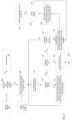
- FIG. 3 depicts a method for processing destination calls in an example embodiment.
- the method is described as being executed by one or more of the elevator group controllers GC-1, GC-2 and GC-3.
- the elevator group controllers may share processing and assignment of elevator cars as the passenger travels along phases of the journey from the source floor to the destination floor. Each phase of the journey is handled by a different elevator group.
- the method begins at 302 where a passenger enters a travel request in the form of a destination call.
- one or more of the elevator group controllers determines if the destination floor is serviceable by a single group of elevator cars. If so, flow proceeds to 306 where a single destination call is created for the passenger.
- the passenger is assigned an elevator car and is directed to the assigned elevator car via a display or other known devices.
- one or more of the elevator group controllers divides the journey from the source floor to the destination floor into a plurality of phases and allocates an elevator car for the first phase of the journey. This is performed by accessing the building information 206 that identifies which elevator group(s) serve each floor in the building. For example, elevator group controller GC-3 may determine that the first phase of the journey will be served by elevator car E4 of elevator group 3. Elevator group controller GC-3 then creates the destination call that allocates elevator car E4 of elevator group 3 to this passenger.
- one or more of the elevator group controllers obtains the position, load and operating mode of the elevator car assigned to the first phase of the journey at 308.
- one or more of the elevator group controllers determines if the operating mode of the assigned elevator car is normal. If the operating mode is not normal, this may indicate a fault in the operation of the elevator car assigned at 308.
- the process flows to 314 where one or more of the elevator group controllers directs the elevator car assigned at 308 to the nearest safe landing.
- the one or more of the elevator group controllers also assigns a new elevator car at 314 by assigning a new elevator car for the first phase, and the method loops back to 310.
- the method flows to 322 where one or more of the elevator group controllers determines if the next stop of the elevator car is the destination or end of the current phase of the journey. If at 322 the next stop is not the destination of the current phase, the method returns to 310.
- the method flows to 324 where one or more of the elevator group controllers determines the time the passenger will arrive at a landing to commence the second phase of the journey.
- the time may be calculated based on the geographical location of the elevator car relative to the landing where the second phase of the journey begins and the time for the elevator car to reach the first destination at the end of the first phase. This computation takes into account the time it will take to complete the first phase of the journey and the time it will take for the passenger to walk to the next elevator car landing.
- the method flows to 326 where one or more of the elevator group controllers registers a second destination request corresponding to the second phase of the journey.
- the second destination request may include a delay time as computed at 324.
- the second destination request may also include a type of call, where the type of call corresponds to a type of the original destination call.
- the type of call may specify a type of service, such as standard service, wheelchair service, VIP service, etc.
- One or more of the elevator group controllers creates a second destination call that allocates a second elevator car of a second elevator group to this passenger. In this manner, each phase of the journey the passenger receives the same type of elevator service, despite using multiple elevator cars.
- the method proceeds to 328 where one or more of the elevator group controllers confirms that the elevator car for the next phase of the journey is confirmed. If not, flow returns to 324 for allocation of an elevator car for the next phase of the journey. If so, flow proceeds to 330 where one or more of the elevator group controllers provides the next elevator car information to the passenger.
- the information may be provided to the passenger using an in-car display, in-car audio, landing display or landing audio.
- the passenger may be directed to the next elevator car using a display route map and/or announcements.
- Each phase of the journey may be handled in the manner as depicted in FIG. 3 . In other words, the processing depicted in 310-330 may be performed during a first phase of a journey, second phase of a journey, third phase of a journey, etc., until the journey is completed.
- FIG. 4 depicts an example arrangement of elevator groups and example journeys by passengers.
- the elevator system in FIG. 4 employs five elevator group controllers GC-1 through GC-5.
- Elevator group controller GC-1 controls elevator car(s) servicing floors 1-11.
- Elevator group controller GC-2 controls elevator car(s) servicing floors 1-15.
- Elevator group controller GC-3 controls elevator car(s) servicing floors 1-17.
- Elevator group controller GC-4 controls elevator car(s) servicing floors 1-14.
- Elevator group controller GC-5 controls elevator car(s) servicing floors B2-9.
- FIG. 4 illustrates two travel cases. In case 1, the passenger uses an elevator car from group 1 to perform a first phase of travel from floor 9 to floor 1 and an elevator car from group 3 to perform a second phase of travel from floor 1 to floor 16. In case 2, the passenger uses an elevator car from group 5 to perform a first phase of travel from floor B2 to floor 1 and an elevator car from group 4 to perform a second phase of travel from floor 1 to floor 13.
- Embodiments provide several advantages such as avoiding the need for a passenger to give multiple destination requests, reducing wait time and travel time and enriching user experience by guiding passengers to different elevator groups using display route map and/or announcements.
- the type of elevator service is preserved across multiple phases of the journey.
- embodiments can be in the form of processor-implemented processes and devices for practicing those processes, such as a processor in a group controller.
- Embodiments can also be in the form of computer program code containing instructions embodied in tangible media, such as network cloud storage, SD cards, flash drives, floppy diskettes, CD ROMs, hard drives, or any other computer-readable storage medium, wherein, when the computer program code is loaded into and executed by a computer, the computer becomes a device for practicing the embodiments.
- Embodiments can also be in the form of computer program code, for example, whether stored in a storage medium, loaded into and/or executed by a computer, or transmitted over some transmission medium, loaded into and/or executed by a computer, or transmitted over some transmission medium, such as over electrical wiring or cabling, through fiber optics, or via electromagnetic radiation, wherein, when the computer program code is loaded into an executed by a computer, the computer becomes an device for practicing the embodiments.
- the computer program code segments configure the microprocessor to create specific logic circuits.
Landscapes
- Engineering & Computer Science (AREA)
- Automation & Control Theory (AREA)
- Computer Networks & Wireless Communication (AREA)
- Elevator Control (AREA)
Claims (11)
- Système d'ascenseur (101) comprenant :un premier dispositif de commande de groupe d'ascenseurs (GC-1) configuré pour commander une première cabine d'ascenseur (103) d'un premier groupe d'ascenseurs ;un second dispositif de commande de groupe d'ascenseurs (GC-2) configuré pour commander une seconde cabine d'ascenseur (103) d'un second groupe d'ascenseurs, le second dispositif de commande de groupe d'ascenseurs (GC-2) étant en communication bidirectionnelle avec le premier dispositif de commande de groupe d'ascenseurs (GC-1) ;un dispositif d'entrée de destination (204) configuré pour recevoir un appel de destination d'un passager, l'appel de destination identifiant un étage source et un étage de destination ;au moins l'un du premier dispositif de commande de groupe d'ascenseurs (GC-1) et du second dispositif de commande de groupe d'ascenseurs (GC-2) déterminant qu'un voyage de l'étage source à l'étage de destination nécessite une première phase utilisant le premier groupe d'ascenseurs et une seconde phase utilisant le second groupe d'ascenseurs ;au moins l'un du premier dispositif de commande de groupe d'ascenseurs et du second dispositif de commande de groupe d'ascenseurs attribuant la première cabine d'ascenseur (103) pour la première phase et attribuant la seconde cabine d'ascenseur (103) pour la seconde phase ;caractérisé en ce que :l'attribution de la première cabine d'ascenseur (103) pour la première phase comprend la génération d'un premier appel de destination ; et la détection d'une charge de la première cabine d'ascenseur (103) et la fin du premier appel de destination si la charge de la première cabine d'ascenseur (103) est nulle ;si la charge dans la première cabine d'ascenseur (103) n'est pas nulle, un ou plusieurs des dispositifs de commande de groupe d'ascenseurs (GC-1, GC-2) déterminent si l'arrêt suivant de la première cabine d'ascenseur (103) est la fin de la première phase du voyage ;si l'arrêt suivant correspond à la fin de la première phase, un ou plusieurs des dispositifs de commande de groupe d'ascenseurs (GC-1, GC-2) :détermine l'heure à laquelle le passager arrivera à un palier pour commencer la seconde phase du voyage ; etenregistre un second appel de destination correspondant à la seconde phase du voyage ;et en ce que l'attribution de la seconde cabine d'ascenseur (103) pour la seconde phase comprend :la génération d'un second appel de destination ; etla détection d'une charge de la seconde cabine d'ascenseur (103) et la fin du second appel de destination lorsque la charge de la seconde cabine d'ascenseur (103) est nulle.
- Système d'ascenseur (101) selon la revendication 1, dans lequel :
l'attribution de la première cabine d'ascenseur (103) comprend la détection d'un mode de fonctionnement de la première cabine d'ascenseur (103) et l'attribution d'une autre première cabine d'ascenseur (103) pour la première phase lorsque le mode de fonctionnement de la première cabine d'ascenseur (103) n'est pas normal. - Système d'ascenseur (101) selon la revendication 1 ou 2, dans lequel :
le second appel de destination et le premier appel de destination ont le même type, dans lequel le type d'appel spécifie un type de service, tel qu'un service standard, un service en fauteuil roulant ou un service VIP. - Système d'ascenseur (101) selon une quelconque revendication précédente, dans lequel :
l'attribution de la seconde cabine d'ascenseur (103) comprend la détermination si un arrêt suivant de la première cabine d'ascenseur (103) est une fin de la première phase. - Système d'ascenseur (101) selon la revendication 4, dans lequel :
lorsque l'arrêt suivant de la première cabine d'ascenseur (103) est la fin de la première phase, au moins l'un du premier dispositif de commande de groupe d'ascenseurs (GC-1) et du second dispositif de commande de groupe d'ascenseurs (GC-2) déterminant un délai pour que le passager commence la seconde phase du voyage. - Système d'ascenseur (101) selon la revendication 5, dans lequel :
l'attribution de la seconde cabine d'ascenseur (103) à la seconde phase est une réponse au délai. - Procédé de fonctionnement d'un système d'ascenseur (101), le procédé comprenant :la réception d'un appel de destination d'un passager, l'appel de destination identifiant un étage source et un étage de destination ;la détermination qu'un voyage de l'étage source à l'étage de destination nécessite une première phase utilisant un premier groupe d'ascenseurs et une seconde phase utilisant un second groupe d'ascenseurs ;l'attribution d'une première cabine d'ascenseur (103) pour la première phase et l'attribution d'une seconde cabine d'ascenseur (103) pour la seconde phase ;dans lequel l'attribution de la première cabine d'ascenseur (103) pour la première phase comprend :la génération d'un premier appel de destination ;la détection d'une charge de la première cabine d'ascenseur (103) et la fin du premier appel de destination lorsque la charge de la première cabine d'ascenseur (103) est nulle ;dans lequel si la charge dans la première cabine d'ascenseur (103) n'est pas nulle, un ou plusieurs des dispositifs de commande de groupe d'ascenseurs (GC-1, GC-2) déterminent si un arrêt suivant de la première cabine d'ascenseur (103) est une fin de la première phase du voyage ;dans lequel si l'arrêt suivant correspond à la fin de la première phase, un ou plusieurs des dispositifs de commande de groupe d'ascenseurs (GC-1, GC-2) :détermine l'heure à laquelle le passager arrivera à un palier pour commencer la seconde phase du voyage ; etenregistre un second appel de destination correspondant à la seconde phase du voyage ;et l'attribution de la seconde cabine d'ascenseur (103) ;dans lequel l'attribution de la seconde cabine d'ascenseur (103) pour la seconde phase comprend :la génération d'un second appel de destination ; etla détection d'une charge de la seconde cabine d'ascenseur (103) et la fin du second appel de destination lorsque la charge de la seconde cabine d'ascenseur (103) est nulle.
- Procédé selon la revendication 7, dans lequel :
le second appel de destination et le premier appel de destination ont le même type, dans lequel le type d'appel spécifie un type de service, tel qu'un service standard, un service en fauteuil roulant ou un service VIP. - Procédé selon la revendication 7 ou 8, dans lequel :
l'attribution de la première cabine d'ascenseur (103) comprend la détection d'un mode de fonctionnement de la première cabine d'ascenseur (103) et l'attribution d'une autre première cabine d'ascenseur (103) pour la première phase lorsque le mode de fonctionnement de la première cabine d'ascenseur (103) n'est pas normal. - Procédé selon l'une quelconque des revendications 7 à 9, dans lequel :
l'attribution de la seconde cabine d'ascenseur (103) comprend également le fait de déterminer si l'arrêt suivant de la première cabine d'ascenseur (103) est la fin de la première phase et lorsque l'arrêt suivant de la première cabine d'ascenseur est la fin de la première phase, la détermination d'un délai pour que le passager commence la seconde phase du voyage. - Procédé selon la revendication 10, dans lequel :
l'attribution de la seconde cabine d'ascenseur (103) pour la seconde phase est en réponse au délai.
Applications Claiming Priority (1)
| Application Number | Priority Date | Filing Date | Title |
|---|---|---|---|
| IN201811029946 | 2018-08-09 |
Publications (2)
| Publication Number | Publication Date |
|---|---|
| EP3608268A1 EP3608268A1 (fr) | 2020-02-12 |
| EP3608268B1 true EP3608268B1 (fr) | 2025-05-14 |
Family
ID=67587676
Family Applications (1)
| Application Number | Title | Priority Date | Filing Date |
|---|---|---|---|
| EP19191096.7A Active EP3608268B1 (fr) | 2018-08-09 | 2019-08-09 | Appels de destination sur plusieurs groupes d'ascenseurs |
Country Status (3)
| Country | Link |
|---|---|
| US (1) | US12116240B2 (fr) |
| EP (1) | EP3608268B1 (fr) |
| CN (1) | CN110817615A (fr) |
Families Citing this family (1)
| Publication number | Priority date | Publication date | Assignee | Title |
|---|---|---|---|---|
| CN113173468B (zh) * | 2021-05-18 | 2023-05-26 | 日立楼宇技术(广州)有限公司 | 一种召梯方法、装置及电梯控制系统 |
Citations (1)
| Publication number | Priority date | Publication date | Assignee | Title |
|---|---|---|---|---|
| WO2007133173A2 (fr) * | 2006-04-11 | 2007-11-22 | Otis Elevator Company | Système d'ascenseurs comprenant un transfert de passagers de cabine à cabine |
Family Cites Families (38)
| Publication number | Priority date | Publication date | Assignee | Title |
|---|---|---|---|---|
| CH658852A5 (de) | 1982-04-08 | 1986-12-15 | Inventio Ag | Gruppensteuerung fuer aufzuege mit einer einrichtung fuer die steuerung des abwaertsspitzenverkehrs. |
| FI85970C (fi) * | 1986-09-24 | 1992-06-25 | Kone Oy | Foerfarande foer koordinering av hissgrupper. |
| FI113467B (fi) | 2002-11-29 | 2004-04-30 | Kone Corp | Allokointimenetelmä |
| JPH07137946A (ja) | 1993-11-17 | 1995-05-30 | Toshiba Corp | エレベータの制御装置 |
| JPH08169650A (ja) | 1994-12-20 | 1996-07-02 | Hitachi Ltd | エレベーターの制御装置 |
| US5719360A (en) * | 1995-07-31 | 1998-02-17 | Otis Elevator Company | Adjustable transfer floor |
| MY154394A (en) | 1995-10-24 | 2015-06-15 | Toshiba Kk | Elevator group management control apparatus and elevator group management control method |
| US5785153A (en) | 1995-11-29 | 1998-07-28 | Otis Elevator Company | Synchronizing elevator arrival at a level of a building |
| US5773772A (en) | 1996-06-19 | 1998-06-30 | Otis Elevator Company | Transferring elevator cabs between non-contiguous hoistways |
| JP4870863B2 (ja) | 2000-04-28 | 2012-02-08 | 三菱電機株式会社 | エレベータ群最適管理方法、及び最適管理システム |
| US6644442B1 (en) | 2001-03-05 | 2003-11-11 | Kone Corporation | Method for immediate allocation of landing calls |
| US6655501B2 (en) | 2001-06-29 | 2003-12-02 | Inventio Ag | Method for selection of the most favorable elevator of an elevator installation comprising at least two elevator groups |
| EP1367018B1 (fr) | 2002-05-27 | 2010-10-06 | Inventio AG | Ascenseur comprenant plusiers cabines auto-motrice et au moins trois gaines d'ascenseur disposé côte à côte |
| SG119203A1 (en) | 2002-12-13 | 2006-02-28 | Inventio Ag | Method and device for controlling a zonally operated elevator installation |
| FI113755B (fi) * | 2003-01-31 | 2004-06-15 | Kone Corp | Menetelmä hissiryhmän hissien ohjaamiseksi |
| DE502004010757D1 (de) * | 2003-06-27 | 2010-04-01 | Inventio Ag | Verfahren zur Steuerung einer im Zonenbetrieb betriebenen Aufzugsgruppe |
| WO2005016811A1 (fr) | 2003-08-06 | 2005-02-24 | Otis Elevator Company | Commande du trafic d'ascenseurs |
| US7198136B2 (en) | 2003-09-11 | 2007-04-03 | Otis Elevator Company | Elevator device for a multi-sky-lobby system |
| SG111198A1 (en) * | 2003-10-09 | 2005-05-30 | Inventio Ag | Lift installation for zonal operation in a building, method for zonal operation of such a lift installation and method for modernisation of a lift installation |
| ATE457952T1 (de) | 2004-04-22 | 2010-03-15 | Kone Corp | Verfahren zur steuerung von aufzügen in einer aufzugsgruppe |
| US7841450B2 (en) | 2005-08-19 | 2010-11-30 | Thyssenkrupp Elevator Capital Corporation | Twin elevator systems |
| JP2008037630A (ja) | 2006-08-09 | 2008-02-21 | Toshiba Elevator Co Ltd | エレベータの群管理制御装置 |
| WO2010032625A1 (fr) | 2008-09-19 | 2010-03-25 | 三菱電機株式会社 | Système de gestion de groupe d'ascenseur |
| FI121009B (fi) | 2008-10-24 | 2010-06-15 | Kone Corp | Hissijärjestelmä |
| US8939263B2 (en) | 2009-07-15 | 2015-01-27 | Mitsubishi Electric Corporation | Elevator system with assigned car confirmation |
| KR101651533B1 (ko) | 2010-02-26 | 2016-08-26 | 오티스 엘리베이터 컴파니 | 그룹 스코어 정보를 통합한 엘리베이터 디스패칭 시스템에서의 최적 그룹 선택 방법 |
| JP5771431B2 (ja) | 2011-04-12 | 2015-08-26 | 株式会社日立製作所 | 複数バンクの群管理エレベーター |
| FI122988B (fi) | 2011-08-26 | 2012-09-28 | Kone Corp | Hissijärjestelmä |
| FI20116170A7 (fi) | 2011-11-23 | 2013-05-24 | Kone Corp | Hissijärjestelmä |
| AU2013283653B2 (en) | 2012-06-25 | 2016-07-14 | Inventio Ag | Transfers in multiple-deck elevator systems |
| JP6264178B2 (ja) | 2014-04-25 | 2018-01-24 | 三菱電機株式会社 | エレベーターシステム |
| JP6202213B2 (ja) | 2014-09-17 | 2017-09-27 | 三菱電機株式会社 | エレベーターシステム |
| DE102014223153A1 (de) | 2014-11-13 | 2016-05-19 | Thyssenkrupp Ag | Verfahren zum Verarbeiten von Rufeingaben durch eine Aufzugsteuerung und Aufzuganlagen zur Durchführung der Verfahren |
| US9896303B2 (en) * | 2014-12-10 | 2018-02-20 | Thyssenkrupp Elevator Corporation | Method for controlling elevator cars |
| US20180282113A1 (en) * | 2017-03-31 | 2018-10-04 | Otis Elevator Company | Elevator service request using user device with transfer floor |
| US11027943B2 (en) * | 2018-03-29 | 2021-06-08 | Otis Elevator Company | Destination dispatch sectoring |
| US11292690B2 (en) * | 2018-07-25 | 2022-04-05 | Otis Elevator Company | Capacity shifting between partially-overlapping elevator groups |
| US12030741B2 (en) * | 2019-03-25 | 2024-07-09 | Otis Elevator Company | Processing multiple elevator service requests |
-
2019
- 2019-08-06 US US16/532,833 patent/US12116240B2/en active Active
- 2019-08-08 CN CN201910729110.4A patent/CN110817615A/zh active Pending
- 2019-08-09 EP EP19191096.7A patent/EP3608268B1/fr active Active
Patent Citations (1)
| Publication number | Priority date | Publication date | Assignee | Title |
|---|---|---|---|---|
| WO2007133173A2 (fr) * | 2006-04-11 | 2007-11-22 | Otis Elevator Company | Système d'ascenseurs comprenant un transfert de passagers de cabine à cabine |
Also Published As
| Publication number | Publication date |
|---|---|
| EP3608268A1 (fr) | 2020-02-12 |
| CN110817615A (zh) | 2020-02-21 |
| US20200048031A1 (en) | 2020-02-13 |
| US12116240B2 (en) | 2024-10-15 |
Similar Documents
| Publication | Publication Date | Title |
|---|---|---|
| EP3599199B1 (fr) | Décalage de capacité entre des groupes d'ascenseurs se chevauchant partiellement | |
| US11691845B2 (en) | Destination dispatch sectoring | |
| CN116081413B (zh) | 用于监视大堂活动以确定是否取消电梯服务的系统 | |
| EP3608268B1 (fr) | Appels de destination sur plusieurs groupes d'ascenseurs | |
| EP3623331B1 (fr) | Système et procédé d'attribution de service d'ascenseur basé sur la priorité de passagers | |
| EP3546407B1 (fr) | Répartition de super groupe | |
| EP3674240A1 (fr) | Système et procédé d'attribution de service d'ascenseur sur la base d'un emplacement souhaité d'une pluralité de passagers | |
| EP3626663B1 (fr) | Système et procédé permettant d'effectuer un transport en fournissant un transfert de passagers entre une pluralité d'ascenseurs | |
| EP3628621B1 (fr) | Système et procédé de service d'appels d'ascenseurs à distance en fonction de la proximité du palier d'ascenseur | |
| EP4151578B1 (fr) | Système et procédé d'attribution de service d'ascenseur basé sur l'utilisation des passagers | |
| CN110775748B (zh) | 电梯的目的地录入系统上选择按钮的动态分配 | |
| EP3643662B1 (fr) | Système d'ascenseur permettant de diriger un passager vers un locataire dans un bâtiment, que le passager soit à l'intérieur ou à l'extérieur du bâtiment |
Legal Events
| Date | Code | Title | Description |
|---|---|---|---|
| PUAI | Public reference made under article 153(3) epc to a published international application that has entered the european phase |
Free format text: ORIGINAL CODE: 0009012 |
|
| STAA | Information on the status of an ep patent application or granted ep patent |
Free format text: STATUS: THE APPLICATION HAS BEEN PUBLISHED |
|
| AK | Designated contracting states |
Kind code of ref document: A1 Designated state(s): AL AT BE BG CH CY CZ DE DK EE ES FI FR GB GR HR HU IE IS IT LI LT LU LV MC MK MT NL NO PL PT RO RS SE SI SK SM TR |
|
| AX | Request for extension of the european patent |
Extension state: BA ME |
|
| STAA | Information on the status of an ep patent application or granted ep patent |
Free format text: STATUS: REQUEST FOR EXAMINATION WAS MADE |
|
| RIN1 | Information on inventor provided before grant (corrected) |
Inventor name: PUSALA, RAJINIKANTH Inventor name: GANGISETTI, BVSP RAVICHAND |
|
| 17P | Request for examination filed |
Effective date: 20200812 |
|
| RBV | Designated contracting states (corrected) |
Designated state(s): AL AT BE BG CH CY CZ DE DK EE ES FI FR GB GR HR HU IE IS IT LI LT LU LV MC MK MT NL NO PL PT RO RS SE SI SK SM TR |
|
| STAA | Information on the status of an ep patent application or granted ep patent |
Free format text: STATUS: EXAMINATION IS IN PROGRESS |
|
| 17Q | First examination report despatched |
Effective date: 20211018 |
|
| GRAP | Despatch of communication of intention to grant a patent |
Free format text: ORIGINAL CODE: EPIDOSNIGR1 |
|
| STAA | Information on the status of an ep patent application or granted ep patent |
Free format text: STATUS: GRANT OF PATENT IS INTENDED |
|
| INTG | Intention to grant announced |
Effective date: 20241205 |
|
| GRAS | Grant fee paid |
Free format text: ORIGINAL CODE: EPIDOSNIGR3 |
|
| GRAA | (expected) grant |
Free format text: ORIGINAL CODE: 0009210 |
|
| STAA | Information on the status of an ep patent application or granted ep patent |
Free format text: STATUS: THE PATENT HAS BEEN GRANTED |
|
| AK | Designated contracting states |
Kind code of ref document: B1 Designated state(s): AL AT BE BG CH CY CZ DE DK EE ES FI FR GB GR HR HU IE IS IT LI LT LU LV MC MK MT NL NO PL PT RO RS SE SI SK SM TR |
|
| REG | Reference to a national code |
Ref country code: GB Ref legal event code: FG4D |
|
| REG | Reference to a national code |
Ref country code: CH Ref legal event code: EP |
|
| REG | Reference to a national code |
Ref country code: DE Ref legal event code: R096 Ref document number: 602019069886 Country of ref document: DE |
|
| REG | Reference to a national code |
Ref country code: IE Ref legal event code: FG4D |
|
| REG | Reference to a national code |
Ref country code: NL Ref legal event code: MP Effective date: 20250514 |
|
| PG25 | Lapsed in a contracting state [announced via postgrant information from national office to epo] |
Ref country code: PT Free format text: LAPSE BECAUSE OF FAILURE TO SUBMIT A TRANSLATION OF THE DESCRIPTION OR TO PAY THE FEE WITHIN THE PRESCRIBED TIME-LIMIT Effective date: 20250915 Ref country code: FI Free format text: LAPSE BECAUSE OF FAILURE TO SUBMIT A TRANSLATION OF THE DESCRIPTION OR TO PAY THE FEE WITHIN THE PRESCRIBED TIME-LIMIT Effective date: 20250514 Ref country code: ES Free format text: LAPSE BECAUSE OF FAILURE TO SUBMIT A TRANSLATION OF THE DESCRIPTION OR TO PAY THE FEE WITHIN THE PRESCRIBED TIME-LIMIT Effective date: 20250514 |
|
| PGFP | Annual fee paid to national office [announced via postgrant information from national office to epo] |
Ref country code: DE Payment date: 20250724 Year of fee payment: 7 |
|
| REG | Reference to a national code |
Ref country code: LT Ref legal event code: MG9D |
|
| PG25 | Lapsed in a contracting state [announced via postgrant information from national office to epo] |
Ref country code: GR Free format text: LAPSE BECAUSE OF FAILURE TO SUBMIT A TRANSLATION OF THE DESCRIPTION OR TO PAY THE FEE WITHIN THE PRESCRIBED TIME-LIMIT Effective date: 20250815 Ref country code: NO Free format text: LAPSE BECAUSE OF FAILURE TO SUBMIT A TRANSLATION OF THE DESCRIPTION OR TO PAY THE FEE WITHIN THE PRESCRIBED TIME-LIMIT Effective date: 20250814 |
|
| PG25 | Lapsed in a contracting state [announced via postgrant information from national office to epo] |
Ref country code: NL Free format text: LAPSE BECAUSE OF FAILURE TO SUBMIT A TRANSLATION OF THE DESCRIPTION OR TO PAY THE FEE WITHIN THE PRESCRIBED TIME-LIMIT Effective date: 20250514 Ref country code: PL Free format text: LAPSE BECAUSE OF FAILURE TO SUBMIT A TRANSLATION OF THE DESCRIPTION OR TO PAY THE FEE WITHIN THE PRESCRIBED TIME-LIMIT Effective date: 20250514 |
|
| REG | Reference to a national code |
Ref country code: AT Ref legal event code: MK05 Ref document number: 1794671 Country of ref document: AT Kind code of ref document: T Effective date: 20250514 |
|
| PG25 | Lapsed in a contracting state [announced via postgrant information from national office to epo] |
Ref country code: BG Free format text: LAPSE BECAUSE OF FAILURE TO SUBMIT A TRANSLATION OF THE DESCRIPTION OR TO PAY THE FEE WITHIN THE PRESCRIBED TIME-LIMIT Effective date: 20250514 |
|
| PG25 | Lapsed in a contracting state [announced via postgrant information from national office to epo] |
Ref country code: HR Free format text: LAPSE BECAUSE OF FAILURE TO SUBMIT A TRANSLATION OF THE DESCRIPTION OR TO PAY THE FEE WITHIN THE PRESCRIBED TIME-LIMIT Effective date: 20250514 |
|
| PG25 | Lapsed in a contracting state [announced via postgrant information from national office to epo] |
Ref country code: AT Free format text: LAPSE BECAUSE OF FAILURE TO SUBMIT A TRANSLATION OF THE DESCRIPTION OR TO PAY THE FEE WITHIN THE PRESCRIBED TIME-LIMIT Effective date: 20250514 |
|
| PGFP | Annual fee paid to national office [announced via postgrant information from national office to epo] |
Ref country code: FR Payment date: 20250723 Year of fee payment: 7 |
|
| PG25 | Lapsed in a contracting state [announced via postgrant information from national office to epo] |
Ref country code: RS Free format text: LAPSE BECAUSE OF FAILURE TO SUBMIT A TRANSLATION OF THE DESCRIPTION OR TO PAY THE FEE WITHIN THE PRESCRIBED TIME-LIMIT Effective date: 20250814 |
|
| PG25 | Lapsed in a contracting state [announced via postgrant information from national office to epo] |
Ref country code: IS Free format text: LAPSE BECAUSE OF FAILURE TO SUBMIT A TRANSLATION OF THE DESCRIPTION OR TO PAY THE FEE WITHIN THE PRESCRIBED TIME-LIMIT Effective date: 20250914 |
|
| PG25 | Lapsed in a contracting state [announced via postgrant information from national office to epo] |
Ref country code: LV Free format text: LAPSE BECAUSE OF FAILURE TO SUBMIT A TRANSLATION OF THE DESCRIPTION OR TO PAY THE FEE WITHIN THE PRESCRIBED TIME-LIMIT Effective date: 20250514 |
|
| PG25 | Lapsed in a contracting state [announced via postgrant information from national office to epo] |
Ref country code: DK Free format text: LAPSE BECAUSE OF FAILURE TO SUBMIT A TRANSLATION OF THE DESCRIPTION OR TO PAY THE FEE WITHIN THE PRESCRIBED TIME-LIMIT Effective date: 20250514 Ref country code: SM Free format text: LAPSE BECAUSE OF FAILURE TO SUBMIT A TRANSLATION OF THE DESCRIPTION OR TO PAY THE FEE WITHIN THE PRESCRIBED TIME-LIMIT Effective date: 20250514 |
|
| PG25 | Lapsed in a contracting state [announced via postgrant information from national office to epo] |
Ref country code: CZ Free format text: LAPSE BECAUSE OF FAILURE TO SUBMIT A TRANSLATION OF THE DESCRIPTION OR TO PAY THE FEE WITHIN THE PRESCRIBED TIME-LIMIT Effective date: 20250514 |
|
| PG25 | Lapsed in a contracting state [announced via postgrant information from national office to epo] |
Ref country code: EE Free format text: LAPSE BECAUSE OF FAILURE TO SUBMIT A TRANSLATION OF THE DESCRIPTION OR TO PAY THE FEE WITHIN THE PRESCRIBED TIME-LIMIT Effective date: 20250514 |
|
| PG25 | Lapsed in a contracting state [announced via postgrant information from national office to epo] |
Ref country code: RO Free format text: LAPSE BECAUSE OF FAILURE TO SUBMIT A TRANSLATION OF THE DESCRIPTION OR TO PAY THE FEE WITHIN THE PRESCRIBED TIME-LIMIT Effective date: 20250514 Ref country code: SK Free format text: LAPSE BECAUSE OF FAILURE TO SUBMIT A TRANSLATION OF THE DESCRIPTION OR TO PAY THE FEE WITHIN THE PRESCRIBED TIME-LIMIT Effective date: 20250514 |
|
| PG25 | Lapsed in a contracting state [announced via postgrant information from national office to epo] |
Ref country code: IT Free format text: LAPSE BECAUSE OF FAILURE TO SUBMIT A TRANSLATION OF THE DESCRIPTION OR TO PAY THE FEE WITHIN THE PRESCRIBED TIME-LIMIT Effective date: 20250514 |
|
| REG | Reference to a national code |
Ref country code: DE Ref legal event code: R097 Ref document number: 602019069886 Country of ref document: DE |
|
| PLBE | No opposition filed within time limit |
Free format text: ORIGINAL CODE: 0009261 |
|
| STAA | Information on the status of an ep patent application or granted ep patent |
Free format text: STATUS: NO OPPOSITION FILED WITHIN TIME LIMIT |
|
| REG | Reference to a national code |
Ref country code: CH Ref legal event code: H13 Free format text: ST27 STATUS EVENT CODE: U-0-0-H10-H13 (AS PROVIDED BY THE NATIONAL OFFICE) Effective date: 20260324 |
|
| REG | Reference to a national code |
Ref country code: CH Ref legal event code: L10 Free format text: ST27 STATUS EVENT CODE: U-0-0-L10-L00 (AS PROVIDED BY THE NATIONAL OFFICE) Effective date: 20260325 |
|
| PG25 | Lapsed in a contracting state [announced via postgrant information from national office to epo] |
Ref country code: MC Free format text: LAPSE BECAUSE OF FAILURE TO SUBMIT A TRANSLATION OF THE DESCRIPTION OR TO PAY THE FEE WITHIN THE PRESCRIBED TIME-LIMIT Effective date: 20250514 |
|
| PG25 | Lapsed in a contracting state [announced via postgrant information from national office to epo] |
Ref country code: LU Free format text: LAPSE BECAUSE OF NON-PAYMENT OF DUE FEES Effective date: 20250809 |
|
| 26N | No opposition filed |
Effective date: 20260217 |