EP3609883B1 - Composés indazole substitués par fluor et leurs utilisations - Google Patents
Composés indazole substitués par fluor et leurs utilisations Download PDFInfo
- Publication number
- EP3609883B1 EP3609883B1 EP18783676.2A EP18783676A EP3609883B1 EP 3609883 B1 EP3609883 B1 EP 3609883B1 EP 18783676 A EP18783676 A EP 18783676A EP 3609883 B1 EP3609883 B1 EP 3609883B1
- Authority
- EP
- European Patent Office
- Prior art keywords
- alkyl
- mmol
- amino
- hydroxy
- heterocyclyl
- Prior art date
- Legal status (The legal status is an assumption and is not a legal conclusion. Google has not performed a legal analysis and makes no representation as to the accuracy of the status listed.)
- Active
Links
Classifications
-
- C—CHEMISTRY; METALLURGY
- C07—ORGANIC CHEMISTRY
- C07D—HETEROCYCLIC COMPOUNDS
- C07D403/00—Heterocyclic compounds containing two or more hetero rings, having nitrogen atoms as the only ring hetero atoms, not provided for by group C07D401/00
- C07D403/02—Heterocyclic compounds containing two or more hetero rings, having nitrogen atoms as the only ring hetero atoms, not provided for by group C07D401/00 containing two hetero rings
- C07D403/04—Heterocyclic compounds containing two or more hetero rings, having nitrogen atoms as the only ring hetero atoms, not provided for by group C07D401/00 containing two hetero rings directly linked by a ring-member-to-ring-member bond
-
- A—HUMAN NECESSITIES
- A61—MEDICAL OR VETERINARY SCIENCE; HYGIENE
- A61K—PREPARATIONS FOR MEDICAL, DENTAL OR TOILETRY PURPOSES
- A61K31/00—Medicinal preparations containing organic active ingredients
- A61K31/33—Heterocyclic compounds
- A61K31/395—Heterocyclic compounds having nitrogen as a ring hetero atom, e.g. guanethidine or rifamycins
- A61K31/495—Heterocyclic compounds having nitrogen as a ring hetero atom, e.g. guanethidine or rifamycins having six-membered rings with two or more nitrogen atoms as the only ring heteroatoms, e.g. piperazine or tetrazines
- A61K31/505—Pyrimidines; Hydrogenated pyrimidines, e.g. trimethoprim
- A61K31/506—Pyrimidines; Hydrogenated pyrimidines, e.g. trimethoprim not condensed and containing further heterocyclic rings
-
- A—HUMAN NECESSITIES
- A61—MEDICAL OR VETERINARY SCIENCE; HYGIENE
- A61K—PREPARATIONS FOR MEDICAL, DENTAL OR TOILETRY PURPOSES
- A61K45/00—Medicinal preparations containing active ingredients not provided for in groups A61K31/00 - A61K41/00
- A61K45/06—Mixtures of active ingredients without chemical characterisation, e.g. antiphlogistics and cardiaca
-
- A—HUMAN NECESSITIES
- A61—MEDICAL OR VETERINARY SCIENCE; HYGIENE
- A61P—SPECIFIC THERAPEUTIC ACTIVITY OF CHEMICAL COMPOUNDS OR MEDICINAL PREPARATIONS
- A61P1/00—Drugs for disorders of the alimentary tract or the digestive system
-
- A—HUMAN NECESSITIES
- A61—MEDICAL OR VETERINARY SCIENCE; HYGIENE
- A61P—SPECIFIC THERAPEUTIC ACTIVITY OF CHEMICAL COMPOUNDS OR MEDICINAL PREPARATIONS
- A61P1/00—Drugs for disorders of the alimentary tract or the digestive system
- A61P1/18—Drugs for disorders of the alimentary tract or the digestive system for pancreatic disorders, e.g. pancreatic enzymes
-
- A—HUMAN NECESSITIES
- A61—MEDICAL OR VETERINARY SCIENCE; HYGIENE
- A61P—SPECIFIC THERAPEUTIC ACTIVITY OF CHEMICAL COMPOUNDS OR MEDICINAL PREPARATIONS
- A61P11/00—Drugs for disorders of the respiratory system
- A61P11/06—Antiasthmatics
-
- A—HUMAN NECESSITIES
- A61—MEDICAL OR VETERINARY SCIENCE; HYGIENE
- A61P—SPECIFIC THERAPEUTIC ACTIVITY OF CHEMICAL COMPOUNDS OR MEDICINAL PREPARATIONS
- A61P13/00—Drugs for disorders of the urinary system
-
- A—HUMAN NECESSITIES
- A61—MEDICAL OR VETERINARY SCIENCE; HYGIENE
- A61P—SPECIFIC THERAPEUTIC ACTIVITY OF CHEMICAL COMPOUNDS OR MEDICINAL PREPARATIONS
- A61P13/00—Drugs for disorders of the urinary system
- A61P13/08—Drugs for disorders of the urinary system of the prostate
-
- A—HUMAN NECESSITIES
- A61—MEDICAL OR VETERINARY SCIENCE; HYGIENE
- A61P—SPECIFIC THERAPEUTIC ACTIVITY OF CHEMICAL COMPOUNDS OR MEDICINAL PREPARATIONS
- A61P13/00—Drugs for disorders of the urinary system
- A61P13/10—Drugs for disorders of the urinary system of the bladder
-
- A—HUMAN NECESSITIES
- A61—MEDICAL OR VETERINARY SCIENCE; HYGIENE
- A61P—SPECIFIC THERAPEUTIC ACTIVITY OF CHEMICAL COMPOUNDS OR MEDICINAL PREPARATIONS
- A61P13/00—Drugs for disorders of the urinary system
- A61P13/12—Drugs for disorders of the urinary system of the kidneys
-
- A—HUMAN NECESSITIES
- A61—MEDICAL OR VETERINARY SCIENCE; HYGIENE
- A61P—SPECIFIC THERAPEUTIC ACTIVITY OF CHEMICAL COMPOUNDS OR MEDICINAL PREPARATIONS
- A61P15/00—Drugs for genital or sexual disorders; Contraceptives
-
- A—HUMAN NECESSITIES
- A61—MEDICAL OR VETERINARY SCIENCE; HYGIENE
- A61P—SPECIFIC THERAPEUTIC ACTIVITY OF CHEMICAL COMPOUNDS OR MEDICINAL PREPARATIONS
- A61P15/00—Drugs for genital or sexual disorders; Contraceptives
- A61P15/08—Drugs for genital or sexual disorders; Contraceptives for gonadal disorders or for enhancing fertility, e.g. inducers of ovulation or of spermatogenesis
-
- A—HUMAN NECESSITIES
- A61—MEDICAL OR VETERINARY SCIENCE; HYGIENE
- A61P—SPECIFIC THERAPEUTIC ACTIVITY OF CHEMICAL COMPOUNDS OR MEDICINAL PREPARATIONS
- A61P15/00—Drugs for genital or sexual disorders; Contraceptives
- A61P15/10—Drugs for genital or sexual disorders; Contraceptives for impotence
-
- A—HUMAN NECESSITIES
- A61—MEDICAL OR VETERINARY SCIENCE; HYGIENE
- A61P—SPECIFIC THERAPEUTIC ACTIVITY OF CHEMICAL COMPOUNDS OR MEDICINAL PREPARATIONS
- A61P17/00—Drugs for dermatological disorders
-
- A—HUMAN NECESSITIES
- A61—MEDICAL OR VETERINARY SCIENCE; HYGIENE
- A61P—SPECIFIC THERAPEUTIC ACTIVITY OF CHEMICAL COMPOUNDS OR MEDICINAL PREPARATIONS
- A61P19/00—Drugs for skeletal disorders
- A61P19/08—Drugs for skeletal disorders for bone diseases, e.g. rachitism, Paget's disease
-
- A—HUMAN NECESSITIES
- A61—MEDICAL OR VETERINARY SCIENCE; HYGIENE
- A61P—SPECIFIC THERAPEUTIC ACTIVITY OF CHEMICAL COMPOUNDS OR MEDICINAL PREPARATIONS
- A61P19/00—Drugs for skeletal disorders
- A61P19/08—Drugs for skeletal disorders for bone diseases, e.g. rachitism, Paget's disease
- A61P19/10—Drugs for skeletal disorders for bone diseases, e.g. rachitism, Paget's disease for osteoporosis
-
- A—HUMAN NECESSITIES
- A61—MEDICAL OR VETERINARY SCIENCE; HYGIENE
- A61P—SPECIFIC THERAPEUTIC ACTIVITY OF CHEMICAL COMPOUNDS OR MEDICINAL PREPARATIONS
- A61P25/00—Drugs for disorders of the nervous system
- A61P25/06—Antimigraine agents
-
- A—HUMAN NECESSITIES
- A61—MEDICAL OR VETERINARY SCIENCE; HYGIENE
- A61P—SPECIFIC THERAPEUTIC ACTIVITY OF CHEMICAL COMPOUNDS OR MEDICINAL PREPARATIONS
- A61P25/00—Drugs for disorders of the nervous system
- A61P25/14—Drugs for disorders of the nervous system for treating abnormal movements, e.g. chorea, dyskinesia
-
- A—HUMAN NECESSITIES
- A61—MEDICAL OR VETERINARY SCIENCE; HYGIENE
- A61P—SPECIFIC THERAPEUTIC ACTIVITY OF CHEMICAL COMPOUNDS OR MEDICINAL PREPARATIONS
- A61P25/00—Drugs for disorders of the nervous system
- A61P25/14—Drugs for disorders of the nervous system for treating abnormal movements, e.g. chorea, dyskinesia
- A61P25/16—Anti-Parkinson drugs
-
- A—HUMAN NECESSITIES
- A61—MEDICAL OR VETERINARY SCIENCE; HYGIENE
- A61P—SPECIFIC THERAPEUTIC ACTIVITY OF CHEMICAL COMPOUNDS OR MEDICINAL PREPARATIONS
- A61P25/00—Drugs for disorders of the nervous system
- A61P25/20—Hypnotics; Sedatives
-
- A—HUMAN NECESSITIES
- A61—MEDICAL OR VETERINARY SCIENCE; HYGIENE
- A61P—SPECIFIC THERAPEUTIC ACTIVITY OF CHEMICAL COMPOUNDS OR MEDICINAL PREPARATIONS
- A61P25/00—Drugs for disorders of the nervous system
- A61P25/22—Anxiolytics
-
- A—HUMAN NECESSITIES
- A61—MEDICAL OR VETERINARY SCIENCE; HYGIENE
- A61P—SPECIFIC THERAPEUTIC ACTIVITY OF CHEMICAL COMPOUNDS OR MEDICINAL PREPARATIONS
- A61P25/00—Drugs for disorders of the nervous system
- A61P25/24—Antidepressants
-
- A—HUMAN NECESSITIES
- A61—MEDICAL OR VETERINARY SCIENCE; HYGIENE
- A61P—SPECIFIC THERAPEUTIC ACTIVITY OF CHEMICAL COMPOUNDS OR MEDICINAL PREPARATIONS
- A61P25/00—Drugs for disorders of the nervous system
- A61P25/28—Drugs for disorders of the nervous system for treating neurodegenerative disorders of the central nervous system, e.g. nootropic agents, cognition enhancers, drugs for treating Alzheimer's disease or other forms of dementia
-
- A—HUMAN NECESSITIES
- A61—MEDICAL OR VETERINARY SCIENCE; HYGIENE
- A61P—SPECIFIC THERAPEUTIC ACTIVITY OF CHEMICAL COMPOUNDS OR MEDICINAL PREPARATIONS
- A61P25/00—Drugs for disorders of the nervous system
- A61P25/30—Drugs for disorders of the nervous system for treating abuse or dependence
-
- A—HUMAN NECESSITIES
- A61—MEDICAL OR VETERINARY SCIENCE; HYGIENE
- A61P—SPECIFIC THERAPEUTIC ACTIVITY OF CHEMICAL COMPOUNDS OR MEDICINAL PREPARATIONS
- A61P27/00—Drugs for disorders of the senses
- A61P27/02—Ophthalmic agents
-
- A—HUMAN NECESSITIES
- A61—MEDICAL OR VETERINARY SCIENCE; HYGIENE
- A61P—SPECIFIC THERAPEUTIC ACTIVITY OF CHEMICAL COMPOUNDS OR MEDICINAL PREPARATIONS
- A61P27/00—Drugs for disorders of the senses
- A61P27/02—Ophthalmic agents
- A61P27/06—Antiglaucoma agents or miotics
-
- A—HUMAN NECESSITIES
- A61—MEDICAL OR VETERINARY SCIENCE; HYGIENE
- A61P—SPECIFIC THERAPEUTIC ACTIVITY OF CHEMICAL COMPOUNDS OR MEDICINAL PREPARATIONS
- A61P27/00—Drugs for disorders of the senses
- A61P27/16—Otologicals
-
- A—HUMAN NECESSITIES
- A61—MEDICAL OR VETERINARY SCIENCE; HYGIENE
- A61P—SPECIFIC THERAPEUTIC ACTIVITY OF CHEMICAL COMPOUNDS OR MEDICINAL PREPARATIONS
- A61P29/00—Non-central analgesic, antipyretic or antiinflammatory agents, e.g. antirheumatic agents; Non-steroidal antiinflammatory drugs [NSAID]
-
- A—HUMAN NECESSITIES
- A61—MEDICAL OR VETERINARY SCIENCE; HYGIENE
- A61P—SPECIFIC THERAPEUTIC ACTIVITY OF CHEMICAL COMPOUNDS OR MEDICINAL PREPARATIONS
- A61P3/00—Drugs for disorders of the metabolism
-
- A—HUMAN NECESSITIES
- A61—MEDICAL OR VETERINARY SCIENCE; HYGIENE
- A61P—SPECIFIC THERAPEUTIC ACTIVITY OF CHEMICAL COMPOUNDS OR MEDICINAL PREPARATIONS
- A61P3/00—Drugs for disorders of the metabolism
- A61P3/04—Anorexiants; Antiobesity agents
-
- A—HUMAN NECESSITIES
- A61—MEDICAL OR VETERINARY SCIENCE; HYGIENE
- A61P—SPECIFIC THERAPEUTIC ACTIVITY OF CHEMICAL COMPOUNDS OR MEDICINAL PREPARATIONS
- A61P3/00—Drugs for disorders of the metabolism
- A61P3/06—Antihyperlipidemics
-
- A—HUMAN NECESSITIES
- A61—MEDICAL OR VETERINARY SCIENCE; HYGIENE
- A61P—SPECIFIC THERAPEUTIC ACTIVITY OF CHEMICAL COMPOUNDS OR MEDICINAL PREPARATIONS
- A61P3/00—Drugs for disorders of the metabolism
- A61P3/08—Drugs for disorders of the metabolism for glucose homeostasis
- A61P3/10—Drugs for disorders of the metabolism for glucose homeostasis for hyperglycaemia, e.g. antidiabetics
-
- A—HUMAN NECESSITIES
- A61—MEDICAL OR VETERINARY SCIENCE; HYGIENE
- A61P—SPECIFIC THERAPEUTIC ACTIVITY OF CHEMICAL COMPOUNDS OR MEDICINAL PREPARATIONS
- A61P37/00—Drugs for immunological or allergic disorders
- A61P37/02—Immunomodulators
- A61P37/06—Immunosuppressants, e.g. drugs for graft rejection
-
- A—HUMAN NECESSITIES
- A61—MEDICAL OR VETERINARY SCIENCE; HYGIENE
- A61P—SPECIFIC THERAPEUTIC ACTIVITY OF CHEMICAL COMPOUNDS OR MEDICINAL PREPARATIONS
- A61P7/00—Drugs for disorders of the blood or the extracellular fluid
- A61P7/02—Antithrombotic agents; Anticoagulants; Platelet aggregation inhibitors
-
- A—HUMAN NECESSITIES
- A61—MEDICAL OR VETERINARY SCIENCE; HYGIENE
- A61P—SPECIFIC THERAPEUTIC ACTIVITY OF CHEMICAL COMPOUNDS OR MEDICINAL PREPARATIONS
- A61P7/00—Drugs for disorders of the blood or the extracellular fluid
- A61P7/06—Antianaemics
-
- A—HUMAN NECESSITIES
- A61—MEDICAL OR VETERINARY SCIENCE; HYGIENE
- A61P—SPECIFIC THERAPEUTIC ACTIVITY OF CHEMICAL COMPOUNDS OR MEDICINAL PREPARATIONS
- A61P7/00—Drugs for disorders of the blood or the extracellular fluid
- A61P7/10—Antioedematous agents; Diuretics
-
- A—HUMAN NECESSITIES
- A61—MEDICAL OR VETERINARY SCIENCE; HYGIENE
- A61P—SPECIFIC THERAPEUTIC ACTIVITY OF CHEMICAL COMPOUNDS OR MEDICINAL PREPARATIONS
- A61P9/00—Drugs for disorders of the cardiovascular system
-
- A—HUMAN NECESSITIES
- A61—MEDICAL OR VETERINARY SCIENCE; HYGIENE
- A61P—SPECIFIC THERAPEUTIC ACTIVITY OF CHEMICAL COMPOUNDS OR MEDICINAL PREPARATIONS
- A61P9/00—Drugs for disorders of the cardiovascular system
- A61P9/02—Non-specific cardiovascular stimulants, e.g. drugs for syncope, antihypotensives
-
- A—HUMAN NECESSITIES
- A61—MEDICAL OR VETERINARY SCIENCE; HYGIENE
- A61P—SPECIFIC THERAPEUTIC ACTIVITY OF CHEMICAL COMPOUNDS OR MEDICINAL PREPARATIONS
- A61P9/00—Drugs for disorders of the cardiovascular system
- A61P9/04—Inotropic agents, i.e. stimulants of cardiac contraction; Drugs for heart failure
-
- A—HUMAN NECESSITIES
- A61—MEDICAL OR VETERINARY SCIENCE; HYGIENE
- A61P—SPECIFIC THERAPEUTIC ACTIVITY OF CHEMICAL COMPOUNDS OR MEDICINAL PREPARATIONS
- A61P9/00—Drugs for disorders of the cardiovascular system
- A61P9/06—Antiarrhythmics
-
- A—HUMAN NECESSITIES
- A61—MEDICAL OR VETERINARY SCIENCE; HYGIENE
- A61P—SPECIFIC THERAPEUTIC ACTIVITY OF CHEMICAL COMPOUNDS OR MEDICINAL PREPARATIONS
- A61P9/00—Drugs for disorders of the cardiovascular system
- A61P9/10—Drugs for disorders of the cardiovascular system for treating ischaemic or atherosclerotic diseases, e.g. antianginal drugs, coronary vasodilators, drugs for myocardial infarction, retinopathy, cerebrovascula insufficiency, renal arteriosclerosis
-
- A—HUMAN NECESSITIES
- A61—MEDICAL OR VETERINARY SCIENCE; HYGIENE
- A61P—SPECIFIC THERAPEUTIC ACTIVITY OF CHEMICAL COMPOUNDS OR MEDICINAL PREPARATIONS
- A61P9/00—Drugs for disorders of the cardiovascular system
- A61P9/12—Antihypertensives
-
- C—CHEMISTRY; METALLURGY
- C07—ORGANIC CHEMISTRY
- C07D—HETEROCYCLIC COMPOUNDS
- C07D401/00—Heterocyclic compounds containing two or more hetero rings, having nitrogen atoms as the only ring hetero atoms, at least one ring being a six-membered ring with only one nitrogen atom
- C07D401/14—Heterocyclic compounds containing two or more hetero rings, having nitrogen atoms as the only ring hetero atoms, at least one ring being a six-membered ring with only one nitrogen atom containing three or more hetero rings
-
- C—CHEMISTRY; METALLURGY
- C07—ORGANIC CHEMISTRY
- C07D—HETEROCYCLIC COMPOUNDS
- C07D403/00—Heterocyclic compounds containing two or more hetero rings, having nitrogen atoms as the only ring hetero atoms, not provided for by group C07D401/00
- C07D403/14—Heterocyclic compounds containing two or more hetero rings, having nitrogen atoms as the only ring hetero atoms, not provided for by group C07D401/00 containing three or more hetero rings
-
- C—CHEMISTRY; METALLURGY
- C07—ORGANIC CHEMISTRY
- C07D—HETEROCYCLIC COMPOUNDS
- C07D405/00—Heterocyclic compounds containing both one or more hetero rings having oxygen atoms as the only ring hetero atoms, and one or more rings having nitrogen as the only ring hetero atom
- C07D405/14—Heterocyclic compounds containing both one or more hetero rings having oxygen atoms as the only ring hetero atoms, and one or more rings having nitrogen as the only ring hetero atom containing three or more hetero rings
-
- C—CHEMISTRY; METALLURGY
- C07—ORGANIC CHEMISTRY
- C07D—HETEROCYCLIC COMPOUNDS
- C07D413/00—Heterocyclic compounds containing two or more hetero rings, at least one ring having nitrogen and oxygen atoms as the only ring hetero atoms
- C07D413/14—Heterocyclic compounds containing two or more hetero rings, at least one ring having nitrogen and oxygen atoms as the only ring hetero atoms containing three or more hetero rings
-
- C—CHEMISTRY; METALLURGY
- C07—ORGANIC CHEMISTRY
- C07D—HETEROCYCLIC COMPOUNDS
- C07D417/00—Heterocyclic compounds containing two or more hetero rings, at least one ring having nitrogen and sulfur atoms as the only ring hetero atoms, not provided for by group C07D415/00
- C07D417/14—Heterocyclic compounds containing two or more hetero rings, at least one ring having nitrogen and sulfur atoms as the only ring hetero atoms, not provided for by group C07D415/00 containing three or more hetero rings
-
- C—CHEMISTRY; METALLURGY
- C07—ORGANIC CHEMISTRY
- C07B—GENERAL METHODS OF ORGANIC CHEMISTRY; APPARATUS THEREFOR
- C07B2200/00—Indexing scheme relating to specific properties of organic compounds
- C07B2200/09—Geometrical isomers
Definitions
- the invention belongs to the pharmaceutical field, specifically, it relates to fluorine-substituted indazole compounds and uses thereof, further to pharmaceutical compositions containing these compounds. These compounds and pharmaceutical compositions can be used as soluble guanylate cyclase stimulators.
- Cyclic guanosine monophosphate is a second messenger having action of intracellular signal transduction, and together with nitrogen monoxide (NO), which is released from the endothelium and transmits hormonal and mechanical signals, forms the NO/cGMP system.
- Guanylate cyclases catalyze the biosynthesis of cGMP from guanosine triphosphate (GTP).
- GTP guanosine triphosphate
- the known representatives of this family can be classified both according to structural features and according to the type of ligands into two groups: the particulate guanylate cyclases which can be stimulated by natriuretic peptides, and the soluble guanylate cyclases which can be stimulated by NO.
- the soluble guanylate cyclases consist of two subunits and very probably contain one heme per heterodimer, which is part of the regulatory site. NO is able to bind to the iron atom of haem and thus markedly increase the activity of the enzyme. Haem-free enzyme cannot, by contrast, be stimulated by NO. Carbon monoxide (CO) is also able to attach to the central iron atom of haem, but the stimulation by CO is distinctly less than that by NO.
- CO Carbon monoxide
- guanylate cyclase plays an important role in various physiological processes, in particular in the relaxation and proliferation of smooth muscle cells, in platelet aggregation and platelet adhesion and in neuronal signal transmission, and also in disorders which are based on a disturbance of the above mentioned processes.
- the NO/cGMP system may be suppressed, which may lead for example to high blood pressure, platelet activation, increased cellular proliferation, endothelial dysfunction, atherosclerosis, angina pectoris, heart failure, myocardial infarction, thromboses, stroke and sexual dysfunction.
- Soluble guanylate cyclase is widely found in mammalian cytosols and has a relatively high content in lung and brain, and is a key signal transduction enzymes in nitric oxide (NO)-sGC-guanosine monophosphate (cGMP) signaling pathway, sGC is activated in the body and will catalyze GTP into cGMP.
- NO nitric oxide
- cGMP cGMP
- non-NO-dependent sGC stimulators can avoid the shortcomings of traditional NO donor drugs, such as prone tolerance, lack of specificity and short duration, thus has received widespread attention.
- the present invention provides a novel fluorine-substituted indazole compounds as sGC stimulators and pharmaceutical compositions thereof, and the use of the compounds or the pharmaceutical compositions in the manufacture of a medicament, wherein the medicament is used for the treatment and/or prevention of sGC-mediated diseases such as heart failure, sclerosis, systemic sclerosis, sickle cell anemia, achalasia of cardia, pulmonary fibrosis, idiopathic pulmonary fibrosis, cystic fibrosis, pulmonary hypertension and the like.
- sGC-mediated diseases such as heart failure, sclerosis, systemic sclerosis, sickle cell anemia, achalasia of cardia, pulmonary fibrosis, idiopathic pulmonary fibrosis, cystic fibrosis, pulmonary hypertension and the like.
- the compound of the invention has Formula (IV), Formula (IVa), Formula (IVb) or Formula (IVc), or a stereoisomer, a geometric isomer, a tautomer, an N -oxide, a hydrate, a solvate, an ester, a pharmaceutically acceptable salt thereof, or
- R 4 is D, F, Cl, Br, I, CN, NO 2 , mercapto, methyl, ethyl, propyl, butyl, vinyl, propenyl, allyl, ethynyl, propynyl, trifluoromethyl, difluoromethyl, 2,2-difluoroethyl, chloroethyl, 2,2,2-trifluoroethyl, 2-chloro-1-methylethyl, cyclopropyl, cyclobutyl, cyclopentyl, cyclohexyl, tetrahydrofuranyl, morpholinyl, piperidinyl, piperazinyl, pyrrolidinyl, pyrazolidinyl, oxomorpholinyl, thiomorpholinyl, 4,4-dioxothiomorpholinyl, oxazolidinyl, thiazolidinyl, 1,1-dio
- each R 2 is independently H, D, F, Cl, Br, I, CN, NO 2 , amino, hydroxy, mercapto, methyl, ethyl, propyl, butyl, trifluoromethyl, trifluoromethoxy, methylamino, dimethylamino, hydroxymethyl, hydroxyethyl, cyanomethyl, cyanoethyl, aminomethyl, aminoethyl, hydroxymethoxy, hydroxyethoxy, amino C 1-3 alkoxy, methoxy, ethoxy, propoxy or butoxy.
- each R 3 is independently oxo, H, D, F, Cl, Br, I, CN, NO 2 , mercapto, methyl, ethyl, propyl, butyl, trifluoromethyl, 2,2-difluoroethyl, cyclopropyl, cyclobutyl, cyclopentyl, cyclohexyl, azetidinyl, pyrrolidinyl, pyrazolidinyl, piperidinyl, piperazinyl, morpholinyl, oxomorpholinyl, thiomorpholinyl, 4,4-dioxothiomorpholinyl, tetrahydrofuranyl, oxazolidinyl, thiazolidinyl, 1,1-dioxoisothiazolidinyl, oxo-1,3-oxazinyl, phenyl, pyridyl, pyrimidinyl
- each R 5a , R 5b , R 5c and R 5d is independently H, D, methyl, ethyl, propyl, butyl, hydroxymethyl, hydroxyethyl, hydroxypropyl, hydroxybutyl, amino C 1-4 alkyl, cyano C 1-4 alkyl, trifluoromethoxy, chloroethyl, 2,2,2-trifluoroethyl, 2,2-difluoroethyl, 2-chloro-1-methylethyl, methoxymethyl, methoxyethyl, methoxycarbonyl, ethoxycarbonyl, propoxycarbonyl, methylcarbonyl, ethylcarbonyl, methylaminocarbonyl, ethylaminocarbonyl, cyclopropyl, cyclobutyl, cyclopentyl, cyclohexyl, azetidinyl, pyrrolidyl, te
- each R 9 and R 9a is independently H, D, C 1-4 alkyl, C 2-4 alkenyl, C 2-4 alkynyl, halo C 1-4 alkyl, acyl, sulfonyl, C 3-6 cycloalkyl, C 2-5 heterocyclyl, C 6-10 aryl, C 1-5 heteroaryl, C 3-6 cycloalkyl-C 1-3 -alkyl, C 2-5 heterocyclyl-C 1-3 -alkyl, C 6-10 aryl-C 1-3 -alkyl or C 1-5 heteroaryl-C 1-3 -alkyl.
- each R 9 and R 9a is independently H, D, methyl, ethyl, propyl, butyl, C 2-4 alkenyl, C 2-4 alkynyl, trifluoromethyl, chloroethyl, 2,2,2-trifluoroethyl, 2,2-difluoroethyl, 2-chloro-1-methylethyl, cyclopropyl, cyclobutyl, cyclopentyl, cyclohexyl, pyrrolidinyl, tetrahydrofuranyl, morpholinyl, piperidinyl, piperazinyl, phenyl, pyridyl, pyrimidinyl, cyclopropylmethyl, cyclobutylmethyl, phenylmethyl, phenylethyl, pyridylmethyl, pyridylethyl or C 2-5 heterocyclyl-C 1-3 -alkyl.
- each R 8 and R 8a is independently H, D, amino, hydroxy, mercapto, methyl, ethyl, propyl, butyl, trifluoromethyl, chloroethyl, 2,2,2-trifluoroethyl, 2,2-difluoroethyl, 2-chloro-1-methylethyl, methoxy, ethoxy, propoxy, trifluoromethoxy, methylamino, dimethylamino, cyclopropyl, cyclobutyl, cyclopentyl, cyclohexyl, azetidinyl, tetrahydropyranyl, pyrrolidinyl, tetrahydrofuranyl, tetrahydrothienyl, morpholinyl, piperidinyl, piperazinyl, thiomorpholinyl, 1,1-dioxothiomorpholinyl, phenyl, pyrrolyl, morpholinyl
- each R x is independently oxo, H, D, F, Cl, Br, I, CN, amino, hydroxy, mercapto, methyl, ethyl, propyl, butyl, C 2-4 alkenyl, C 2-4 alkynyl, hydroxymethyl, hydroxyethyl, amino C 1-4 alkyl, cyano C 1-4 alkyl, trifluoromethyl, chloroethyl, 2,2,2-trifluoroethyl, 2,2-difluoroethyl, 2-chloro-1-methylethyl, methoxy, ethoxy, propoxy, trifluoromethoxy, methylamino, dimethylamino, C 1-3 alkylcarbonyl, C 1-3 alkylsulfonyl, C 1-3 alkylcarbonylamino, C 1-3 alkylsulfonamino, methoxyformylamino, C 2-3 alkoxycarbonylamino, cycl
- each R 5 and R 5e is independently H, D, methyl, ethyl, propyl, butyl, hydroxy C 1-4 alkyl, amino C 1-4 alkyl, cyano C 1-4 alkyl, halo C 1-4 alkyl, C 1-4 alkoxy-C 1-4 alkyl; each R 6a , R 6b , R 6c and R 6d is independently H, D, F, Cl, Br, I, CN, amino, hydroxy, mercapto, methyl, ethyl, propyl, butyl, hydroxy C 1-4 alkyl, amino C 1-4 alkyl, cyano C 1-4 alkyl or halo C 1-4 alkyl.
- the pharmaceutical composition disclosed herein further comprises at least one of pharmaceutically acceptable carrier, excipient, diluent, adjuvant and vehicle.
- provided herein is use of the compound or the pharmaceutical composition of the invention in the manufacture of a medicament for treating and/or preventing diseases, wherein the diseases comprise heart failure, angina pectoris, hypertension, pulmonary hypertension, ischaemias, vascular disorder, nephropathy, thromboembolic disorder, male sexual dysfunction, systemic sclerosis, sickle cell anemia, achalasia of the cardia, fibrotic disorders and/or arteriosclerosis.
- provided herein is use of the compound or the pharmaceutical composition of the invention in the manufacture a medicament as a soluble guanylate cyclase stimulator.
- the compound or the pharmaceutical composition of the invention for use in treating and/or preventing diseases in a patient, wherein the diseases comprise heart failure, angina pectoris, hypertension, pulmonary hypertension, ischaemias, vascular disorder, nephropathy, thromboembolic disorder, male sexual dysfunction, systemic sclerosis, sickle cell anemia, achalasia of the cardia, fibrotic disorders and/or arteriosclerosis.
- the compound or the pharmaceutical composition of the invention for use in the manufacture a medicament as a soluble guanylate cyclase stimulator.
- a compound useful in a method of treating and/or preventing diseases mediated by soluble guanylate cyalase in a patient comprising administering to the patient a therapeutically effective amount of the compound or the pharmaceutical composition of the invention.
- grammatical articles "a”, “an” and “the”, as used herein, are intended to include “at least one” or “one or more” unless otherwise indicated herein or clearly contradicted by the context.
- the articles are used herein to refer to one or more than one (i.e., at least one) of the grammatical objects of the article.
- a component means one or more components, and thus, possibly, more than one component are contemplated and may be employed or used in an implementation of the described embodiments.
- patient refers to a human (including adults and children) or other animal. In one embodiment, “patient” refers to a human.
- Enantiomers refers to two stereoisomers of a compound which are non-superimposable mirror images of one another.
- tautomer or "tautomeric form” refers to structural isomers of different energies which are interconvertible via a low energy barrier. Where tautomerization is possible (e.g., in solution), a chemical equilibrium of tautomers can be reached.
- proton tautomers also known as prototropic tautomers
- Valence tautomers include interconversions by reorganization of some of the bonding electrons.
- keto-enol tautomerization is the interconversion of pentane-2,4-dione and 4-hydroxypent-3-en-2-one tautomers.
- tautomerization is phenol-keto tautomerization.
- the specific example of phenol-keto tautomerisms is pyridin-4-ol and pyridin-4(1 H )-one tautomerism. Unless otherwise stated, all tautomeric forms of the compounds disclosed herein are within the scope of the invention.
- compounds disclosed herein may optionally be substituted with one or more substituents, such as are illustrated by Formula above, or as exemplified by particular classes, subclasses, and species of the invention.
- substituents of compounds disclosed herein are disclosed in groups or in ranges. It is specifically intended that the invention include each and every individual subcombination of the members of such groups and ranges.
- the term "C 1 -C 6 alkyl”or “C 1-6 alkyl” is specifically intended to individually disclose methyl, ethyl, C 3 alkyl, C 4 alkyl, C 5 alkyl and C 6 alkyl;
- C 1-4 alkyl is specifically intended to individually disclose C 1 alkyl (i.e., methyl), C 2 alkyl (i.e., ethyl), C 3 alkyl (i.e., propyl, including n -propyl and i -propyl), C 4 alkyl ( i . e ., butyl, including n -butyl, i -butyl, sec-butyl and t -butyl).
- linking substituents are described. Where the structure clearly requires a linking group, the Markush variables listed for that group are understood to be linking groups. For example, if the structure requires a linking group and the Markush group definition for that variable lists “alkyl” or “aryl” then it is understood that the “alkyl” or “aryl” represents a linking alkylene group or arylene group, respectively.
- alkyl refers to a saturated linear or branched-chain monovalent hydrocarbon group of 1-20 carbon atoms, wherein the alkyl group is optionally substituted with one or more substituents described herein.
- the alkyl group contains 1-12 carbon atoms.
- the alkyl group contains 1-6 carbon atoms, i.e., C 1-6 alkyl.
- the alkyl group contains 1-4 carbon atoms, i.e., C 1-4 alkyl.
- the alkyl group contains 1-3 carbon atoms, i.e., C 1-3 alkyl.
- the C 1-6 alkyl of the invention can be C 1-4 alkyl; in other embodiments, the C 1-6 alkyl can be C 1-3 alkyl.
- alkylene refers to a saturated divalent hydrocarbon group derived from a straight or branched chain saturated hydrocarbon by the removal of two hydrogen atoms. Unless otherwise specified, the alkylene group contains 1-12 carbon atoms. In some embodiments, the alkylene group contains 1-6 carbon atoms. In other embodiments, the alkylene group contains 1-4 carbon atoms. In still other embodiments, the alkylene group contains 1-3 carbon atoms. In yet other embodiments, the alkylene group contains 1-2 carbon atoms.
- Such examples include methylene (-CH 2 -), ethylene (including -CH 2 CH 2 - or -CH(CH 3 )-), i -propylene (including -CH(CH 3 )CH 2 - or -C(CH 3 ) 2 -), and the like.
- the alkylene group may be optionally substituted with one or more substituents disclosed herein.
- alkenyl refers to linear or branched-chain monovalent hydrocarbon radical of 2 to 12 carbon atoms with at least one site of a carbon-carbon, sp 2 double bond, wherein the alkenyl radical may be optionally substituted with one or more substituents described herein, and includes radicals having "cis” and “tans” orientations, or alternatively, " E " and “Z” orientations.
- the alkenyl contains 2 to 8 carbon atoms.
- the alkenyl contains 2 to 6 carbon atoms.
- the alkenyl contains 2 to 4 carbon atoms.
- alkoxy refers to an alkyl group, as previously defined, attached to the parent molecular moiety via an oxygen atom.
- alkoxy group include methoxy, ethoxy, 1-propoxy, 2-propoxy, 1-butoxy, and the like.
- haloalkyl or “haloalkoxy” refer to alkyl or alkoxy, as the case may be, substituted with one or more halogen atoms.
- Some non-limiting examples of such groups include trifluoromethyl, trifluoromethoxy, chloroethyl (such as 2-chloroethyl), 2,2,2-trifluoroethyl, 2,2-difluroethyl, 2-chloro-1-methylethyl, and the like.
- amino refers to group-NH 2 .
- carboxy refers to group -COOH.
- hydroxy independently refers to group -OH, -CN, -NO 2 , -SH.
- alkylamino refers to an -NH 2 group substituted with one or two alkyl groups, wherein the alkyl group is as defined herein.
- suitable alkylamino radical include, but are not limited to, methylamino and diethylamino, and the like.
- hydroxyalkyl respectively refers to an alkyl substituted with one or more hydroxy (-OH), cyano(-CN) or amino (-NH 2 ), wherein the alkyl is as defined herein.
- the "hydroxyalkyl”, “cyanoalkyl”, “aminoalkyl” respectively refers to "hydroxy C 1-6 alkyl”, “cyano C 1-6 alkyl”, “amino C 1-6 alkyl”, i.e., a C 1-6 alkyl substituted with one or more hydroxy (-OH), cyano (-CN) or amino (-NH 2 ).
- hydroxyalkoxy refers to an alkoxy substituted with one or more hydroxy (-OH), cyano (-CN) or amino (-NH 2 ), wherein the alkoxy is as defined herein.
- alkoxy is as defined herein.
- examples include, but are not limited to, hydroxymethoxy, hydroxyethoxy, cyanomethoxy, aminomethoxy, and the like.
- carbocyclyl refers to a monovalent or multivalent, saturated or partially unsaturated ring having 3 to 12 carbon atoms as a monocyclic, bicyclic or tricyclic ring system, wherein the carbocyclyl group is non-aromatic, and doesn't contain any aromatic ring in the system.
- the carbocyclyl group contains 3 to 10 ring carbon atoms, such as C 3-10 carbocyclyl.
- the carbocyclyl group contains 3 to 8 ring carbon atoms, such as C 3-8 carbocyclyl.
- cycloalkyl refers to a saturated ring having 3 to 12 carbon atoms as a monocyclic, bicyclic, or tricyclic ring system.
- the cycloalkyl group contains 3 to 10 ring carbon atoms, such as C 3-10 cycloalkyl.
- the cycloalkyl group contains 3 to 8 ring carbon atoms, such as C 3-8 cycloalkyl.
- the cycloalkyl group contains 3 to 6 ring carbon atoms, such as C 3-6 cycloalkyl.
- cycloalkylalkyl refers to a cycloalkyl group attached to the rest of the molecule through an alkyl group, wherein the cycloalkyl and alkyl are as defined herein.
- the "cycloalkylalkyl” group may be optionally substituted with one or more substituents disclosed herein. Some non-limiting examples include cyclopropylmethyl, cyclopropylethyl, cyclopentylmethyl, cyclohexylmethyl, cyclohexylethyl, and the like.
- heterocyclyl or “heterocyclic ring” refers to a saturated or partially unsaturated, monocyclic, bicyclic or tricyclic ring system in which at least one ring member is selected from nitrogen, sulfur and oxygen, wherein the heterocyclyl group is non-aromatic, and doesn't contain any aromatic ring in the system.
- the sulfur can be optionally oxygenized to S -oxide and the nitrogen can be optionally oxygenized to N -oxide.
- carbocyclyl group is optionally substituted with one or more substituents described herein.
- the heterocyclyl group may be a C 2-9 heterocyclyl group, which refers to a heterocyclyl group containing 2 to 9 ring carbon atoms and at least one ring heteroatom selected from O, S and N.
- the heterocyclyl group may be a C 2-7 heterocyclyl group, which refers to a heterocyclyl group containing 2 to 7 ring carbon atoms and at least one heteroatom selected from O, S and N.
- the heterocyclyl group may be a C 2-5 heterocyclyl group, which refers to a heterocyclyl group containing 2 to 5 ring carbon atoms and at least one heteroatom selected from O, S and N.
- heterocyclylalkyl refers to a heterocyclyl group attached to the rest of the molecule through an alkyl group, wherein the heterocyclyl and alkyl are as defined herein.
- the group “C 2-9 heterocyclyl-C 1-6 -alkyl”, and the like, refers to that C 2-9 cycloalkyl attaches to the rest of the molecular via C 1-6 alkyl.
- the heterocyclylalkyl group may be optionally substituted with one or more substituents disclosed herein.
- Some non-limiting examples of such group included tetrahydropyranylmethyl, tetrahydropyranylethyl, tetrahydrofuranylmethyl, tetrahydrofuranylethyl, pyrrolidinylmethyl, piperidinylmethyl, piperidinylethyl, morpholinylmethyl and morpholinylethyl, etc.
- halogen refers to fluorine (F), chlorine (Cl), bromine (Br) or iodine (I).
- the heteroaryl group may be a C 1-7 heteroaryl group, which refers to a heteroaryl group containing 1 to 7 ring carbon atoms and at least one ring heteroatom selected from O, S and N.
- the heteroaryl group may be a C 1-6 heteroaryl group, which refers to a heteroaryl group containing 1 to 6 ring carbon atoms and at least one ring heteroatom selected from O, S and N.
- the heteroaryl group may be a C 1-5 heteroaryl group, which refers to a heteroaryl group containing 1 to 5 ring carbon atoms and at least one ring heteroatom selected from O, S and N.
- the heteroaryl group may be a C 1-4 heteroaryl group, which refers to a heteroaryl group containing 1 to 4 ring carbon atoms and at least one ring heteroatom selected from O, S and N.
- the heteroaryl group may be a C 1-3 heteroaryl group, which refers to a heteroaryl group containing 1 to 3 ring carbon atoms and at least one ring heteroatom selected from O, S and N.
- the term "6- to 10-membered heteroaryl” refers to the heteroaryl consists of 6-10 ring atoms, wherein at least one of the ring atoms is a heteroatom selected from O, N and S.
- Some non-limiting examples of such group include furyl, imidazolyl, isoxazolyl, oxazolyl, pyrrolyl, pyrazolyl, pyridyl, pyrimidinyl, pyridazinyl, pyrazinyl, thienyl, thiazolyl, etc, and also include the following non-limiting bicyclic ring: benzimidazolyl, benzofuranyl, benzothiophenyl, indolyl, oxoindolyl, indolinyl, imidazopyridyl, pyrazopryridyl, pyrazopyrimidinyl, quinolyl, isoquinolyl and quinazolinyl, etc.
- the heteroaryl group may be optionally substituted with one or more substituents disclosed herein.
- heteroarylalkyl refers to a heteroaryl group attached to the rest of the molecule through an alkyl group, wherein the heteroaryl and alkyl are as defined herein.
- the “heteroarylalkyl” group may be optionally substituted with one or more substituents disclosed herein. Some non-limiting examples of such group included pyridylmethyl, pyrrolylethyl and quinolylmethyl, etc.
- x- to y-membered refers to the cyclic grop consists of x to y ring atoms, wherein "x- to y-" includes any natural numbers between x and y.
- the ring atoms here include carbon atoms and/or heteroatoms such as O, N, S, and P, etc.
- “3- to 8-membered”, “3- to 10-membered”, “3- to 6-membered” or “6- to 10-membered” refers to the cyclic grop consists of 3 to 8, 3 to 10, 3 to 6 or 6 to 10 ring atoms.
- the ring atoms include carbon atoms and/or heteroatoms such as O, N, S, and P, etc.
- "6- to 10-membered heteroaryl” represents a heteroaryl group consisting of 6, 7, 8, 9 or 10 ring atoms.
- alkoxycarbonyl alkylaminocarbonyl
- cycloalkylcarbonyl heterocyclylcarbonyl
- arylcarbonyl heteroarylcarbonyl
- alkoxycarbonyl alkylaminocarbonyl
- cycloalkylcarbonyl heterocyclylcarbonyl
- arylcarbonyl heteroarylcarbonyl
- Such examples include, but are not limited to, methoxycarbonyl, ethoxycarbonyl, propoxycarbonyl, methylaminocarbonyl, ethylaminocarbonyl, cyclopropylcarbonyl, cyclopentylcarbonyl, cyclohexylcarbonyl, cyclopropoxycarbonyl, tetrahydrofurylcarbonyl, tetrahydropyranylcarbonyl, piperidylcarbonyl, piperazinylcarbonyl, morpholinylcarbonyl, tetrahydrothienylcarbonyl, pyrrolidinylcarbonyl, phenylcarbonyl, pyridylcarbonyl, pyrimidinylcarbonyl, pyrrolylcarbonyl, imidazolylcarbonyl, pyrazolylcarbonyl, thienylcarbonyl or furylcarbonyl, and the like.
- L described in the present invention is a group in Formula b
- L ie., -(CR a R b )f-O-
- any adjacent two R 3 , together with the carbon atoms to which they are attached, form a 3- to 6-membered carbocyclic ring, heterocyclic ring, aromatic ring or heteroaromatic ring means that any adjacent two R 3 , together with the carbon atoms to which they are attached, may form a 3- to 6-membered carbocyclic ring, a 3- to 6-membered heterocyclic ring, a 3- to 6-membered aromatic ring or a 3- to 6-membered heteroaromatic ring, wherein the carbocyclic ring, heterocyclic ring, aromatic ring and heteroaromatic ring are all as defined in the present invention.
- the 3- to 6-membered aromatic ring includes 6-membered aromatic ring, i.e., benzene ring;
- the 3- to 6-membered heteroaromatic ring includes 5- to 6-membered heteroaromatic ring;
- the sulfur atom in the heterocyclic ring may be optionally oxidized to a S -oxide, and the nitrogen atom may be optionally oxidized to an N -oxide.
- the 3- to 6-membered carbocyclic ring or 3- to 6-membered heterocyclic ring is an unsaturated carbocyclic or heterocyclic ring, specific examples include but are not limited to, etc.
- Examples of the 3- to 6-membered aromatic ring and 3- to 6-membered heteroaromatic ring include, but are not limited to, and the like.
- the 3- to 6-membered carbocyclic ring, heterocyclic ring, aromatic ring and heteroaryl rings are unsubstituted or optionally substituted with 1, 2, 3 or 4 R z as described herein.
- R 5a and R 5b together with the N atom to which they are attached, form a 3- to 6-membered heterocyclic ring or heteroaromatic ring; or, R 5c and R 5d , together with the N atom to which they are attached, form a 3- to 6-membered heterocyclic ring or heteroaromatic ring
- R 5a and R 5b together with the N atom to which they are attached, or, R 5c and R 5d , together with the N atom to which they are attached, may form a 3- to 6-membered heterocyclic ring or 3- to 6-membered heteroaromatic ring, wherein the heterocyclic ring and heteroaromatic ring are all as defined in the present invention.
- pharmaceutically acceptable refers to molecular entities and compositions that are physiologically tolerable and do not typically produce an allergic or similar untoward reaction, such as gastric upset, dizziness and the like, when administered to a human.
- pharmaceutically acceptable means molecular entities and compositions approved by a regulatory agency of the Federal or a state government or listed in the U.S. Pharmacopeia or other generally recognized pharmacopeia for use in animals, and more particularly in humans.
- sGC stimulator refers to a compound or agent that has a stimulatory effect on soluble guanylate cyclase (sGC).
- sGC soluble guanylate cyclase
- stimulator and agonist may be used interchangeably.
- prodrug refers to a compound that is transformed in vivo into a compound of the invention ( i . e ., the compound represented by Formula (IV), Formula (IVa), Formula (IVb), Formula (IVc) Such a transformation can be affected, for example, by hydrolysis of the prodrug form in blood or enzymatic transformation to the parent form in blood or tissue.
- Prodrugs of the compounds disclosed herein may be, for example, esters. Some common esters which have been utilized as prodrugs are phenyl esters, aliphatic (C 1-24 ) esters, acyloxymethyl esters, carbonates, carbamates and amino acid esters.
- Some non-limiting examples of pharmaceutically acceptable and nontoxic salts formed from acid include, but are not limited to, inorganic acid salts such as hydrochloride, hydrobromide, phosphate, sulfate, perchlorate; organic acid salts such as acetate , oxalate, maleate, tartrate, citrate, succinate, malonate; or obtained by using other methods used in the art such as ion exchange.
- inorganic acid salts such as hydrochloride, hydrobromide, phosphate, sulfate, perchlorate
- organic acid salts such as acetate , oxalate, maleate, tartrate, citrate, succinate, malonate
- salts include adipate, alginate, ascorbate, aspartate, benzenesulfonate, benzoate, bisulfate, borate, butyrate, camphorate, camphorsulfonate, cyclopentanepropionate, digluconate, dodecylsulfate, ethanesulfonate, formate, fumarate, glucoheptonate, glycerophosphate, gluconate, hemisulfate, heptanoate, hexanoate, hydroiodide, 2-hydroxy-ethanesulfonate, lactobionate, lactate, laurate, laurylsulfate, malate, methanesulfonate, 2-naphthalenesulfonate, nicotinate, nitrate, oleate, palmitate, pamoate, pectinate, persulfate, 3-phenylpropionate, picrate,
- Salts derived from appropriate bases include alkali metal, alkaline earth metal, ammonium and N + (C 1-4 alkyl) 4 salts.
- This invention also envisions the quaternization of any basic nitrogen-containing groups of the compounds disclosed herein. Water or oil soluble or dispersable products may be obtained by such quaternization.
- Representative alkali or alkaline earth metal salts include sodium, lithium, potassium, calcium, magnesium, and the like.
- Further pharmaceutically acceptable salts include, when appropriate, nontoxic ammonium, quaternary ammonium, and amine cations formed using counterions such as halide, hydroxide, carboxylate, sulfate, phosphate, nitrate, C 1-8 sulfonate or aryl sulfonate.
- solvate refers to an association or complex of one or more solvent molecules and a compound disclosed herein.
- solvents that form solvates include, but are not limited to, water, isopropanol, ethanol, methanol, DMSO, ethyl acetate, acetic acid and ethanolamine.
- hydrate refers to the complex where the solvent molecule is water.
- esters refers to an in vivo hydrolysable ester of a compound of the invention containing hydroxy or carboxyl group.
- a pharmaceutically acceptable ester is which is hydrolysed in the human or animal body to produce the parent alcohol or acid.
- the compounds of the present invention i.e., the compound represented by Formula (I), Formula (Ia), Formula (Ib), Formula (Ic), Formula (II), Formula (IIa), Formula (IIb), Formula (IIc), Formula (IId), Formula (III), Formula (IV), Formula (IVa), Formula (IVb), Formula (IVc), Formula (Va), Formula (Vb), Formula (Vc) or Formula (Vd)
- suitable groups include, but are not limited to, alkyl, arylalkyl and the like.
- N -oxide refers to one or more than one nitrogen atoms oxidised to form an N -oxide, where a compound contains several amine functions.
- Particular examples of N -oxides are the N -oxides of a tertiary amine or a nitrogen atom of a nitrogen-containing heterocycle.
- N -oxides can be formed by treatment of the corresponding amine with an oxidizing agent such as hydrogen peroxide or a per-acid (e.g., a peroxycarboxylic acid) (See, Advanced Organic Chemistiy, by Jerry March, 4th Edition, Wiley Interscience, pages ). More particularly, N -oxides can be made by the procedure of L. W. Deady (Syn. Comm. 1977, 7, 509-514 ) in which the amine compound is reacted with m -chloroperoxybenzoic acid (MCPBA), for example, in an inert solvent such as dichloromethane.
- MCPBA
- the compound of the invention As used in the present invention, "the compound of the invention”, “the compound of the present invention”, “the compound described in the present invention”, “a compound described in the present invention” or the like are all referred to the compound represented by any one of the general Formula described in the present invention, i.e., the compound represented by Formula (IV), Formula (IVa), Formula (IVb), Formula (IVc)
- the term “treat”, “treating” or “treatment” of any disease or disorder refers in one embodiment, to ameliorating the disease or disorder (i.e., slowing or arresting or reducing the development of the disease or at least one of the clinical symptoms thereof).
- “treat”, “treating” or “treatment” refers to alleviating or ameliorating at least one physical parameter including those which may not be discernible by the patient.
- “treat”, “treating” or “treatment” refers to modulating the disease or disorder, either physically, (e.g., stabilization of a discernible symptom), physiologically, ( e.g., stabilization of a physical parameter), or both.
- “treat”, “treating” or “treatment” refers to preventing or delaying the onset or development or progression of the disease or disorder.
- Any formula given herein is also intended to represent isotopically unenriched forms as well as isotopically enriched forms of the compounds. Any formula given herein is also intended to represent isotopically unenriched forms as well as isotopically enriched forms of the compounds.
- isotopes that can be incorporated into compounds of the invention include isotopes of hydrogen, carbon, nitrogen, oxygen, phosphorous, fluorine and chlorine, such as 2 H, 3 H, 11 C, 13 C, 14 C, 15 N, 17 O, 18 O, 18 F, 31 P, 32 P, 35 S, 36 Cl and 125 I respectively.
- the compounds of the invention include isotopically enriched compounds as defined herein, for example those into which radioactive isotopes, such as 3 H, 14 C and 18 F, or those into which non-radioactive isotopes, such as 2 H and 13 C are present.
- isotopically enriched compounds are useful in metabolic studies (with 14 C), reaction kinetic studies (with, for example 2 H or 3 H), detection or imaging techniques, such as positron emission tomography (PET) or single-photon emission computed tomography (SPECT) including drug or substrate tissue distribution assays, or in radioactive treatment of patients.
- PET positron emission tomography
- SPECT single-photon emission computed tomography
- an 18 F-enriched compound may be particularly desirable for PET or SPECT studies.
- Isotopically-enriched compounds of the invention can generally be prepared by conventional techniques known to those skilled in the art or by processes analogous to those described in the accompanying Examples and Preparations using an appropriate isotopically-labeled reagent in place of the non-labeled reagent previously employed.
- isotopic enrichment factor means the ratio between the isotopic abundance and the natural abundance of a specified isotope.
- a substituent in a compound of this invention is denoted deuterium, such compound has an isotopic enrichment factor for each designated deuterium atom of at least 3500 (52.5% deuterium incorporation at each designated deuterium atom), at least 4000 (60% deuterium incorporation), at least 4500 (67.5% deuterium incorporation), at least 5000 (75% deuterium incorporation), at least 5500 (82.5% deuterium incorporation), at least 6000 (90% deuterium incorporation), at least 6333.3 (95% deuterium incorporation), at least 6466.7 (97% deuterium incorporation), at least 6600 (99% deuterium incorporation), or at least 6633.3 (99.5% deuterium incorporation).
- Pharmaceutically acceptable solvates in accordance with the invention include those wherein the solvent of crystallization may be isotopically substituted, e.g., D 2 O, acetone- d 6 , DMSO- d 6 .
- the present invention provides a novel fluorine-substituted indazole compounds as sGC stimulatorsand pharmaceutical compositions thereof, and the use of the compounds or the pharmaceutical compositions in the manufacture of a medicament, wherein the medicament is used for the treatment and/or prevention of sGC-mediated diseases such as heart failure, sclerosis, systemic sclerosis, sickle cell anemia, achalasia of cardia, pulmonary fibrosis, idiopathic pulmonary fibrosis, cystic fibrosis, pulmonary hypertension and the like.
- sGC-mediated diseases such as heart failure, sclerosis, systemic sclerosis, sickle cell anemia, achalasia of cardia, pulmonary fibrosis, idiopathic pulmonary fibrosis, cystic fibrosis, pulmonary hypertension and the like.
- each R 2 is independently H, D, F, Cl, Br, I, CN, NO 2 , amino, hydroxy, mercapto, C 1-6 alkyl, C 2-6 alkenyl, C 2-6 alkynyl, halo C 1-6 alkyl, halo C 1-6 alkoxy, C 1-6 alkylamino, hydroxy C 1-6 alkyl, cyano C 1-6 alkyl, amino C 1-6 alkyl, hydroxy C 1-6 alkoxy, amino C 1-6 alkoxy, acyl, sulfonyl or C 1-6 alkoxy.
- each R 2 is independently H, D, F, Cl, Br, I, CN, NO 2 , amino, hydroxy, mercapto, C 1-4 alkyl, C 2-4 alkenyl, C 2-4 alkynyl, halo C 1-4 alkyl, halo C 1-4 alkoxy, C 1-4 alkylamino, hydroxy C 1-4 alkyl, cyano C 1-4 alkyl, amino C 1-4 alkyl, hydroxy C 1-4 alkoxy, amino C 1-4 alkoxy or C 1-4 alkoxy.
- each R 2 is independently H, D, F, Cl, Br, I, CN, NO 2 , amino, hydroxy, mercapto, methyl, ethyl, propyl, butyl, trifluoromethyl, trifluoromethoxy, methylamino, dimethylamino, hydroxymethyl, hydroxyethyl, cyanomethyl, cyanoethyl, aminomethyl, aminoethyl, hydroxymethoxy, hydroxyethoxy, amino C 1-3 alkoxy, methoxy, ethoxy, propoxy or butoxy.
- each R 5 and R 5e is independently H, D, C 1-6 alkyl, hydroxy C 1-6 alkyl, amino C 1-6 alkyl, cyano C 1-6 alkyl, halo C 1-6 alkyl, C 1-6 alkoxy-C 1-6 -alkyl, C 3-6 cycloalkyl, C2-5 heterocyclyl, C 6-10 aryl, C 1-5 heteroaryl, C 3-6 cycloalkyl-C 1-6 -alkyl, C 2-5 heterocyclyl-C 1-6 -alkyl, C 6-10 aryl-C 1-6 -alkyl or C 1-5 heteroaryl-C 1-6 -alkyl.
- each R 5 and R 5e is independently H, D, C 1-4 alkyl, hydroxy C 1-4 alkyl, amino C 1-4 alkyl, cyano C 1-4 alkyl, halo C 1-4 alkyl, C 1-4 alkoxy-C 1-4 -alkyl, C 3-4 cycloalkyl, C2-5 heterocyclyl, C 6-10 aryl, C 1-5 heteroaryl, C 3-6 cycloalkyl-C 1-6 -alkyl, C 2-5 heterocyclyl-C 1-4 -alkyl, C 6-10 aryl-C 1 - 4 -alkyl or C 1-5 heteroaryl-C 1-4 -alkyl.
- each R 5 and R 5e is independently H, D, methyl, ethyl, propyl, butyl, hydroxymethyl, hydroxyethyl, aminomethyl, cyanomethyl, difluoromethyl, 2,2-difluoroethyl, methoxymethyl, cyclopropyl, cyclopropoxy, phenyl, pyridyl, pyrimidinyl, cyclopropanemethyl, piperidinylmethyl, benzyl, pyridylmethyl or pyrimidinylmethyl.
- each R 5a , R 5b , R 5c and R 5d is independently H, D, C 1-6 alkyl, C 2-6 alkenyl, C 2-6 alkynyl, hydroxy C 1-6 alkyl, amino C 1-6 alkyl, cyano C 1-6 alkyl, halo C 1-6 alkyl, C 1-6 alkoxy-C 1-6 -alkyl, C 1-6 alkoxycarbonyl, C 1-6 alkylcarbonyl, C 1-6 alkylaminocarbonyl, C 3-6 cycloalkyl, C 2-5 heterocyclyl, C 6-10 aryl, C 1-5 heteroaryl, C 3-6 cycloalkylcarbonyl, C 2-5 heterocyclylcarbonyl, C 6-10 arylcarbonyl, C 1-5 heteroarylcarbonyl, C 3-6 cycloalkyl-C 1-6 -alkylcarbonyl, C 2-5 heterocyclyl-C 1-6 -alkylcarbonyl, C 2-5
- each R 5a , R 5b , R 5c and R 5d is independently H, D, C 1-4 alkyl, C 2-4 alkenyl, C 2-4 alkynyl, hydroxy C 1-4 alkyl, amino C 1-4 alkyl, cyano C 1-4 alkyl, halo C 1-4 alkyl, C 1-4 alkoxy-C 1-4 -alkyl, C 1-4 alkoxycarbonyl, C 1-4 alkylcarbonyl, C 1-4 alkylaminocarbonyl, C 3-6 cycloalkyl, C 2-5 heterocyclyl, C 6-10 aryl, C 1-5 heteroaryl, C 3-6 cycloalkylcarbonyl, C 2-5 heterocyclylcarbonyl, C 6-10 arylcarbonyl, C 1-5 heteroarylcarbonyl, C 3-6 cycloalkyl-C 1-3 -alkyl, C 2-5 heterocyclyl-C 1-3 -alkyl, C 6-10 ary
- each R 5a , R 5b , R 5c and R 5d is independently H, D, methyl, ethyl, propyl, butyl, hydroxymethyl, hydroxyethyl (including 2-hydroxyethyl and 1-hydroxyethyl), hydroxypropyl, hydroxybutyl, amino C 1-4 alkyl, cyano C 1-4 alkyl, trifluoromethoxy, chloroethyl (including 2-chloroethyl and 1-chloroethyl), 2,2,2-trifluoroethyl, 2,2-difluoroethyl, 2-chloro-1-methylethyl, methoxymethyl, methoxyethyl, methoxycarbonyl, ethoxycarbonyl, propoxycarbonyl, methylcarbonyl, ethylcarbonyl, methylaminocarbonyl, ethylaminocarbonyl, cyclopropyl, cyclobutyl,
- each R 6 , R 6a , R 6b , R 6c , R 6d and R 6e is independently H, D, F, Cl, Br, I, CN, amino, hydroxy, mercapto, C 1-6 alkyl, C 2-6 alkenyl, C 2-6 alkynyl, hydroxy C 1-6 alkyl, amino C 1-6 alkyl, cyano C 1-6 alkyl, halo C 1-6 alkyl, C 1-6 alkoxy, halo C 1-6 alkoxy, C 1-6 alkylamino, acyl, sulfonyl, C 3-6 cycloalkyl, C 2-5 heterocyclyl, C 6-10 aryl or C 1-5 heteroaryl.
- each R 6 , R 6a , R 6b , R 6c , R 6d and R 6e is independently H, D, F, Cl, Br, I, CN, amino, hydroxy, mercapto, C 1-4 alkyl, C 2-4 alkenyl, C 2-4 alkynyl, hydroxy C 1-4 alkyl, amino C 1-4 alkyl, cyano C 1-4 alkyl, halo C 1-4 alkyl, C 1-4 alkoxy, halo C 1-4 alkoxy, C 1-4 alkylamino, acyl, sulfonyl, C 3-6 cycloalkyl, C 2-5 heterocyclyl, C 6-10 aryl or C 1-5 heteroaryl.
- each R 6 , R 6a , R 6b , R 6c , R 6d and R 6e is independently H, D, F, Cl, Br, I, CN, amino, hydroxy, mercapto, methyl, ethyl, propyl, butyl, hydroxy C 1-4 alkyl, amino C 1-4 alkyl, cyano C 1-4 alkyl or halo C 1-4 alkyl.
- each R 6 , R 6a , R 6b , R 6c , R 6d and R 6e is independently H, D, F, Cl, Br, I, CN, amino, hydroxy, mercapto, methyl, ethyl, hydroxymethyl, hydroxyethyl, aminomethyl, aminoethyl, cyanomethyl, cyanoethyl, trifluoromethyl, difluoromethyl, monofluromethyl, chloroethyl, methoxy, ethoxy, trifluoromethoxy or difluoromethoxy.
- each R 7 and R 7a is independently H, D, amino, hydroxy, mercapto, C 1-6 alkyl, C 2-6 alkenyl, C 2-6 alkynyl, halo C 1-6 alkyl, C 1-6 alkoxy, halo C 1-6 alkoxy, C 1-6 alkylamino, C 3-6 cycloalkyl, C 2-5 heterocyclyl, C 6-10 aryl or C 1-5 heteroaryl.
- each R 7 and R 7a is independently H, D, amino, hydroxy, mercapto, C 1-4 alkyl, C 2-4 alkenyl, C 2-4 alkynyl, halo C 1-4 alkyl, C 1-4 alkoxy, halo C 1-4 alkoxy, C 1-4 alkylamino, C 3-6 cycloalkyl, C 2-5 heterocyclyl, C 6-10 aryl or C 1-5 heteroaryl.
- each R 7 and R 7a is independently H, D, amino, hydroxy, mercapto, methyl, ethyl, propyl, butyl or trifluoromethyl.
- each R 8 and R 8a is independently H, D, amino, hydroxy, mercapto, C 1-6 alkyl, C 2-6 alkenyl, C 2-6 alkynyl, halo C 1-6 alkyl, C 1-6 alkoxy, halo C 1-6 alkoxy, C 1-6 alkylamino, C 3-6 cycloalkyl, C 2-5 heterocyclyl, C 6-10 aryl or C 1-5 heteroaryl.
- each R 8 and R 8a is independently H, D, amino, hydroxy, mercapto, C 1-4 alkyl, C 2-4 alkenyl, C 2-4 alkynyl, halo C 1-4 alkyl, C 1-4 alkoxy, halo C 1-4 alkoxy, C 1-4 alkylamino, C 3-6 cycloalkyl, C 2-5 heterocyclyl, C 6-10 aryl or C 1-5 heteroaryl.
- each R 8 and R 8a is independently H, D, amino, hydroxy, mercapto, methyl, ethyl, propyl, butyl, trifluoromethyl, chloroethyl, 2,2,2-trifluoroethyl, 2,2-difluoroethyl, 2-chloro-1-methylethyl, methoxy, ethoxy, propoxy, trifluoromethoxy, methylamino, dimethylamino, cyclopropyl, cyclobutyl, cyclopentyl, cyclohexyl, azetidinyl, tetrahydropyranyl, pyrrolidinyl, tetrahydrofuranyl, tetrahydrothienyl, morpholinyl, piperidinyl, piperazinyl, thiomorpholinyl, 1,1-dioxothiomorpholinyl, phenyl, pyrrolyl, morpholinyl
- each R 9 and R 9a is independently H, D, C 1-6 alkyl, C 2-6 alkenyl, C 2-6 alkynyl, halo C 1-6 alkyl, acyl, sulfonyl, C 3-6 cycloalkyl, C 2-5 heterocyclyl, C 6-10 aryl, C 1-5 heteroaryl, C 3-6 cycloalkyl-C 1-6 -alkyl, C 2-5 heterocyclyl-C 1-6 -alkyl, C 6-10 aryl-C 1-6 -alkyl or C 1-5 heteroaryl-C 1-6 alkyl.
- each R 9 and R 9a is independently H, D, methyl, ethyl, propyl, butyl, C 2-4 alkenyl, C 2-4 alkynyl, trifluoromethyl, chloroethyl, 2,2,2-trifluoroethyl, 2,2-difluoroethyl, 2-chloro-1-methylethyl, cyclopropyl, cyclobutyl, cyclopentyl, cyclohexyl, pyrrolidinyl, tetrahydrofuranyl, morpholinyl, piperidinyl, piperazinyl, phenyl, pyridyl, pyrimidinyl, cyclopropylmethyl, cyclobutylmethyl, phenylmethyl, phenylethyl, pyridylmethyl, pyridylethyl or C 2-5 heterocyclyl-C 1-3 -alkyl.
- each R 10 and R 11 is independently H, D, F, Cl, Br, I, CN, amino, hydroxy, mercapto, C 1-6 alkyl, C 2-6 alkenyl, C 2-6 alkynyl, hydroxy C 1-6 alkyl, amino C 1-6 alkyl, cyano C 1-6 alkyl, halo C 1-6 alkyl, C 1-6 alkoxy, halo C 1-6 alkoxy, C 1-6 alkylamino, acyl, sulfonyl, C 3-6 cycloalkyl, C 2-5 heterocyclyl, C 6-10 aryl or C 1-5 heteroaryl; or, R 10 and R 11 together form carbonyl; or, R 10 and R 11 , together with the carbon atom to which they are attached, form a 3- to 8-membered carbocyclic ring or 3- to 8-membered heterocyclic ring.
- each R x is independently oxo, H, D, F, Cl, Br, I, CN, amino, hydroxy, mercapto, C 1-6 alkyl, C 2-6 alkenyl, C 2-6 alkynyl, hydroxy C 1-6 alkyl, amino C 1-6 alkyl, cyano C 1-6 alkyl, halo C 1-6 alkyl, C 1-6 alkoxy, halo C 1-6 alkoxy, C 1-6 alkylamino, acyl, sulfonyl, C 1-6 alkylcarbonyl, C 1-6 alkylsulfonyl, C 1-6 alkylcarbonylamino, C 1-6 alkylsulfonylamino, C 1-6 alkoxycarbonylamino, C 3-6 cycloalkyl, C 2-5 heterocyclyl, C 6-10 aryl or C 1-5 heteroaryl.
- each R x is independently oxo, H, D, F, Cl, Br, I, CN, amino, hydroxy, mercapto, C 1-4 alkyl, C 2-4 alkenyl, C 2-4 alkynyl, hydroxy C 1-4 alkyl, amino C 1-4 alkyl, cyano C 1-4 alkyl, halo C 1-4 alkyl, C 1-4 alkoxy, halo C 1-4 alkoxy, C 1-4 alkylamino, acyl, sulfonyl, C 1-4 alkylcarbonyl, C 1-4 alkylsulfonyl, C 1-4 alkylcarbonylamino, C 1-4 alkylsulfonylamino, C 1-4 alkoxycarbonylamino, C 3-6 cycloalkyl, C 2-5 heterocyclyl, C 6-10 aryl or C 1-5 heteroaryl.
- each R y is independently oxo, H, D, F, Cl, Br, I, CN, amino, hydroxy, mercapto, C 1-6 alkyl, C 2-6 alkenyl, C 2-6 alkynyl, hydroxy C 1-6 alkyl, amino C 1-6 alkyl, cyano C 1-6 alkyl, halo C 1-6 alkyl, C 1-6 alkoxy, halo C 1-6 alkoxy, C 1-6 alkylamino, acyl, sulfonyl, C 1-6 alkylcarbonyl, C 1-6 alkylsulfonyl, C 1-6 alkylcarbonylamino, C 1-6 alkylsulfonylamino, C 1-6 alkoxycarbonylamino, C 3-6 cycloalkyl, C 2-5 heterocyclyl, C 6-10 aryl or C 1-5 heteroaryl.
- each R y is independently oxo, H, D, F, Cl, Br, I, CN, amino, hydroxy, mercapto, C 1-4 alkyl, C 2-4 alkenyl, C 2-4 alkynyl, hydroxy C 1-4 alkyl, amino C 1-4 alkyl, cyano C 1-4 alkyl, halo C 1-4 alkyl, C 1-4 alkoxy, halo C 1-4 alkoxy, C 1-4 alkylamino, acyl, sulfonyl, C 1-4 alkylcarbonyl, C 1-4 alkylsulfonyl, C 1-4 alkylcarbonylamino, C 1-4 alkylsulfonylamino, C 1-4 alkoxycarbonylamino, C 3-6 cycloalkyl, C 2-5 heterocyclyl, C 6-10 aryl or C 1-5 heteroaryl.
- each R y is independently oxo, H, D, F, Cl, Br, I, CN, amino, hydroxy, mercapto, methyl, ethyl, propyl, butyl, C 2-4 alkenyl, C 2-4 alkynyl, hydroxymethyl, hydroxyethyl, amino C 1-4 alkyl, cyano C 1-4 alkyl, trifluoromethyl, chloroethyl, 2,2,2-trifluoroethyl, 2,2-difluoroethyl, 2-chloro-1-methylethyl, methoxy, ethoxy, propoxy, trifluoromethoxy, methylamino, dimethylamino, C 1-3 alkylcarbonyl, C 1-3 alkylsulfonyl, C 1-3 alkylcarbonylamino, C 1-3 alkylsulfonamino, methoxyformylamino, C 2-3 alkoxycarbonylamino, cycl
- each R z is independently oxo, H, D, F, Cl, Br, I, CN, amino, hydroxy, mercapto, C 1-6 alkyl, C 2-6 alkenyl, C 2-6 alkynyl, hydroxy C 1-6 alkyl, amino C 1-6 alkyl, cyano C 1-6 alkyl, halo C 1-6 alkyl, C 1-6 alkoxy, halo C 1-6 alkoxy, C 1-6 alkylamino, acyl, sulfonyl, C 1-6 alkylcarbonyl, C 1-6 alkylsulfonyl, C 1-6 alkylcarbonylamino, C 1-6 alkylsulfonylamino, C 1-6 alkoxycarbonylamino, C 3-6 cycloalkyl, C 2-5 heterocyclyl, C 6-10 aryl or C 1-5 heteroaryl.
- each R z is independently oxo, H, D, F, Cl, Br, I, CN, amino, hydroxy, mercapto, C 1-4 alkyl, C 2-4 alkenyl, C 2-4 alkynyl, hydroxy C 1-4 alkyl, amino C 1-4 alkyl, cyano C 1-4 alkyl, halo C 1-4 alkyl, C 1-4 alkoxy, halo C 1-4 alkoxy, C 1-4 alkylamino, acyl, sulfonyl, C 1-4 alkylcarbonyl, C 1-4 alkylsulfonyl, C 1-4 alkylcarbonylamino, C 1-4 alkylsulfonylamino, C 1-4 alkoxycarbonylamino, C 3-6 cycloalkyl, C 2-5 heterocyclyl, C 6-10 aryl or C 1-5 heteroaryl.
- m is 0, 1, 2 or 3.
- r is 0, 1, or 2.
- each u, j and g is independently 0, 1, 2, 3 or 4.
- each h, i, k and p is independently 0, 1, 2, 3 or 4.
- the compound of the invention has one of the following structures or a stereoisomer, a geometric isomer, a tautomer, an N -oxide, a hydrate, a solvate, an ester, a pharmaceutically acceptable salt thereof,
- composition comprising any one of the compounds disclosed herein.
- the pharmaceutical composition disclosed herein further comprises at least one of pharmaceutically acceptable carrier, excipient, diluent, adjuvant and vehicle.
- provided herein is use of the compound or the pharmaceutical composition of the invention in the manufacture of a medicament for treating and/or preventing diseases, wherein the diseases comprise heart failure, angina pectoris, hypertension, pulmonary hypertension, ischaemias, vascular disorder, nephropathy, thromboembolic disorder, male sexual dysfunction, systemic sclerosis, sickle cell anemia, achalasia of the cardia, fibrotic disorder and/or arteriosclerosis.
- a compound disclosed herein, or a pharmaceutically acceptable salts thereof in the manufacture of a medicament for treating sGC-mediated disease, and those diseases described herein.
- a pharmaceutical composition comprising a therapeutically effective amount of a compound represented by any Formula of the invention in association with at least one pharmaceutically acceptable carrier, excipient, diluent, adjuvant and vehicle.
- a compound useful in a method of treating and/or preventing diseases in a patient comprising administering to the patient a therapeutically effective amount of the compound or the pharmaceutical composition of the invention, wherein the diseases comprise heart failure, angina pectoris, hypertension, pulmonary hypertension, ischaemias, vascular disorder, nephropathy, thromboembolic disorder, male sexual dysfunction, systemic sclerosis, sickle cell anemia, achalasia of the cardia, fibrotic disorders and/or arteriosclerosis.
- the present invention relates to a compound useful in a 2. method of stimulating and/or activating soluble guanylate cyclase, comprising contacting the organism (including in vivo or in vitro) with an effective dosage of a compound or a pharmaceutical composition of the present invention.
- the compound or the pharmaceutical composition of the invention for use in treating and/or preventing the diseases comprise heart failure, angina pectoris, hypertension, pulmonary hypertension, ischaemias, vascular disorder, nephropathy, thromboembolic disorder, male sexual dysfunction, systemic sclerosis, sickle cell anemia, achalasia of the cardia, fibrotic disorder and/or arteriosclerosis.
- the invention relates to the compound or pharmaceutical compositions for use in stimulating and/or activating soluble guanylate cyclase.
- the present invention also encompasses compounds useful in a method of treating or lessening a patient's sGC-mediated disease, or susceptibility to these conditions, comprising administering to a patient a therapeutically effective amount of a compound of the present invention.
- the salt is a pharmaceutically acceptable salt.
- pharmaceutically acceptable refers to that the substance or composition must be compatible chemically and/or toxicologically, with the other ingredients comprising a formulation, and/or the mammal being treated therewith.
- the compounds disclosed herein also include salts of the compounds which are not necessarily pharmaceutically acceptable salts, and which may be useful as intermediates for preparing and/or purifying compounds of the invention, and/or for separating enantiomers of compounds of the invention.
- the salt of the compound in the invention may be prepared by any suitable method available in the art, for example, treatment of the free base with an inorganic acid, such as hydrochloric acid, hydrobromic acid, sulfuric acid, nitric acid, phosphoric acid, and the like.
- an inorganic acid such as hydrochloric acid, hydrobromic acid, sulfuric acid, nitric acid, phosphoric acid, and the like.
- the compound of the present invention can effectively activate the activity of the CHO-K1-Rat sGC monoclonal cell line, that is, the compound of the present invention has godd sGC activation activity.
- the compounds of the present invention have better pharmacokinetic properties in vivo, have better absorption and exposure level, and have higher bioavailability.
- the features of the pharmaceutical compositions of the present invention include the fluorine-substituted indazole compounds described in the present invention, the compounds listed in the present invention, or the compounds of Examples 1-63, and pharmaceutically acceptable carriers, adjuvants, or excipients.
- the amount of compound in the compositions of the present invention is effective to treat or reduce the patient's sGC related disorders.
- Some non-limiting examples of materials which can serve as pharmaceutically acceptable carriers include ion exchangers; aluminium; aluminum stearate; lecithin; serum proteins such as human serum albumin; buffer substances such as phosphates; glycine; sorbic acid; potassium sorbate; partial glyceride mixtures of saturated vegetable fatty acids; water; salts or electrolytes such as protamine sulfate, disodium hydrogen phosphate, potassium hydrogen phosphate, sodium chloride and zinc salts; colloidal silica; magnesium trisilicate; polyvinyl pyrrolidone; polyacrylates; waxes; polyethylene-polyoxypropylene-block polymers; wool fat; sugars such as lactose, glucose and sucrose; starches such as corn starch and potato starch; cellulose and its derivatives such as sodium carboxymethyl cellulose, ethyl cellulose and cellulose acetate; powdered tragacanth; malt; gelatin; talc; excipients such as
- the pharmaceutical composition of the present invention can be administered directly or in a pharmaceutical composition or drug form with a suitable carrier or excipient, which is well known in the art.
- the therapeutic method of the invention may comprise administering an effective compound of the invention to a subject in need thereof.
- the subject is a mammalian subject, and in some preferred embodiments, the individual is a human subject.
- the effective amount of the compound, pharmaceutical composition or medicament of the present invention can be easily determined by routine experimentation.
- the most effective and convenient route of administration and the most suitable formulation can also be determined by routine experimentation.
- Pharmaceutical dosage forms of the compounds of the invention can be provided in the form of immediate release, controlled release, sustained release or target drug delivery systems.
- Commonly used dosage forms include, for example, solutions and suspensions, (micro-) emulsions, ointments, gels and patches, liposomes, tablets, dragees, soft or hard shell capsules, suppositories, ovules, implants, amorphous or crystalline powders, aerosols, and lyophilized formulations.
- special devices may be required for application or administration of the drug, such as, for example, syringes and needles, inhalers, pumps, injection pens, applicators, or special flasks.
- Pharmaceutical dosage forms are often composed of the drug, an excipient(s), and a container/closure system.
- One or multiple excipients also referred to as inactive ingredients, can be added to a compound of the invention to improve or facilitate manufacturing, stability, administration, and safety of the drug, and can provide a means to achieve a desired drug release profile. Therefore, the type of excipient(s) to be added to the drug can depend on various factors, such as, for example, the physical and chemical properties of the drug, the route of administration, and the manufacturing procedure.
- Pharmaceutically acceptable excipients are available in the art and include those listed in various pharmacopoeias. (See, e.g., the U.S.
- compositions of the present invention can include one or more physiologically acceptable inactive ingredients that facilitate processing of active molecules into preparations for pharmaceutical use.
- the composition may be formulated in aqueous solution, if necessary using physiologically compatible buffers, including, for example, phosphate, histidine, or citrate for adjustment of the formulation pH, and a tonicity agent, such as, for example, sodium chloride or dextrose.
- physiologically compatible buffers including, for example, phosphate, histidine, or citrate for adjustment of the formulation pH
- a tonicity agent such as, for example, sodium chloride or dextrose.
- semisolid, liquid formulations, or patches may be preferred, possibly containing penetration enhancers.
- penetration enhancers are generally known in the art.
- the compounds can be formulated in liquid or solid dosage forms, and as instant or controlled/sustained release formulations.
- Suitable dosage forms for oral ingestion by a subject include tablets, pills, dragees, hard and soft shell capsules, liquids, gels, syrups, slurries, suspensions, and emulsions.
- the compounds may also be formulated in rectal compositions, such as suppositories or retention enemas, e.g., containing conventional suppository bases such as cocoa butter or other glycerides.
- Solid oral dosage forms can be obtained using excipients, which may include fillers, disintegrants, binders (dry and wet), dissolution retardants, lubricants, glidants, antiadherants, cationic exchange resins, wetting agents, antioxidants, preservatives, coloring, and flavoring agents.
- excipients may include fillers, disintegrants, binders (dry and wet), dissolution retardants, lubricants, glidants, antiadherants, cationic exchange resins, wetting agents, antioxidants, preservatives, coloring, and flavoring agents.
- excipients can be of synthetic or natural source.
- excipients examples include cellulose derivatives, citric acid, dicalcium phosphate, gelatine, magnesium carbonate, magnesium/sodium lauryl sulfate, mannitol, polyethylene glycol, polyvinyl pyrrolidone, silicates, silicium dioxide, sodium benzoate, sorbitol, starches, stearic acid or a salt thereof, sugars (i.e., dextrose, sucrose, lactose, etc.), talc, tragacanth mucilage, vegetable oils (hydrogenated), and waxes. Ethanol and water may serve as granulation aides.
- coating of tablets with, for example, a taste-masking film, a stomach acid resistant film, or a release-retarding film is desirable.
- Natural and synthetic polymers, in combination with colorants, sugars, and organic solvents or water, are often used to coat tablets, resulting in dragees.
- the drug powder, suspension, or solution thereof can be delivered in a compatible hard or soft shell capsule.
- the compounds of the present invention can be administered topically, such as through a skin patch, a semi-solid, or a liquid formulation, for example a gel, a (micro-) emulsion, an ointment, a solution, a (nano/micro)-suspension, or a foam.
- a skin patch such as through a skin patch, a semi-solid, or a liquid formulation, for example a gel, a (micro-) emulsion, an ointment, a solution, a (nano/micro)-suspension, or a foam.
- the penetration of the drug into the skin and underlying tissues can be regulated, for example, using penetration enhancers; the appropriate choice and combination of lipophilic, hydrophilic, and amphiphilic excipients, including water, organic solvents, waxes, oils, synthetic and natural polymers, surfactants, emulsifiers; by pH adjustment; and use of complexing agents.
- Other techniques such as
- Suitable carriers for intravenous injection for the compounds of the invention include water-based solutions containing a base, such as, for example, sodium hydroxide, to form an ionized compound; sucrose or sodium chloride as a tonicity agent; and a buffer, for example, a buffer that contains phosphate or histidine.
- a base such as, for example, sodium hydroxide
- sucrose or sodium chloride as a tonicity agent
- a buffer for example, a buffer that contains phosphate or histidine.
- co-solvents such as, for example, polyethylene glycols, may be added.
- These water-based systems are effective at dissolving compounds of the invention and produce low toxicity upon systemic administration.
- the proportions of the components of a solution system may be varied considerably, without destroying solubility and toxicity characteristics.
- the identity of the components may be varied.
- low-toxicity surfactants such as polysorbates or poloxamers
- polyethylene glycol or other co-solvents polyethylene glycol or other co-solvents
- biocompatible polymers such as polyvinyl pyrrolidone may be added, and other sugars and polyols may substitute for dextrose.
- the compounds according to the invention may act systemically and/or locally. They can be administered in a suitable manner, for example by the oral, parenteral, pulmonal, nasal, sublingual, lingual, buccal, rectal, dermal, transdermal, conjunctival, otic route, or as an implant or stent.
- the compounds of the present invention are preferably administered orally or parenterally.
- Suitable administration forms for oral administration are those which work according to the prior art, which release the compounds according to the invention rapidly and/or in a modified manner and which contain the compounds according to the invention in crystalline and/or amorphized and/or dissolved form, for example tablets (uncoated or coated tablets, for example with gastric juice-resistant or retarded-dissolution or insoluble coatings which control the release of the compound according to the invention), tablets or films/wafers which disintegrate rapidly in the oral cavity, films/lyophilizates or capsules (for example hard or soft gelatin capsules), sugar-coated tablets, granules, pellets, powders, emulsions, suspensions, aerosols or solutions.
- tablets uncoated or coated tablets, for example with gastric juice-resistant or retarded-dissolution or insoluble coatings which control the release of the compound according to the invention
- tablets or films/wafers which disintegrate rapidly in the oral cavity
- films/lyophilizates or capsules for example hard or soft gelatin
- Parenteral administration can bypass an absorption step (e.g., intravenously, intraarterially, intracardially, intraspinally or intralumbally) or include an absorption (e.g., intramuscularly, subcutaneously, intracutaneously, percutaneously or intraperitoneally).
- Administration forms suitable for parenteral administration include preparations for injection and infusion in the form of solutions, suspensions, emulsions, lyophilizates or sterile powders.
- suitable examples are inhalable medicament forms (including powder inhalers, nebulizers), nasal drops, solutions or sprays, tablets, films/wafers or capsules for lingual, sublingual or buccal administration, suppositories, ear or eye preparations, vaginal capsules, aqueous suspensions (lotions, shaking mixtures), lipophilic suspensions, ointments, creams, transdermal therapeutic systems (e.g., patches), milch, pastes, foams, sprinkling powders, implants or stents.
- inhalable medicament forms including powder inhalers, nebulizers
- nasal drops including tablets, films/wafers or capsules for lingual, sublingual or buccal administration, suppositories, ear or eye preparations, vaginal capsules, aqueous suspensions (lotions, shaking mixtures), lipophilic suspensions, ointments, creams, transdermal therapeutic systems (e.g., patches), milch, pastes, foams
- the therapeutically effective compound of the invention should be present in the pharmaceutical preparations detailed above in a concentration of about 0.1 to 99.5%, preferably of about 0.5 to 95% by weight of the complete mixture.
- compositions detailed above may, apart from the compound of the invention also contain other active pharmaceutical ingredients.
- the therapeutically effective dose can be estimated first using various methods well known in the art. Initial doses used in animal studies may be based on effective concentrations established in cell culture assays. Dosage ranges appropriate for human subjects can be determined, for example, using data obtained from animal studies and cell culture assays.
- the compounds of the present invention can be prepared as an agent for oral administration. In the case of oral administration, the dosage of the compound of the invention is about 0.01 to 100 mg/kg (wherein the kg represents the body weight of the subject).
- the dosage of the medicament is from about 0.01 to 20 mg/kg (wherein the kg represents the body weight of the subject), or optionally from about 0.01 to 10 mg/kg (wherein the kg represents the body weight of the subject), or optionally from about 0.01 to 5.0 mg/kg (wherein the kg represents the body weight of the subject).
- the compounds of the present invention are administered parenterally, with an effective dose of about 0.001 to 1 mg/kg, preferably about 0.01 to 0.5 mg/kg (wherein the kg represents the body weight of the subject).
- the dosing regimen for medicament commonly used for oral administration is three times per week, twice per week, once per week, three times daily, twice daily, or once daily.
- the compound of the present invention is administered as an active ingredient in a total amount of about 0.001 to about 50, preferably 0.001 to 10 mg/kg body weight per 24 hours.
- a single dose may preferably comprise a compound of the invention in an amount of about 0.001 to about 30, especially 0.001 to 3 mg/kg body weight.
- an effective amount, or a therapeutically effective amount, or dose of the medicament refers to the amount of the medicament or compound which ameliorates the disease symptoms in subject or prolongs survival of the subject.
- Toxicity and therapeutic efficacy of such molecules can be determined by standard pharmaceutical procedures in cell cultures or experimental animals, e.g., by determining the LD50 (the dose lethal to 50% of the population) and the ED50 (the dose therapeutically effective in 50% of the population).
- the dose ratio of toxic to therapeutic effects is the therapeutic index, which can be expressed as the ratio LD 50 /ED 50 . Agents that exhibit high therapeutic indices are preferred.
- the effective amount or therapeutically effective amount is the amount of the compound or pharmaceutical composition that will elicit the biological or medical response of a tissue, system, animal or human that is being sought by the researcher, veterinarian, medical doctor or other clinician. Dosages particularly fall within a range of circulating concentrations that includes the ED50 with little or no toxicity. Dosages may vary within this range depending upon the dosage form employed and/or the route of administration utilized. The exact formulation, route of administration, dosage, and dosage interval should be chosen according to methods known in the art, in view of the specifics of a subject's condition.
- Dosage amount and interval may be adjusted individually to provide plasma levels of the active moiety that are sufficient to achieve the desired effects; i.e., the minimal effective concentration (MEC).
- MEC minimal effective concentration
- the MEC will vary for each compound but can be estimated from, for example, in vitro data and animal experiments. Dosages necessary to achieve the MEC will depend on individual characteristics and route of administration. In cases of local administration or selective uptake, the effective local concentration of the drug may not be related to plasma concentration.
- the amount of compound or composition administered may be dependent on a variety of factors, including the sex, age, and weight of the subject being treated, the severity of the affliction, the manner of administration, and the judgment of the prescribing physician.
- compositions may, if desired, be presented in a pack or dispenser device containing one or more unit dosage forms containing the active ingredient.
- a pack or device may, for example, comprise metal or plastic foil, such as a blister pack; or glass and rubber stoppers such as in vials.
- the pack or dispenser device may be accompanied by instructions for administration.
- Compositions comprising a compound of the invention formulated in a compatible pharmaceutical carrier may also be prepared, placed in an appropriate container, and labeled for treatment of an indicated condition.
- the compounds according to the invention can be employed by themselves or, if required, in combination with other active compounds.
- the present invention moreover provides medicaments comprising at least one of the compounds according to the invention and one or more further active compounds, in particular for treatment and/or prevention of the above mentioned diseases.
- the compounds according to the invention act as stimulators of soluble guanylate cyclase and have an identical or improved therapeutic profile compared to compounds known from the prior art, such as, for example, with respect to their in vivo properties such as, for example, their pharmacokinetic and pharmacodynamic behaviour and/or their dose-activity relationship and/or their safety profile. They are therefore suitable for the treatment and/or prophylaxis of diseases in man and animals.
- the compounds according to the invention lead to vasorelaxation, to an inhibition of platelet aggregation and to a reduction in blood pressure, and also to an increase in coronary blood flow. These effects are mediated via direct stimulation of soluble guanylate cyclase and intracellular cGMP increase. Moreover, the compounds according to the invention enhance the effect of substances increasing the cGMP concentration, such as, for example, EDRF (endothelium-derived relaxing factor), NO donors, protoporphyrin IX, arachidonic acid or phenylhydrazine derivatives.
- EDRF endothelium-derived relaxing factor
- the compounds according to the invention are suitable for the treatment and/or prophylaxis of cardiovascular, pulmonary, thromboembolic and fibrotic disorders.
- the compounds according to the invention can be used in medicaments for the treatment and/or prophylaxis of cardiovascular disorders such as, for example, hypertension, acute and chronic heart failure, coronary heart disease, stable and unstable angina pectoris, peripheral and cardiac vascular disorders, arrhythmias, atrial and ventricular arrhythmias and impaired conduction such as, for example, atrioventricular blocks degrees I-III (AB block I-III), supraventricular tachyarrhythmia, atrial fibrillation, atrial flutter, ventricular fibrillation, ventricular flutter, ventricular tachyarrhythmia, torsade de pointes tachycardia, atrial and ventricular extrasystoles, AV-junctional extrasystoles, Sick-Sinus syndrome, syncopes, AV-nodal re-entry tachycardia, Wolff-Parkinson-White syndrome, of acute coronary syndrome (ACS), autoimmune cardiac disorders (pericarditis, end
- heart failure also includes more specific or related types of disease, such as acute decompensated heart failure, right heart failure, left heart failure, global failure, ischaemic cardiomyopathy, dilated cardiomyopathy, hypertrophic cardiomyopathy, idiopathic cardiomyopathy, congenital heart defects, heart valve defects, heart failure associated with heart valve defects, mitral stenosis, mitral insufficiency, aortic stenosis, aortic insufficiency, tricuspid stenosis, tricuspid insufficiency, pulmonary valve stenosis, pulmonary valve insufficiency, combined heart valve defects, myocardial inflammation (myocarditis), chronic myocarditis, acute myocarditis, viral myocarditis, diabetic heart failure, alcoholic cardiomyopathy, cardiac storage disorders, and diastolic and systolic heart failure.
- myocardial inflammation myocarditis
- chronic myocarditis chronic myocarditis
- the compounds according to the invention can also be used for the treatment and/or prophylaxis of arteriosclerosis, impaired lipid metabolism, hypolipoproteinaemias, dyslipidaemias, hypertriglyceridaemias, hyperlipidaemias, hypercholesterolaemias, abetalipoproteinaemias, sitosterolaemia, xanthomatosis, Tangier disease, adipositas, obesity and /or combined hyperlipidaemias and metabolic syndrome.
- the compounds according to the invention can additionally be used for the treatment and/or prophylaxis of primary and secondary Raynaud's phenomenon, of microcirculation impairments, claudication, peripheral and autonomic neuropathies, diabetic microangiopathies, diabetic retinopathy, diabetic ulcers on the extremities, gangrene, CREST syndrome, erythematosis, onychomycosis, rheumatic disorders and for promoting wound healing.
- the compounds according to the invention are furthermore suitable for treating urological disorders such as, for example, benign prostate syndrome (BPS), benign prostate hyperplasia (BPH), benign prostate enlargement (BPE), bladder outlet obstruction (BOO), lower urinary tract syndromes (LUTS, including Feline Urological Syndrome (FUS)), disorders of the urogenital system including neurogenic over-active bladder (OAB) and (IC), incontinence (UI) such as, for example, mixed urinary incontinence, urge urinary incontinence, stress urinary incontinence or overflow urinary incontinence (MUI, UUI, SUI, OUI), pelvic pain, benign and malignant disorders of the organs of the male and femal urogenital system.
- BPS benign prostate syndrome
- BPH benign prostate hyperplasia
- BPE benign prostate enlargement
- BOO bladder outlet obstruction
- LUTS lower urinary tract syndromes
- LUTS lower urinary tract syndromes
- FUS Feline Urological Syndrome
- UI incon
- kidney disorders in particular of acute and chronic renal insufficiency and acute and chronic renal failure.
- renal insufficiency comprises both acute and chronic manifestations thereof, as well as underlying or related kidney diseases such as renal hypoperfusion, intradialytic hypotension, obstructive uropathy, glomerulopathies, glomerulonephritis, acute glomerulonephritis, glomerulosclerosis, tubulointerstitial diseases, nephropathic diseases such as primary and congenital kidney disease, nephritis, immunological kidney diseases such as kidney graft rejection and immunocomplex-induced kidney diseases, nephropathy induced by toxic substances, nephropathy induced by contrast agents, diabetic and non-diabetic nephropathy, pyelonephritis, renal cysts, nephrosclerosis, hypertensive nephrosclerosis
- the present invention also comprises the use of the compounds according to the invention for the treatment and/or prophylaxis of sequelae of renal insufficiency, for example pulmonary oedema, heart failure, uraemia, anaemia, electrolyte disturbances (for example hypercalaemia, hyponatraemia) and disturbances in bone and carbohydrate metabolism.
- sequelae of renal insufficiency for example pulmonary oedema, heart failure, uraemia, anaemia, electrolyte disturbances (for example hypercalaemia, hyponatraemia) and disturbances in bone and carbohydrate metabolism.
- the compounds according to the invention are also suitable for the treatment and/or prophylaxis of asthmatic disorders, pulmonary arterial hypertension (PAH) and other forms of pulmonary hypertension (PH) including left-heart disease, HIV, sickle cell anaemia, thromboembolisms (CTEPH), sarkoidosis, COPD or pulmonary fibrosis-associated pulmonary hypertension, chronic-obstructive pulmonary disease (COPD), acute respiratory distress syndrome (ARDS), acute lung injury (ALI), alpha-1-antitrypsin deficiency (AATD), pulmonary fibrosis, pulmonary emphysema (for example pulmonary emphysema induced by cigarette smoke) and cystic fibrosis (CF).
- PAH pulmonary arterial hypertension
- PH pulmonary hypertension
- COPD chronic-obstructive pulmonary disease
- ARDS acute respiratory distress syndrome
- ALI acute lung injury
- AATD alpha-1-antitrypsin deficiency
- the compounds described in the present invention also represent active compounds for controlling central nervous system diseases characterized by disturbances of the NO/cGMP system. They are suitable in particular for improving perception, concentration, learning or memory after cognitive impairments like those occurring in particular in association with situations/diseases/syndromes such as mild cognitive impairment, age-associated learning and memory impairments, age-associated memory losses, vascular dementia, craniocerebral trauma, stroke, dementia occurring after strokes (post stroke dementia), post-traumatic craniocerebral trauma, general concentration impairments, concentration impairments in children with learning and memory problems, Alzheimer's disease, Lewy body dementia, dementia with degeneration of the frontal lobes including Pick's syndrome, Parkinson's disease, progressive nuclear palsy, dementia with corticobasal degeneration, amyolateral sclerosis (ALS), Huntington's disease, demyelination, multiple sclerosis, thalamic degeneration, Creutzfeld-Jacob dementia, HIV dementia, schizophrenia with dementia or Korsakoff's psychosis.
- the compounds according to the invention are furthermore also suitable for controlling cerebral blood flow and thus represent effective agents for controlling migraine. They are also suitable for the prophylaxis and control of sequelae of cerebral infarct (Apoplexia cerebri) such as stroke, cerebral ischaemias and skull-brain trauma.
- the compounds according to the invention can likewise be employed for controlling states of pain and tinnitus.
- the compounds according to the invention have antiinflammatory action and can therefore be used as antiinflammatory agents for the treatment and/or prophylaxis of sepsis (SIRS), multiple organ failure (MODS, MOF), inflammatory disorders of the kidney, chronic intestinal inflammations (IBD, Crohn's disease, UC), pancreatitis, peritonitis, rheumatoid disorders, inflammatory skin diseases and inflammatory eye diseases.
- SIRS sepsis
- MODS multiple organ failure
- IBD chronic intestinal inflammations
- Crohn's disease UC
- pancreatitis peritonitis
- rheumatoid disorders inflammatory skin diseases and inflammatory eye diseases.
- the compounds according to the invention can also be used for the treatment and/or prophylaxis of autoimmune diseases.
- the compounds according to the invention are furthermore suitable for the treatment and/or prophylaxis of fibrotic disorders of the internal organs such as, for example, the lung, the heart, the kidney, the bone marrow and in particular the liver, and also dermatological fibroses and fibrotic eye disorders.
- fibrotic disorders includes in particular the following terms: hepatic fibrosis, cirrhosis of the liver, pulmonary fibrosis, endomyocardial fibrosis, nephropathy, glomerulonephritis, interstitial renal fibrosis, fibrotic damage resulting from diabetes, bone marrow fibrosis and similar fibrotic disorders, scleroderma (also known as systemic sclerosis), morphea, keloids, hypertrophic scarring (also following surgical procedures), naevi, diabetic retinopathy, proliferative vitreoretinopathy and disorders of the connective tissue (for example sarcoidosis).
- the compounds according to the invention are furthermore suitable for controlling postoperative scarring, for example as a result of glaucoma operations.
- the compounds according to the invention can also be used cosmetically for ageing and keratinized skin.
- the compounds according to the invention are suitable for the treatment and/or prophylaxis of hepatitis, neoplasms, osteoporosis, glaucoma and gastroparesis.
- Gastrointestinal disorders include, for example, irritable bowel syndrome (IBS), non-ulcer dyspepsia, chronic intestinal pseudo-obstruction, functional dyspepsia, colonic pseudo-obstruction, duodenal reflux, gastroesophageal reflux disease (GERD), inflammation of intestinal obstruction (eg., postoperative ileus), gastroparesis, heartburn (high acidity in the gastrointestinal tract), constipation (eg., constipation associated with the use of drugs such as opioids, osteoarthritis drugs, osteoporosis drugs; constipation after surgery; constipation associated with neurological disorders).
- Esophageal motility disorders include, for example, achalasia of cardia (also known as cardiospasmus), diffuse esophageal spasm, and nutcracker es
- the present invention further provides the compounds according to the invention for the treatment and/or prophylaxis of disorders, in particular the disorders mentioned above.
- the present invention further provides the compounds according to the invention for the treatment and/or prophylaxis of heart failure, angina pectoris, hypertension, pulmonary hypertension, ischaemias, vascular disorders, kidney failure, thromboembolic disorders, male sexual dysfunction, systemic sclerosis, sickle cell anemia, fibrotic disorders and/or arteriosclerosis.
- the present invention further provides the use of the compounds according to the invention in the mamufacture a medicament for the treatment and/or prophylaxis of disorders, in particular the disorders mentioned above.
- the present invention further provides the use of the compounds in the manufacture of a medicament according to the invention for the treatment and/or prophylaxis of heart failure, angina pectoris, hypertension, pulmonary hypertension, ischaemias, vascular disorders, kidney failure, thromboembolic disorders, male sexual dysfunction, systemic sclerosis, sickle cell anemia, fibrotic disorders and/or arteriosclerosis.
- the present invention further provides a compound useful in a method of treating and/or preventing of disorders, in particular the disorders mentioned above, with effective amount of at least one of the compounds of the invention.
- the present invention further provides a compound useful in a method of treating and/or preventing of the following disorders: heart failure, angina pectoris, hypertension, pulmonary hypertension, ischaemias, vascular disorders, kidney failure, thromboembolic disorders, male sexual dysfunction, systemic sclerosis, sickle cell anemia, fibrotic disorders and/or arteriosclerosis.
- the compounds according to the invention can be employed alone or, if required, in combination with other active compounds.
- the present invention further provides medicaments comprising at least one of the compounds according to the invention and one or more further active compounds, especially for the treatment and/or prophylaxis of the aforementioned disorders.
- suitable active compound combinations include:
- the compounds according to the invention are administered in combination with a platelet aggregation inhibitor such as, by way of example and preferably, aspirin, clopidogrel, ticlopidin, rivaroxaban or dipyridamol.
- a platelet aggregation inhibitor such as, by way of example and preferably, aspirin, clopidogrel, ticlopidin, rivaroxaban or dipyridamol.
- the compounds according to the invention are administered in combination with a thrombin inhibitor such as, by way of example and preferably, ximelagatran, dabigatran, melagatran, bivalirudin or clexane.
- a thrombin inhibitor such as, by way of example and preferably, ximelagatran, dabigatran, melagatran, bivalirudin or clexane.
- the compounds according to the invention are administered in combination with a GPIIb/IIIa antagonist such as, by way of example and preferably, tirofiban or abciximab.
- a GPIIb/IIIa antagonist such as, by way of example and preferably, tirofiban or abciximab.
- the compounds according to the invention are administered in combination with a factor Xa inhibitor such as, by way of example and preferably, rivaroxaban (BAY 59-7939), DU-176b, apixaban, otamixaban, fidexaban, razaxaban, fondaparinux, idraparinux, PMD-3112, YM-150, KFA-1982, EMD-503982, MCM-17, MLN-1021, DX 9065a, DPC 906, JTV 803, SSR-126512 or SSR-128428.
- a factor Xa inhibitor such as, by way of example and preferably, rivaroxaban (BAY 59-7939), DU-176b, apixaban, otamixaban, fidexaban, razaxaban, fondaparinux, idraparinux, PMD-3112, YM-150, KFA-1982, EMD-503982, M
- the compounds according to the invention are administered in combination with heparin or a low molecular weight (LMW) heparin derivative.
- LMW low molecular weight
- the compounds according to the invention are administered in combination with a vitamin K antagonist such as, by way of example and preferably, coumarin.
- the compounds according to the invention are administered in combination with a calcium antagonist such as, by way of example and preferably, nifedipine, amlodipine, verapamil or diltiazem.
- a calcium antagonist such as, by way of example and preferably, nifedipine, amlodipine, verapamil or diltiazem.
- the compounds according to the invention are administered in combination with an alpha-1 receptor blocker (e.g., prazosin).
- an alpha-1 receptor blocker e.g., prazosin
- the compounds according to the invention are administered in combination with a beta receptor blocker such as, by way of example and preferably, propranolol, atenolol, timolol, pindolol, alprenolol, oxprenolol, penbutolol, bupranolol, metipranolol, nadolol, mepindolol, carazalol, sotalol, metoprolol, betaxolol, celiprolol, bisoprolol, carteolol, esmolol, labetalol, carvedilol, adaprolol, landiolol, nebivolol, epanolol or bucindolol.
- a beta receptor blocker such as, by way of example and preferably, propranolol, atenolol, timolol, pind
- the compounds according to the invention are administered in combination with an angiotensin II antagonist such as, by way of example and preferably, losartan, candesartan, valsartan, telmisartan or embusartan.
- angiotensin II antagonist such as, by way of example and preferably, losartan, candesartan, valsartan, telmisartan or embusartan.
- the compounds according to the invention are administered in combination with an ACE inhibitor such as, by way of example and preferably, enalapril, captopril, lisinopril, ramipril, delapril, fosinopril, quinopril, perindopril or trandopril.
- an ACE inhibitor such as, by way of example and preferably, enalapril, captopril, lisinopril, ramipril, delapril, fosinopril, quinopril, perindopril or trandopril.
- the compounds according to the invention are administered in combination with an endothelin antagonist such as, by way of example and preferably, bosentan, darusentan, ambrisentan or sitaxsentan.
- an endothelin antagonist such as, by way of example and preferably, bosentan, darusentan, ambrisentan or sitaxsentan.
- the compounds according to the invention are administered in combination with a renin inhibitor such as, for example and preferably, aliskiren, SPP-600 or SPP-800.
- a renin inhibitor such as, for example and preferably, aliskiren, SPP-600 or SPP-800.
- the compounds according to the invention are administered in combination with a mineralocorticoid receptor antagonist such as, for example and preferably, spironolactone or eplerenone.
- a mineralocorticoid receptor antagonist such as, for example and preferably, spironolactone or eplerenone.
- the compounds according to the invention are administered in combination with a loop diuretic such as, for example, furosemide, torasemide, bumetanide and piretanide, with potassium-sparing diuretics such as, for example, amiloride and triamterene, with aldosterone antagonists such as, for example, spironolactone, potassium canrenoate and eplerenone and also thiazide diuretics such as, for example, hydrochlorothiazide, chlorthalidone, xipamide and indapamide.
- a loop diuretic such as, for example, furosemide, torasemide, bumetanide and piretanide
- potassium-sparing diuretics such as, for example, amiloride and triamterene
- aldosterone antagonists such as, for example, spironolactone, potassium canrenoate and eplerenone
- thiazide diuretics such as, for
- the compounds according to the invention are administered in combination with a CETP inhibitor such as, by way of example and preferably, dalcetrapib, BAY 60-5521, anacetrapib or CETP vaccine (CETi-1).
- a CETP inhibitor such as, by way of example and preferably, dalcetrapib, BAY 60-5521, anacetrapib or CETP vaccine (CETi-1).
- the compounds according to the invention are administered in combination with a thyroid receptor agonist such as, by way of example and preferably, D-thyroxin, 3,5,3' -triiodothyronin (T3), CGS 23425 or axitirome (CGS 26214).
- a thyroid receptor agonist such as, by way of example and preferably, D-thyroxin, 3,5,3' -triiodothyronin (T3), CGS 23425 or axitirome (CGS 26214).
- the compounds according to the invention are administered in combination with a HMG-CoA reductase inhibitor from the class of the statins such as, by way of example and preferably, lovastatin, simvastatin, pravastatin, fluvastatin, atorvastatin, rosuvastatin or pitavastatin.
- a HMG-CoA reductase inhibitor from the class of the statins such as, by way of example and preferably, lovastatin, simvastatin, pravastatin, fluvastatin, atorvastatin, rosuvastatin or pitavastatin.
- the compounds according to the invention are administered in combination with a squalene synthesis inhibitor such as, by way of example and preferably, BMS-188494 or TAK-475.
- a squalene synthesis inhibitor such as, by way of example and preferably, BMS-188494 or TAK-475.
- the compounds according to the invention are administered in combination with an ACAT inhibitor such as, by way of example and preferably, avasimibe, melinamide, pactimibe, eflucimibe or SMP-797.
- an ACAT inhibitor such as, by way of example and preferably, avasimibe, melinamide, pactimibe, eflucimibe or SMP-797.
- the compounds according to the invention are administered in combination with an MTP inhibitor such as, by way of example and preferably, implitapide, BMS-201038, R-103757 or JTT-130.
- an MTP inhibitor such as, by way of example and preferably, implitapide, BMS-201038, R-103757 or JTT-130.
- the compounds according to the invention are administered in combination with a PPAR-gamma agonist such as, by way of example and preferably, pioglitazone or rosiglitazone.
- a PPAR-gamma agonist such as, by way of example and preferably, pioglitazone or rosiglitazone.
- the compounds according to the invention are administered in combination with a PPAR-delta agonist such as, for example and preferably, GW 501516 or BAY 68-5042.
- a PPAR-delta agonist such as, for example and preferably, GW 501516 or BAY 68-5042.
- the compounds according to the invention are administered in combination with a cholesterol absorption inhibitor such as, by way of example and preferably, ezetimibe, tiqueside or pamaqueside.
- a cholesterol absorption inhibitor such as, by way of example and preferably, ezetimibe, tiqueside or pamaqueside.
- the compounds according to the invention are administered in combination with a lipase inhibitor, a preferred example being orlistat.
- the compounds according to the invention are administered in combination with a polymeric bile acid adsorbent such as, by way of example and preferably, cholestyramine, colestipol, colesolvam, cholestagel or colestimide.
- a polymeric bile acid adsorbent such as, by way of example and preferably, cholestyramine, colestipol, colesolvam, cholestagel or colestimide.
- ASBT IBAT
- the compounds according to the invention are administered in combination with an lipoprotein (a) antagonist such as, by way of example and preferably, gemcabene calcium (CI-1027) or nicotinic acid.
- a lipoprotein (a) antagonist such as, by way of example and preferably, gemcabene calcium (CI-1027) or nicotinic acid.
- the compound is characterized by the corresponding structure.
- the compounds disclosed herein may be prepared by methods described herein, wherein the substituents are as defined for Formula (IV), Formula (IVa), Formula (IVb), Formula (IVc) above, except where further noted.
- the following non-limiting schemes and examples are presented to further exemplify the invention.
- Anhydrous THF, dioxane, toluene, and ethyl ether were obtained by refluxing the solvent with sodium.
- Anhydrous CH 2 Cl 2 and CHCl 3 were obtained by refluxing the solvent with CaH 2 .
- EtOAc, PE, hexane, N , N -dimethylacetamide and N , N -dimethylformamide were treated with anhydrous Na 2 SO 4 prior use.
- reaction flasks were typically fitted with rubber septa for the introduction of substrates and reagents via syringe. Glassware was oven dried and/or heat dried.
- MS data were determined by an Agilent 6320 Series LC-MS spectrometer equipped with a G1312A binary pump and a G1316A TCC (column was operated at 30 °C). G1329A autosampler and G1315B DAD detector were applied in the analysis, and an ESI source was used in the LC-MS spectrometer.
- MS data were determined by an Agilent 6120 Series LC-MS spectrometer equipped with a G1311A quaternary pump and a G1316A TCC (column was operated at 30 °C). G1329A autosampler and G1315B DAD detector were applied in the analysis, and an ESI source was used in the LC-MS spectrometer.
- Both LC-MS spectrometers were equipped with an Agilent Zorbax SB-C18, 2.1 ⁇ 30 mm, 5 ⁇ m column. Injection volume was decided by the sample concentration. The flow rate was 0.6 mL/min. The HPLC peaks were recorded by UV-Vis wavelength at 210 nm and 254 nm. The mobile phase was 0.1% formic acid in acetonitrile (phase A) and 0.1% formic acid in ultrapure water (phase B).
- Table 1 The gradient condition of the mobile phase in Low-resolution mass spectrum analysis Time (min) A (CH 3 CN, 0.1% HCOOH) B (H 2 O, 0.1% HCOOH) 0-3 5 - 100 95 - 0 3 -6 100 0 6-6.1 100 - 5 0-95 6.1 - 8 5 95
- L 1 is F, Cl, Br, I or other suitable leaving group
- L 2 is H or a leaving group such as Cl, Br, and the like
- L 3 is a leaving group such as Cl, Br, and the like
- each L, C1, R 1 , R 2 , R 5c , R 5d , R 5e , R 8a , m and n is as defined herein.
- Compound S6 can be prepared by the process illustrated in scheme 1, and the reaction process is as follows: compound S1 can react with hydrazine hydrate to give compound S2; compound S2 with a suitable reagent (such as boron trifluoride diethyl etherate and isoamyl nitrite) can undergo diazo-reaction and then the product can react with iodine-containing reagent (such as sodium iodide, etc.) to give compound S3; compound S3 with compound S7 can undergo substitution reaction to give compound S4, then compound S4 can undergo cyanation reaction to give a cyano-substituted indazole derivative S5; at last, the compound S5 can undergo addition reaction in the presence of a suitable reagent to give a formamidine derivative S6.
- a suitable reagent such as boron trifluoride diethyl etherate and isoamyl nitrite
- iodine-containing reagent such as sodium iod
- Compound S9 can be prepared by the process illustrated in scheme 2, and the reaction process is as follows: compound S6 can react with benzeneazomalononitrile to give compound S8, then the compound S8 can undergo hydrogenation reduction in the presence of metal palladium catalyst to give compound S9.
- Compound S10 can be prepared by the process illustrated in scheme 3, and the reaction process is as follows: compound S6 can react with compound S11 to give compound S10.
- Compound S14 can be prepared by the process illustrated in scheme 4, and the reaction process is as follows: compound S6 can react derectly with ethyl (ethoxymethylene)cyanoacetate to give compound S12, then compound S12 can be hydrolyzed in the presence of a base (such as sodium hydroxide, etc.) to give compound S13, then the compound S13 with compound NHR 5c R 5d can undergo condensation reaction in the presence of a condensation agent to give compound S14.
- a base such as sodium hydroxide, etc.
- Compound S15 can be prepared by the process illustrated in scheme 5, and the reaction process is as follows: compound S9 can react with a suitable reagent to give compound S15.
- R 5c is tetrahydropyranylethyl ( )
- the compound S15 can be given by reacting compound S9 with tetrahydropyranylethanone ( ) in the presence of acetic acid and sodium cyanoborohydride.
- Compound S16 and S17 can be prepared by the process illustrated in scheme 6, and the reaction process is as follows: compound S9 with compound S-a can undergo condensation reaction in the presence of a suitable reagent (condensation reagent or base) to give compound S16, then compound S16 can react with compound R 5e -L 3 to give compound S17.
- a suitable reagent condensation reagent or base
- Step 3 5,7-difluoro-1-(2-fluorobenzyl)-3-iodo-1 H -indazole
- Step 6 2-(5,7-difluoro-1-(2-fluorobenzyl)-1 H -indazol-3-yl)-5-(phenyldiazenyl)pyrimidine -4,6-diamine
- Step 7 2-(5,7-difluoro-1-(2-fluorobenzyl)-1 H -indazol-3-yl)pyrimidine-4,5,6-triamine
- Step 8 methyl (4,6-diamino-2-(5,7-difluoro-1-(2-fluorobenzyl)-1 H -indazol-3-yl)pyrimidin -5-yl)carbamate
- Methyl (4,6-diamino-2-(5,7-difluoro-1-(2-fluorobenzyl)-1 H -indazol-3-yl)pyrimidin-5 -yl)carbamate (550 mg, 1.24 mmol) was dissolved in N , N -dimethylformamide (30 mL). Then 60% sodium hydride (75 mg, 1.88 mmol) was added at 0°C, and the mixture was stirred maintaining at this temperature for 20 mintues, and then iodomethane (85 ⁇ L, 1.37 mmol) was added into the mixture. The resulting mixture was continued to stir for 30 minutes and then stirred for 1 hour at rt.
- reaction mixture was quenched with saturated aqueous ammonium chloride (20 mL), and the resulting mixture was extracted with ethyl acetate (50 mL ⁇ 2).
- the combined organic layers were washed with water (40 mL) and saturated brine (40 mL), dried over anhydrous sodium sulfate, and filtered.
- Step 1 5,7-difluoro-3-iodo-1-(pyridin-3-ylmethyl)-1 H -indazole
- Cuprous cyanide (845 mg, 9.44 mmol) was dissolved in dimethylsulfoxide (20 mL) under nitrogen protection. The mixture was heated to 150 °C, and a soultion of 5,7-difluoro-3-iodo-1-(pyridin-3-ylmethyl)-1 H -indazole (3.50 g, 9.43 mmol) in dimethylsulfoxide (25 mL) was added dropwise. After addition, the mixture was continueded to stir for 2.5 hours at 150 °C. The reaction mixture was cooled to rt, and quenched with ammonium hydroxide (15 mL) and water (30 mL).
- Step 4 2-(5,7-difluoro-1-(pyridin-3-ylmethyl)-1 H -indazol-3-yl)-5-(phenyldiazenyl) pyrimidine-4,6-diamine
- Step 5 2-(5,7-difluoro-1-(pyridin-3-ylmethyl)-1 H -indazol-3-yl)pyrimidine-4,5,6-triamine
- Step 6 methyl (4,6-diamino-2-(5,7-difluoro-1-(pyridin-3-ylmethyl)-1 H -indazol-3-yl) pyrimidin-5-yl)carbamate
- Methyl (4,6-diamino-2-(5,7-difluoro-1-(pyridin-3-ylmethyl)-1 H -indazol-3-yl) pyrimidin-5-yl)carbamate (180 mg, 0.422 mmol) was dissolved in N , N -dimethylformamide (20 mL). Then 60% sodium hydride (30 mg, 0.75 mmol) was added at 0 °C, and the mixture was stirred at this temperature for 20 mintues, and then iodomethane (55 ⁇ L, 0.88 mmol) was added into the mixture. The resulting mixture was continued to stir for 30 minutes at 0 °C and then stirred for 1 hour at room temperature.
- 2,4-Difluorobenzonitrile (10.00 g, 71.89 mmol) was added into a 500 mL two-neck flask, then n -butanol (200 mL) was added. Then to the mixture was added hydrazine hydrate (70.0 mL, 1443 mmol) under nitrogen protection. After addition, the mixture was heated to 150 °C and stirred for 17 hours. After the reaction was completed, the reaction mixture was cooled to rt, and extracted with EtOAc (200 mL ⁇ 3).
- 6-Fluoro-1 H -indazol-3-amine (4.85 g, 32.1 mmol) was dissolved in tetrahydrofuran (50 mL), then boron trifluoride diethyl etherate (8.0 mL, 64.8 mmol) was added dropwise slowly under an ice-bath condition. After the addition, then the reaction flask was placed in a circumstance of -10 °C, then a solution of isoamyl nitrite (5.6 mL, 42.0 mmol) in tetrahydrofuran (20 mL) was added dropwise slowly. After the addition, the reaction mixture was stirred for 30 min.
- reaction mixture was extracted with ethyl acetate (100 mL ⁇ 3), and the combined organic layers were washed with water (200 mL ⁇ 2) and saturated brine (150 mL), dried over anhydrous sodium sulfate and concentrated in vacuo to remove the solvent to give a brownish black solid, which was used in the next step without further purification.
- Step 3 6-fluoro-1-(2-fluorobenzyl)-3-iodo-1 H -indazole
- 6-Fluoro-3-iodo-1 H -indazole 500 mg, 1.91 mmol was added into a 50 mL flask, then N , N -dimethylformamide (10 mL), 1-(bromomethyl)-2-fluorobenzene (399 mg, 2.11 mmol) and cesium carbonate (688 mg, 2.11 mmol) were added. The mixture was stirred for 2 h at room temperature. The reaction mixture was extracted with ethyl acetate (60 mL ⁇ 3).
- Step 4 6-fluoro-1-(2-fluorobenzyl)-1 H -indazole-3-carbonitrile
- Step 5 6-fluoro-1-(2-fluorobenzyl)-1 H -indazole-3-carboximidamide
- Step 6 2-(6-fluoro-1-(2-fluorobenzyl)-1 H -indazol-3-yl)-5-(phenyldiazenyl)pyrimidine -4,6-diamine
- 6-Fluoro-1-(2-fluorobenzyl)-1 H -indazole-3-carboximidamide (602 mg, 2.10 mmol) was dissolved in N , N -dimethylformamide (2.5 mL), then triethylamine (0.35 mL, 2.5 mmol) was added into the mixture. The resulting mixture was heated to 85 °C, and to the flask was added dropwise slowly a solution of benzeneazomalononitrile (447.7 mg, 2.63 mmol) in N , N -dimethylformamide (2.5 mL). After the addition, the mixture was heated to 100 °C and stirred for 4 h. The mixture was cooled to room temperature and stirred overnight. The mixture was used directly in the next group without further purification.
- Step 7 2-(6-fluoro-1-(2-fluorobenzyl)-1 H -indazol-3-yl)pyrimidine-4,5,6-triamine
- Step 8 methyl (4,6-diamino-2-(6-fluoro-1-(2-fluorobenzyl)-1 H -indazol-3-yl)pyrimidin -5-yl)carbamate
- Example 7 methyl (4,6-diamino-2-(6-fluoro-1-(pyridin-3-ylmethyl)-1 H -indazol-3-yl) pyrimidin-5-yl)carbamate
- Step 1 6-fluoro-3-iodo-1-(pyridin-3-ylmethyl)-1 H -indazole
- Step 2 6-Fluoro-1-(pyridin-3-ylmethyl)-1 H -indazole-3-carbonitrile
- Step 3 6-fluoro-1-(pyridin-3-ylmethyl)-1 H -indazole-3-carboximidamide
- Step 4 2-(6-fluoro-1-(pyridin-3-ylmethyl)-1 H -indazol-3-yl)-5-(phenyldiazenyl) pyrimidine-4,6-diamine
- 6-Fluoro-1-(pyridin-3-ylmethyl)-1 H -indazole-3-carboximidamide (1.40 g, 5.20 mmol) was dissolved in N , N -dimethylformamide (20 mL), then triethylamine (1.1 mL, 7.9 mmol) was added into the mixture. The resulting mixture was heated to 85 °C under nitrogen protection, and to the mixture was added benzeneazomalononitrile (1.2 g, 7.1 mmol). After the addition, the mixture was heated to 100 °C and stirred for 5 h. The mixture was warmed to room temperature, and water (20 mL) was added into the mixture. The resulting mixture was stirred at rt for 1 hour.
- Step 5 2-(6-fluoro-1-(pyridin-3-ylmethyl)-1 H -indazol-3-yl)pyrimidine-4,5,6-triamine
- Step 6 methyl (4,6-diamino-2-(6-fluoro-1-(pyridin-3-ylmethyl)-1 H -indazol-3-yl) pyrimidin-5-yl)carbamate
- Example 8 methyl (4,6-diamino-2-(6-fluoro-1-(pyridin-3-ylmethyl)-1 H -indazol-3-yl) pyrimidin-5-yl)(methyl)carbamate
- Methyl (4,6-diamino-2-(6-fluoro-1-(pyridin-3-ylmethyl)-1 H -indazol-3-yl)pyrimidin -5-yl)carbamate 35 mg, 0.086 mmol was dissolved in N , N -dimethylformamide (20 mL). Then 60% sodium hydride (6.0 mg, 0.15 mmol) was added at 0 °C, and the mixture was stirred maintaining at this temperature for 20 mintues, and then iodomethane (8.0 ⁇ L, 0.13 mmol) was added into the mixture. The resulting mixture was continued to stir for 30 minutes at 0 °C and then stirred for 1 hour at room temperature.
- 2,3-difluorobenzonitrile (10.0 g, 71.9 mmol) was dissolved in n -butanol (200 mL), then hydrazine hydrate (70.0 mL, 1440 mmol) was added dropwise under nitrogen protection. After the addition, the mixture was heated to 150 °C and refluxed for 10 hours. The reaction mixture was cooled to room temperature, and extracted with ethyl acetate (200 mL ⁇ 3).
- Step 2 7-fluoro-3-iodo-1 H -indazole
- reaction mixture was extracted with ethyl acetate (250 mL ⁇ 3), and the combined organic layers were washed with water (250 mL ⁇ 2) and saturated brine (150 mL ⁇ 2), dried over anhydrous sodium sulfate and concentrated in vacuo to remove the solvent and give a brownish black solid, which was used in the next step without further purification.
- Step 3 7-fluoro-1-(2-fluorobenzyl)-3-iodo-1 H -indazole
- Step 4 7-fluoro-1-(2-fluorobenzyl)-1 H -indazole-3-carbonitrile
- Step 5 7-fluoro-1-(2-fluorobenzyl)-1 H -indazole-3-carboximidamide
- Step 6 2-(7-fluoro-1-(2-fluorobenzyl)-1 H -indazol-3-yl)-5-(phenyldiazenyl)pyrimidine -4,6-diamine
- Step 7 2-(7-fluoro-1-(2-fluorobenzyl)-1 H -indazol-3-yl)pyrimidine-4,5,6-triamine
- Step 8 methyl (4,6-diamino-2-(7-fluoro-1-(2-fluorobenzyl)-1 H -indazol-3-yl)pyrimidin -5-yl)carbamate
- Example 12 2-(7-fluoro-1-(2-fluorobenzyl)-1 H -indazol-3-yl)- N 5 -(tetrahydrofuran -3-yl)pyrimidine-4,5,6-triamine
- the reaction mixture was concentrated in vacuo to remove the solvent, and to the residue was added saturated aqueous sodium bicarbonate (40 mL).
- the resulting mixture was extracted with ethyl acetate (30 mL ⁇ 2).
- the combined organic layers were washed with water (50 mL) and saturated brine (50 mL), dried over anhydrous sodium sulfate and filtered.
- Step 1 3-chloro- N -(4,6-diamino-2-(7-fluoro-1-(2-fluorobenzyl)-1 H -indazol-3-yl)pyrimidin -5-yl)propane-1-sulfonamide
- Step 2 2-(4,6-diamino-2-(7-fluoro-1-(2-fluorobenzyl)-1 H -indazol-3-yl)pyrimidin-5-yl) isothiazolidine 1,1-dioxide
- Morpholine-4-carbaldehyde (3.00 g, 26.1 mmol) and n -heptane (30.0 mL) were added into a 100 mL single flask, then copper(II) trifluoromethanesulfonate (0.94 g, 2.6 mmol) and trimethylsilyl cyanide (4.89 mL, 39.1 mmol) were added.
- the mixture was heated to 80 °C for 8 hours under nitrogen protection.
- the reaction mixture was cooled to rt, and concentrated to remove the solvent. To the residue was added ethyl acetate (80 mL).
- Step 2 2-(7-fluoro-1-(2-fluorobenzyl)-1 H- indazol-3-yl)-5-morpholinopyrimidine -4,6-diamine
- Step 1 2-chloroethyl (4,6-diamino-2-(7-fluoro-1-(2-fluorobenzyl)-1 H -indazol-3-yl) pyrimidin -5-yl)carbamate
- Step 2 3-(4,6-diamino-2-(7-fluoro-1-(2-fluorobenzyl)-1 H indazol-3-yl)pyrimidin-5-yl) oxazolidin-2-one
- N -dimethylformamide (20 mL) were added 2-(7-fluoro-1-(2-fluorobenzyl)-1 H -indazol-3-yl)pyrimidine-4,5,6-triamine (100 mg, 0.272 mmol) and tetrahydro-2 H -pyran-2-carboxylic acid (53 mg, 0.41 mmol).
- N -dimethylformamide (20 mL) were added 2-(7-fluoro-1-(2-fluorobenzyl) -1 H -indazol-3-yl)pyrimidine-4,5,6-triamine (120 mg, 0.327 mmol) and tetrahydro-2 H -pyran-3-carboxylic acid (64 mg, 0.492 mmol).
- Step 1 7-fluoro-3-iodo-1-(pyridin-3-ylmethyl)-1 H- indazole
- Step 4 2-(7-fluoro-1-(pyridin-3-ylmethyl)-1 H- indazol-3-yl)-5-(phenyldiazenyl) pyrimidine-4,6-diamine
- Step 5 2-(7-fluoro-1-(pyridin-3-ylmethyl)-1 H -indazol-3-yl)pyrimidine-4,5,6-triamine
- Step 6 methyl (4,6-diamino-2-(7-fluoro-1-(pyridin-3-ylmethyl)-1 H -indazol-3-yl) pyrimidin-5-yl)carbamate
- Example 20 methyl (4,6-diamino-2-(7-fluoro-1-(pyridin-3-ylmethyl)-1 H -indazol-3-yl) pyrimidin-5-yl)(methyl)carbamate
- Methyl (4,6-diamino-2-(7-fluoro-1-(pyridin-3-ylmethyl)-1 H -indazol-3-yl)pyrimidin -5-yl)carbamate (302.6 mg, 0.7409 mmol) was placed in a 50 mL flask, then N , N -dimethylformamide (10 mL) was added. Then 60% sodium hydride (45 mg, 1.1 mmol) and iodomethane (50 ⁇ L, 0.80 mmol) was added under an ice-bath condition, and the mixture was stirred for 2 hours at room temperature.
- Step 1 7-fluoro-3-iodo-1-(pyridin-2-ylmethyl)-1 H- indazole
- the title compound was prepared according to the process of step 1 in example 19 by using 7-fluoro-3-iodo-1 H -indazole (10.1 g, 38.5 mmol), 2-(bromomethyl)pyridine hydrobromide (10.0 g, 39.5 mmol) and cesium carbonate (26.5 g, 81.3 mmol) which were dissolved in N , N -dimethylformamide (150 mL) to give brown oil (11.5 g, 84.5%).
- the title compound was prepared according to the process of step 3 in example 19 by using 7-fluoro-1-(pyridin-2-ylmethyl)-1 H -indazole-3-carbonitrile (700 mg, 2.78 mmol), sodium methoxide (225 mg, 4.16 mmol), ammonium chloride (225 mg, 4.21 mmol) and glacial acetic acid (0.65 mL, 11 mmol) which were dissolved in methanol (60 mL) to give a yellow solid (650 mg, 87.0%).
- Step 4 2-(7-fluoro-1-(pyridin-2-ylmethyl)-1 H- indazol-3-yl)-5-(phenyldiazenyl) pyrimidine-4,6-diamine
- Step 5 2-(7-fluoro-1-(pyridin-2-ylmethyl)-1 H- indazol-3-yl)pyrimidine-4,5,6-triamine
- Step 6 methyl (4,6-diamino-2-(7-fluoro-1-(pyridin-2-ylmethyl)-1 H -indazol-3-yl) pyrimidin-5-yl)carbamate
- Example 22 methyl (4,6-diamino-2-(7-fluoro-1-(pyridin-2-ylmethyl)-1 H -indazol-3-yl) pyrimidin-5-yl)(methyl)carbamate
- Methyl (4,6-diamino-2-(7-difluoro-1-(pyridin-2-ylmethyl)-1 H -indazol-3-yl)pyrimidin -5-yl)carbamate (350 mg, 0.857 mmol) was dissolved in N , N -dimethylformamide (20 mL). Then 60% sodium hydride (100 mg, 2.50 mmol) was added at 0 °C, and the mixture was stirred at this temperature for 20 mintues, and then iodomethane (0.15 mL, 2.41 mmol) was added into the mixture. The resulting mixture was continued to stir for 30 minutes and then stirred for 1.5 hours at room temperature.
- the reaction mixture was extracted with ethyl ether (50 mL ⁇ 2). The combined organic layers were washed with water (40 mL) and saturated brine (40 mL), dried over anhydrous sodium sulfate and concentrated in vacuo to remove the solvent.
- Step 1 7-fluoro-3-iodo-1-(pyridin-4-ylmethyl)-1 H -indazole
- the title compound was prepared according to the process of step 1 in example 19 by using 7-fluoro-3-iodo-1 H -indazole (5.2 g, 20 mmol), 4-(bromomethyl)pyridine hydrobromide (5.0 g, 20 mmol) and cesium carbonate (14 g, 42.97 mmol) which were dissolved in N , N -dimethylformamide (150 mL) to give a yellow solid (6.0 g, 86.0%).
- Cuprous cyanide (1.50 g, 16.7 mmol) was dissolved in dimethylsulfoxide (20 mL) under nitrogen protection. The mixture was heated to 150 °C, and a soultion of 7-fluoro-3-iodo-1-(pyridin-4-ylmethyl)-1 H -indazole (6.0 g, 17 mmol) in dimethylsulfoxide (25 mL) was added dropwise. After addition, the mixture was continueded to stir for 2.5 hours at 150 °C. The reaction mixture was cooled to rt, and quenched with ammonium hydroxide (25 mL) and water (30 mL).
- Step 3 7-fluoro-1-(pyridin-4-ylmethyl)-1 H -indazole-3-carboximidamide
- the title compound was prepared according to the process of step 3 in example 19 by using 7-fluoro-1-(pyridin-4-ylmethyl)-1 H -indazole-3-carbonitrile (1.70 g, 6.70 mmol), sodium methoxide (550 mg, 10.2 mmol), ammonium chloride (540 mg, 10.1 mmol) and glacial acetic acid (1.50 mL, 26.0 mmol) which were dissolved in methanol (100 mL) to give a yellow solid (1.71 g, 94.0%).
- Step 4 2-(7-fluoro-1-(pyridin-4-ylmethyl)-1 H- indazol-3-yl)-5-(phenyldiazenyl) pyrimidine-4,6-diamine
- Step 5 2-(7-fluoro-1-(pyridin-4-ylmethyl)-1 H- indazol-3-yl)pyrimidine-4,5,6-triamine
- Step 6 methyl (4,6-diamino-2-(7-fluoro-1-(pyridin-4-ylmethyl)-1 H -indazol-3-yl) pyrimidin-5-yl)carbamate
- the title compound was prepared according to the process of example 22 by using methyl (4,6-diamino-2-(7-fluoro-1-(pyridin-4-ylmethyl)-1 H -indazol-3-yl)pyrimidin-5-yl) carbamate (650 mg, 1.59 mmol), 60% sodium hydride (160 mg, 4.00 mmol) and iodomethane (0.250 mL, 4.02 mmol) which were dissolved in N , N -dimethylformamide (20.0 mL) to give a white solid (120 mg, 17.9%).
- Step 2 N 5 -(2-benzyloxy-2-methylpropyl)-2-(7-fluoro-1-(2-fluorobenzyl)-1 H -indazo1-3-yl) -pyrimidine-4,5,6-triamine
- Step 3 1-((4,6-diamino-2-(7-fluoro-1-(2-fluorobenzyl)-1 H- indazol-3-yl)pyrimidin-5-yl) amino)-2-methylpropan-2-ol
- N 5 -(2-Benzyloxy-2-methylpropyl)-2-(7-fluoro-1-(2-fluorobenzyl)-1 H -indazol-3-yl) -pyrimidine-4,5,6-triamine (0.15 g, 0.28 mmol) was added in methanol (20 mL), then 10% Pd/C (0.20 g) was added. The mixture was heated to 50 °C and stirred overnight under nitrogen protection. The mixture was cooled to room temperature and filtered by suction.
- N -dimethylformamide (10 mL) 2-(7-fluoro-1-(2-fluorobenzyl)-1 H -indazol-3-yl)pyrimidine-4,5,6-triamine (0.10 g, 0.27 mmol) and tetrahydrofuran-3-carboxylic acid (0.035 g, 0.30 mmol).
- Example 28 2-(7-fluoro-1-(2-fluorobenzyl)-1 H -indazol-3-yl)- N 5 -(1-(tetrahydro-2 H -pyran -4-yl)ethyl)pyrimidine-4,5,6-triamine
- the reaction mixture was concentrated in vacuo to remove the solvent, and to the residue was added saturated aqueous sodium bicarbonate (40 mL).
- the resulting mixture was extracted with ethyl acetate (30 mL ⁇ 2).
- the combined organic layers were washed with water (50 mL) and saturated brine (50 mL), dried over anhydrous sodium sulfate and filtered.
- N -dimethylformamide (20 mL) were added 2-(7-fluoro-1-(2-fluorobenzyl)-1 H -indazol-3-yl)pyrimidine-4,5,6-triamine (140 mg, 0.3811 mmol) and tetrahydro-2 H -pyran-4-carboxylic acid (60 mg, 0.461 mmol).
- Step 1 ethyl 4-amino-2-(7-fluoro-1-(2-fluorobenzyl)-1 H -indazol-3-yl)pyrimidine -5-carboxylate
- Step 2 4-amino-2-(7-fluoro-1-(2-fluorobenzyl)-1 H- indazol-3-yl)pyrimidine-5-carboxylic acid
- Example 31 4-amino- N -cyclopropyl-2-(7-fluoro-1-(2-fluorobenzyl)-1 H -indazol-3-yl) pyrimidine-5-carboxamide
- Example 33 methyl (4,6-diamino-2-(7-fluoro-1-(pyrimidin-5-ylmethyl)-1 H- indazol -3-yl)pyrim idin-5-yl)carbamate
- Cuprous cyanide (1.8 g, 20 mmol) and 7-fluoro-3-iodo-1-(pyrimidin-5-ylmethyl) -1 H -indazole (5.8 g, 16 mmol) was dissolved in dimethylsulfoxide (120 mL) under nitrogen protection. The mixture was stirred at 150 °C for 3 hours. The reaction mixture was cooled to room temperature, and quenched with ammonium hydroxide.The mixture was extracted with ethyl acetate (200 mL ⁇ 3). The combined organic layers were washed with water (100 mL) and saturated brine (100 mL), dried over anhydrous sodium sulfate, and filtered.
- the resulting mixture was adjusted with aqeous sodium hydroxide solution (2 mol/L) to pH 10.
- the reaction mixture was extracted with ethyl acetate (150 mL ⁇ 2).
- the combined organic layers were washed with water (50 mL) and saturated brine (50 mL), dried over anhydrous sodium sulfate, and filtered.
- the filtrate was concentrated in vacuo to give a light yellow solid (1.72 g, 90.0%).
- Step 4 2-(7-fluoro-1-(pyrimidin-5-ylmethyl)-1 H- indazol-3-yl)-5-(phenyldiazenyl) pyrimidine-4,6-diamine
- Step 5 2-(7-fluoro-1-(pyrimidin-5-ylmethyl)-1 H- indazol-3-yl)pyrimidine-4,5,6-triamine
- Step 6 methyl (4,6-diamino-2-(7-fluoro-1-(pyrimidin-5-ylmethyl)-1 H- indazol-3-yl) pyrimidin-5-yl)carbamate
- Methyl (4,6-diamino-2-(7-fluoro-1-(pyrimidin-5-ylmethyl)-1 H -indazol-3-yl) pyrimidin-5-yl)carbamate (280 mg, 0.684 mmol) was dissolved in N , N -dimethylformamide (10 mL). Then 60% sodium hydride (55 mg, 1.375 mmol) was added at 0 °C, and the mixture was stirred maintaining at this temperature for 20 mintues, and then iodomethane (65 ⁇ L, 1.04 mmol) was added into the mixture. The resulting mixture was continued to stir for 30 minutes and then stirred for 1 hour at room temperature.
- the reaction mixture was extracted with ethyl acetate (50 mL ⁇ 2). The combined organic layers were washed with water (40 mL) and saturated brine (40 mL), dried over anhydrous sodium sulfate, and filterd. The filtrate was concentrated in vacuo to remove the solvent.
- Step 1 phenyl (4,6-diamino-2-(7-fluoro-1-(2-fluorobenzyl)-1 H- indazol-3-yl)pyrimidin -5-yl)carbamate
- Step 2 N -(4,6-diamino-2-(7-fluoro-1-(2-fluorobenzyl)-1 H indazol-3-yl)pyrimidin -5-yl)-3-fluoropyrrolidine-1-carboxamide
- Phenyl (4,6-diamino-2-(7-fluoro-1-(2-fluorobenzyl)-1 H -indazol-3-yl)pyrimidin-5-yl) carbamate (0.30 g, 0.62 mmol)
- 3-fluoropyrrolidine hydrochloride (0.15 g, 1.2 mmol)
- triethylamine (0.86 mL, 6.2 mmol) were added into N , N -dimethylformamide (15 mL).
- the mixture was stirred at 50 °C overnight.
- the reaction mixture cooled to rt and poured into water (50 mL).
- the resulting mixture was extracted with ethyl acetate (50 mL ⁇ 2).
- N -dimethylformamide (10.00 mL) were added 2-(7-fluoro-1-(2-fluorobenzyl)-1 H -indazol-3-yl)pyrimidine-4,5,6-triamine (0.20 g, 0.54 mmol) and 2-hydroxyacetic acid (0.05 g, 0.7 mmol). Then triethylamine (0.23 mL, 1.7 mmol) and O-(7-azabenzotriazol-1-yl)- N , N , N' , N' -te-tramethyluronium hexafluorophosphate (0.27 g, 0.71 mmol) were added. The mixture was heated to 80 °C and stirred overnight.
- Example 40 1-cyclopropyl-3-(4,6-diamino-2-(7-fluoro-1-(2-fluorobenzyl)-1 H- indazol -3-yl)pyrimidin-5-yl)urea
- Phenyl (4,6-diamino-2-(7-fluoro-1-(2-fluorobenzyl)-1 H -indazol-3-yl)pyrimidin-5-yl) carbamate (0.20 g, 0.41 mmol)
- cyclopropylamine (0.15 g, 2.6 mmol)
- triethylamine (0.86 mL, 6.2 mmol) were added into N , N -dimethylformamide (15 mL) .
- the mixture was stirred at 50 °C for 3 hours.
- the reaction mixture cooled to room temperature and poured into water (50 mL).
- the resulting mixture was extracted with ethyl acetate (50 mL ⁇ 2).
- Step 1 ethyl 4,6-dihydroxy-2-(7-fluoro-1-(2-fluorobenzyl)-1 H- indazol-3-yl)pyrimidine -5-carboxylate
- Step 2 ethyl 4,6-dichloro-2-(7-fluoro-1-(2-fluorobenzyl)-1 H- indazol-3-yl)pyrimidine -5-carboxylate
- Step 3 ethyl 4,6-diamino-2-(7-fluoro-1-(2-fluorobenzyl)-1 H- indazol-3-yl)pyrimidine -5-carboxylate
- Step 4 4,6-diamino-2-(7-fluoro-1-(2-fluorobenzyl)-1 H- indazol-3-yl)pyrimidine-5-carboxylic acid
- Example 43 methyl (4,6-diamino-2-(7-fluoro-1-((3-fluoropyridin-4-yl)methyl)-1 H- indazol -3-yl)pyrim idin-5-yl)carbamate
- Step 2 7-fluoro-1-((3-fluoropyridin-4-yl)methyl)-3-iodo-1 H- indazole
- Cuprous cyanide (250 mg, 2.791 mmol) and 7-fluoro-1-((3-fluoropyridin-4-yl)methyl)-3-iodo-1 H -indazole (940 mg, 2.533 mmol) was dissolved in dimethylsulfoxide (80 mL) under nitrogen protection. The mixture was stirred at 150 °C for 3.5 hours. The reaction mixture was cooled to room temperature, and quenched with ammonium hydroxide. The reaction mixture was extracted with ethyl ether (100 mL ⁇ 2). The combined organic layers were washed with water (60 mL) and saturated brine (50 mL), dried over anhydrous sodium sulfate, and filtered.
- Step 6 2-(7-fluoro-1-((3-fluoropyridin-4-yl)methyl)-1 H- indazol-3-yl)pyrimidine -4,5,6-triamine
- Step 7 methyl (4,6-diamino-2-(7-fluoro-1-((3-fluoropyridin-4-yl)methyl)-1 H- indazol -3-yl)pyrim idin-5-yl)carbamate
- N -dimethylformamide 8 mL were added 4,6-diamino-2-(7-fluoro-1-(2-fluorobenzyl)-1 H -indazol-3-yl)pyrimidin-5-acetic acid (0.060 g, 0.15 mmol) and cyclopropylamine (0.026 mL, 0.38 mmol). Then O-(7-azabenzotriazol-1-yl)- N , N , N' , N' -te-tramethyluronium hexafluorophosphate (0.086 g, 0.23 mmol) and triethylamine (0.063 mL, 0.45 mmol) were added at 0 °C.
- N -dimethylformamide (10 mL) were added 4-amino-2-(7-fluoro-1-(2-fluorobenzyl)-1 H -indazol-3-yl)pyrimidine-5-carboxylic acid (0.10 g, 0.26 mmol) and a solution of dimethylamine in tetrahydrofuran (0.26 mL, 0.52 mmol, 2 mol/L).
- N -dimethylformamide (10 mL) 4-amino-2-(7-fluoro-1-(2-fluorobenzyl)-1 H -indazol-3-yl)pyrimidine-5-carboxylic acid (0.10 g, 0.26 mmol) and morpholine (0.027 mL, 0.31 mmol).
- O-(7-azabenzotriazol-1-yl)- N , N , N' , N' -te-tramethyluronium hexafluorophosphate (0.12 g, 0.32 mmol) and triethylamine (0.11 mL, 0.79 mmol) were added at 0 °C.
- N -dimethylformamide (10 mL) 4-amino-2-(7-fluoro-1-(2-fluorobenzyl)-1 H -indazol-3-yl)pyrimidine-5-carboxylic acid (0.10 g, 0.26 mmol) and pyrrolidine (0.026 mL, 0.32 mmol).
- O-(7-azabenzotriazol-1-yl)- N , N , N' , N' -te-tramethyluronium hexafluorophosphate (0.12 g, 0.32 mmol) and triethylamine (0.11 mL, 0.79 mmol) were added at 0 °C.
- Example 48 2-(4-amino-2-(7-fluoro-1-(2-fluorobenzyl)-1 H- indazol-3-yl)pyrimidine -5-carboxamido)acetic acid
- Step 1 benzyl 2-(4-amino-2-(7-fluoro-1-(2-fluorobenzyl)-1 H- indazol-3-yl)pyrimidine -5-carboxamido)acetate
- N -dimethylformamide (10 mL) 4-amino-2-(7-fluoro-1-(2-fluorobenzyl)-1 H -indazol-3-yl)pyrimidine-5-carboxylic acid (0.050 g, 0.13 mmol) and benzyl glycinate hydrochloride (0.11 g, 0.55 mmol).
- O-(7-azabenzotriazol-1-yl)- N , N , N' , N' -te-tramethyluronium hexafluorophosphate (0.075 g, 0.20 mmol) and triethylamine (0.18 mL, 1.3 mmol) were added.
- Step 2 2-(4-amino-2-(7-fluoro-1-(2-fluorobenzyl)-1 H- indazol-3-yl)pyrimidine-5 -carboxamido)acetic acid
- Step 1 4-amino-2-(7-fluoro-1-(2-fluorobenzyl)-1 H- indazol-3-yl)pyrimidine-5-carbonyl chloride
- Step 2 4-amino-2-(7-fluoro-1-(2-fluorobenzyl)-1 H- indazol-3-yl)- N- (2-hydroxyethyl) pyrimidine-5-carboxamide
- N -dimethylformamide (10 mL) 4-amino-2-(7-fluoro-1-(2-fluorobenzyl)-1 H -indazol-3-yl)pyrimidine-5-carboxylic acid (0.080 g, 0.21 mmol) and piperazine (0.090 g, 1.0 mmol).
- O-(7-azabenzotriazol-1-yl)- N , N , N' , N' -te-tramethyluronium hexafluorophosphate (0.15 g, 0.39 mmol) was added. After addition, the mixture was stirred at room temperature overnight. The reaction mixture was poured into water (50 mL).
- N -dimethylformamide (10 mL) 4-amino-2-(7-fluoro-1-(2-fluorobenzyl)-1 H -indazol-3-yl)pyrimidine-5-carboxylic acid (0.10 g, 0.26 mmol) and thiomorpholine 1,1-dioxide (0.046 g, 0.34 mmol).
- O-(7-azabenzotriazol-1-yl)- N , N , N' , N' -te-tramethyluronium hexafluorophosphate (0.12 g, 0.32 mmol) and triethylamine (0.11 mL, 0.79 mmol) were added.
- N -dimethylformamide (10 mL) were added 4-amino-2-(7-fluoro-1-(2-fluorobenzyl)-1 H -indazol-3-yl)pyrimidine-5-carboxylic acid (0.10 g, 0.26 mmol) and 4,4-difluoropiperidine hydrochloride (0.050 g, 0.32 mmol).
- O-(7-azabenzotriazol-1-yl)- N , N , N' , N' -te-tramethyluronium hexafluorophosphate (0.12 g, 0.32 mmol) and triethylamine (0.15 mL, 1.1 mmol) were added under an ice-bath condition. After the addition, the mixture was stirred at room temperature overnight. To the reaction mixture was added ethyl acetate (60 mL), and the mixture was washed with water (60 mL) and saturated brine (60 mL). The organic layer was dried over anhydrous sodium sulfate, and filtered.
- N -dimethylformamide (10 mL) 4-amino-2-(7-fluoro-1-(2-fluorobenzyl)-1 H -indazol-3-yl)pyrimidine-5-carboxylic acid (0.10 g, 0.26 mmol) and 1-methylpiperazine (0.038 mL, 0.34 mmol).
- O-(7-azabenzotriazol-1-yl)- N , N , N' , N' -te-tramethyluronium hexafluorophosphate (0.12 g, 0.32 mmol) and triethylamine (0.11 mL, 0.79 mmol) were added under an ice-bath condition.
- N -dimethylformamide (6 mL) were added 4-amino-2-(7-fluoro-1-(2-fluorobenzyl)-1 H -indazol-3-yl)pyrimidine-5-carboxylic acid (0.050 g, 0.13 mmol) and azetidin-3-ol hydrochloride (0.029 g, 0.26 mmol). Then O-(7-azabenzotriazol-1-yl)- N , N , N' , N' -te-tramethyluronium hexafluorophosphate (0.075 g, 0.20 mmol) and triethylamine (0.091 mL, 0.65 mmol) were added.
- Step 1 ethyl 2-(7-fluoro-1-(2-fluorobenzyl)-1 H- indazol-3-yl)pyrimidine-5-carboxylate
- Step 2 2-(7-fluoro-1-(2-fluorobenzyl)-1 H- indazol-3-yl)- N- methylpyrimidine-5-carboxamide
- N -dimethylformamide (10 mL) 2-(7-fluoro-1-(2-fluorobenzyl)-1 H -indazol-3-yl)pyrimidine-5-carboxylic acid (0.10 g, 0.27 mmol) and morpholine (0.036 g, 0.41 mmol).
- O-(7-azabenzotriazol-1-yl)- N , N , N' , N' -te-tramethyluronium hexafluorophosphate (0.16 g, 0.42 mmol) was added.
- the mixture was stirred at room temperature overnight.
- the reaction mixture was poured into water (50 mL).
- Step 1 3-(4-chloro-5-fluoropyrimidin-2-yl)-7-fluoro-1-(2-fluorobenzyl)-1 H- indazole
- Step 2 3-((5-fluoro-2-(7-fluoro-1-(2-fluorobenzyl)-1 H- indazol-3-yl)pyrimidin-4-yl) amino)propan-1-ol
- Step 1 benzyl 2-((5-fluoro-2-(7-fluoro-1-(2-fluorobenzyl)-1 H -indazol-3-yl)pyrimidin-4-yl) amino)acetate
- Step 2 2-((5-fluoro-2-(7-fluoro-1-(2-fluorobenzyl)-1 H -indazol-3-yl)pyrimidin-4-yl) amino)acetic acid
- Step 1 7-fluoro-3-(5-fluoro-4-(piperazin-1-yl)pyrimidin-2-yl)-1-(2-fluorobenzyl) -1 H -indazole
- Step 2 2-(4-(5-fluoro-2-(7-fluoro-1-(2-fluorobenzyl)-1 H -indazol-3-yl)pyrimidin-4-yl) piperazin-1-yl)ethanol
- Step 2 5-fluoro-1-(2-fluorobenzyl)-3-iodo-1 H -indazole
- Step 4 5-fluoro-1-(2-fluorobenzyl)-1 H -indazole-3-carboximidamide
- Step 5 2-(5-fluoro-1-(2-fluorobenzyl)-1 H -indazol-3-yl)-5-(phenyldiazenyl)pyrimidine-4,6-diamine
- Step 6 2-(5-fluoro-1-(2-fluorobenzyl)-1 H -indazol-3-yl)pyrimidine-4,5,6-triamine
- Step 7 methyl (4,6-diamino-2-(5-fluoro-1-(2-fluorobenzyl)-1 H -indazol-3-yl)pyrimidin -5-yl)carbamate
- the activity of the compound on the CHO-K1-Rat sGC monoclonal cell line was determined: The CHO-K1-Rat sGC monoclonal cell line was cultured, and used for test operation at degree of fusion of about 70% to 90%.
- the cells were resuspended in complete medium after TrypLE digestion; the cells were inoculated in a 384-well (low volume tissuse culture treated) cell culture plate at a seeding density of 7500 /well in 25 ⁇ L of complete medium and incubated at 37°C in 5% CO 2 atomosphere for 20 hours; the test compounds were dissolved and dilute with DMSO to give 10 concentration gradients (2X working concentration); 384-well cell culture plates were centrifugated (200 g) for 3 seconds by invertion at RT, medium was removed; The test compounds in each different concentration gradient and corresponding reagent were added into each cell well according to the detection process of Cisbio cGMP HTRF assay kit.
- Example 5 The data were collected with Envision HTRF detector and the EC 50 value of each compound in activating soluble guanylate cyclase was calculated. Table 2 Effect of compounds of the invention on a recombinant guanylate cyclase reporter cell line Example Number EC 50 ( ⁇ M) Example Number EC 50 ( ⁇ M) Example 2 0.22 Example 34 0.81 Example 6 0.23 Example 42 0.76 Example 9 0.68 Example 44 0.34 Example 10 0.37 Example 45 0.16 Example 11 0.082 Example 46 0.20 Example 12 0.12 Example 47 0.12 Example 13 0.036 Example 49 0.27 Example 14 0.062 Example 51 0.42 Example 15 0.30 Example 52 0.11 Example 16 0.69 Example 53 0.39 Example 17 0.42 Example 54 0.14 Example 25 0.86 Example 56 0.34 Example 26 0.10 Example 57 0.079 Example 28 0.094 Example 59 0.058 Example 30 0.82 Example 60 0.120 Example 31 0.035 Example 62 0.075 Example 32 0.089
- the compounds of the present invention can preferably activate the activity of the sGC expressed by CHO-K1-Rat sGC monoclonal cell line, that is, the compounds of the present invention have an activating effect on the recombinant guanylate cyclase.
- Example B Pharmacokinetic activity of the compounds of the invention
- test compound solution The test compound was formulated with 5% dimethylsulfoxide, 5% Solutol HS 15 and 90% physiological saline to give solution, which was used for oral and intravenous administration.
- mice Male SD rats weighing 190-250 g were randomly divided into two groups, each group had three members; one group received test compound at a dose of 1.0 mg/kg by intravenous injection, the other group received test compound at a dose of 2.5 or 5.0 mg/kg by oral. After dosing, blood samples were collected at time points of 0.0833, 0.25, 0.5, 1.0, 2.0, 4.0, 7.0 and 24 h. Standard curve was plotted based on concentrations of the samples in a suitable range, the concentrations of test compounds in plasma samples were determined by using AB SCIEX API4000 LC-MS/MS in MRM mode. Pharmacokinetic parameters were calculated according to drug concentration-time curve using a noncompartmental method by WinNonLin 6.3 software.
- the compounds of the present invention have better pharmacokinetic properties in vivo, such as good exposure, longer half-life and higher bioavailability, etc.
- serial solutions (30, 10, 3.3, 1.1, 0.37 mM).
- the above serial solutions were diluted to 1000-fold with the extracellular fluid to prepare test solutions (final concentration was 30, 10, 3.3, 1.1, 0.37 ⁇ M respectively).
Landscapes
- Health & Medical Sciences (AREA)
- Chemical & Material Sciences (AREA)
- Organic Chemistry (AREA)
- Engineering & Computer Science (AREA)
- Bioinformatics & Cheminformatics (AREA)
- General Health & Medical Sciences (AREA)
- Pharmacology & Pharmacy (AREA)
- Veterinary Medicine (AREA)
- Public Health (AREA)
- Animal Behavior & Ethology (AREA)
- Medicinal Chemistry (AREA)
- Life Sciences & Earth Sciences (AREA)
- General Chemical & Material Sciences (AREA)
- Nuclear Medicine, Radiotherapy & Molecular Imaging (AREA)
- Chemical Kinetics & Catalysis (AREA)
- Cardiology (AREA)
- Neurosurgery (AREA)
- Biomedical Technology (AREA)
- Neurology (AREA)
- Diabetes (AREA)
- Heart & Thoracic Surgery (AREA)
- Hematology (AREA)
- Urology & Nephrology (AREA)
- Physical Education & Sports Medicine (AREA)
- Reproductive Health (AREA)
- Endocrinology (AREA)
- Rheumatology (AREA)
- Obesity (AREA)
- Immunology (AREA)
- Orthopedic Medicine & Surgery (AREA)
- Pain & Pain Management (AREA)
- Psychiatry (AREA)
- Ophthalmology & Optometry (AREA)
- Hospice & Palliative Care (AREA)
- Gynecology & Obstetrics (AREA)
- Psychology (AREA)
- Pulmonology (AREA)
- Vascular Medicine (AREA)
- Epidemiology (AREA)
- Transplantation (AREA)
Claims (14)
- Composé présentant la formule (IV), ou un stéréoisomère, un isomère géométrique, un tautomère, un N-oxyde, un hydrate, un solvate, un ester, ou un sel pharmaceutiquement acceptable de celui-ci,
 chaque R2 est indépendamment H, D, F, Cl, Br, I, CN, NO2, un amino, un hydroxy, un mercapto, un alkyle en C1-6, un alcényle en C2-6, un alcynyle en C2-6, un halo-alkyle en C1-6, un halo-alcoxy en C1-6, un alkylamino en C1-6, un hydroxy-alkyle en C1-6, un cyano-alkyle en C1-6, un amino-alkyle en C1-6, un hydroxy-alcoxy en C1-6, un amino-alcoxy en C1-6, un acyle, un sulfonyle ou un alcoxy en C1-6 ;chaque R3 est indépendamment H, D, F, Cl, Br, I, CN, NO2, un mercapto, un alkyle en C1-6, un alcényle en C2-6, un alcynyle en C2-6, un halo-alkyle en C1-6, un -(CR6aR6b)j-cycloalkyle en C3-10, un -(CR6aR6b)j-hétérocyclyle en C2-10, un -(CR6aR6b)j-aryle en C6-10, un-(CR6aR6b)j-hétéroaryle en C1-9, -(CR6aR6b)jNR5aR5b, -(CR6aR6b)jC(=O)(CR6aR6b)kNR5aR5b,-(CR6aR6b)jC(=O)(CR6aR6b)kOR9, -(CR6aR6b)jOR9, -(CR6aR6b)jS(=O2(CR6aR6b)kOR9,-(CR6aR6b)jS(=O)2(CR6aR6b)kNR5aR5b, -(CR6aR6b)jN(R5)(CR6aR6b)pC(=O)(CR6aR6b)kOR9,-(CR6aR6b)jN(R5)C(=O)(CR6aR6b)kNR5aR5b, -(CR6aR6b)jN(R5)C(=O)R8, -(CR6aR6b)jN(R5)S(=O)2R7,-(CR6aR6b)jS(=O)2R7, -(CR6aR6b)jOS(=O)2R7, -(CR6aR6b)jOC(=O)(CR6aR6b)kOR9,-(CR6aR6b)jOC(=O)R8 ou -(CR6aR6b)jC(=O)R8; chaque R3 est non substitué ou indépendamment substitué avec 1, 2, 3 ou 4 Rx ;R4 est D, F, Cl, Br, I, CN, NO2, un mercapto, un alkyle en C1-6, un alcényle en C2-6, un alcynyle en C2-6, un halo-alkyle en C1-6, un -(CR6cR6d)g-cycloalkyle en C3-6, un -(CR6cR6d)g-hétérocyclyle en C2-5, un -(CR6cR6d)g-aryle en C6-10, un -(CR6cR6d)g-hétéroaryle en C1-5,-(CR6cR6d)gNR5cR5d, -(CR6cR6d)gC(=O)(CR6cR6d)gNR5cR5d -(CR6cR6d)gC(=O)(CR6cR6d)hOR9a,-(CR6cR6d)gOR9a, -(CR6cR6d)gS(=O)2(CR6cR6d)hOR9a, -(CR6cR6d)gS(=O)2(CR6cR6d)hNR5cR5d,-(CR6cR6d)gN(R5e)(CR6cR6d)iC(=O)(CR6cR6d)hOR9a, -(CR6cR6d)gN(R5e)C(=O)R8a,-(CR6cR6d)gN(R5e)C(=O)(CR6cR6d)hNR5cR5d, -(CR6cR6d)gN(R5e)S(=O)2R7a, -(CR6cR6d)gS(=O)2R7a,-(CR6cR6d)gOS(=O)2R7a, -(CR6cR6d)gOC(=O)(CR6cR6d)hOR9a, -(CR6cR6d)gOC(=O)R8a ou-(CR6cR6d)gC(=O)R8a ; R4 est non substitué ou substitué avec 1, 2, 3 ou 4 Ry ;chaque R5 et R5e est indépendamment H, D, un alkyle en C1-6, un hydroxy-alkyle en C1-6, un amino-alkyle en C1-6, un cyano-alkyle en C1-6, un halo-alkyle en C1-6, un alcoxy en C1-6-alkyle en C1-6-, un cycloalkyle en C3-6, un hétérocyclyle en C2-5, un aryle en C6-10, un hétéroaryle en C1-5, un cycloalkyle en C3-6 -alkyle en C1-6, un hétérocyclyle en C2-5 -alkyle en C1-6, un aryle en C6-10-alkyle en C1-6 ou un hétéroaryle en C1-5-alkyle en C1-6 ;chaque R5a, R5b, R5c et R5d est indépendamment H, D, un alkyle en C1-6, un alcényle en C2-6, un alcynyle en C2-6, un hydroxy-alkyle en C1-6, un amino--alkyle en C1-6, un cyano-alkyle en C1-6, un halo-alkyle en C1-6, un alcoxy en C1-6-alkyle en C1-6, un alcoxycarbonyle en C1-6, un alkylcarbonyle en C1-6, un alkylaminocarbonyle en C1-6, un cycloalkyle en C3-6, un hétérocyclyle en C2-5, un aryle en C6-10, un hétéroaryle en C1-5, un cycloalkylcarbonyle en C3-6, un hétérocyclylcarbonyle en C2-5, un arylcarbonyle en C6-10, un hétéroarylcarbonyle en C1-5, un cycloalkyle en C3-6-alkyle en C1-6, un heterocyclyle en C2-5-alkyle en C1-6, un aryle en C6-10-alkyle en C1-6 ou un hétéroaryle en C1-5-alkyle en C1-6 ; ou, R5a et R5b, conjointement avec l'atome N auquel ils sont liés, forment un cycle hétérocyclique de 3 à 10 chaînons ou un cycle hétéroaromatique de 3 à 10 chaînons ; ou, R5c et R5d, conjointement avec l'atome N auquel ils sont liés, forment un cycle hétérocyclique de 3 à 10 chaînons ou un cycle hétéroaromatique de 3 à 10 chaînons ;chaque R6a, R6b, R6c et R6d est indépendamment H, D, F, Cl, Br, I, CN, un amino, un hydroxy, un mercapto, un alkyle en C1-6, un alcényle en C2-6, un alcynyle en C2-6, un hydroxy-alkyle en C1-6, un amino-alkyle en C1-6, un cyano-alkyle en C1-6, un halo-alkyle en C1-6, un alcoxy en C1-6, un halo-alcoxy en C1-6, un alkylamino en C1-6, un acyle, un sulfonyle, un cycloalkyle en C3-6, un hétérocyclyle en C2-5, un aryle en C6-10 ou un hétéroaryle en C1-5 ;chaque R7 et R7a est indépendamment H, D, un amino, un hydroxy, un mercapto, un alkyle en C1-6, un alcényle en C2-6, un alcynyle en C2-6, un halo-alkyle en C1-6, un alcoxy en C1-6, un halo-alcoxy en C1-6, un alkylamino en C1-6, un cycloalkyle en C3-6, un hétérocyclyle en C2-5, un aryle en C6-10 ou un hétéroaryle en C1-5 ;chaque R8 et R8a est indépendamment H, D, un amino, un hydroxy, un mercapto, un alkyle en C1-6, un alcényle en C2-6, un alcynyle en C2-6, un halo-alkyle en C1-6, un alcoxy en C1-6, un halo-alcoxy en C1-6, un alkylamino en C1-6, un cycloalkyle en C3-6, un hétérocyclyle en C2-5, un aryle en C6-10 ou un hétéroaryle en C1-5 ;chaque R9 et R9a est indépendamment H, D, un alkyle en C1-6, un alcényle en C2-6, un alcynyle en C2-6, un halo-alkyle en C1-6, un acyle, un sulfonyle, un cycloalkyle en C3-6, un hétérocyclyle en C2-5, un aryle en C6-10, un hétéroaryle en C1-5, un cycloalkyle en C3-6-alkyle en C1-6, un hétérocyclyle en C2-5-alkyle en C1-6, un aryle en C6-10-alkyle en C1-6 ou un hétéroaryle en C1-5-alkyle en C1-6 ;chaque Rx est indépendamment un oxo, H, D, F, Cl, Br, I, CN, un amino, un hydroxy, un mercapto, un alkyle en C1-6, un alcényle en C2-6, un alcynyle en C2-6, un hydroxy-alkyle en C1-6, un amino-alkyle en C1-6, un cyano-alkyle en C1-6, un halo-alkyle en C1-6, un alcoxy en C1-6, un halo-alcoxy en C1-6, un alkylamino en C1-6, un acyle, un sulfonyle, un alkylcarbonyle en C1-6, un alkylsulfonyle en C1-6, un alkylcarbonylamino en C1-6, un alkylsulfonylamino en C1-6, un alcoxycarbonylamino en C1-6, un cycloalkyle en C3-6, un hétérocyclyle en C2-5, un aryle en C6-10 ou un hétéroaryle en C1-5 ;chaque Ry est indépendamment un oxo, H, D, F, Cl, Br, I, CN, un amino, un hydroxy, un mercapto, un alkyle en C1-6, un alcényle en C2-6, un alcynyle en C2-6, un hydroxy-alkyle en C1-6, un amino-alkyle en C1-6, un cyano-alkyle en C1-6, un halo-alkyle en C1-6, un alcoxy en C1-6, un halo-alcoxy en C1-6, un alkylamino en C1-6, un acyle, un sulfonyle, un alkylcarbonyle en C1-6, un alkylsulfonyle en C1-6, un alkylcarbonylamino en C1-6, un alkylsulfonylamino en C1-6, un alcoxycarbonylamino en C1-6, un cycloalkyle en C3-6, un hétérocyclyle en C2-5, un aryle en C6-10 ou un hétéroaryle en C1-5 ;chaque j, g, h, i, k et p est indépendamment 0, 1, 2, 3 ou 4 ;m est 0, 1, 2 ou 3 ;r est 0, 1 ou 2.
 - Composé selon la revendication 1 présentant la formule (IVa), la formule (IVb) ou la formule (IVc), ou un stéréoisomère, un isomère géométrique, un tautomère, un N-oxyde, un hydrate, un solvate, un ester, ou un sel pharmaceutiquement acceptable de celui-ci,

- Composé selon la revendication 1 ou 2, dans lequel R4 est D, F, Cl, Br, I, CN, NO2, un mercapto, un alkyle en C1-4, un alcényle en C2-4, un alcynyle en C2-4, un halo-alkyle en C1-4, un cycloalkyle en C3-6, un hétérocyclyle en C2-5, un aryle en C6-10, un hétéroaryle en C1-5,-NR5cR5d, -C(=O)NR5cR5d, -OR9a, -S(=O)2OR9a, -S(=O)2NR5cR5d, -N(R5e)C(=O)(CR6cR6d)hOR9a,-N(R5e)C(=O)R8a, -N(R5e)C(=O)NR5cR5d, -N(R5e)S(=O)2R7a, -S(=O)2R7a, -OS(=O)2R7a,-OC(=O)OR9a, -OC(=O)R8a ou -C(=O)R8a ; R4 est non substitué ou substitué avec 1, 2, 3 ou 4 Ry.
- Composé selon l'une quelconque des revendications 1 à 3, dans lequel R4 est D, F, Cl, Br, I, CN, NO2, un mercapto, un méthyle, un éthyle, un propyle, un butyle, un vinyle, un propènyle, un allyle, un éthynyle, un propynyle, un trifluorométhyle, un difluorométhyle, un 2,2-difluoroéthyle, un chloroéthyle, un 2,2,2-trifluoroéthyle, un 2-chloro-1-méthyléthyle, un cyclopropyle, un cyclobutyle, un cyclopentyle, un cyclohexyle, un tétrahydrofuranyle, un morpholinyle, un pipéridinyle, un pipérazinyle, un pyrrolidinyle, un pyrazolidinyle, un oxomorpholinyle, un thiomorpholinyle, un 4,4-dioxothiomorpholinyle, un oxazolidinyle, un thiazolidinyle, un 1,1-dioxoisothiazolidinyle, un oxo-1,3-oxazinylalkyle, un phényle, un pyridyle, un pyrimidinyle, un pyrazolyle, un imidazolyle, un pyrrolyle, un thiazolyle, un oxazolyle, un triazolyle, un tétrazolyle, un thiényle, un furyle, -NR5cR5d, -C(=O)NR5cR5d, -OR9a, -S(=O)2OR9a, -S(=O)2NR5cR5d,-N(R5e)C(=O)(CR6cR6d)hOR9a, -N(R5e)C(=O)R8a, -N(R5e)C(=O)NR5cR5d, -N(R5e)S(=O)2R7a,-S(=O)2R7a, -OS(=O)2R7a, -OC(=O)OR9a, -OC(=O)R8a ou -C(=O)R8a ; R4 est non substitué ou substitué avec 1, 2, 3 ou 4 Ry.
- Composé selon l'une quelconque des revendications 1 à 4, dans lequel chaque R2 est indépendamment H, D, F, Cl, Br, I, CN, NO2, un amino, un hydroxy, un mercapto, un alkyle en C1-4, un alcényle en C2-4, un alcynyle en C2-4, un halo-alkyle en C1-4, un halo-alcoxy en C1-4, un alkylamino en C1-4, un hydroxy-alkyle en C1-4, un cyano-alkyle en C1-4, un amino-alkyle en C1-4, un hydroxy-alcoxy en C1-4, un amino-alcoxy en C1-4 ou un alcoxy en C1-4 ;
chaque R3 est indépendamment H, D, F, Cl, Br, I, CN, NO2, un mercapto, un alkyle en C1-4, un alcényle en C2-4, un alcynyle en C2-4, un halo-alkyle en C1-4, un cycloalkyle en C3-6, un hétérocyclyle en C2-5, un aryle en C6-10, un hétéroaryle en C1-5, -NR5aR5b, -C(=O)NR5aR5b -C(=O)OR9, -OR9, -S(=O)2OR9, -S(=O)2NR5aR5b, -N(R5)C(=O)(CR6aR6b)kOR9,-N(R5)C(=O)NR5aR5b, -N(R5)C(=O)R8, -N(R5)S(=O)2R7, -S(=O)2R7, -OS(=O)2R7, -OC(=O)OR9,-OC(=O)R8 ou -C(=O)R8 ; chaque R3 est non substitué ou substitué avec 1, 2, 3 ou 4 Rx. - Composé selon l'une quelconque des revendications 1 à 5, dans lequel chaque R2 est indépendamment H, D, F, Cl, Br, I, CN, NO2, un amino, un hydroxy, un mercapto, un méthyle, un éthyle, un propyle, un butyle, un trifluorométhyle, un trifluorométhoxy, un méthylamino, un diméthylamino, un hydroxyméthyle, un hydroxyéthyle, un cyanométhyle, un cyanoéthyle, un aminométhyle, un aminoéthyle, un hydroxyméthoxy, un hydroxyéthoxy, un amino-alcoxy en C1-3, un méthoxy, un éthoxy, un propoxy ou un butoxy ;
chaque R3 est indépendamment H, D, F, Cl, Br, I, CN, NO2, un mercapto, un méthyle, un éthyle, un propyle, un butyle, un trifluorométhyle, un 2,2-difluoroéthyle, un cyclopropyle, un cyclobutyle, un cyclopentyle, un cyclohexyle, un azétidinyle, un pyrrolidinyle, un pyrazolidinyle, un pipéridinyle, un pipérazinyle, un morpholinyle, un oxomorpholinyle, un thiomorpholinyle, un 4,4-dioxothiomorpholinyle, un tétrahydrofuranyle, un oxazolidinyle, un thiazolidinyle, un 1,1-dioxoisothiazolidinyle, un oxo-1,3-oxazinyle, un phényle, un pyridyle, un pyrimidinyle, un pyrazolyle, un imidazolyle, un pyrrolyle, un thiazolyle, un oxazolyle, un triazolyle, un tétrazolyle, un thiényle, un furyle, -NR5aR5b, -C(=O)NR5aR5b, -C(=O)OR9, -OR9, -S(=O)2OR9, -S(=O)2NR5aR5b,-N(R5)C(=O)OR9, -N(R5)C(=O)NR5aR5b, -N(R5)C(=O)R8, -N(R5)S(=O)2R7, -S(=O)2R7, -OS(=O)2R7, -OC(=O)OR9, -OC(=O)R8 ou -C(=O)R8; chaque R3 est non substitué ou indépendamment substitué avec 1, 2, 3 ou 4 Rx. - Composé selon l'une quelconque des revendications 1 à 6, dans lequel chaque R5a R5b, R5c et R5d est indépendamment H, D, un alkyle en C1-4, un alcényle en C2-4, un alcynyle en C2-4, un hydroxy-alkyle en C1-4, un amino-alkyle en C1-4, un cyano-alkyle en C1-4, un halo-alkyle en C1-4, un alcoxy en C1-4-alkyle en C1-4, un alcoxycarbonyle en C1-4, un alkylcarbonyle en C1-4, un alkylaminocarbonyle en C1-4, un cycloalkyle en C3-6, un hétérocyclyle en C2-5, un aryle en C6-10, un hétéroaryle en C1-5, un cycloalkylcarbonyle en C3-6, un hétérocyclylcarbonyle en C2-5, un arylcarbonyle en C6-10, un hétéroarylcarbonyle en C1-5, un cycloalkyle en C3-6-alkyle en C1-3, un hétérocyclyle en C2-5-alkyle en C1-3, un aryle en C6-10-alkyle en C1-3 ou un hétéroaryle en C1-5-alkyle en C1-3 ; ou, R5a et R5b, conjointement avec l'atome N auquel ils sont liés, forment un cycle hétérocyclique de 3 à 6 chaînons ou un cycle hétéroaromatique de 3 à 6 chaînons ; ou, R5c et R5d, conjointement avec l'atome N auquel ils sont liés, forment un cycle hétérocyclique de 3 à 6 chaînons ou un cycle hétéroaromatique de 3 à 6 chaînons ;
chaque R9 et R9a est indépendamment H, D, un alkyle en C1-4, un alcényle en C2-4, un alcynyle en C2-4, un halo-alkyle en C1-4, un acyle, un sulfonyle, un cycloalkyle en C3-6, un hétérocyclyle en C2-5, un aryle en C6-10, un hétéroaryle en C1-5, un cycloalkyle en C3-6-alkyle en C1-3, un hétérocyclyle en C2-5-alkyle en C1-3, un aryle en C6-10-alkyle en C1-3 ou un hétéroaryle en C1-5-alkyle en C1-3. - Composé selon l'une quelconque des revendications 1 à 7, dans lequel chaque R5a R5b, R5c et R5d est indépendamment H, D, un méthyle, un éthyle, un propyle, un butyle, un hydroxyméthyle, un hydroxyéthyle, un hydroxypropyle, un hydroxybutyle, un amino-alkyle en C1-4, un cyano-alkyle en C1-4, un trifluorométhoxy, un chloroéthyle, un 2,2,2-trifluoroéthyle, un 2,2-difluoroéthyle, un 2-chloro-1-méthyléthyle, un méthoxyméthyle, un méthoxyéthyle, un méthoxycarbonyle, un éthoxycarbonyle, un propoxycarbonyle, un méthylcarbonyle, un éthyl carbonyle, un méthylaminocarbonyle, un éthylaminocarbonyle, un cyclopropyle, un cyclobutyle, un cyclopentyle, un cyclohexyle, un azétidinyle, un pyrrolidyle, un tétrahydrofuranyle, un tétrahydropyranyle, un morpholinyle, un pipéridinyle, un pipérazinyle, un phényle, un pyridinyle, un pyrimidinyle, un cyclopropylcarbonyle, un cyclopentylcarbonyle, un cyclohexylcarbonyle, un cyclopropyloxycarbonyle, un tétrahydrofurylcarbonyle, un tétrahydropyranylcarbonyle, un pipéridylcarbonyle, un pipérazinylcarbonyle, un morpholinylcarbonyle, un tétrahydrothiophénylcarbonyle, un pyrrolidinylcarbonyle, un phénylcarbonyle, un pyridylcarbonyle, un pyrimidinylcarbonyle, un pyrrolylcarbonyle, un imidazolylcarbonyle, un pyrazolylcarbonyle, un thiénylcarbonyle, un furylcarbonyle, un cyclopropylméthyle, un cyclobutylméthyle, un tétrahydropyranylméthyle, un tétrapyranyléthyle, un tétrahydrofuranylméthyle, un tétrahydrofuranyléthyle, un phénylméthyle, un phényléthyle, un pyridylméthyle, un pyrazolylméthyle, un pyrazolyléthyle, un pyridyléthyle ou un hétérocyclyle en C2-5-alkyle en C1-3 ; ou, R5a et R5b, conjointement avec l'atome N auquel ils sont liés, forment une azétidine, une pyrrolidine, une oxazolidine, une thiazolidine, une isothiazolidine, une pipéridine, une morpholine, une pipérazine, une thiomorpholine, une 1,3-oxazinane, un pyrrole, un pyrazole, un imidazole ou un triazolyle ; ou, R5c et R5d, conjointement avec l'atome N auquel ils sont liés, forment une azétidine, une pyrrolidine, une oxazolidine, une thiazolidine, une isothiazolidine, une pipéridine, une morpholine, une pipérazine, une thiomorpholine, un 1,3-oxazinane, un pyrrole, un pyrazole, un imidazole ou un triazolyle ;
chaque R9 et R9a est indépendamment H, D, un méthyle, un éthyle, un propyle, un butyle, un alcényle en C2-4, un alcynyle en C2-4, un trifluorométhyle, un chloroéthyle, un 2,2,2-trifluoroéthyle, un 2,2-difluoroéthyle, un 2-chloro-1-méthyléthyle, un cyclopropyle, un cyclobutyle, un cyclopentyle, un cyclohexyle, un pyrrolidinyle, un tétrahydrofuranyle, un morpholinyle, un pipéridinyle, un pipérazinyle, un phényle, un pyridyle, un pyrimidinyle, un cyclopropylméthyle, un cyclobutylméthyle, un phénylméthyle, un phényléthyle, un pyridylméthyle, un pyridyléthyle ou un hétérocyclyle en C2-5-alkyle en C1-3. - Composé selon l'une quelconque des revendications 1 à 8, dans lequel chaque R8 et R8a est indépendamment H, D, un amino, un hydroxy, un mercapto, un méthyle, un éthyle, un propyle, un butyle, un trifluorométhyle, un chloroéthyle, un 2,2,2-trifluoroéthyle, un 2,2-difluoroéthyle, un 2-chloro-1-méthyléthyle, un méthoxy, un éthoxy, un propoxy, un trifluorométhoxy, un méthylamino, un diméthylamino, un cyclopropyle, un cyclobutyle, un cyclopentyle, un cyclohexyle, un azétidinyle, un tétrahydropyranyle, un pyrrolidinyle, un tétrahydrofuranyle, un tétrahydrothiényle, un morpholinyle, un pipéridinyle, un pipérazinyle, un thiomorpholinyle, un 1,1-dioxothiomorpholinyle, un phényle, un pyrrolyle, un thiényle, un furyle, un pyridyle ou un pyrimidinyle ;chaque R5 et R5e est indépendamment H, D, un méthyle, un éthyle, un propyle, un butyle, un hydroxy-alkyle en C1-4, un amino-alkyle en C1-4, un cyano-alkyle en C1-4, un halo-alkyle en C1-4 ou un alcoxy en C1-4-alkyle en C1-4 ;chaque R6a, R6b, R6c et R6d est indépendamment H, D, F, Cl, Br, I, CN, un amino, un hydroxy, un mercapto, un méthyle, un éthyle, un propyle, un butyle, un hydroxy-alkyle en C1-4, un amino-alkyle en C1-4, un cyano-alkyle en C1-4, un halo-alkyle en C1-4.
- Composé selon l'une quelconque des revendications 1 à 9, dans lequel chaque Rx est indépendamment un oxo, H, D, F, Cl, Br, I, CN, un amino, un hydroxy, un mercapto, un méthyle, un éthyle, un propyle, un butyle, un alcényle en C2-4, un alcynyle en C2-4, un hydroxyméthyle, un hydroxyéthyle, un amino-alkyle en C1-4, un cyano-alkyle en C1-4, un trifluorométhyle, un chloroéthyle, un 2,2,2-trifluoroéthyle, un 2,2-difluoroéthyle, un 2-chloro-1-méthyléthyle, un méthoxy, un éthoxy, un propoxy, un trifluorométhoxy, un méthylamino, un diméthylamino, un alkylcarbonyle en C1-3, un alkylsulfonyle en C1-3, un alkylcarbonylamino en C1-3, un alkylsulfonamino en C1-3, un méthoxyformylamino, un alcoxycarbonylamino en C2-3, un cyclopropyle, un cyclobutyle, un cyclopentyle, un cyclohexyle, un hétérocyclyle en C2-5, un phényle ou un hétéroaryle en C1-5 ;
chaque Ry est indépendamment un oxo, H, D, F, Cl, Br, I, CN, un amino, un hydroxy, un mercapto, un méthyle, un éthyle, un propyle, un butyle, un alcényle en C2-4, un alcynyle en C2-4, un hydroxyméthyle, un hydroxyéthyle, un amino-alkyle en C1-4, un cyano-alkyle en C1-4, un trifluorométhyle, un chloroéthyle, un 2,2,2-trifluoroéthyle, un 2,2-difluoroéthyle, un 2-chloro-1-méthyléthyle, un méthoxy, un éthoxy, un propoxy, un trifluorométhoxy, un méthylamino, un diméthylamino, un alkylcarbonyle en C1-3, un alkylsulfonyle en C1-3, un alkylcarbonylamino en C1-3, un alkylsulfonamino en C1-3, un méthoxyformylamino, un alcoxycarbonylamino en C2-3, un cyclopropyle, un cyclobutyle, un cyclopentyle, un cyclohexyle, un hétérocyclyle en C2-5, un phényle ou un hétéroaryle en C1-5. - Composé selon l'une quelconque des revendications 1 à 10 présentant l'une des structures suivantes ou un stéréoisomère, un isomère géométrique, un tautomère, un N-oxyde, un hydrate, un solvate, un ester, ou un sel pharmaceutiquement acceptable de ceux-ci,
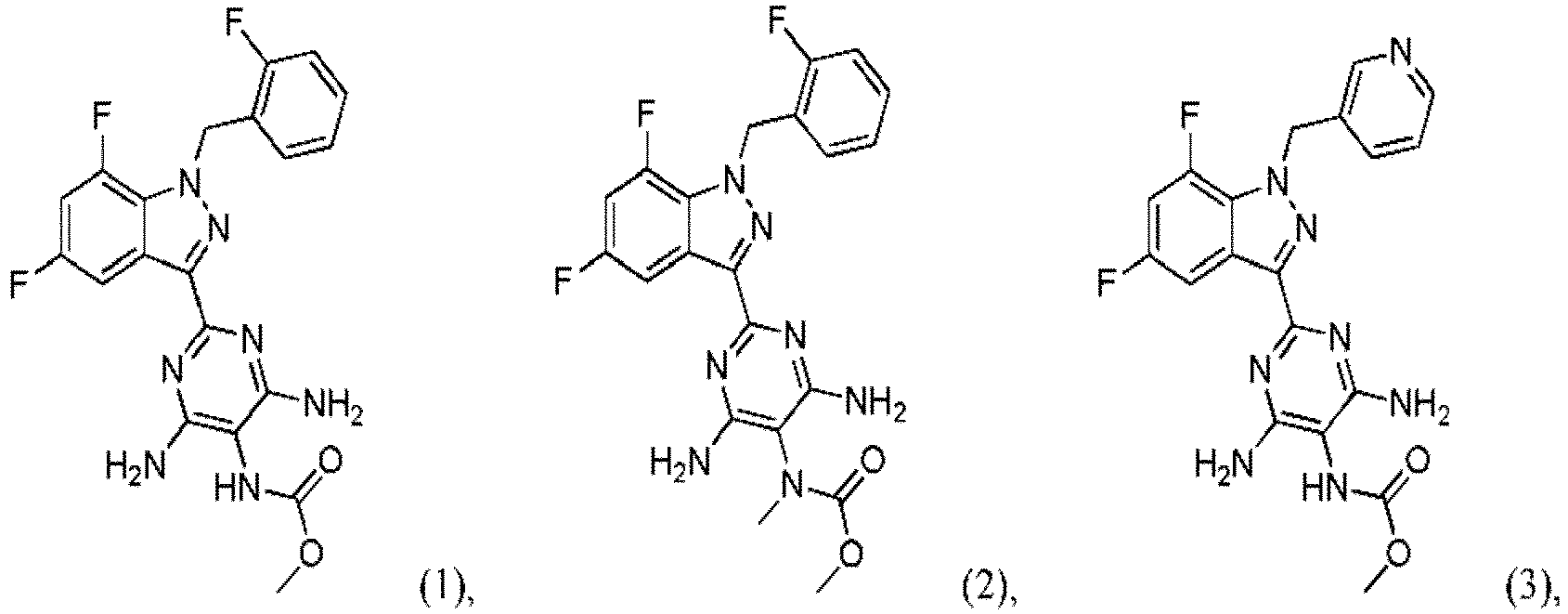


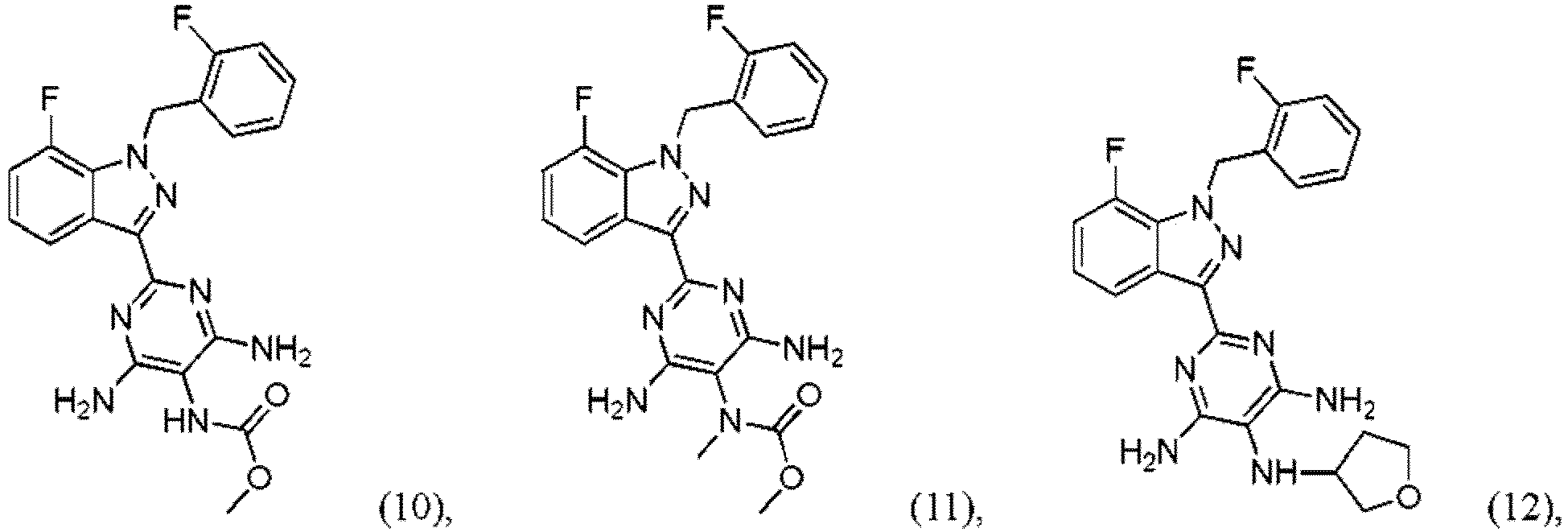


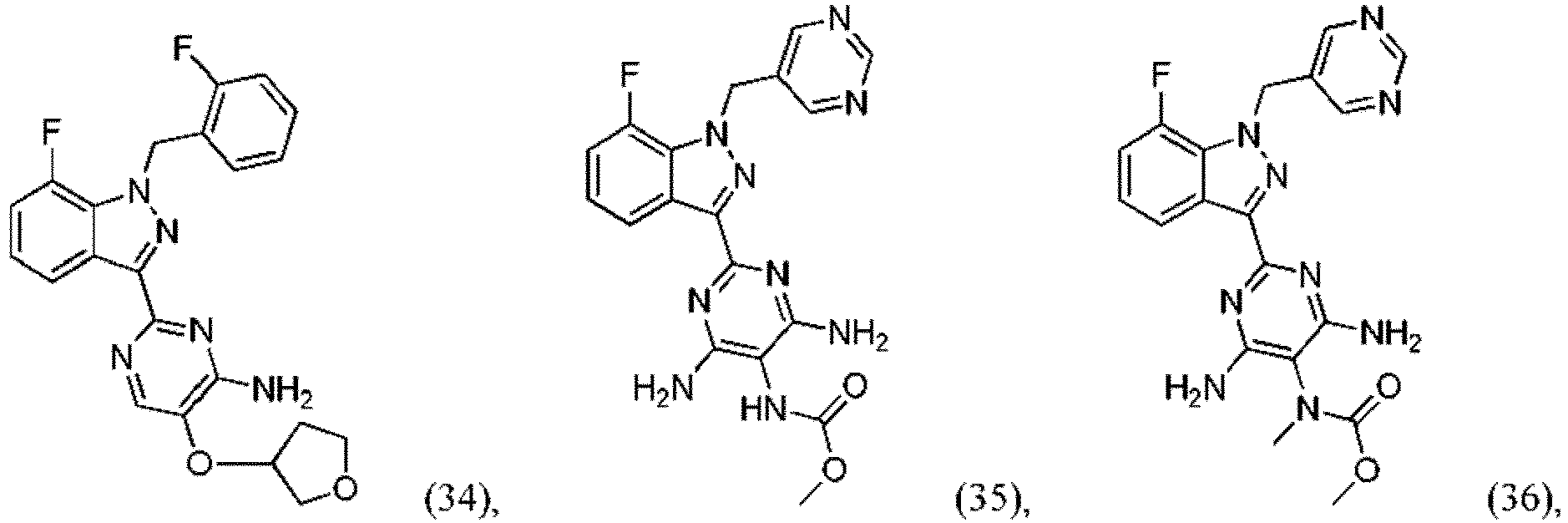
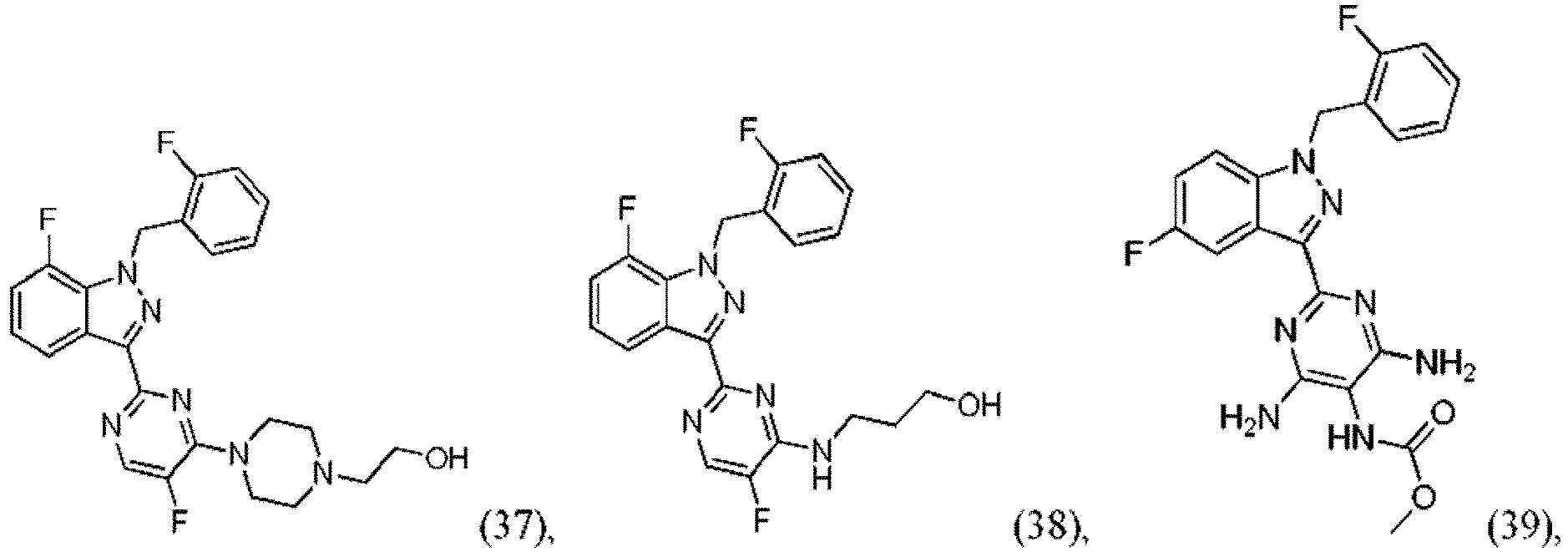

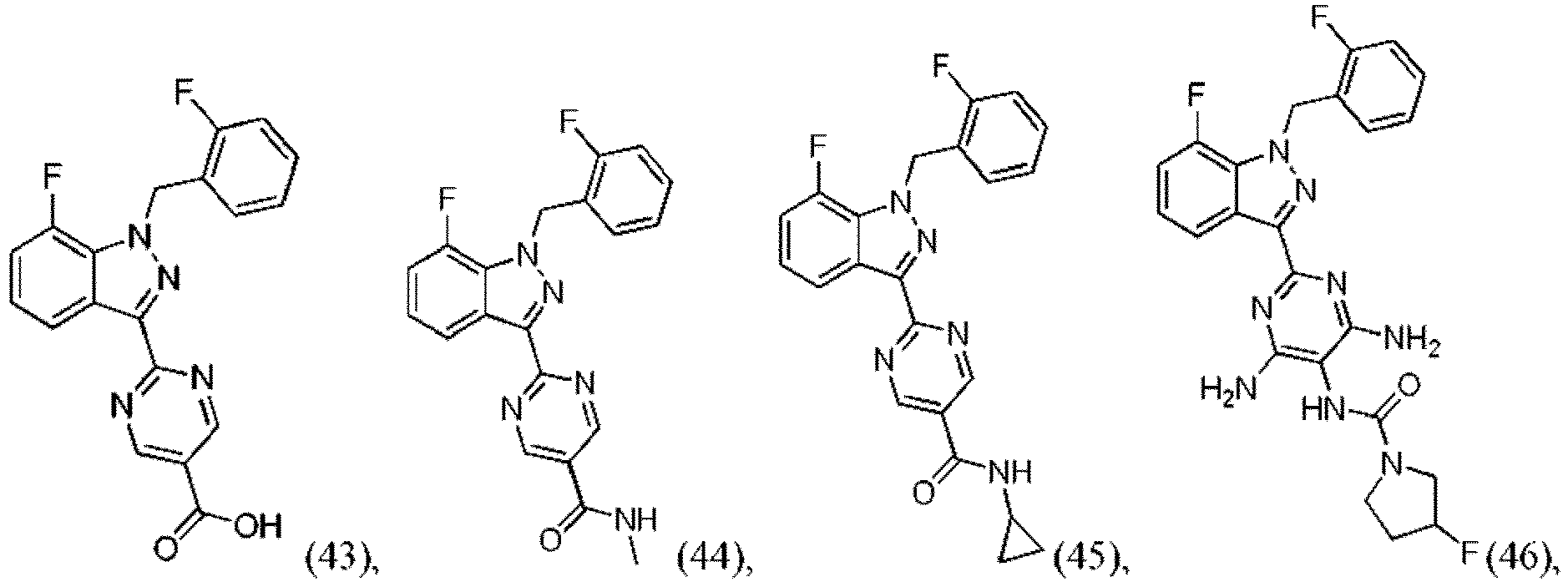


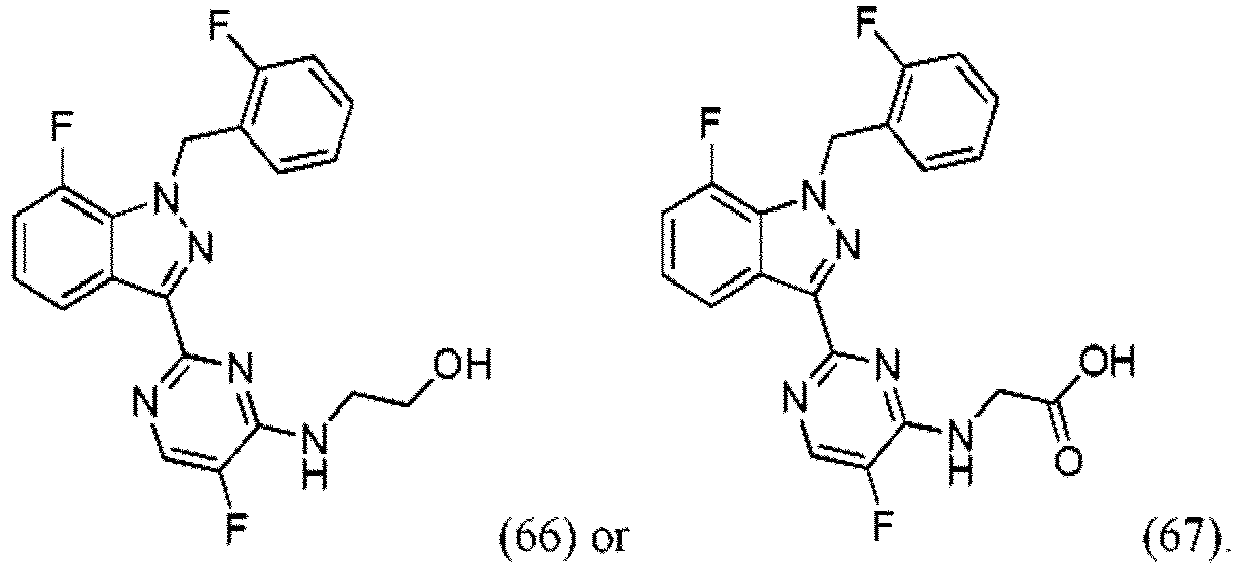
- Composition pharmaceutique comprenant le composé selon l'une quelconque des revendications 1 à 11 ; et comprenant en outre au moins l'un parmi un support, excipient, diluant, adjuvant et véhicule pharmaceutiquement acceptables.
- Composé selon l'une quelconque des revendications 1 à 11 ou composition pharmaceutique selon la revendication 12 pour une utilisation dans le traitement et/ou la prévention de maladies chez un patient, dans lequel les maladies comprennent une insuffisance cardiaque, une angine de poitrine, une hypertension, une hypertension pulmonaire, les ischémies, un trouble vasculaire, une néphropathie, un trouble thromboembolique, un dysfonctionnement sexuel masculin, une sclérodermie systémique, une anémie à cellules falciformes, une achalasie du cardia, un trouble fibrogène et/ou une artériosclérose.
- Composé selon l'une quelconque des revendications 1 à 11 ou composition pharmaceutique selon la revendication 12 pour une utilisation dans la préparation d'un médicament en tant que stimulateur de guanylate cyclase soluble ; pour le traitement et/ou la prévention des maladies suivantes : une insuffisance cardiaque, une angine de poitrine, une hypertension, une hypertension pulmonaire, les ischémies, un trouble vasculaire, une néphropathie, un trouble thromboembolique, un dysfonctionnement sexuel masculin, une sclérodermie systémique, une anémie à cellules falciformes, une achalasie du cardia, un trouble fibrogène et/ou une artériosclérose.
Applications Claiming Priority (2)
| Application Number | Priority Date | Filing Date | Title |
|---|---|---|---|
| CN201710232060 | 2017-04-11 | ||
| PCT/CN2018/082522 WO2018188590A1 (fr) | 2017-04-11 | 2018-04-10 | Composés indazole substitués par fluor et leurs utilisations |
Publications (3)
| Publication Number | Publication Date |
|---|---|
| EP3609883A1 EP3609883A1 (fr) | 2020-02-19 |
| EP3609883A4 EP3609883A4 (fr) | 2020-12-09 |
| EP3609883B1 true EP3609883B1 (fr) | 2022-06-29 |
Family
ID=63793011
Family Applications (1)
| Application Number | Title | Priority Date | Filing Date |
|---|---|---|---|
| EP18783676.2A Active EP3609883B1 (fr) | 2017-04-11 | 2018-04-10 | Composés indazole substitués par fluor et leurs utilisations |
Country Status (10)
| Country | Link |
|---|---|
| US (1) | US11242335B2 (fr) |
| EP (1) | EP3609883B1 (fr) |
| JP (1) | JP7090639B2 (fr) |
| KR (1) | KR102615821B1 (fr) |
| CN (1) | CN108727340B (fr) |
| AU (1) | AU2018252099B2 (fr) |
| CA (1) | CA3056501A1 (fr) |
| ES (1) | ES2924359T3 (fr) |
| TW (1) | TWI789386B (fr) |
| WO (1) | WO2018188590A1 (fr) |
Families Citing this family (6)
| Publication number | Priority date | Publication date | Assignee | Title |
|---|---|---|---|---|
| CN115515963B (zh) * | 2020-04-30 | 2025-08-01 | 正大天晴药业集团股份有限公司 | 嘧啶三并环类化合物及其应用 |
| TWI852126B (zh) | 2021-10-13 | 2024-08-11 | 大陸商正大天晴藥業集團股份有限公司 | 嘧啶三並環衍生物及其在藥學上的應用 |
| CN115621548B (zh) * | 2022-10-27 | 2024-04-30 | 深圳大学 | 一种新型哌啶离子液体电解质的制备方法及应用 |
| EP4640676A1 (fr) | 2022-12-21 | 2025-10-29 | Sunshine Lake Pharma Co., Ltd. | Forme cristalline d'un composé indazole substitué par du fluor et son utilisation |
| AU2023412238A1 (en) | 2022-12-21 | 2025-07-03 | Sunshine Lake Pharma Co., Ltd. | Crystal form of fluorine-substituted indazole compound and use thereof |
| WO2024213088A1 (fr) * | 2023-04-13 | 2024-10-17 | 正大天晴药业集团股份有限公司 | Cristal de dérivé tricyclique de pyrimidine et son utilisation |
Family Cites Families (89)
| Publication number | Priority date | Publication date | Assignee | Title |
|---|---|---|---|---|
| HU198036B (en) * | 1983-08-22 | 1989-07-28 | Hoechst Roussel Pharma | Process for production of derivatives of 3-piperidil-/1h/-indasole and medical preparatives containing them |
| IL90879A0 (en) * | 1988-09-02 | 1990-02-09 | Janssen Pharmaceutica Nv | 3-piperidinyl-indazole derivatives,their preparation and antihypertensive compositions containing them |
| GB8900382D0 (en) * | 1989-01-09 | 1989-03-08 | Janssen Pharmaceutica Nv | 2-aminopyrimidinone derivatives |
| US5776963A (en) * | 1989-05-19 | 1998-07-07 | Hoechst Marion Roussel, Inc. | 3-(heteroaryl)-1- (2,3-dihydro-1h-isoindol-2-yl)alkyl!pyrrolidines and 3-(heteroaryl)-1- (2,3-dihydro-1h-indol-1-yl)alkyl!pyrrolidines and related compounds and their therapeutic untility |
| US4954503A (en) * | 1989-09-11 | 1990-09-04 | Hoechst-Roussel Pharmaceuticals, Inc. | 3-(1-substituted-4-piperazinyl)-1H-indazoles |
| CN1240354A (zh) * | 1996-10-14 | 2000-01-05 | 拜尔公司 | 1-苄基-3-取代杂芳基稠合吡唑衍生物用于治疗心血管系统和中枢神经系统特异性疾病的应用 |
| DE19642255A1 (de) | 1996-10-14 | 1998-04-16 | Bayer Ag | Verwendung von 1-Benzyl-3-(substituierten-hetaryl) -kondensierten Pyrazol-Derivaten |
| IL129416A0 (en) | 1996-10-14 | 2000-02-17 | Bayer Ag | New heterocyclylmethyl-substituted pyrazol derivatives |
| DE19649460A1 (de) | 1996-11-26 | 1998-05-28 | Bayer Ag | Neue substituierte Pyrazolderivate |
| DE19744026A1 (de) | 1997-10-06 | 1999-04-08 | Hoechst Marion Roussel De Gmbh | Pyrazol-Derivate, ihre Herstellung und ihre Verwendung in Arzneimitteln |
| DE19834047A1 (de) | 1998-07-29 | 2000-02-03 | Bayer Ag | Substituierte Pyrazolderivate |
| DE19834045A1 (de) | 1998-07-29 | 2000-02-03 | Bayer Ag | (4-Amino-5-ethylpyrimidin-2-yl)-1-(2-fluorbenzyl)-1H-pyrazolo[3,4-b]pyridin |
| DE19834044A1 (de) | 1998-07-29 | 2000-02-03 | Bayer Ag | Neue substituierte Pyrazolderivate |
| DE19846514A1 (de) * | 1998-10-09 | 2000-04-20 | Bayer Ag | Neue Heterocyclyl-methyl-substituierte Pyrazole |
| DE19920352A1 (de) | 1999-05-04 | 2000-11-09 | Bayer Ag | Substituiertes Pyrazolderivat |
| DE10021069A1 (de) | 2000-04-28 | 2001-10-31 | Bayer Ag | Substituiertes Pyrazolderivat |
| AR031176A1 (es) | 2000-11-22 | 2003-09-10 | Bayer Ag | Nuevos derivados de pirazolpiridina sustituidos con piridina |
| CN1300116C (zh) * | 2001-04-16 | 2007-02-14 | 卫材株式会社 | 1h-吲唑化合物 |
| DE10122894A1 (de) | 2001-05-11 | 2002-11-14 | Bayer Ag | Neue Sulfonat-substituierte Pyrazolopyridinderivate |
| DE10132416A1 (de) | 2001-07-04 | 2003-01-16 | Bayer Ag | Neue Morpholin-überbrückte Pyrazolopyridinderivate |
| DE10220570A1 (de) | 2002-05-08 | 2003-11-20 | Bayer Ag | Carbamat-substituierte Pyrazolopyridine |
| DE10222550A1 (de) | 2002-05-17 | 2003-11-27 | Bayer Ag | Substituierte Benzyl-pyrazolopyridine |
| DE10242941A1 (de) | 2002-09-16 | 2004-03-18 | Bayer Ag | Substituiertes Pyrazolderivat |
| TW200409759A (en) | 2002-09-25 | 2004-06-16 | Wyeth Corp | Substituted 4-(indazol-3-yl)phenols |
| DE10244810A1 (de) | 2002-09-26 | 2004-04-08 | Bayer Ag | Neue Morpholin-überbrückte Indazolderivate |
| US7582631B2 (en) * | 2004-01-14 | 2009-09-01 | Amgen Inc. | Substituted heterocyclic compounds and methods of use |
| US7304073B2 (en) * | 2004-08-20 | 2007-12-04 | Wyeth | Method of treating myocardial ischemia-reperfusion injury using NF-kB inhibitors |
| WO2007065010A2 (fr) | 2005-12-02 | 2007-06-07 | Hif Bio, Inc. | Composes anti-angiogenese |
| CA2637531A1 (fr) * | 2006-02-17 | 2007-08-30 | Memory Pharmaceuticals Corporation | Composes ayant une affinite pour le recepteur 5-ht6 |
| DE102006020327A1 (de) | 2006-04-27 | 2007-12-27 | Bayer Healthcare Ag | Heterocyclisch substituierte, anellierte Pyrazol-Derivate und ihre Verwendung |
| DE102006021733A1 (de) | 2006-05-09 | 2007-11-22 | Bayer Healthcare Ag | 3-Tetrazolylindazole und 3-Tetrazolylpyrazolopyridine sowie ihre Verwendung |
| DE102006043443A1 (de) | 2006-09-15 | 2008-03-27 | Bayer Healthcare Ag | Neue aza-bicyclische Verbindungen und ihre Verwendung |
| DE102008063992A1 (de) | 2008-12-19 | 2010-09-02 | Lerner, Zinoviy, Dipl.-Ing. | Neue aliphatisch substituierte Pyrazolopyridine und ihre Verwendung |
| DE102009004245A1 (de) | 2009-01-09 | 2010-07-15 | Bayer Schering Pharma Aktiengesellschaft | Neue anellierte, Heteroatom-verbrückte Pyrazol- und Imidazol-Derivate und ihre Verwendung |
| ES2439773T3 (es) * | 2009-02-26 | 2014-01-24 | Glaxo Group Limited | Derivados de pirazol usados como antagonistas del receptor CCR4 |
| US9260424B2 (en) | 2009-10-26 | 2016-02-16 | Auspex Pharmaceuticals, Inc. | 4,6-diaminopyrimidine stimulators of soluble guanylate cyclase |
| US9284301B2 (en) | 2010-03-25 | 2016-03-15 | Merck Sharp & Dohme Corp. | Soluble guanylate cyclase activators |
| SI2576548T1 (sl) | 2010-05-26 | 2015-11-30 | Adverio Pharma Gmbh | Uporaba sGC stimulatorjev, sGC aktivatorjev, samih in v kombinacijah s PDE5 inhibitorji za zdravljenje sistemske skleroze |
| DE102010021637A1 (de) | 2010-05-26 | 2011-12-01 | Bayer Schering Pharma Aktiengesellschaft | Substituierte 5-Fluor-1H-Pyrazolopyridine und ihre Verwendung |
| UA107112C2 (uk) | 2010-05-27 | 2014-11-25 | Мерк Шарп Енд Доме Корп. | Активатори розчинної гуанілатциклази |
| EP2590987B1 (fr) | 2010-07-09 | 2016-03-09 | Bayer Intellectual Property GmbH | Dérivés de 4-aminopyrimidine condensées et leur utilisation en tant que stimulateurs de la guanylate cyclase soluble |
| PE20130779A1 (es) | 2010-07-09 | 2013-06-21 | Bayer Ip Gmbh | Pirimidinas y triazinas condensadas y su uso |
| DE102010031665A1 (de) | 2010-07-22 | 2012-01-26 | Bayer Schering Pharma Aktiengesellschaft | Substituierte Oxazolidinone und Oxazinanone und ihre Verwendung |
| DE102010031667A1 (de) | 2010-07-22 | 2012-01-26 | Bayer Schering Pharma Aktiengesellschaft | Substituierte Methyl-pyrimidin-5-ylcarbamate und ihre Verwendung |
| DE102010031666A1 (de) | 2010-07-22 | 2012-01-26 | Bayer Schering Pharma Aktiengesellschaft | Carbamat-substituierte Diaminopyrimidine und ihre Verwendung |
| DE102010040233A1 (de) | 2010-09-03 | 2012-03-08 | Bayer Schering Pharma Aktiengesellschaft | Bicyclische Aza-Heterocyclen und ihre Verwendung |
| DE102010043380A1 (de) | 2010-11-04 | 2012-05-10 | Bayer Schering Pharma Aktiengesellschaft | Benzyl-substituierte Carbamate und ihre Verwendung |
| DE102010043379A1 (de) | 2010-11-04 | 2012-05-10 | Bayer Schering Pharma Aktiengesellschaft | Substituierte 6-Fluor-1H-Pyrazolo[4,3-b]pyridine und ihre Verwendung |
| CN102485724B (zh) | 2010-12-06 | 2015-08-12 | 中国人民解放军军事医学科学院毒物药物研究所 | 取代噻吩基吡唑并吡啶类化合物及其医药用途 |
| EP2487159A1 (fr) | 2011-02-11 | 2012-08-15 | MSD Oss B.V. | Inhibiteurs du RORgammaT |
| ES2583086T3 (es) | 2011-04-21 | 2016-09-19 | Bayer Intellectual Property Gmbh | Pirazolopiridinas sustituidas con fluoroalquilo y su uso |
| DE102011075398A1 (de) | 2011-05-06 | 2012-11-08 | Bayer Pharma Aktiengesellschaft | Substituierte Imidazopyridazine und ihre Verwendung |
| CN103649093B (zh) | 2011-05-06 | 2017-07-07 | 拜耳知识产权有限责任公司 | 取代的咪唑并吡啶和咪唑并哒嗪及其用途 |
| WO2013005168A2 (fr) | 2011-07-05 | 2013-01-10 | Lupin Limited | Modulateurs des récepteurs de cannabinoïdes |
| KR20140050029A (ko) | 2011-07-06 | 2014-04-28 | 바이엘 인텔렉쳐 프로퍼티 게엠베하 | 헤테로아릴-치환된 피라졸로피리딘 및 가용성 구아닐레이트 시클라제 자극제로서의 그의 용도 |
| BR112014004569A2 (pt) * | 2011-09-01 | 2017-06-13 | F. Hoffmann-La Roche Ag | composto da fórmula i, métodos para tratar condição inflamatória, artrite reumatoide, asma e distúrbio imune, composição farmacêutica e uso do composto |
| CN104039784B (zh) | 2011-09-02 | 2017-08-22 | 拜耳知识产权有限责任公司 | 取代的增环嘧啶及其用途 |
| PE20142359A1 (es) | 2011-11-25 | 2015-01-09 | Bayer Pharma AG | Procedimiento de preparacion de 5-fluoro-1h-pirazolopiridinas sustituidas |
| DE102012200349A1 (de) | 2012-01-11 | 2013-07-11 | Bayer Intellectual Property Gmbh | Substituierte annellierte Pyrimidine und Triazine und ihre Verwendung |
| DE102012200360A1 (de) | 2012-01-11 | 2013-07-11 | Bayer Intellectual Property Gmbh | Substituierte Triazine und ihre Verwendung |
| DE102012200352A1 (de) | 2012-01-11 | 2013-07-11 | Bayer Intellectual Property Gmbh | Substituierte, annellierte Imidazole und Pyrazole und ihre Verwendung |
| ES2644781T3 (es) | 2012-03-06 | 2017-11-30 | Bayer Intellectual Property Gmbh | Azabiciclos sustituidos y su uso |
| CN104853757A (zh) * | 2012-08-15 | 2015-08-19 | 默沙东公司 | 作为RORγT抑制剂的4-杂芳基取代的苯甲酸化合物及其用途 |
| WO2014026329A1 (fr) | 2012-08-15 | 2014-02-20 | Merck Sharp & Dohme Corp. | Composés d'indazole et d'indole n-alkylés en tant qu'inhibiteurs de rorgammat et leurs utilisations |
| CN104822377A (zh) * | 2012-08-15 | 2015-08-05 | 默沙东公司 | 作为RORγT抑制剂的N-烷基化吲哚和吲唑化合物及其用途 |
| WO2014026328A1 (fr) * | 2012-08-15 | 2014-02-20 | Merck Sharp & Dohme Corp. | Composés d'indazole et d'indole à substitution 3-cyclohexényle en tant qu'inhibiteurs de rorgammat et leurs utilisations |
| WO2014026330A1 (fr) * | 2012-08-15 | 2014-02-20 | Merck Sharp & Dohme Corp. | Composés 3-aminocycloalkyles en tant qu'inhibiteurs de rorgammat et leurs utilisations |
| WO2014026327A1 (fr) | 2012-08-15 | 2014-02-20 | Merck Sharp & Dohme Corp. | Composés d'acide benzoïque à substitution 4-hétéroaryle en tant qu'inhibiteurs de rorgammat et leurs utilisations |
| US9738610B2 (en) | 2012-09-24 | 2017-08-22 | Whitehead Institute For Biomedical Research | Indazole derivatives and uses thereof |
| CN105102457A (zh) | 2013-02-21 | 2015-11-25 | 阿德弗里奥药品有限责任公司 | {4,6-二氨基-2-[1-(2-氟苄基)-1H-吡唑并[3,4-b]吡啶-3-基]嘧啶-5-基}甲基氨基甲酸甲酯的形式 |
| WO2014131760A1 (fr) | 2013-03-01 | 2014-09-04 | Bayer Pharma Aktiengesellschaft | Pyrimidines annelées à subsitution trifluorométhyle et utilisation correspondante |
| HK1216890A1 (zh) | 2013-03-01 | 2016-12-09 | Bayer Pharma Aktiengesellschaft | 苄基-取代的吡唑并吡啶及其用途 |
| US9440952B2 (en) * | 2013-03-04 | 2016-09-13 | Merck Sharp & Dohme Corp. | Compounds inhibiting leucine-rich repeat kinase enzyme activity |
| EP2976334A1 (fr) | 2013-03-21 | 2016-01-27 | Bayer Pharma Aktiengesellschaft | Indazoles substitués par diaminohétéroaryle |
| EP2976335A1 (fr) | 2013-03-21 | 2016-01-27 | Bayer Pharma Aktiengesellschaft | Indazoles substitués par hétéroaryle |
| AU2014289312A1 (en) | 2013-07-10 | 2016-02-11 | Bayer Pharma Aktiengesellschaft | Benzyl-1H-pyrazolo(3,4-b)pyridines and use thereof |
| CA2928998A1 (fr) | 2013-10-30 | 2015-05-07 | Bayer Pharma Aktiengesellschaft | Pyrazoles substitues par heteroaryle |
| EP3062780A1 (fr) | 2013-11-01 | 2016-09-07 | Bergen Teknologioverføring AS | Activateurs ou stimulateurs de guanylate cyclase soluble destinés à être utilisés pour traiter un syndrome de fatigue chronique |
| CN111349087B (zh) | 2014-02-20 | 2023-07-14 | 康奈尔大学 | 用于抑制肌成束蛋白的化合物和方法 |
| CN107074883A (zh) | 2014-08-29 | 2017-08-18 | 拜耳医药股份有限公司 | 氨基取代的环状嘧啶及其用途 |
| MX2017003463A (es) | 2014-09-17 | 2017-07-13 | Celgene Quanticel Res Inc | Inhibidores de histona desmetilasa. |
| MA39484A (fr) | 2014-09-19 | 2016-03-24 | Bayer Pharma AG | Indazoles à substituants benzyle utilisés comme inhibiteurs de bub1 |
| WO2017107052A1 (fr) * | 2015-12-22 | 2017-06-29 | Merck Sharp & Dohme Corp. | Activateurs solubles de guanylate cyclase |
| WO2017121692A1 (fr) | 2016-01-15 | 2017-07-20 | Bayer Pharma Aktiengesellschaft | Sulfamides substitués et leur utilisation |
| WO2017121700A1 (fr) | 2016-01-15 | 2017-07-20 | Bayer Pharma Aktiengesellschaft | Dérivés de 1h-pyrazolo[3,4-b]pyridine 1,3-disubstitués et leur utilisation en tant que stimulateurs de la guanylacte cyclase soluble |
| WO2017157991A1 (fr) | 2016-03-18 | 2017-09-21 | Bayer Pharma Aktiengesellschaft | 1-alkyl-pyrazoles et 1-alkyl-indazoles utilisés en tant qu'inhibiteurs de bub1 pour le traitement de maladies hyperprolifératives |
| CN107964018A (zh) | 2016-10-19 | 2018-04-27 | 中国人民解放军军事医学科学院毒物药物研究所 | 取代嘌呤酮类衍生物及其医药用途 |
| CN107964011A (zh) | 2016-10-19 | 2018-04-27 | 中国人民解放军军事医学科学院毒物药物研究所 | 取代吡唑并吡啶类衍生物及其医药用途 |
| US11180493B2 (en) | 2016-11-08 | 2021-11-23 | Cyclerion Therapeutics, Inc. | SGC stimulators |
-
2018
- 2018-04-10 JP JP2019555623A patent/JP7090639B2/ja active Active
- 2018-04-10 EP EP18783676.2A patent/EP3609883B1/fr active Active
- 2018-04-10 WO PCT/CN2018/082522 patent/WO2018188590A1/fr not_active Ceased
- 2018-04-10 KR KR1020197032945A patent/KR102615821B1/ko active Active
- 2018-04-10 CA CA3056501A patent/CA3056501A1/fr active Pending
- 2018-04-10 CN CN201810317190.8A patent/CN108727340B/zh active Active
- 2018-04-10 AU AU2018252099A patent/AU2018252099B2/en active Active
- 2018-04-10 ES ES18783676T patent/ES2924359T3/es active Active
- 2018-04-10 US US16/500,266 patent/US11242335B2/en active Active
- 2018-04-11 TW TW107112444A patent/TWI789386B/zh active
Also Published As
| Publication number | Publication date |
|---|---|
| EP3609883A1 (fr) | 2020-02-19 |
| JP2020516632A (ja) | 2020-06-11 |
| CN108727340B (zh) | 2020-12-29 |
| US20210101882A1 (en) | 2021-04-08 |
| ES2924359T3 (es) | 2022-10-06 |
| US11242335B2 (en) | 2022-02-08 |
| EP3609883A4 (fr) | 2020-12-09 |
| CN108727340A (zh) | 2018-11-02 |
| KR20190138661A (ko) | 2019-12-13 |
| CA3056501A1 (fr) | 2018-10-18 |
| JP7090639B2 (ja) | 2022-06-24 |
| TWI789386B (zh) | 2023-01-11 |
| AU2018252099B2 (en) | 2021-08-12 |
| WO2018188590A1 (fr) | 2018-10-18 |
| AU2018252099A1 (en) | 2019-10-03 |
| KR102615821B1 (ko) | 2023-12-21 |
| TW201837030A (zh) | 2018-10-16 |
Similar Documents
| Publication | Publication Date | Title |
|---|---|---|
| EP3609883B1 (fr) | Composés indazole substitués par fluor et leurs utilisations | |
| EP4031547B1 (fr) | Inhibiteurs de la kallicréine plasmatique et leurs utilisations | |
| TWI565708B (zh) | 經取代環化嘧啶類及其用途 | |
| CN105308055B (zh) | 三氟甲基取代的稠合嘧啶类及其用途 | |
| US9505786B2 (en) | Substituted annulated triazines and use thereof | |
| EP3312182B1 (fr) | Composé inhibiteur de brk | |
| US20210206760A1 (en) | Phenyl-substituted dihydronaphthyridine compound and use thereof | |
| JP2016523944A (ja) | ベンジル−1H−ピラゾロ[3,4−b]ピリジンおよびその使用 | |
| CN106715426A (zh) | 氰基取代的咪唑并[1,2‑a]吡啶甲酰胺及其用途 | |
| CN108690016B (zh) | 吡唑并吡啶类化合物及其用途 | |
| CN107108658A (zh) | 取代的环状嘧啶及其用途 | |
| HK40015368A (en) | Fluorine-substituted indazole compounds and uses thereof | |
| HK40015368B (en) | Fluorine-substituted indazole compounds and uses thereof | |
| JP2017529338A (ja) | アミノ置換環式ピリミジンおよびその使用 | |
| CN112794848A (zh) | N-环-氨基嘧啶衍生物及其用途 | |
| HK40074859A (en) | Plasma kallikrein inhibitors and uses thereof | |
| HK40074859B (en) | Plasma kallikrein inhibitors and uses thereof |
Legal Events
| Date | Code | Title | Description |
|---|---|---|---|
| STAA | Information on the status of an ep patent application or granted ep patent |
Free format text: STATUS: THE INTERNATIONAL PUBLICATION HAS BEEN MADE |
|
| PUAI | Public reference made under article 153(3) epc to a published international application that has entered the european phase |
Free format text: ORIGINAL CODE: 0009012 |
|
| STAA | Information on the status of an ep patent application or granted ep patent |
Free format text: STATUS: REQUEST FOR EXAMINATION WAS MADE |
|
| 17P | Request for examination filed |
Effective date: 20191010 |
|
| AK | Designated contracting states |
Kind code of ref document: A1 Designated state(s): AL AT BE BG CH CY CZ DE DK EE ES FI FR GB GR HR HU IE IS IT LI LT LU LV MC MK MT NL NO PL PT RO RS SE SI SK SM TR |
|
| AX | Request for extension of the european patent |
Extension state: BA ME |
|
| DAV | Request for validation of the european patent (deleted) | ||
| DAX | Request for extension of the european patent (deleted) | ||
| RAP1 | Party data changed (applicant data changed or rights of an application transferred) |
Owner name: SUNSHINE LAKE PHARMA CO., LTD. |
|
| REG | Reference to a national code |
Ref country code: HK Ref legal event code: DE Ref document number: 40015368 Country of ref document: HK |
|
| A4 | Supplementary search report drawn up and despatched |
Effective date: 20201106 |
|
| RIC1 | Information provided on ipc code assigned before grant |
Ipc: A61K 31/506 20060101ALI20201102BHEP Ipc: A61P 9/00 20060101ALI20201102BHEP Ipc: A61K 31/416 20060101ALI20201102BHEP Ipc: C07D 231/54 20060101ALI20201102BHEP Ipc: C07D 413/14 20060101ALI20201102BHEP Ipc: C07D 405/14 20060101ALI20201102BHEP Ipc: C07D 403/04 20060101ALI20201102BHEP Ipc: C07D 401/04 20060101ALI20201102BHEP Ipc: C07D 417/14 20060101ALI20201102BHEP Ipc: C07D 403/14 20060101ALI20201102BHEP Ipc: C07D 401/14 20060101AFI20201102BHEP |
|
| STAA | Information on the status of an ep patent application or granted ep patent |
Free format text: STATUS: EXAMINATION IS IN PROGRESS |
|
| 17Q | First examination report despatched |
Effective date: 20210804 |
|
| GRAP | Despatch of communication of intention to grant a patent |
Free format text: ORIGINAL CODE: EPIDOSNIGR1 |
|
| STAA | Information on the status of an ep patent application or granted ep patent |
Free format text: STATUS: GRANT OF PATENT IS INTENDED |
|
| GRAJ | Information related to disapproval of communication of intention to grant by the applicant or resumption of examination proceedings by the epo deleted |
Free format text: ORIGINAL CODE: EPIDOSDIGR1 |
|
| STAA | Information on the status of an ep patent application or granted ep patent |
Free format text: STATUS: EXAMINATION IS IN PROGRESS |
|
| INTG | Intention to grant announced |
Effective date: 20211130 |
|
| INTC | Intention to grant announced (deleted) | ||
| GRAP | Despatch of communication of intention to grant a patent |
Free format text: ORIGINAL CODE: EPIDOSNIGR1 |
|
| STAA | Information on the status of an ep patent application or granted ep patent |
Free format text: STATUS: GRANT OF PATENT IS INTENDED |
|
| INTG | Intention to grant announced |
Effective date: 20220114 |
|
| GRAS | Grant fee paid |
Free format text: ORIGINAL CODE: EPIDOSNIGR3 |
|
| GRAA | (expected) grant |
Free format text: ORIGINAL CODE: 0009210 |
|
| STAA | Information on the status of an ep patent application or granted ep patent |
Free format text: STATUS: THE PATENT HAS BEEN GRANTED |
|
| AK | Designated contracting states |
Kind code of ref document: B1 Designated state(s): AL AT BE BG CH CY CZ DE DK EE ES FI FR GB GR HR HU IE IS IT LI LT LU LV MC MK MT NL NO PL PT RO RS SE SI SK SM TR |
|
| REG | Reference to a national code |
Ref country code: CH Ref legal event code: EP |
|
| REG | Reference to a national code |
Ref country code: AT Ref legal event code: REF Ref document number: 1501287 Country of ref document: AT Kind code of ref document: T Effective date: 20220715 |
|
| REG | Reference to a national code |
Ref country code: IE Ref legal event code: FG4D |
|
| REG | Reference to a national code |
Ref country code: DE Ref legal event code: R096 Ref document number: 602018037370 Country of ref document: DE |
|
| REG | Reference to a national code |
Ref country code: ES Ref legal event code: FG2A Ref document number: 2924359 Country of ref document: ES Kind code of ref document: T3 Effective date: 20221006 |
|
| REG | Reference to a national code |
Ref country code: LT Ref legal event code: MG9D |
|
| PG25 | Lapsed in a contracting state [announced via postgrant information from national office to epo] |
Ref country code: SE Free format text: LAPSE BECAUSE OF FAILURE TO SUBMIT A TRANSLATION OF THE DESCRIPTION OR TO PAY THE FEE WITHIN THE PRESCRIBED TIME-LIMIT Effective date: 20220629 Ref country code: NO Free format text: LAPSE BECAUSE OF FAILURE TO SUBMIT A TRANSLATION OF THE DESCRIPTION OR TO PAY THE FEE WITHIN THE PRESCRIBED TIME-LIMIT Effective date: 20220929 Ref country code: LT Free format text: LAPSE BECAUSE OF FAILURE TO SUBMIT A TRANSLATION OF THE DESCRIPTION OR TO PAY THE FEE WITHIN THE PRESCRIBED TIME-LIMIT Effective date: 20220629 Ref country code: HR Free format text: LAPSE BECAUSE OF FAILURE TO SUBMIT A TRANSLATION OF THE DESCRIPTION OR TO PAY THE FEE WITHIN THE PRESCRIBED TIME-LIMIT Effective date: 20220629 Ref country code: GR Free format text: LAPSE BECAUSE OF FAILURE TO SUBMIT A TRANSLATION OF THE DESCRIPTION OR TO PAY THE FEE WITHIN THE PRESCRIBED TIME-LIMIT Effective date: 20220930 Ref country code: FI Free format text: LAPSE BECAUSE OF FAILURE TO SUBMIT A TRANSLATION OF THE DESCRIPTION OR TO PAY THE FEE WITHIN THE PRESCRIBED TIME-LIMIT Effective date: 20220629 Ref country code: BG Free format text: LAPSE BECAUSE OF FAILURE TO SUBMIT A TRANSLATION OF THE DESCRIPTION OR TO PAY THE FEE WITHIN THE PRESCRIBED TIME-LIMIT Effective date: 20220929 |
|
| REG | Reference to a national code |
Ref country code: NL Ref legal event code: MP Effective date: 20220629 |
|
| REG | Reference to a national code |
Ref country code: AT Ref legal event code: MK05 Ref document number: 1501287 Country of ref document: AT Kind code of ref document: T Effective date: 20220629 |
|
| PG25 | Lapsed in a contracting state [announced via postgrant information from national office to epo] |
Ref country code: RS Free format text: LAPSE BECAUSE OF FAILURE TO SUBMIT A TRANSLATION OF THE DESCRIPTION OR TO PAY THE FEE WITHIN THE PRESCRIBED TIME-LIMIT Effective date: 20220629 Ref country code: LV Free format text: LAPSE BECAUSE OF FAILURE TO SUBMIT A TRANSLATION OF THE DESCRIPTION OR TO PAY THE FEE WITHIN THE PRESCRIBED TIME-LIMIT Effective date: 20220629 |
|
| PG25 | Lapsed in a contracting state [announced via postgrant information from national office to epo] |
Ref country code: NL Free format text: LAPSE BECAUSE OF FAILURE TO SUBMIT A TRANSLATION OF THE DESCRIPTION OR TO PAY THE FEE WITHIN THE PRESCRIBED TIME-LIMIT Effective date: 20220629 |
|
| PG25 | Lapsed in a contracting state [announced via postgrant information from national office to epo] |
Ref country code: SM Free format text: LAPSE BECAUSE OF FAILURE TO SUBMIT A TRANSLATION OF THE DESCRIPTION OR TO PAY THE FEE WITHIN THE PRESCRIBED TIME-LIMIT Effective date: 20220629 Ref country code: SK Free format text: LAPSE BECAUSE OF FAILURE TO SUBMIT A TRANSLATION OF THE DESCRIPTION OR TO PAY THE FEE WITHIN THE PRESCRIBED TIME-LIMIT Effective date: 20220629 Ref country code: RO Free format text: LAPSE BECAUSE OF FAILURE TO SUBMIT A TRANSLATION OF THE DESCRIPTION OR TO PAY THE FEE WITHIN THE PRESCRIBED TIME-LIMIT Effective date: 20220629 Ref country code: PT Free format text: LAPSE BECAUSE OF FAILURE TO SUBMIT A TRANSLATION OF THE DESCRIPTION OR TO PAY THE FEE WITHIN THE PRESCRIBED TIME-LIMIT Effective date: 20221031 Ref country code: EE Free format text: LAPSE BECAUSE OF FAILURE TO SUBMIT A TRANSLATION OF THE DESCRIPTION OR TO PAY THE FEE WITHIN THE PRESCRIBED TIME-LIMIT Effective date: 20220629 Ref country code: AT Free format text: LAPSE BECAUSE OF FAILURE TO SUBMIT A TRANSLATION OF THE DESCRIPTION OR TO PAY THE FEE WITHIN THE PRESCRIBED TIME-LIMIT Effective date: 20220629 |
|
| PG25 | Lapsed in a contracting state [announced via postgrant information from national office to epo] |
Ref country code: PL Free format text: LAPSE BECAUSE OF FAILURE TO SUBMIT A TRANSLATION OF THE DESCRIPTION OR TO PAY THE FEE WITHIN THE PRESCRIBED TIME-LIMIT Effective date: 20220629 Ref country code: IS Free format text: LAPSE BECAUSE OF FAILURE TO SUBMIT A TRANSLATION OF THE DESCRIPTION OR TO PAY THE FEE WITHIN THE PRESCRIBED TIME-LIMIT Effective date: 20221029 |
|
| REG | Reference to a national code |
Ref country code: DE Ref legal event code: R097 Ref document number: 602018037370 Country of ref document: DE |
|
| PG25 | Lapsed in a contracting state [announced via postgrant information from national office to epo] |
Ref country code: AL Free format text: LAPSE BECAUSE OF FAILURE TO SUBMIT A TRANSLATION OF THE DESCRIPTION OR TO PAY THE FEE WITHIN THE PRESCRIBED TIME-LIMIT Effective date: 20220629 |
|
| PG25 | Lapsed in a contracting state [announced via postgrant information from national office to epo] |
Ref country code: DK Free format text: LAPSE BECAUSE OF FAILURE TO SUBMIT A TRANSLATION OF THE DESCRIPTION OR TO PAY THE FEE WITHIN THE PRESCRIBED TIME-LIMIT Effective date: 20220629 Ref country code: CZ Free format text: LAPSE BECAUSE OF FAILURE TO SUBMIT A TRANSLATION OF THE DESCRIPTION OR TO PAY THE FEE WITHIN THE PRESCRIBED TIME-LIMIT Effective date: 20220629 |
|
| PLBE | No opposition filed within time limit |
Free format text: ORIGINAL CODE: 0009261 |
|
| STAA | Information on the status of an ep patent application or granted ep patent |
Free format text: STATUS: NO OPPOSITION FILED WITHIN TIME LIMIT |
|
| 26N | No opposition filed |
Effective date: 20230330 |
|
| PG25 | Lapsed in a contracting state [announced via postgrant information from national office to epo] |
Ref country code: SI Free format text: LAPSE BECAUSE OF FAILURE TO SUBMIT A TRANSLATION OF THE DESCRIPTION OR TO PAY THE FEE WITHIN THE PRESCRIBED TIME-LIMIT Effective date: 20220629 |
|
| REG | Reference to a national code |
Ref country code: CH Ref legal event code: PL |
|
| PG25 | Lapsed in a contracting state [announced via postgrant information from national office to epo] |
Ref country code: LU Free format text: LAPSE BECAUSE OF NON-PAYMENT OF DUE FEES Effective date: 20230410 |
|
| REG | Reference to a national code |
Ref country code: BE Ref legal event code: MM Effective date: 20230430 |
|
| PG25 | Lapsed in a contracting state [announced via postgrant information from national office to epo] |
Ref country code: MC Free format text: LAPSE BECAUSE OF FAILURE TO SUBMIT A TRANSLATION OF THE DESCRIPTION OR TO PAY THE FEE WITHIN THE PRESCRIBED TIME-LIMIT Effective date: 20220629 |
|
| PG25 | Lapsed in a contracting state [announced via postgrant information from national office to epo] |
Ref country code: MC Free format text: LAPSE BECAUSE OF FAILURE TO SUBMIT A TRANSLATION OF THE DESCRIPTION OR TO PAY THE FEE WITHIN THE PRESCRIBED TIME-LIMIT Effective date: 20220629 Ref country code: LI Free format text: LAPSE BECAUSE OF NON-PAYMENT OF DUE FEES Effective date: 20230430 Ref country code: CH Free format text: LAPSE BECAUSE OF NON-PAYMENT OF DUE FEES Effective date: 20230430 |
|
| P01 | Opt-out of the competence of the unified patent court (upc) registered |
Effective date: 20231228 |
|
| REG | Reference to a national code |
Ref country code: IE Ref legal event code: MM4A |
|
| PG25 | Lapsed in a contracting state [announced via postgrant information from national office to epo] |
Ref country code: BE Free format text: LAPSE BECAUSE OF NON-PAYMENT OF DUE FEES Effective date: 20230430 |
|
| PG25 | Lapsed in a contracting state [announced via postgrant information from national office to epo] |
Ref country code: IE Free format text: LAPSE BECAUSE OF NON-PAYMENT OF DUE FEES Effective date: 20230410 |
|
| PG25 | Lapsed in a contracting state [announced via postgrant information from national office to epo] |
Ref country code: IE Free format text: LAPSE BECAUSE OF NON-PAYMENT OF DUE FEES Effective date: 20230410 |
|
| PG25 | Lapsed in a contracting state [announced via postgrant information from national office to epo] |
Ref country code: BG Free format text: LAPSE BECAUSE OF FAILURE TO SUBMIT A TRANSLATION OF THE DESCRIPTION OR TO PAY THE FEE WITHIN THE PRESCRIBED TIME-LIMIT Effective date: 20220629 |
|
| PG25 | Lapsed in a contracting state [announced via postgrant information from national office to epo] |
Ref country code: BG Free format text: LAPSE BECAUSE OF FAILURE TO SUBMIT A TRANSLATION OF THE DESCRIPTION OR TO PAY THE FEE WITHIN THE PRESCRIBED TIME-LIMIT Effective date: 20220629 |
|
| PGFP | Annual fee paid to national office [announced via postgrant information from national office to epo] |
Ref country code: DE Payment date: 20250417 Year of fee payment: 8 |
|
| PGFP | Annual fee paid to national office [announced via postgrant information from national office to epo] |
Ref country code: GB Payment date: 20250424 Year of fee payment: 8 Ref country code: ES Payment date: 20250519 Year of fee payment: 8 |
|
| PGFP | Annual fee paid to national office [announced via postgrant information from national office to epo] |
Ref country code: IT Payment date: 20250430 Year of fee payment: 8 |
|
| PGFP | Annual fee paid to national office [announced via postgrant information from national office to epo] |
Ref country code: FR Payment date: 20250422 Year of fee payment: 8 |
|
| PG25 | Lapsed in a contracting state [announced via postgrant information from national office to epo] |
Ref country code: CY Free format text: LAPSE BECAUSE OF FAILURE TO SUBMIT A TRANSLATION OF THE DESCRIPTION OR TO PAY THE FEE WITHIN THE PRESCRIBED TIME-LIMIT; INVALID AB INITIO Effective date: 20180410 |
|
| PG25 | Lapsed in a contracting state [announced via postgrant information from national office to epo] |
Ref country code: HU Free format text: LAPSE BECAUSE OF FAILURE TO SUBMIT A TRANSLATION OF THE DESCRIPTION OR TO PAY THE FEE WITHIN THE PRESCRIBED TIME-LIMIT; INVALID AB INITIO Effective date: 20180410 |
|
| PG25 | Lapsed in a contracting state [announced via postgrant information from national office to epo] |
Ref country code: TR Free format text: LAPSE BECAUSE OF FAILURE TO SUBMIT A TRANSLATION OF THE DESCRIPTION OR TO PAY THE FEE WITHIN THE PRESCRIBED TIME-LIMIT Effective date: 20220629 |