EP3609977B1 - Composition pour dispositifs électroniques organiques - Google Patents
Composition pour dispositifs électroniques organiques Download PDFInfo
- Publication number
- EP3609977B1 EP3609977B1 EP18716280.5A EP18716280A EP3609977B1 EP 3609977 B1 EP3609977 B1 EP 3609977B1 EP 18716280 A EP18716280 A EP 18716280A EP 3609977 B1 EP3609977 B1 EP 3609977B1
- Authority
- EP
- European Patent Office
- Prior art keywords
- group
- formula
- atoms
- radicals
- aromatic
- Prior art date
- Legal status (The legal status is an assumption and is not a legal conclusion. Google has not performed a legal analysis and makes no representation as to the accuracy of the status listed.)
- Active
Links
Classifications
-
- C—CHEMISTRY; METALLURGY
- C09—DYES; PAINTS; POLISHES; NATURAL RESINS; ADHESIVES; COMPOSITIONS NOT OTHERWISE PROVIDED FOR; APPLICATIONS OF MATERIALS NOT OTHERWISE PROVIDED FOR
- C09K—MATERIALS FOR MISCELLANEOUS APPLICATIONS, NOT PROVIDED FOR ELSEWHERE
- C09K11/00—Luminescent materials, e.g. electroluminescent or chemiluminescent
- C09K11/02—Use of particular materials as binders, particle coatings or suspension media therefor
-
- H—ELECTRICITY
- H10—SEMICONDUCTOR DEVICES; ELECTRIC SOLID-STATE DEVICES NOT OTHERWISE PROVIDED FOR
- H10K—ORGANIC ELECTRIC SOLID-STATE DEVICES
- H10K85/00—Organic materials used in the body or electrodes of devices covered by this subclass
- H10K85/60—Organic compounds having low molecular weight
- H10K85/649—Aromatic compounds comprising a hetero atom
- H10K85/657—Polycyclic condensed heteroaromatic hydrocarbons
- H10K85/6572—Polycyclic condensed heteroaromatic hydrocarbons comprising only nitrogen in the heteroaromatic polycondensed ring system, e.g. phenanthroline or carbazole
-
- C—CHEMISTRY; METALLURGY
- C09—DYES; PAINTS; POLISHES; NATURAL RESINS; ADHESIVES; COMPOSITIONS NOT OTHERWISE PROVIDED FOR; APPLICATIONS OF MATERIALS NOT OTHERWISE PROVIDED FOR
- C09K—MATERIALS FOR MISCELLANEOUS APPLICATIONS, NOT PROVIDED FOR ELSEWHERE
- C09K11/00—Luminescent materials, e.g. electroluminescent or chemiluminescent
- C09K11/06—Luminescent materials, e.g. electroluminescent or chemiluminescent containing organic luminescent materials
-
- H—ELECTRICITY
- H10—SEMICONDUCTOR DEVICES; ELECTRIC SOLID-STATE DEVICES NOT OTHERWISE PROVIDED FOR
- H10K—ORGANIC ELECTRIC SOLID-STATE DEVICES
- H10K71/00—Manufacture or treatment specially adapted for the organic devices covered by this subclass
- H10K71/10—Deposition of organic active material
-
- H—ELECTRICITY
- H10—SEMICONDUCTOR DEVICES; ELECTRIC SOLID-STATE DEVICES NOT OTHERWISE PROVIDED FOR
- H10K—ORGANIC ELECTRIC SOLID-STATE DEVICES
- H10K85/00—Organic materials used in the body or electrodes of devices covered by this subclass
- H10K85/60—Organic compounds having low molecular weight
- H10K85/649—Aromatic compounds comprising a hetero atom
- H10K85/654—Aromatic compounds comprising a hetero atom comprising only nitrogen as heteroatom
-
- H—ELECTRICITY
- H10—SEMICONDUCTOR DEVICES; ELECTRIC SOLID-STATE DEVICES NOT OTHERWISE PROVIDED FOR
- H10K—ORGANIC ELECTRIC SOLID-STATE DEVICES
- H10K85/00—Organic materials used in the body or electrodes of devices covered by this subclass
- H10K85/60—Organic compounds having low molecular weight
- H10K85/649—Aromatic compounds comprising a hetero atom
- H10K85/657—Polycyclic condensed heteroaromatic hydrocarbons
- H10K85/6574—Polycyclic condensed heteroaromatic hydrocarbons comprising only oxygen in the heteroaromatic polycondensed ring system, e.g. cumarine dyes
-
- C—CHEMISTRY; METALLURGY
- C09—DYES; PAINTS; POLISHES; NATURAL RESINS; ADHESIVES; COMPOSITIONS NOT OTHERWISE PROVIDED FOR; APPLICATIONS OF MATERIALS NOT OTHERWISE PROVIDED FOR
- C09K—MATERIALS FOR MISCELLANEOUS APPLICATIONS, NOT PROVIDED FOR ELSEWHERE
- C09K2211/00—Chemical nature of organic luminescent or tenebrescent compounds
- C09K2211/10—Non-macromolecular compounds
- C09K2211/1018—Heterocyclic compounds
- C09K2211/1025—Heterocyclic compounds characterised by ligands
- C09K2211/1029—Heterocyclic compounds characterised by ligands containing one nitrogen atom as the heteroatom
-
- C—CHEMISTRY; METALLURGY
- C09—DYES; PAINTS; POLISHES; NATURAL RESINS; ADHESIVES; COMPOSITIONS NOT OTHERWISE PROVIDED FOR; APPLICATIONS OF MATERIALS NOT OTHERWISE PROVIDED FOR
- C09K—MATERIALS FOR MISCELLANEOUS APPLICATIONS, NOT PROVIDED FOR ELSEWHERE
- C09K2211/00—Chemical nature of organic luminescent or tenebrescent compounds
- C09K2211/10—Non-macromolecular compounds
- C09K2211/1018—Heterocyclic compounds
- C09K2211/1025—Heterocyclic compounds characterised by ligands
- C09K2211/1059—Heterocyclic compounds characterised by ligands containing three nitrogen atoms as heteroatoms
-
- C—CHEMISTRY; METALLURGY
- C09—DYES; PAINTS; POLISHES; NATURAL RESINS; ADHESIVES; COMPOSITIONS NOT OTHERWISE PROVIDED FOR; APPLICATIONS OF MATERIALS NOT OTHERWISE PROVIDED FOR
- C09K—MATERIALS FOR MISCELLANEOUS APPLICATIONS, NOT PROVIDED FOR ELSEWHERE
- C09K2211/00—Chemical nature of organic luminescent or tenebrescent compounds
- C09K2211/10—Non-macromolecular compounds
- C09K2211/1018—Heterocyclic compounds
- C09K2211/1025—Heterocyclic compounds characterised by ligands
- C09K2211/1092—Heterocyclic compounds characterised by ligands containing sulfur as the only heteroatom
-
- H—ELECTRICITY
- H10—SEMICONDUCTOR DEVICES; ELECTRIC SOLID-STATE DEVICES NOT OTHERWISE PROVIDED FOR
- H10K—ORGANIC ELECTRIC SOLID-STATE DEVICES
- H10K2101/00—Properties of the organic materials covered by group H10K85/00
- H10K2101/10—Triplet emission
-
- H—ELECTRICITY
- H10—SEMICONDUCTOR DEVICES; ELECTRIC SOLID-STATE DEVICES NOT OTHERWISE PROVIDED FOR
- H10K—ORGANIC ELECTRIC SOLID-STATE DEVICES
- H10K2101/00—Properties of the organic materials covered by group H10K85/00
- H10K2101/90—Multiple hosts in the emissive layer
-
- H—ELECTRICITY
- H10—SEMICONDUCTOR DEVICES; ELECTRIC SOLID-STATE DEVICES NOT OTHERWISE PROVIDED FOR
- H10K—ORGANIC ELECTRIC SOLID-STATE DEVICES
- H10K50/00—Organic light-emitting devices
- H10K50/10—OLEDs or polymer light-emitting diodes [PLED]
- H10K50/11—OLEDs or polymer light-emitting diodes [PLED] characterised by the electroluminescent [EL] layers
-
- H—ELECTRICITY
- H10—SEMICONDUCTOR DEVICES; ELECTRIC SOLID-STATE DEVICES NOT OTHERWISE PROVIDED FOR
- H10K—ORGANIC ELECTRIC SOLID-STATE DEVICES
- H10K50/00—Organic light-emitting devices
- H10K50/10—OLEDs or polymer light-emitting diodes [PLED]
- H10K50/11—OLEDs or polymer light-emitting diodes [PLED] characterised by the electroluminescent [EL] layers
- H10K50/12—OLEDs or polymer light-emitting diodes [PLED] characterised by the electroluminescent [EL] layers comprising dopants
-
- H—ELECTRICITY
- H10—SEMICONDUCTOR DEVICES; ELECTRIC SOLID-STATE DEVICES NOT OTHERWISE PROVIDED FOR
- H10K—ORGANIC ELECTRIC SOLID-STATE DEVICES
- H10K85/00—Organic materials used in the body or electrodes of devices covered by this subclass
- H10K85/30—Coordination compounds
- H10K85/341—Transition metal complexes, e.g. Ru(II)polypyridine complexes
- H10K85/342—Transition metal complexes, e.g. Ru(II)polypyridine complexes comprising iridium
-
- Y—GENERAL TAGGING OF NEW TECHNOLOGICAL DEVELOPMENTS; GENERAL TAGGING OF CROSS-SECTIONAL TECHNOLOGIES SPANNING OVER SEVERAL SECTIONS OF THE IPC; TECHNICAL SUBJECTS COVERED BY FORMER USPC CROSS-REFERENCE ART COLLECTIONS [XRACs] AND DIGESTS
- Y02—TECHNOLOGIES OR APPLICATIONS FOR MITIGATION OR ADAPTATION AGAINST CLIMATE CHANGE
- Y02E—REDUCTION OF GREENHOUSE GAS [GHG] EMISSIONS, RELATED TO ENERGY GENERATION, TRANSMISSION OR DISTRIBUTION
- Y02E10/00—Energy generation through renewable energy sources
- Y02E10/50—Photovoltaic [PV] energy
- Y02E10/549—Organic PV cells
-
- Y—GENERAL TAGGING OF NEW TECHNOLOGICAL DEVELOPMENTS; GENERAL TAGGING OF CROSS-SECTIONAL TECHNOLOGIES SPANNING OVER SEVERAL SECTIONS OF THE IPC; TECHNICAL SUBJECTS COVERED BY FORMER USPC CROSS-REFERENCE ART COLLECTIONS [XRACs] AND DIGESTS
- Y02—TECHNOLOGIES OR APPLICATIONS FOR MITIGATION OR ADAPTATION AGAINST CLIMATE CHANGE
- Y02P—CLIMATE CHANGE MITIGATION TECHNOLOGIES IN THE PRODUCTION OR PROCESSING OF GOODS
- Y02P70/00—Climate change mitigation technologies in the production process for final industrial or consumer products
- Y02P70/50—Manufacturing or production processes characterised by the final manufactured product
Definitions
- the present invention relates to a composition comprising a bipolar host and an electron-transporting host, its use in electronic devices and electronic devices containing this composition.
- organic electroluminescent devices e.g. OLEDs - organic light emitting diodes or OLECs - organic light emitting electrochemical cells
- organic semiconductors are used as functional materials
- organic semiconductors are used as functional materials
- organometallic complexes that exhibit phosphorescence instead of fluorescence are increasingly used as emitting materials ( MA Baldo et al., Appl. Phys. Lett. 1999, 75, 4-6 ).
- organometallic compounds as phosphorescence emitters can increase energy and power efficiency by up to four times.
- organic electroluminescent devices are not only determined by the emitters used.
- the other materials used such as host and matrix materials, hole blocking materials, electron transport materials, hole transport materials and electron or exciton blocking materials, are also of particular importance, and of these, in particular, the host or matrix materials. Improvements to these materials can lead to significant improvements in electroluminescent devices.
- Host materials for use in organic electronic devices are well known to those skilled in the art.
- matrix material is often used when referring to a host material for phosphorescent emitters.
- a large number of of host materials for both fluorescent and phosphorescent electronic devices are well known to those skilled in the art.
- condensed aromatics especially anthracene derivatives
- fluorescent OLEDs especially for blue-emitting electroluminescent devices, e.g. 9,10-bis(2-naphthyl)anthracene ( US5935721 ).
- 9,10-bis(2-naphthyl)anthracene derivatives are disclosed for use in OLEDs.
- anthracene derivatives are described in WO 01/076323 , in WO 01/021729 , in WO 2004/013073 , in WO 2004/018588 , in WO 2003/087023 or in WO 2004/018587
- Host materials based on aryl-substituted pyrenes and chrysenes are disclosed in WO 2004/016575
- Host materials based on benzanthracene derivatives are disclosed in WO 2008/145239 disclosed.
- ketones e.g. according to WO 2004/093207 or WO 2010/006680
- phosphine oxides e.g. according to WO 2005/003253
- Other matrix materials represent triazines (e.g. WO 2008/056746 , EP0906947 , EP0908787 , EP0906948 ) and lactams (e.g. WO 2011/116865 or WO 2011/137951 ).
- carbazole derivatives e.g.
- indolocarbazole derivatives e.g. according to WO 2007/063754 or WO 2008/056746
- indenocarbazole derivatives e.g. according to WO 2010/136109 or WO 2011/000455
- WO 2011/057706 Carbazole derivatives are known which are substituted with two triphenyltriazine groups.
- WO 2011/046182 Carbazole-arylene-triazine derivatives are known which are substituted at the triazine with a fluorenyl group.
- WO 2009/069442 discloses tricycles such as carbazole, dibenzofuran or dibenzothiophene, which are highly substituted with electron-deficient heteroaromatics (e.g. pyridine, pyrimidine or triazine), as host materials.
- JP2009-21336 discloses substituted dibenzofurans substituted in position 2 with carbazole and in position 8 with a triazine as host materials.
- WO 2011/057706 discloses isolated substituted dibenzothiophenes and dibenzofurans as host materials, wherein the compounds are specifically substituted with an electron-conducting group and a hole-conducting group.
- Another possibility to improve the performance of electronic devices, in particular organic electroluminescent devices, is to use combinations of two or more materials, in particular host materials.
- US6,392,250B1 discloses the use of a mixture consisting of an electron transport material, a hole transport material and a fluorescent emitter in the emission layer of an OLED. With the help of this mixture, the lifetime of the OLED could be improved compared to the state of the art.
- US6,803,720 B1 discloses the use of a mixture containing a phosphorescent emitter and a hole and an electron transport material in the emission layer of an OLED. Both the hole and the electron transport material are small organic molecules.
- WO 2010/108579 A mixture containing a charge-transporting matrix material and another matrix material which does not participate, or does not participate to a significant extent, in the charge transport due to a large band gap is described.
- a mixture of an electron-transporting lactam derivative and another electron-transporting carbazole-triazine derivative is used as a matrix material for a phosphorescent and partially hole-conducting emitter.
- the light-emitting component is doped into the emissive layer in low concentrations of up to 5 wt.%, based on all components of an emissive layer.
- the object of the present invention is therefore to provide materials which are suitable for use in an organic electronic device, in particular in an organic electroluminescent device, and in particular in a fluorescent or phosphorescent OLED and which lead to good device properties, in particular with regard to the service life, as well as to provide the corresponding electronic device.
- compositions comprising a bipolar host and an electron-transporting host solve this problem and eliminate the disadvantages of the prior art.
- Such compositions lead to very good properties of organic electronic devices, in particular organic electroluminescent devices, in particular with regard to lifetime and in particular even at low concentrations of a light-emitting component in the emission layer.
- the present invention therefore relates to a composition comprising a bipolar host and an electron-transporting host.
- Organic electronic devices in particular organic electroluminescent devices, which contain such compositions in a layer, as well as the corresponding preferred embodiments, are also the subject of the present invention.
- the surprising effects are achieved by a very specific selection of known materials.
- the layer containing the composition comprising the bipolar host and the electron-transporting host is in particular an emitting layer (EML), an electron transport layer (ETL), an electron injection layer (EIL) and/or a hole blocking layer (HBL).
- EML emitting layer
- ETL electron transport layer
- EIL electron injection layer
- HBL hole blocking layer
- it is preferably a phosphorescent layer which is characterized in that it contains a phosphorescent emitter in addition to the composition comprising the bipolar host and the electron-transporting host.
- the composition according to the invention is matrix material for the phosphorescent emitter, i.e. does not itself participate, or does not participate to a significant extent, in the light emission.
- a phosphorescent emitter in the sense of the present invention is a compound that exhibits luminescence from an excited state with a higher spin multiplicity, i.e. a spin state > 1, in particular from an excited triplet state.
- a spin state > 1 in particular from an excited triplet state.
- all luminescent complexes with transition metals or lanthanides are to be regarded as phosphorescent emitters. A more precise definition is given below.
- the composition comprising the bipolar host and the electron-transporting host is used as a matrix material for a phosphorescent emitter, it is preferred if its triplet energy is not significantly smaller than the triplet energy of the phosphorescent emitter.
- the triplet level is preferably T 1 (emitter) - T 1 (matrix) ⁇ 0.2 eV, particularly preferably ⁇ 0.15 eV, very particularly preferably ⁇ 0.1 eV.
- T 1 (matrix) is the triplet level of the matrix material in the emission layer, this condition applying to each of the two matrix materials
- T 1 (emitter) is the triplet level of the phosphorescent emitter. If the emission layer contains more than two matrix materials, the above relationship preferably also applies to each additional matrix material.
- a bipolar host in the sense of the present invention, as present in the composition according to the invention, is preferably a compound which has a LUMO of less than or equal to -2.4 eV and a HOMO of greater than or equal to -5.5 eV.
- the LUMO is the lowest unoccupied molecular orbital and the HOMO is the highest occupied molecular orbital.
- the value of the LUMO and the HOMO of the compounds is determined by quantum chemical calculation, as generally described in the example section below.
- An electron-transporting host in the sense of the present invention, as present in the composition according to the invention, is preferably a compound which has a LUMO of less than or equal to -2.3 eV, preferably less than or equal to -2.4 eV.
- both the bipolar host and the electron-transporting host are organic compounds.
- a bipolar host is one which, in the mixture used in the component used, contributes significantly to both electron and hole transport, i.e. it has both electron and hole-conducting properties. It is also known to those skilled in the art that this can be achieved by selecting a material (a) into which both electrons and holes are significantly injected due to its energy level positions compared to the energy level positions of other materials used in the same mixture and (b) in which transport is not suppressed due to extremely low electron or hole mobility (less than 10 -8 cm 2 /(Vs)). The measurement of electron and hole mobilities is routinely carried out by those skilled in the art using standard methods.
- the expert can draw on a large number of known hosts to select suitable bipolar hosts and combine them, for example, with also known emitters with matching energy levels.
- Preferred bipolar hosts are selected from the group of triazines, pyrimidines, pyrazines, pyridines, pyrazoles, pyridazines, quinolines, isoquinolines, quinoxalines, quinazolines, thiazoles, benzothiazoles, oxazoles, oxadiazoles, benzoxazoles, imidazoles, benzimidazoles, carbazoles, indenocarbazoles, indolocarbazoles, phosphine oxides, phenylsulfonyls, ketones, lactams, phenantrolines and triarylamines, where the triazines, Pyrimidines, quinazolines, benzimidazoles, carbazoles, indenocarbazoles, indolocarbazoles, ketones, lactams and triarylamines are particularly preferred.
- Very particularly preferred bipolar hosts are selected from the group of triazines, pyrimidines, quinazolines, benzimidazoles, carbazoles and indenocarbazoles, with triazines, pyrimidines, carbazoles and indenocarbazoles being particularly preferred.
- Bipolar hosts are often represented by so-called hybrid systems.
- Hybrid systems are characterized by the fact that they contain at least one electron-transporting group (ET) as well as at least one hole-transporting group (HT), whereby these are generally groups that achieve a HOMO suitable for hole injection or a LUMO suitable for electron injection due to their electron richness or their electron poverty.
- ET electron-transporting group
- HT hole-transporting group
- the compounds of the general formula (1) always contain, by definition, at least one substituent R 4 which is not hydrogen.
- radical R 1 is defined in such a way that two or more adjacent radicals R 1 do not form a mono- or polycyclic, aliphatic or aromatic or heteroaromatic ring system with one another, but the radicals R 1 can in turn be substituted by radicals R 2 , whereby two or more adjacent radicals R 2 can form a mono- or polycyclic, aliphatic or aromatic or heteroaromatic ring system with one another, then the ring closure of the radicals R 2 must not take place in such a way that the radicals R 1 become part of a ring or ring system.
- a fused aryl group is an aryl group which contains two or more aromatic rings which are fused together, ie share one or more aromatic bonds.
- a corresponding definition applies to Heteroaryl groups. Examples of fused aryl groups regardless of the number of their ring atoms are naphthyl, anthracenyl, pyrenyl, phenanthrenyl and perylenyl. Examples of fused heteroaryl groups are quinolinyl, indolyl, carbazolyl and acridinyl.
- An aryl group in the sense of this invention contains 6 to 60 aromatic ring atoms; a heteroaryl group in the sense of this invention contains 5 to 60 aromatic ring atoms, of which at least one is a heteroatom.
- the heteroatoms are preferably selected from N, O and S. This represents the basic definition. If other preferences are given in the description of the present invention, for example with regard to the number of aromatic ring atoms or the heteroatoms contained, these apply.
- An aryl group or heteroaryl group is understood to be either a simple aromatic cycle, i.e. benzene, or a simple heteroaromatic cycle, for example pyridine, pyrimidine or thiophene, or a condensed (fused) aromatic or heteroaromatic polycycle, for example naphthalene, phenanthrene, quinoline or carbazole.
- a condensed (fused) aromatic or heteroaromatic polycycle in the sense of the present application consists of two or more simple aromatic or heteroaromatic cycles condensed together.
- An electron-poor heteroaromatic or heteroaryl group in the sense of the present invention is defined as a 5-ring heteroaryl group with at least two heteroatoms, for example imidazole, oxazole, oxadiazole, etc., or as a 6-ring heteroaryl group with at least one heteroatom, for example pyridine, pyrimidine, pyrazine, triazine, etc.
- 6-ring aryl or 6-ring heteroaryl groups can also be condensed onto these groups, as is the case, for example, in benzimidazole, quinoline or quinazoline.
- An electron-rich heteroaromatic or heteroaryl group within the meaning of the present invention are those ring systems which contain pyrrole, furan, thiophene, benzothiophene, benzofuran, indole, carbazole, dibenzothiophene, dibenzofuran, azacarbazole and/or arylamines as heteroaryl group.
- An aryl or heteroaryl group which can be substituted by the above-mentioned radicals and which can be linked to the aromatic or heteroaromatic via any position, is understood to mean in particular groups which are derived from benzene, naphthalene, anthracene, phenanthrene, pyrene, dihydropyrene, chrysene, perylene, fluoranthene, benzanthracene, benzphenanthrene, tetracene, pentacene, benzopyrene, furan, benzofuran, isobenzofuran, dibenzofuran, thiophene, benzothiophene, isobenzothiophene, dibenzothiophene, pyrrole, indole, isoindole, carbazole, pyridine, quinoline, isoquinoline, acridine, phenanthridine, benzo-5,6-quinoline, benzo-6,7-quino
- aryloxy group according to the definition of the present invention is understood to mean an aryl group as defined above which is bonded via an oxygen atom.
- An analogous definition applies to heteroaryloxy groups.
- An aromatic ring system in the sense of this invention contains 6 to 60 C atoms in the ring system.
- a heteroaromatic ring system in the sense of this invention contains 5 to 60 aromatic ring atoms, of which at least one represents a heteroatom.
- the heteroatoms are preferably selected from N, O and/or S.
- An aromatic or heteroaromatic ring system in the sense of this invention is to be understood as a system which does not necessarily only contain aryl or heteroaryl groups, but in which several aryl or heteroaryl groups can also be connected by a non-aromatic unit (preferably less than 10% of the atoms other than H), such as an sp 3 -hybridized C, Si, N or O atom, an sp 2 -hybridized C or N atom or an sp-hybridized C atom.
- a non-aromatic unit preferably less than 10% of the atoms other than H
- a non-aromatic unit preferably less than 10% of the atoms other than H
- a non-aromatic unit preferably less than 10% of the atoms other than H
- a non-aromatic unit preferably less than 10% of the atoms other than H
- a non-aromatic unit preferably less than 10% of the atoms other than H
- aromatic ring systems within the meaning of this invention, as are systems in which two or more aryl groups are linked, for example, by a linear or cyclic alkyl, alkenyl or alkynyl group or by a silyl group.
- systems in which two or more aryl or heteroaryl groups are linked to one another via single bonds are also to be understood as aromatic or heteroaromatic ring systems within the meaning of this invention, for example systems such as biphenyl, terphenyl or diphenyltriazine.
- An aromatic or heteroaromatic ring system with 5 to 60 or 5 to 30 aromatic ring atoms, which can be substituted by radicals as defined above and which can be linked to the aromatic or heteroaromatic via any position, is understood to mean in particular groups which are derived from benzene, naphthalene, anthracene, benzanthracene, phenanthrene, benzphenanthrene, pyrene, chrysene, perylene, fluoranthene, naphthacene, pentacene, benzopyrene, biphenyl, biphenylene, terphenyl, terphenylene, quaterphenyl, fluorene, spirobifluorene, dihydrophenanthrene, dihydropyrene, cis- or trans-indenofluorene, truxene, isotruxene, spirotruxene, spiroisotruxene, furan, benzo
- An alkoxy or thioalkyl group having 1 to 40 C atoms is preferably methoxy, trifluoromethoxy, ethoxy, n-propoxy, i-propoxy, n-butoxy, i-butoxy, s-butoxy, t-butoxy, n-pentoxy, s-pentoxy, 2-methylbutoxy, n-hexoxy, cyclohexyloxy, n-heptoxy, cycloheptyloxy, n-octyloxy, cyclooctyloxy, 2-ethylhexyloxy, pentafluoroethoxy, 2,2,2-trifluoroethoxy, methylthio, ethylthio, n-propylthio, i-propylthio, n-butylthio, i-butylthio, s-butylthio, t-butylthio, n-pentylthio
- the group ET is preferably an electron-poor heteroaromatic group which can be substituted by one or more radicals R 1 .
- Even more preferred are heteroaromatic groups with 6 aromatic ring atoms, of which at least one, preferably 2 and very preferably at least three are an N atom, or heteroaromatic groups with 5 aromatic ring atoms, of which at least 2 are heteroatoms, preferably at least one of which is an N atom, which can be substituted by R 1 , it being possible for further aryl or heteroaryl groups to be fused to each of these groups.
- Preferred examples of electron-poor heteroaromatic groups are: pyridines, pyrazines, pyrimidines, pyridazines, 1,2,4-triazines, 1,3,5-triazines, quinolines, isoquinolines, quinoxalines, quinazolines, pyrazoles, imidazoles, benzimidazoles, thiazoles, benzothiazoles, oxazoles or benzooxazoles, each of which may be substituted by R 1.
- the electron-transporting group is a pyridine, pyrazine, pyrimidine, pyridazine, 1,3,5-triazine, benzimidazole and quinazoline substituted by one or more radicals R 1 .
- Electron-poor heteroaromatic groups are selected from the formulas wherein groups of the formulas (ET-12), (ET-13), (ET-14), (ET-15), ET-16) and (ET-20) are very particularly preferred, and groups of the formula (ET-12) are most preferred.
- the substituents R 1 in the group ET are preferably selected from the group consisting of H or an aromatic or heteroaromatic ring system having 5 to 60 aromatic ring atoms, each of which may be substituted by one or more radicals R 2 , It is preferred that a group ET which is substituted by one or more radicals R 1 does not contain any electron-rich aromatic or heteroaromatic rings or ring systems.
- the group HT is preferably an electron-rich heteroaromatic group which can be substituted by one or more radicals R 1 ' and which is substituted by at least 1 and a maximum of 5 radicals R 4 .
- aromatic heterocyclic groups with 3 to 5 fused aryl groups each having 5 or 6 aromatic ring atoms, of which at least one group, preferably 1 or 2 groups, and very preferably exactly one group is a heteroaryl group having 5 aromatic ring atoms, where one of the ring atoms is a heteroatom, preferably an N atom, which may be substituted by R 1 ' or R 4 .
- both o and p are equal to 0 or equal to 1, i.e. equally assume either the value 0 or 1.
- o and p are both equal to 0.
- both o and p have the value 1, it is preferred if the rings A and B have a different number of aromatic ring atoms. That is, if A is an aromatic or heteroaromatic ring with 6 aromatic ring atoms, then B is preferably an aromatic or heteroaromatic ring with 5 aromatic ring atoms, and vice versa.
- a and/or B represent a heteroaromatic ring, it is preferred that at most two, particularly preferably exactly one of the aromatic ring atoms represent a heteroatom selected from N or O, preferably N.
- U is identical or different on each occurrence and is CR 5 , N or O, where the maximum of two U per cycle that are not adjacent to one another preferably stand for N.
- U particularly preferably stands for CR 5 .
- electron-rich heteroaromatic groups HT are carbazoles, indenocarbazoles and indolocarbazoles, with carbazoles being particularly preferred.
- the binding of the 1 to 5 residues R 4 can occur at all not yet substituted positions of the groups (HT-2), (HT-3), (HT-4) and (HT-5).
- bipolar hosts suitable for use in the composition according to the invention are therefore compounds of the following general formulas, wherein examples (1-2) to (1-45) and (1-66) to (1-77) do not fall under the subject matter of claim 1 and serve as reference examples: (1-2) (ET-1)-(L) n -(HT-2)-(R 4 ) q (1-3) (ET-1)-(L) n -(HT-3)-(R 4 ) q (1-4) (ET-1)-(L) n -(HT-4)-(R 4 ) q (1-5) (ET-1)-(L) n -(HT-5)-(R 4 ) q (1-6) (ET-2)-(L) n -(HT-2)-(R 4 ) q (1-7) (ET-2)-(L) n -(HT-3)-(R 4 ) q (1-8) (ET-2)-(L) n -(HT-4)-(R 4 ) q (1-9) (ET-1)
- R 4 , q and n have the meaning given above.
- the groups (HT-1) to (HT-5) preferably have 1 to 4, particularly preferably 1 to 3, very preferably 1 to 2, very particularly preferably exactly 2 and most preferably exactly 1 radical R 5 which corresponds to a radical R 4 .
- R 1 in the HT group corresponds to a radical R 1 '
- R 1 ' is preferably selected from the group consisting of H or an aromatic or heteroaromatic ring or ring system having 5 to 30 ring atoms, where the ring or ring system may each be substituted by one or more radicals R 2 , but is preferably unsubstituted.
- R 1 ' is very preferably H or an aromatic ring or ring system having 5 to 30 ring atoms, where the ring or ring system can each be substituted by one or more radicals R 2 , and it is even more preferred if R 1 ' is unsubstituted.
- Very particularly preferred aromatic groups are phenyl, biphenyl, terphenyl and quarterphenyl.
- R 1 ' is furthermore very preferably H or a heteroaromatic ring or ring system having 5 to 30 ring atoms, where the ring or ring system can each be substituted by one or more radicals R 2 , it being even more preferred if R 1 ' is unsubstituted.
- Very particularly preferred heteroaromatic groups are furan, dibenzofuran, thiophene, benzothiophene, dibenzothiophene, carbazole, phenanthridine and quinoxaline.
- Carbazoles of the group (HT-9) are particularly preferred electron-rich heteroaromatic groups HT.
- the bipolar host is therefore particularly preferably selected from the compounds of the formulas (1a-1) to (1a-6) and (1b-1) to (1b-6), where L, n, R 1 and R 5 have the meanings given above.
- n is 0, 1, 2, 3 or 4, preferably 0 or 1, and most preferably 1.
- L preferably represents an aromatic or heteroaromatic ring system having 5 to 24 aromatic ring atoms, in particular having 6 to 13 aromatic ring atoms, which may be substituted by one or more radicals R 1 ", but is preferably unsubstituted;
- the group ET in the compounds of the general formula (1-1) is selected from the groups (ET-1) to (ET-11), particularly preferably from the groups of the formulas (ET-12) to (ET-20), very particularly preferably from the groups of the formulas (ET-12), (ET-13), (ET-14), (ET-15), (ET-16) and (ET-20).
- the group HT in compounds of the general formula (1-1) is preferably selected from the structures of the formulas (HT-2) to (HT-5), particularly preferably from the structures of the formulas (HT-6) to (HT-9), and very particularly preferably from the structures of the formula (HT-9).
- the bipolar host is therefore selected from the compounds of formulas (1a-7) to (1a-12) and formulas (1b-7) to (1b-12) where the symbols used have the meanings given above and where in the formulas (1a-7) to (1a-12) and (1b-7) to (1b-12) exactly one of the radicals R 5 corresponds to a radical R 4 .
- R 4 is the same or different on each occurrence and is N(R 2 ) 2 , a straight-chain alkyl, alkoxy or thioalkoxy group having 1 to 40 C atoms or a straight-chain alkenyl or alkynyl group having 2 to 40 C atoms or a branched or cyclic alkyl, alkenyl, alkynyl, alkoxy, alkylalkoxy or thioalkoxy group having 3 to 40 C atoms, each of which may be substituted by one or more radicals R 2 , an aromatic or heteroaromatic ring system having 5 to 60 aromatic ring atoms, each of which may be substituted by one or more radicals R 2 , or an aryloxy, arylalkoxy or heteroaryloxy group having 5 to 60 aromatic ring atoms, each of which may be substituted by one or more radicals R 2 .
- R 4 is very preferably the same or different on each occurrence and is an aromatic or heteroaromatic ring system having 5 to 60 aromatic ring atoms, each of which may be substituted by one or more radicals R 2 , or an aryloxy, arylalkoxy or heteroaryloxy group having 5 to 60 aromatic ring atoms, which may be substituted by one or more radicals R 2 , or a diarylamino group, diheteroarylamino group or arylheteroarylamino group having 10 to 40 aromatic ring atoms, which may be substituted by one or more radicals R 2 , or a combination of two or more of these groups; two or more adjacent radicals R 4 can form a mono- or polycyclic, aliphatic or aromatic ring system with one another.
- R 4 identical or different on each occurrence, is an aromatic or heteroaromatic ring system having 5 to 60 aromatic ring atoms, each of which may be substituted by one or more radicals R 2 ; two or more adjacent radicals R 4 may form a polycyclic aromatic ring system.
- Very particularly preferred aromatic or heteroaromatic ring systems for R 4 are phenyl, biphenyl, terphenyl, quaternaryphenyl, carbazole, dibenzofuranyl, which may be substituted by one or more R 2 .
- R 4 represents the one further carbazole radical, optionally substituted by one or more radicals R 2 , which is bonded to the carbazole radical of the group (HT-9).
- the bipolar host is therefore selected from: the compounds of formulas (1a-13) to (1a-18) with the general formula where: Group ET Bipolar host (ET-12) Formula (1a-13) (ET-13) Formula (1a-14) (ET-14) Formula (1a-15) (ET-15) Formula (1a-16) (ET-16) Formula (1a-17) (ET-20) Formula (1a-18); the compounds of formulas (1a-19) to (1a-24) with the general formula where: Group ET Bipolar host (ET-12) Formula (1a-19) (ET-13) Formula (1a-20) (ET-14) Formula (1a-21) (ET-15) Formula (1a-22) (ET-16) Formula (1a-23) (ET-20) Formula (1a-24); the compounds of formulas (1b-13) to (1b-18) with the general formula where: Group ET Bipolar host (ET-12) Formula (1b-13) (ET-13) Formula (1b-14) (ET-14) Formula (1b-15) (ET-15) Formula (1b-16) (ET-16) Formula (1b-17) (ET-20) Formula (1b-18); and the general formulas (1a-19
- the bonding of the residue R 4 can in principle take place at all not yet substituted positions 1 to 9 of the carbazole basic structure, which corresponds to the group (HT-9).
- the bonding positions of a carbazole applicable within the scope of the present invention are shown below:
- Preferred bonding positions for R 4 are positions 2, 3, 6, 7 and 9. Particularly preferred are positions 3, 6 and 9.
- bonding positions 6 and 9 are particularly preferred for bonding R 4 to the carbazole backbone of group (HT-9).
- bonding positions 3 and 6 are particularly preferred for bonding R 4 to the carbazole backbone of group (HT-9).
- the bipolar host is therefore selected from the following compounds of formulas (1a-25) to (1a-30) with the general formula where Group ET Bipolar host (ET-12) Formula (1a-25) (ET-13) Formula (1a-26) (ET-14) Formula (1a-27) (ET-15) Formula (1a-28) (ET-16) Formula (1a-29) (ET-20) Formula (1a-30); the following compounds of formulas (1a-31) to (1a-36) with the general formula where: Group ET Bipolar host (ET-12) Formula (1a-31) (ET-13) Formula (1a-32) (ET-14) Formula (1a-33) (ET-15) Formula (1a-34) (ET-16) Formula (1a-35) (ET-20) Formula (1a-36); the following compounds of formulas (1b-25) to (1b-30) with the general formula where: Group ET Bipolar host (ET-12) Formula (1b-25) (ET-13) Formula (1b-26) (ET-14) Formula (1b-27) (ET-15) Formula (1b-28) (ET-16) Formula (1b-
- the substituents R 1 ' are preferably selected from the group consisting of H or an aromatic or heteroaromatic ring or ring system with 5 to 30 ring atoms, where the ring or the ring system can be substituted by one or more radicals R 2 , but is preferably unsubstituted.
- R 1 ' is very preferably H or an aromatic ring or ring system with 5 to 30 ring atoms, where the ring or the ring system can be substituted by one or more radicals R 2 , with even more preference if R 1 ' is unsubstituted.
- Very particularly preferred aromatic groups are phenyl, biphenyl, terphenyl and quarterphenyl.
- R 1 ' is also very preferably H or a heteroaromatic ring or ring system with 5 to 30 ring atoms, where the ring or the ring system can be substituted by one or more radicals R 2 , with even more preference if R 1 ' is unsubstituted.
- Particularly preferred heteroaromatic Groups are furan, dibenzofuran, thiophene, benzothiophene, dibenzothiophene, carbazole, phenanthridine and quinoxaline.
- the group ET is particularly preferably a triazine according to the formula (ET-12), with the compounds of the formulas (ET-21) to (ET-36) representing very particularly preferred examples of the group ET.
- Y is preferably O, so that the bridging ligand is preferably dibenzofuran (see formula (1-1)).
- the group ET is bonded to position 1 or 2, particularly preferably to position 1 of the dibenzofuran.
- the bipolar host is therefore selected from the compounds of the following formulas (1a-37), (1a-38), (1b-37) and (1b-38) where R 1 and R 2 have the meanings given above.
- the substituents R 1 are very preferably selected from the group consisting of H or an aromatic or heteroaromatic ring system having 5 to 60 aromatic ring atoms, each of which may be substituted by one or more radicals R 2 , it being preferred that R 1 does not contain any electron-rich aromatic or heteroaromatic rings or ring systems.
- the substituents R 1 are very particularly preferably selected such that the triazine group which corresponds to the group ET in the compounds of the formulas (1a-37), (1a-38), (1b-37) and (1b-38) corresponds to one of the groups (ET-21) to (ET-36).
- the substituent R 2 is preferably selected from the group consisting of H or an aromatic or heteroaromatic ring or ring system having 5 to 30 ring atoms, where the ring or ring system can each be substituted by one or more radicals R 3 , but is preferably unsubstituted.
- R 2 is very preferably H or an aromatic ring or ring system having 5 to 30 ring atoms, where the Ring or the ring system can each be substituted by one or more radicals R 3 , it being even more preferred if R 2 is unsubstituted.
- Very particularly preferred aromatic groups are phenyl, biphenyl, terphenyl and quarterphenyl.
- the group HT in the compounds of formulas (1a-37), (1a-38), (1b-37) and (1b-38) is bonded to position 8 of the dibenzofuran.
- bipolar host compounds examples are the structures shown below.
- bipolar host compounds according to the invention can be prepared by synthesis steps known to those skilled in the art, such as bromination, Suzuki coupling, Ullmann coupling, Hartwig-Buchwald coupling, etc.
- a suitable synthesis process is generally shown in Scheme 1 below.
- 6-ring aryl or 6-ring heteroaryl group or 5-ring heteroaryl group means that the ring containing the explicitly shown carbon atom and the group X is such a ring.
- Other aromatic or heteroaromatic groups can be fused to this ring.
- At least two of the groups Ar 1 , Ar 2 and Ar 3 are a 6-membered aryl or a 6-membered heteroaryl group.
- Ar 1 is a group of the formula (3) and at the same time Ar 2 is a group of the formula (10), or Ar 1 is a group of the formula (3) and at the same time Ar 3 is a group of the formula (13), or Ar 2 stands for a group of the formula (10) and at the same time Ar 3 stands for a group of the formula (13).
- W stands for CR or N and not for a group of the formula (8) or (9).
- a maximum of one symbol W per cycle stands for N, and the remaining symbols W stand for CR.
- Ar 3 is a group of the formula (13) and two adjacent groups W in this group Ar 3 are a group of the formula (9) and the other groups W in this group Ar 3 are identical or different and are CR or N, in particular CR.
- the group of the formula (9) can be fused in any possible position.
- Ar 1 simultaneously represents a group of the formula (3) in which W is identical or different and is CR or N, in particular CR
- Ar 2 is a group of the formula (10) in which W is identical or different and is CR or N, in particular CR.
- Preferred embodiments of the compounds of the formula (2) are therefore also the compounds of the following formulae (27) to (32), where the symbols used have the meanings given above.
- W is CR or N.
- a maximum of one group W or Z is N and the other groups W or Z are CR.
- G is CR 2 , NR or O, particularly preferably CR 2 or NR and very particularly preferably CR 2 .
- all groups W and Z are CR and G simultaneously is CR 2 , NR or O, particularly preferably CR 2 or NR and in particular CR 2 .
- Preferred compounds of formula (27) to (32) are thus the compounds of the following formulae (27a) to (32a), where the symbols used have the meanings given above.
- R and G have the meanings given above and the preferred meanings given above or below.
- the bridging group J in the compounds of the formula (2a) is preferably selected from a single bond or an aromatic or heteroaromatic ring system having 5 to 30 aromatic ring atoms, which may be substituted by one or more radicals R.
- the aromatic or heteroaromatic ring systems preferably do not contain any condensed aryl or heteroaryl groups in which more than two aromatic six-membered rings are directly condensed to one another. They particularly preferably contain no aryl or heteroaryl groups at all in which aromatic six-membered rings are directly condensed to one another.
- the index m in compounds of the formula (2a) is 2 or 3, in particular 2. Very particular preference is given to using compounds of the formula (2).
- R in the abovementioned formulas is particularly preferably selected, identically or differently on each occurrence, from the group consisting of H, D, F, Cl, Br, CN, a straight-chain alkyl group having 1 to 10 C atoms or a branched or cyclic alkyl group having 3 to 10 C atoms, each of which may be substituted by one or more radicals R 6 , where one or more H atoms may be replaced by D or F, an aromatic or heteroaromatic ring system having 5 to 18 aromatic ring atoms, each of which may be substituted by one or more radicals R 6 , or a combination of these systems.
- the radicals R when they contain aromatic or heteroaromatic ring systems, preferably contain no condensed aryl or heteroaryl groups in which more than two aromatic six-membered rings are directly condensed to one another. They particularly preferably contain no aryl or heteroaryl groups at all in which aromatic six-membered rings are directly condensed to one another. Particularly preferably are phenyl, biphenyl, terphenyl, quaterphenyl, carbazole, dibenzothiophene, dibenzofuran, indenocarbazole, indolocarbazole, triazine or pyrimidine, each of which may also be substituted by one or more radicals R 6 .
- R 6 particularly preferably contains no aryl or heteroaryl groups at all in which aromatic six-membered rings are directly fused to one another.
- Examples of preferred compounds of the electron-transporting host according to the embodiments listed above are the compounds listed below.
- the concentration of the electron-transporting host in the composition according to the invention is in the range of 5 wt.% to 90 wt.%, preferably in the range of 10 wt.% to 85 wt.%, more preferably in the range of 20 wt.% to 85 wt.%, even more preferably in the range of 30 wt.% to 80 wt.%, most preferably in the range of 20 wt.% to 60 wt.% and most preferably in the range of Range of 30 wt.% to 50 wt.% based on the total composition.
- the concentration of the bipolar host in the composition is in the range of 10 wt% to 95 wt%, preferably in the range of 15 wt% to 90 wt%, more preferably in the range of 15 wt% to 80 wt%, even more preferably in the range of 20 wt% to 70 wt%, most preferably in the range of 40 wt% to 80 wt% and most preferably in the range of 50 wt% to 70 wt%, based on the total composition.
- composition according to the invention can contain, in addition to a bipolar host and an electron-transporting host, further compounds, in particular organic functional materials.
- the present invention therefore also relates to a composition which, in addition to the above-mentioned materials, contains at least one further compound which is selected from the group consisting of hole injection materials, hole transport materials, hole blocking materials, wide-band gap materials, fluorescent emitters, phosphorescent emitters, host materials, matrix materials, electron blocking materials, electron transport materials and electron injection materials, n-dopants and p-dopants.
- at least one further compound which is selected from the group consisting of hole injection materials, hole transport materials, hole blocking materials, wide-band gap materials, fluorescent emitters, phosphorescent emitters, host materials, matrix materials, electron blocking materials, electron transport materials and electron injection materials, n-dopants and p-dopants.
- n-dopants are understood to mean reducing agents, ie electron donors.
- EP2452946A1 EP2463927A1
- N-heterocyclic compounds e.g. WO 2009/000237 A1
- acridine and phenazines e.g. US 2007/145355 A1
- p-dopants are understood to mean oxidizing agents, ie electron acceptors.
- Preferred examples of p-dopants are F 4 -TCNQ, F 6 -TNAP, NDP-2 (Novaled), NDP-9 (Novaled), quinones (eg EP1538684A1 , WO 2006/081780 A1 , WO 2009/003455 A1 , WO 2010/097433 A1 ), Radialene (e.g. EP1988587A1 , US 2010/102709 A1 , EP 2180029 A1 , WO 2011/131185 A1 , WO 2011134458 A1 , US 2012/223296 A1 ), S-containing transition metal complexes (e.g.
- WO 2007/134873 A1 WO 2008/061517 A2 , WO 2008/061518 A2 , DE 102008051737 A1 , WO 2009/089821 A1 , US 2010/096600 A1 ), bisimidazoles (e.g. WO 2008/138580 A1 ), phthalocyanines (e.g. WO 2008/058525 A2 ), Bora-Tetraazapentalene (e.g. WO 2007/115540 A1 ) Fullerenes (e.g. EN 102010046040 A1 ) and main group halides (e.g. WO2008/128519 A2 ).
- bisimidazoles e.g. WO 2008/138580 A1
- phthalocyanines e.g. WO 2008/058525 A2
- Bora-Tetraazapentalene e.g. WO 2007/115540 A1
- Fullerenes e.g. EN 1020
- Wide-band-gap material is defined herein as material within the meaning of the disclosure of US$7,294,849 characterized by a band gap of at least 3.5 eV, where the band gap is the distance between the HOMO and LUMO energy of a material.
- composition according to the invention comprising a bipolar host and an electron-transporting host additionally contains at least one light-emitting compound or emitter, with phosphorescent emitters being particularly preferred.
- phosphorescent emitter typically includes compounds in which the light emission occurs through a spin-forbidden transition from an excited state with a higher spin multiplicity, i.e. a spin state > 1, for example through a transition from a triplet state or a state with an even higher spin quantum number, for example a quintet state.
- a transition from a triplet state is understood here.
- Particularly suitable phosphorescent emitters are compounds which, when suitably excited, emit light, preferably in the visible range, and also contain at least one atom with an atomic number greater than 20, preferably greater than 38 and less than 84, particularly preferably greater than 56 and less than 80, in particular a metal with this atomic number.
- compounds containing copper, molybdenum, tungsten, rhenium, ruthenium, osmium, rhodium, iridium, palladium, platinum, silver, gold or europium are used as phosphorescent emitters, in particular compounds containing iridium or platinum.
- all luminescent compounds containing the above-mentioned metals are regarded as phosphorescent emitters.
- Examples of the emitters described above can be found in the applications WO 00/70655 , WO 2001/41512 , WO 2002/02714 , WO 2002/15645 , EP1191613 , EP1191612 , EP1191614 , WO 05/033244 , WO 05/019373 , US2005/0258742 , WO 2009/146770 , WO 2010/015307 , WO 2010/031485 , WO 2010/054731 , WO 2010/054728 , WO 2010/086089 , WO 2010/099852 , WO 2010/102709 , WO 2011/032626 , WO 2011/066898 , WO 2011/157339 , WO 2012/007086 , WO 2014/008982 , WO 2014/023377 , WO 2014/094961 , WO2014/094960 , EP13004411.8 , EP14000345.0 , EP14000417
- Preferred fluorescent emitters are selected from the class of arylamines.
- An arylamine or an aromatic amine in the sense of this invention is understood to mean a compound which contains three substituted or unsubstituted aromatic or heteroaromatic ring systems directly bonded to the nitrogen.
- at least one of these aromatic or heteroaromatic ring systems is a condensed ring system, particularly preferably with at least 14 aromatic Ring atoms.
- Preferred examples of these are aromatic anthraceneamines, aromatic anthracenediamines, aromatic pyrenamines, aromatic pyrenediamines, aromatic chrysenamines or aromatic chrysenediamines.
- aromatic anthraceneamine is understood to mean a compound in which a diarylamino group is bonded directly to an anthracene group, preferably in the 9-position.
- aromatic anthracenediamine is understood to mean a compound in which two diarylamino groups are bonded directly to an anthracene group, preferably in the 9,10-position.
- Aromatic pyrenamines, pyrenediamines, chrysenamines and chrysenediamines are defined analogously, with the diarylamino groups on the pyrene preferably being bonded in the 1-position or in the 1,6-position.
- fluorescent emitters are indenofluorenamines or -diamines, for example according to WO 2006/108497 or WO 2006/122630 , benzoindenofluorenamines or diamines, for example according to WO 2008/006449 , and dibenzoindenofluorenamines or diamines, for example according to WO 2007/140847 , as well as the WO 2010/012328 disclosed indenofluorene derivatives with condensed aryl groups.
- the composition according to the invention is used as a component of mixed matrix systems.
- the mixed matrix systems preferably comprise three or four different matrix materials, particularly preferably three different matrix materials (that is, a further matrix component in addition to the composition according to the invention).
- Particularly suitable matrix materials which can be used in combination with the composition according to the invention as matrix components of a mixed matrix system are selected from wide-band-gap materials, electron transport materials (ETM) and hole transport materials (HTM).
- Mixed-matrix systems are preferably used in phosphorescent organic electroluminescent devices. More detailed information on mixed-matrix systems can be found in the application WO 2010/108579
- Particularly suitable matrix materials which, in combination with the composition according to the invention, can be used as matrix components of a mixed matrix system in phosphorescent or fluorescent organic electroluminescent devices are selected from the preferred matrix materials for phosphorescent emitters or the preferred matrix materials for fluorescent emitters given below, depending on which type of emitter is used.
- composition according to the invention comprising the bipolar host and the electron-transporting host
- various classes of substances are suitable as further matrix materials, preferably for fluorescent emitters.
- Preferred further matrix materials are selected from the classes of oligoarylenes (e.g. 2,2',7,7'-tetraphenylspirobifluorene according to EP676461 or dinaphthylanthracene), in particular the oligoarylenes containing condensed aromatic groups, the oligoarylenevinylenes (e.g. DPVBi or spiro-DPVBi according to EP676461 ), the polypodal metal complexes (e.g.
- the hole-conducting connections e.g. according to WO 2004/058911
- the electron-conducting compounds in particular ketones, phosphine oxides, sulfoxides, etc. (e.g. according to WO 2005/084081 and WO 2005/084082 ), the atropisomers (e.g. according to WO 2006/048268 ), boronic acid derivatives (e.g. according to WO 2006/117052 ) or benzanthracenes (e.g. according to WO 2008/145239 ).
- Particularly preferred matrix materials are selected from the classes of oligoarylenes containing naphthalene, anthracene, benzanthracene and/or pyrene or atropisomers of these compounds, oligoarylenevinylenes, ketones, phosphine oxides and sulfoxides.
- Very particularly preferred matrix materials are selected from the classes of oligoarylenes containing anthracene, benzanthracene, benzphenanthrene and/or pyrene or atropisomers of these compounds.
- An oligoarylene in the sense of this invention is understood to mean a compound in which at least three aryl or arylene groups are bonded to one another.
- Preferred further matrix materials for phosphorescent emitters in addition to the composition according to the invention comprising the bipolar host and the electron-transporting host, are aromatic amines, in particular triarylamines, e.g. according to US2005/0069729 , carbazole derivatives (e.g. CBP, N,N-biscarbazolylbiphenyl) or Connections according to WO 2005/039246 , US2005/0069729 , JP2004/288381 , EP1205527 or WO 2008/086851 , bridged carbazole derivatives, e.g. according to WO 2011/088877 and WO 2011/128017 , Indenocarbazole derivatives, e.g.
- Azacarbazole derivatives e.g. according to EP1617710 , EP1617711 , EP1731584 , JP2005/347160 , Indolocarbazole derivatives, e.g. according to WO 2007/063754 or WO 2008/056746 , ketones, e.g. according to WO 2004/093207 or WO 2010/006680 , phosphine oxides, sulphoxides and sulphones, e.g. according to WO 2005/003253 , oligophenylenes, bipolar matrix materials, e.g.
- Silanes e.g. according to WO 2005/111172 , azaboroles or boronates, e.g. according to WO 2006/117052 , triazine derivatives, e.g. according to WO 2010/015306 , WO 2007/063754 or WO 2008/056746 , zinc complexes, e.g. according to EP652273 or WO 2009/062578 , aluminium complexes, e.g. BAlq, diazasilole and tetraazasilole derivatives, e.g. according to WO 2010/054729 , diazaphosphole derivatives, e.g. according to WO 2010/054730 and aluminium complexes, e.g. BAIQ.
- BAIQ aluminium complexes
- the composition contains no further components, i.e. functional materials, besides the components bipolar host and electron-transporting host.
- composition according to the invention is suitable for use in an organic electronic device.
- An organic electronic device is understood to mean a device which contains at least one layer which contains at least one organic compound.
- the device can also contain inorganic materials or layers which are made entirely of inorganic materials.
- compositions can be processed by vapor deposition or from solution. If the compositions are applied from solution, formulations of the composition according to the invention containing at least one further solvent are required. These formulations can be, for example, solutions, dispersions or emulsions. It may be preferable to use mixtures of two or more solvents for this purpose.
- a further subject of the present invention is therefore a formulation comprising a composition according to the invention and at least one solvent.
- Suitable and preferred solvents are, for example, toluene, anisole, o-, m- or p-xylene, methyl benzoate, mesitylene, tetralin, veratrole, THF, methyl-THF, THP, chlorobenzene, dioxane, phenoxytoluene, in particular 3-phenoxytoluene, (-)-fenchone, 1,2,3,5-tetramethylbenzene, 1,2,4,5-tetramethylbenzene, 1-methylnaphthalene, 2-methylbenzothiazole, 2-phenoxyethanol, 2-pyrrolidinone, 3-methylanisole, 4-methylanisole, 3,4-dimethylanisole, 3,5-dimethylanisole, acetophenone, ⁇ -terpineol, benzothiazole, butyl benzoate, cumene, cyclohexanol, cyclohexanone, cyclohexylbenzene, decalin,
- the formulation can also contain at least one further organic or inorganic compound which is also used in the electronic device, in particular an emitting compound, in particular a phosphorescent emitter and/or a further matrix material. Suitable emitting compounds and further matrix materials have already been listed above.
- the present invention also relates to the use of the composition according to the invention in an organic electronic device, preferably in an electron-transporting and/or in an emitting layer.
- the organic electronic device is preferably selected from organic integrated circuits (OICs), organic field-effect transistors (OFETs), organic thin-film transistors (OTFTs), organic electroluminescent devices, organic solar cells (OSCs), organic optical detectors and organic photoreceptors, with organic electroluminescent devices being particularly preferred.
- OICs organic integrated circuits
- OFETs organic field-effect transistors
- OTFTs organic thin-film transistors
- organic electroluminescent devices organic solar cells (OSCs)
- OSCs organic solar cells
- organic optical detectors organic photoreceptors
- organic electroluminescent devices for the use of the composition according to the invention are organic light-emitting transistors (OLETs), organic field quench devices (OFQDs), organic light-emitting electrochemical cells (OLECs, LECs, LEECs), organic laser diodes (O-lasers) and organic light-emitting diodes (OLEDs), particularly preferred are OLECs and OLEDs and most preferred are OLEDs.
- OLETs organic light-emitting transistors
- OFQDs organic field quench devices
- OLEDs organic light-emitting electrochemical cells
- O-lasers organic laser diodes
- OLEDs organic light-emitting diodes
- the composition according to the invention comprising the bipolar host and the electron-transporting host is preferably used in an electronic device in a layer with an electron-transporting function.
- the layer is preferably an electron injection layer (EIL), an electron transport layer (ETL), a hole blocking layer (HBL) and/or an emission layer (EML), particularly preferably an ETL, EIL and/or an EML.
- EIL electron injection layer
- ETL electron transport layer
- HBL hole blocking layer
- EML emission layer
- the composition according to the invention is very particularly preferably used in an EML, in particular as a matrix material.
- Yet another subject of the present invention is therefore an organic electronic device which is selected in particular from one of the above-mentioned electronic devices and which contains the inventive combination comprising a bipolar host and an electron-transporting host, preferably in an emission layer (EML), in an electron transport layer (ETL), in an electron injection layer (EIL) and/or in a hole blocking layer (HBL), very preferably in an EML, EIL and/or ETL and very particularly preferably in an EML.
- EML emission layer
- ETL electron transport layer
- EIL electron injection layer
- HBL hole blocking layer
- it is particularly preferably a phosphorescent layer which is characterized in that it contains a phosphorescent emitter in addition to the composition comprising the bipolar host and the electron-transporting host.
- the electronic device is therefore an organic electroluminescent device, very particularly preferably an organic light-emitting diode (OLED), which contains the inventive combination comprising a bipolar host and an electron-transporting host together with a phosphorescent emitter in the emission layer (EML).
- OLED organic light-emitting diode
- the composition of bipolar host and electron-transporting host according to the preferred embodiments and the emitting compound preferably contains between 99.9 and 1 vol. %, more preferably between 99 and 10 vol. %, particularly preferably between 98 and 60 vol. %, most preferably between 97 and 80 vol. % of matrix material of bipolar and electron-transporting host according to the preferred embodiments, based on the total mixture of emitter and matrix material. Accordingly, the composition preferably contains between 0.1 and 99 vol. %, more preferably between 1 and 90 vol. %, particularly preferably between 2 and 40 vol. %, most preferably between 3 and 20 vol. % of the emitter, based on the total mixture of emitter and matrix material. If the compounds are processed from solution, the corresponding amounts in wt. % are preferably used instead of the amounts in vol. % given above.
- an electronic device can contain further layers. These are selected, for example, from one or more hole injection layers, hole transport layers, Hole blocking layers, emitting layers, electron transport layers, electron injection layers, electron blocking layers, exciton blocking layers, interlayers, charge generation layers (IDMC 2003, Taiwan; Session 21 OLED (5), T. Matsumoto, T. Nakada, J. Endo, K. Mori, N. Kawamura, A. Yokoi, J. Kido, Multiphoton Organic EL Device Having Charge Generation Layer ) and/or organic or inorganic p/n junctions. It should be noted, however, that not all of these layers necessarily have to be present.
- the sequence of layers in an organic electroluminescent device is preferably as follows: Anode / hole injection layer / hole transport layer / emitting layer / electron transport layer / electron injection layer / cathode.
- An organic electroluminescent device containing the composition according to the invention can contain several emitting layers.
- these emission layers particularly preferably have a total of several emission maxima between 380 nm and 750 nm, so that overall white emission results, ie various emitting compounds are used in the emitting layers which can fluoresce or phosphoresce and which emit blue or yellow or orange or red light.
- Three-layer systems are particularly preferred, i.e. systems with three emitting layers, where the three layers show blue, green and orange or red emission (for the basic structure, see e.g. WO 2005/011013 ). It should be noted that instead of using multiple emitter compounds emitting in different colors, a single emitter compound emitting in a wide range of wavelengths may be suitable for generating white light.
- Suitable charge transport materials which can be used in the hole injection or hole transport layer or electron blocking layer or in the electron transport layer of the organic electroluminescent device according to the invention are, for example, those described in Y. Shirota et al., Chem. Rev. 2007, 107(4), 953-1010 disclosed compounds or other materials as used in these layers according to the prior art.
- All materials that can be used as electron transport materials in the electron transport layer according to the prior art can be used as materials for the electron transport layer.
- Particularly suitable are aluminum complexes, for example Alq 3 , zirconium complexes, for example Zrq 4 , benzimidazole derivatives, triazine derivatives, pyrimidine derivatives, pyridine derivatives, pyrazine derivatives, quinoxaline derivatives, quinoline derivatives, oxadiazole derivatives, aromatic ketones, lactams, boranes, diazaphosphole derivatives and phosphine oxide derivatives.
- materials that can be used in a hole transport, hole injection or electron blocking layer are particularly preferred, such as indenofluorenamine derivatives (e.g. according to WO 06/122630 or WO 06/100896 ), in the EP1661888 disclosed amine derivatives, hexaazatriphenylene derivatives (e.g. according to WO 01/049806 ), amine derivatives with condensed aromatics (e.g. according to US$5,061,569 ), in the WO 95/09147 disclosed amine derivatives, monobenzoindenofluorenamines (e.g. according to WO 08/006449 ), dibenzoindenofluorenamines (e.g.
- spirobifluorene amines e.g. according to WO 2012/034627 or the not yet disclosed EP12000929.5
- fluorene-amines e.g. according to EP12005369.9 , EP12005370.7 and EP12005371.5
- spiro-dibenzopyran amines e.g. according to the not yet published application EP11009127.9
- dihydroacridine derivatives e.g. according to the not yet disclosed EP11007067.9 ).
- Metals with a low work function, metal alloys or multilayer structures made of different metals are preferred as the cathode of electronic devices, such as alkaline earth metals, alkali metals, main group metals or lanthanides (e.g. Ca, Ba, Mg, Al, In, Mg, Yb, Sm, etc.). Alloys made of an alkali or alkaline earth metal and silver are also suitable, for example an alloy of magnesium and silver.
- other metals can be used that have a relatively high work function, such as Ag or Al, in which case combinations of the metals, such as Ca/Ag, Mg/Ag or Ba/Ag, are generally used.
- a thin intermediate layer of a material with a high dielectric constant between a metallic cathode and the organic semiconductor may also be preferable to introduce a thin intermediate layer of a material with a high dielectric constant between a metallic cathode and the organic semiconductor.
- a material with a high dielectric constant between a metallic cathode and the organic semiconductor.
- alkali metal or alkaline earth metal fluorides but also the corresponding oxides or carbonates (e.g. LiF, Li 2 O, BaF 2 , MgO, NaF, CsF, Cs 2 CO 3 , etc.) can be used for this purpose.
- Lithium quinolinate (LiQ) can also be used for this purpose.
- the thickness of this layer is preferably between 0.5 and 5 nm.
- anode Materials with a high work function are preferred as anode.
- the anode preferably has a work function greater than 4.5 eV vs. vacuum.
- metals with a high redox potential are suitable for this, such as Ag, Pt or Au.
- metal/metal oxide electrodes e.g. Al/Ni/NiO x , Al/PtO x
- at least one of the electrodes must be transparent or partially transparent in order to enable either the irradiation of the organic material (organic solar cell) or the coupling out of light (OLED, O-LASER).
- Preferred anode materials here are conductive mixed metal oxides.
- ITO Indium tin oxide
- IZO indium zinc oxide
- conductive, doped organic materials in particular conductive doped polymers.
- the anode can also consist of several layers, for example an inner layer of ITO and an outer layer of a metal oxide, preferably tungsten oxide, molybdenum oxide or vanadium oxide.
- the organic electronic device is structured, contacted and finally sealed accordingly (depending on the application), since the lifetime of the devices according to the invention is shortened in the presence of water and/or air.
- the organic electronic device containing the composition according to the invention is characterized in that one or more organic layers containing the composition according to the invention are coated using a sublimation process.
- the materials are vapor-deposited in vacuum sublimation systems at an initial pressure of less than 10 -5 mbar, preferably less than 10 -6 mbar. However, it is also possible for the initial pressure to be even lower, for example less than 10 -7 mbar.
- an organic electroluminescent device characterized in that one or more layers are coated using the OVPD (Organic Vapour Phase Deposition) method or with the aid of carrier gas sublimation.
- the materials are applied at a pressure between 10 -5 mbar and 1 bar.
- OVPD Organic Vapour Phase Deposition
- a special case of this method is the OVJP (Organic Vapour Jet Printing) method, in which the materials are applied directly through a nozzle and thus structured (e.g. BMS Arnold et al., Appl. Phys. Lett. 2008, 92, 053301 ).
- an organic electroluminescent device characterized in that one or more organic layers containing the composition according to the invention are produced from solution, such as by spin coating, or using any printing method, such as screen printing, flexographic printing, nozzle printing or offset printing, but particularly preferably LITI (light induced thermal imaging, thermal transfer printing) or ink-jet printing. Soluble compounds of the components of the composition according to the invention are required for this. High solubility can be achieved by suitable substitution of the corresponding compounds. Processing from solution has the advantage that the layer containing the composition according to the invention can be produced very easily and inexpensively. This technique is particularly suitable for the mass production of organic electronic devices.
- hybrid processes are possible in which, for example, one or more layers are applied from solution and one or more further layers are vapor deposited.
- a further subject matter of the present invention is therefore a method for producing an organic electronic device, characterized in that at least one organic layer containing the composition according to the invention is applied by vapor phase deposition, in particular with a sublimation process and/or with an OVPD (Organic Vapor Phase Deposition) process and/or with the aid of carrier gas sublimation, and/or that at least one organic layer containing the composition according to the invention is applied from solution, in particular by spin coating or with a printing process.
- vapor phase deposition in particular with a sublimation process and/or with an OVPD (Organic Vapor Phase Deposition) process and/or with the aid of carrier gas sublimation
- an organic layer which is to contain the composition according to the invention and which can comprise several different components
- the materials used can each be placed in a material source and then vaporized from the various material sources ("co-evaporation”).
- the various materials can be premixed and the mixture placed in a single material source from which it is then vaporized (“premix-evaporation”). This makes it possible to vaporize a layer with a uniform distribution of the components in a simple and quick manner, without the need for precise control of a large number of material sources.
- the at least one organic layer is therefore applied by vapor deposition, wherein the components of the composition are premixed and vaporized from a single material source.
- the HOMO and LUMO energies as well as the triplet level and the singlet levels of the materials are determined using quantum chemical calculations.
- the program package "Gaussian09, Revision D.01” (Gaussian Inc.) is used for this purpose.
- To calculate organic substances without metals (designated with method “org.”), a geometry optimization is first carried out using the semi-empirical method AM1 (Gaussian input line "# AM1 opt”) with charge 0 and multiplicity 1. This is followed by an energy calculation (single point) for the electronic ground state and the triplet level based on the optimized geometry.
- M-org. metal-organic compounds
- the geometry is optimized using the Hartree-Fock method and the basis set LanL2MB (Gaussian input line "# HF/LanL2MB opt”) (charge 0, multiplicity 1).
- the HOMO is obtained as the last orbital occupied by two electrons (alpha occ. eigenvalues) and LUMO as the first unoccupied orbital (alpha virt.
- the triplet level T1 of a material is defined as the relative excitation energy (in eV) of the triplet state with the lowest energy resulting from the quantum chemical energy calculation.
- the singlet level S1 of a material is defined as the relative excitation energy (in eV) of the singlet state with the second lowest energy resulting from the quantum chemical energy calculation.
- the lowest energy singlet state is called S0.
- the method described here is independent of the software package used and always delivers the same results. Examples of frequently used programs for this purpose are “Gaussian09” (Gaussian Inc.) and Q-Chem 4.1 (Q-Chem, Inc.). In this case, the program package "Gaussian09, Revision D.01" is used to calculate the energies.
- Glass plates coated with structured ITO indium tin oxide
- ITO indium tin oxide
- These plasma-treated glass plates form the substrates onto which the OLEDs are applied.
- the OLEDs basically have the following layer structure: substrate / hole injection layer (HIL) / hole transport layer (HTL) / electron blocking layer (EBL) / emission layer (EML) / optional hole blocking layer (HBL) / electron transport layer (ETL) / optional electron injection layer (EIL) and finally a cathode.
- the cathode is formed by a 100 nm thick aluminum layer.
- the exact structure of the OLEDs can be found in Table 1.
- the materials required to manufacture the OLEDs are shown in Table 2.
- the data of the OLEDs are listed in Table 3.
- Examples V1 to V4 are comparative examples according to the prior art, examples E1 to E3 show data from OLEDs according to the invention.
- the HOMO and LUMO values of the compounds are summarized in Table 4.
- the emission layer always consists of at least one matrix material (host material) and an emitting dopant (dopant, emitter), which is mixed into the matrix material or materials by co-evaporation in a certain volume proportion.
- a specification such as L1:CbzT1:TEG1(45%:45%:10%) means that the material L1 is present in the layer in a volume proportion of 45%, CbzT1 in a proportion of 45% and TEG1 in a proportion of 10%.
- the electron transport layer can also consist of a mixture of two materials.
- the OLEDs are characterized as standard.
- the electroluminescence spectra, the current efficiency (SE, measured in cd/A) and the external quantum efficiency (EQE, measured in %) are determined as a function of the luminance, calculated from current-voltage-luminance characteristics assuming a Lambertian radiation characteristic, as well as the service life.
- the electroluminescence spectra are determined at a luminance of 1000 cd/m 2 and the CIE 1931 x and y color coordinates are calculated from this.
- the U1000 specification in Table 3 refers to the voltage required for a luminance of 1000 cd/m 2 .
- SE1000 and EQE1000 refer to the current efficiency and the external quantum efficiency, respectively, which are achieved at 1000 cd/m 2 .
- the service life LD is defined as the time after which the luminance drops from the initial luminance to a certain proportion L1 when operated with a constant current density j 0.
- the materials according to the invention can be used in the emission layer in phosphorescent green OLEDs.
- the compounds CbzT4 and L2 according to the invention are used in examples E1 to E3 as matrix material in the emission layer.
- the materials according to the invention can be used in the electron transport layer (ETL), electron injection layer (EIL), hole blocking layer (HBL) or electron blocking layer (EBL).
- compositions according to the invention in the emission layer of phosphorescent OLEDs
- E3 An excellent improvement in lifetime with a low emitter concentration (7%) in the EML is achieved by the special combination of an electron-transporting host from the class of lactams and a bipolar host from the class of triazine-carbazole derivatives (E1 to E2). Even with very low emitter concentrations of 3%, an improvement of about a factor of 2 can be achieved. service life compared to the state of the art (V1 to V3) (E3).
- the low operating voltage of the OLEDs is maintained at E1 to E3.
- outstanding efficiencies can be achieved compared to the state of the art.
- OLEDs with excellent performance data are obtained by combining further bipolar triazine-carbazole compounds (left column of Table 5) with electron-conducting lactams (right column of Table 5) and phosphorescent emitters, which demonstrates the broad applicability of the material combination according to the invention.
- Table 1 Structure of the OLEDs E.g HIL/HTL Thickness HTL/HIL Thickness EBL Thickness EML Thickness HBL Thickness ETL Thickness EIL Thickness V1 SpA1 HATCN SpMA1 L1:CbzT1:TEG1 --- ST2:LiQ (50%50%) --- 70nm 5nm 90nm (45%:45%:10%) 40nm 30nm V2 SpA1 HATCN SpMA1 L1:CbzT3:TEG1 IC1 ST2:LiQ (50%:50%) --- 70nm 5nm 90nm (45%:45%:10%) 40nm 5nm 25nm V3 SpA1 HATCN SpMA1 L2:CbzT1:TEG1 --- ST2 LiQ 70nm 5nm 90nm (45%:45%:10%) 40nm 30nm 1nm V4 HATCN SpMA1 SpMA2 CbzT2:CbzT4:TEG
Landscapes
- Chemical & Material Sciences (AREA)
- Engineering & Computer Science (AREA)
- Materials Engineering (AREA)
- Physics & Mathematics (AREA)
- Spectroscopy & Molecular Physics (AREA)
- Organic Chemistry (AREA)
- Optics & Photonics (AREA)
- Inorganic Chemistry (AREA)
- Crystallography & Structural Chemistry (AREA)
- Manufacturing & Machinery (AREA)
- Electroluminescent Light Sources (AREA)
- Plural Heterocyclic Compounds (AREA)
- Thin Film Transistor (AREA)
- Photovoltaic Devices (AREA)
- Nitrogen Condensed Heterocyclic Rings (AREA)
- Pyridine Compounds (AREA)
Claims (22)
- Composition comprenant un hôte bipolaire et un hôte de transport d'électrons, caractérisée en ce que l'hôte bipolaire est choisi parmi les composés de formules (1a-13) à (1a-18) répondant à la formule générale
 dans laquelle ce qui suit s'applique :
Groupement ET Hôte bipolaire (ET-12) formule (1a-13) (ET-13) formule (1a-14) (ET-14) formule (1a-15) (ET-15) formule (1a-16) (ET-16) formule (1a-17) (ET-20) formule (1a-18) ; les composés de formules (1a-19) à (1a-24) répondant à la formule générale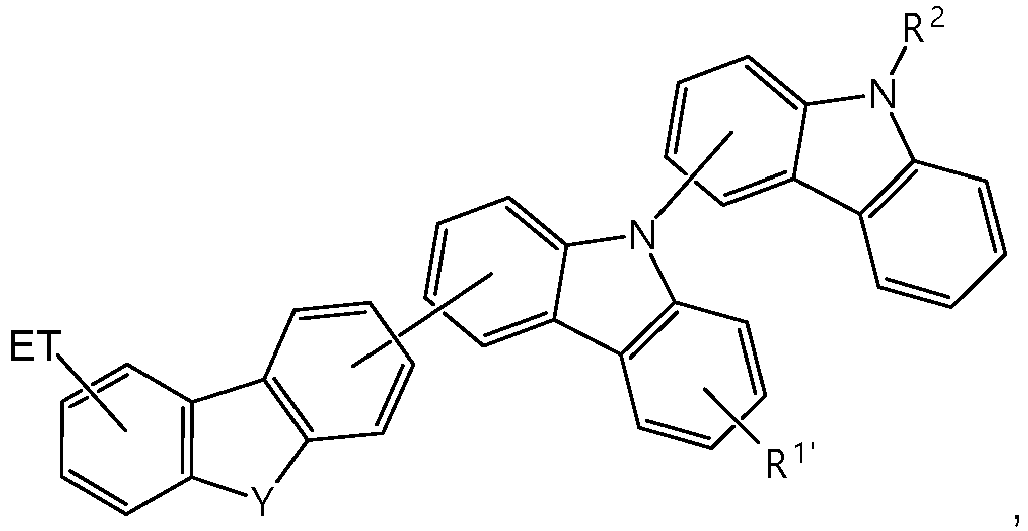 dans laquelle ce qui suit s'applique :
Groupement ET Hôte bipolaire (ET-12) formule (1a-19) (ET-13) formule (1a-20) (ET-14) formule (1a-21) (ET-15) formule (1a-22) (ET-16) formule (1a-23) (ET-20) formule (1a-24) ; les composés de formules (1b-13) à (1b-18) répondant à la formule générale dans laquelle ce qui suit s'applique :
Groupement ET Hôte bipolaire (ET-12) formule (1b-13) (ET-13) formule (1b-14) (ET-14) formule (1b-15) (ET-15) formule (1b-16) (ET-16) formule (1b-17) (ET-20) formule (1b-18) ; et les composés de formules (1b-19) à (1b-24) répondant à la formule générale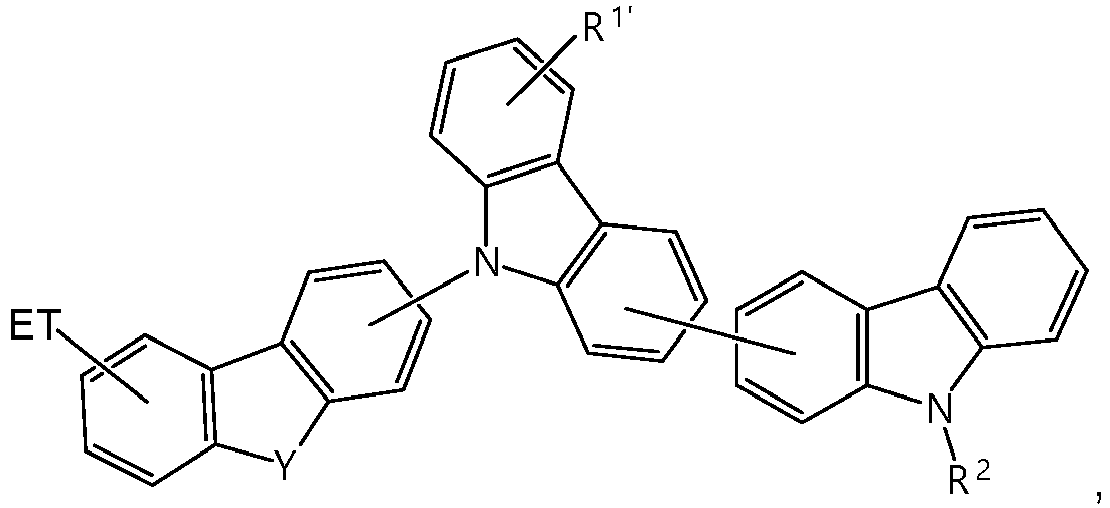 dans laquelle ce qui suit s'applique :
Groupement ET Hôte bipolaire (ET-12) formule (1b-19) (ET-13) formule (1b-20) (ET-14) formule (1b-21) (ET-15) formule (1b-22) (ET-16) formule (1b-23) (ET-20) formule (1b-24) ; Y est O ou S ;et dans laquelle ce qui suit s'applique aux groupements (ET-12), (ET-13), (ET-14), (ET-15), (ET-16) et (ET-20):

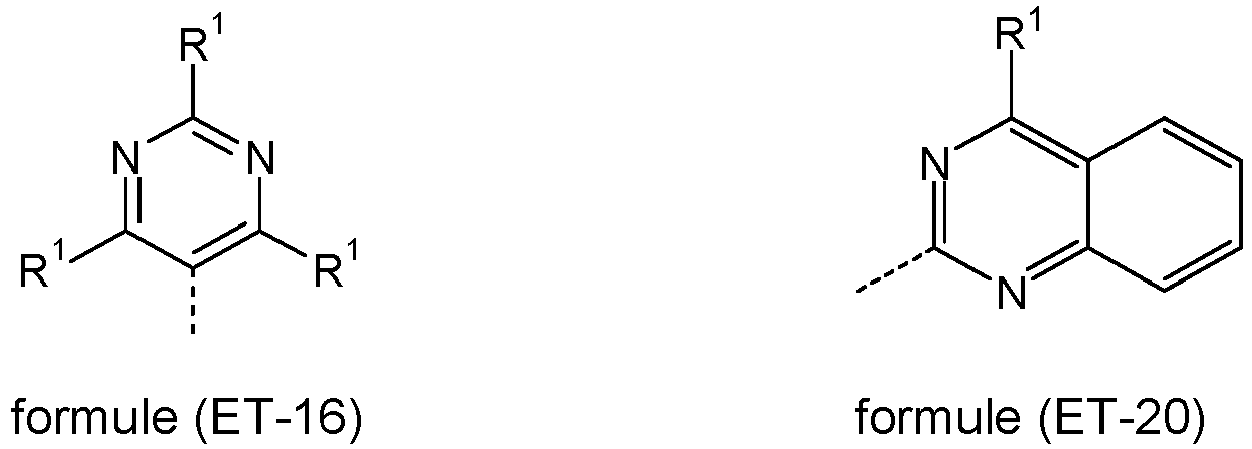 R1, R1', R1" sont, de manière identique ou différente à chaque occurrence, H, D, F, Cl, Br, I, N(R2)2, CN, NO2, Si(R2)3, B(OR2)2, C(=O)R2, P(=O)(R2)2, S(=O)R2, S(=O)2R2, OSO2R2, un groupement alkyle, alcoxy ou thioalcoxy à chaîne linéaire ayant de 1 à 40 atomes de C ou un groupement alcényle ou alcynyle à chaîne linéaire ayant de 2 à 40 atomes de C ou un groupement alkyle, alcényle, alcynyle, alcoxy, alkylalcoxy ou thioalcoxy ramifié ou cyclique ayant de 3 à 40 atomes de C, pouvant dans chaque cas être substitués par un ou plusieurs radicaux R2, où un ou plusieurs groupements CH2 non adjacents peuvent être remplacés par R2C=CR2, C=C, Si(R2)2, Ge(R2)2, Sn(R2)2, C=O, C=S, C=Se, C=NR2, P(=O)(R2), SO, SO2, NR2, O, S ou CONR2 et où un ou plusieurs atomes de H peuvent être remplacés par D, F, Cl, Br, I, CN ou NO2, ou un noyau aromatique ou hétéroaromatique ayant de 5 à 60 atomes de cycle aromatique, pouvant dans chaque cas être substitué par un ou plusieurs radicaux R2, ou un groupement aryloxy, arylalcoxy ou hétéroaryloxy ayant de 5 à 60 atomes de cycle aromatique, pouvant être substitué par un ou plusieurs radicaux R2, ou un groupement diarylamino, un groupement dihétéroarylamino ou un groupement arylhétéroarylamino ayant de 10 à 40 atomes de cycle aromatique, pouvant être substitué par un ou plusieurs radicaux R2, ou une combinaison de deux, ou plus, parmi ces groupements ; deux, ou plus, radicaux R1, R1' ou R1" adjacents peuvent former un noyau mono- ou polycyclique, aliphatique ou aromatique les uns avec les autres, où l'on préfère que deux, ou plus, radicaux R1, R1' ou R1" adjacents ne forment pas de noyau mono- ou polycyclique, aliphatique ou aromatique les uns avec les autres ;R2 est, de manière identique ou différente à chaque occurrence, H, D, F, Cl, Br, I, N(R3)2, CN, NO2, Si(R3)3, B(OR3)2, C(=O)R3, P(=O)(R3)2, S(=O)R3, S(=O)2R3, OSO2R3, un groupement alkyle, alcoxy ou thioalcoxy à chaîne linéaire ayant de 1 à 40 atomes de C ou un groupement alcényle ou alcynyle à chaîne linéaire ayant de 2 à 40 atomes de C ou un groupement alkyle, alcényle, alcynyle, alcoxy, alkylalcoxy ou thioalcoxy ramifié ou cyclique ayant de 3 à 40 atomes de C, pouvant dans chaque cas être substitués par un ou plusieurs radicaux R3, où un ou plusieurs groupements CH2 non adjacents peuvent être remplacés par R3C=CR3, C≡C, Si(R3)2, Ge(R3)2, Sn(R3)2, C=O, C=S, C=Se, C=NR3, P(=O)(R3), SO, SO2, NR3, O, S ou CONR5 et où un ou plusieurs atomes de H peuvent être remplacés par D, F, Cl, Br, I, CN ou NO2, ou un noyau aromatique ou hétéroaromatique ayant de 5 à 60 atomes de cycle aromatique, pouvant dans chaque cas être substitué par un ou plusieurs radicaux R3, ou un groupement aryloxy, arylalcoxy ou hétéroaryloxy ayant de 5 à 60 atomes de cycle aromatique, pouvant être substitué par un ou plusieurs radicaux R3, ou un groupement diarylamino, un groupement dihétéroarylamino ou un groupement arylhétéroarylamino ayant de 10 à 40 atomes de cycle aromatique, pouvant être substitué par un ou plusieurs radicaux R3, ou une combinaison de deux, ou plus, parmi ces groupements ; deux, ou plus, radicaux R2 adjacents peuvent former un noyau mono- ou polycyclique, aliphatique ou aromatique les uns avec les autres ;R5 est, de manière identique ou différente à chaque occurrence, H, D, F ou un radical hydrocarboné aliphatique, aromatique et/ou hétéroaromatique ayant de 1 à 20 atomes de C, où, de plus, un ou plusieurs atomes de H peuvent être remplacés par F ; deux, ou plus, substituants R3 peuvent également former un noyau mono- ou polycyclique, aliphatique ou aromatique les uns avec les autres ;R4 est, de manière identique ou différente à chaque occurrence, N(R2)2, Si(R2)3, B(OR2)2, C(=O)R2, P(=O)(R2)2, S(=O)R2, S(=O)2R2, OSO2R2, un groupement alkyle, alcoxy ou thioalcoxy à chaîne linéaire ayant de 1 à 40 atomes de C ou un groupement alcényle ou alcynyle à chaîne linéaire ayant de 2 à 40 atomes de C ou un groupement alkyle, alcényle, alcynyle, alcoxy, alkylalcoxy ou thioalcoxy ramifié ou cyclique ayant de 3 à 40 atomes de C, pouvant dans chaque cas être substitués par un ou plusieurs radicaux R2, où un ou plusieurs groupements CH2 non adjacents peuvent être remplacés par R2C=CR2, C=C, Si(R2)2, Ge(R2)2, Sn(R2)2, C=O, C=S, C=Se, C=NR2, P(=O)(R2), SO, SO2, NR2, O, S ou CONR2 et où un ou plusieurs atomes de H peuvent être remplacés par D, F, Cl, Br, I, CN ou NO2, ou un noyau aromatique ou hétéroaromatique ayant de 5 à 60 atomes de cycle aromatique, pouvant dans chaque cas être substitué par un ou plusieurs radicaux R2, ou un groupement aryloxy, arylalcoxy ou hétéroaryloxy ayant de 5 à 60 atomes de cycle aromatique, pouvant être substitué par un ou plusieurs radicaux R2, ou un groupement diarylamino, un groupement dihétéroarylamino ou un groupement arylhétéroarylamino ayant de 10 à 40 atomes de cycle aromatique, pouvant être substitué par un ou plusieurs radicaux R2, ou une combinaison de deux, ou plus, parmi ces groupements ; deux, ou plus, radicaux R4 adjacents peuvent former un noyau mono- ou polycyclique, aliphatique ou aromatique les uns avec les autres.
 - Composition selon la revendication 1, caractérisée en ce que l'hôte bipolaire est choisi parmi les composés de formule suivante
 dans laquelle ce qui suit s'applique
Groupement ET Hôte bipolaire (ET-12) formule (1a-25) (ET-13) formule (1a-26) (ET-14) formule (1a-27) (ET-15) formule (1a-28) (ET-16) formule (1a-29) (ET-20) formule (1a-30) ; les composés suivants de formules (1a-31) à (1a-36) répondant à la formule qénérale dans laquelle ce qui suit s'applique :
Groupement ET Hôte bipolaire (ET-12) formule (1a-31) (ET-13) formule (1a-32) (ET-14) formule (1a-33) (ET-15) formule (1a-34) (ET-16) formule (1a-35) (ET-20) formule (1a-36) ; les composés suivants de formules (1b-25) à (1b-30) répondant à la formule générale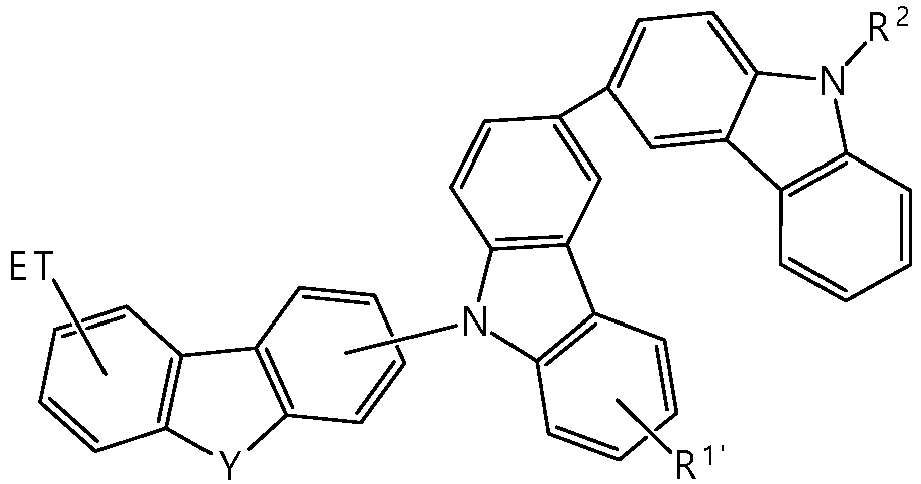 dans laquelle ce qui suit s'applique :
Groupement ET Hôte bipolaire (ET-12) formule (1b-25) (ET-13) formule (1b-26) (ET-14) formule (1b-27) (ET-15) formule (1b-28) (ET-16) formule (1b-29) (ET-20) formule (1b-30) ; et les composés suivants de formules (1b-31) à (1b-36) répondant à la formule générale dans laquelle ce qui suit s'applique :
Groupement ET Hôte bipolaire (ET-12) formule (1b-31) (ET-13) formule (1b-32) (ET-14) formule (1b-33) (ET-15) formule (1b-34) (ET-16) formule (1b-35) (ET-20) formule (1b-36) ; et dans laquelle les symboles utilisés revêtent les significations données ci-dessus. - Composition selon la revendication 1 ou 2, caractérisée en ce que l'hôte bipolaire est choisi parmi les composés de formules (1a-37), (1a-38), (1b-37) et (1b-38)


- Composition selon l'une ou plusieurs parmi les revendications 1 à 3, caractérisée en ce que R1 est choisi dans le groupe constitué par H ou un noyau aromatique ou hétéroaromatique ayant de 5 à 60 atomes de cycle aromatique, pouvant dans chaque cas être substitué par un ou plusieurs radicaux R2, où R1 ne contient pas de préférence de cycles ou noyaux aromatiques ou hétéroaromatiques et riches en électrons, où R2 revêt la signification donnée ci-dessus.
- Composition selon l'une ou plusieurs parmi les revendications 1 à 4, caractérisée en ce que le substituant R2 est choisi dans le groupe constitué par H ou un cycle ou noyau aromatique ou hétéroaromatique ayant de 5 à 30 atomes de cycle, où le cycle ou noyau peut dans chaque cas être substitué par un ou plusieurs radicaux R3, mais est préférablement non substitué, où R5 revêt la signification donnée ci-dessus.
- Composition selon l'une ou plusieurs parmi les revendications 1 à 5, caractérisée en ce que R2 représente un groupement phényle, biphényle, terphényle ou quaterphényle.
- Composition selon l'une ou plusieurs parmi les revendications 1 à 6, caractérisée en ce que l'hôte bipolaire représente un composé de formules (1a-37), (1a-38), (1b-37) et (1b-38), où le groupement HT contenant du carbazole est lié au niveau de la position 8 du dibenzo-furane.
- Composition selon l'une ou plusieurs parmi les revendications 1 à 7, caractérisée en ce que l'hôte de transport d'électrons est un lactame.
- Composition selon l'une ou plusieurs parmi les revendications 1 à 8, caractérisée en ce que l'hôte de transport d'électrons est un composé de formule générale (2) ou (2a),
 E est une liaison simple ou NAr4 ;X est C si Ar1 représente un groupement de cycle aryle de 6 chaînons ou hétéroaryle de 6 chaînons, ou est C ou N si Ar1 représente un groupement de cycle hétéroaryle de 5 chaînons ;Ar1 est, conjointement avec le groupement X et l'atome de carbone explicitement illustré, un noyau aromatique ou hétéroaromatique ayant de 5 à 30 atomes de cycle aromatique, pouvant être substitué par un ou plusieurs radicaux R ;Ar2 est, conjointement avec les atomes de carbone explicitement illustrés, un noyau aromatique ou hétéroaromatique ayant de 5 à 30 atomes de cycle aromatique, pouvant être substitué par un ou plusieurs radicaux R ; Ar2 peut également être lié à Ar3 via une liaison simple ;Ar3 est choisi dans le groupe constitué par H, D, F, Cl, Br, I, CN, NO2, N(Ar5)2, N(R6)2, C(=O)Ar5, C(=O)R6, P(=O)(Ar5)2, un groupement alkyle, alcoxy ou thioalkyle à chaîne linéaire ayant de 1 à 40 atomes de C ou un groupement alkyle, alcoxy ou thioalkyle ramifié ou cyclique ayant de 3 à 40 atomes de C ou un groupement alcényle ou alcynyle ayant de 2 à 40 atomes de C, pouvant dans chaque cas être substitués par un ou plusieurs radicaux R6, où un ou plusieurs groupements CH2 non adjacents peuvent être remplacés par R6C=CR6, C=C, Si(R6)2, Ge(R6)2, Sn(R6)2, C=O, C=S, C=Se, C=NR6, P(=O)(R6), SO, SO2, NR6, O, S ou CONR6 et où un ou plusieurs atomes de H peuvent être remplacés par D, F, Cl, Br, I, CN ou NO2, un noyau aromatique ou hétéroaromatique ayant de 5 à 30 atomes de cycle aromatique, pouvant dans chaque cas être substitué par un ou plusieurs radicaux R6, un groupement aryloxy ou hétéroaryloxy ayant de 5 à 30 atomes de cycle aromatique, pouvant être substitué par un ou plusieurs radicaux R6, ou une combinaison de ces systèmes ; Ar3 peut également être lié à Ar2 via une liaison simple ;Ar4 est un noyau aromatique ou hétéroaromatique ayant de 5 à 30 atomes de cycle aromatique, pouvant être substitué par un ou plusieurs radicaux R ; Ar4 peut également être lié à Ar2 ou Ar1 via une liaison simple ;m vaut 1, 3 ou 4 ;J pour m = 2 est une liaison simple ou un groupement divalent, ou pour m = 3 est un groupement trivalent ou pour m = 4 est un groupement tétravalent, qui est dans chaque cas lié à Ar1, Ar2, Ar3 ou Ar4 au niveau d'une position désirée quelconque ;R est choisi à chaque occurrence, de manière identique ou différente, dans le groupe constitué par H, D, F, Cl, Br, I, CN, NO2, N(Ar5)2, N(R6)2, C(=O)Ar5, C(=O)R6, P(=O)(Ar5)2, un groupement alkyle, alcoxy ou thioalkyle à chaîne linéaire ayant de 1 à 40 atomes de C ou un groupement alkyle, alcoxy ou thioalkyle ramifié ou cyclique ayant de 3 à 40 atomes de C ou un groupement alcényle ou alcynyle ayant de 2 à 40 atomes de C, pouvant dans chaque cas être substitués par un ou plusieurs radicaux R6, où un ou plusieurs groupements CH2 non adjacents peuvent être remplacés par R6C=CR6, C=C, Si(R6)2, Ge(R6)2, Sn(R6)2, C=O, C=S, C=Se, C=NR6, P(=O)(R6), SO, SO2, NR6, O, S ou CONR6 et où un ou plusieurs atomes de H peuvent être remplacés par D, F, Cl, Br, I, CN ou NO2, un noyau aromatique ou hétéroaromatique ayant de 5 à 60 atomes de cycle aromatique, pouvant dans chaque cas être substitué par un ou plusieurs radicaux R6, un groupement aryloxy ou hétéroaryloxy ayant de 5 à 60 atomes de cycle aromatique, pouvant être substitué par un ou plusieurs radicaux R6, ou une combinaison de ces systèmes, où éventuellement deux, ou plus, substituants R adjacents peuvent former un noyau monocyclique ou polycyclique, aliphatique, aromatique ou hétéroaromatique, pouvant être substitué par un ou plusieurs radicaux R6 ;R6 est choisi à chaque occurrence, de manière identique ou différente, dans le groupe constitué par H, D, F, Cl, Br, I, CN, NO2, N(Ar5)2, N(R7)2, C(=O)Ar5, C(=O)R7, P(=O)(Ar5)2, un groupement alkyle, alcoxy ou thioalkyle à chaîne linéaire ayant de 1 à 40 atomes de C ou un groupement alkyle, alcoxy ou thioalkyle ramifié ou cyclique ayant de 3 à 40 atomes de C ou un groupement alcényle ou alcynyle ayant de 2 à 40 atomes de C, pouvant dans chaque cas être substitués par un ou plusieurs radicaux R7, où un ou plusieurs groupements CH2 non adjacents peuvent être remplacés par R7C=CR7, C≡C, Si(R7)2, Ge(R7)2, Sn(R7)2, C=O, C=S, C=Se, C=NR7, P(=O)(R7), SO, SO2, NR7, O, S ou CONR7 et où un ou plusieurs atomes de H peuvent être remplacés par D, F, Cl, Br, I, CN ou NO2, un noyau aromatique ou hétéroaromatique ayant de 5 à 60 atomes de cycle aromatique, pouvant dans chaque cas être substitué par un ou plusieurs radicaux R7, un groupement aryloxy ou hétéroaryloxy ayant de 5 à 60 atomes de cycle aromatique, pouvant être substitué par un ou plusieurs radicaux R7, ou une combinaison de ces systèmes, où éventuellement deux, ou plus, substituants R6 adjacents peuvent former un noyau monocyclique ou polycyclique, aliphatique, aromatique ou hétéroaromatique, pouvant être substitué par un ou plusieurs radicaux R7 ;Ar5 est à chaque occurrence, de manière identique ou différente, un noyau aromatique ou hétéroaromatique ayant de 5 à 30 atomes de cycle aromatique, pouvant être substitué par un ou plusieurs radicaux R7 non aromatiques ; deux radicaux Ar5 qui sont liés au même atome de N ou atome de B peuvent également être pontés l'un avec l'autre via une liaison simple ou un pont choisi parmi N(R7), C(R7)2 ou O ;R7 est choisi dans le groupe constitué par H, D, F, CN, un radical hydrocarboné aliphatique ayant de 1 à 20 atomes de C, un noyau aromatique ou hétéroaromatique ayant de 5 à 30 atomes de cycle aromatique, où un ou plusieurs atomes de H peuvent être remplacés par D, F, Cl, Br, I ou CN, où deux, ou plus, substituants R7 adjacents peuvent former un noyau mono- ou polycyclique, aliphatique, aromatique ou hétéroaromatique les uns avec les autres.
 - Composition selon la revendication 9, caractérisée en ce que, dans les composés de formule (2) ou (2a), le groupement Ar1 représente un groupement de formule (3), (4), (5), (6) ou (7),
 dans laquelle la lignée en pointillés indique la liaison au groupement carbonyle, * indique la position de la liaison à E et, en outre, ce qui suit s'applique :W est, de manière identique ou différente à chaque occurrence, CR ou N ; ou deux groupements W adjacents représentent un groupement de formule (8) ou (9) suivante,
 dans laquelle G représente CR2, NR, O ou S, Z représente, de manière identique ou différente à chaque occurrence, CR ou N, et ^ indique les groupements W adjacents correspondants dans les formules (3) à (7) ;V est NR, O ou S ;et en ce que le groupement Ar2 représente un groupement répondant à l'une des formules (10), (11) ou (12),
 dans lesquelles la lignée en pointillés indique la liaison à N, # indique la position d'une liaison éventuelle à Ar3, * indique la liaison à E, et W et V revêtent les significations données ci-dessus ;et en ce que le groupement Ar3 représente un groupement répondant à l'une des formules (13), (14), (15) ou (16),
 dans lesquelles la lignée en pointillés indique la liaison au N, * indique une liaison éventuelle à Ar2, et W et V revêtent les significations données ci-dessus.
 - Composition selon la revendication 9 ou 10, caractérisée en ce que le composé de formule (2) est choisi parmi les composés de formules (17) à (32)


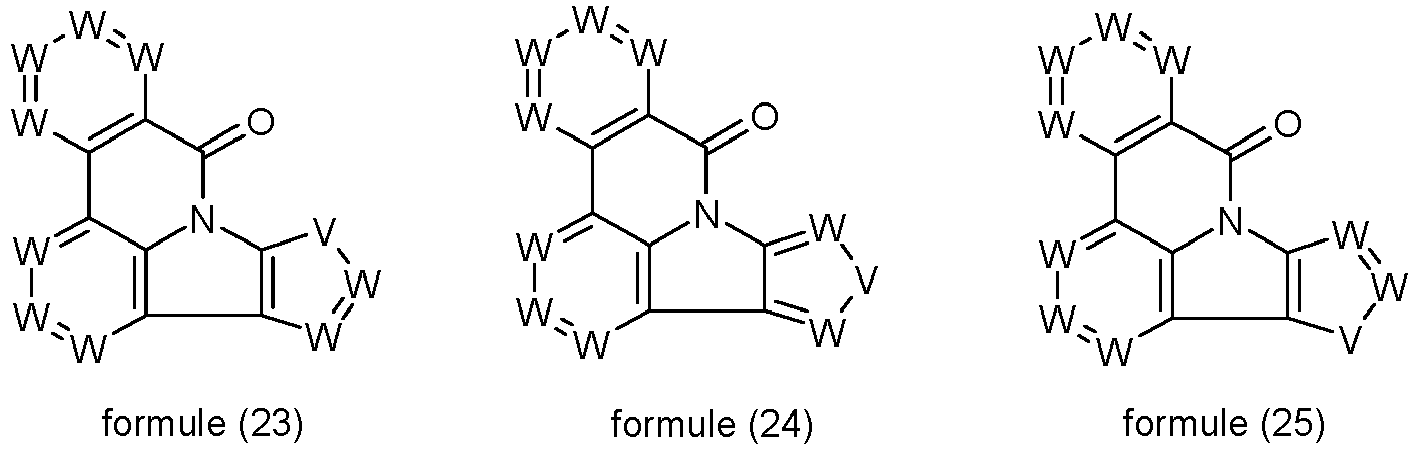


- Composition selon l'une ou plusieurs parmi les revendications 9 à 11, caractérisée en ce que le composé de formule (2) est choisi parmi les composés de formules (17a) à (32a),


- Composition selon l'une ou plusieurs parmi les revendications 9 à 12, caractérisée en ce que le composé de formule (2) est choisi parmi les composés de formules (17b) à (32b),

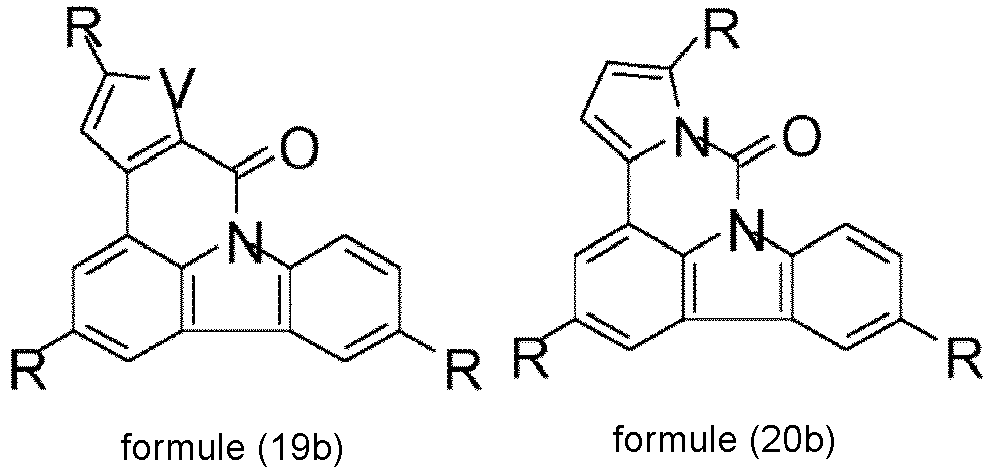


- Composition selon l'une ou plusieurs parmi les revendications 1 à 13, caractérisée en ce que la composition comprend au moins un autre composé, qui est choisi dans le groupe constitué par les matériaux d'injection de trous, les matériaux de transport de trous, les matériaux de blocage de trous, les matériaux à large bande interdite, les émetteurs fluorescents, les émetteurs phosphorescents, les matériaux hôtes, les matériaux de matrice, les matériaux de blocage d'électrons, les matériaux de transport d'électrons et les matériaux d'injection d'électrons, les dopants de type N et les dopants de type P.
- Formulation comprenant une composition selon l'une ou plusieurs parmi les revendications 1 à 14 et au moins un solvant.
- Utilisation d'une composition selon l'une ou plusieurs parmi les revendications 1 à 15 dans un dispositif électronique organique, qui est choisi de préférence parmi les circuits intégrés organiques (OIC), les transistors organiques à effet de champ (OFET), les transistors organiques à couche mince (OTFT), les dispositifs électroluminescents organiques, les cellules solaires organiques (OSC), les détecteurs optiques organiques et les photorécepteurs organiques, où les dispositifs électroluminescents organiques sont particulièrement préférés, et les cellules électrochimiques émettrices de lumière (OLEC) et les diodes électroluminescentes organiques (OLED) sont très particulièrement préférées.
- Dispositif électronique organique contenant au moins une composition selon l'une ou plusieurs parmi les revendications 1 à 14, préférablement dans une couche d'émission (EML), dans une couche de transport d'électrons (ETL), dans une couche d'injection d'électrons (EIL) et/ou dans une couche de blocage de trous (HBL), très préférablement dans une EML, EIL et/ou ETL et très particulièrement préférablement dans une EML.
- Dispositif électronique organique selon la revendication 17, caractérisé en ce qu'il est choisi parmi les circuits intégrés organiques (OIC), les transistors organiques à effet de champ (OFET), les transistors organiques à couche mince (OTFT), les dispositifs électroluminescents organiques, les cellules solaires organiques (OSC), les détecteurs optiques organiques et les photorécepteurs organiques, où les dispositifs électroluminescents organiques sont particulièrement préférés.
- Dispositif électronique organique selon la revendication 17 ou 18, caractérisé en ce qu'il s'agit d'un dispositif électroluminescent organique choisi parmi les transistors organiques émetteurs de lumière (OLET), les dispositifs organiques à extinction de champ (OFQD), les cellules électrochimiques organiques émettrices de lumière (OLEC, LEC, LEEC), les diodes laser organiques (O-lasers) et les diodes électroluminescentes organiques (OLED), préférablement parmi les OLEC et les OLED et particulièrement préférablement parmi les OLED.
- Dispositif électronique organique selon l'une ou plusieurs parmi les revendications 17 à 19, caractérisé en ce qu'il s'agit d'un dispositif électroluminescent organique qui contient la composition selon l'une ou plusieurs parmi les revendications 1 à 14 dans la couche d'émission conjointement avec un émetteur phosphorescent.
- Procédé de production d'un dispositif électronique organique selon l'une ou plusieurs parmi les revendications 17 à 20, caractérisé en ce qu'au moins une couche organique comprenant une composition selon l'une ou plusieurs parmi les revendications 1 à 14 est appliquée par dépôt en phase gazeuse ou à partir d'une solution.
- Procédé selon la revendication 21, caractérisé en ce que la au moins une couche organique est appliquée par dépôt en phase gazeuse par le prémélange de la composition et son évaporation à partir d'une source de matériau unique.
Applications Claiming Priority (2)
| Application Number | Priority Date | Filing Date | Title |
|---|---|---|---|
| EP17166657 | 2017-04-13 | ||
| PCT/EP2018/059076 WO2018189134A1 (fr) | 2017-04-13 | 2018-04-10 | Composition pour dispositifs électroniques organiques |
Publications (2)
| Publication Number | Publication Date |
|---|---|
| EP3609977A1 EP3609977A1 (fr) | 2020-02-19 |
| EP3609977B1 true EP3609977B1 (fr) | 2024-05-29 |
Family
ID=58664467
Family Applications (1)
| Application Number | Title | Priority Date | Filing Date |
|---|---|---|---|
| EP18716280.5A Active EP3609977B1 (fr) | 2017-04-13 | 2018-04-10 | Composition pour dispositifs électroniques organiques |
Country Status (7)
| Country | Link |
|---|---|
| US (1) | US11778907B2 (fr) |
| EP (1) | EP3609977B1 (fr) |
| JP (1) | JP2020522876A (fr) |
| KR (1) | KR102608491B1 (fr) |
| CN (1) | CN110520503A (fr) |
| TW (1) | TW201902891A (fr) |
| WO (1) | WO2018189134A1 (fr) |
Families Citing this family (14)
| Publication number | Priority date | Publication date | Assignee | Title |
|---|---|---|---|---|
| US20220069231A1 (en) * | 2018-07-20 | 2022-03-03 | Merck Patent Gmbh | Materials for organic electroluminescent devices |
| JP2022501400A (ja) * | 2018-09-27 | 2022-01-06 | メルク パテント ゲゼルシャフト ミット ベシュレンクテル ハフツングMerck Patent Gesellschaft mit beschraenkter Haftung | 立体障害窒素含有ヘテロ芳香族化合物を製造する方法 |
| TW202039493A (zh) * | 2018-12-19 | 2020-11-01 | 德商麥克專利有限公司 | 用於有機電致發光裝置之材料 |
| TWI794742B (zh) | 2020-02-18 | 2023-03-01 | 美商基利科學股份有限公司 | 抗病毒化合物 |
| TWI874791B (zh) | 2020-02-18 | 2025-03-01 | 美商基利科學股份有限公司 | 抗病毒化合物 |
| AU2021224588B2 (en) | 2020-02-18 | 2024-07-18 | Gilead Sciences, Inc. | Antiviral compounds |
| KR102914927B1 (ko) | 2020-06-23 | 2026-01-19 | 메르크 파텐트 게엠베하 | 혼합물의 제조 방법 |
| CN111933812B (zh) * | 2020-08-17 | 2024-01-26 | 云谷(固安)科技有限公司 | 显示面板 |
| US20230406861A1 (en) * | 2020-10-02 | 2023-12-21 | Cynora Gmbh | Organic molecules for optoelectronic devices |
| CN114695686B (zh) * | 2020-12-29 | 2025-07-18 | 广州华睿光电材料有限公司 | 有机电致发光器件 |
| JP7688152B2 (ja) | 2021-04-16 | 2025-06-03 | ギリアード サイエンシーズ, インコーポレイテッド | アミドを使用してカルバヌクレオシドを調製する方法 |
| JP7719954B2 (ja) | 2021-08-18 | 2025-08-06 | ギリアード サイエンシーズ, インコーポレイテッド | リン脂質化合物並びにその製造方法及び使用方法 |
| KR102900365B1 (ko) * | 2021-12-31 | 2025-12-15 | 엘지디스플레이 주식회사 | 발광 소자 및 이를 이용한 발광 표시 장치 |
| CN117362292B (zh) * | 2023-06-15 | 2025-07-22 | 闽都创新实验室 | 酰胺衍生物热活化延迟荧光材料及其制备方法和应用 |
Family Cites Families (139)
| Publication number | Priority date | Publication date | Assignee | Title |
|---|---|---|---|---|
| US4539507A (en) | 1983-03-25 | 1985-09-03 | Eastman Kodak Company | Organic electroluminescent devices having improved power conversion efficiencies |
| US5061569A (en) | 1990-07-26 | 1991-10-29 | Eastman Kodak Company | Electroluminescent device with organic electroluminescent medium |
| US5151629A (en) | 1991-08-01 | 1992-09-29 | Eastman Kodak Company | Blue emitting internal junction organic electroluminescent device (I) |
| JP3295088B2 (ja) | 1993-09-29 | 2002-06-24 | 出光興産株式会社 | 有機エレクトロルミネッセンス素子 |
| JPH07133483A (ja) | 1993-11-09 | 1995-05-23 | Shinko Electric Ind Co Ltd | El素子用有機発光材料及びel素子 |
| EP0676461B1 (fr) | 1994-04-07 | 2002-08-14 | Covion Organic Semiconductors GmbH | Composés spiro et leur application comme matières électroluminescentes |
| DE19652261A1 (de) | 1996-12-16 | 1998-06-18 | Hoechst Ag | Arylsubstituierte Poly(p-arylenvinylene), Verfahren zur Herstellung und deren Verwendung in Elektroluminszenzbauelementen |
| US5942340A (en) | 1997-10-02 | 1999-08-24 | Xerox Corporation | Indolocarbazole electroluminescent devices |
| US5952115A (en) | 1997-10-02 | 1999-09-14 | Xerox Corporation | Electroluminescent devices |
| US5843607A (en) | 1997-10-02 | 1998-12-01 | Xerox Corporation | Indolocarbazole photoconductors |
| US5935721A (en) | 1998-03-20 | 1999-08-10 | Eastman Kodak Company | Organic electroluminescent elements for stable electroluminescent |
| JP3302945B2 (ja) | 1998-06-23 | 2002-07-15 | ネースディスプレイ・カンパニー・リミテッド | 新規な有機金属発光物質およびそれを含む有機電気発光素子 |
| KR100913568B1 (ko) | 1999-05-13 | 2009-08-26 | 더 트러스티즈 오브 프린스턴 유니버시티 | 전계인광에 기초한 고 효율의 유기 발광장치 |
| WO2001021729A1 (fr) | 1999-09-21 | 2001-03-29 | Idemitsu Kosan Co., Ltd. | Support organique a electroluminescence et support organique lumineux |
| WO2001041512A1 (fr) | 1999-12-01 | 2001-06-07 | The Trustees Of Princeton University | Complexes de forme l2mx en tant que dopants phosphorescents pour del organiques |
| KR100377321B1 (ko) | 1999-12-31 | 2003-03-26 | 주식회사 엘지화학 | 피-형 반도체 성질을 갖는 유기 화합물을 포함하는 전기소자 |
| TW532048B (en) | 2000-03-27 | 2003-05-11 | Idemitsu Kosan Co | Organic electroluminescence element |
| JP4094203B2 (ja) | 2000-03-30 | 2008-06-04 | 出光興産株式会社 | 有機エレクトロルミネッセンス素子及び有機発光媒体 |
| US6392250B1 (en) | 2000-06-30 | 2002-05-21 | Xerox Corporation | Organic light emitting devices having improved performance |
| US20020121638A1 (en) | 2000-06-30 | 2002-09-05 | Vladimir Grushin | Electroluminescent iridium compounds with fluorinated phenylpyridines, phenylpyrimidines, and phenylquinolines and devices made with such compounds |
| CN101924190B (zh) | 2000-08-11 | 2012-07-04 | 普林斯顿大学理事会 | 有机金属化合物和发射转换有机电致磷光 |
| JP4154139B2 (ja) | 2000-09-26 | 2008-09-24 | キヤノン株式会社 | 発光素子 |
| JP4154140B2 (ja) | 2000-09-26 | 2008-09-24 | キヤノン株式会社 | 金属配位化合物 |
| JP4154138B2 (ja) | 2000-09-26 | 2008-09-24 | キヤノン株式会社 | 発光素子、表示装置及び金属配位化合物 |
| US6803720B2 (en) | 2000-12-15 | 2004-10-12 | Universal Display Corporation | Highly stable and efficient OLEDs with a phosphorescent-doped mixed layer architecture |
| AU2002306698A1 (en) | 2001-03-14 | 2002-09-24 | The Trustees Of Princeton University | Materials and devices for blue phosphorescence based organic light emitting diodes |
| US6750608B2 (en) * | 2001-11-09 | 2004-06-15 | Konica Corporation | Organic electroluminescence element and display |
| CN1239447C (zh) | 2002-01-15 | 2006-02-01 | 清华大学 | 一种有机电致发光材料 |
| KR100691543B1 (ko) | 2002-01-18 | 2007-03-09 | 주식회사 엘지화학 | 새로운 전자 수송용 물질 및 이를 이용한 유기 발광 소자 |
| JP4170655B2 (ja) | 2002-04-17 | 2008-10-22 | 出光興産株式会社 | 新規芳香族化合物及びそれを利用した有機エレクトロルミネッセンス素子 |
| EP1501821B1 (fr) | 2002-05-07 | 2016-07-20 | LG Chem, Ltd. | Nouveaux composes organiques pour l'electroluminescence et dispositifs electroluminescents organiques dans lesquels ils sont utilises |
| EP1541657B2 (fr) | 2002-07-19 | 2014-03-05 | Idemitsu Kosan Co., Ltd. | Dispositifs electroluminescents organiques et support luminescent organique |
| JP4025137B2 (ja) | 2002-08-02 | 2007-12-19 | 出光興産株式会社 | アントラセン誘導体及びそれを利用した有機エレクトロルミネッセンス素子 |
| JP2004075567A (ja) | 2002-08-12 | 2004-03-11 | Idemitsu Kosan Co Ltd | オリゴアリーレン誘導体及びそれを利用した有機エレクトロルミネッセンス素子 |
| WO2004018587A1 (fr) | 2002-08-23 | 2004-03-04 | Idemitsu Kosan Co., Ltd. | Dispositif organique electroluminescent et derive d'anthracene |
| JPWO2004028217A1 (ja) | 2002-09-20 | 2006-01-19 | 出光興産株式会社 | 有機エレクトロルミネッセンス素子 |
| KR101030158B1 (ko) | 2002-12-23 | 2011-04-18 | 메르크 파텐트 게엠베하 | 유기 전자발광 부품 |
| DE10310887A1 (de) | 2003-03-11 | 2004-09-30 | Covion Organic Semiconductors Gmbh | Matallkomplexe |
| KR101020350B1 (ko) | 2003-03-13 | 2011-03-08 | 이데미쓰 고산 가부시키가이샤 | 신규한 질소 함유 헤테로환 유도체 및 이를 이용한 유기 전기발광 소자 |
| JP4411851B2 (ja) | 2003-03-19 | 2010-02-10 | コニカミノルタホールディングス株式会社 | 有機エレクトロルミネッセンス素子 |
| US7345301B2 (en) | 2003-04-15 | 2008-03-18 | Merck Patent Gmbh | Mixtures of matrix materials and organic semiconductors capable of emission, use of the same and electronic components containing said mixtures |
| JP4635870B2 (ja) | 2003-04-23 | 2011-02-23 | コニカミノルタホールディングス株式会社 | 有機エレクトロルミネッセンス素子、照明装置及び表示装置 |
| JP4773346B2 (ja) | 2003-07-07 | 2011-09-14 | メルク パテント ゲーエムベーハー | 有機発光半導体とマトリックス材料との混合物、それらの使用および前記材料を含む電子部品。 |
| DE10333232A1 (de) | 2003-07-21 | 2007-10-11 | Merck Patent Gmbh | Organisches Elektrolumineszenzelement |
| DE10338550A1 (de) | 2003-08-19 | 2005-03-31 | Basf Ag | Übergangsmetallkomplexe mit Carbenliganden als Emitter für organische Licht-emittierende Dioden (OLEDs) |
| DE10345572A1 (de) | 2003-09-29 | 2005-05-19 | Covion Organic Semiconductors Gmbh | Metallkomplexe |
| US7795801B2 (en) | 2003-09-30 | 2010-09-14 | Konica Minolta Holdings, Inc. | Organic electroluminescent element, illuminator, display and compound |
| DE10357044A1 (de) | 2003-12-04 | 2005-07-14 | Novaled Gmbh | Verfahren zur Dotierung von organischen Halbleitern mit Chinondiiminderivaten |
| DE102004008304A1 (de) | 2004-02-20 | 2005-09-08 | Covion Organic Semiconductors Gmbh | Organische elektronische Vorrichtungen |
| DE102004010954A1 (de) | 2004-03-03 | 2005-10-06 | Novaled Gmbh | Verwendung eines Metallkomplexes als n-Dotand für ein organisches halbleitendes Matrixmaterial, organisches Halbleitermaterial und elektronisches Bauteil |
| US7790890B2 (en) | 2004-03-31 | 2010-09-07 | Konica Minolta Holdings, Inc. | Organic electroluminescence element material, organic electroluminescence element, display device and illumination device |
| KR100787425B1 (ko) | 2004-11-29 | 2007-12-26 | 삼성에스디아이 주식회사 | 페닐카바졸계 화합물 및 이를 이용한 유기 전계 발광 소자 |
| DE102004023277A1 (de) | 2004-05-11 | 2005-12-01 | Covion Organic Semiconductors Gmbh | Neue Materialmischungen für die Elektrolumineszenz |
| US7598388B2 (en) | 2004-05-18 | 2009-10-06 | The University Of Southern California | Carbene containing metal complexes as OLEDs |
| JP4862248B2 (ja) | 2004-06-04 | 2012-01-25 | コニカミノルタホールディングス株式会社 | 有機エレクトロルミネッセンス素子、照明装置及び表示装置 |
| EP1655359A1 (fr) | 2004-11-06 | 2006-05-10 | Covion Organic Semiconductors GmbH | Dispositif organique électroluminescent |
| JP2008530773A (ja) | 2005-02-04 | 2008-08-07 | ノヴァレッド・アクチエンゲゼルシャフト | 有機半導体への添加物 |
| KR20090040398A (ko) | 2005-03-18 | 2009-04-23 | 이데미쓰 고산 가부시키가이샤 | 방향족 아민 유도체 및 그것을 사용한 유기 전기발광 소자 |
| JP5295756B2 (ja) | 2005-04-14 | 2013-09-18 | メルク パテント ゲーエムベーハー | 有機電子素子のための化合物 |
| WO2006117052A1 (fr) | 2005-05-03 | 2006-11-09 | Merck Patent Gmbh | Dispositif electroluminescent organique, et derives d'acide boronique et d'acide borinique utilises pour produire ce dispositif electroluminescent organique |
| DE102005023437A1 (de) | 2005-05-20 | 2006-11-30 | Merck Patent Gmbh | Verbindungen für organische elektronische Vorrichtungen |
| EP1956022B1 (fr) | 2005-12-01 | 2012-07-25 | Nippon Steel Chemical Co., Ltd. | Compose pour element electroluminescent organique et element electroluminescent organique |
| US7919010B2 (en) | 2005-12-22 | 2011-04-05 | Novaled Ag | Doped organic semiconductor material |
| EP1837926B1 (fr) | 2006-03-21 | 2008-05-07 | Novaled AG | Radicaux ou diradicaux hétérocycliques, leur dimères, oligomères, polymères, composés spiro et polycycliques. Leur usage dans des semi-conducteurs organiques et dispositifs électroniques. |
| EP1837927A1 (fr) | 2006-03-22 | 2007-09-26 | Novaled AG | Utilisation de radicaux hétérocycliques pour doper des semiconducteurs organiques |
| WO2007115540A1 (fr) | 2006-03-30 | 2007-10-18 | Novaled Ag | Utilisation de bora-tétraazapentalènes |
| EP1860709B1 (fr) | 2006-05-24 | 2012-08-08 | Novaled AG | Utilisation des complexes plans quadrangulaires à base des métaux de transition comme dopant |
| DE102006025777A1 (de) | 2006-05-31 | 2007-12-06 | Merck Patent Gmbh | Neue Materialien für organische Elektrolumineszenzvorrichtungen |
| DE102006025846A1 (de) | 2006-06-02 | 2007-12-06 | Merck Patent Gmbh | Neue Materialien für organische Elektrolumineszenzvorrichtungen |
| DE102006031990A1 (de) | 2006-07-11 | 2008-01-17 | Merck Patent Gmbh | Neue Materialien für organische Elektrolumineszenzvorrichtungen |
| EP2080762B1 (fr) | 2006-11-09 | 2016-09-14 | Nippon Steel & Sumikin Chemical Co., Ltd. | Composé pour un dispositif électroluminescent organique et dispositif électroluminescent organique |
| DE102006053320B4 (de) | 2006-11-13 | 2012-01-19 | Novaled Ag | Verwendung einer Koordinationsverbindung zur Dotierung organischer Halbleiter |
| DE102006054524B4 (de) | 2006-11-20 | 2022-12-22 | Novaled Gmbh | Verwendung von Dithiolenübergangsmetallkomplexen und Selen- analoger Verbindungen als Dotand |
| DE102006054523B4 (de) | 2006-11-20 | 2009-07-23 | Novaled Ag | Dithiolenübergangsmetallkomplexe und Selen-analoge Verbindungen, deren Verwendung als Dotand, organisches halbleitendes Material enthaltend die Komplexe, sowie elektronische oder optoelektronisches Bauelement enthaltend einen Komplex |
| DE102007002714A1 (de) | 2007-01-18 | 2008-07-31 | Merck Patent Gmbh | Neue Materialien für organische Elektrolumineszenzvorrichtungen |
| DE102007018456B4 (de) | 2007-04-19 | 2022-02-24 | Novaled Gmbh | Verwendung von Hauptgruppenelementhalogeniden und/oder -pseudohalogeniden, organisches halbleitendes Matrixmaterial, elektronische und optoelektronische Bauelemente |
| EP3076451B1 (fr) | 2007-04-30 | 2019-03-06 | Novaled GmbH | Connexions de matiere d'oxydes de carbone, de matiere de pseudo oxyde de carbone et radiales tout comme leur utilisation |
| EP1990847B1 (fr) | 2007-05-10 | 2018-06-20 | Novaled GmbH | Utilisation de bisimidazoles quinoïdes et leurs dérivés en tant que dopant destiné au dopage d'un matériau de matrice organique semi-conducteur |
| DE102007024850A1 (de) | 2007-05-29 | 2008-12-04 | Merck Patent Gmbh | Neue Materialien für organische Elektrolumineszenzvorrichtungen |
| EP2009014B1 (fr) | 2007-06-22 | 2018-10-24 | Novaled GmbH | Utilisation d'un précurseur d'un n-dopant destiné au dopage d'un matériau semi-conducteur organique, précurseur et composant électronique ou optoélectronique |
| DE102007031220B4 (de) | 2007-07-04 | 2022-04-28 | Novaled Gmbh | Chinoide Verbindungen und deren Verwendung in halbleitenden Matrixmaterialien, elektronischen und optoelektronischen Bauelementen |
| JP5194596B2 (ja) | 2007-07-11 | 2013-05-08 | コニカミノルタホールディングス株式会社 | 有機エレクトロルミネッセンス素子、表示装置及び照明装置 |
| DE102008051737B4 (de) | 2007-10-24 | 2022-10-06 | Novaled Gmbh | Quadratisch planare Übergangsmetallkomplexe, organische halbleitende Materialien sowie elektronische oder optoelektronische Bauelemente, die diese umfassen und Verwendung derselben |
| DE102007053771A1 (de) | 2007-11-12 | 2009-05-14 | Merck Patent Gmbh | Organische Elektrolumineszenzvorrichtungen |
| WO2009069442A1 (fr) | 2007-11-26 | 2009-06-04 | Konica Minolta Holdings, Inc. | Dispositif électroluminescent organique, dispositif d'affichage et dispositif d'éclairage |
| DE112009000621A5 (de) | 2008-01-15 | 2010-12-16 | Novaled Ag | Dithiolenübergangsmetallkomplexe und elektronische oder optoelektronische Bauelemente |
| US8057712B2 (en) | 2008-04-29 | 2011-11-15 | Novaled Ag | Radialene compounds and their use |
| DE102008027005A1 (de) | 2008-06-05 | 2009-12-10 | Merck Patent Gmbh | Organische elektronische Vorrichtung enthaltend Metallkomplexe |
| DE102008033943A1 (de) | 2008-07-18 | 2010-01-21 | Merck Patent Gmbh | Neue Materialien für organische Elektrolumineszenzvorrichtungen |
| DE102008035413A1 (de) | 2008-07-29 | 2010-02-04 | Merck Patent Gmbh | Verbindungen für organische elektronische Vorrichtungen |
| DE102008036247A1 (de) | 2008-08-04 | 2010-02-11 | Merck Patent Gmbh | Elektronische Vorrichtungen enthaltend Metallkomplexe |
| DE102008036982A1 (de) | 2008-08-08 | 2010-02-11 | Merck Patent Gmbh | Organische Elektrolumineszenzvorrichtung |
| DE102008048336A1 (de) | 2008-09-22 | 2010-03-25 | Merck Patent Gmbh | Einkernige neutrale Kupfer(I)-Komplexe und deren Verwendung zur Herstellung von optoelektronischen Bauelementen |
| US8119037B2 (en) | 2008-10-16 | 2012-02-21 | Novaled Ag | Square planar transition metal complexes and organic semiconductive materials using them as well as electronic or optoelectric components |
| ES2370120T3 (es) | 2008-10-23 | 2011-12-12 | Novaled Ag | Compuesto de radialeno y su utilización. |
| JP5701766B2 (ja) | 2008-11-11 | 2015-04-15 | メルク パテント ゲーエムベーハー | 有機エレクトロルミネセント素子 |
| DE102008056688A1 (de) | 2008-11-11 | 2010-05-12 | Merck Patent Gmbh | Materialien für organische Elektrolumineszenzvorrichtungen |
| DE102008057050B4 (de) | 2008-11-13 | 2021-06-02 | Merck Patent Gmbh | Materialien für organische Elektrolumineszenzvorrichtungen |
| DE102008057051B4 (de) | 2008-11-13 | 2021-06-17 | Merck Patent Gmbh | Materialien für organische Elektrolumineszenzvorrichtungen |
| DE102008064200A1 (de) | 2008-12-22 | 2010-07-01 | Merck Patent Gmbh | Organische Elektrolumineszenzvorrichtung |
| DE102009007038A1 (de) | 2009-02-02 | 2010-08-05 | Merck Patent Gmbh | Metallkomplexe |
| WO2010097433A1 (fr) | 2009-02-26 | 2010-09-02 | Basf Se | Composés quinoniques convenant comme impureté de dopage en électronique organique |
| DE102009011223A1 (de) | 2009-03-02 | 2010-09-23 | Merck Patent Gmbh | Metallkomplexe |
| DE102009013041A1 (de) | 2009-03-13 | 2010-09-16 | Merck Patent Gmbh | Materialien für organische Elektrolumineszenzvorrichtungen |
| DE102009014513A1 (de) | 2009-03-23 | 2010-09-30 | Merck Patent Gmbh | Organische Elektrolumineszenzvorrichtung |
| DE102009023155A1 (de) | 2009-05-29 | 2010-12-02 | Merck Patent Gmbh | Materialien für organische Elektrolumineszenzvorrichtungen |
| DE102009031021A1 (de) | 2009-06-30 | 2011-01-05 | Merck Patent Gmbh | Materialien für organische Elektrolumineszenzvorrichtungen |
| DE102009041414A1 (de) | 2009-09-16 | 2011-03-17 | Merck Patent Gmbh | Metallkomplexe |
| CN102471320A (zh) | 2009-10-16 | 2012-05-23 | 出光兴产株式会社 | 含芴芳香族化合物、有机电致发光元件用材料及使用其的有机电致发光元件 |
| DE102009053382A1 (de) | 2009-11-14 | 2011-05-19 | Merck Patent Gmbh | Materialien für elektronische Vorrichtungen |
| DE102009057167A1 (de) | 2009-12-05 | 2011-06-09 | Merck Patent Gmbh | Elektronische Vorrichtung enthaltend Metallkomplexe |
| DE102010005697A1 (de) | 2010-01-25 | 2011-07-28 | Merck Patent GmbH, 64293 | Verbindungen für elektronische Vorrichtungen |
| DE102010012738A1 (de) | 2010-03-25 | 2011-09-29 | Merck Patent Gmbh | Materialien für organische Elektrolumineszenzvorrichtungen |
| DE102010014933A1 (de) | 2010-04-14 | 2011-10-20 | Merck Patent Gmbh | Materialien für elektronische Vorrichtungen |
| WO2011131185A1 (fr) | 2010-04-21 | 2011-10-27 | Novaled Ag | Mélange pour la fabrication d'une couche semi-conductrice dopée |
| KR101766709B1 (ko) | 2010-04-27 | 2017-08-09 | 노발레드 게엠베하 | 유기 반도전성 물질 및 전자 부품 |
| DE102010019306B4 (de) | 2010-05-04 | 2021-05-20 | Merck Patent Gmbh | Organische Elektrolumineszenzvorrichtungen |
| DE112011102008B4 (de) | 2010-06-15 | 2022-04-21 | Merck Patent Gmbh | Metallkomplexe |
| DE102010027317A1 (de) | 2010-07-16 | 2012-01-19 | Merck Patent Gmbh | Metallkomplexe |
| EP2614047B8 (fr) | 2010-09-10 | 2016-12-14 | Novaled GmbH | Composés pour dispositifs photovoltaïques organiques |
| DE102010045405A1 (de) | 2010-09-15 | 2012-03-15 | Merck Patent Gmbh | Materialien für organische Elektrolumineszenzvorrichtungen |
| DE102010046040B4 (de) | 2010-09-22 | 2021-11-11 | Novaled Gmbh | Verfahren zur Herstellung von Fulleren-Derivaten |
| EP2452946B1 (fr) | 2010-11-16 | 2014-05-07 | Novaled AG | Oxides de pyridylphosphine pour dispositif électronique organique et dispositif électronique organique |
| EP2463927B1 (fr) | 2010-12-08 | 2013-08-21 | Novaled AG | Matériau pour dispositif électronique organique et dispositif électronique organique |
| TWI526418B (zh) | 2011-03-01 | 2016-03-21 | 諾瓦發光二極體股份公司 | 有機半導體材料及有機組成物 |
| JP2014520394A (ja) | 2011-06-09 | 2014-08-21 | ノヴァレッド・アクチエンゲゼルシャフト | 有機電子素子のための化合物 |
| EP3667752A1 (fr) | 2011-06-22 | 2020-06-17 | Novaled GmbH | Dispositif électronique et composé |
| US20140203254A1 (en) | 2011-06-22 | 2014-07-24 | Max-Planck-Gesellschaft Zur Foerderung Der Wissenschaften E.V. | Organic Electronic Component |
| WO2013064206A1 (fr) * | 2011-11-01 | 2013-05-10 | Merck Patent Gmbh | Dispositif électroluminescent organique |
| WO2014008982A1 (fr) | 2012-07-13 | 2014-01-16 | Merck Patent Gmbh | Complexes metalliques |
| JP6339071B2 (ja) | 2012-07-23 | 2018-06-06 | メルク パテント ゲーエムベーハー | 有機エレクトロルミネッセンス素子のための材料 |
| US11917901B2 (en) | 2012-08-07 | 2024-02-27 | Udc Ireland Limited | Metal complexes |
| US20150340621A1 (en) | 2012-12-18 | 2015-11-26 | Merck Patent Gmbh | Organic electroluminescent device |
| KR102188212B1 (ko) | 2012-12-21 | 2020-12-08 | 메르크 파텐트 게엠베하 | 금속 착물 |
| KR102188214B1 (ko) | 2012-12-21 | 2020-12-08 | 메르크 파텐트 게엠베하 | 금속 착물 |
| US20140284584A1 (en) * | 2013-03-25 | 2014-09-25 | Nitto Denko Corporation | Organic light emitting bipolar host materials |
| EP3140302B1 (fr) | 2014-05-05 | 2019-08-21 | Merck Patent GmbH | Matières pour des dispositifs organiques électroluminescents |
| WO2016015810A1 (fr) | 2014-07-29 | 2016-02-04 | Merck Patent Gmbh | Matériaux pour dispositifs électroluminescents organiques |
| KR102502791B1 (ko) | 2014-10-24 | 2023-02-22 | 메르크 파텐트 게엠베하 | 유기 전계발광 소자 |
-
2018
- 2018-04-10 US US16/604,855 patent/US11778907B2/en active Active
- 2018-04-10 WO PCT/EP2018/059076 patent/WO2018189134A1/fr not_active Ceased
- 2018-04-10 JP JP2019555860A patent/JP2020522876A/ja not_active Withdrawn
- 2018-04-10 TW TW107112238A patent/TW201902891A/zh unknown
- 2018-04-10 KR KR1020197032412A patent/KR102608491B1/ko active Active
- 2018-04-10 EP EP18716280.5A patent/EP3609977B1/fr active Active
- 2018-04-10 CN CN201880024529.3A patent/CN110520503A/zh active Pending
Also Published As
| Publication number | Publication date |
|---|---|
| KR102608491B1 (ko) | 2023-11-30 |
| CN110520503A (zh) | 2019-11-29 |
| TW201902891A (zh) | 2019-01-16 |
| WO2018189134A1 (fr) | 2018-10-18 |
| KR20190133045A (ko) | 2019-11-29 |
| JP2020522876A (ja) | 2020-07-30 |
| US11778907B2 (en) | 2023-10-03 |
| US20200168810A1 (en) | 2020-05-28 |
| EP3609977A1 (fr) | 2020-02-19 |
Similar Documents
| Publication | Publication Date | Title |
|---|---|---|
| EP3649123B1 (fr) | Composition pour dispositifs électroniques organiques | |
| EP3027707B1 (fr) | Matériaux pour dispositifs électroniques | |
| EP2907173B1 (fr) | Dispositif électronique | |
| EP3259330B1 (fr) | Matériaux à base de dérivés de spirobifluorène pour dispositifs électroniques | |
| EP3137458B1 (fr) | Matériaux pour dispositifs électroniques | |
| EP3210248B2 (fr) | Matériaux pour dispositifs électroniques | |
| EP2922932B1 (fr) | Matériaux pour dispositifs électroniques | |
| EP2699641B1 (fr) | Composés pour dispositifs électroniques | |
| EP3052477B1 (fr) | Dérivés benzo[h]quinoline substitués par triarylamine en tant que matériaux pour dispositifs électroniques | |
| WO2018189134A1 (fr) | Composition pour dispositifs électroniques organiques | |
| EP3710557B1 (fr) | Composition pour dispositifs électroniques organiques | |
| WO2011160757A1 (fr) | Matériaux pour dispositifs électroniques | |
| EP2984692A1 (fr) | Dispositif électroluminescent organique comportant une matière à fluorescence retardée thermiquement activée | |
| WO2014044344A1 (fr) | Matériaux pour dispositifs électroniques | |
| DE102010048074A1 (de) | Materialien für elektronische Vorrichtungen | |
| EP2926385A1 (fr) | Dispositif électronique | |
| EP2941470B1 (fr) | Dispositif électronique | |
| EP3714022A1 (fr) | Matériaux pour dispositifs électroniques | |
| DE102019005700A1 (de) | Elektronische Vorrichtung | |
| EP2941473B1 (fr) | Dispositif électronique | |
| EP4158703B1 (fr) | Matériaux pour dispositifs électroniques | |
| WO2022129117A1 (fr) | Matériaux pour dispositifs électroniques | |
| EP3820965B1 (fr) | Matériaux pour dispositifs électroniques | |
| EP4631325A1 (fr) | Dispositif électronique organique et matériaux spéciaux pour dispositifs électroniques organiques | |
| WO2024013275A1 (fr) | Matériaux pour dispositifs électroniques |
Legal Events
| Date | Code | Title | Description |
|---|---|---|---|
| STAA | Information on the status of an ep patent application or granted ep patent |
Free format text: STATUS: UNKNOWN |
|
| STAA | Information on the status of an ep patent application or granted ep patent |
Free format text: STATUS: THE INTERNATIONAL PUBLICATION HAS BEEN MADE |
|
| PUAI | Public reference made under article 153(3) epc to a published international application that has entered the european phase |
Free format text: ORIGINAL CODE: 0009012 |
|
| STAA | Information on the status of an ep patent application or granted ep patent |
Free format text: STATUS: REQUEST FOR EXAMINATION WAS MADE |
|
| 17P | Request for examination filed |
Effective date: 20191002 |
|
| AK | Designated contracting states |
Kind code of ref document: A1 Designated state(s): AL AT BE BG CH CY CZ DE DK EE ES FI FR GB GR HR HU IE IS IT LI LT LU LV MC MK MT NL NO PL PT RO RS SE SI SK SM TR |
|
| AX | Request for extension of the european patent |
Extension state: BA ME |
|
| DAV | Request for validation of the european patent (deleted) | ||
| DAX | Request for extension of the european patent (deleted) | ||
| STAA | Information on the status of an ep patent application or granted ep patent |
Free format text: STATUS: EXAMINATION IS IN PROGRESS |
|
| 17Q | First examination report despatched |
Effective date: 20201130 |
|
| RAP3 | Party data changed (applicant data changed or rights of an application transferred) |
Owner name: MERCK PATENT GMBH |
|
| P01 | Opt-out of the competence of the unified patent court (upc) registered |
Effective date: 20230519 |
|
| GRAP | Despatch of communication of intention to grant a patent |
Free format text: ORIGINAL CODE: EPIDOSNIGR1 |
|
| STAA | Information on the status of an ep patent application or granted ep patent |
Free format text: STATUS: GRANT OF PATENT IS INTENDED |
|
| RIC1 | Information provided on ipc code assigned before grant |
Ipc: H10K 85/60 20230101ALI20231123BHEP Ipc: C09K 11/06 20060101ALI20231123BHEP Ipc: C09K 11/02 20060101AFI20231123BHEP |
|
| INTG | Intention to grant announced |
Effective date: 20231221 |
|
| GRAS | Grant fee paid |
Free format text: ORIGINAL CODE: EPIDOSNIGR3 |
|
| GRAA | (expected) grant |
Free format text: ORIGINAL CODE: 0009210 |
|
| STAA | Information on the status of an ep patent application or granted ep patent |
Free format text: STATUS: THE PATENT HAS BEEN GRANTED |
|
| AK | Designated contracting states |
Kind code of ref document: B1 Designated state(s): AL AT BE BG CH CY CZ DE DK EE ES FI FR GB GR HR HU IE IS IT LI LT LU LV MC MK MT NL NO PL PT RO RS SE SI SK SM TR |
|
| REG | Reference to a national code |
Ref country code: CH Ref legal event code: EP |
|
| REG | Reference to a national code |
Ref country code: IE Ref legal event code: FG4D Free format text: LANGUAGE OF EP DOCUMENT: GERMAN |
|
| REG | Reference to a national code |
Ref country code: DE Ref legal event code: R096 Ref document number: 502018014678 Country of ref document: DE |
|
| REG | Reference to a national code |
Ref country code: LT Ref legal event code: MG9D |
|
| REG | Reference to a national code |
Ref country code: NL Ref legal event code: MP Effective date: 20240529 |
|
| PG25 | Lapsed in a contracting state [announced via postgrant information from national office to epo] |
Ref country code: IS Free format text: LAPSE BECAUSE OF FAILURE TO SUBMIT A TRANSLATION OF THE DESCRIPTION OR TO PAY THE FEE WITHIN THE PRESCRIBED TIME-LIMIT Effective date: 20240929 |
|
| PG25 | Lapsed in a contracting state [announced via postgrant information from national office to epo] |
Ref country code: BG Free format text: LAPSE BECAUSE OF FAILURE TO SUBMIT A TRANSLATION OF THE DESCRIPTION OR TO PAY THE FEE WITHIN THE PRESCRIBED TIME-LIMIT Effective date: 20240529 |
|
| PG25 | Lapsed in a contracting state [announced via postgrant information from national office to epo] |
Ref country code: HR Free format text: LAPSE BECAUSE OF FAILURE TO SUBMIT A TRANSLATION OF THE DESCRIPTION OR TO PAY THE FEE WITHIN THE PRESCRIBED TIME-LIMIT Effective date: 20240529 Ref country code: FI Free format text: LAPSE BECAUSE OF FAILURE TO SUBMIT A TRANSLATION OF THE DESCRIPTION OR TO PAY THE FEE WITHIN THE PRESCRIBED TIME-LIMIT Effective date: 20240529 |
|
| PG25 | Lapsed in a contracting state [announced via postgrant information from national office to epo] |
Ref country code: GR Free format text: LAPSE BECAUSE OF FAILURE TO SUBMIT A TRANSLATION OF THE DESCRIPTION OR TO PAY THE FEE WITHIN THE PRESCRIBED TIME-LIMIT Effective date: 20240830 |
|
| PG25 | Lapsed in a contracting state [announced via postgrant information from national office to epo] |
Ref country code: ES Free format text: LAPSE BECAUSE OF FAILURE TO SUBMIT A TRANSLATION OF THE DESCRIPTION OR TO PAY THE FEE WITHIN THE PRESCRIBED TIME-LIMIT Effective date: 20240529 |
|
| PG25 | Lapsed in a contracting state [announced via postgrant information from national office to epo] |
Ref country code: PL Free format text: LAPSE BECAUSE OF FAILURE TO SUBMIT A TRANSLATION OF THE DESCRIPTION OR TO PAY THE FEE WITHIN THE PRESCRIBED TIME-LIMIT Effective date: 20240529 |
|
| PG25 | Lapsed in a contracting state [announced via postgrant information from national office to epo] |
Ref country code: LV Free format text: LAPSE BECAUSE OF FAILURE TO SUBMIT A TRANSLATION OF THE DESCRIPTION OR TO PAY THE FEE WITHIN THE PRESCRIBED TIME-LIMIT Effective date: 20240529 |
|
| PG25 | Lapsed in a contracting state [announced via postgrant information from national office to epo] |
Ref country code: PL Free format text: LAPSE BECAUSE OF FAILURE TO SUBMIT A TRANSLATION OF THE DESCRIPTION OR TO PAY THE FEE WITHIN THE PRESCRIBED TIME-LIMIT Effective date: 20240529 Ref country code: NO Free format text: LAPSE BECAUSE OF FAILURE TO SUBMIT A TRANSLATION OF THE DESCRIPTION OR TO PAY THE FEE WITHIN THE PRESCRIBED TIME-LIMIT Effective date: 20240829 Ref country code: LV Free format text: LAPSE BECAUSE OF FAILURE TO SUBMIT A TRANSLATION OF THE DESCRIPTION OR TO PAY THE FEE WITHIN THE PRESCRIBED TIME-LIMIT Effective date: 20240529 Ref country code: IS Free format text: LAPSE BECAUSE OF FAILURE TO SUBMIT A TRANSLATION OF THE DESCRIPTION OR TO PAY THE FEE WITHIN THE PRESCRIBED TIME-LIMIT Effective date: 20240929 Ref country code: HR Free format text: LAPSE BECAUSE OF FAILURE TO SUBMIT A TRANSLATION OF THE DESCRIPTION OR TO PAY THE FEE WITHIN THE PRESCRIBED TIME-LIMIT Effective date: 20240529 Ref country code: GR Free format text: LAPSE BECAUSE OF FAILURE TO SUBMIT A TRANSLATION OF THE DESCRIPTION OR TO PAY THE FEE WITHIN THE PRESCRIBED TIME-LIMIT Effective date: 20240830 Ref country code: FI Free format text: LAPSE BECAUSE OF FAILURE TO SUBMIT A TRANSLATION OF THE DESCRIPTION OR TO PAY THE FEE WITHIN THE PRESCRIBED TIME-LIMIT Effective date: 20240529 Ref country code: ES Free format text: LAPSE BECAUSE OF FAILURE TO SUBMIT A TRANSLATION OF THE DESCRIPTION OR TO PAY THE FEE WITHIN THE PRESCRIBED TIME-LIMIT Effective date: 20240529 Ref country code: BG Free format text: LAPSE BECAUSE OF FAILURE TO SUBMIT A TRANSLATION OF THE DESCRIPTION OR TO PAY THE FEE WITHIN THE PRESCRIBED TIME-LIMIT Effective date: 20240529 Ref country code: RS Free format text: LAPSE BECAUSE OF FAILURE TO SUBMIT A TRANSLATION OF THE DESCRIPTION OR TO PAY THE FEE WITHIN THE PRESCRIBED TIME-LIMIT Effective date: 20240829 |
|
| PG25 | Lapsed in a contracting state [announced via postgrant information from national office to epo] |
Ref country code: NL Free format text: LAPSE BECAUSE OF FAILURE TO SUBMIT A TRANSLATION OF THE DESCRIPTION OR TO PAY THE FEE WITHIN THE PRESCRIBED TIME-LIMIT Effective date: 20240529 |
|
| PG25 | Lapsed in a contracting state [announced via postgrant information from national office to epo] |
Ref country code: NL Free format text: LAPSE BECAUSE OF FAILURE TO SUBMIT A TRANSLATION OF THE DESCRIPTION OR TO PAY THE FEE WITHIN THE PRESCRIBED TIME-LIMIT Effective date: 20240529 |
|
| PG25 | Lapsed in a contracting state [announced via postgrant information from national office to epo] |
Ref country code: DK Free format text: LAPSE BECAUSE OF FAILURE TO SUBMIT A TRANSLATION OF THE DESCRIPTION OR TO PAY THE FEE WITHIN THE PRESCRIBED TIME-LIMIT Effective date: 20240529 |
|
| PG25 | Lapsed in a contracting state [announced via postgrant information from national office to epo] |
Ref country code: EE Free format text: LAPSE BECAUSE OF FAILURE TO SUBMIT A TRANSLATION OF THE DESCRIPTION OR TO PAY THE FEE WITHIN THE PRESCRIBED TIME-LIMIT Effective date: 20240529 |
|
| PG25 | Lapsed in a contracting state [announced via postgrant information from national office to epo] |
Ref country code: CZ Free format text: LAPSE BECAUSE OF FAILURE TO SUBMIT A TRANSLATION OF THE DESCRIPTION OR TO PAY THE FEE WITHIN THE PRESCRIBED TIME-LIMIT Effective date: 20240529 |
|
| PG25 | Lapsed in a contracting state [announced via postgrant information from national office to epo] |
Ref country code: SK Free format text: LAPSE BECAUSE OF FAILURE TO SUBMIT A TRANSLATION OF THE DESCRIPTION OR TO PAY THE FEE WITHIN THE PRESCRIBED TIME-LIMIT Effective date: 20240529 Ref country code: RO Free format text: LAPSE BECAUSE OF FAILURE TO SUBMIT A TRANSLATION OF THE DESCRIPTION OR TO PAY THE FEE WITHIN THE PRESCRIBED TIME-LIMIT Effective date: 20240529 |
|
| PG25 | Lapsed in a contracting state [announced via postgrant information from national office to epo] |
Ref country code: SM Free format text: LAPSE BECAUSE OF FAILURE TO SUBMIT A TRANSLATION OF THE DESCRIPTION OR TO PAY THE FEE WITHIN THE PRESCRIBED TIME-LIMIT Effective date: 20240529 |
|
| PG25 | Lapsed in a contracting state [announced via postgrant information from national office to epo] |
Ref country code: SM Free format text: LAPSE BECAUSE OF FAILURE TO SUBMIT A TRANSLATION OF THE DESCRIPTION OR TO PAY THE FEE WITHIN THE PRESCRIBED TIME-LIMIT Effective date: 20240529 Ref country code: SK Free format text: LAPSE BECAUSE OF FAILURE TO SUBMIT A TRANSLATION OF THE DESCRIPTION OR TO PAY THE FEE WITHIN THE PRESCRIBED TIME-LIMIT Effective date: 20240529 Ref country code: RO Free format text: LAPSE BECAUSE OF FAILURE TO SUBMIT A TRANSLATION OF THE DESCRIPTION OR TO PAY THE FEE WITHIN THE PRESCRIBED TIME-LIMIT Effective date: 20240529 Ref country code: EE Free format text: LAPSE BECAUSE OF FAILURE TO SUBMIT A TRANSLATION OF THE DESCRIPTION OR TO PAY THE FEE WITHIN THE PRESCRIBED TIME-LIMIT Effective date: 20240529 Ref country code: DK Free format text: LAPSE BECAUSE OF FAILURE TO SUBMIT A TRANSLATION OF THE DESCRIPTION OR TO PAY THE FEE WITHIN THE PRESCRIBED TIME-LIMIT Effective date: 20240529 Ref country code: CZ Free format text: LAPSE BECAUSE OF FAILURE TO SUBMIT A TRANSLATION OF THE DESCRIPTION OR TO PAY THE FEE WITHIN THE PRESCRIBED TIME-LIMIT Effective date: 20240529 |
|
| PG25 | Lapsed in a contracting state [announced via postgrant information from national office to epo] |
Ref country code: IT Free format text: LAPSE BECAUSE OF FAILURE TO SUBMIT A TRANSLATION OF THE DESCRIPTION OR TO PAY THE FEE WITHIN THE PRESCRIBED TIME-LIMIT Effective date: 20240529 |
|
| REG | Reference to a national code |
Ref country code: DE Ref legal event code: R097 Ref document number: 502018014678 Country of ref document: DE |
|
| PLBE | No opposition filed within time limit |
Free format text: ORIGINAL CODE: 0009261 |
|
| STAA | Information on the status of an ep patent application or granted ep patent |
Free format text: STATUS: NO OPPOSITION FILED WITHIN TIME LIMIT |
|
| PG25 | Lapsed in a contracting state [announced via postgrant information from national office to epo] |
Ref country code: SI Free format text: LAPSE BECAUSE OF FAILURE TO SUBMIT A TRANSLATION OF THE DESCRIPTION OR TO PAY THE FEE WITHIN THE PRESCRIBED TIME-LIMIT Effective date: 20240529 |
|
| 26N | No opposition filed |
Effective date: 20250303 |
|
| PGFP | Annual fee paid to national office [announced via postgrant information from national office to epo] |
Ref country code: DE Payment date: 20250319 Year of fee payment: 8 |
|
| PG25 | Lapsed in a contracting state [announced via postgrant information from national office to epo] |
Ref country code: SE Free format text: LAPSE BECAUSE OF FAILURE TO SUBMIT A TRANSLATION OF THE DESCRIPTION OR TO PAY THE FEE WITHIN THE PRESCRIBED TIME-LIMIT Effective date: 20240529 |
|
| REG | Reference to a national code |
Ref country code: CH Ref legal event code: H13 Free format text: ST27 STATUS EVENT CODE: U-0-0-H10-H13 (AS PROVIDED BY THE NATIONAL OFFICE) Effective date: 20251125 |
|
| PG25 | Lapsed in a contracting state [announced via postgrant information from national office to epo] |
Ref country code: LU Free format text: LAPSE BECAUSE OF NON-PAYMENT OF DUE FEES Effective date: 20250410 |
|
| PG25 | Lapsed in a contracting state [announced via postgrant information from national office to epo] |
Ref country code: MC Free format text: LAPSE BECAUSE OF FAILURE TO SUBMIT A TRANSLATION OF THE DESCRIPTION OR TO PAY THE FEE WITHIN THE PRESCRIBED TIME-LIMIT Effective date: 20240529 |
|
| GBPC | Gb: european patent ceased through non-payment of renewal fee |
Effective date: 20250410 |
|
| REG | Reference to a national code |
Ref country code: BE Ref legal event code: MM Effective date: 20250430 |
|
| PG25 | Lapsed in a contracting state [announced via postgrant information from national office to epo] |
Ref country code: GB Free format text: LAPSE BECAUSE OF NON-PAYMENT OF DUE FEES Effective date: 20250410 |
|
| PG25 | Lapsed in a contracting state [announced via postgrant information from national office to epo] |
Ref country code: FR Free format text: LAPSE BECAUSE OF NON-PAYMENT OF DUE FEES Effective date: 20250430 |
|
| PG25 | Lapsed in a contracting state [announced via postgrant information from national office to epo] |
Ref country code: BE Free format text: LAPSE BECAUSE OF NON-PAYMENT OF DUE FEES Effective date: 20250430 |
|
| PG25 | Lapsed in a contracting state [announced via postgrant information from national office to epo] |
Ref country code: CH Free format text: LAPSE BECAUSE OF NON-PAYMENT OF DUE FEES Effective date: 20250430 |
|
| PG25 | Lapsed in a contracting state [announced via postgrant information from national office to epo] |
Ref country code: IE Free format text: LAPSE BECAUSE OF NON-PAYMENT OF DUE FEES Effective date: 20250410 |