EP3729384B1 - Système de contrôle d'accès avec reconnaissance faciale et radioélectrique - Google Patents
Système de contrôle d'accès avec reconnaissance faciale et radioélectrique Download PDFInfo
- Publication number
- EP3729384B1 EP3729384B1 EP18814974.4A EP18814974A EP3729384B1 EP 3729384 B1 EP3729384 B1 EP 3729384B1 EP 18814974 A EP18814974 A EP 18814974A EP 3729384 B1 EP3729384 B1 EP 3729384B1
- Authority
- EP
- European Patent Office
- Prior art keywords
- user
- access
- mobile electronic
- zone
- identifier
- Prior art date
- Legal status (The legal status is an assumption and is not a legal conclusion. Google has not performed a legal analysis and makes no representation as to the accuracy of the status listed.)
- Active
Links
Images

Classifications
-
- G—PHYSICS
- G07—CHECKING-DEVICES
- G07C—TIME OR ATTENDANCE REGISTERS; REGISTERING OR INDICATING THE WORKING OF MACHINES; GENERATING RANDOM NUMBERS; VOTING OR LOTTERY APPARATUS; ARRANGEMENTS, SYSTEMS OR APPARATUS FOR CHECKING NOT PROVIDED FOR ELSEWHERE
- G07C9/00—Individual registration on entry or exit
- G07C9/20—Individual registration on entry or exit involving the use of a pass
- G07C9/22—Individual registration on entry or exit involving the use of a pass in combination with an identity check of the pass holder
- G07C9/25—Individual registration on entry or exit involving the use of a pass in combination with an identity check of the pass holder using biometric data, e.g. fingerprints, iris scans or voice recognition
- G07C9/257—Individual registration on entry or exit involving the use of a pass in combination with an identity check of the pass holder using biometric data, e.g. fingerprints, iris scans or voice recognition electronically
-
- G—PHYSICS
- G06—COMPUTING OR CALCULATING; COUNTING
- G06V—IMAGE OR VIDEO RECOGNITION OR UNDERSTANDING
- G06V40/00—Recognition of biometric, human-related or animal-related patterns in image or video data
- G06V40/10—Human or animal bodies, e.g. vehicle occupants or pedestrians; Body parts, e.g. hands
- G06V40/16—Human faces, e.g. facial parts, sketches or expressions
- G06V40/172—Classification, e.g. identification
-
- G—PHYSICS
- G07—CHECKING-DEVICES
- G07C—TIME OR ATTENDANCE REGISTERS; REGISTERING OR INDICATING THE WORKING OF MACHINES; GENERATING RANDOM NUMBERS; VOTING OR LOTTERY APPARATUS; ARRANGEMENTS, SYSTEMS OR APPARATUS FOR CHECKING NOT PROVIDED FOR ELSEWHERE
- G07C9/00—Individual registration on entry or exit
- G07C9/20—Individual registration on entry or exit involving the use of a pass
- G07C9/29—Individual registration on entry or exit involving the use of a pass the pass containing active electronic elements, e.g. smartcards
Definitions
- the technology described here generally relates to an access control system that grants an authorized user access to a restricted access zone in a building or a site.
- Embodiments of the technology relate in particular to an access control system with a transmitting and receiving device and a method for operating such an access control system.
- Access control systems can be designed in a variety of ways. The designs can, for example, relate to the way in which users (people) have to identify themselves as authorized to access, e.g. with a key, a magnetic, chip or RFID card or a mobile electronic device (e.g. mobile phone).
- WO 2010/112586 A1 describes an access control system in which a mobile phone carried by a user sends an identification code to an access node.
- the access node sends an access code to the mobile phone, which displays the access code on a display. If the user holds the mobile phone up to a camera so that it can capture the displayed access code, the access control system checks whether the captured access code is valid. If it is valid, the user is granted access.
- This access control system offers a certain level of user-friendliness because users do not have to carry authorization badges or traditional keys and do not have to remember an access code. Instead, the mobile electronic device, which many users already carry for communication purposes, functions as an authorization badge or key.
- the US 2015/221151 A1 describes an access control system and method based on facial recognition, in which a biometric reference template is read from a database based on a received device identifier.
- One aspect of the present invention relates to a method according to claim 1.
- Another aspect of the present invention relates to a system according to claim 10.
- the technology described here creates an access control system in which the user does not need to handle the mobile electronic device, especially if the user is already at or near the entrance (e.g. a lock or barrier).
- a first phase of checking whether the user is authorized to access takes place even when the user is still relatively far away from the entrance.
- the user can, for example, move towards the entrance to the restricted access zone, while in one embodiment the user's mobile electronic device is already in communication with the transmitting and receiving device of the access control system or has already been.
- the transmitting and receiving device receives the identifier of the mobile electronic device and the user's reference template. If the user is registered in the access control system as authorized to access, a user profile is stored for the user.
- the user's facial features are determined from a camera recording and defined as a real-time template. If the real-time template matches a stored reference template to a specified degree, the user is recognized and a building action can be initiated for the user without the user having to handle the mobile electronic device. An authorized user can thus enter the restricted access zone and take advantage of the building action almost seamlessly.
- the technology described here also creates an access control system in which there is no central storage of facial templates in a user profile created for a longer period of time (e.g. months or years).
- a user's reference template is stored on the user's mobile device (and is therefore under the user's control) and is only transmitted to the access control system when the user is actually on site, e.g. to enter a restricted area in a building and use a building action. Even in this case, the reference template is only temporarily stored in the access control system until the user either gains access or is out of radio range again.
- the technology thus helps to adequately take into account a user’s interests regarding data protection and privacy.
- a large number of users may be authorized to access a restricted access zone in a building or area.
- the transmitting and receiving device receives a large number of identifiers and reference templates, which are stored in the storage device as data records.
- the technology described here offers the advantage that the check for correspondence is carried out quickly because the real-time template generated on site is only checked for correspondence with the reference templates of the users actually present. A user who is present can thus enter the restricted access zone without significant congestion or delay. This reduces the risk of a queue forming before access, especially in times of high traffic.
- the technology not only offers faster verification, it can also be used when there are high security requirements, because, for example, authentication takes place via a secure (encrypted) radio connection.
- the identifier transmitted wirelessly must belong to a registered user in the system; this allows the user to be recognized and the rights set for the user (e.g. access rights) to be determined.
- optical detection of the user's face is used as an additional channel. This optical channel can be used to identify which of the possibly numerous users present actually wants access, so that only this user is granted access and the building action set for this user is carried out.
- the technology also reduces the effort required to manage user profiles. Since the reference templates are not stored centrally, it is not necessary to update them if, for example, a user's appearance has changed after some time. Each user is responsible for storing the (current) reference template on the mobile device. Before using a mobile device for the first time according to the technology described here, the user creates an image of themselves, which is stored as a reference template in the mobile device. After that, each user can be reminded at regular intervals, for example, to create a to create a new (current) image of themselves. This ensures that a user's real-time template matches the user's reference template to a high degree.
- the check for a match is restricted to a limited number of reference templates.
- a user is authenticated based on the received identifier, which in the case of an authorized user is assigned to a stored user profile.
- the degree of match In comparison to an image processing algorithm whose task is to identify a person based on a relatively large number of facial features with a high degree of recognition accuracy (i.e., the degree of match must be relatively high, for example greater than approximately 90%), with the technology described here it is sufficient to assign relatively few facial features to a reference template of a user who is present.
- the degree of match can be set to between approximately 60% and approximately 90%, for example. A cost-effective image processing algorithm can therefore be used; however, the security requirements can still be guaranteed.
- checking for a match includes generating a result signal. If there is a match, a building action is initiated.
- the building action is specific to the recognized user.
- a user profile of the recognized user stored in the storage device is read; for example, the floor to which the user is authorized to access can be specified there.
- the user-specific building action can include unlocking a building door (e.g. office or apartment door including one or more doors that are on the way from the entrance to the office or apartment door).
- the user-specific building action can also include registering a destination call to a destination floor specified for the user. This improves user-friendliness because the user can go directly to an assigned elevator car without having to enter an elevator call themselves.
- the user-specific building action can also include a combination of unlocking a building door and registering a destination call.
- a control signal can be generated to release a (physical) barrier (e.g. barrier, door or turnstile). A barrier that is not released remains blocked.
- the control signal activates an information device when access is denied.
- the information device can, for example, be used in conjunction with an access without a physical barrier. If an unauthorized user is detected at the access, in one case the information device can generate an alarm that is perceptible at the access (acoustic and/or visual).
- the control signal can alert a security service, which then checks the user who is recognized as not having access authorization.
- the radio connection between the transmitting and receiving device and a user's mobile electronic device is established according to a Bluetooth standard or a WLAN/WiFi standard. This is advantageous because commercially available mobile phones or smartphones are already equipped with technology according to one of these standards and therefore no special devices are required.
- the technology described here also allows flexibility with regard to the identification of a mobile device.
- the identifier of a mobile device can, for example, comprise a device identification number permanently assigned to the device or a telephone number assigned to the mobile device.
- each mobile device is equipped with application-specific software that generates an identifier that is unique to the mobile device and does not change over time.
- the identifier (regardless of whether it comprises a device identification number or a telephone number or is generated by software) enables the unique identification of a mobile device.
- the image processing device is modular; an image processing module generates the real-time template from a camera image, and an evaluation module, which is connected to the image processing module and the storage device, generates a result signal that indicates whether the real-time template matches a reference template.
- an image processing module generates the real-time template from a camera image
- an evaluation module which is connected to the image processing module and the storage device, generates a result signal that indicates whether the real-time template matches a reference template.
- modularity is also provided with respect to a processor that is connected to the image processing device.
- the processor Depending on the result signal, the processor generates a control signal to initiate a reading of a user profile of the recognized user stored in the storage device in order to then initiate a user-specific building action.
- the processor also controls the access control system so that the user is granted or denied access.
- Fig. 1 is a schematic representation of an application example of an access control system 1 in connection with a situation in a building, of which only some walls, rooms 4 and zones 8, 10 are shown for illustration purposes.
- the rooms 4 can be, for example, offices, apartments, halls and/or elevator cabins of an elevator system.
- zone 10 There are several users 2 in zone 10 who carry mobile electronic devices 6 (hereinafter also referred to as mobile devices 6).
- zone 10 is not subject to any access restrictions and is also referred to below as public zone 10.
- Public zone 10 can be an area inside or outside the building.
- An entrance 12 separates public zone 10 from zone 8, which is subject to access restrictions and borders rooms 4.
- access control system 1 is not limited to applications inside a building, but can also be used in an analogous manner to control access to a restricted access zone on a site.
- building in this description includes, for example, residential buildings, commercial buildings, sports arenas, shopping centers, but also ships.
- the access control system 1 monitors the access 12 so that only authorized users 2 can enter the zone 8, for example by blocking or releasing a door, a barrier, a turnstile, or another physical barrier or lock, by controlling (e.g. activating) an information device 38 in the case of access without a physical barrier when an unauthorized user 2 is detected, or by combining these measures.
- the information device 38 can, for example, trigger a visual and/or acoustic alarm or initiate a notification of a security service.
- the access control system 1 is shown as being located in the entrance 12.
- the entrance 12 consists of several individual locks; in Fig. 1
- each of the two turnstiles 36 can represent a lock.
- the access control system 1 or its components can be arranged in different ways.
- the in Fig. 1 The rooms 4 shown can, for example, belong to a group of elevators that includes, for example, six elevators (AF).
- AF elevators
- a user 2 is recognized at the entrance 12, this means in one embodiment that the user 2 wants to be transported with one of the elevators to a destination floor specified for this user 2.
- a destination call is initiated, to which an elevator control assigns an elevator.
- the assigned elevator is communicated to the user 2, for example by means of a display unit.
- Each turnstile 36 can be assigned a display unit.
- the access control system 1 recognizes at which turnstile 36 the user 2 is located and controls the display unit arranged there in order to display the assigned elevator (e.g. "A").
- the access control system 1 comprises a transmitting and receiving device 14 (in Fig. 1 shown as TX/RX) and a camera 16 as part of an image processing device; further components of the access control system 1 are shown in Fig. 2 shown.
- the transmitting and receiving device is designed to receive radio signals; it is also referred to below as a transceiver 14.
- the transceiver 14 communicates with the mobile electronic devices 6 when they are within radio range of the transceiver 14, ie a radio signal transmitted by a mobile device 6 has a signal strength at the location of the transceiver 14 (for example expressed by an RSSI value (Received Signal Strength Indicator)) that is greater than a threshold value set for reliable reception.
- RSSI value Receiveived Signal Strength Indicator
- Bluetooth is a standard according to IEEE 802.15.1
- WLAN/WiFi is a standard according to IEEE 802.11
- ZigBee is a standard according to IEEE 802.15.4;
- radio networks according to these standards serve to wirelessly network devices over a short distance of approximately a few meters to approximately one hundred meters.
- the radio network forms the interface via which the mobile electronic device 6 and the transceiver 14 can communicate with each other.
- the technology described here can be used in an advantageous manner to operate the access control system 1 with the least possible complexity and to grant the user 2 convenient access to the restricted access zone 8.
- the operation of the access control system 1 is as follows: As soon as a user 2 is within radio range of the transceiver 14, his mobile device 6 automatically communicates with the transceiver 14 via a radio connection and the mobile device 6 sends its device-specific identifier to the transceiver 14. The mobile device 6 sends also facial parameters of the user 2 in the form of an electronic reference template to the transceiver 14. In the situation according to Fig. 1 the transceiver 14 receives a large number of identifiers and reference templates.
- the access system 1 therefore "knows" how many mobile devices 6 are within radio range at a certain point in time and, if their users 2 are registered users 2 for the building, to which users 2 the mobile devices 6 belong. At this point in time, the access control system 1 can check for each registered user 2 which rights have been defined for the user in the building (e.g. access authorization to one or more rooms 4 and/or floors, including any time restrictions).
- the users 2 recorded in this way represent a group of present users 2. If one of the present users 2 now wants access to the restricted access zone 8, the user 2 moves in the direction of the entrance 12, which is recognized by the access control system 1.
- the access control system 1 determines a data set with facial features (real-time template) of this user 2 as part of an image processing or facial recognition process and compares this real-time template with the stored reference templates that are assigned to the present users 2. This comparison is limited to the group of present users 2; only the data sets of this group are searched to see whether the determined data set matches one of the stored data sets. This makes it possible to determine which of the present users 2 actually wants access at this time and which rights this user 2 has.
- a building action specified in a user profile can be initiated; For example, a destination call can be registered for user 2 and then an elevator can be assigned that transports user 2 to the floor on which user 2's workstation is located.
- Fig. 1 also shows a communication network 37, which in one embodiment is communicatively connected to a host system 39 and the access control system 1. It is also indicated that a user 2 can communicate via the communication network 37 by means of a communication connection 40, for example with the host system 39 or a web portal. Exemplary applications of the communication network 37 and the host system 39 are in connection with Fig. 4 described.
- Fig. 2 shows a schematic representation of an embodiment of the access control system 1.
- the access control system 1 is modular in one embodiment and comprises an image processing device which, in addition to the camera 16, has an image processing module 22 (image processing in Fig. 2 ) and an evaluation module 24 (evaluation in Fig. 2 ).
- the access control system 1 comprises the transceiver 14, a processor 20, a memory device 26 (memory in Fig. 2 ) and a buffer device 28 (buffer in Fig. 2 ).
- the storage devices 26, 28 can also be assigned to the image processing device or that the function of the intermediate storage device 28 can be performed by the storage device 26 and thus the intermediate storage device 28 can be omitted in one embodiment.
- the processor 20 has an output 32 for a control signal and an input 30 for a result signal generated by the evaluation module 24. Depending on the result signal, the processor 20 controls the access control system 1 so that access is granted or denied to the user 2.
- a destination call can also be initiated, for example, and the elevator assigned to this destination call can be displayed to the user 2.
- the control signal releases the barrier (for example in conjunction with the display of the assigned elevator) or blocks it.
- the control signal controls, for example, the information device 38 to generate an alarm or alerts a security service.
- the information device 38 can also be controlled in conjunction with a barrier to indicate to the user 2 or a security service that the barrier has been released or blocked.
- the camera 16 generates a camera image of a user 2 (in particular his face) who is in the detection range of the camera 16 when the user 2 wishes to enter the restricted access zone 8 at the entrance 12.
- the camera 16 comprises a digital camera with selectable and/or adjustable properties; camera images are in this
- the embodiment is therefore available as digital data sets (digital camera recording (also referred to as digital image)).
- the properties of the digital camera for example resolution (e.g. specified in megapixels), exposure and focal length, are selected or set so that a camera recording (digital image) can be evaluated and the face of the user 2 can be recognized in an evaluable quality on the digital image.
- the digital image is available in a JPEG format, for example, but it can also be available in another format, for example in BMP or JPEG2000 format.
- the camera 16 can be equipped with a sensor module or connected to a separate sensor module that activates the camera 16 when it detects the presence of a user 2 in the detection range of the camera 16.
- the sensor module can, for example, comprise a proximity sensor that can be designed as an ultrasonic sensor, an infrared sensor or an optical sensor (e.g. light barrier, brightness sensor).
- the presence of a user 2 in the detection range of the camera 16 can be detected by detecting changes in the detection range. For example, if the user 2 enters the detection range and the camera 16 is continuously in an active state, the camera 16 records changes against a substantially static background; these changes are interpreted as presence.
- the transceiver 14 and the camera 16 can be housed in a housing, e.g. as in Fig. 1 shown arranged in the access 12.
- the transceiver 14 and the camera 16 can also be arranged separately from one another as separate units, for example spatially separated from one another in an area around the access 12, wherein the camera 16 is arranged in such a way that essentially only the user 2 who actually wants access is recorded.
- several cameras 16 can be present, for example a camera 16 can be assigned to each barrier (e.g. turnstile 36).
- the evaluation module 24 is shown for illustration purposes as a separate unit which is connected to the image processing module 22, the processor 20 and the buffer device 28. In one embodiment, the evaluation module 24 and the Image processing module is a unit.
- the storage devices 26, 28 are also shown as separate units for illustrative purposes; depending on the design, they can be combined in a storage device, where they occupy separate storage areas, for example. Irrespective of this, the storage devices 26, 28 can comprise, for example, a hard disk drive (HDD) or CD/DVD drive, a semiconductor drive/solid-state disk (SSD), or combinations thereof, or other storage devices for digital data.
- the unit comprising evaluation module 24 and image processing module 22 comprises at least one processor unit which carries out a computer-aided method for image processing.
- Image processing methods are known, for example from US 8,494,231 B2
- a basic description of image processing for the purpose of facial recognition is described in the publication "Facial Recognition” by the German Federal Office for Information Security (available under the topic of biometrics at the Internet address www.bsi.bund.de).
- This publication distinguishes between the three main work steps “Create template”, “Create reference dataset” and “Compare facial images”.
- the features of a face are determined and saved in the form of a feature dataset called a "template”.
- the mobile device 6 sends its device-specific identifier and the electronic reference template of the user 2 to the transceiver 14 as soon as it is within radio range of the transceiver 14.
- the processor 20 controls the storage of the received identifier and the received reference template as a data record in the buffer device 28.
- the mobile devices 6 of the users 2 present are designed to use the technology described here, including sending an identifier and a reference template.
- some may wish to access the restricted zone 8 some may be on their way from zone 8 to a building exit, and others may be on their way to another part of the building. In the situation shown, this means that not every user 2 who is in the public zone 10 actually wants to enter zone 8. From the perspective of the access control system 1, however, all users 2 present are potential users 2 who may wish to gain access sooner or later.
- the buffer device 28 stores a data record for each user 2 present, which contains the identifier of the mobile device 6 assigned to the user 2 and the reference template of the user 2. This can be both mobile devices 6 whose users 2 are registered as authorized users 2 in the access control system 1, and mobile devices 6 whose users 2 are not registered. If a user 2 leaves the public zone 10 so that the associated mobile device 6 is outside of radio range, the data record created for this user 2 is deleted in the buffer device 28 and the buffer device 28 is updated.
- the access control system 1 determines the users 2 present with the aid of the communication between the mobile devices 6 and the transceiver 14.
- a radio module for example a module according to a Bluetooth standard, is activated in order to be able to communicate with the transceiver 14 as soon as it is within radio range of the transceiver 14.
- the mobile device 6 is configured accordingly to send the device-specific identifier and the reference template. It can, for example, have an application-specific software application (also referred to as an app) that can be activated by the user 2, for example.
- the application-specific software application is used in one embodiment in connection with access control and the use of elevators.
- the application-specific software generates an identifier that is unique to the mobile device 6 and cannot be changed over time. Such an identifier is generated by The software-generated identifier is an alternative to the device identification number and a telephone number mentioned above.
- a user profile is created for each registered user 2 in the access control system 1, i.e. it is stored as a data record in a database 34.
- the database 34 is set up in the storage device 26.
- the user profile includes personal data of the user 2 (e.g. name, reason for authorization (resident, employee, external service provider, visitor)), access authorizations (e.g. certain rooms 4 and floors) and possible time-based access restrictions (e.g. access from Monday to Friday, from 7:00 a.m. to 8:00 p.m.).
- at least one mobile device 6 is also assigned to the user 2.
- the user profile can be created in a database of a building management system, whereby the access control system 1 can access this database via a communications network.
- the user 2 comes into the detection range of the camera 16 arranged at the entrance 12 and the camera 16 generates one or more digital images or a video recording, each of which is available as a digital data set and is temporarily stored for further processing.
- the image processing module 22 determines the real-time template from the data set, as explained elsewhere in this description. Once the real-time template has been determined, the evaluation module 24 starts a search algorithm to determine whether the real-time template in the intermediate storage device 28 can be assigned to a user 2 present. If the real-time template matches a stored reference template to a specified degree, the user 2 who wishes to access at this time is identified from the group of users 2.
- the mobile device 6 can be, for example, a mobile phone, a smartphone, a tablet PC or a smartwatch, whereby these devices are usually equipped with hardware that enables communication via a near-field radio network.
- the mobile device 6 can also be glasses with a miniature computer or another computer-based device worn on the body (also referred to as a "wearable device”) if these devices are intended for near-field communication and for storing data (here: data of a reference template for facial parameters).
- a graphical user interface also referred to as a graphical user interface, GUI
- GUI graphical user interface
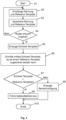
- Fig. 3 a description of an exemplary access control method as an aspect of a method for operating the access control system 1.
- the description is made with reference to a user 2 who wishes to enter the restricted access zone 8 at the entrance 12, for example to use an elevator there.
- the user 2 carries the mobile device 6 with him and has activated its radio module (e.g. for Bluetooth communication).
- a reference template for facial features of the user 2 is already stored in the mobile device 6.
- An associated software application is also activated.
- the method begins in a step S1 and ends in a step S10.
- the transceiver 14 receives a device-specific identifier transmitted by the mobile device 6 in a step S2.
- the transceiver 14 and the mobile device 6 communicate according to the same communication standard, in this embodiment via a radio connection according to a Bluetooth standard.
- the transceiver 14 also receives a reference template for facial parameters of the user 2.
- the identifier and the reference template can be sent essentially simultaneously or sequentially by the mobile device 6. In Fig. 3 the sending of the identifier and the reference template takes place in one (common) step (step S2). In another representation, the sending of the reference template could also take place in a separate step.
- the received identifier and the received reference template are stored in a step S3.
- the identifier and the reference template are stored, for example, as a data record in the buffer device 28.
- Steps S2 and S3 are carried out for each mobile device 6 that is within radio range of the transceiver 14 and operates according to the same communication standard as the transceiver 14.
- a plurality of identifiers and associated reference templates corresponding to a group of present users 2 can be stored in the buffer device 28 at a specific time.
- the person skilled in the art will recognize that the buffer device 28 is updated when a mobile device 6 is no longer within radio range, e.g. because the associated user 2 has left the public zone 10 without requesting access to the restricted access zone 8 or because the associated user 2 has already entered the restricted access zone 8.
- the buffer device 28 thus stores the data records for users 2 who are present in the public zone 10 at a specific time.
- a step S4 it is determined whether one of the users 2 present wishes to access the restricted access zone 8.
- the access control system 1 recognizes this wish according to an embodiment with the aid of the above-mentioned sensor module or the detection of background changes. For example, the sensor module detects when the user 2 enters the detection range of the camera 16, whereupon the camera 16 is activated. If an access wish is recognized, the method proceeds along the yes branch to a step S5. Otherwise, the method proceeds along the no branch back to step S2.
- step S5 the activated camera 16 generates a digital image depicting at least the face of the detected user 2, and the image processing module 22 generates a real-time template from the digital image, as described elsewhere in this description.
- step S6 the real-time template determined in step S5 is used to determine whether the real-time template can be assigned to a reference template stored in the buffer device 28.
- a step S7 checks whether the real-time template matches a reference template to a specified degree.
- the real-time template and the reference templates each comprise a specified number of specified facial parameters and their values (e.g. eye distance, mouth width, distance between the upper edge of the lip and the lower edge of the lip, distance between the nose and the lower edge of the lip, etc.).
- the parameter values of the real-time template are compared with the parameter values of the reference templates. A match exists if the degree of similarity of the templates is at least equal to the specified degree.
- the specified degree indicates a percentage match between the facial parameters of the real-time template and the facial parameters of a reference template. Depending on the accuracy requirement, the specified degree can be selected between approx. 60% and approx. 90%, for example.
- the method proceeds along the yes branch to a step S9 in which a user-specific building action is carried out for this user 2.
- the building action can, for example, consist of a destination call being triggered for user 2 (according to the data of the user profile existing for this user 2), an elevator being assigned to this destination call and the assigned elevator being displayed to user 2 at the entrance 12.
- the building action can also consist of one or more doors being unlocked to which this user 2 is authorized to access. The expert recognizes that these building actions can also be carried out in combination.
- the method proceeds along the no branch to a step S8 in which a notification is generated.
- the notification can, for example, inform the user 2 that an error has occurred and/or that the user 2 should contact a person responsible for the building (e.g. reception staff, security staff). Irrespective of this, the security staff can also be notified directly in step S8.
- the access control system 1 is connected to an elevator system connected, in particular with an elevator control system.
- the communication between the access control system 1 and the elevator control system can take place via the communication network 37.
- the access control takes place, for example, in the entrance hall of the building, which the users 2 have to pass through in order to get to the elevators
- a destination call can be initiated each time access is granted for the user 2 in question.
- the elevator control system of the elevator system processes the destination call and assigns him an elevator.
- the elevator assigned to the destination call can be displayed to the user 2, for example, by a terminal at the entrance 12 and/or communicated by voice. The user 2 can thus go directly to the assigned elevator without having to enter an elevator call.
- each user 2 is registered in the access control system 1 as an authorized user 2.
- non-registered users 2 may also wish to access the restricted zone 8, for example visitors.
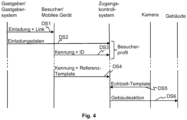
- Fig. 4 shows a signal diagram of an embodiment of a method that makes it possible to grant visitors convenient access to the restricted zone 8.
- Fig. 4 schematically shows interactions between a host or a host system 39 used by him, a visitor or his mobile device 6, the access control system 1, the camera 16 and a building system in order to register the visitor by means of a registration process in the control system 1, to enable access and to carry out a specified building action.
- the visitor is thus also a user 2 (the reference number 2 is used below for both the visitor and for one or more users).
- the host and the visitor 2 agree on an appointment, i.e. on a date and time or a period of time at which the host expects the visitor 2.
- the host then creates an invitation, for example using the host system 39 (e.g. PC, notebook, tablet PC, smartphone or another electronic device) and a software application installed on it (e.g. using Microsoft Outlook TM or similar application programs), and sends it to the visitor 2, for example via the communication network 37 and the communication connection 40.
- the communication connection 40 can, for example, via a mobile communications system.
- the invitation includes the appointment details, an identification number assigned to the invitation (in Fig. 4 referred to as "ID") and also information about a communication channel that the visitor 2 has to use to communicate with the access control system 1 for the purpose of registration.
- the communication channel is the Internet; the information about the communication channel therefore includes an Internet address for a web portal (in Fig. 4 referred to as a "link").
- the Internet address can, for example, comprise a uniform resource locator (URL) that identifies and locates the web portal as a resource via the access method to be used (e.g. a network protocol used such as HTTP or FTP) and the location of the resource in a computer network.
- the web portal is associated with a computer system of the access control system 1.
- the invitation is transmitted via the communication network 37 by means of a signal DS1; it can, for example, be sent as a text message to the mobile device 6 of the visitor 2 or as an email to the email address of the visitor 2.
- the host or host system 39 also sends the invitation data to the access control system 1 using a signal DS2, for example via the communications network 37 and essentially at the same time as the invitation is sent or at a later time.
- the access control system 1 creates a visitor profile for the received invitation data, for example controlled by the processor 20.
- the invitation data includes not only the appointment details but also details about the host, for example name, telephone number, floor and/or apartment or office number, and the visitor (for example name).
- a time window can be specified within which the visitor 2 is to be granted access. The time window can, for example, specify that the visitor 2 is granted access approximately half an hour before and after the start of the appointment in the event that the visitor 2 arrives too early or is late.
- the visitor profile can be deleted after the visitor 2 arrives or at a later time.
- Visitor 2 accepts the invitation, the communication channel specified in the invitation is used to send the invitation identification number and the Identifier of the mobile device 6 to the access control system 1. Depending on the design, the visitor can be asked to enter the identifier of the mobile device 6 (for example telephone number or device identification number). If the visitor accepts the invitation using the mobile device 6, in one embodiment the identifier of the mobile device 6 is also transmitted to the access control system 1, e.g. automatically. If an application-specific software application is installed on the mobile device 6, as described above, it supports the visitor 2 in accepting the invitation. The identifier and the identification number of the invitation are transmitted using a signal DS3, for example via the communication network 37 and the communication connection 40.
- a signal DS3 for example via the communication network 37 and the communication connection 40.
- the signal DS3 can be transmitted according to a known transmission protocol, for example TCP (Transmission Control Protocol), IP (Internet Protocol) and UDP (User Data Protocol).
- TCP Transmission Control Protocol
- IP Internet Protocol
- UDP User Data Protocol
- the invitation can ask the visitor 2 to transmit the ID and the identification number of the invitation to a building management office.
- the building management office can, for example, manage the database 34 for the building in question, in which the user profiles of the users 2 with access authorization are stored.
- the transmission to the building management office can, for example, be made to an email address of the building management office or telephone number of the building management office specified in the invitation, for example for an SMS or MMS message. Building management staff can then arrange for the received data to be further processed.
- the invitation also asks the visitor to take a self-portrait (also known as a "selfie") of themselves, e.g. with the camera of their mobile device 6, and to save it on the mobile device 6.
- a self-portrait also known as a "selfie”
- An advantage of the technology described here is that the visitor 2 can create the selfie at a time of their choosing, as long as this is done before the appointment.
- the visitor 2 can be geographically far away from the building or already in or near the building.
- the application-specific software application installed on the mobile device 6 supports the Visitor 2 also creates and saves the self-portrait as a reference template of Visitor 2.
- visitor 2 can be assigned the following according to the Fig. 3 described access control procedure, the specified building action is carried out when he arrives in the building at the agreed time.
- the transceiver 14 receives the identifier transmitted by the mobile device 6 and the reference template.
- the reception of the identifier of the mobile device 6 and the reference template takes place as described above and is in Fig. 4 by means of a signal DS4.
- the camera 16 If the visitor then comes into the detection range of the camera 16, the camera 16 generates a digital image that shows the visitor's face.
- the generation of the digital image by the camera 16 and the subsequent generation of a real-time template are carried out as described above; in Fig. 4 This is represented by a signal DS5.
- the access control system 1 checks whether the real-time template matches the reference template to a specified degree. In addition, the access control system 1 checks whether the visitor requests access within the time window specified in the visitor profile. If both conditions are met, the visitor is granted access and the building action is initiated; in Fig. 4 This is represented by a signal DS6.
- the access control system 1 can communicate with an elevator control in order to generate a destination call for visitor 2 when access is granted as an example building action.
- the elevator control assigns an elevator to the destination call, whereby the assigned elevator can be communicated to visitor 2 in the area of the access 12 by display or voice.
- the assigned elevator transports visitor 2 to the floor on which the host is located.
- the host's floor is stored, for example, in the visitor profile in connection with the invitation data. Visitor 2, especially if he is in the building for the first time, therefore does not need to concern himself with entering the destination floor.
- Visitor 2 can also be provided with further information to enable him to orient himself better in the building, for example visitor 2 can be informed in which direction (possibly also how far) he should go after the Alighting on the floor.
- the communication of such guidance information can be carried out, for example, by means of the mobile device 6 of the visitor 2 and/or displays on the floors or in the elevator car.
- the access control system 1 generates and sends a message for the host informing the host that the visitor has been granted access. The host can thus prepare promptly for the visitor's arrival.
Landscapes
- Engineering & Computer Science (AREA)
- Physics & Mathematics (AREA)
- General Physics & Mathematics (AREA)
- Human Computer Interaction (AREA)
- Health & Medical Sciences (AREA)
- General Health & Medical Sciences (AREA)
- Oral & Maxillofacial Surgery (AREA)
- Multimedia (AREA)
- Theoretical Computer Science (AREA)
- Lock And Its Accessories (AREA)
- Telephonic Communication Services (AREA)
- Alarm Systems (AREA)
Claims (12)
- Procédé permettant de faire fonctionner un système (1) pour le contrôle d'un accès à une zone à accès restreint (8) dans un bâtiment ou sur un terrain, dans lequel le système (1) comprend un dispositif de transmission et de réception (14) pour une communication radio avec des appareils électroniques mobiles (6) transportés par des utilisateurs (2), un dispositif de mémorisation (26, 28) et un dispositif de traitement d'images (16, 22, 24) qui présente une caméra (16) disposée au niveau de l'accès à la zone à accès restreint (8), dans lequel le procédé comprend :la réception, par le dispositif de transmission et de réception (14), d'un identifiant spécifique à un appareil d'un appareil électronique mobile (6) d'un utilisateur (2) et d'un modèle de référence électronique transmis par l'appareil électronique mobile (6) pour des paramètres faciaux de l'utilisateur (2), dès que l'appareil électronique mobile (6) se trouve à portée radio du dispositif de transmission et de réception (14) dans une zone publique (10) à partir de laquelle l'utilisateur (2) peut demander l'accès à la zone à accès restreint (8) ;la mémorisation de l'identifiant reçu de l'appareil électronique mobile (6) et du modèle de référence électronique dans le dispositif de mémorisation (26, 28) en tant que jeu de données appartenant à un utilisateur (2) présent, dans lequel une pluralité de jeux de données d'utilisateurs (2) présents peuvent être mémorisés dans le dispositif de mémorisation (26, 28) afin de mémoriser, pour chaque utilisateur (2) présent, l'identifiant de l'appareil électronique mobile (6) attribué à l'utilisateur (2) présent et le modèle de référence de l'utilisateur (2) présent dans le jeu de données appartenant à l'utilisateur (2) présent, dans lequel le jeu de données appartenant à un utilisateur (2) présent est effacé et le dispositif de mémorisation (26, 28) est mis à jour dès que ledit utilisateur (2) présent quitte la zone publique (10) et que son appareil électronique mobile (6) se trouve hors de la portée radio du dispositif de transmission et de réception (14) ;la génération d'un modèle en temps réel pour des caractéristiques faciales de l'utilisateur (2) dès que l'utilisateur (2) demande l'accès à la zone à accès restreint (8) et entre dans une zone de détection de la caméra (16) disposée au niveau de l'accès à la zone à accès restreint (8), dans lequel le modèle en temps réel est généré par le dispositif de traitement d'images (16, 22, 24) à partir d'une image de l'utilisateur (2) ;le fait de déterminer si le modèle en temps réel correspond, à un degré défini, à un modèle de référence mémorisé dans le dispositif de mémorisation (26, 28), dans lequel, en cas de correspondance, l'utilisateur (2) est reconnu comme utilisateur (2) demandant l'accès ; etla génération d'un signal de résultat qui, en cas de correspondance, provoque l'exécution d'une action de bâtiment, dans lequel un signal de commande est généré en fonction du signal de résultat afin de provoquer une lecture d'un profil utilisateur de l'utilisateur (2) demandant l'accès, lequel profil utilisateur est mémorisé dans le dispositif de mémorisation (26, 28), afin de déterminer une action de bâtiment spécifique à l'utilisateur.
- Procédé selon la revendication 1, dans lequel l'action de bâtiment spécifique à l'utilisateur comprend un déverrouillage d'une porte de bâtiment à laquelle l'utilisateur (2) a le droit d'accéder, ou un enregistrement d'un appel de destination à un étage de destination défini pour l'utilisateur (2), ou une combinaison du déverrouillage d'une porte de bâtiment et de l'enregistrement d'un appel de destination.
- Procédé selon la revendication 2, présentant en outre la génération d'un signal de commande en fonction du signal de résultat pour débloquer une barrière (18, 36) de sorte que l'utilisateur (2) peut entrer dans la zone à accès restreint (8).
- Procédé selon l'une des revendications précédentes, dans lequel l'image de l'utilisateur (2) est générée par une caméra (16) du dispositif de traitement d'images (16, 22, 24).
- Procédé selon l'une des revendications précédentes, dans lequel la connexion radio entre le dispositif de transmission et de réception (14) et un appareil électronique mobile (6) d'un utilisateur (2) est effectuée conformément à une norme Bluetooth ou une norme WLAN/Wi-Fi, et dans lequel le dispositif de transmission et de réception (14) reçoit l'identifiant spécifique à l'appareil et le modèle de référence par l'intermédiaire de la connexion radio lorsque l'appareil électronique mobile (6) se trouve à portée radio du dispositif de transmission et de réception (14).
- Procédé selon l'une des revendications précédentes, dans lequel l'identifiant est généré par un logiciel spécifique à une application, lequel logiciel est actif sur l'appareil mobile (6), dans lequel l'identifiant est invariable dans le temps.
- Procédé selon l'une des revendications 1 à 6, dans lequel l'identifiant comprend un numéro d'identification d'appareil ou un numéro de téléphone associé à un appareil mobile (6).
- Procédé selon l'une des revendications précédentes, dans lequel le modèle en temps réel et les modèles de référence comprennent respectivement un nombre défini de paramètres faciaux définis, et dans lequel le degré défini est compris entre environ 60 % et environ 90 %, dans lequel le degré défini indique un pourcentage de correspondance des paramètres faciaux du modèle en temps réel avec les paramètres faciaux d'un modèle de référence.
- Procédé selon l'une des revendications précédentes, dans lequel, lorsqu'une pluralité d'appareils électroniques mobiles (6) se trouvent dans la zone publique (10), un jeu de données est mémorisé dans le dispositif de mémorisation (26, 28) pour chaque appareil électronique mobile (6) d'un utilisateur (2) qui transmet un identifiant spécifique à l'appareil et un modèle de référence électronique pour des paramètres faciaux de l'utilisateur (2).
- Système (1) pour le contrôle d'un accès à une zone à accès restreint (8) dans un bâtiment ou sur un terrain, dans lequel le système (1) comprend :un dispositif de transmission et de réception (14) pour la communication radio avec un appareil électronique mobile (6) transporté par un utilisateur (2), lequel dispositif de transmission et de réception est configuré pour la réception d'un identifiant spécifique à l'appareil de l'appareil électronique mobile (6) et d'un modèle de référence électronique transmis par l'appareil électronique mobile (6) pour des paramètres faciaux de l'utilisateur (2), dans lequel la réception est effectuée dès que l'appareil électronique mobile (6) se trouve à portée radio du dispositif de transmission et de réception (14) dans une zone publique (10) à partir de laquelle l'utilisateur (2) peut demander l'accès à la zone à accès restreint (8) ;un dispositif de mémorisation (26, 28) qui est configuré pour mémoriser l'identifiant de l'appareil électronique mobile (6) reçu par le dispositif de transmission et de réception (14) et le modèle de référence de l'utilisateur (2) dans un jeu de données comme appartenant à un utilisateur (2) présent dans une zone publique (10), dans lequel une pluralité de profils utilisateurs d'utilisateurs (2) ayant le droit à l'accès et une pluralité de jeux de données d'utilisateurs (2) présents peuvent être mémorisés dans le dispositif de mémorisation (26, 28) pour mémoriser, pour chaque utilisateur (2) présent, l'identifiant de l'appareil électronique mobile (6) attribué à l'utilisateur (2) présent et le modèle de référence de l'utilisateur (2) présent dans le jeu de données appartenant à l'utilisateur (2) présent, dans lequel le jeu de données appartenant à un utilisateur (2) présent est effacé et le dispositif de mémorisation (26, 28) est mis à jour dès que ledit utilisateur (2) présent quitte la zone publique (10) et que son appareil électronique mobile (6) se trouve hors de la portée radio du dispositif de transmission et de réception (14) ;un dispositif de traitement d'images (16, 22, 24) qui comprend une caméra (16) disposée au niveau de l'accès à la zone à accès restreint (8) et qui est configuré pour- générer, à partir d'une image de l'utilisateur (2), un modèle en temps réel pour des caractéristiques faciales de l'utilisateur (2) dès que l'utilisateur (2) demande l'accès à la zone à accès restreint (8) et arrive dans une zone de détection de la caméra (16), et- déterminer si le modèle en temps réel correspond, à un degré défini, à un modèle de référence mémorisé dans le dispositif de mémorisation (26, 28), dans lequel, en cas de correspondance, l'utilisateur (2) est reconnu comme un utilisateur (2) demandant l'accès ; etun processeur (20) qui est connecté au dispositif de traitement d'images (16, 22, 24) et qui est configuré pour générer un signal de commande en fonction du signal de résultat afin de provoquer une lecture d'un profil utilisateur de l'utilisateur (2) reconnu, lequel profil utilisateur est mémorisé dans le dispositif de mémorisation (26, 28), afin de déterminer une action de bâtiment spécifique à l'utilisateur.
- Système (1) selon la revendication 10, dans lequel le dispositif de traitement d'images (16, 22, 24) comprend un module de traitement d'images (22), au moyen duquel le modèle en temps réel peut être généré à partir d'un enregistrement de caméra, et un module d'évaluation (24) qui est connecté au module de traitement d'images (22) et au dispositif de mémorisation (26, 28), dans lequel le module d'évaluation (24) est configuré pour générer un signal de résultat qui, en cas de correspondance, provoque l'exécution d'une action de bâtiment.
- Système (1) selon la revendication 11, présentant en outre une barrière (18, 36) qui peut être déverrouillée ou bloquée en fonction du signal de commande.
Applications Claiming Priority (2)
| Application Number | Priority Date | Filing Date | Title |
|---|---|---|---|
| EP17209068 | 2017-12-20 | ||
| PCT/EP2018/084795 WO2019121335A1 (fr) | 2017-12-20 | 2018-12-13 | Système de contrôle d'accès avec identification radio et reconnaissance faciale |
Publications (2)
| Publication Number | Publication Date |
|---|---|
| EP3729384A1 EP3729384A1 (fr) | 2020-10-28 |
| EP3729384B1 true EP3729384B1 (fr) | 2025-01-29 |
Family
ID=60702410
Family Applications (1)
| Application Number | Title | Priority Date | Filing Date |
|---|---|---|---|
| EP18814974.4A Active EP3729384B1 (fr) | 2017-12-20 | 2018-12-13 | Système de contrôle d'accès avec reconnaissance faciale et radioélectrique |
Country Status (6)
| Country | Link |
|---|---|
| US (1) | US11551501B2 (fr) |
| EP (1) | EP3729384B1 (fr) |
| CN (1) | CN111373453A (fr) |
| AU (1) | AU2018389641B2 (fr) |
| SG (1) | SG11202003190QA (fr) |
| WO (1) | WO2019121335A1 (fr) |
Families Citing this family (7)
| Publication number | Priority date | Publication date | Assignee | Title |
|---|---|---|---|---|
| US11145151B2 (en) * | 2018-03-08 | 2021-10-12 | Johnson Controls Tyco IP Holdings LLP | Frictionless access control system for a building |
| CN110796770A (zh) * | 2019-08-26 | 2020-02-14 | 腾讯科技(深圳)有限公司 | 门禁的控制方法及装置、存储介质和电子装置 |
| WO2021121989A1 (fr) * | 2019-12-20 | 2021-06-24 | Inventio Ag | Système de bâtiment pour une communication d'utilisateur privée |
| AU2021377371B2 (en) * | 2020-11-12 | 2024-12-12 | Inventio Ag | Building system for a building having waiting zones for the use of a lift system |
| US11941933B2 (en) * | 2020-12-15 | 2024-03-26 | Daon Technology | Enhanced access control |
| AU2022353923B2 (en) | 2021-09-30 | 2026-03-26 | Inventio Ag | Building door system with operating and wayfinding devices |
| GB2635799A (en) * | 2023-07-06 | 2025-05-28 | Accessia Tech Ltd | Control unit for an access point |
Citations (10)
| Publication number | Priority date | Publication date | Assignee | Title |
|---|---|---|---|---|
| DE10146821A1 (de) | 2001-09-20 | 2003-05-08 | Vcs Video Comm Systems Ag | Zutrittskontrollsystem |
| US6819219B1 (en) | 2000-10-13 | 2004-11-16 | International Business Machines Corporation | Method for biometric-based authentication in wireless communication for access control |
| US20050205668A1 (en) | 2004-02-27 | 2005-09-22 | Koji Sogo | Gate system |
| WO2008054410A2 (fr) | 2005-12-01 | 2008-05-08 | Honeywell International Inc. | Vérification d'identité à distance de sécurité répartie compatible avec de multiples systèmes de reconnaissance de visages (frs) |
| WO2013127624A1 (fr) | 2012-03-02 | 2013-09-06 | Bundesdruckerei Gmbh | Procédé d'identification d'une personne |
| WO2013127625A1 (fr) | 2012-03-02 | 2013-09-06 | Bundesdruckerei Gmbh | Procédé d'identification d'une personne |
| EP2202698B1 (fr) | 2008-12-24 | 2014-01-22 | Kabushiki Kaisha Toshiba | Système de surveillance de personnes à l'aide de caméras |
| US20150221151A1 (en) | 2014-02-04 | 2015-08-06 | Secure Gravity Inc. | Methods and systems configured to detect and guarantee identity for the purpose of data protection and access control |
| DE102015108330A1 (de) | 2015-05-27 | 2016-12-01 | Bundesdruckerei Gmbh | Elektronisches Zugangskontrollverfahren |
| US9721147B1 (en) | 2013-05-23 | 2017-08-01 | Consumerinfo.Com, Inc. | Digital identity |
Family Cites Families (21)
| Publication number | Priority date | Publication date | Assignee | Title |
|---|---|---|---|---|
| US6976269B1 (en) | 2000-08-29 | 2005-12-13 | Equinix, Inc. | Internet co-location facility security system |
| JP2003201071A (ja) * | 2001-11-01 | 2003-07-15 | Inventio Ag | 人もしくは物の輸送もしくはアクセス制御のためのシステム、このシステムを保守するための方法、装置およびコンピュータプログラム製品、およびこのシステムにより建物を改造する方法 |
| EP1475754B1 (fr) * | 2003-05-05 | 2011-12-07 | Inventio AG | Système de contrôle de sécurité pour le transport de personnes avec un ascenseur et procédé d'utilisation de ce système |
| JP2007157022A (ja) | 2005-12-08 | 2007-06-21 | Toppan Nsw:Kk | 入場管理システム、入場管理方法 |
| US20070252001A1 (en) * | 2006-04-25 | 2007-11-01 | Kail Kevin J | Access control system with RFID and biometric facial recognition |
| US8412949B2 (en) * | 2006-05-05 | 2013-04-02 | Proxense, Llc | Personal digital key initialization and registration for secure transactions |
| EP2237234A1 (fr) * | 2009-04-03 | 2010-10-06 | Inventio AG | Procédé et dispositif destinés au contrôle d'accès |
| FI122260B (fi) | 2010-05-10 | 2011-11-15 | Kone Corp | Menetelmä ja järjestelmä kulkuoikeuksien rajoittamiseksi |
| US8494231B2 (en) | 2010-11-01 | 2013-07-23 | Microsoft Corporation | Face recognition in video content |
| CN111483895A (zh) | 2013-05-20 | 2020-08-04 | 奥的斯电梯公司 | 基于调度的移动应用 |
| US20170217727A1 (en) | 2014-07-24 | 2017-08-03 | Otis Elevator Company | Elevator passenger entry detection |
| SG11201610919VA (en) * | 2014-07-29 | 2017-02-27 | Inventio Ag | Method and system for access control |
| CA2997297A1 (fr) * | 2015-10-26 | 2017-05-04 | Visa International Service Association | Systeme et procede d'authentification biometrique sans fil |
| CN105654584B (zh) * | 2015-12-24 | 2018-05-08 | 歌尔股份有限公司 | 一种门禁监控方法和系统 |
| CN106934787B (zh) * | 2015-12-29 | 2020-07-10 | 杭州海康威视系统技术有限公司 | 一种智能门禁控制方法、系统、服务器及设备 |
| CN106981107A (zh) | 2016-01-19 | 2017-07-25 | 福建省光速达物联网科技股份有限公司 | 蓝牙门禁的手机开锁方法及系统 |
| US9589397B1 (en) | 2016-06-06 | 2017-03-07 | American Megatrends, Inc. | Securing internet of things (IoT) based entrance/exit with multi-factor authentication |
| TWM533272U (en) | 2016-07-28 | 2016-12-01 | Taiwan Colour & Imaging Technology Corp | Access management and control equipment |
| US11069167B2 (en) * | 2016-08-05 | 2021-07-20 | Assa Abloy Ab | Method and system for automated physical access control system using biometric recognition coupled with tag authentication |
| EP3471013A1 (fr) * | 2017-10-11 | 2019-04-17 | Skidata Ag | Procédé de contrôle d'autorisations d'accès par un système de contrôle d'accès |
| US10997809B2 (en) * | 2017-10-13 | 2021-05-04 | Alcatraz AI, Inc. | System and method for provisioning a facial recognition-based system for controlling access to a building |
-
2018
- 2018-12-13 US US16/955,311 patent/US11551501B2/en active Active
- 2018-12-13 SG SG11202003190QA patent/SG11202003190QA/en unknown
- 2018-12-13 CN CN201880075561.4A patent/CN111373453A/zh active Pending
- 2018-12-13 EP EP18814974.4A patent/EP3729384B1/fr active Active
- 2018-12-13 AU AU2018389641A patent/AU2018389641B2/en active Active
- 2018-12-13 WO PCT/EP2018/084795 patent/WO2019121335A1/fr not_active Ceased
Patent Citations (10)
| Publication number | Priority date | Publication date | Assignee | Title |
|---|---|---|---|---|
| US6819219B1 (en) | 2000-10-13 | 2004-11-16 | International Business Machines Corporation | Method for biometric-based authentication in wireless communication for access control |
| DE10146821A1 (de) | 2001-09-20 | 2003-05-08 | Vcs Video Comm Systems Ag | Zutrittskontrollsystem |
| US20050205668A1 (en) | 2004-02-27 | 2005-09-22 | Koji Sogo | Gate system |
| WO2008054410A2 (fr) | 2005-12-01 | 2008-05-08 | Honeywell International Inc. | Vérification d'identité à distance de sécurité répartie compatible avec de multiples systèmes de reconnaissance de visages (frs) |
| EP2202698B1 (fr) | 2008-12-24 | 2014-01-22 | Kabushiki Kaisha Toshiba | Système de surveillance de personnes à l'aide de caméras |
| WO2013127624A1 (fr) | 2012-03-02 | 2013-09-06 | Bundesdruckerei Gmbh | Procédé d'identification d'une personne |
| WO2013127625A1 (fr) | 2012-03-02 | 2013-09-06 | Bundesdruckerei Gmbh | Procédé d'identification d'une personne |
| US9721147B1 (en) | 2013-05-23 | 2017-08-01 | Consumerinfo.Com, Inc. | Digital identity |
| US20150221151A1 (en) | 2014-02-04 | 2015-08-06 | Secure Gravity Inc. | Methods and systems configured to detect and guarantee identity for the purpose of data protection and access control |
| DE102015108330A1 (de) | 2015-05-27 | 2016-12-01 | Bundesdruckerei Gmbh | Elektronisches Zugangskontrollverfahren |
Non-Patent Citations (8)
| Title |
|---|
| ANONYMOUS: " Doc 9303 Machine Readable Travel Documents Seventh Edition, 2015 Part 4: Specifications for Machine Readable Passports (MRPs) and other TD3 Size MRTDs", MACHINE READABLE TRAVEL DOCUMENTS, INTERNATIONAL CIVIL AVIATION ORGANIZATION, 1 January 2015 (2015-01-01), pages 1 - 38, XP093306219, ISBN: 978-92-9249-793-4, Retrieved from the Internet <URL:https://web.archive.org/web/20150913041547/http://www.icao.int/publications/Documents/9303_p4_cons_en.pdf> |
| ANONYMOUS: "Best Practice Guidelines on the Design, Deployment and Operation of Automated Border Crossing Systems Release 1.1", BEST PRACTICE GUIDELINES, EUROPEAN AGENCY FOR THE MANAGEMENT OF OPERATIONAL COOPERATION AT THE EXTERNAL BOARD OF THE MEMBER STATES OF THE EUROPEAN UNION, 1 March 2011 (2011-03-01), pages 1 - 81, XP093335503, Retrieved from the Internet <URL:https://www.frontex.europa.eu/assets/Publications/Research/ABC_Best_Practice_Guidelines.pdf> |
| ANONYMOUS: "NFC, Bluetooth und RFID entwirren der Drahtlosverbindungen", RFI DHY - BRANCHEN-NEWS, 30 June 2016 (2016-06-30), pages 1 - 5, XP093335513, Retrieved from the Internet <URL:https://www.rfidhy.com/de/nfc-bluetooth-rfid-unraveling-wireless-connections/> |
| ANONYMOUS: "PRADO Glossar (Fachbegriffe im Zusammenhang mit Sicherheitsmerkmalen und mit Sicherheitsdokumenten im Allgemeinen(013) (in alphabetischer Reihenfolge))", PRADO GLOSSAR, RAT DER EUROPäISCHEN UNION, 17 October 2015 (2015-10-17), pages 1 - 139, XP093306144, Retrieved from the Internet <URL:https://web.archive.org/web/20151017212828/http://www.consilium.europa.eu/prado/de/prado-glossary/prado-glossary.pdf> |
| ANONYMOUS: "Using ePassport gates at airport border control", NIDIRECT, 3 April 2017 (2017-04-03), pages 1 - 4, XP093335506, Retrieved from the Internet <URL:https://web.archive.org/web/20170403211436/https://www.nidirect.gov.uk/articles/using-epassport-gates-airport-border-control> |
| D16 - RFIDHY: "RFIDHY Tages-Archiv_ 2016-06-30", 30 June 2016 (2016-06-30), Retrieved from the Internet <URL:https://www.rfidhy.com/de/2016/06/30/> [retrieved on 20251017] |
| NUPPENEY MARKUS: "Automated Border Control - state of play and latest developments", NIST IBPC2014, GAITHERSBURG, APRIL 02. 2014, SECTION S13 Â INSPECTION INFRASTRUCTURES AND ARCHITECTURES FEDERAL OFFICE FOR INFORMATION SECURITY (BSI), 2 April 2014 (2014-04-02), pages 1 - 20, XP093335510, Retrieved from the Internet <URL:https://www.nist.gov/system/files/documents/2020/01/22/03_wednesday_nuppeney_20140328_abc_ibpc2014_bsi-nup_final.pdf> |
| RESEARCH AND DEVELOPMENT UNIT : "Best Practice Technical Guidelines for Automated Border Control (ABC) Systems; Version 2.0", BEST PRACTICE TECHNICAL GUIDELINES FOR AUTOMATED BORDER CONTROL (ABC) SYSTEMS, FRONTEX: EUROPEAN AGENCY FOR THE MANAGEMENT OF OPERATIONAL COOPERATION AT THE EXTERNAL BORDERS OF THE MEMBER STATES OF THE EUROPEAN UNION, 31 August 2012 (2012-08-31), pages 1 - 62, XP093335500, Retrieved from the Internet <URL:https://www.frontex.europa.eu/assets/Publications/Research/Best_Practice_Technical_Guidelines_for_Automated_Border_Control_Systems.pdf> |
Also Published As
| Publication number | Publication date |
|---|---|
| SG11202003190QA (en) | 2020-05-28 |
| US11551501B2 (en) | 2023-01-10 |
| AU2018389641A1 (en) | 2020-05-07 |
| EP3729384A1 (fr) | 2020-10-28 |
| WO2019121335A1 (fr) | 2019-06-27 |
| CN111373453A (zh) | 2020-07-03 |
| AU2018389641B2 (en) | 2022-03-17 |
| US20210049847A1 (en) | 2021-02-18 |
Similar Documents
| Publication | Publication Date | Title |
|---|---|---|
| EP3610465B1 (fr) | Système de contrôle d'accès avec reconnaissance faciale et radioélectrique | |
| EP3610466B1 (fr) | Procédé d'enregistrement et de contrôle d'accès de visiteurs | |
| WO2019121335A1 (fr) | Système de contrôle d'accès avec identification radio et reconnaissance faciale | |
| EP3729385B1 (fr) | Système de contrôle d'accès à fonction d'authentification radio et de saisie du mot de passe | |
| EP3307666B2 (fr) | Systeme d'ascenseur dote d'une generation d'appel predictive | |
| EP1783650B1 (fr) | Procédé et système de communication destinés à comparer des données biométriques enregistrées à l'aide de capteurs biométriques avec des données de référence | |
| EP3212554A1 (fr) | Système et procédé de préservation de la sphère privée de personnes dans des systèmes d'ascenseur | |
| EP3215974B1 (fr) | Procédé pour fournir un code d'accès à un appareil portable, et appareil portable | |
| EP4077185A1 (fr) | Dispositif d'interface homme-machine pour systèmes de construction | |
| EP3335199A1 (fr) | Procédé et dispositif pour effectuer un contrôle de personnes | |
| EP3748590B1 (fr) | Appareil d'authentification pouvant être monté au mur | |
| WO2021121989A1 (fr) | Système de bâtiment pour une communication d'utilisateur privée | |
| WO2023117535A1 (fr) | Système d'ascenseur ayant des règles d'utilisation d'ascenseur au niveau d'une ouverture de porte de bâtiment | |
| WO2021233719A1 (fr) | Surveillance de zone supplémentaire de porte de bâtiment | |
| DE202026100571U1 (de) | Zugangskontrollsystem für Gebäude mit Anzeigevorrichtung | |
| WO2024002637A1 (fr) | Système de contrôle d'accès avec accès sans barrière | |
| WO2023052031A1 (fr) | Système de porte de bâtiment avec dispositifs de fonctionnement et d'orientation | |
| DE102024104177A1 (de) | Verfahren und System zum Betätigen eines intelligenten Schlosses sowie Computerprogrammprodukt | |
| DE102023211564A1 (de) | Verfahren zum Steuern einer Zugangsberechtigung zu einer zugangsbeschränkten Fläche | |
| EP4639501A1 (fr) | Système de construction et dispositif d'interface homme-machine pour représentations d'expression faciale | |
| HK40025689A (en) | Access control system having radio and facial recognition | |
| HK40011232A (en) | Visitor access control system with radio identification and facial recognition | |
| DE102015119677A1 (de) | Kontrollsystem | |
| HK40011121A (en) | Access control system having radio and facial recognition |
Legal Events
| Date | Code | Title | Description |
|---|---|---|---|
| STAA | Information on the status of an ep patent application or granted ep patent |
Free format text: STATUS: UNKNOWN |
|
| STAA | Information on the status of an ep patent application or granted ep patent |
Free format text: STATUS: THE INTERNATIONAL PUBLICATION HAS BEEN MADE |
|
| PUAI | Public reference made under article 153(3) epc to a published international application that has entered the european phase |
Free format text: ORIGINAL CODE: 0009012 |
|
| STAA | Information on the status of an ep patent application or granted ep patent |
Free format text: STATUS: REQUEST FOR EXAMINATION WAS MADE |
|
| 17P | Request for examination filed |
Effective date: 20200403 |
|
| AK | Designated contracting states |
Kind code of ref document: A1 Designated state(s): AL AT BE BG CH CY CZ DE DK EE ES FI FR GB GR HR HU IE IS IT LI LT LU LV MC MK MT NL NO PL PT RO RS SE SI SK SM TR |
|
| AX | Request for extension of the european patent |
Extension state: BA ME |
|
| DAV | Request for validation of the european patent (deleted) | ||
| DAX | Request for extension of the european patent (deleted) | ||
| STAA | Information on the status of an ep patent application or granted ep patent |
Free format text: STATUS: EXAMINATION IS IN PROGRESS |
|
| 17Q | First examination report despatched |
Effective date: 20220629 |
|
| RAP3 | Party data changed (applicant data changed or rights of an application transferred) |
Owner name: INVENTIO AG |
|
| GRAP | Despatch of communication of intention to grant a patent |
Free format text: ORIGINAL CODE: EPIDOSNIGR1 |
|
| STAA | Information on the status of an ep patent application or granted ep patent |
Free format text: STATUS: GRANT OF PATENT IS INTENDED |
|
| INTG | Intention to grant announced |
Effective date: 20240920 |
|
| GRAS | Grant fee paid |
Free format text: ORIGINAL CODE: EPIDOSNIGR3 |
|
| GRAA | (expected) grant |
Free format text: ORIGINAL CODE: 0009210 |
|
| STAA | Information on the status of an ep patent application or granted ep patent |
Free format text: STATUS: THE PATENT HAS BEEN GRANTED |
|
| AK | Designated contracting states |
Kind code of ref document: B1 Designated state(s): AL AT BE BG CH CY CZ DE DK EE ES FI FR GB GR HR HU IE IS IT LI LT LU LV MC MK MT NL NO PL PT RO RS SE SI SK SM TR |
|
| REG | Reference to a national code |
Ref country code: GB Ref legal event code: FG4D Free format text: NOT ENGLISH |
|
| REG | Reference to a national code |
Ref country code: CH Ref legal event code: EP |
|
| REG | Reference to a national code |
Ref country code: DE Ref legal event code: R096 Ref document number: 502018015542 Country of ref document: DE |
|
| REG | Reference to a national code |
Ref country code: IE Ref legal event code: FG4D Free format text: LANGUAGE OF EP DOCUMENT: GERMAN |
|
| REG | Reference to a national code |
Ref country code: NL Ref legal event code: FP |
|
| PG25 | Lapsed in a contracting state [announced via postgrant information from national office to epo] |
Ref country code: RS Free format text: LAPSE BECAUSE OF FAILURE TO SUBMIT A TRANSLATION OF THE DESCRIPTION OR TO PAY THE FEE WITHIN THE PRESCRIBED TIME-LIMIT Effective date: 20250429 |
|
| PG25 | Lapsed in a contracting state [announced via postgrant information from national office to epo] |
Ref country code: FI Free format text: LAPSE BECAUSE OF FAILURE TO SUBMIT A TRANSLATION OF THE DESCRIPTION OR TO PAY THE FEE WITHIN THE PRESCRIBED TIME-LIMIT Effective date: 20250129 |
|
| PG25 | Lapsed in a contracting state [announced via postgrant information from national office to epo] |
Ref country code: PL Free format text: LAPSE BECAUSE OF FAILURE TO SUBMIT A TRANSLATION OF THE DESCRIPTION OR TO PAY THE FEE WITHIN THE PRESCRIBED TIME-LIMIT Effective date: 20250129 |
|
| PG25 | Lapsed in a contracting state [announced via postgrant information from national office to epo] |
Ref country code: ES Free format text: LAPSE BECAUSE OF FAILURE TO SUBMIT A TRANSLATION OF THE DESCRIPTION OR TO PAY THE FEE WITHIN THE PRESCRIBED TIME-LIMIT Effective date: 20250129 |
|
| REG | Reference to a national code |
Ref country code: LT Ref legal event code: MG9D |
|
| PG25 | Lapsed in a contracting state [announced via postgrant information from national office to epo] |
Ref country code: NO Free format text: LAPSE BECAUSE OF FAILURE TO SUBMIT A TRANSLATION OF THE DESCRIPTION OR TO PAY THE FEE WITHIN THE PRESCRIBED TIME-LIMIT Effective date: 20250429 Ref country code: IS Free format text: LAPSE BECAUSE OF FAILURE TO SUBMIT A TRANSLATION OF THE DESCRIPTION OR TO PAY THE FEE WITHIN THE PRESCRIBED TIME-LIMIT Effective date: 20250529 |
|
| PG25 | Lapsed in a contracting state [announced via postgrant information from national office to epo] |
Ref country code: HR Free format text: LAPSE BECAUSE OF FAILURE TO SUBMIT A TRANSLATION OF THE DESCRIPTION OR TO PAY THE FEE WITHIN THE PRESCRIBED TIME-LIMIT Effective date: 20250129 |
|
| PG25 | Lapsed in a contracting state [announced via postgrant information from national office to epo] |
Ref country code: PT Free format text: LAPSE BECAUSE OF FAILURE TO SUBMIT A TRANSLATION OF THE DESCRIPTION OR TO PAY THE FEE WITHIN THE PRESCRIBED TIME-LIMIT Effective date: 20250529 Ref country code: LV Free format text: LAPSE BECAUSE OF FAILURE TO SUBMIT A TRANSLATION OF THE DESCRIPTION OR TO PAY THE FEE WITHIN THE PRESCRIBED TIME-LIMIT Effective date: 20250129 |
|
| PG25 | Lapsed in a contracting state [announced via postgrant information from national office to epo] |
Ref country code: BG Free format text: LAPSE BECAUSE OF FAILURE TO SUBMIT A TRANSLATION OF THE DESCRIPTION OR TO PAY THE FEE WITHIN THE PRESCRIBED TIME-LIMIT Effective date: 20250129 Ref country code: GR Free format text: LAPSE BECAUSE OF FAILURE TO SUBMIT A TRANSLATION OF THE DESCRIPTION OR TO PAY THE FEE WITHIN THE PRESCRIBED TIME-LIMIT Effective date: 20250430 |
|
| PG25 | Lapsed in a contracting state [announced via postgrant information from national office to epo] |
Ref country code: SE Free format text: LAPSE BECAUSE OF FAILURE TO SUBMIT A TRANSLATION OF THE DESCRIPTION OR TO PAY THE FEE WITHIN THE PRESCRIBED TIME-LIMIT Effective date: 20250129 |
|
| PG25 | Lapsed in a contracting state [announced via postgrant information from national office to epo] |
Ref country code: SM Free format text: LAPSE BECAUSE OF FAILURE TO SUBMIT A TRANSLATION OF THE DESCRIPTION OR TO PAY THE FEE WITHIN THE PRESCRIBED TIME-LIMIT Effective date: 20250129 |
|
| PG25 | Lapsed in a contracting state [announced via postgrant information from national office to epo] |
Ref country code: DK Free format text: LAPSE BECAUSE OF FAILURE TO SUBMIT A TRANSLATION OF THE DESCRIPTION OR TO PAY THE FEE WITHIN THE PRESCRIBED TIME-LIMIT Effective date: 20250129 |
|
| PG25 | Lapsed in a contracting state [announced via postgrant information from national office to epo] |
Ref country code: IT Free format text: LAPSE BECAUSE OF FAILURE TO SUBMIT A TRANSLATION OF THE DESCRIPTION OR TO PAY THE FEE WITHIN THE PRESCRIBED TIME-LIMIT Effective date: 20250129 |
|
| REG | Reference to a national code |
Ref country code: DE Ref legal event code: R026 Ref document number: 502018015542 Country of ref document: DE |
|
| PG25 | Lapsed in a contracting state [announced via postgrant information from national office to epo] |
Ref country code: EE Free format text: LAPSE BECAUSE OF FAILURE TO SUBMIT A TRANSLATION OF THE DESCRIPTION OR TO PAY THE FEE WITHIN THE PRESCRIBED TIME-LIMIT Effective date: 20250129 Ref country code: CZ Free format text: LAPSE BECAUSE OF FAILURE TO SUBMIT A TRANSLATION OF THE DESCRIPTION OR TO PAY THE FEE WITHIN THE PRESCRIBED TIME-LIMIT Effective date: 20250129 |
|
| PG25 | Lapsed in a contracting state [announced via postgrant information from national office to epo] |
Ref country code: RO Free format text: LAPSE BECAUSE OF FAILURE TO SUBMIT A TRANSLATION OF THE DESCRIPTION OR TO PAY THE FEE WITHIN THE PRESCRIBED TIME-LIMIT Effective date: 20250129 |
|
| PG25 | Lapsed in a contracting state [announced via postgrant information from national office to epo] |
Ref country code: SK Free format text: LAPSE BECAUSE OF FAILURE TO SUBMIT A TRANSLATION OF THE DESCRIPTION OR TO PAY THE FEE WITHIN THE PRESCRIBED TIME-LIMIT Effective date: 20250129 |
|
| PLBI | Opposition filed |
Free format text: ORIGINAL CODE: 0009260 |
|
| PLAX | Notice of opposition and request to file observation + time limit sent |
Free format text: ORIGINAL CODE: EPIDOSNOBS2 |
|
| REG | Reference to a national code |
Ref country code: CH Ref legal event code: L10 Free format text: ST27 STATUS EVENT CODE: U-0-0-L10-L00 (AS PROVIDED BY THE NATIONAL OFFICE) Effective date: 20251112 |
|
| 26 | Opposition filed |
Opponent name: BUNDESDRUCKEREI GMBH Effective date: 20251020 |
|
| REG | Reference to a national code |
Ref country code: CH Ref legal event code: U11 Free format text: ST27 STATUS EVENT CODE: U-0-0-U10-U11 (AS PROVIDED BY THE NATIONAL OFFICE) Effective date: 20260101 |
|
| PGFP | Annual fee paid to national office [announced via postgrant information from national office to epo] |
Ref country code: GB Payment date: 20251223 Year of fee payment: 8 |
|
| PGFP | Annual fee paid to national office [announced via postgrant information from national office to epo] |
Ref country code: NL Payment date: 20251222 Year of fee payment: 8 Ref country code: FR Payment date: 20251230 Year of fee payment: 8 |
|
| P01 | Opt-out of the competence of the unified patent court (upc) registered |
Free format text: CASE NUMBER: UPC_APP_0018491_3729384/2025 Effective date: 20251219 |
|
| PLBD | Termination of opposition procedure: decision despatched |
Free format text: ORIGINAL CODE: EPIDOSNOPC1 |
|
| PLBP | Opposition withdrawn |
Free format text: ORIGINAL CODE: 0009264 |
|
| REG | Reference to a national code |
Ref country code: CH Ref legal event code: L10 Free format text: ST27 STATUS EVENT CODE: U-0-0-L10-L00 (AS PROVIDED BY THE NATIONAL OFFICE) Effective date: 20260318 |
|
| REG | Reference to a national code |
Ref country code: DE Ref legal event code: R100 Ref document number: 502018015542 Country of ref document: DE |
|
| PLBM | Termination of opposition procedure: date of legal effect published |
Free format text: ORIGINAL CODE: 0009276 |
|
| PGFP | Annual fee paid to national office [announced via postgrant information from national office to epo] |
Ref country code: DE Payment date: 20251229 Year of fee payment: 8 |
|
| REG | Reference to a national code |
Ref country code: CH Ref legal event code: L10 Free format text: ST27 STATUS EVENT CODE: U-0-0-L10-L00 (AS PROVIDED BY THE NATIONAL OFFICE) Effective date: 20260416 |
|
| PGFP | Annual fee paid to national office [announced via postgrant information from national office to epo] |
Ref country code: CH Payment date: 20260101 Year of fee payment: 8 |
|
| 27C | Opposition proceedings terminated |
Effective date: 20260409 |