EP3612835B1 - Procédé permettant de détecter la rancidité de fruits oléagineux, de graines et de noix - Google Patents
Procédé permettant de détecter la rancidité de fruits oléagineux, de graines et de noix Download PDFInfo
- Publication number
- EP3612835B1 EP3612835B1 EP18723663.3A EP18723663A EP3612835B1 EP 3612835 B1 EP3612835 B1 EP 3612835B1 EP 18723663 A EP18723663 A EP 18723663A EP 3612835 B1 EP3612835 B1 EP 3612835B1
- Authority
- EP
- European Patent Office
- Prior art keywords
- absorption
- rancidity
- reflection spectrum
- sample
- process according
- Prior art date
- Legal status (The legal status is an assumption and is not a legal conclusion. Google has not performed a legal analysis and makes no representation as to the accuracy of the status listed.)
- Active
Links
Images

Classifications
-
- G—PHYSICS
- G01—MEASURING; TESTING
- G01N—INVESTIGATING OR ANALYSING MATERIALS BY DETERMINING THEIR CHEMICAL OR PHYSICAL PROPERTIES
- G01N33/00—Investigating or analysing materials by specific methods not covered by groups G01N1/00 - G01N31/00
- G01N33/02—Food
- G01N33/025—Fruits or vegetables
-
- B—PERFORMING OPERATIONS; TRANSPORTING
- B07—SEPARATING SOLIDS FROM SOLIDS; SORTING
- B07C—POSTAL SORTING; SORTING INDIVIDUAL ARTICLES, OR BULK MATERIAL FIT TO BE SORTED PIECE-MEAL, e.g. BY PICKING
- B07C5/00—Sorting according to a characteristic or feature of the articles or material being sorted, e.g. by control effected by devices which detect or measure such characteristic or feature; Sorting by manually actuated devices, e.g. switches
- B07C5/34—Sorting according to other particular properties
- B07C5/342—Sorting according to other particular properties according to optical properties, e.g. colour
-
- G—PHYSICS
- G01—MEASURING; TESTING
- G01N—INVESTIGATING OR ANALYSING MATERIALS BY DETERMINING THEIR CHEMICAL OR PHYSICAL PROPERTIES
- G01N21/00—Investigating or analysing materials by the use of optical means, i.e. using sub-millimetre waves, infrared, visible or ultraviolet light
- G01N21/84—Systems specially adapted for particular applications
- G01N21/85—Investigating moving fluids or granular solids
-
- G—PHYSICS
- G01—MEASURING; TESTING
- G01N—INVESTIGATING OR ANALYSING MATERIALS BY DETERMINING THEIR CHEMICAL OR PHYSICAL PROPERTIES
- G01N21/00—Investigating or analysing materials by the use of optical means, i.e. using sub-millimetre waves, infrared, visible or ultraviolet light
- G01N21/84—Systems specially adapted for particular applications
- G01N21/85—Investigating moving fluids or granular solids
- G01N2021/8557—Special shaping of flow, e.g. using a by-pass line, jet flow, curtain flow
- G01N2021/8564—Sample as drops
-
- G—PHYSICS
- G01—MEASURING; TESTING
- G01N—INVESTIGATING OR ANALYSING MATERIALS BY DETERMINING THEIR CHEMICAL OR PHYSICAL PROPERTIES
- G01N33/00—Investigating or analysing materials by specific methods not covered by groups G01N1/00 - G01N31/00
- G01N33/02—Food
- G01N33/03—Edible oils or edible fats
Definitions
- the invention relates to a method for creating a rancidity index table and assigning a rancidity index value to an absorption or reflection spectrum of oil crops, nuts and seeds. Furthermore, it relates to a method for detecting the rancidity of an oil crop, nut or seed.
- the invention also relates to a device for detecting rancid oil fruits, nuts or seeds.
- ARANTZAZU VALDES ET AL "Monitoring the oxidative stability and volatiles in blanched, roasted and fried almonds under normal and accelerated storage conditions by DSC, thermogravimetric analysis and ATR-FTIR : Effect of cooking on the oxidative stability of almonds", EUROPEAN JOURNAL OF LIPID SCIENCE AND TECHNOLOGY., Vol. 117, No. 8, 24 February 2015, pages 1199-1213, XP055494712, ISSN: 1438-7697, D01: 10.1002/ejlt.201400384 discloses a method for creating a rancidity index table according to the preamble of claim 1 and a method according to the preamble of claim 11, respectively.
- the detection of different ingredients in individual elements of a bulk material is of interest, for example to distinguish between spoiled elements and elements that are not to be able to meet spoiled elements of the bulk material.
- such methods usually work in the near-infrared range.
- the photo sensors used In order to enable these methods to be used in production systems, it is necessary for the photo sensors used to have high refresh rates, generally of 300 Hz or more. This enables a high throughput to be guaranteed while at the same time reliably analyzing the components of each individual element examined.
- data captured by the photo sensors is analyzed using common statistical classification methods such as partial least squares, principle component regression, or the like. This qualitative analysis gives very good results when there are clear differences between spoiled elements and non-spoiled elements in the absorption or reflection spectrum.
- the rate of oxidation of fatty acids is about 1:10:100:200 for stearic acid (18:0), oleic acid (18:1, ⁇ -9), linoleic acid (18:2, ⁇ -6), and ⁇ -linolenic acid (18:3 , ⁇ - 3).
- the samples are heat treated at 100°C for 1, 3, 5, 7, 10, 15 and 20 days and the oxidative stability of the samples after these heat treatments is checked. Changes observed in the infrared spectral bands are used to monitor the progress of oxidation of almond oils. The rancidity of almonds is not explicitly mentioned, only "off-flavor development" is spoken of.
- the measurements with HS-SPME/GC-MS and ATR-FTIR were carried out independently of each other and the measurement results from both measurement types were only used to determine whether the result of the other measurement type is plausible. However, the results of the two measurement types are not linked together. In particular, no rancidity index or any other index is created from the measurement results.
- the invention is therefore based on the object of providing a method which avoids the described disadvantages of the prior art and enables automated detection of the rancidity of individual oleaginous fruits, nuts and seeds.
- this method according to the invention is suitable for the automated detection and sorting of oil seeds, seeds and nuts depending on their degree of rancidity to be used, with a high product throughput individual fruits can be detected and detected rancid fruits can be separated individually from the product flow in sorting systems.
- identifying the volatile components of the sample by mass spectroscopic detection of components relevant to lipid oxidation allows the creation of chromatograms in a range between 20 and 300 selected Mass/charge ratios occur, preferably at least one mass/charge ratio selected from 43, 44, 55, 56, 57, 60, 70, 71, 73, 74, 81, 83, 97.
- identifying the volatile components of the sample by mass spectroscopic detection of components relevant to lipid oxidation comprises generating a fatty acid chromatogram at a first mass/charge ratio and an aldehyde chromatogram at a second mass/charge ratio.
- samples with which the method according to the invention is carried out are selected in number and properties in such a way that a representative cross-section of possible rancidities can be determined. This can be ensured, among other things, by suitable sample selection and preparation (e.g. storage at elevated temperature for different periods of time).
- One embodiment of the method according to the invention is based on the enrichment of volatile compounds in the headspace above the sample, specifically on headspace solid phase microextraction (HS-SPME), coupled to a gas chromatograph with mass-selective detection.
- This combination of analysis methods is abbreviated as HS-SPME-GC-MS.
- the invention is not limited to this embodiment, but the method according to the invention basically comprises the measurement and determination of volatile compounds in the vapor space of the sample, the separation of individual components of the volatile compounds by means of gas chromatography, the identification by mass-selective detection of at least individual of the separated volatile compounds and that selectively using identified volatile compounds to determine the rancidity index.
- lipid oxidation of unsaturated fatty acids starts with the formation of hydroperoxides and leads to a large array of different chemical structures and functional groups.
- these groups of substances can potentially be used as marker compounds to measure the degree of lipid oxidation.
- aldehydes which are derived from fatty acid chain cleavage after hydroperoxide formation. With continued oxidation, the aldehydes can form free fatty acids, which can also contribute to other undesirable sensory properties of rancid nuts.
- HSI serum-derived aldehydes
- HS-SPME-GC-MS HS-SPME-GC-MS as follows: Individual oilseeds, nuts or seeds are ground and a suitable representative sample amount, eg 300 mg, is weighed into an appropriately sized glass jar and sealed gas-tight. A glass-coated magnetic stirrer can be included in the glass vessel.
- the volatile components are enriched using suitable techniques based on headspace analysis using suitable adsorbent or absorptive materials that are capable of reversibly binding volatile organic compounds. Furthermore, desorption takes place thermally at elevated temperatures, preferably directly in the inlet system of a gas chromatographic system.
- the volatile compounds are separated on high-resolution capillary columns with a suitable stationary phase and a temperature program capable of separating the analytes.
- the detection is carried out using mass-selective detection in such a way that a mass spectrum can be acquired over the entire mass range of the relevant target compounds in order to enable unambiguous identification of the compounds. Mass spectra are recorded in scan mode with a scan range of mass/charge ratios (m/ z) of preferably 20-300.
- a rancidity index value can be calculated by integrating the peaks of the aldehyde chromatogram with m/z 44 and the fatty acid chromatogram with m/z 60.
- the numbers obtained can be expressed either as an aldehyde index value, or as a fatty acid index value, or as a total rancidity index.
- the sum of the peak areas is divided by a fixed number to get a number that is more convenient to use.
- the method according to the invention thus uses a quantitative approach in which no obvious distinguishing features are searched for in the absorption or reflection spectra, but weak but still significant differences in the absorption or reflection spectra are correlated with a reference from the laboratory.
- the absorption or reflection spectra are thus not used to separate oilseeds and seeds into two categories according to "good” (hardly any or no products of a rancidity reaction) and “poor” (products of a rancidity reaction present), but a rancidity index is created. This has the advantage that the degree of rancidity can be determined quantitatively.
- one or more threshold values for the rancidity index can only be provided in a subsequent step, from which an oil fruit, a nut or a seed is classified as no longer conforming to quality or falling into different quality levels.
- this enables the advantage of a very simple adaptation to different quality requirements for oilseeds and seeds.
- the method according to the invention also offers the advantage that, for the first time, it is possible to identify the rancidity of oil seeds and seeds by means of spectrometry.
- chemical markers were found in the laboratory that directly correlate with rancidity.
- the absorption or reflection spectra of the photo sensor recorded on selected samples were correlated with the rancidity index determined for the same samples in the laboratory, so that the rancidity index can be calculated directly from the absorption or reflection spectrum.
- the method according to the invention provides an assignment of a rancidity index value to individual oleaginous fruits, nuts and seeds 2 , with an individual oleaginous fruit, nut or seed 2 being irradiated with a light source 3 in a first method step. According to a preferred embodiment variant, this takes place in the near-infrared range.
- the light reflected by or transmitted through the oil fruit, nut or seed 2 is then projected onto a photo sensor 4, which detects an absorption or reflection spectrum in a near infrared range of 900 to 2500 nm, preferably 900 to 1700 nm .
- the absorption or reflection spectrum is recorded by the photo sensor 4 in a range from 1000 to 1500 nm.
- the absorption or reflection spectrum is detected by hyperspectral detection.
- the volatile fraction is determined by headspace analysis of the volatile fraction of individual homogenized oleaginous fruits/seeds/nuts on suitable ad- and/or absorptive materials. After thermal desorption, the separation and detection takes place on a gas chromatographic system with mass-selective detection. The selection of corresponding selective mass fragments of the degradation products formed by the lipid oxidation enables a clear assignment to relevant substance classes and thus the creation of a suitable calibration model for the spectral data from the spectrum measurement, in particular HSI measurement.
- an aldehyde index value is determined by integrating over at least one area of a determined aldehyde chromatogram
- a fatty acid index value is determined by integrating over at least one area of a determined fatty acid chromatogram.
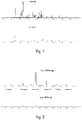
- figure 1 shows by way of illustration a chromatogram of a rancid sample and a fresh sample analyzed according to the method described above, the mass spectrometer upon detection in a scanning mode of mass/charge ratios (m/z) in a relevant mass range, e.g. from 20-300, was operated.
- m/z mass/charge ratios
- FIG. 12 shows an example of an aldehyde chromatogram of a rancid sample at the first mass/charge ratio (m/z) of 44 compared to a fresh sample.
- the determination of the aldehyde index value as described above obviously leads to a significantly higher aldehyde index value for the aldehyde chromatogram of the rancid sample than for the good sample.
- FIG. 12 shows an example of a fatty acid chromatogram of a rancid sample at the second mass/charge ratio (m/z) of 60 compared to a fresh sample.
- the determination of the fatty acid index value as described above obviously leads to a significantly higher fatty acid index value for the fatty acid chromatogram of the rancid sample than for the fresh sample analogously to in figure 2 described aldehyde index value.
- rancidity index table is created from the rancidity index values determined and the associated absorption and reflection spectra.
- the recorded absorption or reflection spectrum of the oil crop, nut or seed is assigned to the rancidity index value by assigning the rancidity index value to at least one of a mean value, a bandwidth or individual frequency bands of the recorded absorption or reflection spectrum.
- specific areas or a mean value of the respective absorption or reflection spectrum are defined as areas which are characteristic of the degree of rancidity of the oil fruits, nuts or seeds 2 .
- the invention provides a method for detecting the rancidity of an oil fruit, nut or seed 2 in order to solve the tasks set out at the beginning.
- a single oil fruit, nut or seed is irradiated with a light source. According to a preferred embodiment variant, this also takes place in the near-infrared range.
- the light reflected from the oil crop, nut or seed or transmitted through it is then projected onto a photo sensor, which records an absorption or reflection spectrum in a near-infrared range of preferably 900 to 1700 nm.
- the absorption or reflection spectrum is recorded by the photo sensor in a range from 1000 to 1500 nm.
- the absorption or reflection spectrum is preferably detected by hyperspectral detection using a hyperspectral camera.
- this method accesses the rancidity table of the previously described method, which contains the rancidity index values and the associated absorption or reflection spectra or characteristic ranges and/or wavelengths of these spectra.
- the following is a comparison of the absorbance or reflectance spectra obtained in this procedure with the absorbance or reflectance spectra contained in the rancidity index table.
- the recorded absorption or reflection spectrum is assigned to an absorption or reflection spectrum of the rancidity index table that is most similar to the recorded absorption or reflection spectrum. This enables the rancidity index value associated with the most similar absorption or reflection spectrum to be determined.
- This method offers the advantage that a previous calibration using the above-described method according to the invention for creating a rancidity index table enables the detection of the rancidity of an oil fruit, nut or seed in a production plant, with the rancidity of individual fruits being detected and not just a homogeneous one product stream.
- the recorded absorption or reflection spectrum is assigned to an absorption or reflection spectrum of the rancidity index table that is most similar to the recorded absorption or reflection spectrum by comparing at least one of a mean value, a bandwidth or individual frequency bands of the absorption or reflection spectra .
- certain areas or an average value of the respective absorption or reflection spectrum are defined as areas which are characteristic of the degree of rancidity of the oil fruits, nuts or seeds and used for this comparison. This advantageously increases the accuracy of the method.
- this detection method offers the advantage that in a further method step at least one threshold value can be defined and exceeding this at least one threshold value causes the oleaginous fruit, nut or seed to be separated or sorted in a differentiated manner.
- This offers the advantage that by defining a threshold value, it is possible to adapt to different quality requirements for the oil crops, nuts or seeds.
- the invention also includes a device, described in detail below, for detecting rancid oil fruits, nuts or seeds, this device being designed to process the detection method according to the invention, using a rancidity index table created according to the method for creating a rancidity index table.
- FIG 4 shows a schematic representation of a device 1 according to the invention for detecting rancid oil fruits, nuts or seeds 2, which comprises two light sources 3, 3', which can be provided together or alternatively, a photo sensor 4, a computer unit 5 and a sorting unit 6.
- the oil fruits, nuts or seeds 2 are successively passed by means of a transport device 7 in the form of a chute through the light beams emitted by the light source 3, 3a and are irradiated by them.
- the light sources 3, 3' emit light in the near-infrared range.
- the photo sensor 4 detects the light from the light source 3 reflected by the oil crop, the nut or the seed 2 or the transmitted light from the light source 3' and records the absorption or reflection spectrum of the oil crop, nut or the seed 2.
- the photo sensor 4 is connected to the computer unit 5 and transmits the recorded absorption or reflection spectrum to it.
- the computer unit 5 accesses the rancidity index table according to the method first described herein. This contains a series of rancidity index values and associated absorbance or reflectance spectra. The computer unit 5 compares the recorded absorption or reflection spectrum with the absorption or reflection spectra listed in the rancidity index table and assigns the recorded absorption or reflection spectrum to the most similar absorption or reflection spectrum in the rancidity index table. According to a preferred embodiment, this is done by comparing a mean value, a bandwidth or individual frequency bands of the absorption or reflection spectra, or a combination thereof. After assignment has taken place, the computer unit determines the rancidity index value assigned to the most similar absorption or reflection spectrum. As a result, a rancidity index value is assigned to each individual oil crop, nut or seed 2 detected by the device 1 .
- the oleaginous fruits, nuts or seeds 1 are guided past the sorting unit 6 , which is also connected to the computer unit 5 , with the computer unit 5 controlling the sorting unit 6 .
- the sorting unit 6 enables individual oleaginous fruits, nuts or seeds 2 to be sorted from a product stream of oleaginous fruits, nuts or seeds 2 guided through the device 1, for example by means of compressed air blasts 6a, which sort the oleaginous fruits, nuts or seeds into different sorting aisles 8 for Convey good products 2a and 9 for rancid products 2b, with the sorting aisles 8, 9 being implemented by chutes, for example.
- the computer unit 5 Based on a predetermined threshold value for the rancidity index value, the computer unit 5 makes a decision to convey the respective oil fruit, nut or the respective seed 2 to one of the sorting aisles.
- the sorting unit 6 can be designed as a flap device, a compressed air device (as shown) or the like. Further embodiments of the sorting unit 6 result from this exemplary reference for the person skilled in the art.
- HAI Hyperspectral Imaging
- a sample is irradiated with broadband light and the reflected light is recorded by a photo sensor, preferably in the near infrared range, and examined spectroscopically.
- spectra amplitude, frequency
- conclusions are drawn about properties or ingredients.
- Evidence of these properties and ingredients is the basis for distinguishing between good and bad products in the sorting process.
- Evidence of these properties/ingredients is based on a qualitative, relative approach. In a modeling process, the photometrically recorded spectra of the good products are compared with the bad product.
- areas of the spectrum are searched for in which the difference in properties is very large or the correlation to a searched substance is very high in contrast to other substances.
- the identified region(s) are then selected for the sorting process and the respective spectra normalized. This means that the absolute amplitudes of the spectrum are eliminated and only the differences between the range of good and bad products can be used for the sorting decision.
- the solution presented is based on a quantitative approach that eliminates the disadvantages of previous methods by not obtaining the sorting information from the spectral comparison of rancid oil fruits/nuts/seeds with non-rancid reference quantities, as was previously the case, but rather the chemical triggers of rancidity (lipid oxidation , hydrolysis) and the resulting substances (aldehydes, etc.) are examined with regard to their spectral fingerprint.
- rancidity index table developed according to the invention is used, which assigns the amplitudes in the corresponding spectral range to a rancidity value of, for example, 0-100% .
- This rancidity index table is developed using available analytical laboratory methods (e.g. gas chromatography etc.) on a statistically large quantity of oilseeds/nuts/seeds.
- rancidity index table is now used according to the invention using a photo sensor of a sorting system, preferably a hyperspectral camera, to detect the degree of rancidity of oilseeds, nuts and seeds, it being possible for the photo sensor to be calibrated using the rancidity index table of the sorting system.
- this table can be used to automatically deduce the quantitative degree (e.g. 0-100%) of rancidity from the absolute amplitude in the spectrum.
Landscapes
- Health & Medical Sciences (AREA)
- Life Sciences & Earth Sciences (AREA)
- Chemical & Material Sciences (AREA)
- Engineering & Computer Science (AREA)
- Food Science & Technology (AREA)
- Physics & Mathematics (AREA)
- Analytical Chemistry (AREA)
- Biochemistry (AREA)
- General Health & Medical Sciences (AREA)
- General Physics & Mathematics (AREA)
- Immunology (AREA)
- Pathology (AREA)
- Medicinal Chemistry (AREA)
- Investigating Or Analysing Materials By Optical Means (AREA)
Claims (14)
- Procédé pour établir une table d'indice de rancissement et associer une valeur d'indice de rancissement à un spectre d'absorption ou de réflexion de fruits oléagineux, de noix et de graines (2), comprenant les étapes consistant à :• irradier un échantillon d'un fruit oléagineux, d'une noix ou d'une graine (2) avec une source de lumière (3) ;• projeter la lumière réfléchie et/ou transmise sur un photocapteur (4) ;• détecter le spectre d'absorption ou de réflexion dans une plage de longueurs d'onde qui est comprise entre 900 nm et 2500 nm, de préférence entre 900 nm et 1700 nm, et de manière encore plus préférée entre 1000 nm et 1500 nm, à l'aide du photocapteur (4) ;• extraire des composants de l'échantillon en utilisant des techniques de préparation d'échantillon basées sur une détermination des composés volatils à partir d'un espace de vapeur qui est situé au-dessus de l'échantillon, et de préférence en réalisant une micro-extraction en phase solide ;• séparer les composants volatils de l'échantillon en utilisant des techniques de chromatographie en phase gazeuse ; et• identifier les composants volatils séparés de l'échantillon en effectuant une détection par spectroscopie de masse des constituants des composants volatils pertinents pour l'oxydation des lipides,caractérisé en ce que le procédé comprend les étapes consistant à :• déterminer une valeur d'indice de rancissement de l'échantillon à partir des composants volatils identifiés de l'échantillon ;• associer à la valeur d'indice de rancissement au moins des longueurs d'onde ou des plages de longueurs d'onde caractéristiques individuelles du spectre d'absorption ou de réflexion détecté de l'échantillon ; et• répéter les étapes précédentes pour un nombre représentatif d'échantillons et établir une table de rancissement à partir des valeurs d'indice de rancissement déterminées ainsi que des spectres d'absorption ou de réflexion associés ou des longueurs d'onde ou des plages de longueurs d'onde caractéristiques des spectres d'absorption ou de réflexion détectés.
- Procédé selon la revendication 1, caractérisé en ce que l'identification des composants volatils de l'échantillon réalisée en effectuant une détection par spectroscopie de masse des constituants pertinents pour l'oxydation des lipides comprend l'identification d'un ou de plusieurs groupe(s) de substances/fonctions choisi(s) parmi :• les hydroperoxydes ;• les hydroperoxydes cycliques ;• les aldéhydes saturés, mono-insaturés et di-insaturés ;• les hydrocarbures (alcanes, alcènes) ;• les alcools (saturés et insaturés) ;• les cétones (saturées et non saturées) ;• les acides gras à chaîne courte ; et• les alkyles furanes.
- Procédé selon la revendication 1 ou 2, caractérisé en ce que l'identification des composants volatils de l'échantillon réalisée en effectuant une détection par spectroscopie de masse de constituants pertinents pour l'oxydation des lipides est effectuée en établissant des chromatogrammes à des rapports de masse/charge qui sont choisis dans une plage comprise entre 20 et 300, de préférence à au moins un rapport de masse/charge qui est choisi parmi 43, 44, 55, 56, 57, 60, 70, 71, 73, 74, 81, 83, 97.
- Procédé selon la revendication 3, caractérisé par l'établissement d'un chromatogramme d'acides gras à un rapport de masse/charge caractéristique des acides gras, notamment à un rapport de masse/charge égal à 60.
- Procédé selon la revendication 4, caractérisé par la détermination d'une valeur d'indice d'acide gras qui est réalisée en effectuant une intégration du chromatogramme d'acide gras sur au moins une zone.
- Procédé selon l'une quelconque des revendications 3 à 5, caractérisé par l'établissement d'un chromatogramme d'aldéhydes à un rapport de masse/charge caractéristique des aldéhydes, notamment à un rapport de masse/charge égal à 44.
- Procédé selon la revendication 6, caractérisé par la détermination d'une valeur d'indice d'aldéhyde qui est réalisée en effectuant une intégration du chromatogramme d'aldéhyde sur au moins une zone.
- Procédé selon les revendications 5 et 7, caractérisé en ce que la détermination d'une valeur d'indice de rancissement est calculée en effectuant la somme de la valeur d'indice d'aldéhyde et de la valeur d'indice d'acide gras.
- Procédé selon l'une quelconque des revendications précédentes, caractérisé en ce que l'association des spectres d'absorption ou de réflexion détectés des échantillons avec les valeurs d'indice de rancissement est réalisée en associant les valeurs d'indice de rancissement à au moins une valeur parmi une valeur moyenne, une largeur de bande ou des bandes de fréquences individuelles des spectres d'absorption ou de réflexion détectés.
- Procédé selon l'une quelconque des revendications précédentes, caractérisé en ce que la détection du spectre d'absorption ou de réflexion à l'aide du photocapteur (4) est réalisée en effectuant une détection hyperspectrale.
- Procédé de détection du rancissement d'un fruit oléagineux, d'une noix ou d'une graine (2), comprenant les étapes suivantes :• exposer le fruit oléagineux, la noix ou la graine (2) à au moins une source de lumière (3) ;• projeter la lumière réfléchie et/ou transmise sur un photocapteur (4) ; et• détecter, à l'aide du photocapteur (4), un spectre d'absorption ou de réflexion dans une plage de longueurs d'onde qui est comprise entre 900 nm et 2500 nm, de préférence entre 900 nm et 1700 nm, et de manière encore plus préférée entre 1000 nm et 1500 nm,caractérisé en ce que le procédé comprend les étapes consistant à :• établir une table d'indice de rancissement selon l'une quelconque des revendications 1 à 10 qui contient les valeurs d'indice de rancissement ainsi que les spectres d'absorption ou de réflexion associés ou les longueurs d'onde ou les plages de longueurs d'onde caractéristiques du spectre d'absorption ou de réflexion ;• associer le spectre d'absorption ou de réflexion détecté ou des longueurs d'onde ou des plages de longueurs d'onde caractéristiques du spectre d'absorption ou de réflexion détecté à un spectre d'absorption ou de réflexion de la table d'indice de rancissement le plus similaire du spectre d'absorption ou de réflexion détecté ou à des longueurs d'onde ou des plages de longueurs d'onde caractéristiques du spectre d'absorption ou de réflexion ; et• déterminer la valeur de l'indice de rancissement associée au spectre d'absorption ou de réflexion le plus similaire ou aux longueurs d'onde ou aux plages de longueurs d'onde caractéristiques du spectre d'absorption ou de réflexion.
- Procédé selon la revendication 11, caractérisé en ce que l'association du spectre d'absorption ou de réflexion détecté au spectre d'absorption ou de réflexion le plus similaire de la table d'indice de rancissement est réalisée en effectuant une comparaison d'au moins une valeur parmi une valeur moyenne, une largeur de bande ou des bandes de fréquence individuelles des spectres d'absorption ou de réflexion.
- Procédé selon l'une quelconque des revendications 11 ou 12, caractérisé par l'élimination du fruit oléagineux, de la noix ou de la graine (2) lorsque la valeur de l'indice de rancissement déterminée est supérieure à une valeur de seuil.
- Dispositif (1) de détection de fruits oléagineux, de noix ou de graines (2) rances, comprenant une source de lumière (3), un photocapteur (4), une unité de calcul (5) ainsi qu'une unité de tri (6), la source de lumière (3) étant conçue de manière à irradier le fruit oléagineux, la noix ou la graine (2), le photocapteur (4) étant relié à l'unité de calcul (3) et étant conçu de manière à générer un spectre d'absorption ou de réflexion de la lumière émise par le fruit oléagineux, la noix ou la graine (2), ou transmise à travers le fruit oléagineux, la noix ou la graine (2), et à transmettre celui-ci à l'unité de calcul (5), et l'unité de tri (6) étant reliée à l'unité de calcul (5), l'unité de calcul (5) étant configurée de manière à commander l'unité de tri (6) en exécutant le procédé selon l'une quelconque des revendications 11 à 13.
Applications Claiming Priority (2)
| Application Number | Priority Date | Filing Date | Title |
|---|---|---|---|
| ATA50322/2017A AT519918B1 (de) | 2017-04-21 | 2017-04-21 | Verfahren zur Detektion der Ranzigkeit von Ölfrüchten, Samen und Nüssen |
| PCT/AT2018/060075 WO2018191768A1 (fr) | 2017-04-21 | 2018-04-20 | Procédé permettant de détecter la rancidité de fruits oléagineux, de graines et de noix |
Publications (2)
| Publication Number | Publication Date |
|---|---|
| EP3612835A1 EP3612835A1 (fr) | 2020-02-26 |
| EP3612835B1 true EP3612835B1 (fr) | 2022-08-17 |
Family
ID=62148050
Family Applications (1)
| Application Number | Title | Priority Date | Filing Date |
|---|---|---|---|
| EP18723663.3A Active EP3612835B1 (fr) | 2017-04-21 | 2018-04-20 | Procédé permettant de détecter la rancidité de fruits oléagineux, de graines et de noix |
Country Status (8)
| Country | Link |
|---|---|
| US (1) | US11073506B2 (fr) |
| EP (1) | EP3612835B1 (fr) |
| CN (1) | CN110785661B (fr) |
| AT (1) | AT519918B1 (fr) |
| CL (1) | CL2019003014A1 (fr) |
| ES (1) | ES2929664T3 (fr) |
| PT (1) | PT3612835T (fr) |
| WO (1) | WO2018191768A1 (fr) |
Families Citing this family (5)
| Publication number | Priority date | Publication date | Assignee | Title |
|---|---|---|---|---|
| ES3037287T3 (en) * | 2019-01-31 | 2025-09-30 | Four Growers Inc | Crop harvesting robot |
| JP7742643B2 (ja) * | 2022-01-27 | 2025-09-22 | 国立大学法人東北大学 | 油脂の酸化原因の特定方法 |
| AT525827B1 (de) * | 2022-02-07 | 2025-11-15 | Insort Gmbh | Verfahren und Vorrichtung zur Bestimmung, ob eine Ölfrucht, eine Nuss, insbesondere eine Haselnuss oder ein Samen faulig ist |
| CN114897082B (zh) * | 2022-05-21 | 2024-12-20 | 浙江农林大学 | 一种香榧过氧化值的快速无损检测方法 |
| CN116678855A (zh) * | 2023-06-21 | 2023-09-01 | 安徽农业大学 | 一种利用葵花籽黑色表皮的高光谱评价其新鲜度的方法 |
Family Cites Families (28)
| Publication number | Priority date | Publication date | Assignee | Title |
|---|---|---|---|---|
| US6646264B1 (en) | 2000-10-30 | 2003-11-11 | Monsanto Technology Llc | Methods and devices for analyzing agricultural products |
| CN1425909A (zh) * | 2002-12-31 | 2003-06-25 | 天津大学 | 中药滴丸制剂中有效成分的红外光谱检测方法 |
| GB0405821D0 (en) * | 2004-03-15 | 2004-04-21 | Evanesco Ltd | Fluid monitoring apparatus and methods |
| US20050250212A1 (en) * | 2004-05-07 | 2005-11-10 | Hormoz Azizian | FT-NIR fatty acid determination method |
| WO2006079846A1 (fr) * | 2005-01-31 | 2006-08-03 | Graf International Limited | Procédé de détection et d’identification des bactéries |
| CN101310738B (zh) * | 2007-05-24 | 2011-10-26 | 天津天士力现代中药资源有限公司 | 一种中药提取物的中红外光谱多组分定量分析方法 |
| US20090305423A1 (en) * | 2008-06-09 | 2009-12-10 | Ohio State University Research Foundation | Methods for Monitoring Composition and Flavor Quality of Cheese Using a Rapid Spectroscopic Method |
| CN101504363A (zh) * | 2009-03-18 | 2009-08-12 | 哈尔滨商业大学 | 一种基于近红外光谱分析的食用油脂酸价检测方法 |
| US8953158B2 (en) * | 2009-09-04 | 2015-02-10 | Danny S. Moshe | Grading of agricultural products via hyper spectral imaging and analysis |
| SE1000620A1 (sv) * | 2010-06-09 | 2011-12-10 | Umbio Ab | Förfarande för hyperspektral bildanalys i realtid |
| CN101907564B (zh) * | 2010-06-24 | 2013-07-17 | 江苏大学 | 基于近红外光谱技术的油菜籽品质无损检测方法和装置 |
| CN101915746B (zh) * | 2010-07-22 | 2012-09-12 | 中国人民解放军空军油料研究所 | 航空润滑油及添加剂的鉴定方法 |
| AT12076U1 (de) * | 2010-07-27 | 2011-10-15 | Evk Di Kerschhaggl Gmbh | Verfahren, sensoreinheit und maschine zum detektieren von ''zuckerspitzen''-defekten in kartoffeln |
| CN102012920B (zh) * | 2010-11-29 | 2012-07-04 | 天津出入境检验检疫局化矿金属材料检测中心 | 一种建立进口铁矿产地鉴别数据库的方法 |
| CN102175640A (zh) * | 2011-03-11 | 2011-09-07 | 张瑞 | 淫羊藿加工生产中的近红外在线检测方法 |
| CN102353643A (zh) * | 2011-06-22 | 2012-02-15 | 中国林业科学研究院林产化学工业研究所 | 一种近红外漫反射光谱(nirs)快速测定油茶籽含油率的方法 |
| KR20130076093A (ko) * | 2011-12-28 | 2013-07-08 | 강원대학교산학협력단 | 형광 스펙트럼 테스트를 이용한 분말상 대두의 저장 중 산패도 측정방법 |
| JP6088770B2 (ja) | 2012-04-20 | 2017-03-01 | 国立大学法人広島大学 | 穀粒成分分析装置および穀粒成分分析方法 |
| CN103808674A (zh) * | 2012-11-09 | 2014-05-21 | 云南太阳魂庄园葡萄酒业销售有限公司 | 一种基于紫外-可见光谱扫描图谱的葡萄酒品质特征客观评价体系方法及应用 |
| CN103487384B (zh) * | 2013-10-15 | 2016-01-27 | 无锡艾科瑞思产品设计与研究有限公司 | 基于近红外光谱的袋装稻谷成分快速检测方法 |
| CN103592257B (zh) * | 2013-12-02 | 2016-07-06 | 广东产品质量监督检验研究院 | 一种用近红外光谱快速测定木器涂料稀释剂中甲苯、乙苯和二甲苯含量的方法 |
| CN104297441B (zh) * | 2014-10-29 | 2016-04-13 | 内蒙古天奇中蒙制药股份有限公司 | 一种红外光谱在线质量监测控制体系在蒙药制剂中的应用 |
| US9459205B1 (en) * | 2015-04-27 | 2016-10-04 | Empire Technology Development Llc | Refractive index measurement of liquids over a broad spectral range |
| CN104865222B (zh) * | 2015-04-30 | 2018-03-23 | 北京林业大学 | 一种牡丹种子脂肪酸含量的无损检测方法 |
| CN104931454A (zh) * | 2015-06-23 | 2015-09-23 | 浙江理工大学 | 一种利用近红外光谱分析技术快速测定纺织品中莱卡纤维含量的方法 |
| CN105628648A (zh) * | 2015-12-31 | 2016-06-01 | 深圳市芭田生态工程股份有限公司 | 一种利用光谱法测定农产品中维生素c的方法 |
| CN106290230B (zh) * | 2016-07-26 | 2019-08-30 | 安徽农业大学 | 一种近红外光谱结合化学成分的红茶萎凋程度的判别方法 |
| CN106018335A (zh) * | 2016-08-04 | 2016-10-12 | 浙江大学 | 基于近红外光谱的整粒棉籽中植酸含量的无损测定方法 |
-
2017
- 2017-04-21 AT ATA50322/2017A patent/AT519918B1/de active
-
2018
- 2018-04-20 PT PT187236633T patent/PT3612835T/pt unknown
- 2018-04-20 WO PCT/AT2018/060075 patent/WO2018191768A1/fr not_active Ceased
- 2018-04-20 EP EP18723663.3A patent/EP3612835B1/fr active Active
- 2018-04-20 ES ES18723663T patent/ES2929664T3/es active Active
- 2018-04-20 US US16/606,907 patent/US11073506B2/en active Active
- 2018-04-20 CN CN201880041395.6A patent/CN110785661B/zh active Active
-
2019
- 2019-10-21 CL CL2019003014A patent/CL2019003014A1/es unknown
Also Published As
| Publication number | Publication date |
|---|---|
| AT519918A1 (de) | 2018-11-15 |
| AT519918B1 (de) | 2020-12-15 |
| PT3612835T (pt) | 2022-11-15 |
| ES2929664T3 (es) | 2022-11-30 |
| CN110785661A (zh) | 2020-02-11 |
| WO2018191768A1 (fr) | 2018-10-25 |
| CL2019003014A1 (es) | 2020-06-12 |
| CN110785661B (zh) | 2022-09-13 |
| US11073506B2 (en) | 2021-07-27 |
| US20200378941A1 (en) | 2020-12-03 |
| EP3612835A1 (fr) | 2020-02-26 |
Similar Documents
| Publication | Publication Date | Title |
|---|---|---|
| EP3612835A1 (fr) | Procédé permettant de détecter la rancidité de fruits oléagineux, de graines et de noix | |
| DE60201684T2 (de) | Verfahren zum sortieren von aus einem organischen material bestehenden gegenständen | |
| Scavarda et al. | Cocoa smoky off-flavour: A MS-based analytical decision maker for routine controls | |
| AT525827B1 (de) | Verfahren und Vorrichtung zur Bestimmung, ob eine Ölfrucht, eine Nuss, insbesondere eine Haselnuss oder ein Samen faulig ist | |
| DE102007062112A1 (de) | Verfahren und Vorrichtung zum Beurteilen der Reinheit von Pflanzenölen mit Hilfe der Terahertz-Zeitdomäne-Spektroskopie | |
| EP3842788B1 (fr) | Capteur spectral proche infrarouge de reconnaissance d'objets utilisant des méthodes d'apprentissage automatique, et méthode correspondante | |
| CH708057A2 (de) | Nahinfrarot-Verfahren zur Bestimmung von Inhaltsstoffen der Lotuswurzel. | |
| Janin et al. | Methods for PDO olive oils traceability: state of art and discussion about the possible contribution of strontium isotopic tool | |
| DE102020002256A1 (de) | Prozesssteuerung/-regelung auf Basis einer spektroskopischen Bestimmung unbestimmter Substanzkonzentrationen | |
| DE10326152A1 (de) | Verfahren und Vorrichtung zur quantitativen Analyse von Lösungen und Dispersionen mittels Nahinfrarot-Spektroskopie | |
| AT527038B1 (de) | Verfahren zum Bestimmen von Hämolyse, Ikterus und/oder Lipämie in einer Blutprobe | |
| DE102021105644A1 (de) | Analyse von Milch | |
| DE19827743C2 (de) | Verfahren und Vorrichtung zur Steuerung und/oder Regelung eines holzverarbeitenden Prozesses | |
| EP2635882A1 (fr) | Procédé de détermination de constituants chimiques de substances solides ou liquides par spectroscopie thz | |
| DE60001733T2 (de) | Verfahren und vorrichtung zur bestimmung der qualität von trauben | |
| DE102007019790B4 (de) | Verfahren und Vorrichtung zur Charakterisierung einer Pflanzenprobe | |
| DE102014009154A1 (de) | Verfahren zum Klassifizieren eines Stoffgemischs | |
| DE102021004464A1 (de) | Verfahren zur Regelung eines Trocknungsverlaufs eines landwirtschaftlichen Produkts | |
| DE102015223436B4 (de) | Verfahren zum berührungslosen und zerstörungsfreien Bestimmen eines Anteils mindestens einer freien Fettsäure oder mindestens eines Oxidationsprodukts auf einer Oberfläche eines Lebens- oder Futtermittels | |
| DE102020131014B4 (de) | Verfahren zum identifizieren einer substanz an einer oberfläche | |
| DE19953387A1 (de) | Verfahren zur Auswertung elektromagnetischer Spektren von Stoffen hinsichtlich ihrer anwendungsspezifischen Wirkung | |
| WO2002048700A2 (fr) | Procede de classification de substances chimiques selon leurs caracteristiques olfactives | |
| WO2025256851A1 (fr) | Procédé de production d'une base de données pour prédire une intensité d'au moins un attribut d'odeur qui peut être perçu par un moyen sensoriel humain, base de données et son utilisation | |
| WO2023046711A1 (fr) | Procédé et dispositif de détermination d'un paramètre d'une répartition dimensionnelle d'un mélange, installation de fabrication de panneaux de matériau et produit-programme d'ordinateur | |
| WO2025242803A1 (fr) | Procédé d'attribution d'un échantillon à l'une de multiples classes possibles sur la base de données expérimentales |
Legal Events
| Date | Code | Title | Description |
|---|---|---|---|
| STAA | Information on the status of an ep patent application or granted ep patent |
Free format text: STATUS: UNKNOWN |
|
| STAA | Information on the status of an ep patent application or granted ep patent |
Free format text: STATUS: THE INTERNATIONAL PUBLICATION HAS BEEN MADE |
|
| PUAI | Public reference made under article 153(3) epc to a published international application that has entered the european phase |
Free format text: ORIGINAL CODE: 0009012 |
|
| STAA | Information on the status of an ep patent application or granted ep patent |
Free format text: STATUS: REQUEST FOR EXAMINATION WAS MADE |
|
| 17P | Request for examination filed |
Effective date: 20191121 |
|
| AK | Designated contracting states |
Kind code of ref document: A1 Designated state(s): AL AT BE BG CH CY CZ DE DK EE ES FI FR GB GR HR HU IE IS IT LI LT LU LV MC MK MT NL NO PL PT RO RS SE SI SK SM TR |
|
| AX | Request for extension of the european patent |
Extension state: BA ME |
|
| RAV | Requested validation state of the european patent: fee paid |
Extension state: MD Effective date: 20191121 |
|
| RAX | Requested extension states of the european patent have changed |
Extension state: BA Payment date: 20191121 |
|
| GRAP | Despatch of communication of intention to grant a patent |
Free format text: ORIGINAL CODE: EPIDOSNIGR1 |
|
| STAA | Information on the status of an ep patent application or granted ep patent |
Free format text: STATUS: GRANT OF PATENT IS INTENDED |
|
| INTG | Intention to grant announced |
Effective date: 20220407 |
|
| GRAS | Grant fee paid |
Free format text: ORIGINAL CODE: EPIDOSNIGR3 |
|
| GRAA | (expected) grant |
Free format text: ORIGINAL CODE: 0009210 |
|
| STAA | Information on the status of an ep patent application or granted ep patent |
Free format text: STATUS: THE PATENT HAS BEEN GRANTED |
|
| AK | Designated contracting states |
Kind code of ref document: B1 Designated state(s): AL AT BE BG CH CY CZ DE DK EE ES FI FR GB GR HR HU IE IS IT LI LT LU LV MC MK MT NL NO PL PT RO RS SE SI SK SM TR |
|
| REG | Reference to a national code |
Ref country code: CH Ref legal event code: EP |
|
| REG | Reference to a national code |
Ref country code: DE Ref legal event code: R096 Ref document number: 502018010426 Country of ref document: DE |
|
| REG | Reference to a national code |
Ref country code: IE Ref legal event code: FG4D Free format text: LANGUAGE OF EP DOCUMENT: GERMAN |
|
| REG | Reference to a national code |
Ref country code: AT Ref legal event code: REF Ref document number: 1512501 Country of ref document: AT Kind code of ref document: T Effective date: 20220915 |
|
| REG | Reference to a national code |
Ref country code: PT Ref legal event code: SC4A Ref document number: 3612835 Country of ref document: PT Date of ref document: 20221115 Kind code of ref document: T Free format text: AVAILABILITY OF NATIONAL TRANSLATION Effective date: 20221109 |
|
| REG | Reference to a national code |
Ref country code: NL Ref legal event code: FP |
|
| REG | Reference to a national code |
Ref country code: ES Ref legal event code: FG2A Ref document number: 2929664 Country of ref document: ES Kind code of ref document: T3 Effective date: 20221130 |
|
| REG | Reference to a national code |
Ref country code: LT Ref legal event code: MG9D Ref country code: NO Ref legal event code: T2 Effective date: 20220817 |
|
| PG25 | Lapsed in a contracting state [announced via postgrant information from national office to epo] |
Ref country code: SE Free format text: LAPSE BECAUSE OF FAILURE TO SUBMIT A TRANSLATION OF THE DESCRIPTION OR TO PAY THE FEE WITHIN THE PRESCRIBED TIME-LIMIT Effective date: 20220817 Ref country code: RS Free format text: LAPSE BECAUSE OF FAILURE TO SUBMIT A TRANSLATION OF THE DESCRIPTION OR TO PAY THE FEE WITHIN THE PRESCRIBED TIME-LIMIT Effective date: 20220817 Ref country code: LV Free format text: LAPSE BECAUSE OF FAILURE TO SUBMIT A TRANSLATION OF THE DESCRIPTION OR TO PAY THE FEE WITHIN THE PRESCRIBED TIME-LIMIT Effective date: 20220817 Ref country code: LT Free format text: LAPSE BECAUSE OF FAILURE TO SUBMIT A TRANSLATION OF THE DESCRIPTION OR TO PAY THE FEE WITHIN THE PRESCRIBED TIME-LIMIT Effective date: 20220817 Ref country code: FI Free format text: LAPSE BECAUSE OF FAILURE TO SUBMIT A TRANSLATION OF THE DESCRIPTION OR TO PAY THE FEE WITHIN THE PRESCRIBED TIME-LIMIT Effective date: 20220817 |
|
| PG25 | Lapsed in a contracting state [announced via postgrant information from national office to epo] |
Ref country code: PL Free format text: LAPSE BECAUSE OF FAILURE TO SUBMIT A TRANSLATION OF THE DESCRIPTION OR TO PAY THE FEE WITHIN THE PRESCRIBED TIME-LIMIT Effective date: 20220817 Ref country code: IS Free format text: LAPSE BECAUSE OF FAILURE TO SUBMIT A TRANSLATION OF THE DESCRIPTION OR TO PAY THE FEE WITHIN THE PRESCRIBED TIME-LIMIT Effective date: 20221217 Ref country code: HR Free format text: LAPSE BECAUSE OF FAILURE TO SUBMIT A TRANSLATION OF THE DESCRIPTION OR TO PAY THE FEE WITHIN THE PRESCRIBED TIME-LIMIT Effective date: 20220817 Ref country code: GR Free format text: LAPSE BECAUSE OF FAILURE TO SUBMIT A TRANSLATION OF THE DESCRIPTION OR TO PAY THE FEE WITHIN THE PRESCRIBED TIME-LIMIT Effective date: 20221118 |
|
| PG25 | Lapsed in a contracting state [announced via postgrant information from national office to epo] |
Ref country code: SM Free format text: LAPSE BECAUSE OF FAILURE TO SUBMIT A TRANSLATION OF THE DESCRIPTION OR TO PAY THE FEE WITHIN THE PRESCRIBED TIME-LIMIT Effective date: 20220817 Ref country code: RO Free format text: LAPSE BECAUSE OF FAILURE TO SUBMIT A TRANSLATION OF THE DESCRIPTION OR TO PAY THE FEE WITHIN THE PRESCRIBED TIME-LIMIT Effective date: 20220817 Ref country code: DK Free format text: LAPSE BECAUSE OF FAILURE TO SUBMIT A TRANSLATION OF THE DESCRIPTION OR TO PAY THE FEE WITHIN THE PRESCRIBED TIME-LIMIT Effective date: 20220817 Ref country code: CZ Free format text: LAPSE BECAUSE OF FAILURE TO SUBMIT A TRANSLATION OF THE DESCRIPTION OR TO PAY THE FEE WITHIN THE PRESCRIBED TIME-LIMIT Effective date: 20220817 |
|
| VS25 | Lapsed in a validation state [announced via postgrant information from nat. office to epo] |
Ref country code: MD Free format text: LAPSE BECAUSE OF FAILURE TO SUBMIT A TRANSLATION OF THE DESCRIPTION OR TO PAY THE FEE WITHIN THE PRESCRIBED TIME-LIMIT Effective date: 20220817 |
|
| REG | Reference to a national code |
Ref country code: DE Ref legal event code: R097 Ref document number: 502018010426 Country of ref document: DE |
|
| PG25 | Lapsed in a contracting state [announced via postgrant information from national office to epo] |
Ref country code: SK Free format text: LAPSE BECAUSE OF FAILURE TO SUBMIT A TRANSLATION OF THE DESCRIPTION OR TO PAY THE FEE WITHIN THE PRESCRIBED TIME-LIMIT Effective date: 20220817 Ref country code: EE Free format text: LAPSE BECAUSE OF FAILURE TO SUBMIT A TRANSLATION OF THE DESCRIPTION OR TO PAY THE FEE WITHIN THE PRESCRIBED TIME-LIMIT Effective date: 20220817 |
|
| PLBE | No opposition filed within time limit |
Free format text: ORIGINAL CODE: 0009261 |
|
| STAA | Information on the status of an ep patent application or granted ep patent |
Free format text: STATUS: NO OPPOSITION FILED WITHIN TIME LIMIT |
|
| PG25 | Lapsed in a contracting state [announced via postgrant information from national office to epo] |
Ref country code: AL Free format text: LAPSE BECAUSE OF FAILURE TO SUBMIT A TRANSLATION OF THE DESCRIPTION OR TO PAY THE FEE WITHIN THE PRESCRIBED TIME-LIMIT Effective date: 20220817 |
|
| 26N | No opposition filed |
Effective date: 20230519 |
|
| PG25 | Lapsed in a contracting state [announced via postgrant information from national office to epo] |
Ref country code: SI Free format text: LAPSE BECAUSE OF FAILURE TO SUBMIT A TRANSLATION OF THE DESCRIPTION OR TO PAY THE FEE WITHIN THE PRESCRIBED TIME-LIMIT Effective date: 20220817 |
|
| PG25 | Lapsed in a contracting state [announced via postgrant information from national office to epo] |
Ref country code: LU Free format text: LAPSE BECAUSE OF NON-PAYMENT OF DUE FEES Effective date: 20230420 |
|
| PG25 | Lapsed in a contracting state [announced via postgrant information from national office to epo] |
Ref country code: MC Free format text: LAPSE BECAUSE OF FAILURE TO SUBMIT A TRANSLATION OF THE DESCRIPTION OR TO PAY THE FEE WITHIN THE PRESCRIBED TIME-LIMIT Effective date: 20220817 |
|
| PG25 | Lapsed in a contracting state [announced via postgrant information from national office to epo] |
Ref country code: MC Free format text: LAPSE BECAUSE OF FAILURE TO SUBMIT A TRANSLATION OF THE DESCRIPTION OR TO PAY THE FEE WITHIN THE PRESCRIBED TIME-LIMIT Effective date: 20220817 |
|
| REG | Reference to a national code |
Ref country code: IE Ref legal event code: MM4A |
|
| PG25 | Lapsed in a contracting state [announced via postgrant information from national office to epo] |
Ref country code: IE Free format text: LAPSE BECAUSE OF NON-PAYMENT OF DUE FEES Effective date: 20230420 |
|
| PG25 | Lapsed in a contracting state [announced via postgrant information from national office to epo] |
Ref country code: IE Free format text: LAPSE BECAUSE OF NON-PAYMENT OF DUE FEES Effective date: 20230420 |
|
| REG | Reference to a national code |
Ref country code: AT Ref legal event code: MM01 Ref document number: 1512501 Country of ref document: AT Kind code of ref document: T Effective date: 20230420 |
|
| PG25 | Lapsed in a contracting state [announced via postgrant information from national office to epo] |
Ref country code: AT Free format text: LAPSE BECAUSE OF NON-PAYMENT OF DUE FEES Effective date: 20230420 |
|
| PG25 | Lapsed in a contracting state [announced via postgrant information from national office to epo] |
Ref country code: AT Free format text: LAPSE BECAUSE OF NON-PAYMENT OF DUE FEES Effective date: 20230420 |
|
| PG25 | Lapsed in a contracting state [announced via postgrant information from national office to epo] |
Ref country code: BG Free format text: LAPSE BECAUSE OF FAILURE TO SUBMIT A TRANSLATION OF THE DESCRIPTION OR TO PAY THE FEE WITHIN THE PRESCRIBED TIME-LIMIT Effective date: 20220817 |
|
| PG25 | Lapsed in a contracting state [announced via postgrant information from national office to epo] |
Ref country code: BG Free format text: LAPSE BECAUSE OF FAILURE TO SUBMIT A TRANSLATION OF THE DESCRIPTION OR TO PAY THE FEE WITHIN THE PRESCRIBED TIME-LIMIT Effective date: 20220817 |
|
| PGFP | Annual fee paid to national office [announced via postgrant information from national office to epo] |
Ref country code: NL Payment date: 20250418 Year of fee payment: 8 |
|
| PGFP | Annual fee paid to national office [announced via postgrant information from national office to epo] |
Ref country code: DE Payment date: 20250422 Year of fee payment: 8 |
|
| PGFP | Annual fee paid to national office [announced via postgrant information from national office to epo] |
Ref country code: GB Payment date: 20250423 Year of fee payment: 8 Ref country code: ES Payment date: 20250530 Year of fee payment: 8 |
|
| PGFP | Annual fee paid to national office [announced via postgrant information from national office to epo] |
Ref country code: NO Payment date: 20250424 Year of fee payment: 8 |
|
| PGFP | Annual fee paid to national office [announced via postgrant information from national office to epo] |
Ref country code: IT Payment date: 20250424 Year of fee payment: 8 Ref country code: BE Payment date: 20250418 Year of fee payment: 8 |
|
| PGFP | Annual fee paid to national office [announced via postgrant information from national office to epo] |
Ref country code: PT Payment date: 20250410 Year of fee payment: 8 |
|
| PGFP | Annual fee paid to national office [announced via postgrant information from national office to epo] |
Ref country code: FR Payment date: 20250425 Year of fee payment: 8 |
|
| PGFP | Annual fee paid to national office [announced via postgrant information from national office to epo] |
Ref country code: CH Payment date: 20250501 Year of fee payment: 8 |
|
| PG25 | Lapsed in a contracting state [announced via postgrant information from national office to epo] |
Ref country code: CY Free format text: LAPSE BECAUSE OF FAILURE TO SUBMIT A TRANSLATION OF THE DESCRIPTION OR TO PAY THE FEE WITHIN THE PRESCRIBED TIME-LIMIT; INVALID AB INITIO Effective date: 20180420 |
|
| PGFP | Annual fee paid to national office [announced via postgrant information from national office to epo] |
Ref country code: TR Payment date: 20250414 Year of fee payment: 8 |
|
| PG25 | Lapsed in a contracting state [announced via postgrant information from national office to epo] |
Ref country code: HU Free format text: LAPSE BECAUSE OF FAILURE TO SUBMIT A TRANSLATION OF THE DESCRIPTION OR TO PAY THE FEE WITHIN THE PRESCRIBED TIME-LIMIT; INVALID AB INITIO Effective date: 20180420 |
|
| REG | Reference to a national code |
Ref country code: CH Ref legal event code: U11 Free format text: ST27 STATUS EVENT CODE: U-0-0-U10-U11 (AS PROVIDED BY THE NATIONAL OFFICE) Effective date: 20260501 |