EP3617191A1 - Procédé de fabrication de diastéréoisomère d'un dérivé d'acide citrique - Google Patents
Procédé de fabrication de diastéréoisomère d'un dérivé d'acide citrique Download PDFInfo
- Publication number
- EP3617191A1 EP3617191A1 EP18791471.8A EP18791471A EP3617191A1 EP 3617191 A1 EP3617191 A1 EP 3617191A1 EP 18791471 A EP18791471 A EP 18791471A EP 3617191 A1 EP3617191 A1 EP 3617191A1
- Authority
- EP
- European Patent Office
- Prior art keywords
- compound
- salt
- aqueous solution
- crystal
- diastereomer
- Prior art date
- Legal status (The legal status is an assumption and is not a legal conclusion. Google has not performed a legal analysis and makes no representation as to the accuracy of the status listed.)
- Granted
Links
Images




Classifications
-
- A—HUMAN NECESSITIES
- A61—MEDICAL OR VETERINARY SCIENCE; HYGIENE
- A61K—PREPARATIONS FOR MEDICAL, DENTAL OR TOILETRY PURPOSES
- A61K31/00—Medicinal preparations containing organic active ingredients
- A61K31/33—Heterocyclic compounds
- A61K31/395—Heterocyclic compounds having nitrogen as a ring hetero atom, e.g. guanethidine or rifamycins
- A61K31/40—Heterocyclic compounds having nitrogen as a ring hetero atom, e.g. guanethidine or rifamycins having five-membered rings with one nitrogen as the only ring hetero atom, e.g. sulpiride, succinimide, tolmetin, buflomedil
- A61K31/4015—Heterocyclic compounds having nitrogen as a ring hetero atom, e.g. guanethidine or rifamycins having five-membered rings with one nitrogen as the only ring hetero atom, e.g. sulpiride, succinimide, tolmetin, buflomedil having oxo groups directly attached to the heterocyclic ring, e.g. piracetam, ethosuximide
-
- A—HUMAN NECESSITIES
- A61—MEDICAL OR VETERINARY SCIENCE; HYGIENE
- A61P—SPECIFIC THERAPEUTIC ACTIVITY OF CHEMICAL COMPOUNDS OR MEDICINAL PREPARATIONS
- A61P1/00—Drugs for disorders of the alimentary tract or the digestive system
- A61P1/16—Drugs for disorders of the alimentary tract or the digestive system for liver or gallbladder disorders, e.g. hepatoprotective agents, cholagogues, litholytics
-
- C—CHEMISTRY; METALLURGY
- C07—ORGANIC CHEMISTRY
- C07D—HETEROCYCLIC COMPOUNDS
- C07D207/00—Heterocyclic compounds containing five-membered rings not condensed with other rings, with one nitrogen atom as the only ring hetero atom
- C07D207/02—Heterocyclic compounds containing five-membered rings not condensed with other rings, with one nitrogen atom as the only ring hetero atom with only hydrogen or carbon atoms directly attached to the ring nitrogen atom
- C07D207/30—Heterocyclic compounds containing five-membered rings not condensed with other rings, with one nitrogen atom as the only ring hetero atom with only hydrogen or carbon atoms directly attached to the ring nitrogen atom having two double bonds between ring members or between ring members and non-ring members
- C07D207/34—Heterocyclic compounds containing five-membered rings not condensed with other rings, with one nitrogen atom as the only ring hetero atom with only hydrogen or carbon atoms directly attached to the ring nitrogen atom having two double bonds between ring members or between ring members and non-ring members with hetero atoms or with carbon atoms having three bonds to hetero atoms with at the most one bond to halogen, e.g. ester or nitrile radicals, directly attached to ring carbon atoms
- C07D207/36—Oxygen or sulfur atoms
- C07D207/40—2,5-Pyrrolidine-diones
- C07D207/416—2,5-Pyrrolidine-diones with hetero atoms or with carbon atoms having three bonds to hetero atoms with at the most one bond to halogen, e.g. ester or nitrile radicals, directly attached to other ring carbon atoms
-
- C—CHEMISTRY; METALLURGY
- C07—ORGANIC CHEMISTRY
- C07B—GENERAL METHODS OF ORGANIC CHEMISTRY; APPARATUS THEREFOR
- C07B2200/00—Indexing scheme relating to specific properties of organic compounds
- C07B2200/13—Crystalline forms, e.g. polymorphs
Definitions
- the present invention relates to a crystal of a citric acid derivative having an inhibitory effect against liver disorder, a highly purified noncrystalline diastereomer (amorphous diastereomer) thereof, and their manufacturing methods.
- Japanese apricot belongs to the subgenus Prunus of the genus Prunus of the subfamily Amygdaloideae of the family Rosaceae , and is eaten as ume processed products such as pickled ume, ume liquors and ume flesh extracts.
- ume flesh extracts have effects of disinfection, fatigue recovery, gastric protection and the like, and have been ingested for health.
- the ume flesh extracts are known to have an effect of improving bloodstream (see non-patent documents 1 and 2).
- the bloodstream improving effect is known to be caused by Mumefural and related compounds thereof produced by heating an organic acid such as citric acid or malic acid contained in ume flesh extract together with a sugar, (non-patent document 3).
- Misatol(R) is commercially available as one of health foods containing ume flesh extracts, and is known to have an effect of inducing autophagy, and an inhibitory effect against liver disorder in patients with viral hepatitis (patent documents 1 and 2).
- the present applicant has recently proposed, based on the above finding, a citric acid derivative comprising a compound represented by the following formula, and a synthesis method thereof ( PCT/JP2016/004789 ).
- R 1 denotes a C1 to C3 alkyl group optionally having a carboxyl group or a hydroxyl group
- R 2 denotes a hydrogen atom
- R 1 and R 2 optionally together form a cyclic structure and denote a C2 to C3 alkylene chain.
- a problem of the present invention is to provide a method for isolating a crystalline diastereomer compound from a diastereomer mixture of a citric acid derivative, which is one among the citric acid derivative represented by the above chemical formula, represented by the following formula obtained by a reaction of citric acid with L-aspartic acid, in a large amount thereof by using inexpensive means, and a method for purifying a noncrystalline diastereomer compound from the diastereomer mixture, in a high purity in a large amount by using inexpensive means.
- the present inventors have found that a crystal of a compound represented by the above formula can be obtained by combining specific steps.
- the present inventors have also found that a noncrystalline diastereomer salt of the compound can be deposited by combining specific steps.
- the present inventors have also determined the structure of a crystalline diastereomer of a compound represented by the above formula by structural analysis using single-crystal X-ray diffractometry.
- the present invention has been completed based on these findings.
- the present invention is as follows.
- the acquisitions of the crystal of the compound A and the highly-purified noncrystalline diastereomer of the compound A serve to elucidate the physiological activity of the each substance and the action mechanism thereof on diseases. Further, the crystal of the compound A and the highly-purified noncrystalline diastereomer of the compound A, since being more easily handled than a diastereomer mixture containing these, are remarkably useful in manufacture or the like of medicines using the compound A as an active ingredient, or food and drink products using the compound A. Further according to the method described in the present application, the crystal of the compound A and the noncrystalline diastereomer can be separated and acquired more inexpensively in larger amounts and in a shorter time than in purifying methods using high separation columns used as common purifying means.
- the amount which can be purified in one-time purifying process depends on the column size to be used, and a large-amount purifying method using large columns which require an expensive high separation carrier is not easy in aspects of costs and efficiency.
- 20 g or more of a high-purity diastereomer can easily be separated from a 500 mL of a reaction liquid by a one-time purifying process, and the purifying scale can easily be enlarged.
- the crystal of the compound A according to the present invention includes a crystal having peaks of diffraction angles (2 ⁇ ) at 11.74 ⁇ 0.20°, preferably ⁇ 0.10°, 29.25 ⁇ 0.20°, preferably ⁇ 0.10°, 18.36 ⁇ 0.20°, preferably ⁇ 0.10°, 21.75 ⁇ 0.20°, preferably ⁇ 0.10°, and 15.95 ⁇ 0.20°, preferably ⁇ 0.10° in a powder X-ray diffractometric pattern using a CuK ⁇ radiation as an X-ray source.
- the crystal of the compound A according to the present invention includes the crystal further having peaks of diffraction angles (2 ⁇ ) at 24.09 ⁇ 0.20°, preferably ⁇ 0.10°, 19.32 ⁇ 0.20°, preferably ⁇ 0.10°, 19.04 ⁇ 0.20°, preferably ⁇ 0.10°, 26.95 ⁇ 0.20°, preferably ⁇ 0.10° and 16.19 ⁇ 0.20°, preferably ⁇ 0.10° in a powder X-ray diffractometric pattern using a CuK ⁇ radiation as an X-ray source, in addition to the above.
- the crystal of the compound A according to the present invention includes the crystal further having, in addition to the above, peaks of diffraction angles (2 ⁇ ) at 26.42 ⁇ 0.20°, preferably ⁇ 0.10°, 16.68 ⁇ 0.20°, preferably ⁇ 0.10°, 17.85 ⁇ 0.20°, preferably ⁇ 0.10°, 21.19 ⁇ 0.20°, preferably ⁇ 0.10° and 18.14 ⁇ 0.20°, preferably ⁇ 0.10° in a powder X-ray diffractometric pattern using a CuK ⁇ radiation as an X-ray source.
- the powder X-ray diffraction patterns using CuK ⁇ as an X-ray source can be acquired by a method described in Example 8 in the present description.
- the compound A has diastereomers having an asymmetric carbon as the 2-position carbon of the propane chain originated from citric acid.
- the compound A according to the present invention has an asymmetric carbon also in a structure originated from aspartic acid, the configuration of the asymmetric carbon is derived from aspartic acid or asparagine to be used as a raw material.
- the crystal of the compound A according to the present invention is derived from an L-isomer of aspartic acid.
- the crystal of the compound A according to the present invention is a crystal of either one of diastereomers of the compound A, NMR cannot tell which one of the diastereomers the either one corresponds to.
- a method of determining which diastereomer a crystal of the compound A is includes a structural analysis using single-crystal X-ray diffraction. Specifically, the method includes a method described in Example 9 as one example. As a result of the analysis in Example 9, it was clarified that a crystalline compound A (a crystal of the compound A) was enantiomers of an SS isomer and an RR isomer. Then, since aspartic acid used in the synthesis was wholly L-aspartic acid (S-isomer), it was found that the configuration of the crystalline compound A was an SS-isomer in the RS notation system.
- the noncrystalline diastereomer of the compound A or a salt thereof according to the present invention is a diastereomer not being crystallized by a crystallization method of the compound A described in the below (hereinafter, referred to also as noncrystalline diastereomer) among diastereomers of the compound A, or a salt thereof.
- the noncrystalline diastereomer of the compound A or a salt thereof according to the present invention can be confirmed by qualitative analysis using high performance liquid chromatography (HPLC) described in Example 5, and can be distinguished from the crystalline diastereomer.
- HPLC high performance liquid chromatography
- the configuration of the crystal of the compound A according to the present invention is an SS isomer in the RS notation system
- the configuration of amorphous (the noncrystalline diastereomer) of the compound A according to the present invention is an SR isomer in the RS notation system as shown below.
- the noncrystalline diastereomer of the compound A or a salt thereof according to the present invention includes those having a mixing proportion of the crystalline diastereomer of 5% or lower, preferably 4% or lower, more preferably 3% or lower, still more preferably 2% or lower and most preferably 1% or lower.
- the salt of the noncrystalline diastereomer of the compound A according to the present invention includes a metal salt and an amino acid salt.
- the metal salt includes a metal salt selected from the group consisting of a sodium salt, a potassium salt, a magnesium salt and a calcium salt, and most preferably includes a calcium salt.
- the amino acid salt includes an amino acid salt selected from the group consisting of an arginine salt, a citrulline salt, an ornithine salt and a histidine salt.
- the amino acid salt is preferably an L isomer of the amino acid salt.
- the crystal of the compound A according to the present invention can be obtained by crystallization either using ion exchange column chromatography or using a compound such as calcium carbonate.
- the crystal of the compound A is manufactured by the following steps of (a) to (f):
- the salt of the compound A and the salt of citric acid in the aqueous solution containing the compound A and/or a salt thereof and citric acid and/or a salt thereof and having a pH of 5.0 to 8.5 examples include an amino acid salt and a metal salt (a sodium salt, a potassium salt, a magnesium salt, a calcium salt).
- a metal salt a sodium salt, a potassium salt, a magnesium salt, a calcium salt.
- Most preferable as the compound A and/or a salt thereof and citric acid and/or a salt thereof are the compound A and citric acid.
- the aqueous solution containing the compound A and/or a salt thereof and citric acid and/or a salt thereof and having a pH of 5.0 to 8.5, to be used in the above step (a) is manufactured, for example, as follows. Citric acid monohydrate and L-aspartic acid are reacted under heating to thereby form a compound A.
- the compound A may be a compound A manufactured by a method other than the synthesis method, such as an enzyme reaction method or a fermentation method. After completion of the reaction, the reaction liquid is allowed to cool, and methanol is added in an acidic condition.
- the concentration of the methanol solution may be any concentration as long as being a concentration at which L-aspartic acid deposits, but is, for example, 60 V/V%.
- the aqueous solution after the solid-liquid separation contains the compound A and citric acid.
- an alkali aqueous solution for example, an aqueous ammonia
- the pH of the aqueous solution is 5.0 to 8.5, preferably 6.0 to 8.0 and most preferably 6.5 to 7.2.
- the aqueous solution is passed through a column packed with an anion-exchange resin.
- the anion-exchange resin may be any anion-exchange resin capable of separating the compound A and/or a salt thereof and citric acid and/or a salt thereof, but examples thereof include a TOYOPEARL SuperQ-650M (150 mm ⁇ 500 mm, manufactured by Tosoh Corp.).
- An eluent to be used in the above step (b) is not especially limited, but is selected, for example, from the group consisting of an ammonium acetate aqueous solution, a sodium chloride aqueous solution and an ammonium formate aqueous solution.
- the concentration of the eluent is 50 mM to 5 M, preferably 100 mM to 3 M, more preferably 150 mM to 2 M and most preferably 200 mM to 1.5 M.
- the elution may be carried out by stepwise raising the concentration of the eluent.
- the flow rate of the elution step is in the range of 10 to 500 mL/min, preferably 50 to 300 mL/min and most preferably 100 to 200 mL/min.
- step (b) is not containing any citric acid, but a tiny amount of citric acid may be contained to the extent of not becoming an obstacle in crystallization of the compound A.
- examples of a method of removing the eluent include a method using a column packed with a cation-exchange resin, and electrodialysis, and preferably include the method using a column packed with a cation-exchange resin.
- removing the eluent means removing components (solutes) in the eluent.
- the cation-exchange resin may be any cation-exchange resin as long as being capable of separating the compound A and the eluent, but includes a DOWEX 50Wx8 (manufactured by Wako Chemical Corp.).
- aqueous solution for example, purified water
- a column packed with the cation-exchange resin By feeding an aqueous solution, for example, purified water, to a column packed with the cation-exchange resin, there is acquired an aqueous solution containing the compound A but containing no eluent. It is desirable that "containing no eluent" is not containing any eluent, but a tiny amount of the eluent may be contained to the extent of not becoming an obstacle in crystallization of the compound A.
- methods of concentrating the aqueous solutions include heating concentration, vacuum concentration and lyophilization, and most preferably include lyophilization.
- a method of acquiring the crystal includes pressure filtration, suction filtration and centrifugal separation. Further in order to reduce adhesion of a mother liquid and improve the quality of the crystal, the crystal can suitably be washed. The washed crystal is dried by vacuum drying, fluidized-bed drying, forced-air drying or the like to thereby obtain the final product.
- the crystallization of the compound A can be attained also by carrying out the step (d) and the step (e) repeatedly several times.
- a crystal of the compound A is manufactured in an aqueous solution by the following steps of (a) to (f):
- the aqueous solution containing the compound A and citric acid and having a pH of 2.0 or lower, to be used in the above step (a) is manufactured, for example, as follows. Citric acid monohydrate and L-aspartic acid are reacted under heating to thereby form a compound A.
- the compound A may be a compound A manufactured by a method other than the synthesis method, such as an enzyme reaction method or a fermentation method. After completion of the reaction, the reaction liquid is allowed to cool, and methanol is added in an acidic condition.
- the concentration of the methanol solution may be any concentration as long as being a concentration at which L-aspartic acid deposits, but is, for example, 60 v/v%.
- the L-aspartic acid Since out of unreacted citric acid and L-aspartic acid contained in the reaction liquid, the L-aspartic acid deposits and precipitates, the deposit and precipitate is solid-liquid separated by centrifugal separation. Here, in this step, the addition of methanol is important. Ethanol is not allowed. For subsequent steps, the aqueous solution after the solid-liquid separation containing the compound A and citric acid is used.
- the difficult point when the crystal of the compound A is obtained by the present method is in removing citric acid from the aqueous solution containing the compound A and citric acid in an acidic condition.
- the compound A is unstable in a neutral to alkaline (pH of 5 or higher) aqueous solution, in order to suppress decomposition of the compound A, maintenance of an acidic condition is important. Therefore, the aqueous solution containing the compound A and citric acid and having a pH of 2.0 or lower to be used in the step (a) may be an aqueous solution whose pH is preferably 0.6 to 1.8 and most preferably 1.0 to 1.6.
- the present inventors have thought of removing citric acid by turning it into a form of a salt, and as a result of repeating trial and error using salts consisting of various metal ions, have found that use of calcium ion (Ca 2+ ) can well remove citric acid.
- the present inventors have further also found that even if the salt is a calcium salt, in the case of using calcium chloride (CaCl 2 ), citric acid cannot be removed well in an acidic condition, and in the case of using calcium carbonate (CaCO 3 ), citric acid can successfully be removed even in an acidic condition.
- the removal of calcium citrate in the above step (b) and the removal of calcium sulfate in the above step (d) can be carried out, for example, by centrifugal separation or filtration.
- the reason of using sulfuric acid in the above step (c) includes that due to frailty to alkali of the compound A and lowness in solubility of calcium sulfate, removal of calcium ions is easy (that is, desalting is easy).
- the pH at this time is preferably 1.0 to 2.0 and more preferably 1.3 to 1.8.
- a sodium salt (sodium sulfate) or a potassium salt (potassium sulfate) the desalting is difficult.
- Specific examples of a method of concentrating the aqueous solution in the above step (e) include heating concentration and vacuum concentration, but in order to prevent deterioration or decomposition of mixed components by heat, use of vacuum concentration is preferable.
- a method of acquiring the crystal includes pressure filtration, suction filtration and centrifugal separation. Further in order to reduce adhesion of a mother liquid and improve the quality of the crystal, the crystal can suitably be cleaned.
- the cleaned crystal is dried by vacuum drying, fluidized-bed drying, forced-air drying or the like to thereby obtain the final product.
- the crystal of the compound A can further be obtained by carrying out the following steps of (g) to (j):
- the organic solvent to be added in the above step (g) is preferably an organic solvent which is miscible with water and can dissolve a certain amount of the compound A, and specific examples thereof include acetone.
- the removal of calcium citrate in the above step (h) can be carried out, for example, by centrifugal separation or filtration.
- a method of depositing the crystal of the compound A in the above step (i) may be any method of depositing the compound, but preferably includes a method in which the aqueous solution is concentrated by solvent distilling-away and a solvent is again added.
- a method of acquiring the crystal includes pressure filtration, suction filtration and centrifugal separation. Further in order to reduce adhesion of a mother liquid and improve the quality of the crystal, the crystal can suitably be cleaned.
- the cleaned crystal is dried by vacuum drying, fluidized-bed drying, forced-air drying or the like to thereby obtain the final product.
- the noncrystalline diastereomer salt of the compound A according to the present invention can be obtained by a method comprising the following steps of (a) to (l):
- the aqueous solution containing the compound A and citric acid and having a pH of 2.0 or lower, to be used in the above step (a) is manufactured, for example, as follows. Citric acid monohydrate and L-aspartic acid are reacted under heating to thereby form a compound A.
- the compound A may be a compound A manufactured by a method other than the synthesis method, such as an enzyme reaction method or a fermentation method. After completion of the reaction, the reaction liquid is allowed to cool, and methanol is added in an acidic condition.
- the concentration of the methanol solution may be any concentration as long as being a concentration at which L-aspartic acid deposits, but is, for example, 60 v/v%.
- the aqueous solution after the solid-liquid separation containing the compound A and citric acid may be an aqueous solution whose pH is preferably 0.6 to 1.8 and most preferably 1.0 to 1.6.
- the difficult point when the crystal of the compound A is obtained by the present method is in removing citric acid from the aqueous solution containing the compound A and citric acid.
- the present inventors have thought of removing citric acid by turning it into a form of a salt, and as a result of repeating trial and error using salts consisting of various metal ions, have found that use of calcium ion (Ca 2+ ) can well remove citric acid.
- the present inventors have further also found that even if the salt is a calcium salt, in the case of using calcium chloride (CaCl 2 ), citric acid cannot be removed well in an acidic condition, and in the case of using calcium carbonate (CaCO 3 ), citric acid can successfully be removed even in an acidic condition.
- the removal of calcium citrate in the above step (b) and the removal of calcium sulfate in the above step (d) can be carried out, for example, by centrifugal separation or filtration.
- the reason of using sulfuric acid in the above step (c) includes that due to frailty to alkali of the compound A and lowness in solubility of calcium sulfate, removal of calcium ions is easy (that is, desalting is easy).
- the pH at this time is preferably 1.0 to 2.0 and more preferably 1.3 to 1.8.
- a sodium salt (sodium sulfate) or a potassium salt (potassium sulfate) the desalting is difficult.
- Specific examples of a method of concentrating the aqueous solution in the above step (e) include heating concentration and vacuum concentration, but in order to prevent deterioration or decomposition of mixed components by heat, use of vacuum concentration is preferable.
- a method of removing the crystal includes pressure filtration, suction filtration and centrifugal separation.
- step (g) and step (h) are steps essential for high purification of the diastereomer salt of the compound A.
- the reason therefor is because in the aqueous solution after the crystal of the compound A has been removed in the step (f), the compound A to be still crystallized remains.
- the organic solvent to be added in the above step (g) is preferably an organic solvent which is miscible with water and can dissolve a certain amount of the compound A, and specific examples thereof include acetone.
- the removal of calcium citrate in the above step (h) can be carried out, for example, by centrifugal separation or filtration.
- a method of depositing the crystal of the compound A in the above step (i) may be any method of depositing the compound, but preferably includes a method in which the aqueous solution is concentrated by solvent distilling-away and a solvent is again added.
- a method of removing the crystal includes centrifugal separation, pressure filtration and suction filtration. In the stage of the above step (j), the crystalline compound A is practically removed.
- the metal salt to be added in the above step (k) includes a sodium salt, a potassium salt, a magnesium salt and a calcium salt, and most preferably, a calcium salt (as an example, calcium chloride or calcium acetate) can be used.
- a calcium salt as an example, calcium chloride or calcium acetate
- the pH of the aqueous solution is preferably acidic and most preferably 3.6 or lower.
- the amino acid salt to be added in the above step (k) includes an amino acid selected from the group consisting of an arginine salt, a citrulline salt, an ornithine salt and a histidine salt, and examples thereof include an L-arginine hydrochloride, an L-citrulline hydrochloride, an L-ornithine hydrochloride and an L-histidine hydrochloride.
- the alcohol to be added in the above step (k) includes methanol, ethanol, n-propanol and isopropanol, and there can be used, for example, ethanol or methanol.
- the efficiency of depositing the diastereomer salt of the compound A is better in the case of ethanol than in the case of methanol.
- the compound A according to the present invention can be synthesized by using, as starting substances, citric acid and L-aspartic acid and/or L-asparagine (most preferably L-aspartic acid).
- the synthesized compound A consists of a mixture of two diastereomers. According to the following procedure, crystallization of the compound A and deposition of the noncrystalline diastereomer salt of the compound A can be carried out continuously.
- conditions of the corresponding steps described above may be used.
- the crystallized compound A (crystal in the aqueous solution) obtained in the above step (5) and the crystallized compound A (crystal in acetone) obtained in the above step (7) are each stored by being subjected to the following operation. Redissolving in water ⁇ recrystallizing ⁇ purity evaluation by qualitative analysis using HPLC ⁇ drying ⁇ storing
- the noncrystal compound A (Ca salt) obtained in the above step (8) is stored by being subjected to the following operation. Redissolving in water ⁇ concentrating (removing precipitated calcium citrate) ⁇ adding ethanol (for example, 90v/v% ethanol aqueous solution) to the aqueous solution of the compound A ⁇ reprecipitating ⁇ purity evaluation by qualitative analysis using HPLC ⁇ drying ⁇ storing
- noncrystal compound A (Ca salt)
- by making it to be acidic with sulfuric acid calcium can be removed therefrom and the concentration as the compound A can be evaluated by qualitative and quantitative analysis using HPLC.
- reaction liquid in the pressure-resistant vessel was put in an autoclave heated at about 80°C, and heat treated at 121°C for 120 min.
- the temperature in the autoclave was lowered to about 80°C, and the reaction liquid in the pressure-resistant vessel was taken out and stirred to thereby dissolve as much of the L-aspartic acid remaining undissolved as possible.
- the reaction liquid was further heat treated in the autoclave at 121°C for 120 min. The stirring and the heat treatment were repeated to carry out the heat treatment at 121°C for the total of 420 min while L-aspartic acid was dissolved.
- the presence of the compound A was confirmed by qualitative analysis using the following high performance liquid chromatography (HPLC). Solutions having various concentrations of the compound A were diluted with a 10mM perchloric acid aqueous solution (mobile phase for qualitative analysis using HPLC) so as to have a suitable concentration; undissolved substances were removed by a membrane filter; and the diluted solution was analyzed by high performance liquid chromatography.
- HPLC high performance liquid chromatography
- the separation condition in qualitative analysis using HPLC was as follows.
- the title component supposed to be the compound A in the chromatogram had a peak at a retention time (RT) of 25.4 to 26.0 min.
- the L-aspartic acid obtained as the precipitate by vaporizing and removing methanol and drying the precipitate, could be reutilized as a synthesis raw material for synthesis of the compound A.
- the reaction liquid (60% methanol) containing the compound A obtained as a filtrate was diluted two-fold with purified water (Japanese Pharmacopoeia purified water) to make a 30% methanol solution.
- 136 g (228 mg per 1 mL of the starting reaction liquid) of a powder of calcium carbonate (Wako Pure Chemical Industries, Ltd.) was added gradually to the solution under stirring, whereupon there deposited a white precipitate of calcium citrate having low solubility.
- the calcium carbonate dissolved accompanied by foaming (carbon dioxide gas), later gradually, calcium citrate having low solubility deposited from the solution.
- unreacted citric acid mostly precipitated as calcium citrate to make a thick white turbid solution.
- the white turbid solution was centrifugally separated (room temperature, 1,500 ⁇ g, 30 min) to be thereby separated into a precipitate and a supernatant solution, and the supernatant solution (containing a 30% methanol) containing the compound A was collected.
- Methanol was distilled away from the collected supernatant solution while being concentrated by an evaporator (Tokyo Rikakikai Co., Ltd.) to thereby make a thick viscous solution.
- Purified water was added to the viscous solution containing the concentrated compound A so as to have the same solution volume of 600 mL as that of the starting reaction liquid.
- One mol/L (2 N) of sulfuric acid was gradually added to the solution and the pH of the solution became 1.3 to 1.6, whereupon Ca ions in the solution deposited and precipitated as a calcium sulfate salt.
- the precipitate was removed by filtration and the filtrate was collected.
- the filtrate contained the compound A and was acidic with sulfuric acid.
- the solution (about 600 mL) was concentrated by an evaporator under heating in a water bath at 40°C so as to have a volume of about 250 mL (to 200 mL).
- the solution as a mother liquid for crystallization of the compound A was cooled to room temperature, and then the glass wall surface was rubbed with a spatula or the like, whereupon a crystalline compound A deposit emerged; and the solution was allowed to stand as it was for a whole day and night, a white precipitate was obtained.
- the precipitate was separated from the mother solution by filtration, and collected after washing with a small amount of purified water to obtain a compound A crystal.
- the above operation from the synthesis reaction liquid to the series of purification and crystallization of the crystalline compound A was repeatedly carried out to thereby obtain about 130 g (wet weight) of a crystal of the compound A from 3 L of the synthesis reaction liquid.
- a trace amount of the crystal (seed crystal) was laid aside, and the rest of the crystal was dissolved (in a warm bath at 40°C) in purified water in a small amount as possible, and then the resultant solution was highly concentrated by an evaporator, and thereafter cooled; and the crystal was obtained again by adding the seed crystal to the solution.
- the crystal was collected by suction filtration, and dried to thereby obtain 113 g of a crystallized compound A.
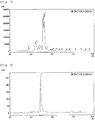
- Figure 2 shows an HPLC chromatogram of the compound A crystal which is crystallized in the aqueous solution.
- the compound A purified from the synthesis reaction liquid after the heat reaction was crystallized in the aqueous solution, and the resultant crystal was purified by recrystallization, and thereafter evaluated by HPLC.
- 70 mg of the crystallized compound A was weighed, and dissolved in 1 mL of purified water.
- the resultant solution was diluted 160-fold with a mobile phase solvent (10mM perchloric acid solution) of the HPLC analysis system, and analyzed. A clear peak of the compound A was observed, and other peaks corresponding to impurities were nearly trace intensities and not clear, it was thus confirmed that the compound A was highly purified.
- a noncrystal of the compound A had hygroscopicity and when being concentrated and solidified, was converted to a hygroscopic and highly viscous (glutinous) form, which was hardly handled.
- the crystal of the compound A was a non-hygroscopic powder, which was easily handled.
- Figure 4 shows an HPLC chromatogram of compound A as a crystal purified by recrystallization, which has been crystallized in acetone.
- the filtered crystal was purified by being recrystallized with purified water; the recrystallized crystal (about 20 mg) was dissolved in purified water (about 0.5 mL); and the resultant solution was diluted 40-fold with a mobile phase solvent (10mM perchloric acid solution) of qualitative analysis using HPLC, and analyzed.
- a clear peak of the compound A was observed, and peaks of impurities were nearly trace intensities and not clear.
- the precipitate was separated from the supernatant solution by centrifugal separation, and further purified by being washed with 70% ethanol to thereby obtain a purified precipitate (noncrystalline compound A Ca salt (1)).
- the supernatant solution made to be a 70% ethanol solution included remaining compound A, and the solution was adjusted the pH to 6.0 as a condition for more strongly inducing the Ca salt from compound A, and then by making the solution to be a 80% ethanol solution, a precipitate was obtained.
- the precipitate was washed with ethanol to make a purified precipitate (noncrystalline compound A Ca salt (2)).
- Figure 5 is an HPLC chromatogram of the precipitate deposited at a pH of 3.6; and Figure 6 is an HPLC chromatogram of the precipitate deposited at a pH of 6.0.
- the HPLC chromatogram of the purified precipitate obtained at a pH of 3.6, although peaks of impurities are observed, the main peak of the compound A is strongly observed, revealing that the precipitate was purified.
- the objective component supposed to be the compound A in the chromatogram was detected as two adjacent peaks in the range of a retention time (RT) of 3.3 to 3.7 min (however, RT slightly changed in some cases, due to the influence such as deterioration of the column packing material).
- RT retention time
- the crystalline compound A diastereomer was detected as a peak on the right side of the longer retention time in the column; and the noncrystalline compound A diastereomer was detected as a peak on the left side of the shorter retention time.
- Figure 7 shows an HPLC chromatogram of the roughly purified compound A synthesis solution. Tow diastereomers of the compound A were detected as two adjacent peaks, and their presence ratio was nearly equal.
- the compound A crystal obtained by being purified from the compound A synthesis solution and being crystallized in the aqueous solution was dissolved in purified water and the presence state of the compound A diastereomers was evaluated by qualitative analysis using HPLC ( Figure 8).
- Figure 8 shows an HPLC chromatogram (analysis result for the same sample as in Figure 2 ) of the compound A crystallized in the aqueous solution.
- the crystalline compound A was detected as a peak on the right side of a longer retention time in the range of detection of two compound A diastereomers, and its presence ratio was 99% or higher in peak areal ratio.
- the mingling ratio of the other diastereomer was 0.36% (calculated from the peak areal ratio).
- FIG. 9 shows an HPLC chromatogram (analysis result for the same sample as in Figure 4 ) of the compound A crystallized in acetone.
- the crystalline compound A crystallized in acetone similarly to the crystalline compound A crystallized in the aqueous solution, was detected as a peak on the right side of a longer retention time in the range of detection of two compound A diastereomers, and its presence ratio was 98% or higher in peak areal ratio.
- the mingling ratio of the other diastereomer was 1.36% (calculated from the peak areal ratio).
- the precipitate deposited in the 70% ethanol was dissolved in purified water, subjected to qualitative analysis using HPLC and was detected as a peak on the left side of the shorter retention time in the range of detection of two compound A diastereomers.
- the peak was detected as a peak on RT clearly different from the peak of the crystalline compound A. Its presence ratio was 99% or higher in peak areal ratio.
- the mingling ratio of the other diastereomer (crystalline compound A) was 0.45% (calculated from the peak areal ratio).
- a white precipitate (calcium citrate) deposited. Since when the calcium chloride solution was further added, a white precipitate was newly precipitated, the calcium chloride solution was gradually added and about 333 mL (0.23 mol as the amount of calcium chloride) was resultantly added to 200 mL of the neutralized reaction liquid. Purified water was added to the resultant mixed solution so that the total volume became 600 mL, and thereafter, a white precipitate being calcium citrate was removed by centrifugal separation and the supernatant was recovered. Then, 430 mL of the supernatant was concentrated to 133 mL by an evaporator (since heat was intended not be applied, the bath temperature was made to be 25°C).
- the estimated content of the target substance in two target substance fractions (Fr (fraction) 8 to 12 and Fr13 was calculated as 5.4 g, and the recovery rate to 64.1 g of the estimated content of the target substance in the raw material was 86.4%.
- Lot. Nos. in the Table 1 are numbers attached to the two target substance fractions for convenience.
- Fr8 to 12 (Lot. No. 198-012-74-1) was dissolved in about 600 mL of purified water, and subjected to the batchwise treatment with an ion-exchange resin (DOWEX 50W ⁇ 8, H+ type, 100 to 200 mesh), and thereafter was lyophilized.
- the lyophilized product was again dissolved in 800 mL of purified water, and divided into two parts and introduced to ion exchange column chromatography (DOWEX 50W ⁇ 8, H+ type, 150 mm ⁇ 200 mm). After the introduction, purified water was fed, and fractions containing the target substance were collected and lyophilized.
- the following could be obtained from 280 mL (aqueous solution, solid content: 235 g) of the starting substance by the ion exchange column chromatography.
- Table 1 the estimated content of the target substance (compound A) calculated from the acetic acid content calculated by 1 H NMR and the area value of HPLC.
- the total target substance content of the three Lots obtained this time's purifying process was calculated as 54.2 g and the recovery rate from the starting substance (estimated content of the target substance: 64.1 g) was 84.5%.
- the measurement of powder X-ray diffraction was carried out by using the crystal of the compound A and the noncrystalline diastereomer of the compound A according to the present invention by the following method.
- test sample 1 the crystal of the compound A obtained from the aqueous solution by column purification in Example 7
- test sample 2 the crystal of the compound A obtained from the acetone solution in Example 4 (crystal stored as seed crystal and not recrystallize)
- test sample 3 the Ca salt (1) of the noncrystalline compound A (the noncrystalline diastereomer of the compound A) obtained in the manufacturing method in Example 4
- Powders of the test sample 1 to the test sample 3 were measured as they were.
- Figure 16 shows comparison by multiple plotting of powder X-ray diffractometric patterns of respective substances of the test sample 1 (the crystal obtained from an aqueous solution by column purification), the test sample 2 (the crystal obtained from an acetone solution) and the test sample 3 (the Ca salt of the noncrystalline diastereomer). Further, the peak list of the powder X-ray diffraction of the test sample 1 is shown in Table 2; and that of the test sample 2, in Table 3.
- test sample 3 being a solid obtained by adding ethanol to solidify the noncrystalline diastereomer as the Ca salt, no clear peak was observed in the powder X-ray diffraction pattern, and it was confirmed that it was an amorphous (noncrystalline) solid.
- a single crystal of the compound A for structural analysis by single crystal X-ray diffractometory was produced by the following method and was subjected to structural analysis by single crystal X-ray diffractometory.
- a highly purified crystalline powder of the compound A was obtained by repeating three times the same operation as in the recrystallization described in the paragraph [0049] of Example 3.
- 100 mL of purified water Japanese Pharmacopoeia purified water
- 10 g of the crystalline powder was then dissolved by heating the resultant in a water bath at 50°C.
- the resultant solution was filtered by using a membrane filter (Merck Millipore) of 0.22 ⁇ m in pore size, and the resultant filtrate was collected.
- the filtrate was concentrated by using an evaporator on a water bath at 40°C to thereby collect the resultant as an about 50 ml of a solution.
- This solution was concentrated and cooled to room temperature to thereby become a solution in a supersaturated state.
- the solution as it was in the heated state (40°C) was dispensed in test tubes with a lid so as to have solvent ratios indicated in the following Table (Table 4) to thereby produce solutions having mixed solvents.
- Table 4 Table 4
- test tube of the each solution of the compound A thus produced was hermetically closed -with the lid of the test tube, and allowed to stand at room temperature for a whole day and night or longer to thereby make the compound A to deposit from the supersaturated state.
- Each of the test tube was subjected to centrifugal separation (room temperature, 3,000 rpm, 10 min) to thereby make deposits to precipitate down; and a supernatant of the each solution was cautiously transferred to another clean test tube with a plastic lid to thereby make a saturated solution of the each solution.
- the crystals were made to grow over several days until crystallized single crystals sufficiently grew, and collected before the single crystals fused and polycrystallized.
- the collecting procedure of the crystals involved turning the test tube upside down together with the solution containing the crystals to drop the solution on a filter paper to thereby make the solution to be absorbed in the filter paper and collecting the crystals left on the filter paper by a metal needle.
- the collected single crystals were observed under a mesoscope, and there were picked out single crystals having sizes and shapes usable for the structural analysis by single crystal X-ray diffractometory, and used for the structural analysis by single crystal X-ray diffractometory.
- the lattice constant was determined by the method of least squares from 25 reflections in the range of 50.0° ⁇ 2 ⁇ 58.8°. The measurement was carried out on reflections of diffraction angles 2 ⁇ of 136.1° or lower by the ⁇ -2 ⁇ scanning method. After the measurement of all reflection data, it was found by the extinction rule (systematic reflection intensity extinction) that the space group was P2 1/c (#14). The measurement data are shown in Table 5, and the crystal data are shown in Table 6. [Table 5] ⁇ Measurement data> Diffractometer used: RASA-7R type, manufactured by Rigaku Corp.
- the atom scattering factor used was a value described in "International Tables for X-ray Crystallography", and all calculations were carried out by using CrystalStructure being a crystallographic software package of Rigaku Corporation and Rigaku/MSC. The analysis data are shown in Table 7.
- the crystalline compound A (the crystal of the compound A) was enantiomers of an SS isomer and an RR isomer in the RS notation system. Then since aspartic acid used in the synthesis was all L-aspartic acid (an S isomer), it has been found that the crystalline compound A was an SS isomer. Then in response thereto, it has also been found that the compound A having a property of not being crystallized was an SR isomer.
- the diastereomer mixture of the compound A is known to be an active substance having an inhibitory effect against liver disorder, there has been unknown so far the physiological action of the crystalline compound A and the noncrystalline compound A in organisms.
- processes requiring a highly purifying technology generally using columns having high resolution ability. Further in usual purification means using these columns, enlargement of the purification scale is difficult and the supply thereof in a large amount requires high costs in many cases.
- the crystal of the compound A and the remarkably high-purity noncrystalline diastereomer of the compound A is expected to be efficiently applied to the field of medicine manufacture, the fields of manufacture of foods including functional foods and health foods, and the like.
Landscapes
- Health & Medical Sciences (AREA)
- Chemical & Material Sciences (AREA)
- Organic Chemistry (AREA)
- Veterinary Medicine (AREA)
- Animal Behavior & Ethology (AREA)
- Public Health (AREA)
- General Health & Medical Sciences (AREA)
- Life Sciences & Earth Sciences (AREA)
- Medicinal Chemistry (AREA)
- Pharmacology & Pharmacy (AREA)
- Nuclear Medicine, Radiotherapy & Molecular Imaging (AREA)
- General Chemical & Material Sciences (AREA)
- Engineering & Computer Science (AREA)
- Chemical Kinetics & Catalysis (AREA)
- Bioinformatics & Cheminformatics (AREA)
- Gastroenterology & Hepatology (AREA)
- Epidemiology (AREA)
- Organic Low-Molecular-Weight Compounds And Preparation Thereof (AREA)
- Pharmaceuticals Containing Other Organic And Inorganic Compounds (AREA)
- Pyrrole Compounds (AREA)
Applications Claiming Priority (2)
| Application Number | Priority Date | Filing Date | Title |
|---|---|---|---|
| JP2017089725 | 2017-04-28 | ||
| PCT/JP2018/016495 WO2018199040A1 (fr) | 2017-04-28 | 2018-04-23 | Procédé de fabrication de diastéréoisomère d'un dérivé d'acide citrique |
Publications (4)
| Publication Number | Publication Date |
|---|---|
| EP3617191A1 true EP3617191A1 (fr) | 2020-03-04 |
| EP3617191A4 EP3617191A4 (fr) | 2020-12-23 |
| EP3617191B1 EP3617191B1 (fr) | 2023-12-20 |
| EP3617191B9 EP3617191B9 (fr) | 2024-03-27 |
Family
ID=63919139
Family Applications (1)
| Application Number | Title | Priority Date | Filing Date |
|---|---|---|---|
| EP18791471.8A Active EP3617191B9 (fr) | 2017-04-28 | 2018-04-23 | Procédé de fabrication de diastéréoisomère d'un dérivé d'acide citrique |
Country Status (13)
| Country | Link |
|---|---|
| US (1) | US11155519B2 (fr) |
| EP (1) | EP3617191B9 (fr) |
| JP (1) | JP6826267B2 (fr) |
| KR (1) | KR102299521B1 (fr) |
| CN (1) | CN110546137B (fr) |
| AU (1) | AU2018259992B2 (fr) |
| CA (1) | CA3058886C (fr) |
| ES (1) | ES2969457T3 (fr) |
| NZ (1) | NZ757747A (fr) |
| PH (1) | PH12019550273A1 (fr) |
| SG (1) | SG11201909240SA (fr) |
| TW (1) | TWI678360B (fr) |
| WO (1) | WO2018199040A1 (fr) |
Families Citing this family (4)
| Publication number | Priority date | Publication date | Assignee | Title |
|---|---|---|---|---|
| PH12018550048B1 (en) * | 2015-11-02 | 2023-08-30 | Otsuka Pharma Factory Inc | Novel citric acid derivative |
| FR3091873B1 (fr) * | 2019-01-17 | 2020-12-25 | Guerbet Sa | Complexe de gadolinium et d’un ligand chelateur derive de pcta diastereoisomeriquement enrichi et procede de preparation et de purification |
| WO2024257845A1 (fr) | 2023-06-16 | 2024-12-19 | 株式会社大塚製薬工場 | Agent de promotion de la consommation énergétique |
| CN120685695B (zh) * | 2025-07-04 | 2026-01-06 | 上海科技大学 | 一种确定手性晶体对映异构体含量的方法及应用 |
Family Cites Families (7)
| Publication number | Priority date | Publication date | Assignee | Title |
|---|---|---|---|---|
| JPS4842624B1 (fr) | 1965-09-06 | 1973-12-13 | ||
| JP2734265B2 (ja) | 1991-12-12 | 1998-03-30 | 日本電気株式会社 | エレクトレット・コンデンサ・マイクロフォン用増幅回路 |
| JP4842624B2 (ja) | 2005-11-25 | 2011-12-21 | Ada Bio株式会社 | オートファジー誘導用飲食品 |
| JP5577129B2 (ja) | 2010-03-26 | 2014-08-20 | Ada Bio株式会社 | ウイルス性肝炎患者における肝機能改善剤 |
| CN105612194B (zh) * | 2013-10-11 | 2018-12-14 | 帝斯曼知识产权资产管理有限公司 | 聚合物和组合物 |
| US10648917B2 (en) * | 2015-04-06 | 2020-05-12 | The Penn State Research Foundation | Luminescent compositions and applications thereof |
| PH12018550048B1 (en) | 2015-11-02 | 2023-08-30 | Otsuka Pharma Factory Inc | Novel citric acid derivative |
-
2018
- 2018-04-23 WO PCT/JP2018/016495 patent/WO2018199040A1/fr not_active Ceased
- 2018-04-23 EP EP18791471.8A patent/EP3617191B9/fr active Active
- 2018-04-23 AU AU2018259992A patent/AU2018259992B2/en active Active
- 2018-04-23 JP JP2019514501A patent/JP6826267B2/ja active Active
- 2018-04-23 SG SG11201909240S patent/SG11201909240SA/en unknown
- 2018-04-23 ES ES18791471T patent/ES2969457T3/es active Active
- 2018-04-23 US US16/606,376 patent/US11155519B2/en active Active
- 2018-04-23 KR KR1020197030766A patent/KR102299521B1/ko active Active
- 2018-04-23 CA CA3058886A patent/CA3058886C/fr active Active
- 2018-04-23 NZ NZ757747A patent/NZ757747A/en unknown
- 2018-04-23 CN CN201880026677.9A patent/CN110546137B/zh active Active
- 2018-04-24 TW TW107113857A patent/TWI678360B/zh active
-
2019
- 2019-10-14 PH PH12019550273A patent/PH12019550273A1/en unknown
Also Published As
| Publication number | Publication date |
|---|---|
| EP3617191A4 (fr) | 2020-12-23 |
| CA3058886C (fr) | 2021-11-09 |
| AU2018259992A1 (en) | 2019-10-24 |
| NZ757747A (en) | 2022-04-29 |
| US11155519B2 (en) | 2021-10-26 |
| ES2969457T3 (es) | 2024-05-20 |
| CN110546137B (zh) | 2023-10-31 |
| JP6826267B2 (ja) | 2021-02-03 |
| TWI678360B (zh) | 2019-12-01 |
| EP3617191B1 (fr) | 2023-12-20 |
| CN110546137A (zh) | 2019-12-06 |
| US20200055821A1 (en) | 2020-02-20 |
| KR102299521B1 (ko) | 2021-09-07 |
| KR20190129965A (ko) | 2019-11-20 |
| SG11201909240SA (en) | 2019-11-28 |
| JPWO2018199040A1 (ja) | 2019-12-26 |
| PH12019550273A1 (en) | 2021-01-04 |
| CA3058886A1 (fr) | 2018-11-01 |
| WO2018199040A1 (fr) | 2018-11-01 |
| EP3617191B9 (fr) | 2024-03-27 |
| AU2018259992B2 (en) | 2020-06-18 |
| TW201841887A (zh) | 2018-12-01 |
Similar Documents
| Publication | Publication Date | Title |
|---|---|---|
| EP3617191B1 (fr) | Procédé de fabrication de diastéréoisomère d'un dérivé d'acide citrique | |
| US10364244B2 (en) | Crystal form of pyrroloquinoline quinone sodium salt and preparation method and use thereof | |
| US10745432B2 (en) | Crystal of 6′-sialyllactose sodium salt, and process for producing same | |
| JP2024170521A (ja) | 水を溶媒とする結晶化を用いて水溶液からメバロン酸又はその塩若しくはラクトンを回収するための方法及びその組成物 | |
| US10836783B2 (en) | Inclusion compound of 3′ ,5′-cyclic diadenylic acid and manufacturing method thereof | |
| CA2133644C (fr) | Mode de fabrication de la vancomycine | |
| EP3121188B1 (fr) | Acide diguanylique 3',5'-cyclique sous forme cristalline | |
| TWI496789B (zh) | 表柔比星(epirubicin)鹽酸鹽之結晶 | |
| KR100810452B1 (ko) | 5'-구아닐산디나트륨·5'-이노신산디나트륨 혼합 결정의 제조방법 | |
| HK40012504A (en) | Method for manufacturing diastereomer of citric acid derivative | |
| US8377905B2 (en) | Stable crystal of 1-(2′-cyano-2′-deoxy-β-D-arabinofuranosyl)cytosine monohydrochloride | |
| HK40012504B (zh) | 柠檬酸衍生物的非对映异构体的制造方法 | |
| US11008355B2 (en) | Crystal of 3'-sialyllactose sodium salt n-hydrate, and process for producing same | |
| KR20160116463A (ko) | L-α-글리세릴 포스포릴 콜린의 III형 결정 및 그 제조방법 |
Legal Events
| Date | Code | Title | Description |
|---|---|---|---|
| STAA | Information on the status of an ep patent application or granted ep patent |
Free format text: STATUS: THE INTERNATIONAL PUBLICATION HAS BEEN MADE |
|
| PUAI | Public reference made under article 153(3) epc to a published international application that has entered the european phase |
Free format text: ORIGINAL CODE: 0009012 |
|
| STAA | Information on the status of an ep patent application or granted ep patent |
Free format text: STATUS: REQUEST FOR EXAMINATION WAS MADE |
|
| 17P | Request for examination filed |
Effective date: 20191011 |
|
| AK | Designated contracting states |
Kind code of ref document: A1 Designated state(s): AL AT BE BG CH CY CZ DE DK EE ES FI FR GB GR HR HU IE IS IT LI LT LU LV MC MK MT NL NO PL PT RO RS SE SI SK SM TR |
|
| AX | Request for extension of the european patent |
Extension state: BA ME |
|
| DAV | Request for validation of the european patent (deleted) | ||
| DAX | Request for extension of the european patent (deleted) | ||
| A4 | Supplementary search report drawn up and despatched |
Effective date: 20201123 |
|
| RIC1 | Information provided on ipc code assigned before grant |
Ipc: C07D 207/416 20060101AFI20201117BHEP Ipc: A61K 31/4015 20060101ALI20201117BHEP Ipc: A61P 1/16 20060101ALI20201117BHEP |
|
| STAA | Information on the status of an ep patent application or granted ep patent |
Free format text: STATUS: EXAMINATION IS IN PROGRESS |
|
| 17Q | First examination report despatched |
Effective date: 20221024 |
|
| GRAP | Despatch of communication of intention to grant a patent |
Free format text: ORIGINAL CODE: EPIDOSNIGR1 |
|
| STAA | Information on the status of an ep patent application or granted ep patent |
Free format text: STATUS: GRANT OF PATENT IS INTENDED |
|
| INTG | Intention to grant announced |
Effective date: 20230512 |
|
| P01 | Opt-out of the competence of the unified patent court (upc) registered |
Effective date: 20230513 |
|
| GRAJ | Information related to disapproval of communication of intention to grant by the applicant or resumption of examination proceedings by the epo deleted |
Free format text: ORIGINAL CODE: EPIDOSDIGR1 |
|
| STAA | Information on the status of an ep patent application or granted ep patent |
Free format text: STATUS: EXAMINATION IS IN PROGRESS |
|
| GRAP | Despatch of communication of intention to grant a patent |
Free format text: ORIGINAL CODE: EPIDOSNIGR1 |
|
| RAP1 | Party data changed (applicant data changed or rights of an application transferred) |
Owner name: OTSUKA PHARMACEUTICAL FACTORY, INC. |
|
| STAA | Information on the status of an ep patent application or granted ep patent |
Free format text: STATUS: GRANT OF PATENT IS INTENDED |
|
| INTC | Intention to grant announced (deleted) | ||
| INTG | Intention to grant announced |
Effective date: 20230928 |
|
| GRAS | Grant fee paid |
Free format text: ORIGINAL CODE: EPIDOSNIGR3 |
|
| GRAA | (expected) grant |
Free format text: ORIGINAL CODE: 0009210 |
|
| STAA | Information on the status of an ep patent application or granted ep patent |
Free format text: STATUS: THE PATENT HAS BEEN GRANTED |
|
| AK | Designated contracting states |
Kind code of ref document: B1 Designated state(s): AL AT BE BG CH CY CZ DE DK EE ES FI FR GB GR HR HU IE IS IT LI LT LU LV MC MK MT NL NO PL PT RO RS SE SI SK SM TR |
|
| REG | Reference to a national code |
Ref country code: GB Ref legal event code: FG4D |
|
| REG | Reference to a national code |
Ref country code: DE Ref legal event code: R096 Ref document number: 602018062954 Country of ref document: DE |
|
| REG | Reference to a national code |
Ref country code: CH Ref legal event code: EP |
|
| REG | Reference to a national code |
Ref country code: IE Ref legal event code: FG4D |
|
| REG | Reference to a national code |
Ref country code: CH Ref legal event code: PK Free format text: BERICHTIGUNG B9 |
|
| PG25 | Lapsed in a contracting state [announced via postgrant information from national office to epo] |
Ref country code: GR Free format text: LAPSE BECAUSE OF FAILURE TO SUBMIT A TRANSLATION OF THE DESCRIPTION OR TO PAY THE FEE WITHIN THE PRESCRIBED TIME-LIMIT Effective date: 20240321 |
|
| REG | Reference to a national code |
Ref country code: LT Ref legal event code: MG9D |
|
| PG25 | Lapsed in a contracting state [announced via postgrant information from national office to epo] |
Ref country code: LT Free format text: LAPSE BECAUSE OF FAILURE TO SUBMIT A TRANSLATION OF THE DESCRIPTION OR TO PAY THE FEE WITHIN THE PRESCRIBED TIME-LIMIT Effective date: 20231220 |
|
| REG | Reference to a national code |
Ref country code: NL Ref legal event code: MP Effective date: 20231220 |
|
| PG25 | Lapsed in a contracting state [announced via postgrant information from national office to epo] |
Ref country code: LT Free format text: LAPSE BECAUSE OF FAILURE TO SUBMIT A TRANSLATION OF THE DESCRIPTION OR TO PAY THE FEE WITHIN THE PRESCRIBED TIME-LIMIT Effective date: 20231220 Ref country code: GR Free format text: LAPSE BECAUSE OF FAILURE TO SUBMIT A TRANSLATION OF THE DESCRIPTION OR TO PAY THE FEE WITHIN THE PRESCRIBED TIME-LIMIT Effective date: 20240321 Ref country code: FI Free format text: LAPSE BECAUSE OF FAILURE TO SUBMIT A TRANSLATION OF THE DESCRIPTION OR TO PAY THE FEE WITHIN THE PRESCRIBED TIME-LIMIT Effective date: 20231220 Ref country code: BG Free format text: LAPSE BECAUSE OF FAILURE TO SUBMIT A TRANSLATION OF THE DESCRIPTION OR TO PAY THE FEE WITHIN THE PRESCRIBED TIME-LIMIT Effective date: 20240320 |
|
| REG | Reference to a national code |
Ref country code: AT Ref legal event code: MK05 Ref document number: 1642365 Country of ref document: AT Kind code of ref document: T Effective date: 20231220 |
|
| REG | Reference to a national code |
Ref country code: ES Ref legal event code: FG2A Ref document number: 2969457 Country of ref document: ES Kind code of ref document: T3 Effective date: 20240520 |
|
| PG25 | Lapsed in a contracting state [announced via postgrant information from national office to epo] |
Ref country code: NL Free format text: LAPSE BECAUSE OF FAILURE TO SUBMIT A TRANSLATION OF THE DESCRIPTION OR TO PAY THE FEE WITHIN THE PRESCRIBED TIME-LIMIT Effective date: 20231220 |
|
| PG25 | Lapsed in a contracting state [announced via postgrant information from national office to epo] |
Ref country code: SE Free format text: LAPSE BECAUSE OF FAILURE TO SUBMIT A TRANSLATION OF THE DESCRIPTION OR TO PAY THE FEE WITHIN THE PRESCRIBED TIME-LIMIT Effective date: 20231220 Ref country code: RS Free format text: LAPSE BECAUSE OF FAILURE TO SUBMIT A TRANSLATION OF THE DESCRIPTION OR TO PAY THE FEE WITHIN THE PRESCRIBED TIME-LIMIT Effective date: 20231220 Ref country code: NO Free format text: LAPSE BECAUSE OF FAILURE TO SUBMIT A TRANSLATION OF THE DESCRIPTION OR TO PAY THE FEE WITHIN THE PRESCRIBED TIME-LIMIT Effective date: 20240320 Ref country code: NL Free format text: LAPSE BECAUSE OF FAILURE TO SUBMIT A TRANSLATION OF THE DESCRIPTION OR TO PAY THE FEE WITHIN THE PRESCRIBED TIME-LIMIT Effective date: 20231220 Ref country code: LV Free format text: LAPSE BECAUSE OF FAILURE TO SUBMIT A TRANSLATION OF THE DESCRIPTION OR TO PAY THE FEE WITHIN THE PRESCRIBED TIME-LIMIT Effective date: 20231220 Ref country code: HR Free format text: LAPSE BECAUSE OF FAILURE TO SUBMIT A TRANSLATION OF THE DESCRIPTION OR TO PAY THE FEE WITHIN THE PRESCRIBED TIME-LIMIT Effective date: 20231220 |
|
| PG25 | Lapsed in a contracting state [announced via postgrant information from national office to epo] |
Ref country code: IS Free format text: LAPSE BECAUSE OF FAILURE TO SUBMIT A TRANSLATION OF THE DESCRIPTION OR TO PAY THE FEE WITHIN THE PRESCRIBED TIME-LIMIT Effective date: 20240420 |
|
| PG25 | Lapsed in a contracting state [announced via postgrant information from national office to epo] |
Ref country code: AT Free format text: LAPSE BECAUSE OF FAILURE TO SUBMIT A TRANSLATION OF THE DESCRIPTION OR TO PAY THE FEE WITHIN THE PRESCRIBED TIME-LIMIT Effective date: 20231220 Ref country code: CZ Free format text: LAPSE BECAUSE OF FAILURE TO SUBMIT A TRANSLATION OF THE DESCRIPTION OR TO PAY THE FEE WITHIN THE PRESCRIBED TIME-LIMIT Effective date: 20231220 |
|
| PG25 | Lapsed in a contracting state [announced via postgrant information from national office to epo] |
Ref country code: SK Free format text: LAPSE BECAUSE OF FAILURE TO SUBMIT A TRANSLATION OF THE DESCRIPTION OR TO PAY THE FEE WITHIN THE PRESCRIBED TIME-LIMIT Effective date: 20231220 |
|
| PG25 | Lapsed in a contracting state [announced via postgrant information from national office to epo] |
Ref country code: SM Free format text: LAPSE BECAUSE OF FAILURE TO SUBMIT A TRANSLATION OF THE DESCRIPTION OR TO PAY THE FEE WITHIN THE PRESCRIBED TIME-LIMIT Effective date: 20231220 Ref country code: SK Free format text: LAPSE BECAUSE OF FAILURE TO SUBMIT A TRANSLATION OF THE DESCRIPTION OR TO PAY THE FEE WITHIN THE PRESCRIBED TIME-LIMIT Effective date: 20231220 Ref country code: RO Free format text: LAPSE BECAUSE OF FAILURE TO SUBMIT A TRANSLATION OF THE DESCRIPTION OR TO PAY THE FEE WITHIN THE PRESCRIBED TIME-LIMIT Effective date: 20231220 Ref country code: IS Free format text: LAPSE BECAUSE OF FAILURE TO SUBMIT A TRANSLATION OF THE DESCRIPTION OR TO PAY THE FEE WITHIN THE PRESCRIBED TIME-LIMIT Effective date: 20240420 Ref country code: EE Free format text: LAPSE BECAUSE OF FAILURE TO SUBMIT A TRANSLATION OF THE DESCRIPTION OR TO PAY THE FEE WITHIN THE PRESCRIBED TIME-LIMIT Effective date: 20231220 Ref country code: CZ Free format text: LAPSE BECAUSE OF FAILURE TO SUBMIT A TRANSLATION OF THE DESCRIPTION OR TO PAY THE FEE WITHIN THE PRESCRIBED TIME-LIMIT Effective date: 20231220 Ref country code: AT Free format text: LAPSE BECAUSE OF FAILURE TO SUBMIT A TRANSLATION OF THE DESCRIPTION OR TO PAY THE FEE WITHIN THE PRESCRIBED TIME-LIMIT Effective date: 20231220 |
|
| PG25 | Lapsed in a contracting state [announced via postgrant information from national office to epo] |
Ref country code: PL Free format text: LAPSE BECAUSE OF FAILURE TO SUBMIT A TRANSLATION OF THE DESCRIPTION OR TO PAY THE FEE WITHIN THE PRESCRIBED TIME-LIMIT Effective date: 20231220 Ref country code: PT Free format text: LAPSE BECAUSE OF FAILURE TO SUBMIT A TRANSLATION OF THE DESCRIPTION OR TO PAY THE FEE WITHIN THE PRESCRIBED TIME-LIMIT Effective date: 20240422 |
|
| PG25 | Lapsed in a contracting state [announced via postgrant information from national office to epo] |
Ref country code: PT Free format text: LAPSE BECAUSE OF FAILURE TO SUBMIT A TRANSLATION OF THE DESCRIPTION OR TO PAY THE FEE WITHIN THE PRESCRIBED TIME-LIMIT Effective date: 20240422 Ref country code: PL Free format text: LAPSE BECAUSE OF FAILURE TO SUBMIT A TRANSLATION OF THE DESCRIPTION OR TO PAY THE FEE WITHIN THE PRESCRIBED TIME-LIMIT Effective date: 20231220 |
|
| REG | Reference to a national code |
Ref country code: DE Ref legal event code: R097 Ref document number: 602018062954 Country of ref document: DE |
|
| PG25 | Lapsed in a contracting state [announced via postgrant information from national office to epo] |
Ref country code: DK Free format text: LAPSE BECAUSE OF FAILURE TO SUBMIT A TRANSLATION OF THE DESCRIPTION OR TO PAY THE FEE WITHIN THE PRESCRIBED TIME-LIMIT Effective date: 20231220 |
|
| PLBE | No opposition filed within time limit |
Free format text: ORIGINAL CODE: 0009261 |
|
| STAA | Information on the status of an ep patent application or granted ep patent |
Free format text: STATUS: NO OPPOSITION FILED WITHIN TIME LIMIT |
|
| PG25 | Lapsed in a contracting state [announced via postgrant information from national office to epo] |
Ref country code: SI Free format text: LAPSE BECAUSE OF FAILURE TO SUBMIT A TRANSLATION OF THE DESCRIPTION OR TO PAY THE FEE WITHIN THE PRESCRIBED TIME-LIMIT Effective date: 20231220 |
|
| PG25 | Lapsed in a contracting state [announced via postgrant information from national office to epo] |
Ref country code: SI Free format text: LAPSE BECAUSE OF FAILURE TO SUBMIT A TRANSLATION OF THE DESCRIPTION OR TO PAY THE FEE WITHIN THE PRESCRIBED TIME-LIMIT Effective date: 20231220 Ref country code: DK Free format text: LAPSE BECAUSE OF FAILURE TO SUBMIT A TRANSLATION OF THE DESCRIPTION OR TO PAY THE FEE WITHIN THE PRESCRIBED TIME-LIMIT Effective date: 20231220 |
|
| PG25 | Lapsed in a contracting state [announced via postgrant information from national office to epo] |
Ref country code: MC Free format text: LAPSE BECAUSE OF FAILURE TO SUBMIT A TRANSLATION OF THE DESCRIPTION OR TO PAY THE FEE WITHIN THE PRESCRIBED TIME-LIMIT Effective date: 20231220 |
|
| 26N | No opposition filed |
Effective date: 20240923 |
|
| PG25 | Lapsed in a contracting state [announced via postgrant information from national office to epo] |
Ref country code: MC Free format text: LAPSE BECAUSE OF FAILURE TO SUBMIT A TRANSLATION OF THE DESCRIPTION OR TO PAY THE FEE WITHIN THE PRESCRIBED TIME-LIMIT Effective date: 20231220 |
|
| REG | Reference to a national code |
Ref country code: CH Ref legal event code: PL |
|
| PG25 | Lapsed in a contracting state [announced via postgrant information from national office to epo] |
Ref country code: LU Free format text: LAPSE BECAUSE OF NON-PAYMENT OF DUE FEES Effective date: 20240423 |
|
| REG | Reference to a national code |
Ref country code: BE Ref legal event code: MM Effective date: 20240430 |
|
| PG25 | Lapsed in a contracting state [announced via postgrant information from national office to epo] |
Ref country code: LU Free format text: LAPSE BECAUSE OF NON-PAYMENT OF DUE FEES Effective date: 20240423 |
|
| PG25 | Lapsed in a contracting state [announced via postgrant information from national office to epo] |
Ref country code: BE Free format text: LAPSE BECAUSE OF NON-PAYMENT OF DUE FEES Effective date: 20240430 |
|
| PG25 | Lapsed in a contracting state [announced via postgrant information from national office to epo] |
Ref country code: BE Free format text: LAPSE BECAUSE OF NON-PAYMENT OF DUE FEES Effective date: 20240430 Ref country code: CH Free format text: LAPSE BECAUSE OF NON-PAYMENT OF DUE FEES Effective date: 20240430 |
|
| PG25 | Lapsed in a contracting state [announced via postgrant information from national office to epo] |
Ref country code: IE Free format text: LAPSE BECAUSE OF NON-PAYMENT OF DUE FEES Effective date: 20240423 |
|
| PGFP | Annual fee paid to national office [announced via postgrant information from national office to epo] |
Ref country code: DE Payment date: 20250422 Year of fee payment: 8 |
|
| PGFP | Annual fee paid to national office [announced via postgrant information from national office to epo] |
Ref country code: GB Payment date: 20250423 Year of fee payment: 8 Ref country code: ES Payment date: 20250530 Year of fee payment: 8 |
|
| PGFP | Annual fee paid to national office [announced via postgrant information from national office to epo] |
Ref country code: IT Payment date: 20250424 Year of fee payment: 8 |
|
| PGFP | Annual fee paid to national office [announced via postgrant information from national office to epo] |
Ref country code: FR Payment date: 20250425 Year of fee payment: 8 |
|
| PG25 | Lapsed in a contracting state [announced via postgrant information from national office to epo] |
Ref country code: CY Free format text: LAPSE BECAUSE OF FAILURE TO SUBMIT A TRANSLATION OF THE DESCRIPTION OR TO PAY THE FEE WITHIN THE PRESCRIBED TIME-LIMIT; INVALID AB INITIO Effective date: 20180423 |
|
| PG25 | Lapsed in a contracting state [announced via postgrant information from national office to epo] |
Ref country code: HU Free format text: LAPSE BECAUSE OF FAILURE TO SUBMIT A TRANSLATION OF THE DESCRIPTION OR TO PAY THE FEE WITHIN THE PRESCRIBED TIME-LIMIT; INVALID AB INITIO Effective date: 20180423 |