EP3620401A1 - Sac d'emballage - Google Patents
Sac d'emballage Download PDFInfo
- Publication number
- EP3620401A1 EP3620401A1 EP18794838.5A EP18794838A EP3620401A1 EP 3620401 A1 EP3620401 A1 EP 3620401A1 EP 18794838 A EP18794838 A EP 18794838A EP 3620401 A1 EP3620401 A1 EP 3620401A1
- Authority
- EP
- European Patent Office
- Prior art keywords
- layer
- based resin
- packaging bag
- polyethylene
- intermediate layer
- Prior art date
- Legal status (The legal status is an assumption and is not a legal conclusion. Google has not performed a legal analysis and makes no representation as to the accuracy of the status listed.)
- Pending
Links
Images

Classifications
-
- B—PERFORMING OPERATIONS; TRANSPORTING
- B65—CONVEYING; PACKING; STORING; HANDLING THIN OR FILAMENTARY MATERIAL
- B65D—CONTAINERS FOR STORAGE OR TRANSPORT OF ARTICLES OR MATERIALS, e.g. BAGS, BARRELS, BOTTLES, BOXES, CANS, CARTONS, CRATES, DRUMS, JARS, TANKS, HOPPERS, FORWARDING CONTAINERS; ACCESSORIES, CLOSURES, OR FITTINGS THEREFOR; PACKAGING ELEMENTS; PACKAGES
- B65D65/00—Wrappers or flexible covers; Packaging materials of special type or form
- B65D65/38—Packaging materials of special type or form
- B65D65/40—Applications of laminates for particular packaging purposes
-
- B—PERFORMING OPERATIONS; TRANSPORTING
- B32—LAYERED PRODUCTS
- B32B—LAYERED PRODUCTS, i.e. PRODUCTS BUILT-UP OF STRATA OF FLAT OR NON-FLAT, e.g. CELLULAR OR HONEYCOMB, FORM
- B32B27/00—Layered products comprising a layer of synthetic resin
- B32B27/06—Layered products comprising a layer of synthetic resin as the main or only constituent of a layer, which is next to another layer of the same or of a different material
- B32B27/08—Layered products comprising a layer of synthetic resin as the main or only constituent of a layer, which is next to another layer of the same or of a different material of synthetic resin
-
- B—PERFORMING OPERATIONS; TRANSPORTING
- B32—LAYERED PRODUCTS
- B32B—LAYERED PRODUCTS, i.e. PRODUCTS BUILT-UP OF STRATA OF FLAT OR NON-FLAT, e.g. CELLULAR OR HONEYCOMB, FORM
- B32B27/00—Layered products comprising a layer of synthetic resin
- B32B27/30—Layered products comprising a layer of synthetic resin comprising vinyl (co)polymers; comprising acrylic (co)polymers
- B32B27/302—Layered products comprising a layer of synthetic resin comprising vinyl (co)polymers; comprising acrylic (co)polymers comprising aromatic vinyl (co)polymers, e.g. styrenic (co)polymers
-
- B—PERFORMING OPERATIONS; TRANSPORTING
- B32—LAYERED PRODUCTS
- B32B—LAYERED PRODUCTS, i.e. PRODUCTS BUILT-UP OF STRATA OF FLAT OR NON-FLAT, e.g. CELLULAR OR HONEYCOMB, FORM
- B32B27/00—Layered products comprising a layer of synthetic resin
- B32B27/32—Layered products comprising a layer of synthetic resin comprising polyolefins
-
- B—PERFORMING OPERATIONS; TRANSPORTING
- B32—LAYERED PRODUCTS
- B32B—LAYERED PRODUCTS, i.e. PRODUCTS BUILT-UP OF STRATA OF FLAT OR NON-FLAT, e.g. CELLULAR OR HONEYCOMB, FORM
- B32B27/00—Layered products comprising a layer of synthetic resin
- B32B27/32—Layered products comprising a layer of synthetic resin comprising polyolefins
- B32B27/322—Layered products comprising a layer of synthetic resin comprising polyolefins comprising halogenated polyolefins, e.g. PTFE
-
- B—PERFORMING OPERATIONS; TRANSPORTING
- B32—LAYERED PRODUCTS
- B32B—LAYERED PRODUCTS, i.e. PRODUCTS BUILT-UP OF STRATA OF FLAT OR NON-FLAT, e.g. CELLULAR OR HONEYCOMB, FORM
- B32B27/00—Layered products comprising a layer of synthetic resin
- B32B27/32—Layered products comprising a layer of synthetic resin comprising polyolefins
- B32B27/325—Layered products comprising a layer of synthetic resin comprising polyolefins comprising polycycloolefins
-
- B—PERFORMING OPERATIONS; TRANSPORTING
- B32—LAYERED PRODUCTS
- B32B—LAYERED PRODUCTS, i.e. PRODUCTS BUILT-UP OF STRATA OF FLAT OR NON-FLAT, e.g. CELLULAR OR HONEYCOMB, FORM
- B32B27/00—Layered products comprising a layer of synthetic resin
- B32B27/36—Layered products comprising a layer of synthetic resin comprising polyesters
-
- B—PERFORMING OPERATIONS; TRANSPORTING
- B32—LAYERED PRODUCTS
- B32B—LAYERED PRODUCTS, i.e. PRODUCTS BUILT-UP OF STRATA OF FLAT OR NON-FLAT, e.g. CELLULAR OR HONEYCOMB, FORM
- B32B27/00—Layered products comprising a layer of synthetic resin
- B32B27/38—Layered products comprising a layer of synthetic resin comprising epoxy resins
-
- B—PERFORMING OPERATIONS; TRANSPORTING
- B32—LAYERED PRODUCTS
- B32B—LAYERED PRODUCTS, i.e. PRODUCTS BUILT-UP OF STRATA OF FLAT OR NON-FLAT, e.g. CELLULAR OR HONEYCOMB, FORM
- B32B3/00—Layered products comprising a layer with external or internal discontinuities or unevennesses, or a layer of non-planar shape; Layered products comprising a layer having particular features of form
- B32B3/02—Layered products comprising a layer with external or internal discontinuities or unevennesses, or a layer of non-planar shape; Layered products comprising a layer having particular features of form characterised by features of form at particular places, e.g. in edge regions
- B32B3/08—Layered products comprising a layer with external or internal discontinuities or unevennesses, or a layer of non-planar shape; Layered products comprising a layer having particular features of form characterised by features of form at particular places, e.g. in edge regions characterised by added members at particular parts
-
- B—PERFORMING OPERATIONS; TRANSPORTING
- B32—LAYERED PRODUCTS
- B32B—LAYERED PRODUCTS, i.e. PRODUCTS BUILT-UP OF STRATA OF FLAT OR NON-FLAT, e.g. CELLULAR OR HONEYCOMB, FORM
- B32B7/00—Layered products characterised by the relation between layers; Layered products characterised by the relative orientation of features between layers, or by the relative values of a measurable parameter between layers, i.e. products comprising layers having different physical, chemical or physicochemical properties; Layered products characterised by the interconnection of layers
- B32B7/04—Interconnection of layers
- B32B7/12—Interconnection of layers using interposed adhesives or interposed materials with bonding properties
-
- B—PERFORMING OPERATIONS; TRANSPORTING
- B65—CONVEYING; PACKING; STORING; HANDLING THIN OR FILAMENTARY MATERIAL
- B65D—CONTAINERS FOR STORAGE OR TRANSPORT OF ARTICLES OR MATERIALS, e.g. BAGS, BARRELS, BOTTLES, BOXES, CANS, CARTONS, CRATES, DRUMS, JARS, TANKS, HOPPERS, FORWARDING CONTAINERS; ACCESSORIES, CLOSURES, OR FITTINGS THEREFOR; PACKAGING ELEMENTS; PACKAGES
- B65D75/00—Packages comprising articles or materials partially or wholly enclosed in strips, sheets, blanks, tubes or webs of flexible sheet material, e.g. in folded wrappers
- B65D75/52—Details
- B65D75/58—Opening or contents-removing devices added or incorporated during package manufacture
- B65D75/5861—Spouts
- B65D75/5872—Non-integral spouts
- B65D75/5883—Non-integral spouts connected to the package at the sealed junction of two package walls
-
- B—PERFORMING OPERATIONS; TRANSPORTING
- B65—CONVEYING; PACKING; STORING; HANDLING THIN OR FILAMENTARY MATERIAL
- B65D—CONTAINERS FOR STORAGE OR TRANSPORT OF ARTICLES OR MATERIALS, e.g. BAGS, BARRELS, BOTTLES, BOXES, CANS, CARTONS, CRATES, DRUMS, JARS, TANKS, HOPPERS, FORWARDING CONTAINERS; ACCESSORIES, CLOSURES, OR FITTINGS THEREFOR; PACKAGING ELEMENTS; PACKAGES
- B65D81/00—Containers, packaging elements, or packages, for contents presenting particular transport or storage problems, or adapted to be used for non-packaging purposes after removal of contents
- B65D81/24—Adaptations for preventing deterioration or decay of contents; Applications to the container or packaging material of food preservatives, fungicides, pesticides or animal repellants
-
- B—PERFORMING OPERATIONS; TRANSPORTING
- B32—LAYERED PRODUCTS
- B32B—LAYERED PRODUCTS, i.e. PRODUCTS BUILT-UP OF STRATA OF FLAT OR NON-FLAT, e.g. CELLULAR OR HONEYCOMB, FORM
- B32B2250/00—Layers arrangement
- B32B2250/03—3 layers
-
- B—PERFORMING OPERATIONS; TRANSPORTING
- B32—LAYERED PRODUCTS
- B32B—LAYERED PRODUCTS, i.e. PRODUCTS BUILT-UP OF STRATA OF FLAT OR NON-FLAT, e.g. CELLULAR OR HONEYCOMB, FORM
- B32B2250/00—Layers arrangement
- B32B2250/05—5 or more layers
-
- B—PERFORMING OPERATIONS; TRANSPORTING
- B32—LAYERED PRODUCTS
- B32B—LAYERED PRODUCTS, i.e. PRODUCTS BUILT-UP OF STRATA OF FLAT OR NON-FLAT, e.g. CELLULAR OR HONEYCOMB, FORM
- B32B2250/00—Layers arrangement
- B32B2250/24—All layers being polymeric
-
- B—PERFORMING OPERATIONS; TRANSPORTING
- B32—LAYERED PRODUCTS
- B32B—LAYERED PRODUCTS, i.e. PRODUCTS BUILT-UP OF STRATA OF FLAT OR NON-FLAT, e.g. CELLULAR OR HONEYCOMB, FORM
- B32B2270/00—Resin or rubber layer containing a blend of at least two different polymers
-
- B—PERFORMING OPERATIONS; TRANSPORTING
- B32—LAYERED PRODUCTS
- B32B—LAYERED PRODUCTS, i.e. PRODUCTS BUILT-UP OF STRATA OF FLAT OR NON-FLAT, e.g. CELLULAR OR HONEYCOMB, FORM
- B32B2274/00—Thermoplastic elastomer material
-
- B—PERFORMING OPERATIONS; TRANSPORTING
- B32—LAYERED PRODUCTS
- B32B—LAYERED PRODUCTS, i.e. PRODUCTS BUILT-UP OF STRATA OF FLAT OR NON-FLAT, e.g. CELLULAR OR HONEYCOMB, FORM
- B32B2307/00—Properties of the layers or laminate
- B32B2307/30—Properties of the layers or laminate having particular thermal properties
- B32B2307/31—Heat sealable
-
- B—PERFORMING OPERATIONS; TRANSPORTING
- B32—LAYERED PRODUCTS
- B32B—LAYERED PRODUCTS, i.e. PRODUCTS BUILT-UP OF STRATA OF FLAT OR NON-FLAT, e.g. CELLULAR OR HONEYCOMB, FORM
- B32B2307/00—Properties of the layers or laminate
- B32B2307/40—Properties of the layers or laminate having particular optical properties
- B32B2307/402—Coloured
- B32B2307/404—Multi-coloured
-
- B—PERFORMING OPERATIONS; TRANSPORTING
- B32—LAYERED PRODUCTS
- B32B—LAYERED PRODUCTS, i.e. PRODUCTS BUILT-UP OF STRATA OF FLAT OR NON-FLAT, e.g. CELLULAR OR HONEYCOMB, FORM
- B32B2307/00—Properties of the layers or laminate
- B32B2307/70—Other properties
- B32B2307/714—Inert, i.e. inert to chemical degradation, corrosion
-
- B—PERFORMING OPERATIONS; TRANSPORTING
- B32—LAYERED PRODUCTS
- B32B—LAYERED PRODUCTS, i.e. PRODUCTS BUILT-UP OF STRATA OF FLAT OR NON-FLAT, e.g. CELLULAR OR HONEYCOMB, FORM
- B32B2307/00—Properties of the layers or laminate
- B32B2307/70—Other properties
- B32B2307/724—Permeability to gases, adsorption
- B32B2307/7242—Non-permeable
- B32B2307/7246—Water vapor barrier
-
- B—PERFORMING OPERATIONS; TRANSPORTING
- B32—LAYERED PRODUCTS
- B32B—LAYERED PRODUCTS, i.e. PRODUCTS BUILT-UP OF STRATA OF FLAT OR NON-FLAT, e.g. CELLULAR OR HONEYCOMB, FORM
- B32B2307/00—Properties of the layers or laminate
- B32B2307/70—Other properties
- B32B2307/732—Dimensional properties
-
- B—PERFORMING OPERATIONS; TRANSPORTING
- B32—LAYERED PRODUCTS
- B32B—LAYERED PRODUCTS, i.e. PRODUCTS BUILT-UP OF STRATA OF FLAT OR NON-FLAT, e.g. CELLULAR OR HONEYCOMB, FORM
- B32B2439/00—Containers; Receptacles
- B32B2439/40—Closed containers
- B32B2439/46—Bags
-
- B—PERFORMING OPERATIONS; TRANSPORTING
- B32—LAYERED PRODUCTS
- B32B—LAYERED PRODUCTS, i.e. PRODUCTS BUILT-UP OF STRATA OF FLAT OR NON-FLAT, e.g. CELLULAR OR HONEYCOMB, FORM
- B32B2439/00—Containers; Receptacles
- B32B2439/70—Food packaging
-
- B—PERFORMING OPERATIONS; TRANSPORTING
- B32—LAYERED PRODUCTS
- B32B—LAYERED PRODUCTS, i.e. PRODUCTS BUILT-UP OF STRATA OF FLAT OR NON-FLAT, e.g. CELLULAR OR HONEYCOMB, FORM
- B32B2439/00—Containers; Receptacles
- B32B2439/80—Medical packaging
-
- Y—GENERAL TAGGING OF NEW TECHNOLOGICAL DEVELOPMENTS; GENERAL TAGGING OF CROSS-SECTIONAL TECHNOLOGIES SPANNING OVER SEVERAL SECTIONS OF THE IPC; TECHNICAL SUBJECTS COVERED BY FORMER USPC CROSS-REFERENCE ART COLLECTIONS [XRACs] AND DIGESTS
- Y02—TECHNOLOGIES OR APPLICATIONS FOR MITIGATION OR ADAPTATION AGAINST CLIMATE CHANGE
- Y02W—CLIMATE CHANGE MITIGATION TECHNOLOGIES RELATED TO WASTEWATER TREATMENT OR WASTE MANAGEMENT
- Y02W30/00—Technologies for solid waste management
- Y02W30/50—Reuse, recycling or recovery technologies
- Y02W30/80—Packaging reuse or recycling, e.g. of multilayer packaging
Definitions
- the present invention relates to a packaging bag.
- a resin film used as a packaging material for medicines, cosmetics, foods, and the like is required to have a low water vapor permeability, in order to suppress deterioration of active ingredients of these contents.
- a packaging material for products to be applied to a living body, such as medicines a packaging bag including a sealant resin such as polyolefin is used (for example, Patent Document 1).
- the packaging bag including a sealant resin such as polyolefin can suppress a water vapor permeability to be low, due to the hydrophobicity of the polyolefin.
- Patent Document 1 Japanese Unexamined Patent Application, First Publication No. 2000-084044
- the packaging bag including a sealant resin such as polyolefin adsorbs medicines or the like with a sealant resin layer, and denatures ingredients such as proteins contained in a biological material. This is presumed to be due to that polyolefin having hydrophobicity has high lipophilicity at the same time. Then, a packaging bag that hardly adsorbs medicines or the like has been demanded.
- Patent Document 1 has been required to further reduce a water vapor permeability in response to the demand of the market.
- the present invention has been made in view of such circumstances, and provides a novel packaging bag that has a low water vapor permeability and is excellent in non-adsorbability.
- one aspect of the present invention provides a packaging bag comprising: a bag body and an outlet joined to the bag body, wherein the bag body includes, as a forming material, laminates each having at least a substrate layer, a first intermediate layer, and a sealant layer in this order, and has a bag shape formed by sticking the sealant layers to each other, the sealant layers being disposed opposite each other to define an internal side, the outlet is joined by being held between the opposite sealant layers, the first intermediate layer contains a polyethylene-based resin and a modified polyethylene-based resin, and the substrate layer includes a layer containing a fluorine-based resin as a forming material.
- One aspect of the present invention may have a configuration in which the polyethylene-based resin is linear low-density polyethylene.
- One aspect of the present invention may have a configuration in which the modified polyethylene-based resin is maleic anhydride-modified polyethylene.
- One aspect of the present invention provides a packaging bag comprising: a bag body and an outlet joined to the bag body, wherein the bag body includes, as a forming material, laminates each having at least a substrate layer, a first intermediate layer, and a sealant layer in this order, and has a bag shape formed by sticking the sealant layers to each other, the sealant layers being disposed opposite each other to define an internal side, the outlet is joined by being held between the opposite sealant layers, the first intermediate layer contains a polyethylene-based resin, an elastomer component, and a component having an epoxy group, and the substrate layer includes a layer containing a fluorine-based resin as a forming material.
- One aspect of the present invention may have a configuration in which the component having an epoxy group is a component in which epoxy has been partially introduced into 1,2-polybutadiene and has a number average molecular weight of 500 or more and 4,000 or less.
- One aspect of the present invention may have a configuration in which the elastomer component contains a styrene-ethylene-butylene-styrene copolymer having a styrene content of 8% by mass or more and 24% by mass or less.
- One aspect of the present invention may have a configuration in which a thickness of the layer containing a fluorine-based resin as a forming material is 20 ⁇ m or more and 60 ⁇ m or less.
- One aspect of the present invention may have a configuration in which the fluorine-based resin is polychlorotrifluoroethylene.
- One aspect of the present invention may have a configuration in which the sealant layer contains a cyclic olefin-based resin.
- One aspect of the present invention may have a configuration in which the bag body comprises a surface resin layer and a second intermediate layer held between the substrate layer and the surface resin layer, on a surface on an external side of the substrate layer.
- One aspect of the present invention may have a configuration in which the outlet contains a cyclic olefin-based resin as a forming material.
- One aspect of the present invention may have a configuration in which the outlet is a two-colored molded article, and at least a part contacting a content contains a cyclic olefin-based resin.
- the present invention provides a novel packaging bag that has a low water vapor permeability and is excellent in non-adsorbability.
- a packaging bag according to a first embodiment of the present invention will be described below with reference to Fig. 1 and Fig. 2 .
- a dimension, ratio, and the like of each element are appropriately made to be different from actual ones, so as to make each element have such a size that it can be recognized on the figures.
- the packaging bag according to the present embodiment is a packaging bag accommodating a content such as medicines, cells, tissues, organs, biological materials, bloods, body fluids, enzymes, antibodies, beauty products, nutrients, health agents, cosmetics or foods.
- the packaging bag according to the present embodiment is preferably used as a packaging bag accommodating medicines. Examples of a form of the packaging bag include a three-way bag, a four-way bag, a butt-seamed bag, a gusset bag, a self-standing bag, a pouch, large-sized bags such as an inner bag for bag-in-box and a drum interior bag, and the like.
- a specific state, shape, and the like of the content accommodated in the packaging bag of the present embodiment are not particularly limited.
- the above-mentioned content may be, for example, a solid, a liquid, a gas, powder, a particle, a mixture, a composition, a dispersion or the like.
- the liquid when the content is a liquid, the liquid may be an aqueous solution containing a drug.
- the packaging bag may be filled with an inert gas such as nitrogen or a liquid.
- Fig. 1 is a plan view of a packaging bag 31 according to the first embodiment.
- Fig. 2 is a cross-sectional view along II-II line of Fig. 1 .
- the packaging bag 31 has a bag body 17 and an outlet 20 joined to the bag body 17.
- the bag body 17 includes laminates 10 as a forming material and is molded into a bag shape by sticking two laminates 10 to each other.
- the outlet 20 is joined by being held between the opposite laminates 10.
- the packaging bag 31 has a first joining part 14 at which the laminate 10 and the outlet 20 are joined and a second joining part 15 at which the laminates 10 are joined to each other.
- the first joining part 14 and the second joining part are continuous, and are provided in a closed ring shape at the periphery portion of the bag body 17.
- a part of the first joining part 14 and a part of the second joining part 15 may have a folded part in which the laminate 10 is mountain-folded into a V-shaped cross section.
- the bag body 17 has a space 5 for filling a content 16.
- a specific state, shape, and the like of the content 16 are not shown.
- the bag body 17 may have a filling port for filling the content 16 into the space 5.
- the laminate 10 has a substrate layer 11, a first intermediate layer 12, and a sealant layer 13 in this order.
- the bag body 17 shown in Fig. 2 is such that two laminates 10 are used, the sealant layers 13 of the laminates are disposed opposite each other, and the sealant layers 13 are stuck to each other.
- the substrate layer 11 is a layer exposed on an external side of the space 5.
- the substrate layer 11 of the present embodiment includes a layer containing a fluorine-based resin as a forming material.
- a packaging bag that is excellent in mechanical strength and optical properties, and has a low water vapor permeability can be provided.
- fluorine-based resin examples include polytetrafluoroethylene (PTFE), a tetrafluoroethylene-perfluoroalkyl vinyl ether copolymer (PFA), a tetrafluoroethylene-hexafluoropropylene copolymer (FEP), tetrafluoroethylene-hexafluoropropylene-perfluoroalkyl vinyl ether (EPA), a tetrafluoroethylene-ethylene copolymer (ETFE), polyvinylidene fluoride (PVDF), polychlorotrifluoroethylene (PCTFE), a chlorotrifluoroethylene-ethylene copolymer (ECTFE), and the like.
- PCTFE polychlorotrifluoroethylene
- the above-mentioned resins may be used alone, or two or more kinds thereof may be used jointly.
- the laminate 10 of the present embodiment by including a fluorine-based resin having a high glass transition temperature as compared with that of a resin that has been so far applied to the substrate layer, an option of a material forming the sealant layer 13 can be widened.
- a thickness of the layer containing a fluorine-based resin as a forming material is preferably 20 ⁇ m or more and 60 ⁇ m or less.
- the thickness of the layer containing a fluorine-based resin as a forming material is 20 ⁇ m or more, the water vapor permeability of the packaging bag 31 can be sufficiently lowered.
- the thickness of the layer containing a fluorine-based resin as a forming material is 60 ⁇ m or less, the production cost can be reduced.
- the substrate layer 11 may have a monolayer configuration of one layer, or may have a laminate configuration of two or more layers.
- a layer that may constitute the substrate layer 11 (hereinafter, referred to as "another layer") can be appropriately selected.
- the other layer include a reinforcing layer, a gas barrier layer, a light shielding layer, a printing layer, a metal foil, synthetic paper, and the like.
- the other layer can have a configuration not containing a fluorine-based resin.
- the reinforcing layer examples include reinforcing resin layers such as biaxially stretched polyethylene terephthalate (O-PET), biaxially stretched nylon (O-Ny), and biaxially stretched polypropylene (OPP).
- O-PET biaxially stretched polyethylene terephthalate
- O-Ny biaxially stretched nylon
- OPP biaxially stretched polypropylene
- the gas barrier layer can be constituted from, for example, an inorganic material, a gas barrier resin or the like.
- the inorganic material include a metal-deposited layer and a metal oxide such as alumina.
- the gas barrier resin include an ethylene-vinyl alcohol copolymer (EVOH), vinylidene chloride, and the like.
- the laminate 10 may have a printing layer or a coating layer on a surface 11a of the substrate layer 11 opposite to the first intermediate layer 12.
- the printing layer can impart discriminability or designability to the packaging bag 31 by printing ink on a surface (surface 11a) of the substrate layer 11.
- the coating layer is a layer for protecting the substrate layer 11 or the other layer such as a printing layer provided on the substrate layer 11.
- a coating layer include a resin layer of a thin film (resin film), an ultraviolet-curing type resin layer, and the like.
- the first intermediate layer 12 bonds the substrate layer 11 and the sealant layer 13. It is preferable that the first intermediate layer 12 of the present embodiment either contains a polyethylene-based resin and a modified polyethylene-based resin, or contains a polyethylene-based resin, an elastomer component, and a resin composition containing an epoxy group.
- the first intermediate layer containing a polyethylene-based resin and a modified polyethylene-based resin may be referred to as "intermediate layer (1)". Furthermore, the first intermediate layer containing a polyethylene-based resin, an elastomer component, and a resin composition containing an epoxy group may be referred to as "intermediate layer (2)”.
- Examples of the polyethylene-based resin contained in the intermediate layer (1) include linear low-density polyethylene (LLDPE), low-density polyethylene (LDPE), medium-density polyethylene (MDPE), and high-density polyethylene (HDPE), and it is preferable that the polyethylene-based resin is linear low-density polyethylene.
- LLDPE linear low-density polyethylene
- LDPE low-density polyethylene
- MDPE medium-density polyethylene
- HDPE high-density polyethylene
- the modified polyethylene-based resin contained in the intermediate layer (1) is a polyethylene-based resin modified with unsaturated carboxylic acid or a derivative thereof, and has an acid functional group such as a carboxy group or a carboxylic anhydride group in the polyethylene-based resin.
- an acid functional group such as a carboxy group or a carboxylic anhydride group in the polyethylene-based resin.
- one obtained by acid-modifying a polyethylene-based resin is preferable.
- Examples of the acid-modifying method include graft modification in which a polyethylene-based resin and an acid functional group-containing monomer are melted and kneaded in the presence of a radical polymerization initiator such as an organic peroxide or an aliphatic azo compound.
- a radical polymerization initiator such as an organic peroxide or an aliphatic azo compound.
- a polyethylene-based resin material before modification is not limited as long as the material contains ethylene as a raw material monomer, and a known polyethylene-based resin is appropriately used.
- the polyethylene-based resin include ethylene- ⁇ -olefin copolymers such as an ethylene-propylene copolymer, an ethylene-1-butene copolymer, an ethylene-4-methyl-1-pentene copolymer, an ethylene-1-hexene copolymer, and an ethylene-1-octene copolymer; ethylene-based copolymer resins such as an ethylene-vinyl acetate copolymer, an ethylene-(meth)acrylic acid copolymer, and an ethylene-(meth)acrylic acid ester copolymer; and the like, in addition to the above-mentioned examples.
- the acid functional group-containing monomer is a compound having an ethylenic double bond and a carboxy group or a carboxylic anhydride group in the same molecule, and examples thereof include various unsaturated monocarboxylic acids and dicarboxylic acids, or acid anhydrides of dicarboxylic acids.
- Examples of the acid functional group-containing monomer having a carboxy group include ⁇ , ⁇ -unsaturated carboxylic acid monomers such as acrylic acid, methacrylic acid, maleic acid, nadic acid, fumaric acid, itaconic acid, citraconic acid, crotonic acid, isocrotonic acid, tetrahydrophthalic acid, and endo-bicyclo [2.2.1]-5-heptene-2,3-dicarboxylic acid (endic acid).
- carboxylic acid monomers such as acrylic acid, methacrylic acid, maleic acid, nadic acid, fumaric acid, itaconic acid, citraconic acid, crotonic acid, isocrotonic acid, tetrahydrophthalic acid, and endo-bicyclo [2.2.1]-5-heptene-2,3-dicarboxylic acid (endic acid).
- Examples of the acid functional group-containing monomer having a carboxylic anhydride group include unsaturated dicarboxylic acid anhydride monomers such as maleic anhydride, nadic anhydride, itaconic anhydride, citraconic anhydride, and endic anhydride.
- These acid functional group-containing monomers may be used alone, or two or more kinds thereof may be used jointly in components constituting the first intermediate layer 12.
- an acid functional group-containing monomer having an acid anhydride group is preferable, a carboxylic anhydride group-containing monomer is more preferable, and maleic anhydride is particularly preferable.
- the modified polyethylene-based resin contained in the intermediate layer (1) is maleic anhydride-modified polyethylene.
- a lower limit value of a proportion of the polyethylene-based resin to the total mass of the polyethylene-based resin and the modified polyethylene-based resin is preferably 10% or more, and further preferably 20% or more.
- an upper limit value of the proportion of the polyethylene-based resin to the total mass of the polyethylene-based resin and the modified polyethylene-based resin is preferably 70% or less, and further preferably 60% or less.
- the adhesion between the sealant layer 13 and the substrate layer 11 can be improved. For that reason, a laminate 10 that hardly causes interlayer peeling can be provided.
- the intermediate layer (2) contains a resin composition containing a polyethylene-based resin, an elastomer component, and a component having an epoxy group.
- the polyethylene-based resin contained in the intermediate layer (2) may be the same as the polyethylene-based resin contained in the above-mentioned intermediate layer (1), and may be a biomass-derived polyethylene-based resin, a petroleum-derived polyethylene-based resin or a mixture thereof.
- the polyethylene-based resin contained in the intermediate layer (2) is preferably a polyethylene-based resin polymerized with a metallocene-based catalyst.
- a polyethylene-based resin polymerized with a metallocene-based catalyst include an ethylene-a olefin copolymer such as C4-LLDPE, C6-LLDPE, and C8-LLDPE, which is polymerized with a metallocene-based catalyst, long chain branched polyethylene, and the like.
- the polyethylene-based resin polymerized with a metallocene-based catalyst has a tendency of narrow molecular weight distribution. For that reason, the content amount of a low molecular weight component that can be an adhesion inhibiting factor is low, and it is considered that high adhesiveness is obtained when such a polyethylene-based resin is used as an adhesive agent.
- a density of the polyethylene-based resin in the above-mentioned resin composition is preferably 0.890 g/cm 3 or more and 0.940 g/cm 3 or less, and more preferably 0.910 g/cm 3 or more and 0.930 g/cm 3 or less.
- a content amount of the polyethylene-based resin in the above-mentioned resin composition is 55 parts by mass or more and 90 parts by mass or less, and preferably 60 parts by mass or more and 80 parts by mass or less.
- the pressure-sensitive adhesiveness with an elastomer component described later is exerted and the adhesiveness is increased.
- Examples of the elastomer component contained in the intermediate layer (2) include a styrene-based elastomer, an acrylic-based elastomer, a urethane-based elastomer, an ester-based elastomer, and the like. However, as the elastomer component, a component having an epoxy group described later is excluded.
- a styrene-based elastomer is preferable, and examples thereof include a block copolymer having a hard segment including polystyrene or the like and a soft segment including polyethylene, polybutadiene, polyisoprene or the like.
- a styrene-based polymer usable in the styrene-based elastomer include copolymers of aromatic olefin-aliphatic olefin such as a styrene-butadiene copolymer, a styrene-isoprene copolymer, and a styrene-ethylene copolymer.
- the styrene-based elastomer is a styrene-ethylene-butylene-styrene copolymer (SEBS) in which unsaturated bonds in molecular chains of a styrene-butylene-styrene copolymer (SBS) have completely been hydrogenated.
- SEBS styrene-ethylene-butylene-styrene copolymer
- a styrene content thereof is preferably 8% by mass or more and 24% by mass or less, and more preferably 10% by mass or more and 20% by mass or less.
- elastomer component contained in the intermediate layer (2) include DYNARON from JSR Corporation, TUFTEC H Series from Asahi Kasei Chemicals Corporation, Kraton G polymer from KRATON CORPORATION, and the like.
- a content amount of the elastomer component is 10 parts by mass or more and 45 parts by mass or less, and preferably 20 parts by mass or more and 40 parts by mass or less.
- a total of the above-mentioned polyethylene-based resin and the above-mentioned elastomer component in the intermediate layer (2) is set to 100 parts by mass.
- the component having an epoxy group and contained in the intermediate layer (2) is preferably a component having an epoxy group and a vinyl group.
- the component having an epoxy group and a vinyl group is preferably a component having a 1,2-vinyl structure, and is preferably epoxidized polybutadiene in which butadiene has been partially epoxidized. Epoxidized polybutadiene in which 1,2-polybutadiene has been partially epoxidized is particularly preferable.
- component having an epoxy group examples include liquid polybutadiene JP-100 and JP-200 from NIPPON SODA CO., LTD., Adekacizer BF-1000 from ADEKA CORPORATION, and the like.
- a number average molecular weight of the component having an epoxy group is 500 or more and 4,000 or less.
- a number average molecular weight in the present embodiment is a value in terms of polystyrene, which is measured by gel permeation chromatography (GPC).
- a content amount of the component having an epoxy group relative to the total amount of 100 parts by mass of the above-mentioned polyethylene-based resin and the above-mentioned elastomer component is 0.1 parts by mass or more and 1.5 parts by mass or less, and preferably 0.5 parts by mass or more and 1.0 part by mass or less.
- a low-molecular weight component in the resin composition which is an adhesion inhibiting factor, can be reduced.
- the above-mentioned elastomer component and the component having an epoxy group are mutually compatible by having a common repetition unit.
- the elastomer component and the component having an epoxy group a combination of styrene-based elastomers or a combination of acrylic-based elastomers is preferable.
- the resin composition of the intermediate layer (2) is obtained by mixing the polyethylene-based resin, the elastomer component, and the component having an epoxy group at a specific blending ratio.
- the epoxy group in the component having an epoxy group is compatible with a fluorine component of the fluorine-based resin, and adhesiveness with the fluorine-based resin is excellent.
- the resin composition of the present embodiment contains the component having an epoxy group, adhesion with a metal material also becomes possible.
- the intermediate layer (2) by mixing the polyethylene-based resin, the elastomer component, and the component having an epoxy group at a specific blending ratio, a so-called sea-island structure can be formed in which the polyethylene-based resin corresponds to the "sea" and the elastomer component corresponds to the "island". Furthermore, by compatibilizing the component having an epoxy group with the elastomer component, the component having an epoxy group can be uniformly dispersed in the resin composition. Accordingly, the epoxy group is protected with the polyethylene-based resin and the elastomer component, and ring opening of the epoxy group due to moisture is suppressed.
- the adhesion between the sealant layer 13 and the substrate layer 11 is improved. For that reason, a laminate 10 that hardly causes interlayer peeling can be provided.
- a packaging bag 31 can be provided in which interlayer peeling is hardly caused at the interface between the substrate layer 11 and the first intermediate layer 12, or the interface between the first intermediate layer 12 and the sealant layer 13. Furthermore, by suppressing the poor adhesion of the first intermediate layer 12, generation of cracking of the packaging bag 31 due to the poor adhesion can be suppressed.
- the sealant layer 13 is used when the laminates are stuck by heat sealing or the like to form a bag shape.
- the sealant layer 13 faces the space 5 in the packaging bag 31 and is a layer contacting the content 16.
- the substrate layer 11 includes a layer containing a fluorine-based resin having a high glass transition temperature as a forming material. Accordingly, sticking between the sealant layers 13 using heat sealing or the like can be performed at a high temperature. For that reason, as a material forming the sealant layer 13, a material having a high glass transition temperature can be used.
- the sealant layer 13 of the present embodiment contains a cyclic olefin-based resin.
- the sealant layer 13 contains the cyclic olefin-based resin, a packaging bag excellent in non-adsorbability for the content 16 can be provided.
- cyclic olefin-based resin examples include a cyclic olefin polymer (COP), a cyclic olefin copolymer (COC), and the like.
- a resin component constituting the sealant layer 13 may be one or two or more kinds of the cyclic olefin-based resins, or may be a mixture of the cyclic olefin-based resin and another resin, an elastomer or the like.
- cyclic olefin polymer examples include a homopolymer of cyclic olefin, a copolymer of two or more kinds of cyclic olefins, and a hydrogenation product of the copolymer.
- the cyclic olefin polymer is preferably an amorphous polymer, and more preferably a ring opening polymer of cyclic olefin by metathesis or the like, or a hydrogenation product thereof.
- the cyclic olefin polymer has a high ratio of containing an alicyclic structure as compared with a cyclic olefin copolymer or the like, and is excellent in non-adsorbability for the content 16.
- Examples of the cyclic olefin copolymer (COC) include a copolymer of one or two or more kinds of cyclic olefins and one or two or more kinds of non-cyclic olefins, and a hydrogenation product thereof.
- the cyclic olefin copolymer is preferably an amorphous polymer, and more preferably a copolymer of cyclic olefin and ethylene, or a hydrogenation product thereof.
- the cyclic olefin used as a constituent monomer of the cyclic olefin-based resin is an unsaturated hydrocarbon (olefin) having at least one ring structure.
- examples thereof include a vinylcycloalkane having a cycloalkane having 3 to 20 carbon atoms and a derivative thereof, a monocycloalkene having 3 to 20 carbon atoms and a derivative thereof, cyclic olefin having a norbornene skeleton (norbornene-based monomer), and the like.
- Examples of the norbornene-based monomer include bicyclo[2.2.1]-2-heptene (norbornene) and a derivative thereof.
- Examples of the derivative include a compound having a substituent such as an alkyl group, a compound having two or more unsaturated bonds like norbornadiene, and a compound having three or more ring structures, two of which constitute a norbornene skeleton.
- Examples of the norbornene-based monomer having three or more ring structures include tricyclo[5.2.1.02, 6]decene (dihydrodicyclopentadiene), a compound in which one or more molecules of cyclopentadiene are added to norbornene or dihydrodicyclopentadiene by the Diels-Alder reaction (for example, tetracyclododecene, pentacyclopentadecene, hexacycloheptadecene, and the like), and a hydrogenation product, isomer having a different position of a double bond, alkyl substitution body, and the like thereof.
- tricyclo[5.2.1.02, 6]decene dihydrodicyclopentadiene
- a compound in which one or more molecules of cyclopentadiene are added to norbornene or dihydrodicyclopentadiene by the Diels-Alder reaction for example, tetra
- non-cyclic olefin used as a constituent monomer of COC examples include ⁇ -olefins such as ethylene, propylene, 1-butene, 1-pentene, 1-hexene, 1-heptene, and 1-octene; and alkenes such as 3-decene and 3-dodecene.
- a glass transition temperature of the material forming the sealant layer 13 is preferably 100°C or higher and 170°C or lower, and more preferably 105°C or higher and 160°C or lower.
- the sealant layer 13 tends to be excellent in non-adsorbability for the content 16.
- the glass transition temperature of the material forming the sealant layer 13 is 170°C or lower, a high temperature is not required when the laminates 10 are stuck, so that the moldability is excellent.
- a thickness of the sealant layer 13 is preferably 20 ⁇ m or more, and more preferably 30 ⁇ m or more. When the thickness of the sealant layer 13 is 20 ⁇ m or more, the sealant layers 13 of the laminates 10 can be stuck by heat sealing or the like to form the laminates 10 into a bag shape. Furthermore, the thickness of the sealant layer 13 is preferably 60 ⁇ m or less, and more preferably 50 ⁇ m or less. When the thickness of the sealant layer 13 is 60 ⁇ m or less, the production cost can be reduced. The upper limit value and the lower limit value in the thickness of the sealant layer 13 can be arbitrarily combined.
- the sealant layer 13 contains the cyclic olefin-based resin
- a water vapor permeability of the packaging bag becomes lower.
- the sealant layer 13 becomes thicker, the sealant layer 13 is easily cracked and the falling strength of the packaging bag 31 is lowered. Accordingly, from the viewpoint of lowering the water vapor permeability of the packaging bag, it is preferable that the sealant layer 13 is thicker, but from the viewpoint of increasing the falling strength, it is preferable that the sealant layer 13 is thinner.
- the substrate layer 11 includes a layer containing a fluorine-based resin having a low water vapor permeability as a forming material. Accordingly, even when the sealant layer 13 is made to be thin as compared with the case where the substrate layer contains a resin other than the fluorine-based resin as a forming material, the water vapor permeability of the packaging bag 31 can be sufficiently lowered. That is, a packaging bag 31 excellent in barrier properties to water vapor can be provided. Furthermore, it is known that as the sealant layer 13 becomes thinner, the sealant layer 13 is more hardly cracked and the falling strength of the packaging bag 31 is increased. For that reason, when the substrate layer includes the layer containing a fluorine-based resin as a forming material, a packaging bag excellent in both barrier properties to water vapor and handleability can be provided.
- a lamination configuration of the second joining part 15 at which laminates 10 are joined is in an order of substrate layer 11/first intermediate layer 12/sealant layer 13/sealant layer 13/first intermediate layer 12/substrate layer 11.
- the second joining part 15 is formed by fusion of resins contained in the sealant layers 13 of the laminates 10.
- the outlet 20 is joined by being held between the opposite sealant layers 13.
- the outlet 20 preferably contains a cyclic olefin-based resin, and preferably contains a cyclic olefin-based resin at least at a part contacting the content 16.
- Examples of the cyclic olefin-based resin forming the outlet 20 include those similar to the cyclic olefin-based resin forming the sealant layer 13.
- a material forming the outlet 20 and a material forming the sealant layer 13 may be the same as or different from each other. In the present embodiment, it is preferable that the outlet 20 and the sealant layer 13 are formed of the same material.
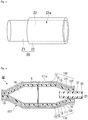
- Fig. 3 is a perspective view showing the periphery of the outlet 20.
- the outlet 20 is a two-colored molded article composed of a first molded body 21 and a second molded body 22.
- the first molded body 21 has a cylindrical shape, and has a flow passage 23 for taking out the content 16 in the interior thereof.
- the first molded body 21 has at least a part accommodated in the space 5.
- the first molded body 21 contains, as a forming material, preferably a cyclic olefin-based resin or a polyolefin-based resin, and more preferably a cyclic olefin-based resin.
- a packaging bag excellent in non-adsorbability can be provided.
- the second molded body 22 has a cylindrical shape, and is formed on an external circumferential surface 21a of the first molded body 21, provided that the second molded body 22 is not formed on the external circumferential surface of the part of the first molded body 21 accommodated in the space 5.
- the second molded body 22 has a shorter length in an axial direction than the first molded body 21. It is preferable that the second molded body 22 contains a polyolefin-based resin as a forming material.
- the polyolefin-based resin may be a homopolymer of one kind of olefin, or may be a copolymer of two or more kinds of olefins.
- the olefin include non-cyclic olefins such as ethylene, propylene, 1-butene, 1-hexene, 1-octene, and ⁇ -olefin.
- Specific examples of the polyolefin include polyethylene, polypropylene, an ethylene- ⁇ -olefin copolymer, and the like.
- polyolefins may also be a copolymer containing a small amount of a non-olefin-based vinyl monomer such as vinyl acetate, vinyl chloride, and vinyl alcohol.
- the olefin may be petroleum-derived olefin, plant-derived olefin, or both of petroleum-derived olefin and plant-derived olefin.
- the polyolefin-based resin forming the second molded body 22 is preferably a polyethylene-based resin, and more preferably linear low-density polyethylene (LLDPE).
- LLDPE linear low-density polyethylene
- the laminate 10 forming the bag body 17 and the outlet 20 are easily joined, and the handleability and the durability are also excellent.
- a laminate configuration of the first joining part 14 at which the laminate 10 and the outlet 20 are joined is in an order of substrate layer 11/first intermediate layer 12/sealant layer 13/outlet 20/sealant layer 13/first intermediate layer 12/substrate layer 11.
- the first joining part 14 is formed by fusion of the sealant layer 13 of the laminate 10 and a resin contained in the outlet 20.
- the laminate 10 may be joined with the first molded body 21 or second molded body 22 of the outlet 20.
- both of a part at which the laminate 10 and the first molded body 21 are joined and a part at which the laminate 10 and the second molded body 22 are joined may be contained.
- the packaging bag 31 may be provided with an accessory such as an inlet, a cock, a label, a knob for opening, and a grip, in addition to the outlet.
- an accessory such as an inlet, a cock, a label, a knob for opening, and a grip
- the accessory is formed of a resin molded article, a configuration similar to that of the above-mentioned outlet may be adopted.
- a method for manufacturing the packaging bag 31 has a step of forming the laminates 10 and a step of joining the laminates 10 and the outlet 20.
- a resin that is to be a raw material of the substrate layer 11, a resin that is to be a raw material of the first intermediate layer 12, and a resin that is to be a raw material of the sealant layer 13 are simultaneously melted and extrusion-molded, so that the laminates 10 are formed.
- the laminates 10 can also be formed by laminating the substrate layer 11, the first intermediate layer 12, and the sealant layer 13 by a method such as a dry lamination method or an extrusion lamination method.
- the outlet 20 is held between the laminates 10 in the state where the sealant layers 13 of the laminates 10 are disposed opposite each other. Then, the laminate 10 and the outlet 20 are jointed to form the first joining part 14. The laminates 10 are joined to form the second joining part 15. Thus, a packaging bag 31 is manufactured.
- a packaging bag that has a low water vapor permeability and is excellent in non-adsorbability.
- FIG. 4 is a cross-sectional view of the packaging bag according to the second embodiment, and is a view corresponding to Fig. 2 .
- the same symbols are given to elements common to those of the first embodiment, and detailed description will be omitted.
- a packaging bag 32 of the second embodiment has a bag body 117 and an outlet 20 joined to the bag body 117.
- the bag body 117 includes laminates 110 as a forming material, and is molded into a bag shape by sticking two laminates 110 to each other.
- the laminate 110 of the second embodiment has a surface resin layer 111, a second intermediate layer 112, a substrate layer 11, a first intermediate layer 12, and a sealant layer 13 in this order.
- the bag body 117 shown in Fig. 4 is such that the two laminates 110 are used, the sealant layers 13 of the laminates are disposed opposite each other, and the sealant layers 13 are stuck to each other.
- the second intermediate layer 112 in the second embodiment may contain the same material as the material contained in the first intermediate layer 12.
- the second intermediate layer 112 may contain the same material as that of the first intermediate layer 12, or may contain a different material.
- the surface resin layer 111 in the second embodiment is a layer containing a polyolefin-based resin, a polyethylene-based resin, a polyimide-based resin, a polyester-based resin or the like.
- the surface resin layer 111 preferably contains a polyolefin-based resin, and more preferably is composed of a polyolefin-based resin containing a cyclic olefin-based resin.
- the cyclic olefin-based resin may be the same material as the material contained in the sealant layer 13.
- the surface resin layer 111 may be the same material as that of the sealant layer 13, or may be a different material.
- the surface resin layer 111 may have a monolayer configuration of one layer, or may have a laminate configuration of two or more layers.
- a printing layer or a colored resin layer may be provided on a surface 111a of the surface resin layer 111 opposite to the second intermediate layer 112.
- a packaging bag that has a low water vapor permeability and is excellent in non-adsorbability can be provided.
- the second embodiment by arbitrarily selecting a resin for the surface resin layer 111, the printability of a surface of the packaging bag 32 can be improved and the slipperiness can be improved.
- the laminate 110 used in the second embodiment has a five-layer configuration, the strength of the packaging bag 32 is high as compared with the first embodiment. Furthermore, in the second embodiment, curling of the laminate 110 can be suppressed as compared with the first embodiment. Particularly, by forming the first intermediate layer 12 and the second intermediate layer 112 with the same material, a surface on the internal side of the substrate layer 11 and a surface on the external side of the substrate layer 11 have the same nature, and curling of the laminate 110 can be further suppressed. As a result of suppression of the curling of the laminate 110, processing of the laminate 110 becomes easy in the step of manufacturing the packaging bag 32.
- Laminates of a three-layer configuration each having a substrate layer, an intermediate layer, and a sealant layer in this order were manufactured. Resins that were to be raw materials of respective layers shown in Table 1, which had each been heated and melted separately, were subjected to a multilayer film formation using an extruder capable of performing co-extrusion multilayer molding, and laminates of a three-layer configuration were obtained.
- laminates of a five-layer configuration having a surface resin layer, a second intermediate layer, a substrate layer, a first intermediate layer, and a sealant layer in this order were manufactured.
- Resins that were to be raw materials of respective layers shown in Table 2 were used, and film formation was performed as in the laminate of a three-layer configuration, so that laminates of a five-layer configuration were obtained.
- Table 1 and Table 2 a numerical value in parenthesis is the thickness of each layer.
- cylindrical outlets each including a cyclic olefin polymer (COP) on the internal side and polyethylene (PE) on a part of the external side were molded by a two-color molding method.
- COP cyclic olefin polymer
- PE polyethylene
- Table 3 shows the compositions of intermediate layers 1 to 4. In addition, in Table 3, a ratio of each material is a ratio by mass (%).
- Intermediate layer 4 Maleic anhydride-modified polyethylene
- a content 100 mL of a 0.05% by mass nitroglycerin injection solution was filled into each of the packaging bags of Examples and Comparative Example.
- packaging bags containing the content were obtained.
- the above-mentioned packaging bags each containing the content were stored at 40°C for 3 months, and the content amount of the nitroglycerin injection solution was confirmed visually.
- the packaging bags of Examples 1 to 13, to which the present invention had been applied could suppress the deterioration of the content. From this result, it is considered that in the packaging bags of Examples 1 to 13, adsorption of the content is suppressed. Furthermore, the packaging bags of Examples 1 to 9 were also excellent in falling strength. On the other hand, in the packaging bag of Comparative Example 1, the deterioration of the content was confirmed. It is considered that this is due to defective adhesion of the intermediate layer in the packaging bag of Comparative Example 1. Furthermore, the packaging bag of Comparative Example 1 was also inferior in falling strength.
Landscapes
- Engineering & Computer Science (AREA)
- Mechanical Engineering (AREA)
- Food Science & Technology (AREA)
- Wrappers (AREA)
- Bag Frames (AREA)
- Packages (AREA)
- Laminated Bodies (AREA)
Applications Claiming Priority (2)
| Application Number | Priority Date | Filing Date | Title |
|---|---|---|---|
| JP2017091287A JP7071063B2 (ja) | 2017-05-01 | 2017-05-01 | 包装袋 |
| PCT/IB2018/000346 WO2018203123A1 (fr) | 2017-05-01 | 2018-04-10 | Sac d'emballage |
Publications (2)
| Publication Number | Publication Date |
|---|---|
| EP3620401A1 true EP3620401A1 (fr) | 2020-03-11 |
| EP3620401A4 EP3620401A4 (fr) | 2020-12-23 |
Family
ID=64016892
Family Applications (1)
| Application Number | Title | Priority Date | Filing Date |
|---|---|---|---|
| EP18794838.5A Pending EP3620401A4 (fr) | 2017-05-01 | 2018-04-10 | Sac d'emballage |
Country Status (8)
| Country | Link |
|---|---|
| US (1) | US12577022B2 (fr) |
| EP (1) | EP3620401A4 (fr) |
| JP (4) | JP7071063B2 (fr) |
| KR (2) | KR102291214B1 (fr) |
| CN (1) | CN110582449B (fr) |
| CA (1) | CA3061571A1 (fr) |
| SG (1) | SG11201909666UA (fr) |
| WO (1) | WO2018203123A1 (fr) |
Families Citing this family (7)
| Publication number | Priority date | Publication date | Assignee | Title |
|---|---|---|---|---|
| JP7431565B2 (ja) * | 2019-12-03 | 2024-02-15 | 藤森工業株式会社 | 注出部材、およびそれを用いた収納容器 |
| CN111056087A (zh) * | 2020-01-04 | 2020-04-24 | 李雪 | 一种建筑型材快包装套袋加工设备 |
| JP7774398B2 (ja) * | 2021-08-04 | 2025-11-21 | Zacros株式会社 | 成形品および容器 |
| JP7768495B2 (ja) * | 2021-10-29 | 2025-11-12 | Zacros株式会社 | 積層体及びプラスチック容器 |
| JP7753055B2 (ja) * | 2021-10-29 | 2025-10-14 | Zacros株式会社 | 積層体及びプラスチック容器 |
| JP2024131858A (ja) * | 2023-03-16 | 2024-09-30 | 藤森工業株式会社 | 包装袋 |
| JP2024131859A (ja) * | 2023-03-16 | 2024-09-30 | 藤森工業株式会社 | 包装袋 |
Family Cites Families (40)
| Publication number | Priority date | Publication date | Assignee | Title |
|---|---|---|---|---|
| WO1992006123A1 (fr) * | 1990-10-05 | 1992-04-16 | Idemitsu Kosan Co., Ltd. | Procede de production de polymere de cycloolefine et de copolymere de cycloolefine et composition et moulage prepares a partir de ces composes |
| US5346963A (en) * | 1993-04-28 | 1994-09-13 | The Dow Chemical Company | Graft-modified, substantially linear ethylene polymers and methods for their use |
| US5863977A (en) * | 1993-10-12 | 1999-01-26 | H. B. Fuller Licensing & Financing, Inc. | High molecular weight S-EB-S hot melt adhesive |
| JPH09151290A (ja) * | 1995-09-27 | 1997-06-10 | Kureha Chem Ind Co Ltd | 塩化ビニリデン系重合体組成物およびその成形物 |
| JPH1160757A (ja) * | 1997-08-18 | 1999-03-05 | Sumitomo Chem Co Ltd | 液体バッグ |
| JP2000084044A (ja) * | 1998-07-15 | 2000-03-28 | Showa Denko Kk | 医療容器用口部材、口栓体及び医療容器 |
| JP3607103B2 (ja) * | 1998-12-14 | 2005-01-05 | 株式会社大塚製薬工場 | 多層フィルムおよび容器 |
| JP2001240083A (ja) * | 2000-02-29 | 2001-09-04 | Fuji Seal Inc | スパウト付き容器におけるスパウト装着方法及びスパウト |
| JP4544563B2 (ja) * | 2001-03-23 | 2010-09-15 | 大日本印刷株式会社 | ヒートシール積層体およびキャリアテープ包装体 |
| US6635343B2 (en) | 2000-04-03 | 2003-10-21 | Dai Nippon Printing Co., Ltd. | Transparent conductive heat sealing material and carrier tape lid using the same |
| EP1296829B1 (fr) * | 2000-06-23 | 2006-06-21 | Honeywell International Inc. | Films a fort effet de barriere contre l'humidite |
| DE10163783A1 (de) * | 2001-12-22 | 2003-07-03 | Degussa | Verfahren zur Herstellung epoxidierter Polyalkenylene und Verwendung von Phosphonsäuren und deren Derivaten als Katalysator |
| JP2004315067A (ja) | 2003-04-18 | 2004-11-11 | Dainippon Printing Co Ltd | パウチ、注出口付パウチ |
| JP4774195B2 (ja) * | 2003-04-28 | 2011-09-14 | トミー株式会社 | 歯科用部材および歯科用部材の表面改質処理方法 |
| US20040247837A1 (en) * | 2003-06-09 | 2004-12-09 | Howard Enlow | Multilayer film |
| ATE505323T1 (de) * | 2003-06-27 | 2011-04-15 | Novo Nordisk As | Behälter für medizinische flüssigkeiten mit hoher wasserdampfsperre |
| ATE485157T1 (de) * | 2003-12-18 | 2010-11-15 | Tekni Plex Europ Nv | Verpackungsfolie für flüssigkeiten und deren herstellungsverfahren |
| US7211308B2 (en) * | 2004-02-20 | 2007-05-01 | Honeywell International Inc. | Formation of multilayer sheets containing PCTFE and COC for blister packaging applications |
| JP4429804B2 (ja) * | 2004-05-25 | 2010-03-10 | 株式会社大塚製薬工場 | 多層フィルム、その製造方法およびそれを用いた容器 |
| JP2006168003A (ja) * | 2004-12-14 | 2006-06-29 | Dainippon Printing Co Ltd | ヒ−トシ−ル性多層積層フィルムおよびそれを使用した積層体、包装用袋、包装製品 |
| JP2007253961A (ja) * | 2006-03-20 | 2007-10-04 | Dainippon Printing Co Ltd | 注出口付き包装用袋 |
| WO2007130277A1 (fr) * | 2006-05-05 | 2007-11-15 | Exxonmobil Chemical Patents Inc. | Mélanges de polymères basse densité linéaires et articles fabriqués à partir de ces mélanges |
| JP4926563B2 (ja) * | 2006-06-28 | 2012-05-09 | 東京応化工業株式会社 | 流体用容器及びそれを用いた流体入り容器 |
| JP5122878B2 (ja) * | 2007-07-04 | 2013-01-16 | 株式会社大塚製薬工場 | 薬液流出入用筒部材および薬液容器 |
| JP2009040439A (ja) * | 2007-08-07 | 2009-02-26 | Dainippon Printing Co Ltd | 酸素水分吸収性パウチ、およびそれを使用した包装製品 |
| US20090208685A1 (en) * | 2008-02-20 | 2009-08-20 | Sealed Air Corporation (Us) | Packaging film and method of decreasing scalping of polar cyclic compounds |
| JP4496275B2 (ja) * | 2008-08-29 | 2010-07-07 | フェリック株式会社 | 発熱組成物収容用袋の包材及びそれを用いた温熱材 |
| JP5399107B2 (ja) * | 2009-03-24 | 2014-01-29 | 共同印刷株式会社 | スパウト付容器の製造方法 |
| TW201236941A (en) * | 2010-12-08 | 2012-09-16 | Ecologic Brands Inc | Containers for holding materials |
| JP5856803B2 (ja) * | 2011-10-25 | 2016-02-10 | 藤森工業株式会社 | 接着性樹脂組成物、接着性樹脂成形体、及び接着性樹脂積層体 |
| JP2014057723A (ja) * | 2012-09-18 | 2014-04-03 | Fujimori Kogyo Co Ltd | ポート付容器及びその製造方法 |
| CN104756236B (zh) * | 2012-12-28 | 2017-10-13 | 琳得科株式会社 | 切割片用基材膜及切割片 |
| TWI617489B (zh) | 2013-04-09 | 2018-03-11 | 陶氏全球科技有限責任公司 | 用於製造超音波封口之方法以及具有該封口之薄膜結構及軟容器 |
| JP2015013683A (ja) | 2013-07-08 | 2015-01-22 | 凸版印刷株式会社 | 自立性包装袋 |
| WO2015141225A1 (fr) * | 2014-03-18 | 2015-09-24 | 株式会社クラレ | Structure multicouche et procédé pour sa production, matériau d'emballage et produit l'utilisant, feuille protectrice de dispositif électronique, et liquide de revêtement |
| JP6604947B2 (ja) * | 2014-07-23 | 2019-11-13 | 共同印刷株式会社 | イージーピール性の包装袋 |
| JP6451231B2 (ja) | 2014-11-12 | 2019-01-16 | 大日本印刷株式会社 | 積層体及びそれよりなる非吸着性包装容器 |
| TWI687352B (zh) * | 2015-06-08 | 2020-03-11 | 日商美樂迪安股份有限公司 | 附有流出口之容器及其製造方法 |
| JP6688574B2 (ja) | 2015-08-06 | 2020-04-28 | 藤森工業株式会社 | ホットメルト接着性樹脂フィルムおよびその製造方法 |
| JP6584227B2 (ja) * | 2015-08-26 | 2019-10-02 | ヘンケルジャパン株式会社 | ラミネート用接着剤 |
-
2017
- 2017-05-01 JP JP2017091287A patent/JP7071063B2/ja active Active
-
2018
- 2018-04-10 CN CN201880027243.0A patent/CN110582449B/zh active Active
- 2018-04-10 SG SG11201909666U patent/SG11201909666UA/en unknown
- 2018-04-10 US US16/607,719 patent/US12577022B2/en active Active
- 2018-04-10 KR KR1020197030947A patent/KR102291214B1/ko active Active
- 2018-04-10 CA CA3061571A patent/CA3061571A1/fr active Pending
- 2018-04-10 KR KR1020217014115A patent/KR102364564B1/ko active Active
- 2018-04-10 EP EP18794838.5A patent/EP3620401A4/fr active Pending
- 2018-04-10 WO PCT/IB2018/000346 patent/WO2018203123A1/fr not_active Ceased
-
2022
- 2022-05-06 JP JP2022076445A patent/JP7209884B2/ja active Active
-
2023
- 2023-01-10 JP JP2023001711A patent/JP7586201B2/ja active Active
-
2024
- 2024-10-18 JP JP2024182600A patent/JP7736895B2/ja active Active
Also Published As
| Publication number | Publication date |
|---|---|
| JP2024180645A (ja) | 2024-12-26 |
| KR102364564B1 (ko) | 2022-02-17 |
| WO2018203123A1 (fr) | 2018-11-08 |
| CN110582449B (zh) | 2022-05-10 |
| US12577022B2 (en) | 2026-03-17 |
| WO2018203123A8 (fr) | 2018-12-06 |
| CA3061571A1 (fr) | 2018-11-08 |
| JP7209884B2 (ja) | 2023-01-20 |
| JP7736895B2 (ja) | 2025-09-09 |
| KR20210055811A (ko) | 2021-05-17 |
| JP2022093686A (ja) | 2022-06-23 |
| JP7586201B2 (ja) | 2024-11-19 |
| JP7071063B2 (ja) | 2022-05-18 |
| SG11201909666UA (en) | 2019-11-28 |
| KR20190129109A (ko) | 2019-11-19 |
| EP3620401A4 (fr) | 2020-12-23 |
| JP2023029540A (ja) | 2023-03-03 |
| CN110582449A (zh) | 2019-12-17 |
| US20200130909A1 (en) | 2020-04-30 |
| KR102291214B1 (ko) | 2021-08-18 |
| JP2018188189A (ja) | 2018-11-29 |
Similar Documents
| Publication | Publication Date | Title |
|---|---|---|
| US12577022B2 (en) | Packaging bag | |
| US12496814B2 (en) | Laminate, blister container, and push-through package | |
| KR102265006B1 (ko) | 접착성 수지 조성물, 불소계 수지 접착용 필름, 적층체 및 적층체의 제조 방법 | |
| WO2018167556A1 (fr) | Stratifié, récipient à coque et emballage à déchirement par pression | |
| EP4186699A1 (fr) | Stratifié, emballage-coque, et emballage à membrane enfonçable | |
| CN115556448B (zh) | 生物工艺袋用多层膜及其应用 | |
| EP4682073A1 (fr) | Sac d'emballage | |
| EP4682074A1 (fr) | Sac d'emballage | |
| JP7187657B2 (ja) | 積層体、ブリスター容器、及びプレススルーパッケージ | |
| JP7187656B2 (ja) | 積層体、ブリスター容器、及びプレススルーパッケージ |
Legal Events
| Date | Code | Title | Description |
|---|---|---|---|
| STAA | Information on the status of an ep patent application or granted ep patent |
Free format text: STATUS: THE INTERNATIONAL PUBLICATION HAS BEEN MADE |
|
| PUAI | Public reference made under article 153(3) epc to a published international application that has entered the european phase |
Free format text: ORIGINAL CODE: 0009012 |
|
| STAA | Information on the status of an ep patent application or granted ep patent |
Free format text: STATUS: REQUEST FOR EXAMINATION WAS MADE |
|
| 17P | Request for examination filed |
Effective date: 20191016 |
|
| AK | Designated contracting states |
Kind code of ref document: A1 Designated state(s): AL AT BE BG CH CY CZ DE DK EE ES FI FR GB GR HR HU IE IS IT LI LT LU LV MC MK MT NL NO PL PT RO RS SE SI SK SM TR |
|
| AX | Request for extension of the european patent |
Extension state: BA ME |
|
| DAV | Request for validation of the european patent (deleted) | ||
| DAX | Request for extension of the european patent (deleted) | ||
| A4 | Supplementary search report drawn up and despatched |
Effective date: 20201125 |
|
| RIC1 | Information provided on ipc code assigned before grant |
Ipc: B32B 27/32 20060101AFI20201119BHEP Ipc: B32B 3/08 20060101ALI20201119BHEP Ipc: B65D 30/02 20060101ALI20201119BHEP Ipc: B65D 65/40 20060101ALI20201119BHEP Ipc: B32B 27/08 20060101ALI20201119BHEP Ipc: B32B 27/38 20060101ALI20201119BHEP Ipc: B65D 75/58 20060101ALI20201119BHEP Ipc: B32B 27/30 20060101ALI20201119BHEP Ipc: B32B 7/12 20060101ALI20201119BHEP Ipc: B65D 81/24 20060101ALI20201119BHEP |
|
| STAA | Information on the status of an ep patent application or granted ep patent |
Free format text: STATUS: EXAMINATION IS IN PROGRESS |
|
| 17Q | First examination report despatched |
Effective date: 20220331 |
|
| RAP3 | Party data changed (applicant data changed or rights of an application transferred) |
Owner name: ZACROS CORPORATION |