EP3624016A1 - Verfahren und vorrichtung zur codierung von bildern sowie prüfverfahren und prüfvorrichtung damit - Google Patents
Verfahren und vorrichtung zur codierung von bildern sowie prüfverfahren und prüfvorrichtung damit Download PDFInfo
- Publication number
- EP3624016A1 EP3624016A1 EP19172863.3A EP19172863A EP3624016A1 EP 3624016 A1 EP3624016 A1 EP 3624016A1 EP 19172863 A EP19172863 A EP 19172863A EP 3624016 A1 EP3624016 A1 EP 3624016A1
- Authority
- EP
- European Patent Office
- Prior art keywords
- feature maps
- generate
- transposed
- group
- inception
- Prior art date
- Legal status (The legal status is an assumption and is not a legal conclusion. Google has not performed a legal analysis and makes no representation as to the accuracy of the status listed.)
- Ceased
Links
Images


Classifications
-
- G—PHYSICS
- G06—COMPUTING OR CALCULATING; COUNTING
- G06T—IMAGE DATA PROCESSING OR GENERATION, IN GENERAL
- G06T7/00—Image analysis
- G06T7/10—Segmentation; Edge detection
- G06T7/11—Region-based segmentation
-
- G—PHYSICS
- G06—COMPUTING OR CALCULATING; COUNTING
- G06N—COMPUTING ARRANGEMENTS BASED ON SPECIFIC COMPUTATIONAL MODELS
- G06N3/00—Computing arrangements based on biological models
- G06N3/02—Neural networks
- G06N3/04—Architecture, e.g. interconnection topology
- G06N3/045—Combinations of networks
-
- G—PHYSICS
- G06—COMPUTING OR CALCULATING; COUNTING
- G06N—COMPUTING ARRANGEMENTS BASED ON SPECIFIC COMPUTATIONAL MODELS
- G06N3/00—Computing arrangements based on biological models
- G06N3/02—Neural networks
- G06N3/04—Architecture, e.g. interconnection topology
- G06N3/0464—Convolutional networks [CNN, ConvNet]
-
- G—PHYSICS
- G06—COMPUTING OR CALCULATING; COUNTING
- G06N—COMPUTING ARRANGEMENTS BASED ON SPECIFIC COMPUTATIONAL MODELS
- G06N3/00—Computing arrangements based on biological models
- G06N3/02—Neural networks
- G06N3/08—Learning methods
- G06N3/084—Backpropagation, e.g. using gradient descent
-
- G—PHYSICS
- G06—COMPUTING OR CALCULATING; COUNTING
- G06N—COMPUTING ARRANGEMENTS BASED ON SPECIFIC COMPUTATIONAL MODELS
- G06N3/00—Computing arrangements based on biological models
- G06N3/02—Neural networks
- G06N3/08—Learning methods
- G06N3/09—Supervised learning
-
- G—PHYSICS
- G06—COMPUTING OR CALCULATING; COUNTING
- G06T—IMAGE DATA PROCESSING OR GENERATION, IN GENERAL
- G06T7/00—Image analysis
- G06T7/10—Segmentation; Edge detection
-
- G—PHYSICS
- G06—COMPUTING OR CALCULATING; COUNTING
- G06T—IMAGE DATA PROCESSING OR GENERATION, IN GENERAL
- G06T9/00—Image coding
- G06T9/002—Image coding using neural networks
-
- H—ELECTRICITY
- H04—ELECTRIC COMMUNICATION TECHNIQUE
- H04N—PICTORIAL COMMUNICATION, e.g. TELEVISION
- H04N19/00—Methods or arrangements for coding, decoding, compressing or decompressing digital video signals
- H04N19/90—Methods or arrangements for coding, decoding, compressing or decompressing digital video signals using coding techniques not provided for in groups H04N19/10-H04N19/85, e.g. fractals
-
- G—PHYSICS
- G06—COMPUTING OR CALCULATING; COUNTING
- G06N—COMPUTING ARRANGEMENTS BASED ON SPECIFIC COMPUTATIONAL MODELS
- G06N3/00—Computing arrangements based on biological models
- G06N3/02—Neural networks
- G06N3/04—Architecture, e.g. interconnection topology
- G06N3/048—Activation functions
-
- G—PHYSICS
- G06—COMPUTING OR CALCULATING; COUNTING
- G06T—IMAGE DATA PROCESSING OR GENERATION, IN GENERAL
- G06T2207/00—Indexing scheme for image analysis or image enhancement
- G06T2207/20—Special algorithmic details
- G06T2207/20081—Training; Learning
-
- G—PHYSICS
- G06—COMPUTING OR CALCULATING; COUNTING
- G06T—IMAGE DATA PROCESSING OR GENERATION, IN GENERAL
- G06T2207/00—Indexing scheme for image analysis or image enhancement
- G06T2207/20—Special algorithmic details
- G06T2207/20084—Artificial neural networks [ANN]
Definitions
- the present disclosure relates to a method for encoding an image based on convolutional neural network (CNN).
- CNN convolutional neural network
- Deep learning is a technology used to cluster or classify objects or data. For example, computers cannot distinguish dogs and cats from photographs alone. But a human can easily distinguish those two. To this end, a method called "machine learning" was devised. It is a technique to allow a computer to classify similar things among lots of data inputted into the computer. When a photo of an animal similar to a dog is inputted, the computer may classify it as a dog.
- Deep Convolution Neural Networks are the heart of the remarkable development in deep learning. CNNs have already been used in the 90's to solve the problem of character recognition, but their use has become as widespread as it is now thanks to recent research. These deep CNNs won the 2012 ImageNet image classification tournament, crushing other competitors. Then, the convolution neural network became a very useful tool in the field of the machine learning.
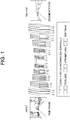
- Fig. 1 is a simplified drawing of a general CNN segmentation process.
- a learning device receives an input image, acquires encoded feature maps by multiple convolution operations and non-linear operations like ReLU in multiple convolutional layers, and acquires a segmentation result by performing multiple deconvolution operations in multiple deconvolutional layers and SoftMax operations on a last one of decoded feature maps.
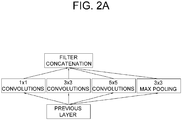
- Figs. 2A and 2B illustrate various configurations of convolutional layers for encoding images by using conventional inception methods, respectively.
- Fig. 2A In the conventional inception method illustrated in Fig. 2A , convolution operations have been applied to an input feature map transmitted from the previous layer through convolution units having various kernel sizes, for example, 1x1, 3x3, and 5x5 or a combination thereof, and then various convoluted feature maps are concatenated.
- an intermediate feature map i.e., an inception feature map, considering various receptive fields from one scale was obtained.
- the conventional inception method shown in FIG. 2B adds a process of reducing the number of channels by using a 1 ⁇ 1 convolution filter in order to reduce the amount of computation.
- the conventional image encoding methods using the above concept of inception can consider various receptive fields with various kernel sizes at the time of applying the convolution operations to the feature map, but there is a problem in that only the kernel sizes of 1 ⁇ 1 or more can be considered. Thus, it is not possible to consider various features of the image. As such, it is required to propose a new method for extracting features with more diverse characteristics considering more various kernel sizes.
- a method for encoding an image based on convolutional neural network including steps of: (a) a learning device, which includes a first to an n-th convolutional layers, obtaining at least one input image; (b) the learning device instructing each of at least one of the convolutional layers to (i) apply one or more transposed convolution operations to the input image or an input feature map received from its corresponding previous convolutional layer, to thereby generate one or more transposed feature maps which have different sizes respectively, and (ii) apply one or more convolution operations, with a different stride and a different kernel size, to their corresponding transposed feature maps, to thereby generate their corresponding one or more inception feature maps as a first group; and (c) the learning device concatenating or element-wise adding the inception feature maps included in the first group to thereby generate its corresponding output feature map.
- CNN convolutional neural network
- the inception feature maps included in the first group have a same size but have different characteristics.
- the step of (b) includes steps of: (b-1) the learning device instructing the k-th convolutional layer to apply a first to an m-th transposed convolution operations to the input image or a
- (k-1)-th feature map received from a (k-1)-th convolutional layer to thereby generate a first to an m-th transposed feature maps which have a first to an m-th sizes, wherein m is a natural number equal to or greater than 2; and (b-2) the learning device (i) determining a first to an m-th stride sizes by referring to each ratio between a size of the (k-1)-th feature map and each of the first to the m-th transposed feature maps and (ii) applying a first to an m-th convolution filters having the first to the m-th stride sizes and a first to an m-th kernel sizes, respectively, to the first to the m-th transposed feature maps, to thereby generate a first to an m-th inception feature maps as the first group.
- the learning device applies the convolution operations to the input image or the input feature map received from its corresponding previous convolutional layer to thereby generate one or more inception feature maps as a second group, wherein, at the step of (c), the learning device concatenates or element-wise adds the inception feature maps of the first group and the inception feature maps of the second group to thereby generate the output feature map.
- the step of (b) includes steps of: (b-1) the learning device instructing the k-th convolutional layer to apply a first to an m-th transposed convolution operations to the input image or a (k-1)-th feature map received from a (k-1)-th convolutional layer, to thereby generate a first to an m-th transposed feature maps which have a first to an m-th sizes, wherein m is a natural number equal to or greater than 2; (b-2) the learning device (i) determining a first to an m-th stride sizes by referring to each ratio between a size of the (k-1)-th feature map and each of the first to the m-th transposed feature maps and (ii) applying a first to an m-th convolution filters having the first to the m-th stride sizes and a first to an m-th kernel sizes, respectively, to the first to
- the learning device applies one or more max pooling operations, with a different size, to the input image or the input feature map received from its corresponding previous convolutional layer, to thereby generate one or more max pooling feature maps as a third group, wherein, at the step of (c), the learning device concatenates or element-wise adds the inception feature maps of the first group, the inception feature maps of the second group and the max pooling feature maps of the third group to thereby generate the output feature map.
- the learning device instructs the first convolutional layer to (i) apply one or more transposed convolution operations to the input image to thereby generate one or more transposed feature maps which have different sizes respectively, and (ii) apply one or more convolution operations, with a different stride and a different kernel size, to their corresponding transposed feature maps, to thereby generate one or more inception feature maps as the first group.
- the method further includes a step of: (d) the learning device obtaining a CNN output based on the output feature map from the n-th convolutional layer and then performing backpropagation of a segmentation loss obtained by referring to the CNN output and its corresponding ground truth (GT).
- GT ground truth
- a method for encoding an image based on convolutional neural network including steps of: (a) a testing device obtaining at least one test image, on condition that a learning device including a first to an n-th convolutional layers (i) has instructed each of at least one of the convolutional layers to apply one or more transposed convolution operations to an input image or an input feature map for training received from its corresponding previous convolutional layer, to thereby generate one or more transposed feature maps for training which have different sizes respectively; (ii) has applied one or more convolution operations, with a different stride and a different kernel size, to their corresponding transposed feature maps for training, to thereby generate their corresponding one or more inception feature maps for training as a first group for training; (iii) has concatenated or element-wise added the inception feature maps for training included in the first group for training to thereby generate its corresponding output feature map for training; and (iv) has obtained a CNN
- the inception feature maps for testing included in the first group for testing have a same size but have different characteristics.
- the step of (b) includes steps of: (b-1) the testing device instructing the k-th convolutional layer to apply a first to an m-th transposed convolution operations to the test image or a (k-1)-th feature map for testing received from a (k-1)-th convolutional layer, to thereby generate a first to an m-th transposed feature maps for testing which have a first to an m-th sizes, wherein m is a natural number equal to or greater than 2; and (b-2) the testing device (i) determining a first to an m-th stride sizes by referring to each ratio between a size of the (k-1)-th feature map for testing and each of the first to the m-th transposed feature maps for testing and (ii) applying a first to an m-th convolution filters having the first to the m-th stride sizes and a first to an m-th
- the testing device further applies the convolution operations to the test image or the input feature map for testing received from its corresponding previous convolutional layer to thereby generate one or more inception feature maps for testing as a second group for testing, wherein, at the step of (c), the testing device concatenates or element-wise adds the inception feature maps for testing of the first group for testing and the inception feature maps for testing of the second group for testing, to thereby generate the output feature map for testing.
- the step of (b) includes steps of: (b-1) the testing device instructing the k-th convolutional layer to apply a first to an m-th transposed convolution operations to the test image or a (k-1)-th feature map for testing received from a (k-1)-th convolutional layer, to thereby generate a first to an m-th transposed feature maps for testing which have a first to an m-th sizes, wherein m is a natural number equal to or greater than 2; (b-2) the testing device (i) determining a first to an m-th stride sizes by referring to each ratio between a size of the (k-1)-th feature map for testing and each of the first to the m-th transposed feature maps for testing and (ii) applying a first to an m-th convolution filters having the first to the m-th stride sizes and a first to an m-th kernel
- the testing device further applies one or more max pooling operations, with a different size, to the test image or the input feature map for testing received from its corresponding previous convolutional layer, to thereby generate one or more max pooling feature maps for testing as a third group for testing, wherein, at the step of (c), the testing device concatenates or element-wise adds the inception feature maps for testing of the first group for testing, the inception feature maps for testing of the second group for testing and the max pooling feature maps for testing of the third group for testing to thereby generate the output feature map for testing.
- a learning device for encoding an image based on convolutional neural network (CNN) which includes a first to an n-th convolutional layers, including: a communication part for obtaining at least one training image as an input image; and a processor for performing processes of (I) instructing each of at least one of the convolutional layers to (i) apply one or more transposed convolution operations to the input image or an input feature map received from its corresponding previous convolutional layer, to thereby generate one or more transposed feature maps which have different sizes respectively, and (ii) apply one or more convolution operations, with a different stride and a different kernel size, to their corresponding transposed feature maps, to thereby generate their corresponding one or more inception feature maps as a first group; and (II) concatenating or element-wise adding the inception feature maps included in the first group to thereby generate its corresponding output feature map.
- CNN convolutional neural network
- the inception feature maps included in the first group have a same size but have different characteristics.
- the process of (I) includes processes of: (I-1) instructing the k-th convolutional layer to apply a first to an m-th transposed convolution operations to the input image or a (k-1)-th feature map received from a (k-1)-th convolutional layer, to thereby generate a first to an m-th transposed feature maps which have a first to an m-th sizes, wherein m is a natural number equal to or greater than 2; and (1-2) (i) determining a first to an m-th stride sizes by referring to each ratio between a size of the (k-1)-th feature map and each of the first to the m-th transposed feature maps and (ii) applying a first to an m-th convolution filters having the first to the m-th stride sizes and a first to an m-th kernel sizes, respectively, to the first to the m-th trans
- the processor applies the convolution operations to the input image or the input feature map received from its corresponding previous convolutional layer to thereby generate one or more inception feature maps as a second group, and, at the process of (II), the processor concatenates or element-wise adds the inception feature maps of the first group and the inception feature maps of the second group to thereby generate the output feature map.
- the process of (I) includes processes of: (I-1) instructing the k-th convolutional layer to apply a first to an m-th transposed convolution operations to the input image or a (k-1)-th feature map received from a (k-1)-th convolutional layer, to thereby generate a first to an m-th transposed feature maps which have a first to an m-th sizes, wherein m is a natural number equal to or greater than 2; (1-2) (i) determining a first to an m-th stride sizes by referring to each ratio between a size of the (k-1)-th feature map and each of the first to the m-th transposed feature maps and (ii) applying a first to an m-th convolution filters having the first to the m-th stride sizes and a first to an m-th kernel sizes, respectively, to the first to the m-th transposed
- the processor applies one or more max pooling operations, with a different size, to the input image or the input feature map received from its corresponding previous convolutional layer, to thereby generate one or more max pooling feature maps as a third group, and, at the process of (II), the processor concatenates or element-wise adds the inception feature maps of the first group, the inception feature maps of the second group and the max pooling feature maps of the third group to thereby generate the output feature map.
- the processor instructs the first convolutional layer to (i) apply one or more transposed convolution operations to the input image to thereby generate one or more transposed feature maps which have different sizes respectively, and (ii) apply one or more convolution operations, with a different stride and a different kernel size, to their corresponding transposed feature maps, to thereby generate one or more inception feature maps as the first group.
- the processor further performs a process of: (III) obtaining a CNN output based on the output feature map from the n-th convolutional layer and then performing backpropagation of a segmentation loss obtained by referring to the CNN output and its corresponding ground truth (GT).
- a testing device for encoding an image based on convolutional neural network including: a communication part for acquiring at least one test image, on condition that, (i) a learning device including a first to an n-th convolutional layers has instructed each of at least one of the convolutional layers to apply one or more transposed convolution operations to an input image or an input feature map for training received from its corresponding previous convolutional layer, to thereby generate one or more transposed feature maps for training which have different sizes respectively; (ii) the learning device has applied one or more convolution operations, with a different stride and a different kernel size, to their corresponding transposed feature maps for training, to thereby generate their corresponding one or more inception feature maps for training as a first group for training; (iii) the learning device has concatenated or element-wise added the inception feature maps for training included in the first group for training to thereby generate its corresponding output feature map for training; and (iv)
- CNN convolutional neural network
- the inception feature maps for testing included in the first group for testing have a same size but have different characteristics.
- the process of (I) includes processes of: (I-1) instructing the k-th convolutional layer to apply a first to an m-th transposed convolution operations to the test image or a (k-1)-th feature map for testing received from a (k-1)-th convolutional layer, to thereby generate a first to an m-th transposed feature maps for testing which have a first to an m-th sizes, wherein m is a natural number equal to or greater than 2; and (1-2) (i) determining a first to an m-th stride sizes by referring to each ratio between a size of the (k-1)-th feature map for testing and each of the first to the m-th transposed feature maps for testing and (ii) applying a first to an m-th convolution filters having the first to the m-th stride sizes and a first to an m-th kernel sizes, respectively, to the
- the processor further applies the convolution operations to the test image or the input feature map for testing received from its corresponding previous convolutional layer to thereby generate one or more inception feature maps for testing as a second group for testing, wherein, at the process of (II), the processor concatenates or element-wise adds the inception feature maps for testing of the first group for testing and the inception feature maps for testing of the second group for testing, to thereby generate the output feature map for testing.
- the process of (II) includes processes of: (II-1) instructing the k-th convolutional layer to apply a first to an m-th transposed convolution operations to the test image or a (k-1)-th feature map for testing received from a (k-1)-th convolutional layer, to thereby generate a first to an m-th transposed feature maps for testing which have a first to an m-th sizes, wherein m is a natural number equal to or greater than 2; (II-2) (i) determining a first to an m-th stride sizes by referring to each ratio between a size of the (k-1)-th feature map for testing and each of the first to the m-th transposed feature maps for testing and (ii) applying a first to an m-th convolution filters having the first to the m-th stride sizes and a first to an m-th kernel sizes, respectively
- the processor further applies one or more max pooling operations, with a different size, to the test image or the input feature map for testing received from its corresponding previous convolutional layer, to thereby generate one or more max pooling feature maps for testing as a third group for testing, wherein, at the process of (II), the processor concatenates or element-wise adds the inception feature maps for testing of the first group for testing, the inception feature maps for testing of the second group for testing and the max pooling feature maps for testing of the third group for testing to thereby generate the output feature map for testing.
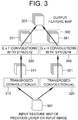
- Fig. 3 illustrates a method for encoding an image in accordance with one example embodiment of the present disclosure.
- Each of a first to a n-th convolutional layers in a learning device or a testing device based on convolutional neural network (CNN) applies one or more convolution operations to an input image or input feature map received from its corresponding previous convolutional layer, to thereby generate a first to an n-th feature maps.
- CNN convolutional neural network
- each of at least one of the first to the n-th convolutional layers applies one or more transposed convolution operations 310 and 320 to its corresponding input feature map (or the input image) 301 received from its corresponding previous convolutional layer, to thereby generate one or more transposed feature maps which have different increased sizes respectively.
- the transposed convolution operations 310 and 320 may mean convolution operations for extending the size of the feature map by using the deconvolutional layer but may also include interpolation or resizing (e.g., the nearest neighbor, linear interpolation, etc.).
- transposed feature maps 311 and 321 are generated.
- the first transposed convolution operation 310 doubles the size of the input feature map 301 so that the size of the first transposed feature map 311 becomes the twice of the size of the input feature map 301
- the second transposed convolution operation 320 increases the size of the input feature map 301 by four times so that the size of the second transposed feature map 321 becomes the four times of the size of the input feature map 301.
- the present disclosure is not limited to these examples.
- one or more convolution operations 330 and 340 are applied to their corresponding transposed feature maps 311 and 321.
- the convolution operations 330 and 340 with a different stride and a different kernel size, are applied to their corresponding transposed feature maps 311 and 321, to thereby generate their corresponding one or more inception feature maps as a first group 302.
- the size of the first transposed feature map 311 is made to become the same as that of the input feature map 301 by applying the first convolution operation 330 with the stride of 2 and (ii) likewise, since the size of the second transposed feature map 321 has become 4 times of that of the input feature map 301, the size of the second transposed feature map 321 is made to become the same as that of the input feature map 301 by applying the second convolution operation 340 with the stride of 4.
- the sizes of the inception feature maps 331 and 341 within the first group 302 become the same.
- kernel sizes to be applied to the first convolution operation 330 and the second convolution operation 340 may be determined differently such as (e x f) and (g x h) respectively.
- various receptive fields may be considered for the input feature map 301.
- the effect of applying their corresponding kernel sizes reduced by respective specific numbers may be achieved, wherein the respective specific numbers have been multipliers by which sizes are increased through their corresponding transposed convolution operations.
- the kernel size of (e x f) is applied to the first transposed convolution feature map 311 having been generated by applying the first transposed convolution operation 310 to the input feature map 301 as shown in Fig. 3
- the receptive field of the size of (e x f) is provided for the first transposed convolution feature map 311, but the receptive field of (e/2 x f/2) can be provided for the input feature map 301.
- the stride of the first convolution operation 330 is 2 and the kernel size is 3 x 3
- the first inception feature map 331 in the first group 302 has been generated in consideration of the receptive field with the size of (3/2 x 3/2) for the input feature map 301
- the stride of the second convolution operation 340 is 4 and the kernel size is 5 x 5
- the second inception feature map 341 in the first group 302 has been generated in consideration of the receptive field with the size of (5/4 x 5/4) for the input feature map 301.
- the inception feature maps 331 and 341 in the first group 302 have the same size but have various characteristics generated in consideration of various receptive fields.
- the inception feature maps 331 and 341 in the first group 302 are concatenated or element-wise added to thereby be integrated as one output feature map 303.
- the output feature map 303 may be an output of its corresponding convolutional layer, or a modified feature map generated from the output feature map 303 may be an output of its corresponding convolutional layer. For example, if the input feature map 301 fed into a k-th convolutional layer is a (k-1)-th feature map outputted from a (k-1)-th convolutional layer among said n convolutional layers, the operation illustrated in Fig.
- the output feature map 303 may be a k-th feature map outputted from the k-th convolutional layer.
- the modified feature map which is generated by applying an additional convolution operation and non-linear operation such as ReLU to the output feature map 303 to change the channel and the size thereof, may be the k-th feature map outputted from the k-th convolutional layer.
- the process of obtaining the output feature map illustrated in Fig. 3 is performed by using the input image, not the input feature map.
- the learning device instructs the first convolutional layers to (i) apply one or more transposed convolution operations to the input image, to thereby generate one or more transposed feature maps which have different sizes respectively, and (ii) apply one or more convolution operations, with a different stride and a different kernel size, to their corresponding transposed feature maps, to thereby generate their corresponding one or more inception feature maps as the first group.
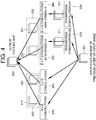
- Fig. 4 illustrates a method for encoding an image in accordance with another example embodiment of the present disclosure.
- inception feature maps of a second group 402 other than the first group 302 are additionally generated as compared with Fig. 3 , and the inception feature maps in the first group 302 and the inception feature maps in the second group 402 are concatenated or element-wise added to thereby be integrated as the output feature map 303.
- convolution operations 410 and 420 are applied to the input feature map 301, to thereby generate one or more inception feature maps 411 and 421 as the second group 402.
- the third convolution operation 410 having a kernel size of (a x b) is applied to the input feature map 301 to thereby generate the third inception feature map 411 in the second group 402
- the fourth convolution operation 420 having a kernel size of (c x d) is applied to the input feature map 301 to thereby generate the fourth inception feature map 421 in the second group 402.
- the third inception feature map 411 has been generated in consideration of the receptive field with the size of (a x b) for the input feature map 301
- the fourth inception feature map 421 has been generated in consideration of the receptive field with the size of (c x d) for the input feature map 301.
- the learning device concatenates or element-wise adds the inception feature maps 331 and 341 of the first group 302 and the inception feature maps 411 and 421 of the second group 402 to thereby integrate them as the output feature map 303.
- Fig. 5 illustrates a method for encoding an image in accordance with still another example embodiment of the present disclosure.
- inception feature maps in a third group 502 are additionally generated as compared with Fig. 3 or Fig. 4 .
- the learning device concatenates or element-wise adds the inception feature maps in the third group 502 and the inception feature maps in the first group 302 or concatenates or element-wise adds the inception feature maps in the first group 302, the inception feature maps in the second group 402 and the inception feature maps in the third group 502, to thereby integrate them as the output feature map 303.
- one or more max pooling operations are applied to the input feature map 301 to thereby generate a max pooling feature map 511 as the third group 502.
- the max pooling operation plays a role of generating the max pooling feature map 511 by extracting only max values from the input feature map 301 without convolution operations.
- the learning device concatenates or element-wise adds the inception feature maps 331 and 341 in the first group 302 and the inception feature map 511 in the third group 502 or concatenates or element-wise adds the inception feature maps 331 and 341 in the first group 302, the inception feature maps 411 and 421 in the second group 402, and the inception feature maps 511 in the third group 502, to thereby integrate them as the output feature map 303.
- 1 x 1 convolution operations for reducing the number of channels may be sometimes used while generating the feature maps of the first group to the third group in order to reduce the amount of computations.
- the learning device obtains a CNN output based on the obtained output feature map and performs backpropagation of a segmentation loss obtained by referring to the CNN output and its corresponding ground truth (GT).
- GT ground truth
- a learning device including a first to an n-th convolutional layers has instructed each of at least one of the convolutional layers to apply one or more transposed convolution operations to an input image or an input feature map for training received from its corresponding previous convolutional layer, to thereby generate one or more transposed feature maps for training which have different sizes respectively;
- the learning device has applied one or more convolution operations, with a different stride and a different kernel size, to their corresponding transposed feature maps for training, to thereby generate their corresponding one or more inception feature maps for training as a first group for training;
- the learning device has concatenated or element-wise added the inception feature maps for training included in the first group for training to thereby generate its corresponding output feature map for training; and
- the learning device has obtained a CNN output for training based on the output feature map for training and then performs backpropagation by using a segmentation loss obtained by referring to the CNN output for training and its corresponding ground
- the testing device may instruct each of at least one of the convolutional layers to (i) apply one or more transposed convolution operations to the test image or an input feature map for testing received from its corresponding previous convolutional layer, to thereby generate one or more transposed feature maps for testing which have different sizes respectively, and (ii) apply one or more convolution operations, with a different stride and a different kernel size, to their corresponding transposed feature maps for testing, to thereby generate their corresponding one or more inception feature maps for testing as a first group for testing.
- the testing device may concatenate or element-wise add the inception feature maps for testing included in the first group for testing to thereby generate its corresponding output feature map for testing.
- the present disclosure has an effect of increasing the sizes of feature maps by applying various sizes of transposed convolution operations to the input image or the input feature map obtained from its corresponding previous convolutional layer, and widening the kernel size from an integer range to a real number range by applying convolution operations having corresponding strides.
- the present disclosure has another effect of obtaining feature maps having various characteristics by diversifying the receptive fields which can be considered in the input feature map obtained from its corresponding previous convolutional layer.
- a transmission and/or a reception of the above-described images such as the training image and the test image can be performed by communication units of the learning device and the testing device, and processes of the convolutional operation, the deconvolutional operation and the loss value operation can be mainly performed by processors of the learning device and the testing device, but the present disclosure is not limited to these examples.
- the embodiments of the present disclosure as explained above can be implemented in a form of executable program command through a variety of computer means recordable to computer readable media.
- the computer readable media may include solely or in combination, program commands, data files, and data structures.
- the program commands recorded to the media may be components specially designed for the present disclosure or may be usable to a skilled human in a field of computer software.
- Computer readable media include magnetic media such as hard disk, floppy disk, and magnetic tape, optical media such as CD-ROM and DVD, magneto-optical media such as floptical disk and hardware devices such as ROM, RAM, and flash memory specially designed to store and carry out program commands.
- Program commands include not only a machine language code made by a complier but also a high level code that can be used by an interpreter etc., which is executed by a computer.
- the aforementioned hardware device can work as more than a software module to perform the action of the present disclosure and they can do the same in the opposite case.
Landscapes
- Engineering & Computer Science (AREA)
- Theoretical Computer Science (AREA)
- Physics & Mathematics (AREA)
- General Physics & Mathematics (AREA)
- Evolutionary Computation (AREA)
- Artificial Intelligence (AREA)
- General Health & Medical Sciences (AREA)
- General Engineering & Computer Science (AREA)
- Data Mining & Analysis (AREA)
- Biophysics (AREA)
- Biomedical Technology (AREA)
- Molecular Biology (AREA)
- Computing Systems (AREA)
- Computational Linguistics (AREA)
- Life Sciences & Earth Sciences (AREA)
- Mathematical Physics (AREA)
- Software Systems (AREA)
- Health & Medical Sciences (AREA)
- Computer Vision & Pattern Recognition (AREA)
- Multimedia (AREA)
- Signal Processing (AREA)
- Image Analysis (AREA)
Applications Claiming Priority (1)
| Application Number | Priority Date | Filing Date | Title |
|---|---|---|---|
| US16/132,475 US10282864B1 (en) | 2018-09-17 | 2018-09-17 | Method and device for encoding image and testing method and testing device using the same |
Publications (1)
| Publication Number | Publication Date |
|---|---|
| EP3624016A1 true EP3624016A1 (de) | 2020-03-18 |
Family
ID=66333963
Family Applications (1)
| Application Number | Title | Priority Date | Filing Date |
|---|---|---|---|
| EP19172863.3A Ceased EP3624016A1 (de) | 2018-09-17 | 2019-05-06 | Verfahren und vorrichtung zur codierung von bildern sowie prüfverfahren und prüfvorrichtung damit |
Country Status (5)
| Country | Link |
|---|---|
| US (1) | US10282864B1 (de) |
| EP (1) | EP3624016A1 (de) |
| JP (1) | JP6856851B2 (de) |
| KR (1) | KR102309702B1 (de) |
| CN (1) | CN110910395B (de) |
Cited By (1)
| Publication number | Priority date | Publication date | Assignee | Title |
|---|---|---|---|---|
| WO2022139616A1 (en) | 2020-12-24 | 2022-06-30 | Huawei Technologies Co., Ltd. | Decoding with signaling of feature map data |
Families Citing this family (13)
| Publication number | Priority date | Publication date | Assignee | Title |
|---|---|---|---|---|
| KR102746521B1 (ko) | 2018-11-09 | 2024-12-23 | 삼성전자주식회사 | 뉴럴 프로세싱 유닛, 뉴럴 프로세싱 시스템, 및 어플리케이션 시스템 |
| US11556778B2 (en) * | 2018-12-07 | 2023-01-17 | Microsoft Technology Licensing, Llc | Automated generation of machine learning models |
| US10733511B1 (en) * | 2019-01-30 | 2020-08-04 | StradVision, Inc. | Learning method and learning device for updating HD map by reconstructing 3D space by using depth estimation information and class information on each object, which have been acquired through V2X information integration technique, and testing method and testing device using the same |
| KR102420104B1 (ko) * | 2019-05-16 | 2022-07-12 | 삼성전자주식회사 | 영상 처리 장치 및 그 동작방법 |
| CN111988609B (zh) | 2019-05-22 | 2024-07-16 | 富士通株式会社 | 图像编码装置、概率模型生成装置和图像解码装置 |
| JP7160201B2 (ja) * | 2019-06-17 | 2022-10-25 | 日本電信電話株式会社 | 識別結果説明装置、識別結果説明方法、及び識別結果説明プログラム |
| CN110415171B (zh) * | 2019-07-08 | 2021-06-25 | 北京三快在线科技有限公司 | 图像处理方法、装置及存储介质、电子设备 |
| CN111179283A (zh) * | 2019-12-30 | 2020-05-19 | 深圳市商汤科技有限公司 | 图像语义分割方法及装置、存储介质 |
| US12450534B2 (en) * | 2020-07-20 | 2025-10-21 | Georgia Tech Research Corporation | Heterogeneous graph attention networks for scalable multi-robot scheduling |
| KR102756360B1 (ko) * | 2020-09-02 | 2025-01-17 | 삼성전자주식회사 | 영상 처리 방법 및 장치 |
| US12061967B2 (en) * | 2020-12-23 | 2024-08-13 | Arm Limited | Processing data for a layer of a neural network |
| US11823490B2 (en) * | 2021-06-08 | 2023-11-21 | Adobe, Inc. | Non-linear latent to latent model for multi-attribute face editing |
| JP2025542460A (ja) * | 2023-01-03 | 2025-12-25 | テレフオンアクチーボラゲット エルエム エリクソン(パブル) | ビデオ符号化および復号の複雑さを低減すること |
Family Cites Families (14)
| Publication number | Priority date | Publication date | Assignee | Title |
|---|---|---|---|---|
| US8872869B2 (en) * | 2004-11-23 | 2014-10-28 | Hewlett-Packard Development Company, L.P. | System and method for correcting defective pixels of a display device |
| US9633282B2 (en) * | 2015-07-30 | 2017-04-25 | Xerox Corporation | Cross-trained convolutional neural networks using multimodal images |
| US9785919B2 (en) * | 2015-12-10 | 2017-10-10 | General Electric Company | Automatic classification of aircraft component distress |
| KR20190021344A (ko) * | 2016-06-20 | 2019-03-05 | 버터플라이 네트워크, 인크. | 초음파 디바이스를 작동하는 사용자를 보조하기 위한 자동화된 영상 취득 |
| JP2018005520A (ja) * | 2016-06-30 | 2018-01-11 | クラリオン株式会社 | 物体検出装置及び物体検出方法 |
| IL293688B2 (en) * | 2016-10-04 | 2024-02-01 | Magic Leap Inc | Efficient data layouts for convolutional neural networks |
| KR101879207B1 (ko) * | 2016-11-22 | 2018-07-17 | 주식회사 루닛 | 약한 지도 학습 방식의 객체 인식 방법 및 장치 |
| JP6929047B2 (ja) * | 2016-11-24 | 2021-09-01 | キヤノン株式会社 | 画像処理装置、情報処理方法及びプログラム |
| US20180225554A1 (en) * | 2017-02-06 | 2018-08-09 | Honda Motor Co., Ltd. | Systems and methods of a computational framework for a driver's visual attention using a fully convolutional architecture |
| US10019788B1 (en) * | 2017-02-14 | 2018-07-10 | Cogniac, Corp. | Machine-learning measurements of quantitative feature attributes |
| US10685429B2 (en) * | 2017-02-22 | 2020-06-16 | Siemens Healthcare Gmbh | Denoising medical images by learning sparse image representations with a deep unfolding approach |
| US10580131B2 (en) * | 2017-02-23 | 2020-03-03 | Zebra Medical Vision Ltd. | Convolutional neural network for segmentation of medical anatomical images |
| US10713540B2 (en) * | 2017-03-07 | 2020-07-14 | Board Of Trustees Of Michigan State University | Deep learning system for recognizing pills in images |
| CN108509978B (zh) * | 2018-02-28 | 2022-06-07 | 中南大学 | 基于cnn的多级特征融合的多类目标检测方法及模型 |
-
2018
- 2018-09-17 US US16/132,475 patent/US10282864B1/en active Active
-
2019
- 2019-05-06 EP EP19172863.3A patent/EP3624016A1/de not_active Ceased
- 2019-08-27 KR KR1020190105479A patent/KR102309702B1/ko active Active
- 2019-08-29 CN CN201910808347.1A patent/CN110910395B/zh active Active
- 2019-09-09 JP JP2019163898A patent/JP6856851B2/ja active Active
Non-Patent Citations (5)
| Title |
|---|
| CHEN LIANG ET AL: "DRINet for Medical Image Segmentation", IEEE TRANSACTIONS ON MEDICAL IMAGING, IEEE SERVICE CENTER, PISCATAWAY, NJ, US, vol. 37, no. 11, 10 May 2018 (2018-05-10), pages 2453 - 2462, XP011693848, ISSN: 0278-0062, [retrieved on 20181029], DOI: 10.1109/TMI.2018.2835303 * |
| CHRISTIAN SZEGEDY ET AL: "Going deeper with convolutions", 2015 IEEE CONFERENCE ON COMPUTER VISION AND PATTERN RECOGNITION (CVPR), 1 June 2015 (2015-06-01), pages 1 - 9, XP055536247, ISBN: 978-1-4673-6964-0, DOI: 10.1109/CVPR.2015.7298594 * |
| GUO JINGJUAN ET AL: "Bi-branch deconvolution-based convolutional neural network for image classification", MULTIMEDIA TOOLS AND APPLICATIONS, KLUWER ACADEMIC PUBLISHERS, BOSTON, US, vol. 77, no. 23, 21 May 2018 (2018-05-21), pages 30233 - 30250, XP036613914, ISSN: 1380-7501, [retrieved on 20180521], DOI: 10.1007/S11042-018-6130-2 * |
| HYEONWOO NOH ET AL: "Learning Deconvolution Network for Semantic Segmentation", ARXIV, 1 December 2015 (2015-12-01), pages 1520 - 1528, XP055558488, ISBN: 978-1-4673-8391-2, DOI: 10.1109/ICCV.2015.178 * |
| SZEGEDY CHRISTIAN ET AL: "Rethinking the Inception Architecture for Computer Vision", 2016 IEEE CONFERENCE ON COMPUTER VISION AND PATTERN RECOGNITION (CVPR), IEEE, 27 June 2016 (2016-06-27), pages 2818 - 2826, XP033021462, DOI: 10.1109/CVPR.2016.308 * |
Cited By (3)
| Publication number | Priority date | Publication date | Assignee | Title |
|---|---|---|---|---|
| WO2022139616A1 (en) | 2020-12-24 | 2022-06-30 | Huawei Technologies Co., Ltd. | Decoding with signaling of feature map data |
| EP4211899A4 (de) * | 2020-12-24 | 2023-11-22 | Huawei Technologies Co., Ltd. | Decodierung mit signalisierung von merkmalskartendaten |
| US12445633B2 (en) | 2020-12-24 | 2025-10-14 | Huawei Technologies Co., Ltd. | Method and apparatus for decoding with signaling of feature map data |
Also Published As
| Publication number | Publication date |
|---|---|
| CN110910395A (zh) | 2020-03-24 |
| CN110910395B (zh) | 2023-07-28 |
| JP6856851B2 (ja) | 2021-04-14 |
| JP2020047271A (ja) | 2020-03-26 |
| KR102309702B1 (ko) | 2021-10-08 |
| KR20200031993A (ko) | 2020-03-25 |
| US10282864B1 (en) | 2019-05-07 |
Similar Documents
| Publication | Publication Date | Title |
|---|---|---|
| US10282864B1 (en) | Method and device for encoding image and testing method and testing device using the same | |
| CN112561027B (zh) | 神经网络架构搜索方法、图像处理方法、装置和存储介质 | |
| KR102313133B1 (ko) | 컨벌루션 뉴럴 네트워크로부터 복수의 출력들의 앙상블을 이용하여 통합된 특징 맵을 제공하기 위한 방법 및 장치 | |
| CN110188795B (zh) | 图像分类方法、数据处理方法和装置 | |
| CN109635817B (zh) | 通过使用特征上采样网络生成特征映射的方法和装置 | |
| US10402977B1 (en) | Learning method and learning device for improving segmentation performance in road obstacle detection required to satisfy level 4 and level 5 of autonomous vehicles using laplacian pyramid network and testing method and testing device using the same | |
| EP3686795B1 (de) | Lernverfahren und lernvorrichtung zur verbesserung der segmentierungsleistung zur detektion von ereignissen einschliesslich fussgängerereignis, fahrzeugereignis, fallereignis und sturzereignis unter verwendung von kantenverlust und testverfahren und dasselbe verwende testvorrichtung | |
| US10496899B1 (en) | Learning method and learning device for adjusting parameters of CNN in which residual networks are provided for meta learning, and testing method and testing device using the same | |
| EP3467720A1 (de) | Lernverfahren und lernvorrichtung zur verbesserung der cnn-leistungsfähigkeit durch verwendung von feature-upsampling-netzwerken sowie testverfahren und testvorrichtung damit | |
| KR102038390B1 (ko) | 고효율 병렬 처리를 위한 인공 신경망 모듈 및 이의 스케쥴링 방법 | |
| Lodhi et al. | Multipath-DenseNet: A Supervised ensemble architecture of densely connected convolutional networks | |
| CN107958285A (zh) | 面向嵌入式系统的神经网络的映射方法及装置 | |
| EP3624015B1 (de) | Lernverfahren, lernvorrichtung mit mehreren zuführungsschichten und prüfverfahren, prüfvorrichtung damit | |
| KR102337383B1 (ko) | 하드웨어 최적화에 사용되는 1xK 또는 Kx1 컨벌루션 연산을 이용한 CNN을 학습하는 방법 및 학습 장치, 이를 이용한 테스트 방법 및 테스트 장치 | |
| KR20200092841A (ko) | 위험 요소 검출에 사용될 학습용 이미지 데이터 세트 생성 방법 및 컴퓨팅 장치 그리고 이용한 학습 방법 및 학습 장치 | |
| KR20200092847A (ko) | 핵심 성능 지수를 만족시킬 수 있는 하드웨어 최적화가 이루어지도록, cnn에서 복수의 블록 내의 입력 이미지로부터 특징을 추출하는 학습 방법 및 학습 장치, 이를 이용한 테스트 방법 및 테스트 장치 | |
| TW202209194A (zh) | 目標模型的獲取 | |
| CN116844032A (zh) | 一种海洋环境下目标检测识别方法、装置、设备及介质 | |
| CN111275076B (zh) | 基于特征选择和特征融合的图像显著性检测方法 | |
| CN115546503B (zh) | 基于深度注意力的自适应多尺度视觉特征表达方法及系统 | |
| KR102083635B1 (ko) | 심층 신경망 시스템 | |
| WO2023061465A1 (en) | Methods, systems, and media for computer vision using 2d convolution of 4d video data tensors | |
| KR102042446B1 (ko) | 컨벌루션 신경망의 첫번째 레이어의 개선된 이진화 장치 및 방법 | |
| CN109670598A (zh) | 一种基于深度学习的数据处理方法 | |
| CN121010845A (zh) | 一种基于高频特征引导的生成式对抗样本生成方法 |
Legal Events
| Date | Code | Title | Description |
|---|---|---|---|
| PUAI | Public reference made under article 153(3) epc to a published international application that has entered the european phase |
Free format text: ORIGINAL CODE: 0009012 |
|
| STAA | Information on the status of an ep patent application or granted ep patent |
Free format text: STATUS: REQUEST FOR EXAMINATION WAS MADE |
|
| 17P | Request for examination filed |
Effective date: 20190506 |
|
| AK | Designated contracting states |
Kind code of ref document: A1 Designated state(s): AL AT BE BG CH CY CZ DE DK EE ES FI FR GB GR HR HU IE IS IT LI LT LU LV MC MK MT NL NO PL PT RO RS SE SI SK SM TR |
|
| AX | Request for extension of the european patent |
Extension state: BA ME |
|
| RBV | Designated contracting states (corrected) |
Designated state(s): AL AT BE BG CH CY CZ DE DK EE ES FI FR GB GR HR HU IE IS IT LI LT LU LV MC MK MT NL NO PL PT RO RS SE SI SK SM TR |
|
| STAA | Information on the status of an ep patent application or granted ep patent |
Free format text: STATUS: EXAMINATION IS IN PROGRESS |
|
| 17Q | First examination report despatched |
Effective date: 20210528 |
|
| STAA | Information on the status of an ep patent application or granted ep patent |
Free format text: STATUS: THE APPLICATION HAS BEEN REFUSED |
|
| 18R | Application refused |
Effective date: 20240612 |