EP3628524B1 - Système d'entraînement à fonction différentielle bloquant variable - Google Patents
Système d'entraînement à fonction différentielle bloquant variable Download PDFInfo
- Publication number
- EP3628524B1 EP3628524B1 EP19198499.6A EP19198499A EP3628524B1 EP 3628524 B1 EP3628524 B1 EP 3628524B1 EP 19198499 A EP19198499 A EP 19198499A EP 3628524 B1 EP3628524 B1 EP 3628524B1
- Authority
- EP
- European Patent Office
- Prior art keywords
- wheels
- drive system
- variable
- differential function
- locking differential
- Prior art date
- Legal status (The legal status is an assumption and is not a legal conclusion. Google has not performed a legal analysis and makes no representation as to the accuracy of the status listed.)
- Active
Links
Images



Classifications
-
- B—PERFORMING OPERATIONS; TRANSPORTING
- B60—VEHICLES IN GENERAL
- B60K—ARRANGEMENT OR MOUNTING OF PROPULSION UNITS OR OF TRANSMISSIONS IN VEHICLES; ARRANGEMENT OR MOUNTING OF PLURAL DIVERSE PRIME-MOVERS IN VEHICLES; AUXILIARY DRIVES FOR VEHICLES; INSTRUMENTATION OR DASHBOARDS FOR VEHICLES; ARRANGEMENTS IN CONNECTION WITH COOLING, AIR INTAKE, GAS EXHAUST OR FUEL SUPPLY OF PROPULSION UNITS IN VEHICLES
- B60K17/00—Arrangement or mounting of transmissions in vehicles
- B60K17/34—Arrangement or mounting of transmissions in vehicles for driving both front and rear wheels, e.g. four wheel drive vehicles
- B60K17/354—Arrangement or mounting of transmissions in vehicles for driving both front and rear wheels, e.g. four wheel drive vehicles having separate mechanical assemblies for transmitting drive to the front or to the rear wheels or set of wheels
-
- B—PERFORMING OPERATIONS; TRANSPORTING
- B60—VEHICLES IN GENERAL
- B60K—ARRANGEMENT OR MOUNTING OF PROPULSION UNITS OR OF TRANSMISSIONS IN VEHICLES; ARRANGEMENT OR MOUNTING OF PLURAL DIVERSE PRIME-MOVERS IN VEHICLES; AUXILIARY DRIVES FOR VEHICLES; INSTRUMENTATION OR DASHBOARDS FOR VEHICLES; ARRANGEMENTS IN CONNECTION WITH COOLING, AIR INTAKE, GAS EXHAUST OR FUEL SUPPLY OF PROPULSION UNITS IN VEHICLES
- B60K17/00—Arrangement or mounting of transmissions in vehicles
- B60K17/34—Arrangement or mounting of transmissions in vehicles for driving both front and rear wheels, e.g. four wheel drive vehicles
- B60K17/356—Arrangement or mounting of transmissions in vehicles for driving both front and rear wheels, e.g. four wheel drive vehicles having fluid or electric motor, for driving one or more wheels
-
- B—PERFORMING OPERATIONS; TRANSPORTING
- B60—VEHICLES IN GENERAL
- B60W—CONJOINT CONTROL OF VEHICLE SUB-UNITS OF DIFFERENT TYPE OR DIFFERENT FUNCTION; CONTROL SYSTEMS SPECIALLY ADAPTED FOR HYBRID VEHICLES; ROAD VEHICLE DRIVE CONTROL SYSTEMS FOR PURPOSES NOT RELATED TO THE CONTROL OF A PARTICULAR SUB-UNIT
- B60W2540/00—Input parameters relating to occupants
- B60W2540/18—Steering angle
-
- B—PERFORMING OPERATIONS; TRANSPORTING
- B60—VEHICLES IN GENERAL
- B60Y—INDEXING SCHEME RELATING TO ASPECTS CROSS-CUTTING VEHICLE TECHNOLOGY
- B60Y2300/00—Purposes or special features of road vehicle drive control systems
- B60Y2300/80—Control of differentials
- B60Y2300/84—Differential locking
Definitions
- the invention relates to a drive system for a motor vehicle, in particular a commercial vehicle, e.g. B. a truck or a bus, a van, a motor vehicle with a total weight of more than 3.5 t and / or a motor vehicle with more than eight seats in addition to the driver's seat.
- a commercial vehicle e.g. B. a truck or a bus, a van
- a hydraulic cross lock with the target value of synchronous synchronization ("50:50") of the left wheel and right wheel leads to poor cornering behavior due to its principle. Since the wheels or the wheel motors are essentially rigidly connected to one another by means of the transverse lock, the utility vehicle tends to understeer, particularly with a hydrostatically driven front axle. Accordingly, it tends to drive straight ahead when cornering, so that the driver of the commercial vehicle expediently has to steer more strongly than corresponds to the actual curve radius.
- the invention creates a drive system for a motor vehicle, in particular a utility vehicle.
- a motor vehicle in particular a utility vehicle.
- the motor vehicle especially commercial vehicle, it can be, for. B. a van, a motor vehicle with more than 3.5 tons total mass and / or a motor vehicle with more than eight seats in addition to the driver's seat.
- the drive system is used in particular to reduce the tendency of a motor vehicle to understeer, in particular by enabling asynchronous speeds (e.g. rolling speeds) for at least two wheels of a particularly hydrostatically driven axle of the motor vehicle, which are connected to one another via a locking differential function, in particular when the motor vehicle is cornering .
- asynchronous speeds e.g. rolling speeds
- the drive system preferably comprises at least one first axis which, for. B. is expediently mechanically drivable via a drive train.
- the drive system further comprises at least one second axle, which is assigned to at least one preferably hydraulic, in particular hydrostatic, motor for driving at least two wheels.
- the at least one motor for driving the at least two wheels comprises an expediently hydraulic (e.g. hydrostatic) axle motor or at least two expediently hydraulic (e.g. hydrostatic) wheel motors.
- the two wheels are consequently assigned in particular to a hydrostatically driven axle.
- the two wheels correspond to e.g. B. a left wheel and a right wheel and / or an inner wheel and an outer wheel during cornering of the motor vehicle.
- the two wheels can be steerable or non-steerable wheels.
- one wheel motor is assigned to at least one of the at least two wheels.
- the drive system is expediently equipped with a locking differential function for preferably complete or at least partial traction compensation for the two wheels.
- the locking differential function can, for. B. essentially as in the EP 1 886 861 A2 or the EP 2 559 581 A2 are implemented so that the content of these patent applications can be fully attributed to the present disclosure.
- the drive system is characterized in particular by the fact that the locking differential function is variable in order to enable different speeds for the at least two wheels when the motor vehicle is cornering, so that preferably during cornering an asynchronous running of the at least two wheels can be represented and / or asynchronous speeds for which at least two wheels can be represented.
- variable locking differential function can be used to map individual speeds (e.g. rolling speed, rolling circumference, track, etc.) of the two wheels.
- variable locking differential function is variable as a function of a steering angle of the motor vehicle and thus the variable locking differential function can be operated taking into account a steering angle.
- a control device e.g. vehicle computer, etc.
- a theoretical speed or target speed, in particular rolling speed for each wheel together with the information on a steering angle, so that this value can serve as an individual control variable for the variable locking differential function for each wheel.
- the drive system can be a z. B. have electronic control device for controlling, in particular regulating, the variable locking differential function.
- the control device can, for. B. a control unit, a motor vehicle computer, a control unit, etc. include.
- the control device can be controlled by a single, e.g. B. central control unit can be implemented or by several interconnected and / or separately working control units.
- a ratio of the z. B. serve certain target speeds for cornering for the at least two wheels.
- wheel speeds are used as a control criterion, but only z. B. the valve position can be monitored. The target speed ratio can then result in particular as a result of the valve position.
- This type of control can be less precise than a direct speed comparison.
- this possible blurring can be an advantage because the system then expediently reacts less sensitively to external influencing variables (e.g. steering movements are relatively sluggish).
- the control variable can expediently comprise several control variables and / or correspond to a setpoint control variable.
- variable locking differential function is given for forward and / or reverse travel.
- the invention is not limited to a drive system, but also includes an operating method for a drive system for a motor vehicle, preferably for a drive system as disclosed herein.
- the drive system and / or the operating method thus serves in particular to reduce the tendency of a motor vehicle to understeer, in particular by enabling asynchronous speeds (e.g. rolling speeds) for at least two wheels of the motor vehicle that are connected to one another via a locking differential function, in particular when the vehicle is cornering Motor vehicle.
- asynchronous speeds e.g. rolling speeds
- the operating method is characterized in particular by the fact that the limited-slip differential function works variably and enables speeds of different speeds (e.g. rolling speeds) for the at least two wheels while the motor vehicle is cornering.
- the symbolism chosen here for the control valve preferably means that a magnetic field can initially be generated via a selected current intensity I in order to expediently exert a force on an actuating piston.
- This force can e.g. B. are in equilibrium with externally acting (z. B. spring) restoring forces. Without electricity, d. H. Magnetic field, z. B. two opposing springs or another suitable mechanism for the adjustment element (e.g. adjustment piston) to persist in the central or neutral position.
- the hydraulic connection to the adjusting element eg adjusting piston
- the actuating forces are so great that they can no longer be represented by structurally acceptable electromagnets. This is particularly true in systems with z. B. increased pressure.
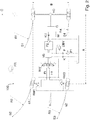
- the drive system 100 also includes a second axle, which is preferably a front axle and which is assigned to two hydraulic motors (wheel / single wheel motors) RM1 and RM2 for driving the two preferably steerable wheels 1 and 2 of the motor vehicle.
- the wheel motor RM1 is assigned to wheel 1
- the wheel motor RM2 is assigned to wheel 2.
- the drive system 100 also has a valve block, preferably designed as a control block VB, for controlling the wheel motors RM1 and RM2, an expediently constant or variable feed pump P1 (in Figure 1 a constant feed pump is shown), an expediently constant or variable high-pressure pump P2, a transmission G, a rear axle differential HD for the first axle, a cooler K, a filter F, a pressure limiting valve DBV and a control device FR (in particular a vehicle computer).
- a valve block preferably designed as a control block VB, for controlling the wheel motors RM1 and RM2, an expediently constant or variable feed pump P1 (in Figure 1 a constant feed pump is shown), an expediently constant or variable high-pressure pump P2, a transmission G, a rear axle differential HD for the first axle, a cooler K, a filter F, a pressure limiting valve DBV and a control device FR (in particular a vehicle computer).
- Reference symbol a1 denotes a steering angle of wheel 1
- reference symbol R2 denotes the individual curve radius of wheel 1
- reference symbol S2 denotes the individual curve track of wheel 1.
- Reference symbol R1 denotes the curve radius of a rear wheel
- reference symbol S1 denotes an individual curve track of this rear wheel.
- Reference character B denotes the track width and / or track of the two wheels 1 and 2 and the two rear wheels, which in the in Figure 1
- the embodiment shown are the same size, but do not have to be the same size within the scope of the invention.
- Reference symbol C denotes a curve center point of the curve to be traveled by the motor vehicle.
- variable limited-slip differential function enables a wheel of the two wheels 1 and 2 that rotates too quickly during cornering to be slowed down. This can be achieved in particular by reducing the hydraulic fluid volume flow FI / FII to the hydraulic motor RM1 / RM2 of the wheel 1/2 rotating too quickly.
- the geometric conditions of the drive system 100 or the motor vehicle are used as the basis for the variable locking differential function, ie in particular the wheelbase A and the track width B.
- the variable locking differential function ie in particular the wheelbase A and the track width B.
- the adjusting element is controlled by means of the control variable from the control device FR and to be regulated until the actual ratio of the actual speeds of the two wheels 1 and 2 is set according to the control variable.
- the drive system 100 z. B. have measuring devices to measure the actual speeds of the two wheels R1 and R2.
- the individual wheel speeds of wheels 1 and 2 can be detected via sensors.
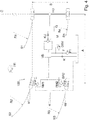
- a curve radius can be set for each of the two wheels 1 and 2 via the steering angle ⁇ , ⁇ 1 or ⁇ 2 R2 and R3 are calculated.
- the two actual speeds of the wheels 1 and 2 which are expediently recorded by means of measuring devices, can serve as a control variable, possibly in addition to the hydraulic pressures of the hydraulic fluid volume flows FI and FII.
- Figure 3 shows a drive system 100 according to another embodiment of the invention.
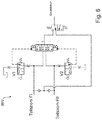
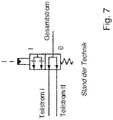
- Figure 6 shows a mass flow divider WV, preferably with a free-running function, according to another embodiment of the invention.
Landscapes
- Engineering & Computer Science (AREA)
- Chemical & Material Sciences (AREA)
- Combustion & Propulsion (AREA)
- Transportation (AREA)
- Mechanical Engineering (AREA)
- Arrangement And Driving Of Transmission Devices (AREA)
- Retarders (AREA)
- Control Of Fluid Gearings (AREA)
Claims (18)
- Système d'entraînement (100) pour un véhicule automobile, de préférence pour réduire la tendance au sous-virage d'un véhicule automobile et/ou pour permettre des vitesses de rotation asynchrones pour au moins deux roues (1, 2) du véhicule automobile, reliées l'une à l'autre par une fonction de différentiel à blocage, comprenant :- au moins un premier essieu qui peut de préférence être entraîné par l'intermédiaire d'une chaîne cinématique,- au moins un deuxième essieu qui est associé à au moins deux moteurs hydrauliques (RM1, RM2) destinés à entraîner au moins deux roues (1, 2) du véhicule automobile, et- une fonction de différentiel à blocage destinée à compenser la traction pour les au moins deux roues (1, 2),
dans lequel- la fonction de différentiel à blocage est variable afin de permettre différentes vitesses de rotation pour les au moins deux roues (1, 2) pendant un déplacement en virage du véhicule automobile, et- un diviseur de débit massique hydraulique (WV) doté d'un élément de réglage est chargé de la fonction de différentiel à blocage variable, et l'élément de réglage permet de préférence une répartition variable d'un débit volumique de liquide hydraulique (FI, FII) sur les moteurs hydrauliques,
caractérisé en ce que(a) l'élément de réglage est régulé au moins jusqu'à ce qu'un rapport de vitesses de rotation réelles pour les au moins deux roues (1, 2) corresponde à un rapport de vitesses de rotation théoriques pour les au moins deux roues (1, 2), et/ou(b) l'élément de réglage est régulé au moins jusqu'à ce qu'une position réelle de l'élément de réglage corresponde à une position théorique de l'élément de réglage, et/ou(c) le diviseur de débit massique (WV) divise les débits volumiques de fluide hydraulique (FI, FII) à destination et/ou en provenance des moteurs hydrauliques (RM1, RM2) des deux roues (1, 2) selon le rapport de vitesses de rotation théoriques pour les au moins deux roues (1, 2). - Système d'entraînement (100) selon la revendication 1, caractérisé en ce que la fonction de différentiel à blocage variable est variable en fonction de l'angle de braquage.
- Système d'entraînement (100) selon la revendication 1 ou 2, caractérisé en ce que la fonction de différentiel à blocage variable est effectuée pour ralentir pendant un déplacement en virage une roue tournant trop vite parmi les deux roues (1, 2), de préférence par la réduction d'un débit volumique de liquide hydraulique (FI, FII) vers le moteur hydraulique (RM1, RM2) de la roue tournant trop vite (1, 2) ou par le freinage au moyen d'une intervention de freinage sur la roue tournant trop vite (1, 2).
- Système d'entraînement (100) selon l'une quelconque des revendications précédentes, caractérisé en ce que le système d'entraînement (100) présente un dispositif de commande (FR), de préférence électronique, pour commander la fonction de différentiel à blocage variable et/ou pour calculer une vitesse de rotation théorique pour chacune des deux roues (1, 2) pour un déplacement en virage en tenant compte d'un angle de braquage du véhicule automobile.
- Système d'entraînement (100) selon l'une quelconque des revendications précédentes, caractérisé en ce que la fonction de différentiel à blocage variable peut être régulée par une boucle de régulation fermée.
- Système d'entraînement (100) selon la revendication 4, caractérisé en ce que l'élément de réglage peut être influencé par le dispositif de commande (FR) de manière électriquement proportionnelle.
- Système d'entraînement (100) selon l'une quelconque des revendications précédentes, caractérisé en ce que le diviseur de débit massique (WV) est réalisé avec ou sans fonction roue libre.
- Système d'entraînement (100) selon l'une quelconque des revendications précédentes, caractérisé en ce qu'un pilotage de l'élément de réglage est effectué par au moins un aimant proportionnel à amplification hydraulique et rappel par ressort, pouvant être piloté électriquement, ou par au moins une vanne de commande (V1, V2), de préférence une vanne proportionnelle, pour commander l'application de pression hydraulique agissant sur l'élément de réglage et le rappel par ressort.
- Système d'entraînement (100) selon l'une quelconque des revendications précédentes, caractérisé en ce qu'un système de freinage (BR1, BR2) doté d'une intervention de freinage sélective est chargé de la fonction de différentiel à blocage variable.
- Système d'entraînement (100) selon la revendication 9, caractérisé en ce que le système de freinage (BR1, BR2) est régulé jusqu'à ce qu'un rapport de vitesses de rotation réelles pour les au moins deux roues (1, 2) corresponde à un rapport de vitesses de rotation théoriques pour les au moins deux roues (1, 2) .
- Système d'entraînement (100) selon la revendication 9 ou 10, caractérisé en ce que le système d'entraînement (100) présente une boucle de régulation fermée par laquelle le système de freinage (BR1, BR2) peut être régulé au moins jusqu'à ce qu'il soit réglé selon au moins une grandeur de commande théorique.
- Système d'entraînement (100) selon l'une quelconque des revendications précédentes, caractérisé en ce que le système d'entraînement (100) présente une boucle de régulation fermée par laquelle- la fonction de différentiel à blocage variable peut être régulée au moins jusqu'à ce qu'elle soit réglée selon au moins une grandeur de commande théorique, et/ou- l'élément de réglage peut être régulé au moins jusqu'à ce qu'il soit réglé selon au moins une grandeur de commande théorique.
- Système d'entraînement (100) selon la revendication 11 ou 12, caractérisé en ce qu'un rapport de vitesses de rotation théoriques pour les au moins deux roues (1, 2) pour un déplacement en virage sert de grandeur de commande théorique, de préférence pour la fonction de différentiel à blocage variable.
- Système d'entraînement (100) selon l'une quelconque des revendications 11 à 13, caractérisé en ce que la grandeur de commande théorique est dynamique, de préférence pour la fonction de différentiel à blocage variable, et varie en fonction de l'angle de braquage.
- Système d'entraînement (100) selon l'une quelconque des revendications précédentes, caractérisé par au moins une pompe (P1, P2) à volume d'absorption constant ou à volume d'absorption variable, en relation active avec ledit au moins un moteur hydraulique (RM1, RM2).
- Système d'entraînement (100) selon la revendication 15, dans lequel ladite au moins une pompe comprend une pompe d'alimentation (P1) et/ou une pompe haute pression (P2).
- Véhicule automobile, comprenant un système d'entraînement (100) selon l'une quelconque des revendications précédentes.
- Procédé d'exploitation pour un système d'entraînement (100) pour un véhicule automobile, en particulier pour réduire la tendance au sous-virage d'un véhicule automobile et/ou pour permettre des vitesses de rotation asynchrones pour au moins deux roues (1, 2) du véhicule automobile reliées l'une à l'autre par une fonction de différentiel à blocage, de préférence pour un système d'entraînement (100) selon l'une quelconque des revendications 1 à 16, le système d'entraînement (100) présentant :- au moins un premier essieu qui peut être entraîné mécaniquement de préférence par une chaîne cinématique,- au moins un deuxième essieu qui est associé à au moins deux moteurs hydrauliques (RM1, RM2) destinés à entraîner au moins deux roues (1, 2) du véhicule automobile, et- une fonction de différentiel à blocage destinée à compenser la traction pour les au moins deux roues (1, 2),
dans lequel- la fonction de différentiel à blocage est variable afin de permettre différentes vitesses de rotation pour les au moins deux roues (1, 2) pendant un déplacement en virage du véhicule automobile, et- un diviseur de débit massique hydraulique (WV) doté d'un élément de réglage est en charge de la fonction de différentiel à blocage variable, et l'élément de réglage permet de préférence une répartition variable d'un débit volumique de liquide hydraulique (FI, FII) sur les moteurs hydrauliques,
caractérisé en ce que(a) l'élément de réglage est régulé au moins jusqu'à ce qu'un rapport de vitesses de rotation réelles pour les au moins deux roues (1, 2) corresponde à un rapport de vitesses de rotation théoriques pour les au moins deux roues (1, 2), et/ou(b) l'élément de réglage est régulé au moins jusqu'à ce qu'une position réelle de l'élément de réglage corresponde à une position théorique de l'élément de réglage, et/ou(c) le diviseur de débit massique (WV) divise les débits volumiques de fluide hydraulique (FI, FII) à destination et/ou en provenance des moteurs hydrauliques (RM1, RM2) des deux roues (1, 2) selon le rapport de vitesses de rotation théoriques pour les au moins deux roues (1, 2).
Applications Claiming Priority (1)
| Application Number | Priority Date | Filing Date | Title |
|---|---|---|---|
| DE102018124020.1A DE102018124020A1 (de) | 2018-09-28 | 2018-09-28 | Antriebssystem mit variabler Sperrdifferential-Funktion |
Publications (2)
| Publication Number | Publication Date |
|---|---|
| EP3628524A1 EP3628524A1 (fr) | 2020-04-01 |
| EP3628524B1 true EP3628524B1 (fr) | 2021-08-25 |
Family
ID=68066541
Family Applications (1)
| Application Number | Title | Priority Date | Filing Date |
|---|---|---|---|
| EP19198499.6A Active EP3628524B1 (fr) | 2018-09-28 | 2019-09-20 | Système d'entraînement à fonction différentielle bloquant variable |
Country Status (2)
| Country | Link |
|---|---|
| EP (1) | EP3628524B1 (fr) |
| DE (1) | DE102018124020A1 (fr) |
Families Citing this family (2)
| Publication number | Priority date | Publication date | Assignee | Title |
|---|---|---|---|---|
| CN117529418A (zh) | 2021-06-14 | 2024-02-06 | 舍弗勒技术股份两合公司 | 可电动操作的车轴传动系、用于操作可电动操作的车轴传动系的方法、计算机程序产品以及控制单元 |
| EP4417477A1 (fr) | 2023-02-17 | 2024-08-21 | Volvo Truck Corporation | Système et procédé de gestion du patinage de roue dans un véhicule |
Family Cites Families (7)
| Publication number | Priority date | Publication date | Assignee | Title |
|---|---|---|---|---|
| DE3635095A1 (de) * | 1985-10-24 | 1987-04-30 | Volkswagen Ag | Verfahren und einrichtung zur vortriebsregelung eines kraftfahrzeugs im sinne des verhinderns eines unerwuenschten durchdrehens der angetriebenen fahrzeugraeder |
| AT503973B1 (de) * | 2006-08-11 | 2008-06-15 | Man Nutzfahrzeuge Oesterreich | Quersperre für ''man-hydrodrive'' |
| US8662212B2 (en) * | 2009-06-04 | 2014-03-04 | Thomas Towles Lawson, Jr. | Four wheel drive system |
| DE102010012418B4 (de) * | 2010-03-23 | 2012-08-30 | Schäffer Maschinenfabrik GmbH | Allradangetriebener Hoflader mit stufenlos verstellbarem Sperrdifferential |
| DE102011111003A1 (de) * | 2011-08-18 | 2013-02-21 | Man Truck & Bus Ag | Antriebssystem für ein Kraftfahrzeug mit einem als Sperrdifferential wirkenden Bremssystem |
| DE102013001254A1 (de) * | 2013-01-25 | 2014-07-31 | Man Truck & Bus Ag | Fahrzeugantrieb mit einem hydrostatischen Hilfsantrieb |
| DE102017211756A1 (de) * | 2017-07-10 | 2019-01-10 | Jungheinrich Aktiengesellschaft | Intelligente Differentialanordnung |
-
2018
- 2018-09-28 DE DE102018124020.1A patent/DE102018124020A1/de not_active Withdrawn
-
2019
- 2019-09-20 EP EP19198499.6A patent/EP3628524B1/fr active Active
Also Published As
| Publication number | Publication date |
|---|---|
| DE102018124020A1 (de) | 2020-04-02 |
| EP3628524A1 (fr) | 2020-04-01 |
Similar Documents
| Publication | Publication Date | Title |
|---|---|---|
| DE10109580B4 (de) | Fahrzeug-Fahrlagensteuervorrichtung | |
| DE69918572T2 (de) | Radaufhängungsanordnung bei einem fahrzeug | |
| DE10348738B4 (de) | Steuerungssystem für ein Kraftfahrzeug und Verfahren zum Steuern eines Kraftfahrzeugs | |
| DE4404098C2 (de) | Fahrzeugregeleinrichtung | |
| EP0606345B1 (fr) | Systeme d'entrainement d'un vehicule a moteur | |
| EP1417108B1 (fr) | Procede pour influer sur la tenue au roulis d'automobiles | |
| EP1849682B1 (fr) | Procédé destiné au réglage de la direction | |
| DE4019732C2 (fr) | ||
| DE4112638A1 (de) | Einrichtung zur steuerung der drehmomentverteilung fuer allradgetriebene fahrzeuge | |
| EP0348634A2 (fr) | Dispositif de contrôle antiroulis pour un véhicule | |
| EP0803427B1 (fr) | Direction pour véhicule | |
| EP0920389A1 (fr) | Procede et dispositif pour le reglage de grandeurs representatives du mouvement d'un vehicule | |
| DE69410532T2 (de) | Vorrichtung zur dynamischen Fahrzeugneigungssteuerung | |
| DE3942411A1 (de) | Steuereinrichtung fuer die verteilung der antriebsenergie in einem antriebszug fuer kraftfahrzeuge mit vierradantrieb und steuerverfahren hierfuer | |
| DE10348736B4 (de) | Steuerungssystem für ein Fahrzeug und Verfahren zum Steuern eines Fahrzeugs | |
| EP3628524B1 (fr) | Système d'entraînement à fonction différentielle bloquant variable | |
| EP1890920A1 (fr) | Regulation de dynamique de vehicule adaptee a l'etat de mouvement et fondee sur des interventions sur l'angle de braquage | |
| EP1843906B1 (fr) | Systeme de commande ou de reglage de dynamique de conduite pour vehicule automobile a deux voies et deux essieux | |
| DE112022000824T5 (de) | Schlupfzustandsdetektionseinrichtung und Federungssteuerungseinrichtung | |
| DE102005037479B4 (de) | Fahrdynamik-Steuerungssystem für ein zweispuriges Kraftfahrzeug | |
| DE4035314A1 (de) | Verfahren zum semiaktiven regeln eines fahrwerks | |
| DE102004008265A1 (de) | Verfahren zur Antriebsschlupfregelung eines Kraftfahrzeugs | |
| DE102013011230A1 (de) | Verfahren zur Verbesserung der Traktion von Fahrzeugen | |
| WO2004087446A1 (fr) | Régulation de suspension | |
| DE102014004946B4 (de) | Verfahren und System zum Kontrollieren von Rädern eines Kraftfahrzeugs |
Legal Events
| Date | Code | Title | Description |
|---|---|---|---|
| PUAI | Public reference made under article 153(3) epc to a published international application that has entered the european phase |
Free format text: ORIGINAL CODE: 0009012 |
|
| STAA | Information on the status of an ep patent application or granted ep patent |
Free format text: STATUS: THE APPLICATION HAS BEEN PUBLISHED |
|
| AK | Designated contracting states |
Kind code of ref document: A1 Designated state(s): AL AT BE BG CH CY CZ DE DK EE ES FI FR GB GR HR HU IE IS IT LI LT LU LV MC MK MT NL NO PL PT RO RS SE SI SK SM TR |
|
| AX | Request for extension of the european patent |
Extension state: BA ME |
|
| STAA | Information on the status of an ep patent application or granted ep patent |
Free format text: STATUS: REQUEST FOR EXAMINATION WAS MADE |
|
| 17P | Request for examination filed |
Effective date: 20200918 |
|
| RBV | Designated contracting states (corrected) |
Designated state(s): AL AT BE BG CH CY CZ DE DK EE ES FI FR GB GR HR HU IE IS IT LI LT LU LV MC MK MT NL NO PL PT RO RS SE SI SK SM TR |
|
| RIC1 | Information provided on ipc code assigned before grant |
Ipc: B60K 17/354 20060101AFI20210216BHEP Ipc: B60K 17/356 20060101ALI20210216BHEP |
|
| GRAP | Despatch of communication of intention to grant a patent |
Free format text: ORIGINAL CODE: EPIDOSNIGR1 |
|
| STAA | Information on the status of an ep patent application or granted ep patent |
Free format text: STATUS: GRANT OF PATENT IS INTENDED |
|
| INTG | Intention to grant announced |
Effective date: 20210409 |
|
| GRAS | Grant fee paid |
Free format text: ORIGINAL CODE: EPIDOSNIGR3 |
|
| GRAA | (expected) grant |
Free format text: ORIGINAL CODE: 0009210 |
|
| STAA | Information on the status of an ep patent application or granted ep patent |
Free format text: STATUS: THE PATENT HAS BEEN GRANTED |
|
| AK | Designated contracting states |
Kind code of ref document: B1 Designated state(s): AL AT BE BG CH CY CZ DE DK EE ES FI FR GB GR HR HU IE IS IT LI LT LU LV MC MK MT NL NO PL PT RO RS SE SI SK SM TR |
|
| REG | Reference to a national code |
Ref country code: CH Ref legal event code: EP |
|
| REG | Reference to a national code |
Ref country code: DE Ref legal event code: R096 Ref document number: 502019002123 Country of ref document: DE |
|
| REG | Reference to a national code |
Ref country code: IE Ref legal event code: FG4D Free format text: LANGUAGE OF EP DOCUMENT: GERMAN Ref country code: AT Ref legal event code: REF Ref document number: 1423449 Country of ref document: AT Kind code of ref document: T Effective date: 20210915 |
|
| REG | Reference to a national code |
Ref country code: SE Ref legal event code: TRGR |
|
| REG | Reference to a national code |
Ref country code: NL Ref legal event code: FP |
|
| REG | Reference to a national code |
Ref country code: LT Ref legal event code: MG9D |
|
| PG25 | Lapsed in a contracting state [announced via postgrant information from national office to epo] |
Ref country code: ES Free format text: LAPSE BECAUSE OF FAILURE TO SUBMIT A TRANSLATION OF THE DESCRIPTION OR TO PAY THE FEE WITHIN THE PRESCRIBED TIME-LIMIT Effective date: 20210825 Ref country code: FI Free format text: LAPSE BECAUSE OF FAILURE TO SUBMIT A TRANSLATION OF THE DESCRIPTION OR TO PAY THE FEE WITHIN THE PRESCRIBED TIME-LIMIT Effective date: 20210825 Ref country code: RS Free format text: LAPSE BECAUSE OF FAILURE TO SUBMIT A TRANSLATION OF THE DESCRIPTION OR TO PAY THE FEE WITHIN THE PRESCRIBED TIME-LIMIT Effective date: 20210825 Ref country code: BG Free format text: LAPSE BECAUSE OF FAILURE TO SUBMIT A TRANSLATION OF THE DESCRIPTION OR TO PAY THE FEE WITHIN THE PRESCRIBED TIME-LIMIT Effective date: 20211125 Ref country code: LT Free format text: LAPSE BECAUSE OF FAILURE TO SUBMIT A TRANSLATION OF THE DESCRIPTION OR TO PAY THE FEE WITHIN THE PRESCRIBED TIME-LIMIT Effective date: 20210825 Ref country code: PT Free format text: LAPSE BECAUSE OF FAILURE TO SUBMIT A TRANSLATION OF THE DESCRIPTION OR TO PAY THE FEE WITHIN THE PRESCRIBED TIME-LIMIT Effective date: 20211227 Ref country code: NO Free format text: LAPSE BECAUSE OF FAILURE TO SUBMIT A TRANSLATION OF THE DESCRIPTION OR TO PAY THE FEE WITHIN THE PRESCRIBED TIME-LIMIT Effective date: 20211125 Ref country code: HR Free format text: LAPSE BECAUSE OF FAILURE TO SUBMIT A TRANSLATION OF THE DESCRIPTION OR TO PAY THE FEE WITHIN THE PRESCRIBED TIME-LIMIT Effective date: 20210825 |
|
| PG25 | Lapsed in a contracting state [announced via postgrant information from national office to epo] |
Ref country code: PL Free format text: LAPSE BECAUSE OF FAILURE TO SUBMIT A TRANSLATION OF THE DESCRIPTION OR TO PAY THE FEE WITHIN THE PRESCRIBED TIME-LIMIT Effective date: 20210825 Ref country code: LV Free format text: LAPSE BECAUSE OF FAILURE TO SUBMIT A TRANSLATION OF THE DESCRIPTION OR TO PAY THE FEE WITHIN THE PRESCRIBED TIME-LIMIT Effective date: 20210825 Ref country code: GR Free format text: LAPSE BECAUSE OF FAILURE TO SUBMIT A TRANSLATION OF THE DESCRIPTION OR TO PAY THE FEE WITHIN THE PRESCRIBED TIME-LIMIT Effective date: 20211126 |
|
| PG25 | Lapsed in a contracting state [announced via postgrant information from national office to epo] |
Ref country code: DK Free format text: LAPSE BECAUSE OF FAILURE TO SUBMIT A TRANSLATION OF THE DESCRIPTION OR TO PAY THE FEE WITHIN THE PRESCRIBED TIME-LIMIT Effective date: 20210825 |
|
| REG | Reference to a national code |
Ref country code: BE Ref legal event code: MM Effective date: 20210930 |
|
| REG | Reference to a national code |
Ref country code: DE Ref legal event code: R097 Ref document number: 502019002123 Country of ref document: DE |
|
| PG25 | Lapsed in a contracting state [announced via postgrant information from national office to epo] |
Ref country code: SM Free format text: LAPSE BECAUSE OF FAILURE TO SUBMIT A TRANSLATION OF THE DESCRIPTION OR TO PAY THE FEE WITHIN THE PRESCRIBED TIME-LIMIT Effective date: 20210825 Ref country code: SK Free format text: LAPSE BECAUSE OF FAILURE TO SUBMIT A TRANSLATION OF THE DESCRIPTION OR TO PAY THE FEE WITHIN THE PRESCRIBED TIME-LIMIT Effective date: 20210825 Ref country code: RO Free format text: LAPSE BECAUSE OF FAILURE TO SUBMIT A TRANSLATION OF THE DESCRIPTION OR TO PAY THE FEE WITHIN THE PRESCRIBED TIME-LIMIT Effective date: 20210825 Ref country code: MC Free format text: LAPSE BECAUSE OF FAILURE TO SUBMIT A TRANSLATION OF THE DESCRIPTION OR TO PAY THE FEE WITHIN THE PRESCRIBED TIME-LIMIT Effective date: 20210825 Ref country code: EE Free format text: LAPSE BECAUSE OF FAILURE TO SUBMIT A TRANSLATION OF THE DESCRIPTION OR TO PAY THE FEE WITHIN THE PRESCRIBED TIME-LIMIT Effective date: 20210825 Ref country code: CZ Free format text: LAPSE BECAUSE OF FAILURE TO SUBMIT A TRANSLATION OF THE DESCRIPTION OR TO PAY THE FEE WITHIN THE PRESCRIBED TIME-LIMIT Effective date: 20210825 Ref country code: AL Free format text: LAPSE BECAUSE OF FAILURE TO SUBMIT A TRANSLATION OF THE DESCRIPTION OR TO PAY THE FEE WITHIN THE PRESCRIBED TIME-LIMIT Effective date: 20210825 |
|
| PLBE | No opposition filed within time limit |
Free format text: ORIGINAL CODE: 0009261 |
|
| STAA | Information on the status of an ep patent application or granted ep patent |
Free format text: STATUS: NO OPPOSITION FILED WITHIN TIME LIMIT |
|
| PG25 | Lapsed in a contracting state [announced via postgrant information from national office to epo] |
Ref country code: LU Free format text: LAPSE BECAUSE OF NON-PAYMENT OF DUE FEES Effective date: 20210920 Ref country code: IE Free format text: LAPSE BECAUSE OF NON-PAYMENT OF DUE FEES Effective date: 20210920 Ref country code: BE Free format text: LAPSE BECAUSE OF NON-PAYMENT OF DUE FEES Effective date: 20210930 |
|
| 26N | No opposition filed |
Effective date: 20220527 |
|
| PG25 | Lapsed in a contracting state [announced via postgrant information from national office to epo] |
Ref country code: SI Free format text: LAPSE BECAUSE OF FAILURE TO SUBMIT A TRANSLATION OF THE DESCRIPTION OR TO PAY THE FEE WITHIN THE PRESCRIBED TIME-LIMIT Effective date: 20210825 |
|
| REG | Reference to a national code |
Ref country code: CH Ref legal event code: PL |
|
| PG25 | Lapsed in a contracting state [announced via postgrant information from national office to epo] |
Ref country code: CY Free format text: LAPSE BECAUSE OF FAILURE TO SUBMIT A TRANSLATION OF THE DESCRIPTION OR TO PAY THE FEE WITHIN THE PRESCRIBED TIME-LIMIT Effective date: 20210825 |
|
| PG25 | Lapsed in a contracting state [announced via postgrant information from national office to epo] |
Ref country code: LI Free format text: LAPSE BECAUSE OF NON-PAYMENT OF DUE FEES Effective date: 20220930 Ref country code: HU Free format text: LAPSE BECAUSE OF FAILURE TO SUBMIT A TRANSLATION OF THE DESCRIPTION OR TO PAY THE FEE WITHIN THE PRESCRIBED TIME-LIMIT; INVALID AB INITIO Effective date: 20190920 Ref country code: CH Free format text: LAPSE BECAUSE OF NON-PAYMENT OF DUE FEES Effective date: 20220930 |
|
| PG25 | Lapsed in a contracting state [announced via postgrant information from national office to epo] |
Ref country code: MK Free format text: LAPSE BECAUSE OF FAILURE TO SUBMIT A TRANSLATION OF THE DESCRIPTION OR TO PAY THE FEE WITHIN THE PRESCRIBED TIME-LIMIT Effective date: 20210825 |
|
| GBPC | Gb: european patent ceased through non-payment of renewal fee |
Effective date: 20230920 |
|
| PG25 | Lapsed in a contracting state [announced via postgrant information from national office to epo] |
Ref country code: TR Free format text: LAPSE BECAUSE OF FAILURE TO SUBMIT A TRANSLATION OF THE DESCRIPTION OR TO PAY THE FEE WITHIN THE PRESCRIBED TIME-LIMIT Effective date: 20210825 |
|
| PG25 | Lapsed in a contracting state [announced via postgrant information from national office to epo] |
Ref country code: GB Free format text: LAPSE BECAUSE OF NON-PAYMENT OF DUE FEES Effective date: 20230920 |
|
| PG25 | Lapsed in a contracting state [announced via postgrant information from national office to epo] |
Ref country code: GB Free format text: LAPSE BECAUSE OF NON-PAYMENT OF DUE FEES Effective date: 20230920 |
|
| PG25 | Lapsed in a contracting state [announced via postgrant information from national office to epo] |
Ref country code: MT Free format text: LAPSE BECAUSE OF FAILURE TO SUBMIT A TRANSLATION OF THE DESCRIPTION OR TO PAY THE FEE WITHIN THE PRESCRIBED TIME-LIMIT Effective date: 20210825 |
|
| PGFP | Annual fee paid to national office [announced via postgrant information from national office to epo] |
Ref country code: DE Payment date: 20250926 Year of fee payment: 7 |
|
| PGFP | Annual fee paid to national office [announced via postgrant information from national office to epo] |
Ref country code: NL Payment date: 20250925 Year of fee payment: 7 Ref country code: IT Payment date: 20250922 Year of fee payment: 7 |
|
| PGFP | Annual fee paid to national office [announced via postgrant information from national office to epo] |
Ref country code: FR Payment date: 20250925 Year of fee payment: 7 |
|
| PGFP | Annual fee paid to national office [announced via postgrant information from national office to epo] |
Ref country code: SE Payment date: 20250924 Year of fee payment: 7 |
|
| REG | Reference to a national code |
Ref country code: AT Ref legal event code: MM01 Ref document number: 1423449 Country of ref document: AT Kind code of ref document: T Effective date: 20240920 |
|
| PG25 | Lapsed in a contracting state [announced via postgrant information from national office to epo] |
Ref country code: AT Free format text: LAPSE BECAUSE OF NON-PAYMENT OF DUE FEES Effective date: 20240920 |
|
| PGFP | Annual fee paid to national office [announced via postgrant information from national office to epo] |
Ref country code: AT Payment date: 20260410 Year of fee payment: 5 |