EP3628587A1 - Système de propulsion d'avion - Google Patents
Système de propulsion d'avion Download PDFInfo
- Publication number
- EP3628587A1 EP3628587A1 EP19189981.4A EP19189981A EP3628587A1 EP 3628587 A1 EP3628587 A1 EP 3628587A1 EP 19189981 A EP19189981 A EP 19189981A EP 3628587 A1 EP3628587 A1 EP 3628587A1
- Authority
- EP
- European Patent Office
- Prior art keywords
- propulsor
- propulsion system
- coupled
- fan
- input shaft
- Prior art date
- Legal status (The legal status is an assumption and is not a legal conclusion. Google has not performed a legal analysis and makes no representation as to the accuracy of the status listed.)
- Withdrawn
Links
Images


Classifications
-
- B—PERFORMING OPERATIONS; TRANSPORTING
- B64—AIRCRAFT; AVIATION; COSMONAUTICS
- B64C—AEROPLANES; HELICOPTERS
- B64C11/00—Propellers, e.g. of ducted type; Features common to propellers and rotors for rotorcraft
- B64C11/001—Shrouded propellers
-
- B—PERFORMING OPERATIONS; TRANSPORTING
- B64—AIRCRAFT; AVIATION; COSMONAUTICS
- B64C—AEROPLANES; HELICOPTERS
- B64C11/00—Propellers, e.g. of ducted type; Features common to propellers and rotors for rotorcraft
- B64C11/46—Arrangements of, or constructional features peculiar to, multiple propellers
- B64C11/48—Units of two or more coaxial propellers
-
- B—PERFORMING OPERATIONS; TRANSPORTING
- B64—AIRCRAFT; AVIATION; COSMONAUTICS
- B64D—EQUIPMENT FOR FITTING IN OR TO AIRCRAFT; FLIGHT SUITS; PARACHUTES; ARRANGEMENT OR MOUNTING OF POWER PLANTS OR PROPULSION TRANSMISSIONS IN AIRCRAFT
- B64D27/00—Arrangement or mounting of power plants in aircraft; Aircraft characterised by the type or position of power plants
- B64D27/02—Aircraft characterised by the type or position of power plants
- B64D27/30—Aircraft characterised by electric power plants
- B64D27/33—Hybrid electric aircraft
-
- B—PERFORMING OPERATIONS; TRANSPORTING
- B64—AIRCRAFT; AVIATION; COSMONAUTICS
- B64D—EQUIPMENT FOR FITTING IN OR TO AIRCRAFT; FLIGHT SUITS; PARACHUTES; ARRANGEMENT OR MOUNTING OF POWER PLANTS OR PROPULSION TRANSMISSIONS IN AIRCRAFT
- B64D33/00—Arrangement in aircraft of power plant parts or auxiliaries not otherwise provided for
- B64D33/08—Arrangement in aircraft of power plant parts or auxiliaries not otherwise provided for of power plant cooling systems
-
- B—PERFORMING OPERATIONS; TRANSPORTING
- B64—AIRCRAFT; AVIATION; COSMONAUTICS
- B64D—EQUIPMENT FOR FITTING IN OR TO AIRCRAFT; FLIGHT SUITS; PARACHUTES; ARRANGEMENT OR MOUNTING OF POWER PLANTS OR PROPULSION TRANSMISSIONS IN AIRCRAFT
- B64D33/00—Arrangement in aircraft of power plant parts or auxiliaries not otherwise provided for
- B64D33/08—Arrangement in aircraft of power plant parts or auxiliaries not otherwise provided for of power plant cooling systems
- B64D33/10—Radiator arrangement
-
- B—PERFORMING OPERATIONS; TRANSPORTING
- B64—AIRCRAFT; AVIATION; COSMONAUTICS
- B64D—EQUIPMENT FOR FITTING IN OR TO AIRCRAFT; FLIGHT SUITS; PARACHUTES; ARRANGEMENT OR MOUNTING OF POWER PLANTS OR PROPULSION TRANSMISSIONS IN AIRCRAFT
- B64D35/00—Transmitting power from power plants to propellers or rotors; Arrangements of transmissions
- B64D35/02—Transmitting power from power plants to propellers or rotors; Arrangements of transmissions specially adapted for specific power plants
- B64D35/021—Transmitting power from power plants to propellers or rotors; Arrangements of transmissions specially adapted for specific power plants for electric power plants
- B64D35/022—Transmitting power from power plants to propellers or rotors; Arrangements of transmissions specially adapted for specific power plants for electric power plants of hybrid-electric type
- B64D35/023—Transmitting power from power plants to propellers or rotors; Arrangements of transmissions specially adapted for specific power plants for electric power plants of hybrid-electric type of series-parallel type
-
- B—PERFORMING OPERATIONS; TRANSPORTING
- B64—AIRCRAFT; AVIATION; COSMONAUTICS
- B64D—EQUIPMENT FOR FITTING IN OR TO AIRCRAFT; FLIGHT SUITS; PARACHUTES; ARRANGEMENT OR MOUNTING OF POWER PLANTS OR PROPULSION TRANSMISSIONS IN AIRCRAFT
- B64D35/00—Transmitting power from power plants to propellers or rotors; Arrangements of transmissions
- B64D35/04—Transmitting power from power plants to propellers or rotors; Arrangements of transmissions characterised by the transmission driving a plurality of propellers or rotors
- B64D35/06—Transmitting power from power plants to propellers or rotors; Arrangements of transmissions characterised by the transmission driving a plurality of propellers or rotors the propellers or rotors being counter-rotating
-
- F—MECHANICAL ENGINEERING; LIGHTING; HEATING; WEAPONS; BLASTING
- F02—COMBUSTION ENGINES; HOT-GAS OR COMBUSTION-PRODUCT ENGINE PLANTS
- F02C—GAS-TURBINE PLANTS; AIR INTAKES FOR JET-PROPULSION PLANTS; CONTROLLING FUEL SUPPLY IN AIR-BREATHING JET-PROPULSION PLANTS
- F02C3/00—Gas-turbine plants characterised by the use of combustion products as the working fluid
- F02C3/04—Gas-turbine plants characterised by the use of combustion products as the working fluid having a turbine driving a compressor
- F02C3/06—Gas-turbine plants characterised by the use of combustion products as the working fluid having a turbine driving a compressor the compressor comprising only axial stages
- F02C3/067—Gas-turbine plants characterised by the use of combustion products as the working fluid having a turbine driving a compressor the compressor comprising only axial stages having counter-rotating rotors
-
- F—MECHANICAL ENGINEERING; LIGHTING; HEATING; WEAPONS; BLASTING
- F02—COMBUSTION ENGINES; HOT-GAS OR COMBUSTION-PRODUCT ENGINE PLANTS
- F02C—GAS-TURBINE PLANTS; AIR INTAKES FOR JET-PROPULSION PLANTS; CONTROLLING FUEL SUPPLY IN AIR-BREATHING JET-PROPULSION PLANTS
- F02C7/00—Features, components parts, details or accessories, not provided for in, or of interest apart form groups F02C1/00 - F02C6/00; Air intakes for jet-propulsion plants
- F02C7/12—Cooling of plants
- F02C7/14—Cooling of plants of fluids in the plant, e.g. lubricant or fuel
-
- F—MECHANICAL ENGINEERING; LIGHTING; HEATING; WEAPONS; BLASTING
- F02—COMBUSTION ENGINES; HOT-GAS OR COMBUSTION-PRODUCT ENGINE PLANTS
- F02C—GAS-TURBINE PLANTS; AIR INTAKES FOR JET-PROPULSION PLANTS; CONTROLLING FUEL SUPPLY IN AIR-BREATHING JET-PROPULSION PLANTS
- F02C7/00—Features, components parts, details or accessories, not provided for in, or of interest apart form groups F02C1/00 - F02C6/00; Air intakes for jet-propulsion plants
- F02C7/36—Power transmission arrangements between the different shafts of the gas turbine plant, or between the gas-turbine plant and the power user
-
- F—MECHANICAL ENGINEERING; LIGHTING; HEATING; WEAPONS; BLASTING
- F02—COMBUSTION ENGINES; HOT-GAS OR COMBUSTION-PRODUCT ENGINE PLANTS
- F02K—JET-PROPULSION PLANTS
- F02K3/00—Plants including a gas turbine driving a compressor or a ducted fan
- F02K3/02—Plants including a gas turbine driving a compressor or a ducted fan in which part of the working fluid by-passes the turbine and combustion chamber
- F02K3/04—Plants including a gas turbine driving a compressor or a ducted fan in which part of the working fluid by-passes the turbine and combustion chamber the plant including ducted fans, i.e. fans with high volume, low pressure outputs, for augmenting the jet thrust, e.g. of double-flow type
- F02K3/06—Plants including a gas turbine driving a compressor or a ducted fan in which part of the working fluid by-passes the turbine and combustion chamber the plant including ducted fans, i.e. fans with high volume, low pressure outputs, for augmenting the jet thrust, e.g. of double-flow type with front fan
-
- F—MECHANICAL ENGINEERING; LIGHTING; HEATING; WEAPONS; BLASTING
- F02—COMBUSTION ENGINES; HOT-GAS OR COMBUSTION-PRODUCT ENGINE PLANTS
- F02K—JET-PROPULSION PLANTS
- F02K3/00—Plants including a gas turbine driving a compressor or a ducted fan
- F02K3/02—Plants including a gas turbine driving a compressor or a ducted fan in which part of the working fluid by-passes the turbine and combustion chamber
- F02K3/04—Plants including a gas turbine driving a compressor or a ducted fan in which part of the working fluid by-passes the turbine and combustion chamber the plant including ducted fans, i.e. fans with high volume, low pressure outputs, for augmenting the jet thrust, e.g. of double-flow type
- F02K3/072—Plants including a gas turbine driving a compressor or a ducted fan in which part of the working fluid by-passes the turbine and combustion chamber the plant including ducted fans, i.e. fans with high volume, low pressure outputs, for augmenting the jet thrust, e.g. of double-flow type with counter-rotating, e.g. fan rotors
-
- F—MECHANICAL ENGINEERING; LIGHTING; HEATING; WEAPONS; BLASTING
- F02—COMBUSTION ENGINES; HOT-GAS OR COMBUSTION-PRODUCT ENGINE PLANTS
- F02K—JET-PROPULSION PLANTS
- F02K5/00—Plants including an engine, other than a gas turbine, driving a compressor or a ducted fan
-
- F—MECHANICAL ENGINEERING; LIGHTING; HEATING; WEAPONS; BLASTING
- F16—ENGINEERING ELEMENTS AND UNITS; GENERAL MEASURES FOR PRODUCING AND MAINTAINING EFFECTIVE FUNCTIONING OF MACHINES OR INSTALLATIONS; THERMAL INSULATION IN GENERAL
- F16H—GEARING
- F16H1/00—Toothed gearings for conveying rotary motion
- F16H1/28—Toothed gearings for conveying rotary motion with gears having orbital motion
-
- B—PERFORMING OPERATIONS; TRANSPORTING
- B64—AIRCRAFT; AVIATION; COSMONAUTICS
- B64D—EQUIPMENT FOR FITTING IN OR TO AIRCRAFT; FLIGHT SUITS; PARACHUTES; ARRANGEMENT OR MOUNTING OF POWER PLANTS OR PROPULSION TRANSMISSIONS IN AIRCRAFT
- B64D27/00—Arrangement or mounting of power plants in aircraft; Aircraft characterised by the type or position of power plants
- B64D2027/005—Aircraft with an unducted turbofan comprising contra-rotating rotors, e.g. contra-rotating open rotors [CROR]
-
- B—PERFORMING OPERATIONS; TRANSPORTING
- B64—AIRCRAFT; AVIATION; COSMONAUTICS
- B64D—EQUIPMENT FOR FITTING IN OR TO AIRCRAFT; FLIGHT SUITS; PARACHUTES; ARRANGEMENT OR MOUNTING OF POWER PLANTS OR PROPULSION TRANSMISSIONS IN AIRCRAFT
- B64D27/00—Arrangement or mounting of power plants in aircraft; Aircraft characterised by the type or position of power plants
- B64D27/02—Aircraft characterised by the type or position of power plants
- B64D27/026—Aircraft characterised by the type or position of power plants comprising different types of power plants, e.g. combination of a piston engine and a gas-turbine
-
- F—MECHANICAL ENGINEERING; LIGHTING; HEATING; WEAPONS; BLASTING
- F05—INDEXING SCHEMES RELATING TO ENGINES OR PUMPS IN VARIOUS SUBCLASSES OF CLASSES F01-F04
- F05D—INDEXING SCHEME FOR ASPECTS RELATING TO NON-POSITIVE-DISPLACEMENT MACHINES OR ENGINES, GAS-TURBINES OR JET-PROPULSION PLANTS
- F05D2220/00—Application
- F05D2220/70—Application in combination with
- F05D2220/76—Application in combination with an electrical generator
-
- F—MECHANICAL ENGINEERING; LIGHTING; HEATING; WEAPONS; BLASTING
- F05—INDEXING SCHEMES RELATING TO ENGINES OR PUMPS IN VARIOUS SUBCLASSES OF CLASSES F01-F04
- F05D—INDEXING SCHEME FOR ASPECTS RELATING TO NON-POSITIVE-DISPLACEMENT MACHINES OR ENGINES, GAS-TURBINES OR JET-PROPULSION PLANTS
- F05D2260/00—Function
- F05D2260/20—Heat transfer, e.g. cooling
- F05D2260/213—Heat transfer, e.g. cooling by the provision of a heat exchanger within the cooling circuit
-
- F—MECHANICAL ENGINEERING; LIGHTING; HEATING; WEAPONS; BLASTING
- F05—INDEXING SCHEMES RELATING TO ENGINES OR PUMPS IN VARIOUS SUBCLASSES OF CLASSES F01-F04
- F05D—INDEXING SCHEME FOR ASPECTS RELATING TO NON-POSITIVE-DISPLACEMENT MACHINES OR ENGINES, GAS-TURBINES OR JET-PROPULSION PLANTS
- F05D2260/00—Function
- F05D2260/40—Transmission of power
- F05D2260/403—Transmission of power through the shape of the drive components
- F05D2260/4031—Transmission of power through the shape of the drive components as in toothed gearing
- F05D2260/40311—Transmission of power through the shape of the drive components as in toothed gearing of the epicyclical, planetary or differential type
-
- F—MECHANICAL ENGINEERING; LIGHTING; HEATING; WEAPONS; BLASTING
- F16—ENGINEERING ELEMENTS AND UNITS; GENERAL MEASURES FOR PRODUCING AND MAINTAINING EFFECTIVE FUNCTIONING OF MACHINES OR INSTALLATIONS; THERMAL INSULATION IN GENERAL
- F16H—GEARING
- F16H1/00—Toothed gearings for conveying rotary motion
- F16H1/28—Toothed gearings for conveying rotary motion with gears having orbital motion
- F16H2001/2881—Toothed gearings for conveying rotary motion with gears having orbital motion comprising two axially spaced central gears, i.e. ring or sun gear, engaged by at least one common orbital gear wherein one of the central gears is forming the output
-
- Y—GENERAL TAGGING OF NEW TECHNOLOGICAL DEVELOPMENTS; GENERAL TAGGING OF CROSS-SECTIONAL TECHNOLOGIES SPANNING OVER SEVERAL SECTIONS OF THE IPC; TECHNICAL SUBJECTS COVERED BY FORMER USPC CROSS-REFERENCE ART COLLECTIONS [XRACs] AND DIGESTS
- Y02—TECHNOLOGIES OR APPLICATIONS FOR MITIGATION OR ADAPTATION AGAINST CLIMATE CHANGE
- Y02T—CLIMATE CHANGE MITIGATION TECHNOLOGIES RELATED TO TRANSPORTATION
- Y02T50/00—Aeronautics or air transport
- Y02T50/60—Efficient propulsion technologies, e.g. for aircraft
Definitions
- the present disclosure concerns a propulsion system for an aircraft.
- geared fan drive aircraft turbofans are being developed.
- a reduction gearbox is provided, which couples a fan drive turbine to a fan, such that the fan turns at a slower rate than the turbine.
- Such arrangements allow for large fan diameters (and so lower fan pressure ratios and higher bypass ratios), while maintaining a small diameter turbine.
- electric aircraft propulsors are also being developed.
- a fan is driven by an electric motor by electrical power provided from one or both of a battery and a prime mover such as an internal combustion engine driven electrical generator.
- a prime mover such as an internal combustion engine driven electrical generator.
- an internal combustion engine is used to drive a generator to provide electrical power for electrical propulsors, such a system is known as a "hybrid electrical" system.
- an aircraft propulsion system comprising:
- two propulsors are provided, with the first propulsor rotating at a higher speed than the second propulsor.
- the or each of the propulsors may comprise open rotor propellers.
- the or each of the propulsors may comprise ducted fans.
- the first propulsor may have a smaller outer diameter than the second propulsor.
- the first propulsor may be able to provide a higher pressure ratio across the propulsor, without having excessively high propulsor tip speeds. Consequently, a high overall propulsion system pressure ratio can be achieved at a relatively low second propulsor tip speed. This can therefore provide one or more of relatively low noise (in view of the low tip speeds) and a relatively high mass flow (and so high propulsive efficiency).
- air is accelerated adjacent the root region of the second fan, thereby increasing the work performed by the propulsion system for a given second fan diameter.
- the first propulsor may comprise a rotating shroud provided at a radially outer end of the first propulsor. Consequently, tip vortices from the first propulsor are avoided, thereby increasing efficiency of the second propulsor downstream. Furthermore, a higher pressure ratio can be developed by the first propulsor, thereby further increasing propulsion system power density. Additionally, mixing between the flows from the first propulsor and the second propulsor is improved, thereby further reducing noise and improving efficiency.
- the second propulsor may be mounted to the planet carrier. Consequently, the first and second propulsor co-rotate, with the first propulsor rotating at a higher speed than the second propulsor. In view of the relatively close proximity of the first and second propulsor, it may be preferable to co-rotate the first and second propulsor, in order to minimise noise. Since the second propulsor root does relatively little work, there may only be minimal advantage in cancelling swirl from the first propulsor.
- the propulsor fan may be mounted to the ring gear.
- the first and second propulsors counter-rotate, allowing for high relative propulsor speeds, and so higher pressure ratios at relatively low rotational speed in a static reference frame.
- Such a system may also avoid the need for a stator between the first and second fans.
- the aircraft propulsion system may comprise an electric motor coupled to the sun input shaft.
- the propulsion system comprises an electric propulsion system or a hybrid propulsion system.
- the second propulsor rotates relatively slowly relative to the rotational speed of the electric motor. Faster turning electric motors can be smaller and lighter for a given power, and so the overall weight of an electric propulsion system can be reduced. Furthermore, a single motor can be used to rotate both fans.
- the propulsion system may comprise a plurality of outlet guide vanes located downstream of the second propulsor.
- the electric motor may be mounted to one or more of the outlet guide vanes.
- the electric motor may comprise a fluid cooling system configured to cool one or more of the rotor and the stator of the electric motor.
- the fluid cooling system may comprise an oil cooling system.
- the fluid cooling system may comprise cooling passages located within one or more outlet guide vanes.
- the aircraft propulsion system may comprise a gas turbine engine.
- the gas turbine engine may comprise a turbine coupled to an electrical generator.
- the electrical generator may be electrically coupled to the motor.
- the turbine of the gas turbine engine may be coupled to the sun input shaft.
- the propulsion system comprises a geared turbofan.
- the second fan can rotate at a lower speed than the turbine, allowing for a smaller, more power dense turbine.
- the gas turbine engine may comprise a gas turbine engine core comprising a compressor coupled to a turbine.
- the first propulsor may have an outer diameter substantially equal to a diameter of an inlet of the compressor.
- the compressor may be fed with higher pressure air from the first propulsor, which may increase overall gas turbine engine compression ratio, and so increase gas turbine engine thermal efficiency.
- an aircraft comprising the propulsion system of the first aspect.
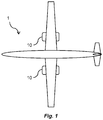
- an aircraft 1 having a propulsion system 10.
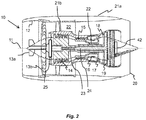
- the propulsion system is shown in further detail in figures 2 to 4 and comprises a gas turbine engine generally indicated at 10, having a principal and rotational axis 11.
- the engine 10 comprises, in axial flow series, an air intake 12, a first propulsive fan 13a, a second propulsive fan 13b, a low-pressure compressor 14, a high pressure compressor 15, combustion equipment 16, a high-pressure turbine 17, an intermediate pressure turbine 18, a low-pressure turbine 19 and an exhaust nozzle 20.
- a fan casing 21a generally surrounds the engine 10 and defines the intake 12
- an engine core casing 21b generally surrounds engine core components comprising the compressors 14, 15, combustor 16 and turbines 17, 18, 19.
- the gas turbine engine 10 works in the conventional manner so that air entering the intake 12 is accelerated by the fans 13a, 13b to produce two air flows: a first air flow into the compressor 14 and a second air flow which passes through a bypass duct 21 to provide propulsive thrust.
- the compressors 14, 15 compress the air flow directed into it before delivering that air to the combustion equipment 16.
- the air flow is mixed with fuel and the mixture combusted.
- the resultant hot combustion products then expand through, and thereby drive the turbines 17, 18, 19 before being exhausted through the nozzle 20 to provide additional propulsive thrust.
- the high 17, intermediate 18, and low 19 pressure turbines drive respectively the high pressure compressor 14, intermediate pressure compressor 14 and the fans 13a, 13b, each by suitable interconnecting shaft 22, 23 24.
- gas turbine engines to which the present disclosure may be applied may have alternative configurations.
- such engines may have an alternative number of interconnecting shafts (e.g. two) and/or an alternative number of compressors and/or turbines.
- the low pressure shaft 24 drives the fans 13a, 13b via an epicyclic reduction gearbox 25, which drives first and second output shafts 26a, 26b to drive the first and second fans 13a, 13b respectively.
- first and second output shafts 26a, 26b to drive the first and second fans 13a, 13b respectively.
- the low pressure shaft 24 (or either of the other shafts 23, 22) also optionally drives an electrical generator 42.
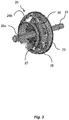
- the gearbox 25 is shown in more detail in figure 2 .
- the single stage reduction gearbox 25 comprises a sun gear 27 coupled to an input shaft in the form of the low pressure shaft 24.
- the sun gear 27 meshes with planet gears 28 which are arranged radially outward of the sun gear 27, and which in turn mesh with an annular ring gear 29 which surround the planet gears 28.
- the planet gears 28 are rotatably mounted to a planet carrier 30, which is in turn mounted for rotation.
- the reduction gearbox 25 is in the form of a planetary gearbox, in which the ring gear 29 is held stationary, while the planet gears 28 and planet carrier 30 rotate in normal use.
- the first output shaft 26a is mounted to the sun gear 27, on an opposite side of the gearbox to the input shaft 24, and so is coupled to the input shaft 24, and thereby is configured to rotate at the same speed and in the same direction as the input shaft 24.
- the second output shaft 26b is mounted for rotation with the planet carrier 30, and is supported by a bearing (not shown) which is in turn mounted to static structure in the form of a forward gearbox mount (not shown).
- the first fan 13a is directly driven by the low pressure turbine, with no reduction or step-up gearing therebetween, whereas a reduction gear is provided in the torque path between the low pressure turbine and second fan 13b.
- FIG. 3 illustrates the direction of rotation where the input shaft 24 rotates clockwise as seen from the front of the fans 13a, 13b.
- each of the input shaft 24 and the first and second output shafts 26a, 26b rotate in a common direction (clockwise in this case).
- the planet carrier 30 and second output shaft 26b rotate at a slower rate than the input shaft 24 and first output shaft 26a.
- the second output shaft 26b rotates at a rate approximately 4 times slower than the input shaft 24 and first output shaft 26a, such that the reduction gearbox 25 can be said to have a 4:1 reduction ratio.
- the reduction gearbox 25 can be said to have a 4:1 reduction ratio.
- the first fan 13a comprises a plurality of blades having a smaller diameter than the second fan 13b, with an outer circumference of the fan having a radial extent substantially equal to a radial extent of an inlet 31 of the engine core casing 21 b.
- the first fan 13a optionally includes an annular shroud 32, which extends around the circumference of the radially outer end of the fan blades. The shroud serves to prevent tip vortices from the fan blades from interfering with the downstream second fan 13b, which would otherwise create turbulence, and so increase second fan noise and reduce second fan efficiency.
- the shroud 32 also serves to increase the pressure ratio across the first fan 13a, by reducing over-tip leakage, and also reducing the radial component of the first fan 13a exit flow. As will be understood, the shroud 32 could optionally be omitted.
- the first fan 13a is mounted to the first output shaft 26a by a fan disc 26a, and also to a central conical hub 33 (also known as a "spinner"). Consequently, each of the spinner 34, first fan 13a and input shaft 24 rotate at the same rate.
- the spinner 34 could include further projections configured to drive the air rearwards, which could act as part of the first fan 13a.
- the second fan 13b has an outer diameter D2 tip which is greater diameter than an outer diameter D1 tip of the first fan 13a, and extends to the fan casing 21a, with a minimal gap being provided therebetween.
- the second fan 13b defines a "hub to tip ratio" defined by the diameter of the hub D hub (calculated by measuring the diameter of the radially inner root of the fan blades of the second fan 13b) by the tip diameter D2 tip (calculated by measuring the diameter of the radially outer tips of the fan blades of the second fan 13b).
- a low hub to tip ratio is desirable, in order to increase the mass flow of the fan 13b.
- the present disclosure solves this problem by providing a first, smaller fan 13a having a higher rotational speed relative to the second fan 13b, provided forward of the second fan 13b. Consequently, a high tip speed can be provided for the first fan 13a (typically, close to, but not exceeding, Mach 1), at a relatively low diameter. This air impinges on the downstream second fan 13b, where is accelerated further (albeit only slightly).
- the first fan 13a may be configured to accelerate air to a higher velocity than that provided by the tip of the second fan 13b.
- the tip speed of the first fan 13a may be supersonic (i.e. greater than Mach 1), while the tip speed of the second fan 13b may be sub-sonic or transonic (i.e. below or close to Mach 1). This is desirable, since it increases fan work, while not resulting in high noise levels, since the high velocity first fan 13a air stream is shielding by the low velocity second fan 13b air stream.
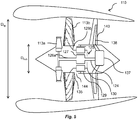
- FIG. 5 shows a second propulsion system 110.
- the propulsion system 110 is similar in many ways to the system 10, with only differences between the two being described in detail.
- the propulsion system 110 comprises first and second fans 113a, 113b driven by a reduction gearbox 125.
- the fans 113a, 113b and gearbox 125 are similar to those of the first embodiment, with the first fan 113a being driven by a first output shaft 126a which is coupled to a sun gear 127 of the gearbox 125, with the second fan 113b being coupled to a second output shaft 126b, which is coupled to a planet carrier 130 of the gearbox 125.
- the gearbox 125 is of a planetary configuration, having a fixed ring gear 129.
- the relative sizes and speeds of the fans 113a, 113b is also similar those of the fans 13a, 13b.
- the gas turbine engine is omitted.
- an electric motor 137 which is coupled to a gearbox input shaft 124, to drive the sun gear 127 of the gearbox 125, to drive both the fans 113a, 113b.
- the electric motor 137 can operate at a high speed in use for a given second fan 113b diameter and fan tip speed. Consequently, the electric motor can be made smaller, and have a high power to weight ratio, and possibly also a higher efficiency. This is because increasing the speed allows for a higher power for a given torque. Since electrical machines are generally sized by torque, lower torque, higher speed machines can generally be made smaller. This in turn results in smaller coils, and so copper losses can be reduced, thereby increasing efficiency.
- the first fan 113a rotates at the same speed as the input shaft 124, and so at the relatively high speed of the electric motor 137. Consequently, a high pressure rise is provided by the first fan 113a in spite of its relatively small diameter.
- the propulsion system 110 also differs from the system 10 in that a motor cooling system is provided.
- the motor cooling system comprises a liquid to air heat exchanger 138 provided within an interior of fan outlet guide vanes 131, which are provided rearward of the second fan 113b. Consequently, efficient cooling is provided, without interrupting the fan airflow.
- the cooling system also comprises an air cooling system comprising a cooling air aperture 144 provided adjacent a root 135 of the second fan 113b.
- the air aperture could be provided adjacent a root of the first fan 113a. Air from the cooling aperture flows over the motor 137 rotor and / or stator (not shown) in use, thereby reducing the temperature of the motor 137, and increasing its efficiency. Due to the high root pressure ratio provided by the fans 113a, 113b compared to conventional direct drive or single stage geared fans, the effectiveness of the cooling air is increased.
- Figure 6 shows a third propulsion system 210.
- the propulsion system is similar to the system 110, but differs in the type of reduction gearbox used.
- the propulsion system 210 again includes first and second fans 213a, 213b driven by a reduction gearbox 225.
- the gearbox 225 is driven by an electric motor 237 via a sun gear 227.
- the gearbox is a "star" gearbox, rather than a planetary gearbox.
- the planet carrier 230 is rotationally fixed to static structure such as a motor housing 221b, whereas the ring gear 229 is mounted for rotation.
- a first output shaft 226a is coupled to the sun gear 227, and so rotates at the same speed as the input shaft 224, similar to the previous embodiments.
- the second output shaft 226b is coupled to the ring gear 229, and so rotates at the rate of the ring gear.
- This different gearbox arrangement has two effects. Firstly, the ring gear 229 and second fan 213b rotate in an opposite direction to the first fan 213a. consequently, swirl produced by the first fan 213a is at least partly cancelled by the second fan 213b, thereby further increasing propulsive efficiency and pressure rise provided by the two fans 213a, 213b in combination. Secondly, for a given gearbox geometry (i.e. sun, planet and ring diameters), a different reduction ratio results. Typically, the reduction ratio is between 2 and 3.
- the star gearbox arrangement of figure 5 could be combined with the gas turbine engine driven arrangement of figures 1 to 4 .
- the cooling aperture of the embodiment of figure 5 could be employed for the gas turbine engine of figures 1 to 3 , to provide case cooling for example.
- the gas turbine engine could be of a different type, for example having different numbers of compressors and / or turbines.
- the compressors could be of a different type (e.g. centrifugal).
- the gearbox reduction ratio could be varied.
- the propulsion system may comprise an electric motor driving one of the input shaft, one or more planet gears, the ring gear or the output shaft to the first propulsor in addition to a gas turbine engine turbine shaft driving the input shaft.
- the open rotor variant could be combined with the other embodiments.
- the open rotor variant could comprise a planetary gearbox, and could comprise a gas turbine engine driving the input shaft.
- the gearbox could be of a "compound” type, in which multiple stages of epicyclic gearboxes are provided.
Landscapes
- Engineering & Computer Science (AREA)
- Mechanical Engineering (AREA)
- Aviation & Aerospace Engineering (AREA)
- Chemical & Material Sciences (AREA)
- Combustion & Propulsion (AREA)
- General Engineering & Computer Science (AREA)
- Retarders (AREA)
- Structures Of Non-Positive Displacement Pumps (AREA)
Applications Claiming Priority (1)
| Application Number | Priority Date | Filing Date | Title |
|---|---|---|---|
| GBGB1814256.2A GB201814256D0 (en) | 2018-09-03 | 2018-09-03 | Aircraft propulsion system |
Publications (1)
| Publication Number | Publication Date |
|---|---|
| EP3628587A1 true EP3628587A1 (fr) | 2020-04-01 |
Family
ID=63921051
Family Applications (1)
| Application Number | Title | Priority Date | Filing Date |
|---|---|---|---|
| EP19189981.4A Withdrawn EP3628587A1 (fr) | 2018-09-03 | 2019-08-05 | Système de propulsion d'avion |
Country Status (3)
| Country | Link |
|---|---|
| US (1) | US20200070988A1 (fr) |
| EP (1) | EP3628587A1 (fr) |
| GB (1) | GB201814256D0 (fr) |
Cited By (1)
| Publication number | Priority date | Publication date | Assignee | Title |
|---|---|---|---|---|
| EP4385889A1 (fr) * | 2022-12-12 | 2024-06-19 | General Electric Company | Propulseur électrique |
Families Citing this family (9)
| Publication number | Priority date | Publication date | Assignee | Title |
|---|---|---|---|---|
| FR3099209B1 (fr) * | 2019-07-26 | 2021-06-25 | Safran Aircraft Engines | Dispositif d’entrainement d’une génératrice d’une turbomachine d’aéronef et procédé de régulation de la vitesse d’une telle génératrice |
| US11286779B2 (en) * | 2020-06-03 | 2022-03-29 | Honeywell International Inc. | Characteristic distribution for rotor blade of booster rotor |
| US12030651B2 (en) * | 2021-01-05 | 2024-07-09 | Pratt & Whitney Canada Corp. | Parallel hybrid power plant with hollow motor |
| US11554866B2 (en) * | 2021-03-11 | 2023-01-17 | Textron Innovations Inc. | Line replaceable centerbody assemblies for ducted propulsion |
| WO2022235145A1 (fr) * | 2021-05-04 | 2022-11-10 | Alibi Akhmejanov | Dispositif aérodynamique |
| CN113682462A (zh) * | 2021-09-18 | 2021-11-23 | 上海交通大学 | 推进装置及其可调进口预旋导叶电驱动涵道风扇推进系统 |
| EP4155193A1 (fr) * | 2021-09-23 | 2023-03-29 | Lilium eAircraft GmbH | Moteur de ventilateur à conduit, réseau de moteurs de ventilateur à conduit et aéronef |
| US20230332546A1 (en) * | 2022-04-15 | 2023-10-19 | Raytheon Technologies Corporation | Gearbox arrangement for close to constant speed accessories |
| US12292004B1 (en) * | 2024-01-12 | 2025-05-06 | Rtx Corporation | Component mounting and drive in a geared turbofan architecture |
Citations (8)
| Publication number | Priority date | Publication date | Assignee | Title |
|---|---|---|---|---|
| US1879142A (en) * | 1930-02-17 | 1932-09-27 | Mathew M Egan | Propeller |
| US3729957A (en) * | 1971-01-08 | 1973-05-01 | Secr Defence | Fan |
| US3861139A (en) * | 1973-02-12 | 1975-01-21 | Gen Electric | Turbofan engine having counterrotating compressor and turbine elements and unique fan disposition |
| DE3834511A1 (de) * | 1987-10-13 | 1990-04-12 | Kastens Karl | Propellergeblaese |
| EP1777369A2 (fr) * | 2005-10-19 | 2007-04-25 | General Electric Company | Ensemble moteur à turbine à gaz et et son procédé d'assemblage |
| US7765786B2 (en) * | 2004-09-03 | 2010-08-03 | Mtu Aero Engines Gmbh | Aircraft engine with separate auxiliary rotor and fan rotor |
| DE102011084360A1 (de) * | 2011-10-12 | 2013-04-18 | Rolls-Royce Deutschland Ltd & Co Kg | Strömungsarbeitsmaschine |
| CN206939096U (zh) * | 2017-06-07 | 2018-01-30 | 深圳光启合众科技有限公司 | 涵道风扇 |
-
2018
- 2018-09-03 GB GBGB1814256.2A patent/GB201814256D0/en not_active Ceased
-
2019
- 2019-08-05 EP EP19189981.4A patent/EP3628587A1/fr not_active Withdrawn
- 2019-08-21 US US16/546,368 patent/US20200070988A1/en not_active Abandoned
Patent Citations (8)
| Publication number | Priority date | Publication date | Assignee | Title |
|---|---|---|---|---|
| US1879142A (en) * | 1930-02-17 | 1932-09-27 | Mathew M Egan | Propeller |
| US3729957A (en) * | 1971-01-08 | 1973-05-01 | Secr Defence | Fan |
| US3861139A (en) * | 1973-02-12 | 1975-01-21 | Gen Electric | Turbofan engine having counterrotating compressor and turbine elements and unique fan disposition |
| DE3834511A1 (de) * | 1987-10-13 | 1990-04-12 | Kastens Karl | Propellergeblaese |
| US7765786B2 (en) * | 2004-09-03 | 2010-08-03 | Mtu Aero Engines Gmbh | Aircraft engine with separate auxiliary rotor and fan rotor |
| EP1777369A2 (fr) * | 2005-10-19 | 2007-04-25 | General Electric Company | Ensemble moteur à turbine à gaz et et son procédé d'assemblage |
| DE102011084360A1 (de) * | 2011-10-12 | 2013-04-18 | Rolls-Royce Deutschland Ltd & Co Kg | Strömungsarbeitsmaschine |
| CN206939096U (zh) * | 2017-06-07 | 2018-01-30 | 深圳光启合众科技有限公司 | 涵道风扇 |
Cited By (1)
| Publication number | Priority date | Publication date | Assignee | Title |
|---|---|---|---|---|
| EP4385889A1 (fr) * | 2022-12-12 | 2024-06-19 | General Electric Company | Propulseur électrique |
Also Published As
| Publication number | Publication date |
|---|---|
| GB201814256D0 (en) | 2018-10-17 |
| US20200070988A1 (en) | 2020-03-05 |
Similar Documents
| Publication | Publication Date | Title |
|---|---|---|
| EP3628587A1 (fr) | Système de propulsion d'avion | |
| US11230942B2 (en) | Gas turbine engine electrical generator | |
| US11313440B2 (en) | Epicyclic gearbox | |
| US10393028B1 (en) | Geared compressor for gas turbine engine | |
| US11364991B2 (en) | Aircraft propulsion system | |
| JP4463810B2 (ja) | 航空機用エンジン装置 | |
| US9890704B2 (en) | Compressor system | |
| US11077953B2 (en) | Electric ducted fan | |
| US10677159B2 (en) | Gas turbine engine including a dual-speed split compressor | |
| US20180080411A1 (en) | Gas turbine engine | |
| US20210164392A1 (en) | Gas turbine engine | |
| CN112739901A (zh) | 包括电源装置的涡轮反应器 | |
| US9869248B2 (en) | Two spool gas generator to create family of gas turbine engines | |
| US20250364872A1 (en) | Electric generator behind fan in turbine engine | |
| CN112739896B (zh) | 具有减速机构的涡轮喷气发动机 | |
| US3462953A (en) | Gas turbine jet propulsion engine | |
| US20240410293A1 (en) | Electric Generator Behind Fan in Turbine Engine | |
| US11828248B1 (en) | Rotatably driven exhaust mixer | |
| EP3617059B1 (fr) | Turbomachine | |
| US20190316525A1 (en) | Accessory gearbox | |
| US20240328363A1 (en) | Power coupling between engine rotating assembly and external device | |
| EP4553309A1 (fr) | Système d'accessoire de moteur à turbine à boîtes de vitesses multiples |
Legal Events
| Date | Code | Title | Description |
|---|---|---|---|
| PUAI | Public reference made under article 153(3) epc to a published international application that has entered the european phase |
Free format text: ORIGINAL CODE: 0009012 |
|
| STAA | Information on the status of an ep patent application or granted ep patent |
Free format text: STATUS: THE APPLICATION HAS BEEN PUBLISHED |
|
| AK | Designated contracting states |
Kind code of ref document: A1 Designated state(s): AL AT BE BG CH CY CZ DE DK EE ES FI FR GB GR HR HU IE IS IT LI LT LU LV MC MK MT NL NO PL PT RO RS SE SI SK SM TR |
|
| AX | Request for extension of the european patent |
Extension state: BA ME |
|
| STAA | Information on the status of an ep patent application or granted ep patent |
Free format text: STATUS: THE APPLICATION IS DEEMED TO BE WITHDRAWN |
|
| 18D | Application deemed to be withdrawn |
Effective date: 20201002 |