EP3628714A1 - Verbesserung der beseitigungsrate von barriereschlamm - Google Patents
Verbesserung der beseitigungsrate von barriereschlamm Download PDFInfo
- Publication number
- EP3628714A1 EP3628714A1 EP19200329.1A EP19200329A EP3628714A1 EP 3628714 A1 EP3628714 A1 EP 3628714A1 EP 19200329 A EP19200329 A EP 19200329A EP 3628714 A1 EP3628714 A1 EP 3628714A1
- Authority
- EP
- European Patent Office
- Prior art keywords
- acid
- salts
- combinations
- group
- derivatives
- Prior art date
- Legal status (The legal status is an assumption and is not a legal conclusion. Google has not performed a legal analysis and makes no representation as to the accuracy of the status listed.)
- Granted
Links
Images



Classifications
-
- C—CHEMISTRY; METALLURGY
- C09—DYES; PAINTS; POLISHES; NATURAL RESINS; ADHESIVES; COMPOSITIONS NOT OTHERWISE PROVIDED FOR; APPLICATIONS OF MATERIALS NOT OTHERWISE PROVIDED FOR
- C09G—POLISHING COMPOSITIONS; SKI WAXES
- C09G1/00—Polishing compositions
-
- C—CHEMISTRY; METALLURGY
- C09—DYES; PAINTS; POLISHES; NATURAL RESINS; ADHESIVES; COMPOSITIONS NOT OTHERWISE PROVIDED FOR; APPLICATIONS OF MATERIALS NOT OTHERWISE PROVIDED FOR
- C09G—POLISHING COMPOSITIONS; SKI WAXES
- C09G1/00—Polishing compositions
- C09G1/02—Polishing compositions containing abrasives or grinding agents
-
- B—PERFORMING OPERATIONS; TRANSPORTING
- B24—GRINDING; POLISHING
- B24B—MACHINES, DEVICES, OR PROCESSES FOR GRINDING OR POLISHING; DRESSING OR CONDITIONING OF ABRADING SURFACES; FEEDING OF GRINDING, POLISHING, OR LAPPING AGENTS
- B24B37/00—Lapping machines or devices; Accessories
- B24B37/005—Control means for lapping machines or devices
-
- B—PERFORMING OPERATIONS; TRANSPORTING
- B24—GRINDING; POLISHING
- B24B—MACHINES, DEVICES, OR PROCESSES FOR GRINDING OR POLISHING; DRESSING OR CONDITIONING OF ABRADING SURFACES; FEEDING OF GRINDING, POLISHING, OR LAPPING AGENTS
- B24B37/00—Lapping machines or devices; Accessories
- B24B37/04—Lapping machines or devices; Accessories designed for working plane surfaces
- B24B37/042—Lapping machines or devices; Accessories designed for working plane surfaces operating processes therefor
- B24B37/044—Lapping machines or devices; Accessories designed for working plane surfaces operating processes therefor characterised by the composition of the lapping agent
-
- B—PERFORMING OPERATIONS; TRANSPORTING
- B24—GRINDING; POLISHING
- B24B—MACHINES, DEVICES, OR PROCESSES FOR GRINDING OR POLISHING; DRESSING OR CONDITIONING OF ABRADING SURFACES; FEEDING OF GRINDING, POLISHING, OR LAPPING AGENTS
- B24B57/00—Devices for feeding, applying, grading or recovering grinding, polishing or lapping agents
- B24B57/02—Devices for feeding, applying, grading or recovering grinding, polishing or lapping agents for feeding of fluid, sprayed, pulverised, or liquefied grinding, polishing or lapping agents
-
- C—CHEMISTRY; METALLURGY
- C09—DYES; PAINTS; POLISHES; NATURAL RESINS; ADHESIVES; COMPOSITIONS NOT OTHERWISE PROVIDED FOR; APPLICATIONS OF MATERIALS NOT OTHERWISE PROVIDED FOR
- C09K—MATERIALS FOR MISCELLANEOUS APPLICATIONS, NOT PROVIDED FOR ELSEWHERE
- C09K3/00—Materials not provided for elsewhere
- C09K3/14—Anti-slip materials; Abrasives
-
- H—ELECTRICITY
- H10—SEMICONDUCTOR DEVICES; ELECTRIC SOLID-STATE DEVICES NOT OTHERWISE PROVIDED FOR
- H10P—GENERIC PROCESSES OR APPARATUS FOR THE MANUFACTURE OR TREATMENT OF DEVICES COVERED BY CLASS H10
- H10P52/00—Grinding, lapping or polishing of wafers, substrates or parts of devices
- H10P52/40—Chemomechanical polishing [CMP]
- H10P52/402—Chemomechanical polishing [CMP] of semiconductor materials
-
- H—ELECTRICITY
- H10—SEMICONDUCTOR DEVICES; ELECTRIC SOLID-STATE DEVICES NOT OTHERWISE PROVIDED FOR
- H10P—GENERIC PROCESSES OR APPARATUS FOR THE MANUFACTURE OR TREATMENT OF DEVICES COVERED BY CLASS H10
- H10P52/00—Grinding, lapping or polishing of wafers, substrates or parts of devices
- H10P52/40—Chemomechanical polishing [CMP]
- H10P52/403—Chemomechanical polishing [CMP] of conductive or resistive materials
-
- H—ELECTRICITY
- H10—SEMICONDUCTOR DEVICES; ELECTRIC SOLID-STATE DEVICES NOT OTHERWISE PROVIDED FOR
- H10W—GENERIC PACKAGES, INTERCONNECTIONS, CONNECTORS OR OTHER CONSTRUCTIONAL DETAILS OF DEVICES COVERED BY CLASS H10
- H10W20/00—Interconnections in chips, wafers or substrates
- H10W20/01—Manufacture or treatment
- H10W20/031—Manufacture or treatment of conductive parts of the interconnections
- H10W20/062—Manufacture or treatment of conductive parts of the interconnections by smoothing of conductive parts, e.g. by planarisation
Definitions
- the present invention relates to barrier chemical mechanical planarization (“CMP") polishing composition (or slurry) used in the production of a semiconductor device, and polishing methods for carrying out chemical mechanical planarization.
- CMP barrier chemical mechanical planarization
- barrier polishing compositions that are suitably used for polishing patterned semiconductor wafers that are composed of multi-type films, for instances, metal layer, a barrier film, and an underlying interlayer dielectric ( ILD ) structure or patterned dielectric layer.
- a barrier layer covers the patterned dielectric layer and a metal layer covers the barrier layer.
- the metal layer has at least sufficient thickness to fill the patterned trenches with metal to form circuit interconnects.
- a barrier typically is a metal, metal alloy or intermetallic compound, examples are Ta or Ti containing film, such as Ta, TaN, Ti, TiN, or TiW, or et al.
- the barrier forms a layer that prevents migration or diffusion between layers within a wafer.
- barriers prevent the diffusion of interconnect metal such as copper or cobalt into an adjacent dielectric.
- Barrier materials must be resistant to corrosion by most acids, and thereby, resist dissolution in a fluid polishing composition for CMP. Furthermore, these barrier materials may exhibit a toughness that resists removal by abrasion abrasive particles in a CMP composition and from fixed abrasive pads.
- the current state of this technology involves the use of a multi-step such as, for example, a two-step process to achieve local and global planarization.
- step one of a typical CMP process a metal layer such as an overburdened copper layer is typically removed, while leaving a smooth planar surface on the wafer with metal-filled lines, vias and trenches that provide circuit interconnects planar to the polished surface.
- Step 1 tends to remove excess interconnect metals, such as copper.
- step two of a typical CMP process frequently referred to as a barrier CMP process, follows to remove the excess metal layers and the barrier layer and other films on the surface of the patterned wafers to achieve both local and global planarization of the surface on the dielectric layer.
- US Patent Application US 7,491,252 B2 discloses a chemical mechanical planarization solution for removing tantalum barrier materials.
- the solution includes nonferrous metal and 0 to 20 complexing agent for the non-ferrous metal, 0.01 to 12 tantalum removal agent selected from the group consisting of formamidine, formamidine salts, formamidine derivatives, guanidine derivatives, guanidine salts and mixtures thereof, 0 to 5 abrasive, 0 to 15 total particles selected from the group consisting of polymeric particles and polymer-coated coated particles and balance water.
- the solution has a tantalum nitride to TEOS selectivity of at least 3 to 1 measured with a microporous polyurethane polishing pad pressure measure normal to wafer less than 20.7 KPa.
- CMP Chemical mechanical planarization
- the present invention provides stable CMP slurries with higher Barrier and ILD removal rates. Described and disclosed herein are barrier CMP compositions, systems and methods for polishing. The compositions disclosed herein provide improved, high barrier film and ILD layer removal rates.
- a barrier chemical mechanical planarization polishing composition comprising:
- the present invention provides a polishing method for chemical mechanical planarization of a semiconductor device comprising at least one surface having at least a barrier layer and a dielectric layer; the method comprising the steps of:
- the present invention provides a system for chemical mechanical planarization, comprising:
- Example of the abrasive includes but is not limited to colloidal silica, alumina, ceria, germania, silica, titania, zirconia, alumina dopes colloidal silica in lattices, organic polymer particles, composite particles of inorganic and organic particles (such as ceria coated silicon particles), surface modified inorganic/organic particles, and combinations thereof.
- the chemical additive includes but is not limited to polyprotic acid and its salt, diprotic acid, its derivatives and their salts; triprotic acid, its derivatives and their salts; and combinations thereof.
- a polyprotic acid is an acid that can donate more than one proton or hydrogen atom per molecule to an aqueous solution during dissociation.
- a diprotic acid is an acid that can donate two proton or hydrogen atoms
- a triprotic acid is an acid that can donate three proton or hydrogen atoms.
- a diprotic acid and a triprotic acid are polyprotic acids.
- the chemical additive comprises at least one polyprotic acid or its salt that has more than one Pka and has its Pka1 is, but not limited to, 0 to 12, 0.5 to 10, 1 to 7, or 1 to 3.
- Pka1 is the negative logs of the acidity constant for the first stage in which a polyprotic acid loses a proton or hydrogen atom.
- the Pka is as measured at 20°C.
- examples of the chemical additive includes but is not limited to the group selected from the group consisting of phosphonoacetic acid, its derivatives and their salts; phosphonic acid, its derivatives and their salts; phenylphosphonic acid, its derivatives and their salts; molybdenum diacid, its derivatives and their salts; oxalic acid, its derivatives and their salts; sulfurous acid, its derivative and their salts; arsenic acid, its derivatives and their salts; nitrobenzoic acid , its derivative and their salts; malonic acid, its derivative and their salts; tartaric acid, its derivative and their salts; phthalic acid , its derivative and their salts; silicic acid, its derivative and their salts; carbonic acid, its derivative and their salts; and combinations thereof.
- the chemical additive is used in an amount ⁇ 5 wt.% , preferably ranging from about 0.001 wt.% to about 10 wt.%; from about 0.01 wt.% to about 5 wt.%; from about 0.025 wt.% to about 4 wt.%, from about 0.025 wt.% to about 3 wt.%, or from about 0.05 wt.% to about 1 wt.%.
- all references to the wt.% of a component of a composition indicate the weight percent of that component by total weight of the composition.
- Example of the water-soluble solvent includes but is not limited to DI water, a polar solvent and a mixture of DI water and polar solvent.
- the polar solvent can be any alcohol, ether, ketone, or other polar reagent.
- Examples of polar solvents include alcohols, such as isopropyl alcohol, ethers, such as tetrahydrofuran and diethyl ether, and ketones, such as acetone.
- Example of the corrosion inhibitor includes but is not limited to benzotriazole or benzotriazole derivatives, 3-amino-1, 2, 4-triazole, 3, 5-diamine-1, 2, 4-triazole, and combinations thereof.
- the corrosion inhibitor is present in an amount ranging from 0.001 wt.% to 1.0 wt.%; 0.0025 wt.% to 0.75 wt.%; 0.005 wt.% to 0.5 wt.%; 0.0075 wt.% to 0.25 wt.%; or 0.01 wt.% to 0.1 wt.%.
- Example of the surfactant includes but is not limited to a). non-ionic surface wetting agents; b). anionic surface wetting agents; c). cationic surface wetting agents; d). ampholytic surface wetting agents; and combinations thereof.
- the surfactant is present in an amount ranging from about 0.0 wt.% to about 10 wt.%; 0.0005 wt.% to about 5 wt.%; 0.001 wt.% to about 1.0 wt.%; or 0.005 to 0.25 wt. %.
- surfactants include, but are not limited to, dodecyl sulfate sodium salt, sodium lauryl sulfate, dodecyl sulfate ammonium salt, secondary alkane sulfonates, alcohol ethoxylate, acetylenic surfactant, and any combination thereof.
- Example of the pH adjusting agent includes but is not limited to (a) nitric acid, sulfuric acid, tartaric acid, succinic acid, citric acid, malic acid, malonic acid, various fatty acids, various polycarboxylic acids and combinations thereof to lower pH of the polishing composition; and (b) potassium hydroxide, sodium hydroxide, ammonia, tetraethylammonium hydroxide, ethylenediamine, piperazine, polyethyleneimine, modified polyethyleneimine, and combinations thereof to raise pH of the polishing composition.
- the pH adjusting agent is present in an amount ranging from about 0 wt.% to 3 wt.%; preferably 0.001 wt.% to 1 wt.%; more preferably 0.01 wt.% to 0.5 wt.% pH adjusting agent.
- the polishing composition has a pH from 2 to 12, 3 to 12, 4 to 12, 6 to 11, or 7 to 11.
- Example of the second rate booster agent includes but is not limited to an organic acid or its salt; inorganic salt.
- the molar conductivities in aqueous solutions at 25°C of the second rate booster agent is preferably ⁇ 75 S•cm 2 /mol.
- the second rate booster agent is present in an amount ranging from about 0.0 wt.% to about 10 wt.%; about 0.001 wt.% to about 7 wt.%; about 0.05 wt. % to about 5 wt.%; preferably from about 0.01 wt.% to about 3 wt.%.
- Example of the second rate booster agent includes but is not limited to nitrate salt (potassium, sodium, ammonium, lithium, piperidinium, their derivatives), nitric salt (potassium, sodium, ammonium, lithium, piperidinium, their derivatives), chloride salt (potassium, sodium, ammonium, lithium, piperidinium, their derivatives), acetate salt (potassium, sodium, ammonium, lithium, piperidinium, their derivatives), and combinations thereof
- Example of the oxidizing agent includes but is not limited to hydrogen peroxide, periodic acid, potassium iodate, potassium permanganate, ammonium persulfate, ammonium molybdate, ferric nitrate, nitric acid, potassium nitrate, ammonia, amine compounds, and combinations thereof.
- the oxidizing agent is present in an amount ranging from about 0.0 wt.% to about 10 wt.%; 0.01 wt. % to 7 wt.%; 0.05 wt. % to 5 wt.%; or from about 0.1 wt.% to about 2 wt.%.
- Suitable chelator includes but is not limited to organic acids and their salts; polymeric acids and their salts; water-soluble copolymers and their salts; copolymers and their salts containing at least two different types of acid groups selected from carboxylic acid groups; sulfonic acid groups; phosphoric acids; and pyridine acids in the same molecule of a copolymer; polyvinyl acids and their salts; polyethylene oxide; polypropylene oxide; pyridine, pyridine derivatives, bipyridine, bipyridine derivatives, and combinations thereof.
- Example of the chelator includes but is not limited to potassium citrate, benzosulfonic acid, 4-tolyl sulfonic acid, 2,4-diamino-benzosulfonic acid, and malonic acid, itaconic acid, malic acid, tartaric acid, citric acid, oxalic acid, gluconic acid, lactic acid, mandelic acid, amino acids, polycarboxy amino acids, phosphonic acids, salts thereof, and combinations thereof.
- the chelator is used in an amount ranging from about 0.0 wt.% to about 10 wt.%; from about 0.01 wt.% to about 10 wt.%; from about 0.05 wt.% to about 5 wt.%; or preferably 0.01 wt. % to 1.0 wt.%.
- Described herein are stable CMP slurries polishing a semiconductor substrate or device having a conductive metal layer, an underlying barrier film, and a dielectric layer having imbedded metal interconnect structures.
- the present invention provides stable CMP slurries with higher Barrier and ILD removal rates. Described and disclosed herein are barrier CMP compositions, systems and methods for polishing. The compositions disclosed herein boost the barrier film ad ILD removal rates.
- the conductive metal layer comprises such as Cu, CuMn, Co, CoMo, Al, AICo, Ru, RuTa, RuTiN, Mn, and combinations thereof.
- the barrier or liner layer comprises tantalum or titanium containing films selected from the group consisting of Ta, TaN, Ti, TiN, TiW or TiWN, and combinations thereof.
- the underlying interlayer dielectric (ILD) layer comprises silicon dioxide film such as SiO2, TEOS; low-K dielectric material; and combinations thereof.
- the barrier chemical mechanical planarization polishing composition comprises:
- the polishing compositions of the present invention comprise an abrasive.
- Suitable abrasives for polishing compositions are nano-sized particles include, but are not limited to, nano-sized colloidal silica or high purity colloidal silica particles; nano-sized inorganic metal oxide particles, such as alumina, titania, zirconia, ceria, and combinations thereof; nano-sized diamond particles; nano-sized silicon nitride particles; mono-modal, bi-modal, or multi-modal colloidal abrasive particles; organic polymer-based soft abrasives; surface-coated or modified abrasives; and combinations thereof.
- the surface-coated or modified abrasives include but are not limited to the colloidal silica particles doped by other metal oxide within lattice of the colloidal silica, such as alumina doped silica particles, colloidal aluminum oxide, which include alpha-, beta-, and gamma-types of aluminum oxides, colloidal and photoactive titanium dioxide, cerium oxide, colloidal cerium oxide, nano-sized diamond particles, nano-sized silicon nitride particles, mono-modal, bi-modal, multi-modal colloidal abrasive particles, zirconium oxide, organic polymer-based soft abrasives, surface-coated or modified abrasives, and mixtures thereof.
- colloidal silica particles doped by other metal oxide within lattice of the colloidal silica such as alumina doped silica particles, colloidal aluminum oxide, which include alpha-, beta-, and gamma-types of aluminum oxides, colloidal and photoactive titanium dioxide, cerium oxide, colloidal cerium
- the nano-sized particles have narrow or broad particle size distributions, various sizes and various shapes.
- the various shapes of the abrasives include spherical shape, cocoon shape, aggregate shape and other shapes.
- the abrasive particles may be purified using a suitable method such as ion exchange to remove metal impurities that may help improve the colloidal stability.
- a suitable method such as ion exchange to remove metal impurities that may help improve the colloidal stability.
- high purity silica abrasive particles that are manufactured from precursors other than metal silicates can be used.
- Preferred abrasives include, but are not limited to, high purity colloidal silica, alumina, ceria, germania, silica, titania, zirconia, alumina dopes colloidal silica in lattices, and mixtures thereof. Colloidal silica is a most preferred abrasive particle.
- the silica can be any of precipitated silica, fumed silica, silica fumed, pyrogenic silica, silica doped with one or more adjutants, or any other silica-based compound.
- the silica can be produced, for example, by a process selected from the group consisting of a sol-gel process, a hydrothermal process, a plasma process, a fuming process, a precipitation process, and any combination thereof.
- the mean particle size of the abrasive as measured by Disc Centrifuge (DC) particle sizing method is between 10 nm and 300 nm, or more preferably between 15 nm and 200 nm, and even more preferably between 25 nm and 90 nm.
- abrasive particles may be used either alone or in combination with one another. Two or more abrasive particles with different sizes may also be combined to obtain excellent performance.
- the abrasive is present in the compositions of the present invention in an amount ranging from ⁇ 1.5wt.%, ⁇ 2.4wt.%, ⁇ 5.0 wt.%, ⁇ 10.wt.% relative to the total weight of the CMP composition.
- Example of the water-soluble solvent includes but is not limited to DI water, a polar solvent and a mixture of DI water and polar solvent.
- the polar solvent can be any alcohol, ether, ketone, or other polar reagent.
- Examples of polar solvents include alcohols, such as isopropyl alcohol, ethers, such as tetrahydrofuran and diethyl ether, and ketones, such as acetone.
- the chemical additive includes but is not limited to diprotic acid, its derivatives and their salts; triprotic acid, its derivatives and their salts; polyprotic acid and its salt, and combinations thereof.
- the chemical additive has PKa1 from 0 to 12, 0.5 to 10, 1 to 7, or 1 to 3.
- the chemical additives are used as the first rate booster.
- examples of the chemical additive includes but is not limited to the group selected from the group consisting of phosphonoacetic acid, its derivatives and their salts; phosphonic acid, its derivatives and their salts; phenylphosphonic acid, its derivatives and their salts; molybdenum diacid, its derivatives and their salts; oxalic acid, its derivatives and their salts; sulfurous acid, its derivative and their salts; arsenic acid, its derivatives and their salts; nitrobenzoic acid , its derivative and their salts; malonic acid, its derivative and their salts; tartaric acid, its derivative and their salts; phthalic acid, its derivative and their salts; silicic acid, its derivative and their salts; carbonic acid, its derivative and their salts; and combinations thereof.
- Examples include potassium sulfite, malonic acid, potassium silicate, potassium molybdate, phosphonoacetic acid, potassium oxalate monohydrate, phenylphosphonic acid, L-tartaric
- the chemical additive is used in an amount ranging from about 0.001 wt.% to about 10 wt.%; preferably from about 0.01 wt.% to about 5 wt.%; from about 0.025 wt.% to about 4 wt.%, or from about 0.05 wt.% to about 1 wt. %.
- a surfactant is used in the barrier CMP slurry as surface wetting agent; suitable surfactant compounds that may be added to the barrier CMP slurry as surface wetting agent include, any of the numerous nonionic, anionic, cationic or amphoteric surfactants known to those skilled in the arts.
- suitable surfactant compounds that may be added to the barrier CMP slurry as surface wetting agent include, any of the numerous nonionic, anionic, cationic or amphoteric surfactants known to those skilled in the arts.
- One example of the nonionic surfactant is tricosaethylene glycol dodecyl ether.
- surfactants also include, but are not limited to, dodecyl sulfate sodium salt, sodium lauryl sulfate, dodecyl sulfate ammonium salt, secondary alkane sulfonates, alcohol ethoxylate, acetylenic surfactant, and any combination thereof.
- Suitable commercially available surfactants include TRITONTM, TergitolTM, DOWFAXTM family of surfactants manufactured by Dow Chemicals and various surfactants in SURFYNOLTM, DYNOLTM, ZetasperseTM, NonidetTM, and TomadolTM surfactant families, manufactured by Air Products and Chemicals.
- Suitable surfactants of surfactants may also include polymers comprising ethylene oxide (EO) and propylene oxide (PO) groups.
- EO-PO polymer is TetronicTM 90R4 from BASF Chemicals.
- the amount of surfactant typically ranges from 0.0001 wt. % to about 1.0 wt. % relative to the total weight of the barrier CMP composition. When employed, the range is 0.0 wt.% to about 10 wt.%; 0.0005 wt.% to about 5 wt.%; 0.001 wt.% to about 1wt.%; or 0.005 to 0.25 wt. %.
- Example of the corrosion inhibitor includes but is not limited to benzotriazole or benzotriazole derivatives, 3-amino-1, 2, 4-triazole, 3, 5-diamine-1, 2, 4-triazole, and combinations thereof.
- the corrosion inhibitor is used in an amount ranging from 0.001 wt.% to 1.0 wt.%; 0.0025 wt.% to 0.75 wt.%; 0.005 wt.% to 0.5 wt.%; 0.0075 wt.% to 0.25 wt.%; or 0.01 wt.% to 0.1 wt.%.
- Example of the pH adjusting agent includes but is not limited to (a) nitric acid, sulfuric acid, tartaric acid, succinic acid, citric acid, malic acid, malonic acid, various fatty acids, various polycarboxylic acids and combinations thereof to lower pH of the polishing composition; and (b) potassium hydroxide, sodium hydroxide, ammonia, tetraethylammonium hydroxide, ethylenediamine, piperazine, polyethyleneimine, modified polyethyleneimine, and combinations thereof to raise pH of the polishing composition.
- the pH adjusting agent is used in an amount ranging from about 0.0001 wt.% to about 3 wt.%;.
- the polishing composition has a pH from about 2 to 12, 3 to 12, 4 to 12, 6 to 11, or 7 to 11.
- Example of the second rate booster agent includes but is not limited to an organic acid or its salt; and inorganic salt.
- the molar conductivities in aqueous solutions at 25°C of the second rate booster agent is ⁇ 75 S•cm 2 /mol.
- the second rate booster agent is present in an amount ranging from about 0.0 wt.% to about 10 wt.%; about 0.001 wt.% to about 7 wt.%; about 0.005 wt.% to about 5 wt.%, or from about 0.01 wt.% to about 3 wt.%.
- Example of the second rate booster agent includes but is not limited to nitrate salt (potassium, sodium, ammonium, lithium, piperidinium, their derivatives), nitric salt (potassium, sodium, ammonium, lithium, piperidinium, their derivatives), chloride salt (potassium, sodium, ammonium, lithium, piperidinium, their derivatives), acetate salt (potassium, sodium, ammonium, lithium, piperidinium, their derivatives), and combinationsthereof.
- Preferred examples include potassium acetate and potassium nitrate.
- Example of the oxidizing agent includes but is not limited to hydrogen peroxide, periodic acid, potassium iodate, potassium permanganate, ammonium persulfate, ammonium molybdate, ferric nitrate, nitric acid, potassium nitrate, ammonia, amine compounds, and combinations thereof.
- the oxidizing agent is used in an amount ranging from about 0.0 wt.% to about 10 wt.%; 0.01 wt. % to 7 wt.%; 0.05 wt. % to 5 wt.%; or from about 0. 1 wt.% to about 2 wt.%.
- Suitable chelator includes but is not limited to organic acids and their salts; polymeric acids and their salts; water-soluble copolymers and their salts; copolymers and their salts containing at least two different types of acid groups selected from carboxylic acid groups; sulfonic acid groups; phosphoric acids; and pyridine acids in the same molecule of a copolymer; polyvinyl acids and their salts; polyethylene oxide; polypropylene oxide; pyridine, pyridine derivatives, bipyridine, bipyridine derivatives, and combinations thereof.
- Example of the chelator is selected from the group consisting of potassium citrate, benzosulfonic acid, 4-tolyl sulfonic acid, 2,4-diamino-benzosulfonic acid, and malonic acid, itaconic acid, malic acid, tartaric acid, citric acid, oxalic acid, gluconic acid, lactic acid, mandelic acid, amino acids, polycarboxy amino acids, phosphonic acids and combinations thereof and salts thereof.
- the chelator is used in an amount ranging from about 0.0 wt.% to about 10 wt.%; preferably from about 0.05wt.% to about 5 wt.%; and more preferably 0.01 wt. % to 1.0 wt.%.
- the present invention also provides a polishing method for chemical mechanical planarization of a semiconductor device comprising at least one surface having at least a barrier layer and a dielectric layer; the method comprising the steps of:
- the present invention further provides a system for chemical mechanical planarization, comprising:
- the present invention includes the following Aspects 1 to 24:
- the CMP tool that was used in the examples is a Mirra®, manufactured by Applied Materials, 3050 Boweres Avenue, Santa Clara, California, 95054. Polishing was performed on VP3500 polisher pad from Dow Chemicals. Polishing was performed at 1.1 psi down force and 93 RPM table speed with 200 ml/min composition flow rates. Polishing experiments were conducted using electroplating deposited copper, plasma enhanced deposition of tetraethoxy silane (TEOS) dielectric, Tantalum (Ta) and Tantalum Nitride (TaN) films. These blanket wafers were purchased from Silicon Valley Microelectronics, 1150 Campbell Ave, CA, 95126, and Advantiv Corporation. Defects on the wafer films were measured using Surfscan SP2 wafer inspection tool, manufactured by KLA-Tencor, One Technology Drive, Milpitas, CA95035.
- TEOS tetraethoxy silane
- Ta Tantalum
- TaN Tantalum Nitride
- Silicon particle about 60 nm (measured by light scattering) purchased from Fuso Chemical Co. LTD, Japan.
- the chemical constituents used for the slurry were shown in Table 1. DI Water was added to make the composition 100 wt. %.
- the slurries were prepared by adding each chemical constituent shown in Table I continuously at room temperature with a short break (several minutes) apart from each component.
- the slurries were used for polishing after 1 wt. % hydrogen peroxide was added to the slurries as an oxidizing agent.
- Polishing results for TaN, Ta and TEOS were shown in Figure 1 .
- Malonic acid is a polyprotic acid (diprotic) with PKa1 of 2.8 at 20°C.
- Potassium nitrate is a second rate booster in which K + has molar ionic conductivity in aqueous solution at 25°C of 73.5 S•cm 2 /mol and NO3 - has molar ionic conductivity in aqueous solution at 25°C of 71.46 S•cm 2 /mol.
- Example 1 demonstrated that the addition of a polyprotic acid with PKa1 between 1 and 3 can boost both barrier and ILD removal rates
- the chemical constituents used for the slurry were shown in Table 1. DI Water was added to make the composition 100 wt. %.
- the slurries were prepared by adding each chemical constituent shown in Table I continuously at room temperature with a short break (several minutes) apart from each component.
- the slurries were used for polishing after 1 wt. % hydrogen peroxide was added to the slurries as an oxidizing agent.
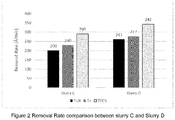
- Polishing results for TaN, Ta and TEOS were shown in Figure 2 .
- Potassium sulfite is a salt of sulfurous acid (diprotic acid) with PKa1 of 1.85 at 20°C.
- Potassium acetate is a second rate booster in which K + has molar ionic conductivity in aqueous solution at 25°C of 73.5 S•cm 2 /mol and acetate ion has molar ionic conductivity in aqueous solution at 25°C of 40.9 S•cm 2 /mol.
- Example 2 demonstrated that the addition of a salt of polyprotic acid with PKa1 between 1 and 3 can boost both barrier and ILD removal rates.
- the slurries were prepared by adding each chemical constituent shown in Table 3 continuously at room temperature with a short break (several minutes) apart from each component.
- the slurries were used for polishing after 1 wt. % hydrogen peroxide was added to the slurries as an oxidizing agent.
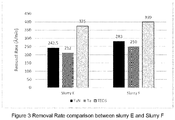
- Polishing results for TaN, Ta and TEOS were shown in Figure 3 .
- both barrier (Ta and TaN) and ILD (TEOS) removal rates were boosted with the addition of both potassium molybdate and potassium silicate.
- Potassium molybdate is the salt of molybdenum diacid, and molybdenum diacid is a diprotic acid with PKa1 at 20°C of 2.9.
- Potassium silicate is the salt of silicic acid, and silicic acid is a polyprotic acid with PKa1 at 20°C of 6-10.
- Example 3 demonstrated that the addition of both a salt of polyprotic acid with PKa1between 1 and 3 and a salt of polyprotic acid with PKa1 between 0.5 to 10 can boost both barrier and ILD removal rates.
- the PH of the slurry is 7.5-8.5.
- Table 4 Composition Slurry G Slurry H DI water Solvent 82.14 81.84 Phosphonoacetic acid Chemical additive 0.30 Potassium hydroxide pH adjusting agent 0.17 0.17 Potassium nitrate Second rate booster 0.6 0.6 Silica Particle Abrasive 17 17 benzotriazole Inhibitor 0.0600 0.0600 Surfactant (Dynol 607) Surfactant 0.03 0.03
- the slurry was prepared with a normal slurry preparation process, that is, by adding each chemical constituent shown in Table 4continuously at room temperature with a short break (several minutes) apart from each component.
- both barrier (Ta and TaN) and ILD (TEOS) removal rate was boosted with addition of phosphonoacetic acid as rate booster slurry component.
- Phosphonoacetic acid is a triprotic acid with PKa1 at 20°C of 1.64.
- Potassium nitrate is a rate booster in which K + has molar ionic conductivity in aqueous solution at 25°C of 73.5 S•cm 2 /mol and NO3 - has molar ionic conductivity in aqueous solution at 25°C of 71.46 S•cm 2 /mol.
- Example 4 demonstrated that addition of a polyprotic acid with PKa1 between 1 and 3 can booster both barrier and ILD removal rate.
- the PH of the slurry is 10-11.
- Table 6 Composition Slurry I Slurry J DI water Solvent 85.02 81.82 Potassium oxalate monohydrate Chemical additive 0.50 Potassium Silicate Chemical additive 0 2.7 Silica Particle Abrasive 14.9 14.9 benzotriazole Inhibitor 0.0500 0.0500 Surfactant (Dynol 607) Surfactant 0.03 0.03
- the slurry was prepared with a normal slurry preparation process, that is, by adding each chemical constituent shown in Table 6 continuously at room temperature with a short break (several minutes) apart from each component.
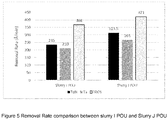
- both barrier (Ta and TaN) and ILD (TEOS) removal rates were boosted with the addition of both potassium oxalate and potassium silicate.
- Potassium oxalate monohydrate is a salt of diprotic acid with PKa1 at 20°C of 1.23.
- Potassium silicate is the salt of silicic acid, and silicic acid is a polyprotic acid with PKa1 at 20°C of 6-10.
- Example 5 demonstrated that the addition of both a salt of polyprotic acid with PKa1between 1 and 3 and a salt of polyprotic acid with PKa1 between 0.5 to 10 can boost both barrier and ILD removal rates.
- the PH of the slurry is 9-11.
- Table 8 Composition Slurry E Slurry K DI water Solvent 94.97 93.87 Phosphonacetic acid Chemical additive 0.10 Potassium Silicate Chemical additive 0 1 Silica Particle Abrasive 5 5 benzotriazole Inhibitor 0.0200 0.0200 Surfactant (Dynol 607) Surfactant 0.01 0.01
- the slurry was prepared with a normal slurry preparation process, that is, by adding each chemical constituent shown in Table 8 continuously at room temperature with a short break (several minutes) apart from each component.
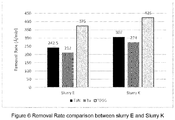
- both barrier (Ta and TaN) and ILD (TEOS) removal rates were boosted with the addition of both phosphonacetic and potassium silicate.
- Phosphonacetic acid is a diprotic acid with PKa1 at 20°C of 1.64.
- Potassium silicate is the salt of silicic acid, and silicic acid is a polyprotic acid with PKa1 at 20°C of 6-10.
- Example 6 demonstrated that the addition of both a salt of polyprotic acid with PKa1 between 1 and 3 and a salt of polyprotic acid with PKa1 between 0.5 to 10 can boost both barrier and ILD removal rates.
- the PH of the slurry is 7-11.
- Table 9 Composition Slurry I Slurry L DI water Solvent 85.02 81.92 Phenylphosphonic acid Chemical additive 0.40 Potassium Silicate Chemical additive 0 2.7 Silica Particle Abrasive 14.9 14.9 benzotriazole Inhibitor 0.0500 0.0500 Surfactant (Dynol 607) Surfactant 0.03 0.03
- the slurry was prepared with a normal slurry preparation process, that is, by adding each chemical constituent shown in Table 9 continuously at room temperature with a short break (several minutes) apart from each component.
- the slurries at point of use (POU) for polishing were slurries G and H after diluting with DI water and adding 1 wt.% hydrogen peroxide as an oxidizing agent, as shown in Table 7.
- Table 10 Slurry I POU Slurry L POU DI water 66 66 Slurry I 33 Slurry L 33 hydrogen peroxide 1 1
- Phenylphosphonic acid is a diprotic acid with PKa1 at 20°C of 1.63.
- Potassium silicate is the salt of silicic acid, and silicic acid is a polyprotic acid with PKa1 at 20°C of 6-10.
- Example 7 demonstrated that the addition of both a salt of polyprotic acid with PKa1 between 1 and 3 and a salt of polyprotic acid with PKa1 between 0.5 to 10 can boost both barrier and ILD removal rates.
- the chemical constituents used for the slurry were shown in Table 11. DI Water was added to make the composition 100 wt. %.
- the PH of the slurry is 7-11.
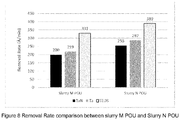
- Table 11 Composition Slurry M Slurry N DI water Solvent 84.82 83.02 L-tartaric acid Chemical additive 0.3 Potassium hydroxide PH adjusting agent 0.2 0.2 Potassium carbonate Chemical additive 1.5 Silica Particle Abrasive 14.9 14.9 benzotriazole Inhibitor 0.05 0.05 Surfactant (Dynol 607) Surfactant 0.03 0.03
- the slurry was prepared with a normal slurry preparation process, that is, by adding each chemical constituent shown in Table 11 continuously at room temperature with a short break (several minutes) apart from each component.
- the slurries at point of use (POU) for polishing were slurries G and H after diluting with DI water and adding 1 wt.% hydrogen peroxide as an oxidizing agent, as shown in Table 7.
- Table 12 Slurry M POU Slurry N POU DI water 66 66 Slurry M 33 Slurry N 33 hydrogen peroxide 1 1
- L-tartaric acid is a polyprotic acid with PKa1 at 20°C of 2.82.
- Potassium carbonate is a salt of diprotic acid with PKa1 at 20°C of 6.3.
- Example 8 demonstrated that the addition of both a salt of polyprotic acid with PKa1 between 1 and 3 and a salt of polyprotic acid with PKa1 between 1 to 7 can boost both barrier and ILD removal rates.
- barrier layer slurry using chemical additive comprising diprotic acid, its derivatives and their salts; triprotic acid, its derivatives and their salts; and combinations thereof boosts barrier and ILD removal rates.
Landscapes
- Chemical & Material Sciences (AREA)
- Organic Chemistry (AREA)
- Engineering & Computer Science (AREA)
- Mechanical Engineering (AREA)
- Materials Engineering (AREA)
- Mechanical Treatment Of Semiconductor (AREA)
- Finish Polishing, Edge Sharpening, And Grinding By Specific Grinding Devices (AREA)
- Separation Using Semi-Permeable Membranes (AREA)
- Treatment Of Sludge (AREA)
Applications Claiming Priority (2)
| Application Number | Priority Date | Filing Date | Title |
|---|---|---|---|
| US201862738427P | 2018-09-28 | 2018-09-28 | |
| US16/577,580 US20200102476A1 (en) | 2018-09-28 | 2019-09-20 | Barrier Slurry Removal Rate Improvement |
Publications (2)
| Publication Number | Publication Date |
|---|---|
| EP3628714A1 true EP3628714A1 (de) | 2020-04-01 |
| EP3628714B1 EP3628714B1 (de) | 2022-06-15 |
Family
ID=68084726
Family Applications (1)
| Application Number | Title | Priority Date | Filing Date |
|---|---|---|---|
| EP19200329.1A Active EP3628714B1 (de) | 2018-09-28 | 2019-09-30 | Verbesserung der beseitigungsrate von barriereschlamm |
Country Status (7)
| Country | Link |
|---|---|
| US (1) | US20200102476A1 (de) |
| EP (1) | EP3628714B1 (de) |
| JP (1) | JP7048550B2 (de) |
| KR (1) | KR102406821B1 (de) |
| CN (1) | CN111087929A (de) |
| SG (1) | SG10201908976QA (de) |
| TW (1) | TWI796520B (de) |
Cited By (5)
| Publication number | Priority date | Publication date | Assignee | Title |
|---|---|---|---|---|
| WO2021135805A1 (zh) * | 2019-12-31 | 2021-07-08 | 安集微电子(上海)有限公司 | 一种化学机械抛光液及其在铜抛光中的应用 |
| US20210301405A1 (en) * | 2020-03-25 | 2021-09-30 | Versum Materials Us, Llc | Barrier Chemical Mechanical Planarization Slurries For Cobalt Films |
| CN114686113A (zh) * | 2020-12-30 | 2022-07-01 | 安集微电子科技(上海)股份有限公司 | 一种化学机械抛光液及其使用方法 |
| EP4067449A1 (de) * | 2021-04-02 | 2022-10-05 | SKC Solmics Co., Ltd. | Polierzusammensetzung für einen halbleiterprozess und verfahren zur herstellung eines halbleiterbauelements damit |
| EP4103662A4 (de) * | 2020-02-13 | 2023-08-16 | FUJIFILM Electronic Materials U.S.A, Inc. | Polierzusammensetzungen und verfahren zur verwendung davon |
Families Citing this family (7)
| Publication number | Priority date | Publication date | Assignee | Title |
|---|---|---|---|---|
| US11802220B2 (en) | 2020-09-18 | 2023-10-31 | Cmc Materials, Inc. | Silica-based slurry for selective polishing of carbon-based films |
| KR102774598B1 (ko) * | 2021-04-02 | 2025-03-04 | 에스케이엔펄스 주식회사 | 반도체 공정용 연마 조성물 및 연마 조성물을 적용한 반도체 소자의 제조 방법 |
| US20240352279A1 (en) * | 2021-07-23 | 2024-10-24 | Versum Materials Us, Llc | Pad-in-a-bottle (pib) technology for copper barrier slurries |
| JP7727510B2 (ja) * | 2021-12-02 | 2025-08-21 | 花王株式会社 | 酸化珪素膜用研磨液組成物 |
| CN115386302B (zh) * | 2022-08-23 | 2023-06-02 | 常州时创能源股份有限公司 | 一种硅片背抛光用添加剂及其应用 |
| KR20240045086A (ko) * | 2022-09-29 | 2024-04-05 | 가부시키가이샤 후지미인코퍼레이티드 | 표면 처리 조성물, 표면 처리 방법, 및 반도체 기판의 제조 방법 |
| US20250368859A1 (en) * | 2024-05-29 | 2025-12-04 | Entegris, Inc. | Silica-based slurry for selective polishing of carbon-based films |
Citations (5)
| Publication number | Priority date | Publication date | Assignee | Title |
|---|---|---|---|---|
| US20050211953A1 (en) * | 2003-07-30 | 2005-09-29 | Jha Sunil C | Polishing slurries and methods for chemical mechanical polishing |
| WO2006133249A2 (en) * | 2005-06-06 | 2006-12-14 | Advanced Technology Materials, Inc. | Integrated chemical mechanical polishing composition and process for single platen processing |
| EP1936674A2 (de) * | 2006-12-21 | 2008-06-25 | DuPont AirProducts NanoMaterials Limited Liability | Verfahren und Aufschlämmung für die Abstimmung von Entfernungsraten von Materialen mit niedriger Konstante im Vergleich zum Kupfer beim chemisch-mechanischen Polieren |
| US7491252B2 (en) | 2002-03-25 | 2009-02-17 | Rohm And Haas Electronic Materials Cmp Holdings, Inc. | Tantalum barrier removal solution |
| EP3153558A1 (de) * | 2015-09-25 | 2017-04-12 | Air Products And Chemicals, Inc. | Chemisch-mechanische polierzusammensetzung |
Family Cites Families (10)
| Publication number | Priority date | Publication date | Assignee | Title |
|---|---|---|---|---|
| AU6537000A (en) | 1999-08-13 | 2001-03-13 | Cabot Microelectronics Corporation | Polishing system with stopping compound and method of its use |
| DE60322695D1 (de) | 2002-04-30 | 2008-09-18 | Hitachi Chemical Co Ltd | Polierfluid und polierverfahren |
| CN101153205A (zh) * | 2006-09-29 | 2008-04-02 | 安集微电子(上海)有限公司 | 用于抛光低介电材料的化学机械抛光液 |
| JP2009094430A (ja) | 2007-10-12 | 2009-04-30 | Adeka Corp | Cmp用研磨組成物 |
| JP5371416B2 (ja) * | 2008-12-25 | 2013-12-18 | 富士フイルム株式会社 | 研磨液及び研磨方法 |
| US9735030B2 (en) | 2014-09-05 | 2017-08-15 | Fujifilm Planar Solutions, LLC | Polishing compositions and methods for polishing cobalt films |
| US10570313B2 (en) * | 2015-02-12 | 2020-02-25 | Versum Materials Us, Llc | Dishing reducing in tungsten chemical mechanical polishing |
| JP6797811B2 (ja) * | 2015-09-30 | 2020-12-09 | 株式会社フジミインコーポレーテッド | 研磨方法 |
| KR20190017815A (ko) | 2016-06-09 | 2019-02-20 | 히타치가세이가부시끼가이샤 | Cmp용 연마액 및 연마 방법 |
| US10253216B2 (en) * | 2016-07-01 | 2019-04-09 | Versum Materials Us, Llc | Additives for barrier chemical mechanical planarization |
-
2019
- 2019-09-20 US US16/577,580 patent/US20200102476A1/en active Pending
- 2019-09-24 TW TW108134378A patent/TWI796520B/zh active
- 2019-09-26 SG SG10201908976QA patent/SG10201908976QA/en unknown
- 2019-09-27 JP JP2019176657A patent/JP7048550B2/ja active Active
- 2019-09-27 KR KR1020190119819A patent/KR102406821B1/ko active Active
- 2019-09-29 CN CN201910932623.5A patent/CN111087929A/zh active Pending
- 2019-09-30 EP EP19200329.1A patent/EP3628714B1/de active Active
Patent Citations (5)
| Publication number | Priority date | Publication date | Assignee | Title |
|---|---|---|---|---|
| US7491252B2 (en) | 2002-03-25 | 2009-02-17 | Rohm And Haas Electronic Materials Cmp Holdings, Inc. | Tantalum barrier removal solution |
| US20050211953A1 (en) * | 2003-07-30 | 2005-09-29 | Jha Sunil C | Polishing slurries and methods for chemical mechanical polishing |
| WO2006133249A2 (en) * | 2005-06-06 | 2006-12-14 | Advanced Technology Materials, Inc. | Integrated chemical mechanical polishing composition and process for single platen processing |
| EP1936674A2 (de) * | 2006-12-21 | 2008-06-25 | DuPont AirProducts NanoMaterials Limited Liability | Verfahren und Aufschlämmung für die Abstimmung von Entfernungsraten von Materialen mit niedriger Konstante im Vergleich zum Kupfer beim chemisch-mechanischen Polieren |
| EP3153558A1 (de) * | 2015-09-25 | 2017-04-12 | Air Products And Chemicals, Inc. | Chemisch-mechanische polierzusammensetzung |
Cited By (10)
| Publication number | Priority date | Publication date | Assignee | Title |
|---|---|---|---|---|
| WO2021135805A1 (zh) * | 2019-12-31 | 2021-07-08 | 安集微电子(上海)有限公司 | 一种化学机械抛光液及其在铜抛光中的应用 |
| CN113122143A (zh) * | 2019-12-31 | 2021-07-16 | 安集微电子(上海)有限公司 | 一种化学机械抛光液及其在铜抛光中的应用 |
| CN113122143B (zh) * | 2019-12-31 | 2024-03-08 | 安集微电子(上海)有限公司 | 一种化学机械抛光液及其在铜抛光中的应用 |
| EP4103662A4 (de) * | 2020-02-13 | 2023-08-16 | FUJIFILM Electronic Materials U.S.A, Inc. | Polierzusammensetzungen und verfahren zur verwendung davon |
| US12371589B2 (en) | 2020-02-13 | 2025-07-29 | Fujifilm Electronic Materials U.S.A., Inc. | Polishing compositions and methods of use thereof |
| US20210301405A1 (en) * | 2020-03-25 | 2021-09-30 | Versum Materials Us, Llc | Barrier Chemical Mechanical Planarization Slurries For Cobalt Films |
| US12516421B2 (en) * | 2020-03-25 | 2026-01-06 | Versum Materials Us, Llc | Barrier chemical mechanical planarization slurries for cobalt films |
| CN114686113A (zh) * | 2020-12-30 | 2022-07-01 | 安集微电子科技(上海)股份有限公司 | 一种化学机械抛光液及其使用方法 |
| WO2022143718A1 (zh) * | 2020-12-30 | 2022-07-07 | 安集微电子科技(上海)股份有限公司 | 一种化学机械抛光液及其使用方法 |
| EP4067449A1 (de) * | 2021-04-02 | 2022-10-05 | SKC Solmics Co., Ltd. | Polierzusammensetzung für einen halbleiterprozess und verfahren zur herstellung eines halbleiterbauelements damit |
Also Published As
| Publication number | Publication date |
|---|---|
| JP2020059847A (ja) | 2020-04-16 |
| KR102406821B1 (ko) | 2022-06-10 |
| US20200102476A1 (en) | 2020-04-02 |
| TWI796520B (zh) | 2023-03-21 |
| EP3628714B1 (de) | 2022-06-15 |
| SG10201908976QA (en) | 2020-04-29 |
| TW202014487A (zh) | 2020-04-16 |
| CN111087929A (zh) | 2020-05-01 |
| KR20200036790A (ko) | 2020-04-07 |
| JP7048550B2 (ja) | 2022-04-05 |
Similar Documents
| Publication | Publication Date | Title |
|---|---|---|
| EP3628714B1 (de) | Verbesserung der beseitigungsrate von barriereschlamm | |
| KR101954380B1 (ko) | 배리어 화학적 기계적 평탄화용 첨가제 | |
| EP2071615B1 (de) | Wässrige dispersion zum chemischen und mechanischen polieren und verfahren zum chemischen und mechanischen polieren von halbleiterbauelementen | |
| US7022255B2 (en) | Chemical-mechanical planarization composition with nitrogen containing polymer and method for use | |
| CN1157450C (zh) | 用于铜基材的化学机械抛光浆料 | |
| US8222145B2 (en) | Method and composition for chemical mechanical planarization of a metal-containing substrate | |
| KR101698490B1 (ko) | 배리어 화학적 기계적 평탄화 조성물 및 이의 사용 방법 | |
| US20050079803A1 (en) | Chemical-mechanical planarization composition having PVNO and associated method for use | |
| US20050076579A1 (en) | Bicine/tricine containing composition and method for chemical-mechanical planarization | |
| EP1935954A1 (de) | Zusammensetzungen zur chemisch-mechanischen Planarisierung von Kupfer | |
| CN101437919A (zh) | 含铜基底的化学机械抛光方法 | |
| KR20080108561A (ko) | 요오드산염을 함유하는 화학적-기계적 연마 조성물 및 방법 | |
| EP1851286A2 (de) | Neue polierslurries und schleifmittelfreie lösungen mit multifunktionsaktivator | |
| EP2093789A2 (de) | Polierkupferhaltige, strukturierte Wafer | |
| US7678702B2 (en) | CMP composition of boron surface-modified abrasive and nitro-substituted sulfonic acid and method of use | |
| JP7295236B2 (ja) | 研磨液、及び、化学的機械的研磨方法 | |
| JP5319968B2 (ja) | Cmp用研磨組成物 | |
| TWI795674B (zh) | 阻障物化學機械平坦化(cmp)研磨組合物、系統及其研磨方法 | |
| TW200535215A (en) | Abrasive and polishing method | |
| KR102699885B1 (ko) | 화학적 기계적 연마를 위한 슬러리 조성물 및 이를 이용한 연마 방법 |
Legal Events
| Date | Code | Title | Description |
|---|---|---|---|
| PUAI | Public reference made under article 153(3) epc to a published international application that has entered the european phase |
Free format text: ORIGINAL CODE: 0009012 |
|
| STAA | Information on the status of an ep patent application or granted ep patent |
Free format text: STATUS: THE APPLICATION HAS BEEN PUBLISHED |
|
| AK | Designated contracting states |
Kind code of ref document: A1 Designated state(s): AL AT BE BG CH CY CZ DE DK EE ES FI FR GB GR HR HU IE IS IT LI LT LU LV MC MK MT NL NO PL PT RO RS SE SI SK SM TR |
|
| AX | Request for extension of the european patent |
Extension state: BA ME |
|
| STAA | Information on the status of an ep patent application or granted ep patent |
Free format text: STATUS: REQUEST FOR EXAMINATION WAS MADE |
|
| 17P | Request for examination filed |
Effective date: 20200930 |
|
| RBV | Designated contracting states (corrected) |
Designated state(s): AL AT BE BG CH CY CZ DE DK EE ES FI FR GB GR HR HU IE IS IT LI LT LU LV MC MK MT NL NO PL PT RO RS SE SI SK SM TR |
|
| STAA | Information on the status of an ep patent application or granted ep patent |
Free format text: STATUS: EXAMINATION IS IN PROGRESS |
|
| 17Q | First examination report despatched |
Effective date: 20210219 |
|
| GRAP | Despatch of communication of intention to grant a patent |
Free format text: ORIGINAL CODE: EPIDOSNIGR1 |
|
| STAA | Information on the status of an ep patent application or granted ep patent |
Free format text: STATUS: GRANT OF PATENT IS INTENDED |
|
| INTG | Intention to grant announced |
Effective date: 20220215 |
|
| RIN1 | Information on inventor provided before grant (corrected) |
Inventor name: SCHLUETER, JAMES ALLEN Inventor name: GAN, LU |
|
| GRAS | Grant fee paid |
Free format text: ORIGINAL CODE: EPIDOSNIGR3 |
|
| GRAA | (expected) grant |
Free format text: ORIGINAL CODE: 0009210 |
|
| STAA | Information on the status of an ep patent application or granted ep patent |
Free format text: STATUS: THE PATENT HAS BEEN GRANTED |
|
| AK | Designated contracting states |
Kind code of ref document: B1 Designated state(s): AL AT BE BG CH CY CZ DE DK EE ES FI FR GB GR HR HU IE IS IT LI LT LU LV MC MK MT NL NO PL PT RO RS SE SI SK SM TR |
|
| REG | Reference to a national code |
Ref country code: CH Ref legal event code: EP Ref country code: GB Ref legal event code: FG4D |
|
| REG | Reference to a national code |
Ref country code: IE Ref legal event code: FG4D |
|
| REG | Reference to a national code |
Ref country code: DE Ref legal event code: R096 Ref document number: 602019015844 Country of ref document: DE |
|
| REG | Reference to a national code |
Ref country code: AT Ref legal event code: REF Ref document number: 1498404 Country of ref document: AT Kind code of ref document: T Effective date: 20220715 |
|
| REG | Reference to a national code |
Ref country code: LT Ref legal event code: MG9D |
|
| REG | Reference to a national code |
Ref country code: NL Ref legal event code: MP Effective date: 20220615 |
|
| PG25 | Lapsed in a contracting state [announced via postgrant information from national office to epo] |
Ref country code: SE Free format text: LAPSE BECAUSE OF FAILURE TO SUBMIT A TRANSLATION OF THE DESCRIPTION OR TO PAY THE FEE WITHIN THE PRESCRIBED TIME-LIMIT Effective date: 20220615 Ref country code: NO Free format text: LAPSE BECAUSE OF FAILURE TO SUBMIT A TRANSLATION OF THE DESCRIPTION OR TO PAY THE FEE WITHIN THE PRESCRIBED TIME-LIMIT Effective date: 20220915 Ref country code: LT Free format text: LAPSE BECAUSE OF FAILURE TO SUBMIT A TRANSLATION OF THE DESCRIPTION OR TO PAY THE FEE WITHIN THE PRESCRIBED TIME-LIMIT Effective date: 20220615 Ref country code: HR Free format text: LAPSE BECAUSE OF FAILURE TO SUBMIT A TRANSLATION OF THE DESCRIPTION OR TO PAY THE FEE WITHIN THE PRESCRIBED TIME-LIMIT Effective date: 20220615 Ref country code: GR Free format text: LAPSE BECAUSE OF FAILURE TO SUBMIT A TRANSLATION OF THE DESCRIPTION OR TO PAY THE FEE WITHIN THE PRESCRIBED TIME-LIMIT Effective date: 20220916 Ref country code: FI Free format text: LAPSE BECAUSE OF FAILURE TO SUBMIT A TRANSLATION OF THE DESCRIPTION OR TO PAY THE FEE WITHIN THE PRESCRIBED TIME-LIMIT Effective date: 20220615 Ref country code: BG Free format text: LAPSE BECAUSE OF FAILURE TO SUBMIT A TRANSLATION OF THE DESCRIPTION OR TO PAY THE FEE WITHIN THE PRESCRIBED TIME-LIMIT Effective date: 20220915 |
|
| REG | Reference to a national code |
Ref country code: AT Ref legal event code: MK05 Ref document number: 1498404 Country of ref document: AT Kind code of ref document: T Effective date: 20220615 |
|
| PG25 | Lapsed in a contracting state [announced via postgrant information from national office to epo] |
Ref country code: RS Free format text: LAPSE BECAUSE OF FAILURE TO SUBMIT A TRANSLATION OF THE DESCRIPTION OR TO PAY THE FEE WITHIN THE PRESCRIBED TIME-LIMIT Effective date: 20220615 Ref country code: LV Free format text: LAPSE BECAUSE OF FAILURE TO SUBMIT A TRANSLATION OF THE DESCRIPTION OR TO PAY THE FEE WITHIN THE PRESCRIBED TIME-LIMIT Effective date: 20220615 |
|
| PG25 | Lapsed in a contracting state [announced via postgrant information from national office to epo] |
Ref country code: NL Free format text: LAPSE BECAUSE OF FAILURE TO SUBMIT A TRANSLATION OF THE DESCRIPTION OR TO PAY THE FEE WITHIN THE PRESCRIBED TIME-LIMIT Effective date: 20220615 |
|
| PG25 | Lapsed in a contracting state [announced via postgrant information from national office to epo] |
Ref country code: SM Free format text: LAPSE BECAUSE OF FAILURE TO SUBMIT A TRANSLATION OF THE DESCRIPTION OR TO PAY THE FEE WITHIN THE PRESCRIBED TIME-LIMIT Effective date: 20220615 Ref country code: SK Free format text: LAPSE BECAUSE OF FAILURE TO SUBMIT A TRANSLATION OF THE DESCRIPTION OR TO PAY THE FEE WITHIN THE PRESCRIBED TIME-LIMIT Effective date: 20220615 Ref country code: RO Free format text: LAPSE BECAUSE OF FAILURE TO SUBMIT A TRANSLATION OF THE DESCRIPTION OR TO PAY THE FEE WITHIN THE PRESCRIBED TIME-LIMIT Effective date: 20220615 Ref country code: PT Free format text: LAPSE BECAUSE OF FAILURE TO SUBMIT A TRANSLATION OF THE DESCRIPTION OR TO PAY THE FEE WITHIN THE PRESCRIBED TIME-LIMIT Effective date: 20221017 Ref country code: ES Free format text: LAPSE BECAUSE OF FAILURE TO SUBMIT A TRANSLATION OF THE DESCRIPTION OR TO PAY THE FEE WITHIN THE PRESCRIBED TIME-LIMIT Effective date: 20220615 Ref country code: EE Free format text: LAPSE BECAUSE OF FAILURE TO SUBMIT A TRANSLATION OF THE DESCRIPTION OR TO PAY THE FEE WITHIN THE PRESCRIBED TIME-LIMIT Effective date: 20220615 Ref country code: CZ Free format text: LAPSE BECAUSE OF FAILURE TO SUBMIT A TRANSLATION OF THE DESCRIPTION OR TO PAY THE FEE WITHIN THE PRESCRIBED TIME-LIMIT Effective date: 20220615 Ref country code: AT Free format text: LAPSE BECAUSE OF FAILURE TO SUBMIT A TRANSLATION OF THE DESCRIPTION OR TO PAY THE FEE WITHIN THE PRESCRIBED TIME-LIMIT Effective date: 20220615 |
|
| PG25 | Lapsed in a contracting state [announced via postgrant information from national office to epo] |
Ref country code: PL Free format text: LAPSE BECAUSE OF FAILURE TO SUBMIT A TRANSLATION OF THE DESCRIPTION OR TO PAY THE FEE WITHIN THE PRESCRIBED TIME-LIMIT Effective date: 20220615 Ref country code: IS Free format text: LAPSE BECAUSE OF FAILURE TO SUBMIT A TRANSLATION OF THE DESCRIPTION OR TO PAY THE FEE WITHIN THE PRESCRIBED TIME-LIMIT Effective date: 20221015 |
|
| REG | Reference to a national code |
Ref country code: DE Ref legal event code: R097 Ref document number: 602019015844 Country of ref document: DE |
|
| PG25 | Lapsed in a contracting state [announced via postgrant information from national office to epo] |
Ref country code: AL Free format text: LAPSE BECAUSE OF FAILURE TO SUBMIT A TRANSLATION OF THE DESCRIPTION OR TO PAY THE FEE WITHIN THE PRESCRIBED TIME-LIMIT Effective date: 20220615 |
|
| PLBE | No opposition filed within time limit |
Free format text: ORIGINAL CODE: 0009261 |
|
| STAA | Information on the status of an ep patent application or granted ep patent |
Free format text: STATUS: NO OPPOSITION FILED WITHIN TIME LIMIT |
|
| PG25 | Lapsed in a contracting state [announced via postgrant information from national office to epo] |
Ref country code: MC Free format text: LAPSE BECAUSE OF FAILURE TO SUBMIT A TRANSLATION OF THE DESCRIPTION OR TO PAY THE FEE WITHIN THE PRESCRIBED TIME-LIMIT Effective date: 20220615 Ref country code: DK Free format text: LAPSE BECAUSE OF FAILURE TO SUBMIT A TRANSLATION OF THE DESCRIPTION OR TO PAY THE FEE WITHIN THE PRESCRIBED TIME-LIMIT Effective date: 20220615 |
|
| REG | Reference to a national code |
Ref country code: CH Ref legal event code: PL |
|
| 26N | No opposition filed |
Effective date: 20230316 |
|
| REG | Reference to a national code |
Ref country code: BE Ref legal event code: MM Effective date: 20220930 |
|
| PG25 | Lapsed in a contracting state [announced via postgrant information from national office to epo] |
Ref country code: SI Free format text: LAPSE BECAUSE OF FAILURE TO SUBMIT A TRANSLATION OF THE DESCRIPTION OR TO PAY THE FEE WITHIN THE PRESCRIBED TIME-LIMIT Effective date: 20220615 |
|
| PG25 | Lapsed in a contracting state [announced via postgrant information from national office to epo] |
Ref country code: LU Free format text: LAPSE BECAUSE OF NON-PAYMENT OF DUE FEES Effective date: 20220930 |
|
| P01 | Opt-out of the competence of the unified patent court (upc) registered |
Effective date: 20230602 |
|
| PG25 | Lapsed in a contracting state [announced via postgrant information from national office to epo] |
Ref country code: LI Free format text: LAPSE BECAUSE OF NON-PAYMENT OF DUE FEES Effective date: 20220930 Ref country code: CH Free format text: LAPSE BECAUSE OF NON-PAYMENT OF DUE FEES Effective date: 20220930 |
|
| PG25 | Lapsed in a contracting state [announced via postgrant information from national office to epo] |
Ref country code: BE Free format text: LAPSE BECAUSE OF NON-PAYMENT OF DUE FEES Effective date: 20220930 |
|
| PG25 | Lapsed in a contracting state [announced via postgrant information from national office to epo] |
Ref country code: IT Free format text: LAPSE BECAUSE OF FAILURE TO SUBMIT A TRANSLATION OF THE DESCRIPTION OR TO PAY THE FEE WITHIN THE PRESCRIBED TIME-LIMIT Effective date: 20220615 |
|
| PG25 | Lapsed in a contracting state [announced via postgrant information from national office to epo] |
Ref country code: HU Free format text: LAPSE BECAUSE OF FAILURE TO SUBMIT A TRANSLATION OF THE DESCRIPTION OR TO PAY THE FEE WITHIN THE PRESCRIBED TIME-LIMIT; INVALID AB INITIO Effective date: 20190930 |
|
| PG25 | Lapsed in a contracting state [announced via postgrant information from national office to epo] |
Ref country code: CY Free format text: LAPSE BECAUSE OF FAILURE TO SUBMIT A TRANSLATION OF THE DESCRIPTION OR TO PAY THE FEE WITHIN THE PRESCRIBED TIME-LIMIT Effective date: 20220615 |
|
| GBPC | Gb: european patent ceased through non-payment of renewal fee |
Effective date: 20230930 |
|
| PG25 | Lapsed in a contracting state [announced via postgrant information from national office to epo] |
Ref country code: MK Free format text: LAPSE BECAUSE OF FAILURE TO SUBMIT A TRANSLATION OF THE DESCRIPTION OR TO PAY THE FEE WITHIN THE PRESCRIBED TIME-LIMIT Effective date: 20220615 |
|
| PG25 | Lapsed in a contracting state [announced via postgrant information from national office to epo] |
Ref country code: TR Free format text: LAPSE BECAUSE OF FAILURE TO SUBMIT A TRANSLATION OF THE DESCRIPTION OR TO PAY THE FEE WITHIN THE PRESCRIBED TIME-LIMIT Effective date: 20220615 |
|
| PG25 | Lapsed in a contracting state [announced via postgrant information from national office to epo] |
Ref country code: GB Free format text: LAPSE BECAUSE OF NON-PAYMENT OF DUE FEES Effective date: 20230930 |
|
| PG25 | Lapsed in a contracting state [announced via postgrant information from national office to epo] |
Ref country code: GB Free format text: LAPSE BECAUSE OF NON-PAYMENT OF DUE FEES Effective date: 20230930 |
|
| PG25 | Lapsed in a contracting state [announced via postgrant information from national office to epo] |
Ref country code: MT Free format text: LAPSE BECAUSE OF FAILURE TO SUBMIT A TRANSLATION OF THE DESCRIPTION OR TO PAY THE FEE WITHIN THE PRESCRIBED TIME-LIMIT Effective date: 20220615 |
|
| PG25 | Lapsed in a contracting state [announced via postgrant information from national office to epo] |
Ref country code: BG Free format text: LAPSE BECAUSE OF FAILURE TO SUBMIT A TRANSLATION OF THE DESCRIPTION OR TO PAY THE FEE WITHIN THE PRESCRIBED TIME-LIMIT Effective date: 20220615 |
|
| PG25 | Lapsed in a contracting state [announced via postgrant information from national office to epo] |
Ref country code: BG Free format text: LAPSE BECAUSE OF FAILURE TO SUBMIT A TRANSLATION OF THE DESCRIPTION OR TO PAY THE FEE WITHIN THE PRESCRIBED TIME-LIMIT Effective date: 20220615 |
|
| PGFP | Annual fee paid to national office [announced via postgrant information from national office to epo] |
Ref country code: DE Payment date: 20250820 Year of fee payment: 7 |
|
| PGFP | Annual fee paid to national office [announced via postgrant information from national office to epo] |
Ref country code: FR Payment date: 20250821 Year of fee payment: 7 |
|
| PGFP | Annual fee paid to national office [announced via postgrant information from national office to epo] |
Ref country code: IE Payment date: 20250822 Year of fee payment: 7 |