EP3629705B1 - Dispositif de stimulation de la croissance de plantes - Google Patents
Dispositif de stimulation de la croissance de plantes Download PDFInfo
- Publication number
- EP3629705B1 EP3629705B1 EP18726182.1A EP18726182A EP3629705B1 EP 3629705 B1 EP3629705 B1 EP 3629705B1 EP 18726182 A EP18726182 A EP 18726182A EP 3629705 B1 EP3629705 B1 EP 3629705B1
- Authority
- EP
- European Patent Office
- Prior art keywords
- plants
- conveyor belt
- conveyor
- plant
- section
- Prior art date
- Legal status (The legal status is an assumption and is not a legal conclusion. Google has not performed a legal analysis and makes no representation as to the accuracy of the status listed.)
- Active
Links
Images
Classifications
-
- A—HUMAN NECESSITIES
- A01—AGRICULTURE; FORESTRY; ANIMAL HUSBANDRY; HUNTING; TRAPPING; FISHING
- A01G—HORTICULTURE; CULTIVATION OF VEGETABLES, FLOWERS, RICE, FRUIT, VINES, HOPS OR SEAWEED; FORESTRY; WATERING
- A01G31/00—Soilless cultivation, e.g. hydroponics
- A01G31/02—Special apparatus therefor
- A01G31/04—Hydroponic culture on conveyors
-
- A—HUMAN NECESSITIES
- A01—AGRICULTURE; FORESTRY; ANIMAL HUSBANDRY; HUNTING; TRAPPING; FISHING
- A01G—HORTICULTURE; CULTIVATION OF VEGETABLES, FLOWERS, RICE, FRUIT, VINES, HOPS OR SEAWEED; FORESTRY; WATERING
- A01G31/00—Soilless cultivation, e.g. hydroponics
- A01G31/02—Special apparatus therefor
- A01G31/04—Hydroponic culture on conveyors
- A01G31/042—Hydroponic culture on conveyors with containers travelling on a belt or the like, or conveyed by chains
-
- A—HUMAN NECESSITIES
- A01—AGRICULTURE; FORESTRY; ANIMAL HUSBANDRY; HUNTING; TRAPPING; FISHING
- A01G—HORTICULTURE; CULTIVATION OF VEGETABLES, FLOWERS, RICE, FRUIT, VINES, HOPS OR SEAWEED; FORESTRY; WATERING
- A01G31/00—Soilless cultivation, e.g. hydroponics
- A01G31/02—Special apparatus therefor
- A01G31/04—Hydroponic culture on conveyors
- A01G31/047—Hydroponic culture on conveyors with containers inside rotating drums or rotating around a horizontal axis, e.g. carousels
-
- A—HUMAN NECESSITIES
- A01—AGRICULTURE; FORESTRY; ANIMAL HUSBANDRY; HUNTING; TRAPPING; FISHING
- A01G—HORTICULTURE; CULTIVATION OF VEGETABLES, FLOWERS, RICE, FRUIT, VINES, HOPS OR SEAWEED; FORESTRY; WATERING
- A01G7/00—Botany in general
- A01G7/04—Electric or magnetic or acoustic treatment of plants for promoting growth
- A01G7/045—Electric or magnetic or acoustic treatment of plants for promoting growth with electric lighting
-
- Y—GENERAL TAGGING OF NEW TECHNOLOGICAL DEVELOPMENTS; GENERAL TAGGING OF CROSS-SECTIONAL TECHNOLOGIES SPANNING OVER SEVERAL SECTIONS OF THE IPC; TECHNICAL SUBJECTS COVERED BY FORMER USPC CROSS-REFERENCE ART COLLECTIONS [XRACs] AND DIGESTS
- Y02—TECHNOLOGIES OR APPLICATIONS FOR MITIGATION OR ADAPTATION AGAINST CLIMATE CHANGE
- Y02P—CLIMATE CHANGE MITIGATION TECHNOLOGIES IN THE PRODUCTION OR PROCESSING OF GOODS
- Y02P60/00—Technologies relating to agriculture, livestock or agroalimentary industries
- Y02P60/20—Reduction of greenhouse gas [GHG] emissions in agriculture, e.g. CO2
- Y02P60/21—Dinitrogen oxide [N2O], e.g. using aquaponics, hydroponics or efficiency measures
Definitions
- the invention relates to a device for automated plant cultivation, which has a conveyor belt that can be moved along a conveyor route for transporting plants at least in sections. During the transport of the plants along the conveyor route, which runs at least approximately horizontally in at least a first section and at least approximately vertically in at least a second section, the plants are at least temporarily supplied with water and nutrients by a nutrient supply unit.
- Hydroponic and aeroponic plant cultivation have been known for many years, and in recent decades these have become intensively used cultivation systems, especially for greenhouse crops, such as tomatoes, cucumbers and lettuces.
- greenhouse crops such as tomatoes, cucumbers and lettuces.
- the mass production of agricultural products in fully air-conditioned buildings under strict control of external influences is also known as so-called “indoor farming”.
- systems for growing plants are known in which the plants are arranged in a shelf system and are automatically supplied with a nutrient medium during the growth phase.
- a system is used, for example, in the JP 2014-168420 A described, whereby the plants intended for cultivation are arranged in a horizontal plane, each fixed in a carrier medium, and are supplied with water and nutrients by regularly flooding and draining nutrient medium.
- artificial lighting is provided using fluorescent tubes or LEDs placed directly above the plants.
- a special greenhouse which is designed in the form of a tower greenhouse. What is important here is that the height of a building is used to create a conveyor route for plant cultivation.
- the greenhouse described has a plurality of conveyor belts arranged in a serpentine manner for transporting the plants, the conveyor belt being designed as an orbit and having upper and lower deflection rollers so that the plants can be moved vertically in different directions.
- suitable fluorescent tubes are provided between the vertically arranged conveyor belts.
- the system described has a conveyor belt, which is arranged in a serpentine shape and partially runs in a vertical direction. Appropriate deflection rollers are provided to redirect the conveyor belt. Furthermore, special containers are provided for transporting the plants, which contain carrier material for holding seeds or plants and which are hooked into the circulating conveyor belt using special hook elements. The containers described for holding the plants extend over the entire width of the conveyor belt and can each hold a plurality of plants next to each other.
- FR 3 021 841 A1 a device for automated plant cultivation, in which the plants to be cultivated are at least partially moved in a vertical direction. The supply of nutrient solution takes place here with the help of immersion tanks into which the plants are partially submerged.
- this document generally discloses the possibility of using spray nozzles to apply nutrient solution.
- the well-known automated systems for plant breeding have a number of advantages over conventional agriculture in fields.
- the climatic conditions inside the greenhouse can be optimally adapted to the respective plants over the entire time, thus achieving constant plant growth. Thanks to special water recovery systems, significantly less water is required to grow plants than when cultivating fields outdoors. In addition, comparatively little fertilizer is required and growing plants in fully air-conditioned rooms makes pesticide-free plant cultivation possible.
- the invention is based on the object of providing a plant cultivation system which enables simple cultivation of useful and ornamental plants adapted to the plant growth phase, preferably in closed rooms is made possible.
- the technical solution to be specified should, in particular, enable almost complete automation of plant cultivation from the application of a seed to the harvest of the fully mature plant in a comparatively simple manner. Furthermore, it should be ensured that the water and nutrient requirements can be limited to a minimum.
- the device designed according to the invention should be characterized by a simple structural design, which can be implemented in a preferred manner with the system components known for the construction of automated greenhouse systems.
- the invention relates to a device for promoting the growth of plants, in particular for automated plant cultivation, with a conveyor belt that can be moved along a conveyor route for transporting plants at least in sections.
- the transported plants are at least temporarily illuminated and provided with nutrients while moving along the conveyor route supplied with nutrients and water and are moved at least approximately horizontally in at least a first section and at least approximately vertically in at least a second section during their conveyance along the conveying route.
- the invention is characterized in that the plants are fixed relative to the conveyor belt at least temporarily during transport along the conveyor belt in such a way that roots of the plants at least partially protrude into an area arranged below an underside of the conveyor belt, while leaves and / or fruits of the plants at least partially protrude into an area that is located above an upper side of the conveyor belt opposite the underside, a nutrient medium supply being arranged below the conveyor belt, which nebulizes a nutrient medium and / or applies it towards the underside of the conveyor belt, the roots of the plants , while the plants are moved at least approximately vertically, are at least temporarily supplied with water and / or nutrients aeroponially.
- essential features of the invention are that the plants are fixed on the conveyor belt during their growth phase, are moved continuously and are transported at least temporarily along a light source and that there is a nutrient medium supply with spray nozzles at a distance from the underside of the conveyor belt, which is located in this area an aeroponic supply of the plants with nutrient medium is guaranteed.
- the aeroponic nutrient supply takes place while the plants are moved at least approximately vertically.
- the root area is continuously supplied with nutrients during the movement, which preferably takes place both in the vertical and at least temporarily in the horizontal direction. Due to the special arrangement of the conveyor route with sections that run at least approximately vertically in the upward and downward directions, the plants are exposed to a constant orbittropic realignment, which promotes plant growth.
- the conveyor belt has, at least in some areas, a carrier material in which the plants are fixed at least temporarily during transport along the conveyor route.
- the carrier material is chosen such that the seeds or plants have good support and the material can also transmit water and/or nutrient medium and store it at least temporarily. Since the device designed according to the invention transports the plants at least partially in an approximately vertical direction, it is possible that, according to a particular development of the invention, the plants are continuously moved along and/or towards a lighting source during their growth phase, with the lighting preferably occurring as soon as the Plants are moved in a vertical direction. In this case, the one on the bottom of the The root area arranged on the conveyor belt is supplied aeroponic with nutrients and moisture.
- the areoponic supply of nutrients to the root area occurs at least temporarily while the plants are moved in a vertical direction.
- an upper deflection point is provided between two vertical sections of the conveyor line, so that the plants are moved upwards in the vertical direction by the conveyor belt and then, after circling the deflection point, downwards in the vertical direction, with the orientation of the Plants, from root to shoot tip, are perpendicular to this direction of movement.
- a lighting unit which, for example, has at least one fluorescent tube and/or an LED
- Providing a lighting unit for generating light has the advantage that the lighting can be targeted, in particular adapted to the plant species to be grown, and/or the plant growth, and can be carried out at any time if necessary.
- the plants are illuminated only in certain areas of the conveyor line, in particular in selected areas in which the plants are moved in a vertical direction and most preferably in half of the total vertical areas provided, so that a day Night rhythm can be imitated.
- the lighting is advantageously carried out using vertically arranged LED panels or other lighting systems.
- the lighting unit is designed in such a way that the plants are illuminated in specifically selected sections of the conveyor line.
- the lighting takes place while the plants are continuously moved upwards on a vertically arranged section of the conveyor line.
- the plant is no longer illuminated, at least temporarily, after the deflection point has rotated, especially as soon as it moves downwards in the vertical direction.
- the plants fixed on the conveyor belt are supplied with nutrient medium aeroponically as soon as they are moved in a vertical direction while they are in the area of a lower deflection point, which is between two vertically extending sections of the conveyor line is located, at least partially moved through an immersion bath, so that there is a hydroponic nutrient supply in this area of the plants, especially the roots.
- the plants are continuously supplied with nutrients and moisture on the serpentine or meandering conveyor route with vertical sections, between which there are lower and upper deflection points or areas.
- a nutrient medium misting system is preferably used for aeroponic irrigation of the plants' roots.
- the conveyor section is dimensioned and/or the running speed of the conveyor belt is set in such a way that a one-time up and down movement of the conveyor belt via a deflection with simultaneous moistening of the root area on the underside is carried out as a module, with such a cultivation loop preferably occurring in 24 hours is passed through.
- a modular structure it is advantageously possible to adapt an entire system for the automated cultivation of plants to the respective needs, i.e. to the respective plant species and/or the respective vegetation phase.
- the individual modules or sections of the conveyor route with the conveyor belt are designed in such a way that in particular the length of the lower sections, which are arranged between two vertically extending route sections, can be changed.
- the conveyor belt has rigid slats arranged in a row, which can be made from a wide variety of materials, such as polyvinyl chloride (PVC).
- PVC polyvinyl chloride
- a further special embodiment of the invention provides that the conveyor section or the conveyor belt moved along the conveyor section is moved on a closed circular or oval path. There are therefore two vertical sections and two horizontal sections in the area of the deflection points, which connect the vertical sections with each other.
- An internal aeroponic nutrient supply for cultivating the moving plants is preferably provided.
- One Such a plant growing system is particularly suitable for growing strawberries, lettuce, spinach, rocket and/or bush tomatoes. An advantageous harvest is possible if the plants or fruits are harvested in the area of the lower turning point, in particular with the help of an automated harvesting machine.
- a lighting unit which enables targeted and controlled irradiation of the plants with the appropriate wavelengths.
- the lighting of the plants is specifically adapted to the plant growth.
- the device is designed in such a way that both illuminated and unilluminated sections of the conveyor line are provided.
- the device according to the invention for automated plant cultivation has a loading system through which the conveyor belt and/or the carrier material provided on the conveyor belt is automatically loaded with at least one seed and/or with a young plant.
- a harvesting module is provided in an area of the conveyor belt, with which the plant that has grown to the desired size, in particular the foliage and/or the fruit, can be removed.
- the device designed according to the invention preferably has a section, which is preferably located following the harvesting module, in which the conveyor belt is cleaned and/or sterilized.
- a device according to the invention is designed in such a way that a loading and a harvesting unit are provided, between which a cleaning and / or a sterilization system, in particular a steam stylization system, is located in the direction of movement of the conveyor belt, so that the conveyor belt after harvesting the grown plants or is cleaned and/or sterilized before re-equipping.
- a cleaning and / or a sterilization system in particular a steam stylization system
- the conveyor belt has suitable plant containers which can be filled with plants and which are attached to the circulating conveyor belt using fastening elements.
- the invention also relates to a method for the automated cultivation of useful or ornamental plants.
- the method according to the invention is characterized in that the plants are fixed relative to the conveyor belt at least temporarily during transport along the conveyor belt in such a way that roots of the plants at least partially protrude into an area arranged below an underside of the conveyor belt, while leaves and / or fruits of the Plants at least partially protrude into an area arranged above an upper side of the conveyor belt, which is opposite the underside, and that the roots of the plants are at least temporarily supplied aeroponic with water and / or nutrients while the plants are moved at least approximately vertically. Due to the fixed plant guidance, it is also comparatively easy to ensure permanent aeroponic irrigation without the leaf portion of the plant being unnecessarily moistened. For this reason, diseases of the leaf mass can be largely avoided.
- the type of spatial separation between the foliage and the root area also enables a more controllable and regulated atmosphere and excessive humidity can be reliably avoided.
- a particular advantage of the invention is the possibility of adapting the conveyor line or the conveyor belt to the size of the plants. This is preferably done by mechanically spreading the conveyor belt in the area of the fixing points and/or the distances between individual cultivation modules in order to meet the increasing space requirements of the growing plants. Significant savings in installation and energy consumption can be realized through a lighting and irrigation regime that is optimized to the changed distances between the plants.
- the device according to the invention which preferably provides a modular arrangement of cultivation modules designed in a loop-like manner in the vertical direction, is particularly flexible, adapted to the planting and the growth stage of the plants and is also economical Plant cultivation possible. Furthermore, considerable cost savings can advantageously be achieved by combining it with an automated loading and/or harvesting unit at the beginning or end of the conveyor line.
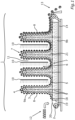
- Figure 1 shows schematically a device designed according to the invention for automated plant cultivation. What is essential about this device is that the plants 8 are fixed on the conveyor belt 2 during their transport along the conveyor line 1, with the roots of the plants 8 being at least largely on a different side of the conveyor belt 2 than the foliage.
- the dimensions of the conveyor line 1 and the speed of movement of the conveyor belt 2 are selected such that the period of time that the plants 8 are moved along the conveyor belt 1 from the placement of a seed or a young plant on the conveyor belt 2 until they are removed from the conveyor belt 2 is a vegetation phase corresponds to the corresponding plant 8.
- the plants 8 fixed on the conveyor belt 2 are moved vertically in sections in both the upward and downward directions, while these are moved in particular in the area of the upper and lower deflection points 4, 5 between the individual vertical sections 6 can be moved at least temporarily in the horizontal direction.
- a loading unit 12 is provided, through which receiving elements 3 of the conveyor belt 2 are each equipped with a young plant 8 become.
- the receiving elements 3 each have a carrier material 18, preferably rock wool, in which the plant 8, in particular its roots, is fixed. It is important that the roots of the plants 8 are located in an area 19 below the conveyor belt 2, while the foliage extends into an area 20 above the conveyor belt 2.
- the areas 19, 20, in which the roots on the one hand and the foliage on the other are located, are spatially separated from one another in this way.
- the root system is in a ventilated room in which aeroponic humidification and nutrient supply 9a of the plants 8 takes place.
- the plants 8 are moved alternately with the conveyor belt 2 in the vertical direction up to an upper deflection point 4 and then again downwards towards a lower deflection point 5. As soon as the plants 8 reach the lower end of the vertical section 6, they are moved in the horizontal direction at least over a short section 7. During this movement in the area of the lower deflection point 5, the carrier material with the roots of the plant 8 arranged therein is immersed in an immersion bath 9b, so that hydroponic humidification and nutrient supply to the plants 8 is effected. Following this at least short-term horizontal movement, the plants 8 are again moved over the next two vertical sections 6 of the conveyor line 1 with the upper deflection point 4 arranged in between. While the plants 8 are moved along these vertically arranged sections 6, aeroponic humidification 9a of the plant roots takes place on the underside of the conveyor belt 2.
- a module is designed and the speed of the conveyor belt 2 is set such that the plants 8 pass through such a module within 24 hours.
- a complete system is composed of the required number of modules so that an entire growth phase of the respective plant 8 can be realized.
- the device for automated plant cultivation has a lighting unit 10, which is designed in such a way that the plants 8 are partially illuminated with artificially generated light during their movement along the conveyor route 1 and sometimes not illuminated.
- the lighting of the plants 8 always takes place during their downward movement on a vertical section 6 between the upper 4 and the lower 5 deflection point.
- a shading phase 11 is provided during the movement of the plants 8 along a section of route running from bottom to top.
- the lighting unit 10 is covered in such a way that the plants 8 are not illuminated. In principle, it is conceivable to adapt the type, intensity and duration of lighting to the respective plant species.
- the lighting is controlled or regulated in an appropriate manner with the help of sensors and a control unit.
- 10 LED panels are provided as the lighting unit, each of which is arranged opposite the vertical section 6 running in the downward direction.
- the in Figure 1 shown device for automated plant cultivation via an adjustment unit 21, so that the distance between the individual modules consisting of two vertical sections 6 and an upper deflection point 4 arranged between them can be adapted to the size growth of the individual plants 8.
- the size of the plants 8 increases during their transport along the conveyor route 1.
- the conveyor belt 2 is also designed in such a way that the distance between the individual receiving elements 3, in which the plants are fixed, can be changed depending on the plant growth.
- a special embodiment of a conveyor belt 2 that can be adapted to the size growth of the plants is discussed in connection with Figure 2 explained.
- an automated harvesting unit 13 which removes the plants 8, which have now grown to normal size, from the rotating conveyor belt 2.
- the conveyor belt 2 is again deflected and finally runs back to the assembly unit 12.
- the conveyor belt 2 is first cleaned on the route between the harvesting unit 13 and the assembly unit 12 finally surface sterilized using a steam sterilization system 14.
- the conveyor belt 2 thus returns to the assembly unit 12, completely cleaned and sterilized, through which the individual Receiving elements 3 of the conveyor belt 2 are again equipped with carrier material 18, at least if this cannot be used multiple times, and with seeds or young plants 8.
- the receiving elements 3 are integrated into the conveyor belt 2 or at least firmly connected to it, so that the placement unit 12 only introduces a seed or a young plant 8 and, if necessary, new carrier material 18 into the receiving elements 3.
- the receiving elements 3 already have carrier material 18 into which seeds or young plants 8 are introduced by the assembly unit 12 or that the individual recordings 3 of the conveyor belt 2 with a seed or a young plant 8 whose roots are already established located in the carrier material 18.
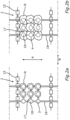
- Figure 2 shows a top view of a section of a conveyor belt 2, which can be adapted to the growth of the plants 8 during their conveyance along the conveyor line 1.
- a corresponding adjustment of the distance between the individual receiving elements 3 makes sense, since as the plants 8 grow, the proportion of leaves in particular, for example in the case of lettuce heads, increases and the space required by the individual plants 8 therefore also increases. For this reason, the individual receiving elements 3 of the conveyor belt 2 are pulled apart in a suitable manner by means of mechanical elements, so that the individual plant 8 has more space or space for its growth and sufficient lighting of the plant is ensured.
- the adaptation described above is essentially achieved in that the distance between the receiving elements 3, in which a plant 8 or its root is fixed in the carrier material 18, is varied depending on the length of time the plants 8 remain on the conveyor belt 2. Taking into account the extent and speed of plant growth, the distances between the individual recordings are increased during the transport of the plants 8.
- each shows a section of a conveyor belt 2 with plants 8 fixed to it in two different growth stages of the plants 8. While the in Figure 2 a) The plants 8 shown are still at the beginning of the conveyor section 1 and are comparatively small, they are in the in Figure 2 b) the state shown immediately before the harvest and have therefore reached an appropriate size. To take this size growth into account, the distances between the individual receiving elements are 3 in Figure 2 b) significantly larger than the corresponding distances in Figure 2 a) .
- the conveyor belt 2 has conveyor chains 15, to which the individual plant holders 3 are attached via suitable, elastic conveyor belts 16.
- the conveyor belts 16 are designed in such a way that both the distance "A” between the parallel conveyor belts 16 and the distance "B” between the receiving elements 3 each attached to a conveyor belt 16 can be changed. While a change in the distance "A” is achieved by moving the conveyor belts 16 outwards, the distances "B" between the individual receptacles 3 are changed by an elastic stretching of the conveyor belts 16 in the longitudinal direction. At the same time, an increase in the distances to the receiving elements 3 that are not directly connected to the conveyor belts 16 is achieved by providing elastic connecting elements 17 between the receiving elements 3, which are stretched accordingly when the conveyor belts 16 are adjusted.
- the receptacles 3 can be attached to the conveyor belts 16 by hanging at least some of the receptacles 3 into the conveyor belts 16. It is also conceivable that at least some of the recordings 3 are firmly connected to a conveyor belt 16.
- elastically stretchable elements 17 are only provided between the individual receiving elements 3 and only the outer recordings 3, namely in Figure 2 each to the The receptacles 3 located at the corner points can be pulled outwards.
- the recordings 3 could be arranged at different points of an elastic network or a corresponding elastic network could form at least part of the conveyor belt 2, the network being able to be pulled apart as required, in particular depending on plant growth, in order to adjust the distances between the recordings 3 as required to change.
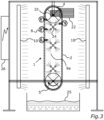
- FIG. 3 a demonstrator was set up, which is shown schematically in Figure 3 is shown.
- This demonstrator has a conveyor section 1 with a conveyor belt 2 revolving in an oval, which has two vertical section sections 6 and, in the area of the upper deflection point 4 and the lower deflection point 5, each has horizontal section sections 7.
- the horizontal sections 7 of the conveyor line 1 are comparatively short due to the design of the demonstrator and are limited to the respective reversal area of the conveyor belt 2.
- the conveyor belt 2 has slats made of a plastic, preferably polyvinyl chloride (PVC), which are designed in the form of roller shutter elements and on which the plants 8 are arranged in such a way that the roots protrude into an area 19 below the conveyor belt 2, while the foliage and/or the fruits protrude into an area 20 above the conveyor belt 2.
- PVC polyvinyl chloride
- the aeroponic nutrient supply unit has three spray nozzles 24 in the form of four-nozzle heads with a drip stop, which are connected to a recirculating water pump system with a nutrient solution tank 25.
- the conveyor belt 2 is driven with the aid of an electric motor 22, which is connected to the conveyor belt 2 via a worm gear 23.
- the drive motor 22 and the lighting strips serving as a lighting unit 10 are connected to a central control unit 26, which adapts both the lighting and the speed at which the plants are moved along the conveyor route 1 to the needs of the plants being moved. For example, lighting and dark or shading bunnies can be varied in this way.
- the in Figure 3 The demonstrator shown was installed in a climate chamber with variable climate control and used for growth tests on various types of lettuce.
- the young plants were transferred to the demonstrator on day 12, and at the same time they were placed in 10 cm rock wool blocks for hydroponic NFT cultivation (NFT - nutrient film technique).
- the lighting with -135 ⁇ mol/s/m 2 was realized with blue and dark red LED light strips (GreenPower production module, Philips).
- a misting system designed for 5 bar (Netafim) with interval spraying was used, whereby nutrient solution was sprayed for a period of 5 s and then the spraying was switched off for 4 min.
- the pH value of the nutrient solution was adjusted to between 5.5 and 6.5 with diluted 5% nitric acid and the nutrient content was kept at 0.8-1.0 EC (electrical conductivity) using liquid fertilizer (YARA).
Landscapes
- Life Sciences & Earth Sciences (AREA)
- Environmental Sciences (AREA)
- Biodiversity & Conservation Biology (AREA)
- Botany (AREA)
- Ecology (AREA)
- Forests & Forestry (AREA)
- Hydroponics (AREA)
- Cultivation Receptacles Or Flower-Pots, Or Pots For Seedlings (AREA)
- Cultivation Of Plants (AREA)
Claims (14)
- Dispositif pour favoriser la croissance des plantes (8) avec une bande transporteuse (2) mobile le long d'une ligne de transport (1) pour le transport au moins par sections de plantes (8) qui sont alimentées en éléments nutritifs pendant un mouvement le long de la ligne de transport (1) au moins temporairement par une alimentation en éléments nutritifs (9) et irradiées par une unité d'éclairage (10), la ligne de transport (1) étant disposée au moins approximativement horizontalement dans au moins une première section (7) et au moins approximativement verticalement dans au moins une deuxième section (6),
dans lequel les plantes (8) sont fixées au moins temporairement pendant le transport le long de la ligne de transport (1) par rapport à la bande transporteuse (2) de telle sorte que les racines des plantes (8) pénètrent au moins partiellement dans une zone (19) disposée au-dessous d'une face inférieure de la bande transporteuse (2), tandis que les feuilles et/ou les fruits des plantes (8) pénètrent au moins partiellement dans une zone (20) disposée au-dessus d'une face supérieure de la bande transporteuse opposée à la face inférieure de la bande transporteuse, caractérisé en ce que l'alimentation en éléments nutritifs (9) dans la zone (19) disposée au-dessous de la face inférieure de la bande transporteuse présente une unité d'alimentation (9) pour l'alimentation aéroponique des plantes (8) en éléments nutritifs, qui nébulise un milieu nutritif et/ou les distribue vers la face inférieure de la bande transporteuse, les racines des plantes (8), tandis que les plantes sont déplacées au moins approximativement verticalement, étant alimentées au moins temporairement en eau et/ou en éléments nutritifs par aéroponie. - Dispositif selon la revendication 1,
caractérisé en ce que la bande transporteuse (2) présente au moins par zones un matériau de support (18) dans lequel les plantes (8) sont fixées au moins temporairement pendant le transport le long de la ligne de transport (1). - Dispositif selon la revendication 1 ou 2,
caractérisé en ce que la ligne de transport (1) présente un point de déviation inférieur (5) entre deux sections partielles (6) disposées au moins approximativement verticalement - Dispositif selon l'une des revendications 1 à 3,
caractérisé en ce qu'au moins une section partielle (11) éclairée par l'unité d'éclairage (10) et une section partielle (11) non éclairée sont disposées le long de la ligne de transport (1). - Dispositif selon l'une des revendications 1 à 4,
caractérisé en ce que la ligne de transport 1 présente deux sections (6) au moins approximativement verticales et deux sections horizontales (7) reliant respectivement les sections verticales (6), au moins une unité d'alimentation pour l'alimentation aéroponique des plantes (8) en milieu nutritif étant disposée entre les faces inférieures tournées l'une vers l'autre de la bande transporteuse (2) déplacée le long de la ligne de transport (1). - Dispositif selon l'une des revendications 1 à 5,
caractérisé en ce qu'au moins une unité de réglage (21) est prévue pour modifier une distance entre une section partielle de la ligne de transport (1) s'étendant au moins approximativement verticalement de haut en bas et une section partielle de la ligne de transport (1) s'étendant au moins approximativement verticalement de bas en haut - Dispositif selon l'une des revendications 1 à 6,
caractérisé en ce qu'une section de la ligne de transport (1) s'étendant au moins approximativement verticalement de bas en haut et une section de la ligne de transport (1) s'étendant au moins approximativement verticalement de haut en bas forment un module et, en fonction de la plante à cultiver, en particulier de l'espace nécessaire à la croissance de la plante, un nombre de modules nécessaires à la réalisation d'une phase de végétation de la plante sont reliés entre eux par des éléments d'interface. - Dispositif selon la revendication 7,
caractérisé en ce qu'au moins une unité d'éclairage (10) est intégrée dans le module. - Dispositif selon la revendication 7 ou 8,
caractérisé en ce que deux modules sont reliés par une section au moins approximativement horizontale de la ligne de transport (1), dont la longueur est choisie en fonction de la plante à cultiver. - Dispositif selon la revendication 7 ou 9,
fabriqué en assemblant au moins deux modules pré-groupés. - Dispositif selon l'une des revendications 1 à 10,
caractérisé en ce qu'une unité de récolte (13) au moins partiellement automatisée est prévue pour éloigner au moins partiellement les plantes (8) de la bande transporteuse (2). - Dispositif selon l'une des revendications 1 à 11,
caractérisé en ce qu'une unité de nettoyage et/ou de stérilisation (14) pour le nettoyage et/ou la stérilisation de la bande transporteuse (2) est disposée dans une zone de la ligne de transport (1) entre une zone dans laquelle les plantes sont au moins partiellement retirées de la bande transporteuse (2) et une zone dans laquelle les graines de plantes et/ou les jeunes plantes (8) sont fixées sur la bande transporteuse (2). - Procédé pour favoriser la croissance des plantes (8), dans lequel les plantes (8) sont déplacées avec une bande transporteuse (2) le long d'une ligne de transport (1), pendant le déplacement le long de la ligne de transport (1), au moins temporairement alimentées en éléments nutritifs (9) et irradiées par une unité d'éclairage (10), les plantes (8) étant déplacées au moins approximativement dans la direction horizontale dans au moins une première section (7) de la ligne de transport (1) et au moins approximativement dans la direction verticale dans au moins une deuxième section (6) de la ligne de transport (1),
dans lequel les plantes (8) sont fixées au moins temporairement pendant le transport le long de la ligne de transport (1) par rapport à la bande transporteuse (2) de telle sorte que les racines des plantes (8) pénètrent au moins partiellement dans une zone (19) disposée sous un côté inférieur de la bande transporteuse, tandis que les feuilles et/ou les fruits des plantes pénètrent au moins partiellement dans une zone (20) disposée au-dessus d'un côté supérieur de la bande transporteuse, qui est opposé au côté inférieur, caractérisé en ce que les racines des plantes (8) sont alimentées en eau et/ou en nutriments au moins temporairement de manière aéroponique pendant que les plantes sont déplacées au moins approximativement verticalement - Procédé selon la revendication 13,
caractérisé en ce que l'ensemble de la ligne de transport (1) est éclairé au moins temporairement
Priority Applications (1)
| Application Number | Priority Date | Filing Date | Title |
|---|---|---|---|
| EP20188084.6A EP3750398B1 (fr) | 2017-05-30 | 2018-05-30 | Dispositif et procédé pour stimuler la croissance de plantes |
Applications Claiming Priority (2)
| Application Number | Priority Date | Filing Date | Title |
|---|---|---|---|
| EP17173370.2A EP3409103B1 (fr) | 2017-05-30 | 2017-05-30 | Dispositif et procédé de stimulation de la croissance de plantes |
| PCT/EP2018/064182 WO2018220011A1 (fr) | 2017-05-30 | 2018-05-30 | Dispositif pour stimuler la croissance de plantes |
Related Child Applications (2)
| Application Number | Title | Priority Date | Filing Date |
|---|---|---|---|
| EP20188084.6A Division-Into EP3750398B1 (fr) | 2017-05-30 | 2018-05-30 | Dispositif et procédé pour stimuler la croissance de plantes |
| EP20188084.6A Division EP3750398B1 (fr) | 2017-05-30 | 2018-05-30 | Dispositif et procédé pour stimuler la croissance de plantes |
Publications (3)
| Publication Number | Publication Date |
|---|---|
| EP3629705A1 EP3629705A1 (fr) | 2020-04-08 |
| EP3629705B1 true EP3629705B1 (fr) | 2024-03-13 |
| EP3629705C0 EP3629705C0 (fr) | 2024-03-13 |
Family
ID=58800740
Family Applications (3)
| Application Number | Title | Priority Date | Filing Date |
|---|---|---|---|
| EP17173370.2A Active EP3409103B1 (fr) | 2017-05-30 | 2017-05-30 | Dispositif et procédé de stimulation de la croissance de plantes |
| EP20188084.6A Active EP3750398B1 (fr) | 2017-05-30 | 2018-05-30 | Dispositif et procédé pour stimuler la croissance de plantes |
| EP18726182.1A Active EP3629705B1 (fr) | 2017-05-30 | 2018-05-30 | Dispositif de stimulation de la croissance de plantes |
Family Applications Before (2)
| Application Number | Title | Priority Date | Filing Date |
|---|---|---|---|
| EP17173370.2A Active EP3409103B1 (fr) | 2017-05-30 | 2017-05-30 | Dispositif et procédé de stimulation de la croissance de plantes |
| EP20188084.6A Active EP3750398B1 (fr) | 2017-05-30 | 2018-05-30 | Dispositif et procédé pour stimuler la croissance de plantes |
Country Status (12)
| Country | Link |
|---|---|
| US (1) | US12201071B2 (fr) |
| EP (3) | EP3409103B1 (fr) |
| JP (2) | JP7329450B2 (fr) |
| KR (2) | KR102654971B1 (fr) |
| CN (2) | CN111727868B (fr) |
| AU (4) | AU2018275644A1 (fr) |
| DK (1) | DK3409103T3 (fr) |
| ES (3) | ES2895175T3 (fr) |
| HU (3) | HUE056721T2 (fr) |
| SA (1) | SA519410424B1 (fr) |
| SG (2) | SG10202007174QA (fr) |
| WO (1) | WO2018220011A1 (fr) |
Families Citing this family (24)
| Publication number | Priority date | Publication date | Assignee | Title |
|---|---|---|---|---|
| JOP20190153A1 (ar) * | 2017-06-14 | 2019-06-20 | Grow Solutions Tech Llc | أنظمة وطرق لإدارة وزن النبات بحجيرة نمو |
| JP2021100395A (ja) * | 2019-12-24 | 2021-07-08 | 井関農機株式会社 | 植物栽培設備 |
| CN115776841B (zh) | 2020-07-06 | 2025-12-02 | 昕诺飞控股有限公司 | 园艺系统、用于确定园艺系统中的植物的体积植物相关参数数据的方法 |
| DE102020125581A1 (de) | 2020-09-30 | 2022-03-31 | Ivan Mallinowski | Aufzuchtvorrichtung und Verfahren zum Aufziehen von Pflanzen |
| CN112956412A (zh) * | 2021-03-03 | 2021-06-15 | 新疆农业科学院农业机械化研究所 | 一种草料培养加工设备 |
| EP4059340A1 (fr) | 2021-03-19 | 2022-09-21 | Fraunhofer-Gesellschaft zur Förderung der angewandten Forschung e.V. | Dispositif de culture automatisée de plantes |
| DE102021110717A1 (de) | 2021-04-27 | 2022-10-27 | Reinhard Bott | Anordnung und verfahren zur aufzucht von pflanzen in einem geschlossenen innenraum |
| DE102021134167B4 (de) | 2021-08-22 | 2024-03-14 | AI.Land GmbH | Vorrichtung und Verfahren zur automatisierten Förderung des Wachstums von Pflanzen, insbesondere von nachwachsenden Kulturen |
| WO2023025353A1 (fr) | 2021-08-22 | 2023-03-02 | Ai. Land Gmbh | Dispositif et procédé pour stimuler de manière automatisée la croissance de plantes, en particulier de cultures de repousse |
| EP4147568A1 (fr) | 2021-09-13 | 2023-03-15 | Fraunhofer-Gesellschaft zur Förderung der angewandten Forschung e.V. | Dispositif et procédé d'approvisionnement en nutriments des plantes et des champignons |
| KR102457433B1 (ko) * | 2021-10-14 | 2022-10-20 | (주)대우건설 | 회전형 식물재배 및 분무기술을 적용한 도시형 고밀도 식물재배 시스템 |
| DE102022120891A1 (de) | 2021-12-02 | 2023-06-07 | Meissner Ag Modell- Und Werkzeugfabrik | Transportelement für ein pflanzenzuchtsystem, förderband und pflanzenzuchtsystem |
| WO2023098935A1 (fr) | 2021-12-02 | 2023-06-08 | Meissner Ag Modell- Und Werkzeugfabrik | Élément de transport pour un système de culture de plantes, bande transporteuse et système de culture de plantes |
| TWI821849B (zh) * | 2021-12-30 | 2023-11-11 | 震亞物聯網科技有限公司 | 運送設備及使用該運送設備的智慧型植物培育系統 |
| EP4561339A4 (fr) * | 2022-07-26 | 2025-10-29 | Univ Yildiz Teknik | Système de culture de plantes automatique pour la fabrication locale et l'alimentation animale |
| CN220606756U (zh) * | 2022-07-28 | 2024-03-19 | 中国农业科学院都市农业研究所 | 一种具有照明组件的立式培育床 |
| CN115380809B (zh) * | 2022-08-31 | 2025-12-12 | 上海墨泉生物有限公司 | 一种植物种植结构及垂直农场 |
| CN115643952B (zh) * | 2022-10-26 | 2024-12-24 | 北京林业大学 | 一种杨树造林育苗盘装置 |
| CN115812586B (zh) * | 2022-11-28 | 2025-11-18 | 四川中农木林森光生物科技有限公司 | 一种具有连续传送结构的立式植物栽培装置 |
| CN115735750A (zh) * | 2022-11-28 | 2023-03-07 | 四川中农木林森光生物科技有限公司 | 用于连续传送作物的传递结构及包含该传递结构的系统 |
| CN115777517B (zh) * | 2022-12-26 | 2026-01-06 | 四川中农木林森光生物科技有限公司 | 一种带有传送带结构的自动化雾培种植架 |
| EP4403022A1 (fr) | 2023-01-23 | 2024-07-24 | Fraunhofer-Gesellschaft zur Förderung der angewandten Forschung e.V. | Appareil et procédé de culture de plantes grimpantes, et système et procédé de culture et de récolte de plantes grimpantes |
| EP4537653A1 (fr) * | 2023-10-10 | 2025-04-16 | Fraunhofer-Gesellschaft zur Förderung der angewandten Forschung e.V. | Procédés et dispositifs de culture de plantes |
| US20250204341A1 (en) * | 2023-12-21 | 2025-06-26 | Oishii Farm Corporation | System and method for vertical farming |
Citations (1)
| Publication number | Priority date | Publication date | Assignee | Title |
|---|---|---|---|---|
| FR3021841A1 (fr) * | 2014-06-10 | 2015-12-11 | Combagro Suisse Sarl | Ligne et installation de culture aeroponique |
Family Cites Families (85)
| Publication number | Priority date | Publication date | Assignee | Title |
|---|---|---|---|---|
| US2244677A (en) * | 1937-07-06 | 1941-06-10 | Fay D Cornell | System of plant production |
| AT240639B (de) * | 1963-01-04 | 1965-06-10 | Othmar Ing Ruthner | Verfahren zur künstlichen Züchtung von Pflanzen, Bakterien u. ähnl. Lebewesen |
| DE1286800B (de) * | 1962-10-13 | 1969-01-09 | Eugenio Dr | Anlage zum kuenstlichen Erzeugen von Pflanzen aus Samen oder Knollen |
| US3276163A (en) * | 1963-10-07 | 1966-10-04 | Oepen Karl | Apparatus for forcing the growth of plants for human and animal nourishment, whereby seeds, bulbs and plants are caused to grow by feeding with chemical solutions |
| US3254448A (en) * | 1964-03-23 | 1966-06-07 | Ruthner Othmar | Installation for the artificial cultivation of plants, bacteria and other organisms |
| BE666530A (fr) * | 1964-07-20 | 1965-11-03 | ||
| AT250728B (de) | 1964-10-01 | 1966-11-25 | Ruthner Othmar | Gewächshaus |
| US3432965A (en) * | 1966-07-05 | 1969-03-18 | Charles M Smith | Hydroponics apparatus |
| DE1782764A1 (de) * | 1967-02-28 | 1972-08-03 | Karl Oepen | Vorrichtung zur Beschickung einer Pflanzenwachstumsanlage mit Saatgut |
| US3824736A (en) * | 1970-11-09 | 1974-07-23 | Integrated Dev And Mfg Co | Method and apparatus for producing plants |
| US3664061A (en) * | 1971-03-03 | 1972-05-23 | Karl Ocpen | Method of and apparatus for the development of plant growth |
| US3809207A (en) | 1972-12-11 | 1974-05-07 | Velten & Pulver | Converging and diverging conveyor |
| US3909978A (en) * | 1974-06-13 | 1975-10-07 | Margaret M Fleming | Method and apparatus for growing plants |
| AT350832B (de) * | 1977-05-12 | 1979-06-25 | Ruthner Othmar | Anlage zur verbesserung der speicherung biochemischer energie durch die nutzung der sonnenenergie und/oder sonstiger elektro- magnetischer strahlungsenergie in pflanzen |
| AT350830B (de) * | 1977-12-09 | 1979-06-25 | Ruthner Othmar | Verfahren zur kontinuierlichen produktion von pflanzen in kulturraeumen |
| US4337986A (en) * | 1978-08-02 | 1982-07-06 | General Mills, Inc. | Method and apparatus for increasing the spacing between plants in accordance with their growth rate |
| US4221764A (en) * | 1978-12-15 | 1980-09-09 | Dravo Corporation | Horizontal extractor |
| US4317308A (en) | 1980-02-08 | 1982-03-02 | Agribusiness Enterprises Limited | Method and apparatus for plant cultivation |
| AT366877B (de) * | 1980-07-28 | 1982-05-10 | Voest Alpine Ag | Gewaechshaus |
| US4356664A (en) * | 1980-12-01 | 1982-11-02 | Othmar Ruthner | Plant for the continuous production of green forage |
| US4327538A (en) * | 1981-03-27 | 1982-05-04 | Whittaker Corporation | Harvester |
| JPS5862848U (ja) * | 1981-10-26 | 1983-04-27 | 株式会社キユ−ビツクエンジニアリング | 栽培装置 |
| JPS59120037A (ja) * | 1982-12-27 | 1984-07-11 | 株式会社日立製作所 | 水耕栽培装置 |
| JPS6170930A (ja) * | 1984-09-12 | 1986-04-11 | 三菱電機株式会社 | 植物栽倍装置 |
| US4965962A (en) * | 1984-11-21 | 1990-10-30 | Q. P. Corporation | Hydroponic culture system |
| JPS6242695A (ja) | 1985-08-20 | 1987-02-24 | Fujitsu Ltd | 2線−4線変換回路 |
| EP0220348B1 (fr) * | 1985-10-21 | 1990-06-06 | Arie Van Wingerden | Dispositif convoyeur pour arroser des plantes |
| JPS62104529A (ja) * | 1985-10-31 | 1987-05-15 | キユーピー株式会社 | 噴霧式水耕栽培装置 |
| JPS62170930A (ja) | 1986-01-23 | 1987-07-28 | Mitsubishi Heavy Ind Ltd | 視界拡大装置 |
| JPS63188333A (ja) * | 1987-01-29 | 1988-08-03 | 川崎製鉄株式会社 | 植物の栽培方法 |
| JPS6420037A (en) * | 1987-07-14 | 1989-01-24 | Inoue Koki Kk | Mobile culture device of three-dimensional type |
| JPS6443143A (en) * | 1987-08-11 | 1989-02-15 | Gojiyou Kk | Device for cultivation in greenhouse |
| JPH0257368U (fr) * | 1988-10-22 | 1990-04-25 | ||
| JPH03133324A (ja) * | 1989-10-17 | 1991-06-06 | Yanmar Agricult Equip Co Ltd | 植物栽培装置 |
| JPH03224420A (ja) * | 1990-01-26 | 1991-10-03 | Nagoya Futou Sairo Kk | ミスト栽培装置 |
| GB9012294D0 (en) | 1990-06-01 | 1990-07-18 | Bryan Groom Ltd | Article support apparatus |
| JPH0847348A (ja) | 1994-08-08 | 1996-02-20 | Nippon Keori Kk | トラフ移動型水耕栽培装置 |
| US5685411A (en) * | 1995-01-13 | 1997-11-11 | Avtec Industries, Inc. | Article conveyor system |
| US5943818A (en) * | 1997-06-16 | 1999-08-31 | Paul Ecke Ranch, Inc. | System for propagation of plants |
| JP3320707B2 (ja) | 1999-01-27 | 2002-09-03 | 誠一 丸元 | 超高密度植物垂直ミスト水耕システム及び育成パネル |
| AUPR303801A0 (en) | 2001-02-09 | 2001-03-08 | A & B Hydroponics International Pty Ltd | A hydroponic apparatus |
| JP3841156B2 (ja) * | 2001-11-01 | 2006-11-01 | 株式会社生物機能工学研究所 | 水耕栽培における害虫駆除用植物浸漬装置 |
| KR200313390Y1 (ko) * | 2002-11-27 | 2003-05-14 | 임선호 | 양액재배포트 |
| US20060201058A1 (en) * | 2005-03-09 | 2006-09-14 | Ripatti Matti T | Multipurpose growing system |
| JP2007166956A (ja) | 2005-12-21 | 2007-07-05 | Centralsun:Kk | ベビーリーフの噴霧水耕栽培法 |
| US7730663B2 (en) * | 2007-12-26 | 2010-06-08 | Angelo Souvlos | Rotary plant growing apparatus |
| JP4812800B2 (ja) * | 2008-04-24 | 2011-11-09 | 株式会社生物機能工学研究所 | 植物水耕栽培における液噴射式害虫駆除装置 |
| SE535207C2 (sv) * | 2008-07-13 | 2012-05-22 | Peter Johansson | Odlingssystem |
| CN101647386A (zh) * | 2008-08-14 | 2010-02-17 | 方炜 | 植物立体栽培塔 |
| EP2491784A4 (fr) * | 2009-10-19 | 2013-12-25 | Cube Farm Co Ltd | Système d'économie d'énergie pour une boîte de croissance de plante se déplaçant verticalement, procédé d'économie d'énergie pour une boîte de croissance de plante se déplaçant verticalement, et dispositif domestique d'économie d'énergie destiné à faire pousser une plante |
| JP2011130765A (ja) * | 2009-11-25 | 2011-07-07 | Technological Institute Of Organic Function | 害虫駆除方法及び害虫駆除装置 |
| KR101263859B1 (ko) * | 2010-08-06 | 2013-05-13 | 박영환 | 무인식물재배장치 |
| KR101222036B1 (ko) * | 2010-12-27 | 2013-01-15 | 재단법인 포항산업과학연구원 | 작물 재배 시스템 |
| KR101240249B1 (ko) * | 2011-02-17 | 2013-03-07 | 박영환 | 식물재배시스템 |
| CA2834933C (fr) | 2011-05-06 | 2018-11-20 | Non-Industrial Manufacture, Inc. | Procede et appareil pour la culture de plantes le long d'un parcours ondule |
| EP2740349B1 (fr) * | 2011-08-05 | 2020-02-26 | Showa Denko K.K. | Procédé de culture d'algues |
| KR20130136226A (ko) * | 2012-06-04 | 2013-12-12 | 유원기 | 농작물 재배 방법 및 그 장치 |
| JP6019361B2 (ja) * | 2012-08-20 | 2016-11-02 | 本多電子株式会社 | 超音波霧化栽培装置用の栽培容器、超音波霧化栽培システム、超音波霧化栽培方法 |
| JP5761821B2 (ja) | 2013-03-04 | 2015-08-12 | 株式会社スプレッド | 水耕栽培システム |
| US8627598B1 (en) * | 2013-03-15 | 2014-01-14 | Sprouting Works, LLC | Sprouted seed grain growing and harvesting apparatus and method |
| US20140325908A1 (en) * | 2013-05-05 | 2014-11-06 | Sadeg M. Faris | High Density Three Dimensional Multi-Layer Farming |
| US20150000194A1 (en) * | 2013-06-27 | 2015-01-01 | Luke A. Meerman | Hydroponic fodder growing system |
| JP2015012826A (ja) * | 2013-07-05 | 2015-01-22 | 興和株式会社 | 植物栽培装置 |
| WO2015022782A1 (fr) * | 2013-08-14 | 2015-02-19 | 有限会社ジャパン通商 | Système de culture hydroponique et usine de production de plantes dotée d'un système de culture hydroponique et serre fabriquée à partir de mousse de styrène |
| CN103477892B (zh) * | 2013-09-02 | 2015-09-09 | 北京农业智能装备技术研究中心 | 一种蔬菜循环生产线 |
| SG2014014302A (en) * | 2014-02-13 | 2015-09-29 | Sky Urban Ip Pte Ltd | Rotatable rack system |
| US20150250115A1 (en) * | 2014-03-10 | 2015-09-10 | Snowbird Environmental Systems Corporation | Automated hydroponic growing and harvesting system for sprouts |
| JP2015181465A (ja) * | 2014-03-26 | 2015-10-22 | パナソニックIpマネジメント株式会社 | 移植サポート装置 |
| FR3024816B1 (fr) * | 2014-08-14 | 2017-07-07 | Combagro (Suisse)Sarl | Installation et systeme de deplacement de vegetaux pour culture hors sol |
| JP6467872B2 (ja) * | 2014-11-05 | 2019-02-13 | 東洋製罐グループホールディングス株式会社 | 水耕栽培システム |
| US11129344B2 (en) | 2015-01-01 | 2021-09-28 | Aravinda Raama Mawendra | Central processing horticulture |
| US10094116B2 (en) * | 2015-01-01 | 2018-10-09 | Aravinda Raama Mawendra | Central processing horticulture |
| US20160302369A1 (en) * | 2015-03-09 | 2016-10-20 | Snowbird Environmental Systems Corporation | Automated hydroponic growing and harvesting system for sprouts with a paddle-equipped linear seed head |
| US10736284B2 (en) * | 2015-09-01 | 2020-08-11 | Keith Baker | Vertical hydroponic system |
| US20170118922A1 (en) | 2015-10-30 | 2017-05-04 | Seros LLC | Power and Lighting System for Vertical Growing Carousel |
| CN109068601B (zh) * | 2016-02-16 | 2021-08-24 | 英国贝纳曼服务有限公司 | 用于种植植物的系统和方法 |
| WO2017206500A1 (fr) * | 2016-05-31 | 2017-12-07 | 郑州海力特农林科技有限公司 | Système de culture écologique doté de brouillard d'eau fin à haute pression |
| US10112814B1 (en) | 2017-02-06 | 2018-10-30 | Power Greenhouse Integration Llc | Vertical circadian horticulture conveyor |
| CA2986879A1 (fr) | 2017-11-28 | 2019-05-28 | Warren Vesty | Mecanisme de croissance vegetale a recirculation |
| EP3759266A4 (fr) | 2018-03-02 | 2021-12-01 | Mesomat Inc. | Fibres revêtues de nanomatériaux |
| KR20200116639A (ko) | 2019-04-02 | 2020-10-13 | 기승철 | 식물생육장치 |
| CN112167042A (zh) | 2020-09-04 | 2021-01-05 | 广东前湾智慧农业装备制造有限公司 | 一种智能化控制垂直农场 |
| DE102020125581A1 (de) * | 2020-09-30 | 2022-03-31 | Ivan Mallinowski | Aufzuchtvorrichtung und Verfahren zum Aufziehen von Pflanzen |
| NL2028448B1 (en) | 2021-06-14 | 2022-12-21 | Pielsa B V | Method and device for qualifying a mushroom |
| CA3182420A1 (fr) * | 2021-11-19 | 2023-05-19 | Ferme D'hiver Technologies Inc. | Methode d'initiation d'un plant en preparation de son ajout a une unite de ferme verticale |
-
2017
- 2017-05-30 DK DK17173370.2T patent/DK3409103T3/da active
- 2017-05-30 ES ES17173370T patent/ES2895175T3/es active Active
- 2017-05-30 HU HUE17173370A patent/HUE056721T2/hu unknown
- 2017-05-30 EP EP17173370.2A patent/EP3409103B1/fr active Active
-
2018
- 2018-05-30 US US16/618,084 patent/US12201071B2/en active Active
- 2018-05-30 KR KR1020197032233A patent/KR102654971B1/ko active Active
- 2018-05-30 ES ES18726182T patent/ES2975277T3/es active Active
- 2018-05-30 SG SG10202007174QA patent/SG10202007174QA/en unknown
- 2018-05-30 AU AU2018275644A patent/AU2018275644A1/en not_active Abandoned
- 2018-05-30 HU HUE20188084A patent/HUE068473T2/hu unknown
- 2018-05-30 EP EP20188084.6A patent/EP3750398B1/fr active Active
- 2018-05-30 KR KR1020207021726A patent/KR102730563B1/ko active Active
- 2018-05-30 CN CN202010662295.4A patent/CN111727868B/zh active Active
- 2018-05-30 SG SG11201910080W patent/SG11201910080WA/en unknown
- 2018-05-30 HU HUE18726182A patent/HUE065906T2/hu unknown
- 2018-05-30 CN CN201880050113.9A patent/CN110996654B/zh active Active
- 2018-05-30 WO PCT/EP2018/064182 patent/WO2018220011A1/fr not_active Ceased
- 2018-05-30 JP JP2019566196A patent/JP7329450B2/ja active Active
- 2018-05-30 ES ES20188084T patent/ES2993240T3/es active Active
- 2018-05-30 EP EP18726182.1A patent/EP3629705B1/fr active Active
-
2019
- 2019-10-30 SA SA519410424A patent/SA519410424B1/ar unknown
-
2020
- 2020-07-27 AU AU2020210163A patent/AU2020210163A1/en not_active Abandoned
- 2020-07-29 JP JP2020128114A patent/JP7426913B2/ja active Active
-
2022
- 2022-12-23 AU AU2022291636A patent/AU2022291636B2/en active Active
- 2022-12-23 AU AU2022291638A patent/AU2022291638B2/en active Active
Patent Citations (1)
| Publication number | Priority date | Publication date | Assignee | Title |
|---|---|---|---|---|
| FR3021841A1 (fr) * | 2014-06-10 | 2015-12-11 | Combagro Suisse Sarl | Ligne et installation de culture aeroponique |
Also Published As
Similar Documents
| Publication | Publication Date | Title |
|---|---|---|
| EP3629705B1 (fr) | Dispositif de stimulation de la croissance de plantes | |
| DE102016121126B3 (de) | Klimatisch abgeschlossene Klimazelle zur Aufzucht von Pflanzen in Innenräumen | |
| DE68923877T2 (de) | Verfahren und vorrichtung für die hydroponkultur. | |
| CH621234A5 (fr) | ||
| EP3777519B1 (fr) | Procédé de fonctionnement automatisé d'une serre, dispositif d'alimentation et serre automatique | |
| DE2558574A1 (de) | Verfahren und vorrichtung zum aufziehen von pflanzen | |
| DE2526298A1 (de) | Verfahren und vorrichtung zum zuechten von pflanzen | |
| EP4062749B1 (fr) | Dispositif et procédé de culture pour plantes | |
| EP4304331B1 (fr) | Système et procédé de culture de plantes dans un espace intérieur fermé | |
| EP4221491A1 (fr) | Dispositif de culture et procédé permettant de cultiver des plantes | |
| DE112022000709T5 (de) | Vorrichtung zur automatisierten kultivierung von pflanzen | |
| AT520937B1 (de) | Vorrichtung zum vertikalen Anbau von Pflanzen | |
| EP4537653A1 (fr) | Procédés et dispositifs de culture de plantes | |
| DE3219430A1 (de) | Verfahren und vorrichtung zum erzeugen von agrar- und forstprodukten und/oder zum biologischen aufbereiten von erde fuer die landwirtschaftliche nutzung | |
| DE102021134167B4 (de) | Vorrichtung und Verfahren zur automatisierten Förderung des Wachstums von Pflanzen, insbesondere von nachwachsenden Kulturen | |
| AT312983B (de) | Verfahren und Anlage zur Erzeugung natürlicher Rohstoffe mittels Pflanzen, die nach hydroponischen Kulturmethoden gewonnen werden | |
| DE102022115528A1 (de) | Trägersystem zur Aufzucht von Pflanzen | |
| EP4403022A1 (fr) | Appareil et procédé de culture de plantes grimpantes, et système et procédé de culture et de récolte de plantes grimpantes | |
| DE1286799B (de) | Verfahren und Anlage zum Kultivieren von Nutz- und Zierpflanzen | |
| EP4147568A1 (fr) | Dispositif et procédé d'approvisionnement en nutriments des plantes et des champignons | |
| AT284534B (de) | Verfahren zur Erzeugung von pflanzlichen oder tierischen Produkten | |
| DE1256471B (de) | Einrichtung fuer die hydroponische Pflanzenkultur, insbesondere von Gruenfutter |
Legal Events
| Date | Code | Title | Description |
|---|---|---|---|
| STAA | Information on the status of an ep patent application or granted ep patent |
Free format text: STATUS: UNKNOWN |
|
| STAA | Information on the status of an ep patent application or granted ep patent |
Free format text: STATUS: THE INTERNATIONAL PUBLICATION HAS BEEN MADE |
|
| PUAI | Public reference made under article 153(3) epc to a published international application that has entered the european phase |
Free format text: ORIGINAL CODE: 0009012 |
|
| STAA | Information on the status of an ep patent application or granted ep patent |
Free format text: STATUS: REQUEST FOR EXAMINATION WAS MADE |
|
| 17P | Request for examination filed |
Effective date: 20191203 |
|
| AK | Designated contracting states |
Kind code of ref document: A1 Designated state(s): AL AT BE BG CH CY CZ DE DK EE ES FI FR GB GR HR HU IE IS IT LI LT LU LV MC MK MT NL NO PL PT RO RS SE SI SK SM TR |
|
| AX | Request for extension of the european patent |
Extension state: BA ME |
|
| DAV | Request for validation of the european patent (deleted) | ||
| DAX | Request for extension of the european patent (deleted) | ||
| STAA | Information on the status of an ep patent application or granted ep patent |
Free format text: STATUS: EXAMINATION IS IN PROGRESS |
|
| 17Q | First examination report despatched |
Effective date: 20201201 |
|
| RAP3 | Party data changed (applicant data changed or rights of an application transferred) |
Owner name: FRAUNHOFER-GESELLSCHAFT ZUR FOERDERUNG DER ANGEWANDTEN FORSCHUNG E.V. |
|
| GRAP | Despatch of communication of intention to grant a patent |
Free format text: ORIGINAL CODE: EPIDOSNIGR1 |
|
| STAA | Information on the status of an ep patent application or granted ep patent |
Free format text: STATUS: GRANT OF PATENT IS INTENDED |
|
| INTG | Intention to grant announced |
Effective date: 20231214 |
|
| GRAJ | Information related to disapproval of communication of intention to grant by the applicant or resumption of examination proceedings by the epo deleted |
Free format text: ORIGINAL CODE: EPIDOSDIGR1 |
|
| STAA | Information on the status of an ep patent application or granted ep patent |
Free format text: STATUS: EXAMINATION IS IN PROGRESS |
|
| GRAS | Grant fee paid |
Free format text: ORIGINAL CODE: EPIDOSNIGR3 |
|
| STAA | Information on the status of an ep patent application or granted ep patent |
Free format text: STATUS: GRANT OF PATENT IS INTENDED |
|
| GRAP | Despatch of communication of intention to grant a patent |
Free format text: ORIGINAL CODE: EPIDOSNIGR1 |
|
| GRAA | (expected) grant |
Free format text: ORIGINAL CODE: 0009210 |
|
| STAA | Information on the status of an ep patent application or granted ep patent |
Free format text: STATUS: THE PATENT HAS BEEN GRANTED |
|
| INTC | Intention to grant announced (deleted) | ||
| INTG | Intention to grant announced |
Effective date: 20240202 |
|
| AK | Designated contracting states |
Kind code of ref document: B1 Designated state(s): AL AT BE BG CH CY CZ DE DK EE ES FI FR GB GR HR HU IE IS IT LI LT LU LV MC MK MT NL NO PL PT RO RS SE SI SK SM TR |
|
| REG | Reference to a national code |
Ref country code: GB Ref legal event code: FG4D Free format text: NOT ENGLISH |
|
| REG | Reference to a national code |
Ref country code: CH Ref legal event code: EP |
|
| REG | Reference to a national code |
Ref country code: DE Ref legal event code: R096 Ref document number: 502018014249 Country of ref document: DE |
|
| REG | Reference to a national code |
Ref country code: IE Ref legal event code: FG4D Free format text: LANGUAGE OF EP DOCUMENT: GERMAN |
|
| U01 | Request for unitary effect filed |
Effective date: 20240313 |
|
| U07 | Unitary effect registered |
Designated state(s): AT BE BG DE DK EE FI FR IT LT LU LV MT NL PT SE SI Effective date: 20240321 |
|
| REG | Reference to a national code |
Ref country code: HU Ref legal event code: AG4A Ref document number: E065906 Country of ref document: HU |
|
| U20 | Renewal fee for the european patent with unitary effect paid |
Year of fee payment: 7 Effective date: 20240529 |
|
| REG | Reference to a national code |
Ref country code: ES Ref legal event code: FG2A Ref document number: 2975277 Country of ref document: ES Kind code of ref document: T3 Effective date: 20240704 |
|
| PG25 | Lapsed in a contracting state [announced via postgrant information from national office to epo] |
Ref country code: GR Free format text: LAPSE BECAUSE OF FAILURE TO SUBMIT A TRANSLATION OF THE DESCRIPTION OR TO PAY THE FEE WITHIN THE PRESCRIBED TIME-LIMIT Effective date: 20240614 |
|
| PG25 | Lapsed in a contracting state [announced via postgrant information from national office to epo] |
Ref country code: HR Free format text: LAPSE BECAUSE OF FAILURE TO SUBMIT A TRANSLATION OF THE DESCRIPTION OR TO PAY THE FEE WITHIN THE PRESCRIBED TIME-LIMIT Effective date: 20240313 Ref country code: RS Free format text: LAPSE BECAUSE OF FAILURE TO SUBMIT A TRANSLATION OF THE DESCRIPTION OR TO PAY THE FEE WITHIN THE PRESCRIBED TIME-LIMIT Effective date: 20240613 |
|
| PG25 | Lapsed in a contracting state [announced via postgrant information from national office to epo] |
Ref country code: RS Free format text: LAPSE BECAUSE OF FAILURE TO SUBMIT A TRANSLATION OF THE DESCRIPTION OR TO PAY THE FEE WITHIN THE PRESCRIBED TIME-LIMIT Effective date: 20240613 Ref country code: HR Free format text: LAPSE BECAUSE OF FAILURE TO SUBMIT A TRANSLATION OF THE DESCRIPTION OR TO PAY THE FEE WITHIN THE PRESCRIBED TIME-LIMIT Effective date: 20240313 Ref country code: GR Free format text: LAPSE BECAUSE OF FAILURE TO SUBMIT A TRANSLATION OF THE DESCRIPTION OR TO PAY THE FEE WITHIN THE PRESCRIBED TIME-LIMIT Effective date: 20240614 |
|
| PG25 | Lapsed in a contracting state [announced via postgrant information from national office to epo] |
Ref country code: IS Free format text: LAPSE BECAUSE OF FAILURE TO SUBMIT A TRANSLATION OF THE DESCRIPTION OR TO PAY THE FEE WITHIN THE PRESCRIBED TIME-LIMIT Effective date: 20240713 |
|
| PG25 | Lapsed in a contracting state [announced via postgrant information from national office to epo] |
Ref country code: SM Free format text: LAPSE BECAUSE OF FAILURE TO SUBMIT A TRANSLATION OF THE DESCRIPTION OR TO PAY THE FEE WITHIN THE PRESCRIBED TIME-LIMIT Effective date: 20240313 |
|
| PG25 | Lapsed in a contracting state [announced via postgrant information from national office to epo] |
Ref country code: PL Free format text: LAPSE BECAUSE OF FAILURE TO SUBMIT A TRANSLATION OF THE DESCRIPTION OR TO PAY THE FEE WITHIN THE PRESCRIBED TIME-LIMIT Effective date: 20240313 |
|
| PG25 | Lapsed in a contracting state [announced via postgrant information from national office to epo] |
Ref country code: SK Free format text: LAPSE BECAUSE OF FAILURE TO SUBMIT A TRANSLATION OF THE DESCRIPTION OR TO PAY THE FEE WITHIN THE PRESCRIBED TIME-LIMIT Effective date: 20240313 |
|
| PG25 | Lapsed in a contracting state [announced via postgrant information from national office to epo] |
Ref country code: SM Free format text: LAPSE BECAUSE OF FAILURE TO SUBMIT A TRANSLATION OF THE DESCRIPTION OR TO PAY THE FEE WITHIN THE PRESCRIBED TIME-LIMIT Effective date: 20240313 Ref country code: SK Free format text: LAPSE BECAUSE OF FAILURE TO SUBMIT A TRANSLATION OF THE DESCRIPTION OR TO PAY THE FEE WITHIN THE PRESCRIBED TIME-LIMIT Effective date: 20240313 Ref country code: RO Free format text: LAPSE BECAUSE OF FAILURE TO SUBMIT A TRANSLATION OF THE DESCRIPTION OR TO PAY THE FEE WITHIN THE PRESCRIBED TIME-LIMIT Effective date: 20240313 Ref country code: PL Free format text: LAPSE BECAUSE OF FAILURE TO SUBMIT A TRANSLATION OF THE DESCRIPTION OR TO PAY THE FEE WITHIN THE PRESCRIBED TIME-LIMIT Effective date: 20240313 Ref country code: IS Free format text: LAPSE BECAUSE OF FAILURE TO SUBMIT A TRANSLATION OF THE DESCRIPTION OR TO PAY THE FEE WITHIN THE PRESCRIBED TIME-LIMIT Effective date: 20240713 |
|
| REG | Reference to a national code |
Ref country code: DE Ref legal event code: R097 Ref document number: 502018014249 Country of ref document: DE |
|
| PG25 | Lapsed in a contracting state [announced via postgrant information from national office to epo] |
Ref country code: MC Free format text: LAPSE BECAUSE OF FAILURE TO SUBMIT A TRANSLATION OF THE DESCRIPTION OR TO PAY THE FEE WITHIN THE PRESCRIBED TIME-LIMIT Effective date: 20240313 |
|
| PLBE | No opposition filed within time limit |
Free format text: ORIGINAL CODE: 0009261 |
|
| STAA | Information on the status of an ep patent application or granted ep patent |
Free format text: STATUS: NO OPPOSITION FILED WITHIN TIME LIMIT |
|
| PG25 | Lapsed in a contracting state [announced via postgrant information from national office to epo] |
Ref country code: MC Free format text: LAPSE BECAUSE OF FAILURE TO SUBMIT A TRANSLATION OF THE DESCRIPTION OR TO PAY THE FEE WITHIN THE PRESCRIBED TIME-LIMIT Effective date: 20240313 |
|
| 26N | No opposition filed |
Effective date: 20241216 |
|
| PG25 | Lapsed in a contracting state [announced via postgrant information from national office to epo] |
Ref country code: IE Free format text: LAPSE BECAUSE OF NON-PAYMENT OF DUE FEES Effective date: 20240530 |
|
| U20 | Renewal fee for the european patent with unitary effect paid |
Year of fee payment: 8 Effective date: 20250516 |
|
| PGFP | Annual fee paid to national office [announced via postgrant information from national office to epo] |
Ref country code: GB Payment date: 20250522 Year of fee payment: 8 Ref country code: ES Payment date: 20250616 Year of fee payment: 8 |
|
| PGFP | Annual fee paid to national office [announced via postgrant information from national office to epo] |
Ref country code: NO Payment date: 20250520 Year of fee payment: 8 |
|
| PGFP | Annual fee paid to national office [announced via postgrant information from national office to epo] |
Ref country code: HU Payment date: 20250523 Year of fee payment: 8 |
|
| PGFP | Annual fee paid to national office [announced via postgrant information from national office to epo] |
Ref country code: CH Payment date: 20250601 Year of fee payment: 8 |
|
| PGFP | Annual fee paid to national office [announced via postgrant information from national office to epo] |
Ref country code: CZ Payment date: 20250516 Year of fee payment: 8 |
|
| PG25 | Lapsed in a contracting state [announced via postgrant information from national office to epo] |
Ref country code: CY Free format text: LAPSE BECAUSE OF FAILURE TO SUBMIT A TRANSLATION OF THE DESCRIPTION OR TO PAY THE FEE WITHIN THE PRESCRIBED TIME-LIMIT; INVALID AB INITIO Effective date: 20180530 |