EP3630700B1 - Belit-minimierter csa zement für bauchemische anwendungen - Google Patents
Belit-minimierter csa zement für bauchemische anwendungen Download PDFInfo
- Publication number
- EP3630700B1 EP3630700B1 EP19719484.8A EP19719484A EP3630700B1 EP 3630700 B1 EP3630700 B1 EP 3630700B1 EP 19719484 A EP19719484 A EP 19719484A EP 3630700 B1 EP3630700 B1 EP 3630700B1
- Authority
- EP
- European Patent Office
- Prior art keywords
- weight
- cement
- mixture
- calcium sulfoaluminate
- csa
- Prior art date
- Legal status (The legal status is an assumption and is not a legal conclusion. Google has not performed a legal analysis and makes no representation as to the accuracy of the status listed.)
- Active
Links
Images
Classifications
-
- C—CHEMISTRY; METALLURGY
- C04—CEMENTS; CONCRETE; ARTIFICIAL STONE; CERAMICS; REFRACTORIES
- C04B—LIME, MAGNESIA; SLAG; CEMENTS; COMPOSITIONS THEREOF, e.g. MORTARS, CONCRETE OR LIKE BUILDING MATERIALS; ARTIFICIAL STONE; CERAMICS; REFRACTORIES; TREATMENT OF NATURAL STONE
- C04B7/00—Hydraulic cements
- C04B7/32—Aluminous cements
- C04B7/323—Calcium aluminosulfate cements, e.g. cements hydrating into ettringite
-
- C—CHEMISTRY; METALLURGY
- C04—CEMENTS; CONCRETE; ARTIFICIAL STONE; CERAMICS; REFRACTORIES
- C04B—LIME, MAGNESIA; SLAG; CEMENTS; COMPOSITIONS THEREOF, e.g. MORTARS, CONCRETE OR LIKE BUILDING MATERIALS; ARTIFICIAL STONE; CERAMICS; REFRACTORIES; TREATMENT OF NATURAL STONE
- C04B28/00—Compositions of mortars, concrete or artificial stone, containing inorganic binders or the reaction product of an inorganic and an organic binder, e.g. polycarboxylate cements
- C04B28/02—Compositions of mortars, concrete or artificial stone, containing inorganic binders or the reaction product of an inorganic and an organic binder, e.g. polycarboxylate cements containing hydraulic cements other than calcium sulfates
- C04B28/06—Aluminous cements
- C04B28/065—Calcium aluminosulfate cements, e.g. cements hydrating into ettringite
-
- C—CHEMISTRY; METALLURGY
- C04—CEMENTS; CONCRETE; ARTIFICIAL STONE; CERAMICS; REFRACTORIES
- C04B—LIME, MAGNESIA; SLAG; CEMENTS; COMPOSITIONS THEREOF, e.g. MORTARS, CONCRETE OR LIKE BUILDING MATERIALS; ARTIFICIAL STONE; CERAMICS; REFRACTORIES; TREATMENT OF NATURAL STONE
- C04B28/00—Compositions of mortars, concrete or artificial stone, containing inorganic binders or the reaction product of an inorganic and an organic binder, e.g. polycarboxylate cements
- C04B28/14—Compositions of mortars, concrete or artificial stone, containing inorganic binders or the reaction product of an inorganic and an organic binder, e.g. polycarboxylate cements containing calcium sulfate cements
-
- C—CHEMISTRY; METALLURGY
- C04—CEMENTS; CONCRETE; ARTIFICIAL STONE; CERAMICS; REFRACTORIES
- C04B—LIME, MAGNESIA; SLAG; CEMENTS; COMPOSITIONS THEREOF, e.g. MORTARS, CONCRETE OR LIKE BUILDING MATERIALS; ARTIFICIAL STONE; CERAMICS; REFRACTORIES; TREATMENT OF NATURAL STONE
- C04B28/00—Compositions of mortars, concrete or artificial stone, containing inorganic binders or the reaction product of an inorganic and an organic binder, e.g. polycarboxylate cements
- C04B28/14—Compositions of mortars, concrete or artificial stone, containing inorganic binders or the reaction product of an inorganic and an organic binder, e.g. polycarboxylate cements containing calcium sulfate cements
- C04B28/16—Compositions of mortars, concrete or artificial stone, containing inorganic binders or the reaction product of an inorganic and an organic binder, e.g. polycarboxylate cements containing calcium sulfate cements containing anhydrite, e.g. Keene's cement
-
- C—CHEMISTRY; METALLURGY
- C04—CEMENTS; CONCRETE; ARTIFICIAL STONE; CERAMICS; REFRACTORIES
- C04B—LIME, MAGNESIA; SLAG; CEMENTS; COMPOSITIONS THEREOF, e.g. MORTARS, CONCRETE OR LIKE BUILDING MATERIALS; ARTIFICIAL STONE; CERAMICS; REFRACTORIES; TREATMENT OF NATURAL STONE
- C04B7/00—Hydraulic cements
- C04B7/36—Manufacture of hydraulic cements in general
- C04B7/38—Preparing or treating the raw materials individually or as batches, e.g. mixing with fuel
- C04B7/42—Active ingredients added before, or during, the burning process
- C04B7/421—Inorganic materials
- C04B7/424—Oxides, Hydroxides
-
- C—CHEMISTRY; METALLURGY
- C04—CEMENTS; CONCRETE; ARTIFICIAL STONE; CERAMICS; REFRACTORIES
- C04B—LIME, MAGNESIA; SLAG; CEMENTS; COMPOSITIONS THEREOF, e.g. MORTARS, CONCRETE OR LIKE BUILDING MATERIALS; ARTIFICIAL STONE; CERAMICS; REFRACTORIES; TREATMENT OF NATURAL STONE
- C04B7/00—Hydraulic cements
- C04B7/36—Manufacture of hydraulic cements in general
- C04B7/43—Heat treatment, e.g. precalcining, burning, melting; Cooling
- C04B7/44—Burning; Melting
-
- C—CHEMISTRY; METALLURGY
- C04—CEMENTS; CONCRETE; ARTIFICIAL STONE; CERAMICS; REFRACTORIES
- C04B—LIME, MAGNESIA; SLAG; CEMENTS; COMPOSITIONS THEREOF, e.g. MORTARS, CONCRETE OR LIKE BUILDING MATERIALS; ARTIFICIAL STONE; CERAMICS; REFRACTORIES; TREATMENT OF NATURAL STONE
- C04B7/00—Hydraulic cements
- C04B7/36—Manufacture of hydraulic cements in general
- C04B7/48—Clinker treatment
- C04B7/52—Grinding ; After-treatment of ground cement
-
- Y—GENERAL TAGGING OF NEW TECHNOLOGICAL DEVELOPMENTS; GENERAL TAGGING OF CROSS-SECTIONAL TECHNOLOGIES SPANNING OVER SEVERAL SECTIONS OF THE IPC; TECHNICAL SUBJECTS COVERED BY FORMER USPC CROSS-REFERENCE ART COLLECTIONS [XRACs] AND DIGESTS
- Y02—TECHNOLOGIES OR APPLICATIONS FOR MITIGATION OR ADAPTATION AGAINST CLIMATE CHANGE
- Y02P—CLIMATE CHANGE MITIGATION TECHNOLOGIES IN THE PRODUCTION OR PROCESSING OF GOODS
- Y02P40/00—Technologies relating to the processing of minerals
- Y02P40/10—Production of cement, e.g. improving or optimising the production methods; Cement grinding
Definitions
- the present invention relates to a CSA clinker and its production, as well as cement ground therefrom and its use.
- CSA is used here as a short term and stands for the chemical term calcium sulfoaluminate.
- Calcium sulfoaluminate in the narrower sense is understood to mean the chemical compound C 4 A 3 $, the industrially produced variant of which is also referred to as Kleinit or Klein's Compound.
- the naturally occurring form is known in mineralogy as Ye'elemit.
- CSA cements are used in the construction industry and construction chemistry in various areas: As low-energy and low-CO 2 cements, as swelling cements and as early high-strength and / or rapidly solidifying binders. First patented in 1934 as a fast-setting and seawater-resistant binding agent, the industrial use of CSA cements began in the late 1950s as swelling or expanding cements. Volume-stable CSA cements were first developed in the 1970s by the Chinese Academy of Building Materials and are now standardized in China as swelling cement, expansion cement, early high-strength cement and low-alkali cement ( Luigi Buzzi et al. High-performance and low-CO2 cements based on calcium sulphoaluminate, ZKG International No. 50, 2010, pp. 39 - 45 ).
- the starting materials and firing temperatures in the production of CSA clinkers are usually chosen so that the cement contains the clinker phase C 2 S (belite) in addition to C 4 A 3 $, since both phases require similar and comparatively significantly lower temperatures for their formation Portland cement or alumina cement clinker. Since the firing temperature has a decisive influence on the temperature required for production, such cements represent "low-energy cements" compared to Portland cement, the clinker of which is sintered at 1450 ° C. Another significant advantage lies in one clear lower CaO content of the CSA clinker and a correspondingly lower content of limestone in of the raw mix, which leads to a significant reduction in CO 2 emissions per t of clinker produced. CSA cements are therefore also referred to as "low CO 2 cements".
- Table 1 shows some comparison values for specific energy requirements and CO 2 emissions. These values come from: JH Sharp et al. Calcium sulfoaluminate cements - low-energy cements, special cements or what, Advances in Cement Research, 1999, 11, No.1, pp. 3-13 . Table 1: Specific energy requirements and CO ⁇ sub> 2 ⁇ /sub> emissions of the pure phases Cement phase (pure) Enthalpy of formation [Kj / kg clinker] CO 2 emissions [kg / kg clinker] C 3 S 1848 0.578 ⁇ -C 2 S 1336 0.511 CA 1030 0.278 C 4 A 3 $ about 800 0.216
- cements based on C 4 A 3 $ and C 2 S can be produced with considerably lower thermal energy consumption and with lower CO 2 emissions than Portland cements, in which the phases C 3 S (3CaO SiO 2 , Tricalcium silicate, "Alit”) and C 2 S (2CaO ⁇ SiO 2 , dicalcium silicate, "Belit”) form the main mineralogical components of the clinker.
- the Portland cement clinkers produced in Germany have average contents of approx. 63% by weight C 3 S and 16% by weight C 2 S (VDZ Zement-Taschenbuch 51st edition, Table I.3.1-2).
- Phase CA (CaO ⁇ Al 2 O 3 , monocalcium aluminate) is the main mineralogical component of high alumina cements or calcium aluminate cements, CAC for short or CA cements according to DIN EN 14647.
- the monocalcium aluminate content of standard high alumina cements is at least 40% by weight (Friedrich W. . Locher, Zement, Verlag Bau +technik, 2000). Combustion of C 4 A 3 $ and the much more reactive C 3 S (alite) compared to C 2 S is practically impossible, since the formation of alite requires temperatures> 1350 ° C, in which the anhydrite content (CaSO 4 ) of the CSA raw mixture and also the C 4 A 3 $ formed are no longer stable.
- sulphobelite cement that are technically produced to date and which, in addition to C 4 A 3 $ and belite, can contain other phases in different quantities, can be divided into 5 categories. Table 3 summarizes these categories, which essentially characterize the system of belite sulfoaluminate ferrite cements (Ivan Odler op. Cit.). Table 3: Characterization of commercially available CSA cements Abbreviation Cement naming characterization SAB Sulfoaluminate belite Main component Belit, CSA content rel.
- low SFAB Sulfoferroaluminate belite SAB partial replacement of Al by Fe BSA Belite sulfoaluminate Main component CSA, lower proportion of belite BSFA Belite sulfoferroaluminate BSA, partial replacement of Al by Fe BSAF Belite sulfoaluminate ferrite SAFB, high Fe content in CSA, clear ferrite content
- US 2013/233207 discloses a process for the production of calcium sulfoaluminate cement using a mixture of raw materials containing between 10 and 35% by weight Al2 03, between 40 and 50% by weight CaO and between 5 and 25% by weight SO3, as well contains between 0 and 28 wt.% SiO 2 and between 0 and 30 wt.% Fe 2 O 3, the mixture being fired at a firing temperature of at least 1200-1300 ° C.
- CSA cements are usually designed as SAB / SAFB to BSA / BSFA variants, according to Table 3.
- SAB / SAFB to BSA / BSFA variants
- Table 3 By using raw materials containing silicate, different belite contents are made possible, which on the one hand ensure a slow, long-term post-hardening and on the other hand serve to limit the maximum amount of ettringite that can be formed. Both aspects make sense when using CSA cement as a binding agent in mortars and concretes and are absolutely necessary with regard to the durability and spatial stability of the hardened cement.
- Residues of ettringite-forming components that have remained unhydrated in the hardened system can occur in the event of subsequent moisture or water ingress, e.g. in the case of porous ones Systems or as a result of microcracks, lead to secondary ettringite formation and thus to damage to the mold or component up to its complete destruction.
- multi-component construction chemical formulations which can contain Portland cement and balanced calcium sulphate content in addition to CSA cement, it is, however, desirable to have a binder that has the highest possible content of hydraulically active, ettringite-forming phase and no limiting, hydraulically little or inactive components contains.
- the object of the present invention is to provide such a CSA cement with a high content of active phase C 4 A 3 $, with low proportions of hydraulically less reactive and unreactive phases, in particular for use in construction chemistry.
- the calcium sulfoaluminate cement according to the invention has only small proportions of poorly or non-reactive phases and can therefore be used in construction chemical formulations in lower amounts than a CSAB cement which contains substantial proportions of slightly to unreactive belite. This advantage has a positive effect in various respects, an example of which is the reduction in the required storage volume.
- the CSA cement according to the invention has only low contents of other, hydraulically highly reactive phases such as calcium aluminates (C 12 A 7 , C 3 A, CA) or CaO and / or Ca (OH) 2 , which can have disruptive influences under certain circumstances who could exercise C 4 A 3 $ hydration.
- C 12 A 7 , C 3 A, CA calcium aluminates
- CaO and / or Ca (OH) 2 which can have disruptive influences under certain circumstances who could exercise C 4 A 3 $ hydration.
- the invention also relates to other areas of application for CSA cements in which the addition of highly effective component C 4 A 3 $ is advantageous, such as shrinkage-compensated systems or immobilization of Pollutants and heavy metals or coatings and coatings.
- the calcium sulfoaluminate cement according to the invention contains at least 90% by weight of C 4 A 3 $ in crystalline or amorphous form or as a mixture of crystalline and amorphous fractions, with a specific Blaine fineness of 3500 cm 2 / g, preferably 4000 cm 2 / g, preferably from 4500 cm 2 / g, to 6250 cm 2 / g, preferably up to 6000 cm 2 / g, preferably up to 5750 cm 2 / g, preferably up to 5500 cm 2 / g.
- the calcium sulfoaluminate cement according to the invention also contains at most 0.5% by weight free lime, calculated as CaO, and / or at most 0.5% by weight C 3 A, and / or at most 2.0% by weight mayenite as C 12 A 7 , and / or at most 10.0% by weight crotite calculated as CA, and furthermore between 0.5 and 10% by weight C 4 AF and its mixed crystals C 6 A 3-x F x with 1 x 3, and / or between 0.5 and 10% by weight of belite, calculated as C 2 S, and / or at least 0.5% by weight of crotite, calculated as CA.
- the calcium sulfoaluminate cement according to the invention thus has advantageous processing and strength properties.
- the calcium sulfoaluminate cement according to the invention advantageously contains at most 99.5% by weight, preferably at most 99% by weight, preferably at most 98% by weight, preferably at most 97% by weight, preferably at most 96% by weight, preferably at most 95% by weight of C 4 A 3 $. This simplifies production while still having advantageous processing and strength properties.
- the calcium sulfoaluminate cement according to the invention advantageously contains at most 0.2% by weight, preferably at most 0.1% by weight, free lime calculated as CaO.
- the calcium sulfoaluminate cement according to the invention advantageously contains at most 0.2% by weight, preferably at most 0.1% by weight, C 3 A.
- the calcium sulfoaluminate cement according to the invention advantageously contains at most 1.0% by weight, preferably at most 0.5% by weight, of mayenite calculated as C 12 A 7 .
- the calcium sulfoaluminate cement according to the invention advantageously contains a maximum of 7.5% by weight, preferably a maximum of 5.0% by weight, preferably a maximum of 2.5% by weight, preferably a maximum of 1.0% by weight, calculated as crotite Approx.
- the calcium sulfoaluminate cement according to the invention advantageously contains at most 7.5% by weight, preferably at most 5.0% by weight, preferably at most 2.5% by weight, preferably at most 1.0% by weight, C 4 AF and its mixed crystals C 6 A 3-x F x with 1 x 3.
- the calcium sulfoaluminate cement according to the invention advantageously contains at most 7.5% by weight, preferably at most 5.0% by weight, preferably at most 2.5% by weight, preferably at most 1.0% by weight, calculated as belite C 2 S.
- the calcium sulfoaluminate cement according to the invention advantageously contains at least 1% by weight, preferably at least 1.5% by weight, preferably at least 2% by weight, preferably at least 2.5% by weight, crotite calculated as CA.
- the calcium sulfoaluminate cement according to the invention advantageously contains at least 1% by weight, preferably at least 1.5% by weight, preferably at least 2% by weight, preferably at least 2.5% by weight, C 4 AF and its mixed crystals C 6 A 3-x F x with 1 ⁇ x ⁇ 3.
- the calcium sulfoaluminate cement according to the invention advantageously contains at least 1% by weight, preferably at least 1.5% by weight, preferably at least 2% by weight, preferably at least 2.5% by weight, belite calculated as C 2 S.
- the calcium sulfoaluminate cement according to the invention advantageously contains one or more of the following further elements: Si, Na, K, Mg, Sr, Ba, Ti, Zr, V, P, Cr, Mn, Zn.
- the elements can be in pure form and / or in the form of their oxides in various oxidation states and / or in the form of other compounds. Additionally or alternatively, other transition metals can also be present in pure form and / or in the form of their oxides in various oxidation states and / or in the form of other compounds.
- the mineral phases can also be partially present in cryptocrystalline and amorphous form or as mixtures of crystalline, cryptocrystalline and / or amorphous forms in addition to the crystalline form.
- phase contents in% by weight, their amorphous proportions of the same chemical composition are included.
- An independent invention is the use of the presently described calcium sulfoaluminate cement according to the invention as a binder component in recipes for the construction chemicals industry.
- Another independent invention provides a process for the production of a calcium sulfoaluminate cement with at least 90% by weight C 4 A 3 $ in crystalline or amorphous form or as a mixture of crystalline and amorphous fractions and a specific fineness according to Blaine between 3500 cm 2 / g and 6250 cm 2 / g, with a mixture of raw materials being used for the production of the calcium sulfoaluminate cement which contains between 41 and 50% by weight, preferably between 42.5 and 50% by weight, Al 2 O 3 and between 34 and 41% by weight, preferably between 35 and 40% by weight, CaO and between 11 and 19% by weight, preferably between 12 and 18% by weight, SO 3 , and between 0.1 and 3% by weight SiO 2 and / or between 0.1 and 1% by weight Fe 2 O 3 and / or between 0.05 and 2.5% by weight TiO 2 and / or between 0.05 and 2.5 wt% ZnO, the method further comprising the steps of firing the mixture of raw materials at
- the mixture of raw materials preferably contains between 0.1 and 2.5% by weight, SiO 2 and / or between 0.1 and 0.7% by weight, Fe 2 O 3 and / or between 0, 05 and 2.1% by weight, TiO 2 and / or between 0.05 and 2.4% by weight, ZnO.
- the method comprises the steps of firing the mixture of raw materials at a firing temperature of at least 1175 ° C, preferably at least 1200 ° C, preferably at least 1225 ° C, and at most 1350 ° C, preferably at least 1325 ° C, preferably from at least 1300 ° C, and / or grinding the raw materials into a mixture of raw materials with a specific Blaine fineness of 4000 cm 2 / g, preferably 4500 cm 2 / g, to 5500 cm 2 / g, the grinding preferably in a ball mill is carried out, preferably in two steps, different grinding media being used in the ball mill in the two steps.
- the mixture 7 also contained the powdery pure substance component ZnO as a mineralizer.
- the respective amounts of starting materials for the preparation of the 7 mixtures are given in Table 5.
- the respective chemical composition of the 7 mixtures is given in Table 6.
- Table 4 Chemical characterization of the starting materials Raw material Calc. bauxite limestone Calcium sulfate Calc.
- Pellets were pressed from aliquots of each of the 7 mixtures and each burned at 1250 ° C. for 1 hour. They were then removed from the oven, cooled to room temperature and ground again to the original fineness. A quantitative XRD analysis was carried out on these materials using the Rietveld method, and the entire sample was then fired again for one hour at the same temperature. After cooling and renewed grinding, an XRD analysis was carried out on these samples. The results of these analyzes are summarized in Table 7 below.
- Table 7 shows that the desired Ye'elimit content of> 90% by weight is present in all 7 mixtures under the stated conditions with the raw materials used.
- Samples 1, 5, 6 and 7 were selected from the seven clinkers obtained in this way, each for 2 minutes in a vibrating disc mill with agate insert at 700 rpm without additives to a fineness of 5000 cm 2 / g +/- 250 cm 2 / g Blaine ground and then hydrated in a heat flow calorimeter at 20 ° C with a W / C of 0.50 for 50 h.
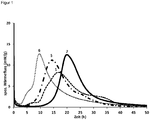
- the measured heat flow curves are in Figure 1 reproduced.
- Figure 1 shows a comparison of the heat flow curves of the mixtures 1, 5, 6 and 7 All the mixtures examined in the calorimeter have a long dormant period of at least 2.5 h after being turned on and show a pronounced heat flow maximum. Compared to the heat flow curves of mixtures 1, 5 and 6, mixture 7 shows a significantly longer open time in the cement paste of approx. 7.5 hours. At the same time, mixture 7 exhibits a homogeneous hydration reaction.
- the raw mixture was selected according to the chemical composition of mixture 7 in Table 6 and manufactured from new raw materials under the designation "R-BC7".
- the chemical compositions of these raw materials are shown in Table 8.
- Table 9 shows the percentage composition of the raw mixture R-BC7.
- Table 8 Chemical characterization of the raw materials for mixture R-BC7 Raw material Anhydrite calc.
- the granules were placed in a heavy oil-fired technical center rotary kiln 7 m long and 50 cm in internal diameter.
- the oven was run at 1.5 revolutions / min.
- the firing temperature in the sintering zone was kept at an average of 1270 ° C.
- the dwell time of the material to be fired in the sintering zone was 30-40 minutes.
- the clinker K-BC7 according to the invention was ground in two stages. The first grinding took place in a ball mill with ball filling, the second grinding in a ball mill with cylindrical grinding media. The clinker was ground without any further additives. The target fineness was 5000 cm 2 / g according to Blaine. In total, several 100 kg of the CSA cement according to the invention with the designation BC7 were produced from the clinker K-BC7 according to the invention.
- Table 10 shows the chemical analysis of the CSA cement according to the invention with the designation BC7 from the grinding of the clinker K-BC7.
- the chemical analyzes of random samples of the two commercially available CSA cements "Alipre” (Italcementi) and “Next Base” (Buzzi Unicem) are shown as comparative data.
- Table 10 Chemical analyzes of the CSA cement BC7 according to the invention and two commercially available comparison products cement Test parameters "Alipre” (Italcementi company) "Next Base” (Buzzi Unicem) "BC7” (Calucem) Chemical composition (wt%) Loi 0.52 1.43 0.06 SiO 2 8.83 10.52 0.59 Al 2 O 3 31.23 29.43 47.20 TiO 2 0.43 1.49 0.02 MnO 0.17 0.04 0.00 Fe 2 O 3 1.50 3.00 0.05 CaO 40.18 41.68 36.90 MgO 4.28 2.51 0.49 K 2 O 0.50 0.39 0.01 Na 2 O 0.81 0.37 0.00 SO 3 11.37 9.24 12.90 P 2 O 5 0.12 0.00 0.01 ZnO 0.00 0.00 1.90 total 99.94 100.10 100.12 Sieve residue (wt%) 90 ⁇ m 0.0 1.4 4.2 fineness Blaine (cm 2 / g) 4700 4600 5210
- the mineralogical composition of the CSA cement BC7 according to the invention is shown in Table 11. These values are compared with random sample analyzes of the commercially available calcium sulfoaluminate cements "Alipre” (Italcementi) and "Next Base” (Buzzi Unicem).
- the two CSA cements "Alipre” and “Next Base” have a C 4 A 3 $ content of less than 90% by weight and a belite (C 2 S ⁇ , ⁇ ) content of 11.80% by weight (“Alipre”) or 17.70% by weight (“Next Base”).
- the CSA according to the invention - BC7 has a C 4 A 3 $ content of 94.5 wt .-% and a belite (C 2 S ⁇ , ⁇ ) content of 2.0% by weight. Phases that solidify quickly, such as C 12 A 7, are not present or only present in traces.
- phase contents were determined with the Rietveld software HighScore Plus, version 4.6a from PANalytical BV, Almelo, Netherlands.
- a Panalytical Cubix X-ray diffractometer with a fast Xcelerator detector was used for the analysis.
- Table 11 Mineralogical analyzes of the CSA cement BC7 according to the invention and two commercially available CSA cements CSA cement "Alipre” (Italcementi company) "Next Base” (Buzzi Unicem) CSA according to the invention - BC7 (Calucem) C 4 A 3 $ 69.2 61.9 94.5 ⁇ -C 2 S 4.2 11.3 0.8 ⁇ -C 2 S 7.6 6.4 1.2 C $ 0.7 4.4 1.0 C 3 MS 2 2.1 5.3 - C 2 AS 2.3 4th - 3C 2 S 3 C $ CaF 2 (Ellastadite fluorine) 5.3 - - CT 0 3.9 - C 3 FT 3.7 1.1 - MgO 4.1 1.7 - CA - - 1.1 C 12 A 7 0.8 0 0.3 ZnA (gahnite) - 1.1 all data in% by weight
- EN 14647 the test method of EN 196-3 is used to determine the standard stiffness and the required water requirement.
- the calcium sulfoaluminate cement BC7 according to the invention has a significantly longer setting characteristic in the glue with a lower water requirement of 28%.
- the values for the water requirement and the setting characteristics in the glue are more comparable to the values for Portland and high alumina cements.
- the "Alipre" comparison cement shows the shortest working time with a start of setting of 9 minutes.
- the compressive strength of the "Next Base” is 6 MPa and that of the "Alipre” is 25 MPa.
- the calcium sulfoaluminate cement BC7 according to the invention already has a compressive strength of 44 MPa after 24 hours and thus has almost twice as high a strength as the commercially available comparison sample "Alipre".
- the self-leveling filler is a particularly demanding product among the construction chemical formulations. On the one hand, this should have a good to very good flow over the processing time of 30 minutes, on the other hand, it must ensure high early strength and quick accessibility. As a rule, the high-quality self-leveling leveling compounds have a high content of calcium sulfoaluminate cement.
- compositions of the various formulations are given in full in Table 13.
- the recipe components are divided into “binders”, “additives I and II” and “fillers”.
- Each of the basic formulations was carried out with the calcium sulfoaluminate cement BC7 according to the invention.
- the two recipes with inventive CSA cement BC7-1 and BC7-2 are recipes compared with the commercially available comparison cements "Alipre” (from Italcementi) and "Next Base” (from Buzzi Unicem).
- Formulation BC7-1 contains 19.66% by weight of the CSA cement BC7 according to the invention.
- the BC7 content was reduced to 14.74% by weight and the recipe was made up to 100% with powdered limestone (F2).
- the four mixtures were each measured over a period of 30 minutes after their preparation by measuring the slump a5, a15 and a30 for their consistency, and on standard prisms 4 cm x 4 cm x 16 cm for their compressive strength development after 4 h, 6 h and 24 h checked.
- the terms and abbreviations used in Table 13 are explained below.
- Binder means the formulation proportions: Portland cement (OPC) Milke Premium CEM I 52.5 R, HeidelbergCement AG, calcium sulfoaluminate cement (CSA) and calcium sulfate (C $) anhydrite - Micro A, Casea.
- additive I refers to the additives with primarily retarding and accelerating effects: tartaric acid L (+) p.a. (WS), from HARKE Chemicals GmbH and pure lithium carbonate. (LiC), Merck Item No. 5670.
- Additives II are those additives that primarily have an influence on the consistency of the mixture: Liquefier ViscoCrete-225 P (VF), SIKA; Cellulose ether Culminal MHPC-500 PF (CE), Ashland; and defoamer Agitan P 801 (ES), from Münzing Chemie GmbH, redispersible polymer powder (RPP) ELOTEX FL 2280, from Akzo Nobel Chemicals AG.
- fillers Inert materials that are not involved in the hydraulic reactions are designated as fillers (F).
- quartz sand F34 F1 from Quarzwerke GmbH and limestone powder 40GU (F2) from Omya GmbH were used.
- Percentages given in Table 13 relate to the percentage of a component in the total weight of the mixture.
- the slump was tested in such a way that 2000 g of the dry formulation mixture was weighed in exactly and mixed in a mortar mixer according to EN 196 with 420 g of demineralized water for 30 seconds at level I and then for 90 seconds at level II. The mixing water was placed in the mixing trough and then the dry mixture was added. The pourable mixture obtained was immediately distributed over 3 discharge rings, ie ring-shaped aluminum vessels 35 mm high and an inner diameter of 68 mm, which were centered on 3 with concentric graduations, exactly horizontally aligned, dry plexiglass spreading plates were arranged. 5 minutes after the start of mixing, the first ring was raised and the diameter of the circular mass was determined as the mean value of two perpendicular measurements with the caliper, as a5 value. The same procedure was followed after 15 and 30 minutes with the other two rings and the values a15 and a30 were determined.
- the construction chemical mixtures were produced in the same way and, after the end of mixing, the pourable materials were poured into prism shapes in accordance with EN 196 without additional compaction measures.
- the molds were stored in accordance with EN 196 and the prisms were tested according to the standards at the scheduled dates.
- the leveling compound BC7-1 with 19.66% calcium sulfoaluminate cement BC7 according to the invention shows significantly higher compressive strengths after 4 h, 6 h and 24 h compared to the leveling compound with 19.66% "Alipre” and 19.66% "Next Base ".
- the leveling compound BC7-2 with only 14.74% calcium sulfoaluminate cement BC7 according to the invention is surprisingly on the strength level of the comparison formulations "Alipre" and "Next Base” with 19.66% cement content.
- the calcium sulfoaluminate cement can in particular contain at most 97% by weight, C 4 A 3 $ at least 1% by weight belite, calculated as C 2 S, and at least 0.5% by weight crotite, calculated as CA.
- the calcium sulfoaluminate cement can in particular contain at most 97% by weight, C 4 A 3 $ at least 1% by weight belite, calculated as C 2 S and at least 0.5% by weight crotite, calculated as CA and at least 0.1 % By weight at most 2.0% by weight, in particular at most 1.0% by weight, in particular at most 0.5% by weight, mayenite, calculated as C12A7.
- the calcium sulfoaluminate cement can in particular contain at most 97% by weight, C 4 A 3 $ at least 1.5% by weight belite, calculated as C 2 S, and at least 0.5% by weight crotite, calculated as CA.
- the calcium sulfoaluminate cement can in particular contain a maximum of 97% by weight, C 4 A 3 $ at least 1.5% by weight of belite, calculated as C 2 S and at least 0.5% by weight of crotite, calculated as CA and at least 0 , 1% by weight at most 2.0% by weight, in particular at most 1.0% by weight, in particular at most 0.5% by weight, mayenite, calculated as C12A7.
Landscapes
- Chemical & Material Sciences (AREA)
- Engineering & Computer Science (AREA)
- Ceramic Engineering (AREA)
- Materials Engineering (AREA)
- Structural Engineering (AREA)
- Organic Chemistry (AREA)
- Inorganic Chemistry (AREA)
- Chemical Kinetics & Catalysis (AREA)
- Physics & Mathematics (AREA)
- Thermal Sciences (AREA)
- Curing Cements, Concrete, And Artificial Stone (AREA)
- Solid-Sorbent Or Filter-Aiding Compositions (AREA)
Description
- Die vorliegende Erfindung betrifft einen CSA Klinker und seine Herstellung, sowie daraus ermahlenen Zement und seine Verwendung.
- Der Begriff CSA wird hier als Kurzbegriff verwendet und steht für den chemischen Begriff Calcium-Sulfoaluminat. Unter Calcium-Sulfoaluminat im engeren Sinn wird dabei die chemische Verbindung C4A3$ verstanden, deren industriell hergestellte Variante auch als Kleinit oder Klein's Compound bezeichnet wird. Die natürlich vorkommende Form ist in der Mineralogie als Ye'elemit bekannt. Die Zusammensetzung der reinen CSA Phase und ihrer Bildung aus den Oxiden entspricht Gleichung 1.
Gleichung 1 4C + 3A + $ → C4A3$
- Die Gleichung ist in der zementchemischen Kurzschreibweise notiert. Im Rahmen der vorliegenden Anmeldung gilt die folgende Schreibweise: C: CaO, A: Al2O3, $: SO3, F: Fe2O3, S: SiO2, H: H2O, T: TiO2, M: MgO, Zn: ZnO, gegebenenfalls erschließt sich die exakte chemische Zusammensetzung aus dem Kontext.
- CSA Zemente finden in der Bauindustrie und Bauchemie Anwendung in verschiedenen Gebieten: Als Low-Energy- und Low-CO2-Zemente, als Quellzemente und als frühhochfeste und/oder rasch erstarrende Bindemittel. Im Jahre 1934 erstmals als rasch abbindendes und meerwasser-resistentes Bindemittel patentiert, begann die industrielle Anwendung der CSA Zemente Ende der 1950er Jahre als Quell- oder Expansivzemente. Raumbeständige CSA Zemente wurden dann zuerst in den 1970er Jahren von der chinesischen Baustoffakademie entwickelt und sind heute in China als Quellzement, Expansivzement, frühhochfester Zement und alkaliarmer Zement standardisiert (Luigi Buzzi et.al. High-performance and low-CO2 cements based on calcium sulphoaluminate, ZKG International Nr. 50, 2010, S. 39 - 45).
- Die Ausgangsstoffe und Brenntemperaturen bei der Herstellung von CSA Klinkern werden in der Regel so gewählt, dass der Zement neben C4A3$ die Klinkerphase C2S (Belit) enthält, da beide Phasen zu ihrer Bildung ähnliche und vergleichsweise deutlich niedrigere Temperaturen erfordern als Portlandzement- oder Tonerdezementklinker. Da die Brenntemperaturen einen entscheidenden Einfluss auf die zur Herstellung benötige Temperatur hat, stellen solche Zemente, im Vergleich zu Portlandzement, dessen Klinker bei 1450°C gesintert wird, deshalb "Low-Energy-Cements" dar. Ein weiterer erheblicher Vorteil liegt in einem deutlich geringeren CaO - Gehalt des CSA Klinkers und einem entsprechend geringeren Gehalt an Kalkstein in der Rohmischung, was zu einer wesentlichen Verringerung der CO2 - Emission pro t erzeugtem Klinker führt. CSA Zemente werden deshalb auch als "Low-CO2-Cements" bezeichnet.
- In Tabelle 1 sind zu spezifischem Energiebedarf und CO2 - Emission einige Vergleichswerte zusammengestellt. Diese Werte stammen aus: J.H. Sharp et.al. Calcium sulfoaluminate cements - low-energy cements, special cements or what, Advances in Cement Research, 1999, 11, No.1, S. 3-13.
Tabelle 1: Spezifischer Energiebedarf und CO2-Ausstoß der reinen Phasen Zement - Phase (rein) Bildungsenthalpie [Kj/kg Klinker] CO2 Ausstoß [kg/kg Klinker] C3S 1848 0,578 β-C2S 1336 0,511 CA 1030 0,278 C4A3$ ca. 800 0,216 - Aus Tabelle 1 wird deutlich, dass Zemente auf Basis C4A3$ und C2S mit erheblich geringerem thermischem Energieaufwand und mit geringerer CO2 Emission hergestellt werden können, als Portlandzemente, bei denen die Phasen C3S (3CaO·SiO2, Tricalciumsilicat, "Alit") und C2S (2CaO·SiO2, Dicalciumsilicat, "Belit") die mineralogischen Hauptbestandteile der Klinker bilden. Die in Deutschland hergestellten Portlandzementklinker weisen mittlere Gehalte von ca. 63 Gew.-% C3S und 16 Gew.-% C2S auf (VDZ Zement-Taschenbuch 51. Ausgabe, Tafel I.3.1-2). Die Phase CA (CaO·Al2O3, Monocalciumaluminat) ist der mineralogische Hauptbestandteil der Tonerdezemente oder Calciumaluminatzemente, kurz CAC oder CA-Zemente nach DIN EN 14647. Der Gehalt an Monocalciumaluminat von Standard Tonerdezementen beträgt mindestens 40 Gew.-% (Friedrich W. Locher, Zement, Verlag Bau+Technik, 2000). Ein gemeinsames Brennen von C4A3$ und dem im Vergleich zu C2S sehr viel reaktiveren C3S (Alit) ist praktisch ausgeschlossen, da die Bildung von Alit Temperaturen >1350°C erfordert, in denen der Anhydritanteil (CaSO4) der CSA-Rohmischung und auch das gebildete C4A3$ nicht mehr stabil sind.
- In der Literatur zur Herstellung von CSA Klinkern wird der Temperaturbereich zur gleichzeitigen Maximierung der Bildung von C4A3$ und C2S (Belit), überwiegend zwischen 1250 - 1350°C angegeben. So nimmt man teilweise die geringe Reaktivität des C2S in Kauf und versucht in anderen Fällen, mit verschiedenen Methoden und Zusätzen zur Rohmischung, aktivierend darauf einzuwirken. Da C4A3$ selbst ab Temperaturen um 1330 - 1350°C instabil ist (Anhydrit zersetzt sich bereits bei Temperaturen >1200 °C), sind an die Herstellung von CSA Klinkern hohe Anforderungen im Hinblick auf Zusammensetzung und Aufbereitung der Rohmaterialien, Prozesssteuerung und Maßnahmen zur Luftreinhaltung gestellt (Ivan Odler, Special Inorganic Cements, 2000; Luigi Buzzi et.al., a.a.O.).
- Die Möglichkeit, CSA Zemente einerseits als Quell- oder Expansivzemente, andererseits aber auch als formstabile Spezialzemente mit steuerbaren Erstarrungs- und Erhärtungseigenschaften einsetzen zu können, lässt sich an einigen grundlegenden Hydratationsreaktionen der Phase C4A3$ erläutern. In Tabelle 2 sind diese Reaktionen für das reine C4A3$ dargestellt sowie für Mischungen aus C4A3$ mit Calciumsulfat und Calciumoxid/Calciumhydroxid alleine und in Kombination.
Tabelle 2 Hydratationsreaktionen von C4A3$ Nr. Ausgangsstoffe Produkte Erstarren1) Expansiv2) 1 C4A3$ + 18H → C4A$H12 + 2AH3 lang 2.1 2C4A3$ + 2C$ + 56H → C6A$3H32 + 4AH3 + C4A$H12 kurz - 2.2 C4A3$ + 2C$ + 38H → C6A$3H32 + 2AH3 lang - 3 C4A3$ + 7CH + 24H → C3AH6 + 2(C3A•0.5C$•0.5CH•12H) sehr kurz 4 C4A3$ + 8C$ + 6C + 96H → 3C6A$3H32 sehr kurz + 1) US 2003 / 0183131 A1 ; 2) Buzzi et. al. , a.a.O. - Aus
US 2003 / 0183131 A1 ist bekannt, dass ein Leim aus reinem C4A3$ und Wasser (Tabelle 2, Nr.1) eine sehr langsame Erstarrungs- und Erhärtungscharakteristik aufweist. Als Hydratationsprodukte entstehen Monosulfat C4A$H12 und Aluminiumhydroxid AH3. Bei Zusatz von steigenden Mengen Calciumsulfat (Anhydrit, Dihydrat etc.) bildet sich neben Monosulfat und Aluminiumhydroxid zunehmend festigkeitsbildendes Ettringit C6A$3H32 (Tabelle 2, Nr. 2.1), bis bei einem Molverhältnis C$ : C4A3$ = 2 : 1 kein Monosulfat mehr auftritt und nur noch Ettringit und Aluminiumhydroxid vorliegt (Tabelle 2, Nr. 2.2). Bei weiter steigendem Molverhältnis C$ : C4A3$ = >2 wird das Hydratationsprodukt zunehmend expansiv. Aus derDE 37 11 549 C2 ist ein Verfahren zur Herstellung eines Calciumsilicat-Gegenstands bekannt. Weiter wird die Verwendung des Calciumsilicat-Gegenstands in verschiedenen Anwendungsgebieten beschrieben, unter anderem als Baumaterial. Aus dem wissenschaftlichen Artikel "Solid-state synthesis of pure ye'elemite", Y. El Khessaimi et al. Journal of the European Ceramic Society 30 (2018) 3401-3411 ist eine Verfahrensvorschrift zur Synthese einer reinen C4A3$-Phase sowie deren Charakterisierung bekannt. - Die Hydratation von Mischungen aus C4A3$ und Calciumhydroxid oder Calciumoxid führt zu Hydrogranat C3AH6 und Afm - Phasen. In Tabelle 2, Nr. 3 ist ein Reaktionsbeispiel mit Calciumhydroxid dazu ausgeführt.
- Durch gemeinsamen Zusatz von Calciumsulfat und Calciumoxid (oder Calciumhydroxid) lässt sich, entsprechend Tabelle 2, Nr.4, eine schnell erstarrende und erhärtende, ausschließlich Ettringit bildende, Mischung herstellen.
- Die verschiedenen, bis heute technisch hergestellten Sulfobelit - Zementtypen, die neben C4A3$ und Belit noch weitere Phasen in unterschiedlicher Menge enthalten können, lassen sich in 5 Kategorien unterteilen. In Tabelle 3 sind diese Kategorien, die das System der Belit-Sulfoaluminat-Ferrit Zemente im Wesentlichen charakterisieren (Ivan Odler a.a.O.) zusammengestellt.
Tabelle 3: Charakterisierung von handelsüblichen CSA Zementen Kürzel Zement-Benennung Charakterisierung SAB Sulfoaluminat-Belit- Hauptbestandteil Belit, CSA Gehalt rel. niedrig SFAB Sulfoferroaluminat-Belit- SAB, teilweiser Ersatz von Al durch Fe BSA Belit-Sulfoaluminat- Hauptbestandteil CSA, Belit-Anteil geringer BSFA Belit-Sulfoferroaluminat- BSA, teilweiser Ersatz von Al durch Fe BSAF Belit-Sulfoaluminat-Ferrit SAFB, hoher Fe Anteil im CSA, deutlicher Ferrit Gehalt - Der Stand der Technik stellt eine breite Palette CSA Zemente zur Verfügung, die eine C4A3$ - Komponente enthalten und Belit als eine weitere, wesentliche Hauptkomponente.
-
US 2013/233207 offenbart ein Verfahren zur Herstellung des Calcium-Sulfoaluminat Zements eine Mischung aus Rohmaterialien verwendet wird, die zwischen 10 und 35 Gew.-% Al2 03,zwischen 40 und 50 Gew.-% CaO und zwischen 5 und 25 Gew.-% SO3, sowie zwischen 0 und 28 Gew.-% Si02 und zwischen 0 und 30 Gew.-% Fe2 03 enthält, wobei das Brennen der Mischung bei einer Brenntemperatur von wenigstens 1200-1300°C stattfindet. - Marktübliche CSA Zemente sind in der Regel als SAB/SAFB bis BSA/BSFA Varianten, entsprechend Tabelle 3 ausgeführt. Durch den Einsatz silikathaltiger Rohstoffe werden unterschiedliche Belit - Gehalte ermöglicht, die einerseits eine langsam verlaufende, langfristige Nacherhärtung sicherstellen und andererseits der Limitierung der maximal zu bildenden Ettringitmenge dienen. Beide Aspekte sind bei der Verwendung des CSA Zementes als Bindemittel in Mörteln und Betonen sinnvoll und absolut notwendig im Hinblick auf Dauerhaftigkeit und Raumbeständigkeit des erhärteten Zementes.
- Unhydratisiert im erhärteten System verbliebene Reste an ettringitbildender Komponente können bei späterem Feuchtigkeits- oder Wasserzutritt, z.B. bei porösen Systemen oder infolge von Mikrorissen, zu sekundärer Ettringitbildung und damit zur Schädigung des Form- oder Bauteils bis hin zu seiner vollständigen Zerstörung führen.
- Diese Problematik wird deutlich, wenn man den Kristallwassergehalt von reinem Ettringit C6A$3H32 betrachtet, der 45,9 Gew.-% beträgt und damit einem W/Z- bzw. einem Wasser/Feststoff - Wert von 0,85 entspricht. In Mörtelrezepturen, bei denen dieser W/Z Wert üblicherweise wesentlich unterschritten wird, muss der Gehalt des Bindemittels an ettringitbildender Komponente, z.B. durch einen Gehalt an Belit, entsprechend limitiert werden, um ihre vollständige Hydratation zu gewährleisten.
- In mehrkomponentigen bauchemischen Rezepturen, die neben CSA Zement auch Portlandzement und abgestimmte Calciumsulfatgehalte enthalten können, ist es dagegen wünschenswert, über ein Bindemittel zu verfügen, das einen möglichst hohen Gehalt an hydraulisch aktiver, ettringitbildender Phase aufweist und keine limitierenden, hydraulisch wenig- oder inaktiven Komponenten enthält.
- Aufgabe der vorliegenden Erfindung ist es, einen solchen CSA Zement, mit einem hohen Gehalt an wirksamer Phase C4A3$, bei geringen Anteilen an hydraulisch wenig- und unreaktiven Phasen, insbesondere für die Verwendung in der Bauchemie zur Verfügung zu stellen. Der erfindungsgemäße Calcium-Sulfoaluminat Zement weist nur geringe Anteile an wenig- oder nichtreaktiven Phasen auf und kann deshalb in bauchemischen Rezepturen in niedrigeren Mengen eingesetzt werden als ein CSAB Zement, der wesentliche Anteile an gering- bis unreaktivem Belit enthält. Dieser Vorteil wirkt sich in verschiedener Hinsicht positiv aus, beispielhaft sei an dieser Stelle auf die Verringerung des erforderlichen Lagervolumens hingewiesen.
- Der erfindungsgemäße CSA Zement weist nur geringe Gehalte an anderen, hydraulisch hoch reaktiven Phasen wie z.B. Calciumaluminate (C12A7, C3A, CA) oder auch CaO und/oder Ca(OH)2 auf, die unter bestimmten Umständen störende Einflüsse auf die C4A3$ Hydratation ausüben könnten. Damit wird zum einen eine hohe Gleichmäßigkeit und zum anderen eine hohe Wirksamkeit der hydraulischen Komponente erreicht, was insbesondere in der Bauchemie von hohem Interesse ist.
- Aus Tabelle 1 wird zudem deutlich, dass der erfindungsgemäße CSA Zement sowohl im Hinblick auf seinen spezifischen Energiebedarf in kJ/kg als auch im Hinblick auf den spezifischen CO2 Ausstoß in kg/kg erzeugtem Klinker im Vergleich zu höher Belit- haltigen CSA Zementen unter Kosten- und Umweltgesichtspunkten erhebliche Vorteile aufweist. Der spezifische Energiebedarf zur Erzeugung von C4A3$ liegt um ca. 40% niedriger, der spezifische CO2 Ausstoß um mehr als 50% niedriger als der bei der Erzeugung von Belit.
- Die Erfindung betrifft neben bauchemischen Rezepturen und der Verwendung des erfindungsgemäßen CSA Zementes als Bindemittelkomponente in Rezepturen der bauchemischen Industrie auch weitere Einsatzgebiete für CSA Zemente, bei denen der Zusatz an hochwirksamer Komponente C4A3$ von Vorteil ist, wie z. b. schwindkompensierte Systeme oder Immobilisierung von Schadstoffen und Schwermetallen oder Beschichtungen und Coatings.
- Der erfindungsgemäße Calcium-Sulfoaluminat Zement enthält mindestens 90 Gew.-% C4A3$ in kristalliner oder amorpher Form oder als Mischung aus kristallinen und amorphen Anteilen, wobei er eine spezifische Mahlfeinheit nach Blaine von 3500 cm2/g, vorzugsweise von 4000 cm2/g, vorzugsweise von 4500 cm2/g, bis 6250 cm2/g, vorzugsweise bis 6000 cm2/g, vorzugsweise bis 5750 cm2/g, vorzugsweise bis 5500 cm2/g, aufweist. Der erfindungsgemäße Calcium-Sulfoaluminat Zement weist weiter höchstens 0,5 Gew.-% Freikalk, berechnet als CaO, und/oder höchstens 0,5 Gew.-% C3A, und/oder höchstens 2,0 Gew.-% Mayenit berechnet als C12A7, und/oder höchstens 10,0 Gew.-% Krotit berechnet als CA, und des Weiteren zwischen 0,5 und 10 Gew.-% C4AF und dessen Mischkristalle C6A3-xFx mit 1 ≤ x ≤ 3, und/oder zwischen 0,5 und 10 Gew.-% Belit berechnet als C2S ,und/oder mindestens 0,5 Gew.-% Krotit berechnet als CA auf. Der erfindungsgemäße Calcium-Sulfoaluminat Zement weist hierdurch vorteilhafte Verarbeitungs- und Festigkeitseigenschaften auf.
- Vorteilhafterweise enthält der erfindungsgemäße Calcium-Sulfoaluminat Zement höchstens 99,5 Gew.-%, vorzugsweise höchstens 99 Gew.-%, vorzugsweise höchstens 98 Gew.-%, vorzugsweise höchstens 97 Gew.-%, vorzugsweise höchstens 96 Gew.-%, vorzugsweise höchstens 95 Gew.-% C4A3$. Hierdurch wird die Herstellung bei weiterhin vorteilhaften Verarbeitungs- und Festigkeitseigenschaften vereinfacht.
- Vorteilhafterweise enthält der erfindungsgemäße Calcium-Sulfoaluminat Zement höchstens 0,2 Gew.-%, vorzugsweise höchstens 0,1 Gew.-%, Freikalk berechnet als CaO.
- Vorteilhafterweise enthält der erfindungsgemäße Calcium-Sulfoaluminat Zement höchstens 0,2 Gew.-%, vorzugsweise höchstens 0,1 Gew.-%, C3A.
- Vorteilhafterweise enthält der erfindungsgemäße Calcium-Sulfoaluminat Zement höchstens 1,0 Gew.-%, vorzugsweise höchstens 0,5 Gew.-%, Mayenit berechnet als C12A7.
- Vorteilhafterweise enthält der erfindungsgemäße Calcium-Sulfoaluminat Zement höchstens 7,5 Gew.-%, vorzugsweise höchstens 5,0 Gew.-%, vorzugsweise höchstens 2,5 Gew.-%, vorzugsweise höchstens 1,0 Gew.-%, Krotit berechnet als CA.
- Vorteilhafterweise enthält der erfindungsgemäße Calcium-Sulfoaluminat Zement höchstens 7,5 Gew.-%, vorzugsweise höchstens 5,0 Gew.-%, vorzugsweise höchstens 2,5 Gew.-%, vorzugsweise höchstens 1,0 Gew.-%, C4AF und dessen Mischkristalle C6A3-xFx mit 1 ≤ x ≤ 3.
- Vorteilhafterweise enthält der erfindungsgemäße Calcium-Sulfoaluminat Zement höchstens 7,5 Gew.-%, vorzugsweise höchstens 5,0 Gew.-%, vorzugsweise höchstens 2,5 Gew.-%, vorzugsweise höchstens 1,0 Gew.-%, Belit berechnet als C2S.
- Vorteilhafterweise enthält der erfindungsgemäße Calcium-Sulfoaluminat Zement mindestens 1 Gew.-%, vorzugsweise mindestens 1,5 Gew.-%, vorzugsweise mindestens 2 Gew.-%, vorzugsweise mindestens 2,5 Gew.-%, Krotit berechnet als CA.
- Vorteilhafterweise enthält der erfindungsgemäße Calcium-Sulfoaluminat Zement mindestens 1 Gew.-%, vorzugsweise mindestens 1,5 Gew.-%, vorzugsweise mindestens 2 Gew.-%, vorzugsweise mindestens 2,5 Gew.-%, C4AF und dessen Mischkristalle C6A3-xFx mit 1 ≤ x ≤ 3.
- Vorteilhafterweise enthält der erfindungsgemäße Calcium-Sulfoaluminat Zement mindestens 1 Gew.-%, vorzugsweise mindestens 1,5 Gew.-%, vorzugsweise mindestens 2 Gew.-%, vorzugsweise mindestens 2,5 Gew.-%, Belit berechnet als C2S.
- Vorteilhafterweise enthält der erfindungsgemäße Calcium-Sulfoaluminat Zement eines oder mehrere der folgenden weiteren Elemente: Si, Na, K, Mg, Sr, Ba, Ti, Zr, V, P, Cr, Mn, Zn. Die Elemente können in Reinform und/oder in Form ihrer Oxide in verschiedenen Oxidationsstufen und/oder in Form anderer Verbindungen enthalten sein. Zusätzlich oder alternativ können auch andere Übergangsmetalle in Reinform und/oder in Form ihrer Oxide in verschiedenen Oxidationsstufen und/oder in Form andere Verbindungen enthalten sein.
- Die Mineralphasen können im erfindungsgemäßen Calcium-Sulfoaluminat-Zement neben der kristallinen Form anteilig auch in kryptokristalliner und amorpher Form, oder als Mischungen aus kristallinen, kryptokristallinen und/oder amorphen Formen vorhanden sein. Bei der Angabe von Phasengehalten in Gew.-% sind deren amorphe Anteile gleicher chemischer Zusammensetzung mit umfasst.
- Es ist bekannt, dass innerhalb des Kristallgitters der Calciumaluminate (CA, CA2, C3A, C12A7) und Calcium-Sulfoaluminate (C4A3$) ein Ersatz von Al3+ durch Fe3+ erfolgen kann. Derartige Mischkristallbildungen von Fe3+/Al3+ sind bei Benennung der Mineralphasen ausdrücklich miteingeschlossen, aber in der formalen Darstellung der Komponenten nicht explizit kenntlich gemacht.
- Eine eigenständige Erfindung stellt die Verwendung des vorliegend beschriebenen erfindungsgemäßen Calcium-Sulfoaluminat Zements als Bindemittelkomponente in Rezepturen der bauchemischen Industrie dar.
- Eine weitere eigenständige Erfindung stellt ein Verfahren zur Herstellung eines Calcium-Sulfoaluminat Zements mit mindestens 90 Gew.-% C4A3$ in kristalliner oder amorpher Form oder als Mischung aus kristallinen und amorphen Anteilen und einer spezifischen Mahlfeinheit nach Blaine zwischen 3500 cm2/g und 6250 cm2/g dar, wobei zur Herstellung des Calcium-Sulfoaluminat Zements eine Mischung aus Rohmaterialien verwendet wird, die zwischen 41 und 50 Gew.-%, vorzugsweise zwischen 42,5 und 50 Gew.-%, Al2O3 und zwischen 34 und 41 Gew.-%, vorzugsweise zwischen 35 und 40 Gew.-%, CaO und zwischen 11 und 19 Gew.-%, vorzugsweise zwischen 12 und 18 Gew.-%, SO3 enthält, sowie zwischen 0,1 und 3 Gew.-% SiO2 und/oder zwischen 0,1 und 1 Gew.-% Fe2O3 und/oder zwischen 0,05 und 2,5 Gew.-% TiO2 und/oder zwischen 0,05 und 2,5 Gew.-% ZnO, wobei das Verfahren weiter die Schritte umfasst Brennen der Mischung aus Rohmaterialien bei einer Brenntemperatur von wenigstens 1150°C und vermahlen der Rohmaterialien in eine Mischung aus Rohmaterialien mit einer spezifischen Mahlfeinheit nach Blaine zwischen 3500 cm2/g und 6000cm2/g..
- Vorzugsweise enthält bei diesem Verfahren die Mischung aus Rohmaterialien zwischen 0,1 und 2,5 Gew.-%, SiO2 und/oder zwischen 0,1 und 0,7 Gew.-%, Fe2O3 und/oder zwischen 0,05 und 2,1 Gew.-%, TiO2 und/oder zwischen 0,05 und 2,4 Gew.-%, ZnO.
- Vorzugsweise umfasst das Verfahren die Schritte, Brennen der Mischung aus Rohmaterialien bei einer Brenntemperatur von wenigstens 1175°C, vorzugsweise von wenigstens 1200°C, vorzugsweise von wenigstens 1225°C, und höchstens 1350°C, vorzugsweise von wenigstens 1325°C, vorzugsweise von wenigstens 1300°C, und/oder vermahlen der Rohmaterialien in eine Mischung aus Rohmaterialien mit einer spezifischen Mahlfeinheit nach Blaine von 4000 cm2/g, vorzugsweise 4500 cm2/g, bis 5500 cm2/g, wobei die Mahlung vorzugsweise in einer Kugelmühle durchgeführt wird, vorzugsweise in zwei Schritten, wobei in den beiden Schritten unterschiedliche Mahlkörper in der Kugelmühle verwendet werden.
- Unter Verwendung der Ausgangsmaterialien: calc. Bauxit, Kalkstein, Calciumsulfat und calc. Alumina, wurden 7 homogene Mischungen mit einer spez. Mahlfeinheit nach Blaine von ca. 5000 cm2/g hergestellt. Die jeweilige chemische Zusammensetzung der Ausgangsmaterialien ist in Tabelle 4 angegeben.
- Die Mischung 7 enthielt zusätzlich die pulverförmige Reinststoffkomponente ZnO als Mineralisator. Die jeweiligen Mengen an Ausgangsmaterialien zur Herstellung der 7 Mischungen sind in Tabelle 5 angegeben. Die jeweilige chemische Zusammensetzung der 7 Mischungen ist in Tabelle 6 angegeben.
Tabelle 4: Chemische Charakterisierung der Ausgangsstoffe Rohmaterial Calc. Bauxit Kalkstein Calciumsulfat Calc. Alumina L.o.i. 0,21 43,72 10,85 0,14 SiO2 5,13 0,19 0,27 0,02 Al2O3 88,52 0,04 0,35 99,86 TiO2 4,45 0,01 0,01 0 MnO 0,01 0,01 0,01 0,01 Fe2O3 1,12 0,04 0,07 0,03 CaO 0 55,77 40,49 0 MgO 0,29 0,43 0,11 0,03 K2O 0,54 0,03 0,03 0,01 Na2O 0,01 0 0 0,1 SO3 0,03 0,05 47,79 0,03 Summe 100,31 100,29 99,98 100,23 alle Daten in Gew.-% Tabelle 5: Zusammensetzung von 7 Rohmischungen Mischung 1 2 3 4 5 6 7 Calc. Bauxit - 30,4 39,2 20,5 - - - Kalkstein 34,4 38,6 40,2 36,9 33,3 33,3 34,4 Calciumsulfat 24,6 21,5 20,6 22,1 26,7 30,0 24,0 Calc. Alumina 41,0 9,5 - 20,5 40,0 36,7 40,0 ZnO - - - - - - 1,6 alle Daten in Gew.-% Tabelle 6: Chemische Analyse (glühverlustfrei) der Rohmischungen nach Tabelle 5 Mischung 1 2 3 4 5 6 7 SiO2 0,2 1,9 2,5 1,3 0,2 0,2 0,1 Al2O3 49,9 44,4 42,5 46,4 47,5 45 47,2 TiO2 0,0 1,6 2,1 1,1 0,0 0,0 0,0 Fe2O3 0,1 0,5 0,6 0,4 0,1 0,1 0,1 CaO 35,5 38,3 39,5 37,2 36,3 37,1 35,7 SO3 13,9 12,9 12,5 13,0 15,6 17,4 13,8 ZnO - - - - - - 2,31 Summe 99,6 99,6 99,7 99,4 99,7 99,8 99,21 alle Daten in Gew.-% - Aus Teilmengen jeder der 7 Mischungen wurden Pellets gepresst und jeweils 1 Stunde lang bei 1250°C gebrannt. Danach wurden sie dem Ofen entnommen, auf Raumtemperatur abgekühlt und erneut auf die Ausgangsfeinheit gemahlen. An diesen Materialien wurde eine quantitative XRD Analyse mit der Rietveldmethode durchgeführt und danach die gesamte Probe noch einmal eine Stunde lang bei gleicher Temperatur gebrannt. Nach dem Abkühlen und erneutem Aufmahlen wurde an diesen Proben wiederum eine XRD - Analyse durchgeführt. Die Ergebnisse dieser Analysen sind in der folgenden Tabelle 7 zusammengestellt.
Tabelle 7: Mineralogische Analysen der Mischungen 1 - 7 (Brand bei 1250 °C) Mischung 1 2 3 4 5 6 7 Ye'elimit (C4A3$) 94,3 93,7 91,3 95,3 91,0 92,3 98,5 Anhydrit (C$) 0,8 - - 0,4 3,7 6,8 - Perowskit (CT) - 3,1 3,2 1,6 - - - Krotit (CA) 4,4 - - - 3,9 - 0,4 Mayenit (C12A7) 0,4 - 0,5 - 1,3 - - Freikalk (CaO) - 0,1 - - - 0,8 - Belit (C2Sα, β) 0,1 3,1 5,0 2,3 0,1 0,1 - Gehlenit (C2AS) - - - 0,4 - - - Gahnit (ZnAl2O4) - - - - - - 1,1 alle Daten in Gew.-% - Tabelle 7 zeigt, dass der angestrebte Ye'elimit Gehalt von > 90 Gew.-% unter den genannten Bedingungen mit den verwendeten Rohmaterialien in allen 7 Mischungen vorliegt.
- Aus den sieben so erhaltenen Klinkern wurden die Proben 1, 5, 6 und 7 ausgewählt, jeweils 2 Minuten in einer Scheibenschwingmühle mit Achateinsatz bei 700 U/min ohne Zusätze auf eine Feinheit 5000 cm2/g +/- 250 cm2/g nach Blaine aufgemahlen und anschließend im Wärmeflusskalorimeter bei 20°C mit einem W/Z von 0,50 für 50 h hydratisiert. Die gemessenen Wärmeflusskurven sind in
Figur 1 wiedergegeben. -
Figur 1 zeigt einen Vergleich der Wärmeflusskurven der Mischungen 1, 5, 6 und 7Alle im Kalorimeter untersuchten Mischungen weisen nach dem Anmachen eine lange dormante Periode von mindestens 2,5 h auf und zeigen ein ausgeprägtes Wärmeflussmaximum. Mischung 7 zeigt im Vergleich zu den Wärmeflusskurven der Mischungen 1, 5 und 6 eine deutlich längere offene Zeit im Zementleim von ca. 7,5 h. Gleichzeitig weist Mischung 7 eine homogene Hydratationsreaktion auf. - Für einen Brennversuch im halbtechnischen Maßstab wurde die Rohmischung entsprechend der chemischen Zusammensetzung von Mischung 7 in Tabelle 6 ausgewählt und unter der Bezeichnung "R-BC7" aus neuen Rohmaterialien hergestellt. Die chemischen Zusammensetzungen dieser Rohmaterialien sind in Tabelle 8 zusammengestellt. Die prozentuale Zusammensetzung der Rohmischung R-BC7 gibt Tabelle 9 wieder.
Tabelle 8: Chemische Charakterisierung der Rohstoffe für Mischung R-BC7 Rohmaterial Anhydrit calc. Alumina Kalkstein Kalkhydrat L.O.I. 3,37 0,71 43,57 24,29 SiO2 0,74 0,01 0,26 1,94 Al2O3 0,05 99,03 0,09 0,57 Fe2O3 0,05 0,01 0,01 0,25 CaO 40,30 0,03 55,32 71,51 MgO 0,74 0,06 0,68 0,96 SO3 54,29 0,00 0,00 0,25 K2O 0,02 0,00 0,00 0,10 Na2O 0,06 0,16 0,03 0,04 P2O5 0,02 0,00 0,02 0,01 TiO2 0,00 0,00 0,00 0,02 Mn2O3 0,01 0,00 0,00 0,02 SrO 0,33 0,00 0,03 0,04 ZnO 0,01 0,01 0,00 0,01 Summe 99,99 100,02 100,01 100,01 alle Daten in Gew.-% Tabelle 9: Prozentuale Zusammensetzung der Rohmischung R-BC7 calc. Alumina 39,7 Kalkstein 27,8 Kalkhydrat 9,5 Anhydrit 21,0 ZnO 2,0 alle Daten in Gew.-% - Mit Hilfe eines Granuliertellers wurden Granalien der Rohmischung R-BC7 mit einem mittleren Durchmesser von 10 mm hergestellt. Der als Rohmischungskomponente eingesetzte Kalkhydratanteil diente der Verbesserung der Granulierbarkeit.
- Die Granalien wurden einem mit Schweröl befeuerten Technikums - Drehofen von 7 m Länge und einem Innendurchmesser von 50 cm aufgegeben. Der Ofen wurde mit 1,5 Umdrehungen/min gefahren. Die Brenntemperatur in der Sinterzone wurde im Mittel bei 1270°C gehalten. Die Verweilzeit des Brennguts in der Sinterzone betrug 30 - 40 Minuten.
- Nach dem Abkühlen wurde der erfindungsgemäße Klinker K-BC7 in zwei Stufen gemahlen. Die erste Mahlung erfolgte in einer Kugelmühle mit Kugelfüllung, die zweite Mahlung in einer Kugelmühle mit zylindrischen Mahlkörpern. Die Vermahlung des Klinkers erfolgte ohne weitere Zusätze. Die Zielfeinheit betrug 5000 cm2/g nach Blaine. Insgesamt wurden mehrere 100 kg des erfindungsgemäßen CSA Zements mit der Bezeichnung BC7 aus dem erfindungsgemäßen Klinker K-BC7 hergestellt.
- In Tabelle 10 ist die chemische Analyse des erfindungsgemäßen CSA - Zements mit der Bezeichnung BC7 aus der Mahlung des Klinkers K-BC7 wiedergegeben. Als Vergleichsdaten sind die chemischen Analysen von Stichproben der beiden handelsüblichen CSA - Zemente "Alipre" (Fa. Italcementi) und "Next Base" (Fa. Buzzi Unicem) dargestellt.
Tabelle 10: Chemische Analysen des erfindungsgemäßen CSA Zementes BC7 und zweier handelsüblicher Vergleichs - Produkte Zement Prüfparameter "Alipre" (Fa. Italcementi) "Next Base" (Fa. Buzzi Unicem) "BC7" (Calucem) Chemische Zusammensetzung (Gew.- %) L.o.i. 0,52 1,43 0,06 SiO2 8,83 10,52 0,59 Al2O3 31,23 29,43 47,20 TiO2 0,43 1,49 0,02 MnO 0,17 0,04 0,00 Fe2O3 1,50 3,00 0,05 CaO 40,18 41,68 36,90 MgO 4,28 2,51 0,49 K2O 0,50 0,39 0,01 Na2O 0,81 0,37 0,00 SO3 11,37 9,24 12,90 P2O5 0,12 0,00 0,01 ZnO 0,00 0,00 1,90 Summe 99,94 100,10 100,12 Siebrückstand (Gew.- %) 90µm 0,0 1,4 4,2 Feinheit Blaine (cm2/g) 4700 4600 5210 - Die mineralogische Zusammensetzung des erfindungsgemäßen CSA Zementes BC7 ist in Tabelle 11 wiedergegeben. Diesen Werten sind Stichprobenanalysen der handelsüblichen Calcium-Sulfoaluminat Zemente "Alipre" (Fa. Italcementi) und "Next Base" (Buzzi Unicem) gegenübergestellt.
- Die beiden CSA - Zemente "Alipre" und "Next Base" weisen einen C4A3$ Gehalt von unter 90 Gew.-% auf und einen Belit (C2Sα,β)-Gehalt von 11,80 Gew.- % ("Alipre") bzw. 17,70 Gew.- % ("Next Base").
- Der erfindungsgemäße CSA - BC7 weist einen C4A3$ Gehalt von 94,5 Gew.-% und einen Belit (C2Sα,β)-Gehalt von 2,0 Gew.- %. Schnell erstarrende Phasen, wie C12A7 sind nicht, bzw. nur in Spuren vorhanden.
- Alle Phasengehalte wurden mit der Rietveldsoftware HighScore Plus, Version 4.6a der Firma PANalytical B.V., Almelo, Niederlande, bestimmt. Zur Analyse wurde ein Panalytical Cubix Röntgendiffraktometer mit schnellem Xcelerator Detektor verwendet.
Tabelle 11: Mineralogische Analysen des erfindungsgemäßen CSA Zementes BC7 und zweier handelsüblicher CSA Zemente CSA Zement "Alipre" (Fa. Italcementi) "Next Base" (Fa. Buzzi Unicem) Erfindungsgemäßer CSA - BC7 (Calucem) C4A3$ 69,2 61,9 94,5 α-C2S 4,2 11,3 0,8 β-C2S 7,6 6,4 1,2 C$ 0,7 4,4 1,0 C3MS2 2,1 5,3 - C2AS 2,3 4 - 3C2S3·C$·CaF2 (Ellastadite-Fluor) 5,3 - - CT 0 3,9 - C3FT 3,7 1,1 - MgO 4,1 1,7 - CA - - 1,1 C12A7 0,8 0 0,3 ZnA (Gahnit) - 1,1 alle Daten in Gew.-% - Für den erfindungsgemäßen Zement BC7 sowie die Vergleichsproben "Alipre" und "Next Base" wurden nach EN 14647 der Wasseranspruch zum Erreichen der Normsteife, die Erstarrungszeit am Leim, sowie die Druckfestigkeitsentwicklung am Normmörtel nach 24 Stunden bestimmt.
- Nach EN 14647 wird zur Bestimmung der Normsteife und des dafür erforderlichen Wasseranspruchs das Prüfverfahren der EN 196-3 angewandt. Die Bestimmung der Druckfestigkeit nach EN 14647 erfolgte an einem Normmörtel, der bei einem Normensandgehalt von 1350 g, 500 g Zement und 200 g Wasser enthält (W/Z = 0,40). Die Ergebnisse der Prüfungen des Wasseranspruchs und des Erstarrungsverhaltens an Leim sowie die Druckfestigkeitsprüfungen sind in Tabelle 12 dargestellt.
Tabelle 12: Ergebnisse der Erstarrungsprüfung und der Festigkeitsprüfung Prüfparameter "Alipre" (Fa. Italcementi) "Next Base" (Fa. Buzzi Unicem) Erfindungsgemäßer CSA - BC7 (Calucem) Erstarren Leim Wasserbedarf (%) 32,0 32,0 28,0 EA (h:min) 0:09 0:17 1:45 EE (h:min) 0:12 0:20 2:30 Druckfestigkeit 24h (MPa) 25 6 44 EA = Erstarrungsanfang; EE = Erstarrungsende - Die handelsüblichen Vergleichszemente zeigen beide ein rasches Erstarren am Zementleim von 9 Minuten ("Alipre") bzw. 17 Minuten ("Next Base"), bei einem Wasseranspruch von 32%.
- Der erfindungsgemäße Calcium-Sulfoaluminat Zement BC7 weist dagegen bei einem geringeren Wasserbedarf von 28% eine deutlich längere Erstarrungs-Charakteristik im Leim auf. Die Werte für den Wasserbedarf und die Erstarrungs-Charakteristik im Leim sind eher mit den Werten von Portland- und Tonerdezementen vergleichbar. Der "Alipre" Vergleichszement zeigt mit 9 Minuten Erstarrungsbeginn die kürzeste Verarbeitungszeit.
- Nach 24h liegt die Druckfestigkeit des "Next Base" bei 6 MPa und die des "Alipre" bei 25 MPa. Der erfindungsgemäße Calcium-Sulfoaluminat Zement BC7 weist demgegenüber nach 24h bereits eine Druckfestigkeit von 44 MPa auf und hat damit eine annähernd doppelt so hohe Festigkeit, wie das handelsübliche Vergleichsmuster "Alipre".
- Mit dem erfindungsgemäßen CSA Zement BC7 wurden unterschiedliche bauchemische Mischungen als selbstverlaufende Spachtelmasse hergestellt, unter Verwendung branchenüblicher Bindemittelbestandteile, Additive und Füllstoffe, wie sie für Produkte im Bereich Fliesenkleber, Ausgleichsmassen, Spachtelmassen und Reparaturmörtel typisch sind.
- Unter den bauchemischen Rezepturen ist die selbstverlaufende Spachtelmasse ein besonders anspruchsvolles Produkt. Einerseits soll diese einen guten bis sehr guten Verlauf über die Verarbeitungszeit von 30 min besitzen, andererseits muss sie eine hohe Frühfestigkeit und schnelle Begehbarkeit gewährleisten. In der Regel weisen die qualitativ hochwertigen selbstverlaufenden Spachtelmassen einen hohen Gehalt an Calcium-Sulfoaluminat Zement auf.
- Die Zusammensetzungen der verschiedenen Rezepturen sind in Tabelle 13 vollständig wiedergegeben. Die Rezepturbestandteile werden dabei unterteilt in "Bindemittel", "Additive I und II" und "Füllstoffe". Jede der Grundrezepturen wurde mit dem erfindungsgemäßen Calcium-Sulfoaluminat Zement BC7 ausgeführt. Den beiden Rezepturen mit erfindungsgemäßem CSA - Zement BC7-1 und BC7-2 sind Rezepturen mit den handelsüblichen Vergleichszementen "Alipre" (Fa. Italcementi) und "Next Base" (Fa. Buzzi Unicem) gegenübergestellt. Rezeptur BC7-1 enthält 19,66 Gew.-% des erfindungsgemäßen CSA - Zements BC7. In Rezeptur BC7-2 wurde der BC7 - Gehalt auf 14,74 Gew.-% verringert und die Rezeptur mit Kalksteinmehl (F2) auf 100% aufgefüllt.
- Die vier Mischungen wurden jeweils über einen Zeitraum von 30 Minuten nach ihrer Herstellung durch das Messen der Ausbreitmaße a5, a15 und a30 auf ihre Konsistenz, sowie an Normenprismen 4 cm x 4 cm x 16 cm auf ihre Druckfestigkeitsentwicklung nach 4 h, 6 h und 24 h geprüft. Im Folgenden werden die in der Tabelle 13 verwendeten Begriffe und Abkürzungen erläutert.
- Unter "Bindemittel" werden die Rezepturanteile: Portlandzement (OPC) Milke Premium CEM I 52,5 R, Fa. HeidelbergCement AG, Calcium-Sulfoaluminat Zement (CSA) und Calciumsulfat (C$) Anhydrit - Micro A, Fa. Casea verstanden.
- Als "Additive I" sind die Zusätze mit primär verzögernder und beschleunigender Wirkung bezeichnet: Weinsäure L(+) p.a. (WS), Fa. HARKE Chemicals GmbH und Lithiumcarbonat rein. (LiC), Fa Merck Art.-Nr. 5670.
- "Additive II" sind diejenigen Zusätze, die primär Einfluss auf die Konsistenz der Mischung ausüben: Verflüssiger ViscoCrete-225 P (VF), Fa SIKA; Celluloseether Culminal MHPC-500 PF (CE), Fa. Ashland; und Entschäumer Agitan P 801 (ES), Fa. Münzing Chemie GmbH, Redispergierbares Polymer Pulver (RPP) ELOTEX FL 2280, Fa. Akzo Nobel Chemicals AG.
- Als Füllstoffe (F) sind inerte, nicht an den hydraulischen Reaktionen beteiligte Materialien bezeichnet. In den Beispielen wurden Quarzsand F34 (F1), Fa. Quarzwerke GmbH und Kalksteinmehl 40GU (F2), Fa. Omya GmbH eingesetzt.
- In der Tabelle 13 angegebene Prozentwerte beziehen sich auf den prozentualen Anteil einer Komponente am Gesamtgewicht der Mischung.
- Alle bauchemischen Mischungen wurden mit einem konstanten Wasser/Feststoffwert (W/F-Wert) von 0,21 angemacht.
- Die Prüfung des Ausbreitmaßes erfolgte in der Weise, dass jeweils 2000 g der trockenen Rezepturmischung exakt eingewogen und in einem Mörtelmischer nach EN 196 mit 420 g entmineralisiertem Wasser 30 Sekunden auf Stufe I und danach 90 Sekunden auf Stufe II angemischt wurden. Das Anmachwasser wurde dazu im Mischtrog vorgelegt und anschließend die Trockenmischung zugegeben. Die erhaltene gießfähige Mischung wurde sofort auf 3 Auslaufringe, d.h. ringförmige Aluminiumgefäße von 35 mm Höhe und einem inneren Durchmesser von 68 mm, verteilt, die zentriert auf 3 mit konzentrischen Graduierungen versehenen, exakt waagerecht ausgerichteten, trockenen Ausbreitplatten aus Plexiglas angeordnet waren. 5 Minuten nach Mischbeginn wurde der erste Ring angehoben und der Durchmesser der kreisförmig verlaufenen Masse als Mittelwert aus zwei senkrecht zueinanderstehenden Messungen mit dem Messschieber, als a5 Wert ermittelt. In gleicher Weise wurde nach 15 und 30 Minuten mit den beiden anderen Ringen verfahren und die Werte a15 und a30 ermittelt.
- Zur Ermittlung der Druckfestigkeit nach 4, 6 und 24 h wurden die bauchemischen Mischungen in gleicher Weise hergestellt und die gießfähigen Materialien nach Mischende ohne zusätzliche Verdichtungsmaßnahmen in Prismenformen nach EN 196 eingefüllt. Die Formen wurden entsprechend EN 196 gelagert und die Prismen normgemäß zu den vorgesehenen Terminen geprüft.
Tabelle 13: Selbstverlaufende Spachtelmassen mit verschiedenen Calcium-Sulfoaluminat Zementen Zement "Alipre" "Next Base" BC7-1 BC7-2 Rezeptur CSA (%) 19,66 19,66 19,66 14,74 OPC (%) 4,91 4,91 4,91 4,91 C$ (%) 4,91 4,91 4,91 4,91 Summe Bindemittel 29,49 29,49 29,49 24,57 Additive I WS (%) 0,13 0,13 0,13 0,13 LiC (%) 0,29 0,29 0,29 0,29 Additive II VF (%) 0,10 0,10 0,10 0,10 CE (%) 0,07 0,07 0,07 0,07 ES (%) 0,14 0,14 0,14 0,14 RPP (%) 0,98 0,98 0,98 0,98 Füllstoffe F1 (%) 40,54 40,54 40,54 40,54 F2 (%) 28,26 28,26 28,26 33,17 W/F - Wert 0,21 0,21 0,21 0,21 Ausbreitmaß a5 (mm) 245 232 245 242 a15 (mm) 246 232 240 245 a30 (mm) 250 236 235 245 Druckfestig keit 4 h (MPa) 15,3 13,9 17,8 14,3 6 h (MPa) 17,5 15,3 22,2 17,1 24 h (MPa) 26,3 21,2 33,9 27,1 - Aus Tabelle 13 wird deutlich, dass alle selbstverlaufenden Spachtelmassen einen sehr guten Verlauf über 30 min besitzen. Die Spachtelmasse BC7-1 mit 19,66% erfindungsgemäßem Calcium-Sulfoaluminat Zement BC7 zeigt nach 4 h, 6 h und 24 h deutlich höhere Druckfestigkeiten im Vergleich zu den Spachtelmassen mit 19,66% "Alipre" und 19,66% "Next Base". Die Spachtelmasse BC7-2 mit nur 14,74% erfindungsgemäßem Calcium-Sulfoaluminat Zement BC7 liegt überraschender Weise auf dem Festigkeitsniveau der Vergleichsrezepturen "Alipre" und "Next Base" mit 19,66% Zementgehalt.
- Der Calcium-Sulfoaluminat Zement kann insbesondere höchstens 97 Gew.-%, C4A3$ mindestens 1 Gew.-% Belit berechnet als C2S und mindestens 0,5 Gew.-% Krotit, berechnet als CA enthalten.
- Der Calcium-Sulfoaluminat Zement kann insbesondere höchstens 97 Gew.-%, C4A3$ mindestens 1 Gew.-% Belit berechnet als C2S und mindestens 0,5 Gew.-% Krotit, berechnet als CA und mindestens 0,1 Gew.-% höchstens 2,0 Gew.-%, insbesondere höchstens 1,0 Gew.-%, insbesondere höchstens 0,5 Gew.-% Mayenit, berechnet als C12A7 enthalten.
- Der Calcium-Sulfoaluminat Zement kann insbesondere höchstens 97 Gew.-%, C4A3$ mindestens 1,5 Gew.-% Belit berechnet als C2S und mindestens 0,5 Gew.-% Krotit, berechnet als CA enthalten.
- Der Calcium-Sulfoaluminat Zement kann insbesondere höchstens 97 Gew.-%, C4A3$ mindestens 1,5 Gew.-% Belit berechnet als C2S und mindestens 0,5 Gew.-% Krotit, berechnet als CA und mindestens 0,1 Gew.-% höchstens 2,0 Gew.-%, insbesondere höchstens 1,0 Gew.-%, insbesondere höchstens 0,5 Gew.-% Mayenit, berechnet als C12A7 enthalten.
Claims (5)
- Verfahren zur Herstellung eines Calcium-Sulfoaluminat Zements mit mindestens 90 Gew.-% C4A3$ in kristalliner oder amorpher Form oder als Mischung aus kristallinen und amorphen Anteilen und einer spezifischen Mahlfeinheit nach Blaine zwischen 3500 cm2/g und 6250 cm2/g, wobei zur Herstellung des Calcium-Sulfoaluminat Zements eine Mischung aus Rohmaterialien verwendet wird, die
zwischen 41 und 50 Gew.-% Al2O3,
zwischen 34 und 41 Gew.-% CaO und
zwischen 11 und 19 Gew.-% SO3,
sowie
zwischen 0,1 und 3 Gew.-% SiO2 und/oder
zwischen 0,1 und 1 Gew.-% Fe2O3 und/oder
zwischen 0,05 und 2,5 Gew.-% TiO2 und/oder
zwischen 0,05 und 2,5 Gew.-% ZnO
enthält, wobei das Verfahren die Schritte umfasst,
vermahlen der Rohmaterialien in eine Mischung mit einer spezifischen Mahlfeinheit nach Blaine zwischen 3500 cm2/g und 6000 cm2/g und
Brennen der Mischung bei einer Brenntemperatur von wenigstens 1150°C. - Verfahren nach Anspruch 1, dadurch gekennzeichnet, dass die Mahlung in einer Kugelmühle durchgeführt wird, vorzugsweise in zwei Schritten, wobei in den beiden Schritten unterschiedliche Mahlkörper in der Kugelmühle verwendet werden.
- Calcium-Sulfoaluminat Zement, dadurch gekennzeichnet, dass er mindestens 90 Gew.-% C4A3$ in kristalliner oder amorpher Form oder als Mischung aus kristallinen und amorphen Anteilen, sowie
höchstens 0,5 Gew.-% Freikalk, berechnet als CaO und/oder
höchstens 0,5 Gew.-% C3A und/oder
höchstens 2,0 Gew.-% Mayenit, berechnet als C12A7 und/oder
höchstens 10,0 Gew.-% Krotit, berechnet als CA,
und des Weiteren
zwischen 0,5 und 10,0 Gew.-% C4AF und dessen Mischkristalle C6A3-x Fx mit 1 ≤ x ≤ 3, und/oder
zwischen 0,5 Gew.-% und 10,0 Gew.-% Belit, berechnet als C2S, und/oder mindestens 0,5 Gew.-% Krotit, berechnet als CA,
enthält und des Weiteren eine spezifische Mahlfeinheit nach Blaine zwischen 3500 cm2/g und 6250 cm2/g aufweist. - Calcium-Sulfoaluminat Zement nach Anspruch 3, dadurch gekennzeichnet, dass er eines oder mehrere der folgenden weiteren Elemente oder ihre Oxide in verschiedenen Oxidationsstufen, sowie deren Verbindungen enthält: Si, Na, K, Mg, Sr, Ba, Ti, Zr, V, P, Cr, Mn, Zn und/oder andere Übergangsmetalle.
- Verwendung eines Calcium-Sulfoaluminat Zements nach Anspruch 3 oder 4 als Bindemittelkomponente in Rezepturen der bauchemischen Industrie.
Priority Applications (2)
| Application Number | Priority Date | Filing Date | Title |
|---|---|---|---|
| HRP20201496TT HRP20201496T1 (hr) | 2018-04-26 | 2019-04-18 | Kalcij-sulfoaluminatni cement s niskim sadržajem belita za kemijske promjene u građevinarstvu |
| PL19719484T PL3630700T3 (pl) | 2018-04-26 | 2019-04-18 | Cement CSA o niskiej zawartości belitu do zastosowań w chemii budowlanej |
Applications Claiming Priority (2)
| Application Number | Priority Date | Filing Date | Title |
|---|---|---|---|
| DE102018110136.8A DE102018110136B3 (de) | 2018-04-26 | 2018-04-26 | Belit-minimierter CSA Zement, Verfahren zur Herstellung von CSA-Zement und Verwendung des CSA Zements |
| PCT/EP2019/060201 WO2019206824A1 (de) | 2018-04-26 | 2019-04-18 | Belit-minimierter csa zement für bauchemische anwendungen |
Publications (2)
| Publication Number | Publication Date |
|---|---|
| EP3630700A1 EP3630700A1 (de) | 2020-04-08 |
| EP3630700B1 true EP3630700B1 (de) | 2020-08-12 |
Family
ID=66286337
Family Applications (1)
| Application Number | Title | Priority Date | Filing Date |
|---|---|---|---|
| EP19719484.8A Active EP3630700B1 (de) | 2018-04-26 | 2019-04-18 | Belit-minimierter csa zement für bauchemische anwendungen |
Country Status (13)
| Country | Link |
|---|---|
| US (1) | US11034618B1 (de) |
| EP (1) | EP3630700B1 (de) |
| JP (1) | JP7001318B2 (de) |
| KR (1) | KR102258626B1 (de) |
| CN (1) | CN111971260B (de) |
| CA (1) | CA3095763C (de) |
| DE (1) | DE102018110136B3 (de) |
| DK (1) | DK3630700T3 (de) |
| ES (1) | ES2833101T3 (de) |
| HR (1) | HRP20201496T1 (de) |
| MX (1) | MX382887B (de) |
| PL (1) | PL3630700T3 (de) |
| WO (1) | WO2019206824A1 (de) |
Families Citing this family (2)
| Publication number | Priority date | Publication date | Assignee | Title |
|---|---|---|---|---|
| WO2022136620A1 (en) * | 2020-12-23 | 2022-06-30 | Construction Research & Technology Gmbh | A ternary hydraulic binder composition |
| CN116768505B (zh) * | 2023-06-19 | 2024-07-26 | 南京工业大学 | 一种离子掺杂制备的阿利特-贝利特-硫铝酸钙水泥熟料及方法 |
Family Cites Families (18)
| Publication number | Priority date | Publication date | Assignee | Title |
|---|---|---|---|---|
| JPS60221352A (ja) * | 1984-04-19 | 1985-11-06 | 株式会社トクヤマ | セメント系セルフレベリング材 |
| US5580508A (en) * | 1986-04-04 | 1996-12-03 | Ube Industries, Ltd. | Process for preparing calcium silicate articles |
| DE3711549C2 (de) | 1986-04-04 | 1997-09-04 | Ube Industries | Leichter Calciumsilicat-Gegenstand sowie Verfahren zu seiner Herstellung |
| FR2807424B1 (fr) * | 2000-04-05 | 2002-12-13 | Energetic Ind Internat | Liant hydraulique resultant du melange d'un liant sulfatique et d'un liant comprenant le compose mineralogique c4a3s |
| FR2831161B1 (fr) | 2001-10-24 | 2004-09-10 | Francais Ciments | Clinker sulfoalumineux sans fer et sans chaux libre, son procede de preparation et son utilisation dans des liants blancs |
| JP2007076966A (ja) | 2005-09-15 | 2007-03-29 | Taiheiyo Material Kk | アーウィンの製造方法 |
| CN100486925C (zh) * | 2006-04-20 | 2009-05-13 | 李金洪 | 硫铝酸钙-阿利特复合矿相水泥熟料及其制备方法 |
| IT1402754B1 (it) * | 2010-11-15 | 2013-09-18 | Italcementi Spa | Clinker solfoalluminoso ad elevate prestazioni |
| US9890082B2 (en) * | 2012-04-27 | 2018-02-13 | United States Gypsum Company | Dimensionally stable geopolymer composition and method |
| FR2990363B1 (fr) | 2012-05-14 | 2014-06-06 | Francais Ciments | Procede de traitement de sols pollues, au moyen d'un liant hydraulique a base de clinker sulfo-alumineux et son utilisation pour la stabilisation de sols pollues |
| PL2803649T3 (pl) | 2013-05-15 | 2016-10-31 | Biały cement glinowy | |
| PL2842922T3 (pl) * | 2013-09-03 | 2018-05-30 | Heidelbergcement Ag | Topniki/mineralizatory dla cementów opartych na siarczanoglinianie wapnia |
| PL2842925T3 (pl) * | 2013-09-03 | 2020-04-30 | Heidelbergcement Ag | Spoiwa kompozytowe na bazie siarczanoglinianu wapnia |
| CA2971138A1 (en) | 2015-02-17 | 2016-08-25 | Italcementi S.P.A. | An environmentally sustainable cement composition, its use for inerting dredging sediments/sludges, relative method and apparatus for inerting |
| US9624131B1 (en) * | 2015-10-22 | 2017-04-18 | United States Gypsum Company | Freeze-thaw durable geopolymer compositions and methods for making same |
| CN108264315A (zh) | 2016-12-30 | 2018-07-10 | 江苏苏博特新材料股份有限公司 | 膨胀可控的建筑用砂浆及其制备方法 |
| EP3461800A1 (de) | 2017-09-28 | 2019-04-03 | HeidelbergCement AG | Reaktionshemmer für calcium-sulfoaluminat-ternesit-zement |
| WO2020206650A1 (en) | 2019-04-11 | 2020-10-15 | Sika Technology Ag | Cementitious composition with fast development of tensile adhesion strength |
-
2018
- 2018-04-26 DE DE102018110136.8A patent/DE102018110136B3/de not_active Expired - Fee Related
-
2019
- 2019-04-18 EP EP19719484.8A patent/EP3630700B1/de active Active
- 2019-04-18 MX MX2020011291A patent/MX382887B/es unknown
- 2019-04-18 PL PL19719484T patent/PL3630700T3/pl unknown
- 2019-04-18 US US17/047,245 patent/US11034618B1/en active Active
- 2019-04-18 ES ES19719484T patent/ES2833101T3/es active Active
- 2019-04-18 DK DK19719484.8T patent/DK3630700T3/da active
- 2019-04-18 WO PCT/EP2019/060201 patent/WO2019206824A1/de not_active Ceased
- 2019-04-18 CA CA3095763A patent/CA3095763C/en active Active
- 2019-04-18 HR HRP20201496TT patent/HRP20201496T1/hr unknown
- 2019-04-18 CN CN201980022865.9A patent/CN111971260B/zh active Active
- 2019-04-18 KR KR1020207034043A patent/KR102258626B1/ko active Active
- 2019-04-18 JP JP2020558474A patent/JP7001318B2/ja active Active
Non-Patent Citations (1)
| Title |
|---|
| None * |
Also Published As
| Publication number | Publication date |
|---|---|
| CA3095763A1 (en) | 2019-10-31 |
| CA3095763C (en) | 2021-12-07 |
| US11034618B1 (en) | 2021-06-15 |
| JP7001318B2 (ja) | 2022-01-19 |
| CN111971260A (zh) | 2020-11-20 |
| JP2021510670A (ja) | 2021-04-30 |
| KR102258626B1 (ko) | 2021-05-31 |
| DK3630700T3 (da) | 2020-10-19 |
| MX382887B (es) | 2025-03-13 |
| US20210155540A1 (en) | 2021-05-27 |
| HRP20201496T1 (hr) | 2020-12-25 |
| CN111971260B (zh) | 2021-10-29 |
| ES2833101T3 (es) | 2021-06-14 |
| KR20200139833A (ko) | 2020-12-14 |
| DE102018110136B3 (de) | 2019-07-18 |
| EP3630700A1 (de) | 2020-04-08 |
| PL3630700T3 (pl) | 2021-03-08 |
| WO2019206824A1 (de) | 2019-10-31 |
| MX2020011291A (es) | 2021-05-25 |
Similar Documents
| Publication | Publication Date | Title |
|---|---|---|
| DE3020384C2 (de) | Hydraulisches Bindemittelgemisch für die Herstellung von Beton und Mörtel unter Verwendung eines latent hydraulischen Bindemittels | |
| EP2803649B1 (de) | Weisser Tonerdezement | |
| DE69227582T2 (de) | Bauzementzusammensetzung mit geringer abbindewärme | |
| DE202005017398U1 (de) | Zementartiger Werkstoff, der Edelstahlschlacke und Geopolymere enthält | |
| EP1719742B2 (de) | Hydraulisches Bindemittel | |
| EP3106445B1 (de) | Verfahren zur herstellung von hoch-reaktiven zementen | |
| EP2746237B1 (de) | Anreger fuer Zement | |
| EP3063102B1 (de) | Wasserbeständiges bindemittel auf basis von beta-calciumsulfat-hemihydrat | |
| EP3310737B1 (de) | Anreger mit niedrigem ph-wert für klinkerersatzmaterialien | |
| EP2080742B1 (de) | Sulfat-Hüttenzement | |
| EP3732143B1 (de) | Tonerdezement | |
| DE102010061456B4 (de) | Verfahren zum Herstellen einer Baustoffzusammensetzung und ein Bindemittel für eine Baustoffmischung | |
| DE102018110136B3 (de) | Belit-minimierter CSA Zement, Verfahren zur Herstellung von CSA-Zement und Verwendung des CSA Zements | |
| EP2066595B1 (de) | Bindemittel enthaltend portlandzement und kalkhydrat | |
| EP2234931B1 (de) | Verfahren zur herstellung von hydraulischem kalk | |
| EP4417591B1 (de) | Zusammensetzung für die herstellung von beton, deren herstellungsverfahren und verwendung, sowie beton enthaltend diese zusammensetzung | |
| EP4414339B1 (de) | Weisszementmischung, verfahren zur herstellung der weisszementmischung, erhärtete weisszementmischung, trockenbetonmischung, trockenmörtelmischung, frischbetonmasse und frischmörtelmasse jeweils mit der weisszementmischung | |
| DE102024133260A1 (de) | Mahlverfahren zum trockenen Mahlen eines stückigen Mahlgutes und Verfahren zur Herstellung eines Zements | |
| DE102024122202A1 (de) | Verfahren zur Herstellung eines Klinkerersatzstoffes und dessen Verwendung, Zementmischungen, Verfahren zur Herstellung der Zementmischungen, Trockenbetonmischung, Trockenmörtelmischung, Frischbetonmasse und Frischmörtelmasse jeweils mit einer Zementmischung | |
| WO2025190883A1 (de) | Chrom(vi)-reduzierter zementklinker | |
| DE2625067A1 (de) | Verfuellmasse |
Legal Events
| Date | Code | Title | Description |
|---|---|---|---|
| STAA | Information on the status of an ep patent application or granted ep patent |
Free format text: STATUS: UNKNOWN |
|
| STAA | Information on the status of an ep patent application or granted ep patent |
Free format text: STATUS: THE INTERNATIONAL PUBLICATION HAS BEEN MADE |
|
| PUAI | Public reference made under article 153(3) epc to a published international application that has entered the european phase |
Free format text: ORIGINAL CODE: 0009012 |
|
| STAA | Information on the status of an ep patent application or granted ep patent |
Free format text: STATUS: REQUEST FOR EXAMINATION WAS MADE |
|
| 17P | Request for examination filed |
Effective date: 20191230 |
|
| AK | Designated contracting states |
Kind code of ref document: A1 Designated state(s): AL AT BE BG CH CY CZ DE DK EE ES FI FR GB GR HR HU IE IS IT LI LT LU LV MC MK MT NL NO PL PT RO RS SE SI SK SM TR |
|
| AX | Request for extension of the european patent |
Extension state: BA ME |
|
| GRAP | Despatch of communication of intention to grant a patent |
Free format text: ORIGINAL CODE: EPIDOSNIGR1 |
|
| STAA | Information on the status of an ep patent application or granted ep patent |
Free format text: STATUS: GRANT OF PATENT IS INTENDED |
|
| INTG | Intention to grant announced |
Effective date: 20200415 |
|
| GRAS | Grant fee paid |
Free format text: ORIGINAL CODE: EPIDOSNIGR3 |
|
| GRAA | (expected) grant |
Free format text: ORIGINAL CODE: 0009210 |
|
| STAA | Information on the status of an ep patent application or granted ep patent |
Free format text: STATUS: THE PATENT HAS BEEN GRANTED |
|
| AK | Designated contracting states |
Kind code of ref document: B1 Designated state(s): AL AT BE BG CH CY CZ DE DK EE ES FI FR GB GR HR HU IE IS IT LI LT LU LV MC MK MT NL NO PL PT RO RS SE SI SK SM TR |
|
| DAV | Request for validation of the european patent (deleted) | ||
| DAX | Request for extension of the european patent (deleted) | ||
| REG | Reference to a national code |
Ref country code: CH Ref legal event code: EP |
|
| REG | Reference to a national code |
Ref country code: IE Ref legal event code: FG4D Free format text: LANGUAGE OF EP DOCUMENT: GERMAN |
|
| REG | Reference to a national code |
Ref country code: DE Ref legal event code: R096 Ref document number: 502019000138 Country of ref document: DE |
|
| REG | Reference to a national code |
Ref country code: FI Ref legal event code: FGE |
|
| REG | Reference to a national code |
Ref country code: AT Ref legal event code: REF Ref document number: 1301408 Country of ref document: AT Kind code of ref document: T Effective date: 20200915 Ref country code: CH Ref legal event code: NV Representative=s name: DREISS PATENTANWAELTE PARTG MBB, DE |
|
| REG | Reference to a national code |
Ref country code: HR Ref legal event code: TUEP Ref document number: P20201496 Country of ref document: HR |
|
| REG | Reference to a national code |
Ref country code: DK Ref legal event code: T3 Effective date: 20201013 |
|
| REG | Reference to a national code |
Ref country code: NL Ref legal event code: FP |
|
| REG | Reference to a national code |
Ref country code: SE Ref legal event code: TRGR |
|
| REG | Reference to a national code |
Ref country code: HR Ref legal event code: T1PR Ref document number: P20201496 Country of ref document: HR |
|
| REG | Reference to a national code |
Ref country code: LT Ref legal event code: MG4D |
|
| PG25 | Lapsed in a contracting state [announced via postgrant information from national office to epo] |
Ref country code: LT Free format text: LAPSE BECAUSE OF FAILURE TO SUBMIT A TRANSLATION OF THE DESCRIPTION OR TO PAY THE FEE WITHIN THE PRESCRIBED TIME-LIMIT Effective date: 20200812 Ref country code: GR Free format text: LAPSE BECAUSE OF FAILURE TO SUBMIT A TRANSLATION OF THE DESCRIPTION OR TO PAY THE FEE WITHIN THE PRESCRIBED TIME-LIMIT Effective date: 20201113 Ref country code: NO Free format text: LAPSE BECAUSE OF FAILURE TO SUBMIT A TRANSLATION OF THE DESCRIPTION OR TO PAY THE FEE WITHIN THE PRESCRIBED TIME-LIMIT Effective date: 20201112 Ref country code: BG Free format text: LAPSE BECAUSE OF FAILURE TO SUBMIT A TRANSLATION OF THE DESCRIPTION OR TO PAY THE FEE WITHIN THE PRESCRIBED TIME-LIMIT Effective date: 20201112 |
|
| PG25 | Lapsed in a contracting state [announced via postgrant information from national office to epo] |
Ref country code: RS Free format text: LAPSE BECAUSE OF FAILURE TO SUBMIT A TRANSLATION OF THE DESCRIPTION OR TO PAY THE FEE WITHIN THE PRESCRIBED TIME-LIMIT Effective date: 20200812 Ref country code: LV Free format text: LAPSE BECAUSE OF FAILURE TO SUBMIT A TRANSLATION OF THE DESCRIPTION OR TO PAY THE FEE WITHIN THE PRESCRIBED TIME-LIMIT Effective date: 20200812 Ref country code: IS Free format text: LAPSE BECAUSE OF FAILURE TO SUBMIT A TRANSLATION OF THE DESCRIPTION OR TO PAY THE FEE WITHIN THE PRESCRIBED TIME-LIMIT Effective date: 20201212 |
|
| PG25 | Lapsed in a contracting state [announced via postgrant information from national office to epo] |
Ref country code: SM Free format text: LAPSE BECAUSE OF FAILURE TO SUBMIT A TRANSLATION OF THE DESCRIPTION OR TO PAY THE FEE WITHIN THE PRESCRIBED TIME-LIMIT Effective date: 20200812 Ref country code: EE Free format text: LAPSE BECAUSE OF FAILURE TO SUBMIT A TRANSLATION OF THE DESCRIPTION OR TO PAY THE FEE WITHIN THE PRESCRIBED TIME-LIMIT Effective date: 20200812 Ref country code: CZ Free format text: LAPSE BECAUSE OF FAILURE TO SUBMIT A TRANSLATION OF THE DESCRIPTION OR TO PAY THE FEE WITHIN THE PRESCRIBED TIME-LIMIT Effective date: 20200812 Ref country code: RO Free format text: LAPSE BECAUSE OF FAILURE TO SUBMIT A TRANSLATION OF THE DESCRIPTION OR TO PAY THE FEE WITHIN THE PRESCRIBED TIME-LIMIT Effective date: 20200812 |
|
| REG | Reference to a national code |
Ref country code: HR Ref legal event code: ODRP Ref document number: P20201496 Country of ref document: HR Payment date: 20210401 Year of fee payment: 3 |
|
| REG | Reference to a national code |
Ref country code: DE Ref legal event code: R097 Ref document number: 502019000138 Country of ref document: DE |
|
| PG25 | Lapsed in a contracting state [announced via postgrant information from national office to epo] |
Ref country code: AL Free format text: LAPSE BECAUSE OF FAILURE TO SUBMIT A TRANSLATION OF THE DESCRIPTION OR TO PAY THE FEE WITHIN THE PRESCRIBED TIME-LIMIT Effective date: 20200812 |
|
| REG | Reference to a national code |
Ref country code: ES Ref legal event code: FG2A Ref document number: 2833101 Country of ref document: ES Kind code of ref document: T3 Effective date: 20210614 |
|
| PLBE | No opposition filed within time limit |
Free format text: ORIGINAL CODE: 0009261 |
|
| STAA | Information on the status of an ep patent application or granted ep patent |
Free format text: STATUS: NO OPPOSITION FILED WITHIN TIME LIMIT |
|
| PG25 | Lapsed in a contracting state [announced via postgrant information from national office to epo] |
Ref country code: SK Free format text: LAPSE BECAUSE OF FAILURE TO SUBMIT A TRANSLATION OF THE DESCRIPTION OR TO PAY THE FEE WITHIN THE PRESCRIBED TIME-LIMIT Effective date: 20200812 |
|
| 26N | No opposition filed |
Effective date: 20210514 |
|
| PG25 | Lapsed in a contracting state [announced via postgrant information from national office to epo] |
Ref country code: MC Free format text: LAPSE BECAUSE OF FAILURE TO SUBMIT A TRANSLATION OF THE DESCRIPTION OR TO PAY THE FEE WITHIN THE PRESCRIBED TIME-LIMIT Effective date: 20200812 |
|
| PG25 | Lapsed in a contracting state [announced via postgrant information from national office to epo] |
Ref country code: LU Free format text: LAPSE BECAUSE OF NON-PAYMENT OF DUE FEES Effective date: 20210418 |
|
| REG | Reference to a national code |
Ref country code: BE Ref legal event code: MM Effective date: 20210430 |
|
| PG25 | Lapsed in a contracting state [announced via postgrant information from national office to epo] |
Ref country code: IE Free format text: LAPSE BECAUSE OF NON-PAYMENT OF DUE FEES Effective date: 20210418 |
|
| REG | Reference to a national code |
Ref country code: HR Ref legal event code: ODRP Ref document number: P20201496 Country of ref document: HR Payment date: 20220405 Year of fee payment: 4 |
|
| PG25 | Lapsed in a contracting state [announced via postgrant information from national office to epo] |
Ref country code: IS Free format text: LAPSE BECAUSE OF FAILURE TO SUBMIT A TRANSLATION OF THE DESCRIPTION OR TO PAY THE FEE WITHIN THE PRESCRIBED TIME-LIMIT Effective date: 20201212 |
|
| PG25 | Lapsed in a contracting state [announced via postgrant information from national office to epo] |
Ref country code: BE Free format text: LAPSE BECAUSE OF NON-PAYMENT OF DUE FEES Effective date: 20210430 |
|
| PG25 | Lapsed in a contracting state [announced via postgrant information from national office to epo] |
Ref country code: PT Free format text: LAPSE BECAUSE OF FAILURE TO SUBMIT A TRANSLATION OF THE DESCRIPTION OR TO PAY THE FEE WITHIN THE PRESCRIBED TIME-LIMIT Effective date: 20201214 |
|
| REG | Reference to a national code |
Ref country code: HR Ref legal event code: ODRP Ref document number: P20201496 Country of ref document: HR Payment date: 20230322 Year of fee payment: 5 |
|
| P01 | Opt-out of the competence of the unified patent court (upc) registered |
Effective date: 20230505 |
|
| PG25 | Lapsed in a contracting state [announced via postgrant information from national office to epo] |
Ref country code: CY Free format text: LAPSE BECAUSE OF FAILURE TO SUBMIT A TRANSLATION OF THE DESCRIPTION OR TO PAY THE FEE WITHIN THE PRESCRIBED TIME-LIMIT Effective date: 20200812 |
|
| PG25 | Lapsed in a contracting state [announced via postgrant information from national office to epo] |
Ref country code: HU Free format text: LAPSE BECAUSE OF FAILURE TO SUBMIT A TRANSLATION OF THE DESCRIPTION OR TO PAY THE FEE WITHIN THE PRESCRIBED TIME-LIMIT; INVALID AB INITIO Effective date: 20190418 |
|
| PG25 | Lapsed in a contracting state [announced via postgrant information from national office to epo] |
Ref country code: SI Free format text: LAPSE BECAUSE OF FAILURE TO SUBMIT A TRANSLATION OF THE DESCRIPTION OR TO PAY THE FEE WITHIN THE PRESCRIBED TIME-LIMIT Effective date: 20200812 |
|
| REG | Reference to a national code |
Ref country code: HR Ref legal event code: ODRP Ref document number: P20201496 Country of ref document: HR Payment date: 20240411 Year of fee payment: 6 |
|
| PG25 | Lapsed in a contracting state [announced via postgrant information from national office to epo] |
Ref country code: MK Free format text: LAPSE BECAUSE OF FAILURE TO SUBMIT A TRANSLATION OF THE DESCRIPTION OR TO PAY THE FEE WITHIN THE PRESCRIBED TIME-LIMIT Effective date: 20200812 |
|
| PG25 | Lapsed in a contracting state [announced via postgrant information from national office to epo] |
Ref country code: MT Free format text: LAPSE BECAUSE OF FAILURE TO SUBMIT A TRANSLATION OF THE DESCRIPTION OR TO PAY THE FEE WITHIN THE PRESCRIBED TIME-LIMIT Effective date: 20200812 |
|
| REG | Reference to a national code |
Ref country code: DE Ref legal event code: R082 Ref document number: 502019000138 Country of ref document: DE |
|
| PGFP | Annual fee paid to national office [announced via postgrant information from national office to epo] |
Ref country code: HR Payment date: 20250318 Year of fee payment: 7 |
|
| REG | Reference to a national code |
Ref country code: HR Ref legal event code: ODRP Ref document number: P20201496 Country of ref document: HR Payment date: 20250318 Year of fee payment: 7 |
|
| PGFP | Annual fee paid to national office [announced via postgrant information from national office to epo] |
Ref country code: GB Payment date: 20250318 Year of fee payment: 7 |
|
| PGFP | Annual fee paid to national office [announced via postgrant information from national office to epo] |
Ref country code: NL Payment date: 20250409 Year of fee payment: 7 |
|
| PGFP | Annual fee paid to national office [announced via postgrant information from national office to epo] |
Ref country code: FI Payment date: 20250421 Year of fee payment: 7 |
|
| PGFP | Annual fee paid to national office [announced via postgrant information from national office to epo] |
Ref country code: DE Payment date: 20250402 Year of fee payment: 7 Ref country code: PL Payment date: 20250324 Year of fee payment: 7 |
|
| PGFP | Annual fee paid to national office [announced via postgrant information from national office to epo] |
Ref country code: ES Payment date: 20250508 Year of fee payment: 7 Ref country code: DK Payment date: 20250425 Year of fee payment: 7 |
|
| PGFP | Annual fee paid to national office [announced via postgrant information from national office to epo] |
Ref country code: IT Payment date: 20250402 Year of fee payment: 7 |
|
| PGFP | Annual fee paid to national office [announced via postgrant information from national office to epo] |
Ref country code: FR Payment date: 20250425 Year of fee payment: 7 |
|
| PGFP | Annual fee paid to national office [announced via postgrant information from national office to epo] |
Ref country code: CH Payment date: 20250501 Year of fee payment: 7 |
|
| PGFP | Annual fee paid to national office [announced via postgrant information from national office to epo] |
Ref country code: AT Payment date: 20250325 Year of fee payment: 7 |
|
| PGFP | Annual fee paid to national office [announced via postgrant information from national office to epo] |
Ref country code: TR Payment date: 20250409 Year of fee payment: 7 |
|
| PGFP | Annual fee paid to national office [announced via postgrant information from national office to epo] |
Ref country code: SE Payment date: 20250430 Year of fee payment: 7 |
|
| REG | Reference to a national code |
Ref country code: CH Ref legal event code: U11 Free format text: ST27 STATUS EVENT CODE: U-0-0-U10-U11 (AS PROVIDED BY THE NATIONAL OFFICE) Effective date: 20260501 |