EP3630700B1 - Ciment à base de sulfoaluminate de calcium à teneur en bélite réduite pour applications en chimie de la construction - Google Patents
Ciment à base de sulfoaluminate de calcium à teneur en bélite réduite pour applications en chimie de la construction Download PDFInfo
- Publication number
- EP3630700B1 EP3630700B1 EP19719484.8A EP19719484A EP3630700B1 EP 3630700 B1 EP3630700 B1 EP 3630700B1 EP 19719484 A EP19719484 A EP 19719484A EP 3630700 B1 EP3630700 B1 EP 3630700B1
- Authority
- EP
- European Patent Office
- Prior art keywords
- weight
- cement
- mixture
- calcium sulfoaluminate
- csa
- Prior art date
- Legal status (The legal status is an assumption and is not a legal conclusion. Google has not performed a legal analysis and makes no representation as to the accuracy of the status listed.)
- Active
Links
Images
Classifications
-
- C—CHEMISTRY; METALLURGY
- C04—CEMENTS; CONCRETE; ARTIFICIAL STONE; CERAMICS; REFRACTORIES
- C04B—LIME, MAGNESIA; SLAG; CEMENTS; COMPOSITIONS THEREOF, e.g. MORTARS, CONCRETE OR LIKE BUILDING MATERIALS; ARTIFICIAL STONE; CERAMICS; REFRACTORIES; TREATMENT OF NATURAL STONE
- C04B7/00—Hydraulic cements
- C04B7/32—Aluminous cements
- C04B7/323—Calcium aluminosulfate cements, e.g. cements hydrating into ettringite
-
- C—CHEMISTRY; METALLURGY
- C04—CEMENTS; CONCRETE; ARTIFICIAL STONE; CERAMICS; REFRACTORIES
- C04B—LIME, MAGNESIA; SLAG; CEMENTS; COMPOSITIONS THEREOF, e.g. MORTARS, CONCRETE OR LIKE BUILDING MATERIALS; ARTIFICIAL STONE; CERAMICS; REFRACTORIES; TREATMENT OF NATURAL STONE
- C04B28/00—Compositions of mortars, concrete or artificial stone, containing inorganic binders or the reaction product of an inorganic and an organic binder, e.g. polycarboxylate cements
- C04B28/02—Compositions of mortars, concrete or artificial stone, containing inorganic binders or the reaction product of an inorganic and an organic binder, e.g. polycarboxylate cements containing hydraulic cements other than calcium sulfates
- C04B28/06—Aluminous cements
- C04B28/065—Calcium aluminosulfate cements, e.g. cements hydrating into ettringite
-
- C—CHEMISTRY; METALLURGY
- C04—CEMENTS; CONCRETE; ARTIFICIAL STONE; CERAMICS; REFRACTORIES
- C04B—LIME, MAGNESIA; SLAG; CEMENTS; COMPOSITIONS THEREOF, e.g. MORTARS, CONCRETE OR LIKE BUILDING MATERIALS; ARTIFICIAL STONE; CERAMICS; REFRACTORIES; TREATMENT OF NATURAL STONE
- C04B28/00—Compositions of mortars, concrete or artificial stone, containing inorganic binders or the reaction product of an inorganic and an organic binder, e.g. polycarboxylate cements
- C04B28/14—Compositions of mortars, concrete or artificial stone, containing inorganic binders or the reaction product of an inorganic and an organic binder, e.g. polycarboxylate cements containing calcium sulfate cements
-
- C—CHEMISTRY; METALLURGY
- C04—CEMENTS; CONCRETE; ARTIFICIAL STONE; CERAMICS; REFRACTORIES
- C04B—LIME, MAGNESIA; SLAG; CEMENTS; COMPOSITIONS THEREOF, e.g. MORTARS, CONCRETE OR LIKE BUILDING MATERIALS; ARTIFICIAL STONE; CERAMICS; REFRACTORIES; TREATMENT OF NATURAL STONE
- C04B28/00—Compositions of mortars, concrete or artificial stone, containing inorganic binders or the reaction product of an inorganic and an organic binder, e.g. polycarboxylate cements
- C04B28/14—Compositions of mortars, concrete or artificial stone, containing inorganic binders or the reaction product of an inorganic and an organic binder, e.g. polycarboxylate cements containing calcium sulfate cements
- C04B28/16—Compositions of mortars, concrete or artificial stone, containing inorganic binders or the reaction product of an inorganic and an organic binder, e.g. polycarboxylate cements containing calcium sulfate cements containing anhydrite, e.g. Keene's cement
-
- C—CHEMISTRY; METALLURGY
- C04—CEMENTS; CONCRETE; ARTIFICIAL STONE; CERAMICS; REFRACTORIES
- C04B—LIME, MAGNESIA; SLAG; CEMENTS; COMPOSITIONS THEREOF, e.g. MORTARS, CONCRETE OR LIKE BUILDING MATERIALS; ARTIFICIAL STONE; CERAMICS; REFRACTORIES; TREATMENT OF NATURAL STONE
- C04B7/00—Hydraulic cements
- C04B7/36—Manufacture of hydraulic cements in general
- C04B7/38—Preparing or treating the raw materials individually or as batches, e.g. mixing with fuel
- C04B7/42—Active ingredients added before, or during, the burning process
- C04B7/421—Inorganic materials
- C04B7/424—Oxides, Hydroxides
-
- C—CHEMISTRY; METALLURGY
- C04—CEMENTS; CONCRETE; ARTIFICIAL STONE; CERAMICS; REFRACTORIES
- C04B—LIME, MAGNESIA; SLAG; CEMENTS; COMPOSITIONS THEREOF, e.g. MORTARS, CONCRETE OR LIKE BUILDING MATERIALS; ARTIFICIAL STONE; CERAMICS; REFRACTORIES; TREATMENT OF NATURAL STONE
- C04B7/00—Hydraulic cements
- C04B7/36—Manufacture of hydraulic cements in general
- C04B7/43—Heat treatment, e.g. precalcining, burning, melting; Cooling
- C04B7/44—Burning; Melting
-
- C—CHEMISTRY; METALLURGY
- C04—CEMENTS; CONCRETE; ARTIFICIAL STONE; CERAMICS; REFRACTORIES
- C04B—LIME, MAGNESIA; SLAG; CEMENTS; COMPOSITIONS THEREOF, e.g. MORTARS, CONCRETE OR LIKE BUILDING MATERIALS; ARTIFICIAL STONE; CERAMICS; REFRACTORIES; TREATMENT OF NATURAL STONE
- C04B7/00—Hydraulic cements
- C04B7/36—Manufacture of hydraulic cements in general
- C04B7/48—Clinker treatment
- C04B7/52—Grinding ; After-treatment of ground cement
-
- Y—GENERAL TAGGING OF NEW TECHNOLOGICAL DEVELOPMENTS; GENERAL TAGGING OF CROSS-SECTIONAL TECHNOLOGIES SPANNING OVER SEVERAL SECTIONS OF THE IPC; TECHNICAL SUBJECTS COVERED BY FORMER USPC CROSS-REFERENCE ART COLLECTIONS [XRACs] AND DIGESTS
- Y02—TECHNOLOGIES OR APPLICATIONS FOR MITIGATION OR ADAPTATION AGAINST CLIMATE CHANGE
- Y02P—CLIMATE CHANGE MITIGATION TECHNOLOGIES IN THE PRODUCTION OR PROCESSING OF GOODS
- Y02P40/00—Technologies relating to the processing of minerals
- Y02P40/10—Production of cement, e.g. improving or optimising the production methods; Cement grinding
Definitions
- the present invention relates to a CSA clinker and its production, as well as cement ground therefrom and its use.
- CSA is used here as a short term and stands for the chemical term calcium sulfoaluminate.
- Calcium sulfoaluminate in the narrower sense is understood to mean the chemical compound C 4 A 3 $, the industrially produced variant of which is also referred to as Kleinit or Klein's Compound.
- the naturally occurring form is known in mineralogy as Ye'elemit.
- CSA cements are used in the construction industry and construction chemistry in various areas: As low-energy and low-CO 2 cements, as swelling cements and as early high-strength and / or rapidly solidifying binders. First patented in 1934 as a fast-setting and seawater-resistant binding agent, the industrial use of CSA cements began in the late 1950s as swelling or expanding cements. Volume-stable CSA cements were first developed in the 1970s by the Chinese Academy of Building Materials and are now standardized in China as swelling cement, expansion cement, early high-strength cement and low-alkali cement ( Luigi Buzzi et al. High-performance and low-CO2 cements based on calcium sulphoaluminate, ZKG International No. 50, 2010, pp. 39 - 45 ).
- the starting materials and firing temperatures in the production of CSA clinkers are usually chosen so that the cement contains the clinker phase C 2 S (belite) in addition to C 4 A 3 $, since both phases require similar and comparatively significantly lower temperatures for their formation Portland cement or alumina cement clinker. Since the firing temperature has a decisive influence on the temperature required for production, such cements represent "low-energy cements" compared to Portland cement, the clinker of which is sintered at 1450 ° C. Another significant advantage lies in one clear lower CaO content of the CSA clinker and a correspondingly lower content of limestone in of the raw mix, which leads to a significant reduction in CO 2 emissions per t of clinker produced. CSA cements are therefore also referred to as "low CO 2 cements".
- Table 1 shows some comparison values for specific energy requirements and CO 2 emissions. These values come from: JH Sharp et al. Calcium sulfoaluminate cements - low-energy cements, special cements or what, Advances in Cement Research, 1999, 11, No.1, pp. 3-13 . Table 1: Specific energy requirements and CO ⁇ sub> 2 ⁇ /sub> emissions of the pure phases Cement phase (pure) Enthalpy of formation [Kj / kg clinker] CO 2 emissions [kg / kg clinker] C 3 S 1848 0.578 ⁇ -C 2 S 1336 0.511 CA 1030 0.278 C 4 A 3 $ about 800 0.216
- cements based on C 4 A 3 $ and C 2 S can be produced with considerably lower thermal energy consumption and with lower CO 2 emissions than Portland cements, in which the phases C 3 S (3CaO SiO 2 , Tricalcium silicate, "Alit”) and C 2 S (2CaO ⁇ SiO 2 , dicalcium silicate, "Belit”) form the main mineralogical components of the clinker.
- the Portland cement clinkers produced in Germany have average contents of approx. 63% by weight C 3 S and 16% by weight C 2 S (VDZ Zement-Taschenbuch 51st edition, Table I.3.1-2).
- Phase CA (CaO ⁇ Al 2 O 3 , monocalcium aluminate) is the main mineralogical component of high alumina cements or calcium aluminate cements, CAC for short or CA cements according to DIN EN 14647.
- the monocalcium aluminate content of standard high alumina cements is at least 40% by weight (Friedrich W. . Locher, Zement, Verlag Bau +technik, 2000). Combustion of C 4 A 3 $ and the much more reactive C 3 S (alite) compared to C 2 S is practically impossible, since the formation of alite requires temperatures> 1350 ° C, in which the anhydrite content (CaSO 4 ) of the CSA raw mixture and also the C 4 A 3 $ formed are no longer stable.
- sulphobelite cement that are technically produced to date and which, in addition to C 4 A 3 $ and belite, can contain other phases in different quantities, can be divided into 5 categories. Table 3 summarizes these categories, which essentially characterize the system of belite sulfoaluminate ferrite cements (Ivan Odler op. Cit.). Table 3: Characterization of commercially available CSA cements Abbreviation Cement naming characterization SAB Sulfoaluminate belite Main component Belit, CSA content rel.
- low SFAB Sulfoferroaluminate belite SAB partial replacement of Al by Fe BSA Belite sulfoaluminate Main component CSA, lower proportion of belite BSFA Belite sulfoferroaluminate BSA, partial replacement of Al by Fe BSAF Belite sulfoaluminate ferrite SAFB, high Fe content in CSA, clear ferrite content
- US 2013/233207 discloses a process for the production of calcium sulfoaluminate cement using a mixture of raw materials containing between 10 and 35% by weight Al2 03, between 40 and 50% by weight CaO and between 5 and 25% by weight SO3, as well contains between 0 and 28 wt.% SiO 2 and between 0 and 30 wt.% Fe 2 O 3, the mixture being fired at a firing temperature of at least 1200-1300 ° C.
- CSA cements are usually designed as SAB / SAFB to BSA / BSFA variants, according to Table 3.
- SAB / SAFB to BSA / BSFA variants
- Table 3 By using raw materials containing silicate, different belite contents are made possible, which on the one hand ensure a slow, long-term post-hardening and on the other hand serve to limit the maximum amount of ettringite that can be formed. Both aspects make sense when using CSA cement as a binding agent in mortars and concretes and are absolutely necessary with regard to the durability and spatial stability of the hardened cement.
- Residues of ettringite-forming components that have remained unhydrated in the hardened system can occur in the event of subsequent moisture or water ingress, e.g. in the case of porous ones Systems or as a result of microcracks, lead to secondary ettringite formation and thus to damage to the mold or component up to its complete destruction.
- multi-component construction chemical formulations which can contain Portland cement and balanced calcium sulphate content in addition to CSA cement, it is, however, desirable to have a binder that has the highest possible content of hydraulically active, ettringite-forming phase and no limiting, hydraulically little or inactive components contains.
- the object of the present invention is to provide such a CSA cement with a high content of active phase C 4 A 3 $, with low proportions of hydraulically less reactive and unreactive phases, in particular for use in construction chemistry.
- the calcium sulfoaluminate cement according to the invention has only small proportions of poorly or non-reactive phases and can therefore be used in construction chemical formulations in lower amounts than a CSAB cement which contains substantial proportions of slightly to unreactive belite. This advantage has a positive effect in various respects, an example of which is the reduction in the required storage volume.
- the CSA cement according to the invention has only low contents of other, hydraulically highly reactive phases such as calcium aluminates (C 12 A 7 , C 3 A, CA) or CaO and / or Ca (OH) 2 , which can have disruptive influences under certain circumstances who could exercise C 4 A 3 $ hydration.
- C 12 A 7 , C 3 A, CA calcium aluminates
- CaO and / or Ca (OH) 2 which can have disruptive influences under certain circumstances who could exercise C 4 A 3 $ hydration.
- the invention also relates to other areas of application for CSA cements in which the addition of highly effective component C 4 A 3 $ is advantageous, such as shrinkage-compensated systems or immobilization of Pollutants and heavy metals or coatings and coatings.
- the calcium sulfoaluminate cement according to the invention contains at least 90% by weight of C 4 A 3 $ in crystalline or amorphous form or as a mixture of crystalline and amorphous fractions, with a specific Blaine fineness of 3500 cm 2 / g, preferably 4000 cm 2 / g, preferably from 4500 cm 2 / g, to 6250 cm 2 / g, preferably up to 6000 cm 2 / g, preferably up to 5750 cm 2 / g, preferably up to 5500 cm 2 / g.
- the calcium sulfoaluminate cement according to the invention also contains at most 0.5% by weight free lime, calculated as CaO, and / or at most 0.5% by weight C 3 A, and / or at most 2.0% by weight mayenite as C 12 A 7 , and / or at most 10.0% by weight crotite calculated as CA, and furthermore between 0.5 and 10% by weight C 4 AF and its mixed crystals C 6 A 3-x F x with 1 x 3, and / or between 0.5 and 10% by weight of belite, calculated as C 2 S, and / or at least 0.5% by weight of crotite, calculated as CA.
- the calcium sulfoaluminate cement according to the invention thus has advantageous processing and strength properties.
- the calcium sulfoaluminate cement according to the invention advantageously contains at most 99.5% by weight, preferably at most 99% by weight, preferably at most 98% by weight, preferably at most 97% by weight, preferably at most 96% by weight, preferably at most 95% by weight of C 4 A 3 $. This simplifies production while still having advantageous processing and strength properties.
- the calcium sulfoaluminate cement according to the invention advantageously contains at most 0.2% by weight, preferably at most 0.1% by weight, free lime calculated as CaO.
- the calcium sulfoaluminate cement according to the invention advantageously contains at most 0.2% by weight, preferably at most 0.1% by weight, C 3 A.
- the calcium sulfoaluminate cement according to the invention advantageously contains at most 1.0% by weight, preferably at most 0.5% by weight, of mayenite calculated as C 12 A 7 .
- the calcium sulfoaluminate cement according to the invention advantageously contains a maximum of 7.5% by weight, preferably a maximum of 5.0% by weight, preferably a maximum of 2.5% by weight, preferably a maximum of 1.0% by weight, calculated as crotite Approx.
- the calcium sulfoaluminate cement according to the invention advantageously contains at most 7.5% by weight, preferably at most 5.0% by weight, preferably at most 2.5% by weight, preferably at most 1.0% by weight, C 4 AF and its mixed crystals C 6 A 3-x F x with 1 x 3.
- the calcium sulfoaluminate cement according to the invention advantageously contains at most 7.5% by weight, preferably at most 5.0% by weight, preferably at most 2.5% by weight, preferably at most 1.0% by weight, calculated as belite C 2 S.
- the calcium sulfoaluminate cement according to the invention advantageously contains at least 1% by weight, preferably at least 1.5% by weight, preferably at least 2% by weight, preferably at least 2.5% by weight, crotite calculated as CA.
- the calcium sulfoaluminate cement according to the invention advantageously contains at least 1% by weight, preferably at least 1.5% by weight, preferably at least 2% by weight, preferably at least 2.5% by weight, C 4 AF and its mixed crystals C 6 A 3-x F x with 1 ⁇ x ⁇ 3.
- the calcium sulfoaluminate cement according to the invention advantageously contains at least 1% by weight, preferably at least 1.5% by weight, preferably at least 2% by weight, preferably at least 2.5% by weight, belite calculated as C 2 S.
- the calcium sulfoaluminate cement according to the invention advantageously contains one or more of the following further elements: Si, Na, K, Mg, Sr, Ba, Ti, Zr, V, P, Cr, Mn, Zn.
- the elements can be in pure form and / or in the form of their oxides in various oxidation states and / or in the form of other compounds. Additionally or alternatively, other transition metals can also be present in pure form and / or in the form of their oxides in various oxidation states and / or in the form of other compounds.
- the mineral phases can also be partially present in cryptocrystalline and amorphous form or as mixtures of crystalline, cryptocrystalline and / or amorphous forms in addition to the crystalline form.
- phase contents in% by weight, their amorphous proportions of the same chemical composition are included.
- An independent invention is the use of the presently described calcium sulfoaluminate cement according to the invention as a binder component in recipes for the construction chemicals industry.
- Another independent invention provides a process for the production of a calcium sulfoaluminate cement with at least 90% by weight C 4 A 3 $ in crystalline or amorphous form or as a mixture of crystalline and amorphous fractions and a specific fineness according to Blaine between 3500 cm 2 / g and 6250 cm 2 / g, with a mixture of raw materials being used for the production of the calcium sulfoaluminate cement which contains between 41 and 50% by weight, preferably between 42.5 and 50% by weight, Al 2 O 3 and between 34 and 41% by weight, preferably between 35 and 40% by weight, CaO and between 11 and 19% by weight, preferably between 12 and 18% by weight, SO 3 , and between 0.1 and 3% by weight SiO 2 and / or between 0.1 and 1% by weight Fe 2 O 3 and / or between 0.05 and 2.5% by weight TiO 2 and / or between 0.05 and 2.5 wt% ZnO, the method further comprising the steps of firing the mixture of raw materials at
- the mixture of raw materials preferably contains between 0.1 and 2.5% by weight, SiO 2 and / or between 0.1 and 0.7% by weight, Fe 2 O 3 and / or between 0, 05 and 2.1% by weight, TiO 2 and / or between 0.05 and 2.4% by weight, ZnO.
- the method comprises the steps of firing the mixture of raw materials at a firing temperature of at least 1175 ° C, preferably at least 1200 ° C, preferably at least 1225 ° C, and at most 1350 ° C, preferably at least 1325 ° C, preferably from at least 1300 ° C, and / or grinding the raw materials into a mixture of raw materials with a specific Blaine fineness of 4000 cm 2 / g, preferably 4500 cm 2 / g, to 5500 cm 2 / g, the grinding preferably in a ball mill is carried out, preferably in two steps, different grinding media being used in the ball mill in the two steps.
- the mixture 7 also contained the powdery pure substance component ZnO as a mineralizer.
- the respective amounts of starting materials for the preparation of the 7 mixtures are given in Table 5.
- the respective chemical composition of the 7 mixtures is given in Table 6.
- Table 4 Chemical characterization of the starting materials Raw material Calc. bauxite limestone Calcium sulfate Calc.
- Pellets were pressed from aliquots of each of the 7 mixtures and each burned at 1250 ° C. for 1 hour. They were then removed from the oven, cooled to room temperature and ground again to the original fineness. A quantitative XRD analysis was carried out on these materials using the Rietveld method, and the entire sample was then fired again for one hour at the same temperature. After cooling and renewed grinding, an XRD analysis was carried out on these samples. The results of these analyzes are summarized in Table 7 below.
- Table 7 shows that the desired Ye'elimit content of> 90% by weight is present in all 7 mixtures under the stated conditions with the raw materials used.
- Samples 1, 5, 6 and 7 were selected from the seven clinkers obtained in this way, each for 2 minutes in a vibrating disc mill with agate insert at 700 rpm without additives to a fineness of 5000 cm 2 / g +/- 250 cm 2 / g Blaine ground and then hydrated in a heat flow calorimeter at 20 ° C with a W / C of 0.50 for 50 h.
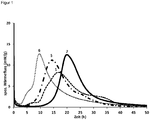
- the measured heat flow curves are in Figure 1 reproduced.
- Figure 1 shows a comparison of the heat flow curves of the mixtures 1, 5, 6 and 7 All the mixtures examined in the calorimeter have a long dormant period of at least 2.5 h after being turned on and show a pronounced heat flow maximum. Compared to the heat flow curves of mixtures 1, 5 and 6, mixture 7 shows a significantly longer open time in the cement paste of approx. 7.5 hours. At the same time, mixture 7 exhibits a homogeneous hydration reaction.
- the raw mixture was selected according to the chemical composition of mixture 7 in Table 6 and manufactured from new raw materials under the designation "R-BC7".
- the chemical compositions of these raw materials are shown in Table 8.
- Table 9 shows the percentage composition of the raw mixture R-BC7.
- Table 8 Chemical characterization of the raw materials for mixture R-BC7 Raw material Anhydrite calc.
- the granules were placed in a heavy oil-fired technical center rotary kiln 7 m long and 50 cm in internal diameter.
- the oven was run at 1.5 revolutions / min.
- the firing temperature in the sintering zone was kept at an average of 1270 ° C.
- the dwell time of the material to be fired in the sintering zone was 30-40 minutes.
- the clinker K-BC7 according to the invention was ground in two stages. The first grinding took place in a ball mill with ball filling, the second grinding in a ball mill with cylindrical grinding media. The clinker was ground without any further additives. The target fineness was 5000 cm 2 / g according to Blaine. In total, several 100 kg of the CSA cement according to the invention with the designation BC7 were produced from the clinker K-BC7 according to the invention.
- Table 10 shows the chemical analysis of the CSA cement according to the invention with the designation BC7 from the grinding of the clinker K-BC7.
- the chemical analyzes of random samples of the two commercially available CSA cements "Alipre” (Italcementi) and “Next Base” (Buzzi Unicem) are shown as comparative data.
- Table 10 Chemical analyzes of the CSA cement BC7 according to the invention and two commercially available comparison products cement Test parameters "Alipre” (Italcementi company) "Next Base” (Buzzi Unicem) "BC7” (Calucem) Chemical composition (wt%) Loi 0.52 1.43 0.06 SiO 2 8.83 10.52 0.59 Al 2 O 3 31.23 29.43 47.20 TiO 2 0.43 1.49 0.02 MnO 0.17 0.04 0.00 Fe 2 O 3 1.50 3.00 0.05 CaO 40.18 41.68 36.90 MgO 4.28 2.51 0.49 K 2 O 0.50 0.39 0.01 Na 2 O 0.81 0.37 0.00 SO 3 11.37 9.24 12.90 P 2 O 5 0.12 0.00 0.01 ZnO 0.00 0.00 1.90 total 99.94 100.10 100.12 Sieve residue (wt%) 90 ⁇ m 0.0 1.4 4.2 fineness Blaine (cm 2 / g) 4700 4600 5210
- the mineralogical composition of the CSA cement BC7 according to the invention is shown in Table 11. These values are compared with random sample analyzes of the commercially available calcium sulfoaluminate cements "Alipre” (Italcementi) and "Next Base” (Buzzi Unicem).
- the two CSA cements "Alipre” and “Next Base” have a C 4 A 3 $ content of less than 90% by weight and a belite (C 2 S ⁇ , ⁇ ) content of 11.80% by weight (“Alipre”) or 17.70% by weight (“Next Base”).
- the CSA according to the invention - BC7 has a C 4 A 3 $ content of 94.5 wt .-% and a belite (C 2 S ⁇ , ⁇ ) content of 2.0% by weight. Phases that solidify quickly, such as C 12 A 7, are not present or only present in traces.
- phase contents were determined with the Rietveld software HighScore Plus, version 4.6a from PANalytical BV, Almelo, Netherlands.
- a Panalytical Cubix X-ray diffractometer with a fast Xcelerator detector was used for the analysis.
- Table 11 Mineralogical analyzes of the CSA cement BC7 according to the invention and two commercially available CSA cements CSA cement "Alipre” (Italcementi company) "Next Base” (Buzzi Unicem) CSA according to the invention - BC7 (Calucem) C 4 A 3 $ 69.2 61.9 94.5 ⁇ -C 2 S 4.2 11.3 0.8 ⁇ -C 2 S 7.6 6.4 1.2 C $ 0.7 4.4 1.0 C 3 MS 2 2.1 5.3 - C 2 AS 2.3 4th - 3C 2 S 3 C $ CaF 2 (Ellastadite fluorine) 5.3 - - CT 0 3.9 - C 3 FT 3.7 1.1 - MgO 4.1 1.7 - CA - - 1.1 C 12 A 7 0.8 0 0.3 ZnA (gahnite) - 1.1 all data in% by weight
- EN 14647 the test method of EN 196-3 is used to determine the standard stiffness and the required water requirement.
- the calcium sulfoaluminate cement BC7 according to the invention has a significantly longer setting characteristic in the glue with a lower water requirement of 28%.
- the values for the water requirement and the setting characteristics in the glue are more comparable to the values for Portland and high alumina cements.
- the "Alipre" comparison cement shows the shortest working time with a start of setting of 9 minutes.
- the compressive strength of the "Next Base” is 6 MPa and that of the "Alipre” is 25 MPa.
- the calcium sulfoaluminate cement BC7 according to the invention already has a compressive strength of 44 MPa after 24 hours and thus has almost twice as high a strength as the commercially available comparison sample "Alipre".
- the self-leveling filler is a particularly demanding product among the construction chemical formulations. On the one hand, this should have a good to very good flow over the processing time of 30 minutes, on the other hand, it must ensure high early strength and quick accessibility. As a rule, the high-quality self-leveling leveling compounds have a high content of calcium sulfoaluminate cement.
- compositions of the various formulations are given in full in Table 13.
- the recipe components are divided into “binders”, “additives I and II” and “fillers”.
- Each of the basic formulations was carried out with the calcium sulfoaluminate cement BC7 according to the invention.
- the two recipes with inventive CSA cement BC7-1 and BC7-2 are recipes compared with the commercially available comparison cements "Alipre” (from Italcementi) and "Next Base” (from Buzzi Unicem).
- Formulation BC7-1 contains 19.66% by weight of the CSA cement BC7 according to the invention.
- the BC7 content was reduced to 14.74% by weight and the recipe was made up to 100% with powdered limestone (F2).
- the four mixtures were each measured over a period of 30 minutes after their preparation by measuring the slump a5, a15 and a30 for their consistency, and on standard prisms 4 cm x 4 cm x 16 cm for their compressive strength development after 4 h, 6 h and 24 h checked.
- the terms and abbreviations used in Table 13 are explained below.
- Binder means the formulation proportions: Portland cement (OPC) Milke Premium CEM I 52.5 R, HeidelbergCement AG, calcium sulfoaluminate cement (CSA) and calcium sulfate (C $) anhydrite - Micro A, Casea.
- additive I refers to the additives with primarily retarding and accelerating effects: tartaric acid L (+) p.a. (WS), from HARKE Chemicals GmbH and pure lithium carbonate. (LiC), Merck Item No. 5670.
- Additives II are those additives that primarily have an influence on the consistency of the mixture: Liquefier ViscoCrete-225 P (VF), SIKA; Cellulose ether Culminal MHPC-500 PF (CE), Ashland; and defoamer Agitan P 801 (ES), from Münzing Chemie GmbH, redispersible polymer powder (RPP) ELOTEX FL 2280, from Akzo Nobel Chemicals AG.
- fillers Inert materials that are not involved in the hydraulic reactions are designated as fillers (F).
- quartz sand F34 F1 from Quarzwerke GmbH and limestone powder 40GU (F2) from Omya GmbH were used.
- Percentages given in Table 13 relate to the percentage of a component in the total weight of the mixture.
- the slump was tested in such a way that 2000 g of the dry formulation mixture was weighed in exactly and mixed in a mortar mixer according to EN 196 with 420 g of demineralized water for 30 seconds at level I and then for 90 seconds at level II. The mixing water was placed in the mixing trough and then the dry mixture was added. The pourable mixture obtained was immediately distributed over 3 discharge rings, ie ring-shaped aluminum vessels 35 mm high and an inner diameter of 68 mm, which were centered on 3 with concentric graduations, exactly horizontally aligned, dry plexiglass spreading plates were arranged. 5 minutes after the start of mixing, the first ring was raised and the diameter of the circular mass was determined as the mean value of two perpendicular measurements with the caliper, as a5 value. The same procedure was followed after 15 and 30 minutes with the other two rings and the values a15 and a30 were determined.
- the construction chemical mixtures were produced in the same way and, after the end of mixing, the pourable materials were poured into prism shapes in accordance with EN 196 without additional compaction measures.
- the molds were stored in accordance with EN 196 and the prisms were tested according to the standards at the scheduled dates.
- the leveling compound BC7-1 with 19.66% calcium sulfoaluminate cement BC7 according to the invention shows significantly higher compressive strengths after 4 h, 6 h and 24 h compared to the leveling compound with 19.66% "Alipre” and 19.66% "Next Base ".
- the leveling compound BC7-2 with only 14.74% calcium sulfoaluminate cement BC7 according to the invention is surprisingly on the strength level of the comparison formulations "Alipre" and "Next Base” with 19.66% cement content.
- the calcium sulfoaluminate cement can in particular contain at most 97% by weight, C 4 A 3 $ at least 1% by weight belite, calculated as C 2 S, and at least 0.5% by weight crotite, calculated as CA.
- the calcium sulfoaluminate cement can in particular contain at most 97% by weight, C 4 A 3 $ at least 1% by weight belite, calculated as C 2 S and at least 0.5% by weight crotite, calculated as CA and at least 0.1 % By weight at most 2.0% by weight, in particular at most 1.0% by weight, in particular at most 0.5% by weight, mayenite, calculated as C12A7.
- the calcium sulfoaluminate cement can in particular contain at most 97% by weight, C 4 A 3 $ at least 1.5% by weight belite, calculated as C 2 S, and at least 0.5% by weight crotite, calculated as CA.
- the calcium sulfoaluminate cement can in particular contain a maximum of 97% by weight, C 4 A 3 $ at least 1.5% by weight of belite, calculated as C 2 S and at least 0.5% by weight of crotite, calculated as CA and at least 0 , 1% by weight at most 2.0% by weight, in particular at most 1.0% by weight, in particular at most 0.5% by weight, mayenite, calculated as C12A7.
Landscapes
- Chemical & Material Sciences (AREA)
- Engineering & Computer Science (AREA)
- Ceramic Engineering (AREA)
- Materials Engineering (AREA)
- Structural Engineering (AREA)
- Organic Chemistry (AREA)
- Inorganic Chemistry (AREA)
- Chemical Kinetics & Catalysis (AREA)
- Physics & Mathematics (AREA)
- Thermal Sciences (AREA)
- Curing Cements, Concrete, And Artificial Stone (AREA)
- Solid-Sorbent Or Filter-Aiding Compositions (AREA)
Claims (5)
- Procédé de production d'un ciment à base de sulfoaluminate de calcium avec au moins 90 % en poids de C4A3$ sous forme cristalline ou amorphe ou en tant que mélange de fractions cristallines et amorphes et une finesse de broyage spécifique selon Blaine comprise entre 3 500 cm2/g et 6 250 cm2/g, dans lequel, pour la production du ciment à base de sulfoaluminate de calcium, un mélange de matières premières est utilisé, qui contient
entre 41 et 50 % en poids d'Al2O3,
entre 34 et 41 % en poids de CaO et
entre 11 et 19 % en poids de SO3,
ainsi que
entre 0,1 et 3 % en poids de SiO2 et/ou
entre 0,1 et 1 % en poids de Fe2O3 et/ou
entre 0,05 et 2,5 % en poids de TiO2 et/ou
entre 0,05 et 2,5 % en poids de ZnO,
dans lequel le procédé comprend les étapes,
de broyage des matières premières en un mélange avec une finesse de broyage spécifique selon Blaine comprise entre 3 500 cm2/g et 6 000 cm2/g et
de cuisson du mélange à une température de cuisson d'au moins 1 150 °C. - Procédé selon la revendication 1, caractérisé en ce que le broyage est effectué dans un broyeur à boulets, de préférence en deux étapes, dans lequel, au cours des deux étapes, différents corps de broyage sont utilisés dans le broyeur à boulets.
- Ciment à base de sulfoaluminate de calcium, caractérisé en ce qu'il contient au moins 90 % en poids de C4A3$ sous forme cristalline ou amorphe ou en tant que mélange de fractions cristallines et amorphes, ainsi que
au maximum 0,5 % en poids de chaux libre, exprimé en CaO et/ou
au maximum 0,5 % en poids de C3A et/ou
au maximum 2,0 % en poids de mayénite, exprimés en C12A7 et/ou
au maximum 10,0 % en poids de krotite, exprimés en CA,
et en outre
entre 0,5 et 10,0 % en poids de C4AF et les cristaux mixtes de celui-ci C6A3-X FX avec 1 ≤ x ≤ 3, et/ou
entre 0,5 % en poids et 10,0 % en poids de bélite, exprimés en C2S, et/ou
au moins 0,5 % en poids de krotite, exprimés en CA et présente en outre une finesse de broyage spécifique selon Blaine comprise entre 3 500 cm2/g et 6 250 cm2/g. - Ciment à base de sulfoaluminate de calcium selon la revendication 3, caractérisé en ce qu'il contient un ou plusieurs des autres éléments suivants ou les oxydes de ceux-ci à différents degrés d'oxydation, ainsi que les composés de ceux-ci : Si, Na, K, Mg, Sr, Ba, Ti, Zr, V, P, Cr, Mn, Zn et/ou d'autres métaux de transition.
- Utilisation d'un ciment à base de sulfoaluminate de calcium selon la revendication 3 ou 4 comme composant de liant dans des préparations de l'industrie de la chimie du bâtiment.
Priority Applications (2)
| Application Number | Priority Date | Filing Date | Title |
|---|---|---|---|
| HRP20201496TT HRP20201496T1 (hr) | 2018-04-26 | 2019-04-18 | Kalcij-sulfoaluminatni cement s niskim sadržajem belita za kemijske promjene u građevinarstvu |
| PL19719484T PL3630700T3 (pl) | 2018-04-26 | 2019-04-18 | Cement CSA o niskiej zawartości belitu do zastosowań w chemii budowlanej |
Applications Claiming Priority (2)
| Application Number | Priority Date | Filing Date | Title |
|---|---|---|---|
| DE102018110136.8A DE102018110136B3 (de) | 2018-04-26 | 2018-04-26 | Belit-minimierter CSA Zement, Verfahren zur Herstellung von CSA-Zement und Verwendung des CSA Zements |
| PCT/EP2019/060201 WO2019206824A1 (fr) | 2018-04-26 | 2019-04-18 | Ciment à base de sulfoaluminate de calcium à teneur en bélite réduite pour applications en chimie de la construction |
Publications (2)
| Publication Number | Publication Date |
|---|---|
| EP3630700A1 EP3630700A1 (fr) | 2020-04-08 |
| EP3630700B1 true EP3630700B1 (fr) | 2020-08-12 |
Family
ID=66286337
Family Applications (1)
| Application Number | Title | Priority Date | Filing Date |
|---|---|---|---|
| EP19719484.8A Active EP3630700B1 (fr) | 2018-04-26 | 2019-04-18 | Ciment à base de sulfoaluminate de calcium à teneur en bélite réduite pour applications en chimie de la construction |
Country Status (13)
| Country | Link |
|---|---|
| US (1) | US11034618B1 (fr) |
| EP (1) | EP3630700B1 (fr) |
| JP (1) | JP7001318B2 (fr) |
| KR (1) | KR102258626B1 (fr) |
| CN (1) | CN111971260B (fr) |
| CA (1) | CA3095763C (fr) |
| DE (1) | DE102018110136B3 (fr) |
| DK (1) | DK3630700T3 (fr) |
| ES (1) | ES2833101T3 (fr) |
| HR (1) | HRP20201496T1 (fr) |
| MX (1) | MX382887B (fr) |
| PL (1) | PL3630700T3 (fr) |
| WO (1) | WO2019206824A1 (fr) |
Families Citing this family (2)
| Publication number | Priority date | Publication date | Assignee | Title |
|---|---|---|---|---|
| EP4267527A1 (fr) * | 2020-12-23 | 2023-11-01 | Sika Technology AG | Composition de liant hydraulique ternaire |
| CN116768505B (zh) * | 2023-06-19 | 2024-07-26 | 南京工业大学 | 一种离子掺杂制备的阿利特-贝利特-硫铝酸钙水泥熟料及方法 |
Family Cites Families (18)
| Publication number | Priority date | Publication date | Assignee | Title |
|---|---|---|---|---|
| JPS60221352A (ja) * | 1984-04-19 | 1985-11-06 | 株式会社トクヤマ | セメント系セルフレベリング材 |
| US5580508A (en) * | 1986-04-04 | 1996-12-03 | Ube Industries, Ltd. | Process for preparing calcium silicate articles |
| DE3711549C2 (de) | 1986-04-04 | 1997-09-04 | Ube Industries | Leichter Calciumsilicat-Gegenstand sowie Verfahren zu seiner Herstellung |
| FR2807424B1 (fr) * | 2000-04-05 | 2002-12-13 | Energetic Ind Internat | Liant hydraulique resultant du melange d'un liant sulfatique et d'un liant comprenant le compose mineralogique c4a3s |
| FR2831161B1 (fr) | 2001-10-24 | 2004-09-10 | Francais Ciments | Clinker sulfoalumineux sans fer et sans chaux libre, son procede de preparation et son utilisation dans des liants blancs |
| JP2007076966A (ja) | 2005-09-15 | 2007-03-29 | Taiheiyo Material Kk | アーウィンの製造方法 |
| CN100486925C (zh) * | 2006-04-20 | 2009-05-13 | 李金洪 | 硫铝酸钙-阿利特复合矿相水泥熟料及其制备方法 |
| IT1402754B1 (it) * | 2010-11-15 | 2013-09-18 | Italcementi Spa | Clinker solfoalluminoso ad elevate prestazioni |
| US9890082B2 (en) * | 2012-04-27 | 2018-02-13 | United States Gypsum Company | Dimensionally stable geopolymer composition and method |
| FR2990363B1 (fr) | 2012-05-14 | 2014-06-06 | Francais Ciments | Procede de traitement de sols pollues, au moyen d'un liant hydraulique a base de clinker sulfo-alumineux et son utilisation pour la stabilisation de sols pollues |
| ES2581863T3 (es) | 2013-05-15 | 2016-09-07 | Calucem Gmbh | Cemento aluminoso |
| ES2766803T3 (es) * | 2013-09-03 | 2020-06-15 | Heidelbergcement Ag | Aglutinantes compuestos de sulfoaluminato de calcio |
| PL2842922T3 (pl) | 2013-09-03 | 2018-05-30 | Heidelbergcement Ag | Topniki/mineralizatory dla cementów opartych na siarczanoglinianie wapnia |
| CN107531573A (zh) | 2015-02-17 | 2018-01-02 | 意大利水泥股份公司 | 环境可持续的水泥组合物,其用于使疏浚沉淀物/淤泥惰性化的方法,用于惰性化的相应方法和设备 |
| US9624131B1 (en) * | 2015-10-22 | 2017-04-18 | United States Gypsum Company | Freeze-thaw durable geopolymer compositions and methods for making same |
| CN108264315A (zh) | 2016-12-30 | 2018-07-10 | 江苏苏博特新材料股份有限公司 | 膨胀可控的建筑用砂浆及其制备方法 |
| EP3461800A1 (fr) | 2017-09-28 | 2019-04-03 | HeidelbergCement AG | Retardateur pour ciment bélite au sulfoaluminate de calcium |
| WO2020206650A1 (fr) | 2019-04-11 | 2020-10-15 | Sika Technology Ag | Composition cimentaire à développement rapide de force d'adhérence à la traction |
-
2018
- 2018-04-26 DE DE102018110136.8A patent/DE102018110136B3/de not_active Expired - Fee Related
-
2019
- 2019-04-18 KR KR1020207034043A patent/KR102258626B1/ko active Active
- 2019-04-18 JP JP2020558474A patent/JP7001318B2/ja active Active
- 2019-04-18 DK DK19719484.8T patent/DK3630700T3/da active
- 2019-04-18 MX MX2020011291A patent/MX382887B/es unknown
- 2019-04-18 CN CN201980022865.9A patent/CN111971260B/zh active Active
- 2019-04-18 CA CA3095763A patent/CA3095763C/fr active Active
- 2019-04-18 PL PL19719484T patent/PL3630700T3/pl unknown
- 2019-04-18 WO PCT/EP2019/060201 patent/WO2019206824A1/fr not_active Ceased
- 2019-04-18 HR HRP20201496TT patent/HRP20201496T1/hr unknown
- 2019-04-18 EP EP19719484.8A patent/EP3630700B1/fr active Active
- 2019-04-18 ES ES19719484T patent/ES2833101T3/es active Active
- 2019-04-18 US US17/047,245 patent/US11034618B1/en active Active
Non-Patent Citations (1)
| Title |
|---|
| None * |
Also Published As
| Publication number | Publication date |
|---|---|
| JP7001318B2 (ja) | 2022-01-19 |
| ES2833101T3 (es) | 2021-06-14 |
| HRP20201496T1 (hr) | 2020-12-25 |
| KR20200139833A (ko) | 2020-12-14 |
| DE102018110136B3 (de) | 2019-07-18 |
| CN111971260A (zh) | 2020-11-20 |
| CN111971260B (zh) | 2021-10-29 |
| CA3095763C (fr) | 2021-12-07 |
| US20210155540A1 (en) | 2021-05-27 |
| EP3630700A1 (fr) | 2020-04-08 |
| KR102258626B1 (ko) | 2021-05-31 |
| CA3095763A1 (fr) | 2019-10-31 |
| JP2021510670A (ja) | 2021-04-30 |
| DK3630700T3 (da) | 2020-10-19 |
| MX382887B (es) | 2025-03-13 |
| MX2020011291A (es) | 2021-05-25 |
| PL3630700T3 (pl) | 2021-03-08 |
| WO2019206824A1 (fr) | 2019-10-31 |
| US11034618B1 (en) | 2021-06-15 |
Similar Documents
| Publication | Publication Date | Title |
|---|---|---|
| DE3020384C2 (de) | Hydraulisches Bindemittelgemisch für die Herstellung von Beton und Mörtel unter Verwendung eines latent hydraulischen Bindemittels | |
| EP2803649B1 (fr) | Ciment alumineux blanc | |
| DE69227582T2 (de) | Bauzementzusammensetzung mit geringer abbindewärme | |
| DE202005017398U1 (de) | Zementartiger Werkstoff, der Edelstahlschlacke und Geopolymere enthält | |
| EP1719742B2 (fr) | Liant hydraulique | |
| EP3106445B1 (fr) | Procédé de fabrication de ciments hautement réactifs | |
| EP2746237B1 (fr) | Activateur pour ciment | |
| EP3063102B1 (fr) | Liant résistant à l'eau à base de hémihydrate de sulfate de calcium bêta | |
| EP3310737B1 (fr) | Activateur à ph faible pour matériaux de remplacement de clinker | |
| EP2080742B1 (fr) | Ciment de fonderie au sulfate | |
| EP3630700B1 (fr) | Ciment à base de sulfoaluminate de calcium à teneur en bélite réduite pour applications en chimie de la construction | |
| EP3732143B1 (fr) | Ciment alumineux | |
| DE102010061456B4 (de) | Verfahren zum Herstellen einer Baustoffzusammensetzung und ein Bindemittel für eine Baustoffmischung | |
| EP2066595B1 (fr) | Ciment portland contenant du liant, et hydrate de calcium | |
| EP2234931B1 (fr) | Procédé pour la production de chaux hydraulique | |
| EP4417591B1 (fr) | Composition pour la préparation de béton, son procédé de préparation et son utilisation, et béton comprenant cette composition | |
| EP4414339B1 (fr) | Mélange de ciment blanc, procédé de fabrication du mélange de ciment blanc, mélange de ciment blanc durci, mélange de béton sec, mélange de béton frais et mélange de mortier blanc chacun | |
| DE102024122202A1 (de) | Verfahren zur Herstellung eines Klinkerersatzstoffes und dessen Verwendung, Zementmischungen, Verfahren zur Herstellung der Zementmischungen, Trockenbetonmischung, Trockenmörtelmischung, Frischbetonmasse und Frischmörtelmasse jeweils mit einer Zementmischung | |
| WO2025190883A1 (fr) | Clinker de ciment à teneur réduite en chrome (vi) | |
| DE2625067A1 (de) | Verfuellmasse |
Legal Events
| Date | Code | Title | Description |
|---|---|---|---|
| STAA | Information on the status of an ep patent application or granted ep patent |
Free format text: STATUS: UNKNOWN |
|
| STAA | Information on the status of an ep patent application or granted ep patent |
Free format text: STATUS: THE INTERNATIONAL PUBLICATION HAS BEEN MADE |
|
| PUAI | Public reference made under article 153(3) epc to a published international application that has entered the european phase |
Free format text: ORIGINAL CODE: 0009012 |
|
| STAA | Information on the status of an ep patent application or granted ep patent |
Free format text: STATUS: REQUEST FOR EXAMINATION WAS MADE |
|
| 17P | Request for examination filed |
Effective date: 20191230 |
|
| AK | Designated contracting states |
Kind code of ref document: A1 Designated state(s): AL AT BE BG CH CY CZ DE DK EE ES FI FR GB GR HR HU IE IS IT LI LT LU LV MC MK MT NL NO PL PT RO RS SE SI SK SM TR |
|
| AX | Request for extension of the european patent |
Extension state: BA ME |
|
| GRAP | Despatch of communication of intention to grant a patent |
Free format text: ORIGINAL CODE: EPIDOSNIGR1 |
|
| STAA | Information on the status of an ep patent application or granted ep patent |
Free format text: STATUS: GRANT OF PATENT IS INTENDED |
|
| INTG | Intention to grant announced |
Effective date: 20200415 |
|
| GRAS | Grant fee paid |
Free format text: ORIGINAL CODE: EPIDOSNIGR3 |
|
| GRAA | (expected) grant |
Free format text: ORIGINAL CODE: 0009210 |
|
| STAA | Information on the status of an ep patent application or granted ep patent |
Free format text: STATUS: THE PATENT HAS BEEN GRANTED |
|
| AK | Designated contracting states |
Kind code of ref document: B1 Designated state(s): AL AT BE BG CH CY CZ DE DK EE ES FI FR GB GR HR HU IE IS IT LI LT LU LV MC MK MT NL NO PL PT RO RS SE SI SK SM TR |
|
| DAV | Request for validation of the european patent (deleted) | ||
| DAX | Request for extension of the european patent (deleted) | ||
| REG | Reference to a national code |
Ref country code: CH Ref legal event code: EP |
|
| REG | Reference to a national code |
Ref country code: IE Ref legal event code: FG4D Free format text: LANGUAGE OF EP DOCUMENT: GERMAN |
|
| REG | Reference to a national code |
Ref country code: DE Ref legal event code: R096 Ref document number: 502019000138 Country of ref document: DE |
|
| REG | Reference to a national code |
Ref country code: FI Ref legal event code: FGE |
|
| REG | Reference to a national code |
Ref country code: AT Ref legal event code: REF Ref document number: 1301408 Country of ref document: AT Kind code of ref document: T Effective date: 20200915 Ref country code: CH Ref legal event code: NV Representative=s name: DREISS PATENTANWAELTE PARTG MBB, DE |
|
| REG | Reference to a national code |
Ref country code: HR Ref legal event code: TUEP Ref document number: P20201496 Country of ref document: HR |
|
| REG | Reference to a national code |
Ref country code: DK Ref legal event code: T3 Effective date: 20201013 |
|
| REG | Reference to a national code |
Ref country code: NL Ref legal event code: FP |
|
| REG | Reference to a national code |
Ref country code: SE Ref legal event code: TRGR |
|
| REG | Reference to a national code |
Ref country code: HR Ref legal event code: T1PR Ref document number: P20201496 Country of ref document: HR |
|
| REG | Reference to a national code |
Ref country code: LT Ref legal event code: MG4D |
|
| PG25 | Lapsed in a contracting state [announced via postgrant information from national office to epo] |
Ref country code: LT Free format text: LAPSE BECAUSE OF FAILURE TO SUBMIT A TRANSLATION OF THE DESCRIPTION OR TO PAY THE FEE WITHIN THE PRESCRIBED TIME-LIMIT Effective date: 20200812 Ref country code: GR Free format text: LAPSE BECAUSE OF FAILURE TO SUBMIT A TRANSLATION OF THE DESCRIPTION OR TO PAY THE FEE WITHIN THE PRESCRIBED TIME-LIMIT Effective date: 20201113 Ref country code: NO Free format text: LAPSE BECAUSE OF FAILURE TO SUBMIT A TRANSLATION OF THE DESCRIPTION OR TO PAY THE FEE WITHIN THE PRESCRIBED TIME-LIMIT Effective date: 20201112 Ref country code: BG Free format text: LAPSE BECAUSE OF FAILURE TO SUBMIT A TRANSLATION OF THE DESCRIPTION OR TO PAY THE FEE WITHIN THE PRESCRIBED TIME-LIMIT Effective date: 20201112 |
|
| PG25 | Lapsed in a contracting state [announced via postgrant information from national office to epo] |
Ref country code: RS Free format text: LAPSE BECAUSE OF FAILURE TO SUBMIT A TRANSLATION OF THE DESCRIPTION OR TO PAY THE FEE WITHIN THE PRESCRIBED TIME-LIMIT Effective date: 20200812 Ref country code: LV Free format text: LAPSE BECAUSE OF FAILURE TO SUBMIT A TRANSLATION OF THE DESCRIPTION OR TO PAY THE FEE WITHIN THE PRESCRIBED TIME-LIMIT Effective date: 20200812 Ref country code: IS Free format text: LAPSE BECAUSE OF FAILURE TO SUBMIT A TRANSLATION OF THE DESCRIPTION OR TO PAY THE FEE WITHIN THE PRESCRIBED TIME-LIMIT Effective date: 20201212 |
|
| PG25 | Lapsed in a contracting state [announced via postgrant information from national office to epo] |
Ref country code: SM Free format text: LAPSE BECAUSE OF FAILURE TO SUBMIT A TRANSLATION OF THE DESCRIPTION OR TO PAY THE FEE WITHIN THE PRESCRIBED TIME-LIMIT Effective date: 20200812 Ref country code: EE Free format text: LAPSE BECAUSE OF FAILURE TO SUBMIT A TRANSLATION OF THE DESCRIPTION OR TO PAY THE FEE WITHIN THE PRESCRIBED TIME-LIMIT Effective date: 20200812 Ref country code: CZ Free format text: LAPSE BECAUSE OF FAILURE TO SUBMIT A TRANSLATION OF THE DESCRIPTION OR TO PAY THE FEE WITHIN THE PRESCRIBED TIME-LIMIT Effective date: 20200812 Ref country code: RO Free format text: LAPSE BECAUSE OF FAILURE TO SUBMIT A TRANSLATION OF THE DESCRIPTION OR TO PAY THE FEE WITHIN THE PRESCRIBED TIME-LIMIT Effective date: 20200812 |
|
| REG | Reference to a national code |
Ref country code: HR Ref legal event code: ODRP Ref document number: P20201496 Country of ref document: HR Payment date: 20210401 Year of fee payment: 3 |
|
| REG | Reference to a national code |
Ref country code: DE Ref legal event code: R097 Ref document number: 502019000138 Country of ref document: DE |
|
| PG25 | Lapsed in a contracting state [announced via postgrant information from national office to epo] |
Ref country code: AL Free format text: LAPSE BECAUSE OF FAILURE TO SUBMIT A TRANSLATION OF THE DESCRIPTION OR TO PAY THE FEE WITHIN THE PRESCRIBED TIME-LIMIT Effective date: 20200812 |
|
| REG | Reference to a national code |
Ref country code: ES Ref legal event code: FG2A Ref document number: 2833101 Country of ref document: ES Kind code of ref document: T3 Effective date: 20210614 |
|
| PLBE | No opposition filed within time limit |
Free format text: ORIGINAL CODE: 0009261 |
|
| STAA | Information on the status of an ep patent application or granted ep patent |
Free format text: STATUS: NO OPPOSITION FILED WITHIN TIME LIMIT |
|
| PG25 | Lapsed in a contracting state [announced via postgrant information from national office to epo] |
Ref country code: SK Free format text: LAPSE BECAUSE OF FAILURE TO SUBMIT A TRANSLATION OF THE DESCRIPTION OR TO PAY THE FEE WITHIN THE PRESCRIBED TIME-LIMIT Effective date: 20200812 |
|
| 26N | No opposition filed |
Effective date: 20210514 |
|
| PG25 | Lapsed in a contracting state [announced via postgrant information from national office to epo] |
Ref country code: MC Free format text: LAPSE BECAUSE OF FAILURE TO SUBMIT A TRANSLATION OF THE DESCRIPTION OR TO PAY THE FEE WITHIN THE PRESCRIBED TIME-LIMIT Effective date: 20200812 |
|
| PG25 | Lapsed in a contracting state [announced via postgrant information from national office to epo] |
Ref country code: LU Free format text: LAPSE BECAUSE OF NON-PAYMENT OF DUE FEES Effective date: 20210418 |
|
| REG | Reference to a national code |
Ref country code: BE Ref legal event code: MM Effective date: 20210430 |
|
| PG25 | Lapsed in a contracting state [announced via postgrant information from national office to epo] |
Ref country code: IE Free format text: LAPSE BECAUSE OF NON-PAYMENT OF DUE FEES Effective date: 20210418 |
|
| REG | Reference to a national code |
Ref country code: HR Ref legal event code: ODRP Ref document number: P20201496 Country of ref document: HR Payment date: 20220405 Year of fee payment: 4 |
|
| PG25 | Lapsed in a contracting state [announced via postgrant information from national office to epo] |
Ref country code: IS Free format text: LAPSE BECAUSE OF FAILURE TO SUBMIT A TRANSLATION OF THE DESCRIPTION OR TO PAY THE FEE WITHIN THE PRESCRIBED TIME-LIMIT Effective date: 20201212 |
|
| PG25 | Lapsed in a contracting state [announced via postgrant information from national office to epo] |
Ref country code: BE Free format text: LAPSE BECAUSE OF NON-PAYMENT OF DUE FEES Effective date: 20210430 |
|
| PG25 | Lapsed in a contracting state [announced via postgrant information from national office to epo] |
Ref country code: PT Free format text: LAPSE BECAUSE OF FAILURE TO SUBMIT A TRANSLATION OF THE DESCRIPTION OR TO PAY THE FEE WITHIN THE PRESCRIBED TIME-LIMIT Effective date: 20201214 |
|
| REG | Reference to a national code |
Ref country code: HR Ref legal event code: ODRP Ref document number: P20201496 Country of ref document: HR Payment date: 20230322 Year of fee payment: 5 |
|
| P01 | Opt-out of the competence of the unified patent court (upc) registered |
Effective date: 20230505 |
|
| PG25 | Lapsed in a contracting state [announced via postgrant information from national office to epo] |
Ref country code: CY Free format text: LAPSE BECAUSE OF FAILURE TO SUBMIT A TRANSLATION OF THE DESCRIPTION OR TO PAY THE FEE WITHIN THE PRESCRIBED TIME-LIMIT Effective date: 20200812 |
|
| PG25 | Lapsed in a contracting state [announced via postgrant information from national office to epo] |
Ref country code: HU Free format text: LAPSE BECAUSE OF FAILURE TO SUBMIT A TRANSLATION OF THE DESCRIPTION OR TO PAY THE FEE WITHIN THE PRESCRIBED TIME-LIMIT; INVALID AB INITIO Effective date: 20190418 |
|
| PG25 | Lapsed in a contracting state [announced via postgrant information from national office to epo] |
Ref country code: SI Free format text: LAPSE BECAUSE OF FAILURE TO SUBMIT A TRANSLATION OF THE DESCRIPTION OR TO PAY THE FEE WITHIN THE PRESCRIBED TIME-LIMIT Effective date: 20200812 |
|
| REG | Reference to a national code |
Ref country code: HR Ref legal event code: ODRP Ref document number: P20201496 Country of ref document: HR Payment date: 20240411 Year of fee payment: 6 |
|
| PG25 | Lapsed in a contracting state [announced via postgrant information from national office to epo] |
Ref country code: MK Free format text: LAPSE BECAUSE OF FAILURE TO SUBMIT A TRANSLATION OF THE DESCRIPTION OR TO PAY THE FEE WITHIN THE PRESCRIBED TIME-LIMIT Effective date: 20200812 |
|
| PG25 | Lapsed in a contracting state [announced via postgrant information from national office to epo] |
Ref country code: MT Free format text: LAPSE BECAUSE OF FAILURE TO SUBMIT A TRANSLATION OF THE DESCRIPTION OR TO PAY THE FEE WITHIN THE PRESCRIBED TIME-LIMIT Effective date: 20200812 |
|
| REG | Reference to a national code |
Ref country code: DE Ref legal event code: R082 Ref document number: 502019000138 Country of ref document: DE |
|
| PGFP | Annual fee paid to national office [announced via postgrant information from national office to epo] |
Ref country code: HR Payment date: 20250318 Year of fee payment: 7 |
|
| REG | Reference to a national code |
Ref country code: HR Ref legal event code: ODRP Ref document number: P20201496 Country of ref document: HR Payment date: 20250318 Year of fee payment: 7 |
|
| PGFP | Annual fee paid to national office [announced via postgrant information from national office to epo] |
Ref country code: GB Payment date: 20250318 Year of fee payment: 7 |
|
| PGFP | Annual fee paid to national office [announced via postgrant information from national office to epo] |
Ref country code: NL Payment date: 20250409 Year of fee payment: 7 |
|
| PGFP | Annual fee paid to national office [announced via postgrant information from national office to epo] |
Ref country code: FI Payment date: 20250421 Year of fee payment: 7 |
|
| PGFP | Annual fee paid to national office [announced via postgrant information from national office to epo] |
Ref country code: DE Payment date: 20250402 Year of fee payment: 7 Ref country code: PL Payment date: 20250324 Year of fee payment: 7 |
|
| PGFP | Annual fee paid to national office [announced via postgrant information from national office to epo] |
Ref country code: ES Payment date: 20250508 Year of fee payment: 7 Ref country code: DK Payment date: 20250425 Year of fee payment: 7 |
|
| PGFP | Annual fee paid to national office [announced via postgrant information from national office to epo] |
Ref country code: IT Payment date: 20250402 Year of fee payment: 7 |
|
| PGFP | Annual fee paid to national office [announced via postgrant information from national office to epo] |
Ref country code: FR Payment date: 20250425 Year of fee payment: 7 |
|
| PGFP | Annual fee paid to national office [announced via postgrant information from national office to epo] |
Ref country code: CH Payment date: 20250501 Year of fee payment: 7 |
|
| PGFP | Annual fee paid to national office [announced via postgrant information from national office to epo] |
Ref country code: AT Payment date: 20250325 Year of fee payment: 7 |
|
| PGFP | Annual fee paid to national office [announced via postgrant information from national office to epo] |
Ref country code: TR Payment date: 20250409 Year of fee payment: 7 |
|
| PGFP | Annual fee paid to national office [announced via postgrant information from national office to epo] |
Ref country code: SE Payment date: 20250430 Year of fee payment: 7 |