EP3632941A1 - Composition de résine - Google Patents
Composition de résine Download PDFInfo
- Publication number
- EP3632941A1 EP3632941A1 EP18000783.3A EP18000783A EP3632941A1 EP 3632941 A1 EP3632941 A1 EP 3632941A1 EP 18000783 A EP18000783 A EP 18000783A EP 3632941 A1 EP3632941 A1 EP 3632941A1
- Authority
- EP
- European Patent Office
- Prior art keywords
- resin composition
- meth
- bis
- phenyl
- acrylate
- Prior art date
- Legal status (The legal status is an assumption and is not a legal conclusion. Google has not performed a legal analysis and makes no representation as to the accuracy of the status listed.)
- Granted
Links
- 0 CC(C)(C(C(C)(*)c(cc1)ccc1N(C(C=C1)=O)C1=O)C=*)c(cc1)ccc1N(C(C=C1)=O)C1=O Chemical compound CC(C)(C(C(C)(*)c(cc1)ccc1N(C(C=C1)=O)C1=O)C=*)c(cc1)ccc1N(C(C=C1)=O)C1=O 0.000 description 3
- MAHYBEUMFAWSMN-UHFFFAOYSA-N CC(C(Cc(cc1)ccc1N(C(C=C1)=O)C1=O)C=C1)C=C1N(C(C=C1)=O)C1=O Chemical compound CC(C(Cc(cc1)ccc1N(C(C=C1)=O)C1=O)C=C1)C=C1N(C(C=C1)=O)C1=O MAHYBEUMFAWSMN-UHFFFAOYSA-N 0.000 description 1
Images


Classifications
-
- C—CHEMISTRY; METALLURGY
- C08—ORGANIC MACROMOLECULAR COMPOUNDS; THEIR PREPARATION OR CHEMICAL WORKING-UP; COMPOSITIONS BASED THEREON
- C08F—MACROMOLECULAR COMPOUNDS OBTAINED BY REACTIONS ONLY INVOLVING CARBON-TO-CARBON UNSATURATED BONDS
- C08F222/00—Copolymers of compounds having one or more unsaturated aliphatic radicals, each having only one carbon-to-carbon double bond, and at least one being terminated by a carboxyl radical and containing at least one other carboxyl radical in the molecule; Salts, anhydrides, esters, amides, imides, or nitriles thereof
- C08F222/36—Amides or imides
- C08F222/40—Imides, e.g. cyclic imides
-
- B—PERFORMING OPERATIONS; TRANSPORTING
- B29—WORKING OF PLASTICS; WORKING OF SUBSTANCES IN A PLASTIC STATE IN GENERAL
- B29C—SHAPING OR JOINING OF PLASTICS; SHAPING OF MATERIAL IN A PLASTIC STATE, NOT OTHERWISE PROVIDED FOR; AFTER-TREATMENT OF THE SHAPED PRODUCTS, e.g. REPAIRING
- B29C64/00—Additive manufacturing, i.e. manufacturing of three-dimensional [3D] objects by additive deposition, additive agglomeration or additive layering, e.g. by 3D printing, stereolithography or selective laser sintering
- B29C64/10—Processes of additive manufacturing
- B29C64/106—Processes of additive manufacturing using only liquids or viscous materials, e.g. depositing a continuous bead of viscous material
- B29C64/124—Processes of additive manufacturing using only liquids or viscous materials, e.g. depositing a continuous bead of viscous material using layers of liquid which are selectively solidified
-
- B—PERFORMING OPERATIONS; TRANSPORTING
- B33—ADDITIVE MANUFACTURING TECHNOLOGY
- B33Y—ADDITIVE MANUFACTURING, i.e. MANUFACTURING OF THREE-DIMENSIONAL [3D] OBJECTS BY ADDITIVE DEPOSITION, ADDITIVE AGGLOMERATION OR ADDITIVE LAYERING, e.g. BY 3D PRINTING, STEREOLITHOGRAPHY OR SELECTIVE LASER SINTERING
- B33Y70/00—Materials specially adapted for additive manufacturing
-
- C—CHEMISTRY; METALLURGY
- C08—ORGANIC MACROMOLECULAR COMPOUNDS; THEIR PREPARATION OR CHEMICAL WORKING-UP; COMPOSITIONS BASED THEREON
- C08F—MACROMOLECULAR COMPOUNDS OBTAINED BY REACTIONS ONLY INVOLVING CARBON-TO-CARBON UNSATURATED BONDS
- C08F2/00—Processes of polymerisation
- C08F2/38—Polymerisation using regulators, e.g. chain terminating agents, e.g. telomerisation
- C08F2/40—Polymerisation using regulators, e.g. chain terminating agents, e.g. telomerisation using retarding agents
-
- C—CHEMISTRY; METALLURGY
- C08—ORGANIC MACROMOLECULAR COMPOUNDS; THEIR PREPARATION OR CHEMICAL WORKING-UP; COMPOSITIONS BASED THEREON
- C08F—MACROMOLECULAR COMPOUNDS OBTAINED BY REACTIONS ONLY INVOLVING CARBON-TO-CARBON UNSATURATED BONDS
- C08F2/00—Processes of polymerisation
- C08F2/46—Polymerisation initiated by wave energy or particle radiation
- C08F2/48—Polymerisation initiated by wave energy or particle radiation by ultraviolet or visible light
-
- C—CHEMISTRY; METALLURGY
- C08—ORGANIC MACROMOLECULAR COMPOUNDS; THEIR PREPARATION OR CHEMICAL WORKING-UP; COMPOSITIONS BASED THEREON
- C08F—MACROMOLECULAR COMPOUNDS OBTAINED BY REACTIONS ONLY INVOLVING CARBON-TO-CARBON UNSATURATED BONDS
- C08F2/00—Processes of polymerisation
- C08F2/46—Polymerisation initiated by wave energy or particle radiation
- C08F2/48—Polymerisation initiated by wave energy or particle radiation by ultraviolet or visible light
- C08F2/50—Polymerisation initiated by wave energy or particle radiation by ultraviolet or visible light with sensitising agents
-
- C—CHEMISTRY; METALLURGY
- C08—ORGANIC MACROMOLECULAR COMPOUNDS; THEIR PREPARATION OR CHEMICAL WORKING-UP; COMPOSITIONS BASED THEREON
- C08F—MACROMOLECULAR COMPOUNDS OBTAINED BY REACTIONS ONLY INVOLVING CARBON-TO-CARBON UNSATURATED BONDS
- C08F222/00—Copolymers of compounds having one or more unsaturated aliphatic radicals, each having only one carbon-to-carbon double bond, and at least one being terminated by a carboxyl radical and containing at least one other carboxyl radical in the molecule; Salts, anhydrides, esters, amides, imides, or nitriles thereof
- C08F222/10—Esters
- C08F222/1006—Esters of polyhydric alcohols or polyhydric phenols
-
- C—CHEMISTRY; METALLURGY
- C08—ORGANIC MACROMOLECULAR COMPOUNDS; THEIR PREPARATION OR CHEMICAL WORKING-UP; COMPOSITIONS BASED THEREON
- C08F—MACROMOLECULAR COMPOUNDS OBTAINED BY REACTIONS ONLY INVOLVING CARBON-TO-CARBON UNSATURATED BONDS
- C08F222/00—Copolymers of compounds having one or more unsaturated aliphatic radicals, each having only one carbon-to-carbon double bond, and at least one being terminated by a carboxyl radical and containing at least one other carboxyl radical in the molecule; Salts, anhydrides, esters, amides, imides, or nitriles thereof
- C08F222/10—Esters
- C08F222/1006—Esters of polyhydric alcohols or polyhydric phenols
- C08F222/102—Esters of polyhydric alcohols or polyhydric phenols of dialcohols, e.g. ethylene glycol di(meth)acrylate or 1,4-butanediol dimethacrylate
-
- C—CHEMISTRY; METALLURGY
- C08—ORGANIC MACROMOLECULAR COMPOUNDS; THEIR PREPARATION OR CHEMICAL WORKING-UP; COMPOSITIONS BASED THEREON
- C08J—WORKING-UP; GENERAL PROCESSES OF COMPOUNDING; AFTER-TREATMENT NOT COVERED BY SUBCLASSES C08B, C08C, C08F, C08G or C08H
- C08J3/00—Processes of treating or compounding macromolecular substances
- C08J3/24—Crosslinking, e.g. vulcanising, of macromolecules
- C08J3/243—Two or more independent types of crosslinking for one or more polymers
-
- B—PERFORMING OPERATIONS; TRANSPORTING
- B33—ADDITIVE MANUFACTURING TECHNOLOGY
- B33Y—ADDITIVE MANUFACTURING, i.e. MANUFACTURING OF THREE-DIMENSIONAL [3D] OBJECTS BY ADDITIVE DEPOSITION, ADDITIVE AGGLOMERATION OR ADDITIVE LAYERING, e.g. BY 3D PRINTING, STEREOLITHOGRAPHY OR SELECTIVE LASER SINTERING
- B33Y80/00—Products made by additive manufacturing
Definitions
- the invention relates to a resin composition for three dimensional printing at elevated temperatures forming high temperature-resistant materials and the use thereof as well as an item produced from the inventive resin composition.
- L-AMTs Lithography-based additive manufacturing technologies
- stereolithography have manifested their position for the production of prototypes with often complex geometries (rapid prototyping).
- Recent technical advancements are trying to push these L-AMTs more toward the actual production of functional parts.
- Examples, where such an industrial venture has been successful are the fields of hearing aid shells or transparent orthodontic fixations.
- one crucial drawback of most of the established light-curable materials is a heat resistance below 100°C, which excludes other potential applications, especially in an industrial environment, where heat resistance is often a vital requirement.
- Light-curable materials (resins or formulations) for L-AMTs are typically based on reactive components (generally on monomers and photoinitiators) that polymerize and cure upon light irradiation and certain additives that further adjust the overall material performance.
- the photoinitiator is activated via light irradiation and generates a reactive site (e.g. a radical) that can then react with the respective monomers (e.g. (meth)acrylates, (meth)acrylamides, vinyl ester, styrene compounds, maleimides, etc.).
- L-AMTs such as stereolithography, digital light processing, digital inkjet printing or multijet modeling. All mentioned technologies are based on a layer-by-layer build-up of the final 3D-part. More recently, the company Carbon has developed the continuous liquid interface production "CLIP", which represents an advanced L-AMT and further pushes the field towards fast production. Current formulations applied for such technologies are of low viscosity ( ⁇ 1 Pa*s), which is imperative for a successful build-up job or build-up step (see I. Gibson, D.W. Rosen, B. Stucker et al., "Additive Manufacturing Technologies", Vol. 238, Springer Verlag (2010 )).
- CLIP continuous liquid interface production
- EP 3 284 583 A1 Hot Lithography Process
- Applicant has developed the so-called Hot Lithography Process (EP 3 284 583 A1 ), which allows for lithography-based 3D-stucturing at elevated temperatures of light-curable resins having high viscosities of > 15 Pa*s at room temperature (20 °C).
- high viscosities are to be found when processing materials having high contents of monomers, oligomers and/or prepolymers with high molecular weight (> 2000 g mol -1 ) and/or high melting or softening temperatures and/or strong intermolecular forces and/or high contents of filling materials that are added to the viscous light-curable resin in order to tune final material performance.
- the combination of high temperatures and processing of highly viscous formulations enables the 3D-structuring of light-curable materials with combined toughness, heat resistance and impact resistance.
- Resin compositions for lithography-based 3D-structuring to form plastic materials that exhibit a heat resistance of up to 300°C and above had yet to be developed.
- cyanate ester-based dual cure resins have been introduced as a class of high-temperature thermosets for additive manufacturing ( WO 2017/040883 A1 ).
- T g glass transition temperatures
- T HDT(B) heat deflection temperature
- Pure cyanate ester resins are known to exhibit very high glass transition temperatures (up to 400°C), which have so far not been available for processing by L-AMTs due to the necessity for a substantial portion of a light-curable component within the formulation.
- the company Novoset has disclosed dual cure resins with a component being a radically curable component (e.g. curable via UV-light, cationic, electron beam, laser, peroxide and/or chemical additive curing) and another component being a thermoset ( US 9,708,440 B2 ).
- a component being a radically curable component (e.g. curable via UV-light, cationic, electron beam, laser, peroxide and/or chemical additive curing) and another component being a thermoset ( US 9,708,440 B2 ).
- the described examples within this patent have been limited to cyanate ester-based formulations and reported glass transition temperatures of up to 300°C.
- Such dual cure resins are described in US 2017/0173866 A1 as potential tools for injection moulding, injection moulding cores, engine blades, aerospace applications such as spacecraft or heat shield parts, boat and naval applications, impellers, radomes, satellite structures, automotive parts (e.g.
- BMIs bismaleimide resins
- AMTs Low-density polystyrene-maleimide resins
- the materials are usually solids or semi-solids with high melting temperatures (>50°C) and are thus rendered incompatible with traditional L-AMTs.
- BMI-thermosets exhibit brittleness due to high crosslink density and usually high crystalline contents.
- maleimide-based components have been introduced to light-curable formulations (e.g. US2013/0025495 A1 ), as they tend to increase resin viscosity and often render the final formulation non-processable, especially in application fields such as coatings, printing inks and L-AMTs, where high viscosities are problematic.
- a resin composition that is adapted to be used in L-AMTs and in particular in stereolithography, which allows for 3D-printing of products of remarkably high temperature resistance and at the same time high mechanical strengths.
- a high temperature-resistant resin composition for three-dimensional printing at elevated temperatures comprising:
- Resin compositions of the inventive type can be processed in 3D-printing applications at elevated temperatures, in which the inventive resin composition is heated and subsequently subjected to a layer-by-layer, light-induced build-up step, in which the light-curable component of the inventive resin composition is structured by light-curing to obtain three dimensional objects via a lithography-based additive manufacturing method yielding materials with the aforementioned desirable thermal, mechanical and chemical properties of high temperature resistant thermosetting compounds.
- the content of light-curable component B is preferably kept to a minimum (even as low as 5 wt% based on the total weight of components A and B) in order to maintain the desirable (thermo)mechanical properties of the heat-cured component A.
- Hot Lithography is used as a processing method to enable the 3D-structuring of resins with a high content of component A, being thermoset precursors like maleimide- or citraconimide-based or based on isomers, oligomers or prepolymers thereof, which are usually characterized by high melting temperatures (> 50°C) and for conventional L-AMTs comparably high viscosities of the resin formulation (> 15 Pa*s at room temperature 0.01-40 Pa*s, preferably from 0.1-25 Pa*s at processing temperature).
- the resulting materials offer unique thermal resistance (meaning the retention of an acceptable proportion of the initial properties at ambient conditions during continuous exposure to elevated temperatures even up to 300°C and more). This is substantiated by the herein disclosed (thermo)mechanical properties for 3D-parts produced via L-AMTs (glass transition temperature T g and heat deflection temperature T HDT(B) of up to 300°C and even above) .
- heat-curable monomers of component A of the inventive resin composition are represented by the following chemical formulae:
- the amount of component A ranges from 40 wt% to 95 wt%, preferably from 50 wt% to 95 wt%, more preferably from 60 wt% to 95 wt% and even more preferably from 70 wt% to 95 wt% based on the total weight of components A and B and the amount of the light-curable component B ranges preferably from 5 wt% to 60 wt%, preferably from 5 wt% to 50 wt%, more preferably from 5 wt% to 40 wt% and even more preferably from 5 wt% to 30 wt% based on the total weight of components A and B.
- component A of the inventive resin composition are N-phenylmaleimide, 2,6-xylylmaleimide, N,N'-m-phenylenebismaleimide, N,N'-(4-methyl-m-phenylene)-bismaleimide, 4,4'-diphenylmethanebismaleimide, m-xylylenebismaleimide, 1,3-bis(citraconimidomethyl)benzene, 1,6-bismaleimido-(trimethyl)hexane (isomeric mixture of 2,2,4- and 2,4,4-trimethyl) and/or oligomers and/or prepolymers thereof as represented by the following chemical formulae:
- the inventive resin composition comprises toughness modifiers selected from the group consisting of thermoplastic resins, in particular polyethylene oxide and polypropylene oxide, reactive rubbers, in particular maleimido-terminated butadiene-acrylonitrile copolymer and/or monomers comprising reactive maleimide- or citraconimide groups with flexible linkers, in particular long aliphatic chains and/or ethylene glycol spacers, monomers such as Q-Bond (a bismaleimide 36 carbon cycloaliphatic branched structure) and/or MIA (an oligomeric polyether bismaleimide, poly(oxybutylene)-di(2-maleimidoacetate), oligomers and/or prepolymers thereof.
- thermoplastic resins in particular polyethylene oxide and polypropylene oxide
- reactive rubbers in particular maleimido-terminated butadiene-acrylonitrile copolymer and/or monomers comprising reactive maleimide- or citraconimide groups with flexible linkers, in particular long alipha
- the resin composition is devised in such a manner, that the component B comprises a multifunctional (meth)acrylate and/or a mixture of mono- and multifunctional (meth)acrylates, in particular methyl-, ethyl-, 2-hydroxyethyl, butyl-, benzyl-, tetrahydrofurfuryl- or isobornyl(meth)acrylat, 1,4-butanedioldi(meth)acrylate, 1,6-hexanedioldi(meth)acrylate, 1,10-decanedioldi(meth)acrylat or 1,12-dodecanedioldi-(meth)acrylate, 2-(2-biphenyloxy)-ethyl(meth)acrylate, bisphenol-A-di(meth)acrylate (an addition product from (meth)acrylic acid and bisphenol-A-diglycidylether), ethoxy- or propoxylated bisphenol-A-di
- Monofunctional (meth)acrylates are components with one radically polymerisable group.
- Multifunctional (meth)acrylate components are components with two or more radically polymerisable groups.
- the formulations related to this invention are composed of at least one di- and/or multifunctional (meth)acrylate or a mixture of mono- and/or di- and/or multifunctional (meth)acrylates. These are radically polymerisable monomers and hence monomers polymerisable by light and are therefore specifically preferred as the light-curable component matrix for component B of the inventive resin composition.
- Multifunctional monomers are preferably tri-, tetra-, penta- and/or hexafunctional (meth)acrylates and/or hyperbranched and/or dendritic (meth)acrylates having even more functional sites. These are suitable for reasons of fast reaction rates and high crosslinking densities.
- the inventive resin composition comprises at least one photoinitiator suitable for radical polymerisation upon light excitation, preferably light excitation within the wavelength spectrum of 150 nm to 580 nm, more preferably between 300 nm to 500 nm, preferably in amounts of 0.01 wt% to 10 wt%, preferably 0.1 wt% to 7 wt%, more preferably 0.2 wt% to 5 wt% based on the weight of components A and B.
- the photoinitiators can be activated with light and initiate polymerisation of the polymerisable components of the formulation.
- the light-initiated polymerisation is successful, when the applied light exposure is of a suitable wavelength for activating the photoinitiator and is of sufficient power. Aside from the light exposure being adequate for the photoinitiator, the overall formulation (optionally including light absorbing monomers or additives) may not interfere with the interaction of the emitted light and the photoinitiator.
- Light exposure applied herein includes any wavelength and power being able to initiate polymerisation. Preferred wavelengths of light are 150 nm to 580 nm, even more preferred between 300 nm to 500 nm. Any suitable UV or visible light source may be used, including but not limited to lasers or LED sources. The light source may emit a broadband or narrowband light spectrum, or a combination thereof.
- the light source may emit continuous or pulsed light during single or repeated exposure periods, which may additionally be varied via time or intensity of exposure.
- a suitable and elevated process temperature will increase the reactivity of the system and thus enhance the light-induced structuring process. Adjusting the parameters and variables above will lead to an optimized protocol for carrying out the described photopolymerisation reaction, yielding optimal 3D-processing via L-AMTs.
- Preferred photoinitiators are Norrish type I photoinitiators alone or in combination with each other.
- Some preferred examples are 2-hydroxy-2-methylpropiophenone, 1-hydroxycyclohexyl phenyl ketone, methyl phenyl glyoxylates, 2-benzyl-2-(dimethylamino)-4'-morpholinobutyrophenone, [1-(4-phenylsulfanylbenzoyl)heptylideneamino]benzoate, [1-[9-ethyl-6-(2-methylbenzoyl)carbazol-3-yl]ethylideneamino] acetate, bis (cyclopentadienyl) bis [2,6-difluoro-3-(1-pyrryl) phenyl] titanium, acyl- or bisacyl-phosphine oxide-based initiators, in particular 2,4,6-trimethylbenzoyldiphenylphosphine oxide (TPO),
- Preferred photoinitiators may also be Norrish type II photoinitiators.
- Some preferred examples are benzophenones (in particular benzophenone, 4-methyl benzophenone, 4,4'-bis(diethylamino)benzophenone), benzoin, diketones (e.g. 9,10-phenanthrenequinone, 1-phenyl-propane-1,2-dione, diacetyl or 4,4'-dichlorobenzil and/or derivatives thereof), thioxanthones (in particular 2,4-diethyl-9H-thioxanthen-9-one).
- Such type II photoinitiators may be used in combination with coinitiators such as tertiary amines, in particular aromatic tertiary amines such as N,N-dialkylaniline, -p-toluidine or -3,5-xylidine, p-N,N-dialkylamino-phenylethanol, -benzoic acid derivatives, -benzaldehyde or triethanolamine.
- coinitiators such as tertiary amines, in particular aromatic tertiary amines such as N,N-dialkylaniline, -p-toluidine or -3,5-xylidine, p-N,N-dialkylamino-phenylethanol, -benzoic acid derivatives, -benzaldehyde or triethanolamine.
- a combination of said type I and/or type II photoinitiators may be used.
- the inventive resin composition comprises one and/or more initiators for radical polymerisation, in particular thermal initiators, which are suitable for thermal curing.
- initiators for radical polymerisation in particular thermal initiators, which are suitable for thermal curing.
- Some preferred examples are azo compounds, more preferably 2,2'azobis(isobutyronitrile) (AIBN) and/or azobis-(4-cyanovaleric acid) and/or peroxides (e.g. dibenzoyl peroxide, dilauroyl peroxide, dicumyl peroxide, tert-butylperbenzoate, di-(tert-butyl)-peroxide) and/or 1,1,2,2-tetraphenyl-1,2-ethanediol.
- AIBN 2,2'azobis(isobutyronitrile)
- azobis-(4-cyanovaleric acid) and/or peroxides (e.g. dibenzoyl peroxide, dilauroyl peroxid
- the inventive resin composition comprises at least one polymerisation inhibitor, preferably an inhibitor selected from the group consisting of hydroquinones, benzoquinones and/or phenothiazines.
- photoinitiators, thermal initiators, inhibitors and other additives may be additionally functionalized with a polymerisable functional group, which can either undergo copolymerisation with components A or components B as it is in accordance with a preferred embodiment of the present invention.
- component A further comprises a comonomer and/or cooligomer and/or coprepolymer, which is able to copolymerize with component A as well as with derivatives thereof.
- comonomers can preferably be selected from the group comprised of monomers and/or oligomers and/or prepolymers from alkenylphenol, alkenylphenyl ether, alkenylphenol ether, polyamine, aminophenol, amino acid hydrazine, cyanate ester, diallyl phthalate, triallyl isocyanurate, triallyl cyanurate, vinylic and/or styrenic functional groups.
- Some preferred examples of such comonomers and the like are represented by the following chemical formulae:
- At least one catalyst may be used for the thermal curing of component A.
- Suitable catalysts may preferably be selected from the group consisting of tertiary amines, in particular DABCO and triethylamine, phosphines, triphenyl phosphonate, imidazoles, in particular 2-methyl-1-vinyl imidazole, organic acids, and/or peroxides.
- the resin composition of this invention comprises organic and/or inorganic fillers.
- organic fillers may be but are not limited to core-shell particles, block copolymers, PTFE, high performance polymers, thermoplastics, in particular poly(ether imides) or polysulfones, rubbers, and the like.
- Preferred inorganic fillers may be metals, metal oxides and/or ceramics (e.g., SiO 2 , ZrO 2 , TiO 2 , ZnO or mixtures thereof with an average particle size of 1-20 ⁇ m, or preferred nano- or micro fillers with an average particle size of 10 nm -1000 nm), silicates such as talc, clays, silica and/or mica, glass powders (in particular quartz, glass ceramics as preferred nano- or micro fillers with an average particle size of 0.01-20 ⁇ m), carbon black, graphene, graphite.
- ceramics e.g., SiO 2 , ZrO 2 , TiO 2 , ZnO or mixtures thereof with an average particle size of 1-20 ⁇ m, or preferred nano- or micro fillers with an average particle size of 10 nm -1000 nm
- silicates such as talc, clays, silica and/or mica
- glass powders in particular quartz, glass ceramics as preferred nano
- the average particle size of the fillers may be determined via static light scattering methods using the Mie-theory according to DIN/ISO 13320 for the determination of average particle size and particle size distribution.
- organic or inorganic fillers may be fibers (e.g. nanofibers, whiskers, and/or mixtures thereof), spheres, fractures and/or defined three-dimensional (in particular graphite) and/or two-dimensional structures (in particular monolayers of graphene).
- the filler(s) may be modified on their surface (e.g. silanzied via radically polymerisable silanes such as 3-methacryloyloxypropyl trimethoxy silane).
- silanzied via radically polymerisable silanes such as 3-methacryloyloxypropyl trimethoxy silane.
- acidic phosphates e.g. 10-methacryloyloxydecyldihydrogen phosphate
- phenomena like agglomeration, mixture stability, particle bonding to the polymer matrix are controlled and/or influenced.
- the resin composition of this invention may additionally comprise stabilizers, colorants, antibacterial agents, optical brighteners, softeners and/or UV-absorbers.
- compositions of components A according to the general formula I may be mixed in various ratios with components B and additional components as described above.
- Preferable ratios for mixing the formulations may be:
- the presence of the mono- or oligomeric, mono- or multifunctional component A provides for a relatively high heat resistance (heat deflection temperature T HDT (B) > 250°C and glass transition temperature T g > 250°C) of the polymerisates.
- T HDT (B) heat deflection temperature
- T g glass transition temperature
- the presence of the mono- and/or oligomeric, mono- and/or multifunctional substance, which can be cured via light (component B) enables the 3D-structuring of the formulations, preferably via Hot Lithography using temperatures in the build-up step of 40 to 150°C.
- the resin composition at room temperature (20 °C) has a viscosity > 5 Pa*s, preferably > 50 Pa*s.
- These viscosities result from the particularly high content of component A which provide the remarkably high temperature resistance of the materials formed from the inventive resin composition.
- inventive resin is characterized by the composition being subjected to a light-induced structuring step followed by a heat-induced curing step.
- the curing process via light is very likely an additive manufacturing process, more preferably a 3D printing process with the respective thermal post-processing steps to obtain the final product having the desired chemical, mechanical and thermal properties.
- inventive resin formulations may thus be used as resin formulations for making three-dimensional objects via additive manufacturing. Resulting 3D-parts offer exceptional heat and chemical resistance, while exhibiting high strength, hardness and stiffness.
- Possible applications for such additively manufactured 3D-objects from said materials may be tools for injection moulding, deep drawing, thermoforming, extrusion and/or pressing, injection moulding cores, dies for continuous casting, engine blades, aerospace applications such as spacecraft or heat shield parts, boat and naval applications, impellers, radomes, satellite structures, automotive parts (e.g. housings and interior facings, parts in contact with fuel such as connectors), printed circuit boards, packaging and cooling architectures for electronics, chip mounting, robotic hands, battery storage enclosures, healthcare applications (e.g. parts exposed to high temperature for sterilisation), surgical instruments (e.g. retractors, dilators, dissectors), intraoral devices such as surgical guides for dental applications or other examples where there is a demand for mechanical stability at high temperatures (> 150°C).
- the light-induced structuring step is carried out at elevated processing temperatures of the resin composition, preferably at a temperature between 40°C and 150°C, more preferably between 60°C and 120°C, even more preferably between 70°C and 110°C. This is done in order to provide solubility or miscibility for the high content of component A and to reduce the viscosity of the inventive resin composition during the structuring step.
- a layer of the resin composition is formed on a carrier plate, preferably by means of a recoater blade, the resin composition preferably having a viscosity at said processing temperature of 0.01 to 40 Pa*s, preferably of 0.1 to 25 Pa*s.
- the light-induced structuring step is preferably performed for building a shaped body by 3D printing, wherein layers of said shaped body are formed one after the other and one on top of each other by each forming a material layer of predetermined thickness of the resin composition between a transparent or at least partially transparent carrier such as a plate, a carrier film or a bottom of a vat, and a mechanically adjustable construction platform, or the shaped body at least partially formed on the construction platform and wherein the so defined material layer is cured in a position-selective manner, in particular by irradiation through the transparent or at least partially transparent carrier, to provide the desired shape of the shaped body layer.
- a transparent or at least partially transparent carrier such as a plate, a carrier film or a bottom of a vat
- a mechanically adjustable construction platform or the shaped body at least partially formed on the construction platform and wherein the so defined material layer is cured in a position-selective manner, in particular by irradiation through the transparent or at least partially transparent
- the light-induced structuring step is carried out by using a first radiation source, wherein the radiation of the first radiation source is applied to the resin composition through the transparent carrier plate, and heating of the layer of resin composition to be structured is carried out by using a second radiation source, wherein the carrier plate is essentially impermeable for the radiation of the second radiation source.
- the carrier plate is heated by the radiation of the second radiation source, said radiation essentially not entering into the layer of the resin composition, and resin composition thus indirectly heated via the carrier plate is structured by the radiation of the first radiation source.
- a heat curing step is performed to yield further cure.
- the heating step may be performed within a temperature region of 150-400 °C and may be divided into one or more individual curing steps with defined time intervals at respectively defined temperatures.
- Nonlimiting examples for such heat curing steps may be: Method A ⁇ 2h at 170°C, 4h at 220°C and 2h at 250°C; Method B ⁇ 1h at 180°C, 1h at 220°C, 4h at 250°C and 1h at 300°C.
- the inventive item that results from subjecting the inventive resin composition to a light-induced structuring step followed by a heat-induced curing step is preferably characterized in that the item has a heat deflection temperature (HDT(B)) ranging from 250°C to 360°C, a storage modulus of > 1 GPa up to temperatures in the range from 250°C to 360°C, a glass transition temperature ranging from 250°C to 360°C and a flexural modulus at room temperature of > 3 GPa.
- HDT(B) heat deflection temperature
- polymer refers to a molecule composed of repeating structural units connected by covalent chemical bonds and characterized by a substantial number of repeating units (e.g., equal to or greater than 10 repeating units and often equal to or greater than 50 repeating units and often equal to or greater than 100 repeating units) and a high molecular weight (e.g. greater than or equal to 5000 Da, 10000 Da or 20000 Da). Polymers are commonly the polymerisation product of one or more monomer precursors.
- polymer includes homopolymers, or polymers consisting essentially of a single repeating monomer subunit.
- polymer also includes copolymers which are formed when two or more different types of monomers are linked in the same polymer. Copolymers may comprise two or more monomer subunits, and include random, block, alternating, segmented, grafted, tapered and other copolymers. The term “polymer” also includes cross-linked polymers.
- an "oligomer” refers to a molecule composed of repeating structural units connected by covalent chemical bonds and characterized by a number of repeating units less than that of a polymer (e.g., equal to or less than 10 repeating units) and a lower molecular weight than polymers (e.g. less than 5,000 Da or 2,000 Da). Oligomers may be the polymerisation product of one or more monomer precursors. In an embodiment, an oligomer or a monomer cannot be considered a polymer in its own right.
- a “prepolymer” refers to a polymer or oligomer, the molecules of which are capable of entering, through reactive groups, into further polymerisation.
- Oligomers and polymer mixtures can be characterized and differentiated from other mixtures of oligomers and polymers by measurements of molecular weight and molecular weight distributions.
- Curable compositions according to the present invention were prepared by mixing the respective compounds in a beaker at a temperature of 60-110°C. The resins were mixed until they became homogeneous formulations.
- (Thermo)mechanical test specimens of the final materials according to the present invention were fabricated from the respective light-curable compositions via Hot Lithography on a Caligma 200 from the company Cubicure GmbH. All printer parts in contact with the formulations (i.e. material vat, recoating unit, recoating blade and building platform) were heated to a temperature in the range of 45°C to 110°C, depending on the adjusted printing temperature for each formulation. All 3D-parts were printed with a scan speed of 12000 mm*s -1 , a laser intensity of 155 mW and a layer thickness of 50 or 100 ⁇ m. The hatching distance was set to 15 ⁇ m in one direction and the laser spot had a diameter of 25 ⁇ m on the upper surface of the material vat.
- HDT Heat Deflection Temperature
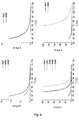
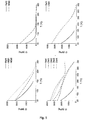
- DMA measurements were performed on a Dynamic Mechanical Analyzer (TA Instruments 2980, New Castle, DE, USA) with a set temperature program (30°C to 400°C) and a heating rate of 3°C*min -1 .
- the testing conditions were set to a frequency of 1 Hz, an amplitude of 20 ⁇ m and a preload force of 0.1 N.
- the glass transition temperature T g is derived from the maximum value of the loss factor tan ⁇ .
- a ProLine Z010 TH material tester from Zwick/Roell was used for 3-point-bending tests of the 3D-printed materials. The test was performed according to DIN EN ISO 178:2013.
- Comparative Example 1 Curable resins with monofunctional maleimides and polymers thereof MM1-3
- inorganic filler further pushes the stiffness and overall moduli (see polymer of MM2), while maintaining the improved heat deflection and glass transition temperatures.
- the softer polymer matrix from Ref2 also can be significantly improved towards higher heat deflection and glass transition temperatures by the addition of 20 wt% 2,6-xylylmaleimide. Improvements in strength and stiffness are also evident for the polymer of MM3 compared to the material from Ref2.
- the outlined examples confirm the effect of improved heat deflection and stability, strength and stiffness via maleimide addition to standard light-curable formulations and constitute the lower bound of maleimide content or contribution toward the material performance of the final 3D-part.
- Example 1 Curable resin with difunctional maleimides, citraconimides and comonomers and polymers thereof (DM1-4)
- thermoset components yields 3D-printed parts (polymers of DM1-4) with substantially improved heat resistance, which is supported by heat deflection temperatures T HDT(B) of more than 300°C as a unique characteristic for 3D-parts from L-AMTs.
- T HDT(B) heat deflection temperatures
- the rather high force load in HDT(C) testing further proves the high heat resistance even upon high forces with temperatures exceeding 150°C, even roughly 230°C for the high BMI-content polymer of DM1.
- the glass transition temperatures lie well-above 300°C for the BMI-based polymers DM1-4.
- Strength and stiffness are also in the preferable range of > 100 MPa (flexural strength) and > 3000 MPa (flexural modulus) for the 3D-part from DM1.
- Other BMI-materials also show properties in the preferable range, except for flexural strength, which can be explained by their rather brittle behaviour. This causes the test specimens to break early in the bending test. Nevertheless, the flexural strength at higher temperatures is expected to uphold contrary to standard (meth)acrylate-based polymers, which have limited heat resistance.
- the BMI-material with the highest BMI content shows the best performance, but processability is better with samples DM2-4 as they additionally contain the comonomer 4,4'-bis(o-propenylphenoxy)benzophenone. This can also be observed by the higher viscosity of DM1 compared to DM2 and DM3. DM4 exhibits higher viscosities due to the inorganic filler present in the formulation.
- OM1 5.00 g of the multifunctional acrylate Bomar 741-XS, 4.00 g of the multifunctional methacrylate (tricyclodecanedimethanol dimethacrylate), 11.95 g of the difunctional m-xylylenebismalemide, 9.85 g of the difunctional 4,4'-diphenylmethanebismaleimide, 5.00 g of the oligomeric BMI resin (copolymer from 4,4'-diphenylmethanebismaleimide and 4,4'-methylenedianiline) and 14.20 g of the diallyl comonomer 4,4'-bis(o-propenylphenoxy)benzophenone were homogenized together with 0.50 g of the photoinitiator TPO-L.
- the viscosity is increased compared to the above tested DMs.
- processability is reached at temperatures around 90°C and 3D-parts have been successfully fabricated.
- the observed heat deflection temperature (127°C for HDT(C)) and the glass transition temperature of above 290°C is below the other BMI examples, but still further supports the striking performance of the 3D-structured BMI materials. It is clear to the person skilled in the art that the use of a BMI-copolymer yields benefits in thermal shrinkage, gel content and part cracking.
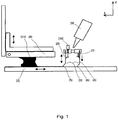
- reference numeral 1 denotes a material support, on which a material layer 11 is arranged.
- a construction platform 8 Spaced from the material support 1, a construction platform 8 is arranged, which is height-adjustable in the z direction and is tiltably mounted about the axis 4. Between the build platform 8 and the material support 1, some material layers 11 are already constructed.
- the material support 1 is translationally movable along the x-direction perpendicular to the z-direction.
- a material introduction device 3 which comprises a first recoater blade 5 and a second recoater blade 6.
- the first recoater blade 5 is height adjustable by means of a recoater motor 10 in the z direction and the second recoater blade 6 has a spring 7 which holds the second recoater blade 6 in abutment with the material support 1 in the z direction.
- a material reservoir 2 is formed, which can be supplied by means of a conveyor 9 with the inventive resin composition.
- the material support 1 is in the second position.
- the construction platform 8 is lowered in the direction of the material support 1, so that a new material layer 11 of the inventive resin composition can be formed by the material layer 11 and is irradiated selectively on the material support 1 by means of a radiation source, not shown, from below through the material support 1 and thereby structured and solidified.
- the material layer 11 was applied during the movement of the material support 1 in the second position by the first recoater blade 5.
Landscapes
- Chemical & Material Sciences (AREA)
- Chemical Kinetics & Catalysis (AREA)
- Medicinal Chemistry (AREA)
- Polymers & Plastics (AREA)
- Organic Chemistry (AREA)
- Health & Medical Sciences (AREA)
- Engineering & Computer Science (AREA)
- Materials Engineering (AREA)
- Manufacturing & Machinery (AREA)
- Physics & Mathematics (AREA)
- Mechanical Engineering (AREA)
- Optics & Photonics (AREA)
- Macromonomer-Based Addition Polymer (AREA)
- Polymerisation Methods In General (AREA)
- Addition Polymer Or Copolymer, Post-Treatments, Or Chemical Modifications (AREA)
- Graft Or Block Polymers (AREA)
Priority Applications (7)
| Application Number | Priority Date | Filing Date | Title |
|---|---|---|---|
| EP18000783.3A EP3632941B1 (fr) | 2018-10-01 | 2018-10-01 | Composition de résine |
| EP19779615.4A EP3861037B1 (fr) | 2018-10-01 | 2019-10-01 | Composition de résine |
| KR1020217012907A KR102675091B1 (ko) | 2018-10-01 | 2019-10-01 | 수지 조성물 |
| US17/280,060 US20210395420A1 (en) | 2018-10-01 | 2019-10-01 | Resin composition |
| CN201980065061.7A CN112823172A (zh) | 2018-10-01 | 2019-10-01 | 树脂组合物 |
| JP2021517990A JP7513598B2 (ja) | 2018-10-01 | 2019-10-01 | 樹脂組成物 |
| PCT/IB2019/058336 WO2020070639A1 (fr) | 2018-10-01 | 2019-10-01 | Composition de résine |
Applications Claiming Priority (1)
| Application Number | Priority Date | Filing Date | Title |
|---|---|---|---|
| EP18000783.3A EP3632941B1 (fr) | 2018-10-01 | 2018-10-01 | Composition de résine |
Publications (3)
| Publication Number | Publication Date |
|---|---|
| EP3632941A1 true EP3632941A1 (fr) | 2020-04-08 |
| EP3632941B1 EP3632941B1 (fr) | 2023-08-23 |
| EP3632941C0 EP3632941C0 (fr) | 2023-08-23 |
Family
ID=63722130
Family Applications (2)
| Application Number | Title | Priority Date | Filing Date |
|---|---|---|---|
| EP18000783.3A Active EP3632941B1 (fr) | 2018-10-01 | 2018-10-01 | Composition de résine |
| EP19779615.4A Active EP3861037B1 (fr) | 2018-10-01 | 2019-10-01 | Composition de résine |
Family Applications After (1)
| Application Number | Title | Priority Date | Filing Date |
|---|---|---|---|
| EP19779615.4A Active EP3861037B1 (fr) | 2018-10-01 | 2019-10-01 | Composition de résine |
Country Status (6)
| Country | Link |
|---|---|
| US (1) | US20210395420A1 (fr) |
| EP (2) | EP3632941B1 (fr) |
| JP (1) | JP7513598B2 (fr) |
| KR (1) | KR102675091B1 (fr) |
| CN (1) | CN112823172A (fr) |
| WO (1) | WO2020070639A1 (fr) |
Cited By (6)
| Publication number | Priority date | Publication date | Assignee | Title |
|---|---|---|---|---|
| EP3909748A1 (fr) | 2020-05-12 | 2021-11-17 | TIGER Coatings GmbH & Co. KG | Matériau thermodurcissant destiné à être utilisé dans une fabrication additive |
| CN113698696A (zh) * | 2020-05-21 | 2021-11-26 | 中国科学院福建物质结构研究所 | 一种基于3d打印降低聚烯烃类高分子制件翘曲度的方法 |
| EP4049841A1 (fr) | 2021-02-26 | 2022-08-31 | Cubicure GmbH | Composition de résine hybride |
| WO2022268609A1 (fr) * | 2021-06-24 | 2022-12-29 | Basf Se | Composition pour impression 3d, objet imprimé en 3d formé à partir de celle-ci et son procédé de formation |
| WO2023110819A1 (fr) * | 2021-12-14 | 2023-06-22 | Arxada Ag | Nouvelles compositions à caractéristiques améliorées |
| EP4650397A1 (fr) * | 2024-05-14 | 2025-11-19 | Cubicure GmbH | Composition de résine pour un procédé de fabrication additive durcissable par rayonnement |
Families Citing this family (39)
| Publication number | Priority date | Publication date | Assignee | Title |
|---|---|---|---|---|
| US12496766B2 (en) | 2020-05-01 | 2025-12-16 | Texas Tech University System | Methods of 3D printing thermosetting polymers and continuous fiber composites via in-situ self-propagation curing and systems thereof |
| CN111575097B (zh) * | 2020-06-15 | 2021-04-16 | 清华大学 | 具有光致变粘度的溶液及调控流体粘度的方法 |
| KR102437041B1 (ko) * | 2021-06-17 | 2022-08-29 | 서울대학교산학협력단 | 3차원 입체 인쇄용 조성물 및 이로부터 제조된 경화물 |
| US12319002B2 (en) | 2021-10-28 | 2025-06-03 | Align Technology, Inc. | Systems for post-processing additively manufactured objects |
| CN118382674A (zh) * | 2021-12-14 | 2024-07-23 | 阿萨达股份公司 | 具有改进的特性的新型组合物 |
| US20230264428A1 (en) | 2022-02-23 | 2023-08-24 | Align Technology, Inc. | Indirect temperature monitoring for additive manufacturing |
| EP4504494A1 (fr) * | 2022-04-06 | 2025-02-12 | Basf Se | Composition durcissable pour procédé d'impression 3d et objet imprimé en 3d formé à partir de celle-ci et procédé d'impression 3d l'utilisant |
| DE102022110873A1 (de) | 2022-05-03 | 2023-11-09 | Tdk Electronics Ag | Additives Fertigungsverfahren mit Modifizierung von Teilschichten |
| CN119487451A (zh) * | 2022-05-13 | 2025-02-18 | 二次3D股份有限公司 | 在可光硬化组合物的体积中形成物体的方法 |
| WO2024040029A2 (fr) | 2022-08-15 | 2024-02-22 | Align Technology, Inc. | Procédés de production d'objets fabriqués de manière additive ayant des propriétés hétérogènes |
| CN120202085A (zh) | 2022-09-15 | 2025-06-24 | 阿莱恩技术有限公司 | 用于对增材制造对象的表面进行改性的系统和方法 |
| EP4590489A2 (fr) | 2022-09-22 | 2025-07-30 | Cubicure GmbH | Plateformes de construction modulaires pour fabrication additive |
| CN120076767A (zh) | 2022-10-20 | 2025-05-30 | 阿莱恩技术有限公司 | 用于生成能够直接制造的牙科器具的系统和方法 |
| CN120112243A (zh) | 2022-10-26 | 2025-06-06 | 阿莱恩技术有限公司 | 具有机械互锁元件的材料和增材制造物品 |
| WO2024092097A1 (fr) | 2022-10-26 | 2024-05-02 | Align Technology, Inc. | Systèmes de fabrication additive à substrats fixes |
| CN120225339A (zh) | 2022-11-01 | 2025-06-27 | 阿莱恩技术有限公司 | 用于增材制造的预制支撑结构和/或覆盖物 |
| US20240227300A1 (en) | 2023-01-09 | 2024-07-11 | Align Technology, Inc. | Methods for generating support structures for additively manufactured objects |
| CN116003687B (zh) * | 2023-01-09 | 2024-04-19 | 南亚新材料科技股份有限公司 | 马来酰亚胺树脂预聚物及其制备方法、树脂组合物和应用 |
| WO2024173543A2 (fr) | 2023-02-15 | 2024-08-22 | Align Technology, Inc. | Composés monomères pour résines d'impression 3d |
| WO2024182521A1 (fr) | 2023-02-28 | 2024-09-06 | Align Technology, Inc. | Additifs pour résines polymères d'impression 3d |
| CN119487450A (zh) * | 2023-03-08 | 2025-02-18 | 二次3D股份有限公司 | 光引发剂、组合物和形成物体的方法 |
| US20240300185A1 (en) | 2023-03-10 | 2024-09-12 | Align Technology, Inc. | Additive manufacturing systems with error correction and associated methods |
| WO2024191831A1 (fr) | 2023-03-10 | 2024-09-19 | Align Technology, Inc. | Procédés et dispositifs pour fabrication additive |
| WO2024192136A1 (fr) | 2023-03-14 | 2024-09-19 | Align Technology, Inc. | Polymères photodurcissables et compositions pour résines d'impression 3d |
| CN121038767A (zh) | 2023-03-14 | 2025-11-28 | 阿莱恩技术有限公司 | 交联剂和组合物 |
| CN121335678A (zh) | 2023-04-14 | 2026-01-13 | 阿莱恩技术有限公司 | 用于设计对象的系统和方法 |
| US20250018650A1 (en) | 2023-07-13 | 2025-01-16 | Align Technology, Inc. | Systems for cleaning and/or cooling additively manufactured objects and associated methods |
| US20250073990A1 (en) | 2023-09-01 | 2025-03-06 | Align Technology, Inc. | Scanning energy systems for additive manufacturing and associated methods |
| US20250108562A1 (en) | 2023-10-02 | 2025-04-03 | Align Technology, Inc. | Methods for stabilizing additively manufactured objects |
| US20250178129A1 (en) | 2023-12-04 | 2025-06-05 | Align Technology, Inc. | Additively manufactured objects with accessible supports and associated methods |
| WO2025147627A1 (fr) | 2024-01-04 | 2025-07-10 | Align Technology, Inc. | Prédiction de résultats de fabrication pour objets fabriqués de manière additive |
| CN117844435B (zh) * | 2024-01-04 | 2025-07-22 | 杭州之江有机硅化工有限公司 | 一种含bmi树脂的氰酸酯组合物及应用 |
| WO2025169200A1 (fr) * | 2024-02-06 | 2025-08-14 | Nano Dimension Technologies, Ltd. | Compositions éliminant l'apparition d'une mobilité translationnelle dans des polymères durcis |
| US20250276378A1 (en) | 2024-02-29 | 2025-09-04 | Cubicure Gmbh | Attachment mechanisms for modular build platforms |
| WO2025207660A2 (fr) | 2024-03-26 | 2025-10-02 | Align Technology, Inc. | Procédés de production de composés phénoliques comprenant du syringol à partir de biomasse et leur utilisation dans l'impression 3d |
| WO2025264582A2 (fr) | 2024-06-17 | 2025-12-26 | Align Technology, Inc. | Récupération de composés contenant un hydroxyle et de monomères de (méth)acrylate à partir d'un matériau polymère imprimé en 3d |
| WO2025264579A1 (fr) | 2024-06-17 | 2025-12-26 | Align Technology, Inc. | Compositions pour la fabrication additive au moyen de charges activables |
| US20260061703A1 (en) | 2024-08-30 | 2026-03-05 | Align Technology, Inc. | Bubble removal systems and methods for additive manufacturing |
| US20260084379A1 (en) | 2024-09-20 | 2026-03-26 | Align Technology, Inc. | Stochastic discretization of object slices for additive manufacturing |
Citations (6)
| Publication number | Priority date | Publication date | Assignee | Title |
|---|---|---|---|---|
| WO2000020517A2 (fr) * | 1999-01-19 | 2000-04-13 | Dsm N.V. | Compositions durcissables par rayonnements a base de composes de maleimide et procede de production d'un substrat avec une couche durcie |
| US20130025495A1 (en) | 2010-01-11 | 2013-01-31 | Isp Investments Inc. | Compositions comprising a reactive monomer and uses thereof |
| US20160369040A1 (en) * | 2015-06-18 | 2016-12-22 | Sajal Das | High temperature three dimensional printing compositions |
| WO2017040883A1 (fr) | 2015-09-04 | 2017-03-09 | Carbon, Inc. | Résines d'ester de cyanate à double durcissement pour fabrication additive |
| US20170173866A1 (en) | 2015-12-22 | 2017-06-22 | Carbon, Inc. | Production of injection molds by additive manufacturing with dual cure resins |
| EP3284583A1 (fr) | 2016-08-18 | 2018-02-21 | Cubicure GmbH | Procede et dispositif de fabrication generative par lithographie de corps de formage tridimensionnels |
Family Cites Families (19)
| Publication number | Priority date | Publication date | Assignee | Title |
|---|---|---|---|---|
| GB1575653A (en) * | 1977-06-01 | 1980-09-24 | Ciba Geigy Ag | Reinforced composites |
| CA1274048A (fr) * | 1986-07-15 | 1990-09-11 | Linda A. Domeier | Formulations de bisomaleimide contenant des agents modifiant les ethers olefiniques |
| JPH0721042B2 (ja) * | 1987-09-30 | 1995-03-08 | 三井石油化学工業株式会社 | 熱硬化性樹脂組成物 |
| US4954195A (en) * | 1989-02-13 | 1990-09-04 | Lockheed Corporation | Production of thermoset composites containing thermoplastic fillers |
| JPH0496914A (ja) * | 1990-08-13 | 1992-03-30 | Showa Highpolymer Co Ltd | ビスマレイミド組成物 |
| FR2746402B1 (fr) * | 1996-03-19 | 1998-05-29 | Aerospatiale | Compositions de resines maleiques durcissables par ionisation et leur utilisation pour la fabrication de materiaux composites a renfort fibreux |
| JP4362989B2 (ja) * | 2001-05-09 | 2009-11-11 | 日油株式会社 | 光学的立体造形用組成物および造形物 |
| US20040029044A1 (en) * | 2002-08-08 | 2004-02-12 | 3M Innovative Properties Company | Photocurable composition |
| JP2004168915A (ja) * | 2002-11-20 | 2004-06-17 | Nof Corp | 光硬化性樹脂組成物および硬化物 |
| US8043534B2 (en) * | 2005-10-21 | 2011-10-25 | Designer Molecules, Inc. | Maleimide compositions and methods for use thereof |
| KR20120110164A (ko) * | 2009-06-26 | 2012-10-09 | 바스프 에스이 | 자동차 부품상에 경화된 코팅 조성물을 형성하는 방법 |
| JP2011102345A (ja) * | 2009-11-10 | 2011-05-26 | Mitsubishi Plastics Inc | ポリマレイミド系組成物 |
| JP5895585B2 (ja) * | 2012-02-23 | 2016-03-30 | 日立金属株式会社 | 接着剤、接着フィルム、積層フィルム、配線フィルム及び多層配線フィルム |
| JP6388909B2 (ja) * | 2013-03-28 | 2018-09-12 | エボニック デグサ ゲーエムベーハーEvonik Degussa GmbH | キシリレンビスマレイミドをベースとする硬化性混合物 |
| JP6439338B2 (ja) * | 2014-09-16 | 2018-12-19 | コニカミノルタ株式会社 | 三次元造形方法および三次元造形装置 |
| KR101630966B1 (ko) * | 2014-11-25 | 2016-06-27 | 김준일 | 광확산층이 형성된 도어 프레임 몰딩 |
| CN105837760B (zh) * | 2016-05-19 | 2018-08-07 | 潘盈 | 一种3d打印用聚酰亚胺光敏材料 |
| CN106832091A (zh) * | 2017-01-18 | 2017-06-13 | 福建省支点三维科技有限公司 | 一种热固性聚丙烯酸酯树脂3d打印材料及其制备方法 |
| WO2019130312A2 (fr) * | 2017-12-28 | 2019-07-04 | Stratasys Ltd. | Fabrication additive employant des formulations contenant un polyimide sans solvant |
-
2018
- 2018-10-01 EP EP18000783.3A patent/EP3632941B1/fr active Active
-
2019
- 2019-10-01 JP JP2021517990A patent/JP7513598B2/ja active Active
- 2019-10-01 CN CN201980065061.7A patent/CN112823172A/zh active Pending
- 2019-10-01 KR KR1020217012907A patent/KR102675091B1/ko active Active
- 2019-10-01 EP EP19779615.4A patent/EP3861037B1/fr active Active
- 2019-10-01 WO PCT/IB2019/058336 patent/WO2020070639A1/fr not_active Ceased
- 2019-10-01 US US17/280,060 patent/US20210395420A1/en active Pending
Patent Citations (7)
| Publication number | Priority date | Publication date | Assignee | Title |
|---|---|---|---|---|
| WO2000020517A2 (fr) * | 1999-01-19 | 2000-04-13 | Dsm N.V. | Compositions durcissables par rayonnements a base de composes de maleimide et procede de production d'un substrat avec une couche durcie |
| US20130025495A1 (en) | 2010-01-11 | 2013-01-31 | Isp Investments Inc. | Compositions comprising a reactive monomer and uses thereof |
| US20160369040A1 (en) * | 2015-06-18 | 2016-12-22 | Sajal Das | High temperature three dimensional printing compositions |
| US9708440B2 (en) | 2015-06-18 | 2017-07-18 | Novoset, Llc | High temperature three dimensional printing compositions |
| WO2017040883A1 (fr) | 2015-09-04 | 2017-03-09 | Carbon, Inc. | Résines d'ester de cyanate à double durcissement pour fabrication additive |
| US20170173866A1 (en) | 2015-12-22 | 2017-06-22 | Carbon, Inc. | Production of injection molds by additive manufacturing with dual cure resins |
| EP3284583A1 (fr) | 2016-08-18 | 2018-02-21 | Cubicure GmbH | Procede et dispositif de fabrication generative par lithographie de corps de formage tridimensionnels |
Non-Patent Citations (1)
| Title |
|---|
| I. GIBSON; D.W. ROSEN; B. STUCKER ET AL.: "Additive Manufacturing Technologies", vol. 238, 2010, SPRINGER VERLAG |
Cited By (11)
| Publication number | Priority date | Publication date | Assignee | Title |
|---|---|---|---|---|
| EP3909748A1 (fr) | 2020-05-12 | 2021-11-17 | TIGER Coatings GmbH & Co. KG | Matériau thermodurcissant destiné à être utilisé dans une fabrication additive |
| WO2021229006A1 (fr) | 2020-05-12 | 2021-11-18 | Tiger Coatings Gmbh & Co. Kg | Matériau thermodurcissable destiné à être utilisé dans la fabrication additive |
| US12583174B2 (en) | 2020-05-12 | 2026-03-24 | Tiger Coatings Gmbh & Co. Kg | Thermosetting material for use in additive manufacturing |
| CN113698696A (zh) * | 2020-05-21 | 2021-11-26 | 中国科学院福建物质结构研究所 | 一种基于3d打印降低聚烯烃类高分子制件翘曲度的方法 |
| CN113698696B (zh) * | 2020-05-21 | 2022-04-19 | 中国科学院福建物质结构研究所 | 一种基于3d打印降低聚烯烃类高分子制件翘曲度的方法 |
| EP4049841A1 (fr) | 2021-02-26 | 2022-08-31 | Cubicure GmbH | Composition de résine hybride |
| WO2022180566A1 (fr) | 2021-02-26 | 2022-09-01 | Cubicure Gmbh | Composition de résine hybride pour l'impression 3d d'objets |
| WO2022268609A1 (fr) * | 2021-06-24 | 2022-12-29 | Basf Se | Composition pour impression 3d, objet imprimé en 3d formé à partir de celle-ci et son procédé de formation |
| WO2023110819A1 (fr) * | 2021-12-14 | 2023-06-22 | Arxada Ag | Nouvelles compositions à caractéristiques améliorées |
| EP4650397A1 (fr) * | 2024-05-14 | 2025-11-19 | Cubicure GmbH | Composition de résine pour un procédé de fabrication additive durcissable par rayonnement |
| WO2025238104A1 (fr) * | 2024-05-14 | 2025-11-20 | Align Technology, Inc. | Composition de résine pour procédé de fabrication additive à durcissement par rayonnement, en particulier pour un procédé de fabrication lithographique |
Also Published As
| Publication number | Publication date |
|---|---|
| EP3632941B1 (fr) | 2023-08-23 |
| CN112823172A (zh) | 2021-05-18 |
| WO2020070639A1 (fr) | 2020-04-09 |
| KR20210069083A (ko) | 2021-06-10 |
| JP7513598B2 (ja) | 2024-07-09 |
| EP3861037B1 (fr) | 2022-10-19 |
| JP2022504052A (ja) | 2022-01-13 |
| EP3861037A1 (fr) | 2021-08-11 |
| EP3632941C0 (fr) | 2023-08-23 |
| KR102675091B1 (ko) | 2024-06-13 |
| US20210395420A1 (en) | 2021-12-23 |
Similar Documents
| Publication | Publication Date | Title |
|---|---|---|
| EP3861037B1 (fr) | Composition de résine | |
| EP4049841B1 (fr) | Composition de résine hybride | |
| JP5818879B2 (ja) | 芳香族カルボキシレートアニオンを含む重合性イオン液体 | |
| CN102781921B (zh) | 包含可聚合离子液体混合物的组合物和制品及固化方法 | |
| KR101827588B1 (ko) | 중합성 이온 액체 조성물 | |
| EP3604353A1 (fr) | Composition photodurcissable, base pour prothèse dentaire, et dentier | |
| WO2021193527A1 (fr) | Composition photodurcissable, produit durci et produit dentaire | |
| JP5981752B2 (ja) | 複合レンズおよびその製造方法 | |
| KR20160036872A (ko) | 입체 조형용 광경화성 수지 조성물 | |
| JP2025021475A (ja) | グリセロールカーボネート(メタ)アクリレートを製造する方法、及びグリセロールカーボネート(メタ)アクリレートに基づく硬化性組成物 | |
| KR20160043787A (ko) | 입체 조형용 광경화성 수지 조성물 | |
| EP4369098A1 (fr) | Composition de résine | |
| EP0304174A2 (fr) | Compositions de bismaléimide | |
| EP4549150A1 (fr) | Composition de résine pour impression tridimensionnelle | |
| WO2025256902A1 (fr) | Impression d'un objet tridimensionnel | |
| WO2025238104A1 (fr) | Composition de résine pour procédé de fabrication additive à durcissement par rayonnement, en particulier pour un procédé de fabrication lithographique | |
| KR20240071939A (ko) | 3d 프린팅용 광경화성 조성물 및 이의 제조 방법 | |
| KR20160071724A (ko) | 입체 조형용 광경화성 수지 조성물 | |
| KR20160071725A (ko) | 입체 조형용 광경화성 수지 조성물 | |
| JP2024121490A (ja) | 三次元光造形用材料及び成形体の製造方法 | |
| KR20160073002A (ko) | 입체 조형용 광경화성 수지 조성물 | |
| JP2020180188A (ja) | (メタ)アクリル系組成物、それを含む塗料および硬化体 | |
| KR20160046094A (ko) | 입체 조형용 광경화성 및 열경화성 수지 조성물 | |
| KR20160043790A (ko) | 입체 조형용 광경화성 및 열경화성 수지 조성물 | |
| KR20160043789A (ko) | 입체 조형용 광경화성 및 열경화성 수지 조성물 |
Legal Events
| Date | Code | Title | Description |
|---|---|---|---|
| PUAI | Public reference made under article 153(3) epc to a published international application that has entered the european phase |
Free format text: ORIGINAL CODE: 0009012 |
|
| STAA | Information on the status of an ep patent application or granted ep patent |
Free format text: STATUS: THE APPLICATION HAS BEEN PUBLISHED |
|
| AK | Designated contracting states |
Kind code of ref document: A1 Designated state(s): AL AT BE BG CH CY CZ DE DK EE ES FI FR GB GR HR HU IE IS IT LI LT LU LV MC MK MT NL NO PL PT RO RS SE SI SK SM TR |
|
| AX | Request for extension of the european patent |
Extension state: BA ME |
|
| STAA | Information on the status of an ep patent application or granted ep patent |
Free format text: STATUS: REQUEST FOR EXAMINATION WAS MADE |
|
| 17P | Request for examination filed |
Effective date: 20201006 |
|
| RBV | Designated contracting states (corrected) |
Designated state(s): AL AT BE BG CH CY CZ DE DK EE ES FI FR GB GR HR HU IE IS IT LI LT LU LV MC MK MT NL NO PL PT RO RS SE SI SK SM TR |
|
| STAA | Information on the status of an ep patent application or granted ep patent |
Free format text: STATUS: EXAMINATION IS IN PROGRESS |
|
| 17Q | First examination report despatched |
Effective date: 20220720 |
|
| GRAP | Despatch of communication of intention to grant a patent |
Free format text: ORIGINAL CODE: EPIDOSNIGR1 |
|
| STAA | Information on the status of an ep patent application or granted ep patent |
Free format text: STATUS: GRANT OF PATENT IS INTENDED |
|
| INTG | Intention to grant announced |
Effective date: 20230515 |
|
| RIN1 | Information on inventor provided before grant (corrected) |
Inventor name: GMEINER, ROBERT Inventor name: GORSCHE, CHRISTIAN Inventor name: FRANK, CHRISTIAN |
|
| GRAS | Grant fee paid |
Free format text: ORIGINAL CODE: EPIDOSNIGR3 |
|
| P01 | Opt-out of the competence of the unified patent court (upc) registered |
Effective date: 20230530 |
|
| GRAA | (expected) grant |
Free format text: ORIGINAL CODE: 0009210 |
|
| STAA | Information on the status of an ep patent application or granted ep patent |
Free format text: STATUS: THE PATENT HAS BEEN GRANTED |
|
| AK | Designated contracting states |
Kind code of ref document: B1 Designated state(s): AL AT BE BG CH CY CZ DE DK EE ES FI FR GB GR HR HU IE IS IT LI LT LU LV MC MK MT NL NO PL PT RO RS SE SI SK SM TR |
|
| REG | Reference to a national code |
Ref country code: GB Ref legal event code: FG4D |
|
| REG | Reference to a national code |
Ref country code: CH Ref legal event code: EP |
|
| REG | Reference to a national code |
Ref country code: IE Ref legal event code: FG4D |
|
| REG | Reference to a national code |
Ref country code: DE Ref legal event code: R096 Ref document number: 602018055772 Country of ref document: DE |
|
| P04 | Withdrawal of opt-out of the competence of the unified patent court (upc) registered |
Effective date: 20230918 |
|
| U01 | Request for unitary effect filed |
Effective date: 20230913 |
|
| U07 | Unitary effect registered |
Designated state(s): AT BE BG DE DK EE FI FR IT LT LU LV MT NL PT SE SI Effective date: 20230921 |
|
| U20 | Renewal fee for the european patent with unitary effect paid |
Year of fee payment: 6 Effective date: 20230921 |
|
| PG25 | Lapsed in a contracting state [announced via postgrant information from national office to epo] |
Ref country code: GR Free format text: LAPSE BECAUSE OF FAILURE TO SUBMIT A TRANSLATION OF THE DESCRIPTION OR TO PAY THE FEE WITHIN THE PRESCRIBED TIME-LIMIT Effective date: 20231124 |
|
| PG25 | Lapsed in a contracting state [announced via postgrant information from national office to epo] |
Ref country code: IS Free format text: LAPSE BECAUSE OF FAILURE TO SUBMIT A TRANSLATION OF THE DESCRIPTION OR TO PAY THE FEE WITHIN THE PRESCRIBED TIME-LIMIT Effective date: 20231223 |
|
| PG25 | Lapsed in a contracting state [announced via postgrant information from national office to epo] |
Ref country code: RS Free format text: LAPSE BECAUSE OF FAILURE TO SUBMIT A TRANSLATION OF THE DESCRIPTION OR TO PAY THE FEE WITHIN THE PRESCRIBED TIME-LIMIT Effective date: 20230823 Ref country code: NO Free format text: LAPSE BECAUSE OF FAILURE TO SUBMIT A TRANSLATION OF THE DESCRIPTION OR TO PAY THE FEE WITHIN THE PRESCRIBED TIME-LIMIT Effective date: 20231123 Ref country code: IS Free format text: LAPSE BECAUSE OF FAILURE TO SUBMIT A TRANSLATION OF THE DESCRIPTION OR TO PAY THE FEE WITHIN THE PRESCRIBED TIME-LIMIT Effective date: 20231223 Ref country code: HR Free format text: LAPSE BECAUSE OF FAILURE TO SUBMIT A TRANSLATION OF THE DESCRIPTION OR TO PAY THE FEE WITHIN THE PRESCRIBED TIME-LIMIT Effective date: 20230823 Ref country code: GR Free format text: LAPSE BECAUSE OF FAILURE TO SUBMIT A TRANSLATION OF THE DESCRIPTION OR TO PAY THE FEE WITHIN THE PRESCRIBED TIME-LIMIT Effective date: 20231124 |
|
| PG25 | Lapsed in a contracting state [announced via postgrant information from national office to epo] |
Ref country code: PL Free format text: LAPSE BECAUSE OF FAILURE TO SUBMIT A TRANSLATION OF THE DESCRIPTION OR TO PAY THE FEE WITHIN THE PRESCRIBED TIME-LIMIT Effective date: 20230823 |
|
| PG25 | Lapsed in a contracting state [announced via postgrant information from national office to epo] |
Ref country code: ES Free format text: LAPSE BECAUSE OF FAILURE TO SUBMIT A TRANSLATION OF THE DESCRIPTION OR TO PAY THE FEE WITHIN THE PRESCRIBED TIME-LIMIT Effective date: 20230823 |
|
| PG25 | Lapsed in a contracting state [announced via postgrant information from national office to epo] |
Ref country code: SM Free format text: LAPSE BECAUSE OF FAILURE TO SUBMIT A TRANSLATION OF THE DESCRIPTION OR TO PAY THE FEE WITHIN THE PRESCRIBED TIME-LIMIT Effective date: 20230823 Ref country code: RO Free format text: LAPSE BECAUSE OF FAILURE TO SUBMIT A TRANSLATION OF THE DESCRIPTION OR TO PAY THE FEE WITHIN THE PRESCRIBED TIME-LIMIT Effective date: 20230823 Ref country code: ES Free format text: LAPSE BECAUSE OF FAILURE TO SUBMIT A TRANSLATION OF THE DESCRIPTION OR TO PAY THE FEE WITHIN THE PRESCRIBED TIME-LIMIT Effective date: 20230823 Ref country code: CZ Free format text: LAPSE BECAUSE OF FAILURE TO SUBMIT A TRANSLATION OF THE DESCRIPTION OR TO PAY THE FEE WITHIN THE PRESCRIBED TIME-LIMIT Effective date: 20230823 Ref country code: SK Free format text: LAPSE BECAUSE OF FAILURE TO SUBMIT A TRANSLATION OF THE DESCRIPTION OR TO PAY THE FEE WITHIN THE PRESCRIBED TIME-LIMIT Effective date: 20230823 |
|
| REG | Reference to a national code |
Ref country code: DE Ref legal event code: R097 Ref document number: 602018055772 Country of ref document: DE |
|
| PG25 | Lapsed in a contracting state [announced via postgrant information from national office to epo] |
Ref country code: MC Free format text: LAPSE BECAUSE OF FAILURE TO SUBMIT A TRANSLATION OF THE DESCRIPTION OR TO PAY THE FEE WITHIN THE PRESCRIBED TIME-LIMIT Effective date: 20230823 |
|
| REG | Reference to a national code |
Ref country code: CH Ref legal event code: PL |
|
| PLBE | No opposition filed within time limit |
Free format text: ORIGINAL CODE: 0009261 |
|
| STAA | Information on the status of an ep patent application or granted ep patent |
Free format text: STATUS: NO OPPOSITION FILED WITHIN TIME LIMIT |
|
| PG25 | Lapsed in a contracting state [announced via postgrant information from national office to epo] |
Ref country code: CH Free format text: LAPSE BECAUSE OF NON-PAYMENT OF DUE FEES Effective date: 20231031 |
|
| 26N | No opposition filed |
Effective date: 20240524 |
|
| PG25 | Lapsed in a contracting state [announced via postgrant information from national office to epo] |
Ref country code: CH Free format text: LAPSE BECAUSE OF NON-PAYMENT OF DUE FEES Effective date: 20231031 |
|
| U1N | Appointed representative for the unitary patent procedure changed after the registration of the unitary effect |
Representative=s name: SONN PATENTANWAELTE GMBH & CO KG; AT |
|
| U20 | Renewal fee for the european patent with unitary effect paid |
Year of fee payment: 7 Effective date: 20241030 |
|
| P05 | Withdrawal of opt-out of the competence of the unified patent court (upc) changed |
Free format text: CASE NUMBER: APP_573717/2023 Effective date: 20230921 |
|
| PG25 | Lapsed in a contracting state [announced via postgrant information from national office to epo] |
Ref country code: CY Free format text: LAPSE BECAUSE OF FAILURE TO SUBMIT A TRANSLATION OF THE DESCRIPTION OR TO PAY THE FEE WITHIN THE PRESCRIBED TIME-LIMIT; INVALID AB INITIO Effective date: 20181001 |
|
| PG25 | Lapsed in a contracting state [announced via postgrant information from national office to epo] |
Ref country code: HU Free format text: LAPSE BECAUSE OF FAILURE TO SUBMIT A TRANSLATION OF THE DESCRIPTION OR TO PAY THE FEE WITHIN THE PRESCRIBED TIME-LIMIT; INVALID AB INITIO Effective date: 20181001 |
|
| U20 | Renewal fee for the european patent with unitary effect paid |
Year of fee payment: 8 Effective date: 20251008 |
|
| PG25 | Lapsed in a contracting state [announced via postgrant information from national office to epo] |
Ref country code: TR Free format text: LAPSE BECAUSE OF FAILURE TO SUBMIT A TRANSLATION OF THE DESCRIPTION OR TO PAY THE FEE WITHIN THE PRESCRIBED TIME-LIMIT Effective date: 20230823 |
|
| PGFP | Annual fee paid to national office [announced via postgrant information from national office to epo] |
Ref country code: GB Payment date: 20251024 Year of fee payment: 8 |
|
| PGFP | Annual fee paid to national office [announced via postgrant information from national office to epo] |
Ref country code: IE Payment date: 20251021 Year of fee payment: 8 |