EP3642185B1 - Materialien für organische elektrolumineszenzvorrichtungen - Google Patents
Materialien für organische elektrolumineszenzvorrichtungen Download PDFInfo
- Publication number
- EP3642185B1 EP3642185B1 EP18732077.5A EP18732077A EP3642185B1 EP 3642185 B1 EP3642185 B1 EP 3642185B1 EP 18732077 A EP18732077 A EP 18732077A EP 3642185 B1 EP3642185 B1 EP 3642185B1
- Authority
- EP
- European Patent Office
- Prior art keywords
- atoms
- substituted
- hole
- organic
- radicals
- Prior art date
- Legal status (The legal status is an assumption and is not a legal conclusion. Google has not performed a legal analysis and makes no representation as to the accuracy of the status listed.)
- Active
Links
Classifications
-
- C—CHEMISTRY; METALLURGY
- C07—ORGANIC CHEMISTRY
- C07C—ACYCLIC OR CARBOCYCLIC COMPOUNDS
- C07C255/00—Carboxylic acid nitriles
-
- C—CHEMISTRY; METALLURGY
- C07—ORGANIC CHEMISTRY
- C07D—HETEROCYCLIC COMPOUNDS
- C07D237/00—Heterocyclic compounds containing 1,2-diazine or hydrogenated 1,2-diazine rings
- C07D237/26—Heterocyclic compounds containing 1,2-diazine or hydrogenated 1,2-diazine rings condensed with carbocyclic rings or ring systems
-
- C—CHEMISTRY; METALLURGY
- C07—ORGANIC CHEMISTRY
- C07C—ACYCLIC OR CARBOCYCLIC COMPOUNDS
- C07C255/00—Carboxylic acid nitriles
- C07C255/01—Carboxylic acid nitriles having cyano groups bound to acyclic carbon atoms
- C07C255/32—Carboxylic acid nitriles having cyano groups bound to acyclic carbon atoms having cyano groups bound to acyclic carbon atoms of a carbon skeleton containing at least one six-membered aromatic ring
- C07C255/35—Carboxylic acid nitriles having cyano groups bound to acyclic carbon atoms having cyano groups bound to acyclic carbon atoms of a carbon skeleton containing at least one six-membered aromatic ring the carbon skeleton being further substituted by halogen atoms, or by nitro or nitroso groups
-
- C—CHEMISTRY; METALLURGY
- C07—ORGANIC CHEMISTRY
- C07C—ACYCLIC OR CARBOCYCLIC COMPOUNDS
- C07C255/00—Carboxylic acid nitriles
- C07C255/01—Carboxylic acid nitriles having cyano groups bound to acyclic carbon atoms
- C07C255/32—Carboxylic acid nitriles having cyano groups bound to acyclic carbon atoms having cyano groups bound to acyclic carbon atoms of a carbon skeleton containing at least one six-membered aromatic ring
- C07C255/37—Carboxylic acid nitriles having cyano groups bound to acyclic carbon atoms having cyano groups bound to acyclic carbon atoms of a carbon skeleton containing at least one six-membered aromatic ring the carbon skeleton being further substituted by etherified hydroxy groups
-
- C—CHEMISTRY; METALLURGY
- C07—ORGANIC CHEMISTRY
- C07C—ACYCLIC OR CARBOCYCLIC COMPOUNDS
- C07C255/00—Carboxylic acid nitriles
- C07C255/01—Carboxylic acid nitriles having cyano groups bound to acyclic carbon atoms
- C07C255/32—Carboxylic acid nitriles having cyano groups bound to acyclic carbon atoms having cyano groups bound to acyclic carbon atoms of a carbon skeleton containing at least one six-membered aromatic ring
- C07C255/40—Carboxylic acid nitriles having cyano groups bound to acyclic carbon atoms having cyano groups bound to acyclic carbon atoms of a carbon skeleton containing at least one six-membered aromatic ring the carbon skeleton being further substituted by doubly-bound oxygen atoms
-
- C—CHEMISTRY; METALLURGY
- C07—ORGANIC CHEMISTRY
- C07C—ACYCLIC OR CARBOCYCLIC COMPOUNDS
- C07C49/00—Ketones; Ketenes; Dimeric ketenes; Ketonic chelates
- C07C49/587—Unsaturated compounds containing a keto groups being part of a ring
- C07C49/597—Unsaturated compounds containing a keto groups being part of a ring of a five-membered ring
-
- C—CHEMISTRY; METALLURGY
- C07—ORGANIC CHEMISTRY
- C07C—ACYCLIC OR CARBOCYCLIC COMPOUNDS
- C07C49/00—Ketones; Ketenes; Dimeric ketenes; Ketonic chelates
- C07C49/587—Unsaturated compounds containing a keto groups being part of a ring
- C07C49/647—Unsaturated compounds containing a keto groups being part of a ring having unsaturation outside the ring
- C07C49/653—Unsaturated compounds containing a keto groups being part of a ring having unsaturation outside the ring polycyclic
-
- C—CHEMISTRY; METALLURGY
- C07—ORGANIC CHEMISTRY
- C07D—HETEROCYCLIC COMPOUNDS
- C07D251/00—Heterocyclic compounds containing 1,3,5-triazine rings
- C07D251/02—Heterocyclic compounds containing 1,3,5-triazine rings not condensed with other rings
- C07D251/12—Heterocyclic compounds containing 1,3,5-triazine rings not condensed with other rings having three double bonds between ring members or between ring members and non-ring members
-
- C—CHEMISTRY; METALLURGY
- C07—ORGANIC CHEMISTRY
- C07D—HETEROCYCLIC COMPOUNDS
- C07D487/00—Heterocyclic compounds containing nitrogen atoms as the only ring hetero atoms in the condensed system, not provided for by groups C07D451/00 - C07D477/00
- C07D487/12—Heterocyclic compounds containing nitrogen atoms as the only ring hetero atoms in the condensed system, not provided for by groups C07D451/00 - C07D477/00 in which the condensed system contains three hetero rings
- C07D487/14—Ortho-condensed systems
-
- C—CHEMISTRY; METALLURGY
- C07—ORGANIC CHEMISTRY
- C07D—HETEROCYCLIC COMPOUNDS
- C07D495/00—Heterocyclic compounds containing in the condensed system at least one hetero ring having sulfur atoms as the only ring hetero atoms
- C07D495/02—Heterocyclic compounds containing in the condensed system at least one hetero ring having sulfur atoms as the only ring hetero atoms in which the condensed system contains two hetero rings
- C07D495/04—Ortho-condensed systems
-
- C—CHEMISTRY; METALLURGY
- C07—ORGANIC CHEMISTRY
- C07F—ACYCLIC, CARBOCYCLIC OR HETEROCYCLIC COMPOUNDS CONTAINING ELEMENTS OTHER THAN CARBON, HYDROGEN, HALOGEN, OXYGEN, NITROGEN, SULFUR, SELENIUM OR TELLURIUM
- C07F5/00—Compounds containing elements of Groups 3 or 13 of the Periodic Table
- C07F5/02—Boron compounds
- C07F5/027—Organoboranes and organoborohydrides
-
- C—CHEMISTRY; METALLURGY
- C07—ORGANIC CHEMISTRY
- C07F—ACYCLIC, CARBOCYCLIC OR HETEROCYCLIC COMPOUNDS CONTAINING ELEMENTS OTHER THAN CARBON, HYDROGEN, HALOGEN, OXYGEN, NITROGEN, SULFUR, SELENIUM OR TELLURIUM
- C07F9/00—Compounds containing elements of Groups 5 or 15 of the Periodic Table
- C07F9/02—Phosphorus compounds
- C07F9/547—Heterocyclic compounds, e.g. containing phosphorus as a ring hetero atom
- C07F9/6564—Heterocyclic compounds, e.g. containing phosphorus as a ring hetero atom having phosphorus atoms, with or without nitrogen, oxygen, sulfur, selenium or tellurium atoms, as ring hetero atoms
- C07F9/6568—Heterocyclic compounds, e.g. containing phosphorus as a ring hetero atom having phosphorus atoms, with or without nitrogen, oxygen, sulfur, selenium or tellurium atoms, as ring hetero atoms having phosphorus atoms as the only ring hetero atoms
- C07F9/65685—Heterocyclic compounds, e.g. containing phosphorus as a ring hetero atom having phosphorus atoms, with or without nitrogen, oxygen, sulfur, selenium or tellurium atoms, as ring hetero atoms having phosphorus atoms as the only ring hetero atoms the ring phosphorus atom being part of a phosphine oxide or thioxide
-
- H—ELECTRICITY
- H10—SEMICONDUCTOR DEVICES; ELECTRIC SOLID-STATE DEVICES NOT OTHERWISE PROVIDED FOR
- H10K—ORGANIC ELECTRIC SOLID-STATE DEVICES
- H10K50/00—Organic light-emitting devices
- H10K50/10—OLEDs or polymer light-emitting diodes [PLED]
- H10K50/14—Carrier transporting layers
- H10K50/15—Hole transporting layers
-
- H—ELECTRICITY
- H10—SEMICONDUCTOR DEVICES; ELECTRIC SOLID-STATE DEVICES NOT OTHERWISE PROVIDED FOR
- H10K—ORGANIC ELECTRIC SOLID-STATE DEVICES
- H10K85/00—Organic materials used in the body or electrodes of devices covered by this subclass
- H10K85/60—Organic compounds having low molecular weight
- H10K85/649—Aromatic compounds comprising a hetero atom
- H10K85/657—Polycyclic condensed heteroaromatic hydrocarbons
- H10K85/6572—Polycyclic condensed heteroaromatic hydrocarbons comprising only nitrogen in the heteroaromatic polycondensed ring system, e.g. phenanthroline or carbazole
-
- H—ELECTRICITY
- H10—SEMICONDUCTOR DEVICES; ELECTRIC SOLID-STATE DEVICES NOT OTHERWISE PROVIDED FOR
- H10K—ORGANIC ELECTRIC SOLID-STATE DEVICES
- H10K30/00—Organic devices sensitive to infrared radiation, light, electromagnetic radiation of shorter wavelength or corpuscular radiation
- H10K30/30—Organic devices sensitive to infrared radiation, light, electromagnetic radiation of shorter wavelength or corpuscular radiation comprising bulk heterojunctions, e.g. interpenetrating networks of donor and acceptor material domains
- H10K30/353—Organic devices sensitive to infrared radiation, light, electromagnetic radiation of shorter wavelength or corpuscular radiation comprising bulk heterojunctions, e.g. interpenetrating networks of donor and acceptor material domains comprising blocking layers, e.g. exciton blocking layers
-
- H—ELECTRICITY
- H10—SEMICONDUCTOR DEVICES; ELECTRIC SOLID-STATE DEVICES NOT OTHERWISE PROVIDED FOR
- H10K—ORGANIC ELECTRIC SOLID-STATE DEVICES
- H10K30/00—Organic devices sensitive to infrared radiation, light, electromagnetic radiation of shorter wavelength or corpuscular radiation
- H10K30/50—Photovoltaic [PV] devices
-
- Y—GENERAL TAGGING OF NEW TECHNOLOGICAL DEVELOPMENTS; GENERAL TAGGING OF CROSS-SECTIONAL TECHNOLOGIES SPANNING OVER SEVERAL SECTIONS OF THE IPC; TECHNICAL SUBJECTS COVERED BY FORMER USPC CROSS-REFERENCE ART COLLECTIONS [XRACs] AND DIGESTS
- Y02—TECHNOLOGIES OR APPLICATIONS FOR MITIGATION OR ADAPTATION AGAINST CLIMATE CHANGE
- Y02E—REDUCTION OF GREENHOUSE GAS [GHG] EMISSIONS, RELATED TO ENERGY GENERATION, TRANSMISSION OR DISTRIBUTION
- Y02E10/00—Energy generation through renewable energy sources
- Y02E10/50—Photovoltaic [PV] energy
- Y02E10/549—Organic PV cells
Definitions
- the present invention relates to a compound of the formula (2A), to the use of the compound in an electronic device, and to an electronic device comprising a compound of the formula (2A).
- the present invention furthermore relates to a process for the preparation of a compound of the formula (2A) and to a formulation comprising one or more compounds of the formula (2A).
- the development of functional compounds for use in electronic devices is currently the subject of intensive research.
- the aim is, in particular, the development of compounds which can be used to improve properties of electronic devices in one or more relevant points, such as, for example, power efficiency and lifetime of the device as well as colour coordinates of the emitted light.
- the term electronic device is taken to mean, inter alia, organic integrated circuits (OICs), organic field-effect transistors (OFETs), organic thin-film transistors (OTFTs), organic light-emitting transistors (OLETs), organic solar cells (OSCs), organic optical detectors, organic photoreceptors, organic field-quench devices (OFQDs), organic light-emitting electrochemical cells (OLECs), organic laser diodes (O-lasers) and organic electroluminescent devices (OLEDs).
- OICs organic integrated circuits
- OFETs organic field-effect transistors
- OFTs organic thin-film transistors
- OLETs organic light-emitting transistors
- OSCs organic solar cells
- OFQDs organic field-quench devices
- OLEDs organic light-emitting electrochemical cells
- O-lasers organic laser diodes
- OEDs organic electroluminescent devices
- OLEDs Of particular interest is the provision of compounds for use in the last-mentioned electronic devices called OLEDs.
- the general structure and the functional principle of OLEDs are known to the person skilled in the art and are described, for example, in US 4539507 .
- hole-transporting layers layers having a hole-transporting function
- hole-injection layers for example hole-injection layers, hole-transport layers and electron-blocker layers
- electron-blocker layers have a great influence on the performance data of electronic devices.
- the efficiency and lifetime of OLEDs are determined, inter alia, by the charge-carrier balance of electrons and holes in the device. This balance becomes established through the charge-carrier distribution and the associated field distribution in the device.
- Efficient hole-injection is a major challenge in the fabrication of OLEDs.
- the absolute value of the work function of commonly used transparent anode material indium-tin oxide is typically below the absolute value of the highest occupied molecular orbital (HOMO) energies of common hole-transport materials.
- p-dopants electron-acceptor compounds
- hole-transporting layers hole-injection layers, hole-transport layers and electron-blocker layers
- a p-dopant is understood here to mean a compound which, when added as a minor component to a main component, significantly increases the conductivity thereof.
- Electron-acceptor compounds can also be used as the main component in a hole-transporting layer (for example, in the hole injection layer) in order to obtain layers having particularly good hole-injection properties.
- P-dopants and, in a more general way, organic electron-acceptor compounds are known from the prior art, for example 7,7,8,8-tetracyano-2,3,5,6-tetrafluoroquinodimethane (F4TCNQ).
- F4TCNQ 7,7,8,8-tetracyano-2,3,5,6-tetrafluoroquinodimethane
- the prior art further discloses, as electron acceptor compounds, metal complexes of transition metal cations and main group metal cations, for example in WO 2011/33023 and indenofluorenedione derivatives, for example in EP 2045848 .
- US 2003/008174 A1 discloses truxene derivatives, which are useful as electron injecting materials in an electroluminescent device.
- EP 2 371 512 A1 discloses indenofluorene derivatives, which are useful as hole injecting materials in an electroluminescent device.
- the materials employed as electron-acceptor materials (for example as p-dopants or as main components in a hole-injection layer) in an OLED should absorb as little light as possible in the visible region (VIS region).
- VIS region visible region
- the absence of significant absorption bands in the VIS region is highly desirable since absorptions in the VIS region affect the emission characteristics of the OLEDs and their efficiency.
- the present invention is thus based on the technical object of providing an electron-acceptor material as a p-dopant or as a main component in a hole-transporting layer selected from hole-injection layers, hole-transport layers and electron-blocking layers, for use in electronic devices.
- An aryl group in the sense of this invention contains 6 to 60 aromatic ring atoms, preferably 6 to 40 aromatic ring atoms, more preferably 6 to 20 aromatic ring atoms; a heteroaryl group in the sense of this invention contains 5 to 60 aromatic ring atoms, preferably 5 to 40 aromatic ring atoms, more preferably 5 to 20 aromatic ring atoms, at least one of which is a heteroatom.
- the heteroatoms are preferably selected from N, O and S.
- An aryl group or heteroaryl group here is taken to mean either a simple aromatic ring, i.e. benzene, or a simple heteroaromatic ring, for example pyridine, pyrimidine or thiophene, or a condensed (annellated) aromatic or heteroaromatic polycycle, for example naphthalene, phenanthrene, quinoline or carbazole.
- a condensed (annellated) aromatic or heteroaromatic polycycle in the sense of the present application consists of two or more simple aromatic or heteroaromatic rings condensed with one another.
- An aryl or heteroaryl group which may in each case be substituted by the above-mentioned radicals and which may be linked to the aromatic or heteroaromatic ring system via any desired positions, is taken to mean, in particular, groups derived from benzene, naphthalene, anthracene, phenanthrene, pyrene, dihydropyrene, chrysene, perylene, fluoranthene, benzanthracene, benzophenanthrene, tetracene, pentacene, benzopyrene, furan, benzofuran, isobenzofuran, dibenzofuran, thiophene, benzothiophene, isobenzothiophene, dibenzothiophene, pyrrole, indole, isoindole, carbazole, pyridine, quinoline, isoquinoline, acridine, phenanthridine, benzo-5,6-quinoline,
- aryloxy group in accordance with the definition of the present invention is taken to mean an aryl group, as defined above, which is bonded via an oxygen atom to a structure.
- An aromatic ring system in the sense of this invention contains 6 to 60 C atoms in the ring system, preferably 6 to 40 C atoms, more preferably 6 to 20 C atoms.
- a heteroaromatic ring system in the sense of this invention contains 5 to 60 aromatic ring atoms, preferably 5 to 40 aromatic ring atoms, more preferably 5 to 20 aromatic ring atoms, at least one of which is a heteroatom.
- the heteroatoms are preferably selected from N, O and/or S.
- An aromatic or heteroaromatic ring system in the sense of this invention is intended to be taken to mean a system which does not necessarily contain only aryl or heteroaryl groups, but instead in which, in addition, a plurality of aryl or heteroaryl groups may be connected by a non-aromatic unit (preferably less than 10% of the atoms other than H), such as, for example, an sp 3 -hybridised C, Si, N or O atom, an sp 2 -hybridised C or N atom or an sp-hybridised C atom.
- systems such as 9,9'-spirobifluorene, 9,9'-diarylfluorene, triarylamine, diaryl ether, stilbene, etc., are also intended to be taken to be aromatic ring systems in the sense of this invention, as are systems in which two or more aryl groups are connected, for example, by a linear or cyclic alkyl, alkenyl or alkynyl group or by a silyl group.
- systems in which two or more aryl or heteroaryl groups are linked to one another via single bonds are also taken to be aromatic or heteroaromatic ring systems in the sense of this invention, such as, for example, systems such as biphenyl, terphenyl or diphenyltriazine.
- An aromatic or heteroaromatic ring system having 5 - 60 aromatic ring atoms, which may in each case also be substituted by radicals as defined above and which may be linked to the aromatic or heteroaromatic group via any desired positions, is taken to mean, in particular, groups derived from benzene, naphthalene, anthracene, benzanthracene, phenanthrene, benzophenanthrene, pyrene, chrysene, perylene, fluoranthene, naphtha-cene, pentacene, benzopyrene, biphenyl, biphenylene, terphenyl, terphenyl-ene, quaterphenyl, fluorene, spirobifluorene, dihydrophenanthrene, dihydropyrene, tetrahydropyrene, cis- or trans-indenofluorene, truxene, isotruxene, spirotru
- a straight-chain alkyl group having 1 to 40 C atoms or a branched or cyclic alkyl group having 3 to 40 C atoms or an alkenyl or alkynyl group having 2 to 40 C atoms in which, in addition, individual H atoms or CH 2 groups may be substituted by the groups mentioned above under the definition of the radicals, is preferably taken to mean the radicals methyl, ethyl, n-propyl, i-propyl, n-butyl, i-butyl, s-butyl, t-butyl, 2-methylbutyl, n-pentyl, s-pentyl, cyclopentyl, neopentyl, n-hexyl, cyclohexyl, neohexyl, n-heptyl, cycloheptyl, n-octyl, cyclooctyl, cyclooct
- An alkoxy or thioalkyl group having 1 to 40 C atoms is preferably taken to mean methoxy, trifluoromethoxy, ethoxy, n-propoxy, i-propoxy, n-butoxy, i-butoxy, s-butoxy, t-butoxy, n-pentoxy, s-pentoxy, 2-methylbutoxy, n-hexoxy, cyclohexyloxy, n-heptoxy, cycloheptyloxy, n-octyloxy, cyclooctyloxy, 2-ethylhexyloxy, pentafluoroethoxy, 2,2,2-tri-fluoroethoxy, methylthio, ethylthio, n-propylthio, i-propylthio, n-butylthio, i-butylthio, s-butylthio, t-butylthio, n-pent
- the above-mentioned formulation is also intended to be taken to mean that, in the case where one of the two radicals represents hydrogen, the second radical is bonded at the position to which the hydrogen atom was bonded, with formation of a ring. This is illustrated by the following scheme:
- a hole-transport material can be a hole-transport material (HTM) and/or a hole-injection material (HIM).
- HTM hole-transport material
- HIM hole-injection material
- Hole-injection materials simplify or facilitate the transfer of holes, i.e. positive charges, from the anode into an organic layer.
- Hole-transport materials are capable of transporting holes, i.e. positive charges, which are generally injected from the anode or an adjacent layer, for example a hole-injection layer.
- Molecular orbitals in particular also the highest occupied molecular orbital (HOMO) and the lowest unoccupied molecular orbital (LUMO), their energy levels and the energy of the lowest triplet state T 1 or of the lowest excited singlet state S 1 of the materials are determined via quantum-chemical calculations.
- HOMO highest occupied molecular orbital
- LUMO lowest unoccupied molecular orbital
- their energy levels and the energy of the lowest triplet state T 1 or of the lowest excited singlet state S 1 of the materials are determined via quantum-chemical calculations.
- a geometry optimisation is carried out using the "Ground State/Semi-empirical/Default Spin/AM1/Charge 0/Spin Singlet" method.
- An energy calculation is subsequently carried out on the basis of the optimised geometry.
- the "TD-SCF/ DFT/Default Spin/B3PW91" method with the "6-31G(d)" base set (charge 0, spin singlet) is used here.
- the geometry is optimised via the "Ground State/ Hartree-Fock/Default Spin/LanL2MB/ Charge 0/Spin Singlet” method.
- the energy calculation is carried out analogously to the above-described method for the organic substances, with the difference that the "LanL2DZ" base set is used for the metal atom and the "6-31G(d)" base set is used for the ligands.
- the energy calculation gives the HOMO energy level HEh or LUMO energy level LEh in hartree units.
- these values are to be regarded as HOMO and LUMO energy levels respectively of the materials.
- the lowest triplet state T 1 is defined as the energy of the triplet state having the lowest energy which arises from the quantum-chemical calculation described.
- the lowest excited singlet state S 1 is defined as the energy of the excited singlet state having the lowest energy which arises from the quantum-chemical calculation described.
- a hole-injection material has an HOMO level which is in the region of or above the level of the anode, i.e. in general is at least -5.3 eV.
- a hole-transport material generally has a high HOMO level of preferably at least -5.4 eV.
- the compounds of formula (2A) are selected from the compounds of formula (10A) or (12A), where the symbols R 1 and R 2 have the same meaning as above.
- the compounds of formula (2A) comprise at least one group R 2 , which is selected on each occurrence, identically or differently, from the group consisting of F, CN, a straight-chain alkyl, alkoxy or thioalkyl groups having 1 to 20 C atoms or a branched or a cyclic alkyl, alkoxy or thioalkyl groups having 3 to 20 C atoms, each of which may be substituted by one or more radicals R 3 , an aromatic or heteroaromatic ring systems having 5 to 30 aromatic ring atoms, which may in each case be substituted by one or more radicals R 3 , or an aryloxy groups having 5 to 30 aromatic ring atoms, which may be substituted by one or more radicals R 3 .
- n is on each occurrence equal to 1 in formula (2A) and R 2 is selected on each occurrence, identically or differently, from the group consisting of F, CN, a straight-chain alkyl, alkoxy or thioalkyl groups having 1 to 20 C atoms or a branched or a cyclic alkyl, alkoxy or thioalkyl groups having 3 to 20 C atoms, each of which may be substituted by one or more radicals R 3 , an aromatic or heteroaromatic ring systems having 5 to 30 aromatic ring atoms, which may in each case be substituted by one or more radicals R 3 , or an aryloxy groups having 5 to 30 aromatic ring atoms, which may be substituted by one or more radicals R 3 .
- R 2 is selected on each occurrence, identically or differently, preferably identically, from the group consisting of F, CN, a straight-chain alkyl, alkoxy or thioalkyl groups having 1 to 20 C atoms or a branched or a cyclic alkyl, alkoxy or thioalkyl groups having 3 to 20 C atoms, each of which may be substituted by one or more radicals R 3 , an aromatic or heteroaromatic ring systems having 5 to 30 aromatic ring atoms, which may in each case be substituted by one or more radicals R 3 , or an aryloxy groups having 5 to 30 aromatic ring atoms, which may be substituted by one or more radicals R 3 .
- R 1 stands on each occurrence, identically or differently, for H, D, F, a straight-chain alkyl, alkoxy or thioalkyl groups having 1 to 20, preferably 1 to 10 C atoms or branched or a cyclic alkyl, alkoxy or thioalkyl groups having 3 to 20, preferably 3 to 10 C atoms, each of which may be substituted by one or more radicals R 3 , an aromatic or heteroaromatic ring systems having 5 to 40, preferably 5 to 30, very preferably 6 to 18 aromatic ring atoms, which may in each case be substituted by one or more radicals R 3 , or an aryloxy groups having 5 to 40, preferably 5 to 30, very preferably 6 to 18 aromatic ring atoms, which may be substituted by one or more radicals R 3 .
- R 3 stands on each occurrence, identically or differently, for H, D, F, CN, a straight-chain alkyl, alkoxy or thioalkyl groups having 1 to 20, preferably 1 to 10 C atoms or branched or a cyclic alkyl, alkoxy or thioalkyl groups having 3 to 20, preferably 3 to 10 C atoms, each of which may be substituted by one or more radicals R 4 , , an aromatic or heteroaromatic ring systems having 5 to 40, preferably 5 to 30, very preferably 6 to 18 aromatic ring atoms, which may in each case be substituted by one or more radicals R 4 , or an aryloxy groups having 5 to 40, preferably 5 to 30, very preferably 6 to 18 aromatic ring atoms, which may be substituted by one or more radicals R 4 .
- R 4 stands on each occurrence, identically or differently, for H, D, F, Cl, Br, I, CN, a straight-chain alkyl, alkoxy or thioalkyl groups having 1 to 20, preferably 1 to 10 C atoms or branched or cyclic alkyl, alkoxy or thioalkyl groups having 3 to 20, preferably 3 to 10 C atoms, or an aromatic or heteroaromatic ring system having 5 to 18, preferably 6 to 12 C atoms.
- the compounds of the disclosure can be prepared by known processes or reaction steps of organic chemistry.
- the process for the preparation of a compound according to the invention comprises the following steps:
- step c) described above can be followed by step d) as follows: d) Reaction of the compound obtained in step c) with a precursor X 2* of one of the group of formulae (X-2) to (X-6); where
- Suitable reactive leaving groups are, for example, bromine, iodine, chlorine, boronic acids, boronic acid esters, amines, alkenyl or alkynyl groups containing a terminal C-C double or triple bond respectively, oxiranes, oxetanes, groups which undergo a cycloaddition, for example a 1,3-dipolar cycloaddition, such, as, for example, dienes or azides, carboxylic acid derivatives, alcohols and silanes.
- oligomers, polymers or dendrimers comprising one or more compounds of the formula (2A) where the bond(s) to the polymer, oligomer or dendrimer may be localised at any desired positions in formula (2A) which are substituted by R, R 1 or R 2 .
- the compound is part of a side chain of the oligomer or polymer or part of the main chain.
- An oligomer in the sense of this disclosure is taken to mean a compound which is built up from at least three monomer units.
- a polymer in the sense of the invention is taken to mean a compound which is built up from at least ten monomer units.
- the polymers, oligomers or dendrimers described herein may be conjugated, partially conjugated or non-conjugated.
- the oligomers or polymers according to the invention may be linear, branched or dendritic.
- the units of the formula (2A) may be linked directly to one another or linked to one another via a divalent group, for example via a substituted or unsubstituted alkylene group, via a heteroatom or via a divalent aromatic or heteroaromatic group.
- three or more units of the formula (2A) may, for example, be linked via a trivalent or polyvalent group, for example via a trivalent or polyvalent aromatic or heteroaromatic group, to give a branched or dendritic oligomer or polymer.
- the monomers described herein are homopolymerised or copolymerised with further monomers.
- Suitable and preferred comonomers are selected from fluorenes (for example in accordance with EP 842208 or WO 00/22026 ), spirobifluorenes (for example in accordance with EP 707020 , EP 894107 or WO 06/061181 ), para-phenylenes (for example in accordance with WO 1992/18552 ), carbazoles (for example in accordance with WO 04/070772 or WO 2004/113468 ), thiophenes (for example in accordance with
- EP 1028136 dihydrophenanthrenes (for example in accordance with WO 2005/014689 or WO 2007/006383 ), cis- and trans-indenofluorenes (for example in accordance with WO 2004/041901 or WO 2004/113412 ), ketones (for example in accordance with WO 2005/040302 ), phenanthrenes (for example in accordance with WO 2005/104264 or WO 2007/017066 ) or also a plurality of these units.
- the polymers, oligomers and dendrimers usually also contain further units, for example emitting (fluorescent or phosphorescent) units, such as, for example, vinyltriarylamines (for example in accordance with WO 2007/068325 ) or phosphorescent metal complexes (for example in accordance with WO 2006/003000 ), and/or charge-transport units, in particular those based on triarylamines.
- emitting fluorescent or phosphorescent
- vinyltriarylamines for example in accordance with WO 2007/068325
- phosphorescent metal complexes for example in accordance with WO 2006/003000
- charge-transport units in particular those based on triarylamines.
- the polymers, oligomers and dendrimers described herein have advantageous properties, in particular long lifetimes, high efficiencies and good colour coordinates.
- the polymers and oligomers described herein are generally prepared by polymerisation of one or more types of monomer at least one monomer of which results in recurring units of the formula (2A) in the polymer.
- Suitable polymerisation reactions are known to the person skilled in the art and are described in the literature.
- Particularly suitable and preferred polymerisation reactions which result in C-C or C-N links are the following:
- formulations of the compounds according to the invention are necessary. These formulations can be, for example, solutions, dispersions or emulsions. It may be preferred to use mixtures of two or more solvents for this purpose.
- Suitable and preferred solvents are, for example, toluene, anisole, o-, m- or p-xylene, methyl benzoate, mesitylene, tetralin, veratrol, THF, methyl-THF, THP, chlorobenzene, dioxane, phenoxytoluene, in particular 3-phenoxytoluene, (-)-fenchone, 1,2,3,5-tetramethylbenzene, 1,2,4,5-tetramethylbenzene, 1-methylnaphthalene, 2-methylbenzothiazole, 2-phenoxyethanol, 2-pyrrolidinone, 3-methylanisole, 4-methylanisole, 3,4-dimethylanisole, 3,5-dimethylanisole, acetophenone, ⁇ -terpineol, benzothiazole, butyl benzoate, cumene, cyclohexanol, cyclohexanone, cyclohexylbenzene, decalin, do
- the invention therefore furthermore relates to a formulation, in particular a solution, dispersion or emulsion, comprising at least one compound of the formula (2A) or at least one polymer, oligomer or dendrimer containing at least one unit of the formula (2A), and at least one solvent, preferably an organic solvent.
- a formulation in particular a solution, dispersion or emulsion, comprising at least one compound of the formula (2A) or at least one polymer, oligomer or dendrimer containing at least one unit of the formula (2A), and at least one solvent, preferably an organic solvent.
- the compounds of the formula (2A) are suitable for use in electronic devices, in particular in organic electroluminescent devices (OLEDs). Depending on the substitution, the compounds are employed in various functions and layers.
- OLEDs organic electroluminescent devices
- the compound of the formula (2A) can be employed in any function in the organic electroluminescent device, for example as hole-transporting material, as matrix material, as emitting material, or as electron-transporting material.
- the invention therefore furthermore relates to the use of a compound of the formula (2A) in an electronic device.
- the electronic device here is preferably selected from the group consisting of organic integrated circuits (OICs), organic field-effect transistors (OFETs), organic thin-film transistors (OTFTs), organic light-emitting transistors (OLETs), organic solar cells (OSCs), organic optical detectors, organic photoreceptors, organic field-quench devices (OFQDs), organic light-emitting electrochemical cells (OLECs), organic laser diodes (O-lasers) and particularly preferably organic electroluminescent devices (OLEDs).
- OICs organic integrated circuits
- OFETs organic field-effect transistors
- OTFTs organic thin-film transistors
- OLETs organic light-emitting transistors
- OSCs organic solar cells
- OFQDs organic field-quench devices
- OLEDs organic light-emitting electrochemical cells
- the invention furthermore relates to an electronic device comprising at least one compound of the formula (2A).
- the electronic device is preferably selected from the devices indicated above. Particular preference is given to an organic electroluminescent device comprising anode, cathode and at least one emitting layer, characterised in that at least one organic layer comprises at least one compound of the formula (2A).
- the organic electroluminescent device may also comprise further layers. These are selected, for example, from in each case one or more hole-injection layers, hole-transport layers, hole-blocking layers, electron-transport layers, electron-injection layers, electron-blocking layers, exciton-blocking layers, interlayers, charge-generation layers (IDMC 2003, Taiwan; Session 21 OLED (5), T. Matsumoto, T. Nakada, J. Endo, K. Mori, N. Kawamura, A. Yokoi, J. Kido, Multiphoton Organic EL Device Having Charge Generation Layer ) and/or organic or inorganic p/n junctions.
- IMC 2003 Taiwan
- Session 21 OLED (5) T. Matsumoto, T. Nakada, J. Endo, K. Mori, N. Kawamura, A. Yokoi, J. Kido, Multiphoton Organic EL Device Having Charge Generation Layer
- organic or inorganic p/n junctions are selected, for example, from
- the sequence of the layers of the organic electroluminescent device is preferably as follows: anode - hole-injection layer - hole-transport layer - emitting layer - electron-transport layer - electron-injection layer - cathode. It is not necessary for all of the said layers to be present, and further layers may additionally be present, for example an electron-blocking layer adjacent to the emitting layer on the anode side, or a hole-blocking layer adjacent to the emitting layer on the cathode side.
- a hole-transport layer according to the present application is a layer with hole-transporting function, which is present between the anode and the emitting layer.
- it is a hole-transporting layer which is not a hole-injection layer or an electron-blocking layer.
- Hole-injection layers and electron-blocking layers in the sense of the present application are understood as specific embodiments of hole-transporting layers.
- a hole-injection layer is, in the case of a plurality of hole-transporting layers between the anode and the emitting layer, a hole-transporting layer which is adjacent to the anode or which is separated from the anode only through a single coating.
- An electron-blocking layer is, in the case of several hole-transporting layers between the anode and the emitting layer, a hole-transporting layer, which is adjacent to the emitting layer on the anode side.
- the organic electroluminescent device may comprise a plurality of emitting layers.
- these emission layers particularly preferably have in total a plurality of emission maxima between 380 nm and 750 nm, resulting overall in white emission, i.e. various emitting compounds which are able to fluoresce or phosphoresce and which emit blue, green, yellow, orange or red light are used in the emitting layers.
- white emission i.e. various emitting compounds which are able to fluoresce or phosphoresce and which emit blue, green, yellow, orange or red light are used in the emitting layers.
- Particular preference is given to three-layer systems, i.e. systems having three emitting layers, where at least one of these layers preferably comprises at least one compound of the formula (2A) and where the three layers exhibit blue, green, yellow, orange or red emission (for the basic structure see, for example, WO 2005/011013 ).
- a white-emitting OLED is a so-called tandem OLED, i.e. two or more complete OLED layer sequences are present in the OLED, where the OLED layer sequences in each case comprise hole-transport layer, emitting layer and electron-transport layer, which are each separated from one another by a charge-generation layer.
- the compound of formula (2A) is employed as a p-dopant in a hole-transporting layer (for example a hole-injection layer, a hole-transport layer or an electron-blocker layer) in combination with one or more hole-transport materials.
- a hole-transporting layer for example a hole-injection layer, a hole-transport layer or an electron-blocker layer
- Suitable hole-transport materials which can be used in a hole-transport, hole-injection or electron-blocking layer in combination with a compound of formula (2A) are indenofluorenamine derivatives (for example in accordance with WO 06/122630 or WO 06/100896 ), the amine derivatives disclosed in EP 1661888 , hexaazatriphenylene derivatives (for example in accordance with WO 01/049806 ), amine derivatives containing condensed aromatic rings (for example in accordance with US 5,061,569 ), the amine derivatives disclosed in WO 95/09147 , monobenzoindenofluorenamines (for example in accordance with WO 08/006449 ), dibenzoindenofluorenamines (for example in accordance with WO 07/140847 ), spirobifluorenamines (for example in accordance with WO 2012/034627 or WO 2013/120577 ), fluorenamines (for example in accordance with EP 2875092 ,
- the proportion of the compound of formula (2A) in the mixture of the hole-transporting layer is between 0.1 and 50.0%, preferably between 0.5 and 20.0%, particularly preferably between 1.0 and 10.0%.
- the proportion of the hole-transport material or hole-transport materials is between 50.0 and 99.9%, preferably between 80.0 and 99.5%, particularly preferably between 90.0 and 99.0%.
- the specifications of the proportions in % are, for the purposes of the present application, taken to mean % by vol. if the compounds are applied from the gas phase and % by weight if the compounds are applied from solution.
- the p-dopants are preferably distributed substantially uniformly in the p-doped layers. This can be achieved for example by co-evaporation of the p-dopant and of the hole-transport material matrix.
- the compounds of formula (2A) employed as a p-dopant in a layer can be employed in combination with other p-dopants.
- Particularly preferred embodiments of p-dopants other than the compounds of formula (2A) are the compounds disclosed in WO 2011/073149 , EP 1968131 , EP 2276085 , EP 2213662 , EP 1722602 , EP 2045848 , DE 102007031220 , US 8044390 , US 8057712 , WO 2009/003455 , WO 2010/094378 , WO 2011/120709 , US 2010/0096600 , WO 2012/095143 and DE 102012209523 .
- Particularly preferred p-dopants other than the compounds of formula (2A) are quinodimethane compounds, azaindenofluorenediones, azaphenalenes, azatriphenylenes, I 2 , metal halides, preferably transition metal halides, metal oxides, preferably metal oxides containing at least one transition metal or a metal of the 3 third main group, and transition metal complexes, preferably complexes of Cu, Co, Ni, Pd and Pt with ligands containing at least one oxygen atom as bonding site.
- transition metal oxides as dopants, preferably oxides of rhenium, molybdenum and tungsten, particularly preferably Re 2 O 7 , MoO3, WO 3 and ReOs.
- Suitable p-dopants other than the compounds of formula (2A) are the compounds (D-1) to (D-13):
- the compound of the formula (2A) can be employed as a main compound, for example in a hole-transport layer, a hole-injection layer or an electron-blocking layer, either as a pure material, i.e. in a proportion of 100% or it can be employed in combination with one or more further compounds.
- the proportion of the compound of formula (2A) is then preferably between 50.0 and 99.9%, preferably between 80.0 and 99.5%, particularly preferably between 90.0 and 99.0%.
- the hole-injection layer has a thickness layer of from 0.5 to 50 nm, preferably from 1 to 20 nm, very preferably 1 to 10 nm and particularly preferably 1 to 5 nm.
- the electronic device prefferably has a plurality of hole-transporting layers between the anode and the emitting layer. The case may occur that all these layers comprise a compound of the formula (2A), or that only individual layers thereof comprise a compound of the formula (2A).
- Suitable phosphorescent emitting compounds are, in particular, compounds which emit light, preferably in the visible region, on suitable excitation and in addition contain at least one atom having an atomic number greater than 20, preferably greater than 38 and less than 84, particularly preferably greater than 56 and less than 80.
- the phosphorescent emitting compounds used are preferably compounds which contain copper, molybdenum, tungsten, rhenium, ruthenium, osmium, rhodium, iridium, palladium, platinum, silver, gold or europium, in particular compounds which contain iridium, platinum or copper.
- Examples of the phosphorescent emitters described above are revealed by the applications WO 00/70655 , WO 2001/41512 , WO 2002/02714 , WO 2002/15645 , EP 1191613 , EP 1191612 , EP 1191614 , WO 05/033244 , WO 05/019373 , US 2005/0258742 , WO 2009/146770 , WO 2010/015307 , WO 2010/031485 , WO 2010/054731 , WO 2010/054728 , WO 2010/086089 , WO 2010/099852 , WO 2010/102709 , WO 2011/032626 , WO 2011/066898 , WO 2011/157339 , WO 2012/007086 , WO 2014/008982 , WO 2014/023377 , WO 2014/094962 , WO 2014/094961 , WO 2014/094960 or WO 2016/124
- Preferred fluorescent emitters are selected from the class of the arylamines.
- An arylamine in the sense of this invention is taken to mean a compound which contains three substituted or unsubstituted aromatic or heteroaromatic ring systems bonded directly to the nitrogen. At least one of these aromatic or heteroaromatic ring systems is preferably a condensed ring system, particularly preferably having at least 14 aromatic ring atoms.
- Preferred examples thereof are aromatic anthracenamines, aromatic anthracenediamines, aromatic pyrenamines, aromatic pyrenediamines, aromatic chrysenamines or aromatic chrysenediamines.
- An aromatic anthracenamine is taken to mean a compound in which one diarylamino group is bonded directly to an anthracene group, preferably in the 9-position.
- An aromatic anthracene-diamine is taken to mean a compound in which two diarylamino groups are bonded directly to an anthracene group, preferably in the 9,10-position.
- Aromatic pyrenamines, pyrenediamines, chrysenamines and chrysenediamines are defined analogously thereto, where the diarylamino groups are preferably bonded to the pyrene in the 1-position or in the 1,6-position.
- emitters are indenofluorenamines or indenofluorene-diamines, for example in accordance with WO 2006/108497 or WO 2006/ 122630 , benzoindenofluorenamines or benzoindenofluorenediamines, for example in accordance with WO 2008/006449 , and dibenzoindenofluorenamines or dibenzoindenofluorenediamines, for example in accordance with WO 2007/140847 , and the indenofluorene derivatives containing condensed aryl groups which are disclosed in WO 2010/012328 .
- Preferred matrix materials for use in combination with fluorescent emitting compounds are selected from the classes of the oligoarylenes (for example 2,2',7,7'-tetraphenylspirobifluorene in accordance with EP 676461 or dinaphthylanthracene), in particular the oligoarylenes containing condensed aromatic groups, the oligoarylenevinylenes (for example DPVBi or spiro-DPVBi in accordance with EP 676461 ), the polypodal metal complexes (for example in accordance with WO 2004/081017 ), the hole-conducting compounds (for example in accordance with WO 2004/058911 ), the electron-conducting compounds, in particular ketones, phosphine oxides, sulfoxides, etc.
- the oligoarylenes for example 2,2',7,7'-tetraphenylspirobifluorene in accordance with EP 676461 or dinaphthylanth
- Particularly preferred matrix materials are selected from the classes of the oligoarylenes, comprising naphthalene, anthracene, benzanthracene and/or pyrene or atropisomers of these compounds, the oligoarylenevinylenes, the ketones, the phosphine oxides and the sulfoxides.
- Very particularly preferred matrix materials are selected from the classes of the oligoarylenes, comprising anthracene, benzanthracene, benzophenanthrene and/or pyrene or atropisomers of these compounds.
- An oligoarylene in the sense of this invention is intended to be taken to mean a compound in which at least three aryl or arylene groups are bonded to one another.
- Preferred matrix materials for use in combination with phosphorescent emitting are aromatic ketones, aromatic phosphine oxides or aromatic sulfoxides or sulphones, for example according to WO 2004/013080 , WO 2004/093207 , WO 2006/005627 or WO 2010/006680 , triarylamines, carbazole derivatives, for example CBP (N, N-biscarbarbolylbiphenyl) or the carbazoles derivatives disclosed in WO 2005/039246 , US 2005/0069729 , JP 2004/288381 , EP 1205527 or WO 2008/086851 , indolocarbazole derivatives, for example according to WO 2007/063754 or WO 2008/056746 , indenocarbazole derivatives, for example according to WO 2010/136109 , WO 2011/000455 or WO 2013/041176 , azacarbazole derivatives, for example according to EP 1617710 , EP 16177
- Suitable charge-transport materials are, for example, the compounds disclosed in Y. Shirota et al., Chem. Rev. 2007, 107(4), 953-1010 , or other materials as are employed in these layers in accordance with the prior art.
- Examples of preferred hole-transport materials which can be used in a hole-transport, hole-injection or electron-blocking layer in the electroluminescent device according to the invention are indenofluorenamine derivatives (for example in accordance with WO 06/122630 or WO 06/100896 ), the amine derivatives disclosed in EP 1661888 , hexaazatriphenylene derivatives (for example in accordance with WO 01/049806 ), amine derivatives containing condensed aromatic rings (for example in accordance with US 5,061,569 ), the amine derivatives disclosed in WO 95/09147 , monobenzoindenofluorenamines (for example in accordance with WO 08/006449 ), dibenzoindenofluorenamines (for example in accordance with WO 07/140847 ), spirobifluorenamines (for example in accordance with WO 2012/034627 or
- WO 2013/120577 fluorenamines (for example in accordance with WO 2014/015937 , WO 2014/015938 , WO 2014/015935 and WO 2015/082/056 ), spirodibenzopyranamines (for example in accordance with WO 2013/083216 ), dihydroacridine derivatives (for example in accordance with WO 2012/150001 ), spirodibenzofurans and spirodibenzothiophenes, for example according to WO 2015/022051 and WO 2016/102048 and WO 2016/131521 , phenanthrene diarylamines, for example according to WO 2015/131976 , spiro-tribenzotropolones, for example according to WO 2016/087017 , spirobifluorenes with meta-phenyldiamine groups, for example according to WO 2016/078738 , spirobisacridines, for example according to WO 2015/1584
- the materials that are known or used as electron-transport materials according to the prior art can all be employed in the electron-transport layer.
- Particularly suitable as electron-transport materials are the following compounds: aluminum complexes, for example Alq 3 , zirconium complexes, for example Zrq 4 , lithium complexes, for example Liq, benzimidazole derivatives, triazine derivatives, pyrimidine derivatives, pyridine derivatives, pyrazine derivatives, quinoxaline derivatives, quinoline derivatives, oxadiazole derivatives, aromatic ketones, lactams, boranes, diazaphosphole derivatives and phosphine oxide derivatives.
- Further suitable materials are derivatives of the above compounds as described in JP 2000/053957 , WO 2003/060956 , WO 2004/028217 , WO 2004/080975 and WO 2010/072300 .
- the cathode of the organic electroluminescent device preferably comprises metals having a low work function, metal alloys or multilayered structures comprising various metals, such as, for example, alkaline-earth metals, alkali metals, main-group metals or lanthanoids (for example Ca, Ba, Mg, Al, In, Mg, Yb, Sm, etc.). Also suitable are alloys comprising an alkali metal or alkaline-earth metal and silver, for example an alloy comprising magnesium and silver.
- further metals which have a relatively high work function such as, for example, Ag or Al
- lithium quinolinate (LiQ) can be used for this purpose.
- the layer thickness of this layer is preferably between 0.5 and 5 nm.
- the anode preferably comprises materials having a high work function.
- the anode preferably has a work function of greater than 4.5 eV vs. vacuum. Suitable for this purpose are on the one hand metals having a high redox potential, such as, for example, Ag, Pt or Au.
- metal/metal oxide electrodes for example Al/Ni/NiO x , Al/PtO x ) may also be preferred.
- at least one of the electrodes must be transparent or partially transparent in order to facilitate either irradiation of the organic material (organic solar cells) or the coupling-out of light (OLEDs, O-lasers).
- Preferred anode materials here are conductive mixed metal oxides. Particular preference is given to indium tin oxide (ITO) or indium zinc oxide (IZO). Preference is furthermore given to conductive, doped organic materials, in particular conductive, doped polymers.
- the device is appropriately (depending on the application) structured, provided with contacts and finally sealed, since the lifetime of the devices according to the invention is shortened in the presence of water and/or air.
- the organic electroluminescent device according to the invention is characterised in that one or more layers are coated by means of a sublimation process, in which the materials are applied by vapour deposition in vacuum sublimation units at an initial pressure of less than 10 -5 mbar, preferably less than 10 -6 mbar.
- the initial pressure it is also possible here for the initial pressure to be even lower, for example less than 10 -7 mbar.
- an organic electroluminescent device characterised in that one or more layers are coated by means of the OVPD (organic vapour phase deposition) process or with the aid of carrier-gas sublimation, in which the materials are applied at a pressure of between 10 -5 mbar and 1 bar.
- OVPD organic vapour phase deposition
- carrier-gas sublimation in which the materials are applied at a pressure of between 10 -5 mbar and 1 bar.
- OVJP organic vapour jet printing
- an organic electroluminescent device characterised in that one or more layers are produced from solution, such as, for example, by spin coating, or by means of any desired printing process, such as, for example, screen printing, flexographic printing, nozzle printing or offset printing, but particularly preferably LITI (light induced thermal imaging thermal transfer printing) or ink-jet printing.
- Soluble compounds of the formula (2A) are necessary for this purpose. High solubility can be achieved through suitable substitution of the compounds.
- an organic electroluminescent device For the production of an organic electroluminescent device according to the invention, it is furthermore preferred to apply one or more layers from solution and one or more layers by a sublimation process.
- the electronic devices comprising one or more compounds according to the invention can be employed in displays, as light sources in lighting applications and as light sources in medical and/or cosmetic applications (for example light therapy).
- Methyl 2-bromo-5-(trifluoromethoxy)benzoate (63.5 g, 212.4 mmol), 1,3-phenylenediboronic acid (16.0 g, 96.5 mmol) and K 3 PO 4 (88.9 g, 386.1 mmol) are dissolved in toluene (700 ml)/ethanol (420 ml)/water (280 ml) under argon. The solution is degassed and Pd(PPh 3 ) 4 (5.57 g, 4.83 mmol) is added. The mixture is heated up to 60 °C over night. After cooling to room temperature, the solution is poured into water (300 ml) with vigorous stirring.
- the layers are separated and the aqueous layer is extracted with toluene (2x100 ml) and dichloromethane (100 ml).
- the combined organic layers are washed with brine (150 ml) and dried over MgSO 4 .
- the solvent is evaporated in vacuo.
- the crude product is purified via silica column chromatography using ethyl acetate/heptane (1:4) as eluent.
- the product is obtained as yellow glue (51.3 g, quant. with some impurities).
- the material is further purified via silica column chromatography using heptane and dichloromethane (1:2) as eluent.
- the isolated product fraction is recrystallized from heptane/dichloromethane.
- E1 (6.3 g, 12.6 mmol, 14%) is obtained as fluffy orange solid.
- the material is sublimed for further purification.
- Example 2 (E2) (The compound E2 is not according to the invention) 2-(12-oxo-2,9-bis(trifluoromethoxy)indeno[1,2-a]fluoren-7-ylidene)malononitrile
- the data for various devices are presented in Examples below (see Tables 1 to 2).
- the substrates used are glass plates coated with structured ITO (indium tin oxide) with a thickness of 50 nm.
- Freshly cleaned substrates are transferred into the evaporation tool.
- the substrates are either preconditioned with oxygen plasma for 130 s and afterwards treated with argon plasma for 150 s (Oxygen_Argon) or only preconditioned with oxygen plasma for 130 s (Oxygen).
- the thickness of the layers is determined by reference experiments, where thick layers of roughly 100 nm organic material are deposited. The thickness is measured during the evaporation by a thin-film thickness monitor, based on quartz crystal microbalance, e.g. Inficon. The organic layer is protected by evaporation of a thin aluminium film on top. Then the real thickness of the organic layer is measured by a surface profiler, e.g. K-LA-Tencor P7. The tooling factor of the thin-film monitor is adapted in a way that the film thickness of the surface profiler and the thin film monitor is the same.
- the devices basically have the following layer structure: substrate / hole-injection layer (HIL) / hole-transport layer (HTL) and finally a cathode.
- the cathode is formed by an aluminium layer with a thickness of 100nm.
- the precise structure of the devices is shown in table 1.
- the materials required for the production of the devices are shown in table 5.
- HTM1 HIM1
- HIM1 56% here means that material HTM1 is present in the layer in a proportion by volume of 95% and HIM1 is present in the layer in a proportion of 5%.
- other layers may also consist of a mixture of two or more materials.
- the OLEDs are characterised by standard methods. For this purpose, the electroluminescence spectra and the external quantum efficiency (EQE, measured in per cent) as a function of the luminous density, calculated from current/voltage/luminous density characteristic lines (IUL characteristic lines) assuming Lambert emission characteristics.
- EQE measured in per cent
- the expression EQE @ 10mA/cm 2 denotes the external quantum efficiency at an operating current density of 10mA/cm 2 .
- LT90 @ 60mA/cm 2 is the lifetime until the OLED has dropped from its initial luminance of i.e. 5000cd/m 2 to 90% of the initial intensity, i.e. to 4500cd/m 2 without using any acceleration factor.
- HIL HTL EBL EML ETM Cathode Thickness / nm Thickness / nm Thickness / nm Thickness / nm Thickness / nm Thickness / nm Thickness / nm E28 HIM1 HTM3 HTM1 SMB;SEB(3%) ETM;LiQ(50%) Al 3 nm 175 nm 10 nm 20 nm 30 100 nm Ex.
- HIM hole injection layer
- HIM1 also gives very low voltage, good efficiency and good lifetime in a blue device (E28).
Landscapes
- Chemical & Material Sciences (AREA)
- Organic Chemistry (AREA)
- Physics & Mathematics (AREA)
- Spectroscopy & Molecular Physics (AREA)
- Engineering & Computer Science (AREA)
- Materials Engineering (AREA)
- Health & Medical Sciences (AREA)
- Life Sciences & Earth Sciences (AREA)
- Biochemistry (AREA)
- General Health & Medical Sciences (AREA)
- Molecular Biology (AREA)
- Optics & Photonics (AREA)
- Electroluminescent Light Sources (AREA)
Claims (10)
- Verbindung der Formel (2A),
 R1, R2 stehen bei jedem Auftreten gleich oder verschieden für H, D, F, Cl, Br, I, CHO, CN, N(R3)2, N(Ar)2, C(=O)Ar, P(=O)(Ar)2, S(=O)Ar, S(=O)2Ar, NO2, Si(R3)3, B(OR3)2, OSO2R3, eine geradkettige Alkyl-, Alkoxy- oder Thioalkylgruppe mit 1 bis 40 C-Atomen oder eine verzweigte oder cyclische Alkyl-, Alkoxy- oder Thioalkylgruppe mit 3 bis 40 C-Atomen, die jeweils durch einen oder mehrere Reste R3 substituiert sein kann, ein aromatisches oder heteroaromatisches Ringsystem mit 5 bis 60 aromatischen Ringatomen, das jeweils durch einen oder mehrere Reste R3 substituiert sein kann, oder eine Aryloxygruppe mit 5 bis 60 aromatischen Ringatomen, die durch einen oder mehrere Reste R3 substituiert sein kann, wobei zwei benachbarte Substituenten R2 ein mono- oder polycyclisches, aliphatisches Ringsystem oder aromatisches Ringsystem bilden können, das durch einen oder mehrere Reste R3 substituiert sein kann;R3 steht bei jedem Auftreten gleich oder verschieden für H, D, F, Cl, Br, I, CHO, CN, N(Ar)2, C(=O)Ar, P(=O)(Ar)2, S(=O)Ar, S(=O)2Ar, NO2, Si(R4)3, B(OR4)2, OSO2R4, eine geradkettige Alkyl-, Alkoxy- oder Thioalkylgruppe mit 1 bis 40 C-Atomen oder eine verzweigte oder cyclische Alkyl-, Alkoxy- oder Thioalkylgruppe mit 3 bis 40 C-Atomen, die jeweils durch einen oder mehrere Reste R4 substituiert sein kann, ein aromatisches oder heteroaromatisches Ringsystem mit 5 bis 60 aromatischen Ringatomen, das jeweils durch einen oder mehrere Reste R4 substituiert sein kann, oder eine Aryloxygruppe mit 5 bis 60 aromatischen Ringatomen, die durch einen oder mehrere Reste R4 substituiert sein kann, wobei zwei benachbarte Substituenten R3 ein mono- oder polycyclisches, aliphatisches Ringsystem oder aromatisches Ringsystem bilden können, das durch einen oder mehrere Reste R4 substituiert sein kann;R4 steht bei jedem Auftreten gleich oder verschieden für H, D, F, Cl, Br, I, CN, eine geradkettige Alkyl-, Alkoxy- oder Thioalkylgruppe mit 1 bis 20 C-Atomen oder eine verzweigte oder cyclische Alkyl-, Alkoxy- oder Thioalkylgruppe mit 3 bis 20 C-Atomen, oder ein aromatisches oder heteroaromatisches Ringsystem mit 5 bis 24 C-Atomen;Ar ist bei jedem Auftreten gleich oder verschieden ein aromatisches oder heteroaromatisches Ringsystem mit 5 bis 60 aromatischen Ringatomen, das jeweils auch durch einen oder mehrere Reste R4 substituiert sein kann;n ist eine ganze Zahl von 0 bis 4.
- Verbindung nach Anspruch 1, dadurch gekennzeichnet, dass n bei jedem Auftreten gleich 1 ist.
- Verbindung nach Anspruch 1 oder 2, dadurch gekennzeichnet, dass sie mindestens eine Gruppe R2 enthält, die bei jedem Auftreten gleich oder verschieden ausgewählt ist aus der Gruppe bestehend aus F, CN, einer geradkettigen Alkyl-, Alkoxy- oder Thioalkylgruppe mit 1 bis 20 C-Atomen oder einer verzweigten oder einer cyclischen Alkyl-, Alkoxy- oder Thioalkylgruppe mit 3 bis 20 C-Atomen, die jeweils durch einen oder mehrere Reste R3 substituiert sein können, einem aromatischen oder heteroaromatischen Ringsystem mit 5 bis 30 aromatischen Ringatomen, das jeweils durch einen oder mehrere Reste R3 substituiert sein kann, oder einer Aryloxygruppe mit 5 bis 30 aromatischen Ringatomen, das durch einen oder mehrere Reste R3 substituiert sein kann.
- Formulierung enthaltend mindestens eine Verbindung nach einem oder mehreren der Ansprüche 1 bis 3 sowie mindestens ein Lösungsmittel.
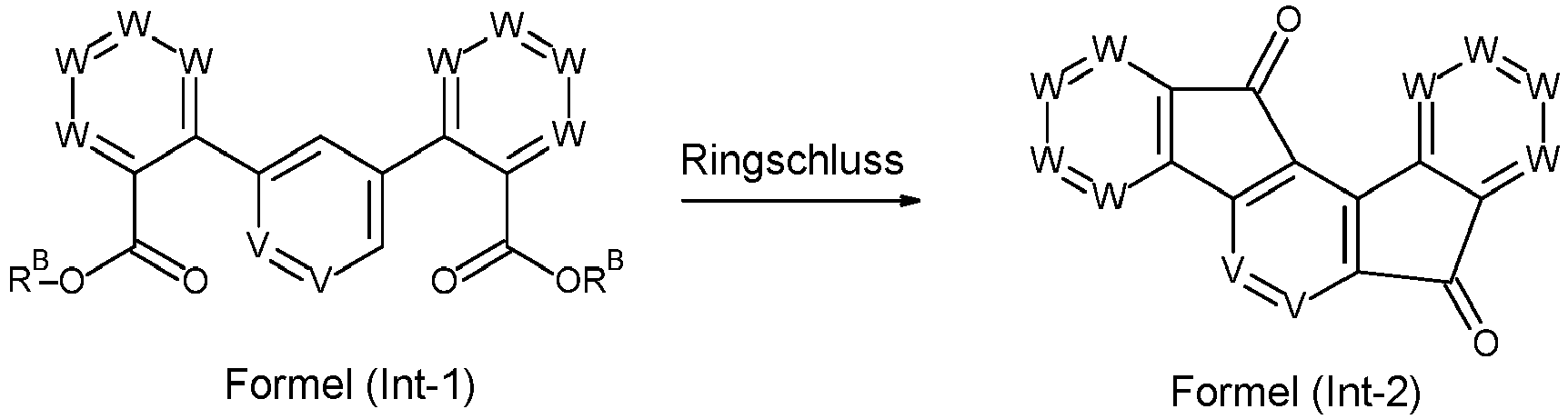
- Verfahren zur Herstellung einer Verbindung nach einem oder mehreren der Ansprüche 1 bis 3, umfassend die folgenden Schritte:a) Synthese eines Terphenyl-dicarboxylat-Derivats der Formel (Int-1) gemäß dem folgenden Reaktionsschema:
 b) Synthese eines Fluorendion-Derivats der Formel (Int-2) gemäß dem folgenden Schema:
 c) Umsetzung der Verbindung der Formel (Int-2) mit einem Vorläufer X1* einer Formel (X-2);wobei
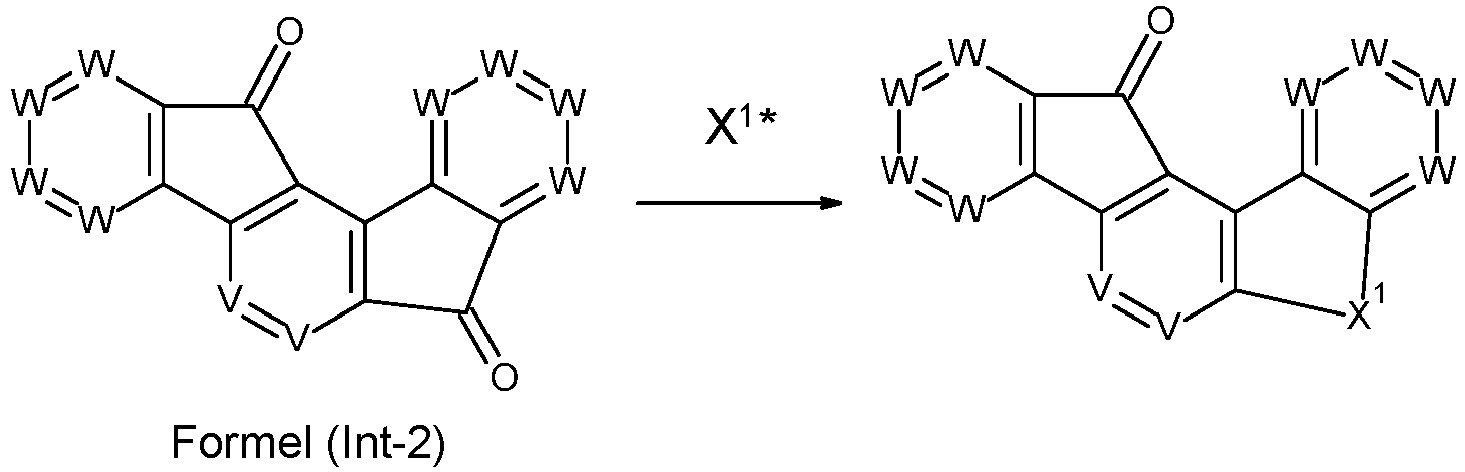 Y1 und Y2 aus Br, Cl, I, B(ORB)2 ausgewählte reaktive Gruppen sind; RB H, ein geradkettiges Alkyl mit 1 bis 10 C-Atomen ist, wobei zwei Substituenten RB ein monocyclisches aliphatisches Ringsystem bilden können, das durch eine Alkylgruppe mit 1 bis 3 C-Atomen substituiert sein kann;X1 einer Gruppe (X-2) entspricht;
 V CR1 ist; undW CR2 oder CH ist.
- Elektronische Vorrichtung enthaltend mindestens eine Verbindung nach einem oder mehreren der Ansprüche 1 bis 3, ausgewählt aus der Gruppe bestehend aus organischen Elektrolumineszenzvorrichtungen, organischen integrierten Schaltungen, organischen Feldeffekttransistoren, organischen Dünnschichttransistoren, organischen lichtemittierenden Transistoren, organischen Solarzellen, farbstoffsensibilisierten organischen Solarzellen, organischen optischen Detektoren, organischen Photorezeptoren, organischen Feld-Quench-Devices, lichtemittierenden elektrochemischen Zellen, organischen Laserdioden und organischen Plasmon-emittierenden Vorrichtungen.
- Elektronische Vorrichtung nach Anspruch 6, bei der es sich um eine organische Elektrolumineszenzvorrichtung handelt, dadurch gekennzeichnet, dass die Verbindung nach einem oder mehreren der Ansprüche 1 bis 3 als ein Elektronenakzeptormaterial in einer Lochinjektionsschicht als reines Material, d.h. in einem Anteil von 100%, oder in Kombination mit einer oder mehreren weiteren Verbindungen eingesetzt wird, wobei der Anteil der Verbindung nach einem oder mehreren der Ansprüche 1 bis 3 dann zwischen 50,0 und 99,9 Vol.-%, wenn die Verbindungen aus der Gasphase aufgebracht werden, und 50,0 und 99,9 Gew.-%, wenn die Verbindungen aus der Lösung aufgebracht werden, liegt.
- Elektronische Vorrichtung nach Anspruch 7, dadurch gekennzeichnet, dass sie weiterhin mindestens eine Lochtransportschicht und mindestens eine Emitterschicht umfasst, wobei die Lochtransportschicht zwischen der Lochinjektionsschicht und der Emitterschicht angeordnet ist.
- Elektronische Vorrichtung nach Anspruch 7 oder 8, dadurch gekennzeichnet, dass die mindestens eine Lochinjektionsschicht, die eine Verbindung nach einem oder mehreren der Ansprüche 1 bis 3 enthält, eine Schichtdicke von 0,5 nm bis 50 nm aufweist.
- Elektronische Vorrichtung nach Anspruch 6, bei der es sich um eine organische Elektrolumineszenzvorrichtung handelt, dadurch gekennzeichnet, dass die Verbindung nach einem oder mehreren der Ansprüche 1 bis 3 als p-Dotand in einer lochtransportierenden Schicht eingesetzt wird, die aus einer Lochinjektionsschicht, einer Lochtransportschicht und einer Elektronenblockierschicht ausgewählt ist.
Applications Claiming Priority (2)
| Application Number | Priority Date | Filing Date | Title |
|---|---|---|---|
| EP17177694 | 2017-06-23 | ||
| PCT/EP2018/066323 WO2018234346A1 (en) | 2017-06-23 | 2018-06-20 | MATERIALS FOR ORGANIC ELECTROLUMINESCENT DEVICES |
Publications (2)
| Publication Number | Publication Date |
|---|---|
| EP3642185A1 EP3642185A1 (de) | 2020-04-29 |
| EP3642185B1 true EP3642185B1 (de) | 2024-04-03 |
Family
ID=59215611
Family Applications (1)
| Application Number | Title | Priority Date | Filing Date |
|---|---|---|---|
| EP18732077.5A Active EP3642185B1 (de) | 2017-06-23 | 2018-06-20 | Materialien für organische elektrolumineszenzvorrichtungen |
Country Status (6)
| Country | Link |
|---|---|
| US (1) | US11767299B2 (de) |
| EP (1) | EP3642185B1 (de) |
| KR (1) | KR20200020841A (de) |
| CN (1) | CN110753685A (de) |
| TW (1) | TW201920598A (de) |
| WO (1) | WO2018234346A1 (de) |
Families Citing this family (4)
| Publication number | Priority date | Publication date | Assignee | Title |
|---|---|---|---|---|
| WO2019175149A1 (en) * | 2018-03-16 | 2019-09-19 | Merck Patent Gmbh | Materials for organic electroluminescent devices |
| US12139500B2 (en) * | 2019-01-16 | 2024-11-12 | Merck Patent Gmbh | Materials for organic electroluminescent devices |
| US20230240132A1 (en) * | 2020-06-22 | 2023-07-27 | Novaled Gmbh | Organic Electronic Device Comprising a Compound of Formula (1), Display Device Comprising the Organic Electronic Device as Well as Compounds of Formula (1) for Use in Organic Electronic Devices |
| CN113980026B (zh) * | 2021-11-25 | 2024-03-29 | 上海钥熠电子科技有限公司 | 咔唑衍生物类胺化合物和包含其的有机电致发光器件 |
Citations (1)
| Publication number | Priority date | Publication date | Assignee | Title |
|---|---|---|---|---|
| US20030008174A1 (en) * | 2001-04-27 | 2003-01-09 | Koichi Suzuki | Organic luminescence device |
Family Cites Families (174)
| Publication number | Priority date | Publication date | Assignee | Title |
|---|---|---|---|---|
| BE556149A (de) * | 1956-03-30 | |||
| US4539507A (en) | 1983-03-25 | 1985-09-03 | Eastman Kodak Company | Organic electroluminescent devices having improved power conversion efficiencies |
| US5061569A (en) | 1990-07-26 | 1991-10-29 | Eastman Kodak Company | Electroluminescent device with organic electroluminescent medium |
| DE4111878A1 (de) | 1991-04-11 | 1992-10-15 | Wacker Chemie Gmbh | Leiterpolymere mit konjugierten doppelbindungen |
| WO1995009147A1 (en) | 1993-09-29 | 1995-04-06 | Idemitsu Kosan Co., Ltd. | Organic electroluminescent element and arylenediamine derivative |
| JPH07133483A (ja) | 1993-11-09 | 1995-05-23 | Shinko Electric Ind Co Ltd | El素子用有機発光材料及びel素子 |
| EP0676461B1 (de) | 1994-04-07 | 2002-08-14 | Covion Organic Semiconductors GmbH | Spiroverbindungen und ihre Verwendung als Elektrolumineszenzmaterialien |
| DE4436773A1 (de) | 1994-10-14 | 1996-04-18 | Hoechst Ag | Konjugierte Polymere mit Spirozentren und ihre Verwendung als Elektrolumineszenzmaterialien |
| DE69608446T3 (de) | 1995-07-28 | 2010-03-11 | Sumitomo Chemical Company, Ltd. | 2,7-aryl-9-substituierte fluorene und 9-substituierte fluorenoligomere und polymere |
| DE19614971A1 (de) | 1996-04-17 | 1997-10-23 | Hoechst Ag | Polymere mit Spiroatomen und ihre Verwendung als Elektrolumineszenzmaterialien |
| JP3302945B2 (ja) | 1998-06-23 | 2002-07-15 | ネースディスプレイ・カンパニー・リミテッド | 新規な有機金属発光物質およびそれを含む有機電気発光素子 |
| DE19846766A1 (de) | 1998-10-10 | 2000-04-20 | Aventis Res & Tech Gmbh & Co | Konjugierte Polymere, enthaltend spezielle Fluorenbausteine mit verbesserten Eigenschaften |
| US6166172A (en) | 1999-02-10 | 2000-12-26 | Carnegie Mellon University | Method of forming poly-(3-substituted) thiophenes |
| DE60031729T2 (de) | 1999-05-13 | 2007-09-06 | The Trustees Of Princeton University | Lichtemittierende, organische, auf elektrophosphoreszenz basierende anordnung mit sehr hoher quantenausbeute |
| EP2270895A3 (de) | 1999-12-01 | 2011-03-30 | The Trustees of Princeton University | Komplexe für OLED-Anwendungen |
| KR100377321B1 (ko) | 1999-12-31 | 2003-03-26 | 주식회사 엘지화학 | 피-형 반도체 성질을 갖는 유기 화합물을 포함하는 전기소자 |
| US6660410B2 (en) | 2000-03-27 | 2003-12-09 | Idemitsu Kosan Co., Ltd. | Organic electroluminescence element |
| US20020121638A1 (en) | 2000-06-30 | 2002-09-05 | Vladimir Grushin | Electroluminescent iridium compounds with fluorinated phenylpyridines, phenylpyrimidines, and phenylquinolines and devices made with such compounds |
| CN101924190B (zh) | 2000-08-11 | 2012-07-04 | 普林斯顿大学理事会 | 有机金属化合物和发射转换有机电致磷光 |
| JP4154140B2 (ja) | 2000-09-26 | 2008-09-24 | キヤノン株式会社 | 金属配位化合物 |
| JP4154139B2 (ja) | 2000-09-26 | 2008-09-24 | キヤノン株式会社 | 発光素子 |
| JP4154138B2 (ja) | 2000-09-26 | 2008-09-24 | キヤノン株式会社 | 発光素子、表示装置及び金属配位化合物 |
| JP2002260863A (ja) | 2001-03-05 | 2002-09-13 | Fuji Xerox Co Ltd | 有機電界発光素子 |
| JP4307839B2 (ja) | 2001-03-10 | 2009-08-05 | メルク パテント ゲーエムベーハー | 有機半導体の溶液および分散液 |
| EP1284258B1 (de) | 2001-08-17 | 2006-02-08 | MERCK PATENT GmbH | Mono-, Oligo und Polyalkylidenfluorene und ihre Verwendung als Ladungstransportmaterialien |
| DE10141624A1 (de) | 2001-08-24 | 2003-03-06 | Covion Organic Semiconductors | Lösungen polymerer Halbleiter |
| JP2003109764A (ja) | 2001-09-28 | 2003-04-11 | Canon Inc | 有機発光素子 |
| DE10159946A1 (de) | 2001-12-06 | 2003-06-18 | Covion Organic Semiconductors | Prozess zur Herstellung von Aryl-Aryl gekoppelten Verbindungen |
| KR100691543B1 (ko) | 2002-01-18 | 2007-03-09 | 주식회사 엘지화학 | 새로운 전자 수송용 물질 및 이를 이용한 유기 발광 소자 |
| ITRM20020411A1 (it) | 2002-08-01 | 2004-02-02 | Univ Roma La Sapienza | Derivati dello spirobifluorene, loro preparazione e loro uso. |
| KR100946476B1 (ko) | 2002-08-23 | 2010-03-10 | 이데미쓰 고산 가부시키가이샤 | 유기 전기발광 소자 및 안트라센 유도체 |
| US20060035109A1 (en) | 2002-09-20 | 2006-02-16 | Idemitsu Kosan Co., Ltd. | Organic electroluminescent element |
| DE10249723A1 (de) | 2002-10-25 | 2004-05-06 | Covion Organic Semiconductors Gmbh | Arylamin-Einheiten enthaltende konjugierte Polymere, deren Darstellung und Verwendung |
| GB0226010D0 (en) | 2002-11-08 | 2002-12-18 | Cambridge Display Tech Ltd | Polymers for use in organic electroluminescent devices |
| US20060063027A1 (en) | 2002-12-23 | 2006-03-23 | Covion Organic Semiconductors Gmbh | Organic electroluminescent element |
| DE10304819A1 (de) | 2003-02-06 | 2004-08-19 | Covion Organic Semiconductors Gmbh | Carbazol-enthaltende konjugierte Polymere und Blends, deren Darstellung und Verwendung |
| DE10310887A1 (de) | 2003-03-11 | 2004-09-30 | Covion Organic Semiconductors Gmbh | Matallkomplexe |
| WO2004080975A1 (ja) | 2003-03-13 | 2004-09-23 | Idemitsu Kosan Co., Ltd. | 新規含窒素複素環誘導体及びそれを用いた有機エレクトロルミネッセンス素子 |
| JP4411851B2 (ja) | 2003-03-19 | 2010-02-10 | コニカミノルタホールディングス株式会社 | 有機エレクトロルミネッセンス素子 |
| EP1618170A2 (de) | 2003-04-15 | 2006-01-25 | Covion Organic Semiconductors GmbH | Mischungen von organischen zur emission befähigten halbleitern und matrixmaterialien, deren verwendung und elektronikbauteile enthaltend diese mischungen |
| WO2004095890A1 (ja) | 2003-04-23 | 2004-11-04 | Konica Minolta Holdings, Inc. | 有機エレクトロルミネッセンス素子用材料、有機エレクトロルミネッセンス素子、照明装置、表示装置 |
| EP1491568A1 (de) | 2003-06-23 | 2004-12-29 | Covion Organic Semiconductors GmbH | Halbleitende Polymere |
| DE10328627A1 (de) | 2003-06-26 | 2005-02-17 | Covion Organic Semiconductors Gmbh | Neue Materialien für die Elektrolumineszenz |
| DE10333232A1 (de) | 2003-07-21 | 2007-10-11 | Merck Patent Gmbh | Organisches Elektrolumineszenzelement |
| DE10337346A1 (de) | 2003-08-12 | 2005-03-31 | Covion Organic Semiconductors Gmbh | Konjugierte Polymere enthaltend Dihydrophenanthren-Einheiten und deren Verwendung |
| DE10338550A1 (de) | 2003-08-19 | 2005-03-31 | Basf Ag | Übergangsmetallkomplexe mit Carbenliganden als Emitter für organische Licht-emittierende Dioden (OLEDs) |
| DE10345572A1 (de) | 2003-09-29 | 2005-05-19 | Covion Organic Semiconductors Gmbh | Metallkomplexe |
| US7795801B2 (en) | 2003-09-30 | 2010-09-14 | Konica Minolta Holdings, Inc. | Organic electroluminescent element, illuminator, display and compound |
| JP2005121887A (ja) | 2003-10-16 | 2005-05-12 | Mitsui Chemicals Inc | フルオレノン誘導体、および該化合物を用いた電子写真感光体、電子写真装置 |
| EP2366752B1 (de) | 2003-10-22 | 2016-07-20 | Merck Patent GmbH | Neue materialien für die elektrolumineszenz und deren verwendung |
| DE102004008304A1 (de) | 2004-02-20 | 2005-09-08 | Covion Organic Semiconductors Gmbh | Organische elektronische Vorrichtungen |
| EP1722602A1 (de) | 2004-03-05 | 2006-11-15 | Idemitsu Kosan Co., Ltd. | Organische elektrolumineszenzeinrichtung und organisches elektrolumineszenzdisplay |
| US7790890B2 (en) | 2004-03-31 | 2010-09-07 | Konica Minolta Holdings, Inc. | Organic electroluminescence element material, organic electroluminescence element, display device and illumination device |
| KR100787425B1 (ko) | 2004-11-29 | 2007-12-26 | 삼성에스디아이 주식회사 | 페닐카바졸계 화합물 및 이를 이용한 유기 전계 발광 소자 |
| DE102004020298A1 (de) | 2004-04-26 | 2005-11-10 | Covion Organic Semiconductors Gmbh | Elektrolumineszierende Polymere und deren Verwendung |
| DE102004023277A1 (de) | 2004-05-11 | 2005-12-01 | Covion Organic Semiconductors Gmbh | Neue Materialmischungen für die Elektrolumineszenz |
| US7598388B2 (en) | 2004-05-18 | 2009-10-06 | The University Of Southern California | Carbene containing metal complexes as OLEDs |
| KR20070029717A (ko) | 2004-05-27 | 2007-03-14 | 이데미쓰 고산 가부시키가이샤 | 비대칭 피렌 유도체 및 이를 이용한 유기 전기 발광 소자 |
| JP4862248B2 (ja) | 2004-06-04 | 2012-01-25 | コニカミノルタホールディングス株式会社 | 有機エレクトロルミネッセンス素子、照明装置及び表示装置 |
| DE102004032527A1 (de) | 2004-07-06 | 2006-02-02 | Covion Organic Semiconductors Gmbh | Elektrolumineszierende Polymere |
| ITRM20040352A1 (it) | 2004-07-15 | 2004-10-15 | Univ Roma La Sapienza | Derivati oligomerici dello spirobifluorene, loro preparazione e loro uso. |
| EP1655359A1 (de) | 2004-11-06 | 2006-05-10 | Covion Organic Semiconductors GmbH | Organische Elektrolumineszenzvorrichtung |
| EP1669386A1 (de) | 2004-12-06 | 2006-06-14 | Covion Organic Semiconductors GmbH | Teilkonjugierte Polymere, deren Darstellung und Verwendung |
| CN101142294B (zh) | 2005-03-16 | 2011-12-07 | 默克专利有限公司 | 用于有机电致发光器件的新颖材料 |
| WO2006100896A1 (ja) | 2005-03-18 | 2006-09-28 | Idemitsu Kosan Co., Ltd. | 芳香族アミン誘導体及びそれを用いた有機エレクトロルミネッセンス素子 |
| EP1869141B1 (de) | 2005-04-14 | 2020-03-11 | Merck Patent GmbH | Verbindungen für organische elektronische vorrichtungen |
| EP1888706B1 (de) | 2005-05-03 | 2017-03-01 | Merck Patent GmbH | Organische elektrolumineszenzvorrichtung und in deren herstellung verwendete boronsäure- und borinsäure-derivate |
| DE102005023437A1 (de) | 2005-05-20 | 2006-11-30 | Merck Patent Gmbh | Verbindungen für organische elektronische Vorrichtungen |
| DE102005026651A1 (de) | 2005-06-09 | 2006-12-14 | Merck Patent Gmbh | Neue Materialien für organische Elektrolumineszenzvorrichtungen |
| JP2007015961A (ja) | 2005-07-06 | 2007-01-25 | Idemitsu Kosan Co Ltd | ピレン誘導体及びそれらを用いた有機エレクトロルミネッセンス素子 |
| ZA200711046B (en) | 2005-07-08 | 2009-06-24 | Unilever Plc | Food product and process for preparing it |
| DE102005037734B4 (de) | 2005-08-10 | 2018-02-08 | Merck Patent Gmbh | Elektrolumineszierende Polymere, ihre Verwendung und bifunktionelle monomere Verbindungen |
| WO2007058172A1 (ja) | 2005-11-17 | 2007-05-24 | Idemitsu Kosan Co., Ltd. | 有機エレクトロルミネッセンス素子 |
| WO2007063754A1 (ja) | 2005-12-01 | 2007-06-07 | Nippon Steel Chemical Co., Ltd. | 有機電界発光素子用化合物及び有機電界発光素子 |
| DE102005058557A1 (de) | 2005-12-08 | 2007-06-14 | Merck Patent Gmbh | Organische Elektrolumineszenzvorrichtung |
| US8795847B2 (en) | 2005-12-08 | 2014-08-05 | Merck Patent Gmbh | Materials for organic electroluminescent devices |
| DE102005060473A1 (de) | 2005-12-17 | 2007-06-28 | Merck Patent Gmbh | Konjugierte Polymere, deren Darstellung und Verwendung |
| EP1968131A4 (de) | 2005-12-27 | 2009-08-19 | Idemitsu Kosan Co | Material für ein organisches elektrolumineszenzgerät und organisches elektrolumineszenzgerät |
| DE102006013802A1 (de) | 2006-03-24 | 2007-09-27 | Merck Patent Gmbh | Neue Materialien für organische Elektrolumineszenzvorrichtungen |
| DE102006025777A1 (de) | 2006-05-31 | 2007-12-06 | Merck Patent Gmbh | Neue Materialien für organische Elektrolumineszenzvorrichtungen |
| DE102006025846A1 (de) | 2006-06-02 | 2007-12-06 | Merck Patent Gmbh | Neue Materialien für organische Elektrolumineszenzvorrichtungen |
| DE102006031990A1 (de) | 2006-07-11 | 2008-01-17 | Merck Patent Gmbh | Neue Materialien für organische Elektrolumineszenzvorrichtungen |
| EP2080762B1 (de) | 2006-11-09 | 2016-09-14 | Nippon Steel & Sumikin Chemical Co., Ltd. | Verbindung für organische elektrolumineszenzvorrichtung und organische elektrolumineszenzvorrichtung |
| JP5249781B2 (ja) | 2006-12-15 | 2013-07-31 | 出光興産株式会社 | 有機エレクトロルミネッセンス素子用材料及び有機エレクトロルミネッセンス素子 |
| DE102007002714A1 (de) | 2007-01-18 | 2008-07-31 | Merck Patent Gmbh | Neue Materialien für organische Elektrolumineszenzvorrichtungen |
| US8044390B2 (en) | 2007-05-25 | 2011-10-25 | Idemitsu Kosan Co., Ltd. | Material for organic electroluminescent device, organic electroluminescent device, and organic electroluminescent display |
| DE102007024850A1 (de) | 2007-05-29 | 2008-12-04 | Merck Patent Gmbh | Neue Materialien für organische Elektrolumineszenzvorrichtungen |
| DE102007031220B4 (de) | 2007-07-04 | 2022-04-28 | Novaled Gmbh | Chinoide Verbindungen und deren Verwendung in halbleitenden Matrixmaterialien, elektronischen und optoelektronischen Bauelementen |
| JP5289979B2 (ja) | 2007-07-18 | 2013-09-11 | 出光興産株式会社 | 有機エレクトロルミネッセンス素子用材料及び有機エレクトロルミネッセンス素子 |
| DE102007053771A1 (de) | 2007-11-12 | 2009-05-14 | Merck Patent Gmbh | Organische Elektrolumineszenzvorrichtungen |
| US7862908B2 (en) | 2007-11-26 | 2011-01-04 | National Tsing Hua University | Conjugated compounds containing hydroindoloacridine structural elements, and their use |
| CN101874021B (zh) | 2007-11-30 | 2013-06-19 | 出光兴产株式会社 | 氮杂茚并芴二酮衍生物、有机电致发光元件用材料和有机电致发光元件 |
| DE102008008953B4 (de) | 2008-02-13 | 2019-05-09 | Merck Patent Gmbh | Neue Materialien für organische Elektrolumineszenzvorrichtungen |
| TWI478624B (zh) | 2008-03-27 | 2015-03-21 | 新日鐵住金化學股份有限公司 | Organic electroluminescent elements |
| US8057712B2 (en) | 2008-04-29 | 2011-11-15 | Novaled Ag | Radialene compounds and their use |
| DE102008027005A1 (de) | 2008-06-05 | 2009-12-10 | Merck Patent Gmbh | Organische elektronische Vorrichtung enthaltend Metallkomplexe |
| DE102008033943A1 (de) | 2008-07-18 | 2010-01-21 | Merck Patent Gmbh | Neue Materialien für organische Elektrolumineszenzvorrichtungen |
| DE102008035413A1 (de) | 2008-07-29 | 2010-02-04 | Merck Patent Gmbh | Verbindungen für organische elektronische Vorrichtungen |
| DE102008036247A1 (de) | 2008-08-04 | 2010-02-11 | Merck Patent Gmbh | Elektronische Vorrichtungen enthaltend Metallkomplexe |
| DE102008036982A1 (de) | 2008-08-08 | 2010-02-11 | Merck Patent Gmbh | Organische Elektrolumineszenzvorrichtung |
| DE102008048336A1 (de) | 2008-09-22 | 2010-03-25 | Merck Patent Gmbh | Einkernige neutrale Kupfer(I)-Komplexe und deren Verwendung zur Herstellung von optoelektronischen Bauelementen |
| US8119037B2 (en) | 2008-10-16 | 2012-02-21 | Novaled Ag | Square planar transition metal complexes and organic semiconductive materials using them as well as electronic or optoelectric components |
| KR101506919B1 (ko) | 2008-10-31 | 2015-03-30 | 롬엔드하스전자재료코리아유한회사 | 신규한 유기 전자재료용 화합물 및 이를 포함하는 유기 전자 소자 |
| EP2344607B1 (de) | 2008-11-11 | 2013-04-10 | Merck Patent GmbH | Organische elektrolumineszenzvorrichtungen |
| DE102008056688A1 (de) | 2008-11-11 | 2010-05-12 | Merck Patent Gmbh | Materialien für organische Elektrolumineszenzvorrichtungen |
| DE102008057050B4 (de) | 2008-11-13 | 2021-06-02 | Merck Patent Gmbh | Materialien für organische Elektrolumineszenzvorrichtungen |
| DE102008057051B4 (de) | 2008-11-13 | 2021-06-17 | Merck Patent Gmbh | Materialien für organische Elektrolumineszenzvorrichtungen |
| JP5343089B2 (ja) * | 2008-12-03 | 2013-11-13 | 出光興産株式会社 | インデノフルオレンジオン誘導体、有機エレクトロルミネッセンス素子用材料及び有機エレクトロルミネッセンス素子 |
| DE102008064200A1 (de) | 2008-12-22 | 2010-07-01 | Merck Patent Gmbh | Organische Elektrolumineszenzvorrichtung |
| DE102009007038A1 (de) | 2009-02-02 | 2010-08-05 | Merck Patent Gmbh | Metallkomplexe |
| DE102009009277B4 (de) | 2009-02-17 | 2023-12-07 | Merck Patent Gmbh | Organische elektronische Vorrichtung, Verfahren zu deren Herstellung und Verwendung von Verbindungen |
| DE102009011223A1 (de) | 2009-03-02 | 2010-09-23 | Merck Patent Gmbh | Metallkomplexe |
| DE102009013041A1 (de) | 2009-03-13 | 2010-09-16 | Merck Patent Gmbh | Materialien für organische Elektrolumineszenzvorrichtungen |
| DE102009023155A1 (de) | 2009-05-29 | 2010-12-02 | Merck Patent Gmbh | Materialien für organische Elektrolumineszenzvorrichtungen |
| DE102009031021A1 (de) | 2009-06-30 | 2011-01-05 | Merck Patent Gmbh | Materialien für organische Elektrolumineszenzvorrichtungen |
| DE102009041414A1 (de) | 2009-09-16 | 2011-03-17 | Merck Patent Gmbh | Metallkomplexe |
| WO2011033023A1 (en) | 2009-09-18 | 2011-03-24 | Osram Opto Semiconductors Gmbh | Organic electronic device and dopant for doping an organic semiconducting matrix material |
| DE102009048791A1 (de) | 2009-10-08 | 2011-04-14 | Merck Patent Gmbh | Materialien für organische Elektrolumineszenzvorrichtungen |
| DE102009053191A1 (de) | 2009-11-06 | 2011-05-12 | Merck Patent Gmbh | Materialien für elektronische Vorrichtungen |
| DE102009057167A1 (de) | 2009-12-05 | 2011-06-09 | Merck Patent Gmbh | Elektronische Vorrichtung enthaltend Metallkomplexe |
| EP2513125B1 (de) | 2009-12-14 | 2014-10-29 | Basf Se | Metallkomplexe, enthaltend diazabenzimidazolcarben-liganden und deren verwendung in oleds |
| WO2011077691A1 (ja) | 2009-12-21 | 2011-06-30 | 出光興産株式会社 | ピレン誘導体を用いた有機エレクトロルミネッセンス素子 |
| DE102010005697A1 (de) | 2010-01-25 | 2011-07-28 | Merck Patent GmbH, 64293 | Verbindungen für elektronische Vorrichtungen |
| DE102010012738A1 (de) | 2010-03-25 | 2011-09-29 | Merck Patent Gmbh | Materialien für organische Elektrolumineszenzvorrichtungen |
| DE102010013495A1 (de) | 2010-03-31 | 2011-10-06 | Siemens Aktiengesellschaft | Dotierstoff für eine Lochleiterschicht für organische Halbleiterbauelemente und Verwendung dazu |
| DE102010019306B4 (de) | 2010-05-04 | 2021-05-20 | Merck Patent Gmbh | Organische Elektrolumineszenzvorrichtungen |
| US9273080B2 (en) | 2010-06-15 | 2016-03-01 | Merek Patent Gmbh | Metal complexes |
| DE102010027317A1 (de) | 2010-07-16 | 2012-01-19 | Merck Patent Gmbh | Metallkomplexe |
| JP2013541837A (ja) | 2010-09-10 | 2013-11-14 | ノヴァレッド・アクチエンゲゼルシャフト | 有機光電変換素子用化合物 |
| DE102010045405A1 (de) | 2010-09-15 | 2012-03-15 | Merck Patent Gmbh | Materialien für organische Elektrolumineszenzvorrichtungen |
| DE102010048607A1 (de) | 2010-10-15 | 2012-04-19 | Merck Patent Gmbh | Verbindungen für elektronische Vorrichtungen |
| DE102010048608A1 (de) | 2010-10-15 | 2012-04-19 | Merck Patent Gmbh | Materialien für organische Elektrolumineszenzvorrichtungen |
| EP2663567B1 (de) | 2011-01-13 | 2016-06-01 | Merck Patent GmbH | Verbindungen für organische elektrolumineszenzvorrichtungen |
| WO2012143080A2 (de) | 2011-04-18 | 2012-10-26 | Merck Patent Gmbh | Materialien für organische elektrolumineszenzvorrichtungen |
| EP2705552B1 (de) | 2011-05-05 | 2015-03-04 | Merck Patent GmbH | Verbindungen für elektronische vorrichtungen |
| KR102077994B1 (ko) | 2011-09-21 | 2020-02-17 | 메르크 파텐트 게엠베하 | 유기 전계발광 소자용 카르바졸 유도체 |
| KR102310368B1 (ko) | 2011-11-17 | 2021-10-07 | 메르크 파텐트 게엠베하 | 스피로디히드로아크리딘 유도체 및 이의 유기 전계발광 소자용 재료로서의 용도 |
| EP3235892B1 (de) | 2012-02-14 | 2019-02-27 | Merck Patent GmbH | Materialien für organische elektrolumineszenzvorrichtungen |
| WO2013145667A1 (ja) | 2012-03-29 | 2013-10-03 | ソニー株式会社 | 有機エレクトロルミネッセンス素子 |
| DE102012209523A1 (de) | 2012-06-06 | 2013-12-12 | Osram Opto Semiconductors Gmbh | Hauptgruppenmetallkomplexe als p-Dotanden für organische elektronische Matrixmaterialien |
| WO2013185871A1 (en) | 2012-06-12 | 2013-12-19 | Merck Patent Gmbh | Compounds for electronic devices |
| CN104428392B (zh) | 2012-07-13 | 2017-05-31 | 默克专利有限公司 | 金属络合物 |
| KR102696532B1 (ko) | 2012-07-23 | 2024-08-19 | 메르크 파텐트 게엠베하 | 플루오렌 및 이를 함유하는 전자 소자 |
| WO2014015938A1 (de) | 2012-07-23 | 2014-01-30 | Merck Patent Gmbh | Derivate von 2-diarylaminofluoren und diese enthaltnde organische elektronische verbindungen |
| KR102006621B1 (ko) | 2012-07-23 | 2019-08-02 | 메르크 파텐트 게엠베하 | 화합물 및 유기 전계 발광 디바이스 |
| WO2014023377A2 (de) | 2012-08-07 | 2014-02-13 | Merck Patent Gmbh | Metallkomplexe |
| EP2892876B1 (de) | 2012-09-04 | 2018-11-07 | Merck Patent GmbH | Verbindungen für elektronische vorrichtungen |
| KR102023232B1 (ko) | 2012-10-09 | 2019-09-19 | 메르크 파텐트 게엠베하 | 전자 디바이스 |
| JP6306033B2 (ja) | 2012-11-12 | 2018-04-04 | メルク パテント ゲーエムベーハー | 電子素子のための材料 |
| CN104870460A (zh) | 2012-12-21 | 2015-08-26 | 默克专利有限公司 | 金属络合物 |
| CN104870459B (zh) | 2012-12-21 | 2018-06-26 | 默克专利有限公司 | 金属络合物 |
| WO2014094960A1 (de) | 2012-12-21 | 2014-06-26 | Merck Patent Gmbh | Metallkomplexe |
| EP2941472B1 (de) | 2013-01-03 | 2018-07-25 | Merck Patent GmbH | Materialien für elektronische vorrichtungen |
| JP6322587B2 (ja) | 2013-02-08 | 2018-05-09 | 株式会社Joled | 有機エレクトロルミネッセンス素子 |
| US9978950B2 (en) | 2013-08-15 | 2018-05-22 | Merck Patent Gmbh | Materials for electronic devices |
| JP2015065248A (ja) | 2013-09-24 | 2015-04-09 | 出光興産株式会社 | 有機エレクトロルミネッセンス素子および電子機器 |
| CN105636944B (zh) | 2013-10-14 | 2019-03-01 | 默克专利有限公司 | 用于电子器件的材料 |
| KR102174919B1 (ko) | 2013-12-03 | 2020-11-05 | 엘지디스플레이 주식회사 | 유기 발광 소자 및 유기 발광 표시장치 |
| US10158083B2 (en) | 2013-12-12 | 2018-12-18 | Merck Patent Gmbh | Materials for electronic devices |
| CN106132910B (zh) | 2014-03-07 | 2019-10-11 | 默克专利有限公司 | 电子器件的材料 |
| EP3131901B1 (de) | 2014-04-14 | 2018-02-07 | Merck Patent GmbH | Materialien für elektronische vorrichtungen |
| CN106170476A (zh) | 2014-04-16 | 2016-11-30 | 默克专利有限公司 | 用于电子器件的材料 |
| JP2017135127A (ja) | 2014-04-21 | 2017-08-03 | 出光興産株式会社 | 有機エレクトロルミネッセンス素子 |
| WO2016078738A1 (en) | 2014-11-18 | 2016-05-26 | Merck Patent Gmbh | Materials for organic electroluminescent devices |
| EP3227269B1 (de) | 2014-12-01 | 2020-02-26 | Merck Patent GmbH | Materialien für organische elektrolumineszenzvorrichtungen |
| JP6608451B2 (ja) | 2014-12-22 | 2019-11-20 | メルク パテント ゲーエムベーハー | 電子素子のための材料 |
| KR102554987B1 (ko) | 2015-02-03 | 2023-07-12 | 메르크 파텐트 게엠베하 | 금속 착물 |
| CN107223122A (zh) | 2015-02-16 | 2017-09-29 | 默克专利有限公司 | 用于电子器件的基于螺二芴衍生物的材料 |
| US10487262B2 (en) | 2015-03-25 | 2019-11-26 | Merck Patent Gmbh | Materials for organic electroluminescent devices |
| JP6749999B2 (ja) | 2015-08-12 | 2020-09-02 | メルク、パテント、ゲゼルシャフト、ミット、ベシュレンクテル、ハフツングMerck Patent GmbH | 電子素子のための材料 |
| US10696664B2 (en) | 2015-08-14 | 2020-06-30 | Merck Patent Gmbh | Phenoxazine derivatives for organic electroluminescent devices |
| US11189801B2 (en) | 2015-08-14 | 2021-11-30 | Merck Patent Gmbh | Phenoxazine derivatives for organic electroluminescent devices |
| JP6833821B2 (ja) | 2015-08-28 | 2021-02-24 | メルク、パテント、ゲゼルシャフト、ミット、ベシュレンクテル、ハフツングMerck Patent GmbH | 電子素子のための材料 |
| JP6935391B2 (ja) | 2015-08-28 | 2021-09-15 | メルク、パテント、ゲゼルシャフト、ミット、ベシュレンクテル、ハフツングMerck Patent GmbH | 6,9,15,18−テトラヒドロ−s−インダセノ[1,2−b:5,6−b’]ジフルオレン誘導体、および電子素子におけるそれらの使用 |
-
2018
- 2018-06-20 US US16/623,633 patent/US11767299B2/en active Active
- 2018-06-20 EP EP18732077.5A patent/EP3642185B1/de active Active
- 2018-06-20 CN CN201880040323.XA patent/CN110753685A/zh active Pending
- 2018-06-20 KR KR1020207001648A patent/KR20200020841A/ko not_active Ceased
- 2018-06-20 WO PCT/EP2018/066323 patent/WO2018234346A1/en not_active Ceased
- 2018-06-20 TW TW107121051A patent/TW201920598A/zh unknown
Patent Citations (1)
| Publication number | Priority date | Publication date | Assignee | Title |
|---|---|---|---|---|
| US20030008174A1 (en) * | 2001-04-27 | 2003-01-09 | Koichi Suzuki | Organic luminescence device |
Also Published As
| Publication number | Publication date |
|---|---|
| US11767299B2 (en) | 2023-09-26 |
| CN110753685A (zh) | 2020-02-04 |
| EP3642185A1 (de) | 2020-04-29 |
| TW201920598A (zh) | 2019-06-01 |
| US20200190039A1 (en) | 2020-06-18 |
| KR20200020841A (ko) | 2020-02-26 |
| WO2018234346A1 (en) | 2018-12-27 |
Similar Documents
| Publication | Publication Date | Title |
|---|---|---|
| EP3334732B1 (de) | Phenoxazinderivate für organische elektrolumineszente vorrichtungen | |
| EP3544985B1 (de) | Bisbenzofuran-kondesierte indeno[1,2-b]fluoren-derivate und verwandte verbindungen als materialien für organische elektrolumineszenzvorrichtungen (oled) | |
| EP3334731B1 (de) | Phenoxazinderivate für organische elektrolumineszente vorrichtungen | |
| EP3274419B1 (de) | Materialien für organische elektrolumineszenzvorrichtungen | |
| KR102540425B1 (ko) | 유기 전계발광 소자 (oled) 용 재료로서 비스벤조푸란-융합된 2,8-디아미노인데노[1,2-b]플루오렌 유도체 및 관련 화합물 | |
| EP3341448B1 (de) | Verbindungen für elektronische vorrichtungen | |
| EP3481796B1 (de) | Materialien für organische elektrolumineszente vorrichtungen | |
| KR102284234B1 (ko) | 2-디아릴아미노플루오렌의 유도체 및 이를 함유하는 유기 전자 화합물 | |
| KR102602818B1 (ko) | 6,9,15,18-테트라히드로-s-인다세노[1,2-b:5,6-b']디플루오렌 유도체 및 전자 소자에서의 이의 용도 | |
| KR102929861B1 (ko) | 화합물 및 유기 전자 소자 | |
| KR102854068B1 (ko) | 화합물 및 유기 전계 발광 디바이스 | |
| EP2782975B1 (de) | Materialien für elektronische vorrichtungen | |
| EP3250658B1 (de) | Materialien für elektronische vorrichtungen | |
| WO2020127176A1 (en) | Materials for electronic devices | |
| US11767299B2 (en) | Materials for organic electroluminescent devices | |
| EP4126884B1 (de) | Materialien für organische elektrolumineszenzvorrichtungen | |
| EP4045483B1 (de) | Materialien für organische elektrolumineszente vorrichtungen | |
| EP3765444B1 (de) | Materialien für organische elektrolumineszente vorrichtungen | |
| WO2018134392A1 (en) | Materials for organic electroluminescent devices |
Legal Events
| Date | Code | Title | Description |
|---|---|---|---|
| STAA | Information on the status of an ep patent application or granted ep patent |
Free format text: STATUS: UNKNOWN |
|
| STAA | Information on the status of an ep patent application or granted ep patent |
Free format text: STATUS: THE INTERNATIONAL PUBLICATION HAS BEEN MADE |
|
| PUAI | Public reference made under article 153(3) epc to a published international application that has entered the european phase |
Free format text: ORIGINAL CODE: 0009012 |
|
| STAA | Information on the status of an ep patent application or granted ep patent |
Free format text: STATUS: REQUEST FOR EXAMINATION WAS MADE |
|
| 17P | Request for examination filed |
Effective date: 20191209 |
|
| AK | Designated contracting states |
Kind code of ref document: A1 Designated state(s): AL AT BE BG CH CY CZ DE DK EE ES FI FR GB GR HR HU IE IS IT LI LT LU LV MC MK MT NL NO PL PT RO RS SE SI SK SM TR |
|
| AX | Request for extension of the european patent |
Extension state: BA ME |
|
| RIN1 | Information on inventor provided before grant (corrected) |
Inventor name: VOGES, FRANK Inventor name: LUDEMANN, AURELIE Inventor name: STENGEL, ILONA Inventor name: VINOKUROV, KATHY |
|
| DAV | Request for validation of the european patent (deleted) | ||
| DAX | Request for extension of the european patent (deleted) | ||
| STAA | Information on the status of an ep patent application or granted ep patent |
Free format text: STATUS: EXAMINATION IS IN PROGRESS |
|
| 17Q | First examination report despatched |
Effective date: 20220218 |
|
| RAP3 | Party data changed (applicant data changed or rights of an application transferred) |
Owner name: MERCK PATENT GMBH |
|
| P01 | Opt-out of the competence of the unified patent court (upc) registered |
Effective date: 20230519 |
|
| GRAP | Despatch of communication of intention to grant a patent |
Free format text: ORIGINAL CODE: EPIDOSNIGR1 |
|
| STAA | Information on the status of an ep patent application or granted ep patent |
Free format text: STATUS: GRANT OF PATENT IS INTENDED |
|
| RIC1 | Information provided on ipc code assigned before grant |
Ipc: H10K 85/60 20230101ALI20231009BHEP Ipc: H10K 50/15 20230101ALI20231009BHEP Ipc: C07F 9/6568 20060101ALI20231009BHEP Ipc: C07C 255/40 20060101ALI20231009BHEP Ipc: C07C 255/37 20060101ALI20231009BHEP Ipc: C07F 5/02 20060101ALI20231009BHEP Ipc: C07C 255/35 20060101ALI20231009BHEP Ipc: C07D 495/04 20060101ALI20231009BHEP Ipc: C07D 237/26 20060101AFI20231009BHEP |
|
| INTG | Intention to grant announced |
Effective date: 20231110 |
|
| GRAS | Grant fee paid |
Free format text: ORIGINAL CODE: EPIDOSNIGR3 |
|
| GRAA | (expected) grant |
Free format text: ORIGINAL CODE: 0009210 |
|
| STAA | Information on the status of an ep patent application or granted ep patent |
Free format text: STATUS: THE PATENT HAS BEEN GRANTED |
|
| AK | Designated contracting states |
Kind code of ref document: B1 Designated state(s): AL AT BE BG CH CY CZ DE DK EE ES FI FR GB GR HR HU IE IS IT LI LT LU LV MC MK MT NL NO PL PT RO RS SE SI SK SM TR |
|
| REG | Reference to a national code |
Ref country code: GB Ref legal event code: FG4D |
|
| REG | Reference to a national code |
Ref country code: CH Ref legal event code: EP |
|
| REG | Reference to a national code |
Ref country code: IE Ref legal event code: FG4D |
|
| REG | Reference to a national code |
Ref country code: DE Ref legal event code: R096 Ref document number: 602018067476 Country of ref document: DE |
|
| REG | Reference to a national code |
Ref country code: LT Ref legal event code: MG9D |
|
| REG | Reference to a national code |
Ref country code: NL Ref legal event code: MP Effective date: 20240403 |
|
| REG | Reference to a national code |
Ref country code: AT Ref legal event code: MK05 Ref document number: 1672198 Country of ref document: AT Kind code of ref document: T Effective date: 20240403 |
|
| PG25 | Lapsed in a contracting state [announced via postgrant information from national office to epo] |
Ref country code: NL Free format text: LAPSE BECAUSE OF FAILURE TO SUBMIT A TRANSLATION OF THE DESCRIPTION OR TO PAY THE FEE WITHIN THE PRESCRIBED TIME-LIMIT Effective date: 20240403 |
|
| PG25 | Lapsed in a contracting state [announced via postgrant information from national office to epo] |
Ref country code: NL Free format text: LAPSE BECAUSE OF FAILURE TO SUBMIT A TRANSLATION OF THE DESCRIPTION OR TO PAY THE FEE WITHIN THE PRESCRIBED TIME-LIMIT Effective date: 20240403 |
|
| PG25 | Lapsed in a contracting state [announced via postgrant information from national office to epo] |
Ref country code: IS Free format text: LAPSE BECAUSE OF FAILURE TO SUBMIT A TRANSLATION OF THE DESCRIPTION OR TO PAY THE FEE WITHIN THE PRESCRIBED TIME-LIMIT Effective date: 20240803 |
|
| PG25 | Lapsed in a contracting state [announced via postgrant information from national office to epo] |
Ref country code: BG Free format text: LAPSE BECAUSE OF FAILURE TO SUBMIT A TRANSLATION OF THE DESCRIPTION OR TO PAY THE FEE WITHIN THE PRESCRIBED TIME-LIMIT Effective date: 20240403 |
|
| PG25 | Lapsed in a contracting state [announced via postgrant information from national office to epo] |
Ref country code: HR Free format text: LAPSE BECAUSE OF FAILURE TO SUBMIT A TRANSLATION OF THE DESCRIPTION OR TO PAY THE FEE WITHIN THE PRESCRIBED TIME-LIMIT Effective date: 20240403 Ref country code: FI Free format text: LAPSE BECAUSE OF FAILURE TO SUBMIT A TRANSLATION OF THE DESCRIPTION OR TO PAY THE FEE WITHIN THE PRESCRIBED TIME-LIMIT Effective date: 20240403 |
|
| PG25 | Lapsed in a contracting state [announced via postgrant information from national office to epo] |
Ref country code: GR Free format text: LAPSE BECAUSE OF FAILURE TO SUBMIT A TRANSLATION OF THE DESCRIPTION OR TO PAY THE FEE WITHIN THE PRESCRIBED TIME-LIMIT Effective date: 20240704 |
|
| PG25 | Lapsed in a contracting state [announced via postgrant information from national office to epo] |
Ref country code: PT Free format text: LAPSE BECAUSE OF FAILURE TO SUBMIT A TRANSLATION OF THE DESCRIPTION OR TO PAY THE FEE WITHIN THE PRESCRIBED TIME-LIMIT Effective date: 20240805 |
|
| PG25 | Lapsed in a contracting state [announced via postgrant information from national office to epo] |
Ref country code: ES Free format text: LAPSE BECAUSE OF FAILURE TO SUBMIT A TRANSLATION OF THE DESCRIPTION OR TO PAY THE FEE WITHIN THE PRESCRIBED TIME-LIMIT Effective date: 20240403 |
|
| PG25 | Lapsed in a contracting state [announced via postgrant information from national office to epo] |
Ref country code: CZ Free format text: LAPSE BECAUSE OF FAILURE TO SUBMIT A TRANSLATION OF THE DESCRIPTION OR TO PAY THE FEE WITHIN THE PRESCRIBED TIME-LIMIT Effective date: 20240403 |
|
| PG25 | Lapsed in a contracting state [announced via postgrant information from national office to epo] |
Ref country code: AT Free format text: LAPSE BECAUSE OF FAILURE TO SUBMIT A TRANSLATION OF THE DESCRIPTION OR TO PAY THE FEE WITHIN THE PRESCRIBED TIME-LIMIT Effective date: 20240403 |
|
| PG25 | Lapsed in a contracting state [announced via postgrant information from national office to epo] |
Ref country code: PL Free format text: LAPSE BECAUSE OF FAILURE TO SUBMIT A TRANSLATION OF THE DESCRIPTION OR TO PAY THE FEE WITHIN THE PRESCRIBED TIME-LIMIT Effective date: 20240403 |
|
| PG25 | Lapsed in a contracting state [announced via postgrant information from national office to epo] |
Ref country code: LV Free format text: LAPSE BECAUSE OF FAILURE TO SUBMIT A TRANSLATION OF THE DESCRIPTION OR TO PAY THE FEE WITHIN THE PRESCRIBED TIME-LIMIT Effective date: 20240403 |
|
| PG25 | Lapsed in a contracting state [announced via postgrant information from national office to epo] |
Ref country code: PT Free format text: LAPSE BECAUSE OF FAILURE TO SUBMIT A TRANSLATION OF THE DESCRIPTION OR TO PAY THE FEE WITHIN THE PRESCRIBED TIME-LIMIT Effective date: 20240805 Ref country code: PL Free format text: LAPSE BECAUSE OF FAILURE TO SUBMIT A TRANSLATION OF THE DESCRIPTION OR TO PAY THE FEE WITHIN THE PRESCRIBED TIME-LIMIT Effective date: 20240403 Ref country code: NO Free format text: LAPSE BECAUSE OF FAILURE TO SUBMIT A TRANSLATION OF THE DESCRIPTION OR TO PAY THE FEE WITHIN THE PRESCRIBED TIME-LIMIT Effective date: 20240703 Ref country code: LV Free format text: LAPSE BECAUSE OF FAILURE TO SUBMIT A TRANSLATION OF THE DESCRIPTION OR TO PAY THE FEE WITHIN THE PRESCRIBED TIME-LIMIT Effective date: 20240403 Ref country code: IS Free format text: LAPSE BECAUSE OF FAILURE TO SUBMIT A TRANSLATION OF THE DESCRIPTION OR TO PAY THE FEE WITHIN THE PRESCRIBED TIME-LIMIT Effective date: 20240803 Ref country code: HR Free format text: LAPSE BECAUSE OF FAILURE TO SUBMIT A TRANSLATION OF THE DESCRIPTION OR TO PAY THE FEE WITHIN THE PRESCRIBED TIME-LIMIT Effective date: 20240403 Ref country code: GR Free format text: LAPSE BECAUSE OF FAILURE TO SUBMIT A TRANSLATION OF THE DESCRIPTION OR TO PAY THE FEE WITHIN THE PRESCRIBED TIME-LIMIT Effective date: 20240704 Ref country code: FI Free format text: LAPSE BECAUSE OF FAILURE TO SUBMIT A TRANSLATION OF THE DESCRIPTION OR TO PAY THE FEE WITHIN THE PRESCRIBED TIME-LIMIT Effective date: 20240403 Ref country code: ES Free format text: LAPSE BECAUSE OF FAILURE TO SUBMIT A TRANSLATION OF THE DESCRIPTION OR TO PAY THE FEE WITHIN THE PRESCRIBED TIME-LIMIT Effective date: 20240403 Ref country code: CZ Free format text: LAPSE BECAUSE OF FAILURE TO SUBMIT A TRANSLATION OF THE DESCRIPTION OR TO PAY THE FEE WITHIN THE PRESCRIBED TIME-LIMIT Effective date: 20240403 Ref country code: BG Free format text: LAPSE BECAUSE OF FAILURE TO SUBMIT A TRANSLATION OF THE DESCRIPTION OR TO PAY THE FEE WITHIN THE PRESCRIBED TIME-LIMIT Effective date: 20240403 Ref country code: AT Free format text: LAPSE BECAUSE OF FAILURE TO SUBMIT A TRANSLATION OF THE DESCRIPTION OR TO PAY THE FEE WITHIN THE PRESCRIBED TIME-LIMIT Effective date: 20240403 Ref country code: RS Free format text: LAPSE BECAUSE OF FAILURE TO SUBMIT A TRANSLATION OF THE DESCRIPTION OR TO PAY THE FEE WITHIN THE PRESCRIBED TIME-LIMIT Effective date: 20240703 |
|
| REG | Reference to a national code |
Ref country code: DE Ref legal event code: R097 Ref document number: 602018067476 Country of ref document: DE |
|
| PG25 | Lapsed in a contracting state [announced via postgrant information from national office to epo] |
Ref country code: DK Free format text: LAPSE BECAUSE OF FAILURE TO SUBMIT A TRANSLATION OF THE DESCRIPTION OR TO PAY THE FEE WITHIN THE PRESCRIBED TIME-LIMIT Effective date: 20240403 |
|
| PG25 | Lapsed in a contracting state [announced via postgrant information from national office to epo] |
Ref country code: EE Free format text: LAPSE BECAUSE OF FAILURE TO SUBMIT A TRANSLATION OF THE DESCRIPTION OR TO PAY THE FEE WITHIN THE PRESCRIBED TIME-LIMIT Effective date: 20240403 |
|
| PG25 | Lapsed in a contracting state [announced via postgrant information from national office to epo] |
Ref country code: SK Free format text: LAPSE BECAUSE OF FAILURE TO SUBMIT A TRANSLATION OF THE DESCRIPTION OR TO PAY THE FEE WITHIN THE PRESCRIBED TIME-LIMIT Effective date: 20240403 Ref country code: RO Free format text: LAPSE BECAUSE OF FAILURE TO SUBMIT A TRANSLATION OF THE DESCRIPTION OR TO PAY THE FEE WITHIN THE PRESCRIBED TIME-LIMIT Effective date: 20240403 |
|
| PG25 | Lapsed in a contracting state [announced via postgrant information from national office to epo] |
Ref country code: SM Free format text: LAPSE BECAUSE OF FAILURE TO SUBMIT A TRANSLATION OF THE DESCRIPTION OR TO PAY THE FEE WITHIN THE PRESCRIBED TIME-LIMIT Effective date: 20240403 |
|
| PG25 | Lapsed in a contracting state [announced via postgrant information from national office to epo] |
Ref country code: SM Free format text: LAPSE BECAUSE OF FAILURE TO SUBMIT A TRANSLATION OF THE DESCRIPTION OR TO PAY THE FEE WITHIN THE PRESCRIBED TIME-LIMIT Effective date: 20240403 Ref country code: SK Free format text: LAPSE BECAUSE OF FAILURE TO SUBMIT A TRANSLATION OF THE DESCRIPTION OR TO PAY THE FEE WITHIN THE PRESCRIBED TIME-LIMIT Effective date: 20240403 Ref country code: RO Free format text: LAPSE BECAUSE OF FAILURE TO SUBMIT A TRANSLATION OF THE DESCRIPTION OR TO PAY THE FEE WITHIN THE PRESCRIBED TIME-LIMIT Effective date: 20240403 Ref country code: EE Free format text: LAPSE BECAUSE OF FAILURE TO SUBMIT A TRANSLATION OF THE DESCRIPTION OR TO PAY THE FEE WITHIN THE PRESCRIBED TIME-LIMIT Effective date: 20240403 Ref country code: DK Free format text: LAPSE BECAUSE OF FAILURE TO SUBMIT A TRANSLATION OF THE DESCRIPTION OR TO PAY THE FEE WITHIN THE PRESCRIBED TIME-LIMIT Effective date: 20240403 Ref country code: MC Free format text: LAPSE BECAUSE OF FAILURE TO SUBMIT A TRANSLATION OF THE DESCRIPTION OR TO PAY THE FEE WITHIN THE PRESCRIBED TIME-LIMIT Effective date: 20240403 |
|
| REG | Reference to a national code |
Ref country code: CH Ref legal event code: PL |
|
| PLBE | No opposition filed within time limit |
Free format text: ORIGINAL CODE: 0009261 |
|
| STAA | Information on the status of an ep patent application or granted ep patent |
Free format text: STATUS: NO OPPOSITION FILED WITHIN TIME LIMIT |
|
| PG25 | Lapsed in a contracting state [announced via postgrant information from national office to epo] |
Ref country code: LU Free format text: LAPSE BECAUSE OF NON-PAYMENT OF DUE FEES Effective date: 20240620 |
|
| 26N | No opposition filed |
Effective date: 20250106 |
|
| GBPC | Gb: european patent ceased through non-payment of renewal fee |
Effective date: 20240703 |
|
| PG25 | Lapsed in a contracting state [announced via postgrant information from national office to epo] |
Ref country code: IE Free format text: LAPSE BECAUSE OF NON-PAYMENT OF DUE FEES Effective date: 20240620 |
|
| PG25 | Lapsed in a contracting state [announced via postgrant information from national office to epo] |
Ref country code: SI Free format text: LAPSE BECAUSE OF FAILURE TO SUBMIT A TRANSLATION OF THE DESCRIPTION OR TO PAY THE FEE WITHIN THE PRESCRIBED TIME-LIMIT Effective date: 20240403 Ref country code: BE Free format text: LAPSE BECAUSE OF NON-PAYMENT OF DUE FEES Effective date: 20240630 Ref country code: CH Free format text: LAPSE BECAUSE OF NON-PAYMENT OF DUE FEES Effective date: 20240630 |
|
| PG25 | Lapsed in a contracting state [announced via postgrant information from national office to epo] |
Ref country code: FR Free format text: LAPSE BECAUSE OF NON-PAYMENT OF DUE FEES Effective date: 20240630 |
|
| PG25 | Lapsed in a contracting state [announced via postgrant information from national office to epo] |
Ref country code: GB Free format text: LAPSE BECAUSE OF NON-PAYMENT OF DUE FEES Effective date: 20240703 |
|
| REG | Reference to a national code |
Ref country code: BE Ref legal event code: MM Effective date: 20240630 |
|
| PG25 | Lapsed in a contracting state [announced via postgrant information from national office to epo] |
Ref country code: SE Free format text: LAPSE BECAUSE OF FAILURE TO SUBMIT A TRANSLATION OF THE DESCRIPTION OR TO PAY THE FEE WITHIN THE PRESCRIBED TIME-LIMIT Effective date: 20240403 |
|
| PG25 | Lapsed in a contracting state [announced via postgrant information from national office to epo] |
Ref country code: CY Free format text: LAPSE BECAUSE OF FAILURE TO SUBMIT A TRANSLATION OF THE DESCRIPTION OR TO PAY THE FEE WITHIN THE PRESCRIBED TIME-LIMIT; INVALID AB INITIO Effective date: 20180620 |
|
| PGFP | Annual fee paid to national office [announced via postgrant information from national office to epo] |
Ref country code: MK Payment date: 20251120 Year of fee payment: 9 |
|
| PG25 | Lapsed in a contracting state [announced via postgrant information from national office to epo] |
Ref country code: IT Free format text: LAPSE BECAUSE OF FAILURE TO SUBMIT A TRANSLATION OF THE DESCRIPTION OR TO PAY THE FEE WITHIN THE PRESCRIBED TIME-LIMIT Effective date: 20240403 |
|
| PG25 | Lapsed in a contracting state [announced via postgrant information from national office to epo] |
Ref country code: HU Free format text: LAPSE BECAUSE OF FAILURE TO SUBMIT A TRANSLATION OF THE DESCRIPTION OR TO PAY THE FEE WITHIN THE PRESCRIBED TIME-LIMIT; INVALID AB INITIO Effective date: 20180620 |
|
| PG25 | Lapsed in a contracting state [announced via postgrant information from national office to epo] |
Ref country code: TR Free format text: LAPSE BECAUSE OF FAILURE TO SUBMIT A TRANSLATION OF THE DESCRIPTION OR TO PAY THE FEE WITHIN THE PRESCRIBED TIME-LIMIT Effective date: 20240403 |
|
| PG25 | Lapsed in a contracting state [announced via postgrant information from national office to epo] |
Ref country code: LT Free format text: LAPSE BECAUSE OF FAILURE TO SUBMIT A TRANSLATION OF THE DESCRIPTION OR TO PAY THE FEE WITHIN THE PRESCRIBED TIME-LIMIT Effective date: 20240403 |
|
| PGFP | Annual fee paid to national office [announced via postgrant information from national office to epo] |
Ref country code: DE Payment date: 20260520 Year of fee payment: 9 |