EP3643311B1 - 4-oxo-alkylierte tetramsäureverbindung, herstellungsverfahren dafür und verwendung davon - Google Patents
4-oxo-alkylierte tetramsäureverbindung, herstellungsverfahren dafür und verwendung davon Download PDFInfo
- Publication number
- EP3643311B1 EP3643311B1 EP18844790.8A EP18844790A EP3643311B1 EP 3643311 B1 EP3643311 B1 EP 3643311B1 EP 18844790 A EP18844790 A EP 18844790A EP 3643311 B1 EP3643311 B1 EP 3643311B1
- Authority
- EP
- European Patent Office
- Prior art keywords
- cdcl
- nmr
- mhz
- preparation
- compound
- Prior art date
- Legal status (The legal status is an assumption and is not a legal conclusion. Google has not performed a legal analysis and makes no representation as to the accuracy of the status listed.)
- Active
Links
Images


Classifications
-
- C—CHEMISTRY; METALLURGY
- C07—ORGANIC CHEMISTRY
- C07D—HETEROCYCLIC COMPOUNDS
- C07D207/00—Heterocyclic compounds containing five-membered rings not condensed with other rings, with one nitrogen atom as the only ring hetero atom
- C07D207/02—Heterocyclic compounds containing five-membered rings not condensed with other rings, with one nitrogen atom as the only ring hetero atom with only hydrogen or carbon atoms directly attached to the ring nitrogen atom
- C07D207/30—Heterocyclic compounds containing five-membered rings not condensed with other rings, with one nitrogen atom as the only ring hetero atom with only hydrogen or carbon atoms directly attached to the ring nitrogen atom having two double bonds between ring members or between ring members and non-ring members
- C07D207/34—Heterocyclic compounds containing five-membered rings not condensed with other rings, with one nitrogen atom as the only ring hetero atom with only hydrogen or carbon atoms directly attached to the ring nitrogen atom having two double bonds between ring members or between ring members and non-ring members with hetero atoms or with carbon atoms having three bonds to hetero atoms with at the most one bond to halogen, e.g. ester or nitrile radicals, directly attached to ring carbon atoms
- C07D207/36—Oxygen or sulfur atoms
-
- A—HUMAN NECESSITIES
- A61—MEDICAL OR VETERINARY SCIENCE; HYGIENE
- A61P—SPECIFIC THERAPEUTIC ACTIVITY OF CHEMICAL COMPOUNDS OR MEDICINAL PREPARATIONS
- A61P25/00—Drugs for disorders of the nervous system
- A61P25/28—Drugs for disorders of the nervous system for treating neurodegenerative disorders of the central nervous system, e.g. nootropic agents, cognition enhancers, drugs for treating Alzheimer's disease or other forms of dementia
-
- A—HUMAN NECESSITIES
- A61—MEDICAL OR VETERINARY SCIENCE; HYGIENE
- A61K—PREPARATIONS FOR MEDICAL, DENTAL OR TOILETRY PURPOSES
- A61K31/00—Medicinal preparations containing organic active ingredients
- A61K31/33—Heterocyclic compounds
- A61K31/395—Heterocyclic compounds having nitrogen as a ring hetero atom, e.g. guanethidine or rifamycins
- A61K31/435—Heterocyclic compounds having nitrogen as a ring hetero atom, e.g. guanethidine or rifamycins having six-membered rings with one nitrogen as the only ring hetero atom
- A61K31/44—Non condensed pyridines; Hydrogenated derivatives thereof
- A61K31/4427—Non condensed pyridines; Hydrogenated derivatives thereof containing further heterocyclic ring systems
- A61K31/4439—Non condensed pyridines; Hydrogenated derivatives thereof containing further heterocyclic ring systems containing a five-membered ring with nitrogen as a ring hetero atom, e.g. omeprazole
-
- A—HUMAN NECESSITIES
- A61—MEDICAL OR VETERINARY SCIENCE; HYGIENE
- A61K—PREPARATIONS FOR MEDICAL, DENTAL OR TOILETRY PURPOSES
- A61K31/00—Medicinal preparations containing organic active ingredients
- A61K31/33—Heterocyclic compounds
- A61K31/395—Heterocyclic compounds having nitrogen as a ring hetero atom, e.g. guanethidine or rifamycins
- A61K31/40—Heterocyclic compounds having nitrogen as a ring hetero atom, e.g. guanethidine or rifamycins having five-membered rings with one nitrogen as the only ring hetero atom, e.g. sulpiride, succinimide, tolmetin, buflomedil
- A61K31/4015—Heterocyclic compounds having nitrogen as a ring hetero atom, e.g. guanethidine or rifamycins having five-membered rings with one nitrogen as the only ring hetero atom, e.g. sulpiride, succinimide, tolmetin, buflomedil having oxo groups directly attached to the heterocyclic ring, e.g. piracetam, ethosuximide
-
- A—HUMAN NECESSITIES
- A61—MEDICAL OR VETERINARY SCIENCE; HYGIENE
- A61K—PREPARATIONS FOR MEDICAL, DENTAL OR TOILETRY PURPOSES
- A61K31/00—Medicinal preparations containing organic active ingredients
- A61K31/33—Heterocyclic compounds
- A61K31/395—Heterocyclic compounds having nitrogen as a ring hetero atom, e.g. guanethidine or rifamycins
- A61K31/40—Heterocyclic compounds having nitrogen as a ring hetero atom, e.g. guanethidine or rifamycins having five-membered rings with one nitrogen as the only ring hetero atom, e.g. sulpiride, succinimide, tolmetin, buflomedil
- A61K31/4025—Heterocyclic compounds having nitrogen as a ring hetero atom, e.g. guanethidine or rifamycins having five-membered rings with one nitrogen as the only ring hetero atom, e.g. sulpiride, succinimide, tolmetin, buflomedil not condensed and containing further heterocyclic rings, e.g. cromakalim
-
- C—CHEMISTRY; METALLURGY
- C07—ORGANIC CHEMISTRY
- C07D—HETEROCYCLIC COMPOUNDS
- C07D207/00—Heterocyclic compounds containing five-membered rings not condensed with other rings, with one nitrogen atom as the only ring hetero atom
- C07D207/02—Heterocyclic compounds containing five-membered rings not condensed with other rings, with one nitrogen atom as the only ring hetero atom with only hydrogen or carbon atoms directly attached to the ring nitrogen atom
- C07D207/30—Heterocyclic compounds containing five-membered rings not condensed with other rings, with one nitrogen atom as the only ring hetero atom with only hydrogen or carbon atoms directly attached to the ring nitrogen atom having two double bonds between ring members or between ring members and non-ring members
- C07D207/34—Heterocyclic compounds containing five-membered rings not condensed with other rings, with one nitrogen atom as the only ring hetero atom with only hydrogen or carbon atoms directly attached to the ring nitrogen atom having two double bonds between ring members or between ring members and non-ring members with hetero atoms or with carbon atoms having three bonds to hetero atoms with at the most one bond to halogen, e.g. ester or nitrile radicals, directly attached to ring carbon atoms
- C07D207/36—Oxygen or sulfur atoms
- C07D207/38—2-Pyrrolones
-
- C—CHEMISTRY; METALLURGY
- C07—ORGANIC CHEMISTRY
- C07D—HETEROCYCLIC COMPOUNDS
- C07D401/00—Heterocyclic compounds containing two or more hetero rings, having nitrogen atoms as the only ring hetero atoms, at least one ring being a six-membered ring with only one nitrogen atom
- C07D401/02—Heterocyclic compounds containing two or more hetero rings, having nitrogen atoms as the only ring hetero atoms, at least one ring being a six-membered ring with only one nitrogen atom containing two hetero rings
- C07D401/12—Heterocyclic compounds containing two or more hetero rings, having nitrogen atoms as the only ring hetero atoms, at least one ring being a six-membered ring with only one nitrogen atom containing two hetero rings linked by a chain containing hetero atoms as chain links
-
- C—CHEMISTRY; METALLURGY
- C07—ORGANIC CHEMISTRY
- C07D—HETEROCYCLIC COMPOUNDS
- C07D409/00—Heterocyclic compounds containing two or more hetero rings, at least one ring having sulfur atoms as the only ring hetero atoms
- C07D409/02—Heterocyclic compounds containing two or more hetero rings, at least one ring having sulfur atoms as the only ring hetero atoms containing two hetero rings
- C07D409/12—Heterocyclic compounds containing two or more hetero rings, at least one ring having sulfur atoms as the only ring hetero atoms containing two hetero rings linked by a chain containing hetero atoms as chain links
-
- C—CHEMISTRY; METALLURGY
- C07—ORGANIC CHEMISTRY
- C07B—GENERAL METHODS OF ORGANIC CHEMISTRY; APPARATUS THEREFOR
- C07B2200/00—Indexing scheme relating to specific properties of organic compounds
- C07B2200/07—Optical isomers
Definitions
- the present invention relates to the field of pharmaceuticals, and in particular to 4-oxo-alkylated tetramic acid compounds, preparation methods and use thereof.
- Alzheimer's disease is a common neurodegenerative disease, accompanied by memory loss, neuronal death, and other symptoms, with senile plaques and nerve fiber tangles as the main clinical signs.
- therapeutic means is relatively insufficient for the disease.
- the FDA approved altogether five therapeutic compounds of two types, including cholinesterase inhibitors and NMDA receptor antagonists, which, however, can only temporarily relieve the symptoms of the disease, instead of preventing the course thereof.
- WO2014/006629A1 discloses compounds for treating Alzheimer's disease.
- WO2010/020055A1 discloses tetramic acid derivatives for treating cancer.
- the objective of the present disclosure (not claimed) is to provide a 4-oxo-alkylated tetramic acid compound and a method of preparing the same.
- the present invention provides compounds as shown in Formula I or a salt thereof for use in a method of treatment of Alzheimer's disease, vascular dementia, and other dementia diseases with impaired memory:
- R 1 can be selected from wherein R 3 can be a C1-C6 alkoxy group, particularly a methoxy group; representing a connecting end.
- R 2 can be selected from wherein R 4 can be a 2-, 3-, or 4-position monosubstituted halogen, particularly 2-, 3-, or 4-position monosubstituted fluorine, 2-, 3-, or 4-position monosubstituted C1-C6 alkyl or alkoxy group, particularly 2- or 4-position substituted methoxy group or 4-position substituted methoxy group, ester group, particularly 4-position substituted -OAc, 4-position substituted 4-position substituted -CN, 4-position substituted -NO 2 , disubstituted alkoxy group, particularly 2-,3-position disubstituted methoxy group or 2-,5-positoin disubstituted methoxy group; or representing a connecting end.
- R 4 can be a 2-, 3-, or 4-position monosubstituted halogen, particularly 2-, 3-, or 4-position monosubstituted fluorine, 2-, 3-, or 4-position monosubstituted C1-C6 alkyl or alkoxy
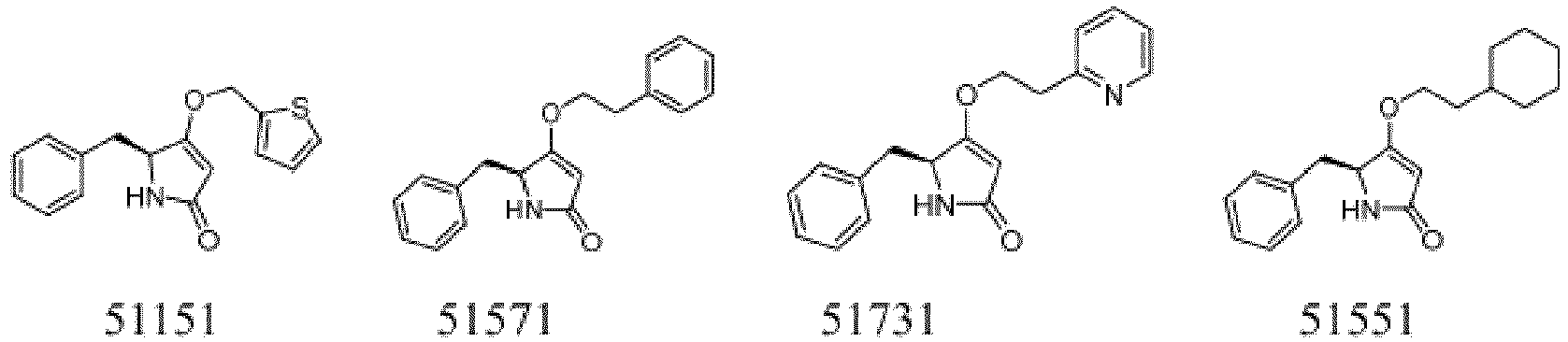
- the 4-oxo-alkylated tetramic acid compound shown in Formula I for use in a method of treatment of Alzheimer's disease, vascular dementia, and other dementia diseases with impaired memory according to the present invention is one of the following compounds:
- the 4-oxo-alkylated tetramic acid compound as shown in Formula I above is prepared by a method comprising the following steps:
- step 1) of the above method the molar ratio of the compound shown in Formula II to the compound shown in Formula III can be 1:1-10.
- the reaction can be carried out under alkaline conditions, and the alkali can be potassium carbonate.
- the reaction temperature can be 0-100 degrees C and the reaction time can be 0.1-24 hours.
- the reaction can be carried out in an organic solvent, which can in particular be acetonitrile.
- step 2) of the above method the removal of Boc protection can be carried out under the action of trifluoroacetic acid.
- the molar ratio of the compound shown in Formula IV to trifluoroacetic acid can be 1:1-20, particularly can be 1:3.
- the reaction temperature for removal of Boc protection can be -10 to 30 degrees C, in particular room temperature, and the reaction time thereof can be 0.5-24 hours, in particular can be 5 hours.
- Boc protection is carried out in an organic solvent, and in particular can be dichloromethane.
- the filtrate was washed six times with 5% potassium bisulfate aqueous solutions, 200 mL each time, washed once with saturated brine, and dried with anhydrous sodium sulfate. And the solvent was removed by reduced pressure evaporation to obtain a yellowish solid. 500 mL of petroleum ether was added, followed by stirring and filtration to obtain a target product, i.e., a white solid (30 g, yield: 77%). A next reaction could be carried out without further purification.
- 2,3-dimethoxybenzaldehyde (1.66 g, 10 mmol) was dissolved into 50 mL of anhydrous tetrahydrofuran, followed by stirring under ice bath for 10 minutes.
- Lithium-aluminium tetrahydride (0.19 g, 5 mmol) was added in batches, followed by reaction under stirring in ice bath for 30 minutes.
- Saturated ammonium chloride aqueous solution was added to quench the reaction. Extraction was performed three times with ethyl acetate (100 mL x 3). Organic layers were combined, and dried by anhydrous sodium sulfate. After filtration, the solvent was removed by reduced pressure evaporation to obtain a target product (1.6 g, yield: 95%).
- a next step reaction could be performed without further purification.
- 2,3-dimethoxybenzyl alcohol (1.6 g, 9.5 mmol) was dissolved into 50 mL of anhydrous dichloromethane, followed by stirring in ice bath for 10 minutes. Phosphorus tribromide (0.87 g, 3.2 mmol) was added dropwise slowly. After that reaction continued under ice bath for 1 hour. After 200 mL of dichloromethane was added to dilute the reaction solution, water washing (50 mL x 3), saturated brine washing (100 mL x 1), drying with anhydrous sodium sulfate, and filtration were performed.
- 2,5-dimethoxybenzyl alcohol (1.68 g, 10 mmol) was dissolved into 50 mL of anhydrous dichloromethane, followed by stirring under ice bath for 10 minutes. Phosphorus tribromide (1.0 g, 3.7 mmol) was dropwise added slowly. Then, reaction continued under ice bath for 1 hour. After adding 200 mL of dichloromethane was added to dilute the reaction solution, water washing (50 mL x 3), saturated brine washing (100 mL x 1), drying with anhydrous sodium sulfate, and filtration were performed.
- 3-acetoxy-4-methoxybenzyl alcohol (1.9 g, 9.7 mmol) was dissolved into 50 mL of anhydrous dichloromethane, followed by stirring under ice bath for 10 minutes. Phosphorus tribromide (1.0 g, 3.7 mmol) was dropwise added slowly. After that, the reaction continued under ice bath for 1 hour. After 200 mL of dichloromethane was added to dilute the reaction solution, water washing (50 mL x 3), saturated brine washing (100 mL x 1), drying with anhydrous sodium sulfate, and filtration were performed.
- intermediate 25 was prepared by the same synthesis method as for intermediate 15, but methyl 4-bromomethyl benzoate was used instead of 4-fluorobenzyl bromide to prepare intermediate 25, as a colorless oily substance (169 mg, yield: 39%). Molecular weight: 437.49.
- intermediate 28 The same synthesis method as for intermediate 15 was adopted, but 2-bromomethylnaphthalene instead of 4-fluorobenzyl bromide was used to prepare intermediate 28, as a colorless oily substance (70 mg, yield: 16%). Molecular weight: 429.52.
- intermediate 29 The same synthesis method as for intermediate 15 was adopted, but 1-bromomethylnaphthalene instead of 4-fluorobenzyl bromide was used to prepare intermediate 29, as a colorless oily substance (206 mg, yield: 48%). Molecular weight: 429.52.
- intermediate 30 The same synthesis method as for intermediate 15 was adopted, but cinnamyl bromide was used instead of 4-fluorobenzyl bromide to prepare intermediate 30, as a colorless oily substance (124 mg, yield: 31%). Molecular weight: 405.49.
- intermediate 32 The same synthesis method as for intermediate 15 was adopted, but ⁇ -bromophenylethane instead of 4-fluorobenzyl bromide was used to prepare intermediate 32, as a colorless oily substance (339 mg, yield: 86%). Molecular weight: 393.48.
- intermediate 35 The same synthesis method as for intermediate 15 was adopted, but 2-phenoxyethyl bromide instead of 4-fluorobenzyl bromide was used to prepare intermediate 35, as a colorless oily substance (309 mg, yield: 75%). Molecular weight: 409.48.
- intermediate 36 The same synthesis method as for intermediate 15 was adopted, but 1-bromopentane instead of 4-fluorobenzyl bromide was used to prepare intermediate 36, as a colorless oily substance (299 mg, yield: 83%). Molecular weight: 359.47.
- L-tyrosine (10 g, 55.2 mmol) was dissolved into 300 mL of a mixture solution of 1,4-dioxane and water (v/v 1:1).
- Triethylamine (11.2 g, 110.7 mmol) and di-tert-butyl dicarbonate (13.3 g, 60.9 mmol) were added in turn at room temperature, followed by stirring for 10 hours at room temperature.
- 1,4-dioxane was removed by reduced pressure evaporation, and 500 mL of dichloromethane was added. 2N hydrochloric acid solution was added dropwise under stirring until the pH value of the water layer was about 5.
- the activity of the compound of the present invention was determined by a method known in the field.
- a positive control used was memantine hydrochloride (purchased from Sigma, goods No. M9292) approved by FDA for the treatment of Alzheimer's disease.
- Other compounds used were prepared according to the methods disclosed in the above examples.
- Drosophila has a classical learning and memory paradigm, known as Pavlov's olfactory-related instantaneous memory.
- Pavlov's olfactory-related instantaneous memory a classical learning and memory paradigm, known as Pavlov's olfactory-related instantaneous memory.
- a group of about 100 drosophilae were exposed sequentially to two odors, i.e., 3-octanol and 4-methylcyclohexanol, each odor for 60 seconds, and to fresh air for 45 seconds therebetween.
- the drosophilae were electrocuted on their feet (1.5-second pulses at 3.5-second intervals, 60V), while no electrocution was exerted during exposure to the second odor.
- Drosophilae containing and expressing human Abeta42 gene were selected as a diseased control, and drosophilae containing but not expressing human Abeta42 gene were selected as a healthy control.
- the day after emergence of the drosophilae male drosophilae were selected and fed. Starting from the third day, drosophilae were fed with a test medicament (100 ⁇ M, 50 ⁇ L per 100 drosophilae) for 7 consecutive days, 4 hours each day. The above memory test was performed on the drosophilae on the tenth day.
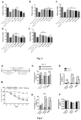
- Fig. 1 shows the effect of compounds 51311, 50561, 51351, 51151, 51121, 51332, 51081, 51091, 51221, 51101, 51071, 51131, 51321, 51341, 51111, and 51301 on memory improvement of drosophilae with Alzheimer's disease.
- the error line in the figure shows a standard error, ***, P ⁇ 0.001; **, P ⁇ 0.01, *, P ⁇ 0.05; n.s, with no statistically significant difference.
- Fig. 2 shows the effect of compounds 60111, 60241, 60201, 51471, 51541, 60221, 60131, 51551, 51571, 60251, 51731, 51561, 60121, 60231, and 60211 on memory improvement of drosophilae with Alzheimer's disease.
- the error line in the figure shows a standard error, ***, P ⁇ 0.001; **, P ⁇ 0.01, *, P ⁇ 0.05; n.s, with no statistically significant difference.
- Fig. 3 shows dose-effect relationships of compounds 50561, 51311, 51351, 51151, and 51121 to improve memory of drosophilae with Alzheimer's disease.
- mice The activity in mice was determined with compound 50561 as an example.
- Transgenic mice containing APP/PS1 were purchased from the Jackson Laboratory of the USA. The transgenic mice were crossbred with B6/C3 background mice. Their offspring were self-bred, genotyped, and each fed in a separate cage for about 8 months.
- a prescribed dose of medicament was administered to the mice by gavage each day, and then the spatial memory of the mice was measured by water maze test.
- a water tank with a diameter of 1.5 meters was filled with water at a constant temperature of 25 degrees, and skim milk was added to render the water surface opaque.
- a transparent platform was placed in a specific quadrant of the water tank. Distant hints were provided as spatial reference. The mice were put into the water and allowed to swim until they found the platform under the surface of water.
- the whole process was tracked by software, and the time from launching to finding the platform, called a latent period, was recorded thereby. If a mouse could not find the platform within 60 seconds, it was manually guided to the platform and its latent period was recorded as 60 seconds.
- Four rounds of the above tests were carried out on each mouse every day, with a one-hour interval between every two rounds of tests for the mice to rest.
- the latent period of each mouse on a day was the average of the four rounds of tests on the same day.
- Fig. 4 shows that compound 50561 (10 mg/kg) improved spatial learning and memory of AD mice.
- a schematically shows administration operations on the mice;
- B shows latent periods of mice in the water maze tests;
- C-D show the percentages of residence time of the mice in the target quadrant before and after training;
- E shows numbers of crossing the platform of the mice before and after training;
- F shows changes in swimming speed of the mice before and after training.
- the error line in the figure is a standard error, ***, P ⁇ 0.001; **, P ⁇ 0.01, *, P ⁇ 0.05; n.s., no statistically significant difference.
- Fig. 5 shows that compound 50561 (1, 0.1 mg/kg) does not improve spatial learning and memory in AD mice.
- a schematically shows administration operations on the mice;
- B shows latent periods of mice in the water maze tests;
- C-D show the percentages of residence time of the mice in the target quadrant before and after training;
- E shows numbers of crossing the platform of the mice before and after training;
- F shows changes in swimming speed of the mice before and after training.
- compound 50561 has no ability to rescue the spatial memory of mice at a dose of 1 mg/kg or 0.1 mg/kg.
- Rapidly activated human delayed rectifier outward potassium current is mainly mediated by hERG ion channels, and participates in human cardiomyocyte repolarization. Pharmaceutical blockade of this current is the main cause of prolonged QT syndrome, even acute arrhythmia and sudden death clinically.
- HEK-hERG from the Academy of Military Medical Sciences
- the whole-cell patch clamp technique was used to record the hERG current.
- Cell suspension was collected and added to a 35 mm culture dish, which was placed on an inverted microscope carrier. After cell attachment, perfusion was performed with an extracellular fluid at a flow rate of 1-2 mL/min.
- a glass microelectrode was drawn in two steps by a micropipette puller, and after filling with electrode inner fluid, the water resistance of the glass microelectrode was 2-5 M ⁇ . After the whole cell recording mode was established, the clamping potential was maintained to-80 mV.
- a depolarization voltage was exerted to +60 mV for 850 ms, followed by repolarization to -50 mV for 1275ms to induce an hERG tail current.
- continuous extracellular perfusion administration from a low concentration to a high concentration was adopted. Starting from the low concentration, continuous perfusion was performed until the efficacy was stable, followed by perfusion of the next concentration.
- the inhibitory rate of a compound or positive control to the hERG current was less than 50%
- the CV of each of five consecutive current values was less than 10%.
- the inhibitory rate of a compound or positive control to the hERG current was more than 50% but less than 70%
- the CV of each of five consecutive current values was less than 20%. If a current amplitude was reduced by less than 200 pA, or if the inhibitory rate was more than 70%, the CV of each of five consecutive current values was less than 30%.
- a certain amount of a test sample was weighed and dissolved into DMSO to prepare a 30 mM stock solution. Prior to the experiment, the above stock solution was diluted by DMSO 10 times and 3 times step by step, and then the solution was diluted by extracellular fluid to a required concentration. The solution at working concentration should be checked for precipitation before use. If precipitation existed, the stock solution would be diluted to increase the final concentration of DMSO in the extracellular fluid. However, the final concentration of DMSO in the extracellular fluid would not exceed 0.5%. Continuous perfusion from low to high concentrations was done during the experiment. The half inhibitory concentration (IC50) of the test sample was obtained by the best fitting of Logistic equation. The blocking effect of the test sample on hERG is shown in Table 1.
- Fig. 6 is a concentration-effect curve of compound 50561 against hERG potassium channels recorded on an hERG stable cell line of HEK-293 by the patch clamp technique.
- the clamping potential was maintained at -80 mV, depolarized to 60 mV for 0.85 s, and then repolarized to - 50 mV for 1.275 s.
- the safety was evaluated taking compound 50561 as an example.
- Histidine auxotrophic strains of Salmonella typhimurium were cultured in a special medium with quite a low content of histidine. The strains were difficult to divide due to lack of nutrition. If a test compound has mutagenicity, a large number of cells will undergo reverse mutation, synthesizing histidine by themselves and developing into colonies visible to the naked eye. In view of the close relationship between mutagenicity and carcinogenesis of chemicals, this method has been widely used in screening carcinogens. Some chemicals need metabolic activation to induce mutagenicity. Mammalian microsomal enzyme S9 can be added into the test system to eliminate the influence of metabolic activation on generation of mutagenicity.
- the safety was evaluated taking compound 50561 as an example.
- mice are commonly used rodents to evaluate the toxicity of a test sample and are also an important part of early preclinical safety evaluation.
- the toxicity of compound 50561 was tested by administering a dose gradient thereof to the mice by gavage and observing its toxicity.
- mice were tested, including half males and half females.
- the males each weighed about 18-23 grams, and the females each weighed about 17-21 grams. They were randomly grouped by a simple randomization procedure. All the animals used in the experiment weighed between ⁇ 20% of the average body weight of their respective genders. If there are not enough animals in the study to meet the weight range required thereby, notify the responsible person of the project to take reasonable measures. Animals must be adapted to the laboratory for at least three days. During this period, daily cage observation was conducted once a day, and a detailed clinical observation was necessary before the experiment. Any animal with symptoms or physical abnormalities would be reported to the attending veterinarian and responsible person of the project, and excluded whenever possible. Animals suitable for experimentation will be assigned to respective experimental groups according to the random grouping method described above.
- Results were shown in Table 4.
- the maximum tolerance of CR mice to compound 50561 was 500 mg/kg > MTD ⁇ 250 mg/kg.
- Distribution of a medicament in the body is one of the important indicators to determine the dose and efficacy of the medicament.
- excellent candidate compounds should have good pharmacokinetic characteristics.
- the compound of the present invention is intended to be used for the treatment of Alzheimer's disease, which is a disease of the central nervous system, the distribution pattern of the compound in the brain and the blood is also one of the subjects to be investigated.
- compound 50561 was administered to mice by oral or by gavage, and the concentrations of the compound in blood and brain were measured at specific time points to determine the pharmacokinetic parameters.
- ICR mice Forty-eight male ICR mice purchased from Shanghai Sippr-BK Lab. Animal Co. Ltd were used in this experiment. The oral group was fasted for 10-14 hours before administration, and feeding was restored 4 hours after administration. Samples were collected from the intravenous administration group 0.083 h, 0.25 h, 0.5 h, 1 h, 2 h, 4 h, 8 h, and 24 h after administration, respectively; while for the oral administration group, about 0.5 mL of blood was collected from the heart 0.25 h, 0.5 h, 1 h, 2 h, 4 h, 6 h, 8 h, and 24 h after administration, respectively. Heparin sodium was used for anticoagulation.
- Plasma samples were collected and placed on ice, and plasma was separated by centrifugation (centrifugation conditions: 8000 rpm, 6 minutes, 4C). The collected plasma was stored at -80 °C before analysis. After collecting plasma samples, brain tissues were collected, washed with normal saline, water-absorbed by filter paper, weighed immediately, and then placed in labeled tubes (one tube for one brain tissue). The samples to be tested were temporarily placed on ice before being stored in a -80 °C refrigerator.
- the analysis methods of biological samples and the analysis of all samples were done by Medicilon Pharmaceutical Technology (Shanghai) Co., Ltd.
- the intraday accuracy evaluation of the quality control samples was carried out while analyzing the samples, and the accuracy of over 66.7% of the quality control samples was required to be between 80-120%.
- the BLQ before C max was calculated as 0; BLQ occurring after C max (including "No peak") was not involved in the calculation.
- WinNonlin Professional V 5.2 (Pharsight, USA) was adopted to calculate the following pharmacokinetic parameters: AUC (0-t) , AUC (0- ⁇ ) , T 1/2 , MRT (o- ⁇ ) , C max , and T max .
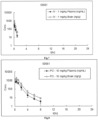
- Fig. 7 and Fig. 8 show the plasma and brain tissue concentration-time curves in ICR mice after intravenous and oral administration of compound 50561, respectively.
- the ratios of brain tissue to plasma in the animals were shown in Table 5.
- Fig. 7 shows the plasma and brain concentration-time curves after intravenous injection of
- Fig. 8 shows the plasma and brain concentration-time curves after oral administration of compound 50561.
- Table 5 Blood Concentration of ICR Mice afterIntravenous or Oral Administration of Ccompound 50561 50561-IV-1 mg/kg Time (hr) Blood concentration (ng/mL) G1-1 G1-2 G1-3 Mean SD 0.083 327.86 145.16 434.45 302.49 146.30 0.25 188.41 180.29 215.73 194.81 18.57 0.5 58.15 98.13 89.73 82.00 21.08 1 18.27 8.99 18.70 15.32 5.49 2 BLQ BLQ BLQ NA NA 4 BLQ BLQ BLQ NA NA 8 BLQ BLQ BLQ NA NA 24 BLQ BLQ NA NA 50561-IV-1 mg/kg Time (hr) Brain tissue concentration (ng/G) G1-1 G1-2 G1-3 Mean SD 0.083 853.63 383.96 977.10 738.23 312.96 0.25 461.84 435
- the present disclosure provides compounds, and preparation methods and use thereof.
- the general structural formula of the compounds is shown in Formula I.
- Animal experiments show that the compounds of the present invention have the effect of saving the memory of animal models.
- the compounds are of high safety, have no mutagenicity, can stay in blood for several hours after oral or intravenous injection, and can enter the brain, and thus can be used to prepare a medicament for treating Alzheimer's disease, Parkinson's disease, Huntington's disease, vascular dementia, schizophrenia, and autism among others.
Landscapes
- Chemical & Material Sciences (AREA)
- Organic Chemistry (AREA)
- Health & Medical Sciences (AREA)
- Medicinal Chemistry (AREA)
- Pharmacology & Pharmacy (AREA)
- Life Sciences & Earth Sciences (AREA)
- Animal Behavior & Ethology (AREA)
- General Health & Medical Sciences (AREA)
- Public Health (AREA)
- Veterinary Medicine (AREA)
- Epidemiology (AREA)
- Bioinformatics & Cheminformatics (AREA)
- Engineering & Computer Science (AREA)
- Biomedical Technology (AREA)
- Neurology (AREA)
- Neurosurgery (AREA)
- Hospice & Palliative Care (AREA)
- Psychiatry (AREA)
- Chemical Kinetics & Catalysis (AREA)
- General Chemical & Material Sciences (AREA)
- Nuclear Medicine, Radiotherapy & Molecular Imaging (AREA)
- Organic Low-Molecular-Weight Compounds And Preparation Thereof (AREA)
- Pharmaceuticals Containing Other Organic And Inorganic Compounds (AREA)
- Acyclic And Carbocyclic Compounds In Medicinal Compositions (AREA)
Claims (3)
- Verbindung, dargestellt durch Formel I, oder ein Salz davon zur Verwendung in einem Verfahren zur Behandlung von Alzheimer-Krankheit, vaskulärer Demenz, und weiteren Demenzerkrankungen mit beeinträchtigtem Gedächtnis:
 wobei in Formel I R1 ausgewählt ist aus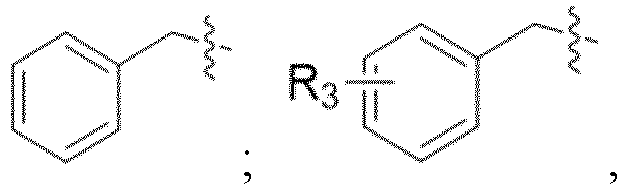
 R2 ausgewählt ist aus


- Verbindung zur Verwendung in einem Verfahren zur Behandlung nach Anspruch 1, wobei die in Formel I dargestellte Verbindung eine der folgenden Verbindungen ist:


- Verbindung zur Verwendung in einem Verfahren zur Behandlung nach Anspruch 2, wobei die in Formel I dargestellte Verbindung eine der folgenden Verbindungen ist:




Applications Claiming Priority (2)
| Application Number | Priority Date | Filing Date | Title |
|---|---|---|---|
| CN201710684789.0A CN107468690B (zh) | 2017-08-11 | 2017-08-11 | 4-氧-烷基化特特拉姆酸类化合物及其制备方法与应用 |
| PCT/CN2018/091961 WO2019029273A1 (zh) | 2017-08-11 | 2018-06-20 | 4-氧-烷基化特特拉姆酸类化合物及其制备方法与应用 |
Publications (4)
| Publication Number | Publication Date |
|---|---|
| EP3643311A1 EP3643311A1 (de) | 2020-04-29 |
| EP3643311A4 EP3643311A4 (de) | 2021-04-14 |
| EP3643311C0 EP3643311C0 (de) | 2024-03-27 |
| EP3643311B1 true EP3643311B1 (de) | 2024-03-27 |
Family
ID=60600290
Family Applications (1)
| Application Number | Title | Priority Date | Filing Date |
|---|---|---|---|
| EP18844790.8A Active EP3643311B1 (de) | 2017-08-11 | 2018-06-20 | 4-oxo-alkylierte tetramsäureverbindung, herstellungsverfahren dafür und verwendung davon |
Country Status (5)
| Country | Link |
|---|---|
| US (1) | US11130733B2 (de) |
| EP (1) | EP3643311B1 (de) |
| CN (1) | CN107468690B (de) |
| AU (1) | AU2018314471B2 (de) |
| WO (1) | WO2019029273A1 (de) |
Families Citing this family (5)
| Publication number | Priority date | Publication date | Assignee | Title |
|---|---|---|---|---|
| CN107468690B (zh) | 2017-08-11 | 2020-01-31 | 北京卓凯生物技术有限公司 | 4-氧-烷基化特特拉姆酸类化合物及其制备方法与应用 |
| CN107353239B (zh) * | 2017-08-11 | 2019-06-18 | 北京卓凯生物技术有限公司 | 4-氧-烷基化特特拉姆酸类化合物及其制备方法 |
| CN108522431A (zh) * | 2018-04-03 | 2018-09-14 | 葛仟鸿 | 抗生素对果蝇记忆认知影响用测定方法 |
| CN112409234A (zh) * | 2020-11-30 | 2021-02-26 | 北京卓凯生物技术有限公司 | 一种左旋氟吡咯酮的晶型a及其制备方法 |
| KR20250123229A (ko) * | 2023-01-03 | 2025-08-14 | 티와이케이 메디슨즈, 인코포레이티드 | 신경퇴행성 질환 예방 및/또는 치료를 위한 화합물 |
Family Cites Families (13)
| Publication number | Priority date | Publication date | Assignee | Title |
|---|---|---|---|---|
| DE59205454D1 (de) * | 1991-08-22 | 1996-04-04 | Lonza Ag | Verfahren zur Herstellung von optisch aktiven 4-Amino-3-hydroxycarbonsäuren |
| DE10354629A1 (de) * | 2003-11-22 | 2005-06-30 | Bayer Cropscience Ag | 2-Ethyl-4,6-dimethyl-phenyl substituierte spirocyclische Tetramsäure-Derivate |
| CN1886391A (zh) | 2003-11-28 | 2006-12-27 | 弗·哈夫曼-拉罗切有限公司 | 作为β-分泌酶抑制剂的特仑酸和特拉氨酸 |
| EP1992614A1 (de) * | 2007-05-16 | 2008-11-19 | Bayer CropScience Aktiengesellschaft | 3-(2-Alkoxy-phenyl)-substituierte Tetramate |
| CN102131775B (zh) * | 2008-08-22 | 2015-12-16 | 不列颠哥伦比亚癌症局分支机构 | 雄激素受体n-末端活化的小分子抑制剂 |
| US8389443B2 (en) * | 2008-12-02 | 2013-03-05 | Bayer Cropscience Ag | Geminal alkoxy/alkylspirocyclic substituted tetramate derivatives |
| CN101838260B (zh) * | 2010-03-31 | 2013-08-14 | 华南理工大学 | 二氢吡咯酮衍生物作为Caspase-3抑制剂 |
| JP5951642B2 (ja) | 2011-01-25 | 2016-07-13 | バイエル・インテレクチュアル・プロパティ・ゲゼルシャフト・ミット・ベシュレンクテル・ハフツングBayer Intellectual Property GmbH | 1−h−ピロリジン−2,4−ジオン誘導体を製造する方法 |
| JP6162799B2 (ja) * | 2012-07-02 | 2017-07-12 | ピーエヌビー ヴェスパー ライフ サイエンス ピーヴィティー リミテッドPnb Vesper Life Science Pvt Limited | 新規なコレシストキニン受容体リガンド |
| CA2899938C (en) | 2013-02-12 | 2021-10-19 | Buck Institute For Research On Aging | Hydantoins that modulate bace-mediated app processing |
| CN107056672A (zh) | 2017-05-22 | 2017-08-18 | 北京卓凯生物技术有限公司 | 吡咯烷‑2,4‑二酮类化合物及其制备方法 |
| CN107468690B (zh) | 2017-08-11 | 2020-01-31 | 北京卓凯生物技术有限公司 | 4-氧-烷基化特特拉姆酸类化合物及其制备方法与应用 |
| CN107353239B (zh) * | 2017-08-11 | 2019-06-18 | 北京卓凯生物技术有限公司 | 4-氧-烷基化特特拉姆酸类化合物及其制备方法 |
-
2017
- 2017-08-11 CN CN201710684789.0A patent/CN107468690B/zh active Active
-
2018
- 2018-06-20 US US16/638,219 patent/US11130733B2/en active Active
- 2018-06-20 AU AU2018314471A patent/AU2018314471B2/en active Active
- 2018-06-20 EP EP18844790.8A patent/EP3643311B1/de active Active
- 2018-06-20 WO PCT/CN2018/091961 patent/WO2019029273A1/zh not_active Ceased
Also Published As
| Publication number | Publication date |
|---|---|
| CN107468690A (zh) | 2017-12-15 |
| AU2018314471B2 (en) | 2021-05-27 |
| AU2018314471A1 (en) | 2020-02-13 |
| CN107468690B (zh) | 2020-01-31 |
| EP3643311A1 (de) | 2020-04-29 |
| EP3643311C0 (de) | 2024-03-27 |
| US11130733B2 (en) | 2021-09-28 |
| US20200361868A1 (en) | 2020-11-19 |
| EP3643311A4 (de) | 2021-04-14 |
| WO2019029273A1 (zh) | 2019-02-14 |
Similar Documents
| Publication | Publication Date | Title |
|---|---|---|
| EP3643311B1 (de) | 4-oxo-alkylierte tetramsäureverbindung, herstellungsverfahren dafür und verwendung davon | |
| EP3647306B1 (de) | 4-oxo-alkylierte tetramsäureverbindung und herstellungsverfahren dafür | |
| AU2023203435B2 (en) | Treatment of mitochondrial associated diseases and disorders, including symptoms thereof using pridopidine | |
| UA125302C2 (uk) | Похідні [1,2,4]триазоло[1,5-a]піримідину як інгібітори pde2 | |
| UA122423C2 (uk) | [1,2,4]ТРИАЗОЛО[1,5-a]ПІРИМІДИН-7-ІЛЬНА СПОЛУКА | |
| DE69729392T2 (de) | Krampfhemmende enantiomere Aminosäurederivate | |
| CN107056672A (zh) | 吡咯烷‑2,4‑二酮类化合物及其制备方法 | |
| CN117659024B (zh) | 一种酰胺取代的色胺酮类衍生物及其制备方法和应用 | |
| CN118892485A (zh) | 凡德他尼及其药学上可接受的盐与硝苯地平及其药学上可接受的盐联合制备治疗癌症和长q-t间期综合症的药物中的用途 | |
| EP4330245B1 (de) | N-alkyl-o-aryl carbamate von 6h-dibenzo[]b,d]pyran-3,8-diolen als mitophagie verstärker | |
| EP0782573B1 (de) | Brefeldin a und analoge zur verbesserung synaptischer übertragungen | |
| DE1211645B (de) | Verfahren zur Herstellung von 4-Hydroxytryptaminphosphorsaeureestern | |
| EP2702990A1 (de) | Antiarrhythmie-arzneimittel, hemmer für vorhofflimmern, modell für durchgehendes vorhofflimmern und herstellungsverfahren dafür sowie verfahren zum screening nach hemmern für vorhofflimmern | |
| CN113461683B (zh) | 一种7-氮杂吲哚类杂环化合物及其制备方法和应用 | |
| US20240350464A1 (en) | Methods of treating neurological, muscular, and proliferative disorders | |
| US10251907B2 (en) | Oligodeoxy nucleotide for preparing drugs for inhibiting tumor growth and application thereof | |
| CN121627661A (zh) | 一类2-硫-3-(哌啶烷二硫基)苯酞及其制备方法和用途 | |
| WO2025041725A1 (ja) | 塩及び前記塩を含む麻酔薬 | |
| CN121378212A (zh) | 2-(哌啶烷基)哒嗪酮类化合物及其制备方法和用途 |
Legal Events
| Date | Code | Title | Description |
|---|---|---|---|
| STAA | Information on the status of an ep patent application or granted ep patent |
Free format text: STATUS: THE INTERNATIONAL PUBLICATION HAS BEEN MADE |
|
| PUAI | Public reference made under article 153(3) epc to a published international application that has entered the european phase |
Free format text: ORIGINAL CODE: 0009012 |
|
| STAA | Information on the status of an ep patent application or granted ep patent |
Free format text: STATUS: REQUEST FOR EXAMINATION WAS MADE |
|
| 17P | Request for examination filed |
Effective date: 20200121 |
|
| AK | Designated contracting states |
Kind code of ref document: A1 Designated state(s): AL AT BE BG CH CY CZ DE DK EE ES FI FR GB GR HR HU IE IS IT LI LT LU LV MC MK MT NL NO PL PT RO RS SE SI SK SM TR |
|
| AX | Request for extension of the european patent |
Extension state: BA ME |
|
| DAV | Request for validation of the european patent (deleted) | ||
| DAX | Request for extension of the european patent (deleted) | ||
| A4 | Supplementary search report drawn up and despatched |
Effective date: 20210316 |
|
| RIC1 | Information provided on ipc code assigned before grant |
Ipc: A61K 31/4439 20060101AFI20210310BHEP Ipc: A61K 31/4025 20060101ALI20210310BHEP Ipc: A61K 31/4015 20060101ALI20210310BHEP Ipc: A61P 25/28 20060101ALI20210310BHEP Ipc: A61P 25/18 20060101ALI20210310BHEP Ipc: A61P 25/14 20060101ALI20210310BHEP Ipc: A61P 25/16 20060101ALI20210310BHEP Ipc: A61P 25/00 20060101ALI20210310BHEP Ipc: A61P 9/00 20060101ALI20210310BHEP Ipc: C07D 207/38 20060101ALI20210310BHEP Ipc: C07D 409/12 20060101ALI20210310BHEP |
|
| GRAP | Despatch of communication of intention to grant a patent |
Free format text: ORIGINAL CODE: EPIDOSNIGR1 |
|
| STAA | Information on the status of an ep patent application or granted ep patent |
Free format text: STATUS: GRANT OF PATENT IS INTENDED |
|
| INTG | Intention to grant announced |
Effective date: 20231114 |
|
| GRAS | Grant fee paid |
Free format text: ORIGINAL CODE: EPIDOSNIGR3 |
|
| GRAA | (expected) grant |
Free format text: ORIGINAL CODE: 0009210 |
|
| STAA | Information on the status of an ep patent application or granted ep patent |
Free format text: STATUS: THE PATENT HAS BEEN GRANTED |
|
| AK | Designated contracting states |
Kind code of ref document: B1 Designated state(s): AL AT BE BG CH CY CZ DE DK EE ES FI FR GB GR HR HU IE IS IT LI LT LU LV MC MK MT NL NO PL PT RO RS SE SI SK SM TR |
|
| REG | Reference to a national code |
Ref country code: GB Ref legal event code: FG4D |
|
| REG | Reference to a national code |
Ref country code: CH Ref legal event code: EP |
|
| REG | Reference to a national code |
Ref country code: DE Ref legal event code: R096 Ref document number: 602018067275 Country of ref document: DE |
|
| REG | Reference to a national code |
Ref country code: IE Ref legal event code: FG4D |
|
| U01 | Request for unitary effect filed |
Effective date: 20240417 |
|
| U07 | Unitary effect registered |
Designated state(s): AT BE BG DE DK EE FI FR IT LT LU LV MT NL PT SE SI Effective date: 20240424 |
|
| PG25 | Lapsed in a contracting state [announced via postgrant information from national office to epo] |
Ref country code: GR Free format text: LAPSE BECAUSE OF FAILURE TO SUBMIT A TRANSLATION OF THE DESCRIPTION OR TO PAY THE FEE WITHIN THE PRESCRIBED TIME-LIMIT Effective date: 20240628 |
|
| PG25 | Lapsed in a contracting state [announced via postgrant information from national office to epo] |
Ref country code: HR Free format text: LAPSE BECAUSE OF FAILURE TO SUBMIT A TRANSLATION OF THE DESCRIPTION OR TO PAY THE FEE WITHIN THE PRESCRIBED TIME-LIMIT Effective date: 20240327 Ref country code: RS Free format text: LAPSE BECAUSE OF FAILURE TO SUBMIT A TRANSLATION OF THE DESCRIPTION OR TO PAY THE FEE WITHIN THE PRESCRIBED TIME-LIMIT Effective date: 20240627 |
|
| PG25 | Lapsed in a contracting state [announced via postgrant information from national office to epo] |
Ref country code: RS Free format text: LAPSE BECAUSE OF FAILURE TO SUBMIT A TRANSLATION OF THE DESCRIPTION OR TO PAY THE FEE WITHIN THE PRESCRIBED TIME-LIMIT Effective date: 20240627 Ref country code: NO Free format text: LAPSE BECAUSE OF FAILURE TO SUBMIT A TRANSLATION OF THE DESCRIPTION OR TO PAY THE FEE WITHIN THE PRESCRIBED TIME-LIMIT Effective date: 20240627 Ref country code: HR Free format text: LAPSE BECAUSE OF FAILURE TO SUBMIT A TRANSLATION OF THE DESCRIPTION OR TO PAY THE FEE WITHIN THE PRESCRIBED TIME-LIMIT Effective date: 20240327 Ref country code: GR Free format text: LAPSE BECAUSE OF FAILURE TO SUBMIT A TRANSLATION OF THE DESCRIPTION OR TO PAY THE FEE WITHIN THE PRESCRIBED TIME-LIMIT Effective date: 20240628 |
|
| U20 | Renewal fee for the european patent with unitary effect paid |
Year of fee payment: 7 Effective date: 20240719 |
|
| PG25 | Lapsed in a contracting state [announced via postgrant information from national office to epo] |
Ref country code: IS Free format text: LAPSE BECAUSE OF FAILURE TO SUBMIT A TRANSLATION OF THE DESCRIPTION OR TO PAY THE FEE WITHIN THE PRESCRIBED TIME-LIMIT Effective date: 20240727 |
|
| PG25 | Lapsed in a contracting state [announced via postgrant information from national office to epo] |
Ref country code: SM Free format text: LAPSE BECAUSE OF FAILURE TO SUBMIT A TRANSLATION OF THE DESCRIPTION OR TO PAY THE FEE WITHIN THE PRESCRIBED TIME-LIMIT Effective date: 20240327 |
|
| PG25 | Lapsed in a contracting state [announced via postgrant information from national office to epo] |
Ref country code: ES Free format text: LAPSE BECAUSE OF FAILURE TO SUBMIT A TRANSLATION OF THE DESCRIPTION OR TO PAY THE FEE WITHIN THE PRESCRIBED TIME-LIMIT Effective date: 20240327 |
|
| PG25 | Lapsed in a contracting state [announced via postgrant information from national office to epo] |
Ref country code: CZ Free format text: LAPSE BECAUSE OF FAILURE TO SUBMIT A TRANSLATION OF THE DESCRIPTION OR TO PAY THE FEE WITHIN THE PRESCRIBED TIME-LIMIT Effective date: 20240327 |
|
| PG25 | Lapsed in a contracting state [announced via postgrant information from national office to epo] |
Ref country code: PL Free format text: LAPSE BECAUSE OF FAILURE TO SUBMIT A TRANSLATION OF THE DESCRIPTION OR TO PAY THE FEE WITHIN THE PRESCRIBED TIME-LIMIT Effective date: 20240327 |
|
| PG25 | Lapsed in a contracting state [announced via postgrant information from national office to epo] |
Ref country code: SK Free format text: LAPSE BECAUSE OF FAILURE TO SUBMIT A TRANSLATION OF THE DESCRIPTION OR TO PAY THE FEE WITHIN THE PRESCRIBED TIME-LIMIT Effective date: 20240327 |
|
| PG25 | Lapsed in a contracting state [announced via postgrant information from national office to epo] |
Ref country code: SM Free format text: LAPSE BECAUSE OF FAILURE TO SUBMIT A TRANSLATION OF THE DESCRIPTION OR TO PAY THE FEE WITHIN THE PRESCRIBED TIME-LIMIT Effective date: 20240327 Ref country code: SK Free format text: LAPSE BECAUSE OF FAILURE TO SUBMIT A TRANSLATION OF THE DESCRIPTION OR TO PAY THE FEE WITHIN THE PRESCRIBED TIME-LIMIT Effective date: 20240327 Ref country code: RO Free format text: LAPSE BECAUSE OF FAILURE TO SUBMIT A TRANSLATION OF THE DESCRIPTION OR TO PAY THE FEE WITHIN THE PRESCRIBED TIME-LIMIT Effective date: 20240327 Ref country code: PL Free format text: LAPSE BECAUSE OF FAILURE TO SUBMIT A TRANSLATION OF THE DESCRIPTION OR TO PAY THE FEE WITHIN THE PRESCRIBED TIME-LIMIT Effective date: 20240327 Ref country code: IS Free format text: LAPSE BECAUSE OF FAILURE TO SUBMIT A TRANSLATION OF THE DESCRIPTION OR TO PAY THE FEE WITHIN THE PRESCRIBED TIME-LIMIT Effective date: 20240727 Ref country code: ES Free format text: LAPSE BECAUSE OF FAILURE TO SUBMIT A TRANSLATION OF THE DESCRIPTION OR TO PAY THE FEE WITHIN THE PRESCRIBED TIME-LIMIT Effective date: 20240327 Ref country code: CZ Free format text: LAPSE BECAUSE OF FAILURE TO SUBMIT A TRANSLATION OF THE DESCRIPTION OR TO PAY THE FEE WITHIN THE PRESCRIBED TIME-LIMIT Effective date: 20240327 |
|
| REG | Reference to a national code |
Ref country code: DE Ref legal event code: R097 Ref document number: 602018067275 Country of ref document: DE |
|
| PG25 | Lapsed in a contracting state [announced via postgrant information from national office to epo] |
Ref country code: MC Free format text: LAPSE BECAUSE OF FAILURE TO SUBMIT A TRANSLATION OF THE DESCRIPTION OR TO PAY THE FEE WITHIN THE PRESCRIBED TIME-LIMIT Effective date: 20240327 |
|
| REG | Reference to a national code |
Ref country code: CH Ref legal event code: PL |
|
| PLBE | No opposition filed within time limit |
Free format text: ORIGINAL CODE: 0009261 |
|
| STAA | Information on the status of an ep patent application or granted ep patent |
Free format text: STATUS: NO OPPOSITION FILED WITHIN TIME LIMIT |
|
| GBPC | Gb: european patent ceased through non-payment of renewal fee |
Effective date: 20240627 |
|
| 26N | No opposition filed |
Effective date: 20250103 |
|
| PG25 | Lapsed in a contracting state [announced via postgrant information from national office to epo] |
Ref country code: IE Free format text: LAPSE BECAUSE OF NON-PAYMENT OF DUE FEES Effective date: 20240620 |
|
| PG25 | Lapsed in a contracting state [announced via postgrant information from national office to epo] |
Ref country code: CH Free format text: LAPSE BECAUSE OF NON-PAYMENT OF DUE FEES Effective date: 20240630 |
|
| PG25 | Lapsed in a contracting state [announced via postgrant information from national office to epo] |
Ref country code: GB Free format text: LAPSE BECAUSE OF NON-PAYMENT OF DUE FEES Effective date: 20240627 |
|
| PG25 | Lapsed in a contracting state [announced via postgrant information from national office to epo] |
Ref country code: CY Free format text: LAPSE BECAUSE OF FAILURE TO SUBMIT A TRANSLATION OF THE DESCRIPTION OR TO PAY THE FEE WITHIN THE PRESCRIBED TIME-LIMIT; INVALID AB INITIO Effective date: 20180620 |
|
| U90 | Renewal fees not paid: noting of loss of rights |
Free format text: RENEWAL FEE NOT PAID FOR YEAR 08 Effective date: 20260128 |
|
| PG25 | Lapsed in a contracting state [announced via postgrant information from national office to epo] |
Ref country code: HU Free format text: LAPSE BECAUSE OF FAILURE TO SUBMIT A TRANSLATION OF THE DESCRIPTION OR TO PAY THE FEE WITHIN THE PRESCRIBED TIME-LIMIT; INVALID AB INITIO Effective date: 20180620 |