EP3646765B1 - Toilettenpapier - Google Patents
Toilettenpapier Download PDFInfo
- Publication number
- EP3646765B1 EP3646765B1 EP18823305.0A EP18823305A EP3646765B1 EP 3646765 B1 EP3646765 B1 EP 3646765B1 EP 18823305 A EP18823305 A EP 18823305A EP 3646765 B1 EP3646765 B1 EP 3646765B1
- Authority
- EP
- European Patent Office
- Prior art keywords
- embossments
- embossed
- toilet paper
- curve
- paper
- Prior art date
- Legal status (The legal status is an assumption and is not a legal conclusion. Google has not performed a legal analysis and makes no representation as to the accuracy of the status listed.)
- Active
Links
Images






Classifications
-
- A—HUMAN NECESSITIES
- A47—FURNITURE; DOMESTIC ARTICLES OR APPLIANCES; COFFEE MILLS; SPICE MILLS; SUCTION CLEANERS IN GENERAL
- A47K—SANITARY EQUIPMENT; ACCESSORIES THEREFOR, e.g. TOILET ACCESSORIES
- A47K10/00—Body-drying implements; Toilet paper; Holders therefor
- A47K10/16—Paper towels; Toilet paper; Holders therefor
-
- D—TEXTILES; PAPER
- D21—PAPER-MAKING; PRODUCTION OF CELLULOSE
- D21H—PULP COMPOSITIONS; PREPARATION THEREOF NOT COVERED BY SUBCLASSES D21C OR D21D; IMPREGNATING OR COATING OF PAPER; TREATMENT OF FINISHED PAPER NOT COVERED BY CLASS B31 OR SUBCLASS D21G; PAPER NOT OTHERWISE PROVIDED FOR
- D21H27/00—Special paper not otherwise provided for, e.g. made by multi-step processes
-
- D—TEXTILES; PAPER
- D21—PAPER-MAKING; PRODUCTION OF CELLULOSE
- D21H—PULP COMPOSITIONS; PREPARATION THEREOF NOT COVERED BY SUBCLASSES D21C OR D21D; IMPREGNATING OR COATING OF PAPER; TREATMENT OF FINISHED PAPER NOT COVERED BY CLASS B31 OR SUBCLASS D21G; PAPER NOT OTHERWISE PROVIDED FOR
- D21H27/00—Special paper not otherwise provided for, e.g. made by multi-step processes
- D21H27/02—Patterned paper
-
- D—TEXTILES; PAPER
- D21—PAPER-MAKING; PRODUCTION OF CELLULOSE
- D21H—PULP COMPOSITIONS; PREPARATION THEREOF NOT COVERED BY SUBCLASSES D21C OR D21D; IMPREGNATING OR COATING OF PAPER; TREATMENT OF FINISHED PAPER NOT COVERED BY CLASS B31 OR SUBCLASS D21G; PAPER NOT OTHERWISE PROVIDED FOR
- D21H27/00—Special paper not otherwise provided for, e.g. made by multi-step processes
- D21H27/30—Multi-ply
-
- B—PERFORMING OPERATIONS; TRANSPORTING
- B31—MAKING ARTICLES OF PAPER, CARDBOARD OR MATERIAL WORKED IN A MANNER ANALOGOUS TO PAPER; WORKING PAPER, CARDBOARD OR MATERIAL WORKED IN A MANNER ANALOGOUS TO PAPER
- B31F—MECHANICAL WORKING OR DEFORMATION OF PAPER, CARDBOARD OR MATERIAL WORKED IN A MANNER ANALOGOUS TO PAPER
- B31F1/00—Mechanical deformation without removing material, e.g. in combination with laminating
- B31F1/07—Embossing, i.e. producing impressions formed by locally deep-drawing, e.g. using rolls provided with complementary profiles
-
- Y—GENERAL TAGGING OF NEW TECHNOLOGICAL DEVELOPMENTS; GENERAL TAGGING OF CROSS-SECTIONAL TECHNOLOGIES SPANNING OVER SEVERAL SECTIONS OF THE IPC; TECHNICAL SUBJECTS COVERED BY FORMER USPC CROSS-REFERENCE ART COLLECTIONS [XRACs] AND DIGESTS
- Y10—TECHNICAL SUBJECTS COVERED BY FORMER USPC
- Y10T—TECHNICAL SUBJECTS COVERED BY FORMER US CLASSIFICATION
- Y10T428/00—Stock material or miscellaneous articles
- Y10T428/24—Structurally defined web or sheet [e.g., overall dimension, etc.]
- Y10T428/24355—Continuous and nonuniform or irregular surface on layer or component [e.g., roofing, etc.]
- Y10T428/24446—Wrinkled, creased, crinkled or creped
- Y10T428/24455—Paper
- Y10T428/24463—Plural paper components
Definitions
- the present invention relates to toilet paper.
- Known toilet paper has a structure in which multiple sheets of embossed base paper are stacked on each other. Also, due to widespread use of shower toilets, durability (strength) and high water absorbency are now required for toilet paper.
- Patent Document 1 discloses toilet paper having a laminated structure called a design laminate. A design is added to this toilet paper by bonding sheets of base paper together using an adhesive including a pigment component.
- Patent Document 2 discloses toilet paper having a tip-to-tip laminated structure.
- a space is formed between two sheets of base paper (crepe paper 10 and crepe paper 20) by bonding top parts (top parts 33 and 43) of embossed protrusions (embossed protrusions 32 and 42) to each other such that parts where no embossed protrusion is formed (non-embossed parts 11 and 21) face each other.
- JP 2017 064191 A relates to toilet paper and a quality evaluation method thereof, and discloses the features of the preamble of claim 1.
- JP 2016 202855 A relates to a toilet roll obtained by winding up toilet paper stacked on two plies.
- US 2009/226670 A1 relates to an embossing device for at least two-layer planar products such as toilet paper, facial tissues or the like, with at least one first and one second roller couple, each having an embossing roller.
- the sheets of base paper are merely bonded to each other at bonded portions, and therefore the toilet paper is not sufficiently strong. Also, because sufficient space is not formed between the sheets of base paper, the water absorbency of the toilet paper is limited. Also, with the configuration of the toilet paper having a tip-to-tip laminated structure, because a large space is formed between the sheets of base paper, the toilet paper tends to be flattened easily in the thickness direction and cannot sufficiently retain absorbed water. Thus, the strength and the water absorbency of the related-art toilet paper are not necessarily high.
- One object of the present invention is to provide toilet paper having improved strength and water absorbency.
- An aspect of the present invention makes it possible to provide toilet paper having improved strength and water absorbency.
- toilet paper that includes a first sheet on which first embossments are formed and a second sheet on which second embossments are formed.
- the first sheet and the second sheet are joined together in a nested manner, and at least some embossments in one of the first embossments and the second embossments are arranged on a first curve having a sine-wave shape.
- the first sheet and the second sheet are joined together in a nested manner such that some embossments in the first embossments and/or some embossments in the second embossments are arranged on the first curve having a sine-wave shape.
- This configuration makes it possible to increase the strength of the toilet paper and make the toilet paper less likely to be flattened in the thickness direction. Also, this configuration enables the toilet paper to retain wiped water. Accordingly, the first aspect makes it possible to provide durable (strong) toilet paper having excellent water absorbency. Also, according to the first aspect, at least some embossments in one of the first embossments and the second embossments are arranged on the first curve having a sine-wave shape. This makes it possible to give an unconventional design to the toilet paper.
- At least some embossments in one of the first embossments and the second embossments are arranged on a second curve that has a sine-wave shape and is parallel to the first curve.
- some embossments in the first embossments and/or some embossments in the second embossments are also arranged on the second curve that has a sine-wave shape and is parallel to the first curve.
- At least some embossments in one of the first embossments and the second embossments are arranged on a third curve that has a sine-wave shape and intersects the first curve.
- some embossments in the first embossments and/or some embossments in the second embossments are also arranged on the third curve that has a sine-wave shape and intersects the first curve.
- At least some embossments in one of the first embossments and the second embossments are arranged on a second curve that has a sine-wave shape and is parallel to the first curve, and at least some embossments in one of the first embossments and the second embossments are arranged on a fourth curve that has a sine-wave shape and is parallel to the third curve.
- some embossments in the first embossments and/or some embossments in the second embossments are arranged on the second curve that has a sine-wave shape and is parallel to the first curve and also on the fourth curve that has a sine-wave shape and is parallel to the third curve.
- the amplitude of the sine-wave shape is between 10 mm and 60 mm. Setting the amplitude of the sine-wave shape of at least one of the first through fourth curves at a value between 10 mm and 60 mm makes it possible to reliably improve the design on the toilet paper while reliably increasing the strength and the water absorbency of the toilet paper.
- the period of the sine-wave shape is between 50 mm and 300 mm. Setting the period of the sine-wave shape of at least one of the first through fourth curves in this range makes it possible to reliably improve the design on the toilet paper while reliably increasing the strength and the water absorbency of the toilet paper.
- At least one of the area of each of top parts of first embossed protrusions of the first embossments and the area of each of top parts of second embossed protrusions of the second embossments is between 0.8 mm 2 and 1.5 mm 2 .
- the area of each of the top parts of the first embossed protrusions of the first embossments and/or the area of each of the top parts of the second embossed protrusions of the second embossments is set in this range, the sheets are supported by the embossed protrusions. This in turn makes it possible to make the first embossed protrusions and the second embossed protrusions less likely to be flattened, and thereby makes it possible to increase the strength of the toilet paper in the thickness direction.
- At least one of the area percentage of top parts of first embossed protrusions of the first embossments and the area percentage of top parts of second embossed protrusions of the second embossments is between 5% and 10%.
- the eighth aspect makes it possible to prevent the embossed protrusions from interfering with each other in a space between the sheets joined in a nested manner. This in turn makes it possible to form a space (which is hereafter referred to as a non-embossment space) where no embossed protrusion is present between the sheets. Accordingly, the eighth aspect makes it possible to provide bulky toilet paper that is less likely to be flattened.
- setting the area percentage of the top parts of the first embossed protrusions and/or the area percentage of the top parts of the second embossed protrusions in the above range makes it possible to reduce the bonding area between the embossed protrusions and the sheets. Accordingly, the eighth aspect makes it possible to suppress the toilet paper from becoming hard (inflexible) due to the bonded portions between the sheets.
- At least one of the area of each of top parts of first embossed protrusions of the first embossments and the area of each of top parts of second embossed protrusions of the second embossments is between 0.8 mm 2 and 1.5 mm 2
- at least one of the area percentage of the top parts of the first embossed protrusions and the area percentage of the top parts of the second embossed protrusions is between 5° and 10%
- at least one of the height of the first embossed protrusions and the height of the second embossed protrusions is between 1.0 mm and 1.7 mm.
- the area of each of the top parts of the first embossed protrusions of the first embossments and/or the area of each of the top parts of the second embossed protrusions of the second embossments is set within the above range
- at least one of the area percentage of the top parts of the first embossed protrusions and the area percentage of the top parts of the second embossed protrusions is set within the above range
- the height of the first embossed protrusions and/or the height of the second embossed protrusions is set within the above range.
- a side surface of a first embossed protrusion of each of the first embossments is inclined from the first sheet toward a top part of the first embossed protrusion such that the area of the top part of the first embossed protrusion becomes less than the area of an opening of a first embossed recess corresponding to the first embossed protrusion; and a side surface of a second embossed protrusion of each of the second embossments is inclined from the second sheet toward a top part of the second embossed protrusion such that the area of the top part of the second embossed protrusion becomes less than the area of an opening of a second embossed recess corresponding to the second embossed protrusion.
- the side surface of the embossed protrusion of each of the first embossments and the second embossments is inclined such that the area of the top part of the embossed protrusion becomes less than the area of the opening of the embossed recess.
- the tenth aspect makes it possible to increase the non-embossment space formed between the sheets and make the toilet paper more unlikely to be flattened. Further, the tenth aspect makes it possible to reduce the bonding area between the embossed protrusions and the sheets and thereby makes it possible to further suppress toilet paper from becoming hard due to bonded portions.
- a side surface of a first embossed protrusion of each of the first embossments is inclined from the first sheet toward a top part of the first embossed protrusion such that the area of the top part of the first embossed protrusion becomes less than the area of an opening of a first embossed recess corresponding to the first embossed protrusion;
- a side surface of a second embossed protrusion of each of the second embossments is inclined from the second sheet toward a top part of the second embossed protrusion such that the area of the top part of the second embossed protrusion becomes less than the area of an opening of a second embossed recess corresponding to the second embossed protrusion; and the inclination angle of each of the side surface of the first embossed protrusion and the side surface of the second embossed protrusion is between 60 degrees and 80 degrees.
- the side surface of the embossed protrusion of each of the first embossments and the second embossments is inclined such that the area of the top part of the embossed protrusion becomes less than the area of the opening of the embossed recess, and the inclination angle of each of the side surface of the first embossed protrusion and the side surface of the second embossed protrusion is set within the above range.
- the compression strength of the toilet paper under a load of 500 gf/cm 2 is greater than or equal to 5.0 gf•cm/cm 2 .
- the compression strength of the toilet paper under a load of 500 gf/cm 2 is in the above range. This configuration makes it possible to reliably increase the strength and durability of the toilet paper.
- the compression strength of toilet paper under the load of 500 gf/cm 2 is in the above range, the toilet paper is readily compressed and therefore the toilet paper becomes soft.
- the compression ratio of the toilet paper under a load of 50 gf/cm 2 is less than or equal to 70%.
- the compression ratio of the toilet paper under a load of 50 gf/cm 2 is less than or equal to 70%. This configuration makes it possible to reliably obtain bulky toilet paper that is less likely to be flattened.
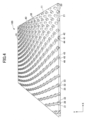
- FIG. 1 illustrates toilet paper according to an embodiment of the present invention
- FIG. 2 illustrates sheets of crepe paper constituting toilet paper according to an embodiment (first embodiment).
- FIG. 3 is a perspective view of toilet paper 100 viewed in a Y direction
- FIG. 4 is a perspective view of the toilet paper 100 viewed in an X direction.
- the toilet paper 100 illustrated in FIG. 1 is an example of toilet paper according to the present invention.
- the toilet paper 100 is rolled toilet paper formed by winding, around a paper tube PT, a strip of toilet paper in which perforation lines (not shown) for separation are formed at appropriate intervals.
- the form of toilet paper is not limited to rolled toilet paper used in the present embodiment.
- the present invention may also be applied to stacked (pick-up or pop-up) toilet paper where toilet paper sheets are folded and stacked.
- the toilet paper 100 includes crepe paper 10 and crepe paper 20. Fine wrinkles are formed on the surface of each of the crepe paper 10 and the crepe paper 20 by bringing a so-called doctor blade into contact with the surface at the exit of a dryer of a paper machine in a paper sheet making process.
- the crepe paper 10 is an example of a first sheet constituting the toilet paper of the present invention
- the crepe paper 20 is an example of a second sheet constituting the toilet paper of the present invention.
- the crepe paper 10 and the crepe paper 20 are made of base paper that is made mostly from pulp.
- the composition of pulp of the base paper may be a normal composition of pulp used for toilet paper.
- the proportion of pulp is 90 wt%, is preferably greater than or equal to 95 wt%, and is more preferably 100 wt%.
- the pulp composition of the crepe paper 10 and the crepe paper 20 is not limited to any specific composition.
- softwood pulp such as needle bleached kraft pulp (NBKP) or needle unbleached kraft pulp (NUKP)
- hardwood pulp such as leaf bleached kraft pulp (LBKP) or leaf unbleached kraft pulp (LUKP)
- the ratio of softwood pulp to hardwood pulp may be between 30:70 and 80:20.
- paper having a predetermined basis weight (or paper weight in gsm) conforming to JIS P 8124 (1998) is used for the crepe paper 10 and the crepe paper 20.
- the predetermined basis weight may be in a range between 10 g/m 2 and 25 g/m 2 , and is preferably in a range between 12 g/m 2 and 20 g/m 2 in view of, for example, flexibility, hydrolysis, and wiping performance of toilet paper.
- the crepe paper 10 includes embossments 30 and a non-embossed part 11.
- the non-embossed part 11 is a portion of the crepe paper 10 that is surrounded by the embossments 30 and where the embossments 30 are not formed.
- Each embossment 30 is comprised of an embossed recess 31 and an embossed protrusion 32 corresponding to the embossed recess 31.
- Multiple embossed recesses 31 and multiple embossed protrusions 32 are formed on the front side and the back side of the crepe paper 10 (see FIGs. 2-4 ).
- the embossments 30, the embossed recesses 31, and the embossed protrusions 32 are examples of first embossments, first embossed recesses, and first embossed protrusions formed on a first sheet constituting toilet paper of the present invention.
- each of an opening 35 of the embossed recess 31, a bottom 36 of the embossed recess 31, and a top part 33 of the embossed protrusion 32 has a quadrangular shape in plan view (see FIGs. 2-4 ). Also, the quadrangular shape of the opening 35 of the embossed recess 31 and the quadrangular shape of the top part 33 of the embossed protrusion 32 are similar to each other. The top part 33 of the embossed protrusion 32 corresponds to the bottom 36 of the embossed recess 31.
- the embossed protrusion 32 has the shape of a truncated quadrangular pyramid.
- the shape of the embossed protrusion 32 is not limited to the truncated quadrangular pyramid.
- the embossed protrusion 32 may be shaped like a truncated triangular pyramid or a truncated cone.
- the embossed recesses 31 are formed on one side of the crepe paper 10 as recesses by pressing a protrusion embossing roller (not shown) against the crepe paper 10 placed between the protrusion embossing roller and a rubber roller.
- the embossed protrusions 32 are formed on the other side of the crepe paper 10 as protrusions corresponding to the embossed recesses 31.
- the crepe paper 20 includes embossments 40 and a non-embossed part 21.
- the non-embossed part 21 is a portion of the crepe paper 20 that is surrounded by the embossments 40 and where the embossments 40 are not formed.
- each embossment 40 is comprised of an embossed recess 41 and an embossed protrusion 42 corresponding to the embossed recess 41.
- Multiple embossed recesses 41 and multiple embossed protrusions 42 are formed on the front side and the back side of the crepe paper 20.
- the embossments 40, the embossed recesses 41, and the embossed protrusions 42 are examples of second embossments, second embossed recesses, and second embossed protrusions formed on a second sheet constituting toilet paper of the present invention.
- each of an opening 45 of the embossed recess 41, a bottom 46 of the embossed recess 41, and a top part 43 of the embossed protrusion 42 has a quadrangular shape in plan view. Also, the quadrangular shape of the opening 45 of the embossed recess 41 and the quadrangular shape of the top part 43 of the embossed protrusion 42 are similar to each other. The top part 43 of the embossed protrusion 42 corresponds to the bottom 46 of the embossed recess 41.
- the embossed protrusion 42 has the shape of a truncated quadrangular pyramid.
- the shape of the embossed protrusion 42 is not limited to the truncated quadrangular pyramid.
- the embossed protrusion 42 may be shaped like a truncated triangular pyramid or a truncated cone.
- the embossed recesses 41 are formed on one side of the crepe paper 20 as recesses by pressing a protrusion embossing roller (not shown) against the crepe paper 20 placed between the protrusion embossing roller and a rubber roller.
- the embossed protrusions 42 are formed on the other side of the crepe paper 20 as protrusions corresponding to the embossed recesses 41.
- the embossed protrusions 32 of the embossments 30 of the crepe paper 10 and the embossed protrusions 42 of the embossments 40 of the crepe paper 20 have the same shape.
- the embossed protrusions 32 of the embossments 30 of the crepe paper 10 may have a shape that is different from the shape of the embossed protrusions 42 of the embossments 40 of the crepe paper 20.
- the crepe paper 10 having the embossments 30 and the crepe paper 20 having the embossments 40 are joined together such that a surface of the crepe paper 10 having the embossed protrusions 32 and a surface of the crepe paper 20 having the embossed protrusions 42 are disposed to face each other in a nested manner.
- the embossed protrusions 32 of the crepe paper 10 are disposed to face the non-embossed part 21 (a portion where no embossed protrusion 42 is formed) of the crepe paper 20.
- the embossed protrusions 42 of the crepe paper 20 are disposed to face the non-embossed part 11 (a portion where no embossed protrusion 32 is formed) of the crepe paper 10.
- top parts 43 of the embossed protrusions 42 of the crepe paper 20 are bonded to the non-embossed part 11 of the crepe paper 10 with an adhesive (not shown). Bonding the top parts 43 of the embossed protrusions 42 of the crepe paper 20 to the non-embossed part 11 of the crepe paper 10 makes it possible to arrange bonded portions between the crepe paper 10 and the crepe paper 20 on one (the crepe paper 10) of two sheets of crepe paper in a balanced manner. This configuration makes it possible to decrease the bonded portions between the crepe paper 10 and the crepe paper 20 that tend to become hard and to disperse the bonded portions between the crepe paper 10 and the crepe paper 20.
- any known adhesive used for toilet paper having a laminated structure may be used.
- major components of such an adhesive include polyvinyl alcohol, starch, modified starch, and carboxymethylcellulose.
- the top parts 33 of the embossed protrusions 32 of the crepe paper 10 are not bonded to the non-embossed part 21 of the crepe paper 20.
- the top parts 33 of the embossed protrusions 32 of the crepe paper 10 may be bonded to the non-embossed part 21 of the crepe paper 20.
- the top parts 33 of the embossed protrusions 32 of the crepe paper 10 may be bonded to the non-embossed part 21 of the crepe paper 20.
- a sine-wave curve indicates a sine curve or a sinusoid having a constant period (wavelength) and a constant amplitude.
- the sine-wave curve is a virtual curve shown on the toilet paper.
- the curve SC1 extends in the Y direction (the direction in which the rolled toilet paper 100 is pulled out) in FIGs. 1 through 4 .
- the curve SC1 is an example of a first curve in toilet paper of the present invention.
- the configuration of the toilet paper 100 is not limited to the configuration where only some embossments in the embossments 30 are arranged on the curve SC1.
- the toilet paper 100 may be configured such that only some embossments in the embossments 40 are arranged on the curve SC1, or may be configured such that both of some embossments in the embossments 30 and some embossments in the embossments 40 are arranged on the curve SC1.
- all of the embossments 30 are arranged on the sine-wave curve SC1.
- the configuration of the toilet paper 100 is not limited to this configuration.
- some embossments in another one of the embossments 30 and the embossments 40 may be arranged on a straight or apparently straight line different from a sine-wave curve.
- the crepe paper 10 and the crepe paper 20 are joined in a nested manner such that some embossments in the embossments 30 are arranged on the sine-wave curve SC1.
- This configuration makes it possible to increase the strength of the toilet paper 100 and to make the toilet paper 100 less likely to be flattened in the thickness direction. Also, this configuration enables the toilet paper 100 to more reliably retain wiped water.
- the toilet paper 100 illustrated in FIGs. 2 through 4 has improved strength and water absorbency.
- the toilet paper 100 when the toilet paper 100 is implemented as rolled paper and is pulled out from a holder (not shown), the embossments 30 arranged in a sine-wave shape look like a wave pattern. Accordingly, the configuration of the toilet paper 100 illustrated in FIGs. 2 through 4 can cause a user to feel stereoscopic and visual softness and can provide an unconventional design.
- the embossments in one of the embossments 30 and the embossments 40 are arranged on a sine-wave curve SC2.
- the curve SC2 is parallel to the sine-wave curve SC1. That is, the curve SC2 is disposed at a predetermined distance from the curve SC1. Similarly to the curve SC1, the curve SC2 extends in the Y direction in FIGs. 2 through 4 .
- the curve SC2 is an example of a second curve in toilet paper of the present invention.
- some embossments in the embossments 40 of the crepe paper 20 are arranged on the curve SC2.
- some embossments in the embossments 40 are arranged in a sine-wave shape along the curve SC2 that is parallel to the curve SC1 while some embossments in the embossments 30 are arranged in a sine-wave shape along the curve SC1.
- the configuration of the toilet paper 100 is not limited to the configuration where only some embossments in the embossments 40 are arranged on the curve SC2. That is, the toilet paper 100 may be configured such that only some embossments in the embossments 30 are arranged on the curve SC2, or may be configured such that both of some embossments in the embossments 30 and some embossments in the embossments 40 are arranged on the curve SC2.
- some embossments in the embossments 30 are arranged in a sine-wave shape along the curve SC1 and some embossments in the embossments 40 are arranged in a sine-wave shape along the curve SC2 parallel to the curve SC1.
- This configuration makes it possible to improve the design on the toilet paper 100 while improving the strength and the water absorbency of the toilet paper 100.
- the embossments in one of the embossments 30 and the embossments 40 are arranged on a sine-wave curve SC3.
- the curve SC3 intersects the sine-wave curve SC1.
- the curve SC1 and the curve SC3 may intersect each other in any manner.
- the curve SC1 and the curve SC3 intersect each other at one point.
- the curve SC3 extends in the X direction in FIGs. 2 through 4 .
- the curve SC3 is an example of a third curve in toilet paper of the present invention.
- some embossments in the embossments 30 and some embossments in the embossments 40 are arranged alternately on the curve SC3.
- some embossments in the embossments 30 are arranged in a sine-wave shape along the curve SC1
- some other embossments in the embossments 30 and some embossments in the embossments 40 are arranged alternately in a sine-wave shape along the curve SC3 intersecting the curve SC1.
- an embossment in the embossments 30 and/or an embossment in the embossments 40 may be disposed as a common embossment(s).
- the configuration of the toilet paper 100 is not limited to the configuration where both of some embossments in the embossments 30 and some embossments in the embossments 40 are arranged on the curve SC3. That is, the toilet paper 100 may be configured such that only some embossments in the embossments 30 are arranged on the curve SC3 or may be configured such that only some embossments in the embossments 40 are arranged on the curve SC3.
- some embossments in the embossments 30 are arranged in a sine-wave shape along the curve SC1, and some other embossments in the embossments 30 and some embossments in the embossments 40 are arranged alternately in a sine-wave shape along the curve SC3 intersecting the curve SC1.
- This configuration makes it possible to further improve the design of the toilet paper while further improving the strength and the water absorbency of the toilet paper.
- At least some embossments in one of the embossments 30 and the embossments 40 are arranged on the sine-wave curve SC2 that is parallel to the curve SC1, and at least some other embossments in one of the embossments 30 and the embossments 40 are arranged on a sine-wave curve SC4 that is parallel to the curve SC3.
- the sine-wave curve SC4 is parallel to the curve SC3 and intersects both of the curve SC1 and the curve SC2. Similarly to the curve SC3, the curve SC4 extends in the X direction in FIGs. 2 through 4 .
- the curve SC4 is an example of a fourth curve in toilet paper of the present invention.
- some embossments in the embossments 30 and some embossments in the embossments 40 are arranged alternately on the curve SC4.
- some embossments in the embossments 30 and some embossments in the embossments 40 are arranged alternately in a sine-wave shape along the curve SC3 that intersects both of the curve SC1 and the curve SC2
- some other embossments in the embossments 30 and some other embossments in the embossments 40 are arranged alternately in a sine-wave shape along the curve SC4 that is parallel to the curve SC3.
- the configuration of the toilet paper 100 is not limited to the configuration where both of some embossments in the embossments 30 and some embossments in the embossments 40 are arranged on the curve SC4. That is, the toilet paper 100 may be configured such that only some embossments in the embossments 30 are arranged on the curve SC4 or may be configured such that only some embossments in the embossments 40 are arranged on the curve SC4.
- some embossments in the embossments 30 are arranged in a sine-wave shape along the curve SC1
- some embossments in the embossments 40 are arranged in a sine-wave shape along the curve SC2 parallel to the curve SC1
- some embossments in the embossments 30 and some embossments in the embossments 40 are arranged alternately in sine-wave shapes along the curve SC3 intersecting the curve SC1 and the curve SC2 and the curve SC4 that is parallel to the curve SC3.
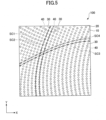
- FIG. 5 is a drawing illustrating sheets of crepe paper constituting toilet paper according to an embodiment (second embodiment).
- toilet paper 100 illustrated in FIG. 5 both of some embossments in the embossments 30 of the crepe paper 10 and some embossments in the embossments 40 of the crepe paper 20 are arranged on a curve SC1. That is, some embossments in the embossments 30 and some embossments in the embossments 40 are arranged alternately in a sine-wave shape along the curve SC1.
- the strength of the toilet paper 100 can be increased, and the toilet paper 100 becomes less likely to be flattened in the thickness direction. Also, this configuration enables the toilet paper 100 to more reliably retain wiped water. Thus, the toilet paper 100 illustrated in FIG. 5 has improved durability (strength) and water absorbency and is less likely to be flattened.
- the toilet paper 100 illustrated in FIG. 5 when the toilet paper 100 illustrated in FIG. 5 is implemented as rolled paper and is pulled out from a holder (not shown), the embossments 30 and the embossments 40 arranged alternately in a sine-wave shape look like a wave pattern. Accordingly, the configuration of the toilet paper 100 illustrated in FIG. 5 can cause a user to feel stereoscopic and visual softness and can provide an unconventional design.
- some embossments in the embossments 30 of the crepe paper 10 and some embossments in the embossments 40 of the crepe paper 20 are arranged on a curve SC2 that is parallel to the curve SC1.
- some embossments in the embossments 30 and some embossments in the embossments 40 are arranged alternately in a sine-wave shape along the curve SC1
- some other embossments in the embossments 30 and some other embossments in the embossments 40 are arranged alternately in a sine-wave shape along the curve SC2 that is parallel to the curve SC1.
- some embossments in the embossments 30 and some embossments in the embossments 40 are arranged alternately in a sine-wave shape along the curve SC1, and some other embossments in the embossments 30 and some other embossments in the embossments 40 are arranged alternately in a sine-wave shape along the curve SC2 that is parallel to the curve SC1.
- This configuration makes it possible to improve the design of the toilet paper 100 while improving the strength and the water absorbency of the toilet paper 100.
- some embossments in the embossments 30 are arranged on a curve SC3.
- some embossments in the embossments 30 and some embossments in the embossments 40 are arranged alternately in a sine-wave shape along the curve SC1
- some other embossments in the embossments 30 are arranged in a sine-wave shape along the curve SC3 that intersects the curve SC1.
- some embossments in the embossments 30 and some embossments in the embossments 40 are arranged alternately in a sine-wave shape along the curve SC1, and some other embossments in the embossments 30 are arranged in a sine-wave shape along the curve SC3 that intersects the curve SC1.
- This configuration makes it possible to further improve the design of the toilet paper while further improving the strength and the water absorbency of the toilet paper.
- some embossments in the embossments 40 are arranged on a curve SC4. Accordingly, some embossments in the embossments 30 are arranged in a sine-wave shape along the curve SC3 that intersects both of the curve SC1 and the curve SC2, and some embossments in the embossments 40 are arranged in a sine-wave shape along the curve SC4 that is parallel to the curve SC3.
- some embossments in the embossments 30 and some embossments in the embossments 40 are arranged alternately in a sine-wave shape along the curve SC1 parallel to the curve SC1
- some other embossments in the embossments 30 and some other embossments in the embossments 40 are arranged alternately in a sine-wave shape along the curve SC2 parallel to the curve SC1
- some other embossments in the embossments 30 are arranged in a sine-wave shape along the curve SC3 intersecting the curve SC1 and the curve SC2
- some other embossments in the embossments 40 are arranged in a sine-wave shape along the curve SC4 parallel to the curve SC3.
- the sine-wave shapes of the curves SC1 through SC4 may have any amplitude.
- the amplitude of the sine-wave shape of at least one of the curves SC1 through SC4 is preferably between 10 mm and 60 mm, more preferably between 20 mm and 50 mm, and further preferably between 35 mm and 45 mm.
- the amplitude of the sine-wave shape of each of the curves SC1 through SC4 is within the range between 10 mm and 60 mm. Setting the amplitude of the sine-wave shape of at least one of the curves SC1 through SC4 in this range makes it possible to reliably improve the design on the toilet paper 100 while reliably increasing the strength and the water absorbency of the toilet paper 100.
- the sine-wave shapes of the curves SC1 through SC4 may have any period (wavelength).
- the period of the sine-wave shape of at least one of the curves SC1 through SC4 is preferably between 50 mm and 300 mm, more preferably between 100 mm and 280 mm, and further preferably between 150 mm and 250mm.
- the period of the sine-wave shape of each of the curves SC1 through SC4 is within the range between 50 mm and 300 mm. Setting the period of the sine-wave shape of at least one of the curves SC1 through SC4 in this range makes it possible to reliably improve the design on the toilet paper 100 while reliably increasing the strength and the water absorbency of the toilet paper 100.
- the area of each of the top parts 33 of the embossed protrusions 32 facing the crepe paper 20 and the top parts 43 of the embossed protrusions 42 facing the crepe paper 10 is preferably between 0.8 mm 2 and 1.5 mm 2 , more preferably between 0.9 mm 2 and 1.4 mm 2 , and further preferably between 1.0 mm 2 and 1.3 mm 2 .
- the area of the top part 33 of the embossed protrusion 32 indicates the area of the top part 33 of each embossed protrusion 32.
- the area of the top part 43 of the embossed protrusion 42 indicates the area of the top part 43 of each embossed protrusion 42.
- the area of the top part of each embossed protrusion may be referred to as an individual area.
- the crepe paper 10 is supported by the embossed protrusions 42 and the crepe paper 20 is supported by the embossed protrusions 32.
- This in turn makes it possible to make the embossed protrusions 32 and the embossed protrusions 42 less likely to be flattened, and thereby makes it possible to increase the strength of the toilet paper 100 in the thickness direction.
- each of the area percentage of the top parts 33 of the embossed protrusions 32 facing the crepe paper 20 and the area percentage of the top parts 43 of the embossed protrusions 42 facing the crepe paper 10 is preferably between 5% and 10%, more preferably between 7% and 10%, and further preferably between 8% and 10%.
- the area percentage of the top parts 33 of the embossed protrusions 32 indicates the percentage of the area of the top parts 33 of the embossed protrusions 32 in the crepe paper 10. Also, the area percentage of the top parts 43 of the embossed protrusions 42 indicates the percentage of the area of the top parts 43 of the embossed protrusions 42 in the crepe paper 20. In the present application, the area percentage of the top parts of the embossed protrusions may be referred to as a gluing area percentage.
- the area percentage of the embossed protrusions 32 and the area percentage of the embossed protrusions 42 within the above ranges makes it possible to prevent the embossed protrusions 32 and the embossed protrusions 42 from interfering with each other in a space between the crepe paper 10 and the crepe paper 20 that are joined in a nested manner, and makes it possible to form a non-embossment space between the crepe paper 10 and the crepe paper 20. Accordingly, the toilet paper 100 becomes bulky and less likely to be flattened.
- the height of the embossed protrusions 32 and 42 is preferably between 1.0 mm and 1.7 mm, more preferably between 1.1 mm and 1.5 mm, and further preferably between 1.2 mm and 1.4 mm.
- the height of the embossed protrusion 32 is the distance from the surface of the crepe paper 10 on which the embossed protrusion 32 is formed to the top part 33 of the embossed protrusion 32
- the height of the embossed protrusion 42 is the distance from the surface of the crepe paper 20 on which the embossed protrusion 42 is formed to the top part 43 of the embossed protrusion 42.
- the height of the embossed protrusions 32 and 42 is set within the above ranges so that the non-embossment space formed between the crepe paper 10 and the crepe paper 20 can be increased while maintaining the strength in the thickness direction of the toilet paper 100. Accordingly, the toilet paper 100 becomes bulkier and more unlikely to be flattened.
- a side surface 34 of the embossed protrusion 32 of the crepe paper 10 is inclined such that the area of the top part 33 of the embossed protrusion 32 becomes less than the area of the opening 35 of the embossed recess 31. That is, the embossed protrusion 32 tapers from the surface of the crepe paper 10 on which the embossed protrusion 32 is formed toward the top part 33 (or the bottom 36) of the embossed protrusion 32.
- a side surface 44 of the embossed protrusion 42 of the crepe paper 20 is inclined such that the area of the top part 43 of the embossed protrusion 42 becomes less than the area of the opening 45 of the embossed recess 41. That is, the embossed protrusion 42 tapers from the surface of the crepe paper 20 on which the embossed protrusion 42 is formed toward the top part 43 (or the bottom 46) of the embossed protrusion 42.
- the embossed protrusion 32 tapers from the surface of the crepe paper 10 on which the embossed protrusion 32 is formed toward the top part 33 (or the bottom 36) of the embossed protrusion 32, the bonding area between the embossed protrusions 32 and the crepe paper 20 can be reduced. This in turn makes it possible to suppress the toilet paper 100 from becoming hard due to the bonded portions between the crepe paper 10 and the crepe paper 20.
- the embossed protrusion 42 tapers from the surface of the crepe paper 20 on which the embossed protrusion 42 is formed toward the top part 43 (or the bottom 46) of the embossed protrusion 42.
- Each of the inclination angle of the side surface 34 of the embossed protrusion 32 and the inclination angle of the side surface 44 of the embossed protrusion 42 is preferably between 60 degrees and 80 degrees, more preferably between 63 degrees and 77 degrees, and further preferably between 65 degrees and 75 degrees.
- the inclination angle of the side surface 34 of the embossed protrusion 32 is the angle between the surface of the crepe paper 10 on which the embossed protrusion 32 is formed and the side surface 34 of the embossed protrusion 32.
- the inclination angle of the side surface 44 of the embossed protrusion 42 is the angle between the surface of the crepe paper 20 on which the embossed protrusion 42 is formed and the side surface 44 of the embossed protrusion 42.
- the compression strength of the toilet paper 100 under a load of 500 gf/cm 2 is preferably greater than or equal to 5.0 gf ⁇ cm/cm 2 .
- the compression strength under the load of 500 gf/cm 2 corresponds to compression energy (gf•cm/cm 2 ) generated when the load of 500 gf/cm 2 is applied to the toilet paper 100 in the thickness direction.
- the load of 500 gf/cm 2 is set as an excessive pressure exceeding a pressure that is supposed to be applied when toilet paper is used.
- the compression ratio of the toilet paper 100 under a load of 50 gf/cm 2 is preferably less than or equal to 70%.
- the compression ratio under the load of 50 gf/cm 2 is calculated according to a formula below based on the thickness (thickness under load) of the toilet paper 100 when the load of 50 gf/cm 2 is applied to the toilet paper 100 in the thickness direction and the initial thickness.
- the initial thickness under the load of 50 gf/cm 2 indicates the thickness of the toilet paper immediately before the load of 50 gf/cm 2 is applied to the toilet paper in the thickness direction.
- the basis weights (paper weights in gsm) (g/m 2 ) of crepe paper (base paper) and products of the toilet paper 100 used in tests were measured.
- the basis weights (paper weights in gsm) (g/m 2 ) were calculated according to JIS P 8124 (1998).
- the thickness (um/sheet) of base paper was measured. After a specimen of base paper cut into a 50 cm x 50 cm size was sufficiently humidified under conditions specified by JIS P 8111 (1998), the thickness of the specimen was measured under the same conditions using a dial thickness gauge "PEACOCK TYPE G" (OZAKI MFG.CO., LTD). In an actual measurement procedure, after confirming that there is no dust or dirt between a plunger and a measurement table, the plunger is lowered onto the measurement table, and the scale of the dial thickness gauge is moved to adjust the zero point. Next, the plunger is raised, and the specimen is placed on the test table. Then, the plunger is slowly lowered, and the gauge is read. At this step, the plunger is simply placed on the specimen.
- the plunger has a circular end part that is made of a metal and has a diameter of 10 mm.
- the plunger is placed on the specimen such that a flat surface of the circular end part perpendicularly contacts the paper surface.
- the load applied to measure the thickness is about 70 gf. An average of ten measurements is used as the measurement of the thickness.
- the thickness of each product was measured (The thickness is measured in the state of a product. For example, the thickness of a 2-ply product is measured in the 2-ply state).
- the thickness of the specimen was measured under the same conditions using a dial thickness gauge "PEACOCK TYPE H" (OZAKI MFG.CO., LTD).
- the plunger is lowered onto the measurement table, and the scale of the dial thickness gauge is moved to adjust the zero point. Next, the plunger is raised, and the specimen is placed on the test table.
- the plunger has a circular end part that is made of a metal and has a diameter of 10 mm.
- the plunger is placed on the specimen such that a flat surface of the circular end part perpendicularly contacts the paper surface.
- the load applied to measure the thickness is about 70 gf. An average of ten measurements is used as the measurement of the thickness.
- compression tests were performed on the toilet paper 100.
- a specimen cut into a 12 cm x 12 cm size is prepared (The test is performed on toilet paper in the state of a product. For example, when the specimen is a 2-ply product, the test is performed on the specimen in the 2-ply state).
- compression energy WC gf•cm/cm 2
- a thickness T m (mm) after applying the load of 50 gf/cm 2 are measured.
- a compression ratio (%) under the load of 50 gf/cm 2 is calculated based on the initial thickness T 0 (mm) and the thickness T m (mm).
- the measurement conditions are as follows: pressurizer area: 2 cm 2 , dynamometer: 1 kg, CHECK switch: MES, DEF output sensitivity dial: 2 mm/V, upper limit load: (1) 50 gf/cm 2 (SENS: 2, STOROKE SET dial: 5), (2) 500 gf/cm 2 (SENS: 10, STOROKE SET dial: 10), SPEED: 0.02 cm/s (SPEED RANGE switch: 0.1, SPED SET switch: 2), CONTROL switch: INT, and STOP switch: OFF.
- the compression energy WC is an integral of a compression workload when the specimen is compressed up to the upper limit load.
- the initial thickness T 0 is the thickness of the specimen when the load pressure reaches 0.5 gf/cm 2
- the thickness T m under the load is the thickness of the specimen when the load pressure reaches the upper limit load (50 gf/cm 2 ).
- Each of the initial thickness T 0 and the thickness T m under the load is obtained by averaging three measurements.
- the compression ratio (flattening ratio) under the load is calculated based on the initial thickness T 0 and the thickness T m under the load.
- the compression energy under a load of 500 gf/cm 2 When the compression energy under a load of 500 gf/cm 2 is high, it indicates that the toilet paper is strong and durable (tough). Also, when the compression energy under a load of 500 gf/cm 2 is high, it indicates that the toilet paper is soft and is readily compressed. In this example, when the compression energy under a load of 500 gf/cm 2 is greater than or equal to 5.0 gf•cm/cm 2 , the toilet paper is evaluated as being durable and soft.
- the toilet paper is bulky.
- the initial thickness T 0 under the load of 50 gf/cm 2 is greater than or equal to 0.7 mm, the toilet paper is evaluated as being bulky.
- the compression ratio under the load of 50 gf/cm 2 when the compression ratio under the load of 50 gf/cm 2 is low, it indicates that the toilet paper is not readily flattened in the thickness direction. In this example, when the compression ratio under the load of 50 gf/cm 2 is less than or equal to 70%, the toilet paper is evaluated as being not readily flattened.
- a penetration prevention rate (%) was calculated, and water absorbency was evaluated based on the penetration prevention rate (%).
- 1 ml of distilled water is applied evenly by, for example, spraying to a 30 mm x 40 mm area that is defined using, for example, a mending tape on a horizontally-held acrylic plate, and 15 specimens (number of specimens) are placed on the distilled water.
- the number of specimens into which the distilled water has penetrated is counted (penetration count).
- the penetration count is obtained by averaging three measurements.
- the penetration prevention rate (%) is calculated using a formula below.
- Penetration prevention rate (%) (number of specimens - penetration count) / basis weight of product x 100
- the penetration prevention rate is greater than or equal to 40%, it is evaluated that the toilet paper does not readily allow penetration of water to the back side even under a load and has good water absorbency.
- toilet paper 100 was prepared by stacking two sheets of base paper (crepe paper 10, 20) with a basis weight of 15.3 g/m 2 and a thickness of 131 um in a nested manner as illustrated in FIGs. 2 through 4 . Also, in Example 1, as illustrated in FIG. 2 , embossments were arranged on the curves SC1 through SC4 each of which is a sine-wave curve that has an amplitude (the amplitude of the sine curve) of 40.0 mm and a period (the period or wavelength of the sine curve) of 209.3 mm.
- embossing conditions were as follows: area of top part of embossed protrusion: 1.2 mm 2 /each, height of embossed protrusion: 1.4 mm, inclination angle of embossed protrusion: 70 degrees, shape of top part of embossed protrusion: quadrangle, number of embossed protrusions (front, crepe paper 10): 1110/144 cm 2 , number of embossed protrusions (back, crepe paper 20): 1116/144 cm 2 , area percentage of top parts of embossed protrusions (percentage of gluing area between non-embossed part 11 of crepe paper 10 and embossed protrusions 42 of crepe paper 20): 9.1%, volume of embossed protrusions (front, crepe paper 10): 3930 mm 3 , volume of embossed protrusions (back, crepe paper 20): 3930 mm 3 ; volume of non-embossment space (volume of space excluding embossed pro
- embossments were arranged on the curves SC1 through SC4 each of which is a sine-wave curve that has an amplitude of 40.0 mm and a period (wavelength) of 240.0 mm.
- Other embossing conditions were as follows: number of embossed protrusions (front, crepe paper 10): 1109/144 cm 2 , number of embossed protrusions (back, crepe paper 20): 1110/144 cm 2 , area percentage of top parts of embossed protrusions (percentage of gluing area between non-embossed part 11 of crepe paper 10 and embossed protrusions 42 of crepe paper 20): 9.0%, volume of embossed protrusions (front, crepe paper 10): 3877 mm 3 , volume of embossed protrusions (back, crepe paper 20): 3879 mm 3 , volume of non-embossment space: 12404 mm 3 , and area percentage of non-
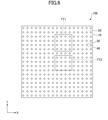
- toilet paper 100 was prepared by stacking two sheets of base paper (crepe paper 10, 20) in a tip-to-tip manner as illustrated in FIGs. 6 through 8 . Also, in Comparative Example 1, as illustrated in FIGs. 6 through 8 , all embossments were arranged linearly.
- toilet paper 100 was prepared by stacking two sheets of base paper (crepe paper 10, 20) in a tip-to-tip manner as illustrated in FIG. 9 . Also, in Reference Example 1, as illustrated in FIG. 9 , embossments were arranged on the curves SC1 through SC4 each of which is a sine-wave curve that has an amplitude of 40.0 mm and a period (wavelength) of 240.0 mm.
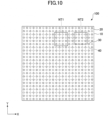
- toilet paper 100 was prepared by stacking two sheets of base paper (crepe paper 10, 20) in a nested manner as illustrated in FIGs. 10 through 12 . Also, in Reference Example 2, as illustrated in FIGs. 10 through 12 , all embossments were arranged linearly.
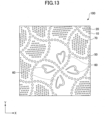
- toilet paper 100 with a design-laminated structure was prepared by stacking two sheets of base paper (crepe paper 10, 20) with a basis weight of 15.5 g/m 2 and a thickness of 133 um as illustrated in FIG. 13 .
- Top parts of embossed protrusions of embossments 50 and 70 of the crepe paper 10 were formed in circular shapes, and top parts of embossed protrusions of embossments 60 of the crepe paper 20 were formed in a floral design.
- the basis weight and the thickness of a produce of the toilet paper 100 were 15.1 g/m 2 and 199 ⁇ m, respectively.
- the conditions and results of Reference Example 3 are indicated in Table 1.
- EXAMPLE 1 COMPARATIVE EXAMPLE 1 REFERENCE EXAMPLE 1 REFERENCE EXAMPLE 2 REFERENCE EXAMPLE 3 BASE PAPER BASIS WEIGHT (g/m 2 ) 15.3 15.3 15.3 15.3 15.5 THICKNESS ( ⁇ m) 131 131 131 131 131 133 EMBOSSING CONDITIONS LAMINATED STRUCTURE nested nested tip to tip tip to tip nested DESIGN LAMINATE NUMBER 0F PLIES (NUMBER) 2 2 2 2 2 2 AMPLITUDE OF SINE CURVE (mm) 40.0 40.0 - 40.0 - - PERIOD OF SINE CURVE (mm) 209.3 240.0 - 240.0 - - AREA OF TOP PART OF EMBOSSED PROTRUSION (mm 2 /EACH) 1.2 1.2 1.2 1.2 1.2 1.2 1.2 - - - HEIGHT OF EMBOSSED PROTRUSION (mm) 1.4
- the compression energy under a load of 500 gf/cm 2 is greater than or equal to 5.0 gf•cm/cm 2 .
- the compression ratio under a load of 50 gf/cm 2 is less than or equal to 70%.
- the water absorbency (penetration prevention rate) is greater than or equal to 40%.
- the compression energy under a load of 500 gf/cm 2 is less than 5.0 gf•cm/cm 2 .
- the compression ratio under a load of 50 gf/cm 2 is greater than 70%.
- the water absorbency (penetration prevention rate) is less than 40%.
- the compression energy under a load of 500 gf/cm 2 is less than 5.0 gf•cm/cm 2 .
- the compression ratio under a load of 50 gf/cm 2 is less than or equal to 70%.
- the water absorbency (penetration prevention rate) in Reference Example 2 is greater than or equal to 40°, and the water absorbency in Reference Example 3 is less than 40%.
- the toilet paper 100 has high strength, is readily compressible, is not readily flattened in the thick direction, and has high water absorbency.
- the present embodiment (Examples 1 and 2) makes it possible to obtain the toilet paper 100 that is durable (strong) and soft, is not readily flattened, and has excellent water absorbency.
Landscapes
- Health & Medical Sciences (AREA)
- Public Health (AREA)
- Sanitary Thin Papers (AREA)
- Paper (AREA)
Claims (11)
- Toilettenpapier (100), aufweisend:eine erste Lage (10) und eine zweite Lage (20), wobeierste geprägte Vorsprünge (32), die zur zweiten Lage (20) hin vorstehen, auf der ersten Lage (10) gebildet sind;zweite geprägte Vorsprünge (42), die zur ersten Lage (10) hin vorstehen, auf der zweiten Lage (20) gebildet sind, wobei die erste Lage (10) und die zweite Lage (20) in einer ineinandergreifenden Weise miteinander verbunden sind, dadurch gekennzeichnet, dass(i) eine Seitenfläche (34) jedes ersten geprägten Vorsprungs (32) in Richtung zu einem Oberteil (33) des ersten geprägten Vorsprungs (32) geneigt ist, so dass eine Fläche des Oberteils (33) des ersten geprägten Vorsprungs (32) kleiner ist als eine Fläche einer Öffnung (35) einer ersten geprägten Vertiefung (31), die dem ersten geprägten Vorsprung (32) entspricht, und(ii) eine Seitenfläche (44) jedes zweiten geprägten Vorsprungs (42) in Richtung zu einem Oberteil (43) des zweiten geprägten Vorsprungs (42) geneigt ist, so dass eine Fläche des Oberteils (43) des zweiten geprägten Vorsprungs (42) kleiner ist als eine Fläche einer Öffnung (45) einer zweiten geprägten Vertiefung (41), die dem zweiten geprägten Vorsprung (42) entspricht;mindestens einige Prägungen der ersten Prägungen (30), welche die ersten geprägten Vorsprünge (32) umfassen, auf einer ersten Bogenlinie (SC1) mit einer Sinuswellenform angeordnet sind; undmindestens einige Prägungen der zweiten Prägungen (40), welche die zweiten geprägten Vorsprünge (42) umfassen, auf einer zweiten Bogenlinie (SC2) mit einer Sinuswellenform angeordnet sind, wobei sich die zweite Bogenlinie (SC2) von der ersten Bogenlinie (SC1) unterscheidet und parallel zur ersten Bogenlinie (SC1) verläuft.
- Toilettenpapier (100) nach Anspruch 1, wobei mindestens einige Prägungen in den ersten Prägungen (32) oder zweiten Prägungen (42) auf einer dritten Bogenlinie (SC3) mit eine Sinuswellenform angeordnet sind, wobei die dritte Bogenlinie (SC3) die erste Bogenlinie (SC1) schneidet.
- Toilettenpapier (100) nach Anspruch 2, wobei mindestens einige Prägungen in den ersten Prägungen (32) oder zweiten Prägungen (42) auf einer vierten Bogenlinie (SC4) mit eine Sinuswellenform angeordnet sind, wobei die vierte Bogenlinie (SC4) parallel zur dritten Bogenlinie (SC3) verläuft.
- Toilettenpapier (100) nach einem der Ansprüche 1 bis 3, wobei eine Amplitude der Sinuswellenform zwischen 10 mm und 60 mm beträgt.
- Toilettenpapier (100) nach einem der Ansprüche 1 bis 3, wobei eine Periode der Sinuswellenform zwischen 50 mm und 300 mm beträgt.
- Toilettenpapier (100) nach einem der Ansprüche 1 bis 3, wobei eine Fläche von jedem der Oberteile (33) der ersten geprägten Vorsprünge (32) der ersten Prägungen (32) und/oder eine Fläche von jedem der Oberteile (43) der zweiten geprägten Vorsprünge (42) der zweiten Prägungen (42) zwischen 0,8 mm2 und 1,5 mm2 betragen.
- Toilettenpapier (100) nach einem der Ansprüche 1 bis 3, wobei ein Flächenprozentsatz der Oberteile (33) der ersten geprägten Vorsprünge (32) der ersten Prägungen (32) und/oder ein Flächenprozentsatz der Oberteile (43) der zweiten geprägten Vorsprünge (42) der zweiten Prägungen (42) zwischen 5% und 10% betragen.
- Toilettenpapier (100) nach einem der Ansprüche Anspruchs 1 bis 3, wobeieine Fläche von jedem der Oberteile (33) der ersten geprägten Vorsprünge (32) der ersten Prägungen (32) und/oder eine Fläche von jedem der Oberteile (43) der zweiten geprägten Vorsprünge (42) der zweiten Prägungen (42) zwischen 0,8 mm2 und 1,5 mm2 betragen;ein Flächenprozentsatz der Oberteile (33) der ersten geprägten Vorsprünge (32) und/oder ein Flächenprozentsatz der Oberteile (43) der zweiten geprägten Vorsprünge (42) zwischen 5% und 10% betragen; undeine Höhe der ersten geprägten Vorsprünge (32) und/oder eine Höhe der zweiten geprägten Vorsprünge (42) zwischen 1,0 mm und 1,7 mm betragen.
- Toilettenpapier (100) nach einem der Ansprüche 1 bis 4, wobei ein Neigungswinkel jeder Seitenfläche (34) der ersten geprägten Vorsprünge (32) und jeder Seitenfläche (44) der zweiten geprägten Vorsprünge (42) zwischen 60 Grad und 80 Grad beträgt.
- Toilettenpapier (100) nach einem der Ansprüche 1 bis 3, wobei eine Druckfestigkeit des Toilettenpapiers (100) unter einer Last von 500 gf/cm2 größer oder gleich 5,0 gf•cm/cm2 ist.
- Toilettenpapier (100) nach einem der Ansprüche 1 bis 3, wobei ein Verdichtungsverhältnis des Toilettenpapiers (100) unter einer Last von 50 gf/cm2 kleiner oder gleich 70% ist.
Applications Claiming Priority (2)
| Application Number | Priority Date | Filing Date | Title |
|---|---|---|---|
| JP2017128581 | 2017-06-30 | ||
| PCT/JP2018/024235 WO2019004225A1 (ja) | 2017-06-30 | 2018-06-26 | トイレットペーパー |
Publications (3)
| Publication Number | Publication Date |
|---|---|
| EP3646765A1 EP3646765A1 (de) | 2020-05-06 |
| EP3646765A4 EP3646765A4 (de) | 2021-03-10 |
| EP3646765B1 true EP3646765B1 (de) | 2024-07-31 |
Family
ID=64741635
Family Applications (1)
| Application Number | Title | Priority Date | Filing Date |
|---|---|---|---|
| EP18823305.0A Active EP3646765B1 (de) | 2017-06-30 | 2018-06-26 | Toilettenpapier |
Country Status (6)
| Country | Link |
|---|---|
| US (1) | US11363917B2 (de) |
| EP (1) | EP3646765B1 (de) |
| JP (2) | JP6778764B2 (de) |
| KR (1) | KR102480243B1 (de) |
| CN (1) | CN110753509B (de) |
| WO (1) | WO2019004225A1 (de) |
Families Citing this family (4)
| Publication number | Priority date | Publication date | Assignee | Title |
|---|---|---|---|---|
| US11337566B2 (en) * | 2017-06-30 | 2022-05-24 | Daio Paper Corporation | Toilet paper |
| US20230287630A1 (en) | 2020-07-03 | 2023-09-14 | Essity Hygiene And Health Aktiebolag | Coreless Rolls of a Tissue Paper Product and Methods of Manufacturing Coreless Rolls |
| EP4225114A4 (de) | 2020-10-09 | 2024-06-05 | Kimberly-Clark Worldwide, Inc. | Geprägtes gewebe |
| EP4587644A1 (de) * | 2022-09-13 | 2025-07-23 | Kimberly-Clark Worldwide, Inc. | Mikrogeprägtes mehrlagiges tissueprodukt |
Family Cites Families (23)
| Publication number | Priority date | Publication date | Assignee | Title |
|---|---|---|---|---|
| JPS6021532B2 (ja) | 1978-07-10 | 1985-05-28 | 鐘淵化学工業株式会社 | 複数層発泡成形品の製法 |
| JPS55119876A (en) | 1979-03-05 | 1980-09-13 | Hitachi Ltd | Door opening*closing controller |
| US4671983A (en) * | 1985-06-12 | 1987-06-09 | Marcal Paper Mills, Inc. | Embossments for minimizing nesting in roll material |
| JP2630708B2 (ja) | 1992-04-08 | 1997-07-16 | 朝日ナショナル照明株式会社 | ロータリースイッチ |
| TR199701246T1 (xx) | 1995-04-24 | 1998-03-21 | The Procter&Gamble Company | ��aret arac�n� haiz olan, kullan�l�p at�lan ka��t �r�n�. |
| US6277466B1 (en) * | 1998-11-23 | 2001-08-21 | The Procter & Gamble Company | Embossed multi ply cellulosic fibrous structure and process for producing the same |
| JP2003070678A (ja) | 2001-08-31 | 2003-03-11 | Daio Paper Corp | トイレット用巻取衛生ロール紙 |
| EP1400199B1 (de) | 2001-05-28 | 2018-01-03 | Daio Paper Corporation | Dünne hygienepapierrolle |
| JP3619808B2 (ja) | 2002-01-08 | 2005-02-16 | 大王製紙株式会社 | トイレット用巻取衛生ロール紙 |
| EP1428654A1 (de) * | 2002-12-09 | 2004-06-16 | SCA Hygiene Products GmbH | Verfahren zur Herstellung von mehrlagigen Tissuepapieren und mehrlagige Tissuepapiere |
| US6896767B2 (en) * | 2003-04-10 | 2005-05-24 | Kimberly-Clark Worldwide, Inc. | Embossed tissue product with improved bulk properties |
| JP4649118B2 (ja) | 2004-03-31 | 2011-03-09 | 大王製紙株式会社 | トイレットロール |
| JP2006045690A (ja) * | 2004-07-30 | 2006-02-16 | Daio Paper Corp | 衛生薄葉紙の製造方法 |
| JP2006280616A (ja) | 2005-03-31 | 2006-10-19 | Daio Paper Corp | エンボス付与シート製品 |
| JP4533806B2 (ja) | 2005-06-06 | 2010-09-01 | 大王製紙株式会社 | 水解性衛生紙 |
| DE102006010709A1 (de) * | 2006-03-08 | 2007-09-13 | Metsä Tissue Oyj | Prägevorrichtung für mindestens zweilagige Flächenprodukte wie Toilettenpapier, Taschentücher o. dgl. |
| WO2012043378A1 (ja) * | 2010-09-30 | 2012-04-05 | 大王製紙株式会社 | 水解性衛生薄葉紙及び水解性衛生薄葉紙の製造方法 |
| WO2012123020A1 (en) * | 2011-03-15 | 2012-09-20 | Sca Hygiene Products Ab | Fibrous product and method for manufacturing such a fibrous product |
| JP6021532B2 (ja) | 2012-09-03 | 2016-11-09 | 大王製紙株式会社 | 水解性衛生薄葉紙 |
| JP6317995B2 (ja) | 2014-05-08 | 2018-04-25 | 伊藤忠セラテック株式会社 | 精密鋳造鋳型製造用スラリーのフィラー材及びそれを用いて得られたスラリー並びに精密鋳造鋳型 |
| CN106413626B (zh) | 2014-08-27 | 2020-10-27 | 株式会社Gc | 牙科修补物的制造方法、牙科修补物用二硅酸锂坯料的制造方法和牙科修补物用二硅酸锂坯料 |
| JP6150843B2 (ja) | 2015-04-21 | 2017-06-21 | 日本製紙クレシア株式会社 | トイレットロール |
| JP6784968B2 (ja) | 2015-09-30 | 2020-11-18 | 大王製紙株式会社 | トイレットペーパー及びトイレットペーパーの品質評価方法 |
-
2018
- 2018-06-26 KR KR1020197037150A patent/KR102480243B1/ko active Active
- 2018-06-26 EP EP18823305.0A patent/EP3646765B1/de active Active
- 2018-06-26 US US16/626,431 patent/US11363917B2/en active Active
- 2018-06-26 CN CN201880039935.7A patent/CN110753509B/zh active Active
- 2018-06-26 WO PCT/JP2018/024235 patent/WO2019004225A1/ja not_active Ceased
- 2018-06-26 JP JP2018563184A patent/JP6778764B2/ja active Active
-
2019
- 2019-12-27 JP JP2019239725A patent/JP7513393B2/ja active Active
Also Published As
| Publication number | Publication date |
|---|---|
| JP6778764B2 (ja) | 2020-11-04 |
| WO2019004225A1 (ja) | 2019-01-03 |
| US11363917B2 (en) | 2022-06-21 |
| US20200129012A1 (en) | 2020-04-30 |
| JPWO2019004225A1 (ja) | 2019-06-27 |
| JP7513393B2 (ja) | 2024-07-09 |
| CN110753509A (zh) | 2020-02-04 |
| JP2020054874A (ja) | 2020-04-09 |
| EP3646765A1 (de) | 2020-05-06 |
| KR102480243B1 (ko) | 2022-12-21 |
| EP3646765A4 (de) | 2021-03-10 |
| CN110753509B (zh) | 2022-09-20 |
| KR20200024149A (ko) | 2020-03-06 |
Similar Documents
| Publication | Publication Date | Title |
|---|---|---|
| EP3646765B1 (de) | Toilettenpapier | |
| KR102362303B1 (ko) | 티슈 제품의 부피를 감소시키고, 밀도를 증가시키는 방법 | |
| EP3805456B1 (de) | Küchenpapierrolle und küchenpapier | |
| EP3873732B1 (de) | Geprägte mehrlagige tissueprodukte | |
| KR20210083294A (ko) | 엠보싱된 여러 겹 티슈 제품 | |
| KR102379467B1 (ko) | 엠보싱된 여러 겹 티슈 제품 | |
| EP3677422B2 (de) | Hygiene-tissuepapier | |
| EP3646764B1 (de) | Toilettenpapier | |
| EP3590397B1 (de) | Hygiene-tissuepapier | |
| TWI764992B (zh) | 衛生薄頁紙 | |
| JP6523396B2 (ja) | 衛生薄葉紙 | |
| JP6851880B2 (ja) | 衛生薄葉紙及び衛生薄葉紙の製造方法 |
Legal Events
| Date | Code | Title | Description |
|---|---|---|---|
| STAA | Information on the status of an ep patent application or granted ep patent |
Free format text: STATUS: THE INTERNATIONAL PUBLICATION HAS BEEN MADE |
|
| PUAI | Public reference made under article 153(3) epc to a published international application that has entered the european phase |
Free format text: ORIGINAL CODE: 0009012 |
|
| STAA | Information on the status of an ep patent application or granted ep patent |
Free format text: STATUS: REQUEST FOR EXAMINATION WAS MADE |
|
| 17P | Request for examination filed |
Effective date: 20191227 |
|
| AK | Designated contracting states |
Kind code of ref document: A1 Designated state(s): AL AT BE BG CH CY CZ DE DK EE ES FI FR GB GR HR HU IE IS IT LI LT LU LV MC MK MT NL NO PL PT RO RS SE SI SK SM TR |
|
| AX | Request for extension of the european patent |
Extension state: BA ME |
|
| DAV | Request for validation of the european patent (deleted) | ||
| DAX | Request for extension of the european patent (deleted) | ||
| A4 | Supplementary search report drawn up and despatched |
Effective date: 20210208 |
|
| RIC1 | Information provided on ipc code assigned before grant |
Ipc: D21H 27/30 20060101ALI20210202BHEP Ipc: D21H 27/00 20060101ALI20210202BHEP Ipc: A47K 10/16 20060101AFI20210202BHEP |
|
| STAA | Information on the status of an ep patent application or granted ep patent |
Free format text: STATUS: EXAMINATION IS IN PROGRESS |
|
| 17Q | First examination report despatched |
Effective date: 20230320 |
|
| GRAP | Despatch of communication of intention to grant a patent |
Free format text: ORIGINAL CODE: EPIDOSNIGR1 |
|
| STAA | Information on the status of an ep patent application or granted ep patent |
Free format text: STATUS: GRANT OF PATENT IS INTENDED |
|
| INTG | Intention to grant announced |
Effective date: 20240410 |
|
| GRAS | Grant fee paid |
Free format text: ORIGINAL CODE: EPIDOSNIGR3 |
|
| GRAA | (expected) grant |
Free format text: ORIGINAL CODE: 0009210 |
|
| STAA | Information on the status of an ep patent application or granted ep patent |
Free format text: STATUS: THE PATENT HAS BEEN GRANTED |
|
| AK | Designated contracting states |
Kind code of ref document: B1 Designated state(s): AL AT BE BG CH CY CZ DE DK EE ES FI FR GB GR HR HU IE IS IT LI LT LU LV MC MK MT NL NO PL PT RO RS SE SI SK SM TR |
|
| REG | Reference to a national code |
Ref country code: CH Ref legal event code: EP Ref country code: GB Ref legal event code: FG4D |
|
| REG | Reference to a national code |
Ref country code: DE Ref legal event code: R096 Ref document number: 602018072524 Country of ref document: DE |
|
| REG | Reference to a national code |
Ref country code: IE Ref legal event code: FG4D |
|
| REG | Reference to a national code |
Ref country code: LT Ref legal event code: MG9D |
|
| REG | Reference to a national code |
Ref country code: NL Ref legal event code: MP Effective date: 20240731 |
|
| PG25 | Lapsed in a contracting state [announced via postgrant information from national office to epo] |
Ref country code: PT Free format text: LAPSE BECAUSE OF FAILURE TO SUBMIT A TRANSLATION OF THE DESCRIPTION OR TO PAY THE FEE WITHIN THE PRESCRIBED TIME-LIMIT Effective date: 20241202 |
|
| REG | Reference to a national code |
Ref country code: AT Ref legal event code: MK05 Ref document number: 1707639 Country of ref document: AT Kind code of ref document: T Effective date: 20240731 |
|
| PG25 | Lapsed in a contracting state [announced via postgrant information from national office to epo] |
Ref country code: PT Free format text: LAPSE BECAUSE OF FAILURE TO SUBMIT A TRANSLATION OF THE DESCRIPTION OR TO PAY THE FEE WITHIN THE PRESCRIBED TIME-LIMIT Effective date: 20241202 |
|
| PG25 | Lapsed in a contracting state [announced via postgrant information from national office to epo] |
Ref country code: NO Free format text: LAPSE BECAUSE OF FAILURE TO SUBMIT A TRANSLATION OF THE DESCRIPTION OR TO PAY THE FEE WITHIN THE PRESCRIBED TIME-LIMIT Effective date: 20241031 |
|
| PG25 | Lapsed in a contracting state [announced via postgrant information from national office to epo] |
Ref country code: FI Free format text: LAPSE BECAUSE OF FAILURE TO SUBMIT A TRANSLATION OF THE DESCRIPTION OR TO PAY THE FEE WITHIN THE PRESCRIBED TIME-LIMIT Effective date: 20240731 Ref country code: GR Free format text: LAPSE BECAUSE OF FAILURE TO SUBMIT A TRANSLATION OF THE DESCRIPTION OR TO PAY THE FEE WITHIN THE PRESCRIBED TIME-LIMIT Effective date: 20241101 Ref country code: NL Free format text: LAPSE BECAUSE OF FAILURE TO SUBMIT A TRANSLATION OF THE DESCRIPTION OR TO PAY THE FEE WITHIN THE PRESCRIBED TIME-LIMIT Effective date: 20240731 Ref country code: PL Free format text: LAPSE BECAUSE OF FAILURE TO SUBMIT A TRANSLATION OF THE DESCRIPTION OR TO PAY THE FEE WITHIN THE PRESCRIBED TIME-LIMIT Effective date: 20240731 |
|
| PG25 | Lapsed in a contracting state [announced via postgrant information from national office to epo] |
Ref country code: BG Free format text: LAPSE BECAUSE OF FAILURE TO SUBMIT A TRANSLATION OF THE DESCRIPTION OR TO PAY THE FEE WITHIN THE PRESCRIBED TIME-LIMIT Effective date: 20240731 |
|
| PG25 | Lapsed in a contracting state [announced via postgrant information from national office to epo] |
Ref country code: LV Free format text: LAPSE BECAUSE OF FAILURE TO SUBMIT A TRANSLATION OF THE DESCRIPTION OR TO PAY THE FEE WITHIN THE PRESCRIBED TIME-LIMIT Effective date: 20240731 |
|
| PG25 | Lapsed in a contracting state [announced via postgrant information from national office to epo] |
Ref country code: IS Free format text: LAPSE BECAUSE OF FAILURE TO SUBMIT A TRANSLATION OF THE DESCRIPTION OR TO PAY THE FEE WITHIN THE PRESCRIBED TIME-LIMIT Effective date: 20241130 Ref country code: AT Free format text: LAPSE BECAUSE OF FAILURE TO SUBMIT A TRANSLATION OF THE DESCRIPTION OR TO PAY THE FEE WITHIN THE PRESCRIBED TIME-LIMIT Effective date: 20240731 |
|
| PG25 | Lapsed in a contracting state [announced via postgrant information from national office to epo] |
Ref country code: HR Free format text: LAPSE BECAUSE OF FAILURE TO SUBMIT A TRANSLATION OF THE DESCRIPTION OR TO PAY THE FEE WITHIN THE PRESCRIBED TIME-LIMIT Effective date: 20240731 |
|
| PG25 | Lapsed in a contracting state [announced via postgrant information from national office to epo] |
Ref country code: RS Free format text: LAPSE BECAUSE OF FAILURE TO SUBMIT A TRANSLATION OF THE DESCRIPTION OR TO PAY THE FEE WITHIN THE PRESCRIBED TIME-LIMIT Effective date: 20241031 Ref country code: ES Free format text: LAPSE BECAUSE OF FAILURE TO SUBMIT A TRANSLATION OF THE DESCRIPTION OR TO PAY THE FEE WITHIN THE PRESCRIBED TIME-LIMIT Effective date: 20240731 |
|
| PG25 | Lapsed in a contracting state [announced via postgrant information from national office to epo] |
Ref country code: RS Free format text: LAPSE BECAUSE OF FAILURE TO SUBMIT A TRANSLATION OF THE DESCRIPTION OR TO PAY THE FEE WITHIN THE PRESCRIBED TIME-LIMIT Effective date: 20241031 Ref country code: PL Free format text: LAPSE BECAUSE OF FAILURE TO SUBMIT A TRANSLATION OF THE DESCRIPTION OR TO PAY THE FEE WITHIN THE PRESCRIBED TIME-LIMIT Effective date: 20240731 Ref country code: NO Free format text: LAPSE BECAUSE OF FAILURE TO SUBMIT A TRANSLATION OF THE DESCRIPTION OR TO PAY THE FEE WITHIN THE PRESCRIBED TIME-LIMIT Effective date: 20241031 Ref country code: NL Free format text: LAPSE BECAUSE OF FAILURE TO SUBMIT A TRANSLATION OF THE DESCRIPTION OR TO PAY THE FEE WITHIN THE PRESCRIBED TIME-LIMIT Effective date: 20240731 Ref country code: LV Free format text: LAPSE BECAUSE OF FAILURE TO SUBMIT A TRANSLATION OF THE DESCRIPTION OR TO PAY THE FEE WITHIN THE PRESCRIBED TIME-LIMIT Effective date: 20240731 Ref country code: IS Free format text: LAPSE BECAUSE OF FAILURE TO SUBMIT A TRANSLATION OF THE DESCRIPTION OR TO PAY THE FEE WITHIN THE PRESCRIBED TIME-LIMIT Effective date: 20241130 Ref country code: HR Free format text: LAPSE BECAUSE OF FAILURE TO SUBMIT A TRANSLATION OF THE DESCRIPTION OR TO PAY THE FEE WITHIN THE PRESCRIBED TIME-LIMIT Effective date: 20240731 Ref country code: GR Free format text: LAPSE BECAUSE OF FAILURE TO SUBMIT A TRANSLATION OF THE DESCRIPTION OR TO PAY THE FEE WITHIN THE PRESCRIBED TIME-LIMIT Effective date: 20241101 Ref country code: FI Free format text: LAPSE BECAUSE OF FAILURE TO SUBMIT A TRANSLATION OF THE DESCRIPTION OR TO PAY THE FEE WITHIN THE PRESCRIBED TIME-LIMIT Effective date: 20240731 Ref country code: ES Free format text: LAPSE BECAUSE OF FAILURE TO SUBMIT A TRANSLATION OF THE DESCRIPTION OR TO PAY THE FEE WITHIN THE PRESCRIBED TIME-LIMIT Effective date: 20240731 Ref country code: BG Free format text: LAPSE BECAUSE OF FAILURE TO SUBMIT A TRANSLATION OF THE DESCRIPTION OR TO PAY THE FEE WITHIN THE PRESCRIBED TIME-LIMIT Effective date: 20240731 Ref country code: AT Free format text: LAPSE BECAUSE OF FAILURE TO SUBMIT A TRANSLATION OF THE DESCRIPTION OR TO PAY THE FEE WITHIN THE PRESCRIBED TIME-LIMIT Effective date: 20240731 |
|
| PG25 | Lapsed in a contracting state [announced via postgrant information from national office to epo] |
Ref country code: DK Free format text: LAPSE BECAUSE OF FAILURE TO SUBMIT A TRANSLATION OF THE DESCRIPTION OR TO PAY THE FEE WITHIN THE PRESCRIBED TIME-LIMIT Effective date: 20240731 Ref country code: SM Free format text: LAPSE BECAUSE OF FAILURE TO SUBMIT A TRANSLATION OF THE DESCRIPTION OR TO PAY THE FEE WITHIN THE PRESCRIBED TIME-LIMIT Effective date: 20240731 Ref country code: RO Free format text: LAPSE BECAUSE OF FAILURE TO SUBMIT A TRANSLATION OF THE DESCRIPTION OR TO PAY THE FEE WITHIN THE PRESCRIBED TIME-LIMIT Effective date: 20240731 |
|
| PG25 | Lapsed in a contracting state [announced via postgrant information from national office to epo] |
Ref country code: EE Free format text: LAPSE BECAUSE OF FAILURE TO SUBMIT A TRANSLATION OF THE DESCRIPTION OR TO PAY THE FEE WITHIN THE PRESCRIBED TIME-LIMIT Effective date: 20240731 |
|
| PG25 | Lapsed in a contracting state [announced via postgrant information from national office to epo] |
Ref country code: CZ Free format text: LAPSE BECAUSE OF FAILURE TO SUBMIT A TRANSLATION OF THE DESCRIPTION OR TO PAY THE FEE WITHIN THE PRESCRIBED TIME-LIMIT Effective date: 20240731 |
|
| PG25 | Lapsed in a contracting state [announced via postgrant information from national office to epo] |
Ref country code: IT Free format text: LAPSE BECAUSE OF FAILURE TO SUBMIT A TRANSLATION OF THE DESCRIPTION OR TO PAY THE FEE WITHIN THE PRESCRIBED TIME-LIMIT Effective date: 20240731 Ref country code: SK Free format text: LAPSE BECAUSE OF FAILURE TO SUBMIT A TRANSLATION OF THE DESCRIPTION OR TO PAY THE FEE WITHIN THE PRESCRIBED TIME-LIMIT Effective date: 20240731 |
|
| REG | Reference to a national code |
Ref country code: DE Ref legal event code: R097 Ref document number: 602018072524 Country of ref document: DE |
|
| PLBE | No opposition filed within time limit |
Free format text: ORIGINAL CODE: 0009261 |
|
| STAA | Information on the status of an ep patent application or granted ep patent |
Free format text: STATUS: NO OPPOSITION FILED WITHIN TIME LIMIT |
|
| 26N | No opposition filed |
Effective date: 20250501 |
|
| PGFP | Annual fee paid to national office [announced via postgrant information from national office to epo] |
Ref country code: GB Payment date: 20250523 Year of fee payment: 8 |
|
| PGFP | Annual fee paid to national office [announced via postgrant information from national office to epo] |
Ref country code: FR Payment date: 20250521 Year of fee payment: 8 |
|
| PGFP | Annual fee paid to national office [announced via postgrant information from national office to epo] |
Ref country code: TR Payment date: 20250521 Year of fee payment: 8 |
|
| PG25 | Lapsed in a contracting state [announced via postgrant information from national office to epo] |
Ref country code: SE Free format text: LAPSE BECAUSE OF FAILURE TO SUBMIT A TRANSLATION OF THE DESCRIPTION OR TO PAY THE FEE WITHIN THE PRESCRIBED TIME-LIMIT Effective date: 20240731 |
|
| PGFP | Annual fee paid to national office [announced via postgrant information from national office to epo] |
Ref country code: DE Payment date: 20250626 Year of fee payment: 8 |
|
| REG | Reference to a national code |
Ref country code: CH Ref legal event code: H13 Free format text: ST27 STATUS EVENT CODE: U-0-0-H10-H13 (AS PROVIDED BY THE NATIONAL OFFICE) Effective date: 20260127 |
|
| PG25 | Lapsed in a contracting state [announced via postgrant information from national office to epo] |
Ref country code: MC Free format text: LAPSE BECAUSE OF FAILURE TO SUBMIT A TRANSLATION OF THE DESCRIPTION OR TO PAY THE FEE WITHIN THE PRESCRIBED TIME-LIMIT Effective date: 20240731 |
|
| PG25 | Lapsed in a contracting state [announced via postgrant information from national office to epo] |
Ref country code: LU Free format text: LAPSE BECAUSE OF NON-PAYMENT OF DUE FEES Effective date: 20250626 |
|
| REG | Reference to a national code |
Ref country code: BE Ref legal event code: MM Effective date: 20250630 |
|
| PG25 | Lapsed in a contracting state [announced via postgrant information from national office to epo] |
Ref country code: IE Free format text: LAPSE BECAUSE OF NON-PAYMENT OF DUE FEES Effective date: 20250626 |
|
| PG25 | Lapsed in a contracting state [announced via postgrant information from national office to epo] |
Ref country code: BE Free format text: LAPSE BECAUSE OF NON-PAYMENT OF DUE FEES Effective date: 20250630 |
|
| PG25 | Lapsed in a contracting state [announced via postgrant information from national office to epo] |
Ref country code: CH Free format text: LAPSE BECAUSE OF NON-PAYMENT OF DUE FEES Effective date: 20250630 |