EP3648508B1 - Procédé et dispositif de communication - Google Patents
Procédé et dispositif de communication Download PDFInfo
- Publication number
- EP3648508B1 EP3648508B1 EP18838630.4A EP18838630A EP3648508B1 EP 3648508 B1 EP3648508 B1 EP 3648508B1 EP 18838630 A EP18838630 A EP 18838630A EP 3648508 B1 EP3648508 B1 EP 3648508B1
- Authority
- EP
- European Patent Office
- Prior art keywords
- base station
- key
- terminal device
- indication information
- target base
- Prior art date
- Legal status (The legal status is an assumption and is not a legal conclusion. Google has not performed a legal analysis and makes no representation as to the accuracy of the status listed.)
- Active
Links
Images







Classifications
-
- H—ELECTRICITY
- H04—ELECTRIC COMMUNICATION TECHNIQUE
- H04W—WIRELESS COMMUNICATION NETWORKS
- H04W12/00—Security arrangements; Authentication; Protecting privacy or anonymity
- H04W12/04—Key management, e.g. using generic bootstrapping architecture [GBA]
- H04W12/043—Key management, e.g. using generic bootstrapping architecture [GBA] using a trusted network node as an anchor
- H04W12/0431—Key distribution or pre-distribution; Key agreement
-
- H—ELECTRICITY
- H04—ELECTRIC COMMUNICATION TECHNIQUE
- H04W—WIRELESS COMMUNICATION NETWORKS
- H04W12/00—Security arrangements; Authentication; Protecting privacy or anonymity
- H04W12/04—Key management, e.g. using generic bootstrapping architecture [GBA]
-
- H—ELECTRICITY
- H04—ELECTRIC COMMUNICATION TECHNIQUE
- H04L—TRANSMISSION OF DIGITAL INFORMATION, e.g. TELEGRAPHIC COMMUNICATION
- H04L5/00—Arrangements affording multiple use of the transmission path
-
- H—ELECTRICITY
- H04—ELECTRIC COMMUNICATION TECHNIQUE
- H04L—TRANSMISSION OF DIGITAL INFORMATION, e.g. TELEGRAPHIC COMMUNICATION
- H04L5/00—Arrangements affording multiple use of the transmission path
- H04L5/003—Arrangements for allocating sub-channels of the transmission path
- H04L5/0048—Allocation of pilot signals, i.e. of signals known to the receiver
-
- H—ELECTRICITY
- H04—ELECTRIC COMMUNICATION TECHNIQUE
- H04W—WIRELESS COMMUNICATION NETWORKS
- H04W12/00—Security arrangements; Authentication; Protecting privacy or anonymity
- H04W12/04—Key management, e.g. using generic bootstrapping architecture [GBA]
- H04W12/043—Key management, e.g. using generic bootstrapping architecture [GBA] using a trusted network node as an anchor
- H04W12/0433—Key management protocols
-
- H—ELECTRICITY
- H04—ELECTRIC COMMUNICATION TECHNIQUE
- H04W—WIRELESS COMMUNICATION NETWORKS
- H04W36/00—Hand-off or reselection arrangements
- H04W36/0005—Control or signalling for completing the hand-off
- H04W36/0011—Control or signalling for completing the hand-off for data sessions of end-to-end connection
- H04W36/0033—Control or signalling for completing the hand-off for data sessions of end-to-end connection with transfer of context information
- H04W36/0038—Control or signalling for completing the hand-off for data sessions of end-to-end connection with transfer of context information of security context information
-
- H—ELECTRICITY
- H04—ELECTRIC COMMUNICATION TECHNIQUE
- H04W—WIRELESS COMMUNICATION NETWORKS
- H04W36/00—Hand-off or reselection arrangements
- H04W36/08—Reselecting an access point
-
- H—ELECTRICITY
- H04—ELECTRIC COMMUNICATION TECHNIQUE
- H04W—WIRELESS COMMUNICATION NETWORKS
- H04W92/00—Interfaces specially adapted for wireless communication networks
- H04W92/16—Interfaces between hierarchically similar devices
- H04W92/20—Interfaces between hierarchically similar devices between access points
Definitions
- This application relates to the communications field, and in particular, to a communication method and a device.
- a handover procedure is performed.
- the source base station may send a key between the source base station and the terminal device to the target base station, and the key continues to be used for a communication between the terminal device and the target base station.
- the source base station is attacked before the handover occurs, after the terminal device is handed over from the source base station to the target base station, a potential security risk exists in data transmitted between the terminal device and the target base station. For example, an attacker may forge a key by using the attacked source base station, and send the forged key to the target base station. The target base station fully trusts the source base station, and transmits data to the terminal device by using the forged key. In this case, the data may still be cracked by the attacker of the source base station.
- WO2017061924 relates to nodes for use in a communication network and methods of operating the same.
- WO2014100929 relates to methods and apparatus for differentiating security configurations in a radio local area network.
- Embodiments of the present invention provide a communication method and a device, which helps resolve a problem that a potential security risk exists in data transmitted between a terminal device and a target base station.
- the source base station sends the handover request to the target base station, to request the target base station to prepare for a handover.
- the target base station determines, based on the first indication information carried in the handover request and the reference information, whether to update a key, and sends the second indication information to the terminal device.
- the terminal device determines, based on the second indication information and/or the reference information, whether to update a key.
- the target base station determines, based on the first indication information and the reference information, whether to update a key
- the terminal device determines, based on the second indication information and the reference information, whether to update a key.
- FIG. 1 is a schematic diagram of an application scenario of a communication method according to an embodiment of the present invention.
- the application scenario includes a source base station 101, a target base station 102, and user equipment 103.
- the base stations (including the source base station and the target base station) communicate with the user equipment wirelessly.
- the communication is represented by using only a lightning type line in FIG. 1 .
- the application scenario shown in FIG. 1 may be specifically applied to a 5G communications system or a subsequent evolved communications system, or may be applied to interaction between the 5G communications system and other communications systems of different standards.
- the target base station 102 is a gNB in 5G
- the source base station 101 is a base transceiver station in a 2G communications system, a NodeB in a 3G communications system, or an eNodeB in a 4G communications system.
- the application scenario may also be applied to a heterogeneous system.
- the source base station 101 is an access point in a non-3GPP system
- the target base station 102 is the gNB in the 5G communications system. No limitation is imposed.
- the source base station 101 and the target base station 102 each may be a macro base station, a micro base station, a picocell base station, a distributed base station, or another type of base station.
- a central unit (Central Unit, CU) and a distributed unit (Distributed Unit, DU) of the source base station 101 may be logically separated from each other, and a CU and a DU of the target base station 102 may be logically separated from each other.
- the CU is configured to process upper-layer protocol communication between the base station and a terminal device.
- the CU processes an upper-layer protocol stack between the base station and the terminal device, such as a packet data convergence protocol (Packet Data Convergence Protocol, PDCP) or a radio resource control (radio resource control, RRC) protocol.
- the DU is configured to process lower-layer protocol communication between the base station and the terminal device.
- the DU processes a lower-layer protocol stack between the base station and the terminal device, such as a radio link control (Radio Link Control, RLC) protocol or a media access control (Media Access Control, MAC) protocol.
- RLC Radio Link Control
- MAC media access control
- the source base station 101 and the target base station 102 may share a CU.
- the terminal device 103 may be user equipment (User Equipment, UE), that is, a device that provides a user with voice and/or data connectivity; or may be a handheld device or an in-vehicle device that has a wireless connection function.
- UE User Equipment
- Common terminal devices include a mobile phone, a tablet computer, a notebook computer, a palmtop computer, a mobile internet device (mobile internet device, MID), and an internet of things device, a wearable device (such as a smartwatch, a smart band, or a pedometer), and the like.
- FIG. 2 is a schematic flowchart of a communication method according to an embodiment of the present invention. The method includes the following steps.
- a target base station receives a handover request from a source base station, where the handover request includes a first key and first indication information, and the first indication information is used to indicate whether the first key is an updated key.
- the first key may be a key derived by the source base station, for example, a key generated based on a next hop chaining counter (Next hop Chaining Counter, NCC); or may be an access layer key between the source base station and a terminal device.
- NCC next hop Chaining Counter
- the first indication information may be used to indicate that the first key is an updated key, or used to indicate that the first key is a key that is updated. These are only two different description manners, and may be interchangeably used.
- the first indication information may be further used to indicate that the first key is a key that is not updated, or used to indicate that the first key is not an updated key.
- the first indication information is used to indicate that the first key is an updated key; or when the first key is the access layer key between the source base station and the terminal device, the first indication information is used to indicate that the first key is a key that is not updated.
- the target base station sends second indication information to the source base station based on the handover request, where the second indication information is used to indicate whether an access layer key between the target base station and the terminal device is an updated key.
- the second indication information may be carried in a handover request acknowledgement (Handover Request Acknowledge) and sent to the source base station; or may be carried in a first message in the handover request acknowledgement, where the first message is constructed by the target base station; or may be sent to the source base station by newly adding a message. No limitation is imposed.
- the first message is used to request to change an RRC connection, for example, establish or change or release a radio bearer.
- the first message may be an RRC connection reconfiguration (Connection Reconfiguration) message.
- the second indication information may be a flag bit in the handover request. That the second indication information is used to indicate whether an access layer key between the target base station and the terminal device is an updated key may be specifically as follows: When a value of the flag bit is 0 (0: false), the flag bit indicates that the access layer key between the target base station and the terminal device is not an updated key, that is, the target base station keeps the access layer key between the target base station and the terminal device unchanged. Alternatively, when a value of the flag bit is 1 (1: true), the flag bit indicates that the access layer key between the target base station and the terminal device is an updated key, that is, the target base station updates the access layer key between the target base station and the terminal device.
- the second indication information may be an implicit indication. That the second indication information is used to indicate whether an access layer key between the target base station and the terminal device is an updated key may be specifically as follows: When the first message does not include the second indication information, it indicates that the access layer key between the target base station and the terminal device is not an updated key, that is, the target base station keeps the access layer key between the target base station and the terminal device unchanged. Alternatively, when the first message includes the second indication information, it indicates that the access layer key between the target base station and the terminal device is an updated key, that is, the target base station updates the access layer key between the target base station and the terminal device.
- the second indication information may be an NCC.
- the terminal device receives the first message, and the first message does not include the NCC, the terminal device keeps the access layer key between the terminal device and the target base station unchanged.
- the terminal device receives the first message, and the first message includes the NCC, the terminal device updates the access layer key between the terminal device and the target base station.
- the target base station may send the second indication information to the source base station based on the handover request in the following two implementations: Manner 1: The target base station sends the second indication information to the source base station when the first indication information is used to indicate that the first key is an updated key. The second indication information is used to indicate that the access layer key between the target base station and the terminal device is an updated key.
- the access layer key between the target base station and the terminal device may be the first key.
- Manner 2 When the source base station and the target base station belong to a same central unit (Central Unit, CU), the target base station sends the second indication information to the source base station, where the second indication information and the first indication information have a same function; or the target base station sends the first indication information to the source base station.
- the target base station sends the second indication information to the source base station, and the second indication information is used to indicate that the access layer key between the target base station and the terminal device is an updated key.
- the source base station and the target base station may share a CU, or the source base station and the target base station may use different CUs. That the source base station and the target base station may share a CU may be understood as that the source base station and the target base station belong to a same CU. That the source base station and the target base station may use different CUs may be understood as that the source base station and the target base station belong to different CUs.
- the second indication information is used to indicate that the access layer key between the target base station and the terminal device is an updated key; or when the first indication information is used to indicate that the first key is a key that is not updated, the second indication information is used to indicate that the access layer key between the target base station and the terminal device is a key that is not updated.
- Manner 3 The target base station sends the second indication information to the source base station based on reference information when the first indication information is used to indicate that the first key is not an updated key.
- That the target base station sends the second indication information to the source base station based on reference information may include the following:
- the second indication information may be used to indicate that the access layer key between the target base station and the terminal device is a key that is not updated, or used to indicate that the access layer key between the target base station and the terminal device is not an updated key.
- the target base station stores a trust list
- the trust list stores a correspondence between a physical cell identifier (Physical Cell Identifier, PCI) and a trust level, or a correspondence between an E-UTRAN cell global identifier (E-UTRAN cell global identifier, ECGI) and a trust level.
- the correspondence may be determined by locations at which the source base station and the target base station are deployed, or may be determined by a manufacturer of the base stations or the like.
- the second indication information is used to indicate that the access layer key between the target base station and the terminal device is not an updated key.
- both the trust level of the target base station for the source base station and the trust threshold may be numerical values, and both the trust level and the trust threshold are preconfigured in the target base station.
- the policy indication information may include policy indication information of the target base station for the terminal device or for a packet data unit (Packet Data Unit, PDU) session.
- the policy indication information may be obtained by the target base station from a policy control function (Policy Control Function, PCF) entity, a unified data management (Unified Data Management, UDM) entity, a structured data storage network function (Structured Data Storage network function, SDSF) entity, or an unstructured data storage network function (Unstructured Data Storage network function, UDSF) entity.
- Policy Control Function Policy Control Function
- UDM Unified Data Management
- SDSF Structured Data Storage network function
- UDSF unstructured data storage network function
- the policy indication information is used to indicate whether the access layer key between the target base station and the terminal device is an updated key, or the policy indication information indicates whether a key used for encrypting a PDU session between the target base station and the terminal device is an updated key.
- the policy indication information may be understood as a rule obtained by the target base station from a core network, and the rule instructs the target base station to or not to update a key.
- the second indication information is used to indicate that the access layer key between the target base station and the terminal device is not an updated key.
- the target base station stores the first key, that is, uses the first key as the access layer key between the target base station and the terminal device.
- That the target base station sends the second indication information to the source base station based on reference information may include the following:
- the handover request further includes an NCC
- the method further includes the following: the target base station sends the NCC to the terminal device by using the source base station.
- the target base station may add the NCC to the first message included in the handover request acknowledgement, and send the first message to the source base station. Then the source base station sends the first message to the terminal device.
- the method further includes the following: the target base station generates a second key based on the NCC.
- the second key may be used for access layer communication between the target base station and the terminal device.
- the target base station may store the second key.
- the target base station may generate the second key based on the NCC and a derivation parameter corresponding to the NCC.
- the derivation parameter may include a PCI, an evolved universal terrestrial radio access absolute radio frequency channel number-downlink (E-UTRA Absolute Radio Frequency Channel Number-Down Link, EARFCN-DL), and a next hop (Next Hop, NH) that is not used by the source base station or an access layer key currently used between the source base station and the terminal device.
- E-UTRA Absolute Radio Frequency Channel Number-Down Link EARFCN-DL
- NH next hop
- the target base station performs vertical key derivation, and the target base station uses the NH as a derivation parameter.
- the target base station performs horizontal key derivation, and the target base station uses a key currently used by the source base station as a derivation parameter.
- the derivation parameter may further include the PCI and/or the EARFCN-DL.
- the method further includes the following:
- the third indication information may be used to instruct the terminal device not to update a key, or used to indicate that the access layer key between the target base station and the terminal device is a key that is not updated, or used to indicate that the access layer key between the target base station and the terminal device is not an updated key.
- the method further includes the following:
- the second key may be used for communication between the target base station and the terminal device.
- the method further includes the following:
- the target base station determines, based on the first indication information carried in the handover request and the reference information, whether to update a key, and sets the second indication information.
- the second indication information is used to indicate whether the access layer key between the target base station and the terminal device is an updated key.
- the target base station sends the second indication information to the terminal device, so that the terminal device may determine, based on an indication of the second indication information, whether to perform a key update operation.
- using the solution in this embodiment of the present invention helps resolve a problem that a potential security risk exists in data transmitted between the terminal device and the target base station, and helps resolve a problem that a key change of the terminal device is not controlled by the base station.
- FIG. 3 is a schematic flowchart of another communication method according to an embodiment of the present invention. The method includes the following steps.
- a source base station sends a handover request to a target base station, where the handover request carries a first key and first indication information, and the first indication information is used to indicate whether the first key is an updated key.
- the first key may be an access layer key between the source base station and the terminal device, or may be a key derived by the source base station, for example, a key generated by the source base station based on an NCC.
- the source base station after the source base station receives a measurement report from the terminal device, and determines, based on the measurement report, that a handover needs to be performed, the source base station sends the handover request to the target base station.
- the handover request carries the first indication information and the first key.
- the first indication information may be used to indicate that the first key is an updated key, or used to indicate that the first key is a key that is updated. These are only two different description manners, and may be interchangeably used.
- the first indication information may be further used to indicate that the first key is a key that is not updated, or used to indicate that the first key is not an updated key.
- the first indication information is used to indicate that the first key is an updated key; or when the first key is the access layer key between the source base station and the terminal device, the first indication information is used to indicate that the first key is a key that is not updated.
- the first indication information may be a flag bit in the handover request, and a value of the flag bit may be 1 (1: true) or 0 (0: false). That the first indication information is used to indicate whether the first key is an updated key is specifically as follows: When the value of the flag bit is 0, the flag bit indicates that the first key is not an updated key, that is, the source base station does not update the access layer key between the source base station and the terminal device, and the source base station keeps the access layer key between the source base station and the terminal device unchanged. Alternatively, when the value of the flag bit is 0, the flag bit indicates that the first key is an updated key, for example, the source base station generates the first key based on the NCC.
- functions of the first indication information may be different in different cases, and are as follows:
- the policy indication information may include policy indication information of the source base station for the terminal device or for a PDU session.
- the policy indication information may be obtained by the source base station from a PCF entity, a UDM entity, an SDSF entity, or a UDSF entity.
- the policy indication information is used to indicate whether the access layer key between the source base station and the terminal device is an updated key, or the policy indication information indicates whether a key used for encrypting a PDU session between the source base station and the terminal device is an updated key.
- the policy indication information may be understood as a rule obtained by the source base station from a core network, and the rule instructs the source base station to or not to update a key.
- the source base station when the source base station and the target base station do not belong to a same CU, or when the trust level of the source base station for the target base station is lower than the trust threshold, the source base station generates the first key based on the NCC, and the first indication information is used to indicate that the first key is an updated key.
- step S202 For a process in which the source base station generates the first key based on the NCC, refer to related content of step S202. Details are not described herein again.
- the source base station keeps the access layer key between the source base station and the terminal device unchanged.
- the first key is not an updated key, and the first indication information is used to indicate that the first key is a key that is not updated.
- the source base station receives second indication information from the target base station, where the second indication information is used to indicate whether an access layer key between the target base station and the terminal device is an updated key.
- the source base station sends the second indication information to the terminal device.
- the source base station may add the second indication information to a first message, and send the first message to the terminal device.
- the first message may be constructed by the target base station.
- the second indication information may use an explicit or implicit manner.
- step S202 For specific content, refer to related descriptions of step S202. Details are not described herein again.
- the source base station determines, based on the measurement report sent by the terminal device, whether to determine to update a key based on a decision, and sets the first indication information.
- the source base station sends the handover request to the target base station, and the handover request includes the first indication information, so that the target base station determines, based on the first indication information and reference information, whether to update a key.
- the source base station receives the second indication information sent by the target base station, and sends the second indication information to the terminal device, so that the source base station determines, based on an indication of the second indication information, whether to perform a key update operation.
- a base station can be prevented from frequently changing a key, thereby reducing performance overheads.
- the method further includes the following:
- That the source base station sends the second indication information to the terminal based on a quantity of times that the terminal device does not update a key of the terminal device may include the following:
- a counter of the source base station for the quantity of times that the terminal device does not update the key of the terminal device performs a counting operation (the source base station increases a count value of the counter by 1).
- the terminal device sets the count value of the counter to 0. When the count value of the counter exceeds the count threshold, the source base station updates the access layer key between the source base station and the terminal device.
- steps S302 and S303 are not performed.
- the method further includes the following: the source base station reselects a target base station for the terminal device when the first indication information indicates that the first key is an updated key, and the second indication information indicates that the access layer key between the target base station and the terminal device is not an updated key.
- step S303 is not performed.
- step S302 the method further includes the following:
- the first message is used to request to change an RRC connection, for example, establish or change or release a radio bearer.
- the first message may be an RRC connection reconfiguration (Connection Reconfiguration) message.
- the first message may carry the NCC, or the first message may carry the second indication information.
- FIG. 4 is a schematic flowchart of another communication method according to an embodiment of the present invention. The method includes the following steps.
- a terminal device receives second indication information from a source base station, where the second indication information is used to indicate whether an access layer key between a target base station and the terminal device is an updated key.
- the second indication information may be carried in a first message, and the first message is used to request to change an RRC connection, for example, establish or change or release a radio bearer.
- the first message may be an RRC connection reconfiguration (Connection Reconfiguration) message.
- the terminal device updates a key of the terminal device based on the second indication information.
- Step S402 may include the following:
- the terminal device may update the key of the terminal device based on the reference information in the following manners.
- Manner 1 The terminal device updates the key of the terminal device when the reference information includes policy indication information, and the policy indication information is used to instruct the terminal device to update a key.
- the policy indication information may include policy indication information of the target base station for the terminal device or for a PDU session.
- the policy indication information may be obtained by the terminal device from a PCF entity, a UDM entity, an SDSF entity, or a UDSF entity.
- the policy indication information is used to indicate whether the access layer key between the target base station and the terminal device is an updated key, or the policy indication information indicates whether a key used for encrypting a PDU session between the target base station and the terminal device is an updated key.
- the policy indication information may be understood as a rule obtained by the terminal device from a core network, and the rule instructs the terminal device to or not to update a key.
- Manner 2 The terminal device updates the key of the terminal device when the reference information includes a quantity of times that the terminal device does not update the key, and the quantity of times that the terminal device does not update the key exceeds a preset threshold.
- a counter of the terminal device performs a counting operation (the terminal device increases a count value of the counter by 1).
- the terminal device sets the count value of the counter to 0. When the count value of the counter exceeds the counter threshold, the terminal device updates the key.
- the terminal device updates the key of the terminal device when the reference information includes status information indicating whether a tracking area identity (Tracking Area Identity, TAI), a radio access network (Radio Access Network, RAN) group, or a radio access technology (Radio Access Technology, RAT) that is perceived by the terminal device is changed, and the status information indicates that any one of the TAI, the RAN group, and the RAT that are perceived by the terminal device is changed.
- TAI Track Area Identity
- RAN Radio Access Network
- RAT Radio Access Technology
- Step S402 in which the terminal device updates the key of the terminal device may include the following: the terminal device receives an NCC from the source base station, and generates a derived key based on the NCC.
- step S202 For a process of generating the derived key based on the NCC, refer to related content of step S202. Details are not described herein again.
- the method further includes the following step: S403.
- the terminal device sends third indication information to the target base station, where the third indication information is used to instruct the terminal device to update a key.
- the third indication information may be transmitted explicitly or implicitly. For specific content, refer to related descriptions of the second indication information in the embodiment shown in FIG. 2 .
- the third indication information may be explicitly carried in a second message, and the second message is used to respond to the first message.
- the second message is an RRC connection reconfiguration complete (Connection Reconfiguration Complete) message.
- the third indication information may be a flag bit in the second message, and a value of the flag bit may be 1: true (1: true) or 0: false (0: false). That the third indication information is used to instruct the terminal device to update the key of the terminal device is specifically as follows: When the value of the flag bit is 0, the flag bit instructs the terminal device not to update the key of the terminal device, that is, the terminal device keeps the access layer key between the terminal device and the target base station unchanged. Alternatively, when the value of the flag bit is 1, the flag bit instructs the terminal device to update the key of the terminal device, for example, the terminal device generates the derived key based on the NCC.
- the third indication information may be an implicit indication, that is, the terminal device notifies the target base station by using different messages.
- the second message is an RRC connection reconfiguration complete (Connection Reconfiguration Complete) message
- it indicates that the terminal device does not update the key of the terminal device that is, the terminal device keeps the access layer key between the terminal device and the target base station unchanged.
- the second message is an RRC connection re-establishment request (Connection Re-establishment Request) message
- it indicates that the terminal device updates the key of the terminal device for example, the terminal device generates the derived key based on the NCC.
- the method further includes a key update process triggered by NCC update, and the key update process is as follows: the terminal device receives a new NCC sent by the target base station, and the terminal device generates a derived key based on the new NCC and a derivation parameter corresponding to the new NCC.
- the terminal device receives the second indication information and the NCC that are sent by the source base station.
- the second indication information is used to indicate that the access layer key between the target base station and the terminal device is an updated key
- the terminal device generates the derived key based on the NCC and the corresponding derivation parameter. This solves a prior-art problem that update of the key of the terminal device is not controlled by the base station.
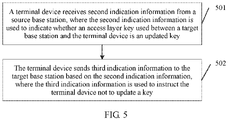
- FIG. 5 is a schematic flowchart of another communication method according to an embodiment of the present invention. The method includes the following steps.
- a terminal device receives second indication information from a source base station, where the second indication information is used to indicate whether an access layer key between a target base station and the terminal device is an updated key.
- the second indication information may be carried in a first message, and the first message is used to request to change an RRC connection, for example, establish or change or release a radio bearer.
- the first message may be an RRC connection reconfiguration (Connection Reconfiguration) message.
- the terminal device sends third indication information to the target base station based on the second indication information, where the third indication information is used to instruct the terminal device not to update a key.
- the third indication information may be further used to instruct the terminal device not to update a key, or used to indicate that the access layer key between the terminal device and the target base station is a key that is not updated, or used to indicate that the access layer key between the terminal device and the target base station is not an updated key.
- the third indication information may be carried in a second message, and the second message is used to respond to the first message.
- Step S502 may include the following:
- the terminal device may send the third indication information to the target base station based on the reference information in the following manners.
- Manner 1 The terminal device sends the third indication information to the target base station when the reference information includes policy indication information, and the policy indication information is used to instruct the terminal device not to update a key.
- Manner 2 The terminal device sends the third indication information to the target base station when the reference information includes a quantity of times that the terminal device does not update a key, and the quantity of times that the terminal device does not update the key exceeds a preset threshold.
- the terminal device sends the third indication information to the target base station when the reference information includes status information indicating whether a TAI, a RAN group, or a RAT that is perceived by the terminal device is changed, and the status information indicates that none of the TAI, the RAN group, and the RAT that are perceived by the terminal device is changed.
- the terminal device determines, based on the second indication information and the reference information, not to update the key of the terminal device, the terminal device does not update the key of the terminal device, that is, the terminal device keeps the key of the terminal device unchanged.
- the third indication information may be a flag bit in the second message, and a value of the flag bit may be 1: true (1: true) or 0: false (0: false). That the third indication information is used to instruct the terminal device to update the key of the terminal device is specifically as follows: When the value of the flag bit is 0, the flag bit instructs the terminal device not to update the key of the terminal device, that is, the terminal device keeps the access layer key between the terminal device and the target base station unchanged. Alternatively, when the value of the flag bit is 1, the flag bit instructs the terminal device to update the key of the terminal device, for example, the terminal device generates a derived key based on an NCC.
- the third indication information may be an implicit indication, that is, the terminal device notifies the target base station by using different messages.
- the second message is an RRC connection reconfiguration complete (Connection Reconfiguration Complete) message
- it indicates that the terminal device does not update the key of the terminal device that is, the terminal device keeps the access layer key between the terminal device and the target base station unchanged.
- the second message is an RRC connection re-establishment request (Connection Re-establishment Request) message
- it indicates that the terminal device updates the key of the terminal device for example, the terminal device generates a derived key based on an NCC.
- the terminal device receives the second indication information and the NCC that are sent by the source base station.
- the terminal device keeps the key of the terminal device unchanged when the second indication information is used to indicate that the access layer key between the target base station and the terminal device is not an updated key, or when the second indication information is used to indicate that the access layer key between the target base station and the terminal device is not an updated key and the terminal device determines, based on the reference information, not to update the key.
- the terminal device determines, based on the indication information sent by the base station side, not to update the key. This resolves a problem that whether to update the key of the terminal device is not controlled by the base station.
- the terminal device specifically determines, based on only the reference information in the following manners, whether to update the key.
- Manner 1 The terminal device updates the key of the terminal device when the reference information includes policy indication information, and the policy indication information is used to instruct the terminal device to update a key; or the terminal device does not update the key of the terminal device when the reference information includes policy indication information, and the policy indication information is used to instruct the terminal device not to update a key.
- Manner 2 The terminal device updates the key of the terminal device when the reference information includes a quantity of times that the terminal device does not update the key, and the quantity of times that the terminal device does not update the key exceeds a preset threshold; or the terminal device does not update the key of the terminal device when the reference information includes a quantity of times that the terminal device does not update the key, and the quantity of times that the terminal device does not update the key does not exceed a preset threshold.
- the terminal device updates the key of the terminal device when the reference information includes status information indicating whether a TAI, a RAN group, or a RAT that is perceived by the terminal device is changed, and the status information indicates that any one of the TAI, the RAN group, and the RAT that are perceived by the terminal device is changed; or the terminal device does not update the key of the terminal device when the reference information includes status information indicating whether a TAI, a RAN group, or a RAT that is perceived by the terminal device is changed, and the status information indicates that none of the TAI, the RAN group, and the RAT that are perceived by the terminal device is changed.
- the terminal device after the terminal device actively determines, based on the reference information, that the terminal device updates the key, the terminal device sends an RRC connection re-establishment request (Connection Re-establishment Request) message to the source base station. The message is used to re-establish an RRC connection.
- the terminal device After the terminal device receives an RRC connection re-establishment complete (Connection Re-establishment Complete) message sent by the source base station, the terminal device updates the key of the terminal device.
- the terminal device updates the key of the terminal device is specifically updating the access layer key between the terminal device and the target base station.
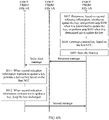
- FIG. 6A and FIG. 6B are a schematic diagram of an interactive procedure of a key update method according to an embodiment of the present invention. The method includes the following steps.
- a source base station determines, based on a measurement report, to hand over a base station.
- the source base station receives the measurement report reported by a terminal device, and determines, based on a level or quality information in the measurement report, whether to hand over a base station. This belongs to the prior art and is not described in detail.
- the source base station updates an access layer key between the source base station and the terminal device based on first reference information.
- the source base station performs step S603 when the source base station determines, based on the first reference information, to update the access layer key between the source base station and the terminal device; or the source base station performs step S604 when the source base station determines, based on the first reference information, not to update the access layer key.
- the first reference information may include whether the source base station and a target base station belong to a same CU, a trust level of the source base station for the target base station, or first policy indication information.
- the source base station performs step S603 when the first reference information includes whether the source base station and the target base station belong to a same CU, and the source base station and the target base station do not belong to a same CU.
- the source base station performs step S604 when the first reference information includes whether the source base station and the target base station belong to a same CU, and the source base station and the target base station belong to a same CU.
- the source base station performs step S603 when the first reference information includes the first policy indication information, and the first policy indication information instructs the source base station to update a key.
- the source base station performs step S604 when the first reference information includes the first policy indication information, and the first policy indication information instructs the source base station not to update a key.
- the source base station performs step S603 when the first reference information includes the trust level of the source base station for the target base station, and the trust level is higher than a first trust threshold.
- the source base station performs step S604 when the first reference information includes the trust level of the source base station for the target base station, and the trust level is lower than a first trust threshold.
- the trust level of the source base station for the target base station is specifically described.
- the source base station stores a trust list, and the trust list stores a correspondence between a PCI and a trust level or a correspondence between an ECGI and a trust level.
- the correspondence may be determined by locations at which the source base station and the target base station are deployed, or may be determined by a device manufacturer of the base stations or the like.
- the source base station generates a first key based on a first NCC, and sends a request message to the target base station.
- the request message may include first indication information and the first key, and the first indication information is used to indicate that the first key is an updated key.
- the first key is the access layer key between the source base station and the terminal device.
- step S202 For a process in which the source base station generates the first key based on the first NCC, refer to related descriptions of step S202. Details are not described again.
- the request message may be a handover request, and the handover request is used to request the target base station to prepare for a handover.
- the request message may alternatively be a role change request.
- the role change request may be used to request the target base station to change from a second base station (Second gNB) to a master base station (Master gNB), and the role change request may be used in a 0-millisecond handover process.
- the master base station may be understood as a base station that has an s1/n2 connection to an MME or an AMF entity in a dual connection
- the second base station may be understood as a base station that provides an additional radio resource to the terminal device in the dual connection.
- the source base station keeps the key of the source base station unchanged, and sends a request message to the target base station.
- the request message may include first indication information, and the first indication information is used to indicate that the first key is a key that is not updated.
- the first key is the access layer key between the source base station and the terminal device.
- the target base station determines, based on the request message, whether to update an access layer key between the target base station and the terminal device.
- the target base station performs step S606 when the target base station determines, based on the request message, to update the access layer key between the target base station and the terminal device; or the target base station performs step S607 when the target base station determines, based on the request message, not to update the access layer key between the target base station and the terminal device.
- the target base station when the first indication information is used to indicate that the first key is an updated key, the target base station performs step S606; or when the first indication information is used to indicate that the first key is not an updated key, the target base station performs step S607.
- the first key is the access layer key between the target base station and the terminal device.
- the target base station stores the first key, and sends a response message to the source base station.
- the response message carries second indication information, and the second indication information is used to indicate that the access layer key between the target base station and the terminal device is an updated key.
- the target base station determines, based on second reference information, whether to update the access layer key between the target base station and the terminal device.
- the target base station performs step S608 when the target base station determines, based on the second reference information, to update the access layer key between the target base station and the terminal device; or the target base station performs step S609 when the target base station determines, based on the second reference information, not to update the access layer key between the target base station and the terminal device.
- the second reference information may include a trust level of the target base station for the source base station or second policy indication information.
- the target base station performs step S608 when the trust level is lower than a second trust threshold, or when the second policy indication information is used to instruct the target base station to update a key.
- the target base station performs step S609 when the trust level is higher than a second trust threshold, or when the second policy indication information is used to instruct the target base station not to update a key.
- the target base station generates a second key based on the first NCC, and sends a response message to the source base station.
- the request message further carries the first NCC.
- the response message carries second indication information, and the second indication information is used to indicate that the access layer key between the target base station and the terminal device is an updated key.
- the second key is the access layer key between the target base station and the terminal device.
- the target base station stores the first key, and sends a response message to the source base station.
- the response message carries second indication information, and the second indication information is used to indicate that the access layer key between the target base station and the terminal device is not an updated key.
- the response messages in steps S606, S608, and S609 are used to respond to the request message in step S605.
- the response message may carry a first message.
- the first message is used to request to change an RRC connection, for example, establish or change or release a radio bearer.
- the first message may be an RRC connection reconfiguration (Connection Reconfiguration) message or another newly added message.
- response message may carry the second indication information includes the following:
- the source base station sends the first message to the terminal device based on the response message.
- the response message carries the first message, and the first message may include the first NCC and the second indication information.
- that the source base station sends the second indication information to the terminal device includes the following:
- That the source base station sends the second indication information to the terminal based on a quantity of times that the terminal device does not update a key of the terminal device may include the following:
- the source base station obtains the second indication information from the first message through parsing.
- the source base station may reselect a target base station for the terminal device when the first indication information indicates that the first key is an updated key, and the second indication information indicates that the access layer key between the target base station and the terminal device is not an updated key. In this case, step S611 and steps after step S611 are no longer performed.
- the source base station sends the first message to the terminal device when the second indication information indicates that the access layer key between the target base station and the terminal device is an updated key, or when the first indication information indicates that the first key is not an updated key and the second indication information indicates that the access layer key between the target base station and the terminal device is an updated key, or when the first indication information indicates that the first key is an updated key and the second indication information indicates that the access layer key between the target base station and the terminal device is an updated key.
- the first message is used to request to change an RRC connection, and the first message includes the second indication information.
- step S611 When the second indication information instructs to update a key, the terminal device performs step S611; or when the second indication information instructs not to update a key, the terminal device performs step S612.
- the terminal device determines to update the key, and the terminal device performs step S611.
- the terminal device determines not to update the key, and the terminal device performs step S612.
- the terminal device performs step S611.
- the terminal device generates a derived key based on the first NCC, and sends a second message to the target base station.
- the second message may be an RRC connection reconfiguration complete (Connection Reconfiguration Complete) message.
- the second message may include third indication information, and the third indication information is used to instruct the terminal device to update a key.
- the terminal device keeps the key unchanged, and sends a second message to the target base station.
- the second message may be an RRC connection reconfiguration complete (Connection Reconfiguration Complete) message.
- the second message may include third indication information, and the third indication information is used to instruct the terminal device not to update a key.
- the source base station determines, based on the first reference information, whether to update a key, and generates the first key and sets the first indication information.
- the source base station sends the handover request to the target base station, and the handover request includes the first key and the NCC.
- the target base station determines, based on the first indication information and the second reference information, whether to update a key, and generates the second key and sets the second indication information.
- the target base station sends the second indication information to the terminal device.
- the terminal device determines, based on an indication of the second indication information, whether to perform a key update operation, and generates the derived key and the third indication information.
- using the solution in this embodiment of the present invention helps resolve a problem that a potential security risk exists in data transmitted between the terminal device and the target base station, and helps resolve a problem that a key change of the terminal device is not controlled by the base station.
- the method further includes the following steps:
- the method further includes the following steps:
- the method further includes the following steps:
- steps S601 to S616b refer to related descriptions in FIG. 2 , FIG. 3 , FIG. 4 , and FIG. 5 . Details are not described herein again.
- the terminal device sends an RRC connection reconfiguration complete (Connection Reconfiguration Complete) message to the target base station.
- RRC connection reconfiguration Complete Connection Reconfiguration Complete
- the terminal device constructs an RRC connection re-establishment request (Connection Re-establishment Request) message, and sends the RRC connection re-establishment request (Connection Re-establishment Request) message to the target base station.
- the message is used to re-establish an RRC connection.
- the target base station can determine that the terminal device updates the key, and send an RRC connection re-establishment complete (Connection Re-establishment Complete) message to the terminal device, to respond to the RRC connection re-establishment request (Connection Re-establishment Request) message.
- RRC connection re-establishment Complete Connection Re-establishment Complete
- Connection Re-establishment Request Connection Re-establishment Request
- FIG. 7A and FIG. 7B show another communication method according to an embodiment of the present invention. As shown in FIG. 7A and FIG. 7B , the method includes the following steps.
- a source base station determines, based on a measurement report, to hand over a base station.
- the source base station determines, based on first reference information, whether to update an access layer key between the source base station and a terminal device.
- the source base station performs step S703 when the source base station determines, based on the first reference information, to update the access layer key between the source base station and the terminal device; or the source base station performs step S704 when the source base station determines, based on the first reference information, not to update the access layer key between the source base station and the terminal device.
- step S702 For related descriptions of this step (S702), refer to related descriptions of step S602. Details are not described again.
- the source base station generates a first key based on a first NCC, and sends a request message to a target base station.
- the request message includes the first key and first indication information, and the first indication information is used to indicate that the first key is an updated key.
- the request message may be a handover request, and the handover request is used to request the target base station to prepare for a handover.
- step S703 For related descriptions of this step (S703), refer to related descriptions of step S603. Details are not described again.
- the source base station keeps the first key unchanged, and sends a request message to a target base station.
- the request message includes the first key and first indication information, and the first indication information is used to indicate that the first key is not an updated key.
- the target base station determines, based on the request message, whether to update a key.
- the target base station performs step S706 when the target base station determines, based on the request message, whether to update an access layer key between the target base station and the terminal device; or the target base station performs step S707 when the target base station determines, based on the request message, not to update an access layer key between the target base station and the terminal device.
- the target base station when the first indication information is used to indicate that the first key is an updated key, the target base station performs step S706; or when the first indication information is used to indicate that the first key is not an updated key, the target base station performs step S707.
- the target base station stores the first key, and sends a response message to the source base station.
- the response message carries second indication information, and the second indication information is used to indicate that the access layer key between the target base station and the terminal device is an updated key.
- the target base station determines, based on second reference information, whether to update the access layer key between the target base station and the terminal device.
- the target base station performs step S708 when the target base station determines, based on the second reference information, to update the access layer key between the target base station and the terminal device; or the target base station performs step S709 when the target base station determines, based on the second reference information, not to update the access layer key between the target base station and the terminal device.
- step S707 For related descriptions of this step (S707), refer to related descriptions of step S607. Details are not described again.
- the target base station generates a second key based on the first NCC, and sends a response message to the source base station.
- the response message carries second indication information, and the second indication information is used to indicate that the access layer key between the target base station and the terminal device is an updated key.
- the target base station stores the first key, and sends a response message to the source base station.
- the response message carries second indication information, and the second indication information is used to indicate that the access layer key between the target base station and the terminal device is not an updated key.
- the source base station sends a first message to the terminal device based on the response message.
- the response message carries the first message, and the first message is used to request to change an RRC connection, for example, establish or change or release a radio bearer.
- the first message may include the first NCC and the second indication information.
- the first message may be an RRC connection reconfiguration (Connection Reconfiguration) message.
- that the source base station sends the second indication information to the terminal device includes the following:
- That the source base station sends the second indication information to the terminal based on a quantity of times that the terminal device does not update a key of the terminal device may include the following:
- step S710 For related descriptions of this step (S710), refer to related descriptions of step S610. Details are not described again.
- step S711 When the second indication information instructs to update a key, the terminal device performs step S711; or when the second indication information instructs not to update a key, the terminal device performs step S712.
- the terminal device uses the second key as the access layer key between the terminal device and the target base station, and sends a second message to the target base station.
- the second message may be an RRC connection reconfiguration complete (Connection Reconfiguration Complete) message.
- the second message may include third indication information, and the third indication information is used to instruct the terminal device to update a key.
- the terminal device determines, based on third reference information, whether to update the key.
- step S713 When the third reference information instructs to update a key, the terminal device performs step S713; or when the third reference information instructs not to update a key, the terminal device performs step S714.
- the third reference information includes third policy indication information, the quantity of times that the terminal device does not update the key, and status information indicating whether a TAI, a RAN group, or a RAT that is perceived by the terminal device is changed.
- the terminal device performs step S713 when the third reference information includes the third policy indication information, and the third policy indication information is used to instruct the terminal device to update the key of the terminal device.
- the terminal device performs step S714 when the third reference information includes the third policy indication information, and the third policy indication information is used to instruct the terminal device not to update the key of the terminal device.
- the terminal device performs step S713 when the third reference information includes the quantity of times that the terminal device does not update the key, and the quantity of times that the terminal device does not update the key exceeds a count threshold.
- the terminal device performs step S714 when the third reference information includes the quantity of times that the terminal device does not update the key, and the quantity of times that the terminal device does not update the key does not exceed a count threshold.
- the terminal device performs step S713 when the third reference information includes the status information indicating whether the TAI, the RAN group, or the RAT that is perceived by the terminal device is changed, and the status information indicates that any one of the TAI, the RAN group, and the RAT that are perceived by the terminal device is changed.
- the terminal device performs step S714 when the third reference information includes the status information indicating whether the TAI, the RAN group, or the RAT that is perceived by the terminal device is changed, and the status information indicates that none of the TAI, the RAN group, and the RAT that are perceived by the terminal device is changed.
- the terminal device generates a derived key based on the first NCC, and sends a second message to the target base station.
- the second message may be an RRC connection reconfiguration complete (Connection Reconfiguration Complete) message.
- the second message may include the third indication information, and the third indication information is used to instruct the terminal device to update a key.
- step S202 For a process in which the terminal device generates the derived key based on the first NCC, refer to related content of step S202. Details are not described herein again.
- the terminal device keeps the key unchanged, and sends the second message to the target base station.
- the second message may be an RRC connection reconfiguration complete (Connection Reconfiguration Complete) message.
- the second message may include the third indication information, and the third indication information is used to instruct the terminal device not to update a key.
- the source base station determines, based on the first reference information, whether to update a key, and generates the first key and sets the first indication information.
- the source base station sends the handover request to the target base station, and the handover request includes the first key and the NCC.
- the target base station determines, based on the first indication information and the second reference information, whether to update a key, and generates the second key and sets the second indication information.
- the target base station sends the second indication information to the terminal device.
- the terminal device determines, based on the second indication information and the third reference information, whether to update a key, and generates the derived key and the third indication information.
- using the solution in this embodiment of the present invention helps resolve a problem that a potential security risk exists in data transmitted between the terminal device and the target base station, and helps resolve a problem that a key change of the terminal device is not controlled by the base station.
- the method further includes the following steps:
- the method further includes the following steps:
- the method further includes the following steps:
- steps S701 to S716b refer to related descriptions in the embodiments shown in FIG. 2 , FIG. 3 , FIG. 4 , and FIG. 5 . Details are not described herein again.
- the terminal device sends an RRC connection reconfiguration complete (Connection Reconfiguration Complete) message to the target base station.
- RRC connection reconfiguration Complete Connection Reconfiguration Complete
- the terminal device constructs an RRC connection re-establishment request (Connection Re-establishment Request) message, and sends the RRC connection re-establishment request (Connection Re-establishment Request) message to the target base station.
- the message is used to re-establish an RRC connection.
- the target base station can determine that the terminal device updates the key, and send an RRC connection re-establishment complete (Connection Re-establishment Complete) message to the terminal device, to respond to the RRC connection re-establishment request (Connection Re-establishment Request) message.
- RRC connection re-establishment Complete Connection Re-establishment Complete
- Connection Re-establishment Request Connection Re-establishment Request
- FIG. 8 is a schematic structural diagram of a base station according to an embodiment of the present invention. As shown in FIG. 8 , the base station 800 includes:
- the first sending unit 802 includes:
- the second sending subunit 8022 includes:
- the second sending subunit 8022 includes:
- the handover request further includes a next hop chaining counter NCC
- the base station 800 further includes: a second sending unit 803, configured to send the NCC to the terminal device by using the source base station.
- the base station 800 further includes: a first generation unit 804, configured to generate a second key based on the NCC when the second indication information is used to indicate that the access layer key between the target base station and the terminal device is an updated key.
- the base station 800 further includes:
- the base station 800 further includes:
- the units (the first receiving unit 801, the first sending unit 802, the second sending unit 803, the first generation unit 804, the second receiving unit 805, the second generation unit 806, the third sending unit 807, the third receiving unit 808, and the fourth sending unit 809) are configured to perform related steps of the foregoing method.
- the base station 800 is presented in a form of a unit.
- the "unit” herein may be an application-specific integrated circuit (application-specific integrated circuit, ASIC), a processor and a memory that execute one or more software or firmware programs, an integrated logic circuit, and/or another component that may provide the foregoing functions.
- ASIC application-specific integrated circuit
- the first receiving unit 801, the first sending unit 802, the second sending unit 803, the first generation unit 804, the second receiving unit 805, the second generation unit 806, the third sending unit 807, the third receiving unit 808, and the fourth sending unit 809 may be implemented by using a processor 1401 of a base station shown in FIG. 14 .
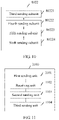
- FIG. 11 is a schematic structural diagram of a base station according to an embodiment of the present invention. As shown in FIG. 10 , the base station 1100 includes:
- the base station 1100 further includes: a third sending unit 1104, configured to send a first message to the terminal device when the second indication information indicates that the access layer key between the target base station and the terminal device is an updated key, or when the first indication information indicates that the first key is not an updated key and the second indication information indicates that the access layer key between the target base station and the terminal device is an updated key, or when the first indication information indicates that the first key is an updated key and the second indication information indicates that the access layer key between the target base station and the terminal device is an updated key, where the first message is used to request to change an RRC connection.
- a third sending unit 1104 configured to send a first message to the terminal device when the second indication information indicates that the access layer key between the target base station and the terminal device is an updated key, or when the first indication information indicates that the first key is not an updated key and the second indication information indicates that the access layer key between the target base station and the terminal device is an updated key, or when the first indication information indicates that the first key is an updated key and the second indication information indicates
- the first indication information is used to indicate that the first key is not an updated key
- the units (the first sending unit 1101, the receiving unit 1102, the second sending unit 1103, and the third sending unit 1104) are configured to perform related steps of the foregoing method.
- the base station 1100 is presented in a form of a unit.
- the "unit” herein may be an application-specific integrated circuit (application-specific integrated circuit, ASIC), a processor and a memory that execute one or more software or firmware programs, an integrated logic circuit, and/or another component that may provide the foregoing functions.
- ASIC application-specific integrated circuit
- the first sending unit 1101, the receiving unit 1102, the second sending unit 1103, and the third sending unit 1104 may be implemented by using a processor 1501 of a base station shown in FIG. 15 .
- FIG. 12 is a schematic structural diagram of a terminal device according to an embodiment of the present invention. As shown in FIG. 12 , the terminal device 1200 includes:
- the update unit 1202 is configured to:
- the update unit 1202 is configured to: update the key of the terminal device when the reference information includes policy indication information, and the policy indication information is used to instruct the terminal device to update a key.
- the update unit 1202 includes:
- the terminal device further includes: a sending unit 1203, configured to send third indication information to the target base station, where the third indication information is used to instruct the terminal device to update a key.
- a sending unit 1203 configured to send third indication information to the target base station, where the third indication information is used to instruct the terminal device to update a key.
- the units are configured to perform related steps of the foregoing method.
- the terminal device 1200 is presented in a form of a unit.
- the "unit” herein may be an application-specific integrated circuit (application-specific integrated circuit, ASIC), a processor and a memory that execute one or more software or firmware programs, an integrated logic circuit, and/or another component that may provide the foregoing functions.
- the receiving unit 1201, the update unit 1202, and the sending unit 1203 may be implemented by using a processor 1601 of a terminal device shown in FIG. 16 .
- FIG. 14 is a schematic structural diagram of a terminal device according to an embodiment of the present invention. As shown in FIG. 14 , the terminal device 1400 includes:
- the sending unit includes:
- the second sending unit 14022 is configured to: send the third indication information to the target base station when the reference information includes policy indication information, and the policy indication information is used to instruct the terminal device not to update a key.
- the units are configured to perform related steps of the foregoing method.
- the terminal device 1400 is presented in a form of a unit.
- the "unit" herein may be an application-specific integrated circuit (application-specific integrated circuit, ASIC), a processor and a memory that execute one or more software or firmware programs, an integrated logic circuit, and/or another component that may provide the foregoing functions.
- ASIC application-specific integrated circuit
- the receiving unit 1401 and the sending unit 1402 may be implemented by using a processor 1901 of a terminal device shown in FIG. 19 .
- a base station 1600 may be implemented in a structure shown in FIG. 16 .
- the base station 1600 includes at least one processor 1601, at least one memory 1602, and at least one communications interface 1603.
- the processor 1601, the memory 1602, and the communications interface 1603 are connected and communicate with each other by using a communications bus.
- the processor 1601 may be a general-purpose central processing unit (CPU), a microprocessor, an application-specific integrated circuit (application-specific integrated circuit, ASIC), or one or more integrated circuits configured to control execution of the foregoing solution program.
- CPU central processing unit
- ASIC application-specific integrated circuit
- the communications interface 1603 is configured to communicate with another device or a communications network, such as the Ethernet, a radio access network (RAN), or a wireless local area network (Wireless Local Area Networks, WLAN).
- a communications network such as the Ethernet, a radio access network (RAN), or a wireless local area network (Wireless Local Area Networks, WLAN).
- RAN radio access network
- WLAN Wireless Local Area Networks
- the memory 1602 may be a read-only memory (read-only memory, ROM) or another type of static storage device that can store static information and instructions, or a random access memory (random access memory, RAM) or another type of dynamic storage device that can store information and instructions; or may be an electrically erasable programmable read-only memory (Electrically Erasable Programmable Read-Only Memory, EEPROM), a compact disc read-only memory (Compact Disc Read-Only Memory, CD-ROM) or another compact disk storage, an optical disc storage (including a compact optical disc, a laser disc, an optical disc, a digital versatile disc, a Blu-ray disc, or the like), a magnetic disk storage medium or another magnetic storage device, or any other medium that can be configured to carry or store expected program code in a form of an instruction or a data structure and that can be accessed by a computer.
- the memory may exist independently, and is connected to the processor by using the bus.
- the memory may be alternatively integrated with the processor
- the memory 1602 is configured to store application program code for executing the foregoing solution, and the processor 1601 controls the execution.
- the processor 1601 is configured to execute the application program code stored in the memory 1602.
- the code stored in the memory 1602 may be used to perform the communication method provided above and performed by a target base station.
- the target base station receives a handover request from a source base station, where the handover request is used to request the target base station to prepare for a handover, the handover request includes a first key and first indication information, and the first indication information is used to indicate whether the first key is an updated key; and the target base station sends second indication information to the source base station based on the handover request, where the second indication information is used to indicate whether an access layer key between the target base station and a terminal device is an updated key.
- a base station 1700 may be implemented in a structure shown in FIG. 17 .
- the base station 1700 includes at least one processor 1701, at least one memory 1702, and at least one communications interface 1703.
- the processor 1701, the memory 1702, and the communications interface 1703 are connected and communicate with each other by using the communications bus.
- the processor 1701 may be a general-purpose central processing unit (CPU), a microprocessor, an application-specific integrated circuit (application-specific integrated circuit, ASIC), or one or more integrated circuits configured to control execution of the foregoing solution program.
- CPU central processing unit
- ASIC application-specific integrated circuit
- the communications interface 1703 is configured to communicate with another device or a communications network, such as the Ethernet, a radio access network (RAN), or a wireless local area network (Wireless Local Area Networks, WLAN).
- a communications network such as the Ethernet, a radio access network (RAN), or a wireless local area network (Wireless Local Area Networks, WLAN).
- RAN radio access network
- WLAN Wireless Local Area Networks
- the memory 1702 may be a read-only memory (read-only memory, ROM) or another type of static storage device that can store static information and instructions, or a random access memory (random access memory, RAM) or another type of dynamic storage device that can store information and instructions; or may be an electrically erasable programmable read-only memory (Electrically Erasable Programmable Read-Only Memory, EEPROM), a compact disc read-only memory (Compact Disc Read-Only Memory, CD-ROM) or another compact disk storage, an optical disc storage (including a compact optical disc, a laser disc, an optical disc, a digital versatile disc, a Blu-ray disc, or the like), a magnetic disk storage medium or another magnetic storage device, or any other medium that can be configured to carry or store expected program code in a form of an instruction or a data structure and that can be accessed by a computer.
- the memory may exist independently, and is connected to the processor by using the bus.
- the memory may be alternatively integrated with the processor
- the memory 1702 is configured to store application program code for executing the foregoing solution, and the processor 1701 controls the execution.
- the processor 1701 is configured to execute the application program code stored in the memory 1702.
- the code stored in the memory 1702 may be used to perform the communication method provided above and performed by a source base station.
- the source base station sends a handover request to a target base station, where the handover request is used to request the target base station to prepare for a handover, the handover request carries a first key and first indication information, and the first indication information is used to indicate whether the first key is an updated key;
- the source base station receives second indication information from the target base station, where the second indication information is used to indicate whether an access layer key between the target base station and a terminal device is an updated key; and the source base station sends the second indication information to the terminal device.
- a terminal device 1800 may be implemented in a structure shown in FIG. 18 .
- the terminal device 1800 includes at least one processor 1801, at least one memory 1802, and at least one communications interface 1803.
- the processor 1801, the memory 1802, and the communications interface 1803 are connected and communicate with each other by using the communications bus.
- the processor 1801 may be a general-purpose central processing unit (CPU), a microprocessor, an application-specific integrated circuit (application-specific integrated circuit, ASIC), or one or more integrated circuits configured to control execution of the foregoing solution program.
- CPU central processing unit
- ASIC application-specific integrated circuit
- the communications interface 1803 is configured to communicate with another device or a communications network, such as the Ethernet, a radio access network (RAN), or a wireless local area network (Wireless Local Area Networks, WLAN).
- a communications network such as the Ethernet, a radio access network (RAN), or a wireless local area network (Wireless Local Area Networks, WLAN).
- RAN radio access network
- WLAN Wireless Local Area Networks
- the memory 1802 may be a read-only memory (read-only memory, ROM) or another type of static storage device that can store static information and instructions, or a random access memory (random access memory, RAM) or another type of dynamic storage device that can store information and instructions; or may be an electrically erasable programmable read-only memory (Electrically Erasable Programmable Read-Only Memory, EEPROM), a compact disc read-only memory (Compact Disc Read-Only Memory, CD-ROM) or another compact disk storage, an optical disc storage (including a compact optical disc, a laser disc, an optical disc, a digital versatile disc, a Blu-ray disc, or the like), a magnetic disk storage medium or another magnetic storage device, or any other medium that can be configured to carry or store expected program code in a form of an instruction or a data structure and that can be accessed by a computer.
- the memory may exist independently, and is connected to the processor by using the bus.
- the memory may be alternatively integrated with the processor
- the memory 1802 is configured to store application program code for executing the foregoing solution, and the processor 1801 controls the execution.
- the processor 1801 is configured to execute the application program code stored in the memory 1802.
- the code stored in the memory 1802 may be used to perform the communication method provided above and performed by a terminal device.
- the terminal device receives second indication information from a source base station, where the second indication information is used to indicate whether an access layer key between a target base station and the terminal device is an updated key; and the terminal device updates a key of the terminal device based on the second indication information.
- a terminal device 1900 may be implemented in a structure shown in FIG. 19 .
- the terminal device 1900 includes at least one processor 1901, at least one memory 1902, and at least one communications interface 1903.
- the processor 1901, the memory 1902, and the communications interface 1903 are connected and communicate with each other by using the communications bus.
- the processor 1901 may be a general-purpose central processing unit (CPU), a microprocessor, an application-specific integrated circuit (application-specific integrated circuit, ASIC), or one or more integrated circuits configured to control execution of the foregoing solution program.
- CPU central processing unit
- ASIC application-specific integrated circuit
- the communications interface 1903 is configured to communicate with another device or a communications network, such as the Ethernet, a radio access network (RAN), or a wireless local area network (Wireless Local Area Networks, WLAN).
- a communications network such as the Ethernet, a radio access network (RAN), or a wireless local area network (Wireless Local Area Networks, WLAN).
- RAN radio access network
- WLAN Wireless Local Area Networks
- the memory 1902 may be a read-only memory (read-only memory, ROM) or another type of static storage device that can store static information and instructions, or a random access memory (random access memory, RAM) or another type of dynamic storage device that can store information and instructions; or may be an electrically erasable programmable read-only memory (Electrically Erasable Programmable Read-Only Memory, EEPROM), a compact disc read-only memory (Compact Disc Read-Only Memory, CD-ROM) or another compact disk storage, an optical disc storage (including a compact optical disc, a laser disc, an optical disc, a digital versatile disc, a Blu-ray disc, or the like), a magnetic disk storage medium or another magnetic storage device, or any other medium that can be configured to carry or store expected program code in a form of an instruction or a data structure and that can be accessed by a computer.
- the memory may exist independently, and is connected to the processor by using the bus.
- the memory may be alternatively integrated with the processor
- the memory 1902 is configured to store application program code for executing the foregoing solution, and the processor 1901 controls the execution.
- the processor 1901 is configured to execute the application program code stored in the memory 1902.
- the code stored in the memory 1902 may be used to perform the communication method provided above and performed by a terminal device.
- the terminal device receives second indication information from a source base station, where the second indication information is used to indicate whether an access layer key between a target base station and the terminal device is an updated key; and the terminal device sends third indication information to the target base station based on the second indication information, where the third indication information is used to instruct the terminal device not to update a key.
- An embodiment of the present invention further provides a computer storage medium.
- the computer storage medium may store a program, and when the program is executed, some or all of the steps of any communication method described in the foregoing method embodiment are performed.
- An embodiment of the present invention further provides a chip, and the chip is configured to implement all or some of the steps in the embodiments shown in FIG. 2 , FIG. 6A and FIG. 6B , and FIG. 7A and FIG. 7B .
- An embodiment of the present invention further provides a chip, and the chip is configured to implement all or some of the steps in the embodiments shown in FIG. 3 , FIG. 6A and FIG. 6B , and FIG. 7A and FIG. 7B .
- An embodiment of the present invention further provides a chip, and the chip is configured to implement all or some of the steps in the embodiments shown in FIG. 4 , FIG. 5 , FIG. 6A and FIG. 6B , and FIG. 7A and FIG. 7B .
- the disclosed apparatus may be implemented in other manners.
- the described apparatus embodiment is merely an example.
- the unit division is merely logical function division and may be other division in actual implementation.
- a plurality of units or components may be combined or integrated into another system, or some features may be ignored or not performed.
- the displayed or discussed mutual couplings or direct couplings or communication connections may be implemented through some interfaces.
- the indirect couplings or communication connections between the apparatuses or units may be implemented in electronic or other forms.
- the units described as separate parts may or may not be physically separate, and parts displayed as units may or may not be physical units, may be located in one position, or may be distributed on a plurality of network units. Some or all of the units may be selected based on actual requirements to achieve the objectives of the solutions of the embodiments.
- the integrated unit When the integrated unit is implemented in the form of a software functional unit and sold or used as an independent product, the integrated unit may be stored in a computer-readable memory. Based on such an understanding, the technical solutions of the present invention essentially, or the part contributing to the prior art, or all or some of the technical solutions may be implemented in the form of a software product.
- the computer software product is stored in a memory and includes several instructions for instructing a computer device (which may be a personal computer, a server, a network device, or the like) to perform all or some of the steps of the methods described in the embodiments of the present invention.
- the foregoing memory includes any medium that can store program code, such as a USB flash drive, a read-only memory (ROM, Read-Only Memory), a random access memory (RAM, Random Access Memory), a removable hard disk, a magnetic disk, or an optical disc.
- program code such as a USB flash drive, a read-only memory (ROM, Read-Only Memory), a random access memory (RAM, Random Access Memory), a removable hard disk, a magnetic disk, or an optical disc.
- the program may be stored in a computer readable memory.
- the memory may include a flash memory, a read-only memory (English: Read-Only Memory, ROM for short), a random access memory (English: Random Access Memory, RAM for short), a magnetic disk, an optical disc, or the like.
Landscapes
- Engineering & Computer Science (AREA)
- Signal Processing (AREA)
- Computer Networks & Wireless Communication (AREA)
- Computer Security & Cryptography (AREA)
- Mobile Radio Communication Systems (AREA)
Claims (13)
- Procédé de communication comprenant de :recevoir (201), par une station de base cible, une demande de transfert en provenance d'une station de base source pour transférer un dispositif terminal, dans lequel la demande de transfert comprend une première clé et de premières informations d'indication, et les premières informations d'indication sont utilisées pour indiquer si la première clé a été mise à jour par la station de base source et dans lequel la première clé est une clé de couche d'accès entre la station de base source et le terminal ; etlorsque les premières informations d'indication indiquent que la première clé n'est pas une clé mise à jour,envoyer (202), par la station de base cible, de deuxièmes informations d'indication à la station de base source sur la base de la demande de transfert, dans lequel les deuxièmes informations d'indication sont utilisées pour indiquer si une clé de couche d'accès entre la station de base cible et le dispositif terminal est une clé mise à jour ou non ;dans lequel l'envoi, par la station de base cible, des deuxièmes informations d'indication à la station de base source sur la base d'informations de référence comprend de :envoyer, par la station de base cible, les deuxièmes informations d'indication à la station de base source lorsque les informations de référence comprennent un niveau de confiance de la station de base cible pour la station de base source, et le niveau de confiance est supérieur à un seuil de confiance, dans lequel les deuxièmes informations d'indication sont utilisées pour indiquer que la clé de couche d'accès entre la station de base cible et le dispositif terminal n'est pas une clé mise à jour ; ouenvoyer, par la station de base cible, les deuxièmes informations d'indication à la station de base source lorsque les informations de référence comprennent un niveau de confiance de la station de base cible pour la station de base source, et le niveau de confiance est inférieur à un seuil de confiance, dans lequel les deuxièmes informations d'indication sont utilisées pour indiquer que la clé de couche d'accès entre la station de base cible et le dispositif terminal est une clé mise à jour.
- Procédé selon la revendication 1, dans lequel l'envoi, par la station de base cible, de deuxièmes informations d'indication à la station de base source sur la base de la demande de transfert comprend de :envoyer, par la station de base cible, les deuxièmes informations d'indication à la station de base source lorsque les premières informations d'indication sont utilisées pour indiquer que la première clé n'est pas la clé de couche d'accès entre la station de base source et le dispositif terminal, dans lequel les deuxièmes informations d'indication sont utilisées pour indiquer que la clé de couche d'accès entre la station de base cible et le dispositif terminal est une clé mise à jour ; ouenvoyer, par la station de base cible, les deuxièmes informations d'indication à la station de base source sur la base d'informations de référence lorsque les premières informations d'indication sont utilisées pour indiquer que la première clé est la clé de couche d'accès entre la station de base source et le dispositif terminal.
- Procédé selon la revendication 1 ou 2, la demande de transfert comprenant en outre un compteur de chaînage de prochain bond, NCC, et le procédé comprenant en outre de :
envoyer, par la station de base cible, le NCC au dispositif terminal en utilisant la station de base source. - Procédé selon la revendication 3, lorsque les deuxièmes informations d'indication sont utilisées pour indiquer que la clé de couche d'accès entre la station de base cible et le dispositif terminal est une clé mise à jour, le procédé comprenant en outre de :
générer, par la station de base cible, une deuxième clé basée sur le NCC. - Procédé selon la revendication 3 ou 4, le procédé comprenant en outre de :recevoir, par la station de base cible, de troisièmes informations d'indication en provenance du dispositif terminal ; etenvoyer, par la station de base cible, le NCC au dispositif terminal lorsque les troisièmes informations d'indication sont utilisées pour ordonner au dispositif terminal de ne pas mettre à jour une clé, et les deuxièmes informations d'indication sont utilisées pour indiquer que la clé de couche d'accès entre la station de base cible et le dispositif terminal est une clé mise à jour.
- Procédé selon la revendication 1 ou 2, le procédé comprenant en outre de :recevoir, par la station de base cible, de troisièmes informations d'indication en provenance du dispositif terminal ; etgénérer, par la station de base cible, une deuxième clé basée sur un NCC lorsque les troisièmes informations d'indication sont utilisées pour ordonner au dispositif terminal de mettre à jour une clé, et les deuxièmes informations d'indication sont utilisées pour indiquer que la clé de couche d'accès entre la station de base cible et le dispositif terminal n'est pas une clé mise à jour ; etenvoyer le NCC au dispositif terminal.
- Procédé de communication comprenant de :envoyer (301), par une station de base source, une demande de transfert pour transférer un dispositif terminal vers une station de base cible, dans lequel la demande de transfert porte une première clé et de premières informations d'indication, et les premières informations d'indication sont utilisées pour indiquer si la première clé a été mise à jour par la station de base source et dans lequel la première clé est une clé de couche d'accès entre la station de base source et le dispositif terminal ;recevoir (302), par la station de base source, de deuxièmes informations d'indication en provenance de la station de base cible, dans lequel les deuxièmes informations d'indication sont utilisées pour indiquer si une clé de couche d'accès entre la station de base cible et un dispositif terminal est une clé mise à jour ; etenvoyer (303), par la station de base source, les deuxièmes informations d'indication au dispositif terminal ;dans lequellorsqu'un niveau de confiance de la station de base source pour la station de base cible est inférieur à un seuil de confiance, les premières informations d'indication sont utilisées pour indiquer que la première clé a été maintenue inchangée par la station de base source ; oulorsqu'un niveau de confiance de la station de base source pour la station de base cible est supérieur à un seuil de confiance, les premières informations d'indication sont utilisées pour indiquer que la première clé a généré une nouvelle clé.
- Procédé selon la revendication 7, le procédé comprenant en outre de :
envoyer, par la station de base source, un premier message au dispositif terminal lorsque les deuxièmes informations d'indication indiquent que la clé de couche d'accès entre la station de base cible et le dispositif terminal est une clé mise à jour, ou lorsque les premières informations d'indication indiquent que la première clé est la clé de couche d'accès entre la station de base source et le dispositif terminal et les deuxièmes informations d'indication indiquent que la clé de couche d'accès entre la station de base cible et le dispositif terminal est une clé mise à jour, ou lorsque les premières informations d'indication indiquent que la première clé n'est pas la clé de couche d'accès entre la station de base source et le dispositif terminal et les deuxièmes informations d'indication indiquent que la clé de couche d'accès entre la station de base cible et le dispositif terminal est une clé mise à jour, dans lequel le premier message est utilisé pour demander de modifier une connexion de gestion des ressources radio, RRC. - Station de base, la station de base comprenant des moyens adaptés pour exécuter le procédé de l'une quelconque des revendications 1 à 6.
- Station de base, la station de base comprenant des moyens adaptés pour exécuter le procédé de l'une quelconque des revendications 7 et 8.
- Support lisible par ordinateur sur lequel est enregistré un programme ; dans lequel le programme fait en sorte qu'une station de base exécute le procédé de l'une quelconque des revendications 1 à 6.
- Support lisible par ordinateur sur lequel est enregistré un programme ; dans lequel le programme fait en sorte qu'une station de base exécute le procédé de l'une quelconque des revendications 7 et 8.
- Système, comprenant : une station de base source et une station de base cible, dans lequella station de base source est configurée pour exécuter le procédé de l'une quelconque des revendications 7 et 8 ; etla station de base cible est configurée pour exécuter le procédé de l'une quelconque des revendications 1 à 6.
Applications Claiming Priority (2)
| Application Number | Priority Date | Filing Date | Title |
|---|---|---|---|
| CN201710627211.1A CN109309919B (zh) | 2017-07-27 | 2017-07-27 | 一种通信方法及设备 |
| PCT/CN2018/095246 WO2019019917A1 (fr) | 2017-07-27 | 2018-07-11 | Procédé et dispositif de communication |
Publications (3)
| Publication Number | Publication Date |
|---|---|
| EP3648508A1 EP3648508A1 (fr) | 2020-05-06 |
| EP3648508A4 EP3648508A4 (fr) | 2020-05-13 |
| EP3648508B1 true EP3648508B1 (fr) | 2022-04-06 |
Family
ID=65039398
Family Applications (1)
| Application Number | Title | Priority Date | Filing Date |
|---|---|---|---|
| EP18838630.4A Active EP3648508B1 (fr) | 2017-07-27 | 2018-07-11 | Procédé et dispositif de communication |
Country Status (4)
| Country | Link |
|---|---|
| US (1) | US11463873B2 (fr) |
| EP (1) | EP3648508B1 (fr) |
| CN (1) | CN109309919B (fr) |
| WO (1) | WO2019019917A1 (fr) |
Families Citing this family (3)
| Publication number | Priority date | Publication date | Assignee | Title |
|---|---|---|---|---|
| CN110178394B (zh) * | 2017-07-27 | 2021-02-12 | 华为技术有限公司 | 小区切换方法和装置 |
| US11737002B2 (en) | 2021-07-28 | 2023-08-22 | Hewlett Packard Enterprise Development Lp | Selective caching of pairwise master keys in streamlined roaming |
| CN119865859A (zh) * | 2023-10-20 | 2025-04-22 | 华为技术有限公司 | 一种中央单元切换方法及相关装置 |
Family Cites Families (17)
| Publication number | Priority date | Publication date | Assignee | Title |
|---|---|---|---|---|
| US20080039096A1 (en) * | 2006-03-28 | 2008-02-14 | Nokia Corporation | Apparatus, method and computer program product providing secure distributed HO signaling for 3.9G with secure U-plane location update from source eNB |
| US20090209259A1 (en) * | 2008-02-15 | 2009-08-20 | Alec Brusilovsky | System and method for performing handovers, or key management while performing handovers in a wireless communication system |
| JP4505528B2 (ja) * | 2008-09-22 | 2010-07-21 | 株式会社エヌ・ティ・ティ・ドコモ | 移動通信方法 |
| CN101715188B (zh) * | 2010-01-14 | 2015-11-25 | 中兴通讯股份有限公司 | 一种空口密钥的更新方法及系统 |
| CN102137400B (zh) * | 2010-01-23 | 2015-04-01 | 中兴通讯股份有限公司 | 一种rrc连接重建立时的安全处理方法和系统 |
| CN102238541B (zh) * | 2010-04-29 | 2015-09-02 | 电信科学技术研究院 | 密钥更新方法和基站 |
| CN104885518B (zh) * | 2012-12-24 | 2019-03-12 | 诺基亚技术有限公司 | 在无线电局域网中用于区分安全配置的方法和装置 |
| CN104125563B (zh) * | 2013-04-25 | 2017-12-29 | 电信科学技术研究院 | 认知无线电系统中的安全管理方法和设备 |
| EP3057349A1 (fr) * | 2013-11-01 | 2016-08-17 | Huawei Technologies Co., Ltd. | Procédé et dispositif de traitement de clé en mode de connexion double |
| CN103747442B (zh) * | 2013-12-27 | 2017-06-30 | 华为技术有限公司 | 一种安全密钥上下文分发方法,移动管理实体及基站 |
| EP4167615B1 (fr) * | 2014-03-21 | 2025-10-08 | Sun Patent Trust | Dérivation de clé de sécurité dans une connectivité double |
| US10462723B2 (en) * | 2015-05-29 | 2019-10-29 | Intel IP Corporation | Seamless mobility for 5G and LTE systems and devices |
| ES2896057T3 (es) * | 2015-10-08 | 2022-02-23 | Ericsson Telefon Ab L M | Nodo para su uso en una red de comunicación y método para operar el mismo |
| EP3520452B1 (fr) * | 2016-09-30 | 2022-12-21 | Nokia Technologies Oy | Mise à jour d'une clé de sécurité |
| US10694444B2 (en) * | 2017-01-05 | 2020-06-23 | Sharp Laboratories Of America, Inc. | UE-based expedited handoff |
| EP3709601B1 (fr) * | 2017-03-17 | 2022-02-16 | Telefonaktiebolaget LM Ericsson (publ) | Noeud de réseau pour une utilisation dans un réseau de communication, dispositif de communication et ses procédés de fonctionnement |
| WO2019003106A1 (fr) * | 2017-06-26 | 2019-01-03 | Telefonaktiebolaget Lm Ericsson (Publ) | Rafraîchissement d'un contexte de sécurité destiné à un dispositif mobile |
-
2017
- 2017-07-27 CN CN201710627211.1A patent/CN109309919B/zh active Active
-
2018
- 2018-07-11 WO PCT/CN2018/095246 patent/WO2019019917A1/fr not_active Ceased
- 2018-07-11 EP EP18838630.4A patent/EP3648508B1/fr active Active
-
2020
- 2020-01-22 US US16/749,911 patent/US11463873B2/en active Active
Also Published As
| Publication number | Publication date |
|---|---|
| US20200162906A1 (en) | 2020-05-21 |
| US11463873B2 (en) | 2022-10-04 |
| WO2019019917A1 (fr) | 2019-01-31 |
| CN109309919A (zh) | 2019-02-05 |
| EP3648508A1 (fr) | 2020-05-06 |
| CN109309919B (zh) | 2021-07-20 |
| EP3648508A4 (fr) | 2020-05-13 |
Similar Documents
| Publication | Publication Date | Title |
|---|---|---|
| US10855461B2 (en) | Security key change method, base station, and user equipment | |
| US11825554B2 (en) | Capability management method and communications device | |
| EP3592035B1 (fr) | Procédé de commutation de réseau mobile et dispositif de communication | |
| EP3567797A1 (fr) | Appareil et procédé de traitement de données de sécurité | |
| CN107690154B (zh) | 一种小区配置方法及装置 | |
| EP3592099B1 (fr) | Procédé de handover, dispositif de stockage et système correspondants | |
| US20200022109A1 (en) | Information Transmission Method And Network Device | |
| US11937319B2 (en) | Integrity protection handling at the gNB-CU-UP | |
| EP3734870B1 (fr) | Procédés de notification et stations de base pour l'exécution d'une récupération de données pdcp | |
| US11323976B2 (en) | Network device and radio communication method | |
| CN114254751A (zh) | 协同推理方法及通信装置 | |
| EP3761708A1 (fr) | Procédé et dispositif de communication | |
| JP7192896B2 (ja) | 通信システム | |
| CN109309918B (zh) | 通信方法、基站和终端设备 | |
| EP3664404B1 (fr) | Procédé efficace de communication entre un terminal et une ams plus smf | |
| CN112543450A (zh) | 密钥推衍方法及装置 | |
| EP3648508B1 (fr) | Procédé et dispositif de communication | |
| EP3499834B1 (fr) | Appareil et procédé de négociation de clé | |
| EP3190856A2 (fr) | Procédé, dispositif et système de communication | |
| CN112804767A (zh) | 用于移动通信系统的基站及其数据传输方法 | |
| EP4611411A1 (fr) | Procédé de communication et appareil de communication | |
| CN119678517B (zh) | 用于无线网络中的scg安全的方法、设备和系统 | |
| WO2024145892A1 (fr) | Procédé, dispositif et système de sécurité de scg dans des réseaux sans fil | |
| EP4247055A1 (fr) | Procédé de commande de transfert intercellulaire, procédé de commande d'admission et appareil de communication | |
| US20180270886A1 (en) | Link setup method and device |
Legal Events
| Date | Code | Title | Description |
|---|---|---|---|
| STAA | Information on the status of an ep patent application or granted ep patent |
Free format text: STATUS: THE INTERNATIONAL PUBLICATION HAS BEEN MADE |
|
| PUAI | Public reference made under article 153(3) epc to a published international application that has entered the european phase |
Free format text: ORIGINAL CODE: 0009012 |
|
| STAA | Information on the status of an ep patent application or granted ep patent |
Free format text: STATUS: REQUEST FOR EXAMINATION WAS MADE |
|
| REG | Reference to a national code |
Ref country code: DE Ref legal event code: R079 Ref document number: 602018033555 Country of ref document: DE Free format text: PREVIOUS MAIN CLASS: H04W0036080000 Ipc: H04W0036000000 |
|
| 17P | Request for examination filed |
Effective date: 20200130 |
|
| AK | Designated contracting states |
Kind code of ref document: A1 Designated state(s): AL AT BE BG CH CY CZ DE DK EE ES FI FR GB GR HR HU IE IS IT LI LT LU LV MC MK MT NL NO PL PT RO RS SE SI SK SM TR |
|
| AX | Request for extension of the european patent |
Extension state: BA ME |
|
| A4 | Supplementary search report drawn up and despatched |
Effective date: 20200414 |
|
| RIC1 | Information provided on ipc code assigned before grant |
Ipc: H04W 12/04 20090101ALI20200406BHEP Ipc: H04W 36/00 20090101AFI20200406BHEP Ipc: H04W 36/08 20090101ALI20200406BHEP |
|
| DAV | Request for validation of the european patent (deleted) | ||
| DAX | Request for extension of the european patent (deleted) | ||
| GRAP | Despatch of communication of intention to grant a patent |
Free format text: ORIGINAL CODE: EPIDOSNIGR1 |
|
| STAA | Information on the status of an ep patent application or granted ep patent |
Free format text: STATUS: GRANT OF PATENT IS INTENDED |
|
| INTG | Intention to grant announced |
Effective date: 20211111 |
|
| GRAS | Grant fee paid |
Free format text: ORIGINAL CODE: EPIDOSNIGR3 |
|
| GRAA | (expected) grant |
Free format text: ORIGINAL CODE: 0009210 |
|
| STAA | Information on the status of an ep patent application or granted ep patent |
Free format text: STATUS: THE PATENT HAS BEEN GRANTED |
|
| AK | Designated contracting states |
Kind code of ref document: B1 Designated state(s): AL AT BE BG CH CY CZ DE DK EE ES FI FR GB GR HR HU IE IS IT LI LT LU LV MC MK MT NL NO PL PT RO RS SE SI SK SM TR |
|
| REG | Reference to a national code |
Ref country code: GB Ref legal event code: FG4D |
|
| REG | Reference to a national code |
Ref country code: CH Ref legal event code: EP |
|
| REG | Reference to a national code |
Ref country code: AT Ref legal event code: REF Ref document number: 1482564 Country of ref document: AT Kind code of ref document: T Effective date: 20220415 |
|
| REG | Reference to a national code |
Ref country code: IE Ref legal event code: FG4D |
|
| REG | Reference to a national code |
Ref country code: DE Ref legal event code: R096 Ref document number: 602018033555 Country of ref document: DE |
|
| REG | Reference to a national code |
Ref country code: LT Ref legal event code: MG9D |
|
| REG | Reference to a national code |
Ref country code: NL Ref legal event code: MP Effective date: 20220406 |
|
| REG | Reference to a national code |
Ref country code: AT Ref legal event code: MK05 Ref document number: 1482564 Country of ref document: AT Kind code of ref document: T Effective date: 20220406 |
|
| PG25 | Lapsed in a contracting state [announced via postgrant information from national office to epo] |
Ref country code: NL Free format text: LAPSE BECAUSE OF FAILURE TO SUBMIT A TRANSLATION OF THE DESCRIPTION OR TO PAY THE FEE WITHIN THE PRESCRIBED TIME-LIMIT Effective date: 20220406 |
|
| PG25 | Lapsed in a contracting state [announced via postgrant information from national office to epo] |
Ref country code: SE Free format text: LAPSE BECAUSE OF FAILURE TO SUBMIT A TRANSLATION OF THE DESCRIPTION OR TO PAY THE FEE WITHIN THE PRESCRIBED TIME-LIMIT Effective date: 20220406 Ref country code: PT Free format text: LAPSE BECAUSE OF FAILURE TO SUBMIT A TRANSLATION OF THE DESCRIPTION OR TO PAY THE FEE WITHIN THE PRESCRIBED TIME-LIMIT Effective date: 20220808 Ref country code: NO Free format text: LAPSE BECAUSE OF FAILURE TO SUBMIT A TRANSLATION OF THE DESCRIPTION OR TO PAY THE FEE WITHIN THE PRESCRIBED TIME-LIMIT Effective date: 20220706 Ref country code: LT Free format text: LAPSE BECAUSE OF FAILURE TO SUBMIT A TRANSLATION OF THE DESCRIPTION OR TO PAY THE FEE WITHIN THE PRESCRIBED TIME-LIMIT Effective date: 20220406 Ref country code: HR Free format text: LAPSE BECAUSE OF FAILURE TO SUBMIT A TRANSLATION OF THE DESCRIPTION OR TO PAY THE FEE WITHIN THE PRESCRIBED TIME-LIMIT Effective date: 20220406 Ref country code: GR Free format text: LAPSE BECAUSE OF FAILURE TO SUBMIT A TRANSLATION OF THE DESCRIPTION OR TO PAY THE FEE WITHIN THE PRESCRIBED TIME-LIMIT Effective date: 20220707 Ref country code: FI Free format text: LAPSE BECAUSE OF FAILURE TO SUBMIT A TRANSLATION OF THE DESCRIPTION OR TO PAY THE FEE WITHIN THE PRESCRIBED TIME-LIMIT Effective date: 20220406 Ref country code: ES Free format text: LAPSE BECAUSE OF FAILURE TO SUBMIT A TRANSLATION OF THE DESCRIPTION OR TO PAY THE FEE WITHIN THE PRESCRIBED TIME-LIMIT Effective date: 20220406 Ref country code: BG Free format text: LAPSE BECAUSE OF FAILURE TO SUBMIT A TRANSLATION OF THE DESCRIPTION OR TO PAY THE FEE WITHIN THE PRESCRIBED TIME-LIMIT Effective date: 20220706 Ref country code: AT Free format text: LAPSE BECAUSE OF FAILURE TO SUBMIT A TRANSLATION OF THE DESCRIPTION OR TO PAY THE FEE WITHIN THE PRESCRIBED TIME-LIMIT Effective date: 20220406 |
|
| PG25 | Lapsed in a contracting state [announced via postgrant information from national office to epo] |
Ref country code: RS Free format text: LAPSE BECAUSE OF FAILURE TO SUBMIT A TRANSLATION OF THE DESCRIPTION OR TO PAY THE FEE WITHIN THE PRESCRIBED TIME-LIMIT Effective date: 20220406 Ref country code: PL Free format text: LAPSE BECAUSE OF FAILURE TO SUBMIT A TRANSLATION OF THE DESCRIPTION OR TO PAY THE FEE WITHIN THE PRESCRIBED TIME-LIMIT Effective date: 20220406 Ref country code: LV Free format text: LAPSE BECAUSE OF FAILURE TO SUBMIT A TRANSLATION OF THE DESCRIPTION OR TO PAY THE FEE WITHIN THE PRESCRIBED TIME-LIMIT Effective date: 20220406 Ref country code: IS Free format text: LAPSE BECAUSE OF FAILURE TO SUBMIT A TRANSLATION OF THE DESCRIPTION OR TO PAY THE FEE WITHIN THE PRESCRIBED TIME-LIMIT Effective date: 20220806 |
|
| REG | Reference to a national code |
Ref country code: DE Ref legal event code: R097 Ref document number: 602018033555 Country of ref document: DE |
|
| PG25 | Lapsed in a contracting state [announced via postgrant information from national office to epo] |
Ref country code: SM Free format text: LAPSE BECAUSE OF FAILURE TO SUBMIT A TRANSLATION OF THE DESCRIPTION OR TO PAY THE FEE WITHIN THE PRESCRIBED TIME-LIMIT Effective date: 20220406 Ref country code: SK Free format text: LAPSE BECAUSE OF FAILURE TO SUBMIT A TRANSLATION OF THE DESCRIPTION OR TO PAY THE FEE WITHIN THE PRESCRIBED TIME-LIMIT Effective date: 20220406 Ref country code: RO Free format text: LAPSE BECAUSE OF FAILURE TO SUBMIT A TRANSLATION OF THE DESCRIPTION OR TO PAY THE FEE WITHIN THE PRESCRIBED TIME-LIMIT Effective date: 20220406 Ref country code: EE Free format text: LAPSE BECAUSE OF FAILURE TO SUBMIT A TRANSLATION OF THE DESCRIPTION OR TO PAY THE FEE WITHIN THE PRESCRIBED TIME-LIMIT Effective date: 20220406 Ref country code: DK Free format text: LAPSE BECAUSE OF FAILURE TO SUBMIT A TRANSLATION OF THE DESCRIPTION OR TO PAY THE FEE WITHIN THE PRESCRIBED TIME-LIMIT Effective date: 20220406 Ref country code: CZ Free format text: LAPSE BECAUSE OF FAILURE TO SUBMIT A TRANSLATION OF THE DESCRIPTION OR TO PAY THE FEE WITHIN THE PRESCRIBED TIME-LIMIT Effective date: 20220406 |
|
| PLBE | No opposition filed within time limit |
Free format text: ORIGINAL CODE: 0009261 |
|
| STAA | Information on the status of an ep patent application or granted ep patent |
Free format text: STATUS: NO OPPOSITION FILED WITHIN TIME LIMIT |
|
| PG25 | Lapsed in a contracting state [announced via postgrant information from national office to epo] |
Ref country code: MC Free format text: LAPSE BECAUSE OF FAILURE TO SUBMIT A TRANSLATION OF THE DESCRIPTION OR TO PAY THE FEE WITHIN THE PRESCRIBED TIME-LIMIT Effective date: 20220406 |
|
| REG | Reference to a national code |
Ref country code: CH Ref legal event code: PL |
|
| 26N | No opposition filed |
Effective date: 20230110 |
|
| REG | Reference to a national code |
Ref country code: BE Ref legal event code: MM Effective date: 20220731 |
|
| PG25 | Lapsed in a contracting state [announced via postgrant information from national office to epo] |
Ref country code: AL Free format text: LAPSE BECAUSE OF FAILURE TO SUBMIT A TRANSLATION OF THE DESCRIPTION OR TO PAY THE FEE WITHIN THE PRESCRIBED TIME-LIMIT Effective date: 20220406 |
|
| PG25 | Lapsed in a contracting state [announced via postgrant information from national office to epo] |
Ref country code: LU Free format text: LAPSE BECAUSE OF NON-PAYMENT OF DUE FEES Effective date: 20220711 Ref country code: LI Free format text: LAPSE BECAUSE OF NON-PAYMENT OF DUE FEES Effective date: 20220731 Ref country code: FR Free format text: LAPSE BECAUSE OF NON-PAYMENT OF DUE FEES Effective date: 20220731 Ref country code: CH Free format text: LAPSE BECAUSE OF NON-PAYMENT OF DUE FEES Effective date: 20220731 |
|
| PG25 | Lapsed in a contracting state [announced via postgrant information from national office to epo] |
Ref country code: SI Free format text: LAPSE BECAUSE OF FAILURE TO SUBMIT A TRANSLATION OF THE DESCRIPTION OR TO PAY THE FEE WITHIN THE PRESCRIBED TIME-LIMIT Effective date: 20220406 Ref country code: BE Free format text: LAPSE BECAUSE OF NON-PAYMENT OF DUE FEES Effective date: 20220731 |
|
| PG25 | Lapsed in a contracting state [announced via postgrant information from national office to epo] |
Ref country code: IE Free format text: LAPSE BECAUSE OF NON-PAYMENT OF DUE FEES Effective date: 20220711 |
|
| PG25 | Lapsed in a contracting state [announced via postgrant information from national office to epo] |
Ref country code: IT Free format text: LAPSE BECAUSE OF FAILURE TO SUBMIT A TRANSLATION OF THE DESCRIPTION OR TO PAY THE FEE WITHIN THE PRESCRIBED TIME-LIMIT Effective date: 20220406 |
|
| PG25 | Lapsed in a contracting state [announced via postgrant information from national office to epo] |
Ref country code: HU Free format text: LAPSE BECAUSE OF FAILURE TO SUBMIT A TRANSLATION OF THE DESCRIPTION OR TO PAY THE FEE WITHIN THE PRESCRIBED TIME-LIMIT; INVALID AB INITIO Effective date: 20180711 |
|
| PG25 | Lapsed in a contracting state [announced via postgrant information from national office to epo] |
Ref country code: MK Free format text: LAPSE BECAUSE OF FAILURE TO SUBMIT A TRANSLATION OF THE DESCRIPTION OR TO PAY THE FEE WITHIN THE PRESCRIBED TIME-LIMIT Effective date: 20220406 Ref country code: CY Free format text: LAPSE BECAUSE OF FAILURE TO SUBMIT A TRANSLATION OF THE DESCRIPTION OR TO PAY THE FEE WITHIN THE PRESCRIBED TIME-LIMIT Effective date: 20220406 |
|
| PG25 | Lapsed in a contracting state [announced via postgrant information from national office to epo] |
Ref country code: MT Free format text: LAPSE BECAUSE OF FAILURE TO SUBMIT A TRANSLATION OF THE DESCRIPTION OR TO PAY THE FEE WITHIN THE PRESCRIBED TIME-LIMIT Effective date: 20220406 |
|
| PG25 | Lapsed in a contracting state [announced via postgrant information from national office to epo] |
Ref country code: BG Free format text: LAPSE BECAUSE OF FAILURE TO SUBMIT A TRANSLATION OF THE DESCRIPTION OR TO PAY THE FEE WITHIN THE PRESCRIBED TIME-LIMIT Effective date: 20220406 |
|
| PG25 | Lapsed in a contracting state [announced via postgrant information from national office to epo] |
Ref country code: BG Free format text: LAPSE BECAUSE OF FAILURE TO SUBMIT A TRANSLATION OF THE DESCRIPTION OR TO PAY THE FEE WITHIN THE PRESCRIBED TIME-LIMIT Effective date: 20220406 |
|
| PGFP | Annual fee paid to national office [announced via postgrant information from national office to epo] |
Ref country code: GB Payment date: 20250529 Year of fee payment: 8 |
|
| PGFP | Annual fee paid to national office [announced via postgrant information from national office to epo] |
Ref country code: DE Payment date: 20250604 Year of fee payment: 8 |
|
| PG25 | Lapsed in a contracting state [announced via postgrant information from national office to epo] |
Ref country code: TR Free format text: LAPSE BECAUSE OF FAILURE TO SUBMIT A TRANSLATION OF THE DESCRIPTION OR TO PAY THE FEE WITHIN THE PRESCRIBED TIME-LIMIT Effective date: 20220406 |