EP3649214B1 - Terbium und dysprosiumkomplexe mit optimierter antenne zur verwendung als lumineszenzmarker - Google Patents
Terbium und dysprosiumkomplexe mit optimierter antenne zur verwendung als lumineszenzmarker Download PDFInfo
- Publication number
- EP3649214B1 EP3649214B1 EP18742729.9A EP18742729A EP3649214B1 EP 3649214 B1 EP3649214 B1 EP 3649214B1 EP 18742729 A EP18742729 A EP 18742729A EP 3649214 B1 EP3649214 B1 EP 3649214B1
- Authority
- EP
- European Patent Office
- Prior art keywords
- group
- groups
- formula
- lanthanide
- complexes
- Prior art date
- Legal status (The legal status is an assumption and is not a legal conclusion. Google has not performed a legal analysis and makes no representation as to the accuracy of the status listed.)
- Active
Links
- 0 Cc1cc(-c2c(*)c(*)c(*)c(*)c2*)cc(C)n1 Chemical compound Cc1cc(-c2c(*)c(*)c(*)c(*)c2*)cc(C)n1 0.000 description 7
Images

Classifications
-
- C—CHEMISTRY; METALLURGY
- C07—ORGANIC CHEMISTRY
- C07F—ACYCLIC, CARBOCYCLIC OR HETEROCYCLIC COMPOUNDS CONTAINING ELEMENTS OTHER THAN CARBON, HYDROGEN, HALOGEN, OXYGEN, NITROGEN, SULFUR, SELENIUM OR TELLURIUM
- C07F5/00—Compounds containing elements of Groups 3 or 13 of the Periodic Table
- C07F5/003—Compounds containing elements of Groups 3 or 13 of the Periodic Table without C-Metal linkages
-
- C—CHEMISTRY; METALLURGY
- C07—ORGANIC CHEMISTRY
- C07F—ACYCLIC, CARBOCYCLIC OR HETEROCYCLIC COMPOUNDS CONTAINING ELEMENTS OTHER THAN CARBON, HYDROGEN, HALOGEN, OXYGEN, NITROGEN, SULFUR, SELENIUM OR TELLURIUM
- C07F5/00—Compounds containing elements of Groups 3 or 13 of the Periodic Table
-
- C—CHEMISTRY; METALLURGY
- C07—ORGANIC CHEMISTRY
- C07D—HETEROCYCLIC COMPOUNDS
- C07D255/00—Heterocyclic compounds containing rings having three nitrogen atoms as the only ring hetero atoms, not provided for by groups C07D249/00 - C07D253/00
- C07D255/02—Heterocyclic compounds containing rings having three nitrogen atoms as the only ring hetero atoms, not provided for by groups C07D249/00 - C07D253/00 not condensed with other rings
-
- C—CHEMISTRY; METALLURGY
- C09—DYES; PAINTS; POLISHES; NATURAL RESINS; ADHESIVES; COMPOSITIONS NOT OTHERWISE PROVIDED FOR; APPLICATIONS OF MATERIALS NOT OTHERWISE PROVIDED FOR
- C09K—MATERIALS FOR MISCELLANEOUS APPLICATIONS, NOT PROVIDED FOR ELSEWHERE
- C09K11/00—Luminescent materials, e.g. electroluminescent or chemiluminescent
- C09K11/06—Luminescent materials, e.g. electroluminescent or chemiluminescent containing organic luminescent materials
-
- G—PHYSICS
- G01—MEASURING; TESTING
- G01N—INVESTIGATING OR ANALYSING MATERIALS BY DETERMINING THEIR CHEMICAL OR PHYSICAL PROPERTIES
- G01N21/00—Investigating or analysing materials by the use of optical means, i.e. using sub-millimetre waves, infrared, visible or ultraviolet light
- G01N21/75—Systems in which material is subjected to a chemical reaction, the progress or the result of the reaction being investigated
- G01N21/76—Chemiluminescence; Bioluminescence
-
- C—CHEMISTRY; METALLURGY
- C09—DYES; PAINTS; POLISHES; NATURAL RESINS; ADHESIVES; COMPOSITIONS NOT OTHERWISE PROVIDED FOR; APPLICATIONS OF MATERIALS NOT OTHERWISE PROVIDED FOR
- C09K—MATERIALS FOR MISCELLANEOUS APPLICATIONS, NOT PROVIDED FOR ELSEWHERE
- C09K2211/00—Chemical nature of organic luminescent or tenebrescent compounds
- C09K2211/18—Metal complexes
- C09K2211/182—Metal complexes of the rare earth metals, i.e. Sc, Y or lanthanide
Definitions
- the invention relates to the technical field of lanthanide complexes.
- the invention relates to lanthanide complexes comprising a chelating agent, formed of a macrocycle or of a ligand, and complexing a lanthanide ion, corresponding chelating agents, as well as a method of detecting a biomolecule with using said lanthanide complex.
- luminescent lanthanide complexes exhibit remarkable spectroscopic properties (fine emission bands characteristic of a given metal and with a long lifespan), and are, therefore, compounds with very high potential for applications in biological imaging ( SV Eliseeva, J.-CG Bünzli, Chem. Soc. Rev. 2010, 39, 189 ). These luminescent compounds can be used alone for applications in imaging by mono- or two-photon fluorescence microscopy, or in conjunction with an appropriate fluorophore to carry out FRET (Förster / Fluorescence Resonant Energy Transfer) experiments. In the latter case, the lanthanide complexes are generally in the form of a complex conjugated to a biomolecule.
- luminescent lanthanide compounds have already been described in the literature, and some are even marketed by Cisbio Bioassays, PerkinElmer or Invitrogen.
- functionalized lanthanide complexes have been developed in order to optimize their spectroscopic properties, shift their absorption towards the visible, optimize their two-photon absorption, and improve their solubility in aqueous medium.
- WO 2005/058877 describes lanthanide complexes based on 1,4,7-triazacyclononane (TACN) rings of which three nitrogen atoms are substituted by chromophores consisting of a pyridine derivative optionally substituted by a reactive group, in order to facilitate conjugation with biomolecules.
- the aim is to provide highly fluorescent, stable and easily graftable complexes to a biomolecule.
- This document describes in particular a TACN type terbium complex, the three nitrogen atoms of which are substituted by a 2-carboxylate-4- (2,4,6-trimethoxyphenyl) -pyridine group (compound 22), but does not indicate the gloss measured for this compound.
- TACN 1,4,7-triazacyclononane
- the structure of the complexes according to the invention makes possible chemical variations making it possible to advantageously obtain good solubility and good stability in a biological medium, and allowing easy grafting on a biomolecule.
- Brightness is defined as the product of absorption at the wavelength of interest and emission quantum efficiency, and corresponds to the amount of light actually available for the imaging and / or FRET experiment. Optimal brightness makes it possible to optimize the signal / noise ratio, and therefore to increase the sensitivity of the detection and / or to reduce the quantity of chromophore used.
- the complexes of the invention are luminescent.
- Luminescence corresponds to an emission of light following an input of energy, in particular a contribution of light.
- This energy supply causes atoms or molecules to pass into an "excited" state, which is at an energy higher than that which they possess in their normal state called “fundamental”. It is when they return to their ground state that they can emit light.
- the lanthanide complexes are sensitized by the antenna effect and the nature of the organic antenna controls the absorption of light and makes it possible to optimize the luminescence of the lanthanide ( SV Eliseeva, J.-C. Bünzli, Chem. Soc. Rev. 2010, 39, 189 ).
- the complexes according to the invention have the advantage of having a high gloss, in particular due to a very high quantum yield, in particular in a hydrophilic medium and in particular in an aqueous medium.
- the inventors believe that the improvement in the quantum efficiency, and the optimization of the brightness, of the complexes of the invention is due to the combination of the electronic and steric effects of the antennas (ie of the groups ( B )) .
- the presence of a single electron donor group significantly improves the quantum efficiency.
- the inventors have observed a drastic drop in quantum efficiency when several electron donor groups are present, compared to a single complex comprising only one electron donor group.
- the complexes according to the invention can be provided with a reactive group, so as to be optionally conjugated by a covalent bond to a molecule of interest, such as a biomolecule.
- the complexes according to the invention can also be provided with one or more water-solubilizing groups, which then makes it possible to improve their solubility in hydrophilic medium, and in particular in aqueous medium.
- alkyl is understood to mean a saturated hydrocarbon chain, which may be linear or branched.
- alkyl groups comprising from 1 to 6 carbon atoms, mention may be made of methyl, ethyl, n-propyl, iso-propyl, n-butyl, iso-butyl, tert-butyl, sec-butyl groups, n-pentyl, iso-pentyl, tert-pentyl, neo-pentyl, sec-pentyl, and n-hexyl.
- the lanthanide Ln is terbium.
- Terbium complexes are indeed very bright.
- the lanthanide complexes of the invention comprise a reactive group, denoted by -X, -X1 or -X2, allowing its covalent coupling to a biomolecule.
- a reactive group denoted by -X, -X1 or -X2
- reactive group is meant a group comprising a function which allows covalent grafting on a function capable of reacting and present on a biomolecule (amine, alcohol, thiol, carboxylic acid, unsaturation, etc.).
- a biomolecule amine, alcohol, thiol, carboxylic acid, unsaturation, etc.
- the various functions allowing such a bio-conjugation are well known to those skilled in the art and are described, for example, in Bioconjugate Techniques, GT Hermanson, 1996, 137-166 .
- biomolecule is understood to mean molecules of biological interest which it may be advantageous to mark with a luminescent complex.
- biomolecules mention may be made of proteins, peptides, antibodies, antigens, DNA strands, biotin and streptavidin.
- the proteins are the biomolecules which will most often be linked to the complexes of the invention.
- the reactive group can be chosen from -COOH, -NH 2 , an acrylamide, an activated amine, an activated ester, an aldehyde, an alkyl halide, an anhydride, an aniline, an azide , an aziridine, a carboxylic acid, a diazoalkane, a haloacetamide, a halotriazine, a hydrazine, an imido ester, an isocyanate, an isothiocyanate, a maleimide, a sulfonyl halide, a thiol, a ketone, an acid halide, a hydroxysuccinimidyl ester, a succinimidyl ester, a hydroxysulfosuccinimidyl ester, an azidonitrophenyl, an azidophenyl, a 3- (2-pyridyl dithio) -propionamide
- the complexes according to the invention comprise at least one and at most 15 water-solubilizing groups, denoted -Y , and advantageously at least 2, and preferably from 2 to 9 water-solubilizing groups, in particular from 2 to 5, and preferably 2 or 3.
- water-solubilizing group is understood to mean a group which comprises a function which makes it possible to improve the solubility in a hydrophilic medium.
- sulfobetaine is intended to mean a betaine group comprising an —SO 3 - function as a function carrying the negative charge.
- a betaine group is defined as a zwitterionic group in which the atom carrying the positive charge does not carry a hydrogen atom and is not adjacent to the atom carrying the negative charge.
- the term “sulfobetaine” is understood to mean, for example, zwitterionic groups combining an ammonium cation, or aromatic iminium, generally pyridinium, imidazollium, and an anionic group of sulfonate type.
- the cation and the anion are spaced apart by at least one CH 2 chain, and preferably by a bivalent alkyl chain (also called alkylene) comprising from 1 to 4, or even from 1 to 6, carbon atoms.
- a bivalent alkyl chain also called alkylene
- R represents an alkyl group of 1 to 6 carbon atoms, and preferably a methyl or ethyl, and q which is equal to 1, 2, 3, 4, 5 or 6, and preferably which is equal to 1 or 2.
- the group -N (CH 3 ) 2 + - (CH 2 ) 3 -SO 3 - is preferred.
- the complexes according to the invention comprise one or more water-solubilizing groups
- these can be on any substituent of the phenyl group of the group of structure ( B ), ie on -R1 , -R2, -R3, -R4 and / or -R5 , or more precisely on -R6 , -R7 , -R8 , -R9 , -R10 and / or -R'10 .
- the water-solubilizing groups are in the ortho and / or para position relative to the pyridinyl group of the group of structure ( B ), ie on -R6 , -R7 , -R8 , -R10 and / or -R'10 , and preferably in para.
- -A- represents -CH 2 -
- / or -Z- represents -C-
- / or -R4 represents hydrogen
- / or -R5 represents hydrogen in -Chrom1 , -Chrom2 and -Chrom3 .
- -R4 and -R5 represent hydrogens in -Chrom1 , -Chrom2 and -Chrom3 .
- -Chrom1 , -Chrom2 and -Chrom3 are identical in the complexes ( I ). These complexes will be named ( la ). These complexes ( Ia ) then have the advantage of being easier to synthesize.
- -R1 represents an electron- donor group -E1 as defined for the groups of formula ( B ), in particular chosen from the groups -O R10 and -NH (CO) R10 , - R10 being as defined for the groups of formula ( B ).
- -R1 represents a group - O R10 , and in particular -OMe or -OPEG, in the complexes ( Ia ).
- -R2 in the complexes ( Ia ), is a -R7 group as defined for the groups of formula ( B ).
- -R2 in the complexes ( Ia ), -R2 represents -Me.
- -R3 is advantageously a hydrogen or a group -R8 as defined for the groups of formula ( B ), preferably -Me.
- -R3 is hydrogen in complexes ( Ia ).
- the complexes of formula ( I ), -Chrom1 , -Chrom2 and -Chrom3 are identical and such that -R1 represents a group -E1 , in particular chosen from the groups - O R10 and -NH (CO) R10 , -R2 is a group -R7 , and in particular -Me, and -R3 is a hydrogen or a group -R8 , preferably -Me , -E1 , -R7 , -R8 and -R10 being as defined for the groups of formula ( B ).
- the complexes of formula (I) , -Chrom1 , -Chrom2 and -Chrom3 are identical and such that -R1 represents a group - O R10, -R2 is a group -R7 , and in particular -Me, and -R3 is hydrogen, -R7 and -R10 being as defined for the groups of formula ( B ).
- -Chrom1 and -Chrom2 are the same and -Chrom3 is different from -Chrom1 and -Chrom2 .
- These complexes will be named (Ib) .
- -R1 1 represents a group -O R10 1 , preferably -OMe or -OPEG, or a group -NH (CO) R10 1 , -R10 1 being as defined for -R10 in the group of formula ( B ).
- -R1 1 represents a group -O R10 1 , preferably -OMe or -OPEG, -R10 1 being as defined for -R10 in the group of formula ( B ).
- -R1 2 advantageously represents a group -NH (CO) R10 2 , or, preferably -O R10 2 , with R10 2 which is an -O (C1-C6) alkyl group substituted with a group -X1 .
- -R2 1 and -R2 2 which are identical or different, advantageously represent a group -R7 as defined for the groups of formula ( B ).
- -R2 1 and -R2 2 are identical and represent, preferably, -Me.
- -R3 1 and -R3 2 which are identical or different, represent a hydrogen or a group -R8 as defined for the groups of formula ( B ).
- R3 1 and -R3 2 are identical and represent -Me or, preferably, a hydrogen.
- -R1 1 represents a group -O R10 1 , preferably -OMe or -OPEG
- -R1 2 represents -O R10 2 , preferably a group - O ( C1-C6) alkyl substituted with one -X1 group, -R10 -R10 1 and 2 being as defined for in -R10 groups of formula (B).
- -R2 -R2 1 and 2 are identical and represent a group -R7, and R3 1 and R3 2 are identical and represent hydrogen or a group such -R8 that -Me, the groups -R7 and -R8 being as defined for the groups of formula ( B ).
- -R2 1 and -R2 2 are identical and represent a group -R7 as defined for the groups of formula ( B ), and preferably -Me, and -R3 1 and -R3 2 are identical and represent hydrogen.
- -R1 1 represent a group -O R10 1 , preferably -OMe or -OPEG
- -R1 2 represents a group -O R10 2 , preferably a group -O (C1-C6) alkyl substituted by a group -X1, -R2 -R2 1 and 2 are identical and represent a group -R7, preferably -Me and R3 1 and R3 2 are identical and represent hydrogen, -R1 1, 2 -R1, -R2 1, 2 -R2, R3 1, R3 2 -R10 and 1 respectively defined as for -R1, - R1, -R2, -R2, R3, -R3 and -R10 for groups of formula ( B ).
- one of -R2 and -R3 represents hydrogen groups.
- one of -R2 or -R3 groups 1 1 represents advantageously a hydrogen.
- one of the groups --R2 2 or R3 2 advantageously represents hydrogen.
- -Chrom1 , -Chrom2 and -Chrom3 are identical or different, and chosen independently of one another from the groups of the following formula ( B4 ): with -R7 and -E1 as defined for the groups of formula ( B ), -R7 preferably representing -Me , and -E1 preferably representing a group - O R10 or -NH (CO) R10 optionally substituted by a group - Y or a group -X1 , R10 being as defined for the groups of formula ( B ).
- the lanthanide complexes are of formula ( Ib ' ): with A as defined for the complexes ( I ), -R7 1 and -R7 2 as defined for -R7 for the groups of formula ( B ), -R10 1 representing a (C1-C6) alkyl group substituted by a group -X1 -R10 and 2 representing a (C1-C6) alkyl substituted by a group -Y.
- the lanthanide ( I ) complexes are chosen from the following complexes:
- a particularly preferred lanthanide complex is the complex ( Ia.2 ).
- -R4 and / or -R5 represents hydrogen in -Chrom4- , -Chrom5- and -Chrom6- .
- -R4 and -R5 represent hydrogens in -Chrom4- , -Chrom5- and - Chrom6- .
- -Chrom4- , -Chrom5- and -Chrom6- are identical. These complexes will be named ( IIa ) .
- -R1 advantageously represents an electron- donor group -E1 as defined for the groups of formula ( B ), in particular chosen from the groups - O R10 and -NH (CO) R10 , -R10 being as defined for the groups of formula ( B ).
- -R1 represents an -OR10 group, and in particular -OMe or -OPEG in the complexes ( IIa ) .
- -R2 is advantageously a -R7 group as defined for the groups of formula ( B ).
- -R2 represents -Me in the complexes ( IIa ).
- -R3 is advantageously a hydrogen or a group -R8 as defined for the groups of formula ( B ), preferably -Me.
- -R3 is hydrogen in complexes ( IIa ).
- -R1 3 and -R1 5 when they are present, are -O (C1-C6) alkyl or -NH (CO) (C1-C6) alkyl groups optionally substituted with a -Y group.
- -R1 -O (C1-C6) alkyl optionally substituted by a group -Y, especially -OMe or -OPEG.
- -R1 4 and -R1 6 when they are present, represent an -O (C1-C6) alkyl or NH (CO) (C1-C6) alkyl group substituted with a group -X1 .
- -R1 -R1 4 and 6 are -O (C1-C6) alkyl optionally substituted by a group -X1.
- R2 3 , -R2 4 , -R2 5 and -R2 6 when they are present, can be the same or different, and represent a group -R7 as defined for the groups of formula ( B ).
- R2 3 , -R2 4 , -R2 5 and -R2 6 when they are present, are identical and preferably represent -Me.
- R2 3 , -R2 4 , -R2 5 , and -R2 6 when they are present, can be identical or different and represent a hydrogen or a group -R8 as defined for the groups of formula ( B ), preferably -Me.
- R2 3 , -R2 4 , -R2 5 , -R2 6 when they are present, are identical and preferably represent hydrogen.
- R3 3 , -R3 4 , -R3 5 and -R3 6 when they are present, can be identical or different and represent a hydrogen or a group -R8 as defined for the groups of formula ( B ), preferably -Me.
- R3 3 , -R3 4 , -R3 5 and -R3 6 when they are present, are identical and represent hydrogen.
- -R3 3 , -R3 4 , -R3 5 and -R3 6 when they are present, are identical and advantageously represent hydrogens
- -R2 3 , -R2 4 , -R2 5 and -R2 6 when they are present, are identical and each represent a group -R7 , as defined for the groups of formula ( B ), preferably -Me.
- Chrom4-, -Chrom5- and -Chrom6- are identical or different, and chosen independently of each other from the groups of the following formula ( B14 ): with -R7 and -E1 as defined for the groups of formula ( B ), and -R7 preferably representing -Me and -E1 preferably representing a group - O R10 or -NCO (N R10 ) optionally substituted by a group - Y or a group -X1 , R10 being as defined for the groups of formula ( B ).
- a subject of the invention is also the chelating agents corresponding to the lanthanide compounds defined in the context of the invention, regardless of their variant embodiment described.
- the invention also relates to such chelating macrocycles in their protected form according to formula ( III ) and to such chelating ligands in their protected form according to formula ( IV ).
- the invention also relates to the chelating agents of formula ( III ): with -Chrom1 ', -Chrom2' , and -Chrom3 ' , identical or different, and chosen independently of one another from the groups of formula ( B5 ): with R1 , R2 , R3 , R4 and R5 as defined for the lanthanide complexes ( I ), and -R13 a group protecting the acid functions (ie -Z (O) OH), such as an alkyl, and in particular an methyl, or in the form of a salt.
- R1 , R2 , R3 , R4 and R5 as defined for the lanthanide complexes ( I ), and -R13 a group protecting the acid functions (ie -Z (O) OH), such as an alkyl, and in particular an methyl, or in the form of a salt.
- a subject of the invention is also the chelating agents of formula ( IV ): with -Chrom4- , -Chrom5- and -Chrom6- as defined for the lanthanide complexes of formula ( II ), and -R13 a protecting group for the acid functions, such as an alkyl, and in particular a methyl, or under the form of a salt.
- the complexation reactions are, in general, carried out with a salt of the desired lanthanide, in particular a chloride, a nitrate or a triflate, in a dissociating solvent, in particular an alcohol such as methanol, THF or acetonitrile, or else in a mixture of solvents, generally in the presence of a carbonate, at a temperature between 25 and 80 ° C., for a period varying from 30 minutes to a few hours.
- a salt of the desired lanthanide in particular a chloride, a nitrate or a triflate
- a dissociating solvent in particular an alcohol such as methanol, THF or acetonitrile
- a mixture of solvents generally in the presence of a carbonate
- Compounds ( III ) and ( IV ) are relatively easy and conventional to access, and can be obtained at a reasonable preparation cost.
- the reagents are in fact commercially available or easily accessible.
- the functional groups optionally present in the compounds of formulas ( III ) and ( IV ), and in the reaction intermediates, can be protected during the syntheses, either in permanent form or in temporary form, by protective groups which ensure unambiguous synthesis. expected compounds.
- the protection and deprotection reactions are carried out according to techniques well known to those skilled in the art.
- temporary protective group is meant protective groups such as those described in Protective Groups in Organic Synthesis, Greene TW and Wuts PGM, ed. John Wiley & Sons, 2006 , and in Protecting Groups, Kocienski PJ 1994, Georg Thieme Verlag .
- the chelating agent of formula ( III ) can be obtained by alkylation of a ring of TACN.3HCl type with an intermediate of formula ( B6 ): with -A-, -R1, -R2, -R3, -R4, -R5 and -R13 as defined for chelating agents (III) and -LG representing a leaving group.
- leaving group is meant a group capable of detaching from the rest of the molecule under the reaction conditions, so that another reagent reacts with the rest of the molecule to form a new bond with the carbon atom bearing initially the leaving group.
- the nature of the leaving group is not limited, and any leaving group known to those skilled in the art may be suitable.
- sulfonates such as mesylate or tosylate.
- Intermediate ( B6 ) can be prepared, according to techniques well known to those skilled in the art, from the following intermediate ( B7 ): with -R1, -R2, -R3, -R4, -R5, - R13 and -Z- as defined for intermediate (B6).
- Intermediate ( B7 ) can be synthesized from reagent ( B9 ), by formation of a boronic acid ( B8 ), followed by a Suzuki reaction with a dialkyl-4-halo-2,6-pyridinedicarboxylate: with -R1, -R2, -R3, -R4 and -R5 as defined for intermediate (B7) and Hal representing a halogen, such as -Br, -Cl or -I.
- the chelating agent of formula ( III ) can be prepared by alkylation of the intermediate ( III ' ) with the intermediate of formula ( B6 " ), with -R1" , -R2 ", -R3 ", R4", -R5 "-R13” Z "-LG” as defined respectively for -R1, -R2, -R3, -R4, -R5, -R13, -Z and for -LG the chelating agent of formula ( III ):
- Intermediate ( III ' ) can be prepared by alkylation of a TACN.3HCl type ring with the intermediate of formula ( B6' ), with -R1 ' , -R2' , -R3 ' , -R4', - R5 '-R13', Z 'and -LG' respectively defined as for -R1, -R2, -R3, -R4, -R5, -R13, -Z -LG and for the chelating agent (III) :
- one of the three amine functions of the TACN.3HCl type cycle is protected, via a group protecting the amine functions, prior to the step of alkylation with the intermediate of formula ( B6 ′ ); a subsequent deprotection step making it possible to generate the intermediate ( III ' )
- DCM dichloromethane
- DMF dimethylformamide
- DMSO dimethylsulfoxide
- Ms mesyl
- n.d . not determined
- PBS phosphate buffered saline
- PEG polyethylene glycol
- PFA paraformaldehyde
- quant. quantitative
- TACN Triazacyclononane
- THF Tetrahydrofuran
- Ts tosyle
- the NMR spectra ( 1 H, 13 C) were recorded on a Bruker Avance apparatus at a frequency of 300 MHz or 500.10 MHz, and 75 MHz or 125.75 MHz, for 1 H and 13 C respectively.
- the chemical shifts ( ⁇ ) are expressed in parts per million (ppm) relative to the trimethylsilane used as an internal reference and using the solvents indicated.
- Coupling constants (J) are expressed in Hz and the following notations are used: s (singlet), br (broad), d (doublet), t (triplet), dd (doublet of doublet), m (multiplet).
- the high-resolution mass spectra were recorded at the Lyon Joint Mass Spectrometry Center (liable Claude Bernard Lyon, Lyon, France) on a MicroTOFQII device equipped with a positive ESI source.
- the purifications were carried out by chromatographic column on silica gel (silica gel 0.035-0.070 mm, 60A).
- the solvents used for the reactions were purchased from Aldrich or Acros Organics as dry or extra dry solvents and stored on a 3 ⁇ molecular sieve and the reagents used were purchased from Aldrich, Acros Organics or Alfa Aesar.
- UV / Vis absorption spectra were recorded on a JASCO V670 spectrometer; the emission spectra on a JOBIN-YVON fluorolog 3 spectrofluorimeter.
- the retention times were carried out on an Agilent Technologies 1260 device equipped with an aWaters XBridge RP-C18 column (3.5 ⁇ m, 4.6 ⁇ 100 mm).
- the chromatographic system used is ammonium formate 0.25M-MeCN (v / v) as eluents: isocratic 15% MeCN (2 min), linear gradient 15 to 100% MeCN (16 min), isocratic 100% MeCN (4 min) , at a flow rate of 1mL.min -1 , UV detection at 210 and 252 nm.
- the cell imaging tests were carried out using a solution concentrated as a complex in DMSO in order to obtain a final complex concentration of the order of 1.10 -5 M in the cell medium (PBS) with ⁇ 1% DMSO.
- PBS cell medium
- the T24 cells are previously fixed to the PFA.
- the two-photon absorption spectra were carried out with a confocal laser scanning microscope LSM710 NLO (Cari Zeiss).
- the compounds of (4-bromo-3-methylanisole), first (1-bromo-3,5-dimethoxybenzene) and second (2,4-dimethoxyphenylboronic acid) are commercially available.
- Compounds 1b and 1d are prepared from the corresponding phenol, while compound 1c is prepared from the corresponding aniline.
- the boronic acids 2a-2d are then obtained according to a procedure well known to those skilled in the art.
- Compounds 3a-e are obtained by a Suzuki coupling reaction with dimethyl-4-iododipicolinate. Then, a reduction reaction followed by mesylation makes it possible to isolate the compounds 5a-e.
- acetic anhydride (305 ⁇ L, 3.22 mmol) is added to a solution of 4-bromo-3-methylaniline (500 mg, 2.69 mmol) in CH 2 Cl 2 sec under Argon.
- the mixture is stirred at room temperature under Argon until the reaction is complete (monitoring TLC, petroleum ether / ethyl acetate, 80/20). After 4 h, the mixture is washed with H 2 O (3x). The organic phase is dried over Na 2 SO 4 , filtered through cotton wool and evaporated to obtain a white solid (506 mg, 82%).
- Compound 2a was prepared according to the protocol described in " Substitute Effects on Oxidation-Induced Formation of Quinone Methidesfrom Arylboronic Ester Precursors ", Sheng Cao, Robin Christiansen, and Xiaohua Peng, Chem. Eur. J., 2013, 19, 9050 - 9058 .
- Potassium acetate (515 mg, 5.25 mmol) is dried under vacuum / Argon for 1 hour then bis (pinacolato) diboron (668 mg, 2.63 mmol), dry DMSO (6 mL) and 1c (400 mg, 1.75 mmol) are added. Argon bubbling in the mixture is carried out for 20 min then PdCl 2 (dppf) 2 .CH 2 Cl 2 (100 mg, 0.12 mmol) is added and the schlenck is closed. The solution is heated to 90 ° C. under Argon and with stirring for 19 h. After returning to ambient temperature, the mixture is filtered through a P3 frit and rinsed with Et 2 O. A serial extraction is then carried out with H 2 O / Et 2 O.
- the dry potassium acetate (830 mg, 8.46 mmol) is dissolved in dry DMSO (10 mL) under Argon then bis (dipicolinato) diboron (1.07 g, 4.23 mmol) and 1d (979 mg, 2.82 mmol) are added. .
- the solution is placed under argon bubbling for 20 minutes then PdCl 2 (dppf) 2 .CH 2 Cl 2 (161 mg, 0.20 mmol) is added.
- the reaction mixture is heated to 90 ° C. under Argon and with stirring for 40 h.
- a serial H 2 O / Et 2 O extraction is then carried out.
- the organic phases are combined, washed with sat NaCl, dried over Na 2 SO 4 , filtered and evaporated in vacuo.
- dimethyl-4-iododipicolinate 200 mg, 0.623 mmol
- 2,4-dimethoxyphenylboronic acid 125 mg, 0.685 mmol
- dry DMF 7 mL
- potassium fluoride 119 mg, 2.056 mmol
- Pd (dba) 3 tBu 3 PH.BF 4 36 mg, 0.062 mmol
- the reaction medium is left stirring at 80 ° C. under Argon for 19 h.
- the mixture is then diluted in an AcOEt / Et 2 O mixture and then extracted with H 2 O then sat NaCl.
- the organic phase is then dried over Na 2 SO 4 , filtered and evaporated under vacuum.
- the brown solid obtained is finally purified on a chromatographic column (SiO 2 , AcOEt / PE, 20/80 to 60/40, solid deposit) in order to obtain the pure product in the form of a beige solid (131 mg, 63%) .
- 3b (320 mg, 0.72 mmol) is dissolved in a CH 2 Cl 2 / MeOH mixture (2.5 mL / 4.5 mL). After placing the medium at 0 ° C., NaBH 4 (30 mg, 0.79 mmol) is added and after 30 minutes, the solution is brought to room temperature with stirring for 3 h. The reaction is quenched by adding a 1M HCl solution. Then a CH 2 Cl 2 / H 2 O extraction is carried out. The organic phase is washed with sat NaCl, dried over Na 2 SO 4 , filtered and evaporated.
- the triazacyclononan (27 mg, 0.115 mmol) and the sodium carbonate (122 mg, 1.15 mmol) are dissolved in dry acetonitrile (7 mL). After 10 minutes at room temperature, 5a (130 mg, 0.356 mmol) is added and the reaction mixture is heated at 60 ° C. with stirring for 24 h then at room temperature for 24 h. The mixture is then filtered through a P3 frit, rinsed with dry CH 3 CN and the mother liquors are evaporated. The crude product is purified on a chromatographic column (Al 2 O 3 , CH 2 Cl 2 / MeOH, 99/1 to 98/2) in order to obtain the pure product in the form of a pale yellow solid (81 mg, 75% ).
- the triazacyclononan (93 mg, 0.39 mmol) and the sodium carbonate (414 mg, 3.91 mmol) are dissolved in dry acetonitrile (24 mL) under Argon. After 10 minutes at ambient temperature, 5b (289 mg, 1.21 mmol) is added and the reaction mixture is heated at 60 ° C. with stirring for 24 h then at ambient temperature for 24 h. The mixture is then filtered through a P3 frit, rinsed with dry CH 3 CN and the mother liquors are evaporated. The crude product is purified on a chromatographic column (Al 2 O 3 , CH 2 Cl 2 / MeOH, 99/1 to 95/5) in order to obtain the pure product in the form of a yellow oil (176 mg, 34%) .
- the triazacyclononan (21.5 mg, 0.09 mmol) and the sodium carbonate (95 mg, 0.90 mmol) are dissolved in dry acetonitrile (5 mL). After 5 minutes at room temperature, 5d (143 mg, 0.28 mmol) is added, argon bubbling is carried out for 5 minutes and the reaction mixture is heated at 60 ° C. with stirring for 4 days. The mixture is then filtered through a P3 frit, rinsed with dry CH 3 CN and the mother liquors are evaporated. The crude product is purified on a chromatographic column (Al 2 O 3 , CH 2 Cl 2 / MeOH, 100% to 97/3) in order to obtain the pure product in the form of a white powder (82 mg, 66%).
- the triazacyclononan (15 mg, 0.064 mmol) and the sodium carbonate (68 mg, 0.64 mmol) are dissolved in dry acetonitrile (4 mL). After 10 minutes at room temperature, 5th (76 mg, 0.198 mmol) is added and the reaction mixture is heated at 60 ° C with stirring for 24 h then at room temperature for 5 days. The mixture is then filtered through a P3 frit, rinsed with dry CH 3 CN and the mother liquors are evaporated. The crude product is purified on a chromatographic column (Al 2 O 3 , CH 2 Cl 2 / MeOH, 100% to 97/3) in order to obtain the pure product in the form of a white powder (41 mg, 65%).
- Ligand 6a (70 mg, 0.075 mmol) is dissolved in THF (10 mL) then 1M NaOH (5 mL) is added and the solution is stirred at room temperature for 1 hour 30 minutes. The pH is then adjusted to pH 4 with 1M HCl (5 mL) and the mixture is concentrated in vacuo. The medium is diluted with MeOH then the pH is adjusted to pH 8-9 using a solution of Na 2 CO 3 sat . Finally, TbCl 3 .6H 2 O (84 mg, 0.224 mmol) is added and the reaction mixture is stirred at room temperature for 72 h.
- Ligand 6b (50 mg, 0.038 mmol) is dissolved in MeOH (5 mL) then 1M NaOH (2 mL) is added and the solution is left under stirring at room temperature for 1 hour. The pH is then adjusted to pH 3 ⁇ 4 with 1M HCl, then to pH ⁇ 7 with Na 2 CO 3sat . TbCl 3 .6H 2 O (21 mg, 0.056 mmol) is added and the solution is left at room temperature overnight. After concentration under reduced pressure, the mixture is purified by extractions / washing with DCM / H 2 O, and the organic phase evaporated to give the product in the form of a pale yellow solid (55 mg, quant.).
- the 6th ligand (31 mg, 0.032 mmol) is dissolved in MeOH (5 mL) then 1M NaOH (2 mL) is added and the solution is stirred at room temperature for 2 h.
- the pH is then adjusted to pH 3-4 with 1M HCl (2 mL) then to pH 7 using a solution of Na 2 CO 3 sat .
- TbCl 3 .6H 2 O (18 mg, 0.047 mmol) is finally added and the reaction mixture is stirred at room temperature for 14 h.
- the medium is concentrated under reduced pressure then the complex is precipitated with addition of H 2 O (2 x) and centrifuged.
- Example 2 Dysprosium complex Ia.5 and Ia.6
- Ligand 6b (50 mg, 0.038 mmol) is dissolved in MeOH (5 mL) then 1M NaOH (2 mL) is added and the solution is left under stirring at room temperature for 1 hour. The pH is then adjusted to pH 3 ⁇ 4 with 1M HCl, then to pH ⁇ 7 with Na 2 CO 3sat .
- Dy (NO 3 ) 3 .5H 2 O (20 mg, 0.056 mmol) is added and the solution is left at room temperature overnight. After concentration under reduced pressure, the mixture is purified by extractions / washing with DCM / H 2 O, and the organic phase evaporated to give the product in the form of a pale yellow solid (50 mg, 92%).
- HRMS (ESI) calculated for C 69 H 87 DyN 6 Na 2 O 18 748.7577. Exp 748.7576 [M + 2Na] 2+ .
- complexes have very high quantum yields, and much higher than that of complex 9 outside the invention, which has no substituent other than hydrogens in alpha of the pyridine-phenyl bond (positions R2 and R3).
- the strong limitation, or even the elimination, of the internal rotation around the pyridine-phenyl bond thus makes it possible to significantly improve the quantum yield.
- the brightness of the complexes according to the invention is then greater than that of complex 9.
- Ia.4 exhibits a brightness at 330 nm lower than that of its counterpart Ia.2.
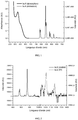
- the figure 1 shows the absorption and emission spectrum of complex Ia.4 in water at room temperature.
- Table 1 ⁇ /b> -Photophysical properties of the complexes ⁇ b> Ia.1-Ia.6, 8 ⁇ /b> and ⁇ b> 9 ⁇ /b> measured in methanol complex ⁇ max (nm) ⁇ (L.mol -1 . cm -1 ) ⁇ (%) T (ms) B at ⁇ max (L.mol -1 .
- the Dysprosium Ia.5 and Ia.6 complexes also exhibit remarkable photophysical properties, in methanol and in water. These complexes are among the brightest complexes reported in the literature.
- the figure 2 shows the absorption and emission spectrum of complex Ia.6 in a methanol / ethanol mixture at room temperature.
- the Ia.2 complex has shown significant interest in one- or two-photon fluorescence microscopy imaging.
- the emission spectra confirm the presence of Ia.2 inside the cell and not in the buffer.
- the internalization of the Ia.5 complex in the cell is confirmed by the emission spectra.
Landscapes
- Chemical & Material Sciences (AREA)
- Organic Chemistry (AREA)
- Physics & Mathematics (AREA)
- Engineering & Computer Science (AREA)
- Biochemistry (AREA)
- Health & Medical Sciences (AREA)
- Life Sciences & Earth Sciences (AREA)
- Analytical Chemistry (AREA)
- Plasma & Fusion (AREA)
- General Health & Medical Sciences (AREA)
- General Physics & Mathematics (AREA)
- Immunology (AREA)
- Pathology (AREA)
- Chemical Kinetics & Catalysis (AREA)
- Materials Engineering (AREA)
- Investigating Or Analyzing Non-Biological Materials By The Use Of Chemical Means (AREA)
- Plural Heterocyclic Compounds (AREA)
Claims (15)
- Lanthanidkomplex, umfassend einen Chelatbildner, gebildet von einem Makrocyclus oder einem Ligand, ein Lanthanid-Ion Ln3+ komplexierend, dadurch gekennzeichnet, dass das Lanthanid aus Terbium und Dysprosium ausgewählt ist und dass der Chelatbildner mindestens eine Gruppe (B) mit der folgenden Struktur umfasst:
 - -R1 für einen Wasserstoff, eine Gruppe -R6 oder eine Elektronendonatorgruppe -E1 steht,- -R2 für einen Wasserstoff, eine Gruppe -R7 oder eine Elektronendonatorgruppe -E2 steht,- -R3 für einen Wasserstoff, eine Gruppe -R8 oder eine Elektronendonatorgruppe -E3 steht,- -R4 und -R5, gleich oder verschieden, unabhängig voneinander für einen Wasserstoff oder eine Gruppe -R9 oder -OR9 stehen,- -E1, -E2 und -E3 unabhängig voneinander aus den Gruppen -OR10, -SR10, -NH(CO)R10, -NH(CO)NR10R'10, -NH(CS)NR10R'10 und -NH(CS)NHR10 ausgewählt sind,- -R6, -R7, -R8, -R9, -R10 und R'10, gleich oder verschieden, unabhängig voneinander für eine (C1-C6)-Alkylgruppe stehen, eventuell durch eine Gruppe -X1 oder eine Gruppe -Y substituiert,- -X1 eine reaktive Gruppe ist, seine Kopplung an ein Biomolekül durch kovalente Bindung ermöglichend,- -Y eine wasserlöslich machende Gruppe ist, ausgewählt aus den Gruppen -SO3 -, -COO-, Sulfobetain und -O-[(CH2)2-O]m-CH3 ausgewählt, wobei m eine ganze Zahl ist, die von 1 bis 10 reicht,- mit der Maßgabe, dass:∘ mindestens einer der Substituenten -R2 und -R3 kein Wasserstoff ist,∘ eine einzige der Gruppen -R1, -R2 und -R3 für eine Elektronendonatorgruppe steht,∘ der Chelatbildner höchstens eine reaktive Gruppe umfasst.
 - Lanthanidkomplex nach Anspruch 1, ausgewählt aus den Lanthanidkomplexen der Formel (I):
 - Ln ein Lanthanid ist, ausgewählt aus Tb und Dy,- -A- für -CH2- oder -CH(LA-X2)- steht,- -LA- eine kovalente Bindung oder eine (C1-C20)-Alkylengruppe ist, linear oder verzweigt, eventuell eine oder mehrere Doppel- oder Dreifachbindungen enthaltend und eventuell durch eine bis drei Gruppen -SO3H substituiert, oder -LA -eine (C5-C8)-Cycloalkylengruppe oder eine (C6-C14)-Arylengruppe ist,- -X2 eine reaktive Gruppe ist, seine Kopplung an ein Biomolekül durch kovalente Bindung ermöglichend,- -Chrom1, -Chrom2 und -Chrom3 gleich oder verschieden sind und unabhängig voneinander aus den Gruppen der Formel (B1) ausgewählt sind:
 - wobei -R1, -R2, -R3, -R4 und -R5 wie in Anspruch 1 definiert sind,- -Z- für -C- oder -P(Rz)- steht und- -Rz- für eine Phenyl-, Benzyl-, Methyl-, Ethyl-, Propyl-, n-Butyl-, sek.-Butyl-, Isobutyl- oder tert.-Butylgruppe und vorzugsweise eine Phenyl- oder Methylgruppe steht,- mit der Maßgabe, dass, wenn -A- -CH(LA-X2)- ist, keine der Gruppen -Chrom1, -Chrom2 und -Chrom3 der Formel (B1) eine Gruppe -X1 umfasst.
 - Lanthanidkomplex nach Anspruch 2, dadurch gekennzeichnet, dass -A- für -CH2- steht und -Z- für -C- steht.
- Lanthanidkomplex nach Anspruch 2 oder 3, dadurch gekennzeichnet, dass:- -Chrom1, -Chrom2 und -Chrom3 gleich sind,- -R1 für eine Elektronendonatorgruppe -E1 wie in Anspruch 1 definiert steht,- -R2 für eine Gruppe -R7 wie in Anspruch 1 definiert steht und- -R3 für eine Gruppe -R8 wie in Anspruch 1 definiert steht.
- Lanthanidkomplex nach Anspruch 2 oder 3, in dem:- -A- für -CH2- steht,- -Chrom1 und -Chrom2 gleich sind und die Struktur (B2) aufweisen:
 - -Chrom3 sich von -Chrom1 und -Chrom2 unterscheidet und die Struktur (B3) aufweist:
 - wobei -R12, -R22, -R32, -R42, -R52 und -Z2- wie für -R1, -R2, -R3, -R4, -R5 bzw. -Z- in einem der Ansprüche 1 bis 3 definiert sind, mit der Maßgabe, dass -Chrom3 eine reaktive Gruppe umfasst.
 - Lanthanidkomplex nach Anspruch 1, ausgewählt aus den Lanthanidkomplexen der Formel (II):
 - Ln ein Lanthanid ist, ausgewählt aus Tb und Dy,- -R11 und -R12, gleich oder verschieden, unabhängig voneinander aus -X1, -Y, einem Wasserstoffatom oder einer (C1-C6)-Alkylgruppe ausgewählt sind,- -Chrom4-, -Chrom5- und -Chrom6-, gleich oder verschieden, unabhängig voneinander für eine Gruppe der Formel (B) wie in Anspruch 1 definiert stehen.
 - Lanthanidkomplex nach Anspruch 6, dadurch gekennzeichnet, dass:- -Chrom4-, -Chrom5- und -Chrom6- gleich sind,- -R1 für eine Elektronendonatorgruppe -E1 wie in Anspruch 1 definiert steht,- -R2 eine Gruppe -R7 wie in Anspruch 1 definiert ist und- -R3 eine Gruppe -R8 wie in Anspruch 1 definiert ist.
- Lanthanidkomplex nach Anspruch 6, dadurch gekennzeichnet, dass:• entweder:- -Chrom5- und -Chrom6- gleich sind und die Struktur (B10) aufweisen:
 - -Chrom4- sich von -Chrom5- und -Chrom6- unterscheidet und die Struktur (B11) aufweist:
 • oder:- -Chrom4- und -Chrom6- gleich sind und die Struktur (B12) aufweisen:
 - -Chrom5- sich von -Chrom4- und -Chrom6- unterscheidet und die Struktur (B13) aufweist:
- Lanthanidkomplex nach einem der Ansprüche 1 bis 8, dadurch gekennzeichnet, dass -R4 und -R5 für Wasserstoffe stehen.
- Lanthanidkomplex nach einem der Ansprüche 1 bis 9, dadurch gekennzeichnet, dass die reaktiven Gruppierungen -X1 und -X2 unabhängig aus -COOH, -NH2, einem Acrylamid, einem aktivierten Amin, einem aktivierten Ester, einem Aldehyd, einem Alkylhalogenid, einem Anhydrid, einem Anilin, einem Azid, einem Aziridin, einer Carbonsäure, einem Diazoalkan, einem Haloacetamid, einem Halotriazin, einem Hydrazin, einem Imidoester, einem Isocyanat, einem Isothiocyanat, einem Maleinimid, einem Sulfonylhalogenid, einem Thiol, einem Keton, einem Säurehalogenid, einem Hydroxysuccinimidylester, einem Succinimidylester, einem Hydroxysulfosuccinimidylester, einem Azidonitrophenyl, einem Azidophenyl, einem 3-(2-Pyridyldithio)propanamid, einem Glyoxal, einem Triazin, einer Acetylengruppe und den Gruppen der Formel:




- Lanthanidkomplex nach einem der Ansprüche 1 bis 10, dadurch gekennzeichnet, dass er eine einzige reaktive Gruppe umfasst, seine Kopplung an ein Biomolekül durch kovalente Bindung ermöglichend, wobei die reaktive Gruppe vorzugsweise aus -COOH, -NH2, einem Acrylamid, einem aktivierten Amin, einem aktivierten Ester, einem Aldehyd, einem Alkylhalogenid, einem Anhydrid, einem Anilin, einem Azid, einem Aziridin, einer Carbonsäure, einem Diazoalkan, einem Haloacetamid, einem Halotriazin, einem Hydrazin, einem Imidoester, einem Isocyanat, einem Isothiocyanat, einem Maleinimid, einem Sulfonylhalogenid, einem Thiol, einem Keton, einem Säurehalogenid, einem Hydroxysuccinimidylester, einem Succinimidylester, einem Hydroxysulfosuccinimidylester, einem Azidonitrophenyl, einem Azidophenyl, einem 3-(2-Pyridyldithio)propanamid, einem Glyoxal, einem Triazin, einer Acetylengruppe und den Gruppen der Formel:


wobei die reaktiven Gruppen, die aus -COOH, -NH2, Succinimidylestern, Haloacetamiden, Aziden, Hydrazinen, Isocyanaten und Maleinimiden ausgewählt sind, bevorzugt sind. - Lanthanidkomplex nach einem der Ansprüche 1 bis 11, dadurch gekennzeichnet, dass die Gruppe Y aus -SO3 -, -COO-, Sulfobetaingruppen und -O-[(CH2)2-O]m-CH3 ausgewählt ist, wobei m eine ganze Zahl ist, die von 1 bis 10 reicht, vorzugsweise m = 3.
- Lanthanidkomplex nach einem der Ansprüche 1 bis 12, dadurch gekennzeichnet, dass Ln Terbium ist.
- Chelatbildner der Formel (III) oder der Formel (IV):
 - wobei -Chrom1', -Chrom2' und -Chrom3', gleich oder verschieden, unabhängig voneinander aus den Gruppen der Formel (B5) ausgewählt sind:
 - wobei R1, R2, R3, R4 und R5 wie in Anspruch 1 definiert sind,- wobei -Chrom4-, -Chrom5- und -Chrom6- wie in einem der Ansprüche 6 bis 8 definiert sind- und -R13 eine Schutzgruppe von Säurefunktionen ist oder in der Form eines Salzes ist.
 - Verfahren zum Nachweis eines Biomoleküls, umfassend den Nachweis der Lumineszenz eines Konjugats des Biomoleküls mit einem lumineszierenden Komplex nach einem der Ansprüche 1 bis 13, umfassend eine reaktive Gruppe, und erhalten durch Kopplung des Biomoleküls mit dem lumineszierenden Komplex an seiner reaktiven Gruppe.
Applications Claiming Priority (2)
| Application Number | Priority Date | Filing Date | Title |
|---|---|---|---|
| FR1756385A FR3068696B1 (fr) | 2017-07-06 | 2017-07-06 | Complexes de terbium et de dysprosium avec antenne optimisee, utiles comme marqueurs luminescents |
| PCT/EP2018/068302 WO2019008118A1 (fr) | 2017-07-06 | 2018-07-05 | Complexes de terbium et de dysprosium avec antenne optimisée, utiles comme marqueurs luminescents |
Publications (2)
| Publication Number | Publication Date |
|---|---|
| EP3649214A1 EP3649214A1 (de) | 2020-05-13 |
| EP3649214B1 true EP3649214B1 (de) | 2021-03-17 |
Family
ID=60450755
Family Applications (1)
| Application Number | Title | Priority Date | Filing Date |
|---|---|---|---|
| EP18742729.9A Active EP3649214B1 (de) | 2017-07-06 | 2018-07-05 | Terbium und dysprosiumkomplexe mit optimierter antenne zur verwendung als lumineszenzmarker |
Country Status (4)
| Country | Link |
|---|---|
| US (1) | US11649253B2 (de) |
| EP (1) | EP3649214B1 (de) |
| FR (1) | FR3068696B1 (de) |
| WO (1) | WO2019008118A1 (de) |
Family Cites Families (7)
| Publication number | Priority date | Publication date | Assignee | Title |
|---|---|---|---|---|
| EP1694672B1 (de) * | 2003-12-18 | 2012-06-20 | Wallac Oy | Neue chelatisierungsmittel und hochlumineszente und stabile chelate sowie deren anwendung |
| US8071626B2 (en) * | 2003-12-18 | 2011-12-06 | Wallac Oy | Chelating agents and highly luminescent and stable chelates and their use |
| FR2978149B1 (fr) | 2011-07-18 | 2014-01-10 | Cisbio Bioassays | Nouveaux agents complexants et complexes de lanthanide correspondant, et leur utilisation comme marqueurs luminescents |
| JP5818990B2 (ja) | 2011-08-19 | 2015-11-18 | デーホーアェル・フィンランド・オサケユキチュア | 3つの発色団を有する発光ランタニドキレート及びそれらの使用 |
| CN104125997B (zh) | 2011-12-22 | 2017-03-08 | 雷度米特图尔库公司 | 具有提升的激发性质的新型发光镧系元素螯合物 |
| WO2014147288A1 (en) | 2013-01-31 | 2014-09-25 | Kaivogen Oy | Luminescent triazacyclononane-based lanthanide chelate complexes as labelling reagents |
| FR3004189B1 (fr) | 2013-04-04 | 2015-09-04 | Ecole Norm Superieure Lyon | Complexes de lanthanide comprenant au moins deux groupes betaines, utiles comme marqueurs luminescents |
-
2017
- 2017-07-06 FR FR1756385A patent/FR3068696B1/fr active Active
-
2018
- 2018-07-05 US US16/628,854 patent/US11649253B2/en active Active
- 2018-07-05 WO PCT/EP2018/068302 patent/WO2019008118A1/fr not_active Ceased
- 2018-07-05 EP EP18742729.9A patent/EP3649214B1/de active Active
Non-Patent Citations (1)
| Title |
|---|
| None * |
Also Published As
| Publication number | Publication date |
|---|---|
| US11649253B2 (en) | 2023-05-16 |
| FR3068696B1 (fr) | 2026-01-02 |
| EP3649214A1 (de) | 2020-05-13 |
| FR3068696A1 (fr) | 2019-01-11 |
| WO2019008118A1 (fr) | 2019-01-10 |
| US20200223869A1 (en) | 2020-07-16 |
Similar Documents
| Publication | Publication Date | Title |
|---|---|---|
| EP2470547B1 (de) | Pyrrolo[1,4]benzodiazepindimerkonjugate als antikrebsmittel | |
| EP2981590B1 (de) | Lanthanidkomplexe mit mindestens zwei als lumineszenzmarker verwendbaren betaingruppen | |
| US11988667B2 (en) | Fluorescent compound and fluorescent labeled biological substance using the same | |
| FR2963007A1 (fr) | Derives anticancereux, leur preparation et leur application therapeutique | |
| FR2978149A1 (fr) | Nouveaux agents complexants et complexes de lanthanide correspondant, et leur utilisation comme marqueurs luminescents | |
| Hao et al. | Synthesis of porphyrin-carbohydrate conjugates using" click" chemistry and their preliminary evaluation in human HEp2 cells | |
| EP2691402B1 (de) | Bifunktionelle hydroxy-bisphosphonsäurederivate | |
| EP3638659B1 (de) | Neue wasserlösliche monoverzweigte und diverzweigte komplexbildner und entsprechende lanthanidkomplexe | |
| EP2183230B1 (de) | Neue fluoreszente derivate von polyamin, verfahren zu deren herstellung und deren anwendung als diagnosewerkzeuge bei der behandlung von krebsartigen tumoren | |
| EP3386974B1 (de) | Wasserlösliche triazapyridinophanbasierte komplexbildner und entsprechende fluoreszierende lanthanidkomplexe | |
| EP3868838A2 (de) | Fluoreszenter farbstoffmaterial und verwendung davon | |
| WO2010070232A1 (fr) | Nouveaux cryptates de terres rares comportant un motif tetraazatriphenylene | |
| EP3649214A1 (de) | Terbium und dysprosiumkomplexe mit optimierter antenne zur verwendung als lumineszenzmarker | |
| EP4007639B1 (de) | Phenazinderivate und ihre verwendung zur behandlung von krebs | |
| US8715529B1 (en) | Synthesis and applications of triazaborolopyridinium compounds and substituted triazaborolopyridinium compounds and methods of use | |
| EP2903973B1 (de) | Neue azide, verfahren zur herstellung davon und anwendungen davon | |
| FR3037955A1 (fr) | Ligands polydentates et complexes metalliques | |
| CA3007797C (fr) | Agents complexants hydrosolubles a base de triazapyridinophane et complexes de lanthanide fluorescents correspondants | |
| FR3067712B1 (fr) | Nouveaux agents complexants de type trimethoxyphenyl pyridine hydrosolubles et complexes de lanthanide correspondants | |
| WO2025263594A1 (ja) | 化合物及び一重項酸素生成材料 | |
| FR3064266A1 (fr) | Plateforme tetrazine modulaire biocompatible | |
| FR3086290A1 (fr) | Complexes de cycloheptyne-cobalt carbonyles et leurs applications en bioconjugaison | |
| EP1648883A2 (de) | Herstellung von lanthanidkomplexen und deren verwendungen |
Legal Events
| Date | Code | Title | Description |
|---|---|---|---|
| STAA | Information on the status of an ep patent application or granted ep patent |
Free format text: STATUS: UNKNOWN |
|
| STAA | Information on the status of an ep patent application or granted ep patent |
Free format text: STATUS: THE INTERNATIONAL PUBLICATION HAS BEEN MADE |
|
| PUAI | Public reference made under article 153(3) epc to a published international application that has entered the european phase |
Free format text: ORIGINAL CODE: 0009012 |
|
| STAA | Information on the status of an ep patent application or granted ep patent |
Free format text: STATUS: REQUEST FOR EXAMINATION WAS MADE |
|
| 17P | Request for examination filed |
Effective date: 20200117 |
|
| AK | Designated contracting states |
Kind code of ref document: A1 Designated state(s): AL AT BE BG CH CY CZ DE DK EE ES FI FR GB GR HR HU IE IS IT LI LT LU LV MC MK MT NL NO PL PT RO RS SE SI SK SM TR |
|
| AX | Request for extension of the european patent |
Extension state: BA ME |
|
| DAV | Request for validation of the european patent (deleted) | ||
| DAX | Request for extension of the european patent (deleted) | ||
| GRAP | Despatch of communication of intention to grant a patent |
Free format text: ORIGINAL CODE: EPIDOSNIGR1 |
|
| STAA | Information on the status of an ep patent application or granted ep patent |
Free format text: STATUS: GRANT OF PATENT IS INTENDED |
|
| INTG | Intention to grant announced |
Effective date: 20201117 |
|
| GRAS | Grant fee paid |
Free format text: ORIGINAL CODE: EPIDOSNIGR3 |
|
| GRAA | (expected) grant |
Free format text: ORIGINAL CODE: 0009210 |
|
| STAA | Information on the status of an ep patent application or granted ep patent |
Free format text: STATUS: THE PATENT HAS BEEN GRANTED |
|
| AK | Designated contracting states |
Kind code of ref document: B1 Designated state(s): AL AT BE BG CH CY CZ DE DK EE ES FI FR GB GR HR HU IE IS IT LI LT LU LV MC MK MT NL NO PL PT RO RS SE SI SK SM TR |
|
| REG | Reference to a national code |
Ref country code: GB Ref legal event code: FG4D Free format text: NOT ENGLISH |
|
| REG | Reference to a national code |
Ref country code: CH Ref legal event code: EP |
|
| REG | Reference to a national code |
Ref country code: DE Ref legal event code: R096 Ref document number: 602018014128 Country of ref document: DE |
|
| REG | Reference to a national code |
Ref country code: IE Ref legal event code: FG4D Free format text: LANGUAGE OF EP DOCUMENT: FRENCH |
|
| REG | Reference to a national code |
Ref country code: AT Ref legal event code: REF Ref document number: 1372248 Country of ref document: AT Kind code of ref document: T Effective date: 20210415 |
|
| REG | Reference to a national code |
Ref country code: LT Ref legal event code: MG9D |
|
| PG25 | Lapsed in a contracting state [announced via postgrant information from national office to epo] |
Ref country code: BG Free format text: LAPSE BECAUSE OF FAILURE TO SUBMIT A TRANSLATION OF THE DESCRIPTION OR TO PAY THE FEE WITHIN THE PRESCRIBED TIME-LIMIT Effective date: 20210617 Ref country code: FI Free format text: LAPSE BECAUSE OF FAILURE TO SUBMIT A TRANSLATION OF THE DESCRIPTION OR TO PAY THE FEE WITHIN THE PRESCRIBED TIME-LIMIT Effective date: 20210317 Ref country code: HR Free format text: LAPSE BECAUSE OF FAILURE TO SUBMIT A TRANSLATION OF THE DESCRIPTION OR TO PAY THE FEE WITHIN THE PRESCRIBED TIME-LIMIT Effective date: 20210317 Ref country code: GR Free format text: LAPSE BECAUSE OF FAILURE TO SUBMIT A TRANSLATION OF THE DESCRIPTION OR TO PAY THE FEE WITHIN THE PRESCRIBED TIME-LIMIT Effective date: 20210618 Ref country code: NO Free format text: LAPSE BECAUSE OF FAILURE TO SUBMIT A TRANSLATION OF THE DESCRIPTION OR TO PAY THE FEE WITHIN THE PRESCRIBED TIME-LIMIT Effective date: 20210617 |
|
| REG | Reference to a national code |
Ref country code: AT Ref legal event code: MK05 Ref document number: 1372248 Country of ref document: AT Kind code of ref document: T Effective date: 20210317 |
|
| REG | Reference to a national code |
Ref country code: NL Ref legal event code: MP Effective date: 20210317 |
|
| PG25 | Lapsed in a contracting state [announced via postgrant information from national office to epo] |
Ref country code: LV Free format text: LAPSE BECAUSE OF FAILURE TO SUBMIT A TRANSLATION OF THE DESCRIPTION OR TO PAY THE FEE WITHIN THE PRESCRIBED TIME-LIMIT Effective date: 20210317 Ref country code: RS Free format text: LAPSE BECAUSE OF FAILURE TO SUBMIT A TRANSLATION OF THE DESCRIPTION OR TO PAY THE FEE WITHIN THE PRESCRIBED TIME-LIMIT Effective date: 20210317 Ref country code: SE Free format text: LAPSE BECAUSE OF FAILURE TO SUBMIT A TRANSLATION OF THE DESCRIPTION OR TO PAY THE FEE WITHIN THE PRESCRIBED TIME-LIMIT Effective date: 20210317 |
|
| PG25 | Lapsed in a contracting state [announced via postgrant information from national office to epo] |
Ref country code: NL Free format text: LAPSE BECAUSE OF FAILURE TO SUBMIT A TRANSLATION OF THE DESCRIPTION OR TO PAY THE FEE WITHIN THE PRESCRIBED TIME-LIMIT Effective date: 20210317 |
|
| PG25 | Lapsed in a contracting state [announced via postgrant information from national office to epo] |
Ref country code: CZ Free format text: LAPSE BECAUSE OF FAILURE TO SUBMIT A TRANSLATION OF THE DESCRIPTION OR TO PAY THE FEE WITHIN THE PRESCRIBED TIME-LIMIT Effective date: 20210317 Ref country code: EE Free format text: LAPSE BECAUSE OF FAILURE TO SUBMIT A TRANSLATION OF THE DESCRIPTION OR TO PAY THE FEE WITHIN THE PRESCRIBED TIME-LIMIT Effective date: 20210317 Ref country code: LT Free format text: LAPSE BECAUSE OF FAILURE TO SUBMIT A TRANSLATION OF THE DESCRIPTION OR TO PAY THE FEE WITHIN THE PRESCRIBED TIME-LIMIT Effective date: 20210317 Ref country code: AT Free format text: LAPSE BECAUSE OF FAILURE TO SUBMIT A TRANSLATION OF THE DESCRIPTION OR TO PAY THE FEE WITHIN THE PRESCRIBED TIME-LIMIT Effective date: 20210317 Ref country code: SM Free format text: LAPSE BECAUSE OF FAILURE TO SUBMIT A TRANSLATION OF THE DESCRIPTION OR TO PAY THE FEE WITHIN THE PRESCRIBED TIME-LIMIT Effective date: 20210317 |
|
| PG25 | Lapsed in a contracting state [announced via postgrant information from national office to epo] |
Ref country code: SK Free format text: LAPSE BECAUSE OF FAILURE TO SUBMIT A TRANSLATION OF THE DESCRIPTION OR TO PAY THE FEE WITHIN THE PRESCRIBED TIME-LIMIT Effective date: 20210317 Ref country code: RO Free format text: LAPSE BECAUSE OF FAILURE TO SUBMIT A TRANSLATION OF THE DESCRIPTION OR TO PAY THE FEE WITHIN THE PRESCRIBED TIME-LIMIT Effective date: 20210317 Ref country code: PT Free format text: LAPSE BECAUSE OF FAILURE TO SUBMIT A TRANSLATION OF THE DESCRIPTION OR TO PAY THE FEE WITHIN THE PRESCRIBED TIME-LIMIT Effective date: 20210719 Ref country code: PL Free format text: LAPSE BECAUSE OF FAILURE TO SUBMIT A TRANSLATION OF THE DESCRIPTION OR TO PAY THE FEE WITHIN THE PRESCRIBED TIME-LIMIT Effective date: 20210317 Ref country code: IS Free format text: LAPSE BECAUSE OF FAILURE TO SUBMIT A TRANSLATION OF THE DESCRIPTION OR TO PAY THE FEE WITHIN THE PRESCRIBED TIME-LIMIT Effective date: 20210717 |
|
| REG | Reference to a national code |
Ref country code: DE Ref legal event code: R097 Ref document number: 602018014128 Country of ref document: DE |
|
| PLBE | No opposition filed within time limit |
Free format text: ORIGINAL CODE: 0009261 |
|
| STAA | Information on the status of an ep patent application or granted ep patent |
Free format text: STATUS: NO OPPOSITION FILED WITHIN TIME LIMIT |
|
| PG25 | Lapsed in a contracting state [announced via postgrant information from national office to epo] |
Ref country code: ES Free format text: LAPSE BECAUSE OF FAILURE TO SUBMIT A TRANSLATION OF THE DESCRIPTION OR TO PAY THE FEE WITHIN THE PRESCRIBED TIME-LIMIT Effective date: 20210317 Ref country code: DK Free format text: LAPSE BECAUSE OF FAILURE TO SUBMIT A TRANSLATION OF THE DESCRIPTION OR TO PAY THE FEE WITHIN THE PRESCRIBED TIME-LIMIT Effective date: 20210317 Ref country code: AL Free format text: LAPSE BECAUSE OF FAILURE TO SUBMIT A TRANSLATION OF THE DESCRIPTION OR TO PAY THE FEE WITHIN THE PRESCRIBED TIME-LIMIT Effective date: 20210317 |
|
| 26N | No opposition filed |
Effective date: 20211220 |
|
| PG25 | Lapsed in a contracting state [announced via postgrant information from national office to epo] |
Ref country code: MC Free format text: LAPSE BECAUSE OF FAILURE TO SUBMIT A TRANSLATION OF THE DESCRIPTION OR TO PAY THE FEE WITHIN THE PRESCRIBED TIME-LIMIT Effective date: 20210317 |
|
| PG25 | Lapsed in a contracting state [announced via postgrant information from national office to epo] |
Ref country code: IS Free format text: LAPSE BECAUSE OF FAILURE TO SUBMIT A TRANSLATION OF THE DESCRIPTION OR TO PAY THE FEE WITHIN THE PRESCRIBED TIME-LIMIT Effective date: 20210717 Ref country code: LU Free format text: LAPSE BECAUSE OF NON-PAYMENT OF DUE FEES Effective date: 20210705 |
|
| PG25 | Lapsed in a contracting state [announced via postgrant information from national office to epo] |
Ref country code: IE Free format text: LAPSE BECAUSE OF NON-PAYMENT OF DUE FEES Effective date: 20210705 |
|
| PG25 | Lapsed in a contracting state [announced via postgrant information from national office to epo] |
Ref country code: CY Free format text: LAPSE BECAUSE OF FAILURE TO SUBMIT A TRANSLATION OF THE DESCRIPTION OR TO PAY THE FEE WITHIN THE PRESCRIBED TIME-LIMIT Effective date: 20210317 |
|
| P01 | Opt-out of the competence of the unified patent court (upc) registered |
Effective date: 20230527 |
|
| PG25 | Lapsed in a contracting state [announced via postgrant information from national office to epo] |
Ref country code: HU Free format text: LAPSE BECAUSE OF FAILURE TO SUBMIT A TRANSLATION OF THE DESCRIPTION OR TO PAY THE FEE WITHIN THE PRESCRIBED TIME-LIMIT; INVALID AB INITIO Effective date: 20180705 |
|
| PG25 | Lapsed in a contracting state [announced via postgrant information from national office to epo] |
Ref country code: SI Free format text: LAPSE BECAUSE OF FAILURE TO SUBMIT A TRANSLATION OF THE DESCRIPTION OR TO PAY THE FEE WITHIN THE PRESCRIBED TIME-LIMIT Effective date: 20210317 |
|
| PG25 | Lapsed in a contracting state [announced via postgrant information from national office to epo] |
Ref country code: MK Free format text: LAPSE BECAUSE OF FAILURE TO SUBMIT A TRANSLATION OF THE DESCRIPTION OR TO PAY THE FEE WITHIN THE PRESCRIBED TIME-LIMIT Effective date: 20210317 |
|
| PG25 | Lapsed in a contracting state [announced via postgrant information from national office to epo] |
Ref country code: MT Free format text: LAPSE BECAUSE OF FAILURE TO SUBMIT A TRANSLATION OF THE DESCRIPTION OR TO PAY THE FEE WITHIN THE PRESCRIBED TIME-LIMIT Effective date: 20210317 |
|
| PGFP | Annual fee paid to national office [announced via postgrant information from national office to epo] |
Ref country code: DE Payment date: 20250711 Year of fee payment: 8 |
|
| PGFP | Annual fee paid to national office [announced via postgrant information from national office to epo] |
Ref country code: IT Payment date: 20250708 Year of fee payment: 8 |
|
| PGFP | Annual fee paid to national office [announced via postgrant information from national office to epo] |
Ref country code: BE Payment date: 20250724 Year of fee payment: 8 Ref country code: GB Payment date: 20250723 Year of fee payment: 8 |
|
| PGFP | Annual fee paid to national office [announced via postgrant information from national office to epo] |
Ref country code: FR Payment date: 20250730 Year of fee payment: 8 |
|
| PGFP | Annual fee paid to national office [announced via postgrant information from national office to epo] |
Ref country code: CH Payment date: 20250801 Year of fee payment: 8 |
|
| PG25 | Lapsed in a contracting state [announced via postgrant information from national office to epo] |
Ref country code: TR Free format text: LAPSE BECAUSE OF FAILURE TO SUBMIT A TRANSLATION OF THE DESCRIPTION OR TO PAY THE FEE WITHIN THE PRESCRIBED TIME-LIMIT Effective date: 20210317 |