EP3655314B1 - A method of performing an eye examination test - Google Patents
A method of performing an eye examination test Download PDFInfo
- Publication number
- EP3655314B1 EP3655314B1 EP18766362.0A EP18766362A EP3655314B1 EP 3655314 B1 EP3655314 B1 EP 3655314B1 EP 18766362 A EP18766362 A EP 18766362A EP 3655314 B1 EP3655314 B1 EP 3655314B1
- Authority
- EP
- European Patent Office
- Prior art keywords
- user
- distance
- screen
- computing device
- pupils
- Prior art date
- Legal status (The legal status is an assumption and is not a legal conclusion. Google has not performed a legal analysis and makes no representation as to the accuracy of the status listed.)
- Active
Links
Images
Classifications
-
- A—HUMAN NECESSITIES
- A61—MEDICAL OR VETERINARY SCIENCE; HYGIENE
- A61B—DIAGNOSIS; SURGERY; IDENTIFICATION
- A61B3/00—Apparatus for testing the eyes; Instruments for examining the eyes
- A61B3/10—Objective types, i.e. instruments for examining the eyes independent of the patients' perceptions or reactions
- A61B3/14—Arrangements specially adapted for eye photography
-
- A—HUMAN NECESSITIES
- A61—MEDICAL OR VETERINARY SCIENCE; HYGIENE
- A61B—DIAGNOSIS; SURGERY; IDENTIFICATION
- A61B3/00—Apparatus for testing the eyes; Instruments for examining the eyes
- A61B3/0016—Operational features thereof
- A61B3/0025—Operational features thereof characterised by electronic signal processing, e.g. eye models
-
- A—HUMAN NECESSITIES
- A61—MEDICAL OR VETERINARY SCIENCE; HYGIENE
- A61B—DIAGNOSIS; SURGERY; IDENTIFICATION
- A61B3/00—Apparatus for testing the eyes; Instruments for examining the eyes
- A61B3/0016—Operational features thereof
- A61B3/0041—Operational features thereof characterised by display arrangements
-
- G—PHYSICS
- G06—COMPUTING OR CALCULATING; COUNTING
- G06F—ELECTRIC DIGITAL DATA PROCESSING
- G06F3/00—Input arrangements for transferring data to be processed into a form capable of being handled by the computer; Output arrangements for transferring data from processing unit to output unit, e.g. interface arrangements
- G06F3/01—Input arrangements or combined input and output arrangements for interaction between user and computer
- G06F3/011—Arrangements for interaction with the human body, e.g. for user immersion in virtual reality
- G06F3/013—Eye tracking input arrangements
-
- G—PHYSICS
- G06—COMPUTING OR CALCULATING; COUNTING
- G06V—IMAGE OR VIDEO RECOGNITION OR UNDERSTANDING
- G06V40/00—Recognition of biometric, human-related or animal-related patterns in image or video data
- G06V40/10—Human or animal bodies, e.g. vehicle occupants or pedestrians; Body parts, e.g. hands
- G06V40/16—Human faces, e.g. facial parts, sketches or expressions
- G06V40/168—Feature extraction; Face representation
- G06V40/171—Local features and components; Facial parts ; Occluding parts, e.g. glasses; Geometrical relationships
-
- G—PHYSICS
- G06—COMPUTING OR CALCULATING; COUNTING
- G06V—IMAGE OR VIDEO RECOGNITION OR UNDERSTANDING
- G06V40/00—Recognition of biometric, human-related or animal-related patterns in image or video data
- G06V40/10—Human or animal bodies, e.g. vehicle occupants or pedestrians; Body parts, e.g. hands
- G06V40/18—Eye characteristics, e.g. of the iris
- G06V40/193—Preprocessing; Feature extraction
-
- G—PHYSICS
- G06—COMPUTING OR CALCULATING; COUNTING
- G06V—IMAGE OR VIDEO RECOGNITION OR UNDERSTANDING
- G06V40/00—Recognition of biometric, human-related or animal-related patterns in image or video data
- G06V40/60—Static or dynamic means for assisting the user to position a body part for biometric acquisition
- G06V40/67—Static or dynamic means for assisting the user to position a body part for biometric acquisition by interactive indications to the user
-
- H—ELECTRICITY
- H04—ELECTRIC COMMUNICATION TECHNIQUE
- H04N—PICTORIAL COMMUNICATION, e.g. TELEVISION
- H04N23/00—Cameras or camera modules comprising electronic image sensors; Control thereof
- H04N23/50—Constructional details
- H04N23/54—Mounting of pick-up tubes, electronic image sensors, deviation or focusing coils
-
- H—ELECTRICITY
- H04—ELECTRIC COMMUNICATION TECHNIQUE
- H04N—PICTORIAL COMMUNICATION, e.g. TELEVISION
- H04N23/00—Cameras or camera modules comprising electronic image sensors; Control thereof
- H04N23/60—Control of cameras or camera modules
- H04N23/67—Focus control based on electronic image sensor signals
-
- A—HUMAN NECESSITIES
- A61—MEDICAL OR VETERINARY SCIENCE; HYGIENE
- A61B—DIAGNOSIS; SURGERY; IDENTIFICATION
- A61B3/00—Apparatus for testing the eyes; Instruments for examining the eyes
- A61B3/02—Subjective types, i.e. testing apparatus requiring the active assistance of the patient
- A61B3/028—Subjective types, i.e. testing apparatus requiring the active assistance of the patient for testing visual acuity; for determination of refraction, e.g. phoropters
- A61B3/032—Devices for presenting test symbols or characters, e.g. test chart projectors
-
- A—HUMAN NECESSITIES
- A61—MEDICAL OR VETERINARY SCIENCE; HYGIENE
- A61B—DIAGNOSIS; SURGERY; IDENTIFICATION
- A61B3/00—Apparatus for testing the eyes; Instruments for examining the eyes
- A61B3/10—Objective types, i.e. instruments for examining the eyes independent of the patients' perceptions or reactions
- A61B3/11—Objective types, i.e. instruments for examining the eyes independent of the patients' perceptions or reactions for measuring interpupillary distance or diameter of pupils
- A61B3/111—Objective types, i.e. instruments for examining the eyes independent of the patients' perceptions or reactions for measuring interpupillary distance or diameter of pupils for measuring interpupillary distance
-
- G—PHYSICS
- G06—COMPUTING OR CALCULATING; COUNTING
- G06T—IMAGE DATA PROCESSING OR GENERATION, IN GENERAL
- G06T2207/00—Indexing scheme for image analysis or image enhancement
- G06T2207/30—Subject of image; Context of image processing
- G06T2207/30196—Human being; Person
- G06T2207/30201—Face
Definitions
- the present disclosure is directed to a method of performing an eye examination test. More specifically, the present disclosure is directed to an eye examination test using a computing device as well as a User Equipment.
- An eye examination test is, typically, a series of tests performed by a professional, for example an optician, an ophthalmologist or anything alike.
- An eye examination test may be used for testing the visual acuity, pupil function, extraocular muscle motility, ophthalmoscopty through an undilated pupil, amongst other things.
- the assessment of the refractive state of the eye may also be an important part of ophthalmic and optometric clinical practice.
- Such eye examination tests may also be used to detect potentially treatable blinding eye diseases, ocular manifestations of systemic disease, or signs of tumours or other anomalies of the brain.
- a user needs to visit an optician, or ophthalmologist, to examine his/her eyes.
- Several tools may be required to examine the eyes of the user.
- the optician, or ophthalmologist then performs some eye examination tests and adjusts the tests based on input he/she receives from the user.
- the optician, or ophthalmologist is able to provide a conclusion related to the eyes based on the tests that were performed.
- a known method of performing an eye examination test uses a computing device as well as a User Equipment.
- the computing device comprises a screen for displaying all kinds of eye examination test related visualizations.
- the User Equipment for example a mobile phone, is used as an input tool.
- the user provides its input on questionnaires displayed on the screen using the User Equipment.
- the user In order for the eye examination test to be performed accurately, it may be required that the user is placed in front of the screen at a distance of about three metres. The user is guided to this distance using the shoe size of the user. That is, the user needs to input his/her shoe size into the online eye examination test. Based on the inputted shoe size, the total amount of heel-toe steps are calculated. For example, for a shoe size 10, about 10 heel-toe steps are required to get to the above mentioned three metres distance. The user is then requested to perform 10 heel-toe steps to assure that the user is at about three metres distance from the screen.
- the eye examination test is performed using the computing device and using the User Equipment as some sort of remote control for the computing device.
- US 2017/112378 discloses a photorefraction assessment apparatus configured to indicate when an image-capturing device is located at an appropriated distance from the eyes on the basis of an interpupillary distance.
- the pupillary distance of people i.e. the predetermined distance between pupils of a user
- that parameter may be used for determining the distance of the user to the screen.
- the inventors furthermore noticed that the type of camera unit used for capturing the at least one image may influence the eye examination test, because the focal length varies per type of camera unit and/or per captured image. It was an insight of the inventors to control for this variable by determining the focal length of the camera corresponding to the at least one captured image prior to the step of determining the distance of the user to the screen.
- the first parameter is the above described generally constant distance between pupils of a user.
- a second parameter is the distance between the pupils in the at least one captured image. This distance is, for example, expressed in pixels.
- the focal length of the camera unit used for capturing the image is used for converting the distance between the pupils in the captured image to an actual measure for the physical distance of the user to the screen.
- the input tool is, for example, a mobile UE separated from the computing device.
- the mobile UE may be any of a smart phone, tablet, smart watch or anything alike.
- Such a mobile UE may be used, by the user, as an input device for inputting answers to questionnaires displayed on the screen. It is noted that, during the eye examination test, the user is at a particular distance from the computing device such that the user is not able to physically reach the computing device. The mobile UE is thus used as an extended input device.
- the input tool may be a microphone. The microphone may be comprised by the computing device. Answers to specific questionnaires may then be provided using voice recognition algorithms running on the computing device. Thus the input tool is to be carried by the user under examination during the test.
- the computing device may be any of a desktop computer, a tablet, a laptop, or anything alike.
- a computing device will run an internet browser which supports the eye examination test as disclosed.
- the distance of the camera unit to the screen is negligible, or known beforehand.
- the distance of the user to the camera unit is calculated, while the distance between the screen and the user is actually the parameter that is decisive.
- the distance of the user to the camera unit is roughly the same as the distance of the user to the screen in case of a webcam that is integrated in the screen.
- the calculated distance may be corrected for using a known distance between the camera unit and the screen.
- said method alternatively comprises the step of:
- the focal length of the camera unit used for capturing said at least one image may be determined in several ways. As a first option, it was noted that many types of camera units log the used focal length in meta data of the image that was captured. As such, the meta data belonging to the captured image comprises the focal length required for determining the distance of the user to the screen.
- the focal length of the camera unit used during capturing of the image may be calculated based on the predetermined distance between pupils of a user and a predetermined initial distance of a user facing the screen. It was found that a user sits at a distance of about 40-70cm from his/her screen when normally operating the computing device. In the initial image captured by the camera unit, it is declared that the distance of the user to the screen is that 40-70cm. This information may be used for determining the focal length of the camera unit.
- an advantage of this example is that a focal length corresponding to the camera unit may be determined, even if such a focal length is not known beforehand.
- said eye examination test is to be performed with a predefined distance of said user to said screen, and wherein said method further comprises:
- a predefined distance of said user to said screen is meant a distance between said user and said screen at which said eye examination test should be performed.
- said user should stand at a predefined distance from said screen. Said predefined distance is then compared with said determined distance of said user to said screen. Thereafter said user is provided with feedback on whether he/she should further approach said screen or whether he/she should move away from said screen.
- An advantage of this example is that said user can position him/herself at said predefined distance, such that said eye examination test can be accurately performed.
- said predetermined distance between pupils of any user is between 55mm - 70mm, preferably between 60mm - 65mm, even more preferably around 63mm.
- An advantage of this example is that a relatively accurate determination can be made with respect to said distance of said user to said screen. This may be advantages for eye examination tests that are being performed to calculate the refractive properties of the eye, as such a calculation is relatively sensitive to errors.
- said predetermined initial distance of a user facing said screen is between 30cm - 80cm, preferably between 40cm - 70cm, even more preferably around 65cm.
- said predetermined initial distance of a user facing said screen is determined based on a plurality of reference images, wherein said reference images are images from previous eye examination tests that are stored in a database accessible by said server.
- An advantage of this example is that said predetermined initial distance can be more accurately determined such that said eye examination test can be more accurately performed.
- a predetermined initial distance of a user is meant a distance, wherein said user is normally operating said computing device.
- the computing device resides on a desk, and the user is sitting at that desk.
- the distance between the user and the screen is, typically, approximately 50cm.
- An advantage of this example is that it is possible to relatively quickly determine the focal length of said camera unit used during capturing an initial image.
- the initial image is created by said camera prior to said eye examination test, wherein said user is at said predetermined initial distance.
- Said focal length can then be determined based on said predetermined initial distance of said user to said screen, said predetermined distance between pupils of a user and a distance between said detected pupils in said initial image.
- said method further comprises the step of:
- a facial feature is, for example, squinting, closing or covering a left and/or right eye, or tilting his/her head, smiling, a pupil size, etc.
- the facial features may be detected by comparing the captured image with a plurality of reference images, wherein the reference images comprise one of more of said facial features.
- An advantage of this example is that the facial feature can be taken into account when analysing the user's eye sight.
- said method comprises the steps of:
- An advantage of this example is that said facial features can be relatively accurately assessed.
- correlating said at least one captured image with images of human faces having predefined facial features it is possible determine differences between the images. Based on these differences, it is possible to determine if an eye examination test is performed correctly. For example, when a user is squinting his/her eyes for during eye examination, this can be taken into account analysing the results of the eye examination test.
- said method further comprises the step of:
- Said environmental feature is, for example, an amount of light in an area wherein said image is captured.
- An advantage of this example is that said environmental feature can be taken into account when analysing said user's eye sight.
- said computing device alternatively comprises:
- An advantage of this example is that a focal length corresponding to the specific camera is used. Thereby, it is possible to control for the type of camera.
- said eye examination test is to be performed with a predefined distance of said user to said screen, and wherein said computing device further comprises:
- Said provide equipment comprises means to communicate with said user, for example, via text or audio.
- An advantage of this example is that said user can position him/herself at said predetermined distance, such that said eye examination test can be accurately performed.
- said predetermined distance between pupils of any user is between 55mm - 70mm, preferably between 60mm - 65mm, even more preferably around 63mm.
- An advantage of this example is that a relatively accurate determination can be made about said distance of said user to said screen.
- said predetermined initial distance of a user facing said screen is between 30cm - 80cm, preferably between 40cm - 70cm, even more preferably around 65cm.
- said system further comprises:
- An advantage of this example is that the facial feature can be taken into account when analysing the user's eye sight.
- said system further comprises a central server having a central database, wherein said computing device comprises:
- An advantage of this example is that said facial features can be relatively accurately assessed.
- correlating said at least one captured image with images of human faces having predefined facial features it is possible determine differences between the images. Based on these differences, it is possible to determine if an eye examination test is performed correctly.
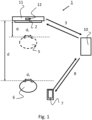
- Figure 1 discloses the basic concept of the invention in accordance with the present disclosure. More specifically, figure 1 discloses, in a conceptual manner, a measurement setup 1 used during the method of performing the eye examination test.
- the measurement setup 1 comprises a computing device 11, a mobile User Equipment 7 as well as a central server 10.
- the computing device 11 comprises a screen 2, which screen 2 is used for displaying all kinds of visualizations that are used by the eye examination test for examining the eyes of a user.
- the visualizations may comprise a plurality of letters, signs, characters, etc. These visualizations are, subsequently, provided in different sizes.
- a user then needs to provide input on the things he/she is able to observe on the screen. That is, the user needs to input the visualizations that he/she is able to recognize on the screen.
- the results of the eye examination test depend on the input that is provided by the user.
- the distance d between the user 6 and the screen 2 should be determined and should be taken into account during the eye examination test in order to provide for accurate results.
- the present disclosure is directed to a method for obtaining that particular distance d.
- the distance d is calculated based on images taken by a camera unit, for example a webcam 12.
- the webcam 12 is comprised by the computing unit 11.
- a webcam 12 is placed just above the screen 2 such that the distance between the webcam 12 and the user is approximately the same.
- the distance d is determined as follows. First, it was recognized that the pupillary distance d p of any user is roughly constant, and should be used as a first parameter in calculating the distance. More specifically, the pupillary distance d p is about 55 - 70mm, even more specifically between 60mm - 65mm, even more specifically 63mm. This parameter is taken into account during the calculation of the distance d between the user 6 and the screen 2.
- the user may input its own pupillary distance d p into the eye examination test.
- the calculation of the distance d is then performed based on the inputted distance d p by the user in stead of the predetermined distance between pupils of a user.
- Such an inputted distance is more accurate compared to a standard, predefined, average distance between pupils of a user.
- a second parameter is related to the distance between the detected pupils in the at least one captured image.
- the pupils of the user need to be detected, in the captured image, by the computing device.
- the distance between the pupils in the image may then be measured once the pupils have been detected.
- the measured distance between the pupils may be expressed in centimetres, pixels or any other distance measure.
- the measured distance between the pupils in the captured image may, for example, be 0.6 mm.
- a third parameter is related to the focal length of the camera unit 12 corresponding to the at least one captured image.
- the focal length may be required to correctly interpret the ratio between the actual distance d p between the pupils of a user and the measured distance d p between the pupils of a user.
- the focal length may be obtained in a variety of manners which is elaborated in more detail here below.
- the focal length may be determined by retrieving the focal length in meta data of the captured at least one image. That is, each image may be stored along with meta data, wherein the meta data related to the setting of the camera unit during the capturing of that particular image.
- the meta data may, for example, comprise resolution settings, ISO settings, diaphragm settings, but also the focal length of the camera unit.
- the focal length is calculated based on the predetermined distance between pupils of a user and a predetermined initial distance of a user facing the screen.
- the initial distance is shown in figure 1 and is referenced to using d i .
- the distance d i may relate to an initial distance that a user sits in front of the screen 2.
- the computing device 11 resides on a desk, and the user 5, at least initially, sits at that particular desk. It is found that the distance between the face of a user, i.e. the pupils of the user, and the screen 2 is, generally, about constant for each user, and for each type of desk. The distance is, roughly, between 30cm - 80cm, most likely between 40cm - 70cm, even more likely around 65cm. Such an initial distance is then taken into account when calculating the focal length of the camera unit 12.
- the focal length is then calculated using the predetermined initial distance of a user facing the screen, said distance between said detected pupils in said at least one captured image, and said predetermined distance between pupils.
- the inventors have found that the eye examination test may be improved even further in case the eye examination test takes into account facial features of the user facing the screen.
- the facial features may indicate whether the user is trying hard to read something, i.e. the user is squinting, may indicate which eye the user has covered during the eye examination test, or anything alike.
- the computing device may be arranged to detect a facial feature of the user facing the screen, and may perform the eye examination test using that detected facial feature. In order to do so, the computing device may use a facial feature algorithm, which is explained in more detail here below.
- the computing device may provide 3 the at least one captured image to a central database corresponding to a central server 10.
- the facial feature algorithm as identified here above, may be run at the central server 10.
- the central server 10 may correlate the received captured image with a plurality of images in its database, wherein each of that plurality of images has a certain facial feature present. That is, some of those plurality of images may comprise a human face in which one of the eyes is covered. Other of those plurality of images may comprise a human face in which the user is squinting, etc.
- By correlating the received captured image with those images in the database it can be assessed whether the user 6 is squinting, tilting his/her head, covering a particular eye, etc.
- the algorithms to determine the distance of the user to the screen as well as the algorithms to determine the facial features and/or the environment features are typically executed, i.e. performed, by the computing device.
- the related captured images may be provided to a central server for improvement purposes. That is, the central server may use these captured images to improve the algorithms.
- the updated algorithms may then be used by the computing device in subsequent captured images.
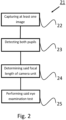
- Figure 2 discloses an example of a method 21 in accordance with the present disclosure.
- the method is directed to performing an eye examination test for examining eyes of a user, said method using a computing device as well as a mobile User Equipment, UE, wherein said computing device comprises a screen and comprises a camera unit arranged for capturing images.
- a computing device as well as a mobile User Equipment, UE, wherein said computing device comprises a screen and comprises a camera unit arranged for capturing images.
- the method comprising the steps of:
- one of the advantages of the present disclosure is that the distance between the user and the screen can be determined, which distance is taken into account during the eye examination test. This improves the accuracy of the eye examination test.
- the eye examination test may be performed more quickly as it reduces the time to setup, i.e. the time to get the user to a predetermined distance from the screen.
- a computer program may be stored/distributed on a suitable medium, such as an optical storage medium or a solid-state medium supplied together with or as part of other hardware, but may also be distributed in other forms, such as via the Internet or other wired or wireless telecommunication systems. Any reference signs in the claims should not be construed as limiting the scope thereof.
Landscapes
- Engineering & Computer Science (AREA)
- Health & Medical Sciences (AREA)
- Life Sciences & Earth Sciences (AREA)
- Physics & Mathematics (AREA)
- General Health & Medical Sciences (AREA)
- Ophthalmology & Optometry (AREA)
- Biomedical Technology (AREA)
- Heart & Thoracic Surgery (AREA)
- Medical Informatics (AREA)
- Molecular Biology (AREA)
- Surgery (AREA)
- Animal Behavior & Ethology (AREA)
- Biophysics (AREA)
- Public Health (AREA)
- Veterinary Medicine (AREA)
- Multimedia (AREA)
- Theoretical Computer Science (AREA)
- Human Computer Interaction (AREA)
- General Physics & Mathematics (AREA)
- Signal Processing (AREA)
- Oral & Maxillofacial Surgery (AREA)
- Computer Vision & Pattern Recognition (AREA)
- General Engineering & Computer Science (AREA)
- Eye Examination Apparatus (AREA)
- Measurement Of The Respiration, Hearing Ability, Form, And Blood Characteristics Of Living Organisms (AREA)
- Eyeglasses (AREA)
Applications Claiming Priority (2)
| Application Number | Priority Date | Filing Date | Title |
|---|---|---|---|
| NL2019319A NL2019319B1 (en) | 2017-07-21 | 2017-07-21 | A method of performing an eye examination test. |
| PCT/NL2018/050501 WO2019017785A1 (en) | 2017-07-21 | 2018-07-20 | METHOD FOR REALIZING AN OPHTHALMOLOGICAL EXAMINATION |
Publications (3)
| Publication Number | Publication Date |
|---|---|
| EP3655314A1 EP3655314A1 (en) | 2020-05-27 |
| EP3655314C0 EP3655314C0 (en) | 2023-08-30 |
| EP3655314B1 true EP3655314B1 (en) | 2023-08-30 |
Family
ID=60957393
Family Applications (1)
| Application Number | Title | Priority Date | Filing Date |
|---|---|---|---|
| EP18766362.0A Active EP3655314B1 (en) | 2017-07-21 | 2018-07-20 | A method of performing an eye examination test |
Country Status (7)
| Country | Link |
|---|---|
| US (1) | US11925416B2 (es) |
| EP (1) | EP3655314B1 (es) |
| JP (1) | JP2020528333A (es) |
| CN (1) | CN111344222A (es) |
| ES (1) | ES2959956T3 (es) |
| NL (1) | NL2019319B1 (es) |
| WO (1) | WO2019017785A1 (es) |
Families Citing this family (7)
| Publication number | Priority date | Publication date | Assignee | Title |
|---|---|---|---|---|
| EP3542704A1 (en) | 2018-03-22 | 2019-09-25 | Tilak Healthcare | Visual testing using mobile devices |
| WO2021209159A1 (en) * | 2020-04-17 | 2021-10-21 | Tilak Healthcare Sas | Method for determining an indication of an acuity level of a user |
| BR112023000418A2 (pt) * | 2020-07-15 | 2023-01-31 | Essilor Int | Método e sistema para avaliação da acuidade visual de uma pessoa |
| NL2029579B1 (en) * | 2021-11-01 | 2023-06-01 | Easee Health B V | Guiding a user to a test position for performing a computer-based eye exam. |
| CN115331282B (zh) * | 2022-07-08 | 2025-10-21 | 重庆大学 | 一种智能视力测试系统 |
| PL443185A1 (pl) * | 2022-12-19 | 2024-06-24 | Solvemed Group Spółka Z Ograniczoną Odpowiedzialnością | Sposób i układ do bezwzględnego pomiaru średnicy fragmentu oka |
| CN115998241B (zh) * | 2023-03-29 | 2023-06-27 | 之江实验室 | 视觉检测方法、装置、电子设备和系统 |
Family Cites Families (17)
| Publication number | Priority date | Publication date | Assignee | Title |
|---|---|---|---|---|
| US8602789B2 (en) * | 2008-10-14 | 2013-12-10 | Ohio University | Cognitive and linguistic assessment using eye tracking |
| PT2427095T (pt) * | 2009-05-09 | 2023-10-13 | Genentech Inc | Sistema de avaliação e rastreio de visão de descriminação de forma |
| EP2261857A1 (en) * | 2009-06-12 | 2010-12-15 | Star Nav | Method for determining the position of an object in an image, for determining an attitude of a persons face and method for controlling an input device based on the detection of attitude or eye gaze |
| CN102525400B (zh) * | 2012-01-12 | 2013-09-25 | 上海理工大学 | 带有双目摄像机的智能视力检测装置 |
| CN102998096B (zh) * | 2012-12-17 | 2016-03-30 | 吉林大学 | 凸透镜焦距的测量方法 |
| CN103033345B (zh) * | 2013-01-05 | 2015-04-08 | 山西省电力公司大同供电分公司 | 薄凸透镜焦距自动测量装置及其测量方法 |
| JP6020923B2 (ja) * | 2013-05-21 | 2016-11-02 | パナソニックIpマネジメント株式会社 | 焦点可変レンズを有するビューア、および映像表示システム |
| US20140372139A1 (en) * | 2013-06-14 | 2014-12-18 | Presbibio, Llc | System for monitoring and tracking patient outcomes after surgical implantation of an intracorneal lens |
| CN103793719A (zh) * | 2014-01-26 | 2014-05-14 | 深圳大学 | 一种基于人眼定位的单目测距方法和系统 |
| JP6415179B2 (ja) * | 2014-08-20 | 2018-10-31 | キヤノン株式会社 | 画像処理装置、画像処理方法、および撮像装置並びにその制御方法 |
| CN104394252B (zh) * | 2014-12-08 | 2018-04-06 | 上海斐讯数据通信技术有限公司 | 一种检测眼睛度数的方法及其移动终端 |
| CN204270321U (zh) * | 2014-12-24 | 2015-04-15 | 武汉虹识技术有限公司 | 一种虹膜采集装置 |
| WO2017070703A1 (en) * | 2015-10-23 | 2017-04-27 | Gobiquity, Inc. | Photorefraction method and product |
| DE102015226726A1 (de) * | 2015-12-23 | 2017-06-29 | Oculus Optikgeräte GmbH | Sehprüfsystem und Verfahren zum Überprüfen der Augen |
| CN105549209B (zh) * | 2016-02-04 | 2018-09-04 | 京东方科技集团股份有限公司 | 3d显示装置及其光栅周期调节方法 |
| US10799112B2 (en) * | 2017-05-02 | 2020-10-13 | Simple Contact, Inc. | Techniques for providing computer assisted eye examinations |
| US20190295507A1 (en) * | 2018-03-21 | 2019-09-26 | International Business Machines Corporation | Adaptive Rendering of Virtual and Augmented Displays to Improve Display Quality for Users Having Different Visual Abilities |
-
2017
- 2017-07-21 NL NL2019319A patent/NL2019319B1/en not_active IP Right Cessation
-
2018
- 2018-07-20 CN CN201880059835.0A patent/CN111344222A/zh active Pending
- 2018-07-20 EP EP18766362.0A patent/EP3655314B1/en active Active
- 2018-07-20 US US16/632,218 patent/US11925416B2/en active Active
- 2018-07-20 ES ES18766362T patent/ES2959956T3/es active Active
- 2018-07-20 WO PCT/NL2018/050501 patent/WO2019017785A1/en not_active Ceased
- 2018-07-20 JP JP2020524705A patent/JP2020528333A/ja active Pending
Also Published As
| Publication number | Publication date |
|---|---|
| CN111344222A (zh) | 2020-06-26 |
| ES2959956T3 (es) | 2024-02-29 |
| EP3655314A1 (en) | 2020-05-27 |
| EP3655314C0 (en) | 2023-08-30 |
| NL2019319B1 (en) | 2019-02-06 |
| US20200253471A1 (en) | 2020-08-13 |
| JP2020528333A (ja) | 2020-09-24 |
| US11925416B2 (en) | 2024-03-12 |
| WO2019017785A1 (en) | 2019-01-24 |
Similar Documents
| Publication | Publication Date | Title |
|---|---|---|
| EP3655314B1 (en) | A method of performing an eye examination test | |
| JP7591635B2 (ja) | 医師による遠隔評価のためのデジタル眼検査方法 | |
| US20230118575A1 (en) | Computerized refraction and astigmatism determination | |
| CN105163649B (zh) | 计算机化屈光和散光确定 | |
| CN112689470B (zh) | 用于使用计算装置执行散光力测试的方法以及相应的计算装置 | |
| US11494897B2 (en) | Application to determine reading/working distance | |
| CN110573061A (zh) | 眼科检查方法及仪器 | |
| KR101984993B1 (ko) | 사용자 맞춤형 시표 제어가 가능한 시야검사기 | |
| CN111699432B (zh) | 使用沉浸式系统确定眼睛的屈光力的方法及其电子设备 | |
| JP2017522104A (ja) | 目状態決定システム | |
| AU2021298223B2 (en) | Subjective refraction exam system | |
| US12318140B2 (en) | System and method for determining prescription of corrective lenses using predictive calculations and corrected-eyesight simulation | |
| WO2020178826A1 (en) | Method and device for non-invasive measurement of an intraocular pressure | |
| EP4171350B1 (en) | Method and device for determining at least one astigmatic effect of at least one eye |
Legal Events
| Date | Code | Title | Description |
|---|---|---|---|
| STAA | Information on the status of an ep patent application or granted ep patent |
Free format text: STATUS: UNKNOWN |
|
| STAA | Information on the status of an ep patent application or granted ep patent |
Free format text: STATUS: THE INTERNATIONAL PUBLICATION HAS BEEN MADE |
|
| PUAI | Public reference made under article 153(3) epc to a published international application that has entered the european phase |
Free format text: ORIGINAL CODE: 0009012 |
|
| STAA | Information on the status of an ep patent application or granted ep patent |
Free format text: STATUS: REQUEST FOR EXAMINATION WAS MADE |
|
| 17P | Request for examination filed |
Effective date: 20200212 |
|
| AK | Designated contracting states |
Kind code of ref document: A1 Designated state(s): AL AT BE BG CH CY CZ DE DK EE ES FI FR GB GR HR HU IE IS IT LI LT LU LV MC MK MT NL NO PL PT RO RS SE SI SK SM TR |
|
| AX | Request for extension of the european patent |
Extension state: BA ME |
|
| RIN1 | Information on inventor provided before grant (corrected) |
Inventor name: NKYA, ELLY ONESMO Inventor name: PREVOO, YVES FRANCO DIANO MARIA |
|
| DAV | Request for validation of the european patent (deleted) | ||
| DAX | Request for extension of the european patent (deleted) | ||
| GRAP | Despatch of communication of intention to grant a patent |
Free format text: ORIGINAL CODE: EPIDOSNIGR1 |
|
| STAA | Information on the status of an ep patent application or granted ep patent |
Free format text: STATUS: GRANT OF PATENT IS INTENDED |
|
| INTG | Intention to grant announced |
Effective date: 20220518 |
|
| GRAS | Grant fee paid |
Free format text: ORIGINAL CODE: EPIDOSNIGR3 |
|
| GRAA | (expected) grant |
Free format text: ORIGINAL CODE: 0009210 |
|
| STAA | Information on the status of an ep patent application or granted ep patent |
Free format text: STATUS: THE PATENT HAS BEEN GRANTED |
|
| AK | Designated contracting states |
Kind code of ref document: B1 Designated state(s): AL AT BE BG CH CY CZ DE DK EE ES FI FR GB GR HR HU IE IS IT LI LT LU LV MC MK MT NL NO PL PT RO RS SE SI SK SM TR |
|
| REG | Reference to a national code |
Ref country code: GB Ref legal event code: FG4D |
|
| REG | Reference to a national code |
Ref country code: CH Ref legal event code: EP |
|
| REG | Reference to a national code |
Ref country code: DE Ref legal event code: R096 Ref document number: 602018056482 Country of ref document: DE |
|
| REG | Reference to a national code |
Ref country code: IE Ref legal event code: FG4D |
|
| U01 | Request for unitary effect filed |
Effective date: 20231002 |
|
| U07 | Unitary effect registered |
Designated state(s): AT BE BG DE DK EE FI FR IT LT LU LV MT NL PT SE SI Effective date: 20231027 |
|
| PG25 | Lapsed in a contracting state [announced via postgrant information from national office to epo] |
Ref country code: GR Free format text: LAPSE BECAUSE OF FAILURE TO SUBMIT A TRANSLATION OF THE DESCRIPTION OR TO PAY THE FEE WITHIN THE PRESCRIBED TIME-LIMIT Effective date: 20231201 |
|
| PG25 | Lapsed in a contracting state [announced via postgrant information from national office to epo] |
Ref country code: IS Free format text: LAPSE BECAUSE OF FAILURE TO SUBMIT A TRANSLATION OF THE DESCRIPTION OR TO PAY THE FEE WITHIN THE PRESCRIBED TIME-LIMIT Effective date: 20231230 |
|
| PG25 | Lapsed in a contracting state [announced via postgrant information from national office to epo] |
Ref country code: RS Free format text: LAPSE BECAUSE OF FAILURE TO SUBMIT A TRANSLATION OF THE DESCRIPTION OR TO PAY THE FEE WITHIN THE PRESCRIBED TIME-LIMIT Effective date: 20230830 Ref country code: NO Free format text: LAPSE BECAUSE OF FAILURE TO SUBMIT A TRANSLATION OF THE DESCRIPTION OR TO PAY THE FEE WITHIN THE PRESCRIBED TIME-LIMIT Effective date: 20231130 Ref country code: IS Free format text: LAPSE BECAUSE OF FAILURE TO SUBMIT A TRANSLATION OF THE DESCRIPTION OR TO PAY THE FEE WITHIN THE PRESCRIBED TIME-LIMIT Effective date: 20231230 Ref country code: HR Free format text: LAPSE BECAUSE OF FAILURE TO SUBMIT A TRANSLATION OF THE DESCRIPTION OR TO PAY THE FEE WITHIN THE PRESCRIBED TIME-LIMIT Effective date: 20230830 Ref country code: GR Free format text: LAPSE BECAUSE OF FAILURE TO SUBMIT A TRANSLATION OF THE DESCRIPTION OR TO PAY THE FEE WITHIN THE PRESCRIBED TIME-LIMIT Effective date: 20231201 |
|
| PG25 | Lapsed in a contracting state [announced via postgrant information from national office to epo] |
Ref country code: PL Free format text: LAPSE BECAUSE OF FAILURE TO SUBMIT A TRANSLATION OF THE DESCRIPTION OR TO PAY THE FEE WITHIN THE PRESCRIBED TIME-LIMIT Effective date: 20230830 |
|
| REG | Reference to a national code |
Ref country code: ES Ref legal event code: FG2A Ref document number: 2959956 Country of ref document: ES Kind code of ref document: T3 Effective date: 20240229 |
|
| PG25 | Lapsed in a contracting state [announced via postgrant information from national office to epo] |
Ref country code: SM Free format text: LAPSE BECAUSE OF FAILURE TO SUBMIT A TRANSLATION OF THE DESCRIPTION OR TO PAY THE FEE WITHIN THE PRESCRIBED TIME-LIMIT Effective date: 20230830 Ref country code: RO Free format text: LAPSE BECAUSE OF FAILURE TO SUBMIT A TRANSLATION OF THE DESCRIPTION OR TO PAY THE FEE WITHIN THE PRESCRIBED TIME-LIMIT Effective date: 20230830 Ref country code: CZ Free format text: LAPSE BECAUSE OF FAILURE TO SUBMIT A TRANSLATION OF THE DESCRIPTION OR TO PAY THE FEE WITHIN THE PRESCRIBED TIME-LIMIT Effective date: 20230830 Ref country code: SK Free format text: LAPSE BECAUSE OF FAILURE TO SUBMIT A TRANSLATION OF THE DESCRIPTION OR TO PAY THE FEE WITHIN THE PRESCRIBED TIME-LIMIT Effective date: 20230830 |
|
| REG | Reference to a national code |
Ref country code: DE Ref legal event code: R097 Ref document number: 602018056482 Country of ref document: DE |
|
| PLBE | No opposition filed within time limit |
Free format text: ORIGINAL CODE: 0009261 |
|
| STAA | Information on the status of an ep patent application or granted ep patent |
Free format text: STATUS: NO OPPOSITION FILED WITHIN TIME LIMIT |
|
| 26N | No opposition filed |
Effective date: 20240603 |
|
| U20 | Renewal fee for the european patent with unitary effect paid |
Year of fee payment: 7 Effective date: 20240724 |
|
| PG25 | Lapsed in a contracting state [announced via postgrant information from national office to epo] |
Ref country code: MC Free format text: LAPSE BECAUSE OF FAILURE TO SUBMIT A TRANSLATION OF THE DESCRIPTION OR TO PAY THE FEE WITHIN THE PRESCRIBED TIME-LIMIT Effective date: 20230830 |
|
| REG | Reference to a national code |
Ref country code: CH Ref legal event code: PL |
|
| PG25 | Lapsed in a contracting state [announced via postgrant information from national office to epo] |
Ref country code: CH Free format text: LAPSE BECAUSE OF NON-PAYMENT OF DUE FEES Effective date: 20240731 |
|
| PG25 | Lapsed in a contracting state [announced via postgrant information from national office to epo] |
Ref country code: IE Free format text: LAPSE BECAUSE OF NON-PAYMENT OF DUE FEES Effective date: 20240720 |
|
| PGFP | Annual fee paid to national office [announced via postgrant information from national office to epo] |
Ref country code: ES Payment date: 20250929 Year of fee payment: 8 |
|
| PGFP | Annual fee paid to national office [announced via postgrant information from national office to epo] |
Ref country code: GB Payment date: 20250918 Year of fee payment: 8 |
|
| U21 | Renewal fee for the european patent with unitary effect paid with additional fee |
Year of fee payment: 8 Effective date: 20250922 |
|
| PG25 | Lapsed in a contracting state [announced via postgrant information from national office to epo] |
Ref country code: CY Free format text: LAPSE BECAUSE OF FAILURE TO SUBMIT A TRANSLATION OF THE DESCRIPTION OR TO PAY THE FEE WITHIN THE PRESCRIBED TIME-LIMIT; INVALID AB INITIO Effective date: 20180720 |
|
| PG25 | Lapsed in a contracting state [announced via postgrant information from national office to epo] |
Ref country code: HU Free format text: LAPSE BECAUSE OF FAILURE TO SUBMIT A TRANSLATION OF THE DESCRIPTION OR TO PAY THE FEE WITHIN THE PRESCRIBED TIME-LIMIT; INVALID AB INITIO Effective date: 20180720 |