EP3656302B1 - System und verfahren zur analyse des menschlichen gangs - Google Patents
System und verfahren zur analyse des menschlichen gangs Download PDFInfo
- Publication number
- EP3656302B1 EP3656302B1 EP18208400.4A EP18208400A EP3656302B1 EP 3656302 B1 EP3656302 B1 EP 3656302B1 EP 18208400 A EP18208400 A EP 18208400A EP 3656302 B1 EP3656302 B1 EP 3656302B1
- Authority
- EP
- European Patent Office
- Prior art keywords
- individual
- frame
- location
- joint
- gait
- Prior art date
- Legal status (The legal status is an assumption and is not a legal conclusion. Google has not performed a legal analysis and makes no representation as to the accuracy of the status listed.)
- Active
Links
Images



Classifications
-
- A—HUMAN NECESSITIES
- A61—MEDICAL OR VETERINARY SCIENCE; HYGIENE
- A61B—DIAGNOSIS; SURGERY; IDENTIFICATION
- A61B5/00—Measuring for diagnostic purposes; Identification of persons
- A61B5/72—Signal processing specially adapted for physiological signals or for diagnostic purposes
- A61B5/7271—Specific aspects of physiological measurement analysis
- A61B5/7275—Determining trends in physiological measurement data; Predicting development of a medical condition based on physiological measurements, e.g. determining a risk factor
-
- A—HUMAN NECESSITIES
- A61—MEDICAL OR VETERINARY SCIENCE; HYGIENE
- A61B—DIAGNOSIS; SURGERY; IDENTIFICATION
- A61B5/00—Measuring for diagnostic purposes; Identification of persons
- A61B5/103—Measuring devices for testing the shape, pattern, colour, size or movement of the body or parts thereof, for diagnostic purposes
- A61B5/11—Measuring movement of the entire body or parts thereof, e.g. head or hand tremor or mobility of a limb
- A61B5/112—Gait analysis
-
- A—HUMAN NECESSITIES
- A61—MEDICAL OR VETERINARY SCIENCE; HYGIENE
- A61B—DIAGNOSIS; SURGERY; IDENTIFICATION
- A61B5/00—Measuring for diagnostic purposes; Identification of persons
- A61B5/103—Measuring devices for testing the shape, pattern, colour, size or movement of the body or parts thereof, for diagnostic purposes
- A61B5/11—Measuring movement of the entire body or parts thereof, e.g. head or hand tremor or mobility of a limb
- A61B5/1126—Measuring movement of the entire body or parts thereof, e.g. head or hand tremor or mobility of a limb using a particular sensing technique
- A61B5/1128—Measuring movement of the entire body or parts thereof, e.g. head or hand tremor or mobility of a limb using a particular sensing technique using image analysis
-
- A—HUMAN NECESSITIES
- A61—MEDICAL OR VETERINARY SCIENCE; HYGIENE
- A61B—DIAGNOSIS; SURGERY; IDENTIFICATION
- A61B5/00—Measuring for diagnostic purposes; Identification of persons
- A61B5/72—Signal processing specially adapted for physiological signals or for diagnostic purposes
- A61B5/7235—Details of waveform analysis
- A61B5/7264—Classification of physiological signals or data, e.g. using neural networks, statistical classifiers, expert systems or fuzzy systems
- A61B5/7267—Classification of physiological signals or data, e.g. using neural networks, statistical classifiers, expert systems or fuzzy systems involving training the classification device
-
- G—PHYSICS
- G06—COMPUTING OR CALCULATING; COUNTING
- G06N—COMPUTING ARRANGEMENTS BASED ON SPECIFIC COMPUTATIONAL MODELS
- G06N3/00—Computing arrangements based on biological models
- G06N3/02—Neural networks
- G06N3/04—Architecture, e.g. interconnection topology
- G06N3/0464—Convolutional networks [CNN, ConvNet]
-
- G—PHYSICS
- G06—COMPUTING OR CALCULATING; COUNTING
- G06N—COMPUTING ARRANGEMENTS BASED ON SPECIFIC COMPUTATIONAL MODELS
- G06N3/00—Computing arrangements based on biological models
- G06N3/02—Neural networks
- G06N3/08—Learning methods
-
- G—PHYSICS
- G06—COMPUTING OR CALCULATING; COUNTING
- G06N—COMPUTING ARRANGEMENTS BASED ON SPECIFIC COMPUTATIONAL MODELS
- G06N3/00—Computing arrangements based on biological models
- G06N3/02—Neural networks
- G06N3/08—Learning methods
- G06N3/09—Supervised learning
-
- G—PHYSICS
- G06—COMPUTING OR CALCULATING; COUNTING
- G06T—IMAGE DATA PROCESSING OR GENERATION, IN GENERAL
- G06T7/00—Image analysis
- G06T7/0002—Inspection of images, e.g. flaw detection
- G06T7/0012—Biomedical image inspection
- G06T7/0014—Biomedical image inspection using an image reference approach
- G06T7/0016—Biomedical image inspection using an image reference approach involving temporal comparison
-
- G—PHYSICS
- G06—COMPUTING OR CALCULATING; COUNTING
- G06T—IMAGE DATA PROCESSING OR GENERATION, IN GENERAL
- G06T7/00—Image analysis
- G06T7/20—Analysis of motion
- G06T7/246—Analysis of motion using feature-based methods, e.g. the tracking of corners or segments
- G06T7/251—Analysis of motion using feature-based methods, e.g. the tracking of corners or segments involving models
-
- G—PHYSICS
- G06—COMPUTING OR CALCULATING; COUNTING
- G06T—IMAGE DATA PROCESSING OR GENERATION, IN GENERAL
- G06T7/00—Image analysis
- G06T7/70—Determining position or orientation of objects or cameras
- G06T7/73—Determining position or orientation of objects or cameras using feature-based methods
- G06T7/75—Determining position or orientation of objects or cameras using feature-based methods involving models
-
- G—PHYSICS
- G06—COMPUTING OR CALCULATING; COUNTING
- G06V—IMAGE OR VIDEO RECOGNITION OR UNDERSTANDING
- G06V10/00—Arrangements for image or video recognition or understanding
- G06V10/70—Arrangements for image or video recognition or understanding using pattern recognition or machine learning
- G06V10/74—Image or video pattern matching; Proximity measures in feature spaces
- G06V10/75—Organisation of the matching processes, e.g. simultaneous or sequential comparisons of image or video features; Coarse-fine approaches, e.g. multi-scale approaches; using context analysis; Selection of dictionaries
-
- G—PHYSICS
- G06—COMPUTING OR CALCULATING; COUNTING
- G06V—IMAGE OR VIDEO RECOGNITION OR UNDERSTANDING
- G06V40/00—Recognition of biometric, human-related or animal-related patterns in image or video data
- G06V40/20—Movements or behaviour, e.g. gesture recognition
- G06V40/23—Recognition of whole body movements, e.g. for sport training
- G06V40/25—Recognition of walking or running movements, e.g. gait recognition
-
- G—PHYSICS
- G16—INFORMATION AND COMMUNICATION TECHNOLOGY [ICT] SPECIALLY ADAPTED FOR SPECIFIC APPLICATION FIELDS
- G16H—HEALTHCARE INFORMATICS, i.e. INFORMATION AND COMMUNICATION TECHNOLOGY [ICT] SPECIALLY ADAPTED FOR THE HANDLING OR PROCESSING OF MEDICAL OR HEALTHCARE DATA
- G16H50/00—ICT specially adapted for medical diagnosis, medical simulation or medical data mining; ICT specially adapted for detecting, monitoring or modelling epidemics or pandemics
- G16H50/20—ICT specially adapted for medical diagnosis, medical simulation or medical data mining; ICT specially adapted for detecting, monitoring or modelling epidemics or pandemics for computer-aided diagnosis, e.g. based on medical expert systems
-
- G—PHYSICS
- G16—INFORMATION AND COMMUNICATION TECHNOLOGY [ICT] SPECIALLY ADAPTED FOR SPECIFIC APPLICATION FIELDS
- G16H—HEALTHCARE INFORMATICS, i.e. INFORMATION AND COMMUNICATION TECHNOLOGY [ICT] SPECIALLY ADAPTED FOR THE HANDLING OR PROCESSING OF MEDICAL OR HEALTHCARE DATA
- G16H50/00—ICT specially adapted for medical diagnosis, medical simulation or medical data mining; ICT specially adapted for detecting, monitoring or modelling epidemics or pandemics
- G16H50/30—ICT specially adapted for medical diagnosis, medical simulation or medical data mining; ICT specially adapted for detecting, monitoring or modelling epidemics or pandemics for calculating health indices; for individual health risk assessment
-
- G—PHYSICS
- G16—INFORMATION AND COMMUNICATION TECHNOLOGY [ICT] SPECIALLY ADAPTED FOR SPECIFIC APPLICATION FIELDS
- G16H—HEALTHCARE INFORMATICS, i.e. INFORMATION AND COMMUNICATION TECHNOLOGY [ICT] SPECIALLY ADAPTED FOR THE HANDLING OR PROCESSING OF MEDICAL OR HEALTHCARE DATA
- G16H50/00—ICT specially adapted for medical diagnosis, medical simulation or medical data mining; ICT specially adapted for detecting, monitoring or modelling epidemics or pandemics
- G16H50/50—ICT specially adapted for medical diagnosis, medical simulation or medical data mining; ICT specially adapted for detecting, monitoring or modelling epidemics or pandemics for simulation or modelling of medical disorders
-
- G—PHYSICS
- G06—COMPUTING OR CALCULATING; COUNTING
- G06T—IMAGE DATA PROCESSING OR GENERATION, IN GENERAL
- G06T2207/00—Indexing scheme for image analysis or image enhancement
- G06T2207/10—Image acquisition modality
- G06T2207/10016—Video; Image sequence
-
- G—PHYSICS
- G06—COMPUTING OR CALCULATING; COUNTING
- G06T—IMAGE DATA PROCESSING OR GENERATION, IN GENERAL
- G06T2207/00—Indexing scheme for image analysis or image enhancement
- G06T2207/20—Special algorithmic details
- G06T2207/20081—Training; Learning
-
- G—PHYSICS
- G06—COMPUTING OR CALCULATING; COUNTING
- G06T—IMAGE DATA PROCESSING OR GENERATION, IN GENERAL
- G06T2207/00—Indexing scheme for image analysis or image enhancement
- G06T2207/20—Special algorithmic details
- G06T2207/20084—Artificial neural networks [ANN]
-
- G—PHYSICS
- G06—COMPUTING OR CALCULATING; COUNTING
- G06T—IMAGE DATA PROCESSING OR GENERATION, IN GENERAL
- G06T2207/00—Indexing scheme for image analysis or image enhancement
- G06T2207/30—Subject of image; Context of image processing
- G06T2207/30196—Human being; Person
-
- G—PHYSICS
- G16—INFORMATION AND COMMUNICATION TECHNOLOGY [ICT] SPECIALLY ADAPTED FOR SPECIFIC APPLICATION FIELDS
- G16H—HEALTHCARE INFORMATICS, i.e. INFORMATION AND COMMUNICATION TECHNOLOGY [ICT] SPECIALLY ADAPTED FOR THE HANDLING OR PROCESSING OF MEDICAL OR HEALTHCARE DATA
- G16H50/00—ICT specially adapted for medical diagnosis, medical simulation or medical data mining; ICT specially adapted for detecting, monitoring or modelling epidemics or pandemics
- G16H50/70—ICT specially adapted for medical diagnosis, medical simulation or medical data mining; ICT specially adapted for detecting, monitoring or modelling epidemics or pandemics for mining of medical data, e.g. analysing previous cases of other patients
Definitions
- the present invention generally relates to electronic data processing, and more particularly, relates to methods, computer program products and systems for human gait analysis usable for assessing the risk of fall (risk of falling accidents) of a human individual.
- a risk model contains a list of risk factors. For a particular patient one checks which of the risk factors apply. Finally, the overall risk score of the patient is a (weighted) sum of the risk factors present. If the risk score is larger than some cut-off value, the conclusion is that the corresponding patient has a high risk of falling.
- the gait of patients is observed by the medically trained person and a subjective assessment of the gait is also taken into account when assessing the risk of fall.
- the various (weighted) factors are supposed to support the medically trained person to take appropriate measures for fall prevention.
- the subjective gait parameter observation may bear a risk that the observed gait parameters lack accuracy and may lead to wrong treatment actions.
- a further prior art tool for human motion estimation is described in the document " Dual Gait Generative Models for Human Motion Estimation From a Single Camera" by Zhang et al.
- a computer-implemented method for human gait based on a video stream obtained from a monocular camera device.
- Video stream as used herein relates to a sequence of frames obtained by a video camera. Thereby, it is irrelevant whether the sequence of frames is directly processed in real time (stream processing) or whether the sequence of frames is stored in a storage device and processed off-line later on.
- the computer implemented method can be performed by a respective computer system which can execute a computer program implementing the modules which are configured to perform the respective method steps when being run on the computer system.
- the monocular camera device can be any standard digital camera (e.g., a camera in a smartphone or tablet computer, a webcam, etc.).
- the monocular camera device is used to obtain a video from a human individual (e.g., the patient) while the individual is walking.
- the obtained video stream includes a plurality of frames reflecting the walk of the human individual.
- estimated two-dimensional coordinates can be combined together with location-maps derived (obtained) by using a convolutional neural network (VNect approach). This example is explained in more detail below.
- VNect approach convolutional neural network
- three-dimensional surface models of a human body are used whose parameters are fitted to estimated two-dimensional coordinates.
- VNect approach is described as an optional embodiment in more detail to illustrate how three-dimensional gait information can be extracted from the obtained video stream.
- a convolutional neural network may be used to infer heat-maps and location-maps for joint location estimation of the individual's joints. This computation can be performed in real-time.
- the term "real-time” as used throughout this document is understood by a person skilled in the art of digital data processing as “near real-time” or “quasi real-time”.
- Any digital data processing step e.g., an image processing step
- data captured from the real world e.g., sensor data to be transferred into visual representations of such sensor data
- the digital data processing steps always results in a delay imposed by the digital data processing steps. For example, there is always a computational delay between the movement of the individual in the real world and the determination of the joint locations in a video frame.
- a particular heat-map describes, for a corresponding frame, probabilities that a particular joint of the individual is associated with respective pixels of the corresponding frame.
- Heat-maps are two-dimensional objects.
- a particular set of location-maps includes a plurality of location-maps, with each of the location maps describing the distance of a particular joint to a root location for the corresponding frame in a respective spatial dimension. That is, each location-map is a two-dimensional map for a corresponding spatial dimension.
- a particular set of location maps for three orthogonal spatial dimensions can be interpreted as a three-dimensional location map.
- the Batch Normalization layers are merged with the weights of their preceding convolution layers to improve the speed of the forward pass.
- Two-dimensional heat-maps and three-dimensional location-maps are predicted from the features at res4d and res5a, tapering down the weights of intermediate losses with increasing iteration count.
- a person skilled in the art is also able to use other CNNs from the ResNet family as a basis for joint location estimation of the individual.
- a default skeleton is used for kinematic skeleton fitting to finally capture the skeletal motion of the individual.
- using a default skeleton can lead to significant inaccuracies when trying to fit the default skeleton into video frames showing an individual whose skeleton shows significant deviations from the default skeleton. Therefore, before performing a kinematic skeleton fitting as described in section 4.2 of the VNect paper, the computer-implemented method as claimed assesses a skeleton model for the individual which reflects the actual proportions of the individual.
- the selection may be received from the medically trained person based on this person's experience.
- image processing techniques can be used to automatically identify frame sequences where the movement of particular joints of the individual from one frame to the next frame stay within a predefined limit characteristic of a smooth movement.
- frame sequences which include the walking start of the person (i.e., typically the initial frame sequences) are less suited for assessing the individual's skeleton model.
- the skeleton model of the individual is then estimated by determining, for each frame of the selected sequence, a loss for each joint of a default skeleton model in each spatial coordinate, and by adjusting the default skeleton model to compensate the determined losses to provide an adjusted skeleton model.
- an error is measured which describes the deviation of the joint locations associated with the default skeleton model versus the joint locations determined by the CNN when trying to fit the default skeleton with the determined joint locations.
- the default skeleton is then compensated by the measured errors over the entire selected frame sequence which results in the adjusted skeleton model reflecting the real proportions of the individual.
- the following kinematic skeleton fitting is then performed using the adjusted skeleton model to determine a plurality of joint locations including at least the foot locations of the individual's feet on each frame.
- the system determines one or more gait parameters of the individual which serve as an input for fall risk assessment. For this purpose, the computer system identifies local extrema frames showing local extrema of the distance between one foot location of the individual and a corresponding reference joint location. When the individual is smoothly walking, the distance of a foot of the individual to a reference joint location changes periodically showing local maxima and local minima between two consecutive touch points of the respective feet with the ground.
- a reference joint location is the location of a further joint of the individual which provides a reference location inside the individual's body with respect to the foot location.
- the reference location is the second foot of the individual
- a local maximum of the distance is reached each time when the feet of the individual have reached the step length.
- the local minimum is reached at the moment the second foot passes the location of the first foot.
- this distance also changes periodically when walking smoothly in that the distance is zero when the respective foot touches the walking floor and reaches a local maximum between two consecutive touch point locations of the same foot.
- the system may determine a cluster of honest local extrema frames (honest maximum frames and/or honest minimum frames) where the frames of the cluster contribute to the computation of the step length in that an average distance value is computed based on all frames of the respective cluster.
- honest local extrema frames include such frames which collectively reflect the distance between the individual's feet for a particular step of the individual.
- the average step length can then be determined by averaging the respective values for a plurality of honest local extrema (e.g., honest local maxima clusters).
- the optimal pixel to be used for estimating the joint location with the following embodiment.
- the computer system first identifies a plurality of heat-map pixels in the particular heat-map wherein each of the identified pixels is associated with the same maximum probability value for the respective joint associated with the particular heat-map. Then, for each identified pixel, heat-map values in a predefined area adjacent to the identified pixel are integrated. For example, the adjacent area can be defined by a circle with the respective pixel at its center. The system thereby computes the integral of all probability values within the adjacent area.
- the system selects the identified pixel with the highest integral value as the pixel associated with the respective joint location.
- the likelihood is increased to select the frame pixel which corresponds to the real world location of the particular joint. As a result, the accuracy of the predicting step is improved.
- the alternative embodiment based on the cited SMPLify approach uses estimates of two dimensional joint coordinates as input which may be obtained, e.g. using approaches such as VNect, or DeepCut, or a convolutional pose machine, or any other method providing two dimensional joint coordinates for that purpose.
- the SMPLify implementation then fits a three dimensional human body model, the Skinned Multi-Person Linear Model (SMPL), to the two dimensional joints.
- SMPL Skinned Multi-Person Linear Model
- This model can be robustly fit to very little data.
- the three dimensional model prevents three dimensional poses that may fit the two dimensional joints, but cause interpenetration.
- the skilled person may refer to the above cited SMPLify publication.
- gait parameters have been identified as highly beneficial for assessing the risk of fall of a patient: the step length, the walking speed and the step height of the patient.
- Various implementations of the step "determining one or more gait parameters" allow to compute each of such parameters to be provided to the medically trained person.
- the step length gait parameter is computed by using the individual's (patient's) second foot in a respective local maximum frame as the corresponding reference location.
- the system then computes the step length gait parameter as the mean value (e.g., average or median) of the distances between the individual's foot locations in the determined local maximum frames.
- the distance between the individual's foot locations may be measured directly in a respective frame based on the corresponding three-dimensional coordinates. This measurement is advantageous when the patient's walk is passing by the camera and the frame pictures show a view of the patient from the side.
- the distance of any joint from the camera can be determined, for example, by using the pinhole projection model known by a person skilled in the art
- the computer system may determine the walking speed gait parameter.
- the walking distance of the individual is computed based on the determined step length and the number of the local maximum frames identified in the video stream. The walking distance is then divided by the time interval associated with the sequence of frames associated with the walking distance to obtain the walking speed. Further implementations for determining the walking distance are disclosed in the detailed description.
- the step height gait parameter is computed by using the location of the head (or pelvis) of the adjusted skeleton model as the corresponding reference location.
- the system identifies respective local minimum frames where a first distance between the foot location and the location of the reference point is shortest. In the same local minimum frames a second distance between the reference point and the second foot of the individual (the one touching the ground) can be computed.
- the step height can then be computed as a mean value of the difference between the first and second distances in the respective local minimum frames.
- the system may directly compute the distance between the individual's feet in local minimum frames.
- the system can determine the step height gait parameter by extrapolating a walking floor plane from floor contact points of the individual's feet.
- floor contact points can be derived from the local maximum frames used for determining the step length.
- the walking floor plane can be extrapolated.
- the system can determine further local maximum frames with further local maxima of the distances of the individual's foot locations from the walking floor plane. Thereby, the shortest distance between a foot location and the floor plane is meant. The system then computes a mean value of the further local maximum distances as the step height.
- the previously determined gait parameters can be associated with respective scores characterizing a risk of fall for the individual. It may be advantageous to define scores which can easily be integrated into the prior art scoring systems for fall risk assessment as used in the healthcare industry.
- the determined gait parameter scores can then be provided as a result of the gait analysis to the medically trained person to support the decision making for an effective treatment of the patient to reduce the risk of fall for the patient.
- a computer program product including instructions that, when loaded into a memory of a computing device and executed by at least one processor of the computing device, execute the method steps of the computer implemented method as disclosed herein.
- a computer system for human gait analysis is provided.
- the computer system is configured to run the computer program product which allows to execute the steps of the disclosed computer-implemented method.
- the computer system implements the following modules via the computer program product to perform the respective gait analysis functions:
- the extractor module further comprises:
- the prediction module is further configured to: identify a plurality of heat-map pixels in a particular heat-map wherein each of the identified pixels is associated with the same maximum probability value for the respective joint associated with the particular heat-map; for each identified pixel, integrate heat-map values in a predefined area adjacent to the identified pixel; and select the identified pixel with the highest integral value as the pixel associated with the respective joint location.
- the extractor module further comprises:
- the gait parameter determining module implements the various gait parameter determination methods as disclosed herein.
- FIG. 1 includes a simplified block diagram of a computer system 100 for human gait analysis based on a video stream 202 obtained from a monocular camera device 201 according to an embodiment.
- FIG. 1 will be described in the context of the flow charts of FIGs. 2 *, 3 and 4* showing simplified flow charts with steps of a computer-implemented method for human gait analysis according to various embodiments. For this reason, the following description includes reference numbers from all of such figures.
- the computer system 100 includes an interface 110 configured to obtain the video stream 202 which is provided by the monocular camera device 201.
- the video stream can be obtained directly from the camera 201 wherein real-time analysis of the individual's gait parameters is intended based on a live stream. It may also be obtained from a video storage 203 to perform offline analysis of previously recorded videos.
- the video stream 202 includes a plurality of frames reflecting the walk of a human individual 10. In other words, the camera 201 is positioned such that the walk of the individual occurs within the viewing angle of the camera indicated by the dotted lines.
- the interface 110 is configured to receive the frames of the video stream in the format in which they are recorded or preprocessed by the camera device 201, or in the format they are stored in the video storage 203.
- the video storage can be any data storage configured to store the sequence of video frames of stream 202.
- the storage 203 can be on a remote storage device (e.g., on a so-called cloud server) or it can be an integral component of the system
- the system 100 further includes a skeletal motion extractor 120 which is configured to extract, from the video stream 202, a skeletal motion associated with the individual 10.
- the extractor infers 1100 three-dimensional gait information from the obtained video stream.
- the three-dimensional gait information includes estimates of the individual's joint locations including at least the individual's foot locations on each frame. The estimates are derived by matching for each frame two-dimensional coordinates of the respective frame with respective three-dimensional model information of the individual's body.
- Various extraction approaches can be applied by the person skilled in the art.
- In one estimated two-dimensional coordinates can be combined together with location-maps derived by using a convolutional neural network (VNect approach).
- VNect approach advantageously, the camera 201 is a monocular RGB camera device.
- three-dimensional surface models of a human body are used whose parameters are fitted to estimated two-dimensional coordinates (SMPLify approach).
- an inference module 121 of the extractor 120 uses a convolutional neural network CNN, trained on three dimensional human pose datasets.
- the CNN is configured to derive 1110 heat-maps and location-maps for joint location estimation as disclosed in the cited VNect reference in section 4.1. This can be performed in real-time in scenarios where gait analysis if performed on the basis of a live video stream. Thereby, a particular heat-map describes, for a corresponding frame, probabilities that a particular joint is associated with respective pixels of the corresponding frame.
- a particular set of location-maps includes a plurality of location-maps, with each of the location maps describing the distance of a particular joint to a root location for the corresponding frame in a respective spatial dimension.
- the set includes location maps in three spatial dimensions thus representing a 3D location map.
- a skeleton model estimator module 122 of the extractor 120 can be used to improve the VNect implementation to achieve a higher degree of accuracy for the derived joint locations of the individual.
- VNect approach the following kinematic skeleton fitting is directly applied by using a default skeleton model for all individuals. This may lead to large errors (loss) in cases where the individual's real skeleton dimensions show substantial deviations from the dimensions of the default skeleton model.
- the model estimator 122 firstly selects at least a frame sequence of the video during which the joints of the individual move smoothly over time.
- a smooth movement in this sense is a movement which lacks any discontinuities in the sense that the joints of the individual do not move over substantial distances from one frame to the next frame.
- a substantial distance corresponds to a distance where the movement of a body part of the individual results in a change of pixel coordinates in subsequent frames indicating an abrupt or erratic movement for this body part. Examples of discontinuous movements occur when the individual is running or jumping, or when the individual is beginning to move from a prior standing or sitting position.
- the model estimator may receive 1120 indicators from an operator 20 (e.g.
- the model estimator may apply standard image processing techniques to identify such a smooth movement sequence in the video stream in accordance with predefined rules defining threshold values for joint movement over two or more frames which specify the beginning of discontinuous movements.
- the model estimator estimates 1130 a skeleton model of the individual by determining, for each frame of the selected sequence, a loss for each joint of a default skeleton model in each spatial coordinate, and by adjusting the default skeleton model to compensate the determined losses to provide an adjusted skeleton model.
- the adjusted skeleton model now reflects the real skeleton of the individual with a higher accuracy than the default skeleton model which was used as a starting point.
- a skeleton fitting module 123 of the extractor performs 1140 kinematic skeleton fitting per video frame using the adjusted skeleton model to determine a plurality of joint locations of the individual 10. It is to be noted that the determined joint locations also include the joints of the individual indicating the individual's the foot locations on each frame.
- Kinematic skeleton fitting can be performed in accordance with the method described in section 4.2 of the VNect reference where the default skeleton model in the VNect approach is replaced by the estimated skeleton model.
- the prediction module is further configured to identify 1111 a plurality of heat-map pixels in a particular heat-map wherein each of the identified pixels is associated with the same maximum probability value for the respective joint associated with the particular heat-map. For each identified pixel, an integral value is computed by integrating 1113 heat-map values in a predefined area adjacent to the identified pixel integrate. Then the identified pixel with the highest integral value is selected 1115 as the pixel associated with the respective joint location for the further processing.
- the estimated skeleton model 300 of the individual 10 is illustrated for the individual 10 with a viewing angle from the side.
- the joint locations are illustrated by respective circles 310, 311, 312, and the connections between the joints (e.g., bones) are illustrated by bold lines 320.
- the determined foot locations may correspond to the joints 311 and 312.
- the estimated skeleton model 301 for an individual 11 is illustrated with a viewing angle from the front.
- the joint locations are illustrated by respective bullets 313, 314 connected again by straight lines.
- the joints 313, 314 may correspond to the individual's foot locations.
- the extractor 120 works similar to the VNect implementation in that both implementations use estimates of two dimensional coordinates of skeleton joints and infer three dimensional information on the human pose via an optimization procedure based on the two dimensional data of the joint coordinates.
- the SMPLify implementation also infers three dimensional information regarding the individual's shape.
- the SMPLify implementation allows for automatic estimation of three dimensional pose and three dimensional shape of a human body (e.g., the individual's body) from a single unconstrained image.
- As input SMPLify requires estimates of the two dimensional coordinates of each joint, together with a confidence value for each joint.
- These two dimensional estimates can, in principle, be provided 1150 by any appropriate method known by the skilled person.
- CNN-based methods such as VNect, DenseCut (cf. " DenseCut: Densely Connected CRFs for Realtime GrabCut", by Cheng et al. , 2015 The Eurographics Association and John Wiley & Sons Ltd. ), or a convolutional pose machine may be employed.
- SMPLify then fits 1160 a three dimensional human body model, the Skinned Multi-Person Linear Model (SMPL), to the two dimensional joints.
- This model can be robustly fit to very little data.
- the three dimensional model prevents three dimensional poses that may fit the two dimensional joints, but cause interpenetration.
- the SMPLify implementation requires estimates of two dimensional joint coordinates as input which may be obtained, e.g. from VNect, or DeepCut, or a convolutional pose machine, or any other method providing two dimensional joint coordinates for that purpose.
- SMPlify does not rely on location maps but uses the SMPL three dimensional body mode.
- the SMPLify solutions does not allow for interpenetration. This may be advantageous in many gait analysis scenarios.
- An advantage of the VNect implementation can be that VNect performs in real time, while SMPLify requires about two minutes to process a single image on a state-of-the-art PC with a GPU.
- the joint locations as determined by the extractor 120 are then used by a gait parameter determining module 130 of the system 100 to determine one or more gait parameters of the individual 10 based on the individual's foot locations in local extrema frames showing local extrema of the distance between one foot location of the individual and a corresponding reference location.
- the gait parameter determining module identifies frames in the video stream where a foot of the individual has a minimum or a maximum distance from a reference point when compared to the preceding frame and the subsequent frame.
- the type of reference point for a particular computation depends on the type of gait parameter to be determined.
- FIGs. 4A to 4D illustrate computer-implemented method steps for determining gait length, gait speed and gait height parameters of the individual 10. Such parameters provide relevant information for a medically trained person to assess the risk of fall for the individual 10. Such figures are now discussed in more detail in the context of the scenarios illustrated in FIGs. 7 and 8 .
- the step 1200 further includes computing step 1210 to determine a step length gait parameter.
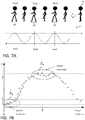
- FIG. 7A illustrates that the corresponding reference location is the location of the individual's second foot in a respective local maximum frame flma*.
- the individual 10 starts walking at the right hand of FIG. 7A into the left direction.
- the video frames flma1, flma2 and flma3 always show the individual when the distance between the two feet of the individual reaches a local maximum sl1, sl2, sl3.
- the lower part of FIG. 7A illustrates schematically how the distance d between the two feet evolves over time t. The behavior is similar to a sinus curve. The local minima are reached when during walking one foot passes the other foot.
- the local maxima lma1, lma2, lma3 are typically present when both feet are touching the ground.
- a local maximum frame occurs when the distance of one foot location to a respective reference joint location reaches a maximum value in comparison with previous and subsequent frames.
- FIG. 7B the figure illustrates the concept of honest extrema , in the human gait which can be used in accordance with an optional embodiment of the invention. The following assumptions are made:
- a ⁇ B is defined as ⁇ a ⁇ A, b ⁇ B : a ⁇ b. Finding these two decompositions of , algorithmically is straightforward.
- The are referred to as the honest minima frames, and are referred to as the honest maxima frames.
- min is the number of honest minima
- max is the number of hones maxima.
- the value of the k th honest maximum/minimum can be chosen as some kind of average of the numbers in F ⁇ k / F ⁇ k , e.g. one can take the mean value 1 # F ⁇ k ⁇ x ⁇ F ⁇ k x , where #A denotes the cardinality of the set A.
- the gait parameter determination module 130 of FIG. 1 computes 1210 a mean value sl of the distances sl* between the individual's foot locations in the determined local maximum frames flma* as the step length gait parameter.
- the system computes 1210 a mean value of the distance values derived from the honest maxima clusters .
- all the sl* values have the same value.
- a mean value can be determined together with a standard deviation for the determined step length parameter.
- the gait parameter information is the provided 210 to a medically trained person 20.
- a high standard deviation indicates to the medically trained person that the various step lengths of the individual show a significant deviation which can be considered when assessing the risk of fall for that individual.
- the distance between the individual's foot locations may be measured directly in a respective frame based on the corresponding pixel coordinates, or it may be measured indirectly for a respective local maximum frame based on the distances of the individual's feet from the monocular camera device 201 using the pinhole projection model.
- the system can compute 1220 a walking distance of the individual based on the determined step length and the number of the local maximum frames identified in the video stream. The walking distance is then divided by the time interval associated with the sequence of frames associated with the walking distance to obtain 1230 the walking speed.
- the camera 201 does not move during the recording of the video.
- the distance of the individual to the camera may be advantageously determined by applying the pinhole projection model, and using it to compute the distance to the individual's pelvis. However, other joint locations (e.g., the individual's head) may be used as well.
- an averaged joint location based on all joints or a particular subset of joint can be used as the reference point against which the distance to the camera is determined.
- the distance can be determined for each frame as the distance between the camera and a reference point which is characteristic of the individual's current location.
- the total number of steps in the defined video stream sequence is determined for the tracked individual 10 as the number of "local maxima" in the step length sequence sl(1), sl(2), ..., sl(F), where sl(f) is the distance between the individuals feet in frame f. From these two gait parameters it is straightforward to compute the average step length, and the cadence.
- H(f, jr) encodes the likelihood for the right variant of joint j to be associated with a specific pixel in frame f
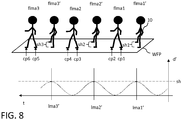
- FIG. 8 illustrates how a step height parameter of the individual 10 may be determined based on the information provided in the video stream in accordance with any one of the embodiments depicted in FIGs. 4C and 4D .
- the system extrapolates 1240 a walking floor plane (WFP) from floor contact points cp* of the individual's feet identified from the local maximum frames flma* which correspond to the frames also usable for step length determination. That is, the corresponding reference location is the location of the individual's second foot in the respective local maximum frame.
- WFP walking floor plane
- the system can then determine 1250 further local maximum frames flma*' with further local maxima lma*' of the distances d' of the individual's foot locations from the walking floor plane WFP.
- This second set of local maxima frames flma1', flma2', flma3' includes such frames where the distances sh1, sh2, sh3 between one foot of the individual and the WPF shows a local maximum. While walking, every second step the same foot passes such a local maximum.
- the local maxima lma1' and lma3' are associated with a first foot of the individual while the local maximum Ima2' is associated with the second foot.
- the system computes 1260 a mean value sh of the further local maximum distances sh1, sh2, sh3 as the step height.
- the periodic behavior shown in the lower part of FIG. 8 is to be understood as a simplified schematic view.
- the step heights of each step would likely vary to some extent.
- the standard deviation can provide valuable information regarding the smoothness of the individual's gait.
- the step height gait parameter is determined by using the head or pelvis of the adjusted skeleton model in a respective local minimum frame as the corresponding reference location for the computation.
- the system determines 1270 local minimum frames with local minima of the distances between the individual's foot locations and the corresponding reference location. In other words, in case the distance between one foot of the individual is at a local minimum with regards to a reference joint (head or pelvis) of the individual's body, the distance to the walking floor shows a local maximum.
- the system can compute 1280 a mean value of the distances between the individual's two feet in the local minimum frames as the step height.
- the system may simply measure the distance between the two feet in each local minimum frame as one foot is touching the ground in the respective frame and the distances between the feet in local minimum frames are good approximations of the respective step heights.
- the person skilled in the art can apply the honest local extrema approach (disclosed in detail in the context of step length computation) also to the computation of the step height parameter.
- the system 100 may further include a parameter scoring module 140.
- the scoring module 140 can associate one or more of the determined gait parameters with a score characterizing a risk of fall for the individual.
- the medically trained person 20 is familiar with such scoring schemes for assessing the risk of fall.
- scoring schemes can be derived from the document "
- FIG. 9 is a diagram that shows an example of a generic computer device 900 and a generic mobile computer device 950, which may be used with the techniques described here.
- Computing device 900 is intended to represent various forms of digital computers, such as laptops, desktops, workstations, personal digital assistants, servers, blade servers, mainframes, and other appropriate computers.
- Generic computer device may 900 correspond to the computer system 100 of FIG. 1 .
- Computing device 950 is intended to represent various forms of mobile devices, such as personal digital assistants, cellular telephones, smart phones, and other similar computing devices.
- computing device 950 may be a smartphone which includes a monocular RGB camera and can be used by the medically trained person to interact with the computer device 900.
- the components shown here, their connections and relationships, and their functions, are meant to be exemplary only, and are not meant to limit implementations of the inventions described and/or claimed in this document.
- Computing device 900 includes a processor 902, memory 904, a storage device 906, a high-speed interface 908 connecting to memory 904 and high-speed expansion ports 910, and a low speed interface 912 connecting to low speed bus 914 and storage device 906.
- Each of the components 902, 904, 906, 908, 910, and 912 are interconnected using various busses, and may be mounted on a common motherboard or in other manners as appropriate.
- the processor 902 can process instructions for execution within the computing device 900, including instructions stored in the memory 904 or on the storage device 906 to display graphical information for a GUI on an external input/output device, such as display 916 coupled to high speed interface 908.
- multiple processing units and/or multiple buses may be used, as appropriate, along with multiple memories and types of memory.
- multiple computing devices 900 may be connected, with each device providing portions of the necessary operations (e.g., as a server bank, a group of blade servers, or a processing device).
- the memory 904 stores information within the computing device 900.
- the memory 904 is a volatile memory unit or units.
- the memory 904 is a non-volatile memory unit or units.
- the memory 904 may also be another form of computer-readable medium, such as a magnetic or optical disk.
- the storage device 906 is capable of providing mass storage for the computing device 900.
- the storage device 906 may be or contain a computer-readable medium, such as a floppy disk device, a hard disk device, an optical disk device, or a tape device, a flash memory or other similar solid state memory device, or an array of devices, including devices in a storage area network or other configurations.
- a computer program product can be tangibly embodied in an information carrier.
- the computer program product may also contain instructions that, when executed, perform one or more methods, such as those described above.
- the information carrier is a computer- or machine-readable medium, such as the memory 904, the storage device 906, or memory on processor 902.
- the high speed controller 908 manages bandwidth-intensive operations for the computing device 900, while the low speed controller 912 manages lower bandwidth-intensive operations.
- the high-speed controller 908 is coupled to memory 904, display 916 (e.g., through a graphics processor or accelerator), and to high-speed expansion ports 910, which may accept various expansion cards (not shown).
- low-speed controller 912 is coupled to storage device 906 and low-speed expansion port 914.
- the low-speed expansion port which may include various communication ports (e.g., USB, Bluetooth, Ethernet, wireless Ethernet) may be coupled to one or more input/output devices, such as a keyboard, a pointing device, a scanner, or a networking device such as a switch or router, e.g., through a network adapter.
- input/output devices such as a keyboard, a pointing device, a scanner, or a networking device such as a switch or router, e.g., through a network adapter.
- the computing device 900 may be implemented in a number of different forms, as shown in the figure. For example, it may be implemented as a standard server 920, or multiple times in a group of such servers. It may also be implemented as part of a rack server system 924. In addition, it may be implemented in a personal computer such as a laptop computer 922. Alternatively, components from computing device 900 may be combined with other components in a mobile device (not shown), such as device 950. Each of such devices may contain one or more of computing device 900, 950, and an entire system may be made up of multiple computing devices 900, 950 communicating with each other.
- Computing device 950 includes a processor 952, memory 964, an input/output device such as a display 954, a communication interface 966, and a transceiver 968, among other components.
- the device 950 may also be provided with a storage device, such as a microdrive or other device, to provide additional storage.
- a storage device such as a microdrive or other device, to provide additional storage.
- Each of the components 950, 952, 964, 954, 966, and 968 are interconnected using various buses, and several of the components may be mounted on a common motherboard or in other manners as appropriate.
- the processor 952 can execute instructions within the computing device 950, including instructions stored in the memory 964.
- the processor may be implemented as a chipset of chips that include separate and multiple analog and digital processing units.
- the processor may provide, for example, for coordination of the other components of the device 950, such as control of user interfaces, applications run by device 950, and wireless communication by device 950.
- Processor 952 may communicate with a user through control interface 958 and display interface 956 coupled to a display 954.
- the display 954 may be, for example, a TFT LCD (Thin-Film-Transistor Liquid Crystal Display) or an OLED (Organic Light Emitting Diode) display, or other appropriate display technology.
- the display interface 956 may comprise appropriate circuitry for driving the display 954 to present graphical and other information to a user.
- the control interface 958 may receive commands from a user and convert them for submission to the processor 952.
- an external interface 962 may be provide in communication with processor 952, so as to enable near area communication of device 950 with other devices.
- External interface 962 may provide, for example, for wired communication in some implementations, or for wireless communication in other implementations, and multiple interfaces may also be used.
- the memory 964 stores information within the computing device 950.
- the memory 964 can be implemented as one or more of a computer-readable medium or media, a volatile memory unit or units, or a non-volatile memory unit or units.
- Expansion memory 984 may also be provided and connected to device 950 through expansion interface 982, which may include, for example, a SIMM (Single In Line Memory Module) card interface.
- SIMM Single In Line Memory Module
- expansion memory 984 may provide extra storage space for device 950, or may also store applications or other information for device 950.
- expansion memory 984 may include instructions to carry out or supplement the processes described above, and may include secure information also.
- expansion memory 984 may act as a security module for device 950, and may be programmed with instructions that permit secure use of device 950.
- secure applications may be provided via the SIMM cards, along with additional information, such as placing the identifying information on the SIMM card in a non-hackable manner.
- the memory may include, for example, flash memory and/or NVRAM memory, as discussed below.
- a computer program product is tangibly embodied in an information carrier.
- the computer program product contains instructions that, when executed, perform one or more methods, such as those described above.
- the information carrier is a computer- or machine-readable medium, such as the memory 964, expansion memory 984, or memory on processor 952, that may be received, for example, over transceiver 968 or external interface 962.
- Device 950 may communicate wirelessly through communication interface 966, which may include digital signal processing circuitry where necessary. Communication interface 966 may provide for communications under various modes or protocols, such as GSM voice calls, SMS, EMS, or MMS messaging, CDMA, TDMA, PDC, WCDMA, CDMA2000, or GPRS, among others. Such communication may occur, for example, through radio-frequency transceiver 968. In addition, short-range communication may occur, such as using a Bluetooth, WiFi, or other such transceiver (not shown). In addition, GPS (Global Positioning System) receiver module 980 may provide additional navigation- and location-related wireless data to device 950, which may be used as appropriate by applications running on device 950.
- GPS Global Positioning System
- Device 950 may also communicate audibly using audio codec 960, which may receive spoken information from a user and convert it to usable digital information. Audio codec 960 may likewise generate audible sound for a user, such as through a speaker, e.g., in a handset of device 950. Such sound may include sound from voice telephone calls, may include recorded sound (e.g., voice messages, music files, etc.) and may also include sound generated by applications operating on device 950.
- Audio codec 960 may receive spoken information from a user and convert it to usable digital information. Audio codec 960 may likewise generate audible sound for a user, such as through a speaker, e.g., in a handset of device 950. Such sound may include sound from voice telephone calls, may include recorded sound (e.g., voice messages, music files, etc.) and may also include sound generated by applications operating on device 950.
- the computing device 950 may be implemented in a number of different forms, as shown in the figure. For example, it may be implemented as a cellular telephone 980. It may also be implemented as part of a smart phone 982, personal digital assistant, or other similar mobile device.
- implementations of the systems and techniques described here can be realized in digital electronic circuitry, integrated circuitry, specially designed ASICs (application specific integrated circuits), computer hardware, firmware, software, and/or combinations thereof.
- ASICs application specific integrated circuits
- These various implementations can include implementation in one or more computer programs that are executable and/or interpretable on a programmable system including at least one programmable processor, which may be special or general purpose, coupled to receive data and instructions from, and to transmit data and instructions to, a storage system, at least one input device, and at least one output device.
- the systems and techniques described here can be implemented on a computer having a display device (e.g., a CRT (cathode ray tube) or LCD (liquid crystal display) monitor) for displaying information to the user and a keyboard and a pointing device (e.g., a mouse or a trackball) by which the user can provide input to the computer.
- a display device e.g., a CRT (cathode ray tube) or LCD (liquid crystal display) monitor
- a keyboard and a pointing device e.g., a mouse or a trackball
- Other kinds of devices can be used to provide for interaction with a user as well; for example, feedback provided to the user can be any form of sensory feedback (e.g., visual feedback, auditory feedback, or tactile feedback); and input from the user can be received in any form, including acoustic, speech, or tactile input.
- the systems and techniques described here can be implemented in a computing device that includes a back end component (e.g., as a data server), or that includes a middleware component (e.g., an application server), or that includes a front end component (e.g., a client computer having a graphical user interface or a Web browser through which a user can interact with an implementation of the systems and techniques described here), or any combination of such back end, middleware, or front end components.
- the components of the system can be interconnected by any form or medium of digital data communication (e.g., a communication network). Examples of communication networks include a local area network ("LAN”), a wide area network (“WAN”), and the Internet.
- LAN local area network
- WAN wide area network
- the Internet the global information network
- the computing device can include clients and servers.
- a client and server are generally remote from each other and typically interact through a communication network.
- the relationship of client and server arises by virtue of computer programs running on the respective computers and having a client-server relationship to each other.
Landscapes
- Engineering & Computer Science (AREA)
- Health & Medical Sciences (AREA)
- Life Sciences & Earth Sciences (AREA)
- Physics & Mathematics (AREA)
- Medical Informatics (AREA)
- General Health & Medical Sciences (AREA)
- Public Health (AREA)
- Biomedical Technology (AREA)
- Computer Vision & Pattern Recognition (AREA)
- Theoretical Computer Science (AREA)
- Pathology (AREA)
- Artificial Intelligence (AREA)
- Biophysics (AREA)
- Molecular Biology (AREA)
- General Physics & Mathematics (AREA)
- Surgery (AREA)
- Heart & Thoracic Surgery (AREA)
- Physiology (AREA)
- Animal Behavior & Ethology (AREA)
- Veterinary Medicine (AREA)
- Data Mining & Analysis (AREA)
- Evolutionary Computation (AREA)
- Oral & Maxillofacial Surgery (AREA)
- Dentistry (AREA)
- Mathematical Physics (AREA)
- Databases & Information Systems (AREA)
- Psychiatry (AREA)
- Multimedia (AREA)
- Radiology & Medical Imaging (AREA)
- Nuclear Medicine, Radiotherapy & Molecular Imaging (AREA)
- Primary Health Care (AREA)
- Epidemiology (AREA)
- Signal Processing (AREA)
- Computing Systems (AREA)
- Software Systems (AREA)
- Computational Linguistics (AREA)
- General Engineering & Computer Science (AREA)
- Fuzzy Systems (AREA)
- Quality & Reliability (AREA)
- Social Psychology (AREA)
Claims (14)
- Computerimplementiertes Verfahren (1000) für eine Analyse des menschlichen Gangs, basierend auf einem Videostream (202), der von einer monokularen Kameravorrichtung (201) erhalten wird, wobei der Videostream mehrere Einzelbilder umfasst, die den Gang eines menschlichen Individuums (10) widerspiegeln, wobei das Verfahren Folgendes umfasst:Schließen (1100), aus dem erhaltenen Videostream, auf dreidimensionale Ganginformationen, wobei die dreidimensionalen Ganginformationen Schätzungen der Gelenkpositionen des Individuums, einschließlich wenigstens der Fußpositionen des Individuums in jedem Einzelbild, einschließen, wobei die Schätzungen durch Abgleichen zweidimensionaler Gelenkkoordinaten für jedes Einzelbild des jeweiligen Einzelbildes mit jeweiligen dreidimensionalen Modellinformationen des Körpers des Individuums abgeleitet werden; undBestimmen (1200) eines oder mehrerer Gangparameter des Individuums basierend auf den Fußpositionen des Individuums in Einzelbilder lokaler Extrema, die die lokalen Extrema der Distanz zwischen einer Fußposition des Individuums und einer entsprechenden Referenzgelenkposition darstellen, wobei wenigstens einer der bestimmten Gangparameter mit einer Punktbewertung verknüpft ist, die ein Sturzrisiko für das Individuum charakterisiert.
- Verfahren nach Anspruch 1, wobei das Schließen (1100) ferner Folgendes umfasst:bleiten (1110) von Wärmeabbildungen und Positionsabbildungen für die Schätzung der Gelenkposition unter Verwendung eines gefalteten neuronalen Netzes, das auf dreidimensionale menschliche Posendatensätzen trainiert wird, wobei eine bestimmte Wärmeabbildung für ein entsprechendes Einzelbild Wahrscheinlichkeitswerte beschreibt, dass ein besonderes Gelenk mit jeweiligen Pixeln des entsprechenden Einzelbildes verknüpft ist, und wobei ein bestimmter Satz von Positionsabbildungen mehrere Positionsabbildungen umfasst, wobei jede der Positionsabbildungen die Distanz eines bestimmten Gelenks zu einer Wurzelposition für das entsprechende Einzelbild in einer jeweiligen räumlichen Dimension beschreibt;Empfangen (1120) einer Auswahl von wenigstens einer Einzelbildfolge des Videostreams, während der sich die Gelenke des Individuums (10) im Laufe der Zeit reibungslos bewegen;Schätzen (1130) eines Skelettmodells des Individuums (10) durch Bestimmen, für jedes Einzelbild der ausgewählten Sequenz, eines Verlusts für jedes Gelenk eines Standardskelettmodells in jeder räumlichen Koordinate, und Anpassen des Standardskelettmodells, um die bestimmten Verluste zu kompensieren, um ein angepasstes Skelettmodell bereitzustellen; undDurchführen (1140) einer kinematischen Skelettanpassung pro Videoeinzelbild unter Verwendung des angepassten Skelettmodells, um mehrere Gelenkpositionen zu bestimmen, einschließlich wenigstens der Fußpositionen der Füße des Individuums auf jedem Einzelbild.
- Verfahren nach Anspruch 2, wobei das Ableiten (1110) ferner Folgendes umfasst:Identifizieren (1111) mehrerer Wärmeabbildungspixel in einer bestimmten Wärmeabbildung, wobei jedem der identifizierten Pixel derselbe maximale Wahrscheinlichkeitswert für das jeweilige Gelenk, das mit der bestimmten Wärmeabbildung assoziiert ist, zugeordnet ist;für jedes identifizierte Pixel, Integrieren (1113) von Wärmeabbildungswerten in einem vordefinierten Bereich angrenzend an das identifizierte Pixel; undAuswählen (1115) des identifizierten Pixels mit dem höchsten Integralwert als das Pixel, das mit der jeweiligen Gelenkposition verknüpft ist.
- Verfahren nach einem der Ansprüche 1 bis 3, wobei der eine oder die mehreren Gangparameter einen Schrittlängengangparameter umfassen und wobei die entsprechende Referenzgelenkposition die Position des zweiten Fußes des Individuums in einem jeweiligen lokalen Maximaleinzelbild (flma*) ist, wobei das Verfahren ferner Folgendes umfasst:
Berechnen (1210) eines Mittelwertes (sl) der Distanzen (sl*) zwischen den Fußpositionen des Individuums in den bestimmten lokalen Maximaleinzelbildern (flma*) als Schrittlängengang parameter. - Verfahren nach Anspruch 4, wobei die Distanz zwischen den Fußpositionen des Individuums in einem jeweiligen Einzelbild basierend auf den entsprechenden Pixelkoordinaten direkt gemessen wird.
- Verfahren nach Anspruch 4, wobei die Distanz zwischen den Fußpositionen des Individuums für ein jeweiliges lokales Maximaleinzelbild indirekt basierend auf den Distanzen der Füße des Individuums von der Monokularkameravorrichtung gemessen wird.
- Verfahren nach einem der Ansprüche 4 bis 6, wobei der eine oder die mehreren Gangparameter ferner einen Gehgeschwindigkeitsgangparameter umfassen, wobei das Verfahren ferner Folgendes umfasst:Berechnen (1220) einer Gehdistanz des Individuums basierend auf der bestimmten Schrittlänge und der Anzahl der lokalen Maximaleinzelbilder, die in dem Videostream identifiziert werden, und Dividieren der Gehdistanz durch das Zeitintervall, das mit der Einzelbildfolge verbunden ist, die mit der Gehdistanz verknüpft ist, um die Gehgeschwindigkeit (1230) zu erhalten.
- Verfahren nach einem der vorhergehenden Ansprüche, wobei der eine oder die mehreren Gangparameter ferner einen Schritthöhengangparameter umfassen, wobei das Verfahren ferner Folgendes umfasst:Extrapolieren (1240) einer Gehbodenebene (walking floor plane - WFP) aus Bodenkontaktpunkten (cp*) der Füße des Individuums, die aus lokalen Maximaleinzelbildern (flma*) identifiziert werden, wobei die entsprechende Referenzgelenksposition die Position des zweiten Fußes des Individuums in dem jeweiligen lokalen Maximaleinzelbild ist;Bestimmen (1250) weiterer lokaler Maximaleinzelbilder (flma*') mit weiteren lokalen Maxima (lma*') der Abstände der Fußpositionen des Individuums von der Gehbodenebene (WFP) und Berechnen (1260) eines Mittelwertes (sh) der weiteren lokalen Maximalabstände als Schritthöhe.
- Verfahren nach einem der Ansprüche 1 bis 7, wobei der eine oder die mehreren Gangparameter ferner einen Schritthöhengangparameter umfassen und wobei die entsprechende Referenzgelenkposition die Position des Kopfes (318) oder des Beckens (319) des angepassten Skelettmodells in einem jeweiligen lokalen Minimaleinzelbild ist, wobei das Verfahren ferner Folgendes umfasst:Bestimmen (1270) lokaler Minimaleinzelbilder mit lokalen Minima der Abstände zwischen den Fußpositionen des Individuums und der entsprechenden Referenzgelenkposition undBerechnen (1280) eines Mittelwertes der Abstände zwischen den beiden Füßen des Individuums in lokalen Minimaleinzelbildern als Schritthöhe.
- Computerprogrammprodukt mit Anweisungen, die, wenn sie in einen Speicher einer Rechenvorrichtung geladen und durch wenigstens einen Prozessor der Rechenvorrichtung ausgeführt werden, die Verfahrensschritte des computerimplementierten Verfahrens nach einem der vorhergehenden Ansprüche ausführen.
- Computersystem (100) für eine Analyse des menschlichen Gangs, Folgendes umfassend:eine Schnittstelle (110), die konfiguriert ist, um einen Videostream (202) von einer Monokularkameravorrichtung (201) zu erhalten, wobei der Videostream (202) mehrere Einzelbilder umfasst, die den Gang eines menschlichen Individuums (10) widerspiegeln;einen Skelettbewegungsextraktor (120), der konfiguriert ist, um aus dem Videostream (202) eine Skelettbewegung zu extrahieren, die mit dem Individuum (10) verknüpft ist, durch Schließen, aus dem erhaltenen Videostream, auf dreidimensionale Ganginformationen, wobei die dreidimensionalen Ganginformationen Schätzungen der Gelenkpositionen des Individuums einschließlich wenigstens der Fußpositionen des Individuums auf jedem Einzelbild einschließen, wobei die Schätzungen durch Abgleichen für jedes Einzelbild zweidimensionaler Gelenkkoordinaten des jeweiligen Einzelbildes mit jeweiligen dreidimensionalen Modellinformationen des Körpers des Individuums abgeleitet werden;ein Gangparameterbestimmungsmodul (130), das konfiguriert ist, um einen oder mehrere Gangparameter des Individuums basierend auf den Fußpositionen (311, 312) des Individuums in lokalen Extremaeinzelbildern zu bestimmen, die die lokalen Extrema der Distanz zwischen einer Fußposition des Individuums und einer entsprechenden Referenzgelenkposition zeigen; undein Bewertungsmodul (140), das konfiguriert ist, um einen oder mehrere der bestimmten Gangparameter mit einer Bewertung zu verknüpfen, die das Sturzrisiko für das Individuum charakterisiert.
- System nach Anspruch 11, wobei das Extraktormodul ferner Folgendes umfasst:ein zweidimensionales Schätzmodul für Gelenkkoordinaten, das konfiguriert ist, um für jedes Einzelbild Schätzungen der zweidimensionalen Gelenkkoordinaten jedes Gelenks zusammen mit einem Konfidenzwert für jedes Gelenk bereitzustellen;
undein dreidimensionales Anpassungsmodul, das konfiguriert ist, um ein dreidimensionales menschliches Körpermodell an die zweidimensionalen Gelenkkoordinaten anzupassen. - System nach Anspruch 11 oder 12, wobei der eine oder die mehreren Gangparameter einen Schrittlängengangparameter umfassen und wobei die entsprechende Referenzgelenkposition die Position des zweiten Fußes des Individuums in einem jeweiligen lokalen Maximaleinzelbild ist, wobei das Gangparameterbestimmungsmodul ferner für Folgendes konfiguriert ist:Berechnen einer Gesamtdistanz, die durch das Individuum zurückgelegt wird, durch Anwenden des Lochblendenprojektionsmodells, um Entfernungen zwischen der Kamera und einem Referenzpunkt zu bestimmen, der für die aktuelle Position des Individuums für wenigstens ein erstes und ein zweites Einzelbild charakteristisch ist, wobei das erste und das zweite Einzelbild eine Videostreamfolge definieren, die für die Schrittlängenanalyse zu verwenden ist, wobei die zurückgelegte Entfernung aus den bestimmten Entfernungen abgeleitet wird;Bestimmen der Anzahl der Schritte in der definierten Videostreamfolge als die Anzahl der lokalen Maximaleinzelbilder mit lokalen Maxima der Distanz zwischen den Füßen des Individuums; undTeilen der berechneten zurückgelegten Distanz durch die Anzahl der lokalen Maximaleinzelbilder, um die durchschnittliche Schrittlänge zu erhalten.
- System nach einem der Ansprüche 11 bis 13, wobei der eine oder die mehreren Gangparameter ferner einen Schritthöhengangparameter umfassen, wobei das Gangparameterbestimmungsmodul ferner für Folgendes konfiguriert ist: Bestimmen von lokalen Minimaleinzelbildern mit lokalen Minima der Distanzen zwischen den Fußpositionen des Individuums und dem Kopf oder Becken des angepassten Skelettmodells; und
Berechnen eines Mittelwertes der Distanzen zwischen den beiden Füßen in lokalen Minimaleinzelbildern als Schritthöhe.
Priority Applications (8)
| Application Number | Priority Date | Filing Date | Title |
|---|---|---|---|
| DK18208400.4T DK3656302T3 (da) | 2018-11-26 | 2018-11-26 | System og fremgangsmåde til analyse af menneskelig gang |
| EP18208400.4A EP3656302B1 (de) | 2018-11-26 | 2018-11-26 | System und verfahren zur analyse des menschlichen gangs |
| PT182084004T PT3656302T (pt) | 2018-11-26 | 2018-11-26 | Sistema e método para análise da marcha humana |
| PCT/EP2019/077113 WO2020108834A1 (en) | 2018-11-26 | 2019-10-07 | System and method for human gait analysis |
| CN201980077303.4A CN113164098B (zh) | 2018-11-26 | 2019-10-07 | 人类步态分析系统和方法 |
| BR112021009677-9A BR112021009677A2 (pt) | 2018-11-26 | 2019-10-07 | Método implementado por computador para análise de marcha humana, meio de armazenamento legível por computador e sistema de computador para análise de marcha humana |
| EP19782611.8A EP3886700B1 (de) | 2018-11-26 | 2019-10-07 | System und verfahren zur analyse des menschlichen gangs |
| US17/303,261 US12226237B2 (en) | 2018-11-26 | 2021-05-25 | System and method for human gait analysis |
Applications Claiming Priority (1)
| Application Number | Priority Date | Filing Date | Title |
|---|---|---|---|
| EP18208400.4A EP3656302B1 (de) | 2018-11-26 | 2018-11-26 | System und verfahren zur analyse des menschlichen gangs |
Publications (2)
| Publication Number | Publication Date |
|---|---|
| EP3656302A1 EP3656302A1 (de) | 2020-05-27 |
| EP3656302B1 true EP3656302B1 (de) | 2020-09-16 |
Family
ID=64664850
Family Applications (2)
| Application Number | Title | Priority Date | Filing Date |
|---|---|---|---|
| EP18208400.4A Active EP3656302B1 (de) | 2018-11-26 | 2018-11-26 | System und verfahren zur analyse des menschlichen gangs |
| EP19782611.8A Active EP3886700B1 (de) | 2018-11-26 | 2019-10-07 | System und verfahren zur analyse des menschlichen gangs |
Family Applications After (1)
| Application Number | Title | Priority Date | Filing Date |
|---|---|---|---|
| EP19782611.8A Active EP3886700B1 (de) | 2018-11-26 | 2019-10-07 | System und verfahren zur analyse des menschlichen gangs |
Country Status (7)
| Country | Link |
|---|---|
| US (1) | US12226237B2 (de) |
| EP (2) | EP3656302B1 (de) |
| CN (1) | CN113164098B (de) |
| BR (1) | BR112021009677A2 (de) |
| DK (1) | DK3656302T3 (de) |
| PT (1) | PT3656302T (de) |
| WO (1) | WO2020108834A1 (de) |
Families Citing this family (36)
| Publication number | Priority date | Publication date | Assignee | Title |
|---|---|---|---|---|
| US11734557B2 (en) * | 2018-05-11 | 2023-08-22 | Qualcomm Incorporated | Neural network with frozen nodes |
| US10937173B2 (en) * | 2018-11-15 | 2021-03-02 | Qualcomm Incorporated | Predicting subject body poses and subject movement intent using probabilistic generative models |
| US11989879B2 (en) * | 2019-08-08 | 2024-05-21 | Curv Labs Inc. | System and method for performing biomechanical assessments |
| US11551374B2 (en) | 2019-09-09 | 2023-01-10 | Snap Inc. | Hand pose estimation from stereo cameras |
| US20240112560A1 (en) * | 2019-11-26 | 2024-04-04 | Scanalytics, Inc. | Prevention of fall events using interventions based on data analytics |
| WO2021220398A1 (ja) * | 2020-04-28 | 2021-11-04 | 楽天株式会社 | オブジェクト領域特定装置、オブジェクト領域特定方法、及びオブジェクト領域特定プログラム |
| US11980790B2 (en) | 2020-05-06 | 2024-05-14 | Agile Human Performance, Inc. | Automated gait evaluation for retraining of running form using machine learning and digital video data |
| WO2022018811A1 (ja) * | 2020-07-20 | 2022-01-27 | 日本電信電話株式会社 | 被写体の3次元姿勢推定装置、3次元姿勢推定方法、及びプログラム |
| CN111950418A (zh) * | 2020-08-03 | 2020-11-17 | 启航汽车有限公司 | 基于腿部特征的步态识别方法、装置及系统、可读存储介质 |
| WO2022056271A1 (en) * | 2020-09-11 | 2022-03-17 | University Of Iowa Research Foundation | Methods and apapratus for machine learning to analyze musculo-skeletal rehabilitation from images |
| CN112215160B (zh) * | 2020-10-13 | 2023-11-24 | 厦门大学 | 一种利用长短期信息融合的视频三维人体姿态估计算法 |
| US11660022B2 (en) * | 2020-10-27 | 2023-05-30 | Snap Inc. | Adaptive skeletal joint smoothing |
| US20220148453A1 (en) * | 2020-11-12 | 2022-05-12 | Tencent America LLC | Vision-based rehabilitation training system based on 3d human pose estimation using multi-view images |
| WO2022132814A1 (en) * | 2020-12-15 | 2022-06-23 | Tonal Systems, Inc. | Exercise machine configurations |
| EP4053736B1 (de) | 2021-03-03 | 2023-08-16 | Lindera GmbH | System und verfahren zum abgleichen einer testrahmenfolge mit einer referenzrahmenfolge |
| CN115170603B (zh) * | 2021-04-06 | 2024-01-23 | 广州视源电子科技股份有限公司 | 基于跑步机的步幅检测方法、装置、跑步机及存储介质 |
| US11878204B2 (en) * | 2021-04-27 | 2024-01-23 | Tonal Systems, Inc. | First repetition detection |
| US12592097B2 (en) * | 2021-07-21 | 2026-03-31 | The Board Of Trustees Of The University Of Alabama | Real-time, fine-resolution human intra-gait pattern recognition based on deep learning models |
| JP7658852B2 (ja) * | 2021-08-24 | 2025-04-08 | 株式会社日立製作所 | 行動分析システム、および、行動分析方法 |
| CN114287921A (zh) * | 2021-12-23 | 2022-04-08 | 常州信息职业技术学院 | 一种步态双侧相似性分析方法、装置及系统 |
| KR102749051B1 (ko) * | 2022-01-17 | 2024-12-31 | 주식회사 에이아이포펫 | 관절의 상태를 예측 및 진단할 수 있는 서비스 제공 시스템 및 그 방법 |
| CN114626900A (zh) * | 2022-05-16 | 2022-06-14 | 深圳市一指淘科技有限公司 | 一种基于特征识别和大数据分析的智能管理系统 |
| WO2024006969A2 (en) * | 2022-06-30 | 2024-01-04 | Aikynetix Llc | Systems and methods for measurement and analysis of human biomechanics with single camera viewpoint |
| JP2024006695A (ja) * | 2022-07-04 | 2024-01-17 | 富士通株式会社 | 照合プログラム、照合方法および情報処理装置 |
| CN115393799B (zh) * | 2022-09-06 | 2023-11-17 | 中国科学技术大学 | 一种基于行人迈步同步效应的群组检测方法 |
| CN115588234A (zh) * | 2022-09-29 | 2023-01-10 | 北京电影学院 | 一种基于人工智能的步态识别声音制作方法 |
| CN115410707B (zh) * | 2022-10-31 | 2023-01-31 | 西南石油大学 | 一种膝关节骨性关节炎的远程诊疗及康复系统 |
| CN116019440B (zh) * | 2022-11-08 | 2025-07-18 | 清华大学 | 步态分析方法、装置、系统、电子设备及存储介质 |
| CN117253283B (zh) * | 2023-08-09 | 2024-08-06 | 三峡大学 | 基于图像信息与电磁定位信息数据融合的轮椅跟随方法 |
| WO2025057641A1 (ja) * | 2023-09-11 | 2025-03-20 | パナソニックIpマネジメント株式会社 | 転倒リスク判定装置、転倒リスク判定方法、および、プログラム |
| US12343138B2 (en) * | 2023-11-30 | 2025-07-01 | Foresightcares Inc. | AI powered mobility assessment system |
| WO2025150135A1 (ja) * | 2024-01-11 | 2025-07-17 | 日本電気株式会社 | 歩容計測装置、歩容計測方法、および記録媒体 |
| CN118490213B (zh) * | 2024-05-14 | 2024-11-22 | 青岛理工大学 | 基于内外因多元融合的步态差异性辨识方法及系统 |
| CN118942164B (zh) * | 2024-10-14 | 2025-01-07 | 珠海市芯未科技有限公司 | 智能匹配步态评估方法、计算机设备和存储介质 |
| CN120071438B (zh) * | 2025-02-06 | 2026-03-20 | 石家庄铁道大学 | 一种基于lma的过街行人意图识别方法 |
| CN120032427B (zh) * | 2025-02-18 | 2025-08-19 | 太原理工大学 | 基于smpl模态分解与嵌入融合的多模态步态识别方法 |
Family Cites Families (14)
| Publication number | Priority date | Publication date | Assignee | Title |
|---|---|---|---|---|
| JP2001005973A (ja) * | 1999-04-20 | 2001-01-12 | Atr Media Integration & Communications Res Lab | カラー画像による人物の3次元姿勢推定方法および装置 |
| DE102006052921A1 (de) * | 2006-11-08 | 2008-05-21 | Gerd Laschinski | Verfahren und Vorrichtung zum Vermessen eines Körpers |
| CN101571917B (zh) * | 2009-06-16 | 2011-03-16 | 哈尔滨工程大学 | 基于视频的正面步态周期检测方法 |
| US11369309B2 (en) * | 2010-04-22 | 2022-06-28 | Leaf Healthcare, Inc. | Systems and methods for managing a position management protocol based on detected inclination angle of a person |
| CN102426645B (zh) * | 2011-08-30 | 2013-04-17 | 北京航空航天大学 | 一种多视角多状态的步态识别方法 |
| CN102679964B (zh) * | 2012-06-12 | 2014-08-20 | 清华大学深圳研究生院 | 步态参数测量系统及其数据处理装置和方法 |
| US9558423B2 (en) * | 2013-12-17 | 2017-01-31 | Canon Kabushiki Kaisha | Observer preference model |
| US10244990B2 (en) * | 2015-09-30 | 2019-04-02 | The Board Of Trustees Of The University Of Alabama | Systems and methods for rehabilitation of limb motion |
| CN105787439B (zh) * | 2016-02-04 | 2019-04-05 | 广州新节奏智能科技股份有限公司 | 一种基于卷积神经网络的深度图像人体关节定位方法 |
| EP3205269B1 (de) * | 2016-02-12 | 2024-01-03 | Tata Consultancy Services Limited | System und verfahren zur analyse des haltungsgleichgewichts einer person |
| US20170243354A1 (en) * | 2016-02-19 | 2017-08-24 | Xerox Corporation | Automatic frontal-view gait segmentation for abnormal gait quantification |
| EP3471611A1 (de) * | 2016-06-15 | 2019-04-24 | Leaf Healthcare, Inc. | Systeme, vorrichtungen und verfahren zur überwachung einer person mit einem wearable-sensor und verwaltung eines drehungsplans für die person |
| CN106127120B (zh) * | 2016-06-16 | 2018-03-13 | 北京市商汤科技开发有限公司 | 姿势估计方法和装置、计算机系统 |
| US10372970B2 (en) * | 2016-09-15 | 2019-08-06 | Qualcomm Incorporated | Automatic scene calibration method for video analytics |
-
2018
- 2018-11-26 EP EP18208400.4A patent/EP3656302B1/de active Active
- 2018-11-26 PT PT182084004T patent/PT3656302T/pt unknown
- 2018-11-26 DK DK18208400.4T patent/DK3656302T3/da active
-
2019
- 2019-10-07 BR BR112021009677-9A patent/BR112021009677A2/pt not_active Application Discontinuation
- 2019-10-07 CN CN201980077303.4A patent/CN113164098B/zh active Active
- 2019-10-07 WO PCT/EP2019/077113 patent/WO2020108834A1/en not_active Ceased
- 2019-10-07 EP EP19782611.8A patent/EP3886700B1/de active Active
-
2021
- 2021-05-25 US US17/303,261 patent/US12226237B2/en active Active
Non-Patent Citations (1)
| Title |
|---|
| None * |
Also Published As
| Publication number | Publication date |
|---|---|
| DK3656302T3 (da) | 2020-10-19 |
| CN113164098A (zh) | 2021-07-23 |
| EP3886700C0 (de) | 2023-07-12 |
| EP3656302A1 (de) | 2020-05-27 |
| WO2020108834A1 (en) | 2020-06-04 |
| US12226237B2 (en) | 2025-02-18 |
| CN113164098B (zh) | 2024-12-31 |
| EP3886700B1 (de) | 2023-07-12 |
| EP3886700A1 (de) | 2021-10-06 |
| US20210275107A1 (en) | 2021-09-09 |
| PT3656302T (pt) | 2020-11-03 |
| BR112021009677A2 (pt) | 2021-08-24 |
| WO2020108834A9 (en) | 2020-11-26 |
Similar Documents
| Publication | Publication Date | Title |
|---|---|---|
| EP3656302B1 (de) | System und verfahren zur analyse des menschlichen gangs | |
| US10891473B2 (en) | Method and device for use in hand gesture recognition | |
| US12190634B2 (en) | Machine learning to determine facial measurements via captured images | |
| CN112102389B (zh) | 确定实物至少一部分的3d重构件的空间坐标的方法和系统 | |
| US20100208038A1 (en) | Method and system for gesture recognition | |
| CN112562068B (zh) | 人体姿态生成方法、装置、电子设备及存储介质 | |
| US10565791B2 (en) | Tracking rigged polygon-mesh models of articulated objects | |
| CN111611903A (zh) | 动作识别模型的训练方法、使用方法、装置、设备和介质 | |
| JP2019217558A (ja) | 対話システム及び対話システムの制御方法 | |
| CN114299612B (zh) | 手势检测方法、装置、电子设备及存储介质 | |
| CN114037087B (zh) | 模型训练方法及装置、深度预测方法及装置、设备和介质 | |
| CN108229251A (zh) | 一种动作识别方法及装置 | |
| CN116386132A (zh) | 基于三维深度相机的体能测评方法、装置及体能测评系统 | |
| CN115880776B (zh) | 关键点信息的确定方法和离线动作库的生成方法、装置 | |
| CN114066980B (zh) | 对象检测方法、装置、电子设备及自动驾驶车辆 | |
| HK40052484A (en) | System and method for human gait analysis | |
| WO2024009532A1 (ja) | 行動認識装置、行動認識方法、及び行動認識プログラム | |
| JP4559375B2 (ja) | 対象物位置追跡方法、装置、およびプログラム | |
| CN112578909A (zh) | 设备交互的方法及装置 | |
| CN115641355A (zh) | 用于检测骨架的方法、装置、设备、介质和产品 | |
| Przybyło | Vision based facial action recognition system for people with disabilities | |
| US20260120315A1 (en) | Approaches to generating semi-synthetic training data for real-time estimation of pose and systems for implementing the same | |
| CN113378777B (zh) | 基于单目摄像机的视线检测的方法和装置 | |
| WO2025169197A1 (en) | Devices, systems and methods of remote determination of physiological indices for a remote polygraph test | |
| Akhavizadegan et al. | Real-time automated contour based motion tracking using a single-camera for upper limb angular motion measurement |
Legal Events
| Date | Code | Title | Description |
|---|---|---|---|
| STAA | Information on the status of an ep patent application or granted ep patent |
Free format text: STATUS: EXAMINATION IS IN PROGRESS |
|
| PUAI | Public reference made under article 153(3) epc to a published international application that has entered the european phase |
Free format text: ORIGINAL CODE: 0009012 |
|
| 17P | Request for examination filed |
Effective date: 20190919 |
|
| AK | Designated contracting states |
Kind code of ref document: A1 Designated state(s): AL AT BE BG CH CY CZ DE DK EE ES FI FR GB GR HR HU IE IS IT LI LT LU LV MC MK MT NL NO PL PT RO RS SE SI SK SM TR |
|
| AX | Request for extension of the european patent |
Extension state: BA ME |
|
| RBV | Designated contracting states (corrected) |
Designated state(s): AL AT BE BG CH CY CZ DE DK EE ES FI FR GB GR HR HU IE IS IT LI LT LU LV MC MK MT NL NO PL PT RO RS SE SI SK SM TR |
|
| GRAP | Despatch of communication of intention to grant a patent |
Free format text: ORIGINAL CODE: EPIDOSNIGR1 |
|
| STAA | Information on the status of an ep patent application or granted ep patent |
Free format text: STATUS: GRANT OF PATENT IS INTENDED |
|
| RIC1 | Information provided on ipc code assigned before grant |
Ipc: G06T 7/00 20170101ALI20200617BHEP Ipc: A61B 5/11 20060101AFI20200617BHEP Ipc: A61B 5/00 20060101ALI20200617BHEP Ipc: G06T 7/246 20170101ALI20200617BHEP Ipc: G06T 7/73 20170101ALI20200617BHEP |
|
| INTG | Intention to grant announced |
Effective date: 20200708 |
|
| GRAS | Grant fee paid |
Free format text: ORIGINAL CODE: EPIDOSNIGR3 |
|
| GRAA | (expected) grant |
Free format text: ORIGINAL CODE: 0009210 |
|
| STAA | Information on the status of an ep patent application or granted ep patent |
Free format text: STATUS: THE PATENT HAS BEEN GRANTED |
|
| AK | Designated contracting states |
Kind code of ref document: B1 Designated state(s): AL AT BE BG CH CY CZ DE DK EE ES FI FR GB GR HR HU IE IS IT LI LT LU LV MC MK MT NL NO PL PT RO RS SE SI SK SM TR |
|
| REG | Reference to a national code |
Ref country code: GB Ref legal event code: FG4D |
|
| REG | Reference to a national code |
Ref country code: CH Ref legal event code: EP |
|
| REG | Reference to a national code |
Ref country code: DE Ref legal event code: R096 Ref document number: 602018007871 Country of ref document: DE |
|
| REG | Reference to a national code |
Ref country code: IE Ref legal event code: FG4D |
|
| REG | Reference to a national code |
Ref country code: CH Ref legal event code: NV Representative=s name: NOVAGRAAF INTERNATIONAL SA, CH Ref country code: AT Ref legal event code: REF Ref document number: 1313396 Country of ref document: AT Kind code of ref document: T Effective date: 20201015 |
|
| REG | Reference to a national code |
Ref country code: DK Ref legal event code: T3 Effective date: 20201015 |
|
| REG | Reference to a national code |
Ref country code: PT Ref legal event code: SC4A Ref document number: 3656302 Country of ref document: PT Date of ref document: 20201103 Kind code of ref document: T Free format text: AVAILABILITY OF NATIONAL TRANSLATION Effective date: 20201027 |
|
| PG25 | Lapsed in a contracting state [announced via postgrant information from national office to epo] |
Ref country code: FI Free format text: LAPSE BECAUSE OF FAILURE TO SUBMIT A TRANSLATION OF THE DESCRIPTION OR TO PAY THE FEE WITHIN THE PRESCRIBED TIME-LIMIT Effective date: 20200916 Ref country code: NO Free format text: LAPSE BECAUSE OF FAILURE TO SUBMIT A TRANSLATION OF THE DESCRIPTION OR TO PAY THE FEE WITHIN THE PRESCRIBED TIME-LIMIT Effective date: 20201216 Ref country code: GR Free format text: LAPSE BECAUSE OF FAILURE TO SUBMIT A TRANSLATION OF THE DESCRIPTION OR TO PAY THE FEE WITHIN THE PRESCRIBED TIME-LIMIT Effective date: 20201217 Ref country code: BG Free format text: LAPSE BECAUSE OF FAILURE TO SUBMIT A TRANSLATION OF THE DESCRIPTION OR TO PAY THE FEE WITHIN THE PRESCRIBED TIME-LIMIT Effective date: 20201216 Ref country code: SE Free format text: LAPSE BECAUSE OF FAILURE TO SUBMIT A TRANSLATION OF THE DESCRIPTION OR TO PAY THE FEE WITHIN THE PRESCRIBED TIME-LIMIT Effective date: 20200916 Ref country code: HR Free format text: LAPSE BECAUSE OF FAILURE TO SUBMIT A TRANSLATION OF THE DESCRIPTION OR TO PAY THE FEE WITHIN THE PRESCRIBED TIME-LIMIT Effective date: 20200916 |
|
| REG | Reference to a national code |
Ref country code: AT Ref legal event code: MK05 Ref document number: 1313396 Country of ref document: AT Kind code of ref document: T Effective date: 20200916 |
|
| REG | Reference to a national code |
Ref country code: NL Ref legal event code: MP Effective date: 20200916 |
|
| PG25 | Lapsed in a contracting state [announced via postgrant information from national office to epo] |
Ref country code: LV Free format text: LAPSE BECAUSE OF FAILURE TO SUBMIT A TRANSLATION OF THE DESCRIPTION OR TO PAY THE FEE WITHIN THE PRESCRIBED TIME-LIMIT Effective date: 20200916 Ref country code: RS Free format text: LAPSE BECAUSE OF FAILURE TO SUBMIT A TRANSLATION OF THE DESCRIPTION OR TO PAY THE FEE WITHIN THE PRESCRIBED TIME-LIMIT Effective date: 20200916 |
|
| REG | Reference to a national code |
Ref country code: LT Ref legal event code: MG4D |
|
| PG25 | Lapsed in a contracting state [announced via postgrant information from national office to epo] |
Ref country code: SM Free format text: LAPSE BECAUSE OF FAILURE TO SUBMIT A TRANSLATION OF THE DESCRIPTION OR TO PAY THE FEE WITHIN THE PRESCRIBED TIME-LIMIT Effective date: 20200916 Ref country code: LT Free format text: LAPSE BECAUSE OF FAILURE TO SUBMIT A TRANSLATION OF THE DESCRIPTION OR TO PAY THE FEE WITHIN THE PRESCRIBED TIME-LIMIT Effective date: 20200916 Ref country code: CZ Free format text: LAPSE BECAUSE OF FAILURE TO SUBMIT A TRANSLATION OF THE DESCRIPTION OR TO PAY THE FEE WITHIN THE PRESCRIBED TIME-LIMIT Effective date: 20200916 Ref country code: RO Free format text: LAPSE BECAUSE OF FAILURE TO SUBMIT A TRANSLATION OF THE DESCRIPTION OR TO PAY THE FEE WITHIN THE PRESCRIBED TIME-LIMIT Effective date: 20200916 Ref country code: EE Free format text: LAPSE BECAUSE OF FAILURE TO SUBMIT A TRANSLATION OF THE DESCRIPTION OR TO PAY THE FEE WITHIN THE PRESCRIBED TIME-LIMIT Effective date: 20200916 |
|
| PG25 | Lapsed in a contracting state [announced via postgrant information from national office to epo] |
Ref country code: AT Free format text: LAPSE BECAUSE OF FAILURE TO SUBMIT A TRANSLATION OF THE DESCRIPTION OR TO PAY THE FEE WITHIN THE PRESCRIBED TIME-LIMIT Effective date: 20200916 Ref country code: AL Free format text: LAPSE BECAUSE OF FAILURE TO SUBMIT A TRANSLATION OF THE DESCRIPTION OR TO PAY THE FEE WITHIN THE PRESCRIBED TIME-LIMIT Effective date: 20200916 Ref country code: ES Free format text: LAPSE BECAUSE OF FAILURE TO SUBMIT A TRANSLATION OF THE DESCRIPTION OR TO PAY THE FEE WITHIN THE PRESCRIBED TIME-LIMIT Effective date: 20200916 Ref country code: IS Free format text: LAPSE BECAUSE OF FAILURE TO SUBMIT A TRANSLATION OF THE DESCRIPTION OR TO PAY THE FEE WITHIN THE PRESCRIBED TIME-LIMIT Effective date: 20210116 Ref country code: PL Free format text: LAPSE BECAUSE OF FAILURE TO SUBMIT A TRANSLATION OF THE DESCRIPTION OR TO PAY THE FEE WITHIN THE PRESCRIBED TIME-LIMIT Effective date: 20200916 |
|
| REG | Reference to a national code |
Ref country code: DE Ref legal event code: R097 Ref document number: 602018007871 Country of ref document: DE |
|
| PG25 | Lapsed in a contracting state [announced via postgrant information from national office to epo] |
Ref country code: MC Free format text: LAPSE BECAUSE OF FAILURE TO SUBMIT A TRANSLATION OF THE DESCRIPTION OR TO PAY THE FEE WITHIN THE PRESCRIBED TIME-LIMIT Effective date: 20200916 Ref country code: SK Free format text: LAPSE BECAUSE OF FAILURE TO SUBMIT A TRANSLATION OF THE DESCRIPTION OR TO PAY THE FEE WITHIN THE PRESCRIBED TIME-LIMIT Effective date: 20200916 |
|
| PLBE | No opposition filed within time limit |
Free format text: ORIGINAL CODE: 0009261 |
|
| STAA | Information on the status of an ep patent application or granted ep patent |
Free format text: STATUS: NO OPPOSITION FILED WITHIN TIME LIMIT |
|
| PG25 | Lapsed in a contracting state [announced via postgrant information from national office to epo] |
Ref country code: LU Free format text: LAPSE BECAUSE OF NON-PAYMENT OF DUE FEES Effective date: 20201126 |
|
| REG | Reference to a national code |
Ref country code: BE Ref legal event code: MM Effective date: 20201130 |
|
| 26N | No opposition filed |
Effective date: 20210617 |
|
| PG25 | Lapsed in a contracting state [announced via postgrant information from national office to epo] |
Ref country code: IE Free format text: LAPSE BECAUSE OF NON-PAYMENT OF DUE FEES Effective date: 20201126 Ref country code: IT Free format text: LAPSE BECAUSE OF FAILURE TO SUBMIT A TRANSLATION OF THE DESCRIPTION OR TO PAY THE FEE WITHIN THE PRESCRIBED TIME-LIMIT Effective date: 20200916 |
|
| PG25 | Lapsed in a contracting state [announced via postgrant information from national office to epo] |
Ref country code: TR Free format text: LAPSE BECAUSE OF FAILURE TO SUBMIT A TRANSLATION OF THE DESCRIPTION OR TO PAY THE FEE WITHIN THE PRESCRIBED TIME-LIMIT Effective date: 20200916 Ref country code: MT Free format text: LAPSE BECAUSE OF FAILURE TO SUBMIT A TRANSLATION OF THE DESCRIPTION OR TO PAY THE FEE WITHIN THE PRESCRIBED TIME-LIMIT Effective date: 20200916 Ref country code: CY Free format text: LAPSE BECAUSE OF FAILURE TO SUBMIT A TRANSLATION OF THE DESCRIPTION OR TO PAY THE FEE WITHIN THE PRESCRIBED TIME-LIMIT Effective date: 20200916 |
|
| PG25 | Lapsed in a contracting state [announced via postgrant information from national office to epo] |
Ref country code: MK Free format text: LAPSE BECAUSE OF FAILURE TO SUBMIT A TRANSLATION OF THE DESCRIPTION OR TO PAY THE FEE WITHIN THE PRESCRIBED TIME-LIMIT Effective date: 20200916 |
|
| PG25 | Lapsed in a contracting state [announced via postgrant information from national office to epo] |
Ref country code: BE Free format text: LAPSE BECAUSE OF NON-PAYMENT OF DUE FEES Effective date: 20201130 |
|
| PG25 | Lapsed in a contracting state [announced via postgrant information from national office to epo] |
Ref country code: NL Free format text: LAPSE BECAUSE OF NON-PAYMENT OF DUE FEES Effective date: 20200923 |
|
| PG25 | Lapsed in a contracting state [announced via postgrant information from national office to epo] |
Ref country code: SI Free format text: LAPSE BECAUSE OF FAILURE TO SUBMIT A TRANSLATION OF THE DESCRIPTION OR TO PAY THE FEE WITHIN THE PRESCRIBED TIME-LIMIT Effective date: 20200916 |
|
| PGFP | Annual fee paid to national office [announced via postgrant information from national office to epo] |
Ref country code: PT Payment date: 20231110 Year of fee payment: 6 Ref country code: FR Payment date: 20231124 Year of fee payment: 6 Ref country code: DK Payment date: 20231122 Year of fee payment: 6 |
|
| REG | Reference to a national code |
Ref country code: DK Ref legal event code: EBP Effective date: 20241130 |
|
| PG25 | Lapsed in a contracting state [announced via postgrant information from national office to epo] |
Ref country code: PT Free format text: LAPSE BECAUSE OF NON-PAYMENT OF DUE FEES Effective date: 20250526 |
|
| PG25 | Lapsed in a contracting state [announced via postgrant information from national office to epo] |
Ref country code: DK Free format text: LAPSE BECAUSE OF NON-PAYMENT OF DUE FEES Effective date: 20241130 |
|
| PG25 | Lapsed in a contracting state [announced via postgrant information from national office to epo] |
Ref country code: FR Free format text: LAPSE BECAUSE OF NON-PAYMENT OF DUE FEES Effective date: 20241130 |
|
| REG | Reference to a national code |
Ref country code: CH Ref legal event code: U11 Free format text: ST27 STATUS EVENT CODE: U-0-0-U10-U11 (AS PROVIDED BY THE NATIONAL OFFICE) Effective date: 20251201 |
|
| PGFP | Annual fee paid to national office [announced via postgrant information from national office to epo] |
Ref country code: DE Payment date: 20251118 Year of fee payment: 8 |
|
| PGFP | Annual fee paid to national office [announced via postgrant information from national office to epo] |
Ref country code: GB Payment date: 20251120 Year of fee payment: 8 |
|
| PGFP | Annual fee paid to national office [announced via postgrant information from national office to epo] |
Ref country code: CH Payment date: 20251201 Year of fee payment: 8 |