EP3658564B1 - Complexes métalliques - Google Patents
Complexes métalliques Download PDFInfo
- Publication number
- EP3658564B1 EP3658564B1 EP18740862.0A EP18740862A EP3658564B1 EP 3658564 B1 EP3658564 B1 EP 3658564B1 EP 18740862 A EP18740862 A EP 18740862A EP 3658564 B1 EP3658564 B1 EP 3658564B1
- Authority
- EP
- European Patent Office
- Prior art keywords
- formula
- group
- groups
- carbon atoms
- cyc
- Prior art date
- Legal status (The legal status is an assumption and is not a legal conclusion. Google has not performed a legal analysis and makes no representation as to the accuracy of the status listed.)
- Active
Links
- 0 **c1nc(*=*)c(*)c(*)n1 Chemical compound **c1nc(*=*)c(*)c(*)n1 0.000 description 42
- PAWGWFYTRODPLK-UHFFFAOYSA-N CC(C)(C)c1cc(-c(cc2)ccc2-c2c(C)c(C)c(C)c(C)c2-c2cc(-c(cccc3)c3-c(cc3)cnc3-c3cccc4c3[o]c3nc(C)ccc43)cc(-c3c(CCC(c(cccc4)c4O)=O)cccc3)c2)ncc1 Chemical compound CC(C)(C)c1cc(-c(cc2)ccc2-c2c(C)c(C)c(C)c(C)c2-c2cc(-c(cccc3)c3-c(cc3)cnc3-c3cccc4c3[o]c3nc(C)ccc43)cc(-c3c(CCC(c(cccc4)c4O)=O)cccc3)c2)ncc1 PAWGWFYTRODPLK-UHFFFAOYSA-N 0.000 description 1
- WASCWONODBJGMN-UHFFFAOYSA-N CC(C)(C)c1cc(-c(cc2)ccc2-c2c(C)c(C)c(C)c(C)c2-c2cc(-c3ccccc3-c3ccc(-c4c5[o]c(nc(C)cc6)c6c5ccc4)nc3)cc(OC)c2)ncc1 Chemical compound CC(C)(C)c1cc(-c(cc2)ccc2-c2c(C)c(C)c(C)c(C)c2-c2cc(-c3ccccc3-c3ccc(-c4c5[o]c(nc(C)cc6)c6c5ccc4)nc3)cc(OC)c2)ncc1 WASCWONODBJGMN-UHFFFAOYSA-N 0.000 description 1
- GBMSZXWHMSSBGP-UHFFFAOYSA-N CC(C)C(C)CN Chemical compound CC(C)C(C)CN GBMSZXWHMSSBGP-UHFFFAOYSA-N 0.000 description 1
- SBSDQJIHCJRRLI-UHFFFAOYSA-N CC(CC(Cc(cccc1)c1Br)=O)=O Chemical compound CC(CC(Cc(cccc1)c1Br)=O)=O SBSDQJIHCJRRLI-UHFFFAOYSA-N 0.000 description 1
- TZNOFIFKGBHEBF-UHFFFAOYSA-N CC1(C)OB(c2cc(-c3ccccc3-c(cc3)ccc3-c3nc4ccccc4cc3)cc(-c3ccccc3-c3ccc(-c4c5[o]c6nc(C)ccc6c5ccc4)nc3)c2)OC1(C)C Chemical compound CC1(C)OB(c2cc(-c3ccccc3-c(cc3)ccc3-c3nc4ccccc4cc3)cc(-c3ccccc3-c3ccc(-c4c5[o]c6nc(C)ccc6c5ccc4)nc3)c2)OC1(C)C TZNOFIFKGBHEBF-UHFFFAOYSA-N 0.000 description 1
- HYKAJFUPPJGVRJ-UHFFFAOYSA-N CC1=C(C)OC(N)(N)O1 Chemical compound CC1=C(C)OC(N)(N)O1 HYKAJFUPPJGVRJ-UHFFFAOYSA-N 0.000 description 1
- RVHYDPHZQKGQJD-UHFFFAOYSA-N CC1=C(C)OC2(CCCC2)O1 Chemical compound CC1=C(C)OC2(CCCC2)O1 RVHYDPHZQKGQJD-UHFFFAOYSA-N 0.000 description 1
- DUYVZCLOHAAKCD-UHFFFAOYSA-N CC1=C(C)OC2(CCCCC2)O1 Chemical compound CC1=C(C)OC2(CCCCC2)O1 DUYVZCLOHAAKCD-UHFFFAOYSA-N 0.000 description 1
- CHKHIEPPCLQDFG-UHFFFAOYSA-N CC1=C(C)OC2(c(cccc3)c3Oc3c2cccc3)O1 Chemical compound CC1=C(C)OC2(c(cccc3)c3Oc3c2cccc3)O1 CHKHIEPPCLQDFG-UHFFFAOYSA-N 0.000 description 1
- LDLWWTFCFDPNOJ-UHFFFAOYSA-N CC1=C(C)OC2(c3ccccc3-c3ccccc23)O1 Chemical compound CC1=C(C)OC2(c3ccccc3-c3ccccc23)O1 LDLWWTFCFDPNOJ-UHFFFAOYSA-N 0.000 description 1
- CPNFIYXPGNTNMS-UHFFFAOYSA-N CCCC(C(CCC1)=C1OC)=O Chemical compound CCCC(C(CCC1)=C1OC)=O CPNFIYXPGNTNMS-UHFFFAOYSA-N 0.000 description 1
- YJZNBZCQPSHVOG-UHFFFAOYSA-M CCCC(C(CCCC1)=C1[O-])=O Chemical compound CCCC(C(CCCC1)=C1[O-])=O YJZNBZCQPSHVOG-UHFFFAOYSA-M 0.000 description 1
- ATWBVMUSCIXALZ-GUBZILKMSA-N CCC[C@@H]1OCC[C@H](C)[C@@H]1C Chemical compound CCC[C@@H]1OCC[C@H](C)[C@@H]1C ATWBVMUSCIXALZ-GUBZILKMSA-N 0.000 description 1
- NTOYRGWWZZQRAC-RXMQYKEDSA-N C[C@H]1NCC=C1 Chemical compound C[C@H]1NCC=C1 NTOYRGWWZZQRAC-RXMQYKEDSA-N 0.000 description 1
- LQDMFODPXOGOIZ-UHFFFAOYSA-N Cc(cc1CBr)c(C)cc1Br Chemical compound Cc(cc1CBr)c(C)cc1Br LQDMFODPXOGOIZ-UHFFFAOYSA-N 0.000 description 1
- JNNROCKOOVFDDU-UHFFFAOYSA-N Cc(cccc1)c1-c1nc(-c2ccccc2C)nc(-c2ccccc2C)n1 Chemical compound Cc(cccc1)c1-c1nc(-c2ccccc2C)nc(-c2ccccc2C)n1 JNNROCKOOVFDDU-UHFFFAOYSA-N 0.000 description 1
Classifications
-
- C—CHEMISTRY; METALLURGY
- C07—ORGANIC CHEMISTRY
- C07F—ACYCLIC, CARBOCYCLIC OR HETEROCYCLIC COMPOUNDS CONTAINING ELEMENTS OTHER THAN CARBON, HYDROGEN, HALOGEN, OXYGEN, NITROGEN, SULFUR, SELENIUM OR TELLURIUM
- C07F15/00—Compounds containing elements of Groups 8, 9, 10 or 18 of the Periodic Table
- C07F15/0006—Compounds containing elements of Groups 8, 9, 10 or 18 of the Periodic Table compounds of the platinum group
- C07F15/0033—Iridium compounds
-
- C—CHEMISTRY; METALLURGY
- C07—ORGANIC CHEMISTRY
- C07D—HETEROCYCLIC COMPOUNDS
- C07D493/00—Heterocyclic compounds containing oxygen atoms as the only ring hetero atoms in the condensed system
-
- C—CHEMISTRY; METALLURGY
- C07—ORGANIC CHEMISTRY
- C07F—ACYCLIC, CARBOCYCLIC OR HETEROCYCLIC COMPOUNDS CONTAINING ELEMENTS OTHER THAN CARBON, HYDROGEN, HALOGEN, OXYGEN, NITROGEN, SULFUR, SELENIUM OR TELLURIUM
- C07F5/00—Compounds containing elements of Groups 3 or 13 of the Periodic Table
- C07F5/02—Boron compounds
- C07F5/025—Boronic and borinic acid compounds
-
- H—ELECTRICITY
- H10—SEMICONDUCTOR DEVICES; ELECTRIC SOLID-STATE DEVICES NOT OTHERWISE PROVIDED FOR
- H10K—ORGANIC ELECTRIC SOLID-STATE DEVICES
- H10K50/00—Organic light-emitting devices
- H10K50/10—OLEDs or polymer light-emitting diodes [PLED]
- H10K50/11—OLEDs or polymer light-emitting diodes [PLED] characterised by the electroluminescent [EL] layers
-
- H—ELECTRICITY
- H10—SEMICONDUCTOR DEVICES; ELECTRIC SOLID-STATE DEVICES NOT OTHERWISE PROVIDED FOR
- H10K—ORGANIC ELECTRIC SOLID-STATE DEVICES
- H10K85/00—Organic materials used in the body or electrodes of devices covered by this subclass
- H10K85/30—Coordination compounds
- H10K85/341—Transition metal complexes, e.g. Ru(II)polypyridine complexes
- H10K85/342—Transition metal complexes, e.g. Ru(II)polypyridine complexes comprising iridium
-
- H—ELECTRICITY
- H10—SEMICONDUCTOR DEVICES; ELECTRIC SOLID-STATE DEVICES NOT OTHERWISE PROVIDED FOR
- H10K—ORGANIC ELECTRIC SOLID-STATE DEVICES
- H10K85/00—Organic materials used in the body or electrodes of devices covered by this subclass
- H10K85/60—Organic compounds having low molecular weight
- H10K85/649—Aromatic compounds comprising a hetero atom
- H10K85/654—Aromatic compounds comprising a hetero atom comprising only nitrogen as heteroatom
-
- H—ELECTRICITY
- H10—SEMICONDUCTOR DEVICES; ELECTRIC SOLID-STATE DEVICES NOT OTHERWISE PROVIDED FOR
- H10K—ORGANIC ELECTRIC SOLID-STATE DEVICES
- H10K85/00—Organic materials used in the body or electrodes of devices covered by this subclass
- H10K85/60—Organic compounds having low molecular weight
- H10K85/649—Aromatic compounds comprising a hetero atom
- H10K85/657—Polycyclic condensed heteroaromatic hydrocarbons
- H10K85/6572—Polycyclic condensed heteroaromatic hydrocarbons comprising only nitrogen in the heteroaromatic polycondensed ring system, e.g. phenanthroline or carbazole
-
- H—ELECTRICITY
- H10—SEMICONDUCTOR DEVICES; ELECTRIC SOLID-STATE DEVICES NOT OTHERWISE PROVIDED FOR
- H10K—ORGANIC ELECTRIC SOLID-STATE DEVICES
- H10K2101/00—Properties of the organic materials covered by group H10K85/00
- H10K2101/10—Triplet emission
-
- Y—GENERAL TAGGING OF NEW TECHNOLOGICAL DEVELOPMENTS; GENERAL TAGGING OF CROSS-SECTIONAL TECHNOLOGIES SPANNING OVER SEVERAL SECTIONS OF THE IPC; TECHNICAL SUBJECTS COVERED BY FORMER USPC CROSS-REFERENCE ART COLLECTIONS [XRACs] AND DIGESTS
- Y02—TECHNOLOGIES OR APPLICATIONS FOR MITIGATION OR ADAPTATION AGAINST CLIMATE CHANGE
- Y02E—REDUCTION OF GREENHOUSE GAS [GHG] EMISSIONS, RELATED TO ENERGY GENERATION, TRANSMISSION OR DISTRIBUTION
- Y02E10/00—Energy generation through renewable energy sources
- Y02E10/50—Photovoltaic [PV] energy
- Y02E10/549—Organic PV cells
Definitions
- the object of the present invention is therefore to provide new and, in particular, improved metal complexes which are suitable as emitters for use in OLEDs.
- metal complexes with a hexadentate tripodal ligand which has the structure described below, solve this problem and are very suitable for use in an organic electroluminescent device.
- These metal complexes and organic electroluminescent devices which contain these complexes are therefore the subject of the present invention.
- the ligand is thus a hexadentate, tripodal ligand with three bidentate sub-ligands L 1 , L 2 and L 3 .
- Bidentate means that the respective partial ligand in the complex coordinates or binds to the iridium via two coordination points.
- Tripodal means that the ligand has three partial ligands which are bound to the bridge V or the bridge of the formula (3). Since the ligand has three bidentate partial ligands, the overall result is a hexadentate ligand, i.e. a ligand that coordinates or binds to the iridium via six coordination points.
- the term “bidentate partial ligand” means that L 1 , L 2 and L 3 would each be a bidentate ligand if the bridge V or the bridge of the formula (3) were not present. Due to the formal abstraction of a hydrogen atom from this bidentate ligand and the connection to the bridge of the formula (3), however, this is no longer a separate ligand, but part of the hexadentate ligand so that the term "partial ligand” is used for this.
- the ligand of the compound according to the invention thus has the following structure (LIG):
- the binding of the ligand to the iridium can be both a coordination bond and a covalent bond or the covalent portion on the bond can vary depending on the ligand. If in the present application it is said that the ligand or the partial ligand coordinates or binds to the iridium, this denotes in the context of the present application any type of binding of the ligand or partial ligand to the iridium, regardless of the covalent portion the bond.
- radicals R or R 1 form a ring system with one another, this can be mono- or polycyclic, aliphatic, heteroaliphatic, aromatic or heteroaromatic. These radicals, which form a ring system with one another, can be adjacent, ie these radicals are bonded to the same carbon atom or to carbon atoms that are directly bonded to one another, or they can be further apart. For example, ring formation of a radical R bonded to group X 2 with a radical R bonded to group X 1 is also possible.
- this ring formation is preferably carried out by a group with three bridging atoms, preferably with three carbon atoms and particularly preferably by a group - (CR 2 ) 3 -.
- this ring formation can take place on radicals which are bonded to carbon atoms directly bonded to one another, or to radicals which are bonded to carbon atoms which are further away. Such a ring formation is preferred in the case of radicals which are bonded to carbon atoms bonded directly to one another.
- a C, N or O atom or a carbonyl group can be interrupted.
- systems such as 9,9'-spirobifluorene, 9,9-diarylfluorene, triarylamine, diaryl ether, stilbene, etc. are also intended as aromatic ring systems for the purposes of this invention are understood, and also systems in which two or more aryl groups are interrupted, for example, by a linear or cyclic alkyl group or by a silyl group.
- systems in which two or more aryl or heteroaryl groups are bonded directly to one another, such as.
- biphenyl, terphenyl, quaterphenyl or bipyridine can also be understood as an aromatic or heteroaromatic ring system.
- a C 1 - to C 20 -alkyl group in which individual H atoms or CH 2 groups can also be substituted by the groups mentioned above, for example the radicals methyl, ethyl, n-propyl, i -Propyl, cyclopropyl, n-butyl, i-butyl, s-butyl, t-butyl, cyclobutyl, 2-methylbutyl, n-pentyl, s-pentyl, t-pentyl, 2-pentyl, neo-pentyl, cyclopentyl, n -Hexyl, s-hexyl, t-hexyl, 2-hexyl, 3-hexyl, neo-hexyl, cyclohexyl, 1-methylcyclopentyl, 2-methylpentyl, n-heptyl, 2-heptyl, 3-
- alkenyl group is understood to mean, for example, ethenyl, propenyl, butenyl, pentenyl, cyclopentenyl, hexenyl, cyclohexenyl, heptenyl, cycloheptenyl, octenyl, cyclooctenyl or cyclooctadienyl.
- An alkynyl group is understood to mean, for example, ethynyl, propynyl, butynyl, pentynyl, hexynyl, heptynyl or octynyl.
- Suitable embodiments of the group of the formula (3) are the structures of the following formulas (4) to (7), where the symbols used have the meanings given above.
- either all of the groups X 1 in the group of the formula (3) are CR, so that the central trivalent cycle of the formula (3) is a benzene.
- All groups X 1 in the formulas (4), (6) and (7) are particularly preferably CH.
- all groups X 1 represent a nitrogen atom, so that the central trivalent cycle of the formula (3) represents a triazine.
- Preferred embodiments of the formula (3) are thus the structures of the formulas (4) and (5).
- the group of the formula (4) is particularly preferably a structure of the following formula (4 '), where the symbols used have the meanings given above.
- Preferred divalent arylene or heteroarylene units are described below, as occur in the group of formulas (3) to (7). As can be seen from the structures of formulas (3) to (7), included these structures have three ortho-linked bivalent arylene or heteroarylene units.
- the group of the formula (8) can represent a heteroaromatic five-membered ring or an aromatic or heteroaromatic six-membered ring.
- the group of the formula (8) contains a maximum of two heteroatoms in the aryl or heteroaryl group, particularly preferably a maximum of one heteroatom. This does not rule out that substituents which are optionally bound to this group can also contain heteroatoms. Furthermore, this definition does not exclude the formation of condensed aromatic or heteroaromatic structures, such as, for example, naphthalene, benzimidazole, etc., as a result of the ring formation of substituents.
- the group of the formula (8) is preferred selected from benzene, pyridine, pyrimidine, pyrazine, pyridazine, pyrrole, furan, thiophene, pyrazole, imidazole, oxazole and thiazole.
- adjacent substituents can also form a ring system with one another, so that condensed structures, including condensed aryl and heteroaryl groups, such as naphthalene, quinoline, benzimidazole, carbazole, dibenzofuran or dibenzothiophene, can arise.
- condensed structures including condensed aryl and heteroaryl groups, such as naphthalene, quinoline, benzimidazole, carbazole, dibenzofuran or dibenzothiophene
- the three groups of the formula (8) which are present in the group of the formulas (3) to (7) or formula (3 ') can be identical or different. In a preferred embodiment of the invention, all three groups of the formula (8) are identical and are also equally substituted.
- a preferred embodiment of the formula (4b) is the structure of the following formula (4b '), where the symbols used have the meanings given above.
- R in formulas (3) to (7) are particularly preferably each occurrence, identically or differently, H, D or an alkyl group having 1 to 4 carbon atoms.
- R H is very particularly preferred.
- the structures of the following formulas (4c) and (5c) are therefore very particularly preferred, where the symbols used have the meanings given above.
- the bidentate sub-ligands L 1 are described below. As described above, the sub-ligand L 1 has a structure of the formula (2).
- At least one group Z is O. Both groups Z are particularly preferably O.
- L 1 is therefore preferably a partial ligand of the following formula (2a), where the symbols used have the meanings given above.
- two radicals R form a ring with one another. This is particularly preferred when the two radicals R bond to the same carbon atom, that is to say in a group CR 2 , or between two radicals R which are directly adjacent within the acetylacetonate group.
- the ring is preferably an aliphatic cycle with 5 or 6 ring atoms or an aromatic cycle. Examples of suitable ring formation between the substituents show the following structures (L 1 -A) to (L 1 -F), where these structures can also be substituted by one or more radicals R 1 , but are preferably unsubstituted.
- L 1 is particularly preferably a partial ligand of the following formula (2b), where the symbols used have the meanings given above.
- L 1 is very particularly preferably a partial ligand of the following formula (2c), where the symbols used have the meanings given above.
- R in formula (2), (2a), (2b) and (2c), identically or differently on each occurrence is preferably selected from the group consisting of H, D, OR 1 , a straight-chain alkyl group with 1 to 10 carbon atoms or a branched or cyclic alkyl group with 3 to 10 carbon atoms, which can in each case be substituted by one or more radicals R 1 , but is preferably unsubstituted, or an aromatic or heteroaromatic ring system with 5 to 24 aromatic ring atoms, each by one or several radicals R 1 can be substituted; several R radicals can also form a ring system with one another.
- radicals R are selected identically or differently on each occurrence from the group consisting of H, D, a straight-chain alkyl group with 1 to 4 carbon atoms or a branched or cyclic alkyl group with 3 to 6 carbon atoms, each with one or several radicals R 1 can be substituted, but is preferably unsubstituted, or an aromatic ring system with 6 to 12 aromatic ring atoms, which can in each case be substituted by one or more radicals R 1; several R radicals can also form a ring system with one another.
- Particularly preferred alkyl groups are methyl, ethyl, iso-propyl, iso-butyl, tert-butyl and neo-pentyl, in particular methyl.
- L 2 and L 3 are described below.
- L 2 coordinates to the iridium via a carbon atom and a nitrogen atom or via two carbon atoms.
- L 3 is identical or different L 1 or L 2 , thus represents a partial ligand of the formula (2) or is a partial ligand which coordinates to the iridium via a carbon atom and a nitrogen atom or via two carbon atoms.
- L 2 and L 3 are both partial ligands which each coordinate to the iridium via a carbon atom and a nitrogen atom or via two carbon atoms.
- the two sub-ligands L 2 and L 3 can be identical or different.
- At least one of the partial ligands L 2 and L 3 preferably has a carbon atom and a nitrogen atom as coordinating atoms. Both partial ligands L 2 and L 3 very particularly preferably have a carbon atom and a nitrogen atom as coordinating atoms.
- the metallacycle which is spanned from the iridium and the partial ligand L 2 or L 3 , is a five-membered ring. This is shown schematically below: where N represents a coordinating nitrogen atom and C represents a coordinating carbon atom and the carbon atoms shown represent atoms of the partial ligand L 2 and L 3, respectively.
- Both partial ligands L 2 and L 3 can have a structure of the formula (L-1), or both partial ligands L 2 and L 3 can have a structure of the formula (L-2), or one of the partial ligands L 2 and L 3 has one structure of the formula (L-1), and the other of the partial ligands has a structure of the formula (L-2).
- one of the partial ligands L 2 and L 3 has a structure of the formula (L-1)
- the other of the partial ligands L 2 and L 3 has a structure of the formula (L-2).
- a total of a maximum of two symbols X in CyC is preferably N, particularly preferably a maximum of one symbol X in CyC is N, very particularly preferably all symbols X are CR, with the proviso that when the bridge of the formula (3) to CyC is bonded, a symbol X stands for C and the bridge of the formula (3) is bonded to this carbon atom.
- Preferred groups among the groups (CyC-1) to (CyC-19) are the groups (CyC-1), (CyC-3), (CyC-8), (CyC-10), (CyC-12), ( CyC-13) and (CyC-16), and particularly preferred are the groups (CyC-1a), (CyC-3a), (CyC-8a), (CyC-10a), (CyC-12a), (CyC- 13a) and (CyC-16a).
- CyD is a heteroaryl group with 5 to 13 aromatic ring atoms, particularly preferably with 6 to 10 aromatic ring atoms, which coordinates to the metal via a neutral nitrogen atom or a carbene carbon atom and which is substituted with one or more radicals R. can be and which is connected to CyC via a covalent bond.
- Preferred embodiments of the group CyD are the structures of the following formulas (CyD-1) to (CyD-12), where the group CyD in each case binds to CyC at the position marked by # and coordinates to the iridium at the position marked by *, where X, W and R have the meanings given above, with the proviso that when the bridge of the formula (3) is bonded to CyD, a symbol X stands for C and the bridge of the formula (3) is bonded to this carbon atom .
- the bond is preferably effected via the position marked with "o” in the formulas shown above, so that the symbol X marked with "o” then preferably stands for C.
- the structures shown above which do not contain a symbol X marked with “o” are preferably not bound directly to the bridge of the formula (3), since such a binding to the bridge is not advantageous for steric reasons.
- the groups (CyD-1) to (CyD-4) and (CyD-7) to (CyD-12) coordinate to the via a neutral nitrogen atom and (CyD-5) and (CyD-6) via a carbene carbon atom Metal.
- a maximum of two symbols X in CyD preferably stand for N, particularly preferably a maximum of one symbol X in CyD stands for N, particularly preferably all symbols X stand for CR, with the proviso that, when the bridge of the formula (3) is bonded to CyD, a symbol X stands for C and the bridge of the formula (3) is bonded to this carbon atom.
- Preferred groups among the groups (CyD-1) to (CyD-12) are the groups (CyD-1), (CyD-2), (CyD-3), (CyD-4), (CyD-5) and ( CyD-6), in particular (CyD-1), (CyD-2) and (CyD-3), and the groups (CyD-1a), (CyD-2a), (CyD-3a), (CyD -4a), (CyD-5a) and (CyD-6a), in particular (CyD-1a), (CyD-2a) and (CyD-3a).
- CyC is an aryl or heteroaryl group with 6 to 13 aromatic ring atoms, and at the same time CyD is a heteroaryl group with 5 to 13 aromatic ring atoms.
- CyC is particularly preferably an aryl or heteroaryl group with 6 to 10 aromatic ring atoms, and at the same time CyD is a heteroaryl group with 5 to 10 aromatic ring atoms.
- CyC is very particularly preferably an aryl or heteroaryl group with 6 aromatic ring atoms and CyD is a heteroaryl group with 6 to 10 aromatic ring atoms. CyC and CyD can be substituted by one or more R radicals.
- Preferred partial ligands (L-1) are the structures of the formulas (L-1-1) and (L-1-2), and preferred partial ligands (L-2) are the structures of the formulas (L-2-1) to ( L-2-4), where the symbols used have the meanings given above and "o" represents the position of the bond to the bridge of the formula (3).
- Particularly preferred partial ligands (L-1) are the structures of the formulas (L-1-1a) and (L-1-2b), and particularly preferred partial ligands (L-2) are the structures of the formulas (L-2-1a) to (L-2-4a), where the symbols used have the meanings given above and "o" represents the position of the bond to the bridge of the formula (3).
- the group of the formula (40) is particularly preferred if this results in the formation of a six-membered ring, as shown, for example, below by the formulas (L-21) and (L-22).
- Preferred ligands which are formed by ring formation of two radicals R on the different cycles are the structures of the formulas (L-3) to (L-30) listed below, where the symbols used have the meanings given above and "o" indicates the position at which this partial ligand is linked to the group of the formula (3).
- This substituent R is preferably a group selected from CF 3 , OCF 3 , alkyl groups with 1 to 10 carbon atoms, in particular branched or cyclic alkyl groups with 3 to 10 carbon atoms, OR 1 , where R 1 is an alkyl group with 1 up to 10 carbon atoms, in particular a branched or cyclic alkyl group with 3 to 10 carbon atoms, a dialkylamino group with 2 to 10 carbon atoms, aromatic or heteroaromatic ring systems or aralkyl or heteroaralkyl groups. These groups are sterically demanding groups.
- This radical R can furthermore preferably also form a cycle with an adjacent radical R.
- partial ligands In a preferred embodiment of the partial ligand (L-31) or (L-32), a maximum of one group of the formula (44) is present. They are therefore preferably partial ligands of the following formulas (L-33) to (L-38), where X stands identically or differently on each occurrence for CR or N, but the radicals R do not form an aromatic or heteroaromatic ring system with one another and the other symbols have the meanings given above.
- one of the atoms X or, if present, Y is N, if a group R which is not hydrogen or deuterium is bonded as a substituent adjacent to this nitrogen atom.
- Benzylic protons are understood to mean protons that bind to a carbon atom which is bound directly to the ligand. This can be achieved in that the carbon atoms of the aliphatic ring system which bond directly to an aryl or heteroaryl group are completely substituted and do not contain any bonded hydrogen atoms.
- the absence of acidic benzylic protons in formulas (45) to (47) is achieved in that A 1 and A 3 , when they stand for C (R 3 ) 2, are defined such that R 3 is not hydrogen.
- R 3 is not equal to H.
- a maximum of one of the groups A 1 , A 2 and A 3 is a heteroatom, in particular O or NR 3
- the other groups are C (R 3 ) 2 or C (R 1 ) 2 or A 1 and A 3 , identically or differently on each occurrence, represent O or NR 3 and A 2 represents C (R 1 ) 2 .
- a 1 and A 3 identically or differently on each occurrence, are C (R 3 ) 2 and A 2 is C (R 1 ) 2 and particularly preferably C (R 3 ) 2 or CH 2 .
- the radicals R 1 which are bonded to the bridgehead represent H, D, F or CH 3 .
- a 2 also preferably stands for C (R 1 ) 2 or O, and particularly preferably for C (R 3 ) 2 .
- Preferred embodiments of the formula (48) are thus a structure of the formula (48-A) and (48-B), and a particularly preferred embodiment of the formula (48-A) is a structure of the formula (48-C), where the symbols used have the meanings given above.
- the group G is also preferably in the formulas (48), (48-A), (48-B), (48-C), (49), (49-A), (50), (50-A) , (51) and (51-A) for a 1,2-ethylene group which can be substituted by one or more radicals R 2 , where R 2 preferably identically or differently on each occurrence for H or an alkyl group with 1 to 4 C Atoms, or an ortho-arylene group with 6 to 10 carbon atoms, which can be substituted by one or more radicals R 2 , but is preferably unsubstituted, in particular an ortho-phenylene group, which can be substituted by one or more radicals R 2 can, but is preferably unsubstituted.
- radicals R are particularly preferably selected identically or differently on each occurrence from the group consisting of H, D, F, N (R 1 ) 2 , a straight-chain alkyl group with 1 to 6 carbon atoms or a branched or cyclic alkyl group with 3 to 10 carbon atoms, where one or more H atoms can be replaced by D or F, or an aromatic or heteroaromatic ring system with 5 to 24 aromatic ring atoms, each of which can be substituted by one or more radicals R 1; two adjacent radicals R or R with R 1 can also form a mono- or polycyclic, aliphatic or aromatic ring system with one another.
- Preferred radicals R 1 which are bonded to R are, identically or differently, H, D, F, N (R 2 ) 2 , CN, a straight-chain alkyl group with 1 to 10 carbon atoms or an alkenyl group with 2 to 10 on each occurrence C atoms or a branched or cyclic alkyl group with 3 to 10 C atoms, where the alkyl group can in each case be substituted by one or more radicals R 2 , or an aromatic or heteroaromatic ring system with 5 to 24 aromatic ring atoms, each by one or several radicals R 2 can be substituted; two or more adjacent radicals R 1 here can form a mono- or polycyclic, aliphatic ring system with one another.
- radicals R 1 which are bonded to R are each occurrence, identically or differently, H, F, CN, a straight-chain alkyl group with 1 to 5 carbon atoms or a branched or cyclic alkyl group with 3 to 5 carbon atoms, the can be substituted in each case by one or more radicals R 2 , or an aromatic or heteroaromatic ring system with 5 to 13 aromatic ring atoms, each by one or more radicals R 2 may be substituted; two or more adjacent radicals R 1 here can form a mono- or polycyclic, aliphatic ring system with one another.
- Preferred radicals R 2 are each occurrence, identically or differently, H, F or an aliphatic hydrocarbon radical with 1 to 5 carbon atoms or an aromatic hydrocarbon radical with 6 to 12 carbon atoms; two or more substituents R 2 here can also form a mono- or polycyclic, aliphatic ring system with one another.
- Examples of suitable structures according to the invention are the compounds shown below. 1 2 3 4th 5 6th 7th 8th 9 10 11 12th 13th 14th 15th 16 17th 18th 19th 20th 21 22nd 23 24 25th 26th 27 28 29 30th 31 32 33 34 35 36 37 38 39 40 41 42 43 44 45 46 47 48 49 50 51 52 53 54 55 56 57 58 59 60 61 62 63 64 65 66 67 68 69 70 71 72 73 74 75 76 77 78
- the iridium complexes according to the invention are chiral structures. If, in addition, the tripodal ligand of the complexes is chiral, the formation of diastereomers and several pairs of enantiomers is possible.
- the complexes according to the invention then include both the mixtures of the various diastereomers or the corresponding racemates and the individual isolated diastereomers or enantiomers.
- Analogous processes can also be carried out with complexes of C 1 - or C s -symmetrical ligands.
- R preferably stands for an alkyl group having 1 to 4 carbon atoms.
- iridium compounds which carry alcoholate and / or halide and / or hydroxy as well as ketoketonate radicals. These connections can also be loaded.
- Corresponding iridium compounds, which are particularly suitable as starting materials, are in WO 2004/085449 disclosed.
- the synthesis of the complexes is preferably carried out as in WO 2002/060910 and in WO 2004/085449 described.
- the synthesis can also be activated thermally, photochemically and / or by microwave radiation, for example.
- the synthesis can also be carried out in an autoclave at elevated pressure and / or elevated temperature.
- solvents or melting aids can also be added.
- Suitable solvents are protic or aprotic solvents, such as aliphatic and / or aromatic alcohols (methanol, ethanol, iso-propanol, t-butanol, etc.), oligo- and polyalcohols (ethylene glycol, 1,2-propanediol, glycerine, etc.) , Alcohol ethers (ethoxyethanol, diethylene glycol, triethylene glycol, polyethylene glycol, etc.), ethers (di- and triethylene glycol dimethyl ether, diphenyl ether, etc.), aromatic, heteroaromatic and / or aliphatic hydrocarbons (toluene, xylene, mesitylene, chlorobenzene, pyridine, lutidine, quinobenzene, pyridine,
- the compounds according to the invention of the formula (1) can be obtained in high purity, preferably more than 99% (determined by means of 1 H-NMR and / or HPLC).
- the compounds according to the invention can also be made soluble by suitable substitution, for example by longer alkyl groups (approx. 4 to 20 carbon atoms), in particular branched alkyl groups, or optionally substituted aryl groups, for example xylyl, mesityl or branched terphenyl or quaterphenyl groups.
- suitable substitution for example by longer alkyl groups (approx. 4 to 20 carbon atoms), in particular branched alkyl groups, or optionally substituted aryl groups, for example xylyl, mesityl or branched terphenyl or quaterphenyl groups.
- fused aliphatic groups as represented, for example, by the formulas (45) to (51) disclosed above, leads to a significant improvement in the solubility of the metal complexes.
- Such compounds are then soluble in common organic solvents such as toluene or xylene at room temperature in sufficient concentration to be able to process the complexes from solution. These soluble compounds
- Suitable and preferred solvents are, for example, toluene, anisole, o-, m- or p-xylene, methyl benzoate, mesitylene, tetralin, veratrole, THF, methyl THF, THP, chlorobenzene, dioxane, phenoxytoluene, especially 3-phenoxytoluene, (-) -Fenchone, 1,2,3,5-tetramethylbenzene, 1,2,4,5-tetramethylbenzene, 1-methylnaphthalene, 2-methylbenzothiazole, 2-phenoxyethanol, 2-pyrrolidinone, 3-methylanisole, 4-methylanisole, 3,4 -Dimethyl anisole, 3,5-dimethyl anisole, acetophenone, ⁇ -terpineol, benzothiazole, butyl benzoate, cumene, cyclohexanol, cyclohexanone, cyclohexylbenzene, decalin,
- the present invention therefore also provides a formulation containing at least one compound according to the invention and at least one further compound.
- the further compound can be, for example, a solvent, in particular one of the solvents mentioned above or a mixture of these solvents.
- the further compound can, however, also be a further organic or inorganic compound which is also used in the electronic device, for example a matrix material. This further compound can also be polymeric.
- the compound according to the invention can be used in the electronic device as active component, preferably as emitter in the emissive layer or as hole or electron transport material in a hole or electron transport layer, or as oxygen sensitizers or as photoinitiator or photocatalyst.
- the present invention thus also relates to the use of a compound according to the invention in an electronic device or as an oxygen sensitizer or as a photoinitiator or photocatalyst.
- Enantiomerically pure iridium complexes according to the invention are suitable as photocatalysts for chiral photoinduced syntheses.
- Yet another subject matter of the present invention is an electronic device containing at least one compound according to the invention.
- An electronic device is understood to mean a device which contains anode, cathode and at least one layer, this layer containing at least one organic or organometallic compound.
- the electronic device according to the invention thus contains anode, cathode and at least one layer which contains at least one iridium complex according to the invention.
- Preferred electronic devices are selected from the group consisting of organic Electroluminescent devices (OLEDs, PLEDs), organic integrated circuits (O-ICs), organic field-effect transistors (O-FETs), organic thin-film transistors (O-TFTs), organic light-emitting transistors (O-LETs), organic solar cells (O- SCs), which includes both purely organic solar cells and dye-sensitized solar cells, organic optical detectors, organic photoreceptors, organic field quench devices (O-FQDs), light-emitting electrochemical cells (LECs), oxygen sensors or organic laser diodes (O Laser), containing at least one compound according to the invention in at least one layer.
- OLEDs organic Electroluminescent devices
- O-ICs organic integrated circuits
- O-FETs organic field-effect transistors
- OF-TFTs organic thin-film transistors
- O-LETs organic light-emitting transistors
- O- SCs organic solar cells
- Organic infrared electroluminescent devices are particularly preferred.
- Active components are generally the organic or inorganic materials which are introduced between anode and cathode, for example charge injection, charge transport or charge blocking materials, but in particular emission materials and matrix materials.
- the compounds according to the invention show particularly good properties as emission material in organic electroluminescent devices.
- Organic electroluminescent devices are therefore a preferred embodiment of the invention.
- the compounds according to the invention can be used for generating singlet oxygen or in photocatalysis.
- the organic electroluminescent device contains a cathode, anode and at least one emitting layer. In addition to these layers, it can also contain further layers, for example one or more hole injection layers, hole transport layers, hole blocking layers, electron transport layers, electron injection layers, exciton blocking layers, electron blocking layers, charge generation layers and / or organic or inorganic p / n junctions. It is possible that one or more hole transport layers are p-doped, for example with metal oxides such as MoO 3 or WO 3 , or with (per) fluorinated electron-poor aromatics or with electron-poor cyano-substituted heteroaromatics (e.g.
- the organic electroluminescent device can contain an emitting layer, or it can contain a plurality of emitting layers. If several emission layers are present, these preferably have a total of several emission maxima between 380 nm and 750 nm, so that overall white emission results, ie different emitting compounds that can fluoresce or phosphoresce are used in the emitting layers. Three-layer systems are particularly preferred, the three layers showing blue, green and orange or red emission (for the basic structure, see e.g. WO 2005/011013 ) or systems that have more than three emitting layers. It can also be a hybrid system in which one or more layers fluoresce and one or more other layers phosphoresce. A preferred embodiment are tandem OLEDs. White-emitting organic electroluminescent devices can be used for lighting applications or, with a color filter, also for full-color displays.
- the organic electroluminescent device contains the iridium complex according to the invention as an emitting compound in one or more emitting layers.
- the iridium complex according to the invention is used as an emitting compound in an emitting layer, it is preferably used in combination with one or more matrix materials.
- the mixture of the iridium complex according to the invention and the matrix material contains between 0.1 and 99% by volume, preferably between 1 and 90% by volume, particularly preferably between 3 and 40% by volume, in particular between 5 and 15% by volume of the Iridium complex according to the invention based on the total mixture of emitter and matrix material. Accordingly, the mixture contains between 99.9 and 1% by volume, preferably between 99 and 10% by volume, particularly preferably between 97 and 60% by volume, in particular between 95 and 85% by volume of the matrix material based on the total mixture Emitter and matrix material.
- the triplet level of the matrix material is preferably higher than the triplet level of the emitter.
- Suitable matrix materials for the compounds according to the invention are ketones, phosphine oxides, sulfoxides and sulfones, e.g. B. according to WO 2004/013080 , WO 2004/093207 , WO 2006/005627 or WO 2010/006680 , Triarylamines, carbazole derivatives, e.g. B.
- CBP N, N-bis-carbazolylbiphenyl
- m-CBP or the in WO 2005/039246 , US 2005/0069729 , JP 2004/288381 , EP 1205527 , WO 2008/086851 or US 2009/0134784 disclosed carbazole derivatives, biscarbazole derivatives, indolocarbazole derivatives, e.g. B. according to WO 2007/063754 or WO 2008/056746 , Indenocarbazole derivatives, e.g. B. according to WO 2010/136109 or WO 2011/000455 , Azacarbazoles, e.g. B.
- Zinc complexes e.g. B. according to EP 652273 or WO 2009/062578 , Dibenzofuran derivatives, e.g. B. according to WO 2009/148015 or WO 2015/169412 , or bridged carbazole derivatives, e.g. B. according to US 2009/0136779 , WO 2010/050778 , WO 2011/042107 or WO 2011/088877 .
- polymers are also suitable as matrix materials, e.g. B. according to WO 2012/008550 or WO 2012/048778 , Oligomers or dendrimers, e.g. B. according to Journal of Luminescence 183 (2017), 150-158 .
- a preferred combination is, for example, the use of an aromatic ketone, a triazine derivative or a phosphine oxide derivative with a triarylamine derivative or a carbazole derivative as a mixed matrix for the metal complex according to the invention.
- a mixture of a charge-transporting matrix material and an electrically inert matrix material which is not or not to a significant extent involved in charge transport, such as, for. B. in WO 2010/108579 or WO 2016/184540 described.
- two electron-transporting matrix materials for example triazine derivatives and lactam derivatives, such as. B. in WO 2014/094964 described.
- triazines and pyrimidines that can be used as electron-transporting matrix materials are the following structures:
- lactams that can be used as electron-transporting matrix materials are the following structures:
- ketone derivatives that can be used as electron-transporting matrix materials are the following structures:
- metal complexes that can be used as electron-transporting matrix materials are the following structures:
- indolo and indenocarbazole derivatives in the broadest sense which, depending on the substitution pattern, can be used as hole- or electron-transporting matrix materials, are the following structures:
- carbazole derivatives which, depending on the substitution pattern, can be used as hole or electron transporting matrix materials are the following structures:
- bridged carbazole derivatives that can be used as hole-transporting matrix materials:
- the triplet emitter with the shorter-wave emission spectrum serves as a co-matrix for the triplet emitter with the longer-wave emission spectrum.
- the metal complexes according to the invention can be combined as a co-matrix with a shorter-wave, e.g. blue, green or yellow-emitting metal complex.
- metal complexes according to the invention can also be used as a co-matrix for triplet emitters emitting longer wavelengths, for example for red-emitting triplet emitters.
- both the shorter-wave and the longer-wave emitting metal complex is a compound according to the invention.
- a preferred embodiment when using a mixture of three triplet emitters is when two are used as co-host and one as emitting material. These triplet emitters preferably have the emission colors green, yellow and red or blue, green and orange.
- a preferred mixture in the emitting layer contains an electron-transporting host material, a so-called "wide bandgap" host material, which, due to its electronic properties, is not or not to a significant extent involved in charge transport in the layer, a co-dopant which is a triplet emitter, which emits at a shorter wavelength than the compound of the invention, as well as a compound of the invention.
- an electron-transporting host material a so-called "wide bandgap" host material, which, due to its electronic properties, is not or not to a significant extent involved in charge transport in the layer
- a co-dopant which is a triplet emitter, which emits at a shorter wavelength than the compound of the invention, as well as a compound of the invention.
- Another preferred mixture in the emitting layer contains an electron-transporting host material, a so-called “wide band gap” host material, which, due to its electronic properties, is not or not to a significant extent involved in charge transport in the layer, a hole-transporting host material, a co-dopant , which is a triplet emitter which emits at a shorter wavelength than the compound of the invention, and a compound of the invention.
- the compounds according to the invention can also be used in other functions in the electronic device, for example as hole transport material in a hole injection or hole transport layer, as charge generation material, as electron blocking material, as hole blocking material or as electron transport material, for example in an electron transport layer.
- the compounds according to the invention can also be used as matrix material for other phosphorescent metal complexes in an emitting layer.
- metal alloys or multilayer structures made of different metals are preferred as cathodes, such as alkaline earth metals, alkali metals, main group metals or lanthanoids (e.g. Ca, Ba, Mg, Al, In, Mg, Yb, Sm, etc.) .
- alloys of an alkali or alkaline earth metal and silver for example an alloy of magnesium and silver, are suitable.
- other metals can also be used in addition to the metals mentioned, which have a relatively high work function, such as.
- B. Ag in which case combinations of the metals such as Mg / Ag, Ca / Ag or Ba / Ag are then usually used.
- a thin intermediate layer of a material with a high dielectric constant between a metallic cathode and the organic semiconductor can also be preferred.
- a material with a high dielectric constant between a metallic cathode and the organic semiconductor for example, alkali metal or alkaline earth metal fluorides, but also the corresponding oxides or carbonates (e.g. LiF, Li 2 O, BaF 2 , MgO, NaF, CsF, CS 2 CO 3 , etc.) are suitable.
- Organic alkali metal complexes are also suitable for this purpose, e.g. B. Liq (lithium quinolinate).
- the layer thickness of this layer is preferably between 0.5 and 5 nm.
- the anode preferably has a work function greater than 4.5 eV vs. vacuum.
- metals with a high redox potential are suitable for this, such as Ag, Pt or Au.
- metal / metal oxide electrodes for example Al / Ni / NiO x , Al / PtO x
- at least one of the electrodes must be transparent or partially transparent in order to enable either the irradiation of the organic material (O-SC) or the extraction of light (OLED / PLED, O-LASER).
- Preferred anode materials here are conductive mixed metal oxides.
- ITO Indium tin oxide
- IZO indium zinc oxide
- conductive, doped organic materials in particular conductive doped polymers, e.g. B. PEDOT, PANI or derivatives of these polymers.
- a p-doped hole transport material is applied as a hole injection layer to the anode, metal oxides, for example MoO 3 or WO 3 , or (per) fluorinated electron-poor aromatics being suitable as p-dopants.
- metal oxides for example MoO 3 or WO 3
- fluorinated electron-poor aromatics being suitable as p-dopants.
- HAT-CN hexacyano-hexaazatriphenylene
- NPD9 compound NPD9 from Novaled.
- Suitable charge transport materials such as those that can be used in the hole injection or hole transport layer or electron blocking layer or in the electron transport layer of the organic electroluminescent device according to the invention are, for example, those in Y. Shirota et al., Chem. Rev. 2007, 107 (4), 953-1010 disclosed compounds or other materials as used in these layers according to the prior art.
- Preferred hole transport materials that can be used in a hole transport, hole injection or electron blocking layer in the electroluminescent device according to the invention are indenofluorenamine derivatives (e.g. according to WO 06/122630 or WO 06/100896 ), in the EP 1661888 disclosed amine derivatives, hexaazatriphenylene derivatives (e.g.
- the device is structured accordingly (depending on the application), contacted and finally hermetically sealed, since the service life of such devices is drastically shortened in the presence of water and / or air.
- An organic electroluminescent device is also preferred, characterized in that one or more layers are coated with a sublimation process.
- the materials are vapor-deposited in vacuum sublimation systems at an initial pressure of usually less than 10 -5 mbar, preferably less than 10 -6 mbar. It is also possible for the initial pressure to be even lower or even higher, for example less than 10 -7 mbar.
- An organic electroluminescent device is likewise preferred, characterized in that one or more layers are coated with the OVPD (Organic Vapor Phase Deposition) process or with the aid of a carrier gas sublimation.
- the materials are applied at a pressure between 10 -5 mbar and 1 bar.
- OVJP Organic Vapor Jet Printing
- the materials are applied directly through a nozzle and structured in this way (e.g. MS Arnold et al., Appl. Phys. Lett. 2008, 92, 053301 ).
- an organic electroluminescent device characterized in that one or more layers of solution, such as, for. B. by spin coating, or with any printing process, such as. B. screen printing, flexographic printing, offset printing or nozzle printing, but particularly preferably LITI (Light Induced Thermal Imaging, thermal transfer printing) or ink-jet printing (inkjet printing) can be produced.
- LITI Light Induced Thermal Imaging, thermal transfer printing
- ink-jet printing inkjet printing
- the organic electroluminescent device can also be produced as a hybrid system in that one or more layers are applied from solution and one or more other layers are vapor-deposited.
- the following syntheses are carried out under a protective gas atmosphere in dried solvents.
- the metal complexes are also handled with exclusion of light or under yellow light.
- the solvents and reagents can e.g. B. from Sigma-ALDRICH or ABCR.
- the particulars given in square brackets or the numbers given for individual compounds relate to the CAS numbers of the compounds known from the literature. In the case of compounds that can have several tautomeric forms, one tautomeric form is shown as a representative.
- Educts product yield S101 68% [1989597-32-1] S50 S102 70% [2088182-35-6] S51 S103 74% [1989597-42-3] S52 S104 69% [1989597-32-1] S53 S105 75% [1989597-32-1] S54 S106 73% [1989597-42-3] S55 S107 67% [1989597-42-3] S56 S108 70% [1989597-32-1] S56
- Example S200 A mixture of 55.6 g (100 mmol) of S100 and 115.6 g (1 mol) of pyridinium hydrochloride [628-13-7] is heated to 200 ° C. for 3 h on a water separator, the distillate being drained off from time to time. After cooling, 1000 ml of ice water are added to the reaction mixture, the product crystallizing. It is left to stand in the refrigerator overnight, filtered off with suction, washed with a little ice water and dried in vacuo. Yield: 55.0 g (87 mmol), 87%; Purity: approx. 97% according to 1 H-NMR.
- a mixture of 7.25 g (10 mmol) of the ligand L1, 4.90 g (10 mmol) of tris-acetylacetonato-iridium (III) [15635-87-7] and 120 g of hydroquinone [123-31-9] are in a 1000 mL Two-necked round-bottomed flask with a glass-coated magnetic core.
- the flask is equipped with a water separator (for media with a lower density than water) and an air cooler with an argon blanket.
- the flask is in a metal heating bowl placed.
- the apparatus is flushed with argon from above over the argon blanket for 15 minutes, the argon being allowed to flow out of the side neck of the two-necked flask.
- a glass-coated Pt-100 thermocouple is inserted into the flask via the side neck of the two-necked flask and the end is placed just above the magnetic stir bar.
- the apparatus is then thermally insulated with several loose windings of household aluminum foil, the insulation being carried to the middle of the riser pipe of the water separator.
- the apparatus is then quickly heated to 250-255 ° C. using a laboratory stirrer, measured on the Pt-100 thermocouple, which is immersed in the melted, stirred reaction mixture.
- the reaction mixture is kept at 250-255 ° C., a little condensate distilling off and collecting in the water separator.
- the mixture is allowed to cool to 190 ° C., the heating dish is removed and 100 ml of ethylene glycol are then added dropwise. After cooling to 100 ° C., 400 ml of methanol are slowly added dropwise.
- the beige suspension obtained in this way is filtered through a reverse frit, the beige solid is washed three times with 50 ml of methanol and then dried in vacuo. Crude yield: quantitative.
- the solid obtained in this way is dissolved in 200 ml of dichloromethane and filtered through approx.
- the loss in the mother liquor can be adjusted via the ratio of dichloromethane (low boiler and good solvent): acetonitrile (high boiler and poor solvent). Typically it should be 3-6% by weight of the amount used.
- Other solvents such as toluene, xylene, ethyl acetate, butyl acetate, etc. can also be used for the hot extraction.
- the product is sublimed at 390 ° C. in a high vacuum. Yield: 5.95 g (6.1 mmol), 61%; Purity:> 99.9% according to HPLC.
- the derived metal complexes are obtained as a mixture of diastereomers, the separation of which by fractional crystallization or chromatography leads to pure enantiomers.
- the separated diastereomers or enantiomers can, as described above, for. B. be further purified by hot extraction.
- diastereomer 1 that diastereomer is referred to as diastereomer 1, which is present on thin-layer chromatography plates (TLC silica gel 60 F 254 from Merck) shows the higher Rf value with the eluent ethyl acetate; the diastereomer which shows the smaller Rf value is referred to as diastereomer2.
- the emission layer always consists of at least one matrix material (host material, host material) and an emitting dopant (dopant, emitter), which is mixed into the matrix material or matrix materials in a certain volume proportion by co-evaporation.
- a specification like M1: M2: Ir (L2) (55%: 35%: 10%) means that the material M1 in a volume fraction of 55%, M2 in a volume fraction of 35% and Ir (L1) in a volume fraction of 10% is present in the layer.
- the electron transport layer can also consist of a mixture of two materials.
- Table 2 The exact structure of the OLEDs is shown in Table 2.
- the materials used to produce the OLEDs are shown in Table 4.
- the compounds according to the invention can also be processed from solution, where they lead to OLEDs which are considerably simpler in terms of process technology compared to vacuum-processed OLEDs with nevertheless good properties.
- the production of such components is based on the production of polymer light-emitting diodes (PLEDs), which has already been described many times in the literature (e.g. in WO 2004/037887 ).
- the structure consists of substrate / ITO / hole injection layer (60 nm) / interlayer (20 nm) / emission layer (60 nm) / hole blocking layer (10 nm) / electron transport layer (40 nm) / cathode.
- substrates from Technoprint are used, on which the ITO structure (Indium tin oxide, a transparent, conductive anode) is applied.
- the substrates are cleaned in the clean room with DI water and a detergent (Deconex 15 PF) and then activated by a UV / ozone plasma treatment.
- a 20 nm hole injection layer is applied by spin coating.
- the required spin rate depends on the degree of dilution and the specific spin coater geometry.
- the substrates are baked for 30 minutes at 200 ° C. on a hot plate.
- the interlayer used is used for hole transport, in this case HL-X092 from Merck is used.
- the solution-processed devices of type 1 contain an emission layer made of M3: M4: IrL (20%: 60%: 20%), those of type 2 contain an emission layer made of M3: M4: IrLa: IrLb (30%: 34%: 30%: 6 %), ie they contain two different iridium complexes.
- the emission layer is spun on in an inert gas atmosphere, in the present case argon, and baked at 160 ° C. for 10 minutes.
- the hole blocking layer (10 nm ETM1) and the electron transport layer (40 nm ETM1 (50%) / ETM2 (50%)) are vapor deposited over this (vapor deposition systems from Lesker oa, typical vapor deposition pressure 5 ⁇ 10 -6 mbar).
Landscapes
- Chemical & Material Sciences (AREA)
- Organic Chemistry (AREA)
- Engineering & Computer Science (AREA)
- Materials Engineering (AREA)
- Physics & Mathematics (AREA)
- Crystallography & Structural Chemistry (AREA)
- Inorganic Chemistry (AREA)
- Spectroscopy & Molecular Physics (AREA)
- Optics & Photonics (AREA)
- Electroluminescent Light Sources (AREA)
- Catalysts (AREA)
- Glass Compositions (AREA)
Claims (15)
- Composé de formule (1),
 L1 est un ligand partiel de formule (2), qui coordine à l'iridium par l'intermédiaire des deux groupes Z et qui est lié à V par l'intermédiaire de la liaison en pointillés,
 A, identique ou différent en chaque occurrence, est CR2, O, S ou NR, dans lequel au moins un groupe A représente CR2 ;Z, identique ou différent en chaque occurrence, est O, S ou NR ;L2 est un ligand partiel bidentate, monoanionique qui coordine à l'iridium par l'intermédiaire d'un atome de carbone et d'un atome d'azote ou par l'intermédiaire de deux atomes de carbone ;L3 est un ligand partiel bidentate, monoanionique qui coordine à l'iridium par l'intermédiaire d'un atome de carbone et d'un atome d'azote ou par l'intermédiaire de deux atomes de carbone, ou est un ligand partiel de formule (2), qui peut être identique ou différent de L1 ;V est un groupe de formule (3), les liaisons en pointillés représentant à chaque fois le lien des ligands partiels L1, L2 et L3,
 X1, identique ou différent en chaque occurrence, est CR ou N ;X2, identique ou différent en chaque occurrence, est CR ou N, ou deux groupes X2 voisins représentent ensemble NR, O ou S, de sorte qu'un cycle à 5 chaînons est généré ; ou deux groupes X2 voisins représentent ensemble CR ou N, lorsque l'un des groupes X3 dans le cycle représente N, de sorte qu'un cycle à 5 chaînons est généré ; à la condition qu'au maximum deux groupes X2 voisins dans chaque cycle représentent N ;X3 est, en chaque occurrence dans un cycle, C ou un groupe X3 représente N et l'autre groupe X3 dans le même cycle représente C, les groupes X3 dans les trois cycles pouvant être choisis indépendamment les uns des autres ; à la condition que deux groupes voisins X2 représentent ensemble CR ou N, lorsque, dans le cycle, l'un des groupes X3 représente N ;R, identique ou différent en chaque occurrence, est H, D, F, Cl, Br, I, N(R1)2, OR1, SR1, CN, NO2, COOH, C(=O)N(R1)2, Si (R1)3, B(OR1)2, C(=O)R1, P(=O) (R1)2, S(=O)R1, S(=O)2R1, OSO2R1, un groupe alkyle à chaîne linéaire possédant 1 à 20 atomes de C ou un groupe alcényle ou alcynyle comportant 2 à 20 atomes de C ou un groupe alkyle ramifié ou cyclique comportant 3 à 20 atomes de C, le groupe alkyle, alcényle ou alcynyle pouvant être à chaque fois substitué par un ou plusieurs radicaux R1 et un ou plusieurs groupes non adjacents CH2 pouvant être remplacés par Si (R1)2, C=O, NR1, O, S ou CONR1, ou un système cyclique aromatique ou hétéroaromatique comportant 5 à 40 atomes de cycle aromatiques, qui peut être à chaque fois substitué par un ou plusieurs radicaux R1 ; à cet égard, deux radicaux R peuvent aussi former ensemble un système cyclique ;R1, identique ou différent en chaque occurrence, est H, D, F, Cl, Br, I, N(R2)2, OR2, SR2, CN, NO2, Si (R2)3, B(OR2)2, C(=O)R2, P(=O) (R2)2, S(=O)R2, S(=O)2R2, OSO2R2, un groupe alkyle à chaîne linéaire possédant 1 à 20 atomes de C ou un groupe alcényle ou alcynyle comportant 2 à 20 atomes de C ou un groupe alkyle ramifié ou cyclique comportant 3 à 20 atomes de C, le groupe alkyle, alcényle ou alcynyle pouvant être à chaque fois substitué par un ou plusieurs radicaux R2 et un ou plusieurs groupes non adjacents CH2 pouvant être remplacés par Si(R2)2, C=O, NR2, O, S ou CONR2, ou un système cyclique aromatique ou hétéroaromatique comportant 5 à 40 atomes de cycle aromatiques, qui peut être à chaque fois substitué par un ou plusieurs radicaux R2 ; à cet égard, deux radicaux R1 ou plus peuvent former ensemble un système cyclique ;R2, identique ou différent en chaque occurrence, est H, D, F ou un radical organique aliphatique, aromatique et/ou hétéroaromatique, en particulier un radical hydrocarboné, comportant 1 à 20 atomes de C, dans lequel également un ou plusieurs atomes de H peuvent être remplacés par F ;à cet égard, les trois ligands bidentates L1, L2 et L3 peuvent être fermés, non seulement par le pont V, mais aussi par un pont supplémentaire pour donner un cryptate.
 - Composé selon la revendication 1, caractérisé en ce que V est choisi parmi les formules (4a) à (7a),


- Composé selon la revendication 1 ou 2, caractérisé en ce que V présente une structure de formule (4b'), (4c) ou (5c),

- Composé selon l'une ou plusieurs des revendications 1 à 3, caractérisé en ce que les deux groupes A dans le ligand partiel L1 représentent CR2.
- Composé selon l'une ou plusieurs des revendications 1 à 4, caractérisé en ce que les deux groupes Z dans le ligand partiel L1 représentent O.
- Composé selon l'une ou plusieurs des revendications 1 à 5, caractérisé en ce que L1 présente une structure de formule (2c),

- Composé selon l'une ou plusieurs des revendications 1 à 6, caractérisé en ce que les deux ligands partiels L2 et L3 présentent à chaque fois un atome de carbone et un atome d'azote en tant qu'atomes coordinants.
- Composé selon l'une ou plusieurs des revendications 1 à 7, caractérisé en ce que les ligands partiels L2 et L3, identiques ou différents en chaque occurrence, représentent une structure selon la formule (L-1) ou (L-2),
 CyC, identique ou différent en chaque occurrence, est un groupe aryle ou hétéroaryle substitué ou non substitué comportant 5 à 14 atomes de cycle aromatiques, qui coordine à chaque fois au métal par l'intermédiaire d'un atome de carbone et qui est relié à CyD par l'intermédiaire d'une liaison covalente ;CyD, identique ou différent en chaque occurrence, est un groupe hétéroaryle substitué ou non substitué comportant 5 à 14 atomes de cycle aromatiques, qui coordine au métal par l'intermédiaire d'un atome d'azote ou par l'intermédiaire d'un atome de carbone de carbène et qui est relié à CyC par l'intermédiaire d'une liaison covalente ;à cet égard, plusieurs des substituants éventuels peuvent former l'un avec l'autre un système cyclique.
 - Composé selon la revendication 8, caractérisé en ce que l'un des ligands partiels L2 et L3 présente une structure de formule (L-1) et l'autre des ligands partiels L2 et L3 présente une structure de formule (L-2) .
- Composé selon la revendication 8 ou 9, caractérisé en ce que CyC est choisi parmi les structures des formules (CyC-1) à (CyC-19), le groupe CyC étant à chaque fois lié à CyD au niveau de la position marquée par # et coordinant à l'iridium au niveau de la position marquée par *, et en ce que le groupe CyD est choisi parmi les structures des formules (CyD-1) à (CyD-12), le groupe CyD étant à chaque fois lié à CyC au niveau de la position marquée par # et coordinant à l'iridium au niveau de la position marquée par *,


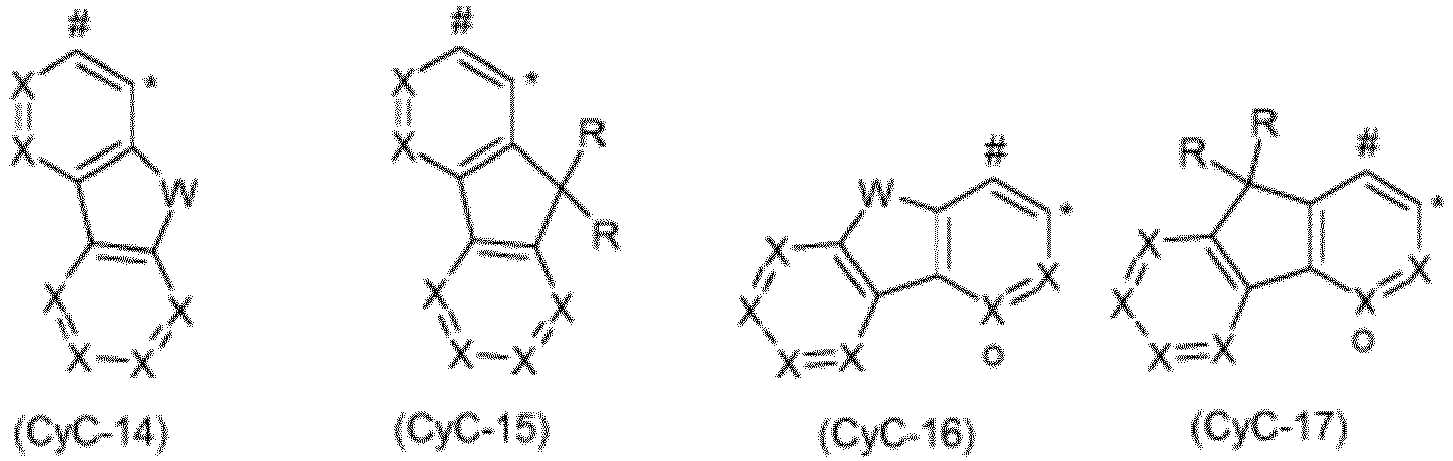
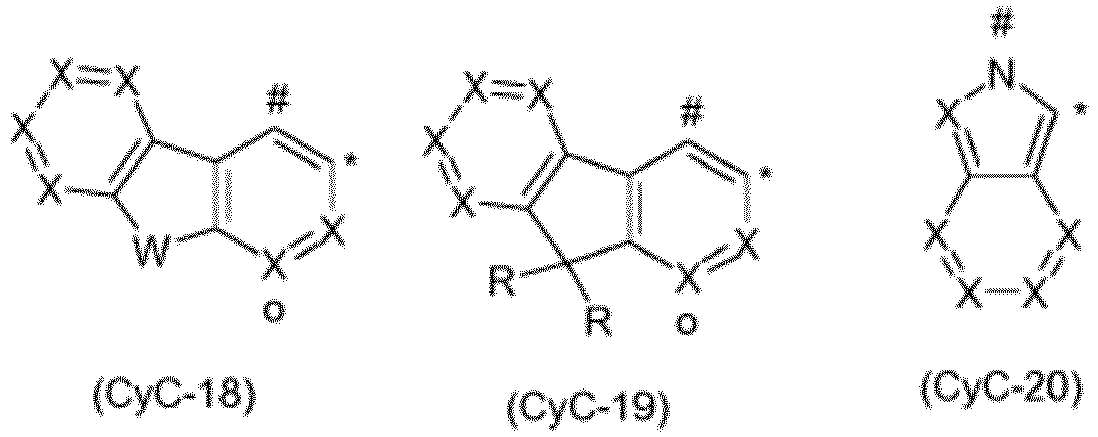


 X, identique ou différent en chaque occurrence, est CR ou N à la condition qu'au maximum deux symboles X par cycle représentent N ;W, identique ou différent en chaque occurrence, est NR, O ou S ;à la condition que lorsque le pont V est lié à CyC, un symbole X dans le groupe correspondant CyC représente C et le pont V est lié au niveau de cet atome de carbone, et lorsque le pont V est lié à CyD, un symbole X dans le groupe correspondant CyD représente C et le pont V est lié au niveau de cet atome de carbone ; la liaison au pont V est alors réalisée par l'intermédiaire d'une position qui est marquée par « o ».
 - Procédé pour la préparation d'un composé selon l'une ou plusieurs des revendications 1 à 10 par la transformation du ligand libre avec des alcoolates d'iridium de formule (52), avec des cétocétonates d'iridium de formule (53), avec des halogénures d'iridium de formule (54) ou avec des carboxylates d'iridium de formule (55),

- Formulation, contenant au moins un composé selon l'une ou plusieurs des revendications 1 à 10 et au moins un composé supplémentaire, le composé supplémentaire étant préférablement choisi parmi un matériau de matrice et/ou un solvant.
- Utilisation d'un composé selon l'une ou plusieurs des revendications 1 à 10 dans un dispositif électronique ou en tant que sensibilisateur à l'oxygène ou en tant que photoinitiateur ou en tant que photocatalyseur.
- Dispositif électronique contenant au moins un composé selon l'une ou plusieurs des revendications 1 à 10, le dispositif électronique étant préférablement choisi dans le groupe constitué par des dispositifs organiques d'électroluminescence, des circuits intégrés organiques, des transistors organiques à effet de champ, des transistors organiques en film mince, des transistors organiques luminescents, des cellules solaires organiques, des détecteurs optiques organiques, des photorécepteurs organiques, des dispositifs organiques d'extinction de champ, des cellules électrochimiques luminescentes, des capteurs infrarouges, des capteurs d'oxygène et des diodes laser organiques.
- Dispositif électronique selon la revendication 14, qui est un dispositif organique d'électroluminescence, caractérisé en ce que le composé selon l'une ou plusieurs des revendications 1 à 10 est utilisé dans une ou plusieurs couches émettrices.
Applications Claiming Priority (2)
| Application Number | Priority Date | Filing Date | Title |
|---|---|---|---|
| EP17182995 | 2017-07-25 | ||
| PCT/EP2018/069854 WO2019020538A1 (fr) | 2017-07-25 | 2018-07-23 | Complexes métalliques |
Publications (2)
| Publication Number | Publication Date |
|---|---|
| EP3658564A1 EP3658564A1 (fr) | 2020-06-03 |
| EP3658564B1 true EP3658564B1 (fr) | 2021-05-19 |
Family
ID=59399323
Family Applications (1)
| Application Number | Title | Priority Date | Filing Date |
|---|---|---|---|
| EP18740862.0A Active EP3658564B1 (fr) | 2017-07-25 | 2018-07-23 | Complexes métalliques |
Country Status (7)
| Country | Link |
|---|---|
| US (1) | US11535640B2 (fr) |
| EP (1) | EP3658564B1 (fr) |
| JP (1) | JP7175959B2 (fr) |
| KR (1) | KR102653759B1 (fr) |
| CN (1) | CN110959010B (fr) |
| TW (1) | TWI776926B (fr) |
| WO (1) | WO2019020538A1 (fr) |
Cited By (1)
| Publication number | Priority date | Publication date | Assignee | Title |
|---|---|---|---|---|
| US11535640B2 (en) | 2017-07-25 | 2022-12-27 | Merck Patent Gmbh | Metal complexes |
Families Citing this family (81)
| Publication number | Priority date | Publication date | Assignee | Title |
|---|---|---|---|---|
| WO2020011686A1 (fr) | 2018-07-09 | 2020-01-16 | Merck Patent Gmbh | Matériaux pour dispositifs électroluminescents organiques |
| US20220020934A1 (en) | 2018-11-06 | 2022-01-20 | Merck Patent Gmbh | 5,6-diphenyl-5,6-dihydro-dibenz[c,e][1,2]azaphosphorin and 6-phenyl-6h-dibenzo[c,e][1,2]thiazin-5,5-dioxide derivatives and similar compounds as organic electroluminescent materials for oleds |
| TW202035345A (zh) | 2019-01-17 | 2020-10-01 | 德商麥克專利有限公司 | 用於有機電致發光裝置之材料 |
| WO2020182779A1 (fr) | 2019-03-12 | 2020-09-17 | Merck Patent Gmbh | Matériaux pour dispositifs électroluminescents organiques |
| WO2020187865A1 (fr) | 2019-03-20 | 2020-09-24 | Merck Patent Gmbh | Matériaux pour dispositifs électroluminescents organiques |
| CN113614082B (zh) | 2019-03-25 | 2024-06-18 | 默克专利有限公司 | 用于有机电致发光器件的材料 |
| JP7625573B2 (ja) | 2019-07-22 | 2025-02-03 | ユー・ディー・シー アイルランド リミテッド | オルトメタル化金属化合物の調製方法 |
| WO2021037401A1 (fr) | 2019-08-26 | 2021-03-04 | Merck Patent Gmbh | Matériaux pour dispositifs électroluminescents organiques |
| KR20220056223A (ko) | 2019-09-02 | 2022-05-04 | 메르크 파텐트 게엠베하 | 유기 전계발광 디바이스용 재료 |
| KR20220066324A (ko) | 2019-09-20 | 2022-05-24 | 메르크 파텐트 게엠베하 | 전자 디바이스용 재료 |
| US20220416172A1 (en) | 2019-10-22 | 2022-12-29 | Merck Patent Gmbh | Materials for organic electroluminescent devices |
| KR20220090539A (ko) | 2019-10-25 | 2022-06-29 | 메르크 파텐트 게엠베하 | 유기 전자 디바이스에서 사용될 수 있는 화합물 |
| TW202136471A (zh) | 2019-12-17 | 2021-10-01 | 德商麥克專利有限公司 | 有機電致發光裝置用的材料 |
| JP7620631B2 (ja) | 2019-12-18 | 2025-01-23 | メルク パテント ゲゼルシャフト ミット ベシュレンクテル ハフツング | 有機エレクトロルミネッセンス素子のための芳香族化合物 |
| CN114867729A (zh) | 2019-12-19 | 2022-08-05 | 默克专利有限公司 | 用于有机电致发光器件的多环化合物 |
| CN115135741A (zh) | 2020-02-25 | 2022-09-30 | 默克专利有限公司 | 杂环化合物在有机电子器件中的用途 |
| WO2021175706A1 (fr) | 2020-03-02 | 2021-09-10 | Merck Patent Gmbh | Utilisation de composés sulfone dans un dispositif électronique organique |
| EP4122028B1 (fr) | 2020-03-17 | 2024-10-16 | Merck Patent GmbH | Composés hétérocycliques pour dispositifs électroluminescents organiques |
| CN115298187A (zh) | 2020-03-17 | 2022-11-04 | 默克专利有限公司 | 用于有机电致发光器件的杂芳族化合物 |
| US12342718B2 (en) | 2020-03-24 | 2025-06-24 | Merck Kgaa | Materials for electronic devices |
| EP4126880A1 (fr) | 2020-03-26 | 2023-02-08 | Merck Patent GmbH | Composés cycliques pour dispositifs électroluminescents organiques |
| US20230151026A1 (en) | 2020-04-02 | 2023-05-18 | Merck Patent Gmbh | Multi-layer body for diffuse transillumination |
| EP4132939B1 (fr) | 2020-04-06 | 2024-01-31 | Merck Patent GmbH | Composés polycycliques pour dispositifs électroluminescents organiques |
| CN115669281A (zh) | 2020-05-29 | 2023-01-31 | 默克专利有限公司 | 有机电致发光器件 |
| CN115867426A (zh) | 2020-06-23 | 2023-03-28 | 默克专利有限公司 | 生产混合物的方法 |
| WO2022002771A1 (fr) | 2020-06-29 | 2022-01-06 | Merck Patent Gmbh | Composés hétérocycliques pour dispositifs électroluminescents organiques |
| JP2023531470A (ja) | 2020-06-29 | 2023-07-24 | メルク パテント ゲゼルシャフト ミット ベシュレンクテル ハフツング | 有機エレクトロルミネッセンス素子のためのヘテロ芳香族化合物 |
| WO2022029096A1 (fr) | 2020-08-06 | 2022-02-10 | Merck Patent Gmbh | Matériaux destinés à des dispositifs électroluminescents organiques |
| CN116134113B (zh) | 2020-08-13 | 2025-12-26 | Udc爱尔兰有限公司 | 金属络合物 |
| US12433160B2 (en) | 2020-08-18 | 2025-09-30 | Merck Patent Gmbh | Materials for organic electroluminescent devices |
| CN115956073A (zh) | 2020-08-19 | 2023-04-11 | 默克专利有限公司 | 用于有机电致发光器件的材料 |
| TW202229215A (zh) | 2020-09-30 | 2022-08-01 | 德商麥克專利有限公司 | 用於有機電致發光裝置功能層之結構化的化合物 |
| TW202222748A (zh) | 2020-09-30 | 2022-06-16 | 德商麥克專利有限公司 | 用於結構化有機電致發光裝置的功能層之化合物 |
| EP4229064A1 (fr) | 2020-10-16 | 2023-08-23 | Merck Patent GmbH | Composés hétérocycliques pour dispositifs électroluminescents organiques |
| WO2022079067A1 (fr) | 2020-10-16 | 2022-04-21 | Merck Patent Gmbh | Composés comprenant des hétéroatomes pour dispositifs électroluminescents organiques |
| CN116568690A (zh) | 2020-12-10 | 2023-08-08 | 默克专利有限公司 | 用于有机电致发光器件的材料 |
| TW202241905A (zh) | 2020-12-18 | 2022-11-01 | 德商麥克專利有限公司 | 用於有機電致發光裝置的氮化合物 |
| WO2022129116A1 (fr) | 2020-12-18 | 2022-06-23 | Merck Patent Gmbh | Dérivés d'indolo[3.2.1-jk]carbazole-6-carbonitrile utilisés en tant qu'émetteurs fluorescents bleus destinés à être utilisés dans des oled |
| US20240101560A1 (en) | 2020-12-18 | 2024-03-28 | Merck Patent Gmbh | Nitrogenous heteroaromatic compounds for organic electroluminescent devices |
| EP4274827A1 (fr) | 2021-01-05 | 2023-11-15 | Merck Patent GmbH | Matériaux pour dispositifs électroluminescents organiques |
| KR20240005782A (ko) | 2021-04-29 | 2024-01-12 | 메르크 파텐트 게엠베하 | 유기 전계 발광 디바이스용 재료 |
| CN117279902A (zh) | 2021-04-29 | 2023-12-22 | 默克专利有限公司 | 用于有机电致发光器件的材料 |
| WO2022229234A1 (fr) | 2021-04-30 | 2022-11-03 | Merck Patent Gmbh | Composés hétérocycliques azotés pour dispositifs électroluminescents organiques |
| EP4340969A1 (fr) | 2021-05-21 | 2024-03-27 | Merck Patent GmbH | Procédé de purification continue d'au moins un matériau fonctionnel et dispositif de purification continue d'au moins un matériau fonctionnel |
| WO2022200638A1 (fr) | 2021-07-06 | 2022-09-29 | Merck Patent Gmbh | Matériaux pour dispositifs électroluminescents organiques |
| EP4402141A1 (fr) | 2021-09-13 | 2024-07-24 | Merck Patent GmbH | Matériaux pour dispositifs électroluminescents organiques |
| KR20240064697A (ko) | 2021-09-14 | 2024-05-13 | 메르크 파텐트 게엠베하 | 유기 전계 발광 디바이스용 붕소 복소환 화합물 |
| CN118056486A (zh) | 2021-09-28 | 2024-05-17 | 默克专利有限公司 | 用于电子器件的材料 |
| EP4410074B1 (fr) | 2021-09-28 | 2025-05-21 | Merck Patent GmbH | Matériaux pour dispositifs électroniques |
| EP4410071A1 (fr) | 2021-09-28 | 2024-08-07 | Merck Patent GmbH | Matériaux pour dispositifs électroniques |
| WO2023052272A1 (fr) | 2021-09-28 | 2023-04-06 | Merck Patent Gmbh | Matériaux pour dispositifs électroniques |
| EP4423209B1 (fr) | 2021-10-27 | 2025-05-07 | Merck Patent GmbH | Composés hétérocycliques contenant du bore et de l'azote pour dispositifs électroluminescents organiques |
| EP4437814A1 (fr) | 2021-11-25 | 2024-10-02 | Merck Patent GmbH | Matériaux pour dispositifs électroniques |
| KR20240122858A (ko) | 2021-12-13 | 2024-08-13 | 메르크 파텐트 게엠베하 | 유기 전계발광 디바이스용 재료 |
| CN114262292A (zh) * | 2021-12-20 | 2022-04-01 | 上海工程技术大学 | 吡啶类衍生物及其制备方法和用途 |
| KR20240128020A (ko) | 2021-12-21 | 2024-08-23 | 메르크 파텐트 게엠베하 | 중수소화 유기 화합물의 제조 방법 |
| KR20240146680A (ko) | 2022-02-09 | 2024-10-08 | 메르크 파텐트 게엠베하 | 유기 전계 발광 디바이스용 재료 |
| EP4479385A1 (fr) | 2022-02-14 | 2024-12-25 | Merck Patent GmbH | Matériaux pour dispositifs électroniques |
| WO2023161168A1 (fr) | 2022-02-23 | 2023-08-31 | Merck Patent Gmbh | Hétérocycles aromatiques pour dispositifs électroluminescents organiques |
| WO2023161167A1 (fr) | 2022-02-23 | 2023-08-31 | Merck Patent Gmbh | Hétérocycles azotés pour dispositifs électroluminescents organiques |
| CN119156361A (zh) | 2022-05-18 | 2024-12-17 | 默克专利有限公司 | 用于氘化的有机化合物的制备方法 |
| WO2023247663A1 (fr) | 2022-06-24 | 2023-12-28 | Merck Patent Gmbh | Composition pour dispositifs électroniques organiques |
| KR20250027272A (ko) | 2022-06-24 | 2025-02-25 | 메르크 파텐트 게엠베하 | 유기 전자 디바이스용 조성물 |
| CN119452060A (zh) | 2022-07-11 | 2025-02-14 | 默克专利有限公司 | 用于电子器件的材料 |
| EP4568964A1 (fr) | 2022-08-09 | 2025-06-18 | Merck Patent GmbH | Matériaux pour dispositifs électroluminescents organiques |
| EP4640022A1 (fr) | 2022-12-19 | 2025-10-29 | Merck Patent GmbH | Matériaux pour dispositifs électroniques |
| TW202438505A (zh) | 2022-12-19 | 2024-10-01 | 德商麥克專利有限公司 | 有機電致發光裝置之材料 |
| CN120379953A (zh) | 2022-12-20 | 2025-07-25 | 默克专利有限公司 | 用于制备氘化芳族化合物的方法 |
| EP4683925A1 (fr) | 2023-03-20 | 2026-01-28 | Merck Patent GmbH | Matériaux pour dispositifs électroluminescents organiques |
| KR20260015809A (ko) | 2023-04-20 | 2026-02-03 | 메르크 파텐트 게엠베하 | 전자 디바이스들을 위한 재료들 |
| EP4720070A1 (fr) | 2023-05-25 | 2026-04-08 | Merck Patent GmbH | Dérivés de tris[1,2,4]triazolo[1,5-a:1',5'-c:1'',5''-e][1,3,5]triazine destinés à être utilisés dans des dispositifs électroluminescents organiques |
| EP4486099B1 (fr) | 2023-06-30 | 2026-04-29 | UDC Ireland Limited | Composés pour dispositifs électroluminescents organiques |
| KR20260044229A (ko) | 2023-07-27 | 2026-04-01 | 메르크 파텐트 게엠베하 | 유기 발광 디바이스 및 유기 센서를 위한 재료 |
| WO2025045842A1 (fr) | 2023-08-30 | 2025-03-06 | Merck Patent Gmbh | Matériaux pour dispositifs électroluminescents organiques |
| CN121753521A (zh) | 2023-08-30 | 2026-03-27 | 默克专利有限公司 | 用于有机发光器件的材料 |
| CN121773745A (zh) | 2023-08-30 | 2026-03-31 | 默克专利有限公司 | 用于有机发光器件的材料 |
| WO2025132551A1 (fr) | 2023-12-22 | 2025-06-26 | Merck Patent Gmbh | Matériaux pour dispositifs électroniques |
| WO2026008710A1 (fr) | 2024-07-05 | 2026-01-08 | Merck Patent Gmbh | Composés de silicium cyclique pour dispositifs électroluminescents organiques |
| WO2026022016A1 (fr) | 2024-07-22 | 2026-01-29 | Merck Patent Gmbh | Matériaux pour dispositifs électroluminescents organiques |
| WO2026041632A1 (fr) | 2024-08-21 | 2026-02-26 | Merck Patent Gmbh | Matériaux hétérocycliques pour dispositifs électroluminescents organiques |
| WO2026073855A1 (fr) | 2024-10-01 | 2026-04-09 | Merck Patent Gmbh | Composés de silicium pour dispositifs électroluminescents organiques |
Family Cites Families (83)
| Publication number | Priority date | Publication date | Assignee | Title |
|---|---|---|---|---|
| US5061569A (en) | 1990-07-26 | 1991-10-29 | Eastman Kodak Company | Electroluminescent device with organic electroluminescent medium |
| JP3295088B2 (ja) | 1993-09-29 | 2002-06-24 | 出光興産株式会社 | 有機エレクトロルミネッセンス素子 |
| JPH07133483A (ja) | 1993-11-09 | 1995-05-23 | Shinko Electric Ind Co Ltd | El素子用有機発光材料及びel素子 |
| KR100377321B1 (ko) | 1999-12-31 | 2003-03-26 | 주식회사 엘지화학 | 피-형 반도체 성질을 갖는 유기 화합물을 포함하는 전기소자 |
| US6660410B2 (en) | 2000-03-27 | 2003-12-09 | Idemitsu Kosan Co., Ltd. | Organic electroluminescence element |
| DE10058578C2 (de) | 2000-11-20 | 2002-11-28 | Univ Dresden Tech | Lichtemittierendes Bauelement mit organischen Schichten |
| KR100832766B1 (ko) | 2000-12-22 | 2008-05-27 | 메르크 파텐트 게엠베하 | 붕소 또는 알루미늄계 스피로 화합물 및 전자 산업에서의이들의 용도 |
| DE10104426A1 (de) | 2001-02-01 | 2002-08-08 | Covion Organic Semiconductors | Verfahren zur Herstellung von hochreinen, tris-ortho-metallierten Organo-Iridium-Verbindungen |
| US6597012B2 (en) | 2001-05-02 | 2003-07-22 | Junji Kido | Organic electroluminescent device |
| ITRM20020411A1 (it) | 2002-08-01 | 2004-02-02 | Univ Roma La Sapienza | Derivati dello spirobifluorene, loro preparazione e loro uso. |
| DE10249723A1 (de) | 2002-10-25 | 2004-05-06 | Covion Organic Semiconductors Gmbh | Arylamin-Einheiten enthaltende konjugierte Polymere, deren Darstellung und Verwendung |
| US20060063027A1 (en) | 2002-12-23 | 2006-03-23 | Covion Organic Semiconductors Gmbh | Organic electroluminescent element |
| JP4411851B2 (ja) | 2003-03-19 | 2010-02-10 | コニカミノルタホールディングス株式会社 | 有機エレクトロルミネッセンス素子 |
| DE10314102A1 (de) * | 2003-03-27 | 2004-10-14 | Covion Organic Semiconductors Gmbh | Verfahren zur Herstellung von hochreinen Organo-Iridium-Verbindungen |
| EP1618170A2 (fr) | 2003-04-15 | 2006-01-25 | Covion Organic Semiconductors GmbH | Melanges de semi-conducteurs organiques aptes a l'emission et de matieres matricielles, leur utilisation et composants electroniques contenant ces melanges |
| JP4635870B2 (ja) | 2003-04-23 | 2011-02-23 | コニカミノルタホールディングス株式会社 | 有機エレクトロルミネッセンス素子、照明装置及び表示装置 |
| DE10333232A1 (de) | 2003-07-21 | 2007-10-11 | Merck Patent Gmbh | Organisches Elektrolumineszenzelement |
| US7795801B2 (en) | 2003-09-30 | 2010-09-14 | Konica Minolta Holdings, Inc. | Organic electroluminescent element, illuminator, display and compound |
| US7790890B2 (en) | 2004-03-31 | 2010-09-07 | Konica Minolta Holdings, Inc. | Organic electroluminescence element material, organic electroluminescence element, display device and illumination device |
| KR100787425B1 (ko) | 2004-11-29 | 2007-12-26 | 삼성에스디아이 주식회사 | 페닐카바졸계 화합물 및 이를 이용한 유기 전계 발광 소자 |
| DE102004023277A1 (de) | 2004-05-11 | 2005-12-01 | Covion Organic Semiconductors Gmbh | Neue Materialmischungen für die Elektrolumineszenz |
| JP4862248B2 (ja) | 2004-06-04 | 2012-01-25 | コニカミノルタホールディングス株式会社 | 有機エレクトロルミネッセンス素子、照明装置及び表示装置 |
| ITRM20040352A1 (it) | 2004-07-15 | 2004-10-15 | Univ Roma La Sapienza | Derivati oligomerici dello spirobifluorene, loro preparazione e loro uso. |
| TWI382079B (zh) | 2004-07-30 | 2013-01-11 | Sanyo Electric Co | 有機電場發光元件及有機電場發光顯示裝置 |
| JP4747558B2 (ja) | 2004-11-08 | 2011-08-17 | ソニー株式会社 | 表示素子用有機材料および表示素子 |
| JP2006135145A (ja) | 2004-11-08 | 2006-05-25 | Sony Corp | 表示素子用有機材料および表示素子 |
| KR100949214B1 (ko) | 2005-03-18 | 2010-03-24 | 이데미쓰 고산 가부시키가이샤 | 방향족 아민 유도체 및 그것을 사용한 유기 전기발광 소자 |
| EP1888706B1 (fr) | 2005-05-03 | 2017-03-01 | Merck Patent GmbH | Dispositif electroluminescent organique, et derives d'acide boronique et d'acide borinique utilises pour produire ce dispositif electroluminescent organique |
| DE102005023437A1 (de) | 2005-05-20 | 2006-11-30 | Merck Patent Gmbh | Verbindungen für organische elektronische Vorrichtungen |
| WO2007063754A1 (fr) | 2005-12-01 | 2007-06-07 | Nippon Steel Chemical Co., Ltd. | Compose pour element electroluminescent organique et element electroluminescent organique |
| DE102006025777A1 (de) | 2006-05-31 | 2007-12-06 | Merck Patent Gmbh | Neue Materialien für organische Elektrolumineszenzvorrichtungen |
| DE102006025846A1 (de) | 2006-06-02 | 2007-12-06 | Merck Patent Gmbh | Neue Materialien für organische Elektrolumineszenzvorrichtungen |
| DE102006031990A1 (de) | 2006-07-11 | 2008-01-17 | Merck Patent Gmbh | Neue Materialien für organische Elektrolumineszenzvorrichtungen |
| US8062769B2 (en) | 2006-11-09 | 2011-11-22 | Nippon Steel Chemical Co., Ltd. | Indolocarbazole compound for use in organic electroluminescent device and organic electroluminescent device |
| DE102007002714A1 (de) | 2007-01-18 | 2008-07-31 | Merck Patent Gmbh | Neue Materialien für organische Elektrolumineszenzvorrichtungen |
| DE102007053771A1 (de) | 2007-11-12 | 2009-05-14 | Merck Patent Gmbh | Organische Elektrolumineszenzvorrichtungen |
| US7862908B2 (en) | 2007-11-26 | 2011-01-04 | National Tsing Hua University | Conjugated compounds containing hydroindoloacridine structural elements, and their use |
| US8221905B2 (en) | 2007-12-28 | 2012-07-17 | Universal Display Corporation | Carbazole-containing materials in phosphorescent light emitting diodes |
| CN102056911B (zh) | 2008-06-05 | 2015-07-22 | 出光兴产株式会社 | 卤素化合物、多环系化合物及使用其的有机电致发光元件 |
| DE102008033943A1 (de) | 2008-07-18 | 2010-01-21 | Merck Patent Gmbh | Neue Materialien für organische Elektrolumineszenzvorrichtungen |
| DE102008036247A1 (de) * | 2008-08-04 | 2010-02-11 | Merck Patent Gmbh | Elektronische Vorrichtungen enthaltend Metallkomplexe |
| DE102008036982A1 (de) | 2008-08-08 | 2010-02-11 | Merck Patent Gmbh | Organische Elektrolumineszenzvorrichtung |
| KR101506919B1 (ko) | 2008-10-31 | 2015-03-30 | 롬엔드하스전자재료코리아유한회사 | 신규한 유기 전자재료용 화합물 및 이를 포함하는 유기 전자 소자 |
| DE102008056688A1 (de) | 2008-11-11 | 2010-05-12 | Merck Patent Gmbh | Materialien für organische Elektrolumineszenzvorrichtungen |
| JP5701766B2 (ja) | 2008-11-11 | 2015-04-15 | メルク パテント ゲーエムベーハー | 有機エレクトロルミネセント素子 |
| DE102009014513A1 (de) | 2009-03-23 | 2010-09-30 | Merck Patent Gmbh | Organische Elektrolumineszenzvorrichtung |
| DE102009023155A1 (de) | 2009-05-29 | 2010-12-02 | Merck Patent Gmbh | Materialien für organische Elektrolumineszenzvorrichtungen |
| DE102009031021A1 (de) | 2009-06-30 | 2011-01-05 | Merck Patent Gmbh | Materialien für organische Elektrolumineszenzvorrichtungen |
| DE102009048791A1 (de) | 2009-10-08 | 2011-04-14 | Merck Patent Gmbh | Materialien für organische Elektrolumineszenzvorrichtungen |
| DE102010005697A1 (de) | 2010-01-25 | 2011-07-28 | Merck Patent GmbH, 64293 | Verbindungen für elektronische Vorrichtungen |
| WO2012008550A1 (fr) | 2010-07-16 | 2012-01-19 | 住友化学株式会社 | Composé polymère, composition contenant le composé polymère, composition liquide, élément et film minces, et source lumineuse de surface et dispositif d'affichage utilisant l'élément |
| DE102010045405A1 (de) | 2010-09-15 | 2012-03-15 | Merck Patent Gmbh | Materialien für organische Elektrolumineszenzvorrichtungen |
| DE102010048498A1 (de) | 2010-10-14 | 2012-04-19 | Merck Patent Gmbh | Materialien für organische Elektrolumineszenzvorrichtungen |
| JP5677036B2 (ja) * | 2010-11-08 | 2015-02-25 | キヤノン株式会社 | 有機発光素子 |
| DE112011104715A5 (de) | 2011-01-13 | 2014-02-06 | Merck Patent Gmbh | Verbindungen für organische Elektrolumineszenzvorrichtungen |
| KR101970940B1 (ko) | 2011-05-05 | 2019-04-22 | 메르크 파텐트 게엠베하 | 전자 소자용 화합물 |
| US10305040B2 (en) | 2011-11-17 | 2019-05-28 | Merck Patent Gmbh | Spiro dihydroacridine derivatives and the use thereof as materials for organic electroluminescence devices |
| JP5920013B2 (ja) | 2012-05-21 | 2016-05-18 | コニカミノルタ株式会社 | 有機エレクトロルミネッセンス素子、有機エレクトロルミネッセンス素子の製造方法、表示装置および照明装置 |
| CN104488359B (zh) | 2012-07-23 | 2018-01-23 | 默克专利有限公司 | 2‑二芳基氨基芴的衍生物和含有所述2‑二芳基氨基芴衍生物的有机电子复合体 |
| KR101807925B1 (ko) | 2012-07-23 | 2017-12-11 | 메르크 파텐트 게엠베하 | 화합물 및 유기 전계 발광 디바이스 |
| EP3424907B1 (fr) | 2012-07-23 | 2025-03-12 | Merck Patent GmbH | Raccordements et dispositifs électro-organiques |
| KR102153871B1 (ko) | 2012-10-09 | 2020-09-09 | 메르크 파텐트 게엠베하 | 전자 디바이스 |
| KR102179608B1 (ko) | 2012-12-18 | 2020-11-17 | 메르크 파텐트 게엠베하 | 유기 전계발광 소자 |
| DE102013215342B4 (de) | 2013-08-05 | 2023-05-04 | Novaled Gmbh | Verfahren zur Herstellung organisch phosphoreszenter Schichten unter Zusatz schwerer Hauptgruppenmetallkomplexe, damit hergestellte Schicht, deren Verwendung und organisches Halbleiterbauelement diese umfassend |
| KR102310370B1 (ko) | 2013-10-02 | 2021-10-07 | 메르크 파텐트 게엠베하 | Oled 에서의 사용을 위한 붕소 함유 화합물 |
| CN106459018B (zh) | 2014-05-05 | 2022-01-25 | 默克专利有限公司 | 用于有机发光器件的材料 |
| WO2016124304A1 (fr) | 2015-02-03 | 2016-08-11 | Merck Patent Gmbh | Complexes métalliques |
| EP3297978B1 (fr) | 2015-05-18 | 2020-04-01 | Merck Patent GmbH | Matériaux pour dispositifs électroluminescents organiques |
| JP6946269B2 (ja) | 2015-08-25 | 2021-10-06 | メルク、パテント、ゲゼルシャフト、ミット、ベシュレンクテル、ハフツングMerck Patent GmbH | 金属錯体 |
| TWI749026B (zh) | 2016-07-14 | 2021-12-11 | 德商麥克專利有限公司 | 金屬錯合物 |
| US11437592B2 (en) | 2016-07-25 | 2022-09-06 | Merck Patent Gmbh | Dinuclear and oligonuclear metal complexes containing tripodal bidentate part ligands and their use in electronic devices |
| KR101836041B1 (ko) | 2016-08-30 | 2018-03-07 | 메르크 파텐트 게엠베하 | 금속 착물 |
| WO2018054798A1 (fr) | 2016-09-21 | 2018-03-29 | Merck Patent Gmbh | Complexes métalliques trouvant application comme émetteurs dans des dispositifs électroluminescents organiques |
| US11430962B2 (en) | 2016-10-12 | 2022-08-30 | Merck Patent Gmbh | Binuclear metal complexes and electronic devices, in particular organic electroluminescent devices containing said metal complexes |
| CN109937207A (zh) | 2016-10-12 | 2019-06-25 | 默克专利有限公司 | 金属络合物 |
| CN109790192A (zh) | 2016-10-13 | 2019-05-21 | 默克专利有限公司 | 金属络合物 |
| US20190280220A1 (en) | 2016-10-25 | 2019-09-12 | Merck Patent Gmbh | Metal complexes |
| JP7138654B2 (ja) | 2017-03-29 | 2022-09-16 | メルク パテント ゲゼルシャフト ミット ベシュレンクテル ハフツング | 金属錯体 |
| EP3601257B1 (fr) | 2017-03-29 | 2021-10-27 | Merck Patent GmbH | Composés aromatiques |
| TWI776926B (zh) | 2017-07-25 | 2022-09-11 | 德商麥克專利有限公司 | 金屬錯合物 |
| TWI791701B (zh) * | 2017-12-13 | 2023-02-11 | 德商麥克專利有限公司 | 金屬錯合物 |
| EP3752512B1 (fr) | 2018-02-13 | 2023-03-01 | Merck Patent GmbH | Complexes métalliques |
| TWI828664B (zh) | 2018-03-19 | 2024-01-11 | 愛爾蘭商Udc愛爾蘭責任有限公司 | 金屬錯合物 |
-
2018
- 2018-07-20 TW TW107125089A patent/TWI776926B/zh active
- 2018-07-23 JP JP2020503855A patent/JP7175959B2/ja active Active
- 2018-07-23 US US16/634,012 patent/US11535640B2/en active Active
- 2018-07-23 WO PCT/EP2018/069854 patent/WO2019020538A1/fr not_active Ceased
- 2018-07-23 KR KR1020207004906A patent/KR102653759B1/ko active Active
- 2018-07-23 EP EP18740862.0A patent/EP3658564B1/fr active Active
- 2018-07-23 CN CN201880047777.XA patent/CN110959010B/zh active Active
Cited By (1)
| Publication number | Priority date | Publication date | Assignee | Title |
|---|---|---|---|---|
| US11535640B2 (en) | 2017-07-25 | 2022-12-27 | Merck Patent Gmbh | Metal complexes |
Also Published As
| Publication number | Publication date |
|---|---|
| JP7175959B2 (ja) | 2022-11-21 |
| TWI776926B (zh) | 2022-09-11 |
| EP3658564A1 (fr) | 2020-06-03 |
| US11535640B2 (en) | 2022-12-27 |
| KR102653759B1 (ko) | 2024-04-03 |
| JP2020529979A (ja) | 2020-10-15 |
| CN110959010B (zh) | 2024-01-23 |
| TW201920224A (zh) | 2019-06-01 |
| KR20200031148A (ko) | 2020-03-23 |
| WO2019020538A1 (fr) | 2019-01-31 |
| US20200207794A1 (en) | 2020-07-02 |
| CN110959010A (zh) | 2020-04-03 |
Similar Documents
| Publication | Publication Date | Title |
|---|---|---|
| EP3658564B1 (fr) | Complexes métalliques | |
| EP3768692B1 (fr) | Complexes métalliques | |
| EP3724202B1 (fr) | Complexes métalliques | |
| EP3487864B1 (fr) | Complexes métalliques trouvant application comme émetteurs dans des dispositifs électroluminescents organiques | |
| EP3487865B1 (fr) | Complexes métalliques dinucléaires et oligonucléaires comprenant des sous-unités de ligands tripodes bidentées ainsi que leur utilisation dans des dispositifs électroniques | |
| EP3601304B1 (fr) | Complexes métalliques | |
| EP3526228B1 (fr) | Complexes métalliques | |
| EP3424936B1 (fr) | Complexe métallique | |
| EP2935293B1 (fr) | Complexes du iridium et leur utilisation dans les dispositifs electroniques en particulier les dispositifs electroluminescentes | |
| EP2714704B1 (fr) | Complexes métalliques | |
| EP3752512A1 (fr) | Complexes métalliques | |
| EP3016952B1 (fr) | Composés de lactame spirocondensés pour des dispositifs électroluminescents organiques | |
| EP3526226A1 (fr) | Complexes métalliques | |
| WO2018054798A1 (fr) | Complexes métalliques trouvant application comme émetteurs dans des dispositifs électroluminescents organiques | |
| WO2018011186A1 (fr) | Complexes métalliques | |
| EP3526227A1 (fr) | Complexes métalliques binucléaires, ainsi que dispositifs électroniques, en particulier dispositifs électroluminescents organiques, contenant lesdits complexes métalliques | |
| WO2018041769A1 (fr) | Complexes métalliques binucléaires et trinucléaires obtenus à partir de deux ligands hexadentés tripodaux liés entre eux, destinés à être utilisés dans des dispositifs électroluminescents | |
| WO2017032439A1 (fr) | Complexes métalliques | |
| WO2016000803A1 (fr) | Complexes métalliques | |
| EP3708634A1 (fr) | Composés spiraniques hétérocycliques | |
| EP3507294A1 (fr) | Complexes métalliques binucléaires et trinucléaires obtenus à partir de deux ligands hexadentés tripodaux liés entre eux, destinés à être utilisés dans des dispositifs électroluminescents | |
| EP3532480B1 (fr) | Complexes métalliques | |
| WO2018050583A1 (fr) | Composés à structures carbazole | |
| EP4069709B1 (fr) | Complexes métalliques | |
| WO2021053046A1 (fr) | Composés hétérocycliques péri-condensés en tant que matériaux destinés à des dispositifs électroniques |
Legal Events
| Date | Code | Title | Description |
|---|---|---|---|
| STAA | Information on the status of an ep patent application or granted ep patent |
Free format text: STATUS: UNKNOWN |
|
| STAA | Information on the status of an ep patent application or granted ep patent |
Free format text: STATUS: THE INTERNATIONAL PUBLICATION HAS BEEN MADE |
|
| PUAI | Public reference made under article 153(3) epc to a published international application that has entered the european phase |
Free format text: ORIGINAL CODE: 0009012 |
|
| STAA | Information on the status of an ep patent application or granted ep patent |
Free format text: STATUS: REQUEST FOR EXAMINATION WAS MADE |
|
| 17P | Request for examination filed |
Effective date: 20200122 |
|
| AK | Designated contracting states |
Kind code of ref document: A1 Designated state(s): AL AT BE BG CH CY CZ DE DK EE ES FI FR GB GR HR HU IE IS IT LI LT LU LV MC MK MT NL NO PL PT RO RS SE SI SK SM TR |
|
| AX | Request for extension of the european patent |
Extension state: BA ME |
|
| DAV | Request for validation of the european patent (deleted) | ||
| DAX | Request for extension of the european patent (deleted) | ||
| GRAP | Despatch of communication of intention to grant a patent |
Free format text: ORIGINAL CODE: EPIDOSNIGR1 |
|
| STAA | Information on the status of an ep patent application or granted ep patent |
Free format text: STATUS: GRANT OF PATENT IS INTENDED |
|
| INTG | Intention to grant announced |
Effective date: 20210122 |
|
| GRAS | Grant fee paid |
Free format text: ORIGINAL CODE: EPIDOSNIGR3 |
|
| GRAA | (expected) grant |
Free format text: ORIGINAL CODE: 0009210 |
|
| STAA | Information on the status of an ep patent application or granted ep patent |
Free format text: STATUS: THE PATENT HAS BEEN GRANTED |
|
| AK | Designated contracting states |
Kind code of ref document: B1 Designated state(s): AL AT BE BG CH CY CZ DE DK EE ES FI FR GB GR HR HU IE IS IT LI LT LU LV MC MK MT NL NO PL PT RO RS SE SI SK SM TR |
|
| REG | Reference to a national code |
Ref country code: GB Ref legal event code: FG4D Free format text: NOT ENGLISH |
|
| REG | Reference to a national code |
Ref country code: CH Ref legal event code: EP |
|
| REG | Reference to a national code |
Ref country code: DE Ref legal event code: R096 Ref document number: 502018005347 Country of ref document: DE |
|
| REG | Reference to a national code |
Ref country code: AT Ref legal event code: REF Ref document number: 1393870 Country of ref document: AT Kind code of ref document: T Effective date: 20210615 |
|
| REG | Reference to a national code |
Ref country code: IE Ref legal event code: FG4D Free format text: LANGUAGE OF EP DOCUMENT: GERMAN |
|
| REG | Reference to a national code |
Ref country code: LT Ref legal event code: MG9D |
|
| REG | Reference to a national code |
Ref country code: NL Ref legal event code: MP Effective date: 20210519 |
|
| PG25 | Lapsed in a contracting state [announced via postgrant information from national office to epo] |
Ref country code: LT Free format text: LAPSE BECAUSE OF FAILURE TO SUBMIT A TRANSLATION OF THE DESCRIPTION OR TO PAY THE FEE WITHIN THE PRESCRIBED TIME-LIMIT Effective date: 20210519 Ref country code: HR Free format text: LAPSE BECAUSE OF FAILURE TO SUBMIT A TRANSLATION OF THE DESCRIPTION OR TO PAY THE FEE WITHIN THE PRESCRIBED TIME-LIMIT Effective date: 20210519 Ref country code: FI Free format text: LAPSE BECAUSE OF FAILURE TO SUBMIT A TRANSLATION OF THE DESCRIPTION OR TO PAY THE FEE WITHIN THE PRESCRIBED TIME-LIMIT Effective date: 20210519 Ref country code: BG Free format text: LAPSE BECAUSE OF FAILURE TO SUBMIT A TRANSLATION OF THE DESCRIPTION OR TO PAY THE FEE WITHIN THE PRESCRIBED TIME-LIMIT Effective date: 20210819 |
|
| PG25 | Lapsed in a contracting state [announced via postgrant information from national office to epo] |
Ref country code: LV Free format text: LAPSE BECAUSE OF FAILURE TO SUBMIT A TRANSLATION OF THE DESCRIPTION OR TO PAY THE FEE WITHIN THE PRESCRIBED TIME-LIMIT Effective date: 20210519 Ref country code: NO Free format text: LAPSE BECAUSE OF FAILURE TO SUBMIT A TRANSLATION OF THE DESCRIPTION OR TO PAY THE FEE WITHIN THE PRESCRIBED TIME-LIMIT Effective date: 20210819 Ref country code: PL Free format text: LAPSE BECAUSE OF FAILURE TO SUBMIT A TRANSLATION OF THE DESCRIPTION OR TO PAY THE FEE WITHIN THE PRESCRIBED TIME-LIMIT Effective date: 20210519 Ref country code: PT Free format text: LAPSE BECAUSE OF FAILURE TO SUBMIT A TRANSLATION OF THE DESCRIPTION OR TO PAY THE FEE WITHIN THE PRESCRIBED TIME-LIMIT Effective date: 20210920 Ref country code: RS Free format text: LAPSE BECAUSE OF FAILURE TO SUBMIT A TRANSLATION OF THE DESCRIPTION OR TO PAY THE FEE WITHIN THE PRESCRIBED TIME-LIMIT Effective date: 20210519 Ref country code: SE Free format text: LAPSE BECAUSE OF FAILURE TO SUBMIT A TRANSLATION OF THE DESCRIPTION OR TO PAY THE FEE WITHIN THE PRESCRIBED TIME-LIMIT Effective date: 20210519 Ref country code: GR Free format text: LAPSE BECAUSE OF FAILURE TO SUBMIT A TRANSLATION OF THE DESCRIPTION OR TO PAY THE FEE WITHIN THE PRESCRIBED TIME-LIMIT Effective date: 20210820 Ref country code: IS Free format text: LAPSE BECAUSE OF FAILURE TO SUBMIT A TRANSLATION OF THE DESCRIPTION OR TO PAY THE FEE WITHIN THE PRESCRIBED TIME-LIMIT Effective date: 20210919 |
|
| PG25 | Lapsed in a contracting state [announced via postgrant information from national office to epo] |
Ref country code: NL Free format text: LAPSE BECAUSE OF FAILURE TO SUBMIT A TRANSLATION OF THE DESCRIPTION OR TO PAY THE FEE WITHIN THE PRESCRIBED TIME-LIMIT Effective date: 20210519 |
|
| PG25 | Lapsed in a contracting state [announced via postgrant information from national office to epo] |
Ref country code: EE Free format text: LAPSE BECAUSE OF FAILURE TO SUBMIT A TRANSLATION OF THE DESCRIPTION OR TO PAY THE FEE WITHIN THE PRESCRIBED TIME-LIMIT Effective date: 20210519 Ref country code: ES Free format text: LAPSE BECAUSE OF FAILURE TO SUBMIT A TRANSLATION OF THE DESCRIPTION OR TO PAY THE FEE WITHIN THE PRESCRIBED TIME-LIMIT Effective date: 20210519 Ref country code: SK Free format text: LAPSE BECAUSE OF FAILURE TO SUBMIT A TRANSLATION OF THE DESCRIPTION OR TO PAY THE FEE WITHIN THE PRESCRIBED TIME-LIMIT Effective date: 20210519 Ref country code: DK Free format text: LAPSE BECAUSE OF FAILURE TO SUBMIT A TRANSLATION OF THE DESCRIPTION OR TO PAY THE FEE WITHIN THE PRESCRIBED TIME-LIMIT Effective date: 20210519 Ref country code: CZ Free format text: LAPSE BECAUSE OF FAILURE TO SUBMIT A TRANSLATION OF THE DESCRIPTION OR TO PAY THE FEE WITHIN THE PRESCRIBED TIME-LIMIT Effective date: 20210519 Ref country code: SM Free format text: LAPSE BECAUSE OF FAILURE TO SUBMIT A TRANSLATION OF THE DESCRIPTION OR TO PAY THE FEE WITHIN THE PRESCRIBED TIME-LIMIT Effective date: 20210519 Ref country code: RO Free format text: LAPSE BECAUSE OF FAILURE TO SUBMIT A TRANSLATION OF THE DESCRIPTION OR TO PAY THE FEE WITHIN THE PRESCRIBED TIME-LIMIT Effective date: 20210519 |
|
| REG | Reference to a national code |
Ref country code: DE Ref legal event code: R097 Ref document number: 502018005347 Country of ref document: DE |
|
| REG | Reference to a national code |
Ref country code: CH Ref legal event code: PL |
|
| PLBE | No opposition filed within time limit |
Free format text: ORIGINAL CODE: 0009261 |
|
| STAA | Information on the status of an ep patent application or granted ep patent |
Free format text: STATUS: NO OPPOSITION FILED WITHIN TIME LIMIT |
|
| PG25 | Lapsed in a contracting state [announced via postgrant information from national office to epo] |
Ref country code: MC Free format text: LAPSE BECAUSE OF FAILURE TO SUBMIT A TRANSLATION OF THE DESCRIPTION OR TO PAY THE FEE WITHIN THE PRESCRIBED TIME-LIMIT Effective date: 20210519 |
|
| REG | Reference to a national code |
Ref country code: BE Ref legal event code: MM Effective date: 20210731 |
|
| 26N | No opposition filed |
Effective date: 20220222 |
|
| PG25 | Lapsed in a contracting state [announced via postgrant information from national office to epo] |
Ref country code: LI Free format text: LAPSE BECAUSE OF NON-PAYMENT OF DUE FEES Effective date: 20210731 Ref country code: CH Free format text: LAPSE BECAUSE OF NON-PAYMENT OF DUE FEES Effective date: 20210731 |
|
| PG25 | Lapsed in a contracting state [announced via postgrant information from national office to epo] |
Ref country code: IS Free format text: LAPSE BECAUSE OF FAILURE TO SUBMIT A TRANSLATION OF THE DESCRIPTION OR TO PAY THE FEE WITHIN THE PRESCRIBED TIME-LIMIT Effective date: 20210919 Ref country code: LU Free format text: LAPSE BECAUSE OF NON-PAYMENT OF DUE FEES Effective date: 20210723 Ref country code: FR Free format text: LAPSE BECAUSE OF NON-PAYMENT OF DUE FEES Effective date: 20210731 Ref country code: AL Free format text: LAPSE BECAUSE OF FAILURE TO SUBMIT A TRANSLATION OF THE DESCRIPTION OR TO PAY THE FEE WITHIN THE PRESCRIBED TIME-LIMIT Effective date: 20210519 |
|
| PG25 | Lapsed in a contracting state [announced via postgrant information from national office to epo] |
Ref country code: IT Free format text: LAPSE BECAUSE OF FAILURE TO SUBMIT A TRANSLATION OF THE DESCRIPTION OR TO PAY THE FEE WITHIN THE PRESCRIBED TIME-LIMIT Effective date: 20210519 Ref country code: IE Free format text: LAPSE BECAUSE OF NON-PAYMENT OF DUE FEES Effective date: 20210723 Ref country code: BE Free format text: LAPSE BECAUSE OF NON-PAYMENT OF DUE FEES Effective date: 20210731 |
|
| GBPC | Gb: european patent ceased through non-payment of renewal fee |
Effective date: 20220723 |
|
| PG25 | Lapsed in a contracting state [announced via postgrant information from national office to epo] |
Ref country code: GB Free format text: LAPSE BECAUSE OF NON-PAYMENT OF DUE FEES Effective date: 20220723 |
|
| P01 | Opt-out of the competence of the unified patent court (upc) registered |
Effective date: 20230519 |
|
| PG25 | Lapsed in a contracting state [announced via postgrant information from national office to epo] |
Ref country code: CY Free format text: LAPSE BECAUSE OF FAILURE TO SUBMIT A TRANSLATION OF THE DESCRIPTION OR TO PAY THE FEE WITHIN THE PRESCRIBED TIME-LIMIT Effective date: 20210519 |
|
| PG25 | Lapsed in a contracting state [announced via postgrant information from national office to epo] |
Ref country code: HU Free format text: LAPSE BECAUSE OF FAILURE TO SUBMIT A TRANSLATION OF THE DESCRIPTION OR TO PAY THE FEE WITHIN THE PRESCRIBED TIME-LIMIT; INVALID AB INITIO Effective date: 20180723 |
|
| REG | Reference to a national code |
Ref country code: DE Ref legal event code: R081 Ref document number: 502018005347 Country of ref document: DE Owner name: UDC IRELAND LTD., IE Free format text: FORMER OWNER: MERCK PATENT GMBH, 64293 DARMSTADT, DE Ref country code: DE Ref legal event code: R081 Ref document number: 502018005347 Country of ref document: DE Owner name: UDC IRELAND LTD., IE Free format text: FORMER OWNER: MERCK PATENT GESELLSCHAFT MIT BESCHRAENKTER HAFTUNG, 64293 DARMSTADT, DE |
|
| P03 | Opt-out of the competence of the unified patent court (upc) deleted | ||
| P01 | Opt-out of the competence of the unified patent court (upc) registered |
Effective date: 20240207 |
|
| PG25 | Lapsed in a contracting state [announced via postgrant information from national office to epo] |
Ref country code: MK Free format text: LAPSE BECAUSE OF FAILURE TO SUBMIT A TRANSLATION OF THE DESCRIPTION OR TO PAY THE FEE WITHIN THE PRESCRIBED TIME-LIMIT Effective date: 20210519 |
|
| PG25 | Lapsed in a contracting state [announced via postgrant information from national office to epo] |
Ref country code: TR Free format text: LAPSE BECAUSE OF FAILURE TO SUBMIT A TRANSLATION OF THE DESCRIPTION OR TO PAY THE FEE WITHIN THE PRESCRIBED TIME-LIMIT Effective date: 20210519 |
|
| REG | Reference to a national code |
Ref country code: AT Ref legal event code: MM01 Ref document number: 1393870 Country of ref document: AT Kind code of ref document: T Effective date: 20230723 |
|
| PG25 | Lapsed in a contracting state [announced via postgrant information from national office to epo] |
Ref country code: MT Free format text: LAPSE BECAUSE OF FAILURE TO SUBMIT A TRANSLATION OF THE DESCRIPTION OR TO PAY THE FEE WITHIN THE PRESCRIBED TIME-LIMIT Effective date: 20210519 |
|
| PG25 | Lapsed in a contracting state [announced via postgrant information from national office to epo] |
Ref country code: AT Free format text: LAPSE BECAUSE OF NON-PAYMENT OF DUE FEES Effective date: 20230723 |
|
| PG25 | Lapsed in a contracting state [announced via postgrant information from national office to epo] |
Ref country code: AT Free format text: LAPSE BECAUSE OF NON-PAYMENT OF DUE FEES Effective date: 20230723 |
|
| PGFP | Annual fee paid to national office [announced via postgrant information from national office to epo] |
Ref country code: DE Payment date: 20250729 Year of fee payment: 8 |
|
| PGFP | Annual fee paid to national office [announced via postgrant information from national office to epo] |
Ref country code: AT Payment date: 20260410 Year of fee payment: 5 |