EP3660065B1 - Préparations à efficacité améliorée en tant qu'agent retardateur de flammes - Google Patents
Préparations à efficacité améliorée en tant qu'agent retardateur de flammes Download PDFInfo
- Publication number
- EP3660065B1 EP3660065B1 EP19211299.3A EP19211299A EP3660065B1 EP 3660065 B1 EP3660065 B1 EP 3660065B1 EP 19211299 A EP19211299 A EP 19211299A EP 3660065 B1 EP3660065 B1 EP 3660065B1
- Authority
- EP
- European Patent Office
- Prior art keywords
- formula
- poly
- preparations according
- polyurethanes
- preparations
- Prior art date
- Legal status (The legal status is an assumption and is not a legal conclusion. Google has not performed a legal analysis and makes no representation as to the accuracy of the status listed.)
- Active
Links
- RIRARCHMRDHZAR-UHFFFAOYSA-N CC1C(C)CCC1 Chemical compound CC1C(C)CCC1 RIRARCHMRDHZAR-UHFFFAOYSA-N 0.000 description 1
Classifications
-
- C—CHEMISTRY; METALLURGY
- C08—ORGANIC MACROMOLECULAR COMPOUNDS; THEIR PREPARATION OR CHEMICAL WORKING-UP; COMPOSITIONS BASED THEREON
- C08K—Use of inorganic or non-macromolecular organic substances as compounding ingredients
- C08K5/00—Use of organic ingredients
- C08K5/49—Phosphorus-containing compounds
- C08K5/51—Phosphorus bound to oxygen
- C08K5/52—Phosphorus bound to oxygen only
- C08K5/521—Esters of phosphoric acids, e.g. of H3PO4
-
- C—CHEMISTRY; METALLURGY
- C08—ORGANIC MACROMOLECULAR COMPOUNDS; THEIR PREPARATION OR CHEMICAL WORKING-UP; COMPOSITIONS BASED THEREON
- C08G—MACROMOLECULAR COMPOUNDS OBTAINED OTHERWISE THAN BY REACTIONS ONLY INVOLVING UNSATURATED CARBON-TO-CARBON BONDS
- C08G63/00—Macromolecular compounds obtained by reactions forming a carboxylic ester link in the main chain of the macromolecule
- C08G63/68—Polyesters containing atoms other than carbon, hydrogen and oxygen
- C08G63/692—Polyesters containing atoms other than carbon, hydrogen and oxygen containing phosphorus
-
- C—CHEMISTRY; METALLURGY
- C08—ORGANIC MACROMOLECULAR COMPOUNDS; THEIR PREPARATION OR CHEMICAL WORKING-UP; COMPOSITIONS BASED THEREON
- C08G—MACROMOLECULAR COMPOUNDS OBTAINED OTHERWISE THAN BY REACTIONS ONLY INVOLVING UNSATURATED CARBON-TO-CARBON BONDS
- C08G18/00—Polymeric products of isocyanates or isothiocyanates
- C08G18/06—Polymeric products of isocyanates or isothiocyanates with compounds having active hydrogen
- C08G18/28—Polymeric products of isocyanates or isothiocyanates with compounds having active hydrogen characterised by the compounds used containing active hydrogen
- C08G18/40—High-molecular-weight compounds
- C08G18/42—Polycondensates having carboxylic or carbonic ester groups in the main chain
- C08G18/4236—Polycondensates having carboxylic or carbonic ester groups in the main chain containing only aliphatic groups
- C08G18/4238—Polycondensates having carboxylic or carbonic ester groups in the main chain containing only aliphatic groups derived from dicarboxylic acids and dialcohols
- C08G18/4241—Polycondensates having carboxylic or carbonic ester groups in the main chain containing only aliphatic groups derived from dicarboxylic acids and dialcohols from dicarboxylic acids and dialcohols in combination with polycarboxylic acids and/or polyhydroxy compounds which are at least trifunctional
-
- C—CHEMISTRY; METALLURGY
- C08—ORGANIC MACROMOLECULAR COMPOUNDS; THEIR PREPARATION OR CHEMICAL WORKING-UP; COMPOSITIONS BASED THEREON
- C08G—MACROMOLECULAR COMPOUNDS OBTAINED OTHERWISE THAN BY REACTIONS ONLY INVOLVING UNSATURATED CARBON-TO-CARBON BONDS
- C08G18/00—Polymeric products of isocyanates or isothiocyanates
- C08G18/06—Polymeric products of isocyanates or isothiocyanates with compounds having active hydrogen
- C08G18/08—Processes
- C08G18/16—Catalysts
- C08G18/18—Catalysts containing secondary or tertiary amines or salts thereof
- C08G18/1833—Catalysts containing secondary or tertiary amines or salts thereof having ether, acetal, or orthoester groups
-
- C—CHEMISTRY; METALLURGY
- C08—ORGANIC MACROMOLECULAR COMPOUNDS; THEIR PREPARATION OR CHEMICAL WORKING-UP; COMPOSITIONS BASED THEREON
- C08G—MACROMOLECULAR COMPOUNDS OBTAINED OTHERWISE THAN BY REACTIONS ONLY INVOLVING UNSATURATED CARBON-TO-CARBON BONDS
- C08G18/00—Polymeric products of isocyanates or isothiocyanates
- C08G18/06—Polymeric products of isocyanates or isothiocyanates with compounds having active hydrogen
- C08G18/08—Processes
- C08G18/16—Catalysts
- C08G18/22—Catalysts containing metal compounds
- C08G18/24—Catalysts containing metal compounds of tin
- C08G18/242—Catalysts containing metal compounds of tin organometallic compounds containing tin-carbon bonds
-
- C—CHEMISTRY; METALLURGY
- C08—ORGANIC MACROMOLECULAR COMPOUNDS; THEIR PREPARATION OR CHEMICAL WORKING-UP; COMPOSITIONS BASED THEREON
- C08G—MACROMOLECULAR COMPOUNDS OBTAINED OTHERWISE THAN BY REACTIONS ONLY INVOLVING UNSATURATED CARBON-TO-CARBON BONDS
- C08G18/00—Polymeric products of isocyanates or isothiocyanates
- C08G18/06—Polymeric products of isocyanates or isothiocyanates with compounds having active hydrogen
- C08G18/28—Polymeric products of isocyanates or isothiocyanates with compounds having active hydrogen characterised by the compounds used containing active hydrogen
- C08G18/40—High-molecular-weight compounds
- C08G18/42—Polycondensates having carboxylic or carbonic ester groups in the main chain
-
- C—CHEMISTRY; METALLURGY
- C08—ORGANIC MACROMOLECULAR COMPOUNDS; THEIR PREPARATION OR CHEMICAL WORKING-UP; COMPOSITIONS BASED THEREON
- C08G—MACROMOLECULAR COMPOUNDS OBTAINED OTHERWISE THAN BY REACTIONS ONLY INVOLVING UNSATURATED CARBON-TO-CARBON BONDS
- C08G18/00—Polymeric products of isocyanates or isothiocyanates
- C08G18/06—Polymeric products of isocyanates or isothiocyanates with compounds having active hydrogen
- C08G18/28—Polymeric products of isocyanates or isothiocyanates with compounds having active hydrogen characterised by the compounds used containing active hydrogen
- C08G18/40—High-molecular-weight compounds
- C08G18/48—Polyethers
- C08G18/4829—Polyethers containing at least three hydroxy groups
-
- C—CHEMISTRY; METALLURGY
- C08—ORGANIC MACROMOLECULAR COMPOUNDS; THEIR PREPARATION OR CHEMICAL WORKING-UP; COMPOSITIONS BASED THEREON
- C08G—MACROMOLECULAR COMPOUNDS OBTAINED OTHERWISE THAN BY REACTIONS ONLY INVOLVING UNSATURATED CARBON-TO-CARBON BONDS
- C08G18/00—Polymeric products of isocyanates or isothiocyanates
- C08G18/06—Polymeric products of isocyanates or isothiocyanates with compounds having active hydrogen
- C08G18/70—Polymeric products of isocyanates or isothiocyanates with compounds having active hydrogen characterised by the isocyanates or isothiocyanates used
- C08G18/72—Polyisocyanates or polyisothiocyanates
- C08G18/74—Polyisocyanates or polyisothiocyanates cyclic
- C08G18/75—Polyisocyanates or polyisothiocyanates cyclic cycloaliphatic
- C08G18/751—Polyisocyanates or polyisothiocyanates cyclic cycloaliphatic containing only one cycloaliphatic ring
- C08G18/752—Polyisocyanates or polyisothiocyanates cyclic cycloaliphatic containing only one cycloaliphatic ring containing at least one isocyanate or isothiocyanate group linked to the cycloaliphatic ring by means of an aliphatic group
- C08G18/753—Polyisocyanates or polyisothiocyanates cyclic cycloaliphatic containing only one cycloaliphatic ring containing at least one isocyanate or isothiocyanate group linked to the cycloaliphatic ring by means of an aliphatic group containing one isocyanate or isothiocyanate group linked to the cycloaliphatic ring by means of an aliphatic group having a primary carbon atom next to the isocyanate or isothiocyanate group
- C08G18/755—Polyisocyanates or polyisothiocyanates cyclic cycloaliphatic containing only one cycloaliphatic ring containing at least one isocyanate or isothiocyanate group linked to the cycloaliphatic ring by means of an aliphatic group containing one isocyanate or isothiocyanate group linked to the cycloaliphatic ring by means of an aliphatic group having a primary carbon atom next to the isocyanate or isothiocyanate group and at least one isocyanate or isothiocyanate group linked to a secondary carbon atom of the cycloaliphatic ring, e.g. isophorone diisocyanate
-
- C—CHEMISTRY; METALLURGY
- C08—ORGANIC MACROMOLECULAR COMPOUNDS; THEIR PREPARATION OR CHEMICAL WORKING-UP; COMPOSITIONS BASED THEREON
- C08G—MACROMOLECULAR COMPOUNDS OBTAINED OTHERWISE THAN BY REACTIONS ONLY INVOLVING UNSATURATED CARBON-TO-CARBON BONDS
- C08G18/00—Polymeric products of isocyanates or isothiocyanates
- C08G18/06—Polymeric products of isocyanates or isothiocyanates with compounds having active hydrogen
- C08G18/70—Polymeric products of isocyanates or isothiocyanates with compounds having active hydrogen characterised by the isocyanates or isothiocyanates used
- C08G18/72—Polyisocyanates or polyisothiocyanates
- C08G18/74—Polyisocyanates or polyisothiocyanates cyclic
- C08G18/76—Polyisocyanates or polyisothiocyanates cyclic aromatic
- C08G18/7614—Polyisocyanates or polyisothiocyanates cyclic aromatic containing only one aromatic ring
- C08G18/7621—Polyisocyanates or polyisothiocyanates cyclic aromatic containing only one aromatic ring being toluene diisocyanate including isomer mixtures
-
- C—CHEMISTRY; METALLURGY
- C08—ORGANIC MACROMOLECULAR COMPOUNDS; THEIR PREPARATION OR CHEMICAL WORKING-UP; COMPOSITIONS BASED THEREON
- C08G—MACROMOLECULAR COMPOUNDS OBTAINED OTHERWISE THAN BY REACTIONS ONLY INVOLVING UNSATURATED CARBON-TO-CARBON BONDS
- C08G79/00—Macromolecular compounds obtained by reactions forming a linkage containing atoms other than silicon, sulfur, nitrogen, oxygen, and carbon with or without the latter elements in the main chain of the macromolecule
- C08G79/02—Macromolecular compounds obtained by reactions forming a linkage containing atoms other than silicon, sulfur, nitrogen, oxygen, and carbon with or without the latter elements in the main chain of the macromolecule a linkage containing phosphorus
- C08G79/04—Phosphorus linked to oxygen or to oxygen and carbon
-
- C—CHEMISTRY; METALLURGY
- C08—ORGANIC MACROMOLECULAR COMPOUNDS; THEIR PREPARATION OR CHEMICAL WORKING-UP; COMPOSITIONS BASED THEREON
- C08J—WORKING-UP; GENERAL PROCESSES OF COMPOUNDING; AFTER-TREATMENT NOT COVERED BY SUBCLASSES C08B, C08C, C08F, C08G or C08H
- C08J3/00—Processes of treating or compounding macromolecular substances
- C08J3/20—Compounding polymers with additives, e.g. colouring
- C08J3/203—Solid polymers with solid and/or liquid additives
-
- C—CHEMISTRY; METALLURGY
- C08—ORGANIC MACROMOLECULAR COMPOUNDS; THEIR PREPARATION OR CHEMICAL WORKING-UP; COMPOSITIONS BASED THEREON
- C08J—WORKING-UP; GENERAL PROCESSES OF COMPOUNDING; AFTER-TREATMENT NOT COVERED BY SUBCLASSES C08B, C08C, C08F, C08G or C08H
- C08J9/00—Working-up of macromolecular substances to porous or cellular articles or materials; After-treatment thereof
- C08J9/0014—Use of organic additives
- C08J9/0038—Use of organic additives containing phosphorus
-
- C—CHEMISTRY; METALLURGY
- C08—ORGANIC MACROMOLECULAR COMPOUNDS; THEIR PREPARATION OR CHEMICAL WORKING-UP; COMPOSITIONS BASED THEREON
- C08J—WORKING-UP; GENERAL PROCESSES OF COMPOUNDING; AFTER-TREATMENT NOT COVERED BY SUBCLASSES C08B, C08C, C08F, C08G or C08H
- C08J9/00—Working-up of macromolecular substances to porous or cellular articles or materials; After-treatment thereof
- C08J9/04—Working-up of macromolecular substances to porous or cellular articles or materials; After-treatment thereof using blowing gases generated by a previously added blowing agent
- C08J9/12—Working-up of macromolecular substances to porous or cellular articles or materials; After-treatment thereof using blowing gases generated by a previously added blowing agent by a physical blowing agent
- C08J9/125—Water, e.g. hydrated salts
-
- C—CHEMISTRY; METALLURGY
- C08—ORGANIC MACROMOLECULAR COMPOUNDS; THEIR PREPARATION OR CHEMICAL WORKING-UP; COMPOSITIONS BASED THEREON
- C08K—Use of inorganic or non-macromolecular organic substances as compounding ingredients
- C08K5/00—Use of organic ingredients
- C08K5/0008—Organic ingredients according to more than one of the "one dot" groups of C08K5/01 - C08K5/59
- C08K5/0066—Flame-proofing or flame-retarding additives
-
- C—CHEMISTRY; METALLURGY
- C08—ORGANIC MACROMOLECULAR COMPOUNDS; THEIR PREPARATION OR CHEMICAL WORKING-UP; COMPOSITIONS BASED THEREON
- C08K—Use of inorganic or non-macromolecular organic substances as compounding ingredients
- C08K5/00—Use of organic ingredients
- C08K5/49—Phosphorus-containing compounds
- C08K5/51—Phosphorus bound to oxygen
-
- C—CHEMISTRY; METALLURGY
- C08—ORGANIC MACROMOLECULAR COMPOUNDS; THEIR PREPARATION OR CHEMICAL WORKING-UP; COMPOSITIONS BASED THEREON
- C08L—COMPOSITIONS OF MACROMOLECULAR COMPOUNDS
- C08L75/00—Compositions of polyureas or polyurethanes; Compositions of derivatives of such polymers
- C08L75/04—Polyurethanes
- C08L75/06—Polyurethanes from polyesters
-
- C—CHEMISTRY; METALLURGY
- C08—ORGANIC MACROMOLECULAR COMPOUNDS; THEIR PREPARATION OR CHEMICAL WORKING-UP; COMPOSITIONS BASED THEREON
- C08L—COMPOSITIONS OF MACROMOLECULAR COMPOUNDS
- C08L75/00—Compositions of polyureas or polyurethanes; Compositions of derivatives of such polymers
- C08L75/04—Polyurethanes
- C08L75/08—Polyurethanes from polyethers
-
- C—CHEMISTRY; METALLURGY
- C08—ORGANIC MACROMOLECULAR COMPOUNDS; THEIR PREPARATION OR CHEMICAL WORKING-UP; COMPOSITIONS BASED THEREON
- C08L—COMPOSITIONS OF MACROMOLECULAR COMPOUNDS
- C08L85/00—Compositions of macromolecular compounds obtained by reactions forming a linkage in the main chain of the macromolecule containing atoms other than silicon, sulfur, nitrogen, oxygen and carbon; Compositions of derivatives of such polymers
- C08L85/02—Compositions of macromolecular compounds obtained by reactions forming a linkage in the main chain of the macromolecule containing atoms other than silicon, sulfur, nitrogen, oxygen and carbon; Compositions of derivatives of such polymers containing phosphorus
-
- C—CHEMISTRY; METALLURGY
- C09—DYES; PAINTS; POLISHES; NATURAL RESINS; ADHESIVES; COMPOSITIONS NOT OTHERWISE PROVIDED FOR; APPLICATIONS OF MATERIALS NOT OTHERWISE PROVIDED FOR
- C09K—MATERIALS FOR MISCELLANEOUS APPLICATIONS, NOT PROVIDED FOR ELSEWHERE
- C09K21/00—Fireproofing materials
- C09K21/06—Organic materials
- C09K21/12—Organic materials containing phosphorus
-
- C—CHEMISTRY; METALLURGY
- C09—DYES; PAINTS; POLISHES; NATURAL RESINS; ADHESIVES; COMPOSITIONS NOT OTHERWISE PROVIDED FOR; APPLICATIONS OF MATERIALS NOT OTHERWISE PROVIDED FOR
- C09K—MATERIALS FOR MISCELLANEOUS APPLICATIONS, NOT PROVIDED FOR ELSEWHERE
- C09K21/00—Fireproofing materials
- C09K21/14—Macromolecular materials
-
- C—CHEMISTRY; METALLURGY
- C08—ORGANIC MACROMOLECULAR COMPOUNDS; THEIR PREPARATION OR CHEMICAL WORKING-UP; COMPOSITIONS BASED THEREON
- C08G—MACROMOLECULAR COMPOUNDS OBTAINED OTHERWISE THAN BY REACTIONS ONLY INVOLVING UNSATURATED CARBON-TO-CARBON BONDS
- C08G2101/00—Manufacture of cellular products
-
- C—CHEMISTRY; METALLURGY
- C08—ORGANIC MACROMOLECULAR COMPOUNDS; THEIR PREPARATION OR CHEMICAL WORKING-UP; COMPOSITIONS BASED THEREON
- C08G—MACROMOLECULAR COMPOUNDS OBTAINED OTHERWISE THAN BY REACTIONS ONLY INVOLVING UNSATURATED CARBON-TO-CARBON BONDS
- C08G2110/00—Foam properties
- C08G2110/0008—Foam properties flexible
-
- C—CHEMISTRY; METALLURGY
- C08—ORGANIC MACROMOLECULAR COMPOUNDS; THEIR PREPARATION OR CHEMICAL WORKING-UP; COMPOSITIONS BASED THEREON
- C08G—MACROMOLECULAR COMPOUNDS OBTAINED OTHERWISE THAN BY REACTIONS ONLY INVOLVING UNSATURATED CARBON-TO-CARBON BONDS
- C08G2110/00—Foam properties
- C08G2110/0041—Foam properties having specified density
- C08G2110/005—< 50kg/m3
-
- C—CHEMISTRY; METALLURGY
- C08—ORGANIC MACROMOLECULAR COMPOUNDS; THEIR PREPARATION OR CHEMICAL WORKING-UP; COMPOSITIONS BASED THEREON
- C08G—MACROMOLECULAR COMPOUNDS OBTAINED OTHERWISE THAN BY REACTIONS ONLY INVOLVING UNSATURATED CARBON-TO-CARBON BONDS
- C08G2110/00—Foam properties
- C08G2110/0083—Foam properties prepared using water as the sole blowing agent
-
- C—CHEMISTRY; METALLURGY
- C08—ORGANIC MACROMOLECULAR COMPOUNDS; THEIR PREPARATION OR CHEMICAL WORKING-UP; COMPOSITIONS BASED THEREON
- C08G—MACROMOLECULAR COMPOUNDS OBTAINED OTHERWISE THAN BY REACTIONS ONLY INVOLVING UNSATURATED CARBON-TO-CARBON BONDS
- C08G2350/00—Acoustic or vibration damping material
-
- C—CHEMISTRY; METALLURGY
- C08—ORGANIC MACROMOLECULAR COMPOUNDS; THEIR PREPARATION OR CHEMICAL WORKING-UP; COMPOSITIONS BASED THEREON
- C08J—WORKING-UP; GENERAL PROCESSES OF COMPOUNDING; AFTER-TREATMENT NOT COVERED BY SUBCLASSES C08B, C08C, C08F, C08G or C08H
- C08J2203/00—Foams characterized by the expanding agent
- C08J2203/10—Water or water-releasing compounds
-
- C—CHEMISTRY; METALLURGY
- C08—ORGANIC MACROMOLECULAR COMPOUNDS; THEIR PREPARATION OR CHEMICAL WORKING-UP; COMPOSITIONS BASED THEREON
- C08J—WORKING-UP; GENERAL PROCESSES OF COMPOUNDING; AFTER-TREATMENT NOT COVERED BY SUBCLASSES C08B, C08C, C08F, C08G or C08H
- C08J2205/00—Foams characterised by their properties
- C08J2205/06—Flexible foams
-
- C—CHEMISTRY; METALLURGY
- C08—ORGANIC MACROMOLECULAR COMPOUNDS; THEIR PREPARATION OR CHEMICAL WORKING-UP; COMPOSITIONS BASED THEREON
- C08J—WORKING-UP; GENERAL PROCESSES OF COMPOUNDING; AFTER-TREATMENT NOT COVERED BY SUBCLASSES C08B, C08C, C08F, C08G or C08H
- C08J2375/00—Characterised by the use of polyureas or polyurethanes; Derivatives of such polymers
- C08J2375/04—Polyurethanes
-
- C—CHEMISTRY; METALLURGY
- C08—ORGANIC MACROMOLECULAR COMPOUNDS; THEIR PREPARATION OR CHEMICAL WORKING-UP; COMPOSITIONS BASED THEREON
- C08L—COMPOSITIONS OF MACROMOLECULAR COMPOUNDS
- C08L2201/00—Properties
- C08L2201/02—Flame or fire retardant/resistant
Definitions
- the present invention relates to preparations with improved effectiveness as flame retardants, their use, and polyurethanes which contain the flame retardant preparations according to the invention.
- Polyurethane plastics are used as materials in many areas, such as furniture, mattresses, transport, electronics, construction and technical insulation.
- massive polyurethanes such as B. thermoplastic polyurethanes
- Polyurethane foams are porous materials made from polyisocyanates by reacting them with polyols in the presence of blowing agents to form a foam that is permanently stabilized by a thermoset polymer structure.
- Many different types of polyisocyanates and polyols are known which, through the choice of raw materials, make it possible to produce various types of foam with different properties.
- flame retardants In addition to the desired effectiveness, flame retardants must have a number of other properties in order to be able to be used successfully. For example, they should be compatible with various types of raw materials used for the production of polyurethanes and be able to be processed with these into fault-free end products. For the production of polyurethanes, preference is given to liquid raw materials that allow simple logistics and easy metering. In this connection, a suitable viscosity, for example from 20 mPas to 1000 mPas at 23 ° C., is particularly desirable.
- the raw materials for polyurethane production should cause few emissions or fogging in the finished polyurethane.
- Emissions are understood to be unwanted, volatile components that are released from plastic articles under conditions of use become. This phenomenon can be assessed quantitatively according to the VDA 278 test specification. Fogging is understood to mean the undesired condensation of evaporated volatile components from the interior of the motor vehicle on glass panes, in particular on the windshield. This phenomenon can be assessed quantitatively according to DIN 75 201.
- the poly (alkylene phosphates) are characterized by a favorable profile of properties.
- the poly (alkylene phosphate) is generally a mixture of substances of the formula (I) denotes in which R 1 to R 4 stand for alkyl radicals, A stands for an alkylene radical optionally containing heteroatoms and n stands for a number between 0 and 100. According to this definition, the poly (alkylene phosphates) related to the present invention contain no free hydroxyl groups.
- Poly (alkylene phosphates) containing hydroxyl groups are also known to the person skilled in the art, but have the disadvantage that, because of their reactivity with isocyanates, they can interfere with the sensitive chemistry of polyurethane synthesis and are therefore often difficult to process.
- Fyrol® PNX has a high viscosity of 1241 mPa ⁇ s at 23 ° C.
- EP 2 687 534 A1 known poly (alkylene phosphates) of the formula (I) in which, for example, R 1 to R 4 represent ethyl radicals, A represents a 3-oxa-1,5-pentylene radical and n stands for a number between 1.10 and 2.00, have a lower viscosity than Fyrol® PNX and are compatible with both polyether polyols and polyester polyols.
- poly (alkylene phosphates) of the formula (I) contained in the preparations according to the invention are preferably those in which a is the number 1.
- the poly (alkylene phosphates) of the formula (I) contained in the preparations according to the invention are likewise preferably those in which the radicals R 5 , R 6 , R 7 and R 8 are all the same and represent hydrogen.
- the poly (alkylene phosphates) of the formula (I) contained in the preparations according to the invention are likewise preferably those in which the radicals R 1 , R 2 , R 3 and R 4 are all the same and represent n-butyl radicals.
- the radicals R 1 , R 2 , R 3 and R 4 are all the same and represent 2-methylpropyl radicals.
- the poly (alkylene phosphates) of the formula (I) contained in the preparations according to the invention preferably have an average value for the number of repeating units n ranging from 1.20 to 3.00; particularly preferably in the range from 1.03 to 2.60 and very particularly preferably in the range from 1.30 to 1.90.
- the number average molar mass M n of the poly (alkylene phosphates) of the formula (I) contained in the preparations according to the invention is determined by gel permeation chromatography with tetrahydrofuran as the eluent against polystyrene standards. This method is known to the person skilled in the art, for example from DIN 55672-1: 2007-08. Taking into account the stoichiometry of the formula (I), the weighted mean value of the number of repeating units can be derived from M n n easily calculate the poly (alkylene phosphates) contained in the mixture (see examples).
- poly (alkylene phosphates) contained in the preparations according to the invention can in principle be produced by methods known to the person skilled in the art for producing alkyl phosphates, for example as described in EP-A-2,687,534 are described.
- the preparation according to the invention preferably contains cyclic phosphonic acid esters of the formula (II) in which R 9 represents methyl or ethyl.
- R 9 particularly preferably represents methyl.
- the preparation according to the invention preferably contains cyclic phosphonic acid esters of the formula (II) in which R 10 represents methyl or ethyl.
- R 10 particularly preferably represents methyl.
- the preparation according to the invention preferably contains cyclic phosphonic acid esters of the formula (II) in which R 11 represents methyl or ethyl.
- R 11 particularly preferably represents ethyl.
- cyclic phosphonic acid esters of the formula (II) contained in the preparations according to the invention are commercially available or can be prepared by known methods.
- the flame retardant preparations according to the invention are preferably halogen-free.
- halogen-free in the context of the present invention means that the components of the preparation do not contain the elements fluorine, chlorine, bromine and / or iodine and that the preparations do not contain any other substances in an amount that contains one or more of the Elements fluorine, chlorine, bromine and iodine of more than 5000 ppm related to the preparation.
- the flame retardant preparation according to the invention preferably contains 60 to 99.9% by weight of the mixture comprising poly (alkylene phosphates) corresponding to the formula (I) and 0.1 to 40% by weight of at least one cyclic phosphonic acid ester of the formula (II) , based on the entire preparation.
- the phosphoric ester preparation according to the invention particularly preferably contains 70 to 99% by weight, mixture comprising poly (alkylene phosphates) and 1 to 30% by weight, of at least one cyclic phosphonic ester of the formula (II), based on the total preparation.
- the flame retardant preparations according to the invention are preferably substances that are liquid at 23 ° C.
- the flame retardant preparations according to the invention preferably have a viscosity between 20 and 1000 mPa ⁇ s at 23 ° C.
- the viscosity at 23 ° C. is particularly preferably from 20 to 900 mPas.
- the flame retardant preparations according to the invention are suitable for use as flame retardants, preferably for polyurethanes.
- the present invention also provides the use of the flame retardant preparations according to the invention as flame retardants in polyurethanes.
- the flame retardant preparations can be used in all applications known to those skilled in the art for flame-retardant polyurethanes, particularly preferably in thermosetting polyurethanes, polyurethane foams, polyurethane elastomers, thermoplastic polyurethanes, polyurethane coatings and varnishes, polyurethane adhesives and binders or polyurethane fibers.
- the preparations are preferably used in polyurethane foams.
- the preparations are particularly preferably used in flexible polyurethane foams.
- the preparations in flexible polyurethane foams which are produced from polyether-polyols, i.e. for polyether-polyurethane flexible foams are very particularly preferably used.
- the preparations are used in flexible polyurethane foams which are produced from polyester-polyols, i.e. for polyester-polyurethane flexible foams.
- the present invention also relates to polyurethanes which contain at least one flame retardant preparation according to the invention.
- these polyurethanes can be made flame-retardant.
- the flame-retardant polyurethanes according to the invention can be prepared by reacting organic polyisocyanates with compounds having at least two isocyanate-reactive hydrogen atoms with customary blowing agents, stabilizers, activators and / or other customary auxiliaries and additives in the presence of at least one flame retardant preparation according to the invention.
- the compounds with at least two isocyanate-reactive hydrogen atoms are referred to as polyol components.
- the flame retardant preparations according to the invention are used in an amount of 0.5 to 30 parts by weight, preferably 3 to 25 parts by weight, based on 100 parts by weight of the polyol component.
- the polyurethanes are isocyanate-based polymers which predominantly have urethane and / or isocyanurate and / or allophanate and / or uretdione and / or urea and / or carbodiimide groups.
- the production of isocyanate-based polymers is known per se and z.
- Am DE-OS 16 94 142 , DE-OS 16 94 215 and DE-OS 17 20 768 as well as in Kunststoff-Handbuch Volume VII, Polyurethane, edited by G. Oertel, Carl-Hanser-Verlag Kunststoff, Vienna 1993 described.
- the flame-retardant polyurethanes according to the invention are preferably thermosetting polyurethanes, polyisocyanurates, polyurethane foams, polyurethane elastomers, thermoplastic polyurethanes, polyurethane coatings and polyurethane varnishes, polyurethane adhesives and binders or polyurethane fibers.
- the flame-retardant polyurethanes according to the invention are flame-retardant polyurethane foams.
- Polyurethane foams are roughly divided into soft and hard foams. It is true that flexible and rigid foams can basically have approximately the same volume density and composition, but the flexible polyurethane foams are only slightly crosslinked and have only a low resistance to deformation when subjected to pressure. In contrast, the structure of rigid polyurethane foams consists of highly cross-linked units and rigid polyurethane foam shows a very high resistance to deformation when subjected to pressure. The typical rigid polyurethane foam is closed-cell and has only a low coefficient of thermal conductivity.
- the polyurethane foams according to the invention preferably have densities of 10-150 kg / m 3 . They particularly preferably have a density of 20-50 kg / m 3 .
- surface-active additives and foam stabilizers as well as cell regulators, reaction retarders, stabilizers, flame-retardant substances, plasticizers, dyes and fillers and fungistatically and bacteriostatically active substances as well as details about the use and mode of action of these additives can be found in the Kunststoff-Handbuch, Volume VII, Carl-Hanser-Verlag, Kunststoff, 1993, on pages 104 to 123 described.
- the present invention also provides a process for the production of polyurethanes by reacting organic polyisocyanates with compounds having at least two isocyanate-reactive hydrogen atoms and customary blowing agents, stabilizers, catalysts, activators and / or other customary auxiliaries and additives at 20 to 80 ° C , in which in an amount of 0.5 to 30 parts by weight based on 100 parts by weight of the polyol component, at least one phosphoric acid ester preparation according to the invention is used.
- the phosphoric ester preparations are preferably used in an amount of 3 to 25 parts by weight based on 100 parts by weight of the polyol component.
- reaction components described above are reacted by the one-step process known per se, the prepolymer process or the semiprepolymer process, often using mechanical equipment, for example those used in the U.S. 2,764,565 to be discribed. Details about processing devices that are also suitable according to the invention are given in Kunststoff-Handbuch Volume VII, Polyurethane, edited by G. Oertel, Carl-Hanser-Verlag, Kunststoff, Vienna 1993, on pages 139 to 192 described.
- Cold-curing foams can also be produced using the process according to the invention ( GB-PS 11 62 517 , DE-OS 21 53 086 ).
- foams can also be produced by block foaming or by the double conveyor belt process known per se.
- Polyisocyanurate foams are produced using the methods and conditions known for this purpose.
- the process according to the invention allows the production of polyurethane foams as rigid or flexible foams in a continuous or discontinuous production method or as foamed molded articles.
- the process according to the invention is preferred in the production of flexible foams which are produced by a block foaming process.
- the polyurethanes obtainable according to the invention are preferably used in furniture upholstery, textile inserts, mattresses, vehicle seats, armrests, structural elements, seat or armature cladding, cable sheathing, seals, coatings, lacquers, adhesives, adhesion promoters or fibers.
- a reactor with a stirrer, dropping funnel, reflux condenser and vacuum device was filled with the amount (parts by weight) of phosphorus oxychloride indicated in Table 1.
- the phosphorus oxychloride was heated to 10 to 20 ° C.
- the amount of diethylene glycol indicated in Table 1 was added dropwise at a vacuum in the range from 500 to 700 mbar. After the end of the dropping, the pressure was reduced further to finally 5 to 15 mbar and the temperature was raised to a value of 20 to 30.degree. An almost colorless, liquid residue remained.
- a reactor with a stirrer, dropping funnel, reflux condenser and vacuum device was filled with the amount (parts by weight) of phosphorus oxychloride indicated in Table 1.
- the phosphorus oxychloride was heated to a temperature of 10 to 20 ° C.
- the amount of diethylene glycol indicated in Table 1 was added dropwise at a vacuum in the range from 500 to 700 mbar. After the end of the dropping, the pressure was reduced further to finally 5 to 15 mbar and the temperature was raised to a value of 20 to 30.degree. An almost colorless, liquid residue remained.
- the comparison material Fyrol PNX contains only 2.4% dimer.
- the viscosity of Amgard® CU (comparative example V8) is 302,270 mPas (23 ° C.) so high that handling and processing with the equipment customary for the production of polyurethanes encounters considerable technical problems.
- the viscosities of the flame retardant preparations B1 to B4 according to the invention are all in the preferred range from 20 mPas to 1000 mPas (23 ° C.) and thus lower than the viscosity of Fyrol PNX (comparative example V7) and a flame retardant preparation made from fyrene PNX and Amgard CU (comparative example C9).
- the mixture S6 not according to the invention (see comparative example V6) and a mixture produced therefrom with Amgard® CU (see comparative example V10) are distinguished by acceptable viscosities.
- S6 causes increased emissions in the foam (see below in Table 4) and is therefore poorly suited for the purpose of the present invention.
- the raw materials for the production of flexible polyether-polyurethane foams and the amounts used are given in Table 3.
- the quantities of flame retardants used were systematically varied, see below.
- the raw materials were stirred into a homogeneous mixture.
- the diisocyanate was then added and briefly stirred in intensively. After a start time of 15-20 s and a rise time of 170-200 s, a flexible polyether-polyurethane foam with a density of 33 kg / m 3 was obtained. In all experiments, uniformly fine-pored foams were obtained.
- the flexible polyurethane foams (polyether and polyester) were tested according to the specifications of the Federal Motor Vehicle Safety Standard FMVSS-302 and the fire classes SE (self-extinguishing), SE / NBR (self-extinguishing / no burn rate), SE / BR (self-extinguishing / with burn rate), BR (burn rate) and RB (fast burning).
- SE self-extinguishing
- SE / NBR self-extinguishing / no burn rate
- SE / BR self-extinguishing / with burn rate
- BR burn rate
- RB fast burning
- the flexible polyurethane foams (polyether and polyester) were tested for the release of volatile components in accordance with the specifications of test method VDA 278.
- VDA 278 test method 278.
- the foam sample is tempered for 30 minutes at 90 ° C.
- the determination of the emissions of the class FOG requires the tempering of the same foam sample for a further 60 minutes at 120 ° C.
- Table 4 The foam samples which contained the amounts of flame retardant given in Table 4 were examined in each case.
- the fogging behavior of the flexible polyurethane foams was investigated in accordance with DIN 75201 B.
- the measured amounts of fogging condensate after storage for 16 hours at 100 ° C. are shown in Table 4.
- the foam samples which contained the amounts of flame retardant given in Table 4 were examined in each case.
- the mixture S4 according to EP-A 3388479 alone shows the lowest effectiveness in the polyether foams, but low emission and fogging values.
- mixture S6 comparative example V6
- the flame retardant preparation B4 according to the invention is more effective than the mixture S4 contained in it alone and shows low emissions and less fogging condensate and thus has the best profile of properties.
- ⁇ u> ⁇ b>Table ⁇ /b> ⁇ /u> ⁇ b> 5 Raw materials and quantities used for the production of polyester-polyurethane flexible foams ⁇ /b> component function description Mass parts A.
- the raw materials for the production of polyester-polyurethane flexible foams and the amounts used are given in Table 5.
- the quantities of flame retardants used were systematically varied, see above. With the exception of the two diisocyanates (components G and H), the raw materials were stirred to form a homogeneous mixture. Then the two premixed diisocyanates were added and briefly stirred in intensively. After a start time of 10-15 s and a rise time of 70-80 s, a polyester-polyurethane flexible foam with a density of 29 kg / m 3 was obtained.
- the foam structure of the polyester-polyurethane flexible foams depended on the ones used Flame retardants.
- Comparative Examples C7 and C9 show that flame retardants based on Fyrol® PNX are not suitable for the production of flame-retardant polyester-polyurethane foams.
- the foams produced had a non-uniform, coarse-pored foam structure and were unusable.
- the desired, uniformly fine-pored foam structure can be produced.
- the flame retardant effectiveness is worse than that of the mixture S6 according to EP-A-2,687,534 (Comparative example C6).
- the flame retardant preparation B4 according to the invention is also well compatible with the polyester-polyol and has a slightly improved effectiveness compared to the mixture S4.
Landscapes
- Chemical & Material Sciences (AREA)
- Organic Chemistry (AREA)
- Health & Medical Sciences (AREA)
- Chemical Kinetics & Catalysis (AREA)
- Medicinal Chemistry (AREA)
- Polymers & Plastics (AREA)
- Engineering & Computer Science (AREA)
- Materials Engineering (AREA)
- Inorganic Chemistry (AREA)
- Compositions Of Macromolecular Compounds (AREA)
- Polyurethanes Or Polyureas (AREA)
- Fireproofing Substances (AREA)
Claims (23)
- Préparation, caractérisée en ce qu'elle contienti) un mélange contenant des poly(phosphates d'alkylène) selon la formule (I)
 R1, R2, R3 et R4 représentent, à chaque fois indépendamment les uns des autres, un radical n-butyle ou un radical 2-méthylpropyle,A représente un radical de formule -CHR5-CHR6- (O-CHR7-CHR8)a-, dans laquellea représente un nombre entier de 1 à 5 etR5, R6, R7 et R8 représentent, indépendamment les uns des autres, hydrogène ou méthyle etn représente un nombre entier de 0 à 100, de préférence de 0 à 50 et de manière particulièrement préférée de 0 à 30,étant entendu que les poly(phosphates d'alkylène) de formule (I) contenus dans le mélange se distinguent les uns des autres au moins par le nombre n de motifs récurrents et la valeur moyenne pondérée
n du nombre de motifs récurrents des poly(phosphates d'alkylène) de formule (I) valant 1,10 à 4,00 etii) au moins un ester cyclique d'acide phosphonique de formule (II)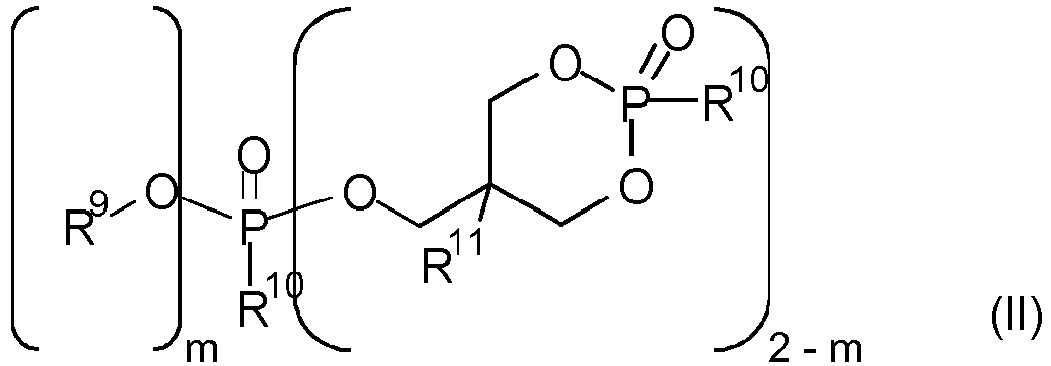 R9, R10 et R11 représentent, à chaque fois indépendamment les uns des autres, un radical C1-C4-alkyle linéaire ou ramifié etm représente le nombre 0 ou 1.
- Préparations selon la revendication 1, caractérisées en ce que a représente le nombre 1.
- Préparations selon les revendications 1 et 2, caractérisées en ce que R5, R6, R7 et R8 sont tous identiques et représentent hydrogène.
- Préparations selon l'une quelconque des revendications 1 à 3, caractérisées en ce que R1, R2, R3 et R4 sont tous identiques et représentent des radicaux n-butyle.
- Préparations selon l'une quelconque des revendications 1 à 3, caractérisées en ce que R1, R2, R3 et R4 sont tous identiques et représentent des radicaux méthylpropyle.
- Préparations selon l'une quelconque des revendications 1 à 5, caractérisées en ce que la valeur moyenne pondérée du nombre de motifs récurrents
n des poly(phosphates d'alkylène) de formule (I) se situe dans la plage de 1,20 à 3,00, de manière particulièrement préférée dans la plage de 1,30 à 2,60 et de manière tout particulièrement préférée 1,30 à 1,90. - Préparations selon l'une quelconque des revendications 1 à 6, caractérisées en ce que la proportion surfacique de l'ester dimère de l'acide phosphorique de formule (I) dans laquelle n = 1 dans la distribution des masses molaires représente 10 à 70% en surface, déterminée par chromatographie par perméation de gel avec du tétrahydrofuranne comme éluant par rapport à un standard de polystyrène.
- Préparations selon l'une quelconque des revendications 1 à 6, caractérisées en ce que R9, R10 et R11 représentent, indépendamment les uns des autres, méthyle ou éthyle.
- Préparations selon l'une quelconque des revendications 1 à 8, caractérisées en ce que R9 et R10 représentent tous deux méthyle et R11 représente éthyle.
- Préparations selon l'une quelconque des revendications 1 à 9, caractérisées en ce qu'elles contiennent au moins un ester cyclique d'acide phosphonique de formule (II) dans laquelle m = 0 et au moins un ester cyclique d'acide phosphonique de formule (II) dans laquelle m = 1.
- Préparations selon l'une quelconque des revendications 1 à 10, caractérisées en ce qu'elles contiennent 60 à 99,9% en poids du mélange contenant des poly(phosphates d'alkylène) de formule (I) et 0,1 à 40% en poids d'au moins un ester cyclique d'acide phosphonique de formule (II), par rapport à la totalité de la préparation.
- Préparations selon la revendication 11, caractérisées en ce qu'elles contiennent 70 à 99% en poids du mélange contenant des poly(phosphates d'alkylène) de formule (I) et 1 à 30% en poids d'au moins un ester cyclique d'acide phosphonique de formule (II), par rapport à la totalité de la préparation.
- Préparation selon l'une quelconque des revendications 1 à 12, caractérisée en ce qu'il s'agit de liquides présentant une viscosité dynamique de 20 à 1000 mPa.s à 23°C.
- Préparation selon l'une quelconque des revendications 1 à 8, caractérisée en ce qu'elle contient un ou plusieurs adjuvants choisis dans le groupe des solvants, des antioxydants, des stabilisants et des colorants.
- Préparations selon l'une quelconque des revendications 1 à 14, caractérisées en ce qu'elles contiennent, outre le mélange contenant des poly(phosphates d'alkylène) selon la formule (I) et ledit au moins un ester cyclique d'acide phosphonique de formule (II), un ou plusieurs agents ignifuges différents des poly(phosphates d'alkylène) de formule (I) et des esters cycliques d'acide phosphonique de formule (II) et le cas échéant un ou plusieurs adjuvants.
- Utilisation de préparations selon l'une quelconque des revendications 1 à 15 comme agent ignifuge.
- Utilisation selon la revendication 16, caractérisée en ce que les préparations sont utilisées comme agents ignifuges pour des polyuréthanes.
- Utilisation selon la revendication 17, caractérisée en ce qu'il s'agit, pour les polyuréthanes, de mousses, de préférence de mousses souples de polyuréthane à base de polyéther-polyols ou de polyester-polyols.
- Polyuréthanes contenant une préparation selon l'une quelconque des revendications 1 à 15.
- Polyuréthanes selon la revendication 19, caractérisés en ce qu'il s'agit de mousses de polyuréthane.
- Mousses de polyuréthane selon la revendication 19, caractérisées en ce qu'il s'agit de mousses souples de polyuréthane, qui ont été préparées à partir de polyéther-polyols ou de polyester-polyols.
- Procédé pour la préparation de polyuréthanes selon la revendication 19, caractérisé en ce que des polyisocyanates organiques sont transformés avec des composés comprenant au moins 2 atomes d'hydrogène réactif vis-à-vis des isocyanates en présence d'une composition selon au moins l'une quelconque des revendications 1 à 14 et en présence d'agents gonflants, de stabilisants, d'activateurs usuels et/ou d'autres adjuvants et additifs usuels, à 20 jusqu'à 80°C.
- Utilisation des polyuréthanes selon la revendication 19 dans des rembourrages de meubles, des garnitures textiles, des matelas, des sièges de véhicule, des accoudoirs, des éléments de construction, des revêtements de sièges ou d'armatures, des ciels de toit, des gaines de câbles, des joints, des revêtements, des vernis, des adhésifs, des promoteurs d'adhérence ou des fibres.
Priority Applications (2)
| Application Number | Priority Date | Filing Date | Title |
|---|---|---|---|
| SI201930110T SI3660065T1 (sl) | 2018-11-28 | 2019-11-25 | Sestavki s povečano učinkovitostjo kot zaviralci ognja |
| PL19211299T PL3660065T3 (pl) | 2018-11-28 | 2019-11-25 | Preparaty o lepszej skuteczności niż środki ogniochronne |
Applications Claiming Priority (1)
| Application Number | Priority Date | Filing Date | Title |
|---|---|---|---|
| EP18208789.0A EP3660064A1 (fr) | 2018-11-28 | 2018-11-28 | Préparations à efficacité améliorée en tant qu'agent ignifuge |
Publications (2)
| Publication Number | Publication Date |
|---|---|
| EP3660065A1 EP3660065A1 (fr) | 2020-06-03 |
| EP3660065B1 true EP3660065B1 (fr) | 2021-08-04 |
Family
ID=64556720
Family Applications (2)
| Application Number | Title | Priority Date | Filing Date |
|---|---|---|---|
| EP18208789.0A Withdrawn EP3660064A1 (fr) | 2018-11-28 | 2018-11-28 | Préparations à efficacité améliorée en tant qu'agent ignifuge |
| EP19211299.3A Active EP3660065B1 (fr) | 2018-11-28 | 2019-11-25 | Préparations à efficacité améliorée en tant qu'agent retardateur de flammes |
Family Applications Before (1)
| Application Number | Title | Priority Date | Filing Date |
|---|---|---|---|
| EP18208789.0A Withdrawn EP3660064A1 (fr) | 2018-11-28 | 2018-11-28 | Préparations à efficacité améliorée en tant qu'agent ignifuge |
Country Status (13)
| Country | Link |
|---|---|
| US (1) | US11390711B2 (fr) |
| EP (2) | EP3660064A1 (fr) |
| JP (1) | JP6947796B2 (fr) |
| KR (1) | KR102690708B1 (fr) |
| CN (1) | CN111234509B (fr) |
| AU (1) | AU2019271961B2 (fr) |
| BR (1) | BR102019024997B1 (fr) |
| CA (1) | CA3062693A1 (fr) |
| DK (1) | DK3660065T3 (fr) |
| ES (1) | ES2893770T3 (fr) |
| PL (1) | PL3660065T3 (fr) |
| PT (1) | PT3660065T (fr) |
| SI (1) | SI3660065T1 (fr) |
Families Citing this family (4)
| Publication number | Priority date | Publication date | Assignee | Title |
|---|---|---|---|---|
| JP7426839B2 (ja) | 2020-01-28 | 2024-02-02 | 古河電気工業株式会社 | 光モジュールの製造方法 |
| CN114573869B (zh) * | 2022-03-17 | 2023-10-13 | 浙江传化华洋化工有限公司 | 钡锌液体稳定剂及其应用 |
| CN116426202B (zh) | 2023-03-24 | 2023-09-26 | 中国铁道科学研究院集团有限公司 | 一种寒区隧道用喷涂聚氨酯保温材料及应用和其施工方法 |
| CN117757141A (zh) * | 2023-12-15 | 2024-03-26 | 包头稀土研究院 | 阻燃组合物、母料和玻璃纤维-尼龙组合物及制备方法 |
Family Cites Families (32)
| Publication number | Priority date | Publication date | Assignee | Title |
|---|---|---|---|---|
| US2764565A (en) | 1951-12-24 | 1956-09-25 | Bayer Ag | Process and apparatus for the manufacture of polyurethane plastics |
| GB1162517A (en) | 1965-11-12 | 1969-08-27 | Dunlop Co Ltd | Process for the production of Polyurethane Foams |
| DE1694142C3 (de) | 1967-03-25 | 1975-10-23 | Bayer Ag, 5090 Leverkusen | Verfahren zur Herstellung von Schaumstoffen |
| DE1694214B2 (de) | 1967-10-31 | 1972-03-16 | Farbenfabriken Bayer Ag, 5090 Lever Kusen | Verfahren zur herstellung von kunststoffen auf isocyanurat basis |
| DE1720768A1 (de) | 1968-01-02 | 1971-07-15 | Bayer Ag | Kunststoffe auf Isocyanatbasis und Verfahren zu ihrer Herstellung |
| US3639545A (en) * | 1968-03-26 | 1972-02-01 | Dow Chemical Co | Process for making cyclic alkylene phosphate alkylene esters |
| US3887483A (en) | 1970-10-26 | 1975-06-03 | Union Carbide Corp | Precursor compositions for cold cure high resilience foams |
| US3741917A (en) | 1970-10-26 | 1973-06-26 | Union Carbide Corp | Cold cure high resilience foam |
| DE2245079A1 (de) * | 1972-09-14 | 1974-04-04 | Basf Ag | Flammwidrige regenratcellulose |
| DE2732292A1 (de) | 1977-07-16 | 1979-02-01 | Bayer Ag | Verfahren zur herstellung von polyurethankunststoffen |
| DE2832253A1 (de) | 1978-07-22 | 1980-01-31 | Bayer Ag | Verfahren zur herstellung von formschaumstoffen |
| DE19540861A1 (de) * | 1995-11-03 | 1997-05-07 | Hoechst Ag | Verfahren zur Herstellung von Mischungen von oligomeren Phosphorsäureestern und deren Verwendung als Flammschutzmittel für Polyurethanschäume |
| US7288577B1 (en) | 1999-09-09 | 2007-10-30 | Supresta U.S. Llc | Polyurethane foam containing flame retardant blend of non-oligomeric and oligomeric flame retardants |
| KR20030063377A (ko) | 2000-11-13 | 2003-07-28 | 아크조 노벨 엔.브이. | 유기인 방염제, 락톤 안정제 및 포스페이트 융화제의 혼련물 |
| DE10231334A1 (de) * | 2002-07-11 | 2004-01-22 | Bayer Ag | Mit polymeren Phosphorigsäureestern stabilisierte Thermoplaste |
| US7067076B2 (en) * | 2003-08-01 | 2006-06-27 | Rhodia Inc. | Flame retardant phosphonate additives for thermoplastics |
| EP1681294A1 (fr) * | 2005-01-17 | 2006-07-19 | Solutia Europe N.V./S.A. | Procédé pour la préparation de composés d'acide aminopolyalkylènephosphonique |
| DE102005034269A1 (de) * | 2005-07-22 | 2007-01-25 | Lanxess Deutschland Gmbh | Halogenfreie, flammwidrige Polyurethanschaumstoffe |
| DE102005053889A1 (de) * | 2005-11-11 | 2007-05-16 | Lanxess Deutschland Gmbh | Halogenfreie, flammgeschützte Polyurethanschaumstoffe |
| JP2009532575A (ja) * | 2006-04-06 | 2009-09-10 | アルベマール・コーポレーシヨン | 難燃性添加剤組成物およびその使用 |
| CN101089005B (zh) * | 2006-06-16 | 2011-06-15 | 沈阳博美达化学有限公司 | 一种环状膦酸酯类化合物的制备方法 |
| KR100778006B1 (ko) * | 2006-12-27 | 2007-11-28 | 제일모직주식회사 | 내후성이 우수한 난연성 열가소성 수지 조성물 |
| CN101079505B (zh) * | 2007-05-11 | 2010-05-26 | 武汉大学 | 锂二次电池用阻燃电解液及其锂电池 |
| JP2010535901A (ja) * | 2007-08-07 | 2010-11-25 | アルベマール・コーポレーシヨン | 難燃性剛性ポリウレタン発泡体および剛性ポリウレタン発泡体調合物 |
| JP2012517502A (ja) * | 2009-02-09 | 2012-08-02 | アイシーエル−アイピー アメリカ インコーポレイテッド | 難燃剤を含有するポリウレタンフォーム組成物、およびこの難燃剤を含有するポリウレタンフォーム組成物を製造するためのプロセス、難燃剤組成物およびこれらから製造されるポリウレタンフォーム |
| WO2012113146A1 (fr) * | 2011-02-24 | 2012-08-30 | Rhodia (China) Co., Ltd. | Compositions polymères ignifuges comprenant des sels d'hypophosphite stabilisés |
| RU2609408C2 (ru) | 2011-10-20 | 2017-02-01 | Акцо Нобель Кемикалз Интернэшнл Б.В. | Способ очистки жидкого сырья, содержащего мхк и дхк |
| EP2687534A1 (fr) * | 2012-07-20 | 2014-01-22 | LANXESS Deutschland GmbH | Poly(alkylphosphate) sans halogène |
| EP2848640A1 (fr) | 2013-09-13 | 2015-03-18 | LANXESS Deutschland GmbH | Préparations d'esters d'acide phosphorique ayant une hygroscopie réduite |
| EP2985335A1 (fr) * | 2014-08-15 | 2016-02-17 | LANXESS Deutschland GmbH | Mousses de polyuréthanne ignifuges ayant un faible roussissement |
| EP3050890A1 (fr) * | 2015-01-27 | 2016-08-03 | LANXESS Deutschland GmbH | Poly(alkylphosphate) contenant des groupes d'hydroxyle |
| EP3388479A1 (fr) | 2017-04-10 | 2018-10-17 | LANXESS Deutschland GmbH | Poly(alkylphosphate) à faible hygroscopie |
-
2018
- 2018-11-28 EP EP18208789.0A patent/EP3660064A1/fr not_active Withdrawn
-
2019
- 2019-11-21 US US16/690,552 patent/US11390711B2/en active Active
- 2019-11-25 ES ES19211299T patent/ES2893770T3/es active Active
- 2019-11-25 PT PT19211299T patent/PT3660065T/pt unknown
- 2019-11-25 EP EP19211299.3A patent/EP3660065B1/fr active Active
- 2019-11-25 DK DK19211299.3T patent/DK3660065T3/da active
- 2019-11-25 SI SI201930110T patent/SI3660065T1/sl unknown
- 2019-11-25 PL PL19211299T patent/PL3660065T3/pl unknown
- 2019-11-25 KR KR1020190151876A patent/KR102690708B1/ko active Active
- 2019-11-25 CA CA3062693A patent/CA3062693A1/fr active Pending
- 2019-11-27 BR BR102019024997-8A patent/BR102019024997B1/pt active IP Right Grant
- 2019-11-27 CN CN201911184135.7A patent/CN111234509B/zh active Active
- 2019-11-27 AU AU2019271961A patent/AU2019271961B2/en not_active Ceased
- 2019-11-27 JP JP2019214222A patent/JP6947796B2/ja not_active Expired - Fee Related
Also Published As
| Publication number | Publication date |
|---|---|
| US11390711B2 (en) | 2022-07-19 |
| US20200165382A1 (en) | 2020-05-28 |
| JP6947796B2 (ja) | 2021-10-13 |
| KR20200063990A (ko) | 2020-06-05 |
| AU2019271961A1 (en) | 2020-06-11 |
| BR102019024997A2 (pt) | 2020-06-09 |
| EP3660064A1 (fr) | 2020-06-03 |
| AU2019271961B2 (en) | 2022-03-17 |
| CA3062693A1 (fr) | 2020-05-28 |
| DK3660065T3 (da) | 2021-10-25 |
| CN111234509A (zh) | 2020-06-05 |
| PT3660065T (pt) | 2021-10-14 |
| PL3660065T3 (pl) | 2021-12-20 |
| BR102019024997B1 (pt) | 2024-02-15 |
| JP2020084191A (ja) | 2020-06-04 |
| EP3660065A1 (fr) | 2020-06-03 |
| CN111234509B (zh) | 2022-03-01 |
| KR102690708B1 (ko) | 2024-08-02 |
| ES2893770T3 (es) | 2022-02-10 |
| SI3660065T1 (sl) | 2021-11-30 |
Similar Documents
| Publication | Publication Date | Title |
|---|---|---|
| EP2687535B1 (fr) | Poly(alkylphosphate) sans halogène | |
| EP2860211B1 (fr) | Préparations d'esters d'acide phosphorique ayant une hygroscopie réduite | |
| EP1785439B1 (fr) | Mousse de polyuréthanne retardateur de flamme non halogène | |
| EP2062905B1 (fr) | Mélanges de liaisons contenant du phosphore, leur procédé de fabrication et leur utilisation comme agent ignifuge | |
| DE19927548A1 (de) | Verfahren zur Herstellung von flammwidrigen Polyurethanweichschäumen | |
| EP2154185B1 (fr) | Mousses de polyuréthanes ignifuges sans halogène dotées d'un Scorch réduit | |
| EP3660065A1 (fr) | Préparations à efficacité améliorée en tant qu'agent retardateur de flammes | |
| EP1746129B1 (fr) | Mousse de polyuréthane ignifugeante et sans halogènes | |
| EP3388480B1 (fr) | Poly(alkylphosphate) à faible hygroscopie | |
| DE102007010160A1 (de) | Halogenfreie, flammgeschützte Polyurethanschaumstoffe | |
| EP3050891B1 (fr) | Poly(alkylphosphate) contenant des groupes d'hydroxyle | |
| EP2985336B1 (fr) | Mousses de polyurethane ininflammables a faible decoloration de l'ame | |
| EP3221375B1 (fr) | Procédé de fabrication de mousses de polyuréthane ignifuges en utilisant des moyens ignifuges sans halogène | |
| EP0316736B1 (fr) | Utilisation d'esters diphényles d'acide méthylphosphonique comme produit ignifugeant pour la préparation de résines synthétiques à base d'isocyanate |
Legal Events
| Date | Code | Title | Description |
|---|---|---|---|
| PUAI | Public reference made under article 153(3) epc to a published international application that has entered the european phase |
Free format text: ORIGINAL CODE: 0009012 |
|
| STAA | Information on the status of an ep patent application or granted ep patent |
Free format text: STATUS: THE APPLICATION HAS BEEN PUBLISHED |
|
| AK | Designated contracting states |
Kind code of ref document: A1 Designated state(s): AL AT BE BG CH CY CZ DE DK EE ES FI FR GB GR HR HU IE IS IT LI LT LU LV MC MK MT NL NO PL PT RO RS SE SI SK SM TR |
|
| AX | Request for extension of the european patent |
Extension state: BA ME |
|
| RAP1 | Party data changed (applicant data changed or rights of an application transferred) |
Owner name: LANXESS DEUTSCHLAND GMBH |
|
| STAA | Information on the status of an ep patent application or granted ep patent |
Free format text: STATUS: REQUEST FOR EXAMINATION WAS MADE |
|
| 17P | Request for examination filed |
Effective date: 20201203 |
|
| RBV | Designated contracting states (corrected) |
Designated state(s): AL AT BE BG CH CY CZ DE DK EE ES FI FR GB GR HR HU IE IS IT LI LT LU LV MC MK MT NL NO PL PT RO RS SE SI SK SM TR |
|
| GRAP | Despatch of communication of intention to grant a patent |
Free format text: ORIGINAL CODE: EPIDOSNIGR1 |
|
| STAA | Information on the status of an ep patent application or granted ep patent |
Free format text: STATUS: GRANT OF PATENT IS INTENDED |
|
| INTG | Intention to grant announced |
Effective date: 20210420 |
|
| GRAS | Grant fee paid |
Free format text: ORIGINAL CODE: EPIDOSNIGR3 |
|
| GRAA | (expected) grant |
Free format text: ORIGINAL CODE: 0009210 |
|
| STAA | Information on the status of an ep patent application or granted ep patent |
Free format text: STATUS: THE PATENT HAS BEEN GRANTED |
|
| AK | Designated contracting states |
Kind code of ref document: B1 Designated state(s): AL AT BE BG CH CY CZ DE DK EE ES FI FR GB GR HR HU IE IS IT LI LT LU LV MC MK MT NL NO PL PT RO RS SE SI SK SM TR |
|
| REG | Reference to a national code |
Ref country code: GB Ref legal event code: FG4D Free format text: NOT ENGLISH |
|
| REG | Reference to a national code |
Ref country code: AT Ref legal event code: REF Ref document number: 1416942 Country of ref document: AT Kind code of ref document: T Effective date: 20210815 |
|
| REG | Reference to a national code |
Ref country code: CH Ref legal event code: EP |
|
| REG | Reference to a national code |
Ref country code: DE Ref legal event code: R096 Ref document number: 502019001960 Country of ref document: DE |
|
| REG | Reference to a national code |
Ref country code: IE Ref legal event code: FG4D Free format text: LANGUAGE OF EP DOCUMENT: GERMAN |
|
| REG | Reference to a national code |
Ref country code: PT Ref legal event code: SC4A Ref document number: 3660065 Country of ref document: PT Date of ref document: 20211014 Kind code of ref document: T Free format text: AVAILABILITY OF NATIONAL TRANSLATION Effective date: 20211004 |
|
| REG | Reference to a national code |
Ref country code: DK Ref legal event code: T3 Effective date: 20211020 |
|
| REG | Reference to a national code |
Ref country code: SE Ref legal event code: TRGR |
|
| REG | Reference to a national code |
Ref country code: NL Ref legal event code: FP |
|
| REG | Reference to a national code |
Ref country code: LT Ref legal event code: MG9D |
|
| PG25 | Lapsed in a contracting state [announced via postgrant information from national office to epo] |
Ref country code: RS Free format text: LAPSE BECAUSE OF FAILURE TO SUBMIT A TRANSLATION OF THE DESCRIPTION OR TO PAY THE FEE WITHIN THE PRESCRIBED TIME-LIMIT Effective date: 20210804 Ref country code: FI Free format text: LAPSE BECAUSE OF FAILURE TO SUBMIT A TRANSLATION OF THE DESCRIPTION OR TO PAY THE FEE WITHIN THE PRESCRIBED TIME-LIMIT Effective date: 20210804 Ref country code: HR Free format text: LAPSE BECAUSE OF FAILURE TO SUBMIT A TRANSLATION OF THE DESCRIPTION OR TO PAY THE FEE WITHIN THE PRESCRIBED TIME-LIMIT Effective date: 20210804 Ref country code: NO Free format text: LAPSE BECAUSE OF FAILURE TO SUBMIT A TRANSLATION OF THE DESCRIPTION OR TO PAY THE FEE WITHIN THE PRESCRIBED TIME-LIMIT Effective date: 20211104 Ref country code: LT Free format text: LAPSE BECAUSE OF FAILURE TO SUBMIT A TRANSLATION OF THE DESCRIPTION OR TO PAY THE FEE WITHIN THE PRESCRIBED TIME-LIMIT Effective date: 20210804 Ref country code: BG Free format text: LAPSE BECAUSE OF FAILURE TO SUBMIT A TRANSLATION OF THE DESCRIPTION OR TO PAY THE FEE WITHIN THE PRESCRIBED TIME-LIMIT Effective date: 20211104 |
|
| REG | Reference to a national code |
Ref country code: ES Ref legal event code: FG2A Ref document number: 2893770 Country of ref document: ES Kind code of ref document: T3 Effective date: 20220210 |
|
| PG25 | Lapsed in a contracting state [announced via postgrant information from national office to epo] |
Ref country code: LV Free format text: LAPSE BECAUSE OF FAILURE TO SUBMIT A TRANSLATION OF THE DESCRIPTION OR TO PAY THE FEE WITHIN THE PRESCRIBED TIME-LIMIT Effective date: 20210804 Ref country code: GR Free format text: LAPSE BECAUSE OF FAILURE TO SUBMIT A TRANSLATION OF THE DESCRIPTION OR TO PAY THE FEE WITHIN THE PRESCRIBED TIME-LIMIT Effective date: 20211105 |
|
| REG | Reference to a national code |
Ref country code: DE Ref legal event code: R097 Ref document number: 502019001960 Country of ref document: DE |
|
| PG25 | Lapsed in a contracting state [announced via postgrant information from national office to epo] |
Ref country code: SM Free format text: LAPSE BECAUSE OF FAILURE TO SUBMIT A TRANSLATION OF THE DESCRIPTION OR TO PAY THE FEE WITHIN THE PRESCRIBED TIME-LIMIT Effective date: 20210804 Ref country code: SK Free format text: LAPSE BECAUSE OF FAILURE TO SUBMIT A TRANSLATION OF THE DESCRIPTION OR TO PAY THE FEE WITHIN THE PRESCRIBED TIME-LIMIT Effective date: 20210804 Ref country code: RO Free format text: LAPSE BECAUSE OF FAILURE TO SUBMIT A TRANSLATION OF THE DESCRIPTION OR TO PAY THE FEE WITHIN THE PRESCRIBED TIME-LIMIT Effective date: 20210804 Ref country code: EE Free format text: LAPSE BECAUSE OF FAILURE TO SUBMIT A TRANSLATION OF THE DESCRIPTION OR TO PAY THE FEE WITHIN THE PRESCRIBED TIME-LIMIT Effective date: 20210804 Ref country code: AL Free format text: LAPSE BECAUSE OF FAILURE TO SUBMIT A TRANSLATION OF THE DESCRIPTION OR TO PAY THE FEE WITHIN THE PRESCRIBED TIME-LIMIT Effective date: 20210804 |
|
| PLBE | No opposition filed within time limit |
Free format text: ORIGINAL CODE: 0009261 |
|
| STAA | Information on the status of an ep patent application or granted ep patent |
Free format text: STATUS: NO OPPOSITION FILED WITHIN TIME LIMIT |
|
| PG25 | Lapsed in a contracting state [announced via postgrant information from national office to epo] |
Ref country code: MC Free format text: LAPSE BECAUSE OF FAILURE TO SUBMIT A TRANSLATION OF THE DESCRIPTION OR TO PAY THE FEE WITHIN THE PRESCRIBED TIME-LIMIT Effective date: 20210804 |
|
| 26N | No opposition filed |
Effective date: 20220506 |
|
| PG25 | Lapsed in a contracting state [announced via postgrant information from national office to epo] |
Ref country code: LU Free format text: LAPSE BECAUSE OF NON-PAYMENT OF DUE FEES Effective date: 20211125 |
|
| PG25 | Lapsed in a contracting state [announced via postgrant information from national office to epo] |
Ref country code: CY Free format text: LAPSE BECAUSE OF FAILURE TO SUBMIT A TRANSLATION OF THE DESCRIPTION OR TO PAY THE FEE WITHIN THE PRESCRIBED TIME-LIMIT Effective date: 20210804 |
|
| PG25 | Lapsed in a contracting state [announced via postgrant information from national office to epo] |
Ref country code: HU Free format text: LAPSE BECAUSE OF FAILURE TO SUBMIT A TRANSLATION OF THE DESCRIPTION OR TO PAY THE FEE WITHIN THE PRESCRIBED TIME-LIMIT; INVALID AB INITIO Effective date: 20191125 |
|
| P01 | Opt-out of the competence of the unified patent court (upc) registered |
Effective date: 20230714 |
|
| PG25 | Lapsed in a contracting state [announced via postgrant information from national office to epo] |
Ref country code: MK Free format text: LAPSE BECAUSE OF FAILURE TO SUBMIT A TRANSLATION OF THE DESCRIPTION OR TO PAY THE FEE WITHIN THE PRESCRIBED TIME-LIMIT Effective date: 20210804 |
|
| PG25 | Lapsed in a contracting state [announced via postgrant information from national office to epo] |
Ref country code: MT Free format text: LAPSE BECAUSE OF FAILURE TO SUBMIT A TRANSLATION OF THE DESCRIPTION OR TO PAY THE FEE WITHIN THE PRESCRIBED TIME-LIMIT Effective date: 20210804 |
|
| PGFP | Annual fee paid to national office [announced via postgrant information from national office to epo] |
Ref country code: IE Payment date: 20240910 Year of fee payment: 6 |
|
| PGFP | Annual fee paid to national office [announced via postgrant information from national office to epo] |
Ref country code: PL Payment date: 20240916 Year of fee payment: 6 |
|
| PGFP | Annual fee paid to national office [announced via postgrant information from national office to epo] |
Ref country code: NL Payment date: 20241004 Year of fee payment: 6 |
|
| PGFP | Annual fee paid to national office [announced via postgrant information from national office to epo] |
Ref country code: PT Payment date: 20241125 Year of fee payment: 6 |
|
| PGFP | Annual fee paid to national office [announced via postgrant information from national office to epo] |
Ref country code: DE Payment date: 20241001 Year of fee payment: 6 |
|
| PGFP | Annual fee paid to national office [announced via postgrant information from national office to epo] |
Ref country code: DK Payment date: 20241118 Year of fee payment: 6 |
|
| PGFP | Annual fee paid to national office [announced via postgrant information from national office to epo] |
Ref country code: BE Payment date: 20241007 Year of fee payment: 6 |
|
| PGFP | Annual fee paid to national office [announced via postgrant information from national office to epo] |
Ref country code: GB Payment date: 20241001 Year of fee payment: 6 |
|
| PGFP | Annual fee paid to national office [announced via postgrant information from national office to epo] |
Ref country code: FR Payment date: 20241001 Year of fee payment: 6 Ref country code: AT Payment date: 20241025 Year of fee payment: 6 |
|
| PGFP | Annual fee paid to national office [announced via postgrant information from national office to epo] |
Ref country code: CZ Payment date: 20241115 Year of fee payment: 6 |
|
| PGFP | Annual fee paid to national office [announced via postgrant information from national office to epo] |
Ref country code: IT Payment date: 20241010 Year of fee payment: 6 Ref country code: ES Payment date: 20241206 Year of fee payment: 6 |
|
| PGFP | Annual fee paid to national office [announced via postgrant information from national office to epo] |
Ref country code: SE Payment date: 20241001 Year of fee payment: 6 |
|
| PGFP | Annual fee paid to national office [announced via postgrant information from national office to epo] |
Ref country code: CH Payment date: 20241201 Year of fee payment: 6 |
|
| PGFP | Annual fee paid to national office [announced via postgrant information from national office to epo] |
Ref country code: TR Payment date: 20241113 Year of fee payment: 6 |
|
| PGFP | Annual fee paid to national office [announced via postgrant information from national office to epo] |
Ref country code: SI Payment date: 20240925 Year of fee payment: 6 |
|
| REG | Reference to a national code |
Ref country code: DE Ref legal event code: R119 Ref document number: 502019001960 Country of ref document: DE |
|
| REG | Reference to a national code |
Ref country code: DK Ref legal event code: EBP Effective date: 20251130 |
|
| REG | Reference to a national code |
Ref country code: CH Ref legal event code: H13 Free format text: ST27 STATUS EVENT CODE: U-0-0-H10-H13 (AS PROVIDED BY THE NATIONAL OFFICE) Effective date: 20260623 |
|
| REG | Reference to a national code |
Ref country code: NL Ref legal event code: MM Effective date: 20251201 |
|
| PG25 | Lapsed in a contracting state [announced via postgrant information from national office to epo] |
Ref country code: PT Free format text: LAPSE BECAUSE OF FAILURE TO SUBMIT A TRANSLATION OF THE DESCRIPTION OR TO PAY THE FEE WITHIN THE PRESCRIBED TIME-LIMIT Effective date: 20251125 |
|
| PG25 | Lapsed in a contracting state [announced via postgrant information from national office to epo] |
Ref country code: AT Free format text: LAPSE BECAUSE OF NON-PAYMENT OF DUE FEES Effective date: 20251125 Ref country code: SE Free format text: LAPSE BECAUSE OF NON-PAYMENT OF DUE FEES Effective date: 20251126 |
|
| REG | Reference to a national code |
Ref country code: AT Ref legal event code: MM01 Ref document number: 1416942 Country of ref document: AT Kind code of ref document: T Effective date: 20251125 |
|
| PG25 | Lapsed in a contracting state [announced via postgrant information from national office to epo] |
Ref country code: CH Free format text: LAPSE BECAUSE OF NON-PAYMENT OF DUE FEES Effective date: 20251130 |
|
| PG25 | Lapsed in a contracting state [announced via postgrant information from national office to epo] |
Ref country code: PT Free format text: LAPSE BECAUSE OF NON-PAYMENT OF DUE FEES Effective date: 20260525 |
|
| PG25 | Lapsed in a contracting state [announced via postgrant information from national office to epo] |
Ref country code: CZ Free format text: LAPSE BECAUSE OF NON-PAYMENT OF DUE FEES Effective date: 20251125 |