EP3660123A1 - Elektrochrome verbindung, elektrochrome zusammensetzung und elektrochromes anzeigeelement - Google Patents
Elektrochrome verbindung, elektrochrome zusammensetzung und elektrochromes anzeigeelement Download PDFInfo
- Publication number
- EP3660123A1 EP3660123A1 EP20151986.5A EP20151986A EP3660123A1 EP 3660123 A1 EP3660123 A1 EP 3660123A1 EP 20151986 A EP20151986 A EP 20151986A EP 3660123 A1 EP3660123 A1 EP 3660123A1
- Authority
- EP
- European Patent Office
- Prior art keywords
- group
- electrochromic
- electrode
- compound
- electrochromic compound
- Prior art date
- Legal status (The legal status is an assumption and is not a legal conclusion. Google has not performed a legal analysis and makes no representation as to the accuracy of the status listed.)
- Pending
Links
- IUMBOQKDAKAEOW-UHFFFAOYSA-N CC(C(OCCCc(cc1)ccc1N1c(cccc2)c2Oc2c1cccc2)=O)=C Chemical compound CC(C(OCCCc(cc1)ccc1N1c(cccc2)c2Oc2c1cccc2)=O)=C IUMBOQKDAKAEOW-UHFFFAOYSA-N 0.000 description 2
- 0 C*C(C(*)C(*)=C1*)C(O)=C1N1c2c(*)c(*)c(*)c(*)c2Oc2c1c(*)c(*)c(*)c2* Chemical compound C*C(C(*)C(*)=C1*)C(O)=C1N1c2c(*)c(*)c(*)c(*)c2Oc2c1c(*)c(*)c(*)c2* 0.000 description 1
- HVAXKULEVPIKHM-UHFFFAOYSA-N C=CC(OCCCc(cc1)ccc1N(c(cccc1)c1Oc1c2)c1ccc2-c(cc1)cc2c1N(c1ccc(CCCOC(C=C)=O)cc1)c(cccc1)c1O2)=O Chemical compound C=CC(OCCCc(cc1)ccc1N(c(cccc1)c1Oc1c2)c1ccc2-c(cc1)cc2c1N(c1ccc(CCCOC(C=C)=O)cc1)c(cccc1)c1O2)=O HVAXKULEVPIKHM-UHFFFAOYSA-N 0.000 description 1
- LVYZLYBDBLQZRC-UHFFFAOYSA-N C=CC(OCCCc(cc1)ccc1N1c(ccc(-c2ccccc2)c2)c2Oc2c1ccc(-c1ccccc1)c2)=O Chemical compound C=CC(OCCCc(cc1)ccc1N1c(ccc(-c2ccccc2)c2)c2Oc2c1ccc(-c1ccccc1)c2)=O LVYZLYBDBLQZRC-UHFFFAOYSA-N 0.000 description 1
- QUHLJSJOFGYWFE-UHFFFAOYSA-N CC(C(OCCCc(cc1)ccc1N1c(ccc(C)c2)c2Oc2c1ccc(C)c2)=O)=C Chemical compound CC(C(OCCCc(cc1)ccc1N1c(ccc(C)c2)c2Oc2c1ccc(C)c2)=O)=C QUHLJSJOFGYWFE-UHFFFAOYSA-N 0.000 description 1
Images



Classifications
-
- G—PHYSICS
- G02—OPTICS
- G02F—OPTICAL DEVICES OR ARRANGEMENTS FOR THE CONTROL OF LIGHT BY MODIFICATION OF THE OPTICAL PROPERTIES OF THE MEDIA OF THE ELEMENTS INVOLVED THEREIN; NON-LINEAR OPTICS; FREQUENCY-CHANGING OF LIGHT; OPTICAL LOGIC ELEMENTS; OPTICAL ANALOGUE/DIGITAL CONVERTERS
- G02F1/00—Devices or arrangements for the control of the intensity, colour, phase, polarisation or direction of light arriving from an independent light source, e.g. switching, gating or modulating; Non-linear optics
- G02F1/01—Devices or arrangements for the control of the intensity, colour, phase, polarisation or direction of light arriving from an independent light source, e.g. switching, gating or modulating; Non-linear optics for the control of the intensity, phase, polarisation or colour
- G02F1/15—Devices or arrangements for the control of the intensity, colour, phase, polarisation or direction of light arriving from an independent light source, e.g. switching, gating or modulating; Non-linear optics for the control of the intensity, phase, polarisation or colour based on an electrochromic effect
- G02F1/1514—Devices or arrangements for the control of the intensity, colour, phase, polarisation or direction of light arriving from an independent light source, e.g. switching, gating or modulating; Non-linear optics for the control of the intensity, phase, polarisation or colour based on an electrochromic effect characterised by the electrochromic material, e.g. by the electrodeposited material
- G02F1/1516—Devices or arrangements for the control of the intensity, colour, phase, polarisation or direction of light arriving from an independent light source, e.g. switching, gating or modulating; Non-linear optics for the control of the intensity, phase, polarisation or colour based on an electrochromic effect characterised by the electrochromic material, e.g. by the electrodeposited material comprising organic material
-
- C—CHEMISTRY; METALLURGY
- C07—ORGANIC CHEMISTRY
- C07D—HETEROCYCLIC COMPOUNDS
- C07D265/00—Heterocyclic compounds containing six-membered rings having one nitrogen atom and one oxygen atom as the only ring hetero atoms
- C07D265/28—1,4-Oxazines; Hydrogenated 1,4-oxazines
-
- C—CHEMISTRY; METALLURGY
- C07—ORGANIC CHEMISTRY
- C07D—HETEROCYCLIC COMPOUNDS
- C07D265/00—Heterocyclic compounds containing six-membered rings having one nitrogen atom and one oxygen atom as the only ring hetero atoms
- C07D265/28—1,4-Oxazines; Hydrogenated 1,4-oxazines
- C07D265/34—1,4-Oxazines; Hydrogenated 1,4-oxazines condensed with carbocyclic rings
- C07D265/38—[b, e]-condensed with two six-membered rings
-
- C—CHEMISTRY; METALLURGY
- C08—ORGANIC MACROMOLECULAR COMPOUNDS; THEIR PREPARATION OR CHEMICAL WORKING-UP; COMPOSITIONS BASED THEREON
- C08F—MACROMOLECULAR COMPOUNDS OBTAINED BY REACTIONS ONLY INVOLVING CARBON-TO-CARBON UNSATURATED BONDS
- C08F20/00—Homopolymers and copolymers of compounds having one or more unsaturated aliphatic radicals, each having only one carbon-to-carbon double bond, and only one being terminated by only one carboxyl radical or a salt, anhydride, ester, amide, imide or nitrile thereof
- C08F20/02—Monocarboxylic acids having less than ten carbon atoms, Derivatives thereof
- C08F20/10—Esters
- C08F20/34—Esters containing nitrogen, e.g. N,N-dimethylaminoethyl (meth)acrylate
- C08F20/36—Esters containing nitrogen, e.g. N,N-dimethylaminoethyl (meth)acrylate containing oxygen in addition to the carboxy oxygen, e.g. 2-N-morpholinoethyl (meth)acrylate or 2-isocyanatoethyl (meth)acrylate
-
- C—CHEMISTRY; METALLURGY
- C09—DYES; PAINTS; POLISHES; NATURAL RESINS; ADHESIVES; COMPOSITIONS NOT OTHERWISE PROVIDED FOR; APPLICATIONS OF MATERIALS NOT OTHERWISE PROVIDED FOR
- C09K—MATERIALS FOR MISCELLANEOUS APPLICATIONS, NOT PROVIDED FOR ELSEWHERE
- C09K9/00—Tenebrescent materials, i.e. materials for which the range of wavelengths for energy absorption is changed as a result of excitation by some form of energy
- C09K9/02—Organic tenebrescent materials
-
- G—PHYSICS
- G02—OPTICS
- G02F—OPTICAL DEVICES OR ARRANGEMENTS FOR THE CONTROL OF LIGHT BY MODIFICATION OF THE OPTICAL PROPERTIES OF THE MEDIA OF THE ELEMENTS INVOLVED THEREIN; NON-LINEAR OPTICS; FREQUENCY-CHANGING OF LIGHT; OPTICAL LOGIC ELEMENTS; OPTICAL ANALOGUE/DIGITAL CONVERTERS
- G02F1/00—Devices or arrangements for the control of the intensity, colour, phase, polarisation or direction of light arriving from an independent light source, e.g. switching, gating or modulating; Non-linear optics
- G02F1/01—Devices or arrangements for the control of the intensity, colour, phase, polarisation or direction of light arriving from an independent light source, e.g. switching, gating or modulating; Non-linear optics for the control of the intensity, phase, polarisation or colour
- G02F1/15—Devices or arrangements for the control of the intensity, colour, phase, polarisation or direction of light arriving from an independent light source, e.g. switching, gating or modulating; Non-linear optics for the control of the intensity, phase, polarisation or colour based on an electrochromic effect
-
- G—PHYSICS
- G09—EDUCATION; CRYPTOGRAPHY; DISPLAY; ADVERTISING; SEALS
- G09F—DISPLAYING; ADVERTISING; SIGNS; LABELS OR NAME-PLATES; SEALS
- G09F9/00—Indicating arrangements for variable information in which the information is built-up on a support by selection or combination of individual elements
- G09F9/30—Indicating arrangements for variable information in which the information is built-up on a support by selection or combination of individual elements in which the desired character or characters are formed by combining individual elements
-
- C—CHEMISTRY; METALLURGY
- C09—DYES; PAINTS; POLISHES; NATURAL RESINS; ADHESIVES; COMPOSITIONS NOT OTHERWISE PROVIDED FOR; APPLICATIONS OF MATERIALS NOT OTHERWISE PROVIDED FOR
- C09K—MATERIALS FOR MISCELLANEOUS APPLICATIONS, NOT PROVIDED FOR ELSEWHERE
- C09K2211/00—Chemical nature of organic luminescent or tenebrescent compounds
- C09K2211/10—Non-macromolecular compounds
- C09K2211/1003—Carbocyclic compounds
-
- C—CHEMISTRY; METALLURGY
- C09—DYES; PAINTS; POLISHES; NATURAL RESINS; ADHESIVES; COMPOSITIONS NOT OTHERWISE PROVIDED FOR; APPLICATIONS OF MATERIALS NOT OTHERWISE PROVIDED FOR
- C09K—MATERIALS FOR MISCELLANEOUS APPLICATIONS, NOT PROVIDED FOR ELSEWHERE
- C09K2211/00—Chemical nature of organic luminescent or tenebrescent compounds
- C09K2211/10—Non-macromolecular compounds
- C09K2211/1003—Carbocyclic compounds
- C09K2211/1007—Non-condensed systems
-
- C—CHEMISTRY; METALLURGY
- C09—DYES; PAINTS; POLISHES; NATURAL RESINS; ADHESIVES; COMPOSITIONS NOT OTHERWISE PROVIDED FOR; APPLICATIONS OF MATERIALS NOT OTHERWISE PROVIDED FOR
- C09K—MATERIALS FOR MISCELLANEOUS APPLICATIONS, NOT PROVIDED FOR ELSEWHERE
- C09K2211/00—Chemical nature of organic luminescent or tenebrescent compounds
- C09K2211/10—Non-macromolecular compounds
- C09K2211/1003—Carbocyclic compounds
- C09K2211/1011—Condensed systems
-
- C—CHEMISTRY; METALLURGY
- C09—DYES; PAINTS; POLISHES; NATURAL RESINS; ADHESIVES; COMPOSITIONS NOT OTHERWISE PROVIDED FOR; APPLICATIONS OF MATERIALS NOT OTHERWISE PROVIDED FOR
- C09K—MATERIALS FOR MISCELLANEOUS APPLICATIONS, NOT PROVIDED FOR ELSEWHERE
- C09K2211/00—Chemical nature of organic luminescent or tenebrescent compounds
- C09K2211/10—Non-macromolecular compounds
- C09K2211/1018—Heterocyclic compounds
- C09K2211/1025—Heterocyclic compounds characterised by ligands
- C09K2211/1029—Heterocyclic compounds characterised by ligands containing one nitrogen atom as the heteroatom
- C09K2211/1033—Heterocyclic compounds characterised by ligands containing one nitrogen atom as the heteroatom with oxygen
Definitions
- the present disclosure relates to electrochromic compounds, electrochromic compositions, and electrochromic display elements.
- Electrochromism is a phenomenon where an oxidation-reduction reaction is reversibly caused to reversibly change a color by applying voltage.
- An electrochromic material exhibiting the electrochromism is typically formed between two facing electrodes, and an oxidation-reduction reaction of the electrochromic material is caused in a structure where a space between the electrodes is filled with an electrolyte layer capable of conducting ions.
- an oxidation reaction which is a reverse reaction of the reduction reaction, occurs adjacent to the other electrode.
- coloring occurs at both the electrodes in a device using the electrochromic material, to thereby change a color or optical density.
- the electrochromic display element is composed of a material that can be in a state of colorless transparent.
- the electrochromic material that can exhibit such a state reported are viologen compounds and triaryl amine compounds exhibiting an electrochromic phenomenon where a neutral state is a transparent state and coloring occurs in a reduced state (see, for example, NPL 1).
- coloring of the triaryl amine compounds disclosed in NPL 1 is from blue to cyan or green, and it is difficult to obtain stable coloring of yellow (Y) or magenta (M).
- the present invention has an object to provide an electrochromic compound that exhibits excellent color and has excellent durability to repetitive use.
- the electrochromic compound of the present invention is a compound represented by the following general formula (I) or (II).
- R 1 to R 13 are each independently a hydrogen atom, a halogen atom, a monovalent organic group, or a polymerizable functional group, and at least one of the R 1 to the R 13 is a polymerizable functional group.
- the present invention can provide an electrochromic compound that exhibits excellent color and has excellent durability to repetitive use.
- An electrochromic compound of the present invention is represented by the following general formula (I) or (II).
- R 1 to R 13 are each independently a hydrogen atom, a halogen atom, a monovalent organic group, or a polymerizable functional group, and at least one of the R 1 to the R 13 is a polymerizable functional group.
- the present inventors have diligently studied the fact that coloring of a compound having triphenyl amine skeleton is from blue to cyan or green, and it is difficult to stably attain coloring of yellow (Y) or magenta (M).
- Y yellow
- M magenta
- the triphenyl amine skeleton has phenyls bonded via a nitrogen atom (N) together through a nonconjugated bond, and thus even when the triphenyl amine skeleton is modified with substituents, a contribution of electron donating-withdrawing to pi conjugation system is small to hardly change a color; and (2) the triphenyl amine skeleton has a high degree of freedom, and thus it is considered that color control is difficult because a band absorption becomes broad, and use of the triphenyl amine skeleton is extremely difficult particularly in color control of magenta where a width of absorption is restricted.
- halogen atom in the general formula (I) and the general formula (II) examples include a fluorine atom, a chlorine atom, a bromine atom, and an iodine atom.
- Examples of the monovalent organic group in the general formula (I) and the general formula (II) include a hydroxyl group, a nitro group, a cyano group, a carboxyl group, a carbonyl group, an amide group, an aminocarbonyl group, a sulfonic acid group, a sulfonyl group, a sulfone amide group, an aminosulfonyl group, an amino group, an alkyl group, an alkenyl group, an alkynyl group, an aryl group, an alkoxy group, an aryloxy group, an alkylthio group, an arylthio group, and a heteroaryl group.
- the above-listed groups may have a substituent.
- Examples of the groups that may have a substituent include: a carbonyl group that may have a substituent, such as an alkoxycarbonyl group that may have a substituent, an aryloxycarbonyl group that may have a substituent, an alkylcarbonyl group that may have a substituent, an arylcarbonyl group that may have a substituent, a monoalkylaminocarbonyl group that may have a substituent, a dialkylaminocarbonyl group that may have a substituent, a monoarylaminocarbonyl group that may have a substituent, and a diarylaminocarbonyl group that may have a substituent; a sulfonyl group that may have a substituent, such as an alkoxysulfonyl group that may have a substituent, an aryloxysulfonyl group that may have a substituent, an alkylsulfonyl group that may have a substituent, an aryls
- an alkyl group having 1 or more carbon atoms an alkenyl group having 2 or more carbon atoms, an alkynyl group having 2 or more carbon atoms, an aryl group having 6 or more carbon atoms, a heteroaryl group, an alkoxy group, an aryloxy group, and a heteroaryloxy group are preferable.
- the alkyl group having 1 or more carbon atoms is preferably a straight-chain, branched-chain, or cyclic alkyl group having 1 or more but 30 or less carbon atoms, and more preferably an alkyl group having 1 or more but 18 or less carbon atoms.
- alkyl group having 1 or more carbon atoms examples include a methyl group, an ethyl group, a propyl group, a butyl group, an isopropyl group, an isobutyl group, a pentyl group, a hexyl group, a heptyl group, an ethylhexyl group, an octyl group, a decyl group, a dodecyl group, a 2-butyloctyl group, an octadecyl group, a cyclopropyl group, a cyclobutyl group, a cyclopentyl group, a cyclohexyl group, and an adamantyl group.
- the alkenyl group having 2 or more carbon atoms is preferably a straight-chain, branched-chain, or cyclic alkenyl group having 2 or more but 30 or less carbon atoms, and more preferably an alkenyl group having 2 or more but 18 or less carbon atoms.
- the alkenyl group having 2 or more carbon atoms is a substituent that is the alkyl group having 1 or more carbon atoms from which any 2 hydrogen atoms have been removed.
- alkenyl group having 2 or more carbon atoms examples include a vinyl group (ethenyl group), a propenyl group, a butenyl group, a pentenyl group, a hexenyl group, a heptanyl group, an octenyl group, a decenyl group, a dodecenyl group, an octadecenyl group, a cyclobutenyl group, a cyclopentenyl group, and a cyclohexcenyl group.
- the alkynyl group having 2 or more carbon atoms is preferably a straight-chain, branched-chain, or cyclic alkenyl group having 2 or more but 30 or less carbon atoms, and more preferably an alkenyl group having 2 or more but 18 or less carbon atoms.
- the alkynyl group having 2 or more carbon atoms is a substituent that is the alkyl group having 1 or more carbon atoms from which any 4 hydrogen atoms have been removed.
- alkynyl group having 2 or more carbon atoms examples include an ethynyl group, a propynyl group, a butynyl group, a pentynyl group, a hexynyl group, a heptynyl group, an octynyl group, a decynyl group, a dodecynyl group, and an octadecynyl group.
- the aryl group having 6 or more carbon atoms is preferably an aryl group having 6 or more but 18 or less carbon atoms.
- the aryl group having 6 or more carbon atoms include a phenyl group, an o-tolyl group, a m-tolyl group, a p-tolyl group, a p-chlorophenyl group, a p-fluorophenyl group, a p-trifluorophenyl group, a naphthyl group, a biphenyl group, an anthryl group, a phenanthryl group, and a pyrenyl group.
- the heteroaryl group is preferably a heteroaryl group having 2 or more but 12 or less carbon atoms.
- constitutional elements of the heteroaryl group include a nitrogen atom, a sulfur atom, an oxygen atom, a silicon atom, and a selenium atom.
- the heteroaryl group preferably contains at least one selected from the group consisting of a nitrogen atom, a sulfur atom, and an oxygen atom.
- the heteroaryl group include a monocyclic heteroaryl group and a polycyclic heteroaryl group.
- Examples of the monocyclic heteroaryl group include a pyridine ring, a pyrimidine ring, a pyridazine ring, a pyrazine ring, tetrazine, a thiophene ring, a furan ring, pyrrole, imidazole, pyrazole, a thiazole ring, an oxazole ring, an isoxazole ring, an oxadiazole ring, a triazine ring, a tetrazole ring, and a triazole ring.
- Examples of the polycyclic heteroaryl group include a quinoline group, an isoquinoline group, a quinazoline group, a phthalazine group, an indole group, a benzothiophene group, a benzofuran group, a benzoimidazole group, a benzothiadiazole group, an acridine group, a phenoxazine group, a phenothiazine group, a carbazole group, a benzodithiophene group, and a benzodifuran group.
- the polymerizable functional group is not particularly limited, as long as the polymerizable functional group is a group that has a carbon-carbon double bond and is a polymerizable group.
- the polymerizable functional group include a 1-substituted ethylene functional group and a 1,1-substituted ethylene functional group.
- X 1 is an arylene group that may have a substituent, an alkenylene group that may have a substituent, a group represented by -CO-, a group represented by -COO-, a group represented by -CON(R 100 )- [R 100 is a hydrogen atom, an alkyl group, an aralkyl group, or an aryl group], or a group represented by -S-.
- Examples of the arylene group in the general formula (i) include a phenylene group that may have a substituent, and a naphthylene group.
- Examples of the alkenylene group include an ethenylene group, a propenylene group, and a butenylene group.
- Examples of the alkyl group include a methyl group and an ethyl group.
- Examples of the aralkyl group include a benzyl group, a naphthylmethyl group, and a phenethyl group.
- Examples of the aryl group include a phenyl group and a naphthyl group.
- polymerizable functional group represented by the general formula (i) examples include a vinyl group, a styryl group, a 2-methyl-1,3-butadienyl group, a vinylcarbonyl group, an acryloyl group, an acryloylamide group, and a vinyl thioether group.
- Y is an alkyl group that may have a substituent, an aralkyl group that may have a substituent, an aryl group that may have a substituent, a halogen atom, a cyano group, a nitro group, an alkoxy group, a group represented by -COOR 101
- R 101 is a hydrogen atom, an alkyl group that may have a substituent, an aralkyl group that may have a substituent, an aryl group that may have a substituent, or a group represented by CONR 102 R 103 (R 102 and R 103 are each a hydrogen atom, an alkyl group that may have a substituent, an aralkyl group that may have a substituent, or an aryl group that may have a substituent, and R 102 and R 103 are identical or different)].
- X 2 is a substituent identical to X 1 in the general formula (i), a single bond, or an alkylene group, provided that at least one of Y and X 2 is an oxycarbonyl group, a cyano group, an alkenylene group, or an aromatic ring.
- Examples of the aryl group of the general formula (ii) include a phenyl group and a naphtyl group.
- Examples of the alkyl group include a methyl group and an ethyl group.
- Examples of the alkoxy group include a methoxy group and an ethoxy group.
- Examples of the aralkyl group include a benzyl group, a naphthylmethyl group, and a phenethyl group.
- polymerizable functional group represented by the general formula (ii) include an ⁇ -chlorinated acryloyloxy group, a methacryloyl group, an ⁇ -cyanoethylene group, an alpha-cyanoacryloyloxy group, an ⁇ -cyanophenylene group, and a methacryloylamino group.
- examples of a substituent further substituting the substituents in X 1 , X 2 , and Y include a halogen atom, a nitro group, a cyano group, an alkyl group (e.g., a methyl group and an ethyl group), an alkoxy group (e.g., a methoxy group and an ethoxy group), an aryloxy group (e.g., a phenoxy group), an aryl group (e.g., a phenyl group and a naphthyl group), and an aralkyl group (e.g., a benzyl group and a phenethyl group).
- an alkyl group e.g., a methyl group and an ethyl group
- an alkoxy group e.g., a methoxy group and an ethoxy group
- an aryloxy group e.g., a phenoxy group
- the polymerizable functional group is preferably introduced as a substituent at a terminal of an alkyl group having 1 or more carbon atoms, an aryl group having 6 or more carbon atoms, or an aryl group substituted with an alkyl group having 7 or more carbon atoms.
- the polymerizable functional group is more preferably introduced as a substituent at a terminal of an alkyl group.
- the polymerizable functional group is preferably bonded to a main skeleton via at least an alkyl group having 2 or more carbon atoms.
- the monovalent organic group and the polymerizable functional group may be further substituted with a substituent.
- Examples of the substituent of the monovalent organic group or the polymerizable functional group include a halogen atom, a nitro group, a cyano group, an alkyl group (e.g., a methyl group and an ethyl group), an alkoxy group (e.g., a methoxy group and an ethoxy group), an aryloxy group (e.g., a phenoxy group), an aryl group (e.g., a phenyl group and a naphthyl group), and an aralkyl group (e.g., a benzyl group and a phenethyl group).
- an alkyl group e.g., a methyl group and an ethyl group
- an alkoxy group e.g., a methoxy group and an ethoxy group
- an aryloxy group e.g., a phenoxy group
- an aryl group e.g.
- electrochromic compounds represented by the general formula (I) or the general formula (II) preferable are compounds in which a monovalent organic group of any of R 1 to R 13 is an alkyl group, an alkenyl group, an alkynyl group, an aryl group, a heteroaryl group, an alkoxy group, an aryloxy group, or a heteroaryloxy group.
- electrochromic compounds represented by the general formula (I) or the general formula (II) more preferable are compounds in which R 3 and R 4 are each a halogen atom, a monovalent organic group, or a polymerizable functional group.
- R 3 and R 4 is preferably a halogen atom, a monovalent organic group, or a polymerizable functional group because the halogen atom, the monovalent organic group, or the polymerizable functional group is introduced at a para position of the oxazine skeleton.
- the para position of the oxazine skeleton in the general formula (I) has a high electron density and high reactivity. It is highly possible that an expected side reaction, such as a dimerization reaction, a cyclization reaction, and a decomposition reaction, may be caused in oxidation and reduction states.
- the para position of the oxazine skeleton is preferably substituted with the halogen atom, the monovalent organic group, or the polymerizable functional group, other than a hydrogen atom.
- electrochromic compounds represented by the general formula (I) or the general formula (II) even more preferable are compounds in which the polymerizable functional group of any of R 1 to R 13 preferably contains an alkyl group, an aryl group, or an aryl group substituted with an alkyl group, with the polymerizable functional group of any of R 1 to R 13 being more preferably an acryloyl group or a methacryloyl group.
- electrochromic compound represented by the general formula (I) or (II) are listed below, but the electrochromic compound is not limited to the following compounds.
- Me represents a methyl group.
- the electrochromic compound represented by the general formula (I) or the general formula (II) can be obtained by successively performing a cross-coupling reaction between carbon-nitrogen using, for example, a phenyl compound represented by the general formula (III) in view of availability and toxicity of the compound, and for example, an amine compound represented by the general formula (IV) in the presence of a metal catalyst (e.g., a palladium catalyst, a nickel catalyst, and a copper catalyst) and an optional base, in an appropriate solvent.
- a metal catalyst e.g., a palladium catalyst, a nickel catalyst, and a copper catalyst
- Hal is a halogen atom or a triflate group.
- R 1 to R 8 are identical to R 1 to R 8 in the general formula (I) and the general formula (II).
- halogen atom examples include a chlorine atom, a bromine atom, and an iodine atom.
- a chlorine atom and a bromine atom are preferable.
- the base is not particularly limited and may be appropriately selected depending on the intended purpose.
- Examples of the base include strong bases.
- Examples of the strong bases include sodium-tert-butoxide, potassium-tert-butoxide, potassium carbonate, cesium carbonate, and potassium phosphate.
- the solvent is not particularly limited and may be appropriately selected depending on the intended purpose.
- examples of the solvent include toluene, xylene, mesitylene, dioxane, tert-butyl alcohol, tetrahydrofuran, chlorobenzene, o-dichlorobenzene, nitrobenzene, and quinoline.
- the catalyst examples include palladium acetate, trisbenzylidene acetone dipalladium, bisbenzylidene acetone palladium, copper, and copper oxide.
- the catalyst may be used in combination with an appropriate ligand.
- the ligand include a phosphorus ligand (e.g., triphenylphosphine, tributylphosphine, and tri-tert-butylphosphine), and a nitrogen-based ligand (e.g., ethylene diamine, cyclohexyldiamine, phenanthroline, and bipyridyl).
- Purification of a crude product of the electrochromic compound obtained after the reaction can be performed in accordance with any of various purification methods known in the art. Examples of the purification method include solvent washing, recrystallization, column chromatography, reprecipitation, and sublimation purification.
- An electrochromic composition of the present invention includes the electrochromic compound of the present invention, and another polymerizable compound different from the electrochromic compound.
- the electrochromic composition preferably includes a polymerization initiator, and may further include other ingredients, if necessary.
- the another polymerizable compound is different from the electrochromic compound of the present invention, and is a compound containing at least one polymerizable functional group.
- the another polymerizable compound include a monofunctional polymerizable compound, a bifunctional polymerizable compound, a tri- or higher functional polymerizable compound, a functional monomer, and a polymerizable oligomer.
- a bifunctional polymerizable compound is particularly preferable.
- the at least one polymerizable functional groups in the another polymerizable compound is the same as the polymerizable functional groups of the electrochromic compound of the present invention.
- an acryloyl group and a methacryloyl group are particularly preferable.
- Examples of the monofunctional polymerizable compound include 2-(2-ethoxyethoxy)ethylacrylate, methoxy polyethylene glycol monoacrylate, methoxy polyethylene glycol monomethacrylate, phenoxy polyethylene glycol acrylate, 2-acryloyloxyethyl succinate, 2-ethylhexyl acrylate, 2-hydroxyethyl acrylate, 2-hydroxypropyl acrylate, tetrahydrofurfuryl acrylate, 2-ethylhexylcarbitol acrylate, 3-methoxybutyl acrylate, benzyl acrylate, cyclohexyl acrylate, isoamyl acrylate, isobutyl acrylate, methoxytriethylene glycol acrylate, phenoxytetraethylene glycol acrylate, cetyl acrylate, isostearyl acrylate, stearyl acrylate, and styrene monomers.
- bifunctional polymerizable compound examples include 1,3-butanediol diacrylate, 1,4-butanediol diacrylate, 1,4-butanediol dimethacrylate, 1,6-hexanediol diacrylate, 1,6-hexanediol dimethacrylate, diethylene glycol diacrylate, polyethylene glycol diacrylate, neopentyl glycol diacrylate, EO-modified bisphenol A diacrylate, EO-modified bisphenol F diacrylate, and neopentyl glycol diacrylate. These compounds may be used alone or in combination.
- tri- or higher functional polymerizable compound examples include trimethylolpropane triacrylate (TMPTA), trimethylolpropane trimethacrylate, EO-modified trimethylolpropane triacrylate, PO-modified trimethylolpropane triacrylate, caprolactone-modified trimethylolpropane triacrylate, HPA-modified trimethylolpropane trimethacrylate, pentaerythritol triacrylate, pentaerythritol tetraacrylate
- PETTA dipentaerythritol hexacrylate
- DPHA dipentaerythritol hexacrylate
- caprolactone-modified dipentaerythritol hexacrylate dipentaerythritol hydroxyl pentacrylate
- alkyl-modified dipentaerythritol pentacrylate alkyl-modified dipentaerythritol tetracrylate
- DTMPTA pentaerythritol ethoxytetracrylate
- EO-modified phosphoric acid triacrylate 2,2,5,5-tetrahydroxymethylcyclopentanone
- Examples of the functional monomer include: monomers substituted with a fluorine atom, such as octafluoropentyl acrylate, 2-perfluorooctylethyl acrylate, 2-perfluorooctylethyl methacrylate, and 2-perfluoroisononylethyl acrylate; vinyl monomers having a polysiloxane group disclosed in Japanese Examined Patent Publication Nos.
- acryloyl polydimethylsiloxane ethyl such as acryloyl polydimethylsiloxane ethyl, methacryloyl polydimethylsiloxane ethyl, acryloyl polydimethylsiloxane propyl, acryloyl polydimethylsiloxane butyl, and diacryloyl polydimethylsiloxane diethyl, each of which contains from 20 through 70 siloxane repeating units; and acrylates and methacrylates.
- These monomers may be used alone or in combination.
- polymerizable oligomer examples include epoxy acrylate-based oligomers, urethane acrylate-based oligomers, and polyester acrylate-based oligomers.
- At least one of the electrochromic compound of the present invention and the another polymerizable compound different from the electrochromic compound of the present invention is preferably has two or more polymerizable functional groups in view of formation of a cross-linked structure.
- An amount of the electrochromic compound of the present invention is preferably 10% by mass or greater but 100% by mass or less, and more preferably 30% by mass or greater but 90% by mass or less, relative to a total amount of the electrochromic composition. When the amount of the electrochromic compound is 10% by mass or greater, an electrochromic function of an electrochromic layer can be sufficiently exhibited, and a resultant element has excellent durability to repetitive use with application of voltage, and has excellent coloring sensitivity.
- An electrochromic function of the electrochromic layer can be also exhibited when the amount of the electrochromic compound is 100% by mass.
- coloring sensitivity is the highest with respect to the thickness.
- compatibility to an ionic liquid required for exchanging electric charges may become low. Therefore, electric properties may be deteriorated due to reduction in durability caused by repetitive use with application of voltage.
- the amount of the electrochromic compound for use cannot be flatly determined because electric properties required are different depending on a process for use, but the amount of the electrochromic compound is more preferably 30% by mass or greater but 90% by mass or less in view of a balance between coloring sensitivity and durability to repetitive use.
- the electrochromic composition preferably includes a polymerization initiator, if necessary, in order to efficiently perform a polymerization/cross-linking reaction between the electrochromic compound of the present invention and the another polymerizable compound different from the electrochromic compound of the present invention.
- the polymerization initiator include a thermal polymerization initiator and a photopolymerization initiator.
- a photopolymerization initiator is preferable in view of efficiency of polymerization.
- the thermal polymerization initiator is not particularly limited and may be appropriately selected depending on the intended purpose.
- the thermal polymerization initiator include: peroxide-based initiators, such as 2,5-dimethylhexane-2,5-dihydroperoxide, dicumyl peroxide, benzoyl peroxide, t-butylcumyl peroxide, 2,5-dimethyl-2,5-di(peroxybenzoyl)hexyne-3, di-t-butylperoxide, t-butylhydroperoxide, cumene hydroperoxide, and lauroyl peroxide; and azo-initiators, such as azobisisobutyl nitrile, azobiscyclohexane carbonitrile, methyl azobisisobutyrate, azobisisobutylamidine hydrochloride, and 4,4'-azobis-4-cyanovaleric acid.
- peroxide-based initiators such as 2,5-d
- the photopolymerization initiator is not particularly limited and may be appropriately selected depending on the intended purpose.
- the photopolymerization initiator include: acetophenone-based or ketal-based photopolymerization initiators, such as diethoxyacetophenone, 2,2-dimethoxy- 1,2-diphenylethan-1-one, 1-hydroxy-cyclohexyl-phenyl-ketone, 4-(2-hydroxyethoxy)phenyl-(2-hydroxy-2-propyl)ketone, 2-benzyl-2-dimethylamino-1-(4-morpholinophenyl)butanone-1,2-hydroxy-2-methyl-1-phenylpropan- 1-one, 2-methyl-2-morpholino(4-methylthiophenyl)propan-1-one, and 1-phenyl-1,2-propanedione-2-(o-ethoxycarbonyl)oxime; benzoin ether-based photopolymerization initiators, such as benzoin, benzoin methyl ether, benzoin
- photopolymerization initiator examples include ethyl anthraquinone, 2,4,6-trimethylbenzoyldiphenylphosphine oxide, 2,4,6-trimethylbenzoylphenylethoxyphosphine oxide, bis(2,4,6-trimethylbenzoyl)phenylphosphine oxide, bis(2,4-dimethoxybenzoyl)-2,4,4-trimethylpentylphosphine oxide, methylphenylglyoxylic ester, 9,10-phenanthrene, acridine-based compounds, triazine-based compounds, and imidazole-based compounds.
- a compound having a photopolymerization acceleration effect may be used alone or in combination with the photopolymerization initiator.
- examples of such a compound include triethanol amine, methyldiethanol amine, ethyl 4-dimethylaminobenzoate, isoamyl 4-dimethylaminobenzoate, ethyl (2-dimethylamino)benzoate, and 4,4'-dimethylaminobenzophenone.
- An amount of the polymerization initiator is preferably 0.5 parts by mass or greater but 40 parts by mass or less, and more preferably 1 part by mass or greater but 20 parts by mass or less, relative to 100 parts by mass of a total amount of the polymerizable compound.
- the other ingredients are not particularly limited and may be appropriately selected depending on the intended purpose.
- examples of the other ingredients include bearing particles, filler, a solvent, a plasticizer, a leveling agent, a sensitizer, a dispersing agent, a surfactant, and an antioxidant.
- bearing particles can be used.
- an electrochromic compound other than the electrochromic compound of the present invention, has a phosphonic acid group, a sulfonic acid group, a phosphoric acid group, or a carboxyl group as a bonding or adsorption structure, for example, the electrochromic compound easily forms a complex with the nanostructure to thereby form an electrochromic composition having excellent color image retainability.
- Two or more of the phosphonic acid groups, the sulfonic acid groups, the phosphoric acid groups and the carboxyl groups may be contained in the electrochromic compound.
- the electrochromic compound of the present invention contains a silyl group or a silanol group
- the electrochromic compound is bonded to the nanostructure via a siloxane bond, which is a strong bond. Accordingly, a stable electrochromic composition is obtained.
- the siloxane bond is a chemical bond via a silicon atom and an oxygen atom.
- a bonding method or manner in the electrochromic composition is not particularly limited, as long as the electrochromic composition has a structure where the electrochromic compound and the nanostructure are bonded via a siloxane bond.
- the conductive nanostructure or semiconductive nanostructure is a structure having irregularities of nanoscale, such as nanoparticles, and a nanoporous structure.
- a material for constituting the conductive nanostructure or semiconductive nanostructure is preferably a metal oxide in view of transparency and conductivity.
- metal oxide examples include titanium oxide, zinc oxide, tin oxide, zirconium oxide, cerium oxide, yttrium oxide, boron oxide, magnesium oxide, strontium titanate, potassium titanate, barium titanate, calcium titanate, calcium oxide, ferrite, hafnium oxide, tungsten oxide, iron oxide, copper oxide, nickel oxide, cobalt oxide, barium oxide, strontium oxide, vanadium oxide, aluminosilicic acid, calcium phosphate, and aluminosilicate. These metal oxides may be used alone or in combination.
- titanium oxide zinc oxide, tin oxide, zirconium oxide, iron oxide, magnesium oxide, indium oxide, and tungsten oxide are preferable, and titanium oxide is more preferable, in view of electric properties such as electroconductivity, or physical properties such as optical characteristics.
- a shape of the metal oxide is preferably particles having an average primary particle diameter of 30 nm or smaller. As the average primary particle diameter of the metal oxide is smaller, transmittance of the metal oxide to light is increased more. Accordingly, the shape having a large surface area per unit volume (referred to as "specific surface area” hereinafter) is used. Because the nanostructure has a large specific surface area, the electrochromic compound is more efficiently born on the nanostructure, leading to an electrochromic element that realizes excellent coloring-decoloring display contrast ratio, and excellent multicolor display.
- the specific surface area of the nanostructure is not particularly limited and may be appropriately selected depending on the intended purpose, but the specific surface area is preferably 100 m 2 /g or greater.
- the filler is not particularly limited and may be appropriately selected depending on the intended purpose.
- Examples of the filler include organic filler and inorganic filler.
- the inorganic filler examples include: metal powders, such as copper, tin, aluminium, and indium; metal oxides, such as silicon oxide (silica), tin oxide, zinc oxide, titanium oxide, aluminium oxide (alumina), zirconium oxide, indium oxide, antimony oxide, bismuth oxide, calcium oxide, antimony-doped tin oxide (ATO), and tin-doped indium oxide; and metal fluorides, such as tin fluoride, calcium fluoride, and aluminium fluoride.
- metal oxides are preferable, and silica, alumina, and antimony-doped tin oxide (ATO) are particularly preferable in view of transparency, stability and easiness of a surface treatment.
- Examples of the organic filler include: resins, such as polyester, polyether, polysulfide, polyolefin, silicone, and polytetrafluoroethylene; low-molecular-weight compounds, such as fatty acid; and pigments, such as phthalocyanine.
- resins such as polyester, polyether, polysulfide, polyolefin, silicone, and polytetrafluoroethylene
- low-molecular-weight compounds such as fatty acid
- pigments such as phthalocyanine.
- An average primary particle diameter of the filler is preferably 1 pm or smaller, and more preferably 10 nm or greater but 1 pm or smaller. When the average primary particle diameter of the filler is 1 pm or smaller, coarse particles are not present, a surface state of an obtained film is excellent, and excellent surface smoothness is obtained.
- An amount of the filler based on a solid content is preferably 0.3 parts by mass or greater but 1.5 parts by mass or less, and more preferably 0.6 parts by mass or greater but 0.9 parts by mass or less, relative to 100 parts by mass of a total amount of the polymerizable compound.
- an effect obtainable by adding the filler is sufficiently exhibited, and excellent film formability can be achieved.
- the amount of the filler is 1.5 parts by mass or smaller, excellent electrochemical properties of a produced electrochromic display element can be obtained.
- electrochromic compound and the electrochromic composition of the present invention can be suitably used for various applications, such as electrochromic display elements, large-scale display boards (e.g., display boards for stock prices), anti-glare mirrors, dimming elements (e.g., dimming glass), low-voltage-driven elements (e.g., key switches according to the touch panel system), optical switches, optical memories, electronic paper, and electronic album.
- electrochromic display elements are particularly preferable.
- An electrochromic display element of the present invention includes a first electrode, a second electrode, and an electrolyte disposed between the first electrode and the second electrode.
- the electrochromic display element may further include other members, if necessary.
- the first electrode contains the electrochromic compound of the present invention or the electrochromic composition of the present invention.
- the phrase "the first electrode contains the electrochromic compound of the present invention or the electrochromic composition of the present invention” includes an embodiment where an electrochromic layer containing the electrochromic compound or the electrochromic composition is laminated on the first electrode, an embodiment where two or more layers of the electrochromic layers are laminated on the first electrode, and an embodiment where the electrochromic layer is laminated on part of the first electrode.
- Examples of a material constituting the first electrode and a material constituting the second electrode include transparent conductive substrates.
- the transparent conductive substrate is preferably glass or a plastic film, which is coated with a transparent conductive film.
- a material of the transparent conductive film is not particularly limited and may be appropriately selected depending on the intended purpose, as long as the material is a transparent material having conductivity.
- the material include inorganic materials, such as tin-doped indium oxide (may be referred to as "ITO” hereinafter), fluorine-doped tin oxide (may be referred to as “FTO” hereinafter), antimony-doped tin oxide (may be referred to as "ATO” hereinafter), and zinc oxide.
- ITO tin-doped indium oxide
- FTO fluorine-doped tin oxide
- ATO antimony-doped tin oxide
- zinc oxide zinc oxide.
- InSnO, GaZnO, SnO, In 2 O 3 , and ZnO are preferable.
- an electrode which is prepared by forming transparent carbon nanotubes, or a highly-conductive non-transparent material, such as Au, Ag, Pt, and Cu, into a fine network, to improve conductivity with maintaining transparency.
- An average thickness of each of the first electrode and the second electrode is adjusted to obtain an electric resistance value required for an oxidation-reduction reaction of an electrochromic layer.
- an average thickness of each of the first electrode and the second electrode is preferably 50 nm or greater but 500 nm or less.
- Examples of a production method of each of the first electrode and the second electrode include vacuum vapor deposition, sputtering, and ion plating.
- a coating method of a material of each of the first electrode and the second electrode is not particularly limited as long as the method can coat the material.
- Examples of the coating method include spin coating, casting, microgravure coating, gravure coating, bar coating, roll coating, wire bar coating, dip coating, slit coating, capillary coating, spray coating, nozzle coating, and various printing methods, such as gravure printing, screen printing, flexographic printing, offset printing, reverse printing, and inkjet printing.
- the electrolyte is disposed between the first electrode and the second electrode.
- the electrolyte include inorganic ionic salts (e.g., alkali metal salts and alkaline earth metal salts), quaternary ammonium salts, and supporting electrolytes, such as acids and bases.
- specific examples include LiClO 4 , LiBF 4 , LiAsFe, LiPF 6 , LiCF 3 SO 3 , LiCF 3 COO, KCl, NaClO 3 , NaCl, NaBF 4 , NaSCN, KBF 4 , Mg(ClO 4 ) 2 , and Mg(BF 4 ) 2 .
- These electrolytes may be used alone or in combination.
- An ionic liquid may be used as a material of the electrolyte.
- organic ionic liquids are preferably used because each organic ionic liquid has a molecular structure which exists as a liquid in a wide temperature range including room temperature.
- Examples of a cationic component of the molecular structure which exists as a liquid in a wide temperature range including room temperature include: imidazole derivatives, such as N,N-dimethylimidazole salt, N,N-methylethylimidazole salt, and N,N-methylpropylimidazole salt; pyridinium derivatives, such as N,N-dimethylpyridinium salt and N,N-methylpropylpyridinium salt; and aliphatic quaternary ammonium salts, such as trimethylpropyl ammonium salt, trimethylhexyl ammonium salt, and triethylhexyl ammonium salt.
- imidazole derivatives such as N,N-dimethylimidazole salt, N,N-methylethylimidazole salt, and N,N-methylpropylimidazole salt
- pyridinium derivatives such as N,N-dimethylpyridinium salt and N,N-methyl
- an anionic component of the molecular structure a compound containing fluorine is preferably used in view of stability in the atmosphere.
- the anionic component include BF 4 - , CF 3 SO 3 - , PF 4 - , and (CF 3 SO 2 ) 2 N - .
- the above-listed examples may be used alone or in combination.
- a material of the electrolyte is preferably an ionic liquid prepared with an any combination of the cationic component and the anionic component.
- the ionic liquid may be directly dissolved in a photopolymerizable monomer, oligomer, or liquid crystal material.
- a solution prepared by dissolving the ionic liquid in a small amount of a solvent may be blended with a photopolymerizable monomer, oligomer, or liquid crystal material.
- solvent examples include propylene carbonate, acetonitrile, gamma-butyrolactone, ethylene carbonate, sulfolane, dioxolane, tetrahydrofuran, 2-methyltetrahydrofuran, dimethylsulfoxide, 1,2-dimethoxyethane, 1,2-ethoxymethoxyethane, polyethylene glycol, and alcohols. These solvents may be used alone or in combination.
- the electrolyte is not necessarily a low-viscous liquid, and can be in a various state, such as a gel, a cross-linked polymer, or a liquid crystal dispersion. It is advantageous to form the electrolyte into a gel or solid state in view of an improvement in strength of a resultant element, and an improvement in reliability of the element.
- a solidification method is preferably to retain the electrolyte and the solvent in a polymer because high ion conductivity and a solid strength can be obtained.
- the polymer is preferably a photocurable resin because an element can be produced at a low temperature and within a short period compared to a method where a thin film is formed through thermal polymerization or by evaporating a solvent.
- An average thickness of an electrolyte layer formed of the electrolyte is not particularly limited and may be appropriately selected depending on the intended purpose, but the average thickness is preferably 100 nm or greater but 100 pm or less.
- the electrochromic layer is not particularly limited and may be appropriately selected depending on the intended purpose.
- the electrochromic layer can be suitably formed by a method where a coating liquid prepared by dispersing or dissolving the electrochromic compound of the present invention in a solvent is applied onto a surface of the first electrode, a method where the electrochromic composition of the present invention is born on the conductive or semiconductive nanostructure, or a below-described production method of an electrochromic display element.
- An average thickness of the electrochromic layer is preferably 0.1 pm or greater but 30 pm or less, and more preferably 0.4 pm or greater but 10 ⁇ m or less.
- the other members are not particularly limited and may be appropriately selected depending on the intended purpose.
- Examples of the other members include a support, an insulating porous layer, an antideterioration layer, and a protective layer.
- any of organic materials or inorganic material known in the art can be used as it is, as long as the material is a transparent material that can support layers.
- the support include: a glass substrate, such as non-alkali glass, borosilicate glass, float glass, and soda-line glass; and a resin substrate, such as a polycarbonate resin, an acrylic resin, polyethylene, polyvinyl chloride, polyester, an epoxy resin, a melamine resin, a phenol resin, a polyurethane resin, and a polyimide resin.
- a surface of the support may be coated with a transparent insulating layer, a UV-cut layer, or an antireflection layer in order to enhance water-vapor barrier properties, gas barrier properties, ultraviolet ray resistance and visibility.
- a shape of the support is not particularly limited and may be appropriately selected depending on the intended purpose.
- the shape may be a rectangle or a circle.
- Two or more of the supports may be laminated.
- the support having a structure where the electrochromic display element is sandwiched between two glass substrates can enhance water-vapor barrier properties and gas barrier properties.
- the insulating porous layer has a function of retaining the electrolyte, as well as separating the first electrode and the second electrode from each other to attain electrical insulation between the first electrode and the second electrode.
- a material of the insulating porous layer is not particularly limited as long as the material is porous.
- the material is preferably an organic material, an inorganic material, or a composite of the organic material and the inorganic material, all of which have high insulating properties and durability and excellent film formability.
- Examples of a formation method of the insulating porous layer include a sintering method (a method where polymer particles or inorganic particles are added to a binder to partially fuse the particles to utilize pores generated between the particles), an extraction method (a method where, after forming a constituting layer with an organic or inorganic material soluble in a solvent and a binder insoluble in the solvent, the organic or inorganic material is dissolved with the solvent to obtain pores), a foaming method where a coating liquid is foamed, a phase transformation method where a mixture of high-molecular-weight compounds are phase-separated by appropriately using a good solvent and a poor solvent, and a radiation method where pores are formed by applying various radial rays.
- a sintering method a method where polymer particles or inorganic particles are added to a binder to partially fuse the particles to utilize pores generated between the particles
- an extraction method a method where, after forming a constituting layer with an organic or inorganic material soluble in
- the antideterioration layer causes a reverse chemical reaction to a reaction of an electrochromic layer formed of the electrochromic composition to take a balance of charges. In this manner, it is possible to prevent corrosions or deteriorations caused by an irreversible oxidation or reduction reaction of the first electrode and the second electrode.
- the reverse chemical reaction means functioning as a capacitor as well as a case where the antideterioration layer is oxidized or reduced.
- a material of the antideterioration layer is not particularly limited and may be appropriately selected depending on the intended purpose, as long as the material is a material that prevents corrosions caused by an irreversible oxidation or reduction reaction of the first electrode and the second electrode.
- the material is a material that prevents corrosions caused by an irreversible oxidation or reduction reaction of the first electrode and the second electrode.
- antimony tin oxide, nickel oxide, titanium oxide, zinc oxide, tin oxide, or conductive or semiconductive metal oxide containing two or more of the above-listed materials can be used.
- the antideterioration layer can be composed of a porous film that has a degree of porosity not to interfere an injection of the electrolyte.
- a preferable porous film that permeates the electrolyte and functions as an antideterioration layer can be obtained by fixing conductive or semiconductive metal oxide particles (e.g., antimony tin oxide, nickel oxide, titanium oxide, zinc oxide, and tin oxide) on the second electrode with a binder (e.g., an acryl-based binder, an alkyd-based binder, an isocyanate-based binder, an urethane-based binder, an epoxy-based binder, and a phenol-based binder).
- a binder e.g., an acryl-based binder, an alkyd-based binder, an isocyanate-based binder, an urethane-based binder, an epoxy-based binder, and a phenol-based binder.
- a conductive or semiconudctive nanostructure identical to that constituting the electrochromic composition as the antideterioration layer is preferable because a production process of the first electrode and the electrochromic composition, and a production process of the second electrode and the antideterioration layer can be partially unified.
- the protective layer can protect the electrochromic display element from external stress and chemicals used in washing processes. Moreover, the protective layer can prevent leakage of the electrolyte and migration of substances (e.g., moisture and oxygen in the air) that are unnecessary for stable operations of the electrochromic display element.
- substances e.g., moisture and oxygen in the air
- An average thickness of the protective layer is not particularly limited and may be appropriately selected depending on the intended purpose.
- the average thickness of the protective layer is preferably 1 pm or greater but 200 pm or less.
- Examples of a material of the protective layer include UV-ray curable resins and thermosetting resins. Specific examples of the material include acryl-based resins, urethane-based resins, and epoxy-based resins.
- the production method of an electrochromic display element is a production method of an electrochromic display element that includes a first electrode, a second electrode, and an electrolyte disposed between the first electrode and the second electrode.
- the production method includes a coating step, preferably includes a cross-linking step, and may further include other steps, if necessary.
- the coating step includes coating an electrochromic composition onto the first electrode, where the electrochromic composition includes the electrochromic compound of the present invention and another polymerizable compound different from the electrochromic compound of the present invention.
- electrochromic compound of the present invention and another polymerizable compound different from the electrochromic compound of the present invention, those described in the descriptions of the electrochromic display element can be used.
- a coating liquid containing the electrochromic compound of the present invention and another polymerizable compound different from the electrochromic compound of the present invention is coated.
- the coating liquid is optionally diluted with a solvent before coating.
- the solvent is not particularly limited and may be appropriately selected depending on the intended purpose.
- the solvent examples include: alcohol-based solvents, such as methanol, ethanol, propanol, and butanol; ketone-based solvents, such as acetone, methyl ethyl ketone, methyl isobutyl ketone, and cyclohexanone; ester-based solvents, such as ethyl acetate, and butyl acetate; ether-based solvents, such as tetrahydrofuran, dioxane, and propyl ether; halogen-based solvents, such as dichloromethane, dichloroethane, trichloroethane, and chlorobenzene; aromatic solvents, such as benzene, toluene, and xylene; and cellosolve-based solvents, such as methylcellosolve, ethylcellosolve, and cellosolve acetate.
- alcohol-based solvents such as methanol, ethanol, propanol,
- a diluting ratio with the solvent varies depending on solubility of a composition, a coating method, and an intended thickness of a target electrochromic layer, and the diluting ratio is appropriately selected.
- the coating can be performed, for example, by dip coating, spray coating, bead coating, and ring coating.
- the cross-linking step includes applying heat or optical energy to the applied electrochromic composition to cross-link the electrochromic composition.
- energy is externally applied to the electrochromic composition to cure the electrochromic composition, to thereby form an electrochromic layer.
- the external energy include heat, light, and radial rays.
- a method for applying the heat energy is performed by heating from a side of the coated surface or a side of the support using gas (e.g., air and nitrogen), vapor, various heat media, infrared rays, or electromagnetic waves.
- the heating temperature is not particularly limited and may be appropriately selected depending on the intended purpose.
- the heating temperature is preferably 60°C or higher but 170°C or lower.
- UV irradiation light sources mainly having emission wavelength in ultraviolet rays (UV), such as high-pressure mercury lamps, and metal halide lamps can be used.
- UV ultraviolet rays
- a radiation dose of UV is not particularly limited and may be appropriately selected depending on the intended purpose.
- the radiation dose is preferable 5 mW/cm 2 or greater but 15,000 mW/cm 2 or less.
- Examples of the other steps include a first-electrode forming step, a second-electrode forming step, an insulating-porous layer forming step, an antideterioration-layer forming step, a protective-layer forming step, and a bonding step.
- FIG. 1 is a schematic view illustrating one example of the electrochromic display element of the present invention.
- the electrochromic display element 8 containing a first electrode 1, a second electrode 2 disposed to face the first electrode 1 with a space between the first electrode 1 and the second electrode 2, and an electrolyte 3 disposed between the first electrode 1 and the second electrode 2, where an electrochromic compound 4 is dissolved in the electrolyte 3.
- the electrochromic compound 4 colors and decolors only at surfaces of the electrodes as a result of oxidation and reduction reactions.
- FIG. 2 is a schematic view illustrating another example of the electrochromic display element of the present invention.
- the electrochromic display element 18 contains a first electrode 10, a second electrode 12 disposed to face the first electrode 10 with a space between the first electrode 10 and the second electrode 12, an electrolyte 13 disposed between the first electrode 10 and the second electrode, and a display layer 15 containing the electrochromic composition 14a disposed at a surface of the first electrode 10.
- An electrochromic compound in the electrochromic composition includes a polymerizable functional group in a molecular structure of the electrochromic compound, and the electrochromic compound is bonded to a conductive or semiconductive nanostructure using the polymerizable functional group as a binding group, to thereby constitute the electrochromic composition.
- the electrochromic composition 14a is arranged into a layer on the first electrode 10, to thereby form the display layer 15.
- FIG. 3 is a schematic view illustrating another example of the electrochromic display element of the present invention.
- the electrochromic display element 28 contains a first electrode 20, a second electrode 22 disposed to face the first electrode 20 with a space between the first electrode 20 and the second electrode 22, an electrolyte 23 disposed between the first electrode 20 and the second electrode 22, and a display layer 25 containing the electrochromic composition 24a disposed at a surface of the first electrode 20.
- a white reflection layer 26 composed of white particles is disposed at a side of the second electrode 22 facing the first electrode.
- Electrochromic Compound 1 was synthesized according to the following scheme.
- Electrochromic Compound 1 Yielded amount: 10.6 g, yield: 96% by mass
- MS spectrum (ESI) of Electrochromic Compound 1 was measured by means of a device (a device name: LCT Premier, measuring mode: ESI, ASAP probe) available from Waters Corporation. As a result, a theoretical value was 371.15 and a measured value was 371.2, confirming that Electrochromic Compound 1 was Electrochromic Compound 1 represented by the following structural formula (I).
- Electrochromic Compound 2 was synthesized according to the following scheme.
- Electrochromic Compound 2 (yield: 93% by mass) was obtained in the same manner as in the synthesis of Electrochromic Compound 1 in Example 1, except that Intermediate Product 1-1 was replaced with Intermediate Product 2-1. MS spectrum of Electrochromic Compound 2 was measured in the same manner as in Example 1. As a result, a theoretical value was 526.97 and a measured value was 527.0, confirming that Electrochromic Compound 2 was Electrochromic Compound 2 represented by the following structural formula (II).
- Electrochromic Compound 3 was synthesized according to the following scheme.
- Electrochromic Compound 3 was obtained in the same manner as in the synthesis of Electrochromic Compound 1 in Example 1, except that Intermediate Product 1-1 was replaced with Intermediate Product 3-1. MS spectrum of Electrochromic Compound 3 was measured in the same manner as in Example 1. As a result, a theoretical value was 523.21 and a measured value was 523.2, confirming that Electrochromic Compound 3 was Electrochromic Compound 3 represented by the following structural formula (III).
- Electrochromic Compound 4 was synthesized according to the following scheme.
- Electrochromic Compound 4 (yield: 98% by mass) was obtained in the same manner as in the synthesis of Electrochromic Compound 1 in Example 1, except that Intermediate Product 1-1 was replaced with Intermediate Product 4-1. MS spectrum (ESI) of Electrochromic Compound 4 was measured in the same manner as in Example 1. As a result, a theoretical value was 399.18 and a measured value was 399.2, confirming that Electrochromic Compound 4 was Electrochromic Compound 4 represented by the following structural formula (IV).
- Electrochromic Compound 5 (yield: 75% by mass) was obtained as colorless crystals in the same manner as in the synthesis of Electrochromic Compound 1 in Example 1, except that acrylic acid was replaced with methacrylic acid.
- Electrochromic Compound 6 (yield: 90% by mass) was obtained as colorless crystals in the same manner as in the synthesis of Electrochromic Compound 1 in Example 1, except that Intermediate Product 1-1 was replaced with Intermediate Product 4-1, and acrylic acid was replaced with methacrylic acid.
- Electrochromic Compound 7 was synthesized according to the following scheme.
- phenoxazine (31.1 g, 170 mmol) was added to tetrahydrofuran (600 mL), and a N-bromosuccinimide (30.2 g, 170 mmol) tetrahydrofuran (450 mL) solution was gradually added dropwise to the resultant mixture. After the dropwise addition, the resultant was returned to room temperature, and was stirred for 1.5 hours. After adding ethyl acetate to the reaction solution, an organic layer was washed with water. After drying the resultant with anhydrous sodium sulfate, the drying agent was separated through filtration.
- Intermediate Product 7-3 was obtained from Intermediate Product 7-1 and Intermediate Product 7-2.
- Electrochromic Compound 7 was obtained as pale yellow solids in the same manner as in the synthesis of Electrochromic Compound 1.
- an electrochromic composition having the following formulation was prepared.
- Electrochromic Compound 1 50 parts by mass IRGACURE184 (available from BASF Japan): 5 parts by mass PEG400 diacrylate having bifunctional acrylate (PEG400DA, available from Nippon Kayaku Co., Ltd.): 50 parts by mass Methyl ethyl ketone: 900 parts by mass
- the obtained electrochromic composition was coated onto an ITO glass substrate (40 mm ⁇ 40 mm, thickness: 0.7 mm, ITO film thickness: about 100 nm) serving as a first electrode by spin coating.
- the obtained coated film was irradiated at 10 mW for 60 seconds by means of a UV irradiation device (SPOT CURE, available from USHIO INC.). Thereafter, the coated film was annealed for 10 minutes at 60°C, to thereby form a cross-linked electrochromic layer having an average thickness of 400 ⁇ m.
- a titanium oxide nanoparticle dispersion liquid (product name: SP210, available from SHOWA DENLO K.K., average particle diameter: about 20 nm) was applied as an antideterioration layer onto an ITO glass substrate (40 mm ⁇ 40 mm, thickness: 0.7 mm, ITO film thickness: about 100 nm) serving as a second electrode by spin coating.
- the coated film was annealed for 15 minutes at 120°C, to thereby form a nanostructure semiconductive material formed of a titanium oxide particle film having a thickness of 1.0 ⁇ m.
- the obtained electrolytic solution was weighted with a micropipette, and was dripped onto the ITO glass substrate having the antideterioration layer.
- the ITO glass substrate having the cross-linked electrochromic layer was bonded so as to leave drawing parts for the electrodes, to thereby produce a bonded element.
- the obtained bonded element was irradiated at 10 mW for 60 seconds by means of a UV (wavelength: 250 nm) irradiation device (SPOT CURE, available from USHIO INC.), to thereby produce an electrochromic display element.
- SPOT CURE a UV (wavelength: 250 nm) irradiation device
- Coloring and decoloring of the produced electrochromic display element were confirmed. Specifically, voltage of minus 2 V was applied between the drawing part of the first electrode layer and the drawing part of the second electrode layer for 5 seconds. As a result, coloring in magenta originated from Electrochromic Compound 1 of the electrochromic layer was confirmed in the area where the first electrode layer and the second electrode layer were overlapped.
- the maximum absorption in a visible region (from 400 nm through 800 nm) was determined as ⁇ max (in this case, 540 nm).
- ⁇ max in this case, 540 nm.
- a change in absorbance between initial absorbance and absorbance after 500-times repetitions was measured by means of USB4000 available from Ocean Optics, Inc., and evaluated based on the following evaluation criteria. The results are presented in Table 1.
- Electrochromic display elements of Examples 9 to 14 were produced in the same manner as in Example 8, except that Electrochromic Compound 1 was replaced with Electrochromic Compounds 2 to 7 depicted in Table 1.
- the produced electrochromic display elements were evaluated in terms of a color and durability to repetitive use in the same manner as in Example 8. The results are presented in Table 1.
- An electrochromic display element of Comparative Example 1 was produced in the same manner as in Example 8, except that Electrochromic Compound 1 was replaced with a compound represented by the following structural formula (VII).
- the produced electrochromic display element was evaluated in terms of a color and durability to repetitive use in the same manner as in Example 8. The results are presented in Table 1.
- An electrochromic display element of Comparative Example 2 was produced in the same manner as in Example 8, except that Electrochromic Compound 1 was replaced with a compound represented by the following structural formula (VIII).
- the produced electrochromic display element was evaluated in terms of a color and durability to repetitive use in the same manner as in Example 8. The results are presented in Table 1.
- Table 1 Compound Color Durability to repetitive use Ex. 8 Electrochromic Compound 1 Magenta A 9 Electrochromic Compound 2 Cyan A 10 Electrochromic Compound 3 Green B 11 Electrochromic Compound 4 Purple A 12 Electrochromic Compound 5 Magenta A 13 Electrochromic Compound 6 Purple A 14 Electrochromic Compound 8 Magenta A Comp. Ex. 1 Structural formula VII Blue D 2 Structural formula VIII Blue C It was found from the results presented in Table 1 that Examples 8 to 14 gave the electrochromic display elements that had excellent colors and durabilities to repetitive use, compared to Comparative Examples 1 and 2.
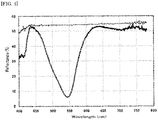
- FIG. 5 depicts chromaticity coordinates of Electrochromic Compounds 1 to 4 used in Examples 8 to 11. As illustrated in FIG. 5 , all of the dyes were colorless and present near a starting point when decolored, but chromaticities went up linearly when colored. Moreover, it was observed that various colors were obtained depending on the positions of the substituents, and Electrochromic Compounds 1 to 4 had excellent colors.
Landscapes
- Chemical & Material Sciences (AREA)
- Organic Chemistry (AREA)
- Physics & Mathematics (AREA)
- Nonlinear Science (AREA)
- Engineering & Computer Science (AREA)
- General Physics & Mathematics (AREA)
- Materials Engineering (AREA)
- Optics & Photonics (AREA)
- Medicinal Chemistry (AREA)
- Polymers & Plastics (AREA)
- Chemical Kinetics & Catalysis (AREA)
- Health & Medical Sciences (AREA)
- Theoretical Computer Science (AREA)
- Electrochromic Elements, Electrophoresis, Or Variable Reflection Or Absorption Elements (AREA)
- Heterocyclic Carbon Compounds Containing A Hetero Ring Having Nitrogen And Oxygen As The Only Ring Hetero Atoms (AREA)
- Addition Polymer Or Copolymer, Post-Treatments, Or Chemical Modifications (AREA)
- Devices For Indicating Variable Information By Combining Individual Elements (AREA)
Applications Claiming Priority (4)
| Application Number | Priority Date | Filing Date | Title |
|---|---|---|---|
| JP2015123939 | 2015-06-19 | ||
| JP2016083873A JP6786858B2 (ja) | 2015-06-19 | 2016-04-19 | エレクトロクロミック化合物及びエレクトロクロミック組成物 |
| EP16811248.0A EP3310877B1 (de) | 2015-06-19 | 2016-06-17 | Elektrochrome verbindung, elektrochrome zusammensetzung und elektrochromes anzeigeelement |
| PCT/JP2016/002923 WO2016203773A1 (en) | 2015-06-19 | 2016-06-17 | Electrochromic compound, electrochromic composition, and electrochromic display element |
Related Parent Applications (2)
| Application Number | Title | Priority Date | Filing Date |
|---|---|---|---|
| EP16811248.0A Division EP3310877B1 (de) | 2015-06-19 | 2016-06-17 | Elektrochrome verbindung, elektrochrome zusammensetzung und elektrochromes anzeigeelement |
| EP16811248.0A Division-Into EP3310877B1 (de) | 2015-06-19 | 2016-06-17 | Elektrochrome verbindung, elektrochrome zusammensetzung und elektrochromes anzeigeelement |
Publications (1)
| Publication Number | Publication Date |
|---|---|
| EP3660123A1 true EP3660123A1 (de) | 2020-06-03 |
Family
ID=57762887
Family Applications (2)
| Application Number | Title | Priority Date | Filing Date |
|---|---|---|---|
| EP20151986.5A Pending EP3660123A1 (de) | 2015-06-19 | 2016-06-17 | Elektrochrome verbindung, elektrochrome zusammensetzung und elektrochromes anzeigeelement |
| EP16811248.0A Active EP3310877B1 (de) | 2015-06-19 | 2016-06-17 | Elektrochrome verbindung, elektrochrome zusammensetzung und elektrochromes anzeigeelement |
Family Applications After (1)
| Application Number | Title | Priority Date | Filing Date |
|---|---|---|---|
| EP16811248.0A Active EP3310877B1 (de) | 2015-06-19 | 2016-06-17 | Elektrochrome verbindung, elektrochrome zusammensetzung und elektrochromes anzeigeelement |
Country Status (5)
| Country | Link |
|---|---|
| US (2) | US10534236B2 (de) |
| EP (2) | EP3660123A1 (de) |
| JP (2) | JP6786858B2 (de) |
| KR (1) | KR102035332B1 (de) |
| CN (1) | CN107683320B (de) |
Families Citing this family (19)
| Publication number | Priority date | Publication date | Assignee | Title |
|---|---|---|---|---|
| JP6786858B2 (ja) * | 2015-06-19 | 2020-11-18 | 株式会社リコー | エレクトロクロミック化合物及びエレクトロクロミック組成物 |
| WO2017070560A1 (en) * | 2015-10-23 | 2017-04-27 | The Regents Of The University Of Colorado, A Body Corporate | Compositions and methods of promoting organic photocatalysis |
| EP3498452A3 (de) | 2017-12-18 | 2019-08-28 | Ricoh Company, Ltd. | Verfahren und vorrichtung zum bilden einer dreidimensionalen gekrümmten oberfläche auf einem laminierten substrat und ein dreidimensionales gekrümmtes laminiertes substrat |
| US11079647B2 (en) | 2018-03-22 | 2021-08-03 | Ricoh Company, Ltd. | Electrochromic display element, optical filter, lens unit, and imaging device |
| CN108534930B (zh) * | 2018-03-23 | 2019-12-10 | 京东方科技集团股份有限公司 | 压力可视化装置及其制备方法、检测设备 |
| US11175559B2 (en) | 2018-04-05 | 2021-11-16 | Ricoh Company, Ltd. | Electrochromic device |
| US11319484B2 (en) | 2018-04-24 | 2022-05-03 | Ricoh Company, Ltd. | Electrochromic element and method for manufacturing electrochromic element |
| JP7367363B2 (ja) | 2018-07-25 | 2023-10-24 | 株式会社リコー | エレクトロクロミック組成物及びエレクトロクロミック素子 |
| WO2020022381A1 (en) | 2018-07-25 | 2020-01-30 | Ricoh Company, Ltd. | Electrochromic compound, electrochromic composition, and electrochromic element |
| JP2020138925A (ja) * | 2019-02-27 | 2020-09-03 | 株式会社リコー | 化合物 |
| EP3712695B1 (de) | 2019-03-20 | 2022-02-23 | Ricoh Company, Ltd. | Elektrochrome vorrichtung, tragbare vorrichtung und verfahren zur ansteuerung einer elektrochromen vorrichtung |
| US11414594B2 (en) * | 2019-04-09 | 2022-08-16 | Gentex Corporation | Low dimerizing viologen electrochromic compounds and devices |
| US11630365B2 (en) | 2019-11-29 | 2023-04-18 | Ricoh Company, Ltd. | Electrochromic element and production method thereof, electrochromic light-adjusting element, electrochromic light-adjusting lens, and electrochromic device |
| KR102754334B1 (ko) | 2019-12-20 | 2025-01-14 | 율촌화학 주식회사 | 광 투과 가변 기능을 갖는 소자 |
| KR102754333B1 (ko) | 2019-12-20 | 2025-01-14 | 율촌화학 주식회사 | 광 투과 가변 기능을 갖는 입자 및 이를 이용한 투과 가변 소자 |
| US12091612B2 (en) | 2020-03-30 | 2024-09-17 | Ricoh Company, Ltd. | Electrochromic element |
| JP7472705B2 (ja) | 2020-07-29 | 2024-04-23 | 株式会社リコー | エレクトロクロミック素子、エレクトロクロミック調光素子、及びエレクトロクロミック装置 |
| US11966139B2 (en) | 2020-07-31 | 2024-04-23 | Ricoh Company, Ltd. | Electrochromic element, and method for driving the same |
| WO2022113702A1 (en) | 2020-11-30 | 2022-06-02 | Ricoh Company, Ltd. | Electrochromic compound, electrochromic composition, and electrochromic element |
Citations (7)
| Publication number | Priority date | Publication date | Assignee | Title |
|---|---|---|---|---|
| JPH0560503B2 (de) | 1985-12-27 | 1993-09-02 | Nippon Oils & Fats Co Ltd | |
| JPH0645770B2 (ja) | 1986-06-10 | 1994-06-15 | 関西ペイント株式会社 | 防汚塗料組成物 |
| US5942615A (en) * | 1996-08-14 | 1999-08-24 | Takasago International Corporation | Phenothiazine or phenoxazine derivative, charge-transporting material comprising the same, and electrophotographic photoreceptor |
| WO2001027690A2 (en) * | 1999-10-11 | 2001-04-19 | University College Dublin | Electrochromic device |
| JP2008001827A (ja) * | 2006-06-23 | 2008-01-10 | Ricoh Co Ltd | アクリル酸エステル及びヒドロキシ化合物、該アクリル酸エステルの(共)重合体、それを用いた電子写真感光体、画像形成方法、画像形成装置及び画像形成装置用プロセスカートリッジ |
| GB2443774A (en) * | 2005-08-12 | 2008-05-14 | Sumitomo Chemical Co | Polymer compound and polymer light-emitting device using same |
| WO2011149056A1 (ja) * | 2010-05-27 | 2011-12-01 | 住友化学株式会社 | 新規化合物及びそれを用いた発光素子 |
Family Cites Families (22)
| Publication number | Priority date | Publication date | Assignee | Title |
|---|---|---|---|---|
| US4505844A (en) * | 1982-11-17 | 1985-03-19 | Chevron Research Company | P-Type polyphenoxazine electroactive polymers |
| DE19505942A1 (de) * | 1995-02-21 | 1996-08-22 | Bayer Ag | (Co)Polymerisate auf Basis von Vinyl-Einheiten und ihre Verwendung in elektrolumineszierenden Anordnungen |
| US6249349B1 (en) * | 1996-09-27 | 2001-06-19 | Vincent Lauer | Microscope generating a three-dimensional representation of an object |
| JP4457529B2 (ja) * | 2001-06-19 | 2010-04-28 | コニカミノルタホールディングス株式会社 | 有機エレクトロルミネッセンス素子 |
| JP3881876B2 (ja) * | 2001-11-30 | 2007-02-14 | 凸版印刷株式会社 | 高分子化合物およびこれを用いた有機薄膜素子 |
| RU2224275C1 (ru) | 2002-09-26 | 2004-02-20 | Закрытое акционерное общество "ТехноГласс Инжиниринг" | Способ изготовления электрохромного устройства и электрохромное устройство |
| US20100286360A1 (en) | 2005-08-12 | 2010-11-11 | Sumitomo Chemical Company, Limited | Polymer compound and polymer light emitting device using the same |
| US7419934B2 (en) | 2006-05-08 | 2008-09-02 | Ricoh Company Limited | Reversible thermosensitive coloring material and reversible thermosensitive recording material using the reversible thermosensitive coloring material |
| US9052263B2 (en) * | 2009-04-15 | 2015-06-09 | General Electric Company | Methods for analyte detection |
| TW201002722A (en) | 2008-01-22 | 2010-01-16 | Ricoh Co Ltd | Benzobisthiazole compound, benzobisthiazole polymer, organic film including the compound or polymer and transistor including the organic film |
| JP5602448B2 (ja) * | 2009-03-26 | 2014-10-08 | 富士フイルム株式会社 | 顔料分散液、着色硬化性組成物、カラーフィルタ、及びカラーフィルタの製造方法 |
| KR101137386B1 (ko) * | 2009-10-09 | 2012-04-20 | 삼성모바일디스플레이주식회사 | 고분자 및 이를 포함한 유기 발광 소자 |
| KR101174880B1 (ko) * | 2010-04-02 | 2012-08-17 | 삼성디스플레이 주식회사 | 고분자 화합물 및 이를 포함하는 유기 발광 소자 |
| US9062221B2 (en) | 2012-03-22 | 2015-06-23 | Ricoh Company, Ltd. | Polymer, ink and organic film |
| GB201314497D0 (en) * | 2013-08-13 | 2013-09-25 | Cambridge Display Tech Ltd | An Electrode for an Organic Electronic Device |
| JP6323154B2 (ja) | 2014-05-13 | 2018-05-16 | 株式会社リコー | エレクトロクロミック表示素子及びその製造方法、並びに表示装置、情報機器及びエレクトロクロミック調光レンズ |
| JP6826031B2 (ja) * | 2014-09-25 | 2021-02-03 | サイノーラ・ゲゼルシャフト・ミト・ベシュレンクテル・ハフツング | 架橋可能なホスト材料 |
| CN107004777B (zh) * | 2014-12-04 | 2019-03-26 | 广州华睿光电材料有限公司 | 聚合物,包含其的混合物、组合物、有机电子器件,及其单体 |
| CN107001807B (zh) * | 2014-12-18 | 2020-04-03 | 富士胶片和光纯药株式会社 | 化合物以及聚合物 |
| JP6597373B2 (ja) * | 2015-06-19 | 2019-10-30 | 株式会社リコー | エレクトロクロミック素子、表示装置及びその駆動方法 |
| JP6786858B2 (ja) * | 2015-06-19 | 2020-11-18 | 株式会社リコー | エレクトロクロミック化合物及びエレクトロクロミック組成物 |
| CN105884707A (zh) | 2016-04-28 | 2016-08-24 | 吉林大学 | 含有三苯胺-吩噁嗪结构的二胺单体、制备方法及其应用 |
-
2016
- 2016-04-19 JP JP2016083873A patent/JP6786858B2/ja active Active
- 2016-06-17 EP EP20151986.5A patent/EP3660123A1/de active Pending
- 2016-06-17 CN CN201680035338.8A patent/CN107683320B/zh active Active
- 2016-06-17 EP EP16811248.0A patent/EP3310877B1/de active Active
- 2016-06-17 US US15/737,115 patent/US10534236B2/en active Active
- 2016-06-17 KR KR1020187001684A patent/KR102035332B1/ko active Active
-
2019
- 2019-11-22 US US16/692,002 patent/US10935862B2/en active Active
-
2020
- 2020-09-07 JP JP2020149914A patent/JP7036175B2/ja active Active
Patent Citations (7)
| Publication number | Priority date | Publication date | Assignee | Title |
|---|---|---|---|---|
| JPH0560503B2 (de) | 1985-12-27 | 1993-09-02 | Nippon Oils & Fats Co Ltd | |
| JPH0645770B2 (ja) | 1986-06-10 | 1994-06-15 | 関西ペイント株式会社 | 防汚塗料組成物 |
| US5942615A (en) * | 1996-08-14 | 1999-08-24 | Takasago International Corporation | Phenothiazine or phenoxazine derivative, charge-transporting material comprising the same, and electrophotographic photoreceptor |
| WO2001027690A2 (en) * | 1999-10-11 | 2001-04-19 | University College Dublin | Electrochromic device |
| GB2443774A (en) * | 2005-08-12 | 2008-05-14 | Sumitomo Chemical Co | Polymer compound and polymer light-emitting device using same |
| JP2008001827A (ja) * | 2006-06-23 | 2008-01-10 | Ricoh Co Ltd | アクリル酸エステル及びヒドロキシ化合物、該アクリル酸エステルの(共)重合体、それを用いた電子写真感光体、画像形成方法、画像形成装置及び画像形成装置用プロセスカートリッジ |
| WO2011149056A1 (ja) * | 2010-05-27 | 2011-12-01 | 住友化学株式会社 | 新規化合物及びそれを用いた発光素子 |
Non-Patent Citations (2)
| Title |
|---|
| ORG. ELECTRON., vol. 15, 2014, pages 428 - 434 |
| TAN HAIJUN ET AL: "A comparative study on properties of two phenoxazine-based dyes for dye-sensitized solar cells", DYES AND PIGMENTS, ELSEVIER APPLIED SCIENCE PUBLISHERS BARKING, GB, vol. 101, 6 October 2013 (2013-10-06), pages 67 - 73, XP028772066, ISSN: 0143-7208, DOI: 10.1016/J.DYEPIG.2013.09.039 * |
Also Published As
| Publication number | Publication date |
|---|---|
| US20200089070A1 (en) | 2020-03-19 |
| US20180173070A1 (en) | 2018-06-21 |
| KR20180019693A (ko) | 2018-02-26 |
| KR102035332B1 (ko) | 2019-10-22 |
| CN107683320B (zh) | 2020-06-16 |
| US10534236B2 (en) | 2020-01-14 |
| US10935862B2 (en) | 2021-03-02 |
| JP2021006911A (ja) | 2021-01-21 |
| EP3310877B1 (de) | 2020-02-26 |
| EP3310877A4 (de) | 2018-04-25 |
| JP7036175B2 (ja) | 2022-03-15 |
| EP3310877A1 (de) | 2018-04-25 |
| JP6786858B2 (ja) | 2020-11-18 |
| JP2017008025A (ja) | 2017-01-12 |
| CN107683320A (zh) | 2018-02-09 |
Similar Documents
| Publication | Publication Date | Title |
|---|---|---|
| US10935862B2 (en) | Electrochromic compound, electrochromic composition, and electrochromic display element | |
| JP6874389B2 (ja) | エレクトロクロミック化合物、エレクトロクロミック組成物およびエレクトロクロミック素子 | |
| EP3268448B1 (de) | Elektrochrome verbindung, elektrochrome zusammensetzung, elektrochromes element und elektrochromes dämmelement | |
| EP3384346B1 (de) | Elektrochromes element | |
| EP3889130A1 (de) | Elektrochromes element | |
| JP7069562B2 (ja) | エレクトロクロミック調光装置 | |
| JP6866574B2 (ja) | エレクトロクロミック化合物及びエレクトロクロミック組成物 | |
| JP6613663B2 (ja) | エレクトロクロミック化合物、エレクトロクロミック組成物及びエレクトロクロミック表示素子 | |
| JP2020140053A (ja) | エレクトロクロミック素子、表示素子、調光素子、エレクトロクロミック組成物及び硬化膜 | |
| EP3827065B1 (de) | Elektrochrome verbindung, elektrochrome zusammensetzung und elektrochromes element | |
| WO2016203773A1 (en) | Electrochromic compound, electrochromic composition, and electrochromic display element | |
| JP6848342B2 (ja) | エレクトロクロミック組成物、及びエレクトロクロミック素子 | |
| JP6665430B2 (ja) | エレクトロクロミック化合物、エレクトロクロミック組成物、及びエレクトロクロミック表示素子 | |
| JP2019172724A (ja) | エレクトロクロミックポリマー、エレクトロクロミック組成物及びエレクトロクロミック表示素子 | |
| JP6786775B2 (ja) | エレクトロクロミック化合物、エレクトロクロミック組成物、及びエレクトロクロミック表示素子 | |
| JP6728951B2 (ja) | エレクトロクロミック化合物、エレクトロクロミック組成物、及びエレクトロクロミック素子 | |
| JP2021162853A (ja) | エレクトロクロミック素子 | |
| WO2022113702A1 (en) | Electrochromic compound, electrochromic composition, and electrochromic element | |
| JP2021026017A (ja) | 電子デバイス、調光レンズ、及び調光メガネ |
Legal Events
| Date | Code | Title | Description |
|---|---|---|---|
| PUAI | Public reference made under article 153(3) epc to a published international application that has entered the european phase |
Free format text: ORIGINAL CODE: 0009012 |
|
| STAA | Information on the status of an ep patent application or granted ep patent |
Free format text: STATUS: REQUEST FOR EXAMINATION WAS MADE |
|
| 17P | Request for examination filed |
Effective date: 20200115 |
|
| AC | Divisional application: reference to earlier application |
Ref document number: 3310877 Country of ref document: EP Kind code of ref document: P |
|
| AK | Designated contracting states |
Kind code of ref document: A1 Designated state(s): AL AT BE BG CH CY CZ DE DK EE ES FI FR GB GR HR HU IE IS IT LI LT LU LV MC MK MT NL NO PL PT RO RS SE SI SK SM TR |
|
| STAA | Information on the status of an ep patent application or granted ep patent |
Free format text: STATUS: EXAMINATION IS IN PROGRESS |
|
| 17Q | First examination report despatched |
Effective date: 20210924 |