EP3660839A2 - Système, serveur et procédé de reconnaissance vocale d'appareil domestique - Google Patents
Système, serveur et procédé de reconnaissance vocale d'appareil domestique Download PDFInfo
- Publication number
- EP3660839A2 EP3660839A2 EP18852416.9A EP18852416A EP3660839A2 EP 3660839 A2 EP3660839 A2 EP 3660839A2 EP 18852416 A EP18852416 A EP 18852416A EP 3660839 A2 EP3660839 A2 EP 3660839A2
- Authority
- EP
- European Patent Office
- Prior art keywords
- speech
- home appliance
- speech recognition
- speech command
- server
- Prior art date
- Legal status (The legal status is an assumption and is not a legal conclusion. Google has not performed a legal analysis and makes no representation as to the accuracy of the status listed.)
- Granted
Links
Images




Classifications
-
- G—PHYSICS
- G10—MUSICAL INSTRUMENTS; ACOUSTICS
- G10L—SPEECH ANALYSIS TECHNIQUES OR SPEECH SYNTHESIS; SPEECH RECOGNITION; SPEECH OR VOICE PROCESSING TECHNIQUES; SPEECH OR AUDIO CODING OR DECODING
- G10L15/00—Speech recognition
- G10L15/22—Procedures used during a speech recognition process, e.g. man-machine dialogue
-
- G—PHYSICS
- G10—MUSICAL INSTRUMENTS; ACOUSTICS
- G10L—SPEECH ANALYSIS TECHNIQUES OR SPEECH SYNTHESIS; SPEECH RECOGNITION; SPEECH OR VOICE PROCESSING TECHNIQUES; SPEECH OR AUDIO CODING OR DECODING
- G10L15/00—Speech recognition
- G10L15/04—Segmentation; Word boundary detection
-
- G—PHYSICS
- G10—MUSICAL INSTRUMENTS; ACOUSTICS
- G10L—SPEECH ANALYSIS TECHNIQUES OR SPEECH SYNTHESIS; SPEECH RECOGNITION; SPEECH OR VOICE PROCESSING TECHNIQUES; SPEECH OR AUDIO CODING OR DECODING
- G10L15/00—Speech recognition
- G10L15/08—Speech classification or search
- G10L15/18—Speech classification or search using natural language modelling
- G10L15/1815—Semantic context, e.g. disambiguation of the recognition hypotheses based on word meaning
-
- G—PHYSICS
- G10—MUSICAL INSTRUMENTS; ACOUSTICS
- G10L—SPEECH ANALYSIS TECHNIQUES OR SPEECH SYNTHESIS; SPEECH RECOGNITION; SPEECH OR VOICE PROCESSING TECHNIQUES; SPEECH OR AUDIO CODING OR DECODING
- G10L15/00—Speech recognition
- G10L15/08—Speech classification or search
- G10L15/18—Speech classification or search using natural language modelling
- G10L15/183—Speech classification or search using natural language modelling using context dependencies, e.g. language models
-
- G—PHYSICS
- G10—MUSICAL INSTRUMENTS; ACOUSTICS
- G10L—SPEECH ANALYSIS TECHNIQUES OR SPEECH SYNTHESIS; SPEECH RECOGNITION; SPEECH OR VOICE PROCESSING TECHNIQUES; SPEECH OR AUDIO CODING OR DECODING
- G10L15/00—Speech recognition
- G10L15/28—Constructional details of speech recognition systems
-
- H—ELECTRICITY
- H04—ELECTRIC COMMUNICATION TECHNIQUE
- H04L—TRANSMISSION OF DIGITAL INFORMATION, e.g. TELEGRAPHIC COMMUNICATION
- H04L12/00—Data switching networks
- H04L12/28—Data switching networks characterised by path configuration, e.g. LAN [Local Area Networks] or WAN [Wide Area Networks]
- H04L12/2803—Home automation networks
- H04L12/2816—Controlling appliance services of a home automation network by calling their functionalities
-
- G—PHYSICS
- G10—MUSICAL INSTRUMENTS; ACOUSTICS
- G10L—SPEECH ANALYSIS TECHNIQUES OR SPEECH SYNTHESIS; SPEECH RECOGNITION; SPEECH OR VOICE PROCESSING TECHNIQUES; SPEECH OR AUDIO CODING OR DECODING
- G10L15/00—Speech recognition
- G10L15/08—Speech classification or search
- G10L15/18—Speech classification or search using natural language modelling
- G10L15/1822—Parsing for meaning understanding
-
- G—PHYSICS
- G10—MUSICAL INSTRUMENTS; ACOUSTICS
- G10L—SPEECH ANALYSIS TECHNIQUES OR SPEECH SYNTHESIS; SPEECH RECOGNITION; SPEECH OR VOICE PROCESSING TECHNIQUES; SPEECH OR AUDIO CODING OR DECODING
- G10L15/00—Speech recognition
- G10L15/26—Speech to text systems
-
- G—PHYSICS
- G10—MUSICAL INSTRUMENTS; ACOUSTICS
- G10L—SPEECH ANALYSIS TECHNIQUES OR SPEECH SYNTHESIS; SPEECH RECOGNITION; SPEECH OR VOICE PROCESSING TECHNIQUES; SPEECH OR AUDIO CODING OR DECODING
- G10L15/00—Speech recognition
- G10L15/28—Constructional details of speech recognition systems
- G10L15/30—Distributed recognition, e.g. in client-server systems, for mobile phones or network applications
-
- G—PHYSICS
- G10—MUSICAL INSTRUMENTS; ACOUSTICS
- G10L—SPEECH ANALYSIS TECHNIQUES OR SPEECH SYNTHESIS; SPEECH RECOGNITION; SPEECH OR VOICE PROCESSING TECHNIQUES; SPEECH OR AUDIO CODING OR DECODING
- G10L15/00—Speech recognition
- G10L15/22—Procedures used during a speech recognition process, e.g. man-machine dialogue
- G10L2015/221—Announcement of recognition results
-
- G—PHYSICS
- G10—MUSICAL INSTRUMENTS; ACOUSTICS
- G10L—SPEECH ANALYSIS TECHNIQUES OR SPEECH SYNTHESIS; SPEECH RECOGNITION; SPEECH OR VOICE PROCESSING TECHNIQUES; SPEECH OR AUDIO CODING OR DECODING
- G10L15/00—Speech recognition
- G10L15/22—Procedures used during a speech recognition process, e.g. man-machine dialogue
- G10L2015/223—Execution procedure of a spoken command
-
- G—PHYSICS
- G10—MUSICAL INSTRUMENTS; ACOUSTICS
- G10L—SPEECH ANALYSIS TECHNIQUES OR SPEECH SYNTHESIS; SPEECH RECOGNITION; SPEECH OR VOICE PROCESSING TECHNIQUES; SPEECH OR AUDIO CODING OR DECODING
- G10L15/00—Speech recognition
- G10L15/22—Procedures used during a speech recognition process, e.g. man-machine dialogue
- G10L2015/225—Feedback of the input speech
Definitions
- the disclosure relates to a speech recognition technology for controlling a home appliance using a speech command generated by a user (a speaker)'s utterance.
- a plurality of operation conditions are set.
- the operation conditions to be set also increase.
- a washing machine for example, in order to change the number of rinsing operations or the water level according to the weight of laundry in each washing course, a number of times of key manipulation on a control panel are required.
- a key manipulation is too complicated to be understood without reading a user guidebook.
- the setting method is greatly inconvenient and thus users may give up using the functions.
- a speech command system based on speech recognition technology is increasingly used.
- the speech command needs to be generated as many times as the number of setting items so as to set each setting item.
- a speech recognition system for a home appliance including: a home appliance configured to receive a speech command that is generated through an utterance of a single sentence for control of the home appliance; and a server configured to receive the speech command in the single sentence from the home appliance and interpret the speech command in the single sentence through multiple intent determination.
- the speech command generated through the utterance of the single sentence may include a plurality of intents, and the server interprets the speech command on the basis of the plurality of intents.
- the server may be configured to: generate a plurality of instruction sentence formulas by combining the plurality of intents; generate a plurality of derivative sentences on the basis of the plurality of instruction sentence formulas; and compare the plurality of derivative sentences with a plurality of pieces of speech command data registered in the server, to find matching speech command data in the comparison.
- the server may be configured to: generate a plurality of scenarios operable by the home appliance on the basis of a function and a specification of the home appliance; and generate the plurality of instruction sentence formulas each corresponding to one of the plurality of scenarios.
- the server may be configured to, in the comparing of the plurality of derivative sentences with the plurality of pieces of speech command data registered in the server, compare the speech command data having a higher priority first.
- the speech command data representing an operation having a higher frequency of use may be assigned a higher priority.
- the server may be configured to: extract a plurality of control values for controlling the home appliance from a result of the interpretation of the speech command; and transmit a speech recognition result including the plurality of control values to the home appliance, wherein the speech recognition result includes at least one of a function and an option of the home appliance, a hardware value of the home appliance, a value required for control of the home appliance, information indicating whether the speech recognition result is successful, or text information guided to a user.
- the home appliance may include at least one of a refrigerator, a washing machine, a cooking device, an air conditioner, or a robot cleaner.
- a speech recognition server for a home appliance, including: a speech recognizer configured to recognize a speech command generated through an utterance of a single sentence for control of the home appliance and convert the speech command into text data; and a natural language interpreter configured to analyze the speech command in the single sentence and extract an intent, wherein the speech recognition server interprets the speech command in the single sentence through multiple intent determination.
- the speech command generated through the utterance of the single sentence may include a plurality of intents, and the speech recognition server may interpret the speech command on the basis of the plurality of intents.
- the speech recognition server may be configured to: generate a plurality of instruction sentence formulas by combining the plurality of intents; generate a plurality of derivative sentences on the basis of the plurality of instruction sentence formulas; and compare the plurality of derivative sentences with a plurality of speech commands registered in the server, to find a matching speech command in the comparison.
- the speech recognition server may be configured to: generate a plurality of scenarios operable by the home appliance on the basis of a function and a specification of the home appliance; and generate the plurality of instruction sentence formulas each corresponding to one of the plurality of scenarios.
- the speech recognition server may be configured to, in the comparing of the plurality of derivative sentences with the plurality of speech commands registered in the server, compare speech command data having a higher priority first.
- the speech command data representing an operation having a higher frequency of use may be assigned a higher priority.
- the speech recognition server may be configured to: extract a plurality of control values for controlling the home appliance from a result of the interpretation of the speech command; and transmit a speech recognition result including the plurality of control values to the home appliance,
- the speech recognition result may include at least one of a function and an option of the home appliance, a hardware value of the home appliance, a value required for control of the home appliance, information indicating whether the speech recognition result is successful, or text information guided to a user.
- the home appliance may include at least one of a refrigerator, a washing machine, a cooking device, an air conditioner, or a robot cleaner.
- a speech recognition method for a home appliance including: receiving a speech command generated through an utterance of a single sentence for control of a home appliance; and receiving the speech command in the single sentence from the home appliance and interpreting the speech command in the single sentence through multiple intent determination.
- the speech command generated through the utterance of the single sentence may include a plurality of intents, and the speech command is interpreted on the basis of the plurality of intents.
- the speech recognition method may further include: generating a plurality of instruction sentence formulas by combining the plurality of intents; generating a plurality of derivative sentences on the basis of the plurality of instruction sentence formulas; and comparing the plurality of derivative sentences with a plurality of pieces of speech command data registered in a server, to find matching speech command data in the comparison.
- the speech recognition method may further include: generating a plurality of scenarios operable by the home appliance on the basis of a function and a specification of the home appliance; and generating the plurality of instruction sentence formulas each corresponding to one of the plurality of scenarios.
- the speech command data having a higher priority may be compared first.
- the speech command data representing an operation having a higher frequency of use may be assigned a higher priority.
- the speech recognition method may further include: extracting a plurality of control values for controlling the home appliance from a result of the interpretation of the speech command; and transmitting a speech recognition result including the plurality of control values to the home appliance, wherein the speech recognition result includes at least one of a function and an option of the home appliance of the home appliance, a hardware value of the home appliance, a value required for control of the home appliance, information indicating whether the speech recognition result is successful, or text information guided to a user.
- the home appliance may include at least one of a refrigerator, a washing machine, a cooking device, an air conditioner, or a robot cleaner.
- a plurality setting items for device control can be easily and rapidly set by collectively setting the plurality of setting items for device control through an utterance of a single sentence in the form of natural language.
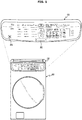
- FIG. 1 is a diagram illustrating a home appliance 100 that employs speech recognition technology according to an embodiment.
- the speech recognition technology according to the embodiment of the disclosure may be applied to any device, such as a vehicle, a computer, industrial facility, a mobile device as well as a home appliance, on which a speech recognition module is mounted to be controlled through a speech command.
- a washing machine is illustrated as an example of the home appliance 100.
- the home appliance to which the speech recognition technology according to the embodiment of the disclosure may be applied is not limited to a washing machine, and the application thereof may be expanded to other types of home appliances, such as an oven or a robot cleaner.
- the home appliance 100 is provided with a microphone hole 102 and a speaker hole 104.
- the microphone hole 102 is provided at a position corresponding to a position at which a microphone (306 in FIG. 3 ) is installed.
- a speech signal uttered by a user (a speaker) is transmitted to the microphone (306 in FIG. 3 ) through the microphone hole 102.
- the speaker hole 104 is provided at a position corresponding to a position at which a speaker (312 in FIG. 3 ) is installed.
- An acoustic signal generated by the home appliance 100 may be output to the outside through the speaker hole 104.
- the positions of the microphone hole 102 and the speaker hole 104 are determined by the positions of the microphone (306 in FIG. 3 ) and the speaker (312 in FIG. 3 ).
- the microphone (306 in FIG. 3 ) and the speaker (312 in FIG. 3 ) may be installed at any position in a main body of the home appliance 100.
- the microphone (306 in FIG. 3 ) and the speaker (312 in FIG. 3 ) may be installed on a control panel 106 provided on a front upper portion of the main body of the home appliance 100, and the microphone hole 102 and the speaker hole 104 may be formed at positions corresponding to the microphone (306 in FIG. 3 ) and the speaker (312 in FIG. 3 ), respectively, so that when the user (the speaker) stands in front of the home appliance 100, the ears and the mouth of the user (the speaker) may approach the microphone hole 102 and the speaker hole 104.
- FIG. 2 is a diagram illustrating a speech recognition system that employs a speech recognition technology according to an embodiment of the disclosure.
- a speech command generated by an utterance of a user (a speaker) 250 is input to a speech recognition device 230 of the home appliance 100, is subjected to a series of signal processing, and then is transmitted to a speech recognition server 270 at a remote site.
- the speech recognition device 230 may be provided in the form of logic in a microprocessor or in the form of speech recognition application software.
- the speech command is subject to interpretation and conversion.
- the speech command interpreted and converted in the speech recognition server 270 is provided to the home appliance 100 again such that the home appliance 100 is subject to control corresponding to the speech command.
- the speech recognition server 270 is provided at a remote site to enable communication with the home appliance 100.
- the speech recognition server 270 may be installed in the home appliance 100 and operated.
- a mobile device for example, a smartphone, such as Samsung's Galaxy series
- FIG. 3 is a detailed diagram illustrating a configuration of the speech recognition system shown in FIG. 2 .
- the speech recognition device 230 provided in the home appliance 100 includes a controller 302, a communicator 304, a microphone 306, a speech storage 308, a preprocessor 310, a speaker 312, and a sensor module 314.
- the speech recognition server 270 provided at a remote site may include a speech recognizer (automatic speech recognition, ASR) 372, a natural language interpreter (natural language understanding, NLU) 374, and a text-to-speech converter (text to speech, TTS) 376.
- ASR automatic speech recognition
- NLU natural language understanding
- TTS text-to-speech converter
- the controller 302 controls overall operations of the speech recognition device 230. For example, the controller 302 receives a speech command generated by an utterance of a user (a speaker), performs a series of signal processing on the speech command, and transmits the speech command on which the signal processing is completed to the speech recognition server 270 at the remote site through the communicator 304. In addition, the controller 302 receives a speech command resulting from interpretation and conversion from the speech recognition server 270, and transmits the received speech command to another controller of the home appliance 100 such that the home appliance 100 is subject to control corresponding the speech command.
- the communicator 304 allows the speech recognition device 230 of the home appliance 100 and the speech recognition server 270 at the remote site to communicate with each other.
- the communicator 304 may be a communication device for wired communication and wireless communication.
- the communication between the speech recognition device 230 of the home appliance 100 and the speech recognition server 270 at the remote site may use both a wired communication network and a wireless communication network.
- the existing infrastructures such as Long Term Evolution (LTE)
- LTE Long Term Evolution
- Wi-Fi or Ethernet may be used.
- the home appliance 100 and the speech recognition server 270 may communicate with each other using a hotspot function of a mobile device.
- the home appliance 100 and the speech recognition server 270 may communicate with each other through a short range communication network, such as Bluetooth or near field communication (NFC).
- a short range communication network such as Bluetooth or near field communication (NFC).
- NFC near field communication
- the microphone 306 is a device for receiving a speech signal uttered by a user (a speaker). An acoustic signal generated by the utterance by the user (the speaker) is collected by the microphone 306 and converted into an electrical signal.
- the speech storage 308 serves as a buffer for temporarily storing the acoustic signals collected by the microphone 306.
- the preprocessor 310 performs preprocessing on the acoustic signals stored in the speech storage 308.
- the preprocessing of the acoustic signals may include noise removal or signal amplification.
- the speaker 312 is a device for outputting an acoustic signal generated by the home appliance 100.
- the acoustic signal output through the speaker 312 may include a beep sound or a warning sound indicating the state of the home appliance 100.
- the acoustic signal output through the speaker 312 may be a response to the speech command of the user or may be an acoustic signal for providing a result of performing the speech command.
- the sensor module 314 is provided to detect various operating states of the home appliance 100.
- the sensor module 314 may include a door sensor capable of detecting a door opening of the home appliance 100.
- the sensor module 314 may include a temperature sensor for measuring the water temperature of the home appliance 100.
- the speech recognizer 372 recognizes a speech command generated by the utterance of the user (the speaker) and converts the speech command into text data.
- the natural language interpreter 374 is a device for analyzing content of the speech command generated by the user (speaker) utterance through natural language processing and for extracting an intent of the user (the speaker).
- the intent of the user (speaker) refers to an independent control item intended by the user.
- the speech command "start with a standard washing course, three times of rinsing, and delicate drying" may include four intents 'washing course', 'the number of rinsing times', 'the degree of dryness' and 'start'.
- the text-to-speech converter 376 is a device provided to convert text data into a speech signal (Text to Speech).
- the speech recognition server 270 stores various pieces of text data related to the home appliance 100.
- the text-to-speech converter 376 converts text data selected from among the various pieces of text data into an acoustic signal and transmits the acoustic signal to the speech recognition device 230 of the home appliance 100.
- the speech recognition device 230 of the home appliance 100 may output the acoustic signal transmitted from the text-to-speech converter 376 of the speech recognition server 270 through the speaker 312 such that the user hears the acoustic signal.
- the natural language interpreter 374 of the speech recognition server 270 compares the text data converted by the speech recognizer 372 with various pieces of text data secured by the natural language interpreter 374, and checks the existence of a matching sentence in the comparison. For example, when a user (a speaker) generates a speech command by uttering "start with a standard washing course, three times of rinsing and delicate drying" , the natural language interpreter 374 searches for text data that matches or closes to the utterance "start with a standard washing course, three times of rinsing, and delicate drying" among the pieces of text data secured by the natural language interpreter 374, and identifies the existence of the matching text data. In this case, a rule name (a command name), based on which the search is performed, is "start cycle and rinse and dryer".
- the pieces of text data secured in the speech recognition server 270 include instruction sentence formulas for understanding and operating speech commands.
- Some examples of the instruction sentence formulas are described as in (A) to (D) below.
- the instruction sentence formulas described below may be provided using multiple intent identification technique.
- the speech command "start with a standard washing course, three times of rinsing, and delicate drying" includes four intents 'washing course', 'the number of rinsing times', 'the degree of dryness' and 'start'.
- the instruction sentence formulas may be summarized as follows.
- the instruction sentence formula corresponding to "start cycle and rinse and dryer” is the instruction sentence formula (B).
- Derivative sentences that may be generated from the instruction sentence formula (B) on the basis of multiple intent identification technology and natural language rules may be represented as (B1) to (B5) below. Although all the derivative sentences (B1) to (B5) have sentence structures and expressions that are close to natural language, it can be seen that a derivative sentence that matches the original speech command "start with a standard washing course, three times of rinsing, and delicate drying" is the sentence (B4). When there is no matching derivative sentence, the most similar derivative sentence is selected.
- the pieces of text data secured by the natural language interpreter 374 may be assigned a priority for increasing the recognition rate.
- a higher priority is assigned to text data representing a general operation having a higher frequency of use in the home appliance 100.
- a general type of washing operation includes 'the washing course', 'the number of rinsing times', and 'the degree of dryness', and thus text data including 'the washing course', 'the number of rinsing times', and 'the degree of drying' has a higher priority.
- the natural language interpreter 374 may perform the comparison starting from the text data having a highest priority, so that a matching text data may be found more quickly and accurately.
- the existence of the matching text data represents that text data of instructions corresponding to the speech signal spoken by the user (speaker) exists in the natural language interpreter 374.
- the natural language interpreter 374 checks the rule of the corresponding instructions.
- a rule of instructions is implemented differently according to an operation scenario of the home appliance 100.
- exceptions are checked according to the functions and specifications of the home appliance 100. For example, when the user (the speaker) says “Start a standard washing course", a rule of the instructions is found and the rule of the instructions "Start Cycle Washer" is secured. Subsequently, it is checked whether the 'standard washing course' uttered by the user (the speaker) is a washing course existing in the home appliance 100 on the basis of the performance and the requirements of the home appliance 100. When the 'standard washing course' is a washing course existing in the home appliance 100, the current operation state of the home appliance 100 is checked. Information about the current state of the home appliance 100 is provided from the speech recognition device 230 of the home appliance 100.
- the 'standard washing course' is allowed to be performed according to the speech command.
- a notification indicating that the 'standard washing course' is not performable is output through the speaker 312 (or a display) to inform the user of the current state.
- the natural language interpreter 374 transmits a speech recognition result to the speech recognition device 230 of the home appliance 100.
- the speech recognition result may include a function and an option of the home appliance 100, a hardware value of the home appliance 100, a value required for control of the home appliance 100, information indicating whether the speech recognition result succeeds, or text information (text-to-speech (TTS) information) guided to the user.
- TTS text-to-speech
- the user may set an intended operation (or input a control command) without directly manipulating the home appliance 100.
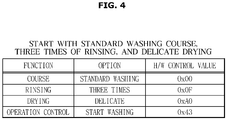
- FIG. 4 is a diagram illustrating an example of a speech command protocol that is applied to a speech recognition technology according to an embodiment of the disclosure.
- the speech recognition system even when a speech command generated by a user (speaker) utterance is a single sentence in the form of natural language including a plurality of consecutive setting items, the speech command may be rapidly and accurately interpreted and converted.
- the plurality of setting items may include an operation control item and an option setting item.
- the speech recognition technology may allow a user (speaker) to consecutively utter a plurality of operation control items and a plurality of option setting items in a single sentence, apply a predetermined rule to the plurality of operation control items and the plurality of option setting items, and perform natural language processing using the natural language interpreter 374, so that the contents of the speech command of the user (speaker) may be accurately identified.
- the speech command protocol shown in FIG. 4 includes ⁇ function>, ⁇ option>, and ⁇ hardware control value>.
- ⁇ Function> is to classify various functions provided in the home appliance 100
- ⁇ option> is to classify a value or state that may be set for each function
- ⁇ hardware control value> is to represent an option for each function as a hexadecimal number.
- ⁇ Hardware control value> may be represented in other forms instead of hexadecimal.
- the home appliance 100 is a washing machine and the user (speaker) utters a speech command "start with a standard washing course, three times of rinsing, and delicate drying".
- the speech command of the user (speaker) includes four intents of 'course', 'rinsing (the number of rinsing times)', 'dryness (the degree of dryness)' and 'operation control'.
- 'Course' is to select a washing course, and may include courses, such as a standard washing, a wool washing, and a large laundry washing.
- the hardware control value representing the standard washing selected by the user (speaker) is "0x00".
- 'Rinsing' is to select the number of rinsing times of laundry, for example, a certain number of rinsing times, from one to five, may be selected.
- the hardware control value representing three times of rinsing selected by the user (speaker) is "0x0f".
- 'Dryness' is to select the degree of drying laundry, for example, one of the degrees of dryness, from among general drying, high temperature drying, delicate drying, and the like, may be selected.
- the hardware control value representing the delicate drying selected by the user (the speaker) is "0xA0".
- 'Operation control' is to set the operation of the home appliance 100. For example, one operation, from among a start and an end of washing, a pause, and the like, may be selected.
- the hardware control value representing the start of washing selected by the user (the speaker) is "0x43".
- the speech recognition device 230 of the home appliance 100 in cooperation with the speech recognition server 270 may analyze that the speech command of the user (speaker) includes ⁇ function>, ⁇ option>, and ⁇ hardware control value> as shown in FIG. 4 , and control the home appliance 100 to perform a standard washing course including three times of rinsing cycles and a delicate drying cycle as analyzed.
- a primary speech command is generated to set a function, and then a secondary speech command is generated to set an option.
- an independent (separate) speech command needs to be generated.
- the speech recognition system may generate a speech command including a plurality of desired ⁇ functions> and a plurality of desired ⁇ options> using only a single sentence structure speech command in the form of a natural language including the plurality of ⁇ functions> and the plurality of ⁇ options>.
- FIG. 5 is a diagram illustrating a speech recognition control method according to an embodiment of the disclosure.
- the home appliance 100 may be powered on through manipulation of a power button by a user, so that power is supplied to each element of the home appliance 100 (502).
- a speech recognition mode When the home appliance 100 is in a power-on state, a speech recognition mode may be activated by at least one of the following two methods (504). Without a separate process for activating the speech recognition mode, a normal conversation occurring around the home appliance 100 may be erroneously recognized by the speech recognition function as a control command input by a user. Therefore, in order to prevent such misrecognition, a separate process for activating a speech recognition mode is required.
- the first method for activating the speech recognition mode may operate in a way to activate the speech recognition mode through a speech trigger. That is, when the user utters a predetermined specific speech, the home appliance 100 may recognize the utterance of the predetermined specific speech, so that the speech recognition mode is activated.
- the second method for activating the speech recognition mode may operate in a way that the user directly manipulates a speech recognition icon or a speech recognition button provided on the home appliance 100 to activate the speech recognition mode.
- the controller 302 of the speech recognition device 230 monitors whether a speech command is received (506).
- the received speech command is temporarily stored in the speech storage 308, and is preprocessed by the preprocessor 310 into a signal in which noise is removed or the magnitude is amplified (508).
- the pre-processed speech command is transmitted to the speech recognition server 270 at a remote side through the communicator 304 (510).
- a speech recognition process including speech recognition (ASR) and natural language interpretation (NLU) is performed on the speech command transmitted from the home appliance 100.
- ASR speech recognition
- NLU natural language interpretation
- the speech recognition process performed by the speech recognition server 270 has been described above in detail with reference to FIG. 3 .
- a result of the speech recognition process performed by the speech recognition server 270 (that is, results of ASR and NLU, and TTS) is transmitted to the controller 302 of the home appliance 100.
- the home appliance 100 receives the result of the speech recognition process (the results of the ASR, the NLU, and the TTS) from the speech recognition server 270 (512).
- the result of the speech recognition process may include a function and an option of the home appliance 100, a hardware value of the home appliance 100, a value required for control of the home appliance 100, information indicating whether the result is successful, and text information (TTS information) that is to be guided the user.
- the controller 302 of the speech recognition device 230 of the home appliance 100 provides required data to other controllers in the home appliance 100 such that the home appliance 100 is subject to control based on the result of the speech recognition process received from the speech recognition server 270 (the results of the ASR, the NLU, the TTS) according to the speech command (514).
- the controller 302 selects text information (TTS information) included in the result of the speech recognition process received from the speech recognition server 270 and outputs a speech guidance corresponding to the current state of the home appliance 100 through the speaker 312 (516).
- the speech guidance may be provided to notify a progress of a task currently being performed in the home appliance 100 or to notify the completion of the task.
- a guide message may be output in the form of text or graphics through the display.
- FIG. 6 is a diagram illustrating a speech recognition scenario of a washing machine that employs a speech recognition technology according to an embodiment of the disclosure.
- a washing machine 600 having received the speech command extracts a plurality of control values through multiple-intent determination of the single sentence type speech command of the user (speaker) in cooperation with the speech recognition server 270, and outputs a speech message "Yes, I will finish washing by 6 p.m.” in response to the speech command of the user (speaker) through the speaker 312.
- Such recognition of a speech command in the form of natural language and generation of a speech message may be performed by extracting a plurality of control values included in the single sentence form speech command through multiple-intent determination of the speech recognition technology according to the embodiment of the disclosure.
- FIG. 7 is a diagram illustrating another speech recognition scenario of a washing machine that employs a speech recognition technology according to an embodiment of the disclosure.
- a washing machine 700 having received the speech command extracts a plurality of control values through multiple-intent determination of the single sentence type speech command of the user (speaker) in cooperation with the speech recognition server 270, and outputs a speech message "it is not recommended to wash a towel and a T-shirt together, separate washing is recommended. " in response to the speech command of the user (speaker) through the speaker 312.
- Such recognition of a speech command in the form of natural language and generation of a speech message may be performed by extracting a plurality of control values included in the single sentence form speech command through multiple-intent determination of the speech recognition technology according to the embodiment of the disclosure.
- FIG. 8 is a diagram illustrating a speech recognition scenario of an oven that employs a speech recognition technology according to an embodiment of the disclosure.
- a user when a user (speaker) generates a speech command "Cook at 450 degrees for 20 minutes and 300 degrees for 3 hours" through a single sentence, an oven 800 having received the speech command extracts a plurality of control values through multiple-intent determination of the single sentence type speech command of the user (speaker) in cooperation with the speech recognition server 270, and outputs a speech message "Yes, I will cook as you said" in response to the speech command of the user (speaker) through the speaker 312.
- Such recognition of a speech command in the form of natural language and generation of a speech message may be performed by extracting a plurality of control values included in the single sentence form speech command through multiple-intent determination of the speech recognition technology according to the embodiment of the disclosure.
- FIG. 9 is a diagram illustrating another speech recognition scenario of an oven that employs a speech recognition technology according to an embodiment of the disclosure.
- an oven 900 having received the speech command extracts a plurality of control values through multiple-intent determination of the single sentence type speech command of the user (speaker) in cooperation with the speech recognition server 270, and outputs a speech message "A sweet potato cake is recommended. I will let you know a detailed recipe if you want. " in response to the speech command of the user (speaker) through the speaker 312.
- Such recognition of a speech command in the form of natural language and generation of a speech message may be performed by extracting a plurality of control values included in the single sentence form speech command through multiple-intent determination of the speech recognition technology according to the embodiment of the disclosure.
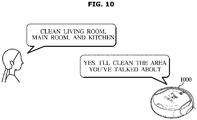
- FIG. 10 is a diagram illustrating a speech recognition scenario of a robot cleaner that employs a speech recognition technology according to an embodiment of the disclosure.
- a robot cleaner 1000 when a user (speaker) generates a speech command "Clean the living room, the main room, and the kitchen" through utterance of a single sentence, a robot cleaner 1000 having received the speech command extracts a plurality of control values through multiple-intent determination of the single sentence type speech command of the user (speaker) in cooperation with the speech recognition server 270, and outputs a speech message "Yes. I'll clean the area you've talked about" in response to the speech command of the user (speaker) through the speaker 312.
- Such recognition of a speech command in the form of natural language and generation of a speech message may be performed by extracting a plurality of control values included in the single sentence form speech command through multiple-intent determination of the speech recognition technology according to the embodiment of the disclosure.
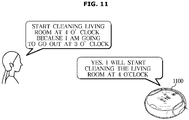
- FIG. 11 is a diagram illustrating another speech recognition scenario of a robot cleaner that employs a speech recognition technology according to an embodiment of the disclosure.
- a robot cleaner 1100 when a user (speaker) generates a speech command "start cleaning the living room at 4 o'clock because I am going to go out at 3 o'clock" through utterance of a single sentence, a robot cleaner 1100 having received the speech command extracts a plurality of control values through multiple-intent determination of the single sentence type speech command of the user (speaker) in cooperation with the speech recognition server 270, and outputs a speech message " Yes, I will start cleaning the living room at 4 o'clock. " in response to the speech command of the user (speaker) through the speaker 312.
- Such recognition of a speech command in the form of natural language and generation of a speech message may be performed by extracting a plurality of control values included in the single sentence form speech command through multiple-intent determination of the speech recognition technology according to the embodiment of the disclosure.
Landscapes
- Engineering & Computer Science (AREA)
- Computational Linguistics (AREA)
- Health & Medical Sciences (AREA)
- Audiology, Speech & Language Pathology (AREA)
- Human Computer Interaction (AREA)
- Physics & Mathematics (AREA)
- Acoustics & Sound (AREA)
- Multimedia (AREA)
- Artificial Intelligence (AREA)
- Automation & Control Theory (AREA)
- Computer Networks & Wireless Communication (AREA)
- Signal Processing (AREA)
- Telephonic Communication Services (AREA)
Applications Claiming Priority (2)
| Application Number | Priority Date | Filing Date | Title |
|---|---|---|---|
| KR1020170111492A KR102428148B1 (ko) | 2017-08-31 | 2017-08-31 | 가전 기기의 음성 인식을 위한 시스템과 서버, 방법 |
| PCT/KR2018/010007 WO2019045455A2 (fr) | 2017-08-31 | 2018-08-29 | Système, serveur et procédé de reconnaissance vocale d'appareil domestique |
Publications (3)
| Publication Number | Publication Date |
|---|---|
| EP3660839A4 EP3660839A4 (fr) | 2020-06-03 |
| EP3660839A2 true EP3660839A2 (fr) | 2020-06-03 |
| EP3660839B1 EP3660839B1 (fr) | 2022-09-28 |
Family
ID=65527652
Family Applications (1)
| Application Number | Title | Priority Date | Filing Date |
|---|---|---|---|
| EP18852416.9A Active EP3660839B1 (fr) | 2017-08-31 | 2018-08-29 | Système et procédé de reconnaissance vocale d'appareil domestique |
Country Status (4)
| Country | Link |
|---|---|
| US (1) | US11501770B2 (fr) |
| EP (1) | EP3660839B1 (fr) |
| KR (1) | KR102428148B1 (fr) |
| WO (1) | WO2019045455A2 (fr) |
Cited By (1)
| Publication number | Priority date | Publication date | Assignee | Title |
|---|---|---|---|---|
| EP4708287A1 (fr) * | 2024-09-05 | 2026-03-11 | LG Electronics Inc. | Procede de modification des caracteristiques d'un appareil electromenager, et serveur et dispositif mettant en oeuvre ce procede |
Families Citing this family (17)
| Publication number | Priority date | Publication date | Assignee | Title |
|---|---|---|---|---|
| JP6910987B2 (ja) * | 2018-06-07 | 2021-07-28 | 株式会社東芝 | 認識装置、認識システム、端末装置、サーバ装置、方法及びプログラム |
| US11226832B2 (en) * | 2018-11-09 | 2022-01-18 | International Business Machines Corporation | Dynamic generation of user interfaces based on dialogue |
| WO2020213762A1 (fr) * | 2019-04-18 | 2020-10-22 | 엘지전자 주식회사 | Dispositif électronique, procédé de fonctionnement de celui-ci et système comprenant une pluralité de dispositifs d'intelligence artificielle |
| KR102887143B1 (ko) * | 2019-07-03 | 2025-11-17 | 삼성전자주식회사 | 전자 장치 및 이의 제어 방법 |
| CN119296533A (zh) * | 2019-08-15 | 2025-01-10 | 深圳引望智能技术有限公司 | 语音交互方法、装置、终端及存储介质 |
| WO2021060570A1 (fr) * | 2019-09-23 | 2021-04-01 | 엘지전자 주식회사 | Appareil électroménager et serveur |
| US11158321B2 (en) | 2019-09-24 | 2021-10-26 | Google Llc | Automated calling system |
| KR102862510B1 (ko) * | 2019-12-18 | 2025-09-22 | 엘지전자 주식회사 | 정보 처리 방법 및 정보 처리 장치 |
| US12002458B1 (en) * | 2020-09-04 | 2024-06-04 | Amazon Technologies, Inc. | Autonomously motile device with command processing |
| US20230395072A1 (en) * | 2020-12-09 | 2023-12-07 | Electrolux Home Products, Inc. | System for computing network-independent appliance control using natural language processing and user feedback |
| WO2022200471A1 (fr) * | 2021-03-23 | 2022-09-29 | Hitachi Energy Switzerland Ag | Système de génération de commande et procédé d'émission de commandes |
| CN114267344A (zh) * | 2021-12-30 | 2022-04-01 | 科大讯飞股份有限公司 | 命令识别方法、装置、电子设备及存储介质 |
| US11776560B1 (en) * | 2022-10-13 | 2023-10-03 | Health Scholars Inc. | Processing multiple intents from an audio stream in a virtual reality application |
| US20240127811A1 (en) * | 2022-10-13 | 2024-04-18 | Health Scholars Inc. | Processing multiple intents from an audio stream in an extended reality application |
| CN115910058B (zh) * | 2022-10-31 | 2025-08-26 | 青岛海尔科技有限公司 | 操作意图的识别方法和装置、存储介质及电子装置 |
| CN119678209A (zh) * | 2022-11-11 | 2025-03-21 | 三星电子株式会社 | 电子设备及其控制方法 |
| KR20260035077A (ko) * | 2024-09-05 | 2026-03-12 | 엘지전자 주식회사 | 명령어에 기반하여 가전기기를 제어하는 방법 및 이를 구현하는 장치 |
Family Cites Families (18)
| Publication number | Priority date | Publication date | Assignee | Title |
|---|---|---|---|---|
| JPH11224179A (ja) * | 1998-02-05 | 1999-08-17 | Fujitsu Ltd | 対話インタフェース・システム |
| US20050261907A1 (en) * | 1999-04-12 | 2005-11-24 | Ben Franklin Patent Holding Llc | Voice integration platform |
| JP4155383B2 (ja) * | 2001-03-05 | 2008-09-24 | アルパイン株式会社 | 音声認識機器操作装置 |
| US8032383B1 (en) * | 2007-05-04 | 2011-10-04 | Foneweb, Inc. | Speech controlled services and devices using internet |
| US8219409B2 (en) * | 2008-03-31 | 2012-07-10 | Ecole Polytechnique Federale De Lausanne | Audio wave field encoding |
| US9640174B2 (en) * | 2013-01-02 | 2017-05-02 | Lg Electronics Inc. | Home appliance and operation method thereof |
| KR101383552B1 (ko) * | 2013-02-25 | 2014-04-10 | 미디어젠(주) | 다중 명령어가 포함된 단일 문장의 음성인식방법 |
| JP6416752B2 (ja) * | 2013-04-19 | 2018-10-31 | パナソニック インテレクチュアル プロパティ コーポレーション オブ アメリカPanasonic Intellectual Property Corporation of America | 家電機器の制御方法、家電機器制御システム、及びゲートウェイ |
| US10030878B2 (en) | 2013-08-21 | 2018-07-24 | Honeywell International Inc. | User interaction with building controller device using a remote server and a duplex connection |
| KR101465230B1 (ko) * | 2013-11-05 | 2014-11-25 | 주식회사 서비전자 | 스마트기기를 이용한 디바이스 제어방법 및 장치 |
| KR102261552B1 (ko) * | 2014-06-30 | 2021-06-07 | 삼성전자주식회사 | 음성 명령어 제공 방법 및 이를 지원하는 전자 장치 |
| JP6316214B2 (ja) * | 2015-01-14 | 2018-04-25 | シャープ株式会社 | システム、サーバ、電子機器、サーバの制御方法、およびプログラム |
| KR20170000722A (ko) * | 2015-06-24 | 2017-01-03 | 엘지전자 주식회사 | 전자기기 및 그의 음성 인식 방법 |
| US10432560B2 (en) * | 2015-07-17 | 2019-10-01 | Motorola Mobility Llc | Voice controlled multimedia content creation |
| JP6710037B2 (ja) * | 2015-10-23 | 2020-06-17 | シャープ株式会社 | 通信装置 |
| US11104502B2 (en) * | 2016-03-01 | 2021-08-31 | Jeffrey S. Melcher | Multi-function compact appliance and methods for a food or item in a container with a container storage technology |
| DK179415B1 (en) * | 2016-06-11 | 2018-06-14 | Apple Inc | Intelligent device arbitration and control |
| US10789948B1 (en) * | 2017-03-29 | 2020-09-29 | Amazon Technologies, Inc. | Accessory for a voice controlled device for output of supplementary content |
-
2017
- 2017-08-31 KR KR1020170111492A patent/KR102428148B1/ko active Active
-
2018
- 2018-08-29 US US16/643,469 patent/US11501770B2/en active Active
- 2018-08-29 EP EP18852416.9A patent/EP3660839B1/fr active Active
- 2018-08-29 WO PCT/KR2018/010007 patent/WO2019045455A2/fr not_active Ceased
Cited By (1)
| Publication number | Priority date | Publication date | Assignee | Title |
|---|---|---|---|---|
| EP4708287A1 (fr) * | 2024-09-05 | 2026-03-11 | LG Electronics Inc. | Procede de modification des caracteristiques d'un appareil electromenager, et serveur et dispositif mettant en oeuvre ce procede |
Also Published As
| Publication number | Publication date |
|---|---|
| WO2019045455A3 (fr) | 2019-04-18 |
| US20210005191A1 (en) | 2021-01-07 |
| EP3660839A4 (fr) | 2020-06-03 |
| KR20190024472A (ko) | 2019-03-08 |
| KR102428148B1 (ko) | 2022-08-02 |
| WO2019045455A2 (fr) | 2019-03-07 |
| US11501770B2 (en) | 2022-11-15 |
| EP3660839B1 (fr) | 2022-09-28 |
Similar Documents
| Publication | Publication Date | Title |
|---|---|---|
| US11501770B2 (en) | System, server, and method for speech recognition of home appliance | |
| US11651771B2 (en) | Home appliance and speech recognition server system using artificial intelligence and method for controlling thereof | |
| JP6887031B2 (ja) | 方法、電子装置、家庭用機器ネットワークおよび記憶媒体 | |
| KR20190084566A (ko) | 음성인식을 이용한 세탁물 처리기기 제어시스템 및 동작방법 | |
| KR102808060B1 (ko) | 가전기기 및 이의 제어 방법 | |
| CN107622767A (zh) | 家电系统的语音控制方法与家电控制系统 | |
| KR102541585B1 (ko) | 인공지능과 음성 인식을 기반으로 동작하는 홈어플라이언스 및 이의 제어 방법 | |
| CN107068148A (zh) | 控制方法以及控制装置 | |
| KR20200074690A (ko) | 전자 장치 및 이의 제어 방법 | |
| CN106328143A (zh) | 语音控制方法、装置和移动终端 | |
| CN113228167B (zh) | 一种语音控制方法及装置 | |
| CN111798850B (zh) | 用语音操作设备的方法和系统及服务器 | |
| KR102044526B1 (ko) | 인공지능에 기반하여 음성 인식을 향상시키는 방법 및 이를 구현하는 장치 | |
| KR20220037299A (ko) | 전자 장치 및 그 제어 방법 | |
| JP6997554B2 (ja) | 家電装置システム | |
| KR20230018833A (ko) | 전자 장치 및 무선 오디오 장치의 연결 전환을 제공하는 방법 | |
| JP5610283B2 (ja) | 外部機器制御装置、その外部機器制御方法及びプログラム | |
| CN116504246B (zh) | 基于蓝牙设备的语音遥控方法、设备、存储介质及装置 | |
| KR20230000739A (ko) | 전자 장치 및 전자 장치와 타겟 장치 간의 거리에 기초하여 생성되는 객체를 출력하는 방법 | |
| CN121634868A (zh) | 智能设备的多模态交互方法、存储介质及电子装置 | |
| CN117811862A (zh) | 一种基于语音识别的智能家电控制方法、系统及存储介质 | |
| KR20200034056A (ko) | 복수의 인공지능 음성단말장치를 이용하여 구역별 전자장치를 제어하는 시스템 및 방법 |
Legal Events
| Date | Code | Title | Description |
|---|---|---|---|
| STAA | Information on the status of an ep patent application or granted ep patent |
Free format text: STATUS: THE INTERNATIONAL PUBLICATION HAS BEEN MADE |
|
| PUAI | Public reference made under article 153(3) epc to a published international application that has entered the european phase |
Free format text: ORIGINAL CODE: 0009012 |
|
| STAA | Information on the status of an ep patent application or granted ep patent |
Free format text: STATUS: REQUEST FOR EXAMINATION WAS MADE |
|
| 17P | Request for examination filed |
Effective date: 20200225 |
|
| A4 | Supplementary search report drawn up and despatched |
Effective date: 20200428 |
|
| AK | Designated contracting states |
Kind code of ref document: A2 Designated state(s): AL AT BE BG CH CY CZ DE DK EE ES FI FR GB GR HR HU IE IS IT LI LT LU LV MC MK MT NL NO PL PT RO RS SE SI SK SM TR |
|
| AX | Request for extension of the european patent |
Extension state: BA ME |
|
| DAV | Request for validation of the european patent (deleted) | ||
| DAX | Request for extension of the european patent (deleted) | ||
| STAA | Information on the status of an ep patent application or granted ep patent |
Free format text: STATUS: EXAMINATION IS IN PROGRESS |
|
| 17Q | First examination report despatched |
Effective date: 20201209 |
|
| GRAP | Despatch of communication of intention to grant a patent |
Free format text: ORIGINAL CODE: EPIDOSNIGR1 |
|
| STAA | Information on the status of an ep patent application or granted ep patent |
Free format text: STATUS: GRANT OF PATENT IS INTENDED |
|
| RIC1 | Information provided on ipc code assigned before grant |
Ipc: G10L 15/30 20130101ALN20220330BHEP Ipc: G10L 15/26 20060101ALN20220330BHEP Ipc: G10L 15/18 20130101ALN20220330BHEP Ipc: H04L 12/28 20060101ALI20220330BHEP Ipc: G10L 15/183 20130101ALI20220330BHEP Ipc: G10L 15/04 20130101ALI20220330BHEP Ipc: G10L 15/28 20130101ALI20220330BHEP Ipc: G10L 15/22 20060101AFI20220330BHEP |
|
| INTG | Intention to grant announced |
Effective date: 20220425 |
|
| GRAS | Grant fee paid |
Free format text: ORIGINAL CODE: EPIDOSNIGR3 |
|
| GRAA | (expected) grant |
Free format text: ORIGINAL CODE: 0009210 |
|
| STAA | Information on the status of an ep patent application or granted ep patent |
Free format text: STATUS: THE PATENT HAS BEEN GRANTED |
|
| AK | Designated contracting states |
Kind code of ref document: B1 Designated state(s): AL AT BE BG CH CY CZ DE DK EE ES FI FR GB GR HR HU IE IS IT LI LT LU LV MC MK MT NL NO PL PT RO RS SE SI SK SM TR |
|
| REG | Reference to a national code |
Ref country code: GB Ref legal event code: FG4D |
|
| REG | Reference to a national code |
Ref country code: CH Ref legal event code: EP |
|
| REG | Reference to a national code |
Ref country code: DE Ref legal event code: R096 Ref document number: 602018041242 Country of ref document: DE |
|
| REG | Reference to a national code |
Ref country code: AT Ref legal event code: REF Ref document number: 1521771 Country of ref document: AT Kind code of ref document: T Effective date: 20221015 |
|
| REG | Reference to a national code |
Ref country code: IE Ref legal event code: FG4D |
|
| REG | Reference to a national code |
Ref country code: LT Ref legal event code: MG9D |
|
| PG25 | Lapsed in a contracting state [announced via postgrant information from national office to epo] |
Ref country code: SE Free format text: LAPSE BECAUSE OF FAILURE TO SUBMIT A TRANSLATION OF THE DESCRIPTION OR TO PAY THE FEE WITHIN THE PRESCRIBED TIME-LIMIT Effective date: 20220928 Ref country code: RS Free format text: LAPSE BECAUSE OF FAILURE TO SUBMIT A TRANSLATION OF THE DESCRIPTION OR TO PAY THE FEE WITHIN THE PRESCRIBED TIME-LIMIT Effective date: 20220928 Ref country code: NO Free format text: LAPSE BECAUSE OF FAILURE TO SUBMIT A TRANSLATION OF THE DESCRIPTION OR TO PAY THE FEE WITHIN THE PRESCRIBED TIME-LIMIT Effective date: 20221228 Ref country code: LV Free format text: LAPSE BECAUSE OF FAILURE TO SUBMIT A TRANSLATION OF THE DESCRIPTION OR TO PAY THE FEE WITHIN THE PRESCRIBED TIME-LIMIT Effective date: 20220928 Ref country code: LT Free format text: LAPSE BECAUSE OF FAILURE TO SUBMIT A TRANSLATION OF THE DESCRIPTION OR TO PAY THE FEE WITHIN THE PRESCRIBED TIME-LIMIT Effective date: 20220928 Ref country code: FI Free format text: LAPSE BECAUSE OF FAILURE TO SUBMIT A TRANSLATION OF THE DESCRIPTION OR TO PAY THE FEE WITHIN THE PRESCRIBED TIME-LIMIT Effective date: 20220928 |
|
| REG | Reference to a national code |
Ref country code: NL Ref legal event code: MP Effective date: 20220928 |
|
| REG | Reference to a national code |
Ref country code: AT Ref legal event code: MK05 Ref document number: 1521771 Country of ref document: AT Kind code of ref document: T Effective date: 20220928 |
|
| PG25 | Lapsed in a contracting state [announced via postgrant information from national office to epo] |
Ref country code: HR Free format text: LAPSE BECAUSE OF FAILURE TO SUBMIT A TRANSLATION OF THE DESCRIPTION OR TO PAY THE FEE WITHIN THE PRESCRIBED TIME-LIMIT Effective date: 20220928 Ref country code: GR Free format text: LAPSE BECAUSE OF FAILURE TO SUBMIT A TRANSLATION OF THE DESCRIPTION OR TO PAY THE FEE WITHIN THE PRESCRIBED TIME-LIMIT Effective date: 20221229 |
|
| PG25 | Lapsed in a contracting state [announced via postgrant information from national office to epo] |
Ref country code: SM Free format text: LAPSE BECAUSE OF FAILURE TO SUBMIT A TRANSLATION OF THE DESCRIPTION OR TO PAY THE FEE WITHIN THE PRESCRIBED TIME-LIMIT Effective date: 20220928 Ref country code: RO Free format text: LAPSE BECAUSE OF FAILURE TO SUBMIT A TRANSLATION OF THE DESCRIPTION OR TO PAY THE FEE WITHIN THE PRESCRIBED TIME-LIMIT Effective date: 20220928 Ref country code: PT Free format text: LAPSE BECAUSE OF FAILURE TO SUBMIT A TRANSLATION OF THE DESCRIPTION OR TO PAY THE FEE WITHIN THE PRESCRIBED TIME-LIMIT Effective date: 20230130 Ref country code: ES Free format text: LAPSE BECAUSE OF FAILURE TO SUBMIT A TRANSLATION OF THE DESCRIPTION OR TO PAY THE FEE WITHIN THE PRESCRIBED TIME-LIMIT Effective date: 20220928 Ref country code: CZ Free format text: LAPSE BECAUSE OF FAILURE TO SUBMIT A TRANSLATION OF THE DESCRIPTION OR TO PAY THE FEE WITHIN THE PRESCRIBED TIME-LIMIT Effective date: 20220928 Ref country code: AT Free format text: LAPSE BECAUSE OF FAILURE TO SUBMIT A TRANSLATION OF THE DESCRIPTION OR TO PAY THE FEE WITHIN THE PRESCRIBED TIME-LIMIT Effective date: 20220928 |
|
| PG25 | Lapsed in a contracting state [announced via postgrant information from national office to epo] |
Ref country code: SK Free format text: LAPSE BECAUSE OF FAILURE TO SUBMIT A TRANSLATION OF THE DESCRIPTION OR TO PAY THE FEE WITHIN THE PRESCRIBED TIME-LIMIT Effective date: 20220928 Ref country code: PL Free format text: LAPSE BECAUSE OF FAILURE TO SUBMIT A TRANSLATION OF THE DESCRIPTION OR TO PAY THE FEE WITHIN THE PRESCRIBED TIME-LIMIT Effective date: 20220928 Ref country code: IS Free format text: LAPSE BECAUSE OF FAILURE TO SUBMIT A TRANSLATION OF THE DESCRIPTION OR TO PAY THE FEE WITHIN THE PRESCRIBED TIME-LIMIT Effective date: 20230128 Ref country code: EE Free format text: LAPSE BECAUSE OF FAILURE TO SUBMIT A TRANSLATION OF THE DESCRIPTION OR TO PAY THE FEE WITHIN THE PRESCRIBED TIME-LIMIT Effective date: 20220928 |
|
| REG | Reference to a national code |
Ref country code: DE Ref legal event code: R097 Ref document number: 602018041242 Country of ref document: DE |
|
| PG25 | Lapsed in a contracting state [announced via postgrant information from national office to epo] |
Ref country code: NL Free format text: LAPSE BECAUSE OF FAILURE TO SUBMIT A TRANSLATION OF THE DESCRIPTION OR TO PAY THE FEE WITHIN THE PRESCRIBED TIME-LIMIT Effective date: 20220928 Ref country code: AL Free format text: LAPSE BECAUSE OF FAILURE TO SUBMIT A TRANSLATION OF THE DESCRIPTION OR TO PAY THE FEE WITHIN THE PRESCRIBED TIME-LIMIT Effective date: 20220928 |
|
| PG25 | Lapsed in a contracting state [announced via postgrant information from national office to epo] |
Ref country code: DK Free format text: LAPSE BECAUSE OF FAILURE TO SUBMIT A TRANSLATION OF THE DESCRIPTION OR TO PAY THE FEE WITHIN THE PRESCRIBED TIME-LIMIT Effective date: 20220928 |
|
| PLBE | No opposition filed within time limit |
Free format text: ORIGINAL CODE: 0009261 |
|
| STAA | Information on the status of an ep patent application or granted ep patent |
Free format text: STATUS: NO OPPOSITION FILED WITHIN TIME LIMIT |
|
| 26N | No opposition filed |
Effective date: 20230629 |
|
| PG25 | Lapsed in a contracting state [announced via postgrant information from national office to epo] |
Ref country code: SI Free format text: LAPSE BECAUSE OF FAILURE TO SUBMIT A TRANSLATION OF THE DESCRIPTION OR TO PAY THE FEE WITHIN THE PRESCRIBED TIME-LIMIT Effective date: 20220928 |
|
| PG25 | Lapsed in a contracting state [announced via postgrant information from national office to epo] |
Ref country code: MC Free format text: LAPSE BECAUSE OF FAILURE TO SUBMIT A TRANSLATION OF THE DESCRIPTION OR TO PAY THE FEE WITHIN THE PRESCRIBED TIME-LIMIT Effective date: 20220928 |
|
| REG | Reference to a national code |
Ref country code: CH Ref legal event code: PL |
|
| PG25 | Lapsed in a contracting state [announced via postgrant information from national office to epo] |
Ref country code: MC Free format text: LAPSE BECAUSE OF FAILURE TO SUBMIT A TRANSLATION OF THE DESCRIPTION OR TO PAY THE FEE WITHIN THE PRESCRIBED TIME-LIMIT Effective date: 20220928 |
|
| PG25 | Lapsed in a contracting state [announced via postgrant information from national office to epo] |
Ref country code: LU Free format text: LAPSE BECAUSE OF NON-PAYMENT OF DUE FEES Effective date: 20230829 |
|
| GBPC | Gb: european patent ceased through non-payment of renewal fee |
Effective date: 20230829 |
|
| PG25 | Lapsed in a contracting state [announced via postgrant information from national office to epo] |
Ref country code: LU Free format text: LAPSE BECAUSE OF NON-PAYMENT OF DUE FEES Effective date: 20230829 Ref country code: CH Free format text: LAPSE BECAUSE OF NON-PAYMENT OF DUE FEES Effective date: 20230831 |
|
| REG | Reference to a national code |
Ref country code: BE Ref legal event code: MM Effective date: 20230831 |
|
| REG | Reference to a national code |
Ref country code: IE Ref legal event code: MM4A |
|
| PG25 | Lapsed in a contracting state [announced via postgrant information from national office to epo] |
Ref country code: IT Free format text: LAPSE BECAUSE OF FAILURE TO SUBMIT A TRANSLATION OF THE DESCRIPTION OR TO PAY THE FEE WITHIN THE PRESCRIBED TIME-LIMIT Effective date: 20220928 |
|
| PG25 | Lapsed in a contracting state [announced via postgrant information from national office to epo] |
Ref country code: IE Free format text: LAPSE BECAUSE OF NON-PAYMENT OF DUE FEES Effective date: 20230829 |
|
| PG25 | Lapsed in a contracting state [announced via postgrant information from national office to epo] |
Ref country code: GB Free format text: LAPSE BECAUSE OF NON-PAYMENT OF DUE FEES Effective date: 20230829 |
|
| PG25 | Lapsed in a contracting state [announced via postgrant information from national office to epo] |
Ref country code: IE Free format text: LAPSE BECAUSE OF NON-PAYMENT OF DUE FEES Effective date: 20230829 Ref country code: GB Free format text: LAPSE BECAUSE OF NON-PAYMENT OF DUE FEES Effective date: 20230829 Ref country code: FR Free format text: LAPSE BECAUSE OF NON-PAYMENT OF DUE FEES Effective date: 20230831 |
|
| PG25 | Lapsed in a contracting state [announced via postgrant information from national office to epo] |
Ref country code: BE Free format text: LAPSE BECAUSE OF NON-PAYMENT OF DUE FEES Effective date: 20230831 |
|
| PG25 | Lapsed in a contracting state [announced via postgrant information from national office to epo] |
Ref country code: BG Free format text: LAPSE BECAUSE OF FAILURE TO SUBMIT A TRANSLATION OF THE DESCRIPTION OR TO PAY THE FEE WITHIN THE PRESCRIBED TIME-LIMIT Effective date: 20220928 |
|
| PG25 | Lapsed in a contracting state [announced via postgrant information from national office to epo] |
Ref country code: BG Free format text: LAPSE BECAUSE OF FAILURE TO SUBMIT A TRANSLATION OF THE DESCRIPTION OR TO PAY THE FEE WITHIN THE PRESCRIBED TIME-LIMIT Effective date: 20220928 |
|
| PG25 | Lapsed in a contracting state [announced via postgrant information from national office to epo] |
Ref country code: CY Free format text: LAPSE BECAUSE OF FAILURE TO SUBMIT A TRANSLATION OF THE DESCRIPTION OR TO PAY THE FEE WITHIN THE PRESCRIBED TIME-LIMIT; INVALID AB INITIO Effective date: 20180829 |
|
| PG25 | Lapsed in a contracting state [announced via postgrant information from national office to epo] |
Ref country code: HU Free format text: LAPSE BECAUSE OF FAILURE TO SUBMIT A TRANSLATION OF THE DESCRIPTION OR TO PAY THE FEE WITHIN THE PRESCRIBED TIME-LIMIT; INVALID AB INITIO Effective date: 20180829 |
|
| PGFP | Annual fee paid to national office [announced via postgrant information from national office to epo] |
Ref country code: DE Payment date: 20250721 Year of fee payment: 8 |
|
| PG25 | Lapsed in a contracting state [announced via postgrant information from national office to epo] |
Ref country code: TR Free format text: LAPSE BECAUSE OF FAILURE TO SUBMIT A TRANSLATION OF THE DESCRIPTION OR TO PAY THE FEE WITHIN THE PRESCRIBED TIME-LIMIT Effective date: 20220928 |