EP3662021B1 - Interpenetrierendes elastomernetzwerk aus gemahlenen reifengummipartikeln - Google Patents
Interpenetrierendes elastomernetzwerk aus gemahlenen reifengummipartikeln Download PDFInfo
- Publication number
- EP3662021B1 EP3662021B1 EP18841561.6A EP18841561A EP3662021B1 EP 3662021 B1 EP3662021 B1 EP 3662021B1 EP 18841561 A EP18841561 A EP 18841561A EP 3662021 B1 EP3662021 B1 EP 3662021B1
- Authority
- EP
- European Patent Office
- Prior art keywords
- rubber
- asphalt
- tire
- emulsion
- surfactant
- Prior art date
- Legal status (The legal status is an assumption and is not a legal conclusion. Google has not performed a legal analysis and makes no representation as to the accuracy of the status listed.)
- Active
Links
Images











Classifications
-
- C—CHEMISTRY; METALLURGY
- C08—ORGANIC MACROMOLECULAR COMPOUNDS; THEIR PREPARATION OR CHEMICAL WORKING-UP; COMPOSITIONS BASED THEREON
- C08L—COMPOSITIONS OF MACROMOLECULAR COMPOUNDS
- C08L95/00—Compositions of bituminous materials, e.g. asphalt, tar, pitch
-
- B—PERFORMING OPERATIONS; TRANSPORTING
- B32—LAYERED PRODUCTS
- B32B—LAYERED PRODUCTS, i.e. PRODUCTS BUILT-UP OF STRATA OF FLAT OR NON-FLAT, e.g. CELLULAR OR HONEYCOMB, FORM
- B32B13/00—Layered products comprising a a layer of water-setting substance, e.g. concrete, plaster, asbestos cement, or like builders' material
- B32B13/04—Layered products comprising a a layer of water-setting substance, e.g. concrete, plaster, asbestos cement, or like builders' material comprising such water setting substance as the main or only constituent of a layer, which is next to another layer of the same or of a different material
-
- B—PERFORMING OPERATIONS; TRANSPORTING
- B32—LAYERED PRODUCTS
- B32B—LAYERED PRODUCTS, i.e. PRODUCTS BUILT-UP OF STRATA OF FLAT OR NON-FLAT, e.g. CELLULAR OR HONEYCOMB, FORM
- B32B19/00—Layered products comprising a layer of natural mineral fibres or particles, e.g. asbestos, mica
- B32B19/04—Layered products comprising a layer of natural mineral fibres or particles, e.g. asbestos, mica next to another layer of the same or of a different material
-
- B—PERFORMING OPERATIONS; TRANSPORTING
- B32—LAYERED PRODUCTS
- B32B—LAYERED PRODUCTS, i.e. PRODUCTS BUILT-UP OF STRATA OF FLAT OR NON-FLAT, e.g. CELLULAR OR HONEYCOMB, FORM
- B32B19/00—Layered products comprising a layer of natural mineral fibres or particles, e.g. asbestos, mica
- B32B19/04—Layered products comprising a layer of natural mineral fibres or particles, e.g. asbestos, mica next to another layer of the same or of a different material
- B32B19/048—Layered products comprising a layer of natural mineral fibres or particles, e.g. asbestos, mica next to another layer of the same or of a different material made of particles
-
- B—PERFORMING OPERATIONS; TRANSPORTING
- B32—LAYERED PRODUCTS
- B32B—LAYERED PRODUCTS, i.e. PRODUCTS BUILT-UP OF STRATA OF FLAT OR NON-FLAT, e.g. CELLULAR OR HONEYCOMB, FORM
- B32B25/00—Layered products comprising a layer of natural or synthetic rubber
- B32B25/04—Layered products comprising a layer of natural or synthetic rubber comprising rubber as the main or only constituent of a layer, which is next to another layer of the same or of a different material
- B32B25/042—Layered products comprising a layer of natural or synthetic rubber comprising rubber as the main or only constituent of a layer, which is next to another layer of the same or of a different material of natural rubber or synthetic rubber
-
- B—PERFORMING OPERATIONS; TRANSPORTING
- B32—LAYERED PRODUCTS
- B32B—LAYERED PRODUCTS, i.e. PRODUCTS BUILT-UP OF STRATA OF FLAT OR NON-FLAT, e.g. CELLULAR OR HONEYCOMB, FORM
- B32B5/00—Layered products characterised by the non- homogeneity or physical structure, i.e. comprising a fibrous, filamentary, particulate or foam layer; Layered products characterised by having a layer differing constitutionally or physically in different parts
- B32B5/16—Layered products characterised by the non- homogeneity or physical structure, i.e. comprising a fibrous, filamentary, particulate or foam layer; Layered products characterised by having a layer differing constitutionally or physically in different parts characterised by features of a layer formed of particles, e.g. chips, powder or granules
-
- B—PERFORMING OPERATIONS; TRANSPORTING
- B32—LAYERED PRODUCTS
- B32B—LAYERED PRODUCTS, i.e. PRODUCTS BUILT-UP OF STRATA OF FLAT OR NON-FLAT, e.g. CELLULAR OR HONEYCOMB, FORM
- B32B5/00—Layered products characterised by the non- homogeneity or physical structure, i.e. comprising a fibrous, filamentary, particulate or foam layer; Layered products characterised by having a layer differing constitutionally or physically in different parts
- B32B5/22—Layered products characterised by the non- homogeneity or physical structure, i.e. comprising a fibrous, filamentary, particulate or foam layer; Layered products characterised by having a layer differing constitutionally or physically in different parts characterised by the presence of two or more layers which are next to each other and are fibrous, filamentary, formed of particles or foamed
- B32B5/30—Layered products characterised by the non- homogeneity or physical structure, i.e. comprising a fibrous, filamentary, particulate or foam layer; Layered products characterised by having a layer differing constitutionally or physically in different parts characterised by the presence of two or more layers which are next to each other and are fibrous, filamentary, formed of particles or foamed one layer being formed of particles, e.g. chips, granules, powder
-
- B—PERFORMING OPERATIONS; TRANSPORTING
- B32—LAYERED PRODUCTS
- B32B—LAYERED PRODUCTS, i.e. PRODUCTS BUILT-UP OF STRATA OF FLAT OR NON-FLAT, e.g. CELLULAR OR HONEYCOMB, FORM
- B32B7/00—Layered products characterised by the relation between layers; Layered products characterised by the relative orientation of features between layers, or by the relative values of a measurable parameter between layers, i.e. products comprising layers having different physical, chemical or physicochemical properties; Layered products characterised by the interconnection of layers
- B32B7/04—Interconnection of layers
-
- B—PERFORMING OPERATIONS; TRANSPORTING
- B32—LAYERED PRODUCTS
- B32B—LAYERED PRODUCTS, i.e. PRODUCTS BUILT-UP OF STRATA OF FLAT OR NON-FLAT, e.g. CELLULAR OR HONEYCOMB, FORM
- B32B7/00—Layered products characterised by the relation between layers; Layered products characterised by the relative orientation of features between layers, or by the relative values of a measurable parameter between layers, i.e. products comprising layers having different physical, chemical or physicochemical properties; Layered products characterised by the interconnection of layers
- B32B7/04—Interconnection of layers
- B32B7/12—Interconnection of layers using interposed adhesives or interposed materials with bonding properties
-
- C—CHEMISTRY; METALLURGY
- C08—ORGANIC MACROMOLECULAR COMPOUNDS; THEIR PREPARATION OR CHEMICAL WORKING-UP; COMPOSITIONS BASED THEREON
- C08J—WORKING-UP; GENERAL PROCESSES OF COMPOUNDING; AFTER-TREATMENT NOT COVERED BY SUBCLASSES C08B, C08C, C08F, C08G or C08H
- C08J11/00—Recovery or working-up of waste materials
- C08J11/04—Recovery or working-up of waste materials of polymers
- C08J11/10—Recovery or working-up of waste materials of polymers by chemically breaking down the molecular chains of polymers or breaking of crosslinks, e.g. devulcanisation
- C08J11/18—Recovery or working-up of waste materials of polymers by chemically breaking down the molecular chains of polymers or breaking of crosslinks, e.g. devulcanisation by treatment with organic material
-
- C—CHEMISTRY; METALLURGY
- C08—ORGANIC MACROMOLECULAR COMPOUNDS; THEIR PREPARATION OR CHEMICAL WORKING-UP; COMPOSITIONS BASED THEREON
- C08J—WORKING-UP; GENERAL PROCESSES OF COMPOUNDING; AFTER-TREATMENT NOT COVERED BY SUBCLASSES C08B, C08C, C08F, C08G or C08H
- C08J3/00—Processes of treating or compounding macromolecular substances
- C08J3/20—Compounding polymers with additives, e.g. colouring
- C08J3/203—Solid polymers with solid and/or liquid additives
-
- C—CHEMISTRY; METALLURGY
- C08—ORGANIC MACROMOLECULAR COMPOUNDS; THEIR PREPARATION OR CHEMICAL WORKING-UP; COMPOSITIONS BASED THEREON
- C08J—WORKING-UP; GENERAL PROCESSES OF COMPOUNDING; AFTER-TREATMENT NOT COVERED BY SUBCLASSES C08B, C08C, C08F, C08G or C08H
- C08J5/00—Manufacture of articles or shaped materials containing macromolecular substances
- C08J5/005—Reinforced macromolecular compounds with nanosized materials, e.g. nanoparticles, nanofibres, nanotubes, nanowires, nanorods or nanolayered materials
-
- C—CHEMISTRY; METALLURGY
- C08—ORGANIC MACROMOLECULAR COMPOUNDS; THEIR PREPARATION OR CHEMICAL WORKING-UP; COMPOSITIONS BASED THEREON
- C08J—WORKING-UP; GENERAL PROCESSES OF COMPOUNDING; AFTER-TREATMENT NOT COVERED BY SUBCLASSES C08B, C08C, C08F, C08G or C08H
- C08J5/00—Manufacture of articles or shaped materials containing macromolecular substances
- C08J5/18—Manufacture of films or sheets
-
- C—CHEMISTRY; METALLURGY
- C08—ORGANIC MACROMOLECULAR COMPOUNDS; THEIR PREPARATION OR CHEMICAL WORKING-UP; COMPOSITIONS BASED THEREON
- C08K—Use of inorganic or non-macromolecular organic substances as compounding ingredients
- C08K3/00—Use of inorganic substances as compounding ingredients
- C08K3/01—Use of inorganic substances as compounding ingredients characterized by their specific function
- C08K3/013—Fillers, pigments or reinforcing additives
-
- C—CHEMISTRY; METALLURGY
- C08—ORGANIC MACROMOLECULAR COMPOUNDS; THEIR PREPARATION OR CHEMICAL WORKING-UP; COMPOSITIONS BASED THEREON
- C08K—Use of inorganic or non-macromolecular organic substances as compounding ingredients
- C08K3/00—Use of inorganic substances as compounding ingredients
- C08K3/02—Elements
- C08K3/04—Carbon
-
- C—CHEMISTRY; METALLURGY
- C08—ORGANIC MACROMOLECULAR COMPOUNDS; THEIR PREPARATION OR CHEMICAL WORKING-UP; COMPOSITIONS BASED THEREON
- C08K—Use of inorganic or non-macromolecular organic substances as compounding ingredients
- C08K9/00—Use of pretreated ingredients
- C08K9/10—Encapsulated ingredients
-
- C—CHEMISTRY; METALLURGY
- C08—ORGANIC MACROMOLECULAR COMPOUNDS; THEIR PREPARATION OR CHEMICAL WORKING-UP; COMPOSITIONS BASED THEREON
- C08L—COMPOSITIONS OF MACROMOLECULAR COMPOUNDS
- C08L19/00—Compositions of rubbers not provided for in groups C08L7/00 - C08L17/00
- C08L19/003—Precrosslinked rubber; Scrap rubber; Used vulcanised rubber
-
- C—CHEMISTRY; METALLURGY
- C08—ORGANIC MACROMOLECULAR COMPOUNDS; THEIR PREPARATION OR CHEMICAL WORKING-UP; COMPOSITIONS BASED THEREON
- C08L—COMPOSITIONS OF MACROMOLECULAR COMPOUNDS
- C08L21/00—Compositions of unspecified rubbers
-
- C—CHEMISTRY; METALLURGY
- C08—ORGANIC MACROMOLECULAR COMPOUNDS; THEIR PREPARATION OR CHEMICAL WORKING-UP; COMPOSITIONS BASED THEREON
- C08L—COMPOSITIONS OF MACROMOLECULAR COMPOUNDS
- C08L91/00—Compositions of oils, fats or waxes; Compositions of derivatives thereof
-
- E—FIXED CONSTRUCTIONS
- E01—CONSTRUCTION OF ROADS, RAILWAYS, OR BRIDGES
- E01C—CONSTRUCTION OF, OR SURFACES FOR, ROADS, SPORTS GROUNDS, OR THE LIKE; MACHINES OR AUXILIARY TOOLS FOR CONSTRUCTION OR REPAIR
- E01C7/00—Coherent pavings made in situ
- E01C7/08—Coherent pavings made in situ made of road-metal and binders
- E01C7/18—Coherent pavings made in situ made of road-metal and binders of road-metal and bituminous binders
- E01C7/26—Coherent pavings made in situ made of road-metal and binders of road-metal and bituminous binders mixed with other materials, e.g. cement, rubber, leather, fibre
- E01C7/265—Coherent pavings made in situ made of road-metal and binders of road-metal and bituminous binders mixed with other materials, e.g. cement, rubber, leather, fibre with rubber or synthetic resin, e.g. with rubber aggregate, with synthetic resin binder
-
- E—FIXED CONSTRUCTIONS
- E01—CONSTRUCTION OF ROADS, RAILWAYS, OR BRIDGES
- E01C—CONSTRUCTION OF, OR SURFACES FOR, ROADS, SPORTS GROUNDS, OR THE LIKE; MACHINES OR AUXILIARY TOOLS FOR CONSTRUCTION OR REPAIR
- E01C7/00—Coherent pavings made in situ
- E01C7/08—Coherent pavings made in situ made of road-metal and binders
- E01C7/35—Toppings or surface dressings; Methods of mixing, impregnating, or spreading them
- E01C7/358—Toppings or surface dressings; Methods of mixing, impregnating, or spreading them with a combination of two or more binders according to groups E01C7/351 - E01C7/356
-
- B—PERFORMING OPERATIONS; TRANSPORTING
- B32—LAYERED PRODUCTS
- B32B—LAYERED PRODUCTS, i.e. PRODUCTS BUILT-UP OF STRATA OF FLAT OR NON-FLAT, e.g. CELLULAR OR HONEYCOMB, FORM
- B32B2255/00—Coating on the layer surface
- B32B2255/04—Coating on the layer surface on a particulate layer
-
- B—PERFORMING OPERATIONS; TRANSPORTING
- B32—LAYERED PRODUCTS
- B32B—LAYERED PRODUCTS, i.e. PRODUCTS BUILT-UP OF STRATA OF FLAT OR NON-FLAT, e.g. CELLULAR OR HONEYCOMB, FORM
- B32B2255/00—Coating on the layer surface
- B32B2255/26—Polymeric coating
-
- B—PERFORMING OPERATIONS; TRANSPORTING
- B32—LAYERED PRODUCTS
- B32B—LAYERED PRODUCTS, i.e. PRODUCTS BUILT-UP OF STRATA OF FLAT OR NON-FLAT, e.g. CELLULAR OR HONEYCOMB, FORM
- B32B2260/00—Layered product comprising an impregnated, embedded, or bonded layer wherein the layer comprises an impregnation, embedding, or binder material
- B32B2260/02—Composition of the impregnated, bonded or embedded layer
- B32B2260/025—Particulate layer
-
- B—PERFORMING OPERATIONS; TRANSPORTING
- B32—LAYERED PRODUCTS
- B32B—LAYERED PRODUCTS, i.e. PRODUCTS BUILT-UP OF STRATA OF FLAT OR NON-FLAT, e.g. CELLULAR OR HONEYCOMB, FORM
- B32B2260/00—Layered product comprising an impregnated, embedded, or bonded layer wherein the layer comprises an impregnation, embedding, or binder material
- B32B2260/04—Impregnation, embedding, or binder material
-
- B—PERFORMING OPERATIONS; TRANSPORTING
- B32—LAYERED PRODUCTS
- B32B—LAYERED PRODUCTS, i.e. PRODUCTS BUILT-UP OF STRATA OF FLAT OR NON-FLAT, e.g. CELLULAR OR HONEYCOMB, FORM
- B32B2262/00—Composition or structural features of fibres which form a fibrous or filamentary layer or are present as additives
- B32B2262/02—Synthetic macromolecular fibres
- B32B2262/0261—Polyamide fibres
-
- B—PERFORMING OPERATIONS; TRANSPORTING
- B32—LAYERED PRODUCTS
- B32B—LAYERED PRODUCTS, i.e. PRODUCTS BUILT-UP OF STRATA OF FLAT OR NON-FLAT, e.g. CELLULAR OR HONEYCOMB, FORM
- B32B2262/00—Composition or structural features of fibres which form a fibrous or filamentary layer or are present as additives
- B32B2262/02—Synthetic macromolecular fibres
- B32B2262/0261—Polyamide fibres
- B32B2262/0269—Aromatic polyamide fibres
-
- B—PERFORMING OPERATIONS; TRANSPORTING
- B32—LAYERED PRODUCTS
- B32B—LAYERED PRODUCTS, i.e. PRODUCTS BUILT-UP OF STRATA OF FLAT OR NON-FLAT, e.g. CELLULAR OR HONEYCOMB, FORM
- B32B2262/00—Composition or structural features of fibres which form a fibrous or filamentary layer or are present as additives
- B32B2262/06—Vegetal fibres
- B32B2262/062—Cellulose fibres, e.g. cotton
-
- B—PERFORMING OPERATIONS; TRANSPORTING
- B32—LAYERED PRODUCTS
- B32B—LAYERED PRODUCTS, i.e. PRODUCTS BUILT-UP OF STRATA OF FLAT OR NON-FLAT, e.g. CELLULAR OR HONEYCOMB, FORM
- B32B2262/00—Composition or structural features of fibres which form a fibrous or filamentary layer or are present as additives
- B32B2262/08—Animal fibres, e.g. hair, wool, silk
-
- B—PERFORMING OPERATIONS; TRANSPORTING
- B32—LAYERED PRODUCTS
- B32B—LAYERED PRODUCTS, i.e. PRODUCTS BUILT-UP OF STRATA OF FLAT OR NON-FLAT, e.g. CELLULAR OR HONEYCOMB, FORM
- B32B2264/00—Composition or properties of particles which form a particulate layer or are present as additives
- B32B2264/02—Synthetic macromolecular particles
- B32B2264/0207—Particles made of materials belonging to B32B25/00
-
- B—PERFORMING OPERATIONS; TRANSPORTING
- B32—LAYERED PRODUCTS
- B32B—LAYERED PRODUCTS, i.e. PRODUCTS BUILT-UP OF STRATA OF FLAT OR NON-FLAT, e.g. CELLULAR OR HONEYCOMB, FORM
- B32B2264/00—Composition or properties of particles which form a particulate layer or are present as additives
- B32B2264/10—Inorganic particles
-
- B—PERFORMING OPERATIONS; TRANSPORTING
- B32—LAYERED PRODUCTS
- B32B—LAYERED PRODUCTS, i.e. PRODUCTS BUILT-UP OF STRATA OF FLAT OR NON-FLAT, e.g. CELLULAR OR HONEYCOMB, FORM
- B32B2264/00—Composition or properties of particles which form a particulate layer or are present as additives
- B32B2264/10—Inorganic particles
- B32B2264/101—Glass
-
- B—PERFORMING OPERATIONS; TRANSPORTING
- B32—LAYERED PRODUCTS
- B32B—LAYERED PRODUCTS, i.e. PRODUCTS BUILT-UP OF STRATA OF FLAT OR NON-FLAT, e.g. CELLULAR OR HONEYCOMB, FORM
- B32B2264/00—Composition or properties of particles which form a particulate layer or are present as additives
- B32B2264/10—Inorganic particles
- B32B2264/102—Oxide or hydroxide
-
- B—PERFORMING OPERATIONS; TRANSPORTING
- B32—LAYERED PRODUCTS
- B32B—LAYERED PRODUCTS, i.e. PRODUCTS BUILT-UP OF STRATA OF FLAT OR NON-FLAT, e.g. CELLULAR OR HONEYCOMB, FORM
- B32B2264/00—Composition or properties of particles which form a particulate layer or are present as additives
- B32B2264/10—Inorganic particles
- B32B2264/105—Metal
-
- B—PERFORMING OPERATIONS; TRANSPORTING
- B32—LAYERED PRODUCTS
- B32B—LAYERED PRODUCTS, i.e. PRODUCTS BUILT-UP OF STRATA OF FLAT OR NON-FLAT, e.g. CELLULAR OR HONEYCOMB, FORM
- B32B2264/00—Composition or properties of particles which form a particulate layer or are present as additives
- B32B2264/10—Inorganic particles
- B32B2264/107—Ceramic
- B32B2264/108—Carbon, e.g. graphite particles
-
- B—PERFORMING OPERATIONS; TRANSPORTING
- B32—LAYERED PRODUCTS
- B32B—LAYERED PRODUCTS, i.e. PRODUCTS BUILT-UP OF STRATA OF FLAT OR NON-FLAT, e.g. CELLULAR OR HONEYCOMB, FORM
- B32B2307/00—Properties of the layers or laminate
- B32B2307/20—Properties of the layers or laminate having particular electrical or magnetic properties, e.g. piezoelectric
- B32B2307/204—Di-electric
-
- B—PERFORMING OPERATIONS; TRANSPORTING
- B32—LAYERED PRODUCTS
- B32B—LAYERED PRODUCTS, i.e. PRODUCTS BUILT-UP OF STRATA OF FLAT OR NON-FLAT, e.g. CELLULAR OR HONEYCOMB, FORM
- B32B2307/00—Properties of the layers or laminate
- B32B2307/30—Properties of the layers or laminate having particular thermal properties
- B32B2307/306—Resistant to heat
- B32B2307/3065—Flame resistant or retardant, fire resistant or retardant
-
- B—PERFORMING OPERATIONS; TRANSPORTING
- B32—LAYERED PRODUCTS
- B32B—LAYERED PRODUCTS, i.e. PRODUCTS BUILT-UP OF STRATA OF FLAT OR NON-FLAT, e.g. CELLULAR OR HONEYCOMB, FORM
- B32B2307/00—Properties of the layers or laminate
- B32B2307/40—Properties of the layers or laminate having particular optical properties
- B32B2307/42—Polarizing, birefringent, filtering
-
- B—PERFORMING OPERATIONS; TRANSPORTING
- B32—LAYERED PRODUCTS
- B32B—LAYERED PRODUCTS, i.e. PRODUCTS BUILT-UP OF STRATA OF FLAT OR NON-FLAT, e.g. CELLULAR OR HONEYCOMB, FORM
- B32B2307/00—Properties of the layers or laminate
- B32B2307/50—Properties of the layers or laminate having particular mechanical properties
- B32B2307/536—Hardness
-
- B—PERFORMING OPERATIONS; TRANSPORTING
- B32—LAYERED PRODUCTS
- B32B—LAYERED PRODUCTS, i.e. PRODUCTS BUILT-UP OF STRATA OF FLAT OR NON-FLAT, e.g. CELLULAR OR HONEYCOMB, FORM
- B32B2307/00—Properties of the layers or laminate
- B32B2307/50—Properties of the layers or laminate having particular mechanical properties
- B32B2307/54—Yield strength; Tensile strength
-
- B—PERFORMING OPERATIONS; TRANSPORTING
- B32—LAYERED PRODUCTS
- B32B—LAYERED PRODUCTS, i.e. PRODUCTS BUILT-UP OF STRATA OF FLAT OR NON-FLAT, e.g. CELLULAR OR HONEYCOMB, FORM
- B32B2307/00—Properties of the layers or laminate
- B32B2307/50—Properties of the layers or laminate having particular mechanical properties
- B32B2307/546—Flexural strength; Flexion stiffness
-
- B—PERFORMING OPERATIONS; TRANSPORTING
- B32—LAYERED PRODUCTS
- B32B—LAYERED PRODUCTS, i.e. PRODUCTS BUILT-UP OF STRATA OF FLAT OR NON-FLAT, e.g. CELLULAR OR HONEYCOMB, FORM
- B32B2307/00—Properties of the layers or laminate
- B32B2307/50—Properties of the layers or laminate having particular mechanical properties
- B32B2307/554—Wear resistance
-
- B—PERFORMING OPERATIONS; TRANSPORTING
- B32—LAYERED PRODUCTS
- B32B—LAYERED PRODUCTS, i.e. PRODUCTS BUILT-UP OF STRATA OF FLAT OR NON-FLAT, e.g. CELLULAR OR HONEYCOMB, FORM
- B32B2307/00—Properties of the layers or laminate
- B32B2307/50—Properties of the layers or laminate having particular mechanical properties
- B32B2307/582—Tearability
- B32B2307/5825—Tear resistant
-
- B—PERFORMING OPERATIONS; TRANSPORTING
- B32—LAYERED PRODUCTS
- B32B—LAYERED PRODUCTS, i.e. PRODUCTS BUILT-UP OF STRATA OF FLAT OR NON-FLAT, e.g. CELLULAR OR HONEYCOMB, FORM
- B32B2307/00—Properties of the layers or laminate
- B32B2307/70—Other properties
- B32B2307/706—Anisotropic
-
- B—PERFORMING OPERATIONS; TRANSPORTING
- B32—LAYERED PRODUCTS
- B32B—LAYERED PRODUCTS, i.e. PRODUCTS BUILT-UP OF STRATA OF FLAT OR NON-FLAT, e.g. CELLULAR OR HONEYCOMB, FORM
- B32B2307/00—Properties of the layers or laminate
- B32B2307/70—Other properties
- B32B2307/712—Weather resistant
-
- B—PERFORMING OPERATIONS; TRANSPORTING
- B32—LAYERED PRODUCTS
- B32B—LAYERED PRODUCTS, i.e. PRODUCTS BUILT-UP OF STRATA OF FLAT OR NON-FLAT, e.g. CELLULAR OR HONEYCOMB, FORM
- B32B2307/00—Properties of the layers or laminate
- B32B2307/70—Other properties
- B32B2307/714—Inert, i.e. inert to chemical degradation, corrosion
-
- B—PERFORMING OPERATIONS; TRANSPORTING
- B32—LAYERED PRODUCTS
- B32B—LAYERED PRODUCTS, i.e. PRODUCTS BUILT-UP OF STRATA OF FLAT OR NON-FLAT, e.g. CELLULAR OR HONEYCOMB, FORM
- B32B2307/00—Properties of the layers or laminate
- B32B2307/70—Other properties
- B32B2307/714—Inert, i.e. inert to chemical degradation, corrosion
- B32B2307/7145—Rot proof, resistant to bacteria, mildew, mould, fungi
-
- B—PERFORMING OPERATIONS; TRANSPORTING
- B32—LAYERED PRODUCTS
- B32B—LAYERED PRODUCTS, i.e. PRODUCTS BUILT-UP OF STRATA OF FLAT OR NON-FLAT, e.g. CELLULAR OR HONEYCOMB, FORM
- B32B2307/00—Properties of the layers or laminate
- B32B2307/70—Other properties
- B32B2307/726—Permeability to liquids, absorption
- B32B2307/7265—Non-permeable
-
- B—PERFORMING OPERATIONS; TRANSPORTING
- B32—LAYERED PRODUCTS
- B32B—LAYERED PRODUCTS, i.e. PRODUCTS BUILT-UP OF STRATA OF FLAT OR NON-FLAT, e.g. CELLULAR OR HONEYCOMB, FORM
- B32B2307/00—Properties of the layers or laminate
- B32B2307/70—Other properties
- B32B2307/732—Dimensional properties
-
- B—PERFORMING OPERATIONS; TRANSPORTING
- B32—LAYERED PRODUCTS
- B32B—LAYERED PRODUCTS, i.e. PRODUCTS BUILT-UP OF STRATA OF FLAT OR NON-FLAT, e.g. CELLULAR OR HONEYCOMB, FORM
- B32B2307/00—Properties of the layers or laminate
- B32B2307/70—Other properties
- B32B2307/752—Corrosion inhibitor
-
- B—PERFORMING OPERATIONS; TRANSPORTING
- B32—LAYERED PRODUCTS
- B32B—LAYERED PRODUCTS, i.e. PRODUCTS BUILT-UP OF STRATA OF FLAT OR NON-FLAT, e.g. CELLULAR OR HONEYCOMB, FORM
- B32B2405/00—Adhesive articles, e.g. adhesive tapes
-
- B—PERFORMING OPERATIONS; TRANSPORTING
- B32—LAYERED PRODUCTS
- B32B—LAYERED PRODUCTS, i.e. PRODUCTS BUILT-UP OF STRATA OF FLAT OR NON-FLAT, e.g. CELLULAR OR HONEYCOMB, FORM
- B32B2419/00—Buildings or parts thereof
-
- B—PERFORMING OPERATIONS; TRANSPORTING
- B32—LAYERED PRODUCTS
- B32B—LAYERED PRODUCTS, i.e. PRODUCTS BUILT-UP OF STRATA OF FLAT OR NON-FLAT, e.g. CELLULAR OR HONEYCOMB, FORM
- B32B2435/00—Closures, end caps, stoppers
- B32B2435/02—Closures, end caps, stoppers for containers
-
- B—PERFORMING OPERATIONS; TRANSPORTING
- B32—LAYERED PRODUCTS
- B32B—LAYERED PRODUCTS, i.e. PRODUCTS BUILT-UP OF STRATA OF FLAT OR NON-FLAT, e.g. CELLULAR OR HONEYCOMB, FORM
- B32B2437/00—Clothing
-
- B—PERFORMING OPERATIONS; TRANSPORTING
- B32—LAYERED PRODUCTS
- B32B—LAYERED PRODUCTS, i.e. PRODUCTS BUILT-UP OF STRATA OF FLAT OR NON-FLAT, e.g. CELLULAR OR HONEYCOMB, FORM
- B32B2437/00—Clothing
- B32B2437/02—Gloves, shoes
-
- B—PERFORMING OPERATIONS; TRANSPORTING
- B32—LAYERED PRODUCTS
- B32B—LAYERED PRODUCTS, i.e. PRODUCTS BUILT-UP OF STRATA OF FLAT OR NON-FLAT, e.g. CELLULAR OR HONEYCOMB, FORM
- B32B2439/00—Containers; Receptacles
- B32B2439/02—Open containers
-
- B—PERFORMING OPERATIONS; TRANSPORTING
- B32—LAYERED PRODUCTS
- B32B—LAYERED PRODUCTS, i.e. PRODUCTS BUILT-UP OF STRATA OF FLAT OR NON-FLAT, e.g. CELLULAR OR HONEYCOMB, FORM
- B32B2457/00—Electrical equipment
-
- B—PERFORMING OPERATIONS; TRANSPORTING
- B32—LAYERED PRODUCTS
- B32B—LAYERED PRODUCTS, i.e. PRODUCTS BUILT-UP OF STRATA OF FLAT OR NON-FLAT, e.g. CELLULAR OR HONEYCOMB, FORM
- B32B2471/00—Floor coverings
- B32B2471/04—Mats
-
- B—PERFORMING OPERATIONS; TRANSPORTING
- B32—LAYERED PRODUCTS
- B32B—LAYERED PRODUCTS, i.e. PRODUCTS BUILT-UP OF STRATA OF FLAT OR NON-FLAT, e.g. CELLULAR OR HONEYCOMB, FORM
- B32B2535/00—Medical equipment, e.g. bandage, prostheses or catheter
-
- B—PERFORMING OPERATIONS; TRANSPORTING
- B32—LAYERED PRODUCTS
- B32B—LAYERED PRODUCTS, i.e. PRODUCTS BUILT-UP OF STRATA OF FLAT OR NON-FLAT, e.g. CELLULAR OR HONEYCOMB, FORM
- B32B2597/00—Tubular articles, e.g. hoses, pipes
-
- B—PERFORMING OPERATIONS; TRANSPORTING
- B32—LAYERED PRODUCTS
- B32B—LAYERED PRODUCTS, i.e. PRODUCTS BUILT-UP OF STRATA OF FLAT OR NON-FLAT, e.g. CELLULAR OR HONEYCOMB, FORM
- B32B2605/00—Vehicles
- B32B2605/10—Trains
-
- B—PERFORMING OPERATIONS; TRANSPORTING
- B32—LAYERED PRODUCTS
- B32B—LAYERED PRODUCTS, i.e. PRODUCTS BUILT-UP OF STRATA OF FLAT OR NON-FLAT, e.g. CELLULAR OR HONEYCOMB, FORM
- B32B2605/00—Vehicles
- B32B2605/16—Submarines
-
- B—PERFORMING OPERATIONS; TRANSPORTING
- B32—LAYERED PRODUCTS
- B32B—LAYERED PRODUCTS, i.e. PRODUCTS BUILT-UP OF STRATA OF FLAT OR NON-FLAT, e.g. CELLULAR OR HONEYCOMB, FORM
- B32B2605/00—Vehicles
- B32B2605/18—Aircraft
-
- C—CHEMISTRY; METALLURGY
- C08—ORGANIC MACROMOLECULAR COMPOUNDS; THEIR PREPARATION OR CHEMICAL WORKING-UP; COMPOSITIONS BASED THEREON
- C08J—WORKING-UP; GENERAL PROCESSES OF COMPOUNDING; AFTER-TREATMENT NOT COVERED BY SUBCLASSES C08B, C08C, C08F, C08G or C08H
- C08J2317/00—Characterised by the use of reclaimed rubber
-
- C—CHEMISTRY; METALLURGY
- C08—ORGANIC MACROMOLECULAR COMPOUNDS; THEIR PREPARATION OR CHEMICAL WORKING-UP; COMPOSITIONS BASED THEREON
- C08J—WORKING-UP; GENERAL PROCESSES OF COMPOUNDING; AFTER-TREATMENT NOT COVERED BY SUBCLASSES C08B, C08C, C08F, C08G or C08H
- C08J2319/00—Characterised by the use of rubbers not provided for in groups C08J2307/00 - C08J2317/00
-
- C—CHEMISTRY; METALLURGY
- C08—ORGANIC MACROMOLECULAR COMPOUNDS; THEIR PREPARATION OR CHEMICAL WORKING-UP; COMPOSITIONS BASED THEREON
- C08J—WORKING-UP; GENERAL PROCESSES OF COMPOUNDING; AFTER-TREATMENT NOT COVERED BY SUBCLASSES C08B, C08C, C08F, C08G or C08H
- C08J2395/00—Bituminous materials, e.g. asphalt, tar or pitch
-
- C—CHEMISTRY; METALLURGY
- C08—ORGANIC MACROMOLECULAR COMPOUNDS; THEIR PREPARATION OR CHEMICAL WORKING-UP; COMPOSITIONS BASED THEREON
- C08J—WORKING-UP; GENERAL PROCESSES OF COMPOUNDING; AFTER-TREATMENT NOT COVERED BY SUBCLASSES C08B, C08C, C08F, C08G or C08H
- C08J2407/00—Characterised by the use of natural rubber
-
- C—CHEMISTRY; METALLURGY
- C08—ORGANIC MACROMOLECULAR COMPOUNDS; THEIR PREPARATION OR CHEMICAL WORKING-UP; COMPOSITIONS BASED THEREON
- C08J—WORKING-UP; GENERAL PROCESSES OF COMPOUNDING; AFTER-TREATMENT NOT COVERED BY SUBCLASSES C08B, C08C, C08F, C08G or C08H
- C08J2409/00—Characterised by the use of homopolymers or copolymers of conjugated diene hydrocarbons
- C08J2409/06—Copolymers with styrene
-
- C—CHEMISTRY; METALLURGY
- C08—ORGANIC MACROMOLECULAR COMPOUNDS; THEIR PREPARATION OR CHEMICAL WORKING-UP; COMPOSITIONS BASED THEREON
- C08K—Use of inorganic or non-macromolecular organic substances as compounding ingredients
- C08K2201/00—Specific properties of additives
- C08K2201/011—Nanostructured additives
-
- C—CHEMISTRY; METALLURGY
- C08—ORGANIC MACROMOLECULAR COMPOUNDS; THEIR PREPARATION OR CHEMICAL WORKING-UP; COMPOSITIONS BASED THEREON
- C08K—Use of inorganic or non-macromolecular organic substances as compounding ingredients
- C08K3/00—Use of inorganic substances as compounding ingredients
- C08K3/02—Elements
- C08K3/04—Carbon
- C08K3/046—Carbon nanorods, nanowires, nanoplatelets or nanofibres
-
- C—CHEMISTRY; METALLURGY
- C08—ORGANIC MACROMOLECULAR COMPOUNDS; THEIR PREPARATION OR CHEMICAL WORKING-UP; COMPOSITIONS BASED THEREON
- C08L—COMPOSITIONS OF MACROMOLECULAR COMPOUNDS
- C08L2555/00—Characteristics of bituminous mixtures
- C08L2555/40—Mixtures based upon bitumen or asphalt containing functional additives
- C08L2555/50—Inorganic non-macromolecular ingredients
-
- C—CHEMISTRY; METALLURGY
- C08—ORGANIC MACROMOLECULAR COMPOUNDS; THEIR PREPARATION OR CHEMICAL WORKING-UP; COMPOSITIONS BASED THEREON
- C08L—COMPOSITIONS OF MACROMOLECULAR COMPOUNDS
- C08L2555/00—Characteristics of bituminous mixtures
- C08L2555/40—Mixtures based upon bitumen or asphalt containing functional additives
- C08L2555/50—Inorganic non-macromolecular ingredients
- C08L2555/52—Aggregate, e.g. crushed stone, sand, gravel or cement
-
- C—CHEMISTRY; METALLURGY
- C08—ORGANIC MACROMOLECULAR COMPOUNDS; THEIR PREPARATION OR CHEMICAL WORKING-UP; COMPOSITIONS BASED THEREON
- C08L—COMPOSITIONS OF MACROMOLECULAR COMPOUNDS
- C08L2555/00—Characteristics of bituminous mixtures
- C08L2555/40—Mixtures based upon bitumen or asphalt containing functional additives
- C08L2555/80—Macromolecular constituents
Definitions
- Crumb rubber obtained from recycled tires is subjected to a process involving phase reticulation induced sulfidic metathesis.
- the process utilizes a reactive component that interferes with sulfur bonds.
- the resulting rubber, subjected to interlinked substitution exhibits properties similar to those of the virgin composite rubber structure prior to being granulated, or other polymeric materials, and is suitable for use in fabricating new tires, engineered rubber articles, and asphalt rubber for use in waterproofing and paving applications.
- Scrap tires were consumed by a variety of scrap tire markets, including tire-derived fuel, civil engineering and ground rubber applications. Other smaller markets and legal landfilling consumed the remaining annually-generated tires.
- the civil engineering market consumes approximately 274 thousand tons of tires per year, about 7.7 percent of the total tires to market, and consists of tire shreds used in road and landfill construction, septic tank leach fields, alternative daily cover and other construction applications. Additional smaller markets for scrap tires exist that consume approximately 7% of annually generated scrap tires. These markets include tires consumed in electric arc furnaces (steel manufacturing), professionally engineered tire bales and products punched, pressed or stamped from scrap tires. Total tire rubber consumed in ground rubber markets is about 1.36 billion pounds. The total scrap tires diverted to these ground rubber markets is about 1.02 million tons (62 million tires). The percent of total pounds of ground rubber consumed in the market in 2015 is as follows: sport surfaces 25%, playground mulch 22%, molded/extruded products 35%, asphalt 15%, automotive uses 2%, and export 1%.
- EOL tires that are no longer suitable for use on vehicles due to wear or irreparable damage are typically either subject to pyrolysis (e.g., to generate energy for use in cement manufacturing), or ground up to be used as filler (e.g., in asphalt pavement, new tires, construction or landscaping materials).
- DATABASE WPI Week 201639 Thomson Scientific, London GB; AN 2016-24669V XP002802830, & RU 2 580130 C2 (UNIV BELGOROD TECHNOLOGICAL) 10 April 2016 ( 2016-04-10 ) relates to production of bitumen-polymer construction and waterproofing materials.
- US 2016/096960 A1 relates to a storage stabilized recycled and devulcanized tire rubber modified asphalt composition.
- US 2010/307380 A1 relates to a method of using pyrolyzed carbonaceous materials as a filler in an asphalt composition.
- US 2015/210839 A1 relates to new composite materials based on rubbers and/or elastomers and/or their recycled.
- An interlinked substitution method for extracting, utilizing, or transforming the natural or synthetic rubber in waste tires and other vulcanized rubber scrap offers potential as a low cost source for quality natural or synthetic rubber.
- Such reclaimed materials may exhibit properties similar to, or even superior to, those of the product from which they are derived.
- Rubber subjected to processes as described herein is variously referred to herein as "treated rubber”, “activated rubber”, “interlinked substituted rubber”, “PTR rubber”, “post reactor ground tire rubber”, “EOL tire rubber crumb-derived rubber” or the like.
- One of the objects of the methods described herein is to process vulcanized rubber products or other cross linked rubber containing products, e.g., as found in end-of-life (EOL) rubber tires, into a form suitable for use as a raw material in the fabrication of articles of manufacture that would conventionally be fabricated from virgin rubber subjected to vulcanization, e.g., new tires or other vulcanized rubber products.
- the vulcanized rubber subjected to the methods described herein is typically provided as a conventionally available, 30 mesh, end-of-life, ground tire rubber particle (GTRP).
- micro-moiety may be re-fabricated into a monolithic, macro-structure characterized by an interpenetrating elastomer network exhibiting physical properties substantially analogous to the macro-structural properties of the original, EOL tire rubber prior to being size-reduced to the 30 mesh particle.
- process management can optionally be data driven, in real time and/or by post-process analysis of the integration of the micron moiety into finished product, macro-structure(s).
- an aqueous, chemical solution is provided into which the particle is immersed.
- the aqueous, chemical solution acts to dissociate the transverse sulfuric bridge from a pendant elastomer bond in a manner that pre-nucleates the pendent site for a subsequent, re-alignment and crosslink.
- This dissociation substantially preserves the sulfidic bridge as an intact and bound 'tether' upon the companion, parallel non-pendant backbone to which it was originally fixed (e.g., vulcanized).
- an electromagnetic-mechanical system which stress-distorts the particle to a sub-hysteresis, strain threshold. This maximizes the exposure of the elastomer crosslink sites to the aqueous, chemical solution such that the chemical of the aqueous, chemical solution can operate at pico-second speed to perform the dissociative substitution described in the first system.
- JRC Joint Research Council
- CCM Critical Raw Material
- NR Natural rubber
- a method for preparing a modified rubber comprising: introducing an aqueous slurry comprising vulcanized rubber particles and an organometallic compound into an electromechanical reactor configured to generate a phase space environment with cavitation, so as to induce delamination of a rubber matrix within the vulcanized rubber particles as coordinated with disrupting sulfidic linkages.
- the method further comprises reestablishing sulfidic linkages to establish within the matrix sulfur bridge cross linked, re- aligned, laminates.
- the organometallic compound comprises a metal having octahedral molecular geometry.
- the organometallic compound comprises an organic anion as a ligand to the metal ion.
- the organometallic compound is copper acetate.
- the organometallic compound is a metal salt that undergoes a phase change from solid to liquid or vapor in a range of 100-150°C.
- a temperature in the electromechanical reactor is maintained at ambient by use of a cooling jacket or cooling coils.
- the vulcanized rubber crumbs have a particle size greater than 200 mesh.
- An electromechanical reactor comprising: a rotor having a plurality of slots; and a stator, wherein the electromechanical reactor is configured to create a phase space environment by generating a mixture of entrained air, an organometallic compound, and ground tire rubber particles in a liquid subject to cavitation.
- a rubber-based heterogeneous matrix comprising an interpenetrating network of two or more elastomers, the network comprising sulfur bridge cross linked, re-aligned, intermingled laminates having an average spacing of from 10 nm to 5 microns, wherein each laminate comprises one of the two or more elastomers.
- carbon black particles are dispersed amongst the laminates.
- the two or more elastomers comprise virgin natural rubber and an elastomer derived from ground tire rubber.
- the two or more elastomers comprise virgin styrene butadiene/butadiene rubber and an elastomer derived from ground tire rubber.
- two of the two or more elastomers have different backbone chemistries.
- the two of the two or more elastomers having the different backbone chemistries are woven together and then cross linked separate from one another.
- a sheet of the rubber-based heterogeneous matrix is also disclosed Aptly, the sheet exhibits an anisotropy in length tensile strength to width tensile strength, wherein the anisotropy in length tensile strength to width tensile strength is from 1.1:1 to 3:1.
- a laminate comprising a plurality of the sheets of the rubber based heterogeneous matrix is also disclosed.
- each of the sheets has a thickness in a range of 10 to 70 microns.
- each of the sheets is vacuum-heat fused and cross linked to an adjacent sheet.
- each of the sheets is oriented 30 to 45 degrees to an anisotropic grain of an adjacent sheet.
- a ground tire rubber composite structure having an unbound, reptated internal morphology, wherein a portion of the rigid sulfidic linkages therein are each tethered at an original allylic carbocation and unbound at an original methyl carbocation.
- a vulcanized rubber is also disclosed, wherein a portion of the rigid sulfidic linkages therein are each tethered at an original allylic carbocation and unbound at an original methyl carbocation, and wherein a portion of polymer backbones within the vulcanized rubber are substituted by an acetate moiety.
- a rubber tire is also disclosed, wherein from 3% by weight to 15% by weight of the rubber in the tire is prepared by a method substantially as described herein.
- a tire tread comprising from 10% by weight to 50% by weight of an interlinked substituted rubber substantially as described herein.
- a tire sidewall comprising from 10% by weight to 100% by weight of an interlinked substituted rubber substantially as described herein.
- An asphalt-rubber binder comprising from 5% by weight to 95% by weight of an interlinked substituted rubber substantially as described herein.
- An asphalt emulsion comprising from 5% by weight to 95% by weight of an interlinked substituted rubber substantially as described herein.
- An asphalt roofing material comprising from 5% by weight to 95% by weight of an interlinked substituted rubber substantially as described herein.
- a tire tread, tire sidewall, roofing membrane, high dielectric electrical tape, tank lining, reservoir lining, trench lining, bridge underlayment, wire harness wrap, self-bonding wire harness wrap, shoe soles, rubber boots, electrical tape, foundation waterproofing, parking garage waterproofing, hose, belt, or molding comprising an interlinked substituted rubber product as described herein is also disclosed.
- any of the features of an embodiment is applicable to all embodiments identified herein. Moreover, any of the features of an embodiment is independently combinable, partly or wholly with other embodiments described herein in any way, e.g., one, two, or three or more embodiments may be combinable in whole or in part. Further, any of the features of an embodiment may be made optional to other embodiments. Any embodiment of a method can be performed by a system or apparatus of another embodiment, and any embodiment of a system or apparatus can be configured to perform a method of another embodiment.
- An ambient, end of life (EOL), ground tire rubber (GTR) particle in the size range of approx. 600 microns (30 mesh), has a cross section composed of either the old tire tread or the tire side wall or a combination of the two. It may be generally characterized as a heterogeneous matrix of an interpenetrating, cross linked, elastomer network filled with inorganic substances, primarily carbon. Depending upon whether it is primarily tire tread or sidewall in origin the primary entangled elastomers will be natural rubber (NR) or styrene butadiene/butadiene rubber (BR S-BR), with the BR and S-BR typically having the larger mass component in the tread for better wear and the sidewall having an NR bias for improved flexural qualities.
- the crosslink may generally be described as elemental sulfur and/or a complex compound incorporating sulfur as its principal element, e.g., a polysulfidic chemical.
- interpenetrating elastomer networks are formed using a sequential crosslink of the predominant elastomer (NR or S-BR) followed by the crosslink of the secondary elastomer, such that the secondary elastomer is "bent" to conform to the already vulcanized, higher strength primary elastomer. This technique imparts mechanical characteristics that are retained in the individual GTR particle.
- one object of the methods and compositions discussed herein is to prepare the GTR particle so that it may be recombined with similar particles or materials into a monolithic unit which may be integrated into the full spectrum of industrial rubber goods manufactured worldwide.
- a method allows one to achieve the objective of preparing, augmenting, and then recombining the GTR particle(s) in such a manner that the individual, complex, heterogeneous, cross linked moieties are built into a re-entangled, monolithic structure, substantially composed of the original GTR; with uniform mechanical properties which are at least equivalent to the whole tire properties of the rubber matrix prior to the granulation process. Achievement of this objective is demonstrated by the end product being competitively re-introduced as feedstock for new tire and industrial rubber production.
- the strategic effort is to 1) gently unpack the dense GTR composite structure, 2) dislocate the least stable attachment point of the transverse crosslink without negatively altering the elastomer molecule or the sulfur bridge, 3) install a complimentary virgin polymer receptor upon a dislocation site, then 4) following subparticle mechanically induced leafing, re-crosslink the original hinged, sulfur bridge at susceptible, dislocation sites along the elastomer backbone.
- This second stage reaction feeding off of the newly formed accelerator intermediate, which is bound to both ends of the forming sulfur chain, begins when the sulfurating agent reacts with a pendant structure attached to an isoprene or butadiene elastomeric molecule chain yielding the formation of a persulfonium ion (I).
- the resultant persulfonium ion then reacts with a second isoprene or butadiene molecule by allylic hydrogen scavenging to produce a polymeric methyl carbocation.
- the formed intermediate also referred to as a polythio-mercapbenzothiazyl group introduces monomeric sulfur into a bonding position in the pendant group which is converted by a new carbocation into a double bond by anionic addition. This formation of the final double bond ultimately occurs with sulfenamide decomposition to uncharacterized isomers near the reaction site.
- Crosslink density and type are determined by chemical swelling method and chemical probes, respectively; or by spectroscopy.
- Elastically effective network chain crosslink density may be calculated by the Flory-Rehner Equation once data is empirically ascertained. Subsequently, the same localized sample used to determine crosslink density is subjected to a piperidine-propane-2-thiol chemical probe (PPTCP) which will determine the sulfidic crosslink (S>3) proportion. Further treated the same PPTCP sample may reveal the di-sulfidic and mono-sulfidic proportions using a piperidine-hexane-1-thiol chemical probe. Thereupon by percentage of the original crosslink density the percentages of each may be computed and beneficially compared to the MDR curve.
- PTCP piperidine-propane-2-thiol chemical probe
- C MAS NMR spectra is cross validated by chemical probe method(s) with polysulfide and mono sulfide resonance peaks at 57.5 and 50.4 ppm respectively (B2 type structures by way of example); and resonant peaks of 37.3, 44.7, 48.2, 49.6, 50.6, 52.5, 54.8 and 57.5 ppm using one-half the sum of these areas to yield cross link density.
- the master pass combines various rubber species which are introduced as small bales or sheets and are blended with fine powders of carbon black and minerals, as well as a small quantity of process oil(s). This step is performed at the high temperature required to lower the viscosity of the rubber elements such that the flow-resistant powder elements can be uniformly distributed in sufficiently small clusters or packets. These clusters or packets can then be subsequently dispersed to a minimal particle size.
- the finish pass is done at a lower temperature and usually under process conditions that create more of a smearing action of the heterogeneous elements.
- the finish pass rubber polymers are not further degraded by high temperatures as in the master pass, and the uniformly distributed agglomerates of powder components are worked into such small physical size that they become dispersed within the free molecular space of the rubber elements.
- the master batch bales are ejected from the mixer and rolled into thin sheets (referred to as milling). The milled sheets are used to lay up, on specialized forming equipment, the tire carcass prior to being placed in a compression molding press for final crosslinking by thermal and/or chemical means.
- Crosslinking accelerants include mercapto group or sulfur-based (e.g., elemental sulfur and/or, accelerator derivatives of N-tert-butyl-2-benzothizolesulfenamide (TBBS)).
- TBBS N-tert-butyl-2-benzothizolesulfenamide
- the sulfur-based crosslinking agents which react with sites in the master batch at or above a prescribed temperature may be partially introduced at both the master pass and the finish pass phase.
- the crosslinking during the final heating of the tire carcass causes the reactive sites in the various rubber elements to build a sufficient crosslink density to achieve the final physical properties required to meet the sustained load and heat environment to which the tire will be subjected.
- a method for targeting the crosslink precursor site has been developed which enables interlinked substitution of EOL tire, such that a functionally re-aligned, recross linkable, submicron particle rubber can be obtained.
- This rubber is suitable for reintroduction into new tire production at levels of up to 100% by weight of subsequent new tire master batch production.
- the new tires, utilizing such EOL tire-modified feedstock, exhibit performance qualities equivalent or similar to those achieved when all virgin materials are utilized.
- Rubber-containing crumb is manufactured from two primary feedstocks: tire buffings, a byproduct of tire retreading, whole tire, and scrap tire rubber.
- Scrap tire rubber comes from three types of tires: passenger car tires; truck tires; and off-the-road tires. End product yields for each of these tire types are affected by the tire's construction, strength and weight. On average, 10 to 16 pounds of end-of-life tire crumb can be derived from one passenger tire.
- Other sources of rubber-containing crumb includes products containing or made using recycled rubber-containing crumb, e.g., new rubber products, playground surfacing, rubber mulch, drainage aggregate, construction fill material, scraps from manufacturing, and the like.
- Tires are composite structures containing a number of components.
- the tire carcass is composed of the tread, bead, sidewall, shoulder, and ply.
- Tires are formed from components such as natural and/or synthetic rubber, cords, and filler.
- the polymer most commonly employed for the tread and encasement of the cords is a blend of NR and S-BR copolymer.
- Cords form the ply and bead of the tire, and provide tensile strength necessary to contain the inflation pressure.
- Cords can comprise steel, natural fibers such as cotton or silk, and synthetic fibers such as nylon or Kevlar.
- Fillers can include silica and carbon black.
- a representative tire can comprise one or more of: synthetic rubber, natural rubber, sulfur and sulfur-containing compounds, silica, phenolic resin, oil (aromatic, naphthenic, and/or paraffinic), fabric (polyester, nylon, etc.), petroleum waxes, pigments (zinc oxide, titanium dioxide, etc.), carbon black, fatty acids, miscellaneous inert materials, and steel wire.
- the typical passenger tire comprises 14% natural rubber, 27% synthetic rubber, 28% carbon black, 14-15% steel, and 16-17% fabric, fillers, accelerators, antiozonants, and other miscellaneous components.
- the average weight of a new passenger car tire is 25 lbs., and for a scrap passenger tire 22 lbs.
- Truck tires typically contain 27% natural rubber, 14% synthetic rubber, 28% carbon black, 14-15% steel, and 16-17% fabric, fillers, accelerators, antiozonants, and other miscellaneous components.
- the average weight of a new truck tire is 120 lbs., and for a scrap truck tire 110 lbs.
- tires can contain higher amounts of synthetic and/or natural rubber, e.g., 70% (by weight) rubber, 15% steel, 3% fiber, and 12% of other materials such as inert fillers.
- Rubber is found in tire components including tread, innerliner, beads, belts, and the like.
- the percent rubber by weight in a new passenger tire is typically as follows: 32.6% in tread; 1.7% in base, 21.9% in sidewall, 5.0% in bead apex, 1.2% in bead insulation, 11.8% in fabric insulation; 9.5% in insulation of steel cord, 12.4% in innerliner, and 3.9% in undercushion.
- the rubber compounds employed in a typical tire, along with associated materials, are set forth in Table 1.
- the methods described herein are suitable for processing tire tread, base, sidewall, as well as innerliner, and are also suitable for processing other materials containing vulcanized (or otherwise cross linked) natural rubber, styrene-butadiene rubber, and isobutylene-isoprene rubber.
- the other components e.g., carbon black, present in EOL tire or other vulcanized-rubber containing articles of manufacture may remain in the rubber subjected to the processes described herein, with no processing conducted to impact the properties or amounts of the other component(s).
- the rubber may be subjected to further processes to enrich or minimize these additional components, or change their properties.
- PHR Base
- PHR Sidewall
- PHR Innerliner
- Whole tires can be ground to yield rubber particles mixed with other components of the tire.
- Methods for producing rubber containing particles from tires are known in the art.
- the used tires (or shreds or granules thereof) can be subjected to an optional cleaning step (e.g., a water wash).
- Tires can be recycled by subjecting them to an initial shredding step, then subjecting the shreds to a granulation process to yield an initial granulate having dimensions of 1-3 cm. Grinding can be conducted under ambient conditions (e.g., in a granulator or a cracker mill) or cryogenic conditions.
- Ambient grinding is a multi-step processing technology that uses a series of machines (usually three) to separate the rubber, metal, and fabric components of the tire. Whether using granulation equipment or cracker mills, the first processing step typically reduces the original feedstock to small chips. The second machine in the series will grind the chips to separate the rubber from the metal and fabric. Then a finishing mill will grind the material to the required product specification. After each processing step, the material is classified by sifting screens that return oversize pieces to the granulator or mill for further processing. Magnets are used throughout the processing stages to remove wire and other metal contaminants.
- Rubber particles produced in the granulation process generally have a cut surface shape and rough texture, with similar dimensions on the cut edges.
- Cracker mills use two large rotating rollers with serrations cut in one or both of them.
- the roll configurations are what make them different. These rollers operate face-to-face in close tolerance at different speeds.
- Product size is controlled by the clearance between the rollers.
- Cracker mills are low speed machines operating at about 30-50 RPM.
- the rubber usually passes through two to three mills to achieve various particle size reductions and further liberate the steel and fiber components. These mills do not have screens built into the mill and as such the mill itself does not control the final particle.
- a stand-alone screening system will separate "sized" particles from oversize granules following the mill and re-circulate the oversize products.
- the particles produced by the cracker mill are typically long and narrow in shape and have a high surface area.
- Cryogenic processing uses liquid nitrogen or other materials/methods to freeze tire chips or rubber particles prior to size reduction. Most rubber becomes embrittled or "glass-like" at temperatures below -80°C. The use of cryogenic temperatures can be applied at any stage of size reduction of scrap tires.
- the size of the feed material is a nominal 2 inch chip or smaller.
- the material can be cooled in a tunnel style chamber, immersed in a "bath” of liquid nitrogen, or sprayed with liquid nitrogen to reduce the temperature of the rubber or tire chip.
- the cooled rubber is size-reduced in an impact type reduction unit, centrifuge, or hammer mill. This process reduces the rubber to particles ranging from 1/4 inch minus to 30 mesh, with the majority of the particle distribution between 1/4 inch minus and 20 mesh.
- a typical throughput is 4,000 to 6,000 pounds per hour.
- Cryogenic grinding avoids heat degradation of the rubber and produces a high yield of product that is free of almost all fiber or steel, which is liberated during the process.
- Wet grinding is a processing technology used to manufacture particles that are 40 mesh and finer.
- the wet grind process mixes partially refined crumb rubber particles with water creating a slurry. This slurry is then conveyed through size reduction and classification equipment. When the desired size is achieved, the slurry is conveyed to equipment for removing the majority of the water and then drying. Aside from the use of water, the same basic principles that are used in an ambient process are utilized in a wet grinding process.
- the major advantage for a wet grind process is the ability to create fine mesh crumb rubber. While products as coarse as 40 mesh are produced, the majority of the particles are 60 mesh and finer. A percentage of the overall throughput is finer than 200 mesh.
- Another advantage for a wet grind process is the cleanliness and consistency of the crumb rubber produced. The process washes the crumb rubber particles. The wet process removes the fine particles of fiber from the crumb rubber making a very clean product.
- the initial granulate contains steel, rubber, and textile components.
- the steel is typically recovered using a multistage magnetic separation process to minimize the loss of rubber.
- This can entail a first step utilizing a high strength twin pole overband cross belt separator magnet to remove metal containing particles in a first step.
- the second step involves a magnetic drum separator or magnetic pulley utilizing high strength rare earth magnets.
- the axial magnetic field causes the metal containing particles to tumble and release entrapped rubber.
- a plate magnet suspended close to the product over the conveyor can lift and remove fine wire fragments. Testing can be conducted to determine metal content, e.g., by using a magnetometer.
- the fiber can be recovered using modified gin machinery as known in the textile industry.
- a two step process is typically employed, where clean fiber is removed from EOL tire crumb using a modified gin cylinder cleaner (used in the textile industry to remove foreign matter from seed cotton). Partially cleaned crumb is subjected to a second step to remove fiber, which can still contain some rubber particles. The resulting cleaned EOL tire crumb is then collected for packaging or other use. See, e.g., W. Stanley Anthony, Applied Engineering in Agriculture, Vol. 22(4): 563-570 .
- ASTM American Society for Testing and Materials
- ASTM American Society for Testing and Materials
- the range of particle sizes can be determined by sieve analysis, consisting of shaking and tapping a measured quantity of a crumb rubber sample through a specified number of test sieves over a specified time. The amount of sample retained on each screen is weighed and results are given as the percentage of sample retained on each screen.
- the recommended procedure for sieve analysis using the Rotap method is provided in ASTM 5644.
- Typical crumb rubber sizes directed to certain products and uses include the following: molded and extruded products, 4 - 100 mesh; asphalt modification, 16 - 40 mesh; sport surfacing, 1/4" - 40 mesh; automotive products, 10 - 40 mesh; tires, 80 - 100 mesh; rubber and plastic blends, 10 - 40 mesh; and construction, 10 - 40 mesh.
- a suitable EOL tire rubber crumb for use in interlinked substitution typically has a low fiber content (less than 0.02% of total weight), low metal content (less than 0.01% of total weight), high consistency, and the particles are preferably sized for 100% pass through 16 mesh. It may be acceptable to have particles of larger size, e.g., 14, 12, or even 10 mesh. For example, 10-40 mesh crumb rubber (e.g., 30 mesh, or 25-35 mesh) yields satisfactory results when processed according to the methods described herein.
- Smaller particles e.g., 41-200 mesh
- Larger particles e.g., less than 10 mesh (4-9 mesh) can also be subjected to the methods, e.g., for particle size reduction purposes.
- Test Method A Extraction by Carbon Disulfide
- Test Method B Extraction by Toluene
- Elemental sulfur has cyclic eight atoms molecules at room temperature.
- elemental sulfur generates sulfur fragments that react with reactive groups of rubbers in the process of interlinked substitution to create crosslinks such as:
- EOL tire rubber crumb is subjected to a chemical treatment with a reactant to induce interlinked substitution.
- the reactant comprises a metal salt having octahedral molecular geometry and a melting point in the range of 100-150°C.
- suitable reactants include cobalt acetate ( CAS 6147-53-1 ; Co(OAc) 2 ,) and copper acetate ( CAS 6046-93-1 ; Cu(OAc) 2 ,), although other reactants can be employed, as discussed elsewhere herein.
- the reactant is typically employed at from 0.1 to 5.0 parts reactant per hundred parts vulcanized rubber (by weight); however, higher or lower amounts may also be employed.
- progressive elements are employed to regenerate a monolithic, macro-structural, interpenetrating elastomer network morphology from ground tire rubber particles.
- Element 1 involves providing an electro-mechanical reactor environment (EMRE) to support Boltzman "Phase Space" mediators which unpack the GTRP then realign sulfidic bridge chains for final compounding.
- Element 2 involves preparing a GTRP slurry for EMRE processing.
- Element 3 involves subjecting GTRP to differential-cyclical mechanical stress and steric electro-polarization.
- Element 4 involves subjecting the GTRP slurry to engineered, cavitation-induced thermal and acoustic shockwave excursion(s).
- Element 5 involves generating a chemotactic, sulfidic-bridge-tether-effect.
- Element 6 involves production of chemical reaction products and timeline.
- Element 7 involves compounding regenerated GTRP into a fully-integrated, monolithic, macro-structural elastomeric material.
- an electromechanical reactor environment provides an effective "Phase Space” environment to 1) unpack the GTRP and reset the vulcanization precursor for 2) subsequent sulfidic bridge realignment, 3) with minimal alteration to the native, elastomer-filler matrix.
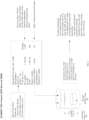
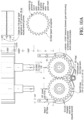
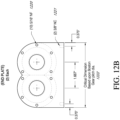
- FIG. 1 an EMRE head.
- the head comprises a 16 inch stainless steel rotor 101 with a variable tip speed and maximum 15,000 fpm.
- a 17 inch stainless steel stator 102 is also employed having a hundred and ten slots (cavitation portals) 103.
- the components generate a GTRP slurry flow pattern 104 as depicted in FIG. 1 .
- detail of the cross-section along line 'A' is provided.
- other mechanical platforms may be configured as reactors employed in the methods, e.g., progressive cavity pumps, screw pumps, extruders, or the like.
- FIG. 2 depicts a process schematic for this process involving a stainless steel mix tank 201 containing a submerged EMRE head 202.
- the tank is generally filled to about 70% of the available tank volume.
- the slurry is prepared from EOL whole tire that has been subjected to conventional processes to remove metal and fiber, and is ground to pass through a 30 mesh (600 micron) sieve.
- a 300 gallon stainless steel mix tank is employed to produce a 200 gallon batch of EOL tire rubber slurry having a specific gravity of 1.03.
- the stainless steel tank can be non-insulated to allow dissipation of EMRE energy (thermal energy).
- Cooling coils can be added to permit the batch temperature to be maintained below a boiling temperature or, alternatively, the process tank can be sealed to allow operation at higher temperature under pressurized conditions.
- the batch of EOL tire rubber slurry weighs 1716 lbs when a 3:1 ratio of water to GTRP.
- the components of the slurry in FIG. 2 include approx. 152 gallons of reverse osmosis (RO) water, approx. 400 lbs of GTRP, and approx. 8 lbs of copper acetate (referred to as organometallic compound or OMC) predissolved in approx. 40 lbs RO water.
- Filtered water recovered from a previous batch including water squeezed out from a filter cake, can be used as a portion of the approx. 152 gallons of water used to prepare a batch. It is generally preferred to use fresh RO water for dissolving the OMC; however, recovered water can also be advantageously employed.
- the GTRP of the slurry traverses a "Phase Space Tunnel” where differential-cyclical mechanical stress and steric field polarization are applied to the GTRP.
- Phase Space depicted herein (sometimes referred to as a Tunnel) was first put forth by Boltzman as a “box” in which molecular structures and velocity are quantified against a time interval when the "contents" of the box undergo outside influence(s).
- Boltzman was first put forth by Boltzman as a “box” in which molecular structures and velocity are quantified against a time interval when the "contents" of the box undergo outside influence(s).
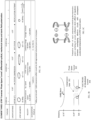
- Time 0.000 is when the particle impinges upon the EMRE rotor 301.
- the GTRP is then subjected to compression in the stator (compression gate 302), exits the stator, and enters into a recirculation pattern.
- compression gate 302 the space between the EMRE rotor 301 and the exit of the compression gate 302 is referred to as the Phase Space Tunnel 303.
- a modulated AC current can optionally be applied at the compression gate to facilitate the process.
- Electrodes 304 are provided that introduce a modulated AC current.
- oscillation up to 1000 Hz or more can be applied by employing a frequency controller.
- Voltages up to 300 V or more can be applied to induce current flow across the slurry medium, which has the effect, through the rapid reversing of polarity, of depositing electrons upon the surface of the rubber particles in the phase space tunnel.
- the process of compression in the stator deforms the GTRP such that the ratio of width to length increases to 6:1.
- 60 dislocated and repotentiated vulcanized precursor sites are regenerated per pass through the stator.
- the EMRE depicted in Element 1 is an example of the Parallel Continuous Flow Micro-synthesis Reactor (PCMR) hardware described elsewhere herein, principally as it avoids the necessity of building and certifying a pressure vessel for conducting the process.
- PCMR Parallel Continuous Flow Micro-synthesis Reactor
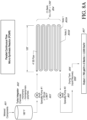
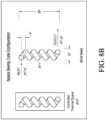
- the PCMR operating at a fixed temperature along a water-to-steam curve is able to produce similar "Phase Space" particle-unpacking results with the GTRP as the Element 1 EMRE example in the five quanta of "Timeline”, “Linear Distance”, “GTRP Geometry”, “Velocity” and “Acceleration Profile” depicted in FIG. 3A by pushing the GTRP slurry through strategically positioned, mechanically larger diameter apertures (e.g., an adjustable iris valve) which allow the slurry volume to expand, whereupon it goes into a gas phase, then be immediately reduced back to the original, internal pipe diameter.
- mechanically larger diameter apertures e.g., an adjustable iris valve
- GTRP unpacking efficiencies are equivalent.
- particle size is reduced.
- approximately 65% of the crosslinking bonds are disrupted, and the particles may be mechanically leafed into thin, pancake-like structures (e.g., 'smeared out' into a 10 micron film).
- Further size reduction is typically not sought after.
- carbon black starts to come out of the particle matrix.
- reduction of carbon begins to occur.
- a particle size of 200 mesh (70 microns) is generally useful for most applications, such as tire, roofing, and paving applications; however, sizes down to 10 micron can be desirable.
- an engineered, cavitation-induced, acoustic shockwave is applied to the GTRP.
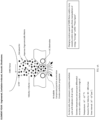
- a mixture of GTRP 405, entrained air 406 and an aqueous organometallic compound matrix 407 is present at a velocity and volume.
- air bubble compression and particle acceleration creates a cavitation progression 408.
- lower pressure completes the cavitation cycle with an implosion of air cavities. It is generally preferred that no bulk-phase change occur within the continuous water phase of the slurry during cavitation. Therefore temperature and pressure differential excursions take place on an atomic scale.
- FIG. 4B depicts process control variables for the GTRP slurry and EMRE.
- a proportional-integral-derivative controller (PID controller or three term controller) - a control loop feedback mechanism widely used in industrial control systems and a variety of other applications requiring continuously modulated control - is employed to control temperature, aperture size, the volume of the slurry, and oscillation between vapor and liquid.
- Other factors that can be adjusted, e.g., by PID controller, related to the reactants include the ratio of rubber to water, the OMC added (amount, rate of metering, intermittent or continuous metering), the amount of OMC residue, the rate of reduction.
- Apparatus related factors that can be adjusted, e.g., by PID controller include the rotor tip speed and the gap size between the EMRE and the compression gate.
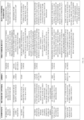
- FIG. 4C provides a table including a list of selected GTRP slurry control variables and results of modifying them.
- FIG. 4D provides a table including a list of selected EMRE process control variables and results of modifying them.
- Element 5 illustrates a chemotactic sulfidic-bridge-tether-effect (SBTE) dynamic.
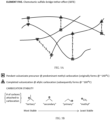
- FIG. 5A depicts the original sulfidic bridges schematically, including formation of pendant vulcanizate precursors that occurs predominantly at a methyl carbocation (originally forms at approx. 140°C) and completed vulcanization that occurs primarily at an allylic carbocation (subsequently forms at approx. 160°C).
- FIG. 5B depicts types of carbocations (with varying numbers of carbon atoms attached to the carbocation) in order of stability, with tertiary carbocations the most stable, secondary carbocations less stable, primary carbocations even less stable, and a methyl carbocation the least stable.
- Resonance adds stability to allylic carbocations as positive charge density is spread out, making it more stable than a secondary carbocation as depicted in FIG. 5B .
- the process of sulfidic bridge dislocation therefore preferentially occurs at a methyl carbocation rather than at an allylic carbocation.
- the result of the dislocation is that the rigid sulfidic bridge becomes a tether connected at the original allylic carbocation and becomes unbound at the methyl carbocation.
- the chemical reaction occurs along a timeline.
- the RO water and OMC in this case metal acetate or MOAc
- a 20% solution concentrate is mixed and metered into the GTRP slurry (180°F, 3:1 ratio by weight of RO water to GTRP), as depicted in FIG. 6A .
- the resulting chemical reaction is depicted in FIG. 6B .
- the organometallic compound dissolved in water associates with ligands, including transient aquo metal formations.
- k refers to the Boltzman "phase space" EMRE tunnel mechanistic-kinetics
- M 2+ refers to the metal ion
- NH n , CH n , Zn n and S n refer to what are believed to be isomer 'debris' near the precursor site that are byproducts of the original rubber compounding process
- OAC -2 refers to the acetate ion.
- Nitrogen-sulfur compounds include ammonium disulfate (NH 4 ) 2 S 2 O 8 molecules (ADS), or radicals thereof, which reside and are compacted as debris isomers, proximate to the methyl carbocation. These nitrogen-sulfur isomers, which notably are not created during the final step of the original sulfidic-vulcanization at the primary carbocation of the sulfidic-crosslink upon the adjacent polymer chain, are highly soluble in water and become powerful oxidizers to drive the methyl carbocation substitution sulfidic-metathesis.
- ADS ammonium disulfate
- ADS ammonium disulfate
- radicals thereof which reside and are compacted as debris isomers, proximate to the methyl carbocation.
- the active OMC may either activate a hydration of the ADS molecule forming hydrogen peroxide (H 2 O 2 ) and/or become an accelerant to enhance that reaction in its targeted, metathesis action as an oxidizer in the methyl carbocation.
- the sulfidic-metathesis conversion rate at the methyl carbocation is assured without any peroxide and/or other oxidizer when the temperature threshold at the reaction site is greater than 240°F, above which the sulfur becomes labile in phase change.
- Various metal ions are suitable for use, including but not limited to Co 2+ (ligand exchange rate for an H 2 O metal coordination matrix of 3 ⁇ 10 6 ), Cu 2+ (ligand exchange rate for an H 2 O metal coordination matrix of 5 ⁇ 10 9 ), Ni 2+ (ligand exchange rate for an H 2 O metal coordination matrix of 3 ⁇ 10 4 ), Zn 2+ (ligand exchange rate for an H 2 O metal coordination matrix of 2 ⁇ 10 7 ), and Mn 2+ (ligand exchange rate for an H 2 O metal coordination matrix of 2 ⁇ 10 7 ).
- Co 2+ ligand exchange rate for an H 2 O metal coordination matrix of 3 ⁇ 10 6
- Cu 2+ ligand exchange rate for an H 2 O metal coordination matrix of 5 ⁇ 10 9
- Ni 2+ ligand exchange rate for an H 2 O metal coordination matrix of 3 ⁇ 10 4
- Zn 2+ ligand exchange rate for an H 2 O metal coordination matrix of 2 ⁇ 10 7
- Mn 2+ ligand exchange rate for an H 2 O metal coordination matrix of 2 ⁇ 10 7
- This coordination capacity provides for the intermediate formation of a super-floppy matrix to assist the process by capturing a ligand from the inhibiting isomer 'debris' near the methyl carbocation reactive site.
- the ligand capture and release rates are many times faster than other metals as well.
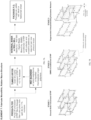
- FIG. 7A depicts the macrostructure of ground state vulcanized GTRP (Stage 1), EMRE conditioned GTRP (Stage 2) including unbound, pre-reptated internal morphology, and regenerated interpenetrating elastomer network (Stage 3) which includes intermingled laminates spaced apart by 10 nm to 5 microns.
- Stage 1 ground state vulcanized GTRP
- EMRE conditioned GTRP Stage 2
- Stage 3 regenerated interpenetrating elastomer network
- One of the features of the process is that crosslinks are reestablished in the interpenetrating elastomer network by a gentle process that leaves carbon black undisturbed. This yields a slight reduction in tensile strength, but an improvement in rebound strength.
- the processed GTPR slurry is pumped off and through a filter cake press, the spin dried to a moisture content of less than 1% by weight.
- the resulting processed GTRP can be oven dried in a tumble dryer to a moisture content of less than 0.1% by weight to yield a dry, EMRE-conditioned GTRP.
- select waterborne or liquefied thermoplastic virgin polymers can optionally be wet blended into the processed GTRP.
- the dried GTRP can be subjected to an internal mixer (e.g., a Banbury mixer, a sigma blade, or the like) and/or a roll mill for micro-laminate, where dry, EMRE-conditioned GTRP is blended with polymer and crosslink additives.
- the resulting product can then be packages as pellet, roll, block, festooned sheet, or the like.
- the processed GTPR slurry is a valuable product for use without any further processing steps.
- the GTRP can be mixed with asphalt to form rolls and sheeting, or melted to bind aggregate, or to form an emulsion.
- any of the steps of Element 7 can be considered optional. It is noted that when a roll mill is employed, the resulting GTRP is 'leafed' into thin pancake-like structures that will form during subsequent vacuum forming, imparting anisotropic properties to the resulting GTRP sheet. When an internal mixer is employed, resultant sheets made therefrom are substantially isotropic.
- a mixture of asphalt and GTRP can be prepared by various methods.
- GTRP is run through a finishing roll mill until a 'leafed' or 'fully leafed-reptated' form is obtained (having, e.g., an approx. 10 ⁇ m or smaller particle thickness in the smallest dimension), and then roll-mill or internal mixer combined with asphalt.
- a cohesive GTRP sheet (indicative of a 'leafed' form) can be obtained after 10 passes through a finishing roll mill with cold rolls, or 2 passes through a finishing roll mill with hot rolls. Once a cohesive GTPR sheet is formed, it can be combined with asphalt.
- asphalt is added to the cohesive GTRP sheet on the finishing roll mill, then mixed in by action of the finishing roll mill to yield a mixture of 92% by weight GTRP and 8% by weight asphalt in the form of a continuous GTRP/asphalt sheet.
- Type IV asphalt can advantageously be employed; however, an asphalt in a 5 pen to 200 pen range can also be employed.
- a crosslinking agent can optionally be added with the asphalt (e.g., 0.005 phr (parts per hundred) of the continuous GTRP/asphalt sheet).
- the sheet can advantageously be turned during the process to facilitate a uniform distribution.
- a cohesive GTRP sheet ('leafed') or continuous GTRP/asphalt sheet can be further combined as hot melt with asphalt in any form, e.g., particles, emulsion, or hot mix. Revulcanization can advantageously be accomplished after the GTRP/asphalt blend is in situ installed.
- a cohesive GTRP sheet or continuous GTRP/asphalt sheet can be melted into asphalt to yield a composition comprising from about 20-50% by weight GTRP, e.g., suitable for use as a binder for aggregate.
- the continuous GTRP/asphalt sheet can be applied in sheet form to a damaged pavement, then conventional hot mix, aggregate, or a mixture of aggregate and binder can be applied as a top layer on the continuous GTRP/asphalt sheet. Irradiation can advantageously be applied to induce crosslinking and binding of the GTRP.
- the GTRP When employed in asphalt as a binder, or in an underlayment comprising a continuous GTRP/asphalt sheet, the GTRP can advantageously be cured in place on the road bed using an emitter system and associated apparatus and methodology as described in U.S. Patent No. 8,992,118 , U.S. Patent No. 9,169,606 , U.S. Patent No. 9,074,328 , U.S. Patent No. 9,347,187 , U.S. Patent No. 9,481,967 , U.S. Patent No. 9,551,117 , U.S. Patent No. 9,551,114 , U.S. Patent No. 9,624,625 , U.S. Patent No. 9,637,870 , U.S. Patent No.
- Such an emitter system for irradiating asphalt/concrete pavement typically includes a structural frame holding an emitter panel configured to emit a peak wavelength of radiation of from 1000 to 10000 nm to achieve flux of the asphalt in the asphalt/concrete pavement.
- the terms "flux” or “fluxing” as used herein are broad terms, and are to be given their ordinary and customary meaning to a person of ordinary skill in the art (and is not to be limited to a special or customized meaning), and refer without limitation to describe a fluid that is displaceable by application of minimal pressure against a body of the fluid.
- Temperatures in a range as high as190°F to 290°F (88°C to 143°C), e.g., 250°F to 290°F (121°C to 143°C) can advantageously be employed to induce flux of asphalt.
- radiation having a peak wavelength in a range of 350 nm to 700 nm peak can advantageously be employed, and can be used in addition to radiation having a peak wavelength of 1000 nm to 10000 nm (e.g., two peak wavelengths).
- Some degree of crosslinking will occur in the absence of the addition of crosslinking agents; however, additional crosslinking agents can boost the speed and efficiency of the process.
- a temperature of 170°F can induce crosslinking when DIBP is employed as a crosslinking agent, making it advantageous for use in GTRP/asphalt sheet where stability and controlled crosslinking is desired.
- dicumyl peroxide is employed as a crosslinking agent, crosslinking will rapidly occur even the absence of applied heat.
- Dicumyl peroxide can be advantageously employed as a crosslinking agent when the GTRP/asphalt is in liquid form (e.g., emulsion).
- Paving material comprising GTRP exhibits superior properties in terms of longevity when compared to conventional paving materials including ground tire rubber that has not been subjected to any treatment.
- the continuous GTRP/asphalt sheet can be used in the form of rolls and sheeting for weatherproofing or roofing applications.
- the cohesive GTRP sheet ('leafed') or continuous GTRP/asphalt sheet can be melted into asphalt or another solvent and the resulting mixture applied to a surface by spraying, yielding a sealed and waterproofed surface.
- the reactant in solid form can be preheated to a temperature of 250°F (e.g., preferably above its melting point or ambient temperature ELT rubber crumb.
- the reactant can be sprayed, misted, sprinkled, or poured into the ELT rubber crumb, optionally under agitation or mixing to achieve uniform coating and distribution of the reactant on the ELT rubber crumb, yielding an activated ELT rubber crumb.
- the reactant can advantageously be provided in the form of a finely ground powder.
- the combination of reactant and ELT rubber is then subjected to mixing, e.g., under pressure, so as to induce phase reticulation induced sulfidic metathesis.
- crumb rubber and reactant can be combined as the sole ingredients of a combination to be subjected to mixing
- other components can also be present, e.g., one or more of process oils, solvents, water, asphalts, fillers (titanium oxide particles, additional carbon black, graphene, pigments, or other dopants as disclosed elsewhere herein), or other components that are known in the art for incorporation into rubber goods or goods or materials containing rubber as a component.
- Roller mills e.g., opposing pairs of cylindrical rollers, similar to those employed in conventional processing of rubber, can be employed as reactors for the phase reticulation induced sulfidic metathesis. The mixture is passed between rollers until a uniform product is obtained exhibiting resilience and/or elasticity.
- one of the signs of a successful reaction is a snapping or crackling sound as the mixture passes between the rollers.
- a successfully reacted product is obtained after passing the mixture between rollers (diameter of 1 cm or less to 100 cm or more and spacing of 1 mm or less to 10 mm or more) for from 10 revolutions or less to 100 revolutions or more of the roller, or for a period of time of from about 1 minute or less to 60 minutes or more.
- a solution or partial solution (suspension) of the reactant in water or another suitable solvent e.g., an alcohol such as methanol or ethanol, or an ether or glycerol
- water or another suitable solvent e.g., an alcohol such as methanol or ethanol, or an ether or glycerol
- the amount of water employed to prepare the solution can be selected to provide a particular ratio of solution to ELT rubber crumb.
- An advantage of employing the reactant in solution or suspension form includes efficiencies and greater ease of handling the resulting activated ELT crumb rubber, which can be in a flowable state or more processable state when worked in the reactor, which can reduce reactor time by up to 20% or more. While not wishing to be bound by any particular theory, it is believed that a solution of the reactant assists in wetting the shoreline of the ELT rubber crumb particles, thereby placing more reactant in contact with the surface of the ELT rubber crumb particles than is the case for dry reactant particles. Mechanical working by the reactor then acts to break up air pockets, further coating the ELT rubber crumb particles.
- the activated ELT rubber crumb (e.g., an admixture of crumb rubber, reactant, and optional additional components) can be transferred to a reactor, e.g., a roller mill or a horizontal compression reactor.
- the reactor can be operated at ambient temperatures or temperatures up to 250°F or higher, e.g., at a temperature of from 242°F to 248°F (or a higher or lower temperature, e.g., 225°F to 265°F, or 235°F to 255°F, or 240°F to 250°F), where it is kneaded or masticated to a gum-like state.
- Sampling of the kneaded product can optionally be conducted at intervals to determine particle size (e.g., effective particle size as represented by film thickness), wherein the particle size is believed to be indicative of the degree of sulfidic metathesis. Additional reactant can be titrated into the kneaded product until a desired particle size target is reached.
- FIG. 9 illustrates the effect of impingement of a horizontal compression reactor's drive roll on the activated ELT rubber crumb. As shown in the plot of energy versus reaction coordinate, the pressure applied in the impingement zone reduces the activation energy for interlinked substitution, such that the energy released during the reaction exceeds the activation energy required for interlinked substitution under impingement conditions.
- a target particle size can be obtained by controlling the degree of sulfidic metathesis, e.g., by controlling the reactor processing time (shorter for larger particle sizes, and longer for smaller particle sizes), or by the amount of reactant added to the ELT rubber crumb. At 5% by weight reactant to 95% by weight ELT rubber crumb, an excess of reactant is present for the amount of sulfur bonds present in typical ELT rubber crumb. A stoichiometric amount of reactant can be employed when maximizing sulfidic metathesis. High degrees of interlinked substitution, e.g., >90% interlinked substitution, are typically observed when a mixture of 4 wt. % reactant to 96% ELT rubber crumb is employed. A mixture of 3 wt.
- % reactant to 97% ELT rubber crumb will leave a significant amount of sulfur bonds present. It can be desired to maintain a certain degree of the original vulcanization (e.g., approximately half, or one quarter, of the sulfur bonds remain intact) so as to impart desirable properties to the resulting product (e.g., tenacity, elasticity, etc.) when employed in certain applications (e.g., black masterbatch for producing rubberized asphalt or specialty rubber products). In these applications, a mixture of 2 wt. % reactant to 98% ELT rubber crumb can employed.
- the resulting interlinked substituted rubber material exhibits good tenacity while having a particle size of ⁇ 1 ⁇ m and can be blended homogeneously into a black masterbatch without impacting critical properties.
- the product subject to sulfidic metathesis can optionally be subjected to a dehydration step by heating at or below 250°F. It is believed that the presence of micronized water in the activated ELT rubber crumb may inhibit metathesis of the sulfur bonds. Further heating at temperatures of 285°F may remove this micronized water and achieve some further amount of sulfidic metathesis.
- a product containing some degree of water in it may be a desired end product, e.g., for processing at temperatures of 250°F to 290°F.
- the kneaded or masticated product can optionally be treated with an agent that neutralizes any unreacted reactant.
- Any suitable neutralizing agent can be employed; however, it is typically preferred to employ a terminally hydroxylated polyethylene (e.g., polyethyleneglycol, CAS 25322-68-3 ) or a polyethylene copolymer with hydroxyallyl side chain functionality, or derivative thereof.
- the neutralizing agent is typically used at 0.05 to 0.1 parts neutralizing agent per hundred parts rubber (by weight); however, higher or lower amounts may also be employed.
- Other post treatment processes can also be conducted, including any other processes that virgin rubber is subjected to, e.g., grafting to incorporate other polymeric chains to yield a thermoset, thermotrope or thermoplastic product.
- the interlinked substitution process offers advantages for reclamation of rubber. For example, no outgassing or pH change is observed during the process or in the interlinked substituted product, which was in the form of sub-micron sized particles, indicating that a stable interlinked substituted product was obtained that is capable of vulcanization.
- the process offers advantages in that it does not utilize or generate any dangerous or hazardous chemicals, and in that no exogenous substances are generated that would significantly impact the usefulness of the resulting product in applications where virgin rubber is typically employed. Depending upon the application, a higher or lower degree of interlinked substitution may be desirable.
- a lower degree of interlinked substitution may yield an acceptable product, whereas for uses in high performance articles such as auto tires, a product having a higher degree of interlinked substitution may be desirable.
- the methods can be adapted to produce product that is partially interlinked substituted, up to highly interlinked substituted and similar in performance to virgin rubber.
- Reactors as depicted in FIGS. 1 , 8A-B , 10A-D , and 12A-C can advantageously be employed.
- a horizontal compression reactor can be of the form depicted in FIGS. 10A-D or 12A-C .
- FIG. 10A depicts a top view and a side view of a small scale reactor and its gears 1000.
- the gears as provided 1008 are steel and are machined to include machined grooves 1010 to the root of pitch. In operation, the grooves of both gears match when the gears mesh, and maintain ⁇ 0.040 inches of clearance 1007 (between the gear with dowel pin placement and the housing) which locates the end plates.
- Ten gear segments of equal length e.g., one segment up to any desired plurality of segments, e.g., up to 10, 20, 30, 40, 50 or more) are employed with nine 1/8 inch grooves equally spaced.
- FIG. 10B provides an exploded view of a horizontal compression reactor showing detail of the gears 1000 of FIG. 10A .
- the gears, as shown in top view in FIG. 10C include eleven sets of gear segments 1030 with twenty-four grooves 940 and a 0.200" compression relief 1014 for each gear segment.
- FIG. 10D shows a view of the end plates 1013 (and transparent view of endplates showing details of gear behind) including taps 1016 and plate 1015 including taps 1017.
- the apparatus depicted in the figures can be employed to provide the pressure to the mixture of vulcanized rubber and copper acetate (or other reactant), other configurations are also envisioned, as will be appreciated by one of skill in the art, e.g., mortar and pestle, ribbon mixers, high shear dispersers, or the like. Instead of meshing gears, smooth rollers in opposing configuration can be employed.
- a reactor having a roller configuration is suitable for use in a "dry" process, e.g., a process not employing water or another carrier liquid.
- FIG. 1 depicts a reactor suitable for use in a process employing water or another carrier liquid.
- FIG. 11 depicts detail of the meshing gears of the drive roll in operation.
- the gears are converging compression rolls with machined relief to allow lateral flow 1106 of the ELT crumb rubber.
- a 20 mesh ELT crumb rubber pre-coated with reactant 1103 fills the space between the gears at a pressure of less than 5 psi.
- the pre-coated ELT crumb rubber 1105 is compressed to approximately 100 psi (e.g., 50 psi to 200 psi, or 75 psi to 150psi, or 80 psi to 125 psi, or higher or lower, depending upon reaction conditions).
- Ten rotations of the gears (10 applications of compression) reduces the particle size (as determined by screening through a particular mesh size) from 20 mesh to less than 200 mesh 1107. Fifty rotations of the gears (50 applications of compression) reduces the particle size from 20 mesh to approximately 2 ⁇ m.
- the drive roll incorporates a dynamic brake to control back pressure.
- the resulting product can be processed until a desired particle size less than that of the starting ELT crumb rubber is obtained, e.g., 30 mesh, 40 mesh, 50 mesh, 100 mesh, 200 mesh, 10 ⁇ m, 5 ⁇ m, 2 ⁇ m, 1 ⁇ m, or less than 1 ⁇ m.
- FIG. 12A shows a side view of one of the barrels 1200.
- the barrel depicted has a 3 inch outer diameter and a 2 inch inner diameter, is 30 inches in length, and contains a rotor 1202.
- FIG 12B shows one of the two end plates 1213 with hold holes 1220, 1221, illustrating the joined barrels configured to enclose the close-intermeshed twin counter rotating screws.
- the critical dimension 1222 is based upon the Boston Gear pitch diameter. A clearance of approximately 0.010 inches between the rotors of the screws and the barrel wall is provided.
- FIG 12C depicts one of the screws, a .500 Roton Screw 1232 with cold rolled steel thread.
- FIG. 12C depicts thrust surface 1230, bronze bearing journal 1235, and ANSI keyway 1234. While the reactor depicted in FIGS. 12A-C includes specific dimensions or materials, the dimensions can be reduced or increased as needed to provide a larger or smaller reactor, and other suitable materials can be substituted.
- the resulting rubber particulate can be used directly as a feedstock for a subsequent process (e.g., production of new tires or rubberized asphalt), stockpiled, or packaged for storage or shipment.
- a subsequent process e.g., production of new tires or rubberized asphalt
- stockpiled e.g., stockpiled
- packaged e.g., packaged for storage or shipment.
- the rubber particulate can be tested to determine its properties and suitability for various applications.
- Testing can include the following: standard test method for rubber property - vulcanization using rotorless cure meters - MDR 2000 rheometer per ASTM D5289 @ 160°C; tension properties including tensile, elongation, and modulus per ASTM D412, unaged and oven aged; tear strength per ASTM D624 T, unaged and oven aged; durometer hardness tested with Rex digital durometer per ASTM D2240 Type A on rebound specimens; heat generation and flexing fatigue in compression of rubber - BF Goodrich flexometer per ASTM D623, Method A; resilience using Schob Type rebound pendulum - Zwick rebound per ASTM D7121; rubber abrasion resistance - Zwick rotary drum abrader per ASTM D5963, Method A; rubber deterioration-surface cracking and static outdoor exposure (20% strain) per ASTM D518, Method A or rubber deteriorationcracking in an ozone controlled environment per ASTM D1149.
- the resulting rubber particulate is also of a quality suitable for use in house shingles and roll roofing, offering hail damage resistance, improved cold temperature flexibility (e.g., flexibility down to a temperature of at least -40°F), and reduced softening, bleed out and staining in hot weather.
- the roll roofing containing rubber particulate can be placed dry and then subjected to irradiation, causing the sheet to melt, conform, crosslink, and adhere to an underlying substrate (e.g., insulation or old roofing).
- a liquid mixture containing GTRP can be subjected to irradiation to induce crosslinking. Irradiation can be applied using an emitter system similar to that described above for paving applications (e.g., U.S. Patent No.
- Electromagnetic radiation of a preselected peak wavelength can be applied to the roofing or waterproofing sheet or spray in place.
- the heating radiation can be generated by modifying an emitter to emit a desired wavelength.
- the wavelength of the electromagnetic radiation used for heating is selected based upon the materials present in the roll roofing.
- Preferred peak wavelengths for targeting rubber in the roll roofing are in a range of 350 nm - 700 nm peak wavelength at watt densities of, e.g., less than or equal to 10 watts/in 2 .
- the radiated energy applied to the roll roofing heats the rubber in the roll roofing while minimizing heating of the substrate.
- the emitter device can be manufactured to minimize cost and are suitable for use in the field. Field use can be achieved by powering the device using a portable generator, e.g., a Tier 4 diesel engine, electrically connected to one or more emitter panels situated within a metal frame.
- the emitter can be insulated with, e.g., a high-density ceramic, and the panel(s) can be nested within the ceramic liner of a frame to point towards the plane of the roll roofing.
- Drying of the post-reactor GTRP blend can be conducted to any desired degree. Moisture can be removed slowly or quickly. Gentle drying will have minimal impact on the structure of the elastomer network morphology. Drying with shear typically yields smaller particle size and quicker evaporation of moisture.
- Curing of the post-reactor GTRP blend can be conducted slowly or quickly, by use of chemical curing agents, or by irradiation (e.g., by an emitter system as discussed elsewhere herein).
- Post-reactor GTRP can be modified for various uses, e.g., as a thermoplastic, thermotrope, or thermoset.
- the polymer backbones are predisposed for vulcanization. Because the post-reactor GTRP is hydrophobic, hydrophilicity is imparted to the material to permit it to be emulsified or formed into a colloidal suspension.
- Properties can be modified by adding a homopolymer to functionalize the backbones.
- the particles can be coated (e.g., with nonylphenol ethoxylate).
- hydrophilic sites can be inserted (e.g., with quaternary amine).
- the presence of caverns facilitates internalization of materials in a liquid in the caverns of the GTRP.
- materials can include waterborne polymers. This can result in superior polymer dispersion properties compared to conventional solid upon solid mixing as is the primary method of polymer blending in the tire industry, for the resulting particle, e.g., superior tensile strength, hysteresis, and shear. An improvement in physical strengths of 200-300%, or more, from what is observed in rubber typically utilized in the tire industry can be observed.
- DCP dicumyl peroxide
- Another effective accelerator is di(tertbutylperoxyisopropyl)benzene (CAS No. 25155-25-3 , also referred to as DBPI).
- Silicone rubber (SiR), grafted with a 1,2-high vinyl butadiene homopolymer functionality, may be cross linked with mercapto group catalyst. Such blends will result in high crosslink densities and uniform, elastomer, interpenetrating domains which exhibit superior, hybridized properties known to both rubber groups.
- An NR/SBR black master batch SiR hybrid, using a regenerated EOL particle is a new, cost effective innovation.
- GTRP particles are size reduced and crosslink realigned in an anhydrous environment.
- the reactants are combined under ambient conditions or conditions of elevated temperature, e.g., approximately 250°F (e.g., 230°F to 270°F, or 240°F to 260°F, or 245°F to 255°F) in a three shaft vertical mixer, a roller mill, an extruder, a Banbury mixer, or other suitable mixing apparatus.
- the reactant e.g., copper acetate or other metal salt as described herein
- the reactant in solid form is preheated to a temperature of 250°F (e.g., preferably above the metal salt's melting point, e.g., up to 250°F or more, e.g., 230°F to 270°F, or 240°F to 260°F, or 245°F to 255°F) in a separate vessel under inert atmosphere (e.g., nitrogen blanket) then added to the crumb rubber, or added directly to the crumb rubber under ambient conditions.
- the inert atmosphere can be optional.
- the heated reactant is combined with the pre-heated EOL tire rubber crumb.
- the heated reactant can be sprayed, misted, or poured into the pre-heated EOL tire rubber crumb under agitation to achieve uniform coating and distribution of the reactant on the pre-heated EOL tire rubber crumb, yielding an activated EOL tire rubber crumb.
- the reactant can advantageously be provided in the form of a finely ground powder.
- the panels include a serpentine wire as an emitter.
- An advantage of the serpentine configuration is that it does not have the high resistance exhibited by spaced apart coils. Accordingly, more of the energy is emitted as radiation of the desired wavelength.
- the coils are spaced apart to minimize the resistance, and a radiant energy is emitted within a "sandwiched" space bounded on the upper side of by the high-density ceramic that has a very low permittivity and essentially redirects the reflected energy from the serpentine wire downward.
- the mica group of sheet silicate (phyllosilicate) minerals includes several closely related materials having close to perfect basal cleavage. All are monoclinic, with a tendency towards pseudohexagonal crystals, and are similar in chemical composition. The nearly perfect cleavage, which is the most prominent characteristic of mica, is explained by the hexagonal sheet-like arrangement of its atoms. Mica or other materials exhibiting micaceous properties can include a large number of layers that create birefringence or trirefringence (biaxial birefringence).
- Birefringence is the optical property of a material having a refractive index that depends on the polarization and propagation direction of light. These optically anisotropic materials are said to be birefringent. The birefringence is often quantified by the maximum difference in refractive index within the material. Birefringence is also often used as a synonym for double refraction, the decomposition of a ray of light into two rays when it passes through a birefringent material. Crystals with anisotropic crystal structures are often birefringent, as well as plastics under mechanical stress. Biaxial birefringence describes an anisotropic material that has more than one axis of anisotropy.
- the refractive index tensor n will in general have three distinct eigenvalues that can be labeled n ⁇ , n ⁇ and n ⁇ .
- Both radiant and conductive energy from the serpentine wire is transmitted to the micaceous element.
- the birefringent characteristics of the micaceous material can be employed to transmit a subset of wavelengths generated by the serpentine wire while filtering out other wavelengths.
- the emitter of certain examples employs a sheath of stainless steel that protects the micaceous material from being damaged. This conductive sheath transfers energy with no significant wavelength translation.
- energy generated by the serpentine wire with a peak wavelength of about 2 micrometers can have the peak wavelength be taken to about 20 micrometers.
- the thickness or other characteristics of the micaceous material can be adjusted to provide a targeted wavelength or range of wavelengths to the surface.
- the device has a 2-foot wide by 1-foot long intercavity dimension, configured similar to a hood, in which a ceramic insulation is mounted.
- the emitter elements are advantageously 1 foot by 1 foot, or otherwise sized for convenience (e.g., the width of the roll roofing, or a standard width used in building construction, e.g., 16 inches).
- Such elements can have a Watt density of up to 14 Watts per square inch, at full energy, capable of being powered by, e.g., a generator that can deliver 250kW.
- An emitter assembly may comprise a structural frame, a power source, a power interrupting mechanism, an electromagnetic radiation emitter, and a positioning system.
- the emitter assembly may be several feet wide, several feet long, and several feet high, or smaller so as to permit use by a single operator (e.g. a small emitter in a rolling frame that can be pushed by the operator, or installed at the end of a wand or arm).
- the emitter assembly may be other sizes as well.
- the frame may support one or more of the other components.
- the frame may comprise structurally adequate members such as metal supports, beams, rails, or other such structures.
- the frame may be configured to prevent significant deformation when in use or in transport or use on a job site.
- the frame may be designed to support at least part of the weight of the various components.
- the frame comprises one or more beams.
- the beams may comprise a metal, wood, or other material that can adequately support the weight of the components.
- the beams may comprise aluminum or steel, and in some examples it may be advantageous to use a material that is both lightweight and strong.
- One or more beams may be disposed on either side of the frame and on either end of the frame. The beams on the side may be connected vertically through brackets, plates, or other attachment mechanisms.
- the pieces may be welded together, or bolts may be utilized to connect the pieces.
- One or more beams may traverse the frame from one side to the other side, or from front to back, and may be configured to provide support or an attachment mechanism to other components.
- One or more beams that traverse the frame may be disposed near the bottom of the frame, such that one or more of the electromagnetic radiation emitters may be attachable to the beams.
- the frame may attach to one or more wheels, directly or indirectly, which may assist the frame in being transported or moved across the roll roofing to be heated.
- the frame may be configured to prevent bending, sagging, or twisting even while traversing uneven terrain.
- the frame may provide a robust structure that supports one or more components of the assembly. Because the assembly may be used in a variety of environments, it may be advantageous for the frame and assembly to be resistant to deformation and deterioration when in transport and in use. For instance, the assembly may be used on roofs that are uneven. It may be advantageous for the frame to withstand transport over an uneven surface. As another example, the frame and assembly may be used in the outdoors in remote locations. It may be advantageous for the frame and assembly to not only be resistant to damage during the transport to the remote location, but also for the frame and assembly to be resistant to the effects of weather while at that location. Even during adverse conditions and extensive travel and transport, it may be advantageous for the bottom surface of the frame to remain a generally consistent distance from a roll roofing over which the assembly may be placed. Therefore, the frame may be sufficiently robust and resistant to deformation or damage in a variety of conditions.
- Rubber e.g., ground tire filler or the PTR material as described herein, is a high energy-absorbing material. If it absorbs too much energy too quickly, it will become a source of combustion and can damage the emitter unit or emit fumes into the atmosphere. Accordingly, in some examples it is desirable to include a feedback loop on the emitter panel so as to continuously monitor the power density at the emitter's particular setting and its effect on the roll roofing.
- the interlinked substituted rubbers produced according to the methods can be employed in applications that utilize virgin rubber, as well as applications that employ recycled rubber, e.g., crumb rubber, or would benefit from a partially vulcanized/partially interlinked substituted rubber product.
- a rubber product having a desired set of properties e.g., hardness, spreadability, solubility, ability to be grafted, particle size, etc.
- it is desirable to reduce the particle size of crumb rubber e.g., as obtained from end-of-life tires or other sources of vulcanized rubber.
- the methods provide an efficient and cost-effective way of reducing average particle size of the crumb rubber, e.g., compared to cryogenic methods, use of centrifuges, etc. - an advantage separate from any reactive or other properties imparted by chemical modification of the rubber polymer.
- One exemplary use of the rubber materials is as an additive or functionalizing agent for asphalt, e.g., as employed in paving, roofing, or coating.
- Asphalt pavement suffers from oxidative hardening over time. This oxidative hardening causes cracking of the pavement, potholes, and loose gravel on the surface.
- rubber such as crumb rubber from recycled automobile tires
- This asphalt-rubber mixture is typically referred to as asphalt-rubber binder (ARB).
- ARB and aggregates are typically mixed together and spread onto road surfaces to form asphalt pavement. Because prior art ARB is highly temperature sensitive, it can be applied to roads only under certain surface temperature and weather conditions. This in turn limits road paving activities to only a few months of the year in most regions of the country. Additionally, special heating/blending equipment are often required at job sites to keep the mixture free flowing and homogeneous. In some cases, additives are added to asphalt-rubber hot mix material to reduce segregation, crusting, or lumping of the crumb rubber. These additives, however, could have detrimental effects on other properties of the mixture.
- Emulsification of asphalt-rubber binder for pavement preservation systems has been considered by many as not achievable because of the difficulties in emulsifying a mixture containing crumb rubber and asphalt.
- asphalt-rubber binder normally may not readily be emulsified because the rubber particles disrupt the laminar flow of the asphalt-rubber matrix during mixing in a colloidal mill.
- the present methods and interlinked substituted rubber overcome these difficulties by pre-compounding the interlinked substituted rubber in a manner so as to facilitate dispersion in the final emulsion.
- the pre-compounding may eliminate disruption of the laminar flow which may occur when emulsifying a binder by means of a colloidal mill. While not limiting any embodiment by theory, it is believed that during mixing, the interlinked substituted crumb rubber is substantially homogenized into the asphalt droplets of the asphalt emulsion, thus forming a smooth and uniform emulsion of asphalt-rubber binder.
- finely ground tire rubber that has been subjected to the process is immersed in an asphalt to form a hot rubber adhesive.
- some methods comprise immersing, under steady stirring, a finely ground tire rubber (crumb rubber) subjected to interlinked substitution and about 80-140 mesh in size, in a waterless, up to about 350°F polymer modified asphalt, whereby the interlinked substituted ground tire rubber swells and reacts thereby "coating" the individual interlinked substituted crumb rubber moiety to form a hot rubber adhesive.
- the reacted hot rubber adhesive may then be compounded under high shear with an asphalt emulsion and can be formulated as a coating, sealing and/or adhesive.
- the resulting asphalt rubber emulsion will cure quickly to a non-tracking, water resistant asphalt rubber binder or surfacing element with superior resistance to oxidative hardening, weather or mechanical wear. It may also be formulated to cure at non-traditional winter temperatures down to 40°F and at night time.
- the resulting asphalt-rubber binder emulsion has improved adhesion, cohesion, early green strength, and water resistance when employed in ambient cured, structural waterproofing and pavement preservation systems.
- Some of these methods comprise treating the interlinked substituted crumb rubber with an asphalt composition to form an asphalt coated interlinked substituted crumb rubber composition, and then mixing the asphalt coated interlinked substituted crumb rubber composition with an asphalt emulsion to form an emulsified asphalt-rubber binder.
- asphalt emulsions may be used to provide emulsions of asphalt-rubber binder.
- an asphalt emulsion may be a product of mixing a first asphalt with water and a surfactant to form a first emulsion.
- an asphalt emulsion may preferably comprise a first asphalt, a surfactant, and water.
- an asphalt-coated interlinked substituted crumb rubber composition may be a product of mixing a plurality of interlinked substituted crumb rubber particles with an effective amount of a second asphalt to coat the particles, wherein the second asphalt has caused the particles to swell.
- an asphalt-coated interlinked substituted crumb rubber composition may include a plurality of interlinked substituted crumb rubber particles and a second asphalt, wherein the particles are substantially coated with the second asphalt, and the particles have swelled in the presence of the second asphalt.
- one method for preparing an emulsion of an asphalt-rubber binder comprises: mixing a first asphalt emulsion with an asphalt-coated interlinked substituted crumb rubber composition to provide an emulsion of an asphalt-rubber binder; wherein the first asphalt emulsion is a product of mixing a first asphalt with water and a surfactant to form a first asphalt emulsion; and wherein the asphalt-coated interlinked substituted crumb rubber composition is a product of mixing a plurality of interlinked substituted crumb rubber particles with an effective amount of a second asphalt to coat the particles, and wherein the second asphalt has caused the particles to swell.
- Another aspect relates to a method for preparing an emulsion of an asphalt-rubber binder comprising: mixing a first asphalt emulsion with an asphalt-coated interlinked substituted crumb rubber composition to provide an emulsion of an asphalt-rubber binder; wherein the first asphalt emulsion comprises a first asphalt, a surfactant, and water; and wherein the asphalt-coated interlinked substituted crumb rubber composition comprises a plurality of interlinked substituted crumb rubber particles and an effective amount of a second asphalt to coat the particles, the particles are substantially coated with the second asphalt, and the particles have swelled in the presence of the second asphalt.
- Some methods for preparing an emulsion of an asphalt-rubber binder comprise: mixing a first asphalt with water and a first surfactant to form a first emulsion; mixing a plurality of interlinked substituted crumb rubber particles with an effective amount of a second asphalt to coat the particles to provide an asphalt-coated interlinked substituted crumb rubber composition, and allowing the particles to swell; and mixing the first asphalt emulsion with the asphalt-coated interlinked substituted crumb rubber composition to provide an emulsion of an asphalt-rubber binder.
- an emulsion of an asphalt-rubber binder prepared by a process described herein.
- Another aspect relates to an emulsion of an asphalt-rubber binder comprising: an asphalt; interlinked substituted crumb rubber, representing about 30% to about 50% of the total weight of all non-volatile components of the emulsion, which has swollen in the presence of the asphalt; a cationic surfactant; and water; wherein the emulsion is stable at a pH below about 7.
- an asphalt emulsion comprising: an asphalt having a pen value of from about 0 dmm to about 30 dmm; an amido amine surfactant, an ammonium salt thereof, or a combination thereof; and water, representing about 30% to about 50% of the weight of the emulsion.
- Some examples provide an asphalt-coated rubber composition
- an asphalt-coated rubber composition comprising: an asphalt; interlinked substituted crumb rubber; and an amount of a cationic surfactant which is effective to increase the hydrophilicity of the composition as compared to a composition which is identical except that it has no added cationic surfactant.
- a process for preparing an asphalt-rubber composition that meets the definition for asphalt rubber binder set forth in ASTM D8-02 or deviations thereof which may be established by the specifying agency from time to time.
- this process provides an asphalt-rubber binder as an emulsion.
- the process generally comprises obtaining asphalt of different penetration grades, combining the asphalt of each grade with preselected chemicals to form separate premixed components, blending the premixed components together under predetermined conditions to form, upon curing, an asphalt-rubber composition that meets certain physical requirements for asphalt-rubber binder, such as those set forth in ASTM D8-02.
- the resulting asphalt-rubber composition not only meets the physical requirements of ARB used in road paving but also has improved dispersion of the rubber, such as dispersion of the rubber in an oil-in-water emulsion of an asphalt.
- asphalt-rubber compositions may also be used as a binder, coating, sealant, adhesive, or a combination thereof, and may be adapted for road paving, roofing, and other related applications.
- an asphalt-rubber binder composition or and asphalt-rubber binder emulsion may be used as a HMA primer, SAMI primer, SAMI (stress absorbing membrane interlayer) chip binder, rejuvenating sealer, fog seal, skid resistant traffic lane sealant-surface binder, seal coat binder, ISSA (International Slurry Surfacing Association) Type I, Type II, or Type III Micro slurry binder, or cold mix adhesive inclusive of RAP, D1227 Type III B roof membrane, submerged membrane liner, flashing cement, steel or concrete pipe coating, waterproofing mastic(s), and the like, or a combination thereof.
- asphalt of three different penetration grades are selected, which includes a hard asphalt, preferably having a pen value of between about 0 dmm and about 50 dmm, or between about 0 dmm and about 90 dmm; a medium asphalt, preferably having a pen value of between about 90 dmm and about 200 dmm or between about 150 dmm and about 200 dmm; and a soft asphalt, preferably having a pen value of between about 200 dmm and about 300 dmm.
- the hard asphalt is preferably mixed with certain surfactants and water to form a hard pen asphalt emulsion.
- the soft asphalt is preferably modified by a polymer and then mixed with certain surfactants and water to form a soft pen-polymer modified asphalt emulsion.
- the medium asphalt is preferably mixed and reacted with interlinked substituted crumb rubber at about 350°F to form an asphalt-rubber blend and then combined with a certain surfactant and optionally water to form a mastic.
- the hard pen asphalt emulsion, soft pen-polymer modified asphalt emulsion, and mastic are then subsequently blended at different ratios to form a variety of waterborne asphalt-rubber composition(s).
- the hard pen asphalt emulsion and soft pen-polymer modified asphalt emulsion are first mixed together to form an emulsion pre-blend, which is subsequently blended with the mastic to provide a substantially homogeneous, free flowing waterborne asphalt-rubber emulsion blend that can be applied to road surfaces at various temperatures.
- this asphalt-rubber emulsion blend is mixed with aggregate at about 32°F to about 100°F or about 130°F to provide an asphalt pavement.
- Some asphalt-rubber binder emulsions may be capable of curing during the winter or at night.
- some asphalt-rubber binder emulsions may fully cure at temperatures as low as about 40°F to about 32°F.
- a waterborne asphalt-rubber binder composition is provided.
- This composition may be used as a binder, coating, sealant, adhesive, or a combination thereof, and may be adapted for road paving, roofing, and other related applications.
- an asphalt-rubber binder composition or and asphalt-rubber binder emulsion may be used as a HMA primer, SAMI primer, SAMI (stress absorbing membrane interlayer) chip binder, rejuvenating sealer, fog seal, skid resistant traffic lane sealant-surface binder, seal coat binder, ISSA (International Slurry Surfacing Association) Type I, Type II, or Type III Micro slurry binder, or cold mix adhesive inclusive of RAP, D1227 Type III B roof membrane, submerged membrane liner, flashing cement, steel or concrete pipe coating, waterproofing mastic(s), and the like, or a combination thereof.
- the composition comprises asphalt; interlinked substituted crumb rubber; an epoxidized unsaturated triglyceride, a solvent dispersed wood rosin ester, a functional vegetable oil derivative, or a combination thereof; a surfactant, and optionally water.
- the composition consists essentially of: asphalt; interlinked substituted crumb rubber; an epoxidized unsaturated triglyceride, a solvent dispersed wood rosin ester, a functional vegetable oil derivative, or a combination thereof; an unsaturated fatty acid; one or more surfactants; an optionally substituted styrene butadiene styrene block copolymer; one or more cross linking agents; and optionally water.
- the composition consists essentially of: asphalt; interlinked substituted crumb rubber; an epoxidized unsaturated triglyceride, a solvent dispersed wood rosin ester, a functional vegetable oil derivative, or a combination thereof; an unsaturated fatty acid; one or more surfactants; an optionally substituted styrene butadiene styrene block copolymer; one or more cross linking agents; a glycol ether; and optionally water.
- An emulsion of an asphalt material comprising an interlinked substituted rubber material can be prepared to provide, e.g., a hot mix asphalt mixture, a cold patch asphalt mixture, a seal coat (fog seal, chip seal, or slurry seal), or an adhesive tack coat between an existing base (e.g., soil, clay, sand, shell, cement, limestone, fly ash, asphaltic materials, recycled asphalt pavement, recycled concrete, aggregates, existing road surfaces (e.g., dirt, gravel, asphalt pavement, concrete) and mixtures thereof) and a new asphaltic paving layer.
- a hot mix asphalt mixture e.g., a cold patch asphalt mixture
- a seal coat for example, a seal, chip seal, or slurry seal
- an adhesive tack coat e.g., adhesive tack coat between an existing base (e.g., soil, clay, sand, shell, cement, limestone, fly ash, asphaltic materials, recycled asphalt pavement, recycled concrete, aggregates, existing road surfaces (e.g
- first asphalt One of the asphalts can be generally referred to as the "first asphalt”, and the other asphalt can generally be referred to as the "second asphalt”, purely for convenience to avoid confusion when describing these processes.
- second asphalt Other nomenclature may be employed either for convenience, or to provide a description related to a property of the asphalts.
- a first asphalt is combined with water and a surfactant, such as a premixed combination of surfactant and water, and optional additives, to provide a first asphalt emulsion.
- a surfactant such as a premixed combination of surfactant and water, and optional additives
- the first asphalt is about 50% (w/w) to about 70% (w/w), or about 60% (w/w) and the surfactant/water is about 30% (w/w) to about 50% (w/w), or about 40% (w/w) of the first asphalt emulsion.
- the surfactant/water is preferably separately prepared by blending water and the surfactant(s).
- the water is about 35% to about 40%, or about 37%, and the surfactant(s) are about 0.5% to about 4%, or about 2.2%, of the total weight of the first asphalt emulsion.
- the surfactant consists essentially of about 1.1% Prime Plex ER 582 surfactant and about 1.1% Indulin W-5 surfactant, based upon the weight of the emulsion.
- the first asphalt is preferably at a temperature between about 300°F to about 350°F at the time it is premixed with the surfactant/water, and the surfactant/water is at a temperature between about 70°F and about 90°F.
- the mixing of the first asphalt and the surfactant/water is carried out at a rate such that the resulting emulsion is about 190°F to about 210°F after the mixing.
- the asphalt and the surfactant/water may be mixed by co-milling through a colloid mill.
- a second asphalt is combined with interlinked substituted crumb rubber, and optional components such as a surfactant and/or additives, to provide an asphalt-coated interlinked substituted crumb rubber composition.
- the asphalt-coated interlinked substituted crumb rubber composition comprises a plurality of interlinked substituted crumb rubber particles which are coated with the second asphalt.
- an anhydrous surfactant is added prior to, during, or after mixing the second asphalt with the interlinked substituted crumb rubber without the addition of any water.
- the process may optionally be carried out without added water and without any added surfactant.
- additives which may be included either before, after, or during the mixing of the second asphalt and the interlinked substituted crumb rubber include fatty acids such as stearic acid, oleic acid, etc.; rosins such as wood rosin; high flash point organic solvents such as mineral spirits; additional surfactants, etc.
- fatty acids such as stearic acid, oleic acid, etc.
- rosins such as wood rosin
- high flash point organic solvents such as mineral spirits
- additional surfactants etc.
- at least a portion of the mixing of the interlinked substituted crumb rubber particles and the second asphalt occurs in the presence of stearic acid or oleic acid, a fatty amine surfactant, an ammonium salt of an amine surfactant, or a combination thereof.
- At least a portion of the mixing of the interlinked substituted crumb rubber particles and the second asphalt occurs in the presence of wood rosin, mineral spirits, a second surfactant, a third surfactant comprising an amine functional group, an ammonium salt, or a combination thereof.
- the second asphalt may in some instances be above ambient temperature when mixed with the interlinked substituted crumb rubber.
- the second asphalt may be heated to from about 325°F to about 375°F, or about 350°F, and the interlinked substituted crumb rubber may be added to the second asphalt.
- asphalt-coated crumb rubber compositions While there are a number of different types of asphalt-coated crumb rubber compositions, two types of an asphalt-coated crumb rubber compositions include a mastic and a hydrophilicized asphalt coated interlinked substituted crumb rubber.
- the interlinked substituted crumb rubber particles may be about 60% to about 90% of the total weight of all non-volatile components of the composition.
- the second asphalt is about 25% and the interlinked substituted crumb rubber is about 75% of the weight of the hydrophilicized asphalt-coated interlinked substituted crumb rubber.
- a hydrophilicized asphalt-coated interlinked substituted crumb rubber can comprise from about 20-80 wt. %, or 25-75 wt. %, or 60-80 wt. % interlinked substituted crumb rubber, with the remainder asphalt and other components.
- Non-volatile components include those that do not significantly evaporate during the in-situ curing process of the final adhesive.
- the hydrophilicized asphalt interlinked substituted coated crumb rubber may be prepared by spraying hot second asphalt onto the surface of interlinked substituted crumb rubber, then stirring the coated rubber within a heated blending vessel until sufficient swelling of the crumb rubber occurs.
- a surfactant or other additives may be added to second asphalt before it is sprayed onto the interlinked substituted crumb rubber, or they may be added after the asphalt is added.
- the second asphalt may be about 60% to about 80%, and the interlinked substituted crumb rubber particles may be about 20% to about 40% of the total weight of all non-volatile components of the composition.
- the second asphalt is about 60% and the interlinked substituted crumb rubber is about 30%, or the asphalt is about 75% and the crumb rubber is about 25%, of the weight of the mastic.
- a mastic can comprise from about 20-80 wt. %, or 25-75 wt. %, or 60-80 wt. % interlinked substituted crumb rubber, with the remainder asphalt and other components.
- the interlinked substituted crumb rubber particles have a diameter from about 650 microns ( ⁇ m) to about 75 ⁇ m, e.g., from 75 ⁇ m to 100 ⁇ m, 200 ⁇ m, 300 ⁇ m, 400 ⁇ m, 500 ⁇ m, or 600 ⁇ m. Larger or smaller particle diameters may be acceptable, e.g., 600 ⁇ m to 700 ⁇ m, 800 ⁇ m, 900 ⁇ m, or 1000 ⁇ m or more; or from 75 ⁇ m down to 60 ⁇ m, 50 ⁇ m, 40 ⁇ m, 30 ⁇ m, 20 ⁇ m, or 10 ⁇ m or less.
- the mastic comprises about 60.5% (w/w) second asphalt, about 30% (w/w) interlinked substituted crumb rubber, about 4% (w/w) epoxidized soy oil, about 4% (w/w) water, and about 1.5% surfactant.
- the mastic consists essentially of about 60.5% (w/w) second asphalt, about 30% (w/w) interlinked substituted crumb rubber, about 4% (w/w) epoxidized soy oil, about 4% (w/w) water, and about 1.5% surfactant.
- the mastic consists essentially of about 60.5% (w/w) second asphalt, about 30% (w/w) interlinked substituted crumb rubber, about 4% (w/w) epoxidized soy oil, about 4% (w/w) water and/or glycol ether, and about 1.5% surfactant.
- the mastic consists essentially of about 55% (w/w) medium asphalt, about 30% (w/w) interlinked substituted crumb rubber, about 11% (w/w) high flash point solvent dissolved wood rosin ester, about 2.5% (w/w) water, and about 1.5% (w/w) surfactant.
- addition of volatile components to the mastic are sequential.
- the initial asphalt crumb rubber reaction may occur at a high temperature (325-375°F). After the high temperature reaction, the mixture may then be allowed to cool to below flash point of subsequent additives so that additives can be blended into the mixture.
- the first asphalt emulsion may be combined with the asphalt-coated crumb rubber composition, such as a mastic or a hydrophilicized asphalt-coated interlinked substituted crumb rubber, to provide an emulsion of asphalt-rubber binder.
- Asphalt emulsion may be combined with the asphalt-coated crumb rubber composition under high speed shear until the mixture is fully homogeneous.
- Some of these processes may further comprise mixing a third asphalt, with a polymer to provide a polymer modified asphalt; mixing the polymer modified asphalt with water and a fourth surfactant to provide a second asphalt emulsion; and mixing the second asphalt emulsion with at least one of the first asphalt emulsion, the asphalt-coated interlinked substituted crumb rubber composition, and the emulsion of the asphalt-rubber binder.
- the third asphalt may be softer than the first asphalt.
- a process for preparing an asphalt-rubber binder system which follows the basic process of the process outlined above can include additional steps.
- This process also utilizes a third asphalt which has a different hardness than the first asphalt and the second asphalt.
- the first asphalt is referred to as "hard asphalt”
- the second asphalt is referred to as “medium asphalt”
- a third asphalt is referred to as "soft asphalt.”
- the process generally comprises selecting asphalt of different penetration grades, mixing each grade of asphalt separately with chemicals to form a plurality of premixed feedstock configured with different properties, and then combining the premixed feedstock to form an asphalt-rubber composition that upon curing, would exhibit physical properties equivalent to the asphalt-rubber binder(s) prepared pursuant to ASTM D6114-97 (2002) or deviations thereof which may be established by the specifying agency from time to time.
- the process begins by providing a hard asphalt, preferably having a pen value of between about 0 dmm and about 50 dmm, or between about 0 dmm and about 90 dmm; a soft asphalt, preferably having a pen value of between about 90 dmm and about 300 dmm, or about 200 dmm and about 300 dmm; a medium asphalt, having a pen value of between about 150 dmm and about 200 dmm.
- the process comprises premixing the hard asphalt with a surfactant/water or a soap system, to form emulsion "H".
- the hard asphalt is about 61% (w/w) and the surfactant/water is about 39% (w/w) of emulsion "H”.
- the surfactant/water is preferably separately prepared by blending water and the surfactant(s).
- the water is about 37% and the surfactant(s) are about 2.2% of the total weight of emulsion "H”.
- the surfactant consists essentially of about 1.1% Prime Plex ER 582 surfactant and about 1.1% Indulin W-5 surfactant.
- the hard asphalt is preferably at a temperature between about 300°F to about 350°F at the time it is premixed with the surfactant/water, and the surfactant/water is at a temperature between about 70°F and about 90°F.
- the mixing of the hard asphalt and the surfactant/water is carried out at a rate such that the resulting emulsion is about 190°F to about 210°F after the mixing.
- the asphalt and the surfactant/water are mixed by co-milling through a colloid mill.
- the process further comprises premixing the soft asphalt with a surfactant/water or soap system, to form emulsion "H-1".
- the soft asphalt is first blended, preferably at about 350°F, with an optionally substituted styrene butadiene styrene block copolymer (SBS) elastomer to form a polymer modified asphalt.
- SBS styrene butadiene styrene block copolymer
- This polymer modified asphalt is then blended with the surfactant/water through a colloid mill to form emulsion "S".
- the soft asphalt or the polymer modified asphalt is about 61%, and the surfactant/water is about 39%, of the total weight of emulsion "S".
- the surfactant/water may comprise about 37% water and about 2% surfactant with respect to the total weight of emulsion "S".
- the surfactant consists essentially of about 1.1% (w/w of emulsion "H") Prime Plex ER 582 surfactant and about 1.1% (w/w of emulsion "H”) Indulin W-5 surfactant.
- the soft asphalt or the polymer modified asphalt may comprise an amendment such as an unsaturated fatty acid, including an olefin from the stearol family.
- the polymer modified asphalt consists essentially of 58% (w/w of emulsion "H") soft asphalt, 1.22% (w/w of emulsion "H") amendment, and 2% (w/w of emulsion "H") SBS elastomer.
- the asphalt and the amendment are blended at 325°F, and the SBS is added and the mixture is run through high shear until the SBS is dissolved.
- the medium asphalt and the interlinked substituted crumb rubber are mixed for about 15 minutes until the proper viscosity is achieved as required by D6114 Table 1 to provide the asphalt-rubber blend.
- the viscosity is from about 900 to about 1500 cps.
- the asphalt is about 60% and the crumb rubber is about 30%, or the asphalt is about 75% and the crumb rubber is about 25%, of the weight of the mastic.
- the crumb rubber particles have a diameter from about 650 microns ( ⁇ m) to about 75 ⁇ m.
- the mastic comprises about 60.5% (w/w) medium asphalt, about 30% (w/w) interlinked substituted crumb rubber, about 4% (w/w) epoxidized soy oil, about 4% (w/w) water, and about 1.5% surfactant.
- the mastic consists essentially of about 60.5% (w/w) medium asphalt, about 30% (w/w) interlinked substituted crumb rubber, about 4% (w/w) epoxidized soy oil, about 4% (w/w) water, and about 1.5% surfactant.
- the mastic consists essentially of about 60.5% (w/w) medium asphalt, about 30% (w/w) interlinked substituted crumb rubber, about 4% (w/w) epoxidized soy oil, about 4% (w/w) water and/or glycol ether, and about 1.5% surfactant.
- the mastic consists essentially of about 55% (w/w) medium asphalt, about 30% (w/w) interlinked substituted crumb rubber, about 11% (w/w) high flash point solvent dissolved wood rosin ester, about 2.5% (w/w) water, and about 1.5% (w/w) surfactant.
- Emulsion "H” and Emulsion “S” are then blended to provide the Emulsion Pre-Blend.
- the mastic is then blended in under high speed shear until the mixture is fully homogeneous to provide the asphalt-rubber emulsion blend.
- a crosslinker is added during the blending of Emulsion "H” and Emulsion “S” to provide an asphalt adhesive or pavement with a crosslinked asphalt-rubber binder.
- a crosslinker is added during the blending of the Emulsion Pre-Blend and the mastic to provide an adhesive or asphalt pavement with a crosslinked asphalt-rubber binder.
- phalt is a broad term and shall have its ordinary meaning and shall include, but not be limited to, a dark brown to black cementitious material in which the predominating constituents are bitumens which occur in nature or are obtained in petroleum processing.
- Bitumen is a class of black or dark-colored (solid, semisolid, or viscous) cementitious substances, natural or manufactured, composed principally of high molecular weight hydrocarbons.
- surfactant is a broad term and shall have its ordinary meaning and shall include, but not be limited to, a compound or mixture of compounds having both one or more hydrophobic or lipophilic moieties and one or more hydrophilic moieties in a single molecule.
- a surfactant may be nonionic, anionic, cationic, or amphoteric. Depending on factors such as pH, a given surfactant may belong to more than one of these classes.
- Nonionic surfactants have no formal charge on the molecules.
- Non-limiting examples of nonionic surfactants include: alkylphenol ethoxylates, such as nonylphenol ethoxylates or octylphenol ethoxylates, comprising 30 to 100 ethylene oxide units; C 8-18 ethoxylated alcohols, including ethoxylated linear or branched alcohols such as ethoxylated fatty alcohols, etc.
- C 8-18 ethoxylated carboxylic acids including ethoxylated linear or branched carboxylic acids such as ethoxylated fatty acids, comprising from 1 to about 10, to about 20, to about 30 or to about 50 ethylene oxide units
- C 8-18 ethoxylated carboxylic acid alkyl esters including ethoxylated linear or branched carboxylic acid alkyl esters, e.g.
- ethoxylated fatty acid alkyl esters such as ethoxylated fatty acid methyl esters, comprising from 1 to about 10, to about 20, to about 30 or to about 50 ethylene oxide units; ethylene oxide based copolymers and block copolymers such as ethylene oxide propylene oxide copolymers, ethylene oxide propylene oxide block copolymers, and the like, having an average molecular weight in the range of about 1,000 to about 10,000; ethoxylated amines, including ethoxylated fatty amines such as tallow amines, containing about 5 to about 10, to about 20, to about 30, or to about 50 ethylene oxide units; ethoxylated diamines, including ethoxylated fatty diamines such as tallow diamines, containing about 5 to about 10, to about 20, to about 30, or to about 50 ethylene oxide units; and combinations thereof.
- ethylene oxide based copolymers and block copolymers such as ethylene oxide propylene oxide copoly
- An amine surfactant is any surfactant containing an amine moiety or functional group.
- An amine moiety has two forms or subsets. In the first subset, or the neutral form, a nitrogen atom is directly attached to 3 independent atoms selected from carbon and hydrogen. In the ammonium or ammonium salt form, or ammonium functional group, a nitrogen atom is directly attached to 4 independent atoms selected from carbon and hydrogen and carries a positive formal charge. If the ammonium includes nitrogen attached to a hydrogen, it is readily converted to the neutral form if the pH is sufficiently high.
- Fatty amines are nonionic surfactants if the pH is sufficiently high (i.e. basic) to keep the nitrogen atoms deprotonated so that they are in the neutral form.
- a fatty amine is nitrogen attached to three moieties independently selected from: H or a hydrocarbon. In some examples, the nitrogen is attached to H or C 8-22 hydrocarbon that is either unsaturated (i.e. alkyl) or has 1, 2, 3, 4, 5, 6, 7, or 8 double bonds.
- Examples include, but are not limited to: tallow amine, tallow diamine, soy diamine, tall oil diamine, tallow triamine, tallow tetramine, oleyl diamine, coco diamine, linear C 8-18 petroleum-derived diamine, branched C 8-18 petroleum-derived diamine, linear C 12-18 alkylether diamine, branched C 12-18 alkylether diamine, combinations thereof, and the like.
- nitrogen containing surfactants such as amidoamines, imidazolines, imidoamines, imines, amidoamines, amides, imadazoles, imidazolene, and the like, also have neutral and cationic forms analogous to amines.
- nitrogen containing surfactants are nonionic surfactants provided that the pH is sufficiently high (i.e. basic).
- Anionic surfactants have one or more negative formal charges on the molecules.
- Examples include: C 6-30 carboxylic acids, including but not limited to, linear and branched carboxylic acids, which include fatty acids such as arachidic acid, arachidonic acid, behenic acid, eicosapentaenoic acid, linoleic acid, ⁇ -linolenic acid, ⁇ -linolenic acid, myristic acid, lauric acid, oleic acid, palmitic acid, palmitoleic acid, stearic acid, and the like; C 6-30 carboxylic acid sulfonates, including but not limited to, sulfonates of any of the carboxylic acids listed above; C 6-30 alkyl sulfates; C 6-30 alkylbenzene sulfonates; alkylphenol ethoxylate sulfonates; etc.
- Cationic surfactants have one or more positive formal charges on the molecules.
- Fatty amines such as those described above are cationic if they are in the ammonium form due to sufficiently low pH (i.e. acidic conditions) or the fact that the nitrogen is attached to 4 carbon atoms.
- Nitrogen compounds such as amines or ammonium salts, amidoamines, imidazolines, imidoamines, imines, amidoamines, amides, imadazoles, imidazolene, and the like, are also cationic surfactants provided that the pH is sufficiently low, or the nitrogen is quaternary, meaning that it is attached to 4 non-hydrogen atoms.
- Amphoteric surfactants have either a positive or a negative formal charge depending on the pH of the composition.
- Sulfobetaines are an example.
- the surfactant is combined with lignin.
- Lignin is a polymeric substance containing a hydroxy phenyl propane backbone. It is found in plant and vegetable tissue associated with cellulose or other plant constituents. In the pulp and paper industry, lignin-containing material such as wood, straw, corn stalks bagasse and other suitable plant tissue may be processed to recover the cellulose and pulp. The residual pulping liquors are the main sources of technical lignins.
- useful examples of lignins include kraft soft wood lignin, kraft hardwood lignin, bagasse lignin, organosol lignin, desulfonated lignosulfonate, and combinations thereof.
- the surfactant comprises a nitrogen containing surfactant or an amine and lignin.
- amendment is a broad term and shall have its ordinary meaning and shall include, plant derived resinous substances which beneficially augment the adhesive, cohesive, and solubility parameters of asphalt. Examples include functional vegetable oil derivatives and unsaturated carboxylic acids.
- the emulsion of an asphalt-rubber binder may comprise an asphalt, interlinked substituted crumb rubber which has swollen in the presence of asphalt, a surfactant such as a cationic surfactant, and water.
- the interlinked substituted crumb rubber is about 15% to about 45%, or about 30% to about 45% of the total weight of all non-volatile components of the emulsion, e.g., 10-80 wt. % of the composition comprises interlinked substituted crumb rubber with other components making up the remainder of the composition.
- the pH should be below about 7, or about 2 to about 6.
- Asphalt-rubber binder One type of emulsion of asphalt-rubber binder is obtained from three separate asphalt compositions: an asphalt-rubber composition, a hard asphalt emulsion, and a soft asphalt emulsion, which may be combined into a single composition to provide an asphalt-rubber emulsion blend. While each of these separate asphalt compositions may vary considerably, the asphalt-coated interlinked substituted crumb rubber composition may comprise medium hardness asphalt, interlinked substituted crumb rubber, a surfactant, and water; the hard asphalt emulsion may comprise hard asphalt, a surfactant, and water; and the soft asphalt emulsion may comprise soft asphalt, a surfactant; and water.
- the amounts of the different asphalt compositions in the emulsion blend may vary depending upon the circumstances.
- the amount of the asphalt-rubber composition may be from about 25% (w/w) to about 50% (w/w) or preferably from about 30% (w/w) to about 40% (w/w);
- the amount of hard asphalt emulsion may be from about 30% (w/w) to about 60% (w/w) or preferably from about 40% (w/w) to about 50% (w/w);
- the amount of soft asphalt emulsion may be from about to about 10% (w/w) to about 30% (w/w) or preferably from about 15% (w/w) to about 25% (w/w).
- the emulsion blend may be prepared by thoroughly blending a hard asphalt emulsion and a soft asphalt emulsion, followed by blending in an asphalt-coated crumb rubber composition.
- the asphalt-coated crumb rubber composition is blended in under high shear until the mixture is fully homogeneous.
- the hard asphalt emulsion, the soft asphalt emulsion, and the asphalt-coated interlinked substituted crumb rubber composition used in the emulsion blend may be prepared by any of the methods described herein.
- a crosslinker may be present in an emulsion of asphalt rubber binder.
- the crosslinker may be present because it was part of an asphalt emulsion, an asphalt-coated interlinked substituted rubber composition, or another optional component incorporated into the final emulsion.
- the crosslinker could be part of a soft asphalt emulsion as described herein (e.g., emulsion "S"), which is incorporated into the blend.
- the emulsion of asphalt-rubber binder may further comprise a crosslinker which is not present in any of the asphalt components combined to form the final emulsion.
- one of the asphalt components combined to prepare the emulsion may contain a crosslinker, and an additional amount of a crosslinker may be added to the final emulsion.
- the crosslinker may be added at any point during the blending of the asphalt compositions; and it may be useful in providing an asphalt pavement with a crosslinked asphalt-rubber binder.
- the crosslinker may be any of the many crosslinkers known in the art, including those that work by an anionic, cationic, or free radical mechanism.
- the crosslinker is sulfur or a sulfur compound, such as a thiol, thioether, disulfide, or the like.
- the crosslinker comprises from 0 to 1000 carbon atoms and from 1 to 1000 sulfur atoms.
- the crosslinker is an anionic crosslinker.
- the emulsion of asphalt-rubber binder may be used to prepare an asphalt pavement at ambient temperatures by a process comprising mixing the emulsion blend with aggregate and allowing the mixture to dry.
- the dry asphalt-rubber binder in the asphalt pavement comprises from about 15% (w/w) to about 50% (w/w), about 4% to about 12%, about 12% (w/w) to about 22% (w/w), or about 15% (w/w) to about 22% (w/w) of interlinked substituted crumb rubber.
- the emulsion blend may be cationic or anionic.
- the pH may be from about 2.5 to about 4.5.
- the pH may be from about 8 to about 10.
- compositions and methods described herein may provide improvement in a variety of asphalt emulsion characteristics compared to conventional compositions and methods utilizing untreated crumb rubber.
- some compositions or methods may provide improved adhesion, cohesion, early green strength, and/or water resistance when employed in a variety of asphalt systems such as ambient cured, structural waterproofing and pavement preservation systems.
- These emulsions may also provide improved performance for asphalt pavement and other applications, such as resistance to oxidative hardening or oxidative embrittlement, resistance to weather or mechanical wear, improvement in pavement life, improved load distribution between aggregate and binder, improved skid resistance, and the like.
- the seal may stabilize and/or repair raveling and micro-fissure(s), interrupt progressive oxidative embrittlement, reverse diminished surface friction, or reduce tire noise.
- Some emulsions described herein may also be used as a parking lot seal, for the maintenance of pavement in parking areas and, with appropriate aggregate, low speed traffic surfaces.
- the seal may restore pavement surface profile, interrupt progressive oxidative embrittlement, create a fuel resistant barrier, eliminate tracking, extend the repaving cycle, reduce tire noise, or re-establish diminished surface friction.
- the asphalt-coated crumb rubber compositions may comprise a second asphalt, and crumb rubber, and optionally, a surfactant.
- the interlinked substituted crumb rubber may about 60% to about 80% of the weight of all non-volatile components of the asphalt-coated rubber composition.
- the interlinked substituted crumb rubber may be about 20% to about 40% of the weight of all non-volatile components of the asphalt-coated rubber composition.
- the asphalt-coated interlinked substituted crumb rubber compositions may comprise asphalt (such as medium hardness asphalt), interlinked substituted crumb rubber, a surfactant, and optionally water.
- the asphalt-coated interlinked substituted crumb rubber compositions may comprise asphalt (such as medium hardness asphalt), interlinked substituted crumb rubber, a surfactant, and no added water, or alternatively, less than about 2% (w/w) water, about 1.5% (w/w) water, about 1% (w/w) water, about 0.5% (w/w) water, about 0.1% (w/w) water, or about 0.01% (w/w) water.
- the asphalt-coated interlinked substituted crumb rubber compositions may further comprise an amendment such as a functional vegetable oil derivative.
- the amount of the second asphalt may vary depending upon the circumstances.
- the medium hardness asphalt is from about 40% (w/w) to about 80% (w/w), from about 50% (w/w) to about 70% (w/w), or about 60% (w/w) of the asphalt-coated interlinked substituted crumb rubber composition.
- the second asphalt may be softer than the first asphalt.
- the second asphalt may be a medium asphalt.
- Medium hardness asphalt refers to asphalt having a hardness which may be suitable for use on an asphalt pavement road.
- the medium hardness asphalt has a penetration value according to ASTM D5 of from about 50 dmm, about 100 dmm, or from about 150 dmm, to about 200 dmm.
- the medium hardness asphalt has a ring and ball softening point according to ASTM D36 of from about 85°F to about 100°F.
- the medium hardness asphalt may comprise C 8-24 hydrocarbons.
- the hydrocarbon portion of the medium hardness asphalt may consist essentially of C 8-24 hydrocarbons.
- the crumb rubber may be ground recycled tire rubber which contains no visible nonferrous metal particles (e.g., no more than about 0.01% ferrous metal particles by weight) and which has been subjected to the interlinked substitution process described herein.
- the particles of the interlinked substituted crumb rubber may be any size suitable for dispersing in the asphalt-coated interlinked substituted crumb rubber composition.
- the particles of interlinked substituted crumb rubber have a mean diameter from about 75 ⁇ m to about 650 ⁇ m.
- the interlinked substituted crumb rubber may be from about 80 mesh to about 600 mesh, from about 100 to about 600 mesh, from about 20 to about 200 mesh, about 140 mesh (e.g. about 75 ⁇ m to about 100 ⁇ m) or about 150 mesh.
- the interlinked substituted crumb rubber is from about 100 mesh to about 600 mesh derived from MICRO-VULK GTR, available from PrimePlex, LLC, or other suppliers of tire-derived crumb rubber.
- the amount of the interlinked substituted crumb rubber may vary depending upon the circumstances.
- the crumb rubber may be at least about 15% (w/w), such as from about 15% (w/w) to about 30% (w/w) from about 20% (w/w) to about 40% (w/w), or from about 25% (w/w) to about 35% (w/w) of all non-volatile components of the emulsion of an emulsion of an asphalt-rubber binder, e.g., the composition can comprise 10-90% interlinked substituted crumb rubber with the remainder comprising other components.
- a functional vegetable oil derivative is a derivative of a vegetable oil or other fatty substance, or a substance having a similar composition regardless of the origin of the substance.
- the functional vegetable oil derivative is epoxidized unsaturated triglyceride.
- Epoxidized unsaturated triglyceride is a tri-ester of glycerine. The glycerine bonds to three linear or branched carboxylic acids, wherein at least one of the carboxylic acids comprises an epoxide moiety.
- vegetable or animal fats or oils examples include coconut oil, corn oil, cottonseed oil, olive oil, palm oil, peanut oil, rapeseed oil, canola oil, safflower oil, sesame oil, soybean oil, sunflower oil, castor oil, tallow oil, and the like.
- the vegetable oil is soybean oil.
- a solvent dispersed wood rosin ester may be used in addition to, or as an alternative to the functional vegetable oil derivative or epoxidized unsaturated triglyceride.
- Common solvents for dispersing the wood rosin ester include organic solvents such as hydrocarbons, including mineral spirits, toluene, xylene, and naphtha solvent (e.g. VM&P).
- the amount of the amendment may vary depending upon the circumstances.
- an amendment such as an epoxidized unsaturated triglyceride, may be from about 1% (w/w) to about 10% (w/w), from about 2% (w/w) to about 6% (w/w), or about 4% (w/w) of the asphalt-coated interlinked substituted crumb rubber composition.
- the surfactant of the asphalt-coated interlinked substituted crumb rubber composition may be any surfactant, including any of the possibilities described above.
- the surfactant comprises a cationic or a nonionic surfactant.
- the surfactant comprises a nitrogen-containing surfactant such as a fatty amine or a nitrogen-containing cationic surfactant such as an amine surfactant in the ammonium salt form.
- the amount of the surfactant may vary depending upon the circumstances.
- the surfactant may be from about 0.1% (w/w) to about 10% (w/w), from about 1% (w/w), to about 4% (w/w), or from about 1.5% (w/w) to about 3% (w/w) of the asphalt-coated interlinked substituted crumb rubber composition.
- the amount of water in the asphalt-coated interlinked substituted crumb rubber composition may vary depending upon the circumstances.
- the water may be about from about 1% (w/w) to about 10% (w/w), from about 2% (w/w), to about 6% (w/w), or about 4% (w/w) of the asphalt-coated interlinked substituted crumb rubber composition.
- a reduced amount of water may be desirable.
- the water content of the composition is about 2% (w/w) or less, such as about 0.00001% (w/w) to about 2% (w/w), about 0.00001% (w/w) to about 1% (w/w), or about 0.00001% (w/w) to about 0.5% (w/w).
- the asphalt-coated interlinked substituted crumb rubber composition is prepared by heating crumb rubber and asphalt together until the interlinked substituted crumb rubber swells or reacts.
- the temperature of the heating may be any convenient temperature, such as from about 250°F to about 450°F, from about 300°F to about 400°F, or about 350°F.
- the heating may occur for any amount of time depending upon the circumstances. In some examples, the heating is carried out from about 5 minutes to about 90 minutes, from about 10 minutes to about 60 minutes, or about 15 minutes.
- the heating may result in a range of viscosities for the asphalt-crumb rubber combination. Preferably, the viscosity is from about 500 cps to about 3000 cps; from about 700 cps to about 2000 cps; or from about 900 cps to about 1500 cps.
- the epoxidized unsaturated triglyceride may be added and mixed into the asphalt-crumb rubber combination after the interlinked substituted crumb rubber swells.
- the mixing may occur at any temperature.
- the mixture may be thoroughly blended at a temperature of: from about 100°F to about 300 °F, from about 150°F to about 250°F, or about 200°F.
- the water and the surfactants are mixed separately from the asphalt-crumb rubber blend until the surfactant is dissolved.
- the surfactant solution is then mixed into the asphalt-crumb rubber blend prepared above.
- the surfactants are added directly to the asphalt-crumb rubber blend without being dissolved in water.
- a lower or no water content in the asphalt-coated crumb rubber composition may result in an asphalt pavement which may cure more rapidly.
- a road made from the asphalt pavement may be opened to traffic sooner after the asphalt pavement is laid.
- the asphalt-coated crumb rubber composition may be mixed with waterborne compounds, such as water in any emulsion composition described herein, without substantially slowing the curing time as compared to that of the original emulsion.
- the first asphalt compositions may comprise a first asphalt, a surfactant, and water.
- the first asphalt may be harder than the second asphalt.
- the first asphalt may have a pen value in the range of about 0 dmm to about 100 dmm.
- a first asphalt composition is a hard asphalt emulsion, such as Emulsion "H"
- the asphalt may be a hard asphalt.
- Hard asphalt is asphalt which is substantially harder than that normally used in roads.
- the hard asphalt may have a penetration value of from about 0 dmm to about 50 dmm, or alternatively, about 0 dmm to about 10 dmm.
- the hard asphalt has a ring and ball softening point of from about 155°F to about 165°F.
- the hard asphalt may comprise hydrocarbons having at least 24 carbon atoms.
- the hydrocarbon portion of the hard asphalt may consist essentially of C 24-500 hydrocarbons.
- the amount of the first asphalt may vary depending upon the circumstances.
- the first asphalt is from about 40% (w/w) to about 80% (w/w); from about 50% (w/w) to about 70% (w/w); or about 60% (w/w); of first hard asphalt emulsion.
- the first surfactant, or the surfactant of the first asphalt emulsion may be any surfactant, including any of the possibilities described above.
- the first surfactant comprises a cationic or a nonionic surfactant.
- the surfactant may comprise one or more of: a nitrogen-containing surfactant such as a fatty amine; a nitrogen-containing cationic surfactant such as an amine surfactant in the ammonium salt form; an amido amine surfactant, an ammonium salt thereof, or a combination thereof; and a lignin amine surfactant, i.e. lignin combined with an amine.
- the first surfactant comprises an amine or an ammonium functional group.
- the amount of the surfactant may vary depending upon the circumstances. In some examples, the surfactant is from about 0.1% (w/w) to about 10% (w/w), from about 1% (w/w) to about 5% (w/w), or about 2% (w/w) of the first asphalt emulsion.
- the amount of water in the first asphalt emulsion may vary depending upon the circumstances.
- the water may be from about 25% (w/w) to about 80% (w/w), from about 30% (w/w) to about 50% (w/w), or from about 30% (w/w) to about 40% (w/w) of the first asphalt emulsion.
- the first asphalt emulsion is prepared by heating the hard asphalt in a separate vessel before mixing with the other components of the first asphalt emulsion.
- the heating may be at any temperature sufficient to soften the asphalt for mixing such as: from about 300°F to about 400°F, or about 325°F.
- the water and the surfactants may be mixed separately until the surfactant is dissolved to form a soap solution.
- the soap solution may then be combined with the heated first asphalt and run through a colloid mill.
- suitable high shear colloid mills include, but are not limited to, Dahlworth, Superton, or Charlotte high shear colloid mills.
- the combination of the hot asphalt and cold soap may result in a mixing temperature below the boiling point of water, such as from about 180°F to about 210°F, or from about 190°F to about 200°F.
- a mixing temperature below the boiling point of water, such as from about 180°F to about 210°F, or from about 190°F to about 200°F.
- the soft asphalt emulsion may comprise soft asphalt, a surfactant; and water.
- the soft asphalt emulsion further comprises an amendment such as an unsaturated carboxylic acid such as an olefin from the stearol family.
- Soft asphalt is asphalt which substantially softer than that normally used in roads.
- the soft asphalt may have a penetration value greater than about 200 dmm.
- the soft asphalt may also be characterized as having a ring and ball softening point of from about 60°F to about 85°F.
- the soft asphalt may comprise C 2-8 hydrocarbons.
- the hydrocarbon portion of the asphalt may consist essentially of C 2-8 hydrocarbons.
- the amount of the soft asphalt may vary depending upon the circumstances.
- the soft asphalt may be from about 40% (w/w) to about 80% (w/w), from about 50% (w/w) to about 70% (w/w), or about 60% (w/w) of the soft asphalt emulsion.
- the unsaturated carboxylic acid comprises a C 6-30 carboxylic acid, including but not limited to, linear and branched carboxylic acids, which include fatty acids or olefins from the stearol family such as arachidonic acid, eicosapentaenoic acid, linoleic acid, ⁇ -linolenic acid, ⁇ -linolenic acid, oleic acid, palmitoleic acid, and combinations thereof.
- linear and branched carboxylic acids which include fatty acids or olefins from the stearol family such as arachidonic acid, eicosapentaenoic acid, linoleic acid, ⁇ -linolenic acid, ⁇ -linolenic acid, oleic acid, palmitoleic acid, and combinations thereof.
- the amount of the unsaturated carboxylic acid may vary depending upon the circumstances.
- the unsaturated carboxylic acid may be from about 0.1% (w/w) to about 5% (w/w), from about 0.5% (w/w) to about 2% (w/w), or from about 1% (w/w) to about 1.5%(w/w) of the soft asphalt emulsion.
- the surfactant of the soft asphalt emulsion may be any surfactant, including any of the possibilities described above.
- the surfactant comprises a cationic or a nonionic surfactant.
- the surfactant may comprise one or more of: a nitrogen-containing surfactant, such as a surfactant comprising an amine or an ammonium functional group, such as a fatty amine; a nitrogen-containing cationic surfactant such as an amine surfactant in the ammonium salt form; an amido amine surfactant; and a lignin amine surfactant, i.e. lignin combined with an amine.
- the amount of the surfactant may vary depending upon the circumstances. In some examples, the surfactant is from about 0.1% (w/w) to about 10% (w/w); from about 1% (w/w) to about 5% (w/w); or about 2% (w/w) of the soft asphalt emulsion.
- the amount of water in the soft asphalt emulsion may vary depending upon the circumstances.
- the water may be from about 10% (w/w) to about 80% (w/w), from about 20% (w/w) to about 50% (w/w), or from about 30% (w/w) to about 40% (w/w) of the soft asphalt emulsion.
- the soft asphalt emulsion may further comprise an optionally substituted styrene butadiene styrene block copolymer (SBS).
- SBS is a block copolymer comprising an optionally alkyl substituted polybutadiene chain which is attached to two distinct, independent optionally substituted polystyrene chains, one on each end of the polybutadiene.
- An optionally substituted polybutadiene chain is a polymeric chain formed from a butadiene which may be unsubstituted, or all or wherein part of the monomers used to form the chain comprise one or more C 1-5 alkyl groups corresponding to any position on the monomer.
- An optionally substituted polystyrene is a polymeric chain formed from a styrene which may be unsubstituted, or wherein all or part of the monomers used to form the chain comprise one or more C 1-5 alkyl groups corresponding to any position on the monomer.
- one or more of the polystyrene chains and the polybutadiene chain may have guest monomeric units up to about 5%, about 10%, or about 50% of the total monomeric content.
- a guest monomeric unit is a monomer that is not an optionally substituted styrene which is incorporated into one or both of the optionally substituted polystyrene chains, or a monomer that is not an optionally substituted butadiene which is incorporated into the polybutadiene chain or is incorporated into a branching or a radially branching group.
- guest monomers include optionally substituted ethylenes, optionally substituted acrylates, and the like.
- the SBS may be branched.
- the SBS may be radially branched.
- the amount of SBS in the soft asphalt emulsion may vary depending upon the circumstances.
- the SBS is from about 0.1% (w/w) to about 10% (w/w), from about 1% (w/w) to about 5% (w/w), or about 2% (w/w) of the soft asphalt emulsion.
- the SBS is crosslinked.
- Crosslinking may be carried out using any of the many crosslinkers known in the art, as described above.
- the amount of crosslinker in the soft asphalt emulsion may vary depending upon the circumstances. In some examples, the crosslinker is from about 0.0001% (w/w) to about 1% (w/w), from about 0.005% (w/w) to about 0.2% (w/w), or about 0.08% (w/w) of the soft asphalt emulsion.
- the soft asphalt emulsion may be prepared by a number of different methods.
- the soft asphalt may be mixed with the unsaturated fatty acid at an elevated temperature to form a soft asphalt-fatty acid composition.
- the mixing may occur at any elevated temperature useful to provide adequate mixing.
- the mixing temperature is from about 200°F to about 450°F, from about 300°F to about 400°F, or about 325°F.
- a combination of water and one or more surfactants are thoroughly mixed, and this surfactant liquid is then combined with the soft asphalt-fatty acid combination to provide a soft asphalt emulsion.
- the mixing of the water and surfactant may be done at any temperature that allows such mixing. In some examples, the mixing is done at from about 32°F to about 150°F, about 70°F to about 90°F, or about 80°F.
- the mixing of the surfactant liquid with the soft asphalt-fatty acid combination may be done at any temperature that allows adequate mixing.
- the mixing is done with the soft asphalt-fatty acid combination having a temperature of from about 200°F to about 450 °F, or from about 280°F to about 350°F, preferably about 300°F, and the water/surfactant combination, or soap system, having a temperature of from about 32°F to about 150°F, or about 70°F to about 110°F, preferably about 80°F.
- the temperature may be about 180°F to about 210°F as mixing continues.
- the optionally substituted SBS is preferably added to the asphalt or the asphalt-fatty acid composition and mixed until the SBS is dissolved to provide a polymer modified soft asphalt.
- the polymer modified soft asphalt may be combined with the surfactant liquid in the same manner as the asphalt-fatty acid composition to provide other examples of the soft asphalt emulsion.
- a crosslinker is added to the polymer modified soft asphalt emulsion and mixed to provide, upon condensation, a crosslinked polymer modified soft asphalt.
- the crosslinker may be mixed under suitable conditions which will allow the crosslinker to be properly dispersed.
- Composition A summarizes one example of the preparation of the interlinked substituted crumb rubber concentrate.
- Crumb rubber about 30 lbs, vulcanized ground scrap tire, about 650-75 micron range
- Epoxidized soy oil is then added as amendment (about 4 lbs), and the mixture is thoroughly blended at about 200°F.
- Composition B summarizes one example of the preparation of the hard pen asphalt emulsion.
- the soap is separately prepared by dissolving or dispersing an amido amine surfactant (ER 582 surfactant, about 1.1 lbs, available from PrimePlex), and W-5 surfactant (about 1.1 lbs, lignin amine Meade Wesvaco Chemical) in water (about 36.5 lbs).
- ER 582 surfactant about 1.1 lbs, available from PrimePlex
- W-5 surfactant about 1.1 lbs, lignin amine Meade Wesvaco Chemical
- the asphalt and soap are pumped into a mixing chamber of a high shear colloid mill.
- the combination of the hot asphalt and cold soap results in a mixing temperature below 200°F.
- Continued mixing in the high shear colloid mill produces an emulsion in which the oil droplets are suspended in water
- Composition C summarizes one example of the preparation of the polymer modified asphalt emulsion.
- an unsaturated fatty acid amendment about 1.2 lbs
- Radially branched styrene butadiene styrene block copolymer (Kraton 1118, about 2 lbs) is then added, and the mixture is run through a high shear mixer until the polymer is dissolved, and the composition is mixed for at least about 8 hours at about 300°F.
- a combination of water (about 36.5 lb) ER 582 (about 1.1 lb) and W-5 (about 1.1 lb) are thoroughly mixed at about 80°F. This is then co-milled with the crosslinked polymer modified asphalt at about 300°F.
- Composition D summarizes one example of the preparation of an asphalt-rubber binder emulsion which provides a minimum of about 15% crumb rubber based upon the total 'neat' binder weight per ASTM Standard D8-02.
- Composition B (about 45 wt. %) and composition C (about 19 wt. %) are thoroughly blended, and composition A (about 35 wt. %) is added under high speed shear until the mixture is fully homogeneous.
- compositions A-D The procedure of Compositions A-D is carried out except that the preparation of Composition A is modified as follows.
- Composition A-1 summarizes one example of the preparation of the crumb rubber concentrate.
- Interlinked substituted crumb rubber about 30 lbs, vulcanized ground scrap tire, about 650-75 micron range
- Epoxidized soy oil is then added as amendment (about 4 lbs), and the mixture is thoroughly blended at about 200°F.
- a fatty amine surfactant (Azko Nobel Readicote 4819, about 1.5 lbs) is then mixed into the asphalt-crumb rubber blend until a heavy mastic body consistency is achieved.
- composition B (about 45 wt. %) and composition C (about 20 wt. %) are thoroughly blended, composition A (about 35 wt. %) is then added under high speed shear until the mixture is fully homogeneous. Finally, a crosslinker is added (1.0% Polycup ® 4500 polymeric resin, as described in the product data sheet, available from PrimePlex, LLC).
- a crumb rubber concentrate can be prepared as described above in Composition A and A1.
- the interlinked substituted crumb rubber employed is a finely ground tire (80-140 mesh).
- a cationic emulsion is then prepared having a pH of about 2.5 to about 4.5 using the crumb rubber concentrate as described in Composition A and A1.
- the emulsion is formulated to have about 50% to about 55% solids by distillation, about 15% to about 22% ground tire rubber, and have a viscosity of less than about 100 Saybolt universal seconds.
- the units of second in the context of viscosity is understood by those of skill in the art to refer to the Saybolt universal second, a measure of kinematic viscosity defined as the time that 60 cm 3 of oil takes to flow through a calibrated tube at a controlled temperature, 38°C.
- the emulsion thus prepared is diluted by about 50% and sprayed on street or highway asphalt pavement at spread rates of about 0.10gal/sq. yd.
- the skid coefficient (per ASTM E274-06) and the wet surface locked wheel stopping distance of a treated road is compared to the skid coefficient of an untreated road for smooth round stone aged pavement, angular aged pavement, and new pavement. In every case, the skid coefficient and the stopping distance was significantly better for the treated pavement.
- a range of crushed aggregates can be added to the emulsions as prepared above. Up to 5 lbs/gal (of concentrated binder) are used. This will further improve skid coefficient, stopping distance, and other indicators of road performance.
- a crumb rubber concentrate is prepared as described in Composition A or A1.
- the interlinked substituted crumb rubber employed is a finely ground tire (80-140 mesh).
- a cationic emulsion is then prepared having a pH of about 2.5 to about 4.5 using the crumb rubber concentrate as described in Composition A or A1.
- the emulsion is formulated to have about 50% to about 65% solids by distillation, about 4% to about 12% ground tire rubber, and have a viscosity of less than about 100 Saybolt universal seconds.
- the emulsion thus prepared is diluted by about 25% to about 40% and sprayed or spread on parking lot asphalt pavement at spread rates of about 0.15 gal/yd 2 to about 0.30 gal/yd 2 .
- a soap is separately prepared by dissolving or dispersing an amido amine surfactant (ER 582 surfactant, about 2 lbs, available from PrimePlex) in water (about 80 lbs).
- the asphalt and soap are pumped into a mixing chamber of a high shear colloid mill.
- the combination of the hot asphalt and cold soap results in a mixing temperature below 200°F.
- Hydrochloric acid (about 0.6 lbs) is then mixed into the composition to bring the pH to about 2.
- Asphalt (about 30 lbs, about 90-200 pen, ring and ball (R&B) softening temperature about 85-100°F) is heated to about 350°F and mixed with a carboxyfunctional blend of stearic acid, oleic acid, and palmitic acid (10/60/30 w/w/w; about 20 lbs), and a fatty amine surfactant (about 0.6 lbs RediCoat 4819, from Akzo Chemical). Part of this mixture (about 25 lbs) is then sprayed onto the surface of the interlinked substituted crumb rubber (about 75 lbs) by means of a Thermal Turbo Integrator, as supplied by PrimePlex, LLC.
- a Thermal Turbo Integrator as supplied by PrimePlex, LLC.
- the base asphalt emulsion formula (about 4 parts by weight) is then blended with the hydrophilicized asphalt-coated rubber (about 1 part by weight) to provide an emulsion of asphalt rubber binder wherein the crumb rubber is about 22 percent of the weight of the non-volatile components of the emulsion.
- a fatty amine surfactant (about 0.7 lbs RediCoat 4819, from Akzo Chemical) and ground tire rubber (about 30 lbs, 80 mesh) are blended into the mixture under high shear to provide a mastic having 87% non-volatile components and about 30% ground tire rubber by weight.
- the mastic 25 lbs is combined with the base asphalt emulsion formula (15 lbs) and water (2.5 lbs) under high shear to provide an emulsion of asphalt rubber binder having about 16% ground tire rubber based upon the weight of the non-volatile components of the emulsion.
- Rubberized asphalt conventionally comprises a regular asphalt mixed with crumb rubber made from recycled tires.
- Rubberized asphalt concrete is a road paving material made by blending ground-up recycled tires with asphalt to produce a binder which is then mixed with conventional aggregate materials. This mix is then placed and compacted into a road surface.
- binders for RAC, asphalt-rubber and terminal blend.
- Asphalt-rubber is defined by American Society for Testing and Materials (ASTM) Standard D6114 as "a blend of paving grade asphalt cement, ground recycled tire (that is, vulcanized) rubber and other additives, as needed, for use as binder in pavement construction.
- the rubber shall be blended and interacted in the hot asphalt cement sufficiently to cause swelling of the rubber particles prior to use.”
- the asphalt-rubber binder is field blended (at the hot mix plant) and requires specialized mobile mixing equipment to produce.
- Typical crumb rubber modifier (CRM) content for asphalt-rubber ranges from 18-22 percent.
- the crumb rubber modifier used in asphalt-rubber is in the 10-16 mesh range.
- Asphalt-rubber been used in California for over 30 years.
- Terminal blends are binder materials that use finely ground (less than 30 mesh) crumb rubber modifier and are typically blended at the asphalt refinery. Terminal blend binders can contain 10 percent or less crumb rubber modifier, or as much as 15-20 percent in some uses. Terminal blend has 20 years of use in California.
- Conventional RAC has been promoted as a cost effective and environmentally friendly alternative to traditional road paving materials. However, conventional RAC suffers from certain disadvantages when compared to traditional road paving materials made using virgin rubber, including inferior durability and inferior maintenance of performance properties over the long term.
- the degree of interlinked substitution of the crumb rubber can be adjusted from minimal interlinked substitution (e.g., a reduction of 10% or less of sulfur bonds over that of the crumb rubber feed) or maximum interlinked substitution (e.g., a reduction of 90% or more of sulfur bonds over that of the crumb rubber feed).
- the degree of particle size reduction can be adjusted, e.g., particle diameter reduced by 10% or more, e.g., 20%, 30%, 40%, 50%, 60%, 70%, 80%, or 90% or more, e.g., a smooth, homogeneous substance with no discernable particulate characteristic.
- an interlinked substituted rubber product having a preselected degree of interlinked substitution and/or preselected particle size can be prepared that is tailored for a particular application, e.g., a hot mix asphalt mixture, a cold patch asphalt mixture, a seal coat (fog seal, chip seal, tack seal, or slurry seal).
- any suitable process for preparing a rubberized asphalt emulsion can be employed.
- the rubberized product is provided in solution form (e.g., a partial solution with some suspended solids) and is combined with an emulsion of an asphalt in water to provide the emulsion of asphalt-rubber binder.
- Suitable solvents can include asphalt itself, or other hydrocarbon solvents as are known in the art.
- the seal may stabilize and/or repair raveling and micro-fissure(s), interrupt progressive oxidative embrittlement, reverse diminished surface friction, or reduce tire noise.
- Some emulsions described herein may also be used as a parking lot seal, for the maintenance of pavement in parking areas and, with appropriate aggregate, low speed traffic surfaces.
- the seal may restore pavement surface profile, interrupt progressive oxidative embrittlement, create a fuel resistant barrier, eliminate tracking, extend the repaving cycle, reduce tire noise, or re-establish diminished surface friction.
- a cutter stock can be employed to control the PG grade in the final blend when the interlinked substituted rubber material is employed in paving asphalt applications.
- Raffex 200 yields a solubility of >99 wt. % at approximately 7.5 wt. % rubber.
- a heavy distillate, which is lower in viscosity, can be used for a cutter stock.
- a 40-50 wt. % stock solution of interlinked substituted rubber material in a cutter stock is suitable for use as an asphalt modifier for many paving applications.
- Exemplary process oils include Raffex 120 and Raffene 750.
- Raffex 120 manufactured by San Joaquin Refining Co., Inc. of Bakersfield, CA is an aromatic oil.
- Raffene 750L, also manufactured by San Joaquin Refining Co., Inc. of Bakersfield, CA is a naphthenic oil.
- the properties of Raffex 120 and Raffene 750L, and related aromatic and naphthenic process oils are provided in the following tables. TABLE 3.
- Aromatic Process Oils Product Data Sheet Typical Properties ASTM Method RAFFEX ® 90 100 120 200 Viscosity, SUS @ 100F D2161 3852 6526 12400 69960 Viscosity, SUS @ 210F D2161 81.9 103 120 210 Viscosity, cSt @ 40C D445 662 1108 2036 10500 Viscosity, cSt @ 100C D445 15.34 20.15 23.77 42.00 API Gravity D287 10.9 10.4 9.5 6.1 Specific Gravity @ 60F D1250 0.9937 0.9972 1.0035 1.0283 Density, lb/gal @ 60F D1250 8.276 8.305 8.358 8.565 Color D1500 D8.0 D8.0 D8.0 D8.0 Flash, COC, F D92 410 415 420 450 Pour Point, F D97 45 49 60 85 Aniline Point, F D611 99 92 88 80 Refractive Index @ 20C D1218 1.5535 1.5624 1.5660 1.5883 Neut.
- the interlinked substituted rubber material is suitable for use in a wide variety of applications, including the tire and paving applications discussed above, or any other applications wherein virgin rubber would be employed.
- reactive adhesive matrices e.g., hot melts (e.g., asphalt, SBR, polyisobutylene (PIB), and polyethylene (PE)) and multicomponent reactives (e.g., fatty acid based polyols)
- PIB polyisobutylene
- PE polyethylene
- multicomponent reactives e.g., fatty acid based polyols
- the compounded interlinked substituted rubber material is waterproof, exhibits lightweight structural properties, is abrasion resistance, resists exposure to salt, common chemicals, and hydrocarbon based fuels, and exhibits superior thermal and UV resistance.
- An interlinked substituted rubber material having properties tailored for a particular application can be obtained by adjusting the process dynamics associated with the entangled polymer-nanoparticle composite that is the interlinked substituted rubber material. For example, in some instances smaller particle size is not necessarily desirable, and there are certain morphological features as described herein that can provide superior performance to virgin rubber.
- the nano-particles have a profound effect on the mechanical properties of the polymer; therefore, controlling the in-service, entropic-enthalpic interaction of the host polymer chain motion (constraint and relaxation), in all time-scales, can provide many benefits.
- interlinked substituted rubber material performance attributes can precipitously drop with a particle size reduction below a dimension which is less than about 5-10 times the random coil radius of the host polymer. This is based upon a model where the original compound from the ground tire generally has a nano-particle cluster:polymer, random coil ratio bias (in favor of the polymer) of greater than 1.0:1.0.
- the over two hundred elements that go into making a tire may be manifest at greater than 90% (as element count) of the mass of individual GTR particles, suggesting that characterizing uniformity of the interlinked substituted rubber material may not be possible, but this is not so.
- the dependable method for abrogating sulfidic influence as in the methods is deliberately 'gentle' upon disrupting the chemical and intermechanical properties of the composite and a system for classifying uniformity is in development.
- the composite, viscosity observational puzzle(s) which contradict the Einstein-Batchelor viscosity law will have a partial resolution once the sulfidic component has become non-influential.
- the interlinked substituted rubber material can be employed in a variety of products, including high performance applications.
- high performance applications include in-situ, monolithic, structural, self-insulating, foamed panels.
- Dried and ground, indigenous carbonaceous, cellulose rich vegetation may be chopper-gun formed with the regenerated GTR as a principal binder (at high loadings) into small, permanent, earthquake proof habitats.
- Secondary containment spray applied membranes may be installed in tanks and ships. Robot-sprayed, plural component, chemically resistant and pressure stable linings may be installed in aging sewer and water pipes without excavation.
- REEP re-engineered, elastomeric polymer
- Such polymers can include, e.g., ground tire rubber, rubber of another source, other elastomers such as cis-1,4-polyisoprene, trans-1,4-polyisoprene, natural polyisoprene, synthetic polyisoprene, polybutadiene, chloroprene rubber, halogenated butyl rubber, nonhalogenated butyl rubber, styrene-butadiene rubber, hydrogenated nitrile rubber, nonhydrogenated nitrile rubber, or other unsaturated rubbers capable of being cured by sulfur vulcanization or having carbon-sulfur bonds in the polymer's backbone, e.g., -C-Sn-C, where n is an integer of two or more.
- elastomers such as cis-1,4-polyisoprene, trans-1,4-polyisoprene, natural polyisoprene, synthetic polyisoprene, polybutadiene
- Re-crosslinking enhances oxidation resistance and mechanical properties, thereby improving the stress-relaxation and/or performance spectrum.
- the final, re-cross linked properties of the REEP may advantageously impart a thermosetting (rigid) or thermotropic (elastic) character to the completed composition.
- Beneficial reptation elastomeric polymer relaxation
- the processing of a REEP is more readily accomplished during the intra-cross link manipulation stage as well (e.g., in conjunction with interlinked substitution as described herein).
- Sulfur vulcanized REEPs predominantly consist of polysulfidic bridges with bond energies of approximately 150kJ/mol. Reducing these bridges to a mono-or di-sulfidic state substantially improves the oxidation resistance of the host elastomer, as the bond energies of mono-or di-sulfidic bridges are approximately 270kJ/Mol.
- Employing a one-step, 'click' metathesis wherein the sulfur bond is hybridized is a desirable step in preparing the REEP for final compounding into an elastomer-containing product.
- PCMR Parallel, Continuous-flow, Micro-synthesis Reactor
- CGA curl gradience amplification
- FIG. 8A depicts a PCMR that utilizes a loop-molecular assembly propagation (L-MAP) process by curl gradience amplification.
- L-MAP loop-molecular assembly propagation
- the L-Map Process as described herein integrates CGA technology into an advanced, modular, PCMR platform that possesses unequalled capabilities to create novel as well as re-engineered polymers.
- the reactor includes a turbo integrator 802 into which metered components 801 are added. These components can include monomers, homopolymers, polymers, and/or other components.
- the pump depicted is configured to operate at pressures less than or equal to 100 psi, and at temperatures less than or equal to 360°F; however, if higher pressures and/or temperatures are desirable for the particular mix of components being processed, then a different pump meeting the required pressure and temperature specifications can be substituted.
- the mixture is then fed by the pump into a bank of pipe 804.
- the pipe is shaped in a serpentine configuration, and has a total length of 800 inches.
- the example depicted includes stainless steel pipe 4 inches in diameter, which is configured into a bank of ten looped pipe segments, the bank having a length of 120 inches.
- the reactor can be scaled to any suitable configuration.
- one or more turbo integrators or other mixing devices as are known in the art can be employed, optionally with heating or cooling capability, pressurization, or maintenance of an inert atmosphere.
- the pipe(s) can be fitted with strategic static mix and chemical injection points to facilitate reaction 804A ( FIG. 8A , Note 1) and integrated curl gradience amplification (CGA) ports 804B ( FIG. 8A , Note 2).
- the pipe(s) can also be, partially or entirely, in a controlled thermal space, e.g., a heating or cooling jacket or temperature controlled immersion bath can be employed. Alternatively, the pipe(s) can be exposed to ambient
- FIG. 8B depicts a space saving tube configuration.
- the tube 811 is spiraled, and can be in a controlled thermal space 810.
- This spiral tube configuration can be extend along an axis from the inlet end 811A to the outlet end 811B, or can be further configured into a serpentine configuration of spiraled tube to reduce the footprint of the bank even further.
- the PCMR can advantageously be employed to functionalize or react interlinked substituted product as described herein in a manner similar to how virgin rubber is reacted or functionalized. Graft polymerization, chain end functionalization, and the like can be conducted. The resulting products can be made suitable for use in asphalt binder, tire rubber, specialty rubber products, and the like.
- the starting material was 100 g of 30 mesh whole tire cold ground tire rubber (GTR). By calculation based on typical tire composition, the starting material was estimated to comprise approximately 40% by weight rubber by weight and approximately 2.5% by weight of rubber mass of elemental sulfur (approximately 2.5 grams of sulfur; molecular weight 32.065 g/mol). Assuming that the sulfur chains between polyisoprene strands in the vulcanized rubber average 8 atoms in length, then 25% of the sulfur (0.625 g; 0.0195 mol) is assumed to be bonded directly to a polyisoprene chain, and for each of these bonded sulfur atoms, one acetate moiety (OAc) is required to replace the bonded sulfur atom.
- GTR 30 mesh whole tire cold ground tire rubber
- the particle size was reduced to a 90% pass through a 1.0 ⁇ m, as measured according to ASTM D 2042.
- the resulting particles were observed to adhere to other particles, forming a film, indicative of restored side chain functionality (interlinked substitution) resulting from the sulfidic scavenging process.
- the resulting film was ⁇ 1.0 ⁇ m thick, as measured using a film thickness gauge 0-0.001 mm Yasuda Model 128 or equivalent.
- a 10% by weight solution in distilled water of the whole tire cold ground tire rubber was prepared as was a 10% by weight solution in distilled water of the interlinked substituted product. No comparative change in pH was observed.
- the starting material was 30 mesh whole tire cold ground tire rubber.
- the starting material was estimated to comprise approximately 40% by weight rubber by weight and approximately 2.5% by weight of rubber mass of elemental sulfur.
- Copper (II) acetate in powder form was provided for interlinked substitution.
- the ground tire rubber and copper acetate were mixed together (4% by weight copper (II) acetate to 96% whole tire cold ground tire rubber) and then fed into a horizontal compression reactor as in FIGS. 11A-C.
- the particle size was reduced to ⁇ 200 mesh, and after a total of 50 cycles through the reactor at 275°F and approximately 100 psi, the particle size was reduced to approximately 1.0 ⁇ m.
- the resulting particles were observed to adhere to other particles, forming a film, indicative of restored side chain functionality resulting from the sulfidic scavenging process.
- the starting material was 30 mesh whole tire cold ground tire rubber.
- the starting material was estimated to comprise approximately 40% by weight rubber by weight and approximately 2.5% by weight of rubber mass of elemental sulfur.
- Copper (II) acetate in dry powder form was provided for interlinked substitution.
- the ground tire rubber and copper acetate were mixed together (4% by weight copper (II) acetate to 96% whole tire cold ground tire rubber) and then fed into a micro-compounder as depicted in FIGS. 12A-C , yielding a mixture of 4% by weight copper (II) acetate to 96% whole tire cold ground tire rubber.
- the mixture was processed in the micro-compounder at 250°F and approximately 80-100 psi, for a duration of approximately 1 hour, and approximately 750g of product, comprised of rubbery particles was obtained. The elasticity of one of the particle masses was demonstrated by the mass being stretched.
- the reactor vessel head space, temperature and pressure are held at a point such that the liquid phase of the water porpoises along a vapor phase-liquid curve. This point has been determined to be between 70 - 100 psi within a temperature range of 265°F - 305°F.
- This process technique substantially improves the permeation of the copper acetate chemistry into the inner reaches of the ground tire rubber fragment.
- test PTR The product of Example 3
- a sample of paving asphalt was obtained from San Joaquin Refining Co., Inc. of Bakersfield, CA.
- the specifications of the Paving Asphalt PG 64-10, Product 2185 (“test asphalt”) are provided in FIG. 13 .
- test process oil Raffex 200 process oil
- test process oil had an ambient viscosity similar to that of 40 weight motor oil, such that a mixture of test PTR and test asphalt would be expected to significantly dilute the asphalt, impacting high temperature performance.
- a mixture of 40 parts by weight test PTR 40 to 10 parts by weight Raffen 200 to 50 parts by weight test asphalt would be expected to improve the high temperature performance to, e.g., PG76, but may require adjustments to the polymer to maintain acceptable cold temperature properties.
- test base or "SJR PG 64-10 Base”
- test base or "SJR PG 64-10 Base”
- test mixture 15 parts test PTR and 85 parts test asphalt
- the test base and the test mixture were subjected to testing to determine compliance to the Caltrans specification for PG 64-10 asphalts including specific gravity and multiple stress creep recovery (MSCR).
- MSCR multiple stress creep recovery
- the test mixture was also subjected to separation testing.
- the base sample was tested to determine specification compliance as prescribed by AASHTO M320. Additional tests required by the Caltrans PG specification were also performed.
- the test mixture was stirred for 10 minutes at 300°F using a Silverson Mixer to ensure homogeneity.
- the test mixture was then tested for grade determination as per AASHTO R29. Additional tests required by Caltrans PG specification were also performed, as shown in the data of FIG. 14A .
- the MSCR testing was performed as per AASHTO T350, as shown in the data of FIG. 14B .
- the separation test was performed by pouring the sample into a cigar tube and storing the sample at 325°F (163°C) for 48 hours. The top and bottom third of the tube were then tested for Dynamic Shear Rheology (SDR), as shown in the data in FIG. 14C .
- SDR Dynamic Shear Rheology
- the fibers' presence can be expected to not add significant mass to the insoluble component of the sub-micron interlinked substituted rubber material but it is expected to plug a one-micron filter pore, making the actual filter medium less porous, and thereby leading to a false reading of the filtrate concentration quanta.
- Samples of interlinked substituted rubber material in a form of a slurry were passed through a high temperature-high pressure piston-diaphragm pump and through a high strength, sintered filter capable of handling up to 50,000 psi through a 1.0 micron orifice. This further processing, which is believed to reduce the overall length of the fibers, yielded a smooth mixture capable of passing through a one-micron filter pore.
- the further processing readily disintegrated the rubber into an easily dispersible, sub-micron moiety, with some release of carbon black.
- This fiber component derived from recycled tire may greatly improve the strength of the bond between the asphalt to which the interlinked substituted rubber material is added (e.g., as a binder or adhesive) and the aggregate, thereby improving overall pavement performance, yielding a superior pavement when compared to one prepared from aggregate and asphalt containing virgin rubber.
- Interlinked substituted rubber material generated using lab scale equipment analogous to the apparatus depicted in FIG. 1 under conditions similar to those set forth in FIG. 2 , was added to a known-property base black master batch of virgin rubber at an amount of 10 wt. %, (after adjustment for filler materials in the interlinked substituted rubber material).
- the resulting 10 wt. % mixture was subjected to thermogravimetrical analysis and other testing. The resulting 10 wt.
- the interlinked substituted rubber material was observed to be suitable for use in fabricating tires as the sole rubber source, or it can be used in combination with base black master batch at loadings above 3%, e.g., 4, 5, 6, 7, 8, 9, 10, 15, 20, 25, 30, 35, 40, 45, 50, 55, 60, 65, 70, 75, 80, 85, 90, or 95 wt. % or more.
- the interlinked substituted rubber material was observed to be near elemental sulfur-free, to have a morphology similar to composite virgin rubber, to be ⁇ 50 micron in particle size, with substantial elastomer retention of the carbon black.
- the material is suitable for use as at least 20% and up to 50, 60%, 70, 80, 90%, or more (e.g., as much as 100%) of the sidewall of new, light truck and auto tires.
- Such an interlinked substituted rubber material is also suitable for use in membranes and industrial rubber goods.
- InterPenetrating Regenerative Elastomer Xlink (IPREX) Rubber Polymer (IRP) is a microlaminated, anisotropic structural rubber sheet. It is composed of multiple, vacuum-heat fused and cross linked layers, each being in the range of 10-70 microns thick.
- the material comprises carbon filled, interpenetrating polyisoprene-polybutadiene elastomer chains, regenerative, realigned crosslinks by transverse sulfidic bridges.
- the individual laminae exhibit a near-zero loop probability and bias-directional, parallel-reptated, intertwined, elastomer backbone structure(s) which, when progressively laid-up during construction at 30-45 degrees to the anisotropic 'grain' of each preceding laminae, produces a finished sheet exhibiting superior torsional strength and resilience to comparable isotropic sheets of similar material and cross-section thickness.
- Pre-cross linked feedstock is processed into thin laminae through a variable nip, high pressure roll mill.
- IPREX Rubber may be fabricated in two steps from previously cross linked, black master batch virgin feedstock prepared for tire or other engineered rubber products and/or EOL whole tire scrap which has subsequently been parted into small rubber particles (typically 30 mesh, ambient ground tire rubber), which are then subsequently re-compounded according to predetermined, PRISM Reactor process parameters as described herein. IPREX Rubber may be compounded to form an interpenetrating and cross linked, elastomer network with other elastomers, such as functionalized SiR, for enhanced chemical and heat resistance.
- IPREX rubber is suitable for use in tire wall construction, code compliant electrical tape and potting compounds, industrial belting and hoses, high temperature fabrics and gaskets, geo-liners, roofing and waterproofing membranes, colloidal suspensions for industrial adhesives, and super-pave, PG hot-melt, asphalt binder modification.
- the post-reactor GTRP has a clumpy, non-uniform appearance exiting the reactor.
- a high shear, internal mixer such as a twin arm Banbury or sigma blade mixer
- the GTRP is passed through a narrow, roll mill nip where it becomes a thin sheet.
- This thin sheet unlike conventional, virgin, black master batch (VBMB) elastomer composite compounds, similarly processed, may exhibit an anisotropy in length tensile strength to width tensile strength of up to approx. 3:1.
- the factors that may contribute to the degree of anisotropy include the reactor-controlled loop probability reduction, manipulation of the degree of crosslink dislocation, and/or reduction of internal mixing time.
- This factor can statistically add, on average, 12.5% by weight of additional, effective elastomer to the resulting matrix, inasmuch as once the same-backbone, methyl carbocation precursor-bonded, sulfuric bridge is dislocated, the elastomer is released to dynamically orient (and remain so) as a reptation-bias, along the lateral axis of compression-travel (which is perpendicular the face of the roll mill nip).
- Post-reactor, GTRP particle, final particle size reduction is a function of the number of wiping cycles the particle endures within the mixer (e.g., twin arm mixer). Since typically only minimal amounts of additives are employed to prepare the GTRP for milling into a sheet for many applications, excessive high shear is not necessitated except when the taking the clumps into progressively smaller dimensions is desired. This manipulation in mixing time can have a similar, but slightly less pronounced, dragging-anchor-effect to that previously described herein.
- the GTRP can be handled in a manner which is the inverse of these three discriminators.
- the anisotropic quality can have great advantage in structures which must undergo persistent flexing, yet remain dimensionally stable, such as the sidewall of a vehicle tire.
- a 40 mil ( ⁇ 1 mm) thick micro-laminated, GTRP sheet composed of four 0.010" thick sheets laid-up as a four, micro-ply assembly, with each sub-ply placed at approximately 45 degrees to the succeeding laminate, demonstrates an increase of approximately 30% or more in resistance to torsional distortion as compared to a similarly prepared VBMB micro-laminate.
- a tire construction utilizing this anisotropic micro-laminate, particularly as a component in the two outer-most laminates of tire construction, where the stress from dimensional radius of distortion is the greatest predicts rolling resistance reduction per unit of tire carcass weight of between 9.5% and 16%.
- the treated rubber is particularly useful in tire applications, e.g., as microlaminated sheets (e.g., 2-100 or more sheets, e.g., 2-20, 2-20, or 2-5 sheets laminated together) for use in tire sidewall applications.
- microlaminated sheets e.g., 2-100 or more sheets, e.g., 2-20, 2-20, or 2-5 sheets laminated together
- the rubbers and rubber-containing materials may be manufactured to meet one or more of the following specifications.
- rubber and rubber goods meeting one or more of the MIL-R specifications listed below are provided. These can include but are not limited to tire tread, tire sidewall, roofing membrane, high dielectric electrical tape, tank lining, reservoir lining, trench lining, bridge underlayment, foundation waterproofing, parking garage waterproofing, hose, belt, molding, or other rubber goods prepared from molded rubber or rubber sheeting (e.g., gaskets, tubing, shock absorbing materials, floor mats and bed liners for vehicles, mats and flooring materials for commercial and residential construction, underlayments for floors, decking, and concrete, sound proofing, etc.)
- Other products include elasticized bands in clothing and hair ties, dishwashing gloves, toys, jar seals and tires, welcome mats, garden hoses.
- Other household rubber items include boots, raincoats, pond liners, mattresses and cushions, pillows, grips on garden tools, bathtub plugs, doorstops, earplugs, hot water bottles, aquarium tubing, faucet washers and backing for rugs. Stoppers for lab flasks and vials, chemical resistant mats and pads, prosthetics and other specialized products and equipment can be made from the rubber, as can rubber food and water bowls, chew toys and balls, foam rubber mattress pads, stall mats, elasticized vet wraps, flea collars, shed mitts and rubber combs, mouse pads, keyboards, adhesives and rolling chair wheels, anti-fatigue mats, carpet underlayment, head phone pads and rubber stamps, inflatable beds for camping, playground tiles, rubber ducks, sportswear, scuba suits, vehicle components for civilian and military use; boat, ship, and submarine components for civilian or military use; airplane, passenger plane, and fighter jet components, railcar and train engine components, residential and commercial building products, factory or industrial or manufacturing components, clothing and footwear components.
- the treated rubber may be employed in rubber products that meet or exceed one or more of the following ASTM specifications, military specifications (MIL), aerospace material specifications (AMS), and/or other specifications as are employed in various industries using rubber goods.
- ASTM specifications military specifications
- MIL military specifications
- AMS aerospace material specifications
- other specifications as are employed in various industries using rubber goods.
- the treated rubber may be employed in PRISM TM Rubber Polymer, a polybutadiene-butyl rubber hybrid master batch material incorporating Phase Reticulation Induced Sulfidic Metathesis (PRISM).
- PRISM TM Rubber Polymer may be compounded to have as many as eight additional polymers mixed in, but more typically not more than three additional polymers (e.g., SBR, natural rubber, and/or EPDM), depending upon the end use.
- PRISM TM Rubber Polymer incorporates an interpenetrating, dual elastomer network where two distinctly different backbone chemistries have been woven together and then cross linked separate from one another. This process achieves superior triaxial and torsional mechanical properties when compared to conventional master batch material for superior stability in all applications.
- PRISM TM Rubber Polymer include a high performance to cost ratio, improved mechanical, chemical and electrical properties, excellent oxidation resistance, significant reduction of carbon footprint, sustainable polymer chemistry.
- PRISM TM Rubber Polymer is suitable for use in tire sidewall, roofing membranes, high dielectric electrical tape, tank lining, reservoir lining, trench lining, bridge underlayment, foundation waterproofing, parking garage waterproofing, rubber hoses, rubber belts, and rubber molding.
- a method allows one to achieve the objective of preparing, augmenting, and then recombining the polymer of the GTR particle(s) (the "GTR polymer”) and another polymer (the “complementary polymer”) in such a manner that the individual, complex, heterogeneous, cross linked moieties are built into a re-entangled, monolithic structure, substantially composed of the original GTR and polymer ("polymeric matrix”) and encapsulating the carbon component (“encapsulated carbon”) derived from the original GTR.
- the methods described herein involve 1) gently unpacking the dense GTR composite structure, 2) dislocating the least stable attachment point of the transverse crosslink of the GTR polymer without negatively altering the elastomer molecule or the sulfur bridge, 3) install a complimentary polymer receptor upon a dislocation site, then 4) following subparticle mechanically induced leafing, re-crosslink the original hinged, sulfur bridge at susceptible, dislocation sites along the elastomer backbone to yield a polymeric matrix comprising crosslinked GTR derived polymer and complementary polymer and encapsulated carbon.
- various elements are employed to regenerate a monolithic, macro-structural, interpenetrating elastomer network morphology, e.g., a polymeric matrix, from ground tire rubber particles.
- Water-based processing methods as described in PCT Intl. Appl. No. PCT/US2018/028656 filed April 20, 2018 can be employed in the manufacture of polymeric matrices.
- a dry processing method can also be employed advantageously.
- the dry processing method involves combining crumb rubber particles, an organometallic compound, and a complementary polymer, and subjecting a mixture of these components to pressure, e.g., in a roller mill, a stuffing box of an extruder, or the like.
- crumb rubber is combined with the organometallic compound and a complementary polymer having reactive sites.
- Suitable complementary polymers can include those having hydroxyl groups, groups that can be a source of hydroxyl groups (e.g., esters such as fatty acid esters, e.g., of glycerol or other polyols), or other functional groups with low reactivity towards the organometallic compound but capable of crosslinking or otherwise forming a bond with itself or the GTR polymer.
- groups that can be a source of hydroxyl groups e.g., esters such as fatty acid esters, e.g., of glycerol or other polyols
- other functional groups with low reactivity towards the organometallic compound but capable of crosslinking or otherwise forming a bond with itself or the GTR polymer.
- the polymeric matrix can be pelletized, formed into sheets, or otherwise shaped to employ in the resulting form (e.g., as a shaped rubber good or as an additive, e.g., to an asphalt) or can be further processed (e.g., applied to a substrate or combined with other materials, e.g., a diluted form or a doped form or a composite form).
- the resulting material offers advantages in that it can be subjected to further post processing while maintaining its elastomeric properties and its ability to hold carbon black within the polymeric matrix.
- Crumb rubber particles as are conventionally obtained from recycled EOL tires can advantageously be employed in the methods. These particles are typically 30 mesh in size. The crumb rubber particles contribute carbon black and/or graphene as a component of the resulting polymeric matrix.
- the resulting polymeric matrix comprise at least 60% by weight of tire rubber-derived polymer; however, less tire rubber-derived polymer can be employed.
- tire rubber-derived polymer When 90% tire rubber is employed, a system superior to conventional black master batch is obtained.
- a mixture containing from 80-90% by weight tire rubber with the remainder virgin polymer can be considered a suitable substitute for black master batch.
- the organometallic compound is employed as a reactive component to dislocate attachment points in the crumb rubber polymer.
- the organometallic compound comprises a metal having octahedral molecular geometry.
- the organometallic compound can be provided in a form of a metal salt that undergoes a phase change from solid to liquid in a range of 115-150°C, e.g., copper acetate.
- the reactant is typically employed at from 0.1 to 5.0 parts reactant per hundred parts vulcanized rubber (by weight); however, higher or lower amounts may also be employed. While not wishing to be bound by any theory, it is believed that in the reaction, metal acetate ion dissociative substitution occurs at the methyl carbocation.
- Various metal ions are suitable for use, including but not limited to Co 2+ (ligand exchange rate for an H 2 O metal coordination matrix of 3 ⁇ 10 6 ), Cu 2+ (ligand exchange rate for an H 2 O metal coordination matrix of 5 ⁇ 10 9 ), Ni 2+ (ligand exchange rate for an H 2 O metal coordination matrix of 3 ⁇ 10 4 ), Zn 2+ (ligand exchange rate for an H 2 O metal coordination matrix of 2 ⁇ 10 7 ), and Mn 2+ (ligand exchange rate for an H 2 O metal coordination matrix of 2 ⁇ 10 7 ).
- Co 2+ ligand exchange rate for an H 2 O metal coordination matrix of 3 ⁇ 10 6
- Cu 2+ ligand exchange rate for an H 2 O metal coordination matrix of 5 ⁇ 10 9
- Ni 2+ ligand exchange rate for an H 2 O metal coordination matrix of 3 ⁇ 10 4
- Zn 2+ ligand exchange rate for an H 2 O metal coordination matrix of 2 ⁇ 10 7
- Mn 2+ ligand exchange rate for an H 2 O metal coordination matrix of 2 ⁇ 10 7
- This coordination capacity provides for the intermediate formation of a super-floppy matrix to assist the process by capturing a ligand from the inhibiting isomer 'debris' near the methyl carbocation reactive site.
- the ligand capture and release rates are many times faster than other metals as well.
- the complementary polymer can be a hydroxyl-containing polymer or other polymer having limited reactivity with the organometallic compound.
- Such polymers include but are not limited to, triglycerides, polyhydroxylated polymers (polyols, branched and/or linear), polysaccharides (xanthan gum, guar gum, carboxymethylated polysaccharides, hydroxypropyl polysaccharides, carboxymethyl, hydroxypropyl polysaccharides, cellulose, arabic gum, guar gum, locust bean gum, tara gum, cassia gum, agar, alginates, carrageenans, chitosan, scleroglucan, diutan, or modified starches such as n-octenyl succinated starch, porous starch, and hydroxypropyl- and/or carboxymethyl-derivatives), carbohydrates, partially hydrolyzed polyvinyl alcohol, and poly amino acids such as polyserine.
- suitable complementary polymers include copolymers containing vinyl alcohol or other monomers containing hydroxyl-substituted side chains, or hydroxyl-containing versions of polymers such as polyesters, polycarbonates, polycaprolactones, polyethers, polythioethers, polyesteramides, polyacrylates, polymethacrylates, polyvinyl alcohols, polyurethanes, polyacetals, polyvinylphenol, polyvinyl alcohol, or copolymers thereof.
- Polymers suitable for use can have an OH number (determined in accordance with DIN 53240-2) of 20 or less to 500 mg KOH/g or more, and an average molar mass of 250 or less to 10000 g/mol or more.
- esters e.g., fatty acid esters, e.g., vegetable oils.
- Vegetable oils are lipids (esters) derived from plants, typically in a form of triglycerides.
- Suitable vegetable oils include, but are not limited to, coconut oil, corn oil, cottonseed oil, olive oil, palm oil, peanut oil, rapeseed oil, safflower oil, soybean oil, sunflower oil, almond oil, castor oil, cashew oil, hazelnut oil, macadamia oil, mongongo nut oil, pecan oil, pine nut oil, pistachio oil, walnut oil, bottle gourd oil, buffalo gourd oil, pumpkin seed oil, watermelon seed oil, acai oil, blackcurrant seed oil, borage seed oil, evening primrose oil, amaranth oil, apricot oil, apple seed oil, argan oil, artichoke oil, avocado oil, babassu oil, ben oil, borneo tallow nut oil, cape chestnut oil, carob pod oil, cassia oil, cocoa butter oil, cocklebur oil, cohune oil, coriander seed oil, dika oil, false flax oil, flax seed oil, grape seed oil, hemp
- Such vegetable oils can be employed in their original state, or can be subjected to other procedures, such as hydrogenation.
- animal-derived oils e.g., oils derived from lard. While naturally occurring vegetable oils obtained from plant or animal sources are advantageously employed, synthetic versions of such oils are also contemplated.
- hydroxyl-containing complementary polymers can advantageously be employed, other polymers are also amenable to use. These polymers are capable of forming crosslinks into the polymeric matrix, and exhibit minimal reactivity towards the organometallic compound.
- Certain process oils are suitable for use, as are polymeric materials containing no carbon black, e.g., virgin rubber. These materials include but are not limited to styrene-butadiene rubber, styrene-butadiene-styrene, e.g., radially branched SBS, silicone polymers, and butadiene homopolymer.
- Examples include polyalkylsiloxane, polyarylsiloxane, polyalkoxysiloxane, and polyaryloxysiloxane oils and silicone oils.
- Specific examples of polysiloxanes include methyl phenyl silicone, methyl tolyl silicone, methyl ethylphenyl silicone, ethyl phenyl silicone, propyl phenyl silicone, butyl phenyl silicone, and hexyl propylphenyl silicone, or silicones such as alkyl phenyl silicones.
- Alkyl groups for alkyl phenyl silicones include aliphatic groups, e.g., methyl, propyl, pentyl, hexyl, decyl, and the like; alicyclic groups, e.g., cyclohexyl, cyclopentyl, and the like; aryl groups, e.g., phenyl, naphthyl, and the like; aralkyl groups; and alkaryl groups, e.g., tolyl, xylyl, and the like; and halogenated, oxygen-containing, and nitrogen-containing organyl groups such as halogenated aryl groups, alkyl and aryl ether groups, aliphatic ester groups, organic acid groups, cyanoalkyl groups, and the like.
- the alkyl groups can contain from 1 to about 30 carbon atoms or more.
- complementary polymer typically from about 1 part by weigh complementary polymer to 1 to 99 parts by weight crumb rubber, or 1 part by weight complementary polymer to 2 to 20 parts by weight of crumb rubber, or 1 part by weight complementary polymer to 4 to 9 parts by weight of crumb rubber, or any ratio therebetween. However, ratios outside of the abovereferenced ratios may be employed.
- complementary polymer is employed herein, it is employed to refer to either a pure polymeric material or polymeric material comprising a single polymer, or a combination of polymers of different chemistries and/or size distributions.
- one exemplary complementary polymer can comprise components have a peak molecular weight ranging from 150k-200k Daltons.
- Cu(Ac) 2 and castor oil were added to crumb rubber in a roller mill having cylindrical rollers pinching together.
- the mixture was cycled through the mill under ambient conditions. After 30 cycles, the material stuck to itself.
- the resulting material was observed to be highly elastic (e.g., stretchable to over two times its resting length without tearing or changing its resting length) and translucent when stretched.
- a mixture of crumb rubber and organometallic reactant is employed wherein the mixture comprises 1.5 to 2.5% by weight organometallic reactant, however higher or lower amounts of the organometallic reactant can also be employed.
- This mixture can be added to the complementary polymer, or vice versa. Any order of addition of the components, in any grouping, can advantageously be employed.
- the polymeric matrix prepared by the method described above functions to encapsulate the carbon black derived from the crumb rubber, thereby maintaining carbon black in the polymeric matrix.
- the morphology can be described as an organized, encapsulated carbon component (e.g., carbon black and/or graphene derived from EOL tire) distributed within a polymer matrix.
- the encapsulation can be viewed of as an enteric envelope for the carbon black, preventing it from being released from the polymeric matrix.
- GTR polymer as the sole polymeric material subjected to the same process, i.e., without a complementary polymer.
- GTR is the sole polymer in a polymeric matrix
- it is necessary to maintain effective particle size at a higher level greater than 5 microns, e.g., 6, 7, 8, 9, or 10 or more microns.
- Materials can be fabricated from pure GTR polymer including multiple laminates having an open crosslinked matrix down to 10 microns in thickness. At smaller thicknesses, a "smearable" structure results, indicating destruction of the interpenetrating structure with corresponding release of carbon black.
- the complementary polymer links to open sites of the GTR polymer to provide superior elastomeric properties.
- a complementary polymer such as described herein, during processing, retention of carbon black at even smaller effective particle sizes can be observed (i.e., less than 5 microns, e.g., 4, 3, 2, or 1 micron or less).
- effective particle sizes i.e., less than 5 microns, e.g., 4, 3, 2, or 1 micron or less.
- the polymeric matrix can be grafted without extra milling, with the surface area and number of reactive sites obtained yielding a satisfactory material. Accordingly, the use of a complementary polymer in conjunction with crumb rubber enables the production of a polymeric matrix with an effective particle size less than 5 microns, along with improved elastomeric properties when compared to conventional black master batch.
- the much smaller equivalent particle size of the polymeric matrices offers a number of advantages, especially in forming homogeneous mixtures with asphalt.
- Tire rubber exhibits a specific gravity of approximately 1.1, while asphalt exhibits a specific gravity of approximately 1.02. Accordingly, tire crumb rubber can settle out of suspension with asphalt.
- the polymeric matrices will maintain a suspension in asphalt. While not wishing to be bound by theory, it is believed that this ability to maintain a suspension is related to the smaller effective particle size (less than 5 microns) that can be obtained for the polymeric matrices compared to conventional tire crumb rubber or pure GTR polymer subjected to treatment as described herein in the absence of a complementary polymer.
- the process yields a material suitable for mixing in asphalt, in that it can pass through a 1 micron filter, and in that it exhibits elastic recovery.
- the complementary polymer added can include process oils as known in the art. At suitable amounts, e.g., 1-20% by weight of the mixture, the resulting material exhibits greater strength and no softening, e.g., improved tensile strength and elongation. While not wishing to be bound by theory, it is believed that the process oil induces swelling in the PTR, opening up reactive sites on the surface that can crosslink.
- the resulting high tensile strength material exhibits strength properties that are similar to, or superior to those of virgin rubber.
- an extremely thin film exhibiting superior elastomeric properties can be prepared from a mixture of 90% PTR and 10% polymer. Such a material exhibits properties similar to those of virgin rubber, except for the black color due to the presence of carbon black.
- the resulting properties of the crosslinked polymer matrix can be selected. For example, using a polyurethane as the complementary polymer with a toluene diisocyanate crosslinking agent having, e.g., 2.7 reactive units per molecule, one can obtain a thermoplastic material. If 2.4 reactive units per molecule are present, then the resulting material exhibits thermoset properties. By reducing the amount of NCO groups present in such a complementary polymer, a material suitable for use as a plasticizer is obtained. By pre-reacting the polyol with a crosslinking agent (e.g., toluene diisocyanate), crosslinking with the GTR polymer can be facilitated. Other polymeric materials can be incorporated as well, e.g., styrene-butadiene rubber, to yield engineered rubber products having predetermined properties.
- a crosslinking agent e.g., toluene diisocyanate
- the polymeric matrices can be fabricated into radiation shielding materials.
- the organized, encapsulated carbon component e.g., carbon black and/or graphene
- the organized, encapsulated carbon component can include dopants in addition to carbon black and/or graphene, e.g., barite, borates, boroncarbide, barium, metals such as transition metals, tungsten, copper, vanadium, gold, lead, doped polypyrrole, titanium dioxide, radiation shielding glass particles, e.g., glass microspheres containing dopants such as CeO 2 , PbO, Tm 3+ , and other dopants as known in the art for use in radiation shielding (e.g., for radiofrequency radiation and/or thermal radiation shielding).
- dopants in addition to carbon black and/or graphene e.g., barite, borates, boroncarbide, barium, metals such as transition metals, tungsten, copper, vana
- the radiation shielding properties of the polymeric matrix are advantageous in applications where aging can present issues, e.g., in paving or roofing.
- a conventional paving or roofing material containing virgin polymer or other polymer not containing carbon black will undergo aging upon exposure to the elements, including thermal and radiofrequency radiation.
- the presence of 5% by weight of crumb rubber as starting material in the polymeric matrices will noticeably improve the aging resistance of the paving material containing the polymeric matrix due to the presence of carbon black.
- pavement lifetime can be increased substantially (i.e., to 40 years or more).
- crumb rubber When 20% by weight crumb rubber is employed as a starting material in, e.g., asphalt, a material suitable for radiation shielding is obtained. Such a material can advantageously be applied to a surface by spraying, or overlayed in sheet form alone or in a form of a composite with other materials.
- One example for radiation shielding employs a layer of polymeric matrix applied to a supporting, insulating, or other backing material (e.g., membrane or fabric (woven or nonwoven)), wherein the polymeric matrix layer is applied by spraying, dipping, lamination or other techniques.
- a layer of polymeric matrix having a thickness of 0.25 to 1 mm applied to a supporting material is suitable for use as a radiation shielding material, e.g., in electronics.
- a layer is particularly useful in shielding cell phones, where it is desirable to minimize radiation exposure to a user due to proximity to the body in use.
- radiation shielding is desirable include structures performing as faraday cages, e.g., to prevent entry or exit of radiofrequency radiation, or for privacy, security or protection of sensitive electronics. Additional advantages of the material include shock absorption abilities and water resistance. It can be desired to employ a silicone component in the radiation shielding material, e.g., a silicon-based process oil.
- FIG. 15 depicts fatigue resistance (recoverable strain) as mitigated stress units (Watts/gram/sec.) for a virgin polymer, a terminal blend/virgin polymer, a GTR/virgin polymer, and PTR.
- the PTR exhibits superior fatigue resistance when compared to conventional materials, imparting a longer service life (in years of service).
- Flexible roads are composed of asphalt concrete (AC) that typically contains approximately 8 parts by weight bituminous binder to 95 parts by weight of an aggregate (e.g., stone) matrix.
- An AC pavement is typically covered over or ground down in 15-20 year intervals due to safety issues and rising maintenance costs associated with excessive cracking and stone loss - a loss attributed to the binder becoming brittle.
- AASHTO PG Pressure Aging Vessel Standards (PAV R28 Test) are designed to artificially age fresh bitumen mixtures at an elevated atmospheric pressure and temperature for intervals of 20 hours up to 60 hours, after which ductility measurements are performed to determine the predicted useful life.
- This PAV environment which utilizes a heated vessel at approximately 235°F, comprising peak wavelengths of from about 1,800-3,000 nm, does not sufficiently simulate the damaging electrochemical environment within which the asphalt binder functions as a component of the AC pavement. Depending upon this method of analysis inevitably leads to suboptimal conclusions about a bitumen's potential long term performance.
- Crushed aggregate used in asphalt concrete is graded along a "0.45 Power Gradation Chart" (PGC) as employed in the paving industry.
- PGC Power Gradation Chart
- Approved aggregate is hard and sound and when uniformly mixed and compacted pursuant to the PGC will nest with a minimum of air voids.
- air void densities of 5-6% by volume can be achieved.
- the surface area of aggregate in a dense graded pavement mix will vary but when calculated pursuant to the Asphalt Institute MS-2 Model a 2 inch lift of asphalt concrete, graded along the PGC, will have approximately 1100000 square inches of surface area per square yard of horizontal, finished pavement driving surface. Since the surface of crushed aggregate exhibits profound asperity, the true stress transfer surface (TSTS) is much less. Careful measuring reveals that contact area between the surfaces of compaction-nested, dense graded aggregate is about 1/10000 of the theoretical area, or about 100 square inches per square yard of driving surface per stone, with a stone-to-stone couplet equal to 200 square inches of load transfer area moving all the rolling load stress through a thin adsorptive asphalt adhesive binding membrane sandwiched between the interlocking aggregate asperities.
- AC pavement design is built around anticipated traffic loads (ESALs) and vehicle trips during the service life of the road.
- An Equivalent Single Axle Loading (ESAL) is 18000 lbs, or equal to about a single truck axle with four tires.
- the approximate surface area of four (loaded) truck tires touching the pavement is approximately 90 square inches or about 200 psi load upon the pavement surface.
- the load footprint may be spread out up to an average of 45 degrees, which increases the area, at one inch of pavement depth, to about twice that experienced at the point of contact between the tire and the pavement, or about 180 inches of bulk transfer area.
- 1.0 psi corresponds to 195 Joules of energy.
- a single 18000 pound rolling truck axle load (one ESAL), traveling at a speed of 60 mph, is continuously transmitting into and through the top 2 inches of driving surface 39000 Joules of energy.
- the ESAL rolling load mechanically translates into a vibration of the stone crystalline structure setting in motion a phononic wave.
- the energy of this vibration transfers to adjacent stones in the densely compacted aggregate structure through the TSTS.
- the TSTS becomes a rapid transfer for accumulated phononic waves which begin to jam, density then reflect back into the stone whereupon a counter-wave is formed which will either convert to stored energy within that stone moiety or pass into the adjacent stone at a tower wave intensity along the adhesive bond line in the form of an acoustic wave.
- the road surface and the underlying substrate experience increased solar or traffic load the energy within the system will continue to seek equilibrium.
- Asphalt may be characterized in four categories: Saturates, Aromatics, Resins and Asphaltenes (SARA).
- Road asphalts generally are composed of these molecular elements in the following range: Saturates 1-4%, Aromatics 18-30%, Resins 18-30% and Asphaltenes 8-35%.
- the SARA composition is generally discussed as a two phase material with the SAR being referred as the continuous phase or Maltene Phase and the Asphaltene being the suspended phase.
- the phononic wave will form a polariton-precursor in the form of plasmons.
- This initial photo-illumination back into the immediate, surrounding stone asphalt interface which also has a pre-potentiated-plasmon environment, causes a chain reaction yielding multiple polariton-discharges; something akin to multiple, concurrent lighting strikes, as the temperature of these polaritons, though short in duration, is expected to be in a range of 1600-2000°F, or more.
- Polariton peak-wavelenths are in the range 700-900 nm with watt densities which are exponentially greater than the PAV watt densities generated by current AASHTO accelerated oxidative aging protocol.
- Polariton-emissions have sufficient energy to rapidly dehydrogenate the ductile, lower molecular weight hydrocarbon chains of the resin and aromatic structures, if only a few molecules at a time.
- Thousands of vehicle trips per day eventually result in a persistent loss of bulk properties in a pavement.
- embrittlement of pavement begins in the uppermost region of the road surface.
- the top 1/2" is brittle with surface cracking and raveling.
- year twelve it has progressed to 1" in depth, and by year fifteen it reaches or extends below the 2" in depth.
- Asphaltenes are supercoiled, high molecular weight (>50,000 Daltons), highly carbonaceous structures not affected by the energy of polariton-emissions. This dehydrogenation shortens these vulnerable resin and aromatic molecules, thereby inducing the progressive loss of pavement flexibility.
- the stages of dehydrogenation include the formation of H2O as a byproduct of the liberated hydrogen atom in combination with air trapped in the stone-to-stone interstitial region.
- the presence of water deep in the asphalt-stone boundary layer progressively degrades the asphalt-to-stone adhesive integrity by forming -OH groups with the metal oxide chemistry of the aggregate. Carboxylate and sulfoxide ions are also deleterious by-products which are also generated during this process. The process is characterized as oxidative embrittlement.
- LTPP Long Term Paving Program
- Black master batch (BMB-1) tire rubber is the classic material which has demonstrated the effective, high energy attenuating effects of, in particular, infrared energy in the 700 - 20000 nm range.
- BMB-1 is typically a 30:70 composition of carbon black:rubber.
- the carbon black is milled into the rubber, which often is a blend of natural rubber and styrene butadiene elastomers, by use of high shearing force internal mixers such as a sigma blade or Banbury design.
- the target cluster configuration is full distribution with dispersement down to a 10-50 nm packet, fully embedded in an interpenetrating elastomer network.
- crosslink agents are added to achieve BMA-2.
- NCC nano-carbon cluster
- nano-carbon clusters are contemplated, other nanoclusters can also be employed, e.g., silicon clusters or other solid clusters of nanometer dimensions (e.g., 1-10 nm).
- a BMB-1 structure will soften and disperse into a suspended phase within heated asphalt.
- Very high or ultra high shear between a stator and rotor mechanism is a commercially available means to integrate these mediums, but the resilient, BMB-1 material will reach a particle equilibrium at about 100 microns in size, with the result that most intimate is surface adsorption. This is insufficient intimacy to achieve an effective result.
- a new method of combining a BMB-1 type of material into a low viscosity material such as heated asphalt has been devised.
- the device is referred to as an Interfusion Reactor (IFR). It has been engineered to have two, otherwise unexpected capabilities: 1) the high speed mixing action of an open blade mixer, and 2) the impinging wedge action of a mixing extruder.
- IFR Interfusion Reactor
- the molecular interfusion of a 20:80 BMB (PTR):asphalt de-mantelizes the resin-aromatic-asphaltene and micro-leafs the nano-cluster, inter-penetrating BMB and fully homogenizes/disperses the blend into a uniform bitumen-filled elastomer which uniformly distributes the energy dissipation across the stone-to-stone interstitial interface.
- Photo-luminescence activity is disrupted such that damaging polariton-emissions and other high energy concentrations cannot attack the bitumen component.
- the disruption of the oxidative embrittlement process results in substantial improvement of: 1) AC pavement fatigue resistance, 2) extended maintenance cycles, 3) useful life and 4) life-cycle-costs.
Landscapes
- Chemical & Material Sciences (AREA)
- Engineering & Computer Science (AREA)
- Health & Medical Sciences (AREA)
- Chemical Kinetics & Catalysis (AREA)
- Medicinal Chemistry (AREA)
- Polymers & Plastics (AREA)
- Organic Chemistry (AREA)
- Structural Engineering (AREA)
- Civil Engineering (AREA)
- Materials Engineering (AREA)
- Manufacturing & Machinery (AREA)
- Architecture (AREA)
- Life Sciences & Earth Sciences (AREA)
- Sustainable Development (AREA)
- Nanotechnology (AREA)
- Wood Science & Technology (AREA)
- Oil, Petroleum & Natural Gas (AREA)
- Compositions Of Macromolecular Compounds (AREA)
- Separation, Recovery Or Treatment Of Waste Materials Containing Plastics (AREA)
- Processes Of Treating Macromolecular Substances (AREA)
- Addition Polymer Or Copolymer, Post-Treatments, Or Chemical Modifications (AREA)
- Road Paving Structures (AREA)
- Tires In General (AREA)
- Laminated Bodies (AREA)
- Floor Finish (AREA)
Claims (32)
- Polymermatrix, umfassend ein vernetztes Netzwerk von aus Altreifen gewonnenem Gummi und mindestens einem komplementären Polymer, wobei die Polymermatrix Ruß- und/oder Graphenpartikel einkapselt.
- Polymermatrix nach Anspruch 1, wobei das komplementäre Polymer neuen natürlichen Gummi umfasst.
- Polymermatrix nach Anspruch 1, wobei das komplementäre Polymer Styrol-Butadien-/Butadien-Gummi umfasst.
- Polymermatrix nach Anspruch 1, wobei der aus Altreifen gewonnene Gummi und das komplementäre Polymer eine unterschiedliche Gerüstchemie aufweisen.
- Polymermatrix nach Anspruch 1, eine wirksame Partikelgröße von weniger als 5 Mikron aufweisend.
- Polymermatrix nach Anspruch 1, wobei das mindestens eine komplementäre Polymer ein hydroxylhaltiges Polymer umfasst.
- Polymermatrix nach Anspruch 1, wobei das komplementäre Polymer ein pflanzliches Öl umfasst.
- Polymermatrix nach Anspruch 1, wobei das mindestens eine komplementäre Polymer ein Sojabohnenöl, ein Rizinusöl, ein Leinsamenöl, ein Sonnenblumenöl oder ein gehärtetes Sojaöl umfasst.
- Polymermatrix nach Anspruch 1, wobei das mindestens eine komplementäre Polymer einen neuen Styrol-Butadien-Styrol- oder einen neuen Butadien-Gummi umfasst.
- Platte aus der Polymermatrix nach Anspruch 1.
- Platte nach Anspruch 10, die eine Anisotropie der Zugfestigkeit in der Länge gegenüber der Zugfestigkeit in der Breite zeigt, wobei die Anisotropie der Zugfestigkeit in der Länge gegenüber der Zugfestigkeit in der Breite mindestens 1,1:1, optional von 1,1:1 bis 3:1 beträgt.
- Laminat, eine Vielzahl von Platten nach Anspruch 10 umfassend.
- Laminat nach Anspruch 12, wobei jede der Platten eine Dicke von 10 bis 70 Mikron aufweist.
- Laminat nach Anspruch 12, wobei jede der Platten mit einer angrenzenden Platte unter Vakuum wärmeverschmolzen und vernetzt ist.
- Laminat nach Anspruch 12, wobei jede der Platten 30 bis 45 Grad zu einem anisotropen Korn einer angrenzenden Platte ausgerichtet ist.
- Reifenlauffläche, Reifenseitenwand, Dachbahn, Isolierband mit hoher dielektrischer Festigkeit, Tankauskleidung, Behälterauskleidung, Grabenauskleidung, Brückenunterlage, Kabelbaumumhüllung, selbstklebende Kabelbaumumhüllung, Schuhsohlen, Gummistiefel, Isolierband, Fundamentabdichtung, Parkgaragenabdichtung, Schlauch, Riemen oder Formteil, umfassend die Polymermatrix nach Anspruch 1.
- Strahlungsabschirmendes Material, die Polymermatrix nach Anspruch 1 umfassend.
- Straßendeckenmaterial, die Polymermatrix nach Anspruch 1 umfassend.
- Suspension der Polymermatrix nach Anspruch 1 in Asphalt.
- Verfahren zum Herstellen der Polymermatrix nach Anspruch 1, umfassend:
Kombinieren von vulkanisierten Gummipartikeln, einem komplementären Polymer und einer organometallischen Verbindung zu einer Mischung, um eine Delamination einer Gummimatrix innerhalb der vulkanisierten Gummipartikel zu induzieren, was mit einem Spalten von sulfidischen Bindungen koordiniert ist, und um eine Vernetzung des komplementären Polymers in die Polymermatrix zu induzieren, wodurch die Polymermatrix Rußpartikel einkapselt. - Verfahren nach Anspruch 20, wobei das Kombinieren Ausüben von Druck auf die Mischung umfasst.
- Verfahren nach Anspruch 20, wobei das Kombinieren Kombinieren in einer Walzenmühle umfasst.
- Verfahren nach Anspruch 20, wobei das Kombinieren in Abwesenheit von Wasser als Trägerfluid stattfindet.
- Verfahren nach Anspruch 20, ferner umfassend Wiederherstellen von durcheinandergebrachten sulfidischen Bindungen, um innerhalb der Matrix über Schwefelbrücken vernetzte, neu ausgerichtete Laminate zu bilden.
- Verfahren nach Anspruch 20, wobei die Delamination damit assoziiert ist, dass ein Teil der starren sulfidischen Brücken der vulkanisierten Gummipartikel an einem ursprünglichen Methyl-Carbokation ungebunden werden, während sie an einem ursprünglichen Allyl-Carbokation gefesselt bleiben.
- Verfahren nach Anspruch 20, wobei die organometallische Verbindung ein Metall mit oktaedrischer Molekülgeometrie umfasst.
- Verfahren nach Anspruch 20, wobei die organometallische Verbindung ein Metallion umfasst, das aus der Gruppe ausgewählt ist, die aus Co2+, Cu2+, Ni2+, Zn2+ und Mn2+ besteht.
- Verfahren nach Anspruch 20, wobei die organometallische Verbindung ein organisches Anion als Ligand zu dem Metallion umfasst.
- Verfahren nach Anspruch 28, wobei das organische Anion ein Acetation umfasst.
- Verfahren nach Anspruch 20, wobei die organometallische Verbindung Kupferacetat ist.
- Verfahren nach Anspruch 20, wobei die organometallische Verbindung ein Metallsalz ist, das eine Phasenänderung von fest zu flüssig in einem Bereich von 115-150 °C durchläuft.
- Verfahren nach Anspruch 20, wobei die vulkanisierten Gummipartikel eine Partikelgröße von mehr als 200 Mesh aufweisen.
Applications Claiming Priority (7)
| Application Number | Priority Date | Filing Date | Title |
|---|---|---|---|
| US201762541610P | 2017-08-04 | 2017-08-04 | |
| US201762569374P | 2017-10-06 | 2017-10-06 | |
| US201862613744P | 2018-01-04 | 2018-01-04 | |
| US201862621465P | 2018-01-24 | 2018-01-24 | |
| PCT/US2018/028656 WO2018200340A1 (en) | 2017-04-25 | 2018-04-20 | Process for regenerating a monolithic, macro-structural, inter-penetrating elastomer network morphology from ground tire rubber particles |
| US201862703366P | 2018-07-25 | 2018-07-25 | |
| PCT/US2018/045061 WO2019028286A1 (en) | 2017-08-04 | 2018-08-02 | INTER-PENETRATING ELASTOMERIC NETWORK DERIVED FROM RUBBER PARTICLES FROM BROKEN TIRE WASTE |
Publications (3)
| Publication Number | Publication Date |
|---|---|
| EP3662021A1 EP3662021A1 (de) | 2020-06-10 |
| EP3662021A4 EP3662021A4 (de) | 2021-10-27 |
| EP3662021B1 true EP3662021B1 (de) | 2025-04-30 |
Family
ID=65231574
Family Applications (1)
| Application Number | Title | Priority Date | Filing Date |
|---|---|---|---|
| EP18841561.6A Active EP3662021B1 (de) | 2017-08-04 | 2018-08-02 | Interpenetrierendes elastomernetzwerk aus gemahlenen reifengummipartikeln |
Country Status (11)
| Country | Link |
|---|---|
| US (4) | US10626275B2 (de) |
| EP (1) | EP3662021B1 (de) |
| JP (3) | JP2020528505A (de) |
| KR (1) | KR102739424B1 (de) |
| CN (1) | CN111032787B (de) |
| AU (2) | AU2018310988B2 (de) |
| CA (1) | CA3069317A1 (de) |
| MX (2) | MX394124B (de) |
| NZ (2) | NZ760296A (de) |
| SG (2) | SG11201912089YA (de) |
| WO (1) | WO2019028286A1 (de) |
Families Citing this family (31)
| Publication number | Priority date | Publication date | Assignee | Title |
|---|---|---|---|---|
| US8992118B2 (en) | 2013-03-15 | 2015-03-31 | William B. Coe | Pavement repair system utilizing solid phase autoregenerative cohesion |
| WO2014151973A1 (en) | 2013-03-15 | 2014-09-25 | Coe William B | Pavement repair system |
| WO2017132414A1 (en) | 2016-01-28 | 2017-08-03 | Coe William B | Rolling cyclic fatigue test platform for determining asphalt ductility |
| US10323148B1 (en) | 2016-05-26 | 2019-06-18 | Marathon Petroleum Company Lp | Method of making an asphalt composition containing ester bottoms |
| CA3047604C (en) | 2017-02-14 | 2024-03-19 | William B. Coe | Apparatus and method for preparing asphalt and aggregate mixture |
| US10800906B2 (en) | 2017-04-25 | 2020-10-13 | William B. Coe | Inter-penetrating elastomer network derived from ground tire rubber particles |
| NZ757617A (en) | 2017-04-25 | 2022-07-01 | Coe William B | Process for regenerating a monolithic, macro-structural, inter-penetrating elastomer network morphology from ground tire rubber particles |
| EP3662021B1 (de) * | 2017-08-04 | 2025-04-30 | William B. Coe | Interpenetrierendes elastomernetzwerk aus gemahlenen reifengummipartikeln |
| MX380936B (es) * | 2018-01-04 | 2025-03-12 | William B Coe | Red elastomerica interpenetrante derivada de particulas de caucho de neumatico molido |
| US11814506B2 (en) | 2019-07-02 | 2023-11-14 | Marathon Petroleum Company Lp | Modified asphalts with enhanced rheological properties and associated methods |
| CL2019002171A1 (es) * | 2019-08-01 | 2019-10-18 | Univ La Frontera | Aditivo granulado en base a fibras textiles provenientes de neumáticos fuera de uso (nfu), polvo de neumático y ligante asfáltico y procedimiento de obtención del producto y uso |
| CN110577749A (zh) * | 2019-08-26 | 2019-12-17 | 珠海市三悦石油化工有限公司 | 一种道路沥青及其制备方法 |
| US12391816B2 (en) | 2020-01-07 | 2025-08-19 | William B. Coe | Method for preparing a recycled rubber-based elastomer |
| US11421099B2 (en) | 2020-01-28 | 2022-08-23 | William B. Coe | Thermoplastic rubber |
| US11686208B2 (en) | 2020-02-06 | 2023-06-27 | Rolls-Royce Corporation | Abrasive coating for high-temperature mechanical systems |
| WO2021178575A1 (en) | 2020-03-05 | 2021-09-10 | Coe William B | Antiferromagnetic strain recovery induced photon pulse initiating bond cleavage in cross-linked rubber structures |
| CN111440456A (zh) * | 2020-04-23 | 2020-07-24 | 中交路桥建设有限公司 | 一种sbs橡胶粉改性沥青、制备方法及其路面施工方法 |
| CN111498320B (zh) * | 2020-04-28 | 2022-01-04 | 四川鑫蕊建筑工程有限公司 | 一种带有防渗井座的ff埋地油罐 |
| WO2021225848A1 (en) | 2020-05-07 | 2021-11-11 | Coe William B | Continuous processor utilizing quantum field micro-variable particle interaction |
| US12304377B2 (en) | 2020-05-21 | 2025-05-20 | Marathon Petroleum Company Lp | Systems and methods for venting tanks to enhance transporting asphalt |
| CN111876131A (zh) * | 2020-07-23 | 2020-11-03 | 遵义市永合隆建材贸易有限公司 | 一种耐高温沥青复合防水卷材及其制备方法 |
| CN111995297B (zh) * | 2020-09-09 | 2022-06-03 | 长安大学 | 一种多孔性低噪声路面沥青混合料及其制备方法 |
| US12297150B2 (en) | 2020-10-12 | 2025-05-13 | Iowa State University Research Foundation, Inc. | Maintenance treatments useful for improving the performance of aged or brittle resinous binders in paving or roofing |
| CN113801487B (zh) * | 2021-09-28 | 2022-06-24 | 福州大学 | 一种基于绿色复合型填料的改性沥青胶浆及其制备方法 |
| CN116277613A (zh) * | 2022-12-05 | 2023-06-23 | 徐州祥美达包装科技有限公司 | 塑料制品回收设备 |
| US12371905B2 (en) | 2022-12-31 | 2025-07-29 | Asphalt Sciences Llc | Impact resistant shingle including local polymer concentration asphalt shingle coating |
| CN116038932B (zh) * | 2023-04-03 | 2023-06-30 | 河北华密新材科技股份有限公司 | 一种合成橡胶连续化湿法混炼装置及方法 |
| FR3160988A1 (fr) * | 2024-04-09 | 2025-10-10 | Compagnie Generale Des Etablissements Michelin | Elément de couverture de toit comprenant au moins une composition comprenant un polymère thermoplastique halogéné et une poudrette de gomme |
| FR3160989B1 (fr) * | 2024-04-09 | 2026-04-03 | Michelin & Cie | Elément de couverture de toit comprenant au moins une composition comprenant un polymère thermoplastique halogéné et une poudrette de gomme |
| WO2026110122A1 (en) * | 2024-11-22 | 2026-05-28 | Puma Energy (Australia) Bitumen Pty Ltd | A bituminous composition |
| CN119800789B (zh) * | 2025-01-24 | 2026-01-23 | 中建五局土木工程有限公司 | 一种道路隔震路基结构及隔震道路 |
Family Cites Families (59)
| Publication number | Priority date | Publication date | Assignee | Title |
|---|---|---|---|---|
| JPS5759860B2 (de) | 1973-08-28 | 1982-12-16 | Japan Synthetic Rubber Co Ltd | |
| US4458095A (en) | 1982-09-30 | 1984-07-03 | Ford Motor Company | Use of zinc and copper (I) salts to reduce sulfur and nitrogen impurities during the pyrolysis of plastic and rubber waste to hydrocarbons |
| JPH0742405B2 (ja) | 1987-07-16 | 1995-05-10 | 出光石油化学株式会社 | ゴムチップ組成物 |
| US5742943A (en) | 1996-06-28 | 1998-04-28 | Johnson & Johnson Medical, Inc. | Slip-coated elastomeric flexible articles and their method of manufacture |
| JPH11172039A (ja) | 1997-12-08 | 1999-06-29 | Idemitsu Petrochem Co Ltd | 水溶性ポリマーの分解方法 |
| US6169128B1 (en) | 1998-06-16 | 2001-01-02 | Poly-Typlax Technology Div. Of R.W. Technology, Inc. | Plastic/rubber composition |
| US6268427B1 (en) | 1999-02-18 | 2001-07-31 | Bridgestone Corporation | Elastomeric compositions for damping |
| JP2000344936A (ja) | 1999-06-02 | 2000-12-12 | Idemitsu Petrochem Co Ltd | 樹脂の分解方法 |
| US6380269B1 (en) | 1999-06-09 | 2002-04-30 | The Goodyear Tire & Rubber Company | Surface devulcanization of cured rubber crumb |
| US6313220B1 (en) | 2000-03-03 | 2001-11-06 | Thierry Florent Edme Materne | Preparation of reinforced elastomer, elastomer composite, and tire having component thereof |
| US6387965B1 (en) * | 2000-03-30 | 2002-05-14 | The Goodyear Tire & Rubber Company | Surface devulcanization of cured rubber crumb |
| US20050067122A1 (en) | 2000-05-17 | 2005-03-31 | Bijan Kazem | Methods of processing lignocellulosic pulp with cavitation |
| US6627784B2 (en) | 2000-05-17 | 2003-09-30 | Hydro Dynamics, Inc. | Highly efficient method of mixing dissimilar fluids using mechanically induced cavitation |
| US6558773B2 (en) | 2000-05-26 | 2003-05-06 | Gerald Edson | Waterproof, durable products made from recycled rubber products |
| US6313183B1 (en) | 2000-07-13 | 2001-11-06 | Chandrasekaran R. Pillai | Process for preparing thermoplastic rubbers from vulcanized rubber scrap materials and olefinic plastic |
| US6703440B2 (en) | 2001-08-22 | 2004-03-09 | Gerald Edson | Waterproof, durable products made from recycled rubber products |
| ATE440123T1 (de) | 2001-09-18 | 2009-09-15 | Jsr Corp | Thermoplastische elastomerzusammensetzung und verfahren zu ihrer herstellung |
| US6992116B2 (en) | 2003-01-03 | 2006-01-31 | The Goodyear Tire & Rubber Company | Devulcanization of cured rubber |
| US20060130419A1 (en) | 2003-02-18 | 2006-06-22 | Modco Technology (Canada) Ltd. | Roofing panel system |
| CN1226339C (zh) | 2003-09-29 | 2005-11-09 | 华南理工大学 | 原位改性废橡胶粉复合材料及其制备方法 |
| US20050279965A1 (en) | 2004-06-04 | 2005-12-22 | Norman Arrison | Waste oil, waste plastic, and waste tire recycling |
| US7425584B2 (en) * | 2004-11-29 | 2008-09-16 | Alberta Research Council | Catalytic devulcanization of rubber |
| CA2611968C (en) * | 2005-06-14 | 2012-06-05 | Construction Research & Technology Gmbh | Providing freezing and thawing resistance to cementitious compositions |
| EP2207853A2 (de) | 2007-11-07 | 2010-07-21 | CBP Carbon Industries Inc. | Asphaltzusammensetzung mit pyrolysierten kohlenstoffhaltigen materialien |
| RU2383562C2 (ru) | 2008-03-31 | 2010-03-10 | Институт проблем нефти и газа СО РАН | Способ получения резиновой смеси |
| US20100048752A1 (en) | 2008-08-21 | 2010-02-25 | Nova Chemicals Inc. | Crosslinked polymer composition |
| KR20100047510A (ko) | 2008-10-29 | 2010-05-10 | 한국원자력연구원 | 나노 크기의 방사선 차폐물질을 포함하는 방사선 차폐재 및이의 제조방법 |
| WO2010078381A2 (en) | 2008-12-30 | 2010-07-08 | Coe William B | Asphalt - rubber compositions and systems and methods for preparing same |
| US9067384B2 (en) * | 2009-06-10 | 2015-06-30 | Ppg Industries Ohio, Inc. | Microporous material having degradation properties and articles prepared therefrom |
| WO2011036670A1 (en) | 2009-09-23 | 2011-03-31 | Mohan Harakchand Bhandari | A multilayer thermoformable packaging laminate |
| US20110120915A1 (en) | 2009-11-24 | 2011-05-26 | Chevron U.S.A. Inc. | Hydrogenation of solid carbonaceous materials using mixed catalysts |
| CN101759869B (zh) * | 2009-12-24 | 2011-06-15 | 朝阳好优达橡塑助剂有限公司 | 废硫化橡胶再生剂组合物 |
| CN102108018B (zh) * | 2009-12-29 | 2013-07-17 | 彭富强 | 改性沥青路面修补材料 |
| JP6046616B2 (ja) * | 2010-07-14 | 2016-12-21 | ユー.ビー.キュー.マテリアルズ リミテッド | 廃棄物ならびに加硫ゴムおよびタイヤコードの内の少なくとも1つの成分に由来する複合材料 |
| DE102010031892B4 (de) | 2010-07-21 | 2019-01-03 | Fraunhofer-Gesellschaft zur Förderung der angewandten Forschung e.V. | Faserverstärkte Verbundstoffe, Verfahren zu deren Herstellung sowie deren Verwendung |
| US9079980B2 (en) | 2010-08-31 | 2015-07-14 | The Goodyear Tire & Rubber Company | Copolymers of conjugated triene monomers for improved filler interaction |
| US20120189819A1 (en) * | 2011-01-25 | 2012-07-26 | Uniroll Enterprise Co., Ltd. | Reinforced Rubber Tile with Laminated Top Layer and Air Cushion Effect |
| CA2874248C (en) * | 2012-05-30 | 2017-02-28 | Bridgestone Bandag, Llc | Tire tread and method of making the same |
| MY170049A (en) | 2012-09-12 | 2019-06-28 | Sekhar Res Innovations Sdn Bhd | A method for producing devulcanized rubber and an apparatus therefor |
| LT6053B (lt) | 2012-10-18 | 2014-08-25 | Devulco, Uab | Devulkanizavimo modifikatorius regeneruotos gumos miltelių gamybai |
| KR101442216B1 (ko) | 2012-11-23 | 2014-09-22 | 한국타이어 주식회사 | 타이어 트레드용 고무 조성물 및 이를 이용하여 제조한 타이어 |
| US9369005B2 (en) * | 2013-03-01 | 2016-06-14 | Massachusetts Eye & Ear Infirmary | Energy extraction |
| US8992118B2 (en) | 2013-03-15 | 2015-03-31 | William B. Coe | Pavement repair system utilizing solid phase autoregenerative cohesion |
| WO2014151973A1 (en) | 2013-03-15 | 2014-09-25 | Coe William B | Pavement repair system |
| US9057163B1 (en) | 2013-03-15 | 2015-06-16 | William B. Coe | Pavement repair system |
| US9090757B2 (en) * | 2013-07-15 | 2015-07-28 | The Goodyear Tire & Rubber Company | Preparation of rubber reinforced with at least one of graphene and carbon nanotubes with specialized coupling agent and tire with component |
| US10000638B2 (en) * | 2013-10-03 | 2018-06-19 | Chandrasekaran Ramayya Pillai | Storage stabilized devulcanized tire rubber modified asphalt composition and the process for its preparation |
| MX2014001230A (es) | 2014-01-30 | 2015-07-29 | Kautec Technologies S A P I De C V | Nuevos materiales compuestos basados en hules, elastomeros y sus reciclados. |
| FR3017392B1 (fr) | 2014-02-07 | 2016-02-12 | Michelin & Cie | Composition de caoutchouc a base de polyisoprene epoxyde |
| US9598564B2 (en) | 2014-04-30 | 2017-03-21 | Lehigh Technologies, Inc. | Chemically functionalized renewed rubber composition |
| RU2580130C2 (ru) * | 2014-08-19 | 2016-04-10 | Федеральное государственное бюджетное образовательное учреждение высшего профессионального образования "Белгородский государственный технологический университет им. В.Г. Шухова" | Битумно-полимерная мастика и способ ее изготовления |
| CN104326907B (zh) | 2014-10-22 | 2016-03-02 | 中国科学院山西煤炭化学研究所 | 一种降解回收不饱和聚酯树脂材料的方法 |
| CN105714638B (zh) * | 2015-03-11 | 2018-10-09 | 中机国能电力工程有限公司 | 一种橡胶轮胎颗粒降噪路面 |
| WO2017132414A1 (en) | 2016-01-28 | 2017-08-03 | Coe William B | Rolling cyclic fatigue test platform for determining asphalt ductility |
| CN105924815A (zh) * | 2016-07-04 | 2016-09-07 | 瑞安市智造科技有限公司 | 一种耐高温氯化聚乙烯电缆料及其制备方法 |
| JP6837823B2 (ja) | 2016-12-15 | 2021-03-03 | Toyo Tire株式会社 | タイヤ用ゴム組成物、及びそれを用いた空気入りタイヤ |
| NZ757617A (en) | 2017-04-25 | 2022-07-01 | Coe William B | Process for regenerating a monolithic, macro-structural, inter-penetrating elastomer network morphology from ground tire rubber particles |
| US10800906B2 (en) * | 2017-04-25 | 2020-10-13 | William B. Coe | Inter-penetrating elastomer network derived from ground tire rubber particles |
| EP3662021B1 (de) | 2017-08-04 | 2025-04-30 | William B. Coe | Interpenetrierendes elastomernetzwerk aus gemahlenen reifengummipartikeln |
-
2018
- 2018-08-02 EP EP18841561.6A patent/EP3662021B1/de active Active
- 2018-08-02 MX MX2021006236A patent/MX394124B/es unknown
- 2018-08-02 CA CA3069317A patent/CA3069317A1/en active Pending
- 2018-08-02 AU AU2018310988A patent/AU2018310988B2/en active Active
- 2018-08-02 SG SG11201912089YA patent/SG11201912089YA/en unknown
- 2018-08-02 KR KR1020207005807A patent/KR102739424B1/ko active Active
- 2018-08-02 NZ NZ760296A patent/NZ760296A/en unknown
- 2018-08-02 US US16/053,708 patent/US10626275B2/en active Active
- 2018-08-02 CN CN201880050887.1A patent/CN111032787B/zh active Active
- 2018-08-02 JP JP2020502314A patent/JP2020528505A/ja active Pending
- 2018-08-02 NZ NZ783543A patent/NZ783543A/en unknown
- 2018-08-02 WO PCT/US2018/045061 patent/WO2019028286A1/en not_active Ceased
- 2018-08-02 MX MX2020001234A patent/MX382998B/es unknown
- 2018-08-02 SG SG10202007466TA patent/SG10202007466TA/en unknown
-
2020
- 2020-02-28 US US16/805,329 patent/US10982096B2/en active Active
- 2020-07-17 JP JP2020122861A patent/JP2020186646A/ja active Pending
-
2021
- 2021-04-16 US US17/233,170 patent/US11781018B2/en active Active
- 2021-11-12 AU AU2021266342A patent/AU2021266342B2/en active Active
-
2023
- 2023-03-29 JP JP2023054061A patent/JP2023093491A/ja not_active Withdrawn
- 2023-10-02 US US18/479,582 patent/US12479996B2/en active Active
Also Published As
| Publication number | Publication date |
|---|---|
| MX394124B (es) | 2025-03-24 |
| US10982096B2 (en) | 2021-04-20 |
| AU2021266342B2 (en) | 2023-11-30 |
| MX382998B (es) | 2025-03-13 |
| SG10202007466TA (en) | 2020-09-29 |
| JP2020186646A (ja) | 2020-11-19 |
| AU2018310988A1 (en) | 2020-01-16 |
| AU2018310988B2 (en) | 2021-08-12 |
| CA3069317A1 (en) | 2019-02-07 |
| US12479996B2 (en) | 2025-11-25 |
| EP3662021A1 (de) | 2020-06-10 |
| SG11201912089YA (en) | 2020-01-30 |
| KR102739424B1 (ko) | 2024-12-05 |
| US10626275B2 (en) | 2020-04-21 |
| NZ760296A (en) | 2022-02-25 |
| US20200255666A1 (en) | 2020-08-13 |
| US11781018B2 (en) | 2023-10-10 |
| US20240110060A1 (en) | 2024-04-04 |
| KR20200029045A (ko) | 2020-03-17 |
| JP2023093491A (ja) | 2023-07-04 |
| MX2020001234A (es) | 2021-05-28 |
| AU2021266342A1 (en) | 2021-12-09 |
| CN111032787A (zh) | 2020-04-17 |
| EP3662021A4 (de) | 2021-10-27 |
| US20220049101A1 (en) | 2022-02-17 |
| NZ783543A (en) | 2023-01-27 |
| MX2021006236A (es) | 2022-07-21 |
| US20190040258A1 (en) | 2019-02-07 |
| CN111032787B (zh) | 2022-10-21 |
| WO2019028286A1 (en) | 2019-02-07 |
| JP2020528505A (ja) | 2020-09-24 |
Similar Documents
| Publication | Publication Date | Title |
|---|---|---|
| US12479996B2 (en) | Inter-penetrating elastomer network derived from ground tire rubber particles | |
| US12221527B2 (en) | Inter-penetrating elastomer network derived from ground tire rubber particles | |
| AU2020256340B2 (en) | Inter-penetrating elastomer network derived from ground tire rubber particles | |
| US10711123B2 (en) | Process for regenerating a monolithic, macro-structural, inter-penetrating elastomer network morphology from ground tire rubber particles | |
| RU2813462C2 (ru) | Взаимопроникающая эластомерная сетка, полученная из частиц измельченной шинной резины | |
| RU2808731C1 (ru) | Взаимопроникающая эластомерная сетка, полученная из частиц измельченной шинной резины | |
| HK40021253A (en) | Inter-penetrating elastomer network derived from ground tire rubber particles | |
| HK40021253B (en) | Inter-penetrating elastomer network derived from ground tire rubber particles |
Legal Events
| Date | Code | Title | Description |
|---|---|---|---|
| STAA | Information on the status of an ep patent application or granted ep patent |
Free format text: STATUS: THE INTERNATIONAL PUBLICATION HAS BEEN MADE |
|
| PUAI | Public reference made under article 153(3) epc to a published international application that has entered the european phase |
Free format text: ORIGINAL CODE: 0009012 |
|
| STAA | Information on the status of an ep patent application or granted ep patent |
Free format text: STATUS: REQUEST FOR EXAMINATION WAS MADE |
|
| 17P | Request for examination filed |
Effective date: 20200120 |
|
| AK | Designated contracting states |
Kind code of ref document: A1 Designated state(s): AL AT BE BG CH CY CZ DE DK EE ES FI FR GB GR HR HU IE IS IT LI LT LU LV MC MK MT NL NO PL PT RO RS SE SI SK SM TR |
|
| AX | Request for extension of the european patent |
Extension state: BA ME |
|
| DAV | Request for validation of the european patent (deleted) | ||
| DAX | Request for extension of the european patent (deleted) | ||
| RIC1 | Information provided on ipc code assigned before grant |
Ipc: C08L 19/00 20060101AFI20210520BHEP Ipc: C08L 7/00 20060101ALI20210520BHEP Ipc: C08L 9/06 20060101ALI20210520BHEP Ipc: C08J 3/00 20060101ALI20210520BHEP Ipc: C08J 3/24 20060101ALI20210520BHEP Ipc: C08K 3/04 20060101ALI20210520BHEP Ipc: C08K 5/098 20060101ALI20210520BHEP Ipc: B29B 17/04 20060101ALI20210520BHEP Ipc: B32B 25/04 20060101ALI20210520BHEP |
|
| REG | Reference to a national code |
Ipc: C08L0019000000 Ref country code: DE Ref legal event code: R079 Ref document number: 602018081586 Country of ref document: DE Free format text: PREVIOUS MAIN CLASS: C08L0095000000 Ipc: C08L0019000000 |
|
| A4 | Supplementary search report drawn up and despatched |
Effective date: 20210928 |
|
| RIC1 | Information provided on ipc code assigned before grant |
Ipc: B32B 25/04 20060101ALI20210921BHEP Ipc: B29B 17/04 20060101ALI20210921BHEP Ipc: C08K 5/098 20060101ALI20210921BHEP Ipc: C08K 3/04 20060101ALI20210921BHEP Ipc: C08J 3/24 20060101ALI20210921BHEP Ipc: C08J 3/00 20060101ALI20210921BHEP Ipc: C08L 9/06 20060101ALI20210921BHEP Ipc: C08L 7/00 20060101ALI20210921BHEP Ipc: C08L 19/00 20060101AFI20210921BHEP |
|
| STAA | Information on the status of an ep patent application or granted ep patent |
Free format text: STATUS: EXAMINATION IS IN PROGRESS |
|
| 17Q | First examination report despatched |
Effective date: 20230804 |
|
| GRAP | Despatch of communication of intention to grant a patent |
Free format text: ORIGINAL CODE: EPIDOSNIGR1 |
|
| STAA | Information on the status of an ep patent application or granted ep patent |
Free format text: STATUS: GRANT OF PATENT IS INTENDED |
|
| INTG | Intention to grant announced |
Effective date: 20241202 |
|
| GRAS | Grant fee paid |
Free format text: ORIGINAL CODE: EPIDOSNIGR3 |
|
| GRAA | (expected) grant |
Free format text: ORIGINAL CODE: 0009210 |
|
| STAA | Information on the status of an ep patent application or granted ep patent |
Free format text: STATUS: THE PATENT HAS BEEN GRANTED |
|
| AK | Designated contracting states |
Kind code of ref document: B1 Designated state(s): AL AT BE BG CH CY CZ DE DK EE ES FI FR GB GR HR HU IE IS IT LI LT LU LV MC MK MT NL NO PL PT RO RS SE SI SK SM TR |
|
| P01 | Opt-out of the competence of the unified patent court (upc) registered |
Free format text: CASE NUMBER: APP_14840/2025 Effective date: 20250326 |
|
| REG | Reference to a national code |
Ref country code: CH Ref legal event code: EP Ref country code: GB Ref legal event code: FG4D |
|
| REG | Reference to a national code |
Ref country code: DE Ref legal event code: R096 Ref document number: 602018081586 Country of ref document: DE |
|
| REG | Reference to a national code |
Ref country code: IE Ref legal event code: FG4D |
|
| REG | Reference to a national code |
Ref country code: NL Ref legal event code: MP Effective date: 20250430 |
|
| REG | Reference to a national code |
Ref country code: AT Ref legal event code: MK05 Ref document number: 1790009 Country of ref document: AT Kind code of ref document: T Effective date: 20250430 |
|
| PG25 | Lapsed in a contracting state [announced via postgrant information from national office to epo] |
Ref country code: FI Free format text: LAPSE BECAUSE OF FAILURE TO SUBMIT A TRANSLATION OF THE DESCRIPTION OR TO PAY THE FEE WITHIN THE PRESCRIBED TIME-LIMIT Effective date: 20250430 Ref country code: PT Free format text: LAPSE BECAUSE OF FAILURE TO SUBMIT A TRANSLATION OF THE DESCRIPTION OR TO PAY THE FEE WITHIN THE PRESCRIBED TIME-LIMIT Effective date: 20250901 Ref country code: ES Free format text: LAPSE BECAUSE OF FAILURE TO SUBMIT A TRANSLATION OF THE DESCRIPTION OR TO PAY THE FEE WITHIN THE PRESCRIBED TIME-LIMIT Effective date: 20250430 |
|
| REG | Reference to a national code |
Ref country code: LT Ref legal event code: MG9D |
|
| PG25 | Lapsed in a contracting state [announced via postgrant information from national office to epo] |
Ref country code: NO Free format text: LAPSE BECAUSE OF FAILURE TO SUBMIT A TRANSLATION OF THE DESCRIPTION OR TO PAY THE FEE WITHIN THE PRESCRIBED TIME-LIMIT Effective date: 20250730 Ref country code: GR Free format text: LAPSE BECAUSE OF FAILURE TO SUBMIT A TRANSLATION OF THE DESCRIPTION OR TO PAY THE FEE WITHIN THE PRESCRIBED TIME-LIMIT Effective date: 20250731 |
|
| PG25 | Lapsed in a contracting state [announced via postgrant information from national office to epo] |
Ref country code: NL Free format text: LAPSE BECAUSE OF FAILURE TO SUBMIT A TRANSLATION OF THE DESCRIPTION OR TO PAY THE FEE WITHIN THE PRESCRIBED TIME-LIMIT Effective date: 20250430 Ref country code: PL Free format text: LAPSE BECAUSE OF FAILURE TO SUBMIT A TRANSLATION OF THE DESCRIPTION OR TO PAY THE FEE WITHIN THE PRESCRIBED TIME-LIMIT Effective date: 20250430 |
|
| PG25 | Lapsed in a contracting state [announced via postgrant information from national office to epo] |
Ref country code: BG Free format text: LAPSE BECAUSE OF FAILURE TO SUBMIT A TRANSLATION OF THE DESCRIPTION OR TO PAY THE FEE WITHIN THE PRESCRIBED TIME-LIMIT Effective date: 20250430 |
|
| PG25 | Lapsed in a contracting state [announced via postgrant information from national office to epo] |
Ref country code: HR Free format text: LAPSE BECAUSE OF FAILURE TO SUBMIT A TRANSLATION OF THE DESCRIPTION OR TO PAY THE FEE WITHIN THE PRESCRIBED TIME-LIMIT Effective date: 20250430 |
|
| PG25 | Lapsed in a contracting state [announced via postgrant information from national office to epo] |
Ref country code: AT Free format text: LAPSE BECAUSE OF FAILURE TO SUBMIT A TRANSLATION OF THE DESCRIPTION OR TO PAY THE FEE WITHIN THE PRESCRIBED TIME-LIMIT Effective date: 20250430 |
|
| PG25 | Lapsed in a contracting state [announced via postgrant information from national office to epo] |
Ref country code: RS Free format text: LAPSE BECAUSE OF FAILURE TO SUBMIT A TRANSLATION OF THE DESCRIPTION OR TO PAY THE FEE WITHIN THE PRESCRIBED TIME-LIMIT Effective date: 20250731 |
|
| PG25 | Lapsed in a contracting state [announced via postgrant information from national office to epo] |
Ref country code: IS Free format text: LAPSE BECAUSE OF FAILURE TO SUBMIT A TRANSLATION OF THE DESCRIPTION OR TO PAY THE FEE WITHIN THE PRESCRIBED TIME-LIMIT Effective date: 20250830 |
|
| PG25 | Lapsed in a contracting state [announced via postgrant information from national office to epo] |
Ref country code: LV Free format text: LAPSE BECAUSE OF FAILURE TO SUBMIT A TRANSLATION OF THE DESCRIPTION OR TO PAY THE FEE WITHIN THE PRESCRIBED TIME-LIMIT Effective date: 20250430 |
|
| PG25 | Lapsed in a contracting state [announced via postgrant information from national office to epo] |
Ref country code: DK Free format text: LAPSE BECAUSE OF FAILURE TO SUBMIT A TRANSLATION OF THE DESCRIPTION OR TO PAY THE FEE WITHIN THE PRESCRIBED TIME-LIMIT Effective date: 20250430 Ref country code: SM Free format text: LAPSE BECAUSE OF FAILURE TO SUBMIT A TRANSLATION OF THE DESCRIPTION OR TO PAY THE FEE WITHIN THE PRESCRIBED TIME-LIMIT Effective date: 20250430 |
|
| PG25 | Lapsed in a contracting state [announced via postgrant information from national office to epo] |
Ref country code: CZ Free format text: LAPSE BECAUSE OF FAILURE TO SUBMIT A TRANSLATION OF THE DESCRIPTION OR TO PAY THE FEE WITHIN THE PRESCRIBED TIME-LIMIT Effective date: 20250430 |
|
| PG25 | Lapsed in a contracting state [announced via postgrant information from national office to epo] |
Ref country code: EE Free format text: LAPSE BECAUSE OF FAILURE TO SUBMIT A TRANSLATION OF THE DESCRIPTION OR TO PAY THE FEE WITHIN THE PRESCRIBED TIME-LIMIT Effective date: 20250430 |
|
| PG25 | Lapsed in a contracting state [announced via postgrant information from national office to epo] |
Ref country code: SK Free format text: LAPSE BECAUSE OF FAILURE TO SUBMIT A TRANSLATION OF THE DESCRIPTION OR TO PAY THE FEE WITHIN THE PRESCRIBED TIME-LIMIT Effective date: 20250430 Ref country code: RO Free format text: LAPSE BECAUSE OF FAILURE TO SUBMIT A TRANSLATION OF THE DESCRIPTION OR TO PAY THE FEE WITHIN THE PRESCRIBED TIME-LIMIT Effective date: 20250430 |
|
| PG25 | Lapsed in a contracting state [announced via postgrant information from national office to epo] |
Ref country code: IT Free format text: LAPSE BECAUSE OF FAILURE TO SUBMIT A TRANSLATION OF THE DESCRIPTION OR TO PAY THE FEE WITHIN THE PRESCRIBED TIME-LIMIT Effective date: 20250430 |
|
| REG | Reference to a national code |
Ref country code: DE Ref legal event code: R097 Ref document number: 602018081586 Country of ref document: DE |
|
| REG | Reference to a national code |
Ref country code: DE Ref legal event code: R119 Ref document number: 602018081586 Country of ref document: DE |
|
| PLBE | No opposition filed within time limit |
Free format text: ORIGINAL CODE: 0009261 |
|
| STAA | Information on the status of an ep patent application or granted ep patent |
Free format text: STATUS: NO OPPOSITION FILED WITHIN TIME LIMIT |
|
| REG | Reference to a national code |
Ref country code: CH Ref legal event code: L10 Free format text: ST27 STATUS EVENT CODE: U-0-0-L10-L00 (AS PROVIDED BY THE NATIONAL OFFICE) Effective date: 20260311 |
|
| REG | Reference to a national code |
Ref country code: CH Ref legal event code: H13 Free format text: ST27 STATUS EVENT CODE: U-0-0-H10-H13 (AS PROVIDED BY THE NATIONAL OFFICE) Effective date: 20260324 |
|
| PG25 | Lapsed in a contracting state [announced via postgrant information from national office to epo] |
Ref country code: MC Free format text: LAPSE BECAUSE OF FAILURE TO SUBMIT A TRANSLATION OF THE DESCRIPTION OR TO PAY THE FEE WITHIN THE PRESCRIBED TIME-LIMIT Effective date: 20250430 |
|
| 26N | No opposition filed |
Effective date: 20260202 |
|
| PG25 | Lapsed in a contracting state [announced via postgrant information from national office to epo] |
Ref country code: LU Free format text: LAPSE BECAUSE OF NON-PAYMENT OF DUE FEES Effective date: 20250802 |
|
| PG25 | Lapsed in a contracting state [announced via postgrant information from national office to epo] |
Ref country code: CH Free format text: LAPSE BECAUSE OF NON-PAYMENT OF DUE FEES Effective date: 20250831 |
|
| GBPC | Gb: european patent ceased through non-payment of renewal fee |
Effective date: 20250802 |
|
| REG | Reference to a national code |
Ref country code: BE Ref legal event code: MM Effective date: 20250831 |
|
| PG25 | Lapsed in a contracting state [announced via postgrant information from national office to epo] |
Ref country code: LT Free format text: LAPSE BECAUSE OF FAILURE TO SUBMIT A TRANSLATION OF THE DESCRIPTION OR TO PAY THE FEE WITHIN THE PRESCRIBED TIME-LIMIT Effective date: 20250430 |
|
| PG25 | Lapsed in a contracting state [announced via postgrant information from national office to epo] |
Ref country code: GB Free format text: LAPSE BECAUSE OF NON-PAYMENT OF DUE FEES Effective date: 20250802 |
|
| PG25 | Lapsed in a contracting state [announced via postgrant information from national office to epo] |
Ref country code: DE Free format text: LAPSE BECAUSE OF NON-PAYMENT OF DUE FEES Effective date: 20260303 |
|
| PG25 | Lapsed in a contracting state [announced via postgrant information from national office to epo] |
Ref country code: IE Free format text: LAPSE BECAUSE OF NON-PAYMENT OF DUE FEES Effective date: 20250802 Ref country code: BE Free format text: LAPSE BECAUSE OF NON-PAYMENT OF DUE FEES Effective date: 20250831 |
|
| PG25 | Lapsed in a contracting state [announced via postgrant information from national office to epo] |
Ref country code: FR Free format text: LAPSE BECAUSE OF NON-PAYMENT OF DUE FEES Effective date: 20250831 |
|
| PG25 | Lapsed in a contracting state [announced via postgrant information from national office to epo] |
Ref country code: SE Free format text: LAPSE BECAUSE OF FAILURE TO SUBMIT A TRANSLATION OF THE DESCRIPTION OR TO PAY THE FEE WITHIN THE PRESCRIBED TIME-LIMIT Effective date: 20250430 |