EP3663346B1 - Siloxane réactif - Google Patents
Siloxane réactif Download PDFInfo
- Publication number
- EP3663346B1 EP3663346B1 EP18210035.4A EP18210035A EP3663346B1 EP 3663346 B1 EP3663346 B1 EP 3663346B1 EP 18210035 A EP18210035 A EP 18210035A EP 3663346 B1 EP3663346 B1 EP 3663346B1
- Authority
- EP
- European Patent Office
- Prior art keywords
- siloxanes
- branched
- groups
- siloxane
- bearing
- Prior art date
- Legal status (The legal status is an assumption and is not a legal conclusion. Google has not performed a legal analysis and makes no representation as to the accuracy of the status listed.)
- Active
Links
Classifications
-
- C—CHEMISTRY; METALLURGY
- C08—ORGANIC MACROMOLECULAR COMPOUNDS; THEIR PREPARATION OR CHEMICAL WORKING-UP; COMPOSITIONS BASED THEREON
- C08G—MACROMOLECULAR COMPOUNDS OBTAINED OTHERWISE THAN BY REACTIONS ONLY INVOLVING UNSATURATED CARBON-TO-CARBON BONDS
- C08G77/00—Macromolecular compounds obtained by reactions forming a linkage containing silicon with or without sulfur, nitrogen, oxygen or carbon in the main chain of the macromolecule
- C08G77/04—Polysiloxanes
- C08G77/38—Polysiloxanes modified by chemical after-treatment
-
- C—CHEMISTRY; METALLURGY
- C08—ORGANIC MACROMOLECULAR COMPOUNDS; THEIR PREPARATION OR CHEMICAL WORKING-UP; COMPOSITIONS BASED THEREON
- C08G—MACROMOLECULAR COMPOUNDS OBTAINED OTHERWISE THAN BY REACTIONS ONLY INVOLVING UNSATURATED CARBON-TO-CARBON BONDS
- C08G77/00—Macromolecular compounds obtained by reactions forming a linkage containing silicon with or without sulfur, nitrogen, oxygen or carbon in the main chain of the macromolecule
- C08G77/04—Polysiloxanes
- C08G77/14—Polysiloxanes containing silicon bound to oxygen-containing groups
-
- C—CHEMISTRY; METALLURGY
- C08—ORGANIC MACROMOLECULAR COMPOUNDS; THEIR PREPARATION OR CHEMICAL WORKING-UP; COMPOSITIONS BASED THEREON
- C08G—MACROMOLECULAR COMPOUNDS OBTAINED OTHERWISE THAN BY REACTIONS ONLY INVOLVING UNSATURATED CARBON-TO-CARBON BONDS
- C08G77/00—Macromolecular compounds obtained by reactions forming a linkage containing silicon with or without sulfur, nitrogen, oxygen or carbon in the main chain of the macromolecule
- C08G77/04—Polysiloxanes
- C08G77/14—Polysiloxanes containing silicon bound to oxygen-containing groups
- C08G77/18—Polysiloxanes containing silicon bound to oxygen-containing groups to alkoxy or aryloxy groups
Definitions
- the invention relates to a process for producing linear or branched siloxanes bearing terminal acetoxy functions, and to a process for producing linear or branched polyether siloxanes starting from these acetoxysiloxanes.
- EP18189073.2 describes a process for producing siloxanes containing trifluoromethanesulfonic acid acetoxy groups, in which cyclic siloxanes, in particular comprising D 4 (octamethylcyclotetrasiloxane) and/or D 5 (decamethylcyclopentasiloxane), and/or mixtures of cyclic-branched siloxanes of the D/T type using trifluoromethanesulfonic acid as Catalyst can be reacted with acetic anhydride and with the addition of acetic acid.
- cyclic siloxanes in particular comprising D 4 (octamethylcyclotetrasiloxane) and/or D 5 (decamethylcyclopentasiloxane
- mixtures of cyclic-branched siloxanes of the D/T type using trifluoromethanesulfonic acid as Catalyst can be reacted with acetic anhydride and with the addition of ace
- EP18189073.2 are suitable for the production of acetoxysiloxanes and in particular also of branched siloxanes bearing terminal acetoxy functions, and this is by no means limited to mixtures of cyclically branched siloxanes.
- EP0003285 A1 does not disclose a reaction system with acetic anhydride, chlorine is used instead.
- the reaction system according to the invention therefore comprises at least the reactants a) and/or b) and/or c) and possibly d) as well as e) a reaction medium, with acetic anhydride, perfluoroalkanesulfonic acid and optionally acetic acid also actively participating in the reaction process, as shown in more detail below becomes.
- the reaction system according to the invention comprises, in particular, consists of: components a) and e). In another preferred embodiment, the reaction system according to the invention comprises, in particular, consists of: components b) and e). In yet another preferred embodiment, the reaction system according to the invention comprises, in particular, consists of: components c) and e). In a preferred embodiment this includes Reaction system according to the invention, in particular consists of: components a), d) and e). In another preferred embodiment, the reaction system according to the invention comprises, in particular, consists of: components b), d) and e). In yet another preferred embodiment, the reaction system according to the invention comprises, in particular, consists of: components c), d) and e).
- the reaction system according to the invention comprises, in particular, consists of: components a), b) and e). In yet another preferred embodiment, the reaction system according to the invention comprises, in particular, consists of: components a), c) and e). In another preferred embodiment, the reaction system according to the invention comprises, in particular, consists of: components b), c) and e). In a preferred embodiment, the reaction system according to the invention comprises, in particular, consists of: components a), b), d) and e). In yet another preferred embodiment, the reaction system according to the invention comprises, in particular, consists of: components a), c), d) and e).
- the reaction system according to the invention comprises, in particular, consists of: components b), c), d) and e).
- the reaction system according to the invention comprises, in particular, consists of: components a), b), c) and e).
- the reaction system according to the invention comprises, in particular, consists of: components a), b), c), d) and e).
- component e) comprises in particular acetic anhydride, trifluoromethanesulfonic acid and acetic acid.
- DT cycles in the context of the invention are cyclically branched siloxanes of the D ⁇ type, which consist exclusively of siloxanes containing D and T units. It is preferred that the total proportion of the D and T units present in the siloxane matrix that have Si-alkoxy and/or SiOH groups, which can be determined using 29 Si NMR spectroscopy, is ⁇ 2 mole percent, preferably less than 1 mole percent, or but is greater than 2 and less than 10 mole percent.
- Simple siloxane cycles are made up only of D units and, for the purposes of this invention, particular preference is given to octamethylcyclotetrasiloxane (D 4 ), decamethylcyclopentasiloxane (D 5 ), dodecamethylcyclohexasiloxane (D 6 ) and/or mixtures thereof.
- An advantage of the reaction system claimed according to the invention is the controlled, reproducible production of linear and/or branched siloxanes bearing terminal acetoxy functions with short reaction times.
- the reaction medium according to the invention contains both starting materials such as silanes and/or siloxanes containing alkoxy groups as well as silanes and/or siloxanes containing acetoxy groups and/or silanes and/or siloxanes containing hydroxy groups, and if necessary in the presence of simple siloxane cycles and/or or, if appropriate, in the presence of DT cycles in the sense of an overall reaction that includes both condensing and equilibrating sub-steps, enables such a complete implementation that the resulting siloxanes bearing terminal acetoxy functions at most still have proportions of SiOH and / or SiOR groups are below the detection limit that can be detected with 29 Si-NMR.
- reaction medium claimed according to the invention in terms of a rapid and complete reaction becomes clear if one considers, for example, the work of M. Jaumann et al. in macromol. Chem. Phys. 2003, 204, 1014-1026 considered. With the aim of hyper-branched To build polyalkoxysiloxanes via ABs-structured monomers, the authors also describe the reaction of tetraethoxysilane with acetic anhydride with the removal of ethyl acetate. The reaction is carried out at 137°C for 36 hours and, despite the extremely long reaction time, delivers the desired acetoxytriethoxysilane in only 39% yield .
- the use of silanes and/or siloxanes containing hydroxy groups is dispensed with, which is particularly attractive from the point of view of avoiding waste, since the only byproduct that is formed is an alkyl acetate that can be easily removed from the reaction system - for example by distillation .
- acetic acid is formed as a by-product, which can also be seen from the above-mentioned exemplary sub-steps d), e), f), g) and h).
- the acetic acid can also be removed from the reaction system, for example by distillation.
- reaction medium comprising acetic anhydride, perfluoroalkanesulfonic acid and preferably Acetic acid, the reproducible provision of structure-defined, linear or branched acetoxysiloxanes.
- the resulting siloxanes bearing acetoxy groups according to the invention are excellent starting materials, in particular for the production of polyether siloxanes, which are used as surface-active surfactants in demanding technical applications, such as for the production of polyurethane foam stabilizers, defoamers, paint and dispersing additives, dsalvsifiers, etc. take.
- the production process according to the invention runs very quickly under very moderate reaction conditions, avoids complex reaction sequences, exotic catalysts, by-products that are difficult to separate off and is preferably carried out without using silanes and/or siloxanes bearing hydroxyl groups.
- Reaction equation 1) shows the reaction of methyltriethoxysilane with one equivalent of acetic anhydride, which gives the acetoxy-functionalized silane CH 3 Si(OEt) 2 OAc (I) with elimination of ethyl acetate, cf. above.
- reaction equation 3 The reaction of (II) with 4 equivalents of acetic anhydride in turn produces a disiloxane (III) with the release of ethyl acetate. which carries 4 acetoxy groups (reaction equation 3)).
- disiloxane (III) could now be equilibrated, for example with siloxane cycles under acid catalysis, to form a branched siloxane bearing terminal acetoxy groups.
- reaction equation 4 Another way of the process claimed according to the invention is shown by reaction equation 4, in which methyltriethoxysilane is first equilibrated with siloxane cycles to form a single-branched siloxane (IV) CH 3 SiD a D b D c (OEt) 3 containing ethoxy end groups.
- the indices a, b, c used for the equilibrated D units in the formula are also intended to make it clear that the individual branches of the branched siloxane (IV) in the equilibration equilibrium can also differ in length.
- the double-branched siloxane (VI) bearing 4 ethoxy end groups is then converted with 4 equivalents of acetic anhydride into the double-branched siloxane (VII) bearing 4 acetoxy end groups, releasing 4 equivalents of ethyl acetate (reaction equation 7)).
- Example 1 makes it clear that the stoichiometric use of the reactants and also the appropriate choice of reaction conditions can be achieved in a very simple manner A sophisticated molecular target structure is achieved.
- Example 1 also illustrates that the reaction of silanes bearing alkoxy groups and/or, as shown there, siloxanes bearing alkoxy groups with acetic anhydride analogous to reaction equations 5) to 7) is an overall reaction characterized by exotherm (temperature increase of 40 ° C).
- the time of addition of the silane and/or siloxane containing acetoxy groups used in the reaction medium is not very critical and can be varied over a wide range.
- the in-situ production of the acetoxy group-bearing silane and/or siloxane from non-acetoxy group-bearing precursors, such as optionally simple siloxane cycles, DT cycles and/or hydroxy group-containing silanes and/or siloxanes in the reaction medium comprising acetic anhydride, perfluoroalkanesulfonic acid and preferably acetic acid, is also possible. possible.
- siloxanes containing hydroxy groups can be converted directly in the reaction medium comprising acetic anhydride, perfluoroalkanesulfonic acid and preferably acetic acid to form a siloxane containing terminal acetoxy groups.
- a reaction system that also includes siloxane cycles is shown in reaction equation 6).
- PDM siloxanes on the market in particular ⁇ , ⁇ -polydimethylsiloxanediols
- siloxanes bearing hydroxy groups thus provides direct access to ⁇ , ⁇ -diacetoxypolydimethylsiloxanes.
- Example 1 illustrates the case in which a branched silicone equilibrate bearing terminal alkoxy groups is reacted as the sole reactant with the reaction medium, there consisting of acetic anhydride, trifluoromethanesulfonic acid and acetic acid, in a controlled manner to form a branched siloxane bearing terminal acetoxy groups.
- Example 2 By modifying the route taken in Example 1, it is also possible according to the invention to introduce all reactants directly from the start with the reaction medium with thorough mixing and then to react them by heating and removing volatile by-products (Example 2 according to the invention). This corresponds to a preferred embodiment.
- branched terminal siloxanes bearing acetoxy groups which contain, for example, several T units in the middle siloxane structure
- reaction times 1) to 6) do not represent any limitation of the claimed subject matter.
- the person skilled in the art it is clear from this combinatorics of the reactants, given as an example for illustration, that there are still a wide range of possibilities for combinations that can be used according to the invention by adding the respective reaction systems additional reactants expanded.
- Dimethyldialkoxysilanes, methyltrialkoxysilanes and/or ortho-alkylsilicic acid esters Si(OR) 4 are preferably used as alkoxysilanes.
- Alkoxysiloxanes used with preference are, for example, obtainable from acidic equilibrations of dimethyldialkoxysilanes or methyltrialkoxysilanes with simple siloxane cycles (for example D 4 /D 5 ) or can also be obtained, for example, by reacting corresponding acetoxysiloxane precursors with alcohols with the elimination of alkyl acetate.
- the use of ethanol is particularly preferred.
- the amount of acetic anhydride preferably used is determined by the desired molecular target structure, with the possible entry of silanes and/or siloxanes bearing acetoxy groups but also the possible entry of hydroxy-functional silanes/and/or siloxanes having to be taken into account stoichiometrically. Understandable to those skilled in the art, it is important to avoid large excesses of acetic anhydride in the reaction mixture, since if acetic anhydride is used in excess, the resulting linear or branched siloxanes bearing acetoxy groups tend to be shifted to lower molecular weights, which results in a deviation from the desired target structure.
- the water content (molecularly bound and/but also free water) introduced, for example via the hydroxy-functional silanes and/or siloxanes used, should also be taken into account stoichiometrically, since each mole of water results in the splitting of one mole Acetic anhydride or also leads to a further linking of siloxanes bearing acetoxy groups in the sense of the above-mentioned reactions g) and h).
- This preferred procedure can also serve to eliminate any uncertainties when using silanes and/or siloxanes bearing alkoxy groups.
- Diacetoxydimethylsilane and triacetoxymethylsilane are preferably used as acetoxysilanes. If acetoxysiloxanes are used, preference is given to using those described in the not yet published European patent application EP18189073.2 are described.
- D 3 hexamethylcyclotrisiloxane
- D 4 octamethylcyclotetrasiloxane
- D 5 decamethylcyclopentasiloxane
- D 6 dodecamethylcyclohexasiloxane
- D 4 and/or D 5 are preferably used.
- Dimethylsilanol (CH 3 )Si(OH) 2 , methylsilanol (CH 3 Si(OH) 3 ) and ortho-silicic acid Si(OH) 4 are preferably used as hydroxy-functional silanes.
- PDM siloxanes ⁇ , ⁇ -polydimethylsiloxane diols
- acetic acid is used in amounts of 0.4 to 3.5 percent by weight, preferably 0.5 to 3 percent by weight, preferably 0.8 to 1.8 percent by weight, particularly preferably in amounts of 1.0 to 1, Add 5 percent by weight based on the reaction system.
- the preferred perfluoroalkanesulfonic acid used is perfluorobutanesulfonic acid or trifluoromethanesulfonic acid, but in particular trifluoromethanesulfonic acid.
- the catalyst perfluoroalkanesulfonic acid namely trifluoromethanesulfonic acid
- the catalyst perfluoroalkanesulfonic acid is used in amounts of 0.1 to 1.0 mass percent, preferably 0.1 to 0.3 mass percent, based on the reaction system.
- the total cylene content determined by gas chromatography is defined as the sum of the D 4 , D 5 , D 6 contents based on the siloxane matrix and determined after the derivatization of the ⁇ , ⁇ -diacetoxypolydimethylsiloxanes or the branched acetoxy groups bearing Siloxanes are used to form the corresponding ⁇ , ⁇ -diisopropoxypolydimethylsiloxanes or the branched siloxanes bearing isopropoxy groups.
- the derivatization to the ⁇ , ⁇ -diisopropoxypolydimethylsiloxanes or the branched siloxanes bearing isopropoxy groups is deliberately chosen in order to achieve a thermally induced splitting reaction of the ⁇ , ⁇ -diacetoxypolydimethylsiloxanes or the branched siloxanes bearing acetoxy groups, which may occur under the conditions of the gas chromatographic analysis prevent (for the re-cleavage reaction see, among others J. Pola et al., Collect. Czech. Chem. Commun. 1974, 39(5), 1169-1176 and also W. Simmler, Houben-Weyl, Methods of Organic Chemistry, Vol. VI/2, 4th Edition, O-Metal Derivatives of Organic Hydroxy Compounds p. 162 ff )).
- the term “finally equilibrated” means that the equilibration equilibrium has been reached, which occurs at a temperature of 23 ° C and a pressure of 1013.25 hPa.
- the total cylene content determined by gas chromatography can be defined as the sum of the D 4 , D 5 , D 6 contents based on the siloxane matrix and determined after the derivatization of the ⁇ , ⁇ -diacetoxypolydimethylsiloxanes to the corresponding ⁇ , ⁇ -Diisopropoxypolydimethylsiloxanes or after derivatization of the branched acetoxysiloxanes to give the corresponding branched isopropoxysiloxanes.
- acetic acid according to the invention makes it possible to easily fall below the otherwise usual equilibrium proportions of about 13 percent by weight of the total cycle content for the linear ⁇ , ⁇ -diacetoxypolydimethylsiloxanes and of about 8 percent by weight of the total cycle content for the branched acetoxysiloxanes.
- equilibrium proportions of the total cycle content are less than 13, preferably less than 12 percent by weight for the linear ⁇ , ⁇ -diacetoxypolydimethylsiloxanes. and equilibrium proportions of the total cycle content of less than 8, preferably less than 7 weight percent for the branched acetoxysiloxanes are not reached
- the reaction is first carried out in a temperature range of 40 to 120 ° C and then to ensure final equilibration in the temperature range of 140 to 160 ° C and over a period of 4 to 10 hours.
- the reaction medium comprising acetic anhydride, perfluoroalkanesulfonic acid and preferably acetic acid
- the reaction medium comprising acetic anhydride, perfluoroalkanesulfonic acid and preferably acetic acid
- Another subject of the present invention relates to trifluoromethanesulfonic acid, end-equilibrated linear a,co-acetoxy group-bearing siloxanes, which have total cyclic contents, defined as the sum of the contents of the cyclic siloxanes comprising D 4 , D 5 and D 6 based on the siloxane matrix and determined by gas chromatography after their derivatization to the corresponding linear ⁇ , ⁇ -isopropoxysiloxanes of less than 13, preferably less than 12 percent by weight, preferably produced by a process according to the invention as described above.
- a further subject of the present invention relates to trifluoromethanesulfonic acid, end-equilibrated branched acetoxy group-bearing siloxanes, preferably prepared as described herein, that they have total cyclic contents, defined as the sum of the contents of the cyclic siloxanes comprising D 4 , D 5 and D 6 based on the siloxane matrix and determined by gas chromatography their derivatization to the corresponding branched isopropoxysiloxanes is less than 8, preferably less than 7, percent by weight.
- the water content is generally determined using the Karl Fischer method based on DIN 51777, DGF E-III 10 and DGF C-III 13a . 29 Si NMR spectroscopy was used to monitor the reaction in all examples.
- the GPC's (gel permeation chromatography) are carried out using THF as mobile phase on a column combination SDV 1000/10000A, length 65 cm, ID 0.80 at a temperature of 30 ° C on a SECcurity 2 GPC System 1260 (PSS Polymer Standards Service GmbH).
- the total cylene content determined by gas chromatography is defined as the sum of the D 4 , D 5 , D 6 contents based on the siloxane matrix and determined after the derivatization of the ⁇ , ⁇ -diacetoxypolydimethylsiloxanes or the branched acetoxy groups Siloxanes are used to form the corresponding ⁇ , ⁇ -diisopropoxypolydimethylsiloxanes or the branched siloxanes bearing isopropoxy groups.
- the derivatization to the ⁇ , ⁇ -diisopropoxypolydimethylsiloxanes or the branched siloxanes bearing isopropoxy groups is deliberately chosen in order to avoid a thermally induced splitting reaction of the ⁇ , ⁇ -diacetoxypolydimethylsiloxanes or the branched siloxanes bearing acetoxy groups, which may occur under the conditions of gas chromatographic analysis to prevent (for the re-cleavage reaction see, among others J. Pola et al., Collect. Czech. Chem. Commun. 1974, 39(5), 1169-1176 and also W. Simmler, Houben-Weyl, Methods of Organic Chemistry, Vol. VI/2, 4th Edition, O-Metal Derivatives of Organic Hydroxy Compounds p. 162 ff )).
- the reflux condenser is then replaced by a distillation bridge.
- distillate With further heating to 150 ° C, a distillate is formed in the temperature range between 105 ° C and 120 ° C, which was determined to be 45.3 g (41.3 g theoretical amount).
- the analysis of the distillate shows that it consists of ethyl acetate and some entrained acetic acid.
- reaction mixture is then allowed to react at 150° C. for 6 hours and the reaction mixture is allowed to cool to 23° C.
- a colorless, clear liquid is isolated whose accompanying 29 Si NMR spectrum demonstrates the quantitative conversion of the branched acetoxysiloxane into a branched isopropoxysiloxane.
- siloxane cycles (D 4 , D 5 and D 6 ) are calculated based solely on the siloxane content.
- the reaction mixture is heated to 150 ° C within 30 minutes. In the temperature range between 105 ° C and 120 ° C, 49.8 g of distillate are removed (41.3 g theoretical amount).
- the analysis of the distillate shows that it consists of ethyl acetate and some entrained acetic acid.
- reaction mixture is then allowed to react at 150° C. for 6 hours and the reaction mixture is allowed to cool to 23° C.
- a brown, clear trifluoromethanesulfonic acid, branched, terminal acetoxy-bearing siloxane is obtained, the target structure of which is confirmed by the accompanying 29 Si NMR spectroscopy.
- the 29 Si NMR spectroscopy also ensures that no SiOH/SiOR groups are present within the scope of measurement accuracy.
- a colorless, clear liquid is isolated whose accompanying 29 Si NMR spectrum demonstrates the quantitative conversion of the branched acetoxysiloxane into a branched isopropoxysiloxane.
- siloxane cycles (D 4 , D 5 and D 6 ) are calculated based solely on the siloxane content.
- the reflux condenser is then replaced by a distillation bridge.
- distillate With further heating to 150 ° C, a distillate is formed in the temperature range between 105 ° C and 120 ° C, which was determined to be 50.1 g (41.3 g theoretical amount).
- the analysis of the distillate shows that it consists of ethyl acetate and entrained acetic acid.
- reaction mixture is then allowed to react at 150° C. for 6 hours and the reaction mixture is allowed to cool to 23° C.
- siloxane cycles (D 4 , D 5 and D 6 ) are calculated based solely on the siloxane content.
Landscapes
- Chemical & Material Sciences (AREA)
- Health & Medical Sciences (AREA)
- Chemical Kinetics & Catalysis (AREA)
- Medicinal Chemistry (AREA)
- Polymers & Plastics (AREA)
- Organic Chemistry (AREA)
- General Chemical & Material Sciences (AREA)
- Silicon Polymers (AREA)
Claims (17)
- Système réactionnel destiné à la préparation de siloxanes portant des fonctions acétoxy, comprenanta) des silanes et/ou siloxanes portant des groupes alcoxy et/oub) des silanes et/ou siloxanes portant des groupes acétoxy, et/ouc) des silanes et/ou siloxanes portant des groupes hydroxy,d) éventuellement des cycles siloxane simples qui ne sont constitués que d'unités D, et/ou des siloxanes ramifiés-cycliques du type DT,e) un milieu de réaction, comprenant de l'anhydride acétique, un acide perfluoroalcanesulfonique ainsi que de préférence de l'acide acétique.
- Système réactionnel selon la revendication 1, destiné à la préparation de siloxanes ramifiés portant des fonctions acétoxy terminales, caractérisé en ce que sont utilisés un silane et/ou un siloxane contenant au moins un groupe T et/ou un groupe Q, portant des groupes alcoxy, et/ou un silane/siloxane contenant au moins un groupe T et/ou un groupe Q, portant des groupes acétoxy,
et/ou des cycles DT. - Système réactionnel selon la revendication 1 ou 2, caractérisé en ce que ne sont pas utilisés de silanes et/ou siloxanes portant des groupes hydroxy.
- Système réactionnel selon l'une des revendications 1 à 3, caractérisé en ce que sont utilisés des alcoxysilanes, de préférence des diméthyldialcoxysilanes, des méthyltrialcoxysilanes et/ou des esters d'acides ortho-alkylsiliciques Si(OR)4, où R = radical alkyle, radical alkyle ramifié ou radical cycloalkyle, ayant de 1 à 10, de préférence ayant de 1 à 4 atomes de carbone, de façon particulièrement préférée R = éthyle-.
- Système réactionnel selon l'une des revendications 1 à 4, caractérisé en ce que sont utilisés des alcoxysilanes linéaires et/ou des alcoxysilanes ramifiés, de préférence ceux de formule :
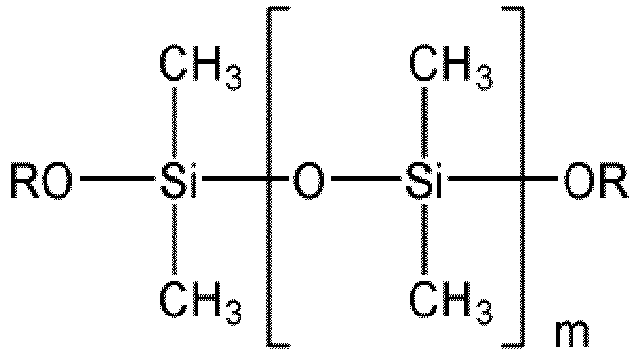 où m = 1 à 300, de préférence 12 à 150, de façon particulièrement préférée m = 20 à 80,
ou
CH3SiDaDbDc(OR) 3
ou
SiDaDbDcDd(OR)4
où a, b, c et d valent chacun, indépendamment les uns des autres, 1 à 100, de préférence 2 à 50, de façon particulièrement préférée 10 à 30 etR = radical alkyle, radical alkyle ramifié, radical cycloalkyle ayant de 1 à 10, de préférence ayant de 1 à 4 atomes de carbone, de façon particulièrement préférée R = éthyle-. - Système réactionnel selon la revendication 5, dans lequel les alcoxysilanes utilisés résultent d'équilibrage acide de diméthyldialcoxysilanes ou méthyltrialcoxysilanes avec des cycles siloxanes simples, comprenant D4 et/ou D5.
- Système réactionnel selon l'une des revendications 1 à 6, caractérisé en ce que sont utilisés des cycles siloxanes simples, comprenant D3 (hexaméthylcyclotrisiloxane), D4 (octaméthylcyclotétrasiloxane), D5 (décaméthylcyclopentasiloxane et/ou D6 (dodécaméthylcyclohexasiloxane), D4 et/ou D5 étant particulièrement préférés, et D5 étant le plus souvent préféré.
- Système réactionnel selon l'une des revendications 1 à 7, caractérisé en ce que sont utilisés des silanes à fonction hydroxy et/ou des siloxanes à fonction hydroxy, de préférence le diméthylsilanol (CH3)Si(OH)2, le méthylsilanol (CH3Si(OH)3) et/ou l'acide orthosilicique Si(OH)4 et/ou en tant que siloxanes à fonction hydroxy de préférence des α,ω-polydiméthylsiloxanediols de formule suivante :

- Système réactionnel selon l'une des revendications 1 à 8, caractérisé en ce que sont utilisés des siloxanes ramifiés-cycliques du type DT, de préférencea) des mélanges de siloxanes ramifiés-cycliques du type D/T, qui sont exclusivement constitués de siloxanes comportant des unités D et T et dont la fraction brute déterminable par spectroscopie de RMN-29Si des unités D et T présentes dans la matrice siloxane, qui comportent des groupes Sialcoxy et/ou SiOH, est ≤ 2 pour cent en moles, de préférence inférieure à 1 pour cent en moles, et qui contiennent de préférence au moins 5 pour cent en poids de cycles siloxane, tels que de préférence l'octaméthylcyclotétrasiloxane (D4), le décaméthylcyclopentasiloxane (D5) et/ou des mélanges de ceux-ci ou bien
ii) des mélanges de siloxanes ramifiés-cycliques comportant exclusivement des unités D et T, dont la fraction brute déterminable par spectroscopie de RMN-29Si des unités D et T présentes dans la matrice siloxane, qui comportent des groupes Sialcoxy et/ou SiOH, est supérieure à 2 et inférieure à 10 pour cent en moles. - Procédé pour la préparation de siloxanes linéaires ou ramifiés, portant des fonctions acétoxy, caractérisé en ce que sont mis en réactiona) des silanes et/ou siloxanes portant des groupes alcoxy et/oub) des silanes et/ou siloxanes portant des groupes acétoxy, et/ouc) des silanes et/ou siloxanes portant des groupes hydroxy,d) éventuellement des cycles siloxane simples qui ne sont constitués que d'unités D, et/ou des siloxanes ramifiés-cycliques du type DT,avec de l'anhydride acétique, un acide perfluoroalcanesulfonique ainsi que de préférence de l'acide acétique.
- Procédé selon la revendication 10 pour la préparation de siloxanes ramifiés portant des fonctions acétoxy terminales, caractérisé en ce qu'est utilisé en tant que composant a) un produit d'équilibrage silicié ramifié, portant des groupes alcoxy terminaux.
- Procédé selon la revendication 10 ou 11 pour la préparation de siloxanes ramifiés portant des fonctions acétoxy terminales, caractérisé en ce que tous les composants a) et/ou b) ainsi qu'en option c) et éventuellement d) sont disposés au préalable et mis en réaction conjointement avec de l'anhydride acétique, un acide perfluoroalcanesulfonique ainsi que de préférence de l'acide acétique.
- Procédé selon la revendication 10 pour la préparation d'α,ω-diacétoxypolydiméthylsiloxanes, caractérisé en ce que le composant c) seul et/ou éventuellement conjointement avec des cycles siloxane simples est mis en réaction avec de l'anhydride acétique, un acide perfluoroalcanesulfonique ainsi que de préférence de l'acide acétique.
- Procédé selon l'une des revendications 10 à 13, caractérisé en ce qu'il est effectué avec utilisation d'un système réactionnel tel que défini dans l'une des revendications 1 à 9.
- Siloxanes linéaires portant des groupes α,ω-acétoxy, à équilibrage complet avec de l'acide trifluorométhanesulfonique, qui présentent des teneurs en cycles totaux, définies comme la somme des fractions de teneurs en siloxanes cycliques comprenant D4, D5 et D6 par rapport à la matrice siloxane et déterminées par chromatographie en phase gazeuse après leur transformation en dérivés consistant en les α,ω-isopropoxysiloxanes linéaires correspondants, de moins de 13, de préférence moins de 12 pour cent en poids, préparés de préférence conformément à un procédé selon la revendication 10 et la revendication 14.
- Siloxanes ramifiés portant des groupes acétoxy, à équilibrage complet avec de l'acide trifluorométhanesulfonique, préparés de préférence conformément à un procédé selon la revendication 10 à la revendication 12, caractérisés en ce qu'ils présentent des teneurs en cycles totaux, définies comme la somme des fractions de teneurs en siloxanes cycliques comprenant D4, D5 et D6 par rapport à la matrice siloxane et déterminées par chromatographie en phase gazeuse après leur transformation en dérivés consistant en les isopropoxysiloxanes ramifiés correspondants, de moins de 8, de préférence moins de 7 pour cent en poids, préparés de préférence conformément à un procédé selon la revendication 10 à la revendication 13.
- Utilisation de siloxanes portant des groupes acétoxy, préparés avec utilisation d'un système réactionnel tel que défini dans les revendications 1 à 9, en particulier conformément à au moins l'une des revendications 10 à 16, pour la préparation de polyéthersiloxanes, en particulier pour la production de stabilisants de mousses de polyuréthane, d'antimousses, d'additifs pour dispersants et peintures et/ou de désémulsifiants.
Priority Applications (6)
| Application Number | Priority Date | Filing Date | Title |
|---|---|---|---|
| ES18210035T ES2970332T3 (es) | 2018-12-04 | 2018-12-04 | Siloxanos reactivos |
| EP18210035.4A EP3663346B1 (fr) | 2018-12-04 | 2018-12-04 | Siloxane réactif |
| US17/297,372 US11795275B2 (en) | 2018-12-04 | 2019-11-19 | Reactive siloxanes |
| PCT/EP2019/081728 WO2020114762A1 (fr) | 2018-12-04 | 2019-11-19 | Siloxanes réactifs |
| CA3121101A CA3121101C (fr) | 2018-12-04 | 2019-11-19 | Siloxanes reactifs |
| CN201980080370.1A CN113166474B (zh) | 2018-12-04 | 2019-11-19 | 反应性硅氧烷 |
Applications Claiming Priority (1)
| Application Number | Priority Date | Filing Date | Title |
|---|---|---|---|
| EP18210035.4A EP3663346B1 (fr) | 2018-12-04 | 2018-12-04 | Siloxane réactif |
Publications (2)
| Publication Number | Publication Date |
|---|---|
| EP3663346A1 EP3663346A1 (fr) | 2020-06-10 |
| EP3663346B1 true EP3663346B1 (fr) | 2023-11-15 |
Family
ID=64901288
Family Applications (1)
| Application Number | Title | Priority Date | Filing Date |
|---|---|---|---|
| EP18210035.4A Active EP3663346B1 (fr) | 2018-12-04 | 2018-12-04 | Siloxane réactif |
Country Status (5)
| Country | Link |
|---|---|
| US (1) | US11795275B2 (fr) |
| EP (1) | EP3663346B1 (fr) |
| CN (1) | CN113166474B (fr) |
| ES (1) | ES2970332T3 (fr) |
| WO (1) | WO2020114762A1 (fr) |
Families Citing this family (18)
| Publication number | Priority date | Publication date | Assignee | Title |
|---|---|---|---|---|
| EP3719076A1 (fr) | 2019-04-01 | 2020-10-07 | Evonik Operations GmbH | Dispersion aqueuse de résine polyorganosiloxanhybride |
| EP3744764A1 (fr) | 2019-05-28 | 2020-12-02 | Evonik Operations GmbH | Fabrication de polyéthersiloxanes par une liaison sioc |
| EP3744745A1 (fr) | 2019-05-28 | 2020-12-02 | Evonik Operations GmbH | Fabrication de mousses de polyuréthane |
| ES2913783T3 (es) | 2019-05-28 | 2022-06-06 | Evonik Operations Gmbh | Procedimiento para la purificación de acetoxisiloxanos |
| ES2990990T3 (es) | 2019-05-28 | 2024-12-02 | Evonik Operations Gmbh | Polietersiloxanos basados en SiOC personalizados |
| PL3744752T3 (pl) | 2019-05-28 | 2025-02-10 | Evonik Operations Gmbh | Sposób wytwarzania niecyklicznych polisiloksanów funkcjonalizowanych alkoksylem |
| ES2977903T3 (es) | 2020-03-27 | 2024-09-02 | Evonik Operations Gmbh | Reciclaje de materiales de estructuras planas siliconizadas |
| EP3954740A1 (fr) | 2020-08-14 | 2022-02-16 | Evonik Operations GmbH | Composition antimousse basée sur les polysiloxanes organo-fonctionnels modifiés |
| US11732092B2 (en) | 2020-10-19 | 2023-08-22 | Evonik Operations Gmbh | Upcycling process for processing silicone wastes |
| EP4011992A1 (fr) * | 2020-12-09 | 2022-06-15 | Evonik Operations GmbH | Composés de condensation durcissables à base de polysiloxanes alkoxy-fonctionnels |
| US12060460B2 (en) | 2021-04-29 | 2024-08-13 | Evonik Operations Gmbh | Process for producing endcapped, liquid siloxanes from silicone wastes |
| EP4119597A1 (fr) | 2021-07-14 | 2023-01-18 | Evonik Operations GmbH | Augmentation de la masse moléculaire des alpha, oméga-polysiloxanediols de faible masse moléculaire |
| CA3180684A1 (fr) | 2021-11-25 | 2023-05-25 | Evonik Operations Gmbh | Composes de condensation durcissables fondes sur des polysiloxanes a fonction alcoxy |
| CN114524940B (zh) * | 2022-02-22 | 2023-05-26 | 江苏省农业科学院 | 一种基于等离子体和超支化耦合对小麦秸秆表面改性方法 |
| CA3208899A1 (fr) | 2022-08-12 | 2024-02-12 | Evonik Operations Gmbh | Production d~alkoxysiloxanes |
| CA3208911A1 (fr) | 2022-08-12 | 2024-02-12 | Evonik Operations Gmbh | Procede de production d~alkoxysiloxanes a partir de silicone recycle |
| CA3248863A1 (fr) | 2023-07-27 | 2025-06-05 | Evonik Operations Gmbh | Réutilisation physique de papiers siliconés |
| CN119192582B (zh) * | 2024-10-22 | 2025-12-05 | 南京大学 | 一种制备低粘度的乙烯基含氟超支化有机硅树脂的方法 |
Citations (3)
| Publication number | Priority date | Publication date | Assignee | Title |
|---|---|---|---|---|
| US20110021693A1 (en) * | 2009-07-24 | 2011-01-27 | Evonik Goldschmidt Gmbh | Novel silicone polyether copolymers and process for preparation thereof |
| EP3611217A1 (fr) * | 2018-08-15 | 2020-02-19 | Evonik Operations GmbH | Copolymères bloc de polydiméthylsiloxane-polyoxyalkylène linéaires de type de structure aba |
| EP3611216A1 (fr) * | 2018-08-15 | 2020-02-19 | Evonik Operations GmbH | Copolymères bloc de polydiméthylsiloxane-polyoxyalkylène linéaires de type de structure aba |
Family Cites Families (137)
| Publication number | Priority date | Publication date | Assignee | Title |
|---|---|---|---|---|
| US3032532A (en) | 1962-05-01 | Xcyloxy-endblocked diorgano- | ||
| BE558554A (fr) | 1956-06-26 | |||
| US3356758A (en) | 1963-08-07 | 1967-12-05 | Union Carbide Corp | Siloxane-oxyalkylene block copolymers and process therefor |
| NL128599C (fr) | 1963-08-07 | 1970-04-15 | ||
| US4066680A (en) | 1976-10-18 | 1978-01-03 | Sws Silicones Corporation | Process for making alpha,omega-siloxanediols |
| CA1125780A (fr) | 1977-10-28 | 1982-06-15 | Eugene R. Martin | Methode pour l'obtention d'alpha-omega- diacyloxysiloxanes |
| DE2802668A1 (de) * | 1978-01-21 | 1979-07-26 | Bayer Ag | Verfahren zur herstellung von siliciumfunktionellen polyorganosiloxanen |
| DE4116987C1 (fr) | 1991-05-24 | 1992-07-30 | Th. Goldschmidt Ag, 4300 Essen, De | |
| DE4239246C1 (de) | 1992-11-21 | 1993-12-16 | Goldschmidt Ag Th | Verfahren zur Herstellung von SiH-Gruppen aufweisenden Organopolysiloxanen |
| DE4313130C1 (de) | 1993-04-22 | 1994-05-26 | Goldschmidt Ag Th | Verfahren zur Herstellung von Silanen bzw. Organosiliciumhydriden durch Reduktion der entsprechenden Siliciumhalogenide bzw. Organosiliciumhalogenide |
| DE4320920C1 (de) | 1993-06-24 | 1994-06-16 | Goldschmidt Ag Th | Silane mit hydrophilen Gruppen, deren Herstellung und Verwendung als Tenside in wäßrigen Medien |
| DE4330059C1 (de) | 1993-09-06 | 1994-10-20 | Goldschmidt Ag Th | Silane mit hydrophilen Gruppen, deren Herstellung und Verwendung als Tenside in wäßrigen Medien |
| DE4336602A1 (de) | 1993-10-27 | 1995-05-04 | Goldschmidt Ag Th | Verfahren zur Herstellung von Aluminiumwasserstoff (AlH¶3¶) durch Umsetzung von Magnesiumhydrid mit Aluminiumhalogenid |
| DE4415556C1 (de) | 1994-04-27 | 1995-06-01 | Goldschmidt Ag Th | Organosilyl- bzw. Organosiloxanyl-Derivate von Glycerinethern und deren Verwendung |
| US5856548A (en) | 1997-05-17 | 1999-01-05 | Th. Goldschmidt Ag | Process for preparing dimethylmonochlorosilane |
| DE19859759C1 (de) | 1998-12-23 | 2000-06-29 | Goldschmidt Ag Th | Verfahren und Vorrichtung zur Durchführung kontinuierlicher Hydrosilylierungsreaktionen |
| CA2298240C (fr) | 1999-02-24 | 2007-08-21 | Goldschmidt Ag | Systeme catalytique synergique et procede permettant d'effectuer des reactions d'hydrosilylation |
| WO2002068506A1 (fr) | 2001-02-27 | 2002-09-06 | Goldschmidt Ag | Procede pour le traitement de polyethersiloxanes |
| EP1350804B1 (fr) | 2002-03-26 | 2004-04-07 | Goldschmidt AG | Utilisation de polysiloxanes organofonctionnels dans la préparation d'une mousse de polyuréthane souple |
| DE10232115A1 (de) | 2002-07-16 | 2004-02-05 | Goldschmidt Ag | Organopolysiloxane zur Entschäumung wässriger Systeme |
| DE10232908A1 (de) | 2002-07-19 | 2004-01-29 | Goldschmidt Ag | Verwendung organfunktionell modifizierter, Phenylderivate enthaltender Polysiloxane als Dispergier- und Netzmittel für Füllstoffe und Pigmente in wässrigen Pigmentpasten und Farb- oder Lackformulierungen |
| ES2213728T3 (es) | 2002-09-26 | 2004-09-01 | Goldschmidt Ag | Nuevos compuestos de siloxanos y su utilizacion como agentes de homogeneizacion en agentes de separacion con un efecto de mateado para la produccion de cuerpos moldeados a partir de materiales sinteticos con superficies mateadas. |
| DE50206131D1 (de) | 2002-12-21 | 2006-05-11 | Goldschmidt Gmbh | Verfahren zur Aufbereitung von Polyethersiloxanen |
| DE10301355A1 (de) | 2003-01-16 | 2004-07-29 | Goldschmidt Ag | Äquilibrierung von Siloxanen |
| DE10337309A1 (de) | 2003-08-14 | 2005-03-10 | Goldschmidt Ag Th | Verfahren zur Herstellung von Silanen bzw. Organosiliciumhydriden durch Reduktion der entsprechenden Siliciumhalogenide bzw. Organosiliciumhalogenide |
| DE50302270D1 (de) | 2003-10-04 | 2006-04-13 | Goldschmidt Gmbh | Verfahren zur Herstellung von organischen Siliciumverbindungen |
| JP2006160831A (ja) * | 2004-12-03 | 2006-06-22 | Dow Corning Toray Co Ltd | オルガノポリシロキサンの製造方法 |
| DE102005001039B4 (de) | 2005-01-07 | 2017-11-09 | Evonik Degussa Gmbh | Verfahren zur Herstellung von Äquilibrierungsprodukten von Organosiloxanen und die so erhältlichen Organopolysiloxane |
| DE102005039398A1 (de) | 2005-08-20 | 2007-02-22 | Goldschmidt Gmbh | Verfahren zur Herstellung von Anlagerungsprodukten aus SiH-Gruppen enthaltenden Verbindungen an Olefingruppen aufweisende Reaktionspartner in wässrigen Medien |
| DE102005039931A1 (de) | 2005-08-24 | 2007-03-01 | Goldschmidt Gmbh | Verfahren zur Herstellung von SiOC-verknüpften, linearen Polydimethylsiloxan-Polyoxyalkylen-Blockcopolymeren |
| DE102005051939A1 (de) | 2005-10-29 | 2007-05-03 | Goldschmidt Gmbh | Verfahren zur Herstellung von organisch modifizierten Polyorganosiloxanen |
| DE102005057857A1 (de) | 2005-12-03 | 2010-02-25 | Evonik Goldschmidt Gmbh | Polyethermodifizierte Polysiloxane mit Blockcharakter und deren Verwendung zur Herstellung von kosmetischen Formulierungen |
| DE102006061350A1 (de) | 2006-12-22 | 2008-06-26 | Evonik Goldschmidt Gmbh | Verfahren zur Herstellung von SiOC-verknüpften, linearen Polydimethylsiloxan-Polyoxyalkylen-Blockcopolymeren und ihre Verwendung |
| DE102006061353A1 (de) | 2006-12-22 | 2008-06-26 | Evonik Goldschmidt Gmbh | Verfahren zur Umsetzung von Polyorganosiloxanen und deren Verwendung |
| DE102006061351A1 (de) | 2006-12-22 | 2008-06-26 | Evonik Goldschmidt Gmbh | Verfahren zur Herstellung von SiOC-verknüpften, linearen Polydimethylsiloxan-Polyoxyalkylen-Blockcopolymeren und ihre Verwendung |
| DE102007003578A1 (de) * | 2007-01-24 | 2008-07-31 | Wacker Chemie Ag | Verfahren zur Herstellung polymerisierbarer Silicone |
| DE102007035646A1 (de) | 2007-07-27 | 2009-01-29 | Evonik Goldschmidt Gmbh | Über SIC- und über Carbonsäureestergruppen verknüpfte lineare Polydimethylsiloxan-Polyoxyalkylen-Blockcopolymere, ein Verfahren zur ihrer Herstellung und ihre Verwendung |
| DE102007041028A1 (de) | 2007-08-29 | 2009-03-05 | Evonik Goldschmidt Gmbh | Verwendung estermodifizierter Organopolysiloxane zur Herstellung kosmetischer oder pharmazeutischer Kompositionen |
| DE102007046736A1 (de) | 2007-09-28 | 2009-04-02 | Evonik Goldschmidt Gmbh | Verwendung linearer Siloxane und Verfahren zu deren Herstellung |
| DE102007055485A1 (de) | 2007-11-21 | 2009-06-04 | Evonik Goldschmidt Gmbh | Verfahren zur Herstellung verzweigter SiH-funktioneller Polysiloxane und deren Verwendung zur Herstellung SiC- und SiOC-verknüpfter, verzweigter organomodifizierter Polysiloxane |
| DE102007055484A1 (de) | 2007-11-21 | 2009-05-28 | Evonik Goldschmidt Gmbh | Verfahren zur Herstellung von Polydimethylsiloxanen an sulfonsauren Kationenaustauscherharzen |
| DE102007057145A1 (de) | 2007-11-28 | 2009-06-04 | Evonik Goldschmidt Gmbh | Verfahren zur Herstellung von Polyetheralkoholen mit DMC-Katalysatoren unter Verwendung von SiH-Gruppen tragenden Verbindungen als Additive |
| DE102007057146A1 (de) | 2007-11-28 | 2009-06-04 | Evonik Goldschmidt Gmbh | Verfahren zur Herstellung von Polyetheralkoholen mit DMC-Katalysatoren unter Verwendung von speziellen Additiven mit aromatischer Hydroxy-Funktionalisierung |
| DE102008000266A1 (de) | 2008-02-11 | 2009-08-13 | Evonik Goldschmidt Gmbh | Die Erfindung betrifft die Verwendung von Schaumstabilisatoren, die auf Basis nachwachsender Rohstoffe hergestellt werden, zur Herstellung von Polyurethanschäumen |
| DE102008000360A1 (de) | 2008-02-21 | 2009-08-27 | Evonik Goldschmidt Gmbh | Neue Alkoxysilylgruppen tragende Polyetheralkohole durch Alkoxylierung epoxidfunktioneller Alkoxysilane an Doppelmetallcyanid (DMC)-Katalysatoren, sowie Verfahren zu deren Herstellung |
| DE102008000903A1 (de) | 2008-04-01 | 2009-10-08 | Evonik Goldschmidt Gmbh | Neue Organosiloxangruppen tragende Polyetheralkohole durch Alkoxylierung epoxidfunktioneller (Poly)Organosiloxane an Doppelmetallcyanid (DMC)-Katalysatoren, sowie Verfahren zu deren Herstellung |
| DE102008002713A1 (de) | 2008-06-27 | 2009-12-31 | Evonik Goldschmidt Gmbh | Neue Polyethersiloxane enthaltende Alkoxylierungsprodukte durch direkte Alkoxylierung organomodifizierter alpha, omega-Dihydroxysiloxane an Doppelmetallcyanid (DMC)-Katalysatoren, sowie Verfahren zu deren Herstellung |
| DE102008041601A1 (de) | 2008-08-27 | 2010-03-04 | Evonik Goldschmidt Gmbh | Verfahren zur Herstellung verzweigter SiH-funtioneller Polysiloxane und deren Verwendung zur Herstellung flüssiger, SiC- oder SiOC-verknüpfter, verzweigter organomodifizierter Polysiloxane |
| DE102008042181B4 (de) | 2008-09-18 | 2020-07-23 | Evonik Operations Gmbh | Äquilibrierung von Siloxanen an wasserhaltigen sulfonsauren Kationenaustauscherharzen |
| DE102008043218A1 (de) | 2008-09-24 | 2010-04-01 | Evonik Goldschmidt Gmbh | Polymere Werkstoffe sowie daraus bestehende Kleber- und Beschichtungsmittel auf Basis multialkoxysilylfunktioneller Präpolymerer |
| DE102008043245A1 (de) | 2008-10-29 | 2010-05-06 | Evonik Goldschmidt Gmbh | Siliconpolyether-Copolymersysteme sowie Verfahren zu deren Herstellung durch Alkoxylierungsreaktion |
| DE102008043343A1 (de) | 2008-10-31 | 2010-05-06 | Evonik Goldschmidt Gmbh | Silikonpolyetherblock-Copolymere mit definierter Polydispersität im Polyoxyalkylenteil und deren Verwendung als Stabilisatoren zur Herstellung von Polyurethanschäumen |
| PL2352779T3 (pl) | 2008-12-05 | 2018-04-30 | Evonik Degussa Gmbh | Polieterosiloksany zawierające grupy alkoksysililowe i sposób ich wytwarzania |
| DE102009022628A1 (de) | 2008-12-05 | 2010-06-10 | Evonik Goldschmidt Gmbh | Verfahren zur Modifizierung von Oberflächen |
| DE102009002417A1 (de) | 2009-04-16 | 2010-10-21 | Evonik Goldschmidt Gmbh | Verwendung organomodifizierter, im Siliconteil verzweigter Siloxane zur Herstellung kosmetischer oder pharmazeutischer Zusammensetzungen |
| DE102009019002B3 (de) | 2009-04-16 | 2010-11-25 | Astrium Gmbh | Blasenfalle für Treibstofftanks in Raumflugkörpern |
| DE102009003274A1 (de) | 2009-05-20 | 2010-11-25 | Evonik Goldschmidt Gmbh | Zusammensetzungen enthaltend Polyether-Polysiloxan-Copolymere |
| DE102009022630A1 (de) | 2009-05-25 | 2010-12-02 | Evonik Goldschmidt Gmbh | Emulsionen auf Basis Silylgruppen tragender Hydroxylverbindungen |
| DE102009022631A1 (de) | 2009-05-25 | 2010-12-16 | Evonik Goldschmidt Gmbh | Härtbare Silylgruppen enthaltende Zusammensetzungen und deren Verwendung |
| DE102009022627A1 (de) | 2009-05-25 | 2010-12-02 | Evonik Goldschmidt Gmbh | Reaktive Silylgruppen tragende Hydroxylverbindungen als Keramikbindemittel |
| DE102009028636A1 (de) | 2009-08-19 | 2011-02-24 | Evonik Goldschmidt Gmbh | Neuartige Urethangruppen enthaltende silylierte Präpolymere und Verfahren zu deren Herstellung |
| DE102009028640A1 (de) | 2009-08-19 | 2011-02-24 | Evonik Goldschmidt Gmbh | Härtbare Masse enthaltend Urethangruppen aufweisende silylierte Polymere und deren Verwendung in Dicht- und Klebstoffen, Binde- und/oder Oberflächenmodifizierungsmitteln |
| DE102010001350A1 (de) | 2010-01-29 | 2011-08-04 | Evonik Goldschmidt GmbH, 45127 | Neuartige lineare Polydimethylsiloxan-Polyether-Copolymere mit Amino- und/oder quaternären Ammoniumgruppen und deren Verwendung |
| DE102010001528A1 (de) | 2010-02-03 | 2011-08-04 | Evonik Goldschmidt GmbH, 45127 | Neue Partikel und Kompositpartikel, deren Verwendungen und ein neues Verfahren zu deren Herstellung aus Alkoxysilylgruppen tragenden Alkoxylierungsprodukten |
| DE102010001531A1 (de) | 2010-02-03 | 2011-08-04 | Evonik Goldschmidt GmbH, 45127 | Neuartige organomodifizierte Siloxane mit primären Aminofunktionen, neuartige organomodifizierte Siloxane mit quaternären Ammoniumfunktionen und das Verfahren zu deren Herstellung |
| DE102010002178A1 (de) | 2010-02-22 | 2011-08-25 | Evonik Goldschmidt GmbH, 45127 | Verfahren zur Herstellung von Amin-Amid-funktionellen Siloxanen |
| DE102010002180A1 (de) | 2010-02-22 | 2011-08-25 | Evonik Goldschmidt GmbH, 45127 | Stickstoffhaltige silizium-organische Pfropfmischpolymere |
| DE102010029723A1 (de) | 2010-06-07 | 2011-12-08 | Evonik Goldschmidt Gmbh | Verfahren zur Herstellung von organischen Siliciumverbindungen |
| DE102010031087A1 (de) | 2010-07-08 | 2012-01-12 | Evonik Goldschmidt Gmbh | Neuartige polyestermodifizierte Organopolysiloxane |
| DE102010062156A1 (de) | 2010-10-25 | 2012-04-26 | Evonik Goldschmidt Gmbh | Polysiloxane mit stickstoffhaltigen Gruppen |
| DE102011005607A1 (de) | 2011-03-16 | 2012-09-20 | Evonik Goldschmidt Gmbh | Verfahren zur Herstllung von organomodifizierten Polysiloxanen |
| DE102011076019A1 (de) | 2011-05-18 | 2012-11-22 | Evonik Goldschmidt Gmbh | Alkoxylierungsprodukte und Verfahren zu ihrer Herstellung mittels DMC-Katalysatoren |
| DE102011079465A1 (de) | 2011-07-20 | 2013-01-24 | Evonik Goldschmidt Gmbh | Verfahren zur Reduktion von Carbonsäureestern oder -lactonen zu den entsprechenden Ethern |
| DE102011109540A1 (de) | 2011-08-03 | 2013-02-07 | Evonik Goldschmidt Gmbh | Alkylcarbonat endverschlossene Polyethersilioxane und Verfahren zu deren Herstellung |
| DE102011085492A1 (de) | 2011-10-31 | 2013-05-02 | Evonik Goldschmidt Gmbh | Neue aminogruppenhaltige Siloxane, Verfahren zu deren Herstellung und Anwendung |
| DE102011088787A1 (de) | 2011-12-16 | 2013-06-20 | Evonik Industries Ag | Siloxannitrone und deren Anwendung |
| DE102012202527A1 (de) | 2012-02-20 | 2013-08-22 | Evonik Goldschmidt Gmbh | Zusammensetzungen enthaltend Polymere und Metallatome oder -ionen und deren Verwendung |
| DE102012202521A1 (de) | 2012-02-20 | 2013-08-22 | Evonik Goldschmidt Gmbh | Verzweigte Polysiloxane und deren Verwendung |
| DE102012203737A1 (de) | 2012-03-09 | 2013-09-12 | Evonik Goldschmidt Gmbh | Modifizierte Alkoxylierungsprodukte, die zumindest eine nicht-terminale Alkoxysilylgruppe aufweisen und mehrere Urethangruppen enthalten und deren Verwendung |
| DE102012210553A1 (de) | 2012-06-22 | 2013-12-24 | Evonik Industries Ag | Siliconpolyether und Verfahren zu deren Herstellung aus Methylidengruppen tragenden Polyethern |
| DE102012210556A1 (de) | 2012-06-22 | 2013-12-24 | Evonik Industries Ag | Verfahren zur Reduktion von Carbonsäureestern oder –lactonen |
| JP6022236B2 (ja) * | 2012-06-28 | 2016-11-09 | 東レ・ダウコーニング株式会社 | コーティング剤、電気・電子機器、および電気・電子機器の金属部の保護方法 |
| JP6081774B2 (ja) * | 2012-10-30 | 2017-02-15 | 東レ・ダウコーニング株式会社 | 硬化性シリコーン組成物、その硬化物、および光半導体装置 |
| WO2014104388A2 (fr) * | 2012-12-28 | 2014-07-03 | Dow Corning Toray Co., Ltd. | Composition de silicone durcissable, produit durci obtenu, et dispositif optique de type semi-conducteur |
| DE102013208328A1 (de) | 2013-05-07 | 2014-11-13 | Evonik Industries Ag | Polyoxyalkylene mit seitenständigen langkettigen Acyloxyresten und Verfahren zu ihrer Herstellung mittels DMC-Katalysatoren |
| DE102013106906A1 (de) | 2013-07-01 | 2015-01-08 | Evonik Industries Ag | Siloxan-Polymere mit zentralem Polysiloxan-Polymerblock mit terminalen organofunktionellen Resten umfassend Harnstoff- und/oder Carbamat-Gruppen sowie Aminosäure-Reste |
| DE102013106905A1 (de) | 2013-07-01 | 2015-01-08 | Evonik Industries Ag | Siloxan-Polymere mit zentralem Polysiloxan-Polymerblock mit organofunktionellen Resten mit jeweils mindestens zwei bivalenten Gruppen ausgewählt aus Harnstoff- und/oder Carbamat-Gruppen und mindestens einem UV/Vis-Chromophor als Rest |
| DE102013213655A1 (de) | 2013-07-12 | 2015-01-15 | Evonik Industries Ag | Härtbare Silylgruppen enthaltende Zusammensetzungen mit verbesserter Lagerstabilität |
| DE102013214081A1 (de) | 2013-07-18 | 2015-01-22 | Evonik Industries Ag | Neue aminosäuremodifizierte Siloxane, Verfahren zu ihrer Herstellung und Anwendung |
| DE102013216787A1 (de) | 2013-08-23 | 2015-02-26 | Evonik Degussa Gmbh | Guanidingruppen aufweisende semi-organische Siliciumgruppen enthaltende Verbindungen |
| DE102013216751A1 (de) | 2013-08-23 | 2015-02-26 | Evonik Industries Ag | Modifizierte Alkoxylierungsprodukte, die Alkoxysilylgruppen aufweisen und Urethangruppen enthalten und deren Verwendung |
| DE102014209407A1 (de) | 2014-05-19 | 2015-11-19 | Evonik Degussa Gmbh | Hoch aktive Doppelmetallcyanid-Katalysatoren und Verfahren zu deren Herstellung |
| DE102014209408A1 (de) | 2014-05-19 | 2015-11-19 | Evonik Degussa Gmbh | Ethoxylatherstellung unter Verwendung hoch aktiver Doppelmetallcyanid-Katalysatoren |
| DE102014211680A1 (de) | 2014-06-18 | 2015-02-26 | Evonik Industries Ag | Optimierte Verfahren zur Herstellung von Siloxanen unter regenerationsfreier Weiterverwendung der Ionenaustauscherharze |
| DE102014213507A1 (de) | 2014-07-11 | 2016-01-14 | Evonik Degussa Gmbh | Platin enthaltende Zusammensetzung |
| DE102014215382A1 (de) | 2014-08-05 | 2016-02-11 | Evonik Degussa Gmbh | Stickstoffhaltige Verbindungen, geeignet zur Verwendung bei der Herstellung von Polyurethanen |
| EP3020749B1 (fr) | 2014-11-12 | 2020-09-30 | Evonik Operations GmbH | Procede de fabrication de compositions contenant du platine |
| EP3050910B1 (fr) | 2015-01-28 | 2016-12-07 | Evonik Degussa GmbH | Produit d'alcoxylation modifié comportant au moins un groupe alcoxysilane non terminal, doté d'une stabilité au stockage accrue et d'une dilatation améliorée du polymère fabriqué en utilisant celui-ci |
| EP3168273B1 (fr) | 2015-11-11 | 2018-05-23 | Evonik Degussa GmbH | Polymere durcissable |
| PL3168274T3 (pl) | 2015-11-11 | 2018-10-31 | Evonik Degussa Gmbh | Polimery utwardzalne |
| CN108291020A (zh) | 2015-11-26 | 2018-07-17 | 赢创德固赛有限公司 | 包含环氧化合物和带有烷氧基甲硅烷基的预聚物的粘合剂体系及其应用 |
| EP3202816B1 (fr) | 2016-02-04 | 2018-09-19 | Evonik Degussa GmbH | Colle d'etancheite contenant des alkoxysilyles et ayant une resistance amelioree a l'allongement d'une dechirure amorcee |
| EP3228649B1 (fr) | 2016-04-04 | 2020-07-15 | Evonik Operations GmbH | Traitement des produits d'alkoxylation obtenus par catalyse alcaline |
| CN105906810B (zh) * | 2016-04-26 | 2019-08-06 | 广东标美硅氟新材料有限公司 | 一种有机聚硅氧烷树脂的制备方法 |
| EP3272331B1 (fr) | 2016-07-22 | 2018-07-04 | Evonik Degussa GmbH | Procede de production de siloxanes contenant des substituts de glycerine |
| EP3321304B1 (fr) | 2016-11-15 | 2019-06-19 | Evonik Degussa GmbH | Mélanges de siloxanes ramifiés-cycliques de type d/t et leurs produits secondaires |
| PL3401353T3 (pl) | 2017-05-08 | 2021-12-13 | Evonik Operations Gmbh | Mieszaniny cyklicznych, rozgałęzionych siloksanów typu D/T i ich dalszych produktów |
| EP3415548B1 (fr) | 2017-06-13 | 2020-03-25 | Evonik Operations GmbH | Procédé de fabrication de polyéthersiloxanes liés par sic |
| EP3415547B1 (fr) | 2017-06-13 | 2020-03-25 | Evonik Operations GmbH | Procédé de fabrication de polyéthersiloxanes liés par sic |
| EP3438158B1 (fr) | 2017-08-01 | 2020-11-25 | Evonik Operations GmbH | Production de polyéthersiloxanes par une liaison sioc |
| EP3467006B1 (fr) | 2017-10-09 | 2022-11-30 | Evonik Operations GmbH | Mélanges de siloxanes ramifiés-cycliques de type d/t et leurs produits secondaires |
| EP3470475B1 (fr) | 2017-10-13 | 2021-01-27 | Evonik Operations GmbH | Composition durcissable pour revêtements à propriété antiadhésive |
| DE112018004605A5 (de) | 2017-10-17 | 2020-05-28 | Evonik Operations Gmbh | Zinkketoiminatkomplexe als Katalysatoren zur Herstellung von Polyurethanen |
| EP3492513B1 (fr) | 2017-11-29 | 2021-11-03 | Evonik Operations GmbH | Procédé de fabrication de polyéthersiloxanes liés au sioc ramifiés dans la partie siloxane |
| US11345783B2 (en) | 2018-05-17 | 2022-05-31 | Evonik Operations Gmbh | Linear polydimethylsiloxane-polyoxyalkylene block copolymers of the structure type ABA |
| EP3794060A1 (fr) | 2018-05-17 | 2021-03-24 | Evonik Operations GmbH | Copolymère séquencé de polydiméthylsiloxane et de polyoxyalkylène à structure linéaire de type aba |
| EP3611215A1 (fr) | 2018-08-15 | 2020-02-19 | Evonik Operations GmbH | Procédé de production de siloxanes portant des groupes acétoxy |
| EP3611214A1 (fr) | 2018-08-15 | 2020-02-19 | Evonik Operations GmbH | Copolymères bloc polydiméthylsiloxane-polyoxyalkylène linéaires à liaisons sioc |
| EP3744760A1 (fr) | 2019-05-28 | 2020-12-02 | Evonik Operations GmbH | Procédé de fabrication de polyéthersiloxanes liés au sioc ramifiés dans la partie siloxane |
| EP3744774B1 (fr) | 2019-05-28 | 2021-09-01 | Evonik Operations GmbH | Procédé de recyclage des silicones |
| ES2990990T3 (es) | 2019-05-28 | 2024-12-02 | Evonik Operations Gmbh | Polietersiloxanos basados en SiOC personalizados |
| ES2913783T3 (es) | 2019-05-28 | 2022-06-06 | Evonik Operations Gmbh | Procedimiento para la purificación de acetoxisiloxanos |
| DK3744762T3 (da) | 2019-05-28 | 2025-02-24 | Evonik Operations Gmbh | Fremgangsmåde til fremstilling af polyoxyalkylen polysiloxan blokpolymerisater |
| PL3744752T3 (pl) | 2019-05-28 | 2025-02-10 | Evonik Operations Gmbh | Sposób wytwarzania niecyklicznych polisiloksanów funkcjonalizowanych alkoksylem |
| EP3744764A1 (fr) | 2019-05-28 | 2020-12-02 | Evonik Operations GmbH | Fabrication de polyéthersiloxanes par une liaison sioc |
| PL3744756T3 (pl) | 2019-05-28 | 2024-10-28 | Evonik Operations Gmbh | Układy acetoksylowe |
| EP3744761B1 (fr) | 2019-05-28 | 2021-06-30 | Evonik Operations GmbH | Polyethérsiloxanes à base de sioc |
| ES2992917T3 (en) | 2019-05-28 | 2024-12-19 | Evonik Operations Gmbh | Method for producing siloxanes bearing acetoxy groups |
| EP3744755B1 (fr) | 2019-05-28 | 2024-10-09 | Evonik Operations GmbH | Procédé de production de siloxanes portant des groupes acétoxy |
| EP3744745A1 (fr) | 2019-05-28 | 2020-12-02 | Evonik Operations GmbH | Fabrication de mousses de polyuréthane |
| ES2986717T3 (es) | 2019-05-28 | 2024-11-12 | Evonik Operations Gmbh | Procedimiento para la producción de polietersiloxanos enlazados a SiOC ramificados en la parte de siloxano |
| WO2021058263A1 (fr) | 2019-09-27 | 2021-04-01 | Evonik Operations Gmbh | (méth)acrylates de silicone, leur procédé de préparation et leur utilisation dans des compositions durcissables |
| ES2924476T3 (es) | 2020-01-08 | 2022-10-07 | Evonik Operations Gmbh | Formulación y su uso como antiespumante |
| EP3865527A1 (fr) | 2020-02-14 | 2021-08-18 | Evonik Operations GmbH | Fabrication de mousses de polyuréthane |
| ES3036635T3 (en) | 2020-02-14 | 2025-09-23 | Evonik Operations Gmbh | Sioc-linked, linear polydimethylsiloxane polyoxyalkylene block copolymers |
| ES2977903T3 (es) | 2020-03-27 | 2024-09-02 | Evonik Operations Gmbh | Reciclaje de materiales de estructuras planas siliconizadas |
| ES3035011T3 (en) | 2020-06-02 | 2025-08-27 | Evonik Operations Gmbh | Linear acetoxy group bearing siloxanes and secondary products |
-
2018
- 2018-12-04 ES ES18210035T patent/ES2970332T3/es active Active
- 2018-12-04 EP EP18210035.4A patent/EP3663346B1/fr active Active
-
2019
- 2019-11-19 CN CN201980080370.1A patent/CN113166474B/zh active Active
- 2019-11-19 WO PCT/EP2019/081728 patent/WO2020114762A1/fr not_active Ceased
- 2019-11-19 US US17/297,372 patent/US11795275B2/en active Active
Patent Citations (3)
| Publication number | Priority date | Publication date | Assignee | Title |
|---|---|---|---|---|
| US20110021693A1 (en) * | 2009-07-24 | 2011-01-27 | Evonik Goldschmidt Gmbh | Novel silicone polyether copolymers and process for preparation thereof |
| EP3611217A1 (fr) * | 2018-08-15 | 2020-02-19 | Evonik Operations GmbH | Copolymères bloc de polydiméthylsiloxane-polyoxyalkylène linéaires de type de structure aba |
| EP3611216A1 (fr) * | 2018-08-15 | 2020-02-19 | Evonik Operations GmbH | Copolymères bloc de polydiméthylsiloxane-polyoxyalkylène linéaires de type de structure aba |
Also Published As
| Publication number | Publication date |
|---|---|
| WO2020114762A1 (fr) | 2020-06-11 |
| EP3663346A1 (fr) | 2020-06-10 |
| CN113166474A (zh) | 2021-07-23 |
| US20220033587A1 (en) | 2022-02-03 |
| CN113166474B (zh) | 2024-05-14 |
| CA3121101A1 (fr) | 2020-06-11 |
| US11795275B2 (en) | 2023-10-24 |
| ES2970332T3 (es) | 2024-05-28 |
Similar Documents
| Publication | Publication Date | Title |
|---|---|---|
| EP3663346A1 (fr) | Siloxane réactif | |
| EP3467006B1 (fr) | Mélanges de siloxanes ramifiés-cycliques de type d/t et leurs produits secondaires | |
| EP3401353B1 (fr) | Mélanges de siloxanes ramifiés-cycliques de type d/t et leurs dérivés | |
| EP3744756B1 (fr) | Systèmes acétoxy | |
| EP1679335B1 (fr) | Bloc-copolymères de siloxane | |
| EP3744762B1 (fr) | Procédé de fabrication de polymères séquencés de polyoxyalkylène polysiloxane | |
| EP3321304B1 (fr) | Mélanges de siloxanes ramifiés-cycliques de type d/t et leurs produits secondaires | |
| EP3272331B1 (fr) | Procede de production de siloxanes contenant des substituts de glycerine | |
| EP3611215A1 (fr) | Procédé de production de siloxanes portant des groupes acétoxy | |
| EP0927734B1 (fr) | Procédé continu pour la fabrication de polyorganosiloxanes | |
| EP3744759A1 (fr) | Procédé de fabrication de polyéthersiloxanes liés au sioc ramifiés dans la partie siloxane | |
| DE3103705A1 (de) | "platin-siloxan-komplex-katalysator und diesen katalysator enthaltende zubereitungen" | |
| DE1570686A1 (de) | Verfahren zur Herstellung von Organosilizium-Verbindungen | |
| EP0170287B1 (fr) | Procédé de stabilisation d'organopolysiloxanes | |
| DE19800021A1 (de) | Verfahren zur Herstellung von Polyorganosiloxanharzen, die mono- und tetrafunktionelle Einheiten enthalten | |
| EP0646616B1 (fr) | Organopolysiloxanes ayant des unités terminales bifonctionnelles | |
| EP3611216A1 (fr) | Copolymères bloc de polydiméthylsiloxane-polyoxyalkylène linéaires de type de structure aba | |
| EP0626414B1 (fr) | Phosphazènes contenant des groupes organosiliciques, procédé pour leur préparation et leur emploi | |
| EP2493962A1 (fr) | Procédé de production d'(hydroxyméthyl)polysiloxanes | |
| EP1852455B1 (fr) | Procédé de préparation de composés d'organosilicium contenant des groupes d'uréthane | |
| DE3412648A1 (de) | Verfahren zur herstellung von siliconharzvorprodukten | |
| EP0305737A2 (fr) | Procédé de condensation ou d'équilibrage de polysiloxanes | |
| DE69922127T2 (de) | Verfahren zur Herstellung von Epoxygruppen enthaltenden Organosiloxanen oder Organosilanen | |
| EP1370601B1 (fr) | Procede de production d'hydroxyalkylpolysiloxanes | |
| EP0258640B1 (fr) | Procédé de stabilisation du poids moléculaire d'organopolysiloxanes |
Legal Events
| Date | Code | Title | Description |
|---|---|---|---|
| PUAI | Public reference made under article 153(3) epc to a published international application that has entered the european phase |
Free format text: ORIGINAL CODE: 0009012 |
|
| STAA | Information on the status of an ep patent application or granted ep patent |
Free format text: STATUS: THE APPLICATION HAS BEEN PUBLISHED |
|
| AK | Designated contracting states |
Kind code of ref document: A1 Designated state(s): AL AT BE BG CH CY CZ DE DK EE ES FI FR GB GR HR HU IE IS IT LI LT LU LV MC MK MT NL NO PL PT RO RS SE SI SK SM TR |
|
| AX | Request for extension of the european patent |
Extension state: BA ME |
|
| STAA | Information on the status of an ep patent application or granted ep patent |
Free format text: STATUS: REQUEST FOR EXAMINATION WAS MADE |
|
| 17P | Request for examination filed |
Effective date: 20201204 |
|
| RBV | Designated contracting states (corrected) |
Designated state(s): AL AT BE BG CH CY CZ DE DK EE ES FI FR GB GR HR HU IE IS IT LI LT LU LV MC MK MT NL NO PL PT RO RS SE SI SK SM TR |
|
| GRAP | Despatch of communication of intention to grant a patent |
Free format text: ORIGINAL CODE: EPIDOSNIGR1 |
|
| STAA | Information on the status of an ep patent application or granted ep patent |
Free format text: STATUS: GRANT OF PATENT IS INTENDED |
|
| INTG | Intention to grant announced |
Effective date: 20230703 |
|
| RIN1 | Information on inventor provided before grant (corrected) |
Inventor name: BROETZMANN, ANDRE Inventor name: FIEDEL, MICHAEL Inventor name: FAVRESSE, PHILLIPPE Inventor name: DUDZIK, HORST Inventor name: KNOTT, WILFRIED |
|
| P01 | Opt-out of the competence of the unified patent court (upc) registered |
Effective date: 20230816 |
|
| GRAS | Grant fee paid |
Free format text: ORIGINAL CODE: EPIDOSNIGR3 |
|
| GRAA | (expected) grant |
Free format text: ORIGINAL CODE: 0009210 |
|
| STAA | Information on the status of an ep patent application or granted ep patent |
Free format text: STATUS: THE PATENT HAS BEEN GRANTED |
|
| AK | Designated contracting states |
Kind code of ref document: B1 Designated state(s): AL AT BE BG CH CY CZ DE DK EE ES FI FR GB GR HR HU IE IS IT LI LT LU LV MC MK MT NL NO PL PT RO RS SE SI SK SM TR |
|
| REG | Reference to a national code |
Ref country code: CH Ref legal event code: EP Ref country code: GB Ref legal event code: FG4D Free format text: NOT ENGLISH |
|
| REG | Reference to a national code |
Ref country code: DE Ref legal event code: R096 Ref document number: 502018013626 Country of ref document: DE |
|
| REG | Reference to a national code |
Ref country code: IE Ref legal event code: FG4D Free format text: LANGUAGE OF EP DOCUMENT: GERMAN |
|
| REG | Reference to a national code |
Ref country code: LT Ref legal event code: MG9D |
|
| REG | Reference to a national code |
Ref country code: NL Ref legal event code: MP Effective date: 20231115 |
|
| PG25 | Lapsed in a contracting state [announced via postgrant information from national office to epo] |
Ref country code: GR Free format text: LAPSE BECAUSE OF FAILURE TO SUBMIT A TRANSLATION OF THE DESCRIPTION OR TO PAY THE FEE WITHIN THE PRESCRIBED TIME-LIMIT Effective date: 20240216 |
|
| PG25 | Lapsed in a contracting state [announced via postgrant information from national office to epo] |
Ref country code: IS Free format text: LAPSE BECAUSE OF FAILURE TO SUBMIT A TRANSLATION OF THE DESCRIPTION OR TO PAY THE FEE WITHIN THE PRESCRIBED TIME-LIMIT Effective date: 20240315 |
|
| PG25 | Lapsed in a contracting state [announced via postgrant information from national office to epo] |
Ref country code: LT Free format text: LAPSE BECAUSE OF FAILURE TO SUBMIT A TRANSLATION OF THE DESCRIPTION OR TO PAY THE FEE WITHIN THE PRESCRIBED TIME-LIMIT Effective date: 20231115 |
|
| PG25 | Lapsed in a contracting state [announced via postgrant information from national office to epo] |
Ref country code: NL Free format text: LAPSE BECAUSE OF FAILURE TO SUBMIT A TRANSLATION OF THE DESCRIPTION OR TO PAY THE FEE WITHIN THE PRESCRIBED TIME-LIMIT Effective date: 20231115 |
|
| PG25 | Lapsed in a contracting state [announced via postgrant information from national office to epo] |
Ref country code: NL Free format text: LAPSE BECAUSE OF FAILURE TO SUBMIT A TRANSLATION OF THE DESCRIPTION OR TO PAY THE FEE WITHIN THE PRESCRIBED TIME-LIMIT Effective date: 20231115 Ref country code: LT Free format text: LAPSE BECAUSE OF FAILURE TO SUBMIT A TRANSLATION OF THE DESCRIPTION OR TO PAY THE FEE WITHIN THE PRESCRIBED TIME-LIMIT Effective date: 20231115 Ref country code: IS Free format text: LAPSE BECAUSE OF FAILURE TO SUBMIT A TRANSLATION OF THE DESCRIPTION OR TO PAY THE FEE WITHIN THE PRESCRIBED TIME-LIMIT Effective date: 20240315 Ref country code: GR Free format text: LAPSE BECAUSE OF FAILURE TO SUBMIT A TRANSLATION OF THE DESCRIPTION OR TO PAY THE FEE WITHIN THE PRESCRIBED TIME-LIMIT Effective date: 20240216 Ref country code: BG Free format text: LAPSE BECAUSE OF FAILURE TO SUBMIT A TRANSLATION OF THE DESCRIPTION OR TO PAY THE FEE WITHIN THE PRESCRIBED TIME-LIMIT Effective date: 20240215 Ref country code: PT Free format text: LAPSE BECAUSE OF FAILURE TO SUBMIT A TRANSLATION OF THE DESCRIPTION OR TO PAY THE FEE WITHIN THE PRESCRIBED TIME-LIMIT Effective date: 20240315 |
|
| REG | Reference to a national code |
Ref country code: ES Ref legal event code: FG2A Ref document number: 2970332 Country of ref document: ES Kind code of ref document: T3 Effective date: 20240528 |
|
| PG25 | Lapsed in a contracting state [announced via postgrant information from national office to epo] |
Ref country code: SE Free format text: LAPSE BECAUSE OF FAILURE TO SUBMIT A TRANSLATION OF THE DESCRIPTION OR TO PAY THE FEE WITHIN THE PRESCRIBED TIME-LIMIT Effective date: 20231115 Ref country code: RS Free format text: LAPSE BECAUSE OF FAILURE TO SUBMIT A TRANSLATION OF THE DESCRIPTION OR TO PAY THE FEE WITHIN THE PRESCRIBED TIME-LIMIT Effective date: 20231115 Ref country code: PL Free format text: LAPSE BECAUSE OF FAILURE TO SUBMIT A TRANSLATION OF THE DESCRIPTION OR TO PAY THE FEE WITHIN THE PRESCRIBED TIME-LIMIT Effective date: 20231115 Ref country code: NO Free format text: LAPSE BECAUSE OF FAILURE TO SUBMIT A TRANSLATION OF THE DESCRIPTION OR TO PAY THE FEE WITHIN THE PRESCRIBED TIME-LIMIT Effective date: 20240215 Ref country code: LV Free format text: LAPSE BECAUSE OF FAILURE TO SUBMIT A TRANSLATION OF THE DESCRIPTION OR TO PAY THE FEE WITHIN THE PRESCRIBED TIME-LIMIT Effective date: 20231115 Ref country code: HR Free format text: LAPSE BECAUSE OF FAILURE TO SUBMIT A TRANSLATION OF THE DESCRIPTION OR TO PAY THE FEE WITHIN THE PRESCRIBED TIME-LIMIT Effective date: 20231115 |
|
| PG25 | Lapsed in a contracting state [announced via postgrant information from national office to epo] |
Ref country code: DK Free format text: LAPSE BECAUSE OF FAILURE TO SUBMIT A TRANSLATION OF THE DESCRIPTION OR TO PAY THE FEE WITHIN THE PRESCRIBED TIME-LIMIT Effective date: 20231115 |
|
| PG25 | Lapsed in a contracting state [announced via postgrant information from national office to epo] |
Ref country code: CZ Free format text: LAPSE BECAUSE OF FAILURE TO SUBMIT A TRANSLATION OF THE DESCRIPTION OR TO PAY THE FEE WITHIN THE PRESCRIBED TIME-LIMIT Effective date: 20231115 |
|
| PG25 | Lapsed in a contracting state [announced via postgrant information from national office to epo] |
Ref country code: SK Free format text: LAPSE BECAUSE OF FAILURE TO SUBMIT A TRANSLATION OF THE DESCRIPTION OR TO PAY THE FEE WITHIN THE PRESCRIBED TIME-LIMIT Effective date: 20231115 |
|
| PG25 | Lapsed in a contracting state [announced via postgrant information from national office to epo] |
Ref country code: SM Free format text: LAPSE BECAUSE OF FAILURE TO SUBMIT A TRANSLATION OF THE DESCRIPTION OR TO PAY THE FEE WITHIN THE PRESCRIBED TIME-LIMIT Effective date: 20231115 Ref country code: SK Free format text: LAPSE BECAUSE OF FAILURE TO SUBMIT A TRANSLATION OF THE DESCRIPTION OR TO PAY THE FEE WITHIN THE PRESCRIBED TIME-LIMIT Effective date: 20231115 Ref country code: RO Free format text: LAPSE BECAUSE OF FAILURE TO SUBMIT A TRANSLATION OF THE DESCRIPTION OR TO PAY THE FEE WITHIN THE PRESCRIBED TIME-LIMIT Effective date: 20231115 Ref country code: IT Free format text: LAPSE BECAUSE OF FAILURE TO SUBMIT A TRANSLATION OF THE DESCRIPTION OR TO PAY THE FEE WITHIN THE PRESCRIBED TIME-LIMIT Effective date: 20231115 Ref country code: EE Free format text: LAPSE BECAUSE OF FAILURE TO SUBMIT A TRANSLATION OF THE DESCRIPTION OR TO PAY THE FEE WITHIN THE PRESCRIBED TIME-LIMIT Effective date: 20231115 Ref country code: DK Free format text: LAPSE BECAUSE OF FAILURE TO SUBMIT A TRANSLATION OF THE DESCRIPTION OR TO PAY THE FEE WITHIN THE PRESCRIBED TIME-LIMIT Effective date: 20231115 Ref country code: CZ Free format text: LAPSE BECAUSE OF FAILURE TO SUBMIT A TRANSLATION OF THE DESCRIPTION OR TO PAY THE FEE WITHIN THE PRESCRIBED TIME-LIMIT Effective date: 20231115 |
|
| REG | Reference to a national code |
Ref country code: CH Ref legal event code: PL |
|
| REG | Reference to a national code |
Ref country code: DE Ref legal event code: R097 Ref document number: 502018013626 Country of ref document: DE |
|
| PG25 | Lapsed in a contracting state [announced via postgrant information from national office to epo] |
Ref country code: LU Free format text: LAPSE BECAUSE OF NON-PAYMENT OF DUE FEES Effective date: 20231204 |
|
| PG25 | Lapsed in a contracting state [announced via postgrant information from national office to epo] |
Ref country code: MC Free format text: LAPSE BECAUSE OF FAILURE TO SUBMIT A TRANSLATION OF THE DESCRIPTION OR TO PAY THE FEE WITHIN THE PRESCRIBED TIME-LIMIT Effective date: 20231115 |
|
| PG25 | Lapsed in a contracting state [announced via postgrant information from national office to epo] |
Ref country code: MC Free format text: LAPSE BECAUSE OF FAILURE TO SUBMIT A TRANSLATION OF THE DESCRIPTION OR TO PAY THE FEE WITHIN THE PRESCRIBED TIME-LIMIT Effective date: 20231115 Ref country code: LU Free format text: LAPSE BECAUSE OF NON-PAYMENT OF DUE FEES Effective date: 20231204 |
|
| PLBE | No opposition filed within time limit |
Free format text: ORIGINAL CODE: 0009261 |
|
| STAA | Information on the status of an ep patent application or granted ep patent |
Free format text: STATUS: NO OPPOSITION FILED WITHIN TIME LIMIT |
|
| REG | Reference to a national code |
Ref country code: IE Ref legal event code: MM4A |
|
| PG25 | Lapsed in a contracting state [announced via postgrant information from national office to epo] |
Ref country code: IE Free format text: LAPSE BECAUSE OF NON-PAYMENT OF DUE FEES Effective date: 20231204 |
|
| PG25 | Lapsed in a contracting state [announced via postgrant information from national office to epo] |
Ref country code: CH Free format text: LAPSE BECAUSE OF NON-PAYMENT OF DUE FEES Effective date: 20231231 |
|
| 26N | No opposition filed |
Effective date: 20240819 |
|
| PG25 | Lapsed in a contracting state [announced via postgrant information from national office to epo] |
Ref country code: SI Free format text: LAPSE BECAUSE OF FAILURE TO SUBMIT A TRANSLATION OF THE DESCRIPTION OR TO PAY THE FEE WITHIN THE PRESCRIBED TIME-LIMIT Effective date: 20231115 |
|
| PG25 | Lapsed in a contracting state [announced via postgrant information from national office to epo] |
Ref country code: SI Free format text: LAPSE BECAUSE OF FAILURE TO SUBMIT A TRANSLATION OF THE DESCRIPTION OR TO PAY THE FEE WITHIN THE PRESCRIBED TIME-LIMIT Effective date: 20231115 Ref country code: IE Free format text: LAPSE BECAUSE OF NON-PAYMENT OF DUE FEES Effective date: 20231204 Ref country code: CH Free format text: LAPSE BECAUSE OF NON-PAYMENT OF DUE FEES Effective date: 20231231 |
|
| REG | Reference to a national code |
Ref country code: AT Ref legal event code: MM01 Ref document number: 1631758 Country of ref document: AT Kind code of ref document: T Effective date: 20231204 |
|
| PG25 | Lapsed in a contracting state [announced via postgrant information from national office to epo] |
Ref country code: AT Free format text: LAPSE BECAUSE OF NON-PAYMENT OF DUE FEES Effective date: 20231204 |
|
| PG25 | Lapsed in a contracting state [announced via postgrant information from national office to epo] |
Ref country code: FI Free format text: LAPSE BECAUSE OF FAILURE TO SUBMIT A TRANSLATION OF THE DESCRIPTION OR TO PAY THE FEE WITHIN THE PRESCRIBED TIME-LIMIT Effective date: 20231115 |
|
| PG25 | Lapsed in a contracting state [announced via postgrant information from national office to epo] |
Ref country code: CY Free format text: LAPSE BECAUSE OF FAILURE TO SUBMIT A TRANSLATION OF THE DESCRIPTION OR TO PAY THE FEE WITHIN THE PRESCRIBED TIME-LIMIT; INVALID AB INITIO Effective date: 20181204 |
|
| PG25 | Lapsed in a contracting state [announced via postgrant information from national office to epo] |
Ref country code: HU Free format text: LAPSE BECAUSE OF FAILURE TO SUBMIT A TRANSLATION OF THE DESCRIPTION OR TO PAY THE FEE WITHIN THE PRESCRIBED TIME-LIMIT; INVALID AB INITIO Effective date: 20181204 |
|
| PG25 | Lapsed in a contracting state [announced via postgrant information from national office to epo] |
Ref country code: TR Free format text: LAPSE BECAUSE OF FAILURE TO SUBMIT A TRANSLATION OF THE DESCRIPTION OR TO PAY THE FEE WITHIN THE PRESCRIBED TIME-LIMIT Effective date: 20231115 |
|
| PGFP | Annual fee paid to national office [announced via postgrant information from national office to epo] |
Ref country code: DE Payment date: 20251211 Year of fee payment: 8 |
|
| PGFP | Annual fee paid to national office [announced via postgrant information from national office to epo] |
Ref country code: GB Payment date: 20251219 Year of fee payment: 8 |
|
| PGFP | Annual fee paid to national office [announced via postgrant information from national office to epo] |
Ref country code: FR Payment date: 20251229 Year of fee payment: 8 |
|
| PGFP | Annual fee paid to national office [announced via postgrant information from national office to epo] |
Ref country code: BE Payment date: 20251219 Year of fee payment: 8 |
|
| PGFP | Annual fee paid to national office [announced via postgrant information from national office to epo] |
Ref country code: ES Payment date: 20260130 Year of fee payment: 8 |