EP3663399A1 - Modifizierte faktor-ix-polypeptide und ihre verwendungen - Google Patents
Modifizierte faktor-ix-polypeptide und ihre verwendungen Download PDFInfo
- Publication number
- EP3663399A1 EP3663399A1 EP19218636.9A EP19218636A EP3663399A1 EP 3663399 A1 EP3663399 A1 EP 3663399A1 EP 19218636 A EP19218636 A EP 19218636A EP 3663399 A1 EP3663399 A1 EP 3663399A1
- Authority
- EP
- European Patent Office
- Prior art keywords
- polypeptide
- fix polypeptide
- fix
- amino acid
- seq
- Prior art date
- Legal status (The legal status is an assumption and is not a legal conclusion. Google has not performed a legal analysis and makes no representation as to the accuracy of the status listed.)
- Granted
Links
Images




Classifications
-
- C—CHEMISTRY; METALLURGY
- C12—BIOCHEMISTRY; BEER; SPIRITS; WINE; VINEGAR; MICROBIOLOGY; ENZYMOLOGY; MUTATION OR GENETIC ENGINEERING
- C12N—MICROORGANISMS OR ENZYMES; COMPOSITIONS THEREOF; PROPAGATING, PRESERVING, OR MAINTAINING MICROORGANISMS; MUTATION OR GENETIC ENGINEERING; CULTURE MEDIA
- C12N9/00—Enzymes; Proenzymes; Compositions thereof; Processes for preparing, activating, inhibiting, separating or purifying enzymes
- C12N9/14—Hydrolases (3)
- C12N9/48—Hydrolases (3) acting on peptide bonds (3.4)
- C12N9/50—Proteinases, e.g. Endopeptidases (3.4.21-3.4.25)
- C12N9/64—Proteinases, e.g. Endopeptidases (3.4.21-3.4.25) derived from animal tissue
- C12N9/6421—Proteinases, e.g. Endopeptidases (3.4.21-3.4.25) derived from animal tissue from mammals
- C12N9/6424—Serine endopeptidases (3.4.21)
- C12N9/644—Coagulation factor IXa (3.4.21.22)
-
- C—CHEMISTRY; METALLURGY
- C07—ORGANIC CHEMISTRY
- C07K—PEPTIDES
- C07K14/00—Peptides having more than 20 amino acids; Gastrins; Somatostatins; Melanotropins; Derivatives thereof
- C07K14/435—Peptides having more than 20 amino acids; Gastrins; Somatostatins; Melanotropins; Derivatives thereof from animals; from humans
- C07K14/745—Blood coagulation or fibrinolysis factors
-
- A—HUMAN NECESSITIES
- A61—MEDICAL OR VETERINARY SCIENCE; HYGIENE
- A61K—PREPARATIONS FOR MEDICAL, DENTAL OR TOILETRY PURPOSES
- A61K38/00—Medicinal preparations containing peptides
- A61K38/16—Peptides having more than 20 amino acids; Gastrins; Somatostatins; Melanotropins; Derivatives thereof
- A61K38/17—Peptides having more than 20 amino acids; Gastrins; Somatostatins; Melanotropins; Derivatives thereof from animals; from humans
- A61K38/36—Blood coagulation or fibrinolysis factors
-
- A—HUMAN NECESSITIES
- A61—MEDICAL OR VETERINARY SCIENCE; HYGIENE
- A61K—PREPARATIONS FOR MEDICAL, DENTAL OR TOILETRY PURPOSES
- A61K38/00—Medicinal preparations containing peptides
- A61K38/16—Peptides having more than 20 amino acids; Gastrins; Somatostatins; Melanotropins; Derivatives thereof
- A61K38/43—Enzymes; Proenzymes; Derivatives thereof
- A61K38/46—Hydrolases (3)
- A61K38/48—Hydrolases (3) acting on peptide bonds (3.4)
- A61K38/482—Serine endopeptidases (3.4.21)
- A61K38/4846—Factor VII (3.4.21.21); Factor IX (3.4.21.22); Factor Xa (3.4.21.6); Factor XI (3.4.21.27); Factor XII (3.4.21.38)
-
- A—HUMAN NECESSITIES
- A61—MEDICAL OR VETERINARY SCIENCE; HYGIENE
- A61P—SPECIFIC THERAPEUTIC ACTIVITY OF CHEMICAL COMPOUNDS OR MEDICINAL PREPARATIONS
- A61P7/00—Drugs for disorders of the blood or the extracellular fluid
- A61P7/04—Antihaemorrhagics; Procoagulants; Haemostatic agents; Antifibrinolytic agents
-
- C—CHEMISTRY; METALLURGY
- C12—BIOCHEMISTRY; BEER; SPIRITS; WINE; VINEGAR; MICROBIOLOGY; ENZYMOLOGY; MUTATION OR GENETIC ENGINEERING
- C12N—MICROORGANISMS OR ENZYMES; COMPOSITIONS THEREOF; PROPAGATING, PRESERVING, OR MAINTAINING MICROORGANISMS; MUTATION OR GENETIC ENGINEERING; CULTURE MEDIA
- C12N15/00—Mutation or genetic engineering; DNA or RNA concerning genetic engineering, vectors, e.g. plasmids, or their isolation, preparation or purification; Use of hosts therefor
- C12N15/01—Preparation of mutants without inserting foreign genetic material therein; Screening processes therefor
-
- C—CHEMISTRY; METALLURGY
- C12—BIOCHEMISTRY; BEER; SPIRITS; WINE; VINEGAR; MICROBIOLOGY; ENZYMOLOGY; MUTATION OR GENETIC ENGINEERING
- C12Y—ENZYMES
- C12Y304/00—Hydrolases acting on peptide bonds, i.e. peptidases (3.4)
- C12Y304/21—Serine endopeptidases (3.4.21)
- C12Y304/21022—Coagulation factor IXa (3.4.21.22)
-
- A—HUMAN NECESSITIES
- A61—MEDICAL OR VETERINARY SCIENCE; HYGIENE
- A61K—PREPARATIONS FOR MEDICAL, DENTAL OR TOILETRY PURPOSES
- A61K48/00—Medicinal preparations containing genetic material which is inserted into cells of the living body to treat genetic diseases; Gene therapy
Definitions
- modified FIX polypeptides are modified to exhibit improved properties, such as increased coagulant activity compared to unmodified FIX polypeptides. Also provided are nucleic acid molecules encoding these polypeptides, and methods of using the modified FIX polypeptides.
- FIX polypeptides Recombinantly produced Factor IX (FIX) polypeptides have been approved for treatment of hemophilia, in particular hemophilia B. Also of therapeutic interest are FIX polypeptides that exhibit anticoagulant activities useful in the treatment of thrombolytic diseases. Hence, FIX, like other coagulation factors, are important therapeutic agents for procoagulant and anticoagulation therapies. There is a need for FIX polypeptides for therapeutic use. Therefore, among the objects herein, it is an object to provide modified FIX polypeptides that are designed to have improved therapeutic properties.
- modified FIX polypeptides have improved procoagulant therapeutic properties compared to an unmodified FIX polypeptide.
- modified FIX polypeptides provided herein are those that exhibit increased coagulant activity, increased catalytic activity, increased resistance to AT-III, heparin and/or the AT-III/heparin complex, and/or improved pharmacokinetic properties, such as i) decreased clearance, ii) altered (e.g.
- the improved pharmacokinetic properties are a result of increased glycosylation and/or decreased binding to the low-density lipoprotein receptor-related protein (LRP). Also provided are nucleic acids encoding the modified FIX polypeptides and methods of using the modified FIX polypeptides, such as for treatment of bleeding disorders.
- modified FIX polypeptides are those containing two amino acid replacements in unmodified FIX polypeptide, wherein the first amino acid replacement is at a position corresponding to a position selected from among 53, 61, 64, 85, 103, 104, 105, 106, 108, 155, 158, 159, 167, 169, 172, 179, 202, 203, 204, 205, 228, 239, 241, 243, 247, 249, 251, 257, 259, 260, 262, 265, 284, 293, 312, 314, 315, 3I6, 317, 318, 319, 321, 333, 338, 343, 346, 345, 392, 394, 400, 403, 410, 412 and 413 in a mature FIX polypeptide having a sequence set forth in SEQ ID NO:3, and the second amino acid replacement is at a position corresponding to a position selected from among 5, 53, 61, 64, 85, 155,
- the first or the second amino acid replacement is replacement with an amino acid residue selected from among alanine (Ala, A); arginine (Arg, R); asparagine (Asn, N); aspartic acid (Asp, D); cysteine (Cys, C); glutamic acid (Glu, E); glutamine (Gln, Q); glycine (Gly, G); histidine (His, H); isoleucine (Ile, I); leucine (Leu, L); lysine (Lys, K); methionine (Met, M); phenylalanine (Phe, F); proline (Pro, P); serine (Ser, S); threonine (Thr, T); tryptophan (Trp, W); tyrosine (Tyr, Y); and valine (Val, V), providing the replacing amino acid is not the same as the amino acid it replaces.
- the first amino acid replacement is replacement with an amino acid residue selected from among alanine; asparagine; aspartic acid, glutamic acid; glutamine; histidine; isoleucine; leucine; lysine; methionine; phenylalanine; serine; threonine; tyrosine and valine.
- exemplary amino acid replacements include S53A, S61A, D64A, D64N, D85N, A103N, D104N, N105S, K106S, K106N, V108S, Y155F, Y155H, Y155Q, S158A, S158D, S158E, T159A, N167D, N167Q, T169A, T172A, T179A, V202M, V202Y, D203M, D203Y, A204M, A204Y, K228N, E239A, E239N, E239S, E239R, E239K, T241N, H243S, K247N, N249S, I251S, H257F, H257E, H257F, H257Y, H257S, Y259S, N260S, A262S, K265T, Y284N, K293E, K293A, R312Q, R312A, R312
- the second amino acid replacement is replacement with an amino acid residue selected from among alanine; arginine; asparagine; aspartic acid; glutamic acid; glutamine; histidine; leucine; lysine; phenylalanine; serine; threonine; tyrosine; or valine.
- exemplary amino acid replacements include K5A, S53A, S61A, D64A, D64N, D85N, Y155F, Y155H, Y155Q, S158A, S158D, S158E, T159A, N167D, N167Q, E239A, E239N, E239S, E239R, E239K, N260S, Y284N, K293E, K293A, R312Q, R312A, R312Y, R312L, R318A, R318E, R318Y, R318N, R333A, R333E, R333S, R338A, R338E, R338L, N346D, N346Y, K400A, K400E, R403A, R403E, E410Q, E410N, E410D, E410S, E410A, T412A, T412V or K413N.
- Other exemplary amino acid replacements
- the first amino acid replacement is at a position corresponding to a position selected from among 155, 247, 249, 318, 338, 403 and 410, such as, for example, Y155F, K247N, N249S, R318Y, R338E, R403E and E410N.
- the second amino acid replacement is at a position corresponding to a position selected from among 155, 247, 249, 318, 338, 403 and 410, such as, for example, Y155F, K247N, N249S, R318Y, R338E, R403E and E410N.
- modified FIX polypeptides are those containing amino acid replacements selected from among amino acid replacements corresponding to K400E/R403E, R318E/R403E, R318Y/E410N, K228N/R318Y, Y155F/K228N, Y155F/I251S, Y155F/N346D, Y155F/N260S, R338E/T343R, E410N/T412A, E410N/T412V, R318Y/R338E, D85N/K228N, D85N/I251S, K400A/R403A, R338A/R403A, R338E/R403E, K293A/R403A, K293E/R403E, R318A/R403A, R338E/E410N, K228N/E410N, K228N/R338E, K228N/R338
- the modified FIX polypeptides contain one or more further amino acid replacements, such as one or more at a position selected from among 53, 61, 64, 85, 103, 104, 105, 106, 108, 155, 158, 159, 167, 169, 172, 179, 202, 203, 204, 205, 228, 239, 241, 243, 247, 249, 251, 257, 259, 260, 262, 265, 284, 293, 312, 314, 315, 316, 317, 318, 319, 321, 333, 338, 343, 346, 345, 392, 394, 400, 403, 410, 412 and 413 in a mature FIX polypeptide having a sequence set forth in SEQ ID NO:3.
- the modified FIX polypeptides can contain a further amino acid replacement selected from among Y5A, S53A, S61A, D64A, D64N, D85N, A103N, D104N, N105S, K106S, K106N, V108S, Y155F, Y155H, Y155Q, S158A, S158D, S158E, T159A, N167D, N167Q, T169A, T172A, T179A, V202M, V202Y, D203M, D203Y, A204M, A204Y, K228N, E239A, E239N, E239S, E239R, E239K, T241N, H243S, K247N, N249S, I251S, H257F, H257E, H257F, H257Y, H257S, Y259S, N260S, A262S, K265T, Y284N, K293
- the modified FIX polypeptides provided herein contain amino acid replacements selected from among amino acid replacements corresponding to R318Y/R338E/R403E, D203N/F205T/R318Y, R318Y/R338E/E410N, K228N/R318Y/E410N, R318Y/R403E/E410N, R318Y/R338E/R403E/E410N, D203N/F205T/R318Y/E410N, A103N/N105S/R318Y/R338E/R403E/E410N, D104N/K106S/R318Y/R338E/R403E/E410N, K228N/R318Y/R338E/R403E/E410N, I251S/R318Y/R338E/R403E/E410N, D104N/K106S/I251S/R318Y/R
- modified FIX polypeptides containing a modification in an unmodified FIX polypeptide, wherein the modification is selected from among modifications corresponding to amino acid replacements S61A, D64A, Y155F, N157D, S158A, S158D, S158E, N167D, N167Q, T169A, T172A, D203M, D203Y, A204M, A204Y, E239S, E239R, E239K, H257F, H257E, R312Y, R312L, K316M, R318E, R318Y, T343R, T343E, F342I, N346Y, K400E, E410D, E410S, E410A, T412A and T412V in a mature FIX polypeptide having a sequence set forth in SEQ ID NO:3.
- the modified FIX polypeptide contains two or more of the amino acid replacements.
- the modified FIX polypeptide contains the mutation Y155F.
- modified FIX polypeptides that contain Y155F and a modification at an amino acid position selected from among positions corresponding to 247, 249, 338, 403 and 410 of a mature FIX polypeptide having a sequence set forth in SEQ ID NO:3.
- the modified FIX contains Y155F/K247N/N249S.
- the modified FIX polypeptide contains the mutation R318Y.
- the modified FIX polypeptides contain one or more further modifications at an amino acid position selected from among positions corresponding to 5, 53, 61, 64, 85, 103, 104, 105, 106, 108, 148, 155, 157, 158, 159, 167, 169, 172, 179, 202, 202, 203, 204, 205, 228, 239, 241, 243, 247, 249, 251, 257, 259, 260, 262, 265, 284, 293, 312, 314, 315, 316, 317, 318, 319, 320, 321, 333, 338, 343, 345, 346, 392, 394, 400, 403, 410, 412 and 413 of a mature FIX polypeptide having a sequence set forth in SEQ ID NO:3.
- Exemplary modification(s) are selected from among modifications corresponding to amino acid replacements K5A, S53A, S61A, D64A, D64N, D85N, A103N, D104N, N105S, N105T, K106N, K106N, K106T, V108S, V108T, T148A, Y155F, Y155H, N157D, N157Q, S158A, S158D, S158E, T159A, N167D, N167Q, T169A, T172A, T179A, V202M, V202Y, D203M, D203Y, D203N, A204M, A204Y, F205S, F205T, K228N, E239N, T241N, E239S, E239A, E239R, E239K, H243S, H243T, K247N, N249S, N249T, I251S, 1251T, H257F, H257Y, H257E,
- modified FIX polypeptides contain modifications corresponding to amino acid replacements R318Y/R338E/R403E/E410N or Y155F/K247N/N249S/R318Y/R338E/R403E/E410N.
- the unmodified FIX polypeptide contains a sequence of amino acids set forth in any of SEQ ID NOS: 2, 3, 20 or 325, or is a species variant thereof, or a variant having at least 60% sequence identity with the FIX of any of SEQ ID NOS: 2, 3, 20 or 325, or is an active fragment of a FIX polypeptide that comprises a sequence of amino acids set forth in any SEQ ID NOS: 2, 3, 20 or 325.
- the species variant can have sequence of amino acids set forth in any of SEQ ID NOS: 4-18.
- the variant having at least 60% sequence identity with the FIX of any of SEQ ID NOS: 2, 3, 20 or 325 has a sequence of amino acids set forth in any of SEQ ID NOS: 75-272.
- the modified FIX polypeptide is an active fragment of an unmodified FIX polypeptide; and the modified FIX polypeptide contains the modification(s).
- any of the modified FIX polypeptides provided herein of can contain one or more modifications that introduces and/or eliminates one or more glycosylation sites compared to the unmodified FIX polypeptide.
- the glycosylation sites are selected from among, N-, O- and S-glycosylation sites.
- one or more N-glycosylation sites are introduced compared to the unmodified FIX polypeptide.
- the N-glycosylation site is introduced at an amino acid positions corresponding to positions selected from among Y1, S3, G4, K5, L6, E7, F9, V10, Q11, G12, L14, E15, R16, M19, E20, K22, S24, F25, E26, E27, A28, R29, E30, V31, F32, E33, T35, E36, R37, T39, E40, F41, W42, K43, Q44, Y45, V46, D47, G48, D49, Q50, E52, S53, N54, L57, N58, G59, S61, K63, D65, 166, N67, S68, Y69, E70, W72, P74, F77, G79, K80, N81, E83, L84, D85, V86, T87, N89, 190, K91, N92, R94, K100, N101, S102, A103, D104, N105,
- Exemplary modifications that introduce a glycosylation include those selected from among modification corresponding to amino acid replacements Y1N, Y1N + S3T, S3N + K5S/T, G4T, G4N + L6S/T, K5N + E7T, L6N + E8T, E7N + F9T, F9N +Q11S/T, V10N+G12S/T, Q11N + N13T, G12N + L14S/T, L14N + R16T, E15T, E15N + E17T; R16N +C18S/T, M19N + E21T; E20N + K22T, K22N, S24N + E26T; F25N + E27T; E26N + A28T; E27N + R29T; A28N + E30T; R29N+V31S/T, E30N + F32T; V31N + E33T; F32N + N34T, E33N, T35
- modified FIX polypeptides containing one or more modifications that eliminates one or more N-glycosylation sites compared to the unmodified FIX polypeptide.
- N-glycosylation sites at an amino acid positions corresponding to N157 or N167 of the mature FIX polypeptide set forth in SEQ ID NO:3 can be eliminated.
- Exemplary modifications that eliminate an N-glycosylation site include those selected from among modifications corresponding to amino acid replacements N157D, N157Q, N167D and N167Q.
- the FIX polypeptide contain one or more modifications that eliminates one or more O-glycosylation sites compared to the unmodified FIX polypeptide.
- O-glycosylation sites that can be eliminated include those an amino acid positions corresponding to positions selected from among S53, S61, T159 and T169 of the mature FIX polypeptide set forth in SEQ ID NO:3.
- Exemplary modifications that eliminate an N-glycosylation site include those selected from among modifications corresponding to amino acid replacements S53A, S61A, T159A and T169A.
- modified FIX polypeptides containing one or more modifications that introduces and/or eliminates one or more sulfation sites compared to the unmodified FIX polypeptide.
- the modified FIX polypeptides contain a modification that eliminates a sulfation site at an amino acid position corresponding to position Y155 of the mature FIX polypeptide set forth in SEQ ID NO:3.
- Exemplary of such modifications are those that correspond to amino acid replacements Y155H, Y155F and Y155Q.
- modified FIX polypeptides containing one or more modifications that introduces and/or eliminates one or more phosphorylation sites compared to the unmodified FIX polypeptide.
- the modified FIX polypeptide contains a modification that eliminates a phosphorylation site at an amino acid position corresponding to position S158 of the mature FIX polypeptide set forth in SEQ ID NO:3. Exemplary of such modifications are those that correspond to amino acid replacements S158A, S158D and S158E.
- the modified FIX polypeptides contain a modification that eliminates a ⁇ -hydroxylation site at an amino acid position corresponding to position D64 of the mature FIX polypeptide set forth in SEQ ID NO:3.
- exemplary of such modifications are those that correspond to amino acid replacements D64N and D64A.
- any of the modified FIX polypeptides provided herein can contain any other mutations known in the art, such as, for example, one or more modifications selected from among amino acid replacements Y1A, Y1C, Y1D, Y1E, Y1G, Y1H, Y1K, Y1N, Y1P, Y1Q, Y1R, Y1S, Y1T, S3T, K5A, K5I, K5L, K5F, K5E, L6A, L6C, L6D, L6E, L6G, L6H, L6K, L6N, L6P, L6Q, L6R, L6S, L6T, L6M, F9A, F9C, F9D, F9E, F9G, F9H, F9K, F9N, F9P, F9Q, F9R, F9S, F9T, F9I, F9M, F9W, V10A
- the modified FIX polypeptides provided herein exhibit increased resistance to antithrombin III, heparin and/or the AT-III/heparin complex compared with the unmodified FIX polypeptide.
- the modified FIX polypeptides can exhibit at least or about 1%, 2%, 3%, 4%, 5%, 6%, 7%, 8%, 9%, 10%, 20%, 30%, 40%, 50%, 60%, 70%, 80%, 90%, 91%, 92%, 93%, 94%, 95%, 96%, 97%, 98%, 99%, 100%, 200%, 300%, 400%, 500% or more increased resistance to antithrombin III and/or heparin compared with the unmodified FIX polypeptide.
- the modified FIX polypeptides exhibit increased catalytic activity compared with the unmodified FIX polypeptide. This can be in the presence or absence of FVIIIa.
- the modified FIX polypeptides can exhibit at least or about 1%, 2%, 3%, 4%, 5%, 6%, 7%, 8%, 9%, 10%, 20%, 30%, 40%, 50%, 60%, 70%, 80%, 90%, 91%, 92%, 93%, 94%, 95%, 96%, 97%, 98%, 99%, 100%, 200%, 300%, 400%, 500% or more catalytic activity compared to an unmodified FIX polypeptide.
- the modified FIX polypeptides further can exhibit improved pharmacokinetic properties compared with the unmodified FIX polypeptide, such as, for example, decreased clearance (e.g. at least or about 1%, 2%, 3%, 4%, 5%, 6%, 7%, 8%, 9%, 10%, 20%, 30%, 40%, 50%, 60%, 70%, 80%, 90%, 91%, 92%, 93%, 94%, 95%, 96%, 97%, 98% or 99% of the clearance of an unmodified FIX polypeptide), altered volume of distribution (e.g.
- the serum half life is ⁇ , ⁇ or ⁇ phase.
- the modified FIX polypeptides provided herein exhibit increased procoagulant activity compared with the unmodified FIX polypeptide, such as, for example, at least or about 1%, 2%, 3%, 4%, 5%, 6%, 7%, 8%, 9%, 10%, 20%, 30%, 40%, 50%, 60%, 70%, 80%, 90%, 91%, 92%, 93%, 94%, 95%, 96%, 97%, 98%, 99%, 100%, 200%, 300%, 400%, 500% or more than the procoagulant activity of an unmodified FIX polypeptide.
- the unmodified FIX polypeptide has a sequence of amino acids set forth in SEQ ID NO:3.
- modified FIX polypeptides having a sequence of amino acids set forth in any of SEQ ID NOS: 75-272).
- the unmodified FIX polypeptide is a variant of the polypeptide set forth in SEQ ID NO:3, such as an allelic or species variant having 40%, 50%, 60%, 70%, 80%, 90%, 91%, 92%, 93%, 94%, 95%, 96%, 97%, 98%, or 99% sequence identity to the polypeptide set forth in SEQ ID NO: 3, excluding the modification(s).
- the provided modified FIX polypeptides are human polypeptides. In other instances, they are non-human polypeptides. In further examples, the modified FIX polypeptides are mature polypeptide. Also provided are single chain and two-chain FIX polypeptides, and active or activated FIX polypeptides. In some examples, activation is effected by proteolytic cleavage by Factor IX (FIXa) or the Tissue Factor/Factor VIIa complex.
- FIXa Factor IX
- Tissue Factor/Factor VIIa complex Tissue Factor/Factor VIIa complex.
- the provided modified FIX polypeptides have only the primary sequence modified.
- a chemical modification or a post-translational modification is contained (e.g. the modified FIX polypeptides are glycosylated, carboxylated, hydroxylated, sulfated, phosphorylated, albuminated, or conjugated to a polyethylene glycol (PEG) moiety).
- PEG polyethylene glycol
- modified FIX polypeptides provided herein can contain 1, 2, 3, 4, 5, 6, 7, 8, 9, 10 or more modifications, or 1, 2, 3, 4, 5, 6, 7, 8, 9, 10, 20, 30, 40, 50 or 60 or more modifications, so long as the polypeptide retains at least one FIX activity (e.g. Factor VIIIa binding, Factor X binding, phospholipid binding, and/or coagulant activity) of the unmodified FIX polypeptide.
- FIX activity e.g. Factor VIIIa binding, Factor X binding, phospholipid binding, and/or coagulant activity
- the modified FIX polypeptide can retain at least about or 1%, 2%, 3%, 4%, 5%, 10%, 20%, 30%, 40%, 50%, 60%, 70%, 80%, 90%, 95%, 96%, 97%, 98%, 99%, 100%, 200%, 300%, 400%, 500%, or more of an activity of the unmodified FIX polypeptide.
- the activities that are retained are increased compared to the unmodified FIX polypeptide.
- the activities that are retained are decreased compared to the unmodified FIX polypeptide.
- the activities can be measured in vitro, ex vivo or in vivo.
- nucleic acid molecules containing a sequence of nucleotides encoding any of the provided modified FIX polypeptides are also provided.
- vectors containing the nucleic acid molecules can be, for example, a prokaryotic vector, viral vector (e.g. an adenovirus, an adeno-associated-virus, a retrovirus, a herpes virus, a lentivirus, a poxvirus, or a cytomegalovirus), or a eukaryotic vector (e.g. a mammalian vector).
- cells containing these vectors can be, for example, a eukaryotic cell, such as a mammalian cell (e.g. baby hamster kidney cells (BHK-21) or 293 cells or CHO cells).
- the cell expresses the modified FIX polypeptide.
- modified FIX polypeptides that are produced by any of the cells provided herein.
- compositions containing a therapeutically effective concentration or amount of a modified FIX polypeptide provided herein, in a pharmaceutically acceptable vehicle.
- the pharmaceutical composition is formulated for local, systemic, or topical administration, such as oral, nasal, pulmonary, buccal, transdermal, subcutaneous, intraduodenal, enteral, parenteral, intravenous, or intramuscular administration. In further examples, it is formulated for controlled- release or for single-dosage administration.
- a subject is treated by administering the provided pharmaceutical compositions, wherein the subject has a disease or condition that is treated by administration of FIX or a procoagulant.
- the disease or condition is treated by administration of active FIX (FIXa) or FIX that is not activated.
- treatment with the pharmaceutical composition ameliorates or alleviates the symptoms associated with the disease or condition.
- methods that contain a step of monitoring the subject for changes in the symptoms associated with disease or condition that is treated by administration of FIX or a procoagulant.
- the disease or condition to be treated using the methods can be selected from among blood coagulation disorders, hematologic disorders, hemorrhagic disorders, hemophilias, and bleeding disorders.
- the hemophilia is hemophilia B.
- the methods also can involve administering one or more additional coagulation factors, such as, for example, plasma purified or recombinant coagulation factors, procoagulants, such as vitamin K, vitamin K derivative and protein C inhibitors, plasma, platelets, red blood cells or corticosteroids.
- articles of manufacture containing packaging material and a pharmaceutical composition containing a provided modified FIX polypeptide contained within the packaging material.
- the modified FIX polypeptide is effective for treatment of a disease treatable by administration of FIX or a procoagulant
- the packaging material includes a label that indicates that the modified FIX polypeptide is used for treatment of a disease treatable by administration of FIX or a procoagulant.
- Kits containing any of the pharmaceutical compositions provided herein, a device for administration of the composition and, optionally, instructions for administration also are provided.
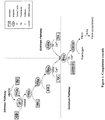
- coagulation pathway or coagulation cascade refers to the series of activation events that leads to the formation of an insoluble fibrin clot.
- an inactive protein of a serine protease also called a zymogen
- fibrinogen is proteolytically cleaved by thrombin to fibrin, which is then crosslinked at the site of injury to form a clot.
- hemostasis refers to the stopping of bleeding or blood flow in an organ or body part.
- the term hemostasis can encompass the entire process of blood clotting to prevent blood loss following blood vessel injury to subsequent dissolution of the blood clot following tissue repair.
- clotting or “coagulation” refers to the formation of an insoluble fibrin clot, or the process by which the coagulation factors of the blood interact in the coagulation cascade, ultimately resulting in the formation of an insoluble fibrin clot.
- proteases are an enzyme that catalyzes the hydrolysis of covalent peptidic bonds. These designations include zymogen forms and activated single-, two- and multiple-chain forms thereof. For clarity, reference to proteases refer to all forms. Proteases include, for example, serine proteases, cysteine proteases, aspartic proteases, threonine and metallo-proteases depending on the catalytic activity of their active site and mechanism of cleaving peptide bonds of a target substrate.
- serine proteases or serine endopeptidases refers to a class of peptidases, which are characterized by the presence of a serine residue in the active site of the enzyme.
- Serine proteases participate in a wide range of functions in the body, including blood clotting and inflammation, as well as functioning as digestive enzymes in prokaryotes and eukaryotes.
- the mechanism of cleavage by serine proteases is based on nucleophilic attack of a targeted peptidic bond by a serine. Cysteine, threonine or water molecules associated with aspartate or metals also can play this role. Aligned side chains of serine, histidine and aspartate form a catalytic triad common to most serine proteases.
- the active site of serine proteases is shaped as a cleft where the polypeptide substrate binds.
- a "factor IX" or FIX polypeptide refers to any factor IX polypeptide including, but not limited to, a recombinantly produced polypeptide, a synthetically produced polypeptide and a factor IX polypeptide extracted or isolated from cells or tissues including, but not limited to, liver and blood.
- Alternative names that are used interchangeably for factor IX include Factor 9, Christmas factor, plasma thromboplastin component (PTC), coagulation factor IX, and serum factor IX.
- Abbreviations for factor IX include FIX and F9.
- Factor IX includes related polypeptides from different species including, but not limited to animals of human and non-human origin.
- Human factor IX includes factor IX, allelic variant isoforms (such as the allelic variant having a T148A (SEQ ID NO:20 or 325) or T412P mutation), synthetic molecules from nucleic acids, protein isolated from human tissue and cells, and modified forms thereof.
- Exemplary unmodified mature human factor IX polypeptides include, but are not limited to, unmodified and wild-type native factor IX polypeptides (such as the polypeptide containing a sequence set forth in SEQ ID NO:3) and the unmodified and wild-type precursor factor IX polypeptide that includes a propeptide and/or a signal peptide (such as, the precursor FIX polypeptide that has the sequence set forth in SEQ ID NO:2).
- the referenced positions of the mature factor IX polypeptide differ by 46 amino acid residues when compared to the precursor FIX polypeptide SEQ ID NO:2, which is the factor IX polypeptide containing the signal peptide and propeptide sequences
- the first amino acid residue of SEQ ID NO:3 "corresponds to" the forty-seventh (47 th ) amino acid residue of SEQ ID NO:2.
- factor IX also encompasses the activated form of the factor IX polypeptide, called factor IXa (FIXa), containing the FIX light chain (corresponding to amino acids 47-191 of SEQ ID NO:2, and amino acids 1-145 of SEQ ID NO:3) and FIX heavy chain (corresponding to amino acids 227-461 of SEQ ID NO:2, and amino acids 181-415 of SEQ ID NO:3) linked by a disulfide bond between residues 132C and 289C (corresponding to the mature FIX polypeptide set forth in SEQ ID NO:3).
- FIXa is produced from a mature FIX polypeptide (e.g.
- proteolytic cleavage can be carried out, for example, by activated factor XI (FXIa) or the tissue factor/activated factor VII (TF/FVIIa) complex.
- FXIa activated factor XI
- TF/FVIIa tissue factor/activated factor VII
- the FIX polypeptides provided herein can be further modified, such as by chemical modification or post-translational modification. Such modifications include, but are not limited to, glycosylation, pegylation, albumination, farnysylation, carboxylation, hydroxylation, phosphorylation, and other polypeptide modifications known in the art.
- Factor IX includes factor IX from any species, including human and non-human species.
- FIX polypeptides of non-human origin include, but are not limited to, murine, canine, feline, leporine, avian, bovine, ovine, porcine, equine, piscine, ranine, and other primate factor IX polypeptides.
- Exemplary FIX polypeptides of non-human origin include, for example, chimpanzee ( Pan troglodytes, SEQ ID NO:4), rhesus macaque ( Macaca mulatta, SEQ ID NO:5), mouse ( Mus musculus, SEQ ID NO:6), rat ( Rattus norvegicus, SEQ ID NO:7), Guinea pig ( Cavia porcellus, SEQ ID NO:8), pig ( Sus scrofa, SEQ ID NO:9), dog ( Canis familiaris, SEQ ID NO:10), cat ( Felis catus, SEQ ID NO:11), rabbit ( Oryctolagus cuniculus, SEQ ID NO:12), chicken ( Gallus gallus, SEQ ID NO:13), cow ( Bos Taurus, SEQ ID NO:14), sheep ( Ovis aries, SEQ ID NO:15), frog ( Xenopus tropicalis, SEQ ID NO:16), zebrafish ( Danio rerio, S
- Reference to FIX polypeptides also includes precursor polypeptides and mature FIX polypeptides in single-chain or two-chain forms, truncated forms thereof that have activity, and includes allelic variants and species variants, variants encoded by splice variants, and other variants, including polypeptides that have at least 40%, 45%, 50%, 55%, 65%, 70%, 75%, 80%, 85%, 90%, 95%, 96%, 97%, 98%, 99% or more sequence identity to the precursor polypeptide set forth in SEQ ID NO:2 or the mature form thereof (SEQ ID NO:3). Included are modified FIX polypeptides, such as those of SEQ ID NOS:75-272 and 326-417 and variants thereof.
- FIX FIX
- FVIIIa binding FVIIIa binding
- factor X binding phospholipid binding
- coagulant activity of a FIX polypeptide.
- the activity can be altered, such as reduced or increased, as compared to a wild-type FIX so long as the level of activity retained is sufficient to yield a detectable effect.
- FIX polypeptides include, but are not limited to, tissue-specific isoforms and allelic variants thereof, synthetic molecules prepared by translation of nucleic acids, proteins generated by chemical synthesis, such as syntheses that include ligation of shorter polypeptides, through recombinant methods, proteins isolated from human and non-human tissue and cells, chimeric FIX polypeptides and modified forms thereof.
- FIX polypeptides also include fragments or portions of FIX that are of sufficient length or include appropriate regions to retain at least one activity (upon activation if needed) of a full-length mature polypeptide.
- FIX polypeptides also include those that contain chemical or posttranslational modifications and those that do not contain chemical or posttranslational modifications. Such modifications include, but are not limited to, pegylation, albumination, glycosylation, farnysylation, carboxylation, hydroxylation, phosphorylation, and other polypeptide modifications known in the art.
- corresponding residues refers to residues that occur at aligned loci.
- Related or variant polypeptides are aligned by any method known to those of skill in the art. Such methods typically maximize matches, and include methods such as using manual alignments and by using the numerous alignment programs available (for example, BLASTP) and others known to those of skill in the art.
- aligning the sequences of polypeptides one skilled in the art can identify corresponding residues, using conserved and identical amino acid residues as guides.
- sequences of factor IX polypeptides one of skill in the art can identify corresponding residues, using conserved and identical amino acid residues as guides.
- the tyrosine in amino acid position 1 (Y1) of SEQ ID NO:3 corresponds to the tyrosine in amino acid position 47 (Y47) of SEQ ID NO:2.
- the Gla domain corresponds to amino acid positions Y1 through V46 of SEQ ID NO:3, and to amino acid positions Y47 through V92 of SEQ ID NO:2.
- conserved amino acid residues as guides to find corresponding amino acid residues between and among human and non-human sequences.
- amino acid residues Q11 and P74 of SEQ ID NO:3 (human) correspond to R11 and Q74 of SEQ ID NO:14 (bovine).
- Corresponding positions also can be based on structural alignments, for example by using computer simulated alignments of protein structure. In other instances, corresponding regions can be identified.
- the same, with reference to an amino acid replacement refers to the identical replacement at the reference amino acid position in SEQ ID NO:3 in a corresponding position in another Factor IX polypeptide.
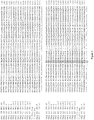
- the same replacement with reference to the replacement of tyrosine at amino acid residue R318 in SEQ ID NO:3 is the replacement of tyrosine at amino acid residue R319 in SEQ ID NO:14 (see, for example, Figure 3 ).
- the same replacement with reference to the replacement of asparagine at amino acid residue E410 in SEQ ID NO:3 is the replacement of asparagine at amino acid residue S410 in SEQ ID NO:366. It is understood that reference to replacement of the same amino acid refers to replacement of amino acid residues that differ at the corresponding position from the replaced residue.
- a proregion refers to a region or a segment that is cleaved to produce a mature protein. This can include segments that function to suppress proteolytic activity by masking the catalytic machinery and thus preventing formation of the catalytic intermediate ( i.e., by sterically occluding the substrate binding site).
- a proregion is a sequence of amino acids positioned at the amino terminus of a mature biologically active polypeptide and can be as little as a few amino acids or can be a multidomain structure.
- mature factor IX refers to a FIX polypeptide that lacks a signal sequence and a propeptide sequence.
- a signal sequence targets a protein for secretion via the endoplasmic reticulum (ER)-golgi pathway and is cleaved following insertion into the ER during translation.
- a propeptide sequence typically functions in post-translational modification of the protein and is cleaved prior to secretion of the protein from the cell.
- a mature FIX polypeptide is typically a secreted protein.
- a mature human FIX polypeptide is set forth in SEQ ID NO:3.
- the amino acid sequence set forth in SEQ ID NO:3 differs from that of the precursor polypeptide set forth in SEQ ID NO:2 in that SEQ ID NO:3 is lacking the signal sequence, which corresponds to amino acid residues 1-28 of SEQ ID NO:2, and also lacks the propeptide sequence, which corresponds to amino acid residues 29-46 of SEQ ID NO:2.
- Reference to a mature FIX polypeptide encompasses the single-chain zymogen form and the two-chain form. Thus, reference to a mature FIX polypeptide also refers to the two chain form containing the heavy chain and light chain (without the activation peptide corresponding to amino acids 192-226 of SEQ ID NO:2) joined by disulfide bonds.
- wild-type or “native” with reference to FIX refers to a FIX polypeptide encoded by a native or naturally occurring FIX gene, including allelic variants, that is present in an organism, including a human and other animals, in nature.
- Reference to wild-type factor IX without reference to a species is intended to encompass any species of a wild-type factor IX. Included among wild-type FIX polypeptides are the encoded precursor polypeptide, fragments thereof, and processed forms thereof, such as a mature form lacking the signal peptide as well as any pre- or post- translationally processed or modified forms thereof.
- native FIX polypeptides include those that are post-translationally modified, including, but not limited to, modification by glycosylation, carboxylation and hydroxylation.
- Native FIX polypeptides also include single-chain and two-chain forms.
- humans express native FIX.
- the amino acid sequence of exemplary wild-type human FIX are set forth in SEQ ID NOS:2 and 3 and allelic variants thereof.
- FIX native FIX
- mice produce native FIX, including, but not limited to, chimpanzee ( Pan troglodytes, SEQ ID NO:4), rhesus macaque ( Macaca mulatta, SEQ ID NO:5), mouse ( Mus musculus, SEQ ID NO:6), rat ( Rattus norvegicus, SEQ ID NO:7), Guinea pig ( Cavia porcellus, SEQ ID NO:8), pig ( Sus scrofa, SEQ ID NO:9), dog ( Canis familiaris, SEQ ID NO:10), cat ( Felis catus, SEQ ID NO:11), rabbit ( Oryctolagus cuniculus, SEQ ID NO:12), chicken ( Gallus gallus, SEQ ID NO:13), cow ( Bos Taurus, SEQ ID NO:14), sheep ( Ovis aries, SEQ ID NO:15), frog ( Xenopus tropicalis, SEQ ID NO:16), zebrafish ( Danio rer
- species variants refer to variants in polypeptides among different species, including different mammalian species, such as mouse and human.
- allelic variants refer to variations in proteins among members of the same species.
- a splice variant refers to a variant produced by differential processing of a primary transcript of genomic DNA that results in more than one type of mRNA.
- a zymogen refers to a protease that is activated by proteolytic cleavage, including maturation cleavage, such as activation cleavage, and/or complex formation with other protein(s) and/or cofactor(s).
- a zymogen is an inactive precursor of a proteolytic enzyme. Such precursors are generally larger, although not necessarily larger, than the active form.
- zymogens are converted to active enzymes by specific cleavage, including catalytic and autocatalytic cleavage, or by binding of an activating co-factor, which generates an active enzyme. For example, generally, zymogens are present in a single-chain form.
- Zymogens generally, are inactive and can be converted to mature active polypeptides by catalytic or autocatalytic cleavage at one or more proteolytic sites to generate a multi-chain, such as a two-chain, polypeptide.
- a zymogen thus, is an enzymatically inactive protein that is converted to a proteolytic enzyme by the action of an activator. Cleavage can be effected by autoactivation.
- a number of coagulation proteins are zymogens; they are inactive, but become cleaved and activated upon the initiation of the coagulation system following vascular damage.
- the FIX polypeptides exist in the blood plasma as zymogens until cleavage by proteases, such as for example, activated FXI (FXIa) or FVIIa (in association with TF) to produce the two-chain form of FIX (FIXa).
- proteases such as for example, activated FXI (FXIa) or FVIIa (in association with TF) to produce the two-chain form of FIX (FIXa).
- an activation sequence refers to a sequence of amino acids in a zymogen that is the site required for activation cleavage or maturation cleavage to form an active protease. Cleavage of an activation sequence can be catalyzed autocatalytically or by activating partners.
- activation cleavage is a type of maturation cleavage, which induces a conformation change that is required for the development of full enzymatic activity.
- This is a classical activation pathway, for example, for serine proteases in which a cleavage generates a new N-terminus that interacts with the conserved regions of the protease, such as Asp 194 in chymotrypsin, to induce conformational changes required for activity.
- Activation can result in production of multi-chain forms of the proteases. In some instances, single chain forms of the protease can exhibit proteolytic activity.
- activated Factor IX refers to any two-chain form of a FIXa polypeptide.
- a two-chain form typically results from proteolytic cleavage, but can be produced synthetically.
- Activated Factor IX thus, includes the zymogen-like two-chain form with low coagulant activity, a fully activated form that occurs upon binding to FVIIIa and FX, and mutated forms that exist in a fully activated two-chain form or undergo conformational change to a fully activated form.
- FIX polypeptide For example, a single-chain form of FIX polypeptide (see, e.g., SEQ ID NO:3) is proteolytically cleaved after amino acid residues R145 and R180 of the mature FIX polypeptide.
- Proteolytic cleavage can be carried out, for example, by activated factor XIa (FXIa), and activated factor VIIa (FVIIa) in complex with TF.
- FXIa activated factor XIa
- FVIIa activated factor VIIa
- a "property" of a FIX polypeptide refers to a physical or structural property, such three-dimensional structure, pI, half-life, conformation and other such physical characteristics.
- an "activity" of a FIX polypeptide refers to any activity exhibited by a factor IX polypeptide. Such activities can be tested in vitro and/or in vivo and include, but are not limited to, coagulation or coagulant activity, pro-coagulant activity, proteolytic or catalytic activity such as to effect factor X (FX) activation; antigenicity (ability to bind to or compete with a polypeptide for binding to an anti-FIX antibody); ability to bind factor Villa or factor X; and/or ability to bind to phospholipids. Activity can be assessed in vitro or in vivo using recognized assays, for example, by measuring coagulation in vitro or in vivo.
- a polypeptide exhibits an activity that can be correlated to activity of the polypeptide in vivo, in which in vivo activity can be referred to as biological activity.
- Assays to determine functionality or activity of modified forms of FIX are known to those of skill in the art.
- Exemplary assays to assess the activity of a FIX polypeptide include prothromboplastin time (PT) assay or the activated partial thromboplastin time (aPTT) assay to assess coagulant activity, or chromogenic assays using synthetic substrates to assess catalytic or proteolytic activity.
- exhibits at least one activity or “retains at least one activity” refers to the activity exhibited by a modified FIX polypeptide as compared to an unmodified FIX polypeptide of the same form and under the same conditions.
- a modified FIX polypeptide in a two-chain form is compared with an unmodified FIX polypeptide in a two-chain form, under the same experimental conditions, where the only difference between the two polypeptides is the modification under study.
- a modified FIX polypeptide in a single-chain form is compared with an unmodified FIX polypeptide in a single-chain form, under the same experimental conditions, where the only difference between the two polypeptides is the modification under study.
- a modified FIX polypeptide that retains or exhibits at least one activity of an unmodified FIX polypeptide of the same form retains a sufficient amount of the activity such that, when administered in vivo, the modified FIX polypeptide is therapeutically effective as a procoagulant therapeutic.
- the amount of activity that is retained is or is about 0.5%, 1%, 2%, 3%, 4%, 5%, 6%, 7%, 8%, 9%, 10%, 11%, 12%, 13%, 14%, 15%, 16%, 17%, 18%, 19%, 20%, 30%, 40%, 50%, 60%, 70%, 80%, 90%, 100%, 200%, 300%, 400%, 500% or more of the activity of an unmodified FIX polypeptide of the same form that displays therapeutic efficacy as a procoagulant.
- the amount of activity that is required to maintain therapeutic efficacy as a procoagulant can be empirically determined, if necessary. Typically, retention of 0.5% to 20%, 0.5% to 10%, 0.5% to 5% of an activity is sufficient to retain therapeutic efficacy as a procoagulant in vivo.
- a modified FIX polypeptide can be any activity, including, but not limited to, coagulation or coagulant activity, pro-coagulant activity; proteolytic or catalytic activity such as to effect factor X (FX) activation; antigenicity (ability to bind to or compete with a polypeptide for binding to an anti-FIX antibody); ability to bind factor VIIIa or factor X; and/or ability to bind to phospholipids.
- a modified FIX polypeptide can retain an activity that is increased compared to an unmodified FIX polypeptide.
- a modified FIX polypeptide can retain an activity that is decreased compared to an unmodified FIX polypeptide.
- Activity of a modified FIX polypeptide can be any level of percentage of activity of the unmodified polypeptide, where both polypeptides are in the same form, including but not limited to, 1% of the activity, 2%, 3%, 4%, 5%, 10%, 20%, 30%, 40%, 50%, 60%, 70%, 80%, 90%, 95%, 96%, 97%, 98%, 99%, 100%, 200%, 300%, 400%, 500%, or more activity compared to the polypeptide that does not contain the modification at issue.
- a modified FIX polypeptide can exhibit increased or decreased activity compared to the unmodified FIX polypeptide in the same form.
- it can retain at least about or 1%, 2%, 3%, 4%, 5%, 6%, 7%, 8%, 9%, 10%, 20%, 30%, 40%, 50%, 60%, 70%, 80%, 90%, 95%, 96%, 97%, 98% or at least 99% of the activity of the unmodified FIX polypeptide.
- the change in activity is at least about 2 times, 3 times, 4 times, 5 times, 6 times, 7 times, 8 times, 9 times, 10 times, 20 times, 30 times, 40 times, 50 times, 60 times, 70 times, 80 times, 90 times, 100 times, 200 times, 300 times, 400 times, 500 times, 600 times, 700 times, 800 times, 900 times, 1000 times, or more times greater than unmodified FIX.
- the particular level to be retained is a function of the intended use of the polypeptide and can be empirically determined. Activity can be measured, for example, using in vitro or in vivo assays such as those described herein.
- coagulation activity or “coagulant activity” or “pro-coagulant activity” refers to the ability of a polypeptide to effect coagulation.
- Assays to assess coagulant activity are known to those of skill in the art, and include prothrombin time (PT) assay or the activated partial thromboplastin time (aPTT) assay.
- PT prothrombin time
- aPTT activated partial thromboplastin time
- proteolytic activity refers to the ability of a FIX protein to catalyze the proteolytic cleavage of a substrate, and are used interchangeably. Assays to assess such activities are known in the art. For example, the proteolytic activity of FIX can be measured using chromogenic substrates such as Mes-D-CHD-Gly-Arg-AMC, where cleavage of the substrate is monitored by absorbance and the rate of substrate hydrolysis determined by linear regression.
- domain refers to a portion of a molecule, such as proteins or the encoding nucleic acids, that is structurally and/or functionally distinct from other portions of the molecule and is identifiable.
- domains include those portions of a polypeptide chain that can form an independently folded structure within a protein made up of one or more structural motifs and/or that is recognized by virtue of a functional activity, such as proteolytic activity.
- a protein can have one, or more than one, distinct domains.
- a domain can be identified, defined or distinguished by homology of the sequence therein to related family members, such as homology to motifs that define a protease domain or a gla domain.
- a domain can be distinguished by its function, such as by proteolytic activity, or an ability to interact with a biomolecule, such as DNA binding, ligand binding, and dimerization.
- a domain independently can exhibit a biological function or activity such that the domain independently or fused to another molecule can perform an activity, such as, for example proteolytic activity or ligand binding.
- a domain can be a linear sequence of amino acids or a non-linear sequence of amino acids.
- Many polypeptides contain a plurality of domains. Such domains are known, and can be identified by those of skill in the art. For exemplification herein, definitions are provided, but it is understood that it is well within the skill in the art to recognize particular domains by name. If needed appropriate software can be employed to identify domains.
- a protease domain is the catalytically active portion of a protease.
- Reference to a protease domain of a protease includes the single, two- and multi-chain forms of any of these proteins.
- a protease domain of a protein contains all of the requisite properties of that protein required for its proteolytic activity, such as for example, the catalytic center.
- the protease domain shares homology and structural feature with the chymotrypsin/trypsin family protease domains, including the catalytic triad. For example, in the mature FIX polypeptide set forth in SEQ ID NO:3, the protease domain corresponds to amino acid positions 181 to 412.
- a gamma-carboxyglutamate (Gla) domain refers to the portion of a protein, for example a vitamin K-dependent protein, that contains post-translational modifications of glutamate residues, generally most, but not all of the glutamate residues, by vitamin K-dependent carboxylation to form Gla.
- the Gla domain is responsible for the high-affinity binding of calcium ions and binding to negatively-charged phospholipids.
- the Gla domain starts at the N-terminal extremity of the mature form of vitamin K-dependent proteins and ends with a conserved aromatic residue.
- the Gla domain corresponds to amino acid positions 1 to 46 of the exemplary polypeptide set forth in SEQ ID NO:3.
- Gla domains are well known and their locus can be identified in particular polypeptides.
- the Gla domains of the various vitamin K-dependent proteins share sequence, structural and functional homology, including the clustering of N-terminal hydrophobic residues into a hydrophobic patch that mediates interaction with negatively charged phospholipids on the cell surface membrane.
- Exemplary other Gla-containing polypeptides include, but are not limited to, FVII, FX, prothrombin, protein C, protein S, osteocalcin, matrix Gla protein, Growth-arrest-specific protein 6 (Gas6), and protein Z.
- an epidermal growth factor (EGF) domain refers to the portion of a protein that shares sequence homology to a specific 30 to 40 amino acid portion of the epidermal growth factor (EGF) sequence.
- the EGF domain includes six cysteine residues that have been shown (in EGF) to be involved in disulfide bonds.
- the main structure of an EGF domain is a two-stranded beta-sheet followed by a loop to a C-terminal short two-stranded sheet.
- FIX contains two EGF domains: EGF-1 and EGF-2. These domains correspond to amino acid positions 47-83, and 84-125, respectively, of the mature FIX polypeptide set forth in SEQ ID NO:3.
- unmodified polypeptide or "unmodified FIX" and grammatical variations thereof refer to a starting polypeptide that is selected for modification as provided herein.
- the starting polypeptide can be a naturally-occurring, wild-type form of a polypeptide.
- the starting polypeptide can be altered or mutated, such that it differs from a native wild type isoform but is nonetheless referred to herein as a starting unmodified polypeptide relative to the subsequently modified polypeptides produced herein.
- existing proteins known in the art that have been modified to have a desired increase or decrease in a particular activity or property compared to an unmodified reference protein can be selected and used as the starting unmodified polypeptide.
- a protein that has been modified from its native form by one or more single amino acid changes and possesses either an increase or decrease in a desired property, such as a change in a amino acid residue or residues to alter glycosylation can be a target protein, referred to herein as unmodified, for further modification of either the same or a different property.
- exemplary modified FIX polypeptides known in the art include any FIX polypeptide described in, for example, Schuettrumpf et al., (2005) Blood 105(6):2316-23 ; Melton et al., (2001) Blood Coagul. Fibrinolysis 12(4):237-43 ; Cheung et al., (1992) J. Biol. Chem.
- modified factor IX polypeptides and “modified factor IX” refer to a FIX polypeptide that has one or more amino acid differences compared to an unmodified factor IX polypeptide.
- the one or more amino acid differences can be amino acid mutations such as one or more amino acid replacements (substitutions), insertions or deletions, or can be insertions or deletions of entire domains, and any combinations thereof.
- a modified FIX polypeptide has one or more modifications in primary sequence compared to an unmodified FIX polypeptide.
- a modified FIX polypeptide provided herein can have 1, 2, 3, 4, 5, 6, 7, 8, 9, 10, 11, 12, 13, 14, 15, 16, 17, 18, 19, 20, 30, 40, 50 or more amino acid differences compared to an unmodified FIX polypeptide. Any modification is contemplated as long as the resulting polypeptide exhibits at least one FIX activity associated with a native FIX polypeptide, such as, for example, catalytic activity, proteolytic activity, the ability to bind FVIIIa or the ability to bind phospholipids.
- antithrombin III or "AT-III” is a serine protease inhibitor (serpin). AT-III is synthesized as a precursor protein containing 464 amino acid residues (SEQ ID NO:21) that is cleaved during secretion to release a 432 amino acid mature antithrombin (SEQ ID NO:22).
- heparin refers to a heterogeneous group of straight-chain highly sulfated glycosaminoglycans having anticoagulant properties. Heparin can bind to AT-III to form the AT-III/heparin complex.
- increased resistance to AT-III and/or heparin refers to any amount of decreased sensitivity of a polypeptide, such as a modified FIX polypeptide, to the inhibitory effects of AT-III alone, heparin alone and/or the AT-III/heparin complex compared with a reference polypeptide, such as an unmodified FIX polypeptide.
- Increased resistance to AT-III, heparin, and/or an AT-III/heparin complex can be assayed by assessing the binding of a modified FIX polypeptide to AT-III, heparin, and/or an AT-III complex.
- Increased resistance also can be assayed by measuring inhibition of the catalytic or coagulant activity of a FIX polypeptide in the presence of AT-III, heparin, or an AT-III/heparin complex.
- Assays to determine the binding of a polypeptide to an inhibitor or the inhibition of enzymatic activity of a polypeptide by an inhibitor are known in the art.
- covalent inhibitors such as, for example, AT-III or an AT-III/heparin complex
- a second order rate constant for inhibition can be measured.
- non-covalent inhibitors such as, for example, heparin, a k i can be measured.
- surface plasma resonance such as on a BIAcore biosensor instrument, also can be used to measure the binding of FIX polypeptides to AT-III, heparin, and/or an AT-III/heparin complex using one or more defined conditions.
- covalent inhibitors such as AT-III or an AT-III/heparin complex
- non-covalent inhibitors such as heparin
- Assays to determine the inhibitory effect of, for example, AT-III/heparin on FIX coagulant activity also are known in the art.
- the ability of a modified FIX polypeptide to cleave its substrate FX in the presence or absence of AT-III/heparin can be measured, and the degree to which AT-III/heparin inhibits the reaction determined. This can be compared to the ability of an unmodified FIX polypeptide to cleave its substrate FX in the presence or absence of AT-III.
- the second order rate constant for inhibition of a FIX polypeptide can be measured and compared to the second order rate constant for inhibition of an unmodified FIX polypeptide. When comparing second order rate constants for inhibition, increased resistance to inhibition means a decreased second order rate constant of inhibition.
- a modified polypeptide that exhibits increased resistance to AT-III and/or heparin exhibits, for example, an increase of 1%, 2%, 3%, 4%, 5%, 6%, 7%, 8%, 9%, 10%, 20%, 30%, 40%, 50%, 60%, 70%, 80%, 90%, 91%, 92%, 93%, 94%, 95%, 96%, 97%, 98%, 99%, 100%, 200%, 300%, 400%, 500%, or more resistance to the effects of AT-III, heparin, and/or an AT-III/heparin complex, respectively, compared to an unmodified polypeptide.
- cofactors refer to proteins or molecules that bind to other specific proteins or molecules to form an active complex. In some examples, binding to a cofactor is required for optimal proteolytic activity.
- FVIIIa is a cofactor of FIXa. Binding of FVIIIa to FIXa induces conformational changes that result in increased proteolytic activity of FIXa for its substrate, FX.
- glycosylation site refers to an amino position in a polypeptide to which a carbohydrate moiety can be attached.
- a glycosylated protein contains one or more amino acid residues, such as asparagine or serine, for the attachment of the carbohydrate moieties.
- a native glycosylation site refers to the position of an amino acid to which a carbohydrate moiety is attached in a wild-type polypeptide.
- a non-native glycosylation site refers to the position of an amino acid to which a carbohydrate moiety is attached in a modified polypeptide that is not present in a wild-type polypeptide.
- Non-native glycosylation sites can be introduced into a FIX polypeptide by amino acid replacement.
- O-glycosylation sites can be created, for example, by amino acid replacement of a native residue with a serine or threonine.
- N-glycosylation sites can be created, for example, by establishing the motif Asn-Xaa-Ser/Thr/Cys, where Xaa is not proline.
- Creation of this consensus sequence by amino acid modification can involve, for example, a single amino acid replacement of a native amino acid residue with an asparagine, a single amino acid replacement of a native amino acid residue with a serine, threonine or cysteine, or a double amino acid replacement involving a first amino acid replacement of a native residue with an asparagine and a second amino acid replacement of native residue with a serine, threonine or cysteine.
- increased levels of glycosylation refers to an increased amount of carbohydrate linked to a polypeptide as compared with a reference polypeptide or protein.
- the carbohydrate can be N-linked, O-linked, C-linked or be attached by any other linkage.
- the level of glycosylation can be increased by at least about 1%, 2%, 3%, 4%, 5%, 6%, 7%, 8%, 9%, 10%, 20%, 30%, 40%, 50%, 60%, 70%, 80%, 90%, 100%, 200%, 300%, 400%, 500%, or more compared to the level of glycosylation of an unmodified polypeptide.
- Assays to determine the level of glycosylation (i.e. amount of carbohydrate) of a polypeptide are known in the art.
- the carbohydrate content or level of glycosylation can be assessed by high pH anion exchange chromatography, fluorophoreassisted carbohydrate electrophoresis (FACE), sequential exoglycosidase digestions, mass spectrometry, NMR, gel electrophoresis or any other method described herein or known in the art.
- FACE fluorophoreassisted carbohydrate electrophoresis
- biological activity refers to the in vivo activities of a compound or physiological responses that result upon in vivo administration of a compound, composition or other mixture. Biological activity, thus, encompasses therapeutic effects and pharmaceutical activity of such compounds, compositions and mixtures. Biological activities can be observed in in vitro systems designed to test or use such activities. Thus, for purposes herein a biological activity of a FIX polypeptide encompasses the coagulant activity.
- a pharmacokinetic property refers to a property related to the action of a drug or agent, such as a FIX polypeptide, in the body and in particular the rate at which drugs are absorbed, distributed, metabolized, and eliminated by the body.
- Pharmacokinetics can be assessed by various parameters. These include, but are not limited to, clearance, volume of distribution, in vivo recovery, total modified FIX polypeptide exposure in vivo, serum half-life, and mean resonance time (MRT).
- Pharmacokinetic properties of polypeptide can be assessed using methods well known in the art, such as, for example, administering the polypeptide to a human or animal model and assessing the amount of FIX in the body at various time points.
- the various parameters, such as clearance, volume of distribution, in vivo recovery, total modified FIX polypeptide exposure in vivo, serum half-life, and mean resonance time (MRT) are assessed using calculations well known in the art and described herein.
- improved pharmacokinetic properties refers to a desirable change in a pharmacokinetic property of a polypeptide, such as a modified FIX polypeptide, compared to, for example, an unmodified FIX polypeptide.
- the change can be an increase or a decrease.
- clearance refers to the removal of an agent, such as a polypeptide, from the body of a subject following administration. Clearance can be assessed using methods well known in the art, such as those described in Example 6. For example, assays in which a FIX polypeptide is administered to mice can be performed, and the clearance of the polypeptide from the body assessed by measuring the amount of FIX in the plasma at various time points and calculating the clearance as Dose / AUC 0-inf . Improved clearance of a modified FIX polypeptide compared to an unmodified FIX polypeptide refers to a decrease in clearance of a modified FIX polypeptide compared to an unmodified FIX polypeptide.
- the clearance of a modified FIX polypeptide can be decreased by at least or about 1%, 2%, 3%, 4%, 5%, 6%, 7%, 8%, 9%, 10%, 20%, 30%, 40%, 50%, 60%, 70%, 80%, 90%, 91%, 92%, 93%, 94%, 95%, 96%, 97%, 98% or 99% compared to an unmodified FIX polypeptide.
- mean resonance time refers to the amount of time a FIX polypeptide resides in the body following administration. MRT can be assessed using methods well known in the art, such as those described in Example 6. For example, assays in which a FIX polypeptide is administered to mice can be performed, and the MRT of the polypeptide assessed by measuring the amount of FIX in the plasma at various time points and calculating the MRT as AUMC 0-last /AUC 0-last , where AUC 0-last is total area under the curve and AUMC 0-last is the total area under the first moment-versus-time curve.
- Improved MRT of a modified FIX polypeptide compared to an unmodified FIX polypeptide refers to an increase in MRT of a modified FIX polypeptide compared to an unmodified FIX polypeptide.
- the MRT of a modified FIX polypeptide can be increased by at least or about 1%, 2%, 3%, 4%, 5%, 6%, 7%, 8%, 9%, 10%, 20%, 30%, 40%, 50%, 60%, 70%, 80%, 90%, 91%, 92%, 93%, 94%, 95%, 96%, 97%, 98%, 99%, 100%, 200%, 300%, 400%, 500% or more compared to an unmodified FIX polypeptide.
- in vivo recovery refers to the percentage of FIX polypeptide detectable in the circulation after a period of time following administration in relation to the total amount of FIX polypeptide administered. In vivo recovery can be assessed using methods well known in the art, such as those described in Example 6. For example, assays in which a FIX polypeptide is administered to mice can be performed, and the in vivo recovery of the polypeptide assessed by measuring the amount of FIX in the plasma at C max and comparing it to the amount of FIX administered.
- Improved in vivo recovery of a modified FIX polypeptide compared to an unmodified FIX polypeptide refers to an increase in in vivo recovery of a modified FIX polypeptide compared to an unmodified FIX polypeptide.
- the in vivo recovery of a modified FIX polypeptide can be increased by at least or about 1%, 2%, 3%, 4%, 5%, 6%, 7%, 8%, 9%, 10%, 20%, 30%, 40%, 50%, 60%, 70%, 80%, 90%, 91%, 92%, 93%, 94%, 95%, 96%, 97%, 98%, 99%, 100%, 200%, 300%, 400%, 500% or more compared to an unmodified FIX polypeptide.
- plasma half-life refers the elimination half-life of a FIX polypeptide, or the time at which the plasma concentration of the FIX polypeptide has reached one half of its initial or maximal concentration following administration.
- Reference to plasma half-life includes plasma half-life during the ⁇ -, ⁇ -, and/or ⁇ -phase.
- Plasma half-life can be assessed using methods well known in the art, such as those described in Example 6. For example, assays in which a FIX polypeptide is administered to mice can be performed, and the plasma half-life of the polypeptide assessed by measuring the amount of FIX in the plasma at various time points.
- the T 1 ⁇ 2 ⁇ is calculated as -ln2 divided by the negative slope during the terminal phase of the log-linear plot of the plasma FIX concentration-versus-time curve.
- Improved plasma half-life of a modified FIX polypeptide compared to an unmodified FIX polypeptide refers to an increase in plasma half-life of a modified FIX polypeptide compared to an unmodified FIX polypeptide.
- the plasma half-life of a modified FIX polypeptide can be increased by at least or about 1%, 2%, 3%, 4%, 5%, 6%, 7%, 8%, 9%, 10%, 20%, 30%, 40%, 50%, 60%, 70%, 80%, 90%, 91%, 92%, 93%, 94%, 95%, 96%, 97%, 98%, 99%, 100%, 200%, 300%, 400%, 500% or more compared to an unmodified FIX polypeptide.
- exposure in vivo refers to the amount of FIX polypeptide in the circulation following administration in relation to the plasma area under the concentration-time curve, or AUC, of FIX polypeptide administered. Exposure in vivo can be assessed using methods well known in the art, such as those described in Example 6. For example, assays in which a FIX polypeptide is administered to mice can be performed, and the in vivo recovery of the polypeptide assessed by measuring the amount of FIX in the plasma at various time points (i.e., AUC) and comparing it to the amount of FIX administered.
- AUC concentration-time curve
- Improved exposure in vivo of a modified FIX polypeptide compared to an unmodified FIX polypeptide refers to an increase in exposure in vivo of a modified FIX polypeptide compared to an unmodified FIX polypeptide.
- the exposure in vivo of a modified FIX polypeptide can be increased by at least or about 1%, 2%, 3%, 4%, 5%, 6%, 7%, 8%, 9%, 10%, 20%, 30%, 40%, 50%, 60%, 70%, 80%, 90%, 91%, 92%, 93%, 94%, 95%, 96%, 97%, 98%, 99%, 100%, 200%, 300%, 400%, 500% or more compared to an unmodified FIX polypeptide.
- volume of distribution refers to the distribution of a FIX polypeptide between plasma and the rest of the body following administration. It is defined as the volume in which the amount of polypeptide would need to be uniformly distributed to produce the observed concentration of polypeptide in the plasma. Volume of distribution can be assessed using methods well known in the art, such as those described in Example 6.
- V ss which is the steady state volume of distribution (calculated as MRT ⁇ Cl) and V z , which is the volume of distribution based on the terminal elimination constant ( ⁇ ) (calculated as Cl/(ln2/T 1 ⁇ 2 ⁇ )
- ⁇ the terminal elimination constant
- Improved volume of distribution of a modified FIX polypeptide compared with an unmodified FIX polypeptide, depending on the protein's mechanism of clearance and safety profile can refer to either an increase or a decrease in the volume of distribution of a modified FIX polypeptide.
- a decreased volume of distribution of a modified FIX polypeptide could result in significantly increased drug exposure and activity in the compartment of interest (e.g., the vascular compartment versus an extravascular compartment) compared with an unmodified FIX polypeptide.
- drug safety is limited by C max
- redistribution into other compartments e.g., binding to the surface of endothelial cells
- an superior safety profile compared to the unmodified FIX polypeptide.
- the volume of distribution of a modified FIX polypeptide can be decreased by at least or about 1%, 2%, 3%, 4%, 5%, 6%, 7%, 8%, 9%, 10%, 20%, 30%, 40%, 50%, 60%, 70%, 80%, 90%, 91%, 92%, 93%, 94%, 95%, 96%, 97%, 98% or 99% compared to an unmodified FIX polypeptide.
- the volume of distribution of the modified FIX polypeptide is increased by at least or about 1%, 2%, 3%, 4%, 5%, 6%, 7%, 8%, 9%, 10%, 20%, 30%, 40%, 50%, 60%, 70%, 80%, 90%, 91%, 92%, 93%, 94%, 95%, 96%, 97%, 98%, 99%, 100%, 200%, 300%, 400%, 500% or more of the volume of distribution of an unmodified FIX polypeptide.
- the term "assess”, and grammatical variations thereof, is intended to include quantitative and qualitative determination in the sense of obtaining an absolute value for the activity of a polypeptide, and also of obtaining an index, ratio, percentage, visual or other value indicative of the level of the activity. Assessment can be direct or indirect. For example, detection of cleavage of a substrate by a polypeptide can be by direct measurement of the product, or can be indirectly measured by determining the resulting activity of the cleaved substrate.
- chymotrypsin numbering refers to the amino acid numbering of a mature bovine chymotrypsin polypeptide of SEQ ID NO:19. Alignment of a protease domain of another protease, such as for example the protease domain of factor IX, can be made with chymotrypsin. In such an instance, the amino acids of factor IX that correspond to amino acids of chymotrypsin are given the numbering of the chymotrypsin amino acids. Corresponding positions can be determined by such alignment by one of skill in the art using manual alignments or by using the numerous alignment programs available (for example, BLASTP).
- Corresponding positions also can be based on structural alignments, for example by using computer simulated alignments of protein structure. Recitation that amino acids of a polypeptide correspond to amino acids in a disclosed sequence refers to amino acids identified upon alignment of the polypeptide with the disclosed sequence to maximize identity or homology (where conserved amino acids are aligned) using a standard alignment algorithm, such as the GAP algorithm.
- the corresponding chymotrypsin numbers of amino acid positions 181 to 415 of the FIX polypeptide set forth in SEQ ID NO:3 are provided in Table 1.
- the amino acid positions relative to the sequence set forth in SEQ ID NO:3 are in normal font, the amino acid residues at those positions are in bold, and the corresponding chymotrypsin numbers are in italics.
- V valine at amino acid position 181 in factor IX is given the chymotrypsin numbering of V16. Subsequent amino acids are numbered accordingly.
- a glutamic acid (E) at amino acid position 213 of the mature factor IX (SEQ ID NO:3) corresponds to amino acid position E49 based on chymotrypsin numbering. Where a residue exists in a protease, but is not present in chymotrypsin, the amino acid residue is given a letter notation.
- A95a and A95b by chymotrypsin numbering correspond to A261 and A262, respectively, by numbering relative to the mature factor IX sequence (SEQ ID NO:3).
- Table 1 Chymotrypsin numbering of factor IX 181 182 183 184 185 186 187 188 189 190 191 192 193 194 195 V V G G E D A K P G Q F P W Q 16 17 18 19 20 21 22 23 24 25 26 27 28 29 30 196 197 198 199 200 201 202 203 204 205 206 207 208 209 210 V V L N G K V D A F C G G S I 31 32 33 34 35 37 38 39 40 41 42 43 44 45 46 211 212 213 214 215 216 217 218 219 220 221 222 223 224 225 V N E K W I V T A A H C V E T 47 48 49 50 51 52 53 54 55 56 57 58 59 60 60A 226 227 228 2
- nucleic acids include DNA, RNA and analogs thereof, including peptide nucleic acids (PNA) and mixtures thereof. Nucleic acids can be single or double-stranded. When referring to probes or primers, which are optionally labeled, such as with a detectable label, such as a fluorescent or radiolabel, single-stranded molecules are contemplated. Such molecules are typically of a length such that their target is statistically unique or of low copy number (typically less than 5, generally less than 3) for probing or priming a library. Generally a probe or primer contains at least 14, 16 or 30 contiguous nucleotides of sequence complementary to or identical to a gene of interest. Probes and primers can be 10, 20, 30, 50, 100 or more nucleic acids long.
- a peptide refers to a polypeptide that is from 2 to 40 amino acids in length.
- amino acids that occur in the various sequences of amino acids provided herein are identified according to their known, three-letter or one-letter abbreviations (Table 2).
- the nucleotides which occur in the various nucleic acid fragments are designated with the standard single-letter designations used routinely in the art.
- amino acid is an organic compound containing an amino group and a carboxylic acid group.
- a polypeptide contains two or more amino acids.
- amino acids include the twenty naturally-occurring amino acids, non-natural amino acids and amino acid analogs (i.e., amino acids wherein the ⁇ -carbon has a side chain).
- amino acid residue sequences represented herein by formulae have a left to right orientation in the conventional direction of amino-terminus to carboxyl-terminus.
- amino acid residue is broadly defined to include the amino acids listed in the Table of Correspondence (Table 2) and modified and unusual amino acids, such as those referred to in 37 C.F.R. ⁇ 1.821-1.822, and incorporated herein by reference.
- a dash at the beginning or end of an amino acid residue sequence indicates a peptide bond to a further sequence of one or more amino acid residues, to an amino-terminal group such as NH 2 or to a carboxyl-terminal group such as COOH.
- naturally occurring amino acids refer to the 20 L-amino acids that occur in polypeptides.
- non-natural amino acid refers to an organic compound containing an amino group and a carboxylic acid group that is not one of the naturally-occurring amino acids listed in Table 2.
- Non-naturally occurring amino acids thus include, for example, amino acids or analogs of amino acids other than the 20 naturally-occurring amino acids and include, but are not limited to, the D-isostereomers of amino acids.
- Exemplary non-natural amino acids are known to those of skill in the art and can be included in a modified factor IX polypeptide.
- conservative amino acid substitutions may be made in any of polypeptides and domains thereof provided that the resulting protein exhibits an activity of a FIX.
- Conservative amino acid substitutions such as those set forth in Table 2B, are those that do not eliminate proteolytic activity. Suitable conservative substitutions of amino acids are known to those of skill in this art and may be made generally without altering the biological activity of the resulting molecule. Those of skill in this art recognize that, in general, single amino acid substitutions in non-essential regions of a polypeptide do not substantially alter biological activity (see, e.g. , Watson et al. Molecular Biology of the Gene, 4th Edition, 1987, The Benjamin/Cummings Pub. co., p.224 ).
- the catalytically active fragment of an MTSP particularly a single chain protease portion.
- Conservative amino acid substitutions are made, for example, in accordance with those set forth in Table 2B as follows: TABLE 2B Original residue Conservative substitution Ala (A) Gly; Ser, Abu Arg (R) Lys, orn Asn (N) Gln; His Cys (C) Ser Gln (Q) Asn Glu (E) Asp Gly (G) Ala; Pro His (H) Asn; Gln Ile (I) Leu; Val; Met; Nle; Nva Leu (L) Ile; Val; Met; Nle; Nv Lys (K) Arg; Gln; Glu Met (M) Leu; Tyr; Ile; NLe Val Ornithine Lys; Arg Phe (F) Met; Leu; Tyr Ser (S) Thr Thr (T) Ser Trp (W) Tyr Tyr (Y) Trp; Phe Val (V) Ile; Le
- DNA construct is a single or double stranded, linear or circular DNA molecule that contains segments of DNA combined and juxtaposed in a manner not found in nature.
- DNA constructs exist as a result of human manipulation, and include clones and other copies of manipulated molecules.
- a DNA segment is a portion of a larger DNA molecule having specified attributes.
- a DNA segment encoding a specified polypeptide is a portion of a longer DNA molecule, such as a plasmid or plasmid fragment, which, when read from the 5' to 3' direction, encodes the sequence of amino acids of the specified polypeptide.
- polynucleotide means a single- or double-stranded polymer of deoxyribonucleotides or ribonucleotide bases read from the 5' to the 3' end.
- Polynucleotides include RNA and DNA, and can be isolated from natural sources, synthesized in vitro, or prepared from a combination of natural and synthetic molecules.
- the length of a polynucleotide molecule is given herein in terms of nucleotides (abbreviated "nt") or base pairs (abbreviated "bp").
- nt nucleotides
- bp base pairs
- double-stranded molecules When the term is applied to double-stranded molecules it is used to denote overall length and will be understood to be equivalent to the term base pairs. It will be recognized by those skilled in the art that the two strands of a double-stranded polynucleotide can differ slightly in length and that the ends thereof can be staggered; thus all nucleotides within a double-stranded polynucleotide molecule can not be paired. Such unpaired ends will, in general, not exceed 20 nucleotides in length.
- primary sequence refers to the sequence of amino acid residues in a polypeptide.
- similarity between two proteins or nucleic acids refers to the relatedness between the sequence of amino acids of the proteins or the nucleotide sequences of the nucleic acids. Similarity can be based on the degree of identity and/or homology of sequences of residues and the residues contained therein. Methods for assessing the degree of similarity between proteins or nucleic acids are known to those of skill in the art. For example, in one method of assessing sequence similarity, two amino acid or nucleotide sequences are aligned in a manner that yields a maximal level of identity between the sequences. "Identity” refers to the extent to which the amino acid or nucleotide sequences are invariant.
- Alignment of amino acid sequences, and to some extent nucleotide sequences, also can take into account conservative differences and/or frequent substitutions in amino acids (or nucleotides). Conservative differences are those that preserve the physico-chemical properties of the residues involved. Alignments can be global (alignment of the compared sequences over the entire length of the sequences and including all residues) or local (the alignment of a portion of the sequences that includes only the most similar region or regions).
- homology As used herein, the terms “homology” and “identity”” are used interchangeably, but homology for proteins can include conservative amino acid changes. In general to identify corresponding positions the sequences of amino acids are aligned so that the highest order match is obtained (see, e.g.
- sequence identity refers to the number of identical amino acids (or nucleotide bases) in a comparison between a test and a reference polypeptide or polynucleotide.
- Homologous polypeptides refer to a pre-determined number of identical or homologous amino acid residues. Homology includes conservative amino acid substitutions as well identical residues. Sequence identity can be determined by standard alignment algorithm programs used with default gap penalties established by each supplier.
- Homologous nucleic acid molecules refer to a pre-determined number of identical or homologous nucleotides. Homology includes substitutions that do not change the encoded amino acid ( i.e., "silent substitutions") as well identical residues.
- Substantially homologous nucleic acid molecules hybridize typically at moderate stringency or at high stringency all along the length of the nucleic acid or along at least about 70%, 80% or 90% of the full-length nucleic acid molecule of interest. Also contemplated are nucleic acid molecules that contain degenerate codons in place of codons in the hybridizing nucleic acid molecule. (For determination of homology of proteins, conservative amino acids can be aligned as well as identical amino acids; in this case, percentage of identity and percentage homology varies).
- nucleic acid molecules have nucleotide sequences (or any two polypeptides have amino acid sequences) that are at least 80%, 85%, 90%, 95%, 96%, 97%, 98% or 99% "identical” can be determined using known computer algorithms such as the "FAST A” program, using for example, the default parameters as in Pearson et al. Proc. Natl. Acad. Sci. USA 85: 2444 (1988 ) (other programs include the GCG program package ( Devereux, J., et al., Nucleic Acids Research 12(1): 387 (1984 )), BLASTP, BLASTN, FASTA ( Atschul, S.F., et al., J. Molec. Biol.
- a GAP program defines similarity as the number of aligned symbols (i.e., nucleotides or amino acids) which are similar, divided by the total number of symbols in the shorter of the two sequences.
- Default parameters for the GAP program can include: (1) a unary comparison matrix (containing a value of 1 for identities and 0 for non identities) and the weighted comparison matrix of Gribskov et al. Nucl. Acids Res. 14: 6745 (1986 ), as described by Schwartz and Dayhoff, eds., Atlas of Protein Sequence and Structure, National Biomedical Research Foundation, pp. 353-358 (1979 ); (2) a penalty of 3.0 for each gap and an additional 0.10 penalty for each symbol in each gap; and (3) no penalty for end gaps.
- the term "identity” represents a comparison between a test and a reference polypeptide or polynucleotide.
- "at least 90% identical to” refers to percent identities from 90 to 100% relative to the reference polypeptides. Identity at a level of 90% or more is indicative of the fact that, assuming for exemplification purposes a test and reference polynucleotide length of 100 amino acids are compared, no more than 10% ( i.e., 10 out of 100) of amino acids in the test polypeptide differs from that of the reference polypeptides. Similar comparisons can be made between a test and reference polynucleotides.
- differences can be represented as point mutations randomly distributed over the entire length of an amino acid sequence or they can be clustered in one or more locations of varying length up to the maximum allowable, e.g., 10/100 amino acid difference (approximately 90% identity). Differences are defined as nucleic acid or amino acid substitutions, insertions or deletions. At the level of homologies or identities above about 85-90%, the result should be independent of the program and gap parameters set; such high levels of identity can be assessed readily, often without relying on software.
- an aligned sequence refers to the use of homology (similarity and/or identity) to align corresponding positions in a sequence of nucleotides or amino acids. Typically, two or more sequences that are related by 50% or more identity are aligned.
- An aligned set of sequences refers to 2 or more sequences that are aligned at corresponding positions and can include aligning sequences derived from RNAs, such as ESTs and other cDNAs, aligned with genomic DNA sequence.
- telomere sequence As used herein, “specifically hybridizes” refers to annealing, by complementary base-pairing, of a nucleic acid molecule (e.g. an oligonucleotide) to a target nucleic acid molecule.
- a nucleic acid molecule e.g. an oligonucleotide
- Parameters particularly relevant to in vitro hybridization further include annealing and washing temperature, buffer composition and salt concentration.
- Exemplary washing conditions for removing non-specifically bound nucleic acid molecules at high stringency are 0.1 x SSPE, 0.1% SDS, 65°C, and at medium stringency are 0.2 x SSPE, 0.1% SDS, 50°C. Equivalent stringency conditions are known in the art. The skilled person can readily adjust these parameters to achieve specific hybridization of a nucleic acid molecule to a target nucleic acid molecule appropriate for a particular application.
- isolated or purified polypeptide or protein or biologically-active portion thereof is substantially free of cellular material or other contaminating proteins from the cell of tissue from which the protein is derived, or substantially free from chemical precursors or other chemicals when chemically synthesized. Preparations can be determined to be substantially free if they appear free of readily detectable impurities as determined by standard methods of analysis, such as thin layer chromatography (TLC), gel electrophoresis and high performance liquid chromatography (HPLC), used by those of skill in the art to assess such purity, or sufficiently pure such that further purification would not detectably alter the physical and chemical properties, such as proteolytic and biological activities, of the substance.
- TLC thin layer chromatography
- HPLC high performance liquid chromatography
- substantially free of cellular material includes preparations of proteins in which the protein is separated from cellular components of the cells from which it is isolated or recombinantly-produced.
- the term substantially free of cellular material includes preparations of protease proteins having less that about 30% (by dry weight) of non-protease proteins (also referred to herein as a contaminating protein), generally less than about 20% of non-protease proteins or 10% of non-protease proteins or less that about 5% of non-protease proteins.
- the protease protein or active portion thereof When the protease protein or active portion thereof is recombinantly produced, it also is substantially free of culture medium, i.e., culture medium represents less than, about, or equal to 20%, 10% or 5% of the volume of the protease protein preparation.
- the term substantially free of chemical precursors or other chemicals includes preparations of protease proteins in which the protein is separated from chemical precursors or other chemicals that are involved in the synthesis of the protein.
- the term includes preparations of protease proteins having less than about 30% (by dry weight), 20%, 10%, 5% or less of chemical precursors or non-protease chemicals or components.
- production by recombinant methods by using recombinant DNA methods refers to the use of the well known methods of molecular biology for expressing proteins encoded by cloned DNA.
- vector refers to discrete elements that are used to introduce heterologous nucleic acid into cells for either expression or replication thereof.
- the vectors typically remain episomal, but can be designed to effect integration of a gene or portion thereof into a chromosome of the genome.
- vectors that are artificial chromosomes such as bacterial artificial chromosomes, yeast artificial chromosomes and mammalian artificial chromosomes. Selection and use of such vehicles are well known to those of skill in the art.
- expression refers to the process by which nucleic acid is transcribed into mRNA and translated into peptides, polypeptides, or proteins. If the nucleic acid is derived from genomic DNA, expression can, if an appropriate eukaryotic host cell or organism is selected, include processing, such as splicing of the mRNA.
- an expression vector includes vectors capable of expressing DNA that is operatively linked with regulatory sequences, such as promoter regions, that are capable of effecting expression of such DNA fragments. Such additional segments can include promoter and terminator sequences, and optionally can include one or more origins of replication, one or more selectable markers, an enhancer, a polyadenylation signal, and the like. Expression vectors are generally derived from plasmid or viral DNA, or can contain elements of both. Thus, an expression vector refers to a recombinant DNA or RNA construct, such as a plasmid, a phage, recombinant virus or other vector that, upon introduction into an appropriate host cell, results in expression of the cloned DNA. Appropriate expression vectors are well known to those of skill in the art and include those that are replicable in eukaryotic cells and/or prokaryotic cells and those that remain episomal or those which integrate into the host cell genome.
- vector also includes "virus vectors” or “viral vectors.”
- viral vectors are engineered viruses that are operatively linked to exogenous genes to transfer (as vehicles or shuttles) the exogenous genes into cells.
- an adenovirus refers to any of a group of DNA-containing viruses that cause conjunctivitis and upper respiratory tract infections in humans.
- naked DNA refers to histone-free DNA that can be used for vaccines and gene therapy. Naked DNA is the genetic material that is passed from cell to cell during a gene transfer processed called transformation or transfection. In transformation or transfection, purified or naked DNA that is taken up by the recipient cell will give the recipient cell a new characteristic or phenotype.
- operably or operatively linked when referring to DNA segments means that the segments are arranged so that they function in concert for their intended purposes, e.g ., transcription initiates in the promoter and proceeds through the coding segment to the terminator.
- an agent that modulates the activity of a protein or expression of a gene or nucleic acid either decreases or increases or otherwise alters the activity of the protein or, in some manner, up- or down-regulates or otherwise alters expression of the nucleic acid in a cell.
- a "chimeric protein” or “fusion protein” refers to a polypeptide operatively-linked to a different polypeptide.
- a chimeric or fusion protein provided herein can include one or more FIX polypeptides, or a portion thereof, and one or more other polypeptides for any one or more of a transcriptional/translational control signals, signal sequences, a tag for localization, a tag for purification, part of a domain of an immunoglobulin G, and/or a targeting agent.
- a chimeric FIX polypeptide also includes those having their endogenous domains or regions of the polypeptide exchanged with another polypeptide.
- chimeric or fusion proteins include those produced by recombinant means as fusion proteins, those produced by chemical means, such as by chemical coupling, through, for example, coupling to sulfhydryl groups, and those produced by any other method whereby at least one polypeptide ( i.e . FIX), or a portion thereof, is linked, directly or indirectly via linker(s) to another polypeptide.
- operatively-linked when referring to a fusion protein refers to a protease polypeptide and a non-protease polypeptide that are fused in-frame to one another.
- the non-protease polypeptide can be fused to the N-terminus or C-terminus of the protease polypeptide.
- a targeting agent is any moiety, such as a protein or effective portion thereof, that provides specific binding to a cell surface molecule, such a cell surface receptor, which in some instances can internalize a bound conjugate or portion thereof.
- a targeting agent also can be one that promotes or facilitates, for example, affinity isolation or purification of the conjugate; attachment of the conjugate to a surface; or detection of the conjugate or complexes containing the conjugate.
- derivative or analog of a molecule refers to a portion derived from or a modified version of the molecule.
- disease or disorder refers to a pathological condition in an organism resulting from cause or condition including, but not limited to, infections, acquired conditions, genetic conditions, and characterized by identifiable symptoms.
- Diseases and disorders of interest herein are those involving coagulation, including those mediated by coagulation proteins and those in which coagulation proteins play a role in the etiology or pathology.
- Diseases and disorders also include those that are caused by the absence of a protein such as in hemophilia, and of particular interest herein are those disorders where coagulation does not occur due to a deficiency of defect in a coagulation protein.
- procoagulant refers to any substance that promotes blood coagulation.
- anticoagulant refers to any substance that inhibits blood coagulation
- hemophilia refers to a bleeding disorder caused by a deficiency in a blood clotting factors. Hemophilia can be the result, for example, of absence, reduced expression, or reduced function of a clotting factor.
- the most common type of hemophilia is hemophilia A, which results from a deficiency in factor VIII.
- the second most common type of hemophilia is hemophilia B, which results from a deficiency in factor IX.
- Hemophilia C also called FXI deficiency, is a milder and less common form of hemophilia.
- congenital hemophilia refers to types of hemophilia that are inherited. Congenital hemophilia results from mutation, deletion, insertion, or other modification of a clotting factor gene in which the production of the clotting factor is absent, reduced, or non-functional. For example, hereditary mutations in clotting factor genes, such as factor VIII and factor IX result in the congenital hemophilias, Hemophilia A and B, respectively.
- hemophilia refers to a type of hemophilia that develops in adulthood from the production of autoantibodies that inactivate FVIII.
- Bleeding disorder refers to a condition in which the subject has a decreased ability to control bleeding. Bleeding disorders can be inherited or acquired, and can result from, for example, defects or deficiencies in the coagulation pathway, defects or deficiencies in platelet activity, or vascular defects.
- anquired bleeding disorder refers to bleeding disorders that results from clotting deficiencies caused by conditions such as liver disease, vitamin K deficiency, or coumadin (warfarin) or other anti-coagulant therapy.
- treating means that a polypeptide, composition or other product provided herein is administered to the subject.
- a therapeutic agent, therapeutic regimen, radioprotectant, or chemotherapeutic mean conventional drugs and drug therapies, including vaccines, which are known to those skilled in the art. Radiotherapeutic agents are well known in the art.
- treatment means any manner in which the symptoms of a condition, disorder or disease are ameliorated or otherwise beneficially altered. Hence treatment encompasses prophylaxis, therapy and/or cure. Treatment also encompasses any pharmaceutical use of the compositions herein. Treatment also encompasses any pharmaceutical use of a modified FIX and compositions provided herein.
- amelioration of the symptoms of a particular disease or disorder by a treatment refers to any lessening, whether permanent or temporary, lasting or transient, of the symptoms that can be attributed to or associated with administration of the composition or therapeutic.
- prevention or prophylaxis refers to methods in which the risk of developing disease or condition is reduced.
- Prophylaxis includes reduction in the risk of developing a disease or condition and/or a prevention of worsening of symptoms or progression of a disease or reduction in the risk of worsening of symptoms or progression of a disease.
- an effective amount of a compound or composition for treating a particular disease is an amount that is sufficient to ameliorate, or in some manner reduce the symptoms associated with the disease.
- Such amount can be administered as a single dosage or can be administered according to a regimen, whereby it is effective.
- the amount can cure the disease but, typically, is administered in order to ameliorate the symptoms of the disease. Typically, repeated administration is required to achieve a desired amelioration of symptoms.
- therapeutically effective amount refers to an agent, compound, material, or composition containing a compound that is at least sufficient to produce a therapeutic effect.
- An effective amount is the quantity of a therapeutic agent necessary for preventing, curing, ameliorating, arresting or partially arresting a symptom of a disease or disorder.
- patient or “subject” to be treated includes humans and or non-human animals, including mammals.
- Mammals include primates, such as humans, chimpanzees, gorillas and monkeys; domesticated animals, such as dogs, horses, cats, pigs, goats, cows; and rodents such as mice, rats, hamsters and gerbils.
- a combination refers to any association between two or among more items.
- the association can be spatial or refer to the use of the two or more items for a common purpose.
- a composition refers to any mixture of two or more products or compounds (e.g., agents, modulators, regulators, etc.). It can be a solution, a suspension, liquid, powder, a paste, aqueous or non-aqueous formulations or any combination thereof.
- an. "article of manufacture” is a product that is made and sold. As used throughout this application, the term is intended to encompass modified protease polypeptides and nucleic acids contained in articles of packaging.
- fluid refers to any composition that can flow. Fluids thus encompass compositions that are in the form of semi-solids, pastes, solutions, aqueous mixtures, gels, lotions, creams and other such compositions.
- kits refers to a packaged combination, optionally including reagents and other products and/or components for practicing methods using the elements of the combination.
- kits containing a modified protease polypeptide or nucleic acid molecule provided herein and another item for a purpose including, but not limited to, administration, diagnosis, and assessment of a biological activity or property are provided. Kits optionally include instructions for use.
- antibody includes antibody fragments, such as Fab fragments, which are composed of a light chain and the variable region of a heavy chain.
- a receptor refers to a molecule that has an affinity for a particular ligand.
- Receptors can be naturally-occurring or synthetic molecules. Receptors also can be referred to in the art as anti-ligands.
- animal includes any animal, such as, but not limited to; primates including humans, gorillas and monkeys; rodents, such as mice and rats; fowl, such as chickens; ruminants, such as goats, cows, deer, sheep; ovine, such as pigs and other animals.
- Non-human animals exclude humans as the contemplated animal.
- the proteases provided herein are from any source, animal, plant, prokaryotic and fungal.
- gene therapy involves the transfer of heterologous nucleic acid, such as DNA, into certain cells, target cells, of a mammal, particularly a human, with a disorder or condition for which such therapy is sought.
- the nucleic acid, such as DNA is introduced into the selected target cells, such as directly or in a vector or other delivery vehicle, in a manner such that the heterologous nucleic acid, such as DNA, is expressed and a therapeutic product encoded thereby is produced.
- the heterologous nucleic acid, such as DNA can in some manner mediate expression of DNA that encodes the therapeutic product, or it can encode a product, such as a peptide or RNA that in some manner mediates, directly or indirectly, expression of a therapeutic product.
- Genetic therapy also can be used to deliver nucleic acid encoding a gene product that replaces a defective gene or supplements a gene product produced by the mammal or the cell in which it is introduced.
- the introduced nucleic acid can encode a therapeutic compound, such as a protease or modified protease, that is not normally produced in the mammalian host or that is not produced in therapeutically effective amounts or at a therapeutically useful time.
- the heterologous nucleic acid, such as DNA, encoding the therapeutic product can be modified prior to introduction into the cells of the afflicted host in order to enhance or otherwise alter the product or expression thereof.
- Genetic therapy also can involve delivery of an inhibitor or repressor or other modulator of gene expression.
- heterologous nucleic acid is nucleic acid that is not normally produced in vivo by the cell in which it is expressed or that is produced by the cell but is at a different locus or expressed differently or that mediates or encodes mediators that alter expression of endogenous nucleic acid, such as DNA, by affecting transcription, translation, or other regulatable biochemical processes.
- Heterologous nucleic acid is generally not endogenous to the cell into which it is introduced, but has been obtained from another cell or prepared synthetically.
- Heterologous nucleic acid can be endogenous, but is nucleic acid that is expressed from a different locus or altered in its expression.
- heterologous nucleic acid such as DNA
- heterologous nucleic acid or foreign nucleic acid includes a nucleic acid molecule not present in the exact orientation or position as the counterpart nucleic acid molecule, such as DNA, is found in a genome. It also can refer to a nucleic acid molecule from another organism or species ( i.e., exogenous).
- heterologous nucleic acid includes exogenously added nucleic acid that also is expressed endogenously.
- heterologous nucleic acid include, but are not limited to, nucleic acid that encodes traceable marker proteins, such as a protein that confers drug resistance, nucleic acid that encodes therapeutically effective substances, such as anti-cancer agents, enzymes and hormones, and nucleic acid, such as DNA, that encodes other types of proteins, such as antibodies.
- Antibodies that are encoded by heterologous nucleic acid can be secreted or expressed on the surface of the cell in which the heterologous nucleic acid has been introduced.
- a therapeutically effective product for gene therapy is a product that is encoded by heterologous nucleic acid, typically DNA, that, upon introduction of the nucleic acid into a host, a product is expressed that ameliorates or eliminates the symptoms, manifestations of an inherited or acquired disease or that cures the disease.
- heterologous nucleic acid typically DNA
- biologically active nucleic acid molecules such as RNAi and antisense.
- polypeptide consists essentially of a recited sequence of amino acids means that only the recited portion, or a fragment thereof, of the full-length polypeptide is present.
- the polypeptide can optionally, and generally will, include additional amino acids from another source or can be inserted into another polypeptide
- ranges and amounts can be expressed as “about” a particular value or range. About also includes the exact amount. Hence “about 5 bases” means “about 5 bases” and also “5 bases.”
- an optionally substituted group means that the group is unsubstituted or is substituted.
- modified Factor IX (FIX) polypeptides including modified FIXa polypeptides and catalytically active fragments thereof.
- Factor IX polypeptides play a role in the regulation of and process of hemostasis, and hence can be used as therapeutic agents. Effective delivery of therapeutic proteins such as FIX for clinical use is a major challenge to pharmaceutical science. Once in the blood stream, these proteins are constantly eliminated from circulation within a short time by different physiological processes, involving metabolism as well as clearance using normal pathways for protein elimination, such as (glomerular) filtration in the kidneys or proteolysis in blood. Once in the luminal gastrointestinal tract, these proteins are constantly digested by luminal proteases.
- inhibitors in the blood can specifically inhibit the activity of the therapeutic protein.
- antithrombin AT-III
- heparin heparin
- AT-III/heparin complex can inhibit the coagulant activity of FIX.
- modified FIX polypeptides provided herein exhibit impropved properties, including improved pharmacokinetic properties, such as increased serum half-life; increased resistance to inhibitors, such as antithrombin III (AT-III), heparin and the AT-III/heparin complex; increased catalytic activity; or any combination thereof.
- modified FIX polypeptides that have increased coagulant activity. Accordingly, these polypeptides have a variety of uses and applications, for example, as therapeutics for modulating hemostasis.
- the following discussion provides a review of the coagulation process and the role of Factor IX in this process, before a discussion of factor IX, and modifications thereof.
- Hemostasis is the physiological mechanism that stems the bleeding that results from injury to the vasculature. Normal hemostasis depends on cellular components and soluble plasma proteins, and involves a series of signaling events that ultimately leads to the formation of a blood clot. Coagulation is quickly initiated after an injury occurs to the blood vessel and endothelial cells are damaged. In the primary phase of coagulation, platelets are activated to form a haemostatic plug at the site of injury. Secondary hemostasis follows involving plasma coagulation factors, which act in a proteolytic cascade resulting in the formation of fibrin strands which strengthen the platelet plug.
- vWF von Willebrand factor
- Such secretion promotes additional adhesion and aggregation of platelets, increased platelet activation and blood vessel constriction, and exposure of anionic phospholipids on the platelet surface that serve as platforms for the assembly of blood coagulation enzyme complexes.
- the platelets change shape leading to pseudopodia formation, which further facilitates aggregation to other platelets resulting in a loose platelet plug.
- a clotting cascade of peptidases (the coagulation cascade) is simultaneously initiated.
- the coagulation cascade involves a series of activation events involving proteolytic cleavage.
- an inactive protein of a serine protease also called a zymogen
- an active protease by cleavage of one or more peptide bonds, which then serves as the activating protease for the next zymogen molecule in the cascade, ultimately resulting in clot formation by the cross-linking of fibrin.
- the cascade generates activated molecules such as thrombin (from cleavage of prothrombin), which further activates platelets, and also generates fibrin from cleavage of fibrinogen. Fibrin then forms a cross-linked polymer around the platelet plug to stabilize the clot.
- fibrin is digested by the fibrinolytic system, the major components of which are plasminogen and tissue-type plasminogen activator (tPA). Both of these proteins are incorporated into polymerizing fibrin, where they interact to generate plasmin, which, in turn, acts on fibrin to dissolve the preformed clot.
- coagulation factor inhibitors also circulate through the blood to prevent clot formation beyond the injury site.
- the clotting of blood is actively circumvented under normal conditions.
- the vascular endothelium supports vasodilation, inhibits platelet adhesion and activation, suppresses coagulation, enhances fibrin cleavage and is anti-inflammatory in character.
- Vascular endothelial cells secrete molecules such as nitrous oxide (NO) and prostacylin, which inhibit platelet aggregation and dilate blood vessels. Release of these molecules activates soluble guanylate cyclases (sGC) and cGMP-dependent protein kinase I (cGKI) and increases cyclic guanosine monophosphate (cGMP) levels, which cause relaxation of the smooth muscle in the vessel wall.
- NO nitrous oxide
- prostacylin which inhibit platelet aggregation and dilate blood vessels. Release of these molecules activates soluble guanylate cyclases (sGC) and cGMP-dependent protein kinase I (cGKI) and increases cyclic gua
- endothelial cells express cell-surface ADPases, such as CD39, which control platelet activation and aggregation by converting ADP released from platelets into adenine nucleotide platelet inhibitors.
- the endothelium also plays an important role in the regulation of the enzymes in the fibrinolytic cascade. Endothelial cells directly promote the generation of plasmin through the expression of receptors of plasminogen (annexin II) and urokinase, as well as the secretion of tissue-type and urokinase plasminogen activators, all of which promote clot clearance.
- endothelial cells play an active role in inhibiting the coagulation cascade by producing heparan sulfate, which increases the kinetics of antithrombin III inhibition of thrombin and other coagulation factors.
- vasoconstrictor mechanisms predominate and the endothelium becomes prothrombotic, procoagulatory and proinflammatory in nature. This is achieved by a reduction of endothelial dilating agents: adenosine, NO and prostacyclin; and the direct action of ADP, serotonin and thromboxane on vascular smooth muscle cells to elicit their contraction (Becker, Heindl et al.. 2000).
- the chief trigger for the change in endothelial function that leads to the formation of haemostatic thrombus is the loss of the endothelial cell barrier between blood and extracellular matrix (ECM) components ( Ruggeri (2002) Nat Med 8:1227-1234 ).
- Circulating platelets identify and discriminate areas of endothelial lesions and adhere to the exposed sub endothelium. Their interaction with the various thrombogenic substrates and locally-generated or released agonists results in platelet activation. This process is described as possessing two stages, 1) adhesion: the initial tethering to a surface, and 2) aggregation: the platelet-platelet cohesion ( Savage et al. (2001) Curr Opin Hematol 8:270-276 ).
- Platelet adhesion is initiated when the circulating platelets bind to exposed collagen through interaction with collagen binding proteins on the cell surface, and through interaction with vWF, also present on the endothelium.
- vWF protein is a multimeric structure of variable size, secreted in two directions by the endothelium; basolaterally and into the bloodstream.
- vWF also binds to factor VIII, which is important in the stabilization of factor VIII and its survival in the circulation.
- vWF binds via its A1 domain to GPIb (part of the platelet glycoprotein receptor complex GPIb-IX-V).
- GPIb part of the platelet glycoprotein receptor complex GPIb-IX-V.
- the interaction between vWF and GPIb is regulated by shear force such that an increase in the shear stress results in a corresponding increase in the affinity of vWF for GPIb.
- Integrin ⁇ 1 ⁇ 2 also known on leukocytes as VLA-2, is the major collagen receptor on platelets, and engagement through this receptor generates the intracellular signals that contribute to platelet activation. Binding through ⁇ 1 ⁇ 2 facilitates the engagement of the lower-affinity collagen receptor, GP VI.
- ADP adenosine diphosphate
- Platelet activation also results in the surface expression of platelet glycoprotein IIb-IIIa (GP IIb-IIIa) receptors, also known as platelet integrin ⁇ IIb ⁇ 3.
- GP IIb-IIIa receptors allow the adherence of platelets to each other (i.e. aggregation) by virtue of fibrinogen molecules linking the platelets through these receptors. This results in the formation of a platelet plug at the site of injury to help prevent further blood loss, while the damaged vascular tissue releases factors that initiate the coagulation cascade and the formation of a stabilizing fibrin mesh around the platelet plug.
- the coagulation pathway is a proteolytic pathway where each enzyme is present in the plasma as a zymogen, or inactive form. Cleavage of the zymogen is regulated to release the active form from the precursor molecule.
- the pathway functions as a series of positive and negative feedback loops that control the activation process, where the ultimate goal is to produce thrombin, which can then convert soluble fibrinogen into fibrin to form a clot.
- the coagulation factors, and other proteins participate in blood coagulation through one or more of the intrinsic, extrinsic or common pathway of coagulation. As discussed below, these pathways are interconnected, and blood coagulation likely occurs through a cell-based model of activation.
- thrombin has historically been divided into three pathways, the intrinsic (suggesting that all components of the pathway are intrinsic to plasma) and extrinsic (suggesting that one or more components of the pathway are extrinsic to plasma) pathways that provide alternative routes for the generation of activated factor X (FXa), and the final common pathway which results in thrombin formation ( Figure 1 ). These pathways participate together in an interconnected and interdependent process to effect coagulation. A cell-based model of coagulation was developed that describes these pathways ( Figure 2 ) ( Hoffman et al. (2001) Thromb Haemost 85:958-965 ).
- the "extrinsic” and “intrinsic” pathways are effected on different cell surfaces; the tissue factor (TF)-bearing cell and the platelet, respectively.
- the process of coagulation is separated into distinct phases, initiation, amplification and propagation, during which the extrinsic and intrinsic pathways function at various stages to produce the large burst of thrombin required to convert sufficient quantities of fibrinogen to fibrin for clot formation.
- FVII is considered to be the coagulation factor responsible for initiating the coagulation cascade, which initiation is dependent on its interaction with TF.
- TF is a transmembrane glycoprotein expressed by a variety of cells such as smooth muscle cells, fibroblasts, monocytes, lymphocytes, granulocytes, platelets and endothelial cells. Myeloid cells and endothelial cells only express TF when they are stimulated, such as by proinflammatory cytokines. Smooth muscle cells and fibroblasts, however, express TF constitutively. Accordingly, once these cells come in contact with the bloodstream following tissue injury, the coagulation cascade is rapidly initiated by the binding of TF with factor VII or FVIIa in the plasma.
- TF/FVIIa complexes can be formed by the direct binding of FVIIa to TF, or by the binding of FVII to TF and then the subsequent activation of FVII to FVIIa by a plasma protease, such as FXa, FIXa, FXIIa, or FVIIa itself.
- the TF/FVIIa complex remains anchored to the TF-bearing cell where it activates small amounts FX into FXa in what is known as the "extrinsic pathway" of coagulation.
- the TF/FVIIa complex also cleaves small amounts of FIX into FIXa.
- FXa associates with its cofactor FVa to also form a complex on the TF-bearing cell that can then covert prothrombin to thrombin.
- the small amount of thrombin produced is, however, inadequate to support the required fibrin formation for complete clotting.
- any active FXa and FIXa are inhibited in the circulation by antithrombin III (AT-III) and other serpins, which are discussed in more detail below. This would normally prevent clot formation in the circulation.
- A-III antithrombin III
- damage to the vasculature results in platelet aggregation and activation at this site of thrombin formation, thereby allowing for amplification of the coagulation signal.
- Amplification takes place when thrombin binds to and activates the platelets.
- the activated platelets release FV from their alpha granules, which is activated by thrombin to FVa.
- Thrombin also releases and activates FVIII from the FVIII/vWF complex on the platelet membrane, and cleaves FXI into FXIa.
- These reactions generate activated platelets that have FVa, FVIIIa and FIXa on their surface, which set the stage for a large burst of thrombin generation during the propagation stage.
- Propagation of coagulation occurs on the surface of large numbers of platelets at the site of injury.
- the activated platelets have FXIa, FVIIIa and FVa on their surface. It is here that the extrinsic pathway is effected.
- FXIa activates FIX to FIXa, which can then bind with FVIIIa. This process, in addition to the small amounts of FIXa that is generated by cleavage of FIX by the TF/FVIIa complex on the TF-bearing cell, generates a large amount FIXa in complex with its cofactor, FVIIIa, calcium and a suitable phospholipid surface.
- This complex is termed the tenase or Xase complex, and it cleaves and activates the Factor X (FX) to Factor Xa (FXa).
- the FXa molecules bind to FVa to generate the prothrombinase complexes that activate prothrombin to thrombin.
- Thrombin acts in a positive feedback loop to activate even more platelets and again initiates the processes described for the amplification phase.
- Fibrinogen is a dimer soluble in plasma which, when cleaved by thrombin, releases fibrinopeptide A and fibrinopeptide B. Fibrinopeptide B is then cleaved by thrombin, and the fibrin monomers formed by this second proteolytic cleavage spontaneously forms an insoluble gel.
- the polymerized fibrin is held together by noncovalent and electrostatic forces and is stabilized by the transamidating enzyme factor XIIIa (FXIIIa), produced by the cleavage of FXIII by thrombin.
- FXIIIa transamidating enzyme factor XIIIa
- thrombin also activates TAFI, which inhibits fibrinolysis by reducing plasmin generation at the clot surface.
- thrombin itself is incorporated into the structure of the clot for further stabilization.
- the cascade is regulated by constitutive and stimulated processes to inhibit further clot formation. Regulation is important to a) limit ischemia of tissues by fibrin clot formation, and b) prevent widespread thrombosis by localizing the clot formation only to the site of tissue injury.
- antithrombin III and tissue factor pathway inhibitor (TFPI) work constitutively to inhibit factors in the coagulation cascade.
- TFPI predominantly inhibits FXa and FVIIa/TF complex.
- AT-III which is a serine protease inhibitor (serpin)
- Serpin serine protease inhibitor
- Heparin also can inhibit the activity of the FIXa/FVIIIa complex in an AT-III-independent manner ( Yuan et al., (2005) Biochemistry 44:3615-3625 ).
- An additional factor, Protein C which is stimulated via platelet activation, regulates coagulation by proteolytic cleavage and inactivation of FVa and FVIIIa. Protein S enhances the activity of Protein C.
- Another factor which contributes to coagulation inhibition is the integral membrane protein thrombomodulin, which is produced by vascular endothelial cells and serves as a receptor for thrombin. Binding of thrombin to thrombomodulin inhibits thrombin procoagulant activities and also contributes to protein C activation.
- Fibrinolysis the breakdown of the fibrin clot, also provides a mechanism for regulating coagulation.
- the crosslinked fibrin multimers in a clot are broken down to soluble polypeptides by plasmin, a serine protease.
- Plasmin can be generated from its inactive precursor plasminogen and recruited to the site of a fibrin clot in two ways: by interaction with tissue plasminogen activator (tPA) at the surface of a fibrin clot, and by interaction with urokinase plasminogen activator (uPA) at a cell surface.
- tPA tissue plasminogen activator
- uPA urokinase plasminogen activator
- Clot dissolution also is regulated in two ways.
- efficient plasmin activation and fibrinolysis occur only in complexes formed at the clot surface or on a cell membrane, while proteins free in the blood are inefficient catalysts and are rapidly inactivated.
- plasminogen activators and plasmin are inactivated by molecules such as plasminogen activator inhibitor type 1 (PAI-1) and PAI-2 which act on the plasminogen activators, and ⁇ 2-antiplasmin and ⁇ 2-macroglobulin that inactivate plasmin.
- PAI-1 plasminogen activator inhibitor type 1
- PAI-2 plasminogen activator inhibitor type 1
- ⁇ 2-antiplasmin and ⁇ 2-macroglobulin that inactivate plasmin.
- modified FIX polypeptides with improved activities or functions.
- FIX is a polypeptide that is involved in the coagulation cascade.
- the role of FIX in the coagulation cascade is related to its structure and mechanism of activation. It is understood that the modulation of coagulation by modified FIX polypeptides provided herein also is linked to its structure and mechanism of activation.
- These features can be the same as an unmodified FIX polypeptide. In other cases, these features can be modified in a FIX polypeptide provided herein, thus resulting in a polypeptide with altered or improved activities or properties. For example, modification of a FIX polypeptide can alter one or more activities of a FIX polypeptide.
- modified FIX polypeptides that exhibit increased levels of glycosylation compared to a wild-type FIX polypeptide.
- the modified FIX polypeptides can thus exhibit improved pharmacokinetic properties, such as reduced clearance and increased serum half-life compared to a wild-type FIX polypeptide, when tested using in vivo assays.
- modified FIX polypeptides that exhibit increased resistance to inhibitors, such as AT-III, heparin and the AT-III/heparin complex; and/or increased catalytic activity.
- modified FIX polypeptides that exhibit improved therapeutic properties compared to an unmodified FIX polypeptide.
- Factor IX is a vitamin K-dependent serine protease and is an important coagulation factor in hemostasis. It is synthesized as a single chain zymogen in the liver and circulates in the blood in this inactivated state until activated as part of the coagulation cascade. Following activation from the FIX zymogen to activated FIX (FIXa) by FXIa or the TF/FVIIa complex, FIXa binds it's cofactor, FVIIIa. The resulting FIXa/FVIIIa complex binds and activates FX to FXa, thus continuing the coagulation cascade described above to establish hemostasis.
- the concentration of FIX in the blood is approximately 4-5 ⁇ g/mL, and it has a half-life of approximately 18-24 hours.
- Hemophilia B also known as Christmas disease or factor IX deficiency, is caused by a deficiency or dysfunction of FIX resulting from any one or more of a variety of mutations in the FIX gene. While less prevalent than Hemophilia A, Hemophilia B remains a significant disease in which recurrent joint bleeds can lead to synovial hypertrophy, chronic synovitis, with destruction of synovium, cartilage, and bone leading to chronic pain, stiffness of the joints, and limitation of movement because of progressive severe joint damage. Recurrent muscle bleeds also produce acute pain, swelling, and limitation of movement, while bleeding at other sites can contribute to morbidity and mortality. Treatment is typically by replacement therapy with recombinant FIX (rFIX). Provided herein are modified FIX polypeptides that are designed to have increased coagulation activity upon activation, and that can serve as improved therapeutics to treat diseases and conditions amenable to factor IX therapy, such as Hemophilia B.
- rFIX
- the human FIX gene is located on the X chromosome and is approximately 34 kb long with eight exons.
- the human FIX transcript is 2803 nucleotides and contains a short 5' untranslated region, an open reading frame (including stop codon) of 1383 nucleotides and a 3' untranslated region.
- the 1383 nucleotide open reading frame (or FIX mRNA; SEQ ID NO:1) encodes a 461 amino acid precursor polypeptide (Swiss-Prot accession no.
- the FIX precursor polypeptide also contains an 18 amino acid propeptide (aa 29-46 of SEQ ID NO:2) that, when cleaved, releases the 415 amino acid mature polypeptide (SEQ ID NO:3) that circulates in the blood as a zymogen until activation to FIXa.
- the FIX precursor also contains the following segments and domains: a Gla domain (aa 47-92 of SEQ ID NO:2, corresponding to aa 1-46 of the mature FIX protein set forth in SEQ ID NO:3), epidermal growth factor (EGF)-like domain 1 (EGF1; aa 93-129 of SEQ ID NO:2, corresponding to aa 47-83 of the mature FIX protein set forth in SEQ ID NO:3), EGF2 (aa 130-171 of SEQ ID NO:2, corresponding to aa 84-125 of the mature FIX protein set forth in SEQ ID NO:3), a light chain (aa 47-191 of SEQ ID NO:2, corresponding to aa 1-145 of the mature FIX protein set forth in SEQ ID NO:3), an activation peptide (aa 192-226 of SEQ ID NO:2, corresponding to aa 146-180 of the mature FIX protein set forth in SEQ ID NO:
- the Gla domain of FIX is a membrane binding motif which, in the presence of calcium ions, interacts with the phospholipid membranes of cells.
- the vitamin K-dependent proteins require vitamin K for the posttranslational synthesis of ⁇ -carboxyglutamic acid, an amino acid clustered in the Gla domain of these proteins.
- the FIX Gla domain has 12 glutamic residues, each of which are potential carboxylation sites. Many of them are, therefore, modified by carboxylation to generate ⁇ -carboxyglutamic acid residues.
- the FIX polypeptide also contains two EGF-like domains.
- Each EGF-like domain contains six highly conserved cysteine residues that form three disulphide bonds in each domain in the same pattern observed in the EGF protein.
- the first EGF-like domain (EGF1) is a calcium-binding EGF domain containing a high affinity Ca 2+ binding site ( Rao et al., (1995) Cell 82:131-141 ) that, when occupied by a calcium ion, contributes to the correct folding of the molecule and promotes biological activity.
- the second EGF domain does not contain a calcium binding site.
- the serine protease domain, or catalytic domain, of FIX is the domain responsible for the proteolytic activity of FIXa.
- FIX contains a serine protease catalytic triad composed of H221, D269 and S365 (corresponding to H57, D102 and S195 by chymotrypsin numbering).
- Activation of mature FIX to FIXa is effected by proteolytic cleavage of the R145-A146 bonds and R180-V181 bonds (numbering relative to the mature FIX polypeptide set forth in SEQ ID NO:3), releasing the activation peptide that corresponds to aa 146-180 of the mature FIX protein set forth in SEQ ID NO:3.
- FIXa consists of two chains; the light chain and heavy chain.
- the light chain contains the Gla domain, EGF1 and EGF2 domains, and the heavy chain contains the protease domain.
- the two chains are held together by a single disulphide bond between C132 and C289.
- the Factor IX precursor polypeptide undergoes extensive posttranslational modification to become the mature zymogen that is secreted into the blood.
- posttranslation modifications include ⁇ -carboxylation, ⁇ -hydroxylation, cleavage of the signal peptide and propeptide, O- and N-linked glycosylation, sulfation and phosphorylation.
- the N-terminal signal peptide directs the polypeptide to the endoplasmic reticulum (ER), after which it is cleaved.
- the propeptide is cleaved by processing proteases, such as, for example, PACE/furin, that recognize at least two arginine residues within four amino acids prior to the cleavage site.
- the ⁇ -carboxylase binds to the FIX propeptide and catalyzes a second carboxylation on the ⁇ -carbon of the glutamic acid residues (i.e. Glu to ⁇ -carboxyglutamyl or Gla) in the Gla domain of the polypeptide.
- FIX contains 12 Gla residues, where the first 10 are at homologous positions of other vitamin K-dependent proteins.
- the Gla domain of FIX then processively carboxylates all glutamates in the cluster before releasing the substrate (Morris et al. 1995; Berkner 2000; Stenina et al. 2001).
- FIX also is partially ⁇ -hydroxylated. This modification is performed by a dioxygenase, which hydroxylates the ⁇ -carbon of D64 (corresponding to the mature FIX polypeptide set forth in SEQ ID NO:3) in EGF1. Approximately one third of human FIX polypeptides are ⁇ -hydroxylated. Although D64 contributes to the high affinity Ca 2+ binding site in the EGF1 domain of FIX, the hydroxylation of this residue does not appear to be necessary for Ca 2+ binding, nor for biological activity ( Derian et al., (1989) J. Biol. Chem. 264:6615-6618 , Sunnerhagen et al., (1993) J. Biol. Chem.
- Additional post-translational modifications include sulfonation at the tyrosine at postion 155, and phosphorylation at the serine residue at position 158. These post-translational modifications of Factor IX have been implicated in contributing to in vivo recovery of FIX ( Kaufman (1998) Thromb. Haemost. 79:1068-1079 , US Pat. No. 7,575,897 ).
- FIX is N-linked glycosylated at asparagine residues in the activation peptide corresponding to N157 and N167 of the mature FIX polypeptide set forth in SEQ ID NO:3.
- Post-translational modification also results in the serine residue at position 53 (corresponding to the mature FIX polypeptide set forth in SEQ ID NO:3) having O-linked disaccharides and trisaccharides, while the serine residue at position 61 contains an O-linked tertrasaccharide.
- threonine residues at amino acid positions 159 and 169 are O-glycosylated ( Agarwala et al., (1994) Biochemistry 33:5167-5171 ).
- the threonine residues at amino acid positions 172 and 179 also may be O-glycosylated.
- Factor IX circulates predominantly as a zymogen with minimal proteolytic activity until it is activated by proteolytic cleavage. Activation can be effected by the TF/FVIIa complex or Factor XIa. Activation by TF/FVIIa is through the intrinsic pathway, while activation by FXIa is through the extrinsic pathway, described above. The process of activation appears to be sequential with initial cleavage of the Arg145-Ala146 bond, followed by cleavage of the Arg180-Val181 bond ( Schmidt et al. (2003) Trends Cardio. Med. 13:39-45 ).
- the proteolytic cleavage releases the activation peptide, forming the two-chain FIXa molecule containing the light chain (corresponding to amino acid positions 1-145 of SEQ ID NO:3) and heavy chain (corresponding to amino acid positions 181-415 of SEQ ID NO:3) held together by a disulphide bond between the two cysteines at amino acid positions 132 and 289 (numbering corresponding to the mature FIX polypeptide set forth in SEQ ID NO:3).
- At least two exosites in FX appear to be involved in binding to TF in the TF/FVIIa complex to form the FIX/TF/FVIIa ternary complex ( Chen et al., (2002) Thromb. Haemost. 88:74-82 ).
- mutation of G48 (relative to the mature FIX polypeptide set forth in SEQ ID NO:3) in the EGF1 domain of FIX reduces its activation by TF/FVIIa ( Wu et al., (2000) Thromb. Haemost. 84:626-634 ).
- the EGF1 domain of FIX has been shown to interact with TF in the TF/FVIIa complex ( Zhong et al., (2002) J. Biol. Chem 277:3622 ). In contrast, however, the EGF1 domain does not appear to be required for FIX activation by FXIa.
- the Gla domain also is involved in binding to the TF/FVIIa complex and, therefore, in activation.
- the Gla domain of FIX interacts with the same region in TF as FX, which also is activated by the TF/FVIIa complex ( Kirchhofer et al., (2000) Biochem. 39:7380-7387 ).
- a new amino terminus at V181 (corresponding to the mature FIX polypeptide set forth in SEQ ID NO:3; V16 by chymotrypsin numbering) is generated.
- Release of the activation peptide facilitates a conformational change whereby the amino group of V181 inserts into the active site and forms a salt bridge with the side chain carboxylate of D364.
- Such a change is required for conversion of the zymogen state to an active state, as the change converts the hydroxyl side chain of S365 to a reactive species that is able to hydrolyze the cleavage site of its substrate, FX.
- the activated FIXa polypeptide remains in a zymogen-like conformation until additional conformational changes are induced, such as by binding with FVIIIa, to generate a FIXa polypeptide with maximal catalytic activity.
- FIX plays an important role in the coagulation pathway and a deficiency or absence of FIX activity leads to hemophilia B.
- FIXa Once activated from FIX to FIXa, FIXa in turn functions to activate the large amounts of FX to FXa that are required for coagulation. To do so, FIXa must first bind to its cofactor, Factor VIIIa, to form the FIXa/FVIIIa complex, also called the intrinsic tenase complex, on the phospholipid surface of the activated platelet. Both the Gla domain and EGF2 domain of FIX are important for stable binding to phospholipids. The FIXa/FVIIIa complex then binds FX to cleave this coagulation factor to form FIXa.
- FIXa is virtually inactive in the absence of its cofactor, FVIIIa, and physiologic substrate, FX. Experimental studies indicate that this can be attributed mainly to the 99-loop.
- Y177 locks the 99-loop in an inactive conformation in which the side chains of Y99 and K98 (by chymotrypsin numbering, corresponding to Y266 and K265 of the mature FIX polypeptide set forth in SEQ ID NO:3) impede substrate binding.
- Binding of FVIIIa to FIXa unlocks and releases this zymogen-like conformation, and FX is then able to associate with the FIXa/FVIIIa complex and rearrange the unlocked 99-loop, subsequently binding to the active site cleft ( Sichler et al., (2003) J. Biol. Chem. 278:4121-4126 ).
- the binding of FIXa to phospholipids and the presence of Ca 2+ further enhances the reaction.
- FIXa binds to FVIIIa in an interaction involving more than one domain of the FIXa polypeptide.
- FVIIIa is a heterodimer composed of three noncovalently associated chains: A1, A2 and A3-C1-C2.
- A3-C1-C2 also is referred to as the light chain.
- the protease domain of FIXa appears to interact with the A2 subunit of FVIIIa.
- Studies suggest that the 293-helix (126-helix by chymotrypsin numbering), 330-helix (162-helix by chyotrypsin numbering) and N346 (N178) by chymotrypsin numbering) of FIXa are involved in the interaction with the A2 subunit of FVIIIa.
- the EGF1/EGF2 domains of FIXa interact with the A3 subunit of FVIIIa.
- the Gla domain of FIXa interacts with the C2 domain of FVIIIa.
- Calcium ions and phospholipids also contribute to binding of FIXa and FVIIIa.
- the presence of phospholipids increases the binding of FIXa to FVIIIa by approximately 2000-fold ( Mathur et al., (1997) J. Biol. Chem. 272 :).
- the protease domain (or catalytic domain) of FIXa is responsible for cleavage of FX at R194-I195 to form FXa.
- LRP low-density lipoprotein receptor-related protein
- an LRP-binding site is exposed ( Neels et al., (2000) Blood 96:3459-3465 ). This binding site is located in a loop in the protease domain spanning residues 342 to 346 of the mature FIX polypeptide set forth in SEQ ID NO:3 ( Rohlena et al., (2003) J. Biol. Chem. 278:9394-9401 ).
- Factor IX is integrally involved in the blood coagulation process, where, in it's activated form (FIXa), it forms a tenase complex with FVIIIa and activates FX to FXa.
- FXa in conjunction with phospholipids, calcium and FVa, converts prothrombin to thrombin, which in turn cleaves fibrinogen to fibrin monomers, thus facilitating the formation of a rigid mesh clot.
- Many studies have demonstrated the ability of exogenous FIX to promote blood clotting in patients with hemophilia. For example, hemophilia B patients, who are deficient in FIX, can be treated by replacement therapy with exogenous FIX.
- Plasma purified FIX such as therapeutics marketed as MonoNine® Factor IX and Alpha-nine-SD® Factor IX.
- Plasma purified FIX complex therapeutics also have been used, including Bebulin® VH, a purified concentrate of FIX with FX and low amounts of FVII; Konyne® 80 (Bayer), a purified concentrate of FIX, with FII, FX, and low levels of FVII; PROPLEX® T (Baxter International), a heat treated product prepared from pooled normal human plasma containing FIX with FII, FVII, and FX; and Profilnine SD® (Alpha Therapeutic Corporation).
- BeneFIX® Coagulation Factor IX (Recombinant), Wyeth) has been approved for use in the control and prevention of bleeding episodes in hemophilia B patients, including control and prevention of bleeding in surgical settings.
- BeneFIX® Coagulation Factor IX (Recombinant) has an amino acid sequence set forth in SEQ ID NO:20, and is identical to the Ala148 allelic form of plasma-derived Factor IX.
- Coagulation Factor IX (Recombinant) contains a T148A mutation.
- inactive forms of FIX can be used as an anticoagulant, such as in the treatment of thrombotic diseases and conditions.
- FIX is administered intravenously, but also can be administered orally, systemically, buccally, transdermally, intramuscularly and subcutaneously.
- FIX can be administered once or multiple times.
- multiple administrations are used in treatment regimens with FIX to effect coagulation.
- modified FIX polypeptides provided herein also can be used in any treatment or pharmaceutical method in which an unmodified or wildtype or other therapeutically active FIX polypeptide is known to be used.
- the modified FIX polypeptides provided herein exhibit improved properties compared to a wildtype or the unmodified FIX polypeptide.
- modified factor IX polypeptides are provided herein.
- the FIX polypeptides can be modified by deletions, insertions or replacement (substitution) of one or more amino acid residues in the primary sequence of a wildtype or unmodified FIX polypeptide.
- the resulting modified polypeptides exhibit improved properties or activities compared to the unmodified or wildtype FIX polypeptide.
- the modified factor IX polypeptides can have altered posttranslational modification, such as altered glycosylation, including hyperglycosylation, and/or altered phosphorylation or sulfation, such as decreased phosphorylation or sulfation; increased resistance to inhibitors, such as AT-III and/or heparin; decreased binding to LRP; increased catalytic activity; improved pharmacokinetic properties, including decreased clearance and increased serum half-life in vivo; increased coagulant activity; or any combination thereof.
- the modified FIX polypeptides exhibit procoagulant activity.
- modified FIX polypeptides that exhibit increased coagulant activity upon activation from their single-chain zymogen form and subsequent binding to the cofactor, FVIIIa.
- modified FIX polypeptides can be administered to patients with diseases or conditions characterized by insufficient coagulation, such as, for example, hemophilia B.
- the modified FIX polypeptides provided herein exhibit increased resistance to inhibitors, including AT-III, heparin and the AT-III/heparin complex, compared to an unmodified FIX polypeptide.
- modified FIX polypeptides can exhibit increased coagulant activity compared to an unmodified FIX polypeptide.
- the modified factor IX polypeptides provided herein exhibit altered posttranslation modification, such as altered glycosylation levels and/or altered types of glycosylation compared to an unmodified FIX polypeptide.
- the modified FIX polypeptides provided herein exhibit increased glycosylation compared to an unmodified FIX polypeptide.
- hyperglycosylated FIX polypeptides can exhibit increased glycosylation by virtue of the incorporation of at least one non-native glycosylation site (i.e. a glycosylation site that is not found in the unmodified or wild-type FIX polypeptide) to which a carbohydrate moiety is linked.
- Such modified FIX polypeptides can exhibit improved pharmacokinetic properties in vivo, including decreased clearance and increased serum half-life.
- the introduction of a non-native glycosylation site and subsequent carbohydrate moiety can further improve the activity of the modified FIX polypeptide by sterically hindering the interaction of the FIX polypeptide with one or more other proteins.
- a glycosylation site can be introduced such that when a carbohydrate moiety is attached at this site, it sterically hinders the interaction of the modified FIX polypeptide with the AT-III/heparin complex, resulting in a polypeptide with increased resistance to AT-III/heparin. This can further reduce clearance of the polypeptide from the circulation.
- the effects of the introduction of a new glycosylation site can be several-fold if the carbohydrate moiety also sterically hinders an interaction with another protein(s), such as the AT-III/heparin complex.
- the modified FIX polypeptides provided herein can contain one or more modifications that introduce one or more non-native glycosylation sites compared to the unmodified FIX polypeptide.
- one or more modifications that introduce one or more non-native glycosylation sites compared to the unmodified FIX polypeptide.
- 1, 2, 3, 4, 5, 6, or more non-native glycosylation sites can be introduced.
- Glycosylation sites that can be introduced include, but are not limited to, N-glycosylation sites, O-glycosylation sites, or a combination thereof.
- the modified FIX polypeptides provided herein can contain 1, 2, 3, 4, 5, 6 or more carbohydrate moieties, each linked to different non-native glycosylation sites, in addition to the carbohydrate moieties linked to the native glycosylation sites (e.g. the native glycosylation sites corresponding to S53, S61, N157, N167, T159, T169, T172 and T179 of the mature FIX polypeptide set forth in SEQ ID NO:3).
- the modified FIX polypeptides provided herein contain one or more non-native N-glycosylation sites.
- the modified FIX polypeptides can exhibit increased levels of N-glycosylation compared to an unmodified FIX polypeptide.
- the modified FIX polypeptides with increased glycosylation also can exhibit, for example, increased solubility, increased AT-III/heparin resistance, increased serum half-life, decreased immunogenicity and/or increased coagulant activity compared to an unmodified FIX polypeptide.
- modified FIX polypeptides can be used in the treatment of bleeding disorders or events, such as hemophilias or injury, where the FIX polypeptides can function to promote blood coagulation.
- the modified FIX polypeptides provided herein that exhibit increased glycosylation also can contain one or more modifications that render the protein inactive, or mostly inactive. Such polypeptides, therefore, can exhibit increased anti-coagulant activity and can be used in the treatment of thrombotic events, conditions or diseases.
- the modified FIX polypeptides provided herein are procoagulants.
- the modified FIX polypeptides provided herein also can exhibit other activities and/or properties.
- some of the modified FIX polypeptides contain one or more modifications that increase catalytic activity.
- the modified FIX polypeptides contain one or more modifications that decrease phosphorylation, sulfation, hydroxylation and/or glycosylation.
- the modified FIX polypeptides contain modifications that interfere with the interaction between FIX and LRP. By interrupting the binding of FIX to LRP, the clearance of FIX from circulation can be decreased. Hence, modifications that reduce the binding of FIX to LRP can improve the pharmacokinetic properties of FIX in vivo.
- FIX polypeptide e.g. unmodified or wildtype FIX polypeptide
- modifications including a precursor FIX polypeptide with a sequence set forth in SEQ ID NO:2, a mature FIX polypeptide set forth in SEQ ID NO:3, or in a FIX polypeptide having a sequence of amino acids that exhibits at least 40%, 50%, 60%, 70%, 80%, 90%, 91%, 92%, 93%, 94%, 95%, 96%, 97%, 98%, or 99% sequence identity to the FIX polypeptide set forth in SEQ ID NOS:2 or SEQ ID NO:3.
- amino acid residues is with respect to the numbering of the mature FIX polypeptide set forth in SEQ ID NO:3. It is within the level of one of skill in the art to identify a corresponding amino acid residue in another FIX polypeptide of any form, such as a precursor, mature or other active form, by alignment of the sequence of the other FIX polypeptide with SEQ ID NO:3 (see e.g. Figure 3 ). Any amino acid replacement provided herein can be made at a corresponding amino acid residue that differs or is not the same as the replacement amino acid residue. It is within the level of one of skill in the art to test any resulting modified FIX polypeptide for activity or property as described herein.
- the modifications can be made in any species, allelic or modified variant, such as those described in the art.
- Allelic variants of FIX include, but are not limited to, T148A and T412P.
- Any of the amino acid replacements provided herein can be an Factor IX that contains mutations T148A or T412P.
- the modifications such as any amino acid replacement can be made in a FIX polypeptide set forth in SEQ ID NO:325 or SEQ ID NO:20.
- Exemplary species variants for modification herein include, but are not limited to, human and non-human polypeptides including FIX polypeptides from chimpanzee, rhesus macaque, mouse, rat, guinea pig, pig, dog, cat, rabbit, chicken, cow, sheep, frog, zebrafish and Japanese pufferfish FIX polypeptides, whose sequences are set forth in SEQ ID NOS:4-18, respectively.
- Modifications in a FIX polypeptide can be made to a FIX polypeptide that also contains other modifications, such as those described in the art, including modifications of the primary sequence and modifications not in the primary sequence of the polypeptide ( see e.g. Section D.6, which describes exemplary modified FIX polypeptides to which the amino modifications described herein can be made).
- the modifications can be made in any active fragment of a FIX polypeptide, such as an active fragment of SEQ ID NO:2 or SEQ ID NO:3, or an active fragment of a species, allelic or modified variant, such as those described in the art
- the active fragment contains a contiguous sequence of amino acids containing the catalytically active domain of the polypeptide or a catalytically active portion thereof containing the amino acid modifications, such as amino acid replacements describes herein.
- the active fragment exhibit at least 30%, 40%, 50%, 60%, 70%, 80%, 90%, 95% or more of the activity of the mature form of the polypeptide, such as the FIX polypeptide set forth in SEQ ID NO:3.
- Modification of FIX polypeptides also include modification of polypeptides that are hybrids of different FIX polypeptides and also synthetic FIX polypeptides prepared recombinantly or synthesized or constructed by other methods known in the art based upon the sequence of known polypeptides. For example, based on alignment of FIX with other coagulation factor family members, including, but not limited to, factor FVII (FVII) and factor X (FX), homologous domains among the family members are readily identified. Chimeric variants of FIX polypeptides can be constructed where one or more amino acids or entire domains are replaced in the FIX amino acid sequence using the amino acid sequence of the corresponding family member.
- FVII factor FVII
- FX factor X
- chimeric FIX polypeptides include those where one or more amino acids or entire domains are replaced in the human FIX amino acid sequence using the amino acid sequence of a different species. Such chimeric proteins can be used as the starting, unmodified FIX polypeptide herein.
- Modifications provided herein of a starting, unmodified reference polypeptide include amino acid replacements or substitution, additions or deletions of amino acids, or any combination thereof.
- modified FIX polypeptides include those with 1, 2, 3, 4, 5, 6, 7, 8, 9, 10, 11, 12, 13, 14, 15, 16, 17, 18, 19, 20, 30, 40, 50 or more modified positions.
- a modification that is made to alter one activity or property of FIX also can, or instead, affect one more other activities or properties.
- a modification made to increase resistance to inhibitors also, or instead, can increase catalytic activity.
- a modification made to introduce a new glycosylation site also can result in increased resistance to inhibitors and/or increased catalytic activity.
- a modification made to decrease binding to LRP can also, or instead, increase resistance to an inhibitor, such as AT-III/heparin.
- an inhibitor such as AT-III/heparin.
- any modification provided herein can be combined with any other modification known to one of skill in the art.
- the resulting modified FIX polypeptide exhibits increased coagulation activity when it is in its two-chain form.
- the activities or properties that can be altered as a result of modification include, but are not limited to, coagulation or coagulant activity; pro-coagulant activity; proteolytic or catalytic activity such as to effect factor X (FX) activation; antigenicity (ability to bind to or compete with a polypeptide for binding to an anti-FIX antibody); ability to bind FVIIIa, antithrombin III, heparin and/or factor X; ability to bind to phospholipids; three-dimensional structure; pI; and/or conformation.
- FX effect factor X
- modified FIX polypeptides include those that have increased resistance to antithrombin III (AT-III), increased resistance to heparin, altered glycosylation, such as increased glycosylation, increased catalytic activity, and improved pharmacokinetic properties, such as i) decreased clearance, ii) altered volume of distribution, iii) enhanced in vivo recovery, iv) enhanced total protein exposure in vivo (i.e., AUC), v) increased serum half-life ( ⁇ -, ⁇ -, and/or ⁇ -phase), and/or vi) increased mean resonance time (MRT).
- AT-III antithrombin III
- heparin altered glycosylation, such as increased glycosylation, increased catalytic activity
- improved pharmacokinetic properties such as i) decreased clearance, ii) altered volume of distribution, iii) enhanced in vivo recovery, iv) enhanced total protein exposure in vivo (i.e., AUC), v) increased serum half-life ( ⁇ -,
- a modification can affect two or more properties or activities of a FIX polypeptide.
- a modification can result in increased AT-III resistance and increased catalytic activity of the modified FIX polypeptide compared to an unmodified FIX polypeptide.
- a modification that introduces a non-native N-glycosylation site and, thus, can increase the glycosylation levels of the polypeptide when expressed in an appropriate cell, such as a mammalian cell also can result in increased catalytic activity of the modified FIX polypeptide compared to an unmodified FIX polypeptide.
- Modified FIX polypeptides provided herein can be assayed for each property and activity to identify the range of effects of a modification.
- modified FIX polypeptides typically retain FVIIIa binding and/or FX binding and activation as compared to a wild-type or starting form of the FIX polypeptide.
- such activity is substantially unchanged (less than 1%, 5% or 10% changed) compared to a wild-type or starting protein.
- the activity of a modified FIX polypeptide is increased or is decreased as compared to a wild-type or starting FIX polypeptide.
- Activity can be assessed in vitro or in vivo and can be compared to the unmodified FIX polypeptide, such as for example, the mature, wild-type native FIX polypeptide (SEQ ID NO:3), the wild-type precursor FIX polypeptide (SEQ ID NO:2), or any other FIX polypeptide known to one of skill in the art that is used as the starting material.
- modifications that are or are not in the primary sequence of the polypeptide also can be included in a modified FIX polypeptide, or conjugate thereof, including, but not limited to, the addition of a carbohydrate moiety, the addition of a polyethylene glycol (PEG) moiety, the addition of an Fc domain, a serum albumin and/or other protein.
- PEG polyethylene glycol
- the resulting modified FIX polypeptides include those that are single-chain zymogen polypeptides and those that are two-chain zymogen-like polypeptides (i.e. FIXa polypeptides that are not bound to the cofactor, FVIIIa).
- Any modified FIX polypeptide provided herein that is a single-chain polypeptide can be activated to generate a modified FIXa (i.e. a two-chain form).
- the activities of a modified FIX polypeptide are typically exhibited in its two-chain form.
- modified FIX polypeptides that contain one or more amino acid replacements as described herein below with numbering of residues with respect to the numbering of SEQ ID NO:3.
- the same amino acid replacements can be made in corresponding amino acid residues in another FIX polypeptide (see e.g. Figure 3 for exemplification of identification of corresponding amino acid residues).
- the amino acid replacements confer altered glycosylation ( e.g . by introduction of non-native glycosylation sites or elimination of native glycosylation sites), increased resistance to AT-III and/or heparin, increased catalytic activity, decreased LRP binding and/or alter posttranslational modifications.
- the resulting modified FIX polypeptides exhibit improved therapeutic efficacy, for example, due to improved pharmacodynamic or pharmacokinetic activity.
- non-limiting examples of amino acid replacements in modified FIX polypeptides provided herein below are at any one or more amino acid residues 155, 318, 338, 343, 403 and/or 410 with numbering with respect to the mature FIX polypeptide set forth in SEQ ID NO:3 (corresponding to amino acid residues [155], 150, 170, 175, 233 and/or 240, respectively, by chymotrypsin numbering).
- the residues corresponding to any of 155, 318, 338, 343, 403 and/or 410 in other FIX polypeptides can be determined by sequence alignment with SEQ ID NO:3 (see e.g. Figure 3 ).
- amino acid replacements provided herein at any of amino acid residues 155, 318, 338, 343, 403 and/or 410 with numbering with respect to SEQ ID NO:3 can be made in other FIX polypeptides as described elsewhere herein. It is also understood that residues corresponding to any of the other amino acid replacements provided herein also can be identified in other FIX polypeptides as exemplified herein (e.g. Figure 3 ).
- the amino acid replacement is Y155F, R318Y, R318E,
- amino acid replacement at position R318 with reference to SEQ ID NO:3 confers resistance to inhibition by the AT-III/heparin complex.
- An amino acid replacement at position R338 (R170 by chymotrypsin numbering) also confers resistance to inhibition by the AT-III/heparin complex.
- the amino acid position R338 is the site of a natural mutation (R170L) that has been reported to exhibit 5-10 fold enhanced clotting activity in an in vitro clotting assay (International Pat. Pub. No. WO 2010029178 ).
- the assay as described was performed with conditioned media rather than purified protein and the protein concentration was measured using an ELISA assay. Consequently, these data could reflect a higher fraction of active material in the R338L (R170L) preparation as compared to the wildtype comparator preparation or a higher level of contaminants that are active in a clotting assay. Nevertheless, as shown herein, there is a 3.5- to 4-fold increased efficiency for FX activation by variants containing A, E and L at position 338 (170). As found herein, the R338E mutation, in addition, exhibited an approximately 88-fold resistance to inhibition by the heparin/AT-III complex as well as 2-fold enhanced binding to the co-factor, FVIIIa.
- T343R T175R by chymotrypsin numbering
- mutations at position R403 confer resistance to inhibition by the heparin/AT-III complex.
- Mutations at position E410 (E240 by chymotypsin numbering), such as E410N, produce a significant, heretofore unobserved, 1.3- to 2.8-fold increase in the catalytic efficacy for activation of FX.
- exemplary amino acid replacements in a FIX polypeptide provided herein found to confer an altered property or activity as described below can be at any amino acid residue from among 1, 5, 53, 61, 64, 85, 103, 104, 105, 106, 108, 148, 157, 158, 159, 167, 169, 172, 179, 202, 203, 204, 205, 228, 239, 241, 243, 247, 249, 251, 257, 259, 260, 262, 284, 293, 312, 314, 315, 316, 317, 319, 320, 321, 333, 342, 345, 346, 392, 394, 400, 412, or 413 with reference to SEQ ID NO:3 or at a corresponding amino acid residue.
- exemplary amino acid replacements in a FIX polypeptide provided herein also include, but are not limited to, YIN, K5A, S53A, S61A, S61C, S61D, S61E, S61F, S61G, S61I, S61K, S61L, S61P, S61R, S61V, S61W, S61Y, D64A, D64C, D64F, D64H, D64I, D64L, D64M, D64N, D64P, D64R, D64S, D64T, D64W, D85N, A103N, D104N, N105S, N105T, K106N, K106S, K106T, V108S, V108T, T148A, N157D, N157E, N157F, N157I, N157K, N157L, N157M, N157Q, N157R, N157V, N157W, N157Y, S158A, S158D, S158E, S158F
- the modified factor IX polypeptides provided herein can exhibit altered glycosylation levels and/or altered types of glycosylation compared to an unmodified FIX polypeptide.
- the modified FIX polypeptides provided herein exhibit increased glycosylation compared to an unmodified FIX polypeptide.
- hyperglycosylated FIX polypeptides are hyperglycosylated FIX polypeptides.
- glycosylation can increase serum-half-life of polypeptides by increasing the stability, solubility, and reducing the immunogenicity of a protein. This is of particular interest for therapeutic polypeptides, where increased solubility, serum half-life and stability of the therapeutic polypeptide can result in increased therapeutic efficacy.
- Oligosaccharides are important in intra- and inter-cell events such as a recognition, signaling and adhesion. Carbohydrates also assist in the folding of secreted proteins. Glycosylation sites provide a site for attachment of monosaccharides and oligosaccharides to a polypeptide via a glycosidic linkage, such that when the polypeptide is produced, for example, in a eukaryotic cell capable of glycosylation, it is glycosylated. There are several types of protein glycosylation. N-linked and O-linked glycosylation are the major classes, in which an asparagine residue, or a serine or threonine residue, respectively, is modified.
- glycans include, glycosaminoglycans and glycosylphophatidylinositol (GPI)-anchors.
- Glycosaminoglycans are attached to the hydroxy oxygen of serine, while GPI anchors attach a protein to a hydrophobic lipid anchor, via a glycan chain.
- C-glycosylation also can occur at the consensus sequence Trp-X-X-Trp, where the indol side chain of the first tryptophan residue in the sequences is modified with an ⁇ -mannopyranosyl group ( Furmanek et al., (2000) Acta Biochim. Pol. 47:781-789 ).
- the presence of a potential glycosylation site does not, however, ensure that the site will be glycosylated during post-translational processing in the ER.
- the level of glycosylation can vary at any given site, as can the glycan structures. The differences in levels and types of glycosylation at particular sites can be attributed, at least in part, to the sequence context and secondary structure around the potential glycosylation site.
- O-linked glycosylation involves the attachment of the sugar units, such as N- acetylgalactosamine, via the hydroxyl group of serine, threonine, hydroxylysine or hydroxyproline residues. It is initiated by the attachment of one monosaccharide, following which others are added to form a mature O-glycan structure.
- sugar units such as N- acetylgalactosamine
- O-glycosylation is more probable in sequences with a high proportion of serine, threonine and proline residues.
- secondary structural elements such as an extended ⁇ turn also may promote O-glycosylation.
- O-glycosylation lacks a common core structure.
- glycans can be attached at the selected O-glycosylation sites, including O-N-acetylgalactosamine (O-GalNAc), O-N-acetylglucosamine (O-GlcNAc), O-fucose and O-glucose.
- O-GalNAc O-N-acetylgalactosamine
- O-GlcNAc O-N-acetylglucosamine
- O-fucose O-glucose
- N-linked glycosylation consensus sequence motif is well characterized.
- a 14-residue oligosaccharide is transferred to the asparagine residue in the Asn-X-Ser/Thr/Cys consensus motif, where X is any amino acid except Pro.
- Glycosyltransferases then enzymatically trim the saccharide and attach additional sugar units to the mannose residues.
- the sequence adjacent to the consensus motif also can affect whether or not glycosylation occurs at the consensus sequence.
- the presence of the Asn-X-Ser/Thr/Cys consensus sequence is required but not necessarily sufficient for N-linked glycosylation to occur.
- changes to the adjacent sequence results in glycosylation at the consensus motif where there previously was none ( Elliot et al., (2004) J. Biol. Chem. 279:16854-16862 ).
- N-linked oligosaccharides share a common core structure of GlcNAc 2 Man 3 .
- High-mannose oligosaccharides essentially contain two N-acetylglucosamines with several mannose residues.
- the final N-linked high-mannose oligosaccharide contains as many mannose residues as the precursor oligosaccharide before it is attached to the protein.
- Complex oligosaccharides can contain almost any number of mannose, N-acetylglucosamines and fucose saccharides, including more than the two N-acetylglucosamines in the core structure.
- Glycosylation can increase the stability of proteins by reducing the proteolysis of the protein and can protect the protein from thermal degradation, exposure to denaturing agents, damage by oxygen free radicals, and changes in pH. Glycosylation also can allow the target protein to evade clearance mechanisms that can involve binding to other proteins, including cell surface receptors.
- the sialic acid component of carbohydrate in particular can enhance the serum half-life of proteins. Sialic acid moieties are highly hydrophilic and can shield hydrophobic residues of the target protein. This increases solubility and decreases aggregation and precipitation of the protein. Decreased aggregation reduces the likelihood of an immune response being raised to the protein. Further, carbohydrates can shield immunogenic sequences from the immune system, and the volume of space occupied by the carbohydrate moieties can decrease the available surface area that is surveyed by the immune system. These properties can lead to the reduction in immunogenicity of the target protein.
- Modifying the level and/or type of glycosylation of a therapeutic polypeptide can affect the in vivo activity of the polypeptide.
- recombinant polypeptides can be made more stable with increased serum half-life, reduced serum clearance and reduced immunogenicity. This can increase the in vivo activity of the polypeptide, resulting in reduced doses and/or frequency of dosing to achieve a comparable therapeutic effect.
- rHuEPO erythropoietin
- DA Darbepoetin alfa
- the increased carbohydrate and sialic acid content of the hyperglycosylated DA polypeptide results in a serum half-life that is three times greater than that of the unmodified rHuEPO.
- This increased serum half-life results in increased bioavailability and reduced clearance, which can allow for less frequent dosing and/or lower dosages, with associated increased convenience for the patient, reduced risk of adverse effects and improved patient compliance.
- modified FIX polypeptides that are modified to exhibit altered glycosylation compared to an unmodified FIX polypeptide.
- the modified FIX polypeptides can exhibit increased or decreased glycosylation, such as by the incorporation of non-native glycosylation sites or the deletion of native glycosylation sites, respectively.
- the modified FIX polypeptides can contain 1, 2, 3, 4 or more non-native N-glycosylation sites.
- the non-native N-glycosylation sites can be introduced by amino acid replacement(s) (or substitution(s)), insertion(s) or deletion(s), or any combination thereof, wherein the amino acid replacement(s), insertion(s) and/or deletion(s) result in the establishment of the glycosylation motif Asn-Xaa-Ser/Thr/Cys, where Xaa is not proline.
- the modified FIX polypeptides provided herein can have a reduced number of glycosylation sites compared to an unmodified FIX polypeptide, typically resulting in a reduced level of glycosylation compared to the unmodified FIX polypeptide.
- the modified FIX polypeptides exhibit the same levels of glycosylation as wild-type FIX, but exhibit different types of glycosylation.
- a modified FIX polypeptide can exhibit the same number of glycosylation sites and the same level of glycosylation as an unmodified FIX polypeptide, but can have different types of glycosylation, such as, for example, different relative amounts of N- and O-glycosylation compared to an unmodified FIX polypeptide.
- a non-native N-glycosylation site is introduced by amino acid replacement.
- the creation of a non-native N-glycosylation site by amino acid replacement requires only one amino acid replacement. For example, if the unmodified FIX polypeptide contains a Gly-Ala-Ser sequence, then an N-glycosylation site can be created by a single amino acid substitution of the glycine with an asparagine, to create a Asn-Ala-Ser N-glycosylation motif.
- an N-glycosylation site can be created by a single amino acid substitution of the methionine with a cysteine (or threonine or serine).
- the creation of a non-native N-glycosylation site by amino acid replacement requires more than one amino acid replacement.
- an N-glycosylation site can be created by two amino acid replacements: an amino acid substitution of the glycine with an asparagine, and an amino acid substitution of the phenylalanine with a cysteine (or threonine or serine), to create a Asn-Arg-Ser/Thr/Cys N-glycosylation motif.
- an amino acid substitution of the glycine with an asparagine and an amino acid substitution of the phenylalanine with a cysteine (or threonine or serine), to create a Asn-Arg-Ser/Thr/Cys N-glycosylation motif.
- the position at which a non-native glycosylation site is introduced into the FIX polypeptide to generate the modified FIX polypeptides provided herein is typically selected so that any carbohydrate moieties linked at that site do not adversely interfere with the structure, function and/or procoagulant activity of the FIX polypeptide, or that the amino acid modification(s) made to the polypeptide to introduce the non-native glycosylation site do not adversely interfere with the structure, function or activity of the FIX polypeptide.
- a non-native glycosylation site can be introduced into any position in a FIX polypeptide provided the resulting modified FIX polypeptide retains at least one activity of the wild type or unmodified FIX polypeptide.
- one or more non-native glycosylation sites can be introduced into the modified FIX polypeptide at sites that may be involved in the interaction of FIX with an inhibitory molecule.
- the carbohydrate moiety that is linked to the new glycosylation site can sterically hinder the interaction between the inhibitory molecule and the modified FIX.
- Such steric hindrance can result in a modified FIX polypeptide with increased coagulant activity.
- a carbohydrate moiety that is linked to a non-native glycosylation site contained in the modified FIX polypeptides provided herein can sterically hinder the interaction of the modified FIX with the AT-III/heparin complex. This can result in increased resistance of the modified FIX polypeptide to the inhibitory effects of AT-III/heparin.
- a non-native glycosylation site can be introduced into the Gla domain, EGF1 domain, EGF2 domain, activation peptide and/or the protease domain, provided the resulting modified FIX polypeptide retains at least one activity of the wild type or unmodified FIX polypeptide.
- a non-native glycosylation site is introduced into the EGF2 domain or the protease domain. The resulting modified FIX polypeptide retains at least one activity of the unmodified FIX polypeptide.
- the modified FIX polypeptide retains at least 5%, 10%, 20%, 30%, 40%, 50%, 60%, 70%, 80%, 90%, 95% or more of the catalytic activity of the unmodified FIX polypeptide. In other examples, the modified FIX polypeptide retains at least 5%, 10%, 20%, 30%, 40%, 50%, 60%, 70%, 80%, 90%, 95% or more of the binding activity for FX of the unmodified FIX polypeptide. In other examples, the modified FIX polypeptide retains at least 5%, 10%, 20%, 30%, 40%, 50%, 60%, 70%, 80%, 90%, 95% or more of the binding activity for FVIIIa of the unmodified FIX polypeptide.
- the modified FIX polypeptides can exhibit increased activity compared with the unmodified FIX protein (e.g., pharmacodynamic activity in vivo, and/or catalytic activity in the presence of ATIII/heparin or plasma)
- Table 3 provides non-limiting examples of exemplary amino acid replacements, corresponding to amino acid positions of a mature FIX polypeptide as set forth in SEQ ID NO:3, that are included in a modified FIX polypeptide to increase glycosylation levels by introducing a non-native N-glycosylation site.
- the first amino acid corresponds to the amino acid that is replaced
- the number corresponds to the position in the mature FIX polypeptide sequence with reference to SEQ ID NO:3
- the second amino acid corresponds to the amino acid selected that replaces the first amino acid at that position.
- the amino acid positions for mutation also are referred to by the chymotrypsin numbering scheme where appropriate (i.e., when the mutation is located within the FIX protease domain).
- a modified amino acid position does not have a corresponding chymotrypsin number (i.e. is not within amino acid positions 181 to 415 corresponding to a mature FIX polypeptide set forth in SEQ ID NO:3, and is not set forth in Table 1, above)
- the position is denoted in brackets using mature FIX numbering.
- A103N does not have a corresponding chymotrypsin number and is set forth as A[103]N when referring to chymotrypsin numbering.
- sequence identifier SEQ ID NO
- Table 3 the sequence identifier is identified in which exemplary amino acid sequences of the modified FIX polypeptide are set forth. Also identified in Table 3 are the positions of the non-native glycosylation sites generated by the modifications.
- the aspartic acid (Asp, D) at position 85 (corresponding to the mature FIX polypeptide set forth in SEQ ID NO:3) can be replaced with an asparagine (Asn, N) to generate a non-native glycosylation site in the EGF2 domain at amino acid position 85 in the resulting modified FIX polypeptide.
- the isoleucine (Ile, I) at position 251 (corresponding to the mature FIX polypeptide set forth in SEQ ID NO:3) can be replaced with a serine (Ser, S) to generate a non-native N-glycosylation site in the protease domain at amino acid position 249 in the resulting modified FIX polypeptide.
- Ser, S serine
- two amino acid replacements are required to create a new glycosylation site.
- the alanine (Ala, A) at position 103 (based on numbering of a mature FIX set forth in SEQ ID NO:3) can be replaced with an asparagine (Asn, N), and the asparagine at position 105 can be replaced with a serine (Ser, S) to create a non-native N-glycosylation site in the EGF2 domain at amino acid position 103 in the resulting modified FIX polypeptide.
- threonine (Thr, T) at position 241 is replaced with an asparagine and the histidine (His, H) at position 243 is replaced with a serine to create a non-native N-glycosylation site in the protease domain at amino acid position 243.
- Table 3 the threonine (Thr, T) at position 241 is replaced with an asparagine and the histidine (His, H) at position 243 is replaced with a serine to create a non-native N-glycosylation site in the protease domain at amino acid position 243.
- modified FIX polypeptides provided herein can contain modifications that result in the introduction of two or more non-native N-glycosylation sites.
- the modifications set forth in Table 3 can be combined, resulting in a modified FIX polypeptide that contains 2, 3, 4, 5, 6 or more non-native N-glycosylation sites. Any two or more of the modifications set forth in Table 3 can be combined.
- modified FIX polypeptides included among the modified FIX polypeptides provided herein are modified FIX polypeptides that contain the amino acid substitutions D104N/K106S/K228N, resulting in a FIX polypeptide with two non-native glycosylation sites at amino acid positions 104 and 228, respectively (numbering corresponding to the mature FIX polypeptide set forth in SEQ ID NO:3).
- a modified FIX polypeptide can contain amino acid substitutions D85N/K247N/N249S/K392N/K394S, resulting in a FIX polypeptide with three non-native glycosylation sites at amino acid positions 85, 247 and 392, respectively (numbering corresponding to the mature FIX polypeptide set forth in SEQ ID NO:3).
- Table 4 sets forth exemplary FIX polypeptides having two or more non-native N-glycosylation sites. Table 4.
- D85N/I251S D[85]N/186S N85 and N149 N[85] and N84 104 D85N/D203N/F205T D[85]N/D39N/F41T N85 and N203 N[85] and N39 100 D85N/K228N D[85]N/K63N N85 and N228 N[85] and N63 102 D85N/D104N/K106S/I251S D[85]N/D[104N]/K[10616/186S N85, N104 and N249 N[85], N[104] and N84 105 A103N/N105S/K247N/N249S A[103]N/N[105]S/K82N/N84S N103 and N247 N[103] and N82 178 D104N/K106S/K247N/N249S D[104]N/K[106]S/K82N/N84S N 104 and N247 N[104]
- the modified FIX polypeptides provided herein can contain one or more non-native glycosylation sites, such as one or more non-native N-glycosylation sites.
- the modified FIX polypeptides when expressed in a cell that facilitates glycosylation, or when glycosylated using in vitro techniques well know in the art, can exhibit increased levels of glycosylation compared to an unmodified FIX polypeptide.
- the level of glycosylation can be increased by at least or at least about 1%, 2%, 3%, 4%, 5%, 6%, 7%, 8%, 9%, 10%, 20%, 30%, 40%, 50%, 60%, 70%, 80%, 90%, 100%, 200%, 300%, 400%, 500%, or more compared to the level of glycosylation of unmodified or wild-type FIX polypeptide.
- modifications described herein to introduce one or more non-native glycosylation sites can be combined with any other mutation described herein or known in the art.
- the resulting modified FIX polypeptide exhibits increased coagulant activity compared to an unmodified FIX polypeptide.
- one or more modifications that introduce one or more non-native glycosylation sites can be combined with modification(s) that increase resistance to an inhibitor, such as AT-III and/or heparin, increase catalytic activity, increase intrinsic activity, increase binding to phospholipids, decrease binding to LRP and/or improve pharmacokinetic and/or pharmacodynamic properties.
- modified FIX polypeptides provided herein that contain one or more non-native glycosylation sites and have altered glycosylation, such as increased levels of glycosylation, retain at least one activity of FIX, such as, for example, catalytic activity for its substrate, FX.
- the modified FIX polypeptides provided herein retain at least or at least about 5%, 10%, 20%, 30%, 40%, 50%, 60%, 70%, 80%, 90%, 95% or more of the catalytic activity exhibited by an unmodified FIX polypeptide.
- Increased levels of glycosylation can improve the pharmacokinetic properties of the modified FIX polypeptides by endowing the variant with one or more of the following properties: i) decreased clearance, ii) altered volume of distribution, iii) enhanced in vivo recovery, iv) enhanced total protein exposure in vivo (i.e., AUC), v) increased serum half-life ( ⁇ , ⁇ , and/or ⁇ phase), and/or vi) increased mean resonance time (MRT) compared to an unmodified FIX.
- AUC enhanced total protein exposure in vivo
- MRT mean resonance time
- the coagulant activity of the modified FIX polypeptides with altered glycosylation can be increased by at least or at least about 1%, 2%, 3%, 4%, 5%, 6%, 7%, 8%, 9%, 10%, 20%, 30%, 40%, 50%, 60%, 70%, 80%, 90%, 100%, 200%, 300%, 400%, 500%, or more compared to the coagulation activity of unmodified or wild-type FIX polypeptide either in vivo or in vitro.
- the modified FIX polypeptides provided herein can have a reduced number of glycosylation sites compared to an unmodified FIX polypeptide. Typically, a reduction in the number of glycosylation sites results in a reduced level of glycosylation compared to the unmodified FIX polypeptide.
- the native glycosylation sites that can be removed include, for example, native N-glycosylation sites at amino acid positions corresponding to positions 157 and 167 of the mature FIX set forth in SEQ ID NO:3, and native O-glycosylation sites at amino acid positions corresponding to positions 53, 61, 159, 169, 172 and 179 of the mature FIX set forth in SEQ ID NO:3.
- Any one or more native glycosylation sites can be removed by amino acid replacement(s), insertion(s) or deletion(s), or any combination thereof.
- an amino acid replacement, deletion and/or insertion can be made to destroy the Asn/Xaa/Ser/Thr/Cys motif (where Xaa is not a proline), thereby removing an N-glycosylation site at position 157 or 167.
- O-glycosylation sites are removed, such as by amino acid replacement or deletion of the serine residues at positions 53 or 61, or amino acid replacement or deletion of the threonine residues at positions 159 or 169.
- the resulting modified FIX polypeptide retains at least one activity of the unmodified FIX polypeptide.
- the modified FIX polypeptide retains at least 5%, 10%, 20%, 30%, 40%, 50%, 60%, 70%, 80%, 90%, 95% or more of the catalytic activity of the unmodified FIX polypeptide. In other examples, the modified FIX polypeptide retains at least 5%, 10%, 20%, 30%, 40%, 50%, 60%, 70%, 80%, 90%, 95% or more of the binding activity for FX of the unmodified FIX polypeptide. In other examples, the modified FIX polypeptide retains at least 5%, 10%, 20%, 30%, 40%, 50%, 60%, 70%, 80%, 90%, 95% or more of the binding activity for FVIIIa of the unmodified FIX polypeptide.
- the modified FIX polypeptides can exhibit enhanced properties compared with unmodified FIX (e.g., including but not limited to, increased in vivo recovery, increased AUC in vivo, and/or decreased clearance in vivo ).
- Table 5 provides non-limiting examples of exemplary amino acid replacements, corresponding to amino acid positions of a mature FIX polypeptide as set forth in SEQ ID NO:3, that are included in a modified FIX polypeptide to decrease glycosylation levels by removing or eliminating a native N-glycosylation site.
- sequence identifier SEQ ID NO
- Table 5 the sequence identifier is identified in which exemplary amino acid sequences of the modified FIX polypeptide are set forth. Table 5.
- modifications described herein to eliminate one or more native glycosylation sites can be combined with any other mutation described herein or known in the art.
- the resulting modified FIX polypeptide exhibits increased coagulant activity compared to an unmodified FIX polypeptide.
- one or more modifications that eliminate one or more native glycosylation sites can be combined with modification(s) that introduce a non-native glycosylation site, increase resistance to an inhibitor, such as AT-III and/or heparin, increase catalytic activity, increase intrinsic activity, increase binding to phospholipids, or improve pharmacokinetic and/or pharmacodynamic properties.
- modified FIX polypeptides provided herein that eliminate one or more native glycosylation sites retain at least one activity of FIX, such as, for example, catalytic activity for its substrate, FX.
- the modified FIX polypeptides provided herein retain at least or at least about 5%, 10%, 20%, 30%, 40%, 50%, 60%, 70%, 80%, 90%, 95% or more of the catalytic activity exhibited by an unmodified FIX polypeptide.
- the coagulant activity of the modified FIX polypeptides with altered glycosylation can be increased by at least or at least about 1%, 2%, 3%, 4%, 5%, 6%, 7%, 8%, 9%, 10%, 20%, 30%, 40%, 50%, 60%, 70%, 80%, 90%, 100%, 200%, 300%, 400%, 500%, or more compared to the coagulation activity of unmodified or wild-type FIX polypeptide either in vivo or in vitro.
- modified FIX polypeptides that exhibit increased resistance to the inhibitory effects of inhibitors, including AT-III and heparin.
- the modified FIX polypeptides provided herein exhibit reduced binding affinity for heparin and/or a decreased second order rate constant for inhibition by AT-III alone and/or the AT-III/heparin complex.
- the modified FIX polypeptides exhibit increased resistance to the AT-III alone, or heparin alone.
- modified FIX polypeptides that exhibit increased resistance to AT-III, the AT-III/heparin complex and/or heparin.
- Antithrombin III (also known as antithrombin or AT-III) is an important anticoagulant serpin (serine protease inhibitor).
- AT-III is synthesized as a precursor protein containing 464 amino acid residues (SEQ ID NO:21). In the course of secretion a 32 residue signal peptide is cleaved to generate a 432 amino acid mature human antithrombin (SEQ ID NO:22).
- the 58 kDa AT-III glycoprotein circulates in the blood and functions as a serine protease inhibitor (serpin) to inhibit a large number of serine proteases of the coagulation system.
- the principal targets of AT-III are thrombin, factor Xa and factor IXa, although AT-III also has been shown to inhibit the activities of FXIa, FXIIa and, to a lesser extent, FVIIa.
- AT-III glycosaminoglycans, such as the naturally occurring heparan sulphate or the various tissue-derived heparins that are widely used as anticoagulants in clinical practice.
- glycosaminoglycans such as the naturally occurring heparan sulphate or the various tissue-derived heparins that are widely used as anticoagulants in clinical practice.
- the reaction of AT-III in the absence of heparin with is target coagulations factors is unusually slow.
- the reactive loop sequence of AT-III provides the determinants of the slow reactivity. Mutagenesis of the conserved P2-P1' residues in the reactive loop center of AT-III, for example, affects the interaction of AT-III with proteases in the absence but not the presence of heparin.
- AT-III binds in a highly specific manner to a unique pentasaccharide sequence in heparin that induces a conformational change in the reactive center loop.
- the reactive center loop of AT-III can more efficiently interact with the reactive site of the serine protease, and effect inhibition.
- Evidence suggests that binding of heparin to AT-III generates new exosites that promote the interaction of FIXa, thrombin and FXa with AT-III.
- the tyrosine at position 253 and the glutamic acid at position 255 have been shown to be key determinants of an exosite on AT-III that is generated by heparin binding, and that promotes the rapid, increased inhibition of FIXa by AT-III, compared to the inhibition observed with AT-III alone ( Izaguirre et al., (2006) J. Bio Chem 281:13424-13432 ).
- Heparin can inhibit the activity of FIXa in the intrinsic tenase complex in both an AT-III-dependent manner, as discussed above, and an AT-III-independent manner.
- AT-III-independent inhibition of FIXa activity by heparin is the result of oligosaccharide binding to an exosite on FIXa that disrupts the FVIIIa-FIXa interaction ( Yuan et al., (2005) Biochem. 44:3615-3625 , Misenheimer et al., (2007) Biochem. 46:7886-7895 , Misenheimer et al. (2010) Biochem. 49:9977-10005 ).
- the heparin-binding exosite is in the Factor IXa protease domain, in an electropositive region extending from the arginine at position 338 (corresponding to position 170 by chymotrypsin numbering) to at least the arginine at position 403 (corresponding to position 233 by chymotrypsin numbering).
- This exosite overlaps with a region of FIXa that is critical to the interaction of FIXa with its cofactor, FVIIIa.
- binding of heparin to FIXa inhibits the interaction of FIXa with FVIIIa, thus reducing the intrinsic tenase activity.
- Modifications can be made to a FIX polypeptide that increase its resistance to AT-III, heparin and/or the AT-III/heparin complex.
- modified FIX polypeptides retain at least one activity of a FIX polypeptide.
- modifications include one or more amino acid substitutions at any position of the FIX polypeptide that is involved in the interaction of FIXa with AT-III, heparin an/or the AT-III/heparin complex.
- modifications can, for example, result in a reduced rate of interaction of the modified FIXa polypeptide with AT-III alone, a reduced rate of interaction of the modified FIXa polypeptide to the AT-III/heparin complex, and/or a reduced binding affinity of the modified FIXa polypeptide for heparin alone.
- the modification(s) introduces one or more non-native glycosylation sites.
- the carbohydrate moiety that is linked to the new glycosylation site can sterically hinder the interaction of the modified FIX with the AT-III/heparin complex, resulting in increased resistance of the modified FIX polypeptide to the inhibitory effects of AT-III/heparin.
- the modified FIXa polypeptides therefore exhibit increased resistance to the naturally inhibitory effects of AT-III, AT-III/heparin and/or heparin with respect to intrinsic tenase activity.
- the modified FIX polypeptides display increased coagulant activity as compared with unmodified FIX polypeptides.
- modified FIXa polypeptides that display increased resistance to AT-III, AT-III/heparin and/or heparin.
- modified FIX polypeptides can be tested in assays known to one of skill in the art to determine if the modified FIX polypeptides display increased resistance to AT-III, AT-III/heparin and/or heparin.
- the modified FIX polypeptides can be tested for binding to AT-III, AT-III/heparin and/or heparin.
- a modified FIX polypeptide that has increased resistance to AT-III, AT-III/heparin and/or heparin will exhibit decreased binding and/or decreased affinity for heparin and/or a decreased rate of interaction with AT-III and/or AT-III/heparin.
- assays are performed with the activated form of FIX (FIXa), and in the presence or absence of the cofactor, FVIIIa, and phospholipids.
- FIX polypeptides exhibiting increased resistance to AT-III, AT-III/heparin and/or heparin.
- FIX polypeptide variants provided herein have been modified at one or more of amino acid positions 202, 203, 204, 205, 228, 239, 257, 260, 293, 312, 316, 318, 319, 321, 333, 338, 342, 346, 400, 403 or 410 (corresponding to amino acid positions 38, 39, 40, 41, 63, 74, 92, 95, 126, 143, 145, 148, 150, 151, 153, 165, 170, 174, 178, 230, 233 and 240 respectively, by chymotrypsin numbering).
- amino acid residues can be modified such as by amino acid replacement, deletion or substitution.
- the identified residues can be replaced or substituted with any another amino acid.
- amino acid insertions can be used to alter the conformation of a targeted amino acid residue or the protein structure in the vicinity of a targeted amino acid residue.
- any amino acid residue can be substituted for the endogenous amino acid residue at the identified positions.
- the replacement amino acid is chosen such that it interferes with the interaction between FIX and AT-III or heparin.
- modifications can be made at amino acid positions 260, 293, 333, 338, 346, 400 and 410 (corresponding to amino acid positions 95, 126, 165, 170, 178, 230, 233 and 240, respectively, by chymotrypsin numbering) to interfere with the interaction of the FIX polypeptide with heparin.
- modifications are made at amino acid positions 203, 204, 205, 228, 239, 312, 314, 316, 318, 319, 321 and 342 (corresponding to amino acid positions 39, 40, 41, 63, 74, 143, 145, 148, 150, 151, 153 and 174, respectively, by chymotrypsin numbering) to interfere with the interaction of the FIX polypeptide with AT-III.
- a new glycosylation site is introduced by amino acid replacement.
- the carbohydrate moiety that is linked to the new glycosylation site can sterically hinder the interaction of the modified FIX with the AT-III/heparin complex, resulting in increased resistance of the modified FIX polypeptide to the inhibitory effects of AT-III/heparin.
- the glutamic acid (Glu, E) at position 410 (corresponding to position 240 by chymotrypsin numbering) can be replaced with an asparagine (Asn, N) to introduce a new glycosylation site at position 410.
- the glutamic acid (Glu, E) at position 239 (corresponding to position 74 by chymotrypsin numbering) is replaced with an asparagine (Asn, N) to introduce a new glycosylation site at position 239.
- Other mutations that introduce a new glycosylation site to increase resistance to AT-III/heparin include, for example, D203N/F205T, R318N/A320S, N260S and F314N/K316S (corresponding to D39N/F41T, R150N/A152S, N95S and F145N/K148S by chymotrypsin numbering).
- valine residue at position 202 (corresponding to position 38 by chymotrypsin numbering) is replaced with a methionine (Met, M) or tyrosine (Tyr, Y);
- aspartic acid (Asp, D) at position 203 (corresponding to position 39 by chymotrypsin numbering) is replaced with a methionine (Met, M) or tyrosine (Tyr, Y);
- the alanine (Ala, A) at position 204 (corresponding to position 40 by chymotrypsin numbering) is replaced with a methionine (Met, M) or tyrosine (Tyr, Y);
- glutamic acid at position 239 (corresponding to position 74 by chymotrypsin numbering) is replaced with serine (Ser, S), alanine (Ala, A), arginine (Arg)
- modified FIX polypeptides that contains an amino acid replacement at residue R318 or at a residue in a FIX polypeptide corresponding to 318 that is a tyrosine, e.g., R318Y, or is a conservative amino acid replacement thereof.
- conservative amino acid residues for tyrosine include, but are not limited to, phenylalanine (F) or tryptophan (W).
- conservative amino acid residues for glutamic acid include, but are not limited to, aspartic acid (D).
- combination mutants can be generated. Included among such combination mutants are those having two or more mutations at amino acid positions 202, 203, 204, 257, 239, 293, 312, 316, 318, 333, 338, 400, 403 and 410 (corresponding to amino acid positions 38, 39, 40, 74, 92, 126, 143, 148, 150, 165, 170, 230, 233 and 240, respectively, by chymotrypsin numbering).
- a modified FIX polypeptide can possess amino acid substitutions at 2, 3, 4, 5 or more of the identified positions.
- a modified polypeptide can display 1, 2, 3, 4, 5 or more mutations that can result in increased resistance of the modified FIX polypeptide to the inhibitory effects of AT-III, AT-III/heparin and/or heparin. Any one or more of the mutations described herein to increase resistance of the modified FIX polypeptide to the inhibitory effects of AT-III, AT-III/heparin and/or heparin can be combined.
- Table 6 provides non-limiting examples of exemplary amino acid replacements at the identified residues, corresponding to amino acid positions of a mature FIX polypeptide as set forth in SEQ ID NO:3. Included amongst these are exemplary combination mutations. As noted, such FIX polypeptides are designed to increase resistance to AT-III, AT-III/heparin and/or heparin, and therefore have increased coagulant activity in vivo, ex vivo, or in in vitro assays that include ATIII, heparin/ATIII, heparin, plasma, serum, or blood.
- the first amino acid corresponds to the amino acid that is replaced
- the number corresponds to the position in the mature FIX polypeptide sequence with reference to SEQ ID NO:3
- the second amino acid corresponds to the amino acid selected that replaces the first amino acid at that position.
- the amino acid positions for mutation also are referred to by the chymotrypsin numbering scheme.
- sequence identifier SEQ ID NO is identified in which exemplary amino acid sequences of the modified FIX polypeptide are set forth. Table 6.
- the modifications described herein to increase resistance to an inhibitor can be combined with any other mutation described herein or known in the art.
- the resulting modified FIX polypeptide exhibits increased coagulant activity compared to an unmodified FIX polypeptide.
- one or more modifications that increase resistance to an inhibitor, such as AT-III and/or heparin can be combined with modification(s) that introduce a non-native glycosylation site, eliminate one or more native glycosylation sites, eliminate one or more of the native sulfation, phosphorylation or hydroxylation sites, increase catalytic activity, increase intrinsic activity, increase binding to phospholipids, or improve pharmacokinetic and/or pharmacodynamic properties.
- the resulting modified FIX polypeptide typically exhibits increased coagulant activity compared to an unmodified FIX polypeptide.
- Modified FIX polypeptides that have increased resistance for AT-III alone, the AT-III/heparin complex and/or heparin alone, can exhibit a reduction in the affinity for heparin, the extent of inhibition under specified conditions, or in the second order rate constant for inhibition by ATIII or heparin/ATIII at least or at least about 1%, 2%, 3%, 4%, 5%, 6%, 7%, 8%, 9%, 10%, 20%, 30%, 40%, 50%, 60%, 70%, 80%, 90%, 95%, 99% or more compared to the affinity, extent of inhibition, or the second order rate constant for inhibition of unmodified or wild-type FIX polypeptide either in vivo or in vitro.
- the modified FIX polypeptides can exhibit increased resistance to AT-III alone, the AT-III/heparin complex and/or heparin alone that is at least or at least about 1%, 2%, 3%, 4%, 5%, 6%, 7%, 8%, 9%, 10%, 20%, 30%, 40%, 50%, 60%, 70%, 80%, 90%, 100%, 200%, 300%, 400%, 500%, or more of the resistance exhibited by an unmodified FIX polypeptide.
- Increased resistance to AT-III, the AT-III/heparin complex and/or heparin by such modified FIX polypeptides also can be manifested as increased coagulation activity or improved duration of coagulation activity in vivo or in vitro in the presence of AT-III, the AT-III/heparin complex, heparin, blood, plasma, or serum.
- the coagulation activity of the modified FIX polypeptides can be increased by at least about 1%, 2%, 3%, 4%, 5%, 6%, 7%, 8%, 9%, 10%, 20%, 30%, 40%, 50%, 60%, 70%, 80%, 90%, 100%, 200%, 300%, 400%, 500%, or more compared to the coagulation activity of unmodified or wild-type FIX polypeptide either in vivo or in vitro.
- Modified FIX polypeptides containing modifications that increase resistance to AT-III, the heparin/AT-III complex, and/or heparin also can exhibit an enhanced therapeutic index compared with unmodified FIXa.
- modified FIX polypeptides provided herein can contain one or more modifications to increase the catalytic activity of the polypeptide compared to an unmodified FIX.
- modifications can be made to the amino acids that are involved in the interaction of FIX with its cofactor, FVIIIa, such that the resulting modified FIX polypeptide has increased affinity for FVIIIa, and thereby displays increased activity toward FX under conditions in which FVIIIa is not present at saturating concentrations.
- Modifications also can be made to the protease domain of the FIX polypeptide, such that the activity or catalytic efficiency of the modified FIX polypeptide for activation of FX, in the presence and/or absence of the co-factor FVIIIa, is increased compared to the activity or catalytic efficiency of the unmodified polypeptide.
- Exemplary modifications that can be included in the modified FIX polypeptides provided herein include amino acid replacements at positions 259, 265, 345, 410 and 412 (corresponding to 94, 98, 177, 240 and 242 by chymotrypsin numbering).
- the amino acids at these positions can be replaced by any other amino acid residue.
- the tyrosine at position 259 is replaced with a phenylalanine; the lysine at position 265 is replaced with a threonine; and /or the tyrosine at position 345 is replaced with a threonine.
- the glutamic acid at position 410 is replaced with a glutamine, serine, alanine or aspartic acid.
- the threonine at position 412 is replaced with a valine or an alanine.
- an inhibitor such as AT-III and/or heparin
- Table 7 provides non-limiting examples of exemplary amino acid replacements at the identified residues, corresponding to amino acid positions of a mature FIX polypeptide as set forth in SEQ ID NO:3.
- the first amino acid corresponds to the amino acid that is replaced
- the number corresponds to the position in the mature FIX polypeptide sequence with reference to SEQ ID NO:3
- the second amino acid corresponds to the amino acid selected that replaces the first amino acid at that position.
- the amino acid positions for mutation also are referred to by the chymotrypsin numbering scheme.
- SEQ ID NO sequence identifier
- Table 7 the sequence identifier (SEQ ID NO) is identified in which exemplary amino acid sequences of the modified FIX polypeptide are set forth.
- Table 7 Mutation Mutation SEQ ID NO (Mature FIX Numbering) (Chymotrypsin Numbering) T412A T242A 202 T412V T242V 203 E410Q E240Q 174 E410S E240S 175 E410A E240A 176 E410D E240D 206 Y259F/K265T/Y345T Y94F/K98T/Y177T 216
- the modifications described herein to increase catalytic activity can be combined with any other mutation described herein or known in the art.
- the resulting modified FIX polypeptide exhibits increased coagulant activity compared to an unmodified FIX polypeptide.
- one or more modifications that increase catalytic activity can be combined with modification(s) that increase resistance to an inhibitor, such as AT-III and/or heparin, introduce a non-native glycosylation site, eliminate one or more native glycosylation sites, eliminate one or more of the native sulfation, phosphorylation or hydroxylation sites, increase intrinsic activity, increase binding to phospholipids, or improve pharmacokinetic and/or pharmacodynamic properties.
- the resulting modified FIX polypeptide typically exhibits increased coagulant activity compared to an unmodified FIX polypeptide.
- Modified FIX polypeptides that have increased catalytic activity can exhibit at least or about 1%, 2%, 3%, 4%, 5%, 6%, 7%, 8%, 9%, 10%, 20%, 30%, 40%, 50%, 60%, 70%, 80%, 90%, 95%, 99% or more activity compared to the catalytic activity of unmodified or wild-type FIX polypeptide either in vivo or in vitro.
- Increased catalytic activity of such modified FIX polypeptides also can be manifested as increased coagulation activity, duration of coagulation activity and/or enhanced therapeutic index.
- the coagulation activity of the modified FIX polypeptides can be increased by at least or at least about 1%, 2%, 3%, 4%, 5%, 6%, 7%, 8%, 9%, 10%, 20%, 30%, 40%, 50%, 60%, 70%, 80%, 90%, 100%, 200%, 300%, 400%, 500%, or more compared to the coagulation activity of unmodified or wild-type FIX polypeptide either in vivo or in vitro.
- FIXa can be cleared from systemic circulation by binding the low-density lipoprotein receptor-related protein (LRP), which is a membrane glycoprotein that is expressed on a variety of tissues, including liver, brain, placenta and lung.
- LRP low-density lipoprotein receptor-related protein
- modified FIX polypeptides that exhibit decreased binding to the LRP. This can result in improved pharmacokinetic properties of the modified FIX polypeptide, including, for example, i) decreased clearance, ii) altered volume of distribution, iii) enhanced in vivo recovery, iv) enhanced total protein exposure in vivo (i.e., AUC), v) increased serum half-life ( ⁇ , ⁇ , and/or ⁇ phase), and/or vi) increased mean resonance time (MRT).
- modified FIX polypeptides can exhibit increased coagulant activity.
- the modified FIX polypeptide provided herein can contain one or more modifications in the LRP-binding site. This binding site is postulated to be located in a loop in the protease domain spanning residues 342 to 346 of the mature FIX polypeptide set forth in SEQ ID NO:3. Modification of one or more of the residues at positions 342-346 (corresponding to positions 174-178 by chymotrypsin numbering), such as by amino acid replacement, insertion or deletion, can interfere with the interaction between the modified FIX polypeptide and LRP, resulting in decreased binding affinity.
- the binding of the modified FIX polypeptides to LRP can be tested using assays known to one of skill in the art (see, e.g. Rohlena et al., (2003) J. Biol. Chem. 278:9394-9401 ). The resulting improved pharmacokinetic properties also can be tested using well known in vivo assays, including those described below.
- Exemplary modifications that can be included in the modified FIX polypeptides provided herein include amino acid replacements at positions 343, 344, 345 and 346 (corresponding to 175, 176, 177 and 178 by chymotrypsin numbering). The amino acids at these positions can be replaced by any other amino acid residue.
- the threonine at position 343 is replaced with a glutamine, glutamic acid, aspartic acid or arginine; the phenylalanine at position 344 is replaced with an isoleucine; the tyrosine at position 345 is replaced with a threonine, alanine or an alanine; and/or the asparagine at position 346 is replaced with an aspartic acid or a tyrosine. Any one or more of these exemplary amino acid replacements can be combined with each other or with other modifications described herein.
- modified FIX polypeptides that contains an amino acid replacement at residue T343 or at a residue in a FIX polypeptide corresponding to 343 that is an arginine, e.g., T343R, or is a conservative amino acid replacement thereof.
- conservative amino acid residues for arginine include, but are not limited to, lysine (K).
- Table 8 provides non-limiting examples of exemplary amino acid replacements at the identified residues, corresponding to amino acid positions of a mature FIX polypeptide as set forth in SEQ ID NO:3.
- the first amino acid corresponds to the amino acid that is replaced
- the number corresponds to the position in the mature FIX polypeptide sequence with reference to SEQ ID NO:3
- the second amino acid corresponds to the amino acid selected that replaces the first amino acid at that position.
- the amino acid positions for mutation also are referred to by the chymotrypsin numbering scheme.
- SEQ ID NO (Mature FIX Numbering) (Chymotrypsin Numbering) N346D N178D 207 N346Y N178Y 208 T343R T175R 209 T343E T175E 210 T343D T175D 416 T343Q T175Q 211 F342I F174I 212 Y345A Y177A 213 Y345T Y177T 214 T343R/Y345T T175R/Y177T 215 T343R/N346D T175R/N178D 409 T343R/N346Y T175R/N178Y 410
- the modifications described herein to decrease binding to LRP can be combined with any other mutation described herein or known in the art.
- the resulting modified FIX polypeptide exhibits increased coagulant activity compared to an unmodified FIX polypeptide.
- one or more modifications that decrease binding to LRP can be combined with modification(s) that increase resistance to an inhibitor, such as AT-III and/or heparin, increase catalytic activity, introduce a non-native glycosylation site, eliminate one or more native glycosylation sites, eliminate one or more of the native sulfation, phosphorylation or hydroxylation sites, increase activity in the presence and/or absence of FVIIIa, increase binding to phospholipids, or improve pharmacokinetic and/or pharmacodynamic properties.
- the resulting modified FIX polypeptide typically exhibits increased coagulant activity compared to an unmodified FIX polypeptide.
- Modified FIX polypeptides that have decreased binding to LRP can exhibit at a decrease of at least or about 1%, 2%, 3%, 4%, 5%, 6%, 7%, 8%, 9%, 10%, 20%, 30%, 40%, 50%, 60%, 70%, 80%, 90%, 95%, 99% or more compared to the binding of unmodified or wild-type FIX polypeptide to LRP in vitro.
- Decreased binding to LRP by such modified FIX polypeptides can result in improved pharmacokinetic properties, such as i) decreased clearance, ii) altered volume of distribution, iii) enhanced in vivo recovery, iv) enhanced total protein exposure in vivo (i.e., AUC), v) increased serum half-life ( ⁇ , ⁇ , and/or ⁇ phase), and/or vi) increased mean resonance time (MRT). Further, such alterations can result in increased coagulant activity, duration of coagulation activity and/or enhanced therapeutic index.
- the coagulation activity of the modified FIX polypeptides can be increased by at least or at least about 1%, 2%, 3%, 4%, 5%, 6%, 7%, 8%, 9%, 10%, 20%, 30%, 40%, 50%, 60%, 70%, 80%, 90%, 100%, 200%, 300%, 400%, 500%, or more compared to the coagulation activity of unmodified or wild-type FIX polypeptide either in vivo or in vitro.
- Wild-type FIX is posttranslationally modified upon expression in mammalian cells.
- the Factor IX precursor polypeptide undergoes extensive posttranslational modification to become the mature zymogen that is secreted into the blood.
- posttranslational modifications include ⁇ -carboxylation, ⁇ -hydroxylation, O- and N-linked glycosylation, sulfation and phosphorylation.
- the levels of glycosylation can be altered by, for example, introducing new non-native glycosylation sites and/or eliminating native glycosylation sites.
- other posttranslational modifications can be altered, such as by introducing and/or eliminating ⁇ -carboxylation, ⁇ -hydroxylation, sulfation and/or phosphorylation sites.
- any one or more of the native ⁇ -carboxylation, ⁇ -hydroxylation, sulfation or phosphorylation sites can be eliminated, such as by amino acid replacement or deletion.
- unmodified FIX polypeptides can be modified by amino acid replacement of any one or more of the twelve glutamic acid residues (corresponding to positions 7, 8, 15, 17, 20, 21, 26, 27, 30, 33, 36 and 40 of the mature FIX set forth in SEQ ID NO:3) in the Gla domain. These residues typically are ⁇ -carboxylated to ⁇ -carboxyglutamyl (or Gla) in wild-type FIX.
- removal of the glutamic acid residues can reduce the level of ⁇ -carboxylation in a modified FIX polypeptide compared to the unmodified FIX polypeptide.
- the aspartic acid residue at position 64 which normally is ⁇ -hydroxylated in wild-type FIX, can be removed, such as by amino acid substitution or deletion.
- Additional post-translational modification sites that can be eliminated include, for example, the tyrosine at position 155, which typically is sulfated in wild-type FIX, and the serine residue at position 158, which typically is phosphorylated in wild-type FIX.
- non-native post-translational modification sites can be introduced, such as by amino acid replacement or insertion.
- additional glutamic acid residues can be introduced into the Gla domain.
- Such glutamic acid residues could be ⁇ -carboxylated to ⁇ -carboxyglutamyl (or Gla) in the modified FIX polypeptide upon expression in, for example, a mammalian cell.
- one or more non-native ⁇ -hydroxylation, sulfation or phosphorylation sites can be introduced.
- modified FIX polypeptides that have one or more of the native posttranslational modification sites eliminated.
- the modified FIX polypeptides that have been modified to eliminate one or more post-translational modification sites, including ⁇ -carboxylation, ⁇ -hydroxylation, sulfation and/or phosphorylation sites retain at least one activity of the unmodified FIX polypeptide.
- the modified FIX polypeptide retains at least or at least about 5%, 10%, 20%, 30%, 40%, 50%, 60%, 70%, 80%, 90%, 95% or more of the catalytic activity of the unmodified FIX polypeptide.
- the modified FIX polypeptide retains at least or at lest about 5%, 10%, 20%, 30%, 40%, 50%, 60%, 70%, 80%, 90%, 95% or more of the binding activity for FVIIIa of the unmodified FIX polypeptide.
- the modified FIX polypeptides can exhibit increased activity compared with the unmodified FIX protein (e.g., increased pharmacodynamic activity in vivo, and/or activity in the presence of AT-III/heparin or plasma).
- modified FIX polypeptides that contains an amino acid replacement at residue Y155 or at a residue in a FIX polypeptide corresponding to 155 that is a phenylalanine, e.g., Y155F, or is a conservative amino acid replacement thereof.
- conservative amino acid residues for phenylalanine include, but are not limited to, methionine (M), leucine (L) or tyrosine (Y).
- Table 9 provides non-limiting examples of exemplary amino acid replacements, corresponding to amino acid positions of a mature FIX polypeptide as set forth in SEQ ID NO:3, that are included in a modified FIX polypeptide to eliminate a native ⁇ -hydroxylation, sulfation and/or phosphorylation sites at positions 64, 155 and 158, respectively.
- sequence identifier SEQ ID NO
- Table 9 the sequence identifier is identified in which exemplary amino acid sequences of the modified FIX polypeptide are set forth. Table 9.
- modifications described herein to eliminate ⁇ -hydroxylation, sulfation and/or phosphorylation sites can be combined with any other mutation described herein or known in the art.
- the resulting modified FIX polypeptide exhibits increased coagulant activity compared to an unmodified FIX polypeptide.
- one or more modifications that eliminate one or more native ⁇ -hydroxylation, sulfation and/or phosphorylation sites can be combined with modification(s) that increase resistance to an inhibitor, such as AT-III and/or heparin, alter glycosylation, such as increase glycosylation, increase catalytic activity, increase intrinsic activity, increase binding to phospholipids, or improve pharmacokinetic and/or pharmacodynamic properties.
- modified FIX polypeptides provided herein that eliminate one or more native ⁇ -hydroxylation, sulfation and/or phosphorylation sites retain at least one activity of FIX, such as, for example, catalytic activity for its substrate, FX, or binding to the co-factor, FVIIIa.
- the modified FIX polypeptides provided herein retain at least or at least about 5%, 10%, 20%, 30%, 40%, 50%, 60%, 70%, 80%, 90%, 95% or more of the catalytic activity exhibited by an unmodified FIX polypeptide.
- the coagulant activity of the modified FIX polypeptides is increased by at least or at least about 1%, 2%, 3%, 4%, 5%, 6%, 7%, 8%, 9%, 10%, 20%, 30%, 40%, 50%, 60%, 70%, 80%, 90%, 100%, 200%, 300%, 400%, 500%, or more compared to the coagulation activity of unmodified or wild-type FIX polypeptide either in vivo or in vitro.
- modified FIX polypeptides that contain one or more non-native glycosylation sites, have one or more native glycosylation sites eliminated, have one or more native ⁇ -hydroxylation, sulfation and/or phosphorylation sites eliminated, or that have modifications that can result in increased resistance to inhibitors, such as AT-III, AT-III/heparin and/or heparin, compared to a wild-type FIX polypeptide, also can contain other modifications.
- the modified FIX polypeptides contain modifications that introduce one or more non-native glycosylation sites and also contain modifications that interfere with the interaction between FIX and inhibitors, such as AT-III, the AT-III/heparin complex and/or and heparin.
- modifications that eliminate one or more native ⁇ -hydroxylation, sulfation and/or phosphorylation sites can be combined with modifications that increase resistance to inhibitors, and/or modifications that introduce one or more glycosylation sites.
- modifications that increase resistance to inhibitors and/or modifications that introduce one or more glycosylation sites.
- modified FIX polypeptides included among the modified FIX polypeptides provided herein are those that exhibit increased glycosylation, such as N-glycosylation; increased resistance to AT-III, AT-III/heparin, and/or heparin; decreased ⁇ -hydroxylation, sulfation and/or phosphorylation; and/or increased catalytic activity compared with an unmodified FIX polypeptide.
- any of the modified FIX polypeptides provided herein can contain any one or more additional modifications.
- the additional modifications result in altered properties and/or activities compared to an unmodified FIX polypeptide.
- such additional modifications are those that themselves result in an increased coagulant activity of the modified polypeptide and/or increased stability of the polypeptide. Accordingly, the resulting modified FIX polypeptides typically exhibit increased coagulant activity.
- the additional modifications can include, for example, any amino acid substitution, deletion or insertion known in the art, typically any that increases the coagulant activity and/or stability of the FIX polypeptide.
- Any modified FIX polypeptide provided herein can contain 1, 2, 3, 4, 5, 6, 7, 8, 9, 10, 11, 12, 13, 14, 15, 16, 17, 18, 19, 20 or more additional amino acid modifications.
- the resulting modified FIX polypeptide retains at least one activity of the wild-type or unmodified polypeptide, such as, for example, catalytic activity, or binding to the co-factor, FVIIIa.
- modified FIX polypeptides provided herein can contain non-native glycosylation sites including and other than those described above, such as any of those described in the art, including non-native O-linked or S-linked glycosylation sites described in U.S. Patent Publication No. 20080280818 , or the non-native glycosylation sites described in International Patent Publication Nos. WO20091300198 and WO2009137254 .
- the additional modification can be made to the FIX polypeptide sequence such that its interaction with other factors, molecules and proteins is altered.
- the amino acid residues that are involved in the interaction with Factor X can be modified such that the affinity and/or binding of the modified FIX polypeptide to FX is increased.
- Other modifications include, but are not limited to, modification of amino acids that are involved in interactions with FVIIIa, heparin, antithrombin III and phospholipids.
- Additional modifications also can be made to a modified FIX polypeptide provided herein that alter the conformation or folding of the polypeptide. These include, for example, the replacement of one or more amino acids with a cysteine such that a new disulphide bond is formed, or modifications that stabilize an ⁇ -helix conformation, thereby imparting increased activity to the modified FIX polypeptide.
- Modifications also can be made to introduce amino acid residues that can be subsequently linked to a moiety, such as one that acts to increase stability of the modified FIX polypeptide.
- cysteine residues can be introduced to facilitate conjugation to a polymer, such polyethylene glycol (PEG) (International Pat. Pub. No. WO2009140015 ).
- PEG polyethylene glycol
- the stability of a FIX polypeptide also can be altered by modifying potential proteolytic sites, such as removing potential proteolytic sites, thereby increasing the resistance of the modified FIX polypeptide to proteases (see e.g. US Pat. Pub. No. 20080102115 ).
- amino acids substitutions, deletions or insertions can be made in the endogenous Gla domain such that the modified FIX polypeptide displays increased binding and/or affinity for phospholipid membranes.
- modifications can include single amino acid substitution, deletions and/or insertions, or can include amino acid substitution, deletion or insertion of multiple amino acids.
- all or part of the endogenous Gla domain can be replaced with all or part of a heterologous Gla domain.
- the modified FIX polypeptides provided herein can display deletions in the endogenous Gla domain, or substitutions in the positions that are normally gamma-carboxylated.
- amino acid substitutions can be made to introduce additional, potential gamma-carboxylation sites.
- additional modifications can be made to a modified factor IX polypeptide provided herein that result in increased catalytic activity toward factor X.
- modifications can be made to the amino acids that are involved in the interaction with its cofactor, FVIIIa, such that the resulting modified FIX polypeptide has increased affinity for FVIIIa, and thereby displays increased activity toward FX under conditions in which FVIIIa is not saturating.
- Modifications can also be made in FIX that increase the catalytic efficiency of FIXa polypeptides and/or the FIXa/FVIIIa complex, compared to the activity of the unmodified FIXa polypeptide or FIXa/FVIIIa complex, for activation of the substrate FX.
- Examples of additional modifications that can be included in the modified FIX polypeptides provided herein to increase the intrinsic activity of the modified FIX polypeptide include, but are not limited to, those described in Hopfner et al., (1997) EMBO J. 16:6626-6635 ; Kolkman et al., (2000) Biochem. 39:7398-7405 ; Sichler et al., (2003) J. Biol. Chem. 278:4121-4126 ; Begbie et al., (2005) Thromb. Haemost. 94(6):1138-47 ; U.S. Patent No. 6531298 and U.S. Patent Publication Nos. 20080167219 and 20080214461 .
- Non-limiting examples of exemplary amino acid modifications described in the art that can result in increased intrinsic activity of the modified FIX polypeptide include any one or more of V86A, V86N, V86D, V86E, V86Q, V86G, V86H, V86I, V86L, V86M, V86F, V86S, V86T, V86W, V86Y, Y259F, A261K, K265T, E277V, E277A, E277N, E277D, E277Q, E277G, E277H, E277I, E277L, E277M, E277F, E277S, E277T, E277W, E277Y, R338A, R338V, R338I, R338F, R338W, R338S, R338T, Y345F, I383V, E388G.
- a modified FIX polypeptide provided herein can contain the amino acid substitutions Y259F/K265T, Y259F/K265T/Y345F, Y259F/A261K/K265T/Y345F, Y259F/K265T/Y345F/I383V/E388G or Y259F/A261K/K265T/Y345F/I383V/E388G.
- the modified FIX polypeptides provided herein can contain modifications that remove the activation peptide ( ⁇ 155-177) (see, e.g. Begbie et al., (2005) Thromb. Haemost. 94(6):1138-47 ), which can both increase activity and decrease clearance in vivo.
- the modified FIX polypeptides provided herein also can contain one or more additional modifications to increase affinity for phospholipids.
- the coagulant activity of FIX can be enhanced by increasing the binding and/or affinity of the polypeptide for phospholipids, such as those expressed on the surface of activated platelets. This can be achieved, for example, by modifying the endogenous FIX Gla domain. Modification can be effected by amino acid substitution at one or more positions in the Gla domain of a FIX polypeptide that result in a modified FIX polypeptide with increased ability to bind phosphatidylserine and other negatively charged phospholipids.
- a modified FIX polypeptide provided herein can contain one or more modifications at amino acid positions 11, 12, 29, 33 and/or 34 (corresponding to a mature FIX polypeptide set forth in SEQ ID NO:3).
- Such modifications are amino acid substitutions K5I, K5L, K5F, K5E, Q11E, Q11D, R16E, R29F and/or N34E, N34D, N34F, N34I, N34L, T35D and T35E.
- the modified FIX polypeptides provided herein also can contain one or more additional modifications to reduce affinity for collagen.
- the coagulant activity of FIX can be enhanced by reducing the binding and/or affinity of the polypeptide for collagen IV, which is present on the surface of the extracellular matrix on endothelial cells.
- a reduced binding to collagen IV can result in increased circulation of the modified FIX polypeptides and, thus, increased coagulant activity in vivo.
- This can be achieved, for example, by modifying the FIX Gla domain at amino acid residues 3 to 11 of a mature FIX polypeptide set forth in SEQ ID NO:3, which are responsible for the interaction with collagen IV ( Cheung et al., (1992) J. Biol. Chem.
- Modification can be effected by amino acid substitution at one or more positions in the Gla domain of a FIX polypeptide that result in a modified FIX polypeptide with decreased ability to bind collagen IV.
- additional modifications to increase phospholipid binding and/or affinity and that can be made to a modified FIX polypeptide provided herein include, but are not limited to, those described in Schuettrumpf et al., (2005) Blood 105(6):2316-23 ; Melton et al., (2001) Blood Coagul.
- a modified FIX polypeptide provided herein can contain are amino acid substitutions K5A and/or V10K.
- Additional modifications can be included that increase the activity of the FIX polypeptide by increasing the resistance of the modified FIX polypeptide to inhibitors, such as, for example, inhibition by antithrombin III (AT-III)/heparin.
- AT-III antithrombin III
- this can be achieved by modifying one or more residues that are involved in the interaction with AT-III, heparin or the AT-III/heparin complex.
- Exemplary of such modifications include those described, for example, in U.S. Patent No. 7,125,841 ; U.S. Pat. Pub. No 20040110675 ; Int. Pat. Pub. No. WO2002040544 ; Chang, J. et al., (1998) J. Biol. Chem.
- Non-limiting examples of modifications that can be included to decrease inhibition by AT-III and/or heparin include, but are not limited to, modifications at amino acid positions corresponding to amino acid positions R252, H256, H257, K265, H268, K293, R318, R333, R338, K400, R403, K409 or K411 of a mature FIX polypeptide set forth in SEQ ID NO:3.
- the FIX polypeptides provided herein can contain the amino acid substitutions R252A, H257A, H268A, K293A, R318A, R333A, R338A, K400A, R403A, R403E and/or K411A.
- Modifications in addition to those described above can be incorporated into the modified FIX polypeptides provided herein to alter the glycosylation of the modified FIX polypeptides compared to an unmodified FIX polypeptide.
- the modified FIX polypeptides can contain one or more modifications that introduce one or more non-native glycosylation sites into the modified FIX polypeptide.
- the modified FIX polypeptides when expressed in an appropriate system, can exhibit altered glycosylation patterns compared to an unmodified FIX polypeptide.
- the modified FIX polypeptides exhibit increased glycosylation compared to an unmodified FIX polypeptide, such as increased N-glycosylation or increased O-glycosylation
- Exemplary modifications that can be included in a modified FIX polypeptide provided herein to increase glycosylation include, but are not limited to, YIN, Y1N + S3T, S3N + K5S/T, G4T, G4N + L6S/T, K5N + E7T, L6N + E8T, E7N + F9T, F9N +Q11S/T, V10N+G12S/T, Q11N + N13T, G12N + L14S/T, L14N + R16T, E15T, E15N + E17T; R16N +C18S/T, M19N + E21T; E20N + K22T, K22N, S24N + E26T; F25N + E27T; E26N + A28T; E27N + R29T; A28N + E30T; R29N+V31S/T, E30N + F32T; V31N + E33T; F32N + N
- Modified FIX polypeptides provided herein also can contain additional modifications that result in increased resistance of the polypeptide to proteases. For example, amino acid substitutions can be made that remove one or more potential proteolytic cleavage sites. The modified FIX polypeptides can thus be made more resistant to proteases, thereby increasing the stability and half-life of the modified polypeptide.
- Exemplary modifications that can be included in a modified FIX polypeptide provided herein to increase protease resistance include, but are not limited to, Y1H, Y1I, S3Q, S3H, S3N, G4Q, G4H, G4N, K5N, K5Q, L6I, L6V, E7Q, E7H, E7N, E8Q, E8H, E8N, F9I, F9V, V10Q, V10H, V10N, G12Q, G12H, G12N, L14I, L14V, E15Q, E15H, E15N, R16H, R16Q, E17Q, E17H, E17N, M19I, M19V, E20Q, E20H, E20N, E21Q, E21H, E21N, K22N, K22Q, S24Q, S24H, S24N, F25I, F25V, E26Q, E26H, E26N, E
- modifications to a modified FIX polypeptide provided herein can include modifications of at least one amino acid residue resulting in a substantial reduction in activity of or elimination of one or more T cell epitopes from the protein, i.e. deimmunization of the polypeptide.
- One or more amino acid modifications at particular positions within any of the MHC class II ligands can result in a deimmunized FIX polypeptide with reduced immunogenicity when administered as a therapeutic to a subject, such as for example, a human subject.
- any one or more modifications disclosed in U.S. Patent Publication No. 20040254106 can be included in the modified FIX polypeptide provided herein to reduce immunogenicity.
- Exemplary amino acid modifications that can contribute to reduced immunogenicity of a FIX polypeptide include any one or more amino acid modifications corresponding to any one or more of the following modifications: Y1A, Y1C, Y1D, Y1E, Y1G, Y1H, Y1K, Y1N, Y1P, Y1Q, Y1R, Y1S, Y1T, S3T, L6A, L6C, L6D, L6E, L6G, L6H, L6K, L6N, L6P, L6Q, L6R, L6S, L6T, L6M, F9A, F9C, F9D, F9E, F9G, F9H, F9K, F9N, F9P, F9Q, F9R, F9S, F9T, F9I, F9M, F9W, V10A, V10C, V10D, V10E, V10G, V10H
- modified FIX polypeptides that have two or more modifications designed to affect one or more properties or activities of an unmodified FIX polypeptide.
- the two or more modifications alter two or more properties or activities of the FIX polypeptide.
- the modifications can be made to the FIX polypeptides such that one or more of glycosylation, resistance to AT-III, resistance to AT-III/heparin, resistance to heparin, catalytic activity, binding to LRP, intrinsic activity, phospholipid binding and/or affinity, resistance to proteases, half-life and interaction with other factors or molecules, such as FVIIIa and FX, is altered.
- the two or more modifications are combined such that the resulting modified FIX polypeptide has increased coagulant activity, increased duration of coagulant activity, and/or an enhanced therapeutic index compared to an unmodified FIX polypeptide.
- the modifications can include amino acid substitution, insertion or deletion.
- the increased coagulant activity, increased duration of coagulant activity, and/or an enhanced therapeutic index of the modified FIX polypeptide containing two or more modifications can be increased by at least or at least about 1%, 2%, 3%, 4%, 5%, 6%, 7%, 8%, 9%, 10%, 20%, 30%, 40%, 50%, 60%, 70%, 80%, 90%, 100%, 110%, 120%, 130%, 140%, 150%, 160%, 170%, 180%, 190%, 200%, 300%, 400%, 500%, or more compared to the activity of the starting or unmodified FIXa polypeptide.
- modified FIX polypeptides that contain two or more modifications that are introduced into an unmodified FIX polypeptide to alter one, two or more activities or properties.
- the modified FIX polypeptides can contain 2, 3, 4, 5, 6 or more modifications.
- a modified FIX polypeptide provided herein can contain the modifications to increase glycosylation by incorporating a non-native glycosylation site into the primary sequence, such as amino acid substitutions D203N and F205T to introduce a non-native glycosylation site at position 203, and a modification to increase resistance to AT-III/heparin, such as R338E (residues corresponding to a mature FIX polypeptide set forth in SEQ ID NO:3).
- Modified FIX polypeptides provided herein can have two or more modifications selected solely from those set forth in Tables 3-9.
- the modified FIX polypeptide contains two or more modifications where one or more modifications are selected from those set forth in Tables 3-9 and one or more modifications are additional modifications that are not set forth in Tables 3-9, such as, for example, modifications described in the art.
- the one or more additional modifications can be selected from those set forth in Section D.3.a-f, above, such as those that result in increased catalytic activity, increased resistance to inhibitors, increased affinity and/or binding to platelets and phospholipids, increased protease resistance, decreased immunogenicity, and those that facilitate conjugation to moieties, such as PEG moieties.
- Non-limiting exemplary combination modifications are provided in Table 10. These exemplary combination modifications include two or more modifications that are designed to alter two or more activities or properties of a FIX polypeptide, including, but not limited to, increased resistance to AT-III, increased resistance to AT-III/heparin, increased resistance to heparin, increased catalytic activity and altered glycosylation. Modified FIX polypeptides containing such combination modifications can have increased coagulant activity, increased duration of coagulant activity, and/or an enhanced therapeutic index.
- SEQ ID NO sequence identifier is identified in which exemplary amino acid sequences of the modified FIX polypeptide are set forth. Table 10.
- the modified FIX polypeptides provided herein can be conjugated or fused to another polypeptide or other moiety, such as a polymer. In some instances, the conjugation or fusion is effected to increase serum half-life.
- exemplary polypeptides to which the modified FIX polypeptides provided herein can be fused include, but are not limited to, serum albumin, Fc, FcRn and tranferrin (see, e.g., Sheffield, W.P. et al., (2004) Br. J. Haematol. 126(4):565-73 ; U.S. Patent Publication No. 20050147618 ; International Patent Publication Nos. WO2007112005 and WO2004101740 ).
- the modified FIX polypeptides provided herein can be conjugated to a polymer, such as dextran, a polyethylene glycol (pegylation(PEG)) or sialyl moiety, or other such polymers, such as natural or sugar polymers.
- a polymer such as dextran, a polyethylene glycol (pegylation(PEG)) or sialyl moiety, or other such polymers, such as natural or sugar polymers.
- the polypeptides are conjugated to dextrans, such as described elsewhere ( Zambaux et al., (1998) J. Protein Chem. 17(3):279-84 ).
- Various methods of modifying polypeptides by covalently attaching (conjugating) a PEG or PEG derivative i.e.
- PEGylation are known in the art (see e.g., US20060104968 , US5672662 , US6737505 and US 20040235734 ). Techniques for PEGylation include, but are not limited to, specialized linkers and coupling chemistries (see e.g., Harris, Adv. Drug Deliv. Rev. 54:459-476, 2002 ), attachment of multiple PEG moieties to a single conjugation site (such as via use of branched PEGs; see e.g., Veronese et al., Bioorg. Med. Chem. Lett.
- modified FIX polypeptide can be pegylated, including glycopegylated, using any method known in the art, such as any described in U.S. Patent Nos. 5,969,040 , 5,621,039 , 6,423,826 , U.S. Patent Publication Nos.
- the modified FIX polypeptides include amino acid replacements to facilitate conjugation to another moiety.
- cysteine residues can be incorporated into the FIX polypeptide to facilitate conjugation to polymers.
- Exemplary amino acid replacement modifications for this purpose include, but are not limited to, D47C, Q50C, S53C, L57C, I66C, N67C, S68C, E70C, W72C, P74C, K80C, L84C, V86C, N89C, I90C, K91C, R94C, K100C, N101C, S102C, A103C, D104C, N105C, K106C, V108C, E114C, R116C, E119C, N120C, Q121C, S123C, E125C, P129C, S138C, T140C, S141C, K142C, A146C, E147C, E162C, T163C, I164C, L165C, D166C, N167C, I
- FIX polypeptides including modified FIX polypeptides, or domains thereof, of FIX can be obtained by methods well known in the art for protein purification and recombinant protein expression. Any method known to those of skill in the art for identification of nucleic acids that encode desired genes can be used. Any method available in the art can be used to obtain a full length ( i.e., encompassing the entire coding region) cDNA or genomic DNA clone encoding a FIX polypeptide or other vitamin-K polypeptide, such as from a cell or tissue source, such as for example from liver. Modified FIX polypeptides can be engineered as described herein, such as by site-directed mutagenesis.
- FIX can be cloned or isolated using any available methods known in the art for cloning and isolating nucleic acid molecules. Such methods include PCR amplification of nucleic acids and screening of libraries, including nucleic acid hybridization screening, antibody-based screening and activity-based screening.
- nucleic acid molecules can be isolated from nucleic acid molecules encoding a FIX polypeptide, including for example, polymerase chain reaction (PCR) methods.
- a nucleic acid containing material can be used as a starting material from which a FIX-encoding nucleic acid molecule can be isolated.
- DNA and mRNA preparations, cell extracts, tissue extracts ( e.g . from liver), fluid samples (e.g . blood, serum, saliva), samples from healthy and/or diseased subjects can be used in amplification methods.
- Nucleic acid libraries also can be used as a source of starting material. Primers can be designed to amplify a FIX-encoding molecule.
- primers can be designed based on expressed sequences from which a FIX is generated. Primers can be designed based on back-translation of a FIX amino acid sequence. Nucleic acid molecules generated by amplification can be sequenced and confirmed to encode a FIX polypeptide.
- Additional nucleotide sequences can be joined to a FIX-encoding nucleic acid molecule, including linker sequences containing restriction endonuclease sites for the purpose of cloning the synthetic gene into a vector, for example, a protein expression vector or a vector designed for the amplification of the core protein coding DNA sequences.
- additional nucleotide sequences specifying functional DNA elements can be operatively linked to a FIX-encoding nucleic acid molecule. Examples of such sequences include, but are not limited to, promoter sequences designed to facilitate intracellular protein expression, and secretion sequences designed to facilitate protein secretion.
- Additional nucleotide sequences such as sequences specifying protein binding regions also can be linked to FIX-encoding nucleic acid molecules.
- Such regions include, but are not limited to, sequences to facilitate uptake of FIX into specific target cells, or otherwise enhance the pharmacokinetics of the synthetic gene.
- the identified and isolated nucleic acids can then be inserted into an appropriate cloning vector.
- vector-host systems known in the art can be used. Possible vectors include, but are not limited to, plasmids or modified viruses, but the vector system must be compatible with the host cell used. Such vectors include, but are not limited to, bacteriophages such as lambda derivatives, or plasmids such as pBR322 or pUC plasmid derivatives or the Bluescript vector (Stratagene, La Jolla, CA).
- the insertion into a cloning vector can, for example, be accomplished by ligating the DNA fragment into a cloning vector which has complementary cohesive termini.
- Insertion can be effected using TOPO cloning vectors (Invitrogen, Carlsbad, CA). If the complementary restriction sites used to fragment the DNA are not present in the cloning vector, the ends of the DNA molecules can be enzymatically modified. Alternatively, any site desired can be produced by ligating nucleotide sequences (linkers) onto the DNA termini; these ligated linkers can contain specific chemically synthesized oligonucleotides encoding restriction endonuclease recognition sequences. In an alternative method, the cleaved vector and FIX protein gene can be modified by homopolymeric tailing. Recombinant molecules can be introduced into host cells via, for example, transformation, transfection, infection, electroporation and sonoporation, so that many copies of the gene sequence are generated.
- transformation of host cells with recombinant DNA molecules that incorporate the isolated FIX protein gene, cDNA, or synthesized DNA sequence enables generation of multiple copies of the gene.
- the gene can be obtained in large quantities by growing transformants, isolating the recombinant DNA molecules from the transformants and, when necessary, retrieving the inserted gene from the isolated recombinant DNA.
- the nucleic acid containing all or a portion of the nucleotide sequence encoding the FIX protein can be inserted into an appropriate expression vector, i.e., a vector that contains the necessary elements for the transcription and translation of the inserted protein coding sequence.
- an appropriate expression vector i.e., a vector that contains the necessary elements for the transcription and translation of the inserted protein coding sequence.
- a vector is any mammalian expression vector such as, for example, pCMV.
- the necessary transcriptional and translational signals also can be supplied by the native promoter for a FIX genes, and/or their flanking regions.
- vectors that contain nucleic acid encoding the FIX or modified FIX.
- Cells containing the vectors also are provided.
- the cells include eukaryotic and prokaryotic cells, and the vectors are any suitable for use therein.
- Prokaryotic and eukaryotic cells including endothelial cells, containing the vectors are provided.
- Such cells include bacterial cells, yeast cells, fungal cells, Archea, plant cells, insect cells and animal cells.
- the cells are used to produce a FIX polypeptide or modified FIX polypeptide thereof by growing the above-described cells under conditions whereby the encoded FIX protein is expressed by the cell, and recovering the expressed FIX protein.
- the FIX can be secreted into the medium.
- vectors containing a sequence of nucleotides that encodes a polypeptide that has FIX activity and contains all or a portion of the FIX polypeptide, or multiple copies thereof are provided.
- the vectors can be selected for expression of the FIX polypeptide or modified FIX polypeptide thereof in the cell or such that the FIX protein is expressed as a secreted protein.
- the nucleic acid is linked to nucleic acid encoding a secretion signal, such as the Saccharomyces cerevisiae ⁇ -mating factor signal sequence or a portion thereof, or the native signal sequence.
- a variety of host-vector systems can be used to express the protein coding sequence. These include but are not limited to mammalian cell systems infected with virus (e.g . vaccinia virus, adenovirus and other viruses); insect cell systems infected with virus (e.g . baculovirus); microorganisms such as yeast containing yeast vectors; or bacteria transformed with bacteriophage, DNA, plasmid DNA, or cosmid DNA.
- the expression elements of vectors vary in their strengths and specificities. Depending on the host-vector system used, any one of a number of suitable transcription and translation elements can be used.
- any methods known to those of skill in the art for the insertion of DNA fragments into a vector can be used to construct expression vectors containing a chimeric gene containing appropriate transcriptional/translational control signals and protein coding sequences. These methods can include in vitro recombinant DNA and synthetic techniques and in vivo recombinants (genetic recombination). Expression of nucleic acid sequences encoding a FIX polypeptide or modified FIX polypeptide, or domains, derivatives, fragments or homologs thereof, can be regulated by a second nucleic acid sequence so that the genes or fragments thereof are expressed in a host transformed with the recombinant DNA molecule(s).
- expression of the proteins can be controlled by any promoter/enhancer known in the art.
- the promoter is not native to the genes for a FIX protein. Promoters which can be used include but are not limited to the SV40 early promoter ( Bernoist and Chambon, Nature 290:304-310 (1981 )), the promoter contained in the 3' long terminal repeat of Rous sarcoma virus ( Yamamoto et al. Cell 22:787-797 (1980 )), the herpes thymidine kinase promoter ( Wagner et al., Proc. Natl. Acad. Sci.
- elastase I gene control region which is active in pancreatic acinar cells ( Swift et al., Cell 38:639-646 (1984 ); Ornitz et al., Cold Spring Harbor Symp. Quant.
- beta globin gene control region which is active in myeloid cells ( Magram et al., Nature 315:338-340 (1985 ); Kollias et al., Cell 46:89-94 (1986 )), myelin basic protein gene control region which is active in oligodendrocyte cells of the brain ( Readhead et al., Cell 48:703-712 (1987 )), myosin light chain-2 gene control region which is active in skeletal muscle ( Shani, Nature 314:283-286 (1985 )), and gonadotrophic releasing hormone gene control region which is active in gonadotrophs of the hypothalamus ( Mason et al., Science 234:1372-1378 (1986 )).
- a vector in a specific embodiment, contains a promoter operably linked to nucleic acids encoding a FIX polypeptide or modified FIX polypeptide, or a domain, fragment, derivative or homolog, thereof, one or more origins of replication, and optionally, one or more selectable markers (e.g ., an antibiotic resistance gene).
- Vectors and systems for expression of FIX polypeptides include the well known Pichia vectors (available, for example, from Invitrogen, San Diego, CA), particularly those designed for secretion of the encoded proteins.
- Exemplary plasmid vectors for expression in mammalian cells include, for example, pCMV.
- coli cells include, for example, the pQE expression vectors (available from Qiagen, Valencia, CA; see also literature published by Qiagen describing the system).
- pQE vectors have a phage T5 promoter (recognized by E. coli RNA polymerase) and a double lac operator repression module to provide tightly regulated, high-level expression of recombinant proteins in E. coli, a synthetic ribosomal binding site (RBS II) for efficient translation, a 6XHis tag coding sequence, t 0 and T1 transcriptional terminators, ColE1 origin of replication, and a beta-lactamase gene for conferring ampicillin resistance.
- RBS II synthetic ribosomal binding site
- the pQE vectors enable placement of a 6xHis tag at either the N- or C-terminus of the recombinant protein.
- Such plasmids include pQE 32, pQE 30, and pQE 31 which provide multiple cloning sites for all three reading frames and provide for the expression of N-terminally 6xHis-tagged proteins.
- Other exemplary plasmid vectors for transformation of E. coli cells include, for example, the pET expression vectors (see, U.S. patent 4,952,496 ; available from NOVAGEN, Madison, WI; see, also literature published by Novagen describing the system).
- Such plasmids include pET 11a, which contains the T7lac promoter, T7 terminator, the inducible E.
- coli lac operator and the lac repressor gene
- pET 12a-c which contains the T7 promoter, T7 terminator, and the E. coli ompT secretion signal
- pET 15b and pET19b (NOVAGEN, Madison, WI), which contain a His-TagTM leader sequence for use in purification with a His column and a thrombin cleavage site that permits cleavage following purification over the column, the T7-lac promoter region and the T7 terminator.
- FIX polypeptides (modified and unmodified) can be produced by any methods known in the art for protein production including in vitro and in vivo methods such as, for example, the introduction of nucleic acid molecules encoding FIX into a host cell, host animal and expression from nucleic acid molecules encoding FIX in vitro.
- FIX and modified FIX polypeptides can be expressed in any organism suitable to produce the required amounts and forms of a FIX polypeptide needed for administration and treatment.
- Expression hosts include prokaryotic and eukaryotic organisms such as E. coli, yeast, plants, insect cells, mammalian cells, including human cell lines and transgenic animals.
- Expression hosts can differ in their protein production levels as well as the types of post-translational modifications that are present on the expressed proteins. The choice of expression host can be made based on these and other factors, such as regulatory and safety considerations, production costs and the need and methods for purification.
- Expression in eukaryotic hosts can include expression in yeasts such as Saccharomyces cerevisiae and Pichia pastoris, insect cells such as Drosophila cells and lepidopteran cells, plants and plant cells such as tobacco, corn, rice, algae, and lemna.
- Eukaryotic cells for expression also include mammalian cells lines such as Chinese hamster ovary (CHO) cells or baby hamster kidney (BHK) cells.
- Eukaryotic expression hosts also include production in transgenic animals, for example, including production in serum, milk and eggs.
- Transgenic animals for the production of wild-type FIX polypeptides are known in the art ( U.S. Patent Publication Nos. 2002-0166130 and 2004-0133930 ) and can be adapted for production of modified FIX polypeptides provided herein.
- expression vectors are available and known to those of skill in the art for the expression of FIX.
- the choice of expression vector is influenced by the choice of host expression system. Such selection is well within the level of skill of the skilled artisan.
- expression vectors can include transcriptional promoters and optionally enhancers, translational signals, and transcriptional and translational termination signals.
- Expression vectors that are used for stable transformation typically have a selectable marker which allows selection and maintenance of the transformed cells.
- an origin of replication can be used to amplify the copy number of the vectors in the cells.
- FIX or modified FIX polypeptides also can be utilized or expressed as protein fusions.
- a fusion can be generated to add additional functionality to a polypeptide.
- fusion proteins include, but are not limited to, fusions of a signal sequence, a tag such as for localization, e.g. a his 6 tag or a myc tag, or a tag for purification, for example, a GST fusion, and a sequence for directing protein secretion and/or membrane association.
- the FIX polypeptide or modified FIX polypeptides can be expressed in an active form, whereby activation is achieved by incubation of the polypeptide activated factor XI (FXIa) following secretion.
- the protease is expressed in an inactive, zymogen form.
- Methods of production of FIX polypeptides can include coexpression of one or more additional heterologous polypeptides that can aid in the generation of the FIX polypeptides.
- additional heterologous polypeptides can contribute to the post-translation processing of the FIX polypeptides.
- Exemplary polypeptides include, but are not limited to, peptidases that help cleave FIX precursor sequences, such as the propeptide sequence, and enzymes that participate in the modification of the FIX polypeptide, such as by glycosylation, hydroxylation, carboxylation, or phosphorylation, for example.
- An exemplary peptidase that can be coexpressed with FIX is PACE/furin (or PACE-SOL), which aids in the cleavage of the FIX propeptide sequence.
- An exemplary protein that aids in the carboxylation of the FIX polypeptide is the warfarin-sensitive enzyme vitamin K 2,3-epoxide reductase (VKOR), which produces reduced vitamin K for utilization as a cofactor by the vitamin K-dependent ⁇ -carboxylase ( Wajih et al., J. Biol. Chem. 280(36)31603-31607 ).
- VKORC1 A subunit of this enzyme, VKORC1 can be coexpressed with the modified FIX polypeptide to increase the ⁇ -carboxylation
- the one or more additional polypeptides can be expressed from the same expression vector as the FIX polypeptide or from a different vector.
- Prokaryotes especially E. coli, provide a system for producing large amounts of FIX (see, for example, Platis et al. (2003) Protein Exp. Purif. 31(2): 222-30 ; and Khalilzadeh et al. (2004) J. Ind. Microbiol. Biotechnol. 31(2): 63-69 ). Transformation of E. coli is a simple and rapid technique well known to those of skill in the art.
- Expression vectors for E. coli can contain inducible promoters that are useful for inducing high levels of protein expression and for expressing proteins that exhibit some toxicity to the host cells. Examples of inducible promoters include the lac promoter, the trp promoter, the hybrid tac promoter, the T7 and SP6 RNA promoters and the temperature regulated ⁇ P L promoter.
- FIX can be expressed in the cytoplasmic environment of E. coli.
- the cytoplasm is a reducing environment and for some molecules, this can result in the formation of insoluble inclusion bodies.
- Reducing agents such as dithiothreitol and ⁇ -mercaptoethanol and denaturants (e.g., such as guanidine-HCl and urea) can be used to resolubilize the proteins.
- denaturants e.g., such as guanidine-HCl and urea
- An alternative approach is the expression of FIX in the periplasmic space of bacteria which provides an oxidizing environment and chaperonin-like and disulfide isomerases leading to the production of soluble protein.
- a leader sequence is fused to the protein to be expressed which directs the protein to the periplasm.
- periplasmic-targeting leader sequences include the pelB leader from the pectate lyase gene and the leader derived from the alkaline phosphatase gene.
- periplasmic expression allows leakage of the expressed protein into the culture medium. The secretion of proteins allows quick and simple purification from the culture supernatant. Proteins that are not secreted can be obtained from the periplasm by osmotic lysis. Similar to cytoplasmic expression, in some cases proteins can become insoluble and denaturants and reducing agents can be used to facilitate solubilization and refolding. Temperature of induction and growth also can influence expression levels and solubility.
- Yeasts such as Saccharomyces cerevisiae, Schizosaccharomyces pombe, Yarrowia lipolytica, Kluyveromyces lactis, and Pichia pastoris are useful expression hosts for FIX (see for example, Skoko et al. (2003) Biotechnol. Appl. Biochem. 38(Pt3):257-65 ).
- Yeast can be transformed with episomal replicating vectors or by stable chromosomal integration by homologous recombination.
- inducible promoters are used to regulate gene expression. Examples of such promoters include GAL1, GAL7, and GAL5 and metallothionein promoters such as CUP1.
- Expression vectors often include a selectable marker such as LEU2, TRP1, HIS3, and URA3 for selection and maintenance of the transformed DNA.
- Proteins expressed in yeast are often soluble and co-expression with chaperonins, such as Bip and protein disulfide isomerase, can improve expression levels and solubility. Additionally, proteins expressed in yeast can be directed for secretion using secretion signal peptide fusions such as the yeast mating type alpha-factor secretion signal from Saccharomyces cerevisiae and fusions with yeast cell surface proteins such as the Aga2p mating adhesion receptor or the Arxula adeninivorans glucoamylase.
- secretion signal peptide fusions such as the yeast mating type alpha-factor secretion signal from Saccharomyces cerevisiae and fusions with yeast cell surface proteins such as the Aga2p mating adhesion receptor or the Arxula adeninivorans glucoamylase.
- a protease cleavage site e.g., the Kex-2 protease
- Kex-2 protease can be engineered to remove the fused sequences from the polypeptides as they exit the secretion pathway.
- Yeast also is capable of glycosylation at Asn-X-Ser/Thr motifs.
- Insects and insect cells are useful for expressing polypeptides such as FIX or modified forms thereof (see, for example, Muneta et al. (2003) J. Vet. Med. Sci. 65(2):219-23 ). Insect cells and insect larvae, including expression in the haemolymph, express high levels of protein and are capable of most of the post-translational modifications used by higher eukaryotes. Baculoviruses have a restrictive host range which improves the safety and reduces regulatory concerns of eukaryotic expression. Typically, expression vectors use a promoter such as the polyhedrin promoter of baculovirus for high level expression.
- baculovirus systems include baculoviruses such as Autographa californica nuclear polyhedrosis virus (AcNPV), and the Bombyx mori nuclear polyhedrosis virus (BmNPV) and an insect cell line such as Sf9 derived from Spodoptera frugiperda, Pseudaletia unipuncta (A7S) and Danaus plexippus (DpN1).
- AcNPV Autographa californica nuclear polyhedrosis virus
- BmNPV Bombyx mori nuclear polyhedrosis virus
- Sf9 derived from Spodoptera frugiperda
- Pseudaletia unipuncta A7S
- Danaus plexippus Danaus plexippus
- the nucleotide sequence of the molecule to be expressed is fused immediately downstream of the polyhedrin initiation codon of the virus.
- Mammalian secretion signals are accurately processed in insect cells and can be
- An alternative expression system in insect cells is the use of stably transformed cells.
- Cell lines such as the Schnieder 2 (S2) and Kc cells ( Drosophila melanogaster ) and C7 cells ( Aedes albopictus ) can be used for expression.
- the Drosophila metallothionein promoter can be used to induce high levels of expression in the presence of heavy metal induction with cadmium or copper.
- Expression vectors are typically maintained by the use of selectable markers such as neomycin and hygromycin.
- Mammalian expression systems can be used to express FIX polypeptides.
- Expression constructs can be transferred to mammalian cells by viral infection such as adenovirus or by direct DNA transfer such as liposomes, calcium phosphate, DEAE-dextran and by physical means such as electroporation and microinjection.
- Expression vectors for mammalian cells typically include an mRNA cap site, a TATA box, a translational initiation sequence (Kozak consensus sequence) and polyadenylation elements.
- Such vectors often include transcriptional promoter-enhancers for high level expression, for example the SV40 promoter-enhancer, the human cytomegalovirus (CMV) promoter, and the long terminal repeat of Rous sarcoma virus (RSV).
- CMV cytomegalovirus
- RSV Rous sarcoma virus
- promoter-enhancers are active in many cell types. Tissue and cell-type promoters and enhancer regions also can be used for expression. Exemplary promoter/enhancer regions include, but are not limited to, those from genes such as elastase I, insulin, immunoglobulin, mouse mammary tumor virus, albumin, alpha-fetoprotein, alpha 1-antitrypsin, beta-globin, myelin basic protein, myosin light chain-2, and gonadotropic releasing hormone gene control. Selectable markers can be used to select for and maintain cells with the expression construct.
- selectable marker genes include, but are not limited to, hygromycin B phosphotransferase, adenosine deaminase, xanthine-guanine phosphoribosyl transferase, aminoglycoside phosphotransferase, dihydrofolate reductase and thymidine kinase. Fusion with cell surface signaling molecules such as TCR- ⁇ and Fc ⁇ RI- ⁇ can direct expression of the proteins in an active state on the cell surface.
- cell lines are available for mammalian expression including mouse, rat human, monkey, and chicken and hamster cells.
- Exemplary cell lines include, but are not limited to, BHK (i.e. BHK-21 cells), 293-F, CHO, CHO Express (CHOX; Excellgene), Balb/3T3, HeLa, MT2, mouse NS0 (non-secreting) and other myeloma cell lines, hybridoma and heterohybridoma cell lines, lymphocytes, fibroblasts, Sp2/0, COS, NIH3T3, HEK293, 293S, 293T, 2B8, and HKB cells.
- Cell lines also are available adapted to serum-free media which facilitates purification of secreted proteins from the cell culture media.
- FIX polypeptides exhibiting similar structure and post-translational modifications as plasma-derived FIX are known in the art.
- Methods of optimizing vitamin K-dependent protein expression are known. For example, supplementation of vitamin K in culture medium or co-expression of vitamin K-dependent ⁇ -carboxylases ( Wajih et al., J. Biol. Chem. 280(36)31603-31607 ) can aid in post-translational modification of vitamin K-dependent proteins, such as FIX polypeptides.
- Transgenic plant cells and plants can be used for the expression of FIX.
- Expression constructs are typically transferred to plants using direct DNA transfer such as microprojectile bombardment and PEG-mediated transfer into protoplasts, and with agrobacterium-mediated transformation.
- Expression vectors can include promoter and enhancer sequences, transcriptional termination elements, and translational control elements.
- Expression vectors and transformation techniques are usually divided between dicot hosts, such as Arabidopsis and tobacco, and monocot hosts, such as corn and rice. Examples of plant promoters used for expression include the cauliflower mosaic virus promoter, the nopaline synthase promoter, the ribose bisphosphate carboxylase promoter and the ubiquitin and UBQ3 promoters.
- Transformed plant cells can be maintained in culture as cells, aggregates (callus tissue) or regenerated into whole plants. Because plants have different glycosylation patterns than mammalian cells, this can influence the choice to produce FIX in these hosts.
- Transgenic plant cells also can include algae engineered to produce proteins (see, for example, Mayfield et al. (2003) Proc Natl Acad Sci USA 100:438-442 ). Because plants have different glycosylation patterns than mammalian cells, this can influence the choice to produce FIX in these hosts.
- FIX polypeptides are generally purified from the culture media after removing the cells.
- cells can be lysed and the proteins purified from the extract.
- transgenic organisms such as transgenic plants and animals are used for expression, tissues or organs can be used as starting material to make a lysed cell extract.
- transgenic animal production can include the production of polypeptides in milk or eggs, which can be collected, and if necessary further the proteins can be extracted and further purified using standard methods in the art.
- FIX can be purified using standard protein purification techniques known in the art including but not limited to, SDS-PAGE, size fraction and size exclusion chromatography, ammonium sulfate precipitation, chelate chromatography and ionic exchange chromatography.
- FIX polypeptides can be purified by anion exchange chromatography, such as described in Example 1, below.
- Exemplary of a method to purify FIX polypeptides is by using an ion exchange column that permits binding of any polypeptide that has a functional Gla domain, followed by elution in the presence of calcium.
- Affinity purification techniques also can be used to improve the efficiency and purity of the preparations.
- antibodies, receptors and other molecules that bind FIX can be used in affinity purification.
- Expression constructs also can be engineered to add an affinity tag such as a myc epitope, GST fusion or His 6 and affinity purified with myc antibody, glutathione resin, and Ni-resin, respectively, to a protein. Purity can be assessed by any method known in the art including gel electrophoresis and staining and spectrophotometric techniques.
- the FIX polypeptide can be expressed and purified to be in an inactive form (zymogen form) or alternatively the expressed protease can be purified into an active form, such as by autocatalysis.
- FIX polypeptides that have been activated via proteolytic cleavage after R145 and R180 can be prepared in vitro (i.e. FIXa; two-chain form).
- the FIX polypeptides can be first prepared by any of the methods of production described herein, including, but not limited to, production in mammalian cells followed by purification. Cleavage of the FIX polypeptides into the active protease form, FIXa, can be accomplished by incubation with factor XIa. In some examples, this is performed in the presence of calcium and phospholipids.
- Fusion proteins containing a modified FIX polypeptide and one or more other polypeptides also are provided.
- Pharmaceutical compositions containing such fusion proteins formulated for administration by a suitable route are provided. Fusion proteins are formed by linking in any order the modified FIX polypeptide and an agent, such as an antibody or fragment thereof, growth factor, receptor, ligand, and other such agent for the purposes of facilitating the purification of a FIX polypeptide, altering the pharmacodynamic properties of a FIX polypeptide by directing, for example, by directing the polypeptide to a targeted cell or tissue, and/or increasing the expression or secretion of the FIX polypeptide.
- an agent such as an antibody or fragment thereof, growth factor, receptor, ligand, and other such agent for the purposes of facilitating the purification of a FIX polypeptide
- altering the pharmacodynamic properties of a FIX polypeptide by directing, for example, by directing the polypeptide to a targeted cell or tissue, and/
- any FIX fusion protein retains at least about 30%, 40%, 50%, 60%, 70%, 80%, 90%, or 95% coagulant activity compared with a non-fusion FIX polypeptide, including 96%, 97%, 98%, 99% or greater coagulant activity compared with a non-fusion polypeptide.
- Linkage of a FIX polypeptide with another polypeptide can be effected directly or indirectly via a linker.
- linkage can be by chemical linkage, such as via heterobifunctional agents or thiol linkages or other such linkages. Fusion also can be effected by recombinant means. Fusion of a FIX polypeptide to another polypeptide can be to the N- or C- terminus of the FIX polypeptide.
- Non-limiting examples of polypeptides that can be used in fusion proteins with a FIX polypeptide provided herein include, for example, a GST (glutathione S-transferase) polypeptide, Fc domain from immunoglobulin G, albumin, or a heterologous signal sequence.
- the fusion proteins can contain additional components, such as E. coli maltose binding protein (MBP) that aid in uptake of the protein by cells (see, International PCT application No. WO 01/32711 ).
- MBP E. coli malto
- a fusion protein can be produced by standard recombinant techniques.
- DNA fragments coding for the different polypeptide sequences can be ligated together in-frame in accordance with conventional techniques, e.g., by employing blunt-ended or stagger-ended termini for ligation, restriction enzyme digestion to provide for appropriate termini, filling-in of cohesive ends as appropriate, alkaline phosphatase treatment to avoid undesirable joining, and enzymatic ligation.
- the fusion gene can be synthesized by conventional techniques including automated DNA synthesizers.
- PCR amplification of gene fragments can be carried out using anchor primers that give rise to complementary overhangs between two consecutive gene fragments that can subsequently be annealed and reamplified to generate a chimeric gene sequence (see, e.g., Ausubel et al. (eds.) Current Protocols in Molecular Biology, John Wiley & Sons, 1992 ).
- anchor primers that give rise to complementary overhangs between two consecutive gene fragments that can subsequently be annealed and reamplified to generate a chimeric gene sequence
- a fusion moiety e.g., a GST polypeptide.
- a FIX-encoding nucleic acid can be cloned into such an expression vector such that the fusion moiety is linked in-frame to the protease protein.
- Modified FIX polypeptides can be prepared as unmodified (or naked) polypeptide chains or as posttranslationally modified polypeptides. For some applications, it can be desirable to prepare modified FIX in a "naked" form without post-translational or other chemical modifications. Naked polypeptide chains can be prepared in suitable hosts that do not post-translationally modify FIX. Such polypeptides also can be prepared in in vitro systems and using chemical polypeptide synthesis. For other applications, particular modifications can be desired. In particular, for the purposes herein, glycosylation of the modified FIX polypeptides to produce hyperglycosylated FIX polypeptides is preferred.
- Such glycosylation can be performed in vivo using an appropriate expression system, such as a mammalian expression system, in vitro (see e.g. Mikami et al. (2006) J. Biotechnol. 127:65-78 ), or a combination of in vivo and in vitro methods in which, for example, the FIX polypeptide is expressed in prokaryotic cells and further modified in vitro using enzymatic transglycosylation (see e.g. Schwarz et al., (2010) Nature Chem. Biol. 6:264-266 ). Additionally, pegylation, albumination, carboxylation, hydroxylation, phosphorylation, or other known modifications can be desired. Modifications can be made in vitro or, for example, by producing the modified FIX in a suitable host that produces such modifications.
- an appropriate expression system such as a mammalian expression system, in vitro (see e.g. Mikami et al. (2006) J. Biotechnol. 127:65-
- Nucleic acid molecules encoding FIX or modified FIX polypeptides are provided herein.
- Nucleic acid molecules include allelic variants or splice variants of any encoded FIX polypeptide.
- Exemplary of nucleic acid molecules provided herein are any that encode a modified FIX polypeptide provided herein, such as any encoding a polypeptide set forth in any of SEQ ID NOS:75-272.
- nucleic acid molecules provided herein have at least 50, 60, 65, 70, 75, 80, 85, 90, 91, 92, 93, 94, 95, or 99% sequence identity or hybridize under conditions of medium or high stringency along at least 70% of the full-length of any nucleic acid encoding a FIX polypeptide provided herein.
- the nucleic acid molecules provided herein have at least or at least about 50, 60, 65, 70, 75, 80, 85, 90, 91, 92, 93, 94, 95, or 99% sequence identity to the nucleic acid sequence set forth in SEQ ID NO:1.
- a nucleic acid molecule can include those with degenerate codon sequences encoding any of the FIX polypeptides provided herein.
- FIX polypeptides can be assessed in vitro and/or in vivo. Assays for such assessment are known to those of skill in the art and are known to correlate tested activities and results to therapeutic and in vivo activities. In one example, FIX variants can be assessed in comparison to unmodified and/or wild-type FIX. Such assays can be performed in the presence or absence of FVIIIa, phospholipids and/or calcium. In vitro assays include any laboratory assay known to one of skill in the art, such as for example, cell-based assays including coagulation assays, binding assays, protein assays, and molecular biology assays.
- In vivo assays include FIX assays in animal models as well as administration to humans.
- activity of FIX polypeptides in vivo can be determined by assessing blood, serum, or other bodily fluid for assay determinants.
- FIX variants, such as those provided herein, also can be tested in vivo to assess an activity or property, such as therapeutic effect.
- FIX polypeptides that have been activated via proteolytic cleavage after R145 and R180 can be prepared in vitro.
- the FIX polypeptides can be first prepared by any of the methods of production described herein, including, but not limited to, production in mammalian cells followed by purification. Cleavage of the FIX polypeptides into the active protease form of FIX can be accomplished by incubation with activated factor XI (FXIa).
- FXIa activated factor XI
- the activated polypeptides can be used in any of the assays to measure FIX activities described herein.
- Such assays also can be performed with the single chain zymogen form.
- a single chain zymogen FIX polypeptide can provide a negative control since such a form typically does not exhibit the proteolytic or catalytic activity required for the coagulant activity of FIX.
- such assays also can be performed in the presence of cofactors, such as FVIIIa, and other molecules, such as phospholipids and/or calcium, which in can augment the activity of FIX.
- Exemplary in vitro assays include assays to assess polypeptide modification and activity. Modifications can be assessed using in vitro assays that assess glycosylation, ⁇ -carboxylation and other post-translational modifications, protein assays and conformational assays known in the art. Assays for activity include, but are not limited to, measurement of FIX interaction with other coagulation factors, such as FVIIIa and factor X, proteolytic assays to determine the proteolytic activity of FIX polypeptides, assays to determine the binding and/or affinity of FIX polypeptides for phosphatidylserines and other phospholipids, and cell based assays to determine the effect of FIX polypeptides on coagulation.
- Assays for activity include, but are not limited to, measurement of FIX interaction with other coagulation factors, such as FVIIIa and factor X, proteolytic assays to determine the proteolytic activity of FIX polypeptides, as
- FIX polypeptides Concentrations of modified FIX polypeptides can be assessed by methods well-known in the art, including but not limited to, enzyme-linked immunosorbant assays (ELISA), SDS-PAGE; Bradford, Lowry, BCA methods; UV absorbance, and other quantifiable protein labeling methods, such as, but not limited to, immunological, radioactive and fluorescent methods and related methods.
- ELISA enzyme-linked immunosorbant assays
- SDS-PAGE SDS-PAGE
- Bradford, Lowry, BCA methods Bradford, Lowry, BCA methods
- UV absorbance and other quantifiable protein labeling methods, such as, but not limited to, immunological, radioactive and fluorescent methods and related methods.
- cleavage products of proteolysis reactions can be performed using methods including, but not limited to, chromogenic substrate cleavage, HPLC, SDS-PAGE analysis, ELISA, Western blotting, immunohistochemistry, immunoprecipitation, NH 2 -terminal sequencing, fluorescence, and protein labeling.
- modified FIX polypeptides can also be assessed. For example, X-ray crystallography, nuclear magnetic resonance (NMR), and cryoelectron microscopy (cryo-EM) of modified FIX polypeptides can be performed to assess three-dimensional structure of the FIX polypeptides and/or other properties of FIX polypeptides, such as Ca 2+ or cofactor binding.
- NMR nuclear magnetic resonance
- cryo-EM cryoelectron microscopy
- FIX degradation can be measured by standard techniques such as sodium dodecyl sulfate polyacrylamide gel electrophoresis (SDS-PAGE), and Western blotting of electrophoresed FIX-containing samples.
- SDS-PAGE sodium dodecyl sulfate polyacrylamide gel electrophoresis
- FIX polypeptides that have been exposed to proteases also can be subjected to N-terminal sequencing to determine location or changes in cleavage sites of the modified FIX polypeptides.
- FIX polypeptides can be assessed for the presence of glycosylation using methods well known in the art. Glycosylation of a polypeptide can been characterized from its enzymatically or chemically released carbohydrate pool, using a wide variety of methods, such as high pH anion exchange chromatography ( Townsend et al., (1991) Glycobiology 1:139-147 ), or fluorophore-assisted carbohydrate electrophoresis (FACE) ( Kumar et al., (1996) Biotechnol. Appl. Biochem.
- Glycosylation of a polypeptide can been characterized from its enzymatically or chemically released carbohydrate pool, using a wide variety of methods, such as high pH anion exchange chromatography ( Townsend et al., (1991) Glycobiology 1:139-147 ), or fluorophore-assisted carbohydrate electrophoresis (FACE) ( Kumar et al., (1996) Biotechnol.
- chemical release can be effected by hydrazinolysis, which releases N- and O-linked glycans from glycoproteins by incubation with anhydrous hydrazine.
- Enzymatic release can be effected by the endoglycosidases peptide N-glycosidase F (PNGase F), which removes unaltered most of the common N-linked carbohydrates from the polypeptide while hydrolyzing the originally glycosylated Asn residue to Asp.
- PNGase F endoglycosidase F
- Hydrazinolysis or endoglycosidase treatment of FIX polypeptides generates a reducing terminus that can be tagged with a fluorophore or chromophore label.
- Labeled FIX polypeptides can be analyzed by fluorophore-assisted carbohydrate electrophoresis (FACE).
- FACE fluorophore-assisted carbohydrate electrophoresis
- the fluorescent tag for glycans also can be used for monosaccharide analysis, profiling or fingerprinting of complex glycosylation patterns by HPLC.
- Exemplary HPLC methods include hydrophilic interaction chromatography, electronic interaction, ion-exchange, hydrophobic interaction, and size-exclusion chromatography.
- Exemplary glycan probes include, but are not limited to, 3-(acetylamino)-6-aminoacridine (AA-Ac) and 2-aminobenzoic acid (2-AA).
- Carbohydrate moieties can also be detected through use of specific antibodies that recognize the glycosylated FIX polypeptide.
- mass spectrometry is used to assess site-specific carbohydrate heterogeneity. This can involve matrix-assisted laser desorption ionization mass spectrometry of collected HPLC-fractions ( Sutton et al, (1994) Anal. Biochem. 218:34-46 ; Ploug et al., (1998) J. Biol. Chem. 273:13933-13943 ), or reversed phase HPLC directly coupled with electrospray ionization mass spectrometry (LC/ESIMS) (see, e.g., Huddleston et al., (1993) Anal. Chem. 65:877-884 ; Medzihradsky et al., (2008) Methods Mol. Biol.
- LC/ESIMS electrospray ionization mass spectrometry
- glycosylation at potential N-glycosylation sites is assessed by LC/ESIMS.
- the potential N-glycosylation sites in a FIX polypeptide can be identified, and a proteolytic enzyme can be selected that would separate these sites on individual peptides.
- the digestion mixture is then analyzed by LC/ESIMS, a method that generates diagnostic carbohydrate ions by collisional activation (33).
- diagnostic carbohydrate ions include, for example, characteristic nonreducing end oxonium ions at m / z 204, 274 and 292, 366, and 657, which indicate the presence of N- acetylhexosamine, neuraminic (sialic) acid, hexosyl-N-acetylhexosamine, and sialyl-hexosyl-Nacetylhexosamine, respectively.
- the LC/ESIMS method In addition to identifying the presence of these ions by selective ion monitoring (SIM), the LC/ESIMS method also analyzes the peptide to assess the molecular weight, which can be used to indicate which peptide, and, therefore, which potential N-glycosylation site, contains the carbohydrate.
- SIM selective ion monitoring
- FIX polypeptides can be assessed for the presence of post-translational modifications other than glycosylation.
- assays are known in the art and include assays to measure hydroxylation, sulfation, phosphorylation and carboxylation.
- An exemplary assay to measure ⁇ -hydroxylation comprises reverse phase HPLC analysis of FIX polypeptides that have been subjected to alkaline hydrolysis ( Przysiecki et al. (1987) PNAS 84:7856-7860 ).
- Carboxylation and ⁇ -carboxylation of FIX polypeptides can be assessed using mass spectrometry with matrix-assisted laser desorption ionization time-of-flight (MALDI-TOF) analysis, as described for other vitamin K-dependent polyppetides ( se, e.g. Harvey et al. J Biol Chem 278:8363-8369 , Maun et al. Prot Sci 14:1171-1180 ).
- MALDI-TOF matrix-assisted laser desorption ionization time-of-flight
- the dissociation constant ( K d ) following incubation of carboxylase with flourescein-labeled pro-FIX polypeptides can be measured by determining the amount of bound carboxylase by anisotropy ( Lin et al. (2004) J Biol Chem 279:6560-6566 ).
- Other exemplary assays to measure carboxylation include reverse phase HPLC analysis of FIX polypeptides that have been subjected to alkaline hydrolysis ( Przysiecki et al. (1987) PNAS 84: 7856-7860 ).
- Exemplary assays to measure phosphorylation include use of phosphospecific antibodies to phospho-serine and/or -tyrosine amino acid residues or to a serine-phosphorylated FIX polypeptide. 32 P metabolic labeling of cells that produce the FIX polypeptide also can be used to assess phosphorylation, wherein the labeled FIX polypeptide can be purified and analyzed for incorporation of radioactive phosphate.
- An exemplary assay for tyrosine sulfation includes 35 S labeling of cells that produce the FIX polypeptide. In such method, cells are incubated with either 35 S-S 2 SO 4 or 35 S-methionine and incorporation of the 35 S is determined by normalization to the 35 S-methionine sample.
- Modified FIX polypeptides can be tested for proteolytic activity towards both synthetic substrates and it's natural substrate, Factor X.
- Activated forms of the modified FIX polypeptides typically are used in the assay.
- Assays using a synthetic substrate, such as a CH 3 SO 2 -LGR-pNA peptide, can be employed to measure enzymatic cleavage activity of the FIXa polypeptides.
- Hydrolysis of CH 3 SO 2 -LGR-pNA in the presence of FIXa can be measured by assessing the production of p-nitroanaline (pNA) from the cleavage reaction sample.
- pNA p-nitroanaline
- the amount of pNA in the sample is proportional to the absorbance of the sample at 405 nm and thus indicates the extent of proteolytic activity in the FIXa sample.
- Additional exemplary fluorogenic substrates that can be used to assess FIXa cleavage activity include, but are not limited to, Mes-D-CHD-Gly-Arg-AMC (Pefafluor FIXa10148) and H-D-Leu-PHG-Arg-AMC (Pefafluor FIXa3688), wherein cleavage is assessed by release of AMC, and the fluorogenic ester substrate, 4-methylumbelliferyl p '-guanidinobenzoate (MUGB), where cleavage is assessed by the release of 4-methylumbelliferone fluorophore (4-MU) (see e.g. Example 3).
- Molecules that enhance FIXa catalytic activity such as ethylene glycol, can be employed in such assays ( Sturzebecher e
- Proteolytic activity of FIXa also can be assessed by measuring the conversion of factor X (FX) into activated factor X (FXa), such as described in Example 4, below.
- FXa polypeptides including the modified FIX polypeptides provided herein, can be incubated with FX polypeptides in the presence of FVIIIa, phospholipids vesicles (phosphatidylserine and/or phosphatidylcholine) and Ca 2+ , and cleavage of FX to produce FXa can be assayed using a fluorogenic substrate, such as Spectrafluor FXa (CH 3 SO 2 -D-CHA-Gly-Arg-AMC), or a chromogenic substrate, such as S2222 or S2765 (Chromogenics AB, Molndal, Sweden), which are specifically cleaved by FXa.
- a fluorogenic substrate such as Spectrafluor FXa (CH 3 SO 2 -D-
- FIX polypeptides can be tested for coagulation activity by using assays well known in the art.
- assays include, but are not limited to, a two stage clotting assay ( Liebman et al., (1985) PNAS 82:3879-3883 ); the prothrombin time assay (PT, which can measure TF-dependent activity of FIXa in the extrinsic pathway); assays which are modifications of the PT test; the activated partial thromboplastin time (aPTT, which can measure TF-independent activity of FIXa); activated clotting time (ACT); recalcified activated clotting time; the Lee-White Clotting time; or thromboelastography (TEG) ( Pusateri et al.
- aPTT activated partial thromboplastin time
- ACT activated clotting time
- TAG thromboelastography
- coagulation activity of a modified FIX polypeptide can be determined by a PT-based assay where FIX is diluted in FIX-deficient plasma, and mixed with prothrombin time reagent (recombinant TF with phospholipids and calcium), such as that available as InnovinTM from Dade Behring. Clot formation is detected optically and time to clot is determined and compared against FIX-deficient plasma alone. In vivo coagulation assays in animal models, such as those described below, also can be performed to assess the coagulation activity of FIX polypeptides.
- Inhibition assays can be used to measure resistance of modified FIX polypeptides to FIX inhibitors, such as, for example, antithrombin III (AT-III), heparain, AT-III/heparin complex, p-aminobenzamidine, serine protease inhibitors, and FIX-specific antibodies. Assessment of inhibition to other inhibitors also can be tested and include, but are not limited to, other serine protease inhibitors. Inhibition can be assessed by incubation of the inhibitor with FIX polypeptides that have been preincubated with and/or without FVIIIa.
- AT-III antithrombin III
- heparain AT-III/heparin complex
- p-aminobenzamidine p-aminobenzamidine
- serine protease inhibitors serine protease inhibitors
- FIX-specific antibodies p-aminobenzamidine
- Inhibition can be assessed by incubation of the inhibitor with FIX polypeptide
- the activity of FIX can then be measured using any one or more of the activity or coagulation assays described above, and inhibition by the inhibitor can be assessed by comparing the activity of FIX polyeptides incubated with the inhibitor, with the activity of FIX polypeptides that were not incubated with the inhibitor.
- the inhibition of modified FIX polypeptides by AT-III/heparin can be assessed as described in Example 5, below.
- Inhibition of wild-type FIXa or FIXa variants by the AT-III/heparin complex is assessed by incubating AT-III/heparin with FIXa and the measuring the catalytic activity of FIXa towards a small molecule substrate, Mesyl-D-CHG-Gly-Arg-AMC (Pefafluor FIXa; Pentapharm).
- Such assays can be performed in the presence or absence of FVIIIa.
- FIX polypeptides also can be tested for binding to other coagulation factors and inhibitors.
- FIX direct and indirect interactions with cofactors, such as FVIIIa, substrates, such as FX and FIX, and inhibitors, such as antithrombin III and heparin can be assessed using any binding assay known in the art, including, but not limited to, immunoprecipitation, column purification, non-reducing SDS-PAGE, BIAcore® assays, surface plasmon resonance (SPR), fluorescence resonance energy transfer (FRET), fluorescence polarization (FP), isothermal titration calorimetry (ITC), circular dichroism (CD), protein fragment complementation assays (PCA), Nuclear Magnetic Resonance (NMR) spectroscopy, light scattering, sedimentation equilibrium, small-zone gel filtration chromatography, gel retardation, Far-western blotting, fluorescence polarization, hydroxyl-radical protein footprinting, phage display, and various two-hybri
- Modified FIX polypeptide binding and/or affinity for phosphatidlyserine (PS) and other phospholipids can be determined using assays well known in the art.
- Highly pure phospholipids for example, known concentrations of bovine PS and egg phosphatidylcholine (PC), which are commercially available, such as from Sigma, in organic solvent can be used to prepare small unilamellar phospholipid vesicles.
- FIX polypeptide binding to these PS/PC vesicles can be determined by relative light scattering at 90° to the incident light. The intensity of the light scatter with PC/PS alone and with PC/PS/FIX is measured to determine the dissociation constant ( Harvey et al., (2003) J. Biol. Chem.
- Non-human animal models can be used to assess activity and stability of modified FIX polypeptides.
- non-human animals can be used as models for a disease or condition.
- Non-human animals can be injected with disease and/or phenotype-inducing substances prior to administration of FIX variants to monitor the effects on disease progression.
- Genetic models also are useful. Animals, such as mice, can be generated which mimic a disease or condition by the overexpression, underexpression or knock-out of one or more genes. Such animals can be generated by transgenic animal production techniques well-known in the art or using naturally-occurring or induced mutant strains. Examples of useful non-human animal models of diseases associated with FIX include, but are not limited to, models of bleeding disorders, in particular hemophilia. These non-human animal models can be used to monitor activity of FIX variants compared to a wild type FIX polypeptide.
- Animal models also can be used to monitor stability, half-life, clearance, and other pharmacokinetic and pharmacodynamic properties of modified FIX polypeptides.
- Such assays are useful for comparing modified FIX polypeptides and for calculating doses and dose regimens for further non-human animal and human trials.
- a modified FIX polypeptide can be injected into the tail vein of mice. Blood samples are then taken at time-points after injection (such as minutes, hours and days afterwards) and then the pharmacokinetic and pharmacodynamic properties of the modified FIX polypeptides assessed, such as by monitoring the serum or plasma at specific time-points for FIXa activity and protein concentration by ELISA or radioimmunoassay (see e.g. Example 6). Blood samples also can be tested for coagulation activity in methods, such as the aPTT assay (see e.g. Example 6).
- Modified FIX polypeptides can be tested for therapeutic effectiveness using animal models for hemophilia.
- an animal model such as a mouse can be used.
- Mouse models of hemophilia are available in the art and include FIX deficient mice (such as those utilized in Example 7, below) and mice expressing mutant FIX polypeptides, and can be employed to test modified FIX polypeptides ( Wang et al., (1997) PNAS 94:11563-11566 ; Lin et al., (1997) Blood 90:3962-3966 ; Kundu et al., (1998) Blood 92: 168-174 ; Sabatino et al., (2004) Blood 104(9):2767-2774 ; and Jin et al., (2004) Blood 104:1733-1739 ; see also Example 7).
- FIX deficiencies include hemophilic dogs that express defective FIX or that have been hepatectomized ( Evans et al., (1989) PNAS 86:10095 ; Mauser et al., (1996) Blood 88:3451 ; and Kay et al., (1994) PNAS 91 :2353-2357 ).
- Phenotypic assays and assays to assess the therapeutic effect of FIX treatment include assessment of blood levels of FIX (such as measurement of serum FIX prior to administration and time-points following administrations including, after the first administration, immediately after last administration, and time-points in between, correcting for the body mass index (BMI)), phenotypic response to FIX treatment including amelioration of symptoms over time compared to subjects treated with an unmodified and/or wild type FIX or placebo.
- BMI body mass index
- FIX activity can be found such as in Franchini et al., (2005) Thromb Haemost. 93(6):1027-1035 ; Shapiro et al., (2005) Blood 105(2):518-525 ; and White et al., (1997) Thromb. Haemost. 78(1):261-265 .
- Patients can be monitored regularly over a period of time for routine or repeated administrations, following administration in response to acute events, such as hemorrhage, trauma, or surgical procedures.
- compositions for use in treatment of bleeding disorders are provided herein.
- Such compositions contain a therapeutically effective amount of a Factor IX polypeptide as described herein.
- Effective concentrations of FIX polypeptides or pharmaceutically acceptable derivatives thereof are mixed with a suitable pharmaceutical carrier or vehicle for systemic, topical or local administration.
- Compounds are included in an amount effective for treating the selected disorder.
- concentration of active compound in the composition will depend on absorption, inactivation, excretion rates of the active compound, the dosage schedule, and amount administered as well as other factors known to those of skill in the art.
- compositions suitable for administration of the compounds provided herein include any such carriers known to those skilled in the art to be suitable for the particular mode of administration.
- Pharmaceutical compositions that include a therapeutically effective amount of a FIX polypeptide described herein also can be provided as a lyophilized powder that is reconstituted, such as with sterile water, immediately prior to administration.
- compositions containing a modified FIX can be formulated in any conventional manner by mixing a selected amount of the polypeptide with one or more physiologically acceptable carriers or excipients. Selection of the carrier or excipient is within the skill of the administering profession and can depend upon a number of parameters. These include, for example, the mode of administration (i.e., systemic, oral, nasal, pulmonary, local, topical, or any other mode) and disorder treated.
- the pharmaceutical compositions provided herein can be formulated for single dosage (direct) administration or for dilution or other modification.
- the concentrations of the compounds in the formulations are effective for delivery of an amount, upon administration, that is effective for the intended treatment.
- the compositions are formulated for single dosage administration.
- the weight fraction of a compound or mixture thereof is dissolved, suspended, dispersed, or otherwise mixed in a selected vehicle at an effective concentration such that the treated condition is relieved or ameliorated.
- the modified FIX polypeptides provided herein can be formulated for administration to a subject as a two-chain FIXa protein.
- the modified FIX polypeptides can be activated by any method known in the art prior to formulation.
- FIX can be activated by incubation with FXIa, such as FXIa immobilized on beads. Calcium can be included in these processes to ensure full activation and correct folding of the modified FIXa protein.
- the modified FIX polypeptides provided herein also can be formulated for administration as a single chain protein.
- the modified FIX polypeptides provided herein can be formulated such that the single-chain and two-chain forms are contained in the pharmaceutical composition, in any ratio by appropriate selection of the medium to eliminate or control auto activation.
- the compound can be suspended in micronized or other suitable form or can be derivatized to produce a more soluble active product.
- the form of the resulting mixture depends upon a number of factors, including the intended mode of administration and the solubility of the compound in the selected carrier or vehicle.
- the resulting mixtures are solutions, suspensions, emulsions and other such mixtures, and can be formulated as an non-aqueous or aqueous mixture, creams, gels, ointments, emulsions, solutions, elixirs, lotions, suspensions, tinctures, pastes, foams, aerosols, irrigations, sprays, suppositories, bandages, or any other formulation suitable for systemic, topical or local administration.
- the polypeptides can be formulated as a solution suspension in an aqueous-based medium, such as isotonically buffered saline or are combined with a biocompatible support or bioadhesive intended for internal administration.
- the effective concentration is sufficient for ameliorating the targeted condition and can be empirically determined.
- the weight fraction of compound is dissolved, suspended, dispersed, or otherwise mixed in a selected vehicle at an effective concentration such that the targeted condition is relieved or ameliorated.
- compositions are prepared in view of approvals for a regulatory agency or other prepared in accordance with generally recognized pharmacopeia for use in animals and in humans.
- Pharmaceutical compositions can include carriers such as a diluent, adjuvant, excipient, or vehicle with which an isoform is administered.
- Such pharmaceutical carriers can be sterile liquids, such as water and oils, including those of petroleum, animal, vegetable or synthetic origin, such as peanut oil, soybean oil, mineral oil, and sesame oil. Water is a typical carrier when the pharmaceutical composition is administered intravenously.
- Saline solutions and aqueous dextrose and glycerol solutions also can be employed as liquid carriers, particularly for injectable solutions.
- Compositions can contain along with an active ingredient: a diluent such as lactose, sucrose, dicalcium phosphate, or carboxymethylcellulose; a lubricant, such as magnesium stearate, calcium stearate and talc; and a binder such as starch, natural gums, such as gum acacia, gelatin, glucose, molasses, polvinylpyrrolidine, celluloses and derivatives thereof, povidone, crospovidones and other such binders known to those of skill in the art.
- a diluent such as lactose, sucrose, dicalcium phosphate, or carboxymethylcellulose
- a lubricant such as magnesium stearate, calcium stearate and talc
- a binder such as starch, natural gums, such as gum acacia, gelatin, glucose, molasses, polvinylpyrrolidine, celluloses and derivatives thereof, povidone, crospovid
- Suitable pharmaceutical excipients include starch, glucose, lactose, sucrose, gelatin, malt, rice, flour, chalk, silica gel, sodium stearate, glycerol monostearate, talc, sodium chloride, dried skim milk, glycerol, propylene, glycol, water, and ethanol.
- a composition if desired, also can contain minor amounts of wetting or emulsifying agents, or pH buffering agents, for example, acetate, sodium citrate, cyclodextrine derivatives, sorbitan monolaurate, triethanolamine sodium acetate, triethanolamine oleate, and other such agents.
- compositions can take the form of solutions, suspensions, emulsion, tablets, pills, capsules, powders, and sustained release formulations.
- Capsules and cartridges of e.g., gelatin for use in an inhaler or insufflator can be formulated containing a powder mix of a therapeutic compound and a suitable powder base such as lactose or starch.
- a composition can be formulated as a suppository, with traditional binders and carriers such as triglycerides.
- Oral formulation can include standard carriers such as pharmaceutical grades of mannitol, lactose, starch, magnesium stearate, sodium saccharine, cellulose, magnesium carbonate, and other such agents.
- Preparations for oral administration also can be suitably formulated with protease inhibitors, such as a Bowman-Birk inhibitor, a conjugated Bowman-Birk inhibitor, aprotinin and camostat.
- protease inhibitors such as a Bowman-Birk inhibitor, a conjugated Bowman-Birk inhibitor, aprotinin and camostat.
- suitable pharmaceutical carriers are described in "Remington's Pharmaceutical Sciences” by E. W. Martin.
- Such compositions will contain a therapeutically effective amount of the compound, generally in purified form, together with a suitable amount of carrier so as to provide the form for proper administration to a subject or patient.
- the modified FIX can be formulated for parenteral administration by injection (e.g., by bolus injection or continuous infusion).
- the injectable compositions can take such forms as suspensions, solutions or emulsions in oily or aqueous vehicles.
- the sterile injectable preparation also can be a sterile injectable solution or suspension in a nontoxic parenterally-acceptable diluent or solvent, for example, as a solution in 1,4-butanediol. Sterile, fixed oils are conventionally employed as a solvent or suspending medium.
- any bland fixed oil can be employed, including, but not limited to, synthetic mono- or diglycerides, fatty acids (including oleic acid), naturally occurring vegetable oils like sesame oil, coconut oil, peanut oil, cottonseed oil, and other oils, or synthetic fatty vehicles like ethyl oleate. Buffers, preservatives, antioxidants, and the suitable ingredients, can be incorporated as required, or, alternatively, can comprise the formulation.
- the polypeptides can be formulated as the sole pharmaceutically active ingredient in the composition or can be combined with other active ingredients.
- the polypeptides can be targeted for delivery, such as by conjugation to a targeting agent, such as an antibody.
- a targeting agent such as an antibody.
- Liposomal suspensions including tissue-targeted liposomes, also can be suitable as pharmaceutically acceptable carriers. These can be prepared according to methods known to those skilled in the art. For example, liposome formulations can be prepared as described in U.S. Patent No. 4,522,811 .
- Liposomal delivery also can include slow release formulations, including pharmaceutical matrices such as collagen gels and liposomes modified with fibronectin ( see, for example, Weiner et al., (1985) J. Pharm. Sci.
- compositions provided herein further can contain one or more adjuvants that facilitate delivery, such as, but are not limited to, inert carriers, or colloidal dispersion systems.
- adjuvants that facilitate delivery
- inert carriers can be selected from water, isopropyl alcohol, gaseous fluorocarbons, ethyl alcohol, polyvinyl pyrrolidone, propylene glycol, a gel-producing material, stearyl alcohol, stearic acid, spermaceti, sorbitan monooleate, methylcellulose, as well as suitable combinations of two or more thereof.
- the active compound is included in the pharmaceutically acceptable carrier in an amount sufficient to exert a therapeutically useful effect in the absence of undesirable side effects on the subject treated.
- the therapeutically effective concentration can be determined empirically by testing the compounds in known in vitro and in vivo systems, such as the assays provided herein.
- the precise amount or dose of the therapeutic agent administered depends on the particular FIX polypeptide, the route of administration, and other considerations, such as the severity of the disease and the weight and general state of the subject. Local administration of the therapeutic agent will typically require a smaller dosage than any mode of systemic administration, although the local concentration of the therapeutic agent can, in some cases, be higher following local administration than can be achieved with safety upon systemic administration. If necessary, a particular dosage and duration and treatment protocol can be empirically determined or extrapolated. For example, exemplary doses of recombinant and native FIX polypeptides can be used as a starting point to determine appropriate dosages.
- FIX FIX
- BeneFIX® Factor IX has been administered to patients with hemophilia B for the treatment of hemorrhage as well as in prophylactic and surgical settings at various doses.
- Dosage and duration of treatment with recombinant FIX depends on the severity of the factor IX deficiency, the location and extent of bleeding, and the patient's clinical condition, age and recovery of factor IX.
- FIX activity of ⁇ 1 IU/dL; 1% of normal activity where 1 IU represents the activity of Factor IX in 1 mL of normal, pooled plasma
- FIX activity of 1-5 IU/dL 1-5% of normal activity
- mild FIX activity of >5 - ⁇ 40 IU/mL; >5 - ⁇ 40 % of normal activity
- hemophilia B For example, patients with severe Hemophilia B (FIX activity of ⁇ 1 IU/dL; 1% of normal activity (where 1 IU represents the activity of Factor IX in 1 mL of normal, pooled plasma) will require more transfused FIX than patients with moderate (FIX activity of 1-5 IU/dL; 1-5% of normal activity), or mild (FIX activity of >5 - ⁇ 40 IU/mL; >5 - ⁇ 40 % of normal activity) hemophilia B.
- Required units body weight (kg)
- x desired factor IX increase IU/dL or % of normal
- x reciprocal of observed recovery IU/kg per IU/dL.
- one IU of BeneFIX per kilogram of body weight increased the circulating activity of factor IX as follows:
- Adults 0.8 ⁇ 0.2 IU/dL [range 0.4 to 1.2 IU/dL]; Pediatric: 0.7 ⁇ 0.3 IU/dL [range 0.2 to 2.1 IU/dL].
- the number of Factor IX IU required IU body weight kg ⁇ desired factor IX increase % or IU / dL ⁇ 1.3 IU / kg per IU / dL
- the number of Factor IX IU required IU body weight kg ⁇ desired factor IX increase % or IU / dL ⁇ 1.4 IU / kg per IU / dL .
- Table 11 sets forth the typical dosing used for various bleeding episodes. Table 11.
- Type of Hemorrhage Circulating FIX activity required (% or IU/dL) Dosing Interval (hours) Duration of Therapy (days) Minor: 20-30 12-24 1-2 Uncomplicated hemarthroses, superficial muscle, or soft tissue Moderate: 25-50 12-24 Treat until bleeding stops and healing begins, about 2 to 7 days Intramuscle or soft tissue with dissection, mucous membranes, dental extractions, or hematuria Major: 50-100 12-24 7-10 Pharynx, retropharynx, retroperitoneum, CNS, surgery
- the modified FIX polypeptides provided herein can be effective at reduced dosage amounts and/or reduced frequencies compared to native recombinant FIX.
- the modified FIX polypeptides provided herein can be administered at less frequent dosing intervals, such as 24 hours, 36 hours, 48 hours, 60 hours or more. In other examples, fewer doses of the modified FIX polypeptides can be administered.
- the modified FIX polyppetides provided herein can be administered just once to achieve coagulation. In some embodiments, the dosages of modified FIX are reduced compared to native FIX.
- the dosages can be less than or about 1 IU/kg, 2 IU/kg, 3 IU/kg, 4 IU/kg, 5 IU/kg, 6 IU/kg, 7 IU/kg, 8 IU/kg, 9 IU/kg, 10 IU/kg, 20 IU/kg, 30 IU/kg, 40 IU/kg or 50 IU/kg, 60 IU/kg, 70 IU/kg, 80 IU/kg, 90 IU/kg, or 100 IU/kg.
- the dose, duration of treatment and the interval between injections will vary with the severity of the bleed and the response of the patient to the treatment, and can be adjusted accordingly.
- Factors such as the level of activity and half-life of the modified FIX in comparison to the unmodified FIX can be taken into account when making dosage determinations.
- Particular dosages and regimens can be empirically determined. For example, a modified FIX polypeptide that exhibits a longer half-life than an unmodified FIX polypeptide can be administered at lower doses and/or less frequently than the unmodified FIX polypeptide. Similarly, the dosages required for therapeutic effect using a modified FIX polypeptide that displays increased coagulant activity compared with an unmodified FIX polypeptide can be reduced in frequency and amount. Particular dosages and regimens can be empirically determined by one of skill in the art.
- compositions are typically formulated and administered in unit dosage forms or multiple dosage forms.
- Formulations can be provided for administration to humans and animals in dosage forms that include, but are not limited to, tablets, capsules, pills, powders, granules, sterile parenteral solutions or suspensions, oral solutions or suspensions, and oil water emulsions containing suitable quantities of the compounds or pharmaceutically acceptable derivatives thereof.
- Each unit dose contains a predetermined quantity of therapeutically active compound sufficient to produce the desired therapeutic effect, in association with the required pharmaceutical carrier, vehicle or diluent.
- unit dose forms include ampoules and syringes and individually packaged tablets or capsules.
- the unit dose is provided as a lyophilized powder that is reconstituted prior to administration.
- a FIX polypeptide can be provided as lyophilized powder that is reconstituted with a suitable solution to generate a single dose solution for injection.
- the lyophilized powder can contain the FIX polypeptide and additional components, such as salts, such that reconstitution with sterile distilled water results in a FIX polypeptide in a buffered or saline solution.
- Unit dose forms can be administered in fractions or multiples thereof.
- a multiple dose form is a plurality of identical unit dosage forms packaged in a single container to be administered in segregated unit dose form. Examples of multiple dose forms include vials, bottles of tablets or capsules or bottles of pints or gallons. Hence, multiple dose form is a multiple of unit doses that are not segregated in packaging.
- FIX polypeptides provided herein can be administered in vitro, ex vivo, or in vivo by contacting a mixture, such as a body fluid or other tissue sample, with a FIX polypeptide.
- a body fluid or tissue sample from a subject can be contacted with the FIX polypeptides that are coated on a tube or filter, such as for example, a tube or filter in a bypass machine.
- the active compounds can be administered by any appropriate route, for example, orally, nasally, pulmonary, parenterally, intravenously, intradermally, subcutaneously, intraarticularly, intracisternally, intraocularly, intraventricularly, intrathecally, intramuscularly, intraperitoneally, intratracheally or topically, as well as by any combination of any two or more thereof, in liquid, semi-liquid or solid form and are formulated in a manner suitable for each route of administration.
- the modified FIX polypeptides can be administered once or more than once, such as twice, three times, four times, or any number of times that are required to achieve a therapeutic effect. Multiple administrations can be effected via any route or combination of routes, and can be administered hourly, every 2 hours, every three hours, every four hours or more.
- the FIX polypeptides will be administered by intravenous bolus injection, with an administration (infusing) time of approximately 2-5 minutes.
- desirable blood levels of FIX can be maintained by a continuous infusion of the active agent as ascertained by plasma levels. It should be noted that the attending physician would know how to and when to terminate, interrupt or adjust therapy to lower dosage due to toxicity, or bone marrow, liver or kidney dysfunctions. Conversely, the attending physician would also know how to and when to adjust treatment to higher levels if the clinical response is not adequate (precluding toxic side effects).
- the location of the bleeding disorder might indicate that the FIX formulation is administered via alternative routes.
- local administration including administration into the brain (e.g., intraventricularly) might be performed when the patient is experiencing bleeding in this region.
- local administration by injection of the therapeutic agent into the joint i.e., intraarticularly, intravenous or subcutaneous means
- topical administration of the therapeutic agent to the skin for example formulated as a cream, gel, or ointment, or administration to the lungs by inhalation or intratracheally, might be appropriate when the bleeding is localized to these areas.
- the long-acting formulations can be administered by implantation (for example, subcutaneously or intramuscularly) or by intramuscular injection.
- the therapeutic compounds can be formulated with suitable polymeric or hydrophobic materials (for example as an emulsion in an acceptable oil) or ion exchange resins, or as sparingly soluble derivatives, for example, as a sparingly soluble salt.
- compositions can be presented in a package, in a kit or dispenser device, that can contain one or more unit dosage forms containing the active ingredient.
- the package for example, contains metal or plastic foil, such as a blister pack.
- the pack or dispenser device can be accompanied by instructions for administration.
- the compositions containing the active agents can be packaged as articles of manufacture containing packaging material, an agent provided herein, and a label that indicates the disorder for which the agent is provided.
- nucleic acid molecules encoding the modified FIX polypeptides and expression vectors encoding them that are suitable for gene therapy.
- nucleic acid can be administered in vivo, such as systemically or by other route, or ex vivo, such as by removal of cells, including lymphocytes, introduction of the nucleic therein, and reintroduction into the host or a compatible recipient.
- Modified FIX polypeptides can be delivered to cells and tissues by expression of nucleic acid molecules. Modified FIX polypeptides can be administered as nucleic acid molecules encoding modified FIX polypeptides, including ex vivo techniques and direct in vivo expression. Nucleic acids can be delivered to cells and tissues by any method known to those of skill in the art. The isolated nucleic acid sequences can be incorporated into vectors for further manipulation. As used herein, vector (or plasmid) refers to discrete elements that are used to introduce heterologous DNA into cells for either expression or replication thereof. Selection and use of such vehicles are well within the skill of the artisan.
- Methods for administering modified FIX polypeptides by expression of encoding nucleic acid molecules include administration of recombinant vectors.
- the vector can be designed to remain episomal, such as by inclusion of an origin of replication or can be designed to integrate into a chromosome in the cell.
- Modified FIX polypeptides also can be used in ex vivo gene expression therapy using non-viral vectors.
- cells can be engineered to express a modified FIX polypeptide, such as by integrating a modified FIX polypeptide encoding-nucleic acid into a genomic location, either operatively linked to regulatory sequences or such that it is placed operatively linked to regulatory sequences in a genomic location. Such cells then can be administered locally or systemically to a subject, such as a patient in need of treatment.
- Viral vectors include, for example adenoviruses, adeno-associated viruses (AAV), poxviruses, herpes viruses, retroviruses and others designed for gene therapy can be employed.
- the vectors can remain episomal or can integrate into chromosomes of the treated subject.
- a modified FIX polypeptide can be expressed by a virus, which is administered to a subject in need of treatment.
- Viral vectors suitable for gene therapy include adenovirus, adeno-associated virus (AAV), retroviruses, lentiviruses, vaccinia viruses and others noted above.
- AAV adeno-associated virus
- retroviruses lentiviruses
- vaccinia viruses vaccinia viruses and others noted above.
- adenovirus expression technology is well-known in the art and adenovirus production and administration methods also are well known.
- Adenovirus serotypes are available, for example, from the American Type Culture Collection (ATCC, Rockville, MD).
- Adenovirus can be used ex vivo, for example, cells are isolated from a patient in need of treatment, and transduced with a modified FIX polypeptide-expressing adenovirus vector. After a suitable culturing period, the transduced cells are administered to a subject, locally and/or systemically.
- modified FIX polypeptide-expressing adenovirus particles are isolated and formulated in a pharmaceutically-acceptable carrier for delivery of a therapeutically effective amount to prevent, treat or ameliorate a disease or condition of a subject.
- adenovirus particles are delivered at a dose ranging from 1 particle to 10 14 particles per kilogram subject weight, generally between 10 6 or 10 8 particles to 10 12 particles per kilogram subject weight.
- a nucleic acid source with an agent that targets cells, such as an antibody specific for a cell surface membrane protein or a target cell, or a ligand for a receptor on a target cell.
- FIX also can be targeted for delivery into specific cell types.
- adenoviral vectors encoding FIX polypeptides can be used for stable expression in nondividing cells, such as liver cells ( Margaritis et al. (2004) J Clin Invest 113:1025-1031 ).
- viral or nonviral vectors encoding FIX polypeptides can be transduced into isolated cells for subsequent delivery. Additional cell types for expression and delivery of FIX might include, but are not limited to, fibroblasts and endothelial cells.
- the nucleic acid molecules can be introduced into artificial chromosomes and other non-viral vectors.
- Artificial chromosomes such as ACES (see, Lindenbaum et al., (2004) Nucleic Acids Res. 32(21):e172 ) can be engineered to encode and express the isoform.
- mammalian artificial chromosomes MACs
- MACs mammalian artificial chromosomes
- ACE mammalian satellite DNA-based Artificial Chromosome Expression
- Purified mammalian ACEs can then be re-introduced into a variety of recipient cell lines where they have been stably maintained for extended periods in the absence of selective pressure using an ACE System. Using this approach, specific loading of one or two gene targets has been achieved in LMTK(-) and CHO cells.
- Another method for introducing nucleic acids encoding the modified FIX polypeptides is a two-step gene replacement technique in yeast, starting with a complete adenovirus genome (Ad2; Ketner et al. (1994) PNAS 91: 6186-6190 ) cloned in a Yeast Artificial Chromosome (YAC) and a plasmid containing adenovirus sequences to target a specific region in the YAC clone, an expression cassette for the gene of interest and a positive and negative selectable marker.
- YACs are of particular interest because they permit incorporation of larger genes.
- This approach can be used for construction of adenovirus-based vectors bearing nucleic acids encoding any of the described modified FIX polypeptides for gene transfer to mammalian cells or whole animals.
- the nucleic acids can be encapsulated in a vehicle, such as a liposome, or introduced into a cells, such as a bacterial cell, particularly an attenuated bacterium or introduced into a viral vector.
- a vehicle such as a liposome
- proteins that bind to a cell surface membrane protein associated with endocytosis can be used for targeting and/or to facilitate uptake, e.g. capsid proteins or fragments thereof tropic for a particular cell type, antibodies for proteins which undergo internalization in cycling, and proteins that target intracellular localization and enhance intracellular half-life.
- nucleic acid molecules encoding the modified FIX polypeptide is introduced into cells that are from a suitable donor or the subject to be treated.
- Cells into which a nucleic acid can be introduced for purposes of therapy include, for example, any desired, available cell type appropriate for the disease or condition to be treated, including but not limited to epithelial cells, endothelial cells, keratinocytes, fibroblasts, muscle cells, hepatocytes; blood cells such as T lymphocytes, B lymphocytes, monocytes, macrophages, neutrophils, eosinophils, megakaryocytes, granulocytes; various stem or progenitor cells, in particular hematopoietic stem or progenitor cells, e.g., such as stem cells obtained from bone marrow, umbilical cord blood, peripheral blood, fetal liver, and other sources thereof.
- treatment For ex vivo treatment, cells from a donor compatible with the subject to be treated or the subject to be treated cells are removed, the nucleic acid is introduced into these isolated cells and the modified cells are administered to the subject.
- Treatment includes direct administration, such as, for example, encapsulated within porous membranes, which are implanted into the patient (see, e.g., U.S. Patent Nos. 4,892,538 and 5,283,187 each of which is herein incorporated by reference in its entirety).
- Techniques suitable for the transfer of nucleic acid into mammalian cells in vitro include the use of liposomes and cationic lipids (e.g., DOTMA, DOPE and DC-Chol) electroporation, microinjection, cell fusion, DEAE-dextran, and calcium phosphate precipitation methods.
- Methods of DNA delivery can be used to express modified FIX polypeptides in vivo.
- Such methods include liposome delivery of nucleic acids and naked DNA delivery, including local and systemic delivery such as using electroporation, ultrasound and calcium-phosphate delivery.
- Other techniques include microinjection, cell fusion, chromosome-mediated gene transfer, microcell-mediated gene transfer and spheroplast fusion.
- a modified FIX polypeptide can be linked to expression of additional molecules.
- expression of a modified FIX polypeptide can be linked with expression of a cytotoxic product such as in an engineered virus or expressed in a cytotoxic virus.
- a cytotoxic product such as in an engineered virus or expressed in a cytotoxic virus.
- viruses can be targeted to a particular cell type that is a target for a therapeutic effect.
- the expressed modified FIX polypeptide can be used to enhance the cytotoxicity of the virus.
- modified FIX polypeptide in vivo expression of a modified FIX polypeptide can include operatively linking a modified FIX polypeptide encoding nucleic acid molecule to specific regulatory sequences such as a cell-specific or tissue-specific promoter.
- Modified FIX polypeptides also can be expressed from vectors that specifically infect and/or replicate in target cell types and/or tissues.
- Inducible promoters can be use to selectively regulate modified FIX polypeptide expression.
- An exemplary regulatable expression system is the doxycycline-inducible gene expression system, which has been used to regulate recombinant FIX expression ( Srour et al., (2003) Thromb. Haemost. 90(3):398-405 ).
- Nucleic acid molecules as naked nucleic acids or in vectors, artificial chromosomes, liposomes and other vehicles can be administered to the subject by systemic administration, topical, local and other routes of administration.
- the nucleic acid molecule or vehicle containing the nucleic acid molecule can be targeted to a cell.
- Administration also can be direct, such as by administration of a vector or cells that typically targets a cell or tissue.
- tumor cells and proliferating can be targeted cells for in vivo expression of modified FIX polypeptides.
- Cells used for in vivo expression of an modified FIX polypeptide also include cells autologous to the patient. Such cells can be removed from a patient, nucleic acids for expression of an modified FIX polypeptide introduced, and then administered to a patient such as by injection or engraftment.
- the modified FIX polypeptides and nucleic acid molecules provided herein can be used for treatment of any condition for which unmodified FIX is employed.
- the modified FIX polypeptides can be used as procoagulants for the treatment of bleeding disorders, including congenital and acquired bleeding disorders, such as hemophilia.
- the modified FIX polypeptides provided herein are procoagulants that are used in the treatment of bleeding disorders.
- the modified FIX polypeptides can be used as anticoagulants.
- a hyperglycosylated modified FIX polypeptide that also contains one or more modifications that result in a lack of catalytic activity for it's substrate, FX can be used as an anticoagulant to treat thrombotic disorders.
- the modified FIX polypeptides provided herein have therapeutic activity alone or in combination with other agents.
- the modified polypeptides provided herein are designed to retain therapeutic activity but exhibit modified properties, such as improved pharmacokinetic and pharmacodynamic properties, increased resistance to inhibitors and/or improved catalytic activity. Such modified properties and activities, for example, can improve the therapeutic effectiveness of the polypeptides.
- the modified FIX polypeptides and encoding nucleic acid molecules provided herein can be used for treatment of any condition for which unmodified FIX is employed. This section provides exemplary uses of and administration methods. These described therapies are exemplary only and do not limit the applications of modified FIX polypeptides.
- modified FIX polypeptides provided herein can be used in various therapeutic as well as diagnostic methods in which FIX is employed. Such methods include, but are not limited to, methods of treatment of physiological and medical conditions described and listed below. Modified FIX polypeptides provided herein can exhibit improvement of in vivo activities and therapeutic effects compared to wild-type FIX, including lower dosage to achieve the same effect, a more sustained therapeutic effect and other improvements in administration and treatment.
- modified FIX polypeptides described herein can exhibit improved pharmacokinetic and pharmacodynamic properties, increased catalytic activity, increased resistance to inhibitors and/or increased coagulant activity compared to an unmodified FIX polypeptide.
- Such polypeptides can be used as procoagulants for the treatment of, for example, bleeding disorders, including congenital bleeding disorders and acquired bleeding disorders.
- the modified FIX polypeptides provided herein that have non-native glycosylation sites also contain modifications that result in a modified FIX polypeptide that inhibits coagulation, such that the modified FIX polypeptide is an anti-coagulant and can be used to treat, for example, thrombotic diseases and disorders.
- modified FIX polypeptides can be used to deliver longer-lasting, more stable therapies.
- therapeutic improvements using modified FIX polypeptides include, but are not limited to, lower dosages, fewer and/or less frequent administrations, decreased side effects and increased therapeutic effects.
- modified FIX polypeptides provided herein are procoagulants and can be used to treat bleeding disorders, including congenital bleeding disorders and acquired bleeding disorders.
- modified FIX polypeptides are intended for use in therapeutic methods in which other modified and unmodified FIX polypeptides have been used for treatment.
- Exemplary diseases and disorders that can be treated with the modified FIX polypeptides, alone or in combination with other agents, including other procoagulants include, but are not limited to, blood coagulation disorders, hematologic diseases, hemorrhagic disorders, hemophilias, in particular hemophilia B, and acquired blood disorders, including bleeding associated with trauma and surgery.
- the bleedings to be treated by FIX polypeptides occur in organs such as the brain, inner ear region, eyes, liver, lung, tumor tissue, gastrointestinal tract.
- the bleeding is diffuse, such as in hemorrhagic gastritis and profuse uterine bleeding.
- Patients with bleeding disorders are often at risk for hemorrhage and excessive bleeding during surgery, including dental extraction, or trauma.
- Such patients often have acute haemarthroses (bleedings in joints), chronic hemophilic arthropathy, haematomas, (such as, muscular, retroperitoneal, sublingual and retropharyngeal), bleedings in other tissue, haematuria (bleeding from the renal tract), cerebral hemorrhage, and gastrointestinal bleedings (such as, UGI bleeds), that can be treated with modified FIX polypeptides.
- the modified FIX polypeptides are used to treat bleeding episodes due to trauma or surgery, or lowered count or activity of platelets, in a subject.
- Exemplary methods for patients undergoing surgery include treatments to prevent hemorrhage and treatments before, during, or after surgeries.
- modified FIX polypeptides provided herein exhibit improved coagulant activity compared to a modified FIX polypeptide
- the modified FIX polypeptides provided herein can contain one or more non-native glycosylation sites and also lack functional peptidase activity.
- modified FIX polypeptides can be used in therapeutic methods to inhibit blood coagulation (see e.g., U.S. Patent Serial No. 6,315,995 ).
- Modified FIX polypeptides that inhibit blood coagulation can be used in anticoagulant methods of treatment for ischemic and thrombotic disorders.
- the modified FIX polypeptides provided herein that are anticoagulants can be administered to prevent excessive clotting in surgeries.
- treatment is performed with FIX alone.
- FIX is administered in conjunction with additional anticoagulation factors as required by the condition or disease to be treated.
- Treatment of diseases and conditions with modified FIX polypeptides can be effected by any suitable route of administration using suitable formulations as described herein including, but not limited to, injection, pulmonary, oral and transdermal administration. If necessary, a particular dosage and duration and treatment protocol can be empirically determined or extrapolated. For example, exemplary doses of recombinant and native FIX polypeptides, such as recommended dosages of BeneFIX® Coagulation Factor IX (Recombinant) as described above, can be used as a starting point to determine appropriate dosages.
- Modified FIX polypeptides that are hyperglycosylated and have an increased half-life in vivo, or that have increased resistance to inhibitors, or have increased catalytic activity, can be effective at reduced dosage amounts and/or frequencies. Dosages and dosage regimens for unmodified FIX polypeptides can be used as guidance for determining dosages for the modified FIX polypeptides provided herein. Factors such as the half-life and level of activity of the modified FIX in comparison to the unmodified FIX can be used in making such determinations. Particular dosages and regimens can be empirically determined.
- Dosage levels and regimens can be determined based upon known dosages and regimens, and, if necessary can be extrapolated based upon the changes in properties of the modified polypeptides and/or can be determined empirically based on a variety of factors. Such factors include body weight of the individual, general health, age, the activity of the specific compound employed, sex, diet, time of administration, rate of excretion, drug combination, the severity and course of the disease, and the patient's disposition to the disease and the judgment of the treating physician.
- the active ingredient, the polypeptide typically is combined with a pharmaceutically effective carrier.
- the amount of active ingredient that can be combined with the carrier materials to produce a single dosage form or multi-dosage form can vary depending upon the host treated and the particular mode of administration.
- the effect of the FIX polypeptides on the clotting time of blood can be monitored using any of the clotting tests known in the art including, but not limited to, whole blood partial thromboplastin time (PTT), the activated partial thromboplastin time (aPTT), the activated clotting time (ACT), the recalcified activated clotting time, or the Lee-White Clotting time.
- PTT whole blood partial thromboplastin time
- aPTT activated partial thromboplastin time
- ACT activated clotting time
- Lee-White Clotting time the Lee-White Clotting time.
- a maintenance dose of a compound or compositions can be administered, if necessary; and the dosage, the dosage form, or frequency of administration, or a combination thereof can be modified.
- a subject can require intermittent treatment on a long-term basis upon any recurrence of disease symptoms or based upon scheduled dosages.
- additional administrations can be required in response to acute events such as hemorrhage, trauma, or surgical procedures.
- Hemophilia is a bleeding disorder that is caused by a deficiency in one or more blood coagulation factors. It is characterized by a decreased ability to form blood clots at sites of tissue damage. Congenital X-linked hemophilias include hemophilia A and hemophilia B, or Christmas disease, which are caused by deficiencies in FVIII and FIX, respectively. Hemophilia A occurs at a rate of 1 out of 10,0000 males, while hemophilia B occurs in 1 out of 50,000 males.
- modified FIX polypeptides provided herein and the nucleic acids encoding the modified FIX polypeptides provided herein can be used in therapies for hemophilia, including treatment of bleeding conditions associated with hemophilia.
- the modified FIX polypeptides provided herein can be used, for example, to control or prevent spontaneous bleeding episodes or to control or prevent bleeding in response to trauma or surgical procedures.
- modified FIX polypeptides herein can exhibit improved pharmacokinetic and pharmacodynamic properties, such as improved serum half-life, increased resistance to inhibitors, increased catalytic activity, and/or increased coagulant activity.
- modified FIX polypeptides can be used to deliver longer lasting or otherwise improved therapies for hemophilia.
- therapeutic improvements using modified FIX polypeptides include for example, but are not limited to, lower dosages, fewer and/or less frequent administrations, decreased side effects, and increased therapeutic effects.
- Modified FIX polypeptides can be tested for therapeutic effectiveness, for example, by using animal models. For example FIX-deficient mice, or any other known disease model for hemophilia, can be treated with modified FIX polypeptides. Progression of disease symptoms and phenotypes is monitored to assess the effects of the modified FIX polypeptides. Modified FIX polypeptides also can be administered to animal models as well as subjects such as in clinical trials to assess in vivo effectiveness in comparison to placebo controls and/or controls using unmodified FIX.
- Hemophilia B can be effectively managed with administration of FIX therapeutics. Patients with severe Hemophilia B have an FIX activity of ⁇ 1 IU/dL (1% of normal activity), patients with moderate Hemophilia B have a FIX activity of 1-5 IU/dL (1-5% of normal activity) and patients with mild hemophilia B have a FIX activity of >5 - ⁇ 40 IU/mL (>5 - ⁇ 40 % of normal activity). With proper prophylactic replacement therapy and/or treatment of particular bleeding episodes with an appropriate amount of FIX, patients often can achieve normal life span.
- FIX can aid in controlling bleeding during surgery, trauma, during dental extraction, or to alleviate bleeding associated with hemarthroses, hematuria, mucocutaneous bleeding, such as epistaxis or gastrointestinal tract bleeding, cystic lesions in subperiosteal bone or soft tissue, or hematomas, which cause neurological complications such as intracranial bleeding, spinal canal bleeding.
- Death in patients with hemophilia is often the result of bleeding in the central nervous system.
- Other serious complications in hemophilic patients include development of inhibitors to coagulation factor therapeutics and disease.
- FIX gene in hemophilia B patients The most frequent alterations in the FIX gene in hemophilia B patients are point mutations, in particular missense mutations. Most of the identified FIX mutations occur in amino acid residues in the coding region of the FIX gene, often affecting evolutionarily conserved amino acids. The severity of the hemophilia depends upon the nature of the mutation. Mutations in the coding region can affect a number of different properties or activities of the FIX polypeptide including alteration of protease activity, cofactor binding, signal peptide or propeptide cleavage, post-translational modifications, and inhibition of cleavage of FIX into its activated form.
- FIX point mutations include nonsense mutations that produce an unstable truncated FIX polypeptide, and frameshift mutations (small deletions and insertions) that result in a terminally aberrant FIX molecule.
- FIX point mutations can be found in the promoter region, which can disrupt the recognition sequences for several specific gene regulatory proteins, resulting in reduced transcription of coagulation factor IX. Decreased FIX as a result of transcriptional abnormalities is called Hemophilia B Leyden.
- An exemplary mutation in the promoter region includes disruption of the HNF-4 binding site, which affect regulation of FIX transcription by the androgen receptor.
- modified FIX polypeptides herein, and nucleic acids encoding modified FIX polypeptides can be used for treatment of hemophilia B.
- the modified FIX polypeptides herein can exhibit improved pharmacokinetic and pharmacodynamic properties, such as improved serum half-life, increased resistance to inhibitors, increased catalytic activity, and/or increased coagulant activity.
- modified FIX polypeptides can be used to deliver improved therapies for hemophilia. Examples of therapeutic improvements using modified FIX polypeptides include for example, but are not limited to, lower dosages, fewer and/or less frequent administrations, decreased side effects, and increased therapeutic effects.
- Hemophilia A which accounts for approximately 85% of all cases of hemophilia, results from mutations(s) in the factor VIII gene on the X chromosome, leading to a deficiency or dysfunction of the FVIII protein.
- treatment of hemophilia A with native FIX polypeptides including recombinant FIX polypeptides such as BeneFIX® Coagulation Factor IX (Recombinant), or plasma-purified FIX polypeptides is not recommended because the native FIX polypeptide requires FVIIIa for catalytic activity to effect coagulation.
- Modified FIX polypeptides can be used in the treatment of hemophilia B. Such polypeptides have FVIII-independent activity, and thus can function as a coagulant in hemophilia A patients.
- the modified FIX polypeptides described above such as those that contain one or more modifications to introduce or eliminate one or more non-native glycosylation sites, and/or one or more modifications to increase resistance to AT-III and/or heparin, and that also contain and one or more modifications to increase activity of the modified FIX polypeptide in the absence of FVIIIa, can be used to treat bleeding episodes in patients with Hemophilia A.
- a modified FIX polypeptide provided herein can contain the amino acid substitutions Y259F/K265T, Y259F/K265T/Y345F, Y259F/A261K/K265T/Y345F, Y259F/K265T/Y345F/I383V/E388G or Y259F/A261K/K265T/Y345F/I383V/E388G and can exhibit increased intrinsic activity.
- modified FIX polypeptides can be used, therefore, in the treatment of Hemophilia A.
- modified FIX polypeptides, and nucleic acid molecules encoding modified FIX polypeptides described herein can be administered in combination with, prior to, intermittently with, or subsequent to, other therapeutic agents or procedures including, but not limited to, other biologics, small molecule compounds and surgery.
- other therapeutic agents or procedures including, but not limited to, other biologics, small molecule compounds and surgery.
- FIX can be used in combination therewith.
- the modified FIX polypeptides provided herein similarly can be used.
- exemplary combinations include, but are not limited to combination with other plasma purified or recombinant coagulation factors, procoagulants, anticoagulants, anti-coagulation antibodies, glycosaminoglycans, heparins, heparinoids, heparin derivatives, heparin-like drugs, coumarins, such as warfarin and coumarin derivatives.
- Additional procoagulants that can be used in combination therapies with modified FIX polypeptides provided herein that have procoagulant properties include, but are not limited to, vitamin K, vitamin K derivatives, other coagulation factors, and protein C inhibitors.
- Additional anticoagulants that can be used in combination therapies with modified FIX polypeptides provided herein that have anticoagulant properties include, but are not limited to, ⁇ 2 adrenoreceptor antagonists, neuropeptide V2 antagonists, prostacyclin analogs, thromboxane synthase inhibitors, calcium agonists, elastase inhibitors, non-steroidal anti-inflammatory molecules, thrombin inhibitors, lipoxygenase inhibitors, FVIIa inhibitors, FXa inhibitors, phosphodiesterase III inhibitors, fibrinogen, vitamin K antagonists, and glucoprotein IIb/IIIa antagonists.
- modified FIX polypeptides for nucleic acids encoding modified FIX polypeptides, or a derivative or a biologically active portion thereof can be packaged as articles of manufacture containing packaging material, a pharmaceutical composition which is effective for treating a FIX-mediated disease or disorder, and a label that indicates that modified FIX polypeptide or nucleic acid molecule is to be used for treating a FIX-mediated disease or disorder.
- the articles of manufacture provided herein contain packaging materials.
- Packaging materials for use in packaging pharmaceutical products are well known to those of skill in the art. See, for example, U.S. Patent Nos. 5,323,907 , 5,033,252 and 5,052,558 , each of which is incorporated herein in its entirety.
- Examples of pharmaceutical packaging materials include, but are not limited to, blister packs, bottles, tubes, inhalers, pumps, bags, vials, containers, syringes, bottles, and any packaging material suitable for a selected formulation and intended mode of administration and treatment.
- a wide array of formulations of the compounds and compositions provided herein are contemplated as are a variety of treatments for any FIX-mediated disease or disorder.
- kits can include a pharmaceutical composition described herein and an item for administration.
- a modified FIX can be supplied with a device for administration, such as a syringe, an inhaler, a dosage cup, a dropper, or an applicator.
- the kit can, optionally, include instructions for application including dosages, dosing regimens and instructions for modes of administration.
- Kits also can include a pharmaceutical composition described herein and an item for diagnosis. For example, such kits can include an item for measuring the concentration, amount or activity of FIX or a FIX regulated system of a subject.
- the nucleic acid encoding the 461 amino acid human FIX precursor polypeptide (P00740; set forth in SEQ ID NO:1) was cloned into the mammalian expression vector, pFUSE-hIgG1-Fc2 (abbreviated here as pFUSE) (InvivoGen; SEQ ID NO:23), which contains a composite promoter, hEF1-HTLV, comprising the Elongation Factor-1 ⁇ (EF-1 ⁇ ) core promoter and the R segment and part of the U5 sequence (R-U5') of the human T-Cell Leukemia Virus (HTLV) Type 1 Long Terminal Repeat.
- pFUSE-hIgG1-Fc2 abbreviated here as pFUSE
- InvivoGen SEQ ID NO:23
- hEF1-HTLV comprising the Elongation Factor-1 ⁇ (EF-1 ⁇ ) core promoter and the R segment and part of the U5 sequence (R-U5') of the human T-Cell
- plasmid pFUSE without the human immunoglobulin 1 (hIgG1) Fc portion was linearized using polymerase chain reaction (PCR) with the pFUSE-Acc-F1 forward primer: GTGCTAGCTGGCCAGACATGATAAG (SEQ ID NO:24) and the pFUSE-Acc-R3 reverse primer: CATGGTGGCCCTCCTTCGCCGGTGATC (SEQ ID NO:25), and was used as Acceptor DNA.
- PCR polymerase chain reaction
- FIX full-length coding sequence of FIX was amplified by PCR using human FIX cDNA (Origene) as template with the FIX-wtsp-Invivo-F1 forward primer: CGAAGGAGGGCCACC ATG CAGCGCGTGAACATGATC (SEQ ID NO:26) and FIX-Invivo-Rl reverse primer: TGTCTGGCCAGCTAGCAC TTA AGTGAGCTTTGTTTTCC (SEQ ID NO:27).
- FIX Donor amplification primer sequences set forth above both FIX 'ATG' start and complementary sequence of 'TAA' stop codons are underlined in the forward and reverse primer sequences, respectively.
- FIX variants were generated using the QuikChange Lightning Site-Directed Mutagenesis Kit (Stratagene) according to manufacturer's instructions with specifically designed oligonucleotides that served as primers to incorporate designed mutations into the newly synthesized DNA.
- Complementary primers that include the desired mutations were extended during cycling using purified, double-stranded super-coiled pFUSE plasmid DNA that contained the cloned FIX cDNA sequence as a template. Extension of the primers resulted in incorporation of the mutations of interest into the newly synthesized strands, and resulted in a mutated plasmid with staggered nicks.
- the mutagenesis product was digested with DpnI restriction enzyme to remove dam methylated parental strands of the E. coli -derived pFUSE DNA.
- the DNA was then transformed into E. coli XL1Blue supercompetent cells (Stratagene) followed by selection on 2xYT agar plates supplemented with 25 ppm Zeocin (InvivoGen). Plasmid DNA was isolated from selected clones, and sequenced to verify for incorporation of mutation(s) at the desired location(s) on the FIX gene.
- the nucleotide sequence of one of the oligonucleotides from each complementary primer pair used to generate the FIX variants is provided in Table 12.
- the nucleotide triplet sequences that encode a substituted amino acid are shown in uppercase.
- the A103N/N105S -Forward primer, and a primer that is complementary to A103N/N105S-Forward were used to replace a 9-bp 'GCTgatAAC' wild-type sequence with a 9-bp 'AATgatAGC' mutant sequence (changed nucleotide triplets are denoted by upper case).
- Table 12 sets forth the oligonucleotide primers used for FIX mutagenesis.
- the mutant triplets are shown in upper case, and primer names correspond to the mutation, by chymotrypsin numbering, produced as a result of the mutagenesis using the primer.
- Table 12 sets forth the oligonucleotide primers used for FIX mutagenesis.
- the mutant triplets are shown in upper case, and primer names correspond to the mutation, by chymotrypsin numbering, produced as a result of the mutagenesis using the primer.
- Table 12 sets forth the oligonucleotide primers used for FIX mutagenesis.
- primer names correspond to the mutation, by chymotrypsin numbering, produced as a result of the mutagenesis using the primer.
- Table 12 sets forth the oligonucleotide primers used for FIX mutagenesis.
- primer names correspond to the mutation, by chymotrypsin numbering
- Table 13 sets forth the FIX variants that were generated, with the mutations indicated using numbering relative to the mature FIX polypeptide set forth in SEQ ID NO:3, and also chymotrypsin numbering. Table 13. FIX variants Mutation (Mature FIX Numbering) Mutation (Chymotrypsin Numbering) SEQ ID NO .
- Wild-type and variant FIX polypeptides were expressed in CHO-Express (CHOX) cells (Excellgene).
- CHO Express (CHOX) cells were maintained in DM204B Complete medium (Irvine Scientific) and used to inoculate production seed cultures. Seed cultures were grown in the same media to approximately 1.4 x 10 7 viable cells (vc)/mL and approximately 100 mL used to inoculate approximately 1.0 L of DM204B Complete media, so that the inoculation density was 1.2 x10 6 vc/mL. This culture was grown for 3 days to reach 13-16 x10 6 vc/mL on the day of transfection.
- a transfection complex was formed by mixing FIX plasmid DNA (3.2 mg) with Polyethylenimine "MAX" (PEI - 20.5 mg (Polysciences)) and diluting to 1.0 L with serum-free TfMAX2 transfection medium (Mediatech). This mixture was then added to the 1.0 L production culture. 1.0 L aliquots of the cells plus transfection mix were split into 2 x 3 L baffled Fernback Flasks and allowed to express for 4 days before harvesting the crude FIX. Culture supernatants were then harvested by filtration and FIX was purified.
- MAX Polyethylenimine
- WAVE bioreactors GE Healthcare
- 20 L wave bags were inoculated with approximately 400 mL of seed culture, grown as described above, with 4.6 L of DM204B Complete media to a seeding density of 1.2 x10 6 vc/mL.
- the WAVE bioreactor was set to a rocking angle of 6 degrees, rocking rate of 24 rpm at 37.1°C in order to allow the cells to reach a cell density of 13-16x10 6 vc/mL 3 days later.
- FIX plasmid DNA and 102.5 mg of PEI were combined to form a transfection complex, which was diluted in 5.0 L of TfMAX2 prior to addition to the culture on the WAVE bioreactor, 3 days after the initial seeding. While the Transfection complex plus TfMAX media was added to the wave bag, the rocking angle of the WAVE Bioreactor was set to 8 degrees and the temperature to 33°C, while the other settings remained the same. The culture was allowed to express for 4 days before harvesting the crude FIX. The contents of the wave bags were allowed to settle for 3 hrs at 4°C prior to harvesting the culture supernatant through a CUNO depth filter and then the FIX was purified.
- FIX polypeptides were purified using a Capto Q column (GE Healthcare), to which FIX polypeptides with functional Gla domains adsorb, followed by a calcium elution step.
- EDTA 10 mM
- Tris 25 mM, pH 8.0
- Tween-80 0.001%
- the samples were loaded onto a Capto Q column that had been pre-equilibrated with Buffer B (25 mM Tris pH 8, 1 M NaCl, 0.001% Tween-80), followed by equilibration with Buffer A (25 mM Tris pH 8, 0.15 M NaCl, 0.001% Tween-80).
- Buffer B 86% Buffer A
- Buffer C 25 mM Tris pH 8, 0.2 M NaCl, 0.001% Tween-80, 10 mM CaCl 2
- Buffer C 25 mM Tris pH 8, 0.2 M NaCl, 0.001% Tween-80, 10 mM CaCl 2
- the eluted pool was further purified using a Q Sepharose HP column (GE Healthcare).
- the sample was prepared for application by diluting with 2 volumes of Buffer D (25 mM Tris pH 8, 0.001% Tween-80).
- the diluted sample was loaded onto a Q Sepharose HP column that had been pre-equilibrated with Buffer F (25 mM Tris pH 8, 1 M NaCl, 2.5 mM CaCl 2 , 0.001% Tween-80), followed by Buffer E (25 mM Tris pH 8, 2.5 mM CaCl 2 , 0.001% Tween-80).
- Buffer F 25 mM Tris pH 8, 1 M NaCl, 2.5 mM CaCl 2 , 0.001% Tween-80
- Buffer E 25 mM Tris pH 8, 2.5 mM CaCl 2 , 0.001% Tween-80
- Buffer F 25 mM Tris pH 8, 2.5 mM CaCl 2 , 0.001% Tween
- the extent of glycosylation of the modified FIX polypeptides was estimated using SDS-polyacrylamide gel electrophoresis. Hyperglycosylation was assessed by comparison of the migration pattern of the modified FIX polypeptide with a wild type FIX, Benefix® Coagulation FIX. Hyperglycosylated forms of the enzyme migrated slower, exhibiting a higher apparent molecular weight, than the wild type polypeptide. It was observed that the polypeptides containing the E240N mutation, which introduces a non-native N-glycosylation site at position 240, were only partially glycosylated (approximately 20% glycosylation). To enrich for the hyperglycosylated form, a modification of the purification process described above was performed.
- the first step of purification was performed using the Capto Q column, as described above.
- the eluted pool from this column was diluted with 2 volumes of Buffer D (as above) and the sample was loaded onto a Heparin Sepharose column that had been pre-equilibrated with Buffer F (as above), followed by Buffer E (as above).
- the column was then developed with a gradient from 0% to 70% Buffer F and fractions were collected.
- the hyperglycosylated form of the E410N variant eluted from the column in approximately 35% Buffer F, whereas the non-hyperglycosylated form eluted in approximately 50% Buffer F.
- Each collected pool was further purified on the Q Sepharose HP column as described above. By this method a pool containing approximately 80% hyperglycosylated form of the E410N variant was obtained.
- the extent of hyperglycosylation was estimated by visual inspection of SDS-polyacrylamide gel electrophoresis.
- FX Factor X
- concentration of Factor X (FX) in a stock of FX that can become catalytically active was determined. This stock of FX was then used in subsequent studies to calculate the catalytic activity of FIX variants for FX.
- the active site titration assay was carried out essentially as described by Bock et al. (Archives of Biochemistry and Biophysics (1989) 273:375-388 ) using the fluorogenic ester substrate fluorescein-mono-p '-guanidinobenzoate (FMGB), with a few minor modifications.
- FMGB fluorogenic ester substrate fluorescein-mono-p '-guanidinobenzoate
- FMGB readily reacts with FXa, but not FX or inactive protease, to form an effectively stable acyl-enzyme intermediate under conditions in which the concentration of FMGB is saturating and deacylation is especially slow and rate limiting for catalysis. Under these conditions, the FXa protease undergoes a single catalytic turnover to release the fluorescein fluorophore. When the initial burst of fluorescence is calibrated to an external concentration standard curve of fluorescein fluorescence, the concentration of active sites can be calculated.
- the concentration of FX in a stock solution that is able to become catalytically active was determined by activation of FX samples with Russell's Viper Venom, followed by titrating the active FX (FXa) with FMGB.
- FX zymogen stocks were first pre-treated by the supplier with DFP (diisopropylfluorophosphate) and EGR-cmk to reduce the background FXa activity.
- FXa activation reactions were prepared with a final concentration of 10 ⁇ M FX (based on the A 280 absorbance and an extinction coefficient of 1.16) in a final volume of 50 - 100 ⁇ L in a reaction buffer containing 100 mM Tris, 50 mM NaCl, 5 mM CaCl 2 , 0.1% PEG 8000, pH 8.1.
- Activation was initiated by the addition of Russell's Viper Venom (RVV-Xase; Heamatologic Technologies, Inc.) to a final concentration of 5 ⁇ g/mL (5 ⁇ L of a 98 ⁇ g/mL dilution per 100 ⁇ L reaction or 2.5 ⁇ L per 50 ⁇ L reaction) at 37°C for 45-60 min of activation time (previously determined to represent complete activation by collecting samples every 15 min and testing the increase in cleavage of Spectrafluor FXa fluorogenic substrate). Reactions were quenched with 1/10 volume of quench buffer containing 100 mM Tris, 50 mM NaCl, 5 mM, 100 mM EDTA, 0.1% PEG 8000, pH 8.1.
- RVV-Xase Russell's Viper Venom
- the active site titration assays were performed with a 1 mL reaction volume in a 0.4 cm x 1 cm quartz cuvette under continuous stirring. Reactions contained 100-400 nM of the freshly activated FXa and 5 ⁇ M FMGB in an assay buffer containing 30 mM Hepes, 135 mM NaCl, 1 mM EDTA and 0.1% PEG 8000, pH 7.4. FMGB was prepared at a stock concentration of 0.01 M in DMF based on the dry weight and the concentration confirmed by absorbance spectroscopy at 452 nm using an extinction coefficient of 19,498 M -1 cm -1 in Phosphate Buffered Saline (PBS), pH 7.2.
- PBS Phosphate Buffered Saline
- Assays were initiated by adding 5 ⁇ L of 1 mM FMGB (5 ⁇ M final concentration) to 1 mL of 1 ⁇ assay buffer and first measuring the background hydrolysis of FMGB for ⁇ 150-200 seconds before the addition of FXa to a final concentration of ⁇ 100-400 nM. The release of fluorescein fluorescence in the burst phase of the reaction was followed for an additional 3600 seconds.
- the amount of fluorescein released following catalysis of FMGB by FXa was determined using a standard curve of free fluorescein.
- the fluorescein standard solution was freshly prepared at a stock concentration of ⁇ 70 - 150 mM in DMF and the accurate concentration was confirmed by absorbance spectroscopy under standard conditions at 496 nm using an extinction coefficient of 89,125 M -1 cm -1 in 0.1 N NaOH.
- a standard curve of free fluorescein was then prepared by titration of the absorbance-calibrated fluorescein standard into 1 ⁇ assay buffer in 20 nM steps to a final concentration of 260-300 nM.
- reaction traces were imported into the Graphpad Prism software package and the contribution of background hydrolysis was subtracted from the curve by extrapolation of the initial measured rate of spontaneous FMGB hydrolysis, which was typically less than 5% of the total fluorescence burst.
- the concentration of active FXa protease was calculated by comparison of the fit parameter for amplitude to the fluorescein standard curve. The values from multiple assays were measured, averaged and the standard deviation determined. The amount of active FXa in the preparation directly represents the concentration of FX in a stock preparation that can be activated by FIXa. This active site titrated value was employed when calculating the concentration of FX to be used in an indirect assay, such as the cofactor-dependent assay described in Example 4, below.
- the concentration of Factor IX (FIX) in a stock solution of the FIX zymogen that is able to become catalytically active was determined by activation of FIX samples, including FIX variants, with Factor XIa (FXIa; Heamatologic Technologies, Inc.) followed by titrating the active Factor IX (FIXa) with 4-methylumbelliferyl p '-guanidinobenzoate (MUGB).
- FXIa Factor XIa
- MUGB 4-methylumbelliferyl p '-guanidinobenzoate
- Activation reactions of FIX to FIXa were prepared at a final concentration of 10 ⁇ M FIX in a final volume of 200 - 500 ⁇ L in a reaction buffer containing 100 mM Tris, 50 mM NaCl, 5 mM CaCl 2 , 0.1% PEG 8000, pH 8.1.
- Activations were initiated by the addition of FXIa or biotinylated FXIa to a final concentration of 20 nM at 37°C for 60 min of activation time.
- a 60 minute activation time was previously determined to represent complete activation by collecting samples every 15 min and assaying for total cleavage by SDS-PAGE.
- the free FXIa or biotinylated FXIa used in the activation reaction was then removed from the samples using one of two methods that produce equivalent results, each removing greater than 95-97% of the catalytic FXIa.
- the first method which was used to remove free FXIa
- activation reactions initiated with FXIa were mixed with an anti-FXIa monoclonal antibody (Abcam 20377) to a final concentration of 50 nM for 60 min at 37°C.
- Antibody capture of free FXIa was followed by the addition of washed protein G Dynal Beads (30 mg/mL; Invitrogen) to a final concentration of 25% vol:vol for an additional 120 min at room temperature.
- the Dynal Beads were removed from the solution per the manufacturer's instructions.
- activation reactions using biotinylated FXIa were mixed with Streptavidin Dynal Beads (10 mg/mL; Invitrogen) to a final concentration of 10% vol:vol for 60 min at room temperature.
- Streptavidin Dynal Beads (10 mg/mL; Invitrogen) to a final concentration of 10% vol:vol for 60 min at room temperature.
- the Dynal Beads were then removed per the manufacturer's instructions.
- the total protein concentrations of activated FIXa samples were determined by A 280 absorbance using an extinction coefficient unique for each variant (as described above).
- the concentration of catalytically active FIXa in an activated stock solution was determined by titrating the FIXa samples with a fluorogenic ester substrate, 4-methylumbelliferyl p '-guanidinobenzoate (MUGB).
- MUGB 4-methylumbelliferyl p '-guanidinobenzoate
- the principle titration assay was carried out essentially as described by Payne et al. (Biochemistry (1996) 35:7100-7106 ) with a few minor modifications to account for the slower reactivity of MUGB with FIXa.
- MUGB readily reacts with FIXa, but not FIX or inactive protease, to form an effectively stable acyl-enzyme intermediate under conditions in which the concentration of MUGB is saturating and deacylation is especially slow and rate limiting for catalysis. Under these conditions, the FIXa protease undergoes a single catalytic turnover to release the 4-methylumbelliferone fluorophore (4-MU). When the initial burst of fluorescence is calibrated to an external concentration standard curve of 4-MU fluorescence, the concentration of active sites can be calculated.
- Assays were performed with a 1 mL reaction volume in a 0.4 cm x 1 cm quartz cuvette, under continuous stirring with an assay buffer containing 50 mM Hepes, 100 mM NaCl, 5 mM CaCl 2 and 0.1% PEG 8000, pH 7.6.
- MUGB was prepared at a stock concentration of 0.04 M in DMSO based on the dry weight and diluted to a working concentration of 2 mM in DMSO.
- Titration assays were initiated by adding 4 ⁇ L of 2 mM MUGB to a final concentration of 8 ⁇ M in 1 ⁇ assay buffer and first measuring the background hydrolysis of MUGB for ⁇ 200 - 300 seconds before the addition of the FIXa or FIXa variant to a final concentration of 100-200 nM based on the total protein concentration determined for the activation reaction after removal of FXIa.
- the release of 4-MU fluorescence in the burst phase of the reaction was followed for a total of 2 hours in order to acquire sufficient data from the initial burst and subsequent steady state phases.
- the amount of 4-MU released following catalysis of MUGB by FIXa was determined using a standard curve of 4-MU.
- a 4-MU standard solution was prepared at a stock concentration of 0.5 M in DMSO and the concentration confirmed by absorbance spectroscopy at 360 nm using an extinction coefficient of 19,000 M -1 cm -1 in 50 mM Tris buffer, pH 9.0.
- the standard curve of free 4-MU was prepared by titration of the absorbance-calibrated 4-MU into 1 ⁇ assay buffer in 20 nM steps to a final concentration of 260 -300 nM 4-MU.
- reaction traces were imported into the Graphpad Prism software package and the contribution of background hydrolysis was subtracted from the curve by extrapolation of the initial measured rate of spontaneous MUGB hydrolysis, which was typically less than 5% of the total fluorescence burst.
- the concentration of active FIXa protease is calculated by comparison of the fit parameter for amplitude to the 4-MU standard curve. The values from multiple assays were measured, averaged and the standard deviation determined. The concentration of FIX zymogen, which may become activated, in a stock solution was then determined by multiplying the A 280 determined total concentration of the FIX zymogen by the experimentally determined fraction active value for the fully activated sample (concentration of active FIXa/total concentration of FIXa).
- the catalytic activity of the FIXa variants for the substrate, Factor X (FX), was assessed indirectly in a fluorogenic assay by assaying for the activity of FXa, generated upon activation by FIXa, on the synthetic substrate Spectrafluor FXa.
- FX Factor X
- a range of FX concentrations were used to calculate the kinetic rate constants where the substrate protease (FX) was in excess by at least a 1000-fold over the concentration of the activating protease (FIXa).
- FIXa tenase
- FVIII phospholipid vesicles
- alpha-thrombin to activate FVIII to FVIIIa
- the activity of alpha-thrombin was then quenched by the addition of a highly specific thrombin inhibitor, hirudin, prior to initiating the assay.
- FIXa variants (as part of the Xase complex) were subsequently mixed with various concentrations of FX and the fluorescent substrate, Spectrafluor FXa (CH 3 SO 2 -D-CHA-Gly-Arg-AMC) to initiate the assay.
- recombinant FVIII (Kogenate FS®; Bayer healthcare) was first resuspended in 5 mL of the provided diluent according to the manufacturer's instructions. The molar concentration of FVIII was then determined by absorbance at 280 nm using an extinction coefficient of 1.567 mg -1 mL cm -1 and a molecular weight of 163.6 kDa. The FIX variants were expressed, purified, activated and active site titrated as described in Examples 1-3, above.
- FIXa variants were then serially diluted to a concentration of 16 pM in a 200 ⁇ L volume of 1 ⁇ Buffer A (20 mM Hepes/150 mM NaCl/5 mM CaCl 2 /0.1% BSA/0.1% PEG-8000, pH 7.4).
- alpha-thrombin Heamatologic Technologies, Inc.
- hirudin American Diagnostica
- Reconstituted FVIII was further diluted to a concentration of 267 nM in a 10 mL volume of 1 ⁇ Buffer A containing 267 ⁇ M freshly resuspended phospholipids (75% phosphatidylcholine (PC)/25% phospatidylserine (PS); PS/PC vesicles ⁇ 120 nm in diameter; Avanti Polar Lipids).
- FVIII was activated to FVIIIa by mixing 600 ⁇ L of the above FVIII/PC/PS solution with 100 ⁇ L of the 16 pM wild-type FIXa or FIXa variant dilution and 50 ⁇ L of the 64 nM alpha-thrombin solution followed by 15 minutes of incubation at 25°C.
- Activation reactions were subsequently quenched by the addition of 50 ⁇ L of the above 640 nM hirudin solution for 5 min at 25°C prior to initiating the kinetic assay for FX activation.
- the final concentration of reagents in the 800 ⁇ L Xase complex solutions was as follows: 2 pM FIXa variant, 200 nM FVIIIa, 200 ⁇ M PC/PS vesicles, 4 nM alpha-thrombin (inhibited) and 40 nM hirudin.
- a total of 25 ⁇ L of each Xase complex solution (FIXa/FVIIIa/Phospholipids/ Ca 2+ ) was aliquoted into a 96-well half-area black assay plate according to a predefined plate map (4 FIXa variants/plate).
- a solution of 900 nM active site titrated and DFP/EGR-cmk treated FX (see Example 2, above) was prepared in 5.6 mL of 1 ⁇ Buffer A containing 1.0 mM Spectrafluor Xa substrate. This represented the highest concentration of FX tested and a sufficient volume for 4 assays.
- the FX/Spectrafluor Xa solution was then serially diluted 1.8-fold in an 8-channel deep-well polypropylene plate with a final volume of 2.5 mL 1 ⁇ Buffer A that contains 1.0 mM Spectrafluor Xa, resulting in final dilutions of 900 nM, 500 nM, 277.8 nM, 154.3 nM, 85.7 nM, 47.6 nM, 25.6 nM and 0 nM FX.
- the FX/Specrafluor Xa solution was then serially diluted 1.5-fold in a 12-channel deep-well polypropylene plate with a final volume of 2.5 mL 1 ⁇ Buffer A that contains 1.0 mM Spectrafluor Xa, resulting in final dilutions of 900 nM, 600 nM, 400 nM, 266.7 nM, 177.8 nM, 118.5 nM, 79.0 nM, 52.7 nM, 35.1 nM, 23.4 nM, 15.6 nM and 0 nM FX.
- Assay reactions were typically initiated using a BioMek FX liquid handling system programmed to dispense 25 ⁇ L of the FX/Spectrafluor Xa dilutions into 4 assay plates containing 25 ⁇ L of each FIXa variant (Xase complex).
- the final concentrations of the reagents in the assay were as follows: 1 pM FIXa, 100 nM FVIIIa, 100 ⁇ M PC/PS vesicles, 0.5 mM Spectrafluor Xa, 2 nM alpha-thrombin (inhibited), 20 nM hirudin and FX dilutions of 0 nM to 450 nM.
- a 0 is the concentration of activating protease (FIXa)
- z 0 is the concentration of zymogen (FX)
- k a and K z represent the k cat and K M for the activator-catalyzed conversion of zymogen to active enzyme (FXa)
- k e and K s represent the k cal and K M for conversion of substrate to product by FXa over a given time t:
- p a 0 k a z 0 K z + z 0 ⁇ k e S 0 K s + S 0 ⁇ t 2 2
- equation (1) was re-cast in the form of equation (2) where the steady-state kinetics of FXa hydrolysis of the fluorogenic substrate were determined independently and replaced by the compound constant k 2 .
- Tables 14-19 set forth the catalytic activity for each of the FIXa variants assayed. Also assayed were recombinant wild-type FIXa (termed Catalyst Biosciences WT; generated as described above in Example 1), plasma purified FIXa (Haematologic Technologies, Inc.), and BeneFIX® (Coagulation Factor IX (Recombinant); Wyeth).
- Tables 14-15 present the results expressed as the kinetic constant for catalytic activity, k cat / K M (M -1 s -1 ), and also as the percentage of the activity of the wild-type FIXa, wherein the activity is catalytic activity, k cat / K M (M -1 s -1 ) of each FIXa variant for its substrate, FX.
- the individual rate constants k cat and K M are provided in Tables 16-17 and 18-19, respectively.
- Tables 15, 17 and 19 reflect data for additional FIXa variants and provide new overall averages calculated to include additional experimental replicates (n) for FIXa variants in Tables 14, 16 and 18.
- the activity of the FIXa variant was compared to wild-type FIXa, it was compared to a recombinant wild-type FIXa polypeptide that was expressed and purified using the same conditions as used for the variant FIXa polypeptides to ensure that any differences in activity were the result of the mutation(s), and not the result of differences in, for example, post-translational modifications associated with different expression systems.
- the wild-type FIXa polypeptide used for comparison was the recombinant wild-type FIXa generated from cloning the FIX gene set forth in SEQ ID NO:1 and expressed from CHOX cells as a polypeptide with an amino acid sequence set forth in SEQ ID NO:3, as described in Example 1 (i.e. Catalyst Biosciences WT FIX polypeptide).
- the standard deviation (S.D.), coefficient of variation (as a percentage; %CV) and the number of assays performed (n) also are provided for each kinetic parameter.
- the observed catalytic activities of the FIXa variants ranged from no detectable Xase activity in a few variants (e.g. FIXa-F314N/H315S, FIXa-G317N, FIXa-R318N/A320S and FIXa-K400F/R403F) to a greater than 10-fold increase in k cat /K M for the activation of FX compared to wild-type FIXa.
- a few variants e.g. FIXa-F314N/H315S, FIXa-G317N, FIXa-R318N/A320S and FIXa-K400F/R403F
- variants displayed markedly increased catalytic activity compared to the wild-type FIXa including FIXa-R338E, FIXa-R338A, FIXa-T343R, FIXa-E410N and combinations thereof such as FIXa-R318Y/R338E/E410N, FIXa-R318Y/R338E/R402E/E410N, FIXa-R318Y/R338E/T343R/R402E/E410N, FIXa- R318Y/R338E/T343R/E410N and FIXa-R338E/T343R displayed some of the greatest increases in catalytic activity.
- FIXa variants with single or multiple additional glycosylation sites demonstrated close to wild-type activity (e.g. FIXa-I251S, FIXa-D85N/I251S, FIXa-K63N, FIXa-K247N/N249S and FIXa-K63N/K247N/N249S) or improved activity when combined with other mutations (e.g. FIXa-K247N/N249S/R338E/T343R/ R403E and FIXa-K247N/N249S/R318Y/R338E/T343R/R403E/E410N), others showed reduced catalytic activity.
- the augmented catalytic activity was due to improvements in k cat or K M or most often, both parameters.
- Table 15 Catalytic activity of FIXa variants ( k cat / K M ) Mutation (Mature FIX Numbering) Mutation (Chymotrypsin Numbering) k cat / K M (M -1 s -1 ) ⁇ S.D.
- Inhibition of wild-type FIXa or FIXa variants by the Antithrombin/heparin complex was assessed by measuring the level of inhibition by various concentrations of AT-III/heparin on the catalytic activity of FIXa towards a small molecule substrate, Mesyl-D-CHG-Gly-Arg-AMC (Pefafluor FIXa; Pentapharm).
- a K 0.5 value is determined for each FIXa variant tested, which corresponds to the molar concentration of AT-III that was required for 50% inhibition (IC 50 ) of the catalytic activity of a FIXa variant under the predefined conditions of the assay.
- Inhibition reactions were performed in the presence of low molecular weight heparin (LMWH; Calbiochem) or full-length unfractionated heparin (UFH; Calbiochem), the latter requiring modified protocol conditions to account for an increase in the rate of inhibition.
- LMWH low molecular weight heparin
- UH full-length unfractionated heparin
- the apparent second-order rate constant ( k app ) for the inhibition of wild-type FIXa or FIXa variants by the AT-III/UFH complex was also directly evaluated using a modified protocol, in which the time of incubation with the AT-III/UFH complex was varied.
- a 200 nM solution of AT-III/LMWH (final 2 ⁇ M LMWH) was prepared by dilution of a 20 ⁇ M stock of plasma purified human AT-III (Molecular Innovations) into a solution of 2 ⁇ M LMWH in a 1.2 mL volume of 1 ⁇ Buffer A (50 mM Tris, 100 mM NaCl, 10 mM CaCl 2 , 0.01% Tween-20, pH 7.4).
- Buffer A 50 mM Tris, 100 mM NaCl, 10 mM CaCl 2 , 0.01% Tween-20, pH 7.4
- AT-III/LMWH solutions were incubated for at least 30 minutes at room temperature and then serially diluted 1.5-fold in a 96 deep-well polypropylene plate with a final volume of 400 ⁇ L 1 ⁇ Buffer A that contained 2 ⁇ M LMWH, resulting in dilutions of 200 nM, 133.3, nM 88.9 nM, 59.3 nM, 39.5 nM, 26.3 nM, 17.6 nM and 0 nM (i.e. rows A-H).
- a total of 25 ⁇ L was aliquoted into their respective rows of a 96-well V-bottom storage plate to fill all columns (i.e. 1-12).
- FIXa variants were initially diluted to 100 nM in 1 ⁇ Buffer A. Subsequently, 36 ⁇ L of each 100 nM FIXa variant was diluted to a concentration of 1.8 nM in 2.0 mL of 1 ⁇ Buffer A and then 60 ⁇ L of this solution was aliquoted into a 96-well V-bottom storage plate according to a predefined plate map (4 FIXa variants per plate).
- Assay reactions were initiated using a BioMek FX liquid handling system programmed to dispense 25 ⁇ L of the FIXa solutions into the plates containing 25 ⁇ L of each dilution of AT-III/LMWH per well for a total of two duplicate assay plates for each FIXa variant.
- the final inhibition assay conditions were: 0.9 nM FIXa and AT-III dilutions ranging from 0 to 100 nM in 1 ⁇ M LMWH.
- Inhibition reactions were further incubated for 1 minute at room temperature ( ⁇ 25°C) before a 25 ⁇ L aliquot of the reaction was transferred by the BioMek FX to a 96-well black half-area plate containing 25 ⁇ L of 1.6 mM Mesyl-D-CHG-Gly-Arg-AMC per well in assay Buffer B (50 mM Tris, 100 mM NaCl, 10 mM CaCl 2 , 0.01% Tween-20, pH 7.4, 60% ethylene glycol). Polybrene (hexadimethrine bromide) at a final concentration of 5 mg/mL was added in Buffer B to quench the AT-III/LMWH reaction.
- Buffer B 50 mM Tris, 100 mM NaCl, 10 mM CaCl 2 , 0.01% Tween-20, pH 7.4, 60% ethylene glycol.
- Polybrene hexadimethrine bromide
- Residual activity of FIXa was assessed by following the initial rates of substrate cleavage for 60 minutes in a fluorescence reader set to 25°C.
- the final assay conditions for determination of residual activity are 0.45 nM FIXa variant, 0.8 mM Mesyl-D-CHG-Gly-Arg-AMC, 30% ethylene glycol and 5 mg/mL polybrene in 50 mM Tris, 100 mM NaCl, 10 mM CaCl 2 , 0.01% Tween-20, pH 7.4.
- the spreadsheet template was used to calculate the AT-III dilution series, ratio of AT-III to FIXa, and the Vi/Vo ratios for each FIXa replicate at each experimental AT-III concentration.
- AT-III/LMWH inhibited less than 10-15% of the total protease activity at the highest tested concentration of AT-III, representing an upper limit of detection for the assay under standard screening conditions.
- Variants with less than 10% maximal inhibition were therefore assigned a lower limit K 0 . 5 value of 999 nM and in most cases are expected to have AT-III resistances much greater than the reported value.
- Table 20 provides the results of the assays that were performed using AT-III/LMWH. The results are presented both as the fitted K 0 . 5 parameter and as a representation of the extent of AT-III resistance for each variant compared to the wild-type FIXa expressed as a ratio of their fitted K 0 . 5 values ( K 0.5 variant/ K 0 . 5 wild-type).
- the K 0.5 parameter of the FIXa variant was compared to wild-type FIXa, it was compared to a recombinant wild-type FIXa polypeptide that was expressed and purified using the same conditions as used for the variant FIXa polypeptides to ensure that any differences in activity were the result of the mutation(s), and not the result of differences in, for example, post-translational modifications associated with different expression systems.
- the wild-type FIXa polypeptide used for comparison was the recombinant wild-type FIXa generated from cloning the FIX gene set forth in SEQ ID NO:1 and expressed from CHOX cells as a polypeptide with an amino acid sequence set forth in SEQ ID NO:3, as described in Example 1 (i.e. Catalyst Biosciences WT FIX polypeptide).
- Several FIXa variants exhibited greater than 20-fold increased resistance to AT-III compared to wild-type FIXa (Catalyst Biosciences WT FIXa).
- FIXa-R318A/R403A, FIXa-R318E/R340E, FIXa-R318A, FIXa-R318E, FIXa-K400E, FIXa-R338E/R403E and FIXa-K400A/R403A are among the group that exhibited significant resistance to AT-III.
- a 70 nM, 600 nM, 2000 nM, 6000 or 10000 nM solutions of AT-III/UFH (final 1 ⁇ M UFH) were prepared by dilution of a 20 ⁇ M stock of plasma purified human AT-III (Molecular Innovations) into a solution of excess UFH (2 to 20 ⁇ M) in a 1.4 mL volume of 1 ⁇ Buffer A (50 mM Tris, 100 mM NaCl, 10 mM CaCl 2 , 0.01% Tween-20, pH 7.4).
- Buffer A 50 mM Tris, 100 mM NaCl, 10 mM CaCl 2 , 0.01% Tween-20, pH 7.4
- AT-III/UFH solutions were also incubated for 30 minutes at room temperature before being serially diluted 1.5-fold in a 96 deep-well polypropylene plate with a final volume of 460 ⁇ L 1 ⁇ Buffer A containing 1 ⁇ M UFH.
- the final dilutions of AT-III for the modified assay were dependent on the starting concentration of AT-III and ranged from 70 nM - 0 nM, 600 nM - 0 nM, 100 nM - 0 nM or 5000 nM - 0 nM (i.e. rows A-H).
- Those variants, which showed increased resistance to AT-III inhibition under the standard conditions were further tested using higher concentrations of AT-III.
- FIXa variants were initially diluted to 100 nM in 1 ⁇ Buffer A. Subsequently, 15 ⁇ L of each 100 nM FIXa variant was diluted to a concentration of 0.6 nM in 2.0 mL of 1 ⁇ Buffer A and then 70 ⁇ L of this solution was aliquoted into a 96-well V-bottom storage plate according to the same predefined plate map (4 FIXa variants per plate).
- Assay reactions were initiated using a BioMek FX liquid handling system programmed to dispense 35 ⁇ L of the FIXa solutions into the plates containing 35 ⁇ L of each dilution of AT-III/heparin per well for a total of two duplicate assay plates for each FIXa variant.
- the final inhibition assay conditions were: 0.3 nM FIXa and AT-III dilutions ranging from 35 nM to 0 nM, 300 nM to 0 nM, 1000 nM to 0 nM, 3000 nM to 0 nM or 5000 nM to 0 nM in UFH ranging from 1 ⁇ M to 10 ⁇ M, depending of the highest AT-III concentration so that the heparin remained in excess.
- Inhibition reactions were further incubated for 10 seconds at room temperature ( ⁇ 25°C) before a 40 ⁇ L aliquot of the reaction was transferred by the BioMek FX to a 96-well black half-area plate containing 20 ⁇ L of 2.5 mM Mesyl-D-CHG-Gly-Arg-AMC per well in assay Buffer C (50 mM Tris, 100 mM NaCl, 10 mM CaCl 2 , 0.01% Tween-20, pH 7.4, 82% ethylene glycol and 5 mg/mL polybrene). Polybrene (hexadimethrine bromide) at a final concentration of 5 mg/mL was added to Buffer C to quench the AT-III/UFH reaction.
- Buffer C 50 mM Tris, 100 mM NaCl, 10 mM CaCl 2 , 0.01% Tween-20, pH 7.4, 82% ethylene glycol and 5 mg/mL polybrene.
- Polybrene
- Residual activity of FIXa was assessed by following the initial rates of substrate cleavage for 60 minutes in a fluorescence reader set to 25°C.
- the final assay conditions for determination of residual activity were 0.2 nM FIXa variant, 0.83 mM Mesyl-D-CHG-Gly-Arg-AMC, 30% ethylene glycol and 5 mg/mL polybrene in 50 mM Tris, 100 mM NaCl, 10 mM CaCl 2 , 0.01% Tween-20, pH 7.4.
- Data analyses were performed as described above for AT-III/LMWH inhibition assays.
- AT-III/UFH inhibited less than 10-15% of the of the total protease activity for a number of FIXa variants at the highest tested concentrations of AT-III, thus representing an upper limit of detection for the assay under standard screening conditions.
- These variants with less than 10% maximal inhibition were therefore assigned a lower limit K 0.5 value of 999 nM and in most cases are expected to have AT-III resistances much greater than the reported value.
- K FIXa variants that were initially given a K 0 . 5 value of 999 nM were retested at higher AT-III concentrations, expanding the sensitivity of the assay and providing clear levels of AT-III resistance.
- Tables 21-22 provide the results of the assays that were performed using AT-III/UFH.
- Table 22 reflects data for additional FIXa variants and provide new overall averages calculated to include additional experimental replicates (n) for FIXa variants in Table 21.
- the results are presented both as the fitted K 0 . 5 parameter and as a representation of the extent of AT-III resistance for each variant compared to the wild-type FIXa expressed as a ratio of their fitted K 0.5 values ( K 0.5 variant/ K 0.5 wild-type).
- K 0.5 variant/ K 0.5 wild-type K 0.5 variant/ K 0.5 wild-type
- AT-III/UFH For inhibition reactions in the presence of UFH, a 1000 nM solution of AT-III/UFH were prepared by dilution of a 20 ⁇ M stock of plasma purified human AT-III (Molecular Innovations) into a solution of excess UFH (2 ⁇ M) in a 1.0 mL volume of 1 ⁇ Buffer A (50 mM Tris, 100 mM NaCl, 10 mM CaCl 2 , 0.01% Tween-20, pH 7.4). AT-III/UFH solutions were incubated for 30 minutes at room temperature prior to being serially diluted 2.0-fold in a 96 deep-well polypropylene plate with a final volume of 500 ⁇ L 1 ⁇ Buffer A containing 2 ⁇ M UFH.
- Buffer A 50 mM Tris, 100 mM NaCl, 10 mM CaCl 2 , 0.01% Tween-20, pH 7.4
- the final dilutions of AT-III for the modified k app assay ranged from 500 nM - 0 nM (i.e. rows A-H).
- a total of 35 ⁇ L of each AT-III dilution was aliquoted into their respective rows of a 96-well V-bottom storage plate to fill all columns (i.e. 1-12).
- FIXa variants were initially diluted to 100 nM in 1 ⁇ Buffer A.
- each 100 nM FIXa variant was diluted to a concentration of 2.0 nM in 2.5 mL of 1 ⁇ Buffer A and then 70 ⁇ L of this solution was aliquoted into a 96-well V-bottom storage plate according to the same predefined plate map as above (4 FIXa variants per plate).
- Assay reactions were initiated using a BioMek FX liquid handling system programmed to dispense 35 ⁇ L of the FIXa solutions into the plates containing 35 ⁇ L of each dilution of AT-III/UFH per well for a total of two duplicate assay plates for each FIXa variant.
- the final inhibition assay conditions were: 1.0 nM FIXa and AT-III dilutions ranging from 500 nM to 0 nM in 1 ⁇ M UFH so that the heparin remained in excess.
- Inhibition reactions were further incubated for various times at room temperature ( ⁇ 25°C) depending on the expected inhibition rate constant and adjusted so that >90% inhibition could be reached at the highest concentration of AT-III in the assay (500 nM).
- Residual activity of FIXa was assessed by following the initial rates of substrate cleavage for 60 minutes in a fluorescence reader set to 25°C.
- the final assay conditions for determination of residual activity were 0.67 nM FIXa variant, 0.83 mM Mesyl-D-CHG-Gly-Arg-AMC, 30% ethylene glycol and 5 mg/mL polybrene in 50 mM Tris, 100 mM NaCl, 10 mM CaCl 2 , 0.01% Tween-20, pH 7.4.
- Data analyses to calculate the K 0.5 value were performed in a similar manner as that described above for AT-III/UFH inhibition assays in Example B using the ActivityBase software package and the XE Runner data analysis module (IDBS Software).
- Table 24 provides the results of the second-order rate assays that were performed using AT-III/UFH. The results are presented both as the fitted k app parameter and as a representation of the extent of AT-III resistance for each variant compared to the wild-type FIXa expressed as a ratio of their fitted k app values ( k app wild-type/ k app variant). Several FIXa variants exhibited greater than 10,000 - 20,000 fold increased resistance to AT-III compared to wild-type FIXa.
- FIXa-R318A, FIXa-R318Y, FIXa-R338A/R403A, FIXa-R318Y/R338E/R403E, FIXa- R318Y/R338E/R403E, FIXa-K247N/N249S/R318Y/R338E/R403E, FIXa- R318Y/R338E/R403E, FIXa-K228N/1251S/R318Y/R338E/R403E/E410N, FIXa- R318Y/R338E/E410N and FIXa- R318Y/R338E/R403E/E410N are among this group, which exhibited significant resistance to AT-III.
- PK pharmacokinetic
- PD pharmacodynamic
- mice Male CD-I mice (30-40 gm), supplied by Charles River Laboratories (Hollister, CA) were quarantined for at least 3 days before treatment.
- male CD-1 mice (30-37 gm) were fitted with an indwelling jugular vein cannula. Filtered tap water and food was available ad libitum prior to use in PD or PK experiments.
- animals were anesthetized and blood was drawn (0.5-1 mL) using terminal cardiac puncture into syringes containing citrate.
- a total of only 4-6 animals were used for serial bleeding at staggered time points; two mice were used for each full time course in order to collect all time points without removing excess blood volume.
- Blood was sampled in restrained conscious animals by first removing a small amount of blood into a 0.1 mL syringe containing 0.9% saline. A syringe containing 4.5 ⁇ l of 0.1M sodium citrate was then attached and 0.05 mL blood was withdrawn into the syringe and the blood was transferred to a 1.5 mL tube. The initial syringe was reattached and 0.07 mL of saline pushed back through the cannula. The cannula was capped until the next time point, when the process was repeated. For all studies, blood samples were centrifuged within 15 minutes of collection (9000 rpm, 8 minutes, 4°C) and the plasma removed and immediately flash frozen in liquid nitrogen and then stored frozen (-70°C) pending analysis.
- Citrated blood samples were collected at various times up to 1440 min post dose (i.e., Predose, 2, 4, 10, 30, 60, 120, 240, 360, 480, 960 and 1440 min) by cardiac puncture for terminal experiments or indwelling catheter for serial experiments.
- Plasma concentrations of rFIX were determined using a factor IX specific ELISA utilizing a matched pair of detection and capture antibodies (#FIX-EIA, Affinity Biologicals, Ancaster, ON). Briefly, an affinity purified polyclonal antibody to FIX is coated onto the wells of a plate. The plates are washed and plasma samples containing FIX are applied. Plasma samples are diluted 1:750 and 1:1500 on the plate.
- a peroxidase conjugated detection antibody to FIX is added to the plate to bind to the captured FIX.
- the peroxidase activity is expressed by incubation with chemiluminescent substrate and read at 425nM on an EnVision plate reader.
- the standard curve is linear over the entire concentration range and spans the concentrations of 0.82 pg/ml to 30 ng/ml.
- the FIX variant itself is used for the standard curve to eliminate differences in the antibody affinity. Each sample is measured on two separate assay plates and those measurements within the range of the standard curve are used to calculate the concentration of FIX variants in the plasma sample.
- PD Assessment The plasma pharmacodynamic activity of rFIX was quantified using an activated partial thromboplastin time (aPTT) assay and FIX deficient human plasma (STACLOT C.K. PREST kit, Diagnostica Stago, Asimbas, France) per the manufacturer's instructions. Briefly, the aPTT assay involves the recalcification of plasma in the presence of cephalin (platelet substitute) and activator (koalin). Using FIX deficient human plasma, the aPTT assay is specific for FIX. The aPTT assay was performed as described in the manufacturers' product insert. Briefly, citrated blood samples were collected at the same time points described for PK assessment.
- Plasma samples were diluted 1:100 in Tris buffered saline containing 0.1% bovine serum albumin (Probumin, Millipore, Billerica, MA). Diluted plasma or standard was combined with FIX deficient human plasma and cephalin/kaolin reagent and incubated for 180 seconds. Coagulation was initiated by the addition of calcium (CaCl 2 ). Coagulation time in seconds was measured using an STArt4 instrument (Diagnostica Stago, Asimbas, France). Using a standard curve made from known concentrations of rFIX, plasma FIX concentrations were interpolated from the log concentration VS. log time standard curve plot and then background FIX activity (from pre dose animals) was subtracted. The lower limit of quantification for factor IX activity was ⁇ 10 ng/mL.
- PD and PK Data Analysis PD (aPTT) and PK (ELISA) parameters from mouse studies with rFIX variants were calculated using non compartmental analysis in WinNonLin (v5.1, Pharsight Corp., Mountain View, CA). Both the PD and PK of rFIX variants followed apparent biexponential plasma decay. Select parameters for each variant tested are provided in Table 25 for PD (using the aPTT assay) and Tables 26-27 for PK (using the ELISA assay). Table 26 reflects data for additional FIXa variants and provide new overall averages calculated to include additional experimental replicates (n) for FIXa variants in Table 26.
- the PD parameters included half-life (terminal, min), MRT (MRT 0-inf , min), Area under the curve (AUC) 0-last (min. ⁇ g/mL)/Dose (mg/kg); Maximal concentration (C max ; ( ⁇ g/mL)/ Dose ( ⁇ g/kg), Vd (mL/kg) and Clearance (Cl, mL/min/kg).
- Plasma half-life (the half life of the FIX polypeptide during the terminal phase of plasma FIX concentration-versus-time profile; T 1 ⁇ 2 ⁇ (calculated as -ln2 divided by the negative slope during the terminal phase of the log-linear plot of the plasma FIX concentration-versus-time curve); MRT 0-last is the mean time the FIX polypeptide resides in body; calculated as AUMC 0-last /AUC 0-last , where AUMC 0-last is the total area under the first moment-versus-time curve and AUC as described subsequently); AUC 0-last /Dose is calculated as [AUC (0-t) ], where t is the last time point with measurable plasma concentration of the FIX polypeptide divided by the IV dose (mg/kg); AUC 0-inf /Dose is calculated as [AUC (0-t) + Ct/(ln2/T 1 ⁇ 2 ⁇ )], where t is the last time point with measurable plasma concentration of the FIX poly
- mice deficient in FIX were established to assess the procoagulant activity of FIX polypeptides.
- the mice were treated with FIX polypeptide and the amount of blood lost in 20 minutes was measured to determine the procoagulant activity of the FIX polypeptides.
- mice Male FIX -/- mice were anesthetized by intraperitoneal administration of a ketamine/xylazine cocktail (45 mg/ml and 3.6 mg/ml in saline) and placed on a heated platform (39°C) to ensure there was no drop in body temperature. The procedure room was kept at a temperature of 82°F. Ten minutes prior to tail cut the tail was immersed in 10 mL of pre-warmed PBS (15mL centrifuge tube; 39°C).
- mice Seven to fifteen mice were injected with recombinant human FIX (Benefix® Coagulation Factor IX (Recombinant), Wyeth) or modified FIX polypeptides diluted in a buffer that was the same as that of Benefix® Coagulation Factor IX (Recombinant) (0.234% sodium chloride, 8 mM L-histidine, 0.8% sucrose, 208 mM glycine, 0.004% polysorbate 80) via the tail vein in a single injection.
- a negative control group of mice received buffer only. In instances where the injection was missed, the animal was excluded from the study.
- Injection with FIX polypeptide or buffer was made 5 minutes prior to tail cut.
- the tail cut was made using a razor blade 5mm from the end of the tail and blood was collected into PBS for a period of 20 minutes. At the end of the collection period, total blood loss was assessed.
- the collection tubes were mixed and a 1ml aliquot of each sample was taken and assayed for hemoglobin content.
- Triton X-100 was diluted 1 in 4 in sterile water and 100 ⁇ L was added to the 1mL samples to cause hemolysis. The absorbance of the samples was then measured at a wavelength of 546 nm.
- the absorbance was read against a standard curve generated by measuring the absorbance at 546 nm of known volumes of murine blood, diluted in PBS and hemolyzed as above with Triton X 100. Values are expressed as Mean ⁇ SEM.
- FIXa-R318Y/R338E/R403E/E410N R150Y/R170E/R233E/E240N by chymotrypsin numbering
- FIXa-R318Y/R338E/E410N R150Y/R170E/E240N by chymotrypsin numbering
- FIXa-Y155F/K247N/N249S/R318Y/R338E/R403E/E410N Y[155]F/K82N/N84S/R150Y/R170E/R233E/E240N by chymotrypsin numbering
- Treatment with FIXa-R318Y/R338E/R403E/E410N resulted in significant inhibition of blood loss at 0.01, 0.03, 0.1, 0.3 and 1 mg/kg (434.65 ⁇ 73.75 ⁇ L, 497.28 ⁇ 50.92 ⁇ L, 230.81 ⁇ 39.67 ⁇ L, 261.94 ⁇ 58.79 ⁇ L and 251.56 ⁇ 41.81 ⁇ L, respectively) compared to the buffer-only control (811.45 ⁇ 26.63 ⁇ L; p ⁇ 0.05 using Kruskal-Wallis followed by Dunn's post test). Reducing the dose to 0.003 mg/kg led to blood loss values nearer control levels, of 786.83 ⁇ 44.39 ⁇ L.
- Treatment with FIXa-R318Y/R338E/E410N also resulted in significant inhibition of blood loss at 0.03, 0.1, 0.3 and 1 mg/kg (571.67 ⁇ 50.45 ⁇ L, 425.42 ⁇ 43.65 ⁇ L, 263.47 ⁇ 42.66 ⁇ L and 78.19 ⁇ 13.42 ⁇ L, respectively) compared to the buffer-only control (845.14 ⁇ 23.63 ⁇ L; p ⁇ 0.05 using Kruskal-Wallis followed by Dunn's post test). Reducing the dose to 0.001 mg/kg led to blood loss values nearer control levels, of 777.16 ⁇ 53.72 ⁇ L.
- mice were dosed i.v. at 96hr, 72hr, 48hr, 32hr, 24hr, 16hr, 8hr, 4hr, 2hr, 30 min and 5 min prior to tail cut. In this experiment, inhibition from the control group was determined where the control group was set at 0% inhibition.
- the FIX knockout colony of mice was generated by in vitro fertilization using cryo-preserved sperm from male FIX knock out mice. All offspring were genotyped using PCR-based protocols to select those animals that contained a FIX knock-out allele. Further crossings of these animals and their offspring (after PCR-based genotyping) produced FIX knock-out animals (i.e., hemizygous males and homozygous females because the FIX gene is on the X chromosome), as confirmed by PCR. After PCR confirmation of the genotype of all members of this initial FIX colony, PCR confirmation of all colony offspring was ceased since legitimate knock-out animals can only produce knock-out offspring.
- the FIX knockout colony was contaminated at some point with one or more non-knock-out animals and therefore contained a small fraction of non-knock out animals that increased over time until between 19 - 23% of the males in the colony contained a wild type FIX gene ( in vivo experiments use male mice only).
- all of the in vitro data is unaffected.
- in vivo data it is assumed and expected that the contamination affected all compounds similarly and therefore does not affect either the rank order of variants or their comparison to BeneFIX.
- mice were double confirmed by genotyping before being used as breeders. All data described below comes from mice born from breeding units where parents have been double confirmed. All replacement breeders are also double confirmed as FIX -/- prior to initiation of new breeding units.
- mice Male FIX -/- mice were anesthetized by intraperitoneal administration of a ketamine/xylazine cocktail (45 mg/ml and 3.6 mg/ml in saline) and placed on a heated platform (39°C) to ensure there was no drop in body temperature. The procedure room was kept at a temperature of 82°F. Ten minutes prior to tail cut the tail was immersed in 10 mL of pre-warmed PBS (15 mL centrifuge tube; 39°C).
- a ketamine/xylazine cocktail 45 mg/ml and 3.6 mg/ml in saline
- the procedure room was kept at a temperature of 82°F.
- Ten minutes prior to tail cut the tail was immersed in 10 mL of pre-warmed PBS (15 mL centrifuge tube; 39°C).
- mice Seven to fifteen mice were injected with recombinant human FIX (Benefix® Coagulation Factor IX (Recombinant), Wyeth) or modified FIX polypeptides diluted in a buffer that was the same as that of Benefix® Coagulation Factor IX (Recombinant) (0.234% sodium chloride, 8 mM L-histidine, 0.8% sucrose, 208 mM glycine, 0.004% polysorbate 80) via the tail vein in a single injection.
- a negative control group of mice received buffer only. In instances where the injection was missed, the animal was excluded from the study.
- Injection with FIX polypeptide or buffer was made 5 minutes prior to tail cut.
- the tail cut was made using a razor blade 5mm from the end of the tail and blood was collected into PBS for a period of 20 minutes. At the end of the collection period, total blood loss was assessed.
- the collection tubes were mixed and a 1ml aliquot of each sample was taken and assayed for hemoglobin content.
- Triton X-100 was diluted 1 in 4 in sterile water and 100 ⁇ L was added to the 1mL samples to cause hemolysis. The absorbance of the samples was then measured at a wavelength of 546 nm.
- the absorbance was read against a standard curve generated by measuring the absorbance at 546 nm of known volumes of murine blood, diluted in PBS and hemolyzed as above with Triton X 100. Values are expressed as Mean ⁇ SEM.
- mice were dosed i.v. at 72 hr, 48 hr, 32 hr, 24 hr, 8 hr and 5 min prior to tail cut, or at 72 hr, 48 hr and 1 hr prior to tail cut. In these experiments, inhibition from the control group was determined where the control group was set at 0% inhibition. Inhibition of blood loss is shown as % inhibition (Mean and SEM) in Table 30. Table 30.
- a range of FVIIIa concentrations were used to calculate the apparent kinetic rate constant ( K D-app ) where the cofactor (FVIIIa) was in excess by at least a 1000-fold over the concentration of the activating protease (FIXa).
- the experiment was designed to be a variation of the assay described in Example 4 (Determination of the Catalytic Activity of FIXa for its Substrate, Factor X) where the cofactor (FVIIIa) at various concentrations is preincubated with FIXa in the presence of phospholipid vesicles forming the tenase (Xase) complex prior to assessing the catalytic activity with saturating levels of the substrate, FX.
- FXase phospholipid vesicles forming the tenase
- activated and active site titrated FIXa was incubated in a calcium-containing buffer with phospholipid vesicles while separately recombinant FVIII is activated (to FVIIIa) with alpha-thrombin.
- FIXa variants were then mixed with various concentrations of FVIIIa to form the Xase complex and subsequently mixed with saturating concentrations of FX and the fluorescent substrate, Spectrafluor FXa (CH 3 SO 2 -D-CHA-Gly-Arg-AMC) to initiate the assay.
- Spectrafluor FXa CH 3 SO 2 -D-CHA-Gly-Arg-AMC
- recombinant FVIII (Kogenate FS®; Bayer healthcare) was first resuspended in 1 mL of the provided diluent. The molar concentration of FVIII was then determined by absorbance at 280 nm using an extinction coefficient of 1.567 mg -1 mL cm -1 and a molecular weight of 163.6 kDa. The FIX variants were expressed, purified, activated and active site titrated as described in Examples 1-3, above.
- FIXa variants were then serially diluted to a concentration of 8 pM (4 ⁇ ) in a 1 mL volume of 1 ⁇ Buffer A (20 mM Hepes/150 mM NaCl/5 mM CaCl 2 /0.1% BSA/0.1% PEG-8000, pH 7.4).
- Buffer A 20 mM Hepes/150 mM NaCl/5 mM CaCl 2 /0.1% BSA/0.1% PEG-8000, pH 7.4
- alpha-thrombin Heamatologic Technologies, Inc.
- hirudin American Diagnostica
- Reconstituted FVIII was further diluted to a concentration of 1600 nM (4 ⁇ of the top dose) in a 1.6 mL volume of 1 ⁇ Buffer A containing 400 ⁇ M freshly resuspended phospholipids (75% phosphatidylcholine (PC)/25% phospatidylserine (PS); PS/PC vesicles ⁇ 120 nm in diameter; Avanti Polar Lipids).
- FVIII was activated to FVIIIa by mixing the above FVIII/PC/PS solution with a final concentration of 15 nM alpha-thrombin solutions followed by 15 minutes of incubation at 25°C.
- Activation reactions were subsequently quenched by the addition of hirudin to a final concentration of 150 nM for 5 min at 25°C prior to initiating a dilution series of 1.5-fold in a 12-channel deep-well polypropylene plate with a final volume of 0.5 mL of the activated FVIIIa into 1 ⁇ Buffer A containing 400 ⁇ M PC/PS vesicles.
- the final concentrations of FVIIIa (4 ⁇ ) were 1600 nM, 1066.7 nM, 711.1 nM, 474.1 nM, 316.1 nM, 210.7 nM, 140.5 nM, 93.6 nM, 62.43 nM, 41.6 nM.
- a solution of 1000 nM (2 ⁇ ) active site titrated and DFP/EGR-cmk treated FX was prepared in 20 mL of 1 ⁇ Buffer A containing 1.0 mM Spectrafluor Xa substrate providing a sufficient volume for 4 assays. This represented a 2 ⁇ saturating concentration of FX that would be at least 5-20-fold above the K M values reported in Example 4, Table 16.
- Assay reactions were typically initiated using a BioMek FX liquid handling system programmed to dispense 25 ⁇ L of the FX/Spectrafluor Xa dilutions into 4 assay plates containing 25 ⁇ L of each FIXa variant and FVIIIa dilution (Xase complexes).
- the final concentrations of the reagents in the assay were as follows: 2 pM FIXa, 400 - 0 nM FVIIIa, 100 ⁇ M PC/PS vesicles, 0.5 mM Spectrafluor Xa, 3.8 nM alpha-thrombin (inhibited), 38 nM hirudin and FX at 500 nM. Reactions were monitored in a SpectraMax fluorescence plate reader for 30 min at 37°C. A standard curve of free AMC served as the conversion factor for RFU to ⁇ M in the subsequent data analysis calculations using a dose range that covered 0 ⁇ M to 100 ⁇ M AMC.
- Table 31 sets forth the functional affinity ( K D-app ) for each of the FIXa variants assayed. Also assayed were recombinant wild-type FIXa (termed Catalyst Biosciences WT; generated as described above in Example 1), plasma purified FIXa (Haematologic Technologies, Inc.), and BeneFIX® (Coagulation Factor IX (Recombinant); Wyeth).
- Table XX presents the results expressed as the kinetic constant for affinity, K D-app (nM), and also as ratio of the functional affinity of the wild-type FIXa compared to that of the FIXa variant, wherein the functional affinity of each FIXa variant is defined by the K D-app (nM) value for activation of the substrate, FX.
- the activity of the FIXa variant was compared to wild-type FIXa, it was compared to a recombinant wild-type FIXa polypeptide that was expressed and purified using the same conditions as used for the variant FIXa polypeptides to ensure that any differences in activity were the result of the mutation(s), and not the result of differences in, for example, post-translational modifications associated with different expression systems.
- the wild-type FIXa polypeptide used for comparison was the recombinant wild-type FIXa generated from cloning the FIX gene set forth in SEQ ID NO:1 and expressed from CHOX cells as a polypeptide with an amino acid sequence set forth in SEQ ID NO:3, as described in Example 1 (i.e. Catalyst Biosciences WT FIX polypeptide).
- S.D. standard deviation
- coefficient of variation as a percentage; %CV
- n number of assays performed
- variants showed similar to wild-type affinities or nominal increases in K D-app (e.g. FIXa- R318Y/R338E and FIXa-R318Y/R338E/R403E/E410N) several variants showed marked increases in functional affinity with greater than 6-10 fold increases in K D-app. Variants with combinations of the R338E, T343R and E410N mutations showed the greatest improvements in functional affinity.
- FIXa- R338E/T343R FIXa-R318Y/R338E/T343R/E410N
- FIXa- R318Y/R338E/E410N FIXa-Y155F/K247N/N249S/R318Y/R338E/T343R/R403E/E410N
- FIXa- R338E/E410N and FIXa-K228N/247N/N249S/R318Y/R338E/T343R/E410N are among this group.
- Table 31 Table 31.
Landscapes
- Health & Medical Sciences (AREA)
- Life Sciences & Earth Sciences (AREA)
- Chemical & Material Sciences (AREA)
- Engineering & Computer Science (AREA)
- Organic Chemistry (AREA)
- Bioinformatics & Cheminformatics (AREA)
- Genetics & Genomics (AREA)
- General Health & Medical Sciences (AREA)
- Zoology (AREA)
- Wood Science & Technology (AREA)
- Medicinal Chemistry (AREA)
- Biomedical Technology (AREA)
- General Engineering & Computer Science (AREA)
- Biochemistry (AREA)
- Gastroenterology & Hepatology (AREA)
- Proteomics, Peptides & Aminoacids (AREA)
- Public Health (AREA)
- Veterinary Medicine (AREA)
- Animal Behavior & Ethology (AREA)
- Pharmacology & Pharmacy (AREA)
- Biotechnology (AREA)
- Molecular Biology (AREA)
- Epidemiology (AREA)
- Immunology (AREA)
- Microbiology (AREA)
- Hematology (AREA)
- Biophysics (AREA)
- Physics & Mathematics (AREA)
- Toxicology (AREA)
- Plant Pathology (AREA)
- Chemical Kinetics & Catalysis (AREA)
- Diabetes (AREA)
- General Chemical & Material Sciences (AREA)
- Nuclear Medicine, Radiotherapy & Molecular Imaging (AREA)
- Peptides Or Proteins (AREA)
- Medicines That Contain Protein Lipid Enzymes And Other Medicines (AREA)
- Micro-Organisms Or Cultivation Processes Thereof (AREA)
- Preparation Of Compounds By Using Micro-Organisms (AREA)
- Medicinal Preparation (AREA)
- Enzymes And Modification Thereof (AREA)
Applications Claiming Priority (3)
| Application Number | Priority Date | Filing Date | Title |
|---|---|---|---|
| US45629810P | 2010-11-03 | 2010-11-03 | |
| EP11781973.0A EP2635677B1 (de) | 2010-11-03 | 2011-11-03 | Modifizierte factor ix proteine und deren verwendung |
| PCT/US2011/059233 WO2012061654A1 (en) | 2010-11-03 | 2011-11-03 | Modified factor ix polypeptides and uses thereof |
Related Parent Applications (1)
| Application Number | Title | Priority Date | Filing Date |
|---|---|---|---|
| EP11781973.0A Division EP2635677B1 (de) | 2010-11-03 | 2011-11-03 | Modifizierte factor ix proteine und deren verwendung |
Publications (2)
| Publication Number | Publication Date |
|---|---|
| EP3663399A1 true EP3663399A1 (de) | 2020-06-10 |
| EP3663399B1 EP3663399B1 (de) | 2021-12-22 |
Family
ID=44936595
Family Applications (2)
| Application Number | Title | Priority Date | Filing Date |
|---|---|---|---|
| EP11781973.0A Active EP2635677B1 (de) | 2010-11-03 | 2011-11-03 | Modifizierte factor ix proteine und deren verwendung |
| EP19218636.9A Active EP3663399B1 (de) | 2010-11-03 | 2011-11-03 | Modifizierte faktor-ix-polypeptide und ihre verwendungen |
Family Applications Before (1)
| Application Number | Title | Priority Date | Filing Date |
|---|---|---|---|
| EP11781973.0A Active EP2635677B1 (de) | 2010-11-03 | 2011-11-03 | Modifizierte factor ix proteine und deren verwendung |
Country Status (18)
| Country | Link |
|---|---|
| US (4) | US8778870B2 (de) |
| EP (2) | EP2635677B1 (de) |
| JP (2) | JP2013545457A (de) |
| KR (2) | KR101841906B1 (de) |
| CN (1) | CN103282491B (de) |
| AU (1) | AU2011323295B2 (de) |
| BR (1) | BR112013010834B1 (de) |
| CA (2) | CA3129054A1 (de) |
| DK (2) | DK2635677T3 (de) |
| ES (1) | ES2782078T3 (de) |
| MX (2) | MX365396B (de) |
| MY (2) | MY192475A (de) |
| NZ (2) | NZ707439A (de) |
| PH (1) | PH12013500899A1 (de) |
| SG (2) | SG190089A1 (de) |
| TW (2) | TWI557135B (de) |
| WO (1) | WO2012061654A1 (de) |
| ZA (1) | ZA201303134B (de) |
Families Citing this family (36)
| Publication number | Priority date | Publication date | Assignee | Title |
|---|---|---|---|---|
| AU2003282724B2 (en) * | 2002-10-02 | 2010-03-04 | Catalyst Biosciences, Inc. | Methods of generating and screening for proteases with altered specificity |
| JP5629423B2 (ja) | 2004-04-12 | 2014-11-19 | カタリスト バイオサイエンシーズ, インコーポレイテッド | 野生型及び変異型mt−sp1による、vegf及びvegf受容体の切断 |
| JP5219819B2 (ja) | 2005-10-21 | 2013-06-26 | カタリスト・バイオサイエンシーズ・インコーポレイテッド | 補体活性化を阻害する修飾プロテアーゼ |
| SG175602A1 (en) | 2006-07-05 | 2011-11-28 | Catalyst Biosciences Inc | Protease screening methods and proteases identified thereby |
| CA2683443A1 (en) * | 2007-04-13 | 2008-10-23 | Catalyst Biosciences, Inc. | Modified factor vii polypeptides and uses thereof |
| TWI465247B (zh) | 2008-04-11 | 2014-12-21 | Catalyst Biosciences Inc | 經修飾的因子vii多肽和其用途 |
| TR201813067T4 (tr) | 2008-09-15 | 2018-09-21 | Uniqure Biopharma B V | Faktör IX polipeptit mutantı, bunun kullanımları ve bunu üretmeye yönelik bir yöntem. |
| TWI557135B (zh) | 2010-11-03 | 2016-11-11 | 介控生化科技公司 | 經修飾之第九因子多胜肽及其用途 |
| WO2014018120A1 (en) | 2012-07-25 | 2014-01-30 | Catalyst Biosciences, Inc. | Modified factor x polypeptides and uses thereof |
| US10398787B2 (en) * | 2012-10-26 | 2019-09-03 | Vrije Universiteit Brussel | Vectors for liver-directed gene therapy of hemophilia and methods and use thereof |
| AU2013336601B2 (en) | 2012-10-26 | 2018-01-25 | Vrije Universiteit Brussel | Vector for liver-directed gene therapy of hemophilia and methods and use thereof |
| CA2892038C (en) * | 2012-11-20 | 2021-12-28 | Darrel W. Stafford | Methods and compositions for modified factor ix proteins |
| WO2014099850A1 (en) * | 2012-12-19 | 2014-06-26 | Merck Sharp & Dohme Corp. | FACTOR IXa 318R/A MUTANT |
| CN103060366A (zh) * | 2012-12-25 | 2013-04-24 | 武汉科技大学 | 人凝血因子ⅸ突变体毕赤酵母表达载体及构建方法和应用 |
| EP2881463A1 (de) | 2013-12-09 | 2015-06-10 | DRK-Blutspendedienst Baden-Württemberg-Hessen gGmbH | Faktor-IX-Varianten mit Gerinnungsaktivität in Abwesenheit ihres Cofaktors und/oder mit erhöhter F.IX-Gerinnungsaktivität und ihre Verwendung zur Behandlung von Blutungsstörungen |
| WO2015154090A1 (en) * | 2014-04-04 | 2015-10-08 | Bloodworks | Routine laboratory and point-of-care (poc) testing for hemostasis |
| GB201420139D0 (en) | 2014-11-12 | 2014-12-24 | Ucl Business Plc | Factor IX gene therapy |
| EA201890423A1 (ru) | 2015-08-03 | 2018-07-31 | Биовератив Терапьютикс Инк. | Слитые белки фактора ix, способы их получения и применения |
| WO2017024198A1 (en) * | 2015-08-06 | 2017-02-09 | The Trustees Of The University Of Pennsylvania | Glp-1 and use thereof in compositions for treating metabolic diseases |
| CN109789181A (zh) * | 2016-07-27 | 2019-05-21 | 费城儿童医院 | 用于调节因子ix功能的组合物和方法 |
| CN106497949A (zh) * | 2016-10-14 | 2017-03-15 | 上海交通大学医学院附属瑞金医院 | 一种高活性凝血因子ix突变体、重组蛋白与融合蛋白的制备与应用 |
| MX2019006444A (es) * | 2016-12-02 | 2019-10-30 | Bioverativ Therapeutics Inc | Métodos de tratamiento de artropatía hemofílica utilizando factores de coagulación quiméricos. |
| EP3617316A4 (de) * | 2017-04-27 | 2020-12-23 | Chugai Seiyaku Kabushiki Kaisha | Koagulationsfaktor ix mit verbesserter pharmakokinetik |
| CN110945127B (zh) | 2017-05-22 | 2024-07-12 | 武田药品工业株式会社 | 用于血友病b的基因疗法的编码具有增加的表达的重组fix的病毒载体 |
| US11491212B1 (en) * | 2017-09-27 | 2022-11-08 | Catalyst Biosciences, Inc. | Subcutaneous administration of modified factor IX polypeptides and treatment of hemophilia B |
| GB201813528D0 (en) | 2018-08-20 | 2018-10-03 | Ucl Business Plc | Factor IX encoding nucleotides |
| US10842885B2 (en) | 2018-08-20 | 2020-11-24 | Ucl Business Ltd | Factor IX encoding nucleotides |
| GB201817810D0 (en) * | 2018-10-31 | 2018-12-19 | Ucl Business Plc | Modified factor IX polypeptides |
| US11596671B2 (en) | 2019-02-01 | 2023-03-07 | Takeda Pharmaceutical Company Limited | Gene therapy of hemophilia B using viral vectors encoding recombinant fix variants with increased expression |
| AU2020242945B2 (en) * | 2019-03-19 | 2025-06-26 | CSL Innovation Pty Ltd | Factor IX variants and uses thereof in therapy |
| EP3833381B1 (de) | 2019-08-15 | 2022-08-03 | Catalyst Biosciences, Inc. | Modifizierte faktor-vii-polypeptide zur subkutanen verabreichung |
| WO2021154414A2 (en) * | 2020-01-29 | 2021-08-05 | Catalyst Biosciences, Inc. | Gene therapy for hemophilia b with a chimeric aav capsid vector encoding modified factor ix polypeptides |
| US20250312488A1 (en) * | 2022-05-16 | 2025-10-09 | The Board Of Trustees Of The Leland Stanford Junior University | Targeted integration at alpha-globin locus in human hematopoietic stem and progenitor cells |
| JP2025533185A (ja) * | 2022-10-10 | 2025-10-03 | シーエスエル・イノベーション・プロプライエタリー・リミテッド | 軟部組織への投与のための第ix因子バリアントポリペプチド |
| WO2025022005A1 (en) * | 2023-07-26 | 2025-01-30 | Le Quellec Sandra | Intranasal administration of factor ix polypeptides |
| WO2025143742A1 (ko) * | 2023-12-26 | 2025-07-03 | 삼성바이오에피스 주식회사 | 혈액응고인자 IX를 암호화하는 코돈-최적화된 폴리뉴클레오티드 및 이를 포함하는 rAAV 생산용 플라스미드 |
Citations (42)
| Publication number | Priority date | Publication date | Assignee | Title |
|---|---|---|---|---|
| US4522811A (en) | 1982-07-08 | 1985-06-11 | Syntex (U.S.A.) Inc. | Serial injection of muramyldipeptides and liposomes enhances the anti-infective activity of muramyldipeptides |
| US4892538A (en) | 1987-11-17 | 1990-01-09 | Brown University Research Foundation | In vivo delivery of neurotransmitters by implanted, encapsulated cells |
| US4952496A (en) | 1984-03-30 | 1990-08-28 | Associated Universities, Inc. | Cloning and expression of the gene for bacteriophage T7 RNA polymerase |
| US5033252A (en) | 1987-12-23 | 1991-07-23 | Entravision, Inc. | Method of packaging and sterilizing a pharmaceutical product |
| US5052558A (en) | 1987-12-23 | 1991-10-01 | Entravision, Inc. | Packaged pharmaceutical product |
| US5283187A (en) | 1987-11-17 | 1994-02-01 | Brown University Research Foundation | Cell culture-containing tubular capsule produced by co-extrusion |
| US5323907A (en) | 1992-06-23 | 1994-06-28 | Multi-Comp, Inc. | Child resistant package assembly for dispensing pharmaceutical medications |
| US5621039A (en) | 1993-06-08 | 1997-04-15 | Hallahan; Terrence W. | Factor IX- polymeric conjugates |
| US5672662A (en) | 1995-07-07 | 1997-09-30 | Shearwater Polymers, Inc. | Poly(ethylene glycol) and related polymers monosubstituted with propionic or butanoic acids and functional derivatives thereof for biotechnical applications |
| US6017882A (en) | 1997-10-23 | 2000-01-25 | Regents Of The University Of Minnesota | Modified vitamin K-dependent polypeptides |
| WO2001032711A2 (en) | 1999-10-21 | 2001-05-10 | Board Of Trustees Of The University Of Arkansas | Adeno-associated virus aav rep78 major regulatory protein, mutants thereof and uses thereof |
| US6315995B1 (en) | 1996-09-27 | 2001-11-13 | The Trustees Of Columbia University In The City Of New York | Methods for treating an ischemic disorder and improving stroke outcome |
| WO2002040544A2 (en) | 2000-11-14 | 2002-05-23 | Board Of Regents, University Of Texas Systems | Mutant human factor ix with an increased resistance to inhibition by heparin |
| US6423826B1 (en) | 2000-06-30 | 2002-07-23 | Regents Of The University Of Minnesota | High molecular weight derivatives of vitamin K-dependent polypeptides |
| US20020166130A1 (en) | 1997-02-14 | 2002-11-07 | American Cross & Virginia Tech Intellectual Properties, Inc. | Expression of active human factor IX in mammary tissue of transgenic animals |
| US6531298B2 (en) | 1997-07-21 | 2003-03-11 | The University Of North Carolina At Chapel Hill | Factor IX antihemophilic factor with increased clotting activity |
| US20030211094A1 (en) | 2001-06-26 | 2003-11-13 | Nelsestuen Gary L. | High molecular weight derivatives of vitamin k-dependent polypeptides |
| US6737505B2 (en) | 1999-12-22 | 2004-05-18 | Nektar Therapeutics Al, Corporation | Sterically hindered poly(ethylene glycol) alkanoic acids and derivatives thereof |
| US20040133930A1 (en) | 2002-03-11 | 2004-07-08 | Cooper Julian D. | Production of high levels of transgenic factor ix without gene rescue, and its therapeutic uses |
| US20040235734A1 (en) | 2003-02-26 | 2004-11-25 | Bossard Mary J. | Polymer-factor VIII moiety conjugates |
| WO2004101740A2 (en) | 2003-05-06 | 2004-11-25 | Syntonix Pharmaceuticals, Inc. | Clotting factor-fc chimeric proteins to treat hemophilia |
| US20040254106A1 (en) | 2001-09-04 | 2004-12-16 | Carr Francis J. | Modified factor ix |
| US20060104968A1 (en) | 2003-03-05 | 2006-05-18 | Halozyme, Inc. | Soluble glycosaminoglycanases and methods of preparing and using soluble glycosaminogly ycanases |
| WO2007112005A2 (en) | 2006-03-24 | 2007-10-04 | Syntonix Pharmaceuticals, Inc. | Pc5 as a factor ix propeptide processing enzyme |
| WO2007135182A2 (en) | 2006-05-24 | 2007-11-29 | Novo Nordisk Health Care Ag | Factor ix analogues having prolonged in vivo half life |
| WO2007149406A2 (en) | 2006-06-19 | 2007-12-27 | Nautilus Technology Llc | Modified coagulation factor ix polypeptides and use thereof for treatment |
| US20080000422A1 (en) | 2006-06-29 | 2008-01-03 | Ips Ltd. | Apparatus for semiconductor processing |
| US20080050772A1 (en) | 2001-10-10 | 2008-02-28 | Neose Technologies, Inc. | Granulocyte colony stimulating factor: remodeling and glycoconjugation of G-CSF |
| US20080146494A1 (en) | 2001-10-10 | 2008-06-19 | Neose Technologies, Inc. | Glycoconjugation methods and proteins/peptides produced by the methods |
| WO2008082613A2 (en) | 2006-12-27 | 2008-07-10 | Nektar Therapeutics Al, Corporation | Factor ix moiety-polymer conjugates having a releasable linkage |
| US20080167219A1 (en) | 2007-01-09 | 2008-07-10 | Shu-Wha Lin | Recombinant human factor ix and use thereof |
| US20080187955A1 (en) | 2001-10-10 | 2008-08-07 | Neose Technologies, Inc. | Erythropoietin: remodeling and glycoconjugation of erythropoietin |
| US20080206808A1 (en) | 2001-10-10 | 2008-08-28 | Neose Technologies, Inc. | Galactosyl nucleotide sugar |
| US20080214461A1 (en) | 2007-02-01 | 2008-09-04 | Baxter International Inc. | FVIII-Independent FIX-Mutant Proteins for Hemophilia A Treatment |
| WO2008119815A1 (en) | 2007-04-02 | 2008-10-09 | Novo Nordisk A/S | Subcutaneous administration of coagulation factor ix |
| US20080280818A1 (en) | 2006-07-21 | 2008-11-13 | Neose Technologies, Inc. | Glycosylation of peptides via o-linked glycosylation sequences |
| WO2009051717A2 (en) | 2007-10-15 | 2009-04-23 | The University Of North Carolina At Chapel Hill | Human factor ix variants with an extended half life |
| US7575897B2 (en) | 2006-03-07 | 2009-08-18 | Baxter International, Inc. | Highly phosphorylated and sulfated recombinant factor IX |
| WO2009130198A2 (en) | 2008-04-21 | 2009-10-29 | Novo Nordisk A/S | Hyperglycosylated human coagulation factor ix |
| WO2009137254A2 (en) | 2008-04-16 | 2009-11-12 | Bayer Healthcare Llc | Modified factor ix polypeptides and uses thereof |
| WO2009140015A2 (en) | 2008-04-16 | 2009-11-19 | Bayer Healthcare Llc | Site-directed modification of factor ix |
| WO2010029178A1 (en) | 2008-09-15 | 2010-03-18 | Paolo Simioni | Factor ix polypeptide mutant, its uses and a method for its production |
Family Cites Families (33)
| Publication number | Priority date | Publication date | Assignee | Title |
|---|---|---|---|---|
| US5614500A (en) | 1983-03-04 | 1997-03-25 | The Scripps Research Institute | Compositions containing highly purified factor IX proteins prepared by immunoaffinity chromatography |
| GR860984B (en) | 1985-04-17 | 1986-08-18 | Zymogenetics Inc | Expression of factor vii and ix activities in mammalian cells |
| ATE180834T1 (de) | 1990-01-29 | 1999-06-15 | Zymogenetics Inc | Antikoagulierende proteine |
| US5583107A (en) | 1990-09-04 | 1996-12-10 | Cor Therapeutics, Inc. | Agents affecting thrombosis and hemostasis |
| US5788965A (en) | 1991-02-28 | 1998-08-04 | Novo Nordisk A/S | Modified factor VII |
| AT407255B (de) | 1997-06-20 | 2001-02-26 | Immuno Ag | Rekombinanter zellklon mit erhöhter stabilität in serum- und proteinfreiem medium und verfahren zur gewinnung des stabilen zellklons |
| US6475725B1 (en) | 1997-06-20 | 2002-11-05 | Baxter Aktiengesellschaft | Recombinant cell clones having increased stability and methods of making and using the same |
| US7247708B2 (en) | 1997-10-23 | 2007-07-24 | Regents Of The University Of Minnesota | Modified vitamin K-dependent polypeptides |
| US6693075B1 (en) | 1997-10-23 | 2004-02-17 | Regents Of The University Of Minnesota | Modified vitamin K-dependent polypeptides |
| US7700341B2 (en) | 2000-02-03 | 2010-04-20 | Dendreon Corporation | Nucleic acid molecules encoding transmembrane serine proteases, the encoded proteins and methods based thereon |
| CA2739933A1 (en) | 2000-02-11 | 2001-08-16 | Bayer Healthcare Llc | Factor vii or viia-like molecules |
| US7419949B2 (en) | 2001-07-16 | 2008-09-02 | Novo Noridsk Healthcare A/G | Single-dose administration of factor VIIa |
| US7052868B2 (en) | 2001-09-27 | 2006-05-30 | Novo Nordisk Healthcare A/G | Human coagulation factor VII polypeptides |
| AU2003282724B2 (en) | 2002-10-02 | 2010-03-04 | Catalyst Biosciences, Inc. | Methods of generating and screening for proteases with altered specificity |
| CA2519873C (en) | 2003-03-20 | 2012-12-18 | Maxygen Holdings Ltd. | Fvii or fviia variants |
| US7410800B2 (en) | 2003-05-05 | 2008-08-12 | Monsanto Technology Llc | Transgenic plants with increased glycine-betaine |
| RU2373282C2 (ru) | 2003-06-19 | 2009-11-20 | Байер Хелткэр Ллк | ВАРИАНТЫ ДОМЕНА GLA ФАКТОРА VII ИЛИ VIIa |
| EP1673453A2 (de) | 2003-10-07 | 2006-06-28 | Novo Nordisk Health Care AG | Hybridmoleküle mit faktor vii/viia-aktivität |
| JP5629423B2 (ja) | 2004-04-12 | 2014-11-19 | カタリスト バイオサイエンシーズ, インコーポレイテッド | 野生型及び変異型mt−sp1による、vegf及びvegf受容体の切断 |
| US7597884B2 (en) | 2004-08-09 | 2009-10-06 | Alios Biopharma, Inc. | Hyperglycosylated polypeptide variants and methods of use |
| WO2006114105A2 (en) | 2005-04-26 | 2006-11-02 | Maxygen Holdings Ltd. | Use of modified factor vii for treating bleeding |
| MX2008002395A (es) | 2005-08-19 | 2008-03-18 | Neose Technologies Inc | Factor vii y factor viia glicopegilados. |
| JP5690047B2 (ja) | 2005-09-14 | 2015-03-25 | ノボ ノルディスク ヘルス ケア アーゲー | ヒト凝固第vii因子ポリペプチド |
| JP5219819B2 (ja) | 2005-10-21 | 2013-06-26 | カタリスト・バイオサイエンシーズ・インコーポレイテッド | 補体活性化を阻害する修飾プロテアーゼ |
| EP1816201A1 (de) | 2006-02-06 | 2007-08-08 | CSL Behring GmbH | Modifizierter Koagulationsfaktor VIIa mit verbesserter 'half-life'-Stabiltät |
| SG175602A1 (en) | 2006-07-05 | 2011-11-28 | Catalyst Biosciences Inc | Protease screening methods and proteases identified thereby |
| EP1952822A1 (de) | 2007-01-26 | 2008-08-06 | Novo Nordisk A/S | Faktor-VII-Polypeptide mit erhöhter Affinität zu Thrombozyten |
| CA2683443A1 (en) | 2007-04-13 | 2008-10-23 | Catalyst Biosciences, Inc. | Modified factor vii polypeptides and uses thereof |
| TWI465247B (zh) | 2008-04-11 | 2014-12-21 | Catalyst Biosciences Inc | 經修飾的因子vii多肽和其用途 |
| EP2149603A1 (de) | 2008-07-28 | 2010-02-03 | DRK-Blutspendedienst Baden-Württemberg-Hessen gGmbH | Faktor-IX-Varianten mit Gerinnungsaktivität in Abwesenheit ihres Cofaktors und ihre Verwendung zur Behandlung von Blutungsstörungen |
| JP5909180B2 (ja) | 2009-06-25 | 2016-04-26 | ザ・ユニヴァーシティ・オヴ・ノース・キャロライナ・アト・チャペル・ヒル | キメラ第vii因子分子 |
| TWI557135B (zh) | 2010-11-03 | 2016-11-11 | 介控生化科技公司 | 經修飾之第九因子多胜肽及其用途 |
| WO2014018120A1 (en) | 2012-07-25 | 2014-01-30 | Catalyst Biosciences, Inc. | Modified factor x polypeptides and uses thereof |
-
2011
- 2011-11-02 TW TW100139924A patent/TWI557135B/zh not_active IP Right Cessation
- 2011-11-02 TW TW105114562A patent/TWI595004B/zh not_active IP Right Cessation
- 2011-11-03 SG SG2013033469A patent/SG190089A1/en unknown
- 2011-11-03 AU AU2011323295A patent/AU2011323295B2/en not_active Ceased
- 2011-11-03 US US13/373,118 patent/US8778870B2/en active Active
- 2011-11-03 SG SG10201510704PA patent/SG10201510704PA/en unknown
- 2011-11-03 KR KR1020177011976A patent/KR101841906B1/ko not_active Expired - Fee Related
- 2011-11-03 PH PH1/2013/500899A patent/PH12013500899A1/en unknown
- 2011-11-03 ES ES11781973T patent/ES2782078T3/es active Active
- 2011-11-03 NZ NZ707439A patent/NZ707439A/en not_active IP Right Cessation
- 2011-11-03 KR KR1020137014040A patent/KR101790589B1/ko not_active Expired - Fee Related
- 2011-11-03 MY MYPI2016001077A patent/MY192475A/en unknown
- 2011-11-03 MX MX2016010700A patent/MX365396B/es unknown
- 2011-11-03 CA CA3129054A patent/CA3129054A1/en active Pending
- 2011-11-03 NZ NZ609959A patent/NZ609959A/en not_active IP Right Cessation
- 2011-11-03 BR BR112013010834A patent/BR112013010834B1/pt not_active IP Right Cessation
- 2011-11-03 MX MX2013004828A patent/MX345314B/es active IP Right Grant
- 2011-11-03 EP EP11781973.0A patent/EP2635677B1/de active Active
- 2011-11-03 DK DK11781973.0T patent/DK2635677T3/da active
- 2011-11-03 DK DK19218636.9T patent/DK3663399T3/da active
- 2011-11-03 WO PCT/US2011/059233 patent/WO2012061654A1/en not_active Ceased
- 2011-11-03 CA CA2816325A patent/CA2816325C/en active Active
- 2011-11-03 EP EP19218636.9A patent/EP3663399B1/de active Active
- 2011-11-03 MY MYPI2013001557A patent/MY162576A/en unknown
- 2011-11-03 CN CN201180063947.1A patent/CN103282491B/zh not_active Expired - Fee Related
- 2011-11-03 JP JP2013537840A patent/JP2013545457A/ja active Pending
-
2013
- 2013-04-29 ZA ZA2013/03134A patent/ZA201303134B/en unknown
-
2014
- 2014-05-01 US US14/267,754 patent/US9328339B2/en active Active
-
2015
- 2015-12-24 JP JP2015252129A patent/JP6027221B2/ja not_active Expired - Fee Related
-
2016
- 2016-03-29 US US15/084,387 patent/US10982203B2/en not_active Expired - Fee Related
-
2021
- 2021-03-16 US US17/203,623 patent/US20210230570A1/en not_active Abandoned
Patent Citations (50)
| Publication number | Priority date | Publication date | Assignee | Title |
|---|---|---|---|---|
| US4522811A (en) | 1982-07-08 | 1985-06-11 | Syntex (U.S.A.) Inc. | Serial injection of muramyldipeptides and liposomes enhances the anti-infective activity of muramyldipeptides |
| US4952496A (en) | 1984-03-30 | 1990-08-28 | Associated Universities, Inc. | Cloning and expression of the gene for bacteriophage T7 RNA polymerase |
| US4892538A (en) | 1987-11-17 | 1990-01-09 | Brown University Research Foundation | In vivo delivery of neurotransmitters by implanted, encapsulated cells |
| US5283187A (en) | 1987-11-17 | 1994-02-01 | Brown University Research Foundation | Cell culture-containing tubular capsule produced by co-extrusion |
| US5033252A (en) | 1987-12-23 | 1991-07-23 | Entravision, Inc. | Method of packaging and sterilizing a pharmaceutical product |
| US5052558A (en) | 1987-12-23 | 1991-10-01 | Entravision, Inc. | Packaged pharmaceutical product |
| US5323907A (en) | 1992-06-23 | 1994-06-28 | Multi-Comp, Inc. | Child resistant package assembly for dispensing pharmaceutical medications |
| US5969040A (en) | 1993-06-08 | 1999-10-19 | Hallahan; Terrence W. | Factor IX -- polymeric conjugates |
| US5621039A (en) | 1993-06-08 | 1997-04-15 | Hallahan; Terrence W. | Factor IX- polymeric conjugates |
| US5672662A (en) | 1995-07-07 | 1997-09-30 | Shearwater Polymers, Inc. | Poly(ethylene glycol) and related polymers monosubstituted with propionic or butanoic acids and functional derivatives thereof for biotechnical applications |
| US6315995B1 (en) | 1996-09-27 | 2001-11-13 | The Trustees Of Columbia University In The City Of New York | Methods for treating an ischemic disorder and improving stroke outcome |
| US20020166130A1 (en) | 1997-02-14 | 2002-11-07 | American Cross & Virginia Tech Intellectual Properties, Inc. | Expression of active human factor IX in mammary tissue of transgenic animals |
| US6531298B2 (en) | 1997-07-21 | 2003-03-11 | The University Of North Carolina At Chapel Hill | Factor IX antihemophilic factor with increased clotting activity |
| US6017882A (en) | 1997-10-23 | 2000-01-25 | Regents Of The University Of Minnesota | Modified vitamin K-dependent polypeptides |
| WO2001032711A2 (en) | 1999-10-21 | 2001-05-10 | Board Of Trustees Of The University Of Arkansas | Adeno-associated virus aav rep78 major regulatory protein, mutants thereof and uses thereof |
| US6737505B2 (en) | 1999-12-22 | 2004-05-18 | Nektar Therapeutics Al, Corporation | Sterically hindered poly(ethylene glycol) alkanoic acids and derivatives thereof |
| US6423826B1 (en) | 2000-06-30 | 2002-07-23 | Regents Of The University Of Minnesota | High molecular weight derivatives of vitamin K-dependent polypeptides |
| US20070254840A1 (en) | 2000-06-30 | 2007-11-01 | Nelsestuen Gary L | High Molecular Weight Derivatives of Vitamin K-Dependent Polypeptides |
| US20040110675A1 (en) | 2000-11-14 | 2004-06-10 | Sheehan John P. | Mutant human factor ix with an increased resistance to inhibition by heparin |
| WO2002040544A2 (en) | 2000-11-14 | 2002-05-23 | Board Of Regents, University Of Texas Systems | Mutant human factor ix with an increased resistance to inhibition by heparin |
| US7125841B2 (en) | 2000-11-14 | 2006-10-24 | The University Of Texas Systems | Mutant human factor IX with an increased resistance to inhibition by heparin |
| US20030211094A1 (en) | 2001-06-26 | 2003-11-13 | Nelsestuen Gary L. | High molecular weight derivatives of vitamin k-dependent polypeptides |
| US20040254106A1 (en) | 2001-09-04 | 2004-12-16 | Carr Francis J. | Modified factor ix |
| US20080050772A1 (en) | 2001-10-10 | 2008-02-28 | Neose Technologies, Inc. | Granulocyte colony stimulating factor: remodeling and glycoconjugation of G-CSF |
| US20080206808A1 (en) | 2001-10-10 | 2008-08-28 | Neose Technologies, Inc. | Galactosyl nucleotide sugar |
| US20080187955A1 (en) | 2001-10-10 | 2008-08-07 | Neose Technologies, Inc. | Erythropoietin: remodeling and glycoconjugation of erythropoietin |
| US20080146494A1 (en) | 2001-10-10 | 2008-06-19 | Neose Technologies, Inc. | Glycoconjugation methods and proteins/peptides produced by the methods |
| US20040133930A1 (en) | 2002-03-11 | 2004-07-08 | Cooper Julian D. | Production of high levels of transgenic factor ix without gene rescue, and its therapeutic uses |
| US20040235734A1 (en) | 2003-02-26 | 2004-11-25 | Bossard Mary J. | Polymer-factor VIII moiety conjugates |
| US20060104968A1 (en) | 2003-03-05 | 2006-05-18 | Halozyme, Inc. | Soluble glycosaminoglycanases and methods of preparing and using soluble glycosaminogly ycanases |
| US20050147618A1 (en) | 2003-05-06 | 2005-07-07 | Rivera Daniel S. | Clotting factor-Fc chimeric proteins to treat hemophilia |
| WO2004101740A2 (en) | 2003-05-06 | 2004-11-25 | Syntonix Pharmaceuticals, Inc. | Clotting factor-fc chimeric proteins to treat hemophilia |
| US7575897B2 (en) | 2006-03-07 | 2009-08-18 | Baxter International, Inc. | Highly phosphorylated and sulfated recombinant factor IX |
| WO2007112005A2 (en) | 2006-03-24 | 2007-10-04 | Syntonix Pharmaceuticals, Inc. | Pc5 as a factor ix propeptide processing enzyme |
| WO2007135182A2 (en) | 2006-05-24 | 2007-11-29 | Novo Nordisk Health Care Ag | Factor ix analogues having prolonged in vivo half life |
| US20080102115A1 (en) | 2006-06-19 | 2008-05-01 | Jorge Oyhenart | Modified coagulation factor IX polypeptides and use thereof for treatment |
| WO2007149406A2 (en) | 2006-06-19 | 2007-12-27 | Nautilus Technology Llc | Modified coagulation factor ix polypeptides and use thereof for treatment |
| US20080000422A1 (en) | 2006-06-29 | 2008-01-03 | Ips Ltd. | Apparatus for semiconductor processing |
| US20080280818A1 (en) | 2006-07-21 | 2008-11-13 | Neose Technologies, Inc. | Glycosylation of peptides via o-linked glycosylation sequences |
| WO2008082613A2 (en) | 2006-12-27 | 2008-07-10 | Nektar Therapeutics Al, Corporation | Factor ix moiety-polymer conjugates having a releasable linkage |
| US20080188414A1 (en) | 2006-12-27 | 2008-08-07 | Nektar Therapeutics Al, Corporation | Factor IX moiety-polymer conjugates having a releasable linkage |
| US20080167219A1 (en) | 2007-01-09 | 2008-07-10 | Shu-Wha Lin | Recombinant human factor ix and use thereof |
| US7700734B2 (en) | 2007-01-09 | 2010-04-20 | Shu-Wha Lin | Recombinant human factor IX and use thereof |
| US20080214461A1 (en) | 2007-02-01 | 2008-09-04 | Baxter International Inc. | FVIII-Independent FIX-Mutant Proteins for Hemophilia A Treatment |
| WO2008119815A1 (en) | 2007-04-02 | 2008-10-09 | Novo Nordisk A/S | Subcutaneous administration of coagulation factor ix |
| WO2009051717A2 (en) | 2007-10-15 | 2009-04-23 | The University Of North Carolina At Chapel Hill | Human factor ix variants with an extended half life |
| WO2009137254A2 (en) | 2008-04-16 | 2009-11-12 | Bayer Healthcare Llc | Modified factor ix polypeptides and uses thereof |
| WO2009140015A2 (en) | 2008-04-16 | 2009-11-19 | Bayer Healthcare Llc | Site-directed modification of factor ix |
| WO2009130198A2 (en) | 2008-04-21 | 2009-10-29 | Novo Nordisk A/S | Hyperglycosylated human coagulation factor ix |
| WO2010029178A1 (en) | 2008-09-15 | 2010-03-18 | Paolo Simioni | Factor ix polypeptide mutant, its uses and a method for its production |
Non-Patent Citations (124)
| Title |
|---|
| "Atlas of Protein Sequence and Structure", 1979, NATIONAL BIOMEDICAL RESEARCH FOUNDATION, pages: 353 - 358 |
| "Useful Proteins from Recombinant Bacteria", SCIENTIFIC AMERICAN, vol. 242, 1980, pages 79 - 94 |
| AGARWALA ET AL., BIOCHEMISTRY, vol. 33, 1994, pages 5167 - 5171 |
| ALEXANDER ET AL., MOL CELL BIOI., vol. 7, 1987, pages 1436 - 1444 |
| ATSCHUL, S.F. ET AL., J. MOLEC. BIOI., vol. 215, 1990, pages 403 |
| AUTIN ET AL., J. THROMB. HAEMOST., vol. 3, 2005, pages 2044 - 2056 |
| BAJAJ ET AL., J. BIOL. CHEM., vol. 276, 2001, pages 16302 - 16309 |
| BEGBIE ET AL., THROMB. HAEMOST., vol. 94, no. 6, 2005, pages 1138 - 47 |
| BERKNER, J. NUTR., vol. 130, 2000, pages 1877 - 80 |
| BERNOISTCHAMBON, NATURE, vol. 290, 1981, pages 304 - 310 |
| BIOCHEM., vol. 11, 1972, pages 1726 |
| BOCK ET AL., ARCHIVES OF BIOCHEMISTRY AND BIOPHYSICS, vol. 273, 1989, pages 375 - 388 |
| BRINSTER ET AL., NATURE, vol. 296, 1982, pages 39 - 42 |
| BUYUE ET AL., BLOOD, vol. 112, 2008, pages 3234 - 3241 |
| CARILLO ET AL., SIAM J APPLIED MATH, vol. 48, 1988, pages 1073 |
| CHANG, J. ET AL., J. BIOL. CHEM., vol. 273, no. 20, 1998, pages 13933 - 13943 |
| CHAPMAN ET AL., NATURE BIOTECH., vol. 17, 1999, pages 780 - 783 |
| CHEN, THROMB. HAEMOST., vol. 88, 2002, pages 74 - 82 |
| CHEUNG ET AL., J. BIOL. CHEM., vol. 267, 1992, pages 20529 - 20531 |
| CHEUNG ET AL., PROC. NATL. ACAD. SCI. U.S.A., vol. 93, 1996, pages 11068 - 11073 |
| CHEUNG ET AL., PROC. NATL. ACAD. SET U.S.A., vol. 93, 1996, pages 11068 - 11073 |
| DEBOER ET AL., PROC. NATL. ACAD. SCI. USA, vol. 80, 1983, pages 21 - 25 |
| DERIAN ET AL., J. BIOL. CHEM., vol. 264, 1989, pages 6615 - 6618 |
| DEVEREUX, J., NUCLEIC ACIDS RESEARCH, vol. 12, no. 1, 1984, pages 387 |
| DUFFIN ET AL., ANAL. CHEM., vol. 64, 1992, pages 1440 - 1448 |
| ELLIOT, J. BIOI. CHEM., vol. 279, 2004, pages 16854 - 16862 |
| EVANS ET AL., PNAS, vol. 86, 1989, pages 10095 |
| FRANCHINI ET AL., THROMB HAEMOST., vol. 94, no. 6, 2005, pages 1138 - 1035 |
| FU ET AL., CARBOHYDR. RES., vol. 261, 1994, pages 173 - 186 |
| FURMANEK ET AL., ACTA BIOCHIM. POL., vol. 47, 2000, pages 781 - 789 |
| GARDER ET AL., NUCLEIC ACIDS RES., vol. 9, 1981, pages 2871 |
| GILLECE-CASTRO ET AL., METH. ENZYMOL., vol. 193, 1990, pages 689 - 712 |
| GRIBSKOV ET AL., NUCL. ACIDS RES., vol. 14, 1986, pages 6745 |
| GROSSCHEDL ET AL., CELL, vol. 38, 1984, pages 647 - 658 |
| HAMMER ET AL., SCIENCE, vol. 235, 1987, pages 53 - 58 |
| HANAHAN ET AL., NATURE, vol. 314, 1985, pages 283 - 286 |
| HARRIS ET AL., BIOCHEMISTRY, vol. 32, 1993, pages 6539 - 6547 |
| HARRIS, ADV. DRUG DELIV. REV., vol. 54, 2002, pages 487 - 504 |
| HARVEY ET AL., J BIOL CHEM, vol. 279, 2004, pages 6560 - 6566 |
| HERRERA-ESTRELLA ET AL., NATURE, vol. 310, 1984, pages 115 - 120 |
| HOFFMAN ET AL., THROMB HAEMOST, vol. 85, 2001, pages 958 - 965 |
| HOPFNER ET AL., EMBO J., vol. 16, 1997, pages 6626 - 6635 |
| HOPFNER, EMBO J, vol. 16, 1997, pages 6626 - 6635 |
| HUDDLESTON ET AL., ANAL. CHEM., vol. 65, 1993, pages 877 - 884 |
| IZAGUIRRE, J BIO CHEM, vol. 281, 2006, pages 13424 - 13432 |
| J. BIOL. CHEM., vol. 243, 1968, pages 3557 - 3559 |
| J. ROHLENA: "Residues Phe342-Asn346 of Activated Coagulation Factor IX Contribute to the Interaction with Low Density Lipoprotein Receptor-related Protein", JOURNAL OF BIOLOGICAL CHEMISTRY, vol. 278, no. 11, 7 March 2003 (2003-03-07), pages 9394 - 9401, XP055021632, ISSN: 0021-9258, DOI: 10.1074/jbc.M209097200 * |
| JAY ET AL., PROC. NAT!. ACAD. SCI. USA, vol. 78, 1981, pages 5543 |
| JIN ET AL., BLOOD, vol. 104, no. 9, 2004, pages 1733 - 1739 |
| KAUFMAN, THROMB. HAEMOST., vol. 79, 1998, pages 1068 - 1079 |
| KETNER ET AL., PNAS, vol. 91, 1994, pages 6186 - 6190 |
| KHALILZADEH ET AL., J. IND. MICROBIOL. BIOTECHNOL., vol. 31, no. 2, 2004, pages 63 - 69 |
| KIRCHHOFER ET AL., BIOCHEM., vol. 39, 2000, pages 7398 - 7405 |
| KOLLIAS ET AL., CELL, vol. 46, 1986, pages 485 - 495 |
| KRUMLAUF ET AL., MOL. CELL. BIOI., vol. 5, 1985, pages 1639 - 1648 |
| KUMAR ET AL., BIOTECHNOL. APPL. BIOCHEM., vol. 24, 1996, pages 207 - 214 |
| KUNDU ET AL., BLOOD, vol. 92, 1998, pages 168 - 174 |
| LIEBMAN ET AL., PNAS, vol. 82, 1985, pages 3879 - 3883 |
| LIN ET AL., BLOOD, vol. 90, 1997, pages 3962 - 3966 |
| LINDENBAUM ET AL., NUCLEIC ACIDS RES., vol. 32, no. 21, 2004, pages e172 |
| MACDONALD, HEPATOLOGY, vol. 7, 1987, pages 425 - 515 |
| MARGARITIS ET AL., J CLIN INVEST, vol. 113, 2004, pages 1025 - 1031 |
| MASON ET AL., SCIENCE, vol. 234, 1986, pages 1372 - 1378 |
| MATHUR ET AL., J. BIOI. CHEM., vol. 272, 1997 |
| MAUN ET AL., PROT SCI, vol. 14, pages 1171 - 1180 |
| MAUSER ET AL., BLOOD, vol. 88, 1996, pages 3451 |
| MAYFIELD ET AL., PROC NATL ACAD SCI USA, vol. 100, 2003, pages 438 - 442 |
| MEDZIHRADSKY, METHODS MOL. BIOL., vol. 446, 2008, pages 293 - 316 |
| MELTON ET AL., BLOOD COAGUL. FIBRINOLYSIS, vol. 12, no. 4, 2001, pages 237 - 43 |
| MELTON ET AL., BLOOD COΑGUL. FIBRINOLYSIS, vol. 12, no. 4, 2001, pages 237 - 43 |
| MIKAMI ET AL., J. BIOTECHNOL., vol. 127, 2006, pages 65 - 78 |
| MISENHEIMER ET AL., BIOCHEM., vol. 46, 2007, pages 7886 - 7895 |
| MISENHEIMER ET AL., BIOCHEM., vol. 49, 2010, pages 9977 - 10005 |
| MUNETA ET AL., J. VET. MED. SCI., vol. 65, no. 2, 2003, pages 219 - 23 |
| NEEDLEMAN ET AL., J. MOL. BIOL., vol. 48, 1970, pages 443 |
| NEELS ET AL., BLOOD, vol. 96, 2000, pages 3459 - 3465 |
| NISHIMURA, J BIOL. CHEM., vol. 264, 1989, pages 20320 - 20325 |
| OLSON ET AL., THROMB HAEMOST, vol. 92, no. 5, 2004, pages 929 - 939 |
| ORNITZ ET AL., COLD SPRING HARBOR SYMP. QUANT. BIOL., vol. 50, 1986, pages 399 - 409 |
| PAYNE ET AL., BIOCHEMISTRY, vol. 35, 1996, pages 7100 - 7106 |
| PEARSON ET AL., PROC. NATL. ACAD. SCI. USA, vol. 85, 1988, pages 2444 |
| PETERSEN ET AL.: "Zymogen-Activation Kinetics: Modulatory effects of trans-4-(aminomethyl)cyclohexane-l-carboxylic acid and poly-D-lysine on plasminogen activation", BIOCHEM. J., vol. 225, 1985, pages 149 - 158 |
| PHAM ET AL., BIOTECHNOL. BIOENG., vol. 84, 2003, pages 332 - 42 |
| PINCKERT ET AL., GENES AND DEVEL., vol. 1, 1987, pages 161 - 171 |
| PLATIS ET AL., PROTEIN EXP. PURIF., vol. 31, no. 2, 2003, pages 222 - 30 |
| PRZYSIECKI ET AL., PNAS, vol. 84, 1987, pages 7856 - 7860 |
| PUSATERI ET AL., CRITICAL CARE, vol. 9, 2005, pages S15 - S24 |
| RAO ET AL., CELL, vol. 82, 1995, pages 131 - 141 |
| READHEAD ET AL., CELL, vol. 48, 1987, pages 703 - 712 |
| ROHLENA, J BIOI. CHEM., vol. 278, 2003, pages 9394 - 9401 |
| RUGGERI, NAT MED, vol. 8, 2002, pages 1227 - 1234 |
| SAVAGE ET AL., CURR OPIN HEMATOL, vol. 8, 2001, pages 270 - 276 |
| SCHMIDT ET AL., TRENDS CARDIO. MED., vol. 13, 2003, pages 39 - 45 |
| SCHMIDT, TRENDS CΑRDIOVΑSC. MED., vol. 13, 2003, pages 39 - 45 |
| SCHUETTRUMPF ET AL., BLOOD, vol. 105, no. 2, 2005, pages 2316 - 525 |
| SCHWARZ ET AL., NATURE CHEM. BIOL., vol. 6, 2010, pages 264 - 266 |
| SHEEHAN ET AL., BLOOD, vol. 107, no. 10, 2006, pages 3876 - 82 |
| SHEFFIELD, W.P., BR. J. HAEMATOL., vol. 126, no. 4, 2004, pages 565 - 73 |
| SICHLER ET AL., J. BIOL. CHEM, vol. 278, 2003, pages 4121 - 4126 |
| SKOKO ET AL., BIOTECHNOL. APPL. BIOCHEM., vol. 38, 2003, pages 257 - 65 |
| SMITHWATERMAN, ADV. APPZ. MATH., vol. 2, 1981, pages 482 |
| SROUR ET AL., THROMB. HAEMOST., vol. 90, no. 3, 2003, pages 398 - 405 |
| STOILOVA-MCPHIE ET AL., BLOOD, vol. 99, 2002, pages 1215 - 1223 |
| STURZEBECHER ET AL., FEBS LETT, vol. 412, 1997, pages 295 - 300 |
| SUN, BLOOD, vol. 101, 2003, pages 2277 - 2284 |
| SUNNERHAGEN ET AL., J. BIOL. CHEM., vol. 268, 1993, pages 23339 - 23344 |
| SUTTON, ANAL. BIOCHEM., vol. 218, 1994, pages 34 - 46 |
| TOWNSEND, GLYCOBIOLOGY, vol. 1, 1991, pages 139 - 147 |
| TYAGARAJAN, GLYCOBIOLOGY, vol. 6, 1996, pages 83 - 93 |
| VERONESE, BIOORG. MED. CHEM. LETT., vol. 12, 2002, pages 177 - 180 |
| WAGNER ET AL., PROC. NATL. ACAD. SCI. USA, vol. 75, 1981, pages 1441 - 1445 |
| WAJIH ET AL., J. BIOL. CHEM., vol. 280, no. 36, pages 31603 - 31607 |
| WANG, PNAS, vol. 94, 1997, pages 11563 - 11566 |
| WATZLAWICK ET AL., BIOCHEMISTRY, vol. 31, 1992, pages 12198 - 12203 |
| WEINER ET AL., J. PHARM. SCI., vol. 74, no. 9, 1985, pages 922 - 5 |
| WHITE, THROMB. HAEMOST., vol. 78, no. l, 1997, pages 261 - 265 |
| WU, THROMB. HAEMOST., vol. 84, 2000, pages 626 - 634 |
| YAMAMOTO ET AL., CELL, vol. 22, 1980, pages 787 - 797 |
| YANG, L. ET AL., J. BIOL. CHEM., vol. 277, no. 52, 2002, pages 50756 - 60 |
| YANG, L. ET AL., J. BIOL. CHEM., vol. 278, no. 11, 2003, pages 25032 - 8369 |
| YUAN ET AL., BIOCHEM., vol. 44, 2005, pages 3615 - 3625 |
| YUAN, BIOCHEMISTRY, vol. 44, 2005, pages 3615 - 3625 |
| ZAMBAUX ET AL., J. PROTEIN CHEM., vol. 17, no. 3, 1998, pages 279 - 84 |
| ZHONG, J. BIOL. CHEM, vol. 277, 2002, pages 3622 |
Also Published As
Similar Documents
| Publication | Publication Date | Title |
|---|---|---|
| US20210230570A1 (en) | Modified factor ix polypeptides and uses thereof | |
| EP2877487B1 (de) | Modifizierte faktor x polypetiden und deren verwendung | |
| US20210238260A1 (en) | Gene therapy for hemophilia b with a chimeric aav capsid vector encoding modified factor ix polypeptides | |
| AU2013204511B2 (en) | Modified factor ix polypeptides and uses thereof | |
| HK40029378A (en) | Modified factor ix polypeptides and uses thereof | |
| HK40029378B (en) | Modified factor ix polypeptides and uses thereof | |
| US11491212B1 (en) | Subcutaneous administration of modified factor IX polypeptides and treatment of hemophilia B | |
| WO2021154414A2 (en) | Gene therapy for hemophilia b with a chimeric aav capsid vector encoding modified factor ix polypeptides | |
| HK1189035A (en) | Modified factor ix polypeptides and uses thereof | |
| HK1189035B (en) | Modified factor ix polypeptides and uses thereof | |
| HK1210790B (en) | Modified factor x polypeptides and uses thereof | |
| HK1167680A (en) | Modified coagulation factor ix polypeptides and use thereof for treatment | |
| HK1167678A (en) | Modified coagulation factor ix polypeptides and use thereof for treatment |
Legal Events
| Date | Code | Title | Description |
|---|---|---|---|
| PUAI | Public reference made under article 153(3) epc to a published international application that has entered the european phase |
Free format text: ORIGINAL CODE: 0009012 |
|
| STAA | Information on the status of an ep patent application or granted ep patent |
Free format text: STATUS: THE APPLICATION HAS BEEN PUBLISHED |
|
| AC | Divisional application: reference to earlier application |
Ref document number: 2635677 Country of ref document: EP Kind code of ref document: P |
|
| AK | Designated contracting states |
Kind code of ref document: A1 Designated state(s): AL AT BE BG CH CY CZ DE DK EE ES FI FR GB GR HR HU IE IS IT LI LT LU LV MC MK MT NL NO PL PT RO RS SE SI SK SM TR |
|
| AX | Request for extension of the european patent |
Extension state: BA ME |
|
| STAA | Information on the status of an ep patent application or granted ep patent |
Free format text: STATUS: REQUEST FOR EXAMINATION WAS MADE |
|
| 17P | Request for examination filed |
Effective date: 20200618 |
|
| RAX | Requested extension states of the european patent have changed |
Extension state: ME Payment date: 20200618 Extension state: BA Payment date: 20200618 |
|
| RBV | Designated contracting states (corrected) |
Designated state(s): AL AT BE BG CH CY CZ DE DK EE ES FI FR GB GR HR HU IE IS IT LI LT LU LV MC MK MT NL NO PL PT RO RS SE SI SK SM TR |
|
| STAA | Information on the status of an ep patent application or granted ep patent |
Free format text: STATUS: EXAMINATION IS IN PROGRESS |
|
| 17Q | First examination report despatched |
Effective date: 20201019 |
|
| REG | Reference to a national code |
Ref country code: HK Ref legal event code: DE Ref document number: 40029378 Country of ref document: HK |
|
| GRAP | Despatch of communication of intention to grant a patent |
Free format text: ORIGINAL CODE: EPIDOSNIGR1 |
|
| STAA | Information on the status of an ep patent application or granted ep patent |
Free format text: STATUS: GRANT OF PATENT IS INTENDED |
|
| INTG | Intention to grant announced |
Effective date: 20210616 |
|
| GRAS | Grant fee paid |
Free format text: ORIGINAL CODE: EPIDOSNIGR3 |
|
| GRAA | (expected) grant |
Free format text: ORIGINAL CODE: 0009210 |
|
| STAA | Information on the status of an ep patent application or granted ep patent |
Free format text: STATUS: THE PATENT HAS BEEN GRANTED |
|
| AC | Divisional application: reference to earlier application |
Ref document number: 2635677 Country of ref document: EP Kind code of ref document: P |
|
| AK | Designated contracting states |
Kind code of ref document: B1 Designated state(s): AL AT BE BG CH CY CZ DE DK EE ES FI FR GB GR HR HU IE IS IT LI LT LU LV MC MK MT NL NO PL PT RO RS SE SI SK SM TR |
|
| REG | Reference to a national code |
Ref country code: GB Ref legal event code: FG4D |
|
| REG | Reference to a national code |
Ref country code: CH Ref legal event code: EP |
|
| REG | Reference to a national code |
Ref country code: DE Ref legal event code: R096 Ref document number: 602011072317 Country of ref document: DE |
|
| REG | Reference to a national code |
Ref country code: AT Ref legal event code: REF Ref document number: 1457095 Country of ref document: AT Kind code of ref document: T Effective date: 20220115 |
|
| REG | Reference to a national code |
Ref country code: IE Ref legal event code: FG4D |
|
| REG | Reference to a national code |
Ref country code: SE Ref legal event code: TRGR |
|
| REG | Reference to a national code |
Ref country code: DK Ref legal event code: T3 Effective date: 20220315 |
|
| REG | Reference to a national code |
Ref country code: LT Ref legal event code: MG9D |
|
| PG25 | Lapsed in a contracting state [announced via postgrant information from national office to epo] |
Ref country code: RS Free format text: LAPSE BECAUSE OF FAILURE TO SUBMIT A TRANSLATION OF THE DESCRIPTION OR TO PAY THE FEE WITHIN THE PRESCRIBED TIME-LIMIT Effective date: 20211222 Ref country code: LT Free format text: LAPSE BECAUSE OF FAILURE TO SUBMIT A TRANSLATION OF THE DESCRIPTION OR TO PAY THE FEE WITHIN THE PRESCRIBED TIME-LIMIT Effective date: 20211222 Ref country code: FI Free format text: LAPSE BECAUSE OF FAILURE TO SUBMIT A TRANSLATION OF THE DESCRIPTION OR TO PAY THE FEE WITHIN THE PRESCRIBED TIME-LIMIT Effective date: 20211222 Ref country code: BG Free format text: LAPSE BECAUSE OF FAILURE TO SUBMIT A TRANSLATION OF THE DESCRIPTION OR TO PAY THE FEE WITHIN THE PRESCRIBED TIME-LIMIT Effective date: 20220322 |
|
| REG | Reference to a national code |
Ref country code: NL Ref legal event code: MP Effective date: 20211222 |
|
| REG | Reference to a national code |
Ref country code: AT Ref legal event code: MK05 Ref document number: 1457095 Country of ref document: AT Kind code of ref document: T Effective date: 20211222 |
|
| PG25 | Lapsed in a contracting state [announced via postgrant information from national office to epo] |
Ref country code: NO Free format text: LAPSE BECAUSE OF FAILURE TO SUBMIT A TRANSLATION OF THE DESCRIPTION OR TO PAY THE FEE WITHIN THE PRESCRIBED TIME-LIMIT Effective date: 20220322 Ref country code: LV Free format text: LAPSE BECAUSE OF FAILURE TO SUBMIT A TRANSLATION OF THE DESCRIPTION OR TO PAY THE FEE WITHIN THE PRESCRIBED TIME-LIMIT Effective date: 20211222 Ref country code: HR Free format text: LAPSE BECAUSE OF FAILURE TO SUBMIT A TRANSLATION OF THE DESCRIPTION OR TO PAY THE FEE WITHIN THE PRESCRIBED TIME-LIMIT Effective date: 20211222 Ref country code: GR Free format text: LAPSE BECAUSE OF FAILURE TO SUBMIT A TRANSLATION OF THE DESCRIPTION OR TO PAY THE FEE WITHIN THE PRESCRIBED TIME-LIMIT Effective date: 20220323 |
|
| PG25 | Lapsed in a contracting state [announced via postgrant information from national office to epo] |
Ref country code: NL Free format text: LAPSE BECAUSE OF FAILURE TO SUBMIT A TRANSLATION OF THE DESCRIPTION OR TO PAY THE FEE WITHIN THE PRESCRIBED TIME-LIMIT Effective date: 20211222 |
|
| PG25 | Lapsed in a contracting state [announced via postgrant information from national office to epo] |
Ref country code: SM Free format text: LAPSE BECAUSE OF FAILURE TO SUBMIT A TRANSLATION OF THE DESCRIPTION OR TO PAY THE FEE WITHIN THE PRESCRIBED TIME-LIMIT Effective date: 20211222 Ref country code: SK Free format text: LAPSE BECAUSE OF FAILURE TO SUBMIT A TRANSLATION OF THE DESCRIPTION OR TO PAY THE FEE WITHIN THE PRESCRIBED TIME-LIMIT Effective date: 20211222 Ref country code: RO Free format text: LAPSE BECAUSE OF FAILURE TO SUBMIT A TRANSLATION OF THE DESCRIPTION OR TO PAY THE FEE WITHIN THE PRESCRIBED TIME-LIMIT Effective date: 20211222 Ref country code: PT Free format text: LAPSE BECAUSE OF FAILURE TO SUBMIT A TRANSLATION OF THE DESCRIPTION OR TO PAY THE FEE WITHIN THE PRESCRIBED TIME-LIMIT Effective date: 20220422 Ref country code: ES Free format text: LAPSE BECAUSE OF FAILURE TO SUBMIT A TRANSLATION OF THE DESCRIPTION OR TO PAY THE FEE WITHIN THE PRESCRIBED TIME-LIMIT Effective date: 20211222 Ref country code: EE Free format text: LAPSE BECAUSE OF FAILURE TO SUBMIT A TRANSLATION OF THE DESCRIPTION OR TO PAY THE FEE WITHIN THE PRESCRIBED TIME-LIMIT Effective date: 20211222 Ref country code: CZ Free format text: LAPSE BECAUSE OF FAILURE TO SUBMIT A TRANSLATION OF THE DESCRIPTION OR TO PAY THE FEE WITHIN THE PRESCRIBED TIME-LIMIT Effective date: 20211222 |
|
| PG25 | Lapsed in a contracting state [announced via postgrant information from national office to epo] |
Ref country code: PL Free format text: LAPSE BECAUSE OF FAILURE TO SUBMIT A TRANSLATION OF THE DESCRIPTION OR TO PAY THE FEE WITHIN THE PRESCRIBED TIME-LIMIT Effective date: 20211222 Ref country code: AT Free format text: LAPSE BECAUSE OF FAILURE TO SUBMIT A TRANSLATION OF THE DESCRIPTION OR TO PAY THE FEE WITHIN THE PRESCRIBED TIME-LIMIT Effective date: 20211222 |
|
| REG | Reference to a national code |
Ref country code: DE Ref legal event code: R097 Ref document number: 602011072317 Country of ref document: DE |
|
| PG25 | Lapsed in a contracting state [announced via postgrant information from national office to epo] |
Ref country code: IS Free format text: LAPSE BECAUSE OF FAILURE TO SUBMIT A TRANSLATION OF THE DESCRIPTION OR TO PAY THE FEE WITHIN THE PRESCRIBED TIME-LIMIT Effective date: 20220422 |
|
| PLBE | No opposition filed within time limit |
Free format text: ORIGINAL CODE: 0009261 |
|
| STAA | Information on the status of an ep patent application or granted ep patent |
Free format text: STATUS: NO OPPOSITION FILED WITHIN TIME LIMIT |
|
| PG25 | Lapsed in a contracting state [announced via postgrant information from national office to epo] |
Ref country code: AL Free format text: LAPSE BECAUSE OF FAILURE TO SUBMIT A TRANSLATION OF THE DESCRIPTION OR TO PAY THE FEE WITHIN THE PRESCRIBED TIME-LIMIT Effective date: 20211222 |
|
| 26N | No opposition filed |
Effective date: 20220923 |
|
| PG25 | Lapsed in a contracting state [announced via postgrant information from national office to epo] |
Ref country code: SI Free format text: LAPSE BECAUSE OF FAILURE TO SUBMIT A TRANSLATION OF THE DESCRIPTION OR TO PAY THE FEE WITHIN THE PRESCRIBED TIME-LIMIT Effective date: 20211222 |
|
| REG | Reference to a national code |
Ref country code: DE Ref legal event code: R081 Ref document number: 602011072317 Country of ref document: DE Owner name: GC BIOPHARMA CORP., YONGIN-SI, KR Free format text: FORMER OWNER: CATALYST BIOSCIENCES, INC., SOUTH SAN FRANCISCO, CA, US |
|
| REG | Reference to a national code |
Ref country code: GB Ref legal event code: 732E Free format text: REGISTERED BETWEEN 20230420 AND 20230426 |
|
| PG25 | Lapsed in a contracting state [announced via postgrant information from national office to epo] |
Ref country code: IT Free format text: LAPSE BECAUSE OF FAILURE TO SUBMIT A TRANSLATION OF THE DESCRIPTION OR TO PAY THE FEE WITHIN THE PRESCRIBED TIME-LIMIT Effective date: 20211222 |
|
| P01 | Opt-out of the competence of the unified patent court (upc) registered |
Effective date: 20230408 |
|
| PG25 | Lapsed in a contracting state [announced via postgrant information from national office to epo] |
Ref country code: MC Free format text: LAPSE BECAUSE OF FAILURE TO SUBMIT A TRANSLATION OF THE DESCRIPTION OR TO PAY THE FEE WITHIN THE PRESCRIBED TIME-LIMIT Effective date: 20211222 |
|
| REG | Reference to a national code |
Ref country code: BE Ref legal event code: MM Effective date: 20221130 |
|
| PG25 | Lapsed in a contracting state [announced via postgrant information from national office to epo] |
Ref country code: LU Free format text: LAPSE BECAUSE OF NON-PAYMENT OF DUE FEES Effective date: 20221103 |
|
| PGFP | Annual fee paid to national office [announced via postgrant information from national office to epo] |
Ref country code: GB Payment date: 20230905 Year of fee payment: 13 Ref country code: IE Payment date: 20230925 Year of fee payment: 13 |
|
| PG25 | Lapsed in a contracting state [announced via postgrant information from national office to epo] |
Ref country code: BE Free format text: LAPSE BECAUSE OF NON-PAYMENT OF DUE FEES Effective date: 20221130 |
|
| PGFP | Annual fee paid to national office [announced via postgrant information from national office to epo] |
Ref country code: SE Payment date: 20230906 Year of fee payment: 13 Ref country code: FR Payment date: 20230905 Year of fee payment: 13 Ref country code: DK Payment date: 20230912 Year of fee payment: 13 |
|
| PGFP | Annual fee paid to national office [announced via postgrant information from national office to epo] |
Ref country code: CH Payment date: 20231201 Year of fee payment: 13 Ref country code: DE Payment date: 20230905 Year of fee payment: 13 |
|
| PG25 | Lapsed in a contracting state [announced via postgrant information from national office to epo] |
Ref country code: HU Free format text: LAPSE BECAUSE OF FAILURE TO SUBMIT A TRANSLATION OF THE DESCRIPTION OR TO PAY THE FEE WITHIN THE PRESCRIBED TIME-LIMIT; INVALID AB INITIO Effective date: 20111103 |
|
| PG25 | Lapsed in a contracting state [announced via postgrant information from national office to epo] |
Ref country code: CY Free format text: LAPSE BECAUSE OF FAILURE TO SUBMIT A TRANSLATION OF THE DESCRIPTION OR TO PAY THE FEE WITHIN THE PRESCRIBED TIME-LIMIT Effective date: 20211222 |
|
| PG25 | Lapsed in a contracting state [announced via postgrant information from national office to epo] |
Ref country code: MK Free format text: LAPSE BECAUSE OF FAILURE TO SUBMIT A TRANSLATION OF THE DESCRIPTION OR TO PAY THE FEE WITHIN THE PRESCRIBED TIME-LIMIT Effective date: 20211222 |
|
| PG25 | Lapsed in a contracting state [announced via postgrant information from national office to epo] |
Ref country code: MT Free format text: LAPSE BECAUSE OF FAILURE TO SUBMIT A TRANSLATION OF THE DESCRIPTION OR TO PAY THE FEE WITHIN THE PRESCRIBED TIME-LIMIT Effective date: 20211222 |
|
| REG | Reference to a national code |
Ref country code: DE Ref legal event code: R119 Ref document number: 602011072317 Country of ref document: DE |
|
| REG | Reference to a national code |
Ref country code: DK Ref legal event code: EBP Effective date: 20241130 |
|
| REG | Reference to a national code |
Ref country code: CH Ref legal event code: PL |
|
| REG | Reference to a national code |
Ref country code: SE Ref legal event code: EUG |
|
| REG | Reference to a national code |
Ref country code: CH Ref legal event code: PL |
|
| GBPC | Gb: european patent ceased through non-payment of renewal fee |
Effective date: 20241103 |
|
| PG25 | Lapsed in a contracting state [announced via postgrant information from national office to epo] |
Ref country code: CH Free format text: LAPSE BECAUSE OF NON-PAYMENT OF DUE FEES Effective date: 20241130 |
|
| PG25 | Lapsed in a contracting state [announced via postgrant information from national office to epo] |
Ref country code: DE Free format text: LAPSE BECAUSE OF NON-PAYMENT OF DUE FEES Effective date: 20250603 Ref country code: DK Free format text: LAPSE BECAUSE OF NON-PAYMENT OF DUE FEES Effective date: 20241130 |
|
| PG25 | Lapsed in a contracting state [announced via postgrant information from national office to epo] |
Ref country code: SE Free format text: LAPSE BECAUSE OF NON-PAYMENT OF DUE FEES Effective date: 20241104 |
|
| PG25 | Lapsed in a contracting state [announced via postgrant information from national office to epo] |
Ref country code: GB Free format text: LAPSE BECAUSE OF NON-PAYMENT OF DUE FEES Effective date: 20241103 |
|
| PG25 | Lapsed in a contracting state [announced via postgrant information from national office to epo] |
Ref country code: FR Free format text: LAPSE BECAUSE OF NON-PAYMENT OF DUE FEES Effective date: 20241130 |
|
| PG25 | Lapsed in a contracting state [announced via postgrant information from national office to epo] |
Ref country code: IE Free format text: LAPSE BECAUSE OF NON-PAYMENT OF DUE FEES Effective date: 20241103 |
|
| PG25 | Lapsed in a contracting state [announced via postgrant information from national office to epo] |
Ref country code: TR Free format text: LAPSE BECAUSE OF FAILURE TO SUBMIT A TRANSLATION OF THE DESCRIPTION OR TO PAY THE FEE WITHIN THE PRESCRIBED TIME-LIMIT Effective date: 20211222 |