EP3663480B1 - Toit à lamelles pourvu de pare-gouttes - Google Patents
Toit à lamelles pourvu de pare-gouttes Download PDFInfo
- Publication number
- EP3663480B1 EP3663480B1 EP18000941.7A EP18000941A EP3663480B1 EP 3663480 B1 EP3663480 B1 EP 3663480B1 EP 18000941 A EP18000941 A EP 18000941A EP 3663480 B1 EP3663480 B1 EP 3663480B1
- Authority
- EP
- European Patent Office
- Prior art keywords
- slats
- closed position
- roof
- pivoted
- rotation
- Prior art date
- Legal status (The legal status is an assumption and is not a legal conclusion. Google has not performed a legal analysis and makes no representation as to the accuracy of the status listed.)
- Active
Links
Images


Classifications
-
- E—FIXED CONSTRUCTIONS
- E04—BUILDING
- E04F—FINISHING WORK ON BUILDINGS, e.g. STAIRS, FLOORS
- E04F10/00—Sunshades, e.g. Florentine blinds or jalousies; Outside screens; Awnings or baldachins
- E04F10/08—Sunshades, e.g. Florentine blinds or jalousies; Outside screens; Awnings or baldachins of a plurality of similar rigid parts, e.g. slabs, lamellae
- E04F10/10—Sunshades, e.g. Florentine blinds or jalousies; Outside screens; Awnings or baldachins of a plurality of similar rigid parts, e.g. slabs, lamellae collapsible or extensible; metallic Florentine blinds; awnings with movable parts such as louvres
Definitions
- the invention relates to a canopy with at least two carriers, on which several slats are each pivotably mounted about an axis of rotation, the axes of rotation of the slats running from one carrier to the other carrier, the slats by means of a drive from a closed position in which the slats have a Form closed roof surface, can be pivoted into any open position, in particular, so that part of the slats is pivoted downwards from the closed position and the other part of the slats is pivoted upwards from the closed position, the opening position when the slats are pivoted in the direction of rotation in each case one part of the lamellae pivoting downward from the closed position of the lamellae has a drainage channel.
- Such canopies are known DE 91 10 964 U1 shows a canopy according to the preamble of claim 1.
- a disadvantage of known canopies is that when the canopy is opened, especially after precipitation, the precipitation and / or dirt collected on the slats drips onto the space under the canopy as a result of the slats pivoting thus polluting the room.
- the invention also relates to a method for controlling a canopy.
- the object of the invention is to overcome the disadvantages of known canopies and to develop a canopy in such a way that contamination of the space under the canopy as a result of opening the roofing is particularly avoided after a rainfall.
- the opening of the canopy or the slats is understood to be synonymous with pivoting the slats into an open position.
- the drive is designed and / or controlled by means of a control unit in such a way that before the slats are pivoted into an open position and / or after aDetection of precipitation, the drive automatically swivels the
- the precipitation and / or dirt collected on the lamellae flows into the drainage channels of the respective lamellae in order to flow off to the side from there via the respective side edges of the lamellae.
- the drainage of the water from the drainage channel can, for example, by means of an inclination of the drainage channel relative to the horizontal and / or due to the inclination of the Lamellae are guaranteed even with respect to the horizontal. This prevents the precipitation and / or dirt collected on the slats from reaching the space under the roof when the slats are opened.
- the length of time precipitation and / or dirt remains on the slats can be minimized, so that the risk of damage to the slats such as rust and / or permanent discoloration and / or sagging of the slats, in particular as a result of freezing water on the slats, can be minimized.
- the drive is designed and / or is controlled by means of a control unit in such a way that before the slats are pivoted into the open position and / or after precipitation has been detected, the drive automatically moves the slats at least once, in particular several times, by an acute angle of up to pivoted by 15 ° or up to 30 ° or up to 45 ° from the closed position in the direction of rotation to the open position in a dripping position and after each swiveling of the slats in the dripping position, swiveled back again in the direction of rotation to the closed position, in particular completely to the closed position.
- This process is called draining.
- the dripping according to the invention can take place each time the roof is opened. Alternatively or cumulatively, draining takes place after the end of a precipitation. For example, on the basis of the torque to be applied by means of the drive and / or the weight of the slats, it can be determined whether there has been precipitation and whether the dripping has to take place.
- precipitation can be detected by means of a rain sensor.
- the dripping can take place after precipitation and / or immediately before opening.
- the drive can have a drip mechanism.
- a draining mechanism can be designed, for example, in such a way that the drive has a worm-like gear, the screw threads for pivoting the slats into the draining position being designed in such a way that the slats at least once, in particular after each pivoting into the draining position, again in the direction of rotation to the closed position, in particular, be pivoted back completely into the closed position.
- the slats In the closed position, the slats form a closed roof surface.
- the opening position of the slats means a pivoting position of the slats deviating from the closed position, in particular whereby the maximum free roof area is created.
- the slats can be pivoted in the open position by 90 ° with respect to the closed position.
- the lamellas can be oriented 90 ° relative to the horizontal in the open position.
- the slats can be fixable in any intermediate positions between the closed position and the open position, in particular by means of stopping the opening process and / or the closing process.
- the slats can be pivoted into any open position in which the slats are at an angle of 1 ° to 175 °, in particular 45 ° or 60 ° or 75 ° or 90 ° or 105 ° or 120 ° or 135 ° or 140 ° or 150 ° or 165 ° or 175 °, are pivoted relative to the closed position.
- the dripping position is a pivoting position of the slats at a small pivot angle with respect to the closed position of up to 45 °, in particular 3 ° or 5 ° or 10 ° or 15 ° or 20 ° or 30 ° or 35 ° or 40 °, so that on the slat adhering precipitation and / or dirt flows off into the drainage channel of the slat without dripping down between the slats.
- Each lamella has a width, a height and a length corresponding to the three spatial dimensions.
- the axes of rotation of the lamellae run directly or indirectly from one carrier directly or indirectly to the other carrier, the actual longitudinal extension of the lamellae being able to be less than, equal to or greater than the distance between the carriers.
- the drainage channel of the lamella can be formed at least partially by means of a longitudinal edge of the lamella that runs in particular parallel to the longitudinal extension.
- each lamella can be formed by a longitudinal profile, in particular a hollow profile.
- the longitudinal profile of each lamella can be formed in one piece or in several parts, in particular from a plurality of longitudinal profiles that are positively and / or non-positively and / or cohesively connected.
- the lamellae can each have a continuous cross section.
- the lamellae can each be mounted so as to be pivotable about an axis of rotation running parallel to their longitudinal extension.
- the slats can be pivoted into the dripping position in a jerky manner, the slats being pivoted into the dripping position more quickly than when the slats are pivoted into the open position.
- the drive can hold the slats in the dripping position for at least one second, in particular several seconds, before the slats are pivoted back again.
- precipitation can be detected by means of a rain sensor.
- the canopy itself can have a control unit and / or can be controlled by an external control unit.
- the control unit can be connected to the canopy by means of a cable and / or wirelessly, in particular by means of an infrared connection and / or a Bluetooth connection and / or a radio connection.
- the carriers can run parallel to one another.
- the carriers can run at an angle to one another, the length of the successive lamellae decreasing in accordance with the angle between the carriers.
- the two carriers can each be mounted on a building lintel.
- one of the beams can be mounted on a building lintel.
- the carrier can be supported on the other side by means of at least one, in particular vertical, post.
- the canopy can be mounted free-standing and supported by several, in particular vertical, posts.
- the canopy preferably has at least one rain sensor.
- a precipitation and / or an end of precipitation can be detected, so that the dripping can be initiated accordingly after the precipitation.
- the dripping can take place after each precipitation.
- water and / or dirt remaining on the slats can be minimized, so that the risk of damage to the slats such as rust and / or permanent discoloration and / or sagging, in particular as a result of freezing water on the slats, can be minimized.
- the rain sensor can be designed as a permanently energized contact or have a permanently energized contact. If there is water on the contact, the resistance and / or the temperature of the rain sensor changes so that the beginning of a precipitation can be detected. The water on the rain sensor will evaporated by a certain heating power generated with the energization of the rain sensor, so that the resistance and / or the temperature of the rain sensor changes again after the end of precipitation. In this way, both the beginning and the end of precipitation can be detected.
- the canopy preferably has an in particular programmable control unit by means of which the drive is controlled.
- the control unit By programming the control unit, the canopy can be adapted to the requirements.
- the dripping and / or the dripping position and / or any opening positions can be set as required.
- the part of the lamellae that swings upward out of the closed position of the lamellae when the lamellae are pivoted in the direction of rotation to the open position preferably has a lip.
- the part of the slat that has the drainage channel is pivoted downwards.
- another part of the lamella is pivoted upwards.
- This upwardly pivoting part of the lamella preferably has a lip.
- a lip of this type can be formed by a longitudinal edge of the lamella that runs in particular parallel to the longitudinal extent and / or can be formed by an additional rubber lip attached to the profile of the lamella.
- one part of the slats that swings upwards from the closed position of the slats has a lip, at least in the closed position of the slats the lip of a first slat and the drainage channel facing the lip of an adjacent slat intermesh.
- the lip of the first lamella and the drainage channel of the adjacent lamella can correspond and work together similarly to the so-called male-female principle.
- one part of the slats that swings upwards from the closed position of the slats has a lip, the lip of a first slat directly or indirectly, in particular via at least one sealing element, sealingly, in particular watertight, with corresponds to the drainage channel of an adjacent lamella.
- the lip of a first slat directly or indirectly, in particular via at least one sealing element, sealingly, in particular watertight, with corresponds to the drainage channel of an adjacent lamella.
- the lip of the first lamella can form a water drain to the drainage channel of the adjacent lamella. In this way, the drainage of water into the drainage channels can be optimized.
- At least one of the lamellae in particular each lamellae, can have an upper side which is coated in such a way that the water collected on the lamellae flows off easily.
- a coating can be designed to be water-repellent and / or particularly smooth.
- the surface of the upper side can be processed and / or produced, in particular by filing and / or grinding and / or milling, in such a way that the surface is particularly smooth.
- At least one of the supports preferably has a rain gutter.
- the rain gutter can be arranged laterally next to the carrier and / or running parallel to the carrier. This allows the water flowing out of the drainage channels to be collected in the rain gutter and drained off.
- the rain gutter can be inclined relative to the horizontal.
- the lamellas are preferably inclined relative to the horizontal with respect to their longitudinal extension.
- the slats can each be inclined downward in the direction of the carrier having a rain gutter. Through this the water flowing out of the gutters can be collected in the rain gutter and drained away.
- the lamellas can be inclined with respect to their longitudinal extension by an acute angle of up to 45 °, in particular by 5 ° or 10 ° or 15 ° or 20 ° or 25 ° or 30 ° or 35 ° or 40 ° relative to the horizontal.
- the canopy preferably has at least one, in particular vertical, post which supports at least one of the supports.
- One of the supports can be mounted on a building lintel, while the other support can be supported by the at least one post.
- a carrier can be supported by at least one, in particular two, posts.
- the canopy preferably has at least one, in particular, vertical post which supports at least one of the carriers, the post having a downpipe for draining water, in particular water, from the carrier supported by the post.
- the post can be formed by a hollow profile.
- the downpipe can be received in the hollow profile of the post.
- the canopy preferably has a frame formed from a plurality of carriers.
- the frame can be supported by several, in particular four, posts arranged at the corners of the frame.
- the frame can be mounted on one or more building lintels.
- At least one of the girders has a rain gutter and the canopy has at least one vertical post supporting the girder, a drainage bend being arranged which leads from the rain gutter to the post, in particular to a downpipe arranged in the post. This allows the water to be drained from the rain gutter through the drainage arch towards the post. This ensures sufficient rainwater drainage.
- the rain gutter can be arranged laterally next to the carrier running parallel to the carrier and the drainage bend can be guided to the post and / or to the downpipe through a notch in the carrier.
- the carrier can have an insert in a notch of the carrier, particularly removable downwards, in which the drainage bend is arranged, in particular with the insert being received in the carrier in a form-fitting and / or force-fitting manner.
- such an insert can also be formed in one piece with the drainage bend.
- the drainage bend can have a heating device, in particular an electrical resistance heater.
- the rain gutter can be formed by a gutter profile and the drainage bend can be connected to the rain gutter by means of a bushing located in a recess in the gutter profile.
- the downpipe can have a connection piece with a socket, in particular a connection piece in the form of an angle, the drainage bend opening into the socket of the connection piece of the downpipe.
- the drainage bend and / or a socket for connecting the drainage bend to the rain gutter and / or a socket for connecting the drainage bend to the downpipe and / or the rain gutter and / or the downpipe can have a particularly removable screen.
- the invention relates to a method for controlling a canopy with at least two carriers, on which several slats are each mounted so as to be pivotable about an axis of rotation, the axes of rotation of the slats running from one carrier to the other carrier, the slats being moved from a closed position by means of a drive, in which the slats have a closed Form the roof surface, can be pivoted into any particular open position, so that part of the slats is pivoted downward out of the closed position and the other part of the slats is pivoted upward out of the closed position, the opening position when the slats are pivoted in the direction of rotation one of the slats swiveling downward from the closed position of the slats has a drainage channel.
- the drive automatically moves the slats at least once, in particular several times, by an acute angle, in particular of up to 15 ° or up to 30 ° or up to 45 °, from the closed position in Direction of rotation to The open position is pivoted into a dripping position and after
- the precipitation and / or dirt collected on the lamellae flows into the drainage channels of the respective lamellae in order to flow off to the side from there via the respective side edges of the lamellae.
- the drainage of the water from the drainage channel can be ensured, for example, by means of an inclination of the drainage channel relative to the horizontal and / or due to the inclination of the slats themselves relative to the horizontal.
- the precipitation and / or dirt collected on the slats from reaching the space under the roof when the slats are opened.
- the length of time precipitation and / or dirt remains on the slats can be minimized, so that the risk of damage to the slats such as rust and / or permanent discoloration and / or sagging of the slats, in particular as a result of freezing water on the slats, can be minimized.
- a start and / or an end of precipitation can be detected by means of a rain sensor.
- the end of a precipitation phase is preferably detected by means of a rain sensor and the slats are pivoted one or more times from the closed position into the dripping position and back into the closed position.
- the beginning of a precipitation phase is preferably detected by means of a rain sensor and the slats are pivoted from an open position into the closed position.
- the lamellae can be controlled automatically as a function of the beginning and / or end of a precipitation phase.
- the method can be used in combination with the previously described device features of the canopy.
- the Figure 1 shows a perspective view of a canopy 1 according to the invention.
- the canopy 1 has four supports 1, 2, 3, 4 which form a frame of the canopy 1.
- a plurality of slats 10, 20, 30 are pivotably mounted on the carriers 1 and 2.
- the lamellas 10, 20, 30 are inclined with respect to their longitudinal extension by 15 ° relative to the horizontal.
- the slats 10, 20, 30 are pivoted by 90 ° with respect to the closed position of the slats 10, 20, 30 in the direction of the open position of the slats 10, 20, 30,
- the slats 10, 20, 30 are automatically moved several times by an acute angle of 30 ° from the closed position before the slats 10, 20, 30 are pivoted into the open position pivoted in the direction of rotation to the open position in a dripping position and after each pivoting in the dripping position, pivoted back again in the direction of rotation to the closed position after the slats 10, 20, 30 have been held in the dripping position for several seconds.
- the girders 1, 2, 3, 4 are supported by three vertical posts 5, 6, 7 and another in perspective according to Fig. 1 non-visible posts at the corners between the beams 1, 2, 3, 4 carried.
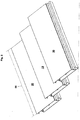
- FIG. 11 shows a perspective view of the three lamellae according to FIG Figure 1 , namely a first lamella 10, an adjacent lamella 20 and a further lamella 30.
- the lamellae 10, 20, 30 each have a longitudinal extension 55.
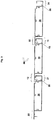
- the Figure 3 shows a cross section of the lamellae Figure 2 in the closed position, in which the slats 10, 20, 30 form a closed roof surface.
- the lamellas 10, 20, 30 are each designed as hollow chamber profiles.
- the slats 10, 20, 30 are also pivoted out of their closed position in the direction of arrow 50 in the plane of the drawing clockwise in the direction of rotation to the open position.
- the slats 10, 20, 30 thus each have a downwardly pivoting part 11, 21, 31 which each has a drainage channel 15, 25, 35.
- the slats 10, 20, 30 each have a part 12, 22, 32 that swings out upward.
- the parts 12, 22, 32 that pivot upwards and the parts 11, 21, 31 that pivot outwards interlock with one another.
- the parts 12, 22, 32 swiveling out upwardly correspond to the drainage channels 15, 25, 35 so that no water can get between the first lamella 10 and the adjacent lamella 20 and between the lamellae 10 and 30 in the closed position.
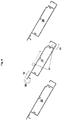
- the Figure 4 shows a cross section of the lamellae 10, 20, 30 according to Figure 3 in a dripping position in which the slats 10, 20, 30 are pivoted by 30 ° with respect to the closed position in the direction of the open position according to arrow 50.
- the downwardly pivoting parts 11, 21, 31 are each geodetically below the upwardly pivoting parts 12, 22, 32 the water 51 collected on the slats 10, 20, 30 can drain into the drainage channels 15, 25, 35 of the slats 10, 20, 30.
- the slats 10, 20, 30 are also inclined with respect to their longitudinal extension relative to the horizontal, the water 51 runs out of the drainage channels 15, 25, 35 to the side so that the space under the roof is not contaminated.
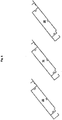
- the Figure 5 shows a cross section of the lamellae Figure 3 in a first open position in which the slats 10, 20, 30 are pivoted through 90 ° with respect to the closed position.
- the Figure 6 shows a cross section of the lamellae Figure 3 in a second open position in which the slats 10, 20, 30 are pivoted through 140 ° with respect to the closed position.
Landscapes
- Engineering & Computer Science (AREA)
- Architecture (AREA)
- Civil Engineering (AREA)
- Structural Engineering (AREA)
- Building Environments (AREA)
Claims (15)
- Toit (1) avec au moins deux supports (1, 2) au niveau desquels plusieurs lamelles (10, 20, 30) sont respectivement montées pivotantes autour d'un axe de rotation, dans lequel les axes de rotation des lamelles (10, 20, 30) s'étendent d'un support (1 ; 2) à l'autre support (2 ; 1), dans lequel les lamelles (10, 20, 30) peuvent pivoter au moyen d'un entraînement à partir d'une position fermée, au sein de laquelle les lamelles (10, 20, 30) forment une surface de toit fermée, jusqu'à une position ouverte en particulier quelconque, de sorte qu'une partie (11, 21, 31) des lamelles est pivotée vers le bas à partir de la position fermée et une autre partie (12, 22, 32) des lamelles est pivotée vers le haut à partir de la position fermée, dans lequel la partie (11, 21, 31) des lamelles (10, 20, 30) qui est pivotée vers le bas lors du pivotement des lamelles (10, 20, 30) dans le sens de rotation de la position fermée des lamelles (10, 20, 30) vers la position ouverte présente un canal d'écoulement (15, 25, 35), caractérisé en ce que l'entraînement est conçu et/ou est commandé au moyen d'une unité de commande de telle manière que, avant un pivotement des lamelles (10, 20, 30) jusqu'à une position ouverte et/ou après une détection d'une précipitation, l'entraînement pivote les lamelles (10, 20, 30) dans une position d'égouttage, de la position fermée dans le sens de rotation vers la position ouverte, de manière automatique au moins une fois, en particulier plusieurs fois, à raison d'un angle aigu, en particulier pouvant aller jusqu'à 15° ou pouvant aller jusqu'à 30° ou pouvant aller jusqu'à 45° et, après chaque pivotement des lamelles (10, 20, 30) dans la position d'égouttage, les fait revenir vers la position fermée par pivotement à nouveau dans le sens de rotation, en particulier complètement jusqu'à la position fermée.
- Toit selon la revendication 1, caractérisé en ce que le toit (1) présente au moins un capteur de pluie, en particulier en ce que le capteur de pluie est réalisé sous la forme d'un contact alimenté en permanence ou présente un contact alimenté en permanence.
- Toit selon la revendication 1 ou 2, caractérisé en ce que le toit (1) présente une unité de commande, en particulier programmable, au moyen de laquelle l'entraînement est commandé.
- Toit selon l'une quelconque des revendications précédentes, caractérisé en ce que la partie (12, 22, 32) des lamelles (10, 20, 30) qui est pivotée vers le haut lors du pivotement des lamelles (10, 20, 30) dans le sens de rotation vers la position ouverte à partir de la position fermée des lamelles (10, 20, 30) présente une lèvre.
- Toit selon l'une quelconque des revendications précédentes, caractérisé en ce que la partie (12, 22, 32) des lamelles (10, 20, 30) qui est pivotée vers le haut lors du pivotement des lamelles (10, 20, 30) dans le sens de rotation vers la position ouverte respectivement à partir de la position fermée des lamelles (10, 20, 30) présente une lèvre, dans lequel la lèvre d'une première lamelle (10) et le canal d'écoulement (25), tourné vers la lèvre, d'une lamelle (20) adjacente viennent en prise l'un dans l'autre au moins dans la position fermée des lamelles (10, 20, 30).
- Toit selon l'une quelconque des revendications précédentes, caractérisé en ce que respectivement une partie (12, 22, 32) des lamelles (10, 20, 30) pivotée vers le haut à partir de la position fermée des lamelles (10, 20, 30) lors du pivotement des lamelles (10, 20, 30) dans le sens de rotation vers la position ouverte présente une lèvre, dans lequel la lèvre d'une première lamelle (10) correspond, de manière directement ou indirectement étanche, en particulier de manière étanche à l'eau, en particulier par l'intermédiaire d'au moins un élément d'étanchéité, au canal d'écoulement (25) d'une lamelle (20) adjacente.
- Toit selon l'une quelconque des revendications précédentes, caractérisé en ce qu'au moins un des supports (1, 2) présente une gouttière (20), en particulier en ce que la gouttière est agencée de manière à s'étendre latéralement à côté du support (1, 2) et/ou parallèlement au support (1, 2).
- Toit selon l'une quelconque des revendications précédentes, caractérisé en ce que les lamelles (10, 20, 30) sont inclinées par rapport à l'horizontale quant à leur extension longitudinale (55), en particulier en ce que les lamelles (10, 20, 30) sont inclinées vers le bas respectivement en direction du support (1 ; 2) présentant une gouttière.
- Toit selon l'une quelconque des revendications précédentes, caractérisé en ce que le toit (1) présente au moins un montant (5, 6, 7), en particulier vertical, qui supporte au moins un des supports (1, 2).
- Toit selon l'une quelconque des revendications précédentes, caractérisé en ce que le toit (1) présente au moins un montant (5, 6, 7), en particulier vertical, qui supporte au moins un des supports (1, 2), dans lequel le montant (5, 6, 7) présente un tuyau de descente permettant d'évacuer de l'eau, en particulier de l'eau issue du support (1, 2) supporté par le montant (5, 6, 7), en particulier en ce que le montant (5, 6, 7) est formé d'un profilé creux.
- Toit selon l'une quelconque des revendications précédentes, caractérisé en ce que le toit (1) présente un cadre formé de plusieurs supports (1, 2, 3, 4), en particulieren ce que le cadre est porté par plusieurs montants (5, 6, 7) agencés en particulier au niveau des angles du cadre.
- Toit selon l'une quelconque des revendications précédentes, caractérisé en ce qu'au moins un des supports (1, 2) présente unegouttière et le toit (1) présente au moins un montant (5, 6, 7), en particulier vertical, supportant le support (1, 2), dans lequel un coude d'écoulement menant de la gouttière jusqu'au montant(5, 6, 7), en particulier jusqu'à un tuyau de descente agencé dans le montant (5, 6, 7).
- Procédé de commande d'un toit (1) avec au moins deux supports (1, 2) au niveau desquels plusieurs lamelles (10, 20, 30) sont respectivement montées pivotantes autour d'un axe de rotation, dans lequel les axes de rotation des lamelles (10, 20, 30) s'étendent d'un support (1 ; 2) à l'autre support (2 ; 1), dans lequel les lamelles (10, 20, 30) peuvent pivoter au moyen d'un entraînement à partird'une position fermée, au sein de laquelle les lamelles (10, 20, 30) forment une surface de toit fermée, jusqu'à une position ouverte en particulier quelconque, de sorte qu'une partie (11, 21, 31) des lamelles est pivotée vers le bas à partir de la position fermée et une autre partie (12, 22, 32) des lamelles est pivotée vers le haut à partir de la position fermée, dans lequel la partie (11, 21, 31) des lamelles (10, 20, 30) qui est pivotée vers le bas lors du pivotement des lamelles (10, 20, 30) dans le sens de rotation vers la position ouverte respectivement à partir de la position fermée des lamelles (10, 20, 30) présente un canal d'écoulement (15, 25, 35), caractérisé en ce que, avant un pivotement des lamelles (10, 20, 30) jusqu'à une position ouverte et/ou après une détection d'une précipitation, l'entraînement pivote les lamelles (10, 20, 30) dans une position d'égouttage, de la position fermée dans le sens de rotation jusqu'à la position ouverte, de manière automatique au moins une fois, en particulier plusieurs fois, à raison d'un angle aigu, en particulier pouvant aller jusqu'à 15° ou pouvant aller jusqu'à 30° ou pouvant aller jusqu'à 45° et, après chaque pivotement des lamelles (10, 20, 30) dans la position d'égouttage, les fait revenir vers la position fermée par pivotement à nouveau dans le sens de rotation, en particulier complètement jusqu'à la position fermée, en particulier après que les lamelles (10, 20, 30) ont été maintenues dans la position d'égouttage pendant une ou plusieurs seconde(s).
- Procédé de commande d'un toit (1) selon la revendication 13, caractérisé en ce que la fin d'une phase de précipitation est détectée au moyen d'un capteur de pluie et un pivotement unique ou multiple des lamelles (10, 20, 30) à partir de la position fermée jusqu'à la position d'égouttage et retour à la position fermée est déclenché.
- Procédé de commande d'un toit (1) selon la revendication 13 ou 14, caractérisé en ce que le début d'une phase de précipitation est détecté au moyen d'un capteur de pluie et les lamelles (10, 20, 30) sont pivotées à partir d'une position ouverte jusqu'à la position fermée.
Priority Applications (1)
| Application Number | Priority Date | Filing Date | Title |
|---|---|---|---|
| EP18000941.7A EP3663480B1 (fr) | 2018-12-06 | 2018-12-06 | Toit à lamelles pourvu de pare-gouttes |
Applications Claiming Priority (1)
| Application Number | Priority Date | Filing Date | Title |
|---|---|---|---|
| EP18000941.7A EP3663480B1 (fr) | 2018-12-06 | 2018-12-06 | Toit à lamelles pourvu de pare-gouttes |
Publications (2)
| Publication Number | Publication Date |
|---|---|
| EP3663480A1 EP3663480A1 (fr) | 2020-06-10 |
| EP3663480B1 true EP3663480B1 (fr) | 2021-09-22 |
Family
ID=64661041
Family Applications (1)
| Application Number | Title | Priority Date | Filing Date |
|---|---|---|---|
| EP18000941.7A Active EP3663480B1 (fr) | 2018-12-06 | 2018-12-06 | Toit à lamelles pourvu de pare-gouttes |
Country Status (1)
| Country | Link |
|---|---|
| EP (1) | EP3663480B1 (fr) |
Cited By (2)
| Publication number | Priority date | Publication date | Assignee | Title |
|---|---|---|---|---|
| IT202200023712A1 (it) * | 2022-11-17 | 2024-05-17 | Pratic F Lli Orioli S P A | Organo di filtraggio per un apparato di copertura |
| GB2633119A (en) * | 2023-01-10 | 2025-03-05 | Dongguan Aluno Ind Co Ltd | Awning capable of hiding draingage |
Families Citing this family (4)
| Publication number | Priority date | Publication date | Assignee | Title |
|---|---|---|---|---|
| BE1029721B1 (nl) * | 2021-08-30 | 2023-03-27 | Renson Sunprotection Screens | Lamellendak, terrasoverkapping omvattende hetzelfde, en een set onderdelen en een werkwijze voor het opbouwen daarvan |
| EP4324996B1 (fr) | 2022-08-15 | 2025-05-07 | Weinor GmbH & Co. KG | Toit à lamelles avec évacuation des eaux de pluie par les lamelles |
| CN115306185A (zh) * | 2022-09-02 | 2022-11-08 | 佛山优格朗装饰材料科技有限公司 | 一种翻板叶片、遮阳组件和百叶凉亭 |
| PL444887A1 (pl) * | 2023-05-12 | 2024-11-18 | Piechowski Sylwester Sun Winner Group | System domykający zadaszenie pergoli ogrodowych |
Family Cites Families (4)
| Publication number | Priority date | Publication date | Assignee | Title |
|---|---|---|---|---|
| DE9110964U1 (de) * | 1990-09-28 | 1991-10-31 | E.M.B. Metallbau und Brandschutztechnik GmbH, 4240 Emmerich | Lamellenlüfter für Gebäudedächer |
| ITUB20159232A1 (it) * | 2015-12-29 | 2017-06-29 | Teleco Automation Srl | Dispositivo di controllo e comando dei motori di movimentazione di una chiusura a lamelle di una pergola. |
| DE102016117772A1 (de) * | 2016-09-21 | 2018-03-22 | Jürgen Grimmeisen | Rahmenkonstruktion mit Eckverbinder |
| US10443245B2 (en) * | 2016-10-03 | 2019-10-15 | Helmut Sprotofski | Louver drive system |
-
2018
- 2018-12-06 EP EP18000941.7A patent/EP3663480B1/fr active Active
Cited By (2)
| Publication number | Priority date | Publication date | Assignee | Title |
|---|---|---|---|---|
| IT202200023712A1 (it) * | 2022-11-17 | 2024-05-17 | Pratic F Lli Orioli S P A | Organo di filtraggio per un apparato di copertura |
| GB2633119A (en) * | 2023-01-10 | 2025-03-05 | Dongguan Aluno Ind Co Ltd | Awning capable of hiding draingage |
Also Published As
| Publication number | Publication date |
|---|---|
| EP3663480A1 (fr) | 2020-06-10 |
Similar Documents
| Publication | Publication Date | Title |
|---|---|---|
| EP3663480B1 (fr) | Toit à lamelles pourvu de pare-gouttes | |
| EP4324996B1 (fr) | Toit à lamelles avec évacuation des eaux de pluie par les lamelles | |
| DE19612490C1 (de) | Unterdeckelement für ein flaches plattenförmiges Bauelement | |
| DE2727288A1 (de) | Einrichtung zur steuerung des einfalls von waerme- und lichtstrahlung, insbesondere fuer gewaechshaeuser u.dgl. | |
| EP4123901A1 (fr) | Système de montage et procédé de montage des modules photovoltaïques encadrés | |
| EP2730158B1 (fr) | Bâtiment doté d'un système de faîtage et système et procédé de commande de l'aération du bâtiment | |
| DE202016102741U1 (de) | Mobiles Gewächshaus mit einem Rahmenwerk | |
| DE4020334C2 (de) | Wand- oder Dachelement mit einem rahmenartigen Traggestell und verschwenkbar gehalterten, plattenartigen Lamellen | |
| EP3587698B1 (fr) | Toit à lamelles | |
| EP1816308B1 (fr) | Dispositif destiné à ombrager des ouvertures d'immeubles avec un senseur | |
| DE2915260A1 (de) | Verfahren und einrichtung zum belueften von viehstaellen | |
| EP3444412B1 (fr) | Toit de terrasse avec éléments de toit fixes et lamelles mobiles | |
| DE9110964U1 (de) | Lamellenlüfter für Gebäudedächer | |
| EP3088292B1 (fr) | Construction de paroi exterieure pur cabines de bateaux | |
| DE102021121506B4 (de) | Dachrandabschluss für Flachdächer oder flachgeneigte Dächer | |
| DE102016113086B4 (de) | Wasserdichte Sektionaltor-Vorrichtung | |
| DE102018109985A1 (de) | Verschlussvorrichtung mit Leitschaufel | |
| EP3421682B1 (fr) | Store pourvu d'évacuation d'eau | |
| EP2698485B1 (fr) | Agencement de fenêtre de toit | |
| EP3258049A1 (fr) | Dispositif destiné à recouvrir la zone extérieure de la limite inférieure d'une ouverture de bâtiment | |
| EP3179022B1 (fr) | Porte, en particulier porte à sections et entraînement de porte | |
| DE20306015U1 (de) | Firsthaube und Firstabdeckung hieraus | |
| DE3431319A1 (de) | Dachbelueftungselement | |
| DE29824480U1 (de) | Wickeljalousie | |
| DE102017107133A1 (de) | Klemmprofil |
Legal Events
| Date | Code | Title | Description |
|---|---|---|---|
| PUAI | Public reference made under article 153(3) epc to a published international application that has entered the european phase |
Free format text: ORIGINAL CODE: 0009012 |
|
| STAA | Information on the status of an ep patent application or granted ep patent |
Free format text: STATUS: THE APPLICATION HAS BEEN PUBLISHED |
|
| AK | Designated contracting states |
Kind code of ref document: A1 Designated state(s): AL AT BE BG CH CY CZ DE DK EE ES FI FR GB GR HR HU IE IS IT LI LT LU LV MC MK MT NL NO PL PT RO RS SE SI SK SM TR |
|
| AX | Request for extension of the european patent |
Extension state: BA ME |
|
| STAA | Information on the status of an ep patent application or granted ep patent |
Free format text: STATUS: REQUEST FOR EXAMINATION WAS MADE |
|
| 17P | Request for examination filed |
Effective date: 20201207 |
|
| RBV | Designated contracting states (corrected) |
Designated state(s): AL AT BE BG CH CY CZ DE DK EE ES FI FR GB GR HR HU IE IS IT LI LT LU LV MC MK MT NL NO PL PT RO RS SE SI SK SM TR |
|
| GRAP | Despatch of communication of intention to grant a patent |
Free format text: ORIGINAL CODE: EPIDOSNIGR1 |
|
| STAA | Information on the status of an ep patent application or granted ep patent |
Free format text: STATUS: GRANT OF PATENT IS INTENDED |
|
| RIC1 | Information provided on ipc code assigned before grant |
Ipc: E04F 10/10 20060101AFI20210420BHEP |
|
| INTG | Intention to grant announced |
Effective date: 20210506 |
|
| RIN1 | Information on inventor provided before grant (corrected) |
Inventor name: STAWSKI, KARL-HEINZ |
|
| GRAS | Grant fee paid |
Free format text: ORIGINAL CODE: EPIDOSNIGR3 |
|
| GRAA | (expected) grant |
Free format text: ORIGINAL CODE: 0009210 |
|
| STAA | Information on the status of an ep patent application or granted ep patent |
Free format text: STATUS: THE PATENT HAS BEEN GRANTED |
|
| AK | Designated contracting states |
Kind code of ref document: B1 Designated state(s): AL AT BE BG CH CY CZ DE DK EE ES FI FR GB GR HR HU IE IS IT LI LT LU LV MC MK MT NL NO PL PT RO RS SE SI SK SM TR |
|
| REG | Reference to a national code |
Ref country code: GB Ref legal event code: FG4D Free format text: NOT ENGLISH |
|
| REG | Reference to a national code |
Ref country code: IE Ref legal event code: FG4D Free format text: LANGUAGE OF EP DOCUMENT: GERMAN |
|
| REG | Reference to a national code |
Ref country code: DE Ref legal event code: R096 Ref document number: 502018007127 Country of ref document: DE |
|
| REG | Reference to a national code |
Ref country code: CH Ref legal event code: EP Ref country code: AT Ref legal event code: REF Ref document number: 1432445 Country of ref document: AT Kind code of ref document: T Effective date: 20211015 |
|
| REG | Reference to a national code |
Ref country code: NL Ref legal event code: FP |
|
| REG | Reference to a national code |
Ref country code: LT Ref legal event code: MG9D |
|
| PG25 | Lapsed in a contracting state [announced via postgrant information from national office to epo] |
Ref country code: RS Free format text: LAPSE BECAUSE OF FAILURE TO SUBMIT A TRANSLATION OF THE DESCRIPTION OR TO PAY THE FEE WITHIN THE PRESCRIBED TIME-LIMIT Effective date: 20210922 Ref country code: SE Free format text: LAPSE BECAUSE OF FAILURE TO SUBMIT A TRANSLATION OF THE DESCRIPTION OR TO PAY THE FEE WITHIN THE PRESCRIBED TIME-LIMIT Effective date: 20210922 Ref country code: FI Free format text: LAPSE BECAUSE OF FAILURE TO SUBMIT A TRANSLATION OF THE DESCRIPTION OR TO PAY THE FEE WITHIN THE PRESCRIBED TIME-LIMIT Effective date: 20210922 Ref country code: HR Free format text: LAPSE BECAUSE OF FAILURE TO SUBMIT A TRANSLATION OF THE DESCRIPTION OR TO PAY THE FEE WITHIN THE PRESCRIBED TIME-LIMIT Effective date: 20210922 Ref country code: BG Free format text: LAPSE BECAUSE OF FAILURE TO SUBMIT A TRANSLATION OF THE DESCRIPTION OR TO PAY THE FEE WITHIN THE PRESCRIBED TIME-LIMIT Effective date: 20211222 Ref country code: LT Free format text: LAPSE BECAUSE OF FAILURE TO SUBMIT A TRANSLATION OF THE DESCRIPTION OR TO PAY THE FEE WITHIN THE PRESCRIBED TIME-LIMIT Effective date: 20210922 Ref country code: NO Free format text: LAPSE BECAUSE OF FAILURE TO SUBMIT A TRANSLATION OF THE DESCRIPTION OR TO PAY THE FEE WITHIN THE PRESCRIBED TIME-LIMIT Effective date: 20211222 |
|
| PG25 | Lapsed in a contracting state [announced via postgrant information from national office to epo] |
Ref country code: LV Free format text: LAPSE BECAUSE OF FAILURE TO SUBMIT A TRANSLATION OF THE DESCRIPTION OR TO PAY THE FEE WITHIN THE PRESCRIBED TIME-LIMIT Effective date: 20210922 Ref country code: GR Free format text: LAPSE BECAUSE OF FAILURE TO SUBMIT A TRANSLATION OF THE DESCRIPTION OR TO PAY THE FEE WITHIN THE PRESCRIBED TIME-LIMIT Effective date: 20211223 |
|
| PG25 | Lapsed in a contracting state [announced via postgrant information from national office to epo] |
Ref country code: IS Free format text: LAPSE BECAUSE OF FAILURE TO SUBMIT A TRANSLATION OF THE DESCRIPTION OR TO PAY THE FEE WITHIN THE PRESCRIBED TIME-LIMIT Effective date: 20220122 Ref country code: SK Free format text: LAPSE BECAUSE OF FAILURE TO SUBMIT A TRANSLATION OF THE DESCRIPTION OR TO PAY THE FEE WITHIN THE PRESCRIBED TIME-LIMIT Effective date: 20210922 Ref country code: RO Free format text: LAPSE BECAUSE OF FAILURE TO SUBMIT A TRANSLATION OF THE DESCRIPTION OR TO PAY THE FEE WITHIN THE PRESCRIBED TIME-LIMIT Effective date: 20210922 Ref country code: PT Free format text: LAPSE BECAUSE OF FAILURE TO SUBMIT A TRANSLATION OF THE DESCRIPTION OR TO PAY THE FEE WITHIN THE PRESCRIBED TIME-LIMIT Effective date: 20220124 Ref country code: PL Free format text: LAPSE BECAUSE OF FAILURE TO SUBMIT A TRANSLATION OF THE DESCRIPTION OR TO PAY THE FEE WITHIN THE PRESCRIBED TIME-LIMIT Effective date: 20210922 Ref country code: ES Free format text: LAPSE BECAUSE OF FAILURE TO SUBMIT A TRANSLATION OF THE DESCRIPTION OR TO PAY THE FEE WITHIN THE PRESCRIBED TIME-LIMIT Effective date: 20210922 Ref country code: EE Free format text: LAPSE BECAUSE OF FAILURE TO SUBMIT A TRANSLATION OF THE DESCRIPTION OR TO PAY THE FEE WITHIN THE PRESCRIBED TIME-LIMIT Effective date: 20210922 Ref country code: CZ Free format text: LAPSE BECAUSE OF FAILURE TO SUBMIT A TRANSLATION OF THE DESCRIPTION OR TO PAY THE FEE WITHIN THE PRESCRIBED TIME-LIMIT Effective date: 20210922 Ref country code: AL Free format text: LAPSE BECAUSE OF FAILURE TO SUBMIT A TRANSLATION OF THE DESCRIPTION OR TO PAY THE FEE WITHIN THE PRESCRIBED TIME-LIMIT Effective date: 20210922 |
|
| REG | Reference to a national code |
Ref country code: DE Ref legal event code: R097 Ref document number: 502018007127 Country of ref document: DE |
|
| PG25 | Lapsed in a contracting state [announced via postgrant information from national office to epo] |
Ref country code: MC Free format text: LAPSE BECAUSE OF FAILURE TO SUBMIT A TRANSLATION OF THE DESCRIPTION OR TO PAY THE FEE WITHIN THE PRESCRIBED TIME-LIMIT Effective date: 20210922 Ref country code: DK Free format text: LAPSE BECAUSE OF FAILURE TO SUBMIT A TRANSLATION OF THE DESCRIPTION OR TO PAY THE FEE WITHIN THE PRESCRIBED TIME-LIMIT Effective date: 20210922 |
|
| PLBE | No opposition filed within time limit |
Free format text: ORIGINAL CODE: 0009261 |
|
| STAA | Information on the status of an ep patent application or granted ep patent |
Free format text: STATUS: NO OPPOSITION FILED WITHIN TIME LIMIT |
|
| 26N | No opposition filed |
Effective date: 20220623 |
|
| PG25 | Lapsed in a contracting state [announced via postgrant information from national office to epo] |
Ref country code: LU Free format text: LAPSE BECAUSE OF NON-PAYMENT OF DUE FEES Effective date: 20211206 Ref country code: IE Free format text: LAPSE BECAUSE OF NON-PAYMENT OF DUE FEES Effective date: 20211206 |
|
| PG25 | Lapsed in a contracting state [announced via postgrant information from national office to epo] |
Ref country code: SI Free format text: LAPSE BECAUSE OF FAILURE TO SUBMIT A TRANSLATION OF THE DESCRIPTION OR TO PAY THE FEE WITHIN THE PRESCRIBED TIME-LIMIT Effective date: 20210922 |
|
| REG | Reference to a national code |
Ref country code: DE Ref legal event code: R082 Ref document number: 502018007127 Country of ref document: DE Representative=s name: PATENTANWALTSKANZLEI METHLING DR. FRANK-OLIVER, DE Ref country code: DE Ref legal event code: R082 Ref document number: 502018007127 Country of ref document: DE Representative=s name: KUTZENBERGER WOLFF & PARTNER PATENTANWALTSPART, DE Ref country code: DE Ref legal event code: R082 Ref document number: 502018007127 Country of ref document: DE Representative=s name: METHLING, FRANK-OLIVER, DIPL.-ING. DR.-ING., DE |
|
| PG25 | Lapsed in a contracting state [announced via postgrant information from national office to epo] |
Ref country code: CY Free format text: LAPSE BECAUSE OF FAILURE TO SUBMIT A TRANSLATION OF THE DESCRIPTION OR TO PAY THE FEE WITHIN THE PRESCRIBED TIME-LIMIT Effective date: 20210922 |
|
| PG25 | Lapsed in a contracting state [announced via postgrant information from national office to epo] |
Ref country code: SM Free format text: LAPSE BECAUSE OF FAILURE TO SUBMIT A TRANSLATION OF THE DESCRIPTION OR TO PAY THE FEE WITHIN THE PRESCRIBED TIME-LIMIT Effective date: 20210922 Ref country code: HU Free format text: LAPSE BECAUSE OF FAILURE TO SUBMIT A TRANSLATION OF THE DESCRIPTION OR TO PAY THE FEE WITHIN THE PRESCRIBED TIME-LIMIT; INVALID AB INITIO Effective date: 20181206 |
|
| PGFP | Annual fee paid to national office [announced via postgrant information from national office to epo] |
Ref country code: GB Payment date: 20231220 Year of fee payment: 6 |
|
| PGFP | Annual fee paid to national office [announced via postgrant information from national office to epo] |
Ref country code: NL Payment date: 20231219 Year of fee payment: 6 Ref country code: FR Payment date: 20231220 Year of fee payment: 6 Ref country code: AT Payment date: 20231214 Year of fee payment: 6 |
|
| PGFP | Annual fee paid to national office [announced via postgrant information from national office to epo] |
Ref country code: BE Payment date: 20231218 Year of fee payment: 6 |
|
| PG25 | Lapsed in a contracting state [announced via postgrant information from national office to epo] |
Ref country code: MK Free format text: LAPSE BECAUSE OF FAILURE TO SUBMIT A TRANSLATION OF THE DESCRIPTION OR TO PAY THE FEE WITHIN THE PRESCRIBED TIME-LIMIT Effective date: 20210922 |
|
| PGFP | Annual fee paid to national office [announced via postgrant information from national office to epo] |
Ref country code: CH Payment date: 20240110 Year of fee payment: 6 |
|
| PGFP | Annual fee paid to national office [announced via postgrant information from national office to epo] |
Ref country code: IT Payment date: 20231229 Year of fee payment: 6 |
|
| PG25 | Lapsed in a contracting state [announced via postgrant information from national office to epo] |
Ref country code: MT Free format text: LAPSE BECAUSE OF FAILURE TO SUBMIT A TRANSLATION OF THE DESCRIPTION OR TO PAY THE FEE WITHIN THE PRESCRIBED TIME-LIMIT Effective date: 20210922 |
|
| PGFP | Annual fee paid to national office [announced via postgrant information from national office to epo] |
Ref country code: DE Payment date: 20241231 Year of fee payment: 7 |
|
| REG | Reference to a national code |
Ref country code: DE Ref legal event code: R082 Ref document number: 502018007127 Country of ref document: DE Representative=s name: KUTZENBERGER WOLFF & PARTNER PATENTANWALTSPART, DE Ref country code: DE Ref legal event code: R082 Ref document number: 502018007127 Country of ref document: DE Representative=s name: METHLING, FRANK-OLIVER, DIPL.-ING. DR.-ING., DE |
|
| REG | Reference to a national code |
Ref country code: DE Ref legal event code: R082 Ref document number: 502018007127 Country of ref document: DE Representative=s name: KUTZENBERGER WOLFF & PARTNER PATENTANWALTSPART, DE |
|
| REG | Reference to a national code |
Ref country code: CH Ref legal event code: PL |
|
| REG | Reference to a national code |
Ref country code: NL Ref legal event code: MM Effective date: 20250101 |
|
| REG | Reference to a national code |
Ref country code: AT Ref legal event code: MM01 Ref document number: 1432445 Country of ref document: AT Kind code of ref document: T Effective date: 20241206 |
|
| GBPC | Gb: european patent ceased through non-payment of renewal fee |
Effective date: 20241206 |
|
| PG25 | Lapsed in a contracting state [announced via postgrant information from national office to epo] |
Ref country code: NL Free format text: LAPSE BECAUSE OF NON-PAYMENT OF DUE FEES Effective date: 20250101 |
|
| REG | Reference to a national code |
Ref country code: BE Ref legal event code: MM Effective date: 20241231 |
|
| PG25 | Lapsed in a contracting state [announced via postgrant information from national office to epo] |
Ref country code: IT Free format text: LAPSE BECAUSE OF NON-PAYMENT OF DUE FEES Effective date: 20241206 |
|
| PG25 | Lapsed in a contracting state [announced via postgrant information from national office to epo] |
Ref country code: GB Free format text: LAPSE BECAUSE OF NON-PAYMENT OF DUE FEES Effective date: 20241206 Ref country code: BE Free format text: LAPSE BECAUSE OF NON-PAYMENT OF DUE FEES Effective date: 20241231 |
|
| PG25 | Lapsed in a contracting state [announced via postgrant information from national office to epo] |
Ref country code: FR Free format text: LAPSE BECAUSE OF NON-PAYMENT OF DUE FEES Effective date: 20241231 Ref country code: AT Free format text: LAPSE BECAUSE OF NON-PAYMENT OF DUE FEES Effective date: 20241206 |
|
| PG25 | Lapsed in a contracting state [announced via postgrant information from national office to epo] |
Ref country code: CH Free format text: LAPSE BECAUSE OF NON-PAYMENT OF DUE FEES Effective date: 20241231 |
|
| PG25 | Lapsed in a contracting state [announced via postgrant information from national office to epo] |
Ref country code: TR Free format text: LAPSE BECAUSE OF FAILURE TO SUBMIT A TRANSLATION OF THE DESCRIPTION OR TO PAY THE FEE WITHIN THE PRESCRIBED TIME-LIMIT Effective date: 20210922 |