EP3663769B1 - Dispositif de détermination la vitesse de véhicules - Google Patents
Dispositif de détermination la vitesse de véhicules Download PDFInfo
- Publication number
- EP3663769B1 EP3663769B1 EP19214528.2A EP19214528A EP3663769B1 EP 3663769 B1 EP3663769 B1 EP 3663769B1 EP 19214528 A EP19214528 A EP 19214528A EP 3663769 B1 EP3663769 B1 EP 3663769B1
- Authority
- EP
- European Patent Office
- Prior art keywords
- vehicle
- magnetometers
- speed
- designed
- sensors
- Prior art date
- Legal status (The legal status is an assumption and is not a legal conclusion. Google has not performed a legal analysis and makes no representation as to the accuracy of the status listed.)
- Active
Links
Images

Classifications
-
- B—PERFORMING OPERATIONS; TRANSPORTING
- B61—RAILWAYS
- B61L—GUIDING RAILWAY TRAFFIC; ENSURING THE SAFETY OF RAILWAY TRAFFIC
- B61L25/00—Recording or indicating positions or identities of vehicles or trains or setting of track apparatus
- B61L25/02—Indicating or recording positions or identities of vehicles or trains
- B61L25/021—Measuring and recording of train speed
-
- G—PHYSICS
- G01—MEASURING; TESTING
- G01P—MEASURING LINEAR OR ANGULAR SPEED, ACCELERATION, DECELERATION, OR SHOCK; INDICATING PRESENCE, ABSENCE, OR DIRECTION, OF MOVEMENT
- G01P3/00—Measuring linear or angular speed; Measuring differences of linear or angular speeds
- G01P3/64—Devices characterised by the determination of the time taken to traverse a fixed distance
- G01P3/66—Devices characterised by the determination of the time taken to traverse a fixed distance using electric or magnetic means
-
- G—PHYSICS
- G08—SIGNALLING
- G08G—TRAFFIC CONTROL SYSTEMS
- G08G1/00—Traffic control systems for road vehicles
- G08G1/01—Detecting movement of traffic to be counted or controlled
- G08G1/052—Detecting movement of traffic to be counted or controlled with provision for determining speed or overspeed
-
- B—PERFORMING OPERATIONS; TRANSPORTING
- B61—RAILWAYS
- B61L—GUIDING RAILWAY TRAFFIC; ENSURING THE SAFETY OF RAILWAY TRAFFIC
- B61L25/00—Recording or indicating positions or identities of vehicles or trains or setting of track apparatus
- B61L25/02—Indicating or recording positions or identities of vehicles or trains
- B61L25/028—Determination of vehicle position and orientation within a train consist, e.g. serialisation
-
- B—PERFORMING OPERATIONS; TRANSPORTING
- B61—RAILWAYS
- B61L—GUIDING RAILWAY TRAFFIC; ENSURING THE SAFETY OF RAILWAY TRAFFIC
- B61L3/00—Devices along the route for controlling devices on the vehicle or train, e.g. to release brake or to operate a warning signal
- B61L3/02—Devices along the route for controlling devices on the vehicle or train, e.g. to release brake or to operate a warning signal at selected places along the route, e.g. intermittent control simultaneous mechanical and electrical control
- B61L3/08—Devices along the route for controlling devices on the vehicle or train, e.g. to release brake or to operate a warning signal at selected places along the route, e.g. intermittent control simultaneous mechanical and electrical control controlling electrically
- B61L3/12—Devices along the route for controlling devices on the vehicle or train, e.g. to release brake or to operate a warning signal at selected places along the route, e.g. intermittent control simultaneous mechanical and electrical control controlling electrically using magnetic or electrostatic induction; using radio waves
- B61L3/121—Devices along the route for controlling devices on the vehicle or train, e.g. to release brake or to operate a warning signal at selected places along the route, e.g. intermittent control simultaneous mechanical and electrical control controlling electrically using magnetic or electrostatic induction; using radio waves using magnetic induction
Definitions
- the invention relates to a device for the contactless determination of a rail-guided vehicle.
- Measuring devices for contactless determination of the speed of vehicles above ground are usually based on the detection of wheel rotation, radar measurements or satellite navigation systems. Acceleration sensors can also be used to determine the speed through time integration. Another possibility is the use of eddy current sensors. In rail traffic, the use of balises or other track-based markers is possible. In addition, optical systems for speed measurement are technically possible. Some of these systems can also be used for the automatic detection of signals, signs or beacons in order to transmit track signals to the vehicle.
- Classic odometric methods such as measuring wheel rotation, have the disadvantage of being subject to sliding and slipping effects.
- a relatively large number of individual components are required here because the electronics for evaluation cannot usually be integrated together with the sensor in the roller or drive wheel or suspension. Sliding and slipping effects make it particularly difficult to detect fluctuations in the vehicle when stopping or when it is at a standstill.
- classic odometry delivers inaccurate results when the wheels are actively braked. In extreme cases, such sensors can report a standstill when the wheels are completely locked, even though the vehicle is slipping. This applies to both guided and unguided vehicles.
- the use of radar measurements based on the Doppler effect is not subject to sliding and slipping effects, but requires technically sophisticated transmission and reception technology combined with real-time capable micro or signal processor technology. This system therefore consists of a large number of complex components with a corresponding risk of failure. In addition, the complexity is a significant cost factor.
- the use of high-frequency radio signals can also interfere with other systems.
- the shape of the reflected signal depends on the reflection properties of the ground, which can lead to errors, for example when driving over wet or dirty surfaces or on bridges and similar changes in the condition of the ground. Such a system can therefore lead to problems with non-standardized substructures, e.g. in cross-border traffic and in international use.
- Satellite navigation systems e.g. GPS, Galileo
- GPS Globalstar Satellite Navigation systems
- Galileo Galileo
- buildings e.g. tunnels, halls
- the signals can be actively disrupted or distorted, either through interference with other systems or deliberately by jammers or external attackers. Such systems are therefore not suitable as the primary measurement method for safety-critical applications.
- Acceleration sensors can be used either alone or in combination with other sensors.
- the measured acceleration of the vehicle is integrated over time to obtain the speed.
- These measurement methods can cause problems at constant speeds or low accelerations; in these cases, the useful signal can be in the range of the noise of the sensors. This means that when the signal is integrated or summed over time, the noise error is amplified and reliable measurement is not possible.
- Eddy current sensors are subject to electrical and magnetic influences from the on-board electronics, especially in the case of electromagnetic drives, and can also cause problems at low speeds or on changing surfaces.
- To detect the movement it is necessary to vary the magnetic properties of the environment can lead to induction in the sensor. However, this requires a sufficiently magnetic background.
- a minimum speed is necessary so that the temporal variation is sufficient. If this type of measurement is only used to determine the rotational speed of the rollers or drive shaft, the problems of odometry with sliding or slipping effects described above occur.
- Optical systems have the disadvantage that sufficient lighting and appropriate optics are required to detect changes in the ground and determine the speed. This can lead to problems during operation, for example due to dirt on the equipment. These problems also occur when detecting signals or signs. It must also be ensured that these markers can be recognized by the optical system. This means that these systems are potentially vulnerable to weather influences, vandalism or other damage to the sensors or signaling equipment.
- balises e.g. the Eurobalise - is now standard in rail transport. These balises communicate wirelessly with the train when it passes overhead and send route information, for example. Since these balises are not installed frequently enough, determining the speed based on the time difference of the crossing is only possible to a limited extent. In addition, these systems are usually installed openly in the track bed and are therefore exposed to environmental influences and potential mechanical or electrical damage.
- EP 2 851 262 A1 describes an antenna device that can be mounted on a vehicle, for example a rail vehicle, to receive signals that are sent out by transmitters on the track. This allows the absolute speed of the vehicle to be measured.
- the antennas are mounted on the vehicle at a known distance in the direction of travel.
- the US 2006/0015 288 A1 describes a sensor unit with two sensors for measuring the speed of a moving object. When the object passes a sensor, a signal is triggered and the time difference between the The speed of the object can be determined from the signals from both sensors and the distance between the two sensors.
- the EN 10 2012 200 087 A1 shows a method for determining the speed of a moving object in which location-specific parameters of the earth's natural magnetic field are evaluated.
- reference data can be determined at specific locations in order to include the changing buildings in the magnetic signature.
- GB 2 0 94981 A describes a device made up of magnetic sensors for a flying object or a submarine, which measures the magnetic field in which the object is moving, for example the earth's magnetic field. This measurement data is converted into an electrical form and correlated by a computer to determine the speed of the object.
- the document JP-H06-82466 a discloses a transmitter-receiver system in which a transmitter is placed along a track and a receiver is attached to a moving object. The receiver correlates the signals emitted by the transmitter and correlates them to calculate the speed of the moving object relative to the transmitter.
- the object of the present invention is to improve a device for contactless determination of a speed of a vehicle in such a way that the above-mentioned problems are avoided or reduced.
- the invention solves the problem by a device having the features of claim 1 and a method having the features of claim 14.
- the invention described here is therefore based on the use of magnetometers, preferably networked ones.
- the magnetic field of the ground is measured independently at or from several locations on the vehicle.
- the magnetometers are installed directly on the vehicle. Technical or structural changes to the route are not necessary.
- the magnetic profiles of the individual magnetometers or sensors are compared with each other in real time.
- the magnetometers are also referred to as sensors in the sense of the present invention.
- a time-resolved measurement makes it possible to determine at what time the spatially fixed magnetic profile of the ground was recorded by which sensor.
- the speed can be calculated from the time difference (phase shift). The speed corresponds to the quotient of the distance between the sensors and the time shift of the measured profiles.
- Interference e.g. from current-carrying conductors
- This method also enables reliable standstill detection because in this case all sensors measure a practically identical, spatially fixed but temporally variable signal (caused by variations in the earth's field or, for example, current-carrying cables). In the simplest case, this can be detected by forming a difference signal between two measurements.
- in-phase and out-of-phase components are made by calculating the cross spectrum between the signals.
- the use of two spatially separated single-axis sensors is sufficient.
- any number of sensors - including multi-axis ones - can be arranged on the vehicle to improve the signal quality. This makes it possible to obtain detailed information about the anomaly and increase measurement reliability.
- a combination with acceleration sensors is also possible to provide redundancy or to enable an adjustment of the automatic analysis of the magnetic measurements depending on the acceleration (e.g. maximum temporal shift of the cross-correlation or combination with Kalman filter).
- a combination with classic odometric methods is also possible and particularly suitable for providing reliable information about the speed during braking, for example.
- saturation core magnetometers also called fluxgate magnetometers or Förster probes
- induction coils fluxmeters or search coil magnetometers
- cheaper sensors based on the magnetoresistive effect can be used.
- the only requirement for determining the speed until a standstill (or a swaying of the vehicle) is that the sensors used are sensitive enough to detect the static magnetic field of the ground or the environment.
- the sensors are only able to measure strong temporal variations in the magnetic field due to their design, a measurement until a standstill is not guaranteed under all conditions.
- a combination with acceleration sensors can be used, for example.
- the sensors should have a sampling rate that is high enough, depending on the maximum speed of the vehicle, to resolve the time difference between the sensors when driving over a constant magnetic profile. For slow vehicles, a sampling rate of around 100 Hz is sufficient; for faster vehicles, sampling in the range of several kHz is necessary. The exact design therefore depends on both the route and the desired maximum speed.
- the evaluation electronics of the device can either be integrated directly into the sensors, in which case the sensors transmit their measured values to all other sensors and each sensor calculates the speed or other required information independently from this. The results must then be collected and compared centrally. This provides additional redundancy should a sensor fail. Alternatively, the magnetic measured values can also be collected, evaluated and, if necessary, stored centrally. This makes the actual sensors simpler to set up.
- the data connection between the sensors or the evaluation unit can be implemented relatively easily because only transmission rates in the range of a few kBit/s to a few MBit/s are required. This makes the system much simpler than, for example, rotation sensors, which potentially deliver high-frequency analog signals.
- the power consumption for magnetic sensors is significantly lower (typically in the range of around 1 W, depending on the sampling rate), which makes the power supply much simpler, even when using multiple sensors.
- Simple copper signal cables or a combination with fiber optic cables can therefore be used for the connection, which leads to cost savings during installation.
- the magnetic field of the subsurface depends not only on the (standardized) condition of the roadway or tracks, but is also determined by contamination (e.g. fallen vehicle or rail parts, foreign objects, etc.) and building materials (e.g. tunnels, bridges, etc.).
- contamination e.g. fallen vehicle or rail parts, foreign objects, etc.
- building materials e.g. tunnels, bridges, etc.
- current-carrying cables, overhead lines and other operating technology Since the device compares the measured magnetic profile of various sensors along the direction of travel, it is independent of the exact condition of the subsurface. In principle, no information about the subsurface (track condition, road structure, etc.) is therefore necessary in advance. Even the natural magnetic fluctuations in the ground can be sufficient. While deviations in the condition can lead to errors with other methods, they can actually increase the accuracy of magnetic measurements. Since changes in the condition lead to another fixed anomaly in the magnetic field, which can be detected when crossing, this leads to a more precise determination of the phase shift and thus the speed. Therefore, it can be used for both rail-
- the device also offers the option of magnetic analysis of the route.
- This allows known magnetic profiles (e.g. of induction loops, bridges, tunnels, switches or other track systems) to be passively detected and this information evaluated by a control or guidance system.
- an adaptive pattern recognition algorithm is used, which recognizes known profiles from the measurements.
- this device can be used on trains, for example, in addition to systems such as the Eurobalise or the scheduled train control system, in order to pass information on to the train without necessarily requiring the installation of additional beacons or receivers. This is particularly advantageous for cross-border or international use. While balises are based on radio communication and are potentially exposed to damage from theft, vandalism and weather, the system described here can be used to use simple magnets as markers, which can be sunk into a road, sleeper or track bed, for example.
- route profiles can also be learned during operation, which makes it possible to automatically inform operating personnel in the event of deviations that could indicate damage to the route or structures, for example.
- near magnetic operating technology e.g. motors, voltage converters
- the device presented here thus combines several otherwise independent systems in one, which brings significant technical and economic advantages. This also makes it interesting to use it in autonomous or semi-autonomous vehicles.
- the invention can also be used with an artificially created external magnetic field in order to additionally determine the orientation in space and the distance to the transmitter based on this field. This can be achieved, for example, using the spatial orientation of the magnetic field vector or a minimum variance analysis.
- the device presented does not have to be installed directly on rollers like other systems, for example, but can be positioned freely on the vehicle.
- magnetometers can be completely encapsulated and thus protected from environmental influences and damage. This has significant economic and technical advantages and makes the system interesting for retrofitting.
- radar systems which can interfere with each other, several magnetic sensors can be used without any problems, even in close proximity, thus ensuring redundancy.
- Functional testing and calibration of the system is also easy.
- any magnetic profile can be created and used for testing without having to move the vehicle.
- the rollers or wheels must rotate with wheel rotation sensors or the ground must move with radar sensors (to generate the Doppler shift). This requires complex test benches and is not easily possible in operation.
- FIG. 1 One possible application of such a device is the measurement of the speed of a railcar or wagon in rail traffic.
- a railcar or wagon Such a system is exemplified in Figure 1
- Two magnetometers 13, 14 are connected to a vehicle 12, namely the railcar, to determine the speed over ground 11.
- the data evaluation takes place in a central data processing unit 15.
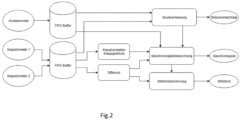
- the sequence of the described signal processing is shown as an example for this system in Figure 2 shown.
- the two magnetometers 13 and 14 are mounted one behind the other at a distance of 30 cm parallel to the rail in the middle under the railcar or wagon.
- a central data evaluation unit 15 with an integrated accelerometer is also used.
- a sampling rate of 2.2 kHz is selected. This ensures that there is at least a temporal shift of four measured values between the two series of measurements.
- the sampling rate is selected to be four times higher: 1/(1.8 ms / 4) ⁇ 2.2 kHz.
- the distance of only 30 cm between the sensors means that the speed can be determined even when there is very little movement.
- a larger distance e.g. in the range of a few meters
- the length of the measurement interval determines the size of the Figure 2 shown FIFO buffer and the maximum rate of updating the results, which should be above approx.
- 0.2 Hz one speed value every five seconds
- the speed of trains is significantly lower than 600 km/h. Therefore, the example choice of sensor distance and sampling rate described offers a good compromise between reliable determination of the speed under all operating conditions and at the same time places reasonable demands on the hardware (buffer memory, processor power, power consumption, etc.) in order to ensure economic efficiency.
- a pattern recognition algorithm is also integrated in order to recognize barges, bridges, switches and the like. Since this requires access to larger data intervals, a separate memory is used. In conjunction with the accelerometer, it is also possible to detect swaying of the train.
Landscapes
- Physics & Mathematics (AREA)
- General Physics & Mathematics (AREA)
- Engineering & Computer Science (AREA)
- Mechanical Engineering (AREA)
- Train Traffic Observation, Control, And Security (AREA)
- Electric Propulsion And Braking For Vehicles (AREA)
Claims (14)
- Dispositif de détermination sans contact d'une vitesse d'un véhicule (12) guidé sur rails, qui(a) comprend au moins deux magnétomètres (13, 14) susceptibles d'être disposés sur le véhicule (12) à distance l'un de l'autre avec une géométrie connue,(b) le dispositif étant conçu pour déterminer la vitesse en se basant sur une comparaison du décalage temporel, c'est-à-dire d'un déphasage, de profils magnétiques et de la géométrie connue desdits au moins deux magnétomètres (13, 14),(c) lesdits au moins deux magnétomètres (13, 14) étant configurés de telle sorte que le champ magnétique du sol peut être mesuré indépendamment par lesdits au moins deux magnétomètres (13, 14),
caractérisé en ce que(d) le dispositif est conçu pour distinguer une composante en phase et une composante hors phase entre les signaux des magnétomètres (13, 14) et pour calculer la vitesse uniquement à partir de la composante hors phase. - Dispositif selon la revendication 1, caractérisé en ce que le dispositif est conçu pour effectuer la distinction de la composante en phase et de la composante hors phase en calculant le spectre croisé entre les signaux des magnétomètres (13, 14).
- Dispositif selon l'une des revendications précédentes, caractérisé en ce que lesdits au moins deux magnétomètres (13, 14) sont susceptibles d'être disposés sur le véhicule (12) à une distance comprise entre 1 cm et 80 cm, de préférence entre 10 cm et 50 cm, et de manière particulièrement préférée entre 20 cm et 40 cm.
- Dispositif selon la revendication 1 ou 2, caractérisé en ce que le dispositif comporte en outre en supplément des capteurs d'accélération pour adapter une évaluation d'une mesure de champ magnétique à un profil de conduite.
- Dispositif selon l'une des revendications précédentes, caractérisé en ce que pour la détermination de la vitesse, le dispositif comporte en outre en supplément des moyens de saisie de valeurs de mesure odométriques.
- Dispositif selon l'une des revendications précédentes,
caractérisé en ce que pour la détermination de la vitesse, le dispositif comporte en outre des moyens de détection d'un patinage des roues du véhicule (12). - Dispositif selon l'une des revendications précédentes, caractérisé en ce que le dispositif est conçu pour déterminer une inclinaison du véhicule.
- Dispositif selon l'une des revendications précédentes, caractérisé en ce que le dispositif est en outre conçu pour déterminer, au moyen des magnétomètres (13, 14), une orientation du véhicule (12) sur la base d'un champ externe susceptible d'être appliqué.
- Dispositif selon l'une des revendications précédentes, caractérisé en ce que le dispositif est en outre conçu pour détecter, au moyen des magnétomètres (13, 14), des marqueurs de trajet et/ou des signaux de communication qui fournissent sans contact des informations supplémentaires au véhicule (12).
- Dispositif selon l'une des revendications précédentes, caractérisé en ce que le dispositif est en outre conçu pour reconnaître et/ou signaler, au moyen des magnétomètres (13, 14), des modifications magnétiques pertinentes pour un fonctionnement et/ou pour la détermination de la vitesse, dans une infrastructure, en particulier une route ou un rail, pendant un déplacement du véhicule (12).
- Dispositif selon l'une des revendications précédentes, caractérisé en ce que le dispositif est en outre conçu pour obtenir, au moyen des magnétomètres (13, 14), des informations d'état, pertinentes pour un fonctionnement et/ou pour la détermination de la vitesse, à partir d'une signature magnétique des installations utilisées pour le fonctionnement du véhicule (12).
- Dispositif selon l'une des revendications précédentes, caractérisé en ce que le dispositif comporte en outre un moyen de stockage pour stocker des données collectées, le dispositif étant conçu de manière à créer des profils de trajet et/ou d'environnement sur la base des données collectées et à les mettre à disposition pour une évaluation ultérieure.
- Véhicule (12) comprenant un dispositif selon l'une des revendications précédentes.
- Procédé de détermination sans contact d'une vitesse d'un véhicule (12) guidé sur rails au moyen d'un dispositif selon l'une des revendications précédentes.
Applications Claiming Priority (1)
| Application Number | Priority Date | Filing Date | Title |
|---|---|---|---|
| DE202018107011.8U DE202018107011U1 (de) | 2018-12-09 | 2018-12-09 | Vorrichtung zur Bestimmung von Betriebsparametern von Fahrzeugen und zugehöriger Infrastruktur |
Publications (2)
| Publication Number | Publication Date |
|---|---|
| EP3663769A1 EP3663769A1 (fr) | 2020-06-10 |
| EP3663769B1 true EP3663769B1 (fr) | 2024-04-10 |
Family
ID=65728290
Family Applications (1)
| Application Number | Title | Priority Date | Filing Date |
|---|---|---|---|
| EP19214528.2A Active EP3663769B1 (fr) | 2018-12-09 | 2019-12-09 | Dispositif de détermination la vitesse de véhicules |
Country Status (2)
| Country | Link |
|---|---|
| EP (1) | EP3663769B1 (fr) |
| DE (1) | DE202018107011U1 (fr) |
Families Citing this family (6)
| Publication number | Priority date | Publication date | Assignee | Title |
|---|---|---|---|---|
| US11525805B2 (en) * | 2020-06-03 | 2022-12-13 | Olympus NDT Canada Inc. | Non-contact speed encoder |
| CH719443A1 (de) | 2022-02-21 | 2023-08-31 | Enotrac Ag | Verfahren zur Erfassung einer Bewegung eines Schienenfahrzeugs entlang eines Schienenwegs. |
| DE102022210315A1 (de) * | 2022-09-29 | 2024-04-04 | Siemens Mobility GmbH | Schätzeinrichtung |
| CN115656546B (zh) * | 2022-12-26 | 2023-04-04 | 北京全路通信信号研究设计院集团有限公司 | 一种中低速磁浮列车测速方法、系统及装置 |
| DE102023210252A1 (de) * | 2023-10-19 | 2025-04-24 | Robert Bosch Gesellschaft mit beschränkter Haftung | Verfahren zum Ermitteln einer Geschwindigkeit eines Schienenfahrzeugs auf einem Gleis basierend auf Magnetfelddaten |
| CN120992984B (zh) * | 2025-10-24 | 2026-04-24 | 西北工业大学 | 基于磁信号特征点时差的封闭腔内高速物体速度估计方法 |
Family Cites Families (5)
| Publication number | Priority date | Publication date | Assignee | Title |
|---|---|---|---|---|
| GB2094981B (en) * | 1981-03-17 | 1984-04-18 | Standard Telephones Cables Ltd | Magnetic velocity measuring systems |
| JP3118094B2 (ja) * | 1992-09-04 | 2000-12-18 | 株式会社トキメック | 速度計測装置 |
| CN100585404C (zh) * | 2002-10-11 | 2010-01-27 | 迪姆肯公司 | 速度检测装置 |
| DE102012200087A1 (de) * | 2012-01-04 | 2013-07-04 | Siemens Aktiengesellschaft | Verfahren und Vorrichtung zur objektseitigen Ermittlung von Orts- und/oder Bewegungsdaten eines beweglichen Objektes |
| EP2851262A1 (fr) * | 2013-09-18 | 2015-03-25 | Bombardier Transportation GmbH | Agencement d'antenne et procédé de détermination de la vitesse absolue d'un véhicule ferroviaire |
-
2018
- 2018-12-09 DE DE202018107011.8U patent/DE202018107011U1/de active Active
-
2019
- 2019-12-09 EP EP19214528.2A patent/EP3663769B1/fr active Active
Also Published As
| Publication number | Publication date |
|---|---|
| EP3663769A1 (fr) | 2020-06-10 |
| DE202018107011U1 (de) | 2019-02-21 |
Similar Documents
| Publication | Publication Date | Title |
|---|---|---|
| EP3663769B1 (fr) | Dispositif de détermination la vitesse de véhicules | |
| DE19580682B4 (de) | Einrichtung und Verfahren zum Detektieren von Defektzuständen in Schienenfahrzeugrädern und Gleiswegen | |
| Mirabadi et al. | Application of sensor fusion to railway systems | |
| EP3431362B1 (fr) | Procédé de détection sans infrastructure d'un passage sur un tronçon de voie d'un véhicule ferroviaire | |
| EP3535173B1 (fr) | Dispositif autonome pour surveillance logistique/diagnostique d'une véhicule ferroviaire | |
| DE102016105413B4 (de) | Geschwindigkeitsmessverfahren und geschwindigkeitsmessanordnung | |
| EP4077098A1 (fr) | Procédé et système de surveillance pour déterminer une position d'un véhicule ferroviaire | |
| DE102014226612B4 (de) | Verfahren zur Ermittlung der Geschwindigkeit eines Schienenfahrzeuges | |
| WO2020021282A1 (fr) | Détermination de la position d'un véhicule sur un rail | |
| US12291250B2 (en) | Portable positioning and odometry system | |
| DE102012209311A1 (de) | Verfahren zur Lokalisierung eines Schienenfahrzeugs innerhalb eines bezüglich seiner Topologie kartographierten Schienennetzes | |
| CN106560371A (zh) | 一种基于卫星定位与加速度传感器的车载atp系统 | |
| EP3924075A1 (fr) | Manège et procédé pour faire fonctionner un manège | |
| EP0795454A1 (fr) | Procédé de détermination de position d'un véhicule guidé sur rails et dispositif de mise en oeuvre du procédé | |
| EP4230501B1 (fr) | Procédé et apparéil de détection d'un mouvement d'un véhicule ferroviaire le long d'un trajet ferroviaire | |
| EP3515787A1 (fr) | Procédé de détermination de la position d'un véhicule ferroviaire et véhicule ferroviaire avec système de détermination de position | |
| WO2008006803A1 (fr) | Système, en particulier système de trafic ferroviaire à petite distance, et procédé pour la détection du trajet côté véhicule pour un tel système | |
| WO2018228757A1 (fr) | Procédé, produit programme informatique, et véhicule sur voie, en particulier véhicule ferroviaire, pour la détection de voie en matière de trafic sur voie, en particulier pour la détection de voie ferrée en matière de trafic ferroviaire | |
| DE102019105662A1 (de) | Verfahren zur Lokalisierung eines Fahrzeugs auf einem Fahrweg | |
| WO2016150708A1 (fr) | Procédé et dispositif permettant l'acquisition côté véhicule de données de position d'un véhicule ferroviaire au moins de la mesure de la durée de parcours | |
| Havryliuk | Determining a Train Location at Level Crossing Approach Section by Track Circuit Input Impedance Processing Using ANN | |
| DE102013224672A1 (de) | Verfahren und Vorrichtung zur fahrzeugseitigen Positionsdatenerfassung bei einem Schienenfahrzeug | |
| Spindler et al. | High accuracy estimation of velocity and position for railway vehicles using ferromagnetic inhomogeneities | |
| DE102015201041A1 (de) | Verfahren und Vorrichtung zur fahrzeugseitigen Positionsdatenerfassung bei einem Schienenfahrzeug | |
| Lehner et al. | Impact of Track Brakes on Magnetic Signatures for Localization of Trains |
Legal Events
| Date | Code | Title | Description |
|---|---|---|---|
| PUAI | Public reference made under article 153(3) epc to a published international application that has entered the european phase |
Free format text: ORIGINAL CODE: 0009012 |
|
| STAA | Information on the status of an ep patent application or granted ep patent |
Free format text: STATUS: THE APPLICATION HAS BEEN PUBLISHED |
|
| AK | Designated contracting states |
Kind code of ref document: A1 Designated state(s): AL AT BE BG CH CY CZ DE DK EE ES FI FR GB GR HR HU IE IS IT LI LT LU LV MC MK MT NL NO PL PT RO RS SE SI SK SM TR |
|
| AX | Request for extension of the european patent |
Extension state: BA ME |
|
| STAA | Information on the status of an ep patent application or granted ep patent |
Free format text: STATUS: REQUEST FOR EXAMINATION WAS MADE |
|
| 17P | Request for examination filed |
Effective date: 20201209 |
|
| RBV | Designated contracting states (corrected) |
Designated state(s): AL AT BE BG CH CY CZ DE DK EE ES FI FR GB GR HR HU IE IS IT LI LT LU LV MC MK MT NL NO PL PT RO RS SE SI SK SM TR |
|
| STAA | Information on the status of an ep patent application or granted ep patent |
Free format text: STATUS: EXAMINATION IS IN PROGRESS |
|
| 17Q | First examination report despatched |
Effective date: 20211129 |
|
| RAP3 | Party data changed (applicant data changed or rights of an application transferred) |
Owner name: PHYSENS RAIL GMBH |
|
| GRAP | Despatch of communication of intention to grant a patent |
Free format text: ORIGINAL CODE: EPIDOSNIGR1 |
|
| STAA | Information on the status of an ep patent application or granted ep patent |
Free format text: STATUS: GRANT OF PATENT IS INTENDED |
|
| INTG | Intention to grant announced |
Effective date: 20231031 |
|
| GRAS | Grant fee paid |
Free format text: ORIGINAL CODE: EPIDOSNIGR3 |
|
| GRAA | (expected) grant |
Free format text: ORIGINAL CODE: 0009210 |
|
| STAA | Information on the status of an ep patent application or granted ep patent |
Free format text: STATUS: THE PATENT HAS BEEN GRANTED |
|
| AK | Designated contracting states |
Kind code of ref document: B1 Designated state(s): AL AT BE BG CH CY CZ DE DK EE ES FI FR GB GR HR HU IE IS IT LI LT LU LV MC MK MT NL NO PL PT RO RS SE SI SK SM TR |
|
| REG | Reference to a national code |
Ref country code: GB Ref legal event code: FG4D Free format text: NOT ENGLISH |
|
| REG | Reference to a national code |
Ref country code: CH Ref legal event code: EP |
|
| REG | Reference to a national code |
Ref country code: DE Ref legal event code: R096 Ref document number: 502019011008 Country of ref document: DE |
|
| REG | Reference to a national code |
Ref country code: IE Ref legal event code: FG4D Free format text: LANGUAGE OF EP DOCUMENT: GERMAN |
|
| REG | Reference to a national code |
Ref country code: LT Ref legal event code: MG9D |
|
| REG | Reference to a national code |
Ref country code: NL Ref legal event code: MP Effective date: 20240410 |
|
| PG25 | Lapsed in a contracting state [announced via postgrant information from national office to epo] |
Ref country code: NL Free format text: LAPSE BECAUSE OF FAILURE TO SUBMIT A TRANSLATION OF THE DESCRIPTION OR TO PAY THE FEE WITHIN THE PRESCRIBED TIME-LIMIT Effective date: 20240410 |
|
| PG25 | Lapsed in a contracting state [announced via postgrant information from national office to epo] |
Ref country code: NL Free format text: LAPSE BECAUSE OF FAILURE TO SUBMIT A TRANSLATION OF THE DESCRIPTION OR TO PAY THE FEE WITHIN THE PRESCRIBED TIME-LIMIT Effective date: 20240410 |
|
| PG25 | Lapsed in a contracting state [announced via postgrant information from national office to epo] |
Ref country code: IS Free format text: LAPSE BECAUSE OF FAILURE TO SUBMIT A TRANSLATION OF THE DESCRIPTION OR TO PAY THE FEE WITHIN THE PRESCRIBED TIME-LIMIT Effective date: 20240810 |
|
| PG25 | Lapsed in a contracting state [announced via postgrant information from national office to epo] |
Ref country code: BG Free format text: LAPSE BECAUSE OF FAILURE TO SUBMIT A TRANSLATION OF THE DESCRIPTION OR TO PAY THE FEE WITHIN THE PRESCRIBED TIME-LIMIT Effective date: 20240410 |
|
| PG25 | Lapsed in a contracting state [announced via postgrant information from national office to epo] |
Ref country code: FI Free format text: LAPSE BECAUSE OF FAILURE TO SUBMIT A TRANSLATION OF THE DESCRIPTION OR TO PAY THE FEE WITHIN THE PRESCRIBED TIME-LIMIT Effective date: 20240410 Ref country code: HR Free format text: LAPSE BECAUSE OF FAILURE TO SUBMIT A TRANSLATION OF THE DESCRIPTION OR TO PAY THE FEE WITHIN THE PRESCRIBED TIME-LIMIT Effective date: 20240410 |
|
| PG25 | Lapsed in a contracting state [announced via postgrant information from national office to epo] |
Ref country code: GR Free format text: LAPSE BECAUSE OF FAILURE TO SUBMIT A TRANSLATION OF THE DESCRIPTION OR TO PAY THE FEE WITHIN THE PRESCRIBED TIME-LIMIT Effective date: 20240711 |
|
| PG25 | Lapsed in a contracting state [announced via postgrant information from national office to epo] |
Ref country code: PT Free format text: LAPSE BECAUSE OF FAILURE TO SUBMIT A TRANSLATION OF THE DESCRIPTION OR TO PAY THE FEE WITHIN THE PRESCRIBED TIME-LIMIT Effective date: 20240812 |
|
| PG25 | Lapsed in a contracting state [announced via postgrant information from national office to epo] |
Ref country code: ES Free format text: LAPSE BECAUSE OF FAILURE TO SUBMIT A TRANSLATION OF THE DESCRIPTION OR TO PAY THE FEE WITHIN THE PRESCRIBED TIME-LIMIT Effective date: 20240410 |
|
| PG25 | Lapsed in a contracting state [announced via postgrant information from national office to epo] |
Ref country code: PL Free format text: LAPSE BECAUSE OF FAILURE TO SUBMIT A TRANSLATION OF THE DESCRIPTION OR TO PAY THE FEE WITHIN THE PRESCRIBED TIME-LIMIT Effective date: 20240410 |
|
| PG25 | Lapsed in a contracting state [announced via postgrant information from national office to epo] |
Ref country code: LV Free format text: LAPSE BECAUSE OF FAILURE TO SUBMIT A TRANSLATION OF THE DESCRIPTION OR TO PAY THE FEE WITHIN THE PRESCRIBED TIME-LIMIT Effective date: 20240410 |
|
| PG25 | Lapsed in a contracting state [announced via postgrant information from national office to epo] |
Ref country code: PT Free format text: LAPSE BECAUSE OF FAILURE TO SUBMIT A TRANSLATION OF THE DESCRIPTION OR TO PAY THE FEE WITHIN THE PRESCRIBED TIME-LIMIT Effective date: 20240812 Ref country code: PL Free format text: LAPSE BECAUSE OF FAILURE TO SUBMIT A TRANSLATION OF THE DESCRIPTION OR TO PAY THE FEE WITHIN THE PRESCRIBED TIME-LIMIT Effective date: 20240410 Ref country code: NO Free format text: LAPSE BECAUSE OF FAILURE TO SUBMIT A TRANSLATION OF THE DESCRIPTION OR TO PAY THE FEE WITHIN THE PRESCRIBED TIME-LIMIT Effective date: 20240710 Ref country code: LV Free format text: LAPSE BECAUSE OF FAILURE TO SUBMIT A TRANSLATION OF THE DESCRIPTION OR TO PAY THE FEE WITHIN THE PRESCRIBED TIME-LIMIT Effective date: 20240410 Ref country code: IS Free format text: LAPSE BECAUSE OF FAILURE TO SUBMIT A TRANSLATION OF THE DESCRIPTION OR TO PAY THE FEE WITHIN THE PRESCRIBED TIME-LIMIT Effective date: 20240810 Ref country code: HR Free format text: LAPSE BECAUSE OF FAILURE TO SUBMIT A TRANSLATION OF THE DESCRIPTION OR TO PAY THE FEE WITHIN THE PRESCRIBED TIME-LIMIT Effective date: 20240410 Ref country code: GR Free format text: LAPSE BECAUSE OF FAILURE TO SUBMIT A TRANSLATION OF THE DESCRIPTION OR TO PAY THE FEE WITHIN THE PRESCRIBED TIME-LIMIT Effective date: 20240711 Ref country code: FI Free format text: LAPSE BECAUSE OF FAILURE TO SUBMIT A TRANSLATION OF THE DESCRIPTION OR TO PAY THE FEE WITHIN THE PRESCRIBED TIME-LIMIT Effective date: 20240410 Ref country code: ES Free format text: LAPSE BECAUSE OF FAILURE TO SUBMIT A TRANSLATION OF THE DESCRIPTION OR TO PAY THE FEE WITHIN THE PRESCRIBED TIME-LIMIT Effective date: 20240410 Ref country code: BG Free format text: LAPSE BECAUSE OF FAILURE TO SUBMIT A TRANSLATION OF THE DESCRIPTION OR TO PAY THE FEE WITHIN THE PRESCRIBED TIME-LIMIT Effective date: 20240410 Ref country code: RS Free format text: LAPSE BECAUSE OF FAILURE TO SUBMIT A TRANSLATION OF THE DESCRIPTION OR TO PAY THE FEE WITHIN THE PRESCRIBED TIME-LIMIT Effective date: 20240710 |
|
| REG | Reference to a national code |
Ref country code: DE Ref legal event code: R097 Ref document number: 502019011008 Country of ref document: DE |
|
| PG25 | Lapsed in a contracting state [announced via postgrant information from national office to epo] |
Ref country code: DK Free format text: LAPSE BECAUSE OF FAILURE TO SUBMIT A TRANSLATION OF THE DESCRIPTION OR TO PAY THE FEE WITHIN THE PRESCRIBED TIME-LIMIT Effective date: 20240410 |
|
| PG25 | Lapsed in a contracting state [announced via postgrant information from national office to epo] |
Ref country code: EE Free format text: LAPSE BECAUSE OF FAILURE TO SUBMIT A TRANSLATION OF THE DESCRIPTION OR TO PAY THE FEE WITHIN THE PRESCRIBED TIME-LIMIT Effective date: 20240410 |
|
| PG25 | Lapsed in a contracting state [announced via postgrant information from national office to epo] |
Ref country code: CZ Free format text: LAPSE BECAUSE OF FAILURE TO SUBMIT A TRANSLATION OF THE DESCRIPTION OR TO PAY THE FEE WITHIN THE PRESCRIBED TIME-LIMIT Effective date: 20240410 |
|
| PG25 | Lapsed in a contracting state [announced via postgrant information from national office to epo] |
Ref country code: SK Free format text: LAPSE BECAUSE OF FAILURE TO SUBMIT A TRANSLATION OF THE DESCRIPTION OR TO PAY THE FEE WITHIN THE PRESCRIBED TIME-LIMIT Effective date: 20240410 Ref country code: RO Free format text: LAPSE BECAUSE OF FAILURE TO SUBMIT A TRANSLATION OF THE DESCRIPTION OR TO PAY THE FEE WITHIN THE PRESCRIBED TIME-LIMIT Effective date: 20240410 |
|
| PG25 | Lapsed in a contracting state [announced via postgrant information from national office to epo] |
Ref country code: SM Free format text: LAPSE BECAUSE OF FAILURE TO SUBMIT A TRANSLATION OF THE DESCRIPTION OR TO PAY THE FEE WITHIN THE PRESCRIBED TIME-LIMIT Effective date: 20240410 |
|
| PG25 | Lapsed in a contracting state [announced via postgrant information from national office to epo] |
Ref country code: SM Free format text: LAPSE BECAUSE OF FAILURE TO SUBMIT A TRANSLATION OF THE DESCRIPTION OR TO PAY THE FEE WITHIN THE PRESCRIBED TIME-LIMIT Effective date: 20240410 Ref country code: SK Free format text: LAPSE BECAUSE OF FAILURE TO SUBMIT A TRANSLATION OF THE DESCRIPTION OR TO PAY THE FEE WITHIN THE PRESCRIBED TIME-LIMIT Effective date: 20240410 Ref country code: RO Free format text: LAPSE BECAUSE OF FAILURE TO SUBMIT A TRANSLATION OF THE DESCRIPTION OR TO PAY THE FEE WITHIN THE PRESCRIBED TIME-LIMIT Effective date: 20240410 Ref country code: EE Free format text: LAPSE BECAUSE OF FAILURE TO SUBMIT A TRANSLATION OF THE DESCRIPTION OR TO PAY THE FEE WITHIN THE PRESCRIBED TIME-LIMIT Effective date: 20240410 Ref country code: DK Free format text: LAPSE BECAUSE OF FAILURE TO SUBMIT A TRANSLATION OF THE DESCRIPTION OR TO PAY THE FEE WITHIN THE PRESCRIBED TIME-LIMIT Effective date: 20240410 Ref country code: CZ Free format text: LAPSE BECAUSE OF FAILURE TO SUBMIT A TRANSLATION OF THE DESCRIPTION OR TO PAY THE FEE WITHIN THE PRESCRIBED TIME-LIMIT Effective date: 20240410 |
|
| PG25 | Lapsed in a contracting state [announced via postgrant information from national office to epo] |
Ref country code: IT Free format text: LAPSE BECAUSE OF FAILURE TO SUBMIT A TRANSLATION OF THE DESCRIPTION OR TO PAY THE FEE WITHIN THE PRESCRIBED TIME-LIMIT Effective date: 20240410 |
|
| PLBE | No opposition filed within time limit |
Free format text: ORIGINAL CODE: 0009261 |
|
| STAA | Information on the status of an ep patent application or granted ep patent |
Free format text: STATUS: NO OPPOSITION FILED WITHIN TIME LIMIT |
|
| 26N | No opposition filed |
Effective date: 20250113 |
|
| PG25 | Lapsed in a contracting state [announced via postgrant information from national office to epo] |
Ref country code: SI Free format text: LAPSE BECAUSE OF FAILURE TO SUBMIT A TRANSLATION OF THE DESCRIPTION OR TO PAY THE FEE WITHIN THE PRESCRIBED TIME-LIMIT Effective date: 20240410 |
|
| PG25 | Lapsed in a contracting state [announced via postgrant information from national office to epo] |
Ref country code: MC Free format text: LAPSE BECAUSE OF FAILURE TO SUBMIT A TRANSLATION OF THE DESCRIPTION OR TO PAY THE FEE WITHIN THE PRESCRIBED TIME-LIMIT Effective date: 20240410 |
|
| PG25 | Lapsed in a contracting state [announced via postgrant information from national office to epo] |
Ref country code: LU Free format text: LAPSE BECAUSE OF NON-PAYMENT OF DUE FEES Effective date: 20241209 |
|
| PG25 | Lapsed in a contracting state [announced via postgrant information from national office to epo] |
Ref country code: SE Free format text: LAPSE BECAUSE OF FAILURE TO SUBMIT A TRANSLATION OF THE DESCRIPTION OR TO PAY THE FEE WITHIN THE PRESCRIBED TIME-LIMIT Effective date: 20240410 |
|
| PG25 | Lapsed in a contracting state [announced via postgrant information from national office to epo] |
Ref country code: IE Free format text: LAPSE BECAUSE OF NON-PAYMENT OF DUE FEES Effective date: 20241209 |
|
| REG | Reference to a national code |
Ref country code: CH Ref legal event code: U11 Free format text: ST27 STATUS EVENT CODE: U-0-0-U10-U11 (AS PROVIDED BY THE NATIONAL OFFICE) Effective date: 20260101 |
|
| PGFP | Annual fee paid to national office [announced via postgrant information from national office to epo] |
Ref country code: GB Payment date: 20251218 Year of fee payment: 7 |
|
| PGFP | Annual fee paid to national office [announced via postgrant information from national office to epo] |
Ref country code: FR Payment date: 20251218 Year of fee payment: 7 |
|
| PGFP | Annual fee paid to national office [announced via postgrant information from national office to epo] |
Ref country code: BE Payment date: 20251223 Year of fee payment: 7 |
|
| REG | Reference to a national code |
Ref country code: AT Ref legal event code: MM01 Ref document number: 1675406 Country of ref document: AT Kind code of ref document: T Effective date: 20241209 |
|
| PGFP | Annual fee paid to national office [announced via postgrant information from national office to epo] |
Ref country code: DE Payment date: 20251222 Year of fee payment: 7 |
|
| PG25 | Lapsed in a contracting state [announced via postgrant information from national office to epo] |
Ref country code: AT Free format text: LAPSE BECAUSE OF NON-PAYMENT OF DUE FEES Effective date: 20241209 |
|
| PGFP | Annual fee paid to national office [announced via postgrant information from national office to epo] |
Ref country code: CH Payment date: 20260101 Year of fee payment: 7 |