EP3663865B1 - Verfahren zur herstellung einer unruhwelle - Google Patents
Verfahren zur herstellung einer unruhwelle Download PDFInfo
- Publication number
- EP3663865B1 EP3663865B1 EP19213301.5A EP19213301A EP3663865B1 EP 3663865 B1 EP3663865 B1 EP 3663865B1 EP 19213301 A EP19213301 A EP 19213301A EP 3663865 B1 EP3663865 B1 EP 3663865B1
- Authority
- EP
- European Patent Office
- Prior art keywords
- shaft
- machining
- laser
- shaping
- alloy
- Prior art date
- Legal status (The legal status is an assumption and is not a legal conclusion. Google has not performed a legal analysis and makes no representation as to the accuracy of the status listed.)
- Active
Links
Images

Classifications
-
- G—PHYSICS
- G04—HOROLOGY
- G04D—APPARATUS OR TOOLS SPECIALLY DESIGNED FOR MAKING OR MAINTAINING CLOCKS OR WATCHES
- G04D3/00—Watchmakers' or watch-repairers' machines or tools for working materials
- G04D3/0074—Watchmakers' or watch-repairers' machines or tools for working materials for treatment of the material, e.g. surface treatment
- G04D3/0089—Watchmakers' or watch-repairers' machines or tools for working materials for treatment of the material, e.g. surface treatment for components of the regulating mechanism, e.g. coil springs
-
- G—PHYSICS
- G04—HOROLOGY
- G04B—MECHANICALLY-DRIVEN CLOCKS OR WATCHES; MECHANICAL PARTS OF CLOCKS OR WATCHES IN GENERAL; TIME PIECES USING THE POSITION OF THE SUN, MOON OR STARS
- G04B17/00—Mechanisms for stabilising frequency
- G04B17/04—Oscillators acting by spring tension
- G04B17/06—Oscillators with hairsprings, e.g. balance
- G04B17/063—Balance construction
-
- G—PHYSICS
- G04—HOROLOGY
- G04B—MECHANICALLY-DRIVEN CLOCKS OR WATCHES; MECHANICAL PARTS OF CLOCKS OR WATCHES IN GENERAL; TIME PIECES USING THE POSITION OF THE SUN, MOON OR STARS
- G04B17/00—Mechanisms for stabilising frequency
- G04B17/32—Component parts or constructional details, e.g. collet, stud, virole or piton
-
- G—PHYSICS
- G04—HOROLOGY
- G04B—MECHANICALLY-DRIVEN CLOCKS OR WATCHES; MECHANICAL PARTS OF CLOCKS OR WATCHES IN GENERAL; TIME PIECES USING THE POSITION OF THE SUN, MOON OR STARS
- G04B18/00—Mechanisms for setting frequency
- G04B18/08—Component parts or constructional details
-
- B—PERFORMING OPERATIONS; TRANSPORTING
- B23—MACHINE TOOLS; METAL-WORKING NOT OTHERWISE PROVIDED FOR
- B23K—SOLDERING OR UNSOLDERING; WELDING; CLADDING OR PLATING BY SOLDERING OR WELDING; CUTTING BY APPLYING HEAT LOCALLY, e.g. FLAME CUTTING; WORKING BY LASER BEAM
- B23K2103/00—Materials to be soldered, welded or cut
- B23K2103/08—Non-ferrous metals or alloys
-
- B—PERFORMING OPERATIONS; TRANSPORTING
- B23—MACHINE TOOLS; METAL-WORKING NOT OTHERWISE PROVIDED FOR
- B23K—SOLDERING OR UNSOLDERING; WELDING; CLADDING OR PLATING BY SOLDERING OR WELDING; CUTTING BY APPLYING HEAT LOCALLY, e.g. FLAME CUTTING; WORKING BY LASER BEAM
- B23K2103/00—Materials to be soldered, welded or cut
- B23K2103/18—Dissimilar materials
- B23K2103/26—Alloys of Nickel and Cobalt and Chromium
-
- B—PERFORMING OPERATIONS; TRANSPORTING
- B23—MACHINE TOOLS; METAL-WORKING NOT OTHERWISE PROVIDED FOR
- B23K—SOLDERING OR UNSOLDERING; WELDING; CLADDING OR PLATING BY SOLDERING OR WELDING; CUTTING BY APPLYING HEAT LOCALLY, e.g. FLAME CUTTING; WORKING BY LASER BEAM
- B23K26/00—Working by laser beam, e.g. welding, cutting or boring
- B23K26/36—Removing material
-
- C—CHEMISTRY; METALLURGY
- C22—METALLURGY; FERROUS OR NON-FERROUS ALLOYS; TREATMENT OF ALLOYS OR NON-FERROUS METALS
- C22C—ALLOYS
- C22C19/00—Alloys based on nickel or cobalt
- C22C19/03—Alloys based on nickel or cobalt based on nickel
- C22C19/05—Alloys based on nickel or cobalt based on nickel with chromium
- C22C19/051—Alloys based on nickel or cobalt based on nickel with chromium and Mo or W
- C22C19/055—Alloys based on nickel or cobalt based on nickel with chromium and Mo or W with the maximum Cr content being at least 20% but less than 30%
-
- C—CHEMISTRY; METALLURGY
- C22—METALLURGY; FERROUS OR NON-FERROUS ALLOYS; TREATMENT OF ALLOYS OR NON-FERROUS METALS
- C22C—ALLOYS
- C22C19/00—Alloys based on nickel or cobalt
- C22C19/03—Alloys based on nickel or cobalt based on nickel
- C22C19/05—Alloys based on nickel or cobalt based on nickel with chromium
- C22C19/051—Alloys based on nickel or cobalt based on nickel with chromium and Mo or W
- C22C19/056—Alloys based on nickel or cobalt based on nickel with chromium and Mo or W with the maximum Cr content being at least 10% but less than 20%
-
- C—CHEMISTRY; METALLURGY
- C22—METALLURGY; FERROUS OR NON-FERROUS ALLOYS; TREATMENT OF ALLOYS OR NON-FERROUS METALS
- C22C—ALLOYS
- C22C19/00—Alloys based on nickel or cobalt
- C22C19/03—Alloys based on nickel or cobalt based on nickel
- C22C19/05—Alloys based on nickel or cobalt based on nickel with chromium
- C22C19/058—Alloys based on nickel or cobalt based on nickel with chromium without Mo and W
Definitions
- the present invention relates to the field of watchmaking. It concerns, more particularly, a method for producing a balance shaft.
- the balance spring In a mechanical watch movement, the balance spring is an important element in determining the regularity of the rate.
- the balance spring is assembled on a shaft, called the balance staff, pivoting in bearings.
- the quality of the pivoting has a great influence on the performance of the movement, in terms of precision, efficiency and durability in particular.
- balance shafts are particularly complex. Indeed, the shaft is machined from a bar, the material of which must be soft enough to be machined precisely and quickly, without causing premature wear of the cutting tools. But the areas interacting with the bearings, called pivots, must also be hard enough to withstand wear during operation. In addition, the surface condition of the pivots must be particularly worked and is currently obtained by rolling operations, which require a material with a hardness of at least 600Hv.
- the document EP2757423 reveals such a process for manufacturing a watch axis.
- the material chosen must therefore be easily machined, and then be able to be hardened by quenching or tempering treatments.
- the machinability of a material can be directly correlated to its specific cutting force, measured by manufacturers by the parameter Kc, generally given in N/mm 2 or MPa.
- Carbon martensitic steels including lead and manganese sulfides are generally used to improve their machinability.
- a steel of this type used in watchmaking is known under the reference 20AP.
- the present invention aims to change the paradigm and aims to propose a new method for producing a watch axis, particularly a balance axis.
- FIG. 1 represents the geometries of a balance shaft during its production using a traditional process
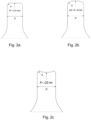
- Figures 2a, 2b and 2c propose balance shaft geometries produced by the method according to the invention.
- a very large amount of energy is applied to the workpiece for a short period of time. Melting or thermal changes do not occur because the material is vaporized instantly.
- the laser is rotated with what is called a trepanning optic.
- Beams with different angles can be sent to the workpiece, automatically changing the rotation diameter and the incidence angle.
- the figure 2 gives three possibilities, respectively to Figures 2a, 2b and 2c .
- the end of the pivot illustrated in 2a is flat. It is described as a right circular cylinder with a diameter D between 50 and 100 ⁇ m (axial symmetry).
- the base of this cylinder has a 90° circular arc with a radius A, between 5 and 25 ⁇ m, starting from the generator of the cylinder. Tangentially and continuously, a radius of curvature R greater than 0.5 mm extends the radius A to the center of the base of the cylinder.
- the end of the pivot illustrated in 2b is convex. It is described as a right circular cylinder with a diameter D of between 50 and 100 ⁇ m (axial symmetry).
- the base of this cylinder has a 90° arc of a circle, with a radius A of between 5 and 25 ⁇ m, starting from the generator of the cylinder.
- a radius of curvature R of between 0.1 and 0.5 mm, more generally between D/2 and 0.5 mm, extends the radius A to the center of the base of the cylinder.
- the end of the pivot illustrated in 2c is concave. It is described as a right circular cylinder with a diameter D of between 50 and 100 ⁇ m (axial symmetry).
- the base of this cylinder has a 90° arc of a circle, with a radius A of between 5 and 25 ⁇ m, starting from the generator of the cylinder.
- a radius of curvature R less than -D/2, preferably less than -0.35 mm extends the radius A to the center of the base of the cylinder.
- this laser bar turning technology made it possible to obtain very good process control and manufacture parts in the dimensions used for watch pivots, with not only very reduced tolerances but also remarkable surface conditions.
- the diameter of the axis at the pivot is approximately 50 ⁇ m and the tolerance is of the order of ⁇ m.
- the surface conditions obtained are better than those obtained after conventional turning.
- a roughness Ra of between 0.025 and 0.1 ⁇ m is measured after laser machining, while it is 0.2 ⁇ m after conventional turning.
- the quality of the surface condition makes it possible to do without subsequent rolling.
- a simple tribological finishing/polishing step is required to further refine the surface condition.
- This type of operation is carried out in bulk, by stirring in a medium loaded with abrasive particles. A large number of parts can therefore be treated very efficiently. No change in geometry is observed during this operation, but only a uniform reduction in dimensions, of a few ⁇ m, depending on the duration of the operation.
- the method according to the invention also relates to the manufacture of a homogeneous balance shaft made of such a non-magnetic alloy.
- the term "homogeneous" means that the material has the same mechanical properties everywhere. Although this is not excluded from the protection, the shaft manufactured according to the method of the invention does not need to receive an external coating to modify its tribological properties.
- the alloys used may be an Inconel 718.
- the alloy comprises between 50 and 55% Nickel, between 17 and 21% Chromium, between 2.8 and 3.3% Molybdenum, between 4.75 and 5.50% Niobium, between 0 and 1.0% Cobalt, between 0 and 0.35% Manganese, between 0 and 0.30% Copper, between 0.20 and 0.80% Aluminum, between 0.65 and 1.15% Titanium, between 0 and 0.35% Silicon, between 0 and 0.08% Carbon, between 0 and 0.015% Sulfur, between 0 and 0.015% Phosphorus, and between 0 and 0.006% Boron, and the balance of Iron.
- different materials with a specific cutting force greater than or equal to 2400 N/mm 2 can be used.
- the selected alloys can optionally be heat treated before being shaped, for example to modify certain properties, such as their hardness. These heat treatments, called aging for this type of alloy, are carried out before laser machining, which avoids any dimensional changes that may occur during heat treatments.
- alloys mentioned being particularly hard, possibly after an ad-hoc heat treatment, it is therefore possible to do without hardening steps generally implemented after traditional machining. Indeed, with traditional bar turning, heat treatment operations such as quenching or tempering are carried out after machining, which requires taking into account the thermal stresses and deformations undergone.
- a simple tribological finishing or polishing step is preferably carried out, while maintaining the defined geometry, that is to say by maintaining the angles or radii, a simple contraction by regular material removal can be observed. The process is therefore much better controlled.
- pivots are shaped during the turning operation. All the geometric characteristics of the axis, including the pivots, are well realized with an extremely low dispersion. The dimensions obtained take into account, where applicable, the removal of material related to a finishing step, such as polishing or other.
- axles can be used without the addition of an external coating. This results in axles that are homogeneous in terms of material and properties.
- the laser can work along the entire length of the shaft, except for the pivot end that connects the shaft to the bar.
- all areas of the shaft can be shaped, gradually refining the surface finish.
- the laser makes the shaft by working its entire length and reducing the diameters, then refining the surface finishes, progressively.
- the axis is separated by cutting from the rest of the bar, this cutting being carried out at the second end.
- the cutting is carried out by laser.
- the use of a laser head combined with a 5-axis numerically controlled machine makes it possible to produce all shapes on the axis, including shapes that are not of revolution, as long as the rotation of the bar is stopped.
Landscapes
- Physics & Mathematics (AREA)
- General Physics & Mathematics (AREA)
- Laser Beam Processing (AREA)
- Shafts, Cranks, Connecting Bars, And Related Bearings (AREA)
- Heat Treatment Of Articles (AREA)
- Motor Power Transmission Devices (AREA)
Claims (11)
- Verfahren zur Herstellung einer Unruhachse aus einer nichtmagnetischen Legierung mittels einer Maschine, die ein rotierendes Greiforgan und einen Bearbeitungslaser umfasst, der auf einem numerisch gesteuerten Aktuator montiert ist,
wobei das Verfahren die folgenden Schritte umfasst:- sich mit einem Stab der genannten Legierung auszustatten,- den Stab in Bezug auf seiner Längsachse in Drehung versetzen,- den Stab durch Laserbearbeitung in Form bringen, um eine Unruhachse zu erhalten, die an jedem Ende einen Zapfen aufweist,- Durchführung einer tribologischen Nachbehandlung, ohne Durchführung eines Rollliervorgangs nach der Formgebung. - Verfahren nach Anspruch 1, dadurch gekennzeichnet, dass die Achse bei der Formgebung durch Laserbearbeitung mit der endgültigen Geometrie hergestellt wird.
- Verfahren nach einem der vorhergehenden Ansprüche, dadurch gekennzeichnet, dass die Zapfen der Achse mit der endgültigen Geometrie bei der Formgebung durch Laserbearbeitung hergestellt werden.
- Verfahren nach Anspruch 3, dadurch gekennzeichnet, dass die Zapfen der Achse bei der tribologischen Nachbehandlung mit den endgültigen Abmessungen hergestellt werden.
- Verfahren nach einem der vorhergehenden Ansprüche, dadurch gekennzeichnet, dass die Legierung eine spezifische Schnittkraft von 2400 N/mm2 oder mehr aufweist.
- Verfahren nach Anspruch 5, dadurch gekennzeichnet, dass die Legierung aufweist, in Massenprozent, mindestens 50 % Nickel, zwischen 13 und 30 % Chrom und Elemente umfasst, die aus Fe, Mo, Nb, Ta, Co, Mn, Cu, Al, Ti, Si, C, S, P und B ausgewählt sind, wobei die Legierung gegebenenfalls einer Wärmebehandlung unterzogen worden ist.
- Verfahren nach Anspruch 5, dadurch gekennzeichnet, dass die Legierung aufweist, in Massenprozent, zwischen 50 und 55% Nickel, zwischen 17 und 21% Chrom, zwischen 2,8 und 3,3% Molybdän, zwischen 4,75 und 5,50% Niob, zwischen 0 und 1,0% Kobalt, zwischen 0 und 0,35% Mangan, zwischen 0 und 0,30% Kupfer, zwischen 0,20 und 0,80% Aluminium, zwischen 0,65 und 1,15% Titan, zwischen 0 und 0,35% Silizium, zwischen 0 und 0,08% Kohlenstoff, zwischen 0 und 0,015% Schwefel, zwischen 0 und 0,015% Phosphor und zwischen 0 und 0,006% Bor, und der Rest Eisen.
- Verfahren nach einem der vorhergehenden Ansprüche, dadurch gekennzeichnet, dass die Bearbeitung einer Achse umfasst:- einen ersten Schritt des Formens eines ersten Endes der Achse, während die Achse auf der Seite ihres zweiten Endes von der Maschine gehalten wird,- einen zweiten Schritt, bei dem die Maschine die Achse auf der Seite des zuvor geformten ersten Endes aufnimmt, und- einen dritten Schritt des Formens des zweiten Endes, während die Achse auf der Seite ihres ersten Endes von der Maschine gehalten wird.
- Verfahren nach einem der vorhergehenden Ansprüche, dadurch gekennzeichnet, dass es einen Schritt des Bearbeitens einer Abflachung oder einer asymmetrischen Form umfasst, die durch Laserbearbeitung mittels des Lasers hergestellt wird, wenn sich der Stab nicht dreht.
- Verfahren nach einem der vorhergehenden Ansprüche, dadurch gekennzeichnet, dass während der Bearbeitung die Parameter des Lasers in den folgenden Bereichen variieren können:- Durchschnittliche Leistung: zwischen 10 und 100 W;- Energie pro Puls: zwischen 20 und 400 µJ ;- Frequenz: zwischen 100 und 1000 kHz ;- Pulsdauer: zwischen 500 fs und 20 ps.
- Verfahren nach einem der vorhergehenden Ansprüche, wobei die Rauheit Ra der Unruhachse nach der Laserbearbeitung zwischen 0,025 und 0,1 µm liegt.
Priority Applications (2)
| Application Number | Priority Date | Filing Date | Title |
|---|---|---|---|
| EP24204277.8A EP4485089A3 (de) | 2018-12-06 | 2019-12-03 | Verfahren zur herstellung einer unruhachse und unruhachse |
| EP24204265.3A EP4481510B1 (de) | 2018-12-06 | 2019-12-03 | Unruhwelle |
Applications Claiming Priority (1)
| Application Number | Priority Date | Filing Date | Title |
|---|---|---|---|
| CH01504/18A CH715613A1 (fr) | 2018-12-06 | 2018-12-06 | Procédé de réalisation d'un axe de balancier et axe de balancier. |
Related Child Applications (2)
| Application Number | Title | Priority Date | Filing Date |
|---|---|---|---|
| EP24204265.3A Division EP4481510B1 (de) | 2018-12-06 | 2019-12-03 | Unruhwelle |
| EP24204277.8A Division EP4485089A3 (de) | 2018-12-06 | 2019-12-03 | Verfahren zur herstellung einer unruhachse und unruhachse |
Publications (2)
| Publication Number | Publication Date |
|---|---|
| EP3663865A1 EP3663865A1 (de) | 2020-06-10 |
| EP3663865B1 true EP3663865B1 (de) | 2024-10-16 |
Family
ID=64745819
Family Applications (3)
| Application Number | Title | Priority Date | Filing Date |
|---|---|---|---|
| EP24204277.8A Pending EP4485089A3 (de) | 2018-12-06 | 2019-12-03 | Verfahren zur herstellung einer unruhachse und unruhachse |
| EP24204265.3A Active EP4481510B1 (de) | 2018-12-06 | 2019-12-03 | Unruhwelle |
| EP19213301.5A Active EP3663865B1 (de) | 2018-12-06 | 2019-12-03 | Verfahren zur herstellung einer unruhwelle |
Family Applications Before (2)
| Application Number | Title | Priority Date | Filing Date |
|---|---|---|---|
| EP24204277.8A Pending EP4485089A3 (de) | 2018-12-06 | 2019-12-03 | Verfahren zur herstellung einer unruhachse und unruhachse |
| EP24204265.3A Active EP4481510B1 (de) | 2018-12-06 | 2019-12-03 | Unruhwelle |
Country Status (2)
| Country | Link |
|---|---|
| EP (3) | EP4485089A3 (de) |
| CH (1) | CH715613A1 (de) |
Families Citing this family (6)
| Publication number | Priority date | Publication date | Assignee | Title |
|---|---|---|---|---|
| EP4509931A3 (de) * | 2019-04-12 | 2025-04-23 | Rolex Sa | Verfahren zur herstellung einer rotationsoberfläche einer uhrenkomponente |
| WO2022223479A1 (fr) | 2021-04-20 | 2022-10-27 | Acrotec R&D Sa | Procede de fabrication d'un axe de pivotement de type horloger |
| EP4603924A1 (de) | 2024-02-19 | 2025-08-20 | Richemont International S.A. | Uhrachse auf basis intermetallischer materialien |
| EP4603925A1 (de) * | 2024-02-19 | 2025-08-20 | Richemont International S.A. | Verfahren zur herstellung einer uhrschwenkwelle und uhrschwenkwelle |
| EP4745680A1 (de) | 2024-11-14 | 2026-05-20 | Richemont International S.A. | Uhrachse auf goldbasis |
| EP4749379A1 (de) | 2024-11-22 | 2026-05-27 | Richemont International S.A. | Verfahren zum laserhärten eines funktionsteils eines uhrwerks oder eines uhrenteils |
Family Cites Families (7)
| Publication number | Priority date | Publication date | Assignee | Title |
|---|---|---|---|---|
| CH372600A (de) * | 1960-09-10 | 1963-11-30 | Straumann Inst Ag | Armbanduhr mit gegen Stösse weitgehend gesicherter Unruh |
| DE1207289B (de) * | 1959-09-25 | 1965-12-16 | Straumann Inst Ag | Armbanduhr |
| CH705707B1 (fr) * | 2004-06-08 | 2013-05-15 | Lvmh Swiss Mft Sa | Procédé de fabrication de composants de transmission synchrone et asynchrone et composants de transmission synchrone et asynchrone obtenus selon ce procédé. |
| EP2757423B1 (de) * | 2013-01-17 | 2018-07-11 | Omega SA | Bauteil für Uhrwerk |
| CH707503A2 (fr) * | 2013-01-17 | 2014-07-31 | Omega Sa | Axe de pivotement pour mouvement horloger. |
| EP3220212B1 (de) * | 2016-03-16 | 2024-05-29 | The Swatch Group Research and Development Ltd | Dekorationsverfahren für eine uhrkomponente |
| EP4177677A1 (de) * | 2016-06-13 | 2023-05-10 | Rolex Sa | Uhrachse |
-
2018
- 2018-12-06 CH CH01504/18A patent/CH715613A1/fr unknown
-
2019
- 2019-12-03 EP EP24204277.8A patent/EP4485089A3/de active Pending
- 2019-12-03 EP EP24204265.3A patent/EP4481510B1/de active Active
- 2019-12-03 EP EP19213301.5A patent/EP3663865B1/de active Active
Also Published As
| Publication number | Publication date |
|---|---|
| EP4481510B1 (de) | 2025-08-20 |
| EP3663865A1 (de) | 2020-06-10 |
| CH715613A1 (fr) | 2020-06-15 |
| EP4481510A2 (de) | 2024-12-25 |
| EP4485089A3 (de) | 2025-03-05 |
| EP4485089A2 (de) | 2025-01-01 |
| EP4481510A3 (de) | 2025-03-05 |
Similar Documents
| Publication | Publication Date | Title |
|---|---|---|
| EP4481510B1 (de) | Unruhwelle | |
| EP3416770B1 (de) | Verfahren und vorrichtung zur herstellung eines teils mittels sukzessiver abscheidung von schichten | |
| EP2981371B1 (de) | Verfahren zur herstellung eines rohrförmigen metallteils | |
| CH714594B1 (fr) | Procédés de fabrication d'un axe de pivotement d'un organe réglant | |
| JP2010280022A (ja) | 帯鋸刃及びその製造方法 | |
| WO2022223478A1 (fr) | Procede de fabrication d'un axe de pivotement horloger et axe de pivotement horloger obtenu par ledit procede | |
| CH718939B1 (fr) | Axe de pivotement pour un composant pivotant d'un mouvement horloger. | |
| EP4110962A1 (de) | Verfahren zum herstellen eines teils aus nitriertem stahl | |
| WO2022078641A1 (fr) | Outil de meulage | |
| EP3273304B1 (de) | Bauteil für uhrwerk | |
| EP4327162A1 (de) | Verfahren zur herstellung eines uhrwerksdrehpersonals | |
| EP4603925A1 (de) | Verfahren zur herstellung einer uhrschwenkwelle und uhrschwenkwelle | |
| CN114799342A (zh) | 一种可快速切断钢铁的冷锯及其制备方法 | |
| CH718551A2 (fr) | Procédé de fabrication d'un axe de pivotement de type horloger. | |
| WO2022223477A1 (fr) | Composant horloger et procede de fabrication d'un tel composant horloger | |
| CH720150A2 (fr) | Axe de pivotement horloger et procédé de fabrication dudit axe de pivotement horloger | |
| JP6604105B2 (ja) | 超硬工具及びその製造方法 | |
| FR3032137A3 (de) | ||
| CN117245140A (zh) | 工件的加工方法 | |
| JP2014037011A (ja) | スリッターナイフ | |
| EP3800511A1 (de) | Schwenkachse eines regulierorgans | |
| RU2312003C1 (ru) | Торовое устройство для поверхностного пластического деформирования | |
| CH718550A2 (fr) | Axe de pivotement horloger et procédé de fabrication d'un tel axe de pivotement horloger. | |
| CH718549A2 (fr) | Composant horloger et procédé de fabrication d'un tel composant horloger. | |
| RU2312751C1 (ru) | Способ поверхностного пластического деформирования |
Legal Events
| Date | Code | Title | Description |
|---|---|---|---|
| PUAI | Public reference made under article 153(3) epc to a published international application that has entered the european phase |
Free format text: ORIGINAL CODE: 0009012 |
|
| STAA | Information on the status of an ep patent application or granted ep patent |
Free format text: STATUS: THE APPLICATION HAS BEEN PUBLISHED |
|
| AK | Designated contracting states |
Kind code of ref document: A1 Designated state(s): AL AT BE BG CH CY CZ DE DK EE ES FI FR GB GR HR HU IE IS IT LI LT LU LV MC MK MT NL NO PL PT RO RS SE SI SK SM TR |
|
| AX | Request for extension of the european patent |
Extension state: BA ME |
|
| STAA | Information on the status of an ep patent application or granted ep patent |
Free format text: STATUS: REQUEST FOR EXAMINATION WAS MADE |
|
| 17P | Request for examination filed |
Effective date: 20201202 |
|
| RBV | Designated contracting states (corrected) |
Designated state(s): AL AT BE BG CH CY CZ DE DK EE ES FI FR GB GR HR HU IE IS IT LI LT LU LV MC MK MT NL NO PL PT RO RS SE SI SK SM TR |
|
| STAA | Information on the status of an ep patent application or granted ep patent |
Free format text: STATUS: EXAMINATION IS IN PROGRESS |
|
| 17Q | First examination report despatched |
Effective date: 20220215 |
|
| GRAP | Despatch of communication of intention to grant a patent |
Free format text: ORIGINAL CODE: EPIDOSNIGR1 |
|
| STAA | Information on the status of an ep patent application or granted ep patent |
Free format text: STATUS: GRANT OF PATENT IS INTENDED |
|
| RIC1 | Information provided on ipc code assigned before grant |
Ipc: G04D 3/00 20060101ALI20240429BHEP Ipc: G04D 1/00 20060101ALI20240429BHEP Ipc: G04B 31/06 20060101ALI20240429BHEP Ipc: G04B 17/06 20060101ALI20240429BHEP Ipc: G04B 13/02 20060101ALI20240429BHEP Ipc: G04B 1/16 20060101AFI20240429BHEP |
|
| INTG | Intention to grant announced |
Effective date: 20240515 |
|
| GRAS | Grant fee paid |
Free format text: ORIGINAL CODE: EPIDOSNIGR3 |
|
| GRAA | (expected) grant |
Free format text: ORIGINAL CODE: 0009210 |
|
| STAA | Information on the status of an ep patent application or granted ep patent |
Free format text: STATUS: THE PATENT HAS BEEN GRANTED |
|
| AK | Designated contracting states |
Kind code of ref document: B1 Designated state(s): AL AT BE BG CH CY CZ DE DK EE ES FI FR GB GR HR HU IE IS IT LI LT LU LV MC MK MT NL NO PL PT RO RS SE SI SK SM TR |
|
| REG | Reference to a national code |
Ref country code: GB Ref legal event code: FG4D Free format text: NOT ENGLISH |
|
| REG | Reference to a national code |
Ref country code: CH Ref legal event code: EP |
|
| REG | Reference to a national code |
Ref country code: IE Ref legal event code: FG4D Free format text: LANGUAGE OF EP DOCUMENT: FRENCH |
|
| REG | Reference to a national code |
Ref country code: DE Ref legal event code: R096 Ref document number: 602019060410 Country of ref document: DE |
|
| REG | Reference to a national code |
Ref country code: LT Ref legal event code: MG9D |
|
| REG | Reference to a national code |
Ref country code: NL Ref legal event code: MP Effective date: 20241016 |
|
| REG | Reference to a national code |
Ref country code: AT Ref legal event code: MK05 Ref document number: 1733406 Country of ref document: AT Kind code of ref document: T Effective date: 20241016 |
|
| PG25 | Lapsed in a contracting state [announced via postgrant information from national office to epo] |
Ref country code: NL Free format text: LAPSE BECAUSE OF FAILURE TO SUBMIT A TRANSLATION OF THE DESCRIPTION OR TO PAY THE FEE WITHIN THE PRESCRIBED TIME-LIMIT Effective date: 20241016 |
|
| PG25 | Lapsed in a contracting state [announced via postgrant information from national office to epo] |
Ref country code: NL Free format text: LAPSE BECAUSE OF FAILURE TO SUBMIT A TRANSLATION OF THE DESCRIPTION OR TO PAY THE FEE WITHIN THE PRESCRIBED TIME-LIMIT Effective date: 20241016 |
|
| PG25 | Lapsed in a contracting state [announced via postgrant information from national office to epo] |
Ref country code: PT Free format text: LAPSE BECAUSE OF FAILURE TO SUBMIT A TRANSLATION OF THE DESCRIPTION OR TO PAY THE FEE WITHIN THE PRESCRIBED TIME-LIMIT Effective date: 20250217 Ref country code: HR Free format text: LAPSE BECAUSE OF FAILURE TO SUBMIT A TRANSLATION OF THE DESCRIPTION OR TO PAY THE FEE WITHIN THE PRESCRIBED TIME-LIMIT Effective date: 20241016 Ref country code: IS Free format text: LAPSE BECAUSE OF FAILURE TO SUBMIT A TRANSLATION OF THE DESCRIPTION OR TO PAY THE FEE WITHIN THE PRESCRIBED TIME-LIMIT Effective date: 20250216 |
|
| PG25 | Lapsed in a contracting state [announced via postgrant information from national office to epo] |
Ref country code: FI Free format text: LAPSE BECAUSE OF FAILURE TO SUBMIT A TRANSLATION OF THE DESCRIPTION OR TO PAY THE FEE WITHIN THE PRESCRIBED TIME-LIMIT Effective date: 20241016 |
|
| PG25 | Lapsed in a contracting state [announced via postgrant information from national office to epo] |
Ref country code: BG Free format text: LAPSE BECAUSE OF FAILURE TO SUBMIT A TRANSLATION OF THE DESCRIPTION OR TO PAY THE FEE WITHIN THE PRESCRIBED TIME-LIMIT Effective date: 20241016 |
|
| PG25 | Lapsed in a contracting state [announced via postgrant information from national office to epo] |
Ref country code: ES Free format text: LAPSE BECAUSE OF FAILURE TO SUBMIT A TRANSLATION OF THE DESCRIPTION OR TO PAY THE FEE WITHIN THE PRESCRIBED TIME-LIMIT Effective date: 20241016 |
|
| PG25 | Lapsed in a contracting state [announced via postgrant information from national office to epo] |
Ref country code: NO Free format text: LAPSE BECAUSE OF FAILURE TO SUBMIT A TRANSLATION OF THE DESCRIPTION OR TO PAY THE FEE WITHIN THE PRESCRIBED TIME-LIMIT Effective date: 20250116 |
|
| PG25 | Lapsed in a contracting state [announced via postgrant information from national office to epo] |
Ref country code: LV Free format text: LAPSE BECAUSE OF FAILURE TO SUBMIT A TRANSLATION OF THE DESCRIPTION OR TO PAY THE FEE WITHIN THE PRESCRIBED TIME-LIMIT Effective date: 20241016 Ref country code: AT Free format text: LAPSE BECAUSE OF FAILURE TO SUBMIT A TRANSLATION OF THE DESCRIPTION OR TO PAY THE FEE WITHIN THE PRESCRIBED TIME-LIMIT Effective date: 20241016 Ref country code: GR Free format text: LAPSE BECAUSE OF FAILURE TO SUBMIT A TRANSLATION OF THE DESCRIPTION OR TO PAY THE FEE WITHIN THE PRESCRIBED TIME-LIMIT Effective date: 20250117 |
|
| PG25 | Lapsed in a contracting state [announced via postgrant information from national office to epo] |
Ref country code: PL Free format text: LAPSE BECAUSE OF FAILURE TO SUBMIT A TRANSLATION OF THE DESCRIPTION OR TO PAY THE FEE WITHIN THE PRESCRIBED TIME-LIMIT Effective date: 20241016 |
|
| PG25 | Lapsed in a contracting state [announced via postgrant information from national office to epo] |
Ref country code: RS Free format text: LAPSE BECAUSE OF FAILURE TO SUBMIT A TRANSLATION OF THE DESCRIPTION OR TO PAY THE FEE WITHIN THE PRESCRIBED TIME-LIMIT Effective date: 20250116 |
|
| PG25 | Lapsed in a contracting state [announced via postgrant information from national office to epo] |
Ref country code: SM Free format text: LAPSE BECAUSE OF FAILURE TO SUBMIT A TRANSLATION OF THE DESCRIPTION OR TO PAY THE FEE WITHIN THE PRESCRIBED TIME-LIMIT Effective date: 20241016 |
|
| PG25 | Lapsed in a contracting state [announced via postgrant information from national office to epo] |
Ref country code: MC Free format text: LAPSE BECAUSE OF FAILURE TO SUBMIT A TRANSLATION OF THE DESCRIPTION OR TO PAY THE FEE WITHIN THE PRESCRIBED TIME-LIMIT Effective date: 20241016 |
|
| PG25 | Lapsed in a contracting state [announced via postgrant information from national office to epo] |
Ref country code: DK Free format text: LAPSE BECAUSE OF FAILURE TO SUBMIT A TRANSLATION OF THE DESCRIPTION OR TO PAY THE FEE WITHIN THE PRESCRIBED TIME-LIMIT Effective date: 20241016 |
|
| REG | Reference to a national code |
Ref country code: DE Ref legal event code: R097 Ref document number: 602019060410 Country of ref document: DE |
|
| PG25 | Lapsed in a contracting state [announced via postgrant information from national office to epo] |
Ref country code: EE Free format text: LAPSE BECAUSE OF FAILURE TO SUBMIT A TRANSLATION OF THE DESCRIPTION OR TO PAY THE FEE WITHIN THE PRESCRIBED TIME-LIMIT Effective date: 20241016 |
|
| PG25 | Lapsed in a contracting state [announced via postgrant information from national office to epo] |
Ref country code: RO Free format text: LAPSE BECAUSE OF FAILURE TO SUBMIT A TRANSLATION OF THE DESCRIPTION OR TO PAY THE FEE WITHIN THE PRESCRIBED TIME-LIMIT Effective date: 20241016 |
|
| PG25 | Lapsed in a contracting state [announced via postgrant information from national office to epo] |
Ref country code: SK Free format text: LAPSE BECAUSE OF FAILURE TO SUBMIT A TRANSLATION OF THE DESCRIPTION OR TO PAY THE FEE WITHIN THE PRESCRIBED TIME-LIMIT Effective date: 20241016 |
|
| PG25 | Lapsed in a contracting state [announced via postgrant information from national office to epo] |
Ref country code: CZ Free format text: LAPSE BECAUSE OF FAILURE TO SUBMIT A TRANSLATION OF THE DESCRIPTION OR TO PAY THE FEE WITHIN THE PRESCRIBED TIME-LIMIT Effective date: 20241016 |
|
| PG25 | Lapsed in a contracting state [announced via postgrant information from national office to epo] |
Ref country code: IT Free format text: LAPSE BECAUSE OF FAILURE TO SUBMIT A TRANSLATION OF THE DESCRIPTION OR TO PAY THE FEE WITHIN THE PRESCRIBED TIME-LIMIT Effective date: 20241016 |
|
| PG25 | Lapsed in a contracting state [announced via postgrant information from national office to epo] |
Ref country code: LU Free format text: LAPSE BECAUSE OF NON-PAYMENT OF DUE FEES Effective date: 20241203 |
|
| PLBE | No opposition filed within time limit |
Free format text: ORIGINAL CODE: 0009261 |
|
| STAA | Information on the status of an ep patent application or granted ep patent |
Free format text: STATUS: NO OPPOSITION FILED WITHIN TIME LIMIT |
|
| PG25 | Lapsed in a contracting state [announced via postgrant information from national office to epo] |
Ref country code: SE Free format text: LAPSE BECAUSE OF FAILURE TO SUBMIT A TRANSLATION OF THE DESCRIPTION OR TO PAY THE FEE WITHIN THE PRESCRIBED TIME-LIMIT Effective date: 20241016 |
|
| 26N | No opposition filed |
Effective date: 20250717 |
|
| REG | Reference to a national code |
Ref country code: BE Ref legal event code: MM Effective date: 20241231 |
|
| PG25 | Lapsed in a contracting state [announced via postgrant information from national office to epo] |
Ref country code: BE Free format text: LAPSE BECAUSE OF NON-PAYMENT OF DUE FEES Effective date: 20241231 |
|
| PG25 | Lapsed in a contracting state [announced via postgrant information from national office to epo] |
Ref country code: IE Free format text: LAPSE BECAUSE OF NON-PAYMENT OF DUE FEES Effective date: 20241203 |
|
| REG | Reference to a national code |
Ref country code: CH Ref legal event code: U11 Free format text: ST27 STATUS EVENT CODE: U-0-0-U10-U11 (AS PROVIDED BY THE NATIONAL OFFICE) Effective date: 20260101 |
|
| PGFP | Annual fee paid to national office [announced via postgrant information from national office to epo] |
Ref country code: DE Payment date: 20251211 Year of fee payment: 7 |
|
| PGFP | Annual fee paid to national office [announced via postgrant information from national office to epo] |
Ref country code: GB Payment date: 20251219 Year of fee payment: 7 |
|
| PGFP | Annual fee paid to national office [announced via postgrant information from national office to epo] |
Ref country code: FR Payment date: 20251229 Year of fee payment: 7 |
|
| PG25 | Lapsed in a contracting state [announced via postgrant information from national office to epo] |
Ref country code: CY Free format text: LAPSE BECAUSE OF FAILURE TO SUBMIT A TRANSLATION OF THE DESCRIPTION OR TO PAY THE FEE WITHIN THE PRESCRIBED TIME-LIMIT; INVALID AB INITIO Effective date: 20191203 |
|
| PGFP | Annual fee paid to national office [announced via postgrant information from national office to epo] |
Ref country code: CH Payment date: 20260101 Year of fee payment: 7 |
|
| PG25 | Lapsed in a contracting state [announced via postgrant information from national office to epo] |
Ref country code: TR Free format text: LAPSE BECAUSE OF FAILURE TO SUBMIT A TRANSLATION OF THE DESCRIPTION OR TO PAY THE FEE WITHIN THE PRESCRIBED TIME-LIMIT Effective date: 20241016 |
|
| PG25 | Lapsed in a contracting state [announced via postgrant information from national office to epo] |
Ref country code: HU Free format text: LAPSE BECAUSE OF FAILURE TO SUBMIT A TRANSLATION OF THE DESCRIPTION OR TO PAY THE FEE WITHIN THE PRESCRIBED TIME-LIMIT; INVALID AB INITIO Effective date: 20191203 |
|
| PG25 | Lapsed in a contracting state [announced via postgrant information from national office to epo] |
Ref country code: SI Free format text: LAPSE BECAUSE OF FAILURE TO SUBMIT A TRANSLATION OF THE DESCRIPTION OR TO PAY THE FEE WITHIN THE PRESCRIBED TIME-LIMIT Effective date: 20241016 |
|
| PG25 | Lapsed in a contracting state [announced via postgrant information from national office to epo] |
Ref country code: LT Free format text: LAPSE BECAUSE OF FAILURE TO SUBMIT A TRANSLATION OF THE DESCRIPTION OR TO PAY THE FEE WITHIN THE PRESCRIBED TIME-LIMIT Effective date: 20241016 |