EP3667073A1 - Commande d'éléments d'appoint complémentaires d'une pale d'éolienne - Google Patents
Commande d'éléments d'appoint complémentaires d'une pale d'éolienne Download PDFInfo
- Publication number
- EP3667073A1 EP3667073A1 EP18212388.5A EP18212388A EP3667073A1 EP 3667073 A1 EP3667073 A1 EP 3667073A1 EP 18212388 A EP18212388 A EP 18212388A EP 3667073 A1 EP3667073 A1 EP 3667073A1
- Authority
- EP
- European Patent Office
- Prior art keywords
- add
- blade
- members
- predetermined
- control device
- Prior art date
- Legal status (The legal status is an assumption and is not a legal conclusion. Google has not performed a legal analysis and makes no representation as to the accuracy of the status listed.)
- Withdrawn
Links
- 238000000034 method Methods 0.000 claims abstract description 24
- 230000004913 activation Effects 0.000 claims description 30
- 230000007704 transition Effects 0.000 description 4
- 230000003213 activating effect Effects 0.000 description 3
- 230000000694 effects Effects 0.000 description 3
- 230000001419 dependent effect Effects 0.000 description 2
- 230000008901 benefit Effects 0.000 description 1
- 238000011217 control strategy Methods 0.000 description 1
- 125000004122 cyclic group Chemical group 0.000 description 1
- 230000009849 deactivation Effects 0.000 description 1
- 230000008569 process Effects 0.000 description 1
- 230000009467 reduction Effects 0.000 description 1
- 230000004044 response Effects 0.000 description 1
- 238000004088 simulation Methods 0.000 description 1
Images

Classifications
-
- F—MECHANICAL ENGINEERING; LIGHTING; HEATING; WEAPONS; BLASTING
- F03—MACHINES OR ENGINES FOR LIQUIDS; WIND, SPRING, OR WEIGHT MOTORS; PRODUCING MECHANICAL POWER OR A REACTIVE PROPULSIVE THRUST, NOT OTHERWISE PROVIDED FOR
- F03D—WIND MOTORS
- F03D7/00—Controlling wind motors
- F03D7/02—Controlling wind motors the wind motors having rotation axis substantially parallel to the air flow entering the rotor
- F03D7/0276—Controlling wind motors the wind motors having rotation axis substantially parallel to the air flow entering the rotor controlling rotor speed, e.g. variable speed
-
- F—MECHANICAL ENGINEERING; LIGHTING; HEATING; WEAPONS; BLASTING
- F03—MACHINES OR ENGINES FOR LIQUIDS; WIND, SPRING, OR WEIGHT MOTORS; PRODUCING MECHANICAL POWER OR A REACTIVE PROPULSIVE THRUST, NOT OTHERWISE PROVIDED FOR
- F03D—WIND MOTORS
- F03D7/00—Controlling wind motors
- F03D7/02—Controlling wind motors the wind motors having rotation axis substantially parallel to the air flow entering the rotor
- F03D7/022—Adjusting aerodynamic properties of the blades
- F03D7/0232—Adjusting aerodynamic properties of the blades with flaps or slats
-
- F—MECHANICAL ENGINEERING; LIGHTING; HEATING; WEAPONS; BLASTING
- F03—MACHINES OR ENGINES FOR LIQUIDS; WIND, SPRING, OR WEIGHT MOTORS; PRODUCING MECHANICAL POWER OR A REACTIVE PROPULSIVE THRUST, NOT OTHERWISE PROVIDED FOR
- F03D—WIND MOTORS
- F03D1/00—Wind motors with rotation axis substantially parallel to the air flow entering the rotor
- F03D1/06—Rotors
- F03D1/0608—Rotors characterised by their aerodynamic shape
- F03D1/0633—Rotors characterised by their aerodynamic shape of the blades
-
- F—MECHANICAL ENGINEERING; LIGHTING; HEATING; WEAPONS; BLASTING
- F03—MACHINES OR ENGINES FOR LIQUIDS; WIND, SPRING, OR WEIGHT MOTORS; PRODUCING MECHANICAL POWER OR A REACTIVE PROPULSIVE THRUST, NOT OTHERWISE PROVIDED FOR
- F03D—WIND MOTORS
- F03D7/00—Controlling wind motors
- F03D7/02—Controlling wind motors the wind motors having rotation axis substantially parallel to the air flow entering the rotor
- F03D7/022—Adjusting aerodynamic properties of the blades
- F03D7/0224—Adjusting blade pitch
-
- F—MECHANICAL ENGINEERING; LIGHTING; HEATING; WEAPONS; BLASTING
- F03—MACHINES OR ENGINES FOR LIQUIDS; WIND, SPRING, OR WEIGHT MOTORS; PRODUCING MECHANICAL POWER OR A REACTIVE PROPULSIVE THRUST, NOT OTHERWISE PROVIDED FOR
- F03D—WIND MOTORS
- F03D7/00—Controlling wind motors
- F03D7/02—Controlling wind motors the wind motors having rotation axis substantially parallel to the air flow entering the rotor
- F03D7/0244—Controlling wind motors the wind motors having rotation axis substantially parallel to the air flow entering the rotor for braking
- F03D7/0252—Controlling wind motors the wind motors having rotation axis substantially parallel to the air flow entering the rotor for braking with aerodynamic drag devices on the blades
-
- F—MECHANICAL ENGINEERING; LIGHTING; HEATING; WEAPONS; BLASTING
- F05—INDEXING SCHEMES RELATING TO ENGINES OR PUMPS IN VARIOUS SUBCLASSES OF CLASSES F01-F04
- F05B—INDEXING SCHEME RELATING TO WIND, SPRING, WEIGHT, INERTIA OR LIKE MOTORS, TO MACHINES OR ENGINES FOR LIQUIDS COVERED BY SUBCLASSES F03B, F03D AND F03G
- F05B2240/00—Components
- F05B2240/20—Rotors
- F05B2240/30—Characteristics of rotor blades, i.e. of any element transforming dynamic fluid energy to or from rotational energy and being attached to a rotor
- F05B2240/305—Flaps, slats or spoilers
- F05B2240/3052—Flaps, slats or spoilers adjustable
-
- F—MECHANICAL ENGINEERING; LIGHTING; HEATING; WEAPONS; BLASTING
- F05—INDEXING SCHEMES RELATING TO ENGINES OR PUMPS IN VARIOUS SUBCLASSES OF CLASSES F01-F04
- F05B—INDEXING SCHEME RELATING TO WIND, SPRING, WEIGHT, INERTIA OR LIKE MOTORS, TO MACHINES OR ENGINES FOR LIQUIDS COVERED BY SUBCLASSES F03B, F03D AND F03G
- F05B2270/00—Control
- F05B2270/30—Control parameters, e.g. input parameters
- F05B2270/327—Rotor or generator speeds
-
- Y—GENERAL TAGGING OF NEW TECHNOLOGICAL DEVELOPMENTS; GENERAL TAGGING OF CROSS-SECTIONAL TECHNOLOGIES SPANNING OVER SEVERAL SECTIONS OF THE IPC; TECHNICAL SUBJECTS COVERED BY FORMER USPC CROSS-REFERENCE ART COLLECTIONS [XRACs] AND DIGESTS
- Y02—TECHNOLOGIES OR APPLICATIONS FOR MITIGATION OR ADAPTATION AGAINST CLIMATE CHANGE
- Y02E—REDUCTION OF GREENHOUSE GAS [GHG] EMISSIONS, RELATED TO ENERGY GENERATION, TRANSMISSION OR DISTRIBUTION
- Y02E10/00—Energy generation through renewable energy sources
- Y02E10/70—Wind energy
- Y02E10/72—Wind turbines with rotation axis in wind direction
Definitions
- the present invention relates to a wind turbine.
- the present invention relates to a method and a device for controlling aerodynamic properties of blades of the wind turbine, wherein each blade comprises segmented add-on members.
- a control device is configured to control aerodynamic properties of a blade of a wind turbine, the blade comprising a predetermined number of add-on members which are actuated by a corresponding trim actuator to alter the aerodynamic properties of the blade, wherein each trim actuator is configured to hold the add-on member in a predetermined first position and a predetermined second position.
- the control device is configured to determine a first number of add-on members which are to be held at the predetermined first position, and to determine a second number of add-on members which are to be held at the predetermined second position.
- the active add-on members are operated without feedback about their positions.
- a fast transition between fully open and fully closed for each add-on member to operate with known aerodynamics is achieved in a digital on/off manner.
- a further advantage is a well-defined aerodynamic response and a very simple control of the active add-on members without the need of any feedback sensors in the blade.
- the predetermined first position is a closed position of the add-on member and the predetermined second position is an opened position of the add-on member.
- the control device is configured to select specific add-on members of the second number on the basis of a trim activation signal which is determined based on a target rotor or generator speed reference.
- the trim activation signal can be calculated by a rotor speed controller which controls the rotor speed or some other controller objective.
- the trim activation signal may be a signal from 0 to 1 where 0 would result in no add-on member are activated, and 1 would result in all add-on members are activated. For example, a number in between would result in an activation of add-on members with either proportionality to a number of add-on members, an impact on a rotor torque taking varying operation parameters into account, an impact on a rotor thrust taking varying operation parameters into account.
- the active add-on members of the blade are divided into a number of smaller add-on members, which can be controlled separately using a digital on/off approach. If the signal is ON, then the active add-on member is fully open. If the signal is OFF, then the active add-on member is fully closed. Fully opened refer to an open position with a known aerodynamic impact. Likewise fully closed corresponds to a closed position with known aerodynamic impact.
- the aerodynamic impact is known with lower certainty as e.g. the exact opening position. Thereby, a blade stall can be unknown or uncertain. If the transition between fully opened and fully closed occurs sufficiently fast, then the influence of the unknown aerodynamic impact during the transition becomes insignificant. A fast transition can be realized in a time being less than six to ten seconds.
- control device is further configured to control a pitch angle of the blade based on a difference between the trim activation signal and a target trim efficiency reference.
- the target trim efficiency reference can be a signal that indicates a desired efficiency level of the add-on members. For example at high wind speed, it is desired that a pitch activation control device controls the blade pitch angle in such a way that the active add-on members have an efficiency level of 50%.
- control device is configured to control aerodynamic properties of a plurality of the blades of the wind turbine, and the control device is configured to determine for each blade the first number of add-on members which are to be held at the predetermined first position, and to determine for each blade the second number of add-on members which are to be held at the predetermined second position.
- a wind turbine comprises a tower, a rotor, the rotor being mounted at the top of the tower to rotate about a rotational axis, wherein the rotor has a plurality of blades, and the above-described control device.
- a method of controlling aerodynamic properties of a blade of a wind turbine comprising a predetermined number of add-on members which are actuated by a corresponding trim actuator to alter the aerodynamic properties of the blade, wherein each trim actuator is configured to hold the add-on member in a predetermined first position and a predetermined second position.
- the method comprises steps of determining a first number of add-on members which are to be held at the predetermined first position, and determining a second number of add-on members which are to be held at the predetermined second position.
- a sum of the first and second numbers is equal to the predetermined number of the add-on members.
- the predetermined first position is a closed position of the add-on member and the predetermined second position is an opened position of the add-on member.
- the method further comprises a step of selecting specific add-on members of the second number on the basis of a trim activation signal which is determined based on a target rotor or generator speed reference. More preferred, the selected specific add-on members of the second number are altered over time. Thereby, the lifetime usage of the active add-on members can be balanced.
- the method further comprises a step of controlling a pitch angle of the blade based on a difference between the trim activation signal and a target trim efficiency reference.
- the target trim efficiency reference can be a signal that indicates a desired efficiency level of the add-on members. For example at high wind speed, it is desired that a pitch activation control device controls the blade pitch angle in such a way that the active add-on members have an efficiency level of 50%.
- the method controls aerodynamic properties of a plurality of the blades of the wind turbine, determines for each blade the first number of add-on members which are to be held at the predetermined first position, and determines for each blade the second number of add-on members which are to be held at the predetermined second position.
- the method further comprises a step of controlling a pitch angle of each blade based on the difference between the trim activation signal and the target trim efficiency reference.
- the predetermined first positions of each blade are identical and/or the predetermined second positions of each blade are identical. This ensures load symmetry when activating the segmented add-on members. This also reduces complexity as one pressure supply can drive the corresponding add-on members on all blades.
- the first numbers of each blade are identical and/or the second numbers of each blade are identical.
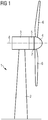
- Fig. 1 shows a wind turbine 1.
- the wind turbine 1 comprises a nacelle 3 and a tower 2.
- the nacelle 3 is mounted at the top of the tower 2.
- the nacelle 3 is mounted rotatable with regard to the tower 2 by means of a yaw bearing.
- the axis of rotation of the nacelle 3 with regard to the tower 2 is referred to as the yaw axis.
- the wind turbine 1 also comprises a hub 4 with three rotor blades 6 (of which two rotor blades 6 are depicted in Fig. 1 ).
- the blades are connected to the hub 4 via a joint section (not shown).
- the hub 4 is mounted rotatable with regard to the nacelle 3 by means of a main bearing 7.
- the hub 4 is mounted rotatable about a rotor axis of rotation 8.
- the wind turbine 1 furthermore comprises a generator 5.
- the generator 5 in turn comprises a rotor 10 connecting the generator 5 with the hub 4.
- the hub 4 is connected directly to the generator 5, thus the wind turbine 1 is referred to as a gearless, direct-driven wind turbine.
- Such a generator 5 is referred as direct drive generator 5.
- the hub 4 may also be connected to the generator 5 via a gear box.
- This type of wind turbine 1 is referred to as a geared wind turbine.
- the present invention is suitable for both types of wind turbines 1.
- the generator 5 is accommodated within the nacelle 3.
- the generator 5 is arranged and prepared for converting the rotational energy from the hub 4 into electrical energy in the shape of an AC power.
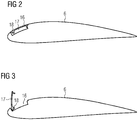
- Fig. 2 shows a wind turbine blade 6 of the wind turbine 1.
- Each blade 6 has a plurality of active add-on members 17 which are actuated by a corresponding actuator to alter aerodynamic properties of the blade 6.
- the cross-section of Fig. 2 shows only one the active add-on members 17; however, the remaining active add-on members 17 of the blade 6 are arranged in front of or behind this active add-on member 17 as shown in Fig. 2 .
- the add-on member 17 are designed as spoilers.
- the spoilers 17 are here arranged near the front edge of the blade 6, but they can also be arranged near the back edge of the blade 6.
- the add-on members 17 are accommodated in recesses 16 in the blade 6 and can turn about hinges 18 by activation of the actuators.
- the spoiler 17 is shown in its normal deactivated position, where no spoiler effect and no stall is desired. This position is referred as a predetermined first position.
- the predetermined first positions of each blade 6 can be identical. This ensures load symmetry when activating the segmented add-on members 17. This also reduces complexity as one pressure supply can drive the corresponding add-on member 17 on all blades 6.
- Fig. 3 shows the same add-on member 17 in an activated position, where the add-on member 17 is turned to a maximum by the actuator so that the stalling effect is maximum.
- This position is referred as a predetermined second position.
- the predetermined second positions of each blade 6 can be identical. This ensures load symmetry when activating the segmented add-on members 17. This also reduces complexity as one pressure supply can drive the corresponding add-on member 17 on all blades 6.
- the add-on members 17 are not necessarily to be formed as spoilers.
- the add-on members 17 can have any other configuration which is able to alter the aerodynamic properties of the blade 6.
- Fig. 4 shows an implementation of a control device 10 for controlling aerodynamic properties of the blades 6 of the wind turbine 1 according to an embodiment of the present invention.
- the wind turbine has three blades 6A, 6B and 6C.
- Each blade 6A, 6B and 6C has a number of n active add-on members 17, which are each formed as a segment. That is, the blade 6A has active add-on members 17 which are designated as segment 1A, segment 2A,..., segment nA; the blade 6B has active add-on members 17 which are designated as segment 1B, segment 2B,..., segment nB; and the blade 6C has active add-on members 17 which are designated as segment 1C, segment 2C,..., segment nC.
- the number of segments is selected with respect to the step impact of one segment and the complexity of multiple segments. That means, if a very low number of segments is chosen, the aerodynamic impact of fully opening one segment is too large, which causes an undesired behaviour in turbine load. A very high number of segments increases the complexity and the number of control valves, tubing etc. Normally the number n of segments will be around 5 to 15 segments per blade 6.
- a control device 10 determines for each blade 6A, 6B, 6C a first number of add-on members 17 which are to be held at the predetermined first position, and determines for each blade 6A, 6B, 6C a second number of add-on members 17 which are to be held at the predetermined second position.
- a sum of the first and second numbers can be equal to the predetermined number of the add-on members 17 of each blade 6A, 6B, 6C.
- the first numbers of each blade 6A, 6B, 6C can identical, and the second numbers of each blade 6A, 6B, 6C can be identical.
- the control device 10 comprises an add-on member selection device 12 selecting specific add-on members 17 of the second number on the basis of a trim activation signal 26 which is determined based on a target rotor or generator speed reference 21.
- the control device 10 comprises a trim activation control device 11 which outputs the trim activation signal 26 into the add-on member selection device 12.
- a difference between the target rotor or generator speed reference 21 and a rotor speed 22 is input.
- Fig. 4 further shows that one activation signal is sent from the add-on member selection device 12 to the segments 1A, 1B, 1C of each blade 6A, 6B and 6C. Another activation signal is sent from the add-on member selection device 12 to the segment 2A, 2B, 2C of the blades 6A, 6B, and 6C, and so on.
- the add-on member selection device 12 can alter the selected specific add-on members 17 of the second number over time.
- the altered selection of the second number of add-on members 17 balances the disadvantage of fixed quantities of an actuator impact versus a disadvantage of many add-on members 17. This can be achieved by rotating the use of add-on members 17 to avoid that one add-on member 17 is fatigue loaded more than others over time.
- the following implementations are conceivable: During activation, those add-on members 17 are selected that were inactive for the longest time; or during deactivation, those add-on members 17 are selected that were active for the longest time. Alternatively, activation statistics can be recorded and those add-on members 17 are selected which have been activated the least. Further alternatively, the add-on members 17 can randomly be selected.
- the control device 10 further comprises a pitch activation control device 24 and one or more pitch actuators 25 for each blade 6A, 6B, 6C.
- the pitch activation control device 24 and the pitch actuators 25 control for each blade 6A, 6B, 6C a pitch angle based on a difference between the trim activation signal 26 and a target trim efficiency reference 23.
- the target trim efficiency reference 23 can be a signal that indicates a desired efficiency level of the add-on members 17. For example at high wind speed, it is desired that the pitch activation control device 24 controls the blade pitch angle in such a way that the active add-on members 17 have an efficiency level of 50%.
- the pitch angle for the blade 6A is designated as pitch position A
- the pitch angle for the blade 6B is designated as pitch position B
- the pitch angle for the blade 6C is designated as pitch position C in Fig. 4 .
- the add-on member selection device 12 can be modified to control the add-on members 17 on the individual blades 6A, 6B, 6C instead of one common output to the add-on members 17 having the same position on the different blades 6A, 6B, 6C. This would enable a cyclic (rotor azimuth dependent) control or possible load reductions at the cost of system complexity.
- the embodiment of Fig. 4 is modified in that the add-on member selection device 12 outputs a first signal to the blade 6A, a second signal to the blade 6B and a third signal to the blade 6C.
Landscapes
- Engineering & Computer Science (AREA)
- Life Sciences & Earth Sciences (AREA)
- Sustainable Development (AREA)
- Sustainable Energy (AREA)
- Chemical & Material Sciences (AREA)
- Combustion & Propulsion (AREA)
- Mechanical Engineering (AREA)
- General Engineering & Computer Science (AREA)
- Physics & Mathematics (AREA)
- Fluid Mechanics (AREA)
- Wind Motors (AREA)
Priority Applications (5)
| Application Number | Priority Date | Filing Date | Title |
|---|---|---|---|
| EP18212388.5A EP3667073A1 (fr) | 2018-12-13 | 2018-12-13 | Commande d'éléments d'appoint complémentaires d'une pale d'éolienne |
| PCT/EP2019/079814 WO2020120009A1 (fr) | 2018-12-13 | 2019-10-31 | Contrôle d'éléments rapportés segmentés d'une pale d'éolienne |
| EP19801752.7A EP3894695A1 (fr) | 2018-12-13 | 2019-10-31 | Contrôle d'éléments rapportés segmentés d'une pale d'éolienne |
| US17/299,909 US11920564B2 (en) | 2018-12-13 | 2019-10-31 | Controlling of segmented add-on members of a wind turbine blade |
| CN201980082530.6A CN113167237A (zh) | 2018-12-13 | 2019-10-31 | 风力涡轮机叶片的分段式附加构件的控制 |
Applications Claiming Priority (1)
| Application Number | Priority Date | Filing Date | Title |
|---|---|---|---|
| EP18212388.5A EP3667073A1 (fr) | 2018-12-13 | 2018-12-13 | Commande d'éléments d'appoint complémentaires d'une pale d'éolienne |
Publications (1)
| Publication Number | Publication Date |
|---|---|
| EP3667073A1 true EP3667073A1 (fr) | 2020-06-17 |
Family
ID=64665468
Family Applications (2)
| Application Number | Title | Priority Date | Filing Date |
|---|---|---|---|
| EP18212388.5A Withdrawn EP3667073A1 (fr) | 2018-12-13 | 2018-12-13 | Commande d'éléments d'appoint complémentaires d'une pale d'éolienne |
| EP19801752.7A Pending EP3894695A1 (fr) | 2018-12-13 | 2019-10-31 | Contrôle d'éléments rapportés segmentés d'une pale d'éolienne |
Family Applications After (1)
| Application Number | Title | Priority Date | Filing Date |
|---|---|---|---|
| EP19801752.7A Pending EP3894695A1 (fr) | 2018-12-13 | 2019-10-31 | Contrôle d'éléments rapportés segmentés d'une pale d'éolienne |
Country Status (4)
| Country | Link |
|---|---|
| US (1) | US11920564B2 (fr) |
| EP (2) | EP3667073A1 (fr) |
| CN (1) | CN113167237A (fr) |
| WO (1) | WO2020120009A1 (fr) |
Families Citing this family (1)
| Publication number | Priority date | Publication date | Assignee | Title |
|---|---|---|---|---|
| EP3667076A1 (fr) * | 2018-12-13 | 2020-06-17 | Siemens Gamesa Renewable Energy A/S | Estimation de la vitesse du vent |
Citations (2)
| Publication number | Priority date | Publication date | Assignee | Title |
|---|---|---|---|---|
| EP2128385A2 (fr) * | 2008-05-16 | 2009-12-02 | Frontier Wind, LLC. | Éolienne dotée de déflecteurs d'air déployables |
| EP2778400A2 (fr) * | 2013-03-15 | 2014-09-17 | Frontier Wind, LLC | Actionnement de dispositifs de gestion de charge répartie sur pales aérodynamiques |
Family Cites Families (9)
| Publication number | Priority date | Publication date | Assignee | Title |
|---|---|---|---|---|
| DK200300670A (da) | 2003-05-05 | 2004-11-06 | Lm Glasfiber As | Vindmölleving med opdriftsregulerende organer |
| EP1995455B1 (fr) * | 2007-05-25 | 2016-11-16 | Siemens Aktiengesellschaft | Système d'actionnement d'un volet de pale d'éolienne |
| US20120141271A1 (en) | 2011-09-13 | 2012-06-07 | General Electric Company | Actuatable spoiler assemblies for wind turbine rotor blades |
| US10385826B2 (en) * | 2014-09-12 | 2019-08-20 | Ge Infrastructure Technology, Llc | Wind turbine air deflector system control |
| DK2998571T3 (en) | 2014-09-19 | 2017-12-18 | Siemens Ag | Buoyancy actuator for a rotor blade of a wind turbine |
| DE102015113404A1 (de) * | 2015-08-13 | 2017-02-16 | Dieter Röhm | Multifunktionales Flap-System zur Verbesserung der Energieeffizienz |
| DK3488101T3 (da) * | 2016-08-30 | 2023-05-01 | Siemens Gamesa Renewable Energy As | Strømningsregulerende indretning til en vindmøllerotorvinge |
| WO2018054439A1 (fr) * | 2016-09-22 | 2018-03-29 | Vestas Wind Systems A/S | Procédé de commande de déflecteurs d'air et d'angles de pas de pales d'éolienne |
| EP3875752A1 (fr) * | 2020-03-05 | 2021-09-08 | Siemens Gamesa Renewable Energy A/S | Procédé et dispositif pour commander une éolienne pour réduire le bruit |
-
2018
- 2018-12-13 EP EP18212388.5A patent/EP3667073A1/fr not_active Withdrawn
-
2019
- 2019-10-31 WO PCT/EP2019/079814 patent/WO2020120009A1/fr not_active Ceased
- 2019-10-31 EP EP19801752.7A patent/EP3894695A1/fr active Pending
- 2019-10-31 CN CN201980082530.6A patent/CN113167237A/zh active Pending
- 2019-10-31 US US17/299,909 patent/US11920564B2/en active Active
Patent Citations (2)
| Publication number | Priority date | Publication date | Assignee | Title |
|---|---|---|---|---|
| EP2128385A2 (fr) * | 2008-05-16 | 2009-12-02 | Frontier Wind, LLC. | Éolienne dotée de déflecteurs d'air déployables |
| EP2778400A2 (fr) * | 2013-03-15 | 2014-09-17 | Frontier Wind, LLC | Actionnement de dispositifs de gestion de charge répartie sur pales aérodynamiques |
Also Published As
| Publication number | Publication date |
|---|---|
| CN113167237A (zh) | 2021-07-23 |
| EP3894695A1 (fr) | 2021-10-20 |
| US20220034297A1 (en) | 2022-02-03 |
| US11920564B2 (en) | 2024-03-05 |
| WO2020120009A1 (fr) | 2020-06-18 |
Similar Documents
| Publication | Publication Date | Title |
|---|---|---|
| EP2737205B1 (fr) | Procédé pour le mouvement de lacet d'un rotor d'éolienne | |
| US8240995B2 (en) | Wind turbine, aerodynamic assembly for use in a wind turbine, and method for assembling thereof | |
| US8475129B2 (en) | Systems and methods for assembling an air distribution system for use in a rotor blade of a wind turbine | |
| EP2317130B1 (fr) | Systèmes et procédés d'assemblage d'un ensemble de pas à utiliser dans une éolienne | |
| US20100226774A1 (en) | Wind turbine control system and apparatus | |
| CN103835881B (zh) | 基于电动有效阻尼的独立变桨系统及变桨方法 | |
| EP3619423B1 (fr) | Système et procédé de réduction de charges de pale de rotor d'éolienne | |
| US10294920B2 (en) | Wind turbine and method for operating a wind turbine | |
| EP2957767B1 (fr) | Procédés et systèmes pour faire fonctionner une éolienne | |
| US11920564B2 (en) | Controlling of segmented add-on members of a wind turbine blade | |
| EP3647588B1 (fr) | Stratégie d'optimisation dynamique pour améliorer le fonctionnement d'un parc éolien | |
| EP4453414A1 (fr) | Système de lacet d'éolienne à multiples niveaux de freinage mécanique | |
| KR20150019461A (ko) | 풍력발전시스템 및 그것의 구동 정지 방법 | |
| CN114423941B (zh) | 控制风力涡轮机的控制装置和方法 | |
| CN101498280B (zh) | 用于停止风力涡轮机的方法 | |
| EP2602481B1 (fr) | Assemblage pour la fixation de l'angle d'une pale de rotor d'une éolienne | |
| EP4093966B1 (fr) | Procédé et dispositif pour commander une éolienne pour réduire le bruit | |
| JP2019078223A (ja) | 水平軸風車の制御装置、水平軸風車、水平軸風車の制御プログラム | |
| EP4390120A1 (fr) | Procédé et appareil de surveillance mise en oeuvre par ordinateur d'une éolienne | |
| WO2011109032A1 (fr) | Système et appareil de commande de turbine éolienne | |
| CN112055782B (zh) | 用于控制风力涡轮转子叶片的桨距角的系统和方法 | |
| WO2025002769A1 (fr) | Procédé de mise en fonctionnement d'une éolienne, et éolienne |
Legal Events
| Date | Code | Title | Description |
|---|---|---|---|
| PUAI | Public reference made under article 153(3) epc to a published international application that has entered the european phase |
Free format text: ORIGINAL CODE: 0009012 |
|
| STAA | Information on the status of an ep patent application or granted ep patent |
Free format text: STATUS: THE APPLICATION HAS BEEN PUBLISHED |
|
| AK | Designated contracting states |
Kind code of ref document: A1 Designated state(s): AL AT BE BG CH CY CZ DE DK EE ES FI FR GB GR HR HU IE IS IT LI LT LU LV MC MK MT NL NO PL PT RO RS SE SI SK SM TR |
|
| AX | Request for extension of the european patent |
Extension state: BA ME |
|
| STAA | Information on the status of an ep patent application or granted ep patent |
Free format text: STATUS: THE APPLICATION IS DEEMED TO BE WITHDRAWN |
|
| 18D | Application deemed to be withdrawn |
Effective date: 20201218 |