EP3670611B1 - Korrosionsschutzmittel zur hohlraumkonservierung und dessen verwendung - Google Patents
Korrosionsschutzmittel zur hohlraumkonservierung und dessen verwendung Download PDFInfo
- Publication number
- EP3670611B1 EP3670611B1 EP18000979.7A EP18000979A EP3670611B1 EP 3670611 B1 EP3670611 B1 EP 3670611B1 EP 18000979 A EP18000979 A EP 18000979A EP 3670611 B1 EP3670611 B1 EP 3670611B1
- Authority
- EP
- European Patent Office
- Prior art keywords
- corrosion protection
- agent
- weight per
- per cent
- component
- Prior art date
- Legal status (The legal status is an assumption and is not a legal conclusion. Google has not performed a legal analysis and makes no representation as to the accuracy of the status listed.)
- Active
Links
Images




Classifications
-
- C—CHEMISTRY; METALLURGY
- C09—DYES; PAINTS; POLISHES; NATURAL RESINS; ADHESIVES; COMPOSITIONS NOT OTHERWISE PROVIDED FOR; APPLICATIONS OF MATERIALS NOT OTHERWISE PROVIDED FOR
- C09D—COATING COMPOSITIONS, e.g. PAINTS, VARNISHES OR LACQUERS; FILLING PASTES; CHEMICAL PAINT OR INK REMOVERS; INKS; CORRECTING FLUIDS; WOODSTAINS; PASTES OR SOLIDS FOR COLOURING OR PRINTING; USE OF MATERIALS THEREFOR
- C09D5/00—Coating compositions, e.g. paints, varnishes or lacquers, characterised by their physical nature or the effects produced; Filling pastes
-
- C—CHEMISTRY; METALLURGY
- C09—DYES; PAINTS; POLISHES; NATURAL RESINS; ADHESIVES; COMPOSITIONS NOT OTHERWISE PROVIDED FOR; APPLICATIONS OF MATERIALS NOT OTHERWISE PROVIDED FOR
- C09D—COATING COMPOSITIONS, e.g. PAINTS, VARNISHES OR LACQUERS; FILLING PASTES; CHEMICAL PAINT OR INK REMOVERS; INKS; CORRECTING FLUIDS; WOODSTAINS; PASTES OR SOLIDS FOR COLOURING OR PRINTING; USE OF MATERIALS THEREFOR
- C09D5/00—Coating compositions, e.g. paints, varnishes or lacquers, characterised by their physical nature or the effects produced; Filling pastes
- C09D5/08—Anti-corrosive paints
-
- C—CHEMISTRY; METALLURGY
- C09—DYES; PAINTS; POLISHES; NATURAL RESINS; ADHESIVES; COMPOSITIONS NOT OTHERWISE PROVIDED FOR; APPLICATIONS OF MATERIALS NOT OTHERWISE PROVIDED FOR
- C09D—COATING COMPOSITIONS, e.g. PAINTS, VARNISHES OR LACQUERS; FILLING PASTES; CHEMICAL PAINT OR INK REMOVERS; INKS; CORRECTING FLUIDS; WOODSTAINS; PASTES OR SOLIDS FOR COLOURING OR PRINTING; USE OF MATERIALS THEREFOR
- C09D5/00—Coating compositions, e.g. paints, varnishes or lacquers, characterised by their physical nature or the effects produced; Filling pastes
- C09D5/08—Anti-corrosive paints
- C09D5/082—Anti-corrosive paints characterised by the anti-corrosive pigment
- C09D5/086—Organic or non-macromolecular compounds
-
- C—CHEMISTRY; METALLURGY
- C09—DYES; PAINTS; POLISHES; NATURAL RESINS; ADHESIVES; COMPOSITIONS NOT OTHERWISE PROVIDED FOR; APPLICATIONS OF MATERIALS NOT OTHERWISE PROVIDED FOR
- C09D—COATING COMPOSITIONS, e.g. PAINTS, VARNISHES OR LACQUERS; FILLING PASTES; CHEMICAL PAINT OR INK REMOVERS; INKS; CORRECTING FLUIDS; WOODSTAINS; PASTES OR SOLIDS FOR COLOURING OR PRINTING; USE OF MATERIALS THEREFOR
- C09D167/00—Coating compositions based on polyesters obtained by reactions forming a carboxylic ester link in the main chain; Coating compositions based on derivatives of such polymers
- C09D167/08—Polyesters modified with higher fatty oils or their acids, or with natural resins or resin acids
-
- C—CHEMISTRY; METALLURGY
- C09—DYES; PAINTS; POLISHES; NATURAL RESINS; ADHESIVES; COMPOSITIONS NOT OTHERWISE PROVIDED FOR; APPLICATIONS OF MATERIALS NOT OTHERWISE PROVIDED FOR
- C09D—COATING COMPOSITIONS, e.g. PAINTS, VARNISHES OR LACQUERS; FILLING PASTES; CHEMICAL PAINT OR INK REMOVERS; INKS; CORRECTING FLUIDS; WOODSTAINS; PASTES OR SOLIDS FOR COLOURING OR PRINTING; USE OF MATERIALS THEREFOR
- C09D5/00—Coating compositions, e.g. paints, varnishes or lacquers, characterised by their physical nature or the effects produced; Filling pastes
- C09D5/08—Anti-corrosive paints
- C09D5/082—Anti-corrosive paints characterised by the anti-corrosive pigment
- C09D5/084—Inorganic compounds
-
- C—CHEMISTRY; METALLURGY
- C09—DYES; PAINTS; POLISHES; NATURAL RESINS; ADHESIVES; COMPOSITIONS NOT OTHERWISE PROVIDED FOR; APPLICATIONS OF MATERIALS NOT OTHERWISE PROVIDED FOR
- C09D—COATING COMPOSITIONS, e.g. PAINTS, VARNISHES OR LACQUERS; FILLING PASTES; CHEMICAL PAINT OR INK REMOVERS; INKS; CORRECTING FLUIDS; WOODSTAINS; PASTES OR SOLIDS FOR COLOURING OR PRINTING; USE OF MATERIALS THEREFOR
- C09D7/00—Features of coating compositions, not provided for in group C09D5/00; Processes for incorporating ingredients in coating compositions
- C09D7/20—Diluents or solvents
-
- C—CHEMISTRY; METALLURGY
- C09—DYES; PAINTS; POLISHES; NATURAL RESINS; ADHESIVES; COMPOSITIONS NOT OTHERWISE PROVIDED FOR; APPLICATIONS OF MATERIALS NOT OTHERWISE PROVIDED FOR
- C09D—COATING COMPOSITIONS, e.g. PAINTS, VARNISHES OR LACQUERS; FILLING PASTES; CHEMICAL PAINT OR INK REMOVERS; INKS; CORRECTING FLUIDS; WOODSTAINS; PASTES OR SOLIDS FOR COLOURING OR PRINTING; USE OF MATERIALS THEREFOR
- C09D7/00—Features of coating compositions, not provided for in group C09D5/00; Processes for incorporating ingredients in coating compositions
- C09D7/40—Additives
- C09D7/60—Additives non-macromolecular
- C09D7/61—Additives non-macromolecular inorganic
-
- C—CHEMISTRY; METALLURGY
- C09—DYES; PAINTS; POLISHES; NATURAL RESINS; ADHESIVES; COMPOSITIONS NOT OTHERWISE PROVIDED FOR; APPLICATIONS OF MATERIALS NOT OTHERWISE PROVIDED FOR
- C09D—COATING COMPOSITIONS, e.g. PAINTS, VARNISHES OR LACQUERS; FILLING PASTES; CHEMICAL PAINT OR INK REMOVERS; INKS; CORRECTING FLUIDS; WOODSTAINS; PASTES OR SOLIDS FOR COLOURING OR PRINTING; USE OF MATERIALS THEREFOR
- C09D7/00—Features of coating compositions, not provided for in group C09D5/00; Processes for incorporating ingredients in coating compositions
- C09D7/40—Additives
- C09D7/70—Additives characterised by shape, e.g. fibres, flakes or microspheres
Definitions
- the invention relates to a corrosion protection agent for cavity preservation and its use.
- a cavity preservative with good creeping capacity is introduced into the cavities, which also penetrates cracks and folds in order to form a permanently water-repellent protective layer over parts or over the entire cavity surface.
- the liquid preservative is sprayed into the cavity in separate openings by means of a spray lance inserted through a drain opening or special spray nozzles, for example, and allowed to creep into the cracks and folds. After a certain time, the liquid preservative solidifies, which may require heating to stabilize the anti-corrosion film that has formed.
- the protective film formed by the hardened preservative should have a certain flexibility and flowability in order to prevent component movements or volume changes compensate for the cavity due to temperature-related thermal expansion.
- So-called full-solid waxes which are not diluted by solvents or water, can contain heat-active additives.
- B. is dispersed particles of solid polymers or waxes with a low softening point. After being sprayed and distributed in the cavity, the component is exposed to increased temperature conditions, as a result of which the heat-active additives go completely or partially into solution. After cooling, the cavity preservative gels so that it can no longer flow out during the subsequent process steps, while the actual hardening takes place through a subsequent chemical crosslinking reaction.
- the JP 2009 208 015 describes an anti-corrosion treatment for a car body in which a wax containing such a drop-stop additive, a thixotropic agent of the heating type, is applied to an anti-corrosion treated area of the car body, the wax liquefied by heating into the throat of the car body allowed to penetrate, thicken and cool. Further heating of the wax then no longer leads to a reduction in viscosity, so that the wax remains in the constriction.
- a cavity preservative which solidifies without heating.
- This cavity preservative is mixed with a crosslinkable component (alkyd resins, acrylic resins, polyester, native and synthetic oils and resins with OH functionality, oxidized waxes and petrolatum, preferably castor oil) in an amount of 5 to 15 parts by weight based on the ready-to-use cavity preservative Component was added.
- a crosslinkable component alkyd resins, acrylic resins, polyester, native and synthetic oils and resins with OH functionality, oxidized waxes and petrolatum, preferably castor oil
- the crosslinking component (amines, peroxides, isocyanates, preferably diisocyanates) is present in an amount of 0.1 to 10 parts by weight, so that the cavity preservative turns into a gel-like consistency after penetrating the motor vehicle component and allowing excess cavity preservative to drip out of the motor vehicle component solidified and then hardened.
- the underlying Cavity preservatives can be corrosion protection additives such as calcium sulfonate, oxidatively crosslinking binders such as alkyd resins, flexibilizers such as mineral oil, fillers such as talc, rheological additives such as inorganic thickeners, e.g. B.
- bentonites organic or inorganic bases that also contribute to corrosion protection, such as triethylenediamine, catalysts for the oxidative hardening of the binder, such as manganese salts, and other additives such as 2-butanone oxime, z. B. to prevent skin from forming when left standing.
- compositions for a corrosion inhibitor for cavity preservation are in EP 2 865 723 B1 described. It can be applied and solidified without heating and does not contain any volatile organic compounds.
- This composition consists of 25 to 40 wt .-% base fluid, which consists of VOC-free solvents, Mineral oils, esters and combinations thereof, as well as 19 to 25% by weight polyester resin, 7.0 to 11.0% by weight wax mixture of at least two solid paraffins which differ in terms of their solidification point, 12.0 to 18% by weight corrosion protection additive , selected from alkali and alkaline earth sulfonates, salicylates, wool fats and combinations thereof, 15 to 25 wt .-% filler and 0.4 to 0.6 wt .-% additive or additive mixture, comprising anti-skinning agent, siccative and dye.
- This corrosion protection agent has an optimized rheology so that it has a low, defined viscosity after shearing, for example by stirring, so that it can also be applied at room temperature. If the anti-corrosive agent comes to rest after application as a film on the component, the viscosity increases again significantly, with the resulting inhibition of run-off being determined by the wax mixture and sulfonates.
- the object of the present invention is to provide an improved cavity preservative.
- the anti-corrosive agent has a basic composition which, for setting the rheological properties of the anti-corrosive agent, contains 1 to 5% by weight of sheet silicate and / or 1 to 8% by weight of ester wax and / or paraffin wax based on the total mass of the anti-corrosion agent.
- the layered silicate whose influence on the viscosity of the anti-corrosive agent is almost independent of the temperature, but gives the anti-corrosive agent thixotropic properties, provides a largely temperature-independent film stabilization and drainage inhibition for the anti-corrosive agent, i.e. H. an improved thermal stability of the freshly applied, not yet crosslinked film.
- the ester and / or paraffin wax on the other hand, whose viscosity is temperature-dependent and which has a flow limit above the solubility limit or below the clearing point, ensures temperature-dependent film hardening and improves the film stability after the heat has been applied.
- an optimized drainage and gelling behavior can be set by varying the proportions of layered silicate and ester / paraffin wax, with either layered silicate or ester / paraffin wax or both components within the specified proportion ranges can be used in a corrosion protection agent with the following basic composition.
- the base composition has 40 to 50% by weight base fluid, 3 to 10% by weight alkyd resin, 10 to 20% by weight sulfonate and / or salicylate component, 15 to 25% by weight filler and 0.003 to 0.007% by weight siccative catalyst to regulate the drying or curing behavior. All proportions refer to the total mass of the anti-corrosion agent.
- siccative catalysts are often dissolved in solvents, with different concentrations of the siccative catalyst being offered in solution.
- the proportion of a siccative catalyst solution with, for example, 1% active ingredient content is in a range from 0.3 to 0.7% by weight in relation to the corrosion protection agent. If the siccative catalyst solution has, for example, 10% active ingredient content, then so the proportion of the solution is in a range from 0.03 to 0.07% by weight in relation to the corrosion protection agent.
- This corrosion protection agent for cavity preservation advantageously solves the task of allowing the cavity preservation agent applied as a film to stabilize with or without heating, even with or without a cross-linking component, with or without heating, so that the hardening properties can be matched to any component temperature. It also has improved properties in terms of odor emissions and corrosion protection.
- the corrosion protection agent according to the invention dispenses with a crosslinking component in high doses, as is required in the prior art in order to allow the corrosion protection agent to gel even without heating.
- the anti-corrosion agent according to the invention does not contain any amine anti-corrosion or binding agent components. By doing without amines, isocyanates and diisocyanates, odor and emissions are significantly improved or reduced.
- the corrosion protection agent according to the invention can be optimized by varying the proportions of layered silicate and ester / paraffin wax both for film formation in cold applications, whereby heating of the components aimed at the film stability is not necessary, and it can also be equipped with a temperature-dependent drop-stop effect, which also allows application to heated components or does not adversely affect the film stability in the event of subsequent exposure to heat.
- the anti-corrosion agent according to the invention can meet these two requirements, regardless of whether the component is cold, is briefly heated or is permanently warm.
- the filler and sulfonate components influence the viscosity independently of the temperature, whereby the sulfonate contributes to the thixotropy of the anti-corrosion agent, so that the viscosity of the anti-corrosive agent decreases significantly under shear stress is viscous at rest, after shear, z. B. by stirring, has a suitable viscosity for spraying. Therefore, the viscosity of the anti-corrosion agent decreases after application as a film on the component surface and penetration in gaps within seconds to minutes in such a way that leakage or dripping, regardless of the temperature, is prevented before the resin curing takes place.
- the base fluid and the unreacted alkyd resin on the other hand, as Newtonian liquids, have a temperature-dependent viscosity and represent the lower limit of the viscosity of the corrosion protection agent in order to achieve the required penetration of the medium in crevices and cracks as well as the flow within the hollow body after the spray application.
- the crosslinked, polymerized alkyd resin provides a flow limit after the application, with the effect of thermal stability already occurring at resin concentrations of> 3% by weight.
- the rheological properties of the anti-corrosion agent can be set in a targeted manner.
- the reduction in the proportion of alkyd resin ensures lower emissions and an improved odor of the anti-corrosion agent and, at the same time, an improved anti-corrosion effect, which is further improved by the ester wax.
- the significantly reduced proportion of alkyd resin compared to the prior art makes an advantageous contribution to further improved protection against corrosion and ensures less pollution and odor.
- the disadvantage of reducing the resin concentration in relation to the film consistency, since only limited or no waxy, grip-resistant structures can be achieved, is on the one hand due to the use of particularly low-emission alkyd resins, which can be used in higher concentrations with the same emission, or with the same concentration cause a lower emission, counteracted.
- the other additives that influence the rheological properties compensate for the reduction in the stabilizing component resin.
- an anti-skinning agent can advantageously be dispensed with in the corrosion protection agent according to the invention, since the corrosion protection agent with 3 to 10% by weight of alkyd resin does not show any skin formation. Is beneficial through the elimination of an anti-skinning agent, which often contains oximes, further reduces the odor pollution caused by the anti-corrosion agent according to the invention.
- the basic composition can contain 0.5 to 5% by weight, preferably 1 to 3% by weight, of an alkaline acid scavenger based on the total mass of the anticorrosive agent to further reduce the odor and emissions.
- an alkaline acid scavenger based on the total mass of the anticorrosive agent to further reduce the odor and emissions.
- the alkaline acid-scavenger component also ensures a significantly improved anti-corrosion effect.
- the alkaline acid scavenger component can be selected from a group comprising alkali and alkaline earth salts, preferably their phosphates, carbonates, silicates, hydroxides, oxides, and sulfonates, including preferably overbased sulfonates, as well as zirconium phosphate and zinc oxide, zinc oxide being particularly preferred, the next the odor and emission-reducing binding of organic acids, e.g. B. short-chain carboxylic acids, advantageously also contributes to improved corrosion protection.
- alkali and alkaline earth salts preferably their phosphates, carbonates, silicates, hydroxides, oxides, and sulfonates, including preferably overbased sulfonates, as well as zirconium phosphate and zinc oxide, zinc oxide being particularly preferred
- organic acids e.g. B. short-chain carboxylic acids
- Other of the specified acid scavenger components can also have anti-corrosion properties, including, for example, carbonates and sulfonates, which in certain embodiments of the anti-corrosion agent are also used as fillers or sulfonate components. Therefore, in the embodiments in which e.g. B. overbased sulfonate is selected as the acid scavenger component, the proportion of the acid scavenger component with the filler / sulfonate component contained in the corrosion protection agent must be added, but does not have to - the acid scavenging properties of the filler and the sulfonate component of the basic composition can already be sufficient in the ranges given above.
- the proportions of filler / sulfonate component can be added to the proportions for the acid scavenger component, so that the basic composition then 10.5 to 40% by weight of filler with alkaline acid scavenging properties or 5.5 to 35% by weight. % Sulfonate component with alkaline acid scavenging properties.
- the basic composition can contain 0.1 to 5% by weight, preferably 0.5 to 2.5% by weight, of the odor-trapping component based on the total mass, in order to further reduce the odor and emissions of the anti-corrosion agent.
- This can be, for example, adsorbents for aldehydes such as zeolites or reactive components for converting aldehydes such as amides, for example malonamide.
- the basic composition can have a dye additive which is present in the corrosion protection agent in a proportion of 0.001 to 0.05% by weight, preferably 0.01% by weight.
- the dye additive facilitates a visual check during the application of the anti-corrosion agent and the applied film, a fluorescent dye additive being preferred so that the optical check includes the use of a corresponding (UV) light source to excite the fluorescent dye additive.
- the corrosion protection agent can have at least one polar swelling agent component with at least one carbonyl and / or hydroxyl group, depending on the proportion of the sheet silicate.
- a swelling agent component is understood here to mean an agent which supports the swelling of the sheet silicate.
- the polar swelling agent component is selected from a group comprising water, short-chain alcohols such as methanol and ethanol, esters such as propylene carbonate and ketones, such as acetone, and mixtures thereof.
- a proportion of the at least one polar swelling agent component can be in a range from 10 to 30% by weight, preferably in a range from 17-23% by weight, based on the proportion of the sheet silicate.
- Mixtures of swelling agent components which contain 19% organic swelling agent compound, i. H. short-chain alcohol, ester or ketone, and 1 to 5% water based on the proportion of the sheet silicate.
- the corrosion protection agent according to the invention which has 0.1 to 7% by weight of sheet silicate, can be used as a swelling agent for 0.019 to 1.33% by weight of swelling agent component, based on the total mass of the corrosion protection agent, depending on the proportion of sheet silicate contain the sheet silicate and 0.005 to 0.07% by weight of water, based on the total mass of the corrosion protection agent, for breaking down the sheet silicate, tap water being sufficient.
- Propylene carbonate can preferably be used as the swelling agent component, which is an almost odorless solvent.
- Alternative swelling agent components for intercalation in the sheet silicate can, however, also be acetone, methanol or ethanol or other short-chain alcohols.
- the corrosion protection agent according to the invention which contains 1 to 5% by weight of sheet silicate, can contain 0.19 to 0.95% by weight, depending on the proportion of sheet silicate, swelling agent component based on the total mass of the corrosion protection agent and 0.01 to 0.05% by weight, based on the total mass of the corrosion protection agent, for breaking down the sheet silicate.
- the proportion of the swelling agent component can in particular be 19% of the layered silicate proportion and the proportion of water can be 1 to 5% of the layered silicate proportion. Consequently, the corrosion protection agent has no swelling agent component and no water if it does not contain layered silicate.
- a corrosion protection agent according to the invention can have a non-polar solvent, which can preferably be a group III base oil, i.e. a catalytically hydroisomerized and dewaxed neutral base oil with hydrogenated, highly isoparaffinic hydrocarbons (C20-50), which can be a kinematic viscosity (40 ° C) in the range from 5 to 40 mm 2 / s, preferably from 10 to 30 mm 2 / s, in particular 10 to 20 mm 2 / s.
- a Group II or Group IV base oil with a corresponding kinematic viscosity (40 ° C) can be used as the base fluid.
- Base oils with a viscosity index of over 100, which show only slight changes in viscosity as a function of temperature are preferred. Mixtures of different base oils can also be used.
- polar solvents can also be used as the base fluid, such as, for example, water, methanol, ethanol, another short-chain alcohol, acetone or a mixture of the aforementioned such as, for example, a methanol / water mixture or an ethanol / water mixture.
- the proportion of the selected polar solvent can be in the range of the sum of the proportions specified in each case for the base fluid and the swelling agent component, that is, if the same polar solvent is selected as the base fluid and the swelling agent component, the proportion of the polar solvent corresponds Solvent the sum of the base fluid and the swelling agent component.
- the alkyd resin used in a corrosion protection agent according to the invention is preferably a low-odor and low-emission, low-viscosity, non-water-miscible and air-drying alkyd resin.
- Long-oil alkyd resins which have a non-volatile content of at least 98% and a dynamic viscosity (20 ° C.) of 500 to 12,000 mPas, preferably 1,000 to 6,000 mPas, can preferably be used.
- a thixotropic overbased calcium sulfonate which contributes both to corrosion protection and to the structural viscosity, can preferably be used as the sulfonate or salicylate component.
- another sulfonate that improves corrosion protection such as amorphous, overbased calcium or magnesium sulfonate or an amorphous, overbased calcium salicylate or mixtures of the aforementioned, can also be selected.
- the filler can be selected from carbonates, silicon dioxide, silicates, sulfates and oxides.
- Usable carbonates include, for example, calcium carbonate, in particular natural, precipitated calcium carbonate, e.g. B. chalk, as well as dolomite and barium carbonate.
- Silicon dioxide can be used in amorphous or crystalline form, e.g. B. as quartz, cristobalite, kieselguhr, pyrogenic, precipitated, synthetic silicas or glass powder.
- Silicates as fillers can be selected from talc, pyrophyllite, chlorite, kaolin, mica, feldspar, wollastonite, slate flour, hornblende, perlite, aluminum silicate, calcium silicate, calcium aluminum silicate or sodium aluminum silicate.
- Suitable sulfates are, for example, barium sulfate or calcium sulfate.
- Oxides as fillers can be made from titanium dioxide, aluminum oxide, e.g. B. corundum, Al hydroxide, Mg hydroxide and Mg oxide can be selected.
- calcium carbonate can be selected as the filler due to its lower solubility and lower corrosiveness compared to, for example, calcium sulfate. Furthermore, calcium carbonate is hardly an acid scavenger effective so that there is no overlap with the alkaline acid scavenger component.
- the siccative catalyst can be a heavy metal based complex based on cobalt, manganese, lead or zinc; however, preference is given to using an iron-based complex as a sorbent catalyst in a corrosion protection agent according to the invention which, even when used in a small amount, shows good drying activity and does not lead to discoloration.
- Suitable heavy metal-based siccative-catalyst complexes e.g. B. the iron-based complex, are in the usual delivery form in a solvent such. B. propylene glycol. This also applies to the iron-based catalyst complex solution used with particular preference, which is available under the name Borchi® Oxy-Coat from Borchers GmbH, Langenfeld, DE. There the effective iron complex present in solution ( CAS no.
- a desired - and particularly preferred - concentration of the active complex in the anti-corrosion agent according to the invention is, for example, 0.005% (ie 50 ppm)
- this content can optionally be increased by 0.5% of a 1% catalyst complex solution or 0.05% of a 10% catalyst complex solution can be achieved.
- the use of more highly concentrated catalyst complex solutions is preferred, since this allows a reduction in the viscosity of the composition due to the solvent included in the delivery form to be limited.
- the layered silicate used to adjust the rheology can in particular be a three-layer silicate or a mixture which has a three-layer silicate.
- a preferred three-layer silicate can be montmorillonite or hectorite, and a preferred mixture can be a bentonite containing 60 to 80% montmorillonite.
- Other accompanying minerals in bentonite can be quartz, mica, feldspar, pyrite or calcite.
- smectites can be used as a mixture comprising three-layer silicate. Smectites also consist mainly of montmorillonite, but also contain quartz and calcite dust.
- Montmorillonite and hectorite are clay minerals from the mineral class of silicates and germanates.
- Montmorillonite is a sodium aluminum silicate with the chemical composition (Na, Ca) 0.3 (Al, Mg) 2 Si 4 O 10 (OH) 2 ⁇ nH 2 O.
- Hectorite is a lithium magnesium silicate with the chemical Composition Na 0.3 (Mg, Li) 3 Si 4 O 10 (OH) 2 .
- the ester and / or paraffin wax used as an alternative or in addition to the sheet silicate can have a dropping point in the range from 65 to 90.degree. C., preferably 70 to 80.degree.
- An exemplary ester wax can be a sunflower wax.
- a use according to the invention of the anticorrosive agent according to the invention for the cavity preservation of a component provides that the rheological properties of the anticorrosive agent are set as a function of a predetermined application temperature and a predetermined component temperature by the predeterminable or predetermined proportions of the phyllosilicate and the ester and / or paraffin wax.
- a corrosion protection agent according to the invention which contains sheet silicate but no wax, shows a run-off behavior that is not or only barely dependent on the application and substrate or component temperature and is determined by the proportion of sheet silicate, with a higher proportion of sheet silicate leads to greater inhibition of expiration.
- the run-off behavior depends on both the application and the component temperature:
- a wax-containing anti-corrosion agent shows a Drainage behavior in which drainage inhibition occurs after a few minutes, whereas the cold application of the waxy anti-corrosion agent on a heated component leads to drainage behavior with a significantly delayed drainage inhibition.
- the waxy anti-corrosion agent is applied warm to a cold, ie unheated, component, a drop-stop effect occurs, ie the run-off is inhibited shortly after application.
- Corrosion protection agents according to the invention which contain both sheet silicate and wax, show, like the wax-containing corrosion protection agents, drainage behavior that depends on the application and component temperature, but with improved drainage inhibition, with a higher proportion of phyllosilicate leading to greater drainage inhibition.
- base fluid, filler, alkyd resin, the desired application-technical rheological behavior can be set by selecting the proportions of these components accordingly: flow after spraying / penetration into crevices, sprayability, thermal stability of the film, mechanical stability of the film , etc.
- the basic composition can advantageously be provided in prefabricated form and the desired rheological behavior of the corrosion protection agent can be set by adding the proportions of wax and / or layered silicate.
- the anti-corrosion agent according to the invention has improved corrosion protection and significantly reduced emissions and odor pollution compared to the conventional anti-corrosion agents which can be applied cold and which can harden without the action of heat.
- the anti-corrosion agent according to the invention also allows permanent or temporary heat action on the component in the cavity of which the anti-corrosion agent is to be applied to form a film without adversely affecting the film stability or curing.
- the rheological properties established in the anticorrosive agent according to the invention provide a viscosity and flow behavior which ensure sprayability and the ability to gel after temporary heating (drop stop). Table 1 shows the compositions of the anti-corrosion agent according to the invention with broad and preferred proportions of the respective components.
- the proportions are based in each case on 100% by weight of the corrosion protection agent.
- Table 1 Components of the anti-corrosion agent according to the invention Share [% by weight] Base fluid 40-50 Alkyd resin 3-10 Sulfonate and / or salicylate component 10-20 ink pen 15-25 Catalyst / siccative 0.003-0.007 and for setting the desired film stability
- Layered silicates 1-5 polar swelling agent component (17-23% based on sheet silicate) preferably: - organic swelling agent component and 0.19-0.95 - Water 0.01-0.05 and / or Ester wax and / or paraffin wax 1-8 and optional alkaline acid scavenger component 1-3 Odor trap component 0.5-2.5 Dye additive 0.01 Anti-skinning agents -
- the proportion of the alkyd resin in the corrosion protection agent according to the invention is significantly reduced in order to reduce emissions and odor and to improve the corrosion protection, since higher resin proportions are generally detrimental to excellent corrosion protection.
- Such a low proportion of alkyd resin would, however, especially since no crosslinking component is used, lead to slower film formation and a softer film consistency with hardly any or no waxy, non-slip structures, if this were not compensated for by the other components of the corrosion protection agent according to the invention, which have an influence on the rheological behavior.
- Layered silicate, filler and sulfonate components whose influence on the viscosity of the corrosion protection agent is hardly dependent on the temperature, ensure improved film stability and prevent run-off, while ester wax, whose viscosity is temperature-dependent, ensures drop-stop behavior and the Film hardness improved.
- Unreacted alkyd resin and base fluid have a temperature-dependent viscosity and ensure that the corrosion protection agent can be sprayed and penetrate into crevices, with the alkyd resin providing a flow limit with a time delay through crosslinking or polymerization, so that the applied film is thermally stable and has sufficient film hardness.
- alkyd resins are used in the anti-corrosion agent according to the invention, which are low in odor and emissions and, moreover, have a low viscosity, are not water-miscible and air-drying.
- the alkyd resins used are preferably long-oil and have a non-volatile content of at least 98%.
- the dynamic viscosities (20 ° C.) are in a range from 500 to 12,000 mPas, preferably from 1,000 to 6,000 mPas.
- Suitable alkyd resins are, for example, WorléeKyd® SD 8300 (V dyn (20 ° C, 100 s -1 , C35 / 1 °) 3,000 to 6,000 mPas), WorléeKyd® VP-W 2733/00 (V dyn (20 ° C, 100 s -1 , C35 / 1 °) 3,000 to 5,000 mPas) or WorléeKyd® RS 2174 (V dyn (20 ° C, 100 s -1 , C35 / 1 °) ⁇ 750 mPas), available from Worlée-Chemie GmbH, Klingenberg am Main, DE.
- WorléeKyd® SD 8300 V dyn (20 ° C, 100 s -1 , C35 / 1 °) 3,000 to 6,000 mPas
- WorléeKyd® VP-W 2733/00 V dyn (20 ° C, 100 s
- Suitable alkyd resins are, for example, Bremar® RK 5949 (V dyn (20 ° C, 100 s -1 , C35 / 1 °) 1,500-3,000 mPas), Bremar® RK 6389 (V dyn (20 ° C, 100 s -1 , C35 / 1 °) 1,000-2,000 mPas), Bremar® RK 6520 (V dyn (20 ° C, 100 s -1 , C35 / 1 °) 3,000 to 6,000 mPas), Rokralux® RK 6739 (V dyn (20 ° C , 100 s -1 , C35 / 1 °) 1,000-2,000 mPas), Bremar® RK 7046 (V dyn (20 ° C, 100 s -1 , C35 / 1 °) 1,500-3,000 mPas), Bremar® RK 7047 ( V dyn (20 ° C, 100 s -1
- the base fluid is also selected for odor / emissions and viscosity.
- the base fluid is therefore preferably selected from VOC- and aromatic-free solvents that have a kinematic viscosity (40 ° C) of 5 to 40 mm 2 / s, preferably 10 to 30 mm 2 / s, for example 10 to 20 mm 2 / s, and have a viscosity index (VI) of at least 100 and thus only a low temperature dependence of the viscosity.
- group III oils optionally also group IV oils, can preferably be used as the base fluid.
- Mixtures of different base oils can of course also be used as base fluids.
- polar solvents can also be used as the base fluid, such as, for example, water, methanol, ethanol, another short-chain alcohol or acetone or a mixture of the aforementioned such as a methanol / water mixture or an ethanol / water mixture.
- the thixotropic sulfonate component in the following exemplary compositions is an overbased calcium sulfonate, which is available, for example, under the name Arcot® 645 from PCAS, Longjumeau, FR, Sulfogel® 180 / 200A / 280, 380 from Holland Chemicals, Burr Ridge, USA, or ThixoCal® 2000 from Soltex, Houston USA.
- amorphous overbased calcium sulfonates e.g. B. Calcinate® or Hybase® OTS, OR, C300, C400, C400C, 313 from Lanxess, Cologne, DE, amorphous overbased magnesium sulfonates, e.g. B. Hybase® M 400 from Lanxess or amorphous overbased calcium salicylates, such as. B. Hybase® S-170D, S-200, S-270D, MS100 from Lanxess can be used. However, these do not contribute to the intrinsic viscosity since they do not have any thixotropic properties.
- Calcium carbonate e.g. Omyacarb® 2-AL from Omya GmbH, DE
- a large number of other known substances can also be used as fillers or pigments, including further alkaline earth carbonates, various forms of silicon dioxide and silicates, sulfates and oxides.
- a fluorescent optical brightener such as B. Tinopal® OB from Ciba, Basel, CH, can be used.
- a metal-based catalyst is used as a siccative, which catalyzes the auto-oxidation of the alkyd resin.
- Suitable catalysts can be heavy metal-based catalysts.
- Known siccatives include octoates and naphthenates based on cobalt, manganese and zirconium.
- Other known siccatives are heavy metal oxides of lead, manganese, cobalt, zinc and metal soaps of mostly unsaturated fatty acids.
- the siccative used is preferably an iron complex which is available dissolved in solvent under the name Borchi® Oxy-Coat from Bochers GmbH, Langenfeld, DE.
- the aldehydes and carboxylic acids released during the curing of the alkyd resin are bound in the corrosion protection agent according to the invention by acid and odor trap components.
- the alkaline acid scavenger component By binding the mainly short-chain carboxylic acids released, the alkaline acid scavenger component not only reduces odor and emissions, but also has anti-corrosive properties, i.e. improves corrosion protection.
- a preferred alkaline acid scavenger component is zinc oxide, available e.g. b. as Bayoxide® Z Active from Borchers GmbH, Langenfeld, DE.
- Further acid scavenger components include alkali and alkaline earth salts, phosphate, carbonate, silicate, strontium phosphate, magnesium oxide, calcium hydroxide, zirconium phosphate and overbased sodium sulfonates (e.g. Lubrizol® 5318 A from Lubrizol, Wickliffe, USA) or overbased calcium sulfonates (e.g. Calcinate® OR from Lanxess, Cologne, DE).
- Zeolites (Zeoflair® 100 from Zeochem® AG, Rüti, CH), which also contain short-chain carboxylic acids, can be used as odor-trapping components for adsorbing the aldehydes formed adsorb, or reactive components such as amides, z. B. malonamide can be used.
- the phyllosilicates used to increase the viscosity of the anticorrosive agent according to the invention to improve the thermal stability of the fresh, not yet crosslinked film include, in particular, three-layer silicates such as montmorillonite or hectorite.
- the other minerals contained in bentonites include quartz, mica, feldspar, pyrite or calcite.
- smectites can also be used, the main component of which is also montmorillonite.
- an example of a bentonite suitable for use in an anti-corrosion agent according to the invention is a processed, organically modified bentonite which is available under the name Baragel® 3000 from Elementis Specialties, Inc., Hightstown, USA.
- the anti-corrosion agent according to the invention can be water, which evaporates during the manufacturing process, and a swelling agent, e.g. B. propylene carbonate, which forms an embedding complex with the sheet silicate, and thus supports the digestion.
- the proportions of water (tap water is sufficient) and swelling agent therefore depend on the proportion of sheet silicate in the corrosion protection agent.
- bentonites that can be used in a composition according to the invention are Baragel® 10, Bentone® 34.
- the additive Nykon® 77 which has tetraalkylammonium bentonite with a corrosion inhibitor, can also be used as layered silicate in a composition according to the invention, with however, a different swelling agent component than propylene carbonate is preferred, since the additive also contains sodium nitrite, which would react with propylene carbonate to form nitrogen oxides and carbon dioxide.
- An example of smectite as a usable layered silicate is Baragel® 20, which is an organically modified smectite clay mineral.
- Suitable sheet silicates based on hectorite are, for example, Baragel® 24, Bentone® 27, Bentone® 38, and Laponit® EP, RD, RDS, S482 and Laponite® SL25. All examples mentioned are available from Elementis Specialties, Inc., Hightstown, USA.
- the paraffin wax that can be used to improve the corrosion protection and to stabilize the film after potential exposure to heat (during cooling) can be, for example, microwax such as Sasolwax 3279 (melting range 76 to 82 ° C) or paraffin wax, Fischer-Tropsch wax such as Sasolwax C80M (with a softening point> 70 ° C) or a mixture of different paraffin waxes.
- microwax such as Sasolwax 3279 (melting range 76 to 82 ° C) or paraffin wax
- Fischer-Tropsch wax such as Sasolwax C80M (with a softening point> 70 ° C) or a mixture of different paraffin waxes.
- the anti-corrosion agent according to the invention can preferably have an ester wax or an ester wax mixture which is a natural wax, preferably based on renewable raw materials, to improve the corrosion protection and to stabilize the film after potential exposure to heat (during cooling).
- the main components of natural waxes are esters of fatty acids with long-chain, aliphatic, primary alcohols and are mainly obtained by extraction.
- a preferred ester wax can be, for example, sunflower wax, which predominantly contains C 42 -C 60 esters (C 20 -C 32 fatty alcohols esterified with C 20 -C 28 fatty acids) with a dropping point between 74 and 80 ° C.
- Sunflower wax is available, for example, under the name Kahlwax 6607 L from Kahl & Co. KG, Trittau, DE, or Sunflower Wax from KosterKeunen Holland BV, Bladel, NL.
- Fig. 1 illustrates the rheological behavior of the anticorrosive agent B8 according to the invention, which has sheet silicate to improve the thermal stability, compared to the conventional composition V1, in which a wax mixture of different waxes ensures improved flow inhibition.
- both compositions, the B8 according to the invention and the conventional V1 show thixotropic behavior: the dynamic viscosity is significantly reduced under shear stress, so that the compositions can also be sprayed at room temperature. After the spraying, the viscosity increases again within seconds as a result of the reduction in the shear stress, while penetration takes place in crevices, and there is an inhibition of drainage before after a few hours the Resin hardening begins.
- composition B8 according to the invention lies in the significantly greater difference in viscosity between the resting phase and the shear phase, the resting viscosity of the composition B8 according to the invention being significantly greater than that of the conventional composition V1, while the shear viscosities are in similar ranges, so that the Composition B8 according to the invention can be sprayed just as easily and penetrate into crevices as the conventional composition V1.
- the composition B8 according to the invention has a significantly lower tendency to run off due to the higher increase in viscosity after application.
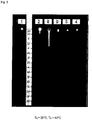
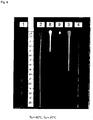
- FIGs. 2 to 4 three photographic images of run-off tests of a conventional corrosion protection agent V1 and different corrosion protection agents according to the invention (B2, B8, B9, B3 and B4) at different application and substrate temperatures are shown. An associated scale is given for each figure.
- the conventional composition V1 differs primarily in the proportions of base fluid (33.49% by weight in total), alkyd resin (22% by weight) and wax (9% by weight in total) from the compositions according to the invention, which have between 45 and 49.5% by weight base fluid, 6% by weight alkyd resin and 0 to 5% by weight wax and / or 0 to 4% by weight layered silicate, while the proportions of sulfonate components (15-16 % By weight) and filler (20-25.4% by weight) are similar.
- compositions according to the invention lie primarily in the different proportions of layered silicate and wax: B2 contains no layered silicate, but 1.5% by weight paraffin wax and also has a slightly higher proportion of base fluid (Nexbase 3030), its viscosity and Viscosity index are somewhat smaller than the viscosity and the viscosity index of the base fluid (Nexbase 3043) of the other compositions according to the invention.
- Composition B8 contains 1.2% by weight of layered silicate but no wax
- B9 contains 4% by weight of layered silicate and no wax
- B3 contains 1% by weight of layered silicate and 2% by weight of ester wax
- B4 contains 0.4% by weight of layered silicate .-% layered silicate and 5% by weight ester wax.
- the predetermined application temperatures T A (20 ° C or 60 ° C) and sheet temperatures T S (20 ° C or 60 ° C) are indicated under each figure:
- the scale given on the test sheet can be taken into account.
- compositions B8 and B9 which do not contain any wax, differ from one another, but the drainage behavior of the composition B8 or B9 in all three tests ( Fig. 2 , 3 and 4th ) is similar in each case, with composition B8 showing a drainage distance of 7.5 to 10 cm and composition B9 showing a drainage distance of less than 2.5 cm.
- the run-off behavior of the wax-free compositions B8 and B9, which contain sheet silicate, is largely not dependent on the application temperature T A or the sheet metal temperature T S.
- the compositions B2, B3, B4, which contain waxes, as well as comparative example V1 show different run-off behavior at different application temperatures T A and sheet temperatures T S.
- the run-off behavior of composition B4 which contains 5% by weight of ester wax (melting range 74 and 80 ° C.) and 0.4% by weight of sheet silicate, is similar to the run-off behavior of composition B2, which contains 1.5% by weight of paraffin wax (Melting range 76 to 82 ° C) significantly less wax, but does not contain any layered silicate:
- composition B3 has a wax content similar to B2 with 2% by weight wax, but also contains 1% by weight layered silicate, which provides improved drainage inhibition compared to B2, as the drainage distance of about 10 cm for B3 shows , which lies in the area of the drainage section from B8, which has no wax, but with 1.2% by weight layered silicate, a layered silicate content similar to B3. Consequently, with the same substrate and application temperature T S , T A of 20 ° C., the run-off behavior is more influenced by the layered silicate content than by the wax content.
- the wax-containing compositions V1, B2, B3, B4 show, with the exception of B2, a quasi-immediate inhibition of drainage, ie solidify after application without draining.
- composition B2 which has the lowest proportion of wax at 1.5% by weight, shows only a short run-off distance of less than 2.5 cm, ie that here, too, run-off inhibition occurs shortly after application.
- the so-called drop-stop effect occurs in the case of the wax-containing compositions, in which the waxes present in the corrosion protection agent are present in dissolved form due to the increased application temperature, so that when applied to the comparatively cold sheet metal, a kind of deterrent solidification or rapid hardening occurs Gel formation is coming.
- the run-off tests show that the run-off behavior of the anticorrosive agent according to the invention can be adjusted in a targeted manner to the substrate and application temperatures envisaged in the application through the proportions of layered silicate and wax. While an anti-corrosive agent that contains layered silicate and no wax, an almost has temperature-independent run-off behavior, corrosion protection agents with waxes show a run-off behavior that is influenced more by the layered silicate content than by the wax content at the same substrate and application temperature Ts, T A of 20 ° C. In the case of cold application on a heated substrate, on the other hand, higher proportions of wax lead to significantly poorer run-off behavior, but this can be at least partially compensated for by adding layered silicate.
- compositions without phyllosilicate show little to no run-off inhibition.
- the application temperature of the wax-containing compositions of the corrosion protection agent has less influence on the run-off behavior than the proportions of phyllosilicate and wax in the respective composition, since the waxy compositions show a drop-stop effect, while the Flow inhibition in compositions without wax is essentially dependent on the layered silicate content.
- the desired application-related rheological behavior can be set: continued flow after spraying / penetration into gaps, sprayability, thermal stability of the film, mechanical stability of the film, etc.
- an anti-corrosive agent tailored to the temperature conditions can be provided so that it can be optimally sprayed and penetrated into gaps before the film formed begins to gel and harden so that no more corrosion protection agent escapes from the component in subsequent process steps, regardless of the temperatures that then occur.
- the rheological properties of the anti-corrosion agent can be set in a targeted manner.
- users of car manufacturers demand film stabilities at 90 to 105 ° C.
- the wax component ensures heat stability up to approx. 70 ° C (by dissolving / gelling), at higher temperatures the applied film is stabilized by the polymerized alkyd resin.
- Fig. 5 illustrates the improved anti-corrosion properties of an anti-corrosion agent B5 according to the invention (see Table 4) compared to the conventional composition V1 (Table 2). Salt spray tests according to DIN EN ISO 9227 NSS were carried out for the corrosion test. Steel sheets Q sheet metal R46, which were coated with a coating thickness of 50 ⁇ m of the respective corrosion protection agent V1 and B5, were selected as the substrate.
- the top row in Fig. 5 shows four images of a metal sheet which was coated with the composition V1 after 1008 h, 1176 h, 1344 h and 1512 h salt spray test. Significant signs of corrosion can already be seen after 1176 hours. After 1512 h, the sheet metal coated with V1 shows extensive corrosion, so that the test was ended.
- the bottom row shows eight images of a metal sheet which has been coated with the composition B5 according to the invention. There it still shows up after 1512 h no corrosion. From the 2016 h salt spray test, signs of corrosion appear on the left edge of the sheet, which increase only moderately after 2520 h and 2856 h.
- the significant improvement in the corrosion protection of the composition B5 according to the invention is due to the significantly reduced alkyd resin content (6% by weight instead of 22% by weight), the addition of 2% by weight zinc oxide as an alkaline acid scavenger component together with the alternatively used filler calcium carbonate ( 24.56% by weight) instead of calcium sulfate (used in V1 with 20.0% by weight).
- Illustrations of further test series with further examples of the anti-corrosion agent according to the invention are not shown. It has been shown, however, that the corrosion tests are similarly good for all examples.
- the duration of protection in the salt spray test ISO 9227 NSS is roughly doubled.
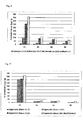
- Figures 6 to 8 show diagrams for the emissions (emission measurements according to ISO 16000-3) of the conventional anti-corrosion agent V1 (see Table 2) in comparison to anti-corrosion agents according to the invention B5, B6 and B9 (see Tables 4 and 5).
- the significantly reduced proportion of alkyd resin 6% by weight in the examples according to the invention compared to 22% by weight in the conventional composition V1 and the waiver Anti-skinning agents in all examples of the invention.
- low-emission alkyd resins such as WorleeKyd® SD 8300 (B5, B6) with a non-volatile content of at least 98% by weight or Bremar® RK 7046 (B9) with a solids content of 100% by weight are used in the compositions according to the invention, whereas in conventional corrosion inhibitors alkyd resins such as Synolac® can be used, which have a non-volatile content of only 50 to 75 wt .-% and are in solvents such as xylene, white spirit.
- the conventional composition V1 with 2,977 ⁇ g / g shows more than six times the TVOC emissions as the compositions B5 according to the invention (367 ⁇ g / g ), B6 (258 ⁇ g / g) and B9 (167 ⁇ g / g), ie the compositions B5, B6 and B9 according to the invention only have 12%, 8.7% and 5.6% of the emissions based on V1 .
- the different emission values of the compositions according to the invention can be attributed on the one hand to the addition of adsorbent (ZEOflair®) as an odor trap in B6 compared to the otherwise identical composition B5 and on the other hand to an alternative alkyd resin in B9 (Bremar® RK 7046 instead of WorléeKyd® SD 8300) .
- adsorbent ZOflair®
- B9 Bomar® RK 7046 instead of WorléeKyd® SD 8300
- the column chart in Fig. 6 shows the aldehyde emissions, broken down into C1-C2 aldehydes, C3-C5 aldehydes, C6-C9 aldehydes and sum of aldehydes with C> 3 for the comparative composition V1 and the example compositions B5, B6 and B9.
- V1 already has low emissions of 10.2 ⁇ g / g for C1 and C2 aldehydes
- those of the compositions according to the invention B5 (4.6 ⁇ g / g), B6 (4.4 ⁇ g / g) and B9 (2.3 ⁇ g / g) can still be fallen below.
- the reduction in emissions for the C3-C5 aldehydes falls even more clearly from 104.7 ⁇ g / g for V1 to 22%, 20% and 16% for B5, B6 and B9, based on V1, and for the C6-C9 Aldehydes from 304 ⁇ g / g for V1 to 28%, 23% and 15% for B5, B6 and B9, based on V1.
- the emission of aldehydes with C> 3 is from 410.2 ⁇ g / g for V1 to just under 30% (118.6 ⁇ g / g for B5), 23% (92.4 ⁇ g / g for B6) or 16% (64 ⁇ g / g for B9), based on V1.
- the bar chart in Fig. 7 in which the acid emissions are broken down into C1-C2 acids, C3-C6 organic acids, sum of C1-C9 organic acids and sum of all organic acids for the comparative composition V1 and the example compositions B5, B6 and B9.
- the emission value of the C1 and C2 acids of 1.9 ⁇ g / g, which is already low for V1, can be reduced to 0.2 ⁇ g / g (B5), 0.09 ⁇ g / g (B6) using examples B5, B6 and B9 according to the invention. and 0.1 ⁇ g / g (B9) can be reduced.
- composition B6 which contains the adsorbent ZEOflair®, achieves the lowest emissions, but only slightly less than with B9, which has an alternative alkyd resin compared to B5 and B6.
- B9 which has an alternative alkyd resin
- the example composition B6 shows lower emissions than the example composition B5 without adsorbent
- the example composition B9 which has the alternative alkyd resin, shows even more significantly reduced emission values , while the total emissions of all identified organic acids for the three inventive compositions B5, B6 and B9 are in a similar range.
- the use of the alternative alkyd resin in B9 leads to higher emissions of organic acids> C9 than the alkyd resin in Examples B5 and B6, but the emissions of these longer-chain and less volatile components are less relevant for the odor.
- Example composition B7 which differs from B6 only in that the reactant malonamide is used as the odor trap component instead of the adsorbent ZEOflair®, shows emission results similar to B6, which is why they are not shown and explained separately here.
Landscapes
- Chemical & Material Sciences (AREA)
- Wood Science & Technology (AREA)
- Life Sciences & Earth Sciences (AREA)
- Engineering & Computer Science (AREA)
- Materials Engineering (AREA)
- Organic Chemistry (AREA)
- Inorganic Chemistry (AREA)
- Chemical Kinetics & Catalysis (AREA)
- Oil, Petroleum & Natural Gas (AREA)
- Paints Or Removers (AREA)
- Compositions Of Macromolecular Compounds (AREA)
- Application Of Or Painting With Fluid Materials (AREA)
- Preventing Corrosion Or Incrustation Of Metals (AREA)
Priority Applications (14)
| Application Number | Priority Date | Filing Date | Title |
|---|---|---|---|
| EP18000979.7A EP3670611B1 (de) | 2018-12-18 | 2018-12-18 | Korrosionsschutzmittel zur hohlraumkonservierung und dessen verwendung |
| ES18000979T ES2870526T3 (es) | 2018-12-18 | 2018-12-18 | Inhibidor de corrosión para el sellado de cavidades y uso del mismo |
| PL18000979T PL3670611T3 (pl) | 2018-12-18 | 2018-12-18 | Środek antykorozyjny do zabezpieczania wnęk i jego zastosowanie |
| CN201980048880.0A CN112840001A (zh) | 2018-12-18 | 2019-11-05 | 用于空腔防护的防腐蚀剂及其用途 |
| CA3102659A CA3102659C (en) | 2018-12-18 | 2019-11-05 | Corrosion protection agent for the preservation of cavities and the use thereof |
| AU2019400473A AU2019400473B2 (en) | 2018-12-18 | 2019-11-05 | Anticorrosive agent for cavity preservation, and use thereof |
| MX2020014279A MX389337B (es) | 2018-12-18 | 2019-11-05 | Agente anticorrosivo para la conservacion de cavidades y el uso del mismo |
| KR1020217009288A KR102363310B1 (ko) | 2018-12-18 | 2019-11-05 | 캐비티 보존용 부식 방지제 및 이의 용도 |
| PCT/EP2019/000303 WO2020126063A1 (de) | 2018-12-18 | 2019-11-05 | Korrosionsschutzmittel zur hohlraumkonservierung und dessen verwendung |
| JP2021506540A JP7014931B2 (ja) | 2018-12-18 | 2019-11-05 | 空洞部保護用防食剤及びその使用 |
| US17/278,292 US11220607B2 (en) | 2018-12-18 | 2019-11-05 | Anticorrosive agent for cavity preservation, and use thereof |
| TW108146153A TWI742487B (zh) | 2018-12-18 | 2019-12-17 | 用於保護空腔的防腐蝕劑及其用途 |
| ARP190103744A AR117434A1 (es) | 2018-12-18 | 2019-12-18 | Anticorrosivo para la conservación de cavidades |
| ZA2021/01007A ZA202101007B (en) | 2018-12-18 | 2021-02-15 | Anticorrosive agent for cavity preservation, and use thereof |
Applications Claiming Priority (1)
| Application Number | Priority Date | Filing Date | Title |
|---|---|---|---|
| EP18000979.7A EP3670611B1 (de) | 2018-12-18 | 2018-12-18 | Korrosionsschutzmittel zur hohlraumkonservierung und dessen verwendung |
Publications (2)
| Publication Number | Publication Date |
|---|---|
| EP3670611A1 EP3670611A1 (de) | 2020-06-24 |
| EP3670611B1 true EP3670611B1 (de) | 2021-03-10 |
Family
ID=64745829
Family Applications (1)
| Application Number | Title | Priority Date | Filing Date |
|---|---|---|---|
| EP18000979.7A Active EP3670611B1 (de) | 2018-12-18 | 2018-12-18 | Korrosionsschutzmittel zur hohlraumkonservierung und dessen verwendung |
Country Status (14)
| Country | Link |
|---|---|
| US (1) | US11220607B2 (pl) |
| EP (1) | EP3670611B1 (pl) |
| JP (1) | JP7014931B2 (pl) |
| KR (1) | KR102363310B1 (pl) |
| CN (1) | CN112840001A (pl) |
| AR (1) | AR117434A1 (pl) |
| AU (1) | AU2019400473B2 (pl) |
| CA (1) | CA3102659C (pl) |
| ES (1) | ES2870526T3 (pl) |
| MX (1) | MX389337B (pl) |
| PL (1) | PL3670611T3 (pl) |
| TW (1) | TWI742487B (pl) |
| WO (1) | WO2020126063A1 (pl) |
| ZA (1) | ZA202101007B (pl) |
Cited By (1)
| Publication number | Priority date | Publication date | Assignee | Title |
|---|---|---|---|---|
| EP4417657A1 (de) * | 2023-02-15 | 2024-08-21 | Flooring Technologies Ltd. | Zusammensetzung zur versiegelung und beschichtung von kanten und/oder fasen von holzwerkstoffplatten |
Families Citing this family (2)
| Publication number | Priority date | Publication date | Assignee | Title |
|---|---|---|---|---|
| DE102020111288B4 (de) * | 2020-04-24 | 2022-12-08 | Pfinder Kg | Verwendung einer Zusammensetzung zur Herstellung eines geruchs- und emissionsreduzierten Korrosionsschutzmittels zur Hohlraumversiegelung oder zum Unterbodenschutz eines Bauteils |
| CN111996064A (zh) * | 2020-09-23 | 2020-11-27 | 上海虎头化工有限公司 | 一种超高温润滑脂及其制备方法 |
Family Cites Families (18)
| Publication number | Priority date | Publication date | Assignee | Title |
|---|---|---|---|---|
| EP0309472A4 (en) | 1986-06-12 | 1992-03-18 | Witco Corporation | Corrosion-inhibiting coating compositions for metals |
| JPH0192267A (ja) | 1987-10-01 | 1989-04-11 | Honda Motor Co Ltd | 防錆ワックス |
| JP2674064B2 (ja) | 1988-02-24 | 1997-11-05 | 日産自動車株式会社 | 速乾性自動車用塗布剤 |
| JPH05195261A (ja) | 1992-01-23 | 1993-08-03 | Yushiro Chem Ind Co Ltd | 自動車床下用防錆剤組成物 |
| DE4240810A1 (de) * | 1992-12-04 | 1994-06-09 | Teroson Gmbh | Beschichtungsmittel mit wärmehärtender Filmbildung und dessen Verwendung |
| CN1094142C (zh) | 1997-09-10 | 2002-11-13 | 中国石油化工集团公司 | 一种汽车内腔防护用蜡组合物及其制备方法 |
| JP3581895B2 (ja) | 1998-02-06 | 2004-10-27 | 三菱ふそうトラック・バス株式会社 | 超防錆塗料及び防錆処理方法 |
| US20100210745A1 (en) * | 2002-09-09 | 2010-08-19 | Reactive Surfaces, Ltd. | Molecular Healing of Polymeric Materials, Coatings, Plastics, Elastomers, Composites, Laminates, Adhesives, and Sealants by Active Enzymes |
| KR100820408B1 (ko) | 2006-08-09 | 2008-04-10 | 현대자동차주식회사 | 방청왁스 조성물 |
| DE102008011489A1 (de) | 2008-02-21 | 2009-08-27 | Pfinder Kg | Verfahren zur Hohlraumversiegelung |
| JP2009208015A (ja) | 2008-03-05 | 2009-09-17 | Honda Motor Co Ltd | 自動車車体の防錆処理方法 |
| RU2384599C1 (ru) | 2008-07-07 | 2010-03-20 | Юрий Михайлович Хамидулин | Композиция для антикоррозионного покрытия |
| RU2436820C1 (ru) | 2010-06-21 | 2011-12-20 | Гаранина Елена Николаевна | Антикоррозионная грунтовка |
| CN103897590A (zh) * | 2012-12-25 | 2014-07-02 | 中国兵器工业集团第五三研究所 | 一种半干性防腐涂料 |
| EP2865723B1 (de) | 2013-10-23 | 2016-09-14 | Fuchs Europe Schmierstoffe GmbH | Korrosionsschutzmittel zur Kaltapplikation |
| RU2562280C1 (ru) | 2014-05-22 | 2015-09-10 | Федеральное государственное бюджетное образовательное учреждение высшего профессионального образования "Уфимский государственынй нефтяной технический университет" | Система антикоррозионного лакокрасочного покрытия |
| KR20200016209A (ko) * | 2017-06-08 | 2020-02-14 | 디아이씨 가부시끼가이샤 | 산화 중합형 불포화 수지용 경화 촉진제, 인쇄 잉크 및 도료 |
| CN107151376A (zh) * | 2017-06-08 | 2017-09-12 | 合肥帧讯低温科技有限公司 | 一种耐腐蚀低温保温材料及其制备工艺 |
-
2018
- 2018-12-18 PL PL18000979T patent/PL3670611T3/pl unknown
- 2018-12-18 EP EP18000979.7A patent/EP3670611B1/de active Active
- 2018-12-18 ES ES18000979T patent/ES2870526T3/es active Active
-
2019
- 2019-11-05 AU AU2019400473A patent/AU2019400473B2/en active Active
- 2019-11-05 KR KR1020217009288A patent/KR102363310B1/ko active Active
- 2019-11-05 WO PCT/EP2019/000303 patent/WO2020126063A1/de not_active Ceased
- 2019-11-05 CA CA3102659A patent/CA3102659C/en active Active
- 2019-11-05 JP JP2021506540A patent/JP7014931B2/ja active Active
- 2019-11-05 MX MX2020014279A patent/MX389337B/es unknown
- 2019-11-05 CN CN201980048880.0A patent/CN112840001A/zh active Pending
- 2019-11-05 US US17/278,292 patent/US11220607B2/en active Active
- 2019-12-17 TW TW108146153A patent/TWI742487B/zh active
- 2019-12-18 AR ARP190103744A patent/AR117434A1/es active IP Right Grant
-
2021
- 2021-02-15 ZA ZA2021/01007A patent/ZA202101007B/en unknown
Non-Patent Citations (1)
| Title |
|---|
| None * |
Cited By (1)
| Publication number | Priority date | Publication date | Assignee | Title |
|---|---|---|---|---|
| EP4417657A1 (de) * | 2023-02-15 | 2024-08-21 | Flooring Technologies Ltd. | Zusammensetzung zur versiegelung und beschichtung von kanten und/oder fasen von holzwerkstoffplatten |
Also Published As
| Publication number | Publication date |
|---|---|
| KR20210042405A (ko) | 2021-04-19 |
| EP3670611A1 (de) | 2020-06-24 |
| AR117434A1 (es) | 2021-08-04 |
| JP2021525827A (ja) | 2021-09-27 |
| TW202035587A (zh) | 2020-10-01 |
| MX2020014279A (es) | 2022-01-12 |
| KR102363310B1 (ko) | 2022-02-15 |
| CN112840001A (zh) | 2021-05-25 |
| PL3670611T3 (pl) | 2021-08-02 |
| TWI742487B (zh) | 2021-10-11 |
| ES2870526T3 (es) | 2021-10-27 |
| US11220607B2 (en) | 2022-01-11 |
| CA3102659A1 (en) | 2020-06-25 |
| MX389337B (es) | 2025-03-20 |
| AU2019400473B2 (en) | 2021-06-17 |
| JP7014931B2 (ja) | 2022-02-01 |
| WO2020126063A1 (de) | 2020-06-25 |
| ZA202101007B (en) | 2021-10-27 |
| AU2019400473A1 (en) | 2021-03-11 |
| US20210309864A1 (en) | 2021-10-07 |
| CA3102659C (en) | 2021-08-31 |
Similar Documents
| Publication | Publication Date | Title |
|---|---|---|
| EP3670611B1 (de) | Korrosionsschutzmittel zur hohlraumkonservierung und dessen verwendung | |
| EP0281124B1 (de) | Thixotrope Zubereitungen, Verwendung von Polycarbonsäureamiden zu ihrer Herstellung und mit Polycarbonsäureamiden beschichtetes Siliciumdioxid | |
| DE102006056688A1 (de) | Eine Zusammensetzung für Korrosionsschutzwachs | |
| DE60104048T2 (de) | Rheologisch-dynamisch verbesserte, flüssig anwendbare elastische Zusammensetzungen | |
| DE3238864C2 (de) | Wäßrige Harzmasse | |
| DE60304501T2 (de) | Rostschutzzusammensetzung | |
| DE836981C (de) | Filmbildner, Lacke und Anstrichmittel | |
| EP0870811A2 (de) | Verwendung spezieller Vanadiumverbindungen als Sikkative für oxidativ trochnende Lacke | |
| EP2208544B1 (de) | Kombinationsbeschichtung für Holz | |
| EP2865723A1 (de) | Korrosionsschutzmittel zur Kaltapplikation | |
| DE69432039T2 (de) | Mit organischen Verbindungen modifizierte Tone als Additive für hochviskose Systeme | |
| EP2254707A2 (de) | Verfahren zur hohlraumversiegelung | |
| EP3980498B1 (de) | Rheologiekontrollierbares korrosionsschutzmittel mit waessriger basis | |
| DE3931907A1 (de) | Waessriges lackoverspray-schutzcoating fuer spritzkabinen sowie verfahren zu dessen herstellung | |
| EP0521920B1 (de) | Tiefenwirksame grundierung | |
| EP3898851A1 (de) | Lichtinduzierte kaltapplikation einer dickschichtigen korrosionsschutzbeschichtung mit kontrollierbarer kinetik | |
| DE3512351A1 (de) | Antikorrodierende schmiermittelzusammensetzungen zur behandlung von metallplatten | |
| DE19823184A1 (de) | Katalysatoren für die Herstellung kalt oder warm vernetzbarer Massen | |
| EP2487227B1 (de) | Umformschmiermittelzusammensetzung, insbesondere für die Kaltumformung von metallischen Teilen | |
| DE202010004049U1 (de) | Lösungsmittelzusammensetzung | |
| EP3744800A1 (de) | Lösemittelhaltige emulgierte alkydharz-beschichtungsmasse für lasur- und lackbeschichtungen | |
| EP1432769A1 (de) | Dispergator-zusammensetzungen | |
| DE102007012402A1 (de) | Verwendung eines Mittels für die Reifenmontage | |
| DEA0019836MA (pl) | ||
| DER0014599MA (pl) |
Legal Events
| Date | Code | Title | Description |
|---|---|---|---|
| PUAI | Public reference made under article 153(3) epc to a published international application that has entered the european phase |
Free format text: ORIGINAL CODE: 0009012 |
|
| STAA | Information on the status of an ep patent application or granted ep patent |
Free format text: STATUS: THE APPLICATION HAS BEEN PUBLISHED |
|
| AK | Designated contracting states |
Kind code of ref document: A1 Designated state(s): AL AT BE BG CH CY CZ DE DK EE ES FI FR GB GR HR HU IE IS IT LI LT LU LV MC MK MT NL NO PL PT RO RS SE SI SK SM TR |
|
| AX | Request for extension of the european patent |
Extension state: BA ME |
|
| STAA | Information on the status of an ep patent application or granted ep patent |
Free format text: STATUS: REQUEST FOR EXAMINATION WAS MADE |
|
| 17P | Request for examination filed |
Effective date: 20200619 |
|
| RBV | Designated contracting states (corrected) |
Designated state(s): AL AT BE BG CH CY CZ DE DK EE ES FI FR GB GR HR HU IE IS IT LI LT LU LV MC MK MT NL NO PL PT RO RS SE SI SK SM TR |
|
| GRAP | Despatch of communication of intention to grant a patent |
Free format text: ORIGINAL CODE: EPIDOSNIGR1 |
|
| STAA | Information on the status of an ep patent application or granted ep patent |
Free format text: STATUS: GRANT OF PATENT IS INTENDED |
|
| INTG | Intention to grant announced |
Effective date: 20200917 |
|
| GRAS | Grant fee paid |
Free format text: ORIGINAL CODE: EPIDOSNIGR3 |
|
| GRAA | (expected) grant |
Free format text: ORIGINAL CODE: 0009210 |
|
| STAA | Information on the status of an ep patent application or granted ep patent |
Free format text: STATUS: THE PATENT HAS BEEN GRANTED |
|
| AK | Designated contracting states |
Kind code of ref document: B1 Designated state(s): AL AT BE BG CH CY CZ DE DK EE ES FI FR GB GR HR HU IE IS IT LI LT LU LV MC MK MT NL NO PL PT RO RS SE SI SK SM TR |
|
| REG | Reference to a national code |
Ref country code: GB Ref legal event code: FG4D Free format text: NOT ENGLISH |
|
| REG | Reference to a national code |
Ref country code: CH Ref legal event code: EP Ref country code: AT Ref legal event code: REF Ref document number: 1369778 Country of ref document: AT Kind code of ref document: T Effective date: 20210315 |
|
| REG | Reference to a national code |
Ref country code: IE Ref legal event code: FG4D Free format text: LANGUAGE OF EP DOCUMENT: GERMAN |
|
| REG | Reference to a national code |
Ref country code: DE Ref legal event code: R096 Ref document number: 502018004177 Country of ref document: DE |
|
| REG | Reference to a national code |
Ref country code: NL Ref legal event code: FP |
|
| REG | Reference to a national code |
Ref country code: SE Ref legal event code: TRGR |
|
| REG | Reference to a national code |
Ref country code: LT Ref legal event code: MG9D |
|
| PG25 | Lapsed in a contracting state [announced via postgrant information from national office to epo] |
Ref country code: LT Free format text: LAPSE BECAUSE OF FAILURE TO SUBMIT A TRANSLATION OF THE DESCRIPTION OR TO PAY THE FEE WITHIN THE PRESCRIBED TIME-LIMIT Effective date: 20210310 Ref country code: BG Free format text: LAPSE BECAUSE OF FAILURE TO SUBMIT A TRANSLATION OF THE DESCRIPTION OR TO PAY THE FEE WITHIN THE PRESCRIBED TIME-LIMIT Effective date: 20210610 Ref country code: FI Free format text: LAPSE BECAUSE OF FAILURE TO SUBMIT A TRANSLATION OF THE DESCRIPTION OR TO PAY THE FEE WITHIN THE PRESCRIBED TIME-LIMIT Effective date: 20210310 Ref country code: GR Free format text: LAPSE BECAUSE OF FAILURE TO SUBMIT A TRANSLATION OF THE DESCRIPTION OR TO PAY THE FEE WITHIN THE PRESCRIBED TIME-LIMIT Effective date: 20210611 Ref country code: HR Free format text: LAPSE BECAUSE OF FAILURE TO SUBMIT A TRANSLATION OF THE DESCRIPTION OR TO PAY THE FEE WITHIN THE PRESCRIBED TIME-LIMIT Effective date: 20210310 Ref country code: NO Free format text: LAPSE BECAUSE OF FAILURE TO SUBMIT A TRANSLATION OF THE DESCRIPTION OR TO PAY THE FEE WITHIN THE PRESCRIBED TIME-LIMIT Effective date: 20210610 |
|
| PG25 | Lapsed in a contracting state [announced via postgrant information from national office to epo] |
Ref country code: RS Free format text: LAPSE BECAUSE OF FAILURE TO SUBMIT A TRANSLATION OF THE DESCRIPTION OR TO PAY THE FEE WITHIN THE PRESCRIBED TIME-LIMIT Effective date: 20210310 Ref country code: LV Free format text: LAPSE BECAUSE OF FAILURE TO SUBMIT A TRANSLATION OF THE DESCRIPTION OR TO PAY THE FEE WITHIN THE PRESCRIBED TIME-LIMIT Effective date: 20210310 |
|
| REG | Reference to a national code |
Ref country code: ES Ref legal event code: FG2A Ref document number: 2870526 Country of ref document: ES Kind code of ref document: T3 Effective date: 20211027 |
|
| PG25 | Lapsed in a contracting state [announced via postgrant information from national office to epo] |
Ref country code: CZ Free format text: LAPSE BECAUSE OF FAILURE TO SUBMIT A TRANSLATION OF THE DESCRIPTION OR TO PAY THE FEE WITHIN THE PRESCRIBED TIME-LIMIT Effective date: 20210310 Ref country code: EE Free format text: LAPSE BECAUSE OF FAILURE TO SUBMIT A TRANSLATION OF THE DESCRIPTION OR TO PAY THE FEE WITHIN THE PRESCRIBED TIME-LIMIT Effective date: 20210310 Ref country code: SM Free format text: LAPSE BECAUSE OF FAILURE TO SUBMIT A TRANSLATION OF THE DESCRIPTION OR TO PAY THE FEE WITHIN THE PRESCRIBED TIME-LIMIT Effective date: 20210310 |
|
| PG25 | Lapsed in a contracting state [announced via postgrant information from national office to epo] |
Ref country code: SK Free format text: LAPSE BECAUSE OF FAILURE TO SUBMIT A TRANSLATION OF THE DESCRIPTION OR TO PAY THE FEE WITHIN THE PRESCRIBED TIME-LIMIT Effective date: 20210310 Ref country code: RO Free format text: LAPSE BECAUSE OF FAILURE TO SUBMIT A TRANSLATION OF THE DESCRIPTION OR TO PAY THE FEE WITHIN THE PRESCRIBED TIME-LIMIT Effective date: 20210310 Ref country code: PT Free format text: LAPSE BECAUSE OF FAILURE TO SUBMIT A TRANSLATION OF THE DESCRIPTION OR TO PAY THE FEE WITHIN THE PRESCRIBED TIME-LIMIT Effective date: 20210712 Ref country code: IS Free format text: LAPSE BECAUSE OF FAILURE TO SUBMIT A TRANSLATION OF THE DESCRIPTION OR TO PAY THE FEE WITHIN THE PRESCRIBED TIME-LIMIT Effective date: 20210710 |
|
| REG | Reference to a national code |
Ref country code: DE Ref legal event code: R097 Ref document number: 502018004177 Country of ref document: DE |
|
| PLBE | No opposition filed within time limit |
Free format text: ORIGINAL CODE: 0009261 |
|
| STAA | Information on the status of an ep patent application or granted ep patent |
Free format text: STATUS: NO OPPOSITION FILED WITHIN TIME LIMIT |
|
| PG25 | Lapsed in a contracting state [announced via postgrant information from national office to epo] |
Ref country code: AL Free format text: LAPSE BECAUSE OF FAILURE TO SUBMIT A TRANSLATION OF THE DESCRIPTION OR TO PAY THE FEE WITHIN THE PRESCRIBED TIME-LIMIT Effective date: 20210310 Ref country code: DK Free format text: LAPSE BECAUSE OF FAILURE TO SUBMIT A TRANSLATION OF THE DESCRIPTION OR TO PAY THE FEE WITHIN THE PRESCRIBED TIME-LIMIT Effective date: 20210310 |
|
| 26N | No opposition filed |
Effective date: 20211213 |
|
| PG25 | Lapsed in a contracting state [announced via postgrant information from national office to epo] |
Ref country code: IS Free format text: LAPSE BECAUSE OF FAILURE TO SUBMIT A TRANSLATION OF THE DESCRIPTION OR TO PAY THE FEE WITHIN THE PRESCRIBED TIME-LIMIT Effective date: 20210710 |
|
| PG25 | Lapsed in a contracting state [announced via postgrant information from national office to epo] |
Ref country code: MC Free format text: LAPSE BECAUSE OF FAILURE TO SUBMIT A TRANSLATION OF THE DESCRIPTION OR TO PAY THE FEE WITHIN THE PRESCRIBED TIME-LIMIT Effective date: 20210310 |
|
| REG | Reference to a national code |
Ref country code: CH Ref legal event code: PL |
|
| REG | Reference to a national code |
Ref country code: BE Ref legal event code: MM Effective date: 20211231 |
|
| PG25 | Lapsed in a contracting state [announced via postgrant information from national office to epo] |
Ref country code: LU Free format text: LAPSE BECAUSE OF NON-PAYMENT OF DUE FEES Effective date: 20211218 Ref country code: IE Free format text: LAPSE BECAUSE OF NON-PAYMENT OF DUE FEES Effective date: 20211218 |
|
| PG25 | Lapsed in a contracting state [announced via postgrant information from national office to epo] |
Ref country code: BE Free format text: LAPSE BECAUSE OF NON-PAYMENT OF DUE FEES Effective date: 20211231 |
|
| PG25 | Lapsed in a contracting state [announced via postgrant information from national office to epo] |
Ref country code: LI Free format text: LAPSE BECAUSE OF NON-PAYMENT OF DUE FEES Effective date: 20211231 Ref country code: CH Free format text: LAPSE BECAUSE OF NON-PAYMENT OF DUE FEES Effective date: 20211231 |
|
| PG25 | Lapsed in a contracting state [announced via postgrant information from national office to epo] |
Ref country code: CY Free format text: LAPSE BECAUSE OF FAILURE TO SUBMIT A TRANSLATION OF THE DESCRIPTION OR TO PAY THE FEE WITHIN THE PRESCRIBED TIME-LIMIT Effective date: 20210310 |
|
| PG25 | Lapsed in a contracting state [announced via postgrant information from national office to epo] |
Ref country code: HU Free format text: LAPSE BECAUSE OF FAILURE TO SUBMIT A TRANSLATION OF THE DESCRIPTION OR TO PAY THE FEE WITHIN THE PRESCRIBED TIME-LIMIT; INVALID AB INITIO Effective date: 20181218 |
|
| PG25 | Lapsed in a contracting state [announced via postgrant information from national office to epo] |
Ref country code: SI Free format text: LAPSE BECAUSE OF FAILURE TO SUBMIT A TRANSLATION OF THE DESCRIPTION OR TO PAY THE FEE WITHIN THE PRESCRIBED TIME-LIMIT Effective date: 20210310 |
|
| PG25 | Lapsed in a contracting state [announced via postgrant information from national office to epo] |
Ref country code: MK Free format text: LAPSE BECAUSE OF FAILURE TO SUBMIT A TRANSLATION OF THE DESCRIPTION OR TO PAY THE FEE WITHIN THE PRESCRIBED TIME-LIMIT Effective date: 20210310 |
|
| PG25 | Lapsed in a contracting state [announced via postgrant information from national office to epo] |
Ref country code: MT Free format text: LAPSE BECAUSE OF FAILURE TO SUBMIT A TRANSLATION OF THE DESCRIPTION OR TO PAY THE FEE WITHIN THE PRESCRIBED TIME-LIMIT Effective date: 20210310 |
|
| PGFP | Annual fee paid to national office [announced via postgrant information from national office to epo] |
Ref country code: NL Payment date: 20241216 Year of fee payment: 7 |
|
| PGFP | Annual fee paid to national office [announced via postgrant information from national office to epo] |
Ref country code: GB Payment date: 20251229 Year of fee payment: 8 |
|
| PGFP | Annual fee paid to national office [announced via postgrant information from national office to epo] |
Ref country code: AT Payment date: 20251219 Year of fee payment: 8 |
|
| PGFP | Annual fee paid to national office [announced via postgrant information from national office to epo] |
Ref country code: IT Payment date: 20251219 Year of fee payment: 8 |
|
| PGFP | Annual fee paid to national office [announced via postgrant information from national office to epo] |
Ref country code: FR Payment date: 20251230 Year of fee payment: 8 |
|
| PGFP | Annual fee paid to national office [announced via postgrant information from national office to epo] |
Ref country code: TR Payment date: 20251212 Year of fee payment: 8 |
|
| PGFP | Annual fee paid to national office [announced via postgrant information from national office to epo] |
Ref country code: SE Payment date: 20251229 Year of fee payment: 8 |
|
| PGFP | Annual fee paid to national office [announced via postgrant information from national office to epo] |
Ref country code: PL Payment date: 20251211 Year of fee payment: 8 |
|
| PGFP | Annual fee paid to national office [announced via postgrant information from national office to epo] |
Ref country code: ES Payment date: 20260119 Year of fee payment: 8 |
|
| PGFP | Annual fee paid to national office [announced via postgrant information from national office to epo] |
Ref country code: DE Payment date: 20251222 Year of fee payment: 8 |