EP3672003A1 - Utilisation d'une traversée à couler dans un élément mural - Google Patents
Utilisation d'une traversée à couler dans un élément mural Download PDFInfo
- Publication number
- EP3672003A1 EP3672003A1 EP18213036.9A EP18213036A EP3672003A1 EP 3672003 A1 EP3672003 A1 EP 3672003A1 EP 18213036 A EP18213036 A EP 18213036A EP 3672003 A1 EP3672003 A1 EP 3672003A1
- Authority
- EP
- European Patent Office
- Prior art keywords
- section
- everting
- protective tube
- bushing
- use according
- Prior art date
- Legal status (The legal status is an assumption and is not a legal conclusion. Google has not performed a legal analysis and makes no representation as to the accuracy of the status listed.)
- Granted
Links
Images

Classifications
-
- H—ELECTRICITY
- H02—GENERATION; CONVERSION OR DISTRIBUTION OF ELECTRIC POWER
- H02G—INSTALLATION OF ELECTRIC CABLES OR LINES, OR OF COMBINED OPTICAL AND ELECTRIC CABLES OR LINES
- H02G3/00—Installations of electric cables or lines or protective tubing therefor in or on buildings, equivalent structures or vehicles
- H02G3/22—Installations of cables or lines through walls, floors or ceilings, e.g. into buildings
-
- F—MECHANICAL ENGINEERING; LIGHTING; HEATING; WEAPONS; BLASTING
- F16—ENGINEERING ELEMENTS AND UNITS; GENERAL MEASURES FOR PRODUCING AND MAINTAINING EFFECTIVE FUNCTIONING OF MACHINES OR INSTALLATIONS; THERMAL INSULATION IN GENERAL
- F16L—PIPES; JOINTS OR FITTINGS FOR PIPES; SUPPORTS FOR PIPES, CABLES OR PROTECTIVE TUBING; MEANS FOR THERMAL INSULATION IN GENERAL
- F16L5/00—Devices for use where pipes, cables or protective tubing pass through walls or partitions
- F16L5/02—Sealing
Definitions
- the present invention relates to a bushing for pouring into a wall element and passing a line through it.
- the implementation is usually poured in during the manufacture of the wall element, for example when it is poured from concrete.
- the bushing can be mounted on a formwork, after which it sits integrated in the concrete wall. It keeps a through opening between the opposite side surfaces of the wall free, through which a cable or other line can then be laid.
- the present invention is based on the technical problem of specifying a particularly advantageous use or implementation as the object of use.
- the bushing has an everted section which is turned over during the pouring in of the bushing and is turned out after the pouring in, a protective tube then being inserted into the everted out section.
- the actual line is laid in the protective tube, for example the cable in the example at the beginning.
- step i) This implementation or the procedure according to steps i.) - iii.) According to claim 1 can be advantageous, for example, insofar as the implementation in the inserted state (step i) is compact, which, for example, can simplify the shuttering. Installation in wall elements with a comparatively small thickness is also possible. The everted section can then be easily accessible, which can simplify the insertion of the protective tube or any fastening thereof.
- the protective tube is typically in a trench or under otherwise confined conditions (e.g. several protective tubes side by side or one above the other, see below) to the wall element, which is why good and easy handling is advantageous.
- the protrusion of the everting section is also a comparatively simple process; for example, a connecting sleeve or the like does not have to be laboriously installed on the cast-in bushing.
- This can also be advantageous, for example, in terms of reducing the number of connection points; especially when working on the ground, each connection point increases the risk of possible contamination during assembly and thus possible later leakage.
- the protective tube can, for example, have an outer diameter of at least 50 mm, 70 mm, 90 mm or 100 mm, with possible (independent) upper limits at z. B. at most 300 mm, 250 mm, 200 mm or 180 mm (increasingly preferred in each case in the order of mention).
- the everted section has a suitable inner diameter, it can also be slightly stretched when the protective tube is inserted. In the diameter range mentioned, on the one hand, the protrusion may well be possible (becomes increasingly difficult with smaller diameters), on the other hand, the forces caused by the weight of the protective tube are not yet too great.
- the everted section is preferably attached to the protective tube, particularly preferably a clamping means is arranged on an outer wall surface of the everting section, with which the everting section is pressed onto the protective tube. An inner wall surface of the everting section then lies in a sealing manner against an outer wall surface of the protective tube.
- a tensioning strap or a tensioning clamp (with screw drive) can be provided as tensioning means.
- inside and outside refer to directions perpendicular to a tube axis of the protective tube and pointing away therefrom (hereinafter also referred to as “radial directions”), unless expressly stated otherwise.
- the tube axis which for example also coincides with a longitudinal axis of the through opening that is kept free of the bushing, results from the orientation of the protective tube where it is inserted into the everting section (to what extent the protective tube then extends, for example curved, spaced from the wall) is insignificant in this respect).
- a “longitudinal direction of the line” referred to below is preferably parallel to the pipe axis (in practice, there may of course be no further relevant deviations from an exact parallelism in the present context).
- the turned-out state is used as the basis for the assignment "inside” / "outside” (so the inside wall surface can be turned in, see below).
- the term “revolving” refers to a revolution around the pipe axis.
- the everting section is preferably a part or section of an everting sleeve. This is made of an elastomer material, preferably it has an essentially hollow cylindrical shape (ie a circular shape in the section just mentioned). To form a film hinge, the wall thickness of the slip sleeve can be reduced locally when viewed in an axial section, in comparison to the slip section and / or an assembly section (see below).
- the everting section could generally also be molded directly as an elastomer part onto a tubular element made of hard plastic.
- a tubular element made of hard plastic and the slip section made of, for example, a thermoplastic elastomer could be injection molded onto it.
- the slip sleeve (with mounting section etc.) could be molded directly onto the tubular element, but it is preferably a matter of separately manufactured, assembled parts.
- the “elastomer material” is generally a plastic with elastic behavior. Its Shore hardness (Shore A) can be, for example, at most 90 Shore, 80 Shore, 75 Shore or 70 Shore and (regardless of this), for example, at least 20 Shore, 25 Shore, 30 Shore, 35 Shore or 40 Shore .
- it can be a rubber material, preferably a synthetic rubber, such as EPDM (ethylene propylene diene, M group).
- EPDM ethylene propylene diene, M group
- TPE thermoplastic elastomer
- silicone-based material such as silicone rubber or silicone elastomer.
- the tubular element can have, for example, a Shore hardness (D) of at least 50 Shore, 60 Shore or 70 Shore have, with possible upper limits at a maximum of 85 Shore or 80 Shore, at least in the case of plastic.
- the slip section is arranged inside the step in accordance with number i.) And then in the step in accordance with number ii.) Outside the wall element.
- This relates to the longitudinal direction of the line, so the everted section is seen from the view of the wall element turned in on one side of the wall and turned out beyond it.
- This can be advantageous, for example, insofar as, for example, a flat formwork element can also be in place during the pouring in, so that no protrusions need to be taken into account.
- the everting section protrudes outwards and is therefore particularly easily accessible, in particular for placing or actuating a clamping device.
- the everting section is part of an everting sleeve (see above), this everting sleeve having a circumferential lip which is formed monolithically with the everting section.
- This lip lies against the formwork when pouring. For this purpose, it extends in the unloaded state, that is to say if no formwork element presses against it, preferably towards its free end obliquely outwards, that is to say in the direction of the everted section and away from the tube axis.
- the lip is preferably arranged radially outside the film hinge of the slip sleeve, so that it remains well movable, kept free from the potting material.
- “monolithic” means free of material boundaries in the interior, that is to say material boundaries between different materials or materials of different manufacturing history, in any case apart from statistically distributed inclusions (for example dye particles).
- the "monolithic” sleeve is preferably a molded part that is produced in one step by casting or pressing into a mold.
- the bushing has a toothed ring.
- the protective tube is pushed into this in the step according to number iii.),
- the toothed ring then holds it secured against slipping out.
- the force required to pull the protective tube out of the toothed ring is greater than the force required to insert it, for example it can be at least 2, 4, 6, 8 or 10 times greater (with possible upper limits for e.g. maximum 1000, 500, 100 or 50 times).
- the toothed ring has a multiplicity of teeth all around (at least 10, 20, 30, 40 or 50, with possible upper limits at, for example, at most 500 or 100), which cling to the protective tube after it has been inserted (as soon as this is or would be moved only slightly opposite to the direction of insertion).
- the toothed ring can hold the inserted protective tube reliably, which can also be advantageous during assembly, for example. Preference is given to pressing the slip section onto the inserted protective tube (with the aid of a clamping device, see above) and fixing by means of a toothed ring combined measures, the toothed ring also being able to simplify the subsequent pressing of the slip section (it holds the protective tube and thus prevents assembly errors).
- one advantage of the toothed ring is the automatic fixation that is achieved simply by inserting the protective tube.
- a toothed ring made of a hard plastic is also conceivable, especially in the case of a protective tube provided as a corrugated tube or spiral tube.
- the toothed ring is a metal part.
- a milled part is also conceivable, but the toothed ring is preferably machined out of a sheet metal, for example by laser cutting or preferably stamping (the toothed ring is then a stamped part).
- the toothed ring can preferably be self-contained all round, but in general it can also be provided, for example, with a parting line (or even in several parts).
- the teeth of the toothed ring still have an orientation corresponding to the surface material or sheet metal before the protective tube is pushed in, that is to say that they are not, or at most only slightly, bent out of the plane. They can, for example, be angled, in particular extend inwards perpendicular to the pipe axis and then when they are inserted of the protective tube are bent in the direction of insertion (and create a claw in the opposite direction).
- the teeth of the toothed ring provided as a laser or stamped part are preferably already bent beforehand, so you have, for example, viewed in an axial section, a lying U or. V shape. This shape is closed against the direction of insertion, so open in the direction of insertion. The protective tube slides accordingly when inserted along the teeth, they claw in the opposite direction.
- the turned-in section covers the toothed ring on the inside, which is protected during the pouring or even beforehand (storage and transport).
- the toothed ring could, for example, also be molded into the sealing sleeve or into a pipe element of the bushing, that is, for example, overmoulded as an insert. It is preferably a separate, inserted part (also independent of the cover on the inside).
- the preferred cover on the inside can also help to ensure that the toothed ring does not slip or fall out, that is to say then sits at the desired position when the protective tube is inserted.
- a closure is inserted into the inlaid section, which closes the bushing to this side of the wall element (to the side from which the protective tube is inserted).
- This can be, for example, a pipe closure cover, a lamella plug or a foam body, for example a round blank made of expanded polypropylene. If a toothed ring is provided, the cover just discussed can advantageously also prevent the closure from clawing due to the inserted section.
- the slip section is part of a sealing sleeve (see above) and the toothed ring is arranged in an assembly section of the sealing sleeve.
- This assembly section sits within the wall element both in the step in accordance with number i.) And in that in accordance with iii.), And is then stable embedded.
- the toothed ring arranged there can hold the protective tube accordingly reliably.
- the protective tube is very generally inserted so far that the end of the protective tube then lies within the wall element. So the end of the protective tube inserted through the everted section comes to lie within the wall element, so it is arranged there when the protective tube is completely or completely inserted (in this position, for example, the everting section is then attached to the protective tube and / or the line through the protective tube misplaced and especially sealed against the implementation).
- the protective tube is thus pushed a bit into a through-opening which is kept free of the passage in the potting material (usually concrete), so that the wall element itself advantageously takes on a stabilizing or supporting function.
- the latter can be particularly advantageous in comparison to the attachment of a separate pipe socket described at the beginning as an alternative solution.
- the support function can be advantageous, for example, during the construction phase, if, for example, improper handling (entering the protective tube) or a subsequent transverse load occurs, for example, if the soil sinks with insufficient compaction.
- the slip section is part of a slip sleeve with a mounting section.
- the protective tube is preferably pushed into the assembly section in the step according to number iii. (Regardless of whether without or preferably with a toothed ring there).
- the sleeve or the mounting section preferably forms a stop, up to which the protective tube is inserted.
- an inwardly protruding, circumferential (preferably completely circumferential) elevation is provided on an inner wall surface of the assembly section.
- this can ensure a system on the then inserted protective tube, for example also have relevance with regard to the tightness.
- it can be combined specify a defined axial position with the toothed ring, so secure it against slipping.
- a plurality of elevations are preferably provided, particularly preferably exactly two, in between the toothed ring is then axially secured.
- an indentation is provided on an inner wall surface of the slip section, in which the elevation is arranged on the inner wall surface of the mounting section when the slip section is turned in, that is to say its inner wall surface is facing outwards (see also the comments above). If the everting section is turned out, the depression represents an inwardly open groove, in the inturned state it is open to the outside (and receives the elevation). If several elevations are provided in the assembly section, these can each be assigned a separate depression or they can also be arranged in a common depression. If a toothed ring is provided, this too is preferably arranged in a recess on the inner wall surface of the turned-in section, particularly preferably together with the elevation (s) that surround it axially.
- a tab is arranged on the everting section, on which the everting can be gripped, preferably by hand (or with pliers).
- the tab is preferably arranged at its axial end and extends radially outward.
- the bushing preferably has a tubular element that remains in the wall element after it is poured into it, that is to say it is not removed.
- the sleeve and the tubular element have an axial overlap; in any case, the turned-over section protrudes axially from the tubular element.
- the tubular element is preferably provided from a hard plastic material, e.g. B. ABS or PVC.
- such a pipe element of the bushing can also keep the entire passage opening free and the everting sleeve or the everting everting section can be arranged radially within it.
- a mounting section of the slip sleeve delimits at least a section of the through opening in the wall element.
- the potting material therefore lies against an outer wall surface of the assembly section when it is poured in.
- This can be advantageous, for example, insofar as the slip sleeve, which is made of a soft material with regard to the slip ability, then forms an interface with the potting material. This hardens after casting, which can lead to shrinkage.
- the soft material of the everting sleeve can then still remain in contact with the hardened potting material with a certain elasticity, thus helping to prevent gaps and possible creeping paths for moisture.
- a combination with the insertion of the protective tube into the mounting section and thus into the wall element can be particularly advantageous because the inserted protective tube then pushes the mounting section outwards and thus into the system on the hardened potting material.
- a web seal that rises outwards is provided on the outer wall surface of the assembly section, to which the potting material is applied.
- the web seal is axially and externally enclosed by the potting material.
- a plurality of web seals can preferably be provided, that is to say at least two and, for example, not more than five or four, and three are particularly preferred.
- the inserted protective tube can then push the web seals slightly outwards and thus into a sealing system.
- a respective web seal can widen towards its free end, that is to say then sit with an undercut in the hardened potting material.
- a respective web seal preferably rises without an undercut, because this significantly simplifies the manufacture of the bushing or slip sleeve in a molding process, especially in connection with the pressing outwards through the inserted protective tube, however, there is no loss of density.
- the assembly section of the slip sleeve is drawn onto a tubular element of the bushing, that is to say the tubular element supports the assembly section radially inward during casting.
- the tubular element is preferably arranged only in one section of the assembly section (not in the entire assembly section) and the protective tube is inserted into another section, see above.
- the tubular element supports the sleeve during the pouring, but then also remains in the wall element together with the sleeve; the two are therefore permanently integrated in the building, for example surrounded by concrete.
- the permanently installed pipe element can, for example, also be advantageous with a view to the later passing or threading of the line, namely preventing the individual components of the bushing from slipping within the wall element (the end of the line could get caught and individual parts could move, the pipe element creates additional stability).
- the everting section when the everting section is turned out, exactly one film hinge is turned over from the inturned state.
- this can be a certain disadvantage compared to protruding around two film hinges (double protrusion) in that the outer wall surface (protruding state) faces inwards when the protruding state.
- no clamping clamp can already be placed as an integral part in the inserted state, which automatically sits in the correct place after being inserted.
- the simple protrusion is preferred in terms of stability. Since the everted fitting section and the mounting section are then essentially axially aligned with one another, the protective tube inserted into the mounting section can then be supported radially in this and thus in the wall element without significant play.
- the slip sleeve is equipped with a further slip section at its end opposite the slip section.
- this serves to adapt the tube element to the bushing.
- the further everting section can be turned in, and thus the fitting sleeve can be secured to the tubular element.
- This can be the case, in particular, in the case of thicker walls, if a pipe socket arranged on a flange plate does not itself or solely form the pipe element, but an extension pipe is additionally inserted, see also the exemplary embodiment for illustration.
- the flange plate with pipe socket is opposite to the end into which the protective tube is inserted.
- Such a flange plate which is part of the bushing after casting on the opposite side surface of the wall element, can generally be preferred.
- the flange plate can be used on the one hand for assembly on a formwork element, and on the other hand the bushing can also be assembled in a modular manner with other bushings.
- form-fit elements can be provided on the outer edges of the flange plate, preferably all feedthroughs or flange plates of a module are of identical construction, that is to say each form-fit element has mutually complementary form-fit element parts (male / female).
- the pipe element of the bushing discussed above or at least a section (pipe socket) thereof is preferably provided in one piece or monolithically with the flange plate, also regardless of its configuration with form-fitting elements etc.
- a further piece of pipe can then be used with the pipe socket of the flange plate be assembled to provide a longer pipe element for thicker walls.
- the sleeve can sit on the pipe socket of the flange plate itself (thin walls) or on a piece of pipe assembled with it (thick walls).
- the wall element is an outer wall of a building, that is to say a space which is enclosed on several sides, preferably in total.
- a residential building is also conceivable, preferably it is a technical building, for example a transformer station (substation).
- the protective tube extends on the outside of the building, and accordingly the everting section is also turned out to the outside of the building.
- a seal is preferably placed on the bushing, which then seals the line against the bushing. This can be done, for example, with a press seal (elastomer body, which is axially compressed with clamping bolts and is applied in a radially sealing manner), or, for example, a shrink tube insert can also be used.
- the wall element is preferably cast from concrete, the bushing preferably being fastened to a formwork which is removed after the wall element has been poured.
- the slip section of the slip sleeve (in the unfolded state) can also have a significantly smaller inside diameter than the mounting section of the slip sleeve, for example of at most 1/2, 1/3 or 1/4 (with possible lower limits for e.g. at least 1/30 or 1/20).
- the mounting section also preferably sits on a tubular element in this variant Execution, which supports and stabilizes the slip sleeve during pouring and beyond.
- the everting sleeve can in particular also be designed for the passage of a plurality of cables, that is to say can have a plurality of everting sections. These can protrude axially on one end face of the everting sleeve in the slipped-out state, and the assembly section extends on the axially opposite side of the end face. Irrespective of this in detail, the slip section or sections can then be pressed onto the respective cable, for example, in each case with a tensioning means (e.g. tensioning strap or tensioning clamp, see above). As also explained above, the assembly section is enclosed by the potting material, in particular concrete, of the wall element.
- a tensioning means e.g. tensioning strap or tensioning clamp
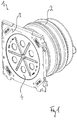
- Figure 1 shows an implementation 1 in an oblique view.
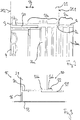
- the bushing 1 has a slip sleeve 2, which is discussed in detail below and is pushed onto a tubular element 20, also compare the section according to FIG Figure 2 .
- the tubular element 20 extends away from a flange plate 3, with which the bushing 1 rests on a formwork when poured into a wall element, see also Figure 3 for illustration.
- the bushing 1 is closed at the end with the flange plate 3 with a cover 4, which can be removed after concreting and the actual line can then be laid.
- FIG. 2 the concrete wall element 21 is indicated by dashed lines.
- a fitting section 2a is, in relation to a longitudinal direction 22 of the line, in the situation according to Figure 2 arranged outside the wall element 21.
- An assembly section 2b of the sleeve 2 lies within it.
- the everting section 2a is also arranged inside the wall element 21, namely it is turned inside.
- the slip section 2a and the mounting section 2b are connected to one another via a film hinge 2c.
- an inner wall surface 2aa of the everting section 2a bears against an inner wall surface 2ba of the mounting section 2b. Since the bushing 1 is cast in with the turned-in section 2a, a flat formwork element can be placed on both side surfaces 21.1, 21.2 of the wall element, which simplifies the formwork. Small wall thicknesses are also possible.
- a closure (not shown here) can additionally be inserted into the inlaid section 2a, which corresponds to the implementation 1 in the illustration Figure 2 closes on the right side. This is then removed after the pouring, and the everting section 2a is turned out.
- a protective tube 31 can then be inserted from the outside of a building 30, namely into the mounting section 2b and thus into the wall element 21.
- the protective tube 31 is thus kept stable against lateral forces.
- a clamping means 32 is arranged on an outer wall surface 2ab of the slip section 2a, which presses the slip section 2a onto the protective tube 31.
- the concrete borders on the outer wall surface 2bb of the mounting section 2b, the inserted protective tube 31 also bringing about a pressure to the outside and thus a tightness of this interface.
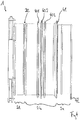
- Figure 4 shows the bushing 1 again in a side view on the outer wall surface 2bb of the mounting section 2b, web seals 40.1-40.3 can be seen, which together form a multi-wall seal. This is also pressed against the outside by the inserted protective tube 31.
- a circumferential lip 41 can be seen which bears against a formwork when the bushing 1 is poured in.
- a tab 42 can be seen at the end of the everted section 2a, which makes it easier for a fitter to put it out.
- the slip sleeve is provided with a further slip section 2d which hangs on the mounting section 2b via a film hinge 2e.
- the further everting section 2d is turned over, for adaptation to a tubular element with a smaller diameter it can be turned over.
- a clamping means (not shown here) can be arranged on the outside on the further slip section 2a in order to fix the slip sleeve 2 relative to the tubular element.
- the cut oblique view according to Figure 5 also reveals features located on the inside.
- the slip sleeve forms a stop 50, up to which the protective tube 31 can be inserted.
- two circumferential elevations 51 are formed on the inner wall surface 2ba in the mounting section 2b, which can be of interest, for example, with regard to a sealing contact with the protective tube 31.
- Complementary depressions 52 are provided on the inner wall surface 2aa of the slip section 2a, in which the elevations 51 come to rest when the slip section 2a is pushed in.
- Figure 6 shows a section of a toothed ring 60, namely from one Figure 5 opposite viewing direction, ie from the direction from which the protective tube 31 is inserted.
- the toothed ring 60 is arranged in the mounting section 2b, namely on the inside and between the elevations 51.
- the toothed ring 60 is shaped as a stamped and bent sheet metal part. It has a multiplicity of teeth 61 all around, along which the protective tube 31 can slide when inserted, but which claw in the opposite direction in its outer wall surface during a movement.
- the toothed ring 60 holds the protective tube 31 in position after it has been inserted, even before the clamping means 32 presses the everting section 2ab onto the protective tube 31.
- the toothed ring 60 can, as mentioned, be arranged in the mounting section 2b between the elevations 51, the recesses 52 then also being able to be combined in the slip section 2a, that is to say the two elevations 51 together with the toothed ring 60 can be placed in a common depression 52.
Landscapes
- Engineering & Computer Science (AREA)
- Architecture (AREA)
- Civil Engineering (AREA)
- Structural Engineering (AREA)
- Forms Removed On Construction Sites Or Auxiliary Members Thereof (AREA)
Priority Applications (2)
| Application Number | Priority Date | Filing Date | Title |
|---|---|---|---|
| EP18213036.9A EP3672003B1 (fr) | 2018-12-17 | 2018-12-17 | Utilisation d'une traversée à couler dans un élément mural |
| PL18213036.9T PL3672003T3 (pl) | 2018-12-17 | 2018-12-17 | Zastosowanie przepustu do zalewania w ściennym elemencie |
Applications Claiming Priority (1)
| Application Number | Priority Date | Filing Date | Title |
|---|---|---|---|
| EP18213036.9A EP3672003B1 (fr) | 2018-12-17 | 2018-12-17 | Utilisation d'une traversée à couler dans un élément mural |
Publications (3)
| Publication Number | Publication Date |
|---|---|
| EP3672003A1 true EP3672003A1 (fr) | 2020-06-24 |
| EP3672003B1 EP3672003B1 (fr) | 2023-11-22 |
| EP3672003C0 EP3672003C0 (fr) | 2023-11-22 |
Family
ID=64744425
Family Applications (1)
| Application Number | Title | Priority Date | Filing Date |
|---|---|---|---|
| EP18213036.9A Active EP3672003B1 (fr) | 2018-12-17 | 2018-12-17 | Utilisation d'une traversée à couler dans un élément mural |
Country Status (2)
| Country | Link |
|---|---|
| EP (1) | EP3672003B1 (fr) |
| PL (1) | PL3672003T3 (fr) |
Citations (7)
| Publication number | Priority date | Publication date | Assignee | Title |
|---|---|---|---|---|
| DE2120070A1 (de) * | 1971-04-24 | 1972-11-16 | Beton-Bau Gmbh, 6833 Kirrlach | Wasserdichte Wanddurchführung für elektrische Kabel |
| DE3005144A1 (de) * | 1980-02-12 | 1981-08-20 | Hans 8100 Garmisch-Partenkirchen Langmatz | Mauerdurchfuehrung fuer kabel und leitungen |
| US5941535A (en) * | 1997-05-29 | 1999-08-24 | Richard; James G. | Cast-in-place pipe support having a reversible pipe seal and removable closure disk |
| EP2899332A1 (fr) * | 2014-01-23 | 2015-07-29 | Hauff-Technik GmbH & Co. KG | Passage encastrable dans un élément de mur ou de sol |
| US20150263498A1 (en) * | 2014-03-13 | 2015-09-17 | Hubbell Incorporated | Push to connect weatherproof box |
| EP3061890A1 (fr) * | 2015-02-26 | 2016-08-31 | Hauff-Technik GmbH & Co. KG | Réalisation de coulée avec du béton |
| EP3255330A1 (fr) * | 2016-06-09 | 2017-12-13 | Hauff-Technik GmbH & Co. KG | Utilisation d'une douille d'etancheite |
Family Cites Families (2)
| Publication number | Priority date | Publication date | Assignee | Title |
|---|---|---|---|---|
| FR2557388B1 (fr) * | 1983-09-23 | 1986-12-26 | Lebrun Marie Therese | Masque prefabrique et presse-etoupe associes pour passage etanche a travers une paroi |
| DE10007527C2 (de) * | 2000-02-18 | 2003-05-22 | Hauff Technik Gmbh & Co Kg | Dichtpackung zum Hindurchführen von Leitungen durch eine Wand |
-
2018
- 2018-12-17 EP EP18213036.9A patent/EP3672003B1/fr active Active
- 2018-12-17 PL PL18213036.9T patent/PL3672003T3/pl unknown
Patent Citations (7)
| Publication number | Priority date | Publication date | Assignee | Title |
|---|---|---|---|---|
| DE2120070A1 (de) * | 1971-04-24 | 1972-11-16 | Beton-Bau Gmbh, 6833 Kirrlach | Wasserdichte Wanddurchführung für elektrische Kabel |
| DE3005144A1 (de) * | 1980-02-12 | 1981-08-20 | Hans 8100 Garmisch-Partenkirchen Langmatz | Mauerdurchfuehrung fuer kabel und leitungen |
| US5941535A (en) * | 1997-05-29 | 1999-08-24 | Richard; James G. | Cast-in-place pipe support having a reversible pipe seal and removable closure disk |
| EP2899332A1 (fr) * | 2014-01-23 | 2015-07-29 | Hauff-Technik GmbH & Co. KG | Passage encastrable dans un élément de mur ou de sol |
| US20150263498A1 (en) * | 2014-03-13 | 2015-09-17 | Hubbell Incorporated | Push to connect weatherproof box |
| EP3061890A1 (fr) * | 2015-02-26 | 2016-08-31 | Hauff-Technik GmbH & Co. KG | Réalisation de coulée avec du béton |
| EP3255330A1 (fr) * | 2016-06-09 | 2017-12-13 | Hauff-Technik GmbH & Co. KG | Utilisation d'une douille d'etancheite |
Also Published As
| Publication number | Publication date |
|---|---|
| EP3672003B1 (fr) | 2023-11-22 |
| PL3672003T3 (pl) | 2024-03-04 |
| EP3672003C0 (fr) | 2023-11-22 |
Similar Documents
| Publication | Publication Date | Title |
|---|---|---|
| EP2899332B1 (fr) | Utilisation d'un passage encastrable dans un élément de mur ou de sol | |
| DE29723989U1 (de) | Vorrichtung zum Verbund von Betonfertigteilen | |
| DE60206930T2 (de) | Gerät mit einer dichtung zwischen zwei gehäuseschalen | |
| EP1288554A1 (fr) | Dispositif de connexion pour un tube | |
| EP3672003B1 (fr) | Utilisation d'une traversée à couler dans un élément mural | |
| EP2338658A1 (fr) | Procédé de fabrication d'un bourrage d'étanchéité | |
| DE69616381T2 (de) | Klemmvorrichtung | |
| EP3288130B1 (fr) | Utilisation d'une traversée de mur destinée à être installée dans un mur extérieur de bâtiment | |
| EP3327884B1 (fr) | Insertion de tube | |
| DE2937605C2 (de) | Formvorrichtung zum Umspritzen oder Umgießen des Randes eines flächigen Bauteiles | |
| EP2028740A1 (fr) | Boîte encastrée pour installations électriques | |
| EP1528011B1 (fr) | Cartouche coaxiale à deux composants | |
| DE102018005720B4 (de) | Verwendung einer Durchführung zum Eingießen in eine Bodenplatte | |
| DE102022124664A1 (de) | Verwendung eines Einsatzes zur Montage in einem Wand- oder Bodenelement | |
| EP3061890B1 (fr) | Passage avec du béton | |
| EP2363552B1 (fr) | Utilisation d'une réhausse pour le réhaussement sur un bourrage d'étanchéité | |
| EP2937493B1 (fr) | Passage encastrable dans un élément de mur ou de sol | |
| EP2426280B1 (fr) | Anneau d'étanchéité de centrage pour une armature sanitaire, notamment une armature de table de lavage | |
| EP2385286B1 (fr) | Passage de ligne avec empilement | |
| DE102023127011A1 (de) | Pressdichtung zum Abdichten einer Leitung gegen eine Seitenfläche eines Wand- oder Bodenelements | |
| DE69001441T2 (de) | Dose mit ausbrechbaren oeffnungen fuer einbaugeraete, insbesondere fuer elektrische geraete. | |
| DE3318754A1 (de) | Membran und verfahren zu deren herstellung | |
| EP4594663A1 (fr) | Utilisation d'un manchon élastomère pour assemblage sur une ligne | |
| DE102022124662A1 (de) | Verwendung eines Einsatzes zur Montage in einem Wand- oder Bodenelement | |
| DE202015001458U1 (de) | Durchführung zum Vergießen mit Beton |
Legal Events
| Date | Code | Title | Description |
|---|---|---|---|
| PUAI | Public reference made under article 153(3) epc to a published international application that has entered the european phase |
Free format text: ORIGINAL CODE: 0009012 |
|
| STAA | Information on the status of an ep patent application or granted ep patent |
Free format text: STATUS: THE APPLICATION HAS BEEN PUBLISHED |
|
| AK | Designated contracting states |
Kind code of ref document: A1 Designated state(s): AL AT BE BG CH CY CZ DE DK EE ES FI FR GB GR HR HU IE IS IT LI LT LU LV MC MK MT NL NO PL PT RO RS SE SI SK SM TR |
|
| AX | Request for extension of the european patent |
Extension state: BA ME |
|
| STAA | Information on the status of an ep patent application or granted ep patent |
Free format text: STATUS: REQUEST FOR EXAMINATION WAS MADE |
|
| 17P | Request for examination filed |
Effective date: 20201222 |
|
| RBV | Designated contracting states (corrected) |
Designated state(s): AL AT BE BG CH CY CZ DE DK EE ES FI FR GB GR HR HU IE IS IT LI LT LU LV MC MK MT NL NO PL PT RO RS SE SI SK SM TR |
|
| STAA | Information on the status of an ep patent application or granted ep patent |
Free format text: STATUS: EXAMINATION IS IN PROGRESS |
|
| 17Q | First examination report despatched |
Effective date: 20211222 |
|
| 17Q | First examination report despatched |
Effective date: 20220217 |
|
| GRAP | Despatch of communication of intention to grant a patent |
Free format text: ORIGINAL CODE: EPIDOSNIGR1 |
|
| STAA | Information on the status of an ep patent application or granted ep patent |
Free format text: STATUS: GRANT OF PATENT IS INTENDED |
|
| RIC1 | Information provided on ipc code assigned before grant |
Ipc: F16L 5/02 20060101ALN20230624BHEP Ipc: F16L 5/00 20060101ALI20230624BHEP Ipc: H02G 3/22 20060101AFI20230624BHEP |
|
| INTG | Intention to grant announced |
Effective date: 20230707 |
|
| GRAS | Grant fee paid |
Free format text: ORIGINAL CODE: EPIDOSNIGR3 |
|
| GRAA | (expected) grant |
Free format text: ORIGINAL CODE: 0009210 |
|
| STAA | Information on the status of an ep patent application or granted ep patent |
Free format text: STATUS: THE PATENT HAS BEEN GRANTED |
|
| AK | Designated contracting states |
Kind code of ref document: B1 Designated state(s): AL AT BE BG CH CY CZ DE DK EE ES FI FR GB GR HR HU IE IS IT LI LT LU LV MC MK MT NL NO PL PT RO RS SE SI SK SM TR |
|
| REG | Reference to a national code |
Ref country code: GB Ref legal event code: FG4D Free format text: NOT ENGLISH |
|
| REG | Reference to a national code |
Ref country code: CH Ref legal event code: EP Ref country code: DE Ref legal event code: R096 Ref document number: 502018013662 Country of ref document: DE |
|
| REG | Reference to a national code |
Ref country code: IE Ref legal event code: FG4D Free format text: LANGUAGE OF EP DOCUMENT: GERMAN |
|
| U01 | Request for unitary effect filed |
Effective date: 20231123 |
|
| U07 | Unitary effect registered |
Designated state(s): AT BE BG DE DK EE FI FR IT LT LU LV MT NL PT SE SI Effective date: 20231129 |
|
| U20 | Renewal fee for the european patent with unitary effect paid |
Year of fee payment: 6 Effective date: 20240215 |
|
| PG25 | Lapsed in a contracting state [announced via postgrant information from national office to epo] |
Ref country code: GR Free format text: LAPSE BECAUSE OF FAILURE TO SUBMIT A TRANSLATION OF THE DESCRIPTION OR TO PAY THE FEE WITHIN THE PRESCRIBED TIME-LIMIT Effective date: 20240223 |
|
| PG25 | Lapsed in a contracting state [announced via postgrant information from national office to epo] |
Ref country code: IS Free format text: LAPSE BECAUSE OF FAILURE TO SUBMIT A TRANSLATION OF THE DESCRIPTION OR TO PAY THE FEE WITHIN THE PRESCRIBED TIME-LIMIT Effective date: 20240322 |
|
| PG25 | Lapsed in a contracting state [announced via postgrant information from national office to epo] |
Ref country code: ES Free format text: LAPSE BECAUSE OF FAILURE TO SUBMIT A TRANSLATION OF THE DESCRIPTION OR TO PAY THE FEE WITHIN THE PRESCRIBED TIME-LIMIT Effective date: 20231122 |
|
| PG25 | Lapsed in a contracting state [announced via postgrant information from national office to epo] |
Ref country code: IS Free format text: LAPSE BECAUSE OF FAILURE TO SUBMIT A TRANSLATION OF THE DESCRIPTION OR TO PAY THE FEE WITHIN THE PRESCRIBED TIME-LIMIT Effective date: 20240322 Ref country code: GR Free format text: LAPSE BECAUSE OF FAILURE TO SUBMIT A TRANSLATION OF THE DESCRIPTION OR TO PAY THE FEE WITHIN THE PRESCRIBED TIME-LIMIT Effective date: 20240223 Ref country code: ES Free format text: LAPSE BECAUSE OF FAILURE TO SUBMIT A TRANSLATION OF THE DESCRIPTION OR TO PAY THE FEE WITHIN THE PRESCRIBED TIME-LIMIT Effective date: 20231122 |
|
| PG25 | Lapsed in a contracting state [announced via postgrant information from national office to epo] |
Ref country code: RS Free format text: LAPSE BECAUSE OF FAILURE TO SUBMIT A TRANSLATION OF THE DESCRIPTION OR TO PAY THE FEE WITHIN THE PRESCRIBED TIME-LIMIT Effective date: 20231122 Ref country code: NO Free format text: LAPSE BECAUSE OF FAILURE TO SUBMIT A TRANSLATION OF THE DESCRIPTION OR TO PAY THE FEE WITHIN THE PRESCRIBED TIME-LIMIT Effective date: 20240222 Ref country code: HR Free format text: LAPSE BECAUSE OF FAILURE TO SUBMIT A TRANSLATION OF THE DESCRIPTION OR TO PAY THE FEE WITHIN THE PRESCRIBED TIME-LIMIT Effective date: 20231122 |
|
| PG25 | Lapsed in a contracting state [announced via postgrant information from national office to epo] |
Ref country code: SK Free format text: LAPSE BECAUSE OF FAILURE TO SUBMIT A TRANSLATION OF THE DESCRIPTION OR TO PAY THE FEE WITHIN THE PRESCRIBED TIME-LIMIT Effective date: 20231122 |
|
| PG25 | Lapsed in a contracting state [announced via postgrant information from national office to epo] |
Ref country code: SM Free format text: LAPSE BECAUSE OF FAILURE TO SUBMIT A TRANSLATION OF THE DESCRIPTION OR TO PAY THE FEE WITHIN THE PRESCRIBED TIME-LIMIT Effective date: 20231122 Ref country code: SK Free format text: LAPSE BECAUSE OF FAILURE TO SUBMIT A TRANSLATION OF THE DESCRIPTION OR TO PAY THE FEE WITHIN THE PRESCRIBED TIME-LIMIT Effective date: 20231122 Ref country code: RO Free format text: LAPSE BECAUSE OF FAILURE TO SUBMIT A TRANSLATION OF THE DESCRIPTION OR TO PAY THE FEE WITHIN THE PRESCRIBED TIME-LIMIT Effective date: 20231122 |
|
| REG | Reference to a national code |
Ref country code: DE Ref legal event code: R097 Ref document number: 502018013662 Country of ref document: DE |
|
| PG25 | Lapsed in a contracting state [announced via postgrant information from national office to epo] |
Ref country code: MC Free format text: LAPSE BECAUSE OF FAILURE TO SUBMIT A TRANSLATION OF THE DESCRIPTION OR TO PAY THE FEE WITHIN THE PRESCRIBED TIME-LIMIT Effective date: 20231122 |
|
| PG25 | Lapsed in a contracting state [announced via postgrant information from national office to epo] |
Ref country code: MC Free format text: LAPSE BECAUSE OF FAILURE TO SUBMIT A TRANSLATION OF THE DESCRIPTION OR TO PAY THE FEE WITHIN THE PRESCRIBED TIME-LIMIT Effective date: 20231122 |
|
| PLBE | No opposition filed within time limit |
Free format text: ORIGINAL CODE: 0009261 |
|
| STAA | Information on the status of an ep patent application or granted ep patent |
Free format text: STATUS: NO OPPOSITION FILED WITHIN TIME LIMIT |
|
| REG | Reference to a national code |
Ref country code: IE Ref legal event code: MM4A |
|
| PG25 | Lapsed in a contracting state [announced via postgrant information from national office to epo] |
Ref country code: IE Free format text: LAPSE BECAUSE OF NON-PAYMENT OF DUE FEES Effective date: 20231217 |
|
| 26N | No opposition filed |
Effective date: 20240823 |
|
| PG25 | Lapsed in a contracting state [announced via postgrant information from national office to epo] |
Ref country code: IE Free format text: LAPSE BECAUSE OF NON-PAYMENT OF DUE FEES Effective date: 20231217 |
|
| U20 | Renewal fee for the european patent with unitary effect paid |
Year of fee payment: 7 Effective date: 20241219 |
|
| PG25 | Lapsed in a contracting state [announced via postgrant information from national office to epo] |
Ref country code: CY Free format text: LAPSE BECAUSE OF FAILURE TO SUBMIT A TRANSLATION OF THE DESCRIPTION OR TO PAY THE FEE WITHIN THE PRESCRIBED TIME-LIMIT; INVALID AB INITIO Effective date: 20181217 |
|
| PG25 | Lapsed in a contracting state [announced via postgrant information from national office to epo] |
Ref country code: HU Free format text: LAPSE BECAUSE OF FAILURE TO SUBMIT A TRANSLATION OF THE DESCRIPTION OR TO PAY THE FEE WITHIN THE PRESCRIBED TIME-LIMIT; INVALID AB INITIO Effective date: 20181217 |
|
| PG25 | Lapsed in a contracting state [announced via postgrant information from national office to epo] |
Ref country code: TR Free format text: LAPSE BECAUSE OF FAILURE TO SUBMIT A TRANSLATION OF THE DESCRIPTION OR TO PAY THE FEE WITHIN THE PRESCRIBED TIME-LIMIT Effective date: 20231122 |
|
| REG | Reference to a national code |
Ref country code: CH Ref legal event code: U11 Free format text: ST27 STATUS EVENT CODE: U-0-0-U10-U11 (AS PROVIDED BY THE NATIONAL OFFICE) Effective date: 20260101 |
|
| PGFP | Annual fee paid to national office [announced via postgrant information from national office to epo] |
Ref country code: GB Payment date: 20251216 Year of fee payment: 8 |
|
| PGFP | Annual fee paid to national office [announced via postgrant information from national office to epo] |
Ref country code: CZ Payment date: 20251204 Year of fee payment: 8 |
|
| U20 | Renewal fee for the european patent with unitary effect paid |
Year of fee payment: 8 Effective date: 20251216 |
|
| PGFP | Annual fee paid to national office [announced via postgrant information from national office to epo] |
Ref country code: PL Payment date: 20251209 Year of fee payment: 8 |
|
| PGFP | Annual fee paid to national office [announced via postgrant information from national office to epo] |
Ref country code: CH Payment date: 20260101 Year of fee payment: 8 |