EP3672681B1 - Selbst-dichtendes septum - Google Patents
Selbst-dichtendes septum Download PDFInfo
- Publication number
- EP3672681B1 EP3672681B1 EP18753200.7A EP18753200A EP3672681B1 EP 3672681 B1 EP3672681 B1 EP 3672681B1 EP 18753200 A EP18753200 A EP 18753200A EP 3672681 B1 EP3672681 B1 EP 3672681B1
- Authority
- EP
- European Patent Office
- Prior art keywords
- septum
- center
- pierceable
- distance
- pierceable septum
- Prior art date
- Legal status (The legal status is an assumption and is not a legal conclusion. Google has not performed a legal analysis and makes no representation as to the accuracy of the status listed.)
- Active
Links
Images



Classifications
-
- A—HUMAN NECESSITIES
- A61—MEDICAL OR VETERINARY SCIENCE; HYGIENE
- A61M—DEVICES FOR INTRODUCING MEDIA INTO, OR ONTO, THE BODY; DEVICES FOR TRANSDUCING BODY MEDIA OR FOR TAKING MEDIA FROM THE BODY; DEVICES FOR PRODUCING OR ENDING SLEEP OR STUPOR
- A61M5/00—Devices for bringing media into the body in a subcutaneous, intra-vascular or intramuscular way; Accessories therefor, e.g. filling or cleaning devices, arm-rests
- A61M5/14—Infusion devices, e.g. infusing by gravity; Blood infusion; Accessories therefor
- A61M5/162—Needle sets, i.e. connections by puncture between reservoir and tube ; Connections between reservoir and tube
-
- A—HUMAN NECESSITIES
- A61—MEDICAL OR VETERINARY SCIENCE; HYGIENE
- A61M—DEVICES FOR INTRODUCING MEDIA INTO, OR ONTO, THE BODY; DEVICES FOR TRANSDUCING BODY MEDIA OR FOR TAKING MEDIA FROM THE BODY; DEVICES FOR PRODUCING OR ENDING SLEEP OR STUPOR
- A61M39/00—Tubes, tube connectors, tube couplings, valves, access sites or the like, specially adapted for medical use
- A61M39/02—Access sites
- A61M39/04—Access sites having pierceable self-sealing members
-
- A—HUMAN NECESSITIES
- A61—MEDICAL OR VETERINARY SCIENCE; HYGIENE
- A61J—CONTAINERS SPECIALLY ADAPTED FOR MEDICAL OR PHARMACEUTICAL PURPOSES; DEVICES OR METHODS SPECIALLY ADAPTED FOR BRINGING PHARMACEUTICAL PRODUCTS INTO PARTICULAR PHYSICAL OR ADMINISTERING FORMS; DEVICES FOR ADMINISTERING FOOD OR MEDICINES ORALLY; BABY COMFORTERS; DEVICES FOR RECEIVING SPITTLE
- A61J1/00—Containers specially adapted for medical or pharmaceutical purposes
- A61J1/05—Containers specially adapted for medical or pharmaceutical purposes for collecting, storing or administering blood, plasma or medical fluids ; Infusion or perfusion containers
- A61J1/06—Ampoules or carpules
- A61J1/062—Carpules
-
- A—HUMAN NECESSITIES
- A61—MEDICAL OR VETERINARY SCIENCE; HYGIENE
- A61J—CONTAINERS SPECIALLY ADAPTED FOR MEDICAL OR PHARMACEUTICAL PURPOSES; DEVICES OR METHODS SPECIALLY ADAPTED FOR BRINGING PHARMACEUTICAL PRODUCTS INTO PARTICULAR PHYSICAL OR ADMINISTERING FORMS; DEVICES FOR ADMINISTERING FOOD OR MEDICINES ORALLY; BABY COMFORTERS; DEVICES FOR RECEIVING SPITTLE
- A61J1/00—Containers specially adapted for medical or pharmaceutical purposes
- A61J1/14—Details; Accessories therefor
- A61J1/1406—Septums, pierceable membranes
-
- A—HUMAN NECESSITIES
- A61—MEDICAL OR VETERINARY SCIENCE; HYGIENE
- A61J—CONTAINERS SPECIALLY ADAPTED FOR MEDICAL OR PHARMACEUTICAL PURPOSES; DEVICES OR METHODS SPECIALLY ADAPTED FOR BRINGING PHARMACEUTICAL PRODUCTS INTO PARTICULAR PHYSICAL OR ADMINISTERING FORMS; DEVICES FOR ADMINISTERING FOOD OR MEDICINES ORALLY; BABY COMFORTERS; DEVICES FOR RECEIVING SPITTLE
- A61J1/00—Containers specially adapted for medical or pharmaceutical purposes
- A61J1/14—Details; Accessories therefor
- A61J1/20—Arrangements for transferring or mixing fluids, e.g. from vial to syringe
- A61J1/2003—Accessories used in combination with means for transfer or mixing of fluids, e.g. for activating fluid flow, separating fluids, filtering fluid or venting
- A61J1/2006—Piercing means
- A61J1/201—Piercing means having one piercing end
-
- A—HUMAN NECESSITIES
- A61—MEDICAL OR VETERINARY SCIENCE; HYGIENE
- A61M—DEVICES FOR INTRODUCING MEDIA INTO, OR ONTO, THE BODY; DEVICES FOR TRANSDUCING BODY MEDIA OR FOR TAKING MEDIA FROM THE BODY; DEVICES FOR PRODUCING OR ENDING SLEEP OR STUPOR
- A61M39/00—Tubes, tube connectors, tube couplings, valves, access sites or the like, specially adapted for medical use
- A61M39/02—Access sites
- A61M39/0208—Subcutaneous access sites for injecting or removing fluids
-
- B—PERFORMING OPERATIONS; TRANSPORTING
- B32—LAYERED PRODUCTS
- B32B—LAYERED PRODUCTS, i.e. PRODUCTS BUILT-UP OF STRATA OF FLAT OR NON-FLAT, e.g. CELLULAR OR HONEYCOMB, FORM
- B32B15/00—Layered products comprising a layer of metal
- B32B15/04—Layered products comprising a layer of metal comprising metal as the main or only constituent of a layer, which is next to another layer of the same or of a different material
- B32B15/06—Layered products comprising a layer of metal comprising metal as the main or only constituent of a layer, which is next to another layer of the same or of a different material of natural rubber or synthetic rubber
-
- B—PERFORMING OPERATIONS; TRANSPORTING
- B32—LAYERED PRODUCTS
- B32B—LAYERED PRODUCTS, i.e. PRODUCTS BUILT-UP OF STRATA OF FLAT OR NON-FLAT, e.g. CELLULAR OR HONEYCOMB, FORM
- B32B15/00—Layered products comprising a layer of metal
- B32B15/04—Layered products comprising a layer of metal comprising metal as the main or only constituent of a layer, which is next to another layer of the same or of a different material
- B32B15/08—Layered products comprising a layer of metal comprising metal as the main or only constituent of a layer, which is next to another layer of the same or of a different material of synthetic resin
-
- B—PERFORMING OPERATIONS; TRANSPORTING
- B32—LAYERED PRODUCTS
- B32B—LAYERED PRODUCTS, i.e. PRODUCTS BUILT-UP OF STRATA OF FLAT OR NON-FLAT, e.g. CELLULAR OR HONEYCOMB, FORM
- B32B25/00—Layered products comprising a layer of natural or synthetic rubber
- B32B25/04—Layered products comprising a layer of natural or synthetic rubber comprising rubber as the main or only constituent of a layer, which is next to another layer of the same or of a different material
- B32B25/042—Layered products comprising a layer of natural or synthetic rubber comprising rubber as the main or only constituent of a layer, which is next to another layer of the same or of a different material of natural rubber or synthetic rubber
-
- B—PERFORMING OPERATIONS; TRANSPORTING
- B32—LAYERED PRODUCTS
- B32B—LAYERED PRODUCTS, i.e. PRODUCTS BUILT-UP OF STRATA OF FLAT OR NON-FLAT, e.g. CELLULAR OR HONEYCOMB, FORM
- B32B25/00—Layered products comprising a layer of natural or synthetic rubber
- B32B25/04—Layered products comprising a layer of natural or synthetic rubber comprising rubber as the main or only constituent of a layer, which is next to another layer of the same or of a different material
- B32B25/08—Layered products comprising a layer of natural or synthetic rubber comprising rubber as the main or only constituent of a layer, which is next to another layer of the same or of a different material of synthetic resin
-
- B—PERFORMING OPERATIONS; TRANSPORTING
- B32—LAYERED PRODUCTS
- B32B—LAYERED PRODUCTS, i.e. PRODUCTS BUILT-UP OF STRATA OF FLAT OR NON-FLAT, e.g. CELLULAR OR HONEYCOMB, FORM
- B32B25/00—Layered products comprising a layer of natural or synthetic rubber
- B32B25/12—Layered products comprising a layer of natural or synthetic rubber comprising natural rubber
-
- B—PERFORMING OPERATIONS; TRANSPORTING
- B32—LAYERED PRODUCTS
- B32B—LAYERED PRODUCTS, i.e. PRODUCTS BUILT-UP OF STRATA OF FLAT OR NON-FLAT, e.g. CELLULAR OR HONEYCOMB, FORM
- B32B25/00—Layered products comprising a layer of natural or synthetic rubber
- B32B25/20—Layered products comprising a layer of natural or synthetic rubber comprising silicone rubber
-
- B—PERFORMING OPERATIONS; TRANSPORTING
- B32—LAYERED PRODUCTS
- B32B—LAYERED PRODUCTS, i.e. PRODUCTS BUILT-UP OF STRATA OF FLAT OR NON-FLAT, e.g. CELLULAR OR HONEYCOMB, FORM
- B32B27/00—Layered products comprising a layer of synthetic resin
- B32B27/06—Layered products comprising a layer of synthetic resin as the main or only constituent of a layer, which is next to another layer of the same or of a different material
- B32B27/08—Layered products comprising a layer of synthetic resin as the main or only constituent of a layer, which is next to another layer of the same or of a different material of synthetic resin
-
- B—PERFORMING OPERATIONS; TRANSPORTING
- B32—LAYERED PRODUCTS
- B32B—LAYERED PRODUCTS, i.e. PRODUCTS BUILT-UP OF STRATA OF FLAT OR NON-FLAT, e.g. CELLULAR OR HONEYCOMB, FORM
- B32B27/00—Layered products comprising a layer of synthetic resin
- B32B27/40—Layered products comprising a layer of synthetic resin comprising polyurethanes
-
- B—PERFORMING OPERATIONS; TRANSPORTING
- B32—LAYERED PRODUCTS
- B32B—LAYERED PRODUCTS, i.e. PRODUCTS BUILT-UP OF STRATA OF FLAT OR NON-FLAT, e.g. CELLULAR OR HONEYCOMB, FORM
- B32B3/00—Layered products comprising a layer with external or internal discontinuities or unevennesses, or a layer of non-planar shape; Layered products comprising a layer having particular features of form
- B32B3/26—Layered products comprising a layer with external or internal discontinuities or unevennesses, or a layer of non-planar shape; Layered products comprising a layer having particular features of form characterised by a particular shape of the outline of the cross-section of a continuous layer; characterised by a layer with cavities or internal voids ; characterised by an apertured layer
- B32B3/263—Layered products comprising a layer with external or internal discontinuities or unevennesses, or a layer of non-planar shape; Layered products comprising a layer having particular features of form characterised by a particular shape of the outline of the cross-section of a continuous layer; characterised by a layer with cavities or internal voids ; characterised by an apertured layer characterised by a layer having non-uniform thickness
-
- B—PERFORMING OPERATIONS; TRANSPORTING
- B32—LAYERED PRODUCTS
- B32B—LAYERED PRODUCTS, i.e. PRODUCTS BUILT-UP OF STRATA OF FLAT OR NON-FLAT, e.g. CELLULAR OR HONEYCOMB, FORM
- B32B3/00—Layered products comprising a layer with external or internal discontinuities or unevennesses, or a layer of non-planar shape; Layered products comprising a layer having particular features of form
- B32B3/26—Layered products comprising a layer with external or internal discontinuities or unevennesses, or a layer of non-planar shape; Layered products comprising a layer having particular features of form characterised by a particular shape of the outline of the cross-section of a continuous layer; characterised by a layer with cavities or internal voids ; characterised by an apertured layer
- B32B3/30—Layered products comprising a layer with external or internal discontinuities or unevennesses, or a layer of non-planar shape; Layered products comprising a layer having particular features of form characterised by a particular shape of the outline of the cross-section of a continuous layer; characterised by a layer with cavities or internal voids ; characterised by an apertured layer characterised by a layer formed with recesses or projections, e.g. hollows, grooves, protuberances, ribs
-
- B—PERFORMING OPERATIONS; TRANSPORTING
- B32—LAYERED PRODUCTS
- B32B—LAYERED PRODUCTS, i.e. PRODUCTS BUILT-UP OF STRATA OF FLAT OR NON-FLAT, e.g. CELLULAR OR HONEYCOMB, FORM
- B32B7/00—Layered products characterised by the relation between layers; Layered products characterised by the relative orientation of features between layers, or by the relative values of a measurable parameter between layers, i.e. products comprising layers having different physical, chemical or physicochemical properties; Layered products characterised by the interconnection of layers
- B32B7/02—Physical, chemical or physicochemical properties
- B32B7/022—Mechanical properties
-
- A—HUMAN NECESSITIES
- A61—MEDICAL OR VETERINARY SCIENCE; HYGIENE
- A61J—CONTAINERS SPECIALLY ADAPTED FOR MEDICAL OR PHARMACEUTICAL PURPOSES; DEVICES OR METHODS SPECIALLY ADAPTED FOR BRINGING PHARMACEUTICAL PRODUCTS INTO PARTICULAR PHYSICAL OR ADMINISTERING FORMS; DEVICES FOR ADMINISTERING FOOD OR MEDICINES ORALLY; BABY COMFORTERS; DEVICES FOR RECEIVING SPITTLE
- A61J2200/00—General characteristics or adaptations
- A61J2200/10—Coring prevention means, e.g. for plug or septum piecing members
-
- A—HUMAN NECESSITIES
- A61—MEDICAL OR VETERINARY SCIENCE; HYGIENE
- A61M—DEVICES FOR INTRODUCING MEDIA INTO, OR ONTO, THE BODY; DEVICES FOR TRANSDUCING BODY MEDIA OR FOR TAKING MEDIA FROM THE BODY; DEVICES FOR PRODUCING OR ENDING SLEEP OR STUPOR
- A61M39/00—Tubes, tube connectors, tube couplings, valves, access sites or the like, specially adapted for medical use
- A61M2039/0036—Tubes, tube connectors, tube couplings, valves, access sites or the like, specially adapted for medical use characterised by a septum having particular features, e.g. having venting channels or being made from antimicrobial or self-lubricating elastomer
- A61M2039/0054—Multiple layers
-
- A—HUMAN NECESSITIES
- A61—MEDICAL OR VETERINARY SCIENCE; HYGIENE
- A61M—DEVICES FOR INTRODUCING MEDIA INTO, OR ONTO, THE BODY; DEVICES FOR TRANSDUCING BODY MEDIA OR FOR TAKING MEDIA FROM THE BODY; DEVICES FOR PRODUCING OR ENDING SLEEP OR STUPOR
- A61M39/00—Tubes, tube connectors, tube couplings, valves, access sites or the like, specially adapted for medical use
- A61M2039/0036—Tubes, tube connectors, tube couplings, valves, access sites or the like, specially adapted for medical use characterised by a septum having particular features, e.g. having venting channels or being made from antimicrobial or self-lubricating elastomer
- A61M2039/0072—Means for increasing tightness of the septum, e.g. compression rings, special materials, special constructions
-
- A—HUMAN NECESSITIES
- A61—MEDICAL OR VETERINARY SCIENCE; HYGIENE
- A61M—DEVICES FOR INTRODUCING MEDIA INTO, OR ONTO, THE BODY; DEVICES FOR TRANSDUCING BODY MEDIA OR FOR TAKING MEDIA FROM THE BODY; DEVICES FOR PRODUCING OR ENDING SLEEP OR STUPOR
- A61M39/00—Tubes, tube connectors, tube couplings, valves, access sites or the like, specially adapted for medical use
- A61M2039/0036—Tubes, tube connectors, tube couplings, valves, access sites or the like, specially adapted for medical use characterised by a septum having particular features, e.g. having venting channels or being made from antimicrobial or self-lubricating elastomer
- A61M2039/0081—Means for facilitating introduction of a needle in the septum, e.g. guides, special construction of septum
-
- B—PERFORMING OPERATIONS; TRANSPORTING
- B32—LAYERED PRODUCTS
- B32B—LAYERED PRODUCTS, i.e. PRODUCTS BUILT-UP OF STRATA OF FLAT OR NON-FLAT, e.g. CELLULAR OR HONEYCOMB, FORM
- B32B2250/00—Layers arrangement
- B32B2250/03—3 layers
-
- B—PERFORMING OPERATIONS; TRANSPORTING
- B32—LAYERED PRODUCTS
- B32B—LAYERED PRODUCTS, i.e. PRODUCTS BUILT-UP OF STRATA OF FLAT OR NON-FLAT, e.g. CELLULAR OR HONEYCOMB, FORM
- B32B2307/00—Properties of the layers or laminate
- B32B2307/50—Properties of the layers or laminate having particular mechanical properties
- B32B2307/51—Elastic
-
- B—PERFORMING OPERATIONS; TRANSPORTING
- B32—LAYERED PRODUCTS
- B32B—LAYERED PRODUCTS, i.e. PRODUCTS BUILT-UP OF STRATA OF FLAT OR NON-FLAT, e.g. CELLULAR OR HONEYCOMB, FORM
- B32B2307/00—Properties of the layers or laminate
- B32B2307/50—Properties of the layers or laminate having particular mechanical properties
- B32B2307/536—Hardness
-
- B—PERFORMING OPERATIONS; TRANSPORTING
- B32—LAYERED PRODUCTS
- B32B—LAYERED PRODUCTS, i.e. PRODUCTS BUILT-UP OF STRATA OF FLAT OR NON-FLAT, e.g. CELLULAR OR HONEYCOMB, FORM
- B32B2307/00—Properties of the layers or laminate
- B32B2307/50—Properties of the layers or laminate having particular mechanical properties
- B32B2307/54—Yield strength; Tensile strength
-
- B—PERFORMING OPERATIONS; TRANSPORTING
- B32—LAYERED PRODUCTS
- B32B—LAYERED PRODUCTS, i.e. PRODUCTS BUILT-UP OF STRATA OF FLAT OR NON-FLAT, e.g. CELLULAR OR HONEYCOMB, FORM
- B32B2535/00—Medical equipment, e.g. bandage, prostheses or catheter
Definitions
- the present invention lies in the field of infusion or injection technology. More particularly, it is related to septa as used in infusion sets or reservoirs for liquid drugs, to infusion sets and reservoirs comprising a septum, as well as the use of a septum in an infusion set or reservoir.
- Ambulatory infusion sets are well known in the art. For example in the in the therapy of Diabetes Mellitus they are used in combination with a miniaturized infusion pump for Continuous Subcutaneous Insulin Infusion (CSII) where small drug amounts are infused in a metered way via a cannula into the tissue of a patient.
- CSII Continuous Subcutaneous Insulin Infusion
- Such infusion sets can also be used in a number of further therapies, such as pain therapy or cancer therapy. They are available from a number of suppliers, such as Roche Diabetes Care GmbH, Germany, or Medtronic MiniMed Inc., CA, USA.
- the metered doses in the range of microliters or nanoliters.
- infusion systems comprising cannula units which can be easily disconnected from the remaining parts, in particular a tubing, by disconnection of a connector device.
- the connector device comprises a connector cannula, which is fluidly connected to a tubing and an infusion pump.
- the septum of the cannula unit is pierced by the connector cannula.
- the septum suffers multiple cuts by the commonly employed sharp cannulas and therefore becomes more prone to leakage.
- a wide variety of infusion sets for introducing a liquid drug into a patient's body rely on elastic septa, which may be pierced multiple times by a cannula or a needle.
- a typical infusion set can for example comprise a cannula unit, which can be fluidly connected to an infusion pump and/or a drug reservoir via a tubing with a connector device that has a connector cannula.
- the cannula unit further comprises a compartment for a liquid drug, which is at least partially formed by a surface of a septum.
- the septum may be used for sealing this compartment which is essentially in permanent fluid connection to the patient's tissue via an infusion cannula.
- liquid drug can be transferred to the compartment and subsequently to the patient via the connector cannula and the infusion cannula.
- flexible infusion cannulas for establishing a permanent fluid connection to the patient's tissue.
- Such flexible infusion cannulas are inserted into the patient's tissue with the help of a piercing needle, such as a rigid steel needle, a section of which is initially arranged within a lumen of the infusion cannula, while a head section is arranged above the septum and the piercing needle penetrates the septum.
- a piercing needle such as a rigid steel needle, a section of which is initially arranged within a lumen of the infusion cannula, while a head section is arranged above the septum and the piercing needle penetrates the septum.
- Either a single septum is used for both drug delivery and the introduction of the piercing needle, or alternatively, two different septa may be employed. Typical examples are described in WO 02/07804 A1 , US 2012/296290 A1 and EP2528642 A2 .
- septa are commonly cylindrically shaped and prestressed by radial compression.
- the septum is built into a cannula housing, which compresses the septum.
- a further beneficial effect of the radial compression is that after penetration and subsequent removal of the needle or the cannula, the thus generated channel-shaped cut within the septum is compressed and the occurrence of leakage is favorably avoided or at least diminished.
- one possible approach to achieve this goal is to prestress the septum by radial compression.
- the compression cannot be infinitively increased.
- radial compression of the septum indeed diminishes leakage of liquid drug in cases in which the septum has been pierced only once, leakage becomes problematic upon repeated piercing events.
- typical infusion systems employ infusion pumps, which deliver the liquid drug to the patient and therefore a fluidic pressure is exerted. As a result of the fluidic pressure, leakage becomes a severe problem, especially if the septum has been pierced already multiple times.
- WO 2018/132540 A1 relates to a membrane for use in connection with a closed system transfer device has a body with a proximal portion opposite a distal portion along a central axis and a skirt extending radially outward from the distal end such that a lip is formed at a transition between the proximal portion and the distal portion.
- the membrane further has at least one well recessed in a proximal direction from a distal end of the distal portion, thereby forming a channel within the distal portion having an open first end, a closed bottom end, and a pair of sidewalls extending between the first end and the second end.
- At least one slit extends through at least a portion of the body in a direction of a plane aligned along or parallel to the central axis.
- US 2013/116664 A1 discloses a pierceable septum according to the preamble of claim 1.
- WO 2018/132540 A1 discloses prior art according to Article 54(3) EPC. The pierceable septum shown in this document is not prestressed by radial compression.
- septa known in the state of the art can be problematic, in particular with respect to leakage upon piercing, in particular multiple piercing, with a cannula or a needle.
- any occurring undetected leakage may have a dramatic influence on dosage and thus on the patient's health.
- many automated infusion devices comprise occlusion detection devices which are malfunctioning if operated in an untight system.
- the septum may in particular belong to an infusion set as used, for example, in CSII, or a drug reservoir.
- the improved septum provides a tight sealing by the septa even if pierced multiple times and/or if exposed to higher pressures.
- the septum can be manufactured in a cost efficient way.
- the overall objective is achieved by a pierceable elastic septum for use in drug reservoirs and infusion sets.
- the pierceable septum comprises a first surface and a second surface, which are positioned opposite to each other.
- a distance between the first surface and the second surface is not constant over the first surface, and designed such that if a higher pressure is applied to the first surface as compared to the second surface, a component of a force, which is exerted on the first surface, acts towards an axis which intersects the center of the first surface and the center of the second surface. It is noted that the distance between the first surface and the second surface is not constant over the first surface in both unstressed and stressed stated.
- the first surface is any surface of the septum, which is in an operative state exposed to a first pressure exerted by a fluid. This pressure may be higher than atmospheric pressure. In an operative state, the first surface is in contact with, respectively exposed to, the fluid. In addition, the first surface can comprise edges.
- the second surface of the septum is exposed to a second pressure, whereby in an operative state, the second pressure is lower than the first pressure.
- the septum can optionally comprise at least one additional surface between the first and the second surface, which can optionally merge into the first surface and/or the second surface, i.e.
- the first surface and the at least one additional surface are not necessarily separated by an edge.
- the at least one additional surface differs from the first surface in that in an operative state, it is not exposed to a pressure exerted by a fluid, however it can be exposed to mechanical pressure.
- the first surface may generally be planar, apart from a recess, blind hole, groove or a protruding element.
- the second surface may usually be planar, however a different shape with a recess and a protrusion is also possible.
- the overall objective is achieved by the use of a piercable elastic septum in accordance with the present invention in an infusion set or a drug reservoir for establishing a fluid connection.
- the fluid connection may be temporary and established by piercing the septum with a cannula or needle.
- the fluid connection may be established between a liquid drug reservoir and an infusion pump or between a cannula unit and an infusion pump. Additionally, any puncture sites or through-cuts of the septum resulting for example from piercing by a cannula or a needle may be sealed.
- the term "septum” is readily understood by those skilled in the art and is typically an engineered element, for example in the form of a membrane or plug, for sealingly separating a first side and second side in a fluid, i.e. gas and/or liquid, tight seal, which can be pierced by a needle or a cannula.
- a septum does not comprise an opening or a puncture, which passes through the septum from the first side to the second side, before a needle or a cannula has been pierced through the septum. Consequently, a stump needle cannot be easily pierced through the septum without exerting high forces.
- the first and second surface may be coplanar.
- a force acting towards an axis is to be understood as a positive force vector, which has a component directed towards an axis, as opposed to a force acting away from an axis.
- the angle between such a force vector and an axis is not necessarily 90°, but can also be a different suitable angle.
- the expression "a force, which is exerted on a surface or applied to a surface” is to be understood as a positive force vector, which has a component directed essentially normal to the surface. In case the surface has a rounded shape, the positive force vector typically has a component directed essentially normal to the tangent at a particular point of the surface.
- distance is defined by a straight line connecting two points in space. Therefore, the distance between two surfaces at a given position of one of the surfaces is the length of the shortest possible straight line between the two surfaces at the given position.
- the first surface is designed such that any force or at least a component of a force applied to the first surface, acts transverse, for example perpendicular, towards an axis which intersects the center of the first surface and the center of the second surface.
- the first surface of the septum comprises one or more recess(es).
- a recess can be a notch, cavity, groove, blind hole and the like.
- a recess is an inherent feature of the septum. Therefore, any recess may be present in the septum in both unstressed and stressed states. The recess is accordingly also presented in the isolated and unassembled state of the septum. If a higher pressure is applied to the first surface as compared to the second surface of such an embodiment in an operated state,
- the first surface of the pierceable septum may be shaped in such a way that the distance between the first surface and the second surface at the center of the first surface is larger than a distance between the first surface and the second surface at a different position of the first surface.
- the distance between the first surface and the second surface at the center of the first surface may be larger than a distance between the first surface and the second surface at any different position of the first surface.
- the septum is disk-shaped, with the first surface and the second surface of the pierceable septum being of circular contour, resulting in a circular footprint.
- the contour might also be different, e. g. elliptic, or may be angular, such as triangular, rectangular or quadratic.
- the pierceable septum may have the shape of an e. g. cylindrical or cuboid plug.
- the diameter of the first surface and the second surface is 2 mm to 6 mm, preferably 3 mm to 4 mm.
- the distance between the first surface and the second surface at the center of the first surface is 1 mm to 3 mm, in particular 1 mm to 2 mm.
- the pierceable septum is made of a polymer, preferably an elastic polymer or rubber such as silicone, natural rubber, urethane, or any other type of polymer which has the desired physical and chemical properties.
- the septum can be manufactured by injection moulding.
- the pierceable septum is prestressed by radial compression.
- radial compression refers to a force which is exerted towards the axis intersecting the center of the first surface and the center of the second surface. Radial compression can for example be induced, in an operational configuration, by a housing, which exerts a force on the septum.
- the septum can be designed in a way that the septum itself induces radial compression.
- the septum can comprise multiple coaxial layers, which surround an axis which intersects the center of the first surface and the center of the second surface. In such an embodiment, at least one prestressing layer is constructed in a way that it prestresses an inner layer by radial compression.
- a prestressing layer can be made from a different material, such as metal or plastic.
- a layer is built in between elastic polymer layers and is thus at least not fully visible.
- the first surface of the pierceable septum comprises a circumferentially closed groove, which surrounds the center of the first surface, preferably in a circular manner.
- a groove does not completely pass through the septum from the first surface to the second surface.
- the ratio of the distance between the first surface and the second surface at the center of the first surface and the depth of the groove is 7:2 to 2:1. Therefore, a typical septum with a distance between the first surface and the second surface at the center of the first surface of 1 mm to 3 mm, may comprise a groove with a depth of 0.4 mm to 0.6 mm.
- the width of the groove may be in the same range as the depth of the groove.
- the depth of the groove is defined as smallest distance between the first surface and the second surface at the groove.
- the dimensions of the groove are depending on the other dimensions of the septum.
- the first surface of the pierceable septum comprises at least two grooves, which are separated from each other and do not merge.
- two curved grooves might surround the center of the first surface in a half-circular manner, without merging into each other.
- three or more curved grooves might surround the center of the first surface without merging into each other.
- the one or more grooves are symmetrically arranged with respect to a rotational axis.
- the one or more grooves have a curved cross-section or an angular cross-section.
- Such an angular cross-section can be triangular, rectangular, quadratic or even trapezoid or rhombic.
- the pierceable septum comprises a plurality of blind holes, for example stud bores, surrounding the center of the first surface.
- the stud bores are not through bores, which means they do not completely pass through the septum from the first surface to the second surface.
- stud bores and blind holes comprise an opening towards the first surface and extend towards the second surface.
- the stud bores and the blind holes surround the center of the surface in a circular manner.
- the first surface of the pierceable septum comprises a protruding part of an elliptic paraboloid. Furthermore, the center of the first surface defines the vertex of the elliptic paraboloid.
- the term elliptic paraboloid is known to the skilled person and defines a three-dimensional geometric body obtained by revolving a two-dimensional parabola around its axis of symmetry. Consequently, when viewed onto the first surface of a septum according to the invention a part of an elliptic paraboloid is protruding from the first surface in the direction of the viewer.
- a circumferentially closed groove may surround the center of the first surface.
- the pierceable septum is shaped in such a way that an area of the first surface between the edge and the center of the first surface exists, at which the distance between the first surface and the second surface is smaller than the distance between the first surface and the second surface at both the edge and at the center of the first surface. Consequently, in such an embodiment the smallest distance between the first surface and the second surface of the pierceable septum is neither at the edge, nor at the center of the first surface. However this does not mean that the distance between the first surface and the second surface at the edge and at the center of the first surface have to be necessarily equal. Nevertheless, this can be the case.
- the pierceable septum may for example comprise a first surface with a circumferentially closed groove.
- the cross section of such a groove may be at least partially defined by a protruding part of the elliptic parabloid as disclosed above.
- the distance between the first surface and the second surface is essentially at the full area of the first surface between the edge and the center of the first surface smaller than the distance between the first surface and the second surface at the edge or at the center of the first surface.
- essentially the whole area between the edge and the center of the first surface is directed inwards.
- embodiments in which essentially the whole area between the edge and the center of the first surface is directed inwards also comprise those in which this may not be perfectly met in a strict sense, e. g. due to manufacturing tolerances and/or assembly.
- the first surface is shaped in such a way that the first surface is at least partially wavelike in cross-section. If a higher pressure is applied to the first surface as compared to the second surface of such an embodiment in an operated state,
- the pierceable septum is symmetrical with respect to at least one mirror plane, which is transverse, preferably perpendicular, to the axis intersecting the center of the first surface and the center of the second surface. Consequently, in such an embodiment, the first surface and the second surface are equally shaped.
- the pierceable septum comprises a first outer layer, a middle layer and a second outer layer.
- the first outer layer comprises the first surface as an outer surface and the second outer layer comprises the second surface as an outer surface.
- the middle layer is sandwiched between the first and second outer layer.
- the middle layer may be directly sandwiched between the first and second outer layer or may be indirectly sandwiched between the first and second outer layer.
- the hardness and/or the elastic modulus of the middle layer is different from the hardness and/or the elastic modulus of the first and second outer layer.
- the hardness and/or the elastic modulus of the first and second outer layer are essentially equal.
- the hardness and/or the elastic modulus of the middle layer is smaller than the hardness and/or the elastic modulus of the first and second outer layer.
- the hardness of a layer may be defined, e. g. by its Shore hardness. With respect to the preferably employed materials, the Shore A hardness is typically used.
- the elastic modulus of a layer is a common number in the technical field of material sciences and is used as a measure for the resistance of a material to be deformed elastically.
- the shear modulus is used herein as the elastic modulus.
- the layers are usually configured such that the elastic restoring force of the middle layer is different from the elastic restoring force of the first and second outer layer, i.e.
- the elastic restoring force of the middle layer can be smaller or larger than the elastic restoring force of the first and second outer layer.
- the elastic restoring force is directly influenced by the hardness and/or the elastic modulus of the layer. Consequently, in the described embodiment, the septum may comprise a first outer layer, a middle layer and a second outer layer, wherein the middle layer may exert a different elastic restoring force upon piercing of the septum with a cannula or a needle than the first and second outer layer. Therefore, upon retraction of the needle an offset may be generated in the channel-shaped cut, which results from the puncture of the needle.
- the first outer layer, the middle layer and the second outer layer may be plane-parallel and may preferably be transversal, typically perpendicular to the axis which intersects the center of the first surface and the center of the second surface.
- the contact surface of the layers may be plane-parallel and/or be transversal, typically perpendicular to the axis which intersects the center of the first surface and the center of the second surface.
- the first surface of the pierceable septum is conical or hemispherical. Consequently, the thickness of the septum, i.e. the distance between the first surface and the second surface, declines from the center of the first surface to an edge of the septum.
- a septum can also be essentially conical or hemispherical and still comprise one or more grooves or blind holes.
- the overall objective is achieved by a pierceable elastic septum for use in drug reservoirs and infusion sets, wherein the septum comprises a first outer layer, a middle layer and a second outer layer.
- the middle layer is sandwiched between the first and the second outer layer.
- the middle layer may even be directly sandwiched between the first and the second outer layer.
- the hardness and/or the elastic modulus of the middle layer is different from the hardness and/or the elastic modulus of the first and second outer layer.
- the first outer layer may comprise a first surface as an outer surface and the second layer a second surface as the outer surface. Both the first surface and the second surface may be essentially flat and/or plane-parallel.
- first surface and the second surface may also be shaped and/or designed according to the other aspect of the invention as described above.
- the first surface may at least partially be wavelike in cross-section.
- the hardness and/or the elastic modulus of the first and second outer layer are essentially equal.
- the hardness and/or the elastic modulus of the middle layer is smaller than the hardness and/or the elastic modulus of the first and second outer layer.
- the hardness of a layer may be defined, e. g. by its Shore hardness. With respect to the preferably employed materials, the Shore A hardness is typically used.
- the layers are configured such that the elastic restoring force of the middle layer is different from the elastic restoring force of the first and second outer layer, i.e.
- the elastic restoring force of the middle layer can be smaller or larger than the elastic restoring force of the first and second outer layer.
- the elastic restoring force is directly influenced by the hardness and/or the elastic modulus of the layer. Consequently, the septum may comprise a first outer layer, a middle layer and a second outer layer, wherein the middle layer may exert a different elastic restoring force upon piercing of the septum with a cannula or a needle than the first and second outer layer. Therefore, upon retraction of the needle an offset may be generated in the channel-shaped cut, which results from the puncture of the needle.
- an infusion set which comprises a pierceable septum in accordance to the present disclosure.
- the pierceable septum is built into a housing unit which forms part of the infusion set and which might prestress the septum by radial compression.
- the infusion set may comprise a cannula unit with a possibly pressurized compartment, which is at least partially formed by the first surface of the septum and is configured to comprise a liquid drug.
- the liquid drug can for example be pumped under pressure into the compartment by an infusion pump.
- the infusion pump can be fluidly connected to a tubing, which can comprise a connector device for connecting with the cannula unit.
- the connector device typically comprises a connector cannula, which is pierced through the septum in an operative state. Hence, a fluid connection between the pump and the compartment, which is at least partially formed by the septum, is established.
- the compartment can further be fluidly connected or temporarily fluidly connected to the patient's tissue via a rigid or soft infusion cannula.
- the connector device of the tubing is favorably configured to be removably engaged and thereby connected to a corresponding counter connector device of the cannula unit, for example via releasable snap fit or bayonet connection.
- the septum may be arranged in a center of the counter-connector device and pierced by the connector cannula of the connector device. While such an arrangement is in principle known in the art, the use of a septum in accordance with the present invention is particularly favourable in this context since it allows multiple coupling and decoupling sequences while avoiding or at least reducing the occurrence of septum leakages.
- a drug reservoir for example an insulin cartridge or a drug bag, which comprises a septum according to the invention.
- the reservoir can, apart from the septum design, be a commonly employed insulin cartridge as known in the art and widely available or customly manufactured.
- the reservoir can further be configured to effect prestressing of the septum by radial compression.
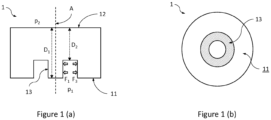
- FIG. 1 (a) An advantageous embodiment of a pierceable septum 1 according to the invention is shown in Figure 1 (a) .
- the pierceable septum 1 displayed in a cross-sectional view, comprises a first surface 11 and a second surface 12, which are positioned opposite to each other. As exemplified by distances D 1 and D 2 , the distance between the first surface and the second surface is not constant over the first surface.
- the distance between the first surface and the second surface as a function of the diameter is designed such that if a pressure p 1 is applied to the first surface, which is higher than a pressure p 2 applied to the second surface, a component F 1 of a force, which is exerted on the first surface, acts towards an axis A intersecting the center of the first surface 11 and the center of the second surface 12.
- a component of force F can act transversal, towards axis A.
- a component F 3 of a force, which is exerted on the first surface acts opposite to an axis which intersects the center of the first surface and the center of the second surface.
- the component F 1 is axis-directed and leads to compression of the septum at the center of the first surface 11 , while the component F 3 is edge-directed and leads to an expansion of the septum at the edges of the first surface 11.
- the first surface 11 comprises a groove 13 having a rectangular cross-section, which circumferentially surrounds the center of the first surface 11.
- Figure 1 (b) represents a plan view of the first surface 11 comprising a groove 13, which circumferentially surrounds the center of the first surface 11 in a circular manner and which is symmetrically arranged with respect to a rotational axis.
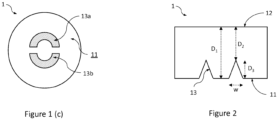
- Figure 1 (c) displays another exemplary septum as a plan view of the first surface 11.
- the first surface 11 of the pierceable septum 1 comprises two grooves 13a and 13b surrounding the center of the first surface in a half-circular manner, without merging into each other.
- the two grooves are symmetrically arranged with respect to a rotational axis.
- the grooves could also be arranged in an asymmetrical manner.
- the first surface 11 is stepped with the distance between the first surface 11 and the second surface 12 being either D 1 or D 2 for each point.
- Figure 2 shows another embodiment of a pierceable septum 1 according to the invention.
- the first surface 11 comprises a circumferential groove 13 which has a triangular cross-section.
- the shape of the first surface of the septum is shaped in such a way, that the distance D 1 between the first surface 11 and the second surface 12 at the center of the first surface is larger than a distance D 2 between the first surface and the second surface at a different position of the first surface.
- the distance between the first surface 11 and the second surface 12 varies continuously from D 1 at the edges to D 2 at the center of the groove 13.
- Groove 13 has a depth D 3 and a width w.
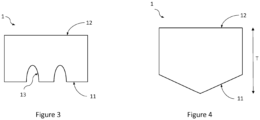
- Figure 3 shows another embodiment of a pierceable septum 1 according to the invention, wherein the first surface comprises a circumferential groove 13 which has a curved cross-section, also resulting in a continuous change in the distance between first surface 11 and the second surface 12.
- the septum shown in Figure 4 represents another advantageous septum.
- the first surface 11, positioned opposite to second surface 12, is conical.
- the thickness T of the septum declines from the center of the first surface to an edge.
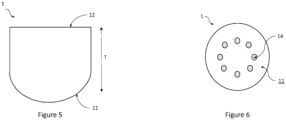
- the septum shown in Figure 5 represents another example of a pierceable septum.
- the first surface 11, which is positioned opposite to the second surface 12 is hemispherical.
- the thickness T declines from the center of the first surface to an edge.
- Figure 6 shows a top view of the first surface 11 of another embodiment of a pierceable septum 1.
- the first surface 11 comprises a plurality of blind holes 14, which surrounds the center of the first surface in a circular manner.
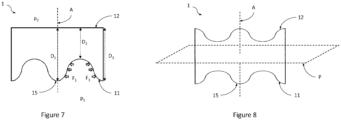
- FIG. 7 Another advantageous embodiment of a pierceable septum 1 according to the invention is shown in Figure 7 .
- the pierceable septum 1 displayed in cross-sectional view, comprises a first surface 11 and a second surface 12, which are positioned opposite to each other. As exemplified by distance D 1 and D 2 , the distance between the first surface 11 and the second surface 12 is not constant over the first surface 11.
- the distance between the first surface 11 and the second surface 12 as a function of the diameter is designed such that if a pressure p 1 is applied to the first surface, which is higher than a pressure p 2 applied to the second surface, a component F, of a force which is exerted on the first surface acts towards an axis A intersecting the center of the first surface 11 and the center of the second surface 12.
- a component F 3 of a force which is exerted on the first surface acts opposite to an axis which intersects the center of the first surface and the center of the second surface, i.e. a component F 3 can act away from an axis which intersects the center of the first surface and the center of the second surface.
- the component F is axis-directed and leads to compression of the septum at the center of the first surface 11, while the component F 3 is edge-directed and leads to an expansion of the septum at the edge of the first surface 11.
- the first surface 11 comprises a protruding part 15 of an elliptic paraboloid.
- the center of the first surface defines the vertex of the paraboloid.
- the pierceable septum shown is shaped in such a way that an area exists at which the distance between the first surface 11 and the second surface 12 is smaller than the distance between the first surface 11 and the second surface 12 at the edge (see D 3 ) and at the center of the first surface (see D 1 ).
- the distance between the first surface 11 and the second surface 12 is at the full area of the first surface between the edge and the center of the first surface 11 smaller than the distance between the first surface 11 and the second surface 12 at the edge and at the center of the first surface 11.
- the first surface 11 of the pierceable septum may comprise a circumferentially closed groove with a curved cross section and the first surface 11 is at least partially wavelike in cross-section.
- Figure 8 shows another embodiment of a pierceable septum 1 according to the invention, wherein the septum is symmetrical with respect to mirror plane P.
- the mirror plane P is perpendicular to axis A.
- the axis A intersects the center of the first surface 11 and the center of the second surface 12.
- the first surface 11 and the second surface 12 each comprise a protruding part 15 of an elliptic paraboloid and are equally shaped.
- FIG 9 shows another embodiment of a pierceable septum 1 according to the invention.
- the septum 1 comprises three layers, first outer layer 16, middle layer 17 and second outer layer 18.
- the first outer layer 16 comprises the first surface 11 as an outer surface and the second outer layer 18 comprises the second surface 12 as an outer surface.
- the middle layer 17 is sandwiched between the first outer layer 16 and the second outer layer 18.
- the contact surfaces of the three layers are plane-parallel and transversal to the axis which intersect the center of the first surface 11 and the center of the second surface 12.
- Such design with a middle layer 17 is not limited to a particular embodiment of the septum 1 but may also be used in the context of other embodiments, such as an embodiment according to Figure 7 .
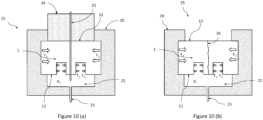
- FIG 10 (a) depicts a pierceable septum 1 according to the invention, which is built into a housing unit 20.
- the housing unit 20 is part of a cannula unit 25, which can be part of an infusion set.
- cannula unit 25 may comprise a flexible infusion cannula 23 which can be inserted into the patient's tissue by insertion of a piercing needle through the septum, prior to assembly of removable connector device 24.
- the housing unit 20 and the septum form a compartment 22, which can comprise a liquid drug.
- the drug can be pumped under pressure into compartment 22 by an infusion pump (not shown) which is in fluid connection with connector cannula 21.
- Connector cannula 21 is part of connector device 24, which is removably connected to cannula unit 25 and not depicted in greater detail.
- a force F might emanate from a fluid pressure p 1 within compartment 11.
- an axis-directed component F 1 of the force applied to the first surface acts towards an axis (not shown in Figure 10 (a) , see Figure 1 (a) ) which intersects the center of the first surface and the center of the second surface.
- the septum 1 is compressed at the center of the first surface and engages connector cannula 21.
- an edge-directed component F 3 of a force acts opposite to an axis which intersects the center of the first surface and the center of the second surface, thereby ensuring sealing engagement between the housing 20 and the peripheral edge of first surface 11.
- the pierceable septum 1 is exposed to a force F 2 , by being prestressed by radial compression.
- the piercing of septum 1 does not lead to any leakage occurring between the walls of the cannula or the needle, because a component F, of a force acts towards the connector cannula and also towards an axis, which intersects the center of the first surface and the center of the second surface.
- a second force F 2 acts toward the same axis
- a third force F 3 acts opposite to this axis, which results in a particular tight sealing between housing 20 and septum 1.
- Figure 10 (b) depicts cannula unit 25 with pierceable septum 1, built into housing unit 20.
- the connector device (see 24 in Figure 10(a) ) comprising a connector cannula (see 21 in Figure 10(a) ) has been removed and thus disconnected from the cannula unit 25.
- the removal of the connector cannula led to the formation of a through-cut or a puncture in the septum.
- This through-cut or puncture is now sealingly closed, as firstly a component F 1 of a force acts towards an axis, which intersects the center of the first surface and the center of the second surface and secondly as a second force F 2 acts toward the same axis.
- Figure 11 shows a reservoir for drugs 30, for example an insulin cartridge comprising a walls 31 and liquid drug 32.
- a pierceable septum 1 according to the invention allows to withdraw drug 32 from the reservoir by a cannula and ensures tight sealing of the pierced septum 1 after removal of the cannula.
- the particular septum shown in Figure 11 comprises second surface 12 and first surface 11 with a circumferential groove.
- FIG 12 (a) depicts a pierceable septum 1 according to the invention, which is built into a housing unit 20.
- the housing unit 20 is part of a cannula unit 25, which can be part of an infusion set.
- cannula unit 25 may comprise a flexible infusion cannula 23 which can be inserted into the patient's tissue by insertion of a piercing needle through the septum, prior to assembly of removable connector device 24.
- the housing unit 20 and the septum form a compartment 22, which can comprise a liquid drug.
- the drug can be pumped under pressure into compartment 22 by an infusion pump (not shown) which is in fluid connection with connector cannula 21.
- Connector cannula 21 is part of connector device 24, which is removably connected to cannula unit 25 and not depicted in greater detail.
- a force might emanate from a fluid pressure p 1 within compartment 22.
- an axis-directed component F 1 of the force applied to the first surface acts towards an axis (not shown in Figure 12 (a) , see Figure 7 ) which intersects the center of the first surface and the center of the second surface.
- the septum 1 is compressed at the center of the first surface and engages connector cannula 21.
- an edge-directed component F 3 of a force acts opposite to an axis which intersects the center of the first surface and the center of the second surface, thereby ensuring sealing engagement between the housing 20 and the peripheral edge of first surface 11.
- the pierceable septum 1 is exposed to a force F 2 , by being prestressed by radial compression.
- the piercing of septum 1 does not lead to any leakage occurring between the walls of the cannula or the needle, because a component F, of a force acts towards the connector cannula and also towards an axis, which intersects the center of the first surface and the center of the second surface.
- a second force F 2 acts toward the same axis
- a third force F 3 acts opposite to this axis, which results in a particular tight sealing between housing 20 and septum 1.
- Figure 12 (b) depicts cannula unit 25 with pierceable septum 1, built into housing unit 20.
- the connector device (see 24 in Figure 4(a)) comprising a connector cannula (see 21 in Figure 12 (a) ) has been removed and thus disconnected from the cannula unit 25.
- the removal of the connector cannula led to the formation of a through-cut or a puncture in the septum.
- This through-cut or puncture is now sealingly closed, as firstly a component F, of a force acts towards an axis, which intersects the center of the first surface and the center of the second surface and secondly as a second force F 2 acts toward the same axis.
- Figure 13 shows a reservoir for drugs 30, for example an insulin cartridge comprising walls 31 and liquid drug 32.
- a pierceable septum 1 according to the invention allows to withdraw drug 32 from the reservoir by a cannula and ensures tight sealing of the pierced septum 1 after removal of the cannula.
- the particular septum shown in Figure 13 comprises second surface 12 and first surface 11 with a protruding part of an elliptic paraboloid 15.
Landscapes
- Health & Medical Sciences (AREA)
- General Health & Medical Sciences (AREA)
- Veterinary Medicine (AREA)
- Public Health (AREA)
- Life Sciences & Earth Sciences (AREA)
- Animal Behavior & Ethology (AREA)
- Heart & Thoracic Surgery (AREA)
- Engineering & Computer Science (AREA)
- Hematology (AREA)
- Anesthesiology (AREA)
- Biomedical Technology (AREA)
- Pharmacology & Pharmacy (AREA)
- Pulmonology (AREA)
- Vascular Medicine (AREA)
- Mechanical Engineering (AREA)
- Physics & Mathematics (AREA)
- Fluid Mechanics (AREA)
- Infusion, Injection, And Reservoir Apparatuses (AREA)
- Medical Preparation Storing Or Oral Administration Devices (AREA)
Claims (15)
- Durchstechbares elastisches Septum (1) zur Verwendung in Arzneimittelreservoirs und Infusionssets, wobei das durchstechbare Septum (1) eine erste Fläche (11) und eine zweite Fläche (12) umfasst, wobei die erste Fläche (11) und die zweite Fläche (12) einander gegenüberliegend positioniert sind, wobei ein Abstand zwischen der ersten Fläche (11) und der zweiten Fläche (12) über die erste Fläche (11) nicht konstant und derart gestaltet ist, dass, wenn auf die erste Fläche (11) im Vergleich zu der zweiten Fläche (12) ein höherer Druck ausgeübt wird, eine Komponente einer Kraft, die auf die erste Fläche (11) ausgeübt wird, in Richtung einer Achse (A) wirkt, die den Mittelpunkt der ersten Fläche (11) und den Mittelpunkt der zweiten Fläche (12) schneidet, wobei das Septum (1) durch radiale Kompression vorgespannt ist, dadurch gekennzeichnet, dass die erste Fläche (11) eine umfänglich geschlossene Nut (13) umfasst, die den Mittelpunkt der ersten Fläche (11) umrandet.
- Durchstechbares Septum (1) nach Anspruch 1, wobei die erste Fläche (11) derart geformt ist, dass der Abstand zwischen der ersten Fläche (11) und der zweiten Fläche (12) am Mittelpunkt der ersten Fläche (11) größer ist als ein Abstand zwischen der ersten Fläche (11) und der zweiten Fläche (12) an einer anderen Position der ersten Fläche (11).
- Durchstechbares Septum (1) nach einem der vorstehenden Ansprüche, dadurch gekennzeichnet, dass die Nut (13) in Bezug auf eine Rotationsachse symmetrisch angeordnet ist.
- Durchstechbares Septum (1) nach einem der vorstehenden Ansprüche, dadurch gekennzeichnet, dass die Nut (13) einen gebogenen Querschnitt oder einen eckigen, vorzugsweise rechteckigen, quadratischen oder dreieckigen, Querschnitt hat.
- Durchstechbares Septum (1) nach einem der vorstehenden Ansprüche, dadurch gekennzeichnet, dass eine Vielzahl von Blindlöchern (14) den Mittelpunkt der ersten Fläche (11) umrandet.
- Durchstechbares Septum (1) nach Anspruch 5, dadurch gekennzeichnet, dass die Vielzahl von Blindlöchern (14) den Mittelpunkt der ersten Fläche (11) kreisförmig umrandet.
- Durchstechbares Septum (1) nach einem der vorstehenden Ansprüche, dadurch gekennzeichnet, dass die erste Fläche (11) konisch oder hemisphärisch ist, wobei die Dicke (T) des Septums vom Mittelpunkt zu einem Rand abnimmt.
- Durchstechbares Septum (1) nach einem der vorstehenden Ansprüche, wobei die erste Fläche (11) einen vorstehenden Teil eines elliptischen Paraboloids (15) umfasst und wobei der Mittelpunkt der ersten Fläche (11) den Scheitelpunkt des elliptischen Paraboloids definiert.
- Durchstechbares Septum (1) nach Anspruch 8, wobei das Septum (1) derart geformt ist, dass ein Bereich der ersten Fläche (11) zwischen dem Rand und dem Mittelpunkt der ersten Fläche (11) existiert, an dem der Abstand zwischen der ersten Fläche (11) und der zweiten Fläche (12) geringer ist als der Abstand zwischen der ersten Fläche (11) und der zweiten Fläche (12) sowohl am Rand als auch am Mittelpunkt der ersten Fläche (11).
- Durchstechbares Septum (1) nach Anspruch 9, dadurch gekennzeichnet, dass der Abstand zwischen der ersten Fläche (11) und der zweiten Fläche (12) im Wesentlichen am gesamten Bereich der ersten Fläche (11) zwischen dem Rand und dem Mittelpunkt der ersten Fläche geringer ist als der Abstand zwischen der ersten Fläche (11) und der zweiten Fläche (12) am Rand und am Mittelpunkt der ersten Fläche (11).
- Durchstechbares Septum (1) nach einem der vorstehenden Ansprüche, wobei die erste Fläche (11) derart geformt ist, dass die erste Fläche (11) im Querschnitt mindestens teilweise wellenförmig ist.
- Durchstechbares Septum (1) nach einem der vorstehenden Ansprüche, dadurch gekennzeichnet, dass das Septum in Bezug auf mindestens eine Spiegelebene (P) symmetrisch ist, wobei die Spiegelebene (P) quer, vorzugsweise senkrecht, zu der Achse (A) ist, die den Mittelpunkt der ersten Fläche (11) und den Mittelpunkt der zweiten Fläche (12) schneidet.
- Durchstechbares Septum (1) nach einem der vorstehenden Ansprüche, dadurch gekennzeichnet, dass das Septum eine erste Außenschicht (16), die die erste Fläche (11) als eine Außenfläche umfasst, eine Mittelschicht (17) und eine zweite Außenschicht (18) umfasst, die die zweite Fläche (12) als eine Außenfläche umfasst, wobei die Mittelschicht (17) zwischen die erste (16) und zweite Außenschicht (18) eingeschoben ist, und wobei die Härte und/oder der Elastizitätsmodul der Mittelschicht (17) verschieden sind/ist von der Härte und/oder dem Elastizitätsmodul der ersten (16) und zweiten Außenschicht (18), wobei vorzugsweise die Härte und/oder der Elastizitätsmodul der Mittelschicht (17) geringer sind/ist als die Härte und/oder der Elastizitätsmodul der ersten (16) und der zweiten Außenschicht (18).
- Infusionsset, umfassend ein Septum (1) nach einem der Ansprüche 1-13.
- Reservoir (30) für ein flüssiges Arzneimittel, umfassend ein Septum (1) nach einem der Ansprüche 1-13.
Applications Claiming Priority (3)
| Application Number | Priority Date | Filing Date | Title |
|---|---|---|---|
| EP17187167 | 2017-08-22 | ||
| EP17209081 | 2017-12-20 | ||
| PCT/EP2018/072330 WO2019038200A1 (en) | 2017-08-22 | 2018-08-17 | SEPTUM WITH AUTOMATIC SHUTTER |
Publications (3)
| Publication Number | Publication Date |
|---|---|
| EP3672681A1 EP3672681A1 (de) | 2020-07-01 |
| EP3672681B1 true EP3672681B1 (de) | 2024-09-25 |
| EP3672681C0 EP3672681C0 (de) | 2024-09-25 |
Family
ID=63168440
Family Applications (1)
| Application Number | Title | Priority Date | Filing Date |
|---|---|---|---|
| EP18753200.7A Active EP3672681B1 (de) | 2017-08-22 | 2018-08-17 | Selbst-dichtendes septum |
Country Status (5)
| Country | Link |
|---|---|
| US (1) | US12151083B2 (de) |
| EP (1) | EP3672681B1 (de) |
| ES (1) | ES2992884T3 (de) |
| HU (1) | HUE069141T2 (de) |
| WO (1) | WO2019038200A1 (de) |
Families Citing this family (1)
| Publication number | Priority date | Publication date | Assignee | Title |
|---|---|---|---|---|
| CN110812224A (zh) * | 2019-11-26 | 2020-02-21 | 湖北辰诺医药包装科技有限公司 | 一种输液胶塞 |
Citations (1)
| Publication number | Priority date | Publication date | Assignee | Title |
|---|---|---|---|---|
| WO2018132540A1 (en) * | 2017-01-12 | 2018-07-19 | Becton Dickinson and Company Limited | Closed system stress resistant membrane |
Family Cites Families (19)
| Publication number | Priority date | Publication date | Assignee | Title |
|---|---|---|---|---|
| US4802885A (en) * | 1986-06-17 | 1989-02-07 | Medical Engineering Corporation | Self sealing subcutaneous infusion and withdrawal device |
| DE19500460A1 (de) * | 1995-01-10 | 1996-07-11 | Pohl Gmbh & Co Kg | Anordnung an Infusionsflaschen oder dergleichen |
| NZ286445A (en) * | 1995-05-16 | 1997-12-19 | Ivac Corp | Needleless luer connector: deformable piston occludes bore |
| US5989216A (en) * | 1995-06-29 | 1999-11-23 | Sims Deltec, Inc. | Access portal and method |
| US6572586B1 (en) | 2000-07-25 | 2003-06-03 | Animas Corporation | Low profile infusion set |
| US6595964B2 (en) * | 2000-12-22 | 2003-07-22 | Baxter International Inc. | Luer activated thread coupler |
| EP1420853B1 (de) | 2001-08-31 | 2010-04-07 | F. Hoffmann-Roche AG | Membrane-kanülen-kombination und konnektierungsvorrichtung |
| US20040064110A1 (en) * | 2002-10-01 | 2004-04-01 | Peter Forsell | Injection port |
| DE602006019587D1 (de) * | 2005-04-27 | 2011-02-24 | Bard Inc C R | Spritzenpumpesystem zur Injektion von Kontrastmittel in einer intravenösen Leitung |
| CA2626787A1 (en) * | 2005-09-30 | 2007-04-12 | Angiodynamics, Inc. | Implantable medical device |
| EP2528642B1 (de) | 2010-01-25 | 2017-11-22 | F. Hoffmann-La Roche AG | Verfahren zum herstellen eines bauteils mit einer kanüle, kanüle, bauteil mit einer kanüle und insertionskopf |
| IT1403656B1 (it) * | 2011-01-28 | 2013-10-31 | Frattini Paolo Giuseppe Gobbi | Connettore a chiusura ermetica, perforabile senza ago ed automaticamente richiudibile a tenuta, per tubi flessibili destinati alla raccolta e all'erogazione di soluzioni liquide ad uso farmacologico e/o nutrizionale. |
| US9919099B2 (en) * | 2011-03-14 | 2018-03-20 | Minipumps, Llc | Implantable drug pumps and refill devices therefor |
| ITMI20121133A1 (it) * | 2012-06-27 | 2013-12-28 | Frattini Paolo Giuseppe Gobbi | Flacone per sostanze attive di tipo farmacologico e/o nutrizionale con chiusura ermetica perforabile con siringa senza ago ed automaticamente richiudibile a tenuta. |
| WO2014162347A1 (ja) * | 2013-04-01 | 2014-10-09 | テルモ株式会社 | コネクタ及び輸液セット |
| US10166321B2 (en) * | 2014-01-09 | 2019-01-01 | Angiodynamics, Inc. | High-flow port and infusion needle systems |
| EP3028737A1 (de) * | 2014-12-03 | 2016-06-08 | Tradinco AB | Selbstschließendes Katheterventil |
| MX388705B (es) * | 2015-03-02 | 2025-03-20 | Amgen Inc | Dispositivo y metodo para realizar conexiones asepticas. |
| CA3002966A1 (en) * | 2015-09-15 | 2017-03-23 | Dr. Py Institute Llc | Septum that decontaminates by interaction with penetrating element |
-
2018
- 2018-08-17 EP EP18753200.7A patent/EP3672681B1/de active Active
- 2018-08-17 ES ES18753200T patent/ES2992884T3/es active Active
- 2018-08-17 WO PCT/EP2018/072330 patent/WO2019038200A1/en not_active Ceased
- 2018-08-17 HU HUE18753200A patent/HUE069141T2/hu unknown
-
2020
- 2020-02-21 US US16/797,598 patent/US12151083B2/en active Active
Patent Citations (1)
| Publication number | Priority date | Publication date | Assignee | Title |
|---|---|---|---|---|
| WO2018132540A1 (en) * | 2017-01-12 | 2018-07-19 | Becton Dickinson and Company Limited | Closed system stress resistant membrane |
Also Published As
| Publication number | Publication date |
|---|---|
| EP3672681A1 (de) | 2020-07-01 |
| US20200188582A1 (en) | 2020-06-18 |
| HUE069141T2 (hu) | 2025-02-28 |
| US12151083B2 (en) | 2024-11-26 |
| EP3672681C0 (de) | 2024-09-25 |
| ES2992884T3 (en) | 2024-12-19 |
| WO2019038200A1 (en) | 2019-02-28 |
Similar Documents
| Publication | Publication Date | Title |
|---|---|---|
| US10773066B2 (en) | Implantable medical devices including septum-based indicators | |
| KR101514915B1 (ko) | 수부재 | |
| EP3756723B1 (de) | Rückflussfreies ventil mit innengewinde mit geringem primingvolumen | |
| EP3120884B1 (de) | Set zur subkutanen infusion mit seitenport-fluidanschluss | |
| US11406758B2 (en) | Connector device | |
| EP3672681B1 (de) | Selbst-dichtendes septum | |
| US12427248B2 (en) | Overmolded septum | |
| US11890443B2 (en) | Implantable medical devices including septum-based indicators | |
| US11191940B2 (en) | Septum arrangement | |
| JP5630288B2 (ja) | オス部材カバー及びカバー付きオス部材 | |
| US12605503B2 (en) | Cannula system with rigid cannula | |
| JP7854804B2 (ja) | オーバーモールドされた隔壁 | |
| HK40058369A (en) | Overmolded septum |
Legal Events
| Date | Code | Title | Description |
|---|---|---|---|
| STAA | Information on the status of an ep patent application or granted ep patent |
Free format text: STATUS: UNKNOWN |
|
| STAA | Information on the status of an ep patent application or granted ep patent |
Free format text: STATUS: THE INTERNATIONAL PUBLICATION HAS BEEN MADE |
|
| PUAI | Public reference made under article 153(3) epc to a published international application that has entered the european phase |
Free format text: ORIGINAL CODE: 0009012 |
|
| STAA | Information on the status of an ep patent application or granted ep patent |
Free format text: STATUS: REQUEST FOR EXAMINATION WAS MADE |
|
| 17P | Request for examination filed |
Effective date: 20200323 |
|
| AK | Designated contracting states |
Kind code of ref document: A1 Designated state(s): AL AT BE BG CH CY CZ DE DK EE ES FI FR GB GR HR HU IE IS IT LI LT LU LV MC MK MT NL NO PL PT RO RS SE SI SK SM TR |
|
| AX | Request for extension of the european patent |
Extension state: BA ME |
|
| DAV | Request for validation of the european patent (deleted) | ||
| DAX | Request for extension of the european patent (deleted) | ||
| STAA | Information on the status of an ep patent application or granted ep patent |
Free format text: STATUS: EXAMINATION IS IN PROGRESS |
|
| 17Q | First examination report despatched |
Effective date: 20201221 |
|
| REG | Reference to a national code |
Ref country code: DE Ref legal event code: R079 Free format text: PREVIOUS MAIN CLASS: A61M0039040000 Ref country code: DE Ref legal event code: R079 Ref document number: 602018074716 Country of ref document: DE Free format text: PREVIOUS MAIN CLASS: A61M0039040000 Ipc: A61M0039020000 |
|
| GRAP | Despatch of communication of intention to grant a patent |
Free format text: ORIGINAL CODE: EPIDOSNIGR1 |
|
| STAA | Information on the status of an ep patent application or granted ep patent |
Free format text: STATUS: GRANT OF PATENT IS INTENDED |
|
| RIC1 | Information provided on ipc code assigned before grant |
Ipc: B32B 3/30 20060101ALI20240307BHEP Ipc: A61J 1/00 20060101ALI20240307BHEP Ipc: A61M 39/04 20060101ALI20240307BHEP Ipc: A61M 39/02 20060101AFI20240307BHEP |
|
| INTG | Intention to grant announced |
Effective date: 20240408 |
|
| GRAS | Grant fee paid |
Free format text: ORIGINAL CODE: EPIDOSNIGR3 |
|
| GRAA | (expected) grant |
Free format text: ORIGINAL CODE: 0009210 |
|
| STAA | Information on the status of an ep patent application or granted ep patent |
Free format text: STATUS: THE PATENT HAS BEEN GRANTED |
|
| RAP3 | Party data changed (applicant data changed or rights of an application transferred) |
Owner name: F. HOFFMANN-LA ROCHE AG Owner name: ROCHE DIABETES CARE GMBH |
|
| AK | Designated contracting states |
Kind code of ref document: B1 Designated state(s): AL AT BE BG CH CY CZ DE DK EE ES FI FR GB GR HR HU IE IS IT LI LT LU LV MC MK MT NL NO PL PT RO RS SE SI SK SM TR |
|
| REG | Reference to a national code |
Ref country code: GB Ref legal event code: FG4D |
|
| REG | Reference to a national code |
Ref country code: CH Ref legal event code: EP |
|
| REG | Reference to a national code |
Ref country code: DE Ref legal event code: R096 Ref document number: 602018074716 Country of ref document: DE |
|
| REG | Reference to a national code |
Ref country code: IE Ref legal event code: FG4D |
|
| U01 | Request for unitary effect filed |
Effective date: 20241015 |
|
| U07 | Unitary effect registered |
Designated state(s): AT BE BG DE DK EE FI FR IT LT LU LV MT NL PT RO SE SI Effective date: 20241031 |
|
| REG | Reference to a national code |
Ref country code: ES Ref legal event code: FG2A Ref document number: 2992884 Country of ref document: ES Kind code of ref document: T3 Effective date: 20241219 |
|
| PG25 | Lapsed in a contracting state [announced via postgrant information from national office to epo] |
Ref country code: NO Free format text: LAPSE BECAUSE OF FAILURE TO SUBMIT A TRANSLATION OF THE DESCRIPTION OR TO PAY THE FEE WITHIN THE PRESCRIBED TIME-LIMIT Effective date: 20241225 |
|
| PG25 | Lapsed in a contracting state [announced via postgrant information from national office to epo] |
Ref country code: GR Free format text: LAPSE BECAUSE OF FAILURE TO SUBMIT A TRANSLATION OF THE DESCRIPTION OR TO PAY THE FEE WITHIN THE PRESCRIBED TIME-LIMIT Effective date: 20241226 |
|
| PG25 | Lapsed in a contracting state [announced via postgrant information from national office to epo] |
Ref country code: RS Free format text: LAPSE BECAUSE OF FAILURE TO SUBMIT A TRANSLATION OF THE DESCRIPTION OR TO PAY THE FEE WITHIN THE PRESCRIBED TIME-LIMIT Effective date: 20241225 |
|
| PG25 | Lapsed in a contracting state [announced via postgrant information from national office to epo] |
Ref country code: RS Free format text: LAPSE BECAUSE OF FAILURE TO SUBMIT A TRANSLATION OF THE DESCRIPTION OR TO PAY THE FEE WITHIN THE PRESCRIBED TIME-LIMIT Effective date: 20241225 Ref country code: NO Free format text: LAPSE BECAUSE OF FAILURE TO SUBMIT A TRANSLATION OF THE DESCRIPTION OR TO PAY THE FEE WITHIN THE PRESCRIBED TIME-LIMIT Effective date: 20241225 Ref country code: GR Free format text: LAPSE BECAUSE OF FAILURE TO SUBMIT A TRANSLATION OF THE DESCRIPTION OR TO PAY THE FEE WITHIN THE PRESCRIBED TIME-LIMIT Effective date: 20241226 |
|
| REG | Reference to a national code |
Ref country code: HU Ref legal event code: AG4A Ref document number: E069141 Country of ref document: HU |
|
| PG25 | Lapsed in a contracting state [announced via postgrant information from national office to epo] |
Ref country code: IS Free format text: LAPSE BECAUSE OF FAILURE TO SUBMIT A TRANSLATION OF THE DESCRIPTION OR TO PAY THE FEE WITHIN THE PRESCRIBED TIME-LIMIT Effective date: 20250125 |
|
| PG25 | Lapsed in a contracting state [announced via postgrant information from national office to epo] |
Ref country code: SM Free format text: LAPSE BECAUSE OF FAILURE TO SUBMIT A TRANSLATION OF THE DESCRIPTION OR TO PAY THE FEE WITHIN THE PRESCRIBED TIME-LIMIT Effective date: 20240925 |
|
| PG25 | Lapsed in a contracting state [announced via postgrant information from national office to epo] |
Ref country code: PL Free format text: LAPSE BECAUSE OF FAILURE TO SUBMIT A TRANSLATION OF THE DESCRIPTION OR TO PAY THE FEE WITHIN THE PRESCRIBED TIME-LIMIT Effective date: 20240925 |
|
| PG25 | Lapsed in a contracting state [announced via postgrant information from national office to epo] |
Ref country code: SK Free format text: LAPSE BECAUSE OF FAILURE TO SUBMIT A TRANSLATION OF THE DESCRIPTION OR TO PAY THE FEE WITHIN THE PRESCRIBED TIME-LIMIT Effective date: 20240925 |
|
| PLBE | No opposition filed within time limit |
Free format text: ORIGINAL CODE: 0009261 |
|
| STAA | Information on the status of an ep patent application or granted ep patent |
Free format text: STATUS: NO OPPOSITION FILED WITHIN TIME LIMIT |
|
| U20 | Renewal fee for the european patent with unitary effect paid |
Year of fee payment: 8 Effective date: 20250723 |
|
| 26N | No opposition filed |
Effective date: 20250626 |
|
| PGFP | Annual fee paid to national office [announced via postgrant information from national office to epo] |
Ref country code: HU Payment date: 20250815 Year of fee payment: 8 |
|
| PGFP | Annual fee paid to national office [announced via postgrant information from national office to epo] |
Ref country code: ES Payment date: 20250901 Year of fee payment: 8 |
|
| PGFP | Annual fee paid to national office [announced via postgrant information from national office to epo] |
Ref country code: GB Payment date: 20250724 Year of fee payment: 8 |
|
| PGFP | Annual fee paid to national office [announced via postgrant information from national office to epo] |
Ref country code: CH Payment date: 20250901 Year of fee payment: 8 |
|
| PGFP | Annual fee paid to national office [announced via postgrant information from national office to epo] |
Ref country code: IE Payment date: 20250725 Year of fee payment: 8 Ref country code: CZ Payment date: 20250730 Year of fee payment: 8 |
|
| PG25 | Lapsed in a contracting state [announced via postgrant information from national office to epo] |
Ref country code: HR Free format text: LAPSE BECAUSE OF FAILURE TO SUBMIT A TRANSLATION OF THE DESCRIPTION OR TO PAY THE FEE WITHIN THE PRESCRIBED TIME-LIMIT Effective date: 20240925 |
|
| PG25 | Lapsed in a contracting state [announced via postgrant information from national office to epo] |
Ref country code: MC Free format text: LAPSE BECAUSE OF FAILURE TO SUBMIT A TRANSLATION OF THE DESCRIPTION OR TO PAY THE FEE WITHIN THE PRESCRIBED TIME-LIMIT Effective date: 20240925 |