EP3673164B1 - Zweiwellen-mantelstrom-triebwerk mit einem niederdruckwellenschublager im abgasgehäuse - Google Patents
Zweiwellen-mantelstrom-triebwerk mit einem niederdruckwellenschublager im abgasgehäuse Download PDFInfo
- Publication number
- EP3673164B1 EP3673164B1 EP18769757.8A EP18769757A EP3673164B1 EP 3673164 B1 EP3673164 B1 EP 3673164B1 EP 18769757 A EP18769757 A EP 18769757A EP 3673164 B1 EP3673164 B1 EP 3673164B1
- Authority
- EP
- European Patent Office
- Prior art keywords
- low
- pressure shaft
- low pressure
- shaft
- pressure
- Prior art date
- Legal status (The legal status is an assumption and is not a legal conclusion. Google has not performed a legal analysis and makes no representation as to the accuracy of the status listed.)
- Active
Links
Images










Classifications
-
- F—MECHANICAL ENGINEERING; LIGHTING; HEATING; WEAPONS; BLASTING
- F02—COMBUSTION ENGINES; HOT-GAS OR COMBUSTION-PRODUCT ENGINE PLANTS
- F02C—GAS-TURBINE PLANTS; AIR INTAKES FOR JET-PROPULSION PLANTS; CONTROLLING FUEL SUPPLY IN AIR-BREATHING JET-PROPULSION PLANTS
- F02C7/00—Features, components parts, details or accessories, not provided for in, or of interest apart form groups F02C1/00 - F02C6/00; Air intakes for jet-propulsion plants
- F02C7/06—Arrangements of bearings; Lubricating
-
- F—MECHANICAL ENGINEERING; LIGHTING; HEATING; WEAPONS; BLASTING
- F01—MACHINES OR ENGINES IN GENERAL; ENGINE PLANTS IN GENERAL; STEAM ENGINES
- F01D—NON-POSITIVE DISPLACEMENT MACHINES OR ENGINES, e.g. STEAM TURBINES
- F01D25/00—Component parts, details, or accessories, not provided for in, or of interest apart from, other groups
- F01D25/16—Arrangement of bearings; Supporting or mounting bearings in casings
- F01D25/166—Sliding contact bearing
- F01D25/168—Sliding contact bearing for axial load mainly
-
- F—MECHANICAL ENGINEERING; LIGHTING; HEATING; WEAPONS; BLASTING
- F02—COMBUSTION ENGINES; HOT-GAS OR COMBUSTION-PRODUCT ENGINE PLANTS
- F02K—JET-PROPULSION PLANTS
- F02K3/00—Plants including a gas turbine driving a compressor or a ducted fan
- F02K3/02—Plants including a gas turbine driving a compressor or a ducted fan in which part of the working fluid by-passes the turbine and combustion chamber
- F02K3/04—Plants including a gas turbine driving a compressor or a ducted fan in which part of the working fluid by-passes the turbine and combustion chamber the plant including ducted fans, i.e. fans with high volume, low pressure outputs, for augmenting the jet thrust, e.g. of double-flow type
-
- F—MECHANICAL ENGINEERING; LIGHTING; HEATING; WEAPONS; BLASTING
- F02—COMBUSTION ENGINES; HOT-GAS OR COMBUSTION-PRODUCT ENGINE PLANTS
- F02K—JET-PROPULSION PLANTS
- F02K3/00—Plants including a gas turbine driving a compressor or a ducted fan
- F02K3/02—Plants including a gas turbine driving a compressor or a ducted fan in which part of the working fluid by-passes the turbine and combustion chamber
- F02K3/04—Plants including a gas turbine driving a compressor or a ducted fan in which part of the working fluid by-passes the turbine and combustion chamber the plant including ducted fans, i.e. fans with high volume, low pressure outputs, for augmenting the jet thrust, e.g. of double-flow type
- F02K3/06—Plants including a gas turbine driving a compressor or a ducted fan in which part of the working fluid by-passes the turbine and combustion chamber the plant including ducted fans, i.e. fans with high volume, low pressure outputs, for augmenting the jet thrust, e.g. of double-flow type with front fan
-
- F—MECHANICAL ENGINEERING; LIGHTING; HEATING; WEAPONS; BLASTING
- F05—INDEXING SCHEMES RELATING TO ENGINES OR PUMPS IN VARIOUS SUBCLASSES OF CLASSES F01-F04
- F05D—INDEXING SCHEME FOR ASPECTS RELATING TO NON-POSITIVE-DISPLACEMENT MACHINES OR ENGINES, GAS-TURBINES OR JET-PROPULSION PLANTS
- F05D2220/00—Application
- F05D2220/30—Application in turbines
- F05D2220/32—Application in turbines in gas turbines
- F05D2220/323—Application in turbines in gas turbines for aircraft propulsion, e.g. jet engines
-
- F—MECHANICAL ENGINEERING; LIGHTING; HEATING; WEAPONS; BLASTING
- F05—INDEXING SCHEMES RELATING TO ENGINES OR PUMPS IN VARIOUS SUBCLASSES OF CLASSES F01-F04
- F05D—INDEXING SCHEME FOR ASPECTS RELATING TO NON-POSITIVE-DISPLACEMENT MACHINES OR ENGINES, GAS-TURBINES OR JET-PROPULSION PLANTS
- F05D2220/00—Application
- F05D2220/30—Application in turbines
- F05D2220/32—Application in turbines in gas turbines
- F05D2220/326—Application in turbines in gas turbines to drive shrouded, low solidity propeller
-
- F—MECHANICAL ENGINEERING; LIGHTING; HEATING; WEAPONS; BLASTING
- F05—INDEXING SCHEMES RELATING TO ENGINES OR PUMPS IN VARIOUS SUBCLASSES OF CLASSES F01-F04
- F05D—INDEXING SCHEME FOR ASPECTS RELATING TO NON-POSITIVE-DISPLACEMENT MACHINES OR ENGINES, GAS-TURBINES OR JET-PROPULSION PLANTS
- F05D2220/00—Application
- F05D2220/30—Application in turbines
- F05D2220/32—Application in turbines in gas turbines
- F05D2220/327—Application in turbines in gas turbines to drive shrouded, high solidity propeller
-
- F—MECHANICAL ENGINEERING; LIGHTING; HEATING; WEAPONS; BLASTING
- F05—INDEXING SCHEMES RELATING TO ENGINES OR PUMPS IN VARIOUS SUBCLASSES OF CLASSES F01-F04
- F05D—INDEXING SCHEME FOR ASPECTS RELATING TO NON-POSITIVE-DISPLACEMENT MACHINES OR ENGINES, GAS-TURBINES OR JET-PROPULSION PLANTS
- F05D2240/00—Components
- F05D2240/50—Bearings
- F05D2240/52—Axial thrust bearings
-
- F—MECHANICAL ENGINEERING; LIGHTING; HEATING; WEAPONS; BLASTING
- F05—INDEXING SCHEMES RELATING TO ENGINES OR PUMPS IN VARIOUS SUBCLASSES OF CLASSES F01-F04
- F05D—INDEXING SCHEME FOR ASPECTS RELATING TO NON-POSITIVE-DISPLACEMENT MACHINES OR ENGINES, GAS-TURBINES OR JET-PROPULSION PLANTS
- F05D2260/00—Function
- F05D2260/40—Transmission of power
- F05D2260/403—Transmission of power through the shape of the drive components
- F05D2260/4031—Transmission of power through the shape of the drive components as in toothed gearing
- F05D2260/40311—Transmission of power through the shape of the drive components as in toothed gearing of the epicyclical, planetary or differential type
-
- Y—GENERAL TAGGING OF NEW TECHNOLOGICAL DEVELOPMENTS; GENERAL TAGGING OF CROSS-SECTIONAL TECHNOLOGIES SPANNING OVER SEVERAL SECTIONS OF THE IPC; TECHNICAL SUBJECTS COVERED BY FORMER USPC CROSS-REFERENCE ART COLLECTIONS [XRACs] AND DIGESTS
- Y02—TECHNOLOGIES OR APPLICATIONS FOR MITIGATION OR ADAPTATION AGAINST CLIMATE CHANGE
- Y02T—CLIMATE CHANGE MITIGATION TECHNOLOGIES RELATED TO TRANSPORTATION
- Y02T50/00—Aeronautics or air transport
- Y02T50/60—Efficient propulsion technologies, e.g. for aircraft
Definitions
- the invention relates to a double-body turbojet, and more particularly to a double-body turbojet with a reduction gearbox having a high dilution rate (turbofan).
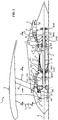
- the figures 1 and 2 schematically represent an example of a turbojet 1 with a double-flow double-body with a reduction gear.
- the turbojet 1 illustrated in these figures comprises a fan 2, a low pressure body 3, a high pressure body 4, a combustion chamber 5 and a gas exhaust nozzle 6.
- the high pressure body 4 comprises a high pressure compressor 41, a high pressure turbine 42 and a high pressure shaft 43 coupling the high pressure turbine 42 to the high pressure compressor 41.
- the low pressure body 3 comprises a low pressure compressor 31, a low pressure turbine 32 and a low pressure shaft 33 coupling the low pressure turbine 32 to the low pressure compressor 31, and extending inside the high pressure shaft 43 .
- the high pressure turbine 42 drives the high pressure compressor 41 in rotation via the high pressure shaft 43, while the low pressure turbine 32 drives the low pressure compressor 31 and the fan 2 in rotation through the intermediary of the high pressure turbine. low pressure shaft 33.
- the turbojet 1 illustrated on figures 1 and 2 is a double-flow turbojet engine having a high dilution rate (in English "bypass ratio"), the dilution rate being defined as the ratio between the flow rate of the secondary flow B (cold) and the flow rate of the primary flow A (hot) .
- the fan 2 is decoupled from the low pressure turbine 32, thus making it possible to optimize independently of their respective rotational speeds.
- Decoupling is for example obtained using a reduction gear 7, such as an epicyclic gear (in English "epicyclic gearing"), arranged between the upstream end of the low pressure shaft 33 and the fan 2.
- the blower 2 is driven by the low pressure shaft 33 via the reduction gear 7 and an additional shaft 23, called the fan shaft.
- This decoupling makes it possible to reduce the speed of rotation and the pressure ratio of the fan (in English "fan pressure ratio"), and thus to increase the power extracted by the low pressure turbine. Thanks to the reduction gear, the low pressure shaft can rotate at higher speeds than in conventional turbojets.
- This arrangement makes it possible to improve the propulsive efficiency of the turbojet engine and to reduce its fuel consumption, as well as the noise emitted by the fan.
- the fan shaft 23, the low pressure shaft 33 and the high pressure shaft 43 are guided in rotation with respect to the structural parts of the turbojet 1 (these structural parts including in particular the inlet casing, the inter-compressor casing , the inter-turbine housing and the exhaust housing) through various bearings.
- each shaft is supported by a first bearing (or thrust bearing), capable of withstanding both radial forces and axial forces exerted on the shaft, and by one or more additional bearing (s) ( s) capable of withstanding only radial forces exerted on the shaft.
- first bearing or thrust bearing
- additional bearing s
- the fan shaft 23 is supported by a first fan bearing S # 1 (upstream bearing) and a second fan bearing S # 2 (downstream bearing) arranged between the fan shaft 23 and the input casing 8
- the second bearing S # 2 is a "thrust" bearing, that is to say that it is able to withstand the axial forces exerted (upstream) by the fan 2 on the fan shaft 23 .
- the low pressure shaft 33 is supported by four bearings, including a first BP # 1 bearing, arranged between the low pressure shaft 33 and the housing inlet 8 (near the upstream end of the low pressure shaft), a second LP # 2 bearing arranged between the low pressure shaft 33 and the inter-compressor housing 9, a third LP # 3 bearing, arranged between the low pressure shaft 33 and the inter-turbine casing 10, and a fourth LP bearing # 4, arranged between the low pressure shaft 33 and the exhaust casing 11.
- the first LP bearing # 1 is a "de stop ”, that is to say that it is capable of withstanding the axial forces exerted (downstream) by the low pressure turbine 3 on the low pressure shaft 33.
- the high pressure shaft 43 is supported by three bearings, including a first HP bearing # 1, arranged between the high pressure shaft 43 and the inter-compressor housing 9 (near the upstream end of the high pressure shaft) , a second HP # 2 bearing arranged between the high pressure shaft 43 and the inter-compressor casing 9, a third HP # 3 bearing, arranged between the high pressure shaft 43 and the inter-turbine casing 10.
- the first HP bearing # 1 is also a “thrust” bearing, that is to say it is able to withstand the axial forces exerted (downstream) by the high pressure turbine 41 on the high pressure shaft 43.
- the first BP # 1 bearing must be sized to withstand high axial forces. This bearing therefore has a large bulk.
- the size of the first BP # 1 bearing makes it difficult to integrate this bearing into the center of the low pressure compressor 31.
- the integration of the reducer 7 and the BP # 1 bearing requires modifying the shape of the primary stream serving to guide the primary flow A.
- the document WO2014197155A1 describes a twin-body turbojet in which the low pressure shaft is supported by a first thrust bearing arranged, upstream, between the low pressure shaft and the high pressure shaft, and a second bearing arranged, downstream, between the low pressure shaft and low pressure compressor housing.
- the document WO2017109330A1 describes a twin-body turbojet in which the low pressure shaft is supported by a thrust bearing arranged, upstream, between the low pressure shaft and the inter-compressor casing, and two bearings arranged, downstream, between the shaft low pressure and the exhaust housing.
- An object of the invention is to provide a twin-body turbojet engine having an arrangement which facilitates the integration of the low pressure shaft thrust bearing within the turbojet engine.
- the low pressure shaft thrust bearing may be disposed near the downstream end of the low pressure shaft, in the center of the exhaust housing, where more space is available.
- This arrangement can also allow the elimination of one or more low pressure bearing (s) (for example the fourth BP # 4 bearing on the figures 1 and 2 ).
- s low pressure bearing
- this arrangement makes it possible to reduce the relative axial displacements between the rotor and the stator of the low pressure turbine due to the expansions of the various parts of the turbojet when the latter is in operation.
- the proposed arrangement makes it possible not to modify the shape of the primary vein.
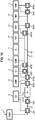
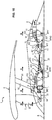
- the turbojet 1 shown comprises a fan 2, a low pressure body 3, a high pressure body 4, a combustion chamber 5 and a gas exhaust nozzle 6.
- the fan 2 comprises a fan disc 21 provided with fan blades 22 at its periphery which, when they are rotated, cause the air flow in the primary and secondary flow spaces of the turbojet 1.
- the low pressure body 3 comprises a low pressure compressor 31, a low pressure turbine 32 and a low pressure shaft 33 coupling the low pressure turbine 32 to the low pressure compressor 31.
- the high pressure body 4 comprises a high pressure compressor 41, a high pressure turbine 42 and a high pressure shaft 43 coupling the high pressure turbine 42 to the high pressure compressor 43.
- the low pressure shaft 33 extends inside the high pressure shaft 43.
- the low pressure shaft 33 and the high pressure shaft 43 are coaxial.
- the low pressure shaft 33 and the high pressure shaft 43 have the axis of rotation, the X axis, which is also the longitudinal axis of the turbojet 1.
- the high pressure turbine 42 drives the high pressure compressor 41 in rotation via the high pressure shaft 43, while the low pressure turbine 32 drives the low pressure compressor 31 and the fan 2 in rotation through the intermediary of the high pressure turbine. low pressure shaft 33.
- double body means that the turbojet comprises only two bodies (bodies 3 and 4), each body consisting of a compressor, a turbine and a shaft coupling the turbine to the compressor.
- a double-body turbojet is distinguished, for example, from a “triple-body” turbojet which comprises a low pressure body, a high pressure body and an intermediate body interposed between the high pressure body and the low pressure body.
- the turbojet 1 further comprises a fan shaft 23 and a reduction gear 7, coupling the fan shaft 23 to the low pressure shaft 33.
- the fan disc 21 is fixedly mounted on the fan shaft 23 so that the The fan disc 21 is rotated by the low pressure shaft 33 via the reduction gear 7 and the fan shaft 23.
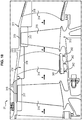
- the low pressure compressor 31 includes a low pressure compressor housing 311, a stator 312 and a rotor 313.
- the stator 312 includes stator vanes 314 fixedly mounted on the housing 311.
- the rotor 313 includes rotor vanes 315 capable of being fitted. driven in rotation with respect to the stator vanes by means of the low pressure shaft 33.
- the rotor vanes are fixedly mounted on the low pressure shaft 33.
- the rotor vanes extend in the vein of circulation of the primary flow A by being interposed between the fixed vanes.
- the high pressure compressor 41 includes a high pressure compressor housing 411, a stator 412, and a rotor 413.
- the stator 412 includes stator vanes fixedly mounted on the housing 411.
- the rotor 413 includes clean rotor vanes. to be trained rotating relative to the stator vanes via the high pressure shaft 43.
- the rotor vanes are mounted fixedly on the high pressure shaft 43.
- the rotor vanes extend in the circulation vein of the primary flow A by being interposed between the fixed vanes.
- the low pressure turbine 32 comprises a low pressure turbine casing 321, a stator 322 and a rotor 323.
- the stator 322 comprises stator vanes fixedly mounted on the casing 321.
- the rotor 323 comprises rotor vanes suitable for being driven in rotation relative to the stator vanes by the flow of exhaust gas.
- the rotor blades are fixedly mounted on the low pressure shaft 33. The rotor blades extend in the circulation vein of the primary flow A, being interposed between the fixed blades.
- the high pressure turbine 42 comprises a high pressure turbine casing 421, a stator 422 and a rotor 423.
- the stator 422 comprises stator vanes fixedly mounted on the casing 421.
- the rotor 423 comprises rotor vanes specific to the housing. be rotated relative to the stator vanes by the flow of exhaust gas.
- the rotor blades are fixedly mounted on the high pressure shaft 42. The rotor blades extend in the circulation vein of the primary flow A, being interposed between the fixed blades.
- the turbojet 1 comprises an inlet casing 8 (or intake casing) arranged around the fan 2.
- the inlet casing 8 comprises a rectifier 81 consisting of a series of fixed vanes 82, arranged in downstream of the blades 22 of the fan 2 and having the function of straightening the secondary flow B generated by the fan 2.
- the reducer 7 is fixed to the inlet casing 8.
- the turbojet 1 further comprises an inter-compressor casing 9 arranged between the low pressure compressor 31 and the high pressure compressor 41. More specifically, the inter-compressor casing 9 connects the casing 311 of the low pressure compressor 31 to the casing 411 of the high compressor. pressure 41.
- the inter-compressor housing 9 is designed to withstand the axial forces transmitted by the input housing 8, these axial forces being generated by the fan 2 on the fan shaft 23.
- the inter-compressor casing 9 transmits these axial forces to the suspensions (not shown) by means of thrust return rods connecting the inter-compressor casing 9 to the suspensions.
- the turbojet 1 further comprises an inter-turbine casing 10 disposed between the high pressure turbine 42 and the low pressure turbine 32. More specifically, the inter-turbine casing 10 connects the casing 421 of the high pressure turbine 42 to the casing 321 of the high pressure turbine. low pressure turbine 32.
- the turbojet 1 further comprises an exhaust casing 11 and an exhaust nozzle 6 fixed to the exhaust casing 11.
- the exhaust nozzle 6 defines a passage 62 for exhaust gases flowing downstream of the exhaust. low pressure turbine 32.
- the exhaust casing 11 is fixed to the casing 321 of the low pressure turbine 32.
- the air flow sucked by the blower 2 is divided into a primary flow A and a secondary flow B.
- the secondary flow B successively passes through the fan 2 and the rectifier 81.
- the primary flow A successively passes through the low pressure compressor 31 and the high pressure compressor 41.
- the pressurized air is injected into the combustion chamber 5 where it is used as an oxidizer for the combustion of the fuel.
- the flow of exhaust gas produced by the combustion reaction flows successively through the high pressure turbine 42, the low pressure turbine 32 and escapes from the turbojet 1 via the exhaust nozzle 6.
- the flow of exhaust gas rotates the rotor 422 of the high pressure turbine 42 and the rotor 322 the low pressure turbine 32.
- the rotor 422 of the high pressure turbine 42 in turn drives the rotor 412 of the high pressure compressor 41 through the high pressure shaft 43, while the rotor 322 of the low pressure turbine 32 drives the rotor 312 of the low pressure compressor 31 through the low pressure shaft 33.
- the rotor 322 of the low pressure turbine 32 also drives the fan disc 21 through the reduction gear 7 and the fan shaft 23.
- the fan shaft 23 is supported by a first fan shaft bearing S # 1 (upstream bearing) and a second fan shaft bearing S # 2 (downstream bearing), each bearing being disposed between the shaft fan 23 and the inlet casing 8.
- the second bearing S # 2 is a “thrust” bearing, that is to say that it is capable of transmitting to the inlet casing 8 the axial forces exerted ( upstream) by blower 2 on the blower shaft 23.
- the low pressure shaft 33 is supported by three bearings BP # 1, BP # 2, BP # 3.
- the first BP # 1 bearing is arranged between the low pressure shaft 33 and the exhaust casing 11 (near the downstream end of the low pressure shaft 33).
- the first BP # 1 bearing is a "thrust" bearing, that is to say it is capable of transmitting the axial forces exerted (downstream) on the low pressure shaft 33 to the exhaust casing 11.
- the BP # 1 thrust bearing is capable of withstanding both radial and axial forces exerted on the low pressure shaft 33.
- the BP # 1 thrust bearing may consist of a spindle bearing. balls or a combination of two or more adjacent angular contact or tapered roller bearings arranged in opposition in a back-to-back or back-to-back configuration.
- the BP # 1 thrust bearing comprises an inner ring 351 fixed on the low pressure shaft 33, an outer ring 352 fixed on the exhaust casing 11 and balls 353 or tapered rollers disposed between the inner ring. 352 and the outer ring 352.
- the second BP # 2 bearing is placed between the low pressure shaft 33 and the inter-compressor housing 9.
- the BP # 2 bearing comprises an inner ring fixed on the low pressure shaft 33, an outer ring fixed on the inter-compressor housing 9 and rollers arranged between the inner ring and the outer ring.
- the third LP bearing # 3 is arranged between the low pressure shaft 33 and the inter-turbine housing 10.
- the BP # 3 bearing comprises an inner ring fixed on the low pressure shaft 33, an outer ring fixed on the inter-turbine casing 10 and rollers arranged between the inner ring and the outer ring.
- Each of the BP # 2 and BP # 3 upstream bearings is capable of withstanding radial forces exerted on the low pressure shaft 33 while allowing a certain axial displacement of the low pressure shaft 33 relative to the inter-compressor housing 9 and to the inter-turbine housing 10. This means that the BP # 2 and BP # 3 bearings do not transmit any axial force exerted on the low pressure shaft 33 to the housings.
- the low pressure shaft 33 undergoes an axial displacement relative to the inter-compressor casing 9 and to the inter-turbine casing 10 due to the expansion of certain parts of the turbojet 1, in particular of the high pressure compressor 41, the combustion chamber 5, the high pressure turbine 42 and the low pressure turbine 32.
- each BP # 2 and BP # 3 bearing are thus designed to be able to allow such axial displacement.
- each BP # 2 and BP # 3 bearing can consist of a roller bearing.
- the first BP # 1 bearing replaces the fourth BP # 4 bearing of the figures 1 and 2 , so that only three steps are needed.
- the high pressure shaft 43 is also supported by three bearings HP # 1, HP # 2, HP # 3.
- the first HP # 1 bearing is arranged between the high pressure shaft 43 and the inter-compressor housing 9 (near the upstream end of the high pressure shaft 43).
- the first HP # 1 bearing is a "thrust" bearing, that is to say it is capable of transmitting the axial forces exerted (downstream) on the high pressure shaft to the inter-compressor housing 9 .
- the HP # 1 thrust bearing is able to withstand both radial forces and axial forces exerted on the low pressure shaft 43.
- the second HP # 2 bearing is also arranged between the high pressure shaft 43 and the inter-compressor housing 9, downstream of the first HP # 1 bearing.
- the third HP # 3 bearing is arranged between the high pressure shaft 43 and the inter-turbine housing 10.
- each of the HP # 2 and HP # 3 bearings is able to withstand radial forces exerted on the high pressure shaft 43 while allowing a certain axial displacement of the shaft.
- high pressure 43 with respect to the inter-compressor housing 9 and to the inter-turbine housing 10. This means that the HP # 2 and HP # 3 bearings do not transmit any axial force exerted on the high pressure shaft 43.
- the arrangement of the BP # 1 bearing in the center of the exhaust housing 11 has the effect of preventing any relative axial displacement between the downstream end of the low pressure shaft 33 and the exhaust housing 11.
- This arrangement advantageously makes it possible to avoid or limit the axial displacement of the rotor blades relative to the stator blades of the low pressure turbine 32, during the operation of the turbojet 1.
- this arrangement simplifies the design of the dynamic sealing devices (generally consisting of wipers and coatings of abradable material located opposite) necessary to prevent gas leaks between the rotor blades and the internal surface of the casing 321 of the engine. low pressure turbine 32. In fact, only the leaks due to radial displacements must be prevented, axial displacements being eliminated.
- the blades 315 of the rotor 313 are positioned relative to the blades 314 of the stator 312 so as to allow an axial displacement (parallel to the X axis) of the blades 315 of the rotor 313, downstream of the turbojet 1 in the direction of air flow, in a displacement range of between 1 millimeter and 2 centimeters, preferably between 2 millimeters and 1 centimeter.
- the internal surface 316 of the low pressure compressor casing 311 has, between the fixed vanes 314, surface portions 317 of cylindrical shape of revolution, having the X axis of rotation of the low pressure shaft as its axis of revolution.
- Each surface portion 317 allows the axial displacement of a rotor blade 315 relative to the low pressure compressor housing 311.
- the internal surface 316 of the low pressure compressor casing 311 may have, at the location where the blades 314 of the stator are fixed, portions of surface 318 which are not cylindrical of revolution.
- the entire internal surface 316 of the low compressor housing pressure 311 has a cylindrical shape of revolution, having the X axis of rotation of the low pressure shaft as its axis of revolution.
- the inner surface 316 also allows axial displacement of the rotor vanes 314 relative to the low pressure compressor housing 311.
- coatings 319 of abradable material are provided on the internal surface 316 of the low pressure compressor casing 311, facing the free end edges of the rotor blades 315.
- Each coating 319 of abradable material is sized to be able to be hollowed out by the end edge of the vane 315 located opposite, during an axial displacement of the latter.
- each stator vane 314 is provided with a heel 343 1 formed of an abradable material fixed to the free end edge of the vane, and the rotor 313 is provided with wipers 342 disposed opposite the heel 341.
- Each heel 341 of abradable material is dimensioned to be able to be hollowed out by the wipers 342, during an axial displacement of the rotor 313 relative to the stator 312.
- the low pressure shaft 33 is coupled with the input shaft of the reducer via a coupling allowing a translation of the low pressure shaft 33 relative to the input shaft of the reducer 7.
- One solution consists in particular in providing the upstream end of the low pressure shaft 33 and the end of the input shaft of the reducer 7 with longitudinal splines, the splines of the input shaft of the reducer 7 cooperating with the grooves of the low pressure shaft 33 so as to make the two shafts integral in rotation while allowing a translation of one relative to the other.
- the splines may be ball splines.
- the reduction gear 7 can comprise an epicyclic gear train designed to allow a displacement of its inner sun gear or of its outer sun gear relative to the planet wheels, for example by means of straight teeth.
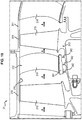
- the rotor 313 of the low pressure compressor 31 comprises a series of discs 343.
- Each disc 343 has a central circular bore.
- the “upstream disc” is defined as the disc 343 located furthest upstream with respect to the other discs 343, in the direction of flow of the air flow (arrow A).
- the radius D1 of the bore of the upstream disc 343 is defined as the smallest distance between the longitudinal axis X of the turbojet 1 and the upstream disc 343.
- the radius D2 of the first BP # 1 bearing is defined as the distance between the longitudinal axis X of the turbojet 1 and the center of a ball 353 of the bearing ball 350.
- the rays D1 and D2 satisfy the following condition: D2> 0.70 x D1, and preferably D2> 0.75 x D1.
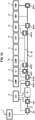
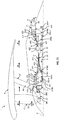
- the figures 5 and 6 schematically show a twin-body turbojet according to a second embodiment of the invention.
- the turbojet 1 does not include a third LP bearing # 3 arranged between the low pressure shaft 33 and the inter-turbine casing 10.
- the turbojet comprises a fourth BP # 4 bearing arranged between the low pressure shaft 33 and the exhaust casing 11, upstream of the BP # 1 bearing.
- the BP # 4 bearing comprises an inner ring fixed on the low pressure shaft 33, an outer ring fixed on the exhaust casing 11 and rollers disposed between the inner ring and the outer ring.
- the BP # 4 bearing is capable of withstanding radial forces exerted on the low pressure shaft 33 while allowing a certain axial displacement of the low pressure shaft 33 relative to the exhaust casing 11. This means that the bearing BP # 4 does not transmit any axial force exerted on the low pressure shaft 33 to the housings.
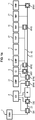
- the figures 7 and 8 schematically show a twin-body turbojet according to a third embodiment of the invention.
- This third embodiment is identical to the second embodiment, except for the following characteristics:
- the fourth BP # 4 bearing is arranged between the low pressure shaft 33 and the exhaust casing 11, downstream of the BP # 1 bearing.
- the figures 9 and 10 schematically show a double-body turbojet according to a fourth embodiment of the invention.
- the turbojet 1 comprises a third BP # 3 bearing arranged between the low pressure shaft 33 and the inlet casing 8 (near the upstream end of the low pressure shaft).
- the BP # 3 bearing is able to withstand radial forces exerted on the low pressure shaft 33 while allowing a certain axial displacement of the low pressure shaft 33 relative to the input casing 8. This means that the bearing BP # 3 does not transmit any axial force exerted on the low pressure shaft 33 to the housings.
- the turbojet 1 thus comprises four BP # 1 to BP # 4 bearings supporting the low pressure shaft 33: a first BP # 1 bearing arranged between the low pressure shaft 33 and the exhaust casing 11 , a second BP # 2 bearing arranged between the low pressure shaft 33 and the inter-compressor casing 9, a third BP # 3 bearing, arranged between the low pressure shaft 33 and the inlet casing 8 (near the upstream end of the low pressure shaft), and a fourth BP # 4 bearing, arranged between the low pressure shaft 33 and the exhaust casing 11, downstream of the first BP # 1 bearing.
- Only the first BP # 1 bearing is a "thrust" bearing, ie it is capable of withstanding the axial forces exerted (downstream) by the low pressure turbine 3 on the low shaft. pressure 33.
- the figures 11 and 12 schematically show a twin-body turbojet according to a fifth embodiment of the invention.
- the turbojet 1 comprises a fourth BP # 4 bearing arranged between the low pressure shaft 33 and the input casing 8 (near the upstream end of the low pressure shaft), upstream of the second BP # 2 bearing.
- the turbojet 1 thus comprises four BP # 1 to BP # 4 bearings supporting the low pressure shaft 33: a first BP # 1 bearing arranged between the low pressure shaft 33 and the exhaust casing 11 , a second LP bearing # 2 arranged between the low pressure shaft 33 and the inter-compressor casing 9, a third LP bearing # 3, arranged between the low pressure shaft 33 and the inter-turbine casing 10, upstream of the first BP # 1 bearing, and a fourth BP # 4 bearing, arranged between the low pressure shaft 33 and the input housing 8 (near the upstream end of the low pressure shaft).
- Only the first BP # 1 bearing is a “thrust” bearing, ie it is capable of withstanding the axial forces exerted (downstream) by the low pressure turbine 3 on the low shaft. pressure 33.
- the figures 13 and 14 schematically show a twin-body turbojet according to a sixth embodiment of the invention.
- the turbojet 1 does not include a third LP bearing # 3 arranged between the low pressure shaft 33 and the inter-turbine casing 10.
- the turbojet 1 thus comprises three BP # 1, BP # 2 and BP # 4 bearings supporting the low pressure shaft 33: a first BP # 1 bearing arranged between the low pressure shaft 33 and the casing exhaust 11, a second LP bearing # 2 arranged between the low pressure shaft 33 and the inter-compressor housing 9, and a fourth bearing BP # 4, placed between the low pressure shaft 33 and the inlet housing 8 (near the upstream end of the low pressure shaft).
- Only the first BP # 1 bearing is a "thrust" bearing, ie it is capable of withstanding the axial forces exerted (downstream) by the low pressure turbine 3 on the low shaft. pressure 33.
- the figures 15 and 16 schematically show a double-body turbojet according to a seventh embodiment of the invention.
- the turbojet 1 does not include a fourth BP # 4 bearing arranged between the low pressure shaft 33 and the inlet housing 8.
- the turbojet 1 thus comprises two BP # 1 and BP # 2 bearings supporting the low pressure shaft 33: the first BP # 1 bearing arranged between the low pressure shaft 33 and the exhaust casing 11 and the second LP bearing # 2 arranged between the low pressure shaft 33 and the inter-compressor housing 9.
- the first BP # 1 bearing is a "thrust" bearing, that is to say that it is able to withstand the axial forces exerted (downstream) by the low pressure turbine 3 on the low pressure shaft. 33.
- the second BP # 2 bearing is capable of withstanding radial forces exerted on the low pressure shaft 33 while allowing a certain axial displacement of the low pressure shaft 33 relative to the inter-compressor housing 9. This means that the BP # 2 bearing does not transmit any axial force exerted on the low pressure shaft 33 to the housings.
- the figure 21 schematically represents a twin-body turbojet according to an eighth embodiment of the invention.
- the low pressure shaft 33 is formed in two parts.
- the low pressure shaft 33 in fact comprises an upstream low pressure shaft portion 331, a downstream low pressure shaft portion 332 and a coupling assembly 333 connecting the downstream low pressure shaft portion 332 and the upstream portion of the shaft. low pressure shaft 331 between them.
- the coupling assembly 333 can be positioned near the upstream end of the low pressure shaft 33 (position referenced 333-a on the figure 21 ) or near the downstream end of the low pressure shaft 33 (position referenced 333-b on the figure 21 ).
- the coupling assembly is adapted to transmit a torque between the low pressure shaft downstream portion 332 and the low pressure shaft upstream portion 331, while allowing relative axial displacement between the low pressure shaft downstream portion 332 and the low pressure shaft upstream part 331 due to the expansion of certain parts of the turbojet 1.
- the low pressure shaft 33 is supported by four bearings, including a first BP # 1 bearing, a second BP # 2 bearing, a third BP # 3 bearing, and a fourth BP # 4 bearing.
- the first BP # 1 bearing is disposed between the downstream portion of the low pressure shaft 332 and the exhaust housing 11.
- the first BP # 1 bearing is a "thrust" bearing, that is to say that it is capable of transmitting the axial forces exerted on the upstream part of the low pressure shaft 331.
- the BP # 1 thrust bearing comprises an inner ring fixed on the downstream part of the low pressure shaft 332, an outer ring fixed on the exhaust casing 11 and balls or tapered rollers arranged between the ring. inner and outer ring.
- the fourth BP # 4 bearing is disposed between the upstream part of the low pressure shaft 331 and the input housing 8.
- the fourth BP # 4 bearing is also a "thrust" bearing, that is to say that 'it is able to withstand axial forces.
- the BP # 4 thrust bearing comprises an inner ring fixed on the upstream part of the low pressure shaft 331, an outer ring fixed on the input housing 8 and balls or tapered rollers arranged between the ring. inner and outer ring.
- the BP # 4 bearing prevents any relative axial displacement between the upstream end of the low pressure shaft 33 and the inlet housing 8, while the BP # 1 bearing prevents any relative axial displacement between the the downstream end of the low pressure shaft 33 and the exhaust housing 11.
- the coupling assembly 333 however allows a relative axial displacement between the downstream part of the low pressure shaft 332 and the upstream part of the low pressure shaft 331.
- the second BP # 2 bearing can be placed between the low pressure shaft 33 and the inter-compressor housing 9.
- the third BP # 3 bearing is arranged between the low pressure shaft 33 and the exhaust casing 11.
- the second BP # 2 bearing and the third BP # 3 bearing are capable of withstanding radial forces exerted on the low pressure shaft 33 while allowing a certain axial displacement of the low pressure shaft 33 relative to the inter- housing. compressor 9 and to the exhaust housing. This means that the BP # 2 and BP # 3 bearings do not transmit any axial force exerted on the low pressure shaft 33 to the housings.
- the coupling assembly 333 is positioned near the upstream end of the low pressure shaft 33 (in this position, the coupling assembly is referenced 333-a on the figure 21 ). In this case, the coupling assembly 333 is arranged downstream of the junction between the low pressure shaft 33 and the rotor 313 of the low pressure compressor 31.
- the coupling assembly 333 is positioned near the downstream end of the low pressure shaft 33 (in this position, the coupling assembly is referenced 333-b). In this case, the coupling assembly 333 is arranged upstream of the junction between the low pressure shaft 33 and the rotor 323 of the low pressure turbine 32.
- the BP # 4 bearing can be dimensioned so as to have a smaller footprint than the BP # 1 bearing of a conventional twin-body turbojet as shown in the figures. figures 1 and 2 .
- the BP # 4 bearing may have a reduced external diameter and / or balls having a reduced diameter.
- the absorption of the axial forces exerted on the low pressure shaft 33 is distributed between the BP # 1 bearing and the BP # 4 bearing.
- the BP # 4 bearing does not take up the axial forces exerted on the low pressure shaft 33 by the low pressure turbine 32.
- the fourth LP bearing # 4 can be placed in the center of the low pressure compressor 31.
- the low pressure compressor 31 can include rotor discs 343 having a reduced bore radius. It is thus possible to optimize the shape of the discs in order to reduce their weight and / or reduce the internal diameter of the compressor duct.
- the turbojet 1 comprises a conventional low pressure compressor casing such as that shown in FIG. figure 17 .
- the BP # 4 bearing prohibits any axial displacement (parallel to the X axis) of the blades 315 of the rotor 313 of the low pressure compressor 31 relative to the blades 314 of the stator 312 or relative to the casing 311 of the low pressure compressor 31 .
- the figure 22 schematically shows a first example of a coupling assembly 333 making it possible to connect the low pressure shaft downstream part 331 and the low pressure shaft upstream part 332 to one another.
- the low pressure shaft upstream part 331 comprises an internal surface 335 and the low pressure shaft downstream part 332 comprises an external surface 336.
- the internal surface 335 may have a cylindrical shape of revolution having the axis X for axis of revolution.
- the outer surface 336 may have a cylindrical shape of revolution having the X axis as its axis of revolution.
- the inner surface 335 surrounds the outer surface 336.
- 332 includes an internal surface surrounding the external surface of the low pressure shaft upstream portion 331.
- the inner surface 335 has first axial splines.
- the outer surface 336 has second axial splines extending opposite the first axial splines.
- the coupling assembly 333 further includes a plurality of rolling elements 337 (eg balls) interposed between the inner surface 335 and the outer surface 336.
- Each rolling element 337 extends into both one of the two. first splines and in one of the second splines.
- the rolling elements 337 are suitable for transmitting a torque between the low pressure shaft downstream part 332 and the low pressure shaft upstream part 331, while allowing an axial displacement of one relative to the other parallel to the 'X axis.
- the coupling assembly 333 includes a cage 338 disposed between the inner surface 335 and the outer surface 336.
- the cage 338 includes a plurality of openings, each opening receiving one of the rolling elements 337 to keep the rolling elements 337 apart. one another.
- the coupling assembly may be a coupling assembly conforming to that which is described in the patent application.
- the figure 23 schematically shows a second example of coupling assembly 333.
- the coupling assembly 333 includes a bellows junction portion 339.
- the bellows junction portion 339 connects the low pressure shaft upstream portion 331 to the low pressure shaft downstream portion 332.
- the low pressure shaft downstream portion bellows junction 339 comprises a plurality of bellows capable of deforming to allow relative axial displacement between the low pressure shaft upstream portion 331 and the low pressure shaft downstream portion 332 parallel to the X axis, while preventing a relative rotation between the low pressure shaft upstream part 331 and the low pressure shaft downstream part 332 about the X axis.
- the bellows junction portion 339 comprises a first bellows 341 and a second bellows 342.
- the bellows junction portion 339 has been shown in solid lines in a first position (or position retracted) and in dotted lines in a second position (or stretched position.
Landscapes
- Engineering & Computer Science (AREA)
- Chemical & Material Sciences (AREA)
- Combustion & Propulsion (AREA)
- Mechanical Engineering (AREA)
- General Engineering & Computer Science (AREA)
- Structures Of Non-Positive Displacement Pumps (AREA)
Claims (12)
- Zweiwellen-Mantelstrom-Triebwerk (1), das umfasst:- einen Niederdruckmantel (3), der einen Niederdruckverdichter (31), eine Niederdruckturbine (32) und eine Niederdruckwelle (33) umfasst, die die Niederdruckturbine (32) mit dem Niederdruckverdichter (31) verbindet;- einen Hochdruckmantel (4), der einen Hochdruckverdichter (41), eine Hochdruckturbine (42) und eine Hochdruckwelle (43) umfasst, die die Hochdruckturbine (42) mit dem Hochdruckverdichter (41) verbindet, wobei die Niederdruckwelle (33) sich im Inneren der Hochdruckwelle (43) erstreckt,- eine Gebläsewelle (23),- einen Untersetzungsmechanismus (7), der die Niederdruckwelle (33) und die Gebläsewelle (23) koppelt,- ein Abgasgehäuse (11), durch das Abgase stromabwärtig der Niederdruckturbine (32) ausströmen,wobei das Triebwerk (1) dadurch gekennzeichnet ist, dass es ferner ein Niederdruckwellen-Schublager (BP#1) umfasst, das einen inneren Ring und einen äußeren Ring umfasst, wobei der eine von den Ringen an der Niederdruckwelle (33) befestigt ist und der andere von den Ringen an dem Abgasgehäuse (11) befestigt ist.
- Triebwerk nach Anspruch 1, das ferner höchstens zwei zusätzliche Niederdruckwellenlager (BP#2, BP#3) umfasst, wobei jedes zusätzliche Niederdruckwellenlager (BP#2, BP#3) einen inneren Ring und einen äußeren Ring umfasst, wobei der eine von den Ringen an der Niederdruckwelle (33) befestigt ist und der andere von den Ringen an einem Gehäuse (9, 10) des Triebwerks (1) befestigt ist.
- Triebwerk nach einem der Ansprüche 1 und 2, das ferner ein einziges zusätzliches Niederdruckwellenlager (BP#2) umfasst, wobei das zusätzliche Niederdruckwellenlager (BP#2) einen inneren Ring und einen äußeren Ring umfasst, wobei der eine von den Ringen an der Niederdruckwelle (33) befestigt ist und der andere von den Ringen an einem Gehäuse (9) der Turbomaschine (1) befestigt ist.
- Triebwerk nach einem der Ansprüche 2 und 3, wobei jedes zusätzliche Niederdruckwellen-Schublager (BP#2, BP#3) einen inneren Ring oder einen äußeren Ring umfasst, der an einem Zwischenverdichtergehäuse (9) oder einem Zwischenturbinengehäuse (10) des Triebwerks befestigt ist.
- Triebwerk nach einem der Ansprüche 1 bis 3, wobei der Niederdruckverdichter (31) umfasst:- ein Niederdruck-Verdichtergehäuse (311), das eine Innenoberfläche (316) aufweist, die einen Zirkulationsgang einer Luftströmung (A) durch den Niederdruckverdichter (31) abgrenzt,- einen Stator (312), der Schaufeln (314) umfasst, die in Bezug auf das Niederdruck-Verdichtergehäuse (311) fest montiert sind und sich in dem Zirkulationsgang der Luftströmung erstrecken, und- einen Rotor (313), der bewegliche Schaufeln (315) umfasst, die geeignet sind, durch die Niederdruckwelle (33) in Bezug auf den Stator (312) drehbar angetrieben zu werden, wobei die beweglichen Schaufeln (315) sich in dem Zirkulationsgang der Luftströmung erstrecken und dabei zwischen den festen Schaufeln (314) eingeschoben sind,wobei die Innenoberfläche (316) des Niederdruck-Vedichtergehäuses (311), die festen Schaufeln (314) und die beweglichen Schaufeln (315) derart in Bezug aufeinander angeordnet sind, dass eine axiale Verlagerung der beweglichen Schaufeln (315) in Bezug auf die festen Wellen (314) parallel zur Drehachse (X) der Niederdruckwelle (33) zugelassen wird.
- Triebwerk nach Anspruch 5, wobei die zugelassene axiale Verlagerung zwischen 1 Millimeter und 2 Zentimeter, vorzugsweise zwischen 2 Millimeter und 1 Zentimeter beträgt.
- Triebwerk nach einem der Ansprüche 5 und 6, wobei die Innenoberfläche (316) des Niederdruck-Verdichtergehäuses (311) zwischen den festen Schaufeln (314) Abschnitte (317) mit zylindrischer Umlaufform aufweist, die die Drehachse (X) der Niederdruckwelle (33) als Umlaufachse aufweisen.
- Triebwerk nach einem der Ansprüche 5 bis 7, wobei die Innenoberfläche (316) des Niederdruck-Verdichtergehäuses (311) eine zylindrische Umlauf form aufweist, die die Drehachse (X) der Niederdruckwelle (33) als Umlaufachse aufweist.
- Triebwerk nach einem der Ansprüche 1 bis 8, wobei die Niederdruckwelle (33) ein stromaufwärtiges Ende aufweist, das mit Rillen versehen ist, und der Untersetzungsmechanismus (7) eine Eingangswelle umfasst, die ein mit Rillen versehenes Ende aufweist, wobei die Rillen der Eingangswelle des Untersetzungsmechanismus (7) derart mit den Rillen der Niederdruckwelle (33) zusammenwirken, dass die zwei Wellen drehfest werden und dabei eine translatorische Bewegung der einen Welle in Bezug auf die andere zugelassen wird.
- Triebwerk nach einem der Ansprüche 1 bis 9, wobei der Niederdruckverdichter (31) eine stromaufwärtige Niederdruck-Verdichterscheibe (343) umfasst, die eine Bohrung aufweist, die einen ersten Radius (D1) aufweist, und wobei das erste Niederdruckwellen-Schublager (BP#1) einen zweiten Radius (D2) aufweist, derart, dass: D2 > 0,70 x D1, vorzugsweise D2 > 0,75 x D1, wobei D1 der erste Radius ist und D2 der zweite Radius ist.
- Triebwerk nach Anspruch 1, das ferner ein zweites Niederdruckwellen-Schublager (BP#4) umfasst, das einen inneren Ring und einen äußeren Ring umfasst, wobei der eine von den Ringen an der Niederdruckwelle (33) befestigt ist und der andere von den Ringen am Eingangsgehäuse (8) befestigt ist.
- Triebwerk nach Anspruch 11, wobei die Niederdruckwelle (33) einen stromaufwärtigen Niederdruckwellenteil (331), einen stromabwärtigen Niederdruckwellenteil (332) und eine Kopplungsbaugruppe (333) umfasst, die dazu geeignet ist, ein Drehmoment zwischen dem stromaufwärtigen Niederdruckwellenteil (331) und dem stromabwärtigen Niederdruckwellenteil (332) zu übertragen und dabei eine relative axiale Verlagerung zwischen dem stromaufwärtigen Niederdruckwellenteil (331) und dem stromabwärtigen Niederdruckwellenteil (332) zuzulassen.
Applications Claiming Priority (2)
| Application Number | Priority Date | Filing Date | Title |
|---|---|---|---|
| FR1757881A FR3070419B1 (fr) | 2017-08-25 | 2017-08-25 | Turboreacteur a double corps ayant un palier de butee d'arbre basse pression positionne dans le carter d'echappement |
| PCT/FR2018/052101 WO2019038510A1 (fr) | 2017-08-25 | 2018-08-24 | Turboreacteur a double corps ayant un palier de butee d'arbre basse pression positionne dans le carter d'echappement |
Publications (3)
| Publication Number | Publication Date |
|---|---|
| EP3673164A1 EP3673164A1 (de) | 2020-07-01 |
| EP3673164B1 true EP3673164B1 (de) | 2021-04-14 |
| EP3673164B2 EP3673164B2 (de) | 2024-04-03 |
Family
ID=59859378
Family Applications (1)
| Application Number | Title | Priority Date | Filing Date |
|---|---|---|---|
| EP18769757.8A Active EP3673164B2 (de) | 2017-08-25 | 2018-08-24 | Zweiwellen-mantelstrom-triebwerk mit einem niederdruckwellenschublager im abgasgehäuse |
Country Status (5)
| Country | Link |
|---|---|
| US (1) | US20200191055A1 (de) |
| EP (1) | EP3673164B2 (de) |
| CN (1) | CN111094722B (de) |
| FR (1) | FR3070419B1 (de) |
| WO (1) | WO2019038510A1 (de) |
Families Citing this family (5)
| Publication number | Priority date | Publication date | Assignee | Title |
|---|---|---|---|---|
| FR3086343B1 (fr) * | 2018-09-24 | 2020-09-04 | Safran Aircraft Engines | Turbomachine a reducteur pour un aeronef |
| GB201913195D0 (en) | 2019-09-12 | 2019-10-30 | Rolls Royce Plc | Gas turbine engine |
| FR3115827B1 (fr) * | 2020-11-05 | 2023-09-22 | Safran Nacelles | Fixation d’un cône d’éjection dans une tuyère de turbomachine |
| FR3144200A1 (fr) * | 2022-12-22 | 2024-06-28 | Safran Aircraft Engines | Maîtrise du comportement dynamique d’un système propulsif aéronautique |
| FR3144189A1 (fr) * | 2022-12-22 | 2024-06-28 | Safran Aircraft Engines | Amélioration du comportement dynamique de l’arbre d’entrainement d’une soufflante d’un système propulsif aéronautique |
Citations (5)
| Publication number | Priority date | Publication date | Assignee | Title |
|---|---|---|---|---|
| US3448582A (en) | 1967-01-06 | 1969-06-10 | Rolls Royce | Gas turbine engine |
| US20080247865A1 (en) | 2005-10-13 | 2008-10-09 | Mtu Aero Engines Gmbh | Device and Method for Axially Displacing a Turbine Rotor |
| US20130025258A1 (en) | 2011-07-29 | 2013-01-31 | Merry Brian D | Geared turbofan bearing arrangement |
| US8402741B1 (en) | 2012-01-31 | 2013-03-26 | United Technologies Corporation | Gas turbine engine shaft bearing configuration |
| US20150192070A1 (en) | 2012-01-31 | 2015-07-09 | United Technologies Corporation | Geared turbofan gas turbine engine architecture |
Family Cites Families (19)
| Publication number | Priority date | Publication date | Assignee | Title |
|---|---|---|---|---|
| US2747367A (en) * | 1950-03-21 | 1956-05-29 | United Aircraft Corp | Gas turbine power plant supporting structure |
| GB1501916A (en) * | 1975-06-20 | 1978-02-22 | Rolls Royce | Matching thermal expansions of components of turbo-machines |
| FR2722836B1 (fr) * | 1994-07-20 | 1996-08-30 | Snecma | Turbomachine munie de moyens d'ajustement du jeu radial entre rotor e stator |
| EP2592235A3 (de) * | 2011-11-11 | 2014-10-15 | United Technologies Corporation | Verdichteranordnungen für einen Gasturbinenmotor |
| US9476320B2 (en) * | 2012-01-31 | 2016-10-25 | United Technologies Corporation | Gas turbine engine aft bearing arrangement |
| US9297422B2 (en) * | 2012-10-25 | 2016-03-29 | Pratt & Whitney Canada Corp. | Coupling element for torque transmission in a gas turbine engine |
| US10094278B2 (en) * | 2013-06-03 | 2018-10-09 | United Technologies Corporation | Turbofan engine bearing and gearbox arrangement |
| FR3007458B1 (fr) * | 2013-06-21 | 2017-11-10 | Snecma | Carter intermediaire ameliore de turbomachine et ensemble d'entrainement de boitier d'accessoire |
| US9551353B2 (en) * | 2013-08-09 | 2017-01-24 | General Electric Company | Compressor blade mounting arrangement |
| US20160195010A1 (en) * | 2014-07-15 | 2016-07-07 | United Technologies Corporation | Vaneless counterrotating turbine |
| US10119592B2 (en) * | 2015-03-06 | 2018-11-06 | Elwha Llc | Vehicle drivetrain with active magnetic bearings |
| US9932858B2 (en) * | 2015-07-27 | 2018-04-03 | General Electric Company | Gas turbine engine frame assembly |
| US10196986B2 (en) * | 2015-09-04 | 2019-02-05 | General Electric Company | Hydrodynamic seals in bearing compartments of gas turbine engines |
| US10094283B2 (en) * | 2015-10-28 | 2018-10-09 | General Electric Company | Differential gas bearing for aircraft engines |
| FR3046202B1 (fr) * | 2015-12-24 | 2017-12-29 | Snecma | Turboreacteur avec un moyen de reprise de poussee sur le carter inter-compresseurs |
| US10590854B2 (en) * | 2016-01-26 | 2020-03-17 | United Technologies Corporation | Geared gas turbine engine |
| US10717539B2 (en) * | 2016-05-05 | 2020-07-21 | Pratt & Whitney Canada Corp. | Hybrid gas-electric turbine engine |
| US10883424B2 (en) * | 2016-07-19 | 2021-01-05 | Pratt & Whitney Canada Corp. | Multi-spool gas turbine engine architecture |
| BE1024941B1 (fr) * | 2017-01-26 | 2018-08-28 | Safran Aero Boosters S.A. | Controle actif de jeu pour compresseur de turbomachine |
-
2017
- 2017-08-25 FR FR1757881A patent/FR3070419B1/fr active Active
-
2018
- 2018-08-24 EP EP18769757.8A patent/EP3673164B2/de active Active
- 2018-08-24 US US16/641,337 patent/US20200191055A1/en not_active Abandoned
- 2018-08-24 CN CN201880059737.7A patent/CN111094722B/zh active Active
- 2018-08-24 WO PCT/FR2018/052101 patent/WO2019038510A1/fr not_active Ceased
Patent Citations (5)
| Publication number | Priority date | Publication date | Assignee | Title |
|---|---|---|---|---|
| US3448582A (en) | 1967-01-06 | 1969-06-10 | Rolls Royce | Gas turbine engine |
| US20080247865A1 (en) | 2005-10-13 | 2008-10-09 | Mtu Aero Engines Gmbh | Device and Method for Axially Displacing a Turbine Rotor |
| US20130025258A1 (en) | 2011-07-29 | 2013-01-31 | Merry Brian D | Geared turbofan bearing arrangement |
| US8402741B1 (en) | 2012-01-31 | 2013-03-26 | United Technologies Corporation | Gas turbine engine shaft bearing configuration |
| US20150192070A1 (en) | 2012-01-31 | 2015-07-09 | United Technologies Corporation | Geared turbofan gas turbine engine architecture |
Also Published As
| Publication number | Publication date |
|---|---|
| EP3673164B2 (de) | 2024-04-03 |
| CN111094722A (zh) | 2020-05-01 |
| FR3070419A1 (fr) | 2019-03-01 |
| WO2019038510A1 (fr) | 2019-02-28 |
| EP3673164A1 (de) | 2020-07-01 |
| FR3070419B1 (fr) | 2019-08-23 |
| CN111094722B (zh) | 2021-02-23 |
| US20200191055A1 (en) | 2020-06-18 |
Similar Documents
| Publication | Publication Date | Title |
|---|---|---|
| EP3673164B1 (de) | Zweiwellen-mantelstrom-triebwerk mit einem niederdruckwellenschublager im abgasgehäuse | |
| EP3286457B1 (de) | Untersetzungsgetriebe mit einem planetengetriebe für einen turbinenmotor | |
| CA2758175C (fr) | Moteur a turbine a gaz a double corps pourvu d ' un palier inter-arbres | |
| EP3864297B1 (de) | Lüftermodul mit schaufeln mit variabler neigung | |
| FR3066559B1 (fr) | Module de soufflante a pales a calage variable | |
| FR2872870A1 (fr) | Commande de jeu de pale | |
| FR2980513A1 (fr) | Mecanisme de changement d'ecartement pour moteur a rotor ouvert | |
| FR3018094A1 (fr) | Rotor de soufflante pour une turbomachine telle qu'un turboreacteur multiflux entraine par reducteur | |
| CA2874707A1 (fr) | Palier a moyen de lubrification et systeme pour changer le pas des pales d'une helice de turbopropulseur d'aeronef, equipe dudit palier | |
| FR3055000A1 (fr) | Module de changement de pas pour turbomachine et turbomachine correspondante | |
| EP3999730B1 (de) | Planetenuntersetzungsgetriebe für eine turbomaschine | |
| FR3055309A1 (fr) | Systeme de changement de pas equipe de moyens de lubrification d'un palier de transfert de charge | |
| WO2017158298A1 (fr) | Turboréacteur ayant un groupe lubrification des paliers simplifié | |
| FR3087857A1 (fr) | Module de soufflante a pales a calage variable | |
| EP3861195B1 (de) | Turbofantriebwerk mit einem durch seine sekundärströmung gekühlten auslasskegel | |
| FR3060061A1 (fr) | Turbomachine a turbine libre pour aeronef | |
| WO2017118791A1 (fr) | Système de changement de pas pour turbopropulseur a doublet d'hélices contrarotatives amont | |
| FR3021296A1 (fr) | Ensemble de propulsion a doublet d'helices pour aeronef | |
| EP3864272B1 (de) | Zweistrom-turbostrahltriebwerk mit epizykloid- oder planetengetriebe | |
| FR3057909A1 (fr) | Turbomachine d'aeronef comprenant une zone fusible agencee sur un arbre pivotant | |
| EP3864273B1 (de) | Zweiflutige turbostrahltriebwerksanordnung mit epizykloid- oder planetenuntersetzungsgetriebe | |
| EP4483039B1 (de) | Turbinentriebwerk für ein flugzeug | |
| FR3065755A1 (fr) | Recuperation d'huile dans une turbomachine | |
| FR3110934A1 (fr) | Dispositif de support d’un arbre de soufflante d’une turbomachine, turbomachine munie de celui-ci | |
| FR3149351A1 (fr) | Dispositif d’inversion de poussée by-passable pour moteur d’aéronef |
Legal Events
| Date | Code | Title | Description |
|---|---|---|---|
| STAA | Information on the status of an ep patent application or granted ep patent |
Free format text: STATUS: UNKNOWN |
|
| STAA | Information on the status of an ep patent application or granted ep patent |
Free format text: STATUS: THE INTERNATIONAL PUBLICATION HAS BEEN MADE |
|
| PUAI | Public reference made under article 153(3) epc to a published international application that has entered the european phase |
Free format text: ORIGINAL CODE: 0009012 |
|
| STAA | Information on the status of an ep patent application or granted ep patent |
Free format text: STATUS: REQUEST FOR EXAMINATION WAS MADE |
|
| 17P | Request for examination filed |
Effective date: 20200325 |
|
| AK | Designated contracting states |
Kind code of ref document: A1 Designated state(s): AL AT BE BG CH CY CZ DE DK EE ES FI FR GB GR HR HU IE IS IT LI LT LU LV MC MK MT NL NO PL PT RO RS SE SI SK SM TR |
|
| AX | Request for extension of the european patent |
Extension state: BA ME |
|
| DAV | Request for validation of the european patent (deleted) | ||
| DAX | Request for extension of the european patent (deleted) | ||
| GRAP | Despatch of communication of intention to grant a patent |
Free format text: ORIGINAL CODE: EPIDOSNIGR1 |
|
| STAA | Information on the status of an ep patent application or granted ep patent |
Free format text: STATUS: GRANT OF PATENT IS INTENDED |
|
| INTG | Intention to grant announced |
Effective date: 20210113 |
|
| GRAS | Grant fee paid |
Free format text: ORIGINAL CODE: EPIDOSNIGR3 |
|
| GRAA | (expected) grant |
Free format text: ORIGINAL CODE: 0009210 |
|
| STAA | Information on the status of an ep patent application or granted ep patent |
Free format text: STATUS: THE PATENT HAS BEEN GRANTED |
|
| AK | Designated contracting states |
Kind code of ref document: B1 Designated state(s): AL AT BE BG CH CY CZ DE DK EE ES FI FR GB GR HR HU IE IS IT LI LT LU LV MC MK MT NL NO PL PT RO RS SE SI SK SM TR |
|
| REG | Reference to a national code |
Ref country code: GB Ref legal event code: FG4D Free format text: NOT ENGLISH |
|
| REG | Reference to a national code |
Ref country code: CH Ref legal event code: EP |
|
| REG | Reference to a national code |
Ref country code: DE Ref legal event code: R096 Ref document number: 602018015623 Country of ref document: DE |
|
| REG | Reference to a national code |
Ref country code: IE Ref legal event code: FG4D Free format text: LANGUAGE OF EP DOCUMENT: FRENCH |
|
| REG | Reference to a national code |
Ref country code: AT Ref legal event code: REF Ref document number: 1382582 Country of ref document: AT Kind code of ref document: T Effective date: 20210515 |
|
| REG | Reference to a national code |
Ref country code: LT Ref legal event code: MG9D |
|
| REG | Reference to a national code |
Ref country code: AT Ref legal event code: MK05 Ref document number: 1382582 Country of ref document: AT Kind code of ref document: T Effective date: 20210414 |
|
| REG | Reference to a national code |
Ref country code: NL Ref legal event code: MP Effective date: 20210414 |
|
| PG25 | Lapsed in a contracting state [announced via postgrant information from national office to epo] |
Ref country code: NL Free format text: LAPSE BECAUSE OF FAILURE TO SUBMIT A TRANSLATION OF THE DESCRIPTION OR TO PAY THE FEE WITHIN THE PRESCRIBED TIME-LIMIT Effective date: 20210414 Ref country code: BG Free format text: LAPSE BECAUSE OF FAILURE TO SUBMIT A TRANSLATION OF THE DESCRIPTION OR TO PAY THE FEE WITHIN THE PRESCRIBED TIME-LIMIT Effective date: 20210714 Ref country code: AT Free format text: LAPSE BECAUSE OF FAILURE TO SUBMIT A TRANSLATION OF THE DESCRIPTION OR TO PAY THE FEE WITHIN THE PRESCRIBED TIME-LIMIT Effective date: 20210414 Ref country code: HR Free format text: LAPSE BECAUSE OF FAILURE TO SUBMIT A TRANSLATION OF THE DESCRIPTION OR TO PAY THE FEE WITHIN THE PRESCRIBED TIME-LIMIT Effective date: 20210414 Ref country code: LT Free format text: LAPSE BECAUSE OF FAILURE TO SUBMIT A TRANSLATION OF THE DESCRIPTION OR TO PAY THE FEE WITHIN THE PRESCRIBED TIME-LIMIT Effective date: 20210414 Ref country code: FI Free format text: LAPSE BECAUSE OF FAILURE TO SUBMIT A TRANSLATION OF THE DESCRIPTION OR TO PAY THE FEE WITHIN THE PRESCRIBED TIME-LIMIT Effective date: 20210414 |
|
| PG25 | Lapsed in a contracting state [announced via postgrant information from national office to epo] |
Ref country code: IS Free format text: LAPSE BECAUSE OF FAILURE TO SUBMIT A TRANSLATION OF THE DESCRIPTION OR TO PAY THE FEE WITHIN THE PRESCRIBED TIME-LIMIT Effective date: 20210814 Ref country code: GR Free format text: LAPSE BECAUSE OF FAILURE TO SUBMIT A TRANSLATION OF THE DESCRIPTION OR TO PAY THE FEE WITHIN THE PRESCRIBED TIME-LIMIT Effective date: 20210715 Ref country code: PL Free format text: LAPSE BECAUSE OF FAILURE TO SUBMIT A TRANSLATION OF THE DESCRIPTION OR TO PAY THE FEE WITHIN THE PRESCRIBED TIME-LIMIT Effective date: 20210414 Ref country code: LV Free format text: LAPSE BECAUSE OF FAILURE TO SUBMIT A TRANSLATION OF THE DESCRIPTION OR TO PAY THE FEE WITHIN THE PRESCRIBED TIME-LIMIT Effective date: 20210414 Ref country code: NO Free format text: LAPSE BECAUSE OF FAILURE TO SUBMIT A TRANSLATION OF THE DESCRIPTION OR TO PAY THE FEE WITHIN THE PRESCRIBED TIME-LIMIT Effective date: 20210714 Ref country code: SE Free format text: LAPSE BECAUSE OF FAILURE TO SUBMIT A TRANSLATION OF THE DESCRIPTION OR TO PAY THE FEE WITHIN THE PRESCRIBED TIME-LIMIT Effective date: 20210414 Ref country code: PT Free format text: LAPSE BECAUSE OF FAILURE TO SUBMIT A TRANSLATION OF THE DESCRIPTION OR TO PAY THE FEE WITHIN THE PRESCRIBED TIME-LIMIT Effective date: 20210816 Ref country code: RS Free format text: LAPSE BECAUSE OF FAILURE TO SUBMIT A TRANSLATION OF THE DESCRIPTION OR TO PAY THE FEE WITHIN THE PRESCRIBED TIME-LIMIT Effective date: 20210414 |
|
| REG | Reference to a national code |
Ref country code: DE Ref legal event code: R026 Ref document number: 602018015623 Country of ref document: DE |
|
| PLBI | Opposition filed |
Free format text: ORIGINAL CODE: 0009260 |
|
| PLAX | Notice of opposition and request to file observation + time limit sent |
Free format text: ORIGINAL CODE: EPIDOSNOBS2 |
|
| PG25 | Lapsed in a contracting state [announced via postgrant information from national office to epo] |
Ref country code: ES Free format text: LAPSE BECAUSE OF FAILURE TO SUBMIT A TRANSLATION OF THE DESCRIPTION OR TO PAY THE FEE WITHIN THE PRESCRIBED TIME-LIMIT Effective date: 20210414 Ref country code: EE Free format text: LAPSE BECAUSE OF FAILURE TO SUBMIT A TRANSLATION OF THE DESCRIPTION OR TO PAY THE FEE WITHIN THE PRESCRIBED TIME-LIMIT Effective date: 20210414 Ref country code: SK Free format text: LAPSE BECAUSE OF FAILURE TO SUBMIT A TRANSLATION OF THE DESCRIPTION OR TO PAY THE FEE WITHIN THE PRESCRIBED TIME-LIMIT Effective date: 20210414 Ref country code: DK Free format text: LAPSE BECAUSE OF FAILURE TO SUBMIT A TRANSLATION OF THE DESCRIPTION OR TO PAY THE FEE WITHIN THE PRESCRIBED TIME-LIMIT Effective date: 20210414 Ref country code: CZ Free format text: LAPSE BECAUSE OF FAILURE TO SUBMIT A TRANSLATION OF THE DESCRIPTION OR TO PAY THE FEE WITHIN THE PRESCRIBED TIME-LIMIT Effective date: 20210414 Ref country code: RO Free format text: LAPSE BECAUSE OF FAILURE TO SUBMIT A TRANSLATION OF THE DESCRIPTION OR TO PAY THE FEE WITHIN THE PRESCRIBED TIME-LIMIT Effective date: 20210414 Ref country code: SM Free format text: LAPSE BECAUSE OF FAILURE TO SUBMIT A TRANSLATION OF THE DESCRIPTION OR TO PAY THE FEE WITHIN THE PRESCRIBED TIME-LIMIT Effective date: 20210414 |
|
| 26 | Opposition filed |
Opponent name: RAYTHEON TECHNOLOGIES CORPORATION Effective date: 20220113 |
|
| REG | Reference to a national code |
Ref country code: CH Ref legal event code: PL |
|
| PG25 | Lapsed in a contracting state [announced via postgrant information from national office to epo] |
Ref country code: MC Free format text: LAPSE BECAUSE OF FAILURE TO SUBMIT A TRANSLATION OF THE DESCRIPTION OR TO PAY THE FEE WITHIN THE PRESCRIBED TIME-LIMIT Effective date: 20210414 |
|
| REG | Reference to a national code |
Ref country code: BE Ref legal event code: MM Effective date: 20210831 |
|
| PG25 | Lapsed in a contracting state [announced via postgrant information from national office to epo] |
Ref country code: LI Free format text: LAPSE BECAUSE OF NON-PAYMENT OF DUE FEES Effective date: 20210831 Ref country code: CH Free format text: LAPSE BECAUSE OF NON-PAYMENT OF DUE FEES Effective date: 20210831 |
|
| PLBB | Reply of patent proprietor to notice(s) of opposition received |
Free format text: ORIGINAL CODE: EPIDOSNOBS3 |
|
| PG25 | Lapsed in a contracting state [announced via postgrant information from national office to epo] |
Ref country code: IS Free format text: LAPSE BECAUSE OF FAILURE TO SUBMIT A TRANSLATION OF THE DESCRIPTION OR TO PAY THE FEE WITHIN THE PRESCRIBED TIME-LIMIT Effective date: 20210814 Ref country code: LU Free format text: LAPSE BECAUSE OF NON-PAYMENT OF DUE FEES Effective date: 20210824 Ref country code: AL Free format text: LAPSE BECAUSE OF FAILURE TO SUBMIT A TRANSLATION OF THE DESCRIPTION OR TO PAY THE FEE WITHIN THE PRESCRIBED TIME-LIMIT Effective date: 20210414 |
|
| PG25 | Lapsed in a contracting state [announced via postgrant information from national office to epo] |
Ref country code: IE Free format text: LAPSE BECAUSE OF NON-PAYMENT OF DUE FEES Effective date: 20210824 Ref country code: BE Free format text: LAPSE BECAUSE OF NON-PAYMENT OF DUE FEES Effective date: 20210831 |
|
| PG25 | Lapsed in a contracting state [announced via postgrant information from national office to epo] |
Ref country code: CY Free format text: LAPSE BECAUSE OF FAILURE TO SUBMIT A TRANSLATION OF THE DESCRIPTION OR TO PAY THE FEE WITHIN THE PRESCRIBED TIME-LIMIT Effective date: 20210414 |
|
| PG25 | Lapsed in a contracting state [announced via postgrant information from national office to epo] |
Ref country code: HU Free format text: LAPSE BECAUSE OF FAILURE TO SUBMIT A TRANSLATION OF THE DESCRIPTION OR TO PAY THE FEE WITHIN THE PRESCRIBED TIME-LIMIT; INVALID AB INITIO Effective date: 20180824 |
|
| APAH | Appeal reference modified |
Free format text: ORIGINAL CODE: EPIDOSCREFNO |
|
| APBM | Appeal reference recorded |
Free format text: ORIGINAL CODE: EPIDOSNREFNO |
|
| APBP | Date of receipt of notice of appeal recorded |
Free format text: ORIGINAL CODE: EPIDOSNNOA2O |
|
| APBU | Appeal procedure closed |
Free format text: ORIGINAL CODE: EPIDOSNNOA9O |
|
| PUAH | Patent maintained in amended form |
Free format text: ORIGINAL CODE: 0009272 |
|
| STAA | Information on the status of an ep patent application or granted ep patent |
Free format text: STATUS: PATENT MAINTAINED AS AMENDED |
|
| 27A | Patent maintained in amended form |
Effective date: 20240403 |
|
| AK | Designated contracting states |
Kind code of ref document: B2 Designated state(s): AL AT BE BG CH CY CZ DE DK EE ES FI FR GB GR HR HU IE IS IT LI LT LU LV MC MK MT NL NO PL PT RO RS SE SI SK SM TR |
|
| REG | Reference to a national code |
Ref country code: DE Ref legal event code: R102 Ref document number: 602018015623 Country of ref document: DE |
|
| PG25 | Lapsed in a contracting state [announced via postgrant information from national office to epo] |
Ref country code: MK Free format text: LAPSE BECAUSE OF FAILURE TO SUBMIT A TRANSLATION OF THE DESCRIPTION OR TO PAY THE FEE WITHIN THE PRESCRIBED TIME-LIMIT Effective date: 20210414 |
|
| PG25 | Lapsed in a contracting state [announced via postgrant information from national office to epo] |
Ref country code: MT Free format text: LAPSE BECAUSE OF FAILURE TO SUBMIT A TRANSLATION OF THE DESCRIPTION OR TO PAY THE FEE WITHIN THE PRESCRIBED TIME-LIMIT Effective date: 20210414 |
|
| PGFP | Annual fee paid to national office [announced via postgrant information from national office to epo] |
Ref country code: DE Payment date: 20250819 Year of fee payment: 8 |
|
| PGFP | Annual fee paid to national office [announced via postgrant information from national office to epo] |
Ref country code: IT Payment date: 20250829 Year of fee payment: 8 |
|
| PGFP | Annual fee paid to national office [announced via postgrant information from national office to epo] |
Ref country code: GB Payment date: 20250825 Year of fee payment: 8 |
|
| PGFP | Annual fee paid to national office [announced via postgrant information from national office to epo] |
Ref country code: FR Payment date: 20250827 Year of fee payment: 8 |
|
| PG25 | Lapsed in a contracting state [announced via postgrant information from national office to epo] |
Ref country code: TR Free format text: LAPSE BECAUSE OF FAILURE TO SUBMIT A TRANSLATION OF THE DESCRIPTION OR TO PAY THE FEE WITHIN THE PRESCRIBED TIME-LIMIT Effective date: 20210414 |