EP3674586A1 - Ventil - Google Patents
Ventil Download PDFInfo
- Publication number
- EP3674586A1 EP3674586A1 EP19216932.4A EP19216932A EP3674586A1 EP 3674586 A1 EP3674586 A1 EP 3674586A1 EP 19216932 A EP19216932 A EP 19216932A EP 3674586 A1 EP3674586 A1 EP 3674586A1
- Authority
- EP
- European Patent Office
- Prior art keywords
- obstacle
- channel
- valve
- rotary shutter
- axis
- Prior art date
- Legal status (The legal status is an assumption and is not a legal conclusion. Google has not performed a legal analysis and makes no representation as to the accuracy of the status listed.)
- Granted
Links
Images




Classifications
-
- F—MECHANICAL ENGINEERING; LIGHTING; HEATING; WEAPONS; BLASTING
- F16—ENGINEERING ELEMENTS AND UNITS; GENERAL MEASURES FOR PRODUCING AND MAINTAINING EFFECTIVE FUNCTIONING OF MACHINES OR INSTALLATIONS; THERMAL INSULATION IN GENERAL
- F16K—VALVES; TAPS; COCKS; ACTUATING-FLOATS; DEVICES FOR VENTING OR AERATING
- F16K5/00—Plug valves; Taps or cocks comprising only cut-off apparatus having at least one of the sealing faces shaped as a more or less complete surface of a solid of revolution, the opening and closing movement being predominantly rotary
- F16K5/06—Plug valves; Taps or cocks comprising only cut-off apparatus having at least one of the sealing faces shaped as a more or less complete surface of a solid of revolution, the opening and closing movement being predominantly rotary with plugs having spherical surfaces; Packings therefor
- F16K5/0605—Plug valves; Taps or cocks comprising only cut-off apparatus having at least one of the sealing faces shaped as a more or less complete surface of a solid of revolution, the opening and closing movement being predominantly rotary with plugs having spherical surfaces; Packings therefor with particular plug arrangements, e.g. particular shape or built-in means
-
- F—MECHANICAL ENGINEERING; LIGHTING; HEATING; WEAPONS; BLASTING
- F16—ENGINEERING ELEMENTS AND UNITS; GENERAL MEASURES FOR PRODUCING AND MAINTAINING EFFECTIVE FUNCTIONING OF MACHINES OR INSTALLATIONS; THERMAL INSULATION IN GENERAL
- F16K—VALVES; TAPS; COCKS; ACTUATING-FLOATS; DEVICES FOR VENTING OR AERATING
- F16K5/00—Plug valves; Taps or cocks comprising only cut-off apparatus having at least one of the sealing faces shaped as a more or less complete surface of a solid of revolution, the opening and closing movement being predominantly rotary
- F16K5/08—Details
- F16K5/12—Arrangements for modifying the way in which the rate of flow varies during the actuation of the valve
Definitions
- the present invention relates to a valve.
- valves including a rotary shutter.
- One problem with these valves is their lack of precision. Indeed, it is difficult to precisely regulate the fluid flow rate passing through these valves.
- An object of the present invention is to provide a valve making it possible to regulate the fluid flow more finely.
- the opening through which the fluid can pass is in the first part of the channel.
- This opening initially has a crescent shape. This crescent grows as the rotary shutter continues its rotary travel, preferably without encountering any obstacle. It is the first part of the rotary race.
- the opening meets the first and second obstacle elements.
- the second part of the rotary race then begins. Since the protrusions of the first and second obstacle elements are directed towards the first part of the channel, the crescent-shaped opening may extend into recesses between the wall of the channel and the first and second obstacle elements.
- the projections allow the surface of the opening which corresponds to the meeting with the first and second obstacle elements to be particularly large. A first effect of the projections is therefore to achieve a high flow rate for a small angle at the start of the rotary stroke of the rotary shutter.
- the opening continues to expand and its area may depend on the shape of the first and second obstacle elements.
- the whole of the second part of the rotary stroke can correspond to a large angular amplitude.
- a variation in flow rate can correspond to a particularly large angular variation in the angular travel of the rotary shutter. Consequently, it is possible by varying the angle of rotation of the rotary shutter slightly, to obtain a particularly small variation in flow rate.
- the invention makes it possible to obtain a large flow resolution in the part of the angular travel of the rotary shutter where the flow is large.
- An advantage of the invention is that the rotary shutter, which is an element which must meet particularly restrictive specifications since it rotates, can be of a relatively simple shape. Indeed, the complexity of the shape of the opening can be transferred to the obstacle, which does not rotate.
- the valve is preferably a hollow ball valve.
- the valve can for example be a cryogenic valve for a rocket engine.
- the fluid can for example be oxygen, hydrogen, or liquid or gaseous methane.
- the channel is of circular section.
- the first part of the channel can be seen, for example, as the part of the channel corresponding to a rotation of 0 ° to 10 ° of the rotary shutter from the closed position. It preferably has a crescent-shaped section.
- the obstacle is an obstruction of the canal. It is preferably fixed. It is mechanically coupled, preferably fixed, to the interior surface of the channel.
- the first, second and optionally third obstacle elements are preferably in the same plane which forms a section of the channel.
- the obstacle defines a neck for the fluid, which is the part of the complementary channel of the obstacle.
- the protrusions which can be called “vertices” or “ridges” or “points” can be pointed or rounded.
- the rotary shutter can be called a hollow spoon or bushel.
- the axis of rotation is preferably perpendicular to the direction of passage of the fluid in the channel.
- the rotary shutter obstructs on a limited angular sector, of approximately 90 ° angle in the center.
- the fluid passes next to the obturator, between it and the section of the channel.
- the stroke or rotary stroke is the angular displacement of the movable shutter between the closed position, which preferably corresponds to an angle of 0 °, and the open position, which preferably corresponds to an angle of 90 °.
- the channel opening is the part of the section of the channel at the obstruction which is not obstructed by the obstruction.
- the opening In the closed position, the opening is minimal.
- the opening In the open position, the opening is maximum.
- the opening In the open position, the opening preferably corresponds to the neck defined by the obstacle.
- the opening In the closed position, the opening is preferably non-existent, because the rotary shutter completely obstructs the neck defined by the obstacle.
- There is a continuity of intermediate positions between the closed position and the open position which correspond to the gradual enlargement of the opening as the race progresses.
- the obstacle is symmetrical with respect to a median plane perpendicular to the axis of rotation and which separates the channel into two symmetrical parts.
- the first and second obstacle elements each comprise a first surface oriented towards the interior surface of the channel.
- the obstacle is such that there is a radius of the section of the channel which starts from the internal surface of the channel, then passes successively through a part of the channel not obstructed by the obstacle. (i.e. by a hollow between the inner surface of the channel and the first obstacle element), by the first obstacle element then by a part of the channel not obstructed by the obstacle and arrives at the center of the channel section. Likewise for the second obstacle element.
- the first surfaces of the first and second obstacle elements are curved and convex.
- the valve is arranged so that the first surfaces of the first and second elements obstacle overlap the limit of the recess of the rotary shutter during the transition between the first part of the rotary race and the second part of the rotary race.
- the first and second obstacle elements each comprise a second surface oriented towards an axis of symmetry of the channel.
- the second surfaces of the first and second obstacle elements are curved and convex.
- the obstacle is located upstream of the axis of rotation relative to the movement of fluid.
- the valve is arranged so that in the closed position, the rotary shutter is partially engaged between the first and the second obstacle elements.
- the rotary shutter comprises a symmetrical recess with respect to a median plane perpendicular to the axis of rotation and which separates the channel into two symmetrical parts.
- the axis of rotation is offset towards the first part of the channel with respect to an axis of symmetry of the channel.
- This offset is preferably 0.5 to 5%, for example 2% of the diameter of the channel. This shifts the rotary shutter downstream to the closed position. The friction between the rotary shutter and the seal is then less, which reduces the wear of the seal, and improves the tightness and the precision of the regulation in the long term.
- the obstacle comprises a third obstacle element mechanically coupled to an interior wall of the channel and situated opposite the channel with respect to the first part of the channel.
- This third obstacle element corresponds to the part of the race where the opening is very large. Because of the thickness of the rotary shutter, it partially obstructs the channel, even in the open position.
- the third obstacle element shields in front of the rotary shutter in the open position, which makes it possible to reduce the tensions in the rotary shutter and to reduce the pressure losses of the fluid.
- the flow value reached at the end of the third part of the stroke is therefore particularly high.
- the rotary shutter is completely hidden behind the obstacle.
- the third obstacle element comprises a surface parallel to the axis of rotation.
- the third obstacle element is separated from the first and second obstacle elements.
- the valve comprises at most three obstacle elements.
- the area of the obstacle represents 10% to 40% of the area of a section of the canal, preferably 20% to 30% of the area of a section of the channel.
- the invention further proposes a use of a valve according to any one of the embodiments of the invention, the use comprising a rotation of the rotary shutter about the axis of rotation.
- first and second serve only to differentiate between the different elements and do not imply an order between them.
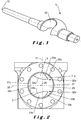
- the figure 1 illustrates an example of a rotary shutter 5 which can be used in an embodiment of a valve according to the invention.
- the rotary shutter 5 is arranged to rotate about an axis of rotation 51.
- the rotary shutter 5 is hollowed out by a recess 52.
- the figure 2 is an elevational view illustrating in particular a channel 2 arranged to pass a fluid and an obstacle 3 arranged to reduce the area of passage of the fluid in the channel 2, and which can be used in an embodiment of a valve according to the invention.
- the figure 2 also illustrates the position of the axis of rotation 51 of the rotary shutter 5, the position of a median plane 25 perpendicular to the axis of rotation 51 and separating the channel 2 into two symmetrical parts and the position of an axis of symmetry 26 of channel 2, which is perpendicular to the plane of the figure 2 .
- the axis of rotation 51 is preferably offset with respect to the axis of symmetry 26.
- the fluid flows essentially in the direction of the axis of symmetry 26.
- the obstacle 3 is preferably symmetrical by mirror symmetry with respect to the median plane 25.
- the obstacle 3 is preferably essentially plane.
- the part of the channel 2 which is not obstructed by the obstacle 3 can be called bottleneck 23.
- the bottleneck 23 does not vary over time.
- the obstacle 3 preferably blocks from 10 to 40% of the section of the channel 2, and the bottleneck 23 from 60 to 90%.
- the obstacle 3 preferably blocks 20 to 30% of the section of the channel 2, and the bottleneck 70 to 80%.
- the rotary shutter 5 When the valve 1 is closed, the rotary shutter 5 obstructs the neck 23, preferably completely ( figure 3 ). When the valve 1 begins to open, the rotary shutter 5 releases part of the neck 23 to form an opening 4 ( figure 6 ) in which the fluid can pass.
- the part of channel 2 which is first obstructed by the rotary shutter 5 is called the first part 21 of channel 2. It preferably adjoins the interior surface of channel 2. It is preferably symmetrical with respect to the median plane 25. It can for example correspond the part of the channel 2 released when the rotary shutter 5 traverses an angular interval ranging from 0 ° to 10 °. To the figure 2 , it is on the right of the gully 23.
- the obstacle 3 includes a first 31a and a second 31b obstacle element. They are preferably symmetrical to each other with respect to the median plane 25. Each of them comprises or forms a projection 32a, 32b oriented in the direction of the first part 21 of the channel.
- the projection 32a, 32b is preferably formed of a first surface 33a, 33b and a second surface 34a, 34b.
- the first surfaces 33a, 33b are turned towards the interior surface of the channel 2.
- the first surfaces 33a, 33b are oriented opposite the axis of symmetry 26 so as to face the interior surface channel 2. This allows that there are recesses 22a, 22b between the inner wall of channel 2 and the first surfaces 33a, 33b.
- the second surfaces 34a, 34b are turned towards the axis of symmetry 26 so as to be at least partially opposite the first respective surfaces 33a, 33b.
- the first and second surfaces 33a, 33b, 34a, 34b are preferably curved and convex.
- each of the projections 32a, 32b forms a point which is directed towards the median plane 25, but preferably not in a direction perpendicular to the median plane 25.
- the obstacle 3 preferably comprises a third obstacle element 31c. It is symmetrical with respect to the median plane 25. It is preferably located in the channel 2 opposite the first part 21 of the channel.
- the third obstacle element 31c may comprise a surface 32c parallel to the axis of rotation 51.
- the first 31a, second 31b and optionally third 31c obstacle elements are preferably in the same plane.
- the first 31a, second 31b and optionally third 31c obstacle elements are preferably separated, in the sense that they preferably are all independently attached to the channel 2. However, they could be joined while remaining within the scope of the invention.
- the obstacle 3 preferably does not include any other obstacle elements than the first 31a, second 31b and third 31c obstacle elements.
- the figure 3a is a schematic sectional view in the median plane 25, and illustrating a valve 1 according to an embodiment of the invention in a closed position 101.
- the figure 3b is a schematic sectional view in a plane comprising the axis of symmetry 26 and perpendicular to the median plane 25, and illustrating a valve 1 according to an embodiment of the invention in a closed position 101.
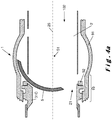
- the figures 4a and 4b correspond to a position 102 intermediate between the closed position 101 and an open position 103.
- the figures 5a and 5b correspond to the open position 103.
- These figures make it possible to illustrate a gasket 92 making it possible to avoid leaks between the rotary shutter 5 and the obstacle 3 and a guide 91 making it possible to guide the rotation of the rotary shutter 5.
- the obstacle 3 is preferably located upstream of the axis of rotation 51 with respect to the movement of fluid.
- the rotary shutter 5 is preferably partially engaged between the first 31a and the second 31b obstacle elements. In the closed position 101, the rotary shutter 5 is preferably partially engaged between the third obstacle element 31c and the inner wall of the channel 2.
- the part of the rotary shutter 5 which is in the channel 2, in particular the recess 52, is preferably symmetrical with respect to the median plane 25.
- the recess 52 In the closed position 101, the recess 52 is preferably open downstream and the rotary shutter 5 has a wall 53 directed essentially upstream.
- the obstruction device 10 comprises the obstacle 3 and the rotary shutter 5.
- the part of the section of the channel 2 which is left free by the obstruction device 10 can be called opening 4 ( figure 6 ).
- the opening 4 varies as a function of time.
- the flow of fluid through the valve 1 mainly depends on the area of the opening 4.
- the arrow 55 represents the direction of rotation of the rotary shutter 5 between the closed position 101 and the open position 103.
- the rotary shutter 5 preferably rotates 90 ° around the axis of rotation 51 between the closed position 101 and the open position 103.
- the third obstacle element 31c forms a screen for the part of the rotary shutter 5 which is in the median plane 25, and which can be called the middle part of the rotary shutter 5.
- the first 31a and the second 31b obstacle elements form a screen for the parts of the rotary shutter 5 which are on either side of the recess 52 along the axis 51, and which can be called upper parts and lower of the rotary shutter 5.
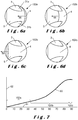
- the figure 6 is an elevational view illustrating the evolution of the position of the rotary shutter 5 as its rotary stroke.
- the arrow 56 is the direction of enlargement of the opening 4. This direction is parallel to the median plane 25.
- the projections 32a, 32b point both in a direction partially opposite to this direction of enlargement of the opening 4 and towards the median plane 25.
- the figure 7 illustrates an example of a curve 60 of flow 62 as a function of the angle 61 in degrees of rotation of the rotary shutter 5, considering that 0 ° is the closed position 101 of the valve 1 and 90 ° is the open position 103 of valve 1.
- the curve 60 flow 62 versus angle 61 depends on the shape of the obstacle 3.
- the figure 6a corresponds to a first part 102a of the rotary travel, which is the rotary travel part between the closed position and the meeting of the opening 4 with the first and second obstacle elements 31a, 31b.
- the obstruction device 10 is preferably designed so as not to obstruct the opening 4 during the first part 102a of the rotary stroke in order to have a flow rate which increases rapidly as a function of the angle of rotation.
- the projections 32a, 32b are the parts of the first and second obstacle elements 31a, 31b which are encountered first by the opening 4.
- the Figures 6b and 6c correspond to a second part 102b of the rotary stroke, which is the rotary part of the stroke between the meeting of the opening 4 with the first and second obstacle elements 31a, 31b and the meeting of the opening 4 with the third element obstacle 31c.
- a first object of the present invention is to obtain a slope of the flow curve 62 versus angle 61 in the first part 102a of the stroke rotary which is high, in the second part 102b of the rotary stroke which is low in order to allow regulation with high precision.
- a second object is to have at the end of the third part 102c of the rotary stroke the greatest flow value 62.
- the figure 6d corresponds to a third part 102c of the rotary stroke, which is the rotary stroke part after the opening 4 meets the third obstacle element 31c.
- the flow rate then almost no longer depends on the angle because almost all of the rotary shutter 5 is behind the obstacle 3.
- the invention relates in particular to a ball valve 1 for regulating a flow of fluid through a channel 2.
- the valve 1 comprises a rotary shutter 5 and an obstacle 3 located directly upstream of the shutter rotary 5.
- the combined obstructions due to the rotary shutter 5 and to the obstacle 3 reduce the possible passage for the fluid to an opening 4 whose area depends on the angle of rotation of the rotary shutter 5.
- the obstacle 3 comprises a first 31a and a second 31b obstacle elements situated on either side of a median plane 25 perpendicular to the axis of rotation 51 of the rotary shutter 5.
- the first 31a and second 31b elements d the obstacle each have a projection 32a, 32b which points towards the part 21 of the channel 2 which is opened first when the valve 1 begins to open.
Landscapes
- Engineering & Computer Science (AREA)
- General Engineering & Computer Science (AREA)
- Mechanical Engineering (AREA)
- Taps Or Cocks (AREA)
- Pharmaceuticals Containing Other Organic And Inorganic Compounds (AREA)
Applications Claiming Priority (1)
| Application Number | Priority Date | Filing Date | Title |
|---|---|---|---|
| BE20185948A BE1026921B1 (fr) | 2018-12-26 | 2018-12-26 | Vanne |
Publications (2)
| Publication Number | Publication Date |
|---|---|
| EP3674586A1 true EP3674586A1 (de) | 2020-07-01 |
| EP3674586B1 EP3674586B1 (de) | 2021-06-23 |
Family
ID=65234310
Family Applications (1)
| Application Number | Title | Priority Date | Filing Date |
|---|---|---|---|
| EP19216932.4A Active EP3674586B1 (de) | 2018-12-26 | 2019-12-17 | Ventil |
Country Status (2)
| Country | Link |
|---|---|
| EP (1) | EP3674586B1 (de) |
| BE (1) | BE1026921B1 (de) |
Citations (4)
| Publication number | Priority date | Publication date | Assignee | Title |
|---|---|---|---|---|
| US20060162792A1 (en) * | 2005-01-26 | 2006-07-27 | Invensys Building Systems, Inc. | Flow characterization in a flowpath |
| EP2299152A2 (de) * | 2009-09-16 | 2011-03-23 | Schneider Electric Buildings, LLC | Kugelventil mit nicht drehbarer Druckplatte |
| US20140209828A1 (en) * | 2013-01-31 | 2014-07-31 | Belimo Holding Ag | Flow characterizing device and ball valve with such a flow characterizing device |
| WO2017039516A1 (en) * | 2015-08-28 | 2017-03-09 | Ab Somas Ventiler | A valve, a valve set and a method for modifying a valve |
Family Cites Families (2)
| Publication number | Priority date | Publication date | Assignee | Title |
|---|---|---|---|---|
| GB2115112A (en) * | 1982-02-01 | 1983-09-01 | Worcester Controls Corp | Rotary ball valves |
| US5937890A (en) * | 1998-01-09 | 1999-08-17 | Griswold Controls, Inc. | Insert for flow throttling ball valves |
-
2018
- 2018-12-26 BE BE20185948A patent/BE1026921B1/fr active IP Right Grant
-
2019
- 2019-12-17 EP EP19216932.4A patent/EP3674586B1/de active Active
Patent Citations (4)
| Publication number | Priority date | Publication date | Assignee | Title |
|---|---|---|---|---|
| US20060162792A1 (en) * | 2005-01-26 | 2006-07-27 | Invensys Building Systems, Inc. | Flow characterization in a flowpath |
| EP2299152A2 (de) * | 2009-09-16 | 2011-03-23 | Schneider Electric Buildings, LLC | Kugelventil mit nicht drehbarer Druckplatte |
| US20140209828A1 (en) * | 2013-01-31 | 2014-07-31 | Belimo Holding Ag | Flow characterizing device and ball valve with such a flow characterizing device |
| WO2017039516A1 (en) * | 2015-08-28 | 2017-03-09 | Ab Somas Ventiler | A valve, a valve set and a method for modifying a valve |
Also Published As
| Publication number | Publication date |
|---|---|
| EP3674586B1 (de) | 2021-06-23 |
| BE1026921A1 (fr) | 2020-07-22 |
| BE1026921B1 (fr) | 2020-07-28 |
Similar Documents
| Publication | Publication Date | Title |
|---|---|---|
| LU83496A1 (fr) | Robinet a papillon | |
| EP3123059B1 (de) | Getriebeanordnung mit einem getriebeelement und einem ölverteilungssystem | |
| EP2850298B1 (de) | Ventil zum steuerung eines flüssigkeitsstroms mit einer drehverschlussvorrichtung | |
| EP3071858B1 (de) | Gleitsattelscheibenbremse mit gleitstiftentlüftung | |
| EP0023172B1 (de) | Ventil mit Schwingungsunterdrückung | |
| EP2880367B1 (de) | Triebwerke-brennkammer mit kugelförmigem einlass / auslassventil | |
| FR2864604A1 (fr) | Raccord et partie d'un tel raccord | |
| EP3674586B1 (de) | Ventil | |
| CH619522A5 (de) | ||
| EP0268521B1 (de) | Schleusenventil | |
| CA2921915C (fr) | Arriere corps de turboreacteur comportant une tuyere equipee d'un systeme d'inversion de poussee qui integre une couronne de chevrons antibruit | |
| EP1283964B1 (de) | Hahn mit sekundärer öffnung | |
| CA3118004A1 (fr) | Joint d'etancheite pour porte de vanne de decharge d'une turbomachine | |
| WO2018189442A1 (fr) | Lubrification pour train d'engrenages épicycloïdal | |
| EP2273126B1 (de) | Rückschlagventil für automatische Rückführung | |
| WO2022189722A1 (fr) | Vanne de detente comportant un coulisseau mobile | |
| EP1938010B1 (de) | Wasserhahn mit kugelförmigem drehverschluss | |
| EP2811208A1 (de) | Absperr- und Regulierhahn | |
| FR3004777A1 (fr) | Dispositif de vanne a papillon incline. | |
| EP4088015A1 (de) | Düse mit variablem auslassquerschnitt für raketenmotor und raketenmotor mit einer solchen düse | |
| FR2996259A1 (fr) | Vanne de controle moteur dotee d'un volet simplifie | |
| CH494356A (fr) | Vanne à obturateur à deux opercules | |
| FR2520833A1 (fr) | Perfectionnements apportes aux vannes a papillon | |
| WO2011141641A1 (fr) | Robinet a joint metallique | |
| FR2858840A1 (fr) | Dispositifs de fermeture et d'etancheite a parallelogramme deformable et profil d'ecoulement optimise |
Legal Events
| Date | Code | Title | Description |
|---|---|---|---|
| PUAI | Public reference made under article 153(3) epc to a published international application that has entered the european phase |
Free format text: ORIGINAL CODE: 0009012 |
|
| STAA | Information on the status of an ep patent application or granted ep patent |
Free format text: STATUS: THE APPLICATION HAS BEEN PUBLISHED |
|
| AK | Designated contracting states |
Kind code of ref document: A1 Designated state(s): AL AT BE BG CH CY CZ DE DK EE ES FI FR GB GR HR HU IE IS IT LI LT LU LV MC MK MT NL NO PL PT RO RS SE SI SK SM TR |
|
| AX | Request for extension of the european patent |
Extension state: BA ME |
|
| STAA | Information on the status of an ep patent application or granted ep patent |
Free format text: STATUS: REQUEST FOR EXAMINATION WAS MADE |
|
| 17P | Request for examination filed |
Effective date: 20201210 |
|
| RBV | Designated contracting states (corrected) |
Designated state(s): AL AT BE BG CH CY CZ DE DK EE ES FI FR GB GR HR HU IE IS IT LI LT LU LV MC MK MT NL NO PL PT RO RS SE SI SK SM TR |
|
| GRAP | Despatch of communication of intention to grant a patent |
Free format text: ORIGINAL CODE: EPIDOSNIGR1 |
|
| STAA | Information on the status of an ep patent application or granted ep patent |
Free format text: STATUS: GRANT OF PATENT IS INTENDED |
|
| INTG | Intention to grant announced |
Effective date: 20210210 |
|
| GRAS | Grant fee paid |
Free format text: ORIGINAL CODE: EPIDOSNIGR3 |
|
| GRAA | (expected) grant |
Free format text: ORIGINAL CODE: 0009210 |
|
| STAA | Information on the status of an ep patent application or granted ep patent |
Free format text: STATUS: THE PATENT HAS BEEN GRANTED |
|
| AK | Designated contracting states |
Kind code of ref document: B1 Designated state(s): AL AT BE BG CH CY CZ DE DK EE ES FI FR GB GR HR HU IE IS IT LI LT LU LV MC MK MT NL NO PL PT RO RS SE SI SK SM TR |
|
| REG | Reference to a national code |
Ref country code: GB Ref legal event code: FG4D Free format text: NOT ENGLISH |
|
| REG | Reference to a national code |
Ref country code: CH Ref legal event code: EP |
|
| REG | Reference to a national code |
Ref country code: DE Ref legal event code: R096 Ref document number: 602019005591 Country of ref document: DE Ref country code: AT Ref legal event code: REF Ref document number: 1404586 Country of ref document: AT Kind code of ref document: T Effective date: 20210715 |
|
| REG | Reference to a national code |
Ref country code: IE Ref legal event code: FG4D Free format text: LANGUAGE OF EP DOCUMENT: FRENCH |
|
| REG | Reference to a national code |
Ref country code: LT Ref legal event code: MG9D |
|
| PG25 | Lapsed in a contracting state [announced via postgrant information from national office to epo] |
Ref country code: FI Free format text: LAPSE BECAUSE OF FAILURE TO SUBMIT A TRANSLATION OF THE DESCRIPTION OR TO PAY THE FEE WITHIN THE PRESCRIBED TIME-LIMIT Effective date: 20210623 Ref country code: HR Free format text: LAPSE BECAUSE OF FAILURE TO SUBMIT A TRANSLATION OF THE DESCRIPTION OR TO PAY THE FEE WITHIN THE PRESCRIBED TIME-LIMIT Effective date: 20210623 Ref country code: LT Free format text: LAPSE BECAUSE OF FAILURE TO SUBMIT A TRANSLATION OF THE DESCRIPTION OR TO PAY THE FEE WITHIN THE PRESCRIBED TIME-LIMIT Effective date: 20210623 Ref country code: BG Free format text: LAPSE BECAUSE OF FAILURE TO SUBMIT A TRANSLATION OF THE DESCRIPTION OR TO PAY THE FEE WITHIN THE PRESCRIBED TIME-LIMIT Effective date: 20210923 |
|
| REG | Reference to a national code |
Ref country code: AT Ref legal event code: MK05 Ref document number: 1404586 Country of ref document: AT Kind code of ref document: T Effective date: 20210623 |
|
| PG25 | Lapsed in a contracting state [announced via postgrant information from national office to epo] |
Ref country code: RS Free format text: LAPSE BECAUSE OF FAILURE TO SUBMIT A TRANSLATION OF THE DESCRIPTION OR TO PAY THE FEE WITHIN THE PRESCRIBED TIME-LIMIT Effective date: 20210623 Ref country code: SE Free format text: LAPSE BECAUSE OF FAILURE TO SUBMIT A TRANSLATION OF THE DESCRIPTION OR TO PAY THE FEE WITHIN THE PRESCRIBED TIME-LIMIT Effective date: 20210623 Ref country code: NO Free format text: LAPSE BECAUSE OF FAILURE TO SUBMIT A TRANSLATION OF THE DESCRIPTION OR TO PAY THE FEE WITHIN THE PRESCRIBED TIME-LIMIT Effective date: 20210923 Ref country code: LV Free format text: LAPSE BECAUSE OF FAILURE TO SUBMIT A TRANSLATION OF THE DESCRIPTION OR TO PAY THE FEE WITHIN THE PRESCRIBED TIME-LIMIT Effective date: 20210623 Ref country code: GR Free format text: LAPSE BECAUSE OF FAILURE TO SUBMIT A TRANSLATION OF THE DESCRIPTION OR TO PAY THE FEE WITHIN THE PRESCRIBED TIME-LIMIT Effective date: 20210924 |
|
| REG | Reference to a national code |
Ref country code: NL Ref legal event code: MP Effective date: 20210623 |
|
| PG25 | Lapsed in a contracting state [announced via postgrant information from national office to epo] |
Ref country code: AT Free format text: LAPSE BECAUSE OF FAILURE TO SUBMIT A TRANSLATION OF THE DESCRIPTION OR TO PAY THE FEE WITHIN THE PRESCRIBED TIME-LIMIT Effective date: 20210623 Ref country code: CZ Free format text: LAPSE BECAUSE OF FAILURE TO SUBMIT A TRANSLATION OF THE DESCRIPTION OR TO PAY THE FEE WITHIN THE PRESCRIBED TIME-LIMIT Effective date: 20210623 Ref country code: NL Free format text: LAPSE BECAUSE OF FAILURE TO SUBMIT A TRANSLATION OF THE DESCRIPTION OR TO PAY THE FEE WITHIN THE PRESCRIBED TIME-LIMIT Effective date: 20210623 Ref country code: RO Free format text: LAPSE BECAUSE OF FAILURE TO SUBMIT A TRANSLATION OF THE DESCRIPTION OR TO PAY THE FEE WITHIN THE PRESCRIBED TIME-LIMIT Effective date: 20210623 Ref country code: PT Free format text: LAPSE BECAUSE OF FAILURE TO SUBMIT A TRANSLATION OF THE DESCRIPTION OR TO PAY THE FEE WITHIN THE PRESCRIBED TIME-LIMIT Effective date: 20211025 Ref country code: SM Free format text: LAPSE BECAUSE OF FAILURE TO SUBMIT A TRANSLATION OF THE DESCRIPTION OR TO PAY THE FEE WITHIN THE PRESCRIBED TIME-LIMIT Effective date: 20210623 Ref country code: SK Free format text: LAPSE BECAUSE OF FAILURE TO SUBMIT A TRANSLATION OF THE DESCRIPTION OR TO PAY THE FEE WITHIN THE PRESCRIBED TIME-LIMIT Effective date: 20210623 Ref country code: ES Free format text: LAPSE BECAUSE OF FAILURE TO SUBMIT A TRANSLATION OF THE DESCRIPTION OR TO PAY THE FEE WITHIN THE PRESCRIBED TIME-LIMIT Effective date: 20210623 Ref country code: EE Free format text: LAPSE BECAUSE OF FAILURE TO SUBMIT A TRANSLATION OF THE DESCRIPTION OR TO PAY THE FEE WITHIN THE PRESCRIBED TIME-LIMIT Effective date: 20210623 |
|
| PG25 | Lapsed in a contracting state [announced via postgrant information from national office to epo] |
Ref country code: PL Free format text: LAPSE BECAUSE OF FAILURE TO SUBMIT A TRANSLATION OF THE DESCRIPTION OR TO PAY THE FEE WITHIN THE PRESCRIBED TIME-LIMIT Effective date: 20210623 |
|
| REG | Reference to a national code |
Ref country code: DE Ref legal event code: R097 Ref document number: 602019005591 Country of ref document: DE |
|
| PG25 | Lapsed in a contracting state [announced via postgrant information from national office to epo] |
Ref country code: DK Free format text: LAPSE BECAUSE OF FAILURE TO SUBMIT A TRANSLATION OF THE DESCRIPTION OR TO PAY THE FEE WITHIN THE PRESCRIBED TIME-LIMIT Effective date: 20210623 |
|
| PLBE | No opposition filed within time limit |
Free format text: ORIGINAL CODE: 0009261 |
|
| STAA | Information on the status of an ep patent application or granted ep patent |
Free format text: STATUS: NO OPPOSITION FILED WITHIN TIME LIMIT |
|
| 26N | No opposition filed |
Effective date: 20220324 |
|
| PG25 | Lapsed in a contracting state [announced via postgrant information from national office to epo] |
Ref country code: AL Free format text: LAPSE BECAUSE OF FAILURE TO SUBMIT A TRANSLATION OF THE DESCRIPTION OR TO PAY THE FEE WITHIN THE PRESCRIBED TIME-LIMIT Effective date: 20210623 |
|
| PG25 | Lapsed in a contracting state [announced via postgrant information from national office to epo] |
Ref country code: MC Free format text: LAPSE BECAUSE OF FAILURE TO SUBMIT A TRANSLATION OF THE DESCRIPTION OR TO PAY THE FEE WITHIN THE PRESCRIBED TIME-LIMIT Effective date: 20210623 |
|
| PG25 | Lapsed in a contracting state [announced via postgrant information from national office to epo] |
Ref country code: LU Free format text: LAPSE BECAUSE OF NON-PAYMENT OF DUE FEES Effective date: 20211217 Ref country code: IE Free format text: LAPSE BECAUSE OF NON-PAYMENT OF DUE FEES Effective date: 20211217 |
|
| PG25 | Lapsed in a contracting state [announced via postgrant information from national office to epo] |
Ref country code: CY Free format text: LAPSE BECAUSE OF FAILURE TO SUBMIT A TRANSLATION OF THE DESCRIPTION OR TO PAY THE FEE WITHIN THE PRESCRIBED TIME-LIMIT Effective date: 20210623 |
|
| PG25 | Lapsed in a contracting state [announced via postgrant information from national office to epo] |
Ref country code: HU Free format text: LAPSE BECAUSE OF FAILURE TO SUBMIT A TRANSLATION OF THE DESCRIPTION OR TO PAY THE FEE WITHIN THE PRESCRIBED TIME-LIMIT; INVALID AB INITIO Effective date: 20191217 |
|
| REG | Reference to a national code |
Ref country code: CH Ref legal event code: PL |
|
| PG25 | Lapsed in a contracting state [announced via postgrant information from national office to epo] |
Ref country code: LI Free format text: LAPSE BECAUSE OF NON-PAYMENT OF DUE FEES Effective date: 20221231 Ref country code: CH Free format text: LAPSE BECAUSE OF NON-PAYMENT OF DUE FEES Effective date: 20221231 |
|
| PG25 | Lapsed in a contracting state [announced via postgrant information from national office to epo] |
Ref country code: MK Free format text: LAPSE BECAUSE OF FAILURE TO SUBMIT A TRANSLATION OF THE DESCRIPTION OR TO PAY THE FEE WITHIN THE PRESCRIBED TIME-LIMIT Effective date: 20210623 |
|
| PG25 | Lapsed in a contracting state [announced via postgrant information from national office to epo] |
Ref country code: MT Free format text: LAPSE BECAUSE OF FAILURE TO SUBMIT A TRANSLATION OF THE DESCRIPTION OR TO PAY THE FEE WITHIN THE PRESCRIBED TIME-LIMIT Effective date: 20210623 |
|
| PG25 | Lapsed in a contracting state [announced via postgrant information from national office to epo] |
Ref country code: TR Free format text: LAPSE BECAUSE OF FAILURE TO SUBMIT A TRANSLATION OF THE DESCRIPTION OR TO PAY THE FEE WITHIN THE PRESCRIBED TIME-LIMIT Effective date: 20210623 |
|
| PGFP | Annual fee paid to national office [announced via postgrant information from national office to epo] |
Ref country code: GB Payment date: 20251229 Year of fee payment: 7 |
|
| PGFP | Annual fee paid to national office [announced via postgrant information from national office to epo] |
Ref country code: FR Payment date: 20251222 Year of fee payment: 7 |
|
| PGFP | Annual fee paid to national office [announced via postgrant information from national office to epo] |
Ref country code: BE Payment date: 20251224 Year of fee payment: 7 |
|
| PGFP | Annual fee paid to national office [announced via postgrant information from national office to epo] |
Ref country code: DE Payment date: 20251222 Year of fee payment: 7 |
|
| PGFP | Annual fee paid to national office [announced via postgrant information from national office to epo] |
Ref country code: IT Payment date: 20251231 Year of fee payment: 7 |