EP3674683B1 - Procédé d'évaluation de poudre de moulage de pièces en stratifié - Google Patents
Procédé d'évaluation de poudre de moulage de pièces en stratifié Download PDFInfo
- Publication number
- EP3674683B1 EP3674683B1 EP17922580.0A EP17922580A EP3674683B1 EP 3674683 B1 EP3674683 B1 EP 3674683B1 EP 17922580 A EP17922580 A EP 17922580A EP 3674683 B1 EP3674683 B1 EP 3674683B1
- Authority
- EP
- European Patent Office
- Prior art keywords
- powder
- squeegeeing
- property
- shaping
- adhesion ratio
- Prior art date
- Legal status (The legal status is an assumption and is not a legal conclusion. Google has not performed a legal analysis and makes no representation as to the accuracy of the status listed.)
- Active
Links
Images












Classifications
-
- G—PHYSICS
- G01—MEASURING; TESTING
- G01N—INVESTIGATING OR ANALYSING MATERIALS BY DETERMINING THEIR CHEMICAL OR PHYSICAL PROPERTIES
- G01N3/00—Investigating strength properties of solid materials by application of mechanical stress
- G01N3/24—Investigating strength properties of solid materials by application of mechanical stress by applying steady shearing forces
-
- B—PERFORMING OPERATIONS; TRANSPORTING
- B22—CASTING; POWDER METALLURGY
- B22F—WORKING METALLIC POWDER; MANUFACTURE OF ARTICLES FROM METALLIC POWDER; MAKING METALLIC POWDER; APPARATUS OR DEVICES SPECIALLY ADAPTED FOR METALLIC POWDER
- B22F1/00—Metallic powder; Treatment of metallic powder, e.g. to facilitate working or to improve properties
- B22F1/06—Metallic powder characterised by the shape of the particles
-
- B—PERFORMING OPERATIONS; TRANSPORTING
- B22—CASTING; POWDER METALLURGY
- B22F—WORKING METALLIC POWDER; MANUFACTURE OF ARTICLES FROM METALLIC POWDER; MAKING METALLIC POWDER; APPARATUS OR DEVICES SPECIALLY ADAPTED FOR METALLIC POWDER
- B22F1/00—Metallic powder; Treatment of metallic powder, e.g. to facilitate working or to improve properties
- B22F1/14—Treatment of metallic powder
-
- B—PERFORMING OPERATIONS; TRANSPORTING
- B33—ADDITIVE MANUFACTURING TECHNOLOGY
- B33Y—ADDITIVE MANUFACTURING, i.e. MANUFACTURING OF THREE-DIMENSIONAL [3D] OBJECTS BY ADDITIVE DEPOSITION, ADDITIVE AGGLOMERATION OR ADDITIVE LAYERING, e.g. BY 3D PRINTING, STEREOLITHOGRAPHY OR SELECTIVE LASER SINTERING
- B33Y70/00—Materials specially adapted for additive manufacturing
-
- B—PERFORMING OPERATIONS; TRANSPORTING
- B22—CASTING; POWDER METALLURGY
- B22F—WORKING METALLIC POWDER; MANUFACTURE OF ARTICLES FROM METALLIC POWDER; MAKING METALLIC POWDER; APPARATUS OR DEVICES SPECIALLY ADAPTED FOR METALLIC POWDER
- B22F10/00—Additive manufacturing of workpieces or articles from metallic powder
- B22F10/20—Direct sintering or melting
- B22F10/28—Powder bed fusion, e.g. selective laser melting [SLM] or electron beam melting [EBM]
-
- B—PERFORMING OPERATIONS; TRANSPORTING
- B22—CASTING; POWDER METALLURGY
- B22F—WORKING METALLIC POWDER; MANUFACTURE OF ARTICLES FROM METALLIC POWDER; MAKING METALLIC POWDER; APPARATUS OR DEVICES SPECIALLY ADAPTED FOR METALLIC POWDER
- B22F2999/00—Aspects linked to processes or compositions used in powder metallurgy
-
- C—CHEMISTRY; METALLURGY
- C22—METALLURGY; FERROUS OR NON-FERROUS ALLOYS; TREATMENT OF ALLOYS OR NON-FERROUS METALS
- C22C—ALLOYS
- C22C9/00—Alloys based on copper
-
- G—PHYSICS
- G01—MEASURING; TESTING
- G01N—INVESTIGATING OR ANALYSING MATERIALS BY DETERMINING THEIR CHEMICAL OR PHYSICAL PROPERTIES
- G01N11/00—Investigating flow properties of materials, e.g. viscosity, plasticity; Analysing materials by determining flow properties
-
- G—PHYSICS
- G01—MEASURING; TESTING
- G01N—INVESTIGATING OR ANALYSING MATERIALS BY DETERMINING THEIR CHEMICAL OR PHYSICAL PROPERTIES
- G01N15/00—Investigating characteristics of particles; Investigating permeability, pore-volume or surface-area of porous materials
- G01N15/02—Investigating particle size or size distribution
- G01N15/0205—Investigating particle size or size distribution by optical means
- G01N15/0211—Investigating a scatter or diffraction pattern
-
- G—PHYSICS
- G01—MEASURING; TESTING
- G01N—INVESTIGATING OR ANALYSING MATERIALS BY DETERMINING THEIR CHEMICAL OR PHYSICAL PROPERTIES
- G01N15/00—Investigating characteristics of particles; Investigating permeability, pore-volume or surface-area of porous materials
- G01N2015/0092—Monitoring flocculation or agglomeration
-
- G—PHYSICS
- G01—MEASURING; TESTING
- G01N—INVESTIGATING OR ANALYSING MATERIALS BY DETERMINING THEIR CHEMICAL OR PHYSICAL PROPERTIES
- G01N15/00—Investigating characteristics of particles; Investigating permeability, pore-volume or surface-area of porous materials
- G01N2015/0096—Investigating consistence of powders, dustability, dustiness
-
- Y—GENERAL TAGGING OF NEW TECHNOLOGICAL DEVELOPMENTS; GENERAL TAGGING OF CROSS-SECTIONAL TECHNOLOGIES SPANNING OVER SEVERAL SECTIONS OF THE IPC; TECHNICAL SUBJECTS COVERED BY FORMER USPC CROSS-REFERENCE ART COLLECTIONS [XRACs] AND DIGESTS
- Y02—TECHNOLOGIES OR APPLICATIONS FOR MITIGATION OR ADAPTATION AGAINST CLIMATE CHANGE
- Y02P—CLIMATE CHANGE MITIGATION TECHNOLOGIES IN THE PRODUCTION OR PROCESSING OF GOODS
- Y02P10/00—Technologies related to metal processing
- Y02P10/25—Process efficiency
Definitions
- the present invention relates to a lamination shaping powder evaluation method and a lamination shaping powder therefor.
- patent literature 1 discloses a technique by which the measurement value of the fluidity complying with JIS Z 2502 is set at 10 to 25 sec/50 g as a condition when using WC-base hard metal particles as lamination shaping granules.
- Non-patent literature 1 also describes the standards of JIS Z 2502 as a metal powder-fluidity measurement method.
- patent literature 2 discloses a technique that evaluates the flowability of aluminum particles by criteria including the average roundness, the average particle size, and the satellite state.
- EP 1 118 404 A1 discloses that primary powder particles whose main component is aluminum and whose particle diameter is between 5 ⁇ m and 300 ⁇ m are bound together using an organic binder to form secondary powder particles having a particle diameter of 10 ⁇ m to 500 ⁇ m. Similarly, primary powder particles whose main component is iron and whose particle diameter is between 20 ⁇ m and 100 ⁇ m are bound together using an organic binder to form secondary powder particles having a particle diameter of 50 ⁇ m to 200 ⁇ m, Thus, an alloy powder having excellent fluidity can be obtained, and a sintered alloy material having high dimensional accuracy can be produced with these secondary powder particles.
- JP 2016 204700 A discloses a copper powder initiating heat shrinkage behavior at a heating temperature of 300°C or less by a heat shrinkage behavior measurement from room temperature to 1000°C by using a TMA (thermomechanical analysis) device, where maximum shrinkage rate C(%) of the copper powder is larger than maximum shrinkage rate C(%) of the copper and maximum shrinkage rate Cm (%) of mixture copper satisfies the following formula C-(C-C) ⁇ 0.5 ⁇ Cm ⁇ C+1 when the mixture copper is prepared by adding the copper powder to the copper which initiates no heat shrinkage behavior at the heating temperature of 300°C or less.
- TMA thermomechanical analysis
- JP 2017 066432 A discloses an aluminum particle group consisting of aluminum particles, having average circularity of the aluminum particle group of 0.75 or more and average particle diameter Dof the aluminum particle group of 10 ⁇ m or more and less than 100 ⁇ m in an observed image when the aluminum particle group is observed by using a scanning type electron microscope and satisfying A ⁇ 3 ⁇ B and D.
- JP 2017 127998 A discloses that the powder for molding of the present invention is to be used for a powder bed melt-binding process and comprises powder containing a ceramic material and/or metal, and a thermoplastic binder.
- the thermoplastic binder contains at least one compound selected from the group consisting of petroleum wax, fatty acids, fatty acid esters, fatty acid amides and polyvinyl acetal.
- the thermoplastic binder has a melting point or a glass transition point in a range of 20°C or higher and 130°C or lower.
- the powder for molding preferably has a Hausner ratio (a ratio of (tap density)/(bulk density)) of 1.10 or more and 1.40 or less.
- CN 105 642 879 A discloses spherical TC4 titanium alloy powder used for laser 3D printing and a preparation method thereof. Titanium alloy powder particles are in a sphere shape, the grain size is 1-180 ⁇ m, the oxygen content is 0.09%-0.14%, the apparent density is 2.587-2.656 g/cm ⁇ 3>, and the liquidity of the powder with the grain size being 54-150 ⁇ m is 20.0-30.0 s/50g.
- the powder with the grain size being 1-54 ⁇ m can be used for powder laying method laser 3D printing, and the powder with the grain size being 54-150 ⁇ m can be used for powder feeding laser 3D printing.
- an electrode titanium bar of which one end is a conical tip is made from titanium alloy and is placed in a induction melting chamber to rotate, induction melting is started at the same time, and when liquid drops are formed by the tip, the titanium bar rotates and perpendicularly moves downwards; the alloy liquid drops are atomized into the powder in an atomizing chamber through inert gases by regulating and controlling the atomizing air pressure and induction parameters; and then collection is conducted through a powder collection device, and the powder with different grain sizes is screened and preserved in a vacuum mode.
- Non-patent literature 1 Japanese Industrial Standards (JIS Z 2502: 2012), "Metallic powders-Determination of flow rate by means of a calibrated funnel "
- the present invention provides a technique of solving the above-described problem.
- One example aspect provides a method of evaluating a squeegeeing property of powder for lamination shaping, wherein the squeegeeing property is evaluated using at least a satellite adhesion ratio of the powder and an apparent density of the powder.
- Another example aspect not covered by the claims but helpful for understanding the present invention provides powder, which has been evaluated to be spread into a uniform powder layer in lamination shaping by the abovementioned method.
- the squeegeeing property of a lamination shaping powder can be evaluated by stable criteria.
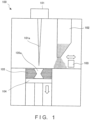
- Fig. 1 is a view showing a schematic configuration example of a laminating and shaping apparatus 100 of this example embodiment.
- the laminating and shaping apparatus 100 includes an emission mechanism 101 for an electron beam or fiber laser 101a, a hopper 102 as a powder tank, a squeegeeing blade 103 for forming a powder bed by spreading a powder by a predetermined thickness, and a table 104 that repetitively moves down by a predetermined thickness in order to perform lamination.
- the squeegeeing blade 103 and the table 104 cooperate with each other to generate a powder laminated portion 105 having a uniform predetermined thickness.
- Each layer is irradiated with the fiber laser 101a based on slice data obtained from 3D-CAD data, thereby melting a metal powder (in this example embodiment, a metal powder, particularly a copper powder or a copper alloy powder) and manufacturing a laminated and shaped product 105a.
- a metal powder in this example embodiment, a metal powder, particularly a copper powder or a copper alloy powder
- a manufactured product having an arbitrary shape can be obtained by melting and solidifying a lamination shaping powder by using the electron beam or fiber laser 101a as a heat source.
- a lamination shaping powder is not limited to a metal powder such as a copper powder.
- the lamination shaping powder of this example embodiment can be manufactured by, e.g., "a rotating disk method", “a gas atomizing method”, “a water atomizing method”, “a plasma atomizing method”, or “a plasma rotating electrode method”.
- the gas atomizing method was used among these methods.
- a gas such as helium, argon, or nitrogen was used, and a lamination shaping powder was manufactured by controlling powdering by adjusting the pressure and flow rate of the gas.
- a similar lamination shaping powder can also be manufactured by using another manufacturing method.
- the manufactured lamination shaping powder was classified by a predetermined classification size.
- the squeegeeing property is a criterion for determining whether a powder can be used by the laminating and shaping apparatus 100, and a powder having an insufficient squeegeeing property is basically excluded from the lamination shaping powder.
- a powder having a sufficient squeegeeing property requires the following conditions.
- the flowability is evaluated by using the flow rate (FR) complying with JIS Z 2502 as disclosed in patent literature 1 and non-patent literature 1.
- FR flow rate
- JIS Z 2502 the measurement of the fluidity complying with JIS Z 2502 is unstable as a criterion of a lamination shaping powder because a fine powder probably usable for lamination shaping cannot be measured or the same powder can be measured or cannot be measured due to a slight change in measurement environment. This makes the evaluation of a lamination shaping powder insufficient.
- a fine powder having an average particle size of 20 to 45 ⁇ m is generally used as a powder for lamination shaping, but the use of a finer powder of 20 ⁇ m or less is desirable in the future.
- a fine powder has a strong adhesive force and hence has a low flowability, and this makes it difficult to generate a powder layer necessary for lamination shaping. It is sometimes impossible to measure a fine powder like this by using JIS Z 2502, so this method is insufficient to properly evaluate the flow form of a powder for lamination shaping. If measurement is impossible, it becomes difficult to evaluate the powder as a lamination shaping powder. In practice, however, it is sometimes possible to laminate even an unmeasurable fine powder depending on an apparatus or a supply method, and this makes evaluation difficult.
- the flowability and the spreadability of a powder are hindered if the powder has a nonuniform shape due to strain or a large amount of satellites are adhered on the powder, and no uniform powder layer can be formed. Since this generates pores or decreases the density, a high-density high-quality homogeneous manufactured product cannot be obtained.
- a powder is ideally closer to a spherical shape in order to obtain a sufficient flowability and a sufficient spreadability.
- the manufacturing cost rises in order to obtain a powder having a higher spherical degree.
- the present inventors made extensive studies and have found that it is possible to ensure a sufficient flowability and a sufficient spreadability suitable for lamination shaping by controlling the satellite adhesion amount to a predetermined amount or less.
- the satellite adhesion ratio with which measurement results are stably obtainable is used as an evaluation criterion of the flowability and combined with other evaluation targets.
- the "satellite adhesion ratio" of powder particles is the ratio of the number of powder particles on which satellites are adhered to the number of all particles including powder particles on which no satellites are adhered.
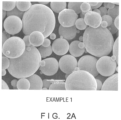
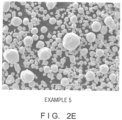
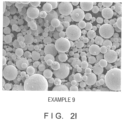
- the satellite adhesion ratio of the whole powder was calculated by counting powder particles on which satellites were adhered and powder particles on which no satellites were adhered. Note that it is also possible to extract the number of powder particles on which satellites are adhered and the number of particles on which no satellites are adhered, by image processing of a scanning electron microscope (SEM) image, and calculate the satellite adhesion ratio of the whole powder.
- SEM scanning electron microscope
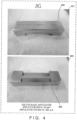
- Fig. 4 is a view showing a jig 400 for testing the squeegeeing property in this example embodiment.
- An upper view 401 of Fig. 4 is a view showing the jig 400 from its upper surface
- a lower view 402 of Fig. 4 is a view showing the jig 400 from its bottom surface.
- the jig 400 is called a doctor blade or an applicator, and obtained by forming a gap by processing one surface of a metal block.
- the jig 400 can apply a paint or ink with a predetermined film thickness.
- the two ends of the jig 400 having an application width of 50 mm and an application thickness of 100 ⁇ m were picked up, and the jig 400 was pressed against the table 104 of the laminating and shaping apparatus 100 or against an equivalent horizontal plate and pulled at a predetermined velocity, thereby forming a powder layer. After that, whether a uniform powder layer was formed was observed. Note that this process was repetitively performed by changing the initial powder amount or the velocity.
- a lamination shaping powder can be evaluated by stable criteria. Also, the stable criteria make it possible to easily find a powder usable as a lamination shaping powder.
- the satellite adhesion ratio exceeds 50%, the squeegeeing property of the powder deteriorates. Also, the conductivity decreases, and this may hinder temporary sintering in a preheating step of electron-beam lamination shaping.
- the apparent density is less than 3.5 g/cm 3 , the packing property of the powder in the powder layer deteriorates, and the density of the manufactured product decreases because pores are formed in the manufactured product.
- the powder causes surface defects, e.g., violently scatters and adheres to the manufactured product again.
- the 50% particle size is larger than 75 ⁇ m in lamination shaping using a laser beam, or if the 50% particle size is larger than 250 ⁇ m in lamination shaping using an electron beam, the surface of the manufactured product roughens and causes an appearance defect.
- a melt pool formed in a powder layer during beam irradiation does not reach a solidified layer immediately below the pool. Since this causes insufficient melting and solidification, a shaping defect occurs.
- a lamination shaping powder is evaluated by further taking account of the "adhesive force" of the powder particles.
- the "adhesive force" is calculated based on a shearing force test.
- a fine powder having an average particle size of 20 to 45 ⁇ m is generally used as a powder for lamination shaping, but the use of a finer powder of 20 ⁇ m or less is desirable in the future.
- a fine powder has a strong adhesive force and hence has a low flowability, and this makes it difficult to generate a powder layer necessary for lamination shaping. It is sometimes impossible to measure a fine powder like this by using JIS Z 2502, so this method is insufficient to properly evaluate the flow form of a powder for lamination shaping. If measurement is impossible, it becomes difficult to evaluate the powder as a lamination shaping powder. In practice, however, it is sometimes possible to laminate even an unmeasurable fine powder depending on an apparatus or a supply method, and this makes evaluation difficult.
- the flowability of a fine powder is low because the adhesive force between particles forming a fine powder is strong and the kinetic energy of the particles is very low. It is known that the adhesive force of a powder relatively increases as the particle size decreases. The adhesive force functions as binding power that hinders the flowability of a powder. On the other hand, the kinetic energy is proportional to the mass, but the mass of a particle is proportional to the cube of the particle size, so the kinetic energy of a fine particle becomes very low. Consequently, the gravity and the inertia force necessary to move particles become low and cannot exceed the adhesive force as binding power. This makes it impossible to cause the flow of a powder.
- the adhesive force with which measurement results are stably obtainable is further used as an evaluation criterion of the flowability and combined with other evaluation targets.
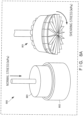
- Fig. 8A is a view showing the arrangement of a shearing stress measurement unit 800 for measuring the shearing stress in this example embodiment.
- the shearing stress measurement unit 800 measures the shearing stress by a rotary cell method.
- a rotary cell 801 including a blade attached to its lower portion is placed inside an external cell 802, and a powder to be measured is packed in the upper portion of the external cell 802. While a predetermined normal stress is applied from the rotary cell 801 to the external cell 802, the shearing stress is measured from the torque of the rotary cell 801.
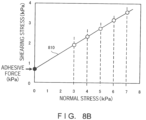
- Fig. 8B is a graph showing a method of obtaining the adhesive force based on the shearing stress measured by the shearing stress measurement unit 800.
- a line obtained by plotting the shearing stress measured by the shearing stress measurement unit 800 when shear occurs under each normal stress is called a failure envelope, and a powder layer slips if a shearing stress stronger than the failure envelope is applied.
- a shearing stress when the normal stress is 0 (zero) on the failure envelope (e.g., 810) is calculated as the adhesive force between particles.
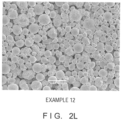
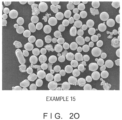
- Figs. 2A to 20 are views showing scanning electron microscope (SEM) images for measuring the satellite adhesion ratios of the powders of Examples 1 to 15.
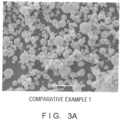
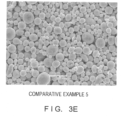
- Figs. 3A to 3F are views showing scanning electron microscope (SEM) images for measuring the satellite adhesion ratios of the powders of Comparative Examples 1 to 6.
- the satellite adhesion ratios of the powders of the examples and the comparative examples were obtained by using these scanning electron microscope (SEM) images.
- Table 1 shows the correspondence between the FR (sec/50 g) measurement results complying with JIS Z 2502 and the satellite adhesion ratio measurement results in Examples 1 to 15 and Comparative Examples 1 to 6.
- the satellite adhesion ratio measurement result can be obtained even for a copper powder or a copper alloy powder that is "unmeasurable" in the FR (sec/50 g) measurement result. Therefore, even for a powder found to be unusable by the FR (sec/50 g) measurement result, it is possible to determine whether the powder is usable as a lamination shaping powder.
- the 50% particle size ( ⁇ m) of a copper powder or a copper alloy powder of each of Examples 1 to 15 and Comparative Examples 1 to 6 was measured by the laser diffraction method (Microtrac MT3300: manufactured by MicrotrackBEL). Also, the apparent density (g/cm 3 ) of the copper powder or the copper alloy powder was measured in accordance with JIS Z 2504.
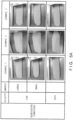
- Figs. 5A and 5B are views showing the test results of the squeegeeing properties of powders of Examples 1 to 5.
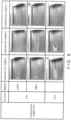
- Fig. 6 is a view showing the test results of the squeegeeing properties of powders of Comparative Examples 1 to 3.
- Figs. 5A , 5B , and 6 show only some of the examples and the comparative examples, but the results of other examples and other comparative examples were also similar.
- Table 2 shows the correspondence between the characteristics (the satellite adhesion ratio, 50% particle size, and apparent density) and the squeegeeing property test results of Examples 1 to 15 and Comparative Examples 1 to 6.
- Table 2 Correspondence Table of Powder Characteristics and Squeegeeing Property Satelli te adhesi on ratio (%) 50% partic le size ( ⁇ m) Appare nt density (g/cm 3 ) Squeegeei ng property Evaluation of manufacturability
- Example 1 28 29.9 5.09 ⁇ Good
- Example 2 48 76.5 4.83 ⁇ Good
- Example 3 39 25.1 5.83 ⁇ Good
- Example 4 13 9.73 4.27 ⁇ Good
- Example 6 43 25.8 5.28 ⁇ Good although few pores were found in manufactured product
- Example 10 30 31.6 4.35 ⁇ Good Example 11 41 72.5 4.78
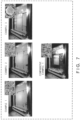
- Fig. 7 shows a state in which the powders of Examples 1, 3, and 5 and Comparative Example 1 were squeegeed in the laminating and shaping apparatus.
- a powder found to have a good squeegeeing property in Table 2 squeegeeing in the laminating and shaping apparatus was also good.
- a powder found to have an unsatisfactory or bad squeegeeing property in Table 2 squeegeeing in the laminating and shaping apparatus was also unsatisfactory.
- the shearing stress of a copper powder or a copper alloy powder was measured by using a searing stress measurement kit shown in Fig. 8A and input to Powder Rheometer FT4 (manufactured by Malvern Instruments), and the adhesive force was calculated in accordance with Fig. 8B .
- Table 3 shows the correspondence between the characteristics (the satellite adhesion ratio, 50% particle size, apparent density, and adhesive force) and the squeegeeing property test results of Examples 1 to 15 and Comparative Examples 1 to 6.
Landscapes
- Chemical & Material Sciences (AREA)
- General Physics & Mathematics (AREA)
- Immunology (AREA)
- Pathology (AREA)
- Physics & Mathematics (AREA)
- Health & Medical Sciences (AREA)
- Life Sciences & Earth Sciences (AREA)
- Analytical Chemistry (AREA)
- Biochemistry (AREA)
- General Health & Medical Sciences (AREA)
- Engineering & Computer Science (AREA)
- Nanotechnology (AREA)
- Dispersion Chemistry (AREA)
- Materials Engineering (AREA)
- Manufacturing & Machinery (AREA)
- Powder Metallurgy (AREA)
- Investigating Strength Of Materials By Application Of Mechanical Stress (AREA)
- Mechanical Engineering (AREA)
- Metallurgy (AREA)
- Organic Chemistry (AREA)
Claims (7)
- Procédé d'évaluation d'une propriété de raclage d'une poudre pour la mise en forme par stratification, dans lequel la propriété de raclage est évaluée en utilisant au moins un rapport d'adhérence des satellites de la poudre et une densité apparente de la poudre,dans lequel le rapport d'adhérence des satellites est un rapport entre un nombre de particules sur lesquelles les satellites sont collés et un nombre de toutes les particules, etdans lequel, si le rapport d'adhérence des satellites est égal ou inférieur à 50 % et la densité apparente est égale ou supérieure à 3,5 g/cm3, la propriété de raclage est évaluée comme étant le fait que la poudre peut être étalée en une couche de poudre uniforme dans le façonnage de stratification.
- Procédé selon la revendication 1, dans lequel la propriété d'écrasement est évaluée en utilisant en outre une taille de particule de 50% de la poudre obtenue par une méthode de diffraction laser.
- Procédé selon la revendication 2, dans lequel si la taille de particule de 50% est de 3 à 250 µm, la propriété de raclage est évaluée comme étant celle où la poudre peut être étalée dans la couche de poudre uniforme dans le façonnage de stratification.
- Procédé selon l'une quelconque des revendications 1 à 3, dans lequel la propriété d'écrasement est évaluée en outre en utilisant une force d'adhésion de la poudre calculée à partir d'une enveloppe de rupture (810) obtenue par un essai de cisaillement réalisé par un rhéomètre à poudre.
- Procédé selon la revendication 4, dans lequel si la force d'adhésion est égale ou inférieure à 0,450 kPa, la propriété de raclage est évaluée comme le fait que la poudre peut être étalée dans la couche de poudre uniforme dans le façonnage de stratification.
- Procédé selon l'une quelconque des revendications 1 à 5, dans lequel la poudre est une poudre métallique ou une poudre d'alliage métallique.
- Procédé selon la revendication 6, dans lequel la poudre métallique ou l'alliage métallique est une poudre de cuivre ou une poudre d'alliage de cuivre.
Applications Claiming Priority (1)
| Application Number | Priority Date | Filing Date | Title |
|---|---|---|---|
| PCT/JP2017/030510 WO2019038910A1 (fr) | 2017-08-25 | 2017-08-25 | Procédé d'évaluation de poudre de moulage de pièces en stratifié et poudre de moulage de pièces en stratifié |
Publications (3)
| Publication Number | Publication Date |
|---|---|
| EP3674683A1 EP3674683A1 (fr) | 2020-07-01 |
| EP3674683A4 EP3674683A4 (fr) | 2021-02-17 |
| EP3674683B1 true EP3674683B1 (fr) | 2023-04-19 |
Family
ID=65438500
Family Applications (1)
| Application Number | Title | Priority Date | Filing Date |
|---|---|---|---|
| EP17922580.0A Active EP3674683B1 (fr) | 2017-08-25 | 2017-08-25 | Procédé d'évaluation de poudre de moulage de pièces en stratifié |
Country Status (5)
| Country | Link |
|---|---|
| US (1) | US11644397B2 (fr) |
| EP (1) | EP3674683B1 (fr) |
| JP (1) | JP6935502B2 (fr) |
| CN (1) | CN111051850B (fr) |
| WO (1) | WO2019038910A1 (fr) |
Families Citing this family (4)
| Publication number | Priority date | Publication date | Assignee | Title |
|---|---|---|---|---|
| JP6935501B2 (ja) * | 2017-08-25 | 2021-09-15 | 福田金属箔粉工業株式会社 | 積層造形用粉末の評価方法 |
| CN111203539B (zh) * | 2020-04-22 | 2020-07-28 | 中国航发上海商用航空发动机制造有限责任公司 | 预制气孔缺陷、内置气孔缺陷的制备方法及预制件 |
| CN111633208B (zh) * | 2020-05-07 | 2022-09-06 | 上海理工大学 | 一种控制粉末流动性对打印成形质量控制方法 |
| WO2022138233A1 (fr) * | 2020-12-25 | 2022-06-30 | 福田金属箔粉工業株式会社 | Poudre d'alliage de cuivre pour fabrication additive et procédé d'évaluation de ladite poudre d'alliage de cuivre, procédé de production d'un article fabriqué de manière additive avec l'alliage de cuivre, et article fabriqué de manière additive avec l'alliage de cuivre |
Family Cites Families (21)
| Publication number | Priority date | Publication date | Assignee | Title |
|---|---|---|---|---|
| JPS5976225A (ja) | 1982-10-25 | 1984-05-01 | Shin Etsu Chem Co Ltd | 熱可塑性樹脂の品質検査方法 |
| JPS6140540A (ja) * | 1984-07-31 | 1986-02-26 | Agency Of Ind Science & Technol | 粉粒体の流動特性測定方法及び装置 |
| JP2000160203A (ja) | 1998-09-24 | 2000-06-13 | Sumitomo Electric Ind Ltd | 合金粉末、合金焼結体およびそれらの製造方法 |
| US6899846B2 (en) | 2003-01-14 | 2005-05-31 | Sinterstahl Corp.-Powertrain | Method of producing surface densified metal articles |
| BRPI0607670A2 (pt) | 2005-04-26 | 2009-09-22 | Avery Dennison Corp | processo para produção de flocos metálicos finos de partìculas finas realçadas que têm brilho e intensidade de cor, processo de formação de um primeiro revestimento que contém flocos realçados, flocos metálicos refletores, laminado de múltiplas camadas e revestimento resinoso |
| JP2013194254A (ja) | 2012-03-16 | 2013-09-30 | Toyota Central R&D Labs Inc | 鉄基粉末、成形用粉末および焼結体 |
| JP6140540B2 (ja) | 2013-06-14 | 2017-05-31 | スリーエム イノベイティブ プロパティズ カンパニー | アダプタ |
| WO2016031279A1 (fr) * | 2014-08-27 | 2016-03-03 | 株式会社日立製作所 | Poudre pour fabrication additive couche par couche et procédé pour la production d'objet par fabrication additive couche par couche |
| JP6475478B2 (ja) * | 2014-11-27 | 2019-02-27 | 山陽特殊製鋼株式会社 | 造形用金属粉末 |
| JP6410150B2 (ja) | 2015-03-17 | 2018-10-24 | 三菱日立ツール株式会社 | 積層造形用顆粒及びその製造方法並びにそれを用いたインサートの製造方法 |
| WO2016158687A1 (fr) | 2015-03-31 | 2016-10-06 | 山陽特殊製鋼株式会社 | Poudre métallique constituée de particules sphériques |
| JP6004034B1 (ja) | 2015-04-21 | 2016-10-05 | 住友金属鉱山株式会社 | 銅粉末 |
| JP6794100B2 (ja) * | 2015-09-28 | 2020-12-02 | 東洋アルミニウム株式会社 | アルミニウム粒子群およびその製造方法 |
| JP6700776B2 (ja) | 2015-12-24 | 2020-05-27 | 三菱日立パワーシステムズ株式会社 | ガスタービン冷却系統、これを備えるガスタービン設備、ガスタービン冷却系統の制御装置及び制御方法 |
| JP6532396B2 (ja) | 2015-12-25 | 2019-06-19 | 株式会社ダイヘン | 銅合金粉末、積層造形物の製造方法および積層造形物 |
| CN105642879B (zh) * | 2016-01-14 | 2017-08-25 | 鞍山东大激光科技有限公司 | 用于激光3d打印的球形tc4钛合金粉末及其制备方法 |
| JP6699824B2 (ja) * | 2016-01-18 | 2020-05-27 | 国立研究開発法人産業技術総合研究所 | 造形用粉末 |
| CN106277960A (zh) | 2016-07-26 | 2017-01-04 | 扬州大学 | 基于再生骨料的c30混凝土及其制备方法 |
| CN109803824A (zh) | 2016-10-12 | 2019-05-24 | 陶氏环球技术有限责任公司 | 多层结构、包含多层结构的物品,及制作多层结构的方法 |
| TWI798480B (zh) * | 2016-12-09 | 2023-04-11 | 美商史達克公司 | 利用積層製造製備金屬部件及其所用之含鎢重金屬合金粉末 |
| JP6935501B2 (ja) | 2017-08-25 | 2021-09-15 | 福田金属箔粉工業株式会社 | 積層造形用粉末の評価方法 |
-
2017
- 2017-08-25 JP JP2019537525A patent/JP6935502B2/ja active Active
- 2017-08-25 CN CN201780093805.7A patent/CN111051850B/zh active Active
- 2017-08-25 WO PCT/JP2017/030510 patent/WO2019038910A1/fr not_active Ceased
- 2017-08-25 EP EP17922580.0A patent/EP3674683B1/fr active Active
- 2017-08-25 US US16/641,963 patent/US11644397B2/en active Active
Also Published As
| Publication number | Publication date |
|---|---|
| US20200254517A1 (en) | 2020-08-13 |
| US11644397B2 (en) | 2023-05-09 |
| JPWO2019038910A1 (ja) | 2020-10-01 |
| JP6935502B2 (ja) | 2021-09-15 |
| EP3674683A4 (fr) | 2021-02-17 |
| EP3674683A1 (fr) | 2020-07-01 |
| CN111051850A (zh) | 2020-04-21 |
| WO2019038910A1 (fr) | 2019-02-28 |
| CN111051850B (zh) | 2022-07-08 |
Similar Documents
| Publication | Publication Date | Title |
|---|---|---|
| EP3674682B1 (fr) | Procédé d'évaluation de poudre de moulage de pièces en stratifié | |
| EP3674683B1 (fr) | Procédé d'évaluation de poudre de moulage de pièces en stratifié | |
| EP3266541B1 (fr) | Poudre de titane | |
| KR102011166B1 (ko) | 은 피복 구리 합금 분말 및 그의 제조 방법 | |
| WO2019017467A1 (fr) | Poudre de cuivre, procédé de production d'un modèle stéréolithographique l'utilisant, et modèle stéréolithographique utilisant du cuivre | |
| JP2019183268A (ja) | 銀粉およびその製造方法 | |
| JP2019112700A (ja) | 金属粉末材料の製造方法 | |
| JP4613362B2 (ja) | 導電ペースト用金属粉および導電ペースト | |
| JP7544697B2 (ja) | 積層造形用銅粉末、積層造形体の製造方法 | |
| JP2023012810A (ja) | 銅基粉、その製造方法、および銅基粉を用いた光造形物の製造方法 | |
| WO2018101471A1 (fr) | Matériau de liaison électroconducteur et procédé de fabrication de dispositif à semiconducteur | |
| US20220339697A1 (en) | Composite powder with iron based particles coated with graphene material | |
| US11952286B2 (en) | Mn ferrite powder, resin composition, electromagnetic wave shielding material, electronic material, and electronic component | |
| EP3643428A1 (fr) | Poudre de cuivre pour moulage par couches, et produit moulé par couches l'utilisant | |
| JP7313195B2 (ja) | 金属粉末の製造方法及び銀被覆金属粉末の製造方法 | |
| JP2019060009A (ja) | 拡散源 | |
| JP4642487B2 (ja) | 溶射用粉末 | |
| Iwasaki et al. | Encapsulation of lead-free Sn/Zn/Bi solder alloy particles by coating with wax powder for improving oxidation resistance | |
| EP3656486A1 (fr) | Poudre de cuivre pour fabrication additive, et produit de fabrication additive | |
| HK40019805B (en) | Lamination shaping powder evaluation method and lamination shaping powder therefor | |
| HK40019805A (en) | Lamination shaping powder evaluation method and lamination shaping powder therefor | |
| JP2019003988A (ja) | 磁性体膜及びその製造方法 | |
| HK40019801A (en) | Evaluation method of powder for laminate molding, and powder for laminate molding | |
| JP7775025B2 (ja) | 金属粉末および導電性ペースト | |
| JP7651672B1 (ja) | 混合銀粉及びその製造方法、並びに接合用金属ペースト |
Legal Events
| Date | Code | Title | Description |
|---|---|---|---|
| STAA | Information on the status of an ep patent application or granted ep patent |
Free format text: STATUS: THE INTERNATIONAL PUBLICATION HAS BEEN MADE |
|
| PUAI | Public reference made under article 153(3) epc to a published international application that has entered the european phase |
Free format text: ORIGINAL CODE: 0009012 |
|
| STAA | Information on the status of an ep patent application or granted ep patent |
Free format text: STATUS: REQUEST FOR EXAMINATION WAS MADE |
|
| 17P | Request for examination filed |
Effective date: 20200324 |
|
| AK | Designated contracting states |
Kind code of ref document: A1 Designated state(s): AL AT BE BG CH CY CZ DE DK EE ES FI FR GB GR HR HU IE IS IT LI LT LU LV MC MK MT NL NO PL PT RO RS SE SI SK SM TR |
|
| AX | Request for extension of the european patent |
Extension state: BA ME |
|
| DAV | Request for validation of the european patent (deleted) | ||
| DAX | Request for extension of the european patent (deleted) | ||
| A4 | Supplementary search report drawn up and despatched |
Effective date: 20210115 |
|
| RIC1 | Information provided on ipc code assigned before grant |
Ipc: B33Y 30/00 20150101ALI20210111BHEP Ipc: G01N 3/24 20060101ALI20210111BHEP Ipc: C22C 9/00 20060101ALN20210111BHEP Ipc: B22F 1/00 20060101ALI20210111BHEP Ipc: B22F 3/00 20210101ALI20210111BHEP Ipc: B33Y 40/00 20200101ALI20210111BHEP Ipc: B22F 3/105 20060101ALI20210111BHEP Ipc: G01N 15/02 20060101ALN20210111BHEP Ipc: B33Y 70/00 20200101ALI20210111BHEP Ipc: B22F 3/16 20060101ALI20210111BHEP Ipc: C22C 1/04 20060101ALN20210111BHEP Ipc: G01N 11/00 20060101AFI20210111BHEP |
|
| STAA | Information on the status of an ep patent application or granted ep patent |
Free format text: STATUS: EXAMINATION IS IN PROGRESS |
|
| 17Q | First examination report despatched |
Effective date: 20220825 |
|
| RIC1 | Information provided on ipc code assigned before grant |
Ipc: C22C 9/00 20060101ALN20221222BHEP Ipc: C22C 1/04 20060101ALN20221222BHEP Ipc: G01N 15/02 20060101ALN20221222BHEP Ipc: B22F 1/14 20220101ALI20221222BHEP Ipc: B22F 1/06 20220101ALI20221222BHEP Ipc: B33Y 70/00 20200101ALI20221222BHEP Ipc: B22F 1/00 20060101ALI20221222BHEP Ipc: B33Y 40/00 20200101ALI20221222BHEP Ipc: B22F 3/105 20060101ALI20221222BHEP Ipc: B22F 3/00 20060101ALI20221222BHEP Ipc: B33Y 30/00 20150101ALI20221222BHEP Ipc: G01N 3/24 20060101ALI20221222BHEP Ipc: B22F 3/16 20060101ALI20221222BHEP Ipc: G01N 11/00 20060101AFI20221222BHEP |
|
| GRAP | Despatch of communication of intention to grant a patent |
Free format text: ORIGINAL CODE: EPIDOSNIGR1 |
|
| STAA | Information on the status of an ep patent application or granted ep patent |
Free format text: STATUS: GRANT OF PATENT IS INTENDED |
|
| GRAS | Grant fee paid |
Free format text: ORIGINAL CODE: EPIDOSNIGR3 |
|
| INTG | Intention to grant announced |
Effective date: 20230201 |
|
| RIN1 | Information on inventor provided before grant (corrected) |
Inventor name: NISHIDA, MOTONORI Inventor name: SUGITANI, YUJI Inventor name: MATSUMOTO, SEIICHI |
|
| GRAA | (expected) grant |
Free format text: ORIGINAL CODE: 0009210 |
|
| STAA | Information on the status of an ep patent application or granted ep patent |
Free format text: STATUS: THE PATENT HAS BEEN GRANTED |
|
| AK | Designated contracting states |
Kind code of ref document: B1 Designated state(s): AL AT BE BG CH CY CZ DE DK EE ES FI FR GB GR HR HU IE IS IT LI LT LU LV MC MK MT NL NO PL PT RO RS SE SI SK SM TR |
|
| REG | Reference to a national code |
Ref country code: GB Ref legal event code: FG4D |
|
| REG | Reference to a national code |
Ref country code: CH Ref legal event code: EP |
|
| REG | Reference to a national code |
Ref country code: DE Ref legal event code: R096 Ref document number: 602017067976 Country of ref document: DE |
|
| REG | Reference to a national code |
Ref country code: IE Ref legal event code: FG4D |
|
| REG | Reference to a national code |
Ref country code: AT Ref legal event code: REF Ref document number: 1561543 Country of ref document: AT Kind code of ref document: T Effective date: 20230515 |
|
| REG | Reference to a national code |
Ref country code: LT Ref legal event code: MG9D |
|
| REG | Reference to a national code |
Ref country code: NL Ref legal event code: MP Effective date: 20230419 |
|
| REG | Reference to a national code |
Ref country code: AT Ref legal event code: MK05 Ref document number: 1561543 Country of ref document: AT Kind code of ref document: T Effective date: 20230419 |
|
| PG25 | Lapsed in a contracting state [announced via postgrant information from national office to epo] |
Ref country code: NL Free format text: LAPSE BECAUSE OF FAILURE TO SUBMIT A TRANSLATION OF THE DESCRIPTION OR TO PAY THE FEE WITHIN THE PRESCRIBED TIME-LIMIT Effective date: 20230419 |
|
| PG25 | Lapsed in a contracting state [announced via postgrant information from national office to epo] |
Ref country code: SE Free format text: LAPSE BECAUSE OF FAILURE TO SUBMIT A TRANSLATION OF THE DESCRIPTION OR TO PAY THE FEE WITHIN THE PRESCRIBED TIME-LIMIT Effective date: 20230419 Ref country code: PT Free format text: LAPSE BECAUSE OF FAILURE TO SUBMIT A TRANSLATION OF THE DESCRIPTION OR TO PAY THE FEE WITHIN THE PRESCRIBED TIME-LIMIT Effective date: 20230821 Ref country code: NO Free format text: LAPSE BECAUSE OF FAILURE TO SUBMIT A TRANSLATION OF THE DESCRIPTION OR TO PAY THE FEE WITHIN THE PRESCRIBED TIME-LIMIT Effective date: 20230719 Ref country code: ES Free format text: LAPSE BECAUSE OF FAILURE TO SUBMIT A TRANSLATION OF THE DESCRIPTION OR TO PAY THE FEE WITHIN THE PRESCRIBED TIME-LIMIT Effective date: 20230419 Ref country code: AT Free format text: LAPSE BECAUSE OF FAILURE TO SUBMIT A TRANSLATION OF THE DESCRIPTION OR TO PAY THE FEE WITHIN THE PRESCRIBED TIME-LIMIT Effective date: 20230419 |
|
| PG25 | Lapsed in a contracting state [announced via postgrant information from national office to epo] |
Ref country code: RS Free format text: LAPSE BECAUSE OF FAILURE TO SUBMIT A TRANSLATION OF THE DESCRIPTION OR TO PAY THE FEE WITHIN THE PRESCRIBED TIME-LIMIT Effective date: 20230419 Ref country code: PL Free format text: LAPSE BECAUSE OF FAILURE TO SUBMIT A TRANSLATION OF THE DESCRIPTION OR TO PAY THE FEE WITHIN THE PRESCRIBED TIME-LIMIT Effective date: 20230419 Ref country code: LV Free format text: LAPSE BECAUSE OF FAILURE TO SUBMIT A TRANSLATION OF THE DESCRIPTION OR TO PAY THE FEE WITHIN THE PRESCRIBED TIME-LIMIT Effective date: 20230419 Ref country code: LT Free format text: LAPSE BECAUSE OF FAILURE TO SUBMIT A TRANSLATION OF THE DESCRIPTION OR TO PAY THE FEE WITHIN THE PRESCRIBED TIME-LIMIT Effective date: 20230419 Ref country code: IS Free format text: LAPSE BECAUSE OF FAILURE TO SUBMIT A TRANSLATION OF THE DESCRIPTION OR TO PAY THE FEE WITHIN THE PRESCRIBED TIME-LIMIT Effective date: 20230819 Ref country code: HR Free format text: LAPSE BECAUSE OF FAILURE TO SUBMIT A TRANSLATION OF THE DESCRIPTION OR TO PAY THE FEE WITHIN THE PRESCRIBED TIME-LIMIT Effective date: 20230419 Ref country code: GR Free format text: LAPSE BECAUSE OF FAILURE TO SUBMIT A TRANSLATION OF THE DESCRIPTION OR TO PAY THE FEE WITHIN THE PRESCRIBED TIME-LIMIT Effective date: 20230720 Ref country code: AL Free format text: LAPSE BECAUSE OF FAILURE TO SUBMIT A TRANSLATION OF THE DESCRIPTION OR TO PAY THE FEE WITHIN THE PRESCRIBED TIME-LIMIT Effective date: 20230419 |
|
| PG25 | Lapsed in a contracting state [announced via postgrant information from national office to epo] |
Ref country code: FI Free format text: LAPSE BECAUSE OF FAILURE TO SUBMIT A TRANSLATION OF THE DESCRIPTION OR TO PAY THE FEE WITHIN THE PRESCRIBED TIME-LIMIT Effective date: 20230419 |
|
| PG25 | Lapsed in a contracting state [announced via postgrant information from national office to epo] |
Ref country code: SK Free format text: LAPSE BECAUSE OF FAILURE TO SUBMIT A TRANSLATION OF THE DESCRIPTION OR TO PAY THE FEE WITHIN THE PRESCRIBED TIME-LIMIT Effective date: 20230419 |
|
| REG | Reference to a national code |
Ref country code: DE Ref legal event code: R097 Ref document number: 602017067976 Country of ref document: DE |
|
| PG25 | Lapsed in a contracting state [announced via postgrant information from national office to epo] |
Ref country code: SM Free format text: LAPSE BECAUSE OF FAILURE TO SUBMIT A TRANSLATION OF THE DESCRIPTION OR TO PAY THE FEE WITHIN THE PRESCRIBED TIME-LIMIT Effective date: 20230419 Ref country code: SK Free format text: LAPSE BECAUSE OF FAILURE TO SUBMIT A TRANSLATION OF THE DESCRIPTION OR TO PAY THE FEE WITHIN THE PRESCRIBED TIME-LIMIT Effective date: 20230419 Ref country code: RO Free format text: LAPSE BECAUSE OF FAILURE TO SUBMIT A TRANSLATION OF THE DESCRIPTION OR TO PAY THE FEE WITHIN THE PRESCRIBED TIME-LIMIT Effective date: 20230419 Ref country code: EE Free format text: LAPSE BECAUSE OF FAILURE TO SUBMIT A TRANSLATION OF THE DESCRIPTION OR TO PAY THE FEE WITHIN THE PRESCRIBED TIME-LIMIT Effective date: 20230419 Ref country code: DK Free format text: LAPSE BECAUSE OF FAILURE TO SUBMIT A TRANSLATION OF THE DESCRIPTION OR TO PAY THE FEE WITHIN THE PRESCRIBED TIME-LIMIT Effective date: 20230419 Ref country code: CZ Free format text: LAPSE BECAUSE OF FAILURE TO SUBMIT A TRANSLATION OF THE DESCRIPTION OR TO PAY THE FEE WITHIN THE PRESCRIBED TIME-LIMIT Effective date: 20230419 |
|
| PLBE | No opposition filed within time limit |
Free format text: ORIGINAL CODE: 0009261 |
|
| STAA | Information on the status of an ep patent application or granted ep patent |
Free format text: STATUS: NO OPPOSITION FILED WITHIN TIME LIMIT |
|
| PG25 | Lapsed in a contracting state [announced via postgrant information from national office to epo] |
Ref country code: MC Free format text: LAPSE BECAUSE OF FAILURE TO SUBMIT A TRANSLATION OF THE DESCRIPTION OR TO PAY THE FEE WITHIN THE PRESCRIBED TIME-LIMIT Effective date: 20230419 |
|
| 26N | No opposition filed |
Effective date: 20240122 |
|
| REG | Reference to a national code |
Ref country code: CH Ref legal event code: PL |
|
| PG25 | Lapsed in a contracting state [announced via postgrant information from national office to epo] |
Ref country code: MC Free format text: LAPSE BECAUSE OF FAILURE TO SUBMIT A TRANSLATION OF THE DESCRIPTION OR TO PAY THE FEE WITHIN THE PRESCRIBED TIME-LIMIT Effective date: 20230419 |
|
| PG25 | Lapsed in a contracting state [announced via postgrant information from national office to epo] |
Ref country code: LU Free format text: LAPSE BECAUSE OF NON-PAYMENT OF DUE FEES Effective date: 20230825 |
|
| PG25 | Lapsed in a contracting state [announced via postgrant information from national office to epo] |
Ref country code: LU Free format text: LAPSE BECAUSE OF NON-PAYMENT OF DUE FEES Effective date: 20230825 Ref country code: CH Free format text: LAPSE BECAUSE OF NON-PAYMENT OF DUE FEES Effective date: 20230831 |
|
| PG25 | Lapsed in a contracting state [announced via postgrant information from national office to epo] |
Ref country code: SI Free format text: LAPSE BECAUSE OF FAILURE TO SUBMIT A TRANSLATION OF THE DESCRIPTION OR TO PAY THE FEE WITHIN THE PRESCRIBED TIME-LIMIT Effective date: 20230419 |
|
| REG | Reference to a national code |
Ref country code: BE Ref legal event code: MM Effective date: 20230831 |
|
| REG | Reference to a national code |
Ref country code: IE Ref legal event code: MM4A |
|
| PG25 | Lapsed in a contracting state [announced via postgrant information from national office to epo] |
Ref country code: SI Free format text: LAPSE BECAUSE OF FAILURE TO SUBMIT A TRANSLATION OF THE DESCRIPTION OR TO PAY THE FEE WITHIN THE PRESCRIBED TIME-LIMIT Effective date: 20230419 Ref country code: IT Free format text: LAPSE BECAUSE OF FAILURE TO SUBMIT A TRANSLATION OF THE DESCRIPTION OR TO PAY THE FEE WITHIN THE PRESCRIBED TIME-LIMIT Effective date: 20230419 |
|
| PG25 | Lapsed in a contracting state [announced via postgrant information from national office to epo] |
Ref country code: IE Free format text: LAPSE BECAUSE OF NON-PAYMENT OF DUE FEES Effective date: 20230825 |
|
| PG25 | Lapsed in a contracting state [announced via postgrant information from national office to epo] |
Ref country code: IE Free format text: LAPSE BECAUSE OF NON-PAYMENT OF DUE FEES Effective date: 20230825 |
|
| PG25 | Lapsed in a contracting state [announced via postgrant information from national office to epo] |
Ref country code: BE Free format text: LAPSE BECAUSE OF NON-PAYMENT OF DUE FEES Effective date: 20230831 |
|
| PG25 | Lapsed in a contracting state [announced via postgrant information from national office to epo] |
Ref country code: BG Free format text: LAPSE BECAUSE OF FAILURE TO SUBMIT A TRANSLATION OF THE DESCRIPTION OR TO PAY THE FEE WITHIN THE PRESCRIBED TIME-LIMIT Effective date: 20230419 |
|
| PG25 | Lapsed in a contracting state [announced via postgrant information from national office to epo] |
Ref country code: BG Free format text: LAPSE BECAUSE OF FAILURE TO SUBMIT A TRANSLATION OF THE DESCRIPTION OR TO PAY THE FEE WITHIN THE PRESCRIBED TIME-LIMIT Effective date: 20230419 |
|
| PG25 | Lapsed in a contracting state [announced via postgrant information from national office to epo] |
Ref country code: CY Free format text: LAPSE BECAUSE OF FAILURE TO SUBMIT A TRANSLATION OF THE DESCRIPTION OR TO PAY THE FEE WITHIN THE PRESCRIBED TIME-LIMIT; INVALID AB INITIO Effective date: 20170825 |
|
| PG25 | Lapsed in a contracting state [announced via postgrant information from national office to epo] |
Ref country code: HU Free format text: LAPSE BECAUSE OF FAILURE TO SUBMIT A TRANSLATION OF THE DESCRIPTION OR TO PAY THE FEE WITHIN THE PRESCRIBED TIME-LIMIT; INVALID AB INITIO Effective date: 20170825 |
|
| PGFP | Annual fee paid to national office [announced via postgrant information from national office to epo] |
Ref country code: DE Payment date: 20250901 Year of fee payment: 9 |
|
| PGFP | Annual fee paid to national office [announced via postgrant information from national office to epo] |
Ref country code: GB Payment date: 20250822 Year of fee payment: 9 |
|
| PGFP | Annual fee paid to national office [announced via postgrant information from national office to epo] |
Ref country code: FR Payment date: 20250821 Year of fee payment: 9 |
|
| REG | Reference to a national code |
Ref country code: DE Ref legal event code: R081 Ref document number: 602017067976 Country of ref document: DE Owner name: FUKUDA METAL FOIL & POWDER CO., LTD., JP Free format text: FORMER OWNERS: FUKUDA METAL FOIL & POWDER CO., LTD., KYOTO-SHI, JP; TECHNOLOGY RESEARCH ASSOCIATION FOR FUTURE ADDITIVE MANUFACTURING, TOKYO, JP |
|
| PG25 | Lapsed in a contracting state [announced via postgrant information from national office to epo] |
Ref country code: TR Free format text: LAPSE BECAUSE OF FAILURE TO SUBMIT A TRANSLATION OF THE DESCRIPTION OR TO PAY THE FEE WITHIN THE PRESCRIBED TIME-LIMIT Effective date: 20230419 |
|
| REG | Reference to a national code |
Ref country code: GB Ref legal event code: 732E Free format text: REGISTERED BETWEEN 20260102 AND 20260107 |