EP3676429B1 - Verfahren und zusammensetzungen zur kühlung von garnen und geweben sowie artikel damit - Google Patents
Verfahren und zusammensetzungen zur kühlung von garnen und geweben sowie artikel damit Download PDFInfo
- Publication number
- EP3676429B1 EP3676429B1 EP18851924.3A EP18851924A EP3676429B1 EP 3676429 B1 EP3676429 B1 EP 3676429B1 EP 18851924 A EP18851924 A EP 18851924A EP 3676429 B1 EP3676429 B1 EP 3676429B1
- Authority
- EP
- European Patent Office
- Prior art keywords
- cooling
- denier
- yarn
- further aspect
- composition
- Prior art date
- Legal status (The legal status is an assumption and is not a legal conclusion. Google has not performed a legal analysis and makes no representation as to the accuracy of the status listed.)
- Active
Links
Images




Classifications
-
- D—TEXTILES; PAPER
- D03—WEAVING
- D03D—WOVEN FABRICS; METHODS OF WEAVING; LOOMS
- D03D15/00—Woven fabrics characterised by the material, structure or properties of the fibres, filaments, yarns, threads or other warp or weft elements used
- D03D15/50—Woven fabrics characterised by the material, structure or properties of the fibres, filaments, yarns, threads or other warp or weft elements used characterised by the properties of the yarns or threads
- D03D15/52—Woven fabrics characterised by the material, structure or properties of the fibres, filaments, yarns, threads or other warp or weft elements used characterised by the properties of the yarns or threads thermal insulating, e.g. heating or cooling
-
- D—TEXTILES; PAPER
- D02—YARNS; MECHANICAL FINISHING OF YARNS OR ROPES; WARPING OR BEAMING
- D02G—CRIMPING OR CURLING FIBRES, FILAMENTS, THREADS, OR YARNS; YARNS OR THREADS
- D02G3/00—Yarns or threads, e.g. fancy yarns; Processes or apparatus for the production thereof, not otherwise provided for
- D02G3/22—Yarns or threads characterised by constructional features, e.g. blending, filament/fibre
- D02G3/36—Cored or coated yarns or threads
-
- D—TEXTILES; PAPER
- D01—NATURAL OR MAN-MADE THREADS OR FIBRES; SPINNING
- D01F—CHEMICAL FEATURES IN THE MANUFACTURE OF ARTIFICIAL FILAMENTS, THREADS, FIBRES, BRISTLES OR RIBBONS; APPARATUS SPECIALLY ADAPTED FOR THE MANUFACTURE OF CARBON FILAMENTS
- D01F1/00—General methods for the manufacture of artificial filaments or the like
- D01F1/02—Addition of substances to the spinning solution or to the melt
- D01F1/10—Other agents for modifying properties
-
- D—TEXTILES; PAPER
- D01—NATURAL OR MAN-MADE THREADS OR FIBRES; SPINNING
- D01F—CHEMICAL FEATURES IN THE MANUFACTURE OF ARTIFICIAL FILAMENTS, THREADS, FIBRES, BRISTLES OR RIBBONS; APPARATUS SPECIALLY ADAPTED FOR THE MANUFACTURE OF CARBON FILAMENTS
- D01F8/00—Conjugated, i.e. bi- or multicomponent, artificial filaments or the like; Manufacture thereof
- D01F8/04—Conjugated, i.e. bi- or multicomponent, artificial filaments or the like; Manufacture thereof from synthetic polymers
- D01F8/12—Conjugated, i.e. bi- or multicomponent, artificial filaments or the like; Manufacture thereof from synthetic polymers with at least one polyamide as constituent
-
- D—TEXTILES; PAPER
- D01—NATURAL OR MAN-MADE THREADS OR FIBRES; SPINNING
- D01F—CHEMICAL FEATURES IN THE MANUFACTURE OF ARTIFICIAL FILAMENTS, THREADS, FIBRES, BRISTLES OR RIBBONS; APPARATUS SPECIALLY ADAPTED FOR THE MANUFACTURE OF CARBON FILAMENTS
- D01F8/00—Conjugated, i.e. bi- or multicomponent, artificial filaments or the like; Manufacture thereof
- D01F8/04—Conjugated, i.e. bi- or multicomponent, artificial filaments or the like; Manufacture thereof from synthetic polymers
- D01F8/14—Conjugated, i.e. bi- or multicomponent, artificial filaments or the like; Manufacture thereof from synthetic polymers with at least one polyester as constituent
-
- D—TEXTILES; PAPER
- D02—YARNS; MECHANICAL FINISHING OF YARNS OR ROPES; WARPING OR BEAMING
- D02G—CRIMPING OR CURLING FIBRES, FILAMENTS, THREADS, OR YARNS; YARNS OR THREADS
- D02G3/00—Yarns or threads, e.g. fancy yarns; Processes or apparatus for the production thereof, not otherwise provided for
- D02G3/02—Yarns or threads characterised by the material or by the materials from which they are made
- D02G3/04—Blended or other yarns or threads containing components made from different materials
-
- D—TEXTILES; PAPER
- D02—YARNS; MECHANICAL FINISHING OF YARNS OR ROPES; WARPING OR BEAMING
- D02G—CRIMPING OR CURLING FIBRES, FILAMENTS, THREADS, OR YARNS; YARNS OR THREADS
- D02G3/00—Yarns or threads, e.g. fancy yarns; Processes or apparatus for the production thereof, not otherwise provided for
- D02G3/22—Yarns or threads characterised by constructional features, e.g. blending, filament/fibre
- D02G3/32—Elastic yarns or threads ; Production of plied or cored yarns, one of which is elastic
- D02G3/328—Elastic yarns or threads ; Production of plied or cored yarns, one of which is elastic containing elastane
-
- D—TEXTILES; PAPER
- D02—YARNS; MECHANICAL FINISHING OF YARNS OR ROPES; WARPING OR BEAMING
- D02G—CRIMPING OR CURLING FIBRES, FILAMENTS, THREADS, OR YARNS; YARNS OR THREADS
- D02G3/00—Yarns or threads, e.g. fancy yarns; Processes or apparatus for the production thereof, not otherwise provided for
- D02G3/22—Yarns or threads characterised by constructional features, e.g. blending, filament/fibre
- D02G3/40—Yarns in which fibres are united by adhesives; Impregnated yarns or threads
-
- D—TEXTILES; PAPER
- D03—WEAVING
- D03D—WOVEN FABRICS; METHODS OF WEAVING; LOOMS
- D03D13/00—Woven fabrics characterised by the special disposition of the warp or weft threads, e.g. with curved weft threads, with discontinuous warp threads, with diagonal warp or weft
- D03D13/004—Woven fabrics characterised by the special disposition of the warp or weft threads, e.g. with curved weft threads, with discontinuous warp threads, with diagonal warp or weft with weave pattern being non-standard or providing special effects
-
- D—TEXTILES; PAPER
- D03—WEAVING
- D03D—WOVEN FABRICS; METHODS OF WEAVING; LOOMS
- D03D15/00—Woven fabrics characterised by the material, structure or properties of the fibres, filaments, yarns, threads or other warp or weft elements used
- D03D15/40—Woven fabrics characterised by the material, structure or properties of the fibres, filaments, yarns, threads or other warp or weft elements used characterised by the structure of the yarns or threads
- D03D15/47—Woven fabrics characterised by the material, structure or properties of the fibres, filaments, yarns, threads or other warp or weft elements used characterised by the structure of the yarns or threads multicomponent, e.g. blended yarns or threads
-
- D—TEXTILES; PAPER
- D03—WEAVING
- D03D—WOVEN FABRICS; METHODS OF WEAVING; LOOMS
- D03D15/00—Woven fabrics characterised by the material, structure or properties of the fibres, filaments, yarns, threads or other warp or weft elements used
- D03D15/50—Woven fabrics characterised by the material, structure or properties of the fibres, filaments, yarns, threads or other warp or weft elements used characterised by the properties of the yarns or threads
- D03D15/513—Woven fabrics characterised by the material, structure or properties of the fibres, filaments, yarns, threads or other warp or weft elements used characterised by the properties of the yarns or threads heat-resistant or fireproof
-
- D—TEXTILES; PAPER
- D03—WEAVING
- D03D—WOVEN FABRICS; METHODS OF WEAVING; LOOMS
- D03D15/00—Woven fabrics characterised by the material, structure or properties of the fibres, filaments, yarns, threads or other warp or weft elements used
- D03D15/50—Woven fabrics characterised by the material, structure or properties of the fibres, filaments, yarns, threads or other warp or weft elements used characterised by the properties of the yarns or threads
- D03D15/56—Woven fabrics characterised by the material, structure or properties of the fibres, filaments, yarns, threads or other warp or weft elements used characterised by the properties of the yarns or threads elastic
-
- D—TEXTILES; PAPER
- D10—INDEXING SCHEME ASSOCIATED WITH SUBLASSES OF SECTION D, RELATING TO TEXTILES
- D10B—INDEXING SCHEME ASSOCIATED WITH SUBLASSES OF SECTION D, RELATING TO TEXTILES
- D10B2201/00—Cellulose-based fibres, e.g. vegetable fibres
- D10B2201/01—Natural vegetable fibres
- D10B2201/02—Cotton
-
- D—TEXTILES; PAPER
- D10—INDEXING SCHEME ASSOCIATED WITH SUBLASSES OF SECTION D, RELATING TO TEXTILES
- D10B—INDEXING SCHEME ASSOCIATED WITH SUBLASSES OF SECTION D, RELATING TO TEXTILES
- D10B2201/00—Cellulose-based fibres, e.g. vegetable fibres
- D10B2201/20—Cellulose-derived artificial fibres
-
- D—TEXTILES; PAPER
- D10—INDEXING SCHEME ASSOCIATED WITH SUBLASSES OF SECTION D, RELATING TO TEXTILES
- D10B—INDEXING SCHEME ASSOCIATED WITH SUBLASSES OF SECTION D, RELATING TO TEXTILES
- D10B2331/00—Fibres made from polymers obtained otherwise than by reactions only involving carbon-to-carbon unsaturated bonds, e.g. polycondensation products
- D10B2331/02—Fibres made from polymers obtained otherwise than by reactions only involving carbon-to-carbon unsaturated bonds, e.g. polycondensation products polyamides
-
- D—TEXTILES; PAPER
- D10—INDEXING SCHEME ASSOCIATED WITH SUBLASSES OF SECTION D, RELATING TO TEXTILES
- D10B—INDEXING SCHEME ASSOCIATED WITH SUBLASSES OF SECTION D, RELATING TO TEXTILES
- D10B2331/00—Fibres made from polymers obtained otherwise than by reactions only involving carbon-to-carbon unsaturated bonds, e.g. polycondensation products
- D10B2331/04—Fibres made from polymers obtained otherwise than by reactions only involving carbon-to-carbon unsaturated bonds, e.g. polycondensation products polyesters, e.g. polyethylene terephthalate [PET]
-
- D—TEXTILES; PAPER
- D10—INDEXING SCHEME ASSOCIATED WITH SUBLASSES OF SECTION D, RELATING TO TEXTILES
- D10B—INDEXING SCHEME ASSOCIATED WITH SUBLASSES OF SECTION D, RELATING TO TEXTILES
- D10B2401/00—Physical properties
- D10B2401/02—Moisture-responsive characteristics
Definitions
- Denim is thought to have derived its name from a French fabric called "serge de Nimes" that was worn in the 16th century and has a twill weave similar to the denim fabric of today.
- the durability and flexible application of denim led to it becoming popular in England in the 17 th century.
- Another fabric that gained popularity during the same time period was a cotton corduroy fabric that originated in Genoa, Italy and which was called jean, derived from its place of origin.
- denim was made of two different threads of cotton, one colored and one white, while jean used two threads of cotton of the same color. It seems that the two fabrics became synonymous during this period and became known by both names.
- Denim enhancements have led to the combination of spandex to soften the fabric and give it stretch. Other yarns have also been added to improve the softness and hand feel of the fabric. However, little has been done to improve the wicking, drying and thermal conductivity of the fabric. Denim naturally absorbs moisture, but does not effectively remove it away from the skin. The fabric becomes "swampy" - moist and hot - when worn in warm environments or while active, holding on to the moisture and the heat generated by the person wearing the material.
- US 2008/045105 A1 discloses a core-sheath composite type monofilament for use in a screen gauze, wherein the core-sheath structure is formed by using polymers for a polyester core and a nylon sheath.
- CN 106 757 505 A discloses an anti-mosquito fiber characterized by comprising a composite structure comprising a cortex and a core layer, said core layer being a polypropylene layer containing an anti-mosquito agent, said skin layer being a polyamide layer containing a cool sensation substance.
- US 2016/024699 A1 discloses a non-woven fiber article comprising a melt-spun polymer fiber and a detectable particulate distributed in the polymer fiber.
- the disclosure in one aspect, relates to composite yarns having a core component and a sheath layer, wherein each of the core component and the sheath layer independently comprise a polymer and a disclosed cooling composition.
- the present disclosure pertains to double covered yarns comprising an elastic core comprising an elastic yarn; a first yarn in contact with the elastic core, and wherein the first yarn comprises a disclosed composite yarn comprising a core component and a sheath layer; and a second yarn in contact with the first yarn, and wherein the second yarn comprises a yarn comprising a cellulosic fiber.
- the present disclosure pertains to a fabric, such as a denim fabric, comprising a weft yarn comprising a disclosed double covered yarn; and a warp yarn comprising a cotton fibers.
- a fabric such as a denim fabric, comprising a weft yarn comprising a disclosed double covered yarn; and a warp yarn comprising a cotton fibers.
- the present invention provides a composite yarn comprising a core component and a sheath layer, as defined in claim 1.
- the present invention also provides a fabric, as defined in claim 7.
- the present invention also provides an article of clothing, as defined in claim 14. Preferred embodiments of the invention are set out in the dependent claims.
- cooling compositions comprising a cooling material, a cooling compound, a first cooling salt, or combinations thereof.
- double covered yarns comprising: (a) an elastic core comprising an elastic yarn; (b) a first yarn comprising a disclosed composite yarn comprising a core component comprising a polyester polymer and a first cooling composition, and a sheath layer comprising a polyamide polymer and a second cooling composition; and (c) a second yarn comprising a cellulosic fiber; wherein the first yarn is wound around the elastic core to form a single covered yarn; and wherein the second yarn is wound around the single covered yarn to form a double covered yarn.
- articles comprising a yarn comprising a core component and a sheath layer, where: (a) the core component comprises a polyester polymer and a first cooling composition; and (b) the sheath layer comprises a polyamide polymer and a second cooling composition; wherein the first cooling composition comprises a first cooling material, a first cooling compound, a first cooling salt, or combinations thereof; and wherein the second cooling composition comprises a second cooling material, a second cooling compound, and a second cooling salt.
- ⁇ about x, y, z, or less' should be interpreted to include the specific ranges of ⁇ about x', ⁇ about y', and ⁇ about z' as well as the ranges of ⁇ less than x', less than y', and ⁇ less than z'.
- the phrase ⁇ about x, y, z, or greater' should be interpreted to include the specific ranges of ⁇ about x', ⁇ about y', and ⁇ about z' as well as the ranges of ⁇ greater than x', greater than y', and ⁇ greater than z'.
- the phrase "about ⁇ x' to 'y''', where 'x' and 'y' are numerical values includes "about 'x' to about 'y'''.
- a numerical range of "about 0.1% to 5%” should be interpreted to include not only the explicitly recited values of about 0.1% to about 5%, but also include individual values (e.g., about 1%, about 2%, about 3%, and about 4%) and the sub-ranges (e.g., about 0.5% to about 1.1 %; about 5% to about 2.4%; about 0.5% to about 3.2%, and about 0.5% to about 4.4%, and other possible sub-ranges) within the indicated range.
- the terms “about,” “approximate,” “at or about,” and “substantially” mean that the amount or value in question can be the exact value or a value that provides equivalent results or effects as recited in the claims or taught herein. That is, it is understood that amounts, sizes, formulations, parameters, and other quantities and characteristics are not and need not be exact, but may be approximate and/or larger or smaller, as desired, reflecting tolerances, conversion factors, rounding off, measurement error and the like, and other factors known to those of skill in the art such that equivalent results or effects are obtained. In some circumstances, the value that provides equivalent results or effects cannot be reasonably determined.
- an "effective amount” of a cooling composition refers to an amount that is sufficient to achieve the desired improvement in the property modulated by the cooling composition, e.g. achieving the desired enhancement in Qmax compared to a yarn or fabric without the effective amount.
- the specific level in terms of wt% in a composition required as an effective amount will depend upon a variety of factors including the amount and type of polymer and yarn, fabric use, and the like.
- the terms "optional” or “optionally” means that the subsequently described event or circumstance can or cannot occur, and that the description includes instances where said event or circumstance occurs and instances where it does not.
- transition metal means an element whose atom has a partially filled d sub-shell, or which can give rise to cations with an incomplete d sub-shell, typically found in Groups 3-12 of the periodic table in Periods 4-7.
- transition metals include titanium, vanadium, chromium, manganese, iron, cobalt, nickel, copper, zinc, yttrium, zirconium, silver, tungsten, platinum, and gold.
- nano silver oxide i.e., silver (I) oxide, silver (II) oxide, or combinations thereof
- silver oxide i.e., silver (I) oxide, silver (II) oxide, or combinations thereof
- the silver oxide is in a form comprising substantially a particulates, a powder, or combinations thereof, in which the particles and/or powder are nano-sized. That is the particles or powder, as appropriate, generally have a size of about 1 nm to about 1000 nm.
- temperatures referred to herein are based on atmospheric pressure (i.e. one atmosphere).
- the disclosure relates to cooling compositions that can be used in manufacture of a yarn. More specifically, in one aspect, the present disclosure relates to a cooling polymer composition comprising a polymer and a cooling composition comprising a cooling material, a cooling compound, a cooling salt, or combinations thereof. Disclosed cooling polymer compositions can be fabricated in chips or pellets for use in a yarn or filament spinning apparatus or machine.
- the polymer in a disclosed cooling polymer composition can comprise a polyamide polymer, such as a nylon 6, nylon 4/6, nylon 6/6, nylon 6/10, nylon 6/12, nylon 11, nylon 12, or combinations thereof.
- the polyamide can comprise a nylon 6/6.
- the polyamide is a polyamide co-polymer comprising nylon 6, nylon 4/6, nylon 6/6, nylon 6/10, nylon 6/12, nylon 11, nylon 12, or combinations thereof.
- the polyamide is a polyamide co-polymer comprising nylon 6/6.
- the cooling composition can be present in the cooling polymer composition present in an amount of about 0.001 wt% to about 5 wt% based on the total weight of the polymer and the cooling composition. In a further aspect, the cooling composition can be present in an amount, based on the total weight of the polymer and the cooling composition of about 0.001 wt%; about 0.002 wt%; about 0.003 wt%; about 0.004 wt%; about 0.005 wt%; about 0.006 wt%; about 0.007 wt%; about 0.008 wt%; about 0.009 wt%; about 0.010 wt%; about 0.02 wt%; about 0.03 wt%; about 0.04 wt%; about 0.05 wt%; about 0.06 wt%; about 0.07 wt%; about 0.08 wt%; about 0.09 wt%; about 0.10 wt%; about 0.11 wt%; about 0.12
- the cooling material can be present in the cooling composition in an amount of about 0.2 wt% to about 2 wt% of the cooling material; about 0.02 wt% to about 0.07 wt% of the cooling compound; about 0.001 wt% to about 0.02 wt% of the cooling salt; or combinations thereof; and wherein the wt% is based on the total weight of the polymer and the cooling composition.
- the cooling material can be present in the cooling composition, based on the total weight of the polymer and the cooling composition, in an amount of about 0.5 wt% to about 1 wt% of the cooling material; about 0.03 wt% to about 0.05 wt% of the cooling compound; about 0.001 wt% to about 0.01 wt% of the cooling salt; or combinations thereof; and wherein the wt% is based on the total weight of the polymer and the cooling composition.
- the cooling material can be present in the cooling composition in an amount of about 0.2 wt% to about 2 wt% of the cooling material; about 0.02 wt% to about 0.07 wt% of the cooling compound; and about 0.001 wt% to about 0.02 wt% of the cooling salt; and wherein the wt% is based on the total weight of the polymer and the cooling composition.
- the cooling material can be present in the cooling composition in an amount of about 0.5 wt% to about 1 wt% of the cooling material; about 0.03 wt% to about 0.05 wt% of the cooling compound; and about 0.001 wt% to about 0.01 wt% of the cooling salt; and wherein the wt% is based on the total weight of the polymer and the cooling composition.
- the cooling material can be present in the cooling composition in an amount of about 3.0 wt% to about 10.0 wt% of the cooling material; about 5.0 wt% to about 12.0 wt% of the cooling compound; about 0.3 wt% to about 4.0 wt% of the cooling salt; or combinations thereof; and wherein the wt% is based on the total weight of the polymer and the cooling composition.
- the cooling material can be present in the cooling composition in an amount of about 5.0 wt% to about 7.2 wt% of the cooling material; about 6.4 wt% to about 10.5 wt% of the cooling compound; and about 0.5 wt% to about 2.1 wt% of the cooling salt; and wherein the wt% is based on the total weight of the polymer and the cooling composition.
- the cooling material can be present in the cooling composition in an amount of about 0.2 wt% to about 2 wt%; and wherein the wt% is based on the total weight of the polymer and the cooling composition. In a still further aspect, the cooling material can be present in an amount of about 0.4 wt% to about 1 wt%; and wherein the wt% is based on the total weight of the polymer and the cooling composition. In a yet further aspect, the cooling material can be present in an amount of about 0.5 wt% to about 0.9 wt%; and wherein the wt% is based on the total weight of the polymer and the cooling composition.
- the cooling material can be present in the cooling composition in an amount of about 3.0 wt% to about 10.0 wt%; and wherein the wt% is based on the total weight of the polymer and the cooling composition. In a still further aspect, the cooling material can be present in an amount of about 4.0 wt% to about 8.0 wt%; and wherein the wt% is based on the total weight of the polymer and the cooling composition. In a yet further aspect, the cooling material can be present in an amount of about 4.5 wt% to about 7.7 wt%; and wherein the wt% is based on the total weight of the polymer and the cooling composition.
- the cooling material can be present in an amount of about 5.0 wt% to about 7.2 wt%; and wherein the wt% is based on the total weight of the polymer and the cooling composition. In an even further aspect, the cooling material can be present in an amount of about 5.0 wt% to about 7.0 wt%; and wherein the wt% is based on the total weight of the polymer and the cooling composition.
- the cooling material can be present in the cooling composition, based on the total weight of the polymer and the cooling composition, in an amount of about 0.20 wt%; about 0.21 wt%; about 0.22 wt%; about 0.23 wt%; about 0.24 wt%; about 0.25 wt%; about 0.26 wt%; about 0.27 wt%; about 0.28 wt%; about 0.29 wt%; 0.30 wt%; about 0.31 wt%; about 0.32 wt%; about 0.33 wt%; about 0.34 wt%; about 0.35 wt%; about 0.36 wt%; about 0.37 wt%; about 0.38 wt%; about 0.39 wt%; about 0.40 wt%; about 0.41 wt%; about 0.42 wt%; about 0.43 wt%; about 0.44 wt%; about 0.45 wt%; about 0.46 wt%; about 0.47
- the cooling material can be present in the cooling composition, based on the total weight of the polymer and the cooling composition, in an amount of about 4.0 wt%, about 4.1 wt%; about 4.2 wt%; about 4.3 wt%; about 4.4 wt%; about 4.5 wt%; about 4.6 wt%; about 4.7 wt%; about 4.8 wt%; about 4.9 wt%; about 5.0 wt%, about 5.1 wt%; about 5.2 wt%; about 5.3 wt%; about 5.4 wt%; about 5.5 wt%; about 5.6 wt%; about 5.7 wt%; about 5.8 wt%; about 5.9 wt%; about 6.0 wt%, about 6.1 wt%; about 6.2 wt%; about 6.3 wt%; about 6.4 wt%; about 6.5 wt%; about 6.6 wt%; about 6.7
- the cooling material comprises a metal, a metal alloy, a metal oxide, a carbon material, a ceramic material, a mineral, or combinations thereof.
- the cooling material comprises a mineral.
- Exemplary, but non-limiting, minerals useful for the disclosed cooling compositions include those comprising silicon, zirconium, titanium, or combinations thereof.
- a mineral comprising zirconium can be allendeite, baddeleyite, eudialyte, loranskite, menezesite, or combinations thereof.
- a mineral comprising titanium can be rutile, ilmenite, titanite, anatase, brookite, or combinations thereof.
- a mineral comprising silicon is quartz, granite, chalcedony, chrysoprase, garnet, phenacite, olivine, mica, kaolinite, feldspar, zeolite, carnelian, agate, onyx, jasper, heliotrope, flint, or combinations thereof.
- a mineral can comprise both zirconium and titanium, including minerals such as calzirtite, kobeite, lakargiite, lindsleyite, loveringite, mathiasite, tazheranite, zircon, zirconolite, zirkelite, or combinations thereof.
- the cooling material comprises a ceramic comprising aluminum oxide, aluminum titanate, zirconium oxide, aluminum nitride, silicon carbide, silicon nitride, silicon alumina nitride, or combinations thereof.
- the cooling material comprising a metal, a metal alloy, a metal oxide, a carbon material, a ceramic material, a mineral, or combinations thereof
- the cooling material can be in a form that is convenient for incorporation into the cooling polymer composition, such as a powder, a wire, a filament, a sheet, a particle, or combinations thereof.
- the cooling material comprising a metal, a metal alloy, a metal oxide, a carbon material, a ceramic material, a mineral, or combinations thereof, can be in the form of a particle, a powder, or combinations thereof.
- the cooling material is a metal, a metal alloy, a metal oxide, a carbon material, a ceramic material, a mineral, or combinations thereof, comprising microparticles.
- the microparticles in the cooling material can have a size of about 10 ⁇ m to about 200 ⁇ m; about 20 ⁇ m to about 100 ⁇ m; about 30 ⁇ m to about 90 ⁇ m; about 40 ⁇ m to about 80 ⁇ m; about 50 ⁇ m to about 70 ⁇ m; a size or set of sizes within any of the foregoing ranges, or a sub-range within the foregoing ranges.
- the cooling compound can be present in the cooling polymer composition, based on the total weight of the polymer and the cooling composition, in an amount of about 5.0 wt%; about 5.1 wt%; about 5.2 wt%; about 5.3 wt%; about 5.4 wt%; about 5.5 wt%; about 5.6 wt%; about 5.7 wt%; about 5.8 wt%; about 5.9 wt%; about 6.0 wt%; about 6.1 wt%; about 6.2 wt%; about 6.3 wt%; about 6.4 wt%; about 6.5 wt%; about 6.6 wt%; about 6.7 wt%; about 6.8 wt%; about 6.9 wt%; about 7.0 wt%; about 7.1 wt%; about 7.2 wt%; about 7.3 wt%; about 7.4 wt%; about 7.5 wt%; about 7.6 wt%; about
- the cooling compound can comprise a transition metal oxide, a Group 13 oxide, a Group 14 oxide, a Group 13 carbide, Group 14 carbide, or mixtures thereof.
- the cooling compound can comprise an aluminum oxide, silicon carbide, silicon dioxide, silicon carbide, silicon dioxide, titanium oxide, titanium dioxide, titanium trioxide, zirconium dioxide, or combinations thereof.
- the cooling compound can comprise aluminum oxide, silicon dioxide, titanium dioxide, or combinations thereof.
- the cooling compound can comprise titanium dioxide.
- the cooling compound can be in the form of a powder, a particle, or combinations thereof.
- the cooling compound can be in the form of a particle, such as a nanoparticle, a microparticle, or combinations thereof.
- the cooling compound can be in a form that is convenient for incorporation into the cooling polymer composition, such as a powder, a wire, a filament, a sheet, a particle, or combinations thereof.
- the cooling compound can be in the form of a particle, a powder, or combinations thereof.
- the cooling compound is in the form of a particle, including forms such as a nanoparticle, a microparticle, or combinations thereof.
- the cooling compound comprises a particle form of the cooling compound, and the particle size is about 10 ⁇ m to about 200 ⁇ m; about 20 ⁇ m to about 100 ⁇ m; about 30 ⁇ m to about 90 ⁇ m; about 40 ⁇ m to about 80 ⁇ m; or about 50 ⁇ m to about 70 ⁇ m; or a sub-range within any of the foregoing ranges.
- the cooling compound comprises a particle form of the cooling compound, and the particle size is about 10 ⁇ m; about 20 ⁇ m; about 30 ⁇ m; about 40 ⁇ m; about 50 ⁇ m; about 60 ⁇ m; about 70 ⁇ m; about 80 ⁇ m; about 90 ⁇ m; about 100 ⁇ m; about 110 ⁇ m; about 120 ⁇ m; about 130 ⁇ m; about 140 ⁇ m; about 150 ⁇ m; about 160 ⁇ m; about 170 ⁇ m; about 180 ⁇ m; about 190 ⁇ m; about 200 ⁇ m; a range utilizing any of the foregoing values; a sub-range with a range utilizing any of the foregoing values; or any set of values utilizing the foregoing values.
- the cooling compound can comprise nanoparticles having a size of about 10 nm; about 11 nm; about 12 nm; about 13 nm; about 14 nm; about 15 nm; about 16 nm; about 17 nm; about 18 nm; about 19 nm; about 20 nm; about 21 nm; about 22 nm; about 23 nm; about 24 nm; about 25 nm; about 26 nm; about 27 nm; about 28 nm; about 29 nm; about 30 nm; about 31 nm; about 32 nm; about 33 nm; about 34 nm; about 35 nm; about 36 nm; about 37 nm; about 38 nm; about 39 nm; about 40 nm; about 41 nm; about 42 nm; about 43 nm; about 44 nm; about 45 nm; about 46 nm; about 47 nm; about 48 nm; about
- the cooling composition comprises a cooling salt present in an amount, based on the total weight of the polymer and the cooling composition, of about 0.001 wt% to about 0.02 wt%; about 0.001 wt% to about 0.01 wt%; about 0.002 wt% to about 0.01 wt%; or a sub-range within any of the foregoing ranges.
- the cooling composition comprises a cooling salt present in an amount, based on the total weight of the polymer and the cooling composition, of about 0.001 wt%; about 0.002 wt%; about 0.003 wt%; about 0.004 wt%; about 0.005 wt%; about 0.006 wt%; about 0.007 wt%; about 0.008 wt%; about 0.009 wt%; about 0.010 wt%; about 0.02 wt%; a range utilizing any of the foregoing values; a sub-range with a range utilizing any of the foregoing values; or any set of values utilizing the foregoing values.
- the cooling composition comprises a cooling salt present in an amount, based on the total weight of the polymer and the cooling composition, of about 0.40 wt%; about 0.41 wt%; about 0.42 wt%; about 0.43 wt%; about 0.44 wt%; about 0.45 wt%; about 0.46 wt%; about 0.47 wt%; about 0.48 wt%; about 0.49 wt%; about 0.50 wt%; about 0.51 wt%; about 0.52 wt%; about 0.53 wt%; about 0.54 wt%; about 0.55 wt%; about 0.56 wt%; about 0.57 wt%; about 0.58 wt%; about 0.59 wt%; about 0.60 wt%; about 0.61 wt%; about 0.62 wt%; about 0.63 wt%; about 0.64 wt%; about 0.65 wt%; about 0.66 wt%; about 0.67 wt%; about
- the cooling composition comprises a cooling salt comprising a transition metal salt, a Group I salt, a Group II salt, or combinations thereof.
- the cooling salt is a Group I salt.
- the cooling salt is a Group II salt.
- the cooling salt is a transition metal salt.
- the cooling salt can comprise a Group I carbonate, a Group I halide, a Group I nitrate, or combinations thereof.
- the cooling salt can comprise a Group II carbonate, a Group II halide, a Group II nitrate, or combinations thereof.
- the cooling salt can comprise a transition metal carbonate, a transition metal halide, a transition metal nitrate, or combinations thereof.
- the salt comprises a transition metal carbonate, Group I carbonate, a Group II carbonate, or combinations thereof.
- the salt comprises calcium carbonate.
- the cooling salt in the cooling composition can be in the form of a powder, a particle, or combinations thereof.
- the cooling salt in the cooling composition comprises particles having a size of about 10 ⁇ m to about 1000 ⁇ m.
- the salt in the cooling composition comprises particles having a size of about 30 ⁇ m to about 500 ⁇ m.
- the cooling salt can comprise nanoparticles having a size of about 10 nm; about 11 nm; about 12 nm; about 13 nm; about 14 nm; about 15 nm; about 16 nm; about 17 nm; about 18 nm; about 19 nm; about 20 nm; about 21 nm; about 22 nm; about 23 nm; about 24 nm; about 25 nm; about 26 nm; about 27 nm; about 28 nm; about 29 nm; about 30 nm; about 31 nm; about 32 nm; about 33 nm; about 34 nm; about 35 nm; about 36 nm; about 37 nm; about 38 nm; about 39 nm; about 40 nm; about 41 nm; about 42 nm; about 43 nm; about 44 nm; about 45 nm; about 46 nm; about 47 nm; about 48 nm; about
- the disclosure relates to composite yarns, comprising a core component and a sheath layer that can be used in manufacture of a double covered yarn or utilized in a woven or knit fabric. More specifically, in one aspect, the present disclosure relates to composite yarns comprising a core component and a sheath layer, where: (a) the core component comprises a polyester polymer and a first cooling composition; and (b) the sheath layer comprises a polyamide polymer and a second cooling composition; wherein the first cooling composition comprises a first cooling material, a first cooling compound, a first cooling salt, or combinations thereof; and wherein the second cooling composition comprises a second cooling material, a second cooling compound, and a second cooling salt.
- a disclosed composite yarn comprises a polyamide polymer in a weight percent amount based on the total weight of the composite yarn of about 20 wt%; about 21 wt%; about 22 wt%; about 23 wt%; about 24 wt%; about 25 wt%; about 26 wt%; about 27 wt%; about 28 wt%; about 29 wt%; about 30 wt%; about 31 wt%; about 32 wt%; about 33 wt%; about 34 wt%; about 35 wt%; about 36 wt%; about 37 wt%; about 38 wt%; about 39 wt%; about 40 wt%; about 41 wt%; about 42 wt%; about 43 wt%; about 44 wt%; about 45 wt%; about 46 wt%; about 47 wt%; about 48 wt%; about 49 wt%; about 50 wt%; about 51
- the polyester polymer is a polyethylene terephthalate, a polytrimethylene terephthalate, or combinations thereof. In a further aspect, the polyester polymer is a polyethylene terephthalate. In a still further aspect, the polyester polymer is a polytrimethylene terephthalate.
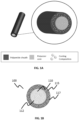
- FIG. 1A shows a side on cross-sectional view of a portion of a disclosed composite yarn with a cross-sectional view of an end thereof. An enlarged view of the cross-sectional end view is highlighted. A key is shown beneath the views indicating the gray-scale colors associated with a sheath layer, a core component, and distribution of one or more cooling compositions in each of the sheath layer and core component.
- FIG. 1A shows a side on cross-sectional view of a portion of a disclosed composite yarn with a cross-sectional view of an end thereof. An enlarged view of the cross-sectional end view is highlighted. A key is shown beneath the views indicating the gray-scale colors associated with a sheath layer, a core component, and distribution of one or more cooling compositions in each of the sheath layer and core component.
- the first cooling composition can be present in an amount of about 0.001 wt% to about 5 wt% based on the total weight of the polyester polymer and the first cooling composition. In a further aspect, the first cooling composition can be present in an amount, based on the total weight of the polyester polymer and the first cooling composition of about 0.001 wt%; about 0.002 wt%; about 0.003 wt%; about 0.004 wt%; about 0.005 wt%; about 0.006 wt%; about 0.007 wt%; about 0.008 wt%; about 0.009 wt%; about 0.010 wt%; about 0.02 wt%; about 0.03 wt%; about 0.04 wt%; about 0.05 wt%; about 0.06 wt%; about 0.07 wt%; about 0.08 wt%; about 0.09 wt%; about 0.10 wt%; about 0.11 wt%; about 0.12
- the first cooling material can be present in the first cooling composition in an amount of about 0.2 wt% to about 2 wt% of the first cooling material; about 0.02 wt% to about 0.07 wt% of the first cooling compound; about 0.001 wt% to about 0.02 wt% of the first cooling salt; or combinations thereof; and wherein the wt% is based on the total weight of the polyester polymer and the first cooling composition.
- the first cooling material can be present in the first cooling composition in an amount of about 0.2 wt% to about 2 wt% of the first cooling material; about 0.02 wt% to about 0.07 wt% of the first cooling compound; and about 0.001 wt% to about 0.02 wt% of the first cooling salt; and wherein the wt% is based on the total weight of the polyester polymer and the first cooling composition.
- the first cooling material can be present in the first cooling composition in an amount of about 0.5 wt% to about 1 wt% of the first cooling material; about 0.03 wt% to about 0.05 wt% of the first cooling compound; and about 0.001 wt% to about 0.01 wt% of the first cooling salt; and wherein the wt% is based on the total weight of the polyester polymer and the first cooling composition.
- the first cooling material can be present in the first cooling composition, based on the total weight of the polyester polymer and the first cooling composition, in an amount of about 4.0 wt% to about 8.0 wt% of the first cooling material; about 5.5 wt% to about 11.0 wt% of the first cooling compound; about 0.4 wt% to about 3.0 wt% of the first cooling salt; or combinations thereof; and wherein the wt% is based on the total weight of the polyester polymer and the first cooling composition.
- the first cooling material can be present in the first cooling composition in an amount of about 5.0 wt% to about 7.0 wt% of the first cooling material; about 6.7 wt% to about 10.0 wt% of the first cooling compound; and about 0.59 wt% to about 2.0 wt% of the first cooling salt; and wherein the wt% is based on the total weight of the polyester polymer and the first cooling composition.
- the first cooling material can be present in the first cooling composition in an amount of about 0.2 wt% to about 2 wt%; and wherein the wt% is based on the total weight of the polyester polymer and the first cooling composition.
- the first cooling material can be present in an amount of about 0.4 wt% to about 1 wt%; and wherein the wt% is based on the total weight of the polyester polymer and the first cooling composition.
- the first cooling material can be present in an amount of about 0.5 wt% to about 0.9 wt%; and wherein the wt% is based on the total weight of the polyester polymer and the first cooling composition.
- the first cooling material can be present in the first cooling composition in an amount of about 3.0 wt% to about 10.0 wt%; and wherein the wt% is based on the total weight of the polyester polymer and the first cooling composition.
- the first cooling material can be present in an amount of about 4.0 wt% to about 8.0 wt%; and wherein the wt% is based on the total weight of the polyester polymer and the first cooling composition.
- the first cooling material can be present in an amount of about 4.5 wt% to about 7.7 wt%; and wherein the wt% is based on the total weight of the polyester polymer and the first cooling composition.
- the first cooling material can be present in the first cooling composition, based on the total weight of the polyester polymer and the first cooling composition, in an amount of about 0.20 wt%; about 0.21 wt%; about 0.22 wt%; about 0.23 wt%; about 0.24 wt%; about 0.25 wt%; about 0.26 wt%; about 0.27 wt%; about 0.28 wt%; about 0.29 wt%; 0.30 wt%; about 0.31 wt%; about 0.32 wt%; about 0.33 wt%; about 0.34 wt%; about 0.35 wt%; about 0.36 wt%; about 0.37 wt%; about 0.38 wt%; about 0.39 wt%; about 0.40 wt%; about 0.41 wt%; about 0.42 wt%; about 0.43 wt%; about 0.44 wt%; about 0.45 wt%; about 0.46 wt%;
- the first cooling material comprises a metal oxide.
- metal oxides useful for preparation of the first cooling material include those comprising gold (II) oxide, gold (III) oxide, silver (I) oxide, silver (II) oxide, silver (I, III) oxide, magnesium oxide, iron (II) oxide, iron (III) oxide, copper (I) oxide, copper (II) oxide, or combinations thereof.
- the metal oxide comprises silver (I) oxide, copper (I) oxide, copper (II) oxide, or combinations thereof.
- the metal oxide comprises silver (I) oxide.
- the metal oxide can be a mixture comprising two or metal oxides.
- the first cooling material comprises a mineral.
- Exemplary, but non-limiting, minerals useful for the disclosed cooling compositions include those comprising silicon, zirconium, titanium, or combinations thereof.
- a mineral comprising zirconium can be allendeite, baddeleyite, eudialyte, loranskite, menezesite, or combinations thereof.
- a mineral comprising titanium can be rutile, ilmenite, titanite, anatase, brookite, or combinations thereof.
- the first cooling material comprises a ceramic comprising aluminum oxide, aluminum titanate, zirconium oxide, aluminum nitride, silicon carbide, silicon nitride, silicon alumina nitride, or combinations thereof.
- the first cooling material comprises a metal such as silver, aluminum, copper, or combinations thereof.
- the metal can comprise silver.
- the metal can comprise copper.
- metal can comprise a mixture of copper and silver.
- the metal can be a mixture comprising two or more metals.
- the first cooling material comprises a metal alloy comprising silver, aluminum, copper, or combinations thereof.
- the metal alloy can comprise silver.
- the metal alloy can comprise copper.
- metal alloy can comprise a mixture of copper and silver.
- the metal alloy can be a mixture comprising two or more metal alloys.
- the first cooling material comprising a metal, a metal alloy, a metal oxide, a carbon material, a ceramic material, a mineral, or combinations thereof, is in the form of a particle, including forms such as a nanoparticle, a microparticle, or combinations (or mixtures) thereof.
- the first cooling material comprises a metal, a metal alloy, a metal oxide, a carbon material, a ceramic material, a mineral, or combinations thereof, comprising nanoparticles having a size of about 10 nm to about 100 nm.
- the nanoparticles have a size of about 15 nm to about 50 nm.
- the nanoparticles have a size of about 20 nm to about 40 nm.
- the nanoparticles have a size of about 10 nm; about 11 nm; about 12 nm; about 13 nm; about 14 nm; about 15 nm; about 16 nm; about 17 nm; about 18 nm; about 19 nm; about 20 nm; about 21 nm; about 22 nm; about 23 nm; about 24 nm; about 25 nm; about 26 nm; about 27 nm; about 28 nm; about 29 nm; about 30 nm; about 31 nm; about 32 nm; about 33 nm; about 34 nm; about 35 nm; about 36 nm; about 37 nm; about 38 nm; about 39 nm; about 40 nm; about 41 nm; about 42 nm; about 43 nm; about 44 nm; about 45 nm; about 46 nm; about 47 nm; about 48 nm; about 49 nm; about 40 n
- the first cooling material is a metal, a metal alloy, a metal oxide, a carbon material, a ceramic material, a mineral, or combinations thereof, comprising microparticles.
- the microparticles in the first cooling material can have a size of about 10 ⁇ m to about 200 ⁇ m; about 20 ⁇ m to about 100 ⁇ m; about 30 ⁇ m to about 90 ⁇ m; about 40 ⁇ m to about 80 ⁇ m; about 50 ⁇ m to about 70 ⁇ m; a size or set of sizes within any of the foregoing ranges, or a sub-range within the foregoing ranges.
- the first cooling compound can be present in the first cooling polymer composition in an amount of 5.0 wt% to about 12.0 wt%; about 5.5 wt% to about 11.0 wt%; about 5.9 wt% to about 11.0 wt%; about 6.4 wt% to about 10.5 wt%; about 6.7 wt% to about 10.0 wt%; and wherein the wt% is based on the total weight of the polyester polymer and the first cooling composition.
- the first cooling compound can be present in the first cooling polymer composition, based on the total weight of the polyester polymer and the first cooling composition, in an amount of about 5.0 wt%; about 5.1 wt%; about 5.2 wt%; about 5.3 wt%; about 5.4 wt%; about 5.5 wt%; about 5.6 wt%; about 5.7 wt%; about 5.8 wt%; about 5.9 wt%; about 6.0 wt%; about 6.1 wt%; about 6.2 wt%; about 6.3 wt%; about 6.4 wt%; about 6.5 wt%; about 6.6 wt%; about 6.7 wt%; about 6.8 wt%; about 6.9 wt%; about 7.0 wt%; about 7.1 wt%; about 7.2 wt%; about 7.3 wt%; about 7.4 wt%; about 7.5 wt%; about 7.6 w
- the first cooling compound can comprise a transition metal oxide, a Group 13 oxide, a Group 14 oxide, a Group 13 carbide, Group 14 carbide, or mixtures thereof.
- the first cooling compound can comprise an aluminum oxide, silicon carbide, silicon dioxide, silicon carbide, silicon dioxide, titanium oxide, titanium dioxide, titanium trioxide, zirconium dioxide, or combinations thereof.
- the first cooling compound can comprise aluminum oxide, silicon dioxide, titanium dioxide, or combinations thereof.
- the first cooling compound can comprise titanium dioxide.
- the first cooling compound can be in the form of a powder, a particle, or combinations thereof.
- the first cooling compound can be in the form of a particle, such as a nanoparticle, a microparticle, or combinations thereof.
- the first cooling compound can be in a form that is convenient for incorporation into the first cooling polymer composition, such as a powder, a wire, a filament, a sheet, a particle, or combinations thereof. In other instances, the first cooling compound can be in the form of a particle, a powder, or combinations thereof. In some instances, the first cooling compound is in the form of a particle, including forms such as a nanoparticle, a microparticle, or combinations thereof.
- the first cooling compound comprises a particle form of the first cooling compound, and the particle size is about 10 ⁇ m; about 20 ⁇ m; about 30 ⁇ m; about 40 ⁇ m; about 50 ⁇ m; about 60 ⁇ m; about 70 ⁇ m; about 80 ⁇ m; about 90 ⁇ m; about 100 ⁇ m; about 110 ⁇ m; about 120 ⁇ m; about 130 ⁇ m; about 140 ⁇ m; about 150 ⁇ m; about 160 ⁇ m; about 170 ⁇ m; about 180 ⁇ m; about 190 ⁇ m; about 200 ⁇ m; a range utilizing any of the foregoing values; a sub-range with a range utilizing any of the foregoing values; or any set of values utilizing the foregoing values.
- the first cooling compound can comprise nanoparticles having a size of about 10 nm to about 100 nm. In a still further aspect, the first cooling compound can comprise nanoparticles having a size of about 15 nm to about 50 nm. In a yet further aspect, the first cooling compound can comprise nanoparticles having a size of about 20 nm to about 40 nm.
- the first cooling compound can comprise nanoparticles having a size of about 10 nm; about 11 nm; about 12 nm; about 13 nm; about 14 nm; about 15 nm; about 16 nm; about 17 nm; about 18 nm; about 19 nm; about 20 nm; about 21 nm; about 22 nm; about 23 nm; about 24 nm; about 25 nm; about 26 nm; about 27 nm; about 28 nm; about 29 nm; about 30 nm; about 31 nm; about 32 nm; about 33 nm; about 34 nm; about 35 nm; about 36 nm; about 37 nm; about 38 nm; about 39 nm; about 40 nm; about 41 nm; about 42 nm; about 43 nm; about 44 nm; about 45 nm; about 46 nm; about 47 nm; about 48 nm;
- the first cooling composition comprises a first cooling salt present in an amount, based on the total weight of the polyester polymer and the first cooling composition, of about 0.001 wt% to about 0.02 wt%; about 0.001 wt% to about 0.01 wt%; about 0.002 wt% to about 0.01 wt%; or a sub-range within any of the foregoing ranges.
- the first cooling composition comprises a first cooling salt present in an amount, based on the total weight of the polyester polymer and the first cooling composition, of about 0.001 wt%; about 0.002 wt%; about 0.003 wt%; about 0.004 wt%; about 0.005 wt%; about 0.006 wt%; about 0.007 wt%; about 0.008 wt%; about 0.009 wt%; about 0.010 wt%; about 0.02 wt%; a range utilizing any of the foregoing values; a sub-range with a range utilizing any of the foregoing values; or any set of values utilizing the foregoing values.
- the first cooling composition comprises a first cooling salt present in an amount, based on the total weight of the polyester polymer and the first cooling composition, of about 0.3 wt% to about 4.0 wt%; about 0.4 wt% to about 3.0 wt%; about 0.4 wt% to about 2.5 wt%; about 0.5 wt% to about 2.1 wt%; about 0.59 wt% to about 2.0 wt%; or a sub-range within any of the foregoing ranges.
- a first cooling salt present in an amount, based on the total weight of the polyester polymer and the first cooling composition, of about 0.3 wt% to about 4.0 wt%; about 0.4 wt% to about 3.0 wt%; about 0.4 wt% to about 2.5 wt%; about 0.5 wt% to about 2.1 wt%; about 0.59 wt% to about 2.0 wt%; or a sub-range within any of the foregoing ranges.
- the first cooling composition comprises a first cooling salt present in an amount, based on the total weight of the polyester polymer and the first cooling composition, of about 0.40 wt%; about 0.41 wt%; about 0.42 wt%; about 0.43 wt%; about 0.44 wt%; about 0.45 wt%; about 0.46 wt%; about 0.47 wt%; about 0.48 wt%; about 0.49 wt%; about 0.50 wt%; about 0.51 wt%; about 0.52 wt%; about 0.53 wt%; about 0.54 wt%; about 0.55 wt%; about 0.56 wt%; about 0.57 wt%; about 0.58 wt%; about 0.59 wt%; about 0.60 wt%; about 0.61 wt%; about 0.62 wt%; about 0.63 wt%; about 0.64 wt%; about 0.65 wt%; about 0.66 wt%;
- the first cooling salt can be in a form that is convenient for incorporation into the first cooling polymer composition, such as a powder, a wire, a filament, a sheet, a particle, or combinations thereof.
- the first cooling salt can be in the form of a particle, a powder, or combinations thereof.
- the first cooling salt is in the form of a particle, including forms such as a nanoparticle, a microparticle, or combinations thereof.
- the first cooling salt in the first cooling composition can be in the form of a powder, a particle, or combinations thereof.
- the first cooling salt in the first cooling composition comprises particles having a size of about 10 ⁇ m to about 1000 ⁇ m.
- the salt in the first cooling composition comprises particles having a size of about 30 ⁇ m to about 500 ⁇ m.
- the second cooling composition can be present in an amount of about 0.001 wt% to about 5 wt% based on the total weight of the polyamide polymer and the second cooling composition. In a further aspect, the second cooling composition can be present in an amount, based on the total weight of the polyamide polymer and the second cooling composition of about 0.001 wt%; about 0.002 wt%; about 0.003 wt%; about 0.004 wt%; about 0.005 wt%; about 0.006 wt%; about 0.007 wt%; about 0.008 wt%; about 0.009 wt%; about 0.010 wt%; about 0.02 wt%; about 0.03 wt%; about 0.04 wt%; about 0.05 wt%; about 0.06 wt%; about 0.07 wt%; about 0.08 wt%; about 0.09 wt%; about 0.10 wt%; about 0.11 wt%; about 0.
- the second cooling material can be present in the second cooling composition in an amount of about 3.0 wt% to about 10.0 wt% of the second cooling material; about 5.0 wt% to about 12.0 wt% of the second cooling compound; about 0.3 wt% to about 4.0 wt% of the second cooling salt; or combinations thereof; and wherein the wt% is based on the total weight of the polyamide polymer and the second cooling composition.
- the second cooling material can be present in the second cooling composition, based on the total weight of the polyamide polymer and the second cooling composition, in an amount of about 4.0 wt% to about 8.0 wt% of the second cooling material; about 5.5 wt% to about 11.0 wt% of the second cooling compound; about 0.4 wt% to about 3.0 wt% of the second cooling salt; or combinations thereof; and wherein the wt% is based on the total weight of the polyamide polymer and the second cooling composition.
- the second cooling material can be present in the second cooling composition in an amount of about 0.2 wt% to about 2 wt%; and wherein the wt% is based on the total weight of the polyamide polymer and the second cooling composition.
- the second cooling material can be present in an amount of about 0.4 wt% to about 1 wt%; and wherein the wt% is based on the total weight of the polyamide polymer and the second cooling composition.
- the second cooling material can be present in an amount of about 0.5 wt% to about 0.9 wt%; and wherein the wt% is based on the total weight of the polyamide polymer and the second cooling composition.
- the second cooling material can be present in the second cooling composition in an amount of about 3.0 wt% to about 10.0 wt%; and wherein the wt% is based on the total weight of the polyamide polymer and the second cooling composition.
- the second cooling material can be present in an amount of about 4.0 wt% to about 8.0 wt%; and wherein the wt% is based on the total weight of the polyamide polymer and the second cooling composition.
- the second cooling material can be present in an amount of about 4.5 wt% to about 7.7 wt%; and wherein the wt% is based on the total weight of the polyamide polymer and the second cooling composition.
- the second cooling material can be present in an amount of about 5.0 wt% to about 7.2 wt%; and wherein the wt% is based on the total weight of the polyamide polymer and the second cooling composition. In an even further aspect, the second cooling material can be present in an amount of about 5.0 wt% to about 7.0 wt%; and wherein the wt% is based on the total weight of the polyamide polymer and the second cooling composition.
- the second cooling material can be present in the second cooling composition, based on the total weight of the polyamide polymer and the second cooling composition, in an amount of about 0.20 wt%; about 0.21 wt%; about 0.22 wt%; about 0.23 wt%; about 0.24 wt%; about 0.25 wt%; about 0.26 wt%; about 0.27 wt%; about 0.28 wt%; about 0.29 wt%; 0.30 wt%; about 0.31 wt%; about 0.32 wt%; about 0.33 wt%; about 0.34 wt%; about 0.35 wt%; about 0.36 wt%; about 0.37 wt%; about 0.38 wt%; about 0.39 wt%; about 0.40 wt%; about 0.41 wt%; about 0.42 wt%; about 0.43 wt%; about 0.44 wt%; about 0.45 wt%; about 0.46 wt%
- the second cooling material can be present in the second cooling composition, based on the total weight of the polyamide polymer and the second cooling composition, in an amount of about 4.0 wt%, about 4.1 wt%; about 4.2 wt%; about 4.3 wt%; about 4.4 wt%; about 4.5 wt%; about 4.6 wt%; about 4.7 wt%; about 4.8 wt%; about 4.9 wt%; about 5.0 wt%, about 5.1 wt%; about 5.2 wt%; about 5.3 wt%; about 5.4 wt%; about 5.5 wt%; about 5.6 wt%; about 5.7 wt%; about 5.8 wt%; about 5.9 wt%; about 6.0 wt%, about 6.1 wt%; about 6.2 wt%; about 6.3 wt%; about 6.4 wt%; about 6.5 wt%; about 6.6 wt%; about 6.0
- the second cooling material comprises a metal, a metal alloy, a metal oxide, a carbon material, a ceramic material, a mineral, or combinations thereof.
- the second cooling material comprises a metal oxide.
- metal oxides useful for preparation of the second cooling material include those comprising gold (II) oxide, gold (III) oxide, silver (I) oxide, silver (II) oxide, silver (I, III) oxide, magnesium oxide, iron (II) oxide, iron (III) oxide, copper (I) oxide, copper (II) oxide, or combinations thereof.
- the metal oxide comprises silver (I) oxide, copper (I) oxide, copper (II) oxide, or combinations thereof.
- the metal oxide comprises silver (I) oxide.
- the metal oxide can be a mixture comprising two or metal oxides.
- the second cooling material comprises a mineral.
- Exemplary, but non-limiting, minerals useful for the disclosed cooling compositions include those comprising silicon, zirconium, titanium, or combinations thereof.
- a mineral comprising zirconium can be allendeite, baddeleyite, eudialyte, loranskite, menezesite, or combinations thereof.
- a mineral comprising titanium can be rutile, ilmenite, titanite, anatase, brookite, or combinations thereof.
- a mineral comprising silicon is quartz, granite, chalcedony, chrysoprase, garnet, phenacite, olivine, mica, kaolinite, feldspar, zeolite, carnelian, agate, onyx, jasper, heliotrope, flint, or combinations thereof.
- a mineral can comprise both zirconium and titanium, including minerals such as calzirtite, kobeite, lakargiite, lindsleyite, loveringite, mathiasite, tazheranite, zircon, zirconolite, zirkelite, or combinations thereof.
- the second cooling material comprises a metal such as silver, aluminum, copper, or combinations thereof.
- the metal can comprise silver.
- the metal can comprise copper.
- metal can comprise a mixture of copper and silver.
- the metal can be a mixture comprising two or more metals.
- the second cooling material comprises a metal alloy comprising silver, aluminum, copper, or combinations thereof.
- the metal alloy can comprise silver.
- the metal alloy can comprise copper.
- metal alloy can comprise a mixture of copper and silver.
- the metal alloy can be a mixture comprising two or more metal alloys.
- the second cooling material comprising a metal, a metal alloy, a metal oxide, a carbon material, a ceramic material, a mineral, or combinations thereof
- the second cooling material can be in a form that is convenient for incorporation into the second cooling polymer composition, such as a powder, a wire, a filament, a sheet, a particle, or combinations thereof.
- the second cooling material comprising a metal, a metal alloy, a metal oxide, a carbon material, a ceramic material, a mineral, or combinations thereof, can be in the form of a particle, a powder, or combinations thereof.
- the second cooling material comprising a metal, a metal alloy, a metal oxide, a carbon material, a ceramic material, a mineral, or combinations thereof, is in the form of a particle, including forms such as a nanoparticle, a microparticle, or combinations (or mixtures) thereof.
- the second cooling material comprises a metal, a metal alloy, a metal oxide, a carbon material, a ceramic material, a mineral, or combinations thereof, comprising nanoparticles having a size of about 10 nm to about 100 nm.
- the nanoparticles have a size of about 15 nm to about 50 nm.
- the nanoparticles have a size of about 20 nm to about 40 nm.
- the nanoparticles have a size of about 10 nm; about 11 nm; about 12 nm; about 13 nm; about 14 nm; about 15 nm; about 16 nm; about 17 nm; about 18 nm; about 19 nm; about 20 nm; about 21 nm; about 22 nm; about 23 nm; about 24 nm; about 25 nm; about 26 nm; about 27 nm; about 28 nm; about 29 nm; about 30 nm; about 31 nm; about 32 nm; about 33 nm; about 34 nm; about 35 nm; about 36 nm; about 37 nm; about 38 nm; about 39 nm; about 40 nm; about 41 nm; about 42 nm; about 43 nm; about 44 nm; about 45 nm; about 46 nm; about 47 nm; about 48 nm; about 49 nm; about 40 n
- the second cooling compound can be present in the second cooling polymer composition in an amount of about 0.02 wt% to about 0.07 wt%; about 0.03 wt% to about 0.07 wt%; about 0.03 wt% to about 0.06 wt%; about 0.03 wt% to about 0.05 wt%; and wherein the wt% is based on the total weight of the polyamide polymer and the second cooling composition; and wherein the wt% is based on the total weight of the polyamide polymer and the second cooling composition.
- the second cooling compound can be present in the second cooling polymer composition, based on the total weight of the polyamide polymer and the second cooling composition, in an amount of about 0.020 wt%; 0.025 wt%; about 0.030 wt%; about 0.035 wt%; about 0.040 wt%; about 0.045 wt%; about 0.050 wt%; about 0.055 wt%; about 0.060 wt%; about 0.065 wt%; about 0.070 wt%; a range utilizing any of the foregoing values; a sub-range with a range utilizing any of the foregoing values; or any set of values utilizing the foregoing values.
- the second cooling compound can comprise a transition metal oxide, a Group 13 oxide, a Group 14 oxide, a Group 13 carbide, Group 14 carbide, or mixtures thereof.
- the second cooling compound can comprise an aluminum oxide, silicon carbide, silicon dioxide, silicon carbide, silicon dioxide, titanium oxide, titanium dioxide, titanium trioxide, zirconium dioxide, or combinations thereof.
- the second cooling compound can comprise aluminum oxide, silicon dioxide, titanium dioxide, or combinations thereof.
- the second cooling compound can comprise titanium dioxide.
- the second cooling compound can be in the form of a powder, a particle, or combinations thereof.
- the second cooling compound can be in the form of a particle, such as a nanoparticle, a microparticle, or combinations thereof.
- the second cooling compound can be in a form that is convenient for incorporation into the second cooling polymer composition, such as a powder, a wire, a filament, a sheet, a particle, or combinations thereof. In other instances, the second cooling compound can be in the form of a particle, a powder, or combinations thereof. In some instances, the second cooling compound is in the form of a particle, including forms such as a nanoparticle, a microparticle, or combinations thereof.
- the second cooling compound comprises a particle form of the second cooling compound, and the particle size is about 10 ⁇ m to about 200 ⁇ m; about 20 ⁇ m to about 100 ⁇ m; about 30 ⁇ m to about 90 ⁇ m; about 40 ⁇ m to about 80 ⁇ m; or about 50 ⁇ m to about 70 ⁇ m; or a sub-range within any of the foregoing ranges.
- the second cooling compound can comprise nanoparticles having a size of about 10 nm to about 100 nm. In a still further aspect, the second cooling compound can comprise nanoparticles having a size of about 15 nm to about 50 nm. In a yet further aspect, the second cooling compound can comprise nanoparticles having a size of about 20 nm to about 40 nm.
- the second cooling compound can comprise nanoparticles having a size of about 10 nm; about 11 nm; about 12 nm; about 13 nm; about 14 nm; about 15 nm; about 16 nm; about 17 nm; about 18 nm; about 19 nm; about 20 nm; about 21 nm; about 22 nm; about 23 nm; about 24 nm; about 25 nm; about 26 nm; about 27 nm; about 28 nm; about 29 nm; about 30 nm; about 31 nm; about 32 nm; about 33 nm; about 34 nm; about 35 nm; about 36 nm; about 37 nm; about 38 nm; about 39 nm; about 40 nm; about 41 nm; about 42 nm; about 43 nm; about 44 nm; about 45 nm; about 46 nm; about 47 nm; about 48 nm;
- the second cooling composition comprises a second cooling salt present in an amount, based on the total weight of the polyamide polymer and the second cooling composition, of about 0.001 wt%; about 0.002 wt%; about 0.003 wt%; about 0.004 wt%; about 0.005 wt%; about 0.006 wt%; about 0.007 wt%; about 0.008 wt%; about 0.009 wt%; about 0.010 wt%; about 0.02 wt%; a range utilizing any of the foregoing values; a sub-range with a range utilizing any of the foregoing values; or any set of values utilizing the foregoing values.
- the second cooling composition comprises a second cooling salt present in an amount, based on the total weight of the polyamide polymer and the second cooling composition, of about 0.40 wt%; about 0.41 wt%; about 0.42 wt%; about 0.43 wt%; about 0.44 wt%; about 0.45 wt%; about 0.46 wt%; about 0.47 wt%; about 0.48 wt%; about 0.49 wt%; about 0.50 wt%; about 0.51 wt%; about 0.52 wt%; about 0.53 wt%; about 0.54 wt%; about 0.55 wt%; about 0.56 wt%; about 0.57 wt%; about 0.58 wt%; about 0.59 wt%; about 0.60 wt%; about 0.61 wt%; about 0.62 wt%; about 0.63 wt%; about 0.64 wt%; about 0.65 wt%; about 0.66 wt%
- the second cooling composition comprises a second cooling salt comprising a transition metal salt, a Group I salt, a Group II salt, or combinations thereof.
- the second cooling salt is a Group I salt.
- the second cooling salt is a Group II salt.
- the second cooling salt is a transition metal salt.
- the second cooling salt can comprise a Group I carbonate, a Group I halide, a Group I nitrate, or combinations thereof.
- the second cooling salt can comprise a Group II carbonate, a Group II halide, a Group II nitrate, or combinations thereof.
- the second cooling salt can comprise a transition metal carbonate, a transition metal halide, a transition metal nitrate, or combinations thereof.
- the salt comprises a transition metal carbonate, Group I carbonate, a Group II carbonate, or combinations thereof.
- the salt comprises calcium carbonate.
- the second cooling salt can be in a form that is convenient for incorporation into the second cooling polymer composition, such as a powder, a wire, a filament, a sheet, a particle, or combinations thereof.
- the second cooling salt can be in the form of a particle, a powder, or combinations thereof.
- the second cooling salt is in the form of a particle, including forms such as a nanoparticle, a microparticle, or combinations thereof.
- the second cooling salt in the second cooling composition can be in the form of a powder, a particle, or combinations thereof.
- the second cooling salt in the second cooling composition comprises particles having a size of about 10 ⁇ m to about 1000 ⁇ m.
- the salt in the second cooling composition comprises particles having a size of about 30 ⁇ m to about 500 ⁇ m.
- the second cooling salt in the second cooling composition comprises particles having a size of about 10 ⁇ m; about 20 ⁇ m; about 30 ⁇ m; about 40 ⁇ m; about 50 ⁇ m; about 60 ⁇ m; about 70 ⁇ m; about 80 ⁇ m; about 90 ⁇ m; about 100 ⁇ m; 110 ⁇ m; about 120 ⁇ m; about 130 ⁇ m; about 140 ⁇ m; about 150 ⁇ m; about 160 ⁇ m; about 170 ⁇ m; about 180 ⁇ m; about 190 ⁇ m; about 200 ⁇ m; 210 ⁇ m; about 220 ⁇ m; about 230 ⁇ m; about 240 ⁇ m; about 250 ⁇ m; about 260 ⁇ m; about 270 ⁇ m; about 280 ⁇ m; about 290 ⁇ m; about 300 ⁇ m; 310 ⁇ m; about 320 ⁇ m; about 330 ⁇ m; about 340 ⁇ m; about 350 ⁇ m; about 360 ⁇ m; about 370 ⁇ m; about
- the second cooling salt can comprise nanoparticles having a size of about 10 nm; about 11 nm; about 12 nm; about 13 nm; about 14 nm; about 15 nm; about 16 nm; about 17 nm; about 18 nm; about 19 nm; about 20 nm; about 21 nm; about 22 nm; about 23 nm; about 24 nm; about 25 nm; about 26 nm; about 27 nm; about 28 nm; about 29 nm; about 30 nm; about 31 nm; about 32 nm; about 33 nm; about 34 nm; about 35 nm; about 36 nm; about 37 nm; about 38 nm; about 39 nm; about 40 nm; about 41 nm; about 42 nm; about 43 nm; about 44 nm; about 45 nm; about 46 nm; about 47 nm; about 48 nm;
- the first cooling composition can be present in an amount of about 0. 1 wt% to about 2 wt% based on the total weight of the composite yarn. In a further aspect, the first cooling composition can be present in an amount, based on the total weight of the composite yarn of about 0.10 wt%; about 0.11 wt%; about 0.12 wt%; about 0.13 wt%; about 0.14 wt%; about 0.15 wt%; about 0.16 wt%; about 0.17 wt%; about 0.18 wt%; about 0.19 wt%; about 0.20 wt%; about 0.21 wt%; about 0.22 wt%; about 0.23 wt%; about 0.24 wt%; about 0.25 wt%; about 0.26 wt%; about 0.27 wt%; about 0.28 wt%; about 0.29 wt%; 0.30 wt%; about 0.31 wt%; about 0.32 wt%; about 0.33 wt%
- the first cooling material can be present in the first cooling composition in an amount of about 0.1 wt% to about 1 wt% of the first cooling material; about 0.005 wt% to about 0.07 wt% of the first cooling compound; about 0.0005 wt% to about 0.02 wt% of the first cooling salt; or combinations thereof; and wherein the wt% is based on the total weight of the composite yarn.
- the first cooling material can be present in the first cooling composition, based on the total weight of the composite yarn, in an amount of about 0.2 wt% to about 0.9 wt% of the first cooling material; about 0.01 wt% to about 0.06 wt% of the first cooling compound; about 0.0005 wt% to about 0.01 wt% of the first cooling salt; or combinations thereof; and wherein the wt% is based on the total weight of the composite yarn.
- the first cooling material can be present in the first cooling composition in an amount of about 0.2 wt% to about 0.8 wt% of the first cooling material; about 0.01 wt% to about 0.05 wt% of the first cooling compound; and about 0.0005 wt% to about 0.015 wt% of the first cooling salt; and wherein the wt% is based on the total weight of the composite yarn.
- the first cooling material can be present in the first cooling composition in an amount of about 0.25 wt% to about 0.65 wt% of the first cooling material; about 0.015 wt% to about 0.40 wt% of the first cooling compound; and about 0.0005 wt% to about 0.01 wt% of the first cooling salt; and wherein the wt% is based on the total weight of the composite yarn.
- the first cooling material can be present in the first cooling composition in an amount of about 0.5 wt% to about 7.0 wt% of the first cooling material; about 1.0 wt% to about 10.0 wt% of the first cooling compound; about 0.05 wt% to about 3.0 wt% of the first cooling salt; or combinations thereof; and wherein the wt% is based on the total weight of the composite yarn.
- the first cooling material can be present in the first cooling composition, based on the total weight of the composite yarn, in an amount of about 1.0 wt% to about 6.0 wt% of the first cooling material; about 1.5 wt% to about 7.0 wt% of the first cooling compound; about 0.1 wt% to about 2.0 wt% of the first cooling salt; or combinations thereof; and wherein the wt% is based on the total weight of the composite yarn.
- the first cooling material can be present in the first cooling composition in an amount of about 1.0 wt% to about 5.0 wt% of the first cooling material; about 1.5 wt% to about 6.0 wt% of the first cooling compound; and about 0.1 wt% to about 1.5 wt% of the first cooling salt; and wherein the wt% is based on the total weight of the composite yarn.
- the first cooling material can be present in the first cooling composition in an amount of about 1.0 wt% to about 4.0 wt% of the first cooling material; about 2.0 wt% to about 5.0 wt% of the first cooling compound; and about 0.1 wt% to about 1.0 wt% of the first cooling salt; and wherein the wt% is based on the total weight of the composite yarn.
- the first cooling material can be present in the first cooling composition, based on the total weight of the composite yarn, in an amount of about 0.10 wt%; about 0.11 wt%; about 0.12 wt%; about 0.13 wt%; about 0.14 wt%; about 0.15 wt%; about 0.16 wt%; about 0.17 wt%; about 0.18 wt%; about 0.19 wt%; about 0.20 wt%; about 0.21 wt%; about 0.22 wt%; about 0.23 wt%; about 0.24 wt%; about 0.25 wt%; about 0.26 wt%; about 0.27 wt%; about 0.28 wt%; about 0.29 wt%; 0.30 wt%; about 0.31 wt%; about 0.32 wt%; about 0.33 wt%; about 0.34 wt%; about 0.35 wt%; about 0.36 wt%; about 0.37 wt
- the first cooling material can be present in the first cooling composition in an amount of about 0.5 wt% to about 7.0 wt%; and wherein the wt% is based on the total weight of the composite yarn. In a still further aspect, the first cooling material can be present in an amount of about 1.0 wt% to about 6.0 wt%; and wherein the wt% is based on the total weight of the composite yarn. In a yet further aspect, the first cooling material can be present in an amount of about 1.0 wt% to about 5.0 wt%; and wherein the wt% is based on the total weight of the composite yarn.
- the first cooling material can be present in the first cooling composition, based on the total weight of the composite yarn, in an amount of about 1.0 wt%, about 1.1 wt%; about 1.2 wt%; about 1.3 wt%; about 1.4 wt%; about 1.5 wt%; about 1.6 wt%; about 4.7 wt%; about 4.8 wt%; about 4.9 wt%; about 2.0 wt%, about 2.1 wt%; about 2.2 wt%; about 2.3 wt%; about 2.4 wt%; about 2.5 wt%; about 2.6 wt%; about 2.7 wt%; about 2.8 wt%; about 2.9 wt%; about 3.0 wt%, about 3.1 wt%; about 3.2 wt%; about 3.3 wt%; about 3.4 wt%; about 3.5 wt%; about 3.6 wt%; about 3.7 wt%;
- the first cooling compound can be present in the first cooling composition in an amount of about 0.005 wt% to about 0.07 wt%; about 0.01 wt% to about 0.06 wt%; about 0.01 wt% to about 0.05 wt%; about 0.015 wt% to about 0.40 wt%; and wherein the wt% is based on the total weight of the composite yarn; and wherein the wt% is based on the total weight of the composite yarn.
- the first cooling compound can be present in the first cooling composition, based on the total weight of the composite yarn, in an amount of about 0.0050 wt%; about 0.0051 wt%; about 0.0052 wt%; about 0.0053 wt%; about 0.0054 wt%; about 0.0055 wt%; about 0.0056 wt%; about 0.0057 wt%; about 0.0058 wt%; about 0.0059 wt%; about 0.0060 wt%; about 0.0061 wt%; about 0.0062 wt%; about 0.0063 wt%; about 0.0064 wt%; about 0.0065 wt%; about 0.0066 wt%; about 0.0067 wt%; about 0.0068 wt%; about 0.0069 wt%; about 0.0070 wt%; about 0.0071 wt%; about 0.0072 wt%; about 0.0073 wt%; about 0.0074
- the first cooling compound can be present in the first cooling composition in an amount of about 1.0 wt% to about 10.0 wt%; about 1.5 wt% to about 7.0 wt%; about 1.5 wt% to about 6.0 wt%; about 2.0 wt% to about 5.0 wt%; about 2.0 wt% to about 4.0 wt%; and wherein the wt% is based on the total weight of the composite yarn.
- the first cooling compound can be present in the first cooling composition, based on the total weight of the composite yarn, in an amount of about 1.0 wt%; about 1.1 wt%; about 1.2 wt%; about 1.3 wt%; about 1.4 wt%; about 1.5 wt%; about 1.6 wt%; about 1.7 wt%; about 1.8 wt%; about 1.9 wt%; about 2.0 wt%; about 2.1 wt%; about 2.2 wt%; about 2.3 wt%; about 2.4 wt%; about 2.5 wt%; about 2.6 wt%; about 2.7 wt%; about 2.8 wt%; about 2.9 wt%; about 3.0 wt%; about 3.1 wt%; about 3.2 wt%; about 3.3 wt%; about 3.4 wt%; about 3.5 wt%; about 3.6 wt%; about 3.7 wt%;
- the first cooling salt can be present in the first cooling composition, based on the total weight of the composite yarn, in an amount of about 0.0005 wt%; about 0.001 wt%; about 0.002 wt%; about 0.003 wt%; about 0.004 wt%; about 0.005 wt%; about 0.006 wt%; about 0.007 wt%; about 0.008 wt%; about 0.009 wt%; about 0.010 wt%; about 0.011 wt%; about 0.012 wt%; about 0.013 wt%; about 0.014 wt%; about 0.015 wt%; about 0.016 wt%; about 0.017 wt%; about 0.018 wt%; about 0.019 wt%; about 0.02 wt%; a range utilizing any of the foregoing values; a sub-range with a range utilizing any of the foregoing values; or
- the first cooling salt can be present in the first cooling composition, based on the total weight of the composite yarn, in an amount of about 0.0005 wt%; about 0.0006 wt%; about 0.0007 wt%; about 0.0008 wt%; about 0.0009 wt%; about 0.0010 wt%; about 0.0011 wt%; about 0.0012 wt%; about 0.0013 wt%; about 0.0014 wt%; about 0.0015 wt%; about 0.0016 wt%; about 0.0017 wt%; about 0.0018 wt%; about 0.0019 wt%; about 0.0020 wt%; about 0.0021 wt%; about 0.0022 wt%; about 0.0023 wt%; about 0.0024 wt%; about 0.0025 wt%; about 0.0026 wt%; about 0.0027 wt%; about 0.0028 wt%; about 0.0029
- the first cooling salt can be present in the first cooling composition, based on the total weight of the composite yarn, in an amount of about 0.05 wt% to about 3.0 wt%; about 0.1 wt% to about 2.0 wt%; about 0.1 wt% to about 1.5 wt%; about 0.1 wt% to about 1.0 wt%; about 0.15 wt% to about 1.0 wt%; or a sub-range within any of the foregoing ranges.
- the first cooling salt can be present in the first cooling composition, based on the total weight of the composite yarn, in an amount of about 0.05 wt%; about 0.06 wt%; about 0.07 wt%; about 0.08 wt%; about 0.09 wt%; about 0.10 wt%; about 0.11 wt%; about 0.12 wt%; about 0.13 wt%; about 0.14 wt%; about 0.15 wt%; about 0.16 wt%; about 0.17 wt%; about 0.18 wt%; about 0.19 wt%; about 0.20 wt%; about 0.21 wt%; about 0.22 wt%; about 0.23 wt%; about 0.24 wt%; about 0.25 wt%; about 0.26 wt%; about 0.27 wt%; about 0.28 wt%; about 0.29 wt%; about 0.30 wt%; about 0.31 wt%; about 0.32 w
- the second cooling composition can be present in an amount of about 0. 1 wt% to about 2 wt% based on the total weight of the composite yarn. In a further aspect, the second cooling composition can be present in an amount, based on the total weight of the composite yarn of about 0.10 wt%; about 0.11 wt%; about 0.12 wt%; about 0.13 wt%; about 0.14 wt%; about 0.15 wt%; about 0.16 wt%; about 0.17 wt%; about 0.18 wt%; about 0.19 wt%; about 0.20 wt%; about 0.21 wt%; about 0.22 wt%; about 0.23 wt%; about 0.24 wt%; about 0.25 wt%; about 0.26 wt%; about 0.27 wt%; about 0.28 wt%; about 0.29 wt%; 0.30 wt%; about 0.31 wt%; about 0.32 wt%; about 0.33 wt%
- the second cooling composition can be present in an amount of about 2.0 wt% to about 10 wt% based on the total weight of the composite yarn. In a further aspect, the second cooling composition can be present in an amount, based on the total weight of the composite yarn of about 2.0 wt%; about 2.1 wt%; about 2.2 wt%; about 2.3 wt%; about 2.4 wt%; about 2.5 wt%; about 2.6 wt%; about 2.7 wt%; about 2.8 wt%; about 2.9 wt%; about 3.0 wt%; about 3.1 wt%; about 3.2 wt%; about 3.3 wt%; about 3.4 wt%; about 3.5 wt%; about 3.6 wt%; about 3.7 wt%; about 3.8 wt%; about 3.9 wt%; about 4.0 wt%; about 4.1 wt%; about 4.2 wt%; about 4.3 wt%; about
- the second cooling material can be present in the second cooling composition in an amount of about 0.1 wt% to about 1 wt% of the second cooling material; about 0.005 wt% to about 0.07 wt% of the second cooling compound; about 0.0005 wt% to about 0.02 wt% of the second cooling salt; or combinations thereof; and wherein the wt% is based on the total weight of the composite yarn.
- the second cooling material can be present in the second cooling composition in an amount of about 0.5 wt% to about 7.0 wt%; and wherein the wt% is based on the total weight of the composite yarn. In a still further aspect, the second cooling material can be present in an amount of about 1.0 wt% to about 6.0 wt%; and wherein the wt% is based on the total weight of the composite yarn. In a yet further aspect, the second cooling material can be present in an amount of about 1.0 wt% to about 5.0 wt%; and wherein the wt% is based on the total weight of the composite yarn.
- the second cooling material can be present in an amount of about 1.0 wt% to about 4.0 wt%; and wherein the wt% is based on the total weight of the composite yarn. In an even further aspect, the second cooling material can be present in an amount of about 1.5 wt% to about 3.0 wt%; and wherein the wt% is based on the total weight of the composite yarn.
- the second cooling material can be present in the second cooling composition, based on the total weight of the composite yarn, in an amount of about 1.0 wt%, about 1.1 wt%; about 1.2 wt%; about 1.3 wt%; about 1.4 wt%; about 1.5 wt%; about 1.6 wt%; about 4.7 wt%; about 4.8 wt%; about 4.9 wt%; about 2.0 wt%, about 2.1 wt%; about 2.2 wt%; about 2.3 wt%; about 2.4 wt%; about 2.5 wt%; about 2.6 wt%; about 2.7 wt%; about 2.8 wt%; about 2.9 wt%; about 3.0 wt%, about 3.1 wt%; about 3.2 wt%; about 3.3 wt%; about 3.4 wt%; about 3.5 wt%; about 3.6 wt%; about 3.7 wt%;
- the second cooling compound can be present in the second cooling composition in an amount of about 0.005 wt% to about 0.07 wt%; about 0.01 wt% to about 0.06 wt%; about 0.01 wt% to about 0.05 wt%; about 0.015 wt% to about 0.40 wt%; and wherein the wt% is based on the total weight of the composite yarn; and wherein the wt% is based on the total weight of the composite yarn.
- the second cooling compound can be present in the second cooling composition, based on the total weight of the composite yarn, in an amount of about 0.0050 wt%; about 0.0051 wt%; about 0.0052 wt%; about 0.0053 wt%; about 0.0054 wt%; about 0.0055 wt%; about 0.0056 wt%; about 0.0057 wt%; about 0.0058 wt%; about 0.0059 wt%; about 0.0060 wt%; about 0.0061 wt%; about 0.0062 wt%; about 0.0063 wt%; about 0.0064 wt%; about 0.0065 wt%; about 0.0066 wt%; about 0.0067 wt%; about 0.0068 wt%; about 0.0069 wt%; about 0.0070 wt%; about 0.0071 wt%; about 0.0072 wt%; about 0.0073 wt%; about 0.0074
- the second cooling compound can be present in the second cooling composition, based on the total weight of the composite yarn, in an amount of about 1.0 wt%; about 1.1 wt%; about 1.2 wt%; about 1.3 wt%; about 1.4 wt%; about 1.5 wt%; about 1.6 wt%; about 1.7 wt%; about 1.8 wt%; about 1.9 wt%; about 2.0 wt%; about 2.1 wt%; about 2.2 wt%; about 2.3 wt%; about 2.4 wt%; about 2.5 wt%; about 2.6 wt%; about 2.7 wt%; about 2.8 wt%; about 2.9 wt%; about 3.0 wt%; about 3.1 wt%; about 3.2 wt%; about 3.3 wt%; about 3.4 wt%; about 3.5 wt%; about 3.6 wt%; about 3.7 wt%;
- the second cooling salt can be present in the second cooling composition, based on the total weight of the composite yarn, in an amount of about 0.0005 wt%; about 0.001 wt%; about 0.002 wt%; about 0.003 wt%; about 0.004 wt%; about 0.005 wt%; about 0.006 wt%; about 0.007 wt%; about 0.008 wt%; about 0.009 wt%; about 0.010 wt%; about 0.011 wt%; about 0.012 wt%; about 0.013 wt%; about 0.014 wt%; about 0.015 wt%; about 0.016 wt%; about 0.017 wt%; about 0.018 wt%; about 0.019 wt%; about 0.02 wt%; a range utilizing any of the foregoing values; a sub-range with a range utilizing any of the foregoing values; or
- the second cooling salt can be present in the second cooling composition, based on the total weight of the composite yarn, in an amount of about 0.0005 wt%; about 0.0006 wt%; about 0.0007 wt%; about 0.0008 wt%; about 0.0009 wt%; about 0.0010 wt%; about 0.0011 wt%; about 0.0012 wt%; about 0.0013 wt%; about 0.0014 wt%; about 0.0015 wt%; about 0.0016 wt%; about 0.0017 wt%; about 0.0018 wt%; about 0.0019 wt%; about 0.0020 wt%; about 0.0021 wt%; about 0.0022 wt%; about 0.0023 wt%; about 0.0024 wt%; about 0.0025 wt%; about 0.0026 wt%; about 0.0027 wt%; about 0.0028 wt%; about 0.0029
- the second cooling salt can be present in the second cooling composition, based on the total weight of the composite yarn, in an amount of about 0.05 wt% to about 3.0 wt%; about 0.1 wt% to about 2.0 wt%; about 0.1 wt% to about 1.5 wt%; about 0.1 wt% to about 1.0 wt%; about 0.15 wt% to about 1.0 wt%; or a sub-range within any of the foregoing ranges.
- the second cooling salt can be present in the second cooling composition, based on the total weight of the composite yarn, in an amount of about 0.05 wt%; about 0.06 wt%; about 0.07 wt%; about 0.08 wt%; about 0.09 wt%; about 0.10 wt%; about 0.11 wt%; about 0.12 wt%; about 0.13 wt%; about 0.14 wt%; about 0.15 wt%; about 0.16 wt%; about 0.17 wt%; about 0.18 wt%; about 0.19 wt%; about 0.20 wt%; about 0.21 wt%; about 0.22 wt%; about 0.23 wt%; about 0.24 wt%; about 0.25 wt%; about 0.26 wt%; about 0.27 wt%; about 0.28 wt%; about 0.29 wt%; about 0.30 wt%; about 0.31 wt%; about 0.32 w
- the disclosure relates to double covered yarns that can be utilized in a woven or knit fabric. More specifically, in one aspect, the present disclosure relates to double covered yarn comprising: (a) an elastic core comprising an elastic yarn; (b) a first yarn comprising a disclosed composite yarn; and (c) a second yarn comprising a cellulosic fiber; wherein the first yarn is wound around the elastic core to form a single covered yarn; and wherein the second yarn is wound around the single covered yarn to form a double covered yarn.
- a disclosed double-covered yarn comprises about 1 wt% to about 15 wt% of an elastic yarn; about 35 wt% to about 55 wt% of first yarn comprising a disclosed composite yarn; and about 35 wt% to about 60 wt% of a second yarn comprising a cellulosic fiber; and wherein the weight percent is based upon the total weight of the double-covered yarn, and provided that the total weight percent of the elastic yarn, the first yarn, and the second yarn is from about 90 wt% to about 100 wt%.
- a disclosed double-covered yarn comprises about 3 wt% to about 12 wt% of an elastic yarn; about 38 wt% to about 52 wt% of first yarn comprising a disclosed composite yarn; and about 40 wt% to about 50 wt% of a second yarn comprising a cellulosic fiber; and wherein the weight percent is based upon the total weight of the double-covered yarn, and provided that the total weight percent of the elastic yarn, the first yarn, and the second yarn is from about 90 wt% to about 100 wt%.
- a disclosed double-covered yarn comprises about 5 wt% to about 10 wt% of an elastic yarn; about 40 wt% to about 50 wt% of first yarn comprising a disclosed composite yarn; and about 42 wt% to about 48 wt% of a second yarn comprising a cellulosic fiber; and wherein the weight percent is based upon the total weight of the double-covered yarn, and provided that the total weight percent of the elastic yarn, the first yarn, and the second yarn is from about 90 wt% to about 100 wt%.
- a double-covered yarn comprises an elastic yarn in a weight percent amount based on the total weight of the double-covered yarn of about 1.0 wt%; about 1.1 wt%; about 1.2 wt%; about 1.3 wt%; about 1.4 wt%; about 1.5 wt%; about 1.6 wt%; about 1.7 wt%; about 1.8 wt%; about 1.9 wt%; about 2.0 wt%; about 2.1 wt%; about 2.2 wt%; about 2.3 wt%; about 2.4 wt%; about 2.5 wt%; about 2.6 wt%; about 2.7 wt%; about 2.8 wt%; about 2.9 wt%; about 3.0 wt%; about 3.1 wt%; about 3.2 wt%; about 3.3 wt%; about 3.4 wt%; about 3.5 wt%; about 3.6 wt%; about 3.7 wt%
- a double-covered yarn comprises a first yarn in a weight percent amount based on the total weight of the double-covered yarn of about 35 wt%; about 36 wt%; about 37 wt%; about 38 wt%; about 39 wt%; about 40 wt%; about 41 wt%; about 42 wt%; about 43 wt%; about 44 wt%; about 45 wt%; about 46 wt%; about 47 wt%; about 48 wt%; about 49 wt%; about 50 wt%; about 51 wt%; about 52 wt%; about 53 wt%; about 54 wt%; about 55 wt%; a range utilizing any of the foregoing values; a sub-range with a range utilizing any of the foregoing values; or any set of values utilizing the foregoing values, and provided that the total weight percent of the elastic yarn, the first yarn, and the second yarn is from about 90 wt%;
- a double-covered yarn comprises a second yarn in a weight percent amount based on the total weight of the double-covered yarn of about 35 wt%; about 36 wt%; about 37 wt%; about 38 wt%; about 39 wt%; about 40 wt%; about 41 wt%; about 42 wt%; about 43 wt%; about 44 wt%; about 45 wt%; about 46 wt%; about 47 wt%; about 48 wt%; about 49 wt%; about 50 wt%; about 51 wt%; about 52 wt%; about 53 wt%; about 54 wt%; about 55 wt%; about 56 wt%; about 57 wt%; about 58 wt%; about 59 wt%; about 60 wt%; a range utilizing any of the foregoing values; a sub-range with a range utilizing any of the foregoing values; or any
- the elastic core of the double covered yarn comprises an elastic yarn such as a spandex yarn, a polyester yarn, or combinations thereof.
- the polyester yarn in the elastic core of the double covered yarn can comprise polyethylene terephthalate, a polytrimethylene terephthalate, or combinations thereof.
- the elastic core of the double covered yarn can comprise a composite filament of polyethylene terephthalate and polytrimethylene terephthalate; and wherein the filament has the polyethylene terephthalate and polytrimethylene terephthalate arranged side-by-side.
- the elastic core of the double covered yarn can comprise a spandex yarn and a polyester yarn comprising polyethylene terephthalate, a polytrimethylene terephthalate, or combinations thereof.
- FIG. 6A shows a schematic cross-sectional view of a disclosed double-covered yarn comprising a viscose rayon, a composite yarn, and a spandex yarn.
- FIG. 6B shows a cross-sectional view of a disclosed double-covered yarn, 1000 , with aspects specified as follows: (a) an elastic core, 200 , comprising an elastic yarn; (b) a a plurality of first yarns, 100a - 100h , each comprising a disclosed composite yarn, such as that shown in FIG.
- first yarn is wound around the elastic core to form a single covered yarn; and wherein the second yarn is wound around the single covered yarn to form a double covered yarn.
- the elastic yarn in the elastic corn of the double covered yarn has a stretch rate is about 2.5 to about 5; about 3 to about 4; about 3.2 to about 3.8; or a sub-range within any of the foregoing ranges.
- the cellulosic fiber of the double covered yarn can comprise a viscose fiber, including, but not limited to, a viscose rayon, a viscose silk, or combinations thereof.
- cellulosic fiber of the double covered yarn is a viscose rayon.
- the double covered yarn has a weight of about 250 denier to about 370 denier; about 260 denier to about 370 denier; about 270 denier to about 370 denier; about 280 denier to about about 370 denier; about 290 denier to about 370 denier; about 300 denier to about 370 denier; about 310 denier to about 370 denier; about 320 denier to about 370 denier; about 330 denier to about 370 denier; about 340 denier to about 370 denier; about 350 denier to about 370 denier; about 355 denier to about 370 denier; about 360 denier to about 370 denier; about 250 denier to about 360 denier; about 260 denier to about 360 denier; about 270 denier to about 360 denier; about 280 denier to about about 360 denier; about 290 denier to about 360 denier; about 300 denier to about 360 denier; about 310 denier to about 360 denier; about 320 denier to about 360 denier; about 290 denier
- the first cooling material can be present in the first cooling composition in an amount of about 0.01 wt% to about 0.9 wt% of the first cooling material; about 0.001 wt% to about 0.05 wt% of the first cooling compound; about 0.0001 wt% to about 0.005 wt% of the first cooling salt; or combinations thereof; and wherein the wt% is based on the total weight of the double-covered yarn.
- the first cooling material can be present in the first cooling composition in an amount of about 0.1 wt% to about 4.0 wt% of the first cooling material; about 0.1 wt% to about 5.0 wt% of the first cooling compound; about 0.01 wt% to about 2.0 wt% of the first cooling salt; or combinations thereof; and wherein the wt% is based on the total weight of the double-covered yarn.
- the first cooling material can be present in the first cooling composition, based on the total weight of the double-covered yarn, in an amount of about 0.1 wt% to about 3.0 wt% of the first cooling material; about 0.1 wt% to about 4.0 wt% of the first cooling compound; about 0.01 wt% to about 1.0 wt% of the first cooling salt; or combinations thereof; and wherein the wt% is based on the total weight of the double-covered yarn.
- the first cooling material can be present in the first cooling composition in an amount of about 0.3 wt% to about 2.0 wt% of the first cooling material; about 0.1 wt% to about 2.5 wt% of the first cooling compound; and about 0.05 wt% to about 0.5 wt% of the first cooling salt; and wherein the wt% is based on the total weight of the double-covered yarn.
- the first cooling composition comprises a first cooling salt present in an amount, based on the total weight of the double-covered yarn, of about 0.01 wt%; about 0.02 wt%; about 0.03 wt%; about 0.04 wt%; about 0.05 wt%; about 0.06 wt%; about 0.07 wt%; about 0.08 wt%; about 0.09 wt%; about 0.10 wt%; about 0.11 wt%; about 0.12 wt%; about 0.13 wt%; about 0.14 wt%; about 0.15 wt%; about 0.16 wt%; about 0.17 wt%; about 0.18 wt%; about 0.19 wt%; about 0.20 wt%; about 0.21 wt%; about 0.22 wt%; about 0.23 wt%; about 0.24 wt%; about 0.25 wt%; about 0.26 wt%; about 0.27 wt%; about 0.28 wt%; about
- the second cooling composition can be present in an amount of about 0. 01 wt% to about 1 wt% based on the total weight of the double-covered yarn. In a further aspect, the second cooling composition can be present in an amount, based on the total weight of the double-covered yarn of about 0.01 wt%; about 0.02 wt%; about 0.03 wt%; about 0.04 wt%; about 0.05 wt%; about 0.06 wt%; about 0.07 wt%; about 0.08 wt%; about 0.09 wt%; about 0.10 wt%; about 0.11 wt%; about 0.12 wt%; about 0.13 wt%; about 0.14 wt%; about 0.15 wt%; about 0.16 wt%; about 0.17 wt%; about 0.18 wt%; about 0.19 wt%; about 0.20 wt%; about 0.21 wt%; about 0.22 wt%; about 0.23 wt%
- the second cooling composition can be present in an amount of about 1.0 wt% to about 5 wt% based on the total weight of the double-covered yarn. In a further aspect, the second cooling composition can be present in an amount, based on the total weight of the double-covered yarn of about 1.0 wt%; about 1.1 wt%; about 1.2 wt%; about 1.3 wt%; about 1.4 wt%; about 1.5 wt%; about 1.6 wt%; about 1.7 wt%; about 1.8 wt%; about 1.9 wt%; about 2.0 wt%; about 2.1 wt%; about 2.2 wt%; about 2.3 wt%; about 2.4 wt%; about 2.5 wt%; about 2.6 wt%; about 2.7 wt%; about 2.8 wt%; about 2.9 wt%; about 3.0 wt%; about 3.1 wt%; about 3.2 wt%; about
- the second cooling material can be present in the second cooling composition in an amount of about 0.1 wt% to about 4.0 wt% of the second cooling material; about 0.1 wt% to about 5.0 wt% of the second cooling compound; about 0.01 wt% to about 2.0 wt% of the second cooling salt; or combinations thereof; and wherein the wt% is based on the total weight of the double-covered yarn.
- the second cooling material can be present in the second cooling composition in an amount of about 0.1 wt% to about 2.5 wt% of the second cooling material; about 0.1 wt% to about 3.0 wt% of the second cooling compound; and about 0.01 wt% to about 0.75 wt% of the second cooling salt; and wherein the wt% is based on the total weight of the double-covered yarn.
- the second cooling material can be present in the second cooling composition in an amount of about 0.3 wt% to about 2.0 wt% of the second cooling material; about 0.1 wt% to about 2.5 wt% of the second cooling compound; and about 0.05 wt% to about 0.5 wt% of the second cooling salt; and wherein the wt% is based on the total weight of the double-covered yarn.
- the second cooling material can be present in the second cooling composition in an amount of about 0.5 wt% to about 2.0 wt% of the second cooling material; about 0.5 wt% to about 2.2 wt% of the second cooling compound; and about 0.07 wt% to about 0.45 wt% of the second cooling salt; and wherein the wt% is based on the total weight of the double-covered yarn.
- the second cooling material can be present in the second cooling composition, based on the total weight of the double-covered yarn, in an amount of about 0.0 wt%, about 0.1 wt%; about 0.2 wt%; about 0.3 wt%; about 0.4 wt%; about 0.5 wt%; about 0.6 wt%; about 0.7 wt%; about 0.8 wt%; about 0.9 wt%; about 1.0 wt%, about 1.1 wt%; about 1.2 wt%; about 1.3 wt%; about 1.4 wt%; about 1.5 wt%; about 1.6 wt%; about 1.7 wt%; about 1.8 wt%; about 1.9 wt%; about 2.0 wt%, about 2.1 wt%; about 2.2 wt%; about 2.3 wt%; about 2.4 wt%; about 2.5 wt%; about 2.6 wt%; about 2.7 wt
- the second cooling compound can be present in the second cooling polymer composition, based on the total weight of the double-covered yarn, in an amount of about 0.001 wt%; about 0.002 wt%; about 0.003 wt%; about 0.004 wt%; about 0.005 wt%; about 0.010 wt%; about 0.015 wt%; about 0.020 wt%; about 0.025 wt%; about 0.030 wt%; about 0.035 wt%; about 0.040 wt%; about 0.045 wt%; about 0.050 wt%; about 0.055 wt%; about 0.060 wt%; about 0.065 wt%; about 0.070 wt%; about 0.075 wt%; about 0.080 wt%; about 0.085 wt%; about 0.090 wt%; about 0.090 wt%; about 0.095 wt%; about
- the second cooling composition comprises a second cooling salt present in an amount, based on the total weight of the double-covered yarn, of about 0.0001 wt% to about 0.005 wt%; about 0.0003 wt% to about 0.003 wt%; about 0.007 wt% to about 0.03 wt%; about 0.0001 wt% to about 0.003 wt%; a range utilizing any of the foregoing values; a sub-range with a range utilizing any of the foregoing values; or any set of values utilizing the foregoing values.
- the second cooling composition comprises a second cooling salt present in an amount, based on the total weight of the double-covered yarn, of about 0.01 wt%; about 0.02 wt%; about 0.03 wt%; about 0.04 wt%; about 0.05 wt%; about 0.06 wt%; about 0.07 wt%; about 0.08 wt%; about 0.09 wt%; about 0.10 wt%; about 0.11 wt%; about 0.12 wt%; about 0.13 wt%; about 0.14 wt%; about 0.15 wt%; about 0.16 wt%; about 0.17 wt%; about 0.18 wt%; about 0.19 wt%; about 0.20 wt%; about 0.21 wt%; about 0.22 wt%; about 0.23 wt%; about 0.24 wt%; about 0.25 wt%; about 0.26 wt%; about 0.27 wt%; about 0.28 wt%; about
- a disclosed woven fabric comprises about 60 wt% to about 80 wt% cotton yarn; about 0.5 wt% to about 7.5 wt% of an elastic yarn; about 5 wt% to about 20 wt% of first yarn comprising a disclosed composite yarn; and about 5 wt% to about 20 wt% of a second yarn comprising a cellulosic fiber; and wherein the weight percent is based upon the total weight of the woven fabric.
- a disclosed woven fabric comprises about 65 wt% to about 80 wt% cotton yarn; about 0.5 wt% to about 5.0 wt% of an elastic yarn; about 5 wt% to about 15 wt% of first yarn comprising a disclosed composite yarn; and about 7.5 wt% to about 20 wt% of a second yarn comprising a cellulosic fiber; and wherein the weight percent is based upon the total weight of the woven fabric.
- a disclosed woven fabric comprises an elastic yarn in a weight percent amount based on the total weight of the disclosed woven fabric of about 0.5 wt%; about 0.6 wt%; about 0.7 wt%; about 0.8 wt%; about 0.9 wt%; about 1.0 wt%; about 1.1 wt%; about 1.2 wt%; about 1.3 wt%; about 1.4 wt%; about 1.5 wt%; about 1.6 wt%; about 1.7 wt%; about 1.8 wt%; about 1.9 wt%; about 2.0 wt%; about 2.1 wt%; about 2.2 wt%; about 2.3 wt%; about 2.4 wt%; about 2.5 wt%; about 2.6 wt%; about 2.7 wt%; about 2.8 wt%; about 2.9 wt%; about 3.0 wt%; about 3.1 wt%; about 3.2 wt%
- a disclosed woven fabric comprises a first yarn in a weight percent amount based on the total weight of the disclosed woven fabric of about 5 wt%; about 6 wt%; about 7 wt%; about 8 wt%; about 9 wt%; about 10 wt%; about 11 wt%; about 12 wt%; about 13 wt%; about 14 wt%; about 15 wt%; about 16 wt%; about 17 wt%; about 18 wt%; about 19 wt%; about 20 wt%; about 21 wt%; about 22 wt%; about 23 wt%; about 24 wt%; about 25 wt%; about 26 wt%; about 27 wt%; about 28 wt%; about 29 wt%; about 30 wt%; a range utilizing any of the foregoing values; a sub-range with a range utilizing any of the foregoing values; or any set of values
- a disclosed woven fabric comprises a second yarn in a weight percent amount based on the total weight of the disclosed woven fabric of about 5 wt%; about 6 wt%; about 7 wt%; about 8 wt%; about 9 wt%; about 10 wt%; about 11 wt%; about 12 wt%; about 13 wt%; about 14 wt%; about 15 wt%; about 16 wt%; about 17 wt%; about 18 wt%; about 19 wt%; about 20 wt%; about 21 wt%; about 22 wt%; about 23 wt%; about 24 wt%; about 25 wt%; about 26 wt%; about 27 wt%; about 28 wt%; about 29 wt%; about 30 wt%; a range utilizing any of the foregoing values; a sub-range with a range utilizing any of the foregoing values; or any set of values
- the warp yarn of the disclosed woven fabric can comprise a cotton yarn having a weight of about 8's to about 50's.
- the cotton yarn can have a weight of about 8's, about 9's, about 10's, about 11's, about 12's, about 13's, about 14's, about 15's, about 16's, about 17's, about 18's, about 19's, about 20's, about 21's, about 22's, about 23's, about 24's, about 25's, about 26's, about 27's, about 28's, about 29's, about 30's, about 31's, about 32's, about 33's, about 34's, about 35's, about 36's, about 37's, about 38's, about 39's, about 40's, about 41's, about 42's, about 43's, about 44's, about 45's, about 46's, about 47's, about 48'
- the disclosed woven fabric comprises about 50 wt% to about 70 wt% cotton fibers; about 1 wt% to about 15 wt% of a polyester polymer; about 1 wt% to about 10 wt% of a polyamide polymer; and about 0.1 wt% to about 5 wt% of an elastic fiber or elastic filament.
- the disclosed woven fabric comprises about 55 wt% to about 70 wt% cotton fibers; about 8 wt% to about 12 wt% of a polyester polymer; about 4 wt% to about 8 wt% of a polyamide polymer; and about 1 wt% to about 4 wt% of an elastic fiber or elastic filament.
- the disclosed woven fabric comprises about 60 wt% to about 70 wt% cotton fibers; about 8 wt% to about 10 wt% of a polyester polymer; about 4 wt% to about 7 wt% of a polyamide polymer; and about 2 wt% to about 4 wt% of an elastic fiber or elastic filament.
- the disclosed woven fabric has a weight of about 4 oz/sy to about 10 oz/sy; about 5 oz/sy to about 8 oz/sy; about 5 oz/sy to about 7 oz/sy; about 5.5 oz/sy to about 6.5 oz/sy; or a sub-range within or overlapping any of the foregoing ranges. (To determine g/m 2 from oz/sy, multiply by 33.906.)
- the disclosed woven fabric has a weight of about 6.20 oz/sy ⁇ 10%; about 6.20 oz/sy ⁇ 5%; about 6.20 oz/sy ⁇ 3%; about 6.21 oz/sy ⁇ 10%; about 6.21 oz/sy ⁇ 5%; about 6.21 oz/sy ⁇ 3%; about 6.22 oz/sy ⁇ 10%; about 6.22 oz/sy ⁇ 5%; about 6.22 oz/sy ⁇ 3%; about 6.23 oz/sy ⁇ 10%; about 6.23 oz/sy ⁇ 5%; about 6.23 oz/sy ⁇ 3%; about 6.24 oz/sy ⁇ 10%; about 6.24 oz/sy ⁇ 5%; about 6.24 oz/sy ⁇ 3%; about 6.25 oz/sy ⁇ 10%; about 6.25 oz/sy ⁇ 5%; about 6.25 oz/sy ⁇
- the disclosed woven fabric has a Qmax value of about 0.15 to about 0.50 when determined in accordance with FTTS-FA-019 as specified by Committee of Conformity Assessment of Accreditation and Certification on Functional and Technical Textiles (Taiwan). In a still further aspect, the disclosed woven fabric has a Qmax value of about 0.17 to about 0.25 when determined in accordance with FTTS-FA-019 as specified by Committee of Conformity Assessment of Accreditation and Certification on Functional and Technical Textiles (Taiwan).
- the disclosed woven fabric has a Qmax value, when determined in accordance with FTTS-FA-019 as specified by Committee of Conformity Assessment of Accreditation and Certification on Functional and Technical Textiles (Taiwan), that is about 20% greater than the Qmax value for a reference denim fabric.
- the reference denim fabric consists essentially of cotton yarn, having a fabric weight that is ⁇ 10% of the fabric, and the same weave pattern as the fabric.
- the disclosed woven fabric has a Qmax value, when determined in accordance with FTTS-FA-019 as specified by Committee of Conformity Assessment of Accreditation and Certification on Functional and Technical Textiles (Taiwan), that is about 25% greater than the Qmax value for a reference denim fabric.
- the disclosed woven fabric has a Qmax value, when determined in accordance with FTTS-FA-019 as specified by Committee of Conformity Assessment of Accreditation and Certification on Functional and Technical Textiles (Taiwan), that is about 30% greater than the Qmax value for a reference denim fabric.
- the disclosed woven fabric has a wicking time, when determined in accordance with AATCC Test Method 197, of less than about 5 minutes. In a still further aspect, the disclosed woven fabric has a wicking time, when determined in accordance with AATCC Test Method 197, of less than about 4.9 minutes, less than about 4.8 minutes, less than about 4.7 minutes, less than about 4.6 minutes, less than about 4.5 minutes, less than about 4.4 minutes, less than about 4.3 minutes, less than about 4.2 minutes, less than about 4.1 minutes, less than about 4.0 minutes, less than about 3.9 minutes, less than about 3.8 minutes, less than about 3.7 minutes, less than about 3.6 minutes, less than about 3.5 minutes, less than about 3.4 minutes, less than about 3.3 minutes, less than about 3.2 minutes, less than about 3.1 minutes, less than about 3.0 minutes, less than about 2.9 minutes, less than about 2.8 minutes, less than about 2.7 minutes, less than about 2.6 minutes, less than about 2.5 minutes, less than about 2.4 minutes
- the disclosed woven fabric has a wicking time, when determined in accordance with AATCC Test Method 197, from about 0.5 minutes to about 4.9 minutes, about 0.5 minutes to about 4.8 minutes, about 0.5 minutes to about 4.7 minutes, about 0.5 minutes to about 4.6 minutes, about 0.5 minutes to about 4.5 minutes, about 0.5 minutes to about 4.4 minutes, about 0.5 minutes to about 4.3 minutes, about 0.5 minutes to about 4.2 minutes, about 0.5 minutes to about 4.1 minutes, about 0.5 minutes to about 4.0 minutes, about 0.5 minutes to about 3.9 minutes, about 0.5 minutes to about 3.8 minutes, about 0.5 minutes to about 3.7 minutes, about 0.5 minutes to about 3.6 minutes, about 0.5 minutes to about 3.5 minutes, about 0.5 minutes to about 3.4 minutes, about 0.5 minutes to about 3.3 minutes, about 0.5 minutes to about 3.2 minutes, about 0.5 minutes to about 3.1 minutes, about 0.5 minutes to about 3.0 minutes, about 0.5 minutes to about 2.9 minutes, about 0.5 minutes to about 2.8 minutes, about
- the disclosed woven fabric has a wicking time, when determined in accordance with AATCC Test Method 197, from about 1.0 minutes to about 4.9 minutes, about 1.0 minutes to about 4.8 minutes, about 1.0 minutes to about 4.7 minutes, about 1.0 minutes to about 4.6 minutes, about 1.0 minutes to about 4.5 minutes, about 1.0 minutes to about 4.4 minutes, about 1.0 minutes to about 4.3 minutes, about 1.0 minutes to about 4.2 minutes, about 1.0 minutes to about 4.1 minutes, about 1.0 minutes to about 4.0 minutes, about 1.0 minutes to about 3.9 minutes, about 1.0 minutes to about 3.8 minutes, about 1.0 minutes to about 3.7 minutes, about 1.0 minutes to about 3.6 minutes, about 1.0 minutes to about 3.5 minutes, about 1.0 minutes to about 3.4 minutes, about 1.0 minutes to about 3.3 minutes, about 1.0 minutes to about 3.2 minutes, about 1.0 minutes to about 3.1 minutes, about 1.0 minutes to about 3.0 minutes, about 1.0 minutes to about 2.9 minutes, about 1.0 minutes to about 2.8 minutes, about
- the disclosed woven fabric has a wicking time, when determined in accordance with AATCC Test Method 197, from about 1.5 minutes to about 4.9 minutes, about 1.5 minutes to about 4.8 minutes, about 1.5 minutes to about 4.7 minutes, about 1.5 minutes to about 4.6 minutes, about 1.5 minutes to about 4.5 minutes, about 1.5 minutes to about 4.4 minutes, about 1.5 minutes to about 4.3 minutes, about 1.5 minutes to about 4.2 minutes, about 1.5 minutes to about 4.1 minutes, about 1.5 minutes to about 4.0 minutes, about 1.5 minutes to about 3.9 minutes, about 1.5 minutes to about 3.8 minutes, about 1.5 minutes to about 3.7 minutes, about 1.5 minutes to about 3.6 minutes, about 1.5 minutes to about 3.5 minutes, about 1.5 minutes to about 3.4 minutes, about 1.5 minutes to about 3.3 minutes, about 1.5 minutes to about 3.2 minutes, about 1.5 minutes to about 3.1 minutes, about 1.5 minutes to about 3.0 minutes, about 1.5 minutes to about 2.9 minutes, about 1.5 minutes to about 2.8 minutes, about 1.5 minutes to about 2.7 minutes, about 1.5 minutes to about 2.6 minutes, about 1.5 minutes to about
- the disclosed woven fabric has a wicking time, when determined in accordance with AATCC Test Method 197, from about 2.0 minutes to about 4.9 minutes, about 2.0 minutes to about 4.8 minutes, about 2.0 minutes to about 4.7 minutes, about 2.0 minutes to about 4.6 minutes, about 2.0 minutes to about 4.5 minutes, about 2.0 minutes to about 4.4 minutes, about 2.0 minutes to about 4.3 minutes, about 2.0 minutes to about 4.2 minutes, about 2.0 minutes to about 4.1 minutes, about 2.0 minutes to about 4.0 minutes, about 2.0 minutes to about 3.9 minutes, about 2.0 minutes to about 3.8 minutes, about 2.0 minutes to about 3.7 minutes, about 2.0 minutes to about 3.6 minutes, about 2.0 minutes to about 3.5 minutes, about 2.0 minutes to about 3.4 minutes, about 2.0 minutes to about 3.3 minutes, about 2.0 minutes to about 3.2 minutes, about 2.0 minutes to about 3.1 minutes, about 2.0 minutes to about 3.0 minutes, about 2.0 minutes to about 2.9 minutes, about 2.0 minutes to about 2.8 minutes, about 2.0 minutes to about 2.7 minutes, about 2.0 minutes to about 2.6 minutes, about 2.0 minutes to about
- the disclosed woven fabric has a wicking time, when determined in accordance with AATCC Test Method 197, that is at least about 100% faster than the wicking time for a reference denim fabric.
- the reference denim fabric consists essentially of cotton yarn, having a fabric weight that is ⁇ 10% of the fabric, and the same weave pattern as the fabric.
- the disclosed woven fabric has a wicking time, when determined in accordance with AATCC Test Method 197, that is at least about 50% faster than the wicking time for a reference denim fabric; at least about 55% faster than the wicking time for a reference denim fabric; at least about 60% faster than the wicking time for a reference denim fabric; at least about 65% faster than the wicking time for a reference denim fabric; at least about 70% faster than the wicking time for a reference denim fabric; at least about 75% faster than the wicking time for a reference denim fabric; at least about 80% faster than the wicking time for a reference denim fabric; at least about 85% faster than the wicking time for a reference denim fabric; at least about 90% faster than the wicking time for a reference denim fabric; at least about 95% faster than the wicking time for a reference denim fabric; at least about 100% faster than the wicking time for a reference denim fabric; at least about 110%
- the disclosed woven fabric has a drying time, when determined in accordance with AATCC Test Method 79, of less than about 60 secs. In a still further aspect, the disclosed woven fabric has a drying time, when determined in accordance with AATCC Test Method 79, of about 8 secs to about 30 secs; about 10 secs to about 20 secs; about 10 secs to about 15 secs; or a sub-range of within any of the foregoing ranges.
- the disclosed woven fabric has a drying time, when determined in accordance with AATCC Test Method 79 that is at least about 100% faster than the drying time for a reference denim fabric.
- the reference denim fabric consists essentially of cotton yarn, having a fabric weight that is ⁇ 10% of the fabric, and the same weave pattern as the fabric.
- the disclosed woven fabric has a drying time, when determined in accordance with AATCC Test Method 79, that is faster than the drying time for the reference denim fabric by about 100%; about 200%; about 300%, about 400%; about 500%; or range encompassed by any combination of the foregoing values.
- the disclosed woven fabric has a UPF test value, when tested in accordance with AATCC Test Method 183, of at least about 1500 for dry evaluation and of at least about 3500 for wet evaluation.
- the disclosed woven fabric has a UPF test value, when tested in accordance with AATCC Test Method 183, of about 1500 to about 3000 for dry evaluation and of about 3500 to about 4500 for wet evaluation; about 1700 to about 2800 for dry evaluation and of about 3700 to about 4300 for wet evaluation; about 2000 to about 2700 for dry evaluation and of about 3800 to about 4200 for wet evaluation; or a sub-range within any of the foregoing ranges.
- the disclosed woven fabric has a UPF test value, when tested in accordance with AATCC Test Method 183, of about 2500 ⁇ 10% for dry evaluation and of about 4100 ⁇ 10% for wet evaluation; about 2500 ⁇ 5% for dry evaluation and of about 4100 ⁇ 5% for wet evaluation; about 2500 ⁇ 3% for dry evaluation and of about 4100 ⁇ 3% for wet evaluation.
- the disclosed woven fabric has a UPF test value, when tested in accordance with AATCC Test Method 183, that is about 100% greater and for wet evaluation that is about 100% greater than for a reference denim fabric.
- the reference denim fabric consists essentially of cotton yarn, having a fabric weight that is ⁇ 10% of the fabric, and the same weave pattern as the fabric.
- the disclosed woven fabric has a UPF test value, when tested in accordance with AATCC Test Method 183, that is about 150% greater and for wet evaluation that is about 150% greater than for the reference denim fabric.
- the disclosed woven fabric has a UPF test value, when tested in accordance with AATCC Test Method 183, that is about 200% greater and for wet evaluation that is about 200% greater than for the reference denim fabric.
- the disclosed woven fabric has a UPF test value, when tested in accordance with AATCC Test Method 183, that is about 250% greater and for wet evaluation that is about 250% greater than for the reference denim fabric.
- the disclosed woven fabric has a UPF test value, when tested in accordance with AATCC Test Method 183, that is about 300% greater and for wet evaluation that is about 300% greater than for the reference denim fabric.
- the first cooling composition can be present in an amount of about 0.005 wt% to about 0.2 wt% based on the total weight of the woven fabric. In a further aspect, the first cooling composition can be present in an amount, based on the total weight of the woven fabric of about 0.005 wt%; about 0.006 wt%; about 0.007 wt%; about 0.008 wt%; about 0.009 wt%; about 0.011 wt%; about 0.012 wt%; about 0.013 wt%; about 0.014 wt%; about 0.015 wt%; about 0.016 wt%; about 0.017 wt%; about 0.018 wt%; about 0.019 wt%; about 0.10 wt%; about 0.11 wt%; about 0.12 wt%; about 0.13 wt%; about 0.14 wt%; about 0.15 wt%; about 0.16 wt%; about 0.16
- the first cooling composition can be present in an amount of about 0.1 wt% to about 2.0 wt% based on the total weight of the woven fabric. In a further aspect, the first cooling composition can be present in an amount, based on the total weight of the woven fabric of about 0.1 wt%; about 0.2 wt%; about 0.3 wt%; about 0.4 wt%; about 0.5 wt%; about 0.6 wt%; about 0.7 wt%; about 0.8 wt%; about 0.9 wt%; 1.0 wt%; about 1.1 wt%; about 1.2 wt%; about 1.3 wt%; about 1.4 wt%; about 1.5 wt%; about 1.6 wt%; about 1.7 wt%; about 1.8 wt%; about 1.9 wt%; about 2.0 wt%; a range utilizing any of the foregoing values; a sub-range with a range utilizing any of the for the for
- the first cooling composition can comprise, based on the total weight of the woven fabric, about 0.005 wt% to about 0.150 wt% of the first cooling material; about 0.0001 wt% to about 0.009 wt% of the first cooling compound; about 0.00005 wt% to about 0.002 wt% of the first cooling salt; or combinations thereof; and wherein the wt% is based on the total weight of the woven fabric.
- the first cooling composition can comprise, based on the total weight of the woven fabric, about 0.007 wt% to about 0.150 wt% of the first cooling material; about 0.0005 wt% to about 0.007 wt% of the first cooling compound; about 0.00005 wt% to about 0.0015 wt% of the first cooling salt; or combinations thereof; and wherein the wt% is based on the total weight of the woven fabric.
- the first cooling composition can comprise, based on the total weight of the woven fabric, about 0.010 wt% to about 0.100 wt% of the first cooling material; about 0.0007 wt% to about 0.005 wt% of the first cooling compound; and about 0.00005 wt% to about 0.001 wt% of the first cooling salt; and wherein the wt% is based on the total weight of the woven fabric.
- the first cooling composition can comprise, based on the total weight of the woven fabric, about 0.010 wt% to about 0.090 wt% of the first cooling material; about 0.0010 wt% to about 0.0060 wt% of the first cooling compound; and about 0.0001 wt% to about 0.0003 wt% of the first cooling salt; and wherein the wt% is based on the total weight of the woven fabric.
- the first cooling composition can comprise, based on the total weight of the woven fabric, about 0.01 wt% to about 1.0 wt% of the first cooling material; about 0.01 wt% to about 1.5 wt% of the first cooling compound; about 0.001 wt% to about 0.20 wt% of the first cooling salt; or combinations thereof; and wherein the wt% is based on the total weight of the woven fabric.
- the first cooling composition can comprise, based on the total weight of the woven fabric, about 0.1 wt% to about 0.75 wt% of the first cooling material; about 0.1 wt% to about 0.9 wt% of the first cooling compound; and about 0.01 wt% to about 0.15 wt% of the first cooling salt; and wherein the wt% is based on the total weight of the woven fabric.
- the first cooling composition can comprise, based on the total weight of the woven fabric, about 0.15 wt% to about 0.50 wt% of the first cooling material; about 0.15 wt% to about 0.75 wt% of the first cooling compound; and about 0.01 wt% to about 0.15 wt% of the first cooling salt; and wherein the wt% is based on the total weight of the woven fabric.
- the first cooling material can be present in the first cooling composition in an amount of about 0.005 wt% to about 0.150 wt%; and wherein the wt% is based on the total weight of the woven fabric. In a still further aspect, the first cooling material can be present in an amount of about 0.007 wt% to about 0.150 wt%; and wherein the wt% is based on the total weight of the woven fabric. In a yet further aspect, the first cooling material can be present in an amount of about 0.010 wt% to about 0.100 wt%; and wherein the wt% is based on the total weight of the woven fabric. In an even further aspect, the first cooling material can be present in an amount of about 0.010 wt% to about 0.090 wt%; and wherein the wt% is based on the total weight of the woven fabric.
- the first cooling material can be present in the first cooling composition, based on the total weight of the woven fabric, in an amount of about 0.005 wt%; about 0.006 wt%; about 0.007 wt%; about 0.008 wt%; about 0.009 wt%; about 0.010 wt%; about 0.011 wt%; about 0.012 wt%; about 0.013 wt%; about 0.014 wt%; about 0.015 wt%; about 0.016 wt%; about 0.017 wt%; about 0.018 wt%; about 0.019 wt%; about 0.020 wt%; about 0.021 wt%; about 0.022 wt%; about 0.023 wt%; about 0.024 wt%; about 0.025 wt%; about 0.026 wt%; about 0.027 wt%; about 0.028 wt%; about 0.029
- the first cooling material can be present in the first cooling composition in an amount of about 0.01 wt% to about 1.0 wt%; and wherein the wt% is based on the total weight of the woven fabric. In a still further aspect, the first cooling material can be present in an amount of about 0.05 wt% to about 1.0 wt%; and wherein the wt% is based on the total weight of the woven fabric. In a yet further aspect, the first cooling material can be present in an amount of about 0.1 wt% to about 0.75 wt%; and wherein the wt% is based on the total weight of the woven fabric. In a still further aspect, the first cooling material can be present in an amount of about 0.15 wt% to about 0.50 wt% of the first cooling material; and wherein the wt% is based on the total weight of the woven fabric.
- the first cooling material can be present in the first cooling composition, based on the total weight of the woven fabric, in an amount of about 0.01 wt%; about 0.02 wt%; about 0.03 wt%; about 0.04 wt%; about 0.05 wt%; about 0.06 wt%; about 0.07 wt%; about 0.08 wt%; about 0.09 wt%; about 0.1 wt%; about 0.2 wt%; about 0.3 wt%; about 0.4 wt%; about 0.5 wt%; about 0.6 wt%; about 0.7 wt%; about 0.8 wt%; about 0.9 wt%; about 1.0 wt%, a sub-range with a range utilizing any of the foregoing values; or any set of values utilizing the foregoing values.
- the first cooling compound can be present in the first cooling composition in an amount of about 0.0001 wt% to about 0.009 wt%; about 0.0005 wt% to about 0.007 wt%; about 0.0007 wt% to about 0.005 wt%; about 0.0010 wt% to about 0.0060 wt%; and wherein the wt% is based on the total weight of the woven fabric.
- the first cooling compound can be present in the first cooling composition, based on the total weight of the woven fabric, in an amount of about 0.0001 wt%; about 0.0002 wt%; about 0.0003 wt%; about 0.0004 wt%; about 0.0005 wt%; about 0.0010 wt%; about 0.0015 wt%; about 0.0020 wt%; about 0.0025 wt%; about 0.0030 wt%; about 0.0035 wt%; about 0.0040 wt%; about 0.0045 wt%; about 0.0050 wt%; about 0.0055 wt%; about 0.0060 wt%; about 0.0065 wt%; about 0.0070 wt%; about 0.0075 wt%; about 0.0080 wt%; about 0.0085 wt%; about 0.0090 wt%; about 0.0090 wt%; about 0.0090 wt%; a range utilizing any of the for
- the first cooling compound can be present in the first cooling composition in an amount of about 0.01 wt% to about 1.5 wt%; about 0.05 wt% to about 1.0 wt%; about 0.1 wt% to about 0.9 wt%; about 0.15 wt% to about 0.75 wt%; and wherein the wt% is based on the total weight of the woven fabric.
- the first cooling compound can be present in the first cooling composition, based on the total weight of the woven fabric, in an amount of about 0.01 wt%; about 0.02 wt%; about 0.03 wt%; about 0.04 wt%; about 0.05 wt%; about 0.06 wt%; about 0.07 wt%; about 0.08 wt%; about 0.09 wt%; about 0.10 wt%; about 0.11 wt%; about 0.12 wt%; about 0.13 wt%; about 0.14 wt%; about 0.15 wt%; about 0.16 wt%; about 0.17 wt%; about 0.18 wt%; about 0.19 wt%; about 0.20 wt%; about 0.21 wt%; about 0.22 wt%; about 0.23 wt%; about 0.24 wt%; about 0.25 wt%; about 0.26 wt%; about 0.27 wt%; about 0.28 wt%; about
- the first cooling salt can be present in the first cooling composition, based on the total weight of the woven fabric, of about 0.00005 wt%; about 0.00006 wt%; about 0.00007 wt%; about 0.00008 wt%; about 0.00009 wt%; about 0.00010 wt%; about 0.00011 wt%; about 0.00012 wt%; about 0.00013 wt%; about 0.00014 wt%; about 0.00015 wt%; about 0.00016 wt%; about 0.00017 wt%; about 0.00018 wt%; about 0.00019 wt%; about 0.00020 wt%; about 0.00021 wt%; about 0.00022 wt%; about 0.00023 wt%; about 0.00024 wt%; about 0.00025 wt%; about 0.00026 wt%; about 0.00027 wt%; about 0.00028 wt%; about 0.00029 wt
- the first cooling salt can be present in the first cooling composition, based on the total weight of the woven fabric, of about 0.001 wt% to about 0.20 wt%; about 0.005 wt% to about 0.15 wt%; about 0.01 wt% to about 0.15 wt%; about 0.01 wt% to about 0.15 wt%; or a sub-range within any of the foregoing ranges.
- the first cooling salt can be present in the first cooling composition, based on the total weight of the woven fabric, of about 0.001 wt%; about 0.002 wt%; about 0.003 wt%; about 0.004 wt%; about 0.005 wt%; about 0.006 wt%; about 0.007 wt%; about 0.008 wt%; about 0.009 wt%; about 0.010 wt%; about 0.011 wt%; about 0.012 wt%; about 0.013 wt%; about 0.014 wt%; about 0.015 wt%; about 0.016 wt%; about 0.017 wt%; about 0.018 wt%; about 0.019 wt%; about 0.020 wt%; about 0.021 wt%; about 0.022 wt%; about 0.023 wt%; about 0.024 wt%; about 0.025 wt
- the second cooling composition can be present in an amount of about 0.005 wt% to about 0.2 wt% based on the total weight of the woven fabric. In a further aspect, the second cooling composition can be present in an amount, based on the total weight of the woven fabric of about 0.005 wt%; about 0.006 wt%; about 0.007 wt%; about 0.008 wt%; about 0.009 wt%; about 0.011 wt%; about 0.012 wt%; about 0.013 wt%; about 0.014 wt%; about 0.015 wt%; about 0.016 wt%; about 0.017 wt%; about 0.018 wt%; about 0.019 wt%; about 0.10 wt%; about 0.11 wt%; about 0.12 wt%; about 0.13 wt%; about 0.14 wt%; about 0.15 wt%; about 0.16 wt%; about 0.16
- the second cooling composition can be present in an amount of about 0.1 wt% to about 2.0 wt% based on the total weight of the woven fabric. In a further aspect, the second cooling composition can be present in an amount, based on the total weight of the woven fabric of about 0.1 wt%; about 0.2 wt%; about 0.3 wt%; about 0.4 wt%; about 0.5 wt%; about 0.6 wt%; about 0.7 wt%; about 0.8 wt%; about 0.9 wt%; 1.0 wt%; about 1.1 wt%; about 1.2 wt%; about 1.3 wt%; about 1.4 wt%; about 1.5 wt%; about 1.6 wt%; about 1.7 wt%; about 1.8 wt%; about 1.9 wt%; about 2.0 wt%; a range utilizing any of the foregoing values; a sub-range with a range utilizing any of the for the for
- the second cooling composition can comprise, based on the total weight of the woven fabric, about 0.005 wt% to about 0.150 wt% of the second cooling material; about 0.0001 wt% to about 0.009 wt% of the second cooling compound; about 0.00005 wt% to about 0.002 wt% of the second cooling salt; or combinations thereof; and wherein the wt% is based on the total weight of the woven fabric.
- the second cooling composition can comprise, based on the total weight of the woven fabric, about 0.007 wt% to about 0.150 wt% of the second cooling material; about 0.0005 wt% to about 0.007 wt% of the second cooling compound; about 0.00005 wt% to about 0.0015 wt% of the second cooling salt; or combinations thereof; and wherein the wt% is based on the total weight of the woven fabric.
- the second cooling composition can comprise, based on the total weight of the woven fabric, about 0.010 wt% to about 0.100 wt% of the second cooling material; about 0.0007 wt% to about 0.005 wt% of the second cooling compound; and about 0.00005 wt% to about 0.001 wt% of the second cooling salt; and wherein the wt% is based on the total weight of the woven fabric.
- the second cooling composition can comprise, based on the total weight of the woven fabric, about 0.010 wt% to about 0.090 wt% of the second cooling material; about 0.0010 wt% to about 0.0060 wt% of the second cooling compound; and about 0.0001 wt% to about 0.0003 wt% of the second cooling salt; and wherein the wt% is based on the total weight of the woven fabric.
- the second cooling composition can comprise, based on the total weight of the woven fabric, about 0.01 wt% to about 1.0 wt% of the second cooling material; about 0.01 wt% to about 1.5 wt% of the second cooling compound; about 0.001 wt% to about 0.20 wt% of the second cooling salt; or combinations thereof; and wherein the wt% is based on the total weight of the woven fabric.
- the second cooling composition can comprise, based on the total weight of the woven fabric, about 0.05 wt% to about 1.0 wt% of the second cooling material; about 0.05 wt% to about 1.0 wt% of the second cooling compound; about 0.005 wt% to about 0.15 wt% of the second cooling salt; or combinations thereof; and wherein the wt% is based on the total weight of the woven fabric.
- the second cooling composition can comprise, based on the total weight of the woven fabric, about 0.1 wt% to about 0.75 wt% of the second cooling material; about 0.1 wt% to about 0.9 wt% of the second cooling compound; and about 0.01 wt% to about 0.15 wt% of the second cooling salt; and wherein the wt% is based on the total weight of the woven fabric.
- the second cooling composition can comprise, based on the total weight of the woven fabric, about 0.15 wt% to about 0.50 wt% of the second cooling material; about 0.15 wt% to about 0.75 wt% of the second cooling compound; and about 0.01 wt% to about 0.15 wt% of the second cooling salt; and wherein the wt% is based on the total weight of the woven fabric.
- the second cooling material can be present in the second cooling composition in an amount of about 0.005 wt% to about 0.150 wt%; and wherein the wt% is based on the total weight of the woven fabric. In a still further aspect, the second cooling material can be present in an amount of about 0.007 wt% to about 0.150 wt%; and wherein the wt% is based on the total weight of the woven fabric. In a yet further aspect, the second cooling material can be present in an amount of about 0.010 wt% to about 0.100 wt%; and wherein the wt% is based on the total weight of the woven fabric. In an even further aspect, the second cooling material can be present in an amount of about 0.010 wt% to about 0.090 wt%; and wherein the wt% is based on the total weight of the woven fabric.
- the second cooling material can be present in the second cooling composition, based on the total weight of the woven fabric, in an amount of about 0.005 wt%; about 0.006 wt%; about 0.007 wt%; about 0.008 wt%; about 0.009 wt%; about 0.010 wt%; about 0.011 wt%; about 0.012 wt%; about 0.013 wt%; about 0.014 wt%; about 0.015 wt%; about 0.016 wt%; about 0.017 wt%; about 0.018 wt%; about 0.019 wt%; about 0.020 wt%; about 0.021 wt%; about 0.022 wt%; about 0.023 wt%; about 0.024 wt%; about 0.025 wt%; about 0.026 wt%; about 0.027 wt%; about 0.028 wt%; about 0.029
- the second cooling material can be present in the second cooling composition, based on the total weight of the woven fabric, in an amount of about 0.01 wt%; about 0.02 wt%; about 0.03 wt%; about 0.04 wt%; about 0.05 wt%; about 0.06 wt%; about 0.07 wt%; about 0.08 wt%; about 0.09 wt%; about 0.1 wt%; about 0.2 wt%; about 0.3 wt%; about 0.4 wt%; about 0.5 wt%; about 0.6 wt%; about 0.7 wt%; about 0.8 wt%; about 0.9 wt%; about 1.0 wt%, a sub-range with a range utilizing any of the foregoing values; or any set of values utilizing the foregoing values.
- the second cooling compound can be present in the second cooling composition in an amount of about 0.01 wt% to about 1.5 wt%; about 0.05 wt% to about 1.0 wt%; about 0.1 wt% to about 0.9 wt%; about 0.15 wt% to about 0.75 wt%; and wherein the wt% is based on the total weight of the woven fabric.
- the second cooling compound can be present in the second cooling composition, based on the total weight of the woven fabric, in an amount of about 0.01 wt%; about 0.02 wt%; about 0.03 wt%; about 0.04 wt%; about 0.05 wt%; about 0.06 wt%; about 0.07 wt%; about 0.08 wt%; about 0.09 wt%; about 0.10 wt%; about 0.11 wt%; about 0.12 wt%; about 0.13 wt%; about 0.14 wt%; about 0.15 wt%; about 0.16 wt%; about 0.17 wt%; about 0.18 wt%; about 0.19 wt%; about 0.20 wt%; about 0.21 wt%; about 0.22 wt%; about 0.23 wt%; about 0.24 wt%; about 0.25 wt%; about 0.26 wt%; about 0.27 wt%; about 0.28 wt%; about
- the second cooling salt can be present in the second cooling composition, based on the total weight of the woven fabric, of about 0.00005 wt% to about 0.002 wt%; about 0.00005 wt% to about 0.0015 wt%; about 0.00005 wt% to about 0.001 wt%; about 0.0001 wt% to about 0.0003 wt%; a range utilizing any of the foregoing values; a sub-range with a range utilizing any of the foregoing values; or any set of values utilizing the foregoing values.
- the second cooling salt can be present in the second cooling composition, based on the total weight of the woven fabric, of about 0.00005 wt%; about 0.00006 wt%; about 0.00007 wt%; about 0.00008 wt%; about 0.00009 wt%; about 0.00010 wt%; about 0.00011 wt%; about 0.00012 wt%; about 0.00013 wt%; about 0.00014 wt%; about 0.00015 wt%; about 0.00016 wt%; about 0.00017 wt%; about 0.00018 wt%; about 0.00019 wt%; about 0.00020 wt%; about 0.00021 wt%; about 0.00022 wt%; about 0.00023 wt%; about 0.00024 wt%; about 0.00025 wt%; about 0.00026 wt%; about 0.00027 wt%; about 0.00028 wt%; about 0.00029 wt
- the second cooling salt can be present in the second cooling composition, based on the total weight of the woven fabric, of about 0.001 wt% to about 0.20 wt%; about 0.005 wt% to about 0.15 wt%; about 0.01 wt% to about 0.15 wt%; about 0.01 wt% to about 0.15 wt%; or a sub-range within any of the foregoing ranges.
- the second cooling salt can be present in the second cooling composition, based on the total weight of the woven fabric, of about 0.001 wt%; about 0.002 wt%; about 0.003 wt%; about 0.004 wt%; about 0.005 wt%; about 0.006 wt%; about 0.007 wt%; about 0.008 wt%; about 0.009 wt%; about 0.010 wt%; about 0.011 wt%; about 0.012 wt%; about 0.013 wt%; about 0.014 wt%; about 0.015 wt%; about 0.016 wt%; about 0.017 wt%; about 0.018 wt%; about 0.019 wt%; about 0.020 wt%; about 0.021 wt%; about 0.022 wt%; about 0.023 wt%; about 0.024 wt%; about 0.025 wt
- the disclosure relates to articles comprising a disclosed composite yarn.
- the article comprising the disclosed composite yarn is an article of clothing, including, but not limited to a pair of pants, a shirt, a jacket, a dress, a glove, a skirt, T-shirt, vest, poly top, pullover, male or female brief, underwear, long-john, nightwear such as pajamas, bra, cardigan, skit, dress, blouse, trousers, tracksuit bottom, shorts, sock, tie, pair of jeans, pair of gloves, coat, jacket, mitt, hat, cap, skull cap, helmet, dressing gown, baby clothing, garments such as gowns, drapes, overalls, masks, uniforms such as chefs jackets and aprons, and an inner lining of clothing and towels.
- the article comprising the disclosed composite yarn is an article of sportswear.
- Clothing includes footwear, for example, insoles, shoes, sandals and trainers.
- the fabric comprising the disclosed yarns and fabrics can constitute part of or, preferably, all of a garment fabric.
- a garment fabric For instance, it is possible to construct trousers, shirts, t-shirts where the fabric of each was the fabric of the present disclosure.
- only part of a garment may comprise the fabric of the present disclosure.
- a garment such as a t-shirt or shirt, may comprise the fabric of the present disclosure in locations commonly associate with greater heating and/or generation of moisture, such as the 'armpits' or back of the garment.
- the article comprising the disclosed composite yarn an article of drapery, home textile, home furnishing, upholstery cover, mattress pad, mattress cover, mattress ticking, blanket, bed linen, table linen, sheet, duvet cover, throw, sleeping bag, or combinations of the foregoing articles.
- An article in the form of upholstery covers includes, but is not limited to, upholstery covers for furniture for home, institutional and commercial markets, and for transportation seating.
- the article comprising the disclosed composite yarn a floor covering.
- the article comprising the disclosed composite yarn is a tote bag, a furniture cover, a tarpaulin, or a vehicle seat.
- the disclosure relates to articles comprising a disclosed double covered yarn.
- the article comprising the disclosed double covered yarn is an article of clothing, including, but not limited to a pair of pants, a shirt, a jacket, a dress, a glove, a skirt, T-shirt, vest, poly top, pullover, male or female brief, underwear, long-john, nightwear such as pajamas, bra, cardigan, skit, dress, blouse, trousers, tracksuit bottom, shorts, sock, tie, pair of jeans, pair of gloves, coat, jacket, mitt, hat, cap, skull cap, helmet, dressing gown, baby clothing, garments such as gowns, drapes, overalls, masks, uniforms such as chefs jackets and aprons, and an inner lining of clothing and towels.
- the article comprising the disclosed double covered yarn an article of sportswear.
- Clothing includes footwear, for example, insoles, shoes, sandals and trainers.
- the fabric comprising the disclosed yarns and fabrics can constitute part of or, preferably, all of a garment fabric. For instance, it is possible to construct trousers, shirts, t-shirts where the fabric of each was the fabric of the present disclosure. Alternatively, only part of a garment may comprise the fabric of the present disclosure.
- a garment such as a t-shirt or shirt, may comprise the fabric of the present disclosure in locations commonly associate with greater heating and/or generation of moisture, such as the 'armpits' or back of the garment.
- the article comprising the disclosed double covered yarn an article of drapery, home textile, home furnishing, upholstery cover, mattress pad, mattress cover, mattress ticking, blanket, bed linen, table linen, sheet, duvet cover, throw, sleeping bag, or combinations of the foregoing articles.
- An article in the form of upholstery covers includes, but is not limited to, upholstery covers for furniture for home, institutional and commercial markets, and for transportation seating.
- the article comprising the disclosed double covered yarn a floor covering.
- the article comprising the disclosed double covered yarn is a tote bag, a furniture cover, a tarpaulin, or a vehicle seat.
- the disclosure relates to articles comprising a disclosed fabric.
- the article comprising the disclosed fabric is an article of clothing, including, but not limited to a pair of pants, a shirt, a jacket, a dress, a glove, a skirt, T-shirt, vest, poly top, pullover, male or female brief, underwear, long-john, nightwear such as pajamas, bra, cardigan, skit, dress, blouse, trousers, tracksuit bottom, shorts, sock, tie, pair of jeans, pair of gloves, coat, jacket, boxing glove, mitt, hat, cap, skull cap, helmet, dressing gown, baby clothing, garments such as gowns, drapes, overalls, masks, uniforms such as chefs jackets and aprons, and an inner lining of clothing and towels.
- the article comprising the disclosed fabric an article of sportswear.
- Clothing includes footwear, for example, insoles, shoes, sandals and trainers.
- the fabric comprising the disclosed yarns and fabrics can constitute part of or, preferably, all of a garment fabric.
- a garment fabric For instance, it is possible to construct trousers, shirts, t-shirts where the fabric of each was the fabric of the present disclosure.
- only part of a garment may comprise the fabric of the present disclosure.
- a garment such as a t-shirt or shirt, may comprise the fabric of the present disclosure in locations commonly associate with greater heating and/or generation of moisture, such as the 'armpits' or back of the garment.
- the article comprising the disclosed fabric an article of drapery, home textile, home furnishing, upholstery cover, mattress pad, mattress cover, mattress ticking, blanket, bed linen, table linen, sheet, duvet cover, throw, sleeping bag, or combinations of the foregoing articles.
- An article in the form of upholstery covers includes, but is not limited to, upholstery covers for furniture for home, institutional and commercial markets, and for transportation seating.
- the article comprising the disclosed fabric a floor covering.
- the article comprising the disclosed fabric is a tote bag, a furniture cover, a tarpaulin, or a vehicle seat.
- Exemplary Disclosed Fabric A representative disclosed fabric sample was prepared with the following characteristics: 48" x 6.25 oz/sy; aggregate fiber content of 67% Cotton 15% Rayon, 9% Polyester, 6% Nylon, 3% Spandex; warp faced fabric with a 3/1 twill weave pattern.
- the fabric had a warp yarn comprised cotton fibers; and the weft yarn comprised a disclosed double-covered yarn.
- the yarn count for warp yarn was 62.0 Tex (9.5's/1) and weft yarn is 40.0 Tex (360.0 Denier).
- the double-covered yarn in the weft yarn comprised a composite yarn comprising a core component and sheath layer that comprised: (a) core component of polyester yarn comprising titanium oxide (0.034 - 0.05% by weight based on the total weight of the core component; particle size 50 - 70 ⁇ m), silver oxide (0.5 - 0.912% by weight based on the total weight of the core component; particle size: 20-35.5 nm), and calcium carbonate (0.002 - 0.01% by weight based on the total weight of the core component; particle size 35 - 500 ⁇ m); and (b) sheath layer of nylon yarn comprising titanium oxide (6.7 - 10.0% by weight based on the total weight of the sheath layer; particle size 50-70 ⁇ m), silver oxide (5 - 7.0% by weight based on the total weight of the sheath layer; particle size 20-35.5 nm), and calcium carbonate (0.59 - 2.0% by weight based on the total weight of the sheath layer; particle size 35 - 500 ⁇ m).
- cooling composition amounts are those as determined in the sheath layer and core component by elemental analysis and quantitative compositional analysis performed using field emission scanning electron microscope (FESEM) carried out with a FEI Teneo scanning electron microscope (FEI, Inc., Hillsboro, Oregon, US) equipped with an extremely large area detector for energy-dispersive spectroscopy (INCA Energy detector; Oxford Instruments, Concord, Massachussetts, US). Elemental analysis capability was provided using the OXFORD XMAX software (Oxford Instruments). The area of analysis was chosen under "Scan Image” option. The raw elemental analysis was carried out under the "Acquire spectra” option and the final average analysis was presented under the "Fitted spectra tool.”
- FESEM field emission scanning electron microscope
- Standard Denim Fabric A comparator denim sample representative of a commonly available standard denim fabric was prepared with the following characteristics: 52" x 6.5 oz/sy; aggregate fiber content was 100% cotton; warp faced fabric with a 3/1 twill weave pattern.
- the representative disclosed fabric sample and comparator denim sample were subjected to tests to determine the following: (a) Qmax was determined in accordance with FTTS-FA-019 as specified by Committee of Conformity Assessment of Accreditation and Certification on Functional and Technical Textiles (Taiwan); (b) drying time and rates were determined in accordance with AATCC 200 ("Drying Rate of Textiles at their Absorbent Capacity: Air Flow Method") and AATCC 201 ("Drying Rate of Fabrics: Heated Plate Method”); and (c) UPF dry and wet evaluation were determined in accordance with AATCC 183 ("Transmittance or Blocking of Erythemally Weighted Ultraviolet Radiation through Fabrics"). The data obtained in these tests are given below in Table 1.
- a representative disclosed fabric i.e., a disclosed denim fabric
- the representative disclosed fabric is 500% faster in moisture wicking compared to a standard denim sample (cf. a dry time of 11.9 seconds for the representative disclosed fabric versus over 60 seconds for a standard denim sample), and much improved drying rates (cf.
- the representative disclosed fabric show a 320% improvement in the dry evaluation and a 413% improvement in the wet evaluation. The foregoing improvements were attainable while using a 100% cotton yarn in the warp weave, but incorporating a disclosed double covered yarn in the weft weave.
- FIGs. 2A-2B Representative scanning electron micrograph (SEM) images are shown in FIGs. 2A-2B of the representative disclosed fabric sample used in this example. Representative SEM images are shown in FIGs. 3A-3B of the warp yarn used in representative disclosed fabric sample of this example. Representative SEM images are shown in FIGs. 4A-4B of the weft yarn used in representative disclosed fabric sample of this example. All SEM images were obtained at the Georgia Electron Microscopy Center (University of Georgia, 151 Barrow Hall, 115 D.W. Brooks Drive, Athens GA 30602, USA).
- Exemplary Disclosed Fabric A representative disclosed fabric sample was prepared with the following characteristics: 52" x 10oz/sy; aggregate fiber content 72% Cotton, 8% Polyester, 5% Nylon, 13% Rayon, 2% Spandex; warp faced fabric with a 3/1 twill weave pattern with a fabric count of 89 x 46.
- the fabric had a warp yarn comprised cotton fibers; and the weft yarn comprised a disclosed double-covered yarn.
- the yarn count for warp yarn was 62.0 Tex (9.5's/1) and weft yarn is 40.0 Tex (360.0 Denier).
- the double-covered yarn in the weft yarn comprised a composite yarn comprising a core component and sheath layer that comprised: (a) core component comprising polyester and a cooling composition comprising titanium oxide (0.034 - 0.05% by weight based on the total weight of the core component; particle size 50-70 ⁇ m), silver oxide (0.5 - 0.912% by weight based on the total weight of the core component; particle size: 20-35.5 nm), and calcium carbonate (0.002-0.01% by weight based on the total weight of the core component; particle size 35-500 ⁇ m); and (b) sheath layer of nylon yarn comprising titanium oxide (6.7- 10.0% by weight based on the total weight of the sheath layer; particle size 50-70 ⁇ m), silver oxide (5- 7.0% by weight based on the total weight of the sheath layer; particle size 20-35.5 nm), and calcium carbonate (0.59- 2.0% by weight based on the total weight of the sheath layer; particle size 35-500 ⁇ m).
- cooling composition amounts are those as determined in the sheath layer and core component by elemental analysis and quantitative compositional analysis performed using field emission scanning electron microscope (FESEM) carried out with a FEI Teneo scanning electron microscope (FEI, Inc., Hillsboro, Oregon, US) equipped with an extremely large area detector for energy-dispersive spectroscopy (INCA Energy detector; Oxford Instruments, Concord, Massachussetts, US). Elemental analysis capability was provided using the OXFORD XMAX software (Oxford Instruments). The area of analysis was chosen under "Scan Image” option. The raw elemental analysis was carried out under the "Acquire spectra” option and the final average analysis was presented under the "Fitted spectra tool.”
- FESEM field emission scanning electron microscope
- FIGs. 2A-2B Representative scanning electron micrograph (SEM) images are shown in FIGs. 2A-2B of the representative disclosed fabric sample used in this example. Representative SEM images are shown in FIGs. 3A-3B of the warp yarn used in representative disclosed fabric sample of this example. Representative SEM images are shown in FIGs. 4A-4B of the weft yarn used in representative disclosed fabric sample of this example. All SEM images were obtained at the Georgia Electron Microscopy Center (University of Georgia, 151 Barrow Hall, 115 D.W. Brooks Drive, Athens GA 30602, USA).
- Comparator Fabrics Comparator Fabrics . Comparator fabric used, and shown in Table 2 below, was representative of a commonly available conventional denim fabric.
- the conventional denim fabric used was: 98.0% cotton, 2.0% spandex, with with a 3/1 twill weave pattern with a fabric count of 78 x 61 and a weight of 10 ounces/square yard; a yarn count for warp yarn of 67.8 Tex (8.7's/1) and weft yarn was 67.3 Tex (15.8's/1).
- the representative disclosed fabric sample and comparator denim sample were subjected to tests to determine the following: (a) Qmax was determined in accordance with FTTS-FA-019 as specified by Committee of Conformity Assessment of Accreditation and Certification on Functional and Technical Textiles (Taiwan); (b) drying time and rates were determined in accordance with AATCC 201 ("Drying Rate of Fabrics: Heated Plate Method”); (c) thermal resistance was determined in accordance with ISO 11092:2014 ("TextilesPhysiological effects -- Measurement of thermal and water-vapour resistance under steady-state conditions (sweating guarded-hotplate test)"); and (d) Vertical Wicking was determined in accordance with AATCC 197. The data obtained in these tests are given below in Table 2.
- Test Sample Q max 1 Thermal Resistance 2 Air permeability ⁇ Representative disclosed fabric sample 0.181 0.018 19.6 Conventional denim fabric sample 0.155 n.d. n.d. Test Sample Drying Time ⁇ Drying Rate ⁇ Wicking* Wicking** Representative disclosed fabric sample 11.65 1.03 2 2 Conventional denim fabric sample 22.53 0.53 13 21 1 Reported in W/cm 2 and carried out per FTTS-FA-019. 2 Reported in Km 2 /W and carried out per ISO 11092:2014.
- a representative disclosed fabric i.e., a disclosed denim fabric comprising a disclosed double covered yarn and a cotton yarn
- the representative disclosed fabric had a 500% faster rate in moisture wicking compared to a standard denim fabric (cf. a wicking time of 2 minutes for the representative disclosed fabric versus 13 minutes for a standard denim sample), and much improved drying rates (cf. a drying rate of 1.03 ml/hr for the representative disclosed fabric versus 0.53 ml/hr for standard denim fabric under the conditions of the test.
- the data in Table 2 show an improved Qmax value for the disclosed representative fabric compared to standard denim fabric.
- the Qmax value was improved 16.8% compared to standard denim fabric.
- the disclosed representative fabric showed a surprisingly significant improvement in a number of characteristics and properties compared to a conventional denim fabric.
- Exemplary Disclosed Fabric As described above for Example 2.
- Comparator Fabrics Comparator fabrics used, and shown in Table 3 below, were representative of a commonly available standard denim fabric or other cooling fabrics. Comparator Fabric A: 9.7 oz/sy; aggregate fiber content was 75% Cotton, 23% Polyester, 2% Lycra Elastane; warp faced fabric with a 3/1 twill weave pattern with fabric count of 116 x 66. Comparator Fabric B: 11 oz/sy; aggregate fiber content was 70% Cotton, 28% Polyester, 2% Spandex; warp faced fabric with a 3/1 twill weave pattern with fabric count of 80 x 51.
- the representative disclosed fabric sample and comparator denim sample were subjected to tests to determine the following: (a) Qmax was determined in accordance with FTTS-FA-019 as specified by Committee of Conformity Assessment of Accreditation and Certification on Functional and Technical Textiles (Taiwan); (b) drying time and rates were determined in accordance with AATCC 201 ("Drying Rate of Fabrics: Heated Plate Method”); (c) thermal resistance was determined in accordance with ISO 11092:2014 ("TextilesPhysiological effects -- Measurement of thermal and water-vapour resistance under steady-state conditions (sweating guarded-hotplate test)"); and (d) Vertical Wicking was determined in accordance with AATCC 197. The data obtained in these tests are given below in Table 2.
- a representative disclosed fabric i.e., a disclosed denim fabric comprising a disclosed double covered yarn and a cotton yarn
- the representative disclosed denim fabric had a 48-57% improvement in Qmax value compared to the comparator conventional cooling denim fabrics, i.e., Comparator Fabrics A and B.
- the Qmax method determines the maximum heat lost or instantaneous cooling feeling of the fabric between the temperature of 25 °C and 35 °C, i.e., a cooling characteristic associated with a short time period.
- the representative disclosed denim fabric had 50% improvement in moisture wicking compared to the comparator conventional cooling denim fabrics (cf. a wicking time of 2 minutes for the representative disclosed fabric versus 4 minutes for a comparator cooling denim fabrics), and much improved drying rates (cf. a drying rate of 1.03 ml/hr for the representative disclosed fabric versus 0.83 ml/hr for Comparator Fabric A under the conditions of the test).
- the disclosed representative fabric showed a surprisingly significant improvement in a number of characteristics and properties compared to conventional.
Landscapes
- Engineering & Computer Science (AREA)
- Textile Engineering (AREA)
- Mechanical Engineering (AREA)
- Chemical & Material Sciences (AREA)
- Chemical Kinetics & Catalysis (AREA)
- General Chemical & Material Sciences (AREA)
- Physics & Mathematics (AREA)
- Thermal Sciences (AREA)
- Manufacturing & Machinery (AREA)
- Yarns And Mechanical Finishing Of Yarns Or Ropes (AREA)
Claims (14)
- Verbundgarn (100; 120; 130) mit einer Kernkomponente (110) und einer Hüllschicht (115), bei dem:(a) die Kernkomponente (110) ein Polyesterpolymer und eine erste Kühlungszusammensetzung (112) aufweist, und(b) die Hüllschicht (115) ein Polyamidpolymer und eine zweite Kühlungszusammensetzung (117) aufweist,bei dem die erste Kühlungszusammensetzung (112) ein erstes Kühlungsmaterial, eine erste Kühlungsverbindung und ein erstes Kühlungssalz aufweist,bei dem die erste Kühlungszusammensetzung (112) 0,2 Gewichts% bis 2 Gewichts% des ersten Kühlungsmaterials; 0,02 Gewichts% bis 0,07 Gewichts% der ersten Kühlungsverbindung;0,001 Gewichts% bis 0,02 Gewichts% des ersten Kühlungssalzes aufweist, bei dem das Gewichts% auf dem Gesamtgewicht des Polyesterpolymers und der Kühlungszusammensetzung basiert;bei dem das erste Kühlungsmaterial Silberoxid, Aluminiumoxid, Kupferoxid oder Kombinationen davon aufweist, oder bei dem das erste Kühlungsmaterial einen Nanopartikel mit einer Größe von 10 nm bis 100 nm aufweist,bei dem die zweite Kühlungszusammensetzung (117) ein zweites Kühlungsmaterial, eine zweite Kühlungsverbindung und ein zweites Kühlungssalz aufweist, undbei dem die zweite Kühlungszusammensetzung (117) 1 Gewichts% bis 10 Gewichts% des zweiten Kühlungsmaterials; 1 Gewichts% bis 15 Gewichts% der zweiten Kühlungsverbindung;0,1 Gewichts% bis 5 Gewichts% des zweiten Kühlungssalzes aufweist, bei dem das Gewichts% auf dem Gesamtgewicht des Polyamidpolymers und der Kühlungszusammensetzung basiert.
- Verbundgarn (100; 120; 130) nach Anspruch 1, bei dem die erste Kühlungsverbindung Magnesiumoxid, Siliziumkarbid, Siliziumdioxid, Titandioxid oder Kombinationen davon aufweist, oder
die erste Kühlungsverbindung ein Nanopartikel ist; und bei dem der Nanopartikel eine Größe von 10 µm bis 200 µm aufweist. - Verbundgarn (100; 120; 130) nach Anspruch 1, bei dem das erste Kühlungssalz ein Gruppe-II-Karbonat, ein Gruppe-II-Halogenid, ein Gruppe-II-Nitrat oder Kombinationen davon aufweist, oder das erste Kühlungssalz einen Partikel mit einer Größe von 10 µm bis 1000 µm aufweist.
- Verbundgarn (100; 120; 130) nach Anspruch 1, bei dem das Polyamidpolymer ein Nylon 6, Nylon 4/6, Nylon 6/6, Nylon 6/10, Nylon 6/12, Nylon 11, Nylon 12 oder Kombinationen davon ist.
- Verbundgarn (100; 120; 130) nach Anspruch 1, bei dem das Garn ein Gewicht von 75d/36f ± 10 % aufweist.
- Verbundgarn (100; 120; 130) nach Anspruch 1, bei dem das Garn 45 Gewichts% bis 55 Gewichts% des Polyesters und der ersten Kühlungszusammensetzung (112) und 45 Gewichts% bis 55 Gewichts% des Polyamids und der zweiten Kühlungszusammensetzung (117) aufweist.
- Stoff mit:einem gewobenen Garn mit einem doppelt umwundenen Garn (1000); undeinem Kettgarn mit Baumwollfasern,bei dem das doppelt umwundene Garn (1000) aufweist:(a) einen elastischen Kern (200) mit einem elastischen Garn;(b) ein erstes Garn (100a - 100h) mit einem Verbundgarn (100; 120; 130) nach Anspruch 1; und(c) ein zweites Garn (300a - 300h) mit einer Zellulosefaser;bei dem das erste Garn (100a - 100h) zum Ausbilden eines einzeln umwundenen Garns um das Kerngarn gewickelt ist;bei dem das zweite Garn (300a - 300h) zum Ausbilden eines doppelt umwundenen Garns (1000) um das einzeln umwundene Garn gewickelt ist.
- Stoff nach Anspruch 7, bei dem der Stoff 50 Gewichts% bis 70 Gewichts% Baumwollfasern, 1 Gewichts% bis 15 Gewichts% eines Polyesterpolymers, 1 Gewichts% bis 10 Gewichts% eines Polyamidpolymers und 0,1 Gewichts% bis 5 Gewichts% einer elastischen Faser oder eines elastischen Fadens aufweist.
- Stoff nach Anspruch 7, bei dem der Stoff ein Gewicht von 135 g/m2 [4 oz/sy] bis 340 g/m2 [10 oz/sy] aufweist.
- Stoff nach Anspruch 7, bei dem der Stoff einen Qmax-Wert von 0,15 bis 0,50 aufweist, wenn er entsprechend FTTS-FA-019, wie durch das Komitee für Konformitätsbewertung von Akkreditierung und Zertifizierung für funktionale und technische Textile (Taiwan) spezifiziert, bestimmt wird.
- Stoff nach Anspruch 7, bei dem der Stoff einen Qmax-Wert aufweist, der 20 % größer als der Qmax-Wert für einen Referenzjeansstoff ist, bei dem der Qmax-Wert entsprechend FTTS-FA-019, wie durch das Komitee für Konformitätsbewertung von Akkreditierung und Zertifizierung für funktionale und technische Textile (Taiwan) spezifiziert, bestimmt wird, und bei dem der Referenzjeansstoff im Wesentlichen aus Baumwollfaser mit einem Stoffgewicht, das ± 10 % des Stoffs ist, und demselben Webmuster wie der Stoff besteht.
- Stoff nach Anspruch 7, bei dem der Stoff eine Dochtwirkungszeit von weniger als 60 s aufweist, wenn sie entsprechend dem AATCC- Testverfahren 197 bestimmt wird.
- Stoff nach Anspruch 7, bei dem der Stoff eine Trocknungsrate von weniger als 2,5 ml/h aufweist, wenn sie entsprechend dem AATCC-Testverfahren 200 bestimmt wird.
- Bekleidungsartikel mit dem Stoff nach Anspruch 7.
Applications Claiming Priority (9)
| Application Number | Priority Date | Filing Date | Title |
|---|---|---|---|
| TW106129774A TWI650455B (zh) | 2017-08-31 | 2017-08-31 | 多機能皮芯式纖維之涼感丹寧布料製造方法 |
| TW106129771A TW201912858A (zh) | 2017-08-31 | 2017-08-31 | 多機能皮芯式纖維及其複合紗線之製造方法 |
| TW106213242U TWM568270U (zh) | 2017-09-06 | 2017-09-06 | The structure of the cool sensory core-core fiber and its composite yarn containing four components |
| TW106213241U TWM566216U (zh) | 2017-09-06 | 2017-09-06 | Tannin fabric construction with four components of cool sensory core fiber |
| CN201711042927.1A CN109750408A (zh) | 2017-11-01 | 2017-11-01 | 多机能皮芯式纤维的凉感丹宁布料制造方法 |
| CN201711055972.0A CN109750398A (zh) | 2017-11-02 | 2017-11-01 | 多机能皮芯式纤维及其复合纱线的制造方法 |
| US201862659931P | 2018-04-19 | 2018-04-19 | |
| US16/036,097 US10337128B2 (en) | 2017-08-31 | 2018-07-16 | Methods and compositions for cooling yarns and fabrics, and articles comprising same |
| PCT/US2018/048901 WO2019046608A1 (en) | 2017-08-31 | 2018-08-30 | METHODS AND COMPOSITIONS FOR COOLING THREADS AND FABRICS, AND ARTICLES COMPRISING THE SAME |
Publications (4)
| Publication Number | Publication Date |
|---|---|
| EP3676429A1 EP3676429A1 (de) | 2020-07-08 |
| EP3676429A4 EP3676429A4 (de) | 2021-06-30 |
| EP3676429B1 true EP3676429B1 (de) | 2023-12-20 |
| EP3676429C0 EP3676429C0 (de) | 2023-12-20 |
Family
ID=65442903
Family Applications (1)
| Application Number | Title | Priority Date | Filing Date |
|---|---|---|---|
| EP18851924.3A Active EP3676429B1 (de) | 2017-08-31 | 2018-08-30 | Verfahren und zusammensetzungen zur kühlung von garnen und geweben sowie artikel damit |
Country Status (6)
| Country | Link |
|---|---|
| US (2) | US10337128B2 (de) |
| EP (1) | EP3676429B1 (de) |
| CA (1) | CA3073724A1 (de) |
| ES (1) | ES2972632T3 (de) |
| MX (1) | MX2020002341A (de) |
| WO (1) | WO2019046608A1 (de) |
Families Citing this family (7)
| Publication number | Priority date | Publication date | Assignee | Title |
|---|---|---|---|---|
| US20200102675A1 (en) * | 2018-09-28 | 2020-04-02 | Nygard International (Barbados) Limited | Knitted and woven fabric and garments made therewith |
| US10835708B2 (en) * | 2018-11-16 | 2020-11-17 | Bearaby Inc. | Layered yarn and weighted blanket for deep pressure therapy |
| US10557219B1 (en) * | 2018-12-28 | 2020-02-11 | Brrr! Inc. | Methods and compositions for cooling yarns and fabrics comprising a cellulosic fiber, and articles comprising same |
| US10597798B1 (en) * | 2018-12-28 | 2020-03-24 | Brrr! Inc. | Methods and compositions for cooling yarns and fabrics, and articles comprising same |
| CN110804787A (zh) * | 2019-10-29 | 2020-02-18 | 邓景军 | 一种耐磨布料及其纺织方法 |
| TWI727765B (zh) * | 2020-04-24 | 2021-05-11 | 南亞塑膠工業股份有限公司 | 隔熱涼感雙效纖維及隔熱涼感雙效織物 |
| TWI861439B (zh) * | 2021-10-05 | 2024-11-11 | 星佳國際實業有限公司 | 奈米粉末混合物及包含其的母粒、紗線及織物 |
Family Cites Families (15)
| Publication number | Priority date | Publication date | Assignee | Title |
|---|---|---|---|---|
| US2855758A (en) | 1956-04-05 | 1958-10-14 | Tom R Johnson | Chemical cooling garment and fabric |
| DE3036069C2 (de) | 1980-09-25 | 1982-09-30 | Hoechst Ag, 6000 Frankfurt | Jeansgewebe |
| US6240716B1 (en) | 1997-01-29 | 2001-06-05 | Dupont Toray Company, Ltd. | Stable double covered elastic yarn, process for making same, and fabric comprising same |
| US7008888B2 (en) * | 2003-07-24 | 2006-03-07 | E. I. Du Pont De Nemours And Company | Multiple component spunbond web |
| WO2005118926A1 (ja) | 2004-06-03 | 2005-12-15 | Kanebo, Ltd. | スクリーン紗用モノフィラメントおよびそれを用いたスクリーン紗 |
| US20090068463A1 (en) | 2005-10-19 | 2009-03-12 | Katsuhiko Mochizuki | Crimped Yarn, Method for Manufacture thereof, and Fiber Structure |
| ES2908419T3 (es) | 2007-04-17 | 2022-04-29 | Lycra Company Uk Ltd | Hilos elásticos compuestos y tejidos fabricados con ellos, y métodos y equipos para fabricarlos |
| US20080299855A1 (en) | 2007-05-31 | 2008-12-04 | Toshifumi Morihashi | Core yarn and woven and knitted fabric |
| US7762287B2 (en) | 2008-01-25 | 2010-07-27 | Invista North America S.A.R.L. | Stretch wovens with separated elastic yarn system |
| PL2638192T3 (pl) | 2010-11-12 | 2016-11-30 | Kompozytowa przędza rozciągliwa, sposób i tkanina | |
| KR101928053B1 (ko) | 2011-04-15 | 2018-12-11 | 루브리졸 어드밴스드 머티어리얼스, 인코포레이티드 | 엘라스토머 섬유 및 이를 제조하고 사용하는 방법 |
| TWI507581B (zh) | 2011-11-29 | 2015-11-11 | Columbia Sportswear Na Inc | 涼爽織物及製造彼之方法 |
| US20150240389A1 (en) | 2014-02-25 | 2015-08-27 | Yi-yung Chen | Dope-Dyed Core-Sheath Type Composite Fiber |
| US10753022B2 (en) * | 2014-07-25 | 2020-08-25 | Illinois Tool Works, Inc. | Particle-filled fiber and articles formed from the same |
| CN106757505A (zh) | 2016-12-28 | 2017-05-31 | 厦门安踏体育用品有限公司 | 一种冰感防蚊虫纤维及其制备方法和冰感防蚊虫面料 |
-
2018
- 2018-07-16 US US16/036,097 patent/US10337128B2/en active Active
- 2018-08-30 EP EP18851924.3A patent/EP3676429B1/de active Active
- 2018-08-30 WO PCT/US2018/048901 patent/WO2019046608A1/en not_active Ceased
- 2018-08-30 CA CA3073724A patent/CA3073724A1/en active Pending
- 2018-08-30 ES ES18851924T patent/ES2972632T3/es active Active
- 2018-08-30 MX MX2020002341A patent/MX2020002341A/es unknown
-
2019
- 2019-05-16 US US16/414,226 patent/US20190271103A1/en not_active Abandoned
Also Published As
| Publication number | Publication date |
|---|---|
| ES2972632T3 (es) | 2024-06-13 |
| MX2020002341A (es) | 2021-01-08 |
| EP3676429A1 (de) | 2020-07-08 |
| EP3676429A4 (de) | 2021-06-30 |
| US20190062957A1 (en) | 2019-02-28 |
| WO2019046608A1 (en) | 2019-03-07 |
| US10337128B2 (en) | 2019-07-02 |
| US20190271103A1 (en) | 2019-09-05 |
| CA3073724A1 (en) | 2019-03-07 |
| EP3676429C0 (de) | 2023-12-20 |
Similar Documents
| Publication | Publication Date | Title |
|---|---|---|
| US10337128B2 (en) | Methods and compositions for cooling yarns and fabrics, and articles comprising same | |
| CN101144217B (zh) | 兼具抗菌吸臭与散热凉爽的纤维制品 | |
| US20170145596A1 (en) | Systems and articles of manufacture employing long-term cooling material in woven and non-woven fabrics and processes to generate the long-term cooling material and articles of manufacture | |
| EP3902948B1 (de) | Verfahren und zusammensetzungen zum kühlen von garnen und geweben aus cellulosefasern und diese enthaltende artikel | |
| US20120117708A1 (en) | Antimicrobial Medical Garment | |
| US11155937B2 (en) | Methods and compositions for cooling yarns and fabrics, and articles comprising same | |
| CN212488522U (zh) | 一种吸湿凉爽短衫 | |
| US12240952B2 (en) | Methods and compositions for films, masterbatch, yarns, fabrics, and articles comprising same | |
| CN208071893U (zh) | 一种面料 | |
| KR101873258B1 (ko) | 냉감기능이 우수한 직물의 제조방법 | |
| CN218660820U (zh) | 一种新型吸湿自发热保暖针织面料及服装 | |
| KR101237025B1 (ko) | 기능성 의류제품의 제조방법 | |
| CN204994641U (zh) | 一种吸湿发热抗静电毛衫 | |
| CN215757812U (zh) | 一种吸湿排汗涤纶混纺面料 | |
| CN111295469A (zh) | 用于冷却纱线和织物的方法和组合物以及包含冷却纱线和织物的物品 | |
| Kiran et al. | Application of Nanoparticles in Textiles for Moisture Management | |
| CN221775453U (zh) | 一种防紫外线的服装面料 | |
| CN214983774U (zh) | 一种防辐射透气复合型服饰 | |
| JP2006291427A (ja) | 複合撚糸及びこれを用いた織編物 | |
| JPH0841707A (ja) | スラックスおよびスーツ | |
| CN106245127B (zh) | 一种天然纳米矿物石粉功能纤维及一种功能性热能棉 | |
| WO2023026505A1 (ja) | 接触冷感機能を有する繊維製品 | |
| SK500282008A3 (sk) | Polypropylénové vlákno so zlepšenými bariérovými vlastnosťami proti UV žiareniu |
Legal Events
| Date | Code | Title | Description |
|---|---|---|---|
| STAA | Information on the status of an ep patent application or granted ep patent |
Free format text: STATUS: THE INTERNATIONAL PUBLICATION HAS BEEN MADE |
|
| PUAI | Public reference made under article 153(3) epc to a published international application that has entered the european phase |
Free format text: ORIGINAL CODE: 0009012 |
|
| STAA | Information on the status of an ep patent application or granted ep patent |
Free format text: STATUS: REQUEST FOR EXAMINATION WAS MADE |
|
| 17P | Request for examination filed |
Effective date: 20200224 |
|
| AK | Designated contracting states |
Kind code of ref document: A1 Designated state(s): AL AT BE BG CH CY CZ DE DK EE ES FI FR GB GR HR HU IE IS IT LI LT LU LV MC MK MT NL NO PL PT RO RS SE SI SK SM TR |
|
| AX | Request for extension of the european patent |
Extension state: BA ME |
|
| DAV | Request for validation of the european patent (deleted) | ||
| DAX | Request for extension of the european patent (deleted) | ||
| RAP1 | Party data changed (applicant data changed or rights of an application transferred) |
Owner name: BRRR! INC. |
|
| A4 | Supplementary search report drawn up and despatched |
Effective date: 20210531 |
|
| RIC1 | Information provided on ipc code assigned before grant |
Ipc: D01F 8/12 20060101AFI20210526BHEP Ipc: D01F 8/14 20060101ALI20210526BHEP Ipc: D06M 11/36 20060101ALI20210526BHEP Ipc: D01F 1/10 20060101ALI20210526BHEP Ipc: D02G 3/04 20060101ALI20210526BHEP Ipc: D02G 3/36 20060101ALI20210526BHEP Ipc: D03D 13/00 20060101ALI20210526BHEP Ipc: D03D 15/47 20210101ALI20210526BHEP Ipc: D03D 15/56 20210101ALI20210526BHEP Ipc: D02G 3/32 20060101ALI20210526BHEP |
|
| RAP3 | Party data changed (applicant data changed or rights of an application transferred) |
Owner name: BRRR! INC. |
|
| REG | Reference to a national code |
Ref country code: DE Ref legal event code: R079 Free format text: PREVIOUS MAIN CLASS: D01F0008120000 Ipc: D03D0015513000 Ref country code: DE Ref legal event code: R079 Ref document number: 602018063014 Country of ref document: DE Free format text: PREVIOUS MAIN CLASS: D01F0008120000 Ipc: D03D0015513000 |
|
| RIC1 | Information provided on ipc code assigned before grant |
Ipc: D02G 3/04 20060101ALI20220804BHEP Ipc: D01F 8/14 20060101ALI20220804BHEP Ipc: D01F 8/12 20060101ALI20220804BHEP Ipc: D01F 1/10 20060101ALI20220804BHEP Ipc: D03D 15/52 20210101ALI20220804BHEP Ipc: D02G 3/36 20060101ALI20220804BHEP Ipc: D02G 3/32 20060101ALI20220804BHEP Ipc: D03D 13/00 20060101ALI20220804BHEP Ipc: D03D 15/56 20210101ALI20220804BHEP Ipc: D03D 15/47 20210101ALI20220804BHEP Ipc: D03D 15/513 20210101AFI20220804BHEP |
|
| GRAP | Despatch of communication of intention to grant a patent |
Free format text: ORIGINAL CODE: EPIDOSNIGR1 |
|
| STAA | Information on the status of an ep patent application or granted ep patent |
Free format text: STATUS: GRANT OF PATENT IS INTENDED |
|
| INTG | Intention to grant announced |
Effective date: 20230104 |
|
| GRAJ | Information related to disapproval of communication of intention to grant by the applicant or resumption of examination proceedings by the epo deleted |
Free format text: ORIGINAL CODE: EPIDOSDIGR1 |
|
| STAA | Information on the status of an ep patent application or granted ep patent |
Free format text: STATUS: REQUEST FOR EXAMINATION WAS MADE |
|
| INTC | Intention to grant announced (deleted) | ||
| GRAP | Despatch of communication of intention to grant a patent |
Free format text: ORIGINAL CODE: EPIDOSNIGR1 |
|
| STAA | Information on the status of an ep patent application or granted ep patent |
Free format text: STATUS: GRANT OF PATENT IS INTENDED |
|
| INTG | Intention to grant announced |
Effective date: 20230713 |
|
| GRAS | Grant fee paid |
Free format text: ORIGINAL CODE: EPIDOSNIGR3 |
|
| GRAA | (expected) grant |
Free format text: ORIGINAL CODE: 0009210 |
|
| STAA | Information on the status of an ep patent application or granted ep patent |
Free format text: STATUS: THE PATENT HAS BEEN GRANTED |
|
| AK | Designated contracting states |
Kind code of ref document: B1 Designated state(s): AL AT BE BG CH CY CZ DE DK EE ES FI FR GB GR HR HU IE IS IT LI LT LU LV MC MK MT NL NO PL PT RO RS SE SI SK SM TR |
|
| REG | Reference to a national code |
Ref country code: GB Ref legal event code: FG4D |
|
| REG | Reference to a national code |
Ref country code: CH Ref legal event code: EP |
|
| REG | Reference to a national code |
Ref country code: DE Ref legal event code: R096 Ref document number: 602018063014 Country of ref document: DE |
|
| REG | Reference to a national code |
Ref country code: IE Ref legal event code: FG4D |
|
| U01 | Request for unitary effect filed |
Effective date: 20240117 |
|
| U07 | Unitary effect registered |
Designated state(s): AT BE BG DE DK EE FI FR IT LT LU LV MT NL PT SE SI Effective date: 20240126 |
|
| PG25 | Lapsed in a contracting state [announced via postgrant information from national office to epo] |
Ref country code: GR Free format text: LAPSE BECAUSE OF FAILURE TO SUBMIT A TRANSLATION OF THE DESCRIPTION OR TO PAY THE FEE WITHIN THE PRESCRIBED TIME-LIMIT Effective date: 20240321 |
|
| PG25 | Lapsed in a contracting state [announced via postgrant information from national office to epo] |
Ref country code: GR Free format text: LAPSE BECAUSE OF FAILURE TO SUBMIT A TRANSLATION OF THE DESCRIPTION OR TO PAY THE FEE WITHIN THE PRESCRIBED TIME-LIMIT Effective date: 20240321 |
|
| PG25 | Lapsed in a contracting state [announced via postgrant information from national office to epo] |
Ref country code: RS Free format text: LAPSE BECAUSE OF FAILURE TO SUBMIT A TRANSLATION OF THE DESCRIPTION OR TO PAY THE FEE WITHIN THE PRESCRIBED TIME-LIMIT Effective date: 20231220 Ref country code: NO Free format text: LAPSE BECAUSE OF FAILURE TO SUBMIT A TRANSLATION OF THE DESCRIPTION OR TO PAY THE FEE WITHIN THE PRESCRIBED TIME-LIMIT Effective date: 20240320 Ref country code: HR Free format text: LAPSE BECAUSE OF FAILURE TO SUBMIT A TRANSLATION OF THE DESCRIPTION OR TO PAY THE FEE WITHIN THE PRESCRIBED TIME-LIMIT Effective date: 20231220 |
|
| REG | Reference to a national code |
Ref country code: ES Ref legal event code: FG2A Ref document number: 2972632 Country of ref document: ES Kind code of ref document: T3 Effective date: 20240613 |
|
| PG25 | Lapsed in a contracting state [announced via postgrant information from national office to epo] |
Ref country code: IS Free format text: LAPSE BECAUSE OF FAILURE TO SUBMIT A TRANSLATION OF THE DESCRIPTION OR TO PAY THE FEE WITHIN THE PRESCRIBED TIME-LIMIT Effective date: 20240420 |
|
| PG25 | Lapsed in a contracting state [announced via postgrant information from national office to epo] |
Ref country code: CZ Free format text: LAPSE BECAUSE OF FAILURE TO SUBMIT A TRANSLATION OF THE DESCRIPTION OR TO PAY THE FEE WITHIN THE PRESCRIBED TIME-LIMIT Effective date: 20231220 |
|
| PG25 | Lapsed in a contracting state [announced via postgrant information from national office to epo] |
Ref country code: SK Free format text: LAPSE BECAUSE OF FAILURE TO SUBMIT A TRANSLATION OF THE DESCRIPTION OR TO PAY THE FEE WITHIN THE PRESCRIBED TIME-LIMIT Effective date: 20231220 |
|
| PG25 | Lapsed in a contracting state [announced via postgrant information from national office to epo] |
Ref country code: SM Free format text: LAPSE BECAUSE OF FAILURE TO SUBMIT A TRANSLATION OF THE DESCRIPTION OR TO PAY THE FEE WITHIN THE PRESCRIBED TIME-LIMIT Effective date: 20231220 Ref country code: SK Free format text: LAPSE BECAUSE OF FAILURE TO SUBMIT A TRANSLATION OF THE DESCRIPTION OR TO PAY THE FEE WITHIN THE PRESCRIBED TIME-LIMIT Effective date: 20231220 Ref country code: RO Free format text: LAPSE BECAUSE OF FAILURE TO SUBMIT A TRANSLATION OF THE DESCRIPTION OR TO PAY THE FEE WITHIN THE PRESCRIBED TIME-LIMIT Effective date: 20231220 Ref country code: IS Free format text: LAPSE BECAUSE OF FAILURE TO SUBMIT A TRANSLATION OF THE DESCRIPTION OR TO PAY THE FEE WITHIN THE PRESCRIBED TIME-LIMIT Effective date: 20240420 Ref country code: CZ Free format text: LAPSE BECAUSE OF FAILURE TO SUBMIT A TRANSLATION OF THE DESCRIPTION OR TO PAY THE FEE WITHIN THE PRESCRIBED TIME-LIMIT Effective date: 20231220 |
|
| PG25 | Lapsed in a contracting state [announced via postgrant information from national office to epo] |
Ref country code: PL Free format text: LAPSE BECAUSE OF FAILURE TO SUBMIT A TRANSLATION OF THE DESCRIPTION OR TO PAY THE FEE WITHIN THE PRESCRIBED TIME-LIMIT Effective date: 20231220 |
|
| PG25 | Lapsed in a contracting state [announced via postgrant information from national office to epo] |
Ref country code: PL Free format text: LAPSE BECAUSE OF FAILURE TO SUBMIT A TRANSLATION OF THE DESCRIPTION OR TO PAY THE FEE WITHIN THE PRESCRIBED TIME-LIMIT Effective date: 20231220 |
|
| REG | Reference to a national code |
Ref country code: DE Ref legal event code: R097 Ref document number: 602018063014 Country of ref document: DE |
|
| U20 | Renewal fee for the european patent with unitary effect paid |
Year of fee payment: 7 Effective date: 20240827 |
|
| PGFP | Annual fee paid to national office [announced via postgrant information from national office to epo] |
Ref country code: GB Payment date: 20240827 Year of fee payment: 7 |
|
| PGFP | Annual fee paid to national office [announced via postgrant information from national office to epo] |
Ref country code: ES Payment date: 20240902 Year of fee payment: 7 |
|
| PLBE | No opposition filed within time limit |
Free format text: ORIGINAL CODE: 0009261 |
|
| STAA | Information on the status of an ep patent application or granted ep patent |
Free format text: STATUS: NO OPPOSITION FILED WITHIN TIME LIMIT |
|
| 26N | No opposition filed |
Effective date: 20240923 |
|
| REG | Reference to a national code |
Ref country code: CH Ref legal event code: PL |
|
| PG25 | Lapsed in a contracting state [announced via postgrant information from national office to epo] |
Ref country code: MC Free format text: LAPSE BECAUSE OF FAILURE TO SUBMIT A TRANSLATION OF THE DESCRIPTION OR TO PAY THE FEE WITHIN THE PRESCRIBED TIME-LIMIT Effective date: 20231220 Ref country code: CH Free format text: LAPSE BECAUSE OF NON-PAYMENT OF DUE FEES Effective date: 20240831 |
|
| PG25 | Lapsed in a contracting state [announced via postgrant information from national office to epo] |
Ref country code: IE Free format text: LAPSE BECAUSE OF NON-PAYMENT OF DUE FEES Effective date: 20240830 |
|
| PG25 | Lapsed in a contracting state [announced via postgrant information from national office to epo] |
Ref country code: CY Free format text: LAPSE BECAUSE OF FAILURE TO SUBMIT A TRANSLATION OF THE DESCRIPTION OR TO PAY THE FEE WITHIN THE PRESCRIBED TIME-LIMIT; INVALID AB INITIO Effective date: 20180830 |
|
| PG25 | Lapsed in a contracting state [announced via postgrant information from national office to epo] |
Ref country code: HU Free format text: LAPSE BECAUSE OF FAILURE TO SUBMIT A TRANSLATION OF THE DESCRIPTION OR TO PAY THE FEE WITHIN THE PRESCRIBED TIME-LIMIT; INVALID AB INITIO Effective date: 20180830 |
|
| U90 | Renewal fees not paid: noting of loss of rights |
Free format text: RENEWAL FEE NOT PAID FOR YEAR 08 Effective date: 20260323 |
|
| GBPC | Gb: european patent ceased through non-payment of renewal fee |
Effective date: 20250830 |
|
| PG25 | Lapsed in a contracting state [announced via postgrant information from national office to epo] |
Ref country code: TR Free format text: LAPSE BECAUSE OF FAILURE TO SUBMIT A TRANSLATION OF THE DESCRIPTION OR TO PAY THE FEE WITHIN THE PRESCRIBED TIME-LIMIT Effective date: 20231220 |
|
| U93 | Unitary patent lapsed |
Free format text: RENEWAL FEE NOT PAID Effective date: 20250831 |
|
| PG25 | Lapsed in a contracting state [announced via postgrant information from national office to epo] |
Ref country code: GB Free format text: LAPSE BECAUSE OF NON-PAYMENT OF DUE FEES Effective date: 20250830 |