EP3677587A1 - Xylooligosaccharide acide, et procédé de fabrication de celui-ci - Google Patents
Xylooligosaccharide acide, et procédé de fabrication de celui-ci Download PDFInfo
- Publication number
- EP3677587A1 EP3677587A1 EP17846671.0A EP17846671A EP3677587A1 EP 3677587 A1 EP3677587 A1 EP 3677587A1 EP 17846671 A EP17846671 A EP 17846671A EP 3677587 A1 EP3677587 A1 EP 3677587A1
- Authority
- EP
- European Patent Office
- Prior art keywords
- acidic xylooligosaccharide
- acidic
- xylooligosaccharide
- producing
- raw material
- Prior art date
- Legal status (The legal status is an assumption and is not a legal conclusion. Google has not performed a legal analysis and makes no representation as to the accuracy of the status listed.)
- Pending
Links
Images
Classifications
-
- C—CHEMISTRY; METALLURGY
- C08—ORGANIC MACROMOLECULAR COMPOUNDS; THEIR PREPARATION OR CHEMICAL WORKING-UP; COMPOSITIONS BASED THEREON
- C08H—DERIVATIVES OF NATURAL MACROMOLECULAR COMPOUNDS
- C08H8/00—Macromolecular compounds derived from lignocellulosic materials
-
- C—CHEMISTRY; METALLURGY
- C07—ORGANIC CHEMISTRY
- C07H—SUGARS; DERIVATIVES THEREOF; NUCLEOSIDES; NUCLEOTIDES; NUCLEIC ACIDS
- C07H1/00—Processes for the preparation of sugar derivatives
- C07H1/06—Separation; Purification
- C07H1/08—Separation; Purification from natural products
-
- C—CHEMISTRY; METALLURGY
- C07—ORGANIC CHEMISTRY
- C07H—SUGARS; DERIVATIVES THEREOF; NUCLEOSIDES; NUCLEOTIDES; NUCLEIC ACIDS
- C07H3/00—Compounds containing only hydrogen atoms and saccharide radicals having only carbon, hydrogen, and oxygen atoms
- C07H3/06—Oligosaccharides, i.e. having three to five saccharide radicals attached to each other by glycosidic linkages
-
- C—CHEMISTRY; METALLURGY
- C08—ORGANIC MACROMOLECULAR COMPOUNDS; THEIR PREPARATION OR CHEMICAL WORKING-UP; COMPOSITIONS BASED THEREON
- C08B—POLYSACCHARIDES; DERIVATIVES THEREOF
- C08B37/00—Preparation of polysaccharides not provided for in groups C08B1/00 - C08B35/00; Derivatives thereof
- C08B37/0006—Homoglycans, i.e. polysaccharides having a main chain consisting of one single sugar, e.g. colominic acid
- C08B37/0057—Homoglycans, i.e. polysaccharides having a main chain consisting of one single sugar, e.g. colominic acid beta-D-Xylans, i.e. xylosaccharide, e.g. arabinoxylan, arabinofuronan, pentosans; (beta-1,3)(beta-1,4)-D-Xylans, e.g. rhodymenans; Hemicellulose; Derivatives thereof
-
- C—CHEMISTRY; METALLURGY
- C08—ORGANIC MACROMOLECULAR COMPOUNDS; THEIR PREPARATION OR CHEMICAL WORKING-UP; COMPOSITIONS BASED THEREON
- C08L—COMPOSITIONS OF MACROMOLECULAR COMPOUNDS
- C08L5/00—Compositions of polysaccharides or of their derivatives not provided for in groups C08L1/00 or C08L3/00
- C08L5/14—Hemicellulose; Derivatives thereof
-
- C—CHEMISTRY; METALLURGY
- C13—SUGAR INDUSTRY
- C13K—SACCHARIDES OBTAINED FROM NATURAL SOURCES OR BY HYDROLYSIS OF NATURALLY OCCURRING DISACCHARIDES, OLIGOSACCHARIDES OR POLYSACCHARIDES
- C13K13/00—Sugars not otherwise provided for in this class
-
- C—CHEMISTRY; METALLURGY
- C13—SUGAR INDUSTRY
- C13K—SACCHARIDES OBTAINED FROM NATURAL SOURCES OR BY HYDROLYSIS OF NATURALLY OCCURRING DISACCHARIDES, OLIGOSACCHARIDES OR POLYSACCHARIDES
- C13K13/00—Sugars not otherwise provided for in this class
- C13K13/007—Separation of sugars provided for in subclass C13K
Definitions
- the present invention relates to a method for producing an acidic xylooligosaccharide, and an acidic xylooligosaccharide. Specifically, the present invention relates to an acidic xylooligosaccharide having a low acetyl group content, and a method for producing the acidic xylooligosaccharide.
- Acidic xylooligosaccharide is also one of the acidic sugars expected to be applicable as an intermediate for an active pharmaceutical ingredient.
- Acidic xylooligosaccharides are xylooligosaccharides having at least one uronic acid residue as a side chain in a xylooligosaccharide molecule (Patent Literature (PTL) 1).
- Xylooligosaccharide is a sugar that has physiological activities of both oligosaccharide and dietary fiber.
- xylooligosaccharides that have an average degree of polymerization of around 12 are known to exhibit a dietary fiber-like intestinal function-regulating action.
- Xylooligosaccharide is usually a neutral sugar that becomes less soluble with an increase of its chain length.
- the degree of solubility of xylooligosaccharide can be increased by introducing an acid residue as a side chain to form an acidic xylooligosaccharide.
- Such an acidic xylooligosaccharide is expected to be applicable not only as a functional food, but also as a material that can be used for cosmetics, pharmaceuticals, and the like (for example, Patent Literature (PTL) 2 and Patent Literature (PTL) 3).
- Patent Literature (PTL) 1 discloses an acidic xylooligosaccharide composition containing an acidic xylooligosaccharide having at least one uronic acid residue as a side chain in a xylooligosaccharide molecule, and having an average degree of polymerization of 8 to 15.
- a lignocellulose material is enzymatically treated to obtain a complex of a xylooligosaccharide component and a lignin component; and the complex is then acidically hydrolyzed to obtain a xylooligosaccharide mixture, from which an acidic xylooligosaccharide mixture is separated, to thereby obtain an acidic xylooligosaccharide.
- a lignocellulose material is enzymatically treated with a neutral thermophilic xylanase derived from the genus Bacillus to thereby produce an acidic xylooligosaccharide having a relatively high average degree of polymerization.
- NPL-1 CMC Publishing Co., Ltd., "Wood Chemicals no Gijyutsu (Techniques of Wood Chemicals),” First Edition 2007, p. 108
- an acidic xylooligosaccharide When an acidic xylooligosaccharide is to be produced, increasing the production process efficiency and promoting cost reduction is one of the important issues. Further, when an acidic xylooligosaccharide is to be used as an intermediate for producing an active pharmaceutical ingredient, the acidic xylooligosaccharide is desirably usable as an intermediate (raw material) for producing an active pharmaceutical ingredient with a high yield.
- the present inventors have found that when a method for producing an acidic xylooligosaccharide includes a step of depolymerizing a plant-derived raw material, the production cost can be reduced.
- the inventors further found that when the method includes a deacetylation step, an acidic xylooligosaccharide with a reduced acetyl group content can be obtained, and that this acidic xylooligosaccharide can be used as a starting material for producing an active pharmaceutical ingredient with a high yield.
- the present invention has the following constitution.
- a method for producing an acidic xylooligosaccharide at a reduced production cost is provided.
- the production method of the present invention can efficiently produce an acidic xylooligosaccharide.
- the present invention can reduce the production cost of acidic xylooligosaccharide, and can thus provide an acidic xylooligosaccharide that is less expensive than conventional xylooligosaccharides.
- the present invention provides an acidic xylooligosaccharide with a reduced acetyl group content that can be used as a starting material for producing pentosan sulfate with a high yield.
- the acidic xylooligosaccharide contains at least one uronic acid bound to at least one of the xylose units in a xylooligosaccharide molecule. That is, the acidic xylooligosaccharide has, as a side chain, at least one uronic acid residue per xylooligosaccharide molecule.
- the average number of uronic acid residues per acidic xylooligosaccharide molecule is preferably 1 or more and 3 or less, more preferably 1 or more and 2 or less.
- the average number of uronic acid residues per xylooligosaccharide molecule can be measured by the carbazole-sulfuric acid method, or the colorimetric method using sodium tetraborate.
- acidic xylooligosaccharides obtained from xylan include a certain amount of xylose units to which acetyl groups (-COCH 3 ), as well as uronic acid residue(s), bind.
- the acidic xylooligosaccharide of the present invention has a lower acetyl group content; in particular, the acidic xylooligosaccharide also has a lower content of acetyl groups bound to specific xylose units, as described above.
- the acidic xylooligosaccharide of the present invention has an acetyl group content of 0 to 5.0% by mass.
- the acidic xylooligosaccharide preferably has an acetyl group content of 0 to 2.5 mass%, more preferably 0 to 1.0 mass%, particularly preferably 0 to 0.7 mass%, and most preferably substantially 0 mass%. Since the acidic xylooligosaccharide of the present invention has a low acetyl group content, the use of the acidic xylooligosaccharide as a starting material for pentosan polysulfate described below provides pentosan polysulfate with a high yield.
- the average degree of polymerization of the acidic xylooligosaccharide is not particularly limited; however, it may be 40 or less, and is preferably 30 or less.
- an acidic xylooligosaccharide with a desired average degree of polymerization can be efficiently obtained.
- the production method of the present invention is particularly preferable as a method for producing an acidic xylooligosaccharide having an average degree of polymerization of less than 8 (for example, 7 or less).
- an acidic xylooligosaccharide solution is maintained at 50°C, and centrifuged at 15000 rpm for 15 minutes.
- the total sugar amount of the supernatant is then quantified by the phenol-sulfuric acid method (" Kangento no Teiryo-Ho (Method of Quantifying Reducing Sugar)"; published by Gakkai Shuppan Center ).
- Kangento no Teiryo-Ho Method of Quantifying Reducing Sugar
- the amount of reducing sugar is quantified by the Somogyi-Nelson method ("Kangento no Teiryo-Ho (Method of Quantifying Reducing Sugar)"; published by Gakkai Shuppan Center ).
- the calibration curve to be used in this quantification is also produced using D-xylose (Wako Pure Chemical Industries, Ltd.).
- the weight average molecular weight (Mw) of the acidic xylooligosaccharide is not particularly limited; however, it may be, for example, 3000 or less, or 2000 or less. In this case, the lower limit of the weight average molecular weight (Mw) of the acidic xylooligosaccharide is preferably 400.
- the weight average molecular weight (Mw) of the acidic xylooligosaccharide may be more than 3000, may be 4000 or more, or may be 5000 or more.
- the number average molecular weight (Mn) of the acidic xylooligosaccharide is not particularly limited; however, it may be, for example, 3000 or less, or 2000 or less. In this case, the lower limit of the number average molecular weight (Mn) of the acidic xylooligosaccharide is preferably 400.
- the number average molecular weight (Mn) of the acidic xylooligosaccharide may be 3000 or more, 4000 or more, or 5000 or more.
- the weight average molecular weight (Mw) and the number average molecular weight (Mn) of the acidic xylooligosaccharide obtained by the production method of the present invention can be measured by GPC (gel permeation chromatography).
- GPC gel permeation chromatography
- a YMC-Pack Diol-300 and YMC-Pack Diol-60 (both manufactured by YMC) connected to each other can be used as the GPC column.
- the GPC conditions can be, for example, the following conditions.
- the degree of dispersion of the acidic xylooligosaccharide of the present invention is preferably 1.0 or more and 1.8 or less, and more preferably 1.0 or more and 1.6 or less. It is also preferable that the degree of dispersion of pentosan polysulfate is 1.0 or more and 1.4 or less.
- the acidic xylooligosaccharide obtained by the production method described below has high purity and tends to have a narrow molecular weight distribution. Therefore, the acidic xylooligosaccharide of the present invention can be preferably used for applications to foods, cosmetics, pharmaceuticals, etc.
- compositions containing the acidic xylooligosaccharide can be provided as foods, cosmetics, and pharmaceuticals.
- the acidic xylooligosaccharide obtained by the production method of the present invention can also be preferably used as an intermediate for producing an active pharmaceutical ingredient.
- the acidic xylooligosaccharide of the present invention is preferably used as a raw material for producing pentosan polysulfate with a high yield.
- the production method of the present invention can control the average degree of polymerization of acidic xylooligosaccharide. Therefore, when the method of the present invention is performed and the obtained acidic xylooligosaccharide is subsequently sulfated, pentosan polysulfate having an average degree of polymerization and weight average molecular weight within the controlled ranges can be obtained.
- Sulfation increases the molecular weight of acidic xylooligosaccharide about 2.5-fold. Therefore, for example, in order to obtain pentosan polysulfate having a weight average molecular weight (Mw) of 4000 or less, an acidic xylooligosaccharide with a weight average molecular weight (Mw) of 1600 or less (average degree of polymerization: about 10 or less) can be used.
- an acidic xylooligosaccharide with a weight average molecular weight (Mw) of 960 or less (average degree of polymerization: about 6 or less) can be used.
- an acidic xylooligosaccharide with a weight average molecular weight (Mw) of more than 1600 (average degree of polymerization: more than about 10) can be used.
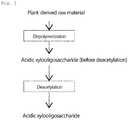
- the method for producing the acidic xylooligosaccharide of the present invention includes a step of depolymerizing a plant-derived raw material and a deacetylation step. As shown in Fig. 1 , the method for producing the acidic xylooligosaccharide of the present invention may be any method that comprises a step of depolymerizing a plant-derived raw material and a deacetylation step in this order.
- the plant-derived raw material and the steps in the method for producing the acidic xylooligosaccharide of the present invention are described below.
- plant-derived raw materials include wood-derived raw materials, seed-derived raw materials, grain-derived raw materials, fruit-derived raw materials, and the like.
- plant-derived raw materials further include cottons such as cotton linter and cotton lint; herbaceous plants such as kenaf, hemp, ramie, and rice straw; and the like.
- Such raw materials derived from various sources may be used in combination as the plant-derived raw material.
- wood-derived raw materials are particularly preferable as the plant-derived raw material.
- wood-derived raw materials include wood materials such as softwoods and hardwoods.
- the wood-derived raw material is preferably at least one selected from softwoods and hardwoods; and hardwoods are more preferable.
- the wood-derived raw material may be a mixture of softwood and hardwood.
- a bark may also be used as the wood-derived raw material.
- hardwoods include beech, Eucalyptus globulus, Eucalyptus grandis, Eucalyptus urograndis, Eucalyptus pellita, Eucalyptus braciana, Acacia mearnsii, and the like.
- softwoods include Japanese cedar, Japanese cypress, pine, hiba, Japanese hemlock, and the like.
- the wood-derived raw material preferably has a volume weight of 450 kg/m 3 or more and 700 kg/m 3 or less, and more preferably 500 kg/m 3 or more and 650 kg/m 3 or less.
- the efficiency of producing an acidic xylooligosaccharide can be enhanced.
- the wood-derived raw material is preferably wood chips obtained by crushing one or more of the above-mentioned woods.
- wood chips are used as a plant-derived raw material, depolymerization of the plant-derived raw material can efficiently proceed and the efficiency of producing acidic xylooligosaccharide can be enhanced.
- the method for producing the acidic xylooligosaccharide of the present invention comprises a step of depolymerizing a plant-derived raw material. Since the method includes the step of depolymerizing a plant-derived raw material, acidic xylooligosaccharide can be efficiently produced. This reduces the cost of producing the acidic xylooligosaccharide, and can thus provide a less-expensive acidic xylooligosaccharide.
- the step of depolymerizing a plant-derived raw material is a step of chemically and/or physically decomposing a plant-derived raw material to produce an acidic xylooligosaccharide.
- the chemical and/or physical decomposition step include a heat treatment step, an alkali treatment step, an acid treatment step, an enzyme treatment step, an ionic liquid treatment step, a catalytic treatment step, and the like.
- the depolymerization step is preferably at least one selected from a heat treatment step and an enzyme treatment step; and is more preferably a heat treatment step.
- the heat treatment step may be a heating and pressurizing step.
- the depolymerization step is preferably performed under non-alkaline conditions (herein referred to as pH 9 or less, preferably pH 8 or less, and more preferably pH 7 or less).
- the heat treatment step is a step of heating a plant-derived raw material in the presence of a solution. Since the plant-derived raw material is hydrolyzed in such a heat treatment step, the heat treatment step is sometimes referred to as a hydrolysis treatment step or a pre-hydrolysis treatment step.
- the solution used in the heat treatment step is preferably water.
- the ratio (mass ratio) of water to the plant-derived raw material is preferably in the range of 1:1 to 1:10. When the ratio of water to the plant-derived raw material is set within the above range, the hydrolysis reaction can proceed more efficiently.
- the water used in the heat treatment step may be water added separately from the plant-derived raw material; or a part of the water used in the heat treatment step may be water originally contained in the plant-derived raw material.
- the heat treatment step is a step of heating a plant-derived raw material in the presence of water.
- the heating temperature (liquid temperature) in this step is preferably 30°C or higher, more preferably 50°C or higher, even more preferably 75°C or higher, still even more preferably 90°C or higher, particularly preferably 100°C or higher, and most preferably 120°C or higher.
- the heating temperature (liquid temperature) is preferably 300°C or lower, more preferably 250°C or lower, and even more preferably 200°C or lower.
- the treatment time in the heat treatment step can be determined, as appropriate, according to the treatment temperature.
- the treatment time is, for example, preferably 5 minutes or more, more preferably 10 minutes or more, and even more preferably 20 minutes or more.
- P P factor
- T absolute temperature (Celsius temperature (°C) + 273.5)
- t heat treatment time
- K H1 ( T )/K 100°C the relative rate of hydrolysis of glycosidic bonds.
- the P factor is preferably set at 200 or more, more preferably 250 or more, and even more preferably 300 or more. On the other hand, the P factor is preferably 1000 or less.
- the P factor is adjusted as appropriate so that the average degree of polymerization of acidic xylooligosaccharide is within a desired range, whereby the molecular weight of the obtained pentosan polysulfate can be adjusted. Furthermore, the energy efficiency of the hydrolysis reaction can be increased.
- an acidic xylooligosaccharide having an average degree of polymerization of less than about 8 can be obtained by performing a heat treatment step at an absolute temperature for a heat treatment time such as to achieve a P factor of 800 or more and 1000 or less.
- an acidic xylooligosaccharide having a weight average molecular weight of about 1800 (the average degree of polymerization: about 12) to about 5000 (the average degree of polymerization: about 33) can be obtained by performing a heat treatment step at an absolute temperature for a heat treatment time such as to achieve a P factor of 100 or more and 400 or less.
- an acidic xylooligosaccharide having a weight average molecular weight of more than 1200 (the average degree of polymerization: about 8) and less than about 1800 (the average degree of polymerization: about 12) can be obtained by performing a heat treatment step at an absolute temperature for a heat treatment time such as to achieve a P factor of less than 800 and more than 400.
- the solution containing a plant-derived raw material preferably has a pH of 9 or less, more preferably a pH of 8 or less, and even more preferably a pH of 7 or less. That is, the heat treatment step is preferably performed under non-alkaline conditions.
- the pH value described above refers to the pH of the solution before the heat treatment.
- a raw material-derived acid may be dissociated, and acid hydrolysis may proceed at least partially.
- plant raw material-derived acids include organic acids, such as acetic acid and formic acid.
- the solution containing a plant-derived raw material has a further reduced pH after the acid hydrolysis.
- the depolymerization step is preferably a heat treatment step.
- This can increase the efficiency of producing acidic xylooligosaccharide.
- the heat treatment step can significantly reduce the number of steps required to produce acidic xylooligosaccharide, as compared with the conventional methods.
- acidic xylooligosaccharide can be efficiently produced with suppressed coloration, because the acidic xylooligosaccharide is not substituted with hexenuronic acid.
- the depolymerization step is preferably a heat treatment step; however, it can be a step other than the heat treatment step.
- the depolymerization step is an enzyme treatment step
- the depolymerization step comprises a step of mixing a plant-derived raw material with an enzyme.
- usable enzymes include hemicellulase and the like.
- Specific examples include commercially available enzyme preparations, such as Cellulosin HC100 (trade name, manufactured by HBI Enzymes Inc.), Cellulosin TP25 (trade name, manufactured by HBI Enzymes Inc.), Cellulosin HC (trade name, manufactured by HBI Enzymes Inc.), Cartazyme (trade name, manufactured by Clariant AG), Ecopulp (trade name, manufactured by Rohm Enzyme GmbH), Sumizyme (trade name, manufactured by Shin Nihon Chemicals Corporation), Pulpzyme (manufactured by Novo Nordisk), and Multifect 720 (Genencor); and xylanase produced by microorganisms belonging to genus Trichoderma, genus Thermomyces, genus Aureobasidium, genus Streptomyces, genus Aspergillus, genus Clostridium, genus Bacillus, genus Thermotoga, genus Thermoascus, genus Card
- an enzyme is added to a solution obtained by mixing a plant-derived raw material with water.
- the temperature of the solution during this addition is preferably 10°C or higher and 90°C or lower, and more preferably 30°C or higher and 60°C or lower.
- the temperature of the solution is preferably a temperature close to the optimal temperature of the enzyme used.
- the pH of the solution is also preferably adjusted to a range in which the activity of the enzyme is enhanced. For example, the pH of the solution is preferably adjusted to a pH of 3 or more and 10 or less.
- the depolymerization step comprises a step of mixing a plant-derived raw material with an alkaline solution or an acid solution.
- the alkali treatment step sodium hydroxide or potassium hydroxide is preferably added.
- the acid treatment step hydrochloric acid, sulfuric acid, acetic acid, or the like is preferably added. In this case as well, heating or pressurization may be performed as appropriate.
- the production method may further comprise, after the treatment step, a squeezing step, an extraction step, a heating step, a filtration step, a separation step, a purification step, a concentration step, a desalting step, or the like.
- the method may further comprise a molecular weight reduction step after the treatment step. Examples of other steps include the steps described in JP2003-183303A , the contents of which are incorporated herein by reference.
- the reaction mixture is separated into solids of the plant-derived raw material, and a solution other than the solids. More specifically, when the method comprises a filtration step that is performed after the depolymerization step, the reaction product is separated into solids, which are used as a pulp raw material, and a filtrate. The solids used as a pulp raw material are subjected to a digestion step or the like as a post-step to thereby provide a cellulose raw material (dissolving pulp).
- the collected filtrate can be separated into a gas layer and a liquid layer. Since the gas layer contains a large amount of furfurals, furfurals can be isolated by collecting these furfurals from the gas layer. On the other hand, the liquid layer contains a large amount of hemicellulose comprising acidic xylooligosaccharide and neutral xylooligosaccharide. The acidic xylooligosaccharide contained in this liquid layer can be separated and purified in the step described below.
- the method for producing the acidic xylooligosaccharide of the present invention preferably further comprises a separation and purification step after the depolymerization step.
- the separation and purification step may be provided immediately after the depolymerization step. However, it is preferable that a filtration step is provided after the depolymerization step, and a separation and purification step is provided after the filtration step, so that the acidic xylooligosaccharide is separated from the obtained filtrate and purified.
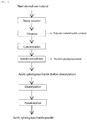
- the filtration step may be provided as a part of the separation and purification step; or, as shown in Fig. 2 , the filtration step may be provided between the depolymerization step and the separation and purification step.
- the separation and purification step is a step of separating and purifying the acidic xylooligosaccharide. Since the filtrate obtained in the filtration step contains various saccharides, such as neutral xylooligosaccharide, in addition to acidic xylooligosaccharide, the separation and purification step is also a step of removing such xylooligosaccharides other than the acidic xylooligosaccharide.
- ion exchange chromatography for example, ion exchange chromatography, affinity chromatography, gel filtration, ion exchange treatment, NF membrane treatment, UF membrane treatment, RO membrane treatment, activated carbon treatment, or like methods are preferably used.
- acidic xylooligosaccharide can be selectively separated and purified.
- acidic xylooligosaccharide is adsorbed to thereby mainly obtain acidic xylooligosaccharide from the sugar liquid (filtrate).
- sugar liquid is first treated with a strong cation exchange resin to remove metal ions from the sugar liquid. Subsequently, using a strong anion exchange resin, sulfate ions or the like are removed from the sugar liquid.
- the resulting sugar liquid is treated with a weak anion exchange resin to adsorb acidic xylooligosaccharide on the resin.
- the acidic oligosaccharide adsorbed on the resin is eluted with a low-concentration salt (NaCl, CaCl 2 , KCl, MgCl 2 , etc.) to thereby obtain an acidic xylooligosaccharide solution containing a small amount of impurities.
- a low-concentration salt NaCl, CaCl 2 , KCl, MgCl 2 , etc.
- the method for producing the acidic xylooligosaccharide of the present invention preferably comprises a concentration step between the depolymerization step and the separation and purification step.
- the concentration step is more preferably provided after the filtration step, which is provided after the depolymerization step, and before the separation and purification step.
- the subsequent separation and purification step can be more efficiently performed, and the efficiency of producing an acidic xylooligosaccharide can be increased.
- concentration step examples include a membrane treatment step using an NF membrane, an ultrafiltration membrane, a reverse osmosis membrane, or the like; a concentration step using evaporation etc.; and the like.
- the solution is preferably concentrated, so that the resulting concentrate has an acidic xylooligosaccharide content of 10% or more and 80% or less, and more preferably 20% or more and 60% or less, based on the total mass of the concentrate.
- the method for producing acidic xylooligosaccharide of the present invention comprises a deacetylation step.
- the deacetylation step may be included at any stage after the depolymerization step.
- the production method of the present invention which comprises a deacetylation step, can obtain an acidic xylooligosaccharide with a low acetyl group content.
- the deacetylation step is a step of adding a base to achieve a pH of 11 or more. More specifically, the deacetylation step is a step of adding a base to adjust the pH of a solution containing a substance obtained from a plant-derived raw material, such as acidic xylooligosaccharide (herein also referred to as a "solution containing acidic xylooligosaccharide or the like") to pH 11 or more.
- a solution containing acidic xylooligosaccharide herein also referred to as a "solution containing acidic xylooligosaccharide or the like
- the solution obtained after the depolymerization; the filtrate obtained in the filtration step; or the solution containing acidic xylooligosaccharide after the separation and purification step may be adjusted to a pH of 11 or higher.
- a base may be added to a solution containing a product obtained through the depolymerization step (acidic xylooligosaccharide before deacetylation) so as to achieve a pH of 11 or more.
- the solution containing acidic xylooligosaccharide may also be herein referred to as an acidic xylooligosaccharide solution.
- the solution is preferably an aqueous solution.
- the pH applied in the deacetylation step is preferably pH 11 to 14, and more preferably pH 12 to 13.
- the solution containing acidic xylooligosaccharide is preferably maintained at pH 11 or higher for 0.5 hours or more, more preferably at pH 11 or higher for 1.0 hour or more, even more preferably at pH 11 or higher for 2.0 hours or more, and particularly preferably at pH 11 or higher for 3.0 hours or more.
- the solution is preferably maintained for 1.0 hour or more.
- Particularly preferred conditions can be, for example, conditions in which solution is maintained at pH 12 to 13 for 3 hours or more.
- the solution is preferably stirred.
- the temperature conditions while the solution is maintained in the pH range are not particularly limited; however, the temperature is preferably room temperature.
- the base to be added in the deacetylation step is not particularly limited, as long as the desired pH can be achieved.
- the base is preferably sodium hydroxide.
- the deacetylation step may comprise a pH adjustment step of adjusting, to less than pH 11, an acidic xylooligosaccharide-containing solution having pH 11 or more due to a base added after the solution is maintained at the pH described above.
- the solution may be adjusted to, for example, pH 9 or less, pH 8 or less, pH 7 or less, pH 6 or less, pH 5 or less, pH 4 or less, or the like.
- the adjustment may be performed by adding an acid. Examples of acids include hydrochloric acid.
- the deacetylation step may also preferably comprise a desalting step after the pH adjustment step.
- Desalting can be performed, for example, using a dialysis membrane or an NF membrane.
- the deacetylation step may further comprise a step of powdering the obtained product for the subsequent treatment.
- the acidic xylooligosaccharide may be obtained in the form of an acidic xylooligosaccharide solution; or may be subjected to a dehydration step, and thereby obtained in the form of an acidic xylooligosaccharide concentrate, or in the form of an acidic xylooligosaccharide powder.
- the production method preferably further comprises a powdering step after the deacetylation step, as shown in Fig. 2 .
- the acidic xylooligosaccharide solution obtained in the deacetylation step is treated, for example, using a spray dryer, a freeze-drying machine, a hot-air drying machine, or a water-soluble organic solvent, to thereby obtain an acidic xylooligosaccharide powder.
- the concentrated sugar liquid was passed at SV 1.5 through a 4-bed 4-tower type ion exchange resin system consisting of a strong cationic resin (PK-218; manufactured by Mitsubishi Chemical Corporation), a weak anionic resin (WA30; manufactured by Mitsubishi Chemical Corporation), a strong cationic resin (PK-218; manufactured by Mitsubishi Chemical Corporation), and a weak anionic resin (WA30; manufactured by Mitsubishi Chemical Corporation). Acidic xylooligosaccharide was adsorbed on the weak anionic resin of the second and fourth towers.
- a 50 mM sodium chloride aqueous solution was then passed through the second and fourth towers at SV 1.5 to recover an acidic xylooligosaccharide solution. Thereafter, the obtained acidic xylooligosaccharide solution was powdered using a spray dryer (manufactured by Okawara Kogyo Co., Ltd.).
- a sample sugar liquid was prepared by adding 1000 parts by mass of water to 1 part by mass of the powdered acidic xylooligosaccharide. This sample sugar liquid was maintained at 50°C and filtered through a 0.45 ⁇ m filter to obtain the total sugar amount. The total sugar amount in the filtrate was divided by the amount of reducing sugar (both in terms of xylose) to obtain an average degree of polymerization.
- the total sugar amount was quantified by the phenol-sulfuric acid method ( " Kangento no Teiryo-Ho (Method of Quantifying Reducing Sugar)"; published by Gakkai Shuppan Center ) using a calibration curve prepared using D-xylose (Wako Pure Chemical Industries, Ltd.).
- the amount of reducing sugar was quantified by the Somogyi-Nelson method ("Quantitative Method for Reducing Sugar” published by Gakkai Shuppan Center ) using a calibration curve prepared using D-xylose (Wako Pure Chemical Industries, Ltd.).
- the average degree of polymerization of the acidic xylooligosaccharide was 6.
- an acidic xylooligosaccharide having an average degree of polymerization of less than 8 was obtained.
- the production method consisted of a smaller number of steps, could be performed very easily, and makes it possible to produce an acidic xylooligosaccharide at a significantly reduced cost.
- the acetyl group content of the acidic xylooligosaccharide as a starting material was calculated by multiplying the obtained acetyl group content of pentosan polysulfate sodium by 2.5.
- the weight average molecular weight (Mw) and the number average molecular weight (Mn) of pentosan polysulfate sodium shown in Table 1 were measured by GPC (gel permeation chromatography).
- GPC column a YMC-Pack Diol-300 and YMC-Pack Diol-60 (both manufactured by YMC) connected to each other were used. GPC was performed under the following conditions.
- the sulfur content of pentosan polysulfate sodium was measured by the oxygen flask combustion method described in the Japanese Pharmacopoeia.
- the anti-Xa activity of pentosan polysulfate sodium was measured using Test Team (registered trademark) Heparin S (manufactured by Sekisui Medical Co., Ltd.).
Landscapes
- Chemical & Material Sciences (AREA)
- Organic Chemistry (AREA)
- Life Sciences & Earth Sciences (AREA)
- Biochemistry (AREA)
- Health & Medical Sciences (AREA)
- Engineering & Computer Science (AREA)
- Molecular Biology (AREA)
- General Health & Medical Sciences (AREA)
- Genetics & Genomics (AREA)
- Biotechnology (AREA)
- Chemical Kinetics & Catalysis (AREA)
- Medicinal Chemistry (AREA)
- Polymers & Plastics (AREA)
- Materials Engineering (AREA)
- Polysaccharides And Polysaccharide Derivatives (AREA)
- Preparation Of Compounds By Using Micro-Organisms (AREA)
- Saccharide Compounds (AREA)
Applications Claiming Priority (2)
| Application Number | Priority Date | Filing Date | Title |
|---|---|---|---|
| JP2016169709 | 2016-08-31 | ||
| PCT/JP2017/031433 WO2018043667A1 (fr) | 2016-08-31 | 2017-08-31 | Xylooligosaccharide acide, et procédé de fabrication de celui-ci |
Publications (2)
| Publication Number | Publication Date |
|---|---|
| EP3677587A1 true EP3677587A1 (fr) | 2020-07-08 |
| EP3677587A4 EP3677587A4 (fr) | 2021-04-14 |
Family
ID=61300981
Family Applications (1)
| Application Number | Title | Priority Date | Filing Date |
|---|---|---|---|
| EP17846671.0A Pending EP3677587A4 (fr) | 2016-08-31 | 2017-08-31 | Xylooligosaccharide acide, et procédé de fabrication de celui-ci |
Country Status (11)
| Country | Link |
|---|---|
| US (1) | US11286272B2 (fr) |
| EP (1) | EP3677587A4 (fr) |
| JP (2) | JPWO2018043667A1 (fr) |
| KR (1) | KR102559743B1 (fr) |
| CN (1) | CN111148749A (fr) |
| AU (1) | AU2017321817B2 (fr) |
| BR (1) | BR112020003908B1 (fr) |
| MX (1) | MX2020002288A (fr) |
| SG (1) | SG11202001824RA (fr) |
| WO (2) | WO2018043666A1 (fr) |
| ZA (1) | ZA202001444B (fr) |
Families Citing this family (8)
| Publication number | Priority date | Publication date | Assignee | Title |
|---|---|---|---|---|
| JP6225321B1 (ja) | 2016-08-31 | 2017-11-08 | 王子ホールディングス株式会社 | ポリ硫酸ペントサンの製造方法 |
| EP3677587A4 (fr) | 2016-08-31 | 2021-04-14 | Oji Holdings Corporation | Xylooligosaccharide acide, et procédé de fabrication de celui-ci |
| JP6281659B1 (ja) * | 2017-02-28 | 2018-02-21 | 王子ホールディングス株式会社 | ポリ硫酸ペントサン、医薬組成物及び抗凝固剤 |
| CA3065747C (fr) | 2017-05-31 | 2024-10-01 | Oji Holdings Corporation | Composition hydratante comprenant un polysulfate de pentosanne |
| AU2018333249B2 (en) | 2017-09-12 | 2023-03-02 | Oji Holdings Corporation | Pentosan polysulfate and method for producing pentosan polysulfate |
| WO2019124363A1 (fr) | 2017-12-20 | 2019-06-27 | 王子ホールディングス株式会社 | Pentosane polysulfate et médicament contenant du pentosane polysulfate |
| US20220233559A1 (en) * | 2021-01-27 | 2022-07-28 | Prenexus Health, Inc. | Xylooligosaccharide as a multifunctional prebiotic |
| CN117065572A (zh) * | 2023-08-18 | 2023-11-17 | 焦作市华康糖醇科技有限公司 | 一种连续色谱脱除木糖溶液无机酸的系统及方法 |
Family Cites Families (58)
| Publication number | Priority date | Publication date | Assignee | Title |
|---|---|---|---|---|
| JPS4843100B1 (fr) | 1969-09-05 | 1973-12-17 | ||
| US4168742A (en) | 1978-03-27 | 1979-09-25 | Hudson Products Corporation | Tube bundle |
| FR2538404B1 (fr) | 1982-12-28 | 1985-08-23 | Anic Spa | |
| FR2543145B1 (fr) | 1983-03-24 | 1986-10-17 | Sanofi Sa | Nouveaux sulfates de xylanes, leur procede de preparation et leur activite anti-thrombotique et hypolipemiante |
| JPS60112708A (ja) | 1983-11-24 | 1985-06-19 | Maruho Kk | 皮膚用保湿剤 |
| FR2572731B1 (fr) | 1984-11-07 | 1987-03-06 | Sanofi Sa | Nouveaux sulfates de xylanes de bas poids moleculaires, leur procede de preparation et leur activite antithrombotique et hypolipemiante par voie orale |
| JPS61130301A (ja) | 1984-11-30 | 1986-06-18 | Tokyo Univ | 抗凝血活性を有する硫酸化キシロフラナン及びその製造法 |
| JPS61130302A (ja) | 1984-11-30 | 1986-06-18 | Tokyo Univ | 抗凝血活性を有する硫酸化リボフラナン及びその製造法 |
| US5672334A (en) | 1991-01-16 | 1997-09-30 | Access Pharmaceuticals, Inc. | Invivo agents comprising cationic metal chelators with acidic saccharides and glycosaminoglycans |
| FR2645745B1 (fr) | 1989-04-12 | 1991-09-27 | Anben Ste Civile | Compositions therapeutiques pour le traitement ou la prevention du ronflement |
| DE3917982A1 (de) | 1989-06-02 | 1990-12-06 | Behringwerke Ag | Verwendung von xylanpolyhydrogensulfaten zur therapie von zellproliferations-bedingten erkrankungen |
| FR2648463B1 (fr) | 1989-06-14 | 1993-01-22 | Inst Fs Rech Expl Mer | Polysaccharides sulfates, agent anticoagulant et agent anticomplementaire obtenus a partir de fucanes d'algues brunes et leur procede d'obtention |
| EP0526578A4 (en) | 1990-04-26 | 1993-09-22 | Cytrx Corporation | Composition and method for topical treatment of damaged or diseased tissue |
| US20010005720A1 (en) | 1995-06-07 | 2001-06-28 | U.S.A. As Represented By The Secretary Department Of Health And Human Services | Method of treating chronic progressive vascular scarring diseases |
| DE19632840A1 (de) | 1996-08-14 | 1998-02-19 | Landsberger Albert | Vitamin A-haltige Zusammensetzung |
| JPH10195107A (ja) | 1997-01-10 | 1998-07-28 | Shiseido Co Ltd | オリゴ硫酸化ヒアルロン酸 |
| JP4336905B2 (ja) | 1997-12-19 | 2009-09-30 | マルホ株式会社 | 硫酸化多糖類含有皮膚保湿乳剤性ローション剤 |
| US6593310B1 (en) | 2000-11-21 | 2003-07-15 | Arthropharm Pty. Ltd. | Treatment of osteoporosis |
| DE10141106A1 (de) | 2001-08-22 | 2003-03-13 | Aventis Pharma Gmbh | Verwendung von Heparinoid-Derivaten zur Behandlung und Diagnose von mit Heparinoiden behandelbaren Erkrankungen |
| JP4073661B2 (ja) | 2001-12-20 | 2008-04-09 | 王子製紙株式会社 | 酸性キシロオリゴ糖組成物の製造方法 |
| JP3772749B2 (ja) * | 2002-01-25 | 2006-05-10 | 王子製紙株式会社 | メラニン生成抑制剤 |
| JP2003221339A (ja) * | 2002-01-29 | 2003-08-05 | Oji Paper Co Ltd | 抗炎症剤 |
| ITMI20031618A1 (it) | 2003-08-06 | 2005-02-07 | Inalco Spa | Derivati polisaccaridici dotati di alta attivita' |
| PL1748781T3 (pl) | 2004-05-27 | 2013-05-31 | Baxter Int | Sposoby do leczenia zaburzeń związanych z krwawieniem z zastosowaniem siarczanowanych polisacharydów |
| CA2576131C (fr) | 2004-08-05 | 2012-04-24 | Ivax Drug Research Institute Ltd. | Glycosides polysulfates et sels de ceux-ci |
| US20060194759A1 (en) | 2005-02-25 | 2006-08-31 | Eidelson Stewart G | Topical compositions and methods for treating pain and inflammation |
| JP4675139B2 (ja) * | 2005-04-15 | 2011-04-20 | サントリーホールディングス株式会社 | 高純度キシロオリゴ糖組成物 |
| EP1906975A4 (fr) | 2005-07-22 | 2010-10-06 | Trf Pharma Inc | Methode destinee a traiter la drepanocytose et les sequelles de la drepanocytose |
| US20070243218A1 (en) | 2006-04-03 | 2007-10-18 | Ellinghuysen Jerry A | Stabilized pentosan polysulfate (PPS) formulations and methods of analyzing them |
| GB0610350D0 (en) | 2006-05-25 | 2006-07-05 | Univ Liverpool | prevention and/or treatment of neuodegenerative disorders |
| WO2008066193A1 (fr) | 2006-11-27 | 2008-06-05 | Chisso Corporation | Composition cosmétique |
| WO2008107906A1 (fr) | 2007-03-06 | 2008-09-12 | Alembic Limited | Processus de préparation de polysulfate de pentosane ou de ses sels |
| FI121811B (fi) | 2007-06-01 | 2011-04-29 | Upm Kymmene Corp | Uudet dispersiot ja menetelmä niiden valmistamiseksi |
| HUP0900072A2 (hu) | 2009-02-06 | 2010-09-28 | Egis Gyogyszergyar Nyilvanosan | Transzdermális gyógyszerkészítmények |
| WO2009087581A1 (fr) | 2008-01-04 | 2009-07-16 | Alembic Limited | Procédé perfectionné pour la préparation de polysulfate de pentosane ou de ses sels |
| JP2009196915A (ja) | 2008-02-20 | 2009-09-03 | Ezaki Glico Co Ltd | 化粧品用組成物 |
| AU2008100730B4 (en) | 2008-07-04 | 2008-10-02 | Parnell Technologies Pty Ltd | Sulfated polysaccharide compound for clinical use and the preparation thereof |
| FR2935386B1 (fr) | 2008-08-26 | 2010-09-10 | Sanofi Aventis | Nouveaux polysaccharides a activite antithrombotique comprenant une liaion covalente avec une chaine amine |
| KR101678429B1 (ko) | 2009-02-02 | 2016-11-22 | 오츠카 세이야쿠 가부시키가이샤 | 저분자량 다황산화 히알루론산 유도체 및 이를 함유하는 의약 |
| CN102061323B (zh) | 2010-11-10 | 2013-09-25 | 山东龙力生物科技股份有限公司 | 一种植物木质纤维素的综合利用工艺 |
| WO2012101544A1 (fr) | 2011-01-29 | 2012-08-02 | Alembic Pharmaceuticals Limited | Procédé de préparation amélioré de polysulfate de pentosane ou de sels de celui-ci |
| WO2012114349A1 (fr) | 2011-02-23 | 2012-08-30 | Cadila Healthcare Limited | Procédé amélioré pour la préparation de pentosane polysulfate sodium |
| CN102766225B (zh) | 2011-05-06 | 2015-08-05 | 上海医药工业研究院 | 一种戊聚糖聚硫酸钠的制备方法以及一种寡聚木糖 |
| WO2013186857A1 (fr) | 2012-06-12 | 2013-12-19 | 株式会社リボミック | Aptamère de fgf2 et son utilisation |
| ITMI20130112A1 (it) | 2013-01-24 | 2014-07-25 | Chemi Spa | Metodo di qualificazione di preparazioni di pentosan polifosfato, sue materie prime e processi di produzione |
| JO3529B1 (ar) | 2013-02-08 | 2020-07-05 | Amgen Res Munich Gmbh | مضاد التصاق خلايا الدم البيض من أجل التخفيف من الاثار السلبية الممكنة الناتجة عن مجالات ارتباط cd3- المحدد |
| JP6132302B2 (ja) | 2013-05-28 | 2017-05-24 | リーディアント・バイオサイエンシーズ・ソシエタ・アノニマLeadiant Biosciences S.A. | 抗血管新生活性を有し、抗凝血効果を有さない、ヘパラナーゼ阻害剤としての部分的に脱硫酸化されたグリコサミノグリカンの誘導体 |
| CN103320548A (zh) | 2013-06-24 | 2013-09-25 | 稼禾生物股份有限公司 | 一种利用农作物秸秆制备低聚木糖和纤维素的方法 |
| JP6403317B2 (ja) | 2013-07-19 | 2018-10-10 | 学校法人慶應義塾 | 抗腫瘍剤 |
| HUE057703T2 (hu) * | 2015-05-20 | 2022-05-28 | Chemi Spa | Eljárás poliszacharidok elõállítására |
| WO2016191698A1 (fr) | 2015-05-27 | 2016-12-01 | Vanguard Therapeutics, Inc. | Pentosane polysulfate de sodium pour le traitement de la drépanocytose |
| CN106832020A (zh) | 2015-12-04 | 2017-06-13 | 长春工业大学 | 一种玉米秸秆戊聚糖硫酸酯的制备工艺 |
| CN105907896B (zh) | 2016-05-16 | 2019-11-12 | 中国科学院广州能源研究所 | 一种利用木质纤维原料联产高浓度木糖和低聚木糖的方法 |
| EP3677587A4 (fr) | 2016-08-31 | 2021-04-14 | Oji Holdings Corporation | Xylooligosaccharide acide, et procédé de fabrication de celui-ci |
| JP6225321B1 (ja) | 2016-08-31 | 2017-11-08 | 王子ホールディングス株式会社 | ポリ硫酸ペントサンの製造方法 |
| CN106636254B (zh) * | 2016-12-28 | 2024-03-08 | 山东龙力生物科技股份有限公司 | 一种高纯度低聚木糖制备工艺 |
| CN106674382A (zh) * | 2017-01-13 | 2017-05-17 | 河南工业大学 | 一种从木瓜果实中提取高纯度木聚糖的方法 |
| JP6281659B1 (ja) | 2017-02-28 | 2018-02-21 | 王子ホールディングス株式会社 | ポリ硫酸ペントサン、医薬組成物及び抗凝固剤 |
-
2017
- 2017-08-31 EP EP17846671.0A patent/EP3677587A4/fr active Pending
- 2017-08-31 JP JP2018516078A patent/JPWO2018043667A1/ja active Pending
- 2017-08-31 SG SG11202001824RA patent/SG11202001824RA/en unknown
- 2017-08-31 US US16/643,215 patent/US11286272B2/en active Active
- 2017-08-31 CN CN201780094452.2A patent/CN111148749A/zh active Pending
- 2017-08-31 WO PCT/JP2017/031432 patent/WO2018043666A1/fr not_active Ceased
- 2017-08-31 BR BR112020003908-0A patent/BR112020003908B1/pt active IP Right Grant
- 2017-08-31 WO PCT/JP2017/031433 patent/WO2018043667A1/fr not_active Ceased
- 2017-08-31 AU AU2017321817A patent/AU2017321817B2/en active Active
- 2017-08-31 KR KR1020207008635A patent/KR102559743B1/ko active Active
- 2017-08-31 MX MX2020002288A patent/MX2020002288A/es unknown
-
2018
- 2018-12-07 JP JP2018229611A patent/JP6544475B2/ja active Active
-
2020
- 2020-03-06 ZA ZA2020/01444A patent/ZA202001444B/en unknown
Also Published As
| Publication number | Publication date |
|---|---|
| CN111148749A (zh) | 2020-05-12 |
| KR102559743B1 (ko) | 2023-07-25 |
| WO2018043666A1 (fr) | 2018-03-08 |
| ZA202001444B (en) | 2022-07-27 |
| JPWO2018043667A1 (ja) | 2018-08-30 |
| KR20200040870A (ko) | 2020-04-20 |
| CA3074415A1 (fr) | 2018-03-08 |
| AU2017321817B2 (en) | 2022-12-15 |
| SG11202001824RA (en) | 2020-04-29 |
| BR112020003908A2 (pt) | 2020-09-08 |
| AU2017321817A1 (en) | 2020-04-16 |
| US20200207796A1 (en) | 2020-07-02 |
| EP3677587A4 (fr) | 2021-04-14 |
| MX2020002288A (es) | 2020-07-14 |
| US11286272B2 (en) | 2022-03-29 |
| JP2019073709A (ja) | 2019-05-16 |
| JP6544475B2 (ja) | 2019-07-17 |
| WO2018043667A1 (fr) | 2018-03-08 |
| BR112020003908B1 (pt) | 2023-01-24 |
Similar Documents
| Publication | Publication Date | Title |
|---|---|---|
| US11286272B2 (en) | Production method for acidic xylooligosaccharide, and acidic xylooligosaccharide | |
| EP3590971B1 (fr) | Polysulfate de pentosane, composition pharmaceutique et anticoagulant | |
| US11312790B2 (en) | Production method for pentosan polysulfate | |
| EP3683242B1 (fr) | Polysulfate de pentosane et procédé de production de polysulfate de pentosane | |
| CA3074415C (fr) | Xylooligosaccharide acide, et procede de fabrication de celui-ci |
Legal Events
| Date | Code | Title | Description |
|---|---|---|---|
| STAA | Information on the status of an ep patent application or granted ep patent |
Free format text: STATUS: THE INTERNATIONAL PUBLICATION HAS BEEN MADE |
|
| STAA | Information on the status of an ep patent application or granted ep patent |
Free format text: STATUS: THE APPLICATION IS DEEMED TO BE WITHDRAWN |
|
| STAA | Information on the status of an ep patent application or granted ep patent |
Free format text: STATUS: THE INTERNATIONAL PUBLICATION HAS BEEN MADE |
|
| PUAI | Public reference made under article 153(3) epc to a published international application that has entered the european phase |
Free format text: ORIGINAL CODE: 0009012 |
|
| STAA | Information on the status of an ep patent application or granted ep patent |
Free format text: STATUS: REQUEST FOR EXAMINATION WAS MADE |
|
| 17P | Request for examination filed |
Effective date: 20200227 |
|
| AK | Designated contracting states |
Kind code of ref document: A1 Designated state(s): AL AT BE BG CH CY CZ DE DK EE ES FI FR GB GR HR HU IE IS IT LI LT LU LV MC MK MT NL NO PL PT RO RS SE SI SK SM TR |
|
| AX | Request for extension of the european patent |
Extension state: BA ME |
|
| DAV | Request for validation of the european patent (deleted) | ||
| DAX | Request for extension of the european patent (deleted) | ||
| A4 | Supplementary search report drawn up and despatched |
Effective date: 20210312 |
|
| RIC1 | Information provided on ipc code assigned before grant |
Ipc: C07H 3/06 20060101AFI20210305BHEP Ipc: C08B 37/00 20060101ALI20210305BHEP Ipc: C13K 13/00 20060101ALI20210305BHEP Ipc: C08L 5/00 20060101ALI20210305BHEP |
|
| STAA | Information on the status of an ep patent application or granted ep patent |
Free format text: STATUS: EXAMINATION IS IN PROGRESS |
|
| 17Q | First examination report despatched |
Effective date: 20230112 |