EP3678255A1 - Verfahren zur kalibrierung einer familie von lithium-ionen-batterieelementen, entsprechende lademethode, entsprechendes computerprogrammprodukt und entsprechende ladevorrichtung - Google Patents
Verfahren zur kalibrierung einer familie von lithium-ionen-batterieelementen, entsprechende lademethode, entsprechendes computerprogrammprodukt und entsprechende ladevorrichtung Download PDFInfo
- Publication number
- EP3678255A1 EP3678255A1 EP19219728.3A EP19219728A EP3678255A1 EP 3678255 A1 EP3678255 A1 EP 3678255A1 EP 19219728 A EP19219728 A EP 19219728A EP 3678255 A1 EP3678255 A1 EP 3678255A1
- Authority
- EP
- European Patent Office
- Prior art keywords
- battery
- battery element
- state
- charge
- limit value
- Prior art date
- Legal status (The legal status is an assumption and is not a legal conclusion. Google has not performed a legal analysis and makes no representation as to the accuracy of the status listed.)
- Granted
Links
Images

Classifications
-
- H—ELECTRICITY
- H01—ELECTRIC ELEMENTS
- H01M—PROCESSES OR MEANS, e.g. BATTERIES, FOR THE DIRECT CONVERSION OF CHEMICAL ENERGY INTO ELECTRICAL ENERGY
- H01M10/00—Secondary cells; Manufacture thereof
- H01M10/42—Methods or arrangements for servicing or maintenance of secondary cells or secondary half-cells
- H01M10/425—Structural combination with electronic components, e.g. electronic circuits integrated to the outside of the casing
-
- H—ELECTRICITY
- H01—ELECTRIC ELEMENTS
- H01M—PROCESSES OR MEANS, e.g. BATTERIES, FOR THE DIRECT CONVERSION OF CHEMICAL ENERGY INTO ELECTRICAL ENERGY
- H01M10/00—Secondary cells; Manufacture thereof
- H01M10/42—Methods or arrangements for servicing or maintenance of secondary cells or secondary half-cells
- H01M10/48—Accumulators combined with arrangements for measuring, testing or indicating the condition of cells, e.g. the level or density of the electrolyte
-
- G—PHYSICS
- G01—MEASURING; TESTING
- G01R—MEASURING ELECTRIC VARIABLES; MEASURING MAGNETIC VARIABLES
- G01R31/00—Arrangements for testing electric properties; Arrangements for locating electric faults; Arrangements for electrical testing characterised by what is being tested not provided for elsewhere
- G01R31/36—Arrangements for testing, measuring or monitoring the electrical condition of accumulators or electric batteries, e.g. capacity or state of charge [SoC]
- G01R31/367—Software therefor, e.g. for battery testing using modelling or look-up tables
-
- G—PHYSICS
- G01—MEASURING; TESTING
- G01R—MEASURING ELECTRIC VARIABLES; MEASURING MAGNETIC VARIABLES
- G01R31/00—Arrangements for testing electric properties; Arrangements for locating electric faults; Arrangements for electrical testing characterised by what is being tested not provided for elsewhere
- G01R31/36—Arrangements for testing, measuring or monitoring the electrical condition of accumulators or electric batteries, e.g. capacity or state of charge [SoC]
- G01R31/392—Determining battery ageing or deterioration, e.g. state of health
-
- H—ELECTRICITY
- H02—GENERATION; CONVERSION OR DISTRIBUTION OF ELECTRIC POWER
- H02J—ELECTRIC POWER NETWORKS; CIRCUIT ARRANGEMENTS OR SYSTEMS FOR SUPPLYING OR DISTRIBUTING ELECTRIC POWER; SYSTEMS FOR STORING ELECTRIC ENERGY
- H02J7/00—Circuit arrangements for charging or discharging batteries or for supplying loads from batteries
- H02J7/875—Charging or discharging for charge maintenance, battery initiation or rejuvenation
-
- G—PHYSICS
- G01—MEASURING; TESTING
- G01R—MEASURING ELECTRIC VARIABLES; MEASURING MAGNETIC VARIABLES
- G01R31/00—Arrangements for testing electric properties; Arrangements for locating electric faults; Arrangements for electrical testing characterised by what is being tested not provided for elsewhere
- G01R31/36—Arrangements for testing, measuring or monitoring the electrical condition of accumulators or electric batteries, e.g. capacity or state of charge [SoC]
- G01R31/385—Arrangements for measuring battery or accumulator variables
- G01R31/3865—Arrangements for measuring battery or accumulator variables related to manufacture, e.g. testing after manufacture
-
- H—ELECTRICITY
- H01—ELECTRIC ELEMENTS
- H01M—PROCESSES OR MEANS, e.g. BATTERIES, FOR THE DIRECT CONVERSION OF CHEMICAL ENERGY INTO ELECTRICAL ENERGY
- H01M10/00—Secondary cells; Manufacture thereof
- H01M10/05—Accumulators with non-aqueous electrolyte
- H01M10/052—Li-accumulators
- H01M10/0525—Rocking-chair batteries, i.e. batteries with lithium insertion or intercalation in both electrodes; Lithium-ion batteries
-
- H—ELECTRICITY
- H01—ELECTRIC ELEMENTS
- H01M—PROCESSES OR MEANS, e.g. BATTERIES, FOR THE DIRECT CONVERSION OF CHEMICAL ENERGY INTO ELECTRICAL ENERGY
- H01M10/00—Secondary cells; Manufacture thereof
- H01M10/42—Methods or arrangements for servicing or maintenance of secondary cells or secondary half-cells
- H01M10/425—Structural combination with electronic components, e.g. electronic circuits integrated to the outside of the casing
- H01M2010/4271—Battery management systems including electronic circuits, e.g. control of current or voltage to keep battery in healthy state, cell balancing
-
- H—ELECTRICITY
- H02—GENERATION; CONVERSION OR DISTRIBUTION OF ELECTRIC POWER
- H02J—ELECTRIC POWER NETWORKS; CIRCUIT ARRANGEMENTS OR SYSTEMS FOR SUPPLYING OR DISTRIBUTING ELECTRIC POWER; SYSTEMS FOR STORING ELECTRIC ENERGY
- H02J7/00—Circuit arrangements for charging or discharging batteries or for supplying loads from batteries
- H02J7/80—Circuit arrangements for charging or discharging batteries or for supplying loads from batteries including monitoring or indicating arrangements
- H02J7/82—Control of state of charge [SOC]
-
- Y—GENERAL TAGGING OF NEW TECHNOLOGICAL DEVELOPMENTS; GENERAL TAGGING OF CROSS-SECTIONAL TECHNOLOGIES SPANNING OVER SEVERAL SECTIONS OF THE IPC; TECHNICAL SUBJECTS COVERED BY FORMER USPC CROSS-REFERENCE ART COLLECTIONS [XRACs] AND DIGESTS
- Y02—TECHNOLOGIES OR APPLICATIONS FOR MITIGATION OR ADAPTATION AGAINST CLIMATE CHANGE
- Y02E—REDUCTION OF GREENHOUSE GAS [GHG] EMISSIONS, RELATED TO ENERGY GENERATION, TRANSMISSION OR DISTRIBUTION
- Y02E60/00—Enabling technologies; Technologies with a potential or indirect contribution to GHG emissions mitigation
- Y02E60/10—Energy storage using batteries
Definitions
- the present invention relates to a method for calibrating a family of Li-ion battery cells.
- the invention also relates to a charging method, a computer program product and a charging device.
- the invention applies to the field of batteries, more particularly to the field of lithium-ion batteries.
- Li-ion batteries also denoted Li-ion, generally have a higher mass energy than other types of batteries. As a result, Li-ion batteries are an advantageous alternative for storing electrical energy.
- Li-ion batteries include at least one battery cell, each battery cell comprising a so-called “positive” electrode (or cathode) and a so-called “negative” electrode (or anode), separated by an electrolyte.
- the cathode is generally metallic, for example made of a compound of the transition metal oxide type or of the lithium phosphate type comprising lithium.
- the anode includes graphite particles.
- Li-ion battery cells which include an anode of a similar nature (i.e. an anode with in particular the same morphology of graphite particles, the same composition, the same binder and the same porosity), a similar cathode (i.e. a cathode having in particular the same composition: the same binder, the same conductive additive, the same porosity) and a similar electrolyte (that is to say an electrolyte with, in particular, the same ionic conductivity) define a "family", within the meaning of the present invention.
- an anode of a similar nature i.e. an anode with in particular the same morphology of graphite particles, the same composition, the same binder and the same porosity
- a similar cathode i.e. a cathode having in particular the same composition: the same binder, the same conductive additive, the same porosity
- electrolyte that is to say an electrolyte with, in particular, the
- lithium Li + ions migrate from the cathode of each battery element to be inserted into the graphite of the corresponding anode. Reverse migration occurs when the battery is discharged.
- Such degradation is due to the formation of a deposit of metallic lithium on the surface of the graphite particles of the anode. Such a phenomenon generally occurs during the charging of the battery, and is commonly designated by the English expression “ lithium plating”.
- lithium When such a deposit comes into contact with the electrolyte, lithium generally oxidizes to form compounds of the lithium carbonate type (ROCO 2 Li) or inorganic compounds (Li 2 CO 3 , LiF). The lithium then becomes inactive from an electrochemical point of view, and is no longer able to participate in the redox reactions taking place at the electrodes.
- ROCO 2 Li lithium carbonate type
- LiF inorganic compounds
- the lithium deposition phenomenon contributes to the loss of battery capacity, thus reducing its lifespan.
- Such a method makes it possible to determine the limit value of the predetermined characteristic quantity, for which the potential of the anode is still positive or no.
- the use of such a limit value confers the possibility, during a charging of the battery element, of interrupting the charging of the battery element when the current value of the predetermined characteristic quantity reaches the limit value, or else to reduce the charging regime in favor of a lower charging regime, for which the limit value of the predetermined characteristic variable is higher than the limit value associated with the current charge regime.
- the evaluation of the state of health of the battery element makes it possible to take into account the degradation of the performance of the battery element over time.
- the subject of the invention is a computer program product comprising program code instructions which, when executed by a computer, implement the loading method as defined above.
- the computer is also configured to control the reduction of the load regime in the event of detection of the limit state.
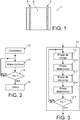
- a battery cell 2 is schematically shown in the figure 1 .
- the battery element 2 is such that a battery is obtained by the series and / or parallel mounting of a plurality of battery elements 2. More specifically, the battery element 2 is an element of a Li-ion battery.
- the battery element 2 comprises a so-called positive electrode, also called “cathode” 4, and a so-called negative electrode, also called “Anode” 6.
- the cathode 4 and the anode 6 are arranged at a distance from each other, the space between the electrodes 4, 6 being occupied by an electrolyte 8.
- the battery element 2 has a surface capacity Q, generally expressed in milliampere hours per square centimeter (mAh / cm 2 ).
- surface capacity is meant the equivalent capacity of the active material per unit area, that is to say an equivalent capacity obtained from the capacity representative of the performance of the electrochemically active material (in mAh / g ) within the electrodes, related to the surface of the electrodes and multiplied by the amount of active material actually present in the electrodes (in grams).
- Such a surface capacity varies over time and, more specifically, decreases, from an initial maximum value, called initial surface capacity Q 0 , as a state of health H of the battery element 2 degrades.
- Such a state of health H constitutes an indicator of the aging of the battery element 2.
- Such aging comes, for example, from a deposit of metallic lithium at the level of the anode. 6.
- the battery element 2 is such that, before the first charge of the battery element 2, the cathode 4 comprises lithium.
- the cathode 4 is produced in a compound comprising lithium, such as LiNi 1/3 Mn 1/3 CO 1/3 O 2 .
- a plurality of battery cells 2 from the same family is provided. At least two battery cells 2 of the family have a different initial surface capacity Q 0 and a different state of health H.
- a battery cell 2 is chosen from the plurality of battery cells 2.
- the state of health H of the chosen battery cell 2 is evaluated, that is to say - say calculated.
- the state of health H is evaluated during each cyclic step 12 described later.
- the selected battery cell 2 is initially discharged.
- the selected battery element 2 is then connected to a calibration device (not shown).
- the step following the initialization step 10 is a cyclic step 12, as described later.
- the calibration device keeps the temperature of the battery element 2 constant.
- the calibration device is configured to implement the cyclic step 12 according to a predetermined number of iterations.
- the corresponding temperatures are preferably different.
- the step following each cyclic step 12 is a test step 14.
- the step following the test step 14 is a new cyclic step 12. If, during the test step 14, the calibration device determines that the cyclic step 12 has been set implemented a number of times equal to the predetermined number of iterations, then the step following the test step 14 is a calculation step 16.
- the calibration device subjects the battery element 2 to a predetermined number of cycles each comprising a charging phase 12.1 and a discharging phase 12.2 from the battery element 2, as illustrated by the figure 3 .
- the calibration device determines, during a control phase 12.3, whether the number of cycles carried out has reached the predetermined number of cycles. If the number of cycles carried out is strictly less than the predetermined number of cycles, then a new cycle comprising a charging phase 12.1 and a discharging phase 12.2 is implemented.
- the calibration device supplies the battery element 2 with electrical energy at a predetermined constant charging rate.
- charging regime it is understood, within the meaning of the present invention, an electric current calculated from the maximum constant current that a battery or a battery element 2 is capable of discharging in one hour.
- the charging regime 1C corresponds to a current of 1000 mA
- the charging regime C / 10 corresponds to an electric current of 100 mA
- the 3C charging regime corresponds to an electrical current of 3000 mA, etc.
- the calibration device charges the battery element 2 at a charging speed greater than the charging speed associated with the preceding charging phase 12.1.
- the charge regime is successively C / 10, then C / 2, then 0.75C, then 1C, then 1.25C, then 1.5C, then 2C, then 3C, then 5C.
- the calibration device measures, during each charging phase 12.1 of the cyclic step 12, the voltage across the terminals of the battery element 2.
- the calibration device measures the potential of the anode 6 of the battery cell 2. Such a potential of the anode 6 generally decreases with the increase of a state of charge S of the battery cell 2, as defined later.
- the calibration device calculates the potential of anode 6 from a potential difference measurement between anode 6 and a reference electrode having a fixed potential over time, for example an electrode at lithium Li + / Li classically known.
- the calibration device calculates the state of charge S of the battery cell 2.
- q max is the maximum capacity of the battery element 2 at the end of the charge phase associated with the speed of charge C / 10.
- the capacity q (t) of the battery element 2 at the instant t is, for example, taken equal to the integral, between a predetermined initial instant and the current instant t, of the measured value of the current flowing at across the battery element 2.
- the value of the capacity q (t) is positive.
- the predetermined initial instant is, for example, the instant at which the charging phase 12.1 begins.
- the state of charge S increases during the charging phase 12.1.
- the calibration device During each charging phase 12.1, the calibration device also determines a limit value VAL lim of the state of charge S, for which the potential difference between the anode 6 and the reference electrode becomes less than or equal at a predetermined threshold.
- the limit value VAL lim corresponds to a zero potential difference between the anode 6 and the reference electrode.
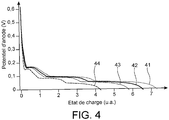
- the graph of the figure 4 illustrates the evolution of the anode potential of a Li-ion battery element 2 as a function of its state of charge S, for the same charge regime and the same initial surface capacitance Q 0 given of the battery element 2 , for four distinct values of health status H, the temperature here being constant and identical for all of the measurements.
- Curve 41 (dotted lines) illustrates the evolution of the anode potential as a function of the state of charge S, when the battery element 2 has a state of health of 100%.
- Curve 42 (thick solid line) illustrates the evolution of the anode potential as a function of the state of charge S, when the battery element 2 has a state of health of 90%.
- Curve 43 (solid line) illustrates the evolution of the anode potential as a function of the state of charge S, when the battery element 2 has a state of health of 80%.
- Curve 44 illustrates the evolution of the anode potential as a function of the state of charge S, when the battery element 2 has a state of health of 60%.
- the calibration device ends each charging phase 12.1 when a predetermined condition is fulfilled. For example, the calibration device ends each charging phase 12.1 when the voltage across the terminals of the battery element 2 reaches a predetermined maximum voltage.
- the calibration device draws electrical energy from the battery cell 2, at a predetermined charge rate.
- the calibration device takes energy from the battery cell 2 at an identical charge rate for all the discharge phases 12.2 of the cyclic step 12, for example a charge rate equal to C / 10 .
- the calibration device ends each discharge phase 12.2 when a predetermined condition is fulfilled. For example, the calibration device ends the discharge phase 12.2 when the voltage across the terminals of the battery element 2 reaches a predetermined minimum voltage, strictly lower than the predetermined maximum voltage.
- the predetermined minimum and maximum voltages depend in particular on the nature of the materials present within the battery element 2.
- the predetermined minimum and maximum voltages are chosen so as to reach a limit lithiation state making it possible to preserve the insertion structure of the materials used in the battery element 2.
- the electrolyte 8 is chosen to be stable at least between the minimum voltage and the predetermined maximum voltage.
- the predetermined minimum and maximum voltages for a Gr / NMC battery element i.e. graphite / LiNi 1/3 Mn 1/3 Co 1/3 O 2 ) known are respectively 2.7 V and 4.2 V.
- the predetermined minimum and maximum voltages for a known Gr / LFP (ie graphite / LiFePO 4 ) battery cell are worth 2.0 V and 3.6 V respectively.
- the initialization step 10 and the plurality of cyclic steps 12 are carried out implemented for another battery element 2 among the plurality of battery elements 2 of the same family which was initially supplied.
- the calibration device uses the limit values VAL lim obtained for various charge regimes, different initial surface capacities of battery cells 2 and different health states to calculate, by regression, the parameters of a mathematical model. linking the limit value VAL lim to the charge regime, to the initial surface capacity Q 0 of the battery cell 2 and to the state of health of the battery cell 2.
- the calibration device uses the limit values VAL lim obtained for various temperatures, various charge regimes, different initial surface capacitances of battery cells 2 and different states of health for calculating, by regression, the parameters of a mathematical model linking the limit value VAL lim to the charge regime, at the temperature of the battery cell 2, at the initial surface capacity Q 0 of the battery cell 2 and in the state of health of the battery cell 2.
- the predetermined characteristic quantity chosen is the voltage U between the cathode 4 and the anode 6 of the selected battery element 2.
- the voltage U is taken as a quantity whose value is representative of the value of the electrical potential of the anode 6.
- the implementation of the calibration process differs from the implementation previously described in the following.
- the calibration device During each charging phase 12.1, the calibration device does not calculate the state of charge S of the battery cell 2, but measures the voltage U between the electrodes 4, 6 of the battery cell 2. The voltage U increases during the charging phase 12.1.
- the calibration device determines a limit value VAL lim of the voltage U for which the potential difference between the anode 6 and the reference electrode becomes less than or equal to one predetermined threshold.
- the calibration device records the limit value VAL lim of the voltage U, the limit value VAL lim being associated with the family of the battery element 2 chosen, with the capacity initial surface area of the selected battery cell 2, in the state of health of the selected battery cell and at the charging speed of the charging phase 12.1 considered.
- the calibration device uses the limits LIM lim of the voltage U obtained for various charge regimes and different initial surface capacities and different states of health of battery cells to calculate, by regression, the parameters of a model. mathematical linking the limit value VAL lim of the voltage U to the charge regime and to the initial surface capacitance Q 0 and to the state of health H of the battery element 2.
- the calibration device uses the limit values VAL lim obtained for different temperatures, different load regimes, different initial surface capacitances of battery cells 2 and different states of health for calculating, by regression, the parameters of a mathematical model linking the limit value VAL lim of the voltage to the charge regime, to the temperature of the battery cell 2, to the initial surface capacity Q 0 of the battery element 2 and to the state of health H of the battery element 2.
- the battery 200 is obtained by putting in series and / or in parallel identical battery elements 2.
- the charging device 20 comprises a supply circuit 22 and a computer 26.
- the charging device 20 also includes at least one temperature sensor 24, each temperature sensor 24 being configured to measure the temperature of the battery 200.
- the supply circuit 22 is configured to transmit electrical energy to the battery 200 from a source of electrical energy 28. More specifically, the supply circuit 22 is configured to transmit electrical energy to the battery 200 at a predetermined charging speed.
- the computer 26 is configured to calculate the value of the predetermined characteristic quantity relating to each battery element 2 of the battery 200 over time.
- the computer 26 is configured to calculate the state of charge of each battery element 2 of the battery 200 over time.
- the computer 26 is configured to calculate the voltage between the electrodes 4, 6 of each battery element 2 of the battery 200 over time.
- the computer 26 is also configured to store, for at least one family of battery cells 2, the model of the limit value VAL lim , for the predetermined characteristic quantity, which was obtained according to the calibration method as described above. .
- the computer 26 is also configured to evaluate the state of health H of each battery element 2 of the battery 200.
- the computer 26 is configured to calculate the limit value VAL lim of the predetermined characteristic quantity chosen for each battery element 2 of the battery 200 to be charged, as a function of the family of the battery elements 2, of the initial surface capacity battery cells 2, the state of health H evaluated for each battery cell 2 and the charge regime according to which the supply circuit 22 supplies electrical energy to the battery 200.
- the computer 26 is configured to detect a situation, called "limit state", in which the value of the predetermined characteristic quantity relating to at least one battery element 2 reaches a predetermined fraction of the corresponding limit value VAL lim .
- the computer 26 is also configured to control the charging regime according to which the supply circuit 22 supplies electrical energy to the battery 200.
- the computer 26 is configured to control, in the event of detection of the limit state, the reduction of the charge regime according to which the supply circuit 22 supplies electrical energy to the battery 200.
- the charging of the battery 200 by means of the charging device 20 is described with reference to the figure 6 .
- a battery 200 comprising identical battery elements 2 of a given Li-ion battery family, and having an initial surface capacity Q 0 and a given state of health H, is supplied.
- An operator informs the architecture of the battery 200 in the charging device 20.
- the operator informs the way in which the battery elements 2 of the battery 200 are connected together.
- the operator also informs, in the charging device 20, the family and the initial surface capacity of the battery cells 2 of the battery 200.
- the charging device 20 evaluates the state of health of each battery element 2 of the battery 200.
- the charging device 20 loads the mathematical model of the limit load VAL lim for the family corresponding to the battery cells 2 of the battery 200.
- the charging device 20 is intended to charge predetermined batteries 200, comprising identical battery cells 2.
- the intervention of the operator during the configuration step 30 is not required, the information relating to the family and the initial surface capacity of the battery cells 2 of the battery 200, as well as the architecture of the battery 200, being prerecorded in the charging device 20.
- the charging device 20 comprises a detector (not shown) configured to identify the battery 200, that is to say to determine the architecture of the battery elements 2, as well as the family and the surface capacity initial of the battery cells 2 of the battery 200. In this case, the intervention of the operator during the configuration step 30 is not required, the information relating to the family and the initial surface capacity of the battery cells 2 of the battery 200, as well as of the architecture of the battery 200, being prerecorded in the charging device 20.
- the supply circuit 22 supplies electrical energy to the battery 200, at a given charge rate.
- the computer 26 calculates the limit state of charge VAL lim for the family and the initial surface capacity of the battery cells 2, the state of health of each battery cell 2 and the speed charging according to which the supply circuit 22 supplies electrical energy to the battery 200.
- the computer 26 also takes into account the temperature measured by each temperature sensor 24, if it is present, for the calculation of the state of charge limit VAL lim .
- the computer 26 calculates the state of charge of each battery element 2.
- the computer 26 calculates the voltage between the electrodes 4, 6 of each battery element 2. In this case, if the voltage between the electrodes of a battery element 2 of the battery 200 reaches the predetermined fraction of the value limit VAL lim for the voltage U, then the computer 26 detects a limit state.
- the computer 26 evaluates the state of health of each battery element 2 throughout the supply step 32, the value of the limit state of charge (or the limit voltage) being updated, over time, with the evolution of the state of health.
- the computer 26 commands the supply circuit 22 to select a new charge regime strictly lower than the regime charging the previous feeding step 32.
- the step successive to the reconfiguration step 34 is the supply step 32, the supply circuit 22 supplying electrical energy to the battery 200 according to the new charge regime.
Landscapes
- Engineering & Computer Science (AREA)
- Manufacturing & Machinery (AREA)
- Chemical & Material Sciences (AREA)
- Chemical Kinetics & Catalysis (AREA)
- Electrochemistry (AREA)
- General Chemical & Material Sciences (AREA)
- Physics & Mathematics (AREA)
- General Physics & Mathematics (AREA)
- Power Engineering (AREA)
- Microelectronics & Electronic Packaging (AREA)
- Secondary Cells (AREA)
- Charge And Discharge Circuits For Batteries Or The Like (AREA)
Applications Claiming Priority (1)
| Application Number | Priority Date | Filing Date | Title |
|---|---|---|---|
| FR1900018A FR3091353B1 (fr) | 2019-01-02 | 2019-01-02 | Procédé d’étalonnage d’une famille d’éléments de batterie lithium-ion, méthode de charge, produit programme d’ordinateur et dispositif de charge associes |
Publications (2)
| Publication Number | Publication Date |
|---|---|
| EP3678255A1 true EP3678255A1 (de) | 2020-07-08 |
| EP3678255B1 EP3678255B1 (de) | 2024-05-29 |
Family
ID=66676800
Family Applications (1)
| Application Number | Title | Priority Date | Filing Date |
|---|---|---|---|
| EP19219728.3A Active EP3678255B1 (de) | 2019-01-02 | 2019-12-26 | Verfahren zur kalibrierung einer familie von lithium-ionen-batterieelementen, entsprechende lademethode, entsprechendes computerprogrammprodukt und entsprechende ladevorrichtung |
Country Status (2)
| Country | Link |
|---|---|
| EP (1) | EP3678255B1 (de) |
| FR (1) | FR3091353B1 (de) |
Cited By (2)
| Publication number | Priority date | Publication date | Assignee | Title |
|---|---|---|---|---|
| CN113281656A (zh) * | 2021-05-20 | 2021-08-20 | 北京现代汽车有限公司 | 电池健康度的确定方法和装置 |
| CN114527172A (zh) * | 2022-02-21 | 2022-05-24 | 蜂巢能源科技股份有限公司 | 一种电池正极材料稳定性的评估方法 |
Citations (6)
| Publication number | Priority date | Publication date | Assignee | Title |
|---|---|---|---|---|
| US20050233220A1 (en) | 2004-02-06 | 2005-10-20 | Gozdz Antoni S | Lithium secondary cell with high charge and discharge rate capability |
| WO2013006415A2 (en) * | 2011-07-06 | 2013-01-10 | Apple Inc. | Using reference electrodes to manage batteries for portable electronic devices |
| DE102013007011A1 (de) * | 2013-04-23 | 2014-10-23 | Daimler Ag | Verfahren zum Laden einer Lithium-lonen-Batterie sowie System mit einer Lithium-lonen-Batterie und einem Batteriemanagementsystem |
| DE102016007479A1 (de) * | 2016-06-18 | 2017-02-09 | Daimler Ag | Verfahren und Vorrichtung zum Laden einer Batteriezelle und Verfahren zum Bereitstellen eines Ladestromstärkenkennfeldes |
| WO2018067565A1 (en) * | 2016-10-03 | 2018-04-12 | Johnson Controls Technology Company | State of charge dependent plating estimation and prevention |
| US20180123354A1 (en) * | 2016-11-01 | 2018-05-03 | Samsung Electronics Co., Ltd. | Method and apparatus for charging battery |
-
2019
- 2019-01-02 FR FR1900018A patent/FR3091353B1/fr active Active
- 2019-12-26 EP EP19219728.3A patent/EP3678255B1/de active Active
Patent Citations (6)
| Publication number | Priority date | Publication date | Assignee | Title |
|---|---|---|---|---|
| US20050233220A1 (en) | 2004-02-06 | 2005-10-20 | Gozdz Antoni S | Lithium secondary cell with high charge and discharge rate capability |
| WO2013006415A2 (en) * | 2011-07-06 | 2013-01-10 | Apple Inc. | Using reference electrodes to manage batteries for portable electronic devices |
| DE102013007011A1 (de) * | 2013-04-23 | 2014-10-23 | Daimler Ag | Verfahren zum Laden einer Lithium-lonen-Batterie sowie System mit einer Lithium-lonen-Batterie und einem Batteriemanagementsystem |
| DE102016007479A1 (de) * | 2016-06-18 | 2017-02-09 | Daimler Ag | Verfahren und Vorrichtung zum Laden einer Batteriezelle und Verfahren zum Bereitstellen eines Ladestromstärkenkennfeldes |
| WO2018067565A1 (en) * | 2016-10-03 | 2018-04-12 | Johnson Controls Technology Company | State of charge dependent plating estimation and prevention |
| US20180123354A1 (en) * | 2016-11-01 | 2018-05-03 | Samsung Electronics Co., Ltd. | Method and apparatus for charging battery |
Non-Patent Citations (1)
| Title |
|---|
| RUI XIONG ET AL.: "Towards a smarter battery management system: A critical review on battery state of health monitoring methods", JOURNAL OF POWER SOURCES, vol. 405, 2018, pages 18 - 29 |
Cited By (3)
| Publication number | Priority date | Publication date | Assignee | Title |
|---|---|---|---|---|
| CN113281656A (zh) * | 2021-05-20 | 2021-08-20 | 北京现代汽车有限公司 | 电池健康度的确定方法和装置 |
| CN114527172A (zh) * | 2022-02-21 | 2022-05-24 | 蜂巢能源科技股份有限公司 | 一种电池正极材料稳定性的评估方法 |
| CN114527172B (zh) * | 2022-02-21 | 2024-05-03 | 蜂巢能源科技股份有限公司 | 一种电池正极材料稳定性的评估方法 |
Also Published As
| Publication number | Publication date |
|---|---|
| EP3678255B1 (de) | 2024-05-29 |
| FR3091353A1 (fr) | 2020-07-03 |
| FR3091353B1 (fr) | 2021-01-29 |
Similar Documents
| Publication | Publication Date | Title |
|---|---|---|
| EP3443370B1 (de) | Verfahren zur bestimmung des parameterwerts bezüglich des zustands eines akkumulators einer batterie, batterie und elektronisches batterieverwaltungssystem | |
| EP2666204B1 (de) | Verfahren zur schätzung der selbstentladung einer lithiumbatterie | |
| EP2944970B1 (de) | Verfahren zur Abschätzung des Gesundheitszustands einer Batteriezelle | |
| EP3052953A1 (de) | Verfahren und vorrichtung zur beurteilung des gesundheitszustandes einer lithiumbatterie | |
| EP3899562B1 (de) | Schätzung der soh und schätzung des soc eines elektrochemischen elements | |
| FR2987703A1 (fr) | Methode et systeme d'estimation de l'etat de charge d'un element electrochimique au lithium comprenant une electrode positive de type phosphate lithie | |
| EP2397863A1 (de) | Verfahren zur Überwachung des Zustands einer Batterie | |
| CA3175880C (fr) | Prediction de l'etat de sante d'un dispositif electrochimique par mesure de sa chute de capacite | |
| WO2020064959A1 (fr) | Procede et dispositif de mesure en temps reel et in situ des donnees thermodynamiques d'une batterie (enthalpie et entropie) | |
| FR3002045A1 (fr) | Gestion de la charge d'une batterie | |
| WO2021064030A1 (fr) | Procédé de détermination de l'état de santé d'une batterie lithium-ion | |
| FR3006812A1 (fr) | Gestion de la duree de vie d'une batterie | |
| EP3671243B1 (de) | Verfahren zur bestimmung des gesundheitszustands der zellen einer batterie | |
| EP3678255B1 (de) | Verfahren zur kalibrierung einer familie von lithium-ionen-batterieelementen, entsprechende lademethode, entsprechendes computerprogrammprodukt und entsprechende ladevorrichtung | |
| EP4081817B1 (de) | Verfahren zum identifizieren des beginns der beschleunigung der verschlechterung des gesundheitszustands eines packs von wiederaufladbaren batterien | |
| EP3667345A1 (de) | Verfahren zur bestimmung des gesundheitszustands der zellen einer batterie | |
| FR3013361A1 (fr) | Procede de recalibration in-situ d'une electrode de comparaison integree au sein d'un systeme electrochimique. | |
| FR3068829A1 (fr) | Procede d'etalonnage d'une famille d'elements de batterie lithium-ion, methode de charge, produit programme d'ordinateur et dispositif de charge associes | |
| EP3999863B1 (de) | Schätzung des soc eines elektrochemischen elements | |
| EP3999864B1 (de) | Verfahren zur bestimmung des gesundheitszustands der zellen einer batterie | |
| FR3108730A1 (fr) | Procédé de détermination en temps réel de la durée de vie d’un élément électrochimique d’une batterie | |
| FR3098921A1 (fr) | Estimation du SoH d’un élément électrochimique | |
| FR3127582A1 (fr) | Procédé d’estimation de l’état de santé d’un élément électrochimique | |
| EP3717919A1 (de) | Verfahren zur überwachung und verwaltung eines batterieparks | |
| EP3516753A1 (de) | Verfahren zur verwaltung der ladung einer vielzahl von batterien |
Legal Events
| Date | Code | Title | Description |
|---|---|---|---|
| PUAI | Public reference made under article 153(3) epc to a published international application that has entered the european phase |
Free format text: ORIGINAL CODE: 0009012 |
|
| STAA | Information on the status of an ep patent application or granted ep patent |
Free format text: STATUS: REQUEST FOR EXAMINATION WAS MADE |
|
| 17P | Request for examination filed |
Effective date: 20191226 |
|
| AK | Designated contracting states |
Kind code of ref document: A1 Designated state(s): AL AT BE BG CH CY CZ DE DK EE ES FI FR GB GR HR HU IE IS IT LI LT LU LV MC MK MT NL NO PL PT RO RS SE SI SK SM TR |
|
| AX | Request for extension of the european patent |
Extension state: BA ME |
|
| RIN1 | Information on inventor provided before grant (corrected) |
Inventor name: CHANDESRIS, MARION Inventor name: SICSIC, DAVID Inventor name: ALIAS, MELANIE Inventor name: PILIPILI MATADI, BRAMY Inventor name: MARTINET, SEBASTIEN Inventor name: GENIES, SYLVIE |
|
| RIN1 | Information on inventor provided before grant (corrected) |
Inventor name: CHANDESRIS, MARION Inventor name: GENIES, SYLVIE Inventor name: PILIPILI MATADI, BRAMY Inventor name: MARTINET, SEBASTIEN Inventor name: SICSIC, DAVID Inventor name: ALIAS, MELANIE |
|
| STAA | Information on the status of an ep patent application or granted ep patent |
Free format text: STATUS: EXAMINATION IS IN PROGRESS |
|
| 17Q | First examination report despatched |
Effective date: 20211217 |
|
| P01 | Opt-out of the competence of the unified patent court (upc) registered |
Effective date: 20230530 |
|
| GRAP | Despatch of communication of intention to grant a patent |
Free format text: ORIGINAL CODE: EPIDOSNIGR1 |
|
| STAA | Information on the status of an ep patent application or granted ep patent |
Free format text: STATUS: GRANT OF PATENT IS INTENDED |
|
| RIC1 | Information provided on ipc code assigned before grant |
Ipc: G01R 31/385 20190101ALN20231130BHEP Ipc: H01M 10/0525 20100101ALN20231130BHEP Ipc: G01R 31/392 20190101ALI20231130BHEP Ipc: G01R 31/367 20190101ALI20231130BHEP Ipc: H02J 7/00 20060101ALI20231130BHEP Ipc: H01M 10/48 20060101ALI20231130BHEP Ipc: H01M 10/42 20060101AFI20231130BHEP |
|
| INTG | Intention to grant announced |
Effective date: 20231222 |
|
| GRAS | Grant fee paid |
Free format text: ORIGINAL CODE: EPIDOSNIGR3 |
|
| GRAA | (expected) grant |
Free format text: ORIGINAL CODE: 0009210 |
|
| STAA | Information on the status of an ep patent application or granted ep patent |
Free format text: STATUS: THE PATENT HAS BEEN GRANTED |
|
| AK | Designated contracting states |
Kind code of ref document: B1 Designated state(s): AL AT BE BG CH CY CZ DE DK EE ES FI FR GB GR HR HU IE IS IT LI LT LU LV MC MK MT NL NO PL PT RO RS SE SI SK SM TR |
|
| REG | Reference to a national code |
Ref country code: CH Ref legal event code: EP |
|
| REG | Reference to a national code |
Ref country code: IE Ref legal event code: FG4D Free format text: LANGUAGE OF EP DOCUMENT: FRENCH |
|
| REG | Reference to a national code |
Ref country code: DE Ref legal event code: R096 Ref document number: 602019052865 Country of ref document: DE |
|
| REG | Reference to a national code |
Ref country code: LT Ref legal event code: MG9D |
|
| REG | Reference to a national code |
Ref country code: NL Ref legal event code: MP Effective date: 20240529 |
|
| PG25 | Lapsed in a contracting state [announced via postgrant information from national office to epo] |
Ref country code: IS Free format text: LAPSE BECAUSE OF FAILURE TO SUBMIT A TRANSLATION OF THE DESCRIPTION OR TO PAY THE FEE WITHIN THE PRESCRIBED TIME-LIMIT Effective date: 20240929 |
|
| PG25 | Lapsed in a contracting state [announced via postgrant information from national office to epo] |
Ref country code: BG Free format text: LAPSE BECAUSE OF FAILURE TO SUBMIT A TRANSLATION OF THE DESCRIPTION OR TO PAY THE FEE WITHIN THE PRESCRIBED TIME-LIMIT Effective date: 20240529 |
|
| PG25 | Lapsed in a contracting state [announced via postgrant information from national office to epo] |
Ref country code: FI Free format text: LAPSE BECAUSE OF FAILURE TO SUBMIT A TRANSLATION OF THE DESCRIPTION OR TO PAY THE FEE WITHIN THE PRESCRIBED TIME-LIMIT Effective date: 20240529 Ref country code: HR Free format text: LAPSE BECAUSE OF FAILURE TO SUBMIT A TRANSLATION OF THE DESCRIPTION OR TO PAY THE FEE WITHIN THE PRESCRIBED TIME-LIMIT Effective date: 20240529 |
|
| PG25 | Lapsed in a contracting state [announced via postgrant information from national office to epo] |
Ref country code: GR Free format text: LAPSE BECAUSE OF FAILURE TO SUBMIT A TRANSLATION OF THE DESCRIPTION OR TO PAY THE FEE WITHIN THE PRESCRIBED TIME-LIMIT Effective date: 20240830 |
|
| REG | Reference to a national code |
Ref country code: AT Ref legal event code: MK05 Ref document number: 1691409 Country of ref document: AT Kind code of ref document: T Effective date: 20240529 |
|
| PG25 | Lapsed in a contracting state [announced via postgrant information from national office to epo] |
Ref country code: ES Free format text: LAPSE BECAUSE OF FAILURE TO SUBMIT A TRANSLATION OF THE DESCRIPTION OR TO PAY THE FEE WITHIN THE PRESCRIBED TIME-LIMIT Effective date: 20240529 |
|
| PG25 | Lapsed in a contracting state [announced via postgrant information from national office to epo] |
Ref country code: AT Free format text: LAPSE BECAUSE OF FAILURE TO SUBMIT A TRANSLATION OF THE DESCRIPTION OR TO PAY THE FEE WITHIN THE PRESCRIBED TIME-LIMIT Effective date: 20240529 |
|
| PG25 | Lapsed in a contracting state [announced via postgrant information from national office to epo] |
Ref country code: PL Free format text: LAPSE BECAUSE OF FAILURE TO SUBMIT A TRANSLATION OF THE DESCRIPTION OR TO PAY THE FEE WITHIN THE PRESCRIBED TIME-LIMIT Effective date: 20240529 |
|
| PG25 | Lapsed in a contracting state [announced via postgrant information from national office to epo] |
Ref country code: LV Free format text: LAPSE BECAUSE OF FAILURE TO SUBMIT A TRANSLATION OF THE DESCRIPTION OR TO PAY THE FEE WITHIN THE PRESCRIBED TIME-LIMIT Effective date: 20240529 |
|
| RAP4 | Party data changed (patent owner data changed or rights of a patent transferred) |
Owner name: COMMISSARIAT A L'ENERGIE ATOMIQUE ET AUX ENERGIESALTERNATIVES |
|
| PG25 | Lapsed in a contracting state [announced via postgrant information from national office to epo] |
Ref country code: PL Free format text: LAPSE BECAUSE OF FAILURE TO SUBMIT A TRANSLATION OF THE DESCRIPTION OR TO PAY THE FEE WITHIN THE PRESCRIBED TIME-LIMIT Effective date: 20240529 Ref country code: NO Free format text: LAPSE BECAUSE OF FAILURE TO SUBMIT A TRANSLATION OF THE DESCRIPTION OR TO PAY THE FEE WITHIN THE PRESCRIBED TIME-LIMIT Effective date: 20240829 Ref country code: LV Free format text: LAPSE BECAUSE OF FAILURE TO SUBMIT A TRANSLATION OF THE DESCRIPTION OR TO PAY THE FEE WITHIN THE PRESCRIBED TIME-LIMIT Effective date: 20240529 Ref country code: IS Free format text: LAPSE BECAUSE OF FAILURE TO SUBMIT A TRANSLATION OF THE DESCRIPTION OR TO PAY THE FEE WITHIN THE PRESCRIBED TIME-LIMIT Effective date: 20240929 Ref country code: HR Free format text: LAPSE BECAUSE OF FAILURE TO SUBMIT A TRANSLATION OF THE DESCRIPTION OR TO PAY THE FEE WITHIN THE PRESCRIBED TIME-LIMIT Effective date: 20240529 Ref country code: GR Free format text: LAPSE BECAUSE OF FAILURE TO SUBMIT A TRANSLATION OF THE DESCRIPTION OR TO PAY THE FEE WITHIN THE PRESCRIBED TIME-LIMIT Effective date: 20240830 Ref country code: FI Free format text: LAPSE BECAUSE OF FAILURE TO SUBMIT A TRANSLATION OF THE DESCRIPTION OR TO PAY THE FEE WITHIN THE PRESCRIBED TIME-LIMIT Effective date: 20240529 Ref country code: ES Free format text: LAPSE BECAUSE OF FAILURE TO SUBMIT A TRANSLATION OF THE DESCRIPTION OR TO PAY THE FEE WITHIN THE PRESCRIBED TIME-LIMIT Effective date: 20240529 Ref country code: BG Free format text: LAPSE BECAUSE OF FAILURE TO SUBMIT A TRANSLATION OF THE DESCRIPTION OR TO PAY THE FEE WITHIN THE PRESCRIBED TIME-LIMIT Effective date: 20240529 Ref country code: AT Free format text: LAPSE BECAUSE OF FAILURE TO SUBMIT A TRANSLATION OF THE DESCRIPTION OR TO PAY THE FEE WITHIN THE PRESCRIBED TIME-LIMIT Effective date: 20240529 Ref country code: RS Free format text: LAPSE BECAUSE OF FAILURE TO SUBMIT A TRANSLATION OF THE DESCRIPTION OR TO PAY THE FEE WITHIN THE PRESCRIBED TIME-LIMIT Effective date: 20240829 |
|
| PG25 | Lapsed in a contracting state [announced via postgrant information from national office to epo] |
Ref country code: NL Free format text: LAPSE BECAUSE OF FAILURE TO SUBMIT A TRANSLATION OF THE DESCRIPTION OR TO PAY THE FEE WITHIN THE PRESCRIBED TIME-LIMIT Effective date: 20240529 |
|
| PG25 | Lapsed in a contracting state [announced via postgrant information from national office to epo] |
Ref country code: NL Free format text: LAPSE BECAUSE OF FAILURE TO SUBMIT A TRANSLATION OF THE DESCRIPTION OR TO PAY THE FEE WITHIN THE PRESCRIBED TIME-LIMIT Effective date: 20240529 |
|
| PG25 | Lapsed in a contracting state [announced via postgrant information from national office to epo] |
Ref country code: DK Free format text: LAPSE BECAUSE OF FAILURE TO SUBMIT A TRANSLATION OF THE DESCRIPTION OR TO PAY THE FEE WITHIN THE PRESCRIBED TIME-LIMIT Effective date: 20240529 |
|
| PG25 | Lapsed in a contracting state [announced via postgrant information from national office to epo] |
Ref country code: EE Free format text: LAPSE BECAUSE OF FAILURE TO SUBMIT A TRANSLATION OF THE DESCRIPTION OR TO PAY THE FEE WITHIN THE PRESCRIBED TIME-LIMIT Effective date: 20240529 |
|
| PG25 | Lapsed in a contracting state [announced via postgrant information from national office to epo] |
Ref country code: CZ Free format text: LAPSE BECAUSE OF FAILURE TO SUBMIT A TRANSLATION OF THE DESCRIPTION OR TO PAY THE FEE WITHIN THE PRESCRIBED TIME-LIMIT Effective date: 20240529 |
|
| PG25 | Lapsed in a contracting state [announced via postgrant information from national office to epo] |
Ref country code: SK Free format text: LAPSE BECAUSE OF FAILURE TO SUBMIT A TRANSLATION OF THE DESCRIPTION OR TO PAY THE FEE WITHIN THE PRESCRIBED TIME-LIMIT Effective date: 20240529 Ref country code: RO Free format text: LAPSE BECAUSE OF FAILURE TO SUBMIT A TRANSLATION OF THE DESCRIPTION OR TO PAY THE FEE WITHIN THE PRESCRIBED TIME-LIMIT Effective date: 20240529 |
|
| PG25 | Lapsed in a contracting state [announced via postgrant information from national office to epo] |
Ref country code: SM Free format text: LAPSE BECAUSE OF FAILURE TO SUBMIT A TRANSLATION OF THE DESCRIPTION OR TO PAY THE FEE WITHIN THE PRESCRIBED TIME-LIMIT Effective date: 20240529 |
|
| PG25 | Lapsed in a contracting state [announced via postgrant information from national office to epo] |
Ref country code: SM Free format text: LAPSE BECAUSE OF FAILURE TO SUBMIT A TRANSLATION OF THE DESCRIPTION OR TO PAY THE FEE WITHIN THE PRESCRIBED TIME-LIMIT Effective date: 20240529 Ref country code: SK Free format text: LAPSE BECAUSE OF FAILURE TO SUBMIT A TRANSLATION OF THE DESCRIPTION OR TO PAY THE FEE WITHIN THE PRESCRIBED TIME-LIMIT Effective date: 20240529 Ref country code: RO Free format text: LAPSE BECAUSE OF FAILURE TO SUBMIT A TRANSLATION OF THE DESCRIPTION OR TO PAY THE FEE WITHIN THE PRESCRIBED TIME-LIMIT Effective date: 20240529 Ref country code: EE Free format text: LAPSE BECAUSE OF FAILURE TO SUBMIT A TRANSLATION OF THE DESCRIPTION OR TO PAY THE FEE WITHIN THE PRESCRIBED TIME-LIMIT Effective date: 20240529 Ref country code: DK Free format text: LAPSE BECAUSE OF FAILURE TO SUBMIT A TRANSLATION OF THE DESCRIPTION OR TO PAY THE FEE WITHIN THE PRESCRIBED TIME-LIMIT Effective date: 20240529 Ref country code: CZ Free format text: LAPSE BECAUSE OF FAILURE TO SUBMIT A TRANSLATION OF THE DESCRIPTION OR TO PAY THE FEE WITHIN THE PRESCRIBED TIME-LIMIT Effective date: 20240529 |
|
| PG25 | Lapsed in a contracting state [announced via postgrant information from national office to epo] |
Ref country code: IT Free format text: LAPSE BECAUSE OF FAILURE TO SUBMIT A TRANSLATION OF THE DESCRIPTION OR TO PAY THE FEE WITHIN THE PRESCRIBED TIME-LIMIT Effective date: 20240529 |
|
| REG | Reference to a national code |
Ref country code: DE Ref legal event code: R097 Ref document number: 602019052865 Country of ref document: DE |
|
| PLBE | No opposition filed within time limit |
Free format text: ORIGINAL CODE: 0009261 |
|
| STAA | Information on the status of an ep patent application or granted ep patent |
Free format text: STATUS: NO OPPOSITION FILED WITHIN TIME LIMIT |
|
| PG25 | Lapsed in a contracting state [announced via postgrant information from national office to epo] |
Ref country code: SI Free format text: LAPSE BECAUSE OF FAILURE TO SUBMIT A TRANSLATION OF THE DESCRIPTION OR TO PAY THE FEE WITHIN THE PRESCRIBED TIME-LIMIT Effective date: 20240529 |
|
| 26N | No opposition filed |
Effective date: 20250303 |
|
| PG25 | Lapsed in a contracting state [announced via postgrant information from national office to epo] |
Ref country code: MC Free format text: LAPSE BECAUSE OF FAILURE TO SUBMIT A TRANSLATION OF THE DESCRIPTION OR TO PAY THE FEE WITHIN THE PRESCRIBED TIME-LIMIT Effective date: 20240529 |
|
| REG | Reference to a national code |
Ref country code: CH Ref legal event code: PL |
|
| PG25 | Lapsed in a contracting state [announced via postgrant information from national office to epo] |
Ref country code: LU Free format text: LAPSE BECAUSE OF NON-PAYMENT OF DUE FEES Effective date: 20241226 |
|
| PG25 | Lapsed in a contracting state [announced via postgrant information from national office to epo] |
Ref country code: SE Free format text: LAPSE BECAUSE OF FAILURE TO SUBMIT A TRANSLATION OF THE DESCRIPTION OR TO PAY THE FEE WITHIN THE PRESCRIBED TIME-LIMIT Effective date: 20240529 |
|
| REG | Reference to a national code |
Ref country code: BE Ref legal event code: MM Effective date: 20241231 |
|
| PG25 | Lapsed in a contracting state [announced via postgrant information from national office to epo] |
Ref country code: BE Free format text: LAPSE BECAUSE OF NON-PAYMENT OF DUE FEES Effective date: 20241231 |
|
| PG25 | Lapsed in a contracting state [announced via postgrant information from national office to epo] |
Ref country code: CH Free format text: LAPSE BECAUSE OF NON-PAYMENT OF DUE FEES Effective date: 20241231 |
|
| PG25 | Lapsed in a contracting state [announced via postgrant information from national office to epo] |
Ref country code: IE Free format text: LAPSE BECAUSE OF NON-PAYMENT OF DUE FEES Effective date: 20241226 |
|
| PGFP | Annual fee paid to national office [announced via postgrant information from national office to epo] |
Ref country code: GB Payment date: 20251229 Year of fee payment: 7 |
|
| PGFP | Annual fee paid to national office [announced via postgrant information from national office to epo] |
Ref country code: FR Payment date: 20251222 Year of fee payment: 7 |
|
| PG25 | Lapsed in a contracting state [announced via postgrant information from national office to epo] |
Ref country code: PT Free format text: LAPSE BECAUSE OF NON-PAYMENT OF DUE FEES Effective date: 20240529 |
|
| PGFP | Annual fee paid to national office [announced via postgrant information from national office to epo] |
Ref country code: DE Payment date: 20251222 Year of fee payment: 7 |