EP3680968B1 - Positive electrode active material for lithium secondary battery and manufacturing method therefor - Google Patents
Positive electrode active material for lithium secondary battery and manufacturing method therefor Download PDFInfo
- Publication number
- EP3680968B1 EP3680968B1 EP18880300.1A EP18880300A EP3680968B1 EP 3680968 B1 EP3680968 B1 EP 3680968B1 EP 18880300 A EP18880300 A EP 18880300A EP 3680968 B1 EP3680968 B1 EP 3680968B1
- Authority
- EP
- European Patent Office
- Prior art keywords
- positive electrode
- active material
- electrode active
- single particle
- ppm
- Prior art date
- Legal status (The legal status is an assumption and is not a legal conclusion. Google has not performed a legal analysis and makes no representation as to the accuracy of the status listed.)
- Active
Links
Images




Classifications
-
- H—ELECTRICITY
- H01—ELECTRIC ELEMENTS
- H01M—PROCESSES OR MEANS, e.g. BATTERIES, FOR THE DIRECT CONVERSION OF CHEMICAL ENERGY INTO ELECTRICAL ENERGY
- H01M4/00—Electrodes
- H01M4/02—Electrodes composed of, or comprising, active material
- H01M4/36—Selection of substances as active materials, active masses, active liquids
- H01M4/48—Selection of substances as active materials, active masses, active liquids of inorganic oxides or hydroxides
- H01M4/485—Selection of substances as active materials, active masses, active liquids of inorganic oxides or hydroxides of mixed oxides or hydroxides for inserting or intercalating light metals, e.g. LiTi2O4 or LiTi2OxFy
-
- C—CHEMISTRY; METALLURGY
- C01—INORGANIC CHEMISTRY
- C01G—COMPOUNDS CONTAINING METALS NOT COVERED BY SUBCLASSES C01D OR C01F
- C01G53/00—Compounds of nickel
-
- C—CHEMISTRY; METALLURGY
- C01—INORGANIC CHEMISTRY
- C01G—COMPOUNDS CONTAINING METALS NOT COVERED BY SUBCLASSES C01D OR C01F
- C01G53/00—Compounds of nickel
- C01G53/40—Complex oxides containing nickel and at least one other metal element
- C01G53/42—Complex oxides containing nickel and at least one other metal element containing alkali metals, e.g. LiNiO2
-
- C—CHEMISTRY; METALLURGY
- C01—INORGANIC CHEMISTRY
- C01G—COMPOUNDS CONTAINING METALS NOT COVERED BY SUBCLASSES C01D OR C01F
- C01G53/00—Compounds of nickel
- C01G53/40—Complex oxides containing nickel and at least one other metal element
- C01G53/42—Complex oxides containing nickel and at least one other metal element containing alkali metals, e.g. LiNiO2
- C01G53/44—Complex oxides containing nickel and at least one other metal element containing alkali metals, e.g. LiNiO2 containing manganese
- C01G53/50—Complex oxides containing nickel and at least one other metal element containing alkali metals, e.g. LiNiO2 containing manganese of the type (MnO2)n-, e.g. Li(NixMn1-x)O2 or Li(MyNixMn1-x-y)O2
-
- H—ELECTRICITY
- H01—ELECTRIC ELEMENTS
- H01M—PROCESSES OR MEANS, e.g. BATTERIES, FOR THE DIRECT CONVERSION OF CHEMICAL ENERGY INTO ELECTRICAL ENERGY
- H01M10/00—Secondary cells; Manufacture thereof
- H01M10/05—Accumulators with non-aqueous electrolyte
- H01M10/052—Li-accumulators
-
- H—ELECTRICITY
- H01—ELECTRIC ELEMENTS
- H01M—PROCESSES OR MEANS, e.g. BATTERIES, FOR THE DIRECT CONVERSION OF CHEMICAL ENERGY INTO ELECTRICAL ENERGY
- H01M10/00—Secondary cells; Manufacture thereof
- H01M10/05—Accumulators with non-aqueous electrolyte
- H01M10/052—Li-accumulators
- H01M10/0525—Rocking-chair batteries, i.e. batteries with lithium insertion or intercalation in both electrodes; Lithium-ion batteries
-
- H—ELECTRICITY
- H01—ELECTRIC ELEMENTS
- H01M—PROCESSES OR MEANS, e.g. BATTERIES, FOR THE DIRECT CONVERSION OF CHEMICAL ENERGY INTO ELECTRICAL ENERGY
- H01M4/00—Electrodes
- H01M4/02—Electrodes composed of, or comprising, active material
- H01M4/04—Processes of manufacture in general
- H01M4/0471—Processes of manufacture in general involving thermal treatment, e.g. firing, sintering, backing particulate active material, thermal decomposition, pyrolysis
-
- H—ELECTRICITY
- H01—ELECTRIC ELEMENTS
- H01M—PROCESSES OR MEANS, e.g. BATTERIES, FOR THE DIRECT CONVERSION OF CHEMICAL ENERGY INTO ELECTRICAL ENERGY
- H01M4/00—Electrodes
- H01M4/02—Electrodes composed of, or comprising, active material
- H01M4/13—Electrodes for accumulators with non-aqueous electrolyte, e.g. for lithium-accumulators; Processes of manufacture thereof
- H01M4/131—Electrodes based on mixed oxides or hydroxides, or on mixtures of oxides or hydroxides, e.g. LiCoOx
-
- H—ELECTRICITY
- H01—ELECTRIC ELEMENTS
- H01M—PROCESSES OR MEANS, e.g. BATTERIES, FOR THE DIRECT CONVERSION OF CHEMICAL ENERGY INTO ELECTRICAL ENERGY
- H01M4/00—Electrodes
- H01M4/02—Electrodes composed of, or comprising, active material
- H01M4/13—Electrodes for accumulators with non-aqueous electrolyte, e.g. for lithium-accumulators; Processes of manufacture thereof
- H01M4/139—Processes of manufacture
- H01M4/1391—Processes of manufacture of electrodes based on mixed oxides or hydroxides, or on mixtures of oxides or hydroxides, e.g. LiCoOx
-
- H—ELECTRICITY
- H01—ELECTRIC ELEMENTS
- H01M—PROCESSES OR MEANS, e.g. BATTERIES, FOR THE DIRECT CONVERSION OF CHEMICAL ENERGY INTO ELECTRICAL ENERGY
- H01M4/00—Electrodes
- H01M4/02—Electrodes composed of, or comprising, active material
- H01M4/36—Selection of substances as active materials, active masses, active liquids
- H01M4/362—Composites
- H01M4/366—Composites as layered products
-
- H—ELECTRICITY
- H01—ELECTRIC ELEMENTS
- H01M—PROCESSES OR MEANS, e.g. BATTERIES, FOR THE DIRECT CONVERSION OF CHEMICAL ENERGY INTO ELECTRICAL ENERGY
- H01M4/00—Electrodes
- H01M4/02—Electrodes composed of, or comprising, active material
- H01M4/36—Selection of substances as active materials, active masses, active liquids
- H01M4/48—Selection of substances as active materials, active masses, active liquids of inorganic oxides or hydroxides
- H01M4/50—Selection of substances as active materials, active masses, active liquids of inorganic oxides or hydroxides of manganese
- H01M4/505—Selection of substances as active materials, active masses, active liquids of inorganic oxides or hydroxides of manganese of mixed oxides or hydroxides containing manganese for inserting or intercalating light metals, e.g. LiMn2O4 or LiMn2OxFy
-
- H—ELECTRICITY
- H01—ELECTRIC ELEMENTS
- H01M—PROCESSES OR MEANS, e.g. BATTERIES, FOR THE DIRECT CONVERSION OF CHEMICAL ENERGY INTO ELECTRICAL ENERGY
- H01M4/00—Electrodes
- H01M4/02—Electrodes composed of, or comprising, active material
- H01M4/36—Selection of substances as active materials, active masses, active liquids
- H01M4/48—Selection of substances as active materials, active masses, active liquids of inorganic oxides or hydroxides
- H01M4/52—Selection of substances as active materials, active masses, active liquids of inorganic oxides or hydroxides of nickel, cobalt or iron
- H01M4/525—Selection of substances as active materials, active masses, active liquids of inorganic oxides or hydroxides of nickel, cobalt or iron of mixed oxides or hydroxides containing iron, cobalt or nickel for inserting or intercalating light metals, e.g. LiNiO2, LiCoO2 or LiCoOxFy
-
- H—ELECTRICITY
- H01—ELECTRIC ELEMENTS
- H01M—PROCESSES OR MEANS, e.g. BATTERIES, FOR THE DIRECT CONVERSION OF CHEMICAL ENERGY INTO ELECTRICAL ENERGY
- H01M4/00—Electrodes
- H01M4/02—Electrodes composed of, or comprising, active material
- H01M4/62—Selection of inactive substances as ingredients for active masses, e.g. binders, fillers
-
- C—CHEMISTRY; METALLURGY
- C01—INORGANIC CHEMISTRY
- C01P—INDEXING SCHEME RELATING TO STRUCTURAL AND PHYSICAL ASPECTS OF SOLID INORGANIC COMPOUNDS
- C01P2002/00—Crystal-structural characteristics
- C01P2002/20—Two-dimensional structures
-
- C—CHEMISTRY; METALLURGY
- C01—INORGANIC CHEMISTRY
- C01P—INDEXING SCHEME RELATING TO STRUCTURAL AND PHYSICAL ASPECTS OF SOLID INORGANIC COMPOUNDS
- C01P2002/00—Crystal-structural characteristics
- C01P2002/30—Three-dimensional structures
- C01P2002/32—Three-dimensional structures spinel-type (AB2O4)
-
- C—CHEMISTRY; METALLURGY
- C01—INORGANIC CHEMISTRY
- C01P—INDEXING SCHEME RELATING TO STRUCTURAL AND PHYSICAL ASPECTS OF SOLID INORGANIC COMPOUNDS
- C01P2002/00—Crystal-structural characteristics
- C01P2002/50—Solid solutions
- C01P2002/52—Solid solutions containing elements as dopants
-
- C—CHEMISTRY; METALLURGY
- C01—INORGANIC CHEMISTRY
- C01P—INDEXING SCHEME RELATING TO STRUCTURAL AND PHYSICAL ASPECTS OF SOLID INORGANIC COMPOUNDS
- C01P2002/00—Crystal-structural characteristics
- C01P2002/60—Compounds characterised by their crystallite size
-
- C—CHEMISTRY; METALLURGY
- C01—INORGANIC CHEMISTRY
- C01P—INDEXING SCHEME RELATING TO STRUCTURAL AND PHYSICAL ASPECTS OF SOLID INORGANIC COMPOUNDS
- C01P2004/00—Particle morphology
- C01P2004/01—Particle morphology depicted by an image
- C01P2004/03—Particle morphology depicted by an image obtained by SEM
-
- C—CHEMISTRY; METALLURGY
- C01—INORGANIC CHEMISTRY
- C01P—INDEXING SCHEME RELATING TO STRUCTURAL AND PHYSICAL ASPECTS OF SOLID INORGANIC COMPOUNDS
- C01P2004/00—Particle morphology
- C01P2004/01—Particle morphology depicted by an image
- C01P2004/04—Particle morphology depicted by an image obtained by TEM, STEM, STM or AFM
-
- C—CHEMISTRY; METALLURGY
- C01—INORGANIC CHEMISTRY
- C01P—INDEXING SCHEME RELATING TO STRUCTURAL AND PHYSICAL ASPECTS OF SOLID INORGANIC COMPOUNDS
- C01P2004/00—Particle morphology
- C01P2004/60—Particles characterised by their size
- C01P2004/61—Micrometer sized, i.e. from 1-100 micrometer
-
- C—CHEMISTRY; METALLURGY
- C01—INORGANIC CHEMISTRY
- C01P—INDEXING SCHEME RELATING TO STRUCTURAL AND PHYSICAL ASPECTS OF SOLID INORGANIC COMPOUNDS
- C01P2006/00—Physical properties of inorganic compounds
- C01P2006/40—Electric properties
-
- H—ELECTRICITY
- H01—ELECTRIC ELEMENTS
- H01M—PROCESSES OR MEANS, e.g. BATTERIES, FOR THE DIRECT CONVERSION OF CHEMICAL ENERGY INTO ELECTRICAL ENERGY
- H01M4/00—Electrodes
- H01M4/02—Electrodes composed of, or comprising, active material
- H01M2004/021—Physical characteristics, e.g. porosity, surface area
-
- H—ELECTRICITY
- H01—ELECTRIC ELEMENTS
- H01M—PROCESSES OR MEANS, e.g. BATTERIES, FOR THE DIRECT CONVERSION OF CHEMICAL ENERGY INTO ELECTRICAL ENERGY
- H01M4/00—Electrodes
- H01M4/02—Electrodes composed of, or comprising, active material
- H01M2004/026—Electrodes composed of, or comprising, active material characterised by the polarity
- H01M2004/028—Positive electrodes
-
- Y—GENERAL TAGGING OF NEW TECHNOLOGICAL DEVELOPMENTS; GENERAL TAGGING OF CROSS-SECTIONAL TECHNOLOGIES SPANNING OVER SEVERAL SECTIONS OF THE IPC; TECHNICAL SUBJECTS COVERED BY FORMER USPC CROSS-REFERENCE ART COLLECTIONS [XRACs] AND DIGESTS
- Y02—TECHNOLOGIES OR APPLICATIONS FOR MITIGATION OR ADAPTATION AGAINST CLIMATE CHANGE
- Y02E—REDUCTION OF GREENHOUSE GAS [GHG] EMISSIONS, RELATED TO ENERGY GENERATION, TRANSMISSION OR DISTRIBUTION
- Y02E60/00—Enabling technologies; Technologies with a potential or indirect contribution to GHG emissions mitigation
- Y02E60/10—Energy storage using batteries
Definitions
- the present invention relates to a positive electrode active material for a lithium secondary battery having improved lifetime characteristics at a high voltage, and a preparation method thereof.
- lithium secondary batteries having high energy density and voltage, a long cycle life, and a low self-discharge rate have been commercialized and widely used.
- NCM an upper voltage limit in commercial cells is 4.2 V.
- NCM with an upper voltage limit of 4.35 V is used in a small device, there is a problem in that it has inferior performance, as compared to LCO. This is because Li deintercalation of NCM is higher than that of LCO at the same upper voltage limit, and NCM becomes more unstable in a high state of charge (SOC). As a result, rapid deterioration of the lifetime characteristic occurs when NCM is used at a high voltage of 4.35 V or more.
- NCM positive electrode active materials having improved lifetime characteristics as an inexpensive positive electrode active material that is operable at a high voltage.
- JP 2012 252964 A describes a positive electrode active material from Ni-Co-Mn complex hydroxide particles containing Ca, preferably further containing Mg and Na, and being secondary particles formed by aggregation of a plurality of primary particles by inducing nucleation while controlling the pH at 25°C of a solution for nucleation containing a Ni-Co-Mn compound, Ca or both Ca and Mg, and an ammonium-ion supplying body within the range of 12.0 to 14.0, and inducing nucleus growth while controlling the pH at 25°C of the solution for particle growth containing nuclei within the range of 10.5 to 12.0 lower than the pH during the nucleation.
- WO 2018/160023 A1 describes a cathode active material for a lithium secondary battery comprising a lithium composite transition metal oxide comprising nickel (Ni), cobalt (Co), and manganese (Mn), wherein the lithium composite transition metal oxide has a portion of a nickel (Ni) site substituted with tungsten (W), and has a content of 1,000 ppm or less of a lithium tungsten oxide remaining on the surface of particles thereof.
- US 2017/309908 A1 describes a 5 V class spinel-type lithium manganese-containing composite oxide which enables the expansion of a high potential capacity region and the suppression of gas generation.
- the 5 V class spinel-type lithium manganese-containing composite oxide has an operating potential of 4.5 V or more at a metal Li reference potential, and contains Li, Mn, O and two or more other elements
- an object of the present invention is to provide a positive electrode active material for a lithium secondary battery having an improved lifetime characteristic at a high voltage, and a preparation method thereof.
- An embodiment of the present invention provides a nickel-based lithium composite metal oxide single particle including a plurality of crystal grains.
- the nickel-based lithium composite metal oxide is represented by Chemical Formula 1: Li a (Ni x Mn y Co z )O 2+b (1)
- Another embodiment of the present invention provides a method of preparing a positive electrode active material for a lithium secondary battery, the method comprising the steps of:
- Still another embodiment of the present invention provides a positive electrode for a lithium secondary battery, the positive electrode including the above-described positive electrode active material, and a lithium secondary battery including the positive electrode.
- a positive electrode active material for a lithium secondary battery according to the present invention may improve the lifetime characteristic at a high voltage.
- the crystallite size of the crystal grain may be quantitatively analyzed by X-ray diffraction (XRD) analysis with Cu K ⁇ X-rays (X-r ⁇ ).
- XRD X-ray diffraction
- X-r ⁇ Cu K ⁇ X-rays
- D50 may be defined as a particle size at 50 % of a particle size distribution, and may be measured by using a laser diffraction method.
- a positive electrode active material in the form of single particle two exemplary embodiments of a positive electrode active material in the form of single particle are provided.
- single particles of two exemplary embodiments may commonly include:
- the first and second single particles may have the characteristics of 1) to 4), thereby contributing to improvement of lifetime characteristics of a battery at a high voltage.
- a nickel-based lithium composite metal hydroxide secondary particle prepared by co-precipitation is used as a precursor, this precursor is mixed with a lithium raw material, and this mixture is calcined at a temperature of lower than 960 °C to obtain a nickel-based lithium composite metal oxide secondary particle.
- the particle no longer has a secondary particle form, and single particles of the nickel-based lithium composite metal oxide may be obtained. This resulting product may be used as the single particles of the first and second embodiments.
- the nickel-based lithium composite metal oxide secondary particle and the single particles of the two embodiments include a plurality of crystal grains, regardless of the calcination temperature.
- “including a plurality of crystal grains” means a crystal formed by two or more crystal particles having an average crystallite size in a particular range.
- the crystallite size of the crystal grain may be quantitatively analyzed by X-ray diffraction (XRD) analysis with a Cu K ⁇ X-ray (X-r ⁇ ).
- XRD X-ray diffraction
- X-r ⁇ Cu K ⁇ X-ray
- crystal grains having a size of less than 180 nm may be produced. That is, when the size of crystal grains is less than 180 nm, it is difficult to obtain a single particle having a perfect shape. As a result, there is a concern that the interface between a positive electrode active material and an electrolyte may become large, and contact between the particles and the electrolyte may be increased due to a volume change during charge/discharge. Further, when the average crystallite size of the particle exceeds 300 nm, there is a concern that the capacity may be reduced due to enlargement of the crystal grains.
- the single particles of the first and second embodiments are excessively calcined at a temperature of 960 °C or higher, specifically at 960 °C to 1100 °C, for example at 990 °C to 1100 °C, coarsening of crystal grains may occur, and therefore crystal grains having a size of up to 180 nm to 300 nm may be included.
- the first and second single particles including the coarsened crystal grains (180 nm to 300 nm) have a lower specific surface area (BET) than the nickel-based lithium composite metal oxide secondary particle including smaller crystal grains, and therefore its reactivity with an electrolyte is low, and gas generation and release of internal metals may be reduced.
- BET specific surface area
- the results of X-ray diffraction analysis with a Cu K ⁇ X-ray (X-r ⁇ ) shows that the crystal grains in the single particles of the two embodiments have a larger size when they are over-calcined at a temperature of 990 °C (Examples 1 to 6) than those over-calcined at a temperature of 1010 °C (Examples 7 to 12) with the same composition.
- the patterns resulting from over-calcination at 1010 °C (Examples 7 to 12) are related to an aggregation degree of single particles according to the calcination temperature and a measuring device, rather than being out of the general tendency.
- the average particle size (D50) of the nickel-based lithium composite metal oxide secondary particles may be 10 ⁇ m to 18 ⁇ m, and the average particle size (D50) of the single particles of the two embodiments is 3.5 ⁇ m or more to 8 ⁇ m or less.
- the average particle size (D50) of the single particles of the two embodiments is less than 3.5 ⁇ m, there are concerns about reduction in durability of the electrolyte and the positive electrode active material.
- the average particle size (D50) of the single particles of the two embodiments is more than 8 ⁇ m, there are concerns about capacity reduction due to over-calcination and reduction of lifetime characteristics. Therefore, the average particle size (D50) of the single particles of the two embodiments is controlled in the range of 3.5 ⁇ m or more to 8 ⁇ m or less.
- the single particles of the two embodiments have different crystal structures at the central part thereof and the surface part thereof. This is attributed to the structural change of the particle surface from the layered structure to a rock salt structure, a spinel structure, or a mixed structure thereof at a temperature of 960 °C or higher. Specifically, at a temperature of 960 °C or higher, 960 °C to 1100 °C, or for example 990 °C to 1100 °C, loss of part of lithium occurs on the surface of the nickel-based lithium composite metal oxide single particles, and Ni 2+ ions of the lower part thereof move to the underlying lithium (Li) layer, that is, degeneration of the cation mixing layer successively occurs. These successive reactions may occur from the surface of the nickel-based lithium composite metal oxide single particles to a particular depth.
- the single particles of the two embodiments have a surface part and a central part which are different from each other in the crystal lattice structure.
- the surface part of the single particles of the two embodiments includes a rock salt structure, a spinel structure, or a mixed structure thereof from the surface of the individual single particle to a depth of 0.13 % to 5.26 %, for example of a depth of 0.13 % to 2.63 % of the radius of the individual single particle.
- the central part of the single particles of the two embodiments has a layered structure from the interface with the surface part to the center of the single particle.
- the surface part of the rock salt structure, the spinel structure, or the mixed structure thereof of the single particles of the two embodiments may have low reactivity with an electrolyte, may be structurally stable, and may also maintain the structural stability even if a charge voltage of more than 4.2 V, 4.4 V or more, or 4.45 V or more is applied, as compared with the surface part of the layered structure of the nickel-based lithium composite metal oxide secondary particles.
- the first single particle includes an element M doped in the crystal structure of a lithium composite metal oxide represented by the following Chemical Formula 1; and the second single particle includes a compound comprising an element M' coated on the surface of the single particle, together with the element M doped in the crystal structure of lithium composite metal oxide represented by the following Chemical Formula 1: Li a (Ni x Mn y Co z )O 2+b (1) wherein, in Chemical Formula 1, a, x, y, and z represent a molar ratio of each element in the lithium composite metal oxide.
- the element M doped in the crystal lattice of the first and second single particles and the element M' of the compound coated on the surface of the second single particle may be the same as or different from each other, and subject to the appended claims each may be one or more metals selected from the group consisting of Al, Ti, Mg, Zr, W, Y, Sr, Co, Na, Cu, Fe, Ca, and B.
- the element M may be located only on part of the surface of the particle depending on the positional preference of the element M, and may be located with a concentration gradient from the surface of the particle toward the center of the particle, or may uniformly exist throughout the particle.
- the element M is doped, or coated and doped, in an amount of 2500 ppm to 6000 ppm.
- the amount of the element M is less than 2500 ppm, the structure-stabilizing effect according to doping or coating of the element M may be slight, and when the amount of the element M is more than 6000 ppm, there are concerns about capacity reduction and deterioration of lifetime characteristics and rate characteristics due to increased resistance.
- the element M may be coated or doped in a specific amount of 2500 to 5500 ppm, and more specifically, 3500 ppm to 5000 ppm, in terms of an excellent improvement effect by control of the element M content.
- Chemical Formula 1 may follow a composition of a generally known nickel-based lithium composite metal oxide secondary particle.
- lithium (Li) may be included in an amount corresponding to a, specifically 0.95 ⁇ a ⁇ 1.2.
- a is less than 0.95, there are concerns about deterioration of output characteristics of a battery due to an increase of interface resistance generated at the contact interface between the positive electrode active material and the electrolyte.
- a is more than 1.2, there are concerns about reduction of an initial discharge capacity of a battery.
- nickel (Ni) is an element that contributes to high voltage and high capacity of a secondary battery.
- x When x is 0, there are concerns about deterioration of charge/discharge capacity characteristics.
- x When x is 0.6 or more, there are concerns about deterioration of structural and thermal stability of the active material, and as a result, deterioration of lifetime characteristics.
- y is more than 0.4, there are concerns about deterioration of lifetime characteristics due to increased release of manganese.
- z is 1, there are concerns about deterioration of charge/discharge capacity due to deterioration of structural stability.
- the cobalt may be more specifically included in an amount of 0.1 ⁇ z ⁇ 0.4, and much more specifically 0.1 ⁇ z ⁇ 0.3.
- the present invention provides a method of preparing the single particles of the two embodiments.
- the first single particle may be prepared by a series of processes including the steps of:
- the nickel-based lithium composite metal oxide single particle including a plurality of crystal grains may be synthesized, and at the same time, the element M of the element M containing compound may be doped in the crystal lattice of the lithium composite metal oxide single particle, thereby obtaining the first single particle.
- the content of the element M compound in the total weight of the first mixture is controlled in the range of 2500 ppm to 6000 ppm.
- the second single particle may be prepared by a series of processes including the steps of:
- the nickel-based lithium composite metal oxide single particle including a plurality of crystal grains may be synthesized, and at the same time, the element M of the element M compound may be doped in the crystal lattice of the lithium composite metal oxide single particle.
- the step of calcining the second mixture at a temperature of 350 °C to 800 °C may be further performed after preparing the second mixture including the calcined product of the first mixture and the element M' compound, thereby obtaining the second single particle.
- the total content of the element M compound and the element M' compound in the total weight of the first mixture and the second mixture is 2500 ppm to 6000 ppm.
- the lithium composite metal oxide single particle including a plurality of crystal grains may be synthesized, and at the same time, the element M of the element M compound is doped in the crystal lattice of the lithium composite metal oxide single particle.
- the calcination temperature may be controlled to a temperature of 960 °C or higher, considering the above-described factors such as single particle preparation, size control of crystal grains, etc. More specifically, the calcination temperature may be controlled at a temperature of 960 °C to 1100 °C, for example 990 °C to 1100 °C. In particular, when the composition of Ni is less than 0.6, over-calcination may not occur at a temperature of lower than 960 °C.
- the calcination temperature is lower than 960 °C, D50 of the active material to be prepared is not as large as the range according to the present invention, and thus there are concerns about deterioration of battery performance due to side reactions between the electrolyte and the positive electrode active material at a high SOC.
- the calcination temperature is higher than 1100 °C, it is not preferable in that the capacity may be reduced due to enlargement of the crystal grains.
- the over-calcination process may be performed in an oxidizing atmosphere containing oxygen, and more specifically, in an atmosphere having an oxygen content of 20 vol% or more.
- the average particle size (D50) of the lithium composite metal hydroxide particle may more specifically be 4 ⁇ m or more to 8 ⁇ m or less.
- D50 average particle size of the lithium composite metal hydroxide particle
- the lithium composite metal hydroxide particle having D50 of 8 ⁇ m or less as a precursor may be an oxide, hydroxide, or oxyhydroxide containing nickel, cobalt, and manganese.
- the precursor may be prepared according to a common method, except that the raw materials of nickel, cobalt, and manganese are used in amounts defined in Chemical Formula 1, and the average particle size (D50) of the finally prepared precursor is 7 ⁇ m or less.
- the precursor may be prepared by a solid-phase method of mixing nickel oxide, cobalt oxide, and manganese oxide, and then performing heat treatment, or prepared by a co-precipitation method of adding respective metal salts containing nickel, cobalt, and manganese to a solvent, specifically, water or a mixture of water and an organic solvent that is miscible with water (specifically, an alcohol, etc.).
- the lithium raw material may be lithium-containing oxide, sulfate, nitrate, acetate, carbonate, oxalate, citrate, halide, hydroxide, oxyhydroxide, etc., and specifically, Li 2 CO 3 , LiNO 3 , LiNO 2 , LiOH, LiOH ⁇ H 2 O, LiH, LiF, LiCl, LiBr, LiI, CH 3 COOLi, Li 2 O, Li 2 SO 4 , CH 3 COOLi, Li 3 C 6 H 5 O 7 , etc. Any one of them or a mixture of two or more thereof may be used.
- the lithium raw material may be Li 2 O or Li 2 CO 3 , in terms of reaction efficiency and reduction of by-product production upon reaction with the precursor for forming the lithium composite metal oxide.
- the raw material of the doping element M may be an element M-containing oxide, sulfate, nitrate, acetate, carbonate, oxalate, citrate, halide, hydroxide, oxyhydroxide, etc.
- M is the same as described above.
- the precursor for forming the lithium composite metal oxide, the lithium raw material, and the raw material of element M or M' may be used after being mixed in amounts satisfying the content range of the lithium in the finally prepared lithium composite metal oxide of Chemical Formula 1 and the content range of the element M (corresponding to a sum of M and M' in the preparation method) included in the positive electrode active material.
- a coating layer containing the element M' compound may be formed on all or part of the surface of the single particle, and the element M' compound may be, for example, in the form of a metal oxide.
- the coating element M' may be an element that is the same as or different from the doping element M.
- the raw material of the coating element M' may be an element M'-containing oxide, sulfate, nitrate, acetate, carbonate, oxalate, citrate, halide, hydroxide, oxyhydroxide, etc.
- M is the same as described above.
- An additional heat treatment process of forming the coating layer may be performed at a temperature of 350 °C to 800 °C, more specifically at a temperature of 350 °C to 650 °C, in an oxidizing atmosphere containing oxygen, as in the doping process.
- the coating layer may not be sufficiently formed, and when the temperature is higher than 800 °C, there are problems of cation mixing and deterioration of capacity and rate characteristics.
- a cooling process may be optionally performed after the over-calcination during the preparation of the first single particle and after the secondary heat treatment during the preparation of the second single particle.
- the cooling process may be performed according to a common method, specifically, by a method such as natural cooling in an air atmosphere or hot air cooling.
- the positive electrode active material for a lithium secondary battery prepared according to the above-described preparation method may have a reduced specific surface area (BET), an interface with an electrolyte may be reduced.
- BET specific surface area
- the amount of residual lithium in the active material is reduced due to over-calcination, and thus side-reaction with an electrolyte may be reduced.
- the positive electrode active material may exhibit excellent battery performance and lifetime characteristics when the battery is operated at a high voltage of 4.35 V or more, and in particular, it may exhibit excellent high-temperature lifetime characteristics due to structural stability.
- Still another embodiment of the present invention provides a positive electrode for a lithium secondary battery, the positive electrode including the positive electrode active material including any one of the single particles of the two embodiments, and a lithium secondary battery including the positive electrode.
- the positive electrode and the lithium secondary battery each prepared by using the above-described positive electrode active material may exhibit excellent lifetime characteristics even at a high SOC.
- the positive electrode may include a positive electrode collector and a positive electrode active material layer which is formed on the positive electrode collector and includes the above-described positive electrode active material.
- the positive electrode collector is not particularly limited as long as it has conductivity without causing chemical changes in a battery.
- stainless steel, aluminum, nickel, titanium, calcined carbon, and aluminum or stainless steel that is surface-treated with carbon, nickel, titanium, or silver may be used.
- the positive electrode collector may have a thickness of 3 ⁇ m to 500 ⁇ m, and adhesion of the positive electrode active material may be increased by forming fine roughness on the surface of the collector.
- the collector may be in a variety of forms such as a film, a sheet, a foil, a net, a porous material, a foamed material, a non-woven fabric material, etc.
- the positive electrode active material layer may include a conductive material and a binder together with the above-described positive electrode active material.
- the conductive material is used to provide an electrode with conductivity, and is not particularly limited as long as it has electrical conductivity without causing chemical changes in the battery.
- Specific examples thereof may include carbon-based materials such as carbon black, acetylene black, Ketjen black, channel black, furnace black, lamp black, thermal black, carbon fibers, etc.; graphite such as natural or artificial graphite; metallic powders or metallic fibers of copper, nickel, aluminum, silver, etc.; conductive whiskers such as zinc oxide, potassium titanate, etc.; conductive metal oxides such as titanium oxide; or conductive polymers such as polyphenylene derivatives, etc. These may be used alone or in a mixture of two or more thereof.
- the conductive material may be included in an amount of 1 % by weight to 30 % by weight with respect to the total weight of the positive electrode active material layer.
- the binder functions to improve adhesion between the positive electrode active materials, and adhesive force between the positive electrode active material and the collector.
- Specific examples thereof may include polyvinylidene fluoride (PVDF), a vinylidene fluoride-hexafluoropropylene copolymer (PVDF-co-HFP), polyvinyl alcohol, polyacrylonitrile, carboxymethyl cellulose (CMC), starch, hydroxypropyl cellulose, regenerated cellulose, polyvinyl pyrrolidone, polytetrafluoroethylene, polyethylene, polypropylene, an ethylene-propylene-diene polymer (EPDM), sulfonated-EPDM, styrene butadiene rubber (SBR), fluorine rubber, or combinations thereof. These may be used alone or in a mixture of two or more thereof.
- the binder may be included in an amount of 1 % by weight to 30 % by weight with respect to the total weight of the positive electrode active material layer.
- the positive electrode may be manufactured according to a common method of manufacturing a positive electrode, except that the above-described positive electrode active material is used. Specifically, the positive electrode may be manufactured by applying a slurry for forming a positive electrode active material layer onto a positive electrode collector, followed by drying and rolling, in which the slurry is prepared by mixing the above-described positive electrode active material and optionally the binder, and the conductive material in a solvent. In this regard, the kind and content of the positive electrode active material, the binder, and the conductive material are the same as described above.
- the solvent may be a solvent generally used in the art, and may include dimethyl sulfoxide (DMSO), isopropyl alcohol, N-methylpyrrolidone (NMP), acetone, water, etc. These may be used alone or in a mixture of two or more thereof. In consideration of the coating thickness of the slurry and the production yield, the solvent may be used in an amount sufficient to dissolve or disperse the positive electrode active material, the conductive material, and the binder, and to allow the slurry to have a viscosity suitable for excellent uniformity of thickness when applied for manufacturing the positive electrode.
- DMSO dimethyl sulfoxide
- NMP N-methylpyrrolidone
- acetone water, etc.
- the positive electrode may be manufactured by casting the slurry for forming the positive electrode active material layer on a separate support, and then laminating a film peeled off from the support on the positive electrode collector.
- Still another embodiment of the present invention provides an electrochemical device including the positive electrode.
- the electrochemical device may specifically be a battery, a capacitor, etc., and more specifically, a lithium secondary battery.
- the lithium secondary battery may specifically include a positive electrode, a negative electrode facing the positive electrode, a separator interposed between the positive electrode and the negative electrode, and an electrolyte.
- the positive electrode is the same as described above.
- the lithium secondary battery may optionally further include a battery container accommodating an electrode assembly composed of the positive electrode, the negative electrode, and the separator, and a sealing member for sealing the battery container.
- the negative electrode includes a negative electrode collector and a negative electrode active material layer disposed on the negative electrode collector.
- the negative electrode collector is not particularly limited as long as it has high conductivity without causing chemical changes in a battery.
- copper, stainless steel, aluminum, nickel, titanium, calcined carbon, or copper or stainless steel that is surface-treated with carbon, nickel, titanium, or silver, or an aluminum-cadmium alloy may be used.
- the negative electrode collector may commonly have a thickness of 3 ⁇ m to 500 ⁇ m, and like the positive electrode collector, adhesion of the negative electrode active material may be increased by forming fine roughness on the surface of the collector.
- the collector may be in a variety of forms such as a film, a sheet, a foil, a net, a porous material, a foamed material, a non-woven fabric material, etc.
- the negative electrode active material layer may optionally include a binder and a conductive material together with the negative electrode active material.
- the negative electrode active material layer may be prepared, for example, by applying and drying a slurry for forming the negative electrode on the negative electrode collector, the slurry being prepared by mixing the negative electrode active material, and optionally the binder, and the conductive material in a solvent, or by casting a composition for forming the negative electrode on a separate support, and then laminating a film peeled off from the support on the negative electrode collector.
- the negative electrode active material may be a compound that is capable of reversible intercalation and deintercalation of lithium.
- a carbon material such as artificial graphite, natural graphite, graphitized carbon fiber, amorphous carbon, etc.
- a metal compound that is capable of alloying with lithium such as Si, Al, Sn, Pb, Zn, Bi, In, Mg, Ga, Cd, a Si alloy, a Sn alloy, an Al alloy, etc.
- a metal oxide that is capable of doping and dedoping lithium ions such as SiO x (0 ⁇ x ⁇ 2), SnO 2 , vanadium oxide, or lithium vanadium oxide
- a composite including the metal compound and the carbon material such as a Si-C composite or a Sn-C composite.
- the negative electrode active material may be a lithium metal thin film.
- low-crystallinity carbon, high-crystallinity carbon, etc. may all be used as the carbon material.
- the low-crystallinity carbon is represented by soft carbon or hard carbon
- the high-crystallinity carbon is represented by high-temperature calcined carbon such as amorphous, platy, flake, spherical, or fibrous natural graphite or artificial graphite, Kish graphite, pyrolytic carbon, mesophase pitch-based carbon fiber, mesocarbon microbeads, mesophase pitches, petroleum or coal tar pitch-derived cokes, or the like.
- binder and the conductive material may be the same as those described in the positive electrode.
- the separator serves to separate the negative electrode and the positive electrode and to provide a flow passage for lithium ions.
- the separator is not particularly limited as long as it is used as a separator in a common lithium secondary battery, and particularly, a separator which exhibits low resistance to migration of electrolyte ions and has an excellent ability of absorbing an electrolyte solution is preferred.
- the separator may be a porous polymer film made of a polyolefin-based polymer such as an ethylene homopolymer, a propylene homopolymer, an ethylene/butene copolymer, an ethylene/hexene copolymer, an ethylene/methacrylate copolymer, or the like, or a stacked structure having two or more layers thereof.
- the separator may be a common porous non-woven fabric, for example, a non-woven fabric made of glass fiber with a high melting point, polyethylene terephthalate fiber, or the like.
- the separator may be a coated separator including ceramic components or polymer materials, and optionally, may be used in a single-layer or multi-layer structure.
- the electrolyte used in the present invention may be an organic liquid electrolyte, an inorganic liquid electrolyte, a solid polymer electrolyte, a gel polymer electrolyte, an inorganic solid electrolyte, a molten-type inorganic electrolyte, etc., which may be used in the manufacture of a lithium secondary battery, but the present invention is not limited thereto.
- the electrolyte may include an organic solvent and a lithium salt.
- the organic solvent is not particularly limited as long as it may act as a medium capable of migrating ions involved in an electrochemical reaction of a battery.
- the organic solvent may be an ester-based solvent such as methyl acetate, ethyl acetate, ⁇ -butyrolactone, ⁇ -caprolactone, etc.; an ether-based solvent such as dibutyl ether, tetrahydrofuran, etc.; a ketone-based solvent such as cyclohexanone, etc.; an aromatic hydrocarbon-based solvent such as benzene, fluorobenzene, etc.; a carbonate-based solvent such as dimethyl carbonate (DMC), diethyl carbonate (DEC), methyl ethyl carbonate (MEC), ethyl methyl carbonate (EMC), ethylene carbonate (EC), propylene carbonate (PC), etc.; an alcohol-based solvent such as ethyl alcohol, isopropyl alcohol, etc.; n
- the carbonate-based solvent is preferred, and a mixture of a cyclic carbonate (e.g., ethylene carbonate, propylene carbonate, etc.) having high ionic conductivity and a high dielectric constant, which is capable of increasing the charging and discharging performance of a battery, and a linear carbonate-based compound with low viscosity (e.g., ethyl methyl carbonate, dimethyl carbonate, diethyl carbonate, etc.) is more preferred.
- a cyclic carbonate e.g., ethylene carbonate, propylene carbonate, etc.
- a linear carbonate-based compound with low viscosity e.g., ethyl methyl carbonate, dimethyl carbonate, diethyl carbonate, etc.
- excellent performance of the electrolyte may be exhibited.
- the lithium salt is not particularly limited as long as it may provide lithium ions used in a lithium secondary battery.
- the lithium salt may be LiPF 6 , LiClO 4 , LiAsF 6 , LiBF 4 , LiSbF 6 , LiAl0 4 , LiAlCl 4 , LiCF 3 SO 3 , LiC 4 F 9 SO 3 , LiN(C 2 F 5 SO 3 ) 2 , LiN(C 2 F 5 SO 2 ) 2 , LiN(CF 3 SO 2 ) 2 , LiCl, LiI, LiB(C 2 O 4 ) 2 , etc.
- the concentration of the lithium salt is preferably within a range of 0.1 M to 2.0 M. When the concentration of the lithium salt is within the above range, an electrolyte has appropriate conductivity and viscosity, and thus excellent performance of the electrolyte may be exhibited and lithium ions may be effectively migrated.
- the electrolyte may further include one or more additives such as a haloalkylene carbonate-based compound such as difluoroethylene carbonate, etc., pyridine, triethyl phosphite, triethanolamine, a cyclic ether, ethylene diamine, n-glyme, hexaphosphoric triamide, nitrobenzene derivatives, sulfur, quinoneimine dyes, N-substituted oxazolidinone, N,N-substituted imidazolidine, ethylene glycol dialkyl ethers, ammonium salts, pyrrole, 2-methoxyethanol, aluminum trichloride, etc.
- the additives may be included in an amount of 0.1 % by weight to 5 % by weight with respect to the total weight of the electrolyte.
- the lithium secondary battery including the positive electrode active material according to the present invention may stably exhibit excellent discharge capacity, output characteristics, and capacity retention rate, thereby being usefully applied in portable devices such as mobile phones, notebook PCs, digital cameras, etc., and electric vehicles such as a hybrid electric vehicles (HEV), etc.
- portable devices such as mobile phones, notebook PCs, digital cameras, etc.
- electric vehicles such as a hybrid electric vehicles (HEV), etc.
- HEV hybrid electric vehicles
- Still another embodiment of the present invention provides a battery module including the lithium secondary battery as a unit cell and a battery pack including the same.
- the battery module or battery pack may be used as a power source of one or more medium- and large-sized devices such as a power tool, an electric car including an electric vehicle (EV), a hybrid electric vehicle, and a plug-in hybrid electric vehicle (PHEV), or a power storage system.
- a power tool such as a power tool, an electric car including an electric vehicle (EV), a hybrid electric vehicle, and a plug-in hybrid electric vehicle (PHEV), or a power storage system.
- EV electric vehicle
- PHEV plug-in hybrid electric vehicle
- Each of the positive electrode active materials prepared in the following examples and comparative examples, a carbon black conductive material, and a PVdF binder were mixed at a weight ratio of 96:2:2 in an N-methyl pyrrolidone solvent to prepare a slurry for forming a positive electrode (viscosity: 5000 mPa ⁇ s), and the slurry was applied onto an aluminum collector having a thickness of 20 ⁇ m, dried, and rolled to fabricate a positive electrode.
- artificial graphite MCMB (mesocarbon microbeads) as a negative electrode active material, a carbon black conductive material, a PVDF binder, and a BM-L301 dispersing agent were mixed at a weight ratio of 96.5:0.75:1.25:1.5 in an N-methyl pyrrolidone solvent to prepare a slurry for forming a negative electrode, and the slurry was applied onto a copper collector to fabricate a negative electrode.
- a porous polyethylene separator was interposed between the positive electrode and the negative electrode fabricated as above to fabricate an electrode assembly, the electrode assembly was placed inside a case, and then an electrolyte was injected into the case to fabricate a lithium secondary battery.
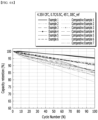
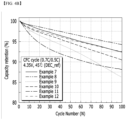
- High-temperature lifetime retention rate (%): The lithium secondary batteries thus fabricated were charged at 45 °C at constant current/constant voltage (CC/CV) of 0.7 C to 4.35 V/38 mA, and then discharged at constant current (CC) of 0.5 C to 2.5 V, and a discharge capacity was measured. This procedure was repeated for 1 cycle to 100 cycles, and the results are shown in FIG. 5.
- CC/CV constant current/constant voltage
- CC constant current
- a positive electrode active material doped with Zr/Mg/Ti was prepared in the same manner as in Example 1, except that a precursor of 5.2 ⁇ m was over-calcined at 990 °C, and 4250 ppm of Zr/Mg/Ti (3500 ppm of Zr, 250 ppm of Mg, and 500 ppm of Ti) was doped.
- a positive electrode active material doped with Zr was prepared in the same manner as in Example 1, except that a precursor of 5.2 ⁇ m was over-calcined at 990 °C, and 3500 ppm of Zr was doped by using 0.444807 g of ZrO 2 as a raw material of element M.
- a positive electrode active material doped with Zr was prepared in the same manner as in Example 1, except that a precursor of 5.2 ⁇ m was over-calcined at 990 °C, and 5500 ppm of Zr was doped by using 0.698983 g of ZrO 2 as a raw material of element M.
- LiNi 0.5 Co 0.3 Mn 0.2 O 2 doped with 4250 ppm of Zr/Mg/Ti of Example 2 and 0.078872 g of Al 2 O 3 as a raw material of element M' were mixed and calcined at 500 °C to prepare a doped positive electrode active material which was further coated with 1500 ppm of Al.
- a LiNi 0.5 Co 0.3 Mn 0.2 O 2 positive electrode active material which was doped with 4000 ppm of Zr/Mg/Ti (3500 ppm of Zr, 250 ppm of Mg, and 250 ppm of Ti) with respect to the total weight of the positive electrode active material was prepared in the same manner as in Example 1, except that over-calcination was performed at a temperature of 1010 °C instead of 990 °C as in Example 1.
- a positive electrode active material doped with Zr/Mg/Ti was prepared in the same manner as in Example 1, except that over-calcination was performed at a temperature of 1010 °C instead of 990 °C as in Example 2, and 4250 ppm of Zr/Mg/Ti (3500 ppm of Zr, 250 ppm of Mg, and 500 ppm of Ti) was doped in the same manner as in Example 2.
- LiNi 0.5 Co 0.3 Mn 0.2 O 2 doped with 4250 ppm of Zr/Mg/Ti was prepared in the same manner as in Example 3, except that over-calcination was performed at a temperature of 1010 °C instead of 990 °C as in Example 3. Thereafter, the doped positive electrode active material was further coated with 900 ppm of Al/B (500 ppm of Al and 400 ppm of B) in the same manner as in Example 3.
- a positive electrode active material doped with 3500 ppm of Zr was prepared in the same manner as in Example 4, except that over-calcination was performed at a temperature of 1010 °C instead of 990 °C as in Example 4.
- a positive electrode active material doped with 5500 ppm of Zr was prepared in the same manner as in Example 5, except that over-calcination was performed at a temperature of 1010 °C instead of 990 °C as in Example 5.
- LiNi 0.5 Co 0.3 Mn 0.2 O 2 doped with 4250 ppm of Zr/Mg/Ti was prepared in the same manner as in Example 6, except that over-calcination was performed at a temperature of 1010 °C instead of 990 °C as in Example 6. Thereafter, the doped positive electrode active material was further coated with 1500 ppm of Al in the same manner as in Example 6.
- a positive electrode active material doped with 4250 ppm of Zr/Mg/Ti was prepared in the same manner as in Example 2, except that calcination was performed at a temperature of 920 °C.
- a positive electrode active material doped with 4250 ppm of Zr/Mg/Ti was prepared in the same manner as in Example 2, except that calcination was performed at a temperature of 950 °C.
- a positive electrode active material doped with 1500 ppm of Zr was prepared in the same manner as in Example 4, except that 1500 ppm of Zr was doped.
- a positive electrode active material doped with 7500 ppm of Zr was prepared in the same manner as in Example 4, except that 7500 ppm of Zr was doped.
- a LiNi 0.5 Co 0.3 Mn 0.2 O 2 positive electrode active material was prepared in the same manner as in Example 4, except that no Zr-doping treatment was performed.
- a positive electrode active material doped with 4250 ppm of Zr/Mg/Ti was prepared in the same manner as in Example 2, except that a precursor of 11 ⁇ m was calcined at a temperature of 920 °C.
- a positive electrode active material doped with 1500 ppm of Zr was prepared in the same manner as in Example 4, except that a precursor of 12 ⁇ m was over-calcined at a temperature of 960 °C, and 1500 ppm of Zr was doped.
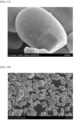
- Example 12 Each of the active materials prepared in Examples 2, 4, 6, 8, 10, and 12 was observed and analyzed using a scanning electron microscope (SEM), etc., and the results are shown in FIGS. 1A (Example 2), 1B (Example 4), 1C (Example 6), 1D (Example 8), 1E (Example 10), and 1F (Example 12). Further, crystal grain sizes of the positive electrode active materials of Examples 1 to 8 and 10 to 12, and Comparative Examples 1 to 7, were confirmed using an X-ray diffraction analyzer (Bruker AXS D4-Endeavor XRD), and the results are shown in the following Table 1.
- SEM scanning electron microscope
- the crystal grain sizes of the positive electrode active materials were calculated by performing X-ray diffraction analysis using a Cu source (Cu K ⁇ ), obtaining a full width at half maximum (FWHM) from the analysis results, and then putting the full width at half maximum into the following equation.
- ⁇ K ⁇ ⁇ / ⁇ ⁇ cos ⁇
- K is a shape factor, usually 0.9 without a unit
- ⁇ is X-ray wavelength
- ⁇ is a full width at half maximum of a peak having a maximum intensity
- ⁇ is an angle of peak maximum.
- Example 1 Total amount of coating and doping (ppm) Crystal grain size (nm)
- Example 1 4000 264
- Example 2 4250 233
- Example 3 5150 207
- Example 4 3500 225
- Example 5 5500 233
- Example 6 5750 229
- Example 7 4000 181
- Example 8 4250 194
- Example 10 3500 194
- Example 11 5500 195
- Example 12 5750 206 Comparative Example 1 4250 151 Comparative Example 2 4250 178 Comparative Example 3 1500 215 Comparative Example 4 7500 239 Comparative Example 5 0 232 Comparative Example 6 4250 154 Comparative Example 7 1500 199
- the active materials prepared according to the present invention were prepared in the form of single particles having a particle size of 3.5 ⁇ m to 10 ⁇ m.
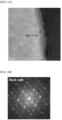
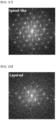
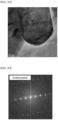
- Example 2 and Comparative Example 1 were observed using TEM-ASTAR and HR-TEM equipment. Specifically, an HR-TEM image of Example 2 is shown in FIG. 2A , a TEM-ASTAR image of the surface thereof is shown in FIGS. 2B and 2C , and a TEM-ASTAR image of the central part thereof is shown in FIG. 2D . Further, an HR-TEM image of Comparative Example 1 is shown in FIG. 2E , a TEM-ASTAR image of the surface thereof is shown in FIG. 2F , and a TEM-ASTAR image of the central part thereof is shown in FIG. 2G .
- the crystal structure of the surface part may differ depending on the calcination temperature of the precursor, even though the compositions are the same. Specifically, Comparative Example 1 which was not over-calcined showed uniform formation of a layered crystal lattice structure from the surface thereof to the center thereof.
- Example 2 which was over-calcined showed different crystal structures in the surface thereof and the center thereof. More specifically, the over-calcined Example 2 had a single particle D50 of 6.8 ⁇ m, and had a rock salt structure, a spinel structure, or a mixed structure thereof from the surface part thereof to a depth of 25 nm, and the central part thereof is a layered structure.
- the positive electrode active materials according to the examples and comparative examples were measured for gas generation and the results are shown in the following Tables 2 and 3, and FIGS. 2A and 2B .
- a method of measuring the gas generation is as follows.
- Each of the positive electrode active materials according to the examples and comparative examples was used to prepare a slurry for forming a positive electrode and a lithium secondary battery, and then their high-temperature lifetime characteristics were evaluated and the results are shown in the following FIGS. 4A and 4B .
- the active materials of Examples 1 to 12 having all technical combinations of over-calcination of precursor particles and limited doping (and coating) contents showed excellent high-voltage and high-temperature lifetime characteristics.
- Comparative Examples 1 and 2 not satisfying the over-calcination conditions showed capacity retention of 85 % or less at 100 cycles, and the slopes gradually increased. Thus, it is expected that the capacity retention will more rapidly decrease after 100 cycles.
- Comparative Examples 3 and 4 of which coating and doping contents were out of the conditions showed that capacity retention decreased and the slopes gradually decreased with cycling. Thus, it is expected that the capacity retention will further decrease after 100 cycles.
- Comparative Example 5 in which coating and doping were not performed showed excellent initial capacity retention, but showed a rapid decrease after 70 cycles.
- Comparative Example 6 in which over-calcination did not occur and the size of the precursor was large showed a rapid decrease in initial capacity retention.
- Comparative Example 7 in which over-calcination occurred but the precursor size and the coating/doping contents did not satisfy the conditions of the present invention showed a rapid decrease in initial capacity retention and deterioration in lifetime characteristics with cycling.
- those over-calcined at 1010 °C showed excellent capacity retention of the battery compared to those over-calcined at 990 °C (Examples 1 to 6), which may be associated with gas generation, as confirmed in Experimental Example 2.
- those over-calcined at 1010 °C (Examples 7 to 12) showing low Co release may improve electrochemical properties of the battery, as compared with those over-calcined at 960 °C (Examples 1 to 6).
Landscapes
- Chemical & Material Sciences (AREA)
- Chemical Kinetics & Catalysis (AREA)
- Electrochemistry (AREA)
- General Chemical & Material Sciences (AREA)
- Inorganic Chemistry (AREA)
- Organic Chemistry (AREA)
- Engineering & Computer Science (AREA)
- Manufacturing & Machinery (AREA)
- Composite Materials (AREA)
- Materials Engineering (AREA)
- Battery Electrode And Active Subsutance (AREA)
- Inorganic Compounds Of Heavy Metals (AREA)
Priority Applications (1)
| Application Number | Priority Date | Filing Date | Title |
|---|---|---|---|
| EP23186352.3A EP4250404A3 (en) | 2017-11-22 | 2018-11-21 | Positive electrode active material for lithium secondary battery and manufacturing method therefor |
Applications Claiming Priority (3)
| Application Number | Priority Date | Filing Date | Title |
|---|---|---|---|
| KR20170156745 | 2017-11-22 | ||
| KR1020180143840A KR102656223B1 (ko) | 2017-11-22 | 2018-11-20 | 리튬 이차전지용 양극활물질 및 그 제조방법 |
| PCT/KR2018/014367 WO2019103458A1 (ko) | 2017-11-22 | 2018-11-21 | 리튬 이차전지용 양극활물질 및 그 제조방법 |
Related Child Applications (2)
| Application Number | Title | Priority Date | Filing Date |
|---|---|---|---|
| EP23186352.3A Division EP4250404A3 (en) | 2017-11-22 | 2018-11-21 | Positive electrode active material for lithium secondary battery and manufacturing method therefor |
| EP23186352.3A Division-Into EP4250404A3 (en) | 2017-11-22 | 2018-11-21 | Positive electrode active material for lithium secondary battery and manufacturing method therefor |
Publications (3)
| Publication Number | Publication Date |
|---|---|
| EP3680968A1 EP3680968A1 (en) | 2020-07-15 |
| EP3680968A4 EP3680968A4 (en) | 2020-11-18 |
| EP3680968B1 true EP3680968B1 (en) | 2025-05-21 |
Family
ID=66675925
Family Applications (2)
| Application Number | Title | Priority Date | Filing Date |
|---|---|---|---|
| EP23186352.3A Pending EP4250404A3 (en) | 2017-11-22 | 2018-11-21 | Positive electrode active material for lithium secondary battery and manufacturing method therefor |
| EP18880300.1A Active EP3680968B1 (en) | 2017-11-22 | 2018-11-21 | Positive electrode active material for lithium secondary battery and manufacturing method therefor |
Family Applications Before (1)
| Application Number | Title | Priority Date | Filing Date |
|---|---|---|---|
| EP23186352.3A Pending EP4250404A3 (en) | 2017-11-22 | 2018-11-21 | Positive electrode active material for lithium secondary battery and manufacturing method therefor |
Country Status (9)
| Country | Link |
|---|---|
| US (5) | US11594727B2 (pl) |
| EP (2) | EP4250404A3 (pl) |
| JP (1) | JP6929588B2 (pl) |
| KR (2) | KR102656223B1 (pl) |
| CN (2) | CN116154148A (pl) |
| DE (3) | DE202018006967U1 (pl) |
| ES (1) | ES3032735T3 (pl) |
| HU (1) | HUE071764T2 (pl) |
| PL (1) | PL3680968T3 (pl) |
Families Citing this family (47)
| Publication number | Priority date | Publication date | Assignee | Title |
|---|---|---|---|---|
| KR102656223B1 (ko) * | 2017-11-22 | 2024-04-11 | 주식회사 엘지에너지솔루션 | 리튬 이차전지용 양극활물질 및 그 제조방법 |
| KR102258083B1 (ko) | 2018-05-17 | 2021-05-27 | 삼성에스디아이 주식회사 | 리튬 이차 전지용 양극 활물질 및 이를 포함하는 리튬 이차 전지 |
| CN113785418B (zh) * | 2019-07-22 | 2024-05-28 | 株式会社Lg化学 | 制备锂二次电池用正极活性材料的方法和由此制备的正极活性材料 |
| US12308418B2 (en) * | 2019-08-07 | 2025-05-20 | L&F Co., Ltd. | Secondary battery active material |
| US12368160B2 (en) | 2019-08-12 | 2025-07-22 | Lg Chem, Ltd. | Positive electrode for lithium secondary battery and lithium secondary battery including the same |
| US20220344653A1 (en) * | 2019-09-25 | 2022-10-27 | L&F Co., Ltd | Positive active material for lithium secondary battery |
| US11616232B2 (en) * | 2019-10-16 | 2023-03-28 | Hcm Co., Ltd. | Doped lithium manganese iron phosphate-based particulate, doped lithium manganese iron phosphate-based powdery material including the same, and method for preparing powdery material |
| US20230039367A1 (en) * | 2019-12-20 | 2023-02-09 | Posco | Cathode active material and lithium secondary battery comprising same |
| JP6857752B1 (ja) * | 2020-01-09 | 2021-04-14 | 住友化学株式会社 | リチウム金属複合酸化物、リチウム二次電池用正極活物質、リチウム二次電池用正極、リチウム二次電池及びリチウム金属複合酸化物の製造方法 |
| JP7497903B2 (ja) | 2020-01-29 | 2024-06-11 | エルジー エナジー ソリューション リミテッド | 二次電池用正極活物質およびこれを含むリチウム二次電池 |
| EP4064391B1 (en) * | 2020-01-30 | 2024-10-23 | LG Energy Solution, Ltd. | Positive electrode active material for lithium secondary battery and method of preparing the same |
| KR102595176B1 (ko) * | 2020-06-18 | 2023-10-27 | 삼성에스디아이 주식회사 | 리튬이차전지용 니켈계 복합양극활물질, 그 제조방법 및 이를 포함하는 양극을 함유한 리튬이차전지 |
| KR102855556B1 (ko) * | 2020-08-28 | 2025-09-03 | 주식회사 엘지화학 | Al이 도핑된 NCM 양극재의 Al 도핑 여부 판단 방법 |
| KR102461125B1 (ko) * | 2020-10-27 | 2022-11-01 | 주식회사 에코프로비엠 | 리튬 이차전지용 양극 활물질의 제조 방법 |
| WO2022092922A1 (ko) * | 2020-10-29 | 2022-05-05 | 주식회사 엘지에너지솔루션 | 리튬 이차 전지용 양극 활물질, 그 제조방법 및 이를 포함하는 리튬 이차 전지 |
| JP7793340B2 (ja) * | 2020-11-05 | 2026-01-05 | 日本化学工業株式会社 | リチウム二次電池用正極活物質、その製造方法及びリチウム二次電池 |
| KR102580743B1 (ko) * | 2020-12-21 | 2023-09-19 | 포스코홀딩스 주식회사 | 양극 활물질 및 이를 포함하는 리튬 이차 전지 |
| KR102580745B1 (ko) * | 2020-12-21 | 2023-09-19 | 포스코홀딩스 주식회사 | 양극 활물질 및 이를 포함하는 리튬 이차 전지 |
| EP4299529A4 (en) | 2021-02-26 | 2024-09-11 | Panasonic Intellectual Property Management Co., Ltd. | POSITIVE ELECTRODE ACTIVE MATERIAL FOR SECONDARY BATTERIES WITH ANHYDROUS ELECTROLYTE AND SECONDARY BATTERY WITH ANHYDROUS ELECTROLYTE |
| CN116235317A (zh) * | 2021-06-11 | 2023-06-06 | 三星Sdi株式会社 | 用于可再充电的锂电池的正极活性物质、其制备方法以及包括其的可再充电的锂电池 |
| CN117941095A (zh) * | 2021-09-10 | 2024-04-26 | 株式会社Lg新能源 | 正极活性材料、包含其的正极和锂二次电池 |
| JP7810805B2 (ja) * | 2022-01-07 | 2026-02-03 | エルジー エナジー ソリューション リミテッド | 正極活物質、その製造方法、それを含む正極及びリチウム二次電池 |
| KR102938042B1 (ko) * | 2022-01-27 | 2026-03-11 | 주식회사 엘 앤 에프 | 단일체 입자 및 이를 포함하는 이차전지용 활물질 |
| KR20230117818A (ko) * | 2022-02-03 | 2023-08-10 | 에스케이온 주식회사 | 리튬 이차 전지용 양극 활물질 및 이를 포함하는 리튬 이차 전지 |
| EP4459693A4 (en) * | 2022-03-03 | 2025-08-20 | Gs Yuasa Int Ltd | ENERGY STORAGE ELEMENT AND ENERGY STORAGE DEVICE |
| CN114430037B (zh) * | 2022-04-06 | 2022-07-15 | 比亚迪股份有限公司 | 一种正极材料及其应用 |
| CN117957671A (zh) * | 2022-05-20 | 2024-04-30 | 株式会社Lg化学 | 正极活性材料及其制造方法 |
| KR20240002815A (ko) * | 2022-06-30 | 2024-01-08 | 주식회사 엘지화학 | 양극 활물질, 이의 제조방법, 및 이를 포함하는 양극 및 리튬 이차전지 |
| KR20240051712A (ko) * | 2022-10-13 | 2024-04-22 | 주식회사 엘지에너지솔루션 | 리튬이차전지 |
| KR20240085714A (ko) * | 2022-12-08 | 2024-06-17 | 포스코홀딩스 주식회사 | 리튬 이차 전지용 양극 활물질, 이의 제조방법 및 이를 포함하는 리튬 이차 전지 |
| US12191488B2 (en) | 2022-12-15 | 2025-01-07 | Lg Energy Solution, Ltd. | Positive electrode active material and positive electrode including the same |
| KR20240102463A (ko) * | 2022-12-26 | 2024-07-03 | 재단법인 포항산업과학연구원 | 리튬 이차 전지용 양극 활물질, 이의 제조 방법 및 이를 포함하는 리튬 이차 전지 |
| CN116040697B (zh) * | 2023-01-18 | 2025-02-11 | 宁夏中化锂电池材料有限公司 | 一种低产气长循环三元正极材料及其制备方法 |
| US20240313283A1 (en) * | 2023-03-13 | 2024-09-19 | Ascend Elements, Inc. | Doped cathode material from recycled lithium-ion batteries |
| KR20240151032A (ko) * | 2023-04-10 | 2024-10-17 | 주식회사 엘지화학 | 양극 활물질, 이의 제조방법, 및 이를 포함하는 양극 및 리튬 이차전지 |
| KR102940280B1 (ko) * | 2023-06-26 | 2026-03-17 | (주)포스코퓨처엠 | 리튬 이차 전지용 양극 활물질 및 이를 포함하는 리튬 이차 전지 |
| KR20250019581A (ko) * | 2023-08-01 | 2025-02-10 | 주식회사 엘지화학 | 양극 활물질, 이의 제조 방법, 및 이를 포함하는 양극 및 리튬 이차전지 |
| WO2025042249A1 (ko) * | 2023-08-24 | 2025-02-27 | 주식회사 엘지에너지솔루션 | 양극 활물질, 이를 포함하는 양극 및 리튬 이차 전지 |
| KR20250045312A (ko) * | 2023-09-25 | 2025-04-01 | (주)포스코퓨처엠 | 리튬 이차 전지용 양극 활물질, 이의 제조방법 및 이를 포함하는 리튬 이차 전지 |
| WO2025080039A1 (ko) * | 2023-10-12 | 2025-04-17 | 주식회사 엘지화학 | 양극 활물질 및 이의 제조 방법 |
| KR20250065235A (ko) * | 2023-11-03 | 2025-05-12 | 주식회사 엘지화학 | 양극 활물질, 이의 제조 방법, 및 이를 포함하는 양극 및 리튬 이차전지 |
| KR20250093950A (ko) * | 2023-12-18 | 2025-06-25 | 포스코홀딩스 주식회사 | 리튬 이차 전지용 양극 활물질, 이의 제조방법 및 이를 포함하는 리튬 이차 전지 |
| KR20250094287A (ko) * | 2023-12-18 | 2025-06-25 | 포스코홀딩스 주식회사 | 리튬 이차 전지용 양극 활물질, 이의 제조방법 및 이를 포함하는 리튬 이차 전지 |
| KR20250094314A (ko) * | 2023-12-18 | 2025-06-25 | 포스코홀딩스 주식회사 | 리튬 이차 전지용 양극 활물질 및 이를 포함하는 리튬 이차 전지 |
| KR20250094165A (ko) | 2023-12-18 | 2025-06-25 | 동아대학교 산학협력단 | 리튬 이차전지용 양극 활물질 및 그 제조 방법 |
| WO2025135728A1 (ko) * | 2023-12-22 | 2025-06-26 | 주식회사 엘지에너지솔루션 | 양극 활물질, 이의 제조 방법, 이를 포함하는 양극 및 리튬 이차 전지 |
| WO2026071531A1 (ko) * | 2024-09-26 | 2026-04-02 | (주)포스코퓨처엠 | 리튬 이차 전지용 양극 활물질 및 이를 포함하는 리튬 이차 전지 |
Family Cites Families (29)
| Publication number | Priority date | Publication date | Assignee | Title |
|---|---|---|---|---|
| KR101452950B1 (ko) * | 2007-07-13 | 2014-10-21 | 주식회사 엘지화학 | 이차전지의 양극 활물질용 리튬 니켈계 산화물 및 그것의제조방법 |
| JP4440339B2 (ja) | 2008-05-15 | 2010-03-24 | パナソニック株式会社 | 非水電解質二次電池用正極活物質、非水電解質二次電池用正極および非水電解質二次電池 |
| DE102008029804A1 (de) * | 2008-06-24 | 2010-07-08 | Süd-Chemie AG | Mischoxid enthaltend einen Lithium-Mangan-Spinell und Verfahren zu dessen Herstellung |
| WO2010053328A2 (ko) * | 2008-11-10 | 2010-05-14 | 주식회사 엘지화학 | 고전압 특성이 향상된 양극 활물질 |
| KR20120030774A (ko) | 2010-09-20 | 2012-03-29 | 삼성에스디아이 주식회사 | 양극 활물질, 이의 제조방법 및 이를 이용한 리튬 전지 |
| JP5730676B2 (ja) * | 2011-06-06 | 2015-06-10 | 住友金属鉱山株式会社 | 非水系電解質二次電池用正極活物質とその製造方法、ならびに、ニッケルコバルトマンガン複合水酸化物とその製造方法 |
| JP5966387B2 (ja) | 2012-01-27 | 2016-08-10 | トヨタ自動車株式会社 | リチウム二次電池,その製造方法,およびその正極の製造方法 |
| JP5903956B2 (ja) | 2012-03-15 | 2016-04-13 | 戸田工業株式会社 | 非水電解質二次電池用リチウム複合酸化物粒子粉末及びその製造方法、並びに非水電解質二次電池 |
| KR101785262B1 (ko) * | 2013-07-08 | 2017-10-16 | 삼성에스디아이 주식회사 | 양극 활물질, 그 제조방법, 이를 채용한 양극 및 리튬이차전지 |
| WO2015012650A1 (ko) | 2013-07-26 | 2015-01-29 | 주식회사 엘지화학 | 양극 활물질 및 이의 제조방법 |
| EP3041071B1 (en) * | 2013-08-29 | 2018-10-03 | LG Chem, Ltd. | Lithium transition metal composite particles, method for preparing same, and positive active materials comprising same |
| KR101643819B1 (ko) * | 2013-10-23 | 2016-07-28 | 주식회사 엘지화학 | 표면 코팅된 양극 활물질의 제조방법 및 이에 의해 제조된 양극 활물질 |
| CN103840151B (zh) * | 2013-12-13 | 2016-04-13 | 山东海特电子新材料有限公司 | 一种特殊单晶结构的三元正极材料及其制备方法 |
| KR101566155B1 (ko) | 2013-12-17 | 2015-11-05 | 전자부품연구원 | 나노크기의 이산화티탄으로 표면이 코팅된 구형의 전이금속복합탄산물을 이용한 고전압용 비수계 리튬이차전지용 고용량 양극재료 및 그의 제조 방법 |
| CN103700836A (zh) * | 2013-12-18 | 2014-04-02 | 江苏科捷锂电池有限公司 | 单晶三元正极材料ZnO/LiNi0.5Co0.2Mn0.3O2的制备方法 |
| KR20150099219A (ko) * | 2014-02-21 | 2015-08-31 | 삼성전자주식회사 | 양극 활물질, 이를 채용한 리튬 전지, 및 상기 양극 활물질의 제조방법 |
| CN107112515B (zh) | 2014-10-28 | 2020-08-18 | 株式会社Lg 化学 | 锂二次电池用正极活性材料、其制备方法和包含其的锂二次电池 |
| CN107004846B (zh) | 2014-12-05 | 2020-04-24 | 株式会社Lg 化学 | 正极活性材料、制备其的方法以及包含其的锂二次电池 |
| WO2016089176A1 (ko) | 2014-12-05 | 2016-06-09 | 주식회사 엘지화학 | 양극 활물질, 이의 제조방법, 및 이를 포함하는 리튬 이차전지 |
| JP6627241B2 (ja) * | 2014-12-15 | 2020-01-08 | 住友金属鉱山株式会社 | 非水系電解質二次電池用正極活物質とその製造方法、および、非水系電解質二次電池 |
| CN104733723A (zh) | 2015-02-11 | 2015-06-24 | 江苏科捷锂电池有限公司 | LiCoO2包覆改性三元正极材料的制备方法 |
| PL3100981T3 (pl) * | 2015-04-28 | 2019-05-31 | Nichia Corp | Cząstki wodorotlenku kompleksu niklu i kobaltu i sposób ich otrzymywania, aktywny materiał elektrody dodatniej do zastosowań w akumulatorach z niewodnym elektrolitem i sposób jego otrzymywania oraz akumulator z niewodnym elektrolitem |
| WO2016175311A1 (ja) * | 2015-04-30 | 2016-11-03 | 三井金属鉱業株式会社 | 5v級スピネル型リチウムマンガン含有複合酸化物 |
| CN105185982A (zh) * | 2015-08-31 | 2015-12-23 | 宁波金和锂电材料有限公司 | 一种正极材料及其制备方法和锂离子电池 |
| KR101913897B1 (ko) * | 2015-09-30 | 2018-12-28 | 주식회사 엘지화학 | 이차전지용 양극활물질 및 이를 포함하는 이차전지 |
| JP2017188428A (ja) | 2016-03-30 | 2017-10-12 | Basf戸田バッテリーマテリアルズ合同会社 | 非水電解質二次電池用の正極活物質及びその製造方法、並びにそれを用いた非水電解質二次電池 |
| WO2018160023A1 (ko) | 2017-02-28 | 2018-09-07 | 주식회사 엘지화학 | 리튬 이차전지용 양극 활물질, 그 제조방법 및 이를 포함하는 리튬 이차전지 |
| KR102176633B1 (ko) | 2017-02-28 | 2020-11-09 | 주식회사 엘지화학 | 리튬 이차전지용 양극 활물질, 그 제조방법 및 이를 포함하는 리튬 이차전지 |
| KR102656223B1 (ko) * | 2017-11-22 | 2024-04-11 | 주식회사 엘지에너지솔루션 | 리튬 이차전지용 양극활물질 및 그 제조방법 |
-
2018
- 2018-11-20 KR KR1020180143840A patent/KR102656223B1/ko active Active
- 2018-11-21 CN CN202310333298.7A patent/CN116154148A/zh active Pending
- 2018-11-21 EP EP23186352.3A patent/EP4250404A3/en active Pending
- 2018-11-21 CN CN201880064115.3A patent/CN111164806B/zh active Active
- 2018-11-21 US US16/755,688 patent/US11594727B2/en active Active
- 2018-11-21 DE DE202018006967.1U patent/DE202018006967U1/de active Active
- 2018-11-21 JP JP2019563197A patent/JP6929588B2/ja active Active
- 2018-11-21 EP EP18880300.1A patent/EP3680968B1/en active Active
- 2018-11-21 ES ES18880300T patent/ES3032735T3/es active Active
- 2018-11-21 DE DE202018006941.8U patent/DE202018006941U1/de active Active
- 2018-11-21 PL PL18880300.1T patent/PL3680968T3/pl unknown
- 2018-11-21 DE DE202018006840.3U patent/DE202018006840U1/de active Active
- 2018-11-21 HU HUE18880300A patent/HUE071764T2/hu unknown
-
2023
- 2023-01-24 US US18/100,778 patent/US11909045B2/en active Active
- 2023-06-27 US US18/214,800 patent/US11967714B2/en active Active
- 2023-10-27 KR KR1020230146036A patent/KR102687546B1/ko active Active
-
2024
- 2024-03-19 US US18/609,708 patent/US12249712B2/en active Active
-
2025
- 2025-02-06 US US19/047,382 patent/US20250183295A1/en active Pending
Also Published As
| Publication number | Publication date |
|---|---|
| KR20190059241A (ko) | 2019-05-30 |
| JP2020520539A (ja) | 2020-07-09 |
| JP6929588B2 (ja) | 2021-09-01 |
| CN111164806B (zh) | 2023-04-21 |
| US11909045B2 (en) | 2024-02-20 |
| US20200295367A1 (en) | 2020-09-17 |
| PL3680968T3 (pl) | 2025-07-21 |
| KR20230153983A (ko) | 2023-11-07 |
| US20240234719A1 (en) | 2024-07-11 |
| DE202018006840U1 (de) | 2023-09-19 |
| ES3032735T3 (en) | 2025-07-24 |
| EP3680968A4 (en) | 2020-11-18 |
| US11967714B2 (en) | 2024-04-23 |
| EP3680968A1 (en) | 2020-07-15 |
| CN111164806A (zh) | 2020-05-15 |
| US11594727B2 (en) | 2023-02-28 |
| DE202018006967U1 (de) | 2025-02-12 |
| EP4250404A2 (en) | 2023-09-27 |
| US20250183295A1 (en) | 2025-06-05 |
| US12249712B2 (en) | 2025-03-11 |
| US20230352678A1 (en) | 2023-11-02 |
| HUE071764T2 (hu) | 2025-09-28 |
| DE202018006941U1 (de) | 2024-09-27 |
| CN116154148A (zh) | 2023-05-23 |
| KR102656223B1 (ko) | 2024-04-11 |
| US20230163295A1 (en) | 2023-05-25 |
| EP4250404A3 (en) | 2023-12-06 |
| KR102687546B1 (ko) | 2024-07-24 |
Similar Documents
| Publication | Publication Date | Title |
|---|---|---|
| US11967714B2 (en) | Positive electrode active material for lithium secondary battery and preparation method thereof | |
| KR102657451B1 (ko) | 이차전지용 양극재 및 이를 포함하는 리튬 이차전지 | |
| JP6523444B2 (ja) | リチウム二次電池用正極活物質、この製造方法及びこれを含むリチウム二次電池 | |
| KR101777466B1 (ko) | 리튬 이차전지용 양극활물질, 이의 제조방법 및 이를 포함하는 리튬 이차전지 | |
| KR20210097646A (ko) | 리튬 이차전지용 양극 활물질 및 이의 제조 방법 | |
| KR102481802B1 (ko) | 양극 활물질 전구체의 제조 방법 및 양극 활물질 전구체 | |
| KR102729341B1 (ko) | 리튬 이차 전지용 양극 활물질의 제조방법 | |
| KR102809602B1 (ko) | 양극 활물질, 그 제조 방법, 이를 포함하는 양극재, 양극 및 리튬 이차 전지 | |
| KR102664291B1 (ko) | 이차전지용 양극 활물질 전구체, 양극 활물질, 그 제조방법 및 이를 포함하는 리튬 이차전지 | |
| KR102264804B1 (ko) | 리튬 복합 산화물 및 이를 포함하는 리튬 이차전지 | |
| KR20200107843A (ko) | 리튬 이차전지 | |
| EP4421914A1 (en) | Cathode active material, method for manufacturing same, and cathode comprising same | |
| KR20220113195A (ko) | 양극 활물질 및 이의 제조방법 | |
| EP4361105A1 (en) | Positive electrode active material | |
| JP2023500220A (ja) | 正極活物質、これを含む正極およびリチウム二次電池 | |
| KR102745357B1 (ko) | 양극 활물질, 이를 포함하는 양극 및 리튬 이차전지 | |
| KR20220113201A (ko) | 양극 활물질 및 이의 제조방법 | |
| EP4708398A1 (en) | Positive electrode active material, method for producing same, positive electrode comprising positive electrode active material, and lithium secondary battery comprising positive electrode active material | |
| EP4361102A1 (en) | Positive electrode active material and lithium secondary battery comprising the same | |
| EP4593114A1 (en) | Positive electrode active material and lithium secondary battery including same | |
| EP4734175A1 (en) | Positive electrode active material, and positive electrode and lithium secondary battery comprising same | |
| KR20250128111A (ko) | 양극 활물질, 및 이를 포함하는 양극 및 리튬 이차전지 | |
| EP4693483A1 (en) | Positive electrode active material and lithium secondary battery comprising same | |
| KR20250097577A (ko) | 양극 활물질, 이를 포함하는 양극 및 리튬 이차 전지 | |
| KR20260047781A (ko) | 양극 활물질, 이를 포함하는 양극 및 리튬 이차전지 |
Legal Events
| Date | Code | Title | Description |
|---|---|---|---|
| STAA | Information on the status of an ep patent application or granted ep patent |
Free format text: STATUS: THE INTERNATIONAL PUBLICATION HAS BEEN MADE |
|
| PUAI | Public reference made under article 153(3) epc to a published international application that has entered the european phase |
Free format text: ORIGINAL CODE: 0009012 |
|
| STAA | Information on the status of an ep patent application or granted ep patent |
Free format text: STATUS: REQUEST FOR EXAMINATION WAS MADE |
|
| 17P | Request for examination filed |
Effective date: 20200406 |
|
| AK | Designated contracting states |
Kind code of ref document: A1 Designated state(s): AL AT BE BG CH CY CZ DE DK EE ES FI FR GB GR HR HU IE IS IT LI LT LU LV MC MK MT NL NO PL PT RO RS SE SI SK SM TR |
|
| AX | Request for extension of the european patent |
Extension state: BA ME |
|
| A4 | Supplementary search report drawn up and despatched |
Effective date: 20201015 |
|
| RIC1 | Information provided on ipc code assigned before grant |
Ipc: H01M 4/04 20060101ALI20201009BHEP Ipc: H01M 4/62 20060101ALI20201009BHEP Ipc: H01M 4/36 20060101ALI20201009BHEP Ipc: H01M 4/525 20100101AFI20201009BHEP Ipc: H01M 4/1391 20100101ALI20201009BHEP Ipc: C01G 53/00 20060101ALI20201009BHEP Ipc: H01M 10/0525 20100101ALI20201009BHEP |
|
| DAV | Request for validation of the european patent (deleted) | ||
| DAX | Request for extension of the european patent (deleted) | ||
| RAP1 | Party data changed (applicant data changed or rights of an application transferred) |
Owner name: LG ENERGY SOLUTION LTD. |
|
| RAP3 | Party data changed (applicant data changed or rights of an application transferred) |
Owner name: LG ENERGY SOLUTION, LTD. |
|
| STAA | Information on the status of an ep patent application or granted ep patent |
Free format text: STATUS: EXAMINATION IS IN PROGRESS |
|
| 17Q | First examination report despatched |
Effective date: 20231023 |
|
| GRAP | Despatch of communication of intention to grant a patent |
Free format text: ORIGINAL CODE: EPIDOSNIGR1 |
|
| STAA | Information on the status of an ep patent application or granted ep patent |
Free format text: STATUS: GRANT OF PATENT IS INTENDED |
|
| RIC1 | Information provided on ipc code assigned before grant |
Ipc: C01G 53/42 20250101ALI20250131BHEP Ipc: H01M 4/62 20060101ALI20250131BHEP Ipc: H01M 4/36 20060101ALI20250131BHEP Ipc: H01M 10/0525 20100101ALI20250131BHEP Ipc: C01G 53/50 20250101ALI20250131BHEP Ipc: H01M 4/1391 20100101ALI20250131BHEP Ipc: H01M 4/04 20060101ALI20250131BHEP Ipc: H01M 4/525 20100101AFI20250131BHEP |
|
| INTG | Intention to grant announced |
Effective date: 20250225 |
|
| GRAS | Grant fee paid |
Free format text: ORIGINAL CODE: EPIDOSNIGR3 |
|
| GRAA | (expected) grant |
Free format text: ORIGINAL CODE: 0009210 |
|
| STAA | Information on the status of an ep patent application or granted ep patent |
Free format text: STATUS: THE PATENT HAS BEEN GRANTED |
|
| P01 | Opt-out of the competence of the unified patent court (upc) registered |
Free format text: CASE NUMBER: APP_13456/2025 Effective date: 20250319 |
|
| AK | Designated contracting states |
Kind code of ref document: B1 Designated state(s): AL AT BE BG CH CY CZ DE DK EE ES FI FR GB GR HR HU IE IS IT LI LT LU LV MC MK MT NL NO PL PT RO RS SE SI SK SM TR |
|
| REG | Reference to a national code |
Ref country code: GB Ref legal event code: FG4D |
|
| REG | Reference to a national code |
Ref country code: CH Ref legal event code: EP |
|
| REG | Reference to a national code |
Ref country code: DE Ref legal event code: R096 Ref document number: 602018082187 Country of ref document: DE |
|
| REG | Reference to a national code |
Ref country code: IE Ref legal event code: FG4D |
|
| REG | Reference to a national code |
Ref country code: NL Ref legal event code: FP |
|
| REG | Reference to a national code |
Ref country code: SE Ref legal event code: TRGR |
|
| REG | Reference to a national code |
Ref country code: ES Ref legal event code: FG2A Ref document number: 3032735 Country of ref document: ES Kind code of ref document: T3 Effective date: 20250724 |
|
| REG | Reference to a national code |
Ref country code: HU Ref legal event code: AG4A Ref document number: E071764 Country of ref document: HU |
|
| PG25 | Lapsed in a contracting state [announced via postgrant information from national office to epo] |
Ref country code: FI Free format text: LAPSE BECAUSE OF FAILURE TO SUBMIT A TRANSLATION OF THE DESCRIPTION OR TO PAY THE FEE WITHIN THE PRESCRIBED TIME-LIMIT Effective date: 20250521 Ref country code: PT Free format text: LAPSE BECAUSE OF FAILURE TO SUBMIT A TRANSLATION OF THE DESCRIPTION OR TO PAY THE FEE WITHIN THE PRESCRIBED TIME-LIMIT Effective date: 20250922 |
|
| REG | Reference to a national code |
Ref country code: LT Ref legal event code: MG9D |
|
| PG25 | Lapsed in a contracting state [announced via postgrant information from national office to epo] |
Ref country code: GR Free format text: LAPSE BECAUSE OF FAILURE TO SUBMIT A TRANSLATION OF THE DESCRIPTION OR TO PAY THE FEE WITHIN THE PRESCRIBED TIME-LIMIT Effective date: 20250822 Ref country code: NO Free format text: LAPSE BECAUSE OF FAILURE TO SUBMIT A TRANSLATION OF THE DESCRIPTION OR TO PAY THE FEE WITHIN THE PRESCRIBED TIME-LIMIT Effective date: 20250821 |
|
| PG25 | Lapsed in a contracting state [announced via postgrant information from national office to epo] |
Ref country code: BG Free format text: LAPSE BECAUSE OF FAILURE TO SUBMIT A TRANSLATION OF THE DESCRIPTION OR TO PAY THE FEE WITHIN THE PRESCRIBED TIME-LIMIT Effective date: 20250521 |
|
| PG25 | Lapsed in a contracting state [announced via postgrant information from national office to epo] |
Ref country code: HR Free format text: LAPSE BECAUSE OF FAILURE TO SUBMIT A TRANSLATION OF THE DESCRIPTION OR TO PAY THE FEE WITHIN THE PRESCRIBED TIME-LIMIT Effective date: 20250521 |
|
| PG25 | Lapsed in a contracting state [announced via postgrant information from national office to epo] |
Ref country code: RS Free format text: LAPSE BECAUSE OF FAILURE TO SUBMIT A TRANSLATION OF THE DESCRIPTION OR TO PAY THE FEE WITHIN THE PRESCRIBED TIME-LIMIT Effective date: 20250821 |
|
| PG25 | Lapsed in a contracting state [announced via postgrant information from national office to epo] |
Ref country code: IS Free format text: LAPSE BECAUSE OF FAILURE TO SUBMIT A TRANSLATION OF THE DESCRIPTION OR TO PAY THE FEE WITHIN THE PRESCRIBED TIME-LIMIT Effective date: 20250921 |
|
| PG25 | Lapsed in a contracting state [announced via postgrant information from national office to epo] |
Ref country code: LV Free format text: LAPSE BECAUSE OF FAILURE TO SUBMIT A TRANSLATION OF THE DESCRIPTION OR TO PAY THE FEE WITHIN THE PRESCRIBED TIME-LIMIT Effective date: 20250521 |
|
| PGFP | Annual fee paid to national office [announced via postgrant information from national office to epo] |
Ref country code: NL Payment date: 20251020 Year of fee payment: 8 |
|
| PGFP | Annual fee paid to national office [announced via postgrant information from national office to epo] |
Ref country code: HU Payment date: 20251127 Year of fee payment: 8 |
|
| REG | Reference to a national code |
Ref country code: AT Ref legal event code: MK05 Ref document number: 1797576 Country of ref document: AT Kind code of ref document: T Effective date: 20250521 |
|
| PGFP | Annual fee paid to national office [announced via postgrant information from national office to epo] |
Ref country code: DE Payment date: 20251020 Year of fee payment: 8 |
|
| PGFP | Annual fee paid to national office [announced via postgrant information from national office to epo] |
Ref country code: GB Payment date: 20251023 Year of fee payment: 8 |
|
| PG25 | Lapsed in a contracting state [announced via postgrant information from national office to epo] |
Ref country code: DK Free format text: LAPSE BECAUSE OF FAILURE TO SUBMIT A TRANSLATION OF THE DESCRIPTION OR TO PAY THE FEE WITHIN THE PRESCRIBED TIME-LIMIT Effective date: 20250521 Ref country code: AT Free format text: LAPSE BECAUSE OF FAILURE TO SUBMIT A TRANSLATION OF THE DESCRIPTION OR TO PAY THE FEE WITHIN THE PRESCRIBED TIME-LIMIT Effective date: 20250521 Ref country code: SM Free format text: LAPSE BECAUSE OF FAILURE TO SUBMIT A TRANSLATION OF THE DESCRIPTION OR TO PAY THE FEE WITHIN THE PRESCRIBED TIME-LIMIT Effective date: 20250521 |
|
| PGFP | Annual fee paid to national office [announced via postgrant information from national office to epo] |
Ref country code: IT Payment date: 20251021 Year of fee payment: 8 |
|
| PGFP | Annual fee paid to national office [announced via postgrant information from national office to epo] |
Ref country code: FR Payment date: 20251021 Year of fee payment: 8 |
|
| PGFP | Annual fee paid to national office [announced via postgrant information from national office to epo] |
Ref country code: TR Payment date: 20251022 Year of fee payment: 8 Ref country code: BE Payment date: 20251020 Year of fee payment: 8 |
|
| PGFP | Annual fee paid to national office [announced via postgrant information from national office to epo] |
Ref country code: SE Payment date: 20251021 Year of fee payment: 8 |
|
| PG25 | Lapsed in a contracting state [announced via postgrant information from national office to epo] |
Ref country code: CZ Free format text: LAPSE BECAUSE OF FAILURE TO SUBMIT A TRANSLATION OF THE DESCRIPTION OR TO PAY THE FEE WITHIN THE PRESCRIBED TIME-LIMIT Effective date: 20250521 |
|
| PGFP | Annual fee paid to national office [announced via postgrant information from national office to epo] |
Ref country code: PL Payment date: 20251020 Year of fee payment: 8 |
|
| PG25 | Lapsed in a contracting state [announced via postgrant information from national office to epo] |
Ref country code: EE Free format text: LAPSE BECAUSE OF FAILURE TO SUBMIT A TRANSLATION OF THE DESCRIPTION OR TO PAY THE FEE WITHIN THE PRESCRIBED TIME-LIMIT Effective date: 20250521 |
|
| PG25 | Lapsed in a contracting state [announced via postgrant information from national office to epo] |
Ref country code: RO Free format text: LAPSE BECAUSE OF FAILURE TO SUBMIT A TRANSLATION OF THE DESCRIPTION OR TO PAY THE FEE WITHIN THE PRESCRIBED TIME-LIMIT Effective date: 20250521 Ref country code: SK Free format text: LAPSE BECAUSE OF FAILURE TO SUBMIT A TRANSLATION OF THE DESCRIPTION OR TO PAY THE FEE WITHIN THE PRESCRIBED TIME-LIMIT Effective date: 20250521 |
|
| PGFP | Annual fee paid to national office [announced via postgrant information from national office to epo] |
Ref country code: ES Payment date: 20251215 Year of fee payment: 8 |
|
| REG | Reference to a national code |
Ref country code: DE Ref legal event code: R097 Ref document number: 602018082187 Country of ref document: DE |
|
| PLBE | No opposition filed within time limit |
Free format text: ORIGINAL CODE: 0009261 |
|
| STAA | Information on the status of an ep patent application or granted ep patent |
Free format text: STATUS: NO OPPOSITION FILED WITHIN TIME LIMIT |
|
| REG | Reference to a national code |
Ref country code: CH Ref legal event code: L10 Free format text: ST27 STATUS EVENT CODE: U-0-0-L10-L00 (AS PROVIDED BY THE NATIONAL OFFICE) Effective date: 20260402 |
|
| 26N | No opposition filed |
Effective date: 20260224 |