EP3681054A1 - Procédé de transmission à antennes multiples, terminal et station de base - Google Patents
Procédé de transmission à antennes multiples, terminal et station de base Download PDFInfo
- Publication number
- EP3681054A1 EP3681054A1 EP19208362.4A EP19208362A EP3681054A1 EP 3681054 A1 EP3681054 A1 EP 3681054A1 EP 19208362 A EP19208362 A EP 19208362A EP 3681054 A1 EP3681054 A1 EP 3681054A1
- Authority
- EP
- European Patent Office
- Prior art keywords
- srs
- transmission
- antenna
- antennas
- antenna group
- Prior art date
- Legal status (The legal status is an assumption and is not a legal conclusion. Google has not performed a legal analysis and makes no representation as to the accuracy of the status listed.)
- Withdrawn
Links
Images
Classifications
-
- H—ELECTRICITY
- H04—ELECTRIC COMMUNICATION TECHNIQUE
- H04B—TRANSMISSION
- H04B7/00—Radio transmission systems, i.e. using radiation field
- H04B7/02—Diversity systems; Multi-antenna system, i.e. transmission or reception using multiple antennas
- H04B7/04—Diversity systems; Multi-antenna system, i.e. transmission or reception using multiple antennas using two or more spaced independent antennas
- H04B7/0413—MIMO systems
- H04B7/0456—Selection of precoding matrices or codebooks, e.g. using matrices antenna weighting
-
- H—ELECTRICITY
- H04—ELECTRIC COMMUNICATION TECHNIQUE
- H04B—TRANSMISSION
- H04B7/00—Radio transmission systems, i.e. using radiation field
- H04B7/02—Diversity systems; Multi-antenna system, i.e. transmission or reception using multiple antennas
- H04B7/04—Diversity systems; Multi-antenna system, i.e. transmission or reception using multiple antennas using two or more spaced independent antennas
- H04B7/0413—MIMO systems
- H04B7/0456—Selection of precoding matrices or codebooks, e.g. using matrices antenna weighting
- H04B7/0486—Selection of precoding matrices or codebooks, e.g. using matrices antenna weighting taking channel rank into account
-
- H—ELECTRICITY
- H04—ELECTRIC COMMUNICATION TECHNIQUE
- H04B—TRANSMISSION
- H04B7/00—Radio transmission systems, i.e. using radiation field
- H04B7/02—Diversity systems; Multi-antenna system, i.e. transmission or reception using multiple antennas
- H04B7/04—Diversity systems; Multi-antenna system, i.e. transmission or reception using multiple antennas using two or more spaced independent antennas
- H04B7/06—Diversity systems; Multi-antenna system, i.e. transmission or reception using multiple antennas using two or more spaced independent antennas at the transmitting station
- H04B7/0613—Diversity systems; Multi-antenna system, i.e. transmission or reception using multiple antennas using two or more spaced independent antennas at the transmitting station using simultaneous transmission
- H04B7/0615—Diversity systems; Multi-antenna system, i.e. transmission or reception using multiple antennas using two or more spaced independent antennas at the transmitting station using simultaneous transmission of weighted versions of same signal
- H04B7/0617—Diversity systems; Multi-antenna system, i.e. transmission or reception using multiple antennas using two or more spaced independent antennas at the transmitting station using simultaneous transmission of weighted versions of same signal for beam forming
-
- H—ELECTRICITY
- H04—ELECTRIC COMMUNICATION TECHNIQUE
- H04L—TRANSMISSION OF DIGITAL INFORMATION, e.g. TELEGRAPHIC COMMUNICATION
- H04L5/00—Arrangements affording multiple use of the transmission path
- H04L5/003—Arrangements for allocating sub-channels of the transmission path
- H04L5/0048—Allocation of pilot signals, i.e. of signals known to the receiver
- H04L5/005—Allocation of pilot signals, i.e. of signals known to the receiver of common pilots, i.e. pilots destined for multiple users or terminals
-
- H—ELECTRICITY
- H04—ELECTRIC COMMUNICATION TECHNIQUE
- H04L—TRANSMISSION OF DIGITAL INFORMATION, e.g. TELEGRAPHIC COMMUNICATION
- H04L5/00—Arrangements affording multiple use of the transmission path
- H04L5/0091—Signalling for the administration of the divided path, e.g. signalling of configuration information
- H04L5/0094—Indication of how sub-channels of the path are allocated
-
- H—ELECTRICITY
- H04—ELECTRIC COMMUNICATION TECHNIQUE
- H04W—WIRELESS COMMUNICATION NETWORKS
- H04W72/00—Local resource management
- H04W72/20—Control channels or signalling for resource management
- H04W72/23—Control channels or signalling for resource management in the downlink direction of a wireless link, i.e. towards a terminal
-
- H—ELECTRICITY
- H04—ELECTRIC COMMUNICATION TECHNIQUE
- H04W—WIRELESS COMMUNICATION NETWORKS
- H04W74/00—Wireless channel access
- H04W74/002—Transmission of channel access control information
- H04W74/004—Transmission of channel access control information in the uplink, i.e. towards network
-
- H—ELECTRICITY
- H04—ELECTRIC COMMUNICATION TECHNIQUE
- H04L—TRANSMISSION OF DIGITAL INFORMATION, e.g. TELEGRAPHIC COMMUNICATION
- H04L5/00—Arrangements affording multiple use of the transmission path
- H04L5/0001—Arrangements for dividing the transmission path
- H04L5/0003—Two-dimensional division
- H04L5/0005—Time-frequency
- H04L5/0007—Time-frequency the frequencies being orthogonal, e.g. OFDM(A) or DMT
-
- H—ELECTRICITY
- H04—ELECTRIC COMMUNICATION TECHNIQUE
- H04W—WIRELESS COMMUNICATION NETWORKS
- H04W88/00—Devices specially adapted for wireless communication networks, e.g. terminals, base stations or access point devices
- H04W88/08—Access point devices
Definitions
- the present invention relates to the field of communications, and more particularly, to a multi-antenna transmission method, a terminal and a base station.
- MIMO Multiple-Input Multiple-Out-put
- LTE Long Term Evolution
- TDD Time Division Duplexing
- the beamforming estimates an airspace channel on which received signals propagate to obtain beamforming reception/transmission weighting value, and during a receiving/transmitting process, the input and output signals of each antenna in the array are weighted to achieve signal beamforming reception/transmission.
- the LTE TDD mode uses the time division duplex mode, wherein uplink and downlink channels occupy the same frequency resource and have essential channel reciprocity, and it is very suitable for using the beamforming technique to improve the downlink performance.
- the basic operating procedure of downlink beamforming in the LTE TDD system is: first, an evolved Node B (eNodeB or eNB) estimates to obtain an uplink channel according to a Sounding Reference Signal (referred to as SRS) or Demodulation Reference signal (referred to as DMRS) transmitted in the uplink, and obtains the equivalent downlink channel according to the channel reciprocity, the eNB performs a downlink transmission beamforming vector estimation according to the equivalent downlink channel.
- SRS Sounding Reference Signal
- DMRS Demodulation Reference signal
- the eNB uses the estimated beamforming vector to perform a downlink transmission, and performs the same beamforming on transmitted data and the UE-specific reference signals (UE-Specific RS).
- UE user equipment
- the UE-specific reference signal for channel estimation to obtain the equivalent channel, thus recovering the downlink transmitted data.
- the Long Term Evolution advanced (LTE-A) R10 supports uplink MIMO (UL-MIMO) and downlink MIMO (DL MIMO), and supports up to four SRS port transmission in the uplink and up to eight antenna reception in the downlink at the UE side.
- UL-MIMO uplink MIMO
- DL MIMO downlink MIMO
- the eNB using the SRS or DMRS transmitted in the uplink can only obtain downlink radio channels between some but not all of the UE's reception antennas and the base station transmission antennas; in the LTE, when the number of UE's transmission antennas is 1, in order to better support the beamforming based on the channel reciprocity in the TDD mode, the method for switching the UE's transmission antennas can be used to support two antennas alternately transmitting the SRS.
- the number of downlink MIMO configuration ports is greater than 2, the scheme cannot make the eNB have full access to the radio channels between the UE's antennas and the base station antennas.
- the eNB when the number of antennas which can be used by the UE for uplink transmission is greater than the number of SRS transmission ports, only through SRS signals transmitted by the SRS transmission ports, the eNB is hard to obtain conditions of radio channels completely from all the UE's antennas to the eNB, and cannot transmit a physical uplink shared channel (PUSCH) with an optimal antenna or antenna group to obtain an optimal uplink transmission performance.
- PUSCH physical uplink shared channel
- the embodiment of the present invention provides a multi-antenna transmission method, a terminal and a base station to solve the problem in the related art that, the downlink pre-coding calculated by the eNB according to the uplink channel matrix cannot match the radio channels between all the UE's antennas and the base station antennas when the number of UE's reception antennas is greater than the number of SRS transmission ports and the number of downlink configuration ports is greater than 2, as well as the problem that the eNB is hard to obtain conditions of radio channels from all the UE's antennas to the eNodeB completely when the number of antennas which can be used by the UE for transmission is greater than the number of SRS transmission ports, and cannot make the PUSCH transmitted through the optimal antenna or antenna group.
- the abovementioned method may further have the following feature:
- the abovementioned method may further have the following feature:
- the abovementioned method may further have the following feature: the new SRS transmission ports are orthogonal with the UE's LTE-A standard SRS transmission ports through time division, frequency division, or code division.
- the abovementioned method may further have the following feature: when the SRS transmission mode comprises a signaling which is used to instruct the UE to perform an antenna group alternate transmission, it further comprises a signaling for instructing an antenna grouping principle, and the antenna grouping principle is grouping antennas whose antenna correlation is greater than or equal to a standard correlation into a same antenna group.
- the abovementioned method may further have the following feature: when the number of antenna groups which are used for performing the antenna group alternate transmission is more than one, the numbers of times of various antenna groups transmitting the SRS in one SRS transmission cycle are the same.
- the abovementioned method may further have the following feature: when the number of antenna groups which are used for performing the antenna group alternate transmission is 2, the eNodeB uses SRS antenna port serial number in a SRS antenna alternate transmission rule to instruct antenna group serial numbers.
- the abovementioned method may further have the following feature: the antenna group division method is determined according to whether the UE needs to perform a PUSCH antenna group selection and transmission or not, and when the UE needs to perform the PUSCH antenna group selection, preferably, antennas whose antenna correlation is greater than or equal to the standard correlation are grouped in the same antenna group, and when the UE does not need to perform the PUSCH antenna group selection, preferably, antennas whose antenna correlation is less than the standard correlation are grouped in the same antenna group.
- the abovementioned method may further have the following feature:
- the present invention further provides a user equipment (UE), and the UE comprises a receiving module, an analysis processing module and a transmitting module; the receiving module is configured to: receive a SRS transmission mode as well as a control signaling required by the SRS transmission mode from an eNodeB, the SRS transmission mode comprises the UE's new SRS transmission port information determined according to the maximum number of the UE's reception antennas or the maximum number of antennas which can be used by the UE for transmission and/or a signaling for instructing the UE to perform an antenna group alternate transmission; and is further used to receive a downlink MIMO precoding matrix signal or receive a PUSCH antenna group instructed by the eNodeB as well as an uplink MIMO pre-coding matrix signal; the analysis processing module is configured to: analyze the control signaling and the SRS transmission mode; the transmitting module is configured to: send the eNodeB the maximum number of the UE's reception antennas and/or the maximum number of antennas which can be used for transmission, and also used to
- the abovementioned UE may further have the following feature: the transmitting module is configured to: when the number of antenna groups used for performing the antenna group alternate transmission is greater than 1, transmit the SRS for the same number of times in each antenna group in one SRS transmission cycle.
- the abovementioned UE may further have the following feature: the analysis processing module is further configured to: determine an antenna group division method according to whether the UE needs to perform a PUSCH antenna group selection and transmission or not, and when there is a need to perform the PUSCH antenna group selection, preferably, group antennas whose antenna correlation is greater than or equal to a standard correlation in the same antenna group, and when there is no need to perform the PUSCH antenna group selection, preferably, group antennas whose antenna correlation is less than a standard correlation into the same antenna group.
- the embodiment of the present invention further provides a base station, and the base station comprises a receiving module, an analysis processing module and a transmitting module;
- the analysis processing module is configured to: determine the UE's new SRS transmission port information according to the maximum number of the UE's reception antennas or the maximum number of antennas which can be used for transmission, and is further used to determine a signaling for instructing the UE to perform the antenna group alternate transmission; and further used to estimate channel information between the base station and the UE according to the SRS; and is further used to perform a downlink MIMO pre-coding matrix calculation according to the channel information; and is further used to perform a PUSCH antenna group selection and an uplink MIMO pre-coding matrix calculation according to the channel information;
- the transmitting module is configured to: send the UE a SRS transmission mode and a control signaling required by the SRS transmission mode, wherein the SRS transmission mode comprises the new SRS transmission port information and/or a signaling used for instructing the UE to perform an antenna group alternate transmission;
- the abovementioned base station may further have the following feature:
- the abovementioned base station may further have the following feature: the SRS transmission port determining unit is configured to: when determining the number of new SRS transmission ports according to the maximum number of the UE's reception antennas, make the sum of the number of the new SRS transmission ports and the number of long term evolution advanced (LTE-A) standard SRS transmission ports be the maximum number of the UE's reception antennas; further used to make the sum of the number of the new SRS transmission ports and the number of LTE-A standard SRS transmission ports be the maximum number of antennas which can be used by the UE for transmission when determining the number of new SRS transmission ports according to the maximum number of antennas which can be used by the UE for transmission.
- LTE-A long term evolution advanced
- the abovementioned base station may further have the following feature: the SRS transmission port determining unit is further configured to: set the new SRS transmission ports to be orthogonal with the UE's LTE-A standard SRS transmission ports through time division, frequency division, or code division.
- the abovementioned base station may further have the following feature: when the SRS transmission mode comprises a signaling for instructing the UE to perform an antenna group alternate transmission, it further comprises a signaling for instructing an antenna grouping principle, and the antenna grouping principle is grouping antennas whose antenna correlation is greater than or equal to a standard correlation into the same antenna group.
- the abovementioned base station may further have the following feature:
- the abovementioned base station may further have the following feature:
- the abovementioned base station may further have the following feature:
- the embodiment of the present invention can be used to overcome the problem that a downlink pre-coding calculated by the eNode B according to the uplink channel matrix cannot match radio channels between all the UE's antennas and the base station antennas in the LTE-A TDD mode when the number of the UE's reception antennas is greater than the number of transmission ports and the number of downlink configuration ports is greater than 2; in addition, it can also overcome the problem that the eNodeB is hard to obtain conditions of radio channels completely from all the UE's antennas to the eNode in the LTE/LTE-A system when the number of antennas which can be used by the UE for transmission is greater than the number of transmission ports, so that the PUSCH cannot be transmitted through the optimal antenna or antenna group. If the beamforming method is used, it can further overcome the quantization error exists in a codebook, precisely match the channels, and improve the downlink performance.
- the multi-antenna signal transmission method according to the sounding reference signal in accordance with an embodiment of the present invention comprises steps S101 to S103.
- an eNB sends a UE a SRS transmission mode and a control signaling required by the SRS transmission mode, and the SRS transmission mode comprises the UE's new SRS transmission port information and/or a signaling for instructing the UE to perform an antenna group alternate transmission according to the maximum number of the UE's reception antennas or the maximum number of antennas which can be used for transmission; when the eNB sends the control signaling, a RRC signaling can be used for configuration, and a DCI signaling can also be used to perform a dynamic activation.
- step S102 the UE uses the abovementioned SRS transmission mode to send the SRS according to the abovementioned control signaling, and the eNB estimates channel information between the eNB and the UE according to the SRS; in step S103, the abovementioned eNB performs a downlink MIMO pre-coding matrix calculation and transmission according to the abovementioned channel information; or, the abovementioned eNB performs a physical uplink shared channel (PUSCH) antenna group selection and an uplink MIMO pre-coding matrix calculation and transmission according to the abovementioned channel information and the UE performs an uplink MIMO signal transmission in the PUSCH antenna group selected by the abovementioned eNB.
- PUSCH physical uplink shared channel
- the eNB can add a SRS transmission mode, and the added SRS transmission mode comprises at least one of the following methods: the first method: adding the UE's SRS transmission port information.
- the LTE-A R10 scheme supports up to four antenna ports transmitting the SRS, and the number of SRS transmission ports is limited to the PUSCH transmission mode and the number of spatial multiplexing layers, in order to obtain uplink channels between all the antennas which can be used by the UE for transmission and the base station antennas, it also needs to add more antenna port transmission modes for the SRS, and the number of SRS configuration transmission ports is not limited to the PUSCH transmission mode and the number of spatial multiplexing layers.
- the eNB determines the UE's new SRS transmission port information according to the maximum number of the UE's reception antennas and the maximum number of antennas which can be used for transmission.
- the maximum number of the UE's reception antennas and the maximum number of antennas which can be used for transmission may have been known by the eNB, or acquiesced by the both parties, or carried in the information reported by the UE to the eNB.
- the eNB When determining the number of SRS transmission ports, the eNB needs to combine with the number of reception antennas reported by the UE and the number of antennas which can be used for transmission.
- the number of new SRS transmission ports is determined according to the maximum number of the UE's reception antennas, preferably, the sum of the number of new SRS transmission ports determined by the eNB and the number of LTE-A standard SRS transmission ports is the maximum number of the UE's reception antennas.
- the number of new SRS transmission ports is determined according to the maximum number of antennas which can be used by the UE for transmission, preferably, the sum of the number of new SRS transmission ports determined by the eNB and the number of LTE-A standard SRS transmission ports is the maximum number of antennas which can be used by the UE for transmission; for example, the number of all the UE's SRS transmission ports (including the new SRS transmission ports and the LTE-A standard SRS transmission ports) can be configured as ⁇ 0,1,2,4,8, ... M ⁇ , wherein M is the number of antennas which can be used by the UE for uplink transmission.
- the UE's new SRS antenna ports are orthogonal with the UE's existing LTE-A standard SRS antenna ends (such as the four antenna ports in the original LTE-A standard) through time division, frequency division, or code division.
- Time division for example, the sub-frame where the new M-4 SRS antenna ports are located has an offset value with the sub-frame of the existing four antenna ports; frequency division: for example, the new M-4 SRS antenna ports has an offset value with the RB where the existing four antenna ports are located; code division: for example, the first two antenna ports in the new M-4 SRS antenna ports, for example, the number of new SRS antenna ports is 4, that is, the SRS antenna ports ⁇ 4,5 ⁇ and the existing SRS antenna ports ⁇ 0,1 ⁇ are in the same sub-carriers, then by distinguishing with different cyclic shifts, the cyclic phase differences between the SRS antenna ports ⁇ 4,5 ⁇ and the SRS antenna port ⁇ 0 ⁇ are 2 ⁇ 2 8 and 2 ⁇ 6 8 ; the SRS antenna ports ⁇ 6,7 ⁇ and the existing SRS antenna ports ⁇ 2,3 ⁇ are in the same sub-carriers, then by distinguishing with different cyclic shifts, the cyclic phase differences between the SRS antenna ports ⁇ 6,7 ⁇ and the SRS antenna
- the second method, antenna group alternate transmission is the second method, antenna group alternate transmission.
- the number of uplink transmission ports supported in the LTE protocol is 1 and the UE supports the antenna alternate transmission, a signaling can be used to configure the antenna alternate transmission, but there is no concept of antenna group alternate transmission.
- a signaling can be used to configure the antenna alternate transmission, but there is no concept of antenna group alternate transmission.
- the number of the UE's reception antennas is greater than the number of transmission ports and the number of downlink configuration ports is greater than 2, it is better to obtain downlink channel information through the SRS and the channel reciprocity, it can add the antenna group alternate transmission function and related signaling instruction, instruct the antenna group alternate transmission via a signaling, or use other values of this signaling to instruct the fixed antenna group to transmit.
- the number of antenna groups can be the default (for example, it is two by default). After the eNB transmits a signaling which is used to instruct to perform the antenna group alternate transmission, the UE automatically performs grouping according to the default number of antenna groups. The number of antenna groups can also be determined by the eNB and notified to the UE. The eNB can determine the number of antenna groups according to the maximum number of antennas which can be used by the UE for transmission.
- antennas with relative high antenna correlation are grouped into the same antenna group, that is, antennas whose antenna correlation is greater than or equal to the standard correlation are grouped into the same antenna group, to make the antennas between the groups have relatively strong independence, therefore it can make sure that the optimal antenna group is selected for transmission in the subsequent PUSCH antenna group selection and transmission.
- the UE When the UE does not perform the PUSCH antenna group selection, preferably, it needs to divide antennas with relatively high antenna correlation into different groups to make antennas within a group have relatively strong independence, so that channels among the antennas during the SRS transmission are more independent, thus obtaining more diversity and multiplexing gain.
- the eNB can further transmit a signaling for instructing the antenna grouping principle, for example, when the bit value of the signaling is "1", it indicates that antennas whose antenna correlation is greater than or equal to the standard correlation are grouped in the same antenna group, when it is "0", it indicates that antennas whose antenna correlation is less than the standard antenna correlation are grouped in the same antenna group.
- the numbers of times of various antenna groups transmitting the SRS within one SRS transmission cycle are the same.
- the antenna group numbers are ⁇ 0,1 ⁇ .
- the number of SRS antenna ports is 4, the number of antennas that can be used for uplink transmission is 8, then the antennas can be divided into two groups, each group has four antennas and the antenna group numbers are ⁇ 0,1 ⁇ .
- the two SRS antenna port group alternate transmission rule can follow the SRS antenna alternate transmission rule in the LTE protocol, or a new SRS antenna port group alternate transmission rule can be added.
- the UE should consider the impact of the delay and relevance between the antennas and the RF indicator, and try to make antennas whose delay difference and frequency difference are relatively large in different groups.
- the UE performs the antenna grouping according to the eNodeB's antennas grouping rule instruction. If the eNB does not have an antenna grouping rule instruction, preferably, the antenna grouping is performed according to whether the UE performs the PUSCH antenna group selection and transmission or not.
- the antenna grouping is performed according to the eNodeB's antenna grouping rule instruction.
- the UE is a dual-polarized antenna
- horizontally polarized antennas and vertically polarized antennas are divided into different groups, for example, when being divided into 2 groups, the vertically polarized antennas are grouped into one group, and the horizontally polarized antennas are grouped into the other group.
- the UE divides antennas with relatively high antenna correlation into different groups to make the antennas within a group have relatively strong independence, such that channels between the antennas during the PUSCH transmission are more independent, thus obtaining more diversity and multiplexing gain.
- the UE is a dual-polarized antenna
- horizontally polarized antennas and vertically polarized antennas should be divided in different groups, and when they are divided into 2 groups, the vertically polarized antennas are in one group, and the horizontally polarized antennas are in the other group.
- the eNB uses the SRS to perform uplink channel estimation on the reference signal transmitted at the corresponding antenna port to obtain an uplink channel estimate value.
- the SRS existing ports it is to take received signals at the SRS existing ports according to the resource location (radio frame number, subframe number, uplink SC-FDMA symbol serial number, frequency domain subcarrier number), perform channel estimation, and obtain a channel estimation matrix of SRS existing ports according to the arrangement of SRS port number;
- the SRS new ports it is to take the received signal at the SRS new ports according to the resource location (radio frame number, subframe number, uplink SC-FDMA symbol serial number, frequency domain subcarrier number), perform the channel estimation, and obtain a channel estimation matrix of the SRS new ports according to the arrangement of SRS port number; then, according to the arrangement of SRS port number, the channel estimation matrix of the SRS existing ports and the channel estimate matrix of the SRS new ports are arranged into a large matrix which comprises channel estimation of all SRS ports.
- the resource location radio frame number, subframe number, uplink SC-FDMA symbol serial number, frequency domain subcarrier number
- the 0 th antenna group of the SRS it is to take received signal of the 0 th antenna group ports of the SRS according to the resource location (radio frame number, subframe number, uplink SC-FDMA symbol serial number, frequency domain subcarrier number), perform the channel estimation, and obtain the channel estimation matrix of the 0 th antenna group of SRS existing ports in accordance with the arrangement of SRS port number;
- the 1 st antenna group of the SRS it is to take received signal of the 1 st antenna group ports of the SRS according to the resource location (radio frame number, subframe number, uplink SC-FDMA symbol serial number, frequency domain subcarrier number), perform the channel estimation, and obtain the channel estimation matrix of the 1 st antenna group of SRS existing ports in accordance with the arrangement of SRS port number; the other situations can be obtained accordingly according to the antenna group serial numbers; then, according to the arrangement of antenna group serial number, channel estimation matrixes of the SRS ports of all the antenna groups are arranged into a large matrix which comprises the channel estimation
- the eNB can perform the downlink MIMO pre-coding matrix calculation and transmission according to the channel information.
- the eNB can also judge the PUSCH uplink antenna group selection and calculate the PUSCH MIMO pre-coding matrix.
- the eNB notifies the UE of the PUSCH related scheduling information, it needs a new PUSCH antenna group selection signaling; then the UE performs the MIMO transmission on the selected antenna group according to the PUSCH relevant scheduling information, including the PUSCH antenna group selection signaling, sent by the eNode B.
- the LTE protocol supports the PUSCH open-loop and closed-loop antenna alternate transmission, and the open-loop antenna alternate transmission is performed by the UE, and the protocol did not specify it; during the closed-loop antenna alternate transmission, the eNodeB indicates the PUSCH antenna selection ports through the CRC check bit scrambling sequence of the DCI format0: when the UE transmits antenna selection, the CRC check bit scrambling sequence of the DCI format0 UE transmits antenna selection Antenna selection mask ⁇ x AS ,0 , x AS ,1 ,..., x AS ,15 > UE Port 0 ⁇ 0, 0, 0, 0, 0, 0, 0, 0, 0, 0, 0, 0, 0, 0> UE Port 1 ⁇ 0, 0, 0, 0, 0, 0, 0, 0, 0, 0, 0, 1>
- the DCI SRS port indication is redefined as comprising but not limited to the following methods:
- the present method can use one of the following methods in a specific implementation:
- each of the abovementioned embodiments can solve the problem in the related art that the downlink precoding matrix calculated by the eNB according to the uplink channel matrix cannot match the radio channels between all the UE's antennas and the base station antennas when the number of the UE's reception antennas is greater than the number of transmission ports and the number of downlink configuration ports is greater than 2, as well as the problem that the eNB is hard to completely obtain conditions of radio channels from all the UE's antennas to the eNodeB when the number of antennas which can be used by the UE for transmission is greater than the number of transmission ports, and cannot make the PUSCH transmitted through the optimal antenna or antenna group.
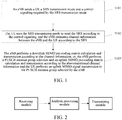
- the user equipment in the embodiment of the present invention comprises a receiving module, an analysis processing module, and a transmitting module;
- the receiving module is configured to: receive a SRS transmission mode and a control signaling which is required by the SRS transmission mode from the eNB, wherein the SRS transmission mode comprises the UE's new SRS transmission port information determined according to the maximum number of the UE's reception antennas or the maximum number of antennas which can be used for transmission and/or a signaling for instructing the UE to perform the antenna group alternate transmission; receive a downlink MIMO precoding matrix signal or receive a PUSCH antenna group indicated by the eNB and an uplink MIMO pre-coding matrix signal;
- the analysis processing module is configured to: analyze the control signaling and the SRS transmission mode;
- the transmitting module is configured to: send the eNB the maximum number of the UE's reception antennas and/or the maximum number of antennas which can be used for transmission, and use the abovementioned SRS transmission mode to transmit the SRS according to the abovementioned control signaling; and perform the uplink MIMO signal transmission in the PUSCH antenna group selected by the eNB.
- the transmitting module is configured to: when the number of antenna groups used for performing the antenna group alternate transmission is greater than 1, transmit the SRS in various antenna groups for the same times in one SRS transmission cycle.
- the analysis processing module is further configured to determine an antenna group division method according to whether the UE needs to perform the PUSCH antenna group selection and transmission or not, and when there is a need to perform the PUSCH antenna group selection, group antennas whose antenna correlation is greater than or equal to a standard correlation into a same antenna group, and when there is no need to perform the PUSCH antenna group selection, group antennas whose antenna correlation is less than the standard correlation into the same antenna group.
- the base station in the embodiment of the present invention further comprises a receiving module, an analysis processing module, and a transmitting module;
- the analysis processing module is configured to determine the UE's new SRS transmission port information according to the maximum number of the UE's reception antennas or the maximum number of antennas which can be used for transmission, determine the signaling for instructing the UE to perform the antenna group alternate transmission; estimate the channel information between the eNB and the UE according to the SRS; and is further used to perform the downlink MIMO pre-coding matrix calculation according to the abovementioned channel information; and perform the PUSCH antenna group selection and the uplink MIMO pre-coding matrix calculation according to the abovementioned channel information;
- the transmitting module is configured to send the UE the SRS transmission mode and control signaling required by the SRS transmission mode, and the SRS transmission mode comprises the new SRS transmission port information and/or the signaling used for instructing the UE to perform the antenna group alternate transmission; transmit the downlink MIMO pre-coding matrix to the
- the analysis processing module comprises a SRS transmission port determining unit; the SRS transmission port determining unit is configured to: when the purpose of the UE transmitting the SRS is for the downlink beamforming of the eNB, determine the number of new SRS transmission ports according to the maximum number of the UE's reception antennas, preferably, determine the sum of the number of new SRS transmission ports and the LTE-A standard SRS transmission ports is the maximum number of the UE's reception antennas; when the purpose of the UE transmitting the SRS is for the UE's PUSCH antenna group selection and uplink MIMO signal transmission, determine the number of the new SRS transmission ports according to the maximum number of antennas which can be used by the UE for transmission, preferably, determine that the sum of the number of the new SRS transmission ports and the number of LTE-A standard SRS transmission ports is the maximum number of antennas which can be used by the UE for transmission.
- the SRS transmission port determining unit is further configured to set the new SRS transmission ports to be orthogonal with the UE's LTE-A standard SRS transmission ports through time division, frequency division, or code division.
- the SRS transmission mode comprises a signaling for instructing the UE to perform the antenna group alternate transmission, it further comprises a signaling for indicating the antenna grouping principle, and the antenna grouping principle is grouping antennas whose antenna correlation is greater than or equal to the standard correlation in the same antenna group.
- the analysis processing module further comprises an antenna group alternate transmission setting unit which is configured to perform the alternate transmission rule of SRS antenna port during the antenna alternate transmission, and when the number of antenna groups used for performing the antenna group alternate transmission is 2, use the SRS antenna port serial number in the SRS antenna alternate transmission rule to indicate the antenna group serial numbers.
- the analysis processing module further comprises a channel estimation unit which is configured to obtain a corresponding channel estimation matrix of each LTE-A standard SRS transmission port number according to the arrangement of UE's LTE-A standard SRS port number, obtain a corresponding channel estimation matrix of each new SRS transmission port number according to the arrangement of UE's new SRS port number, and arrange the two channel estimation matrixes into one matrix as the channel estimation matrix of all the UE's SRS transmission ports, and estimate the channel information according to the matrix.
- a channel estimation unit which is configured to obtain a corresponding channel estimation matrix of each LTE-A standard SRS transmission port number according to the arrangement of UE's LTE-A standard SRS port number, obtain a corresponding channel estimation matrix of each new SRS transmission port number according to the arrangement of UE's new SRS port number, and arrange the two channel estimation matrixes into one matrix as the channel estimation matrix of all the UE's SRS transmission ports, and estimate the channel information according to the matrix.
- the channel estimation unit is further configured to: obtain the channel estimation matrix of the SRS transmission ports of each antenna group according to the arrangement of UE's SRS transmission port number, arrange the channel estimation matrixes of all the antenna groups into one matrix as the channel estimation matrix of all the UE's SRS transmission ports in accordance with the arrangement of antenna group serial number, and estimate the channel information in accordance with this matrix.
- each module/unit in the abovementioned embodiments may be realized in a form of hardware, or in a form of software function modules.
- the present invention is not limited to any specific form of hardware and software combinations.
Landscapes
- Engineering & Computer Science (AREA)
- Signal Processing (AREA)
- Computer Networks & Wireless Communication (AREA)
- Mobile Radio Communication Systems (AREA)
- Radio Transmission System (AREA)
Applications Claiming Priority (3)
| Application Number | Priority Date | Filing Date | Title |
|---|---|---|---|
| CN201210587152.7A CN103905104B (zh) | 2012-12-28 | 2012-12-28 | 一种根据探测参考信号的多天线发送方法及终端及基站 |
| EP13804361.7A EP2940885B1 (fr) | 2012-12-28 | 2013-08-14 | Procédé de transmission multi-antennes, terminal et station de base |
| PCT/CN2013/081467 WO2013185733A2 (fr) | 2012-12-28 | 2013-08-14 | Procédé de transmission multi-antennes, terminal et station de base |
Related Parent Applications (1)
| Application Number | Title | Priority Date | Filing Date |
|---|---|---|---|
| EP13804361.7A Division EP2940885B1 (fr) | 2012-12-28 | 2013-08-14 | Procédé de transmission multi-antennes, terminal et station de base |
Publications (1)
| Publication Number | Publication Date |
|---|---|
| EP3681054A1 true EP3681054A1 (fr) | 2020-07-15 |
Family
ID=49758799
Family Applications (2)
| Application Number | Title | Priority Date | Filing Date |
|---|---|---|---|
| EP19208362.4A Withdrawn EP3681054A1 (fr) | 2012-12-28 | 2013-08-14 | Procédé de transmission à antennes multiples, terminal et station de base |
| EP13804361.7A Active EP2940885B1 (fr) | 2012-12-28 | 2013-08-14 | Procédé de transmission multi-antennes, terminal et station de base |
Family Applications After (1)
| Application Number | Title | Priority Date | Filing Date |
|---|---|---|---|
| EP13804361.7A Active EP2940885B1 (fr) | 2012-12-28 | 2013-08-14 | Procédé de transmission multi-antennes, terminal et station de base |
Country Status (4)
| Country | Link |
|---|---|
| US (1) | US10038481B2 (fr) |
| EP (2) | EP3681054A1 (fr) |
| CN (1) | CN103905104B (fr) |
| WO (1) | WO2013185733A2 (fr) |
Families Citing this family (77)
| Publication number | Priority date | Publication date | Assignee | Title |
|---|---|---|---|---|
| US9655088B2 (en) * | 2013-04-17 | 2017-05-16 | Qualcomm Incorporated | Utilizing unused uplink sequence shifts for signaling |
| CN104218981B (zh) * | 2014-08-26 | 2018-03-20 | 大唐移动通信设备有限公司 | 一种多天线的联合处理方法和设备 |
| CN105530685B (zh) * | 2014-10-24 | 2020-01-07 | 中兴通讯股份有限公司 | 消息发送接收方法、发送接收装置、基站及终端 |
| CN106256092B (zh) * | 2014-12-08 | 2020-01-21 | 华为技术有限公司 | 发送导频的方法、站点及接入站 |
| US9847862B2 (en) | 2015-03-14 | 2017-12-19 | Qualcomm Incorporated | Reciprocal channel sounding reference signal multiplexing |
| US10263745B2 (en) * | 2015-03-14 | 2019-04-16 | Qualcomm Incorporated | Reciprocal channel sounding reference signal allocation and configuration |
| US10136432B2 (en) * | 2015-04-10 | 2018-11-20 | Sony Corporation | Infrastructure equipment, communications device and methods |
| CN106330281B (zh) * | 2015-06-18 | 2019-06-28 | 华为技术有限公司 | 波束赋形方法及装置 |
| CN106559277A (zh) * | 2015-09-25 | 2017-04-05 | 中兴通讯股份有限公司 | 探测参考信号的发送方法及装置、信令配置方法及装置 |
| EP3383129B1 (fr) * | 2015-12-31 | 2020-05-20 | Huawei Technologies Co., Ltd. | Appareil et procédé à commande réseau de type maître-esclave permettant de sélectionner une antenne de trame de gestion |
| WO2017137090A1 (fr) * | 2016-02-12 | 2017-08-17 | Nokia Solutions And Networks Oy | Appareil et procédé permettant une signalisation de commande dans un précodage de liaison montante |
| US10225109B2 (en) * | 2016-03-11 | 2019-03-05 | Lg Electronics Inc. | Method and apparatus for transmitting and receiving information related to SRS transmission in FDR mode |
| JP6644904B2 (ja) | 2016-03-16 | 2020-02-12 | 華為技術有限公司Huawei Technologies Co.,Ltd. | 信号伝送方法及び装置 |
| CN107579808B (zh) | 2016-07-05 | 2020-04-14 | 华为技术有限公司 | 无线通信的方法和装置 |
| WO2018016700A1 (fr) * | 2016-07-22 | 2018-01-25 | 엘지전자 주식회사 | Procédé d'émission multi-antenne en liaison montante dans un système de communication sans fil et appareil associé |
| CN109565331A (zh) * | 2016-07-29 | 2019-04-02 | 华为技术有限公司 | 用户设备ue和信道质量测量方法 |
| EP3487203B1 (fr) * | 2016-08-05 | 2020-12-16 | Huawei Technologies Co., Ltd. | Procédé et appareil d'émission pour signal de référence de sondage |
| US10826573B2 (en) * | 2016-08-10 | 2020-11-03 | Idac Holdings, Inc. | Methods, apparatus, systems and procedures for uplink (UL) channel reciprocity |
| CN107819497A (zh) * | 2016-09-12 | 2018-03-20 | 中兴通讯股份有限公司 | 基于载波聚合的空分复用方法、装置及基站 |
| AU2017332423B2 (en) * | 2016-09-26 | 2020-11-19 | Lg Electronics Inc. | Uplink transmission/reception method in wireless communication system and device therefor |
| CN107888255B (zh) * | 2016-09-30 | 2023-07-14 | 中兴通讯股份有限公司 | 上行参考信号的发送方法、装置及系统,基站和终端 |
| CN111585626B (zh) * | 2016-11-27 | 2024-11-15 | 上海朗帛通信技术有限公司 | 一种被用于多天线传输的ue、基站中的方法和装置 |
| CN114944857A (zh) * | 2017-01-26 | 2022-08-26 | 上海朗帛通信技术有限公司 | 一种用于多天线传输的用户设备、基站中的方法和装置 |
| WO2018170910A1 (fr) * | 2017-03-24 | 2018-09-27 | Motorola Mobility Llc | Détermination d'un nombre de symboles destinés à une transmission de signaux de référence de sondage |
| CN108631835B (zh) * | 2017-03-24 | 2022-04-12 | 中兴通讯股份有限公司 | 一种传输方式的信令指示方法及装置 |
| US12166541B2 (en) * | 2017-06-16 | 2024-12-10 | Telefonaktiebolaget Lm Ericsson (Publ) | Multi-resource uplink sounding and antenna subset transmission |
| CN109391304B (zh) * | 2017-08-11 | 2020-11-27 | 电信科学技术研究院 | 一种数据传输方法、基站、终端和存储介质 |
| WO2019037026A1 (fr) | 2017-08-24 | 2019-02-28 | Qualcomm Incorporated | Procédé destiné à l'émission de signal de référence de sondage servant à un équipement utilisateur comportant une émission/réception asymétrique |
| US10715233B2 (en) * | 2017-08-31 | 2020-07-14 | Qualcomm Incorporated | Sounding reference signal (SRS) transmit antenna selection |
| RU2751674C1 (ru) | 2017-10-02 | 2021-07-15 | Телефонактиеболагет Лм Эрикссон (Пабл) | Способы эффективного указания ресурсов srs |
| MX2020003441A (es) | 2017-10-02 | 2020-07-29 | Ericsson Telefon Ab L M | Transmision de referencia de sondeo. |
| CN108260217B (zh) * | 2018-03-05 | 2024-06-04 | 中兴通讯股份有限公司 | 一种信息传输的方法、装置和通信节点 |
| CN108462498B (zh) | 2018-03-16 | 2020-05-05 | Oppo广东移动通信有限公司 | 多路选择开关、射频系统和无线通信设备 |
| CN108599778B (zh) * | 2018-03-16 | 2020-06-23 | Oppo广东移动通信有限公司 | 多路选择开关、射频系统和无线通信设备 |
| CN108462499A (zh) | 2018-03-16 | 2018-08-28 | 广东欧珀移动通信有限公司 | 多路选择开关及相关产品 |
| CN108199730B (zh) * | 2018-03-16 | 2020-11-06 | Oppo广东移动通信有限公司 | 多路选择开关、射频系统以及无线通信设备 |
| CN108199729B (zh) | 2018-03-16 | 2020-09-04 | Oppo广东移动通信有限公司 | 多路选择开关、射频系统和无线通信设备 |
| CN108199725A (zh) * | 2018-03-16 | 2018-06-22 | 广东欧珀移动通信有限公司 | 多路选择开关及相关产品 |
| CN108494413B (zh) | 2018-03-16 | 2020-03-17 | Oppo广东移动通信有限公司 | 具有多路选择开关的电子设备 |
| CN108512567B (zh) * | 2018-03-16 | 2020-06-23 | Oppo广东移动通信有限公司 | 多路选择开关、射频系统和无线通信设备 |
| CN108462497B (zh) | 2018-03-16 | 2020-09-01 | Oppo广东移动通信有限公司 | 多路选择开关及相关产品 |
| CN108599777B (zh) * | 2018-03-16 | 2020-09-01 | Oppo广东移动通信有限公司 | 多路选择开关及相关产品 |
| CN110278007B (zh) | 2018-03-16 | 2020-10-20 | Oppo广东移动通信有限公司 | 多路选择开关及相关产品 |
| CN108390694B (zh) * | 2018-03-16 | 2020-05-05 | Oppo广东移动通信有限公司 | 多路选择开关、射频系统以及无线通信设备 |
| CN108462506B (zh) * | 2018-03-16 | 2020-06-23 | Oppo广东移动通信有限公司 | 多路选择开关、射频系统和无线通信设备 |
| CN108199726B (zh) * | 2018-03-16 | 2020-08-28 | Oppo广东移动通信有限公司 | 多路选择开关及相关产品 |
| CN108599779B (zh) | 2018-03-16 | 2020-03-10 | Oppo广东移动通信有限公司 | 具有多路选择开关的无线通信设备 |
| CN108462507B (zh) * | 2018-03-16 | 2020-09-04 | Oppo广东移动通信有限公司 | 多路选择开关、射频系统以及无线通信设备 |
| CN108494461B (zh) * | 2018-03-16 | 2020-06-16 | Oppo广东移动通信有限公司 | 无线通信设备 |
| CN108199727A (zh) * | 2018-03-16 | 2018-06-22 | 广东欧珀移动通信有限公司 | 多路选择开关及相关产品 |
| CN108512568A (zh) * | 2018-03-16 | 2018-09-07 | 广东欧珀移动通信有限公司 | 多路选择开关及相关产品 |
| CN108199728B (zh) | 2018-03-16 | 2020-05-19 | Oppo广东移动通信有限公司 | 多路选择开关、射频系统和无线通信设备 |
| CN108512556B (zh) * | 2018-03-16 | 2020-06-16 | Oppo广东移动通信有限公司 | 多路选择开关、射频系统和无线通信设备 |
| CN108599780A (zh) * | 2018-03-16 | 2018-09-28 | 广东欧珀移动通信有限公司 | 多路选择开关和无线通信设备 |
| CN108390693A (zh) * | 2018-03-16 | 2018-08-10 | 广东欧珀移动通信有限公司 | 多路选择开关及相关产品 |
| JP7261223B2 (ja) * | 2018-03-23 | 2023-04-19 | 株式会社Nttドコモ | 基地局及び送信方法 |
| CN108768599B (zh) * | 2018-04-02 | 2022-08-19 | 中兴通讯股份有限公司 | 上行信号的发送、接收方法及装置、存储介质、电子设备 |
| WO2019191915A1 (fr) | 2018-04-04 | 2019-10-10 | 华为技术有限公司 | Procédé permettant de transmettre un signal de référence de sondage, dispositif terminal et support de stockage lisible par ordinateur |
| ES2956485T3 (es) * | 2018-04-06 | 2023-12-21 | Ericsson Telefon Ab L M | Control de potencia para comunicación de múltiples entradas y múltiples salidas de un solo usuario de enlace ascendente de nueva radio |
| CN112292834B (zh) * | 2018-06-27 | 2022-08-26 | 华为技术有限公司 | 选择传输模式的方法和通信装置 |
| CN108900201B (zh) * | 2018-06-29 | 2020-07-28 | Oppo广东移动通信有限公司 | 多路选择开关、射频系统及电子设备 |
| US11424793B2 (en) * | 2018-07-13 | 2022-08-23 | Lenovo (Beijing) Limited | SRS configurations and SRS transmission |
| CN110838860B (zh) * | 2018-08-17 | 2023-06-27 | 大唐移动通信设备有限公司 | 一种信号传输方法、装置、终端及网络侧设备 |
| WO2020038343A1 (fr) * | 2018-08-22 | 2020-02-27 | 华为技术有限公司 | Procédé de rotation d'antenne et dispositif terminal |
| CN110858976B (zh) * | 2018-08-22 | 2021-06-29 | 华为技术有限公司 | 一种天线轮发方法及终端设备 |
| CN113965924A (zh) | 2018-09-29 | 2022-01-21 | 华为技术有限公司 | 功率指示方法及装置 |
| US11296769B2 (en) * | 2018-12-21 | 2022-04-05 | Qualcomm Incorporated | User equipment (UE) antenna grouping |
| CN111405663A (zh) * | 2019-01-03 | 2020-07-10 | 索尼公司 | 用于无线通信的电子设备和方法、计算机可读存储介质 |
| CN111416693B (zh) * | 2019-01-07 | 2023-05-09 | 中国移动通信有限公司研究院 | 一种信息发送方法、装置、终端及基站 |
| CN111769919B (zh) * | 2019-04-01 | 2024-11-15 | 华为技术有限公司 | 探测参考信号srs的传输方法及通信装置 |
| CN111867078B (zh) * | 2019-04-30 | 2023-09-29 | 大唐移动通信设备有限公司 | 上行信号传输方法、调度信息确定方法和相关设备 |
| WO2020248158A1 (fr) * | 2019-06-12 | 2020-12-17 | Qualcomm Incorporated | Configuration adaptative de port de signal de référence de sondage |
| CN112242856A (zh) * | 2019-07-16 | 2021-01-19 | 中兴通讯股份有限公司 | 一种消除多径干扰方法、装置及计算机可读存储介质 |
| CN111130607B (zh) * | 2019-12-26 | 2024-01-23 | 中兴通讯股份有限公司 | 上行传输、信号接收方法、装置、终端、服务节点及介质 |
| US11463216B2 (en) | 2020-12-04 | 2022-10-04 | Qualcomm Incorporated | Techniques for thermal mitigation and power saving |
| EP4319363A1 (fr) * | 2021-03-25 | 2024-02-07 | Guangdong Oppo Mobile Telecommunications Corp., Ltd. | Procédé et appareil pour la configuration d'une ressource de brouillage, et dispositif de terminal et périphérique de réseau |
| CN120710548A (zh) * | 2024-03-26 | 2025-09-26 | 中国移动通信有限公司研究院 | 一种信息传输方法、相关设备、存储介质及计算机产品 |
Citations (3)
| Publication number | Priority date | Publication date | Assignee | Title |
|---|---|---|---|---|
| US20110261716A1 (en) * | 2009-01-13 | 2011-10-27 | Hak Seong Kim | Method and apparatus of transmitting sounding reference signal in multiple antenna system |
| US20120039273A1 (en) * | 2010-08-12 | 2012-02-16 | Samsung Electronics Co., Ltd. | Apparatus and method for transmission of uplink sounding reference signals in a wireless network |
| US20120252474A1 (en) * | 2009-11-02 | 2012-10-04 | Esa Tapani Tiirola | Sounding Reference Signal Configuration |
Family Cites Families (14)
| Publication number | Priority date | Publication date | Assignee | Title |
|---|---|---|---|---|
| US8811353B2 (en) * | 2008-04-22 | 2014-08-19 | Texas Instruments Incorporated | Rank and PMI in download control signaling for uplink single-user MIMO (UL SU-MIMO) |
| CN101610607B (zh) * | 2008-06-20 | 2012-08-08 | 电信科学技术研究院 | 上行探测参考信号发送、接收方法以及基站和移动终端 |
| CN101626264B (zh) * | 2008-07-09 | 2013-03-20 | 中兴通讯股份有限公司 | 一种无线通信系统中实现开环预编码的方法 |
| CN101778065B (zh) * | 2009-01-12 | 2013-08-07 | 中兴通讯股份有限公司 | 一种下行数据载波映射的方法及系统 |
| CN101841357B (zh) * | 2009-03-16 | 2014-06-11 | 夏普株式会社 | 下行数据传输方法、基站和用户设备 |
| US8380135B2 (en) * | 2009-05-04 | 2013-02-19 | Lg Electronics Inc. | Method of transmitting control information in wireless communication system |
| KR101647377B1 (ko) * | 2009-05-22 | 2016-08-10 | 엘지전자 주식회사 | 무선 통신 시스템에서 안테나 전송 전력에 따른 적응적인 다중 안테나 전송 방법 및 장치 |
| KR20110119502A (ko) * | 2010-04-26 | 2011-11-02 | 삼성전자주식회사 | 다중 안테나 전송 기법을 사용하는 상향링크 무선 통신 시스템에서의 사운딩 레퍼런스 신호 전송 방법 |
| CN101888624B (zh) * | 2010-06-11 | 2016-03-30 | 中兴通讯股份有限公司 | 发射天线选择的配置方法及装置 |
| US8837394B2 (en) * | 2010-06-18 | 2014-09-16 | Mediatek Inc. | Sounding mechanism under carrier aggregation |
| CN102340463B (zh) * | 2010-07-26 | 2014-07-30 | 华为技术有限公司 | 一种信道估计方法、装置和系统 |
| WO2012081932A2 (fr) * | 2010-12-17 | 2012-06-21 | 엘지전자 주식회사 | Procédé et appareil pour transmettre un signal de référence de sondage apériodique dans un système de communication sans fil |
| CN102185642B (zh) * | 2011-05-12 | 2014-10-15 | 电信科学技术研究院 | 发送配置信息和选择发射天线的方法、系统及设备 |
| CN105247904A (zh) * | 2013-05-15 | 2016-01-13 | 高通股份有限公司 | 用于多播/广播数据传输的群承载和承载选择 |
-
2012
- 2012-12-28 CN CN201210587152.7A patent/CN103905104B/zh active Active
-
2013
- 2013-08-14 WO PCT/CN2013/081467 patent/WO2013185733A2/fr not_active Ceased
- 2013-08-14 US US14/655,731 patent/US10038481B2/en active Active
- 2013-08-14 EP EP19208362.4A patent/EP3681054A1/fr not_active Withdrawn
- 2013-08-14 EP EP13804361.7A patent/EP2940885B1/fr active Active
Patent Citations (3)
| Publication number | Priority date | Publication date | Assignee | Title |
|---|---|---|---|---|
| US20110261716A1 (en) * | 2009-01-13 | 2011-10-27 | Hak Seong Kim | Method and apparatus of transmitting sounding reference signal in multiple antenna system |
| US20120252474A1 (en) * | 2009-11-02 | 2012-10-04 | Esa Tapani Tiirola | Sounding Reference Signal Configuration |
| US20120039273A1 (en) * | 2010-08-12 | 2012-02-16 | Samsung Electronics Co., Ltd. | Apparatus and method for transmission of uplink sounding reference signals in a wireless network |
Also Published As
| Publication number | Publication date |
|---|---|
| CN103905104A (zh) | 2014-07-02 |
| US20150381246A1 (en) | 2015-12-31 |
| US10038481B2 (en) | 2018-07-31 |
| EP2940885B1 (fr) | 2019-11-13 |
| WO2013185733A2 (fr) | 2013-12-19 |
| CN103905104B (zh) | 2017-12-19 |
| EP2940885A4 (fr) | 2016-01-13 |
| WO2013185733A3 (fr) | 2014-02-13 |
| EP2940885A2 (fr) | 2015-11-04 |
Similar Documents
| Publication | Publication Date | Title |
|---|---|---|
| US10038481B2 (en) | Multi-antenna transmission method, terminal and base station | |
| US11804885B2 (en) | Codebook subset restriction for full-dimension MIMO | |
| US11515984B2 (en) | Method and apparatus for reporting channel state information in wireless communication system | |
| CN108260217B (zh) | 一种信息传输的方法、装置和通信节点 | |
| US9178596B2 (en) | Method and apparatus for transmitting and receiving codebook subset restriction bitmap | |
| US10374678B2 (en) | Channel state information feedback method and apparatus | |
| EP2600535B1 (fr) | Procédé, appareil et système pour la configuration de signaux de référence de démodulation | |
| EP2901568B1 (fr) | Retour d'informations d'état de canal non basé sur des livres de codes | |
| US9985763B2 (en) | Method for configuring channel state information reference signal, and base station | |
| EP3105875B1 (fr) | Couplage de signaux de référence dans un réseau sans fil | |
| EP3629510B1 (fr) | Procédé de transmission de données, dispositif, équipement côté réseau, et équipement d'utilisateur | |
| CN110212958B (zh) | 一种移动通信系统中的信道信息反馈方法和装置 | |
| JP2023041742A (ja) | 端末デバイスで実行される方法、端末デバイス、ネットワークデバイスで実行される方法及びネットワークデバイス | |
| KR20100089744A (ko) | 하향링크 참조 신호 송수신 기법 | |
| US20230008939A1 (en) | Method for unified uplink and downlink beam indication | |
| US12413375B2 (en) | Method for port indication for uplink data channels | |
| EP3200377A1 (fr) | Procédé et dispositif pour des communications mimo 3d dans un ue, et station de base | |
| CN111246589A (zh) | 一种随机接入信号发送方法及装置 | |
| WO2020147033A1 (fr) | Procédé, dispositif et support lisible par ordinateur pour estimer des informations d'état de canal | |
| AU2015255308B2 (en) | Method and apparatus for transmitting and receiving codebook subset restriction bitmap |
Legal Events
| Date | Code | Title | Description |
|---|---|---|---|
| PUAI | Public reference made under article 153(3) epc to a published international application that has entered the european phase |
Free format text: ORIGINAL CODE: 0009012 |
|
| STAA | Information on the status of an ep patent application or granted ep patent |
Free format text: STATUS: THE APPLICATION HAS BEEN PUBLISHED |
|
| AC | Divisional application: reference to earlier application |
Ref document number: 2940885 Country of ref document: EP Kind code of ref document: P |
|
| AK | Designated contracting states |
Kind code of ref document: A1 Designated state(s): AL AT BE BG CH CY CZ DE DK EE ES FI FR GB GR HR HU IE IS IT LI LT LU LV MC MK MT NL NO PL PT RO RS SE SI SK SM TR |
|
| STAA | Information on the status of an ep patent application or granted ep patent |
Free format text: STATUS: THE APPLICATION IS DEEMED TO BE WITHDRAWN |
|
| 18D | Application deemed to be withdrawn |
Effective date: 20210116 |