EP3683181A1 - Aufzugstürsteuerungsvorrichtung und aufzugstürantriebssystem - Google Patents
Aufzugstürsteuerungsvorrichtung und aufzugstürantriebssystem Download PDFInfo
- Publication number
- EP3683181A1 EP3683181A1 EP18854081.9A EP18854081A EP3683181A1 EP 3683181 A1 EP3683181 A1 EP 3683181A1 EP 18854081 A EP18854081 A EP 18854081A EP 3683181 A1 EP3683181 A1 EP 3683181A1
- Authority
- EP
- European Patent Office
- Prior art keywords
- door
- operation state
- control
- command
- control input
- Prior art date
- Legal status (The legal status is an assumption and is not a legal conclusion. Google has not performed a legal analysis and makes no representation as to the accuracy of the status listed.)
- Withdrawn
Links
- 238000011156 evaluation Methods 0.000 claims abstract description 48
- 230000007246 mechanism Effects 0.000 claims abstract description 30
- 230000001133 acceleration Effects 0.000 claims description 59
- 238000001514 detection method Methods 0.000 claims description 17
- 230000001629 suppression Effects 0.000 abstract description 14
- 230000004044 response Effects 0.000 description 16
- 238000000034 method Methods 0.000 description 8
- 238000004458 analytical method Methods 0.000 description 5
- NAWXUBYGYWOOIX-SFHVURJKSA-N (2s)-2-[[4-[2-(2,4-diaminoquinazolin-6-yl)ethyl]benzoyl]amino]-4-methylidenepentanedioic acid Chemical compound C1=CC2=NC(N)=NC(N)=C2C=C1CCC1=CC=C(C(=O)N[C@@H](CC(=C)C(O)=O)C(O)=O)C=C1 NAWXUBYGYWOOIX-SFHVURJKSA-N 0.000 description 4
- 238000010586 diagram Methods 0.000 description 4
- 239000003990 capacitor Substances 0.000 description 3
- 230000008859 change Effects 0.000 description 3
- 239000004065 semiconductor Substances 0.000 description 3
- 229910000831 Steel Inorganic materials 0.000 description 2
- 238000004364 calculation method Methods 0.000 description 2
- 238000006243 chemical reaction Methods 0.000 description 2
- 230000000694 effects Effects 0.000 description 2
- 230000010354 integration Effects 0.000 description 2
- 230000009467 reduction Effects 0.000 description 2
- 239000010959 steel Substances 0.000 description 2
- 230000001360 synchronised effect Effects 0.000 description 2
- 230000000052 comparative effect Effects 0.000 description 1
- 238000012986 modification Methods 0.000 description 1
- 230000004048 modification Effects 0.000 description 1
- 238000002945 steepest descent method Methods 0.000 description 1
- 230000009466 transformation Effects 0.000 description 1
Images



Classifications
-
- B—PERFORMING OPERATIONS; TRANSPORTING
- B66—HOISTING; LIFTING; HAULING
- B66B—ELEVATORS; ESCALATORS OR MOVING WALKWAYS
- B66B13/00—Doors, gates, or other apparatus controlling access to, or exit from, cages or lift well landings
- B66B13/02—Door or gate operation
- B66B13/14—Control systems or devices
- B66B13/143—Control systems or devices electrical
Definitions
- the present invention relates to an elevator door control device and an elevator door drive system using the same.
- An elevator door control device is mounted to a car side, and an open/close operation of a door is controlled by sliding a door panel with a power of a motor.
- the door panel is combined with an endless belt (for example, a V belt and a toothed belt) or a steel wire rope wound around a pulley.
- an endless belt for example, a V belt and a toothed belt
- a steel wire rope wound around a pulley When the belt or the steel wire rope is driven with the power of the motor, the door panel also moves to slide right and left.
- the door panel is suspended from a door rail disposed on the top of a doorway of the car.
- a door shoe disposed on a lower portion of the door panel slidably engages with a groove of a sill (sill) on a car platform.
- the door panel is guided by the door rail and the groove of the sill to slide in a constant direction without deviating from the doorway.
- both a speed following performance and a vibration suppression performance are required at the same time. Since an inferior speed following performance causes a position error corresponding to a speed error, the door fails to accurately move by a desired distance corresponding to a speed command. Then, since a deceleration start position of the door deviates from a predetermined position, the door collides against a door open end or a door close end, or it takes a longer time for the door to move to the door open end or the close door end.
- An inferior vibration suppression performance causes the door to vibrate to cause a noise, or causes a resonance at a low frequency to damage a mechanism part.
- control gain is changed (see PTL 1 and PTL 2), or a pattern of the speed command is changed (see PTL 3).
- the present invention provides an elevator door control device configured to provide a plurality of performances at the same time, and an elevator door drive system using the same.
- an elevator door control device outputs a control command corresponding to a target command for a door operation state.
- the control command is a command to drive a door mechanism disposed on a car.
- the elevator door control device includes a controller and an optimal controller.
- the controller generates the control command corresponding to a control input.
- the optimal controller includes an evaluation index to evaluate the door operation state and the control input together.
- the optimal controller computes the control input to optimize the evaluation index and outputs the computed control input to the controller.
- an elevator door drive system includes a door mechanism and a door control device.
- the door mechanism includes a motor, a door driven to be opened and closed by the motor, and an inverter that drives the motor.
- the door mechanism is disposed on a car.
- the door control device outputs a control command corresponding to a target command for a door operation state.
- the control command is provided to the inverter to drive the door mechanism.
- the door control device includes a controller and an optimal controller.
- the controller generates the control command corresponding to a control input.
- the optimal controller includes an evaluation index to evaluate the door operation state and the control input together.
- the optimal controller computes the control input to optimize the evaluation index and outputs the computed control input to the controller.
- the present invention can provide a plurality of performances relating to a door operation state at the same time.
- Figure 1 is an overall configuration diagram illustrating an elevator door drive system including a door control device (door control controller) as Example 1 of the present invention.
- 103 is a car of an elevator that moves up and down between floors, and components 101, 102, and 104 to 107 constitute a door mechanism of the car 103.
- 101 indicates a direct current power supply
- 102 indicates a direct current capacitor charged by the direct current power supply 101
- 104 indicates a door motor that opens and closes a door of the car 103
- 105 indicates an inverter that drives the door motor 104
- 106 indicates a motor current detector that detects a current flowing to the door motor 104
- 107 indicates a rotary encoder that detects a rotation speed and a rotator position of the door motor 104.
- a permanent magnet synchronous motor is applied as the door motor 104.
- the door mechanism in addition, for example, an endless belt, with which a door panel is combined, driven by the door motor 104 is included, but the door mechanism itself is configured with a known technique and its detailed description is omitted.
- 108 to 117 indicate the components of the door controller that controls the inverter 105. The components will be each described later.
- the control command output from the door controller is a Pulse Width Modulation (PWM) command to control ON/OFF power semiconductor switching devices constituting a main circuit of the inverter 105.
- PWM Pulse Width Modulation
- IGBT insulated gate bipolar transistor
- junction bipolar transistor a junction bipolar transistor
- the door controller in Example 1 outputs the control command, that is, the above-described PWM command to drive the door mechanism corresponding to a speed command and an acceleration command as a target command for the door operation state.
- the PWM command is output from a current controller 108, and at this time, a current command (motor current command value) as a control input to the current controller 108 is generated with application of what is called an optimal control.
- a motor current value detected by the motor current detector 106 is obtained by the door control controller, and input to the current controller 108.
- the current controller 108 performs a vector control for controlling the permanent magnet synchronous motor, and generates a dq-axis voltage command such that the detected motor current has a desired current value provided by the current command. Furthermore, the current controller 108 converts the dq-axis voltage command to a three-phase voltage command by two-phase to three-phase coordinate transformation, and outputs the PWM command generated based on the three-phase voltage command to the power semiconductor switching devices in the inverter 105.
- the rotary encoder 107 outputs a pulse signal in synchronization with the rotation of the door motor 104.
- the pulse signal is input to a speed detection unit 109.
- the speed detection unit 109 detects the speed of the door motor 104 from an interval of the input pulse signals, the number of pulses per unit time, and the like, and outputs its speed information as a speed feedback value to an optimal controller 113.
- An acceleration sensor 116 detects a door acceleration that indicates a vibration state of the door.
- the detected acceleration is input to an acceleration detection unit 117.
- the acceleration detection unit 117 performs D/A conversion of an analog signal of the input acceleration to generate acceleration information, and outputs the acceleration information as an acceleration feedback value to the optimal controller 113.
- a three-axis acceleration sensor using Micro Electro Mechanical Systems (MEMS) is applied to the acceleration sensor 116.
- MEMS Micro Electro Mechanical Systems
- the speed information may be differentiated to calculate the acceleration information, or the speed and the acceleration may be estimated using an observer, a Kalman filter, and the like.
- An acceleration command generation unit 110 generates a command value to a vibration acceleration of the door, and outputs it to the optimal controller 113.
- the command value is zero.
- a speed command generation unit 111 generates the speed command, that is, a speed pattern of the door, and outputs it to the optimal controller 113.
- An exemplary speed pattern is illustrated in Figure 2.
- Figure 2 also illustrates a corresponding acceleration pattern, that is, the acceleration in a door running direction.
- the speed pattern at opening/closing the door is a low speed at a start of door running and at a stop of the door, that is, open and close ends of the door, and a maximum speed near the center of a frontage, that is, a door running range.
- this speed pattern is a speed pattern of what is called a hat (hat) type.
- the optimal controller 113 ( Figure 1 ) includes a door model 114 represented by an equation of motion regarding a mechanism part of the door, and an optimizer 115 as a solver for solving an optimal control problem.
- the optimal controller 113 generates the current command by solving the optimal control problem based on the acceleration command input from the acceleration command generation unit 110 and the speed pattern (speed command) input from the speed command generation unit 111 such that the speed feedback value detected by the speed detection unit 109 follows the speed command and such that the acceleration feedback value detected by the acceleration detection unit 117 follows the acceleration command to reduce the door vibration, and the optimal controller 113 outputs the generated current command to the current controller 108.
- Example 1 the equation of motion of the door model 114 is expressed by what is called a state equation that includes the speed and the acceleration as a state quantity. Furthermore, the equation of motion includes a door driving force. Since the driving force is provided by a torque of the door motor 104, the driving force depends on the motor current flowing in the door motor 104. Therefore, in Example 1, the door driving force is indicated with the current command output from the optimal controller 113 to the current controller 108, and the equation of motion includes the current command.
- the optimal controller 113 the speed and the acceleration as the door operation state and the current command providing the door driving force are comprehensively evaluated together with a predetermined evaluation index as described later.
- the optimal controller 113 computes the current command to optimize the evaluation index, and provides the computed current command as the control input to the current controller.
- the evaluation index is represented by a predetermined function (evaluation function).
- the speed and the acceleration to be evaluated are a speed response and an acceleration response of the door mechanism, respectively, computed based on the door model 114.
- a difference between the speed command and the speed response and a difference between the acceleration command and the acceleration response are defined as evaluation values.
- the kinetic energy of the door is also defined as the evaluation value in the evaluation index.
- Example 1 the evaluation index in the optimal control is represented by predetermined functions (evaluation functions) having the above-described respective evaluation values as variables.
- the optimal controller 113 computes the speed response and the acceleration response in the future for a predetermined time period from the present time point (hereinafter referred to as a "prediction period") having the acceleration feedback value and the speed feedback value output from the acceleration detection unit 117 and the speed detection unit 109, respectively, at the present time point as initial values using the door model 114.
- the optimal controller 113 computes the evaluation value for each computed response, and uses the optimizer 115 to compute the current command in the case where an integral value for the predetermined time period in the prediction period becomes optimal (for example, minimum or maximum) for the evaluation functions including the respective evaluation values including the current command. Specific computing means will be described later.
- a constraint condition storage unit 112 stores a constraint condition for the optimal controller 113 to solve the optimal control problem. Accordingly, the optimal controller 113 reads the constraint condition from the constraint condition storage unit 112, and executes the optimal control under the read constraint condition.
- the constraint condition is, for example, "maximum value and minimum value of speed detection value”, “maximum value and minimum value of current command”, “maximum value and minimum value of inclination of current command”, and “maximum value and minimum value of kinetic energy of door”. They are what is called the maximum/minimum value of input/output and the maximum/minimum value of the inclination of input/output of the optimal controller 113.
- the state quantity (state equation) in the door model 114 may be configured as the constraint condition.
- the state quantity of the speed at the door end can be configured as the constraint condition.
- the kinetic energy may be added to the output part of the equation of motion to add the kinetic energy as a new state quantity to the door model 114, thus using the deformed constraint condition.
- Example 1 The following describes the computing means in the optimal controller 113. First, a description will be given along a general theory of the optimal control problem, and next, the computing means applied to Example 1 will be described.
- the optimal controller 113 solves the optimal control problem where obtaining a state feedback control law in a range of a finite time period (prediction period) is set as a problem, thus determining the output (current command).
- This control is generally referred to as a "Model Predictive Control (abbreviated to MPC)" or a “receding horizon control (abbreviated to RH control)".
- MPC Model Predictive Control
- RH control receiving horizon control
- x(t) is a state vector, and the speed, the acceleration, the kinetic energy, and the like of the door are the state quantity.
- u(t) is a control input vector, and corresponds to the current command and the torque command.
- the door model represented by the formula (1) includes, for example, a model that has one inertia including the motor to the door panel and a model where a spring or a damper is used for the belt connected to the motor.
- the model to be applied is appropriately selected depending on the required control performance (vibration control performance, following performance, and the like). Typically, since a higher-order model is high in control performance but high in calculation cost, the model is preferred to be selected also in consideration of calculation cost.
- Example 1 regardless of the model to be applied, the kinetic energy of the door is used for the constraint condition. This ensures opening/closing the door without an excessive or an excessively low kinetic energy. Furthermore, by setting u(t) such that a time integration of the evaluation value (for the door speed and the door acceleration, differences between them and the command value) or a time integration of the evaluation function including these evaluation values becomes minimum in a range of the constraint condition, both the speed following capability and the vibration suppression performance can be improved while the constraint condition is satisfied.
- an evaluation function J such as a formula (2) is made minimum for optimizing a response of a system.
- the first term of the right side and L to be integrated are scalar value functions.
- J ⁇ x t + T , u t + T + ⁇ t t + T L x ⁇ , u ⁇ d ⁇
- t indicates a current time to be controlled
- T indicates a length of an evaluation section as a future time period to be evaluated
- the control input vector u(t) to make J minimum is computed in this section. This ensures obtaining the optimal control input up to a finite future time period.
- ⁇ is an adjoint variable vector
- ⁇ is a Lagrange multiplier vector for a fixed final state quantity.
- MPC Model Predictive Control
- an optimal control input u opt that makes the evaluation function J minimum can be obtained by solving the above-described formulas in a numerical analysis manner having a state quantity x 0 as an initial value at each time.
- indirect methods Newton method, a steepest descent method, and the like as gradient methods have been known.
- direct methods solutions where conversion to a nonlinear programming problem is performed, and an active set method and an interior point method are used have been known.
- Example 1 to provide both the speed following performance and the vibration suppression performance at the same time, and simultaneously satisfy the constraint condition (the kinetic energy), a quadratic form evaluation function J including a plurality of evaluation values as a formula (8) is set.
- a formula (9) and a formula (10) indicate the constraint conditions.
- [Math. 8] J ⁇ t 0 t 0 + T w 1 v d ⁇ ⁇ v ref 2 + w 2 a d ⁇ ⁇ a ref 2 + w 3 u ⁇ 2 + w 4 V ⁇ 2 d ⁇
- v d is the speed response
- v ref is the speed command value
- a d is the acceleration response
- a ref is the acceleration command value
- u is a magnitude of the current command
- V is the kinetic energy.
- w 1 to w 4 are weighting factors, and balances among the respective weights are adjusted through analyses and tests.
- the formula (9) indicates the maximum value and the minimum value of the current command.
- the constraint condition of the formula (9) suppresses a rapid change of the output.
- the formula (10) indicates the maximum value and the minimum value of the kinetic energy. With the constraint condition of the formula (10), the kinetic energy during the move of the door is controlled so as not to become excessive or excessively low.
- the first term indicates a following error of the speed
- the second term indicates a following error of the acceleration
- the optimal control input u opt (current command) that makes the evaluation function J of the formula (8) minimum can be obtained in a numerical analysis manner.
- the above-described computing for the prediction period is repeated at predetermined time intervals, and u opt is sequentially set by the computing at each time point.
- Figure 3 illustrates an exemplary speed waveform of the door under the Model Predictive Control in Example 1.
- the speed command (the speed pattern) is also illustrated.
- Example 1 indicates the satisfactory speed following performance.
- Figure 4 illustrates an exemplary speed waveform under an ordinary proportional-integral control as a comparative example.
- the exemplary waveform of Figure 4 different from Example 1 ( Figure 3 ), there is a deviation from the speed pattern near the peak of the speed and the like.
- Figure 5 illustrates an exemplary acceleration waveform of the door under the Model Predictive Control (MPC) and the proportional-integral control (PI control) in Example 1.
- MPC Model Predictive Control
- PI control proportional-integral control
- Example 1 since the current command is set through the optimal control where the speed and the acceleration of the door are evaluated together, the speed following capability and the vibration suppression performance can be provided at the same time. Since the kinetic energy of the door is evaluated under the constraint condition, the safety is ensured even when a passenger touches the door, and energy saving is improved.
- Example 1 Since, in Example 1, the plurality of control performances (speed following capability, vibration suppression) and the kinetic energy of the door are collectively evaluated with one evaluation function, this can eliminate the need for complexly adjusting a control gain or redesigning the control system for balancing the plurality of control performances and the kinetic energy.
- Example 1 a current command pattern is preliminarily obtained by solving the optimal control problem for the predetermined speed pattern as illustrated in Figure 2 without the sequential computing, and the inverter 105 is controlled corresponding to the obtained current command pattern.
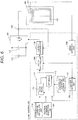
- FIG. 6 is an overall configuration diagram illustrating an elevator door drive system including a door control device (door controller) as Example 2 of the present invention. The following mainly describes differences from Example 1.
- Example 2 a position pattern (position command) generated by a position command generation unit 201 is input to the optimal controller 113.
- a position detection unit 203 integrates the speed information output from the speed detection unit 109 to compute a position (movement distance) of the door (or the motor). The position information to be computed is input as the position feedback value to the optimal controller 113.
- the optimal controller 113 generates the speed command by solving the optimal control problem based on the position command and the acceleration command generated by the acceleration command generation unit 110 such that the position feedback value follows the position command and the acceleration as the state quantity in the door model 114 follows the acceleration command to reduce the door vibration, and the optimal controller 113 outputs the speed command to a speed controller 202.
- a controller that generates the PWM command includes the current controller 108 and the speed controller 202.
- the speed controller 202 generates the current command through the proportional-integral control and the like such that speed information feedback value follows the speed command based on the speed command input from the optimal controller 113 and the speed information feedback value fed back from the speed detection unit 109, and the speed controller 202 outputs the current command to the current controller 108.
- the current controller 108 similarly to Example 1, generates the PWM command such that the detected motor current has a desired current value provided by the current command.
- the optimal controller 113 evaluates the position, the acceleration, the speed command, and the kinetic energy of the door with the evaluation index.
- the position and the acceleration to be evaluated are a position response of the door mechanism and an acceleration as the state quantity, respectively, computed with the door model 114.
- Example 2 the optimal controller 113 computes the speed command as an evaluation index that makes the evaluation function J as a formula (11) minimum. This ensures obtaining the speed pattern for the fastest opening/closing in the range of the constraint condition while the door vibration is reduced.
- J ⁇ t 0 t 0 + T w 1 p d ⁇ ⁇ v ref 2 + w 2 a d ⁇ ⁇ a ref 2 + w 3 u ⁇ 2 + w 4 V ⁇ 2 d ⁇
- p d is the position response
- p ref is a position command value
- a d is an acceleration value as the state quantity
- a ref is the acceleration command value
- u is a magnitude of the control input (speed command) from the optimal controller 113 to the speed controller 202
- V is the kinetic energy of the door.
- w 1 to w 4 are weighting factors, and balances among the respective weights are adjusted through analyses and tests.
- Example 2 the constraint conditions are represented by the formula (9) and the formula (10). However, the formula (9) represents the maximum value and the minimum value of the speed command.
- the first term indicates a following error of the position
- the second term indicates a following error of the acceleration.
- Figure 7 illustrates the speed command (speed pattern) and the speed waveform of the door under a Model Predictive Control in Example 2.
- the position pattern (position command) generated by the position command generation unit 201 is also illustrated.
- Figure 7 illustrates the speed pattern and the speed waveform during the door opening.
- a position A where engagement elements of the doors on the car side and the landing side mutually contact is set as the position command, and subsequently, the door open end position B is set as the position command.
- the speed pattern generated in Example 2 has a shape different from that of the speed pattern illustrated in Figure 2 to make the opening/closing time of the door shortest.
- the opening/closing of the door is often controlled by a speed control system, and the speed pattern as illustrated in Figure 2 is applied.
- the speed pattern of Figure 2 has a low speed period near the open end and the close end, and a high speed period in the center between both ends. The low speed period is disposed in consideration of noise reduction at the start of opening/closing and reduction of impact force that the door receives.
- the shape of the speed pattern as Figure 2 is empirically obtained. However, the speed pattern as Figure 2 does not necessarily make the opening/closing time shortest. In contrast, in Example 2, solving the optimal control problem provides the shape of the speed pattern that makes the opening/closing speed shortest.
- Example 2 since the speed command is set through the optimal control where the position and the acceleration of the door are evaluated together, the door can be opened/closed at the fastest speed while the position following capability and the vibration suppression performance are provided at the same time. Since the kinetic energy of the door is evaluated under the constraint condition, the safety is ensured even when a passenger touches the door, and energy saving is improved.
- Example 2 Since, in Example 2, the plurality of control performances (position following capability, vibration suppression) and the kinetic energy of the door are collectively evaluated with one evaluation function, this can eliminate the need for complexly adjusting a control gain or redesigning the control system for balancing the plurality of control performances and the kinetic energy.
- Example 2 a speed command pattern is preliminarily obtained by solving the optimal control problem for the position pattern as illustrated in Figure 7 without the sequential computing, and the inverter 105 is controlled corresponding to the obtained speed command pattern.
- the door may be any of a single slide type and a double slide type.
- the number of the door panels to be opened/closed may be any number.
- the driving force of the door motor may be transmitted to the door via a link mechanism.
- the model of the door mechanism is not limited to the equation of state, but may be represented by a differential equation and the like.
Landscapes
- Engineering & Computer Science (AREA)
- Automation & Control Theory (AREA)
- Elevator Door Apparatuses (AREA)
Applications Claiming Priority (2)
| Application Number | Priority Date | Filing Date | Title |
|---|---|---|---|
| JP2017173774A JP7012488B2 (ja) | 2017-09-11 | 2017-09-11 | エレベーターのドア制御装置ならびにエレベーターのドア駆動システム |
| PCT/JP2018/018401 WO2019049424A1 (ja) | 2017-09-11 | 2018-05-11 | エレベーターのドア制御装置ならびにエレベーターのドア駆動システム |
Publications (2)
| Publication Number | Publication Date |
|---|---|
| EP3683181A1 true EP3683181A1 (de) | 2020-07-22 |
| EP3683181A4 EP3683181A4 (de) | 2021-09-08 |
Family
ID=65635282
Family Applications (1)
| Application Number | Title | Priority Date | Filing Date |
|---|---|---|---|
| EP18854081.9A Withdrawn EP3683181A4 (de) | 2017-09-11 | 2018-05-11 | Aufzugstürsteuerungsvorrichtung und aufzugstürantriebssystem |
Country Status (4)
| Country | Link |
|---|---|
| EP (1) | EP3683181A4 (de) |
| JP (1) | JP7012488B2 (de) |
| CN (1) | CN110914185B (de) |
| WO (1) | WO2019049424A1 (de) |
Cited By (1)
| Publication number | Priority date | Publication date | Assignee | Title |
|---|---|---|---|---|
| JP2022188344A (ja) * | 2021-06-09 | 2022-12-21 | 株式会社日立製作所 | エレベーターのかごドアの開閉を制御するドア制御装置及び方法 |
Families Citing this family (2)
| Publication number | Priority date | Publication date | Assignee | Title |
|---|---|---|---|---|
| CN113852313B (zh) * | 2021-09-09 | 2023-11-24 | 日立楼宇技术(广州)有限公司 | 电梯曳引机控制电路、方法、装置、系统及存储介质 |
| JP7582543B1 (ja) | 2024-04-25 | 2024-11-13 | 三菱電機ビルソリューションズ株式会社 | エレベータシステム |
Family Cites Families (19)
| Publication number | Priority date | Publication date | Assignee | Title |
|---|---|---|---|---|
| JPH04243791A (ja) | 1991-01-28 | 1992-08-31 | Hitachi Building Syst Eng & Service Co Ltd | エレベータの扉の制御装置 |
| US5804779A (en) | 1996-11-21 | 1998-09-08 | Otis Elevator Company | Method for generating and scaling velocity profiles for elevator car doors |
| JP4289570B2 (ja) | 1998-11-30 | 2009-07-01 | 三菱電機株式会社 | エレベータのドア制御装置 |
| JP2001320891A (ja) | 2000-05-09 | 2001-11-16 | Mitsubishi Electric Corp | ドア制御装置およびドア制御装置の調整方法 |
| JP4488210B2 (ja) * | 2002-09-27 | 2010-06-23 | 三菱電機株式会社 | エレベータドアの制御装置 |
| FI116132B (fi) * | 2004-01-23 | 2005-09-30 | Kone Corp | Menetelmä ja järjestelmä automaattioven kunnonvalvontaan |
| CN100547504C (zh) * | 2004-09-16 | 2009-10-07 | 上海交通大学 | 基于模糊目标与模糊约束的工业过程预测控制方法 |
| CN101180444B (zh) | 2005-04-19 | 2013-01-16 | 塞德斯股份公司 | 用于控制驱动运动件的设备 |
| CN101258087B (zh) * | 2005-09-05 | 2010-06-16 | 通力股份公司 | 用于改进电梯系统的性能的方法和系统 |
| JP2009155086A (ja) | 2007-12-27 | 2009-07-16 | Toshiba Elevator Co Ltd | エレベータのドア制御装置 |
| JP4937163B2 (ja) | 2008-03-07 | 2012-05-23 | 三菱電機株式会社 | エレベーターのドア装置 |
| JP2011152973A (ja) | 2010-01-26 | 2011-08-11 | Toshiba Elevator Co Ltd | エレベータのドア制御装置 |
| CN102869597B (zh) * | 2010-04-30 | 2015-01-07 | 三菱电机株式会社 | 电梯门控制装置 |
| JP5764839B2 (ja) * | 2011-05-19 | 2015-08-19 | 東芝エレベータ株式会社 | エレベータのドア制御装置 |
| DE112014002813B4 (de) * | 2013-06-12 | 2021-05-06 | Mitsubishi Electric Corporation | Türeinrichtung und Türsteuerverfahren |
| CN104692219B (zh) * | 2013-12-04 | 2016-09-07 | 三菱电机株式会社 | 电梯门的控制装置及电梯门的控制方法 |
| CN104370171B (zh) * | 2014-11-24 | 2016-04-27 | 哈尔滨工业大学 | 电梯永磁曳引系统无称重传感器起动转矩控制方法 |
| US9834414B2 (en) * | 2015-06-17 | 2017-12-05 | Mitsubishi Electric Research Laboratories, Inc. | System and method for controlling elevator door systems |
| JP6597426B2 (ja) * | 2015-08-19 | 2019-10-30 | 三菱電機株式会社 | ドア制御装置およびエレベータ装置 |
-
2017
- 2017-09-11 JP JP2017173774A patent/JP7012488B2/ja active Active
-
2018
- 2018-05-11 EP EP18854081.9A patent/EP3683181A4/de not_active Withdrawn
- 2018-05-11 WO PCT/JP2018/018401 patent/WO2019049424A1/ja not_active Ceased
- 2018-05-11 CN CN201880047343.XA patent/CN110914185B/zh active Active
Cited By (1)
| Publication number | Priority date | Publication date | Assignee | Title |
|---|---|---|---|---|
| JP2022188344A (ja) * | 2021-06-09 | 2022-12-21 | 株式会社日立製作所 | エレベーターのかごドアの開閉を制御するドア制御装置及び方法 |
Also Published As
| Publication number | Publication date |
|---|---|
| JP7012488B2 (ja) | 2022-01-28 |
| JP2019048697A (ja) | 2019-03-28 |
| CN110914185B (zh) | 2022-04-29 |
| EP3683181A4 (de) | 2021-09-08 |
| WO2019049424A1 (ja) | 2019-03-14 |
| CN110914185A (zh) | 2020-03-24 |
Similar Documents
| Publication | Publication Date | Title |
|---|---|---|
| JP4937163B2 (ja) | エレベーターのドア装置 | |
| US7637355B2 (en) | Elevator arrangement | |
| EP3683181A1 (de) | Aufzugstürsteuerungsvorrichtung und aufzugstürantriebssystem | |
| EP2694416B1 (de) | Verfahren zur betriebszustandsüberwachung einer aufzugsanlage und aufzugsanlage | |
| JP5465251B2 (ja) | エレベーターのドア装置 | |
| CN105026299B (zh) | 电梯门控制装置 | |
| KR101401698B1 (ko) | 엘리베이터의 도어 제어 장치 | |
| CN105283402B (zh) | 门装置和门的控制方法 | |
| EP3971380A1 (de) | Türeinklemmdetektionsvorrichtung, eisenbahntüranordnung und programm | |
| JP4488210B2 (ja) | エレベータドアの制御装置 | |
| CN104692219B (zh) | 电梯门的控制装置及电梯门的控制方法 | |
| JP5182694B2 (ja) | エレベータのドア制御装置 | |
| EP3971379A1 (de) | Türeinklemmdetektionsvorrichtung, eisenbahntüranordnung und programm | |
| EP2690051B1 (de) | Steuervorrichtung für eine aufzugstür | |
| EP3287403B1 (de) | Aufzug | |
| CN101258087B (zh) | 用于改进电梯系统的性能的方法和系统 | |
| CN102317194B (zh) | 电梯的门控制装置 | |
| JPH09323877A (ja) | エレベータドアの制御装置 | |
| CN121493762A (zh) | 电梯的门控制装置和门控制系统 | |
| JP2010254464A (ja) | エレベータのドア制御装置 | |
| Grovu et al. | Simulation Model and Validation Method Analysis of an Electric Passenger Elevator | |
| WO2026057645A1 (en) | Sliding door control based on jerk-limited door speed reference curve | |
| KR20180037438A (ko) | 외란제어를 선택적으로 적용하는 엘리베이터 도어의 속도패턴 제어방법 |
Legal Events
| Date | Code | Title | Description |
|---|---|---|---|
| STAA | Information on the status of an ep patent application or granted ep patent |
Free format text: STATUS: THE INTERNATIONAL PUBLICATION HAS BEEN MADE |
|
| PUAI | Public reference made under article 153(3) epc to a published international application that has entered the european phase |
Free format text: ORIGINAL CODE: 0009012 |
|
| STAA | Information on the status of an ep patent application or granted ep patent |
Free format text: STATUS: REQUEST FOR EXAMINATION WAS MADE |
|
| 17P | Request for examination filed |
Effective date: 20200120 |
|
| AK | Designated contracting states |
Kind code of ref document: A1 Designated state(s): AL AT BE BG CH CY CZ DE DK EE ES FI FR GB GR HR HU IE IS IT LI LT LU LV MC MK MT NL NO PL PT RO RS SE SI SK SM TR |
|
| AX | Request for extension of the european patent |
Extension state: BA ME |
|
| DAV | Request for validation of the european patent (deleted) | ||
| DAX | Request for extension of the european patent (deleted) | ||
| A4 | Supplementary search report drawn up and despatched |
Effective date: 20210805 |
|
| RIC1 | Information provided on ipc code assigned before grant |
Ipc: B66B 13/14 20060101AFI20210730BHEP |
|
| STAA | Information on the status of an ep patent application or granted ep patent |
Free format text: STATUS: EXAMINATION IS IN PROGRESS |
|
| 17Q | First examination report despatched |
Effective date: 20230601 |
|
| GRAP | Despatch of communication of intention to grant a patent |
Free format text: ORIGINAL CODE: EPIDOSNIGR1 |
|
| STAA | Information on the status of an ep patent application or granted ep patent |
Free format text: STATUS: GRANT OF PATENT IS INTENDED |
|
| INTG | Intention to grant announced |
Effective date: 20241113 |
|
| RIN1 | Information on inventor provided before grant (corrected) |
Inventor name: OHNUMA, NAOTO Inventor name: TERUNUMA, TOMOAKI Inventor name: INOUE, SHINSUKE |
|
| STAA | Information on the status of an ep patent application or granted ep patent |
Free format text: STATUS: THE APPLICATION HAS BEEN WITHDRAWN |
|
| 18W | Application withdrawn |
Effective date: 20250203 |