EP3689230B1 - Mobilisationsrollstuhl - Google Patents
Mobilisationsrollstuhl Download PDFInfo
- Publication number
- EP3689230B1 EP3689230B1 EP19000517.3A EP19000517A EP3689230B1 EP 3689230 B1 EP3689230 B1 EP 3689230B1 EP 19000517 A EP19000517 A EP 19000517A EP 3689230 B1 EP3689230 B1 EP 3689230B1
- Authority
- EP
- European Patent Office
- Prior art keywords
- wheelchair
- mobilisation
- patient
- unit
- mobilization
- Prior art date
- Legal status (The legal status is an assumption and is not a legal conclusion. Google has not performed a legal analysis and makes no representation as to the accuracy of the status listed.)
- Active
Links
Images


Classifications
-
- A—HUMAN NECESSITIES
- A61—MEDICAL OR VETERINARY SCIENCE; HYGIENE
- A61B—DIAGNOSIS; SURGERY; IDENTIFICATION
- A61B5/00—Measuring for diagnostic purposes; Identification of persons
- A61B5/74—Details of notification to user or communication with user or patient; User input means
- A61B5/746—Alarms related to a physiological condition, e.g. details of setting alarm thresholds or avoiding false alarms
-
- A—HUMAN NECESSITIES
- A61—MEDICAL OR VETERINARY SCIENCE; HYGIENE
- A61B—DIAGNOSIS; SURGERY; IDENTIFICATION
- A61B5/00—Measuring for diagnostic purposes; Identification of persons
- A61B5/02—Detecting, measuring or recording for evaluating the cardiovascular system, e.g. pulse, heart rate, blood pressure or blood flow
- A61B5/024—Measuring pulse rate or heart rate
-
- A—HUMAN NECESSITIES
- A61—MEDICAL OR VETERINARY SCIENCE; HYGIENE
- A61B—DIAGNOSIS; SURGERY; IDENTIFICATION
- A61B5/00—Measuring for diagnostic purposes; Identification of persons
- A61B5/68—Arrangements of detecting, measuring or recording means, e.g. sensors, in relation to patient
- A61B5/6887—Arrangements of detecting, measuring or recording means, e.g. sensors, in relation to patient mounted on external non-worn devices, e.g. non-medical devices
- A61B5/6894—Wheel chairs
-
- A—HUMAN NECESSITIES
- A61—MEDICAL OR VETERINARY SCIENCE; HYGIENE
- A61B—DIAGNOSIS; SURGERY; IDENTIFICATION
- A61B2505/00—Evaluating, monitoring or diagnosing in the context of a particular type of medical care
- A61B2505/09—Rehabilitation or training
-
- A—HUMAN NECESSITIES
- A61—MEDICAL OR VETERINARY SCIENCE; HYGIENE
- A61B—DIAGNOSIS; SURGERY; IDENTIFICATION
- A61B5/00—Measuring for diagnostic purposes; Identification of persons
- A61B5/08—Measuring devices for evaluating the respiratory organs
- A61B5/0816—Measuring devices for examining respiratory frequency
Definitions
- the invention relates to a mobilization wheelchair, wherein the mobilization wheelchair has a positioning device with an electric motor and controllable/regulatable drive.
- a patient bed for the long-term storage of a patient with integrated and combined monitoring and therapy equipment for controlling physiological parameters in bedridden patients in the acute and rehabilitation phases and for mobilizing the patient.
- This patient bed can be motorized to change or regulate the angle of inclination of the lying surface using a controllable drive.
- the control for controlling this drive is dependent on at least one measured physiological parameter of the patient towards a target value.
- the patient bed has a device for leg and/or foot mobilization, whereby the intensity of the mobilization is regulated depending on at least one measured physiological parameter of the patient, namely blood pressure, heart rate, intracranial pressure, body temperature, blood sugar, sweat regulation, pulse, basal metabolic rate.
- the regulation and control are carried out via appropriate hardware and software.
- the measuring and monitoring unit continuously records and documents heart rate and blood pressure, and if necessary, intracranial pressure. The measured actual value is compared with a target value or range and, depending on the deviation, the patient's inclination is changed in order to reach the target range.
- the aim of this monitoring and therapy facility is to maintain the patient’s homeostasis.
- a wheelchair with a vibration unit is known, whereby the vibration unit generates horizontal vibrations or vibrations parallel to the respective body surface of the patient in the range of 1 to 100 Hz and the vibration unit in the area of the footrest, the seat and/or the backrest of the wheelchair.
- the horizontal vibration plane or vibrations running parallel to the patient's body surface avoid the strain on the joints and skeleton, which is known to be very stressful when vibration vectors are directed in a different direction.
- This wheelchair or mobilization wheelchair is used successfully in initial and early mobilization and physiotherapy treatments, among other things.
- a patient support system with a chair and a patient support surface is known in which an operating speed of actuators for the seat, the backrest and the legrest of the patient support surface and/or a patient lifting device is adjusted by means of a controller in response to a user input device or a detection system with patient condition sensors.
- the US 2015/216451 A1 relates to a person support device in the form of a hospital bed with a sensory control for the positioning and monitoring of a person.
- the control system comprises several sensors and control modules with which the position and/or the presence of the patient is monitored and recorded.
- the Act to Improve Patient Rights of 20 February 2013 regulates the duties of those providing treatment in Germany, including documentation of treatment.
- documentation of the progress of treatment must be kept and continuously updated for each treatment unit. This should document the individual services provided, the reaction of the Patients, any special features of the procedure, and the identification or assignment of the respective treating physician.
- the final therapy documentation makes it possible to understand the course of the problem and the treatment, to compare the therapy goals with the actual ones and to make a prognostic assessment.
- the object of the invention is to provide a mobilization wheelchair which enables interaction between the mobilization wheelchair and the patient to be treated in order to enable optimization of the treatment and to prevent the patient's stress limits, in particular the limits of vital data, from being exceeded.
- This optimization of the treatment should include an increasing and decreasing stress scenario within predetermined limits by adjusting the position of the mobilization wheelchair and physiotherapeutic measures as an option. This should also be possible without direct intervention by the therapist.
- the aim of the present invention is therefore also to improve the efficiency of physiotherapy treatments.
- the therapists should be relieved of the necessary documentation effort as much as possible so that they can devote themselves to their actual, highly qualified treatment task. It should also be possible to automatically create progress documentation, thereby relieving the therapists of administrative tasks. The therapists are thus deployed more according to their qualifications and thus more economically.
- the course of therapy should be recorded in a more transparent, precise, tamper-proof, complex and machine-readable manner. This should, among other things, create the conditions for interactive action in order to To increase patient safety.
- the mobilization wheelchair should also be suitable for severely affected patients without postural control.
- the object of the invention is achieved by a mobilization wheelchair with the features according to claim 1.
- the mobilization wheelchair 7 has at least one measuring unit 13, a measured value acquisition and measured value processing unit 14, a data memory 15, a microprocessor-based data processing unit 16, a display and input unit 17 and a control and regulating unit 6, which are connected to one another in a communicative manner.
- the measuring unit 13, the measured value acquisition and processing unit 14, the data memory 15, the microprocessor-based data processing unit 16, the display and input unit 17 and the control and regulation unit 6 are selected and configured in a technically known manner so that measurement and control data can be transmitted, stored and processed in the usual way, i.e. these modules are communicatively connected to one another in a known manner.
- a measuring unit 13 in the sense of the invention is a conventional electrically operated unit for measuring vital data, which has at least one data interface for reading and/or transmitting measured vital data. This communicates, for example wirelessly, in the usual way at least with the measured value acquisition and measured value processing unit 14.
- Optimal dynamic training is also implemented on the basis of data from previous therapy sessions and the current one, which is characterized by increasing resilience and constitution. The patient's current daily form and other factors influencing the patient's state of health can thus be taken into account for the first time.
- the accuracy can be adjusted almost arbitrarily according to medical requirements by means of the sampling rate or clock frequency of the recordings.
- the positions in which the patient is located, the exercises he is performing, the forces he is exerting and the intensity of external stimuli, such as vibrations from the foot pedal, are electronically scanned by the physiotherapeutic mobilization wheelchair 7 and are continuously compared with the vital parameters, such as pulse and breathing rates. If these vital parameters reach medically specified limit values, the treating therapist is alerted and/or an automatic interaction takes place between the mobilization wheelchair 7 and the patient.
- the therapy can be interrupted or the mobilization wheelchair 7 can be automatically controlled into a desired position.
- This biofeedback functionality can ultimately be used to maintain the patient's vital parameters in a predetermined range over a certain period of time, possibly with a dynamic progression, by providing feedback to the control of the mobilization wheelchair 7.
- the mobilization wheelchair 7 has an alarm device 4, preferably an acoustic and/or optical one, which is activated by the data processing unit 16 when at least one limit value (target value) of a vital value is reached.
- an alarm device 4 preferably an acoustic and/or optical one, which is activated by the data processing unit 16 when at least one limit value (target value) of a vital value is reached.
- This alarm can be triggered automatically, ie without direct intervention by the therapist.
- This alarm is the result of an interaction between the mobilization wheelchair 7 and the patient after the target value is exceeded by the value of the actual value of at least one of the vital data.
- the mobilization wheelchair 7 can be set to react independently. Alternatively, an alarm can be triggered when limit values of the vital data are reached and a preset reaction of the mobilization wheelchair 7 occurs. It is preferred that at least the measured value acquisition and processing unit 14, the data memory 15, the microprocessor-based data processing unit 16, the display and input unit 17 and the control and regulation unit 6 are arranged in an additional module 3 or a portable unit, preferably a tablet PC, which can be arranged on the mobilization wheelchair 7 and can be connected to it in the usual way for communication purposes.
- the measuring unit 13 can be arranged in the additional module 3 and can be connected in a communicating manner in the usual way.
- the measuring unit 13 can have one or more sensors for measuring vital data.
- an additional module 3 can be used simultaneously or sequentially for several mobilization wheelchairs 7.
- the measuring unit 13 is usually not included in this portable unit.
- 15 patient-related therapy documentations can be accessed from the data storage.
- the mobilization wheelchair 7 is suitable for optimizing the patient's rehabilitation. Targeted training without overloading or under-challenging the patient leads to a faster recovery with a reduced risk of complications.
- Predefined load limits or training scenarios can be entered into the system as parameters via the display and input unit 17.
- the system then monitors compliance with these vital data parameters by adjusting the positions of the mobilization wheelchair 7. For example, a predetermined pulse rate of the patient, which is entered into the system as a parameter, is kept largely constant by keeping the patient upright when the pulse rate drops or by moving the mobilization wheelchair 7 towards a relaxing resting position when the pulse rate increases.
- the monitoring of other vital data such as respiratory rate, blood pressure or others can be included in this biofeedback functionality.
- the values stored in the data memory 15 show how long the patient was in which position. This basic functionality is completed with a patient and therapist identification that is entered manually once before the start of therapy via the display and input unit 17. Additional data, such as findings, therapy goals, treatment plan and notes on special features during treatment, can be added manually or via a standard data interface.
- the therapy documentation is compiled from several patient progress documents, which can also be manually supplemented with prognostic assessments and other notes.
- the resulting progress documentation and the final therapy documentation meet the relevant requirements for documentation of treatment without any additional effort.
- the progress and therapy documentation can be exported via suitable interfaces as a csv file, as a PDF document or directly into the hospital information system (HIS).
- the aim of relieving therapists of the documentation workload is thus basically achieved.
- the basic functionality described can be expanded with the automatically determined room temperature and/or humidity or climatic influences at the site of use as well as by overlaying with available vital data.
- These vital data can be obtained internally through sensors built into the mobilization wheelchair 7 or imported from external sources, such as blood pressure, oxygen saturation, intracranial pressure.
- the overlay of the data and the computer-assisted evaluation show how, for example, the patient's blood circulation responds to changes in position.
- the intensity of a vibration stimulus acting on the patient, its duration and frequency can be displayed or entered on the display and control unit of the mobilization wheelchair 7. This intensity of the vibration stimulus can also be displayed in the usual way in relation to the patient's vital data.
- Another aim of the treatment is to involve the patient as actively as possible in the therapeutic measures.
- a handlebar can be attached across the patient.
- Any change in position e.g. by operating the hand control of the mobilization wheelchair 7, results in an update of the graphic display and a new memory entry.
- the graphical representation of the positions of the patient support surface enables the practitioner to compare the therapy situation with the specified therapy goals and with historical values.
- the mobilization wheelchair 7 can be set to react independently when limit values are reached.
- the movement can be slowed down or interrupted and, if the pulse rate remains high, the patient can be switched to a gentle Program relaxation position.
- the respective reactions of the mobilization wheelchair 7 to the change in the vital data are programmed into the system beforehand in accordance with the medical guidelines.
- the patient-related limit values are entered as parameters via the display and input unit 17.
- a recovery phase with a lower pulse rate may be planned.
- the positions of the mobilization wheelchair 7, but also the vibration intensity (frequency and duration) of a vibration unit 1, not included in this embodiment, can be available for readjustment.
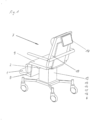
- Fig.1 shows an embodiment of a mobilization wheelchair 7 with at least one vibration unit 1 in a schematic perspective view.
- the vibration unit 1 can be arranged in the area of the footrest 8, the seat 9 and/or the backrest 10 of the mobilization wheelchair 7.
- the vibration unit 1 has an electric motor and controllable/regulatable drive 12, for example an unbalance motor.
- the mobilization wheelchair 7 has a positioning device 2 with an electric motor and controllable/regulatable drive 11, in Fig.1 not shown.
- the mobilization wheelchair 7 has at least one measuring unit 13, a measured value acquisition and measured value processing unit 14, a data memory 15, a microprocessor-based data processing unit 16, a display and input unit 17 and a control and regulating unit 6, which are communicatively connected to one another.
- the mobile mobilization wheelchair 7 has at least one footrest 8, a seat 9 and a backrest 10. Otherwise, the mobilization wheelchair 7 can fulfill known functionalities and have the components, assemblies and control programs required in this regard according to its respective level of equipment. In this regard, it has in particular a device control 12, which can control, among other things, the electric motor drive 11, the positioning device 2 and the vibration unit 1 in the usual way.
- the vibration unit 1 can, for example, generate horizontal vibrations or vibrations parallel to the respective body surface of the patient in the range of 1 to 100 Hz.
- the mobilization wheelchair 7 has a conventional electrical power supply device in which Fig.1 not shown, for all electrically operated components.
- a continuous movement sequence can be achieved by a positioning device 2, which is driven by an electric motor drive 11 and controlled by a device control 12 in the usual way. can be done without the patient having to exert any energy to change his position. This is done by a continuously variable positioning device 2 of the mobilization wheelchair7.
- the mobilization wheelchair 7 can be set to react independently.
- the mobilization wheelchair 7 allows at least three patient positions, namely a sitting, lying or standing position. The patient sits, lies or stands in or on the mobilization wheelchair 7, with his feet regularly touching the foot part 8.
- the vibration unit 1 is arranged in the area of the footrest 8 and integrated in the footrest 8.
- the vibration unit 1 is controllable so that in particular its frequency can be changed as desired.
- the measuring unit 13, the measured value acquisition and processing unit 14, the data memory 15, the microprocessor-based data processing unit 16, the display and input unit 17 and the control and regulation unit 6 are arranged in the housing 19 of the mobilization wheelchair 7 in the embodiment shown.
- auxiliary module 20 not relating to this embodiment, which can be arranged next to the mobilization wheelchair 7 and can be connected to it in the usual way, in particular for data communication.
- the mobilization wheelchair 7 is suitable for initial and early mobilization, especially in early neurological rehabilitation, which enables gradual and continuous verticalization from a sitting position.
- Such a mobilization wheelchair 7 is suitable, for example, for severely affected patients without postural control.
- Fig.2 shows a schematic representation of the control, measurement, input and output data of the mobilization wheelchair 7 as a block diagram.
- a data processing unit 16 which in particular has a conventional microprocessor and related software, transmits, stores and processes in particular control, measurement, input and output data in the usual way.
- the progress and therapy documentation can be exported from the data processing unit 16 via a data output 20 with suitable interfaces as a csv file, as a PDF document or directly into the hospital information system (HIS).
- HIS hospital information system
- This data processing unit 16 can read the incremental signals of the motors from the control of the mobilization wheelchair 7 at predetermined time intervals and use them to calculate the positions of the patient support surface, such as the inclination of the backrest 10 and the footrest 8, the inclination of the seat 9 and the height. The calculation is carried out in the usual way according to functions that form the basis of the device design. Alternatively, empirically obtained tabular data can also be used.
- the positions of the patient support surface determined in this way can be graphically displayed on a display or display and input unit 17 and stored with a time stamp.
- Fig.3 shows a schematic representation of a movable auxiliary module 3. At least the measuring unit 13, the measured value acquisition and processing unit 14, the data memory 15, the microprocessor-based data processing unit 16, the display and input unit 17 and the control and regulation unit 6 are arranged in an auxiliary module 3, which is located next to the mobilization wheelchair 7, in Fig.3 not shown, and can be connected to it in the usual way, in particular for data communication.
- the auxiliary module 3 can have a separate energy supply device, for example an electric battery unit, or can be connected to an external energy source.
- Fig.4 shows an embodiment of a mobilization wheelchair 7 with at least one handle bar 5 in a schematic perspective view.
- the mobilization wheelchair 7 has a positioning device 2 with an electric motor and controllable/regulatable drive 11, in Fig.4 not shown.
- the mobilization wheelchair 7 has at least one measuring unit 13, a measured value acquisition and measured value processing unit 14, a data memory 15, a microprocessor-based data processing unit 16, a display and input unit 17 and a control and regulating unit 6, whereby these are connected to one another in a communicative manner.
- the mobile mobilization wheelchair 7 has at least a footrest 8, a seat 9 and a backrest 10. Otherwise, the mobilization wheelchair 7 can fulfill known functionalities and have the components, assemblies and control programs required in this regard according to its respective level of equipment.
- This handlebar 5 is attached transversely in front of the patient position, in particular detachably or pivotably on the mobilization wheelchair 7.
- the handlebar 5 is provided on both sides with measuring sensors 18 which measure the tensile or compressive force applied by the patient. These measured data are transmitted to the measured value acquisition and processing unit 14 via a standard data interface.
- the patient In the lying position, the patient can pull himself up using the handle bar 5. The patient can practice getting up in a physiologically correct way, particularly when transitioning from sitting to standing. After electronic evaluation of the forces applied, the patient is given the individually required support in getting up using the control for positioning the mobilization wheelchair 7. In the standing position, exercises to improve coordination skills are possible. The balance of forces is shown to the patient on a screen, which motivates him to take coordinated action.
- This handle bar 5 on the mobilization wheelchair 7 offers patients a variety of starting points for building muscle, improving movement sequences and
Landscapes
- Health & Medical Sciences (AREA)
- Life Sciences & Earth Sciences (AREA)
- Biomedical Technology (AREA)
- Heart & Thoracic Surgery (AREA)
- Veterinary Medicine (AREA)
- Biophysics (AREA)
- Pathology (AREA)
- Engineering & Computer Science (AREA)
- Public Health (AREA)
- Physics & Mathematics (AREA)
- Medical Informatics (AREA)
- Molecular Biology (AREA)
- Surgery (AREA)
- Animal Behavior & Ethology (AREA)
- General Health & Medical Sciences (AREA)
- Cardiology (AREA)
- Physiology (AREA)
- Rehabilitation Tools (AREA)
Description
- Die Erfindung betrifft einen Mobilisationsrollstuhl, wobei der Mobilisationsrollstuhl eine Positioniereinrichtung mit einem elektromotorischen und steuerbaren/regelbaren Antrieb besitzt.
- Aus der
EP 2 227 210 B1 ist ein Patientenbett zur langfristigen Lagerung eines Patienten mit integrierter und kombinierter Überwachungs- und Therapieeinrichtung zur Steuerung physiologischer Parameter bei bettlägerigen Patienten in der Akut- und Rehabilitationsphase und zur Mobilisierung des Patienten bekannt. Dieses Patientenbett kann motorisch bezüglich des Neigungswinkels der Liegefläche mittels eines ansteuerbaren Antriebs verändert bzw. geregelt werden. Die Regelung zur Ansteuerung dieses Antriebs erfolgt in Abhängigkeit wenigsten eines gemessenen physiologischen Parameters des Patienten hin zu einem Sollwert. Das Patientenbett besitzt eine Einrichtung zur Bein- und/oder Fußmobilisierung, wobei die Intensität der Mobilisierung in Abhängigkeit wenigsten des einen gemessenen physiologischen Parameters des Patienten, nämlich Blutdruck, Herzfrequenz, Hirndruck, Körpertemperatur, Blutzucker, Schweißregulation, Puls, Grundumsatz, geregelt wird. Die Regelung und Steuerung erfolgen über eine entsprechende Hard- und Software. Die Mess- und Monitoreinheit erfasst und dokumentiert kontinuierlich Herzfrequenz und Blutdruck, sowie ggf. den Hirndruck. Dabei wird der gemessene IST-Wert mit einem Soll-Wert bzw. - Bereich abgeglichen und in Abhängigkeit der Abweichung wird die Neigung des Patienten verändert, um in den Soll-Bereich zu gelangen. - Ziel dieser Überwachungs- und Therapieeinrichtung ist die Aufrechterhaltung der Homöostase des Patienten.
- Aus der
DE 10 2015 001 846 B4 ist ein Krankenfahrstuhl mit Vibrationseinheit bekannt, wobei die Vibrationseinheit horizontale Schwingungen oder zur jeweiligen Körperoberfläche des Patienten parallelverlaufende Schwingungen im Bereich von 1 bis 100 Hz erzeugt und die Vibrationseinheit im Bereich der Fußstütze, des Sitzes und/oder der Rückenlehne des Krankenfahrstuhls angeordnet ist oder sind. Durch die horizontale Schwingungsebene oder zur jeweiligen Körperoberfläche des Patienten parallelverlaufende Schwingungen werden die Belastungen auf die Gelenke und das Skelett vermieden, die bei anders gerichteten Schwingungsvektoren als stark belastend bekannt sind. Dieser Krankenfahrstuhl bzw. Mobilisationsrollstuhl wird u.a. im Rahmen der Erst- und Frühmobilisation und physiotherapeutischer Behandlungen erfolgreich einsetzt. - Aus der
US 2017/0172827 A1 ist ein Patientenunterstützungssystem mit einem Stuhl und einer Patientenunterstützungsfläche bekannt, bei dem mittels einer Steuerung eine Betriebsgeschwindigkeit von Aktuatoren für den Sitz, die Rücklehne und die Beinlehne der Patientenunterstützungsfläche und/oder einer Patientenhebevorrichtung in Reaktion auf ein Benutzereingabegerät oder ein Erfassungssystem mit Patientenzustandssensoren eingestellt wird. - Die
US 2015/216451 A1 betrifft eine Personenstützvorrichtung in Form eines Krankenbettes mit einer sensorischen Steuerung für die Lagerung und Überwachung einer Person. Das Steuersystem umfasst mehrere Sensoren und Steuermodule, mit denen die Lageposition und/oder die Anwesenheit des Patienten überwacht und erfasst wird. - Dabei besteht bei Verwendung eines solchen Mobilisationsrollstuhls, aber auch anderer, seit längerem ein Bedarf diese physiotherapeutischen Behandlungen für den Genesungsprozess des Patienten und das behandelnde medizinische Personal effektiver zu gestalten und den Verlauf der Behandlung computerbasiert und sicher zu dokumentieren.
- Mit dem Gesetz zur Verbesserung der Rechte von Patientinnen und Patienten vom 20.02.2013 werden beispielsweise die Pflichten der Behandelnden, u.a. zur Dokumentation der Behandlung, in Deutschland geregelt. Es ist diesbezüglich eine Verlaufsdokumentation zu führen und kontinuierlich je Behandlungseinheit fortzuschreiben. Diese soll die im Einzelnen erbrachten Leistungen, die Reaktion des Patienten, ggf. Besonderheiten bei der Durchführung, und die Kennzeichnung bzw. Zuordnung des jeweils Behandelnden ermöglichen.
- Mit der abschließenden Therapiedokumentation werden insbesondere der Problem- und Behandlungsverlauf nachvollziehbar, der Soll-IST Vergleich der Therapieziele sowie eine prognostische Einschätzung möglich.
- Eine solche Dokumentation ist eine zusätzliche administrative Aufgabe, die neben der eigentlichen Tätigkeit des Therapeuten zu erbringen ist. Die Erstellung der kontinuierlichen Verlaufsdokumentation und der abschließenden Therapiedokumentation beanspruchen bis zu einem Viertel der Arbeitszeit des Therapeuten. Zudem gibt es für Physiotherapeuten bisher keine standardisierten Dokumentationsrichtlinien.
- Aufgabe der Erfindung ist es, einen Mobilisationsrollstuhl bereit zu stellen, welcher eine Interaktion zwischen Mobilisationsrollstuhl und zu behandelnden Patienten ermöglicht, um eine Optimierung der Behandlung zu ermöglichen und es zu verhindern, Belastungsgrenzen des Patienten, insbesondere Grenzwerte von Vitaldaten, zu überschreiten. Diese Optimierung der Behandlung soll ein an- und abschwellendes Belastungsszenario innerhalb vorgegebener Grenzwerte durch die Positionsverstellung des Mobilisationsrollstuhls und physiotherapeutische Maßnahmen als Option einschließen. Dies soll auch ohne ein direktes Eingreifen des Therapeuten ermöglicht sein.
- Die vorliegende Erfindung hat somit auch zum Ziel, die Effizienz physiotherapeutischer Behandlungen zu verbessern. Die Therapeuten sollen vom erforderlichen Dokumentationsaufwand möglichst entlastet werden, um sich ihrer eigentlichen hochqualifizierten Behandlungsaufgabe widmen zu können. Es soll außerdem ermöglicht sein, eine Verlaufsdokumentation automatisch zu erstellen und dadurch die Therapeuten von administrativen Aufgaben zu entlasten. Die Therapeuten werden somit stärker entsprechend ihrer Qualifikation und damit wirtschaftlicher eingesetzt.
- Einhergehend soll der Therapieverlauf transparenter, genauer, manipulationssicher, komplexer und maschinell auswertbar aufgezeichnet werden. Damit soll u.a. die Voraussetzung geschaffen werden, um ein interaktives Agieren zu ermöglichen, um die Patientensicherheit zu erhöhen.
- Der Mobilisationsrollstuhl soll außerdem für schwer betroffene Patienten ohne posturale Kontrolle geeignet sein.
- Die Aufgabe der Erfindung wird durch einen Mobilisationsrollstuhl mit den Merkmalen gemäß Anspruch 1 gelöst.
- Erfindungswesentlich ist, dass der Mobilisationsrollstuhl 7 zumindest eine Messeinheit 13, eine Messwerterfassungs- und Messwertverarbeitungseinheit 14, einen Datenspeicher 15, eine mikroprozessorbasierte Datenverarbeitungseinheit 16, eine Anzeige- und Eingabeeinheit 17 und eine Steuer- und Regeleinheit 6 besitzt, welche kommunizierend miteinander verbunden sind.
- Die Messeinheit 13, die Messwerterfassungs- und Messwertverarbeitungseinheit 14, der Datenspeicher 15, die mikroprozessorbasierte Datenverarbeitungseinheit 16, die Anzeige- und Eingabeeinheit 17 und die Steuer- und Regeleinheit 6 sind in technisch bekannter Art und Weise ausgewählt und konfiguriert, so dass Mess- und Steuerdaten in üblicher Art und Weise übertragen, gespeichert und verarbeitet werden können, d.h. diese Baugruppen sind in bekannter Art und Weise kommunizierend miteinander verbunden.
- Eine Messeinheit 13 im Sinne der Erfindung ist eine übliche elektrisch betriebene Einheit zur Messung von Vitaldaten, welche zumindest eine Datenschnittstelle zum Auslesen und/oder Übertragen von gemessenen Vitaldaten besitzt. Diese kommuniziert, beispielsweise drahtlos, in üblicher Art und Weise zumindest mit der Messwerterfassungs- und Messwertverarbeitungseinheit 14.
- Auf Basis ausgewählter Daten wird somit eine Therapie optimierbar. Dabei wird auch auf Basis von Daten von vorherigen Therapiesitzungen und der aktuellen ein optimales dynamisches Training realisiert, welches durch eine ansteigende Belastbarkeit und Konstitution charakterisiert ist. Die jeweilige Tagesform und andere Einflussfaktoren auf den Gesundheitszustand des Patienten können damit erstmals einbezogen werden.
- Die Genauigkeit kann entsprechend der medizinischen Erfordernisse nahezu beliebig mittels der Abtastrate bzw. Taktfrequenz der Aufzeichnungen eingestellt werden.
- Es lassen sich eine Vielzahl zusätzlicher Vitalparameter erfassen und in einem komplexen Zusammenhang zum Therapieverlauf darstellen.
- Schließlich werden durch die quantitative Darstellung des Verlaufs in digitalisierter Form sowohl historische als auch vergleichende maschinelle Auswertungen möglich.
- Die vom physiotherapeutischen Mobilisationsrollstuhl 7 elektronisch abgetasteten Positionen, in denen sich der Patient befindet, seine durchgeführten Übungen, seine dabei aufgebrachten Kräfte und die Intensität äußerer Reize, beispielsweise durch Vibration des Fußtritts, werden kontinuierlich mit den Vitalparametern, beispielsweise den Puls- und Atemfrequenzen, verglichen. Sofern diese Vitalparameter ärztlich vorgegebene Grenzwerte erreichen, wird der behandelnde Therapeut alarmiert und/oder es erfolgt eine automatische Interaktion zwischen dem Mobilisationsrollstuhl 7 und dem Patienten.
- In Abhängigkeit von Voreinstellungen kann die Therapie unterbrochen oder der Mobilisationsrollstuhl 7 in eine gewünschte Position automatisch gesteuert werden. Diese Biofeedback-Funktionalität lässt sich schließlich dazu nutzen, durch Rückkopplung auf die Steuerung des Mobilisationsrollstuhls 7 die Vitalparameter des Patienten über einen bestimmten Zeitraum, möglicherweise mit dynamischem Verlauf in einem vorgegebenen Bereich zu halten.
- Die abhängigen Ansprüche 2 bis 7 enthalten vorteilhafte Ausgestaltungen der Erfindung ohne diese damit zu begrenzen.
- Bevorzugt ist, dass der Mobilisationsrollstuhl 7 eine Alarmierungseinrichtung 4, bevorzugt eine akustische und/oder optische, besitzt, welche bei Erreichen zumindest eines Grenzwertes (Soll-Wertes) eines Vitalwertes durch die Datenverarbeitungseinheit 16 aktiviert wird.
- Diese Alarmierung kann automatisch, d.h. ohne ein direktes Eingreifen des Therapeuten, ausgelöst werden. Diese Alarmierung ist das Ergebnis einer Interaktion zwischen dem Mobilisationsrollstuhl 7 und dem Patienten nach Überschreiten des Soll-Wertes durch den Wert des IST-Wertes zumindest einen der Vitaldaten.
- Durch permanente Überwachung der Vitaldaten wird die Patientensicherheit erhöht. Über eine übliche akustische und/oder optische Alarmierung bei Erreichen von Grenzwerten hinausgehend kann der Mobilisationsrollstuhl 7 für selbständige Reaktionen eingestellt werden. Eine Alarmierung kann alternativ bei Erreichen von Grenzwerten der Vitaldaten und voreingestellte Reaktion des Mobilisationsrollstuhls 7 erfolgen. Bevorzugt ist, dass zumindest die Messwerterfassungs- und Messwertverarbeitungseinheit 14, der Datenspeicher 15, die mikroprozessorbasierte Datenverarbeitungseinheit 16, die Anzeige- und Eingabeeinheit 17 und die Steuer- und Regeleinheit 6 in einem Beistellmodul 3 oder einer tragbaren Baueinheit, bevorzugt einem Tablet-PC, angeordnet sind, welches am Mobilisationsrollstuhl 7 anordenbar und mit diesem in üblicher Art und Weise kommunikationstechnisch verbindbar ist.
- Im Beistellmodul 3 kann die Messeinheit 13 angeordnet und in üblicher Art und Weise kommunizierend verbunden sein.
- Die Messeinheit 13 kann einen Sensor oder mehreren Sensoren zur Messung von Vitaldaten besitzen.
- Damit ist in einfacher Art und Weise die Möglichkeit eröffnet, diesbezügliche Krankenfahrstühle und/oder Mobilisationsrollstühle 7 in ihrer Funktionalität zu erweitern oder nachzurüsten.
- Außerdem kann ein Beistellmodul 3 gleichzeitig oder nacheinander für mehrere Mobilisationsrollstühle 7 verwendet werden.
- Bei der tragbaren Baueinheit, beispielsweise einem Tablet-PC, ist die Messeinheit 13, regelmäßig nicht in dieser tragbaren Baueinheit enthalten.
- Bevorzugt ist, dass aus dem Datenspeicher 15 patientenbezogene Therapiedokumentationen abgreifbar sind.
- Der Mobilisationsrollstuhl 7 ist geeignet, die Rehabilitation des Patienten zu optimieren. Gezieltes Training ohne den Patienten zu überlasten oder zu unterfordern führt zu schneller Genesung bei verringertem Komplikationsrisiko.
- Vorgegebene Belastungsgrenzen oder auch Trainingsszenarien lassen sich als Parameter über die Anzeige- und Eingabeeinheit 17 in das System eingeben.
- Das System überwacht sodann die Einhaltung dieser Parameter der Vitaldaten durch Nachregelung der Positionen des Mobilisationsrollstuhls 7. Beispielsweise wird eine vorgegebene und in das System als Parameter eingetragene Pulsfrequenz des Patienten weitgehend konstant gehalten, indem bei abfallender Pulsfrequenz der Patient weiter aufgerichtet wird oder bei ansteigender Pulsfrequenz der Mobilisationsrollstuhl 7 sich in Richtung einer entspannenden Ruheposition verstellt. In diese Biofeedback-Funktionalität lässt sich die Überwachung weiterer Vitaldaten wie Atemfrequenz, Blutdruck oder andere einbeziehen.
- Aus den im Datenspeicher 15 abgespeicherten Werten wird ersichtlich, wie lange sich der Patient in welcher Position befunden hat. Diese Grundfunktionalität wird mit einer vor Therapiebeginn einmalig manuell über die Anzeige- und Eingabeeinheit 17 eingegebenen Patienten- und Therapeutenidentifikation abgeschlossen. Weitere Daten, wie Befund, Therapieziele, Behandlungsplan und Notizen zu Besonderheiten während der Behandlung, können manuell oder über eine übliche Datenschnittstelle, hinzugefügt werden.
- Aus mehreren Verlaufsdokumentationen eines Patienten wird die Therapiedokumentation zusammengefasst, die ebenso mit prognostischer Einschätzung und weiteren Notizen manuell ergänzt werden kann. Die so entstandenen Verlaufsdokumentationen und die abschließende Therapiedokumentation genügen ohne weiteren Aufwand den einschlägigen Vorgaben zur Dokumentation der Behandlung.
- Die Verlaufs- und die Therapiedokumentation können über geeignete Schnittstellen als csv-File, als PDF-Dokument oder direkt in das Krankenhausinformationssystem (KIS) exportiert werden. Das Ziel, die Therapeuten vom Dokumentationsaufwand zu entlasten, wird damit grundsätzlich erreicht.
- Die beschriebene Grundfunktionalität ist erweiterbar mit der automatisch ermittelten Raumtemperatur und/oder Luftfeuchtigkeit bzw. klimatischer Einflüsse am Einsatzort sowie durch Überlagerung mit zur Verfügung stehenden Vitaldaten.
- Diese Vitaldaten, wie beispielsweise Atemfrequenz oder Pulsfrequenz, können sowohl durch in den Mobilisationsrollstuhl 7 eingebaute Sensoren intern gewonnen werden als auch aus externen Quellen importiert werden, wie z.B. Blutdruck, Sauerstoffsättigung, intrakranieller Druck.
- Aus der Überlagerung der Daten und der computergestützten Auswertung wird erkennbar, wie beispielsweise der Blutkreislauf des Patienten auf Lageänderungen anspricht.
- Die Intensität eines auf den Patienten wirkenden Vibrationsreizes, dessen Dauer und Frequenz können an der Anzeige- und Bedieneinheit des Mobilisationsrollstuhls 7 angezeigt oder eingegeben werden. Diese Intensität des Vibrationsreizes lässt sich ebenso in üblicher Art und Weise in Relation zu den Vitaldaten des Patienten darstellen.
- Ein Ziel der Behandlung ist es außerdem, die Patienten möglichst aktiv in die therapeutischen Maßnahmen einzubeziehen. Zu diesem Zweck kann quer vor den Patienten eine Griffstange angebracht werden.
- Jede Änderung der Position, z.B. durch Betätigen der Handbedienung vom Mobilisationsrollstuhl 7, führt zu einer Aktualisierung der grafischen Anzeige und zu einem neuen Speichereintrag.
- Die grafische Darstellung der Positionen der Patientenauflagefläche ermöglicht es dem Behandelnden die Therapiesituation mit den vorgegebenen Therapiezielen und mit historischen Werten zu vergleichen.
- Durch permanente Überwachung der Vitaldaten wird die Patientensicherheit erhöht. Über eine übliche akustische und/oder optische Alarmierung kann bei Erreichen von Grenzwerten hinausgehend der Mobilisationsrollstuhl 7 für selbständige Reaktionen eingestellt werden.
- Wird beispielsweise eine zu hohe Pulsfrequenz beim Aufrichten des Patienten in die Stehposition erkannt/detektiert, lassen sich das Verlangsamen bzw. Unterbrechen der Bewegung und bei anhaltend hoher Pulsfrequenz der Übergang in eine schonende Entspannungsposition programmieren.
- Diese Interaktion vom therapeutischem Hilfsmittel Mobilisationsrollstuhl 7 und Patient nach vorgegebenen Leitlinien unterstützt den Behandelnden in seiner Reaktion auf Besonderheiten während der Therapie.
- Die jeweiligen Reaktionen des Mobilisationsrollstuhls 7 auf die Veränderung der Vitaldaten werden zuvor entsprechend der medizinischen Leitlinien in das System programmiert. Die patientenbezogenen Grenzwerte werden über die Anzeige- und Eingabeeinheit 17 als Parameter eingegeben.
- Bei Ergänzung der vorgegebenen Belastungsparameter mit einer zeitlichen Komponente ergibt sich für den Patienten ein Trainingsszenario.
- Beispielsweise kann nach einer stärkeren Belastung (höhere Pulsfrequenz) eine Erholungsphase mit niedrigerer Pulsfrequenz vorgesehen sein.
- Zur Nachregelung kann die Positionen des Mobilisationsrollstuhl 7, aber auch die Vibrationsstärke (Frequenz und Dauer) einer Vibrationseinheit 1, in diesem Ausführungsbeispiel nicht enthalten, zur Verfügung stehen.
- Weitere Merkmale, Eigenschaften und Vorteile der vorliegenden Erfindung ergeben sich aus der nachfolgenden Beschreibung von Ausführungsbeispielen unter Bezugnahme auf die
Figur 1 bis 3 . - Es zeigen:
- Fig. 1
- eine Ausführungsform eines Mobilisationsrollstuhls 7 mit zumindest einer Vibrationseinheit 1 in einer schematischen perspektivischen Ansicht,
- Fig. 2
- eine schematische Darstellung der Steuer-, Mess-, Eingabe- und Ausgabedatenströme des Mobilisationsrollstuhls 7 als Blockschaltbild,
- Fig 3
- eine schematische Darstellung eines Beistellmoduls 3, und
- Fig 4
- eine Ausführungsform eines Mobilisationsrollstuhls 7 mit zumindest einer Griffstange in einer schematischen perspektivischen Ansicht.
-
Fig. 1 zeigt eine Ausführungsform eines Mobilisationsrollstuhls 7 mit zumindest einer Vibrationseinheit 1 in einer schematischen perspektivischen Ansicht. - Die Vibrationseinheit 1 kann im Bereich der Fußstütze 8, des Sitzes 9 und/oder der Rückenlehne 10 des Mobilisationsrollstuhls 7 angeordnet sein. Die Vibrationseinheit 1 besitzt einen elektromotorischen und steuerbaren/regelbaren Antrieb 12, beispielsweise einen Unwuchtmotor.
- Der Mobilisationsrollstuhl 7 besitzt eine Positioniereinrichtung 2 mit einem elektromotorischen und steuerbaren/regelbaren Antrieb 11, in
Fig. 1 nicht dargestellt. - Der Mobilisationsrollstuhl 7 besitzt zumindest eine Messeinheit 13, eine Messwerterfassungs- und Messwertverarbeitungseinheit 14, einen Datenspeicher 15, eine mikroprozessorbasierte Datenverarbeitungseinheit 16, eine Anzeige- und Eingabeeinheit 17 und eine Steuer- und Regeleinheit 6, wobei diese kommunizierend miteinander verbunden sind.
- Der fahrbare Mobilisationsrollstuhl 7 besitzt zumindest eine Fußstütze 8, einen Sitz 9 und eine Rückenlehne 10. Ansonsten kann der Mobilisationsrollstuhl 7 bekannte Funktionalitäten erfüllen und die diesbezüglich erforderlichen Bauteile, Baugruppen und Steuerprogramme entsprechend seinem jeweiligen Ausstattungsgrad besitzen. Diesbezüglich besitzt dieser insbesondere eine Gerätesteuerung 12, welche u.a. den elektromotorischen Antrieb 11, die Positioniereinrichtung 2 und die Vibrationseinheit 1 in üblicher Art und Weise ansteuern kann.
- Die Vibrationseinheit 1 kann beispielsweise horizontale Schwingungen oder zur jeweiligen Körperoberfläche des Patienten parallelverlaufende Schwingungen im Bereich von 1 bis 100 Hz erzeugen. Der Mobilisationsrollstuhl 7 besitzt eine übliche elektrische Stromversorgungseinrichtung, in
Fig. 1 nicht dargestellt, für alle elektrisch betriebenen Bauteile. - Vom Liegen, über das Sitzen bis zum Stand kann ein kontinuierlicher Bewegungsablauf durch eine Positioniereinrichtung 2, welche durch einen elektromotorischen Antrieb 11 angetrieben und durch eine Gerätesteuerung 12 in üblicher Art und Weise gesteuert wird, erfolgen, ohne dass der Patient selbst Energie aufbringen muss, um seine Position zu verändern. Dies erfolgt durch eine stufenlos veränderliche Positioniereinrichtung 2 des Mobilisationsrollstuhls7.
- Die Regelung und Steuerung erfolgen über eine entsprechende in Art und Umfang übliche Hard- und Software.
- Durch permanente Überwachung der Vitaldaten wird die Patientensicherheit erhöht. Über eine übliche akustische und/oder optische Alarmierung bei Erreichen von Grenzwerten hinausgehend kann der Mobilisationsrollstuhl 7 für selbständige Reaktionen eingestellt werden.
- Der Mobilisationsrollstuhl 7 ermöglicht zumindest drei Patientenpositionen, nämlich eine Sitz-, Liege- oder Standposition. Der Patient sitzt, liegt oder steht im oder auf dem Mobilisationsrollstuhl 7, wobei er mit den Füßen regelmäßig das Fußteil 8 berührt.
- Im Ausführungsbeispiel gemäß
Fig. 1 ist die Vibrationseinheit 1 im Bereich der Fußstütze 8 angeordnet und in der Fußstütze 8 integriert. Die Vibrationseinheit 1 ist ansteuerbar, sodass insbesondere deren Frequenz, wie gewünscht, veränderbar ist. - Die Messeinheit 13, die Messwerterfassungs- und Messwertverarbeitungseinheit 14, der Datenspeicher 15, die mikroprozessorbasierte Datenverarbeitungseinheit 16, die Anzeige- und Eingabeeinheit 17 und die Steuer- und Regeleinheit 6 sind in der dargestellten Ausführungsform im Gehäuse 19 des Mobilisationsrollstuhls 7 angeordnet.
- Alternativ sind diese in einem Beistellmodul 20, nicht dieses Ausführungsbeispiel betreffend, angeordnet, welches neben dem Mobilisationsrollstuhl 7 anordenbar und mit diesem insbesondere zur Datenkommunikation in üblicher Art und Weise verbindbar ist.
- Der Mobilisationsrollstuhl 7 ist zur Erst- und Frühmobilisation, insbesondere in der neurologischen Frührehabilitation, geeignet, welche eine allmähliche und kontinuierliche Vertikalisierung aus einer Sitzposition heraus ermöglichen.
- Ein solcher Mobilisationsrollstuhl 7 ist beispielsweise für schwer betroffene Patienten ohne posturalen Kontrolle geeignet.
-
Fig. 2 zeigt eine schematische Darstellung der Steuer-, Mess-, Eingabe- und Ausgabedaten des Mobilisationsrollstuhls 7 als Blockschaltbild. - Eine Datenverarbeitungseinheit 16, welche insbesondere einen üblichen Mikroprozessor und eine diesbezügliche Software besitzt, überträgt, gespeichert und verarbeitet insbesondere Steuer-, Mess-, Eingabe- und Ausgabedaten in üblicher Art und Weise. Aus der Datenverarbeitungseinheit 16 können die Verlaufs- und die Therapiedokumentation über eine Datenausgabe 20 mit geeigneten Schnittstellen als csv-File, als PDF-Dokument oder direkt in das Krankenhausinformationssystem (KIS) exportiert werden.
- Diese Datenverarbeitungseinheit 16 kann in vorgegebenen Zeitintervallen die Inkrementalsignale der Motoren aus der Steuerung des Mobilisationsrollstuhls 7 auslesen und daraus die Positionen der Patientenauflagefläche, wie Neigung der Rückenlehne 10 und der Fußstütze 8, Neigung des Sitzes 9 sowie die Höhe errechnen. Die Berechnung erfolgt in üblicher Art und Weise nach Funktionen, die der Gerätekonstruktion zugrunde liegen. Hilfsweise können auch empirisch gewonnene tabellarische Daten herangezogen werden.
- Die so ermittelten Positionen der Patientenauflagefläche können auf einem Display oder Anzeige- und Eingabeeinheit 17 grafisch dargestellt und mit einem Zeitstempel versehen abgespeichert werden.
-
Fig. 3 zeigt eine schematische Darstellung eines verfahrbaren Beistellmoduls 3. Zumindest die Messeinheit 13, die Messwerterfassungs- und Messwertverarbeitungseinheit 14, der Datenspeicher 15, die mikroprozessorbasierte Datenverarbeitungseinheit 16, die Anzeige- und Eingabeeinheit 17 und die Steuer- und Regeleinheit 6 sind in einem Beistellmodul 3 angeordnet, welches sich neben dem Mobilisationsrollstuhl 7, inFig. 3 nicht dargestellt, anordnen und sich mit diesem, insbesondere zur Datenkommunikation, in üblicher Art und Weise verbinden lässt. - Das Beistellmoduls 3 kann eine gesonderte Energieversorgungseinrichtung, beispielsweise eine elektrische Batterieeinheit, besitzen oder mit einer externen Energiequelle verbindbar sein.
-
Fig. 4 zeigt eine Ausführungsform eines Mobilisationsrollstuhls 7 mit zumindest einer Griffstange 5 in einer schematischen perspektivischen Ansicht. - Der Mobilisationsrollstuhl 7 besitzt eine Positioniereinrichtung 2 mit einem elektromotorischen und steuerbaren/regelbaren Antrieb 11, in
Fig. 4 nicht dargestellt. Der Mobilisationsrollstuhl 7 besitzt zumindest eine Messeinheit 13, eine Messwerterfassungs- und Messwertverarbeitungseinheit 14, einen Datenspeicher 15, eine mikroprozessorbasierte Datenverarbeitungseinheit 16, eine Anzeige- und Eingabeeinheit 17 und eine Steuer- und Regeleinheit 6, wobei diese kommunizierend miteinander verbunden sind. - Der fahrbare Mobilisationsrollstuhl 7 besitzt zumindest eine Fußstütze 8, einen Sitz 9 und eine Rückenlehne 10. Ansonsten kann der Mobilisationsrollstuhl 7 bekannte Funktionalitäten erfüllen und die diesbezüglich erforderlichen Bauteile, Baugruppen und Steuerprogramme entsprechend seinem jeweiligen Ausstattungsgrad besitzen.
- Diese Griffstange 5 ist quer vor der Patientenposition, insbesondere lösbar oder verschwenkbar am Mobilisationsrollstuhls 7, angebracht. Die Griffstange 5 ist beidseitig mit Messaufnehmern 18 versehen, die die vom Patienten eingebrachte Zug- bzw. Druckkraft messen. Diese gemessenen Messdaten werden über eine übliche Datenschnittstelle an die Messwerterfassungs- und Messwertverarbeitungseinheit 14 übertragen.
- In der Liegeposition kann sich der Patient an der Griffstange 5 nach oben ziehen. Insbesondere beim Übergang vom Sitzen in den Stand kann der Patient das physiologisch korrekte Aufstehen üben. Nach elektronischer Auswertung der eingebrachten Kräfte wird dem Patienten vermittels der Steuerung zur Positionierung des Mobilisationsrollstuhls 7 die individuell benötigte Unterstützung beim Aufstehen gegeben. In der Stehposition sind Übungen zur Verbesserung der Koordinationsfähigkeit möglich. Die Kräftebalance wird dem Patienten auf einem Bildschirm dargestellt, wodurch er selbst zur koordinierten Aktion motiviert wird.
- Diese Griffstange 5 am Mobilisationsrollstuhl 7 eröffnet den Patienten vielfältige Ansatzpunkte zum Muskelaufbau, zur Verbesserung der Bewegungsabläufe und zum
- Koordinationstraining durch eigene Aktivitäten. Somit kann ohne zusätzlichen Aufwand umfangreiches Datenmaterial in die Verlaufsdokumentation einfließen, wodurch diese wesentlich aussagefähiger wird.
-
- 1 Vibrationseinheit
- 2 Positioniereinrichtung
- 3 Beistellmodul
- 4 Alarmierungseinrichtung
- 5 Griffstange
- 6 Steuer- und Regeleinheit
- 7 Mobilisationsrollstuhl
- 8 Fußstütze
- 9 Sitz
- 10 Rückenlehne
- 11 Antrieb
- 12 Gerätesteuerung
- 13 Messeinheit Vitaldaten
- 14 Messwerterfassungs- und Messwertverarbeitungseinheit
- 15 Datenspeicher
- 16 Datenverarbeitungseinheit
- 17 Anzeige- und Eingabeeinheit
- 18 Messaufnehmern
- 19 Gehäuse
- 20 Datenausgabe
Claims (7)
- Mobilisationsrollstuhl, wobei der Mobilisationsrollstuhl (7) eine Positioniereinrichtung (2) mit einem elektromotorischen und steuerbaren/regelbaren Antrieb (11) besitzt, und der Mobilisationsrollstuhl (7) zumindest eine Messeinheit (13) zum Messen von Vitalwerten, eine Messwerterfassungs- und Messwertverarbeitungseinheit (14), einen Datenspeicher (15), eine mikroprozessorbasierte Datenverarbeitungseinheit (16), eine Anzeige- und Eingabeeinheit (17) und eine Steuer- und Regeleinheit (6) besitzt, wobei diese bei kontinuierlicher Messung kommunizierend miteinander verbunden sind, dadurch gekennzeichnet, dass der Mobilisationsrollstuhl (7) durch die Positioniereinrichtung (2) mit dem elektromotorischen Antrieb (11) zumindest in eine Sitz-, Liege- und Standposition einstellbar ist und aus dem Datenspeicher (15) patientenbezogene Therapiedokumentationen abgreifbar sind, sodass durch eine Nachregelung der zumindest einen Sitz-, Liege- und Standposition mittels der Steuer- und Regeleinheit (6) und der Positioniereinrichtung (2) eine Einhaltung von Vitalwerten realisierbar ist.
- Mobilisationsrollstuhl gemäß Anspruch 1, dadurch gekennzeichnet, dass der Mobilisationsrollstuhl (7) eine Alarmierungseinrichtung (4), bevorzugt eine akustische und/oder optische, besitzt, welche bei Erreichen zumindest eines Grenzwertes (Soll-Wertes) eines Vitalwertes durch die Datenverarbeitungseinheit (16) aktiviert wird.
- Mobilisationsrollstuhl gemäß Anspruch 1, dadurch gekennzeichnet, dass im Datenspeicher (15) zumindest patientenbezogene Messdaten, wie die Vitalwerte Atemfrequenz, Pulsfrequenz und Blutdruck, und/oder Werte, wie lange sich ein Patient in welcher Position befunden hat, gespeichert werden.
- Mobilisationsrollstuhl gemäß Anspruch 1, dadurch gekennzeichnet, dass zumindest die Messwerterfassungs- und Messwertverarbeitungseinheit (14), der Datenspeicher (15), die mikroprozessorbasierte Datenverarbeitungseinheit (16), die Anzeige- und Eingabeeinheit (17) und die Steuer- und Regeleinheit (6) in einer Baueinheit im Mobilisationsrollstuhl (7), einer tragbaren Baueinheit, bevorzugt einem Tablet-PC, oder einem Beistellmodul (3) angeordnet sind.
- Mobilisationsrollstuhl gemäß Anspruch 1, dadurch gekennzeichnet, dass aus dem Datenspeicher (15) patientenbezogene Therapiedokumentationen abgreifbar sind, welche durch Überlagerung von Vitaldaten des Patienten aus internen oder externen Datenquellen errechnet worden sind.
- Mobilisationsrollstuhl gemäß Anspruch 1, dadurch gekennzeichnet, dass die Messeinheit (13) zur Messung der vom Patienten aufgebrachten Gegenkraft und die Messwerterfassungs- und Messverarbeitungseinheit (14) zur Auswertung der Antriebsregelung bezüglich Kraft und Geschwindigkeit dient.
- Mobilisationsrollstuhl gemäß Anspruch 1, dadurch gekennzeichnet, dass der Mobilisationsrollstuhl (7) zumindest eine Vibrationseinheit (1) besitzt, wobei die Vibrationseinheit (1) im Bereich der Fußstütze (8), des Sitzes (9) und/oder der Rückenlehne (10) des Krankenfahrstuhls (7) angeordnet ist und die Vibrationseinheit (1) einen elektromotorischen und steuerbaren/regelbaren Antrieb besitzt.
Applications Claiming Priority (1)
| Application Number | Priority Date | Filing Date | Title |
|---|---|---|---|
| DE102019000667.4A DE102019000667A1 (de) | 2019-01-31 | 2019-01-31 | Mobilisationsrollstuhl |
Publications (2)
| Publication Number | Publication Date |
|---|---|
| EP3689230A1 EP3689230A1 (de) | 2020-08-05 |
| EP3689230B1 true EP3689230B1 (de) | 2024-08-14 |
Family
ID=68581124
Family Applications (1)
| Application Number | Title | Priority Date | Filing Date |
|---|---|---|---|
| EP19000517.3A Active EP3689230B1 (de) | 2019-01-31 | 2019-11-13 | Mobilisationsrollstuhl |
Country Status (4)
| Country | Link |
|---|---|
| EP (1) | EP3689230B1 (de) |
| DE (1) | DE102019000667A1 (de) |
| ES (1) | ES2990199T3 (de) |
| PL (1) | PL3689230T3 (de) |
Citations (3)
| Publication number | Priority date | Publication date | Assignee | Title |
|---|---|---|---|---|
| US20150216451A1 (en) * | 2009-09-18 | 2015-08-06 | Hill-Rom Services, Inc. | Sensor control for apparatuses for supporting and monitoring a person |
| DE102015001846A1 (de) * | 2015-02-17 | 2016-08-18 | Reha & Medi Hoffmann Gmbh | Krankenfahrstuhl mit Vibrationseinheit |
| US20170172827A1 (en) * | 2015-12-22 | 2017-06-22 | Stryker Corporation | Patient Support Systems And Methods For Assisting Caregivers With Patient Care |
Family Cites Families (3)
| Publication number | Priority date | Publication date | Assignee | Title |
|---|---|---|---|---|
| CH701932B1 (de) | 2008-01-03 | 2011-04-15 | Clemens Dr Med Gutknecht | Patientenbett mit Überwachungs- und Therapieeinrichtung. |
| US20110034302A1 (en) * | 2009-08-04 | 2011-02-10 | Zlobinsky Rachel | System and method for supervised home care rehabilitation of stroke survivors |
| US10315067B2 (en) * | 2013-12-13 | 2019-06-11 | ALT Innovations LLC | Natural assist simulated gait adjustment therapy system |
-
2019
- 2019-01-31 DE DE102019000667.4A patent/DE102019000667A1/de active Pending
- 2019-11-13 PL PL19000517.3T patent/PL3689230T3/pl unknown
- 2019-11-13 EP EP19000517.3A patent/EP3689230B1/de active Active
- 2019-11-13 ES ES19000517T patent/ES2990199T3/es active Active
Patent Citations (3)
| Publication number | Priority date | Publication date | Assignee | Title |
|---|---|---|---|---|
| US20150216451A1 (en) * | 2009-09-18 | 2015-08-06 | Hill-Rom Services, Inc. | Sensor control for apparatuses for supporting and monitoring a person |
| DE102015001846A1 (de) * | 2015-02-17 | 2016-08-18 | Reha & Medi Hoffmann Gmbh | Krankenfahrstuhl mit Vibrationseinheit |
| US20170172827A1 (en) * | 2015-12-22 | 2017-06-22 | Stryker Corporation | Patient Support Systems And Methods For Assisting Caregivers With Patient Care |
Also Published As
| Publication number | Publication date |
|---|---|
| DE102019000667A1 (de) | 2020-08-06 |
| EP3689230A1 (de) | 2020-08-05 |
| ES2990199T3 (es) | 2024-11-29 |
| PL3689230T3 (pl) | 2024-10-28 |
Similar Documents
| Publication | Publication Date | Title |
|---|---|---|
| DE102015117596B3 (de) | Rehabilitationsmechanismus für bettpflichtige Patienten und Verfahren zu dessen Ansteuerung sowie ein den Rehabilitationsmechanismus umfassendes Bett | |
| DE19808950B4 (de) | Massagevorrichtung und Verfahren zur Steuerung des Betriebs derselben | |
| EP2227210B1 (de) | Patientenbett mit überwachungs- und therapieeinrichtung | |
| DE69329895T2 (de) | Vorrichtung zur nichtinvasiven in vivo knochenwachstumsstimulation | |
| WO2006138045A2 (en) | System for patient specific spinal therapy | |
| EP3096654B1 (de) | Verfahren zum einstellen des druckes in den luftkammern einer matratze | |
| WO2019001636A1 (de) | Messverfahren und vorrichtung zur bestimmung der längenverhältnisse, der position und/oder des bewegungsradius der unteren extremitäten eines bettpflichtigen patienten | |
| DE102008023573A1 (de) | Beinbewegungsschiene zur repetitiven Bewegung des Knie- und Hüftgelenks mit Assistenzfunktion bei aktiver Nutzung | |
| DE68923451T2 (de) | Vorrichtung zur behandlung von knochenkrankheiten. | |
| DE10308267A1 (de) | Ergometer zum Training achsengerecht geführter Bewegungen der unteren Extremitäten | |
| DE202019002177U1 (de) | Datenverarbeitungsanlage für einen elektromotorisch angetriebenen Krankenfahrstuhl oder Mobilisationsrollstuhl | |
| EP2616033B1 (de) | Kniescheibengreifer und gerät zum bewegen einer kniescheibe umfassend einen solchen kniescheibengreifer | |
| EP3689230B1 (de) | Mobilisationsrollstuhl | |
| EP1721572B1 (de) | Gerät zur Haltungs- und/oder Bewegungskorrektur von Körperteilen | |
| DE102017012238B3 (de) | Verfahren zur Steuerung einer Belastungsprozedur und Vorrichtung zur gesteuerten Belastung eines tierischen oder menschlichen Organismus | |
| DE19622564C2 (de) | Verfahren zur Steuerung einer Streckliege mit Rückkopplung der Muskelaktivität | |
| EP4003504B1 (de) | Gerät zur kernspinresonanztherapie | |
| DE102023001651A1 (de) | Verfahren zum Betrieb einer Massagevorrichtung eines Fahrzeugsitzes | |
| EP4017344B1 (de) | Vorrichtung zur einwirkung auf das körpergewebe, verfahren zur messung und auswertung eines körpergewebezustandes | |
| EP1959909B1 (de) | Vorrichtung zur Bewegung von Gliedmaßen | |
| DE102023103223A1 (de) | System zur Durchführung einer physiotherapeutischen Übung | |
| EP2522274B1 (de) | System zur adaptiven Stimulation der Muskulatur | |
| EP2156815A1 (de) | Anordnung zum Trainieren von Bewegungsabläufen | |
| EP1842486A1 (de) | Therapieeinrichtung und Betriebsverfahren | |
| DE102021103209A1 (de) | Gefäßanalysegestütztes medizinisches System zum Festlegen von Einstellwerten einer Blutbehandlungsvorrichtung |
Legal Events
| Date | Code | Title | Description |
|---|---|---|---|
| PUAI | Public reference made under article 153(3) epc to a published international application that has entered the european phase |
Free format text: ORIGINAL CODE: 0009012 |
|
| STAA | Information on the status of an ep patent application or granted ep patent |
Free format text: STATUS: THE APPLICATION HAS BEEN PUBLISHED |
|
| AK | Designated contracting states |
Kind code of ref document: A1 Designated state(s): AL AT BE BG CH CY CZ DE DK EE ES FI FR GB GR HR HU IE IS IT LI LT LU LV MC MK MT NL NO PL PT RO RS SE SI SK SM TR |
|
| AX | Request for extension of the european patent |
Extension state: BA ME |
|
| STAA | Information on the status of an ep patent application or granted ep patent |
Free format text: STATUS: REQUEST FOR EXAMINATION WAS MADE |
|
| 17P | Request for examination filed |
Effective date: 20210127 |
|
| RBV | Designated contracting states (corrected) |
Designated state(s): AL AT BE BG CH CY CZ DE DK EE ES FI FR GB GR HR HU IE IS IT LI LT LU LV MC MK MT NL NO PL PT RO RS SE SI SK SM TR |
|
| STAA | Information on the status of an ep patent application or granted ep patent |
Free format text: STATUS: EXAMINATION IS IN PROGRESS |
|
| 17Q | First examination report despatched |
Effective date: 20221118 |
|
| RAP3 | Party data changed (applicant data changed or rights of an application transferred) |
Owner name: REHA & MEDI HOFFMANN GMBH |
|
| GRAP | Despatch of communication of intention to grant a patent |
Free format text: ORIGINAL CODE: EPIDOSNIGR1 |
|
| STAA | Information on the status of an ep patent application or granted ep patent |
Free format text: STATUS: GRANT OF PATENT IS INTENDED |
|
| INTG | Intention to grant announced |
Effective date: 20240314 |
|
| GRAS | Grant fee paid |
Free format text: ORIGINAL CODE: EPIDOSNIGR3 |
|
| GRAA | (expected) grant |
Free format text: ORIGINAL CODE: 0009210 |
|
| STAA | Information on the status of an ep patent application or granted ep patent |
Free format text: STATUS: THE PATENT HAS BEEN GRANTED |
|
| AK | Designated contracting states |
Kind code of ref document: B1 Designated state(s): AL AT BE BG CH CY CZ DE DK EE ES FI FR GB GR HR HU IE IS IT LI LT LU LV MC MK MT NL NO PL PT RO RS SE SI SK SM TR |
|
| REG | Reference to a national code |
Ref country code: GB Ref legal event code: FG4D Free format text: NOT ENGLISH |
|
| REG | Reference to a national code |
Ref country code: CH Ref legal event code: EP |
|
| REG | Reference to a national code |
Ref country code: DE Ref legal event code: R096 Ref document number: 502019011865 Country of ref document: DE |
|
| P01 | Opt-out of the competence of the unified patent court (upc) registered |
Free format text: CASE NUMBER: APP_44451/2024 Effective date: 20240731 |
|
| REG | Reference to a national code |
Ref country code: IE Ref legal event code: FG4D Free format text: LANGUAGE OF EP DOCUMENT: GERMAN |
|
| REG | Reference to a national code |
Ref country code: ES Ref legal event code: FG2A Ref document number: 2990199 Country of ref document: ES Kind code of ref document: T3 Effective date: 20241129 |
|
| REG | Reference to a national code |
Ref country code: LT Ref legal event code: MG9D |
|
| REG | Reference to a national code |
Ref country code: NL Ref legal event code: MP Effective date: 20240814 |
|
| PG25 | Lapsed in a contracting state [announced via postgrant information from national office to epo] |
Ref country code: NO Free format text: LAPSE BECAUSE OF FAILURE TO SUBMIT A TRANSLATION OF THE DESCRIPTION OR TO PAY THE FEE WITHIN THE PRESCRIBED TIME-LIMIT Effective date: 20241114 |
|
| PG25 | Lapsed in a contracting state [announced via postgrant information from national office to epo] |
Ref country code: FI Free format text: LAPSE BECAUSE OF FAILURE TO SUBMIT A TRANSLATION OF THE DESCRIPTION OR TO PAY THE FEE WITHIN THE PRESCRIBED TIME-LIMIT Effective date: 20240814 Ref country code: NL Free format text: LAPSE BECAUSE OF FAILURE TO SUBMIT A TRANSLATION OF THE DESCRIPTION OR TO PAY THE FEE WITHIN THE PRESCRIBED TIME-LIMIT Effective date: 20240814 Ref country code: GR Free format text: LAPSE BECAUSE OF FAILURE TO SUBMIT A TRANSLATION OF THE DESCRIPTION OR TO PAY THE FEE WITHIN THE PRESCRIBED TIME-LIMIT Effective date: 20241115 Ref country code: PT Free format text: LAPSE BECAUSE OF FAILURE TO SUBMIT A TRANSLATION OF THE DESCRIPTION OR TO PAY THE FEE WITHIN THE PRESCRIBED TIME-LIMIT Effective date: 20241216 |
|
| PG25 | Lapsed in a contracting state [announced via postgrant information from national office to epo] |
Ref country code: BG Free format text: LAPSE BECAUSE OF FAILURE TO SUBMIT A TRANSLATION OF THE DESCRIPTION OR TO PAY THE FEE WITHIN THE PRESCRIBED TIME-LIMIT Effective date: 20240814 |
|
| PG25 | Lapsed in a contracting state [announced via postgrant information from national office to epo] |
Ref country code: LV Free format text: LAPSE BECAUSE OF FAILURE TO SUBMIT A TRANSLATION OF THE DESCRIPTION OR TO PAY THE FEE WITHIN THE PRESCRIBED TIME-LIMIT Effective date: 20240814 |
|
| PG25 | Lapsed in a contracting state [announced via postgrant information from national office to epo] |
Ref country code: IS Free format text: LAPSE BECAUSE OF FAILURE TO SUBMIT A TRANSLATION OF THE DESCRIPTION OR TO PAY THE FEE WITHIN THE PRESCRIBED TIME-LIMIT Effective date: 20241214 |
|
| PG25 | Lapsed in a contracting state [announced via postgrant information from national office to epo] |
Ref country code: HR Free format text: LAPSE BECAUSE OF FAILURE TO SUBMIT A TRANSLATION OF THE DESCRIPTION OR TO PAY THE FEE WITHIN THE PRESCRIBED TIME-LIMIT Effective date: 20240814 |
|
| PG25 | Lapsed in a contracting state [announced via postgrant information from national office to epo] |
Ref country code: RS Free format text: LAPSE BECAUSE OF FAILURE TO SUBMIT A TRANSLATION OF THE DESCRIPTION OR TO PAY THE FEE WITHIN THE PRESCRIBED TIME-LIMIT Effective date: 20241114 |
|
| PG25 | Lapsed in a contracting state [announced via postgrant information from national office to epo] |
Ref country code: RS Free format text: LAPSE BECAUSE OF FAILURE TO SUBMIT A TRANSLATION OF THE DESCRIPTION OR TO PAY THE FEE WITHIN THE PRESCRIBED TIME-LIMIT Effective date: 20241114 Ref country code: PT Free format text: LAPSE BECAUSE OF FAILURE TO SUBMIT A TRANSLATION OF THE DESCRIPTION OR TO PAY THE FEE WITHIN THE PRESCRIBED TIME-LIMIT Effective date: 20241216 Ref country code: NO Free format text: LAPSE BECAUSE OF FAILURE TO SUBMIT A TRANSLATION OF THE DESCRIPTION OR TO PAY THE FEE WITHIN THE PRESCRIBED TIME-LIMIT Effective date: 20241114 Ref country code: NL Free format text: LAPSE BECAUSE OF FAILURE TO SUBMIT A TRANSLATION OF THE DESCRIPTION OR TO PAY THE FEE WITHIN THE PRESCRIBED TIME-LIMIT Effective date: 20240814 Ref country code: LV Free format text: LAPSE BECAUSE OF FAILURE TO SUBMIT A TRANSLATION OF THE DESCRIPTION OR TO PAY THE FEE WITHIN THE PRESCRIBED TIME-LIMIT Effective date: 20240814 Ref country code: IS Free format text: LAPSE BECAUSE OF FAILURE TO SUBMIT A TRANSLATION OF THE DESCRIPTION OR TO PAY THE FEE WITHIN THE PRESCRIBED TIME-LIMIT Effective date: 20241214 Ref country code: HR Free format text: LAPSE BECAUSE OF FAILURE TO SUBMIT A TRANSLATION OF THE DESCRIPTION OR TO PAY THE FEE WITHIN THE PRESCRIBED TIME-LIMIT Effective date: 20240814 Ref country code: GR Free format text: LAPSE BECAUSE OF FAILURE TO SUBMIT A TRANSLATION OF THE DESCRIPTION OR TO PAY THE FEE WITHIN THE PRESCRIBED TIME-LIMIT Effective date: 20241115 Ref country code: FI Free format text: LAPSE BECAUSE OF FAILURE TO SUBMIT A TRANSLATION OF THE DESCRIPTION OR TO PAY THE FEE WITHIN THE PRESCRIBED TIME-LIMIT Effective date: 20240814 Ref country code: BG Free format text: LAPSE BECAUSE OF FAILURE TO SUBMIT A TRANSLATION OF THE DESCRIPTION OR TO PAY THE FEE WITHIN THE PRESCRIBED TIME-LIMIT Effective date: 20240814 |
|
| PG25 | Lapsed in a contracting state [announced via postgrant information from national office to epo] |
Ref country code: SM Free format text: LAPSE BECAUSE OF FAILURE TO SUBMIT A TRANSLATION OF THE DESCRIPTION OR TO PAY THE FEE WITHIN THE PRESCRIBED TIME-LIMIT Effective date: 20240814 Ref country code: DK Free format text: LAPSE BECAUSE OF FAILURE TO SUBMIT A TRANSLATION OF THE DESCRIPTION OR TO PAY THE FEE WITHIN THE PRESCRIBED TIME-LIMIT Effective date: 20240814 Ref country code: RO Free format text: LAPSE BECAUSE OF FAILURE TO SUBMIT A TRANSLATION OF THE DESCRIPTION OR TO PAY THE FEE WITHIN THE PRESCRIBED TIME-LIMIT Effective date: 20240814 |
|
| PG25 | Lapsed in a contracting state [announced via postgrant information from national office to epo] |
Ref country code: EE Free format text: LAPSE BECAUSE OF FAILURE TO SUBMIT A TRANSLATION OF THE DESCRIPTION OR TO PAY THE FEE WITHIN THE PRESCRIBED TIME-LIMIT Effective date: 20240814 |
|
| PG25 | Lapsed in a contracting state [announced via postgrant information from national office to epo] |
Ref country code: CZ Free format text: LAPSE BECAUSE OF FAILURE TO SUBMIT A TRANSLATION OF THE DESCRIPTION OR TO PAY THE FEE WITHIN THE PRESCRIBED TIME-LIMIT Effective date: 20240814 |
|
| PG25 | Lapsed in a contracting state [announced via postgrant information from national office to epo] |
Ref country code: SK Free format text: LAPSE BECAUSE OF FAILURE TO SUBMIT A TRANSLATION OF THE DESCRIPTION OR TO PAY THE FEE WITHIN THE PRESCRIBED TIME-LIMIT Effective date: 20240814 |
|
| REG | Reference to a national code |
Ref country code: DE Ref legal event code: R097 Ref document number: 502019011865 Country of ref document: DE |
|
| PLBE | No opposition filed within time limit |
Free format text: ORIGINAL CODE: 0009261 |
|
| STAA | Information on the status of an ep patent application or granted ep patent |
Free format text: STATUS: NO OPPOSITION FILED WITHIN TIME LIMIT |
|
| REG | Reference to a national code |
Ref country code: CH Ref legal event code: PL |
|
| PG25 | Lapsed in a contracting state [announced via postgrant information from national office to epo] |
Ref country code: MC Free format text: LAPSE BECAUSE OF FAILURE TO SUBMIT A TRANSLATION OF THE DESCRIPTION OR TO PAY THE FEE WITHIN THE PRESCRIBED TIME-LIMIT Effective date: 20240814 |
|
| PG25 | Lapsed in a contracting state [announced via postgrant information from national office to epo] |
Ref country code: LU Free format text: LAPSE BECAUSE OF NON-PAYMENT OF DUE FEES Effective date: 20241113 |
|
| REG | Reference to a national code |
Ref country code: CH Ref legal event code: PL |
|
| 26N | No opposition filed |
Effective date: 20250515 |
|
| GBPC | Gb: european patent ceased through non-payment of renewal fee |
Effective date: 20241114 |
|
| PG25 | Lapsed in a contracting state [announced via postgrant information from national office to epo] |
Ref country code: CH Free format text: LAPSE BECAUSE OF NON-PAYMENT OF DUE FEES Effective date: 20241130 |
|
| REG | Reference to a national code |
Ref country code: BE Ref legal event code: MM Effective date: 20241130 |
|
| PG25 | Lapsed in a contracting state [announced via postgrant information from national office to epo] |
Ref country code: SE Free format text: LAPSE BECAUSE OF FAILURE TO SUBMIT A TRANSLATION OF THE DESCRIPTION OR TO PAY THE FEE WITHIN THE PRESCRIBED TIME-LIMIT Effective date: 20240814 |
|
| PG25 | Lapsed in a contracting state [announced via postgrant information from national office to epo] |
Ref country code: GB Free format text: LAPSE BECAUSE OF NON-PAYMENT OF DUE FEES Effective date: 20241114 Ref country code: BE Free format text: LAPSE BECAUSE OF NON-PAYMENT OF DUE FEES Effective date: 20241130 |
|
| PG25 | Lapsed in a contracting state [announced via postgrant information from national office to epo] |
Ref country code: IE Free format text: LAPSE BECAUSE OF NON-PAYMENT OF DUE FEES Effective date: 20241113 |
|
| PGFP | Annual fee paid to national office [announced via postgrant information from national office to epo] |
Ref country code: DE Payment date: 20250804 Year of fee payment: 7 |
|
| PG25 | Lapsed in a contracting state [announced via postgrant information from national office to epo] |
Ref country code: AT Free format text: LAPSE BECAUSE OF NON-PAYMENT OF DUE FEES Effective date: 20241113 |
|
| PGFP | Annual fee paid to national office [announced via postgrant information from national office to epo] |
Ref country code: IT Payment date: 20251128 Year of fee payment: 7 |
|
| PGFP | Annual fee paid to national office [announced via postgrant information from national office to epo] |
Ref country code: FR Payment date: 20251120 Year of fee payment: 7 |
|
| REG | Reference to a national code |
Ref country code: AT Ref legal event code: MM01 Ref document number: 1712491 Country of ref document: AT Kind code of ref document: T Effective date: 20241113 |
|
| PGFP | Annual fee paid to national office [announced via postgrant information from national office to epo] |
Ref country code: PL Payment date: 20251103 Year of fee payment: 7 |
|
| PGFP | Annual fee paid to national office [announced via postgrant information from national office to epo] |
Ref country code: ES Payment date: 20251216 Year of fee payment: 7 |
|
| PG25 | Lapsed in a contracting state [announced via postgrant information from national office to epo] |
Ref country code: HU Free format text: LAPSE BECAUSE OF FAILURE TO SUBMIT A TRANSLATION OF THE DESCRIPTION OR TO PAY THE FEE WITHIN THE PRESCRIBED TIME-LIMIT; INVALID AB INITIO Effective date: 20191113 |
|
| PG25 | Lapsed in a contracting state [announced via postgrant information from national office to epo] |
Ref country code: CY Free format text: LAPSE BECAUSE OF FAILURE TO SUBMIT A TRANSLATION OF THE DESCRIPTION OR TO PAY THE FEE WITHIN THE PRESCRIBED TIME-LIMIT; INVALID AB INITIO Effective date: 20191113 |