EP3689990A1 - Article adhésif - Google Patents
Article adhésif Download PDFInfo
- Publication number
- EP3689990A1 EP3689990A1 EP18860001.9A EP18860001A EP3689990A1 EP 3689990 A1 EP3689990 A1 EP 3689990A1 EP 18860001 A EP18860001 A EP 18860001A EP 3689990 A1 EP3689990 A1 EP 3689990A1
- Authority
- EP
- European Patent Office
- Prior art keywords
- adhesive layer
- adhesive
- stretching
- adhesive article
- article
- Prior art date
- Legal status (The legal status is an assumption and is not a legal conclusion. Google has not performed a legal analysis and makes no representation as to the accuracy of the status listed.)
- Withdrawn
Links
- 239000000853 adhesive Substances 0.000 title claims abstract description 189
- 230000001070 adhesive effect Effects 0.000 title claims abstract description 189
- 239000012790 adhesive layer Substances 0.000 claims abstract description 211
- 239000012634 fragment Substances 0.000 claims abstract description 34
- 239000000839 emulsion Substances 0.000 claims description 48
- 239000000523 sample Substances 0.000 claims description 40
- 238000012360 testing method Methods 0.000 claims description 26
- 239000000758 substrate Substances 0.000 claims description 25
- 239000002245 particle Substances 0.000 claims description 22
- 238000005259 measurement Methods 0.000 claims description 11
- 229910001220 stainless steel Inorganic materials 0.000 claims description 7
- 239000010935 stainless steel Substances 0.000 claims description 7
- 239000002861 polymer material Substances 0.000 claims description 6
- 239000000178 monomer Substances 0.000 description 41
- -1 acryl Chemical group 0.000 description 35
- 229920000058 polyacrylate Polymers 0.000 description 35
- NIXOWILDQLNWCW-UHFFFAOYSA-M Acrylate Chemical compound [O-]C(=O)C=C NIXOWILDQLNWCW-UHFFFAOYSA-M 0.000 description 32
- SOGAXMICEFXMKE-UHFFFAOYSA-N Butylmethacrylate Chemical compound CCCCOC(=O)C(C)=C SOGAXMICEFXMKE-UHFFFAOYSA-N 0.000 description 32
- 239000000203 mixture Substances 0.000 description 32
- XLYOFNOQVPJJNP-UHFFFAOYSA-N water Substances O XLYOFNOQVPJJNP-UHFFFAOYSA-N 0.000 description 25
- 229920000642 polymer Polymers 0.000 description 22
- 238000000034 method Methods 0.000 description 18
- 239000006185 dispersion Substances 0.000 description 17
- 238000001035 drying Methods 0.000 description 17
- 239000011347 resin Substances 0.000 description 17
- 229920005989 resin Polymers 0.000 description 17
- 239000003995 emulsifying agent Substances 0.000 description 15
- IJGRMHOSHXDMSA-UHFFFAOYSA-N Atomic nitrogen Chemical compound N#N IJGRMHOSHXDMSA-UHFFFAOYSA-N 0.000 description 12
- CERQOIWHTDAKMF-UHFFFAOYSA-N Methacrylic acid Chemical compound CC(=C)C(O)=O CERQOIWHTDAKMF-UHFFFAOYSA-N 0.000 description 12
- NIXOWILDQLNWCW-UHFFFAOYSA-N 2-Propenoic acid Natural products OC(=O)C=C NIXOWILDQLNWCW-UHFFFAOYSA-N 0.000 description 11
- 238000006243 chemical reaction Methods 0.000 description 11
- 239000003505 polymerization initiator Substances 0.000 description 11
- 239000002390 adhesive tape Substances 0.000 description 10
- 229920006243 acrylic copolymer Polymers 0.000 description 9
- 125000005907 alkyl ester group Chemical group 0.000 description 9
- 230000009477 glass transition Effects 0.000 description 9
- 239000010410 layer Substances 0.000 description 9
- SMZOUWXMTYCWNB-UHFFFAOYSA-N 2-(2-methoxy-5-methylphenyl)ethanamine Chemical compound COC1=CC=C(C)C=C1CCN SMZOUWXMTYCWNB-UHFFFAOYSA-N 0.000 description 8
- 239000003522 acrylic cement Substances 0.000 description 8
- 230000015572 biosynthetic process Effects 0.000 description 8
- 125000003178 carboxy group Chemical group [H]OC(*)=O 0.000 description 8
- 229920001971 elastomer Polymers 0.000 description 8
- 239000000123 paper Substances 0.000 description 8
- 238000002360 preparation method Methods 0.000 description 8
- 239000012874 anionic emulsifier Substances 0.000 description 7
- 230000000052 comparative effect Effects 0.000 description 7
- 239000000463 material Substances 0.000 description 7
- 229910052757 nitrogen Inorganic materials 0.000 description 7
- 239000005060 rubber Substances 0.000 description 7
- 239000002904 solvent Substances 0.000 description 7
- CIWBSHSKHKDKBQ-JLAZNSOCSA-N Ascorbic acid Chemical compound OC[C@H](O)[C@H]1OC(=O)C(O)=C1O CIWBSHSKHKDKBQ-JLAZNSOCSA-N 0.000 description 6
- YXFVVABEGXRONW-UHFFFAOYSA-N Toluene Chemical compound CC1=CC=CC=C1 YXFVVABEGXRONW-UHFFFAOYSA-N 0.000 description 6
- 239000000835 fiber Substances 0.000 description 6
- 239000004745 nonwoven fabric Substances 0.000 description 6
- 238000003860 storage Methods 0.000 description 6
- MHAJPDPJQMAIIY-UHFFFAOYSA-N Hydrogen peroxide Chemical compound OO MHAJPDPJQMAIIY-UHFFFAOYSA-N 0.000 description 5
- 229920003171 Poly (ethylene oxide) Polymers 0.000 description 5
- 238000004364 calculation method Methods 0.000 description 5
- QYZFTMMPKCOTAN-UHFFFAOYSA-N n-[2-(2-hydroxyethylamino)ethyl]-2-[[1-[2-(2-hydroxyethylamino)ethylamino]-2-methyl-1-oxopropan-2-yl]diazenyl]-2-methylpropanamide Chemical compound OCCNCCNC(=O)C(C)(C)N=NC(C)(C)C(=O)NCCNCCO QYZFTMMPKCOTAN-UHFFFAOYSA-N 0.000 description 5
- 238000006116 polymerization reaction Methods 0.000 description 5
- VHUUQVKOLVNVRT-UHFFFAOYSA-N Ammonium hydroxide Chemical compound [NH4+].[OH-] VHUUQVKOLVNVRT-UHFFFAOYSA-N 0.000 description 4
- JOYRKODLDBILNP-UHFFFAOYSA-N Ethyl urethane Chemical compound CCOC(N)=O JOYRKODLDBILNP-UHFFFAOYSA-N 0.000 description 4
- PPBRXRYQALVLMV-UHFFFAOYSA-N Styrene Chemical compound C=CC1=CC=CC=C1 PPBRXRYQALVLMV-UHFFFAOYSA-N 0.000 description 4
- 235000011114 ammonium hydroxide Nutrition 0.000 description 4
- 238000001816 cooling Methods 0.000 description 4
- 239000003431 cross linking reagent Substances 0.000 description 4
- 238000007720 emulsion polymerization reaction Methods 0.000 description 4
- 239000003999 initiator Substances 0.000 description 4
- 238000000691 measurement method Methods 0.000 description 4
- 150000002978 peroxides Chemical class 0.000 description 4
- 229920000098 polyolefin Polymers 0.000 description 4
- XEKOWRVHYACXOJ-UHFFFAOYSA-N Ethyl acetate Chemical compound CCOC(C)=O XEKOWRVHYACXOJ-UHFFFAOYSA-N 0.000 description 3
- DGAQECJNVWCQMB-PUAWFVPOSA-M Ilexoside XXIX Chemical compound C[C@@H]1CC[C@@]2(CC[C@@]3(C(=CC[C@H]4[C@]3(CC[C@@H]5[C@@]4(CC[C@@H](C5(C)C)OS(=O)(=O)[O-])C)C)[C@@H]2[C@]1(C)O)C)C(=O)O[C@H]6[C@@H]([C@H]([C@@H]([C@H](O6)CO)O)O)O.[Na+] DGAQECJNVWCQMB-PUAWFVPOSA-M 0.000 description 3
- 239000000654 additive Substances 0.000 description 3
- 125000000129 anionic group Chemical group 0.000 description 3
- 239000003963 antioxidant agent Substances 0.000 description 3
- 230000003078 antioxidant effect Effects 0.000 description 3
- 235000006708 antioxidants Nutrition 0.000 description 3
- 239000002216 antistatic agent Substances 0.000 description 3
- 235000010323 ascorbic acid Nutrition 0.000 description 3
- 229960005070 ascorbic acid Drugs 0.000 description 3
- 239000011668 ascorbic acid Substances 0.000 description 3
- 239000003795 chemical substances by application Substances 0.000 description 3
- 239000003086 colorant Substances 0.000 description 3
- 229920001577 copolymer Polymers 0.000 description 3
- 229910001873 dinitrogen Inorganic materials 0.000 description 3
- RTZKZFJDLAIYFH-UHFFFAOYSA-N ether Substances CCOCC RTZKZFJDLAIYFH-UHFFFAOYSA-N 0.000 description 3
- 239000002657 fibrous material Substances 0.000 description 3
- 239000000945 filler Substances 0.000 description 3
- 239000011521 glass Substances 0.000 description 3
- 125000002887 hydroxy group Chemical group [H]O* 0.000 description 3
- 239000002075 main ingredient Substances 0.000 description 3
- QJGQUHMNIGDVPM-UHFFFAOYSA-N nitrogen group Chemical group [N] QJGQUHMNIGDVPM-UHFFFAOYSA-N 0.000 description 3
- 239000012875 nonionic emulsifier Substances 0.000 description 3
- 239000000049 pigment Substances 0.000 description 3
- 239000004014 plasticizer Substances 0.000 description 3
- 229920000728 polyester Polymers 0.000 description 3
- 229910052708 sodium Inorganic materials 0.000 description 3
- 239000011734 sodium Substances 0.000 description 3
- 239000007787 solid Substances 0.000 description 3
- 229920006302 stretch film Polymers 0.000 description 3
- 239000000126 substance Substances 0.000 description 3
- 238000006467 substitution reaction Methods 0.000 description 3
- 239000006097 ultraviolet radiation absorber Substances 0.000 description 3
- CCTFAOUOYLVUFG-UHFFFAOYSA-N 2-(1-amino-1-imino-2-methylpropan-2-yl)azo-2-methylpropanimidamide Chemical compound NC(=N)C(C)(C)N=NC(C)(C)C(N)=N CCTFAOUOYLVUFG-UHFFFAOYSA-N 0.000 description 2
- GOXQRTZXKQZDDN-UHFFFAOYSA-N 2-Ethylhexyl acrylate Chemical compound CCCCC(CC)COC(=O)C=C GOXQRTZXKQZDDN-UHFFFAOYSA-N 0.000 description 2
- XDLMVUHYZWKMMD-UHFFFAOYSA-N 3-trimethoxysilylpropyl 2-methylprop-2-enoate Chemical compound CO[Si](OC)(OC)CCCOC(=O)C(C)=C XDLMVUHYZWKMMD-UHFFFAOYSA-N 0.000 description 2
- ZFSPZXXKYPTSTJ-UHFFFAOYSA-N 5-methyl-2-propan-2-yl-4,5-dihydro-1h-imidazole Chemical compound CC(C)C1=NCC(C)N1 ZFSPZXXKYPTSTJ-UHFFFAOYSA-N 0.000 description 2
- 239000004342 Benzoyl peroxide Substances 0.000 description 2
- OMPJBNCRMGITSC-UHFFFAOYSA-N Benzoylperoxide Chemical compound C=1C=CC=CC=1C(=O)OOC(=O)C1=CC=CC=C1 OMPJBNCRMGITSC-UHFFFAOYSA-N 0.000 description 2
- 239000004908 Emulsion polymer Substances 0.000 description 2
- LFQSCWFLJHTTHZ-UHFFFAOYSA-N Ethanol Chemical compound CCO LFQSCWFLJHTTHZ-UHFFFAOYSA-N 0.000 description 2
- YCKRFDGAMUMZLT-UHFFFAOYSA-N Fluorine atom Chemical compound [F] YCKRFDGAMUMZLT-UHFFFAOYSA-N 0.000 description 2
- VZCYOOQTPOCHFL-OWOJBTEDSA-N Fumaric acid Chemical compound OC(=O)\C=C\C(O)=O VZCYOOQTPOCHFL-OWOJBTEDSA-N 0.000 description 2
- 244000043261 Hevea brasiliensis Species 0.000 description 2
- VVQNEPGJFQJSBK-UHFFFAOYSA-N Methyl methacrylate Chemical group COC(=O)C(C)=C VVQNEPGJFQJSBK-UHFFFAOYSA-N 0.000 description 2
- 239000004952 Polyamide Substances 0.000 description 2
- 239000004698 Polyethylene Substances 0.000 description 2
- 239000004743 Polypropylene Substances 0.000 description 2
- 239000004820 Pressure-sensitive adhesive Substances 0.000 description 2
- XTXRWKRVRITETP-UHFFFAOYSA-N Vinyl acetate Chemical compound CC(=O)OC=C XTXRWKRVRITETP-UHFFFAOYSA-N 0.000 description 2
- BZHJMEDXRYGGRV-UHFFFAOYSA-N Vinyl chloride Chemical compound ClC=C BZHJMEDXRYGGRV-UHFFFAOYSA-N 0.000 description 2
- 125000005037 alkyl phenyl group Chemical group 0.000 description 2
- 150000001409 amidines Chemical class 0.000 description 2
- 235000019400 benzoyl peroxide Nutrition 0.000 description 2
- CQEYYJKEWSMYFG-UHFFFAOYSA-N butyl acrylate Chemical compound CCCCOC(=O)C=C CQEYYJKEWSMYFG-UHFFFAOYSA-N 0.000 description 2
- 229920005549 butyl rubber Polymers 0.000 description 2
- 238000003851 corona treatment Methods 0.000 description 2
- 230000001804 emulsifying effect Effects 0.000 description 2
- 239000005038 ethylene vinyl acetate Substances 0.000 description 2
- 239000004744 fabric Substances 0.000 description 2
- 239000011737 fluorine Substances 0.000 description 2
- 229910052731 fluorine Inorganic materials 0.000 description 2
- 230000004927 fusion Effects 0.000 description 2
- 238000010191 image analysis Methods 0.000 description 2
- 229910010272 inorganic material Inorganic materials 0.000 description 2
- 239000011147 inorganic material Substances 0.000 description 2
- 239000004611 light stabiliser Substances 0.000 description 2
- 239000003550 marker Substances 0.000 description 2
- 239000007769 metal material Substances 0.000 description 2
- 238000012986 modification Methods 0.000 description 2
- 230000004048 modification Effects 0.000 description 2
- 239000003607 modifier Substances 0.000 description 2
- 229920003052 natural elastomer Polymers 0.000 description 2
- 229920001194 natural rubber Polymers 0.000 description 2
- 239000003208 petroleum Substances 0.000 description 2
- 238000009832 plasma treatment Methods 0.000 description 2
- 229920001084 poly(chloroprene) Polymers 0.000 description 2
- 229920001200 poly(ethylene-vinyl acetate) Polymers 0.000 description 2
- 229920002647 polyamide Polymers 0.000 description 2
- 229920000573 polyethylene Polymers 0.000 description 2
- 229920000139 polyethylene terephthalate Polymers 0.000 description 2
- 239000005020 polyethylene terephthalate Substances 0.000 description 2
- 229920001155 polypropylene Polymers 0.000 description 2
- 229920002635 polyurethane Polymers 0.000 description 2
- 239000004814 polyurethane Substances 0.000 description 2
- 239000003755 preservative agent Substances 0.000 description 2
- 230000002335 preservative effect Effects 0.000 description 2
- 238000004381 surface treatment Methods 0.000 description 2
- 239000004094 surface-active agent Substances 0.000 description 2
- 239000002562 thickening agent Substances 0.000 description 2
- VZCYOOQTPOCHFL-UHFFFAOYSA-N trans-butenedioic acid Natural products OC(=O)C=CC(O)=O VZCYOOQTPOCHFL-UHFFFAOYSA-N 0.000 description 2
- 238000012546 transfer Methods 0.000 description 2
- 239000002023 wood Substances 0.000 description 2
- DTGKSKDOIYIVQL-WEDXCCLWSA-N (+)-borneol Chemical group C1C[C@@]2(C)[C@@H](O)C[C@@H]1C2(C)C DTGKSKDOIYIVQL-WEDXCCLWSA-N 0.000 description 1
- QEQBMZQFDDDTPN-UHFFFAOYSA-N (2-methylpropan-2-yl)oxy benzenecarboperoxoate Chemical compound CC(C)(C)OOOC(=O)C1=CC=CC=C1 QEQBMZQFDDDTPN-UHFFFAOYSA-N 0.000 description 1
- NALFRYPTRXKZPN-UHFFFAOYSA-N 1,1-bis(tert-butylperoxy)-3,3,5-trimethylcyclohexane Chemical compound CC1CC(C)(C)CC(OOC(C)(C)C)(OOC(C)(C)C)C1 NALFRYPTRXKZPN-UHFFFAOYSA-N 0.000 description 1
- OTMBZPVYOQYPBE-UHFFFAOYSA-N 1,1-bis(tert-butylperoxy)cyclododecane Chemical compound CC(C)(C)OOC1(OOC(C)(C)C)CCCCCCCCCCC1 OTMBZPVYOQYPBE-UHFFFAOYSA-N 0.000 description 1
- KPAPHODVWOVUJL-UHFFFAOYSA-N 1-benzofuran;1h-indene Chemical compound C1=CC=C2CC=CC2=C1.C1=CC=C2OC=CC2=C1 KPAPHODVWOVUJL-UHFFFAOYSA-N 0.000 description 1
- AVTLBBWTUPQRAY-UHFFFAOYSA-N 2-(2-cyanobutan-2-yldiazenyl)-2-methylbutanenitrile Chemical compound CCC(C)(C#N)N=NC(C)(CC)C#N AVTLBBWTUPQRAY-UHFFFAOYSA-N 0.000 description 1
- XMNIXWIUMCBBBL-UHFFFAOYSA-N 2-(2-phenylpropan-2-ylperoxy)propan-2-ylbenzene Chemical compound C=1C=CC=CC=1C(C)(C)OOC(C)(C)C1=CC=CC=C1 XMNIXWIUMCBBBL-UHFFFAOYSA-N 0.000 description 1
- JAHNSTQSQJOJLO-UHFFFAOYSA-N 2-(3-fluorophenyl)-1h-imidazole Chemical compound FC1=CC=CC(C=2NC=CN=2)=C1 JAHNSTQSQJOJLO-UHFFFAOYSA-N 0.000 description 1
- JKNCOURZONDCGV-UHFFFAOYSA-N 2-(dimethylamino)ethyl 2-methylprop-2-enoate Chemical compound CN(C)CCOC(=O)C(C)=C JKNCOURZONDCGV-UHFFFAOYSA-N 0.000 description 1
- PFHOSZAOXCYAGJ-UHFFFAOYSA-N 2-[(2-cyano-4-methoxy-4-methylpentan-2-yl)diazenyl]-4-methoxy-2,4-dimethylpentanenitrile Chemical compound COC(C)(C)CC(C)(C#N)N=NC(C)(C#N)CC(C)(C)OC PFHOSZAOXCYAGJ-UHFFFAOYSA-N 0.000 description 1
- WYGWHHGCAGTUCH-UHFFFAOYSA-N 2-[(2-cyano-4-methylpentan-2-yl)diazenyl]-2,4-dimethylpentanenitrile Chemical compound CC(C)CC(C)(C#N)N=NC(C)(C#N)CC(C)C WYGWHHGCAGTUCH-UHFFFAOYSA-N 0.000 description 1
- OMIGHNLMNHATMP-UHFFFAOYSA-N 2-hydroxyethyl prop-2-enoate Chemical compound OCCOC(=O)C=C OMIGHNLMNHATMP-UHFFFAOYSA-N 0.000 description 1
- RUMACXVDVNRZJZ-UHFFFAOYSA-N 2-methylpropyl 2-methylprop-2-enoate Chemical compound CC(C)COC(=O)C(C)=C RUMACXVDVNRZJZ-UHFFFAOYSA-N 0.000 description 1
- NMZSJIQGMAGSSO-UHFFFAOYSA-N 3-[[1-amino-2-[[1-amino-1-(2-carboxyethylimino)-2-methylpropan-2-yl]diazenyl]-2-methylpropylidene]amino]propanoic acid Chemical compound OC(=O)CCNC(=N)C(C)(C)N=NC(C)(C)C(=N)NCCC(O)=O NMZSJIQGMAGSSO-UHFFFAOYSA-N 0.000 description 1
- DXPPIEDUBFUSEZ-UHFFFAOYSA-N 6-methylheptyl prop-2-enoate Chemical compound CC(C)CCCCCOC(=O)C=C DXPPIEDUBFUSEZ-UHFFFAOYSA-N 0.000 description 1
- CUXGDKOCSSIRKK-UHFFFAOYSA-N 7-methyloctyl prop-2-enoate Chemical compound CC(C)CCCCCCOC(=O)C=C CUXGDKOCSSIRKK-UHFFFAOYSA-N 0.000 description 1
- RSWGJHLUYNHPMX-UHFFFAOYSA-N Abietic-Saeure Natural products C12CCC(C(C)C)=CC2=CCC2C1(C)CCCC2(C)C(O)=O RSWGJHLUYNHPMX-UHFFFAOYSA-N 0.000 description 1
- HRPVXLWXLXDGHG-UHFFFAOYSA-N Acrylamide Chemical compound NC(=O)C=C HRPVXLWXLXDGHG-UHFFFAOYSA-N 0.000 description 1
- NLHHRLWOUZZQLW-UHFFFAOYSA-N Acrylonitrile Chemical compound C=CC#N NLHHRLWOUZZQLW-UHFFFAOYSA-N 0.000 description 1
- QGZKDVFQNNGYKY-UHFFFAOYSA-O Ammonium Chemical compound [NH4+] QGZKDVFQNNGYKY-UHFFFAOYSA-O 0.000 description 1
- GAWIXWVDTYZWAW-UHFFFAOYSA-N C[CH]O Chemical group C[CH]O GAWIXWVDTYZWAW-UHFFFAOYSA-N 0.000 description 1
- 229920000298 Cellophane Polymers 0.000 description 1
- 229920000742 Cotton Polymers 0.000 description 1
- SNRUBQQJIBEYMU-UHFFFAOYSA-N Dodecane Natural products CCCCCCCCCCCC SNRUBQQJIBEYMU-UHFFFAOYSA-N 0.000 description 1
- OTMSDBZUPAUEDD-UHFFFAOYSA-N Ethane Chemical class CC OTMSDBZUPAUEDD-UHFFFAOYSA-N 0.000 description 1
- JIGUQPWFLRLWPJ-UHFFFAOYSA-N Ethyl acrylate Chemical compound CCOC(=O)C=C JIGUQPWFLRLWPJ-UHFFFAOYSA-N 0.000 description 1
- CWYNVVGOOAEACU-UHFFFAOYSA-N Fe2+ Chemical class [Fe+2] CWYNVVGOOAEACU-UHFFFAOYSA-N 0.000 description 1
- 240000000907 Musa textilis Species 0.000 description 1
- WHNWPMSKXPGLAX-UHFFFAOYSA-N N-Vinyl-2-pyrrolidone Chemical compound C=CN1CCCC1=O WHNWPMSKXPGLAX-UHFFFAOYSA-N 0.000 description 1
- 239000004677 Nylon Substances 0.000 description 1
- CTQNGGLPUBDAKN-UHFFFAOYSA-N O-Xylene Chemical compound CC1=CC=CC=C1C CTQNGGLPUBDAKN-UHFFFAOYSA-N 0.000 description 1
- ISWSIDIOOBJBQZ-UHFFFAOYSA-N Phenol Chemical compound OC1=CC=CC=C1 ISWSIDIOOBJBQZ-UHFFFAOYSA-N 0.000 description 1
- 239000005062 Polybutadiene Substances 0.000 description 1
- 229920002367 Polyisobutene Polymers 0.000 description 1
- 239000004793 Polystyrene Substances 0.000 description 1
- 239000004372 Polyvinyl alcohol Substances 0.000 description 1
- OFOBLEOULBTSOW-UHFFFAOYSA-N Propanedioic acid Natural products OC(=O)CC(O)=O OFOBLEOULBTSOW-UHFFFAOYSA-N 0.000 description 1
- 229920000297 Rayon Polymers 0.000 description 1
- KHPCPRHQVVSZAH-HUOMCSJISA-N Rosin Natural products O(C/C=C/c1ccccc1)[C@H]1[C@H](O)[C@@H](O)[C@@H](O)[C@@H](CO)O1 KHPCPRHQVVSZAH-HUOMCSJISA-N 0.000 description 1
- DWAQJAXMDSEUJJ-UHFFFAOYSA-M Sodium bisulfite Chemical compound [Na+].OS([O-])=O DWAQJAXMDSEUJJ-UHFFFAOYSA-M 0.000 description 1
- DBMJMQXJHONAFJ-UHFFFAOYSA-M Sodium laurylsulphate Chemical compound [Na+].CCCCCCCCCCCCOS([O-])(=O)=O DBMJMQXJHONAFJ-UHFFFAOYSA-M 0.000 description 1
- 229920002125 Sokalan® Polymers 0.000 description 1
- 229920002472 Starch Polymers 0.000 description 1
- QAOWNCQODCNURD-UHFFFAOYSA-L Sulfate Chemical compound [O-]S([O-])(=O)=O QAOWNCQODCNURD-UHFFFAOYSA-L 0.000 description 1
- ULUAUXLGCMPNKK-UHFFFAOYSA-N Sulfobutanedioic acid Chemical compound OC(=O)CC(C(O)=O)S(O)(=O)=O ULUAUXLGCMPNKK-UHFFFAOYSA-N 0.000 description 1
- KYIKRXIYLAGAKQ-UHFFFAOYSA-N abcn Chemical compound C1CCCCC1(C#N)N=NC1(C#N)CCCCC1 KYIKRXIYLAGAKQ-UHFFFAOYSA-N 0.000 description 1
- 229920006221 acetate fiber Polymers 0.000 description 1
- 239000002253 acid Substances 0.000 description 1
- 125000001931 aliphatic group Chemical group 0.000 description 1
- 150000005215 alkyl ethers Chemical class 0.000 description 1
- 125000000217 alkyl group Chemical group 0.000 description 1
- 150000008051 alkyl sulfates Chemical class 0.000 description 1
- BTBJBAZGXNKLQC-UHFFFAOYSA-N ammonium lauryl sulfate Chemical compound [NH4+].CCCCCCCCCCCCOS([O-])(=O)=O BTBJBAZGXNKLQC-UHFFFAOYSA-N 0.000 description 1
- 229940063953 ammonium lauryl sulfate Drugs 0.000 description 1
- ROOXNKNUYICQNP-UHFFFAOYSA-N ammonium peroxydisulfate Substances [NH4+].[NH4+].[O-]S(=O)(=O)OOS([O-])(=O)=O ROOXNKNUYICQNP-UHFFFAOYSA-N 0.000 description 1
- VAZSKTXWXKYQJF-UHFFFAOYSA-N ammonium persulfate Chemical compound [NH4+].[NH4+].[O-]S(=O)OOS([O-])=O VAZSKTXWXKYQJF-UHFFFAOYSA-N 0.000 description 1
- 229910001870 ammonium persulfate Inorganic materials 0.000 description 1
- 125000003118 aryl group Chemical group 0.000 description 1
- WPKWPKDNOPEODE-UHFFFAOYSA-N bis(2,4,4-trimethylpentan-2-yl)diazene Chemical compound CC(C)(C)CC(C)(C)N=NC(C)(C)CC(C)(C)C WPKWPKDNOPEODE-UHFFFAOYSA-N 0.000 description 1
- 230000000903 blocking effect Effects 0.000 description 1
- PVEOYINWKBTPIZ-UHFFFAOYSA-N but-3-enoic acid Chemical compound OC(=O)CC=C PVEOYINWKBTPIZ-UHFFFAOYSA-N 0.000 description 1
- 125000004432 carbon atom Chemical group C* 0.000 description 1
- 239000011111 cardboard Substances 0.000 description 1
- 238000006555 catalytic reaction Methods 0.000 description 1
- 125000002091 cationic group Chemical group 0.000 description 1
- 239000001913 cellulose Substances 0.000 description 1
- 229920002678 cellulose Polymers 0.000 description 1
- 239000012986 chain transfer agent Substances 0.000 description 1
- 239000012295 chemical reaction liquid Substances 0.000 description 1
- 239000003638 chemical reducing agent Substances 0.000 description 1
- 239000011248 coating agent Substances 0.000 description 1
- 238000000576 coating method Methods 0.000 description 1
- 239000002131 composite material Substances 0.000 description 1
- 239000011162 core material Substances 0.000 description 1
- LDHQCZJRKDOVOX-NSCUHMNNSA-N crotonic acid Chemical compound C\C=C\C(O)=O LDHQCZJRKDOVOX-NSCUHMNNSA-N 0.000 description 1
- 125000000113 cyclohexyl group Chemical group [H]C1([H])C([H])([H])C([H])([H])C([H])(*)C([H])([H])C1([H])[H] 0.000 description 1
- KBLWLMPSVYBVDK-UHFFFAOYSA-N cyclohexyl prop-2-enoate Chemical compound C=CC(=O)OC1CCCCC1 KBLWLMPSVYBVDK-UHFFFAOYSA-N 0.000 description 1
- 125000002704 decyl group Chemical group [H]C([H])([H])C([H])([H])C([H])([H])C([H])([H])C([H])([H])C([H])([H])C([H])([H])C([H])([H])C([H])([H])C([H])([H])* 0.000 description 1
- 238000000151 deposition Methods 0.000 description 1
- 230000008021 deposition Effects 0.000 description 1
- LSXWFXONGKSEMY-UHFFFAOYSA-N di-tert-butyl peroxide Chemical compound CC(C)(C)OOC(C)(C)C LSXWFXONGKSEMY-UHFFFAOYSA-N 0.000 description 1
- 235000014113 dietary fatty acids Nutrition 0.000 description 1
- 238000000113 differential scanning calorimetry Methods 0.000 description 1
- 229940079886 disodium lauryl sulfosuccinate Drugs 0.000 description 1
- KHIQYZGEUSTKSB-UHFFFAOYSA-L disodium;4-dodecoxy-4-oxo-3-sulfobutanoate Chemical compound [Na+].[Na+].CCCCCCCCCCCCOC(=O)C(S(O)(=O)=O)CC([O-])=O.CCCCCCCCCCCCOC(=O)C(S(O)(=O)=O)CC([O-])=O KHIQYZGEUSTKSB-UHFFFAOYSA-L 0.000 description 1
- VVSMKOFFCAJOSC-UHFFFAOYSA-L disodium;dodecylbenzene;sulfate Chemical compound [Na+].[Na+].[O-]S([O-])(=O)=O.CCCCCCCCCCCCC1=CC=CC=C1 VVSMKOFFCAJOSC-UHFFFAOYSA-L 0.000 description 1
- 238000004090 dissolution Methods 0.000 description 1
- VFNGKCDDZUSWLR-UHFFFAOYSA-L disulfate(2-) Chemical compound [O-]S(=O)(=O)OS([O-])(=O)=O VFNGKCDDZUSWLR-UHFFFAOYSA-L 0.000 description 1
- WNAHIZMDSQCWRP-UHFFFAOYSA-N dodecane-1-thiol Chemical compound CCCCCCCCCCCCS WNAHIZMDSQCWRP-UHFFFAOYSA-N 0.000 description 1
- 125000003438 dodecyl group Chemical group [H]C([H])([H])C([H])([H])C([H])([H])C([H])([H])C([H])([H])C([H])([H])C([H])([H])C([H])([H])C([H])([H])C([H])([H])C([H])([H])C([H])([H])* 0.000 description 1
- 230000000694 effects Effects 0.000 description 1
- 239000000806 elastomer Substances 0.000 description 1
- 238000010556 emulsion polymerization method Methods 0.000 description 1
- 229920006332 epoxy adhesive Polymers 0.000 description 1
- 125000005670 ethenylalkyl group Chemical group 0.000 description 1
- 125000001495 ethyl group Chemical group [H]C([H])([H])C([H])([H])* 0.000 description 1
- IPZIVCLZBFDXTA-UHFFFAOYSA-N ethyl n-prop-2-enoylcarbamate Chemical compound CCOC(=O)NC(=O)C=C IPZIVCLZBFDXTA-UHFFFAOYSA-N 0.000 description 1
- 238000011156 evaluation Methods 0.000 description 1
- 239000000194 fatty acid Substances 0.000 description 1
- 229930195729 fatty acid Natural products 0.000 description 1
- 239000001530 fumaric acid Substances 0.000 description 1
- 239000007789 gas Substances 0.000 description 1
- 239000011086 glassine Substances 0.000 description 1
- VOZRXNHHFUQHIL-UHFFFAOYSA-N glycidyl methacrylate Chemical compound CC(=C)C(=O)OCC1CO1 VOZRXNHHFUQHIL-UHFFFAOYSA-N 0.000 description 1
- 238000010438 heat treatment Methods 0.000 description 1
- 125000003187 heptyl group Chemical group [H]C([*])([H])C([H])([H])C([H])([H])C([H])([H])C([H])([H])C([H])([H])C([H])([H])[H] 0.000 description 1
- 125000004051 hexyl group Chemical group [H]C([H])([H])C([H])([H])C([H])([H])C([H])([H])C([H])([H])C([H])([H])* 0.000 description 1
- 229920001519 homopolymer Polymers 0.000 description 1
- 239000011256 inorganic filler Substances 0.000 description 1
- 229910003475 inorganic filler Inorganic materials 0.000 description 1
- 125000000959 isobutyl group Chemical group [H]C([H])([H])C([H])(C([H])([H])[H])C([H])([H])* 0.000 description 1
- 125000001972 isopentyl group Chemical group [H]C([H])([H])C([H])(C([H])([H])[H])C([H])([H])C([H])([H])* 0.000 description 1
- 125000001449 isopropyl group Chemical group [H]C([H])([H])C([H])(*)C([H])([H])[H] 0.000 description 1
- 239000002655 kraft paper Substances 0.000 description 1
- 239000000314 lubricant Substances 0.000 description 1
- VZCYOOQTPOCHFL-UPHRSURJSA-N maleic acid Chemical compound OC(=O)\C=C/C(O)=O VZCYOOQTPOCHFL-UPHRSURJSA-N 0.000 description 1
- 239000011976 maleic acid Substances 0.000 description 1
- FPYJFEHAWHCUMM-UHFFFAOYSA-N maleic anhydride Chemical compound O=C1OC(=O)C=C1 FPYJFEHAWHCUMM-UHFFFAOYSA-N 0.000 description 1
- 229910052751 metal Inorganic materials 0.000 description 1
- 239000002184 metal Substances 0.000 description 1
- ZQMHJBXHRFJKOT-UHFFFAOYSA-N methyl 2-[(1-methoxy-2-methyl-1-oxopropan-2-yl)diazenyl]-2-methylpropanoate Chemical compound COC(=O)C(C)(C)N=NC(C)(C)C(=O)OC ZQMHJBXHRFJKOT-UHFFFAOYSA-N 0.000 description 1
- 125000002496 methyl group Chemical group [H]C([H])([H])* 0.000 description 1
- LVHBHZANLOWSRM-UHFFFAOYSA-N methylenebutanedioic acid Natural products OC(=O)CC(=C)C(O)=O LVHBHZANLOWSRM-UHFFFAOYSA-N 0.000 description 1
- 125000001421 myristyl group Chemical group [H]C([*])([H])C([H])([H])C([H])([H])C([H])([H])C([H])([H])C([H])([H])C([H])([H])C([H])([H])C([H])([H])C([H])([H])C([H])([H])C([H])([H])C([H])([H])C([H])([H])[H] 0.000 description 1
- 229920005615 natural polymer Polymers 0.000 description 1
- 125000001400 nonyl group Chemical group [H]C([*])([H])C([H])([H])C([H])([H])C([H])([H])C([H])([H])C([H])([H])C([H])([H])C([H])([H])C([H])([H])[H] 0.000 description 1
- 229920001778 nylon Polymers 0.000 description 1
- 125000002347 octyl group Chemical group [H]C([*])([H])C([H])([H])C([H])([H])C([H])([H])C([H])([H])C([H])([H])C([H])([H])C([H])([H])[H] 0.000 description 1
- 239000012766 organic filler Substances 0.000 description 1
- 238000010979 pH adjustment Methods 0.000 description 1
- 125000001147 pentyl group Chemical group C(CCCC)* 0.000 description 1
- PNJWIWWMYCMZRO-UHFFFAOYSA-N pent‐4‐en‐2‐one Natural products CC(=O)CC=C PNJWIWWMYCMZRO-UHFFFAOYSA-N 0.000 description 1
- JRKICGRDRMAZLK-UHFFFAOYSA-L peroxydisulfate Chemical compound [O-]S(=O)(=O)OOS([O-])(=O)=O JRKICGRDRMAZLK-UHFFFAOYSA-L 0.000 description 1
- 239000005011 phenolic resin Substances 0.000 description 1
- 229920003023 plastic Polymers 0.000 description 1
- 239000004033 plastic Substances 0.000 description 1
- 239000004584 polyacrylic acid Substances 0.000 description 1
- 229920006122 polyamide resin Polymers 0.000 description 1
- 229920002857 polybutadiene Polymers 0.000 description 1
- 229920006267 polyester film Polymers 0.000 description 1
- 229920001721 polyimide Polymers 0.000 description 1
- 239000009719 polyimide resin Substances 0.000 description 1
- 229920001195 polyisoprene Polymers 0.000 description 1
- 230000000379 polymerizing effect Effects 0.000 description 1
- 229920000259 polyoxyethylene lauryl ether Polymers 0.000 description 1
- 229920002503 polyoxyethylene-polyoxypropylene Polymers 0.000 description 1
- 229920001296 polysiloxane Polymers 0.000 description 1
- 229920002223 polystyrene Polymers 0.000 description 1
- 229920000346 polystyrene-polyisoprene block-polystyrene Polymers 0.000 description 1
- 229920002451 polyvinyl alcohol Polymers 0.000 description 1
- ONQDVAFWWYYXHM-UHFFFAOYSA-M potassium lauryl sulfate Chemical compound [K+].CCCCCCCCCCCCOS([O-])(=O)=O ONQDVAFWWYYXHM-UHFFFAOYSA-M 0.000 description 1
- 229940116985 potassium lauryl sulfate Drugs 0.000 description 1
- USHAGKDGDHPEEY-UHFFFAOYSA-L potassium persulfate Chemical compound [K+].[K+].[O-]S(=O)(=O)OOS([O-])(=O)=O USHAGKDGDHPEEY-UHFFFAOYSA-L 0.000 description 1
- 125000004368 propenyl group Chemical group C(=CC)* 0.000 description 1
- 125000001436 propyl group Chemical group [H]C([*])([H])C([H])([H])C([H])([H])[H] 0.000 description 1
- 102000004169 proteins and genes Human genes 0.000 description 1
- 108090000623 proteins and genes Proteins 0.000 description 1
- 150000003254 radicals Chemical class 0.000 description 1
- 239000002964 rayon Substances 0.000 description 1
- 230000000630 rising effect Effects 0.000 description 1
- 125000002914 sec-butyl group Chemical group [H]C([H])([H])C([H])([H])C([H])(*)C([H])([H])[H] 0.000 description 1
- 239000013464 silicone adhesive Substances 0.000 description 1
- 229920002379 silicone rubber Polymers 0.000 description 1
- 239000004945 silicone rubber Substances 0.000 description 1
- 238000009751 slip forming Methods 0.000 description 1
- 229940079827 sodium hydrogen sulfite Drugs 0.000 description 1
- 235000010267 sodium hydrogen sulphite Nutrition 0.000 description 1
- 235000019333 sodium laurylsulphate Nutrition 0.000 description 1
- 239000007921 spray Substances 0.000 description 1
- 238000004544 sputter deposition Methods 0.000 description 1
- 239000008107 starch Substances 0.000 description 1
- 235000019698 starch Nutrition 0.000 description 1
- 229920003048 styrene butadiene rubber Polymers 0.000 description 1
- 229920000468 styrene butadiene styrene block copolymer Polymers 0.000 description 1
- BDHFUVZGWQCTTF-UHFFFAOYSA-M sulfonate Chemical compound [O-]S(=O)=O BDHFUVZGWQCTTF-UHFFFAOYSA-M 0.000 description 1
- 230000008961 swelling Effects 0.000 description 1
- 150000003505 terpenes Chemical class 0.000 description 1
- 235000007586 terpenes Nutrition 0.000 description 1
- SJMYWORNLPSJQO-UHFFFAOYSA-N tert-butyl 2-methylprop-2-enoate Chemical compound CC(=C)C(=O)OC(C)(C)C SJMYWORNLPSJQO-UHFFFAOYSA-N 0.000 description 1
- 125000000999 tert-butyl group Chemical group [H]C([H])([H])C(*)(C([H])([H])[H])C([H])([H])[H] 0.000 description 1
- CIHOLLKRGTVIJN-UHFFFAOYSA-N tert‐butyl hydroperoxide Chemical compound CC(C)(C)OO CIHOLLKRGTVIJN-UHFFFAOYSA-N 0.000 description 1
- 238000010998 test method Methods 0.000 description 1
- KHPCPRHQVVSZAH-UHFFFAOYSA-N trans-cinnamyl beta-D-glucopyranoside Natural products OC1C(O)C(O)C(CO)OC1OCC=CC1=CC=CC=C1 KHPCPRHQVVSZAH-UHFFFAOYSA-N 0.000 description 1
- LDHQCZJRKDOVOX-UHFFFAOYSA-N trans-crotonic acid Natural products CC=CC(O)=O LDHQCZJRKDOVOX-UHFFFAOYSA-N 0.000 description 1
- 125000002889 tridecyl group Chemical group [H]C([*])([H])C([H])([H])C([H])([H])C([H])([H])C([H])([H])C([H])([H])C([H])([H])C([H])([H])C([H])([H])C([H])([H])C([H])([H])C([H])([H])C([H])([H])[H] 0.000 description 1
- 125000002948 undecyl group Chemical group [H]C([*])([H])C([H])([H])C([H])([H])C([H])([H])C([H])([H])C([H])([H])C([H])([H])C([H])([H])C([H])([H])C([H])([H])C([H])([H])[H] 0.000 description 1
- 230000000007 visual effect Effects 0.000 description 1
- 239000002759 woven fabric Substances 0.000 description 1
- 239000008096 xylene Substances 0.000 description 1
Images

Classifications
-
- C—CHEMISTRY; METALLURGY
- C09—DYES; PAINTS; POLISHES; NATURAL RESINS; ADHESIVES; COMPOSITIONS NOT OTHERWISE PROVIDED FOR; APPLICATIONS OF MATERIALS NOT OTHERWISE PROVIDED FOR
- C09J—ADHESIVES; NON-MECHANICAL ASPECTS OF ADHESIVE PROCESSES IN GENERAL; ADHESIVE PROCESSES NOT PROVIDED FOR ELSEWHERE; USE OF MATERIALS AS ADHESIVES
- C09J133/00—Adhesives based on homopolymers or copolymers of compounds having one or more unsaturated aliphatic radicals, each having only one carbon-to-carbon double bond, and at least one being terminated by only one carboxyl radical, or of salts, anhydrides, esters, amides, imides, or nitriles thereof; Adhesives based on derivatives of such polymers
- C09J133/04—Homopolymers or copolymers of esters
- C09J133/06—Homopolymers or copolymers of esters of esters containing only carbon, hydrogen and oxygen, the oxygen atom being present only as part of the carboxyl radical
-
- B—PERFORMING OPERATIONS; TRANSPORTING
- B32—LAYERED PRODUCTS
- B32B—LAYERED PRODUCTS, i.e. PRODUCTS BUILT-UP OF STRATA OF FLAT OR NON-FLAT, e.g. CELLULAR OR HONEYCOMB, FORM
- B32B27/00—Layered products comprising a layer of synthetic resin
- B32B27/06—Layered products comprising a layer of synthetic resin as the main or only constituent of a layer, which is next to another layer of the same or of a different material
- B32B27/08—Layered products comprising a layer of synthetic resin as the main or only constituent of a layer, which is next to another layer of the same or of a different material of synthetic resin
-
- C—CHEMISTRY; METALLURGY
- C09—DYES; PAINTS; POLISHES; NATURAL RESINS; ADHESIVES; COMPOSITIONS NOT OTHERWISE PROVIDED FOR; APPLICATIONS OF MATERIALS NOT OTHERWISE PROVIDED FOR
- C09J—ADHESIVES; NON-MECHANICAL ASPECTS OF ADHESIVE PROCESSES IN GENERAL; ADHESIVE PROCESSES NOT PROVIDED FOR ELSEWHERE; USE OF MATERIALS AS ADHESIVES
- C09J7/00—Adhesives in the form of films or foils
-
- C—CHEMISTRY; METALLURGY
- C08—ORGANIC MACROMOLECULAR COMPOUNDS; THEIR PREPARATION OR CHEMICAL WORKING-UP; COMPOSITIONS BASED THEREON
- C08F—MACROMOLECULAR COMPOUNDS OBTAINED BY REACTIONS ONLY INVOLVING CARBON-TO-CARBON UNSATURATED BONDS
- C08F220/00—Copolymers of compounds having one or more unsaturated aliphatic radicals, each having only one carbon-to-carbon double bond, and only one being terminated by only one carboxyl radical or a salt, anhydride ester, amide, imide or nitrile thereof
- C08F220/02—Monocarboxylic acids having less than ten carbon atoms; Derivatives thereof
- C08F220/10—Esters
- C08F220/12—Esters of monohydric alcohols or phenols
- C08F220/16—Esters of monohydric alcohols or phenols of phenols or of alcohols containing two or more carbon atoms
- C08F220/18—Esters of monohydric alcohols or phenols of phenols or of alcohols containing two or more carbon atoms with acrylic or methacrylic acids
- C08F220/1804—C4-(meth)acrylate, e.g. butyl (meth)acrylate, isobutyl (meth)acrylate or tert-butyl (meth)acrylate
-
- C—CHEMISTRY; METALLURGY
- C08—ORGANIC MACROMOLECULAR COMPOUNDS; THEIR PREPARATION OR CHEMICAL WORKING-UP; COMPOSITIONS BASED THEREON
- C08F—MACROMOLECULAR COMPOUNDS OBTAINED BY REACTIONS ONLY INVOLVING CARBON-TO-CARBON UNSATURATED BONDS
- C08F220/00—Copolymers of compounds having one or more unsaturated aliphatic radicals, each having only one carbon-to-carbon double bond, and only one being terminated by only one carboxyl radical or a salt, anhydride ester, amide, imide or nitrile thereof
- C08F220/02—Monocarboxylic acids having less than ten carbon atoms; Derivatives thereof
- C08F220/10—Esters
- C08F220/12—Esters of monohydric alcohols or phenols
- C08F220/16—Esters of monohydric alcohols or phenols of phenols or of alcohols containing two or more carbon atoms
- C08F220/18—Esters of monohydric alcohols or phenols of phenols or of alcohols containing two or more carbon atoms with acrylic or methacrylic acids
- C08F220/1808—C8-(meth)acrylate, e.g. isooctyl (meth)acrylate or 2-ethylhexyl (meth)acrylate
-
- C—CHEMISTRY; METALLURGY
- C09—DYES; PAINTS; POLISHES; NATURAL RESINS; ADHESIVES; COMPOSITIONS NOT OTHERWISE PROVIDED FOR; APPLICATIONS OF MATERIALS NOT OTHERWISE PROVIDED FOR
- C09J—ADHESIVES; NON-MECHANICAL ASPECTS OF ADHESIVE PROCESSES IN GENERAL; ADHESIVE PROCESSES NOT PROVIDED FOR ELSEWHERE; USE OF MATERIALS AS ADHESIVES
- C09J133/00—Adhesives based on homopolymers or copolymers of compounds having one or more unsaturated aliphatic radicals, each having only one carbon-to-carbon double bond, and at least one being terminated by only one carboxyl radical, or of salts, anhydrides, esters, amides, imides, or nitriles thereof; Adhesives based on derivatives of such polymers
- C09J133/02—Homopolymers or copolymers of acids; Metal or ammonium salts thereof
-
- C—CHEMISTRY; METALLURGY
- C09—DYES; PAINTS; POLISHES; NATURAL RESINS; ADHESIVES; COMPOSITIONS NOT OTHERWISE PROVIDED FOR; APPLICATIONS OF MATERIALS NOT OTHERWISE PROVIDED FOR
- C09J—ADHESIVES; NON-MECHANICAL ASPECTS OF ADHESIVE PROCESSES IN GENERAL; ADHESIVE PROCESSES NOT PROVIDED FOR ELSEWHERE; USE OF MATERIALS AS ADHESIVES
- C09J201/00—Adhesives based on unspecified macromolecular compounds
-
- C—CHEMISTRY; METALLURGY
- C09—DYES; PAINTS; POLISHES; NATURAL RESINS; ADHESIVES; COMPOSITIONS NOT OTHERWISE PROVIDED FOR; APPLICATIONS OF MATERIALS NOT OTHERWISE PROVIDED FOR
- C09J—ADHESIVES; NON-MECHANICAL ASPECTS OF ADHESIVE PROCESSES IN GENERAL; ADHESIVE PROCESSES NOT PROVIDED FOR ELSEWHERE; USE OF MATERIALS AS ADHESIVES
- C09J5/00—Adhesive processes in general; Adhesive processes not provided for elsewhere, e.g. relating to primers
-
- C—CHEMISTRY; METALLURGY
- C09—DYES; PAINTS; POLISHES; NATURAL RESINS; ADHESIVES; COMPOSITIONS NOT OTHERWISE PROVIDED FOR; APPLICATIONS OF MATERIALS NOT OTHERWISE PROVIDED FOR
- C09J—ADHESIVES; NON-MECHANICAL ASPECTS OF ADHESIVE PROCESSES IN GENERAL; ADHESIVE PROCESSES NOT PROVIDED FOR ELSEWHERE; USE OF MATERIALS AS ADHESIVES
- C09J7/00—Adhesives in the form of films or foils
- C09J7/20—Adhesives in the form of films or foils characterised by their carriers
-
- C—CHEMISTRY; METALLURGY
- C09—DYES; PAINTS; POLISHES; NATURAL RESINS; ADHESIVES; COMPOSITIONS NOT OTHERWISE PROVIDED FOR; APPLICATIONS OF MATERIALS NOT OTHERWISE PROVIDED FOR
- C09J—ADHESIVES; NON-MECHANICAL ASPECTS OF ADHESIVE PROCESSES IN GENERAL; ADHESIVE PROCESSES NOT PROVIDED FOR ELSEWHERE; USE OF MATERIALS AS ADHESIVES
- C09J7/00—Adhesives in the form of films or foils
- C09J7/30—Adhesives in the form of films or foils characterised by the adhesive composition
- C09J7/38—Pressure-sensitive adhesives [PSA]
-
- C—CHEMISTRY; METALLURGY
- C09—DYES; PAINTS; POLISHES; NATURAL RESINS; ADHESIVES; COMPOSITIONS NOT OTHERWISE PROVIDED FOR; APPLICATIONS OF MATERIALS NOT OTHERWISE PROVIDED FOR
- C09J—ADHESIVES; NON-MECHANICAL ASPECTS OF ADHESIVE PROCESSES IN GENERAL; ADHESIVE PROCESSES NOT PROVIDED FOR ELSEWHERE; USE OF MATERIALS AS ADHESIVES
- C09J7/00—Adhesives in the form of films or foils
- C09J7/30—Adhesives in the form of films or foils characterised by the adhesive composition
- C09J7/38—Pressure-sensitive adhesives [PSA]
- C09J7/381—Pressure-sensitive adhesives [PSA] based on macromolecular compounds obtained by reactions involving only carbon-to-carbon unsaturated bonds
- C09J7/385—Acrylic polymers
-
- C—CHEMISTRY; METALLURGY
- C09—DYES; PAINTS; POLISHES; NATURAL RESINS; ADHESIVES; COMPOSITIONS NOT OTHERWISE PROVIDED FOR; APPLICATIONS OF MATERIALS NOT OTHERWISE PROVIDED FOR
- C09J—ADHESIVES; NON-MECHANICAL ASPECTS OF ADHESIVE PROCESSES IN GENERAL; ADHESIVE PROCESSES NOT PROVIDED FOR ELSEWHERE; USE OF MATERIALS AS ADHESIVES
- C09J7/00—Adhesives in the form of films or foils
- C09J7/40—Adhesives in the form of films or foils characterised by release liners
-
- B—PERFORMING OPERATIONS; TRANSPORTING
- B32—LAYERED PRODUCTS
- B32B—LAYERED PRODUCTS, i.e. PRODUCTS BUILT-UP OF STRATA OF FLAT OR NON-FLAT, e.g. CELLULAR OR HONEYCOMB, FORM
- B32B2307/00—Properties of the layers or laminate
- B32B2307/50—Properties of the layers or laminate having particular mechanical properties
-
- B—PERFORMING OPERATIONS; TRANSPORTING
- B32—LAYERED PRODUCTS
- B32B—LAYERED PRODUCTS, i.e. PRODUCTS BUILT-UP OF STRATA OF FLAT OR NON-FLAT, e.g. CELLULAR OR HONEYCOMB, FORM
- B32B2307/00—Properties of the layers or laminate
- B32B2307/70—Other properties
- B32B2307/732—Dimensional properties
-
- B—PERFORMING OPERATIONS; TRANSPORTING
- B32—LAYERED PRODUCTS
- B32B—LAYERED PRODUCTS, i.e. PRODUCTS BUILT-UP OF STRATA OF FLAT OR NON-FLAT, e.g. CELLULAR OR HONEYCOMB, FORM
- B32B2307/00—Properties of the layers or laminate
- B32B2307/70—Other properties
- B32B2307/748—Releasability
-
- B—PERFORMING OPERATIONS; TRANSPORTING
- B32—LAYERED PRODUCTS
- B32B—LAYERED PRODUCTS, i.e. PRODUCTS BUILT-UP OF STRATA OF FLAT OR NON-FLAT, e.g. CELLULAR OR HONEYCOMB, FORM
- B32B2405/00—Adhesive articles, e.g. adhesive tapes
-
- B—PERFORMING OPERATIONS; TRANSPORTING
- B32—LAYERED PRODUCTS
- B32B—LAYERED PRODUCTS, i.e. PRODUCTS BUILT-UP OF STRATA OF FLAT OR NON-FLAT, e.g. CELLULAR OR HONEYCOMB, FORM
- B32B7/00—Layered products characterised by the relation between layers; Layered products characterised by the relative orientation of features between layers, or by the relative values of a measurable parameter between layers, i.e. products comprising layers having different physical, chemical or physicochemical properties; Layered products characterised by the interconnection of layers
- B32B7/04—Interconnection of layers
- B32B7/06—Interconnection of layers permitting easy separation
-
- C—CHEMISTRY; METALLURGY
- C09—DYES; PAINTS; POLISHES; NATURAL RESINS; ADHESIVES; COMPOSITIONS NOT OTHERWISE PROVIDED FOR; APPLICATIONS OF MATERIALS NOT OTHERWISE PROVIDED FOR
- C09J—ADHESIVES; NON-MECHANICAL ASPECTS OF ADHESIVE PROCESSES IN GENERAL; ADHESIVE PROCESSES NOT PROVIDED FOR ELSEWHERE; USE OF MATERIALS AS ADHESIVES
- C09J133/00—Adhesives based on homopolymers or copolymers of compounds having one or more unsaturated aliphatic radicals, each having only one carbon-to-carbon double bond, and at least one being terminated by only one carboxyl radical, or of salts, anhydrides, esters, amides, imides, or nitriles thereof; Adhesives based on derivatives of such polymers
- C09J133/04—Homopolymers or copolymers of esters
- C09J133/06—Homopolymers or copolymers of esters of esters containing only carbon, hydrogen and oxygen, the oxygen atom being present only as part of the carboxyl radical
- C09J133/08—Homopolymers or copolymers of acrylic acid esters
-
- C—CHEMISTRY; METALLURGY
- C09—DYES; PAINTS; POLISHES; NATURAL RESINS; ADHESIVES; COMPOSITIONS NOT OTHERWISE PROVIDED FOR; APPLICATIONS OF MATERIALS NOT OTHERWISE PROVIDED FOR
- C09J—ADHESIVES; NON-MECHANICAL ASPECTS OF ADHESIVE PROCESSES IN GENERAL; ADHESIVE PROCESSES NOT PROVIDED FOR ELSEWHERE; USE OF MATERIALS AS ADHESIVES
- C09J2301/00—Additional features of adhesives in the form of films or foils
- C09J2301/30—Additional features of adhesives in the form of films or foils characterized by the chemical, physicochemical or physical properties of the adhesive or the carrier
-
- C—CHEMISTRY; METALLURGY
- C09—DYES; PAINTS; POLISHES; NATURAL RESINS; ADHESIVES; COMPOSITIONS NOT OTHERWISE PROVIDED FOR; APPLICATIONS OF MATERIALS NOT OTHERWISE PROVIDED FOR
- C09J—ADHESIVES; NON-MECHANICAL ASPECTS OF ADHESIVE PROCESSES IN GENERAL; ADHESIVE PROCESSES NOT PROVIDED FOR ELSEWHERE; USE OF MATERIALS AS ADHESIVES
- C09J2301/00—Additional features of adhesives in the form of films or foils
- C09J2301/30—Additional features of adhesives in the form of films or foils characterized by the chemical, physicochemical or physical properties of the adhesive or the carrier
- C09J2301/312—Additional features of adhesives in the form of films or foils characterized by the chemical, physicochemical or physical properties of the adhesive or the carrier parameters being the characterizing feature
-
- C—CHEMISTRY; METALLURGY
- C09—DYES; PAINTS; POLISHES; NATURAL RESINS; ADHESIVES; COMPOSITIONS NOT OTHERWISE PROVIDED FOR; APPLICATIONS OF MATERIALS NOT OTHERWISE PROVIDED FOR
- C09J—ADHESIVES; NON-MECHANICAL ASPECTS OF ADHESIVE PROCESSES IN GENERAL; ADHESIVE PROCESSES NOT PROVIDED FOR ELSEWHERE; USE OF MATERIALS AS ADHESIVES
- C09J2400/00—Presence of inorganic and organic materials
- C09J2400/10—Presence of inorganic materials
- C09J2400/16—Metal
-
- C—CHEMISTRY; METALLURGY
- C09—DYES; PAINTS; POLISHES; NATURAL RESINS; ADHESIVES; COMPOSITIONS NOT OTHERWISE PROVIDED FOR; APPLICATIONS OF MATERIALS NOT OTHERWISE PROVIDED FOR
- C09J—ADHESIVES; NON-MECHANICAL ASPECTS OF ADHESIVE PROCESSES IN GENERAL; ADHESIVE PROCESSES NOT PROVIDED FOR ELSEWHERE; USE OF MATERIALS AS ADHESIVES
- C09J2433/00—Presence of (meth)acrylic polymer
Definitions
- the present invention relates to an adhesive article and in more detail, to an adhesive article that expresses adhesiveness by stretching.
- Adhesive sheets and adhesive tapes are used in, for example, adhesion of various adherends such as a metal, a glass, a wood, a paper, a corrugated cardboard and a plastic material.
- Such adhesive sheets are that its adhesive surface is generally protected with a separator (release sheet) in order to protect the adhesive surface until sticking on an adherend.
- a separator release sheet
- a substrate in which a back surface contacting an adhesive surface was subjected to a release treatment is used in order to facilitate rewinding.
- Patent Literature 1 describes an adhesiveness reexpression method including fixing a non-adhesive substance to an adhesive surface of an adhesive sheet by an interfacial catalytic reaction to form a non-adhesive thin layer and breaking the non-adhesive thin layer when sticking on an adherend, thereby reexpressing the adhesiveness.
- Patent Literature 1 Japanese Patent No. 4380837
- the present invention has an object to provide an adhesive article capable of expressing satisfactory adhesiveness by simple operation when used while substantially having non-adhesiveness in the initial state.
- One embodiment of the present invention relates to an adhesive article including an adhesive layer and a non-adhesive layer provided on at least one surface of the adhesive layer, wherein the adhesive article expresses adhesiveness when the non-adhesive layer is broken by stretching, and wherein when the adhesive article has been stretched to twice in a lengthwise direction, the number of fragments per unit area of the non-adhesive layer is 10/cm 2 or more at the central part of the surface of the adhesive article after stretching to twice where the non-adhesive layer has been provided.
- the adhesive article may further includes a substrate, and the adhesive layer and the non-adhesive layer may be provided in this order on the substrate.
- the non-adhesive layer preferably contains a polymer material.
- the non-adhesive layer preferably contains an aggregate of a plurality of emulsion particles.
- the adhesive article is preferably such that a tack value of the adhesive article after stretching to twice in a lengthwise direction measured by the following probe tack test 2 is at least 10 gf larger than a tack value before stretching measured by the following probe tack test 1.
- one embodiment of the present invention relates to an adhesive article including an adhesive layer and a non-adhesive layer provided on at least one surface of the adhesive layer, wherein the adhesive article expresses adhesiveness when the non-adhesive layer is broken by stretching, and wherein the non-adhesive layer contains an aggregate of a plurality of emulsion particles.
- the adhesive article according to one embodiment of the present invention is substantially non-adhesive in the initial state and therefore does not require a separator and a release treatment. Additionally, the adhesive article can express good adhesiveness by simple operation.
- the proportion (percentage, parts and the like) based on mass is the same as the proportion (percentage, parts and the like) based on weight.
- the adhesive article according to one embodiment of the present invention is an adhesive article including an adhesive layer and a non-adhesive layer provided on at least one surface of the adhesive layer, and the adhesive article expresses adhesiveness when the non-adhesive layer is broken by stretching.
- the adhesive article of this embodiment is an adhesive article that expresses adhesiveness by stretching, and the adhesive article does not substantially have adhesiveness in the initial state before stretching, that is, is substantially non-adhesive.
- Adhesiveness due to the adhesive layer is expressed when the non-adhesive layer is broken by stretching. Specifically, the non-adhesive layer is broken in the course of stretching, and fragments of the non-adhesive layer broken by stretching typically adheres to the surface of the adhesive article (adhesive layer).
- surface area of the adhesive article is increased by the stretching of the adhesive article. As a result, in the adhesive article after stretching, the adhesive layer is exposed at the surface to which the fragments of the non-adhesive layer are not adhered, and adhesiveness due to the adhesive layer is thus expressed.
- the adhesive article of this embodiment can have various shapes such as a sheet shape, a line shape, a mass shape, a bag shape, a tube shape, a honeycomb shape and a mesh shape.
- the adhesive article of this embodiment may be a substrateless adhesive article, but may be further provided with a substrate having properties according to the form of the adhesive article.
- a sheet-shaped adhesive article (hereinafter referred to as an "adhesive sheet") as an example is described below.
- sheet-shaped used herein is a concept including shapes such as a tape shape, a film shape, a label shape and a roll shape, in addition to a sheet shape.
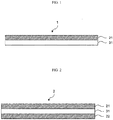
- Fig. 1 shows a schematic cross-sectional view of one configuration example of the adhesive article according to this embodiment.
- An adhesive article 1 shown in Fig. 1 includes an adhesive layer 31 and a non-adhesive layer 21 provided on one surface of the adhesive layer.
- Fig. 2 shows a schematic cross-sectional view of another configuration example of the adhesive article according to this embodiment.
- An adhesive article 2 shown in Fig. 2 includes an adhesive layer 31, a non-adhesive layer 21 provided on one surface of the adhesive layer 31 and a non-adhesive layer 22 provided on the surface opposite the non-adhesive layer 21 side.
- the non-adhesive layer covers the adhesive layer in the initial state before stretching, but the adhesive article expresses adhesiveness when the non-adhesive layer is broken by stretching the adhesive article.
- storage modulus at 23°C of the non-adhesive layer is preferably 1 ⁇ 10 7 Pa or more and more preferably 5 ⁇ 10 7 Pa or more.
- the storage modulus at 23°C of the non-adhesive layer is, for example, preferably 1 ⁇ 10 10 Pa or less and more preferably 5 ⁇ 10 9 Pa or less, from the standpoint of flexibility.
- the storage modulus at 23°C of the non-adhesive layer is measured by a dynamic viscoelasticity measuring device (product name: RSA-III, manufactured by TA Instruments) and in detail, is measured by the measurement method described in the column of examples.
- streaks may be formed on the non-adhesive layer in order to assist break of the non-adhesive layer when stretching.
- the direction of streaks in case of forming streaks on the non-adhesive layer is not particularly limited, but the break by stretching of the non-adhesive layer sometimes relatively easily occurs in the direction vertical to the stretching direction.
- streaks are preferably formed in the stretching direction in order to finely break the non-adhesive layer by stretching.
- the direction forming streaks is not limited to one direction, and streaks may be formed in a plurality of arbitrary directions, for example, two directions of a stretching direction and a direction vertical to the stretching direction.
- the material of the non-adhesive layer that can be used can be appropriately selected from materials that do not substantially have adhesiveness in themselves, can cover the adhesive layer and can be broken by stretching, and examples thereof include polymer materials, metal materials and inorganic materials. Above all, polymer materials are preferably used from the standpoint of easy break by stretching.
- the polymer materials include a resin (polyolefin, polyester, polystyrene, acryl resin, vinyl chloride, phenol resin, polyurethane, nylon or the like), an elastomer, a rubber, a natural polymer (fiber cellulose, protein or the like), and starch. Above all, acryl resin is preferred because self-fusion is difficult to occur (difficult to cause blocking). One kind alone of those materials can be used or they can be used by combining two or more kinds.
- non-adhesive layer forming polymer-containing composition a composition containing a polymer used to form the non-adhesive layer
- a non-adhesive layer forming polymer-containing composition may be a water-dispersion type non-adhesive layer forming polymer-containing composition or may be a solvent type non-adhesive layer forming polymer-containing composition.
- the non-adhesive layer formed by a water dispersion type non-adhesive layer forming polymer-containing composition is sometimes called an emulsion type non-adhesive layer
- the non-adhesive layer formed by a solvent type non-adhesive layer forming polymer-containing composition is sometimes called a solvent type non-adhesive layer.
- the term "polymer" has the concept including a copolymer.
- the non-adhesive layer formed by a water dispersion type non-adhesive layer forming polymer-containing composition is formed as a layer containing an aggregate of a plurality of emulsion particles.
- the non-adhesive layer is preferably a layer containing an aggregate of a plurality of emulsion particles (emulsion polymer particles) (emulsion type non-adhesive layer) for the reason that better adhesiveness is expressed after stretching.
- the non-adhesive layer is a layer containing an aggregate of a plurality of emulsion particles (emulsion polymer particles) (emulsion type non-adhesive layer).
- emulsion polymer particles emulsion polymer particles
- the reason that better adhesiveness is expressed after stretching is not always obvious, but is inferred as follows.
- the non-adhesive layer is an emulsion type non-adhesive layer
- the non-adhesive layer is broken in various directions from the interface between agglomerated emulsion particles, and fine scaly fragments are formed, thereby typically forming the state that the fragments are adhered to the surface of the adhesive article (adhesive layer).
- non-adhesive layer contains an aggregate of a plurality of emulsion particles containing acrylic polymer (acrylic polymer emulsion particles) is described below, but the present invention is not limited to this.
- the non-adhesive layer containing an aggregate of a plurality of acrylic polymer emulsion particles can be formed using a composition containing a water dispersion type acrylic polymer as the non-adhesive layer forming polymer-containing composition.
- the water dispersion type acrylic polymer is a composition in an emulsion form in which the acrylic polymer is dispersed in water.
- the acrylic polymer preferably includes an acrylic copolymer wherein a main monomer unit is methyl methacrylate, n-butyl methacrylate, i-butyl methacrylate, t-butyl methacrylate, isobornyl (meth)acrylate, cyclohexyl acrylate or the like.
- an acrylic copolymer (1) in which a main monomer unit is n-butyl methacrylate is preferred, and specifically includes an acrylic copolymer (1-1) containing n-butyl methacrylate and a carboxyl group-containing monomer as monomer units, and an acrylic copolymer (1-2) containing n-butyl methacrylate, a carboxyl group-containing monomer, and (meth)acrylic acid C 1-14 alkyl ester other than n-butyl methacrylate, as monomer units.
- the carboxyl group-containing monomer is not particularly limited, and can includes, for example, (meth)acrylic acid, carboxyethyl (meth)acrylate, carboxypentyl (meth)acrylate, itaconic acid, maleic acid, fumaric acid and crotonic acid. Above all, acrylic acid and/or methacrylic acid are preferred, and concurrent use of acrylic acid and methacrylic acid is more preferred. In the case of concurrently using acrylic acid and methacrylic acid, a ratio of amounts thereof is not particularly limited, but those are preferably used in nearly the same amounts. One kind or two or more kinds of the carboxyl group-containing monomer can be used.
- an alkyl group having 1 to 14 carbon atoms may be straight chain and may be branched chain, and examples thereof include methyl (meth)acrylate, ethyl (meth)acrylate, propyl (meth)acrylate, isopropyl (meth)acrylate, n-butyl acrylate, isobutyl (meth)acrylate, s-butyl (meth)acrylate, t-butyl (meth)acrylate, pentyl (meth)acrylate, isopentyl (meth)acrylate, hexyl (meth)acrylate, heptyl (meth)acrylate, octyl (meth)acrylate, cyclohexyl (meth)acrylate, 2-ethylhexyl (meth)acrylate, isooctyl (meth)acrylate, nony
- the acrylic copolymer (1) contains n-butyl methacrylate in an amount of preferably 50 to 99% by weight, more preferably 60 to 90% by weight and particularly preferably 60 to 70% by weight, in the whole monomer units.
- composition of the acrylic copolymer (1-1) containing n-butyl methacrylate and a carboxyl group-containing monomer as monomer units is that n-butyl methacrylate : carboxyl group-containing monomer (weight ratio) is preferably 80 to 99 : 20 to 1, more preferably 80 to 95 : 20 to 5 and particularly preferably 85 to 95 : 15 to 5.
- composition of the acrylic copolymer (1-2) containing n-butyl methacrylate, a carboxyl group-containing monomer and (meth)acrylic acid C 1-14 alkyl ester other than n-butyl methacrylate, as monomer units is that n-butyl methacrylate : carboxyl group-containing monomer : (meth)acrylic acid C 1-14 alkyl ester other than n-butyl methacrylate (weight ratio) is preferably 50 to 98 : 1 to 20 : 1 to 30 (provided that the total weight of three components is 100) and more preferably 60 to 90 : 5 to 20 : 5 to 20 (provided that the total weight of three components is 100).
- the acrylic copolymers (1) and (1-1) each can contain methacrylic acid C 1-18 alkyl ester other than n-butyl methacrylate, and a hydroxyl group-containing monomer as monomer units in a range of 10% by weight or less in the whole monomer units.
- the acrylic copolymer (1-2) can contain methacrylic acid C 15-18 alkyl ester and a hydroxyl group-containing monomer as monomer units in a range of 10% by weight or less in the whole monomer units.
- the hydroxyl group-containing monomer includes hydroxyethyl (meth)acrylate, hydroxybutyl (meth)acrylate, hydroxyhexyl (meth)acrylate, hydroxyoctyl (meth)acrylate, hydroxydecyl (meth)acrylate, hydroxylauryl (meth)acrylate and (4-hydroxymethylcyclohexyl) methyl methacrylate.
- the glass transition temperature of the acrylic polymer forming the non-adhesive layer containing an aggregate of a plurality of acrylic polymer emulsion particles is not particularly limited, but is preferably 5°C or higher and more preferably 10°C or higher, in order to show good non-adhesiveness.
- the upper limit of the glass transition temperature is not particularly limited, but is, for example, 150°C or lower from the standpoint of film formability.
- the glass transition temperature (°C) of the acrylic polymer is obtained by converting a theoretical glass transition temperature (K) calculated from the following Fox equation from monomer units constituting the acrylic polymer and the respective proportions into degree Celsius (°C).
- Theoretical glass transition temperature obtained from Fox equation (converted into degree Celsius (°C)) well consists with the measured glass transition temperature obtained by differential scanning calorimetry (DSC), dynamic viscoelasticity or the like.
- a method for obtaining a water dispersion type acrylic polymer by polymerizing the monomer conventional polymerization methods can be used, and an emulsion polymerization method can be preferably used.
- a monomer supply method in conducting the emulsion polymerization a batch preparation method that supplies all monomer components at one time, a continuous supply (dropping) method, a split supply (dropping) method or the like can be appropriately used.
- a part or the whole (typically the whole) of monomers may be previously mixed with water (typically, an appropriate amount of an emulsifier is used together with water) and emulsified, and the resulting emulsion (monomer emulsion) may be supplied to a reaction vessel at one time, continuously or dividedly.
- the polymerization temperature can be appropriately selected depending on the kind of monomers used, the kind of a polymerization initiator, and the like, and can be, for example, about 20 to 100°C (typically 40 to 80°C).
- the polymerization initiator used in polymerization can be appropriately selected from the conventional polymerization initiators depending on the kind of a polymerization method.
- an azo type polymerization initiator can be preferably used.
- Specific examples of the azo type polymerization initiator include 2,2'-azobisisoburyronitrile, 2,2'-azobis(2-methylpropionamidine)disulfate, 2,2'-azobis(2-amidinopropane)dihydrochloride, 2,2'-azobis[(2-(5-methyl-2-imidazolin-2-yl)propane]-dihydrochloride, 2,2'-azobis[2-(5-methyl-2-imidazolin-2-yl)propane]dihydrochloride, 2,2'-azobis(N,N'-dimethyleneisobutylamidine), 2,2'-azobis[N-(2-carboxyethyl)-2-methylpropionamidine]hydrate,
- polymerization initiator examples include a sulfate such as potassium persulfate or ammonium persulfate; a peroxide type initiator such as benzoyl peroxide, t-butyl hydroperoxide, di-t-butyl peroxide, t-butyl peroxybenzoate, dicumyl peroxide, 1,1-bis(t-butylperoxy)-3,3,5-trimethyl cyclohexane, 1,1-bis(t-butylperoxy)cyclododecane or hydrogen peroxide; a substituted ethane type initiator such as phenyl-substituted ethane; and an aromatic carbonyl compound.
- a sulfate such as potassium persulfate or ammonium persulfate
- a peroxide type initiator such as benzoyl peroxide, t-butyl hydroperoxide, di-t-butyl peroxide, t-but
- the polymerization initiator includes a redox type initiator by a combination of a peroxide and a reducing agent.
- the redox type initiator include a combination of a peroxide and ascorbic acid (such as a combination of a hydrogen peroxide solution and ascorbic acid), a combination of a peroxide and iron (II) salt (such as a combination of a hydrogen peroxide solution and iron (II) salt), and a combination of a persulfate and sodium hydrogen sulfite.
- polymerization initiators can be used alone or by combining two or more kinds.
- the amount of the polymerization initiator used is the amount generally used, and can be selected from a range of, for example, about 0.005 to 1 part by weight (typically 0.01 to 1 part by weight) per 100 parts by weight of the total monomer components.
- an emulsifier In the preparation of the water dispersion type acrylic polymer, an emulsifier can be used as necessary. Anionic, nonionic and cationic emulsifiers can be used as the emulsifier. In general, anionic or nonionic emulsifier is preferably used. The emulsifier can be preferably used when monomer components are emulsified or when an acrylic polymer obtained by other method is dispersed in water.
- the anionic emulsifier includes an alkyl sulfate type anionic emulsifier such as sodium lauryl sulfate, ammonium lauryl sulfate or potassium lauryl sulfate; a polyoxyethylene alkyl ether sulfate type anionic emulsifier such as polyoxyethylene lauryl ether sodium sulfate; a polyoxyethylene alkyl phenyl ether sulfate type anionic emulsifier such as ammonium polyoxyethylene lauryl phenyl ether sulfate or sodium polyoxyethylene lauryl phenyl ether sulfate; a sulfonate type anionic emulsifier such as sodium dodecylbenzene sulfate; and a sulfosuccinic acid type anionic emulsifier such as disodium lauryl sulfosuccinate or disodium lauryl polyoxyethylene sulfo
- the nonionic emulsifier includes a polyoxyethylene alkyl ether type nonionic emulsifier such as polyoxyethylene lauryl ether; a polyoxyethylene alkyl phenyl ether type emulsifier such as polyoxyethylene lauryl phenyl ether; polyoxyethylene fatty acid ester; and a polyoxyethylene polyoxypropylene block polymer.
- a radical polymerizable emulsifier (reactive emulsifier) having a structure that a radial polymerizable group (such as a propenyl group) is introduced into the above-described anionic or nonionic emulsifiers may be used.
- the amount of the emulsifier used is an amount capable of preparing an acrylic polymer in a form of an emulsion, and is not particularly limited.
- the amount is appropriately selected from a range of about 0.2 to 10 parts by weight (preferably about 0.5 to 5 parts by weight) on solids basis per 100 parts by weight of the acrylic polymer.
- desired dispersion stability polymerization stability, mechanical stability and the like
- adhesiveness may be deteriorated or an adherend may be contaminated.
- the non-adhesive layer contains an aggregate of a plurality of emulsion particles (acrylic polymer emulsion particles) containing an acrylic polymer, but the present invention is not limited to this case, and for example, the case that the non-adhesive layer contains an aggregate of emulsion particles containing a polymer other than the acrylic polymer can appropriately follow the above case.
- a solution obtained by dissolving the polymer that forms the non-adhesive layer in an appropriate solvent such as ethyl acetate or ethanol can be used.
- the non-adhesive layer forming polymer-containing composition may contain an acid or a base (ammonia water or the like) used for pH adjustment or the like, as necessary.
- the composition may further contain various additives such as a crosslinking agent, a viscosity regulator (such as a thickener), a leveling agent, a release modifier, a plasticizer, a softener, a filler, a coloring agent (pigment, dye or the like), a surfactant, an antistatic agent, a preservative, an age resister, an ultraviolet absorber, an antioxidant and a light stabilizer.
- a crosslinking agent is not preferably contained in the non-adhesive layer forming polymer-containing composition for the reason that the non-adhesive layer becomes too hard, so that the non-adhesive layer may be difficult to break and the adhesive layer may be broken by the impact at break of the non-adhesive layer.
- the thickness of the non-adhesive layer is, for example, preferably 0.1 ⁇ m or more and more preferably 1 ⁇ m or more, form the standpoints of securing of substantial non-adhesiveness before stretching and protection of the adhesive layer.
- the thickness is, for example, preferably 60 ⁇ m or less and more preferably 20 ⁇ m or less, from the standpoint of expression of adhesive force.
- the adhesive constituting the adhesive layer is not particularly limited and can be conventional adhesives.
- the adhesive may be an acrylic adhesive, a rubber adhesive, a vinyl alkyl ether adhesive, a silicone adhesive, a polyester adhesive, a polyamide adhesive, a urethane adhesive, a fluorine adhesive and an epoxy adhesive.
- a rubber adhesive and an acrylic adhesive are preferred from the standpoint of adhesiveness, and an acrylic adhesive is particularly preferred.
- One kind alone of the adhesive may be used and it may be used by combining two or more kinds.
- the adhesive in this embodiment is preferably a pressure-sensitive adhesive that has adhesiveness at normal temperatures and can attach an adherend to the surface thereof by a pressure caused on contact between the surface of the adhesive and the surface of the adherend.
- the pressure-sensitive adhesive does not require heating and therefore can be applied to an adherend that is weak to heat.
- the acrylic adhesive contains, as a main ingredient, a polymer of monomers including (meth)acrylic acid alkyl ester such as ethyl acrylate, butyl acrylate, 2-ethylhexyl acrylate, isooctyl acrylate or isononyl acrylate as a main component, and a modifying monomer such as acrylonitrile, vinyl acetate, styrene, methyl methacrylate, acrylic acid, maleic anhydride, vinylpyrrolidone, glycidyl methacrylate, dimethyl aminoethyl methacrylate, hydroxy ethyl acrylate or acrylamide, added to the main ingredient as necessary.
- a polymer of monomers including (meth)acrylic acid alkyl ester such as ethyl acrylate, butyl acrylate, 2-ethylhexyl acrylate, isooctyl acrylate or isononyl acryl
- the rubber adhesive contains a rubber polymer such as natural rubber, a styreneisoprene-styrene block copolymer, a styrene-butadiene-styrene block copolymer, a styrene-ethylene-butylene-styrene copolymer, a styrene-butadiene rubber, polybutadiene, polyisoprene, polyisobutylene, butyl rubber, chloroprene rubber or silicone rubber, as a main ingredient.
- a rubber polymer such as natural rubber, a styreneisoprene-styrene block copolymer, a styrene-butadiene-styrene block copolymer, a styrene-ethylene-butylene-styrene copolymer, a styrene-butadiene rubber, polybutadiene, poly
- Tackifying resins such as rosin type, terpene type, styrene type, aliphatic petroleum type, aromatic petroleum type, xylene type, phenol type, coumarone indene type and their hydrogenated products, and various additives such as a crosslinking agent, a viscosity regulator (such as a thickener), a leveling agent, a release modifier, a plasticizer, a softener, a filler, a coloring agent (pigment, dye or the like), a surfactant, an antistatic agent, a preservative, an age resister, an ultraviolet absorber, an antioxidant and a light stabilizer can be appropriately added to those adhesives.
- a viscosity regulator such as a thickener
- a leveling agent such as a release modifier
- a plasticizer such as a softener
- a filler such as a coloring agent (pigment, dye or the like)
- a surfactant such as a surfactant, an anti
- a water dispersion type adhesive is preferred in that high-speed coating is possible, it is environmentally friendly, and influence (swelling and dissolution) on the core material by a solvent is small.
- the thickness of the adhesive layer is not particularly limited, but when the thickness is too small, the adhesive article may be broken when stretching. Therefore, the thickness is, for example, preferably 1 ⁇ m or more and more preferably 3 ⁇ m or more. On the other hand, when the thickness is too large, large stress may be required when stretching. Therefore, the thickness is, for example, preferably 200 ⁇ m or less and more preferably 150 ⁇ or less.
- the number of fragments per unit area of the non-adhesive layer (hereinafter referred to as the number of fragments of the non-adhesive layer after stretching to twice) is preferably 10/cm 2 or more, more preferably 25/cm 2 or more, still more preferably 50/cm 2 or more and yet further preferably 100/cm 2 or more, at the central part of the surface of the adhesive article after stretching to twice where the non-adhesive layer has been provided.
- the number of fragments of the non-adhesive layer after stretching to twice is 10/cm 2 or more, adhesiveness expressed after stretching of the adhesive article is better.
- the reason for this is considered as follows.
- the number of fragments is 10/cm 2 or more
- the individual fragment of the non-adhesive layer adhered to the surface of the adhesive layer becomes sufficiently fine.
- the surface area of the adhesive article is increased by the stretching of the adhesive article. Therefore, in the adhesive article after stretching, the surface to which the fragments of the non-adhesive layer are not adhered comes into an exposed state and adhesiveness due to the adhesive layer is thus expressed.
- the upper limit of the number of fragments of the non-adhesive layer after stretching to twice is not particularly limited, but is, for example, 500/cm 2 or less.
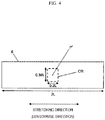
- Adhesive article 5 having length: L and width: W with a center P as a center is prepared as shown in Fig. 3 .
- Stretching direction (lengthwise direction) is defined as “Horizontal” and a direction vertical to the stretching direction (lengthwise direction) is defined as “Vertical”.
- the adhesive article 5 is stretched to twice in the lengthwise direction to prepare an adhesive article 6 after stretching to twice as shown in Fig. 4 .
- the central part (region surrounded by dot line in Fig. 4 ) in the adhesive article 6 after stretching to twice is defined as CR.
- the central part CR is a rectangular region having length: 0.2L and width: 0.3W with a center P' of the adhesive article 6 after stretching as a center.
- the surface of the adhesive article 6 after stretching to twice where the non-adhesive layer has been provided is photographed, its image is binarized using "Image J" that is an image processing program, the number of fragments per unit area (number/cm 2 ) of the non-adhesive layer within the central part CR is calculated by image analysis, and the calculated value is defined as the number of fragments of the non-adhesive layer after stretching to twice.
- Image J an image processing program
- the number of fragments per unit area (number/cm 2 ) of the non-adhesive layer within the central part CR is calculated by image analysis, and the calculated value is defined as the number of fragments of the non-adhesive layer after stretching to twice.
- the non-adhesive layer can be colored with an oil-base color marker or the like before stretching and then stretched.
- the number of fragments can also be measured according to the above calculation method.
- the number of fragments is 10/cm 2 or more
- a method of constituting the non-adhesive layer by an aggregate of a plurality of emulsion particles, a method of forming streaks (cuts) in the non-adhesive layer, or the like can be used.
- the adhesive article of this embodiment may further include a substrate.
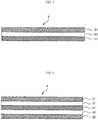
- Fig. 5 shows a schematic cross-sectional view of one configuration example of the adhesive article according to this embodiment.
- Adhesive article 3 shown in Fig. 5 includes a substrate 41 having provided on one surface thereof an adhesive layer 31 and a non-adhesive layer 21 in this order.
- Fig. 6 shows a schematic cross-sectional view of another configuration example of the adhesive article according to this embodiment.
- Adhesive article 4 shown in Fig. 6 includes a substrate 41, an adhesive layer 31 and a non-adhesive layer 21 that are provided on one surface of the substrate 41 in this order, and an adhesive layer 32 and a non-adhesive layer 22 that are provided on the other surface of the substrate 41 in this order.
- the adhesive layer and the non-adhesive layer are provided on the whole of one surface of the substrate, and in the adhesive article shown in Fig. 6 , the adhesive layer and the non-adhesive layer are provided on the whole of both surfaces of the substrate.
- the present invention is not limited to those embodiments, and the adhesive layer and non-adhesive layer may be only partially provided on one surface or both surfaces of the substrate.
- the adhesive layer is typically continuously formed, but the present invention is not limited to such embodiment.
- the adhesive layer may be formed into a regular or random pattern such as a dot shape or a stripe shape. In any case, the surface of the adhesive layer is covered with the non-adhesive layer.
- the substrate used in the adhesive article is not particularly limited so long as it does not disturb stretching of the adhesive article.
- a substrate composed of a material that is stretchable by itself is preferred, and for example, a resin film, a paper, a cloth, a rubber sheet, a foamed sheet and their composites (multilayer body) can be used.
- the resin film examples include polyolefin films such as polyethylene (PE), polypropylene (PP), an ethylenepropylene copolymer or an ethylene-vinyl acetate copolymer (EVA); polyester films such as polyethylene terephthalate (PET); urethane films such as urethane or acryl urethane; vinyl chloride resins; vinyl acetate resins; polyimide resin films; polyamide resin films; fluorine resin films; and cellophane.
- PET polyethylene terephthalate
- urethane films such as urethane or acryl urethane
- vinyl chloride resins vinyl acetate resins
- polyimide resin films polyamide resin films
- fluorine resin films and cellophane.
- the paper include Japanese paper, kraft paper, glassine paper, wood free paper, synthetic paper and top coated layer.
- the cloth include woven fabric or nonwoven fabric composed of each of various fibrous materials or a mixture of various fibrous materials.
- fibrous material examples include cotton, staple fiber, Manila hemp, pulp, rayon, acetate fiber, polyester fiber, polyvinyl alcohol fiber, polyamide fiber and polyolefin fiber.
- rubber sheet examples include natural rubber sheet and a butyl rubber sheet.
- foamed sheet examples include a foamed polyurethane sheet and a foamed polychloroprene sheet.
- the non-woven fabric used herein has a concept indicating non-woven fabric for adhesive sheet mainly used in the fields of adhesive tapes and other adhesive tapes, and typically means non-woven fabric prepared using the general paper making machine (sometimes called "paper").
- the resin film used herein is typically a nonporous resin sheet, and has a concept distinguished from, for example, non-woven fabric (that is, free of non-woven fabric).
- the resin film may be any of a non-stretched film, a uniaxially stretched film and a biaxially stretched film. Surface treatment such as application of a primer, a corona discharge treatment or a plasma treatment may be applied to the surface of the substrate.
- a polyolefin film and a urethane film are preferably used from the standpoint of easy stretching.
- the thickness of the substrate is not particularly limited and can be appropriately selected depending on the purpose. However, when the thickness is too small, the adhesive article may be broken when stretching. Therefore, the thickness is, for example, preferably 5 ⁇ m or more and more preferably 10 ⁇ m or more. On the other hand, when the thickness is too large, large stress may be required when stretching. Therefore, the thickness is, for example, preferably 100 ⁇ m or less and more preferably 50 ⁇ m or less.
- the substrate may contain various additives such as a filler (inorganic filler, organic filler or the like), an age resister, an antioxidant, an ultraviolet absorber, an antistatic agent, a lubricant, a plasticizer and a coloring agent (pigment, dye or the like).
- a filler inorganic filler, organic filler or the like
- an antioxidant an antioxidant
- an ultraviolet absorber an antistatic agent
- a lubricant e.g., a lubricant
- plasticizer e.g., a plasticizer
- a coloring agent pigment, dye or the like
- the conventional surface treatment such as corona discharge treatment, plasma treatment or application of a primer may be applied to the surface of the substrate.
- the thickness of the adhesive layer is not particularly limited.
- the thickness is, for example, preferably 1 ⁇ m or more and more preferably 3 ⁇ m or more, from the standpoint of adhesiveness.
- the thickness is, for example, 200 ⁇ m or less and more preferably 150 ⁇ m or less, from the standpoint of drying property.
- the thickness of the non-adhesive layer is not particularly limited, but is, for example, preferably 0.1 ⁇ m or more and more preferably 1 ⁇ m or more, from the standpoints of securing of substantial non-adhesiveness before stretching and protection of the adhesive layer. On the other hand, the thickness is, for example, preferably 60 ⁇ m or less and more preferably 20 ⁇ m or less, from the standpoint of expression of adhesive force.
- the term that the adhesive article in the initial state (before stretching) "does not substantially have adhesiveness (is substantially non-adhesive)" indicates that a tack value on the surface of the adhesive article measured by the following probe tack test 1 is 5 gf or less. Furthermore, the term that the adhesive article in the initial state (before stretching) "has adhesiveness” indicates that a tack value of the surface of the adhesive article measured by the following probe tack test 1 exceeds 5 gf. More specifically, the tack value is measured according to a probe tack measurement method described in the column of examples described hereinafter.
- the term that the adhesive article after stretching "does not substantially have adhesiveness (is substantially non-adhesive)" indicates that a tack value on the surface of the adhesive article measured by the following probe tack test 2 is 5 gf or less. Furthermore, the term that the adhesive article after stretching "has adhesiveness” indicates that a tack value on the surface of the adhesive article measured by the following probe tack test 2 exceeds 5 gf. More specifically, the tack value is measured according to a probe tack measurement method described in the column of examples described hereinafter.
- the adhesive article "expresses adhesiveness by stretching” indicates that the adhesive article is substantially non-adhesive in the initial state before stretching and has adhesiveness after stretching.
- the tack value after stretching to twice in a lengthwise direction of the adhesive article is preferably 10 gf or more larger than the tack value before stretching, more preferably 12 gf or more larger than the tack value before stretching, and still more preferably 15 gf or more larger than the tack value before stretching.
- the tack value after stretching to twice in a lengthwise direction of the adhesive article is preferably 10 gf or more, more preferably 12 gf or more and still more preferably 15 gf or more.
- the upper limit of the tack value after stretching to twice in a lengthwise direction of the adhesive article is not particularly limited, but is, for example, 1000 gf or less from the standpoint of the balance with shear adhesive force.
- the tack value after stretching to 4 times in a lengthwise direction of the adhesive article is preferably 20 gf or more larger than the tack value before stretching, more preferably 40 gf or more larger than the tack value before stretching, and still more preferably 60 gf or more larger than the tack value before stretching.
- the tack value after stretching to 4 times in a lengthwise direction of the adhesive article is preferably 20 gf or more, more preferably 40 gf or more and still more preferably 60 gf or more.
- the upper limit of the tack value after stretching to 4 times in a lengthwise direction of the adhesive article is not particularly limited, but is, for example, 1000 gf or less from the standpoint of the balance with shear adhesive force.
- a method of forming the adhesive article of this embodiment is not particularly limited.
- a method of directly applying an adhesive to a releasable or non-releasable substrate, followed by drying or curing direct method
- a method of applying an adhesive to a surface having releasability, followed by drying or curing, thereby forming an adhesive layer on the surface, and then bonding the adhesive layer to a non-releasable substrate in a transfer (transfer method); and the like can be used.
- the adhesive can be applied using the conventional coaters such as gravure roll coater, reverse roll coater, kiss roll coater, dip roll coater, bar coater, knife coater or spray coater.
- the drying temperature can be appropriately adjusted, but is preferably 40 to 200°C, more preferably 50 to 180°C and particularly preferably 70 to 120°C.
- the drying time can be appropriately adjusted.
- the drying time is preferably 5 seconds to 20 minutes, more preferably 5 seconds to 10 minutes and particularly preferably 10 seconds to 5 minutes.
- the above-described each method of forming the adhesive layer may be appropriately applied using the non-adhesive layer forming polymer-containing composition.
- the drying conditions may also be appropriately adjusted and may also follow the drying conditions of the adhesive layer described above. Even in the case of using a polymer material other than a resin, the same method can be appropriately applied using its solution.
- the drying conditions of a water dispersion type non-adhesive layer forming polymer-containing composition are preferably adjusted such that fusion (film formation) of emulsion particles is suppressed.
- drying conditions are, for example, such that when a glass transition temperature of the polymer is Tg, the drying temperature is preferably Tg to Tg+50°C and more preferably Tg+5 to Tg+30°C, and the drying time is preferably 5 seconds to 20 minutes and more preferably 5 seconds to 10 minutes.
- the non-adhesive layer in which fusion of emulsion particles has been suppressed is broken in various directions from the interfaces of agglomerated emulsion particles and easily becomes fine scaly fragments.
- a metal material as the non-adhesive layer
- deposition, sputtering or the like can be used, and in the case of using an inorganic material, a preparation method using sol gel reaction can be used.
- ion-exchanged water 40 parts by weight of ion-exchanged water were placed in a reaction vessel equipped with a cooling pipe, a nitrogen introduction pipe, a thermometer and a stirrer, and the water was stirred at 60°C for 1 hour or more while introducing nitrogen gas, thereby conducting nitrogen substitution.
- 0.1 parts by weight of 2,2'-azobis[N-(2-carboxyethyl)-2-methylpropione amidine] n hydrate (polymerization initiator) were added to the reaction vessel.
- Monomer emulsion A was gradually added dropwise to the reaction vessel over 4 hours while maintaining the system at 60°C, thereby advancing the emulsion polymerization reaction.
- the monomer emulsion A used was an emulsion obtained by adding 98 parts by weight of 2-ethylhexyl acrylate, 1.25 parts by weight of acrylic acid, 0.75 parts by weight of methacrylic acid, 0.05 parts by weight of lauryl mercaptan (chain transfer agent), 0.02 parts by weight of ⁇ -methacryloxypropyl trimethoxysilane (manufactured by Shin-Etsu Chemical Co., Ltd., trade name "KBM-503”) and 2 parts by weight of sodium polyoxyethylene lauryl sulfate (emulsifier) to 30 parts by weight of ion-exchanged water, followed by emulsifying.
- emulsifier sodium polyoxyethylene lauryl sulfate
- ion-exchanged water 40 parts by weight of ion-exchanged water were placed in a reaction vessel equipped with a cooling pipe, a nitrogen introduction pipe, a thermometer and a stirrer, and the water was stirred at 60°C for 1 hour or more while introducing nitrogen gas, thereby conducting nitrogen substitution.
- 0.1 parts by weight of 2,2'-azobis[N-(2-carboxyethyl)-2-methylpropione amidine] n hydrate (polymerization initiator) were added to the reaction vessel.
- Monomer emulsion B was gradually added dropwise to the reaction vessel over 4 hours while maintaining the system at 60°C, thereby advancing the emulsion polymerization reaction.
- the monomer emulsion B used was an emulsion obtained by adding 95 parts by weight of n-butyl methacrylate, 5 parts by weight of acrylic acid and 2 parts by weight of sodium polyoxyethylene lauryl sulfate (emulsifier) to 30 parts by weight of ion-exchanged water, followed by emulsifying. After completion of dropwise addition of the monomer emulsion B, the resulting mixture was maintained at 60°C for 3 hours, and then 0.2 parts by weight of hydrogen peroxide solution and 0.6 parts by weight of ascorbic acid were added. After cooling the system to room temperature, the pH of the mixture was adjusted to 7 by adding 10 wt% ammonia water. Thus, an acrylic polymer emulsion (water dispersion type acrylic polymer) B was obtained.
- the water dispersion type acrylic adhesive composition A was applied to a release liner having a release-treated layer by a silicone release agent, and dried at 130°C for 2 minutes. Thus, an adhesive layer having a thickness of 40 ⁇ m was formed.
- the acrylic polymer emulsion B was applied to the adhesive layer by a bar coater such that the thickness after drying is about 5 ⁇ m, and dried at 70°C for 5 minutes. Thus, a two-layer structure of an adhesive layer and a non-adhesive layer was obtained. Thereafter, the release liner on the adhesive layer side was released and the two-layer structure was then transferred to a stretch film S (manufactured by Sekisui Material Solutions, thickness: 25 ⁇ m). The resulting laminate was cut into a size of 3 cm width and 5 cm length. Thus, a sample of the adhesive article of Example 1 was obtained.
- a sample of the adhesive article of Example 2 was prepared in the same manner as in Example 1 except that the drying conditions after applying the acrylic polymer emulsion B were changed to 130°C and 2 minutes.
- the water dispersion type acrylic adhesive composition A prepared in Example 1 was used as an adhesive composition for adhesive layer.
- a sample of the adhesive article according to Comparative Example 1 was prepared in the same manner as in Example 1 except that the acrylic polymer solution C was used as a forming material of the non-adhesive layer in place of the acrylic polymer emulsion B.
- the surface (surface of stretch film side) opposite the non-adhesive layer side of the sample according to each Example and Comparative Examples was stuck on a slide glass manufactured by Matsunami Glass Inc., Ltd. using a double-sided adhesive tape "No. 5000N" (thickness: 0.16 mm) manufactured by Nitto Denko Corporation. Thus, a test piece was prepared.
- test piece prepared was subjected to a probe tack test using a probe tack measuring device (TACKINESS TESTER Model TAC-II manufactured by RHESCA).
- the adhesive article When the tack value measured by the probe tack test is 5 gf or less, it is evaluated that the adhesive article "does not substantially have adhesiveness (is substantially non-adhesive)".
- test piece prepared was subjected to the same test method under the same test conditions as in the tack value in the initial state (before stretching), and the tack value (gf) after stretching to twice or stretching to 4 times was measured.
- Adhesive article 5 having length L: 5 cm and width W: 3 cm with a center P as a center was prepared as shown in Fig. 3 .
- Stretching direction (lengthwise direction) is defined as “Horizontal” and a direction vertical to the stretching direction (lengthwise direction) is defined as “Vertical”.
- the adhesive article 5 is stretched to twice in the lengthwise direction to prepare an adhesive article 6 after stretching to twice as shown in Fig. 4 .
- the central part (region surrounded by dot line in Fig. 4 ) in the adhesive article 6 after stretching to twice is defined as CR.
- the surface of the adhesive article 6 after stretching to twice where the non-adhesive layer has been provided was photographed, its image was binarized using "Image J" that is an image processing program, the number of fragments per unit area ([number]/cm 2 ) of the non-adhesive layer within the central part CR was calculated by image analysis, and the calculated value was defined as the number of fragments of the non-adhesive layer after stretching to twice.
- the non-adhesive layer was colored with an oil-base color marker before stretching and then stretched.
- Elastic modulus at 23°C of the non-adhesive layer was measured by the following measurement method.
- Example 1 a sheet-like test piece having a size of 3 mm width, 30 mm length and 0.04 mm thickness was prepared under the drying conditions of 70°C and 5 minutes using the acrylic polymer emulsion B for non-adhesive layer formation.
- Example 2 a sheet-like test piece having the same size as in Example 1 was prepared under the drying conditions of 130°C and 2 minutes using the acrylic polymer emulsion B for non-adhesive layer formation.
- Comparative Example 1 a sheet-like test piece having the same size as in Example 1 was prepared under the drying conditions of 70°C and 5 minutes using the acrylic polymer solution C for non-adhesive layer formation.
- Measurement results of a tack value in the initial state (before stretching), a tack value after stretching to twice and a tack value after stretching to 4 times in the evaluation sample of each example are shown in Table 1.
- the number of fragments of the non-adhesive layer after stretching to twice are shown. Additionally, the measurement results of storage modulus of the non-adhesive layers are shown.
- the adhesive articles of Examples 1 and 2 having an emulsion type non-adhesive layer and in which the above-mentioned number of fragments of the non-adhesive layer after stretching to twice is 10/cm 2 or more expressed good adhesiveness after stretching as compared with the adhesive article of Comparative Example 1.
Landscapes
- Chemical & Material Sciences (AREA)
- Organic Chemistry (AREA)
- Chemical Kinetics & Catalysis (AREA)
- Health & Medical Sciences (AREA)
- Medicinal Chemistry (AREA)
- Polymers & Plastics (AREA)
- Adhesives Or Adhesive Processes (AREA)
- Adhesive Tapes (AREA)
- Laminated Bodies (AREA)
Applications Claiming Priority (2)
| Application Number | Priority Date | Filing Date | Title |
|---|---|---|---|
| JP2017192137 | 2017-09-29 | ||
| PCT/JP2018/036038 WO2019065875A1 (fr) | 2017-09-29 | 2018-09-27 | Article adhésif |
Publications (2)
| Publication Number | Publication Date |
|---|---|
| EP3689990A1 true EP3689990A1 (fr) | 2020-08-05 |
| EP3689990A4 EP3689990A4 (fr) | 2021-06-23 |
Family
ID=66337520
Family Applications (1)
| Application Number | Title | Priority Date | Filing Date |
|---|---|---|---|
| EP18860001.9A Withdrawn EP3689990A4 (fr) | 2017-09-29 | 2018-09-27 | Article adhésif |
Country Status (6)
| Country | Link |
|---|---|
| US (1) | US20200254736A1 (fr) |
| EP (1) | EP3689990A4 (fr) |
| JP (1) | JP7264609B2 (fr) |
| KR (1) | KR20200061341A (fr) |
| CN (1) | CN111108167A (fr) |
| TW (1) | TW201920562A (fr) |
Family Cites Families (13)
| Publication number | Priority date | Publication date | Assignee | Title |
|---|---|---|---|---|
| JPS3816319Y1 (fr) * | 1960-06-06 | 1963-08-06 | ||
| JPS3828672Y1 (fr) * | 1961-12-06 | 1963-12-25 | ||
| JPS4017976Y1 (fr) * | 1962-09-26 | 1965-06-25 | ||
| US3379562A (en) * | 1964-08-17 | 1968-04-23 | Minnesota Mining & Mfg | Self-adhering sheet product |
| JPS5037691B1 (fr) * | 1970-10-08 | 1975-12-04 | ||
| JPS5825708B2 (ja) * | 1975-09-03 | 1983-05-28 | 昭和電線電纜株式会社 | ノンセパレ−タ−ジコユウチヤクセイテ−プ |
| JP2829413B2 (ja) * | 1988-06-06 | 1998-11-25 | 日東電工株式会社 | 繊維状感圧接着体及びその感圧接着層 |
| JPH05302069A (ja) * | 1992-02-24 | 1993-11-16 | Sekisui Chem Co Ltd | 粘着テープ巻重体及びその製造方法 |
| JP4380837B2 (ja) | 1999-04-07 | 2009-12-09 | 日東電工株式会社 | 粘着性再発現方法 |
| AU8852601A (en) * | 2000-09-06 | 2002-03-22 | Appleton Paper Inc | In situ microencapsulated adhesive |
| US7078582B2 (en) * | 2001-01-17 | 2006-07-18 | 3M Innovative Properties Company | Stretch removable adhesive articles and methods |
| US7001475B2 (en) * | 2001-12-11 | 2006-02-21 | 3M Innovative Properties Company | Film structures and methods of making film structures |
| US7964276B2 (en) * | 2005-08-30 | 2011-06-21 | Kimberly-Clark Worldwide, Inc. | Fastening system with auto-adhesive layer exposed through rupturable cover layer |
-
2018
- 2018-09-27 CN CN201880061416.0A patent/CN111108167A/zh active Pending
- 2018-09-27 EP EP18860001.9A patent/EP3689990A4/fr not_active Withdrawn
- 2018-09-27 JP JP2018181176A patent/JP7264609B2/ja active Active
- 2018-09-27 US US16/651,643 patent/US20200254736A1/en not_active Abandoned
- 2018-09-27 KR KR1020207008547A patent/KR20200061341A/ko not_active Withdrawn
- 2018-09-28 TW TW107134475A patent/TW201920562A/zh unknown
Also Published As
| Publication number | Publication date |
|---|---|
| US20200254736A1 (en) | 2020-08-13 |
| JP2019065279A (ja) | 2019-04-25 |
| KR20200061341A (ko) | 2020-06-02 |
| EP3689990A4 (fr) | 2021-06-23 |
| CN111108167A (zh) | 2020-05-05 |
| TW201920562A (zh) | 2019-06-01 |
| JP7264609B2 (ja) | 2023-04-25 |
Similar Documents
| Publication | Publication Date | Title |
|---|---|---|
| CN100503760C (zh) | 压敏粘合片类 | |
| JP2019123884A (ja) | 粘着シート | |
| JP5190384B2 (ja) | 粘着シート | |
| JP2019070102A (ja) | アクリル系粘着剤組成物および粘着シート | |
| CN100577759C (zh) | 压敏粘合片 | |
| CN101302407A (zh) | 双面粘合片 | |
| TW201739862A (zh) | 黏著片材 | |
| WO2017123488A1 (fr) | Composition adhésive sensible à la pression et article associé | |
| CN106459706A (zh) | 水分散型粘合剂组合物和粘合片 | |
| CN105602463A (zh) | 粘合片 | |
| CN101857781A (zh) | 粘合制品 | |
| JP2016102195A (ja) | 粘着シート | |
| JPWO2015064282A1 (ja) | 表面保護シートおよび表面保護シート用水分散型粘着剤組成物 | |
| WO2019065886A1 (fr) | Article adhésif | |
| CN101555390A (zh) | 粘合片及其制造方法 | |
| EP4015593A1 (fr) | Article adhésif | |
| CN102994019A (zh) | 水性分散性压敏粘合剂组合物和压敏粘合片 | |
| CN102477264A (zh) | 双面粘合胶带 | |
| EP3508542A1 (fr) | Composition adhésive acrylique dispersée dans l'eau | |
| CN104250539B (zh) | 水分散型粘合剂组合物及其制造方法、以及使用了该组合物的粘合片 | |
| JP2019099635A (ja) | 粘着シート | |
| JP2019070103A (ja) | 粘着シート | |
| CN102533167A (zh) | 粘合剂组合物及其应用 | |
| EP3689991A1 (fr) | Article adhésif | |
| WO2019151192A1 (fr) | Procédé de décollement de feuille adhésive |
Legal Events
| Date | Code | Title | Description |
|---|---|---|---|
| STAA | Information on the status of an ep patent application or granted ep patent |
Free format text: STATUS: THE INTERNATIONAL PUBLICATION HAS BEEN MADE |
|
| PUAI | Public reference made under article 153(3) epc to a published international application that has entered the european phase |
Free format text: ORIGINAL CODE: 0009012 |
|
| STAA | Information on the status of an ep patent application or granted ep patent |
Free format text: STATUS: REQUEST FOR EXAMINATION WAS MADE |
|
| 17P | Request for examination filed |
Effective date: 20200327 |
|
| AK | Designated contracting states |
Kind code of ref document: A1 Designated state(s): AL AT BE BG CH CY CZ DE DK EE ES FI FR GB GR HR HU IE IS IT LI LT LU LV MC MK MT NL NO PL PT RO RS SE SI SK SM TR |
|
| AX | Request for extension of the european patent |
Extension state: BA ME |
|
| DAV | Request for validation of the european patent (deleted) | ||
| DAX | Request for extension of the european patent (deleted) | ||
| A4 | Supplementary search report drawn up and despatched |
Effective date: 20210526 |
|
| RIC1 | Information provided on ipc code assigned before grant |
Ipc: C09J 7/00 20180101AFI20210519BHEP Ipc: C09J 201/00 20060101ALI20210519BHEP Ipc: C09J 133/02 20060101ALI20210519BHEP |
|
| STAA | Information on the status of an ep patent application or granted ep patent |
Free format text: STATUS: THE APPLICATION IS DEEMED TO BE WITHDRAWN |
|
| 18D | Application deemed to be withdrawn |
Effective date: 20220104 |