EP3694156A1 - Procédé de transmission de données protégé contres les défaillances, noeuds de réseau, programme informatique et support lisible par ordinateur - Google Patents
Procédé de transmission de données protégé contres les défaillances, noeuds de réseau, programme informatique et support lisible par ordinateur Download PDFInfo
- Publication number
- EP3694156A1 EP3694156A1 EP19155923.6A EP19155923A EP3694156A1 EP 3694156 A1 EP3694156 A1 EP 3694156A1 EP 19155923 A EP19155923 A EP 19155923A EP 3694156 A1 EP3694156 A1 EP 3694156A1
- Authority
- EP
- European Patent Office
- Prior art keywords
- ring
- port
- riv
- node
- segment
- Prior art date
- Legal status (The legal status is an assumption and is not a legal conclusion. Google has not performed a legal analysis and makes no representation as to the accuracy of the status listed.)
- Withdrawn
Links
- 230000005540 biological transmission Effects 0.000 title claims abstract description 48
- 238000000034 method Methods 0.000 title claims abstract description 48
- 238000004590 computer program Methods 0.000 title claims abstract description 5
- 239000003999 initiator Substances 0.000 claims abstract description 15
- 238000010168 coupling process Methods 0.000 claims description 149
- 238000005859 coupling reaction Methods 0.000 claims description 149
- 230000008878 coupling Effects 0.000 claims description 147
- 239000003086 colorant Substances 0.000 claims description 29
- 230000008569 process Effects 0.000 claims description 8
- 125000006413 ring segment Chemical group 0.000 description 194
- 238000004891 communication Methods 0.000 description 10
- 238000012546 transfer Methods 0.000 description 9
- 238000012360 testing method Methods 0.000 description 8
- 238000001914 filtration Methods 0.000 description 7
- 230000006870 function Effects 0.000 description 6
- 230000007246 mechanism Effects 0.000 description 6
- 230000008859 change Effects 0.000 description 5
- 230000008901 benefit Effects 0.000 description 4
- 238000003745 diagnosis Methods 0.000 description 4
- 238000005516 engineering process Methods 0.000 description 4
- 238000001514 detection method Methods 0.000 description 3
- 230000000644 propagated effect Effects 0.000 description 3
- 238000004364 calculation method Methods 0.000 description 2
- 125000004122 cyclic group Chemical group 0.000 description 2
- 238000011161 development Methods 0.000 description 2
- 230000007935 neutral effect Effects 0.000 description 2
- 238000012545 processing Methods 0.000 description 2
- 230000001960 triggered effect Effects 0.000 description 2
- 230000004913 activation Effects 0.000 description 1
- 238000007792 addition Methods 0.000 description 1
- 230000002457 bidirectional effect Effects 0.000 description 1
- 230000004069 differentiation Effects 0.000 description 1
- 238000009826 distribution Methods 0.000 description 1
- 238000009434 installation Methods 0.000 description 1
- 230000010354 integration Effects 0.000 description 1
- 238000004519 manufacturing process Methods 0.000 description 1
- 238000012544 monitoring process Methods 0.000 description 1
- 230000006855 networking Effects 0.000 description 1
- 238000005457 optimization Methods 0.000 description 1
- 230000008520 organization Effects 0.000 description 1
- 230000000737 periodic effect Effects 0.000 description 1
- 230000004044 response Effects 0.000 description 1
- 230000000717 retained effect Effects 0.000 description 1
- 230000002441 reversible effect Effects 0.000 description 1
- 238000000926 separation method Methods 0.000 description 1
- 239000007787 solid Substances 0.000 description 1
- 230000001360 synchronised effect Effects 0.000 description 1
Images





Classifications
-
- H—ELECTRICITY
- H04—ELECTRIC COMMUNICATION TECHNIQUE
- H04L—TRANSMISSION OF DIGITAL INFORMATION, e.g. TELEGRAPHIC COMMUNICATION
- H04L12/00—Data switching networks
- H04L12/28—Data switching networks characterised by path configuration, e.g. LAN [Local Area Networks] or WAN [Wide Area Networks]
- H04L12/42—Loop networks
Definitions
- the invention relates to a method for fail-safe data transmission in a preferably industrial network with one or more ring segments, in which or in each of which several ring nodes are connected to form a ring, each ring node having exactly two participating in the respective ring segment and as such has known ring ports and optionally one or more ports not participating in the respective ring segment.
- the invention also relates to a network node, a computer program and a computer-readable medium.
- a field bus is a bus system that connects field devices such as measuring sensors (sensors) and actuators (actuators) in a system for the purpose of communication with an automation device. If several communication participants send their messages over the same line, it must be specified who (identifier) says what (measured value, command) when (initiative). There are standardized protocols for this. Ethernet has established itself as a technology.
- the fieldbus replaces the parallel bundle of cables with a single bus cable and usually connects all levels, from the field to the control level.
- the transmission medium of the fieldbus networks the components in the field.
- PROFINET In PROFINET, a separate priority was usually used for real-time data, which should only be used for real-time data in a network. So that latency can be guaranteed, the real-time data must be transmitted with the highest priority.
- the exclusive use of the highest priority is an installation guideline and is no longer monitored. All other applications can also use this special priority.
- the resources actually used are not checked. Each application only checks whether the network is adequately dimensioned for exclusive use.
- the controller-device model is used as a basis and the communication load on the controller, which can be a programmable logic controller, is checked. The simple check can lead to overload situations in the network in several applications, which represent incorrect use of the real-time system and can lead to communication failure.
- the user of PROFINET has to ensure the boundary conditions for the use so that the system works in a restricted application.
- a known way of offering media redundancy is to use the typical network structures of field buses - long lines - and to close the lines to form a ring.
- a corresponding network then comprises a ring segment in which several ring nodes are connected to form a ring, with each ring node having exactly two ring ports participating in the ring segment and optionally one or more ports not participating in the ring segment (can also be referred to as non-ring ports ) has, or is formed by such. Only a small extension is added locally to the ring participants.
- the ring is specifically opened in a specially provided device, the so-called ring manager.
- opening is to be understood in particular to mean that data packets that arrive at a ring port of a ring node participating in the ring segment, which in particular represents the ring manager or includes this or its function, are not forwarded.
- the function of all individual connections is constantly checked by the ring manager using test telegrams. In the event of a faulty connection, the cyclical test telegrams are not received and the ring manager closes the previously opened ring in order to reestablish communication with the part of the ring that was decoupled by the error.
- MRP Media Redundancy Protocol
- HRP Highspeed Redundancy Protocol
- the data is usually transmitted in parallel on several, typically two separate transmission paths (paths) in the network.
- This is often referred to as "Seamless Redundancy" because there is no failure of communication in the event of an error.
- the network protocol for Ethernet known as High-Availability Seamless Redundancy (HSR), and the Parallel Redundancy Protocol (PRP), both of which are standardized in IEC 62439-3, are known.
- HSR and PRP a sequence number is inserted into all data packets.
- Ethernet Since the introduction of fieldbus technology on Ethernet, Ethernet has evolved. In the AVB working group (Audio Video Bridging Taskgroup) extensions were introduced to protect special periodic connections (so-called streams) in the network. The aim of AVB is the protected transmission of audio and video signals in an Ethernet network.
- a reservation protocol Stream Reservation Protocol, SRP, see in particular IEEE802.1Q
- SRP Stream Reservation Protocol
- TSN Time Sensitive Networking
- further optimizations and additions were added in order to cover the requirements of further use cases and thus to be able to use Ethernet in other markets.
- TSN includes a variety of standards. The time synchronization (IEEE802.1AS-Rev), frame preemption (IEEE802.1Qbu) and reservation (IEEE802.1Qca, IEEE802.1Qcc) are mentioned purely as examples in this context.
- This object is achieved in a method for fail-safe data transmission of the type mentioned in that, in order to set up a stream between a stream initiator and at least one stream participant, the stream initiator issues an announcement message for the stream and this is distributed in the network, and the announcement message reaches the respective ring segment at a port not participating in the respective ring segment of a ring node representing the feed ring node of the respective ring segment for this announcement message, and the respective feed ring node receives the announcement message via at least one of its forwards both ring ports participating in the respective ring segment, and the announcement message in the respective ring segment is forwarded in at least one direction from ring node to ring node and is preferably processed by the ring node, w whether for each or from each ring node of the respective ring segment that receives an announcement message at a ring port participating in the respective ring segment, before it is forwarded via its other ring port participating in the respective ring segment, it is checked whether it is the feeder Ring node of the respective
- the basic idea of the present invention consists in the simple redundancy mechanisms optimized for industrial applications based on ring topologies with resource reservation for a protected transmission, in particular of a reservation protocol such as SRP, to combine.
- a stream announcement message which can be in the form of a talker or listener advert, for example, is duplicated or doubled when entering the or, if there are several, the respective ring segment via the node taking over the feed role for the respective segment or segments. multiplied and forwarded via its two ring ports participating in the (respective) ring segment in both directions and "runs through” the (respective) ring segment once completely in both directions. This makes it easy to reserve both directions or routes in the network with ring topology (s). Then, in the event of an error, if you have to switch from one of the two paths to the other, there are enough resources available for a transmission on the other, new path and the switchover can be triggered locally immediately.
- the stream device takes place in a manner known per se in order to forward a transmission of data packets using resources reserved at network nodes following the device, in particular when at least one stream participant has logged on to the announced stream can, whereby in particular a latency can be guaranteed.
- an announcement message for a stream is forwarded in the network or distributed in this means in particular that the nodes receive the announcement message in a manner known per se, process it, store the information it contains and the information it contains, possibly together with additional information, in turn Forward the form of an announcement message to the next node or nodes or terminals (peer-to-peer).
- a network can comprise or be given by more than one ring segment, for example two, three or more ring segments.
- the ring segments can be coupled to one another.
- the processes provided according to the invention are preferably carried out in two or more, in particular all ring segments.
- the additional check provided according to the invention is carried out by or for the ring nodes as to whether they were the (respective) feeder of a stream announcement message received at a ring port, for or by all ring nodes of all ring segments.
- the ring nodes of all ring segments taking on the role of feeder then preferably forward announcement messages received at a port not participating in the respective ring segment, in each case via one or both ring ports assigned to the respective ring segment.
- announcement message from the feeder ring node is expediently always forwarded via both ring ports and distributed in both directions in the ring until it arrives at the feeder again.
- announcement messages from a ring node forming a feeder are only forwarded via one of the two ports, especially in the second ring segment.
- a preferred embodiment of the method according to the invention is characterized in that the check for or from the respective ring node, whether it was the or (in the case of several) the respective feed ring node for an announcement message, is carried out by the respective or for the the respective ring node is checked to see whether it has previously received the announcement message via a port that is not participating in the respective ring segment.
- the only ring node of a given ring segment that receives an announcement message via a ring port not participating in this ring segment (a non-ring port from the perspective of this segment) is the one via which the announcement message enters this ring segment, i.e. the Infeed ring node of this segment.
- a corresponding check is therefore a simple way of identifying the (respective) feeder.
- the (respective) feed ring node forwards the announcement message received on a port not participating in the respective ring segment via its two ring ports participating in the respective ring segment, and that the announcement message is forwarded via one of the ports Provides ring port with a connoisseur and, before it is forwarded via the other ring port, with another, from which one connoisseur provides different connoisseurs, whereby preferably VLAN IDs and / or colors are used as experts.
- a reservation for "red” and “blue” in each node on the two ports participating in the (respective) ring segment can be viewed locally as two reservations.
- the reservation can in particular use the fact of the ring with the local identification of the ring ports in order to be able to determine the two directions in the ring locally.
- the colors can be a merely "imagined" differentiation criterion, in particular for the two directions of rotation.
- VLAN IDs for example, can be used - in particular as experts contained in announcement messages - and / or port numbers - in particular as experts used purely locally for the reservations - are used.
- Each node can, for example, make any local assignment of "red” and “blue” to the two ring ports of a ring segment.
- the reservation of resources in particular for terminals that want to send or receive data packets that are to be transported over the ring segment using the resources, can then be made in the network with the respective local color - or with two identifiers representing the two colors, for example VLAN IDs and / or port numbers - can be viewed and / or performed.
- the color coding for both paths in the reservation can be made by using a separate VLAN ID in the stream description. This is usually also used in the data plane to determine the forwarding route.
- the identification in the data and the stream description, which represent the announcement message or can be included by it, does not have to take place when the method according to the invention is carried out.
- the internal processing of the reservation messages by the reservation protocol can work with purely local VLAN IDs in order to map two identifiers, in particular the two colors, internally.
- the information stored internally by the reservation protocol then corresponds in particular to information for a connoisseur - even if this was only given locally.
- the color coding or the identifier representing the two colors can be used internally to differentiate the information from the two ports.
- the internal procedure for the reservation in the (MRP / HRP) ring at the two ports with the identifier contained in the advertise messages by the first node can then be analogous or similar to that in the WO 2019/001718 A1 proceed as described.
- the two experts assigned locally by the first ring node behave like the experts of one Reservation on previously established loop-free paths in a ring with a color for each direction of the ring.
- the reservation protocol generates a stream entry for each connoisseur with the associated information from the announcement message, in particular the advert and the local reservation status. If the reservation is successful, forwarding is set up for the data plane.
- a common forwarding is set up in the data plane for the reservation with both experts.
- the optional use of different experts in the announcement, especially talker / listener advertise messages, which is not absolutely necessary, offers an advantage in diagnosis in order to be able to distinguish between the announcement and especially advertise messages of the reservation from the two directions of rotation in the ring.
- the ring port numbers can also be used purely internally (reception via the first or second ring port) - the announcement, in particular Talker Advertise messages, cannot be distinguished by a different expert.
- an announcement message or stream description usually belongs to exactly one stream.
- a stream can contain a stream ID and / or stream address, in particular designated stream address (stream DA), for unambiguous identification or assignment to a stream, particularly in a manner known per se.
- stream DA designated stream address
- data packets can be transmitted as a stream over a protected connection between exactly one sender (particularly referred to as a "talker” in TSN) and exactly one receiver (particularly referred to as a "listener” in TSN).
- a stream is set up between a sender / talker and several recipients / listeners, i.e. more than one recipient / listener logs on to a stream announced or described by a sender / talker. This is also known as multiple listener per talker and can be seen from the definition of a stream from IEEE 802.1Q as a directed data flow from a talker to a listener.
- a stream is set up between several senders / talkers and a receiver / listener, i.e. several senders / talkers send data packets to a common destination, a receiver / listener, via a stream or a protected connection.
- This scenario which can also be referred to as multiple talker per stream, is described in the European patent application with the file number 18154319.0, which also goes back to the applicant.
- a stream is expediently initiated either by one sender / talker or - in the case of several senders / talkers - by one receiver / listener.
- the stream initiator can thus be both a sender / talker and a listener / receiver.
- the stream announcement message can accordingly be both a talker and a listener advertise.
- participation messages that can be sent by the stream participant (s) to register for a stream, correspondingly to listeners or talker readys or joins.
- Another embodiment of the method according to the invention is characterized in that the check for or from the respective ring node as to whether it was the respective feed ring node for the announcement message is carried out by checking whether the respective ring node has already received the announcement message beforehand received without one (of the two) connoisseurs. For example, provision can be made for each node to check its address table entries following receipt of an announcement message provided with an identifier, in particular from the feeder ring node, to determine whether the announcement message is already available without an identifier. This is another particularly suitable way of identifying the feeding ring node at which the transfer should end.
- each ring node forwards an announcement message received at a port via all (remaining) ports with the exception of the port on which it received the (respective) announcement message (receiving port). It can be provided that the announcement message is forwarded unchanged. This applies in particular to the ports of the (respective) ring segment that do not participate in the respective ring segment.
- any terminal devices connected to the respective ring node receive announcement messages and can log on to associated streams, in particular by sending a participation message, such as listeners or talker joins or readys.
- announcement messages for streams are always forwarded directly, in particular immediately following the initial reception. In such a case in particular, however, it may be necessary to update the information as soon as the announcement message is received again via the respective second ring port.
- the accumulated latency in particular, can be greater over a "slower" path of propagation and the greatest possible overall latency must always be considered.
- the announcement message is usually propagated in both directions in a ring segment and the ring segment is completely traversed in both directions, since all ring nodes with the exception of the feeder "pass on" the message after one run (peer-to-peer),
- the ring nodes usually receive each announcement message twice, once at their one ring port and once at their other ring port.
- the announcement message that is received later will usually contain an indication of a greater maximum latency. Terminal devices should always receive the information about the maximum possible latency that can occur taking into account both possible redundant transmission paths.
- the announcement message is updated. This is particularly the case with regard to a maximum latency that is described or specified with the announcement message for the stream.
- the fact that "the same" announcement message is received a second time means in particular that an announcement message with the same stream ID and / or stream DA (designated stream address) arrives at a node a second time.
- the forwarding of the announcement message on the later fast transmission path of the data transmission of the stream can take longer and regardless of the time required for the transmission of the stream data, since the information is received, evaluated, changed and only then passed on, in particular through the reservation protocol. The time required for this depends on the computing power of the node.
- the forwarding of the stream data takes place advantageously in hardware and is significantly faster than the forwarding of the announcement, especially talker or listener advertise information.
- the ring nodes after having received an announcement message for a stream for the first time on one of their two ring ports (with or without an expert), first wait until the announcement message for this stream is also sent to the other ring port, i.e. is received from the opposite direction of rotation (possibly with a different expert) before the announcement message for the stream is forwarded via one or more ports that do not participate in the (respective) ring segment, in particular to terminals. If the second announcement message is waited for, the essential information, in particular greater latency, can be passed on directly; an update does not have to take place after it has been passed on for the first time.
- the ring nodes assign an identifier to announcement messages that they receive at their one ring port participating in the respective ring segment and announcement messages that they receive at their other ring port participating in the respective ring segment one of assign the one connoisseur to various other connoisseurs, and preferably the ring nodes store and / or further process received announcement messages or information contained therein together with the respectively assigned connoisseur.
- Locally assigned identifiers are preferably those who are assigned to the ring port participating in the ring segment or segments via which the respective announcement message was received.
- a ring node that has a ring port 1 and ring port 2 in a ring segment can, for example, assign the number 1 to all announcement messages that it receives via ring port 1 and the number 2 to all announcement messages received via ring port 2. Any two other experts who know each other can be used equally.
- the arbitrary local assignment for each stream from the perspective of each ring node creates a separate direction of rotation for the local red and blue reservation in the network starting from the first ring node (feeder) in the ring. It is possible that the local identifier for a stream - possibly in each node in the ring segment - changes, especially when each ring node uses local identifiers that are preferably assigned to the respective ring port. This can be the case in particular if the advertise information is passed on without an expert and the expert is assigned locally in each ring node.
- the states in both directions of the ring segment and error messages can be viewed separately from one another, which among other things can be advantageous for diagnostic purposes.
- each ring node assigns announcement messages that it receives at its one ring port to an identifier and announcement messages that it receives at its other ring port to another one from the first different identifier (for example the two port numbers).
- the ring nodes basically have exactly two ring ports participating in a given ring segment and forwarding - without additional information being required - can take place locally at the other ring port participating in the (respective) ring segment, the use of an expert , for example a color or VLAN ID or port number is only relevant locally for the reservation.
- the principle of the reservation corresponds to that of two established routes in the network.
- the information about which two Ports of the ring nodes are ring ports participating in the (respective) ring segment which can be provided and / or received via a redundancy protocol, for example MRP and / or HRP.
- MRP is the well-known abbreviation for the Media Redundancy Protocol and HRP stands for the High Speed Redundancy Protocol.
- a reservation protocol is preferably used. It can be provided that a logical data plane is accepted in the control plane of the reservation protocol, in which the data is forwarded with the same identifications. As a result, the data on the two logical paths of the control plane are identical; in particular, based on the stream data packets sent in the ring, it is not possible to differentiate between the two propagation paths in the ring.
- an extended reservation protocol can be used, which works with two logical control plane paths, only sets up one logical data plane and implements the special rules described in this application when forwarding the announcement, in particular advert information
- the resources that are to be reserved or reserved at participating nodes along the transmission paths within the scope of the method according to the invention are in particular those resources that are also reserved according to the previously known, standardized methods in order to contain a protected connection.
- SRP that is to say the Stream Reservation Protocol, in particular IEEE 802.1 Q, for example.
- the network comprises not just one but two or more ring segments coupled to one another.
- each two coupled ring segments can be coupled to one another via a coupling ring node participating in the respective two ring segments.
- the coupling ring node can have two first ring ports participating in the respective first ring segment, which do not participate in the respective second ring segment, and two second ring ports participating in the respective second ring segment, which do not participate in the respective first ring segment participate, and optionally has further ports participating neither in the respective first nor in the respective second ring segment.
- the coupling ring node also forms the feed ring node for the respective second ring segment and in particular forwards announcement messages that it receives on one of the two first ring ports, both via the other of the two first ring ports and via the two second ring ports.
- the two or two ring segments are coupled to one another via two, three or four coupling ring nodes that each have two ring ports that participate in one or the two ring segments.
- the two or more coupling ring nodes are then connected to one another in particular via two coupling links.
- Each of the two coupling paths then preferably connects a coupling port of the one coupling ring node that is not participating in any of the two ring segments or segments with one of neither of the ring segments coupling port of the other coupling ring node participating in two ring segments.
- one coupling path represents an active coupling path and the other coupling path represents a passive coupling path, the active coupling path having two active coupling ports (active coupling ports) and the passive coupling path having two passive coupling ports (passive Coupling ports) connects.
- the passive link in particular then forms a standby link via which no data packets are transmitted, but which can "take over" in the event of an error in the other coupling link.
- a coupling ring node when it receives announcement messages for a stream for the first time on a ring port, forwards it via its other ring port but not via its active or passive coupling port, and especially if it has already done one Receives an announcement message for a stream received a first time at a ring port a second time at its other ring port, forwards the announcement message via the one ring port and via its active or passive coupling port.
- a coupling ring node which receives an announcement message for a stream at an active coupling port (and in particular represents the feeder for the second ring segment) only forwards the announcement message via one of its two ring ports.
- a coupling ring node which receives an announcement message for a stream, especially for the first time at its passive coupling port, forwards the announcement message via neither of its two ring ports and temporarily stores it.
- the announcement message already received at the passive coupling port is then preferably only passed on when the announcement message is also received via a ring port of the coupling ring node.
- the coupling ring nodes can duplicate stream data packets and / or filter out duplicated stream data packets, in particular support seamless redundancy, preferably in accordance with IEEE 802.1 CB .
- the stream initiator and the at least one stream participant can furthermore preferably insert redundancy tags into stream data packets and / or remove them from stream data packets. These particularly (also) support seamless redundancy, preferably in accordance with IEEE 802.1 CB.
- a backfeed protection can also be set up or obtained.
- the CB mechanisms can then be used to prevent unwanted duplicates from reaching the recipient.
- the first or preceding ring segment is logically "left" and the announcement information is passed on again, as from a terminal in the (each) further coupled ring segment, using the modified stream reservation protocol .
- the reservation in the second or subsequent ring segment can be carried out independently of that of the first and a return to the first or previous ring segment is prevented.
- Another embodiment is characterized in that, following the establishment of the stream, data packets are transmitted from the stream initiator to the at least one stream participant or from the at least one stream participant to the stream initiator using resources reserved at ring nodes
- the data packets are duplicated by the ring node via which they reach the respective ring segment and forwarded in both directions of the respective ring segment, whereby a ring manager of the respective ring segment, in particular from one of the ring nodes of the respective ring segment, preferably formed by a ring node participating in all ring segments or is included, prevents the forwarding of data packets at one point in the respective ring segment in order to prevent duplicates of the data packets from reaching the recipient. In the event of an error, an interruption can occur anywhere else in the ring and the ring manager forwards the data unhindered.
- this embodiment corresponds to the state of the art, for example the possibility previously known from MRP to ensure that the actual data transmission only ever takes place via one of two possible redundant paths when a ring topology is present and accordingly no duplicates have to be filtered and no circular ones Telegrams can come in the ring. Forwarding can and will then be activated for both directions in the ring segment by the reservation protocol, so both deposits are "active". The ring manager "opens" the ring and thus prevents duplicates from arriving at a recipient (listener) participating in the stream.
- the invention also relates to a network node which is designed and / or set up to carry out the method according to the invention.
- a network node which can also be referred to as a network element, can be in the form of a bridge or a switch, for example.
- the network node according to the invention has proven to be particularly suitable for carrying out the method according to the invention.
- the network node has three or more ports and is designed and / or set up to determine or to be informed which of its ports participate in a given ring segment and represent ring ports of this ring segment, and preferably which or which other of its ports are connected does not participate in the given ring segment, and to check whether it has previously received an announcement message that it receives on a ring port on a port that does not participate in the given ring segment, and in particular to forward the received announcement message via its other ring port just in case that it has not previously received the announcement message via a port that is not participating in the given ring segment.
- a network node participates in more than one ring segment and not only has two but four, six or more ports, two of which participate in a ring segment. Ports that participate in a ring segment are only ring ports of this segment and, if available, non-ring ports of one - possibly several - other segments.
- the network is also expediently an AVB or TSN network or an AVB or TSN-capable network.
- the network nodes of the network are AVB or TSN-capable, support one or more AVB or TSN standards, for example the reservation of resources for forwarding with guaranteed latency. Accordingly, this preferably applies to the network node according to the invention.
- the invention also relates to a computer program which comprises program code means for performing the steps of the method according to the invention.
- the subject matter of the invention is a computer-readable medium which comprises instructions which, when executed on at least one computer, cause the at least one computer to carry out the steps of the method according to the invention.
- the computer-readable medium can be, for example, a CD-ROM or DVD or a USB or flash memory. It should be noted that a computer-readable medium should not be understood exclusively as a physical medium, but rather such a medium can also be present, for example, in the form of a data stream and / or a signal that represents a data stream.
- the Figure 1 shows in a purely schematic partial representation an industrial Ethernet-based network with several network nodes in the form of bridges R1-R6.
- the network is a TSN network and all network nodes R1-B10 support TSN standards, in particular the reservation of network resources for real-time data transmission with guaranteed latency.
- the nodes R1-R6 are connected to one another via cables / links 1 in such a way that a ring-shaped network topology is obtained.
- a ring segment 2 results, which forms part of the network or the network.
- the network nodes R1-R6 are accordingly referred to below as ring nodes R1-R6.
- Each ring node R1-R6 has exactly two ring ports 3, 4 participating in ring segment 2. It should be noted that the term ring segment 2 is used in particular in the light of the possibility that only part of a network is formed by a group of nodes connected in a ring .
- the ring topology shown was set up within the scope of the example described here on the basis of MRP (Media Redundancy Protocol).
- MRP Media Redundancy Protocol
- MRP supplies the identification of the ring ports 3, 4 of each ring node R1-R6 and a loop-free topology in a manner known per se.
- data packets can be exchanged between devices participating in the network, such as terminals.
- terminals Such are in Figure 1 not shown, but can Figure 2 be removed.
- two terminals T, L are shown, one of which T would like to send data packets as a TSN stream to another L via a protected connection.
- one terminal T represents a sender or talker of the stream and the other terminal L a receiver or listener.
- the talker T is connected to the ring node R1 and the listener L to the ring node R4.
- the two devices T, L each have one that does not participate in ring segment 2 Port 5 (which can also be referred to as a non-ring port) of the respective ring node R1, R4.
- Each of the ring nodes R1-R6 has one or more such ports 5 not participating in the ring segment 2. In the figures, only one port 5 of R1 and R4 that does not participate in ring segment 2 is shown by way of example.
- the terminal T in the present case represents a programmable logic controller from which data packets are to be transmitted to the terminal L, which in the present case is an IO device.
- the IO device L comprises actuators or is connected to actuators via which an industrial process (not shown in the figures) can be acted upon.
- the actuators must receive control values cyclically in a manner known per se, so that a cyclic transmission of data packets with corresponding user data content from the terminal T to the terminal L has to take place.
- MRP / HRP large rings with many participants are possible in industrial networks, especially with MRP up to 50 and according to HRP up to 100 devices.
- the ring topology enables redundancy because for each pair of transmitter and receiver that are connected to one another via ring segment 2, two redundant paths are available.
- For a transmission between the terminals T and L for example, is available in Figure 2 "Upper" path or path P2 via R1, R2, R3 and R4 or the “lower” path or path P1 via R1, R6, R5 and R4 are available.
- a selected ring manager which in the present case is formed by the ring node R3 or whose function is the ring node R3 forms, "opens" the ring in a targeted manner and prevents a circle of telegrams / data packets and duplicates from reaching the recipient, in this case L.
- the fact that the ring is "opened” means in particular that the ring manager R3, which is in the Figures 1 and 2nd is highlighted by an additional border, which does not forward telegrams or packets arriving at one of its two ring ports 3 via its other ring port 4.
- the function of all individual connections 1 is constantly checked by the ring manager R3 using test telegrams. In the event of a faulty connection, the cyclic test telegrams are not received and the ring manager R3 closes the previously opened ring in order to reestablish communication with the part of the ring that was decoupled by the error.
- the data transfer process can be carried out in accordance with the Figure 2 steps shown.
- the telegrams of a network participant, here T are first sent in both directions in the network, this is called “flooding" and is in the Figure 2 indicated above left by an arrow. Only when the target L of the data transmission is known, for example because a transmission from the target device L in the network has also been "flooded", as in FIG Figure 2 Above, middle indicated, the address of the target device L is learned and there is a specific forwarding to the recipient L in the network ( Figure 2 top right).
- transmission resources are to be reserved for the transmission at the participating network nodes R1-R6, as from the prior art, i.a. various TSN standards, well known in advance.
- the data packets transmitted periodically using reserved resources can also be referred to as a stream or TSN stream.
- both paths in the network are reserved.
- 6 are available on one of the paths (in Figure 2 the “lower” path via R1, R6, R5 and R4) also has enough resources, such as bandwidth, for transmission on the new path (in the Figure 2 the "upper” path via R1, R2, R3 and R4) is available and the switchover can be triggered locally immediately without waiting for the reservation to be completed on the new path.
- a reservation for "red” and “blue” can be viewed locally as two reservations in each ring node R1-R6 on the two ring ports 3, 4 participating in ring segment 2 in the ring. According to the invention, the fact of the ring with the locally known or identified ring ports 3, 4 is used for the reservation.
- a ring node R1-R6 can make any local assignment of “red” and “blue” to the two ring ports 3, 4 of a ring segment 2.
- the reservations of terminals such as T and L, for which a reservation protocol such as SRP (Stream Reservation Protocol) can be used in a manner known per se, can be viewed in the network with the respective local color.
- SRP Stream Reservation Protocol
- the participant representing the stream initiator in this case the talker T, can issue an announcement message for the stream in a manner known per se and distribute it in the network.
- the talker T issues a talker advert in a manner known per se, and terminals that wish to participate in the stream announced and described with it can register with it via a participation message.
- the listener L logs on to the stream by sending a listener join or listener ready.
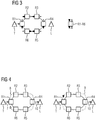
- the Talker Advertise 7 issued by Talker T is used when it connects the ring segment 2 to a port 5 of the ring node that does not participate in the ring segment 2 of the ring node representing the feed ring node of the ring segment 2 for this Talker Advertise, which is used in the scenario according to the Figures 1 to 3 is given by R1, is forwarded by the ring node R1 via its two ring ports 3, 4, and in the ring segment 2 in both directions - one clockwise and one counterclockwise - from ring nodes R1-R6 to ring nodes R1-R6 and forwarded processed by the ring nodes R1-R6 in a manner known per se.
- Talker Advertise 7 is in the Figure 4 indicated on the left for the clockwise direction and on the right for the direction against this.
- An arrow 8 with a dashed line shows the propagation of the advertise information for the color “blue” (left) and an arrow 9 with a dashed line shows the propagation of the advertise information for the color “red”.
- a common description or a common Talker Advertise is advantageously passed on, which is in the Figure 4 is indicated in each case by an arrow 10 with a solid line from the last ring node R4 to the listener L.
- the joint description of both paths contains the combined information from both paths, in particular the greater maximum latency information from both paths.
- the color coding for two paths in the reservation can be made by using a separate VLAN ID in the stream description, especially the Talker Advertise. This can also be used in the data plane to determine the forwarding route.
- the identification in the data packets and the stream description, i.e. the Talker Advertise sent by Talker T, does not have to be done here.
- the internal processing can work with purely local VLAN IDs in order to map the two colors internally.
- An address and a VLAN can be used for data transmission, i.e. the forwarding of data packets with user data content following the successful establishment of the stream.
- data transmission i.e. the forwarding of data packets with user data content following the successful establishment of the stream.
- no difference in the color used for the reservation can be seen on the data plane, all data are forwarded in ring segment 2 with the same identifier - the reservations could have been created by different colors.
- the use of different connoisseurs in the Talker Advertise messages offers an advantage in the diagnosis, in order to be able to distinguish the advertise messages of the reservation from the two directions of rotation in ring segment 2.
- the ring port numbers for example, can also be used internally (reception via the first or second ring port 3, 4) - the Talker Advertise messages cannot be differentiated by a different expert.
- error messages are reliably avoided which could otherwise occur if an announcement message with the same stream ID and stream DA is received a second time from a node R1-R6.
- the transmission of the stream data (taking place after the stream device) is carried out on a path in the network, according to the Figures 1 to 3 on the "upper" path P2, interrupted.
- This is illustrated again in FIG. 5 for normal data, which on the left shows possible active paths with arrows with a dashed or dash-dotted line for the colors blue and red, and on the right with a solid line the data transmission. This ensures that data is only ever received via one path.
- Any local assignment of a color means that each stream can have its own “from the point of view” of each ring node
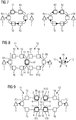
- Direction of rotation for the local "red” and “blue” reservations in the network result in what is in the Figure 6 is indicated purely schematically and by way of example.
- the direction of rotation for a bidirectional connection is shown.
- the ring node R1 on the talker T selects the internal color, which is then used as an identifier when the talker advert 7 is passed on in the entire ring segment 2.
- the ring node R4 selects the color for the talker advertise.
- each ring node R1-R6 that receives an announcement message 7 (without an identifier) at a ring port 3, 4 locally assigns an identifier.
- announcement messages 7 received via a ring port 3, 4 can then be assigned the number of that ring port on which the message was received. This or information contained therein is then expediently processed under or together with the locally assigned expert.
- each ring node R1-R6 can then change for a stream, which - again only schematically and by way of example - in Figure 7 is illustrated.
- the color "red” is again represented by arrowheads with and the color "blue” by arrowheads without filling.
- the path of the blue advertise information local to ring node R1 and the path of the red advertise information local to ring node R1 are traced in the network on the right.
- the internal color assignments in nodes R1-R6 are only exemplary and can be assigned internally as required by nodes R1-R6. As a result, the local color in ring segment 2 is arbitrarily assigned when the advertise information is received and thus changes in the course of the propagation in ring segment 2.
- announcement message 7 is received at a ring port 3, 4, it is expediently stored or configured that the later data forwarding has to take place via the other ring port.
- the internally stored information then corresponds to information for a connoisseur - even if this was only given locally.
- the direction of rotation for all ring nodes R1-R6 can be defined, for example, through information in the test telegrams and thus the color for ring ports 3, 4 can be determined or established.
- each or for each ring node R1-R6 that receives an announcement message 7 at one of its two ring ports 3, 4 first checks whether it is the feed ring node of the (possibly respective) ring segment 2 for the announcement message 7 for this stream was. If this is the case, the announcement message 7 has already completely traversed the (possibly respective) ring segment 2 in the corresponding direction, i.e. it has reached all ring nodes R1-R6 of the (possibly respective) ring segment 2 in the corresponding direction and should not continue to circle.
- the "color" is only important locally for the reservation.
- the principle of the reservation corresponds to that of two established routes in the network.
- the check as to whether a ring node R1-R6 represents the feeder can be carried out in which the respective ring node R1-R6 checks whether it has previously received a Talker Advertise message received at a ring port 3, 4 without an expert, which then means that it was previously received at a non-ring port.
- a talker advert that was received by a ring node R1-R6 at any port is also sent to all other non-ring ports 5 not participating in ring segment 2 but the receive port is omitted. In this way, end devices participating in the network can be informed of announced streams at any point.
- the transmission of the Talker Advertise 7 on the later fast transmission path can take longer and is independent of the time required for the transmission of the data, since the information is received, evaluated, changed and only then passed on through the reservation protocol.
- the time required for this depends on the computing power of the node - the stream data packets are advantageously forwarded in hardware and are significantly faster than forwarding the Talker Advertise information.
- a ring node R1-R6 which receives a talker advertise on a ring port 3, 4, initially only sends it via the other ring port 3, 4, but not via non-ring ports 5 forwards, but waits until the talker advertise has also been received from the other direction, i.e. at its second ring port 3, 4 and then forwards it to terminals in particular via non-ring ports 5.
- a network comprises more than one ring segment 2 is formed by two or more ring segments 2.
- a network with two ring segments 11, 12 coupled to one another is shown purely by way of example and schematically.
- Two terminals can also be seen - by way of example - of which one again represents a talker T and the other represents a listener L.
- left ring segment 11 includes the ring nodes R1, R2, R3, R4, R5 and R6.
- the ring segment 12 includes the ring nodes R7, R8, R9, R10, R11 and also the ring node R4, which accordingly represents a ring node of both the one and the other ring segment 11, 12.
- the ring nodes R1, R2, R3, R5, R6, R7, R8, R9, R10 and R11 each have two ring ports 3, 4 participating in the respective ring segment 11, 12 and one or more ports not participating in any ring segment.
- the ring node R4 has two first ring ports 13, 14 belonging to the segment 11 and two second ring ports 15, 16 belonging to the second segment 12 as well as one or more ports not belonging to any ring port. It should be noted that the ring ports 13 and 14, which are located in the first segment 11, are simultaneously non-ring ports of the second segment 12 or "from its point of view", and the ring ports 15 and 16, which are located in the second segment 12, are simultaneously not Ring ports of the first segment 11 or "from its point of view" are.
- the ring node R4 which couples the two segments 11, 12, is referred to below as a coupling ring node. This also represents the ring manager.
- the first ring / ring segment 11 is logically "exited” and the first stream description, in this case the Talker Advertise, is passed on again, as to a terminal from the point of view of ring segment 11 and as from a terminal in the coupled further ring segment 12. This is in the Figure 8 indicated on the right.
- the reservation in the second ring segment 12 is carried out independently of that in the first ring segment 11.
- R1 represents the feed ring node.
- R2 For the first ring segment 11, R1 represents the feed ring node.
- R4 For the second ring segment R4.
- each ring node that receives a talker advert on a ring port 3, 4 or 13, 14, 15, 16 checks whether it has not sent this message to the respective segment 11, 12 participating port.
- the ring node with the feeder position R1, R4 no longer forwards the advert if it receives it at a ring port 3, 4, 15, 16, since the ring then completely enters the one or the other direction has been traversed and endless circling is prevented.
- a standby coupling with an active and a passive Coupling path 17, 18 may be provided, which is shown schematically and by way of example in Figure 9 is illustrated.
- connection to coupling nodes for coupling with standby.
- the coupling links 17, 18, which can also be referred to as the coupling link By monitoring the coupling links 17, 18, which can also be referred to as the coupling link, and the automatic activation of a passive second link (standby), a quick switchover can take place.
- the reservation of the resources does not differ from that with CB (especially with IEEE 802.1 CB), at least in principle - the data transmission is, however, much easier.
- the ring nodes RI, RIII with standby links 18 expediently work in the role of "ring node" for the transfer of information, that is, of the talker advert 7 via the standby link 18.
- the information of the talker advert 7 is only passed on via the standby link 18 when the information was received from both ring directions (from both ring ports 3, 4).
- the information is received via an active coupling port 19 or a passive coupling port 20 (see Figure 9 ) the information is only passed on via a ring port 3, 4 (active port) or is only temporarily stored at the passive coupling port 20 and is only distributed from a ring port 3, 4 when the first Talker Advertise 7 is received.
- the information required by the reservation is the port role of the standby coupling and the status of the coupling links 17, 18 - passive or active.
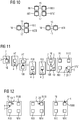
- the Figure 11 shows a total of seven steps from left to right, specifically that a Talker Advertise 7 that is in the Figures 11 to 13 each indicated by an arrow, the coupling ring node RI reaches a ring port 3 in the first ring segment 11, and the node RI forwards this in the second step via its other ring port 4.
- the talker advert 7 is accordingly received by the coupling ring node RII at the ring port 3 and this also forwards it in the ring segment 11, that is to say via its other ring port 4.
- the coupling ring node RII then receives the second talker advert 7 from the other direction via its other ring port 4 and forwards it both via its ring port 3 in the direction of RI and via its active coupling port 19 in the direction of RIV.
- RIV receives the talker advertise 7 at its active coupling port 20.
- the node RIV only forwards the talker advert 7 to one of its two ring ports 3, 4 located in the ring segment 12, in the present case via the ring port 3 and receives the "Einspeiser- Roll "for the second ring segment 12 a.
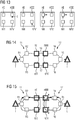
- FIG Figure 13 The sequence for the situation in which the information about the route RII, RIV, segment 12 and RIII is faster is in FIG Figure 13 outlined.
- the rule here is that the coupling ring node RIII has not yet received a talker advert 7 for a stream via its passive coupling port 20 if it arrives via one of its ring ports 3, 4. This is in Figure 13 on the far left - as an example for a reception via port 3 - indicated.
- An additional standby link 18 can be obtained by adding two, three or four coupling ring nodes (in Figure 9 referred to as RI-RIV) and connected to one another via both an active 17 and a passive link 18. This is schematically in Figure 10 shown. It should be noted that in the Figures 8, 9 and 10th the coupling ring nodes R4, RI-RIV are each highlighted by a double border.
- Talker Advertise 7 is passed on from node RIII via its other ring port 4. What a passing about the passive coupling port 20 concerns, however, the arrival of the second Talker Advertise 7 from the other direction is waited for. Since the ring node RIV only forwards the information on one of its two ring ports 3, 4, no second information arrives at the ring node via the second ring port 3, 4. The second information arrives via the ring node R1 and the passive standby coupling link 18 at the node RIII. This sends the updated information in both directions of the ring 12.
- the RIV since the RIV only sends in one ring direction, and the ring node with the passive standby coupling link 18 would only pass on the information when it receives a second piece of information, the information is sent back from prevents the second ring segment 12 into the first ring segment 11 on the basis of the local ring and standby information at the ports, without a path calculation being necessary beforehand.
- a coupling ring node RI-RIV which receives a talker advert 7 via a ring port 3, 4, initially only forwards the information from the talker advert 7 via the other ring port 3, 4 (not the receiving port).
- the Talker Advertise information is received via an active coupling port 19, the message is only forwarded to one ring port 3, 4.
- the talker advertise information is received via the passive coupling port 20
- the information is only passed on if information, specifically a talker advert 7, has already been received via a ring port 3, 4 - the information received is updated and redistributed if necessary.
- the necessary identification of the ports, in particular as active or passive coupling ports 19, 20, is provided by the configuration of the standby mechanism in the coupling ring node RI-RIV and can be used by the extended reservation protocol, in particular SRP.
- the terminals T have to insert a redundancy tag with a sequence number into the packets of a stream. Using the sequence number in the tag, duplicates of CB nodes are recognized and can be filtered.
- the four coupling ring nodes RI-RIV (maximum reliability) during data transmission are filtered (with R-RIV) and the stream data frames are duplicated again (with RIII and RIV).
- the Figure 16 shows the local forwarding information for forwarding the Talker Advertise information from Talker T, which is indicated in each case by arrows at the nodes R1-R6, RI-RIV.
- the data transfer takes place without colors. No synchronized direction is necessary.
- Talker Advertise 7 is concerned with CB coupling, the same rules apply as described above for the exemplary embodiments without CB in the coupling, with duplicate filtering being configured in the affected coupling ring nodes RI-RIV.
- FIG 17 is the duplicate detection and the duplicate filtering for the scenario according to Figure 15 shown.
- a detection in the Figure 17 indicated by single hatched bars
- a filtering indicated by double hatched bars.
- Duplicate filters are required in the coupling ring nodes RIII and RIV.
- the reservation configures the duplicate filtering at the coupling points of the connection in the second ring segment 12 at the coupling ring nodes RIII and RIV. If the MRP or HRP functions correctly, it occurs in the first Ring segment 11 and the coupling ring nodes RI and RII do not lead to duplicates for the imaged stream, since only one path is active at a time through the ring manager R1, R4. Since both coupling routes 17, 18 are used simultaneously, there is an exchange of duplicates in the second ring segment 12 between the two nodes RIII and RIV - one copy each runs from node RIII to RIV and from RIV to RIII.
- two connoisseurs can also be in the data plane, in particular two colors and / or VIDs can be used.
- a "direction of rotation" in the (respective) ring segment for the coupling ring nodes RI-RIV is advantageous when duplicating again, so that those of the coupling ring nodes RI-RIV data received can be passed on without changing the identifier.
- the control plane must then be expanded accordingly in the coupling ring node RI-RIV that supports the CB, in order to observe the "color" of the reservations and, if necessary, to correct the locally incorrect color locally when sending a duplicated reservation and in the ring segment 11, 12 changed to be passed on.
- the ring nodes R1-R6 in the ring segment 11, 12 themselves consider the reservation internally, expediently with the color assigned for the port 3, 4, so that the direction is retained internally and a reservation is made or possible for both directions.
- a configuration of CB can optionally also be used as feedback protection, in the scenario according to Figure 14 in particular in the coupling ring nodes RI and RII.
Landscapes
- Engineering & Computer Science (AREA)
- Computer Networks & Wireless Communication (AREA)
- Signal Processing (AREA)
- Small-Scale Networks (AREA)
Priority Applications (1)
| Application Number | Priority Date | Filing Date | Title |
|---|---|---|---|
| EP19155923.6A EP3694156A1 (fr) | 2019-02-07 | 2019-02-07 | Procédé de transmission de données protégé contres les défaillances, noeuds de réseau, programme informatique et support lisible par ordinateur |
Applications Claiming Priority (1)
| Application Number | Priority Date | Filing Date | Title |
|---|---|---|---|
| EP19155923.6A EP3694156A1 (fr) | 2019-02-07 | 2019-02-07 | Procédé de transmission de données protégé contres les défaillances, noeuds de réseau, programme informatique et support lisible par ordinateur |
Publications (1)
| Publication Number | Publication Date |
|---|---|
| EP3694156A1 true EP3694156A1 (fr) | 2020-08-12 |
Family
ID=65363126
Family Applications (1)
| Application Number | Title | Priority Date | Filing Date |
|---|---|---|---|
| EP19155923.6A Withdrawn EP3694156A1 (fr) | 2019-02-07 | 2019-02-07 | Procédé de transmission de données protégé contres les défaillances, noeuds de réseau, programme informatique et support lisible par ordinateur |
Country Status (1)
| Country | Link |
|---|---|
| EP (1) | EP3694156A1 (fr) |
Citations (5)
| Publication number | Priority date | Publication date | Assignee | Title |
|---|---|---|---|---|
| WO2008106907A1 (fr) * | 2007-03-02 | 2008-09-12 | Siemens Aktiengesellschaft | Recherche de port cible dans des réseaux constitués de sous-réseaux reliés |
| US20120250695A1 (en) * | 2011-03-31 | 2012-10-04 | Nokia Siemens Networks Ethernet Solutions Ltd. | Hitless node insertion for ethernet networks |
| DE102011082965A1 (de) * | 2011-09-19 | 2013-01-24 | Siemens Aktiengesellschaft | Verfahren zum Betreiben einer Netzwerkanordnung und Netzwerkanordnung |
| WO2018162071A1 (fr) * | 2017-03-10 | 2018-09-13 | Siemens Aktiengesellschaft | Procédé et dispositif permettant l'orientation modulaire d'un flux avb |
| WO2019001718A1 (fr) | 2017-06-29 | 2019-01-03 | Siemens Aktiengesellschaft | Procédé de réservation de voies de transmission redondantes au maximum pour la transmission de paquets de données et dispositif |
-
2019
- 2019-02-07 EP EP19155923.6A patent/EP3694156A1/fr not_active Withdrawn
Patent Citations (5)
| Publication number | Priority date | Publication date | Assignee | Title |
|---|---|---|---|---|
| WO2008106907A1 (fr) * | 2007-03-02 | 2008-09-12 | Siemens Aktiengesellschaft | Recherche de port cible dans des réseaux constitués de sous-réseaux reliés |
| US20120250695A1 (en) * | 2011-03-31 | 2012-10-04 | Nokia Siemens Networks Ethernet Solutions Ltd. | Hitless node insertion for ethernet networks |
| DE102011082965A1 (de) * | 2011-09-19 | 2013-01-24 | Siemens Aktiengesellschaft | Verfahren zum Betreiben einer Netzwerkanordnung und Netzwerkanordnung |
| WO2018162071A1 (fr) * | 2017-03-10 | 2018-09-13 | Siemens Aktiengesellschaft | Procédé et dispositif permettant l'orientation modulaire d'un flux avb |
| WO2019001718A1 (fr) | 2017-06-29 | 2019-01-03 | Siemens Aktiengesellschaft | Procédé de réservation de voies de transmission redondantes au maximum pour la transmission de paquets de données et dispositif |
Similar Documents
| Publication | Publication Date | Title |
|---|---|---|
| EP2676409B1 (fr) | Boucles de trajets mpls au niveau réacheminement pour réseaux mpls sans connexion | |
| EP2838220B1 (fr) | Procédé de transmission redondante de messages dans un réseau de communication industriel et appareil de communication | |
| EP2070256B1 (fr) | Procédé pour reconfigurer un réseau de communication | |
| WO2019001718A1 (fr) | Procédé de réservation de voies de transmission redondantes au maximum pour la transmission de paquets de données et dispositif | |
| EP3228036B1 (fr) | Procédé et dispositif de commande pour la transmission de données relatives à la sécurité dans un véhicule automobile au moyen d'une norme éthernet | |
| EP2413538B1 (fr) | Prévention de boucles de transmission dans un réseau en anneau redondant | |
| DE102014112082A1 (de) | Verteilerknoten, Automatisierungsnetz und Verfahren zum Übertragen von echtzeitrelevanten und nicht-echtzeitrelevanten Datenpaketen | |
| EP3577871B1 (fr) | Procédé et dispositif permettant l'orientation modulaire d'un flux avb | |
| DE102007015539A1 (de) | Verfahren zum Rekonfigurieren eines Kommunikationsnetzwerks | |
| EP1532771A1 (fr) | Methode d'essai de chemins de messages dans des reseaux de communication et element de reseau | |
| EP3151476B1 (fr) | Procede de trafic transversal entre deux esclaves d'un reseau de donnees en boucle | |
| DE10207529A1 (de) | Lokales Netzwerk, insbesondere Ethernet-Netzwerk mit Redundanzeigenschaften sowie Koppelgerät für ein derartiges Netzwerk | |
| WO2020125987A1 (fr) | Procédé de communication de données, comportant une exigence applicable relative à la fiabilité, appareil de communication, programme informatique et support lisible par ordinateur | |
| EP2127241B1 (fr) | Recherche de port cible dans des réseaux constitués de sous-réseaux reliés | |
| EP4125253B1 (fr) | Procédé de transmission de données temporellement critiques, système de communication et appareil de communication couplée | |
| EP3874333B1 (fr) | Procédé de transfert de données à sécurité intégrée, noeud de réseau, programme informatique et support lisible par ordinateur | |
| EP1540895B1 (fr) | Procede de transmission redondante permanente de messages de donnees dans des systemes de communication | |
| EP2359540A1 (fr) | Procédé de raccordement à un réseau quelconque de segments de réseau possédant des propriétés de redondance | |
| EP4214905A1 (fr) | Système d'automatisation à structure maître-esclave, distributeur et procédé de transmission de télégrammes | |
| EP4035315A1 (fr) | Réseau d'automatisation et procédé de transmission de données dans un réseau d'automatisation | |
| EP3694156A1 (fr) | Procédé de transmission de données protégé contres les défaillances, noeuds de réseau, programme informatique et support lisible par ordinateur | |
| EP3963839B1 (fr) | Distributeur de réseau, réseau d'automatisation et procédé de transmission de données dans un réseau d'automatisation | |
| EP3629550A1 (fr) | Procédé de transmission de données dans un réseau de communication industrielle et dispositif de communication couplée | |
| DE10207527A1 (de) | Lokales Netzwerk, insbesondere Ethernet-Netzwerk, mit Redundanzeigenschaften sowie Koppelgerät für ein derartiges Netzwerk | |
| DE10260640A1 (de) | Verfahren zur Topologie-Erkennung und Weglenkung von Datenpaketen in einem Pakete vermittelnden Ring |
Legal Events
| Date | Code | Title | Description |
|---|---|---|---|
| PUAI | Public reference made under article 153(3) epc to a published international application that has entered the european phase |
Free format text: ORIGINAL CODE: 0009012 |
|
| STAA | Information on the status of an ep patent application or granted ep patent |
Free format text: STATUS: THE APPLICATION HAS BEEN PUBLISHED |
|
| AK | Designated contracting states |
Kind code of ref document: A1 Designated state(s): AL AT BE BG CH CY CZ DE DK EE ES FI FR GB GR HR HU IE IS IT LI LT LU LV MC MK MT NL NO PL PT RO RS SE SI SK SM TR |
|
| AX | Request for extension of the european patent |
Extension state: BA ME |
|
| STAA | Information on the status of an ep patent application or granted ep patent |
Free format text: STATUS: THE APPLICATION IS DEEMED TO BE WITHDRAWN |
|
| 18D | Application deemed to be withdrawn |
Effective date: 20210213 |