EP3696834B1 - Metall-polymer-kapazität, die eine dielektrische folie mit einer starken dielektrischen konstante und einer starken durchbruchfeldstärke umfasst - Google Patents
Metall-polymer-kapazität, die eine dielektrische folie mit einer starken dielektrischen konstante und einer starken durchbruchfeldstärke umfasst Download PDFInfo
- Publication number
- EP3696834B1 EP3696834B1 EP20157469.6A EP20157469A EP3696834B1 EP 3696834 B1 EP3696834 B1 EP 3696834B1 EP 20157469 A EP20157469 A EP 20157469A EP 3696834 B1 EP3696834 B1 EP 3696834B1
- Authority
- EP
- European Patent Office
- Prior art keywords
- nanoparticles
- core
- polymer
- polymer material
- electrically insulating
- Prior art date
- Legal status (The legal status is an assumption and is not a legal conclusion. Google has not performed a legal analysis and makes no representation as to the accuracy of the status listed.)
- Active
Links
Images

Classifications
-
- H—ELECTRICITY
- H01—ELECTRIC ELEMENTS
- H01G—CAPACITORS; CAPACITORS, RECTIFIERS, DETECTORS, SWITCHING DEVICES, LIGHT-SENSITIVE OR TEMPERATURE-SENSITIVE DEVICES OF THE ELECTROLYTIC TYPE
- H01G4/00—Fixed capacitors; Processes of their manufacture
- H01G4/002—Details
- H01G4/018—Dielectrics
- H01G4/06—Solid dielectrics
- H01G4/14—Organic dielectrics
- H01G4/18—Organic dielectrics of synthetic material, e.g. derivatives of cellulose
-
- H—ELECTRICITY
- H01—ELECTRIC ELEMENTS
- H01G—CAPACITORS; CAPACITORS, RECTIFIERS, DETECTORS, SWITCHING DEVICES, LIGHT-SENSITIVE OR TEMPERATURE-SENSITIVE DEVICES OF THE ELECTROLYTIC TYPE
- H01G4/00—Fixed capacitors; Processes of their manufacture
- H01G4/002—Details
- H01G4/018—Dielectrics
- H01G4/20—Dielectrics using combinations of dielectrics from more than one of groups H01G4/02 - H01G4/06
- H01G4/206—Dielectrics using combinations of dielectrics from more than one of groups H01G4/02 - H01G4/06 inorganic and synthetic material
-
- H—ELECTRICITY
- H01—ELECTRIC ELEMENTS
- H01G—CAPACITORS; CAPACITORS, RECTIFIERS, DETECTORS, SWITCHING DEVICES, LIGHT-SENSITIVE OR TEMPERATURE-SENSITIVE DEVICES OF THE ELECTROLYTIC TYPE
- H01G4/00—Fixed capacitors; Processes of their manufacture
- H01G4/002—Details
- H01G4/018—Dielectrics
- H01G4/06—Solid dielectrics
- H01G4/08—Inorganic dielectrics
Definitions
- the present invention relates to the field of capacitances, and more particularly metal-polymer capacitances, in particular for so-called high voltage applications.
- the invention also relates to a method of manufacturing such a metal-polymer capacitor.
- Metal/Insulator/Metal film-type capacitors are structures in which a dielectric material is wound between two metal electrodes.
- the dielectric material must be flexible and is generally of organic type (soaked papers, oils and polymers).
- the films are, for example, made of polystyrene (PS), polyethylene terephthalate (PET), polytetrafluoroethylene (PTFE), or even polyetherimide (PEI).
- PS polystyrene
- PET polyethylene terephthalate
- PTFE polytetrafluoroethylene
- PEI polyetherimide
- non-polar plasticizers CFE or CTFE
- CFE non-polar plasticizers
- CTFE CTFE
- the ter-polymer is therefore in theory capable of storing 5 times more energy in the ambient environment than its ferroelectric co-polymer counterpart whose permittivity reaches 12.
- the breakdown field of this ter-polymer is of the order of 400MV /m ( Chu et al.
- the first route consists of adding oxide nanoparticles to a polymer. More particularly, the polymer is mixed with a high concentration of complex oxide nanoparticles with high permittivity (TiO 2 , SrTiO 3 , BaTiO 3 , PZT, PMNPT, etc.).
- the mixtures are prepared in a homogeneous medium using simple techniques, with stirring.
- the increase in permittivity only becomes substantial for high charging rates in accordance with the law of mixtures (Maxwell Garnet), for example for charging rates greater than 30% or 50% by mass.
- the nanocomposite material thus formed is subject to strong inhomogeneities of the local electric field at the interface between the high permittivity nanoparticles and the low permittivity polymer.
- the second route consists of mixing the polymer with low concentrations of electrically conductive nanoparticles, for example metal nanoparticles.
- concentration of the metallic or conductive phase must remain below the electrical percolation threshold which general is low (generally less than 1% by volume), and be controlled with great precision.
- these composite materials are obtained by mixing the different constituents in a homogeneous medium using simple techniques with stirring.
- the dispersion of metal nanoparticles is generally poorly controlled in a polymer.
- the diameter of the silver core ranges from 20 to 120nm and the thickness of the shell is 4-6nm for the thinnest shells and 8-10nm for the thickest shells.
- the permittivity of this composite material reaches approximately 300 at the percolation threshold (0.2% vol.).
- Such a dielectric film is represented schematically on the figure 2 .
- the voltage withstand of this composite material drops from 10 MV/m to 1 MV/m before the percolation threshold.
- Breakdown resistance can be improved by the addition of hexagonal boron nitride nanosheets.
- the breakdown resistance of a reduced oxidized graphene airgel rGO (conductive phase) mixed with polyurethane (dielectric phase) is improved by interposing between the layers of the airgel layers of hexagonal boron nitride nanosheets coated in polyurethane.
- the shaping of such a micro-laminated composite uses cold casting (freeze casting) and compaction (pressing), which is not compatible with many substrates, and in particular with silicon technologies, and does not allow not realize an integrated capability.
- An aim of the present invention is to provide a capacitor having high permittivity, few conduction losses and good resistance to electrical voltage.
- the nanoparticles represent from 0.01% to 10%, preferably from 0.01% to 5% and even more preferably from 0.1% to 2% by volume of the dielectric film.
- the core/shell structure nanoparticles represent a volume fraction of the dielectric film lower than the electrical percolation threshold of the dielectric film.
- the invention fundamentally differs from the prior art, in particular, by the presence of monodisperse metal/polymer hybrid nanoparticles.
- the low size distribution of the nanoparticles, coated by the first polymer material makes it possible to limit or even eliminate interparticle conduction: both direct conduction paths at low voltage (local ohmic effect due to the absence of polymer locally) and indirect high voltage (field effect (FET) or tunnel effect through very thin polymer barriers), which increases the permittivity, leads to a reduction in conduction losses and avoids having uncontrolled breakdown fields.
- FET field effect
- the nanoparticles are dispersed homogeneously in the polymer matrix.
- homogeneously dispersed we mean that the nanoparticles are distributed substantially uniformly in the polymer matrix. This makes it possible to further reduce interparticle conduction.
- the second layer of a polymer material in the shell which coats the nanoparticles.
- the second polymer layer covers at least partially and, preferably, completely the core of the nanoparticles. In addition to limiting the probability of interparticle conduction, it can play the role of spacer, depending on the quantity of nanoparticles in the dielectric film.
- the thickness can, for example, range from 5 to 15nm. It advantageously has a uniform thickness around the nanoparticle.
- the thickness of the layer of second material is substantially identical from one nanoparticle to another. By substantially identical, we consider that the thickness does not vary by more than 20% from one nanoparticle to another and within the same nanoparticle.
- the presence of the layer of inorganic carbon material makes it possible to graft, in a covalent manner, the layer of polymer material around the nanoparticles.
- the core of the nanoparticles is protected from oxidation by the shell, which allows them to retain their initial properties (for example magnetic and/or electrical).
- the mechanical stability of the nanoparticles over time is improved.
- the inorganic carbon material is organized 2D carbon.
- the carbon material is graphene.
- the carbon layer is made up of a repetition of a few layers to a few dozen layers of graphene to maintain an organized 2D structure of the carbon.
- it includes a few layers of graphene (from 2 to 5 for example).
- a carbonaceous layer comprising at least two layers of graphene to confer sufficient hydrophilic properties to the nanoparticle and to be able to form Van der Waals bonds.
- We will advantageously choose a number of layers less than 100, to avoid the appearance of defects in the layers and to have a disorganized 2D carbon arrangement on the surface, for example hydrogenated, or of graphitic type which are hydrophobic.
- the carbon layer advantageously forms a continuous layer around each nanoparticle.
- the core of the nanoparticles is made of cobalt, iron, nickel, copper, gold and/or silver.
- the first polymer material is chosen from polystyrene, polymethyl methacrylate, polyurethane, polyacrylic, polypropylene, polyimide, polyetherimide and a polymer having a pyrene group.
- the dielectric film comprises electrically insulating nanoparticles.
- FET tunneling effect
- the electrically insulating nanoparticles are made of metal oxide, for example barium and/or strontium oxide.
- the electrically insulating nanoparticles are made of a semiconductor material, preferably with a wide gap, such as silicon carbide, diamond and/or hexagonal boron nitride.
- a semiconductor material preferably with a wide gap
- such as silicon carbide, diamond and/or hexagonal boron nitride In the case of hexagonal boron nitride, it may also be nanotubes and/or nanosheets.
- the electrically insulating nanoparticles are in the shell of the nanoparticles.
- the electrically insulating nanoparticles are in the polymer matrix.
- the dielectric film may comprise an alternation of nanoparticles with a core/shell structure and electrically insulating nanoparticles.
- Core/shell nanoparticles and electrically insulating nanoparticles can be randomly dispersed in the matrix.
- the second polymer material is chosen from polystyrene, polyethylene terephthalate, cellulose acetate, polycarbonate, polypropylene, polyethylene, a polyamide, a polysiloxane, a polysulfone, an optionally aromatic polyester, a polyetheretherketone, a polyetherimide and an epoxy.
- the second polymer material comprises groups photosensitive to ultraviolet rays.
- the ratio between the maximum diameter of the nanoparticles and the minimum diameter of the nanoparticles is less than 1.5, preferably less than 1.3, even more preferably less than 1.2 and even more preferably less than 1.1.
- Such a very tight size distribution ensures a strong increase in permittivity.
- emulsion we mean a heterogeneous mixture of two immiscible liquids, such as oil and water.
- One of the two phases (called the dispersed phase, here the aqueous phase) is dispersed in the form of droplets in the other (called the dispersing phase).
- the size of the droplets can range from a few tens of nanometers to 1 micron, for example from 20nm to 1 ⁇ m.
- mini-emulsion we mean that the size of the droplets can range from 30 nm to 100 nm, and more preferably from 30 nm to 60 nm.
- the droplets of the mini-emulsion form polymerization reactors. During the polymerization reaction, the monomers will be gradually consumed until the micelle is saturated. We talk about micellar growth. The size of the final particle thus formed is similar to that of the micelle.
- We ultimately obtain a product called latex comprising monodisperse beads of polymer (micelles without metal nanoparticles) and hybrid metal-polymer nanoparticles (micelles with metal nanoparticles).
- This polymerization in a heterogeneous medium leads to better control of the thickness of polymer coating the core of the nanoparticles, compared to polymerization in a homogeneous medium.
- the layer of carbonaceous material surrounding the nanoparticles makes the nanoparticles hydrophilic, which allows their insertion into the droplets of the emulsion.
- the layer of carbon material also effectively protects them against oxidation. Without this carbonaceous shell, the metal nanoparticles would spontaneously oxidize on contact with water and/or form hydroxides, which would make them hydrophobic and help drive them out of the micelles to join the dispersing phase (oil).
- the droplets play, in addition to the role of a polymerization reactor, a role of filter.
- Nanoparticles whose diameter is greater than or equal to those of the droplets will form a raw sediment (without polymer) which will be easily removed afterwards. Furthermore, it has been observed that the smallest nanoparticles (for example with a diameter of less than 10 nm) are imperfectly covered by the carbon layer and oxidize quickly (formation of carboxyls and/or metal oxides). , which gives them a more hydrophobic character than nanoparticles completely covered by a carbon layer. These particles do not penetrate the droplets containing the aqueous phase, remain suspended in the dispersing phase and can easily be eliminated later.
- the ratio between the maximum diameter of the nanoparticles and the minimum diameter of the nanoparticles is less than 1.5, preferably less than 1.3, even more preferably less than 1.2 and even more preferably less than 1.1.
- Such a very tight size distribution does not exist commercially and is made possible by the miniemulsion process.
- electrically insulating nanoparticles as defined above are added during step i).
- electrically insulating nanoparticles as defined above are added during step a), b) or c).
- the metal/polymer hybrid capacitor is formed on a substrate 100.
- the substrate 100 is preferably made of silicon.
- Other substrates can be used such as glass, alumina, ferrite and polymer films such as polyimide (such as Kapton), poly(ethylene naphthalate), and poly(ethylene terephthalate). ) (PET).
- the capacitor comprises a first so-called lower electrode 101, in contact with the substrate 100 and a second so-called upper electrode 102.
- the electrodes are electrically conductive and preferably made of metal. They are, for example, made of gold.
- a dielectric film 40 is placed between the first electrode 101 and the second electrode 102.
- the dielectric film comprises a polymer matrix 50 in which metal-polymer hybrid nanoparticles 20 are dispersed.
- nanoparticles 20 is meant elements of submicron size (typically less than 1 ⁇ m) of shape, for example, spherical, elongated, ovoid. Preferably, these are spherical particles. Their largest dimension is called diameter or size.
- the nanoparticles 20 are monodisperse, that is to say they have a small size distribution. In other words, they have a size distribution between a maximum diameter and a minimum diameter such that their ratio is less than or equal to 5, 3 or 2 and advantageously less than or equal to 1.5, for example 1.3 or 1.2 or 1.1.
- the characteristics of such a powder are, for example, an average diameter of the nanoparticles of 40nm, a maximum diameter of 42nm and a minimum diameter of 38nm.
- the diameter of the nanoparticles 20 can be measured with a laser particle size analyzer or by light diffraction (DLS for “Dynamic Light Scattering”) in solution.
- the separation distance between the nanoparticles is controlled.
- the edge-to-edge separation distance between two metal/C particles of diameter ⁇ is 1 x ⁇ , 1/2 x ⁇ or 2/3 x ⁇ and advantageously less than or equal to 1/3 x ⁇ .
- such a film is characterized by a homogeneous dispersion of Co/C nanoparticles with an average diameter of 30nm with an average intergranular distance of 10nm, up to 5nm.
- the particles 20 have a core-shell structure.
- the shell 22 is integral with the core 21 of the particle.
- the heart 21, or core is a metallic material.
- metallic material we mean a metal, a metal alloy.
- it is a metal.
- it is cobalt, nickel, iron, copper, silver or gold.
- Such nanoparticles are denoted metal/C/polymer.
- the carbon material is preferably inorganic, for example graphene, graphite or carbon nanotubes.
- the coating 22 is made of graphene. It may include one layer or several (two, three, four, etc.) layers of graphene. For example, it comprises from 1 to 50 sheets of graphene, preferably from 1 to 10, for example from 1 to 5, and even more preferably from 3 to 10.
- the carbonaceous shell 22 is continuous so as to completely cover the core 21 of the particle 20 to protect the core of the nanoparticles from oxidation, and make them more hydrophilic.
- the first polymer material is chosen from polystyrene (PS), polymethyl methacrylate (PMMA), polyurethane (PU), polyacrylic (PAA), polyimide (PI), polyetherimide (PEI) and polypropylene ( PP).
- the polymer can also be a polymer functionalized with a conjugated pi group, such as pyrene. This is, for example, polystyrene functionalized with a pyrene group (Py-PS) or even a polyacrylic functionalized with a pyrene group (Py-PAA).
- the thickness of the polymer layer 23 ranges, for example from 1nm to 100n, preferably from 2nm to 50nm and even more preferably from 5nm to 15nm.
- the polymer layer 23 completely coats the core 21 of the nanoparticle 20.
- the polymer material is covalently bonded to the carbonaceous layer, which reduces the risk of debonding and tearing.
- the uniformity and adhesion of the electrical insulation layer surrounding the nanoparticles are improved. Low-voltage interparticle electrical conduction is suppressed.
- the separation distance between the nanoparticles, in the dielectric film is controlled.
- the volume percentage of nanoparticles in the composite material ranges from 0.01% to 10%.
- the volume percentage ranges for example from 0.01% to 5%, and preferably from 0.1% to 2%.
- the volume percentage of nanoparticles 20 will advantageously be chosen so as to be below the electrical percolation threshold, for example, in a range from a quarter to half of the percolation threshold.
- the capacity may include one or more types of nanoparticles 20.
- the matrix 50 is made of a second polymer material.
- the second polymer material may be polystyrene (PS), polyethylene terephthalate (PET), cellulose acetate (CA), polycarbonate (PC), polytetrafluoroethylene (PTFE), polyparylene, polypropylene (PP), polyethylene (PE), for example in crosslinked polyethylene (PER), polyphenylene sulphide (PPS), bioriented polypropylene (BOPP), polyimide (PI), polyamide (PA), polysiloxane (or Silicone), polysulfone, an optionally aromatic polyester, for example polyester fluorene (FPE) , polyetheretherketone (PEEK), polyetherimide (PEI) and an epoxy (epoxy).
- PS polystyrene
- PET polyethylene terephthalate
- CA cellulose acetate
- PC polycarbonate
- PTFE polytetrafluoroethylene
- PP polypropylene
- PE polyethylene
- PE polyethylene
- PER polyphenylene sulphide
- the polymer matrix for example PI and epoxy, may contain photosensitive crosslinking agents, preferably UV.
- the first polymer material and the second polymer material may be the same or different. When the two polymer materials are identical, they have different molecular weights. It is possible to differentiate, for example, by Fourier transform infrared spectroscopy (or FTIR for “Fourier Transform InfraRed spectroscopy”).
- the polymer matrix 50 can be replaced by a matrix made of silica, alumina, silicon nitride or silicon oxynitride.
- These matrices can be deposited by atomic layer deposition (ALD), physical vapor deposition (PVD) or plasma-enhanced chemical vapor deposition (PECVD) at low temperatures, for example at a temperature below 350°C.
- the dielectric film 40 has a thickness ranging from 0.05 ⁇ m to 50 ⁇ m.
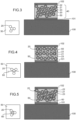
- the capacity as shown on the Figure 3 is, advantageously, intended for low or medium voltage applications.
- Such a capacity targets, in particular, a breakdown field of the order of 100 MV/m.
- the dielectric film 40 further comprises electrically insulating nanoparticles 60 ( figures 4 and 5 ).
- electrically insulating we mean an intrinsic electrical resistivity greater than 10 12 ohm.cm.
- the emission of electrons by field effect at the metal/polymer interface leads, at high fields, to an increase in electrical losses and heating which risks destroying the capacity.
- the circulation of these electrons is advantageously blocked by the electrically insulating nanoparticles 60 which form 2D insulating "barriers" (therefore very fine).
- the electrically insulating nanoparticles 60 are arranged across the conduction paths (insert of figures 4 and 5 ). Electrical losses are reduced.
- These may be mineral nanoparticles, for example silica nanoparticles, complex oxide nanoparticles, for example barium titanate (BaTiO 3 ) or/and strontium (SrTiO 3 ), diamond or carbide nanoparticles. silicon (SiC).
- silica nanoparticles for example silica nanoparticles, complex oxide nanoparticles, for example barium titanate (BaTiO 3 ) or/and strontium (SrTiO 3 ), diamond or carbide nanoparticles. silicon (SiC).
- tubular or lamellar nanoparticles can be tubular or lamellar nanoparticles.
- tubular or lamellar nanoparticles we mean particles of which one of the dimensions is much smaller than the other two.
- Such tubular particles or lamellar most often have a thickness e (or a diameter d) much less than their length L or width l.
- the ratio e/L (or d/L) and e/l (or d/l) is less than or equal to 0.5 and preferably less than or equal to 0.1 or 0.01.
- tubular or lamellar nanoparticles are made of hexagonal boron nitride (h-BN). It can also be graphene oxide GO.
- Tubular h-BN particles can, for example, be produced in large quantities by aerosol pyrolysis (spray pyrolysis).
- the dielectric film comprises alternating layers of hybrid nanoparticles 20 and layers of electrically insulating nanoparticles 60 ( Figure 4 ).
- the hybrid nanoparticles and the electrically insulating nanoparticles are randomly dispersed in the polymer matrix.
- the electrically insulating nanoparticles 60 are arranged in and/or on the shell of the hybrid nanoparticles 20.
- This latter embodiment can be combined with the first or the second embodiment.
- electrically insulating nanoparticles 60 dispersed randomly in the polymeric matrix 50 and in the shell of the hybrid nanoparticles 20.
- Such a nanocomposite dielectric film 40 has a high resistivity (for example 10 12 - 10 15 ⁇ Ohm.cm), a dielectric constant which can be exceptionally high (for example 100 or 1000) when approaching the electrical percolation threshold (for example 0.5, 1, or 2% by weight) and high resistance to electrical breakdown (for example 10 MV/m, 100 MV/m, 500 MV/m).
- a high resistivity for example 10 12 - 10 15 ⁇ Ohm.cm
- a dielectric constant which can be exceptionally high for example 100 or 1000
- the electrical percolation threshold for example 0.5, 1, or 2% by weight
- high resistance to electrical breakdown for example 10 MV/m, 100 MV/m, 500 MV/m.
- the hybrid nanoparticles 20 are electrically insulated, have a low size distribution and are homogeneously dispersed in the dielectric film. With such nanoparticles 20, it is possible to miniaturize capacities intended for high voltage applications.
- Such capacity can be used for the integration of power conversion modules, for example for electric vehicles.
- precursor of the polymer is meant monomers and/or oligomers and/or pre-polymers leading to the formation of the polymer.
- the polymer precursor is associated with a polymerization initiator.
- the polymerization initiator is, for example, a photoinitiator or a radical initiator. After shaping, the precursor is polymerized to obtain the polymer.
- the solvent is an organic solvent.
- the solvent is evaporated after the solution is deposited.
- the solution can be deposited using a contactless deposition technique. This may be, for example, a coating technique, such as curtain coating or flow-coating or dip-coating or spin-coating Preferably, this is centrifugal coating.
- the film can be exposed to a light source, preferably an ultraviolet (UV) source.
- a light source preferably an ultraviolet (UV) source.
- UV ultraviolet
- the film can be pressed hot, preferably near the glass transition temperature.
- the solution of step i) can also contain the electrically insulating nanoparticles 60 as described above.
- the solution containing the hybrid nanoparticles 20 then a second solution containing the electrically insulating nanoparticles 60.
- This second solution can also contain a third polymer material or the precursors of the third polymer material.
- the third polymer material is preferably identical to the second polymer material. The two solutions can be deposited alternately until the desired number of layers is obtained.
- the process can be carried out at room temperature (20-25°C).
- the process is carried out at ambient pressure (1 bar).
- the process is advantageously carried out in air; there is no need to work in a controlled atmosphere.
- the dielectric film 40 can be obtained by plasma deposition.
- We will advantageously choose a deposition technique whose implementation temperature is lower than the melting temperature of the polymer material of the shell.
- the emulsion will make it possible to sort these nanoparticles 20 according to their size. For example, for a powder whose average diameter of the nanoparticles 20 is of the order of 30 nm, the size dispersion is large and can range from less than 5 nm to more than 300 nm. This is detrimental for the manufacture of a nanocomposite material with controlled properties.
- the emulsion acts as a filter. Nanoparticles of a certain size are selected by appropriately choosing the size of the micelles.
- the size of the micelles is 2 to 3 times greater than the average size of the nanoparticles 20 (for example between 60 and 90 nm for 30 nm). Only nanoparticles 20 of average size of the order of 30 nm will be trapped in the emulsion and only these nanoparticles 20 will subsequently be coated with a layer of polymer 23. In this way, the largest nanoparticles 20 (for example 100 nm or 300 nm) will form a sediment not covered with polymer which will be easily removed afterwards.
- the small nanoparticles 20 (for example 10 nm and less) imperfectly covered with carbon coating 22 oxidize quickly, and therefore more hydrophobic, remain in the organic phase. The nanoparticles are suspended in the organic phase or in the sediment, and do not participate in polymerization.
- a micelle contains a single nanoparticle 20.
- the size of the droplets will be chosen according to the size of the nanoparticles 20 and the thickness of the polymer layer 23 desired.
- step a an aqueous phase and an organic phase are brought together so as to obtain a bi-phasic mixture, then an emulsification of the bi-phasic mixture is carried out in the presence of a surfactant (or emulsifier ), whereby a water-in-oil emulsion is formed, formed of droplets of the aqueous phase dispersed in the organic phase.
- a surfactant or emulsifier
- Emulsification is, for example, formed by stirring (ultrasound).
- the mixture remains stable thanks to the addition of the emulsifier.
- the speed or kinetics of evolution of the mixture is almost zero, which makes it a particularly stable confined reaction medium and conducive to the synthesis of polymers by polymerization of monomers.
- the emulsion may contain other ingredients, non-reactive, but necessary for stabilizing the emulsion.
- the electrically insulating nanoparticles are added to the emulsion in step a).
- the particles are advantageously hydrophobic so as to be dispersed in the organic phase with the monomers.
- a portion of these electrically insulating nanoparticles are entrained by the monomers and find themselves trapped in and/or on the polymer layer coating the metal nanoparticle.
- the polymerization initiator and the monomers, precursors of the polymer are added to the emulsion formed in step b).
- quantities of initiator and monomer are chosen so as to obtain a low polymerization yield in order to create a very thin layer 23 of polymer on the surface of the nanoparticles 20 (for example from 5 nm to 10 nm).
- low is meant a polymerization yield of less than 50%, and preferably less than 25%, preferably less than 20%, for example of the order of 10%.
- the quantity of monomers consumed is fixed by the polymerization yield.
- steps c) and d) are carried out simultaneously.
- the method successively comprises steps c), d) and c).
- step c) is carried out before step b).
- polymerization initiator also called polymerization initiator
- the polymerization is a radical polymerization. This is initiated by the entry into the micelle of an oligo-radical (hydrophilic) previously formed in the aqueous phase which will generate progressive consumption of the (hydrophobic) monomers stored in the dispersing phase (here the oil), until the micelle is saturated.
- the polymerization is carried out by heating the emulsion to a temperature of 40°C to 80°C, preferably 50°C to 80°C, and preferably 60°C to 70°C. These temperature ranges can be adapted depending on the temperature at which the polymerization initiator becomes reactive.
- the polymerization step generally lasts from a few minutes to a few tens of minutes, for example around 20 minutes. This step can be carried out under ultrasound using a sonication probe.
- the emulsion droplets are converted into solid elements dispersed in the organic phase.
- dispenser is meant a stable suspension of solid elements, preferably individualized and not agglomerated, in a continuous liquid phase.
- the elements have an average size equivalent to the average size of the droplets of the emulsion from which they come.
- a “washing” (precipitation/dilution sequence) is advantageously carried out to eliminate the unconsumed reaction products and recover the latex.
- a centrifugation step is advantageously carried out to separate the metal/C/polymer nanoparticles from the polymer beads.
- a ready-to-use composite material (colloid or powder) is obtained.
- Ni/graphene/PS nanoparticles were prepared by a mini-emulsion method. High molecular weight polystyrene (PS) is added to a solution containing these nanoparticles.
- PS High molecular weight polystyrene
- a first gold electrode 101 is formed, by vacuum evaporation.
- the solution containing the nanoparticles and the PS is then deposited by spin coating.
- the thickness of the dielectric film 40 can be adjusted between 0.05 ⁇ m and 50 ⁇ m. It is, for example, 2 ⁇ m for deposition at 1000 rpm.
- the second electrode 102 is then formed so as to obtain a planar capacitance (2D).
- the capacitance exhibits a statistically homogeneous distribution of size-sorted Ni/C/polymer nanoparticles 20 in the Polystyrene host matrix 50.
Landscapes
- Engineering & Computer Science (AREA)
- Power Engineering (AREA)
- Manufacturing & Machinery (AREA)
- Microelectronics & Electronic Packaging (AREA)
- Chemical & Material Sciences (AREA)
- Inorganic Chemistry (AREA)
- Fixed Capacitors And Capacitor Manufacturing Machines (AREA)
- Compositions Of Macromolecular Compounds (AREA)
- Carbon And Carbon Compounds (AREA)
- Ceramic Capacitors (AREA)
- Health & Medical Sciences (AREA)
- Chemical Kinetics & Catalysis (AREA)
- Medicinal Chemistry (AREA)
- Polymers & Plastics (AREA)
- Organic Chemistry (AREA)
- Materials Engineering (AREA)
Claims (14)
- Metall-Polymer-Kapazität, einen dielektrischen Film (40) umfassend, der zwischen einer ersten Elektrode (101) und einer zweiten Elektrode (102) angeordnet ist, dadurch gekennzeichnet, dass der dielektrische Film (40) umfasst:- Nanopartikel (20) mit Kern-Schalen-Struktur, wobei der Kern (21) der Nanopartikel metallisch ist und die Schale eine erste Schicht (22) aus einem anorganischen Kohlenstoffmaterial und eine zweite Schicht (23) aus einem ersten Polymermaterial umfasst, wobei das Verhältnis zwischen dem maximalen Durchmesser der Nanopartikel (20) und dem minimalen Durchmesser der Nanopartikel (20) kleiner oder gleich 5 ist, vorzugsweise kleiner oder gleich 3,- eine Matrix (50), in der die Nanopartikel (20) mit Kern-Schalen-Struktur dispergiert sind, wobei die Matrix (50) eine Mineral-Matrix ist oder eine Matrix aus einem zweiten Polymermaterial,- elektrisch isolierende Nanopartikel (60),wobei der Volumenanteil von Nanopartikeln (20) mit Kern-Schalen-Struktur im dielektrischen Film (40) von 0,01 % bis 10 % reicht, vorzugsweise von 0,01 % bis 5 % und noch bevorzugter von 0,1 % bis 2 %.
- Kapazität nach Anspruch 1, dadurch gekennzeichnet, dass das anorganische Kohlenstoffmaterial organisierter 2D-Kohlenstoff ist, vorzugsweise Graphen.
- Kapazität nach einem der Ansprüche 1 und 2, dadurch gekennzeichnet, dass der Kern (21) der Nanopartikel mit Kern-Schalen-Struktur aus Kobalt, Eisen, Nickel, Kupfer, Silber oder Gold besteht.
- Kapazität nach einem der vorhergehenden Ansprüche, dadurch gekennzeichnet, dass das erste Polymermaterial ausgewählt ist aus Polystyrol, Polymethylmethacrylat, Polyurethan, einem Polyacryl, Polypropylen, einem Polyimid, Polyetherimid und einem Polymer, das eine Pyrengruppe aufweist.
- Kapazität nach einem der vorhergehenden Ansprüche, dadurch gekennzeichnet, dass die elektrisch isolierenden Nanopartikel (60) aus Metalloxid bestehen, beispielsweise Barium- und/oder Strontiumoxid, Siliciumcarbid, Diamant oder hexagonalem Bornitrid.
- Kapazität nach einem der vorhergehenden Ansprüche, dadurch gekennzeichnet, dass sich die elektrisch isolierenden Nanopartikel (60) in der Schale der Nanopartikel befinden.
- Kapazität nach einem der vorhergehenden Ansprüche, dadurch gekennzeichnet, dass sich die elektrisch isolierenden Nanopartikel (60) in der Polymer-Matrix befinden.
- Kapazität nach Anspruch 7, dadurch gekennzeichnet, dass der dielektrische Film einen Wechsel von Nanopartikeln (20) mit Kern-Schalen-Struktur und elektrisch isolierenden Nanopartikeln (60) umfasst.
- Kapazität nach Anspruch 7, dadurch gekennzeichnet, dass die Nanopartikeln (20) mit Kern-Schalen-Struktur und die elektrisch isolierenden Nanopartikel (60) willkürlich in der Polymer-Matrix (50) dispergiert sind.
- Kapazität nach einem der vorhergehenden Ansprüche, dadurch gekennzeichnet, dass das zweite Polymermaterial ausgewählt ist aus Polystyrol, Polyethylenterephthalat, Celluloseacetat, Polycarbonat, Polypropylen, Polyethylen, einem Polyamid, einem Polysiloxan, einem Polysulfon, einem gegebenenfalls aromatischen Polyester, einem Polyetheretherketon, einem Polyetherimid und Epoxiden.
- Kapazität nach einem der vorhergehenden Ansprüche, dadurch gekennzeichnet, dass das zweite Polymermaterial gegen ultraviolette Strahlen lichtempfindliche Gruppierungen umfasst.
- Kapazität nach einem der vorhergehenden Ansprüche, dadurch gekennzeichnet, dass das Verhältnis zwischen dem maximalen Durchmesser der Nanopartikel (20) mit Kern-Schalen-Struktur und dem minimalen Durchmesser der Nanopartikel (20) mit Kern-Schalen-Struktur kleiner als 1,5 ist, vorzugsweise kleiner als 1,3, noch bevorzugter kleiner als 1,2 und noch bevorzugter kleiner als 1,1.
- Verfahren zur Herstellung einer Metall-Polymer-Kapazität nach einem der Ansprüche 1 bis 12, die folgenden Schritte umfassend:i. Bereitstellung einer Lösung, enthaltend:- ein Lösungsmittel,- die Nanopartikel (20) mit Kern-Schalen-Struktur, wobei der Kern (21) der Nanopartikel (20) metallisch ist und die Schale eine erste Schicht (22) aus einem Kohlenstoffmaterial und eine zweite Schicht (23) aus einem ersten Polymermaterial umfasst, wobei das Verhältnis zwischen dem maximalen Durchmesser der Nanopartikel (20) und dem minimalen Durchmesser der Nanopartikel (20) kleiner oder gleich 5 ist, vorzugsweise kleiner oder gleich 3,- das zweite gelöste Polymermaterial oder die Vorgänger des zweiten Polymermaterials,- die elektrisch isolierenden Nanopartikel (60),ii. gegebenenfalls, Polymerisation der Vorgänger des zweiten Polymermaterials,iii. Abscheidung der Lösung auf einer Elektrode (101).
- Verfahren nach dem vorhergehenden Anspruch, dadurch gekennzeichnet, dass die in Schritt i) bereitgestellten Nanopartikel (20) mit Kern-Schalen-Struktur gemäß den folgenden Schritten erhalten werden:a) Ansetzen einer Wasser-in-Öl-Emulsion, Tröpfchen einer wässrigen Phase umfassend, die in einer organischen Phase dispergiert sind,b) Zugabe von Nanopartikeln (20), die einen metallischen Kern (21) umfassen, der von einer Schale aus Kohlenstoffmaterial (22) bedeckt ist, wodurch Nanopartikel (20) erhalten werden, die in den Tröpfchen eingeschlossen sind,c) Zugabe von Monomeren, die die Vorgänger des ersten Polymermaterials sind, undd) Zugabe eines Polymerisationsinitiators,wobei das Inkontaktbringen der Monomere und des Polymerisationsinitiators zur Polymerisation der Monomere führt, wodurch Nanopartikel (20) erhalten werden, die mit einer Schicht des ersten Polymermaterials (23) umhüllt sind, und in der organischen Phase dispergiert sind,wobei elektrisch isolierende Nanopartikel (60) in den Schritten a), b) oder c) zugegeben werden.
Applications Claiming Priority (1)
| Application Number | Priority Date | Filing Date | Title |
|---|---|---|---|
| FR1901600A FR3092930B1 (fr) | 2019-02-18 | 2019-02-18 | Capacite metal-polymere comprenant un film dielectrique a forte constante dielectrique et a fort champ de claquage |
Publications (2)
| Publication Number | Publication Date |
|---|---|
| EP3696834A1 EP3696834A1 (de) | 2020-08-19 |
| EP3696834B1 true EP3696834B1 (de) | 2024-04-03 |
Family
ID=67810664
Family Applications (1)
| Application Number | Title | Priority Date | Filing Date |
|---|---|---|---|
| EP20157469.6A Active EP3696834B1 (de) | 2019-02-18 | 2020-02-14 | Metall-polymer-kapazität, die eine dielektrische folie mit einer starken dielektrischen konstante und einer starken durchbruchfeldstärke umfasst |
Country Status (4)
| Country | Link |
|---|---|
| US (1) | US20200265997A1 (de) |
| EP (1) | EP3696834B1 (de) |
| JP (1) | JP7442336B2 (de) |
| FR (1) | FR3092930B1 (de) |
Families Citing this family (8)
| Publication number | Priority date | Publication date | Assignee | Title |
|---|---|---|---|---|
| FR3092833B1 (fr) * | 2019-02-18 | 2021-07-16 | Commissariat Energie Atomique | Procede de fabrication de nanoparticules hybrides metal/polymere a faible distribution de tailles par polymerisation en mini-emulsion |
| CN113527826B (zh) * | 2021-06-04 | 2022-08-26 | 宁波大学 | 一种片状核壳结构掺杂聚偏氟乙烯共聚物的复合薄膜及其制备方法 |
| CN113736195B (zh) * | 2021-09-03 | 2022-04-15 | 武汉理工大学 | 一种耐高温铁电聚合物基介电储能复合薄膜及其制备方法和应用 |
| CN114121490A (zh) * | 2021-11-25 | 2022-03-01 | 江苏科技大学 | 一种低损耗含氟聚合物多层介质膜、其制备方法及应用 |
| CN115850544B (zh) * | 2022-12-21 | 2023-10-20 | 浙江工业大学 | Ag@PMMA纳米复合材料、其制备及PVDF基介电复合材料的制备方法 |
| CN116082683B (zh) * | 2023-03-03 | 2023-08-18 | 哈尔滨理工大学 | 一种芴聚酯与聚丙烯酸乙酯-氯乙醚基全有机共混复合材料的制备方法及应用 |
| CN117301674A (zh) * | 2023-08-25 | 2023-12-29 | 北京科技大学 | 一种五层复合薄膜及其制备方法和应用 |
| CN117757147B (zh) * | 2023-12-15 | 2024-12-13 | 哈尔滨理工大学 | 一种核壳结构填料及其制备方法和在聚醚酰亚胺基储能复合介质薄膜中的应用 |
Family Cites Families (3)
| Publication number | Priority date | Publication date | Assignee | Title |
|---|---|---|---|---|
| JP5321001B2 (ja) * | 2008-11-17 | 2013-10-23 | 富士通株式会社 | 構造体、キャパシタ、及びキャパシタの製造方法 |
| CN105140028A (zh) | 2015-09-25 | 2015-12-09 | 安捷利(番禺)电子实业有限公司 | 一种高介电常数的埋入式电容的制备方法 |
| FR3050989B1 (fr) * | 2016-05-03 | 2021-06-18 | Commissariat Energie Atomique | Nanocomposite et procede d'obtention associe |
-
2019
- 2019-02-18 FR FR1901600A patent/FR3092930B1/fr active Active
-
2020
- 2020-02-11 US US16/787,071 patent/US20200265997A1/en not_active Abandoned
- 2020-02-14 EP EP20157469.6A patent/EP3696834B1/de active Active
- 2020-02-17 JP JP2020024409A patent/JP7442336B2/ja active Active
Also Published As
| Publication number | Publication date |
|---|---|
| EP3696834A1 (de) | 2020-08-19 |
| FR3092930A1 (fr) | 2020-08-21 |
| JP2020136680A (ja) | 2020-08-31 |
| FR3092930B1 (fr) | 2021-03-12 |
| JP7442336B2 (ja) | 2024-03-04 |
| US20200265997A1 (en) | 2020-08-20 |
Similar Documents
| Publication | Publication Date | Title |
|---|---|---|
| EP3696834B1 (de) | Metall-polymer-kapazität, die eine dielektrische folie mit einer starken dielektrischen konstante und einer starken durchbruchfeldstärke umfasst | |
| US10355216B2 (en) | Method of selective separation of semiconducting carbon nanotubes, dispersion of semiconducting carbon nanotubes, and electronic device including carbon nanotubes separated by using the method | |
| EP3020050A1 (de) | Elektrisch isolierendes verbundmaterial, verfahren zur herstellung solch eines materials und verwendung davon als elektrisches isolationsmittel | |
| EP3252782B1 (de) | Nanoverbundmaterial und entsprechendes herstellungsverfahren | |
| CA2783951C (fr) | Materiau solide composite piezoelectrique et/ou pyroelectrique, procede d'obtention et utilisation d'un tel materiau | |
| EP3696203B1 (de) | Herstellungsverfahren von hybriden metall-/polymer-nanopartikeln mit geringer grössenverteilung durch polymerisation in mini-emulsionen | |
| Che et al. | Inkjet printing of all aqueous inks to flexible microcapacitors for high‐energy storage | |
| Dizayee et al. | Synergistic effect of Ni (OH) 2 and MXene nanosheets in 3D framework on the improvement of dielectric, energy storage, mechanical and thermal characteristics of polyvinylidene fluoride (PVDF) polymeric composites | |
| WO2017001805A1 (fr) | Matériau composite conducteur élabore á partir de poudres revêtues | |
| Shen et al. | Surface‐modified barium titanate by MEEAA for high‐energy storage application of polymer composites | |
| FR3057873A1 (fr) | Materiau composite electriquement et thermiquement conducteur | |
| FR3052908B1 (fr) | Cable electrique comprenant une couche metallique | |
| KR101618975B1 (ko) | 그래핀 나노시트의 제조방법 | |
| EP4035661B1 (de) | Verfahren zur herstellung eines verbundmaterials, das ein polymer und nanomaterialien umfasst | |
| US9444003B2 (en) | Layer-by-layer nanoassembled nanoparticles based thin films for solar cell and other applications | |
| US20190287694A1 (en) | Dielectric Composite Containing Dispersed Primary Nanoparticles of Aluminum or Aluminum Oxide | |
| FR3130805A1 (fr) | Procede de fabrication d’une couche de pedot-pss sur un substrat en silicone | |
| Gackowski et al. | Enhancing energy density in thin-film nanocomposite dielectric capacitors through surface functionalization of nanoparticles | |
| EP3312226A1 (de) | Material zur verteilung eines elektrischen felds, sein herstellungsverfahren und vorrichtung, die ein solches material umfasst | |
| Zhang et al. | Scalable Production of Two-Dimensional Materials and Its Reliable Resistive Switching | |
| JP2014105123A (ja) | 薄層黒鉛または薄層黒鉛化合物の配向膜の製造方法 | |
| Nikolaeva et al. | Conducting properties of single-wall carbon nanotubes in composites based on polystyrene | |
| Zainal et al. | The electrical and optical properties of PMMA/MWCNTs nanocomposite thin films |
Legal Events
| Date | Code | Title | Description |
|---|---|---|---|
| PUAI | Public reference made under article 153(3) epc to a published international application that has entered the european phase |
Free format text: ORIGINAL CODE: 0009012 |
|
| STAA | Information on the status of an ep patent application or granted ep patent |
Free format text: STATUS: REQUEST FOR EXAMINATION WAS MADE |
|
| 17P | Request for examination filed |
Effective date: 20200214 |
|
| AK | Designated contracting states |
Kind code of ref document: A1 Designated state(s): AL AT BE BG CH CY CZ DE DK EE ES FI FR GB GR HR HU IE IS IT LI LT LU LV MC MK MT NL NO PL PT RO RS SE SI SK SM TR |
|
| AX | Request for extension of the european patent |
Extension state: BA ME |
|
| GRAP | Despatch of communication of intention to grant a patent |
Free format text: ORIGINAL CODE: EPIDOSNIGR1 |
|
| STAA | Information on the status of an ep patent application or granted ep patent |
Free format text: STATUS: GRANT OF PATENT IS INTENDED |
|
| INTG | Intention to grant announced |
Effective date: 20231016 |
|
| GRAS | Grant fee paid |
Free format text: ORIGINAL CODE: EPIDOSNIGR3 |
|
| GRAA | (expected) grant |
Free format text: ORIGINAL CODE: 0009210 |
|
| STAA | Information on the status of an ep patent application or granted ep patent |
Free format text: STATUS: THE PATENT HAS BEEN GRANTED |
|
| AK | Designated contracting states |
Kind code of ref document: B1 Designated state(s): AL AT BE BG CH CY CZ DE DK EE ES FI FR GB GR HR HU IE IS IT LI LT LU LV MC MK MT NL NO PL PT RO RS SE SI SK SM TR |
|
| REG | Reference to a national code |
Ref country code: CH Ref legal event code: EP |
|
| REG | Reference to a national code |
Ref country code: IE Ref legal event code: FG4D Free format text: LANGUAGE OF EP DOCUMENT: FRENCH |
|
| REG | Reference to a national code |
Ref country code: DE Ref legal event code: R096 Ref document number: 602020028166 Country of ref document: DE |
|
| REG | Reference to a national code |
Ref country code: LT Ref legal event code: MG9D |
|
| REG | Reference to a national code |
Ref country code: NL Ref legal event code: MP Effective date: 20240403 |
|
| REG | Reference to a national code |
Ref country code: AT Ref legal event code: MK05 Ref document number: 1673314 Country of ref document: AT Kind code of ref document: T Effective date: 20240403 |
|
| PG25 | Lapsed in a contracting state [announced via postgrant information from national office to epo] |
Ref country code: NL Free format text: LAPSE BECAUSE OF FAILURE TO SUBMIT A TRANSLATION OF THE DESCRIPTION OR TO PAY THE FEE WITHIN THE PRESCRIBED TIME-LIMIT Effective date: 20240403 |
|
| PG25 | Lapsed in a contracting state [announced via postgrant information from national office to epo] |
Ref country code: NL Free format text: LAPSE BECAUSE OF FAILURE TO SUBMIT A TRANSLATION OF THE DESCRIPTION OR TO PAY THE FEE WITHIN THE PRESCRIBED TIME-LIMIT Effective date: 20240403 |
|
| PG25 | Lapsed in a contracting state [announced via postgrant information from national office to epo] |
Ref country code: IS Free format text: LAPSE BECAUSE OF FAILURE TO SUBMIT A TRANSLATION OF THE DESCRIPTION OR TO PAY THE FEE WITHIN THE PRESCRIBED TIME-LIMIT Effective date: 20240803 |
|
| PG25 | Lapsed in a contracting state [announced via postgrant information from national office to epo] |
Ref country code: BG Free format text: LAPSE BECAUSE OF FAILURE TO SUBMIT A TRANSLATION OF THE DESCRIPTION OR TO PAY THE FEE WITHIN THE PRESCRIBED TIME-LIMIT Effective date: 20240403 |
|
| PG25 | Lapsed in a contracting state [announced via postgrant information from national office to epo] |
Ref country code: HR Free format text: LAPSE BECAUSE OF FAILURE TO SUBMIT A TRANSLATION OF THE DESCRIPTION OR TO PAY THE FEE WITHIN THE PRESCRIBED TIME-LIMIT Effective date: 20240403 Ref country code: FI Free format text: LAPSE BECAUSE OF FAILURE TO SUBMIT A TRANSLATION OF THE DESCRIPTION OR TO PAY THE FEE WITHIN THE PRESCRIBED TIME-LIMIT Effective date: 20240403 |
|
| PG25 | Lapsed in a contracting state [announced via postgrant information from national office to epo] |
Ref country code: GR Free format text: LAPSE BECAUSE OF FAILURE TO SUBMIT A TRANSLATION OF THE DESCRIPTION OR TO PAY THE FEE WITHIN THE PRESCRIBED TIME-LIMIT Effective date: 20240704 |
|
| PG25 | Lapsed in a contracting state [announced via postgrant information from national office to epo] |
Ref country code: PT Free format text: LAPSE BECAUSE OF FAILURE TO SUBMIT A TRANSLATION OF THE DESCRIPTION OR TO PAY THE FEE WITHIN THE PRESCRIBED TIME-LIMIT Effective date: 20240805 |
|
| PG25 | Lapsed in a contracting state [announced via postgrant information from national office to epo] |
Ref country code: ES Free format text: LAPSE BECAUSE OF FAILURE TO SUBMIT A TRANSLATION OF THE DESCRIPTION OR TO PAY THE FEE WITHIN THE PRESCRIBED TIME-LIMIT Effective date: 20240403 |
|
| PG25 | Lapsed in a contracting state [announced via postgrant information from national office to epo] |
Ref country code: CZ Free format text: LAPSE BECAUSE OF FAILURE TO SUBMIT A TRANSLATION OF THE DESCRIPTION OR TO PAY THE FEE WITHIN THE PRESCRIBED TIME-LIMIT Effective date: 20240403 |
|
| PG25 | Lapsed in a contracting state [announced via postgrant information from national office to epo] |
Ref country code: AT Free format text: LAPSE BECAUSE OF FAILURE TO SUBMIT A TRANSLATION OF THE DESCRIPTION OR TO PAY THE FEE WITHIN THE PRESCRIBED TIME-LIMIT Effective date: 20240403 |
|
| PG25 | Lapsed in a contracting state [announced via postgrant information from national office to epo] |
Ref country code: PL Free format text: LAPSE BECAUSE OF FAILURE TO SUBMIT A TRANSLATION OF THE DESCRIPTION OR TO PAY THE FEE WITHIN THE PRESCRIBED TIME-LIMIT Effective date: 20240403 |
|
| PG25 | Lapsed in a contracting state [announced via postgrant information from national office to epo] |
Ref country code: LV Free format text: LAPSE BECAUSE OF FAILURE TO SUBMIT A TRANSLATION OF THE DESCRIPTION OR TO PAY THE FEE WITHIN THE PRESCRIBED TIME-LIMIT Effective date: 20240403 |
|
| RAP4 | Party data changed (patent owner data changed or rights of a patent transferred) |
Owner name: COMMISSARIAT A L'ENERGIE ATOMIQUE ET AUX ENERGIESALTERNATIVES |
|
| PG25 | Lapsed in a contracting state [announced via postgrant information from national office to epo] |
Ref country code: PT Free format text: LAPSE BECAUSE OF FAILURE TO SUBMIT A TRANSLATION OF THE DESCRIPTION OR TO PAY THE FEE WITHIN THE PRESCRIBED TIME-LIMIT Effective date: 20240805 Ref country code: PL Free format text: LAPSE BECAUSE OF FAILURE TO SUBMIT A TRANSLATION OF THE DESCRIPTION OR TO PAY THE FEE WITHIN THE PRESCRIBED TIME-LIMIT Effective date: 20240403 Ref country code: NO Free format text: LAPSE BECAUSE OF FAILURE TO SUBMIT A TRANSLATION OF THE DESCRIPTION OR TO PAY THE FEE WITHIN THE PRESCRIBED TIME-LIMIT Effective date: 20240703 Ref country code: LV Free format text: LAPSE BECAUSE OF FAILURE TO SUBMIT A TRANSLATION OF THE DESCRIPTION OR TO PAY THE FEE WITHIN THE PRESCRIBED TIME-LIMIT Effective date: 20240403 Ref country code: IS Free format text: LAPSE BECAUSE OF FAILURE TO SUBMIT A TRANSLATION OF THE DESCRIPTION OR TO PAY THE FEE WITHIN THE PRESCRIBED TIME-LIMIT Effective date: 20240803 Ref country code: HR Free format text: LAPSE BECAUSE OF FAILURE TO SUBMIT A TRANSLATION OF THE DESCRIPTION OR TO PAY THE FEE WITHIN THE PRESCRIBED TIME-LIMIT Effective date: 20240403 Ref country code: GR Free format text: LAPSE BECAUSE OF FAILURE TO SUBMIT A TRANSLATION OF THE DESCRIPTION OR TO PAY THE FEE WITHIN THE PRESCRIBED TIME-LIMIT Effective date: 20240704 Ref country code: FI Free format text: LAPSE BECAUSE OF FAILURE TO SUBMIT A TRANSLATION OF THE DESCRIPTION OR TO PAY THE FEE WITHIN THE PRESCRIBED TIME-LIMIT Effective date: 20240403 Ref country code: ES Free format text: LAPSE BECAUSE OF FAILURE TO SUBMIT A TRANSLATION OF THE DESCRIPTION OR TO PAY THE FEE WITHIN THE PRESCRIBED TIME-LIMIT Effective date: 20240403 Ref country code: CZ Free format text: LAPSE BECAUSE OF FAILURE TO SUBMIT A TRANSLATION OF THE DESCRIPTION OR TO PAY THE FEE WITHIN THE PRESCRIBED TIME-LIMIT Effective date: 20240403 Ref country code: BG Free format text: LAPSE BECAUSE OF FAILURE TO SUBMIT A TRANSLATION OF THE DESCRIPTION OR TO PAY THE FEE WITHIN THE PRESCRIBED TIME-LIMIT Effective date: 20240403 Ref country code: AT Free format text: LAPSE BECAUSE OF FAILURE TO SUBMIT A TRANSLATION OF THE DESCRIPTION OR TO PAY THE FEE WITHIN THE PRESCRIBED TIME-LIMIT Effective date: 20240403 Ref country code: RS Free format text: LAPSE BECAUSE OF FAILURE TO SUBMIT A TRANSLATION OF THE DESCRIPTION OR TO PAY THE FEE WITHIN THE PRESCRIBED TIME-LIMIT Effective date: 20240703 |
|
| REG | Reference to a national code |
Ref country code: DE Ref legal event code: R097 Ref document number: 602020028166 Country of ref document: DE |
|
| PG25 | Lapsed in a contracting state [announced via postgrant information from national office to epo] |
Ref country code: DK Free format text: LAPSE BECAUSE OF FAILURE TO SUBMIT A TRANSLATION OF THE DESCRIPTION OR TO PAY THE FEE WITHIN THE PRESCRIBED TIME-LIMIT Effective date: 20240403 |
|
| PG25 | Lapsed in a contracting state [announced via postgrant information from national office to epo] |
Ref country code: EE Free format text: LAPSE BECAUSE OF FAILURE TO SUBMIT A TRANSLATION OF THE DESCRIPTION OR TO PAY THE FEE WITHIN THE PRESCRIBED TIME-LIMIT Effective date: 20240403 |
|
| PG25 | Lapsed in a contracting state [announced via postgrant information from national office to epo] |
Ref country code: SK Free format text: LAPSE BECAUSE OF FAILURE TO SUBMIT A TRANSLATION OF THE DESCRIPTION OR TO PAY THE FEE WITHIN THE PRESCRIBED TIME-LIMIT Effective date: 20240403 Ref country code: RO Free format text: LAPSE BECAUSE OF FAILURE TO SUBMIT A TRANSLATION OF THE DESCRIPTION OR TO PAY THE FEE WITHIN THE PRESCRIBED TIME-LIMIT Effective date: 20240403 |
|
| PG25 | Lapsed in a contracting state [announced via postgrant information from national office to epo] |
Ref country code: SM Free format text: LAPSE BECAUSE OF FAILURE TO SUBMIT A TRANSLATION OF THE DESCRIPTION OR TO PAY THE FEE WITHIN THE PRESCRIBED TIME-LIMIT Effective date: 20240403 |
|
| PG25 | Lapsed in a contracting state [announced via postgrant information from national office to epo] |
Ref country code: SM Free format text: LAPSE BECAUSE OF FAILURE TO SUBMIT A TRANSLATION OF THE DESCRIPTION OR TO PAY THE FEE WITHIN THE PRESCRIBED TIME-LIMIT Effective date: 20240403 Ref country code: SK Free format text: LAPSE BECAUSE OF FAILURE TO SUBMIT A TRANSLATION OF THE DESCRIPTION OR TO PAY THE FEE WITHIN THE PRESCRIBED TIME-LIMIT Effective date: 20240403 Ref country code: RO Free format text: LAPSE BECAUSE OF FAILURE TO SUBMIT A TRANSLATION OF THE DESCRIPTION OR TO PAY THE FEE WITHIN THE PRESCRIBED TIME-LIMIT Effective date: 20240403 Ref country code: EE Free format text: LAPSE BECAUSE OF FAILURE TO SUBMIT A TRANSLATION OF THE DESCRIPTION OR TO PAY THE FEE WITHIN THE PRESCRIBED TIME-LIMIT Effective date: 20240403 Ref country code: DK Free format text: LAPSE BECAUSE OF FAILURE TO SUBMIT A TRANSLATION OF THE DESCRIPTION OR TO PAY THE FEE WITHIN THE PRESCRIBED TIME-LIMIT Effective date: 20240403 |
|
| PLBE | No opposition filed within time limit |
Free format text: ORIGINAL CODE: 0009261 |
|
| STAA | Information on the status of an ep patent application or granted ep patent |
Free format text: STATUS: NO OPPOSITION FILED WITHIN TIME LIMIT |
|
| 26N | No opposition filed |
Effective date: 20250106 |
|
| PG25 | Lapsed in a contracting state [announced via postgrant information from national office to epo] |
Ref country code: SI Free format text: LAPSE BECAUSE OF FAILURE TO SUBMIT A TRANSLATION OF THE DESCRIPTION OR TO PAY THE FEE WITHIN THE PRESCRIBED TIME-LIMIT Effective date: 20240403 |
|
| PG25 | Lapsed in a contracting state [announced via postgrant information from national office to epo] |
Ref country code: SE Free format text: LAPSE BECAUSE OF FAILURE TO SUBMIT A TRANSLATION OF THE DESCRIPTION OR TO PAY THE FEE WITHIN THE PRESCRIBED TIME-LIMIT Effective date: 20240403 |
|
| PG25 | Lapsed in a contracting state [announced via postgrant information from national office to epo] |
Ref country code: MC Free format text: LAPSE BECAUSE OF FAILURE TO SUBMIT A TRANSLATION OF THE DESCRIPTION OR TO PAY THE FEE WITHIN THE PRESCRIBED TIME-LIMIT Effective date: 20240403 |
|
| REG | Reference to a national code |
Ref country code: CH Ref legal event code: PL |
|
| PG25 | Lapsed in a contracting state [announced via postgrant information from national office to epo] |
Ref country code: LU Free format text: LAPSE BECAUSE OF NON-PAYMENT OF DUE FEES Effective date: 20250214 |
|
| PG25 | Lapsed in a contracting state [announced via postgrant information from national office to epo] |
Ref country code: CH Free format text: LAPSE BECAUSE OF NON-PAYMENT OF DUE FEES Effective date: 20250228 |
|
| REG | Reference to a national code |
Ref country code: BE Ref legal event code: MM Effective date: 20250228 |
|
| PG25 | Lapsed in a contracting state [announced via postgrant information from national office to epo] |
Ref country code: BE Free format text: LAPSE BECAUSE OF NON-PAYMENT OF DUE FEES Effective date: 20250228 |
|
| PG25 | Lapsed in a contracting state [announced via postgrant information from national office to epo] |
Ref country code: IE Free format text: LAPSE BECAUSE OF NON-PAYMENT OF DUE FEES Effective date: 20250214 |
|
| PG25 | Lapsed in a contracting state [announced via postgrant information from national office to epo] |
Ref country code: IT Free format text: LAPSE BECAUSE OF FAILURE TO SUBMIT A TRANSLATION OF THE DESCRIPTION OR TO PAY THE FEE WITHIN THE PRESCRIBED TIME-LIMIT Effective date: 20240403 |
|
| PGFP | Annual fee paid to national office [announced via postgrant information from national office to epo] |
Ref country code: GB Payment date: 20260218 Year of fee payment: 7 |
|
| PGFP | Annual fee paid to national office [announced via postgrant information from national office to epo] |
Ref country code: DE Payment date: 20260217 Year of fee payment: 7 |
|
| PGFP | Annual fee paid to national office [announced via postgrant information from national office to epo] |
Ref country code: FR Payment date: 20260219 Year of fee payment: 7 |