EP3702016B1 - Procédé et installation permettant d'obtenir un produit de propylène - Google Patents
Procédé et installation permettant d'obtenir un produit de propylène Download PDFInfo
- Publication number
- EP3702016B1 EP3702016B1 EP19159425.8A EP19159425A EP3702016B1 EP 3702016 B1 EP3702016 B1 EP 3702016B1 EP 19159425 A EP19159425 A EP 19159425A EP 3702016 B1 EP3702016 B1 EP 3702016B1
- Authority
- EP
- European Patent Office
- Prior art keywords
- propane
- permeate
- hydrogen
- purge gas
- membrane separation
- Prior art date
- Legal status (The legal status is an assumption and is not a legal conclusion. Google has not performed a legal analysis and makes no representation as to the accuracy of the status listed.)
- Not-in-force
Links
Images
Classifications
-
- C—CHEMISTRY; METALLURGY
- C07—ORGANIC CHEMISTRY
- C07C—ACYCLIC OR CARBOCYCLIC COMPOUNDS
- C07C5/00—Preparation of hydrocarbons from hydrocarbons containing the same number of carbon atoms
- C07C5/32—Preparation of hydrocarbons from hydrocarbons containing the same number of carbon atoms by dehydrogenation with formation of free hydrogen
-
- C—CHEMISTRY; METALLURGY
- C07—ORGANIC CHEMISTRY
- C07C—ACYCLIC OR CARBOCYCLIC COMPOUNDS
- C07C5/00—Preparation of hydrocarbons from hydrocarbons containing the same number of carbon atoms
- C07C5/32—Preparation of hydrocarbons from hydrocarbons containing the same number of carbon atoms by dehydrogenation with formation of free hydrogen
- C07C5/327—Formation of non-aromatic carbon-to-carbon double bonds only
- C07C5/333—Catalytic processes
-
- B—PERFORMING OPERATIONS; TRANSPORTING
- B01—PHYSICAL OR CHEMICAL PROCESSES OR APPARATUS IN GENERAL
- B01D—SEPARATION
- B01D53/00—Separation of gases or vapours; Recovering vapours of volatile solvents from gases; Chemical or biological purification of waste gases, e.g. engine exhaust gases, smoke, fumes, flue gases, aerosols
- B01D53/22—Separation of gases or vapours; Recovering vapours of volatile solvents from gases; Chemical or biological purification of waste gases, e.g. engine exhaust gases, smoke, fumes, flue gases, aerosols by diffusion
- B01D53/225—Multiple stage diffusion
- B01D53/226—Multiple stage diffusion in serial connexion
-
- B—PERFORMING OPERATIONS; TRANSPORTING
- B01—PHYSICAL OR CHEMICAL PROCESSES OR APPARATUS IN GENERAL
- B01D—SEPARATION
- B01D53/00—Separation of gases or vapours; Recovering vapours of volatile solvents from gases; Chemical or biological purification of waste gases, e.g. engine exhaust gases, smoke, fumes, flue gases, aerosols
- B01D53/22—Separation of gases or vapours; Recovering vapours of volatile solvents from gases; Chemical or biological purification of waste gases, e.g. engine exhaust gases, smoke, fumes, flue gases, aerosols by diffusion
- B01D53/229—Integrated processes (Diffusion and at least one other process, e.g. adsorption, absorption)
-
- B—PERFORMING OPERATIONS; TRANSPORTING
- B01—PHYSICAL OR CHEMICAL PROCESSES OR APPARATUS IN GENERAL
- B01J—CHEMICAL OR PHYSICAL PROCESSES, e.g. CATALYSIS OR COLLOID CHEMISTRY; THEIR RELEVANT APPARATUS
- B01J8/00—Chemical or physical processes in general, conducted in the presence of fluids and solid particles; Apparatus for such processes
- B01J8/008—Details of the reactor or of the particulate material; Processes to increase or to retard the rate of reaction
- B01J8/009—Membranes, e.g. feeding or removing reactants or products to or from the catalyst bed through a membrane
-
- C—CHEMISTRY; METALLURGY
- C07—ORGANIC CHEMISTRY
- C07C—ACYCLIC OR CARBOCYCLIC COMPOUNDS
- C07C4/00—Preparation of hydrocarbons from hydrocarbons containing a larger number of carbon atoms
- C07C4/02—Preparation of hydrocarbons from hydrocarbons containing a larger number of carbon atoms by cracking a single hydrocarbon or a mixture of individually defined hydrocarbons or a normally gaseous hydrocarbon fraction
- C07C4/04—Thermal processes
-
- C—CHEMISTRY; METALLURGY
- C07—ORGANIC CHEMISTRY
- C07C—ACYCLIC OR CARBOCYCLIC COMPOUNDS
- C07C7/00—Purification; Separation; Use of additives
- C07C7/144—Purification; Separation; Use of additives using membranes, e.g. selective permeation
-
- B—PERFORMING OPERATIONS; TRANSPORTING
- B01—PHYSICAL OR CHEMICAL PROCESSES OR APPARATUS IN GENERAL
- B01D—SEPARATION
- B01D2256/00—Main component in the product gas stream after treatment
- B01D2256/24—Hydrocarbons
-
- B—PERFORMING OPERATIONS; TRANSPORTING
- B01—PHYSICAL OR CHEMICAL PROCESSES OR APPARATUS IN GENERAL
- B01D—SEPARATION
- B01D2257/00—Components to be removed
- B01D2257/10—Single element gases other than halogens
- B01D2257/108—Hydrogen
-
- B—PERFORMING OPERATIONS; TRANSPORTING
- B01—PHYSICAL OR CHEMICAL PROCESSES OR APPARATUS IN GENERAL
- B01J—CHEMICAL OR PHYSICAL PROCESSES, e.g. CATALYSIS OR COLLOID CHEMISTRY; THEIR RELEVANT APPARATUS
- B01J2219/00—Chemical, physical or physico-chemical processes in general; Their relevant apparatus
- B01J2219/00049—Controlling or regulating processes
- B01J2219/00051—Controlling the temperature
- B01J2219/00157—Controlling the temperature by means of a burner
Definitions
- the invention relates to a method and a plant for the production of a propylene product according to the preambles of the independent claims
- propylene (propene) is mainly produced by steam cracking of hydrocarbon feeds and other conversion processes in the course of refinery processes. In these cases, propylene is a by-product, but only a comparatively small amount is obtained. Due to the increasing demand for propylene, especially for polypropylene, propane dehydrogenation is therefore also used.
- Propane dehydrogenation is an endothermic equilibrium reaction which is generally carried out over noble or heavy metal catalysts, comprising, for example, platinum or chromium.
- the dehydration reaction is extremely selective. Overall yields of approx. 90% are given for commercially available processes.
- smaller amounts of hydrocarbons with one, two, four and more than four carbon atoms are typically also formed as by-products. These by-products as well as propane not converted in the propane dehydrogenation have to be separated off in order to obtain a propylene product.
- propylene-containing component mixtures are formed which have to be processed accordingly in order to obtain a propylene product.
- the present invention is suitable in principle for all processes and systems in which component mixtures are formed which contain propylene and, in particular, components that boil below propylene.
- hydrocarbons with two carbon atoms and lower-boiling compounds are typically cryogenically separated from hydrocarbons with three or more carbon atoms (so-called deethanization) when processing a corresponding component mixture after appropriate preparation, for example compression and carbon dioxide removal. Then, if present, hydrocarbons with three carbon atoms are separated off and the remaining fraction, which predominantly or exclusively contains propane and propylene, is separated (so-called P-P separation). Similar processes are also used to process component mixtures that are formed in steam cracking processes and refinery processes.
- cryogenic processes known from the prior art for processing corresponding component mixtures are characterized by an extremely high investment outlay, which results in particular from the machines for generating cold and the apparatus for transmitting cold. Due to the (positive) economies of scale that can be determined, the cryogenic processes for systems with large capacities are the separation processes of choice. However, the specific investment costs for cryogenic processes increase disproportionately for plants with lower capacities.
- the present invention proposes a method and a plant for the production of propylene with the respective features of the independent claims.
- Preferred configurations are the subject of the dependent claims and the description below.
- Fluids of any type are generally referred to herein as being “rich” in one or more contained components if the content of the one or more components is at least 50%, 60%, 70%, 80%, 90%, 95%, 99% or Is 99.5% on a molar, weight, or volume basis.
- they are referred to as “poor” in the one or more components if the content of the one or more components is at most 30%, 20%, 10%, 5%, 1% or 0.5% by molar weight - or volume base.
- they can be “enriched” or “depleted” in one or more components, these terms relating to a corresponding content in a starting fluid from which the respective fluid was formed.
- the fluid is referred to as enriched if it has at least twice, 5 times, 10 times, 100 times or 1,000 times the content of the one or more components, based on the starting fluid.
- the fluid is referred to as depleted if it has at most 0.5 times, 0.1 times, 0.01 times or 0.001 times the content of the one or more components, based on the starting fluid.
- a fluid "predominantly" containing one or more components is rich in one or more of these as defined above.
- a fluid (the term fluid is also used as a representative for corresponding flows, fractions, etc.) is derived from another fluid (which is also referred to here as the starting fluid) or is formed from such a fluid if there are at least some in the Has starting fluid contained or obtained from this components.
- a fluid that is derived or formed in this sense can be enriched or formed from the starting fluid by separating or branching off a portion or one or more components Depletion with respect to one or more components, chemical or physical conversion of one or more components, heating, cooling, pressurization and the like are obtained or formed.
- a material flow can also be formed, for example, simply in that it is withdrawn from a storage container or separated from another material flow.
- pressure level and "temperature level” are used to characterize pressures and temperatures, which is intended to express that pressures and temperatures do not have to be in the form of exact pressure or temperature values.
- a pressure level or temperature level can, for example, be ⁇ 1%, 5%, 10%, 20% or 50% around a mean value. Multiple pressure and temperature levels can represent disjoint or overlapping areas. The same pressure or temperature level can still exist, for example, when pressures and temperatures have been reduced due to line losses or cooling.
- the pressure levels specified here in bar are absolute pressures.
- the present invention is based in particular on the knowledge that for known membrane separation processes (practically) no economies of scale can be determined, which is why they generally do not represent economical solutions for high plant capacities, but are often cost-effective solutions for small plants.
- Membrane separation processes typically differ from cryogenic distillation processes in that they are only suitable for coarse (bulk) separations, but cannot deliver highly pure products.
- the present invention proposes a simple and cost-effective process for separating a propylene-containing fraction or a propylene product from a component mixture formed using propane dehydrogenation, the component mixture being formed in particular in a comparatively low production quantity and the propane dehydrogenation having a comparatively low production capacity owns.
- a "low production quantity” or a “low production capacity” is understood here to mean a production quantity of 20 to 120 kta (kilotons per year), in particular 35 to 80 kta, for example approx. 50 kta.
- the separation proposed in the context of the present invention proves to be significantly more advantageous than conventional cryogenic separation sequences, in particular with regard to the investment costs for correspondingly low production capacities, since expensive apparatus and machines can be dispensed with.
- a reaction insert can be provided in the separation which has propane and hydrogen in amounts suitable for propane dehydrogenation. External metering can therefore be dispensed with.
- the present invention is particularly suitable for use in smaller propane dehydrogenation plants that can be retrofitted to increase production in existing plants, for example plants for steam cracking. Due to the hydrogen separation proposed according to the invention, the remaining gas mixtures can be processed in such existing systems or the separating devices provided there and do not overload them. No further conversion measures are therefore required.
- the present invention proposes a process for producing a propylene product in which a propane, propylene and hydrogen-containing component mixture is provided using propane dehydrogenation to which a reaction charge containing propane and hydrogen is subjected.
- the method according to the invention can in particular be integrated into an overall method or a system in which further material-converting method steps and separation steps are carried out, for example one or more steam splitting steps and separation steps assigned to them.
- the propylene product produced according to the invention can in particular also be obtained using corresponding further separation steps.
- the present invention provides that the component mixture or a part thereof is subjected to a first membrane separation as a first separation insert, by means of which a first permeate which is enriched in hydrogen compared to the first separation insert and a hydrogen, propane and propylene which is depleted in hydrogen compared to the first separation insert containing first retentate are formed.
- the first permeate advantageously contains no or only small amounts of propane and propylene, those in that of the first membrane separation supplied first separation insert are included.
- membrane separation processes are typically not set up to achieve a complete separation of components, so that the first retentate still contains considerable amounts of the hydrogen contained in the first separation insert.
- the second membrane separation explained below is used for its further separation.
- the first (and the second, explained below) membrane separation can be carried out within the scope of the present invention using membrane separation devices which are basically known from the prior art. Reference is made to specialist literature for further details.
- a “permeate” is understood here to mean a gas or gas mixture which predominantly or exclusively comprises components which are not or predominantly not retained by a membrane used in a membrane separation stage, that is to say which pass through the membrane (essentially or at least preferably) unhindered.
- a “retentate” is a gas or gas mixture which predominantly or exclusively comprises components which are completely or at least predominantly retained by the membrane used in the membrane separation stage.
- the first retentate or a part thereof is subjected to a second membrane separation as a second separation insert, in which a second permeate containing at least the majority of the hydrogen of the second separation insert and at least the majority of the propane and propylene of the second separation insert containing second retentate are formed.
- a second permeate containing at least the majority of the hydrogen of the second separation insert and at least the majority of the propane and propylene of the second separation insert containing second retentate are formed.
- a second permeate containing at least the majority of the hydrogen of the second separation insert and at least the majority of the propane and propylene of the second separation insert containing second retentate are formed.
- the first membrane separation using a propane containing Purge gas are carried out and the first permeate are thus obtained as a permeate charged with propane of the purge gas.
- a corresponding flushing gas is passed in the membrane separation on the permeate side along the membrane used and makes it possible to gain a larger amount or a larger proportion via the membrane, since lighter components passing through the membrane can be continuously removed and thus a concentration or Partial pressure gradient across the membrane can be maintained.
- the propane-containing purge gas used is, in particular, propane or a gas or gas mixture rich in propane, but advantageously free or low in hydrogen, in order to achieve the mentioned advantageous effects in membrane separation.
- the propane in the permeate to which propane from the purge gas is applied comes from the purge gas and not, or only to a small extent, from the first separation insert.
- the first permeate charged with propane of the purge gas and / or the second permeate charged with propane of the purge gas, or one or more parts thereof, are used in the formation of the reaction insert. If, on the other hand, one of the permeates, i.e. the first or the second permeate, is not obtained as permeate charged with propane from the purge gas, i.e. if no corresponding purge gas is used in the corresponding first or second membrane separation, this is typically not used in the formation of the reaction insert, but rather as also explained below, in particular underfired in one or more reactors or fed to a fuel gas network in a corresponding system.
- the particular advantage of using a permeate charged with propane of a propane-containing purge gas when forming the reaction insert is that the corresponding permeate charged with propane already has the contains components required in a corresponding reaction insert, propane and hydrogen, and therefore no separate metering is required.
- the use of the flushing gas has the double advantage that the corresponding membrane separation can be advantageously influenced and at the same time a gas mixture that can be used directly in a separation insert can be provided.
- the hydrogen provided in a corresponding reaction insert in the manner according to the invention does not come from external sources but from membrane separation, additional purification steps that may otherwise be required can be dispensed with.
- the reaction feed subjected to propane dehydrogenation contains in particular 45 to 95 percent by volume propane and 1 to 50 percent by volume, in particular 5 to 40 percent by volume, for example 9 to 30 percent by volume, hydrogen.
- a corresponding proportion of hydrogen can advantageously be partially or completely covered by the hydrogen which, according to the invention, is converted into the correspondingly used permeate in the membrane separation step or steps.
- the component mixture formed in the propane dehydrogenation and the first separating insert advantageously contain 40 to 60 percent by volume propane, 20 to 30 percent by volume propylene and 25 to 35 percent by volume hydrogen.
- additional (excess) hydrogen is thus formed which, in the proportion in which it is not returned to the propane dehydrogenation, can advantageously be used for other purposes.
- the first separation insert is partially depleted of hydrogen, so that the first retentate and the second separation insert contain, in the context of the present invention, in particular 10 to 20 percent by volume of hydrogen.
- the component mixture or its part which is subjected to the first membrane separation is subjected to cooling and compression before it is subjected to membrane separation.
- the cooling takes place in particular by heat exchange with the reaction insert or a part thereof before it is subjected to the propane dehydrogenation.
- the method proposed according to the invention allows particularly advantageous heat recovery.
- the component mixture or its part subjected to the first membrane separation is advantageously compressed to a pressure level of 2 to 38 bar, 6 to 20 bar, 8 to 18 bar, 10 to 14 bar, 10 to 16 bar or 12 to 14 bar.
- This pressure level depends in particular on the required delivery pressure of the second retentate or on a required inlet pressure of the method step or steps to which the second retentate is to be subjected.
- the pressure level also depends on the volume fraction of the hydrogen in the component mixture from the propane dehydrogenation, because the advantageous separation pressure in the first and second membrane separation is in turn dependent on a corresponding volume fraction.
- the heat recovery is to be burned, even according to the pressure required for this, especially if it is to be fed into a heating gas network.
- Another influencing factor is the outside temperature, because hydrocarbons with three and possibly more carbon atoms should not condense in the first and second membrane separation.
- trace heating can also be advantageous depending on the partial pressure of the corresponding components.
- another factor influencing pressure is the compressor used.
- this should not have more than two intermediate cooling stages.
- a compressor driven by an electric motor in particular a three-stage turbo compressor, is advantageously used as the compressor, since the electric drive means that expensive turbines and an equally expensive steam system connection can be saved.
- the feed of the second retentate in the further process step or steps, in particular for vapor splitting or one or more of these downstream separation steps, is advantageously carried out at a pressure level of 1 to 38 bar, so that if the compression of the crude gas from the propane dehydrogenation is suitably selected, no further compression steps are required are.
- only the first membrane separation can be carried out using the propane-containing purge gas and thus only the first permeate can be obtained as a permeate charged with propane from the purge gas.
- only the second membrane separation can be carried out using the propane-containing flushing gas and only the second permeate can be obtained as permeate charged with propane from the flushing gas.
- the permeate that is not exposed to propane from the purge gas, or a part thereof can be burned for heating in one or more reactors used for propane dehydrogenation. For this purpose, for example, it can be fed into a heating gas network, as already mentioned.
- another use of a corresponding permeate, in particular containing predominantly or exclusively hydrogen is also possible.
- the hydrogen formed in the propane dehydrogenation can be put to an advantageous use in this way.
- the permeate that is not exposed to propane from the purging gas is advantageously provided at a pressure level of 3 to 7 bar for corresponding use in the respective first or second membrane separation and can in this way, in particular, be fed into a heating gas network that is operated at a corresponding pressure level will.
- the present invention also provides a system, the features of which are specified in the corresponding independent claim.
- the features and advantages of the system proposed according to the invention express reference is made to the features and advantages explained above with regard to the method explained and its advantageous configuration. The same applies in particular to a system according to a particularly preferred embodiment of the present invention, which has means which are set up to carry out a corresponding method.
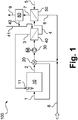
- Figure 1 illustrates a method configured according to an embodiment of the invention in a greatly simplified, schematic representation.
- Figure 1 a method designed according to the invention is illustrated in a greatly simplified, schematic representation and denoted as a whole by 100.
- one or more reactors are used which is or are set up for a propane dehydrogenation 10 and to which a propane-containing reaction feed 1 is fed.
- the reactor or reactors is or are heated with one or more burners 11.
- a component mixture 2 containing propane, propylene and hydrogen is formed and is thus provided in the process 100.
- the production volume is, for example, approx. 50 kta.
- the component mixture 2, or only a part of the component mixture 2 is subjected to cooling 20 and, in particular, a heat exchange with the starting mixture 1.
- the component mixture 2 or its part subjected to cooling, or again only a part thereof, is subjected to a compression 30, in particular a three-stage turbo-compressor driven by an electric motor M in a housing enclosing the three compressor stages being used can.
- the compression takes place in particular to a pressure level of 12 to 15 bar.
- the component mixture or its part subjected to compression 30, or again only a part thereof, is subjected to a first membrane separation 40 as the first separating insert.
- a first permeate 3 enriched in hydrogen and low in propane and propylene or free of propane and propylene and a first retentate 4 depleted in hydrogen compared to the first separating insert, but still containing hydrogen and otherwise propane and propylene, are formed in this example.
- the first membrane separation is carried out without using a propane-containing purge gas and thus the first permeate 3 is not obtained as a permeate charged with propane of a purge gas.
- process variants are also considered in which precisely this takes place.
- the membrane separation 40 is carried out in particular in such a way that a pressure level at which the first permeate 3 is obtained is just high enough that the first permeate 3, or only a part thereof, without further compression of the burner or burners 11 supplied and can be used in this or these as heating gas. If a quantity of the first permeate 3 is not sufficient for heating by means of the burner or burners 11, provision can in particular be made to flush the first membrane separation 30 with a flammable flushing gas, in particular methane or a gas mixture containing methane, in particular with natural gas .
- the first permeate 3 can also be fed into a heating gas network of a corresponding system or a corresponding system network.
- the first retentate 4, or only a part thereof, is subjected as a second separating insert to a second membrane separation 50, in which a purging gas 5 containing at least the majority of the hydrogen contained in the second separating insert, compared to the second separating insert, using a propane-containing second permeate 6 and at least the majority of the Second retentate 7 containing propane and propylene from the second separation insert can be formed.
- the purging gas 5 is used in particular so that, regardless of the reduction in the hydrogen partial pressure that has already taken place in the first membrane separation 40, a sufficient, ie complete or essentially complete, hydrogen separation can take place.
- the second permeate 6 comprises propane of the flushing gas 5 and hydrogen from the second separation insert.
- the second permeate 6 is obtained as a permeate charged with propane from the flushing gas 5.
- the second permeate 6, or only a part thereof, can therefore be recycled in a particularly advantageous manner as part of the reaction insert 1 in the reactor (s) 10, since the propane dehydrogenation carried out there typically uses reaction inserts which contain a certain proportion of hydrogen .
- the second membrane separation can be used both for separating off hydrogen to obtain a propylene product and for metering hydrogen into a reaction insert 1.
- the second retentate 7 is fed to one or more further process steps 60, in particular a separation of propane and propylene and, if necessary, a separation of heavier components.
- a propylene product 9 containing predominantly or exclusively propylene can be formed.
- a fraction containing predominantly or exclusively propane can also be obtained, which fraction can be used as the flushing gas 5.
- the further method step (s) 60 can, in particular, also be part of a steam cracking process with correspondingly assigned separation steps.
Landscapes
- Chemical & Material Sciences (AREA)
- Organic Chemistry (AREA)
- Chemical Kinetics & Catalysis (AREA)
- Engineering & Computer Science (AREA)
- Oil, Petroleum & Natural Gas (AREA)
- Analytical Chemistry (AREA)
- General Chemical & Material Sciences (AREA)
- Water Supply & Treatment (AREA)
- Physics & Mathematics (AREA)
- Thermal Sciences (AREA)
- Organic Low-Molecular-Weight Compounds And Preparation Thereof (AREA)
- Separation Using Semi-Permeable Membranes (AREA)
Claims (14)
- Procédé (100) de production d'un produit à base de propylène (9), selon lequel, à l'aide d'une déshydrogénation de propane (10) à laquelle une charge réactionnelle contenant du propane et de l'hydrogène (1) est soumise, un mélange de composants contenant du propane, du propylène et de l'hydrogène (2) est fourni,- où le mélange de composants (2) ou une partie de celui-ci est soumis, en tant que première charge séparatrice, à une première séparation membranaire (40) au moyen de laquelle un premier perméat (3) enrichi en hydrogène par rapport à la première charge séparatrice, ainsi qu'un premier rétentat (4) appauvri en hydrogène par rapport à la première charge séparatrice et contenant de l'hydrogène, du propane et du propylène, sont formés,- où le premier rétentat (4) ou une partie de celui-ci est soumis, en tant que seconde charge séparatrice, à une seconde séparation membranaire (50), dans laquelle un second perméat (6) contenant au moins la majorité de l'hydrogène de la seconde charge séparatrice, ainsi qu'un second rétentat (7) contenant au moins la majorité du propane et du propylène de la seconde charge séparatrice sont formés,- où la première séparation membranaire (40) est mise en œuvre à l'aide d'un gaz de balayage (5) contenant du propane et le premier perméat (3) est obtenu sous la forme de perméat (3) chargé en propane du gaz de balayage (5) et/ou la seconde séparation membranaire (50) est mise en œuvre à l'aide du gaz de balayage (5) contenant du propane et le second perméat (6) est obtenu sous la forme de perméat (6) chargé en propane du gaz de balayage (5),- où le premier perméat (3) chargé en propane du gaz de balayage (5) et/ou le second perméat (6) chargé en propane du gaz de balayage ou une ou plusieurs parties de ceux-ci sont utilisés dans la formation de la charge réactionnelle (1).
- Procédé selon la revendication 1, selon lequel la charge réactionnelle (1) présente 45 à 95 pour cent en volume de propane et 1 à 50 pour cent en volume d'hydrogène.
- Procédé selon la revendication 1 ou 2, selon lequel le mélange de composants (2) et la première charge séparatrice présentent 40 à 60 % en volume de propane, 20 à 30 % en volume de propylène et 25 à 35 % en volume d'hydrogène.
- Procédé selon l'une quelconque des revendications précédentes, selon lequel le premier rétentat et la seconde charge séparatrice présentent 10 à 20 pour cent en volume d'hydrogène.
- Procédé selon l'une quelconque des revendications précédentes, selon lequel le second rétentat présente 5 à 15 pour cent en volume d'hydrogène.
- Procédé selon l'une quelconque des revendications précédentes, selon lequel le mélange de composants (2) ou sa partie soumise à la première séparation membranaire (40) est soumis(e) à un refroidissement (20) et à une compression (30) avant d'être soumis(e) à la séparation membranaire (40).
- Procédé selon la revendication 6, selon lequel la compression (30) est effectuée à un niveau de pression de 2 à 38 bars.
- Procédé selon la revendication 6 ou 7, selon lequel la compression (30) est réalisée à l'aide d'un ou de plusieurs turbocompresseurs à plusieurs étages, en particulier à deux étages de refroidissement intermédiaires ou moins.
- Procédé selon l'une quelconque des revendications précédentes, selon lequel le second rétentat ou une partie de celui-ci, en particulier à un niveau de pression de 1 à 38 bars, est amené à une ou plusieurs autres étapes de procédé (60).
- Procédé selon la revendication 9, selon lequel la ou les autres étapes de procédé (60) comprennent un procédé de vapocraquage ou une ou plusieurs étapes de séparation associées au procédé de vapocraquage.
- Procédé selon l'une quelconque des revendications précédentes, selon lequel seule la première séparation membranaire (40) est mise en œuvre à l'aide du gaz de balayage (5) contenant du propane et seul le premier perméat (3) est obtenu sous la forme de perméat (3) chargé en propane du gaz de balayage (5) ou selon lequel seule la seconde séparation membranaire (50) est mise en œuvre à l'aide du gaz de balayage (5) contenant du propane et seul le second perméat (6) est obtenu sous la forme de perméat (6) chargé en propane du gaz de balayage (5), où le perméat (3, 6) respectif non chargé en propane du gaz de balayage (5) ou une partie de celui-ci est brûlé dans un ou plusieurs réacteurs utilisés pour la déshydrogénation du propane (10) pour son/leur chauffage.
- Procédé selon la revendication 11, selon lequel le perméat (3, 6) respectif non chargé en propane du gaz de balayage (5) est fourni dans la séparation membranaire (40, 50) à un niveau de pression de 3 à 7 bars.
- Installation de production d'un produit à base de propylène (9), comportant un ou plusieurs réacteurs, lesquels sont conçus pour, à l'aide d'une déshydrogénation de propane (10) à laquelle une charge réactionnelle (1) contenant du propane et de l'hydrogène est soumise, fournir un mélange de composants (2) contenant du propane, du propylène et de l'hydrogène,- des moyens, lesquels sont conçus pour soumettre le mélange de composants (2) ou une partie de celui-ci, en tant que première charge séparatrice, à une première séparation membranaire (40) au moyen de laquelle un premier perméat (3) enrichi en hydrogène par rapport à la première charge séparatrice, ainsi qu'un premier rétentat (4) appauvri en hydrogène par rapport à la première charge séparatrice et contenant de l'hydrogène, du propane et du propylène sont formés,- des moyens, lesquels sont conçus pour soumettre le premier rétentat (4) ou une partie de celui-ci, en tant que seconde charge séparatrice, à une seconde séparation membranaire (50), dans laquelle un second perméat (6) contenant au moins la majorité de l'hydrogène de la seconde charge séparatrice et du propane du gaz de balayage, ainsi qu'un deuxième rétentat, contenant au moins la majorité du propane et du propylène de la seconde charge séparatrice sont formés,- des moyens, lesquels sont conçus pour mettre en œuvre la première séparation membranaire (40) à l'aide d'un gaz de balayage (5) contenant du propane et pour obtenir le premier perméat (3) sous la forme de perméat (3) chargé en propane du gaz de balayage (5) et/ou pour mettre en œuvre la seconde séparation membranaire (50) à l'aide du gaz de balayage (5) contenant du propane et pour obtenir le second perméat (6) sous la forme de perméat (6) chargé en propane du gaz de balayage (5),- des moyens, lesquels sont conçus pour utiliser le premier perméat (3) chargé en propane du gaz de balayage (5) et/ou le second perméat (3) chargé en propane du gaz de balayage ou une ou plusieurs parties de ceux-ci dans la formation de la charge réactionnelle (1).
- Installation selon la revendication 13, laquelle est conçue pour mettre en œuvre un procédé selon l'une quelconque des revendications précédentes.
Priority Applications (6)
| Application Number | Priority Date | Filing Date | Title |
|---|---|---|---|
| ES19159425T ES2903560T3 (es) | 2019-02-26 | 2019-02-26 | Método y sistema para la obtención de un producto de propileno |
| EP19159425.8A EP3702016B1 (fr) | 2019-02-26 | 2019-02-26 | Procédé et installation permettant d'obtenir un produit de propylène |
| CN202080016662.1A CN113474074B (zh) | 2019-02-26 | 2020-02-26 | 用于获得丙烯产品的方法和设备 |
| PCT/EP2020/055058 WO2020174018A1 (fr) | 2019-02-26 | 2020-02-26 | Procédé et installation pour obtenir un produit à base de propylène |
| EP20706292.8A EP3930875A1 (fr) | 2019-02-26 | 2020-02-26 | Procédé et installation pour obtenir un produit à base de propylène |
| US17/433,862 US11505515B2 (en) | 2019-02-26 | 2020-02-26 | Method and system for obtaining a propylene product |
Applications Claiming Priority (1)
| Application Number | Priority Date | Filing Date | Title |
|---|---|---|---|
| EP19159425.8A EP3702016B1 (fr) | 2019-02-26 | 2019-02-26 | Procédé et installation permettant d'obtenir un produit de propylène |
Publications (2)
| Publication Number | Publication Date |
|---|---|
| EP3702016A1 EP3702016A1 (fr) | 2020-09-02 |
| EP3702016B1 true EP3702016B1 (fr) | 2022-01-05 |
Family
ID=65598538
Family Applications (2)
| Application Number | Title | Priority Date | Filing Date |
|---|---|---|---|
| EP19159425.8A Not-in-force EP3702016B1 (fr) | 2019-02-26 | 2019-02-26 | Procédé et installation permettant d'obtenir un produit de propylène |
| EP20706292.8A Withdrawn EP3930875A1 (fr) | 2019-02-26 | 2020-02-26 | Procédé et installation pour obtenir un produit à base de propylène |
Family Applications After (1)
| Application Number | Title | Priority Date | Filing Date |
|---|---|---|---|
| EP20706292.8A Withdrawn EP3930875A1 (fr) | 2019-02-26 | 2020-02-26 | Procédé et installation pour obtenir un produit à base de propylène |
Country Status (5)
| Country | Link |
|---|---|
| US (1) | US11505515B2 (fr) |
| EP (2) | EP3702016B1 (fr) |
| CN (1) | CN113474074B (fr) |
| ES (1) | ES2903560T3 (fr) |
| WO (1) | WO2020174018A1 (fr) |
Families Citing this family (1)
| Publication number | Priority date | Publication date | Assignee | Title |
|---|---|---|---|---|
| US12012557B2 (en) | 2021-12-28 | 2024-06-18 | Uop Llc | Start-up method for contacting a feed stream with fluidized catalyst |
Family Cites Families (7)
| Publication number | Priority date | Publication date | Assignee | Title |
|---|---|---|---|---|
| US5634354A (en) * | 1996-05-08 | 1997-06-03 | Air Products And Chemicals, Inc. | Olefin recovery from olefin-hydrogen mixtures |
| FR2853899B1 (fr) * | 2003-04-18 | 2007-12-28 | Air Liquide | Procede de traitement d'un melange gazeux comprenant du propane et du propylene |
| US7329791B2 (en) * | 2004-03-31 | 2008-02-12 | Uchicago Argonne, Llc | Hydrogen transport membranes for dehydrogenation reactions |
| US7875758B2 (en) * | 2007-01-08 | 2011-01-25 | L'air Liquide, Societe Anonyme Pour L'etude Et L'exploitation Des Procedes George Claude | Systems and methods for the separation of propylene and propane |
| EP2505573A1 (fr) * | 2011-03-29 | 2012-10-03 | Stamicarbon B.V. acting under the name of MT Innovation Center | Procédé de production d'oléfines |
| WO2016140574A1 (fr) * | 2015-03-05 | 2016-09-09 | Stamicarbon B.V. Acting Under The Name Of Mt Innovation Center | Système et procédé de production d'alcènes par la déshydrogénation d'alcanes |
| FI126341B (en) * | 2015-09-18 | 2016-10-14 | Neste Oyj | Method for separating and purifying renewable propane |
-
2019
- 2019-02-26 ES ES19159425T patent/ES2903560T3/es active Active
- 2019-02-26 EP EP19159425.8A patent/EP3702016B1/fr not_active Not-in-force
-
2020
- 2020-02-26 EP EP20706292.8A patent/EP3930875A1/fr not_active Withdrawn
- 2020-02-26 WO PCT/EP2020/055058 patent/WO2020174018A1/fr not_active Ceased
- 2020-02-26 US US17/433,862 patent/US11505515B2/en active Active
- 2020-02-26 CN CN202080016662.1A patent/CN113474074B/zh not_active Expired - Fee Related
Also Published As
| Publication number | Publication date |
|---|---|
| CN113474074A (zh) | 2021-10-01 |
| EP3930875A1 (fr) | 2022-01-05 |
| US11505515B2 (en) | 2022-11-22 |
| WO2020174018A1 (fr) | 2020-09-03 |
| CN113474074B (zh) | 2024-03-19 |
| ES2903560T3 (es) | 2022-04-04 |
| US20220144726A1 (en) | 2022-05-12 |
| EP3702016A1 (fr) | 2020-09-02 |
Similar Documents
| Publication | Publication Date | Title |
|---|---|---|
| EP3535232B1 (fr) | Procédé et installation de fabrication d'oléfines | |
| EP3498668A1 (fr) | Procédé et installation destinées à l'obtention des oléfines | |
| EP2917305A1 (fr) | Procédé de production de produits oléfiniques par vapocraquage thermique | |
| EP3558912B1 (fr) | Procédé et installation de production d'une oléfine | |
| DD145638A5 (de) | Verfahren zur herstellung einer kohlenwasserstofffraktion | |
| EP3652138B1 (fr) | Procédé et installation de fabrication de propylène par combinaison de déshydrogénation de propane et procédé de vapocraquage avec stages de pre-séparation dans les deux procédés pour éliminer hydrogène et méthane | |
| DE60219736T2 (de) | Hydrierverfahren | |
| DE1770178B1 (de) | Verfahren zum katalytischen Reformieren einer Kohlenwasserstoffbeschickung | |
| EP3513863A1 (fr) | Procédé et installation destinés à l'obtention d'hélium pur | |
| EP3068849B1 (fr) | Procédé de séparation d'un mélange d'hydrocarbures | |
| EP3702016B1 (fr) | Procédé et installation permettant d'obtenir un produit de propylène | |
| EP3020696B1 (fr) | Procede de fabrication d'un ou plusieurs produits de reaction | |
| EP3931170B1 (fr) | Procédé et installation destinés à la production d'un produit du butylène | |
| EP3652137A1 (fr) | Procédé et installation pour la production de propylène par combinaison d'une déshydrogénation de propane et d'un procédé de vapocraquage avec recyclage du propane dans le procédé de vapocraquage | |
| DE102019115388A1 (de) | Verfahren und Anlage zur Gewinnung eines Olefins | |
| EP3510008B1 (fr) | Procédé et installation de production de benzène | |
| DE3617280C2 (de) | Verfahren zur Gewinnung von Kohlenmonoxid | |
| EP3992172A1 (fr) | Procédé et installation de production d'oléfines | |
| DE1802396A1 (de) | Verfahren zur Trennung von Kohlenwasserstoffgemischen | |
| WO2017068161A1 (fr) | Procédé de production d'oléfines | |
| DE102019115382A1 (de) | Verfahren und Anlage zur Gewinnung eines oder mehrerer Olefine | |
| DE2233826C3 (de) | Verfahren zur Herstellung von Erdöl-Flüssiggas durch zweistufige Hydrocrackung | |
| AT232628B (de) | Verfahren zur Umwandlung eines Einsatzes von benzinfreien schweren Kohlenwasserstoffölen | |
| DE1907624A1 (de) | Verfahren zur Umwandlung eines Erdoeleinsatzmaterials | |
| DE102019115402A1 (de) | Verfahren und Anlage zur Gewinnung eines Olefins |
Legal Events
| Date | Code | Title | Description |
|---|---|---|---|
| PUAI | Public reference made under article 153(3) epc to a published international application that has entered the european phase |
Free format text: ORIGINAL CODE: 0009012 |
|
| STAA | Information on the status of an ep patent application or granted ep patent |
Free format text: STATUS: THE APPLICATION HAS BEEN PUBLISHED |
|
| AK | Designated contracting states |
Kind code of ref document: A1 Designated state(s): AL AT BE BG CH CY CZ DE DK EE ES FI FR GB GR HR HU IE IS IT LI LT LU LV MC MK MT NL NO PL PT RO RS SE SI SK SM TR |
|
| AX | Request for extension of the european patent |
Extension state: BA ME |
|
| STAA | Information on the status of an ep patent application or granted ep patent |
Free format text: STATUS: REQUEST FOR EXAMINATION WAS MADE |
|
| 17P | Request for examination filed |
Effective date: 20210224 |
|
| RBV | Designated contracting states (corrected) |
Designated state(s): AL AT BE BG CH CY CZ DE DK EE ES FI FR GB GR HR HU IE IS IT LI LT LU LV MC MK MT NL NO PL PT RO RS SE SI SK SM TR |
|
| GRAP | Despatch of communication of intention to grant a patent |
Free format text: ORIGINAL CODE: EPIDOSNIGR1 |
|
| STAA | Information on the status of an ep patent application or granted ep patent |
Free format text: STATUS: GRANT OF PATENT IS INTENDED |
|
| INTG | Intention to grant announced |
Effective date: 20210728 |
|
| GRAS | Grant fee paid |
Free format text: ORIGINAL CODE: EPIDOSNIGR3 |
|
| GRAA | (expected) grant |
Free format text: ORIGINAL CODE: 0009210 |
|
| STAA | Information on the status of an ep patent application or granted ep patent |
Free format text: STATUS: THE PATENT HAS BEEN GRANTED |
|
| AK | Designated contracting states |
Kind code of ref document: B1 Designated state(s): AL AT BE BG CH CY CZ DE DK EE ES FI FR GB GR HR HU IE IS IT LI LT LU LV MC MK MT NL NO PL PT RO RS SE SI SK SM TR |
|
| REG | Reference to a national code |
Ref country code: GB Ref legal event code: FG4D Free format text: NOT ENGLISH |
|
| REG | Reference to a national code |
Ref country code: CH Ref legal event code: EP |
|
| REG | Reference to a national code |
Ref country code: AT Ref legal event code: REF Ref document number: 1460021 Country of ref document: AT Kind code of ref document: T Effective date: 20220115 |
|
| REG | Reference to a national code |
Ref country code: DE Ref legal event code: R096 Ref document number: 502019003132 Country of ref document: DE |
|
| REG | Reference to a national code |
Ref country code: IE Ref legal event code: FG4D Free format text: LANGUAGE OF EP DOCUMENT: GERMAN |
|
| REG | Reference to a national code |
Ref country code: ES Ref legal event code: FG2A Ref document number: 2903560 Country of ref document: ES Kind code of ref document: T3 Effective date: 20220404 |
|
| REG | Reference to a national code |
Ref country code: LT Ref legal event code: MG9D |
|
| REG | Reference to a national code |
Ref country code: NL Ref legal event code: MP Effective date: 20220105 |
|
| PG25 | Lapsed in a contracting state [announced via postgrant information from national office to epo] |
Ref country code: NL Free format text: LAPSE BECAUSE OF FAILURE TO SUBMIT A TRANSLATION OF THE DESCRIPTION OR TO PAY THE FEE WITHIN THE PRESCRIBED TIME-LIMIT Effective date: 20220105 |
|
| PG25 | Lapsed in a contracting state [announced via postgrant information from national office to epo] |
Ref country code: SE Free format text: LAPSE BECAUSE OF FAILURE TO SUBMIT A TRANSLATION OF THE DESCRIPTION OR TO PAY THE FEE WITHIN THE PRESCRIBED TIME-LIMIT Effective date: 20220105 Ref country code: RS Free format text: LAPSE BECAUSE OF FAILURE TO SUBMIT A TRANSLATION OF THE DESCRIPTION OR TO PAY THE FEE WITHIN THE PRESCRIBED TIME-LIMIT Effective date: 20220105 Ref country code: PT Free format text: LAPSE BECAUSE OF FAILURE TO SUBMIT A TRANSLATION OF THE DESCRIPTION OR TO PAY THE FEE WITHIN THE PRESCRIBED TIME-LIMIT Effective date: 20220505 Ref country code: NO Free format text: LAPSE BECAUSE OF FAILURE TO SUBMIT A TRANSLATION OF THE DESCRIPTION OR TO PAY THE FEE WITHIN THE PRESCRIBED TIME-LIMIT Effective date: 20220405 Ref country code: LT Free format text: LAPSE BECAUSE OF FAILURE TO SUBMIT A TRANSLATION OF THE DESCRIPTION OR TO PAY THE FEE WITHIN THE PRESCRIBED TIME-LIMIT Effective date: 20220105 Ref country code: HR Free format text: LAPSE BECAUSE OF FAILURE TO SUBMIT A TRANSLATION OF THE DESCRIPTION OR TO PAY THE FEE WITHIN THE PRESCRIBED TIME-LIMIT Effective date: 20220105 Ref country code: BG Free format text: LAPSE BECAUSE OF FAILURE TO SUBMIT A TRANSLATION OF THE DESCRIPTION OR TO PAY THE FEE WITHIN THE PRESCRIBED TIME-LIMIT Effective date: 20220405 |
|
| PG25 | Lapsed in a contracting state [announced via postgrant information from national office to epo] |
Ref country code: PL Free format text: LAPSE BECAUSE OF FAILURE TO SUBMIT A TRANSLATION OF THE DESCRIPTION OR TO PAY THE FEE WITHIN THE PRESCRIBED TIME-LIMIT Effective date: 20220105 Ref country code: LV Free format text: LAPSE BECAUSE OF FAILURE TO SUBMIT A TRANSLATION OF THE DESCRIPTION OR TO PAY THE FEE WITHIN THE PRESCRIBED TIME-LIMIT Effective date: 20220105 Ref country code: GR Free format text: LAPSE BECAUSE OF FAILURE TO SUBMIT A TRANSLATION OF THE DESCRIPTION OR TO PAY THE FEE WITHIN THE PRESCRIBED TIME-LIMIT Effective date: 20220406 Ref country code: FI Free format text: LAPSE BECAUSE OF FAILURE TO SUBMIT A TRANSLATION OF THE DESCRIPTION OR TO PAY THE FEE WITHIN THE PRESCRIBED TIME-LIMIT Effective date: 20220105 |
|
| PG25 | Lapsed in a contracting state [announced via postgrant information from national office to epo] |
Ref country code: IS Free format text: LAPSE BECAUSE OF FAILURE TO SUBMIT A TRANSLATION OF THE DESCRIPTION OR TO PAY THE FEE WITHIN THE PRESCRIBED TIME-LIMIT Effective date: 20220505 |
|
| REG | Reference to a national code |
Ref country code: DE Ref legal event code: R097 Ref document number: 502019003132 Country of ref document: DE |
|
| REG | Reference to a national code |
Ref country code: CH Ref legal event code: PL |
|
| PG25 | Lapsed in a contracting state [announced via postgrant information from national office to epo] |
Ref country code: SM Free format text: LAPSE BECAUSE OF FAILURE TO SUBMIT A TRANSLATION OF THE DESCRIPTION OR TO PAY THE FEE WITHIN THE PRESCRIBED TIME-LIMIT Effective date: 20220105 Ref country code: SK Free format text: LAPSE BECAUSE OF FAILURE TO SUBMIT A TRANSLATION OF THE DESCRIPTION OR TO PAY THE FEE WITHIN THE PRESCRIBED TIME-LIMIT Effective date: 20220105 Ref country code: RO Free format text: LAPSE BECAUSE OF FAILURE TO SUBMIT A TRANSLATION OF THE DESCRIPTION OR TO PAY THE FEE WITHIN THE PRESCRIBED TIME-LIMIT Effective date: 20220105 Ref country code: MC Free format text: LAPSE BECAUSE OF FAILURE TO SUBMIT A TRANSLATION OF THE DESCRIPTION OR TO PAY THE FEE WITHIN THE PRESCRIBED TIME-LIMIT Effective date: 20220105 Ref country code: LU Free format text: LAPSE BECAUSE OF NON-PAYMENT OF DUE FEES Effective date: 20220226 Ref country code: EE Free format text: LAPSE BECAUSE OF FAILURE TO SUBMIT A TRANSLATION OF THE DESCRIPTION OR TO PAY THE FEE WITHIN THE PRESCRIBED TIME-LIMIT Effective date: 20220105 Ref country code: DK Free format text: LAPSE BECAUSE OF FAILURE TO SUBMIT A TRANSLATION OF THE DESCRIPTION OR TO PAY THE FEE WITHIN THE PRESCRIBED TIME-LIMIT Effective date: 20220105 Ref country code: CZ Free format text: LAPSE BECAUSE OF FAILURE TO SUBMIT A TRANSLATION OF THE DESCRIPTION OR TO PAY THE FEE WITHIN THE PRESCRIBED TIME-LIMIT Effective date: 20220105 |
|
| PLBE | No opposition filed within time limit |
Free format text: ORIGINAL CODE: 0009261 |
|
| STAA | Information on the status of an ep patent application or granted ep patent |
Free format text: STATUS: NO OPPOSITION FILED WITHIN TIME LIMIT |
|
| PG25 | Lapsed in a contracting state [announced via postgrant information from national office to epo] |
Ref country code: AL Free format text: LAPSE BECAUSE OF FAILURE TO SUBMIT A TRANSLATION OF THE DESCRIPTION OR TO PAY THE FEE WITHIN THE PRESCRIBED TIME-LIMIT Effective date: 20220105 |
|
| 26N | No opposition filed |
Effective date: 20221006 |
|
| PG25 | Lapsed in a contracting state [announced via postgrant information from national office to epo] |
Ref country code: LI Free format text: LAPSE BECAUSE OF NON-PAYMENT OF DUE FEES Effective date: 20220228 Ref country code: IE Free format text: LAPSE BECAUSE OF NON-PAYMENT OF DUE FEES Effective date: 20220226 Ref country code: FR Free format text: LAPSE BECAUSE OF NON-PAYMENT OF DUE FEES Effective date: 20220305 Ref country code: CH Free format text: LAPSE BECAUSE OF NON-PAYMENT OF DUE FEES Effective date: 20220228 |
|
| PG25 | Lapsed in a contracting state [announced via postgrant information from national office to epo] |
Ref country code: SI Free format text: LAPSE BECAUSE OF FAILURE TO SUBMIT A TRANSLATION OF THE DESCRIPTION OR TO PAY THE FEE WITHIN THE PRESCRIBED TIME-LIMIT Effective date: 20220105 |
|
| PG25 | Lapsed in a contracting state [announced via postgrant information from national office to epo] |
Ref country code: IT Free format text: LAPSE BECAUSE OF FAILURE TO SUBMIT A TRANSLATION OF THE DESCRIPTION OR TO PAY THE FEE WITHIN THE PRESCRIBED TIME-LIMIT Effective date: 20220105 |
|
| GBPC | Gb: european patent ceased through non-payment of renewal fee |
Effective date: 20230226 |
|
| PG25 | Lapsed in a contracting state [announced via postgrant information from national office to epo] |
Ref country code: GB Free format text: LAPSE BECAUSE OF NON-PAYMENT OF DUE FEES Effective date: 20230226 |
|
| PG25 | Lapsed in a contracting state [announced via postgrant information from national office to epo] |
Ref country code: GB Free format text: LAPSE BECAUSE OF NON-PAYMENT OF DUE FEES Effective date: 20230226 |
|
| PGFP | Annual fee paid to national office [announced via postgrant information from national office to epo] |
Ref country code: ES Payment date: 20240319 Year of fee payment: 6 |
|
| PG25 | Lapsed in a contracting state [announced via postgrant information from national office to epo] |
Ref country code: MK Free format text: LAPSE BECAUSE OF FAILURE TO SUBMIT A TRANSLATION OF THE DESCRIPTION OR TO PAY THE FEE WITHIN THE PRESCRIBED TIME-LIMIT Effective date: 20220105 Ref country code: CY Free format text: LAPSE BECAUSE OF FAILURE TO SUBMIT A TRANSLATION OF THE DESCRIPTION OR TO PAY THE FEE WITHIN THE PRESCRIBED TIME-LIMIT Effective date: 20220105 |
|
| PGFP | Annual fee paid to national office [announced via postgrant information from national office to epo] |
Ref country code: DE Payment date: 20240216 Year of fee payment: 6 |
|
| PG25 | Lapsed in a contracting state [announced via postgrant information from national office to epo] |
Ref country code: HU Free format text: LAPSE BECAUSE OF FAILURE TO SUBMIT A TRANSLATION OF THE DESCRIPTION OR TO PAY THE FEE WITHIN THE PRESCRIBED TIME-LIMIT; INVALID AB INITIO Effective date: 20190226 |
|
| PGFP | Annual fee paid to national office [announced via postgrant information from national office to epo] |
Ref country code: BE Payment date: 20240219 Year of fee payment: 6 |
|
| PG25 | Lapsed in a contracting state [announced via postgrant information from national office to epo] |
Ref country code: MT Free format text: LAPSE BECAUSE OF FAILURE TO SUBMIT A TRANSLATION OF THE DESCRIPTION OR TO PAY THE FEE WITHIN THE PRESCRIBED TIME-LIMIT Effective date: 20220105 |
|
| REG | Reference to a national code |
Ref country code: AT Ref legal event code: MM01 Ref document number: 1460021 Country of ref document: AT Kind code of ref document: T Effective date: 20240226 |
|
| PG25 | Lapsed in a contracting state [announced via postgrant information from national office to epo] |
Ref country code: AT Free format text: LAPSE BECAUSE OF NON-PAYMENT OF DUE FEES Effective date: 20240226 |
|
| REG | Reference to a national code |
Ref country code: DE Ref legal event code: R119 Ref document number: 502019003132 Country of ref document: DE |
|
| REG | Reference to a national code |
Ref country code: BE Ref legal event code: MM Effective date: 20250228 |
|
| PG25 | Lapsed in a contracting state [announced via postgrant information from national office to epo] |
Ref country code: TR Free format text: LAPSE BECAUSE OF FAILURE TO SUBMIT A TRANSLATION OF THE DESCRIPTION OR TO PAY THE FEE WITHIN THE PRESCRIBED TIME-LIMIT Effective date: 20220105 |
|
| PG25 | Lapsed in a contracting state [announced via postgrant information from national office to epo] |
Ref country code: DE Free format text: LAPSE BECAUSE OF NON-PAYMENT OF DUE FEES Effective date: 20250902 |
|
| PG25 | Lapsed in a contracting state [announced via postgrant information from national office to epo] |
Ref country code: BE Free format text: LAPSE BECAUSE OF NON-PAYMENT OF DUE FEES Effective date: 20250228 |
|
| REG | Reference to a national code |
Ref country code: ES Ref legal event code: FD2A Effective date: 20260330 |
|
| PG25 | Lapsed in a contracting state [announced via postgrant information from national office to epo] |
Ref country code: ES Free format text: LAPSE BECAUSE OF NON-PAYMENT OF DUE FEES Effective date: 20250227 |
|
| PGFP | Annual fee paid to national office [announced via postgrant information from national office to epo] |
Ref country code: AT Payment date: 20260410 Year of fee payment: 5 |